Flashback : Dallas

A Miscellany: History, Ads, Pop Culture

Lucy, Desi, Dallas — 1956

lucy-desi_fw_bellaircraftLucille Ball and Desi Arnaz and their loaner ‘copter from Bell Aircraft

by Paula Bosse

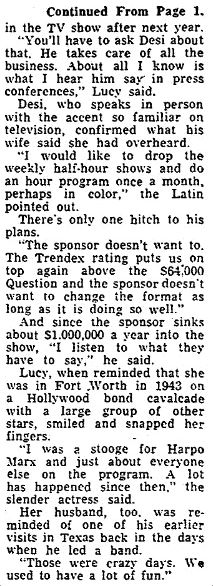
Lucille Ball and Desi Arnaz came to Dallas and Fort Worth in 1956 to promote their new movie, “Forever Darling.” Their arrival times were heavily publicized, and throngs of fans showed up to welcome them — in Dallas at Love Field, and in Fort Worth at the Western Hills Hotel. For those who might have missed their arrivals, they still had a chance to see the couple at one of the personal appearances scheduled at the theaters showing their movie (in Dallas at the Majestic on February 10th, and in Fort Worth at the Hollywood on the 11th). Crowds were large and enthusiastic, and everyone appears to have had a genuinely fun time, possibly even Lucy and Desi, whose relationship in those days was frequently a bit shaky.

Best of all was the tidbit about how the famous couple traveled from Dallas to Fort Worth: by helicopter.

Two television stars will be sailing around above Dallas skyscrapers Saturday. …Lucille Ball and Desi Arnaz will catch a helicopter ride from atop the Statler Hilton for a trip to Fort Worth. City Council officially sanctioned the ride at its Monday meeting. (Dallas Morning News, Feb. 7, 1956)

They left from the helipad atop the Statler Hilton and touched down at the helipad at the Western Hills Hotel in Fort Worth (hotels are nothing without helipads). There was some sort of cordial relationship between the Arnazes and the people at Bell Aircraft, because they availed themselves of this brand new deluxe chopper in New York as well as in DFW. When their promotional duties were finished, Lucy and Desi left Cowtown for California as guests of the president of the Santa Fe Railway — in his private car. Because that’s how you travel if you’re Hollywood royalty.

*

lucy-desi_dmn_020856-detFeb 8, 1956
*

lucy-desi_dmn_021156-photolucy-desi_dmn_021156-captionDMN, Feb. 11, 1956

(Leon Craker, I bet you had a great story about this for years after this momentous meeting.) 

*

In Fort Worth, Elston Brooks (whose amusing articles I’ve really enjoyed discovering these past few months), seemed underwhelmed and a little annoyed at the prospect of  “lovable Lucy and spouse” invading the city (click articles to see larger images):
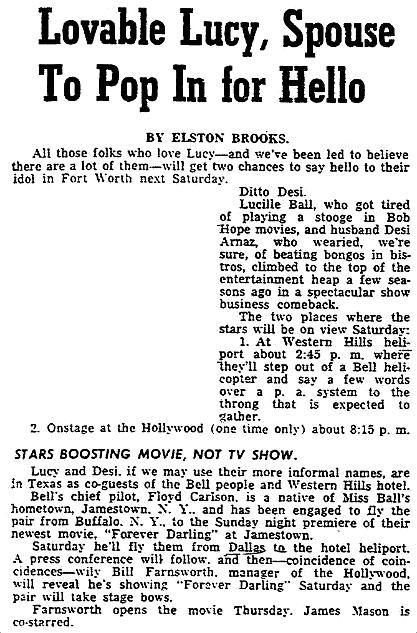
lucy-desi_FWST_020556Fort Worth Star-Telegram, Feb. 5, 1956
*

Elson Brooks may not have been very excited, but when Lucy and Desi stepped out of that helicopter, the Fort Worth crowd went wild (click text for larger image):

lucy-desi_FWST_021256-photo

lucy-desi_FWST_021256a

lucy-desi_FWST_021256bFWST, Feb. 12, 1956

*

And here they are back in Los Angeles, with Desi Jr., at the end of a busy promotional tour. Desi is proudly wearing the cowboy hat he’d been given in Fort Worth. And he looks damn good in it.

lucy-desi_dfw

***

Sources & Notes

Top photo of Lucy and Desi standing next to the 1956 Bell 47H-1 (“one of the world’s first executive helicopters”) is from the August 2012 issue of Vintage Aircraft Magazine; photo from Bell Aircraft. The article concerning this helicopter model is contained in a PDF here.

The bottom photo is from a Pinterest page, here.

UPDATE: I had originally identified the photo of Lucy and Desi with the train as having probably been taken in Fort Worth as they were about to depart for Hollywood, mainly because they’re wearing similar clothing from the FW appearance, but a rail historian noted that this photo was actually taken in California at the Los Angeles Union Passenger Terminal — he could tell because he recognized the part of the platform structure over their heads! (“I can name that song in TWO notes!”) The photo he directed me which shows the LAUPT platform (and, in fact, the same engine, two years earlier!), is here. They probably took the final photo for the Santa Fe company as thanks for providing them with transportation back home in the president’s private car. (Thanks, Skip!)

*

And because today is Lucille Ball’s birthday (which I know only because she shares a birthday with my aunt — happy birthday, Bettye Jo!), it seems like a good time to wheel out this strikingly beautiful portrait of Lucy, along with a wonderful photograph of her from about the same time (probably between 1928 and 1930).
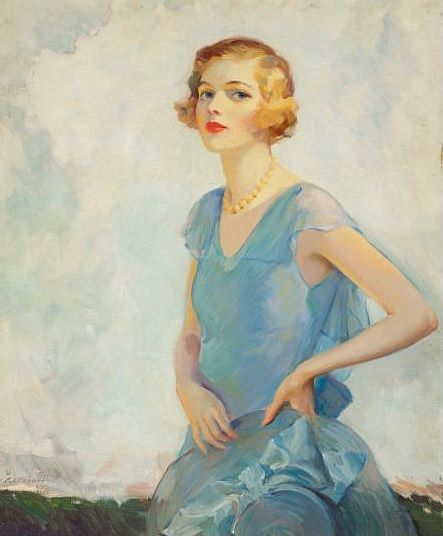
lucilleballportrait

lucilleball-ca1930

*

Copyright © 2014 Paula Bosse. All Rights Reserved.

 

Thank You, Alan Peppard/Dallas Morning News!

dmn_guide-live_logo

by Paula Bosse

Thanks to Alan Peppard of The Dallas Morning News for picking up the Powell University Training School story (and for saying such nice things about me and the blog)! Thank you, Alan!

Check out Alan’s article “Century-old school still stands in the shadow of SMU and Hotel Lumen” here.

If you missed the original Flashback: Dallas post, see it here.

*

Copyright © 2014 Paula Bosse. All Rights Reserved.
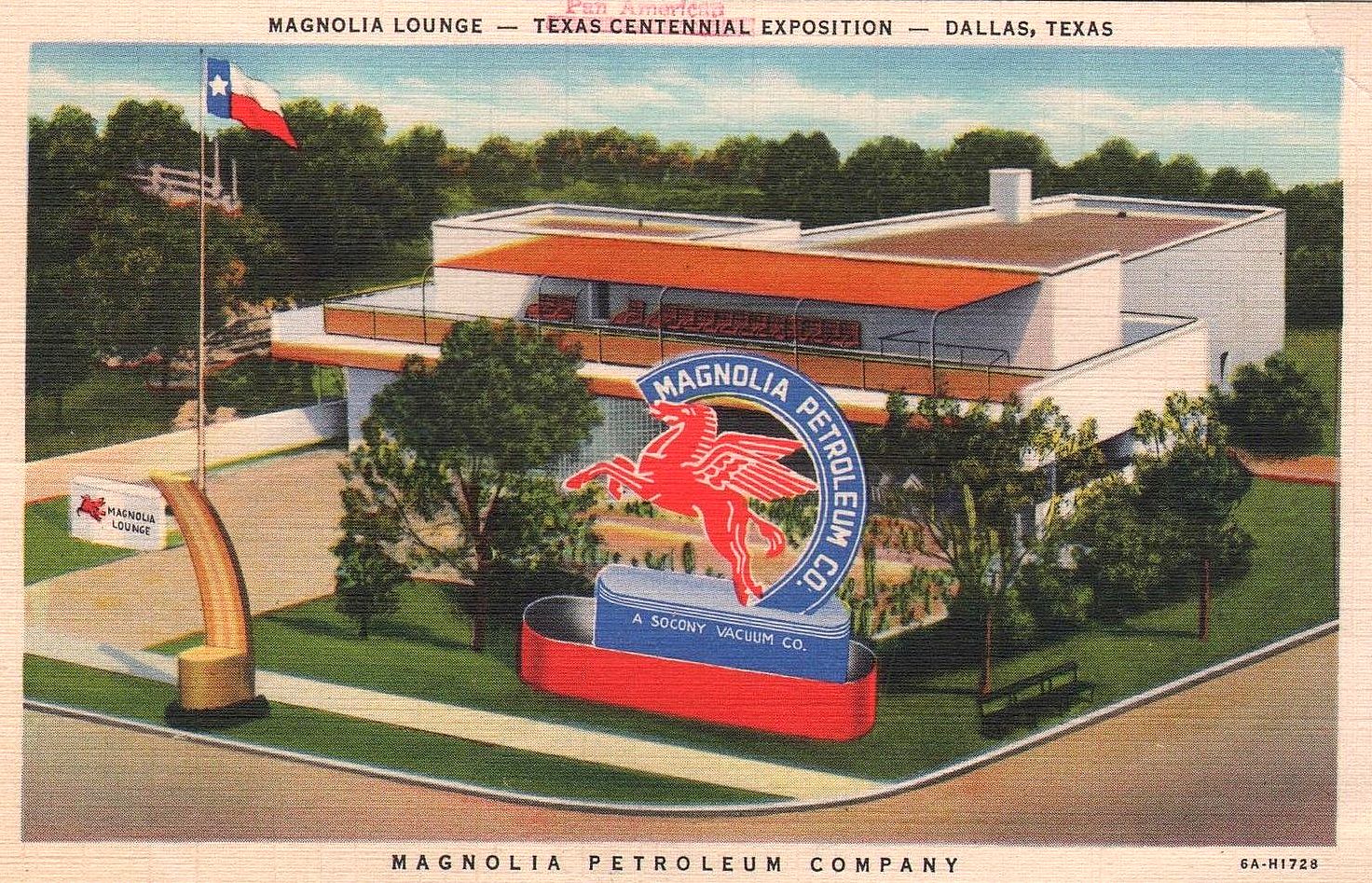
William Lescaze’s Ultramodern Magnolia Lounge — 1936

magnolia-lounge_tx-centennial

by Paula Bosse

The sleekly cool Magnolia Lounge, designed by Swiss-born American architect William Lescaze for the Texas Centennial, is considered the first International-style building built in Texas, and though it feels perfectly at home in Art Deco Fair Park, it looks completely different and much more modern that the buildings around it. It was built by the Magnolia Petroleum Company as a place for visitors to the Centennial Exposition to relax and cool off (it boasted a 20-ton refrigeration plant). The Magnolia Company’s slogan for their building was “Be Our Guest and Rest at the Magnolia Lounge.” In other words, this was the most insistently fabulous rest stop ever built!

How did we GET this cool building? Two words: Stanley Marcus.

“Young retailer Stanley Marcus was dispatched to New York City by Dallas-based Magnolia Petroleum to find the most up-to-date architect of the United States for their Centennial pavilion. Marcus chose William Lescaze, who had just designed the first International-style skyscraper in the United States [the PSFS Building in Philadelphia, which opened in 1932].” (– Virginia Savage McAlester)

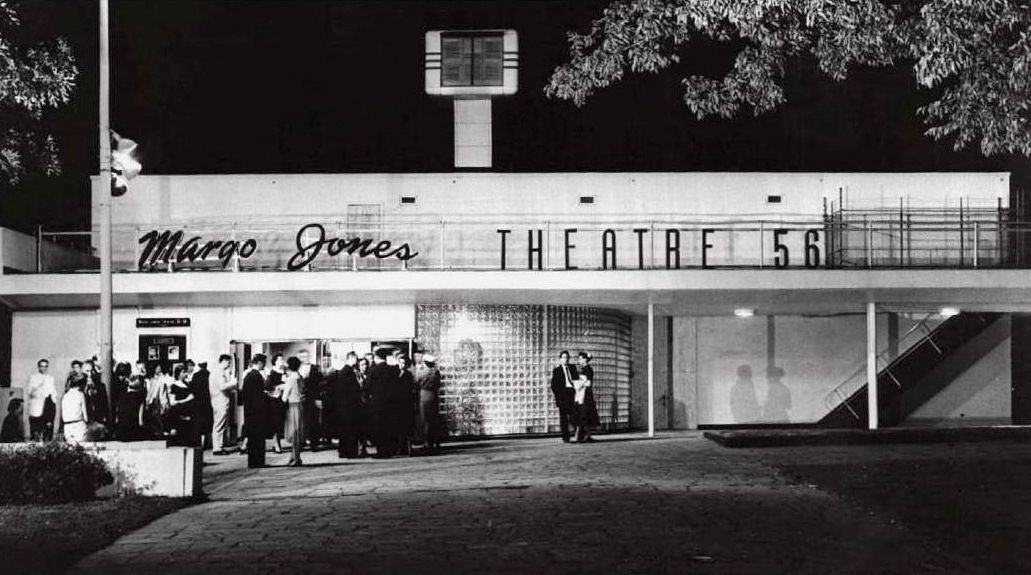
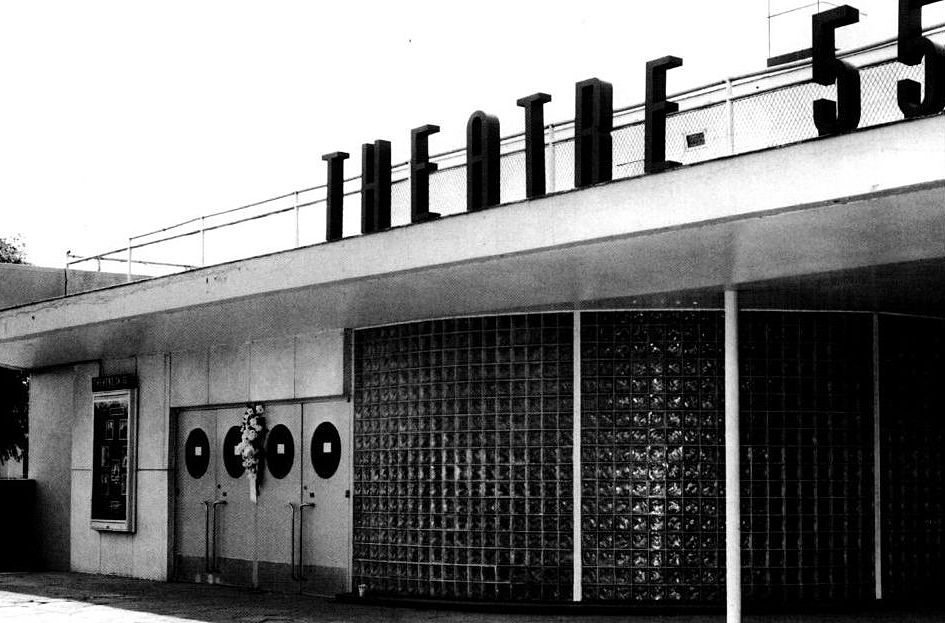
It was a popular oil company-branded “comfort station” for fair visitors until 1942 when the Magnolia Petroleum Co. (who had owned the building), gave title of the Magnolia Lounge to the State Fair, which used it for many years to house its general offices. In 1947, the space became Theatre ’47, Margo Jones’ legendary regional theater where, among other achievements, she produced plays of a young Tennessee Williams and introduced the innovation of theater-in-the-round. After Jones’ death in 1955, the theater carried on for a few years but eventually closed in 1959. After some difficult lean years for the building (during which demolition was considered!), it has been home to organizations such as the Friends of Fair Park, and it is now an active performance space again. And all is well with the world.

margo-jones_theatre-56_dpl

***

Sources & Notes

Postcard of the Magnolia Lounge from the vast wilds of the internet. Click it. It’s huge.

The Virginia McAlester quote is from a Friends of Fair Park advertising section in the Oct. 1989 issue of Texas Monthly.

Photograph of Theatre ’56 from Historic Dallas Theatres by D. Troy Sherrod, from the collection of the Dallas Public Library. (The theater struggled to continue after the sudden death of Margo Jones in 1955, which I wrote about here.)

For more on the history of the Magnolia Lounge, see the official Fair Park home page here; also, check out the the City of Dallas page devoted to this building, here.

And for more on this cool building, particularly in connection with Margo Jones, see the page on the always informative Watermelon Kid site, here.

A lengthy description of the building can be found in the article “Daylight Movies of Texas Scenes To Reward Visitors to Magnolia’s Cool Lounge” (The Dallas Morning News, April 26, 1936).

The Wikipedia page on architect William Lescaze is here.

*

Copyright © 2014 Paula Bosse. All Rights Reserved.
 

Margo Jones & Jim Beck: Both Legends in Their Fields, Both Victims of Carbon Tetrachloride

margo_tennessee
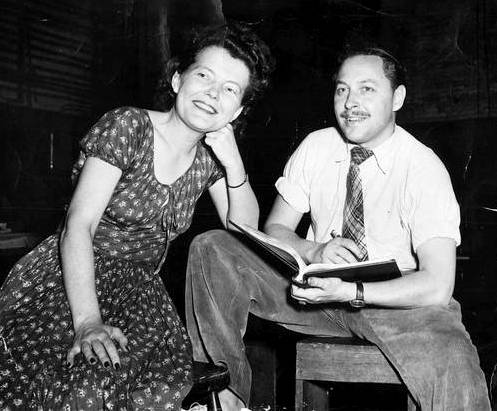
Margo Jones with Tennessee Williams

by Paula Bosse

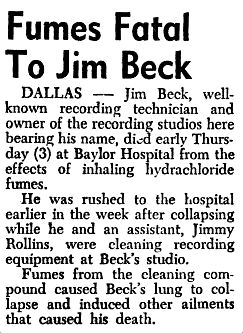
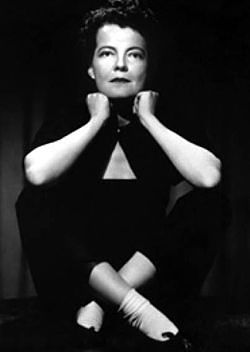
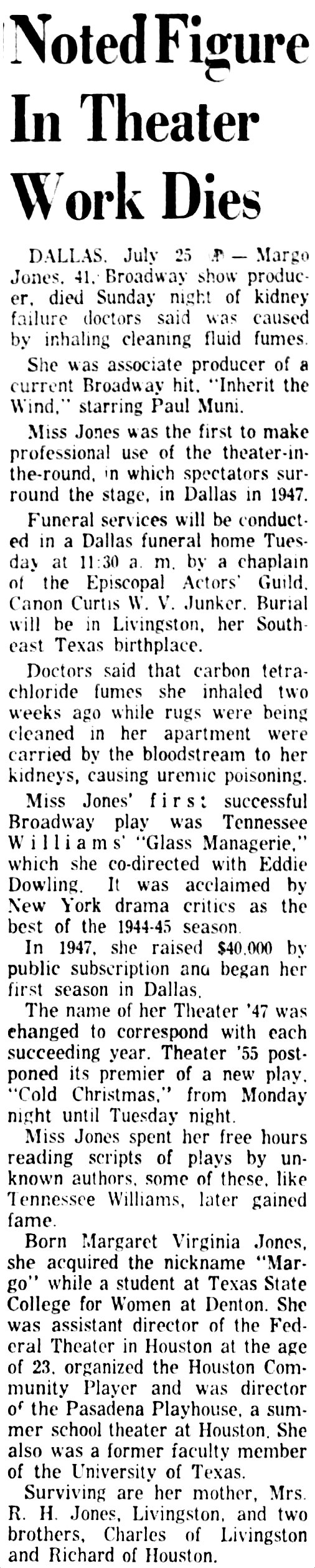
In reading about Dallas theater legend Margo Jones, I saw that she died from inhaling the lingering fumes of a cleaning agent that had been used to clean a rug in her apartment at the Stoneleigh Hotel: carbon tetrachloride. The only thing I knew about carbon tetrachloride was that it had also caused the early death of legendary recording engineer and producer Jim Beck (the man who discovered and produced the first records of Lefty Frizzell, Ray Price, et al.); Beck had been cleaning his recording equipment and had been overcome by the fumes. Both were rushed to the hospital when they were discovered unconscious, and both died about ten days later.

Margo Jones died on July 24, 1955, and Beck died less than a year later, on May 3, 1956. Jones was in her early 40s — Beck was only 39. Margo Jones was a creative powerhouse who was already revolutionizing regional theater, and Jim Beck’s enormous talent was the sole reason that Columbia Records was on the brink of moving their operations from Nashville to Dallas (a move that might very well have set the wheels in motion for Dallas to overtake Nashville as the nation’s recording center for country music). It is such a loss that both died so young,victims of something as mundane as cleaning fluid. With so much remarkable potential ahead of them, it’s sobering to imagine how different Dallas theater and the Dallas recording industry would be today had their careers lasted another two or three or four decades.

margo-jones-photo

margo-jones_austin-american_072655_obitAustin American, July  26, 1955 (click to see larger image)

margo-jones_wreath_legacies_fall-2004Margo Jones’ Theatre ’55 with wreath on door (click for larger image)

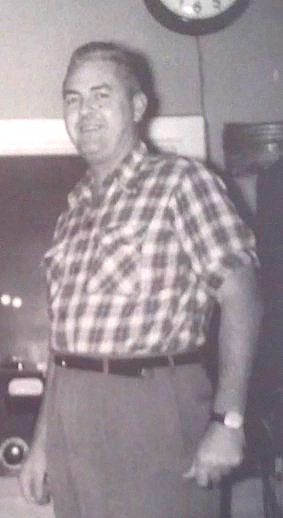
jim-beck_detJim Beck in his studio

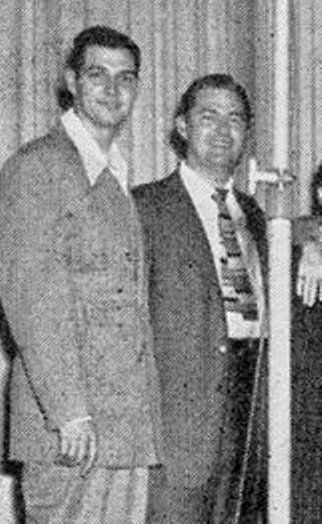
jim-beck_hank-thompson_liberty-jamboree_c1951-detJim Beck (right) with Hank Thompson

jim-beck_billboard_051256bBillboard, May 12, 1956

jim-beck-studio-logo

***

Sources & Notes

Photo of Theatre ’55 (formerly the Magnolia Lounge in Fair Park) with wreath is from the story “‘I’m Doing It, Darling!’ — Dallas, Margo Jones, and Inherit the Wind” by Kay Cattarulla (Legacies, Fall, 2004 issue), which can be read here.

First photo of Jim Beck (which has been cropped) is from the Bear Family CD box set “Lefty Frizzell: Life’s Like Poetry.”

Photo of Jim Beck and country recording star Hank Thompson is a (cropped) Liberty Jamboree promotional photo, circa 1951.

Jim Beck Studio logo from the Handbook of Texas entry for the recording industry in Texas, here.

Margo Jones is very important. Read why here.

Jim Beck is very important. Read why here.

A bit morbid, perhaps, but Margo Jones’ death certificate can be viewed here; Jim Beck’s death certificate, here.

And, finally … kids, stay away from that carbon tetrachloride. It’s bad stuff.

For my previous post “Lefty Frizzell: It All Began on Ross Avenue,” click here.

*

Copyright © 2014 Paula Bosse. All Rights Reserved.
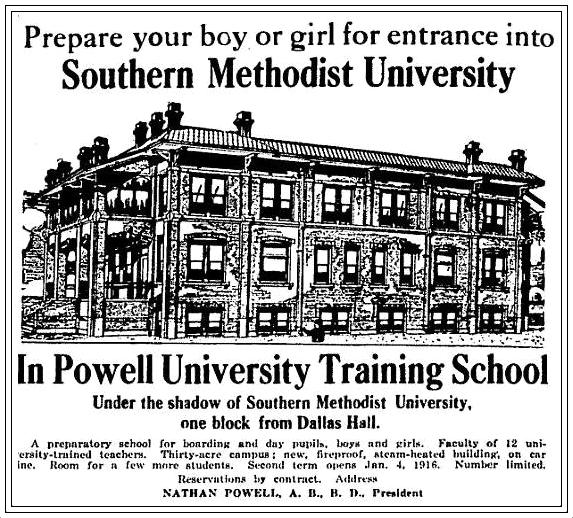
Send Your Kids to Prep School “Under the Shadow of SMU” — 1915

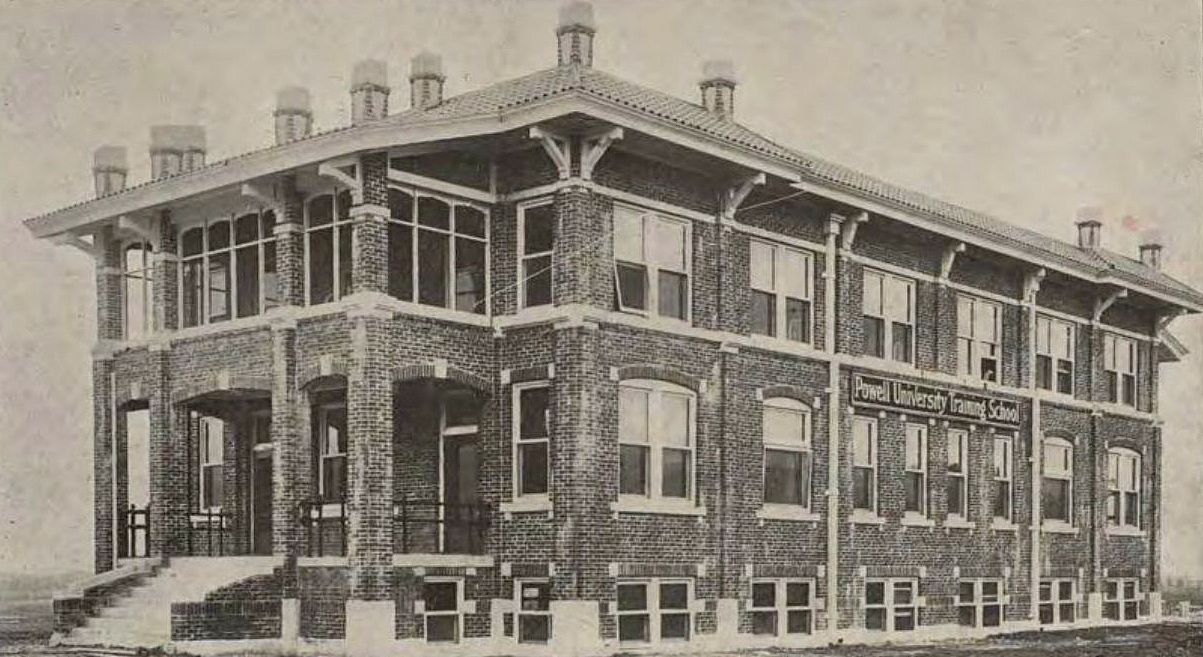
powell-prep_rotunda_1916Powell University Training School, 1915

by Paula Bosse

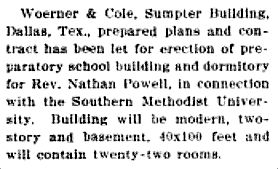
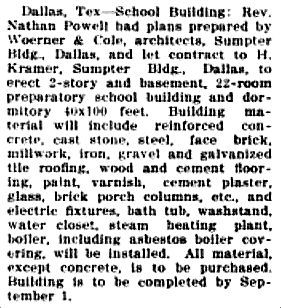
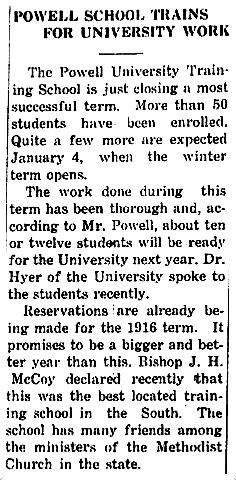
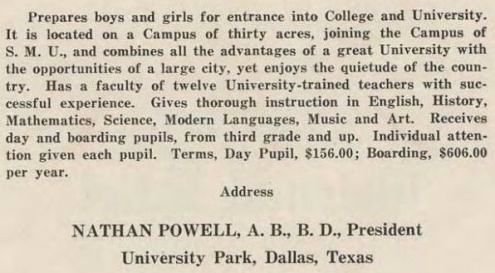
Nathan Powell (1869-1963) was a former Methodist minister who opened his prep school, Powell University Training School, on thirty acres of open land, just across an unpaved road from SMU (which was still in the very early days of its construction). SMU and the Powell school shared more than just adjacent addresses — which they both rather idealistically touted as being “situated on high ground overlooking the university campus and the city” — they also opened on the same day, September 15, 1915.

The location and the opening date were not a coincidence, as Dr. Powell was one of the Methodist movers and shakers who originally promoted the idea of Dallas as the site for a new Methodist university. The following (perhaps exaggerated) sentence can be found in the (perhaps overly laudatory) profile of Powell in one of those ubiquitous late-19th, early-20th century “mug books,” A History of  Texas and Texans (1916):

Beyond his activities as a minister and teacher, the most notable achievement in the life and career of Doctor Powell lies in the fact that he was the sole originator and promoter of the great Southern Methodist University at Dallas, which began its first year September 15, 1915.

Powell University Training School lasted for only about twelve years, until Powell’s rather sudden retirement in 1927 (the good reverend’s “retirement” might have been precipitated by numerous lawsuits and mounting debt). When the school closed, Dr. Powell and his family moved to Harlingen to — as his obituary states — “help organize the grapefruit growers of the Rio Grande Valley.” He operated a citrus nursery himself for a while until it was destroyed by a 1933 hurricane. Nathan Powell died in Harlingen in 1963 at the age of 94.

It’s always exciting to see old buildings still standing in Dallas, and, happily, this one is still around — and it still looks good. Fittingly, it’s currently home to an early-child development center. Next time you’re near the intersection of Binkley and Hillcrest, go take a look.

*

powell_tx-trade-rev-industrial-record_071515a*powell_tx-trade-rev-industrial-record_071515bBoth items from the Texas Trade Review & Industrial Record, July 15, 1915

powell_school_ad_smu-times_121815SMU Times, Dec. 18, 1915 (click for larger image)

powell_school_smu-times_121815SMU Times, Dec. 18, 1915

ad-powell-prep_smu-rotunda-19161915 (click to read text)

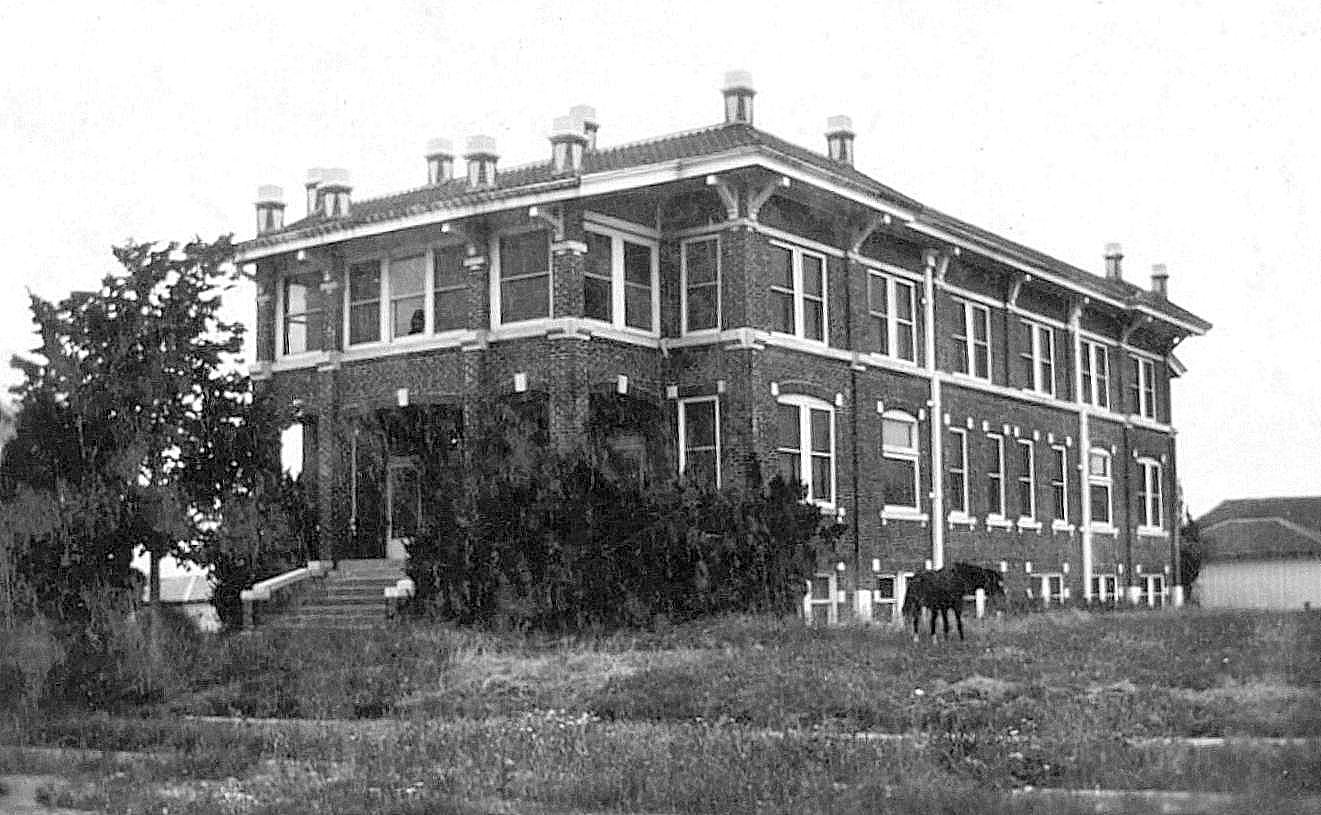
Below, after the school closed. Looking a little shaggy. I would have guessed the photo was from much earlier, but it’s dated 1931. Complete with horse.

powell-univ-training-school_brown-bk_university-park_19311931, Brown Book, University Park Public Library

***

Sources & Notes

Top image and bottom ad appeared in the very first edition of The Rotunda, SMU’s yearbook for their inaugural year, 1915-16.

More on Rev. Powell’s early life and involvement with the founding of Southern Methodist University can be read in A History of Texas and Texans by Frank W. Johnson (Chicago and New York: American Historical Society, 1916), here.

Information regarding Powell’s retirement in Harlingen is from “The Chronological History of Harlingen” by Norman Rozeff (circa 2009), in a PDF here.

Powell’s obituary can be found in The Dallas Morning News, Nov. 8, 1963: “Dr. Powell Dies; Helped Found SMU.”

Currently occupying 3412 Binkley is The Community School of the Park Cities. According to the history page of their website (here), the building has been operated as a school since at least the 1950s.

I’m not sure what the actual facts are concerning Nathan Powell’s role in the founding of SMU. There are very few results when searching the internet. Most newspaper articles connecting him with the university seem to have been generated by Powell himself. If Powell was as important in the history of SMU as he claimed to be, it’s surprising to see so little information on any connection. Was Powell’s assertion that he was the driving force behind the creation of SMU a blatant lie? Was it merely an exaggeration of the truth? Or was it accurate, but something happened to cause the university to distance itself from him? A collection of papers in the SMU archives (which I have not seen) seems to indicate that there were those in Methodist circles who disputed Powell’s claims, as Elijah L. Shettles took it upon himself to prove that Nathan Powell was the driving force behind the very existence of SMU. An overview of the collection — The Elijah L. Shettles Papers on the Founding of Southern Methodist University — can be found here.

(I’ve found an article from the Fort Worth Star-Telegram in 1910 that had Powell all but saying Fort Worth — not Dallas — would be the best choice for the university’s location. Read that article and see other photos of the school — and also read about the lawsuit against Powell (which had nothing to do with SMU) that took thirteen years to reach trial and ended in quite a hefty judgement, in a PDF here.)

See more of SMU’s first year in previous posts here and here.

*

Copyright © 2014 Paula Bosse. All Rights Reserved.
Up North in Denton: “Famous School and College County”

denton-co-courthouse-1928Denton County Courthouse, 1928 (click for larger image)

by Paula Bosse

Okay, so it’s not Dallas, but who in Big D doesn’t love Little D? Besides, this is just too great a photo to keep to myself.

And in case you need to bone up on your 1928 Denton County stats for “Jeopardy” or something, look no further (click for larger image):

denton-co-courthouse_1928b

“Kindergarten to College Degree —
Board at home and be educated free.”

Free!

*

Might as well see where the photo of the courthouse was taken from: the Wright Opera House (now Recycled Books). Here it is, about 1900:

denton-opera-house_1900_tx-historian_1982The Wright Opera House, built in 1899, shown here in 1900 (click for much larger image)

***

The photo of the courthouse and the ad are both from, where else, the program for the 52nd Annual Convention of the State Firemen’s Association of Texas, held in Denton in June of 1928. If you’re into firefighting ephemera or old Denton photos, you might want to peruse it yourself: click here. (From the collection of the Denton Public Library.)

Photo of the Opera House from the article “Faded Echoes: A History of the Wright Opera House in Denton” by Clare Adkins, featured in the September, 1982 issue of Texas Historian, accessible through the Portal to Texas History, here.

Click pictures for larger images.

*

Copyright © 2014 Paula Bosse. All Rights Reserved.
Interurban vs. Streetcar

interurban-vs-streetcarOh dear…

by Paula Bosse

I’m not sure what’s happened here, but it looks like the interurban has emerged victorious.

***

Sources & Notes

I don’t know the original source of this photo, but I came across it on the Northern Texas Traction History Group on Facebook. The electric-powered interurban car is the big red one on the left; the puny (but cute) electric-powered green streetcar is on the right. The view here is looking north on Record, from just south of Young Street, inside what would one day be called “Communications Center”: the Dallas Morning News Building is on the left, and the not-yet-built WFAA studios will later be to the immediate right (east). The long-gone Hotel Jefferson is north of Ferris Park (the hotel was catty-corner from Union Station, across Houston Street). In the distance you can see the tippy-top of the Old Red Courthouse, just above the green streetcar. Also, those now-gone smokestacks that were such a fixture on the skyline are straight ahead.

*

Copyright © 2014 Paula Bosse. All Rights Reserved.
“Speed With Safety” on the Crimson Limited — 1930

crimson-ltd_interurban_1930

by Paula Bosse

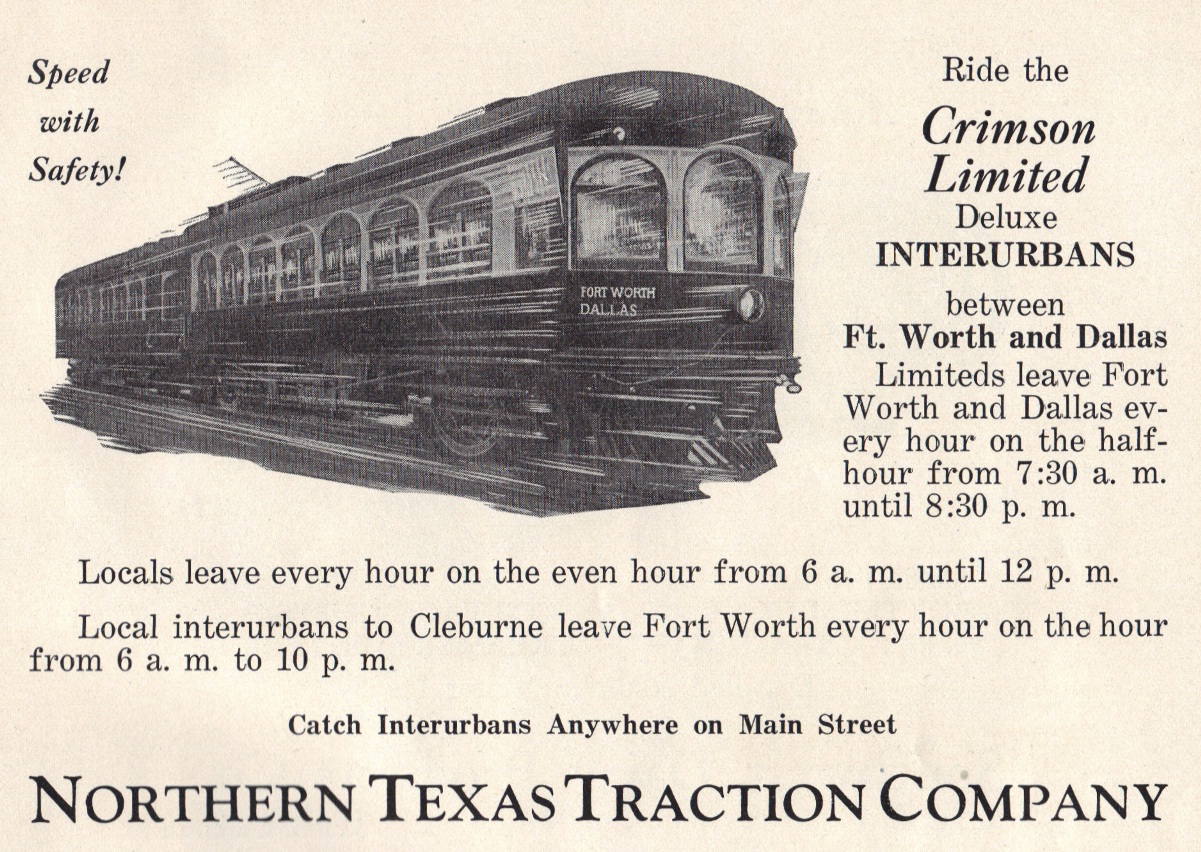
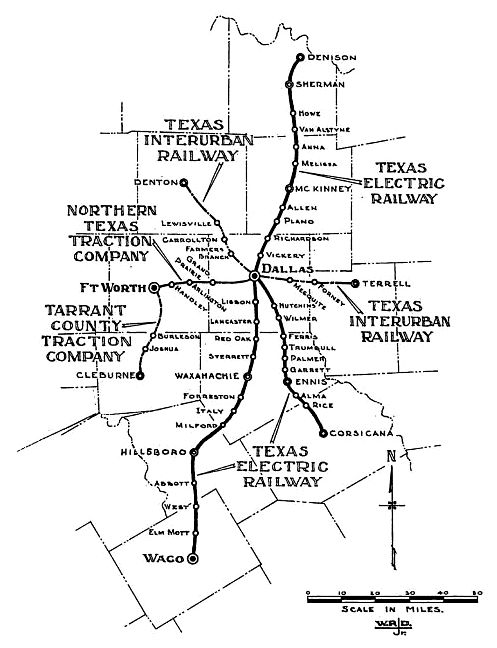
A 1930 ad for the Crimson Limited deluxe interurbans (electrified railway trains) that ran between Dallas and Fort Worth, a couple of years before the company went into receivership, put out of business by the rise of automobile culture. Even though the writing was pretty much on the walls, the Northern Texas Traction Company fought hard to reverse the decline in ridership by introducing these fancy Crimson Limited cars:

The most notable of their moves was the introduction of the Crimson Limited in October of 1924. The Crimson Limited was the name given to the upgraded interurban service to Dallas because the cars were painted bright red. The trailer car saw the most extensive upgrades. The bench seats in the rear half of the car were removed and replaced with wicker chairs. The rear doors were converted to windows giving the car a ‘parlor car’ appearance. Additional upgrades were implemented in 1927. Although the public approved of the new more luxurious trains and more modern streetcars, they continued to abandon mass transit for the automobile. (–North Texas Historic Transportation, Inc.)

Wicker chairs? Pure LUXURY!

interurban-map

***

Sources & Notes

The ad is from an old magazine I can’t cite because it’s stuck in a box in a closet somewhere.

The quote is from a page on the North Texas Historic Transportation site.

For more on this topic, check out the nice, meaty, image-filled post (which includes an ad touting the somewhat vague “Special Conveniences for Ladies”) on the Hometown by Handlebar blog, here. (Hometown by Handlebar is a really great Fort Worth history blog that might prove I was separated at birth from a twin sibling I knew nothing about!)

Not quite sure what an “interurban” is? Fret not. Wikipedia’s here to help, here.

*

Copyright © 2014 Paula Bosse. All Rights Reserved.
Thanks, Ticket Guys!

ticket-logo

by Paula Bosse

Got a flood of Twitter followers from the great mention last Saturday on The Orphanage show. Thank you so much, guys!

A brief snippet — with hosts Danny Balis and Dave Lane, as well as the wonderful Robert Wilonsky of The Dallas Morning News as guest — can be heard here. (Love ya, Robert, but even though I worked at the Preston Royal Borders for several years, I was not actually the General Manager!)

*

Copyright © 2014 Paula Bosse. All Rights Reserved.

Empire Mills — Grinding Wheat Into Wedding Presents Since the Cleveland Administration

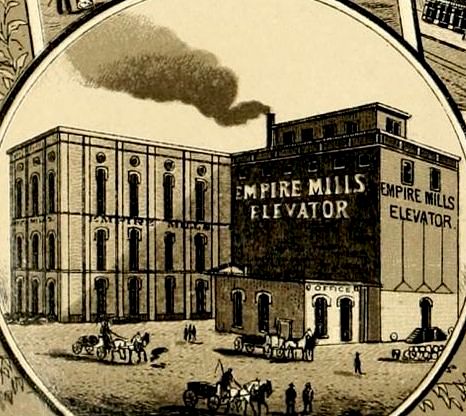
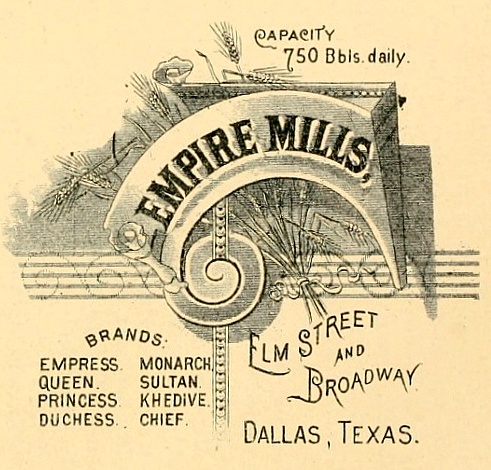
empire-mills_imm-gd_1889aFlour central!

by Paula Bosse

Exciting news hit the pages of The Dallas Herald on March 26, 1885:

A contract was closed last night for the erection of a mammoth 250-barrel, full roller flouring mill with all the latest machinery in this city. The promoters are W.C. Howard, J. Rauch and S.T. Stratton. It will be called the Empire Mills.

The mill opened in September, with the company’s proclamation that their new “roller mills” were “the largest and finest ever erected in the South.” It was located at Elm and Broadway, near the Trinity River. In a newspaper interview, John Neely Bryan’s son described the location of his father’s famous cabin as being “at the top of the hill, about where Empire mills are now located” (Dallas Morning News, Aug. 11, 1889). So, about where Dealey Plaza is today. Wheat was a major crop in North Texas, and the mill was a successful and important addition to the growth of the city.

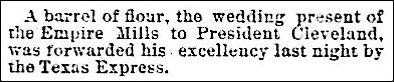
But it wasn’t all crushing and grinding. One must occasionally participate in the world of social niceties. So when the president of the United States is getting married, what better way to commemorate the occasion than by presenting the happy couple with a romantic and self-promoting barrel of flour?

cleveland-flour_dmn_053086DMN, May 30, 1886

cleveland-flour_dmn_070586DMN, July 5, 1886

One wonders what the newlyweds exclaimed as they tore the bow from that barrel? It probably wasn’t, “Oh! Flour! How stupendous!”

empire-mills_clifton-church_1894

empire-mills_souv-gd

empire-mills_imm-gd_1889b

***

Sources & Notes

Top and bottom images from an ad in The Immigrants Guide to Texas (1889).

Photograph by Clifton Church, ca. 1894.

Next to last illustration from Souvenir of Dallas, Texas (c. 1888).

Roller mill? Right this way.

*

Copyright © 2014 Paula Bosse. All Rights Reserved.