Flashback : Dallas

A Miscellany: History, Ads, Pop Culture

Welcome, Dallas Morning News Blog Readers!

dmn-blog_header

by Paula Bosse

Thanks to the link in yesterday’s Dallas Morning News blog post by Rudolph Bush (about the COOL mosaic he stumbled upon at the Preston-Forest shopping center), I’ve had a ton of new people checking out this blog. Welcome, everyone! And thanks for the mention, Rudy!

***

Check out Rudy’s post “Flashback Dallas Solves the Mystery of the Preston Forest Mosaic” on the dallasnews.com Opinion page, here.

To see the full-page spread on the opening of the shopping center (DMN, Aug. 24, 1960) that Rudy reproduced in the article, check out the zoomable PDF here.

*

Copyright © 2014 Paula Bosse. All Rights Reserved.

Junius Heights … Adjacent!

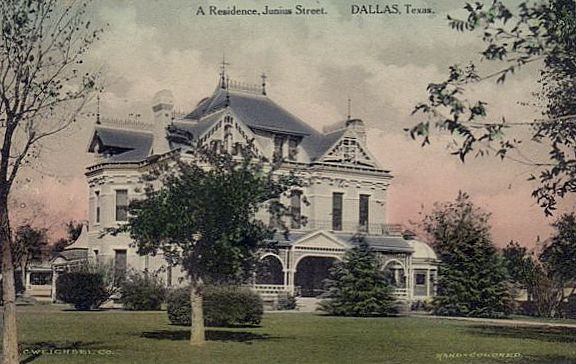
junius-stNot actually Junius Heights, but nearby! (see explanation below)

by Paula Bosse

One of the most popular neighborhoods in Old East Dallas is Junius Heights, which I’m a little surprised to learn is the largest historic district in Dallas. It came into being when streetcar service was extended into the eastern boondocks of the city, opening up tantalizing possibilities of new development. According to Preservation Dallas, when lots went on sale in the neighborhood-to-be in September of 1906, there was a buying frenzy:

“Prospective buyers were encouraged to take the streetcar to a newly platted neighborhood of the same name that afternoon to view the lots. Because it was Sunday, no lots were sold that day. But interested buyers remained in the neighborhood until midnight, when a pistol was fired to indicate the start of the sale. Within an hour, two hundred lots in Junius Heights had been sold and by Wednesday, every lot in the neighborhood had been sold.”

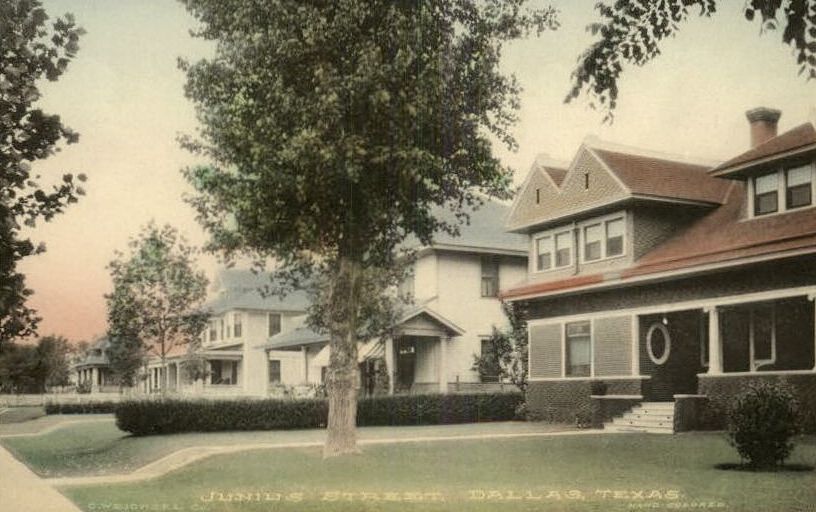
junius-housesUm, apparently not Junius Heights either….

And East Dallas has never looked back.

*

UPDATE: Having determined where the houses in these postcards were actually located — on Junius between Peak & Carroll — I now see this ISN’T Junius Heights! It’s a few blocks west of the Henderson Avenue boundary. So, not Junius Heights, but Junius Heights-adjacent!

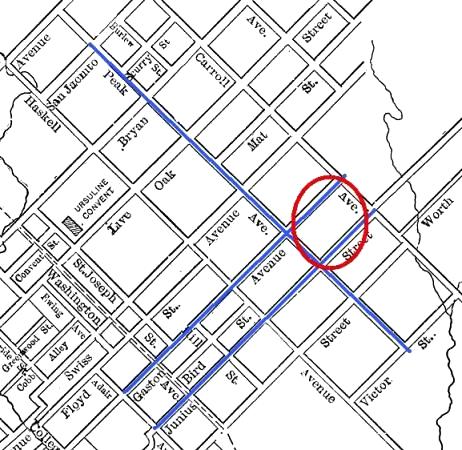
The postcard at top shows the Thomas Field house (built in 1884 and sold to John B. Wilson — of Wilson Building fame — in 1894); it was situated in a full city block bounded by Junius, Carroll, Gaston, and Peak. Before addresses changed throughout the city in 1911, the residence seems to have had no official address; in 1911 it was assigned the address of 4305 Junius. According to William L. McDonald’s book Dallas Rediscovered, the house was demolished in 1922 in order to subdivide and redevelop the property, Below is a map of the area from about 1898, showing the general location of the property.

field_wilson_house_ca-1898-map

The second postcard reproduces a photo seen in a real estate ad from 1906 which shows “portions of Junius Street between Peak and Carroll” — so, in the same block as the Field/Wilson house. Just not actually in Junius Heights!

junius-st_betw-peak-carroll_dmn_090206Dallas Morning News, Sept. 2, 1906 (click for larger image)

***

Quote is from a history of the Junius Heights neighborhood on the Preservation Dallas site, here.

Wikipedia entry is here.

Click pictures for larger images.

*

Copyright © 2014 Paula Bosse. All Rights Reserved.

“I’ve Got the Dallas Blues and the Main Street Heart Disease”

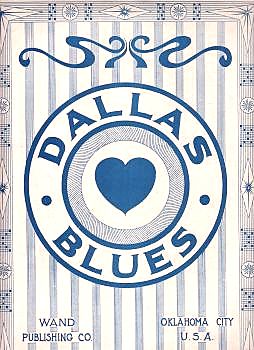
dallas-blues-sheet-music

by Paula Bosse

“Dallas Blues” is an important milestone in the history of blues music. I gather this may be debatable, but it is cited as being the first “true blues song” ever published (at least by sources on Wikipedia). Written sometime before 1909 by Hart A. Wand, a white musician in Oklahoma, “Dallas Blues” was published as an instrumental in 1912; in 1918, lyrics were added by Lloyd Garrett.

I have to admit, when I read the opening lyrics, I assumed it was your typical Dallas-inspired ditty about how Dallas is a cold and heartless city that will chew you up and spit you out:

When your money’s gone, friends have turned you down,
And you wander ’round just like a houn’ (a lonesome houn’),
Then you stop to say, ‘Let me go away
From this old town (this awful town).’

But then the next lines are:

There’s a place I know folks won’t pass me by,
Dallas, Texas, that’s the town I cry! (Oh hear me cry!)
And I’m going back, going back to stay
There till I die (until I die).

Ha! That was unexpected.

Below are a few versions of “Dallas Blues” — fast and slow, some with vocals, and one hot instrumental. Enjoy. I hope those juicy peaches are still hanging on your trees!

**

Ted Lewis’ version from 1931, with Fats Waller’s first vocal appearance on record and Benny Goodman on clarinet. Most of the lyrics have been left out, but this is great

*

Louis Armstrong’s recording, from 1929:

*

George Lewis’ slowed-down version:

*

And, lastly, Isham Jones’ instrumental version — this one is hopping!

***

Sources & Notes

Sheet music from an Art & Seek story on Texas Blues (with sound clips) by Jerome Weeks, here.

Wikipedia entry on the song, here.

Complete lyrics to the song, here.

I’ve got the Dallas Blues and the Main Street heart disease
(It’s buzzin’ ’round),
Buzzin’ ’round my head like a swarm of little honey bees
(Of honey bees).

Interested in Dallas-related blues songs? Check out my previous post “Deep Ellum / Deep Elm / Deep Elem Blues,” here.

*

Copyright © 2014 Paula Bosse. All Rights Reserved.

Irby-Mayes Ad With a Cameo by the Merc — 1948

ad-irby-mayes_merc_dmn_040148Landmark alert!

by Paula Bosse

An ad with the famous local building making a cameo.

It’s called PLATEAU
…the wonder fabric by Pacific Mills
that’s so perfect for our Texas weather. Suits of
[redacted??] look like regular weight worsted
…yet can be worn most every month of the year.
A new shipment exclusive at Irby-Mayes.

I love this 1948 ad. Irby-Mayes was located — where else? — in the Mercantile Bank Building!

*

Copyright © 2014 Paula Bosse. All Rights Reserved.

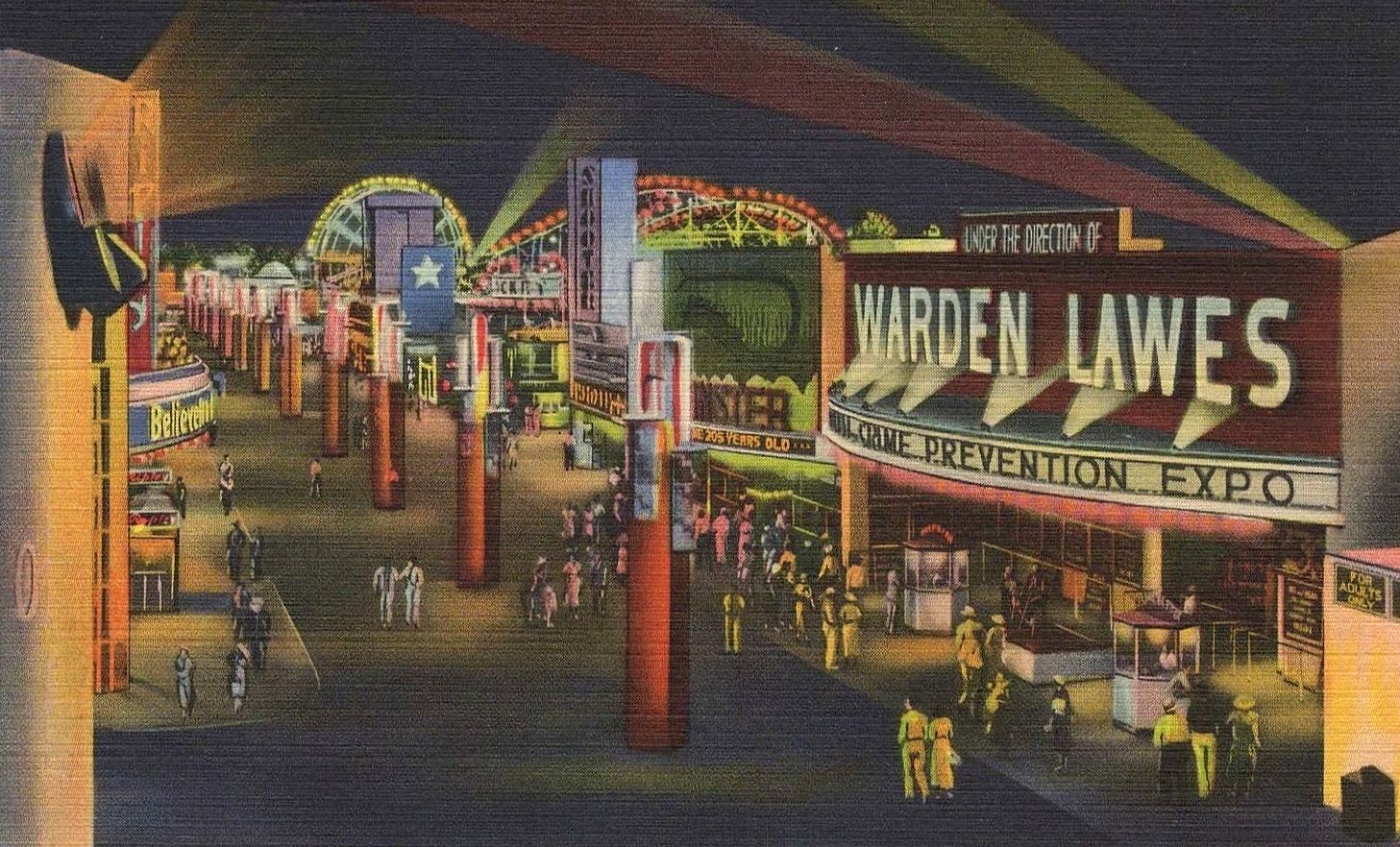
Night Life Along the Centennial Midway — 1936

tx-centennial_night-midwayThe magical midway at night (click for larger image)

by Paula Bosse

Glamorous night shots as seen in not-quite-real-looking postcards from the 1930s and ’40s are among my favorites. And this shot, of the Texas Centennial Exposition Midway at night-time is so, so GREAT!

The text on the back of the card:

Night life in all its glory and glamour. Oddities, Animal Shows and Girl Shows to charm the most fastidious, along the Midway.

***

Compare to the shots of this stretch of the Midway from the other direction, in my previous post here.

Click picture for MUCH larger image!

*

Copyright © 2014 Paula Bosse. All Rights Reserved.

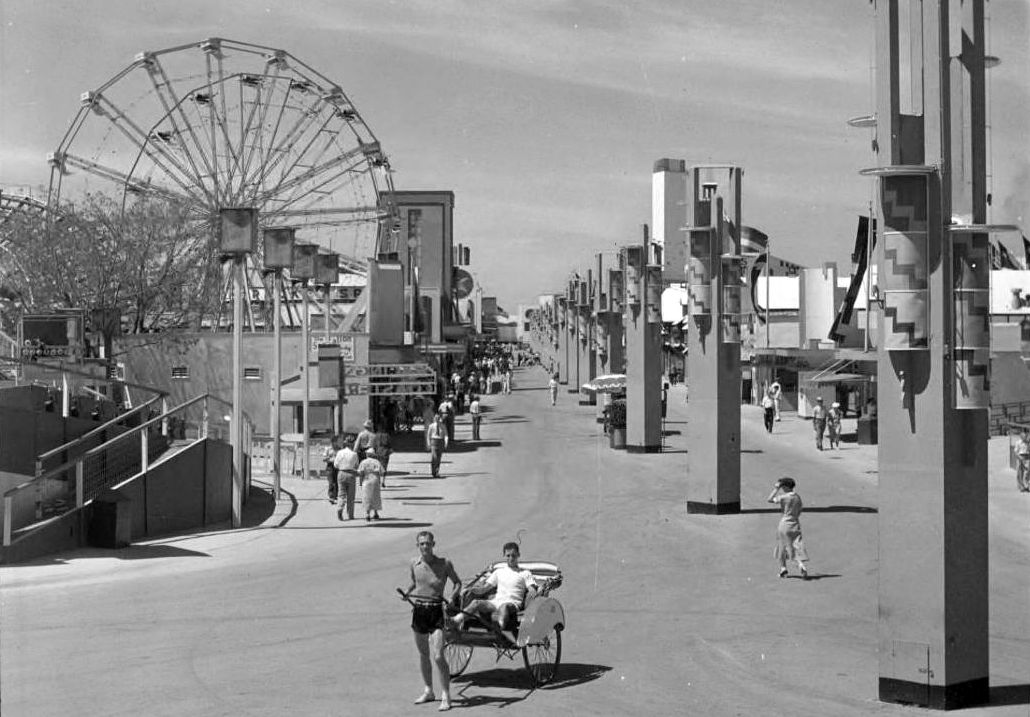
Forget the Ferris Wheel, Take a Ride in a Centennial Rickshaw — 1936

tx-centennial-midway_1936_ucrYour rickshaw awaits…

by Paula Bosse

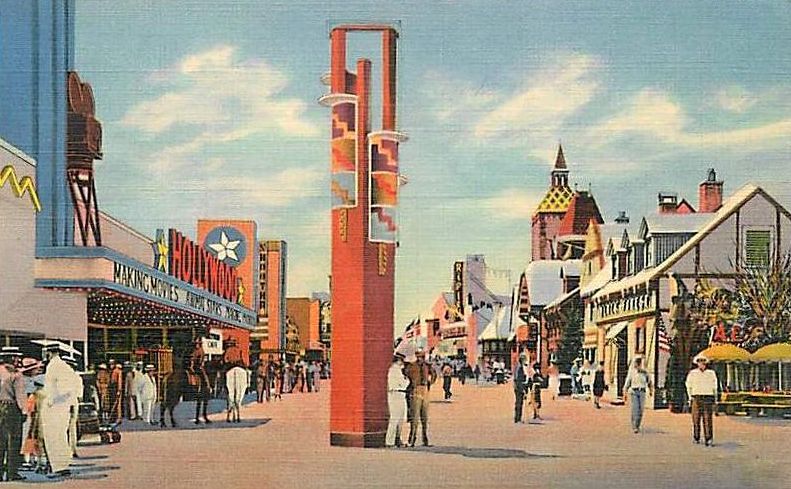
Here’s an odd photo of the Midway at Fair Park, taken in 1936. The whole thing feels a little weird. It’s just so … bright. And empty. It’s kind of bleak-looking for the glamorous Texas Centennial Exposition. And then there’s that rickshaw (?). What this scene needs is a little postcard-colorizing magic. Below, a similar scene, sans rickshaw.

fair-park_hollywood_centennial_midway

Better … but still kind of odd.

But back to that rickshaw. According to the the Treasury of Texas Trivia, Vol. II:

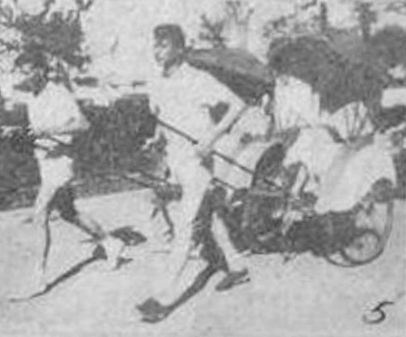
The Texas Centennial in Dallas had one feature that, considering its uncountable sights and sounds that one had to take in, may very well have been forgotten. College boys, as a means of earning tuition as well as keeping in shape, pulled foot-weary fairgoers from street to street and plaza to plaza in rickshaws during the 1936 celebration of our state’s one hundredth birthday.

rickshaw_tx-centennial-1936

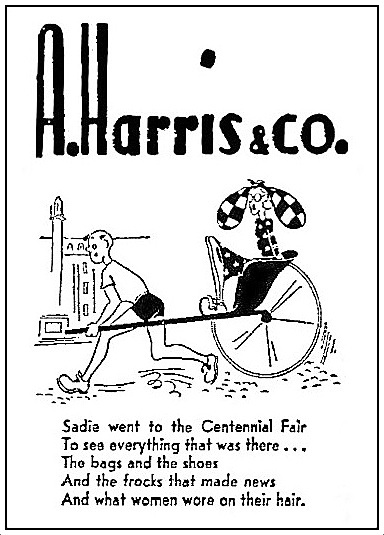
This exotic mode of transportation was even appearing in local advertisements — like this one, from an ad placed by the A. Harris department store:

ad-a-harris_centennial_rickshaw_dmn_052536_detA. Harris ad (det) , 1936

One of the most notable rickshaw-riders of the Dallas Centennial was none other than celebrated fan-dancer, Sally Rand, whose “Nude Ranch” show (check Google for risque film footage) at the competing Frontier Centennial Exposition in Fort Worth was packing them in in Cowtown. Even Sally had to come over and check out the Centennial. The photo below shows her autographing the shorts of one of the “ricksha-toters,” a lucky young man named Guy Johnsen. The caption of the July, 1936 news photo reads:

Sally Rand, who says she never knew success until she thought of taking her pants off, autographs those of Guy Johnson [sic], her ricksha toter, on a visit to the Texas Centennial Exposition at Dallas. With her is Mrs. Voln Taylor, Chairman of the Centennial Advisory Board.

centennial_rickshaw_sally-rand_cook-coll_smuCook Collection/DeGolyer Library/SMU

And now I know.

***

Sources & Notes

Top photo — titled “The Gay Midway of the Texas Centennial Exposition, Dallas” — from the Keystone-Mast Collection, UCR/California Museum of Photography, University of California at Riverside; see here.

Quote from Treasury of Texas Trivia, Vol. II by Bill Cannon (Plano: Republic of Texas Press, 2000).

Sally Rand photo (“Sally Rand Gives an Autograph”) from the George W. Cook Dallas/Texas Image Collection, DeGolyer Library, Central University Libraries, Southern Methodist University; more info on this photo is here. (Arne Miller “Guy” Johnsen — known later as “Swede” Johnsen — was a native South Dakotan who had left home and arrived in Dallas just in time for the Centennial, where he got a job pulling visitors around Fair Park in a rickshaw. This paragraph is from his 2005 obituary: “Raised on a farm in Volin, South Dakota, ‘Guy’ (as he was nicknamed by his mother), left home on a quest for better opportunities. In 1936, his travels found him pulling a rickshaw at the Dallas Centennial Fair. His claim to fame was pulling the famous and beautiful fan-dancer Sally Rand throughout the centennial fair grounds.” I guess a moment like that really stays with a person!)

To see this stretch of the Midway from the other direction — and AT NIGHT (!) — see my companion post here.

I find that — by complete coincidence — I’ve posted this on June 6th, the anniversary of the opening day of the Texas Centennial Exposition.

*

Copyright © 2014 Paula Bosse. All Rights Reserved.

The Texas Land & Mortgage Company — 1912

ad-texas-land-mortgage_19121912

by Paula Bosse

The Texas Land and Mortgage Company of London, Ltd. was the first mortgage company in the state of Texas. The Dallas branch of the English company opened in 1882 at a time when British investment across Texas was booming; it was one of the few speculation firms in the state that grew and prospered into the 20th century. Much development of the city in this period can be attributed to loans granted by the Texas Land & Mortgage Company.

The building they occupied (built by them in 1896) was located at the northwest corner of Commerce and Field, across Field from where the Adolphus has stood since 1912. The building in the 1912 ad looks a little different from the one in the photo below, taken four years earlier. It’s not a terribly attractive building in either photo, but there is some improvement in the later picture, and it IS vastly superior to the 7-Eleven occupying that corner today.

texas-land-mortgage_grtr-dal-ill_19081908

***

Advertisement from the pages of The Cattle Raisers’ Association of Texas, March 1912.

Bottom photograph from Greater Dallas Illustrated (Dallas: Friends of the Dallas Public Library, 1992 — originally published in Dallas in 1908).

For a short biography of A.G. Wood, the Scottish general manager of the Texas Land & Mortgage Co., see the Encyclopedia of Texas (1922) entry here.

Click pictures for larger images.

*

Copyright © 2014 Paula Bosse. All Rights Reserved.

The Ladies’ Reading Circle: An Influential Women’s Club Organized by Black Teachers in 1892

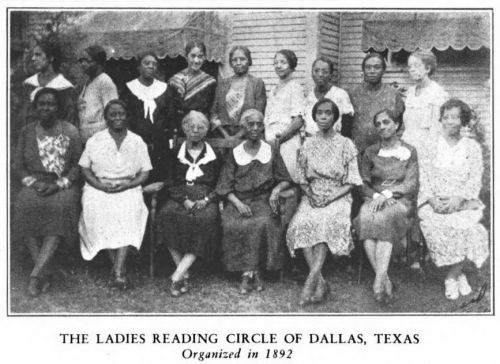
ladies-reading-circle_negro-leg-brewer_1935The Ladies (click for larger image)

by Paula Bosse

When one thinks of “ladies’ clubs” of the past, one probably tends to think of groups of largely well-to-do women in fashionable dresses, gloves, and smart hats who gathered for quaint meetings in one another’s homes to discuss vaguely literary or cultural topics, sip tea, chit-chat, and gossip. Often they would plan projects and events which would aid pet community or charitable causes. There were clubs of varying degrees of serious-mindedness, but, for the most part, club meetings were mostly an excuse for women to socialize. 100 years ago, these women rarely worked outside the home, and these groups offered an important social and cultural outlet for well-educated women of means. White women. Women of color were not part of that particular club world. They had to create clubs for themselves. And they did.

In 1892, eight African-American teachers in Dallas organized their own club, the Ladies’ Reading Circle, and while it, too, was an important social outlet for the women, the focus of the group tended to be more serious, with reading lists comprised primarily of political, historical, and critical texts.

The members of the Ladies’ Reading Circle (a group that lasted at least until the 1950s) were, for the most part, middle-class black women who set an agenda for the club of education, self-improvement, and social responsibility. Like most women’s clubs of the time, each meeting of the LRC was held in a different member’s home and usually ended with a “dainty” luncheon and light musical fare, courtesy of the Victrola or player piano; but what set the LRC apart from most of the other women’s clubs of the day was the choice of reading material — from books on world history and international politics, to texts on current affairs and social criticism. (Several surprising examples appear below.)

Not only did the women gather weekly to discuss current and cultural affairs, they also worked to improve their community by tackling important social issues and by inspiring and encouraging young women (and men) who looked to them as civic leaders. Noted black historian J. Mason Brewer dedicated his 1935 book Negro Legislators of Texas to the women of the Ladies’ Reading Circle. The photograph above is from Brewer’s book, as is the following dedication:

lrc_negro-leg-brewer_1935-dedication

Included were the names of the members, several of whom had organized the club in 1892:

lrc_members_brewer

One of the LRC’s concerns was establishing a home which, like the white community’s YWCA, offered housing and career training for young women. The charming frame house the club bought for this purpose in 1938 (and which is described in the Jan. 10, 1952 News article “Ladies Reading Circle Seeks $7,500 for Expanding Home”) still stands at 2616 Hibernia in the State-Thomas area

lrc-home_2616-hibernia_google2616 Hibernia (Google Street view, 2014)

But the group was organized primarily as a “reading circle,” and the minutes of three randomly chosen meetings show the sort of topics they were interested in exploring. The following three articles are from the post-WWI-era, and all appeared in The Dallas Express, a newspaper for the city’s black community.

lrc_dallas-express_040320April 3, 1920

lrc_dallas-express_041020April 10, 1920

lrc_dallas-express_102023October 20, 1923

My favorite juxtaposition of content on the pages of The Dallas Express was the article below which reported on a white politician’s promise that he would fight to keep “illiterate Negro women” from voting — just a column or two away was one of those eye-popping summaries of the latest meeting of the Ladies’ Reading Circle. My guess is that the black educators who comprised the Ladies’ Reading Circle were probably far more knowledgeable about world events than he was.

negro-womans-suffrage_dallas-express_052220May 22, 1920

In reading the limited amount of information I could find on the LRC, I repeatedly came across the name of one of the earliest members, Callie Hicks (she is in the 1935 photo at the top, seated, second from the right). She was a dedicated teacher as well as a respected civic leader who worked for several causes and was an executive of the Dallas branch of the NAACP. A Dallas News article about Miss Hicks appeared in Feb., 1950 when she was named “Woman of the Year” by one of the largest African American women’s organizations in Dallas County (“Honor Caps 40 Years of Helpful Teaching,” DMN, Feb. 10, 1950). Miss Hicks died in May, 1965.
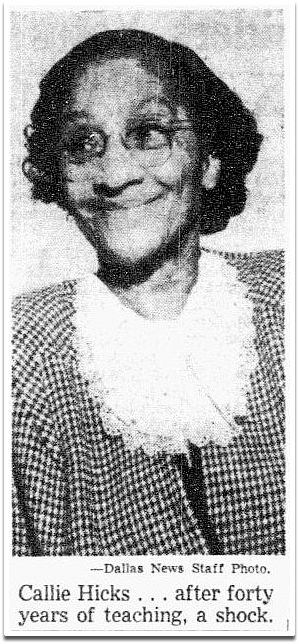
callie-hicks_dmn-021950-photo1950

It’s a shame that the Ladies’ Reading Circle is not better known in Dallas today. I have to admit that I had never heard of the group until I stumbled across that 1935 club photo. Their tireless work to improve the intellectual lives of themselves and others no doubt influenced the generations that followed.

***

Sources & Notes

Top photograph, dedication, and member list, from Negro Legislators of Texas and Their Descendants; A History of the Negro in Texas Politics from Reconstruction to Disenfranchisement by J. Mason Brewer (Dallas: Mathis Publishing Co., 1935).

Minutes from the Ladies’ Reading Circle meetings all printed in The Dallas Express.

Relevant material on the LRC and other historic African-American women’s clubs can be read in Women and the Creation of Urban Life, Dallas, Texas, 1843-1920 by Elizabeth York Enstam (College Station: Texas A & M University Press, 1998), here.

The Handbook of Texas entry for one of the founding members of the Ladies’ Reading Circle, Julia Caldwell Frazier, can be found here.

*

Copyright © 2014 Paula Bosse. All Rights Reserved

Swooning Over Love Field — 1940

love-field_1940Art Deco Love Field!

by Paula Bosse

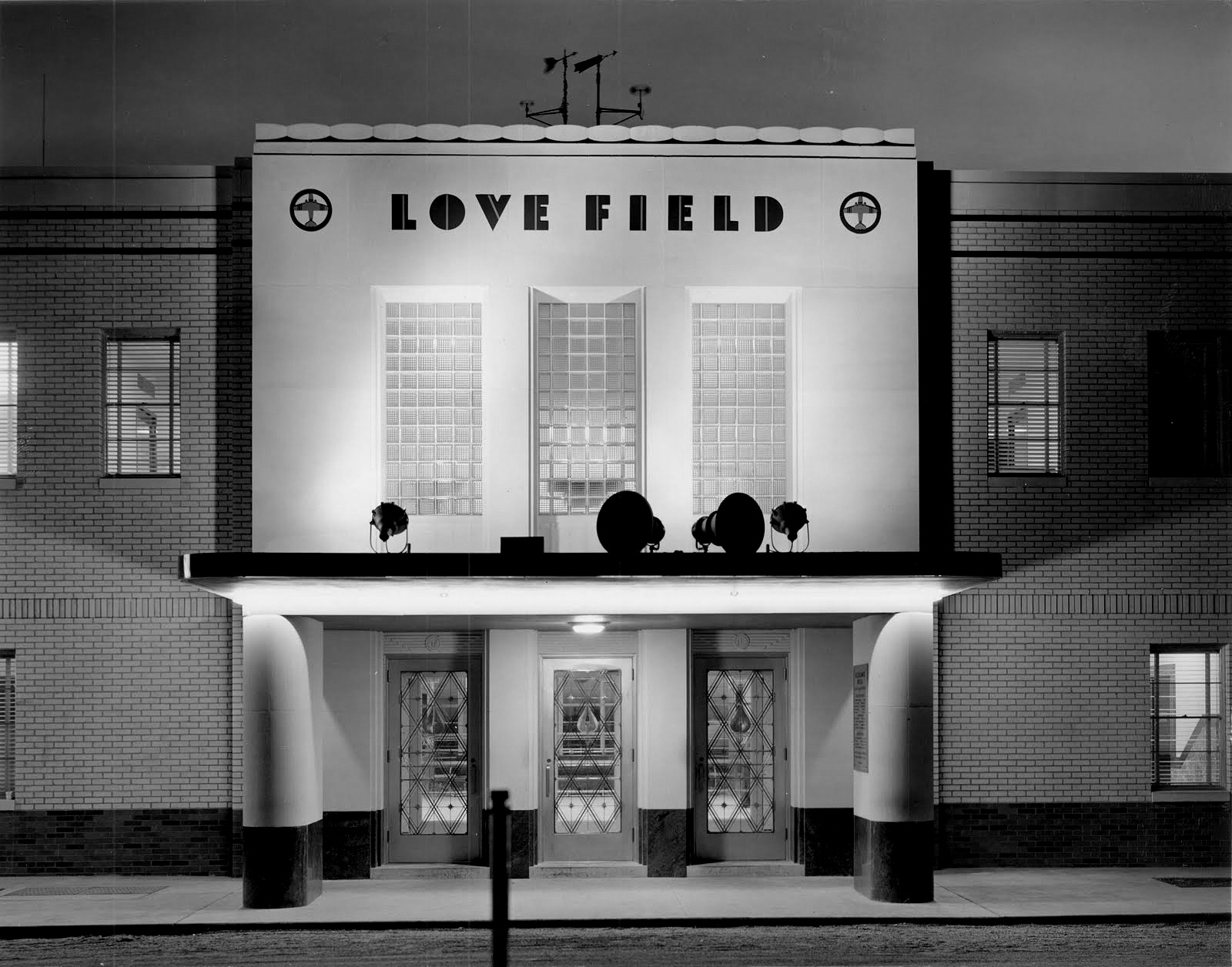
I’m a huge-fan of the modern 1950s-era Love Field (the one with the Mockingbird Lane entrance), but even that can’t trump this fantastic building! Designed by architect Thomas D. Broad, the new Love Field administration building and terminal — which faced Lemmon Avenue — was unveiled on October 6, 1940, to rapturous acclaim. The night view above is pretty breathtaking. Forget the airfield. For me, it’s all about this entrance. Those windows. And those doors. And that font! And those little airplane pictographs!

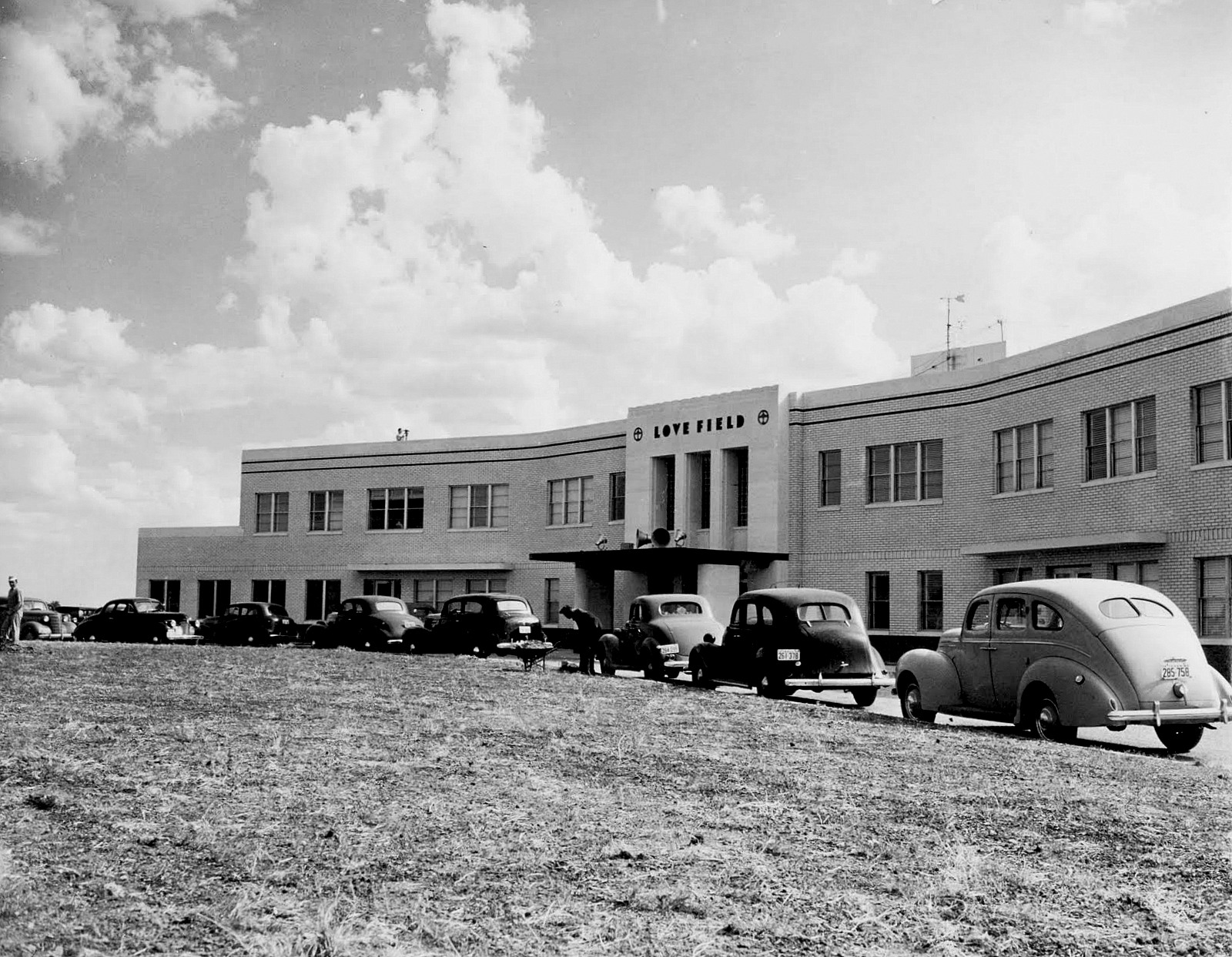
love-field_terminal_1940It wasn’t bad in the daytime, either — just nowhere near as dramatic. And in dire need of landscaping.

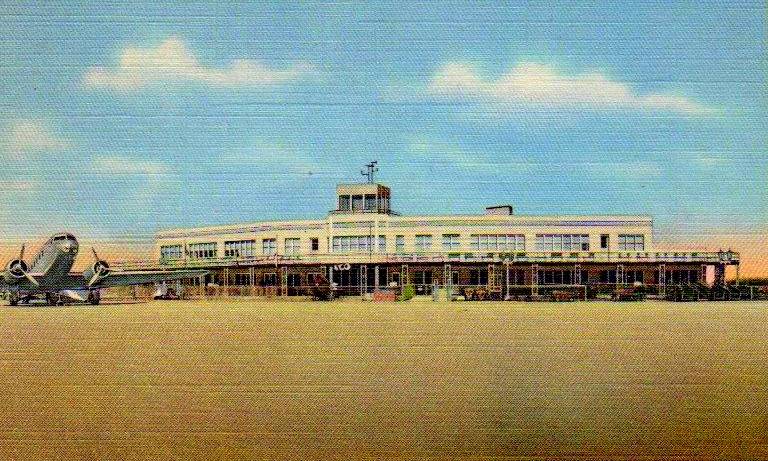
love-field_ca1940_frontAnd here it is from the field side. Still swoon-worthy. The back of this postcard reads:

LOVE FIELD — NEW $225,000 ADMINISTRATION BUILDING
One of America’s finest air terminals which takes care of more airline passengers, more air mail and more air express in ratio to population than any other airport in the country.

**

What happened to this beautiful building? I searched through the Dallas Morning News archives until I felt I had to throw in the towel, never finding a definitive answer. But here’s what I did find. When the brand-spanking-new terminal (the one we know today) opened in 1958, the 1940 terminal was vacated. A better word might be “abandoned.” Most assumed the building would be razed very soon after. But I got as far as September of 1964, and the old terminal was still standing. And it wasn’t pretty. This excerpt from a Dallas Morning News article is painful to read:

…The old terminal building cowers in desolation…. Virtually every window has been smashed, carpeting the deserted terminal with a dangerous floor of broken glass. Loose wires stick out here and there, and blinds hang in twisted postures from broken cords. The building’s big sign DALLLAS is missing its D. (DMN, July 2, 1961)

(And even more thoroughly painful is the article in the Dallas News archives by Kent Biffle, “Ghosts Wait by Runway” — DMN, Feb. 2, 1961.)

Apparently, the old building had to remain standing until a “much-debated” new multi-million-dollar runway was agreed upon.

The point at which I threw in the towel in my quest to discover when the old terminal building had been demolished was a DMN photo from September 25, 1964, with the caption “$4,000,000-Plus Runway Progress. The 8,800-foot parallel runway at Dallas Love Field, left center, is two-thirds completed and should be ready for use next spring.” I am assured the photo has a hard-to-see old terminal still decaying in it. I assume they razed that sucker pretty soon afterward. …Possibly.

***

Sources & Notes

Top two photos are from the Love Field Collection, Dallas History and Archives, Dallas Public Library; accession numbers are PA83-13-8 for the swoony one at the top, and PA83-13-4 for the daylight exterior photo. I originally found these in the post “The New Love Field” by Jacob Haynes, here.

Click pictures for larger images — the first two are HUGE!

*

Copyright © 2014 Paula Bosse. All Rights Reserved.

The DFW Turnpike, Unsullied by Traffic, Billboards, or Urban Sprawl — 1957

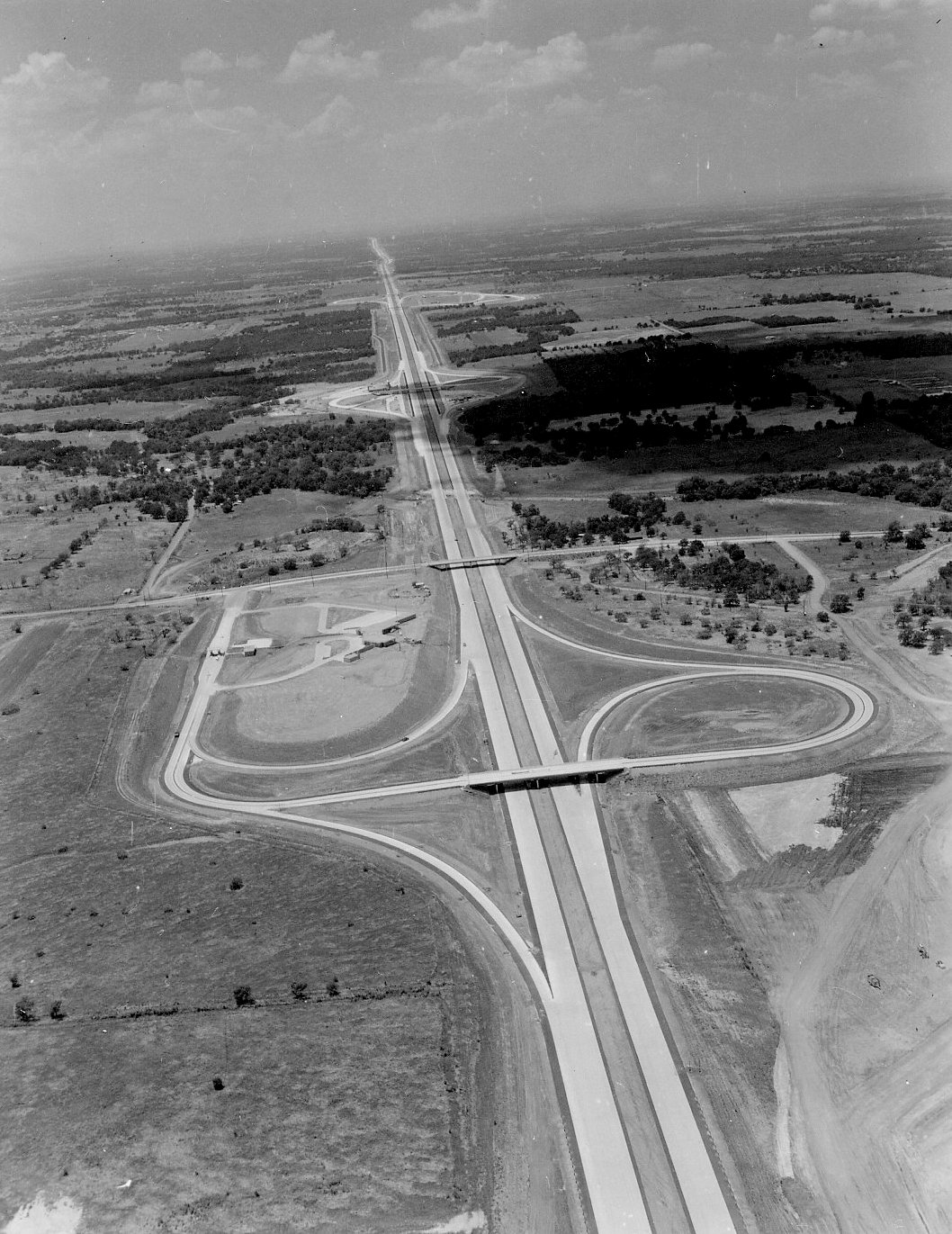
turnpike_west-from-360_1957The DFW Turnpike, 1957… (click for very large image!)

by Paula Bosse

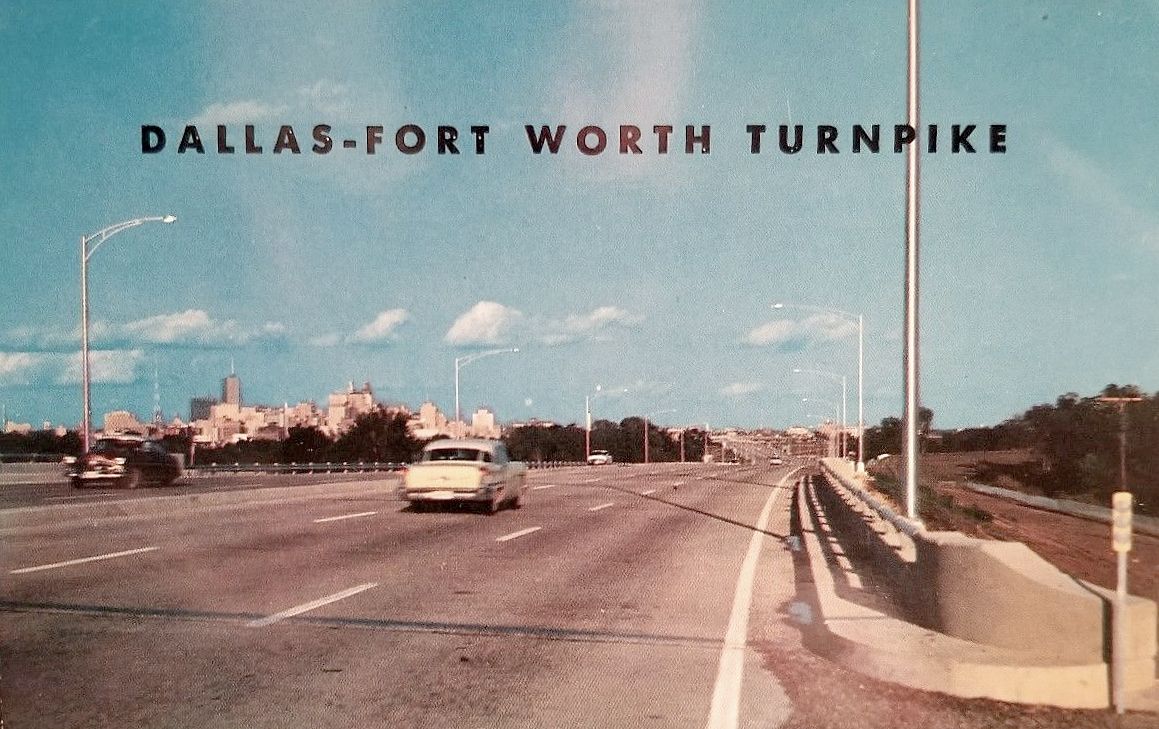
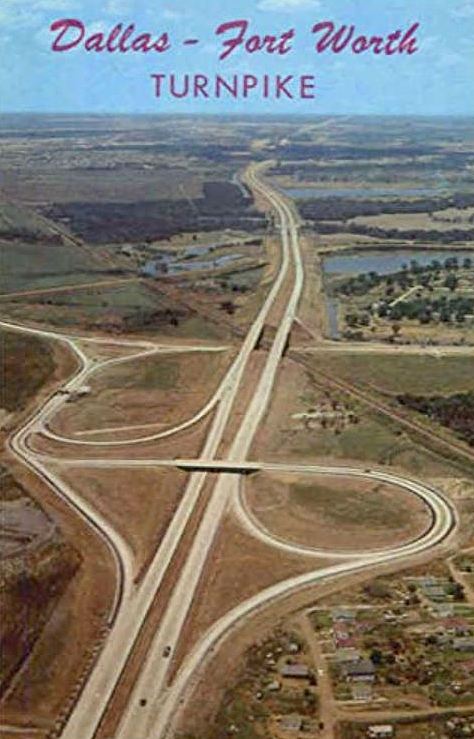
Above, the Dallas-Fort Worth turnpike in 1957, before it opened for business. When this toll road was paid off in 1977, the toll booths were removed and it became I-30, a “free” highway. (This “toll-road-becoming-a-free-road” thing has happened only once in the history of Texas; I can’t imagine it will ever happen again.) This photo shows the turnpike heading west through Arlington, with Hwy. 360 crossing over it in the middle. Six Flags over Texas would be built in this wide open expanse four years later. And then … an explosion of development.

A Texas Highways article described the 30-mile stretch (“30 miles — 30 minutes!”) as being a blissful drive through “a landscape devoid of advertising signboards and commercial establishments” (!). In fact, the only businesses along the turnpike were two restaurants and two service stations. All the way from Dallas to Fort Worth … that was IT! You know, I’d gladly pay an obscenely exorbitant toll today if it meant I could drive that stretch of highway the way it was in this photo. A world without urban sprawl would be heaven.

I love this photo. The road ahead just disappears into the ether. And, Arlington, you’ve never looked better.

dfw_turnpike

dfw-turnpike_postcard

dfw-turnpike_flickr_coltera

dfw-turnpike_postcard_skyline

dallas-fw-turnpike_postcard

***

Sources & Notes

Top photo from Oscar Slotboom’s book Dallas-Fort Worth Freeways, credited to TxDOT Travel Information Division, 1957. His caption: “The view looks west along the turnpike just before it opened in  1957 with the  SH 360 intersection in the foreground…. Land on the left side of the turnpike just past SH 360 would soon be developed into Six Flags Over Texas…. The building alongside the turnpike was a Texas Turnpike Authority administrative office which was demolished in 2011.”

Postcards from around the internet.

For an informative read and LOTS of photos, I highly recommend Oscar Slotboom’s chapter on the DFW Turnpike, which you can access here (there are tons of historical photos). This chapter is from Slotboom’s exhaustive work Dallas-Fort Worth Freeways: Texas-Sized Ambition. The entire book has been made available online — for free (the home-page is here). You can read about Mr. Slotboom’s work in a Dallas Morning News interview by Robert Wilonsky here.

A fun read about the turnpike (yes, fun!) is an article from Texas Highways (Dec. 1957), here. (The article is spread over three web pages — don’t miss the links for all of the pages at the top of each page.)

By the way, when the turnpike opened, the toll was 50 cents. According to the Inflation Calculator, that would be equivalent in today’s money to just over $4.00. To drive from Dallas to Fort Worth quickly, through not-yet-developed green spaces and along a new highway uncluttered with billboards. A BARGAIN!

Click photo for larger image.

*

Copyright © 2014 Paula Bosse. All Rights Reserved.