Flashback : Dallas

A Miscellany: History, Ads, Pop Culture

Dallas Fire Stations — 1901
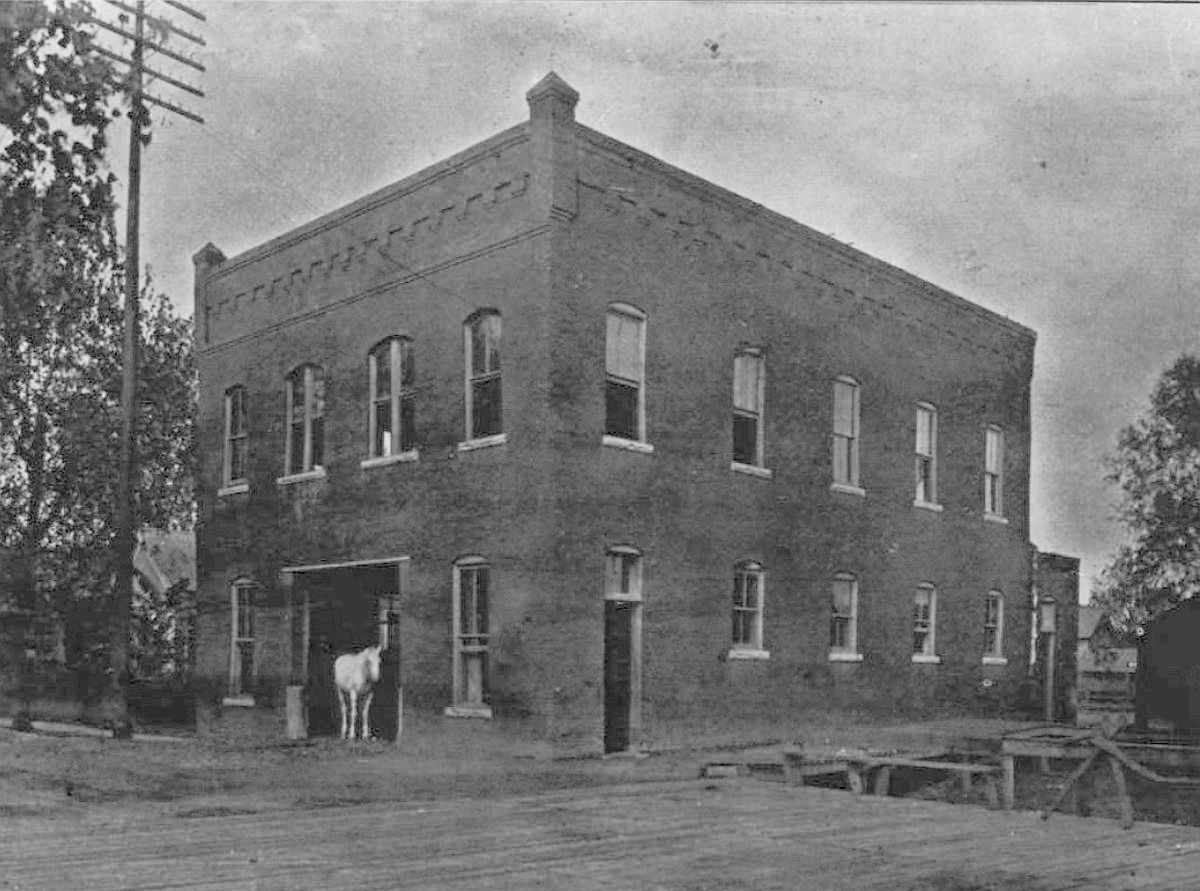
fire-dept_engine-co-3_gaston-and-college_1901Fire horse in Old East Dallas relaxing between calls (click for larger image)

by Paula Bosse

A few turn-of-the-century photos of Dallas’ fire stations, from a 1901 photographic annual. These seven firehouses were built between 1882 and 1894. One of these buildings is, miraculously, still standing on McKinney Avenue, in the heart of Uptown.

*

At the top, Engine Co. No. 3, at Gaston and College Avenues. In service: January, 1892. Equipment: an Ahrens Steamer, capacity 750 gallons per minute, and a Cooney Hose Carriage. See it on a 1905 Sanborn map here; see the present location (Gaston and Hall) here. (And since I just used it a few days ago, here’s a 1921 Sanborn map, showing Mill Creek running right through the property.)

*
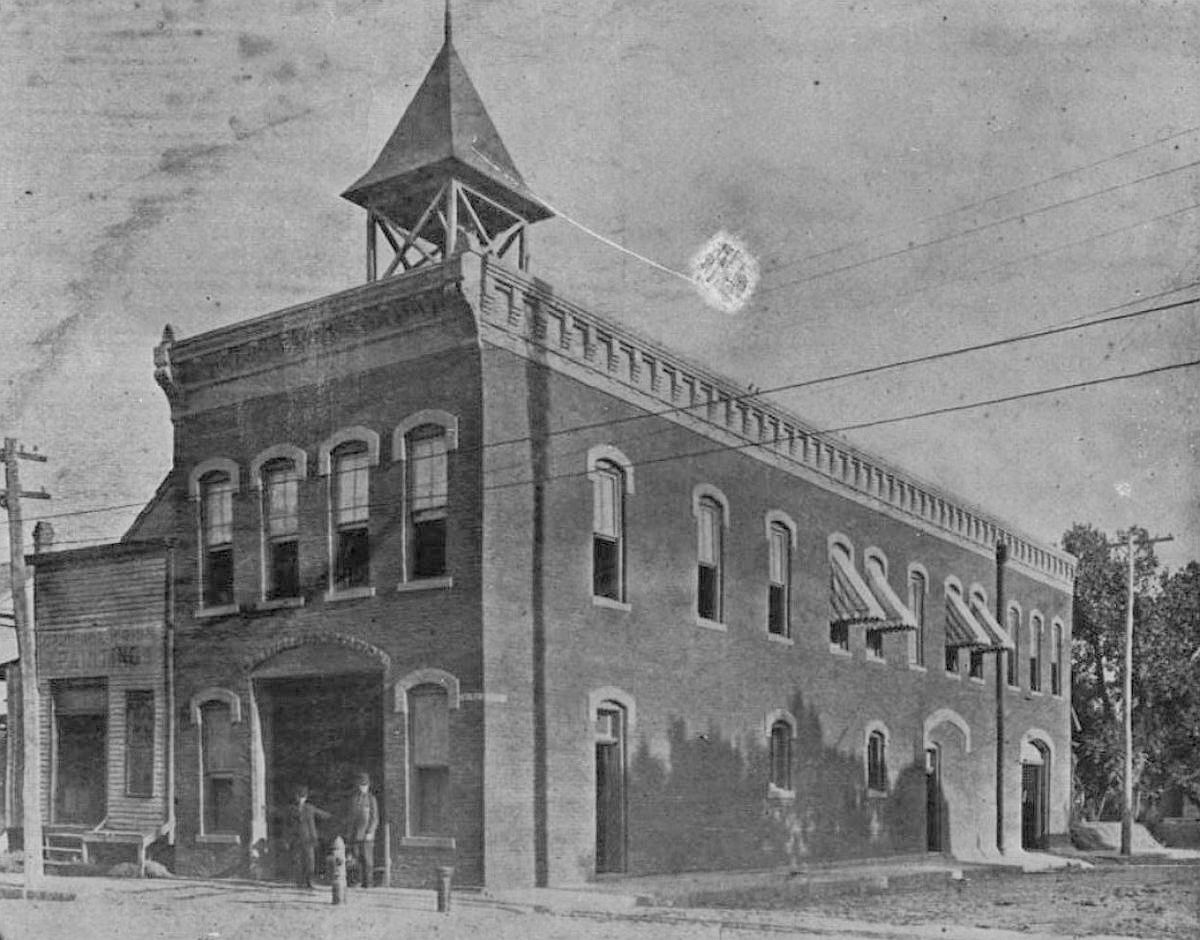
fire-dept_central-station_main-harwood_1901

Above, Central Fire Station, Main and Harwood Streets. In service: October, 1887. Equipment: a double-sixty-gallon Champion Chemical Engine and a City Hook and Ladder Truck. See it on a 1905 Sanborn map here; see the present location here (the site of the old City Hall/Municipal Building).

*
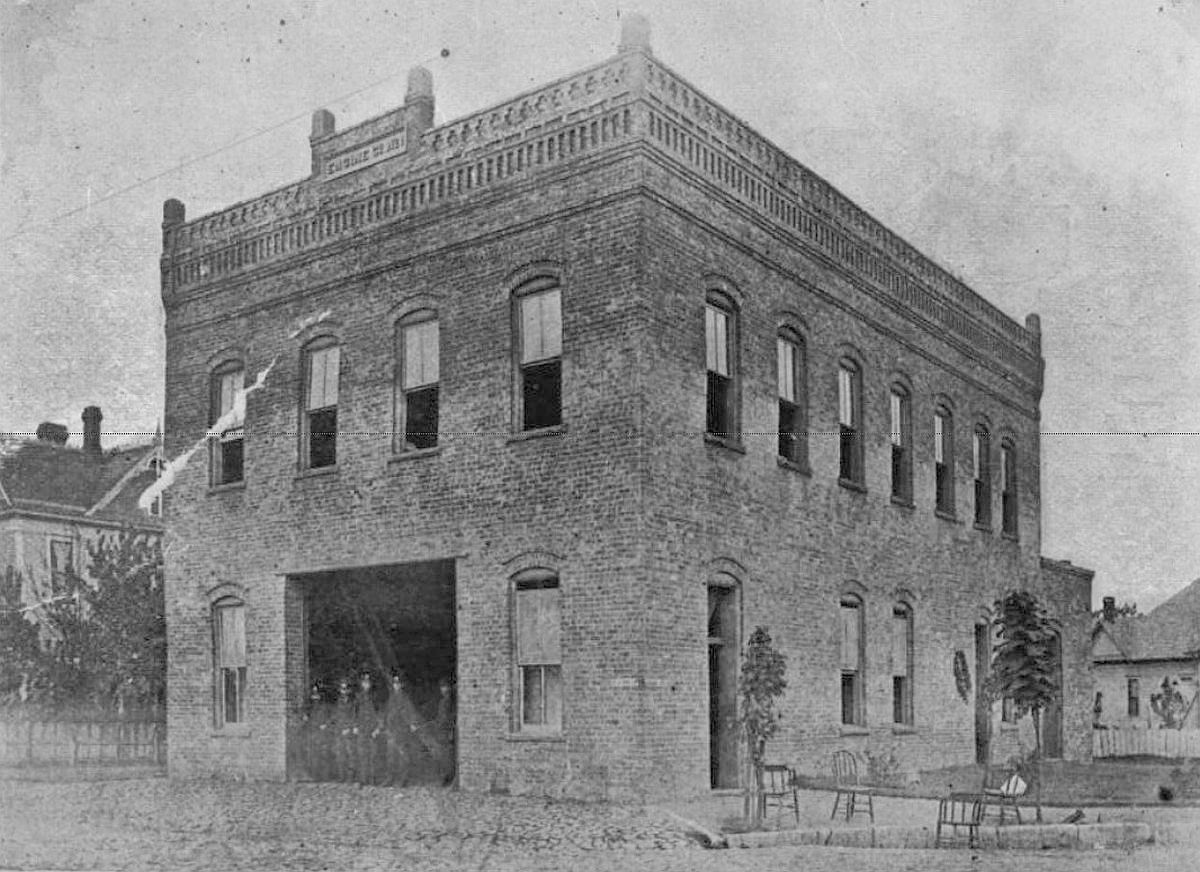
fire-dept_mckinney-leonard_engine-co-1_1901

Engine Co. No. 1, McKinney Avenue and Leonard. Equipment: an Ahrens Steamer, 750 gallons per minute, and a Cooney Hose Carriage. In service: August, 1894. See it on a 1905 Sanborn map here; see the present location here. NOTE: This is the only one of these firehouses still standing. I wrote about it here.

UPDATE: Well, sort of. Thanks to a comment on Facebook, I researched this station a bit more and found that it was rebuilt and modernized at the end of 1909 — using materials from the original building seen above, built on the same plot of land. So instead of being 122 years old, the building on McKinney today is a mere 106 years old.

*
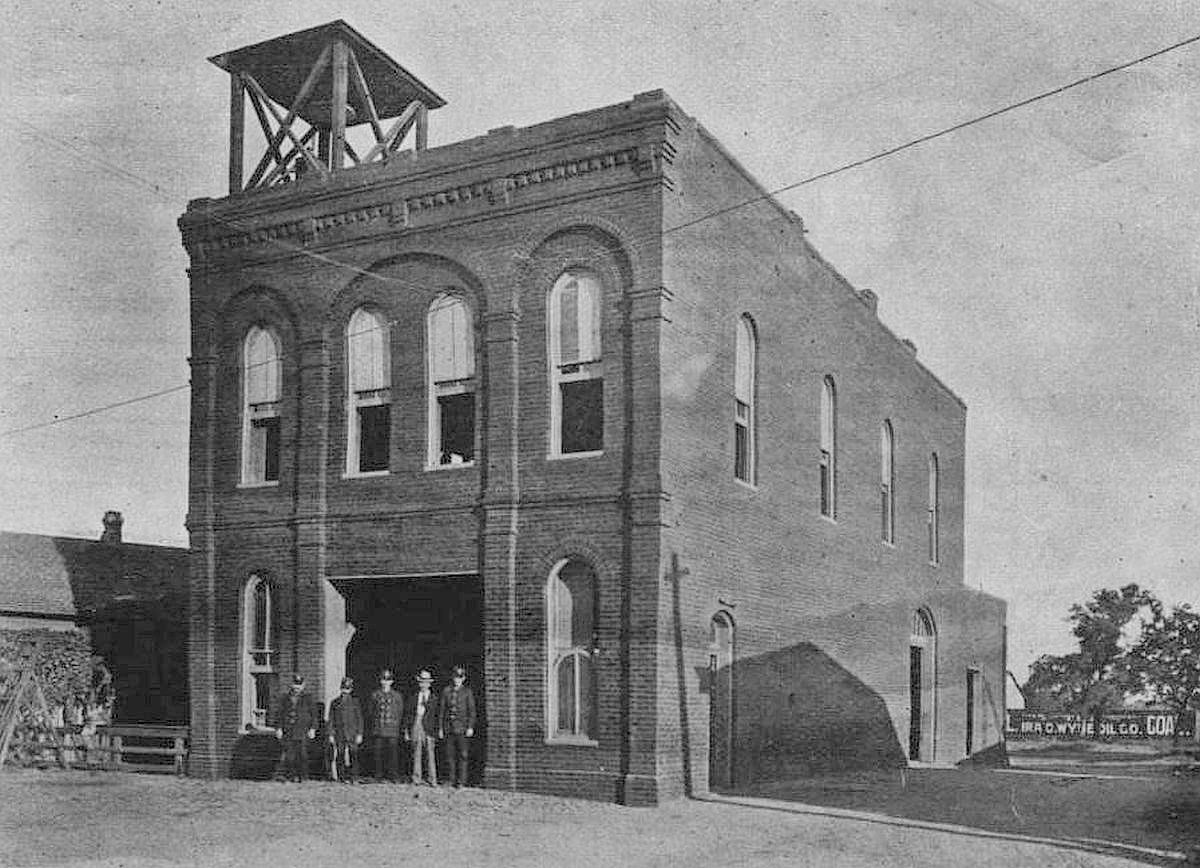
fire-dept_commerce-hawkins_engine-co-2_1901

Engine Co. No. 2, Commerce and Hawkins Streets. In service: January, 1882. Equipment: an Ahrens Steamer, capacity 750 gallons per minute, and a Cooney Hose Carriage. See it on a 1905 Sanborn map here; see a shot-in-the-dark guess at a present location here.

*
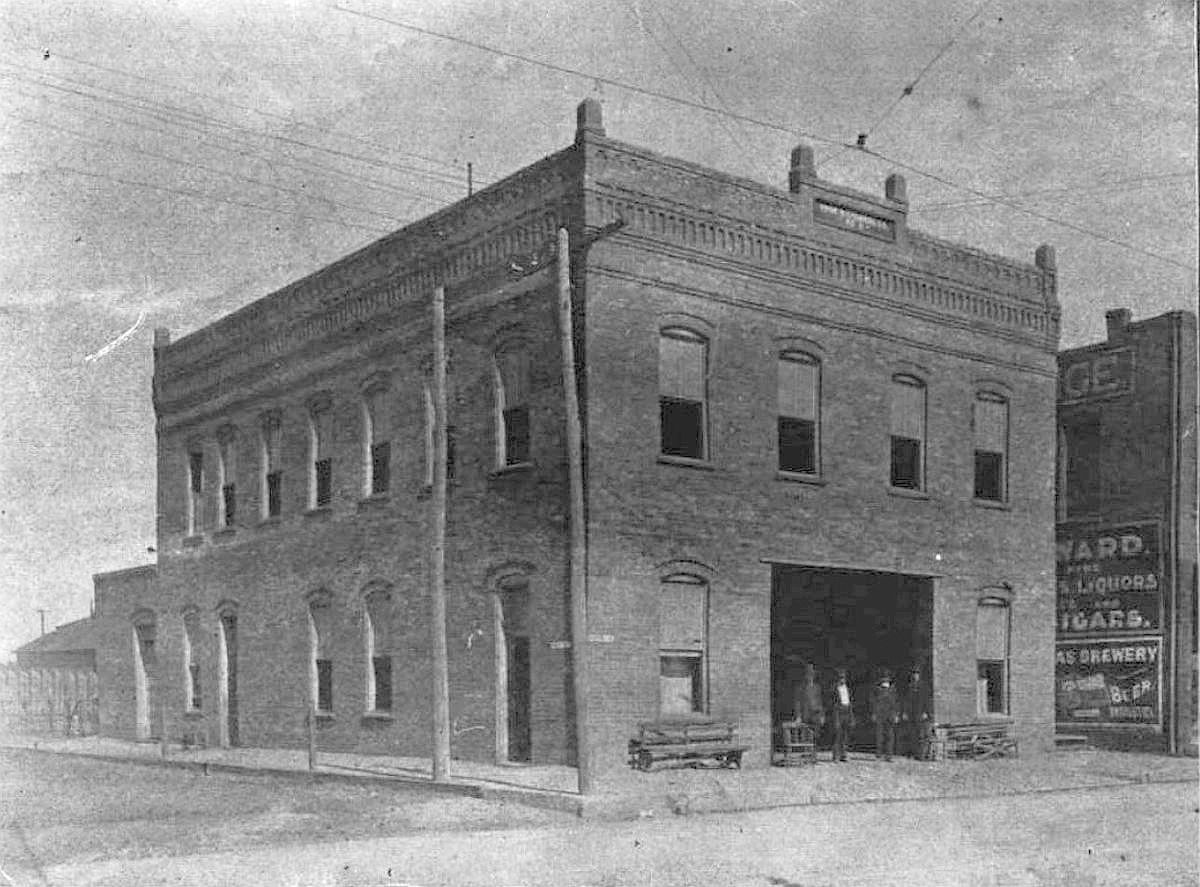
fire-dept_ervay-kelly_hose-co-2_1901

Hose Co. No. 2 and Chemical Co. No. 2, Ervay Street and Kelly Avenue. In service: September, 1894. Equipment: a Cooney Hose Carriage and double-sixty-gallon Champion Chemical Engine. See it on a 1905 Sanborn map here; see the present location here (right behind where the word “Cedars” is).

fire-dept_bryan-hawkins_hook-and-ladder-1_1901

Hose Co. No. 1 and Hook and Ladder Co. No. 1, Bryan and Hawkins Streets. In service: January, 1893. Equipment: Preston Aerial Truck with 75-foot extension ladder, and a Cooney Hose Carriage. See it on a 1905 Sanborn map here; see the approximate present location here.

*
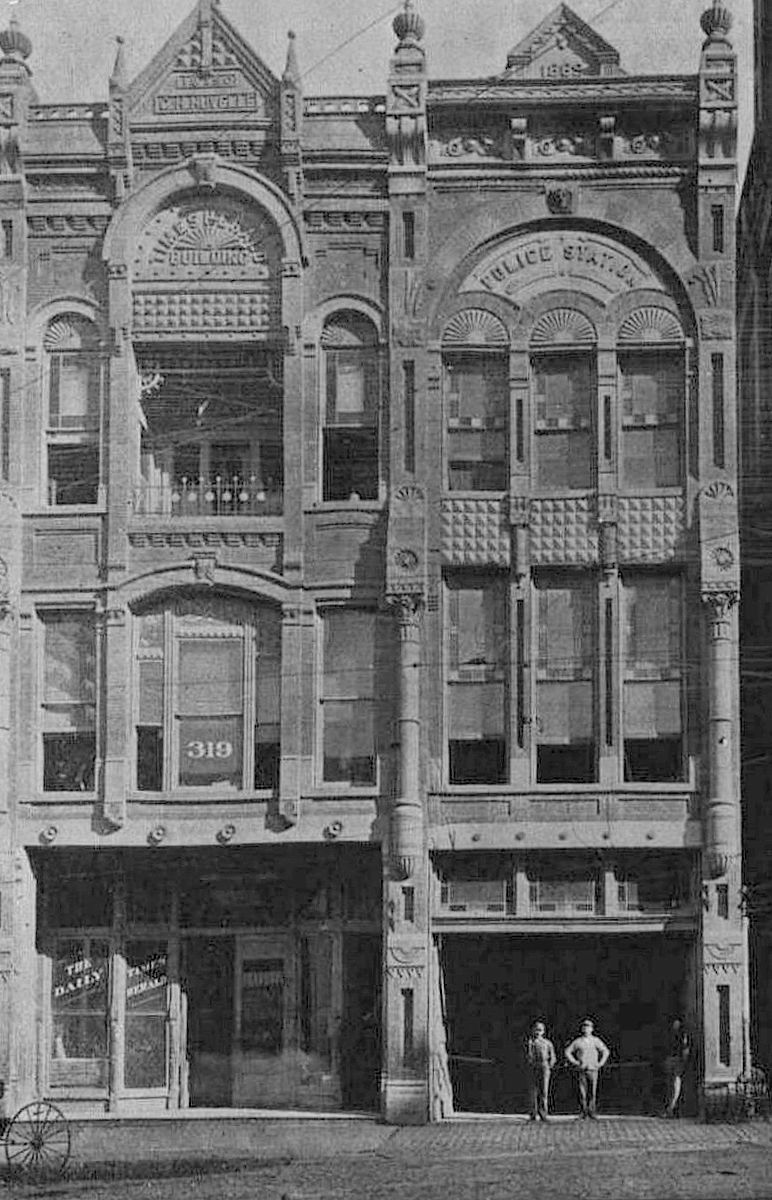
fire-dept_commerce-akard_engine-co-4_1901

Engine Co. No. 4, Commerce and Akard Streets, next door to the City Hall. In service: August, 1894. Equipment: an Ahrens Steamer, capacity 1,100 gallons per minute, and a Cooney Hose Carriage. See it on a 1905 Sanborn map here; see the present location here (just out of frame at the right was the City Hall; the block is now the site of the Adolphus Hotel).

*
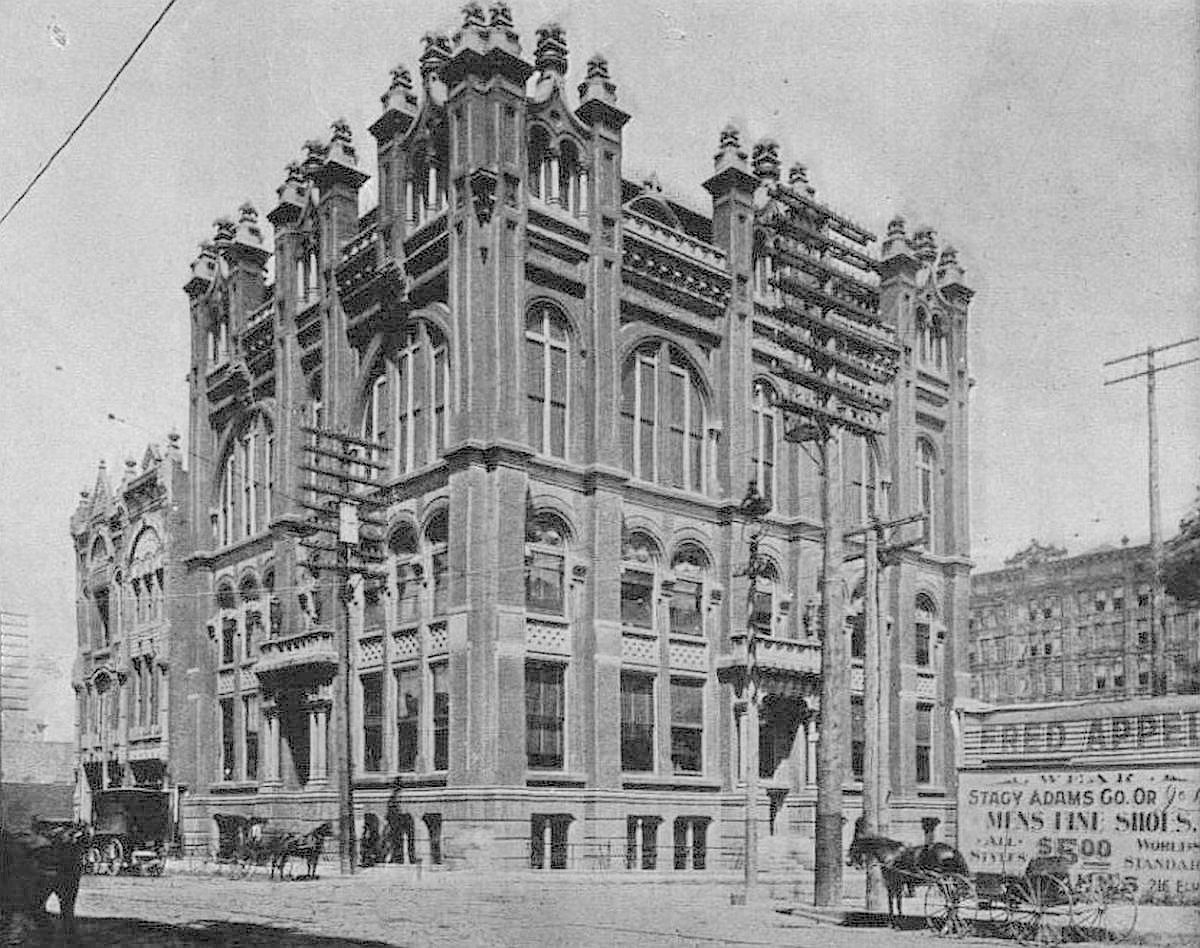
city-hall_1901_fire-dept-annual_portal

City Hall, Commerce and Akard Streets, now the location of the Adolphus Hotel. Half of the shorter building to the left housed the police department and Engine Co. No. 4.

*

The “Historical” page from the book (click to read).
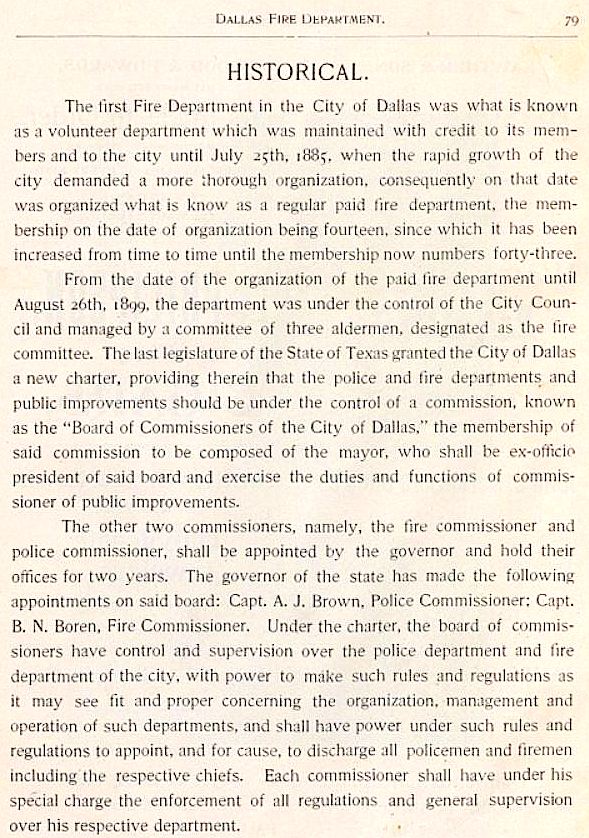
fire-dept-hist_dallas-fire-dept-annual_1901_portal

**

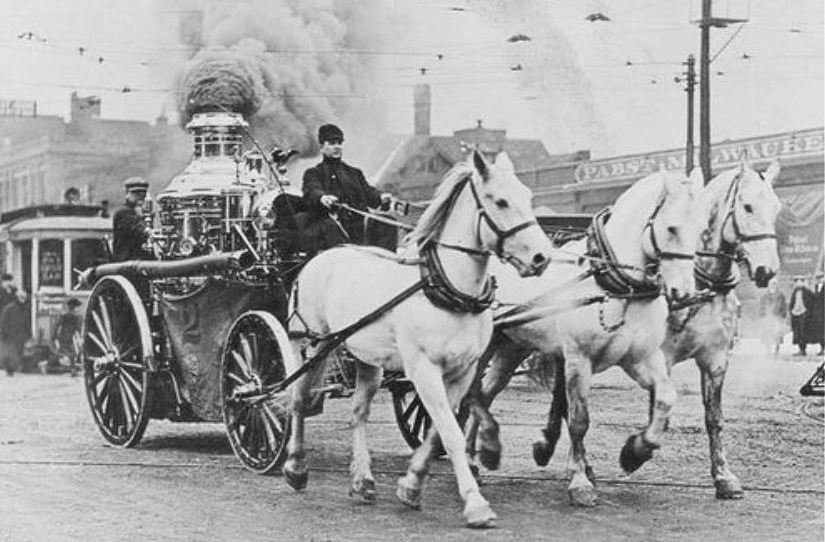
Since there is no sign of the actual equipment in these photos, here’s what horse-drawn steam engines (Ahrens steamers) looked like at this time. (Photo from the Wisconsin Historical Society).
fire-steam-engine_wisconsin-hist-soc

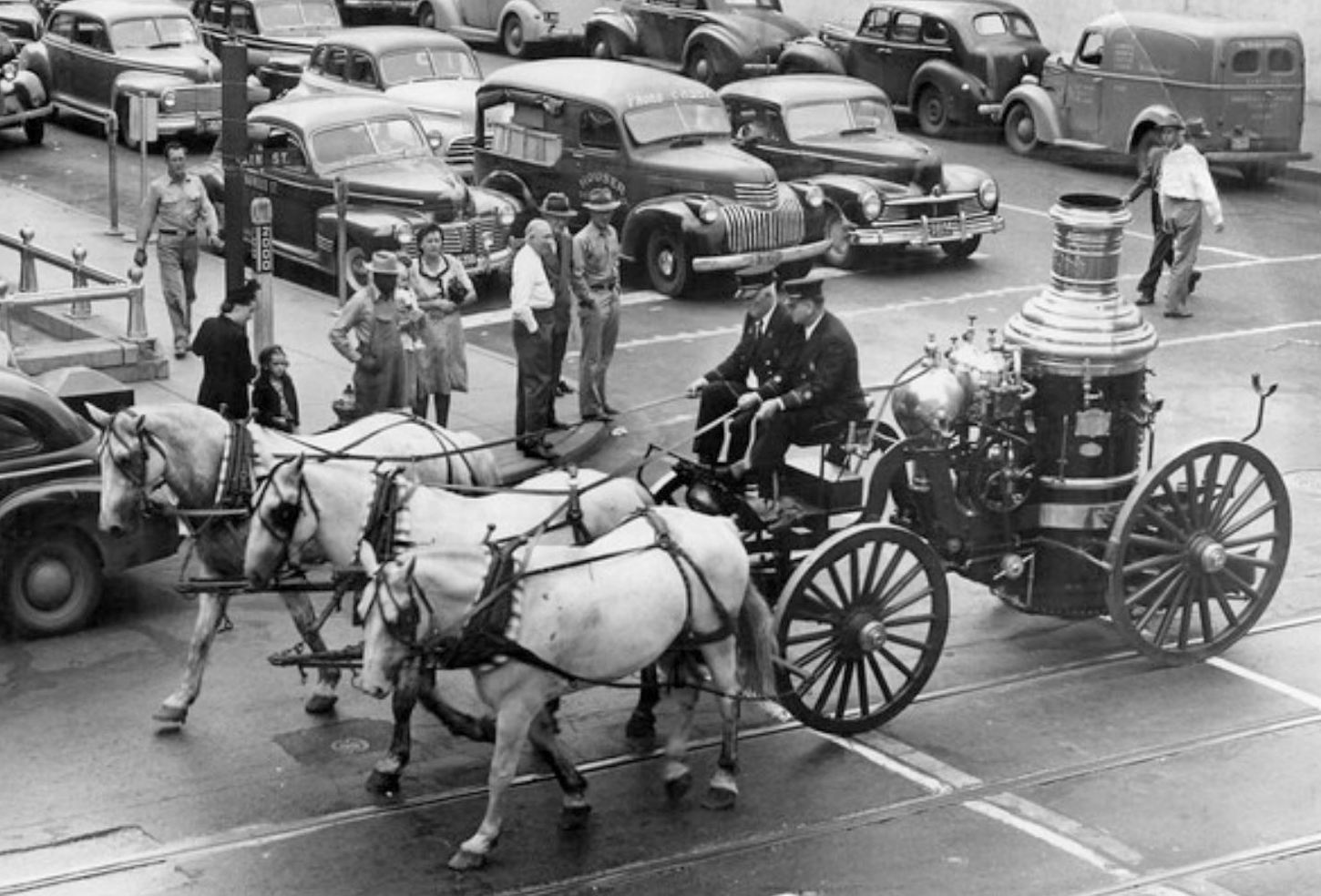
UPDATE: I found this photo on Flickr, showing equipment from those early days being driven through the streets of Dallas during a fire prevention parade.
fire-department_pumper_flickr_coltera

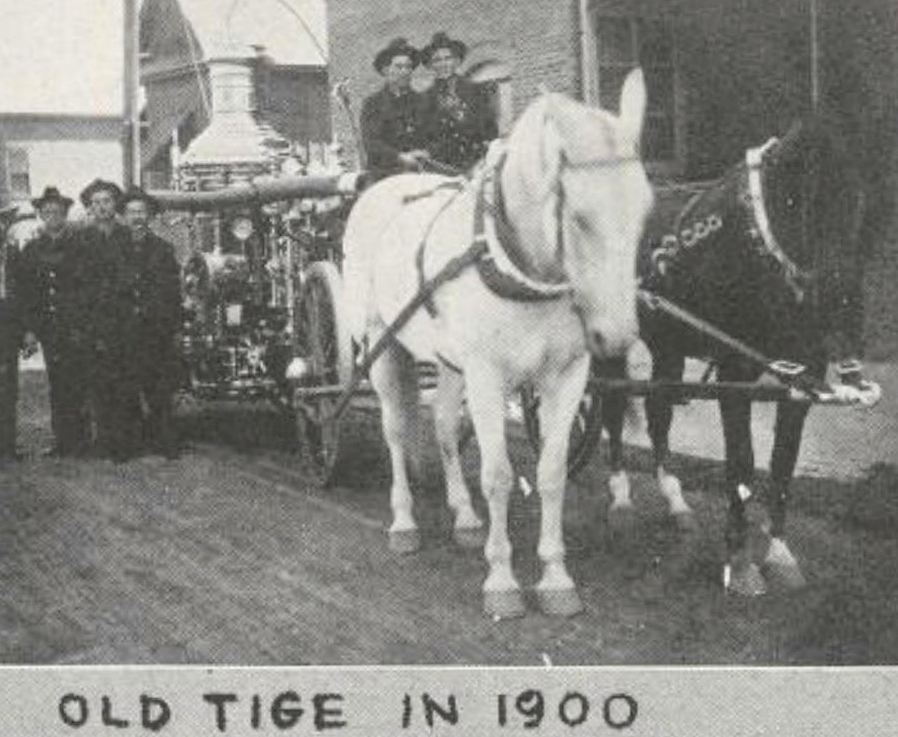
UPDATE: Lo and behold, a photo from 1900 of Old Tige, the 600 gallons-per-minute steam pumper, built in 1884, which was in service with the Dallas Fire Department until 1921. (Old Tige can be seen in the Firefighters Museum across from Fair Park.) Found at the Portal to Texas History.
old-tige_1900_fire-dept-bk_1931_portal

***

Sources & Notes

Photos by Clifton Church, from the Dallas Fire Department Annual, 1901, which can be viewed in its entirety on the Portal to Texas History, here.

A contemporary map of Dallas (ca. 1898) can be viewed on the Portal to Texas History site, here.

More Flashback Dallas posts on historic Dallas firehouses can be found here.

All photos larger when clicked.

*

Copyright © 2016 Paula Bosse. All Rights Reserved.
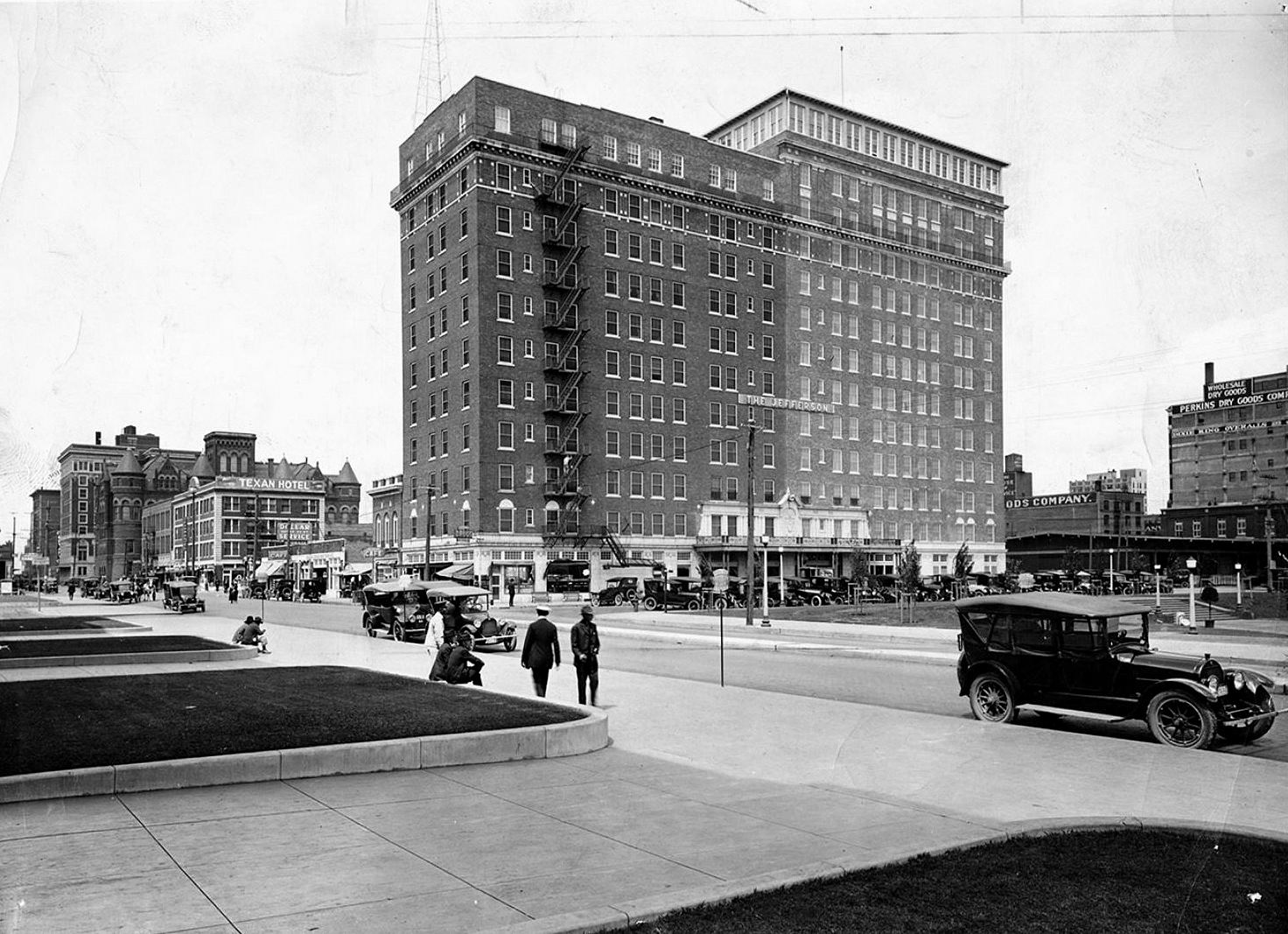
The Jefferson Hotel and Its “Wireless Telegraph” Rooftop Tower — 1921

jefferson-hotel_1921_UTAThe view from Union Station… (click for larger image)

by Paula Bosse

I haven’t seen many photographs showing this striking view of Dallas along Houston Street. This is what visitors saw when they emerged from Union Station after having arrived in the city by train: in the distance, the John Deere Plow Co. Building on Elm, the Dallas Jail and Criminal Courts Building, the Dallas County Courthouse, the Texan Hotel, the Jefferson Hotel, and (mostly out of frame at the right) the very pretty Ferris Plaza.

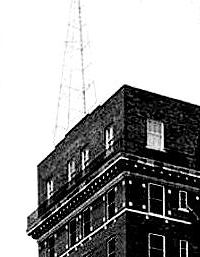
This photo was taken as one of several coinciding with the formal opening of the Jefferson Hotel’s major new addition (the addition is the taller, lighter-colored half of the hotel) — it was published in the May 8, 1921 edition of The Dallas Morning News in a special Jefferson Hotel section of the paper. I guessed that the the date of the photo was later because of what looks like a radio broadcast tower on the roof. Commercial radio broadcasts were not available in Dallas until June of 1922 when WFAA went on the air (their rooftop towers looked like this). WRR — the municipal broadcasting station — was a little older, but in those early days it was used exclusively for police communication (they appear to have had an aerial on top of the City Hall by at least September of 1921, if not earlier). So what was that tower on the roof?

jefferson-hotel_UTA_tower

It took a while to find out what it was, but … turns out it was, in fact, an antenna. It was part of the “wireless telegraph” equipment owned by the Continental Radio Telegraph Co., which had a Western Union-like office in the hotel’s lobby (the company had to relocate their tower and office from the Southland Hotel, their home for a little over a year before moving to the Jefferson’s roof).

The Continental Radio Telegraph and Telephone Co. began in about 1919. It was one of the first companies in the Southwest to attempt to commercialize the nascent “wireless” technology which allowed the sending and receiving of messages via radio waves. The initial motivation for establishing this new-fangled business appears to have been the inability of those with interests in the remote Texas oilfields to communicate with their workers in areas not served by telephone and telegraph wires. The plan was to build radio towers in these areas to broadcast and receive messages. When a “radiogram” was received and transcribed, a “polite, intelligent boy” would be dispatched to deliver the message to its recipient — all for about the same price as sending a regular telegram. Not only did the company envision the ability to one day communicate with ships, trains, and airplanes that were in transit, they also hoped to develop “wireless telephone” communication.

The Continental Radio Telegraph Company was based in Dallas from at least January of 1920, but they were gone by the time the 1922 city directory was printed — gone just a few short months after planting that aerial on top of the Jefferson Hotel. They seem to have erected only four towers: in Dallas, Fort Worth, Wichita Falls, and (possibly) Breckenridge. Then, as now, technology has a way of racing ahead of somewhat limited business plans.

But at least we have a nice photograph of their rooftop tower as proof that they existed.

**

(Click articles to see larger images.)

continental-radio_dmn_022720
Dallas Morning News, Feb. 27, 1920

continental-radio_jefferson-hotel_dmn-042921
April 29, 1921

continental-radio_jefferson-hotel_dmn_073121
“Wirless”! — DMN, July 31, 1921

*

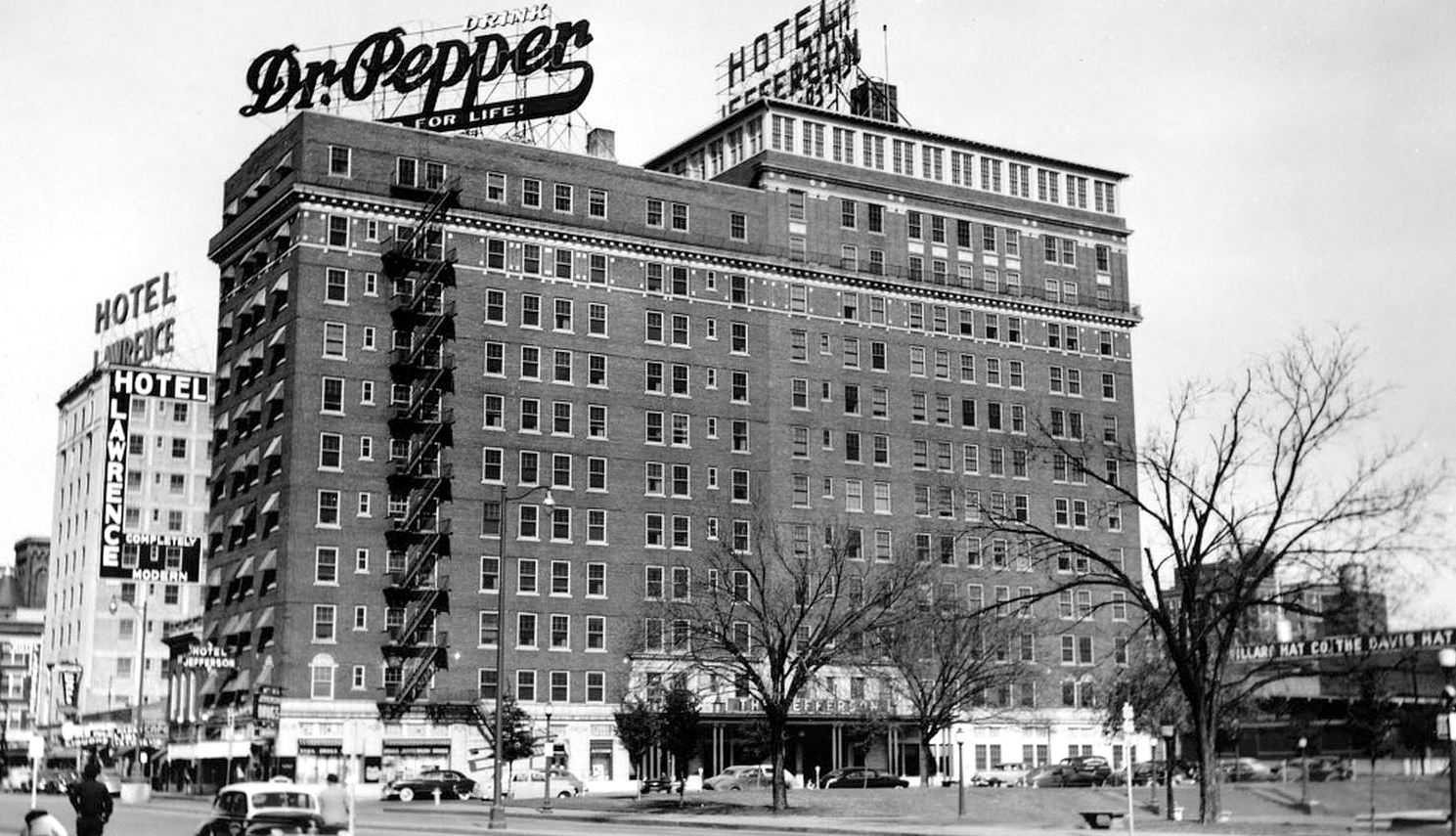
Here’s a shot from the same location a few years later; the tower has been replaced by the huge Dr Pepper sign which became something of a city landmark, and the Hotel Lawrence has popped up and is open for business next door. (More on this sign can be found in the Flashback Dallas post “Neon Refreshment: The Giant Dr Pepper Sign.”)

jefferson-hotel_hotel-lawrence_dr-pepper-sign_dmn-tumblr

***

Sources & Notes

Top photo is from the Fort Worth Star-Telegram Collection, UTA Libraries; more information is here. When the picture ran in the May 8, 1921 edition of The Dallas Morning News, the credit line read “Photo by Raymond.”

Photo with the Dr Pepper sign was purchased at an antique mall/flea market and was uploaded to Tumblr, here.

The Jefferson Hotel — which opened in October, 1917 — was demolished in 1975.

All images larger when clicked.

*

Copyright © 2016 Paula Bosse. All Rights Reserved.
 

DFW Airport Under Construction — 1973

dfw_under-construction_ca-1973_UTAA bird’s-eye view of the old Harrington place (click for HUGE image)

by Paula Bosse

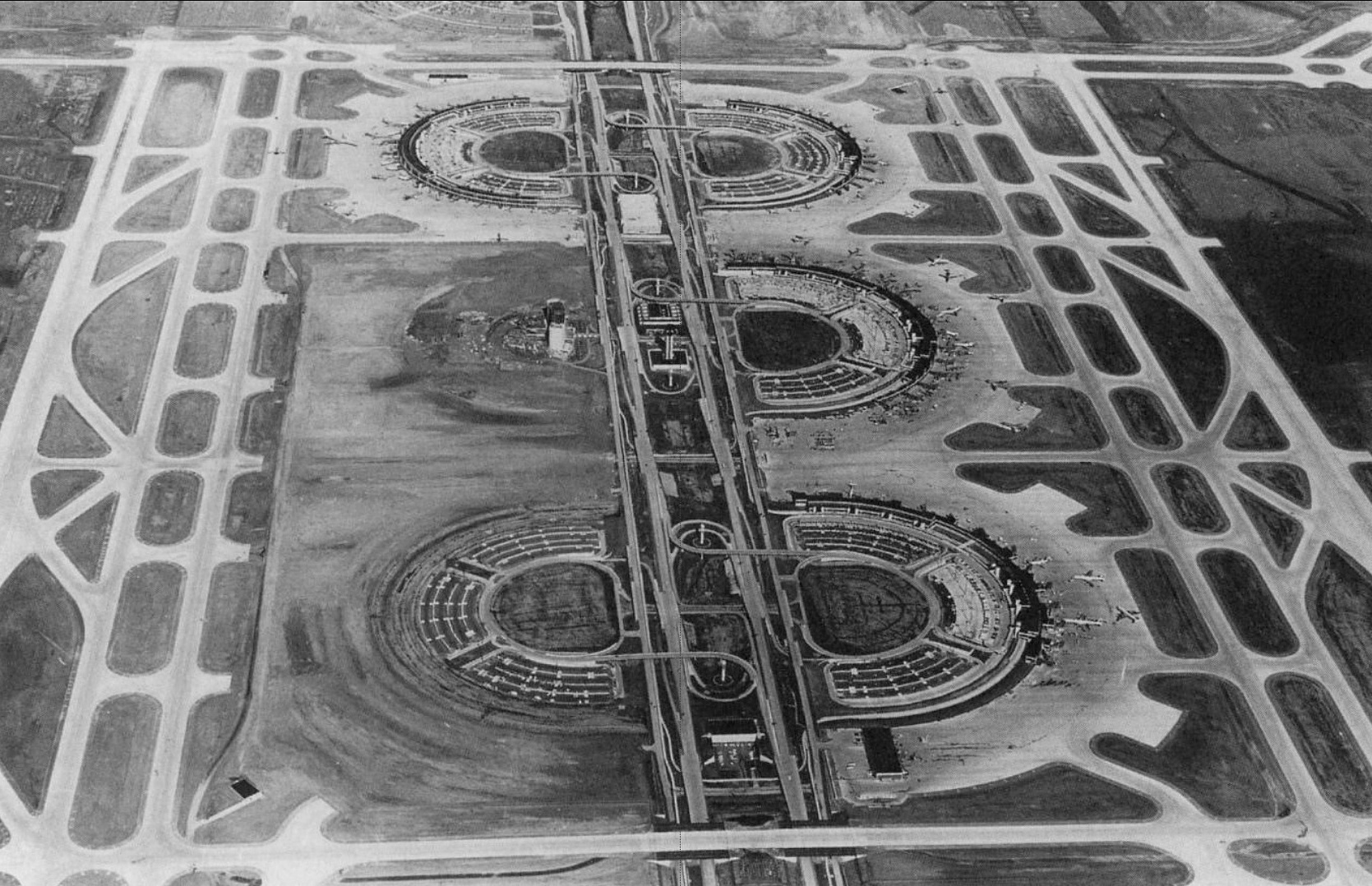
Dallas-Fort Worth Airport, during construction in 1973. DFW before it was DFW.

dfw-airport_1974-tsha

When DFW opened in January, 1974 — on 700 acres of land purchased from Irving rancher R. D. Harrington — it was served by only 8 airlines, had 3 runways and 56 gates. American Airlines Flight 341 from New York/Memphis/Little Rock was the first commercial flight to land at the airport, on Jan. 13, 1974. There was apparently an onboard battle to claim bragging rights to being the first passengers off the very first flight: a Fort Worth couple beat out a Dallas businessman for the honors — the Dallas man asserted, “I was the third person off the plane as the result of a shoulder block from the young lady who was the first person off” (Dallas Morning News, “First Flight A Scramble For History by Charlie Bates, Jan. 14, 1974).

***

Sources & Notes

Top photo titled “Airview of terminal buildings and highway through the airport at Dallas-Fort Worth Airport during construction, ca. 1973; from UTA Libraries, Special Collections — more info here.

Second photo is from the Texas State Historical Association 103rd Annual program (March, 1999), found on UNT’s Portal to Texas History site, here.

More on the history of DFW Airport can be found in the Fort Worth Star-Telegram article “40th Anniversary: DFW Ready to Soar Into the Future” by Andrea Ahles (Jan. 11, 2014), here.

DFW Wikipedia entry is here.

An aerial view of the airport today, from Google Maps, is here.

Photos are MUCH larger when clicked.

*

Copyright © 2016 Paula Bosse. All Rights Reserved.


Views of Elm Street, With Cameo Appearances by the Fox Theater — 1920s-1960s

fox-theater_sherrod_dpl
Elm looking west from Akard, ca. 1922

by Paula Bosse

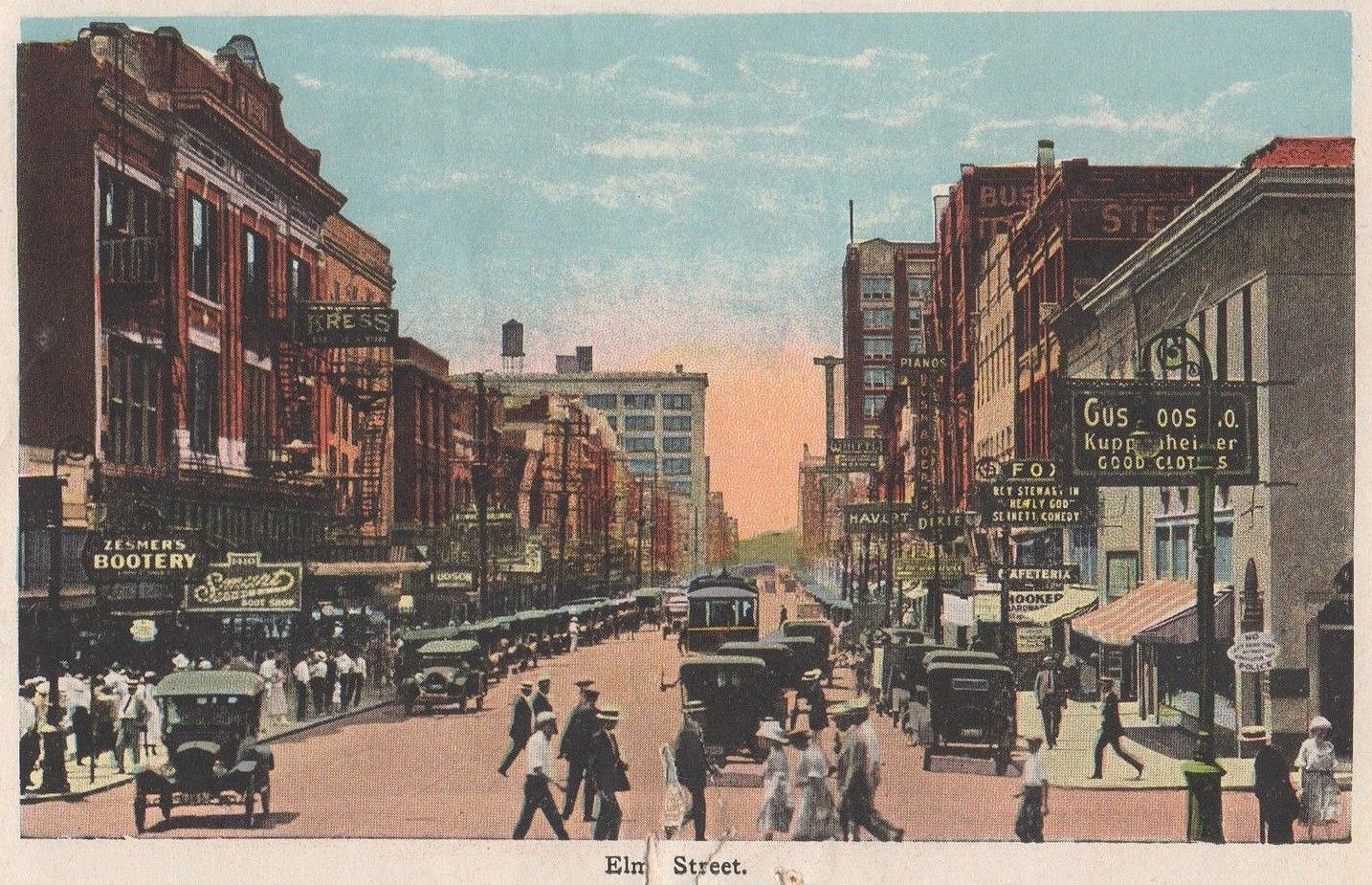
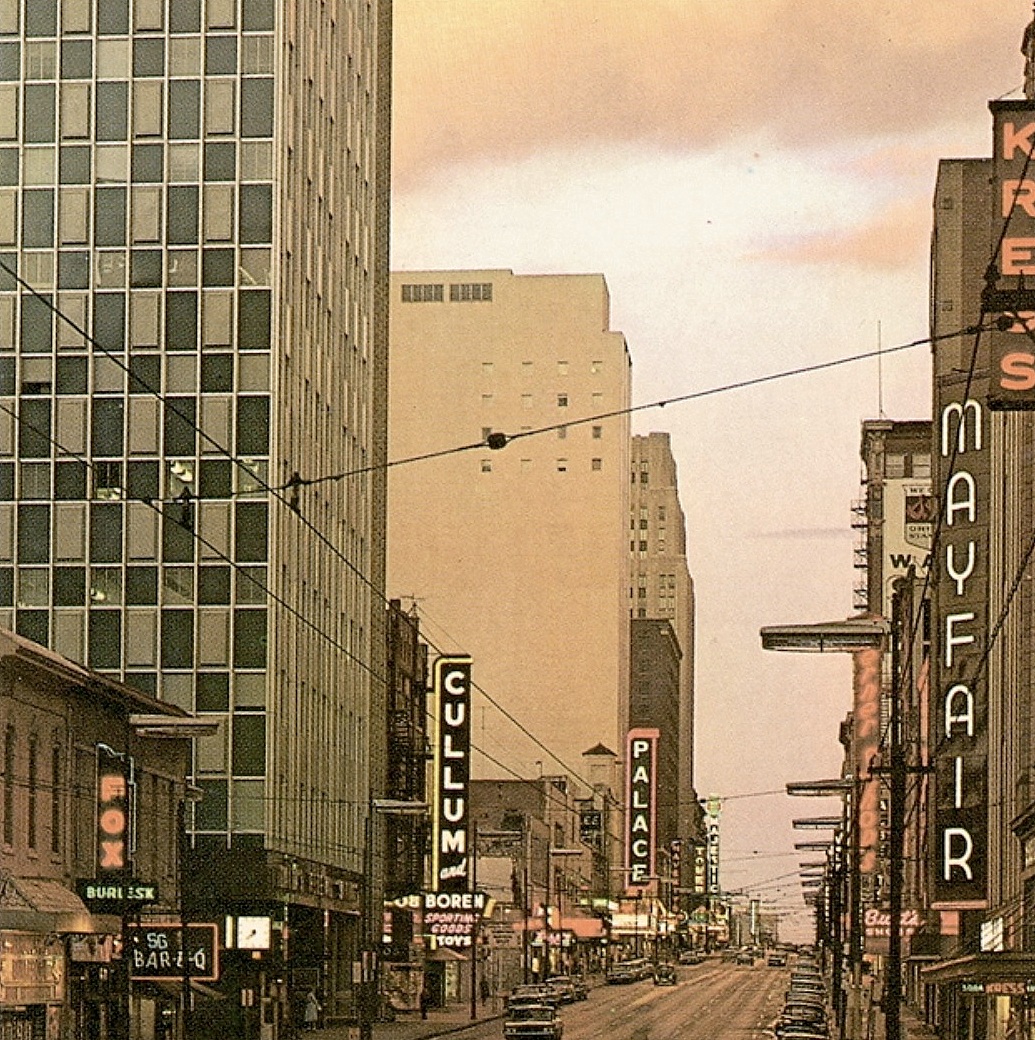
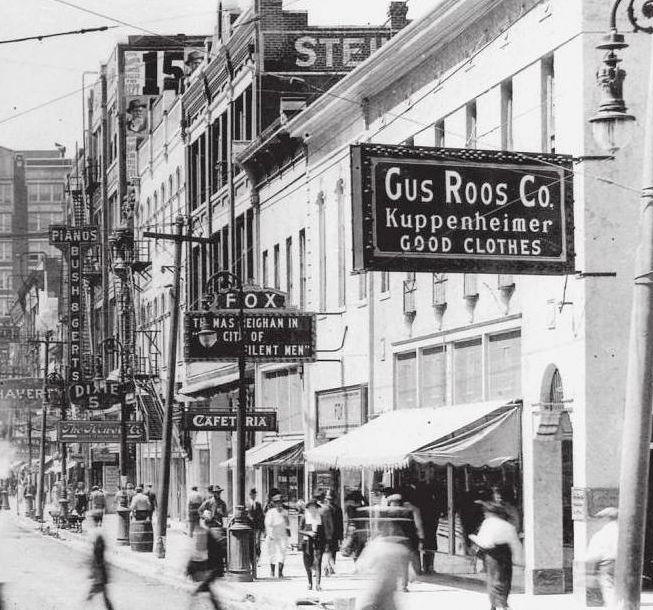
From the earliest days of moving pictures, most downtown movie houses called Elm Street home. Some were originally vaudeville houses which occasionally featured short films between acts of the live revues, and some were theaters built expressly as move theaters. Most of the downtown theaters could be found on Elm Street, and the stretch between, say, Field and Harwood became known as “film row” or “theater row.” Most theaters were located on the north side of Elm in the blocks east of Akard Street, but a few found a home west of Akard. One of these — which I’ve seen in several of the photos I’ve posted — was the Fox Theater, located next to the Gus Roos store, at 1411 Elm, just west of the Akard intersection.

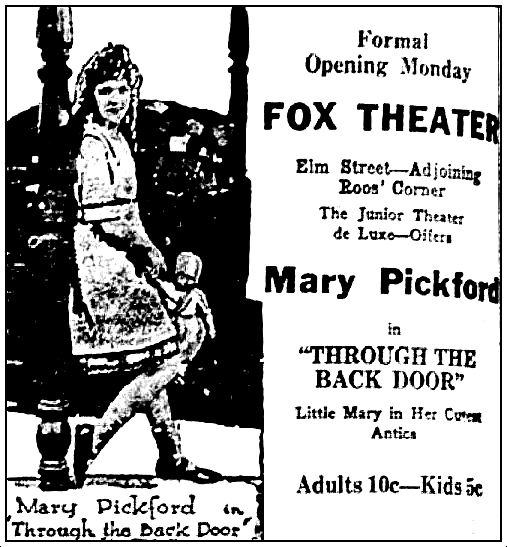
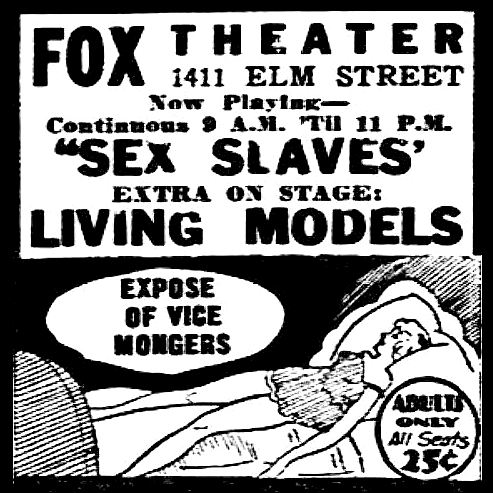
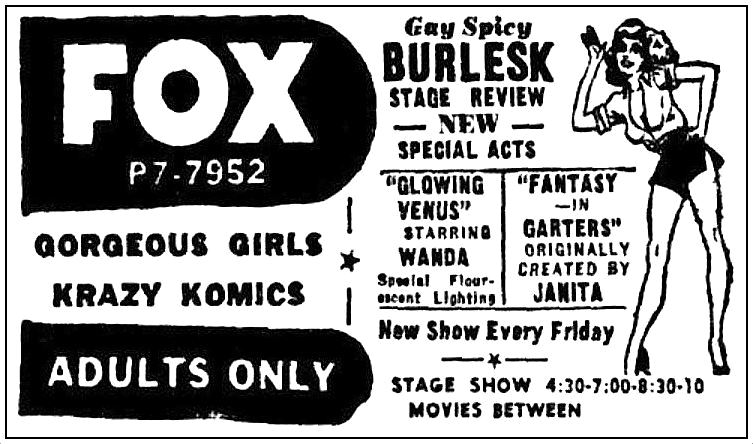
The Fox — which was named after owner Max Fox, a Polish immigrant who also owned the nearby Strand Theater — opened in the early months of 1922. During its 40-year history, it had something of a “colorful” life: despite opening with a sweet, family-friendly Mary Pickford movie and then showing mostly second-run features, it ultimately became one of Elm Street’s seedier theaters, showing cheap exploitation flicks and, later, becoming a “burlesk” house with on-stage strippers and “adult-only” fare playing continuously from 9 AM (!) to 11 PM. The Fox remained in business until the end of 1961 when property in the 1400 block began to be sold in order to build the First National Bank Building. (A comprehensive history of the theater can be found on Cinema Treasures.)

*

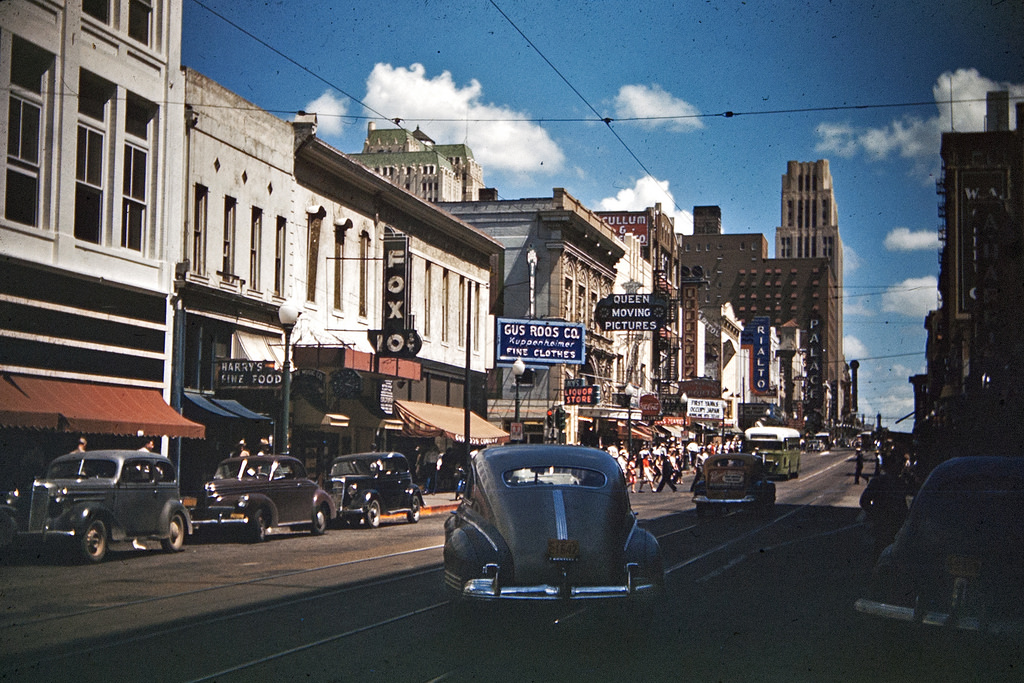
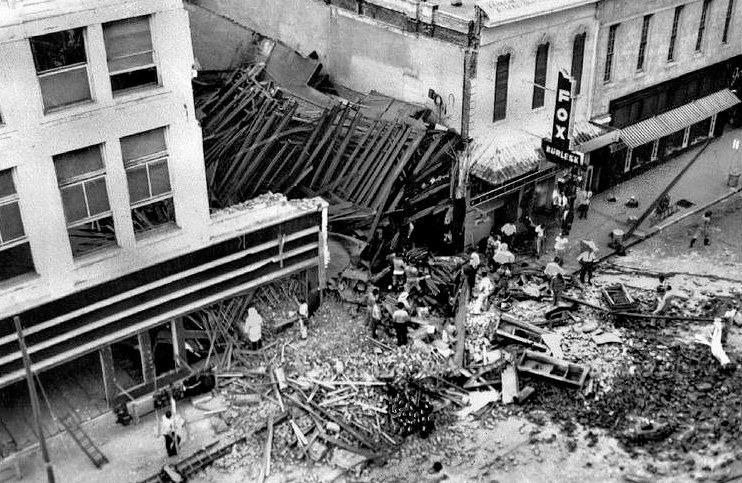
As I said, I’ve noticed the Fox Theater in a number of photos I’ve come across — some of which I’ve posted previously. Here are a few views of Elm Street in which the Fox pops up in a cameo appearance.

The top photo shows Elm looking west in about 1922. Down the street a bit you can see the Dixie Theater at 1315 Elm, one of the (if not THE) oldest permanent movie theater spaces in Dallas. The Dixie began life in 1909, the third theater in the location originally occupied by the Theatorium, which opened in 1906. (I wrote about the Dixie and other early “photoplay houses” in Dallas here.)

A similar view from about the same year is seen in this postcard (click to see a very large image):

elm-st-color_1920s

From the WWII-era, this fantastic color photo, looking east (the Queen, Telenews, Capitol, Rialto, and Palace theaters can be seen in this photo, with the silhouette of the Majestic Theatre’s sign seen way in the distance):

elm-street-color_1940s_jeppson-flickr

In 1955, the wall of the building next door to the theater collapsed, killing several people (I wrote about that building collapse, here):

building-collapse_observer-090511

And, lastly, a photo of a decidedly less glamorous Elm Street, showing the “Fox Burlesk” in its final months, taken about 1961:

1400-block-elm_schaffershot54_flickr_ca-1961

**

fox-theater_032022
Dallas Morning News, March 20, 1922

fox-theater_pickford_dmn_031922
March 19, 1922

fox-theater_dmn_031940
1940

fox-burlesk_dmn_061850
1950

***

Sources & Notes

Top photo from Troy Sherrod’s book Historic Dallas Theatres; photo from the Dallas Public Library.

1940s color photo from Noah Jeppson’s Unvisited Dallas post, “Elm Street 1945,” here.

UPI photo showing the building collapse was posted a few years ago by Robert Wilonsky on the Dallas Observer’s Unfair Park blog, here.

Bottom color photo from Flickr user Schaffershot54, here.

Other Flashback Dallas posts on Dallas theaters can be found here.

*

Copyright © 2016 Paula Bosse. All Rights Reserved.

Summer Rerun: 7-Eleven Day!

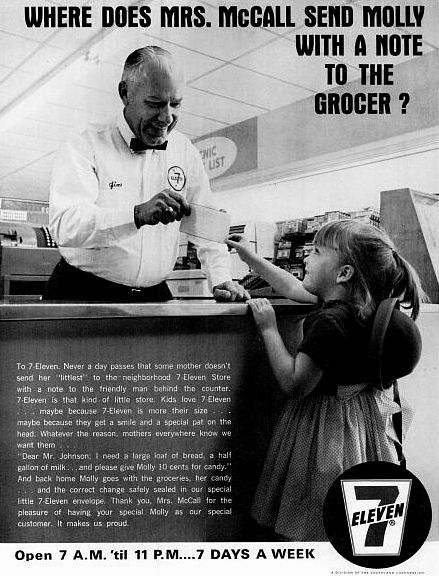
7-eleven_1966

by Paula Bosse

Today — July 11 — is “7-Eleven Day,” the day when the Dallas company that revolutionized the world of retail convenience offers free Slurpees to a hot and sweaty public. The 1966 ad above is one of the first things I ever posted on this blog. It’s sweet and quaint. The world has changed quite a bit since that folksy advertisement appeared 50 years ago. Read the ad copy in the original post, here.

*

Copyright © 2016 Paula Bosse. All Rights Reserved.

The Dallas Express — A Look Inside the Offices of the City’s Most Important Black Newspaper — 1924

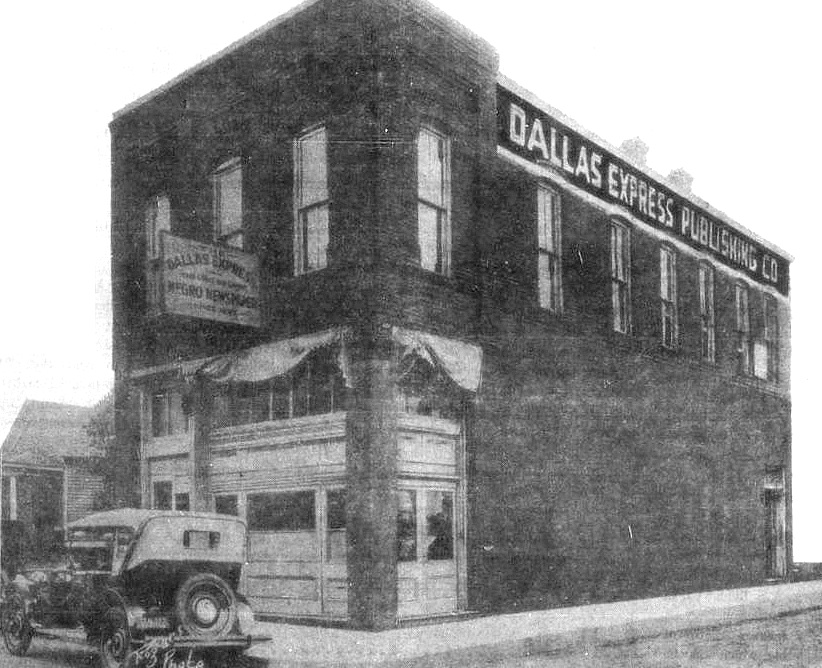
dallas-express-bldg_dallas-express_0607242600 Swiss, home of The Dallas Express (click for larger image)

by Paula Bosse

Without question, The Dallas Express (1892/3-1970) was the most important and most widely-read black-owned newspaper published for Dallas’ African-American community. In addition to stories of particular interest to its Dallas and Texas readership, it also covered national and international news, and in the Jim Crow era, when black Dallasites were rarely mentioned in white-owned newspapers except in crime reports, The Express reported on the people, the businesses, the churches, and the achievements of their large community. They also wrote about politics and issues of race and discrimination. One of the paper’s slogans was “A Champion of Justice, A Messenger of Hope.”

I’ve been interested in newspapers, journalism, and the actual physical process of printing newspapers for as long as I can remember, but until a couple of years ago, I was not aware of The Dallas Express, founded in 1892 by publisher/editor W. E. King. Discovering this paper and its stories about my hometown has been eye-opening. The Dallas Express is an important — and often overlooked — source of Dallas history. I love reading through issues of The Express because unlike white-owned papers of this period, it presents a realistic and human chronicle of the everyday lives of Dallas’ black men and women, something which was almost completely ignored by The Dallas Morning News and The Dallas Times Herald.

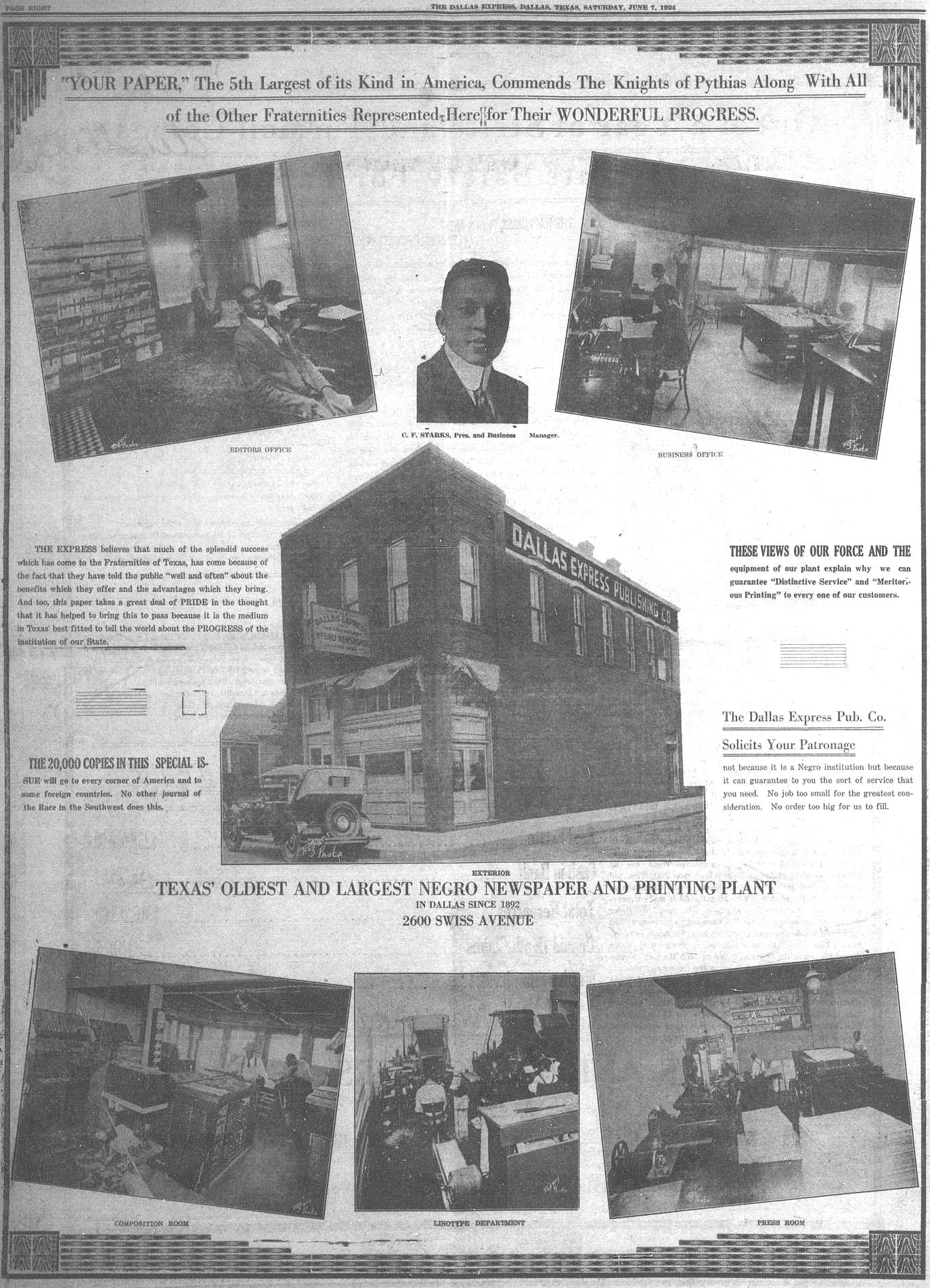
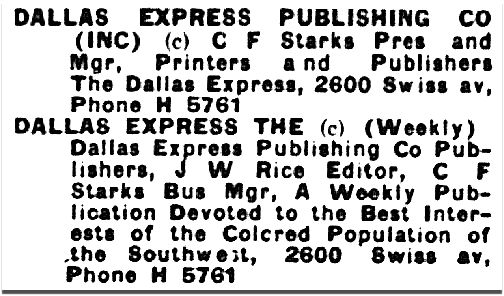
For many years, the offices of the Express were just north of Deep Ellum, at 2600 Swiss — at the corner of Good Street, about where Brad Oldham’s Traveling Man sculpture stands today. (I have a feeling the actual location was in the middle of what is now Good-Latimer. See the location on a 1921 Sanborn map here.) Happily, the Express printed a full-page ad for itself in the June 7, 1924 edition, so we can see what the Swiss Avenue building, its offices, and its production rooms looked like. These photos were taken by noted Dallas photographer Frank Rogers. (Apologies for the muddy quality of these photos — I’d love to see the crisp originals!)

*

These photos show the Dallas Express offices as they looked in 1924, when the newspaper had already been in business for 32 years. The exterior of the two-story building can be seen in the photo at the top — standing next to a private residence. (Click photos to see larger images.)

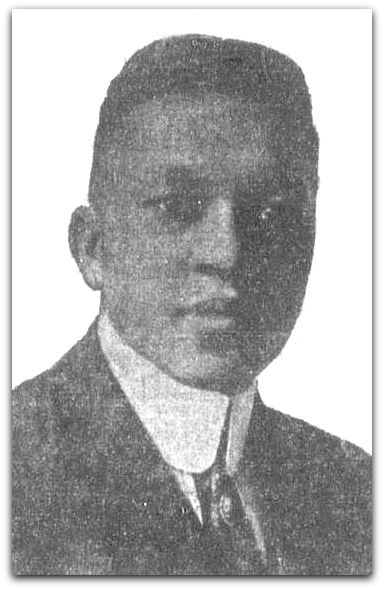
Below, president and business manger (and, later, owner), C. F. Starks:

dallas-express_c-f-starks_pres-business-mgr_060724

The editor’s office (John W. Rice was the editor at this time and is, presumably, the man in the foreground):

dallas-express_editors-office_060724

The business office:

dallas-express_business-office_060724

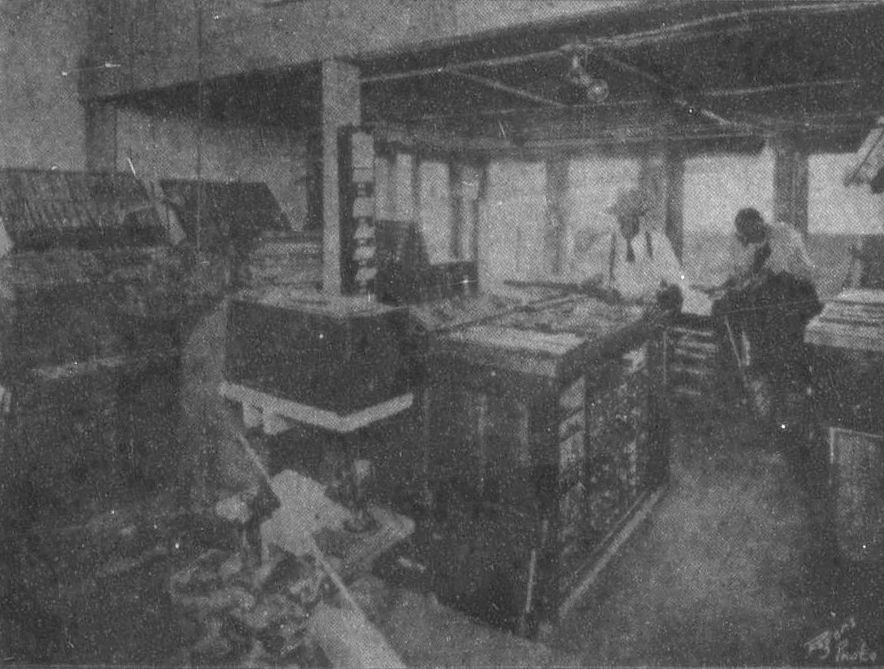
The composition room:

dallas-express_composition-room_060724

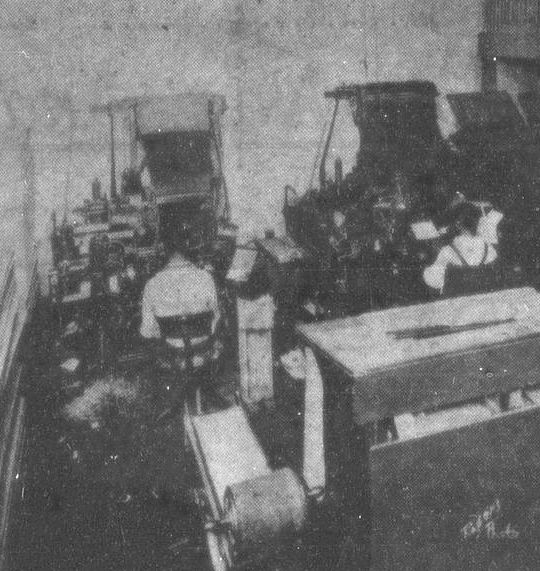
The linotype department (I have written about my fascination with linotype machines here):

dallas-express_linotype_060724

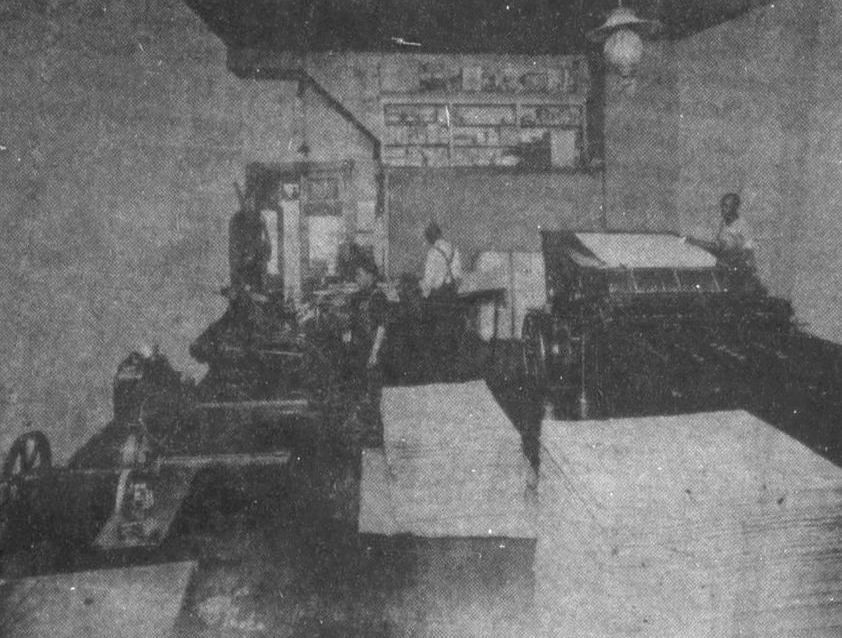
And the press room:

dallas-express_press-room_060724

The text from the ad (this special “Pythian Edition”of the paper was printed to coincide with the 40th annual meeting of the Knights of Pythias):

“YOUR Paper,” The 5th Largest of its Kind in America, Commends The Knights of Pythias Along With All of the Other Fraternities Represented Here for Their WONDERFUL PROGRESS.

THE EXPRESS believes that much of the splendid success which has come to the Fraternities of Texas, has come because of the fact that they have told the public “well and often” about the benefits which they offer and the advantages which they bring. And too, this paper takes a great deal of PRIDE in the thought that it has helped to bring this to pass because it is the medium in Texas best fitted to tell the world about the PROGRESS of the institution of our State.

These views of our force and the equipment at our plant explain why we can guarantee “Distinctive Service” and “Meritorious Printing” to every one of our customers.

The 20,000 copies in this special issue will go to every corner of America and to some foreign countries. No other journal of the Race in the Southwest does this.

The Dallas Express Pub. Co. Solicits Your Patronage not because it is a Negro institution but because it can guarantee to you the sort of service that you need. No job too small for the greatest consideration. No order too big for us to fill.

TEXAS’ OLDEST AND LARGEST NEGRO NEWSPAPER AND PRINTING PLANT
In Dallas Since 1892
2600 Swiss Avenue

*

The full-page ad:

dallas-express_060724_p8_full-page
Dallas Express, June 7, 1924

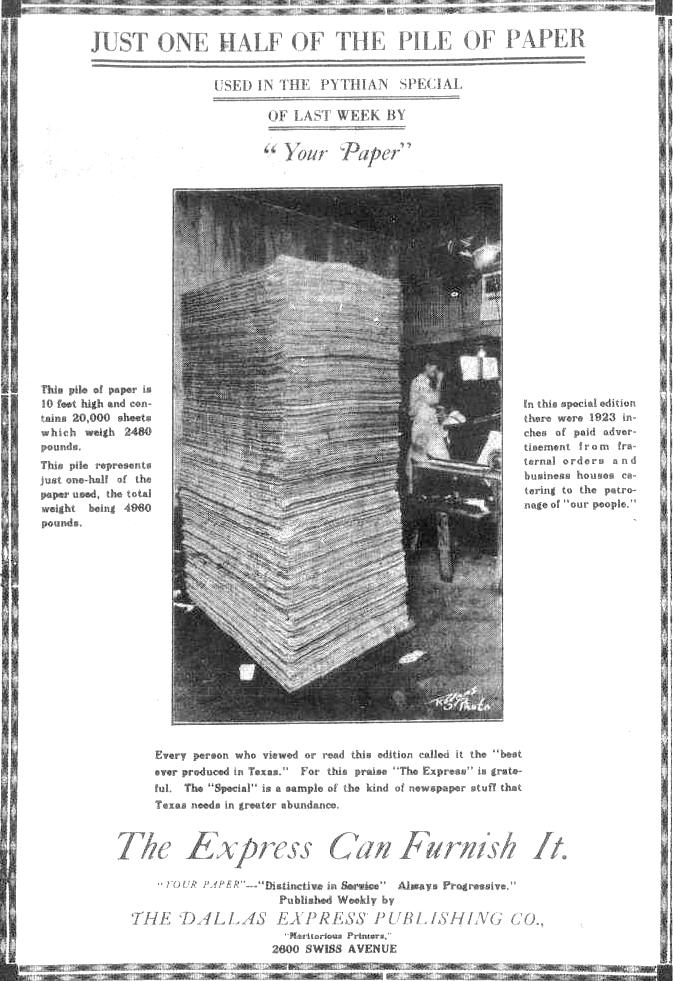
Another photo of the printing room appeared in an Express ad which ran in the paper the following week:

dallas-express_061424_ad
Dallas Express, June 14, 1924

dallas-express_1923-directory
1923 Dallas directory

***

Sources & Notes

Photos by Frank Rogers. Original prints might be in the Frank Rogers Collection at the Dallas Public Library, but nothing showed up when I searched the DPL database. Original crisp prints would be wonderful to see!

Photos appeared in the June 7, 1924 edition of The Dallas Express. The full newspaper can be found here. Only a few years’ worth of scanned issues of The Express are available on UNT’s Portal to Texas History site — mostly 1919-1924 — they can be accessed here.

Read about The Dallas Express at the Portal to Texas History, here; the Wikipedia entry is here.

*

Copyright © 2016 Paula Bosse. All Rights Reserved.
 

Dallas Police Department — 1914

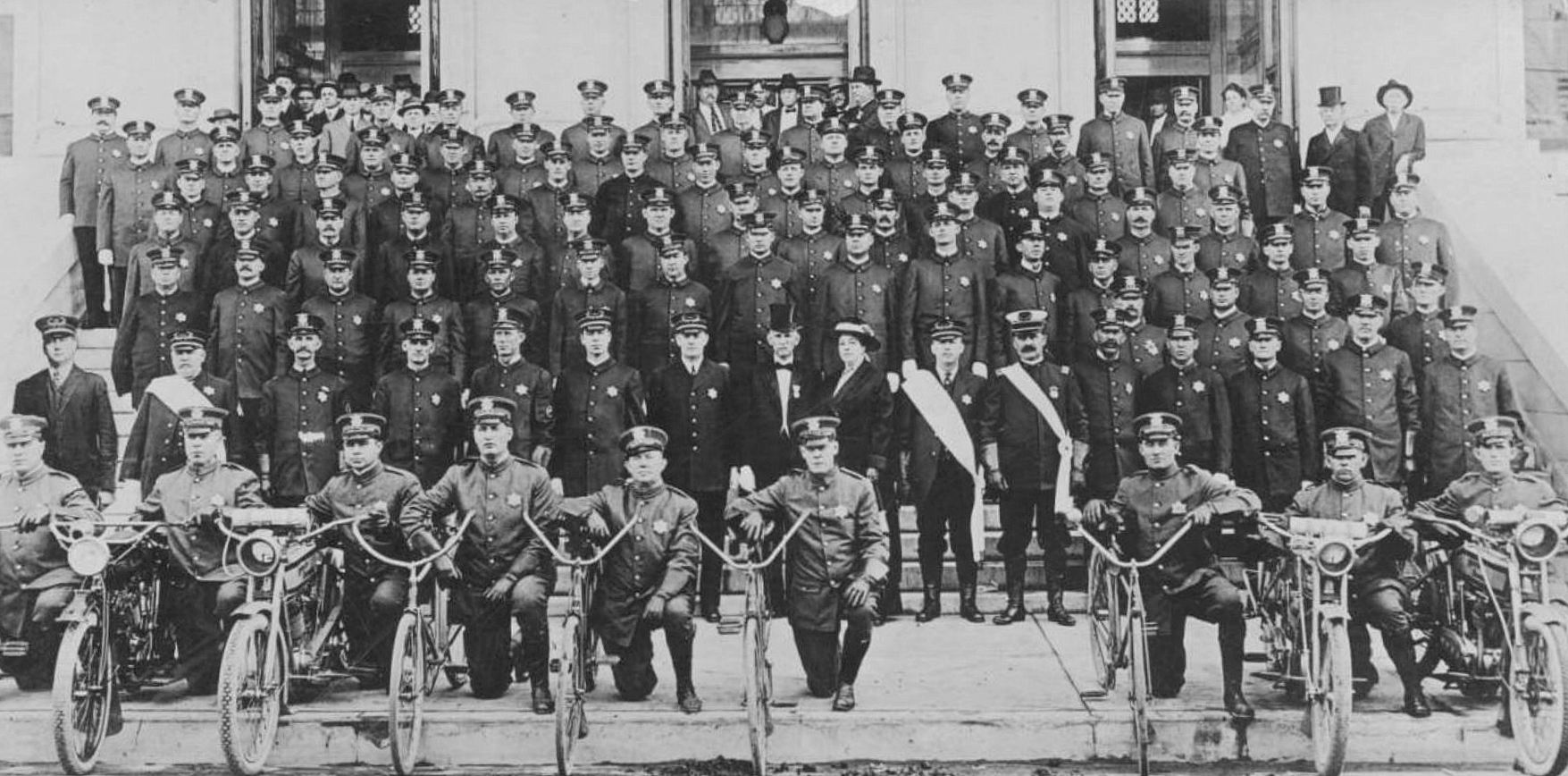
dallas-police-dept_opening-of-city-hall_101714_cook-colln_degolyer_smuOn the steps of the Municipal Building (click for much larger image)

by Paula Bosse

dallas-police-dept_frank-rogers_101714_cook-colln_degolyer_smu

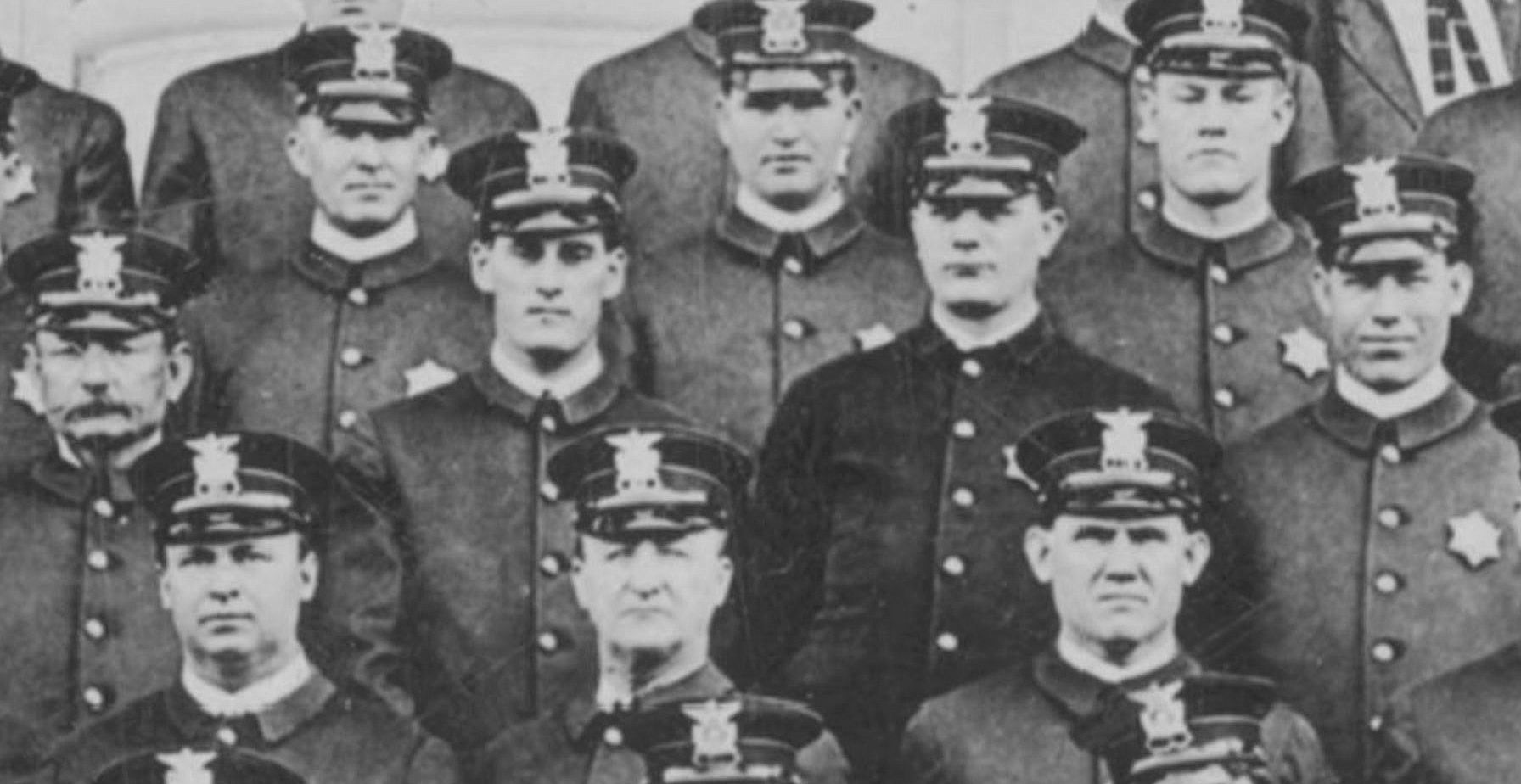
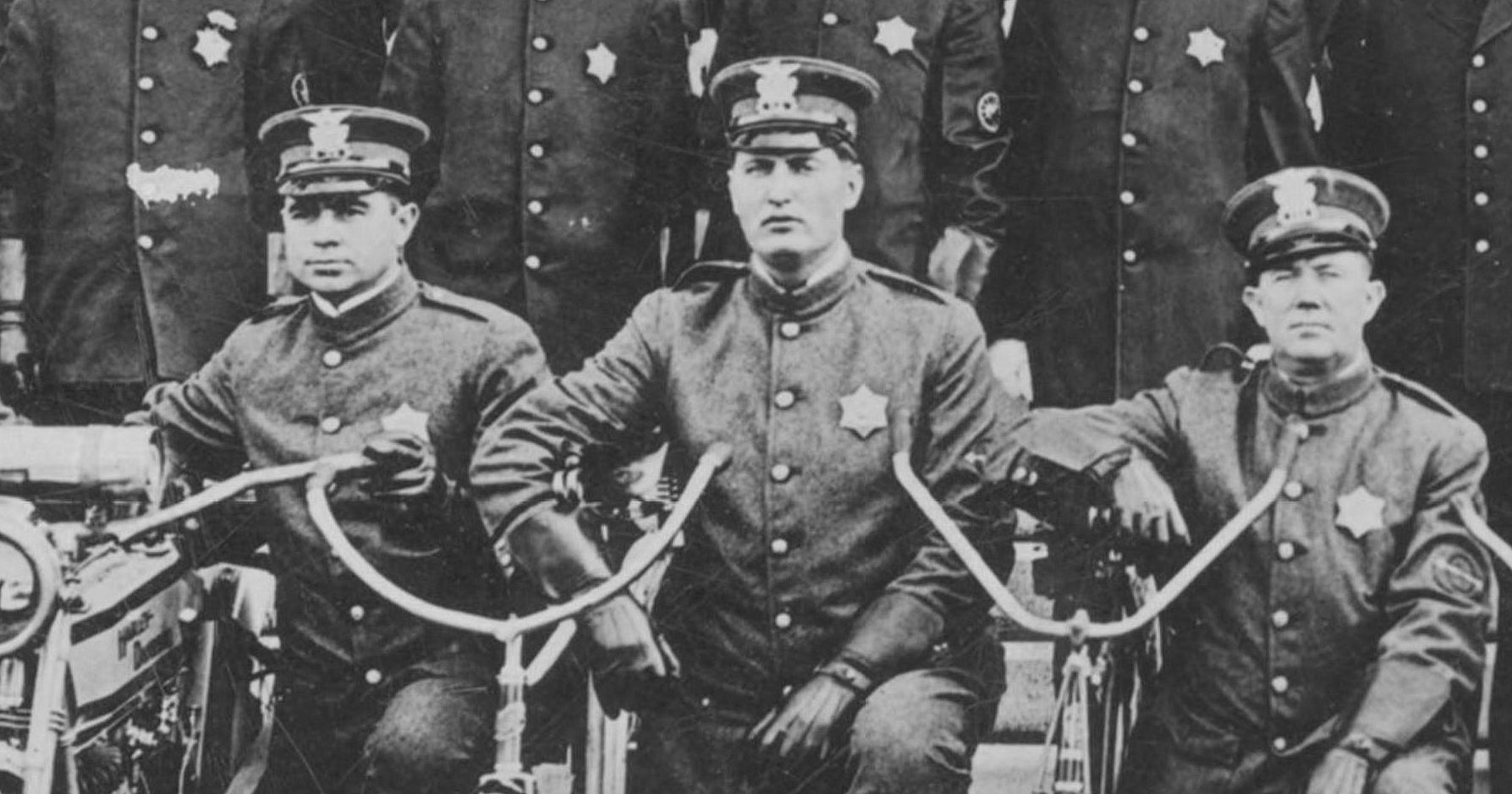
police_1914_det3

police_1914_det4

police_1914_det5

***

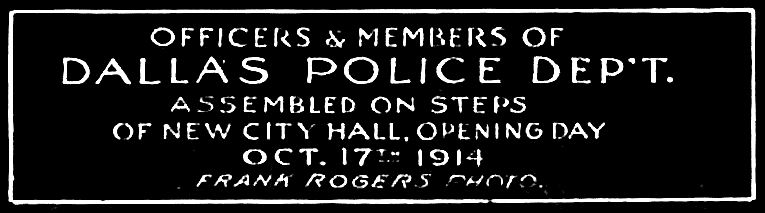
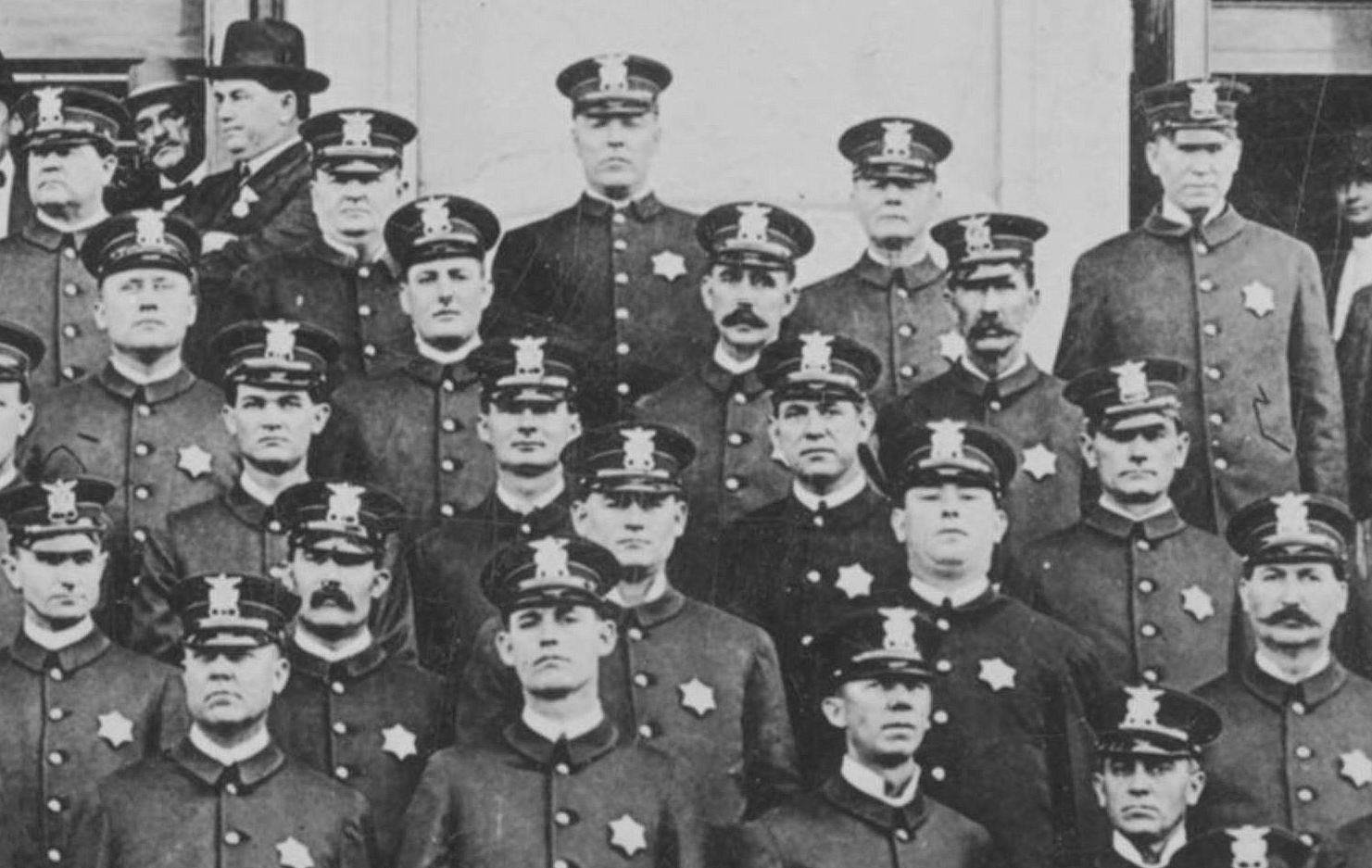
“Officers & Members of Dallas Police Dept. Assembled on Steps of New City Hall, Opening Day, Oct. 17th 1914,” photo by Frank Rogers, from the George Cook Collection, DeGolyer Library, Central University Libraries, Southern Methodist University; more information here. I have edited the image.

All images very large when clicked.

*

Copyright © 2016 Paula Bosse. All Rights Reserved.

Mrs. Hartgraves’ Cafe, and Bonnie & Clyde Earning Paychecks on Swiss Avenue

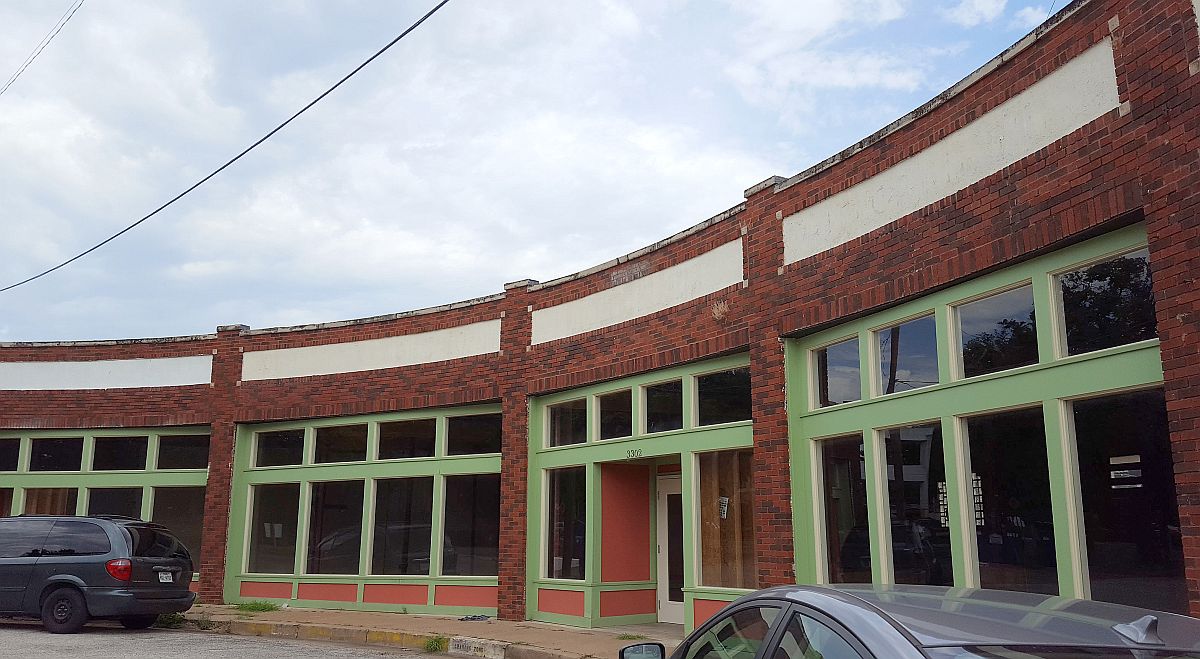
swiss-circle-front_070516The Swiss Circle building, 2016 (click for larger image) / Photo: Paula Bosse

by Paula Bosse

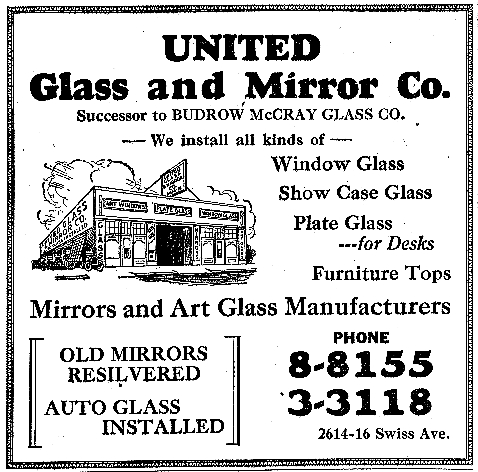
Bonne and Clyde were famous for being from West Dallas, but each actually spent a good amount of time in East Dallas. Working. Earning an honest living. Bonnie worked as a waitress, and Clyde worked in a mirror and glass company. Both worked in establishments on Swiss Avenue, though probably at different times. They hadn’t met yet, but it’s interesting to know they worked at businesses only a few blocks apart: Hartgraves Cafe was at 3308 Swiss, and United Mirror and Glass was at 2614 Swiss. Both buildings are still standing.

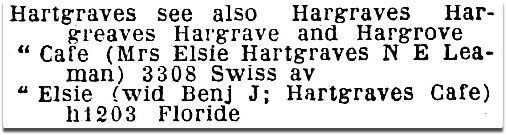
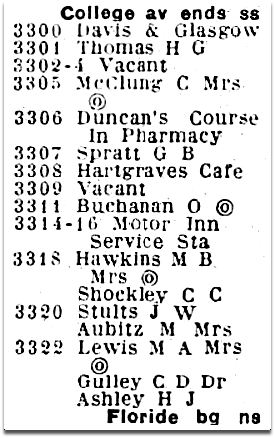
The Hartgraves Cafe (the name of which is always misspelled in historical accounts as Hargrave’s Cafe — even by Bonnie and Clyde enthusiasts) was in a curved building at the corner of Swiss and College (it is now at the corner of Swiss and Hall). 50-something-year-old Mrs. Alcie Hartgraves (her first name usually appeared in directories as “Elsie,” sometimes as “Alice”) opened the restaurant a few months after her husband, Ben, had died in 1923. It lasted until late 1930 or early 1931. (All clippings and photos are larger when clicked.)

1928-directory_hartgraves1928 Dallas directory

1929-directorySwiss Avenue between College Avenue and Floride, 1928 directory

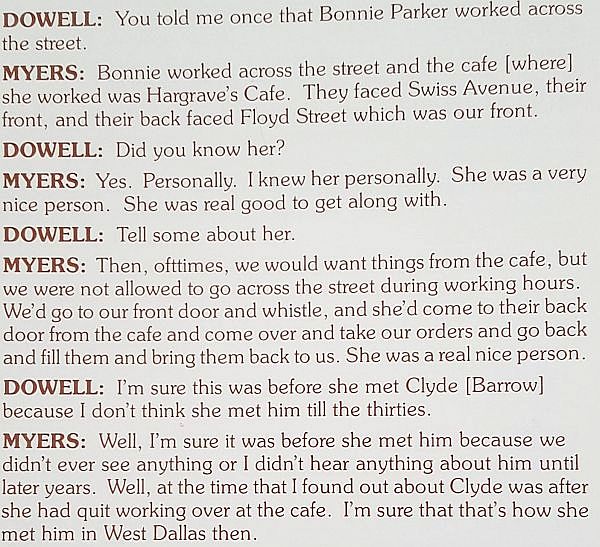
According to Bonnie and Clyde histories, Bonnie worked there as a teenaged waitress with an absent husband, from 1928 to early 1929. According to one woman who worked at the Yates Laundry, just across from the cafe’s back door, Bonnie was a very nice person. Here, in a 1972 oral history, Rose Myers — who worked at the Yates Laundry for 25 years — remembers Bonnie from those days at Mrs. Hartgraves’ cafe:

hartgraves-yates_reminiscences
From the book Reminiscences

The laundry is long gone, but here’s what the back side of the building Bonnie worked in looks like today.

swiss-circle_back_070516Photo: Paula Bosse

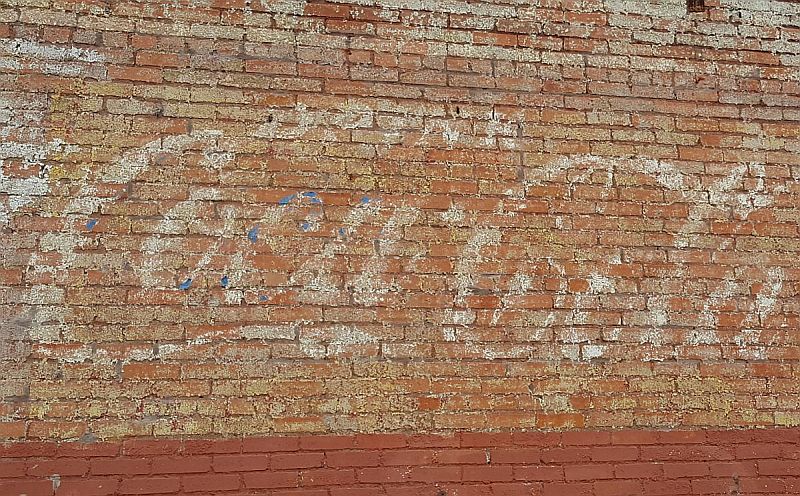
And here’s a Coca-Cola ghost sign, painted on the end of the building that faces Hall.

swiss-circle_coke-ghost-sign_070516Photo: Paula Bosse

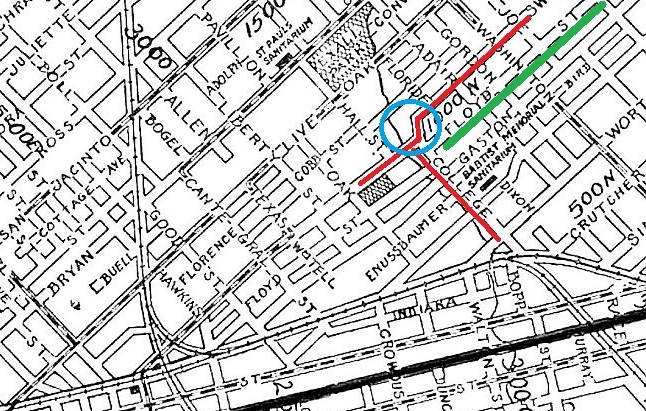
The Bonnie Parker connection is about the only reason people know about this odd little building in Old East Dallas. From looking through Dallas street directories, it appears that this building was built in 1915 or 1916 as a retail strip which, until Mrs. Hartgraves left, usually contained three or four businesses. The question is: why was it shaped like that? Many people think it was a streetcar stop, the cars using the circle as a place to turn around, but old maps showing streetcar routes from this period don’t show cars going down this part of Swiss. Below, a detail from a 1919 map, with Swiss and College streets in red. Streetcar tracks on Swiss turn left at Texas and then right on Live Oak, completely bypassing the circle area. (Another handy map of old streetcar routes laid over a present-day Google map can be found here.)

swiss-circle_1919-map
1919 map detail, via UNT

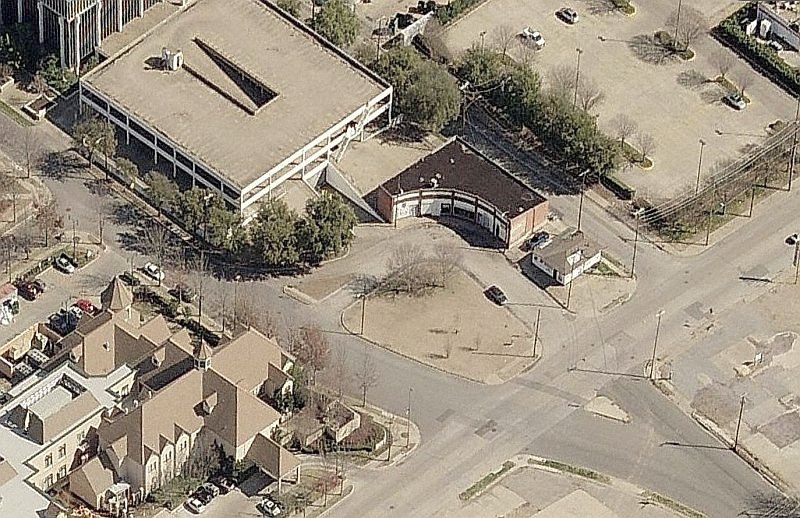
There’s a great view of the area in the 1921 Sanborn map here (with a different angle here). It may just be that the building was built to take advantage of/conform to the odd jog that Swiss Avenue takes in front of it. Here’s an aerial view from the recent past.

swiss-circle_bing-birdseye
Bing Maps

Our own teensy and unspectacular Royal Crescent! (You know what they say — “Everything’s bigger in Bath….”)

**

But what about Clyde? Clyde worked at a mirror and glass company four-tenths of a mile west. Here’s an ad from 1928 (the same year Bonnie was working at Hartgraves).

united-mirror-glass_1928-diectory-ad_texashideout
via Bonnie & Clyde’s Hideout

Charles “Chili” Blatney worked with Clyde at United Glass and Mirror. In the Dallas Morning News article “He Helps Dallas to See Itself” by David Hawkins (DMN, March 17, 1970), Hawkins wrote: “Blatney remembers him as the friend he was: The little guy who always wore a hat and who would jerk it off and beat the floor with it in merriment when a good joke was told. […] ‘I guess I was surprised to see him turn real bad,’ [said Blatney].”

The building still stands, almost unrecognizable.

So, yeah, East Dallas was the stomping grounds of Bonnie and Clyde, back when they were living paycheck-to-paycheck and before they had begun their short-lived life of crime.

***

Sources & Notes

Photos of the Swiss Circle building taken by me when I stumbled across it yesterday. I knew what it was when I saw it, but I didn’t really know much about it, other than the Bonnie connection. The building is currently vacant, currently for lease, and currently a weird shade of green. It’s a great space and a cool building. The back side is FANTASTIC!

The surname of the property owner (or property manager) is rather unbelievably … Dunaway.

The passage quoting Rose Myers, who worked at the Yates Laundry, is from the book Reminiscences: A Glimpse of Old East Dallas.

A discussion of this building can be found on the Phorum discussion board, here.

Other Flashback Dallas  posts on Bonnie and Clyde can be found here.

Click everything. See bigger images!

*

Copyright © 2016 Paula Bosse. All Rights Reserved.
 

4th of July at White Rock Lake — 1946

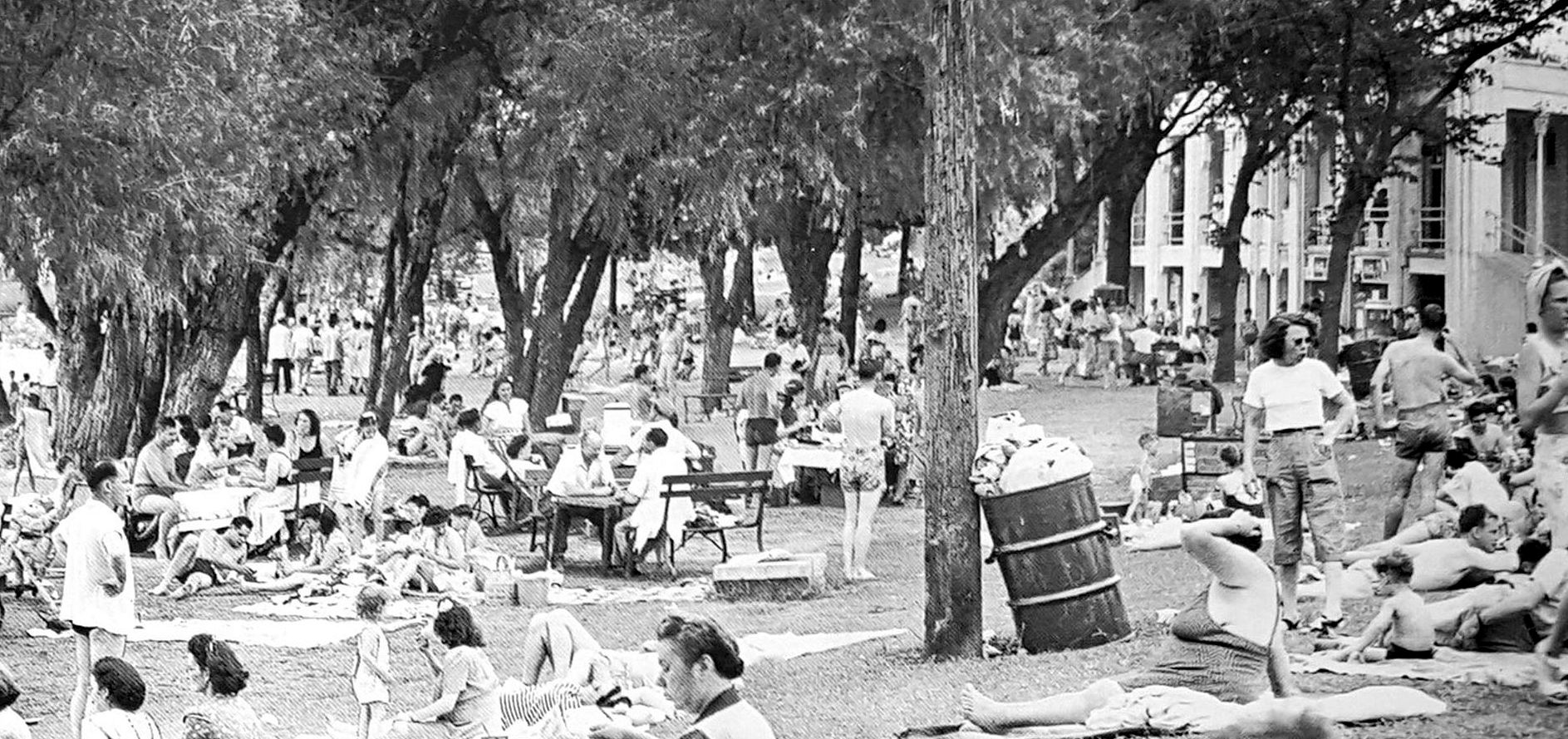
july-4th_1946_white-rock-lakeSo much going on here! (Click for super-gigantic image!)

by Paula Bosse

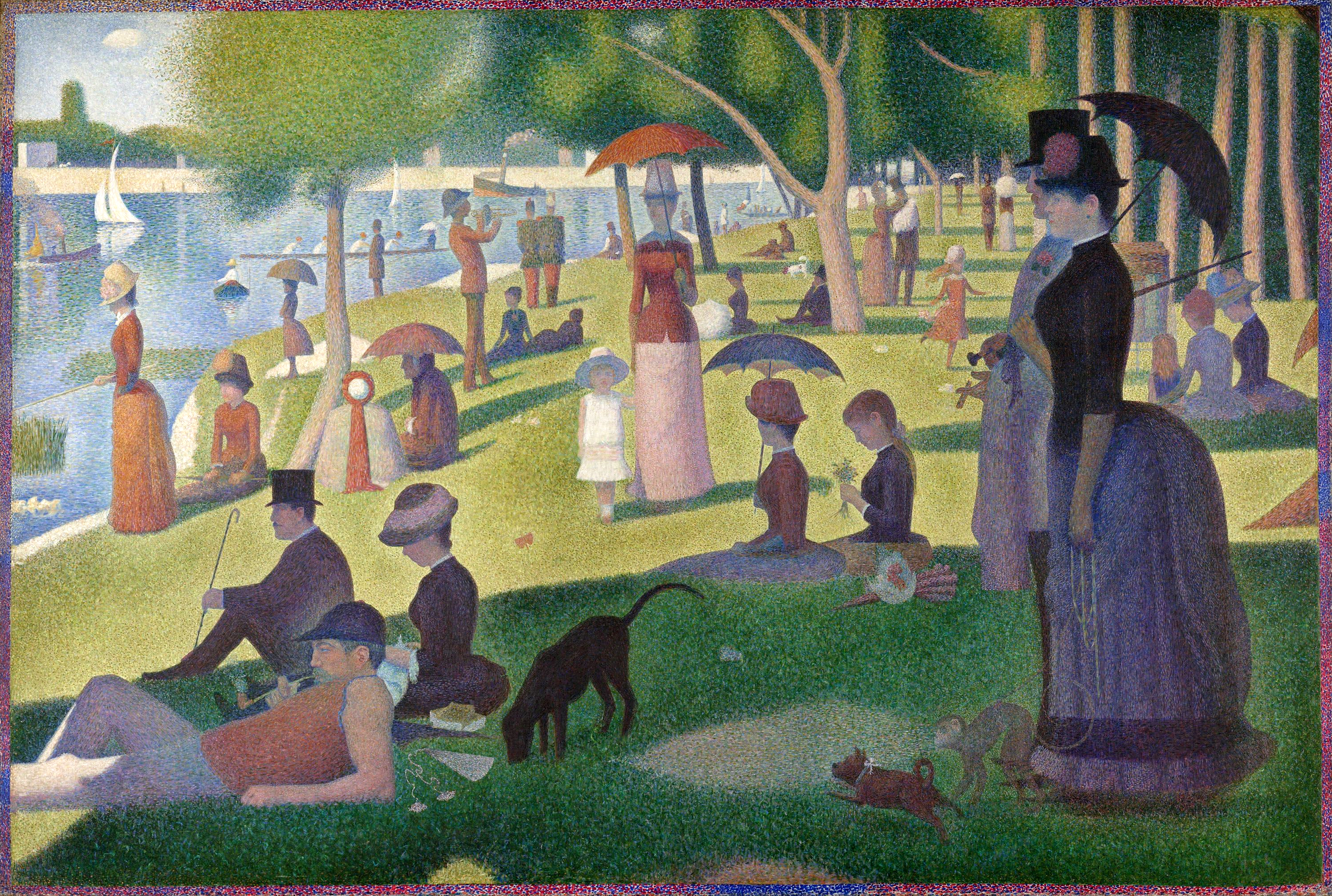
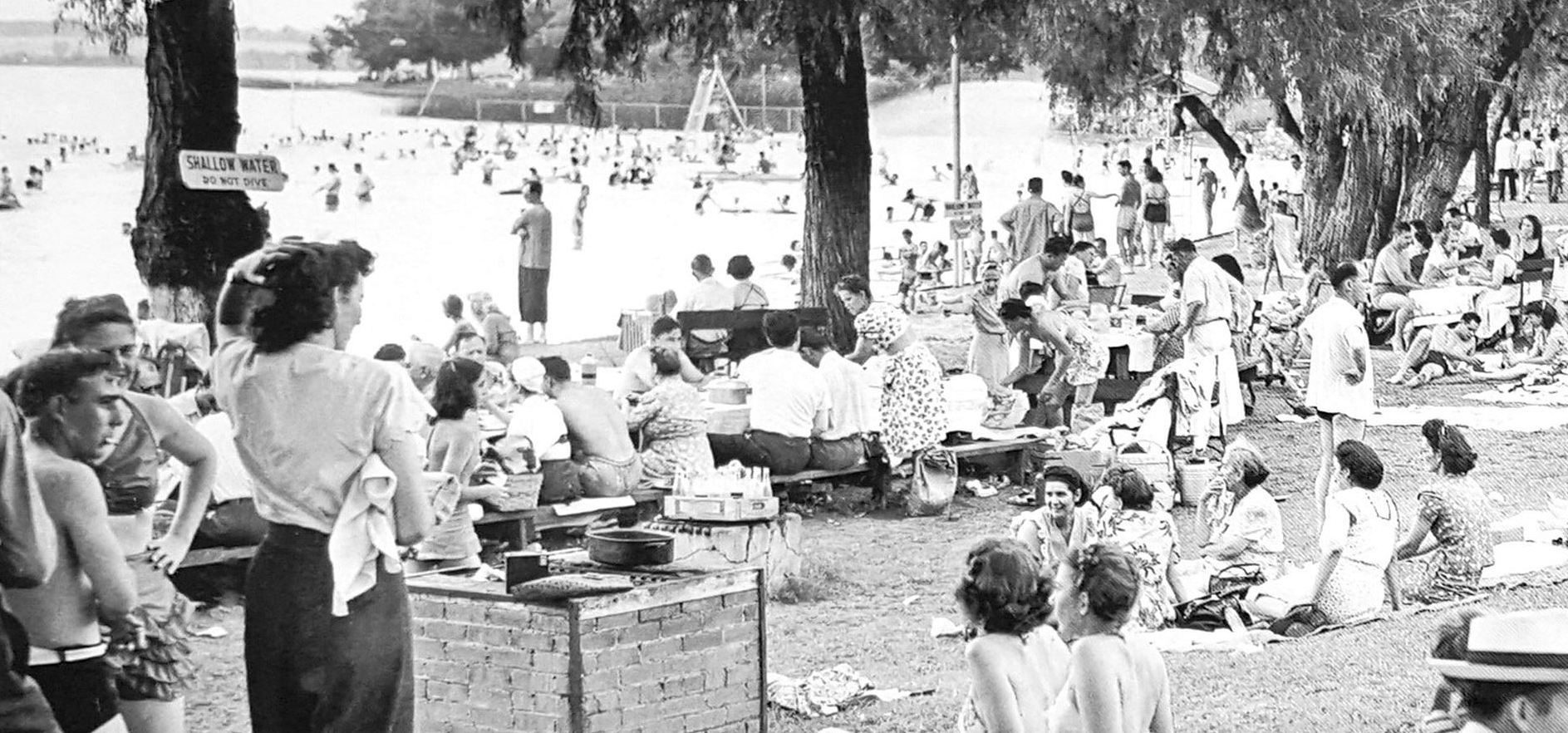
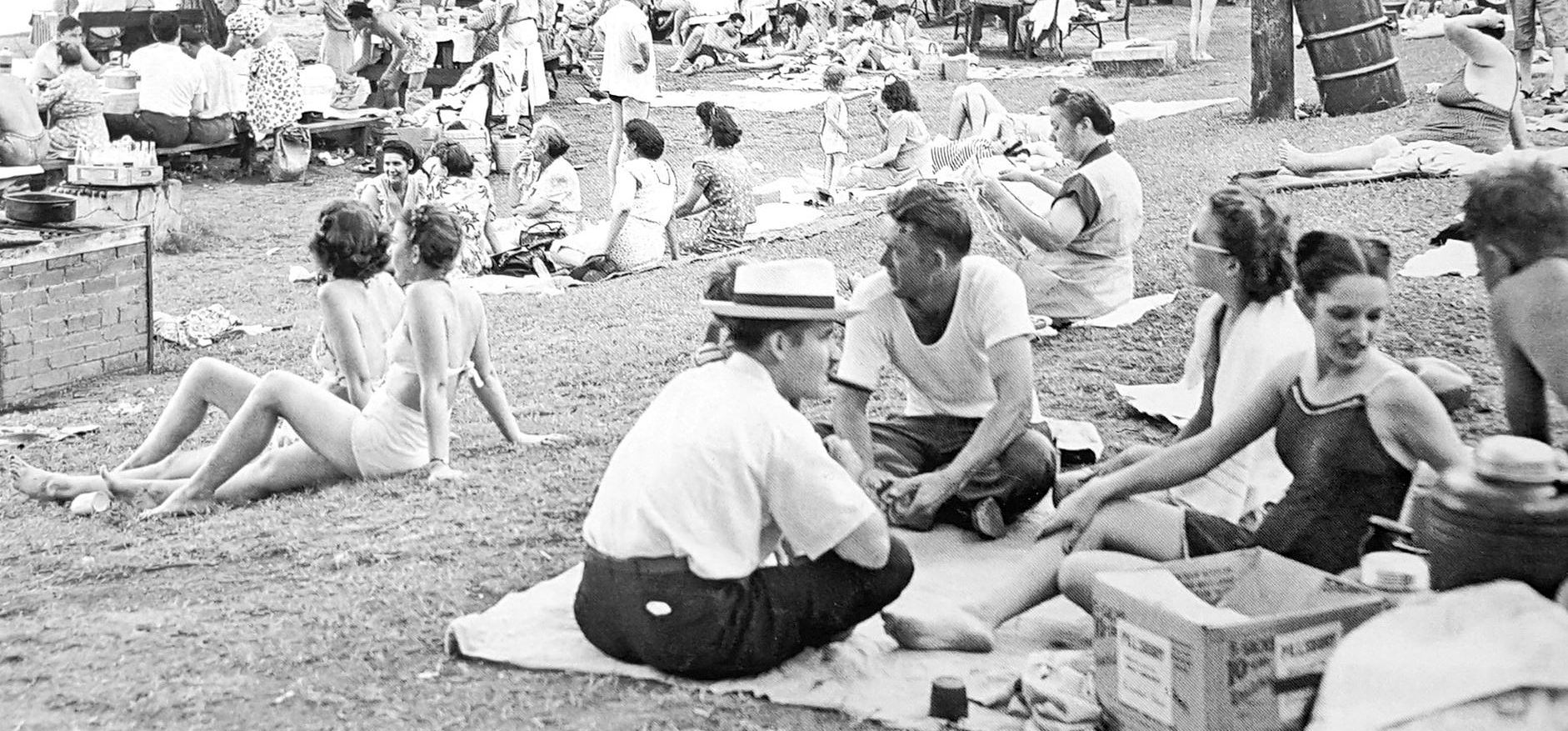
I love absolutely everything about this photo of July 4th celebrants relaxing at White Rock Lake near the Bath House (back when people actually swam in the lake!). All that’s needed is a pet monkey on a leash and a few parasols, and you’d have an updated Tex-ified version of Seurat’s La Grande Jatte painting.

seurat_le-grande-jatte_wiki

This is a photo definitely worth zooming in on. All images here are really big — click ’em! You can practically smell the wienies roasting/croissants baking. Have a happy and safe 4th of July!

4th-july_det1

4th-july_det2

4th-july_det3

*

Copyright © 2016 Paula Bosse. All Rights Reserved.
 

Bowling In the Sky — 1964

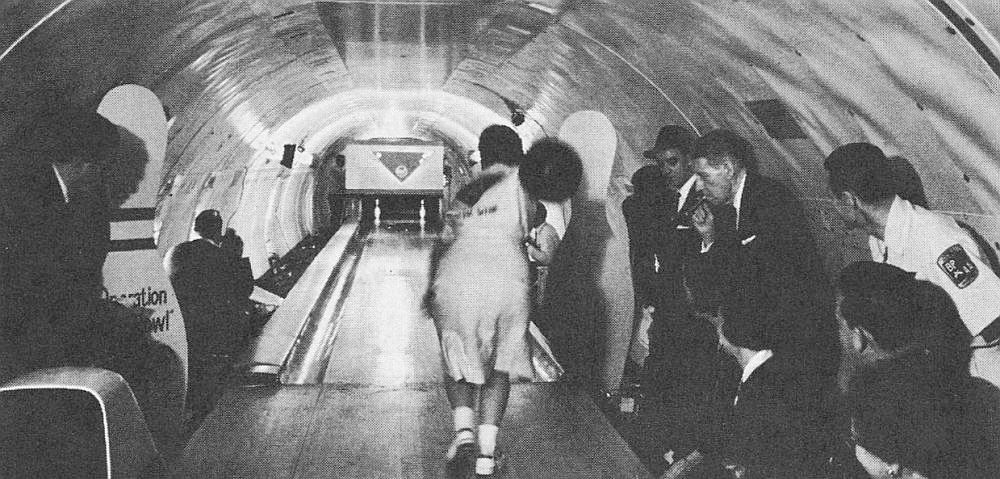
bowling_american-airlines_encylopedia-britannica-yrbk_jan-1964Sylvia Wene battles Dick Weber and turbulence…

by Paula Bosse

It’s a bowling alley. …In an airplane.

As publicity stunts go, this one was pretty good. It even had a cutesy name: Operation AstroBowl. American Airlines wanted to promote their great big Boeing 707 cargo planes, so someone came up with the idea of putting a bowling alley in one of them. Happily, a company that manufactured bowling alley equipment — American Machine and Foundry (AMF) — was keen to jump on the promotion bandwagon. They installed the regulation 79-foot lane — complete with automatic pin-setting equipment and gutters — in one of the American Airlines jet freighters. It took 4 days. Looking at the photos, it resembled a very large MRI tube.
Since they had the lane and the equipment in there, they pretty much had to get a couple of champion players on board to bowl a few mid-air frames. As luck would have it, the National All-Star Tournament (aka “The World Series of Bowling”) was — hey! — to be held in Dallas at Fair Park Coliseum a week after the stunt. Serendipity! Champions Dick Weber and Sylvia Wene were roped in to play a 5-mile-high game in the sky.

So much to promote!

Operation AstroBowl took place on January 6, 1964 at cruising altitude between New York’s Kennedy International Airport and Love Field. Sylvia won. Barely. But this story made it into countless newspapers across the country the following day, so, really, it was the publicists who won. Drinks, I’m sure, were on them.

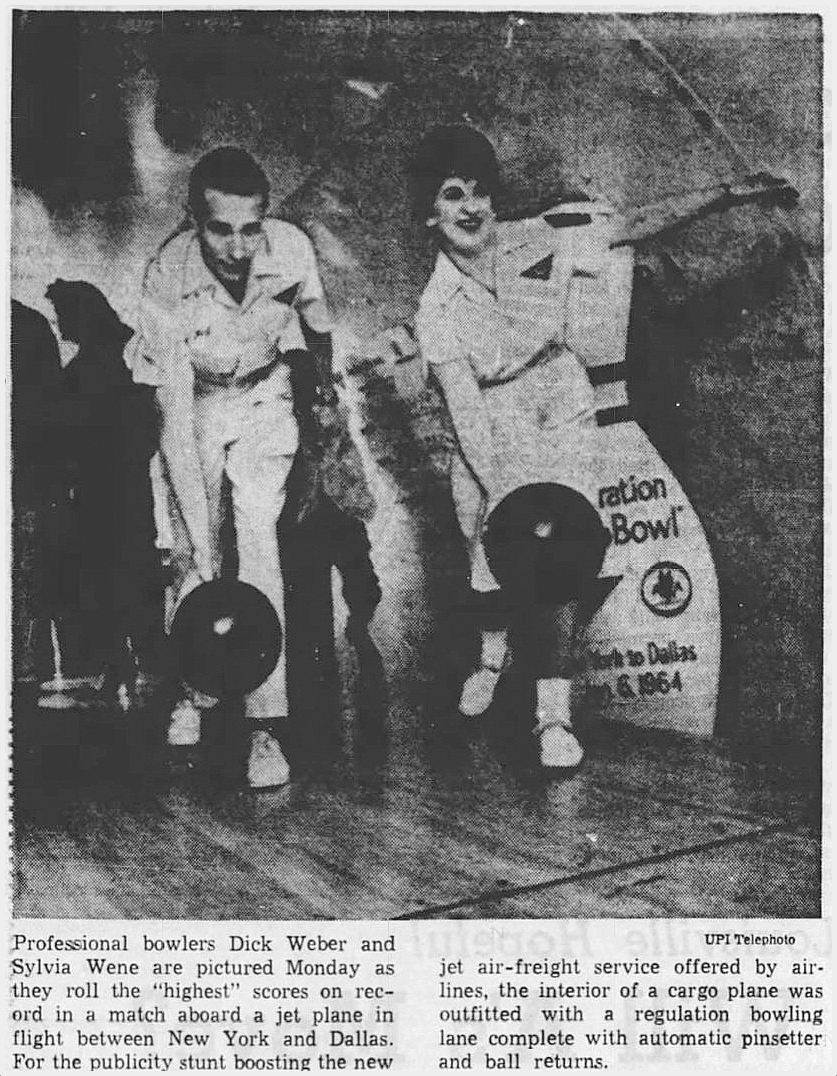
bowling_american-airlines_AP-story_010764-photo_dick-weberDick Weber bowling at 500 miles an hour


bowling_american-airlines_AP-story_010764
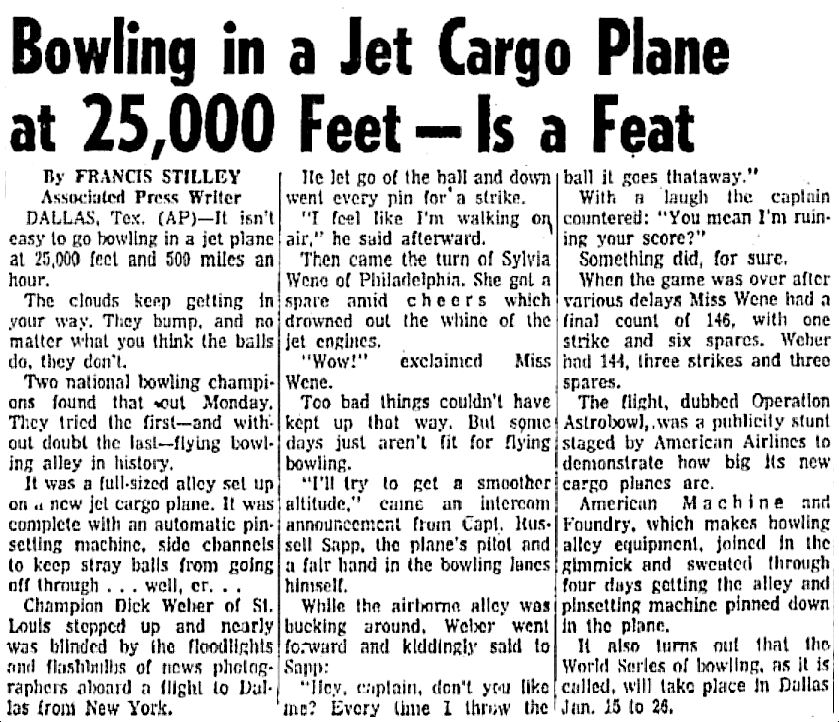
AP story which appeared all over the country, Jan. 7, 1964

bowling_american-airlines_weber_wene_ap-wire_010764

***

Sources & Notes

Top photo appeared in the Encyclopedia Britannica Yearbook and was brought to my attention by Steve Dirkx (thanks, Steve!).

Story and photos by the Associated Press.

If you’re on Facebook, a tiny bit of film footage can we watched here.

Hold the presses! I’ve been translated! Check out this bowling post in Portuguese (!), on a Brazilian bowling site, here.

*

Copyright © 2016 Paula Bosse. All Rights Reserved.