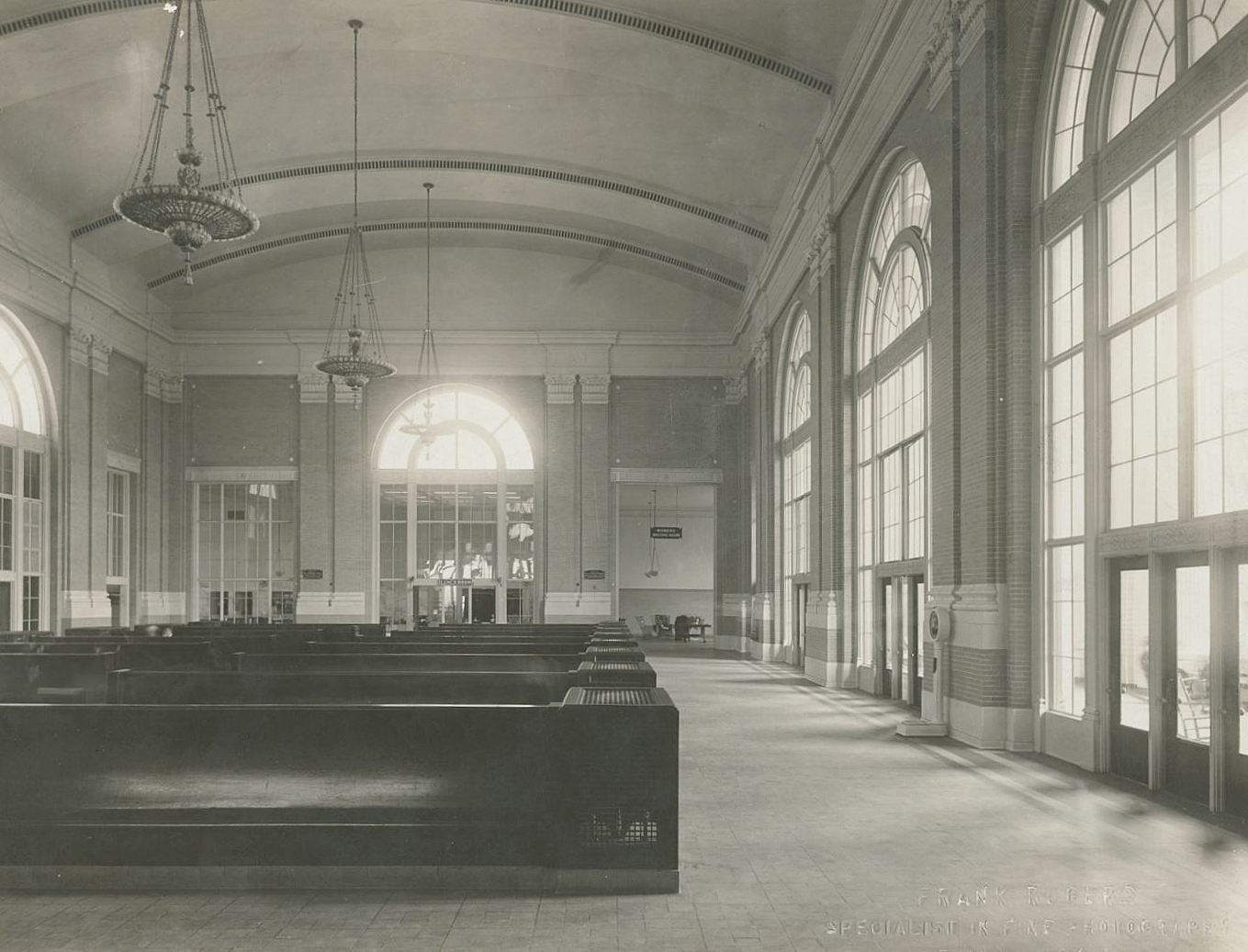
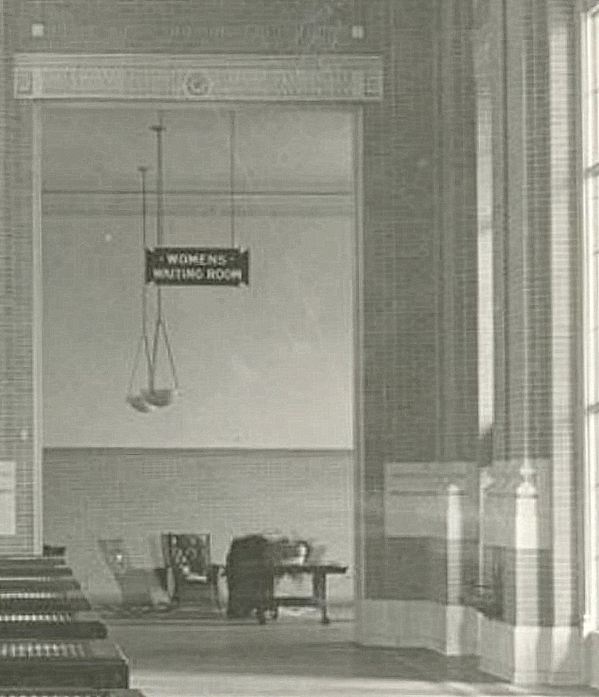
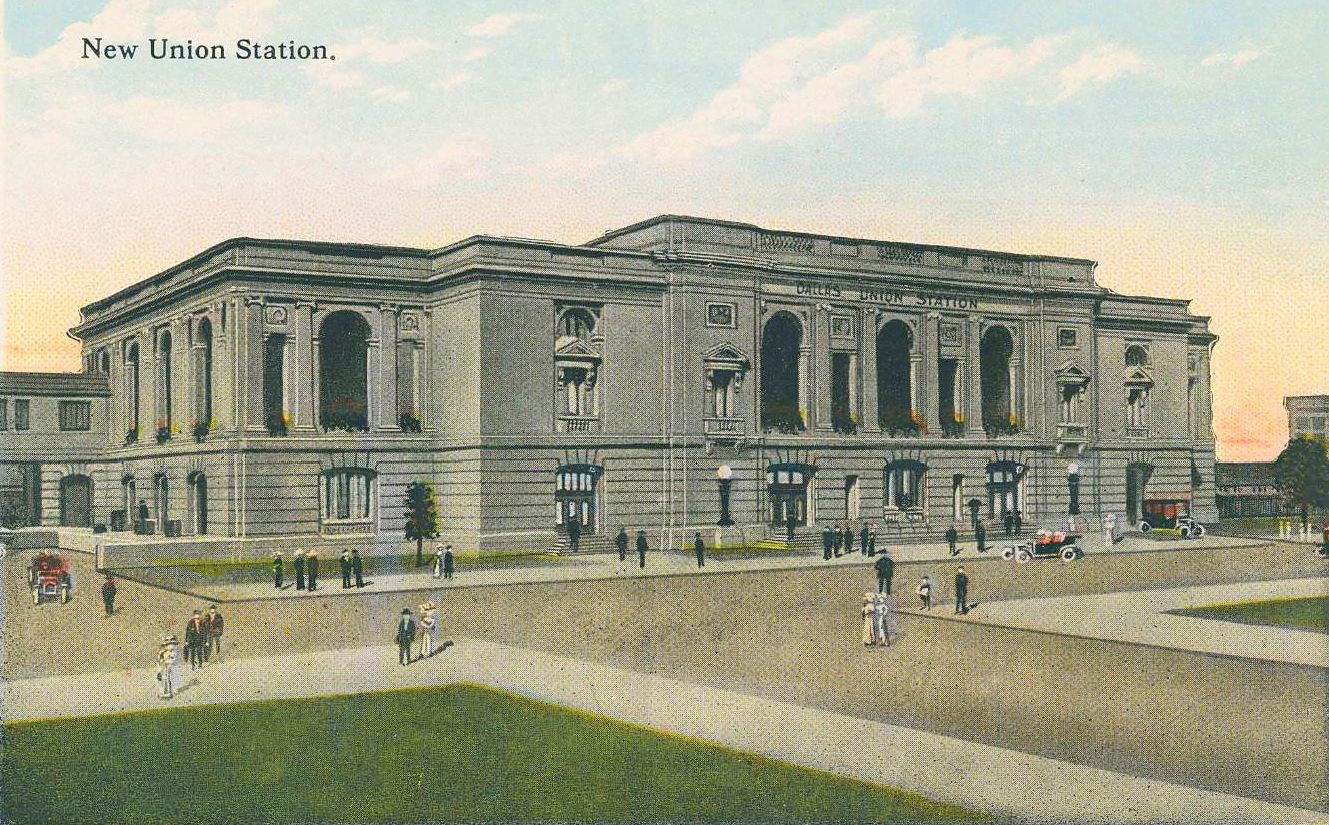
Above, a photo of the new “Union Depot,” completed in 1916 and, thankfully, still standing more than a century later. Below, a couple of details of the Lunch Room and the Women’s Waiting Room.
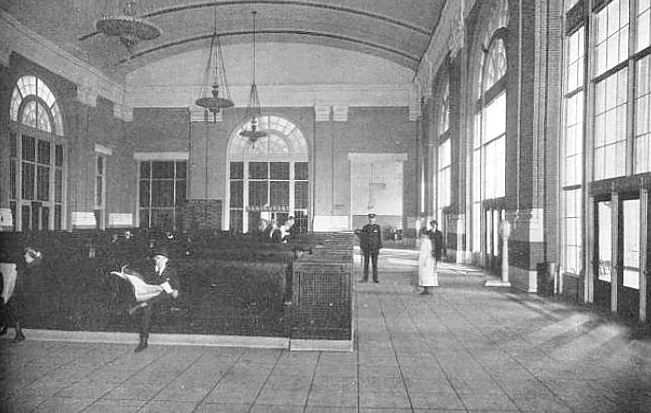
The same view as the top photo, but from 1922:
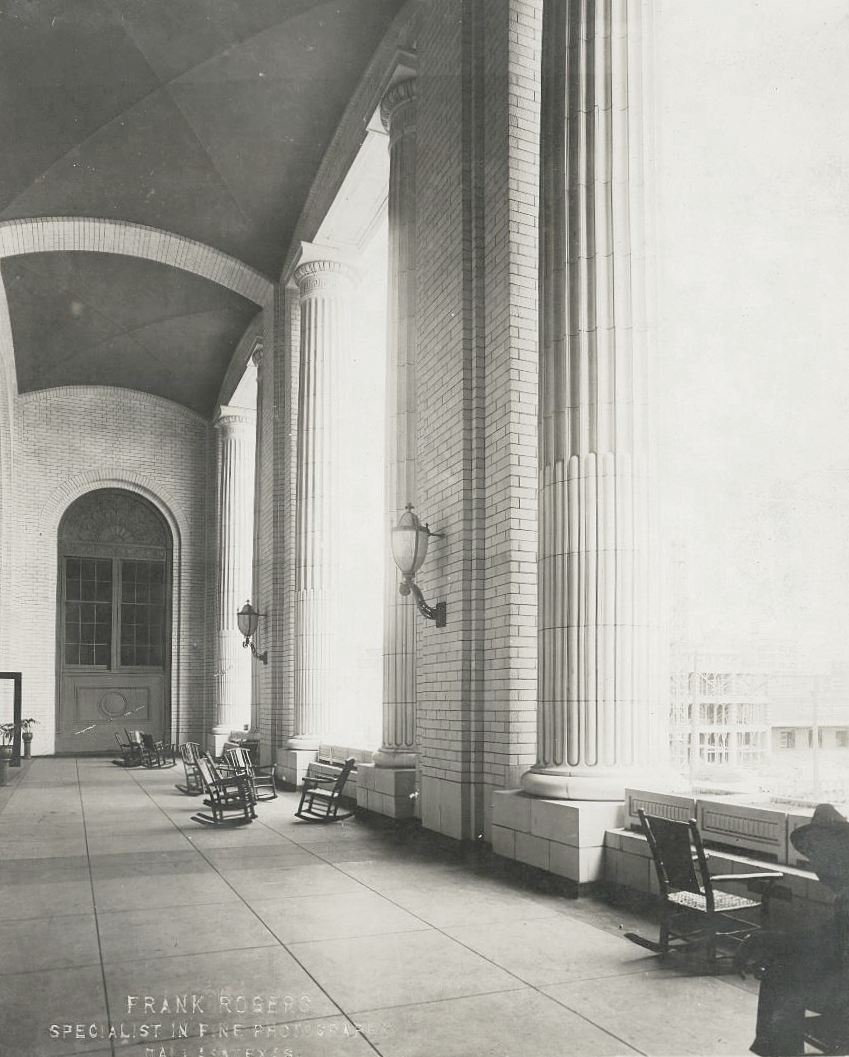
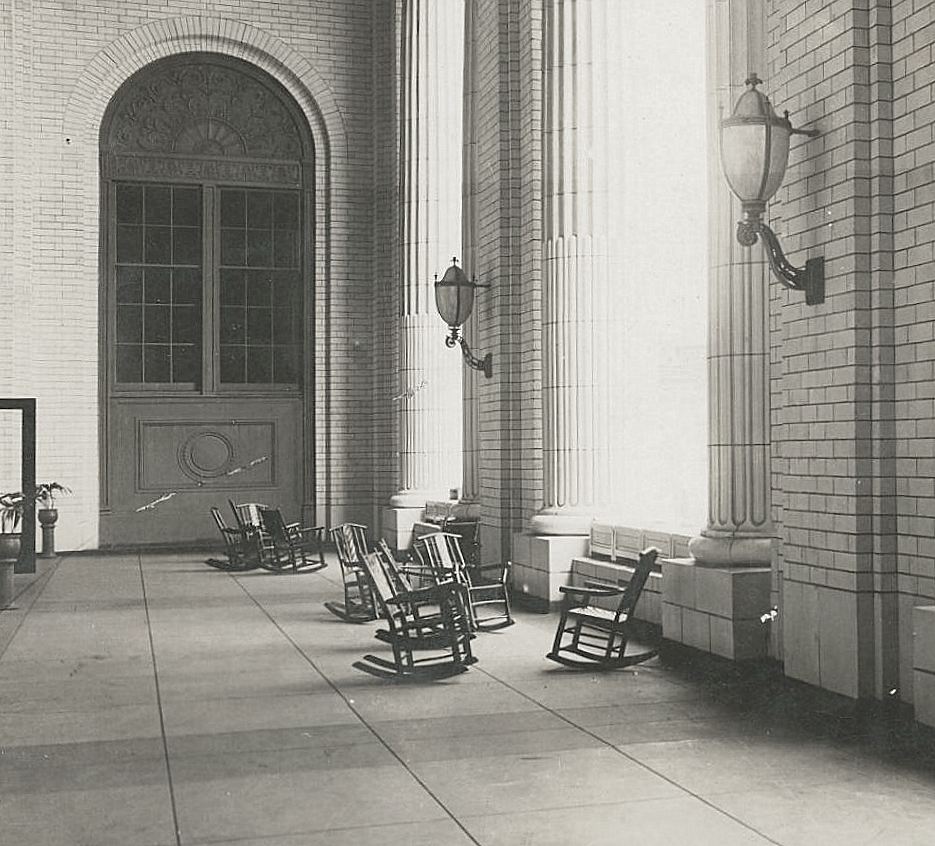
Back to 1916, in what I gather is a sort of interior/exterior shot showing another place to pass the time. What better, quaint way to wait for a train and take in a great, slightly elevated view, than in a rocking chair.
And a slight zoom-in:
Imagine those rocking chairs up there in those archways, between the columns.
***
Sources & Notes
The two photos from 1916 (by Frank Rogers) are from the Atlantic Terra Cotta Company Architectural records and photographs, 1914-1941, Architectural Terra Cotta, Alexander Architectural Archives, University of Texas Libraries, The University of Texas at Austin — more info on these photos is here and here.
A couple of other images of the new Union Station can be seen in these Flashback Dallas posts:
Above, a photo of Smithson & Harris, makers and painters of signs in the 1890s. The business — owned by Harry M. Smithson and W. H. Harris — was apparently at 209 S. Akard, which has been described as having been on the northeast corner of Akard and Commerce, later the site of the Magnolia Building. That address does not comport with 209 S. Akard as we know it today — that would be in the southwest block of S. Akard — south of Commerce and on the other side of the street. This is a sentence from Smithson’s obituary:
Mr. Smithson operated a sign-painting and furniture repair shop in a one-story frame building where the Magnolia Building now stands at the northeast corner of Akard and Commerce. — Dallas Morning News, May 1, 1936
Another source repeats the same info. Below is an excerpt from the small booklet Dallas’ First Hundred Years, 1856-1956 by George H. Santerre. I’m guessing Santerre got his info from the very same obit (and perhaps embellished the importance of the two businesses pictured).
In 1895 Dallas’ merchants obtained their large store signs from Smithson & Harris, whose one-story frame establishment […] facing on Akard was located on the northeast corner of Commerce and Akard streets, the present site of Dallas’ Magnolia Building. The real estate offices of Palmer & McKay, through which many of Dallas’ real estate transfers were handled, adjoined the sign-painters location.
As far as that last little nod to Palmer & McKay (John R. Palmer and James C. McKay), I could find their real estate partnership in only one Dallas directory — 1891, when their office was located at 296 Main. I have no 1890 directory to check, but Palmer left a previous place of employment in 1889. “Palmer & McKay” had disappeared from Dallas directories by 1892, so my guess is that the photo is from about 1890.
As far as the address being 209 S. Akard — Dallas has renumbered and renamed so many streets over the years that it’s hard to keep track of everything.
Dallas’ most prosperous and well-known sign-maker of this period was P. S. Borich. His shop was at 209 Sycamore (the street was later renamed N. Akard). But around 1890, “209 Sycamore” became, weirdly, 108 South Akard — right where the Magnolia Building was built. Borich was at 209 Sycamore/108 S. Akard until about 1900, when most of the individuals mentioned above had moved on to other professions. (You can see the confusing address numbering in the 1885 and 1892 Sanborn maps.)
1889 Dallas directory
So I’m not sure what’s going on in this photo of a building with the address “209.” 19th-century sublet?
(Incidentally, the Borich company eventually morphed into Texlite, the company that made Pegasus, the city’s symbol who lives atop, yes, the Magnolia Building. I wrote about Borich and Texlite in the post “Texlite, Borich, Pegasus.”)
“Smithson & Harris” and “Palmer & McKay” were both very short-lived partnerships, lasting only a year or two. Wherever these businesses were located, it’s a cool photo.
***
Sources & Notes
Photo from the American Petroleum Institute Photograph and Film Collection, National Museum of American History, Archives Center; it is accessible via the Smithsonian Institution Online Virtual Archives, here. The back of the photo contains the notations “Magnolia Corner, 1896” and “Credit: Magnolia Petroleum Co.” …So much conflicting information. My head hurts.
Another copy of this photo is in the George A. McAfee photographs collection, DeGolyer Library, SMU Libraries, Southern Methodist University — more information on that copy is here (note: there is even more conflicting info in the description, but it also carries the “circa 1896” date).
I first saw the (cropped) photo in the 1931 Rotunda, the yearbook of SMU, from the collection at the DeGolyer Library, SMU Libraries, Southern Methodist University, here.
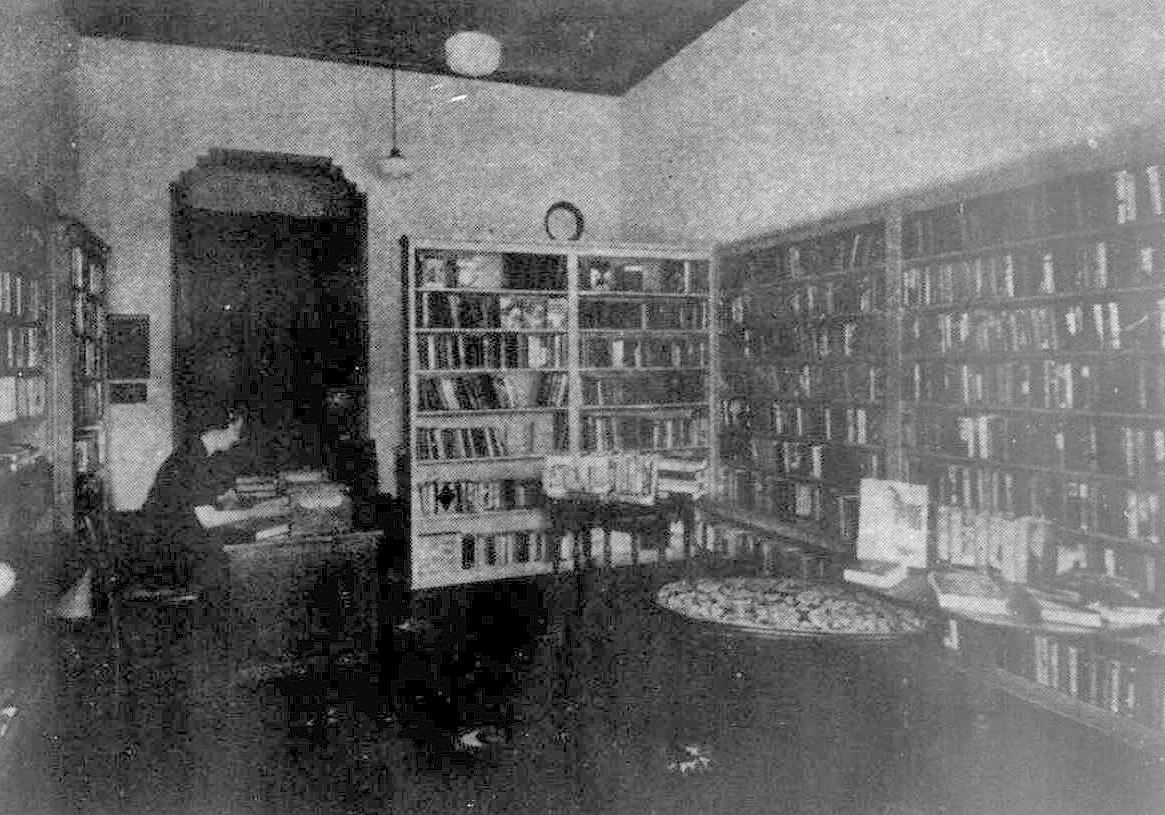
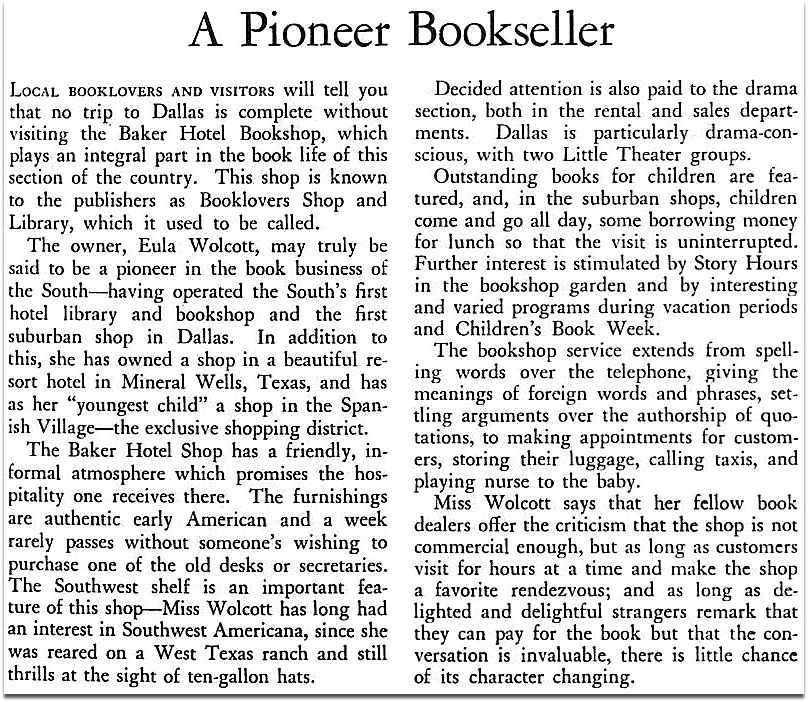
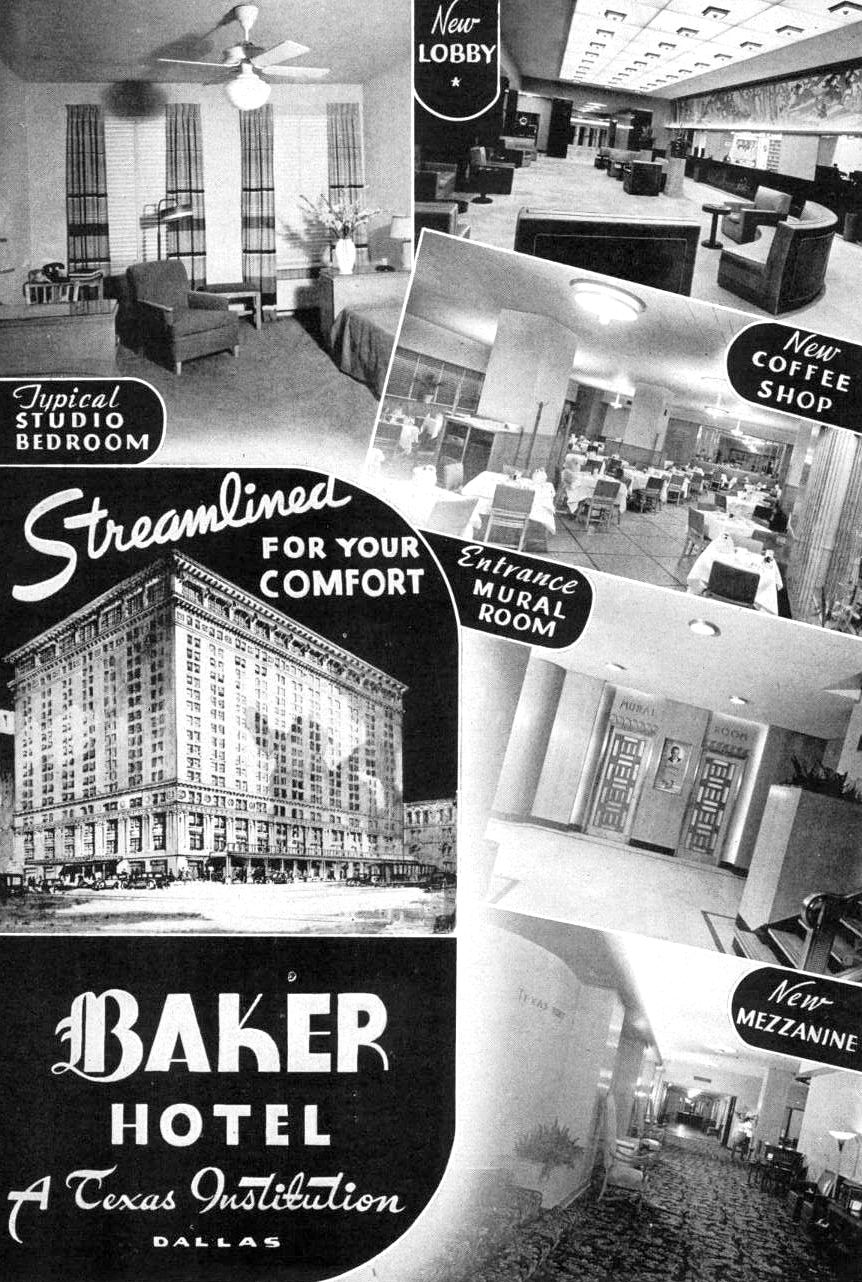
Today is the birthday of my late father, Dick Bosse, owner of the Aldredge Book Store. I always try to post something bookstore-related on his birthday. This year: Miss Eula Wolcott’s Baker Hotel Book Shop & Rental Library, located inside the Baker Hotel.
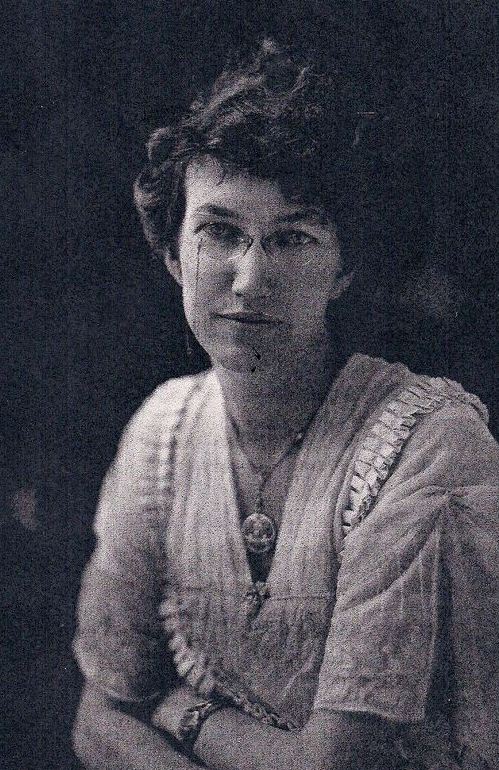
Eula Wolcott (1881-1962) was born in Waxahachie and had moved to Dallas by 1910. She appears to have had theatrical ambitions and studied voice and expression (she was billed as an “Experienced Concert Reader and Story Teller”). She opened a little book store and library in the early 1920s — the Booklovers Shop and Library was first on West Jefferson and later on Swiss Avenue. In 1926, she opened a similar shop inside the glamorous Baker Hotel, an enterprise she ran successfully until at least 1942 when another owner took over (she also apparently had a book shop inside the Baker Hotel in Mineral Wells). In 1931 she opened the rather confusingly-named “Baker Hotel Book Shop and Rental Library” in Highland Park — in the new “Spanish Village” (the original name for Highland Park Village). Below is a very enthusiastic profile from Publishers Weekly (click to see a larger image).
Publishers Weekly, March 24, 1934
I wish the photo at the top had been better, because I’d love to get a good look at the decor. And Eula. I managed to find a photo of her.
Eula Wolcott, via Ancestry.com
Here are a few ads:
1924
Two shops, one owner — 1926
1927
1937
1940
She was active as a bookseller for many years and was also a familiar voice to radio listeners who tuned in to hear her book reviews on WFAA.
One interesting piece of trivia about Eula’s hotel bookshop, shared with me by a former bookstore client of mine: the Baker Hotel Book Shop was the very first American bookstore that British author H. G. Wells ever visited. A lecture tour brought him to Dallas in 1940 — like many of the celebs of the day, he stayed at the Baker. I’m sure Eula was very happy to have Mr. Wells, a literary powerhouse, in her shop. Let’s hope he exhibited proper bookstore etiquette and purchased something!
Baker Hotel, circa 1940
***
Sources & Notes
Top photo and article from the trade magazine Publishers Weekly, March 24, 1934.
Read more Flashback Dallas articles on the Dallas bookstore scene here.
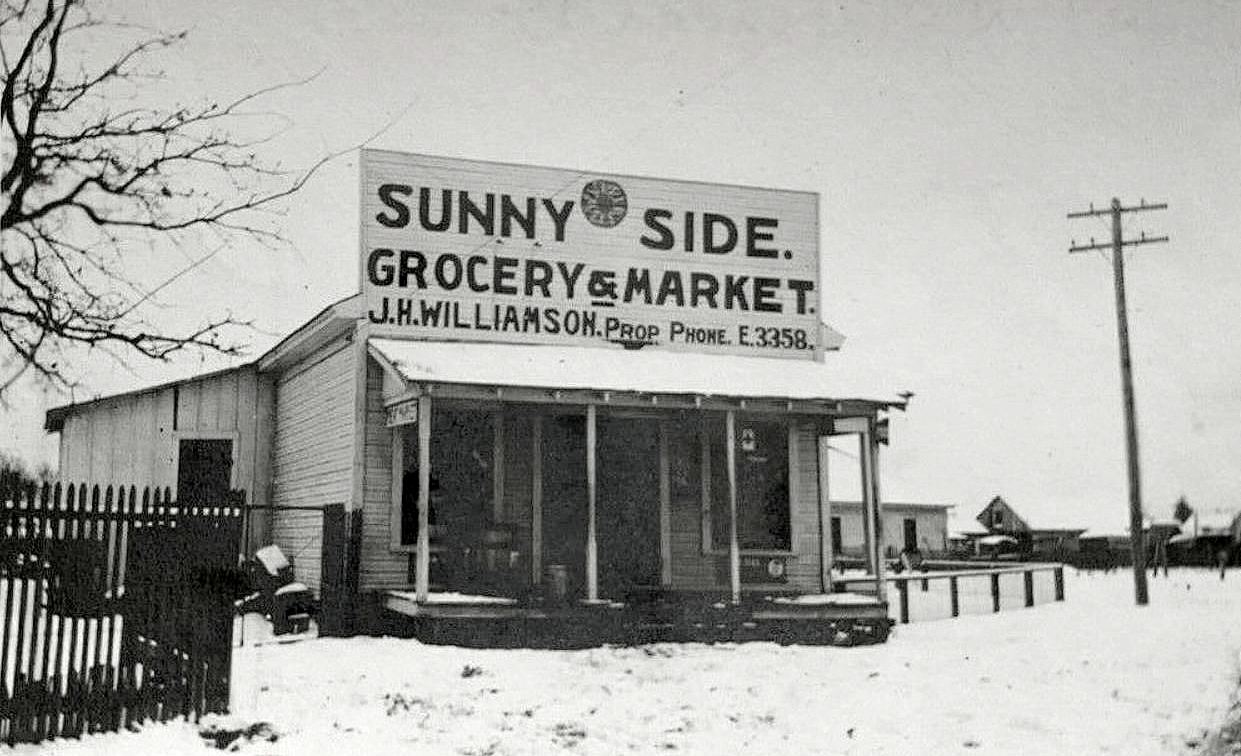
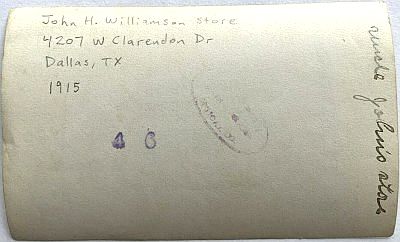
Above, the Sunny Side Grocery & Market, J. H. Williamson, prop. According to the notation on the back of this photo, the store — owned by John Williamson — was located at 4207 W. Clarendon (a few steps from Sunny Side Avenue in, I believe, Cockrell Hill (which I’m ashamed to say I didn’t realize was a separate city from Dallas — as Wikipedia says, it is a city “completely surrounded by the city of Dallas” — sorry, Cockrell Hill!).
Mr. Williamson appears to have owned another store — or this store, with an incorrect modern-day notation by a descendant. The other store (also called the Sunny Side Grocery…) was listed in the 1915 Dallas city directory (as well as in a 1915 ad in TheDallas Morning News) as being at 3600 Copeland (where S. Trunk and Copeland meet in South Dallas — as seen in the bottom right corner of this 1922 Sanborn map).
The only other thing to go on is the telephone number: “E 3358,” which might be “Edgewood” 3358. The Edgewood exchange went into service in 1911 and served “all telephones south of the Santa Fe tracks and west of the Fair Grounds” (Dallas Morning News, May 2, 1911). So that’s not terribly helpful in this instance, since both locations would be in that exchange (I think…). My guess is that the photo shows the W. Clarendon location (which was still in business as late as 1936).
Dallas Morning News headline, May 4, 2022/photo: Tom Fox
by Paula Bosse
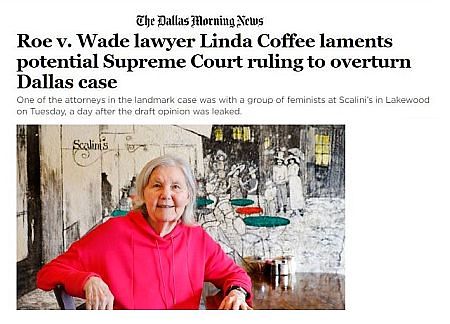
Great work by BeLynn Hollers of The Dallas Morning News for getting comments from Linda Coffee — the Dallas attorney who took her case, Roe v. Wade, to the U.S. Supreme Court (along with her co-counsel, Sarah Weddington) — on the leaked Supreme Court draft decision which appears to signal the overturning of her landmark court case. The story, “Roe v. Wade Lawyer Linda Coffee Laments Potential Supreme Court Ruling to Overturn Dallas Case” (Dallas Morning News, May 4, 2022) can be found here (paywall). Below is the video interview with Coffee, posted on YouTube, here.
The previous DMN interview of Linda Coffee by BeLynn Hollers — “Dallas Lawyer Linda Coffee Launched Landmark Roe vs. Wade Abortion Rights Case with a $15 Filing Fee” (Dallas Morning News, Dec. 16, 2021) — can be found here (paywall). The video interview from that article is posted on YouTubehere.
And, from 1970, what may be Linda Coffee’s first-ever television interview about the Dallas case (which was just beginning its long trek to the Supreme Court) has recently been found in the WFAA Newsfilm Collection at SMU (G. William Jones Film & Video Collection, Hamon Arts Library, Southern Methodist University). She was, incredibly, only 27 years old. It is posted on YouTube here. (Read the YouTube notes for background info on this interview.)
I often just wander aimlessly around the internet, hoping I’ll find something Dallas-related that I haven’t seen before. Last night I found this unusual photo in the Western Americana Collection of Princeton University, described as “View of a Texas city, possibly Dallas.” Okay. It didn’t strike me immediately as a familiar view of Dallas, but you’ve got appearances by Dallas Art Glass Co., Texas Hosiery, and Texas Paper Co. So, yeah. Dallas! I definitely haven’t seen this before. (Scroll down for the specifics of the location.)
Once I determined this was, in fact, Dallas, I tried to figure out what was happening — who (and why?!) were those two people waving from a tiny platform on top of a tall pole? I first thought “flagpole-sitting,” the weird fad of the 1920s which makes me uncomfortably acrophobic just thinking about it. But it was two people on a pole. Standing. Waving. I just kept looking at it, wondering how they got up there. And how were they going to get down (without plummeting)? Why were they there? Were they a couple? Were there husband-and-wife pole-sitters/-standers/-dancers/-wavers? So many questions.
My first hint was in a December, 1931 story in The Dallas Morning News about a young woman who seemed to have some name-recognition named Betty Fox who was, at the time of the article, perched atop a pole in Greenville, Texas, attempting to test her endurance and remain there for 100 hours. As one does. (When in Greenville….) So I searched for newspaper articles about “Betty Fox.” She was, indeed, a star in the pole-sitting world, entertaining large crowds and making personal appearances all around the country. Then I noticed that there seemed to be more than one “Betty Fox” out there. Hmm. And I had noticed that there had been a pole-sitter named Ben Fox who was a fairly serious flagpole-sitting champ. That was kind of a weird coincidence. Or was it? And then I found the article “Sky Dancers Betty and Benny Fox,” which helpfully explained that Benny and Betty were daredevil aerial dancers. They were originally billed as brother and sister, but as the article says, “they were not related. And Betty was not always the same person, nor was she actually named Betty.”
They traveled from city to city where they drew large crowds who watched them perform high in the sky on a tiny circular disc 24 inches in diameter (it later shrank to 18 inches in diameter). Their acrobatic “sky dance” (AKA “The Dance of Death”) apparently lasted for several hours. (There was an article I read from 1931 about “Betty” and a heretofore unknown other “sibling” named “Babe” Fox who defied a judge’s injunction to prohibit the two from engaging in a 100-hour marathon-dance stunt on a 35-inch platform, 50 feet in the air in cold, wet, and windy Texarkana. Seems like a bad idea, but, apparently, they didn’t die. (…Or maybe they did and just got a new “Betty” and “Babe” and carried on to the next gig.)
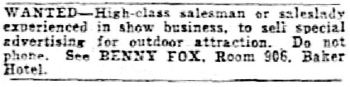
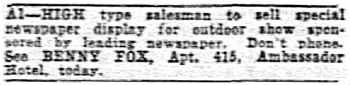
Princeton University estimated the date of the photo to be around 1930. I think it might have been 1935. The two classified ads below in which Benny seeks Dallas promoters for their local event, were from the end of 1935. (The event was sponsored by a Dallas newspaper — it obviously wasn’t the DMN, because there was no story about the Foxes in their pages.) The newspaper photo below the ads shows the then-current version of Betty and Benny, and they look like the couple in the Princeton photo.
Dallas Morning News, Nov. 27, 1935
DMN, Dec. 7, 1935
Atlanta Constitution, May 3, 1935
Yes, that caption says they performed for SIX HOURS.
I’m not sure how long “Betty and Benny” lasted, but they were back in Dallas in 1957 performing at a week-long carnival in Wynnewood Shopping Center. I bet there were more “Bettys” than “Perunas.”
Here’s some newsreel footage of one of the Betty and Benny incarnations, doing their thing in Chicago. (Seriously, if you’ve got even a hint of a fear of heights, look away!!!)
*
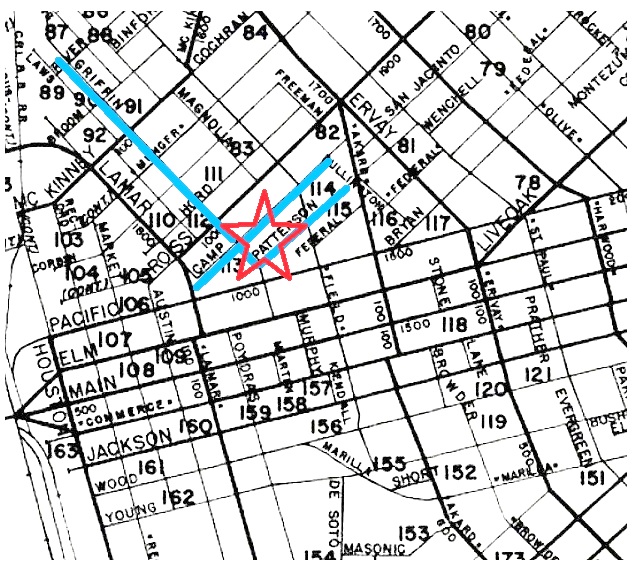
So where was that photo at the top taken? I’m estimating the camera was on the top of a building at, roughly, Griffin and Pacific, looking in a northerly direction. At the top right, the tall building farthest away is the First Methodist Episcopal Church (now First United Methodist) at Ross and Harwood. It’s hard to see any streets, but the two running diagonally are Camp and Patterson. A few addresses of businesses seen in the photo:
Dallas Art Glass Co.: 1408 Camp
Steger Transfer Co.: 1305 Camp
Texas Hosiery: 1200 Camp/1201 Patterson
Texas Paper Co.: 1200 Patterson, extending to Pacific
A 1921 Sanborn map is here. A detail from a 1952 Mapsco is below.
1952 Mapsco (det)
*
I’m not sure why Princeton has this photo in their collection, but I really enjoyed reading about Benny and his “Bettys.”
***
Sources & Notes
Top photo — “View of a Texas city, possibly Dallas” — is from the Western Americana Collection, Princeton University Library Special Collections; more information on this photo can be found on the Princeton website here.
See several “action” photos of Benny and Betty from GettyImages here.
Read the very entertaining “Sky Dancers Betty and Benny Fox” by Alan E. Hunter, here.
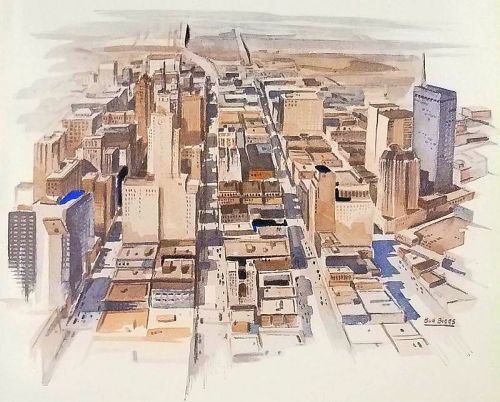
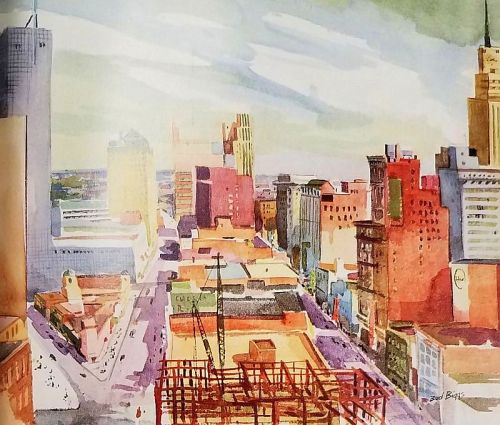
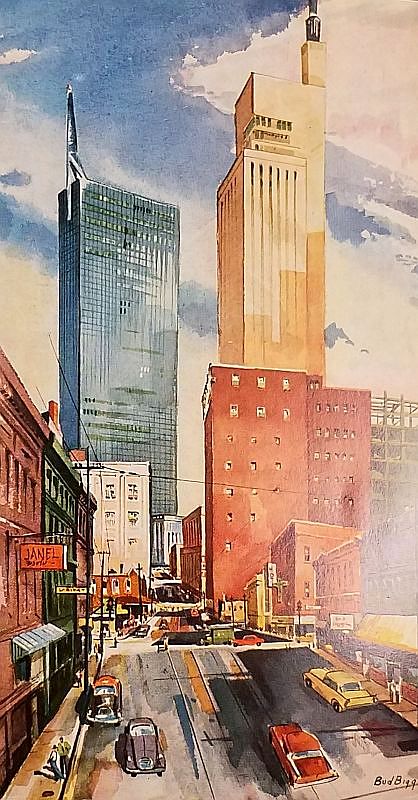
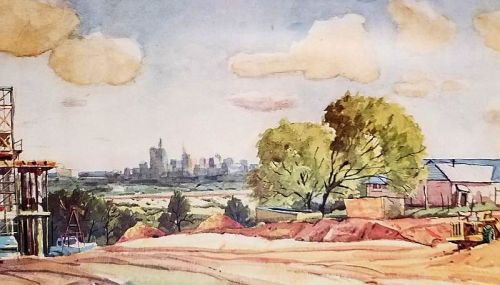
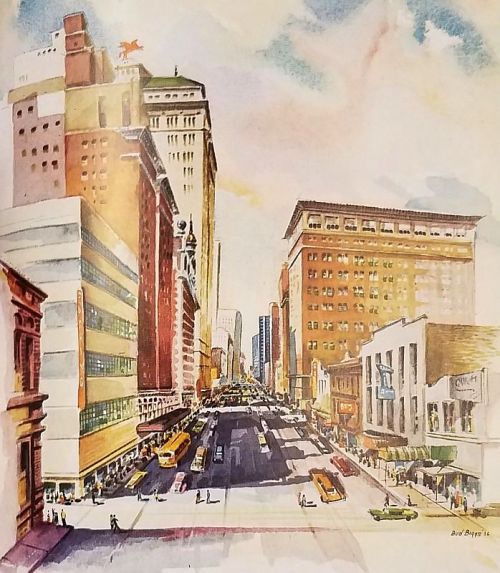
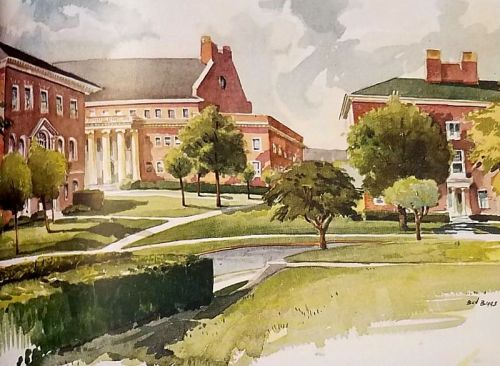
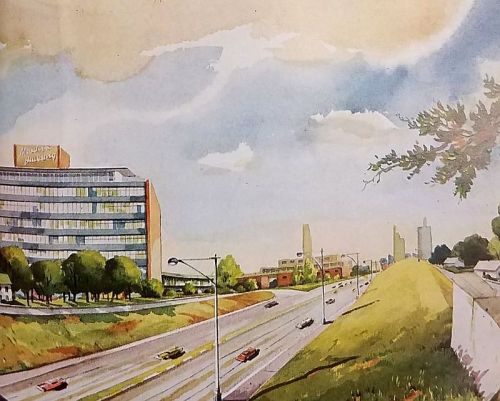
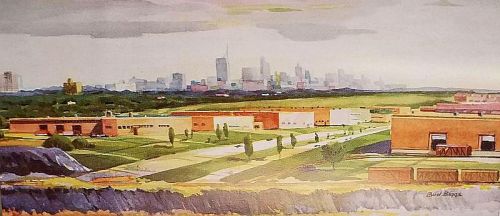
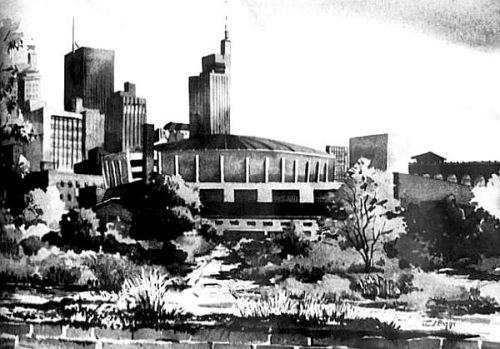
Back in 2018 I posted Christmas-themed magazine cover art by Dallas artist/illustrator Bud Biggs — it was one of my favorite images posted that year (see the post here). I knew that it had been one of the 12 monthly covers by Biggs used in 1956 for Dallas magazine, the Dallas Chamber of Commerce publication. Since then, I’ve managed to turn up all 12 watercolors. Some of them are going to look a little wonky with unfortunate glare patches — this is because I was unable to photograph them lying flat. I’ve done my best! I’ve paired them with the titles which were printed in the Dallas Morning News — I hope I’ve gotten the right titles with the right paintings.
*
Above, “Aerial View of Downtown Dallas” by Bud Biggs (this painting appeared on the cover of the January, 1956 issue of Dallas magazine).
*
Below, “The Katy Round House” by Bud Biggs (February, 1956 cover)
*
“Looking Up Pacific” by Bud Biggs (March, 1956 cover)
*
“Ervay Street” by Bud Biggs (April, 1956 cover)
*
“Ground-breaking, Dallas University” by Bud Biggs (May, 1956 cover)
*
“Commerce Street” by Bud Biggs (June, 1956 cover)
*
“SMU Legal Center” by Bud Biggs (July, 1956 cover)
*
“Central Expressway” by Bud Biggs (August, 1956 cover)
*
“Midway, State Fair of Texas” by Bud Biggs (September, 1956 cover)
*
“Trinity Industrial District” by Bud Biggs (October, 1956 cover)
*
“City Auditorium” by Bud Biggs (November, 1956 cover) — sadly, I was unable to find this one in color.
*
“Main Street, Christmas Night” by Bud Biggs (used for the cover of the December, 1956 issue of Dallas and for the cover of the Christmas, 1959 issue of the Shamrock Oil & Gas publication, The Shamrock)
**
This series of 12 paintings won the “Best Covers of 1956” award from the American Association of Commerce Publications, and in 1958 all 12 of the original watercolors were purchased by Southwest Airmotive Company to be displayed in their new Love Field terminal. I have no idea where these paintings are today. I love them.
*
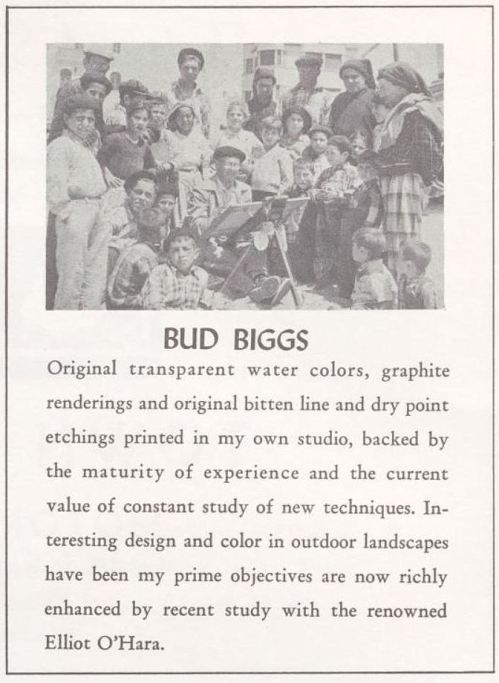
Dallas native Bancroft Putnam “Bud” Biggs (1906-1985) attended Forest Ave. High School, SMU, and the St. Louis School of Fine Arts. He was primarily a commercial artist, working for Dallas artist Guy Cahoon before opening his own advertising studio. He produced fine art as well, specializing in watercolors, and was a respected art instructor. Below is an ad placed in the publication La Fiesta of Art (1957) to coincide with an art show in Highland Park Village. He is seen sitting at an easel. I had never heard of Bud Biggs before that Christmas post in 2018 — someone needs to round up his works and publish them!
***
Sources & Notes
Information on the 12 paintings is from the Dallas Morning News article “Art & Artists: Biggs Series Bought by Firm” by Rual Askew, Feb. 20, 1958.
I was contacted by someone over the weekend about a photo I had posted to my personal Instagram back in 2014. And that reminded me that I’ve been meaning to post these photos for several years now! (Thanks, G.H.)
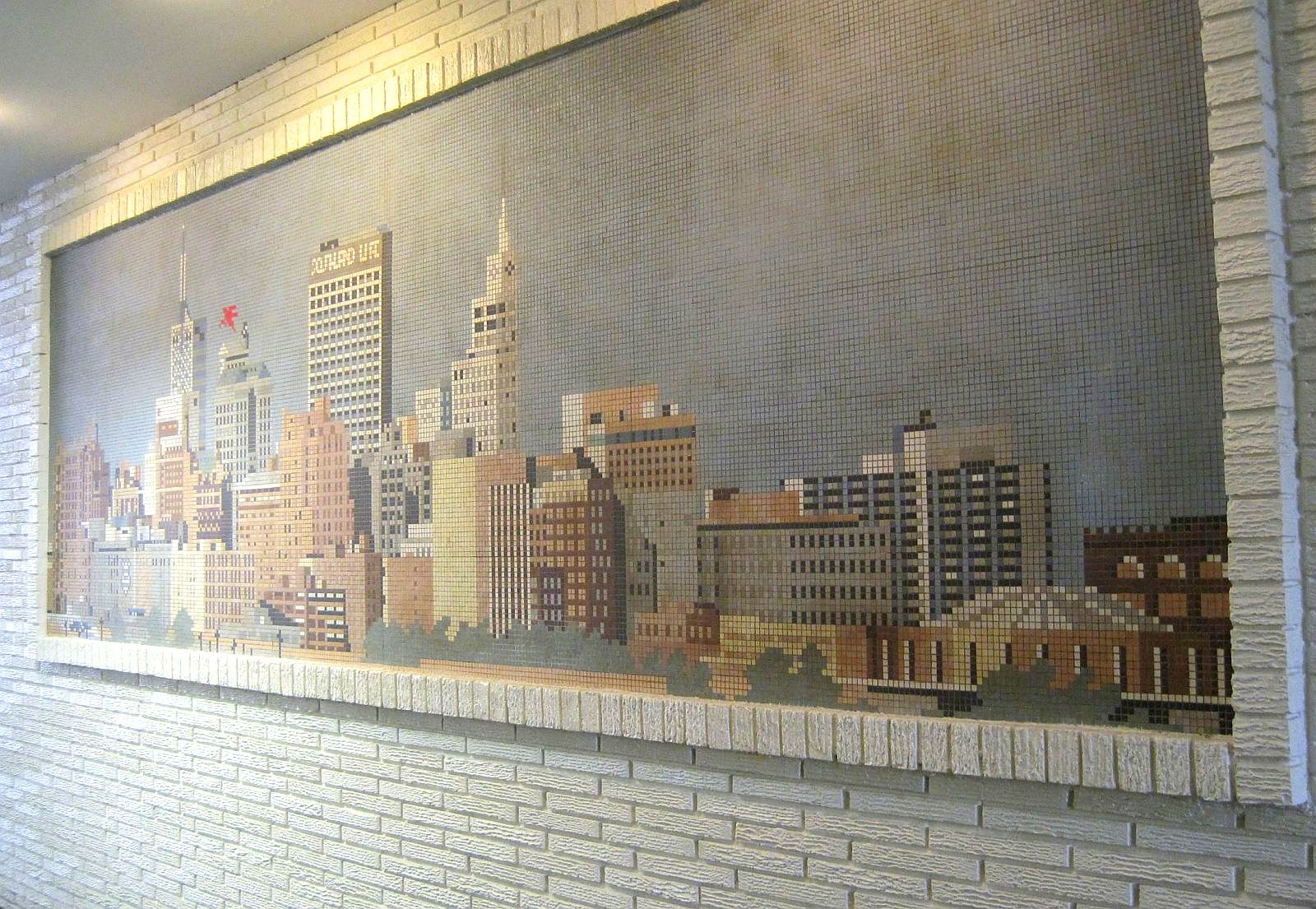
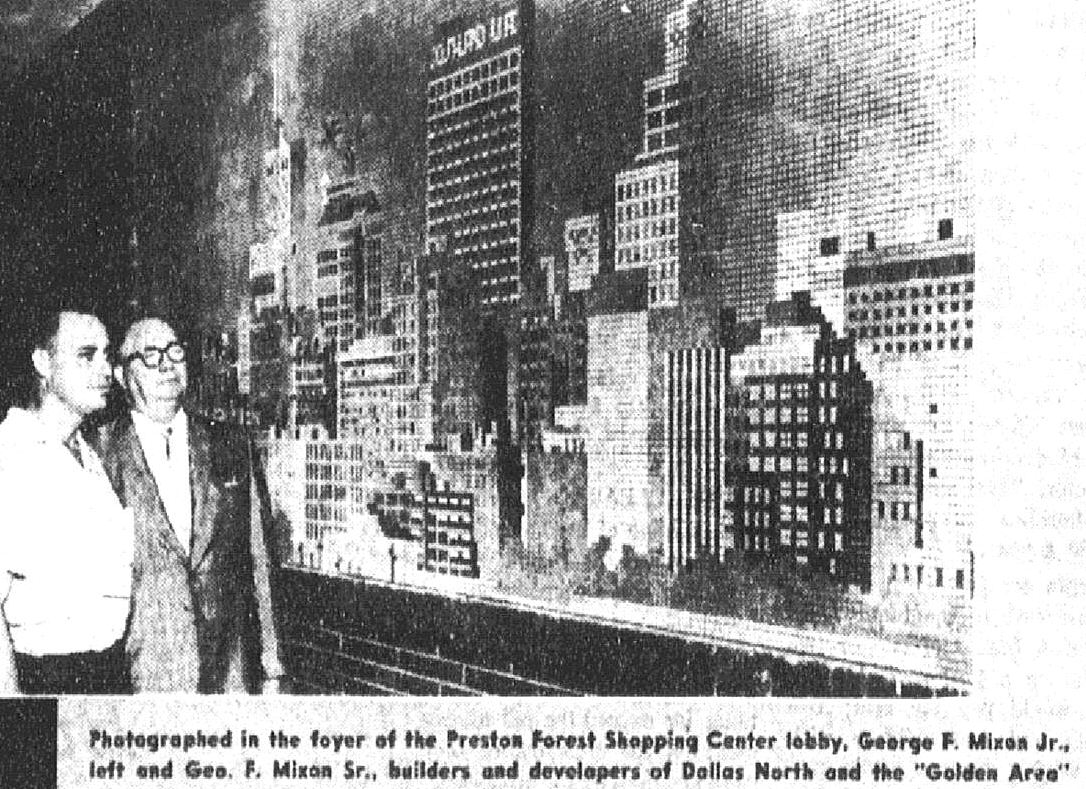
Back in June, 2014, I saw a Dallas Morning News blog post by Rudy Bush, saying that he had just seen a pretty amazing mural after having gone to get a haircut in the Preston Forest Shopping Center and that he was hoping to find more information about it. He posted a photo, and it was COOL! I’d never seen it, and started looking to see what I could find. Rudy included my info in a later DMN blog post, with a nice link to my brand new Flashback Dallas site.
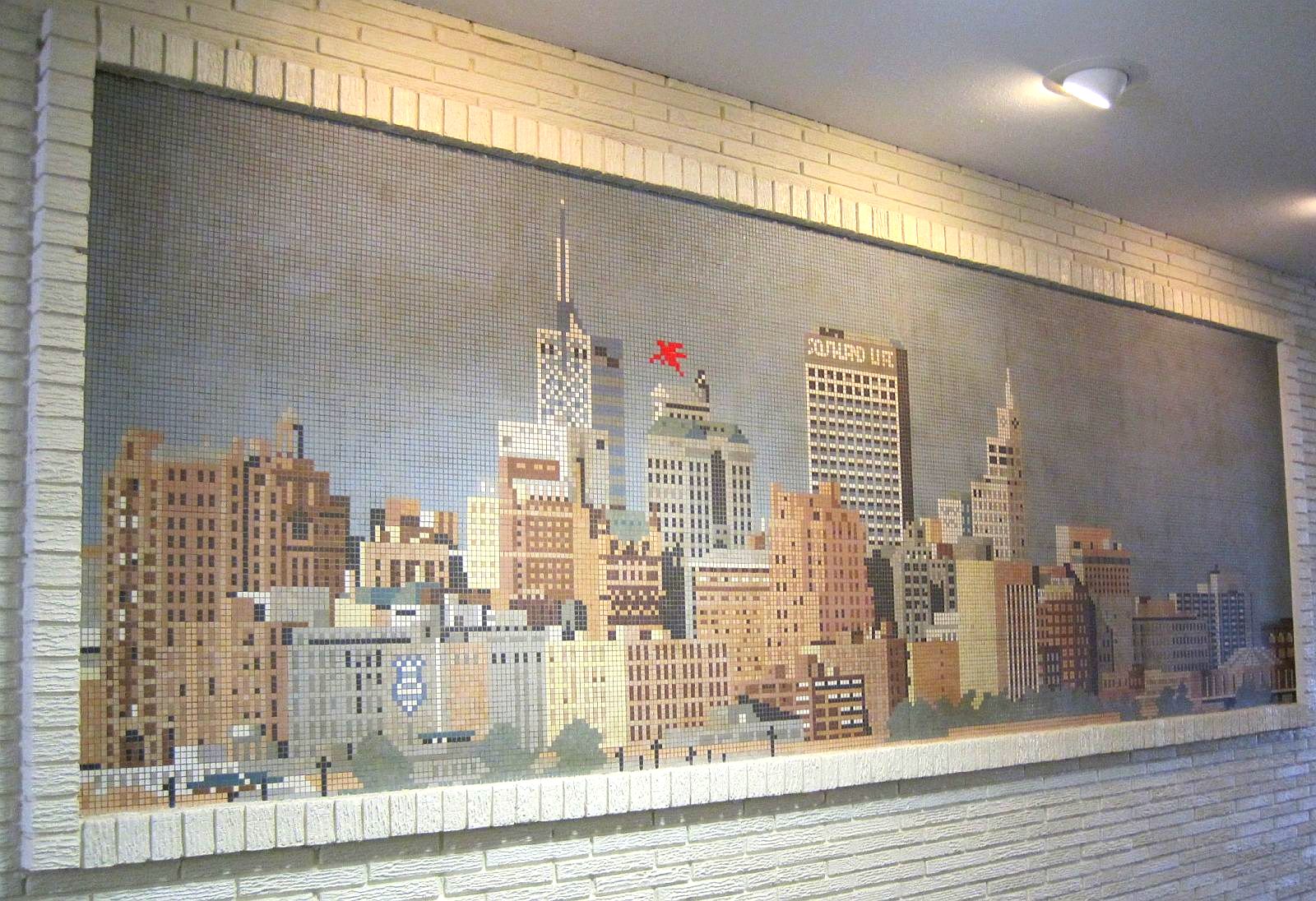
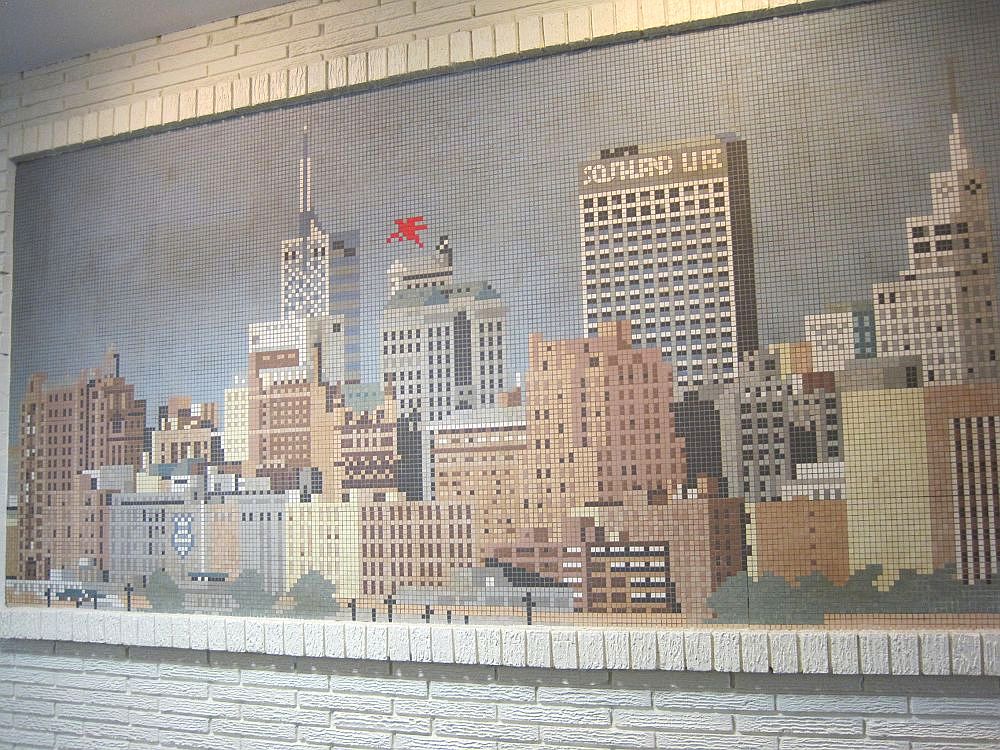
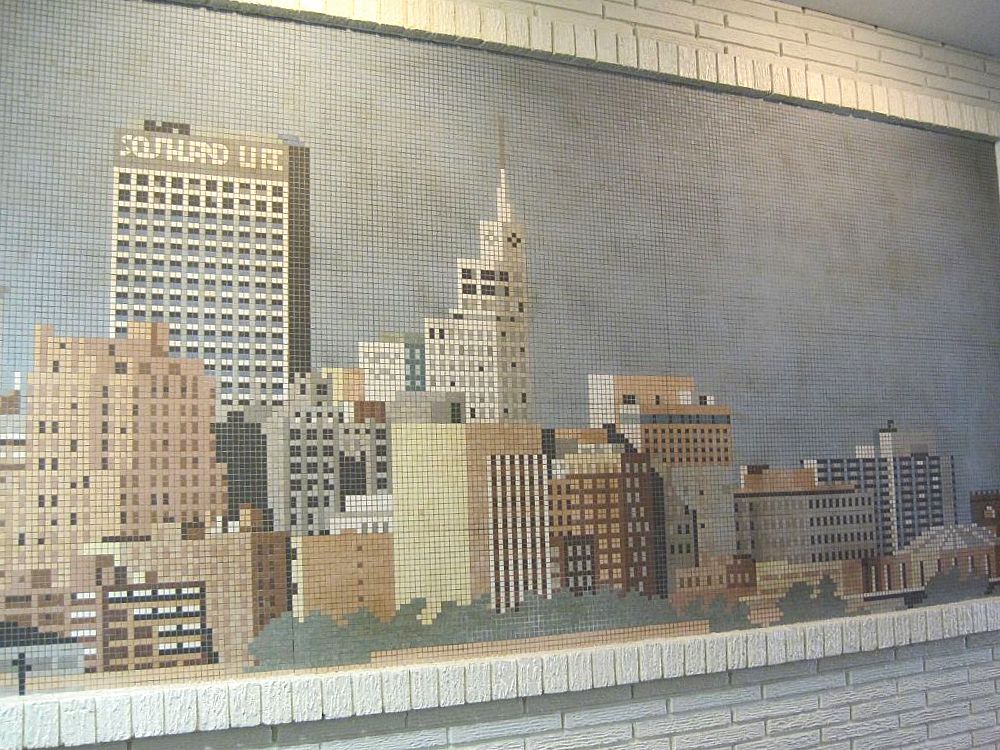
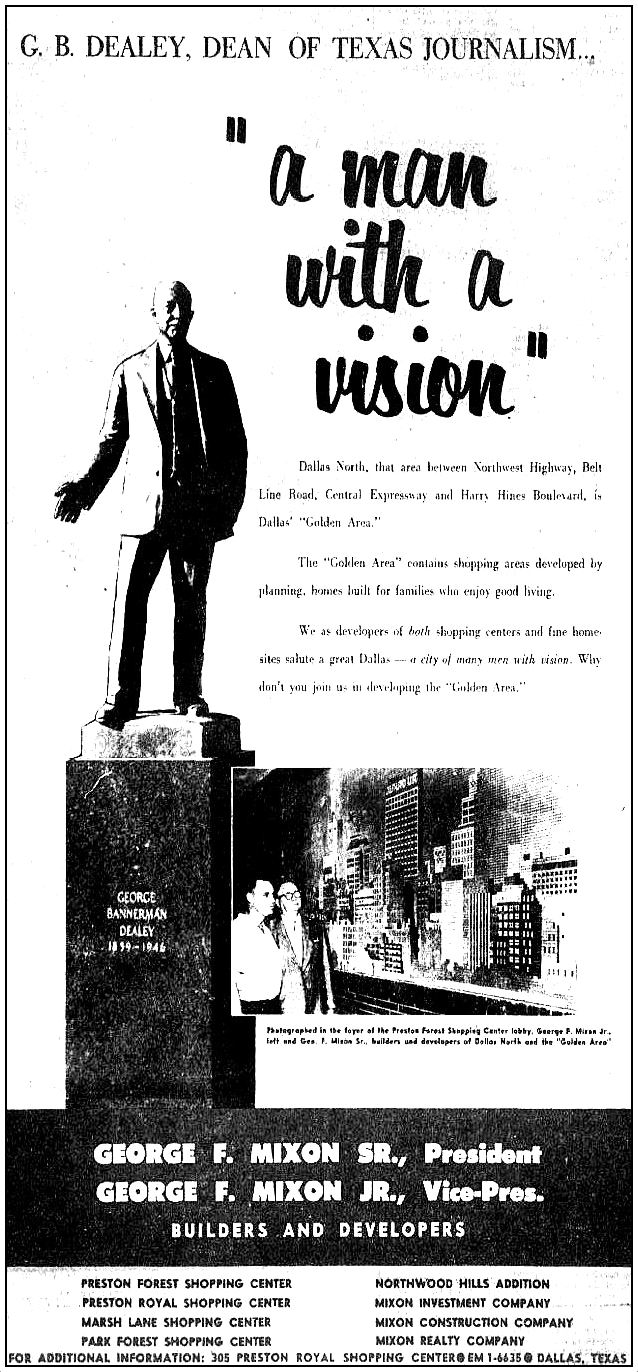
The 80-square-foot tile mosaic — made up of more than 46,000 ceramic tiles — shows the Dallas skyline of the late 1950s. It was created by Cambridge Tile Co. of Ohio (with a factory in the Trinity Industrial District) and installed by H. J. Palmer Tile Co. of Dallas. The mural was commissioned by George F. Mixon Sr. and George F. Mixon Jr., developers of several North Dallas shopping centers, including the Preston Forest Shopping Center (southeast corner of Preston and Forest). The mural was installed in the shopping center office.
I haven’t been over to see it since 2014, but I assume it’s still there. It’s about halfway between Staples and Whole Foods, next to a barber shop. It’s in the small lobby of office space you might never have even noticed. And it is wonderful. Unfortunately, it’s in a hallway, so there’s no way to take a photo of the whole thing straight on. Even when you’re standing looking at it, it’s like being on the front row of a movie theater — the only way to see the whole thing is to move your head from side to side as you feel yourself straining to lean back to take the whole thing in.
I know it was commissioned especially for this building, but no one ever sees it! It would be great if it were installed somewhere else where more people could enjoy it. I love it. Go and see it! And have fun identifying all the landmark buildings. (UPDATE: I have been informed by several people who have made the pilgrimage to Preston-Forest to see this mural that it is no longer accessible to the general public. What a shame!)
*
Here are photos I took in June, 2014.
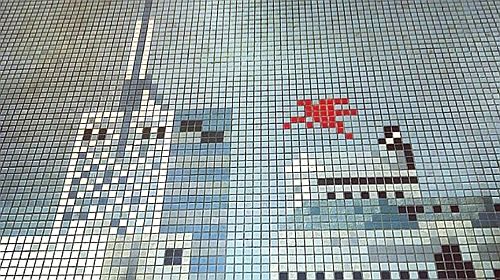
And, of course, my favorite detail — look what you can do with 29 red tiles:
**
Below, a photo of the Mixons in front of their mural — from a 1960 ad. (See the full ad below.)
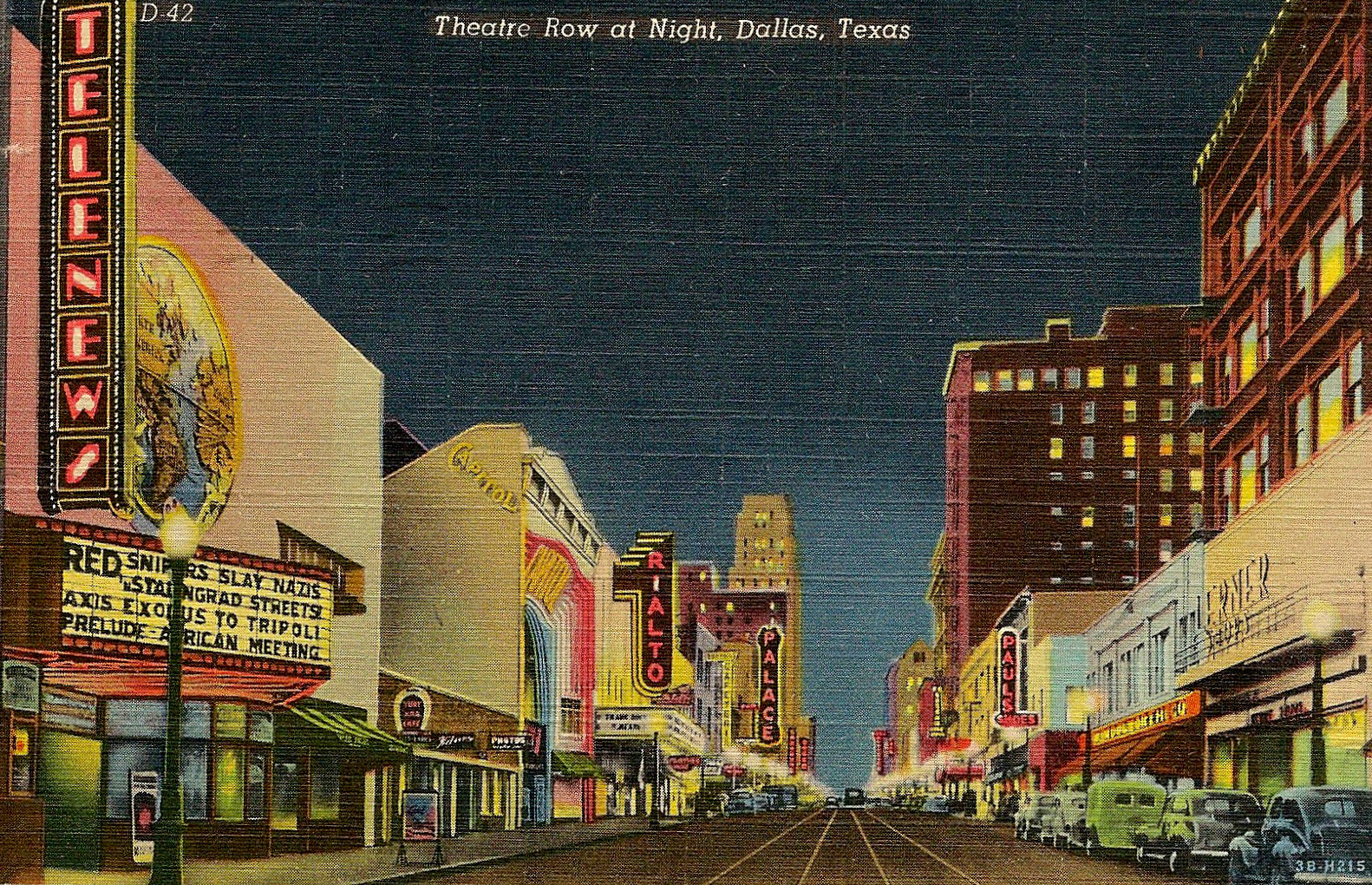
In honor of tonight’s Oscars, I give you a whole bunch of posts about — and images of — old Dallas movie theaters in one handy link, here. Just keep scrolling!
There’s a church, and a bank, and a bank, and a bank…
by Paula Bosse
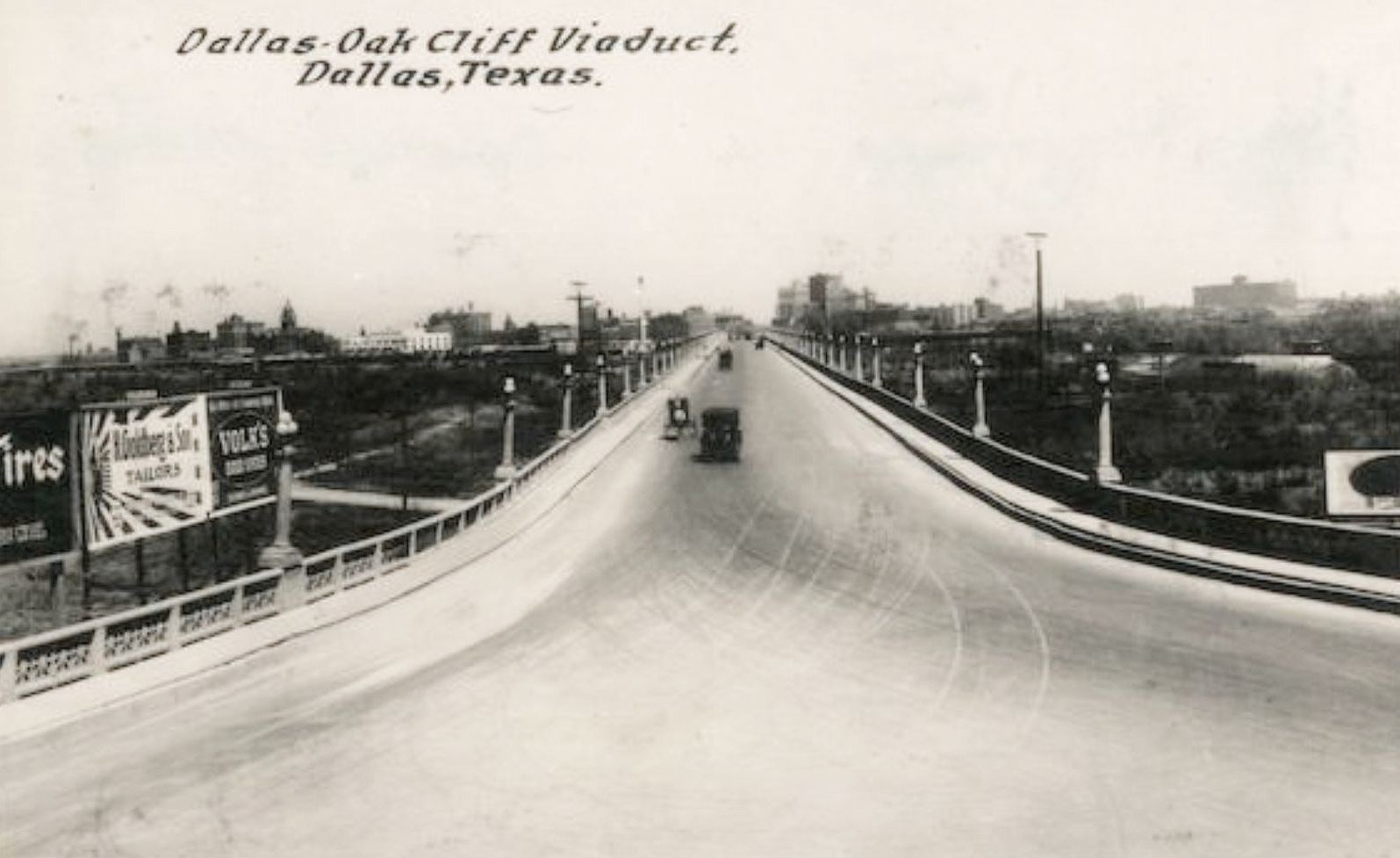
A couple of quickies: these are two really nice postcards which popped up recently on eBay — I’d never seen them before.
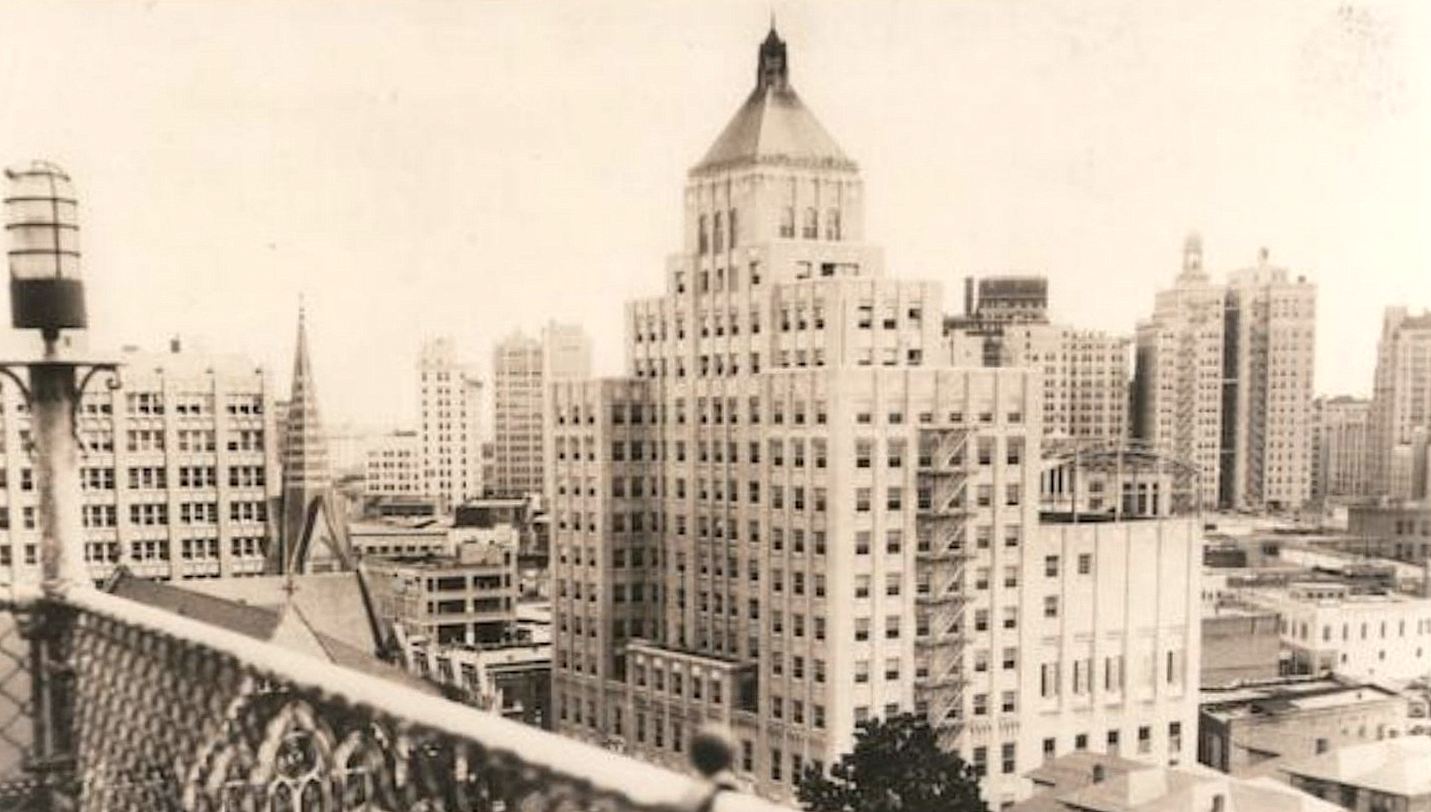
Above, a lovely, creamy, glowing shot of the skyline. I recognize several of the buildings, but I’m not sure where the photographer was positioned. I’m sure a smart person will put the location in the comments.
And below, a great image of the “Dallas-Oak Cliff viaduct,” looking toward the city. There’s even a Volk’s billboard to welcome visitors.

 A beautiful place to wait…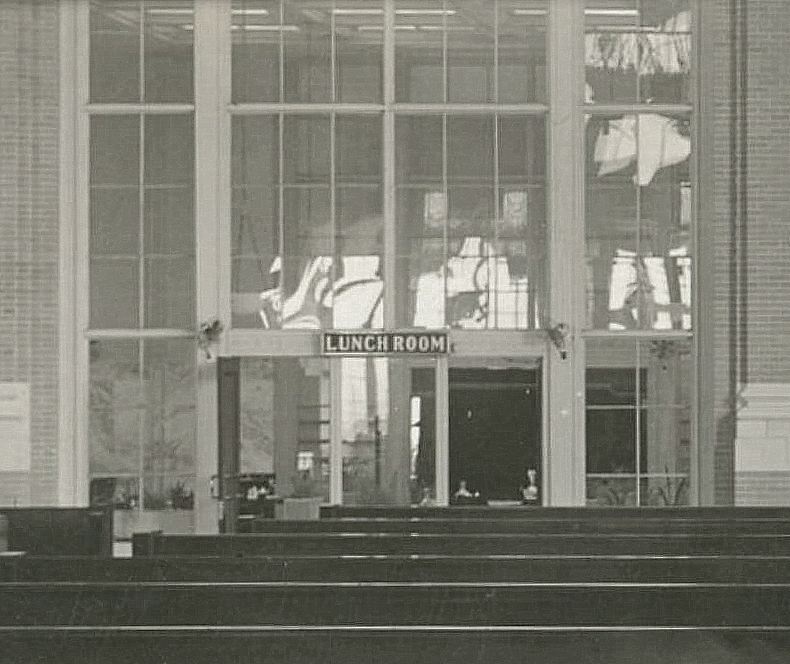


 1889 Dallas directory
 1924
1924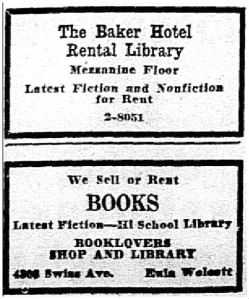 Two shops, one owner — 1926
 1927
1927 1937
1937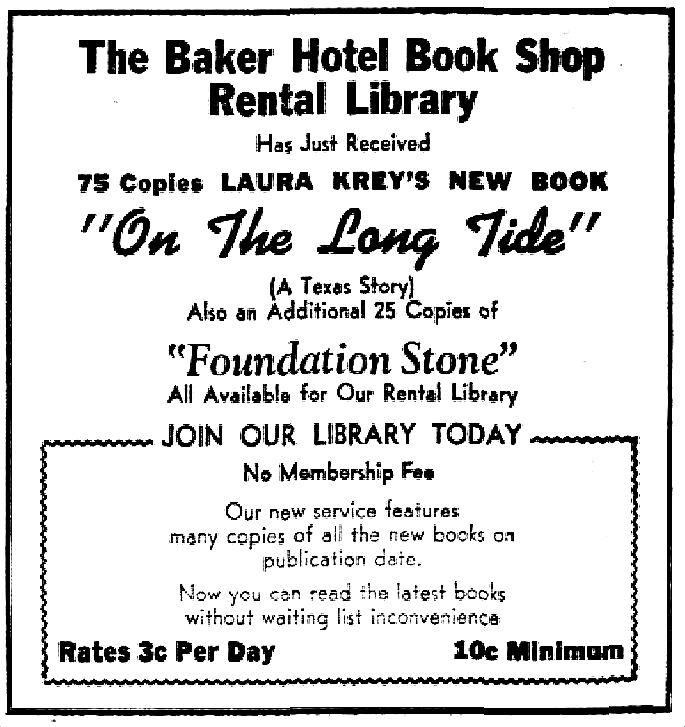


 Dallas Morning News headline, May 4, 2022/photo: Tom Fox
 Dallas Morning News, Nov. 27, 1935
 DMN, Dec. 7, 1935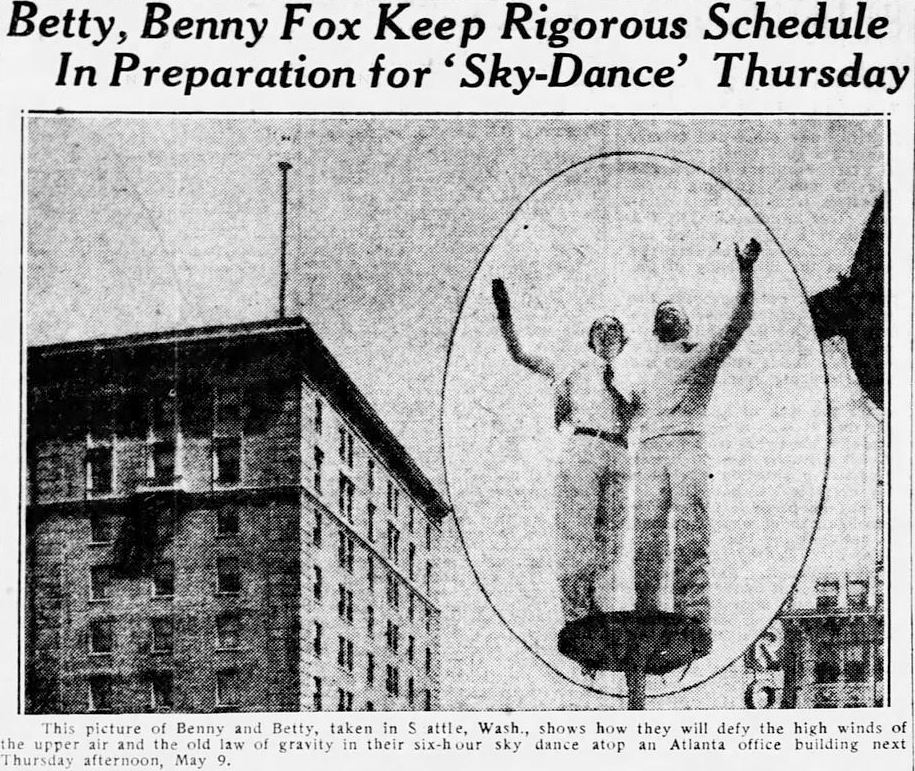

 “Aerial View of Downtown Dallas” by Bud Biggs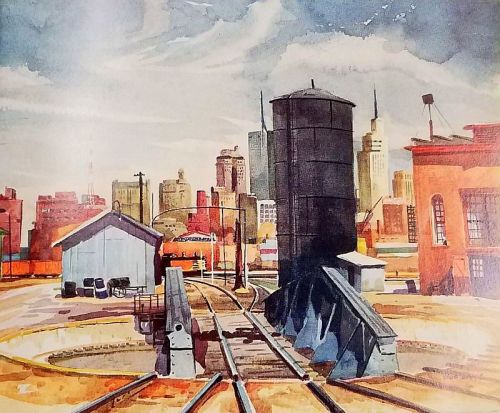






 Flashback : Dallas