Flashback : Dallas

A Miscellany: History, Ads, Pop Culture

Tag: Dallas TX

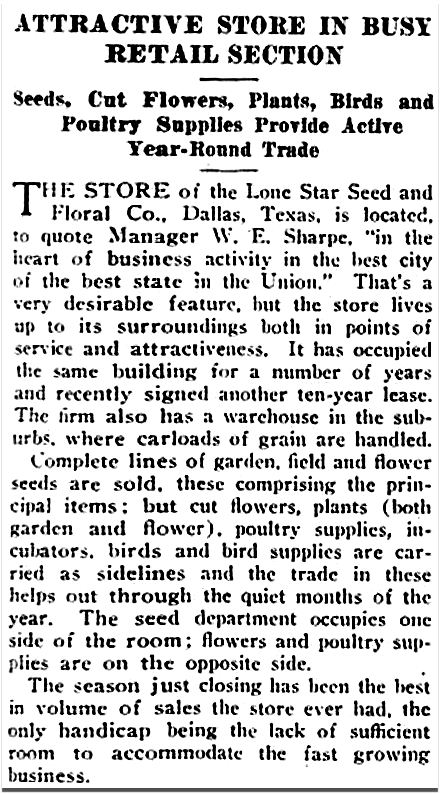
Next-Door Neighbors: The Palace Theater and Lone Star Seed & Floral — 1926
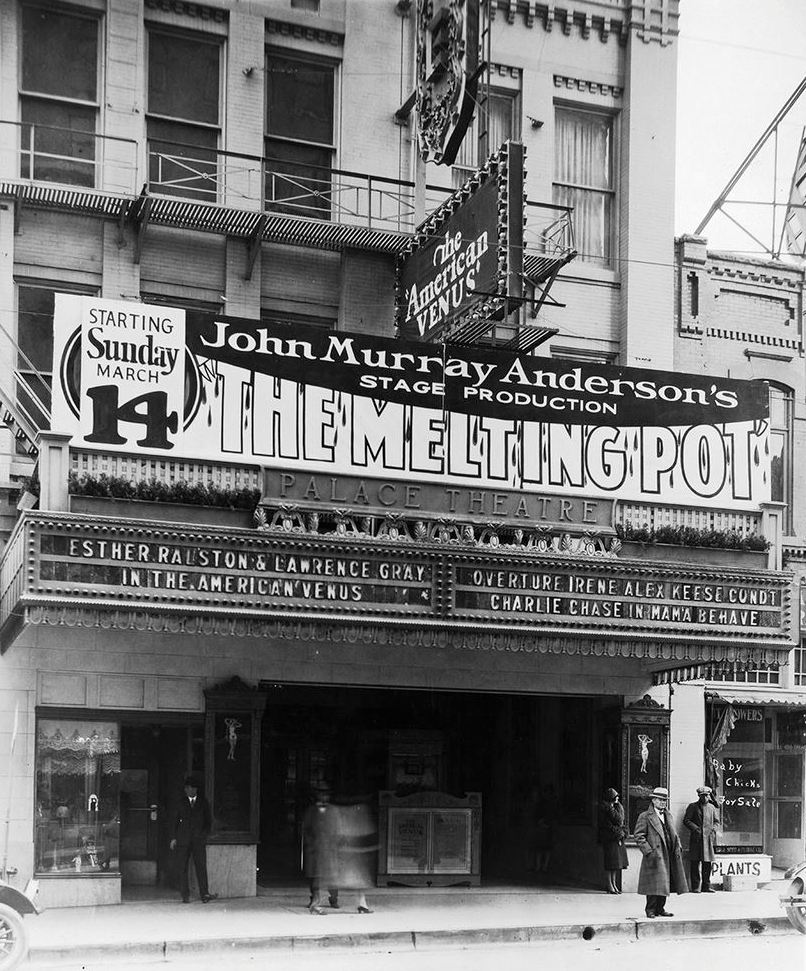
palace-theatre_melting-pot_march-1926_utaElm Street neighbors, March, 1926…. (click for larger image)

by Paula Bosse

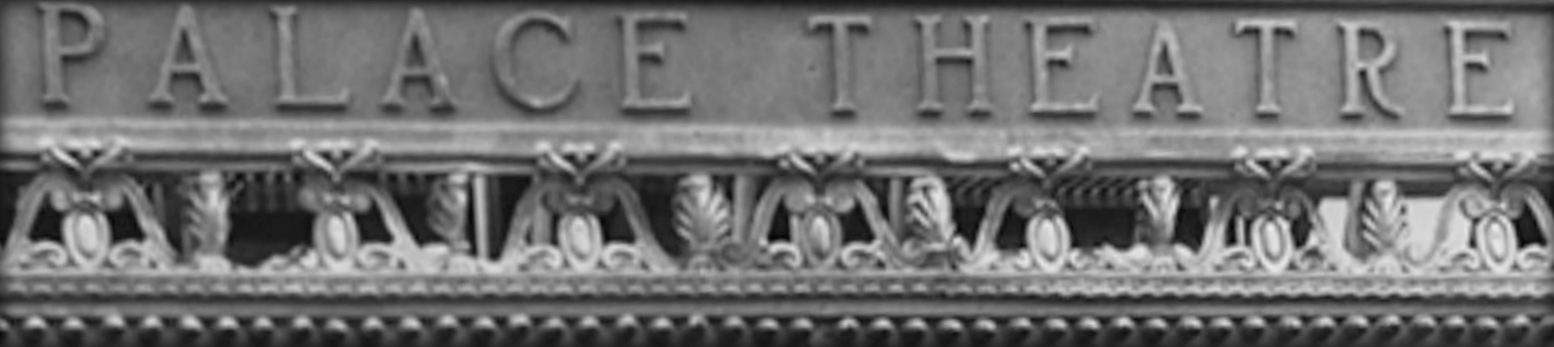
Above, the Palace Theater, one of Dallas’ great moviehouses. It opened in June, 1921, near the northwest corner of Elm and Ervay; this photograph is from March of 1926, three months before the theater’s fifth birthday. It was still a whippersnapper. 

Below, a detail from the photo: by zooming in and tweaking the contrast, the box office is revealed, as are two women chatting in the shadows (all pictures and clippings are larger when clicked).
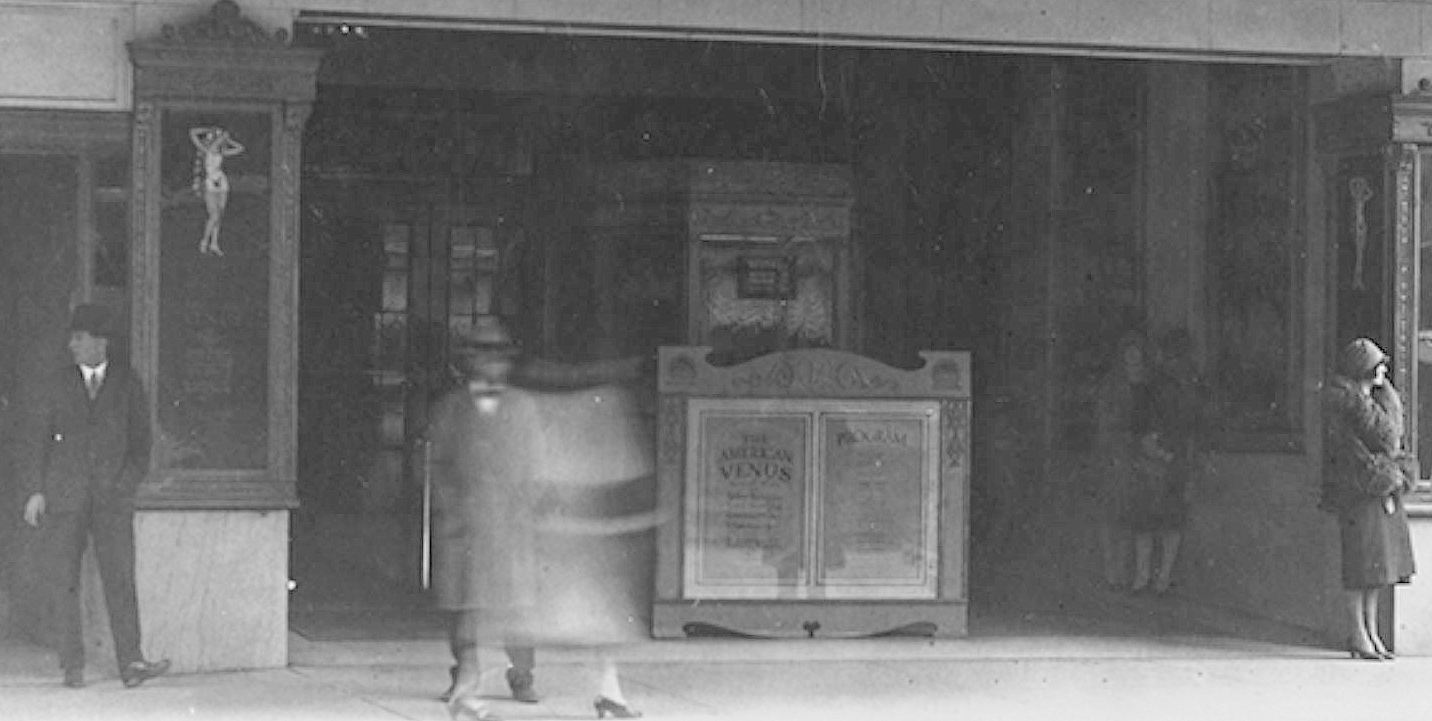
palace-theatre_melting-pot_march-1926_uta_det2

As interesting as old movie theaters are, I was more intrigued by the three people to the right of the theater (who all look like characters from a period melodrama) and by the business next door. I’ll never know who those men were or who that woman was waiting for, but finding out what business was selling baby chicks (…next door to the Palace?) was pretty easy.
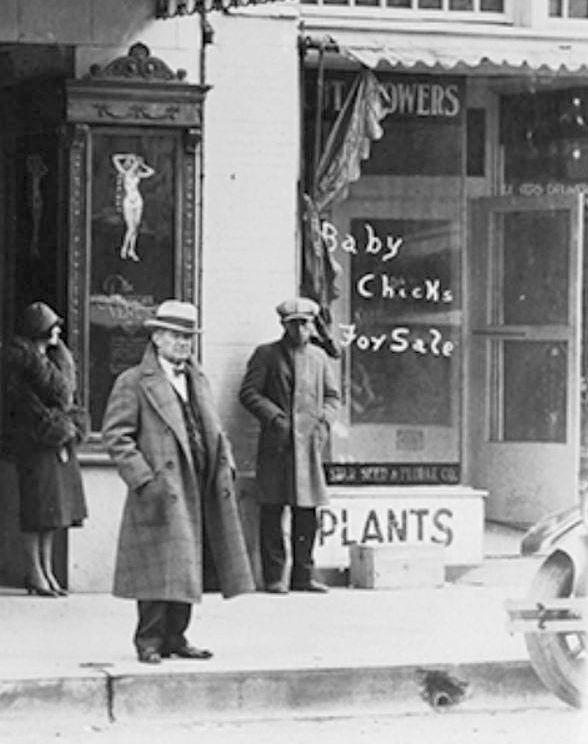
palace_lone-star-seed_1926_uta_det

The store was Lone Star Seed & Floral (1627 Elm). They sold seeds and flowers, potted plants, canaries, goldfish, and pet and livestock supplies. They could also help you with all your poultry needs: feed, incubators, medicine, and live chickens. …Right next door to one of the plushest and most luxurious entertainment destinations in Dallas.

Lone Star Seed & Floral appears to have once been Texas Seed & Floral and had been around since at least 1892. They set up shop at 1627 Elm in 1902 and remained there quite a while until they moved in January, 1927, just a few months after the top photo was taken. Here is a postcard of its earlier incarnation, with photos of the Pacific Avenue location at the left, and the Elm Street location at the lower right (the view is looking north on Ervay; the Palace would later be built immediately west of this  building, to the left of the lower postcard image, just out of frame).
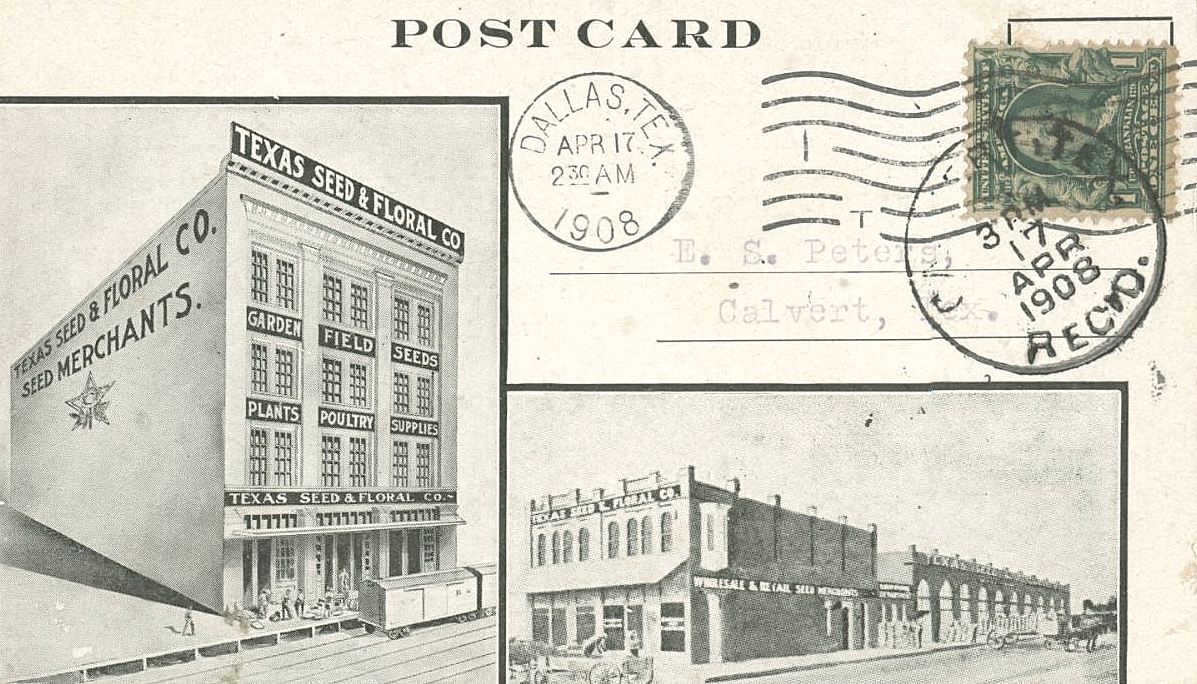
texas-seed-and-floral_1908_portal

The store looks very clean and extremely well organized. My inexplicable love of things stored in card-catalog-file-like cabinets and fold-out bins tells me I’d probably be stopping in fairly regularly after having seen the latest Buster Keaton film next door.
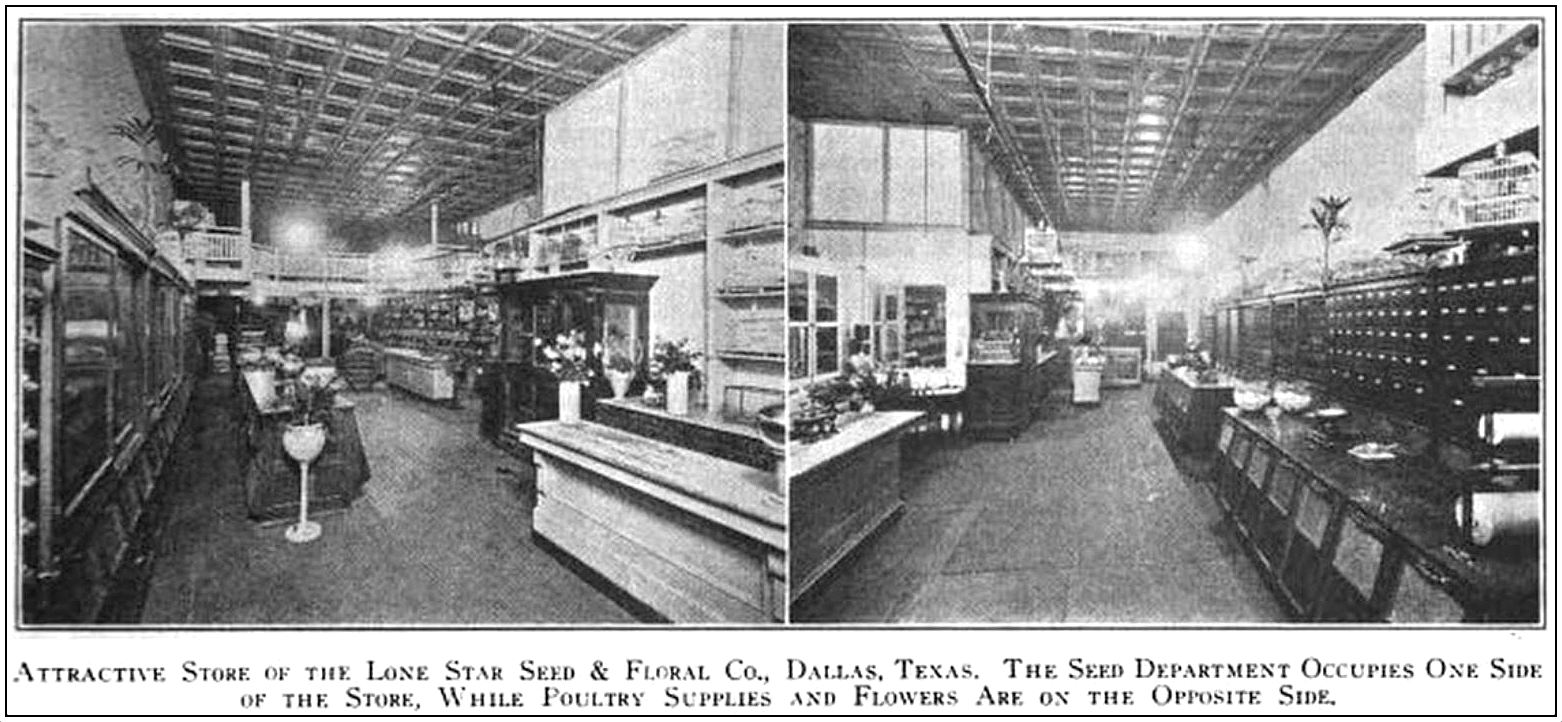
lone-star-seed_the-seed-world_082020

lone-star-seed_the-seed-world_082020_article
Photo and article from, yes, The Seed World, Aug. 20, 1920
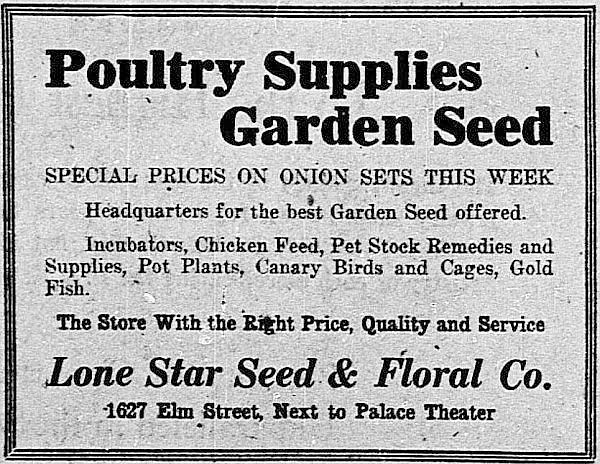
lone-star-seed_dmn_022622
Feb., 1922

But back to the Palace. The banner is publicizing the imminent arrival of John Murray Anderson’s “The Melting Pot,” a stage production which opened at the Palace on March 14, 1926. The Palace Theater, owned by the Publix chain, was about to embark on “a new and surprisingly different type of entertainment,” which consisted of musical revue roadshows staged in New York under the direction of producer John Murray Anderson. Each production — its performers, costumes, and sets — would be sent into the hinterlands, playing a circuit which included Dallas, the only stop in Texas. There was a new show every week. And if you missed it, you really had no excuse: there were four shows daily (five on Sunday). (Anderson was later asked by Billy Rose to help with producing Fort Worth’s Centennial celebration.) (John Rosenfield’s tepidly positive Dallas Morning News review, “‘Melting Pot’ Is Presented at Palace, Introducing New Style Film Theater Feature,” ran on March 15, 1926.)
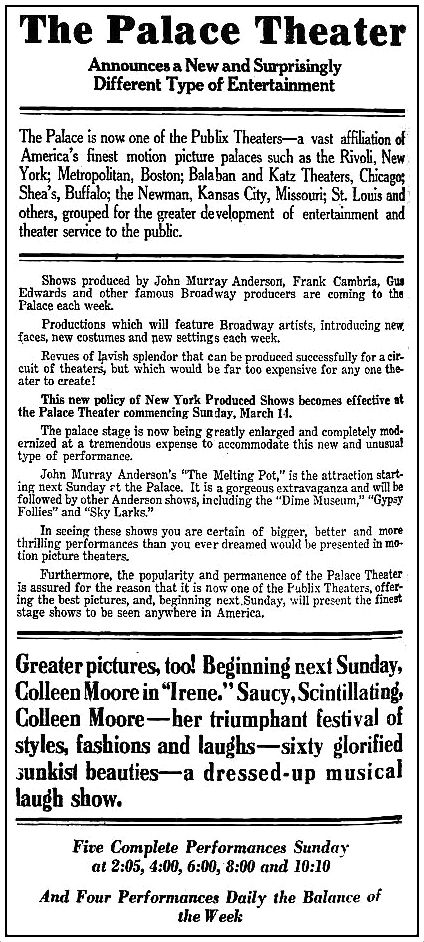
palace_dmn_031326_melting-pot-ad
Palace ad, March 13, 1926

*

palace-theatre_1926_uta_det1

***

Sources & Notes

Top photo from the Billy Burke Photograph Collection, UTA Libraries, Special Collections; more info here.

See the same view today via Google Street View here.

The Texas Seed & Floral Co. postcard is from the collection of Dallas Heritage Village, via the Portal to Texas History, here.

The beloved Palace — once an honest-to-God “movie palace” was unceremoniously demolished in 1971. It had stood at Elm and Ervay for 50 years. The north side of that block is now occupied by Thanksgiving Tower. The theater and the seed store were just west of Ervay — Lone Star Seed & Floral was just to the left of where the 7-Eleven is, on the ground floor of 211 N. Ervay, the blue building seen here (the view is northwesterly from the Wilson Building across the street).

See a great photo of Elm Street in the ’20s in the post “Dazzling Neon, Theater Row — 1929” here.

Click pictures and clipping to see larger images.

*

Copyright © 2016 Paula Bosse. All Rights Reserved.


The Katy Building, Commerce Street

m-k-t_katy-bldg_flickr_coltera“The Katy Serves the Southwest…” (click for larger image)

by Paula Bosse

A couple of days ago I posted a photo of an M-K-T train leaving Dallas and, today, coincidentally, I came across a photo of the Katy Building, the railroad’s headquarters, at Commerce and Market. This photo shows Commerce looking west toward the Old Red Courthouse from Austin Street. An interurban car is heading east.

See the same view today, via Google Street View, here.

A photo I really love — which shows a view from about the same time looking east on Commerce — can be seen in a previous post, “Commerce & Record Streets — 1946,” here.

***

Photo from Flickr, here.

*

Copyright © 2016 Paula Bosse. All Rights Reserved.
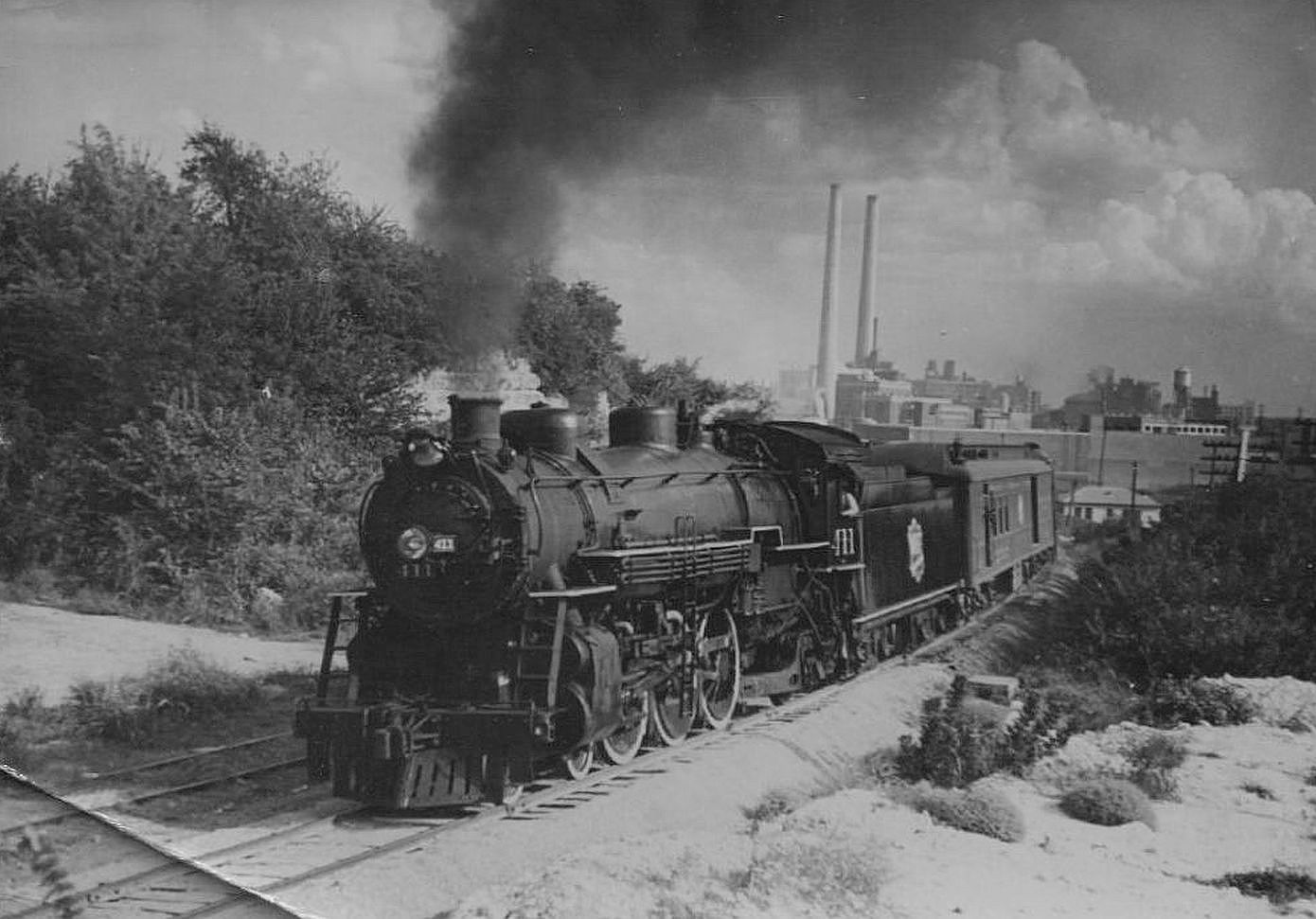
The M-K-T Pulling Out of Dallas

mkt-leaving-dallas_peter-stewart_austin_ebayTrain whistles don’t sound so lonesome in the daytime…

by Paula Bosse

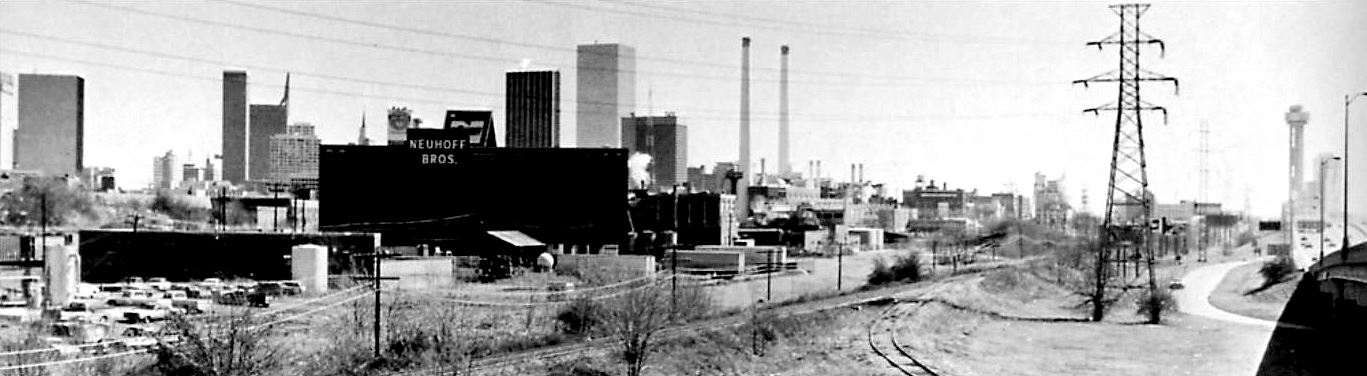
Above, an undated photo I came across on eBay a couple of months ago, showing a Missouri-Kansas-Texas train heading north from the Katy yard at the northwest corner of downtown. In the background are the twin DP&L smokestacks which were iconic landmarks until they were demolished in order to build the American Airlines Center and Victory Park. Below, a later photo taken from about the same location.

neuhoff_dpl_reunion-tower

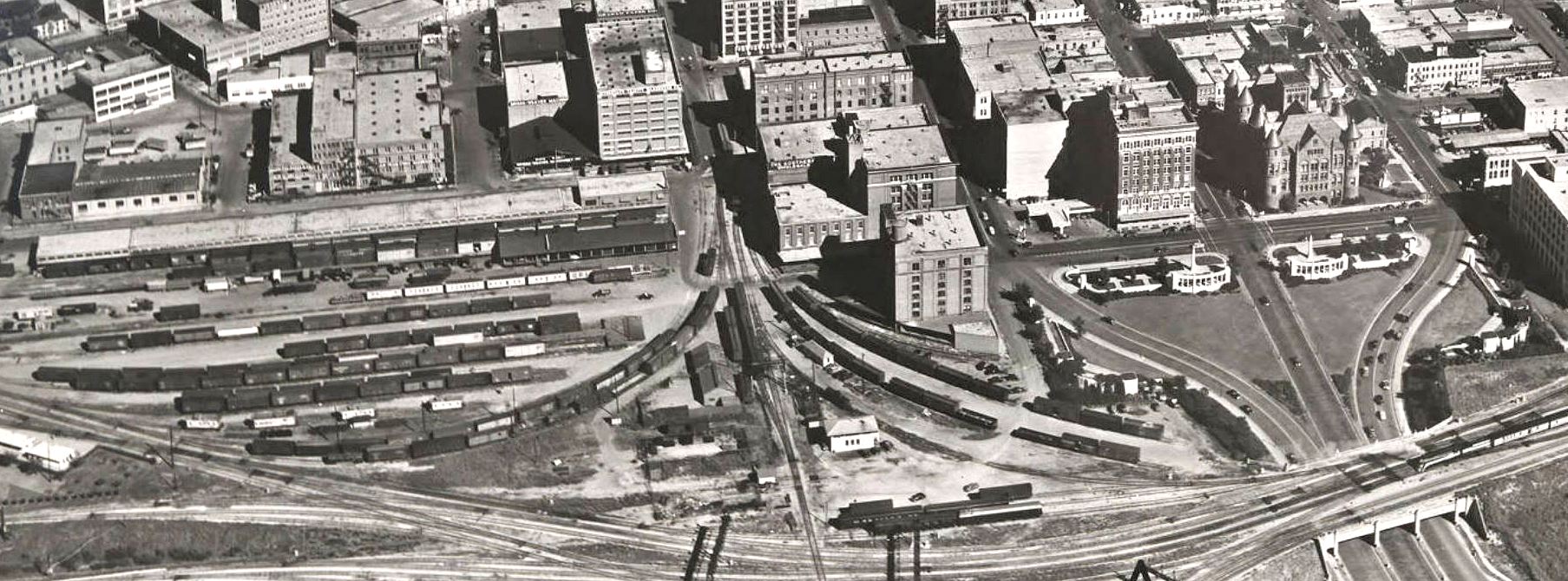
The area between Dealey Plaza and the Neuhoff meat packing plant was crammed with tracks; below is a detail from a mid-1940s aerial photo (click to see a larger image).

aerial_long_foscue-lib_smu_1940s_det

The M-K-T split about where the photo at the top was taken, as can be seen in the Sanborn map below (from 1927) between Turtle Creek and McKinney Avenue. One track headed north, the other cut through Oak Lawn and Highland Park (now the Katy Trail), crossing Mockingbird at the Dr Pepper plant near Central Expressway.

sanborn_vol-2_key_1927

mkt-logo

***

Sources & Notes

Top photo from eBay, with the photographer of this “vintage snapshot” credited as “Peter Stewart, Austin, Texas.” (There is a crease to the lower left corner.) It is undated, but when posted to the Texas Railroad History group on Facebook, commenters suggested mid-to-late-1930s to early ’50s. It’s a bit grainy, but the number on the engine appears to be 411.

The second photo, showing the Neuhoff plant and Reunion Tower, is from the collection of the Dallas Public Library.

The aerial shot is a detail from this photo by Lloyd M. Long, from the Edwin J. Foscue Map Library, Central University Libraries, Southern Methodist University.

The map detail is from the “key” page of the 1927 Sanborn Fire Insurance Map, here. Speaking of Sanborn maps, this one from 1921 shows M-K-T tracks galore behind the DP&L plant.

Click pictures to see larger images.

*

Copyright © 2016 Paula Bosse. All Rights Reserved.
 

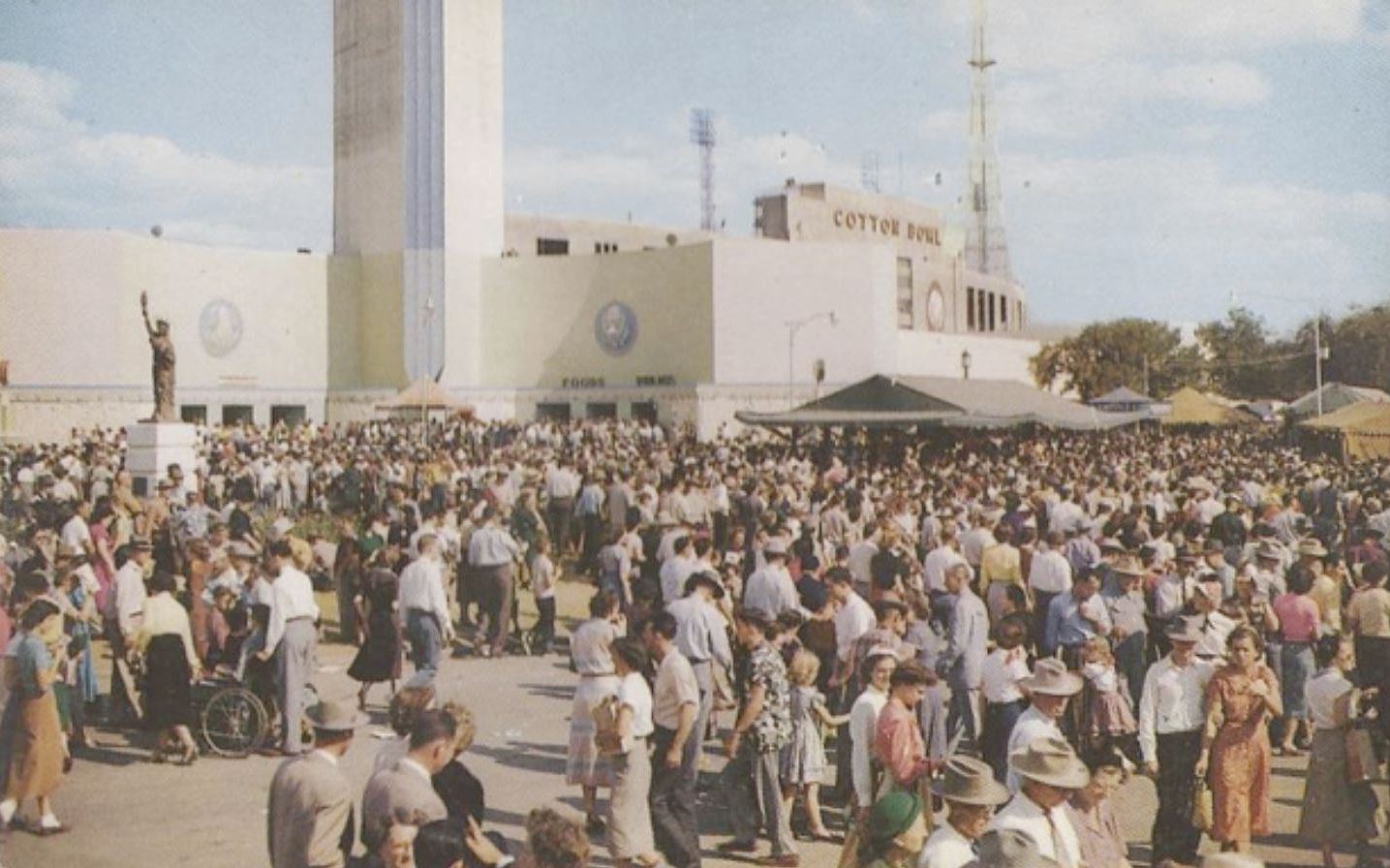
Fair Park’s Statue of Liberty

statue-of-liberty_fair-park_flickr_colteraGetting a bit lost in the crowd…

by Paula Bosse

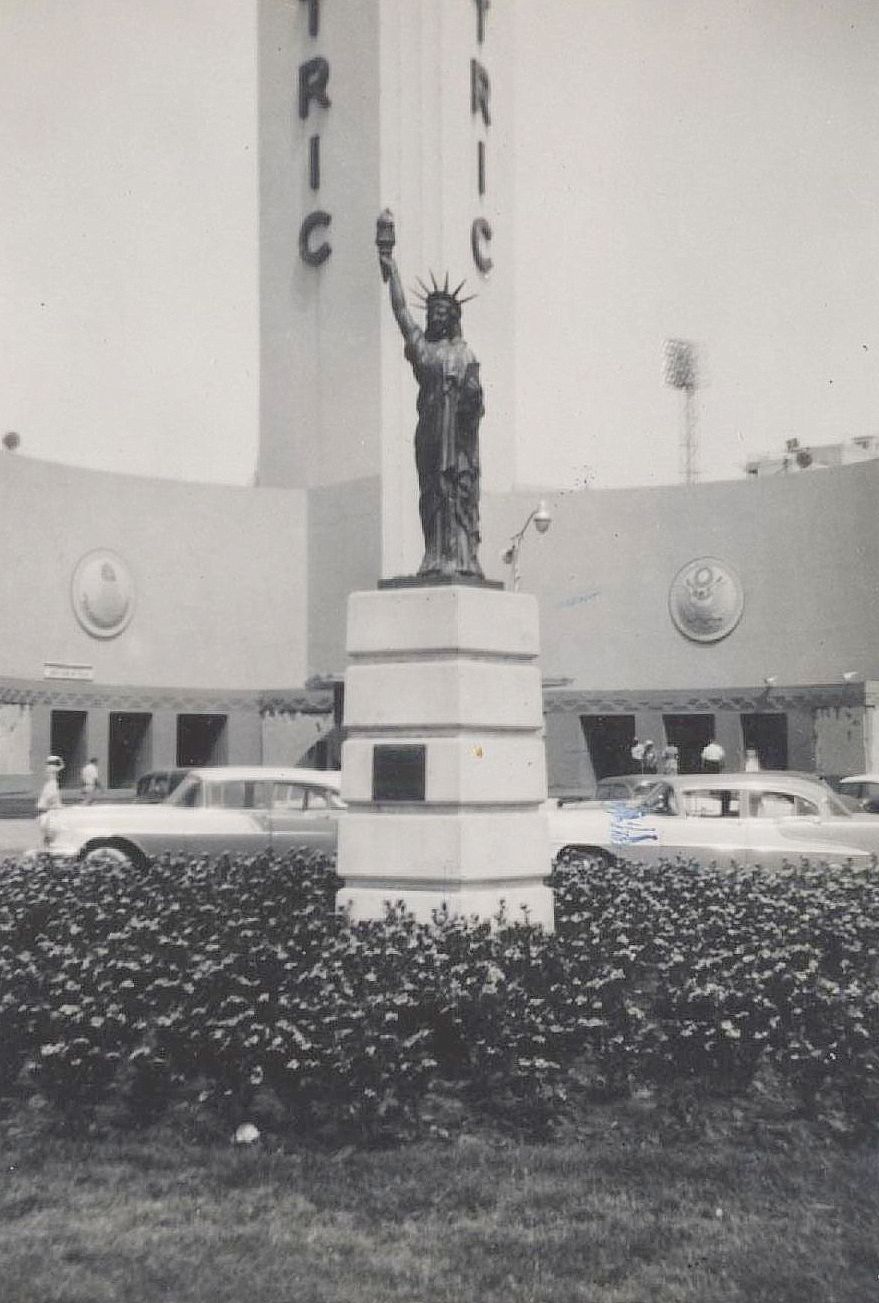
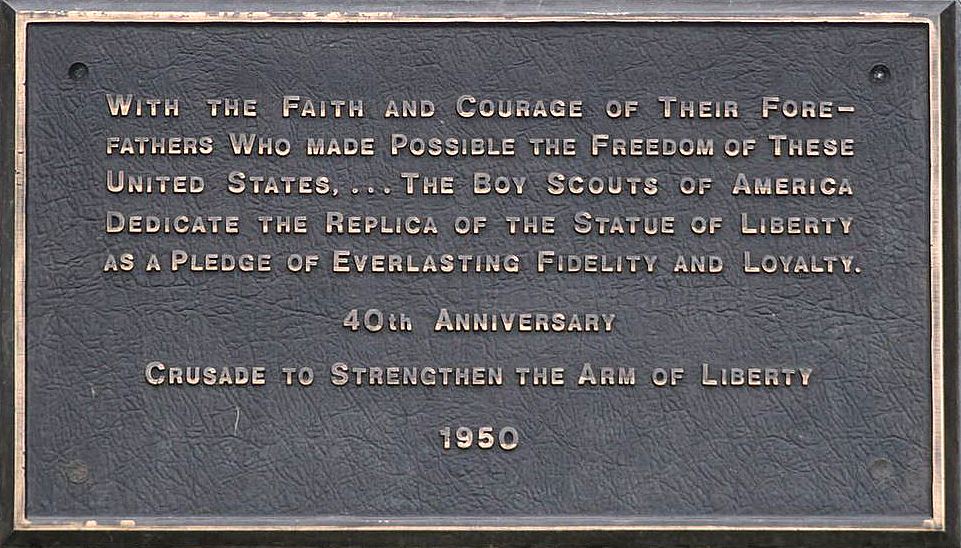
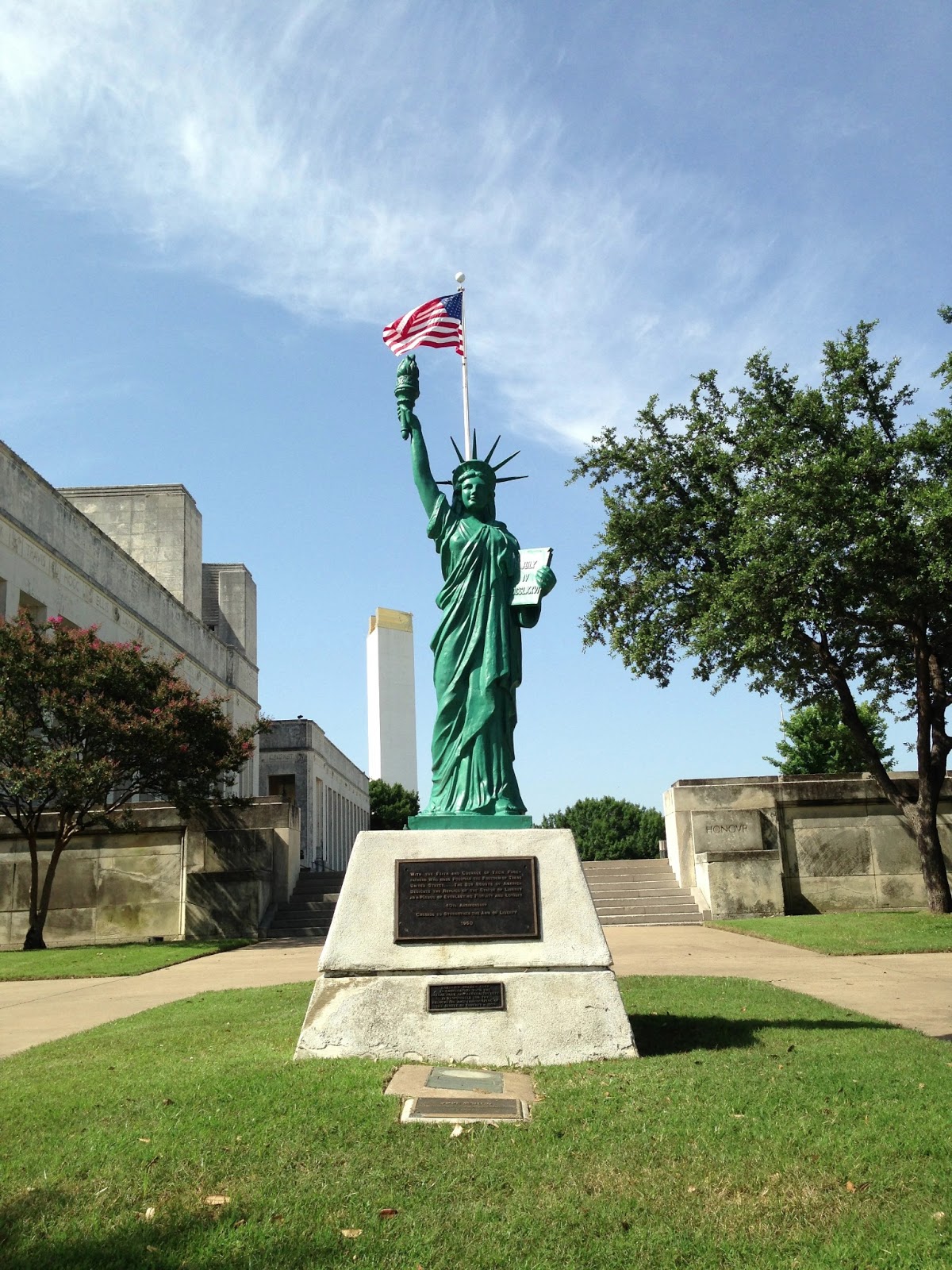
Somehow I missed the fact that October 28th was the 130th anniversary of the dedication of the Statue of Liberty in New York Harbor. And somehow I also forgot that there is a replica of the Statue of Liberty here in Dallas, at Fair Park. It was a gift from the State Fair of Texas to the Boy Scouts and the people of Texas and was dedicated by the Boy Scouts of Circle Ten Council on July 4, 1950. (These miniature replicas of the Statue of Liberty were placed all over the United States in 1950 to commemorate the 40th anniversary of the Boy Scouts of America.)

Below, the plaque at the base of the statue which stands near the Hall of State in Fair Park. (Click pictures to see larger images.)

statue-of-liberty_fair-park_plaque_flickr_aringo

Were they sentient, I’m sure Lady Liberty’s numerous miniature offspring would join me in sending belated birthday greetings to their full-size non-replica progenitor.

statue-of-liberty_fair-park_roaming-itinerant-blog
Photo: Adam Cruz/Roaming Itinerant

Here’s another view of Mini Lady Liberty welcoming the huddled masses to the State Fair of Texas in 1956:

fair-park_statue-of-liberty_ebay_stamped-1956

***

Sources & Notes

Photo of the Statue of Liberty replica amidst the crowd outside the Cotton Bowl is from Flickr user Coltera, here.

Photo of the plaque is from Flickr user Aringo, here.

Photo of the replica with the Hall of State in the background is by Adam Cruz, from his blog, The Roaming Itinerant.

1956 photo is from eBay.

A list of the Statue of Liberty replicas in Texas is here.

Perhaps we should send NYC a replica of Big Tex to keep Lady Liberty company. (The Statue of Liberty is kind of like a New York version of Big Tex, right?)

*

Copyright © 2016 Paula Bosse. All Rights Reserved.
The Business District at Night

skyline_night_flickr_coltera

by Paula Bosse

If you squint, the Mercantile Building looks a little Statue-of-Liberty here.

***

Postcard from Flickr.

Click for larger view.

*

Copyright © 2016 Paula Bosse. All Rights Reserved.

50 Years Before Main Street Garden Park

skillerns_statler-hilton_ebayHey, Skillern’s, you’re blocking the view!

by Paula Bosse

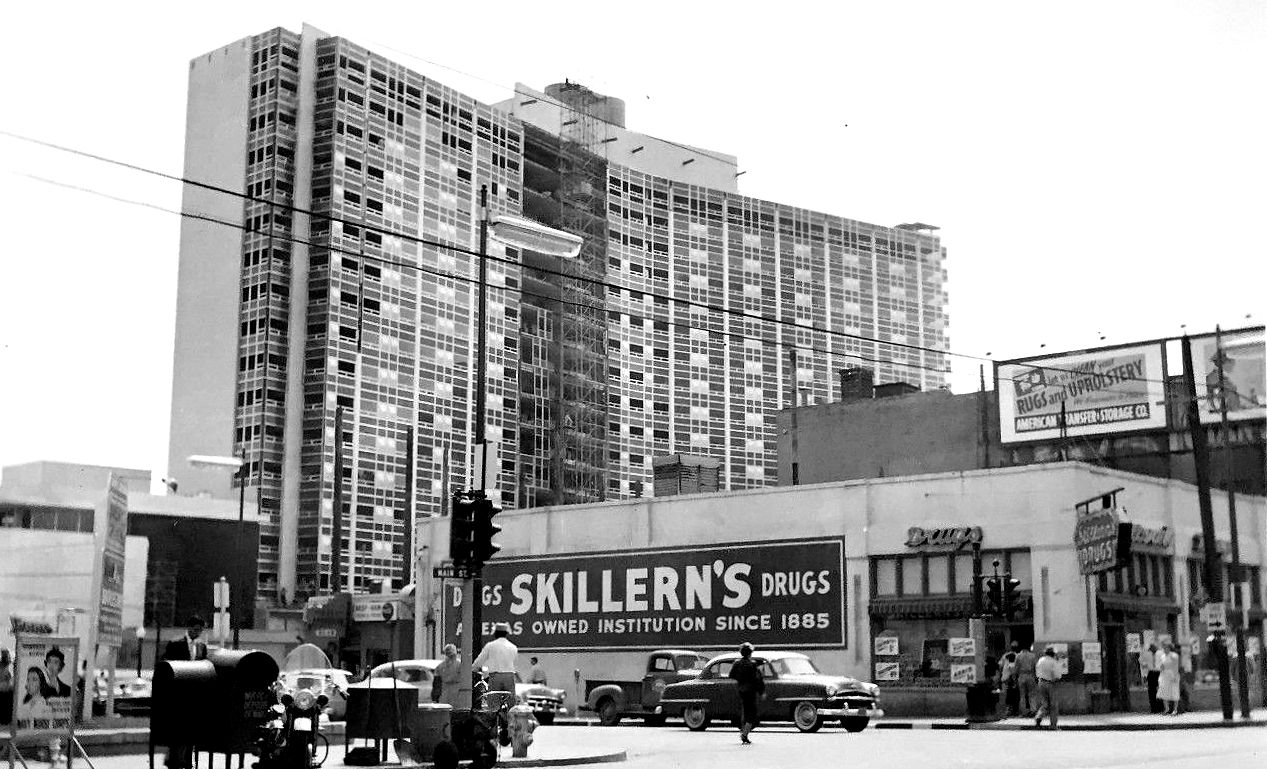
This view showing a Skillern’s drugstore at the southwest corner of Main and Harwood was taken as the Statler Hilton was nearing its opening in 1956. The block bounded by Main, Harwood, Commerce, and St. Paul was filled with businesses (…and later a parking garage) (…and way before that, homes) has been cleared and is now the lovely Main Street Garden Park. It’s always nice to have green space downtown, but, for me, the absolute best thing about this open space is that it FINALLY allows the beauty of the old (soon-to-be-new again) Statler Hilton, the old Titche-Goettinger building, and the old Municipal Building to be seen as they should have been seen all along: in full view, from a distance, without anything impeding the view. And now … the 360°-view — especially at night — is spectacular! Below, that same block these days, captured in a fantastic photo by my favorite Dallas photographer, Justin Terveen.

statler-hilton_justin-terveenJustin Terveen

As much as I love the mid-century skyline of this city, I have to say, the 21st-century version of this end of downtown — this square — wins.

***

Sources & Notes

The top photo appeared a couple of months ago on eBay.

The color photo is by Dallas photographer Justin Terveen, used with permission. See more of Justin’s incredible photos here — the one above and many others are available for purchase. I tend to get stuck in the past, but seeing Justin’s photographs of present-day Dallas make me realize how remarkably modern and vibrant the city is right now.

The same view from Main and Harwood, as seen today on Google, is here.

It always felt a little claustrophobic on Main, Harwood, and Commerce — those buildings needed room to breathe. For years, that block in the middle got in the way of fully appreciating Titche’s (this idealized postcard view shows Main Street at the right, St. Paul at the left), the Statler Hilton, and the Municipal Building (this 1920s photo shows people standing on the steps with a former drugstore occupant — Drake’s — across Harwood; Harwood was especially narrow when the building was originally built in 1914, and, as I recall, many were unhappy that such a majestic building was built in a location where it was impossible to fully appreciate its aesthetic qualities, even after the street was widened several years later).

More on Main Street Garden Park is here and here.

*

Copyright © 2016 Paula Bosse. All Rights Reserved.

Looking South from the Hilltop — 1966

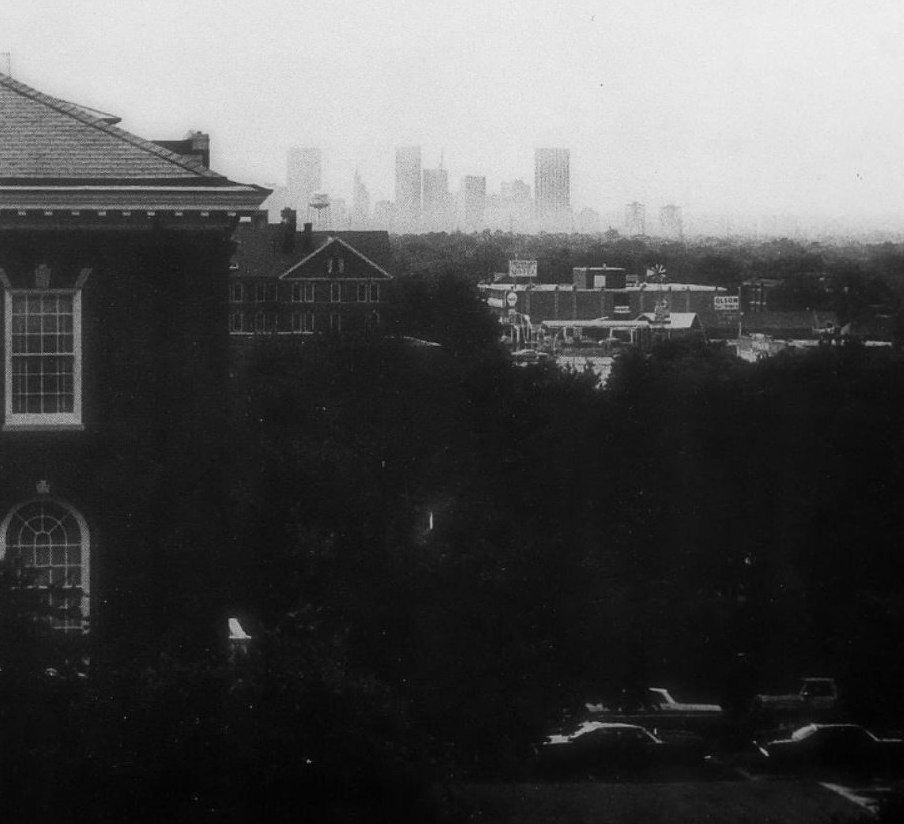
skyline_smu-law-school-yrbk_1966Downtown, as seen from the SMU campus… (click for larger image)

by Paula Bosse

Yeah, the photo is pretty dark, and the image quality leaves something to be desired, but I like this unusual view of a dreamlike downtown skyline, as seen from the SMU campus. Hillcrest Avenue — the SMU drag — can be seen in the upper center; the large building on the west side of Hillcrest is the University House Motel (still standing, but expanded and massively renovated as Hotel Lumen). Right next to the motel is the excessively quaint windmill of the Little Red Barn restaurant.

It all seems very calm.

***

Photo from the 1966 Southern Methodist University Law School yearbook.

*

Copyright © 2016 Paula Bosse. All Rights Reserved.
Three Flags Over Texas at the Entrance to Fair Park — 1936

tx-centennial_flags_entrance_nyplMexico, France, and Texas welcome visitors…

by Paula Bosse

Another State Fair of Texas is winding down. Here’s what the entrance to Fair Park looked like when the Texas Centennial opened in June 1936. This Associated Press photo was accompanied by the following caption when it ran in newspapers:

FLAGS  WAVE  AT  TEXAS  CENTENNIAL
Dallas, June 6 — Three of six flags which have flown over the Lone Star State, waved over the main entrance to the Texas Centennial celebration at its opening here today. Buildings throughout the grounds of the exposition are ultra modern in design.

This view — taken at about Parry and Exposition — hasn’t changed all that much. See it on Google Street View here.

***

Sources & Notes

Associated Press photo from the New York Public Library’s digital collections, here.

*

Copyright © 2016 Paula Bosse. All Rights Reserved.
“How the News Got Made” — SMU’s WFAA Newsfilm Collection Spotlighted at the Dallas VideoFest

wfaa-newsfilm_thumbnails_hamon_cul_smu(G. William Jones Film and Video Collection, SMU)

by Paula Bosse

The Dallas VideoFest is in full swing this weekend, and one of the events on the schedule is How the News Got Made: A Rare Look at SMU’s WFAA Newsfilm and a Conversation with the People who Created It.” This screening and panel discussion will include WFAA news clips and B-roll footage on 16mm film from the 1960s and ’70s, selected from the large WFAA Newsfilm Collection (part of the moving image holdings of the G. William Jones Film and Video Collection, Hamon Arts Library, Southern Methodist University).

A few months ago I saw a screening at SMU of some of these clips — which had been selected by the collection’s curator, Jeremy Spracklen, who has also, I believe, compiled the clips for the VideoFest presentation — and I really enjoyed it. Being able to watch 45- or 50-year-old news clips — of subjects both newsworthy and not-so-newsworthy — is an interesting way to study moments in the history of Dallas. It’s certainly more immediate and “flavorful” than reading old black and white newspaper clippings. I mean … you can listen to people actually talking. (With actual ACCENTS!) And see them move! SMU is in the process of identifying people and places seen in these clips and may soon request crowdsourced assistance from the public. It’s a large undertaking, further complicated by the fact that much of the footage was received by SMU randomly spliced together, some of it raw footage without sound. The hope is to identify subjects and subject matter in order to assist researchers, historians, and documentarians.

At present, almost two decades’ worth of these film reels are slowly being digitized; when the transfers are complete, they are uploaded to SMU’s Central University Libraries site and are free to be viewed by the public. Check what’s up now, here, and watch a few yourself.

There is a great Dallas Observer article by Jamie Laughlin on this collection. You must make sure to scroll down and watch the clip of fresh-faced Channel 8 newsboy Bill O’Reilly (yes, that Bill O’Reilly) interview the only slightly younger-looking future superstar ventriloquist (…two words I’ve never typed one right after the other before…) Jeff Dunham, who, at 14, seems really excited to be talking about his craft on TV.

And, if only a sliver of what I saw of the hilariously bizarre and wonderfully entertaining footage from about 1969 of mini-skirt-and-sideburn-hating Texas Land Commissioner Jerry Sadler — who was reported to have grabbed and choked a political critic in a dispute over Spanish galleon treasure recovered off the Texas coast (…yes, that’s what I said…) —  is shown at the VideoFest, it will be WELL worth your time!

***

Sources & Notes

The top image is a collection of thumbnail images of WFAA digital files which have been uploaded to the Central University Libraries’ site, here.

Read about this WFAA Newsfilm Collection in the Hamon Arts Library digital collection here.

For more information on the collection, contact filmarchive@smu.edu.

The Dallas VideoFest program, “How the News Got Made: A Rare Look at SMU’s WFAA Newsfilm and a Conversation with the People who Created It,” takes place this weekend, Saturday, Oct. 22, 2016, 5:15-6:45 PM at the Angelika Film Center. More information on the event and the panel participants is here.

*

Copyright © 2016 Paula Bosse. All Rights Reserved.
 

Empire Central and Its Fabulous Empire Club

empire-central_1958_ebay_det“Northwest Dallas” in 1959 — how quaint… (click for larger image)

by Paula Bosse

“Empire Central.”

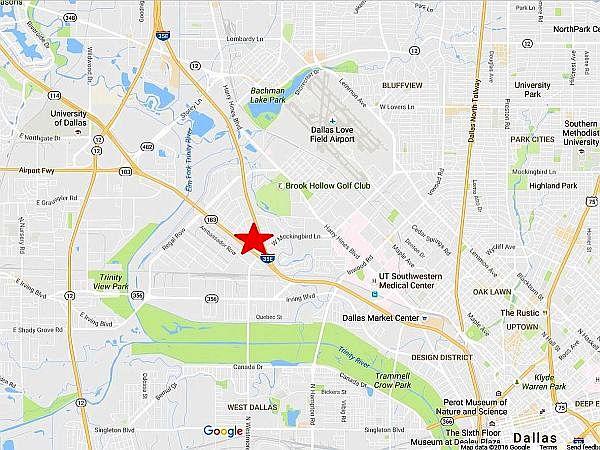
I have to admit that I’d never heard of anyplace in Dallas called Empire Central, but because I wanted to post the picture above (which I love) (and which is  from a 1959 ad), I felt I should at least look into finding out what and where it was and broaden my horizons a bit. So I did. It was (is?) an “office community” built in 1958 on 90 acres of land (later expanded), located in the “V” between Hwy. 77 (soon to be Stemmons Freeway) and Hwy. 183 (aka Empire Freeway, soon to be John W. Carpenter Freeway), with W. Mockingbird on the south and Dividend Drive on the north(-ish). It was developed as an office park as part of the already existing 1,200-acre Brook Hollow Industrial District (which, when its development began in 1953, was beyond the city limits) — both areas were developed by Windsor Properties. Empire Central was announced in 1957.

Unsurprisingly, almost every early newspaper story about plans for the new district mentioned what was considered to be its sexiest, most novel attraction: the Empire Club, an on-site dining and recreation club for employees — executives and underlings alike — who worked in the “community’s” office buildings. It was a round, 45,000-square-foot structure that sat on 9 acres and featured a distinctive roof which utilized 24 tamarack logs “more than 100 feet long, imported here especially for the club from the virgin forests of Washington” (DMN, Nov. 24, 1957). Its amenities included a sunken garden, a terraced dining room, lounge, swimming pool, putting green, and shuffleboard court, all nestled in a “garden-like atmosphere.” What a great perk!

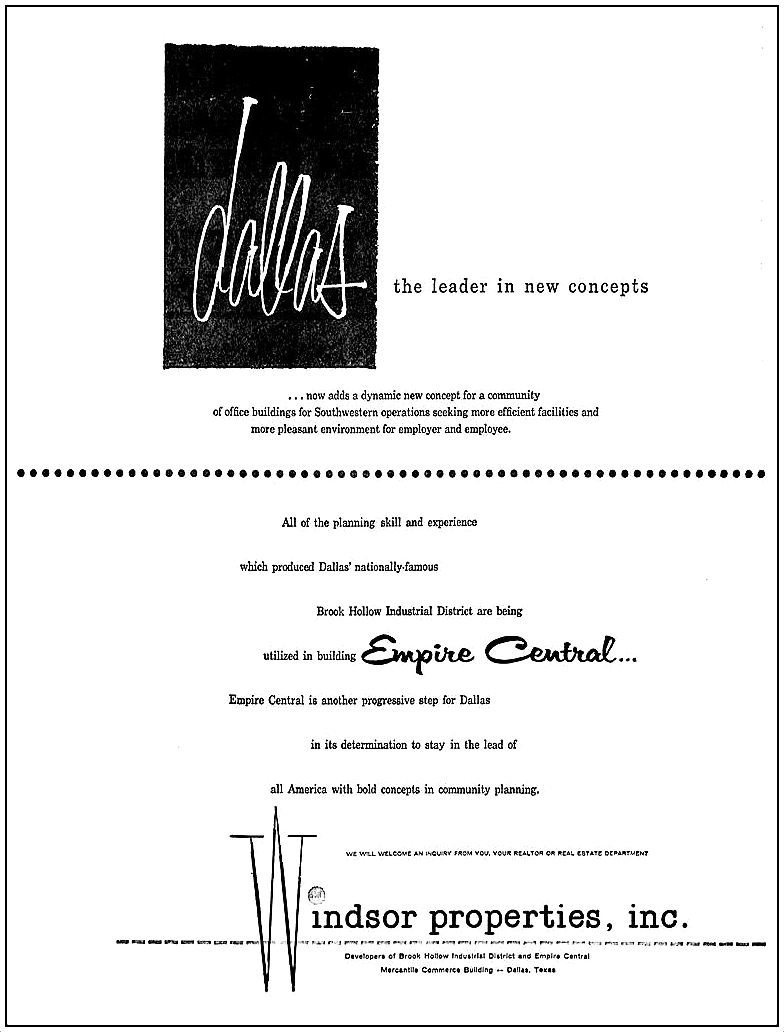
The club was important in the conceptualization of the office park, as the developers insisted that a happy employee was a productive employee, as can be seen in the text from a 1959 advertisement which ran the week the club opened:

Two fundamental concepts were taken into consideration by Windsor Properties, Inc., in designing Empire Central.

First was the realization that the company able to attract the most capable employees at a given wage would be most successful. Second, the urbanization of our population has created the need for a measure of community life.

The Empire Club, as the heart of Empire Central, is designed to accomplish both objectives for management.

And that club looked cool. It was a cutting-edge design from the always impressive George Dahl, one of Dallas’ top architects. (Dahl worked on several other projects with W. C. Windsor — Sr. and Jr. — including a prison (?!) and several other buildings in the Empire Central District.) Dahl’s previous big round building — Memorial Auditorium/Dallas Convention Center — had opened in 1957, just months before construction began on this unusual and sophisticated clubhouse, something one would certainly not expect to find plonked down in the middle of such prosaic surroundings.

empire-central_dmn_101859_empire-club_det

empire-central_dmn_101859_empire-club_pool_det

empire-central_dmn_101859_map_det

Below, the full ad, which appeared the week the new Empire Club opened in October, 1959 (click to see larger image):

empire-central_dmn_101859_empire-club
Oct., 1959

At some point (or maybe always) the club began to be used by outside groups. In the ’60s, it was the site of a lot of Junior League and debutante activities and dances. In 1966 the Empire Club became The Round House restaurant (in which could be found the Fatted Calf club). The last listing I could find of a restaurant or club at that address (which was, originally, 100 Empire Central Drive and, later, 1100 Empire Central Place) was in 1971. Sadly, that cool-looking building was torn down somewhere along the way. What a shame! I just discover a George Dahl-designed building I’d never seen — in a part of town I’d never heard of — and *poof*! … it’s gone. …At least I didn’t have time to get too attached.

**

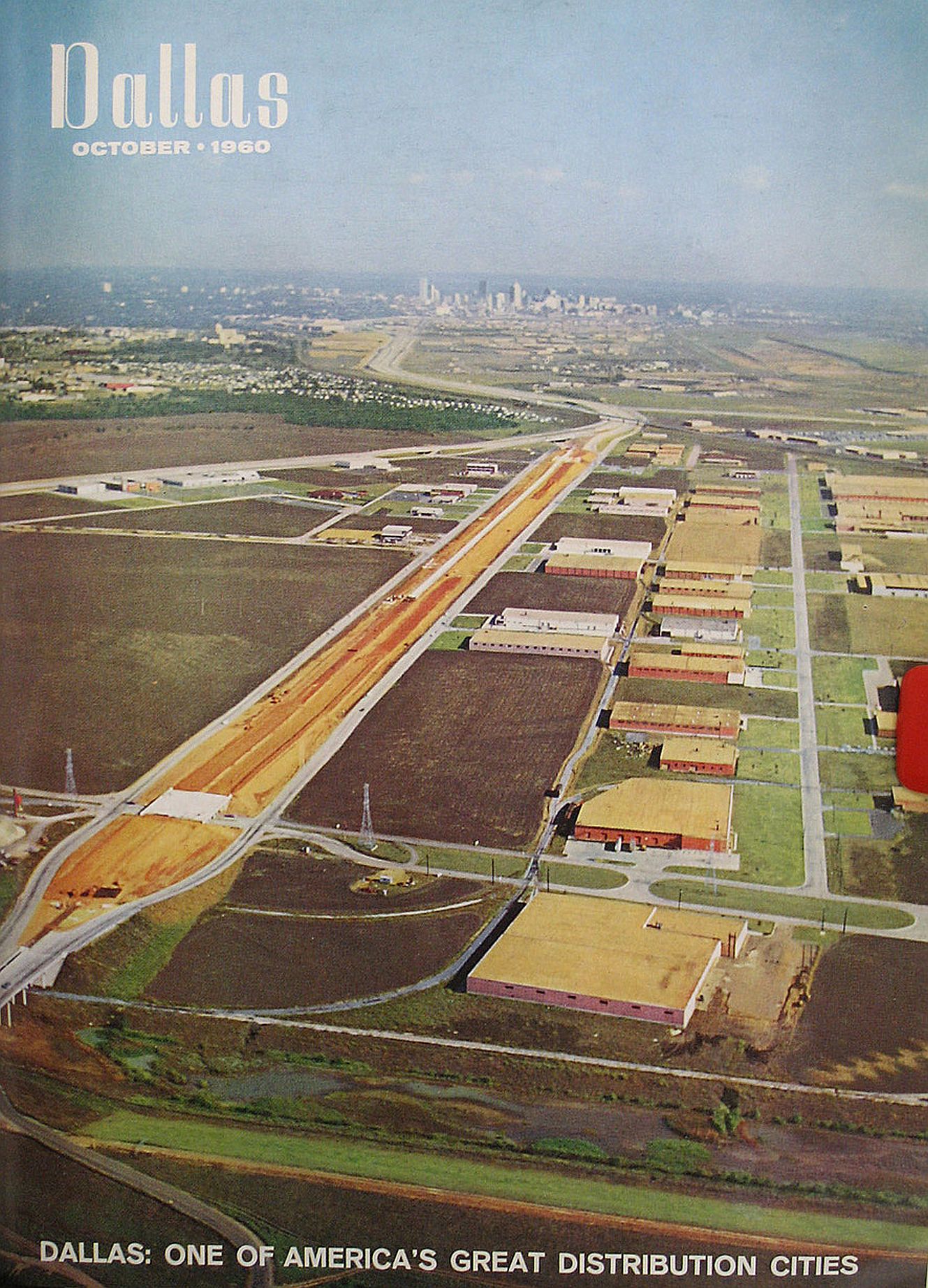
Here’s a great photo from 1960 (click it — it’s really big) looking southeast toward downtown from about Regal Row (bridge in foreground), with the new and improved Carpenter Freeway/Hwy. 183 in the center, and Stemmons — coming in from the left — meeting it in the distance; the Mockingbird bridge is just beyond it, just above the point. The Empire Central district — in between Stemmons and Carpenter — looks kind of puny here. You  might have to squint, but you can see the brown, round Empire Club building in the center of the triangle. If you listen closely, you might be able to hear a Southwestern Drug Company secretary splashing happily in the heated pool.

empire-central_183-construction_1960_dallas-freeways-site

*

empire-central_1958_ebay
1958 ad

empire-central_dmn_011958_ad
Jan., 1958

empire-central_google
Google Maps

***

Sources & Notes

Top image is from a full-page magazine ad from 1958, found on eBay.

The 1960 photo appeared on the cover of Dallas magazine (October, 1960); I found it on the unbelievably thorough Dallas-Fort Worth Freeways site (main page is here, this photo is linked from here).

This area — what is it called? The consensus seems to be “Brook Hollow.” Or maybe “Stemmons Corridor” (the Wikipedia entry for the latter is here).

The Flashback Dallas post on the area’s 1920s-era namesake golf club — “Brook Hollow Country Club — 1940s” — is here.

(Thank you, Dallas History Facebook group for the helpful tidbits!)

Think it should be bigger? Click it!

*

Copyright © 2016 Paula Bosse. All Rights Reserved.