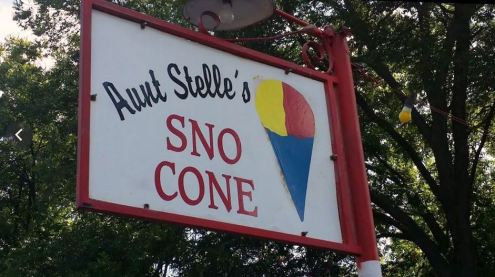
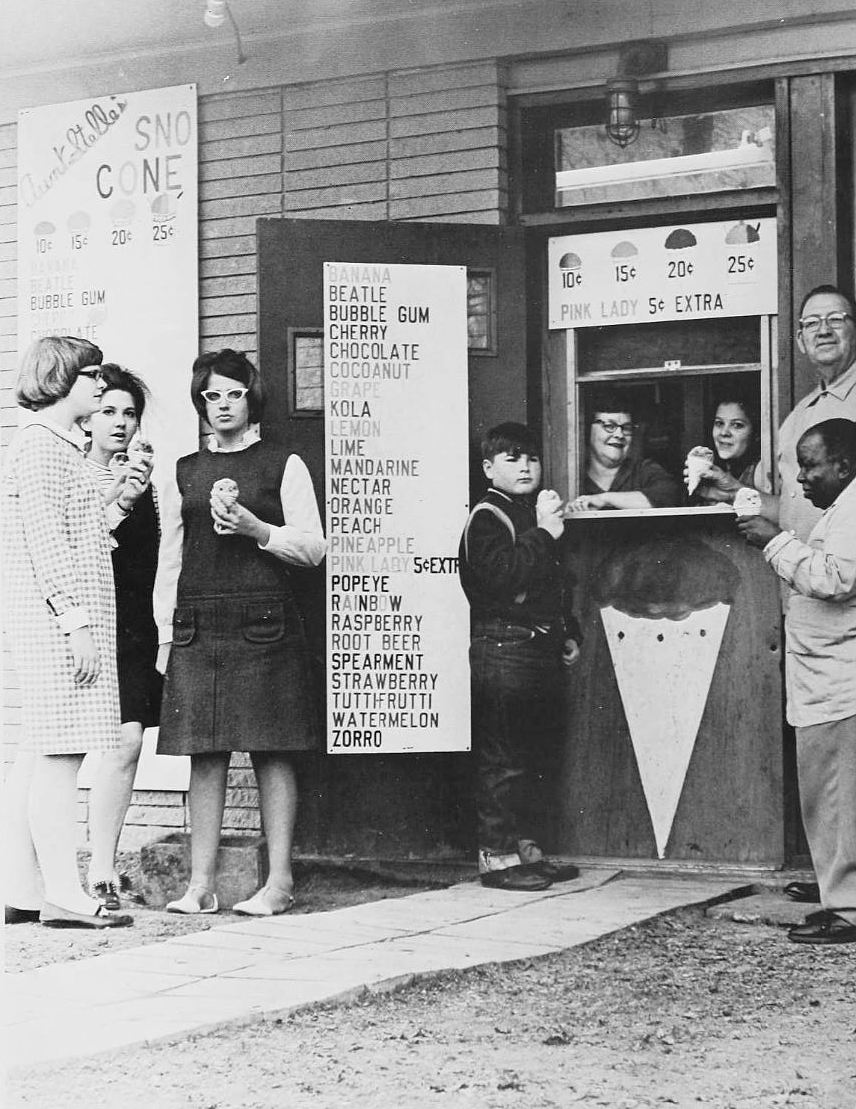
This has been a brutally hot summer. The kind of summer when a snow cone would really hit the spot at just about any sweltering hour of the day. One place that was famous for its snow cones (they were described as being like “fine snow”) was Aunt Stelle’s Sno Cone, at 2002 W. Clarendon (at Marlborough) in Oak Cliff. Established by Estelle Williams in 1962, the little stand was hugely popular until it officially closed in 2018. Her snow cones were flying out of there every summer season for more than 55 years! To generations of customers. Not many businesses can boast that kind of longevity and patron loyalty. (One of those loyal patrons was Oak Cliff homeboy Stevie Ray Vaughan.)
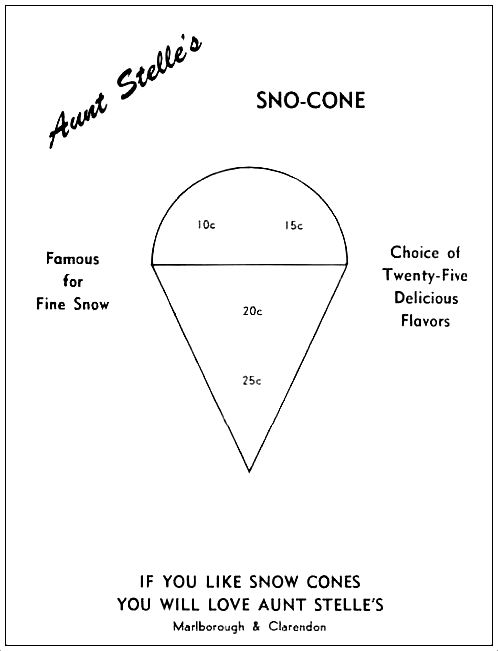
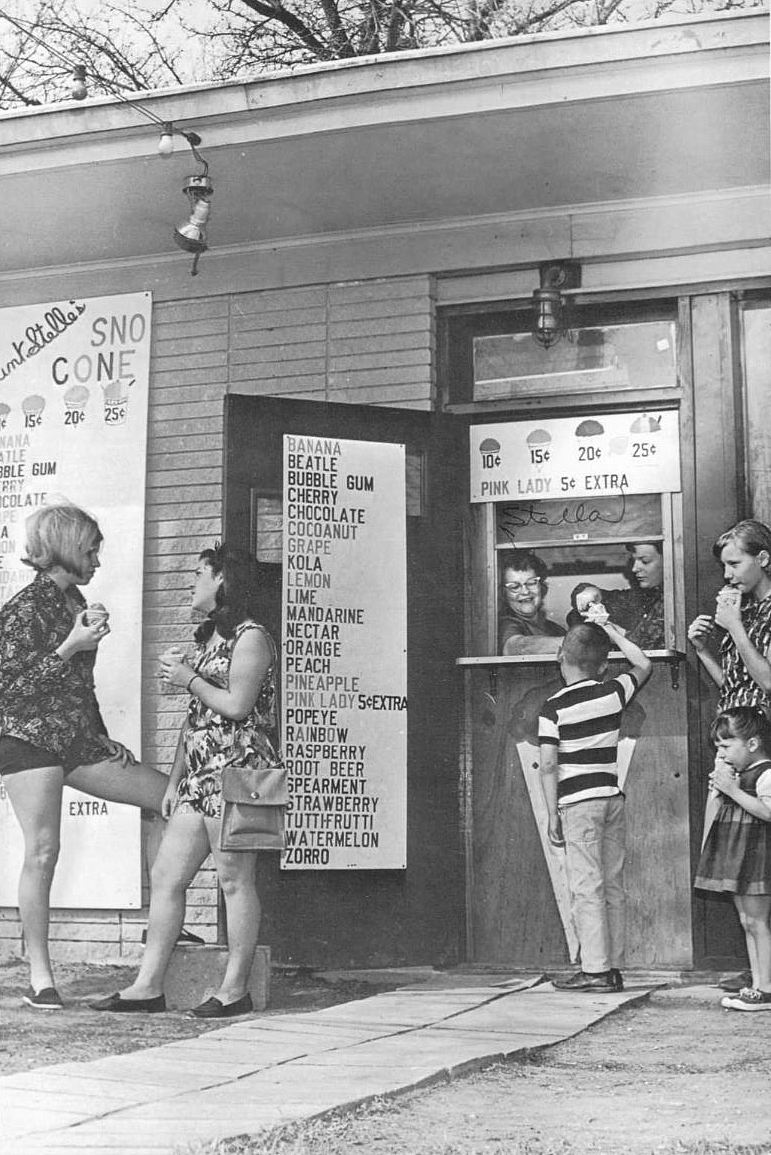
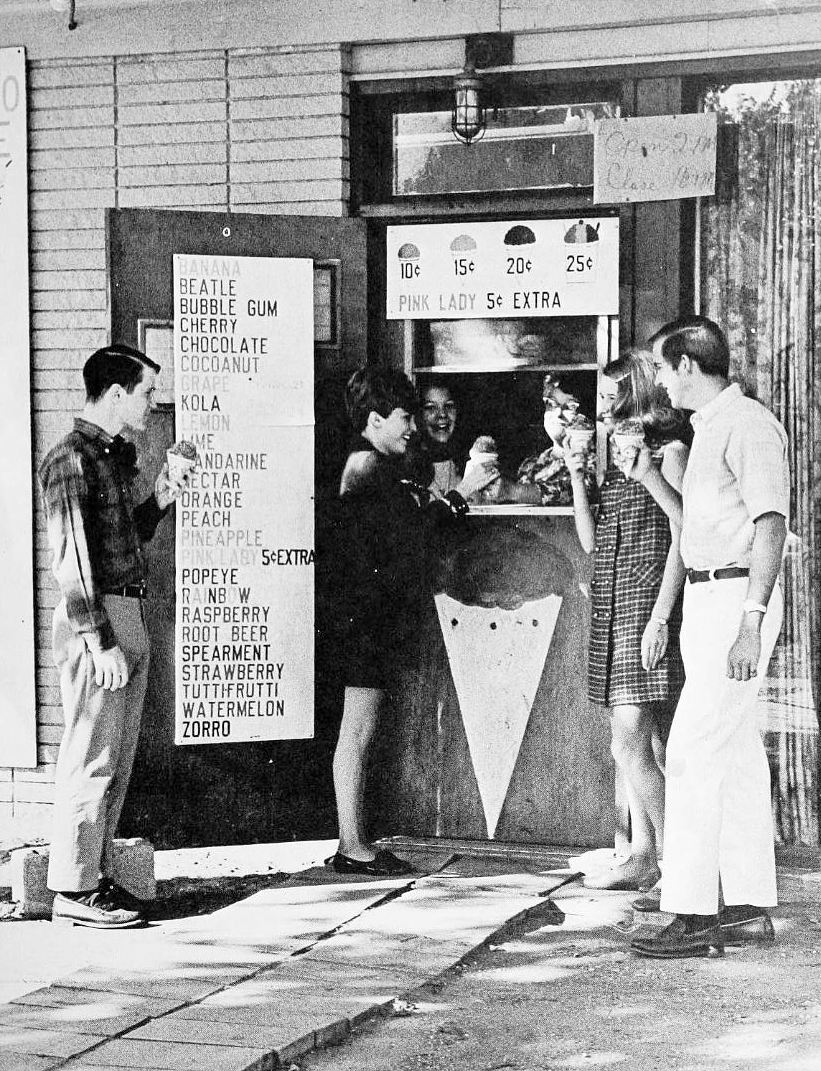
Having not grown up in Oak Cliff, I wasn’t familiar with Aunt Stelle’s until I saw the photos below which appeared as ads in editions of the Sunset High School yearbook. You can see Estelle in the window. She looks exactly like the kind of person I’d want serving me a delicious, refreshing, messy treat.
Speaking of the treats, check out that menu board! I understand the “Beatle” tasted like a grape SweeTart, the “Zorro” tasted like licorice (and it was black!), the “Pink Lady” tasted like vanilla ice cream, and the “Popeye”… I really wanted it to be green and taste like spinach, but apparently it tasted like gumballs (what a missed opportunity!).
*
1967 Sunset High School yearbook
1967 Sunset yearbook
1968 Sunset yearbook
1969 Sunset yearbook
***
Sources & Notes
Top image of the Aunt Stelle’s sign is from Google — the photographer is listed simply as “Scott.”
A great story about Aunt Stelle’s can be found in the Dallas Morning News archives in the story “Sno Days: Aunt Stelle’s Has Been Keeping Oak Cliff Cool for 40 Seasons” by Dave Tarrant (DMN, June 22, 2001).
Consider supporting me on Patreon! Five bucks a month gets you daily morsels of Dallas history!
The beautiful Copper Cow… (from a July Patreon post)
by Paula Bosse
At the beginning of April 2023, I started a Patreon page. I post something there every day — exclusive content for my patrons who support me by pledging $5, $10, or $15 a month. Not only is it flattering that people do this, but the extra cash has helped me tremendously at an uncertain time as I begin a job search. (Thank you, patrons!)
Because people might not know what I do over on Patreon, I basically write mini-Flashback Dallas posts, which are accompanied by photos, ads, illustrations, etc. If you’d like to get these little Dallas-history tidbits in your mailbox every morning, please consider signing up. It’s painless. You can always sign up, read through what’s there, and, if it’s not something you’re interested in, you can cancel at any time. But, of course, I hope you’ll join and stay awhile. I’ve thoroughly enjoyed doing it. If you’re interested, you can check it out and join here.
Below is a list of what I’ve posted on Patreon since I started in April.
*
AUGUST 2023
Six Flags: Stagecoach Rides and Buffalo (1961-1967)
Booker T. Washington High School: Vocational Classes – 1953
The Adolphus, The Baker, The Horse Shoe, The Colony Club
Sanger Bros. – 1899
Lamar & Smith Funeral Home, Oak Cliff
Colbert’s, Casa Linda – 1967
The Ripley Believe It or Not Odditorium – 1936
Loew’s Melba Theatre – 1920s
Dave’s Pawn Shop, Deep Ellum – 1955
Akard Streetcar
North on Ervay, from Commerce – In Color
I’ve Done It – I’m on Patreon… (April 2, 2023)
***
Sources & Notes
Photo of the interior of the Copper Cow restaurant (1519 Commerce Street) by Squire Haskins, from the Squire Haskins Photography Inc. Collection, University of Texas at Arlington Libraries, Special Collections — more information on this photo is on the UTA website here. (I tackled the Copper Cow in July in the Patreon post “The Copper Cow: The Most Beautiful MCM Restaurant Interior in Dallas?”)
If you think you might like to join me on Patreon, more info is here. Thanks!
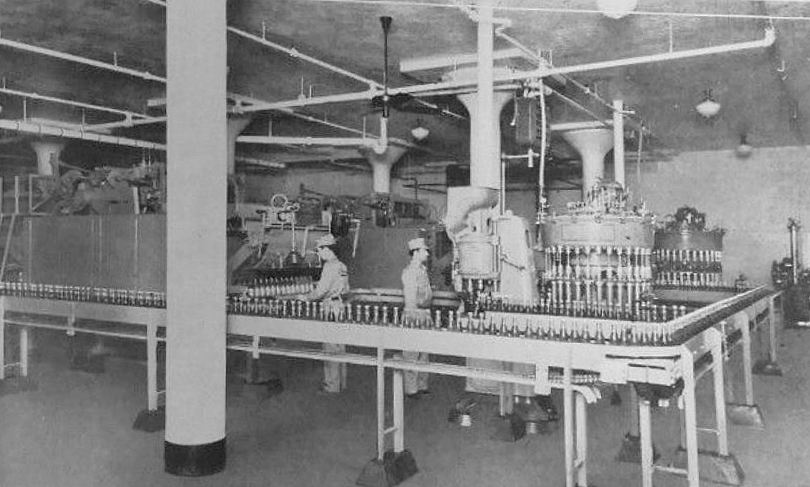
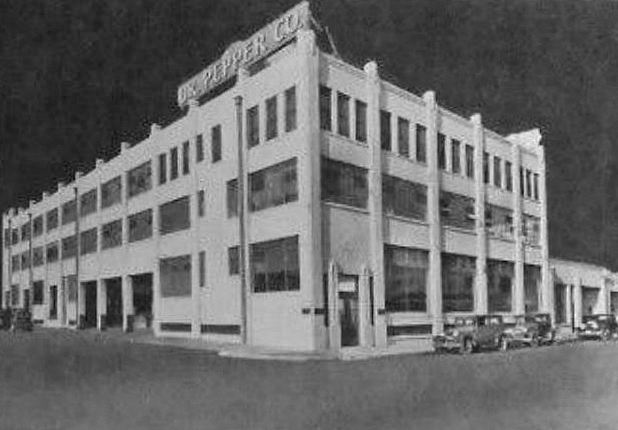
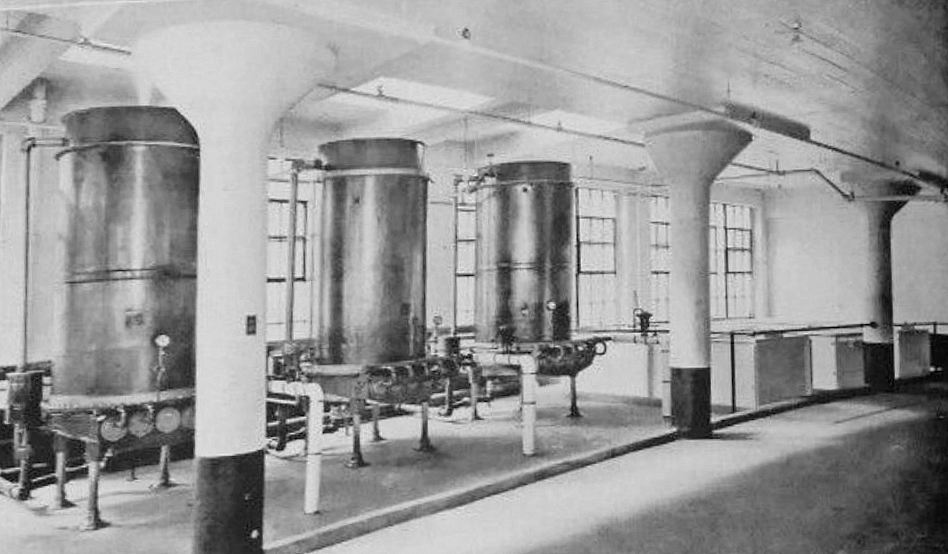
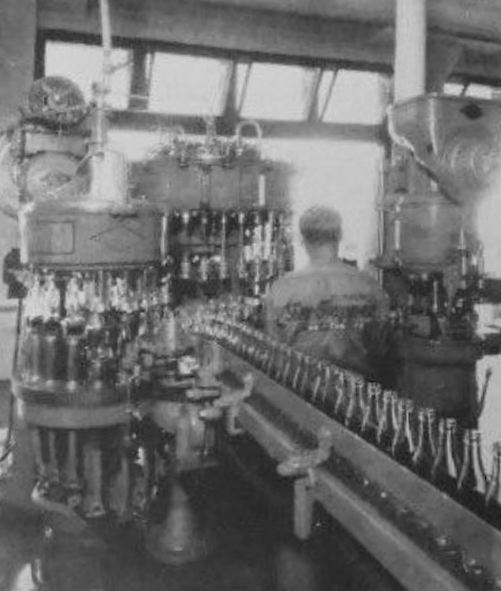
Before Dr Pepper moved into its fabulous art deco HQ at Mockingbird & Greenville (RIP…), the company’s Dallas bottling works was located at Second Avenue & Hickory Street, from about 1927 to 1948. The building (seen below) still stands.
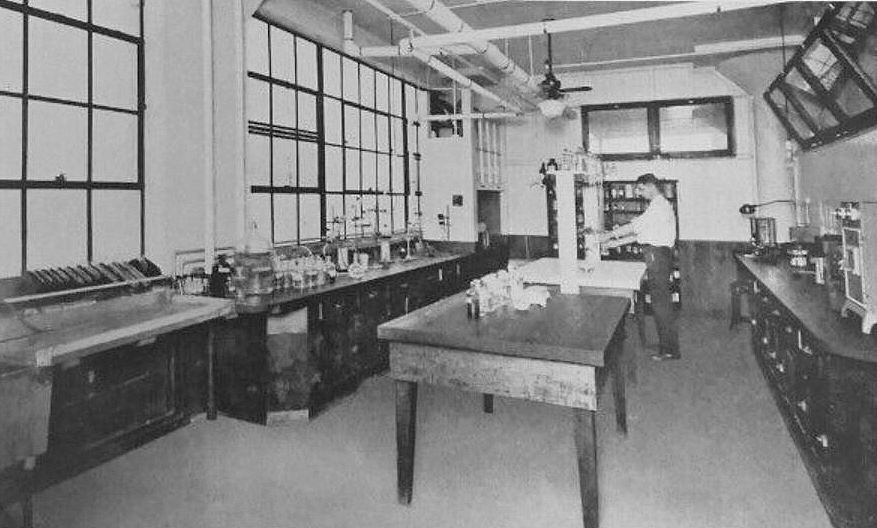
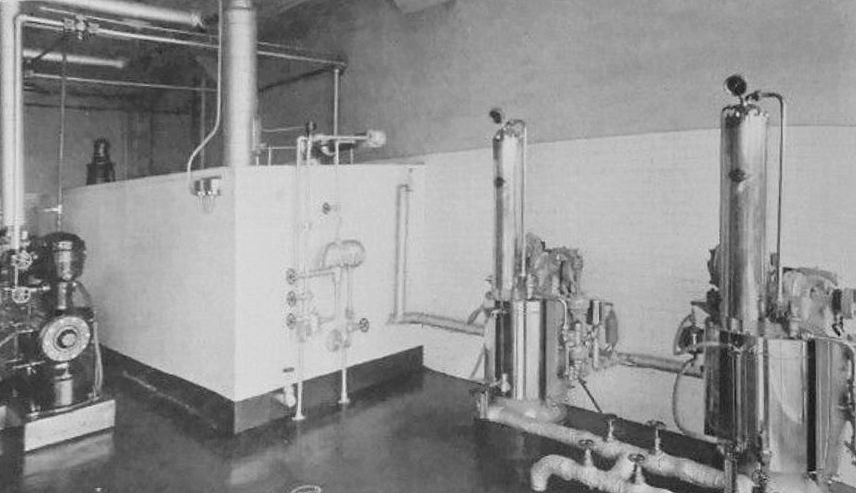
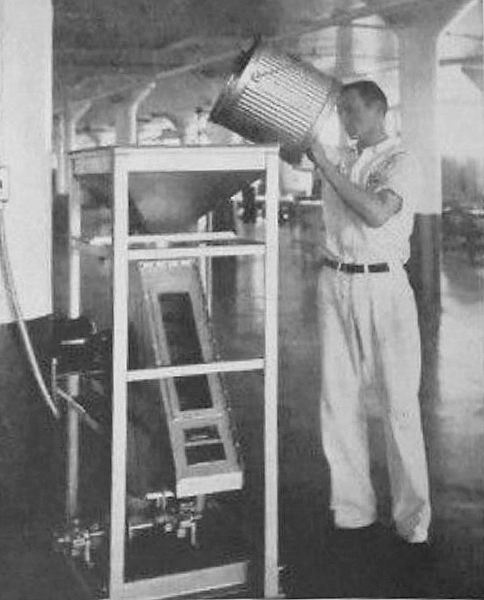
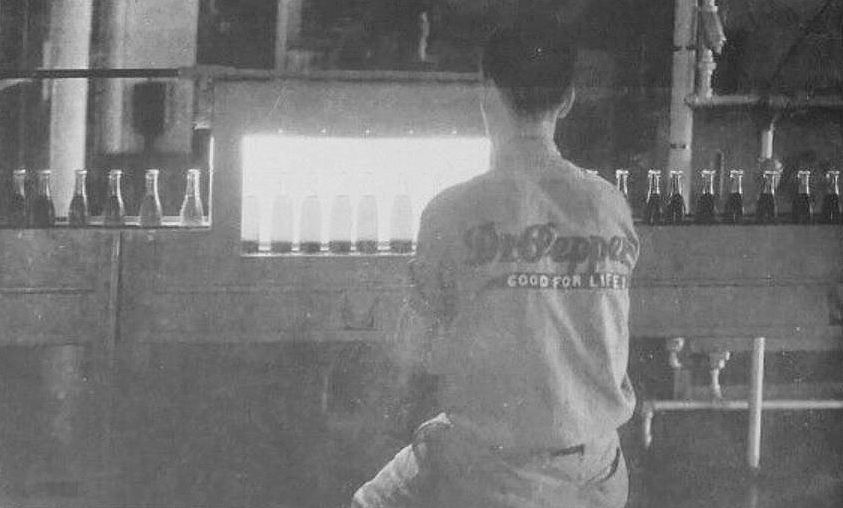
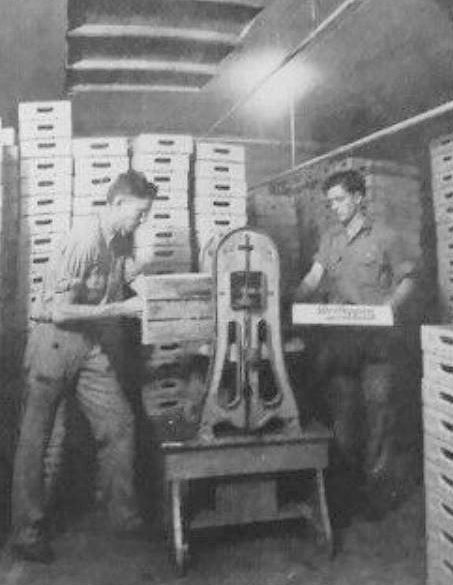
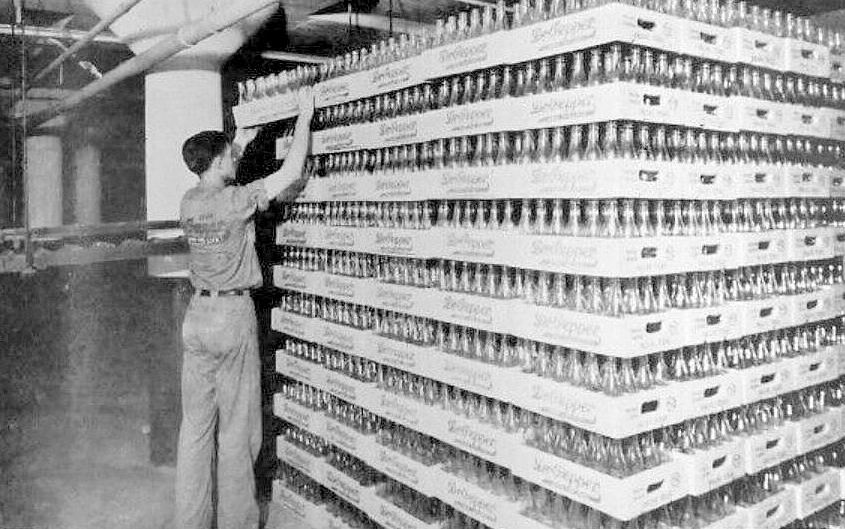
The images in this post are from a DP manual for bottlers, with numerous photos taken in the Dallas plant. All photos in this post are from that manual (more info is at the end of this post), which every true Dr Pepper superfan (or the dogged collector of obscure soft-drink ephemera) should probably have! All captions are from the booklet.
Above, “Interior of Dallas bottling plant in operation.”
Below, “Model syrup factory, bottling plant and general home office of Dr. Pepper Company, Dallas, Texas.”
*
“Water stills, Dallas plant, supplying water for syrup making.”
*
“General view chemical laboratory, Dallas.”
*
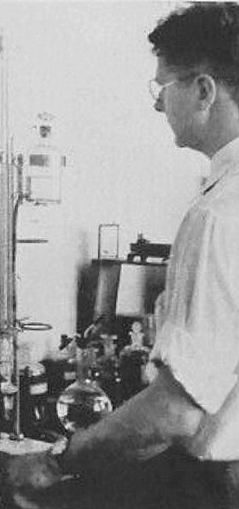
“Chief chemist, Mr. H. Buttler, Dallas, Texas” (Howland Buttler is also seen in the photo above).
*
“Water cooler and carbonating equipment, bottling plant, Dallas.”
*
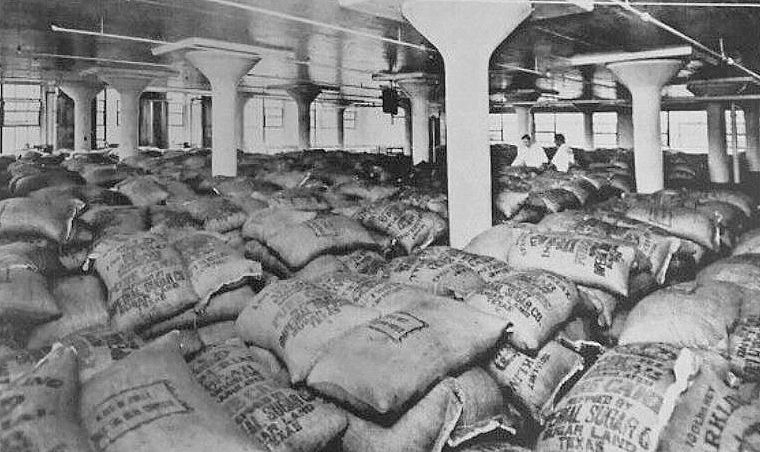
This is my favorite photo: “One section of sugar storage, Dallas — you see a supply sufficient for about a week. Interior view of sugar storage floor, Dr Pepper factory building, Dallas. Only the finest, pure cane sugar is used, a grade and quality superior even to the finest table sugar. Exacting standards must be maintained by refiners to meet our specifications, lest the slightest taste or odor from impurities creep into the Dr. Pepper syrup.” (A few years ago, I stumbled across a crazy story about Dr. Pepper — and other soft drink manufacturers — involved in buying black-market sugar, which was a violation of war-time food rationing, as WWII came to a close. Read about this case in the post “Halloween Party? Don’t Forget the Dr Pepper! — 1947” — scroll to the bottom.) Shout out to Sugar Land!
*
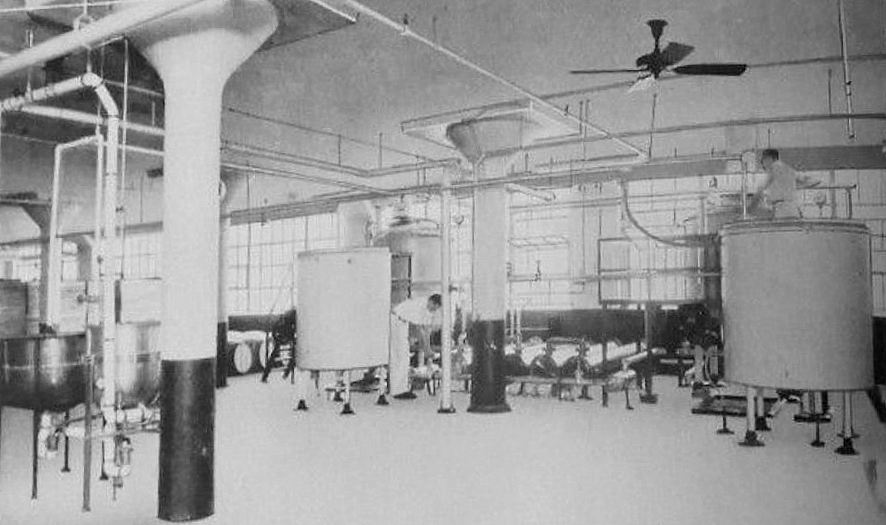
“Syrup compounding and manufacturing unit at Dallas, Texas. Interior view of syrup room, Dr. Pepper factory, Dallas. Note flood of sunshine through modern factory-glass windows; floors, walls, ceilings, as well as equipment, immaculately clean. Glass-lined mixing tanks in center and at right are of 300-gallon capacity, and behind these are 500-gallon steam-jacketed, glass-lined kettles, where hot process simple syrup is made. Entire syrup manufacturing process is modern, efficient and sanitary.”
*
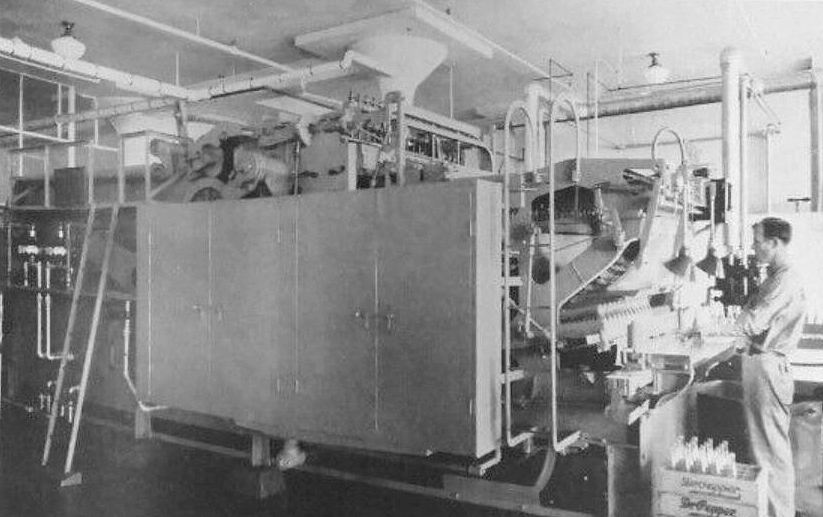
“Modern soaker and washer — one of two units used in Dallas plant.”
“Automatic case stenciling machine.” This is an important part of the manufacturing process I hadn’t thought about….
*
“Bottle storage, Dallas plant.”
*
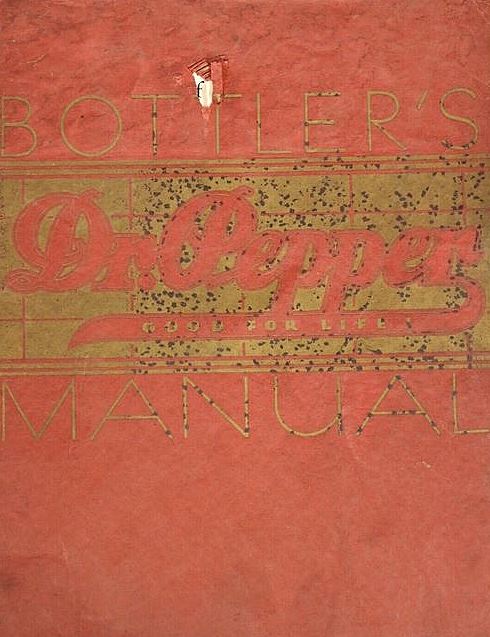
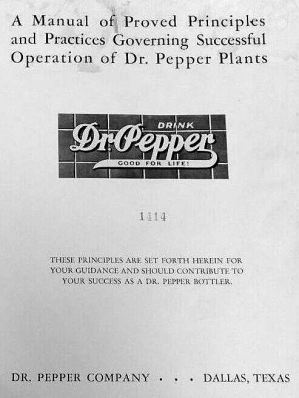
Battered front cover and title page:
***
Sources & Notes
Photos from “Dr. Pepper Bottler’s Manual: A Manual of Proved Principles and Practices Governing Successful Operation of Dr. Pepper Plants” (Dr. Pepper Company, Dallas, Texas, Nov. 1938); this booklet was found on eBay — for sale for $499.99.
More Flashback Dallas posts featuring Dr Pepper can be found here.
Please consider following me on Patreon, where I post new content daily — for as little as $5 a month!
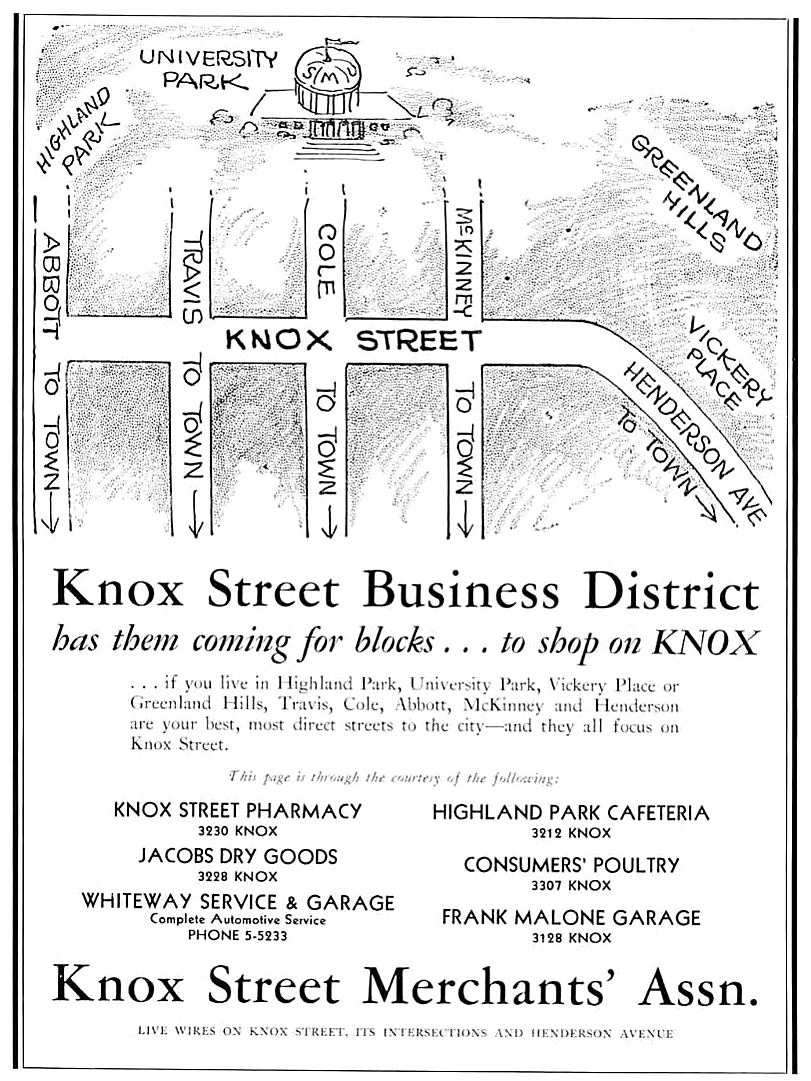
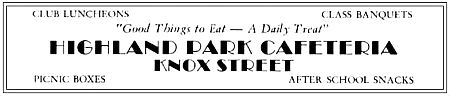
A quick post today! Above, the much-loved, much-missed Highland Park Cafeteria (3212 Knox), a proud member of the Knox Street Merchants’ Association, the latter of which has drawn up a not-terribly-helpful, pre-Central Expressway map, as seen below, with handy arrows pointing to town.
1932
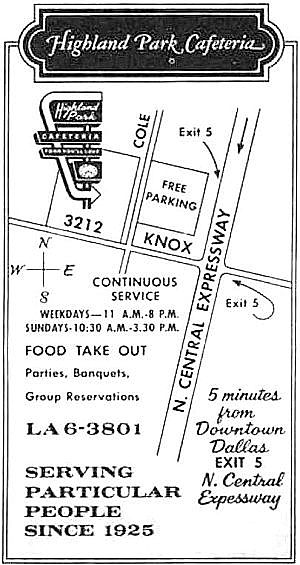
From a couple of decades later, a matchbook graphic (with a more helpful map), reminding you that the HPC has been “serving particular people since 1925”:
I’m just going to add these things here, because, so far, this is my only post on the HPC, and I might as well keep everything together.
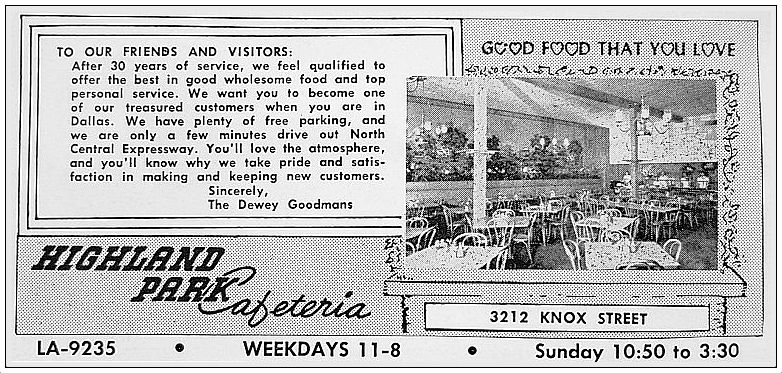
I saw the 1956 ad below, and, even though the photo in the ad is pretty poor quality, it looked like there was a mural there. I’m always interested in murals — most of the time a photo like this is the only chance to see them because they are inevitably painted over or demolished. Anyway… was there a story behind the mural? What did it show?
Dec. 1956
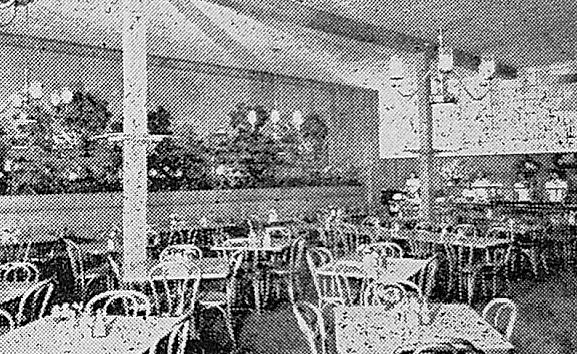
Here it is larger, but the resolution is still low, and the hanging light fixtures directly in front of the mural don’t help:
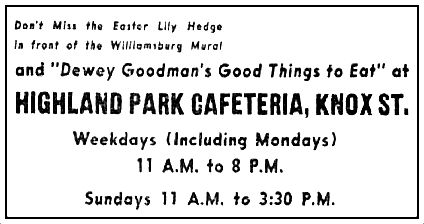
I found only one mention of a mural at the Highland Park Cafeteria — in this 1950 ad, which mentions “the Williamsburg mural,” as if it were a well-known feature of the restaurant:
April 1950
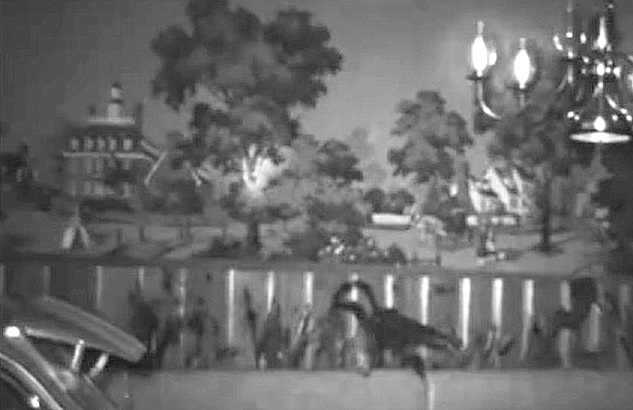
Then I asked about it on the Flashback Dallas Facebook page — and that led to this muddy screenshot glimpse of the mural from unknown news footage from 1953. Yep, Colonial Williamsburg, above a long planter. I’m not sure why that was immortalized on a wall of the Highland Park Cafeteria, but if anyone was wondering about any sort of HPC mural, these few paragraphs are for you!
***
Sources & Notes
Photo from Pinterest.
Knox Street Merchants’ Association ad from the 1932 SMU Rotunda. (That whole area has gotten cramped and is certainly more claustrophobic than when I was a kid, but I’m sure the present-day business owners would probably still echo the 1932 sentiment “Knox Street Business District has them coming from blocks … to shop on Knox.”) (Also, it isn’t often that I see ads mentioning Greenland Hills, the general M Steets area, adjacent to the neighborhood I grew up in.)
Matchbook (detail) from the George W. Cook Dallas/Texas Image Collection, DeGolyer Library, SMU Libraries — the full image and more information can be found here.
I’m on Patreon! If you’d like to support me and get new posts daily, head over here.
I’ve spent a lot of the past month visiting a loved one in a hospital. It hasn’t been fun. For either of us. Here are several hospitals photographed in 1944, some of which were unknown to me before my 2020 post “A Few Dallas Hospitals and Clinics — 1944.” (Above, Bradford Memorial Hospital for Babies, 3512 Maple Avenue.)
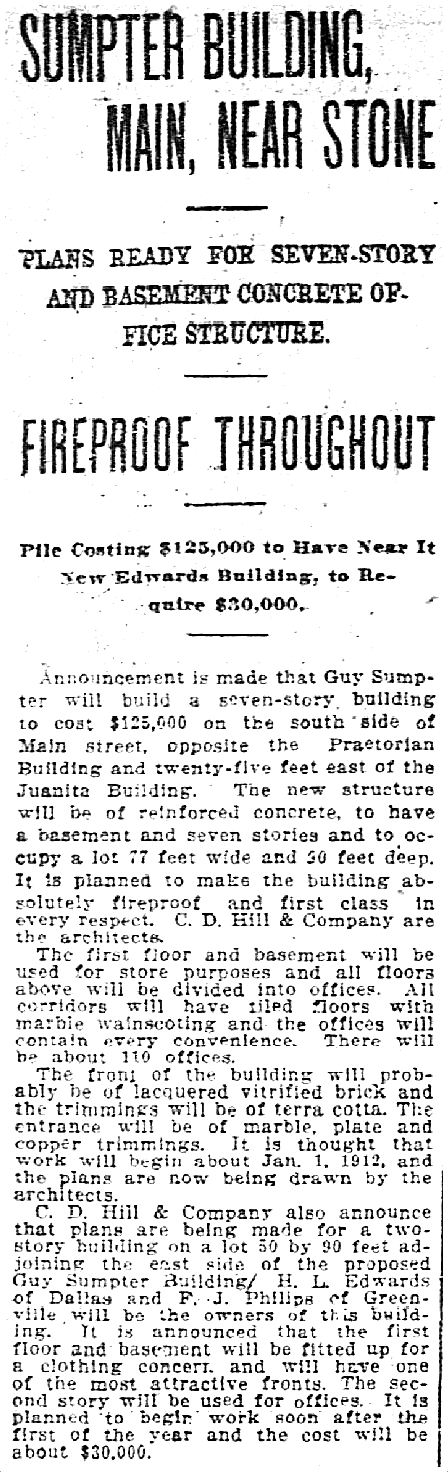
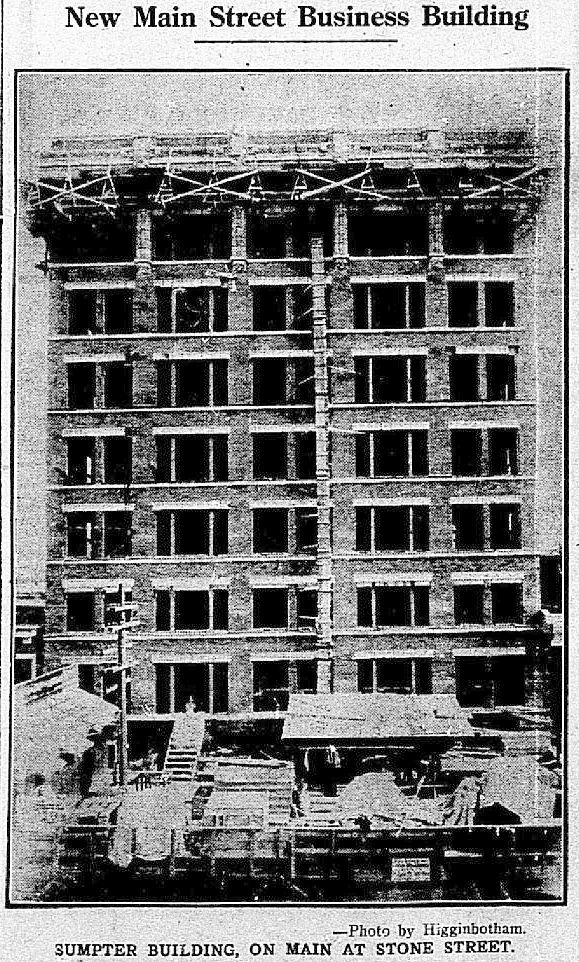
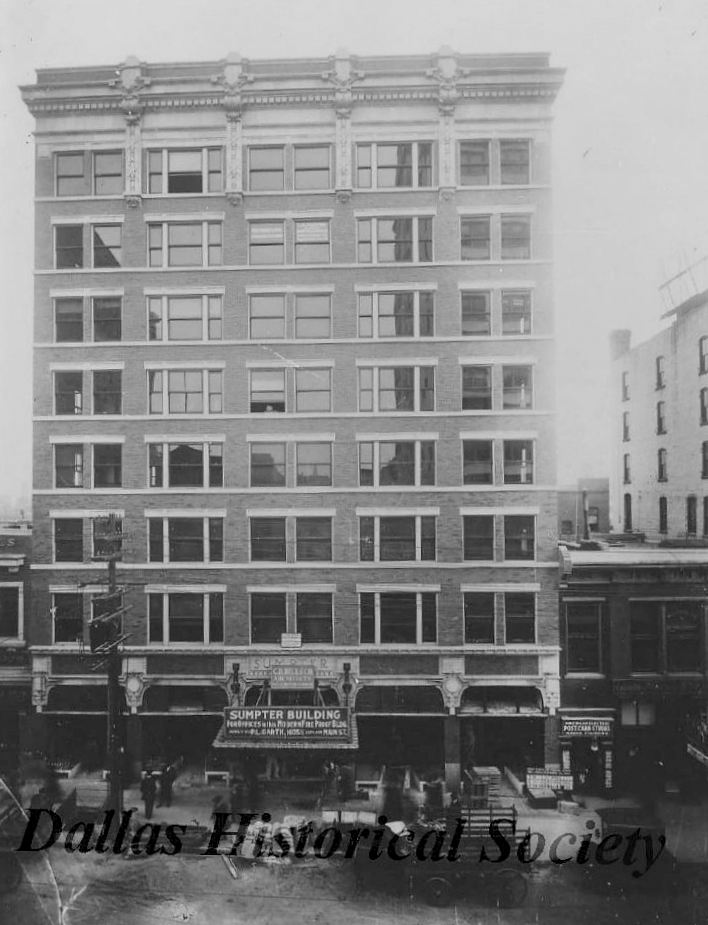
Behold, the Sumpter Building and a partial view of its little buddy, the Edwards & Phillips Building, which were built simultaneously. (See them on a 1921 Sanborn map here.) Both were designed by Dallas architect C. D. Hill, whose spectacular Municipal Building would be built a couple of years later, two and a half blocks away.
Guess what? Both are still standing — part of the Joule empire. See what they look like today — at 1604-1608 Main Street — on Google Street View here. (The shorter building has been through a multitude of renovations over the years, but at some point, by at least 2007, someone had restored it — however briefly — to its original design, as you can see in a 2007 Google Street View here — look how tired and dirty the Sumpter Building looked back then, before its recent scrubbed and rejuvenated revitalization.)
The Sumpter Building served primarily as office space over the years — architect C. D. Hill had a “penthouse” office on the top floor (I wonder if he knew that when he was drawing up the plans?) — and the smaller building was retail space on the ground floor and office space above. It might be remembered as the home of Linz Jewelers for several decades.
**
Dallas Morning News, Dec. 17, 1911 (click to read)
*
DMN, Mar. 7, 1912
*
DMN, Aug. 25, 1912
*
Dallas Historical Society, 1912
*
The smaller building debuted as home to retail tenant Matthews Brothers. (It is presently the home of another fashion mecca, Traffic Los Angeles (1608 Main).
April 1912
April 1912
*
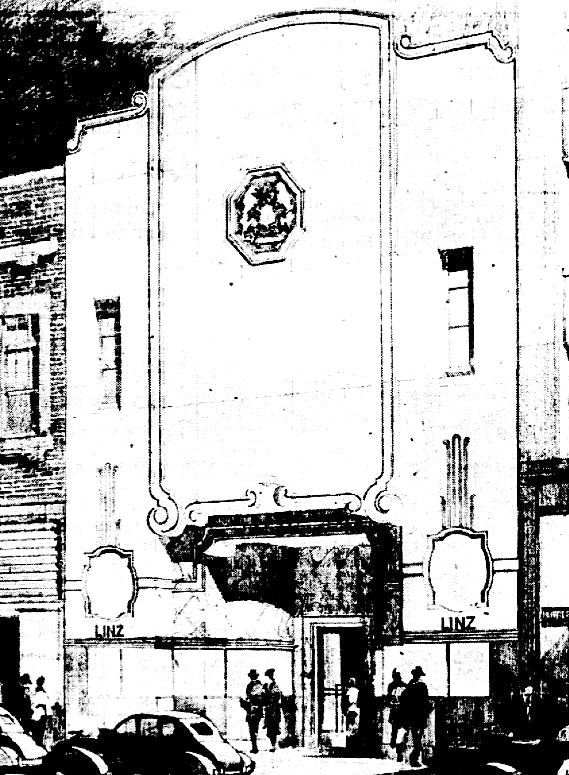
In 1940, Linz took over the shorter building. Articles in The Dallas Morning News described “construction” and a new design by Lang & Witchell, but I think the building was just gutted and (weirdly) refaced.
Linz Bros. Jewelers (Lang & Witchell, 1940)
*
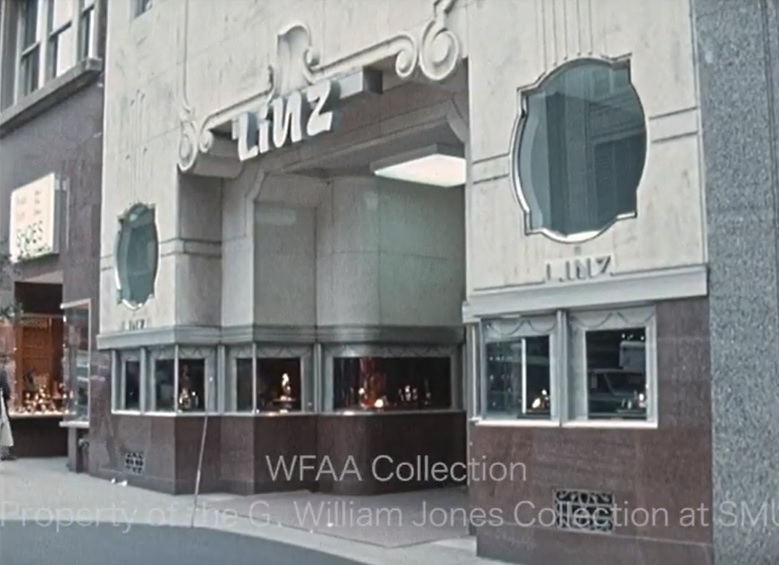
Here it is in living color, in 1970.
WFAA-Channel 8 News, Jan. 1970 (Jones Film Collection, SMU)
*
By the end of 1970, the building had undergone another (weird) “facelift” (and an expansion).
WFAA-Channel 8 News, Jan. 1971 (Jones Film Collection, SMU)
(The two screenshots above are from Channel 8 news reports about a fantastically successful jewelry heist in January 1970. Linz would never reveal the value of jewels stolen in the massive theft, but it was estimated at the time to be between $1.6 million and $3.5 million (the equivalent in today’s dollars of $12.5 million to $27 million!). It was the biggest burglary in Dallas history, and it was estimated to have been the biggest in the South. As far as I can tell, the crime was never solved. A great report on how it happened — with interesting little tidbits such as the fact that the robbers emptied a safe and took everything except for a few pieces of costume jewelry and that the burglars stopped for a break to brew a cup of coffee in the adjacent shoe store — can be found in the Dallas Morning News archives in the story “Gem Loss $3 Million?” by Robert Finklea (DMN, Jan. 13, 1970). It reads like a movie!
**
I’m always surprised to find these century-old buildings still standing downtown. Poor things have been through a lot.
*
Thank you to Chad K. for asking on Patreon if I knew anything about the history of these buildings. As it turned out, I knew NOTHING about the history of these buildings. I do now! Thanks for asking, Chad!
***
Sources & Notes
Top postcard from eBay.
1912 photo of the “Sumpter Building under construction” is from the Johnson Photographic Collection, Dallas Historical Society (A.77.87.967), here.
This post was inspired by a question from a supporter on Patreon. If you would like to join me on Patreon, where I post something every day, pop over here. (Thanks again, Chad!)
I am looking for a job, and since I have this blog as a platform which attracts like-minded people, I will just post this here, hoping it’s not too obnoxious.
It would be wonderful if I could find something in the world of Dallas history – especially in the area of writing and/or researching – but I know those jobs are somewhat limited.
I started this Flashback Dallas blog in Feb. 2014 – I’m 6 months away from my 10th anniversary! Unbelievably, I’ve written more than 1,300 posts. I know that many of you have been reading for several years (thank you!), and I hope you’ve been able to get a feel for my personality through my writing and can tell that I possess many traits a Boy Scout would be proud to have.
If you know of a job opportunity requiring someone who is intelligent, diligent, responsible, courteous, amusing, and detail-oriented – and who can write/edit/proofread/research – please think of me.
If you are looking to hire someone like me – or if you know of someone who is – please let me know! If you would like me to send you a resume, please contact me at FlashbackDallas214@gmail.com.
I had a LinkedIn page years ago, but I never reaped any benefits from it, so I closed it. I’ve started another one, but there’s a lot to navigate, and I’m not sure it’s worth it. But if you want to check out what I’ve managed to get up there, check me out here: https://www.linkedin.com/in/paula-bosse-214-dallas/.
(I’ve had mixed results getting that direct link to work for people who don’t have LinkedIn accounts. You may land on a page that looks like you have to enter a username and password — try clicking the “X” in the top corner and see if that works to bypass entering anything. If the link above doesn’t work, try putting “paula bosse” and “linkedin” in Google, and you should be able to see my public page.)
Thank you for reading. Any leads would be welcome.
–Paula
***
Sources & Notes
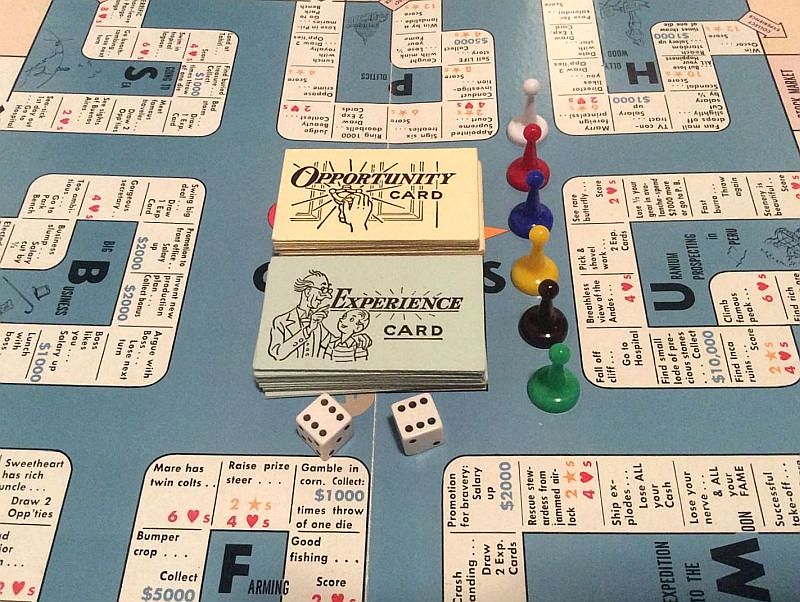
Image of the “Careers” board game is from Etsy. I kind of want to play this game. One of the occupations is Uranium Prospecting in Peru. I’m down for that.
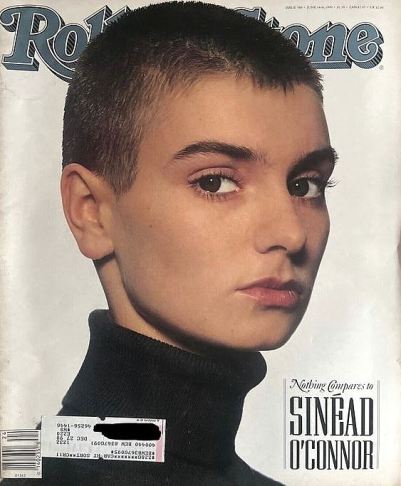
Sinead O’Connor died today. I loved her. When she came to Dallas to play the Bronco Bowl on May 25, 1990, I was there. She sang “Nothing Compares 2 U” a capella. The audience was so quiet while she sang you could hear a pin drop. It was one of the most memorable live music moments I’ve ever experienced.
In the early days of alternative radio station KDGE, I spent a lot of time at the Edge studios and provided a surprising amount of (uncredited, unheralded, and uncompensated) “comedy” writing for one of the on-air personalities. I even did a few on-air bits.
One night, out of the blue, I got a phone call at home, and was told to call the station’s answering machine and give ridiculous directions to a secret Sinead O’Connor party which was supposedly being given in her honor while she was in town for her show at the Bronco Bowl. So I did. The sound quality is atrocious, but I had to scramble to find a tape recorder before the bit aired a few minutes later. I’m still waiting for my Peabody.
So here’s one of the improvised stealth comedy bits I did on The Edge (and, yes, I really do give directions like this). It is followed by a commercial for Sinead’s appearance at the Bronco Bowl, produced by 462 (pure ’90s nostalgia). I’ve been told by a friend that he could access this link on his laptop but not his phone, but I’m going for it anyway.
Today marks the 50th anniversary of the murder of 12-year-old Santos Rodriguez by a Dallas policeman, a tragedy which outraged Dallasites and which was a turning point for Dallas’ Mexican American community.
Several years ago, I maintained a long-running personal blog (back in the days when everyone had a blog — now everyone has a podcast). A recent comment on my Patreon page reminded me of an old blog post I wrote in 2010, several years before I began Flashback Dallas. I thought I would share it here (slightly rewritten). It’s a different sort of thing than I normally write on *this* blog — it’s pretty long and only tangentially connected with Dallas history — but it made me laugh to reread this 13 years later. (I have to add that since I wrote this back in 2010, the Municipal Building has been lovingly, *dazzlingly* restored by the University of North Texas and is no longer the hellhole I describe below! I haven’t seen the restored interior in person yet, but photos show some unbelievably amazing work! Thank you, UNT!)
**
October 27, 2010
I’m one of those people who receives a lot of jury summonses. I swear one year I got at least 3. Maybe 4. Do they keep sending them to me because I always report for jury duty like a responsible citizen is supposed to do? Is this good behavior working against me? So when I got a jury summons last month — a mere 4 months after my most recent jury duty on Cinco de Mayo — several unladylike words spilled out of me as I stood at the mailbox. I scanned the list of acceptable exemptions — there was a little empty checkbox next to the statement “I have been convicted of a felony.” Instant exemption! My first thought was, “Hmm. I’ve got six weeks….” It was tempting.
But I was still felony-free by the time I had to report yesterday (Oct. 26, 2010), so I somehow got myself up at the crack of dawn after only 4 or 5 hours of sleep and pointed my car in the direction of downtown. Most of my jury duty has been at the criminal courts building, which is easy to get to, and the chairs in the central jury room are plush and fairly comfy. This time, though — for the first time — I was summoned to a municipal court, where I guess they try people for non-death-penalty offenses like traffic tickets and zoning violations. If this day had any upside, it was that it would be my first visit to the beautiful Municipal Building. I couldn’t wait to see what that building — arguably the grandest building in Dallas — looked like inside.
But first I had to get there. I had to travel what felt like the entire length of downtown before I was able to turn left on Main and loop back to Harwood. I was sleep-deprived, caffeine-deprived, and just generally cranky, knowing that this whole thing was unnecessary, as I would no doubt be let go by noon, after having sat around for hours doing nothing but thinking unladylike things and wondering the whole time how this inefficient system keeps going.
Convenient parking? Ha! Fend for yourselves, suckers. At least Frank Crowley has a parking garage. Somehow, I found an unattended, cash-only lot along Commerce for the surprisingly affordable price of $2.00. My luck continued when I found that I actually had two one-dollar bills, which I stuffed through the narrow slot.
Despite my lengthy detour, I had arrived a little early and enjoyed a leisurely walk down Commerce. As I passed the building’s parking garage entrance/exit, I wondered if that was where Lee Harvey Oswald was shot. (It was.) I took my time, taking in the lovely, stately Municipal Building, which opened to rapturous acclaim in 1914 — it’s one of those cool old buildings that Dallas loves to tear down. I was really looking forward to stepping inside that grand palace, imagining an interior of marble, brass, etched glass, and ornate, highly polished, hand-carved wooden banisters.
I headed up the elegant, wide steps, walked in, and… oh… my… god. It was awful. AWFUL! But before I was treated to the full force of its awfulness, I was first greeted with the de rigueur metal detector. Which I set off. I stepped back and the officer asked me to raise each pant leg so he could see the tops of my shoes. I must have looked confused because he said, “We just want to make sure you’re not wearing an ankle holster.” Without thinking, I stupidly replied, “Pfft — I WISH,” and I instantly regretted it. But he laughed, and I continued on my way.
The Beaux-Arts-style Municipal Building, designed by architect C. D. Hill, is beautiful and stately. …On the outside. Here’s what it looked like almost 100 years ago:
Inside? Dear god. Depressingly institutional. Last “updated” circa the ’70s/’80s? Cramped and claustrophobic, bad paint, fluorescent lights, drop ceiling tiles, and absolutely no signage. I had to ask three people how to get to the central jury room! It’s a shame I found it, because I am going to have nightmares about that horrible place for a long time. There were about a hundred of us sitting on folding chairs in a room with dingy cream-colored walls trimmed with flat-turquoise paint. It reeked of the thousands of cigarettes which had no doubt been smoked over the past century by thousands of long-dead civil servants. The smell of stale smoke was embedded in every nook and cranny of that room. I think I would have preferred to serve my civic duty by picking up Miller Lite cartons from the side of the highway.
The worst thing about the room? The blaring TV. I don’t know why this has become acceptable, but it’s everywhere: in every waiting room there’s always a TV now — always on, stuck on a program you would never choose to watch. My fellow captive good citizens and I were subjected to a chirpy morning show (“Sweaters: to tuck or not?”) and lurid Hollywood gossip. I wondered if I could leave the room to get a breath of fresh air — it would be sheer relief to stand out in the hallway with the slumlords and the red-light-runners waiting their turn to go before the judge and take on City Hall. But I didn’t see anyone else doing that, so I sat, defeated, involuntarily learning about the finer points of sweater-tucking.
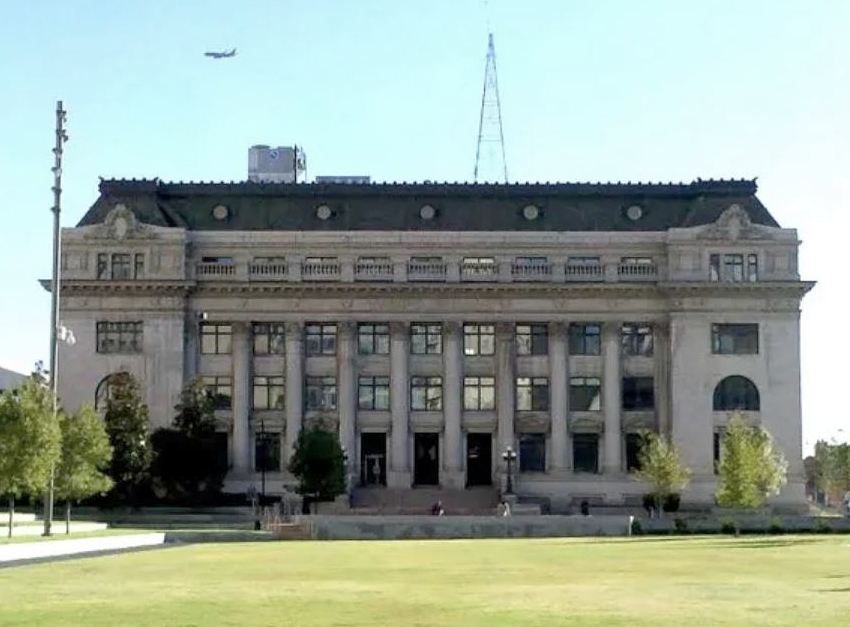
After an hour and a half or so, the marshal — who had a shaved head and wore taps on his shoes — announced that we were allowed a half-hour break. I hot-footed it out of there and left the building (I had to ask how to get out). I walked around the building admiring it, then walked across the street to a new park that’s sprung up since I was last downtown — a whole block of a park, lined with trees and terraced walkways — in downtown Dallas — with grass and everything! It’s cool. Here’s a photo I took of the municipal building from across the park (Main Street Garden):
Oct. 26, 2010 / photo: Paula Bosse
I saw several young hipsters walking their dogs. I bounced across a small playground, built on some sort of weird, springy, spongey surface. I thought how unusual and how nice this whole “open space” thing was. My half hour was up too soon. As I walked back, a possibly homeless man joined me and chatted with giddy enthusiasm about the Rangers being in the World Series, insisting to me that they were Going. To. Win. I laughed and said I believed him. It was such a beautiful day. How sad that I was heading back to the dark dungeon of the central jury room. I waited to cross the street with a couple of women I recognized as fellow potential jurors. They decided to blithely cross against a red light. There were six police cars parked in front of us, but not one cop to bust these scofflaws! I crossed on green, because I’d used up my luck finding a convenient parking spot, and as sure as the Rangers are Going To Win the World Series, I knew I would be instantly cited for pedestrian incivility the second I stepped off the curb to a flashing red light.
Back inside, I set off the metal detector a second time and showed my holster-free ankles to a different officer and followed the trail of breadcrumbs I’d left earlier. In the jury room — where women outnumbered men 4-1, and the median age was 60 — the two women who’d crossed on red were talking about the Laura Bush autobiography one of them was reading. Two other women were talking in excruciating detail about deaths of beloved pets. The guy next to me was nodding off, somehow oblivious to Wendy Williams chattering excitedly about Charlie Sheen and a hooker. A guy behind me had a laptop which kept making clanging sounds and which he’d plugged into an extension cord that snaked its way into the bowels of a mystery room behind an intimidating door marked “Private.”
There was no coffee in the building. (“There is NO coffee in the building,” the marshal had informed us earlier. “If you want a cup of coffee, you’re going to have to exit the building.”) HAD there been coffee, it would have been thin and stale and cold, and the powdered artificial creamer would not have dissolved, no matter how much you stabbed at the globules with a plastic stir stick. Like in the movie “Joe Versus the Volcano.” I kept thinking of that movie, because that godforsaken central jury room I was trapped in could have been the inspiration for the scene in that movie which my brother and I often reference:
*
I was so miserable. I contemplated committing some sort of petty property crime to relieve the tedium but reconsidered when I realized I’d only find myself back in the same building when my trial date came up. I was going to have to tough it out like an adult.
A middle-aged woman who looked like she was probably a hardcore, high-powered North Dallas realtor sat a couple of rows in front of me and seemed to be able to read only a sentence or two from her book (Famous Soviet Spies) before she grew bored and slipped her “We the People” bookmark back in and closed it, only to stare off into space, gathering the energy to raise the book again and read from it for 20 or 30 more aggressively-anti-Communist seconds.
The youngest person in the room sighed frequently and played a game on her phone.
An older Black man in a gimme cap and an older white man who had probably left his gimme cap in his truck talked together absolutely without pause for the entire time we were there. I couldn’t hear what they were talking about, but I have a feeling they’ll be spending Thanksgiving together this year.
Throughout my ordeal, I had longed to hear the snappy taps on the shoes of the marshal. He would be our savior — the one who could let us go. Finally, he returned. He called maybe 10 people and sent the rest of us on our way. It was 11:00 AM. I had been there only two and a half hours. It felt like a lifetime.
I got in my car, stopped for a burrito, headed home, and fell asleep on the couch. Civic duty done. I only hope I’m never called back to that depressing, confusing building. Pray you’re never called for jury duty there.
***
Sources & Notes
Blog post by Paula Bosse, originally published on Oct. 27, 2010 (revised July 2023).
Photo of the sad, dark Municipal Building at top is from Google Street View, Aug. 2007; photo from 2013 by Paula Bosse.
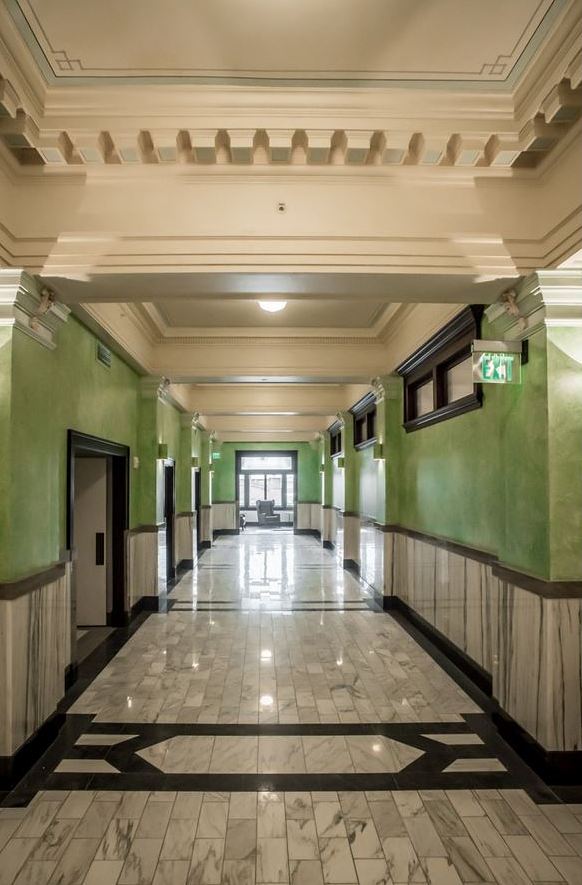
The City of Dallas and all of us who live here, should fall to our knees to thank the University of North Texas Law School and the team of incredible people who restored and renovated the former Municipal Building. Thankfully, all of my sarcastic descriptions above are no longer accurate. I mean, look at this photo of what a hallway looks like now:
That photo is one of several showing the restoration in the article “Bringing Historic Dallas Back to Life” by Preston Pressley, on LinkedIn, here (possibly behind a subscription wall).
See more photos — as well as the film “Restore” by Mark Birnbaum — on the Phoenix I Restoration and Construction site,here.
Look at this photo of the revitalized building today — more beautiful than I’ve ever seen it. Every inch of its exterior has been cleaned, spruced up, and restored. I kind of wish I could be called to jury duty there now!

 An Oak Cliff oasis…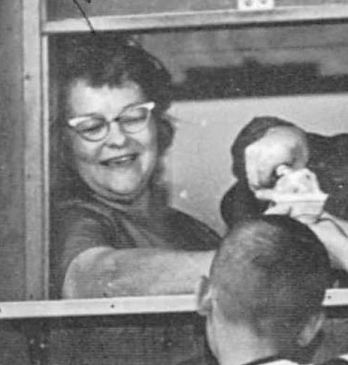
 1967 Sunset High School yearbook
 1967 Sunset yearbook
 1968 Sunset yearbook
 1969 Sunset yearbook














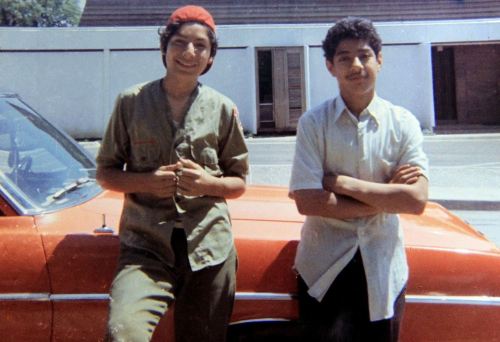 Brothers David and Santos Rodriguez
 Sad and gloomy, yearning for restoration (2007)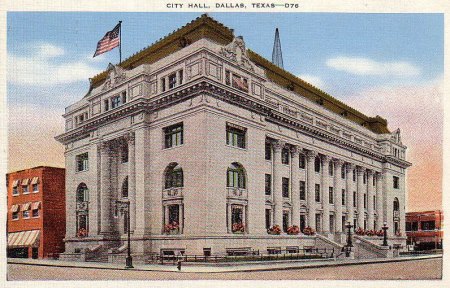


 Flashback : Dallas