
The Grading of Junius — 1903
by Paula Bosse
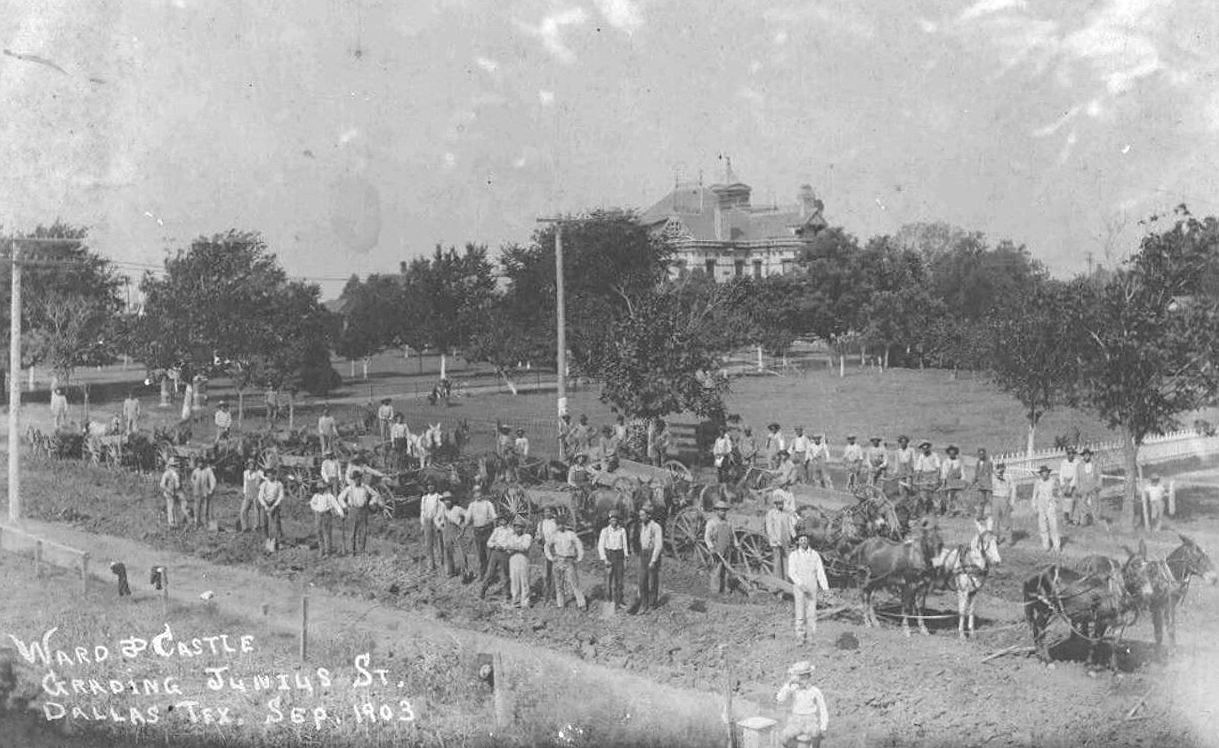 Let the scraping begin!
by Paula Bosse
Here’s an interesting photograph I stumbled across on eBay. It shows Junius Street in East Dallas, between Peak and Carroll, taken in September 1903, as workers were grading the street as part of the paving process. The mammoth house seen on what looks like a hill, belonged to John B. Wilson (namesake of the Wilson Building downtown), who had purchased the grand home from Thomas Field in the 1890s. (This beautiful house — built in 1884 — was demolished in 1922 in order to free up land for apartments, etc. Read more about this in the 2014 post “Junius Heights … Adjacent!”) Here’s Wilson’s home, up close:
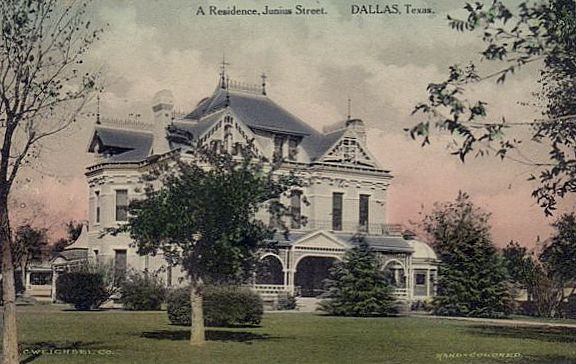
The house was built in 1884 at the northeast corner of Junius and Peak — it sat on a lot of land. By 1903, after other houses had been built around it, it occupied almost half a block, bounded by Junius, Peak, and Gaston. (See this area on Sanborn maps from 1905 and 1922 — it’s pretty easy to spot the house!)
But back to the 1903 photo. It shows road work on Junius, which, up until that point, had been a dirt/gravel road.
In March 1903, residents of Junius Street asked the City Council to pave their street between Haskell and Fitzhugh. I’m sure their main goal was to live on a nice, paved street instead of one that became a nasty, muddy nightmare when it rained — but, perhaps to make it seem more egalitarian, they zhuzhed up their request by saying that “Junius street is the principal outlet to Garland, Reinhardt and the country surrounding those towns.” They noted that the county had kept the continuation of the road outside the city in good condition and that this stretch of paved road would provide “a connecting link between the city and the country.” (I don’t know how important this “connecting link” was, but the stretch of road they wanted paved was only half a mile long. It seems pretty ballsy to request that the city pave this very short bit of road, which would have resumed being unpaved east of Fitzhugh…. and on to Garland and Reinhardt. I think there’s no question that Moneyed Resident Wilson — who, let’s not forget, was building the very large Wilson Building downtown at this time — had a lot of sway amongst the city leaders.)
The group approached the city with a proposition in which they, the homeowners, would pay for half the cost of the construction, with each of them paying 50¢ for every foot of their property which fronted the street. (Surprisingly, only two property owners had an issue with this — one of them was Dr. Buckner of the Buckner Orphans’ Home (before it relocated to the ‘burbs, it was at 4120 Junius), who said the home did not have the funds for this, but he personally ponied up a $50 contribution, the equivalent of about $1,700 in today’s money.) The city seemed happy with this and agreed to match the $2,500 collected by the group. (Mr. Wilson’s share must have been substantial.) I don’t know what the tax situation was back then, but it’s odd that people once had to do this. I would guess that very few streets were paved beyond the Central Business District in this era — who could afford that? I guess that’s why so many real estate ads from the past stressed that the streets of their new developments were all paved.
The Junius improvements included the laying/installing of cement sidewalks, a macadamized roadway, and bois-d’arc-block gutters. The grading work (shown in the photo at the top) began in August 1903.
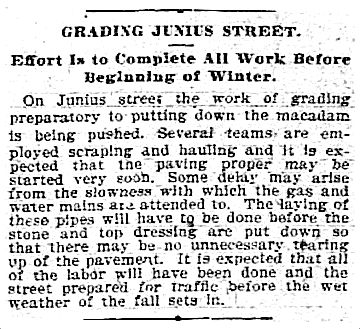 Dallas Morning News, Aug. 25, 1903
There were, of course, delays, caused by a lack of materials, weather, the necessity of having to wait while gas and water mains were laid, and having to either rebuild a bridge over the road or build a culvert under the road (the city went with the cheaper culvert). Work was still going on in December, but I gather the job was completed early in 1904.
*
Leadership of the neighborhood group was comprised of two people from each block (one from each side of the street). The leaders for what is now the 4700 block of Junius were John C. Ward and C. J. Castle (their names are on the photo showing this work in progress). The notation below is written on the back of the photo: “J. B. Wilson home in background (built Wilson Building downtown). J. C. Ward my grandfather. Mary Musick.”

J. C. Ward (1851-1937) came to Dallas in 1874, traveling in a covered wagon, witnessing buffalo stampedes and white-knuckling it through Indian territories. He was pals with an elderly John Neely Bryan. He worked as a contractor and must have done well, as he owned houses on several lots in the 4700 block of Junius, most of which were occupied by family members (including his daughter, Ella Ward Arnold, and his granddaughter, Mary Arnold Musick) — his own home was in the 6100 block of Junius, which appears to be the current location of the Lakewood Library. At one point he owned 72 acres of farmland on the eastern edge of Dallas, but it was condemned by the city in order to build White Rock Lake. He didn’t seem to hold too much of a grudge, because his major pastime was fishing, and he frequently walked the 2 miles to the lake from his home to fish, well into his 80s.
He seems to have had a real affinity for Junius Street. I love the fact that he and his across-the-street neighbor, C. J. Castle, memorialized the paving of their street with a specially commissioned photograph and managed to get all the workers to pose for it. The paving of Junius must have been a particularly gratifying achievement.
***
Sources & Notes
Top photo is from eBay — it is currently for sale, here.
If you enjoy this sort of thing, check me out on Patreon, where, for a subscription costing mere pennies a day, you can receive daily, bite-size Dallas-history posts directly in your inbox.

*
Copyright © 2024 Paula Bosse. All Rights Reserved.
 Flashback : Dallas
Paula Have you heard of the McCutchin homestead where pepper square now stands? If so do you have photos of the house?
Sent from AT&T Yahoo Mail for iPhone
LikeLiked by 1 person
I haven’t, but I’ll keep my eyes peeled.
LikeLike
With that surname I know from experience that spellings vary a bunch and one does well to try two or three versions of the name just in case.
LikeLike
The Arnolds were next door neighbors and good friends of my grandparents, who lived at 611 Paulus. Both the Arnold home and the Musgrove home were demo’d for the Lakewood Library (as well as 2 other Junius Street homes and 2 other Worth Street homes).
Mary Arnold Musick told the story to the library many years later about their home…it was originally Hawpe Lane before the name was changed to Junius Street.
LikeLiked by 1 person
Thanks, Teresa! I actually thought of you when I was writing this, because I knew of your grandparents’ house. Mrs. Musick must have moved into that house after her grandfather died. I tried to find more information about that house, but couldn’t — now I know that it had a different street name at the time. I don’t know when he moved into that house, but he was living in the 4700 block of Junius when the paving work was done. Thanks for the additional info!
LikeLike
Lost me @ b…..sy
LikeLike
Sorry!
LikeLike
Interesting! Thank you Paula.
LikeLiked by 1 person
I thought I was logged in. It’s silvershiloh
LikeLiked by 1 person
Delightful entry. Meanwhile, Dallas residents may not be paying for streets (at least not out of their wallets) any longer, but we are still expected to pay halvsies for sidewalks!
LikeLiked by 1 person
Thanks! And really? I had no idea.
LikeLike
[…] “THE GRADING OF JUNIUS — 1903” […]
LikeLike
[…] “THE GRADING OF JUNIUS — 1903” […]
LikeLike