Flashback : Dallas

A Miscellany: History, Ads, Pop Culture

Category: 1900s

The Southern Rock Island Plow Company

southern-rock-island-plow_city-directory_1908-det_smFrom plow company to Dallas’ most famous building (click to enlarge)

by Paula Bosse

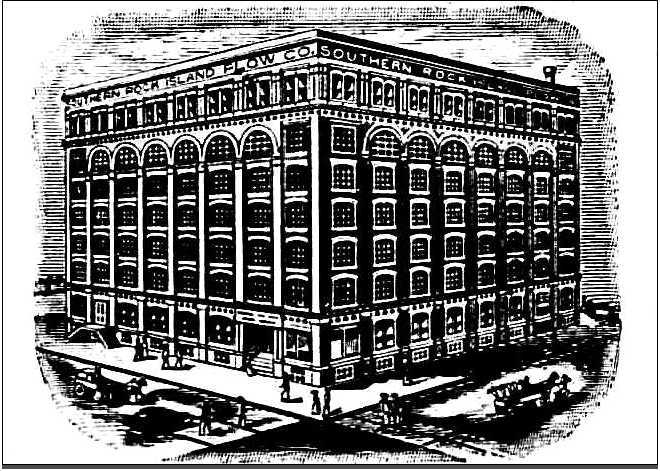
Behold, the Southern Rock Island Plow Company building. Looks familiar? Perhaps “Texas School Book Depository” is an easier hook to hang your hat on. When Dallas seemed to be farm implement-central, there were numerous plow companies in business here. This is the second Southern Rock Island Plow Co. building — the first one (built in the same location around 1898) burned down when it was struck by lighting. The building that still stands was built in 1903, and it is, without question, the most famous building in Dallas.And it’s probably not that far behind the Alamo.

southern-rock-island-plow_city-directory-19081908

southern-rock-island-plow_bldg-code_19141914

***

Sources & Notes

Ad from the 1908 city directory.

Photo from the Building, Plumbing, Gas & Electrical Laws of the City of Dallas (1914).

More on the history of the Dallas branch of the Southern Rock Island Plow Co. can be found here.

For more about what’s going on with the building these days, see the Dallas Morning News article “Dallas County May Move Offices Out of Historic School Book Depository” by Matthew Watkins, here.

For more on the various incarnations of the building (which, by the way, is officially called the County Administration Building and which now houses county offices as well as the Sixth Floor Museum), see my previous post, “The Sexton Foods Building and the Former Life of the School Book Depository,” here.

*

Copyright © 2015 Paula Bosse. All Rights Reserved.


F. J. Hengy: Junk Merchant, Litigant

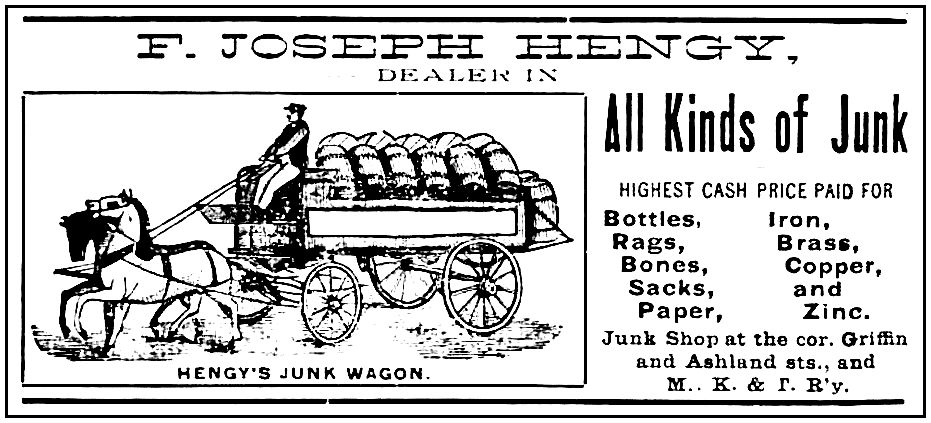
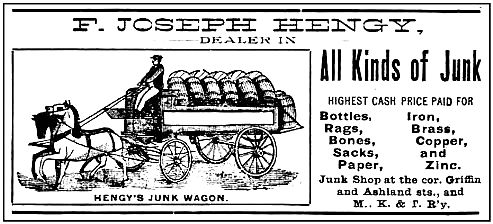
ad-hengy-junk_city-directory_1890-sm“All Kinds of Junk” — 1890 ad

by Paula Bosse

Frank Joseph Hengy was born in Germany in 1850. He immigrated to the United States in 1873, and in about 1880 he made his way to Dallas with a wife and children and established himself as a prosperous buyer and seller of scrap metal and other assorted “junk.” He also owned and operated a foundry, producing amongst other things, sash weights. In the 1894 city directory, there were exactly two “junk dealers” listed, which is surprising, seeing as Dallas was a sizable place in 1894 — there must have been a lot of bottles, rags, bones, sacks, paper, iron, brass, copper, and zinc lying around all over the place, just waiting to be hauled away.
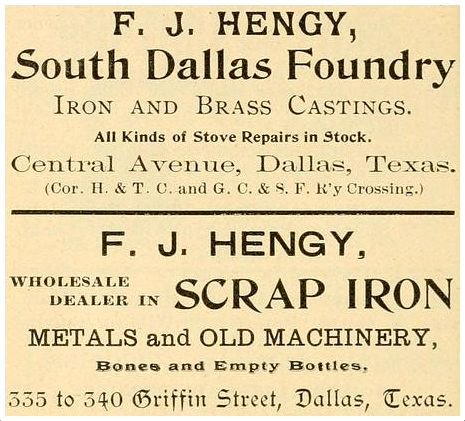
hengy_souv-gd_1984Souvenir Guide to Dallas, 1894

F. J. “Joe” Hengy’s junkyard (and adjacent residence) was at Griffin and Ashland, right next to the M K T Railway tracks. He advertised in the newspapers constantly and was apparently THE man to sell your junk to. His name even made its way into the minutes of an 1899 city council meeting, when, during the discussion on how the city was going to pay for the shipping of a Spanish cannon that had been captured in Cuba and had been given to the city as a war trophy, a councilman asked sarcastically, “What will Hengy give for it?” (Dallas Morning News, Aug. 5, 1899).

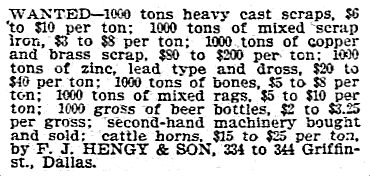
But, seriously, got junk? Call Hengy. Got tons of it? By god, he wants it. A couple of examples of the endless ads placed over the years — two ads, 12 years apart (the 1887 one getting his first initial wrong).
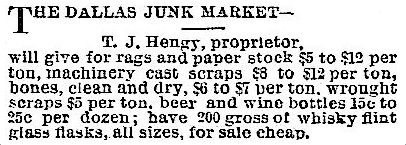
1887_hengy_dmn_082487DMN, Aug. 24, 1887

1899_hengy_dmn_102299DMN, Oct. 22, 1899

In the mid-1890s, Joe took his son Louis on as a partner, which, in retrospect, was probably not a good idea, because it wasn’t long before Joe found himself in the middle of years and years of lawsuits: father against son, son against father, father and associates against son, son and associates against father, etc. Not only was he constantly being sued by his son, he was also sued for divorce … twice … by the same woman. He turned around and sued her for custody of their youngest children (and won). She sued him for the business when he was threatening to sell it and retire. He sued her back for something or other. And on and on and on.

Not only was Joe spending all his non-junk-hauling time traipsing about courthouses, but he also found the time to suffer the occasional partial destruction of buildings on his property — twice by fire and once by the massive flood of 1908. The fires were suspicious (the flood was not).

Then there was the time he was charged with the crime of mailing an obscene letter (I’m gonna go out on a limb and guess that it was probably a letter sent to his wife — or maybe ex-wife by that point — who was in the midst of suing him and their son). Even though this was a potentially serious federal offense, he was ordered to pay only a small fine for “misuse of the mails.” He was also charged at one point with “receiving and concealing stolen property,” but I’m not sure that got past a grand jury investigation, and one might wonder if there wasn’t some sort of “set-up” by aggrieved relatives involved. It was something new anyway. Probably broke up the monotony a little bit.

But the thing that seems to have been Hengy’s biggest headache and was probably the root of most of the lawsuits filed BY him and AGAINST him concerned property he owned which had been condemned in the name of eminent domain by the M K T Railway. The condemnation was disputed, the appraisal of land value was disputed, the question of which Hengy actually owned the land was disputed, etc.

By the end of 1913, Joe Hengy had been engaged in at least 10 years of wall-to-wall litigation. He moved to Idaho at some point, remarried, started another business, and, finally, died there in 1930. Let’s hope his later years were lawsuit-free.

*
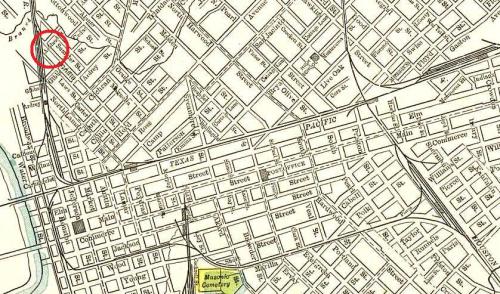
hengy_map_ca1900

Hengy’s business and residence (which was, surprisingly, right next door to his litigious son) was at 2317 Griffin, very close to the present-day site of the Perot Museum. (Full map circa 1900, here.) (Click for larger image.)

*

Lastly, two odd, interesting tidbits.

Joe Hengy took time out from junk and courtrooms to invent new and improved … suspenders! I’m not sure exactly what was so revolutionary about them, but a patent was granted in 1912 — you can read the abstract here, and see them in all their suspendery glory here. (With so much foundry and scrap metal know-how, you’d think he’d go in a more … I don’t know … anvil direction or something.)

And, then there’s this — a kind of sad ad for a tonic called “Sargon” with a testimonial from Mrs. Ollie Hengy, the no doubt long-suffering wife of perennial plaintiff/defendant Louis Hengy. “Was On Verge of Breakdown.” I don’t doubt it! (Incidentally, Ollie and Louis divorced the same year this advertisement appeared in Texas newspapers. Maybe that stuff did work.)
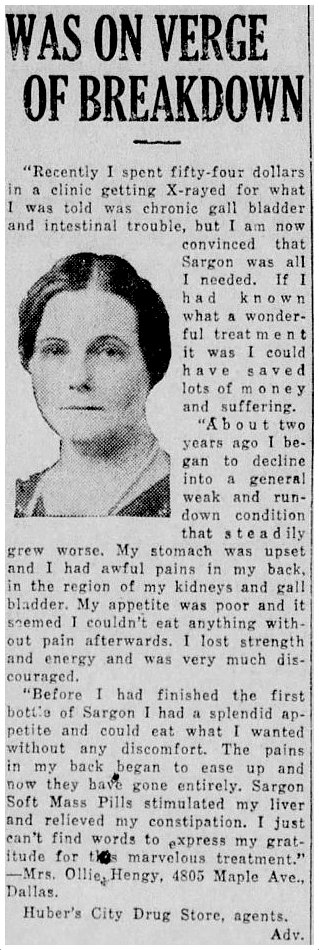
ollie-hengy_vernon-daily-record_0906291929

***

Sources & Notes

Top ad from Dallas’ 1890 city directory.

Sargon ad appeared in The Vernon Daily Record, Sept. 6, 1929. More on the quack tonic Sargon here.

Sources for other clippings and images as noted.

Lastly, an interesting article that answers the questions “Why was the scrap metal game profitable?” and “Just where did all that metal GO, anyway?” can be found in the article “Many Uses for Junk: How Wornout and Discarded Metal is Utilized,” originally published in The Brooklyn Citizen in 1899; it can be read here. I’m nothing if not exhaustive.

*

Copyright © 2015 Paula Bosse. All Rights Reserved.

The Wilson Building Under Construction — 1902

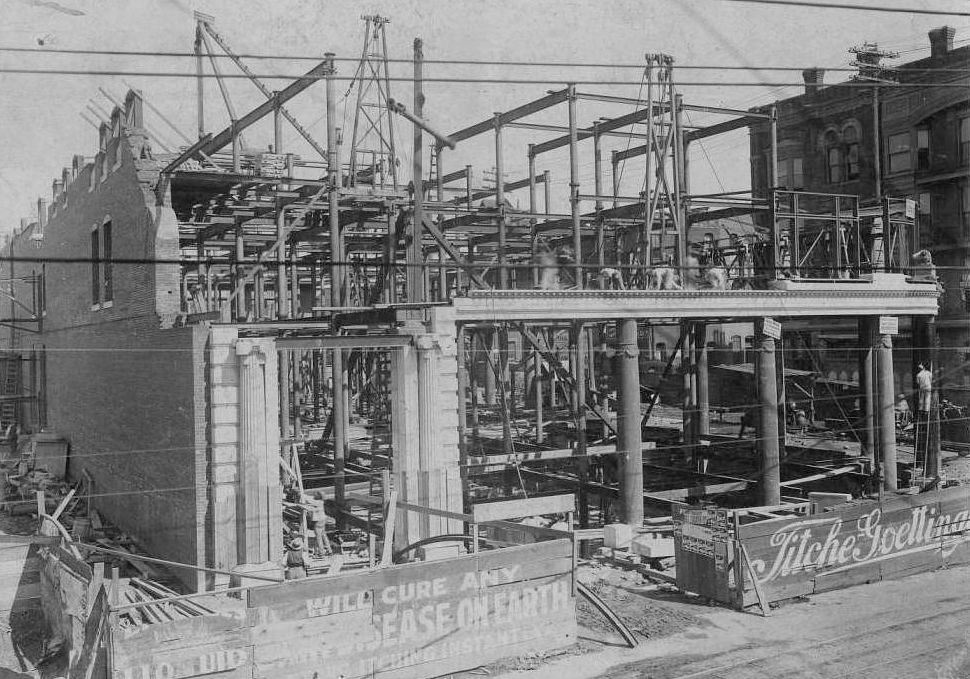
wilson-bldg-construction_cook_degolyer_smu_1902_bwSlowly but surely…. (DeGolyer Library/SMU)

by Paula Bosse

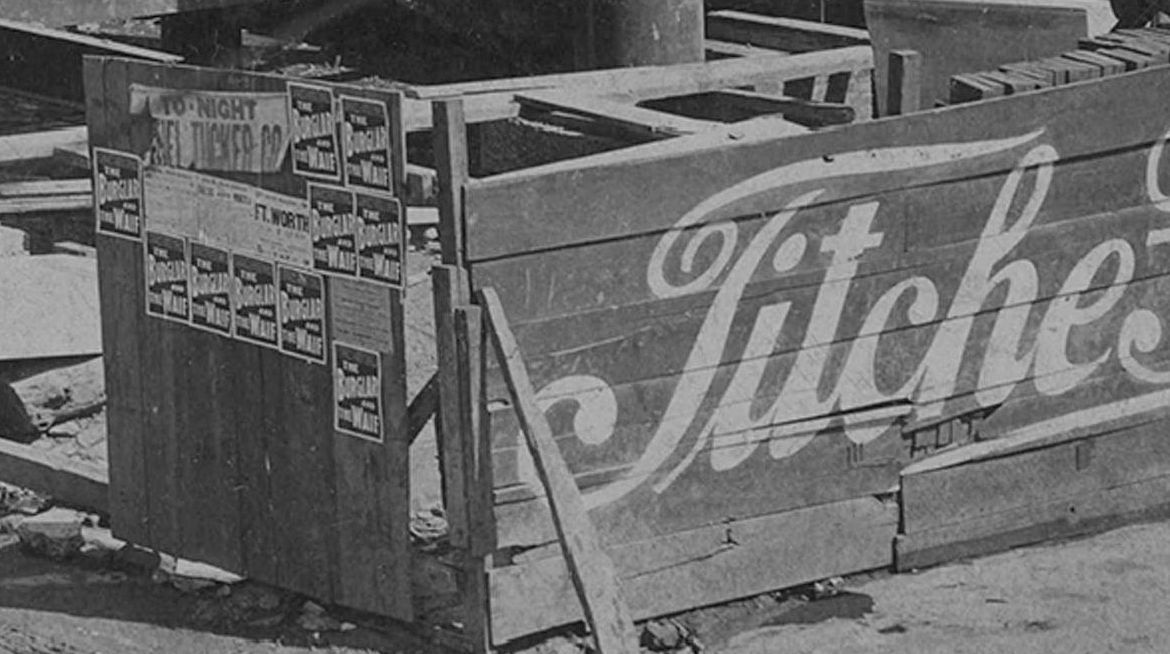
The Wilson Building is one of Dallas’ most beautiful buildings. Designed by the immensely influential Fort Worth firm of Sanguinet & Staats, the building opened in 1904, with its most notable tenant being the Titche-Goettinger department store, which occupied the basement and first two floors.

From the Dallas Public Library’s website:

“J. B, Wilson, a wealthy Dallas cattleman, built this French Renaissance/Second Empire (Beaux Arts) style building, modeled after the Paris Grand Opera House. Craftsman from all over the country came to contribute to the building finish, exterior and interior, with a mahogany and marble interior finish. It was the first eight-story building in Texas. The building originally housed the Titche-Goettinger department store on the bottom floor, with the upper floors used as office space. In 1911, Sanguinet & Staats built a twelve-story annex to the building, which was raised five floors in 1957.”

It was listed in the National Register of Historic Places in 1979.

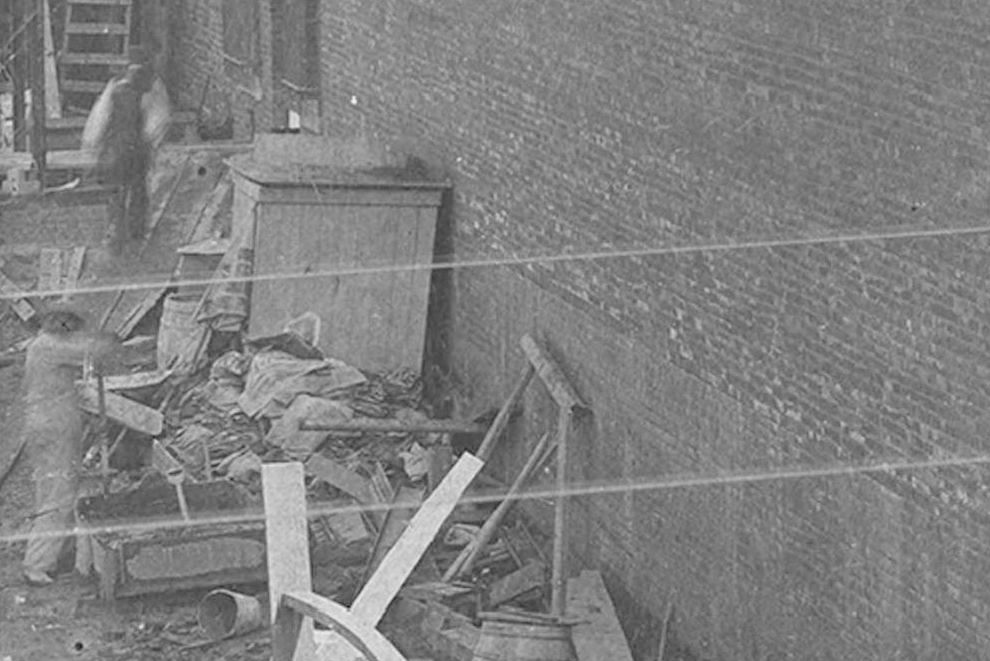
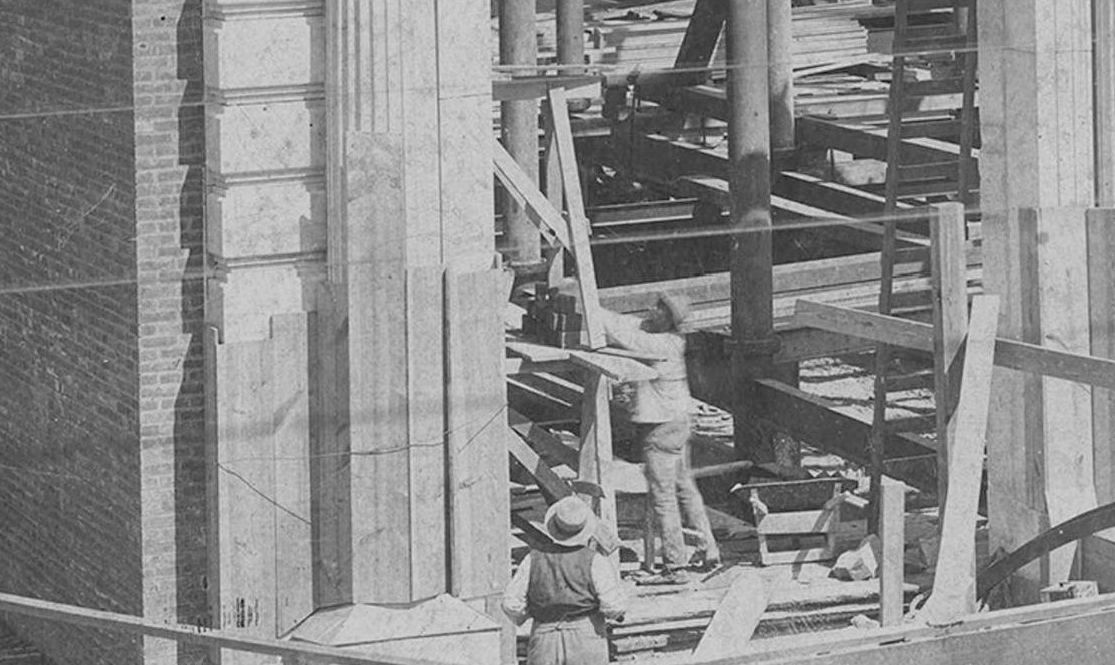
The photo above is part of the incredible George W. Cook Dallas/Texas Image Collection at SMU’s wonderful DeGolyer Library (see note below). Below are a few enlargements of parts of the original photo to see more details. (Click for larger images.)

wilson-bldg-constuction_cook_degolyer_smu_1902-det7_bw

wilson-bldg-construction_cook_degolyer_smu_1902-det4_bw

wilson-bldg-construction_cook_degolyer_smu_1902-det5_bw

wilson-bldg-construction_cook_degolyer_smu_1902-det3_bw

wilson-bldg-constuction_cook_degolyer_smu_1902-det6_bw

wilson-bldg-construction_cook_degolyer_smu_1902-det2_bw

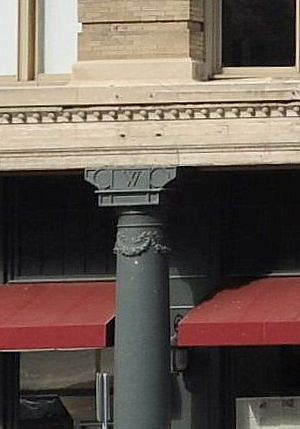
wilsonbldg-det

wilsonbldgHere it is today. Beautiful. Click photo for an image so colossally large that you can easily check out all the fabulous intricate architectural details. (Photo by Joe Mabel.)

***

Sources & Notes

This photo (titled “Building Construction at the Intersection of North Ervay and Elm Street”) is from the incredible George W. Cook Dallas/Texas Image Collection, housed at the DeGolyer Library, Central University Libraries, Southern Methodist University; it can be viewed here. It is not currently identified as being the Wilson Building. (UPDATE: The photo is now titled “Wilson Building Construction, Intersection of North Ervay and Elm Street.” And this post is actually cited in the description! Thank you, DeGolyer Library!) (I have altered the color of these images as they were appearing harshly yellow in my photo editor — please see DeGolyer page for correct color of the original gelatin silver photograph.)

The DeGolyer Library is one of Dallas’ very best repositories of important historical images and papers, and just knowing that they are scanning this fantastic collection of Dallas ephemera is making me a little dizzy. So many incredible images!! An exhibit of selected items from the collection opens TOMORROW (Jan. 30, 2015) — details are here.

Credit and photo info for the gigantic present-day photo by Joe Mabel is here.

Read about Sanguinet & Staats here.

More on the Wilson Building from the Dallas Public Library, here. Check out the photo of the excavation of the site before construction began at the top of the page.

And what does Wikipedia say? See here.

*

Copyright © 2015 Paula Bosse. All Rights Reserved.
A Post Office on the Fairgrounds?

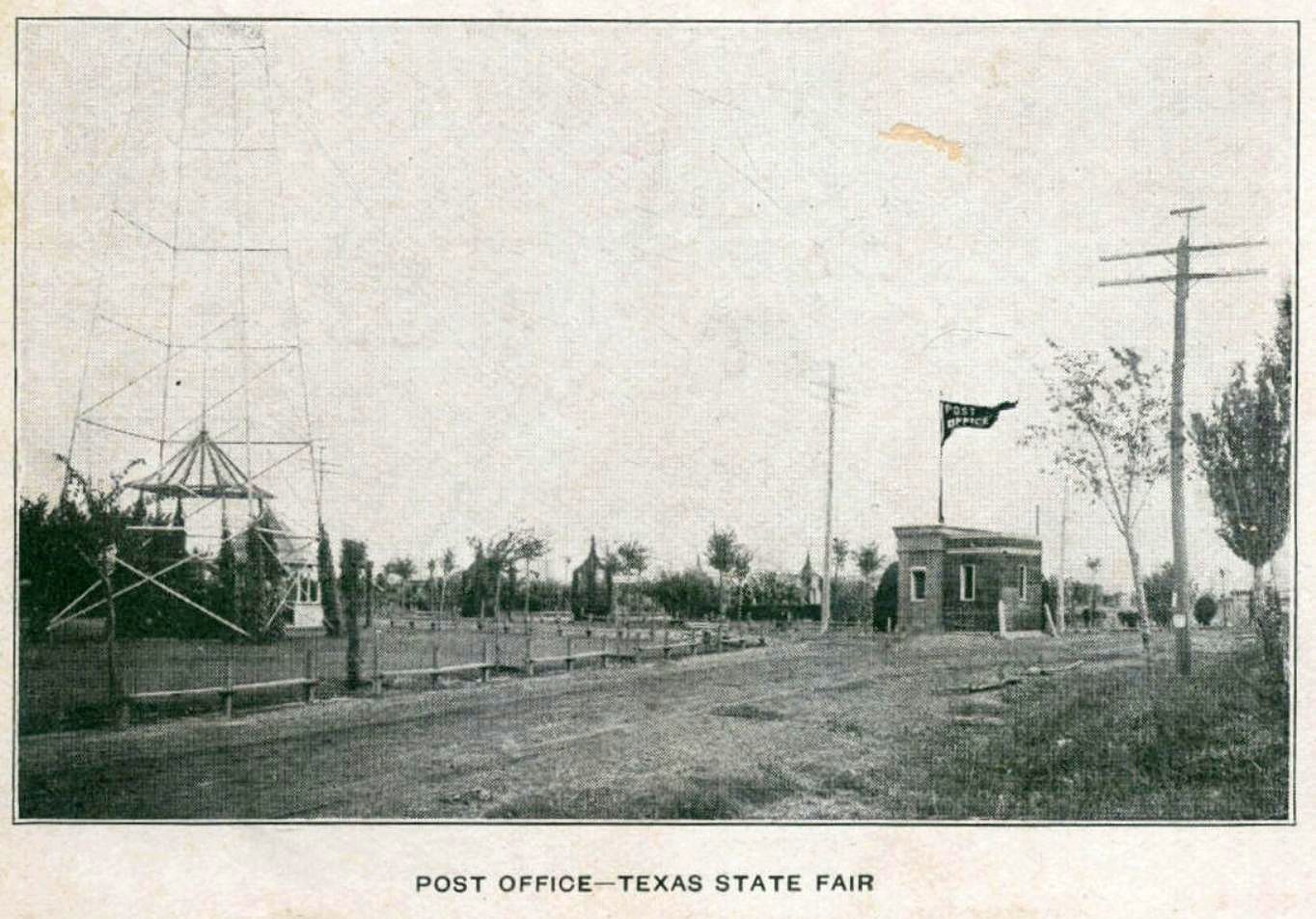
tx-state-fair_post-office_postcardTeeny-tiny post office at Fair Park… (click for larger image)

by Paula Bosse

I’m not really sure about this. It’s a postcard with a photograph captioned “Post Office — Texas State Fair” on the front, and “Missouri, Kansas & Texas Ry. Co.” printed on the back.

mkt_post-office-back

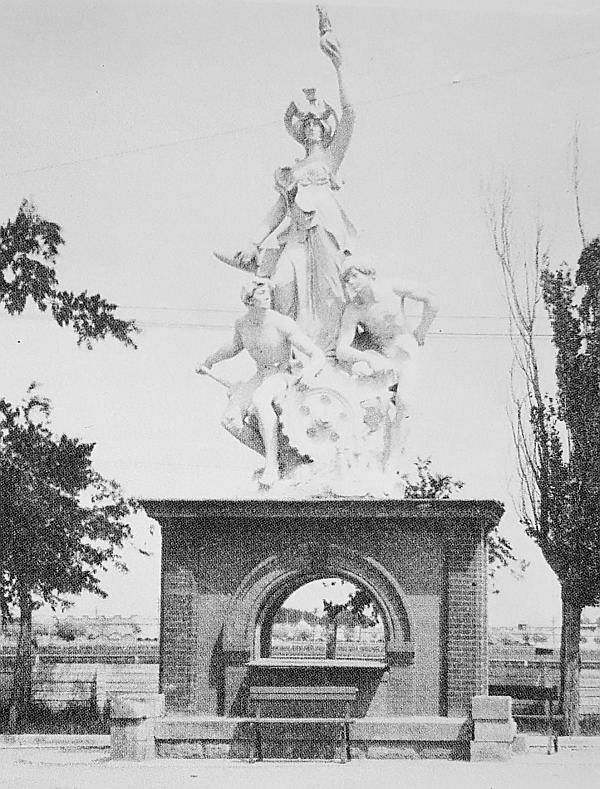
Was there a post office on the fairgrounds? After much googling, I came across a photo of a huge statue atop an arch in the book Fair Park by Willis Cecil Winters. Winters writes that this masonry arch […] served the fairgrounds as a post office.” I’m not sure how that worked, but it’s interesting.

fair-park_arch_statuary_post-office_dallas-rediscovered

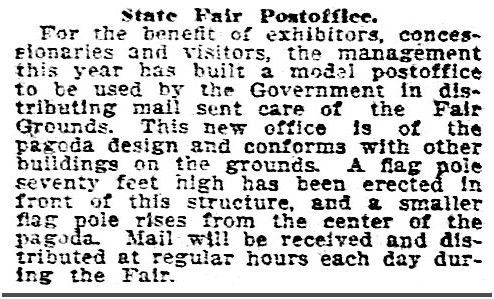
I did find a few mentions of a post office on the grounds of the state fair. Seems that it was a fairly standard temporary fixture on the fairgrounds — not only was it a post office branch that served those who worked the fair, it was also a one of the many features (along with huge steam-powered engines, restaurants, and telegraph and telephone service) that made the fairgrounds a self-contained mini city of sorts:

[I]t is no longer necessary for those doing business at the fair grounds to come down town, as the grounds constitute a completely appointed modern city, with all connection with the outside world. (Dallas Morning News, Sept. 25, 1901)

(Click clippings to see larger images.)

post-office_fairgrounds_dmn_091799
DMN, Sept. 17, 1899

post-office_fairgrounds_dmn_092501
DMN, Sept. 29, 1901

post-office_fairgrounds_dmn_091103
DMN, Sept. 11, 1903

state-fair_post-office_dmn_100408
DMN, Oct. 4, 1908

And now I know.

***

Top photo is from eBay (where this postcard is currently waiting for bids, here).

Photo of the Fair Park sculpture was taken in 1910. The Dallas Historical Society photo is captioned thusly by William L. McDonald in his book Dallas Rediscovered: “‘Progress,’ a sculptural monument to the promise of the age of technology which disappeared mysteriously just before the 1936 Centennial.” (THAT sounds like an interesting story!)

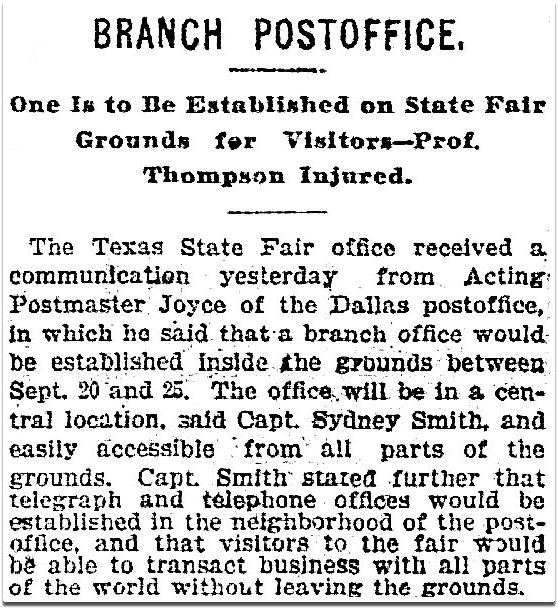
About the only mention I could find of the “colossal statuary that spans the driveway near the grand stand of the race track” (DMN, Oct. 15, 1905) was this short mention in a News article:

fair-park_arch_statuary_dmn_091505
DMN, Sept. 15, 1905

Want to know what the “Act of Congress” mentioned on the back of this “privately printed” postcard means? See here. Kind of interesting. And the info seems to indicate that the postcard above was printed between 1898 and 1901.

Click pictures and clippings to see larger images.

*

Copyright © 2015 Paula Bosse. All Rights Reserved.

Munger Place — 1908

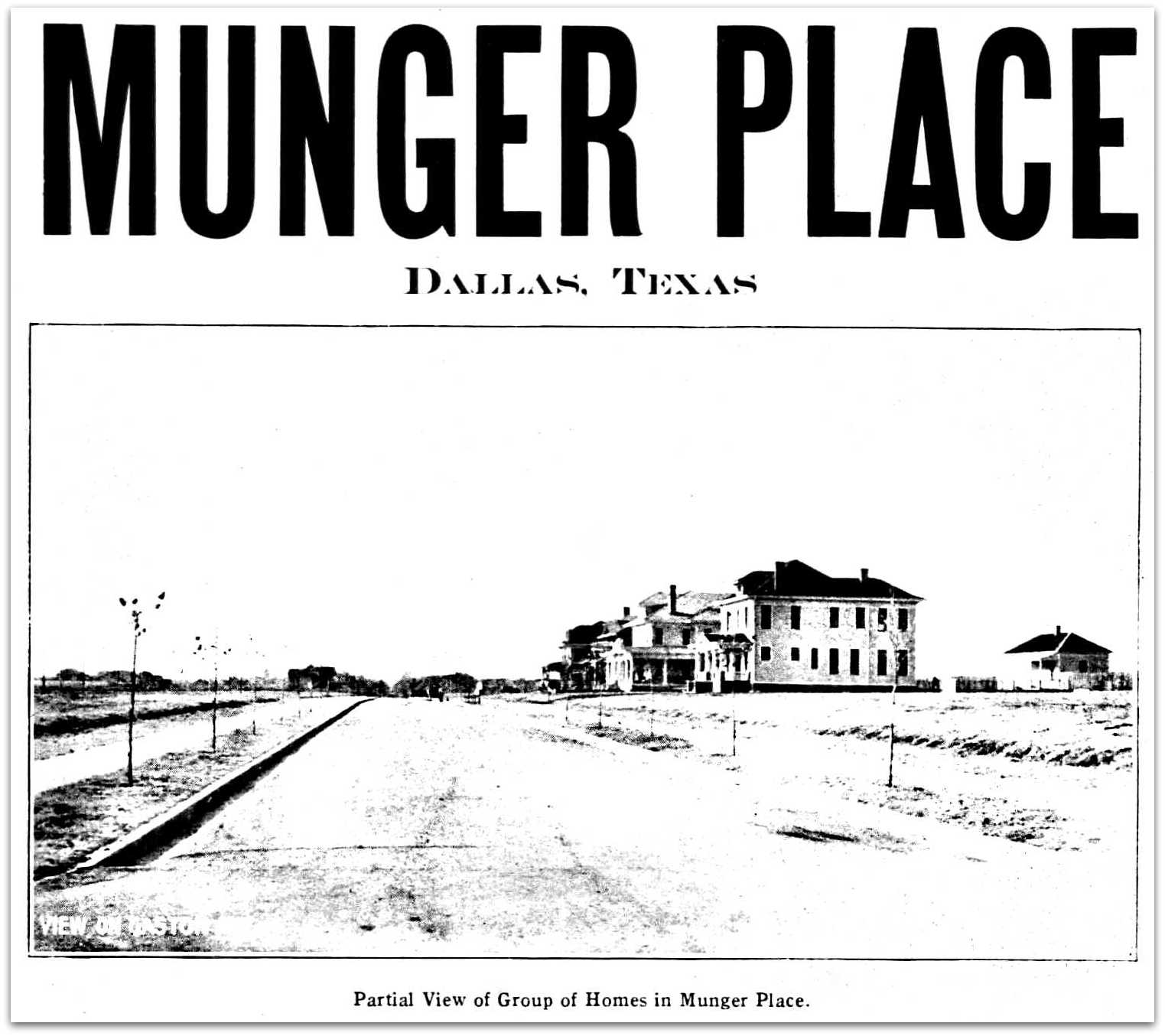
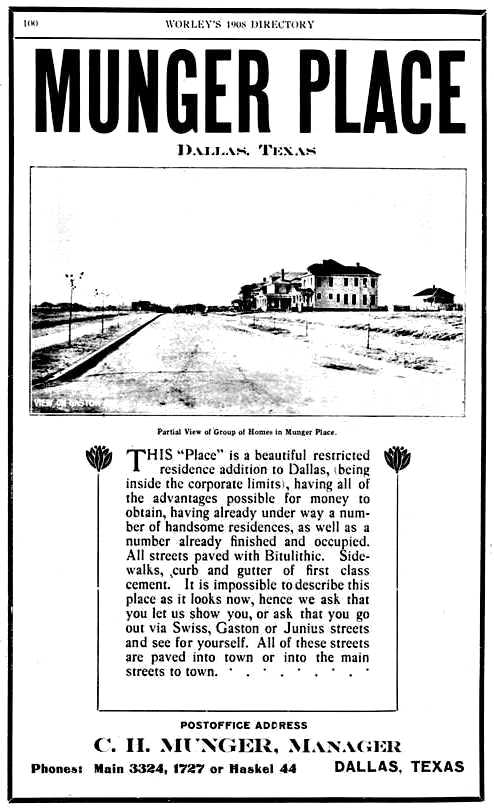
munger-place_city-directory_1908-detGaston Avenue in its salad days… (click for much larger image)

by Paula Bosse

This ‘Place’ is a beautiful restricted residence addition to Dallas (being inside the corporate limits), having all of the advantages possible for money to obtain, having already under way a number of handsome residences, as well as a number already finished and occupied. All streets paved with Bitulithic. Sidewalks, curb and gutter of first class cement. It is impossible to describe this place as it looks now, hence we ask that you let us show you, or ask that you go out via Swiss, Gaston or Junius streets and see for yourself. All of these streets are paved into town or into the main streets to town.

It would have taken a great deal of creative vision to imagine what a beautiful neighborhood the one shown in that bleak photo would one day become. (Does anyone know where on Gaston this photo was taken? Are any of these houses still standing?)

munger-place_city-directory-1908

***

Ad from the 1908 city directory.

Info on the Munger Place Historic District on Wikipedia, here, and at MungerPlace.com, here.

Click top image for a much larger image.

*

Copyright © 2015 Paula Bosse. All Rights Reserved.


Baylor Hospital — 1909-1921

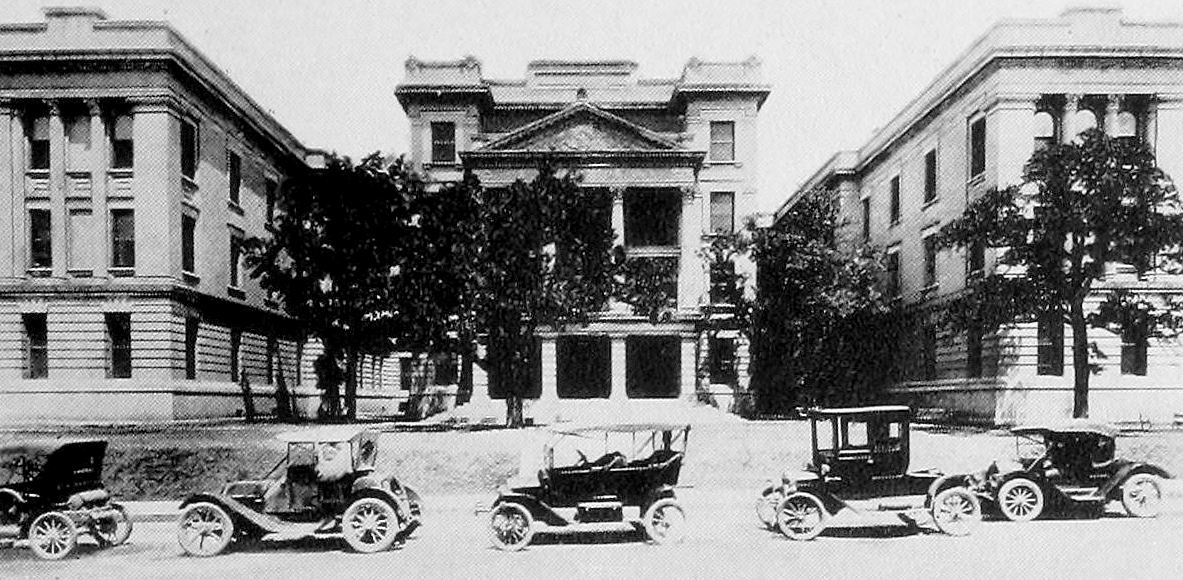
baylor_postcardClassic cars on Junius Street… (click for larger image)

by Paula Bosse

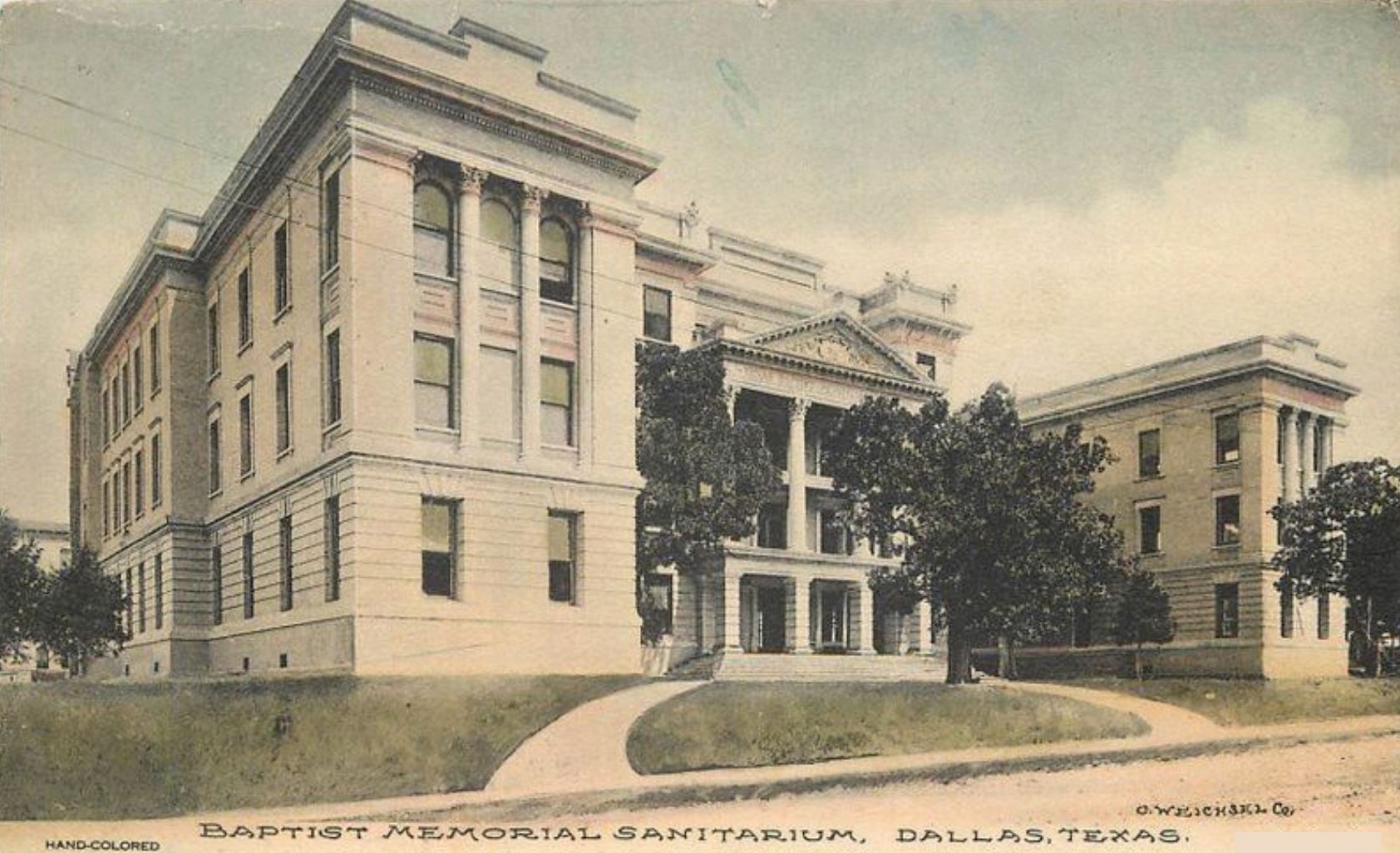
I originally thought the street in front of Baylor Hospital in this postcard was Gaston. But Baylor originally faced Junius Street (see it on a 1921 Sanborn map here), and, in fact, its address was 3315 Junius for many years. I had no idea.

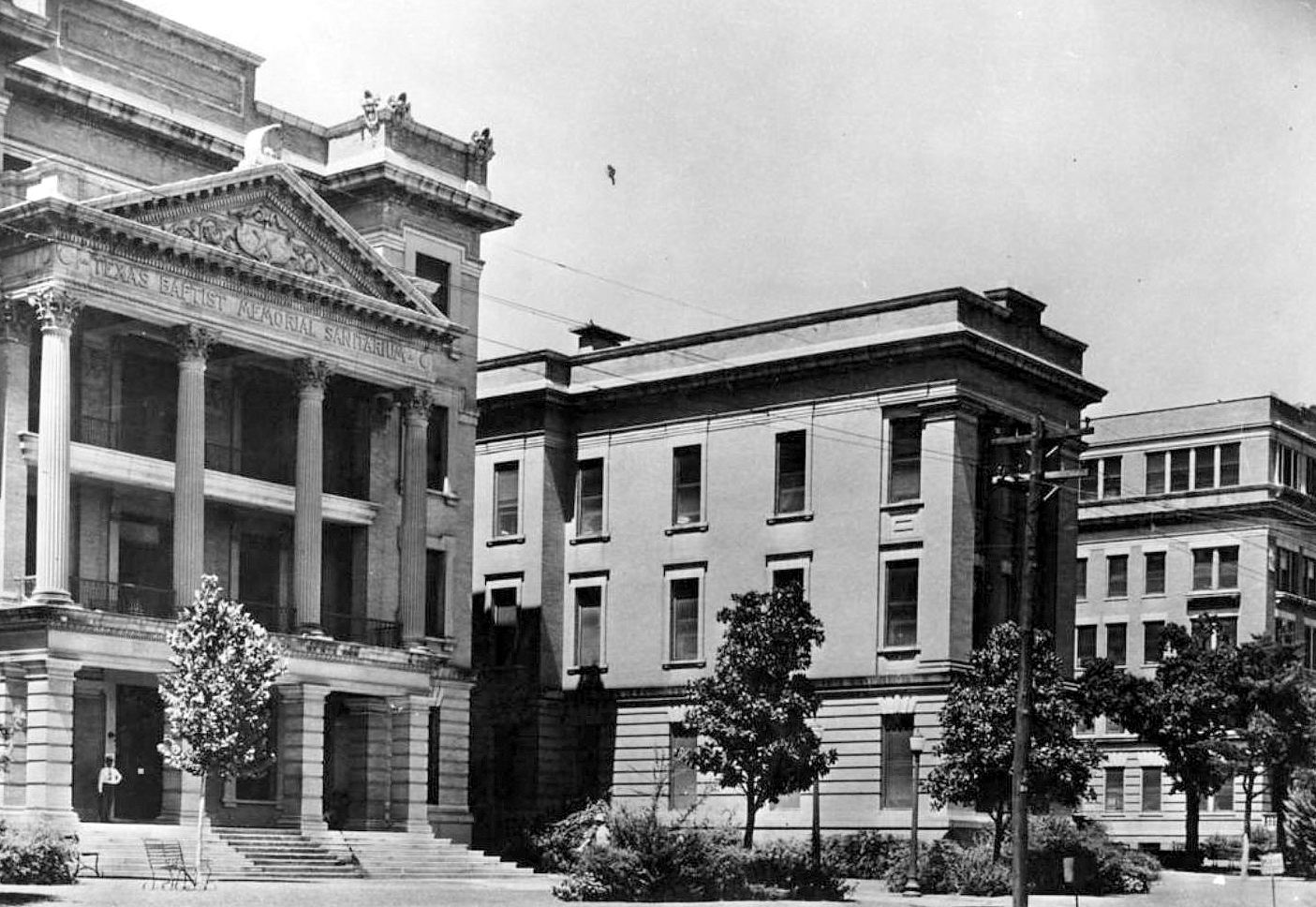
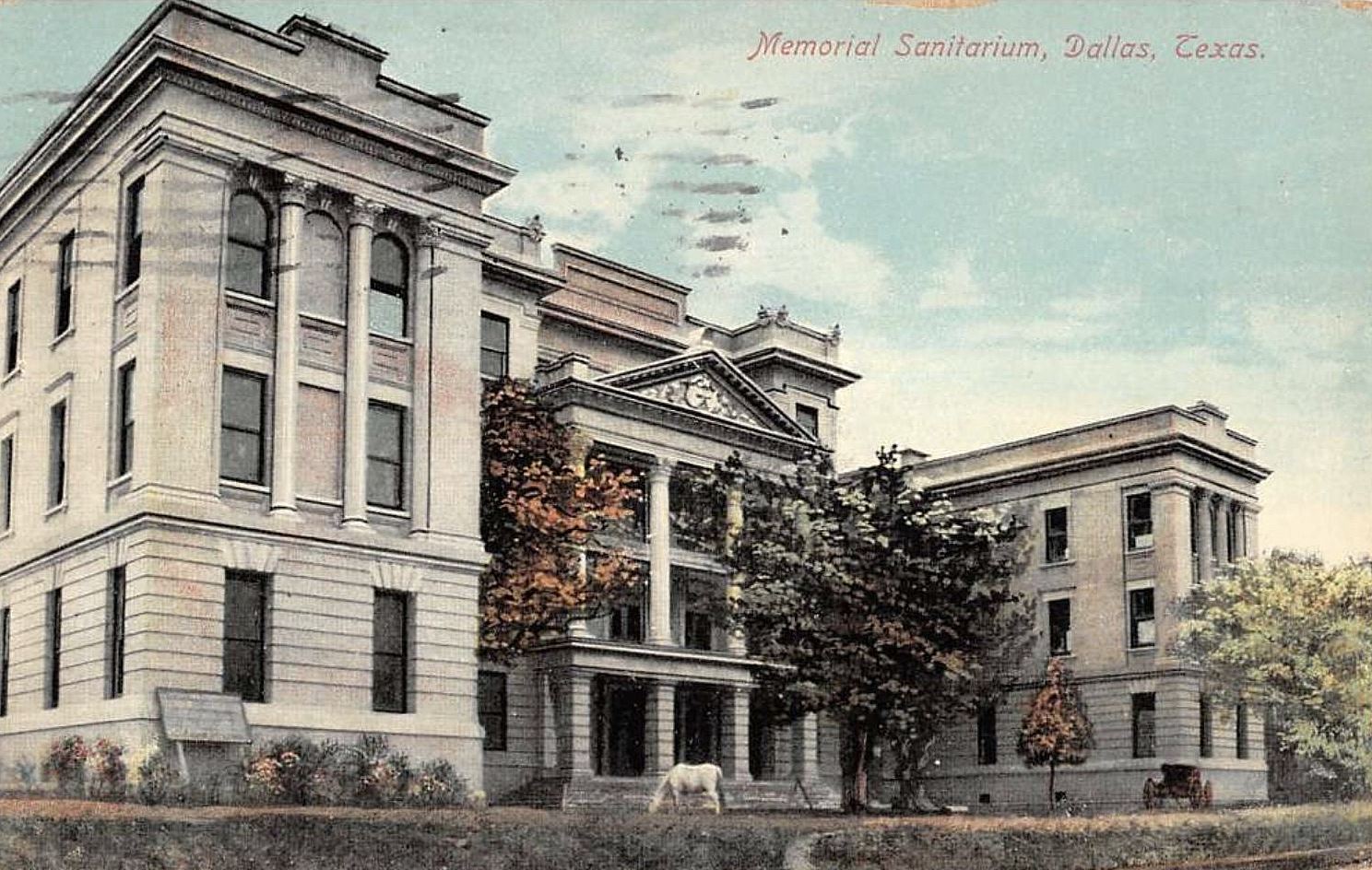
Below are a few more photos and postcards of the medical facility which eventually grew into Baylor Hospital (its Dallas roots go back to 1903, but the buildings seen in these images — buildings designed by noted Dallas architect C. W. Bulger & Co. — were built around 1909). Originally known as the “Texas Baptist Memorial Sanitarium,” it changed its name to the more familiar “Baylor Hospital” in 1920/1921 (and later became “Baylor University Hospital” in 1936). (More on the timeline of Baylor Hospital can be found here and here.)

baylor_postmarked-1919_ebaypostmarked 1919

Dig those cars.

baylor_baylor-univ-waco-yrbk_the-round-up_19171915

baylor-hospital_baptist-sanitarium_postcard

baylor_tx-baptist-memorial-sanitarium_ca-1912_UTSW-libraryca. 1912 (photo: UT Southwestern Library)

This is my favorite one: no cars, but there’s a horse grazing at the entrance!

baylor_horse_postmarked-1911_ebaypostmarked 1911

The postcard below was postmarked 1909, the year these new buildings opened. No cars, no horse, no people. 

baylor_postmarked-1909_ebay1909

And here is the brand new sanitarium, in a photograph that appeared in The Dallas Morning News less than a month after its official opening.

baylor-hospital_exterior_dmn_111009_clogensonDMN, Nov. 10, 1909

***

Sources & Notes

Postcards found on eBay.

The first black-and-white photo is from the 1917 Round-Up, the yearbook of Baylor University in Waco; the same image (uncolorized) appears in the digital archives of UT Southwestern, here, with the date 1915.

The second black-and-white photo is from the UT Southwestern Library archives, here.

The name-change of the Texas Baptist Memorial Sanitarium to Baylor Hospital was proposed in Nov. of 1920 and formally approved by the Board of Trustees of Baylor University in Waco on January 16, 1921. More about the major changes happening to the medical facility/facilities affected can be found in the article “Medical Center For Dallas Is Authorized by Texas Baptists” by Silliman Evans (Fort Worth Star-Telegram, Nov. 13, 1920), here.

Read a detailed description of the Texas Baptist Memorial Sanitarium in the Dallas Morning News article “Baptist Memorial Sanitarium, Just Completed at Dallas, Represents an Investment of More Than Four Hundred Thousand Dollars” (DMN, Nov. 10, 1909), here and here. There are several photographs taken inside and outside (and on top of) the brand new buildings.

*

Copyright © 2014 Paula Bosse. All Rights Reserved.

Dallas News Hustler — 1908

newsboy-horse_dmn_012608_lgErnest d’Ablemont, 13, newspaper carrier aboard his trusty steed, 1908

by Paula Bosse

The photo above appeared in the pages of The Dallas Morning News on Jan. 26, 1908 under the headline “One of the Dallas News Hustlers.” The caption:

Ernest A. d’Ablemont is one of the hustlers selling The Dallas News. He began selling the paper in March, 1905, on Sundays at the age of 11 years. He is now 14, or will reach that age on his birthday, March 16, 1908. Since he began, he has never missed a Sunday, rain or shine, hot or cold. Since his business career began he has clothed himself and has accumulated sufficient money to enable him to make a loan of $150 at 10 per cent.

Quite the business-minded newsboy — the Inflation Calculator estimates that $150 in 1908 would be equivalent to almost $4,000 today! In 1909 — just a year later — he had his own entry in the Worley’s city directory, but he had jumped ship from the News and was working for The Dallas Dispatch.

dablemont_worleys_1909

Ernest d’Ablemont was born in Dallas in 1894 to immigrant parents — his father, Felix, was French, and his mother, Inga, was Norwegian. One wonders what could possibly have enticed a Parisian to come to Dallas, but Felix had been in the city since about 1883, working first in a meat market, then spending most of his life as a produce man. Felix was a “truck farmer” (he grew vegetables to sell locally), and he had a small piece of land off 2nd Avenue in the old Lagow Settlement area, south of Fair Park, about where S. 2nd Ave. intersects with Hatcher. Felix placed this ad in 1903:

dablemont_dmn_110103

“German, Swede, Norwegian or French preferred.”

Ernest followed in the footsteps of his farmer father. After his early entrepreneurial foray into the world of newspaper delivery and a couple of years of service in World War I (which took him overseas where he was assigned to a field hospital and a “sanitary train”), he returned to Dallas and worked the family’s truck farm until he retired. He died in 1954 at the age of 60.

***

Sources & Notes

Top image of young Ernest on horseback from The Dallas Morning News, Jan. 26, 1908; photo by Clogenson.

Want-ad from the DMN, Nov. 1, 1903.

WWI “sanitary trains”? I’d never heard the term. Find out what they were and see what one looked like in this GREAT photo from Shorpy, here.

*

Copyright © 2014 Paula Bosse. All Rights Reserved.

Main Street — 1905

main-st_1905A wide Main Street (click for larger image)

by Paula Bosse

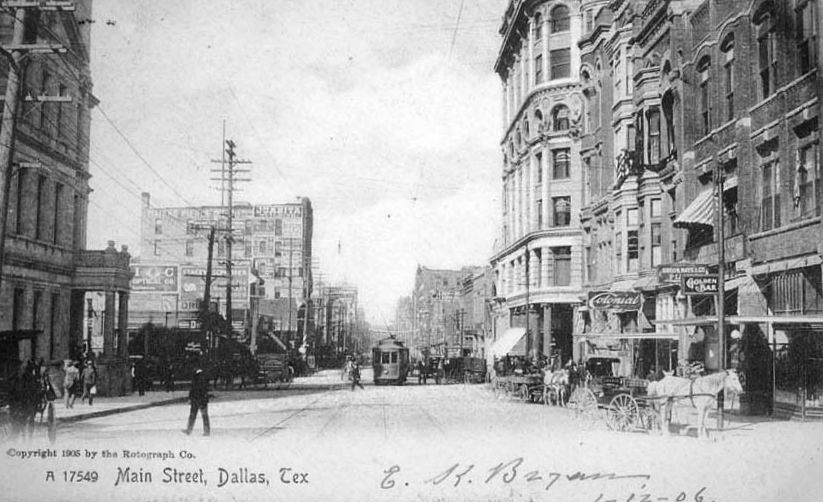
Just another day on Main, here looking west from the middle of the block between Ervay and St. Paul. The Wilson Building is on the right, the Juanita Building is at the top left.

***

Postcard from eBay.

*

Copyright © 2014 Paula Bosse. All Rights Reserved.

Please Don’t Pull the Daisies

city-park_no-one-allowed-to-pull-flowersCity Park, 1909-ish

by Paula Bosse

Back when Old City Park was merely “City Park.” The sign at the bottom right reads: “WARNING: NO-ONE ALLOWED TO PULL FLOWERS.” Seems a bit brusque. Not even a “please.” Still, one best not.

***

Sources & Notes

Hand-colored postcard with an odd color palette, probably by Weichsel, around 1909.

*

Copyright © 2014 Paula Bosse. All Rights Reserved.

Dallas High School Football, 1909-Style

football-team-1909Game faces ON… (click for larger image)

by Paula Bosse

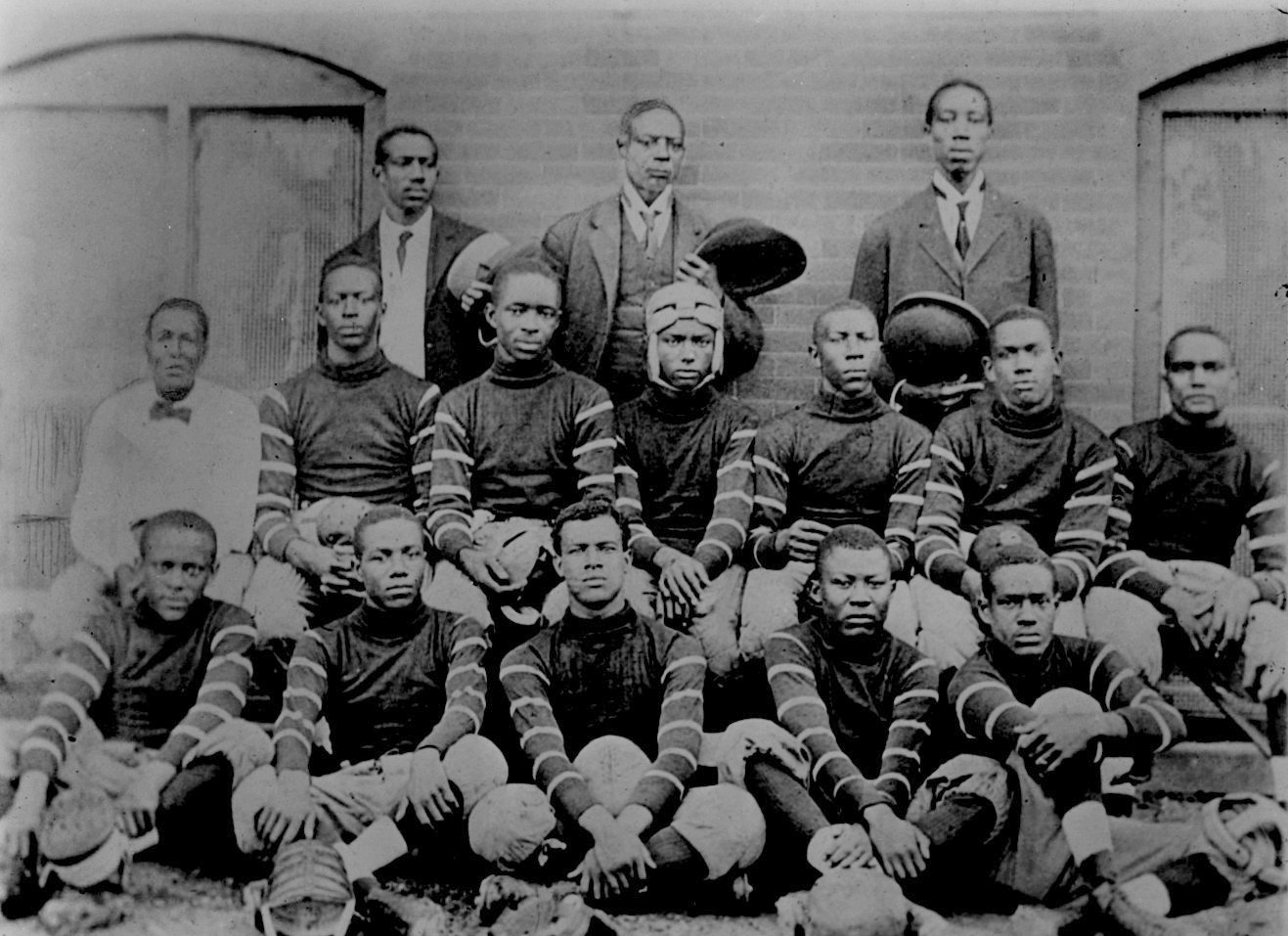
Great Dallas Historical Society photo described only as “a high school football team,” from 1909. The team most likely represented the “Colored High School” located at Hall and Cochran, the only high school in Dallas at the time for African-American students (it eventually merged with and relocated to the nearby Booker T. Washington High School in the early 1920s where, incredibly, it remained the city’s only high school for black students until Lincoln High School opened in South Dallas in 1939).

As everything was segregated at the time, including schools and sports, the number of black high school football teams they could play was severely limited — in-town opponents were non-existent. In fact, a 1909 blurb in The Dallas Morning News announced that “[t]he football team of the Dallas Colored High School will play the Wylie University team from Marshall at Gaston Park” (DMN, Nov. 12, 1909). They were playing college teams. From 150 miles away. At least they were the home team.

***

Photo from the J. L. Patton Collection, Dallas Historical Society.

Click picture for larger image.

*

Copyright © 2014 Paula Bosse. All Rights Reserved.