Flashback : Dallas

A Miscellany: History, Ads, Pop Culture

Category: 1900s

Brown Cracker Co. Cracker Wrappers
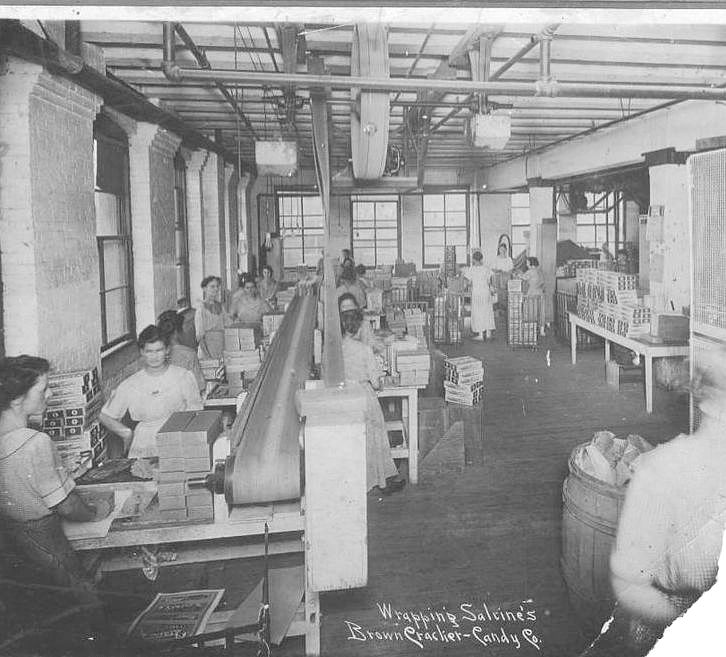
brown-cracker_ca1918_cook_degolyerThe saltine-wrapping room

by Paula Bosse

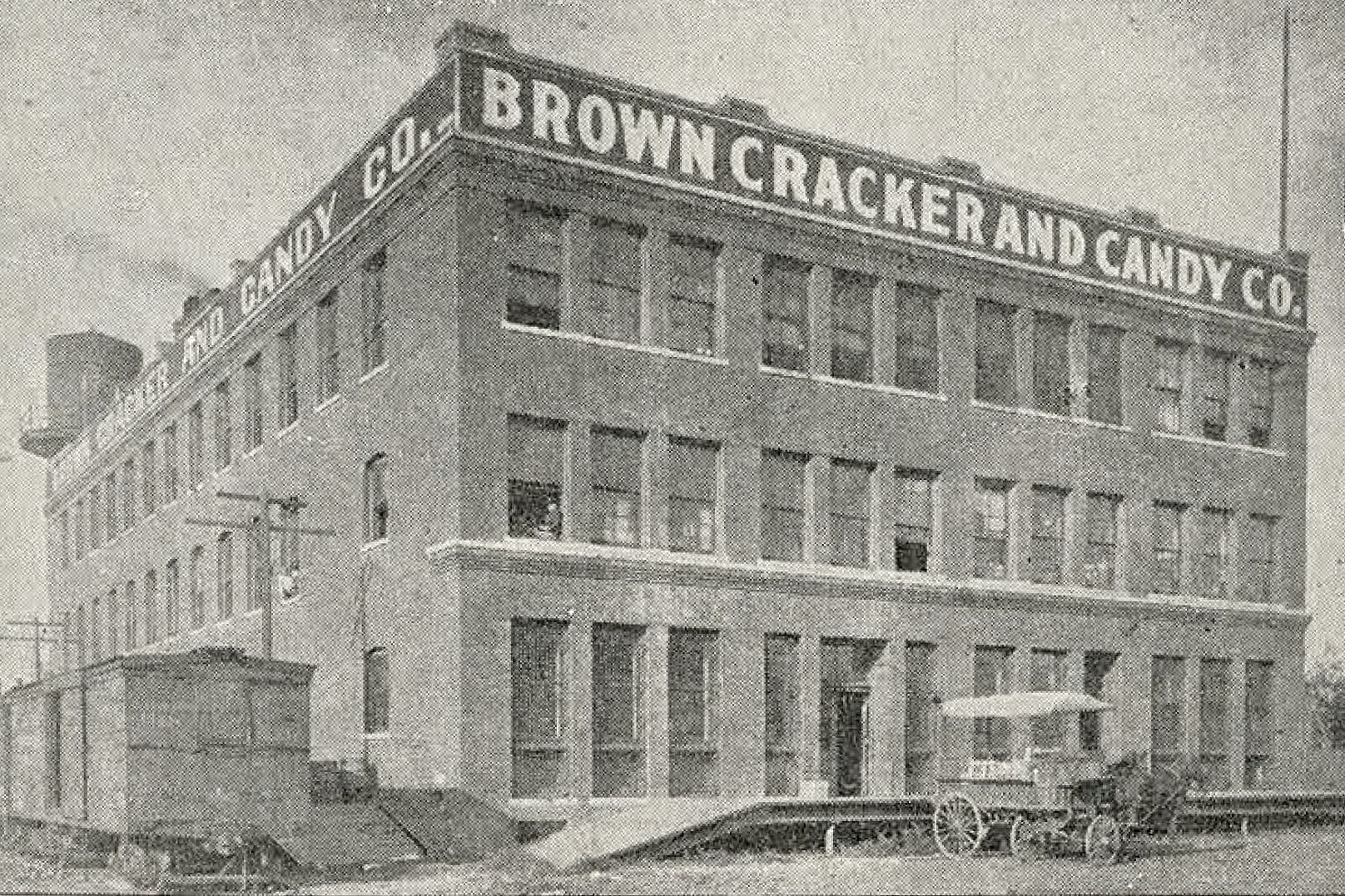
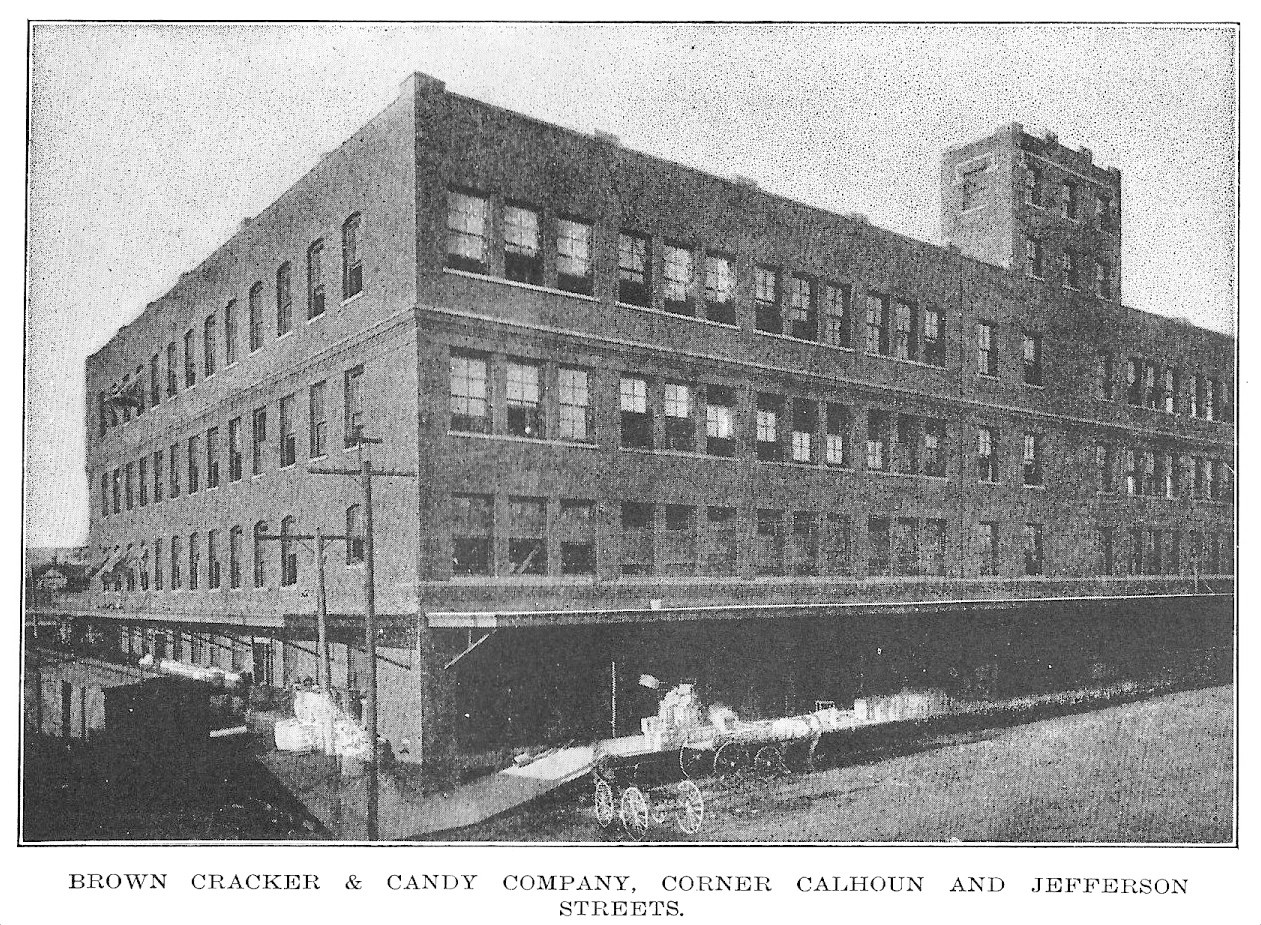
I will stop and look at great length at any photograph containing a conveyor belt. The conveyor belt in this photo belonged to the Brown Cracker and Candy Company, a large and important Dallas manufacturer and employer. The cracker, cake, and candy factory opened in 1903 in a brand new building in the industrial area just south of McKinney Avenue (the part of town that borders downtown, now known as the West End). Best known these days as the West End Marketplace building, the structure still stands and, in fact, has just been purchased and is about to undergo renovation.

brown-cracker_postcard_cook-degolyerDeGolyer Library, SMU

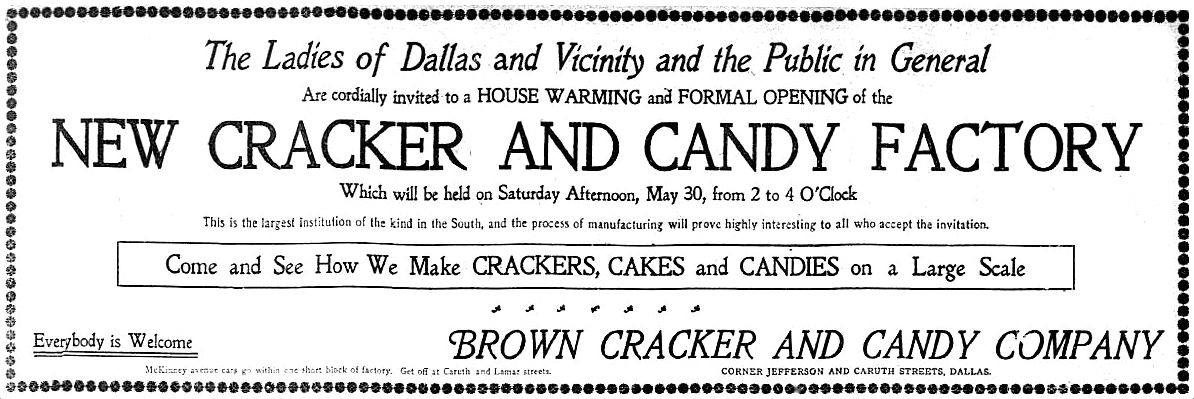
As the new building was nearing completion, the company charter was filed in April 1903, and just a few short weeks later, the factory opened itself up for inspection by the community.
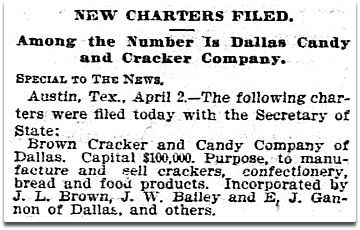
brown-charter_dmn_040303Dallas Morning News, April 3, 1903

brown_opening_dmn_052903
DMN, May 29, 1903 (click for larger image)

The open house was packed — several thousand people (mostly women) showed up to tour the plant, fascinated by the inner workings of the city’s newest business, a manufacturer of crackers and sweet treats. Of particular interest must have been the two giant brick ovens on the the second floor, which used more than one ton of coal daily, and the huge copper kettles used in candy making on the top floor. There were also things like chocolate dipping machines, starch machines (?), and marshmallow heaters (I don’t know what that is, but I want to see one in action — could it have been a “marshmallow beater,” like the one seen here?).
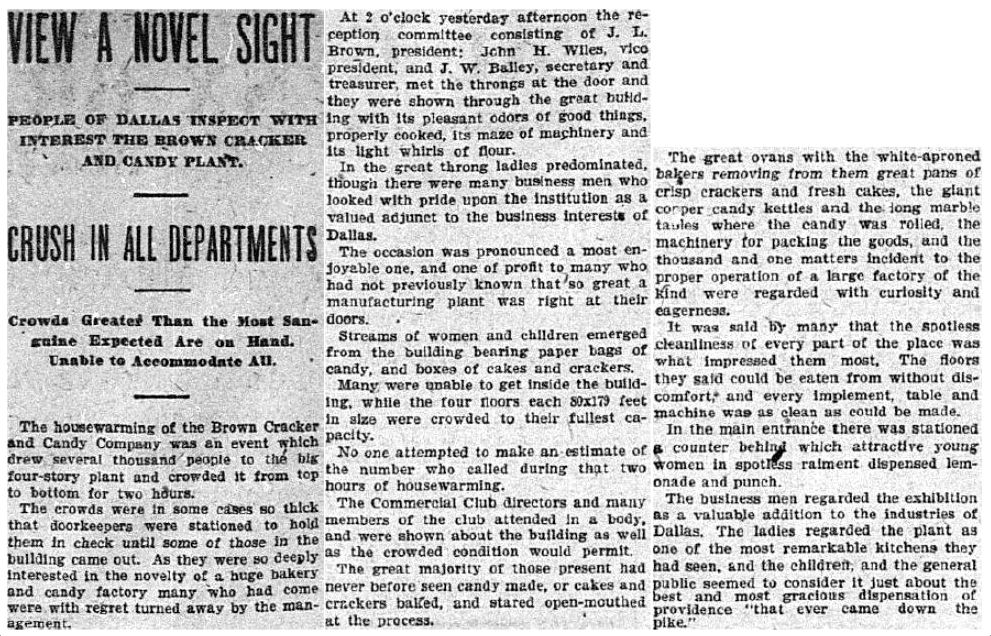
brown-cracker_dmn-053103DMN, May 31, 1903

The main reason to open the factory to the public for inspection — other than as a PR-managed meet-and-greet — was to let the people see for themselves just how CLEAN the place was. This was at a time when unsanitary food handling and manufacturing practices were much in the news (see here) — concerns which ultimately led to the enactment of the Pure Food and Drug Act of 1906 — and the above article stresses that visitors were impressed by the factory’s “spotless cleanliness” (“The floors they said could be eaten from without discomfort…”). In regard to the “cracker wrappers” pictured at the top, the company wanted to make sure everyone knew that their products were wrapped and boxed — gone were the days of shoppers dipping their (probably unclean) hands into the old “cracker barrel” full of loose, stale crackers.

crackers_dmn_040603DMN, April 6, 1903

Let’s take a closer look at the top photo, probably taken around 1920 (click pictures for larger images).

brown-cracker_ca1918_cook_degolyer_det2

brown-cracker_ca1918_cook_degolyer_det1

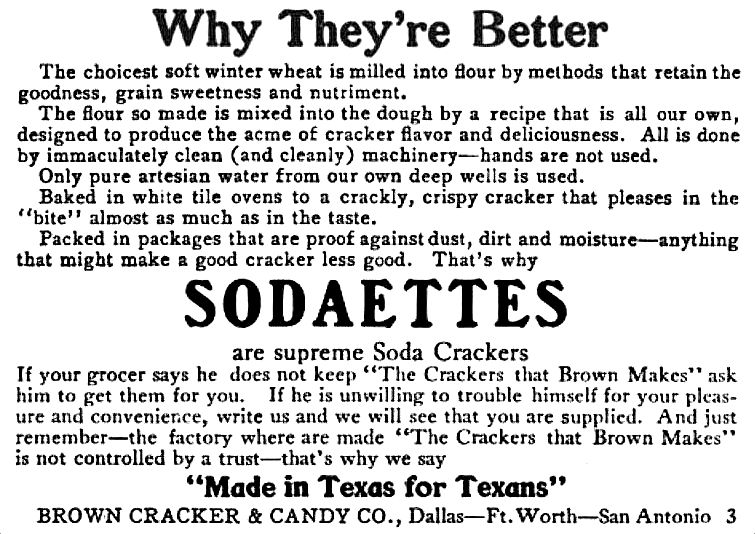
ad-brown_dmn_122003DMN, Dec. 20, 1903

sodaette-crackers(click to read text)

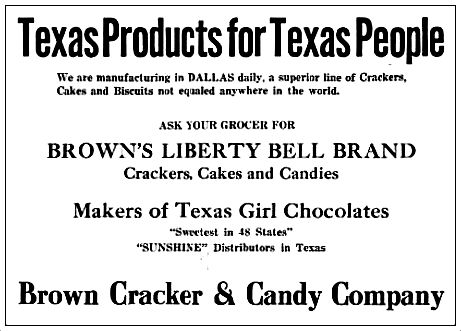
brown-cracker_1922-directory1922 city directory

brown-cracker_come-to-dallas_degolyer_SMU_ca1905ca. 1905

brown-cracker-greater-dallas-illustrated_ca1908ca. 1908

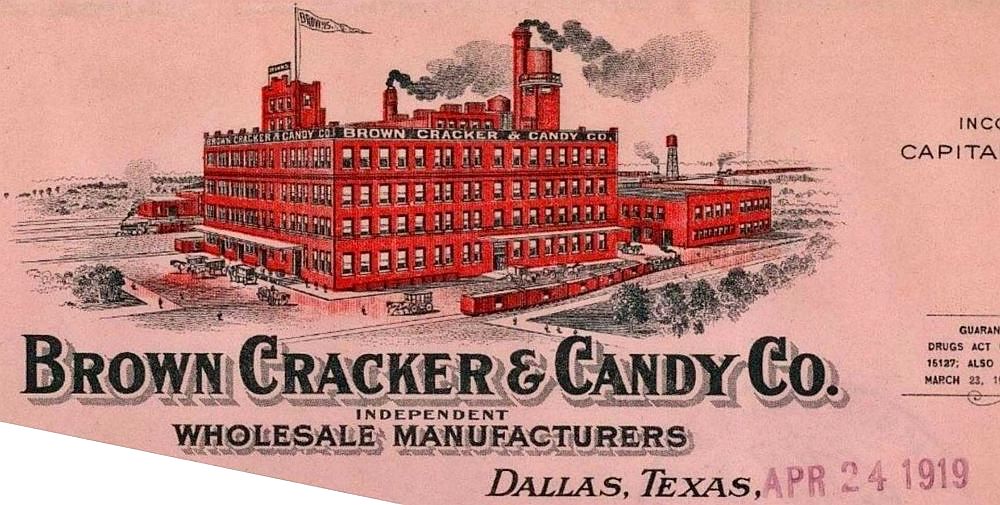
brown-cracker-co-lettrhead_1919_ebay1919 (eBay)

***

Sources & Notes

Top photo, titled “Wrapping Saltines at Brown Cracker and Candy Co.,” is from the George W. Cook Dallas/Texas image collection, DeGolyer Library, Central University Libraries, Southern Methodist University; it can be accessed here.

Written on the back of the photo: “Miss Bessie Manning, 2724 Roadwood [sic] avenue, Dallas, Texas.” Bessie Manning (born Bena Manina in 1899 to Italian immigrants), began working at the Brown Cracker Co. (with a brother and a sister) around 1917 but wasn’t living on Rosewood (later North Harwood) until 1919; she left Brown in 1921 or 1922. She isn’t identified in the photo, but she is, presumably, one of the women on the left; she would have been about 20.

bessie-manning_1920-censusBessie Manning’s occupation, 1920 census

The color postcard showing the Brown Cracker Co. is also from the Cook collection at SMU; it is here.

The Sodaette ad is from Library of Advertising by A. P. Johnson (Chicago: Cree Publishing Co., 1911).

The photo from about 1905 is from the promotional brochure titled “Come To Dallas” (Dallas: Dorsey Printing Co., about 1905), in the collection of the DeGolyer Library, Southern Methodist University; more info is here.

The photo at the bottom is from Greater Dallas Illustrated, The Most Progressive Metropolis in the Southwest (Dallas: The American Illustrating Company, 1908; reprinted by Friends of the Dallas Public Library, 1992). The informative company profile that accompanied the photo can be read in a PDF, here.

All other ads and clippings as noted.

Another very informative article which details the specifics of the building and its machinery — “New Dallas Industry, Brown Cracker and Candy Company About to Begin Operations” (DMN, Apr. 6, 1903) — can be read in a PDF, here.

To see the Brown Cracker Company’s specs on a Sanborn map from 1905, see here; to see where it is on a modern map, see here.

For current info on what’s about to happen to the building (much expanded over the years), see Steve Brown’s Dallas Morning News article, here.

And, yes, a teenaged Clyde Barrow apparently worked there briefly, for a dollar a day.

*

Copyright © 2015 Paula Bosse. All Rights Reserved.
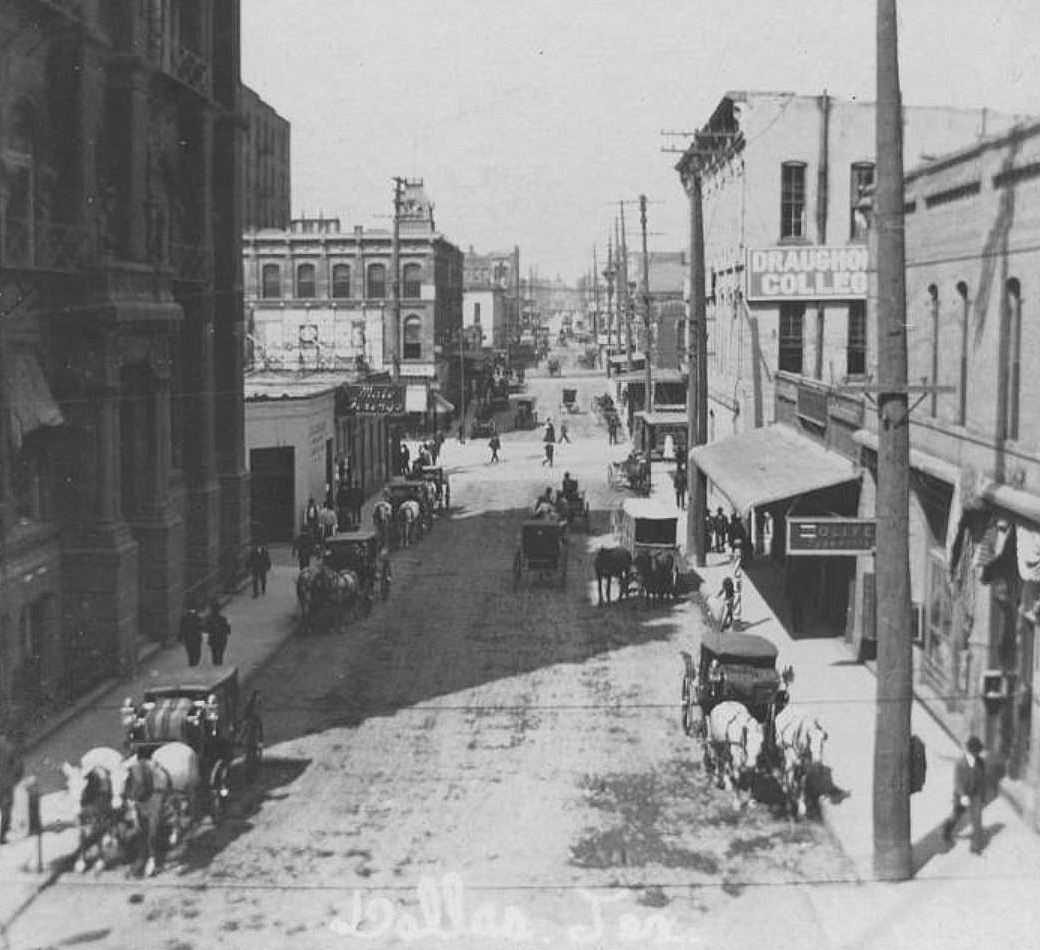
“Male Fixings” and Horse Manure — Akard Street, ca. 1906

akard-looking-north_cook-colln_degolyer_smu_ca-1906George W. Cook Collection, SMU

by Paula Bosse

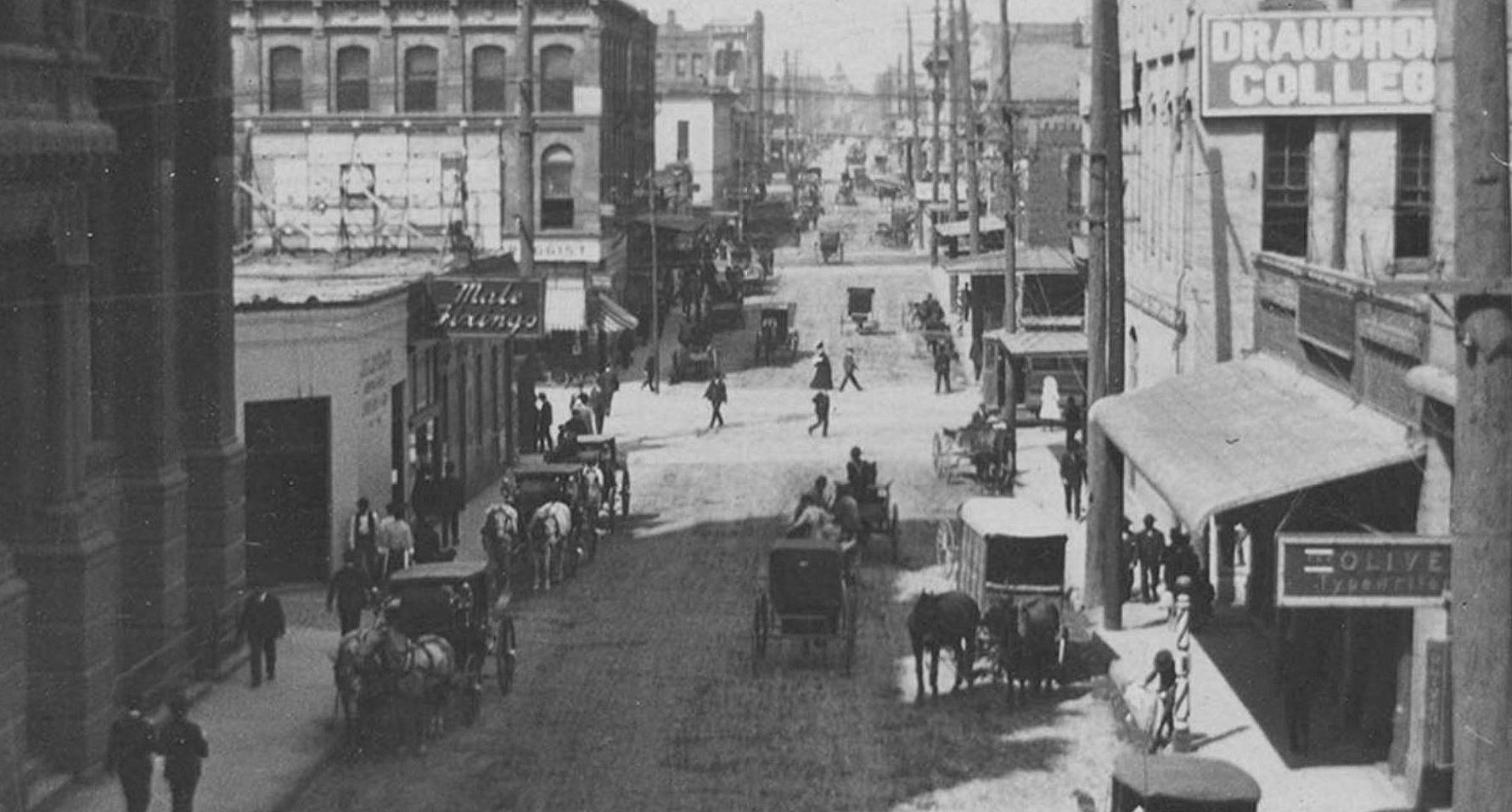
This great photograph shows Akard Street looking north from just south of Main. I especially like the sign for “Male Fixings” (a store selling men’s clothing accessories). Let’s zoom in to see that sign better (click photo to see a much larger image).

akard-looking-north_cook-colln_degolyer_smu_ca-1906-det

I also like the guy with the bicycle, next to the barber pole at the lower right, and the lone woman crossing the street. (There is a little girl in a white dress on the sidewalk on the right — about to cross Main — but everyone else in this photo is of the gender that might well patronize a business called “Male Fixings.”)

As indelicate as it may be to bring up the subject … I assume there were people employed to walk around the streets with shovels to clean up after all those horses? I’ve actually thought of this fairly often. It had to have been a major, major problem back then. I’ve just looked it up. The average horse pulling wagons and carriages produced, on average, 30+ pounds of manure and several gallons of urine daily, deposited willy-nilly whenever the need arose (which was often). Multiply that by hundreds. This article isn’t about Dallas, but I highly recommend “The Great Horse Manure Crisis of 1894” — you’ll learn way more about the subject than you may want to — read it here. That lady crossing the street? I bet she spent a good part of every day hiking her skirts and dodging dung.

*

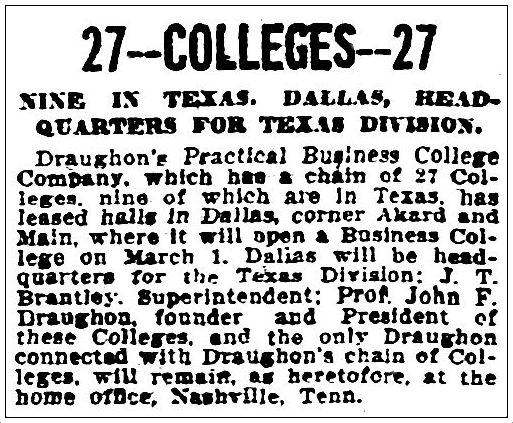
UPDATE: I’ve updated the title to this post several times (you’ll notice that the URL of this post shows a different location and year). After spending time to pin down the date, it appears this photo was taken between 1906 and 1909, when the Draughon Practical Business College was located at the southeast corner of Main and Akard — and the Oliver Typewriter Agency was located at 114 South Akard. The original annotation of this photo says the view is Main Street, with Akard in the midground, but it appears this photo was taken just south of Main Street looking north on Akard. The photo is confusing because the Draughon’s sign is seen here on the Akard Street side, not the Main Street side. The main tip-off is the cupola seen atop the building standing at the northwest corner of Main and Akard — it is the Rowan Building, which housed the Marvin Drug Store, which I wrote about here.

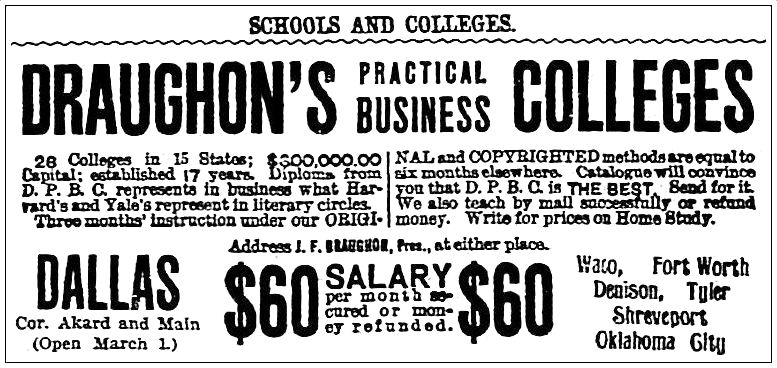
Draughon’s Practical Business College opened its first Dallas campus (but its 27th location across the major cities of the south) at the southeast corner of Main and Akard in March, 1906. By the time the 1910 city directory was printed, they had moved to another location (in fact, in their first ten years in Dallas they had moved five times!). I’m not sure how long the business college lasted in Dallas — at least through the 1970s, possibly longer — but the institution seems to still be in business after something like 130 years. (Click ads below to see larger images.)

draughon-business-school_dmn_0304061906

draughon-business-school_dmn_0315061906

***

This is another wonderful photo from the George W. Cook Dallas/Texas Image Collection, DeGolyer Library, Central University Libraries, Southern Methodist University; it can be accessed (and zoomed in on) here.

Another interesting article on the “manure problem” is “When Horses Posed a Public Health Hazard” — a blog post from The New York Times (which tantalizingly mentions herds of pigs roaming the streets of NYC) — read it here.

*

Copyright © 2015 Paula Bosse. All Rights Reserved.
Akard Street Looking South, 1887-2015

akard_from-pacific_cook_degolyer_smu_ca1898-detAkard Street from Pacific, ca. 1898, via Cook Collection, SMU

by Paula Bosse

I realized the other day that I have an inordinate number of photographs and postcards showing Akard Street looking south — usually taken from Pacific or Elm, so I thought I’d collect them all together. Some of these aren’t dated, so they’re not in strict chronological order, but I’ve made a half-hearted attempt to make sure horse-and-buggy photos are before the men-in-straw-hat-boaters, which are before the women-in-Miss-Crabtree-dresses, which are before the cars-with-rounded-bodies. It might be easiest to just assume they are not in chronological order. (All photos are larger when clicked — a couple are really  big.)

*

The oldest is from 1887, when North Akard was still called Sycamore Street, and before the Oriental Hotel was built at Commerce and Akard in 1895.

akard_south-from-elm_1887

*

Next up, an incredible photo, taken around 1898, a detail of which appears at the top of this post. The Oriental Hotel can now be seen at the end of Akard, at Commerce, where Akard used to make a dog-leg turn before continuing south, giving the appearance of a dead-end street.

akard_from-pacific_cook_de-golyer_smu-ca1898via George W. Cook Collection, DeGolyer Library, SMU

*

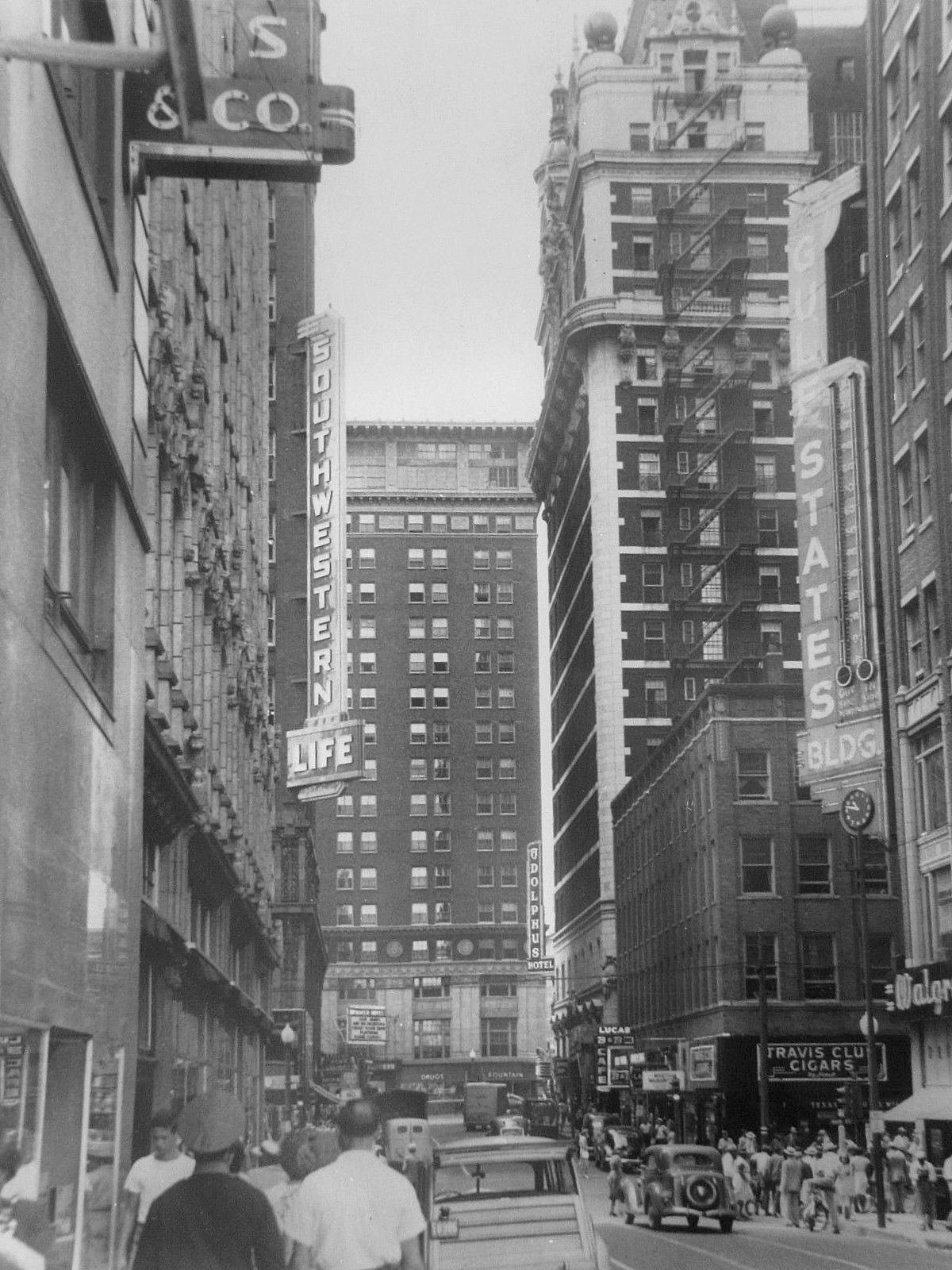
Another, with the Adolphus Hotel (built in 1912) now on the right, across Commerce from the Oriental. The tall building across Akard from the Adolphus is the Southwestern Life Building. The Gentry photography studio was at the southeast corner of Elm and Akard from 1912, which is probably the date of this postcard image. Construction of the Busch Building (now known as the Kirby Building) began in December, 1912.

akard-elm_postcard_ebay_ca-1912via eBay

*

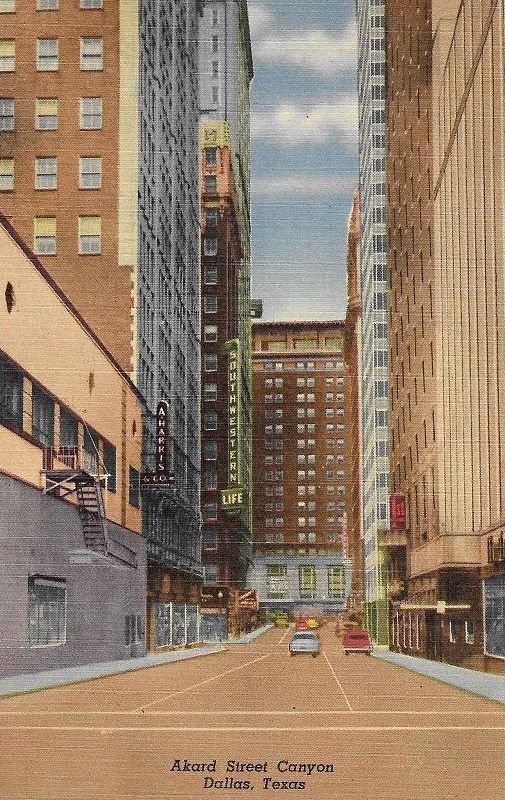
From 1925, with the new Baker Hotel having replaced the Oriental Hotel. This area was now being called “the canyon district” or “the canyon.”

akard_south-from-elm_1925

*

In this great Frank Rogers photo, the canyon walls are getting higher, with the Adolphus Hotel firmly anchoring the Commerce corner across from the Baker.

akard_baker-adolphus_postcard_rogers_ebayvia eBay

*

By the time this photo was taken in about 1936, Pegasus had become a part of the skyline, perched atop the Magnolia Petroleum Building. (Note the Queen Theater at the northeast corner of Elm and Akard.)

akard_pacific_1936_legacies-spring-1989via Legacies History Journal

*

This photo is from the early- or mid-1930s — LOOK AT ALL THOSE PEOPLE.

akard-canyon_municipal-archives_dma-uncratedvia the DMA’s Uncrated blog

*

As opposed to this one, which has NO people in it.

akard-canyon_ebayvia eBay

*

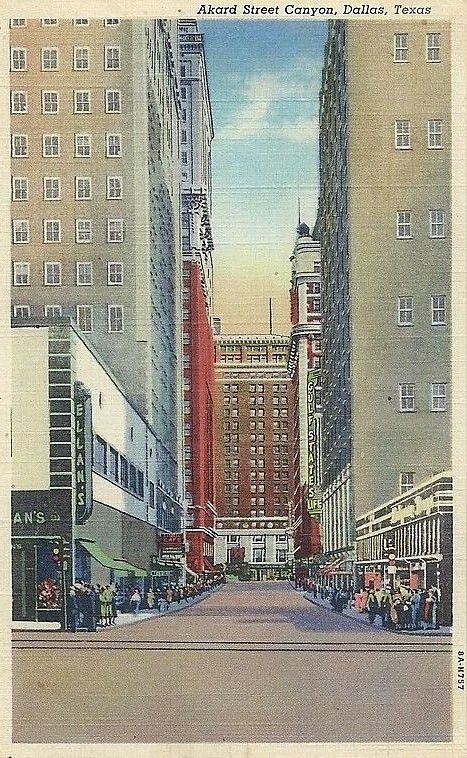
More canyon, this view showing the super-cool art-deco-y building at Elm and Akard with Ellan’s hat shop on the ground floor, late-1930s.

akard-st-canyon_ellans

*

This candid photograph, a little deeper into the canyon, is one of my favorites. (Click to see a gigantic image.)

akard-looking-south_ebayvia eBay

*

From 1951 — a bit grainy, but a slightly closer view of the side of the Queen Theater at the left and the Mayfair department store, built in 1946, at the right:

akard_dpl_1951via Dallas Public Library

*

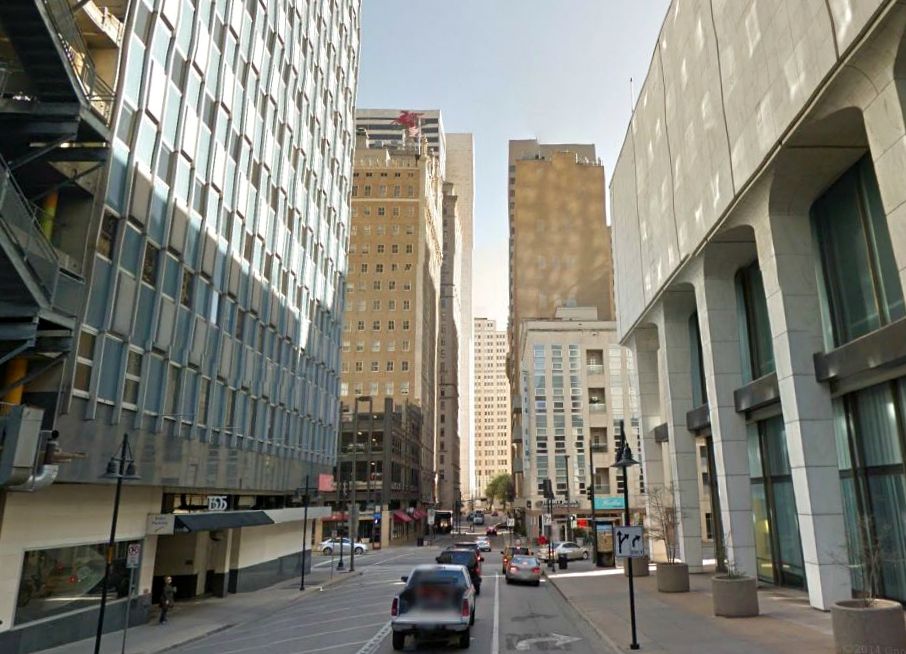
And, finally, today. Pegasus and the Adolphus are still there, but the Baker Hotel was demolished in 1980, replaced by the One AT&T Plaza/Whitacre Tower.

akard-looking-south_google_2015via Google Street View, 2014

***

Sources & Notes

The photo dated by SMU as “circa 1898” is titled “Akard Street from Akard and Pacific Avenue Intersection”; it is from the George W. Cook Dallas/Texas Image Collection, DeGolyer Library, Central University Libraries, Southern Methodist University, and it can be viewed here.

The circa 1936 photo showing Pegasus is from the Spring, 1989 issue of Legacieshere; it is from the Hayes Collection, Texas/Dallas Archives Division, Dallas Public Library, and is attributed to Denny Hayes.

The photo showing “ALL THOSE PEOPLE” is from the Dallas Museum of Art’s Uncrated blog — here — is from the Dallas Municipal Archives. They have the date as “1940,” but Liggett’s Drug Store was gone from Elm and Akard by 1936.

Other sources as noted.

Click pictures for larger images — sometimes MUCH larger images.

*

Copyright © 2015 Paula Bosse. All Rights Reserved.
 

Three of Dallas’ Earliest “Photoplay Houses” — 1906-1913

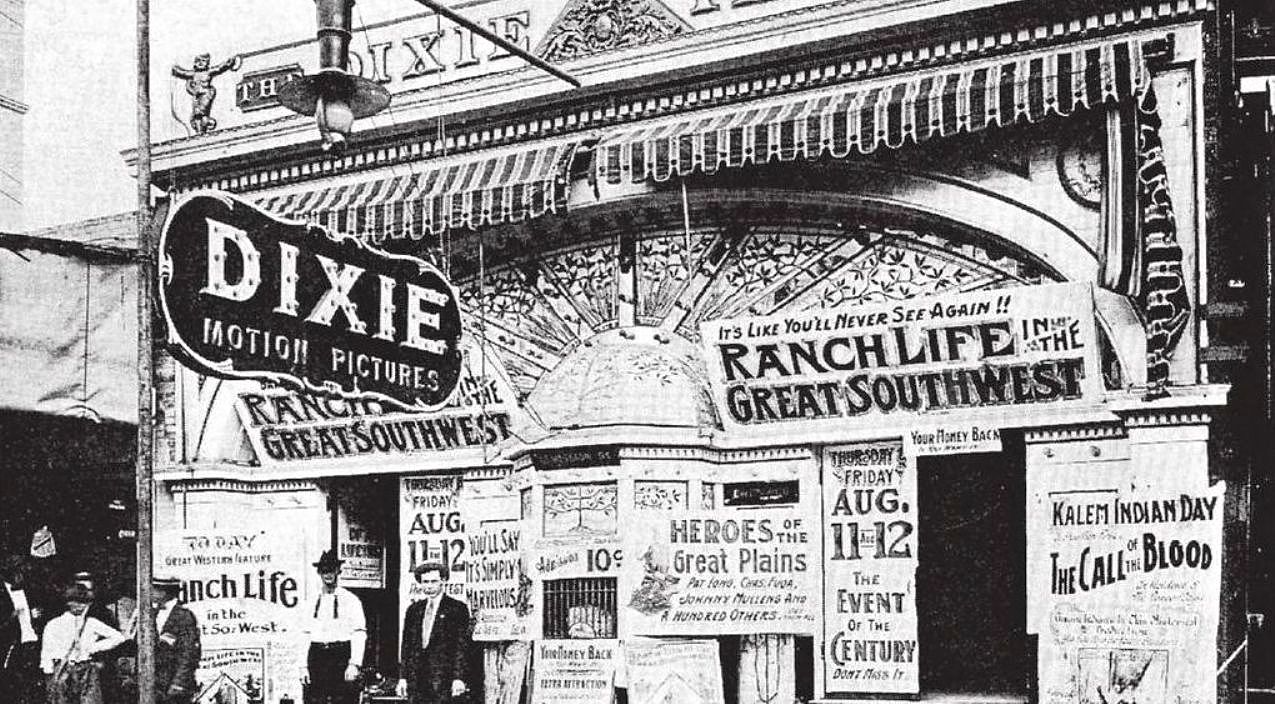
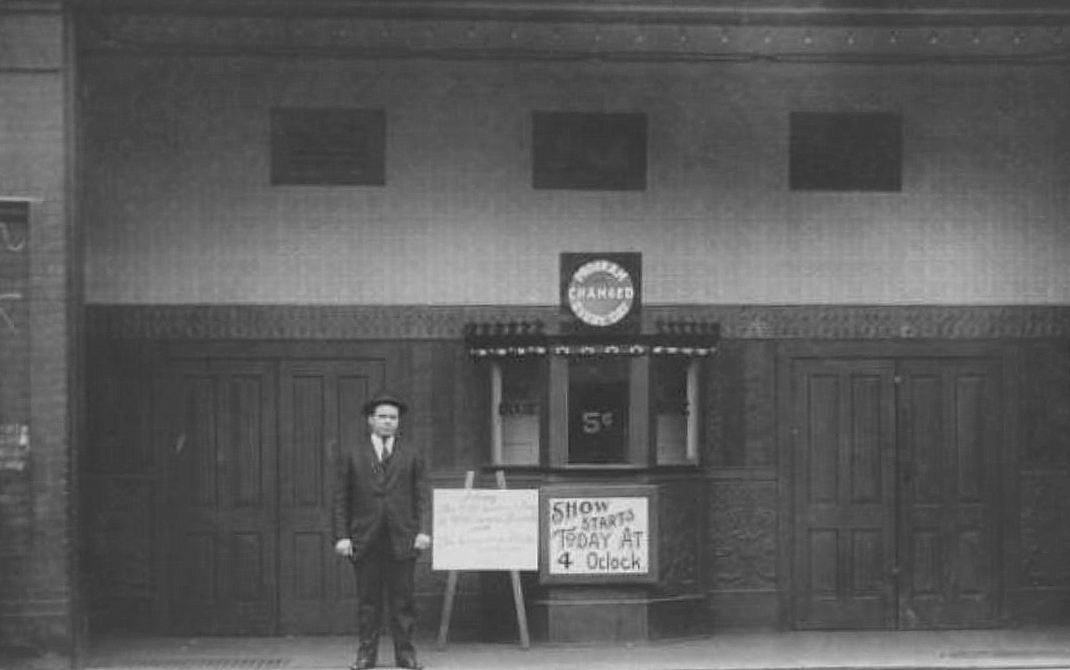
dixie-theater_1910_sherrod_smuDallas’ first movie house, here in 1910 on its third name (click for larger image)

by Paula Bosse

I seem to be deep into an unintended “Movie Week” here, all because I’ve been researching a photo of a little-known early suburban movie theater — and that’s how I stumbled onto a great article about Dallas’ first “picture shows.” The rather clunky title of the extremely informative Dallas Morning News article (which is linked below) is: “Startling Progress of Picture Shows; One-Third of Dallas’ Population Daily Entertained; History Local Houses; Dark Storerooms and Rickety Chairs Give Way to the Modern Photo-Play Theater” (March 9, 1913).

Some of the facts in the article are a bit off, but it’s fascinating to read that the first (or certainly ONE of the first) showings of a moving picture in Dallas was at the State Fair in 1897, when a boxing promoter presented what was one of the earliest “pay for view” matches in history — he showed footage of the highly publicized Jim Corbett-Bob Fitzsimmons Heavyweight Championship fight which had taken place a few months previously — the fight was originally intended to be fought in Dallas, but it was moved to Nevada, causing, one would assume, much consternation to those involved with the staging of and promotion of the fight. Not only did the promoter make back all the money he had invested locally in the thwarted boxing match, but he made a hefty profit trundling the film around the country for curious viewers (which included a large number of women who were not generally allowed to watch boxing matches).

Later, two men set up a projector in a second-story window and began showing movies on an open-air screen across the street, at Main and Lamar. It was popular, but it was also something of a traffic hazard. Also, there were itinerant hucksters who came and went, showing motion pictures wherever they could, moving from city to city.

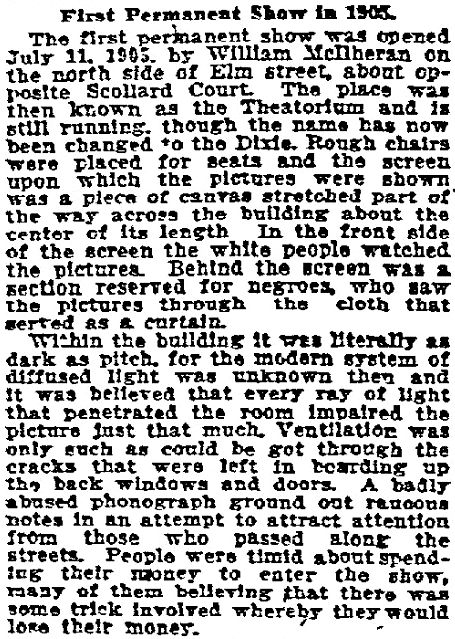
It wasn’t until the summer of 1906 that Dallas got its first permanent movie house when William McIlheran opened the Theatorium (a common word used around the country back then for a movie theater, but which, to virgin ears, sounds as odd as “Sportatorium” must to people who have never heard that word). It was at 311 Elm Street (which later became 1315 Elm), at about where Field is today, and it was the first movie theater on Theater Row! I love this description of what the place was like, from the DMN article mentioned above — even though the opening date is off by a year (click for larger image):

theatorium_dmn_030913DMN, March 9, 1913

theatorium_sherrod

With the arrival of this permanent theater (one with an actual roof over it), the moving picture had finally became more than just a mere novelty, and the success of the Theatorium started a mad dash of entrepreneurs opening up their own theaters. Within a month of the Theatorium’s opening, at least four more such houses were open for business.

At some point the Theatorium became the Wonderland (in 1907 or 1908), and it began showing so-called “talking films” (the talking was, apparently, provided by an off-stage actor providing the spoken dialogue while trying to match the silent actors’ lips on screen).

cameraphone_talking-pictures_dmn_101908The “Cameraphone” — DMN, Oct. 19, 1908

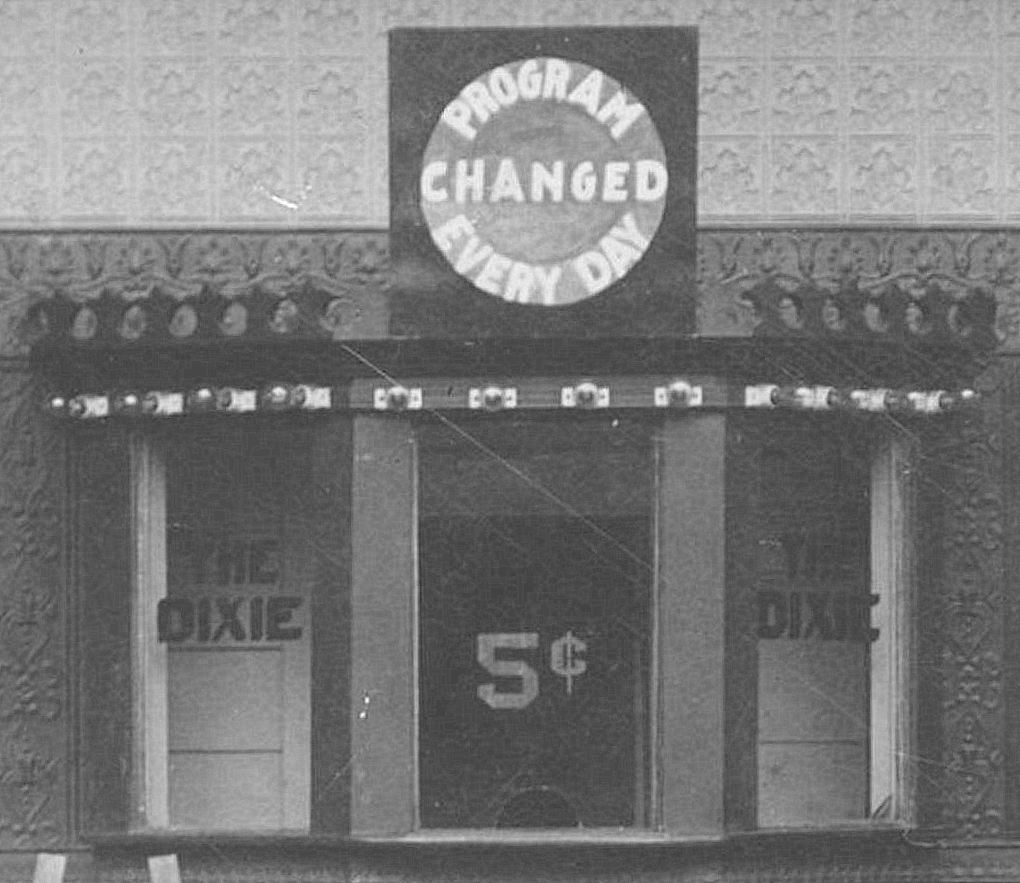
And finally, the Wonderland turned into the Dixie, seen at the top, in 1910, and below, in 1909.

dixie-theatre_1909_cook-colln_degolyer

dixie-theatre_1909_cook-colln_degolyer_detBox office, detail (click for larger image)

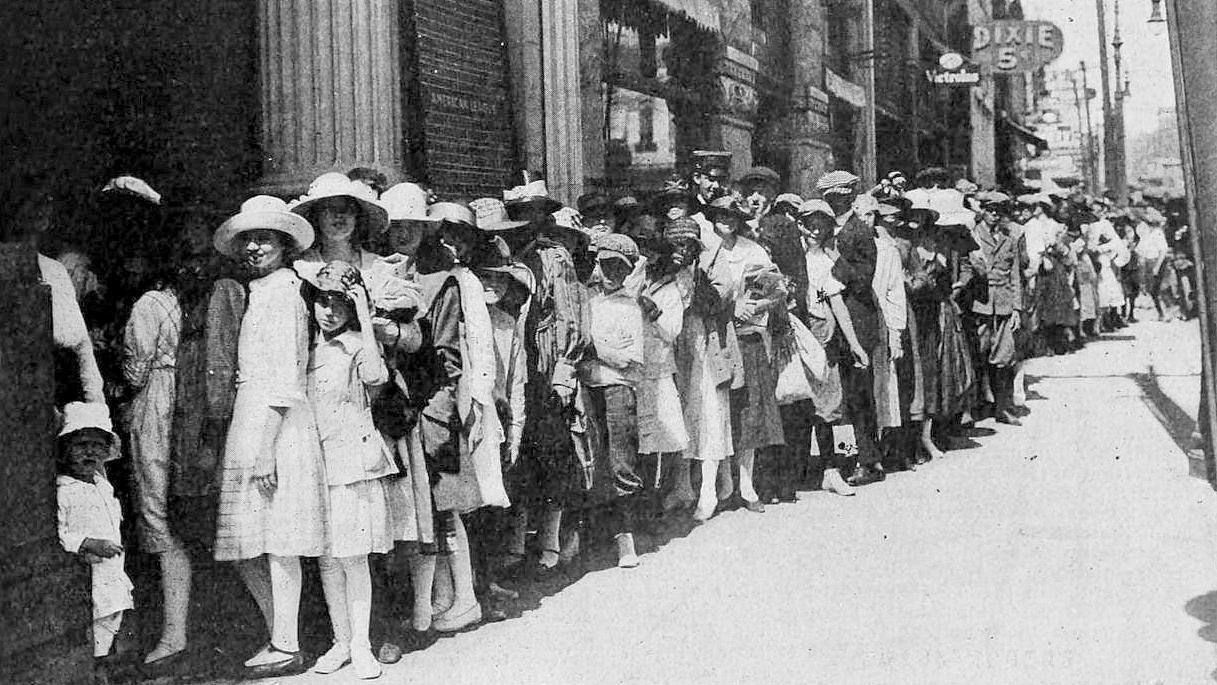
Another photo, from 1918, shows mostly children lined up in front of the theater, with the sign in the background. (They were lined up to see a WWI-related movie at the nearby Hippodrome; the photo is looking east along the north side of Elm, near where Field now intersects.)

hippodrome_dixie_elm-street_moving-picture-world_062218from The Moving Picture World magazine, June 22, 1918

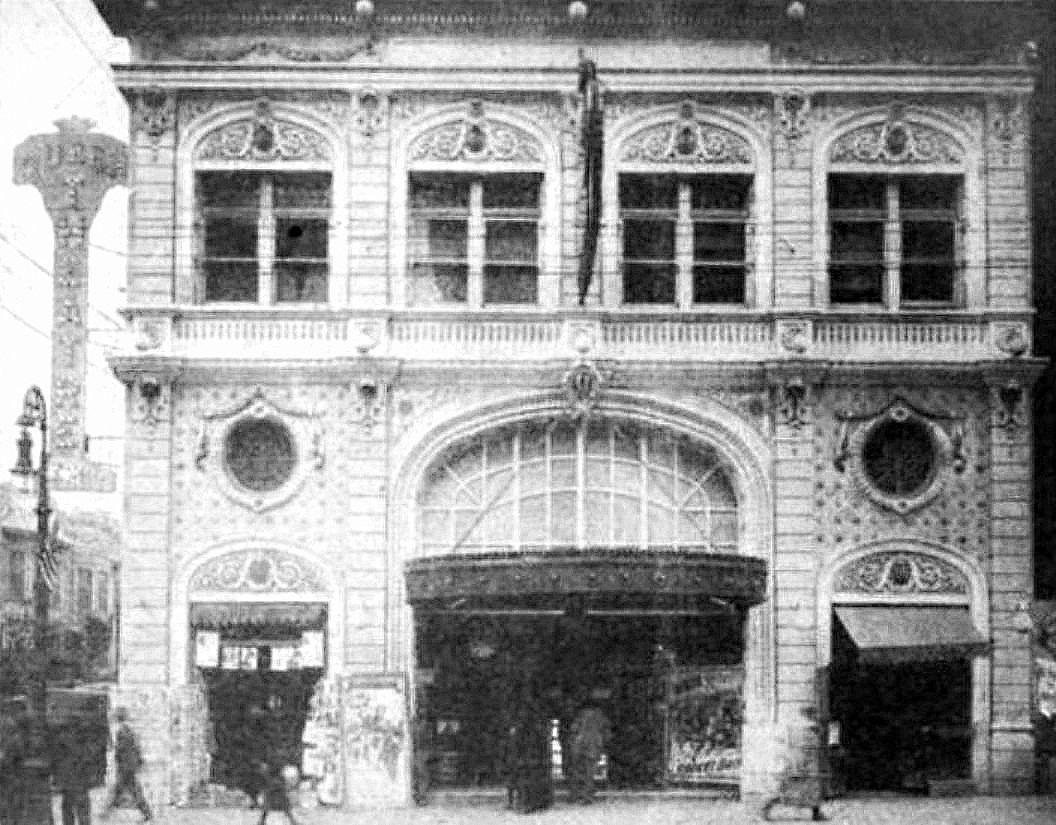
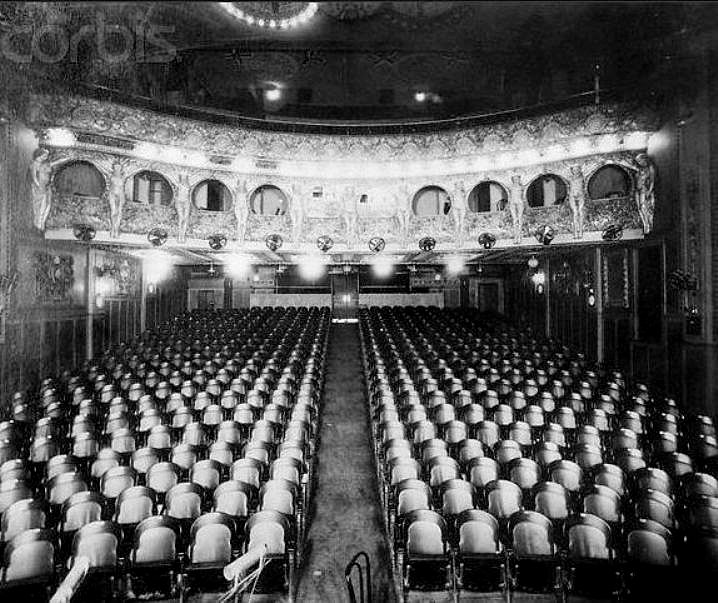
But it wasn’t until the beginning of 1913 that the first “palaces” arrived. The Queen Theatre opened first, at the corner of Elm and Akard. The DMN raved: “The most beautiful Photo-Play Theater in the South. Every man, woman and child in Texas should see this theater — truly a credit to the State” (DMN, Feb. 2, 1913).

queen_bldg-code-bk_1914Photo from Building Laws of the City of Dallas, 1914

queen_cinema-treasuresElm St. about 1917, with Queen on left — photo from CinemaTreasures.org

queen-theater-1939-CORBISInterior, 1930s — photo from CorbisImages.com

queen-theatre_dmn_102012DMN, Oct. 20, 1912

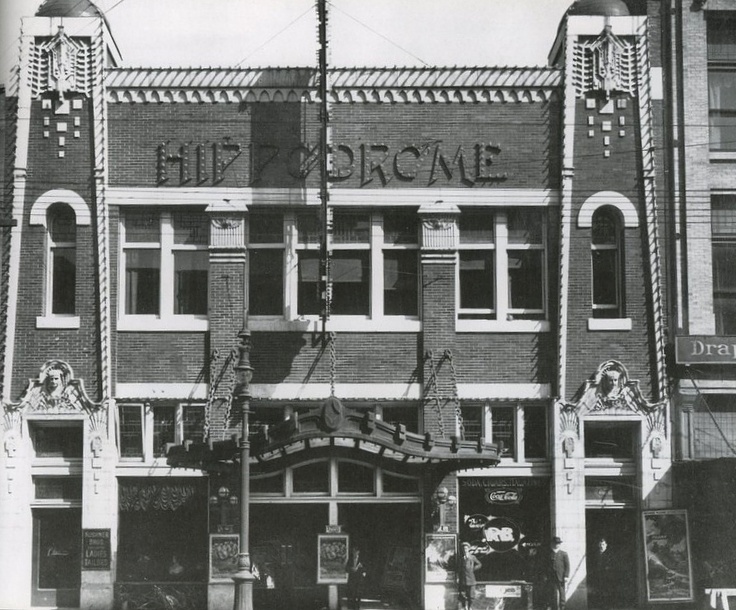
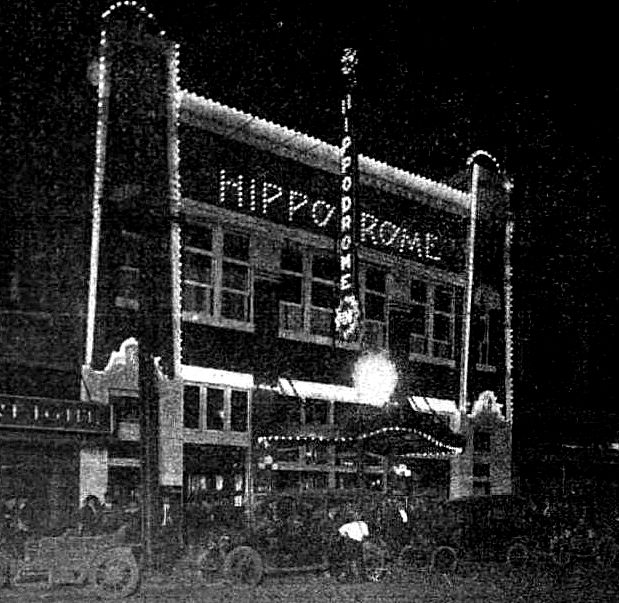
The Queen opened to rapturous crowds in January, 1913, but moviegoers barely had time to catch their collective breath when the Hippodrome opened at 1209 Elm, just a few weeks later, on March 1, 1913. It was “…conceded to being the finest moving picture house in the United States” (DMN, March 9, 1913).

hippodrome

hippodrome_bldg-code_1914Photo from Building Laws of the City of Dallas, 1914

hippodrome_dmn_022813DMN, Feb. 28, 1913

By the time the Queen and Hippodrome opened, movies had become a popular and profitable form of entertainment. In 1913 Dallas had 28 “picture shows” — 24 for white patrons and 4 for black patrons. Even vaudeville houses occasionally ran short films to pad out their live shows. And, notably, movie houses had begun to pop up away from downtown: in 1913 there were a dozen “suburban” theaters in residential areas of town (many of these, though, showed movies outdoors and thus operated only in the warmer months and at night).

There was a tremendous appetite for movies in Dallas in those early years, and when the money men realized that motion pictures weren’t just a here-today-gone-tomorrow novelty but a burgeoning industry, they dived in with enthusiasm.

Any tendency to cast the movies aside as a passing fad has given way to a realization that they are here to stay and that the crest of their popularity has not yet been approached. (DMN, March 9, 1913)

And Theater Row was off and running.

***

Sources & Notes

The top photo of the Dixie Theatre and the Theatorium ad are from the Hamon Arts Library, Southern Methodist University. I found them in Historic Dallas Theatres by D. Troy Sherrod. Sherrod’s passage on the Theatorium/Wonderland/Dixie is well worth reading, here. The second Dixie Theatre photo, with the man standing next to the box office, is from the George W. Cook Dallas/Texas Image Collection, DeGolyer Library, Central University Libraries, Southern Methodist University; it can be found here.

The very informative Dallas Morning News article of March 9, 1913 on the history of movie theaters in Dallas can be read here (it opens in a PDF, click the plus-sign at top of page to increase the text size).

Background on the Corbett-Fitzsimmons fight is here. Background on the now-legendary FILM of the fight is here; highlights of the 1897 film can be viewed here.

Many images larger when clicked.

*

Copyright © 2015 Paula Bosse. All Rights Reserved.
 

Tracking Down a Photo Location & Discovering a City Pioneer: D. M. Clower, The Man Who Brought the Telephone to Dallas

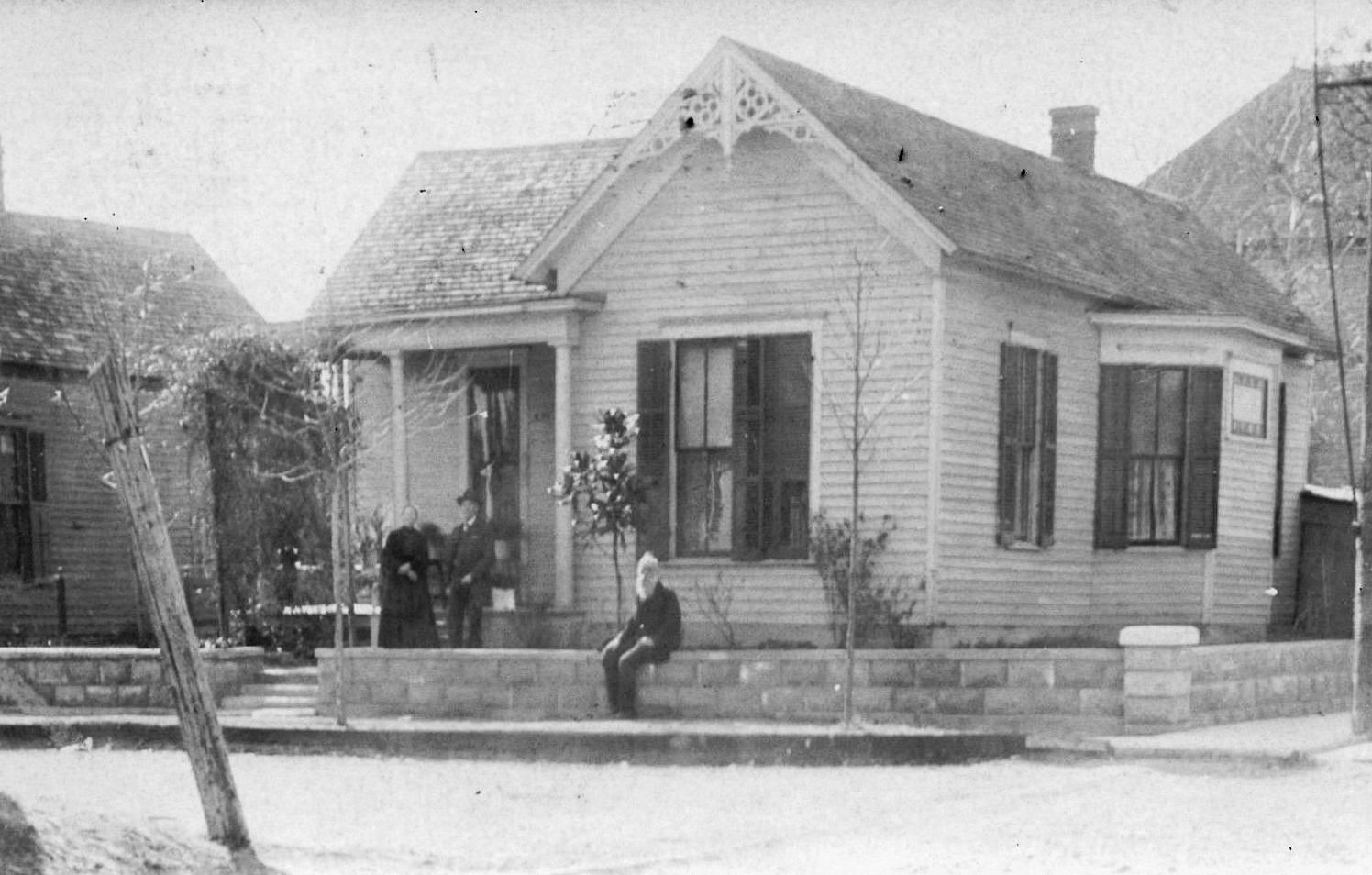
house_RPPC_1909_ebayMystery house, Dallas, ca. 1908 (click for larger image)

by Paula Bosse

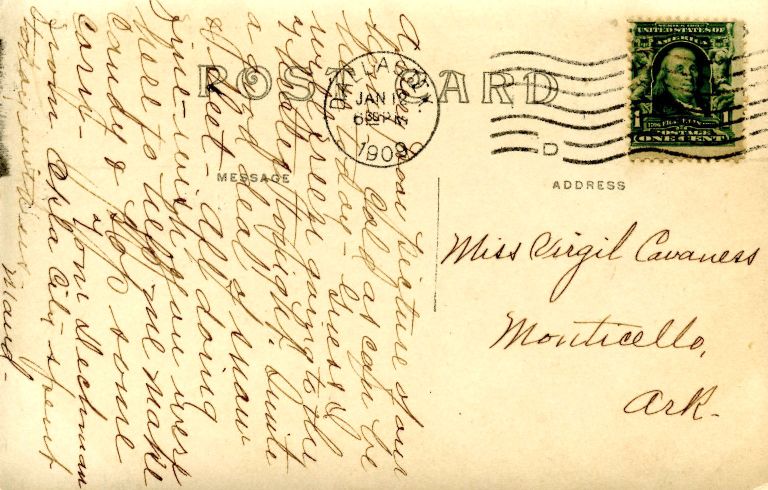
Not too long ago I came across the above photo which had been made into a real photo postcard.” It was postmarked January 12, 1909, and it contained a chatty message.

“A very good picture of our house. Cold as can be here today – guess I will freeze going to the theater tonight. Quite a good deal of snow and sleet. All doing fine – wish you were here to help me make candy & pop some corn. Tom Dechman from Okla. City spent today with us. Maud.”

house_RPPC_1909_ebay_back

Such a nice photo of a modest little house in Dallas, probably taken in 1908. When I saw it, I thought it would be cool if I could figure out where it was. There wasn’t much to go on from the postcard, though. But, as it turns out, there was just enough information to put the pieces together and figure it out. Someone asked me recently how I track down things like this. Basically, I look for a long time in a lot of different places. Here’s how I found out where this mystery house was.

Using Ancestry.com, I found Virginia (“Virgil” — sometimes “Virgie”) Cavaness in Monticello, Arkansas. She was born in 1871 and would have just turned 37 years old when she received this card. The familiar tone of the postcard message indicated to me that Virgil was probably a close friend or family member.

I found Thomas Dechman in Oklahoma City — he would have been 23 when he visited Maud. He probably wasn’t a close friend or immediate family member because she writes his full name out. According to the 1909 Oklahoma City directory (accessible on Ancestry.com), he worked alongside his father, A. F. Dechman, at a wholesale produce company.

Then I checked the Dallas Morning News archives and found this from Dec. 30,1909.

clower_dmn_123009DMN, Dec. 30, 1909

Tom Dechman was Mrs. A. F. Dechman’s son. So I searched on “Maud Clower.” Maud, born in 1877, was also D. M. Clower’s daughter. Mrs. A. F. Dechman was Maud’s sister Annie, and Tom was her nephew.

I continued searching the DMN archives for mentions of the Clower family and found that in 1906 Maud Clower had married Jesse (J. D.) Patterson — and, hey, Virgil had attended the wedding.

virgie_dmn_090206DMN, Sept. 2, 1906

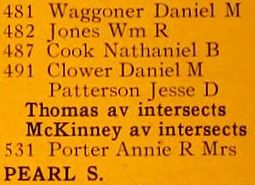
I checked to see where Maud and J. D. Patterson were living in 1908/1909. Most directories are available on Ancestry (a subscription site), but, as it happens, the 1909 directory is one of the few historical Dallas city directories that is available online (for free) — you can access it here (a few other directories are here). I found a Jesse D. Patterson listed as living at 491 N. Pearl, but no spouse’s name was listed, so I cross-referenced the address with the street directory section to determine whether this was the right J. D. Patterson. (Street directories are very helpful — not only do they list the occupants for each address, they also help to pinpoint where specific addresses were as they show which cross-streets those addresses were between; this is extremely helpful when trying to figure out where things were when streets had different names and/or when trying to figure out where things were before all of Dallas’ street numbers were changed in 1911. Another useful resource is a page on Jim Wheat’s site, which has links to every page of the 1911 street directory — click on a street name and find your address: the “new” address is on the left, and the “old” address is next to it, in bold.)

clower-patterson_1909-directory1909 city directory, residents of N. Pearl Street

Even though this didn’t have Maud’s name listed alongside her husband’s, it DID show that her father, D. M. Clower, was living at the same address. Success!

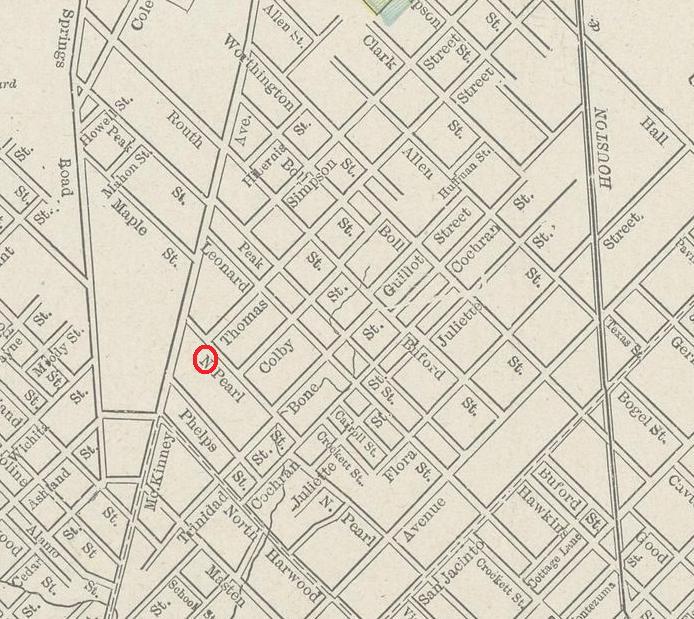
So there it is. When Maud sent that postcard to Virgil, she and her husband were living with her parents at 491 N. Pearl Street. The house in the photo was at the southwest corner of N. Pearl and Thomas. It’s always helpful to check a street map from about the same period for context and to make sure you’re looking at the right location — many street names have changed over the years — if a street named “Forest” is being referenced in the 1940s, for instance, you need to know that the old Forest Avenue and the current Forest Lane are absolutely nowhere near each other. Below is a map drawn about 1900, with the location of the Clower house circled in red (this is one of many maps found on the Portal to Texas History site; the one below is a detail of the map found here).

clower-home_map-ca1898

I also checked out Sanborn maps to see if the house in the photo matched the house that was actually on the lot at N. Pearl and Thomas. It does. To see what the general footprint of the house looked like in 1905 (the Clowers lived at 491 N. Pearl from about 1905 to 1910), see here. In the 1921 map (by which time the address had been changed to 2221 N. Pearl), you can see that additions had been made to the house since 1905 and that it looks more like the house in the photo (a room now juts out at the right and there is an out-building behind the house); see the 1921 Sanborn map here. To see what that Uptown block looks like now, see here (N. Pearl is on the left, looking south). Quite a change! It took me a long time to realize just how essential Sanborn maps can be — they are incredibly useful, and I try to use them whenever I can.

**

I really didn’t expect to track down the actual address of an unidentified house found on a picture postcard, but persistence pays off. A bonus of this persistence was that I ended up learning about the very interesting man who owned the house — a man who played a pivotal role in the development of Dallas: Daniel Morgan (D. M.) Clower. Clower was an electrical engineer who, in 1881, installed the very first telephone in Dallas (for Judge John Bookhout) and ran the city’s first telephone exchange; he also set up phone systems in other cities. In addition to his work for Bell Telephone, he also ran Dallas’ electric company for many years and was responsible for setting up the city’s first electric street lights and helped in developing electrified rail systems in the region.

clower_electrician_1889-directory1889 Dallas directory (click for larger image)

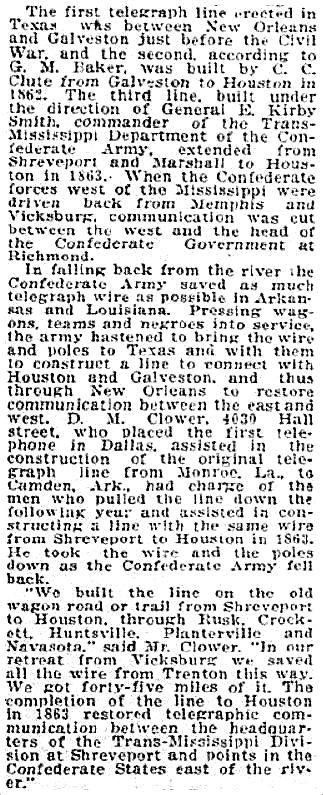
During the Civil War, Clower was a Confederate telegraph operator in the 1st Louisiana Regiment (see Clower’s fascinating obituary below). When the Union army was advancing after the fall of Vicksburg, Clower directed (and helped in) the destruction of the Confederate telegraph system he had helped set up, in order to prevent its being commandeered by Yankee forces — he and his men raced to pull up over 40 miles of wire and equipment, loaded everything on wagons, bugged out, and then used the same wire and poles to string a new Confederate line into and across Texas.

clower-telegrapher_dmn_010822DMN, Jan. 8, 1922

The war ended before Clower had completed his line northward from Houston, but his efforts had helped lay the telegraph infrastructure that the state of Texas relied on for decades afterward.

*

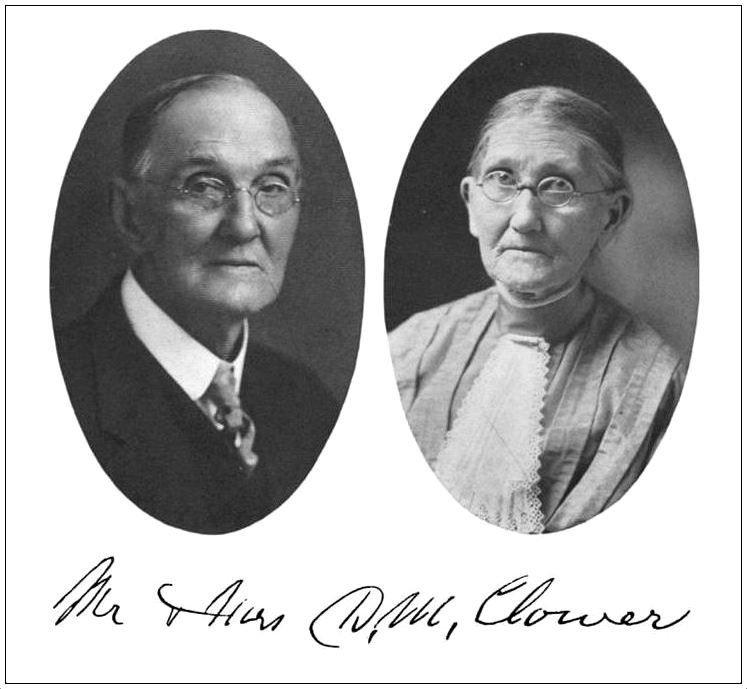
The people in the top photo are not identified. When that photo was taken, D. M. Clower and his wife, Ellender, would have been about 73; their daughter Maud and her husband Jesse would have been in their early 30s. I assume it’s the elder Clowers, with a mystery bearded man in the foreground.

clowers_d-m-and-ellender_hist-of-tx-and-texans_1914_portal
Mr. and Mrs. D. M. Clower, ca. 1914

You never know what you’re going to discover when you read a 106-year-old postcard and wonder where an old house used to be.

***

Sources & Notes

Postcard found on eBay.

Daniel Morgan Clower was born in Alabama in 1835; he arrived in Dallas in 1879, coming from Comanche, where Maud was born in 1877. Clower died in 1927 at the age of 92; Maud died in 1948. His wife, Ellender Paralee Clower, died in 1917 (at which time the couple had been married for more than sixty years).

More on Clower can be found in the pages of The Dallas Morning News:

  • “Telegrapher Tells Civil War Episode” (DMN, Feb. 1, 1924) — a fantastically cinematic account of Clower’s past, in his own words
  • A photo of Clower and Eli Sanger, (DMN, May 1, 1927) — what might well be the last photo of Clower ran in the News just a few months before his death at the age of 92; also in the photo is Eli Sanger, of Sanger Bros. (Clower once had a business in Millican, TX when Sanger’s opened there at the close of the Civil War, and he proudly boasted that he was one of their very first customers)
  • “Daniel Clower Funeral Held” (DMN, Aug. 19, 1927) — Clower’s obituary, with photo

Photo of Mr. Clower with text from a Dallas Times Herald story published on the occasion of his 89th birthday can be found here (scroll down to 1924, about halfway down the page), via Jim Wheat’s site.

The photo of Mr. Clower and his wife Ellender is from the book A History of Texas and Texans, published in 1914; the accompanying entry about Clower’s very interesting life can be found here, via the Portal to Texas History.

*

Copyright © 2015 Paula Bosse. All Rights Reserved.
The Wilson Building & Its Tenants — 1908/1909

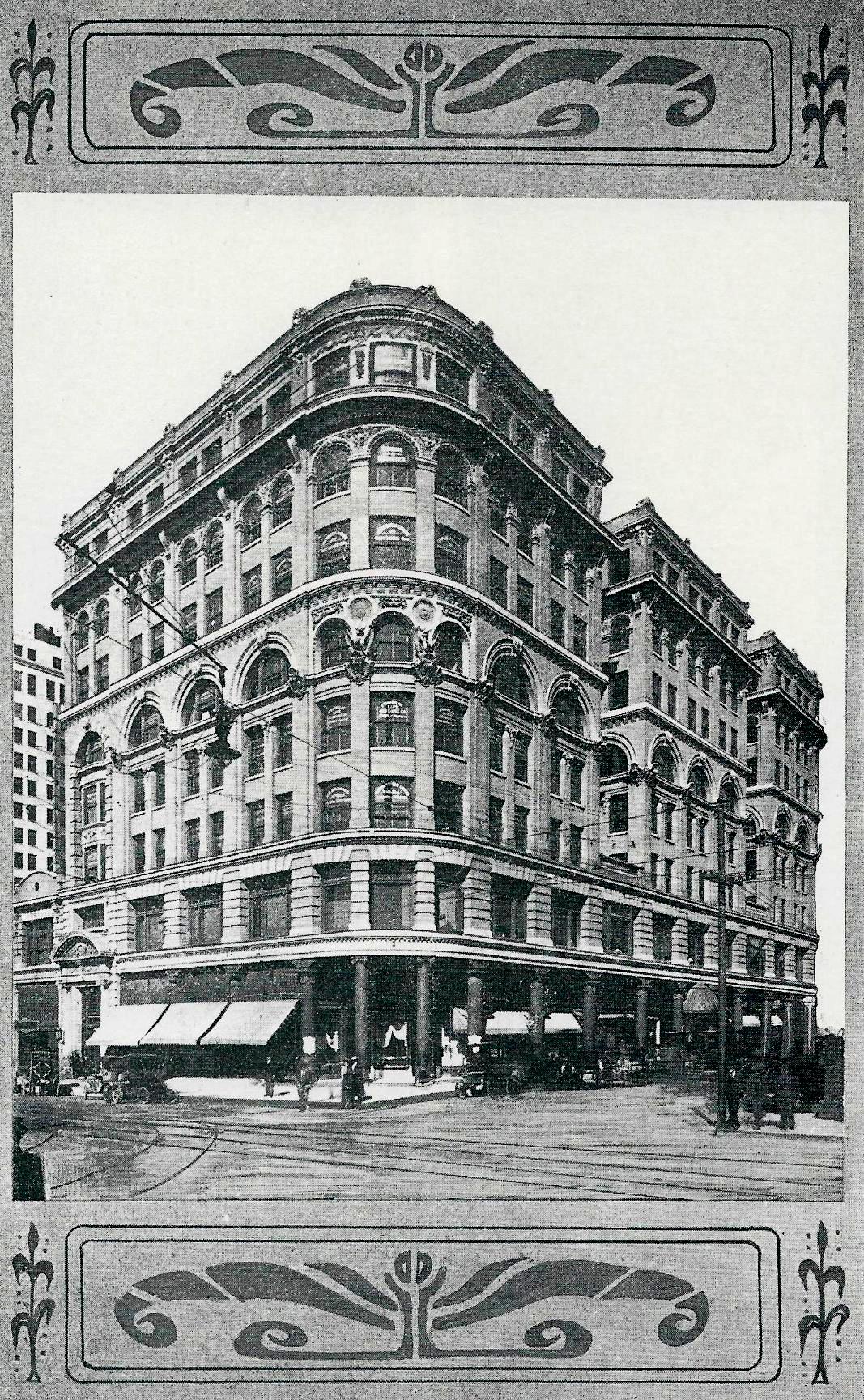
wilson-bldg_greater-dallas-illus-1908Forever & always, Dallas’ most beautiful building (click for larger image)

by Paula Bosse

I love the Wilson Building. Who doesn’t? Every time I realize it’s still standing, I’m actually kind of shocked. To find a 100-plus-year-old building still standing in Dallas is a rarity. If the wrecking ball ever strikes this building, there will definitely be hell to pay.

I’d never seen the above photo, which was published along with lovely art nouveau borders in the book Greater Dallas Illustrated, The Most Progressive Metropolis of the Southwest (1908). I’m fascinated by office buildings of the first half of the twentieth century that had business names painted on upper-floor windows. I always think of Sam Spade’s office.

sam-spade_sign-window

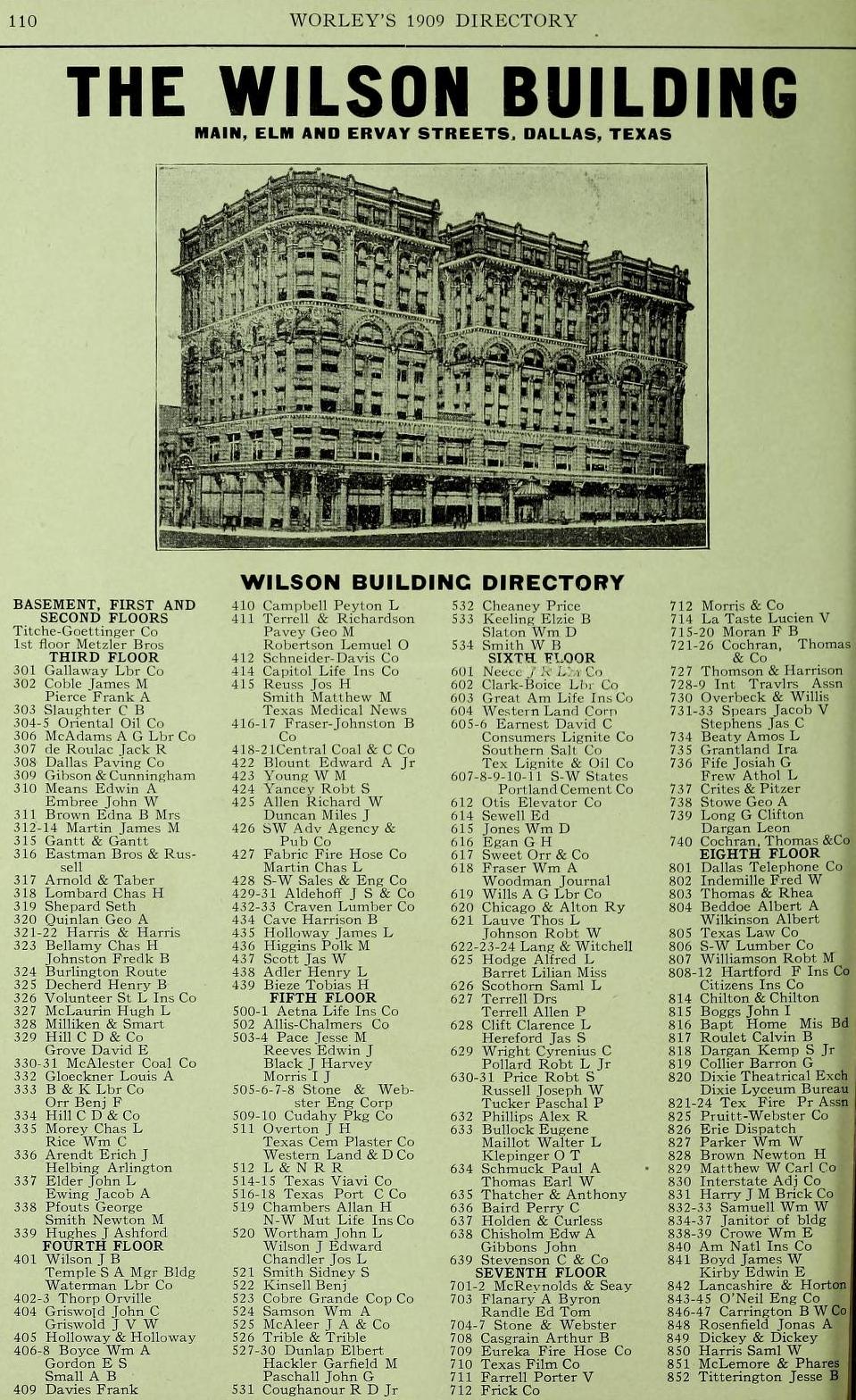
I was really hoping to find at least ONE detective agency in the Wilson Building at that time, but steep rents and a choosy leasing agent were probably working against such downmarket enterprises setting up shop in such a grand palace. Below is the list of occupants in the building at about the time the top photo was taken. Aside from the Titche-Goettinger department store occupying the basement and first two floors, Dallas’ premier office building was home to several important local business concerns, lots of insurance companies and agents, some notable architects (Lang & Witchell, C.D. Hill, Overbeck & Willis), and a surprising number of osteopaths (including Edna B. Brown, one of only two women specifically mentioned by name). (Click directory page for larger image.)

wilson-bldg-occupants_1909-directory

***

Photo of the Wilson Building from Greater Dallas Illustrated (Dallas: Friends of the Dallas Public Library, 1992 — originally published in Dallas in 1908). The Wilson Building is located on Main and Elm at Ervay.

It’s doubtful that it would fall victim to the wrecking ball, but the Wilson Building may not actually be protected from any possible future threat of demolition. For clarification, see the comment near the top of the comments section in this Dallas Morning News article on recent demolition in the same block, here.

Sam Spade image is a still from the 1941 Humphrey Bogart film The Maltese Falcon, based on Dashiell Hammett’s novel. (Poor Archer….)

Directory page from Worley’s 1909 city directory.

My previous post — “The Wilson Building Under Construction — 1902” — can be found here.

Click pictures for larger images.

*

Copyright © 2015 Paula Bosse. All Rights Reserved.
A New Turbine Power Station for Big D — 1907

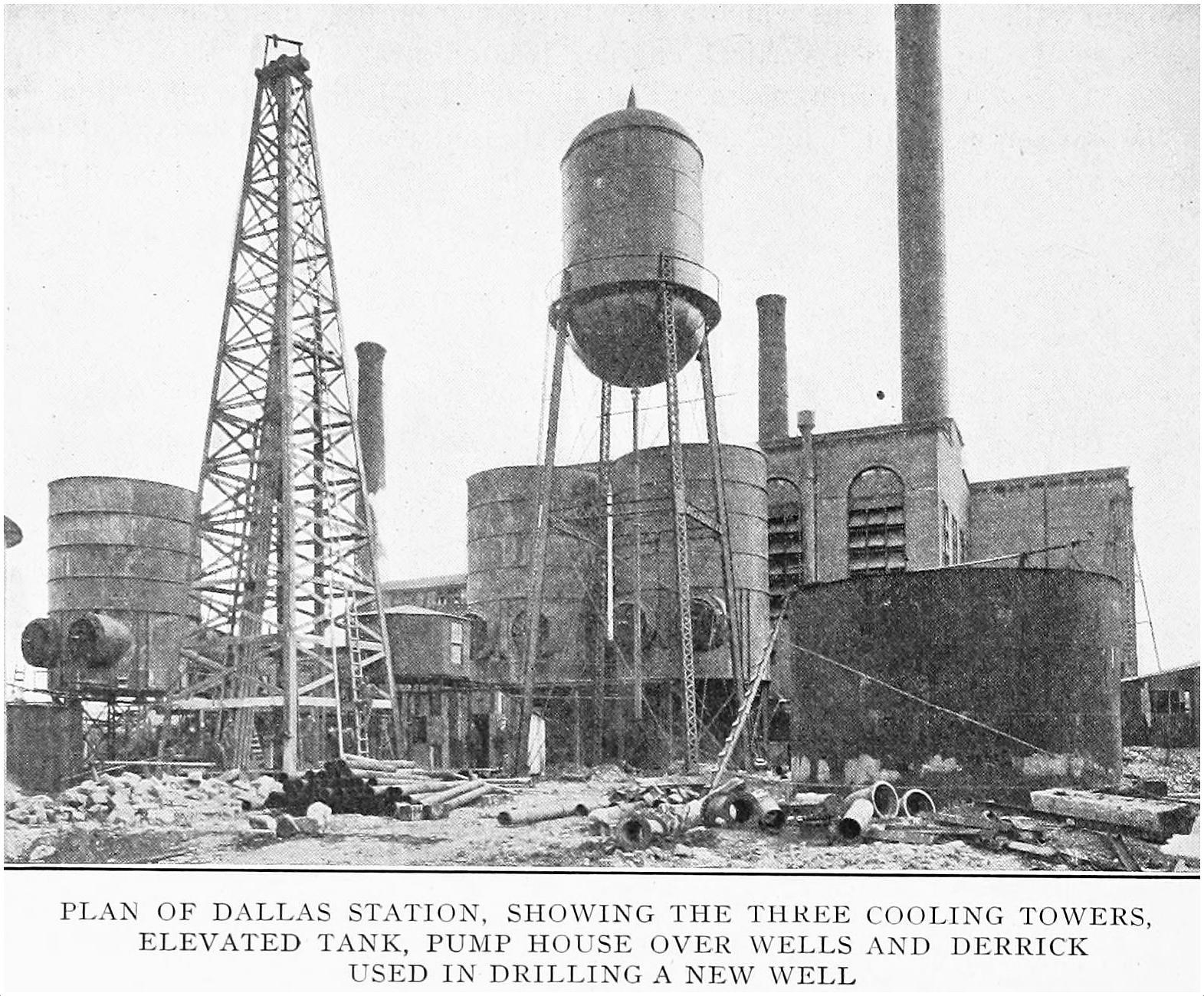
power-station_1907New and old power plants, 1907 (click for much larger image)

by Paula Bosse

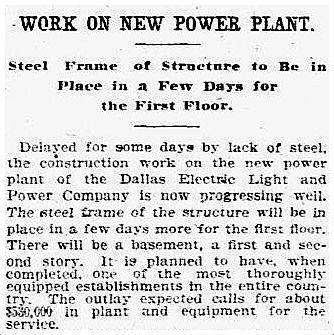
Construction began in 1906 on a new power plant for the Dallas Electric Light & Power Company. It was built next to the old power plant, and it furnished electricity for the city’s lighting and power needs as well as for its streetcars and interurban cars. When construction began, the project was expected to cost more than $500,000 (over $13 million in today’s money), a large (but necessary) expenditure for the growing city.

power-station_dmn_020906Dallas Morning News, Feb. 9, 1906

The photo at the top shows the new plant on the left, and the old 19th-century plant on the right. Here, a view from the other side:

power-station_ext_1907

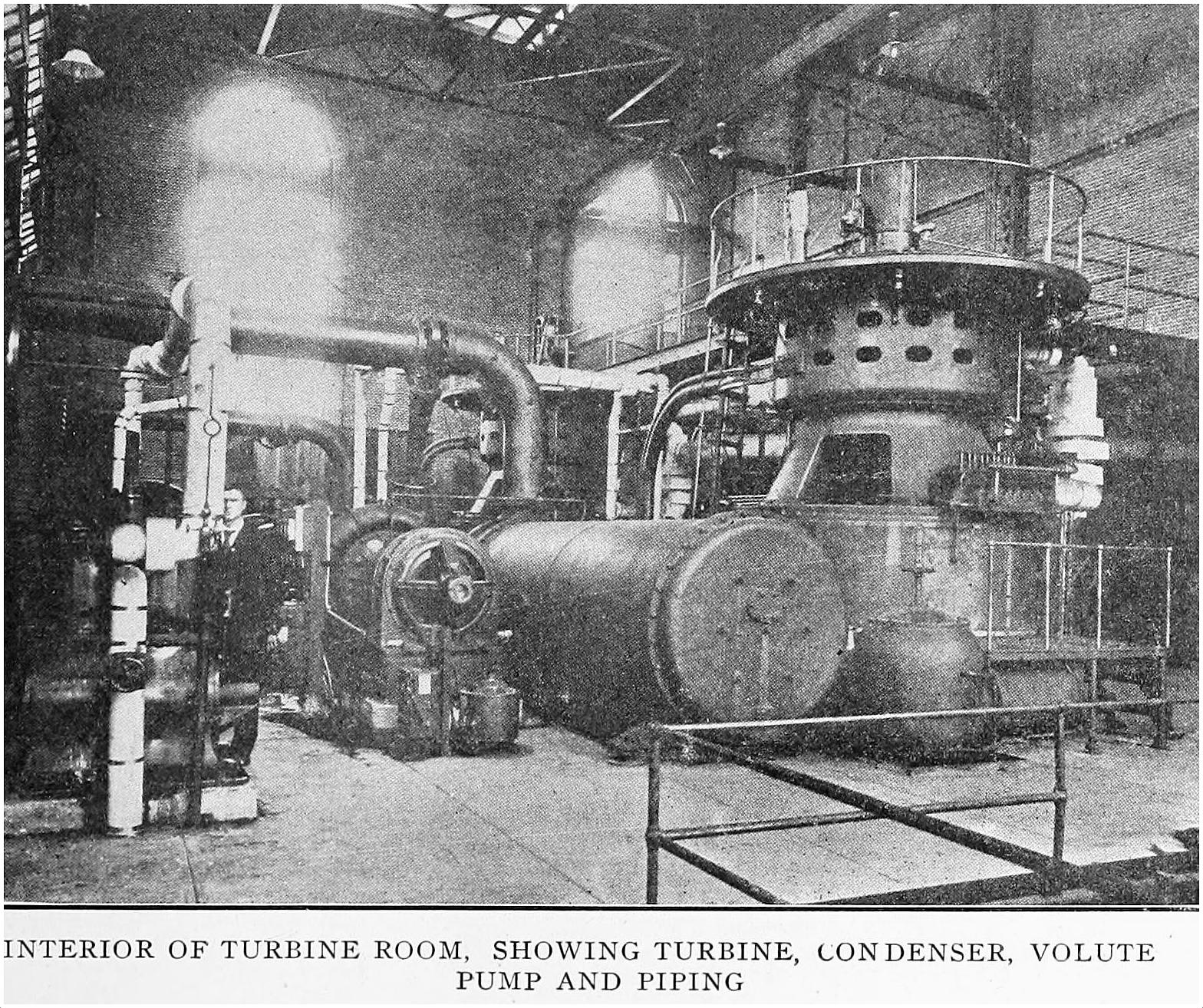
Inside? A lot of fascinating stuff that looked like this (as well as a stern-looking man who appears to be trying to avoid the camera):

turbine-rm_1907

The power station was northwest of downtown, between the MKT and Cotton Belt and Rock Island railroad yards (approximately where the American Airlines Center is today). Before the Trinity was straightened and moved, the plant was only about half a mile from the banks of the river. Even though the grade of the new station’s floor was built above the highest flood level, the historic flood of 1908 put the plant out of commission for several days, but — probably because it was filled with brand new equipment — the city’s power was restored much faster than one might have expected.

***

Sources & Notes

Photos are from the Street Railway Journal, May 18, 1907 (Vol. XXIX, No. 20). To view the entire 7-page article — which includes more photographs as well as several floorplans and schematics, all of which are very cool (even to someone like me who has absolutely no idea of what any of it means!) — check it out, here.

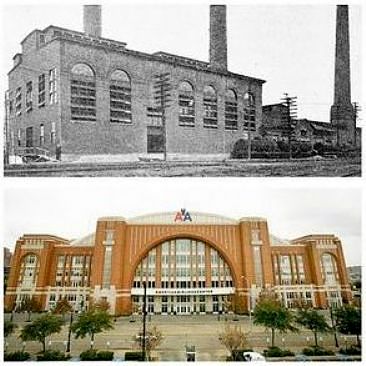
The American Airlines Center incorporated elements of the 1907 plant’s design into its own:

aac

My previous related post, “DP&L’s Twin Smokestacks,” can be read here.

Photos are much larger when clicked.

*

Copyright © 2015 Paula Bosse. All Rights Reserved.


The “Semi-Convertible” Streetcar — 1907

semi-convertible-streetcar_1907_smEXTRA long… (click for larger image of car)

by Paula Bosse

Ah, the “grooveless-post semi-convertible” streetcar with the “extra long platforms,” the cherry and maple interior, the domed ceiling, and the clusters of frosted globes. Sounds nice.

semi-convertible-streetcar_int_1907“Interior of Car for Dallas” (click for larger image)

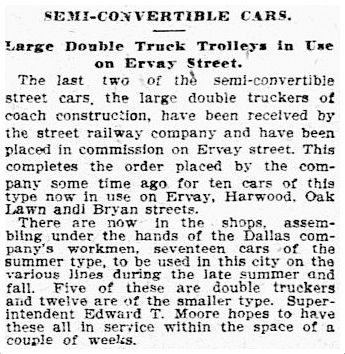
semi-convertible-streetcar_dmn_082907Dallas Morning News, Aug. 29, 1907

***

Photos from Street Railway Journal, April 6, 1907; original article can be accessed here. Above scans from an old eBay listing.

Want to know more about the Brill Convertible and Semi-Convertible Cars? Sure you do! Hie yourself here.

*

Copyright © 2015 Paula Bosse. All Rights Reserved.

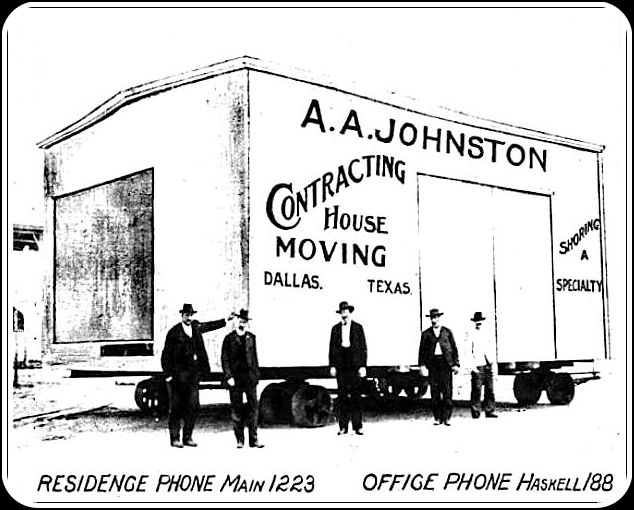
A. A. Johnston House Moving Co. — 1908

ad-johnston-house-moving_city-directory_1908_sm“Shoring a Specialty”

by Paula Bosse

Imagine what moving entailed before the advent of large motorized moving trucks.

I, myself, will be moving soon, and this will be my last new post for a while. I will probably link to old posts on Twitter and Facebook (see the tab at the top of the page to follow me and “like” me). I’ll be back sometime next week. Maybe by then the rain will have finally stopped!

***

Ad from the 1908 city directory.

*

Copyright © 2015 Paula Bosse. All Rights Reserved.

“How High’s the Water, Mama?” — 1908

trinity-river_flood_1908_LOC-lg

by Paula Bosse

A great panoramic photo by Clogenson, showing the old Commerce Street bridge partially submerged by the Trinity River (which is pretty dang high … and rising).

***

Photograph by Henry Clogenson, from the collection of the Library of Congress; accessible here.

Previous Flashback Dallas posts on the Great Flood of 1908 can be found here and here. And a fantastic photo of what the Trinity looked like before it was straightened and moved is here.

And, really, you MUST hear Johnny Cash sing the pertinent “Five Feet High & Rising,” here.

Click picture for a REALLY big image.

*

Copyright © 2015 Paula Bosse. All Rights Reserved.