Flashback : Dallas

A Miscellany: History, Ads, Pop Culture

Category: 1910s

The Mosquito Bar

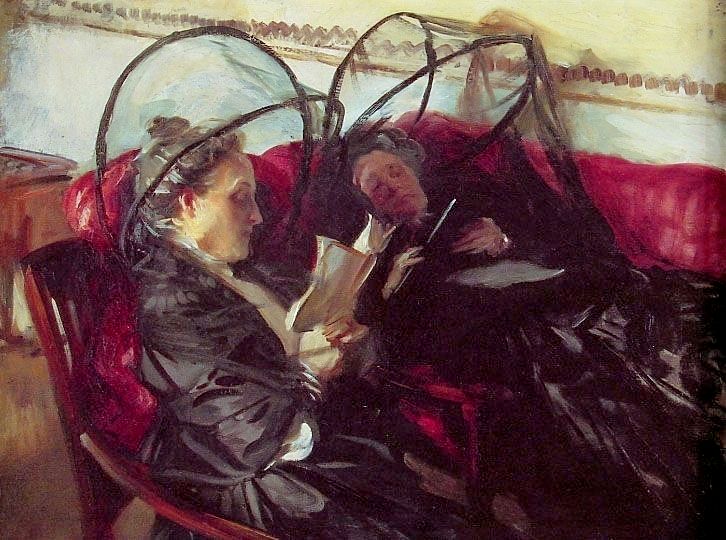
sargent_mosquito-nets_1908Relax without fear of being bitten by mosquitoes…

by Paula Bosse

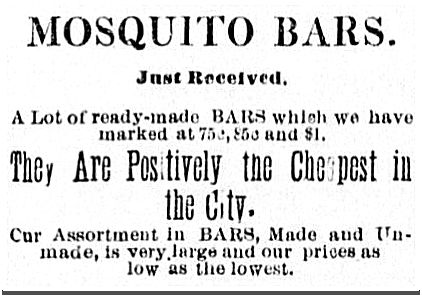
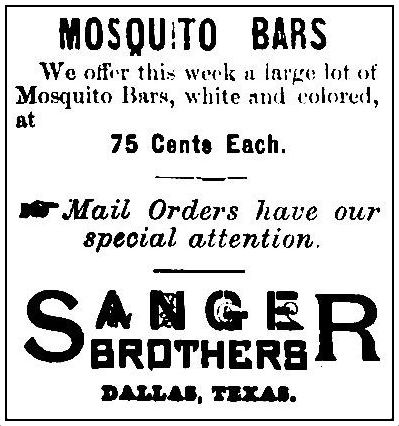
The “mosquito bar” — the human’s defense against blood-thirsty mosquitoes (and other annoying pests) — had its heyday in the US in the second half of the 19th century and the first couple of decades of the 20th century, before screens for windows and doors were commonplace in American homes. They were particularly necessary in the hot and sweaty Southern US states which were routinely plagued with mosquitoes. A typical mosquito bar ad looked like this one from Dallas merchants Sanger Bros. (click ads and clippings to see larger images):
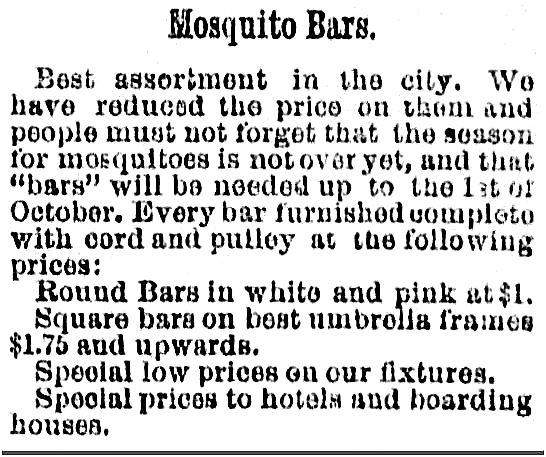
mosquito-bar_dallas-herald_080285_sanger-bros-ad-det
Dallas Herald, Aug. 2, 1885

(According to the Inflation Calculator, $1.00 in 1885 money would be worth about $27.00 in today’s money, adjusted for inflation.)

The first Dallas ad I found for mosquito bars was from 1877 — like the clipping above, it is also from a Sanger Bros. ad (in fact, Sanger’s seemed to be mosquito-bar-central for 19th-century Dallas).
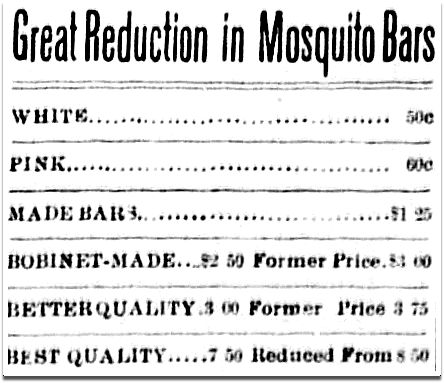
mosquito-bar_sanger-bros-ad-det_dallas-herald_073177
Dallas Herald, July 31, 1877

mosquito-bar_sanger-bros-ad-det_dallas-herald_051478
Dallas Herald, May 14, 1878

mosquito-bar_screens_dallas-herald_052482_sanger-bros-ad-det
Dallas Herald, May 24, 1882

mosquito-bars_southern-mercury_070390Southern Mercury, July 3, 1890

screens_dallas-screen-co_1894
1894

Mosquito bars were usually draped over beds, canopy-style, but the painting above (“Mosquito Nets” by John Singer Sargent, 1908) shows “personal” net-covered armatures, perfect for genteel ladies to relax inside of and read (while trying to keep cool despite being weighed down by what must have been uncomfortably heavy clothing).

The mesh netting or fine muslin used to drape beds (and cover windows and doors) was generally white or pink, sometimes green. Once inside the canopied beds, the netting was tucked under the mattress in order to seal all potential entry points in the mesh-walled fortress and allow the thankful occupants inside to sleep unmolested by mosquitoes (or other biting and stinging insects).

mosquito-netting

These bars became fairly standard in hotels and in many homes of the time, but if one could not afford the luxury of sleeping inside one of these things, the sleeper would often resort to rubbing him- or herself with kerosene if they wished to avoid being bitten throughout the night.
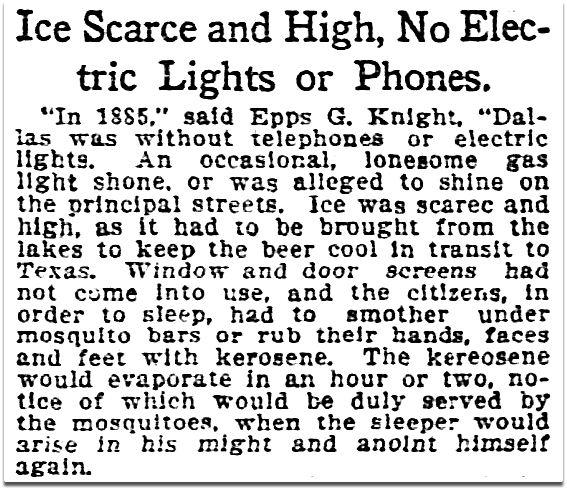
mosquito-bar_dmn_100110_kerosene
Dallas Morning News, Oct. 1, 1910

As much of a godsend as the bars were, they had their problems. The fine material was easily torn, and sometimes the mesh was so tightly knit that ventilation (and breathing!) was not optimal. Also, it was not unusual for them to catch fire — there are numerous newspaper reports of the bars being ignited by candles or gas-burning lamps or by careless or sleepy smokers smoking inside the canopy.

mosquito-bar_dallas-herald_052481_fire
Dallas Herald, May 24, 1881

It was apparently a common precaution against midnight thievery for men who stayed in hotels to keep their money in the pockets of their pants and then fold the pants and place them beneath their pillows. The second line of defense was the mosquito netting tucked resolutely under the mattress of their canopied beds. The feeling was that a burglar would have to be pretty stealthy to breech a man’s mosquito bar and steal his pants from under his pillow without waking him. But never underestimate the Big City burglar (click article to see a larger image):

mosquito-bar_dmn_091088_theft
DMN, Sept. 10, 1888

After doors and windows began to be routinely covered with wire screens, the use of mosquito bars in homes and hotels waned, but their use continued in military encampments and hospitals, in recreational camping, and in swampy or tropical areas where the transmission of diseases like malaria and Dengue fever (transmitted by mosquitoes) posed health risks. Wire screens must have been a godsend.

ad-acme-screen-co_terrill-yrbk_1924Acme Screen Co., 1924

And if you don’t think that the prospect of a night without a mosquito bar (especially in the bayous of Louisiana…) wouldn’t inflame usually calmer heads, here’s a news story from 1910 about a man who shot a co-worker three times at close range because of a heated argument over which of them owned a mosquito bar. And this was in February! Lordy. Talk about your crime of passion. The moral of this story: do not mess with another man’s mosquito bar.

mosquito-bar_town-talk_alexandria-LA_022210_deadly-dispute
Town Talk (Alexandria, LA), Feb. 22, 1910

*
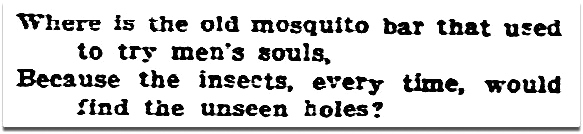
mosquito-bar_dmn_052812_couplet
DMN, May 28, 1912

***

Sources & Notes

The top painting by John Singer Sargent — titled “Mosquito Nets” (1908) — is from the Detroit Institute of Arts; more on the painting can be found here.

Photo of draped bed is from the “Mosquito Net” Wikipedia page, here.

Other clippings and ads as noted. Dallas Herald and Southern Mercury newspaper scans are part of the huge database of scanned historical Texas newspapers found at the Portal to Texas History (to see newspapers, click this link and filter by “Counties,” “Decades,” “Years,” etc. on the left side of the page, or search by keywords at the top).

This post was adapted from a post I wrote for my other (non-Dallas) blog, High Shrink — that post, “The Mosquito Bar,” can be found here (it includes some great additional photographs and illustrations).

*

Copyright © 2017 Paula Bosse. All Rights Reserved.
San Antonio Extra: The Texas Transportation Co. and the Pearl Brewery Electric Freight Trolley

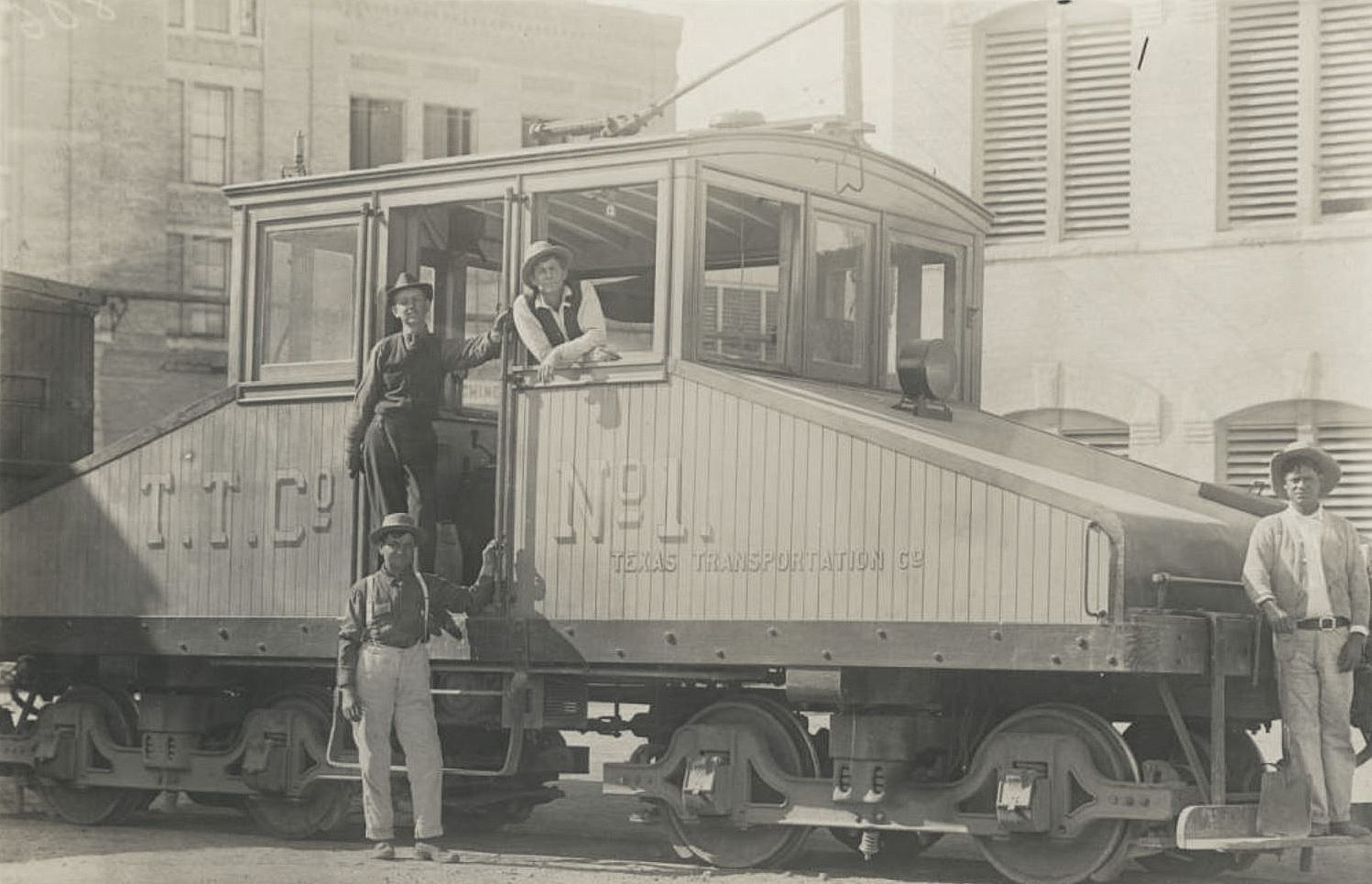
texas-transportation-co_cook-coll_degolyer_smu_san-antonioT. T. Co. No. 1, at your service… (click for larger image)

by Paula Bosse

I come across a lot of interesting Texas photos that have nothing to do with Dallas, so I think I might, on occasion, post them here, knowing that someone else is also likely to find them interesting. Like the one above.

This photo is from the incredible gift that just keeps giving, the George W. Cook Dallas/Texas Image Collection, held by the DeGolyer Library at SMU. Most of the items in the collection have a Dallas connection, but there are several others of general Texas interest.

When I saw this photo I wasn’t sure what it was. It looked like an electric trolley, but I’d never seen a shape like that before. It turns out it was, indeed, an electric freight locomotive. It was one of two locomotives that belonged to the Texas Transportation Co.’s tiny fleet of two — this was engine No. 1. The T.T.C. operated a freight service on their very short 1.3-mile track for 113 years (1887-2000), serving primarily the Pearl and Lone Star breweries of San Antonio, running freight to and from the breweries and the Southern Pacific rail yard. (More at Wikipedia, here.)

Here’s a later photo of the locomotive (October, 1928), now emblazoned with the Pearl Beer logo.

texas-transportation-co_1928_denver-public-library

As hard as it is to believe, this electric freight trolley ran along the streets of San Antonio until the year 2000, when it became a victim of the Pabst Brewing Company’s acquisition and shuttering of the Pearl Brewery. Without the brewery, there was no need for the trolley to continue to run. A month before it stopped running, a man shot video footage of the locomotive(s) trundling through San Antonio. I particularly liked seeing the locos push freight cars as well as pull them (seen at about the 12:50 mark). (Read the notes of the man who shot the video on the YouTube page under “Show More.”)

*

***

Sources & Notes

Top photo — titled “T. T. Co. No. 1. Texas Transportation Co.” — is from the George W. Cook Dallas/Texas Image Collection, DeGolyer Library, Central University Libraries, Southern Methodist Unviersity; more information about this photo can be found here.

Second photo — titled “Texas Transportation Co. locomotive, engine number 1, engine type Electric” — is from the Otto C. Perry Memorial Collection of Railroad Photographs, Western History Department, Denver Public Library; more information on this photo can be found here.

A great short, illustrated history of the Texas Transportation Co. and the various locomotives that ran on its rails can be found at the Don Ross Group website, here (be sure to read the reminiscences of a man who worked at the Pearl Brewery as a college student in 1960 at the bottom of the page).

I wrote about electric interurban freight-hauling locomotives in the Flashback Dallas post “Interurbans: Freight Movers?”

Click photos to see larger images.

*

Copyright © 2017 Paula Bosse. All Rights Reserved.


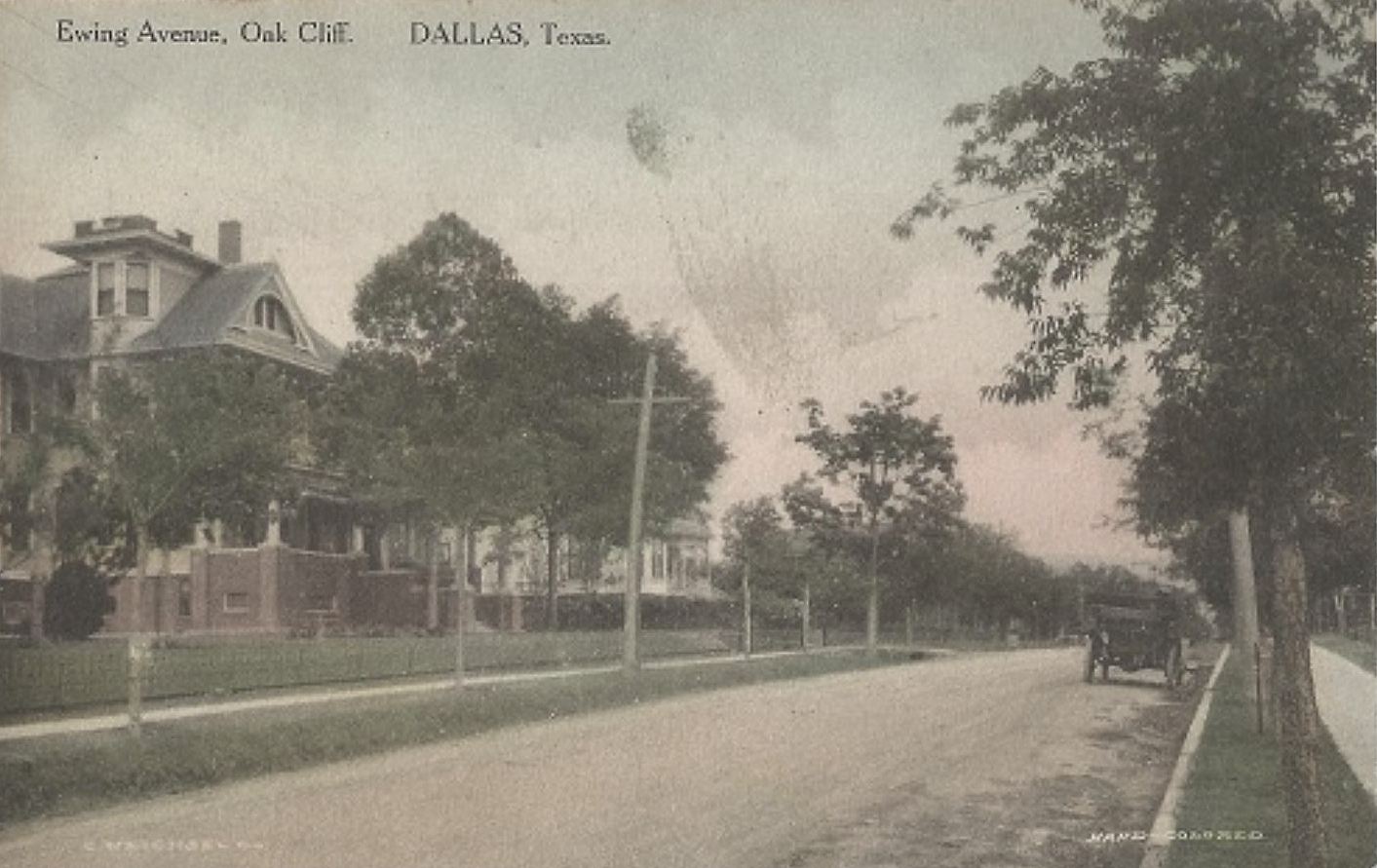
Ewing Avenue, Oak Cliff

oak-cliff_ewing-avenue_flickr_colteraStately and serene Oak Cliff… (click for larger image)

by Paula Bosse

Another lovely hand-colored postcard from the C. Weichsel Co. — this one shows a sleepy, gauzy-looking Ewing Avenue in Oak Cliff, probably around 1910. According to the 1910 Dallas directory, Ewing Avenue stretched from S. Jefferson (now E. Jefferson) to 18th Street (it may have extended beyond that, but 18th Street was, apparently, the city limits).

If anyone knows the location of this view or the owner of this house, please let me know. I don’t think any part of Ewing — North or South — looks like this anymore!

***

Postcard found on Flickr, posted by Coltera (sorry, did not note the link).

*

Copyright © 2017 Paula Bosse. All Rights Reserved.
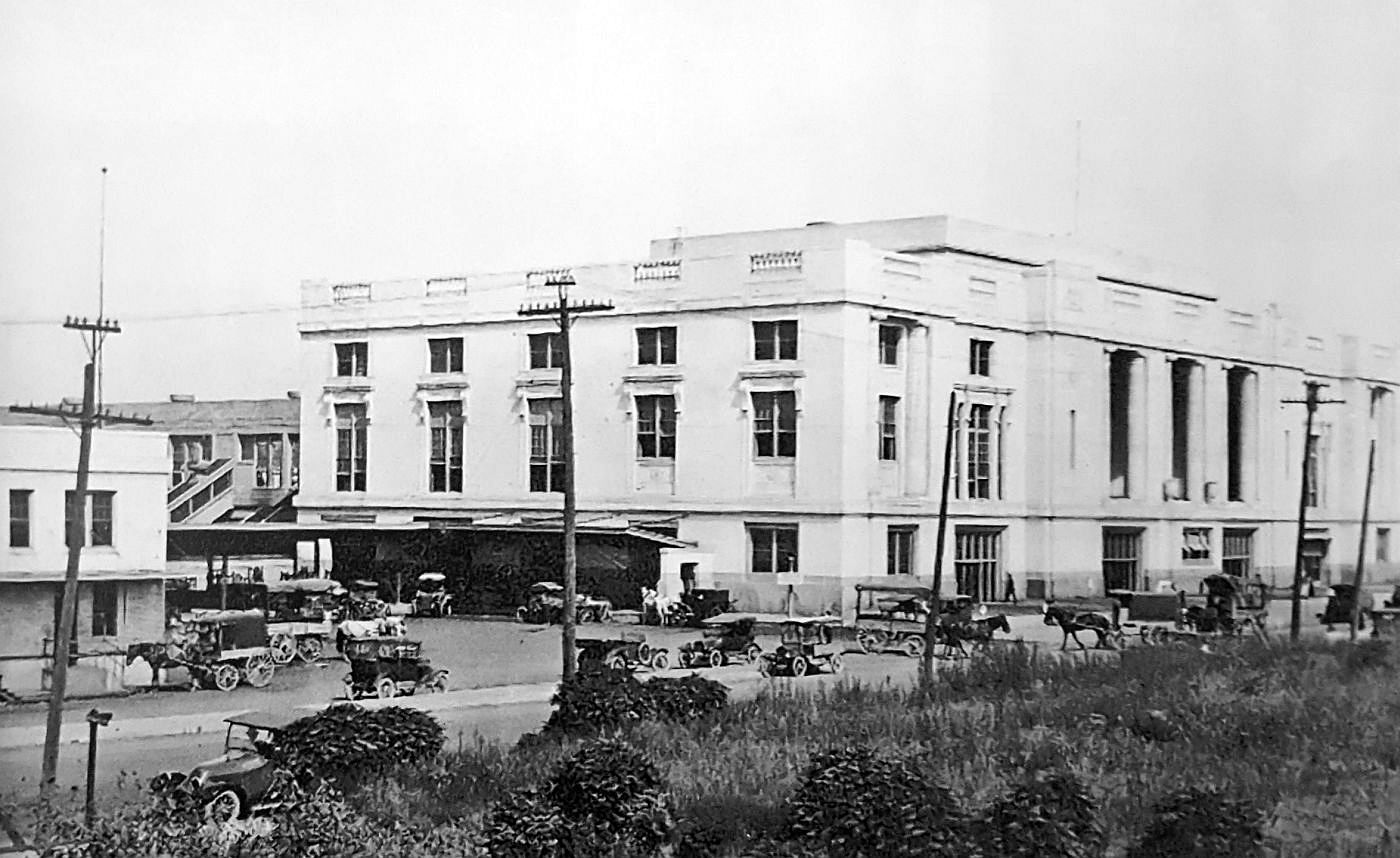
Union Station — ca. 1916

union-station_ca-1916A century ago… (click to see larger image)

by Paula Bosse

A new Union Station, bustling with activity, as seen across a scrubby vacant lot which, today, is the home of the Dallas Morning News building at S. Houston and Young. See the view today, here.

The photo shows the baggage shed which used to be on the south side of the building as well as the passenger bridge heading to and from the trains, with steps leading down to the platforms. See the details on the Sanborn map from 1921 here.

Union Station has weathered some difficult times and suffered from neglect after the golden age of train travel ended, but after recent extensive renovation/restoration, the historic landmark looks as good as new!

*

Copyright © 2017 Paula Bosse. All Rights Reserved.
 

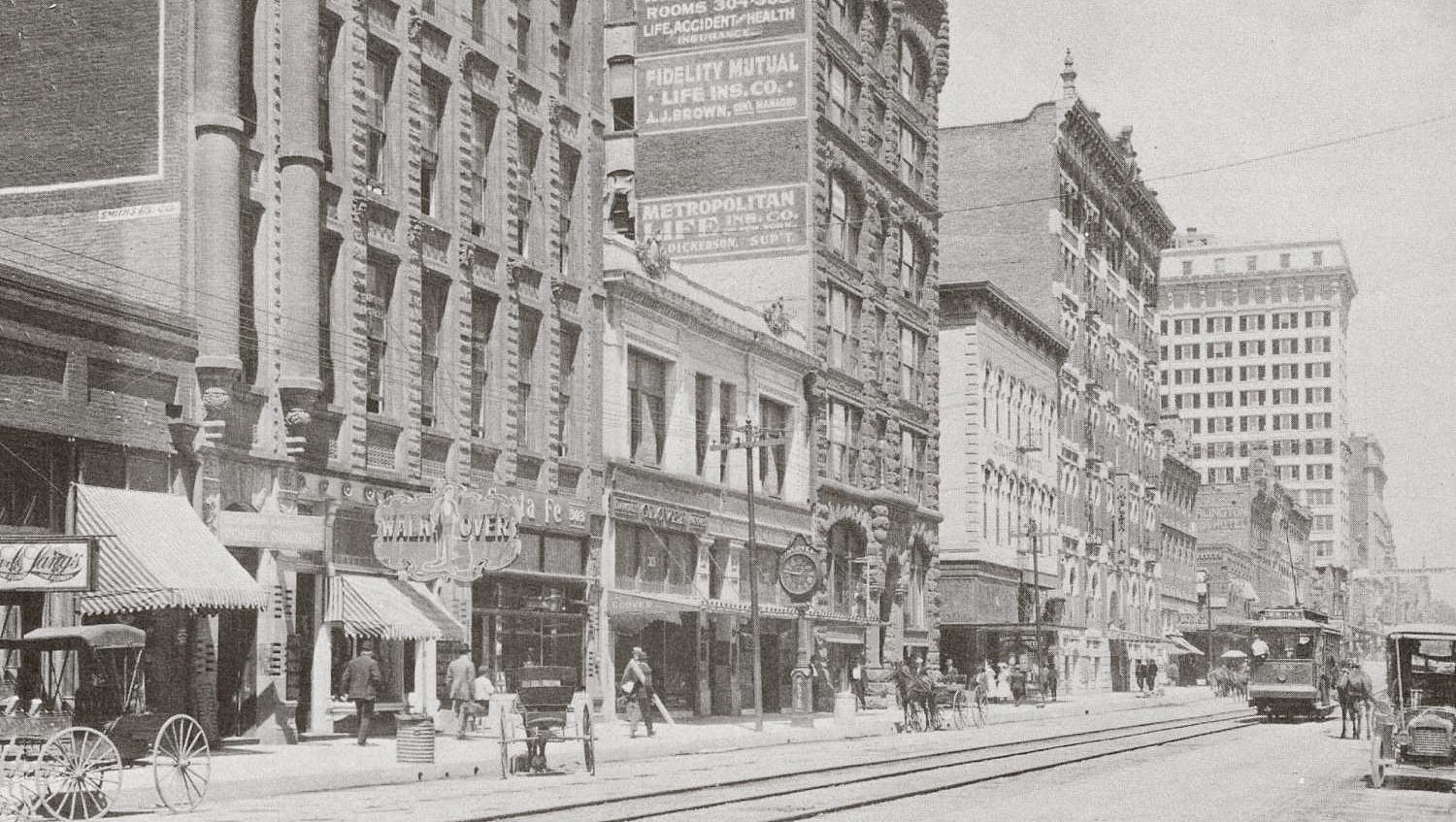
Main Street’s Varied Modes of Transport — ca. 1909

main-street_tsha-meeting-1977_portalPowered by oats, electricity, and gasoline…

by Paula Bosse

Here’s Main Street, looking east, from about Field. This is another of those odd photos showing streets shared by horse-drawn buggies and automobiles. And an electric streetcar. The days of those horses clip-clopping down Main Street were running out. (And I’m sure the horses were much relieved.)

This photo was taken sometime between 1909, when the Praetorian Building opened (it’s the tall white building in the background, with the Wilson Building behind it at the other end of the block), and 1911, when the street numbers changed (you can see the address of “303” next to the words “Santa Fe” — the Gulf, Colorado & Santa Fe Railway offices were at 303 Main Street in the 1909 city directory).

Also seen in this photo are the tall Scollard Building (the one with the advertising painted on its side) and, one building away, the Imperial Hotel.

See what it looks like now, here.

***

Sources & Notes

Photo from a pamphlet for the Texas State Historical Association’s annual meeting in Dallas in 1977, found on the Portal to Texas History, here. Sadly, the photo was printed in sepia ink, which, argh. As always, if you know of a sharper image, please let me know!

*

Copyright © 2017 Paula Bosse. All Rights Reserved.
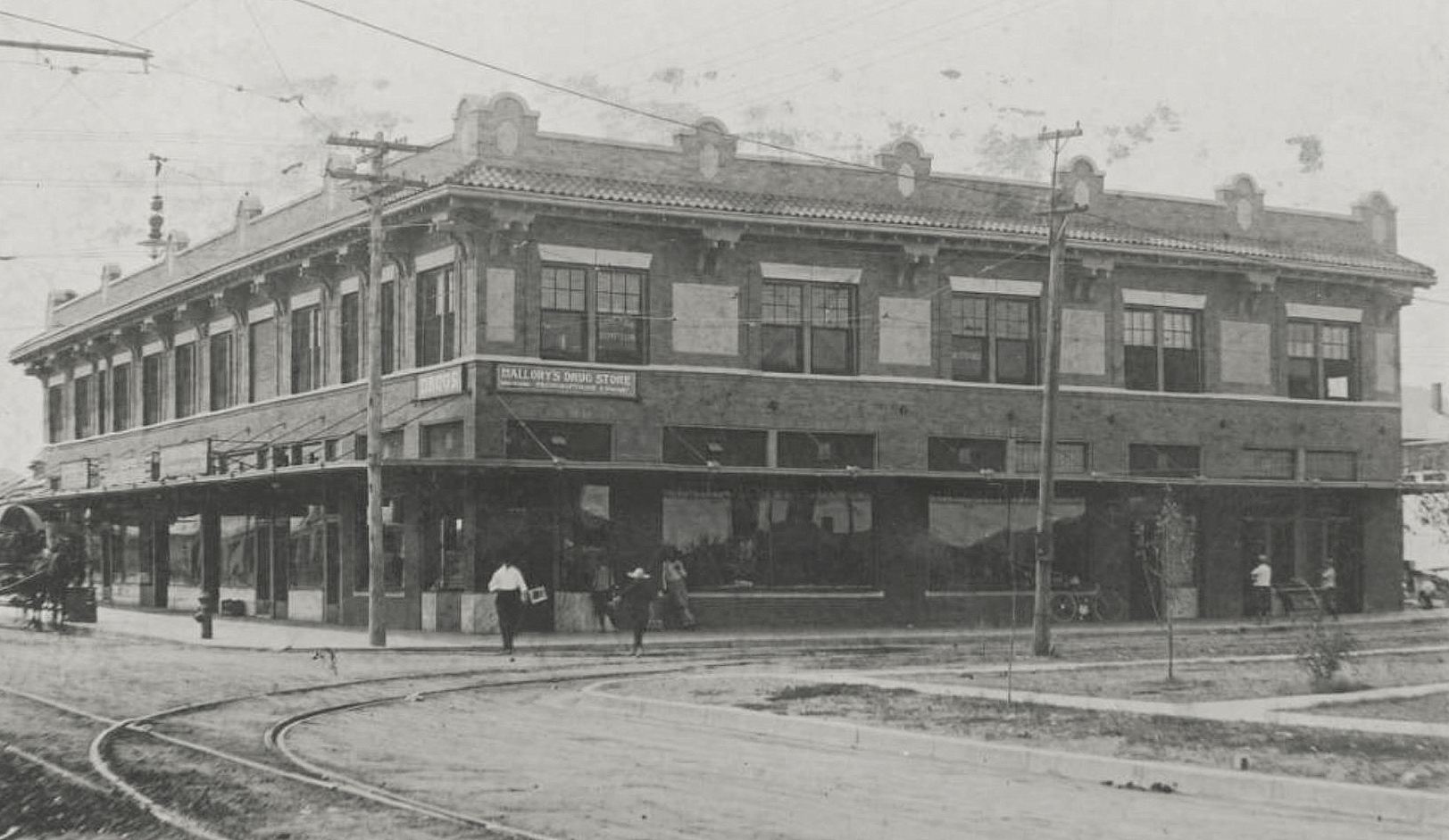
West Jefferson and Tyler — 1913

mallorys-drug-store_ca-1913_cook-collection_smuWhy, yes, we ARE accessible by streetcar… (click for larger image)

by Paula Bosse

Every time I pass the northwest corner of West Jefferson and Tyler in Oak Cliff, I admire this building. Actually, I love this building. And I’m always surprised it’s still there.

This photo shows Tyler St. to the right and Jefferson Blvd. heading off to the left. See what it looks like today on Google Street View, here.

It appears to have been built in 1911 or 1912. And it still looks pretty good.

Thank you, Oak Cliff!

***

Sources & Notes

Real photo postcard titled “Mallory’s Drug Store” from the George W. Cook Dallas/Texas Image Collection, DeGolyer Library, Central University Libraries, Southern Methodist University; see the card front and back and read more information here.

A couple of other photos can be found in the post “Dallas in ‘The Western Architect,’ 1914: Businesses,” here (scroll down to number 7). Seems the building was designed by architect C. A. Gill, the man behind the famed Gill Well.

*

Copyright © 2017 Paula Bosse. All Rights Reserved.
 

Commerce & Ervay, Looking East

commerce-ervay_east_flickr-colteraEven then a busy downtown intersection…

by Paula Bosse

Above, Commerce Street, looking east from Ervay, with the old Post Office/Federal Building on the northeast corner (replaced by the Mercantile Bank Building in the early 1940s). In the background, at the right side of the photo, the Metropolitan Business College, at Commerce and St. Paul.

See a view of Commerce looking west in 1913 — showing the Metropolitan Business College in the foreground and the new Adolphus Hotel a few blocks away, here.

Another eastward-looking view — from about 1895, when the post office was still pretty new — is here.

And the present-day Google Street View of Commerce and Ervay looks like this.

***

Sources & Notes

I’m not sure of the original source of this photograph, but I found it on Coltera’s Flickr stream (I didn’t save the link and I can’t find it again). If anyone knows of a sharper image of this photo, I’d love to see it!

*

Copyright © 2017 Paula Bosse. All Rights Reserved.

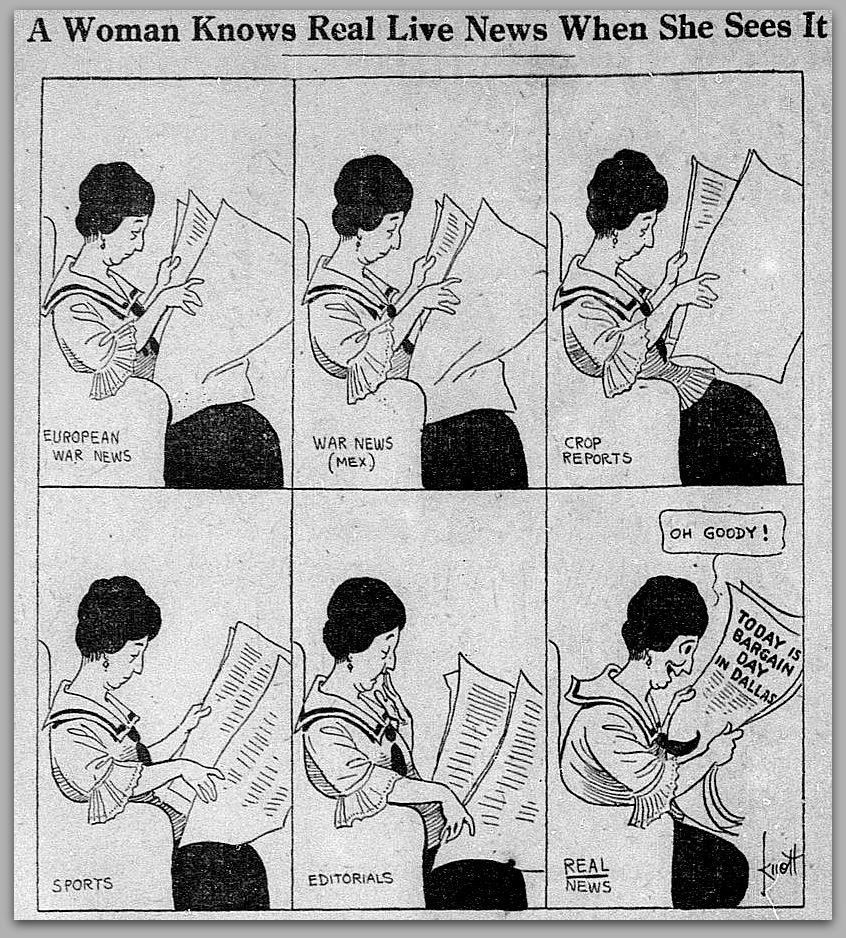
“A Woman Knows Real Live News When She Sees It” — 1915

womens-news_dmn_070815_knott-cartoon“Oh goody!” (click for larger image)

by Paula Bosse

This editorial cartoonist’s take on what was really important to Dallas women is one that probably caused some Dallasites to chuckle and some to fume. The date of this Dallas Morning News cartoon was July 8, 1915. In 1915 women had no constitutional right to vote in the United States and were barred from voting in local, state, and national elections. The Nineteenth Amendment to the U. S. Constitution (which gave women the right to vote) was ratified in Texas in June, 1919.

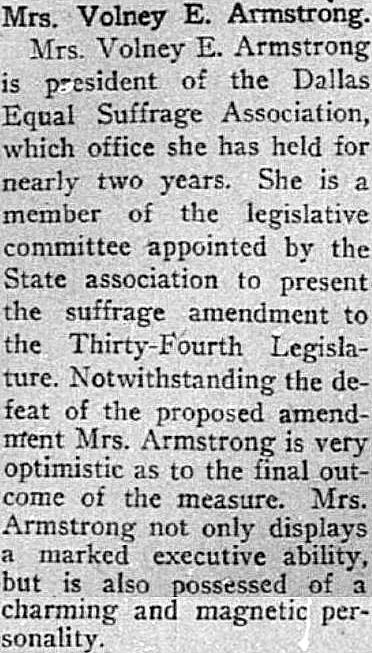
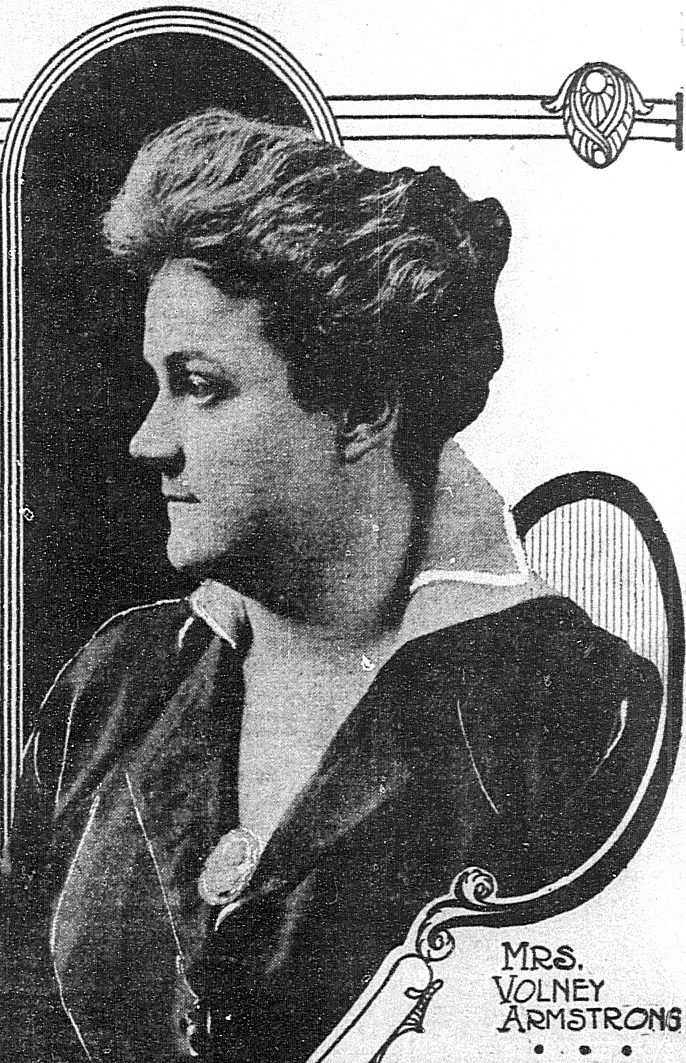
The woman’s suffrage movement in Dallas had been active since at least the 1890s, but it really began to catch fire in the early ‘teens when the Dallas Equal Suffrage Association (DESA) was formed in 1913. The second president of this organization (who was one of the state’s leading suffragists when this cartoon appeared) was Texas Erwin Armstrong (Mrs. Volney E. Armstrong). (Yes, her first name was “Texas” — her friends called her “Tex.”)

I have to admit, I was not aware of Mrs. Armstrong until today, but she was one of many laudable women who helped forge the way for those of us who followed. I like this quote of hers from 1918, commenting on the support (or lack thereof) of politicians during the slow but sure path to ratification:

“Any Democrat who failed to vote for this measure is a man without a party and soon will be a man without a country.” (DMN, Jan. 12, 1918)

tex-armstrong_dmn_031515_suffrage_photo

tex-armstrong_dmn_031515_suffrage
Dallas Morning News, March 15, 1915 (photo and profile)

**

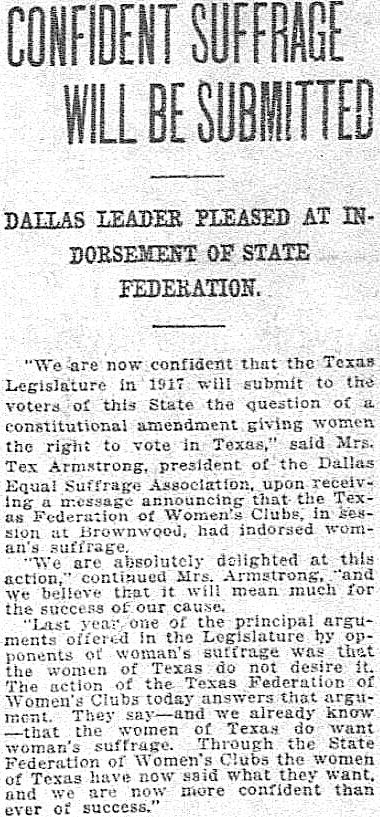
More suffrage news from Dallas (click articles to see larger images).

suffrage_dmn_111115
DMN, Nov. 11, 1915

suffrage_dmn_030818
DMN, March 8, 1918

***

Sources & Notes

Dallas Morning News editorial cartoon “A Woman Knows Real Live News When She Sees It” (by staff cartoonist John Knott) appeared in the July 8, 1915 edition of the paper.

For more on the history of Dallas women and women’s causes, check out the book Women and the Creation of Urban Life: Dallas, Texas, 1843-1920 by Elizabeth York Enstam (College Station: Texas A & M University Press, 1998); a large portion of the chapter “Suffragists and the City” can be read here.

The history of the women’s suffrage movement in Texas can be found at the Handbook of Texas site, here.

The obituary of Mrs. Texas Erwin Armstrong (1878-1960) can be found in the archives of The Dallas Morning News: “Campaigner For Women’s Suffrage Dies” (DMN, March 7, 1960).

Click clippings and pictures to see larger images.

*

Copyright © 2017 Paula Bosse. All Rights Reserved.
 

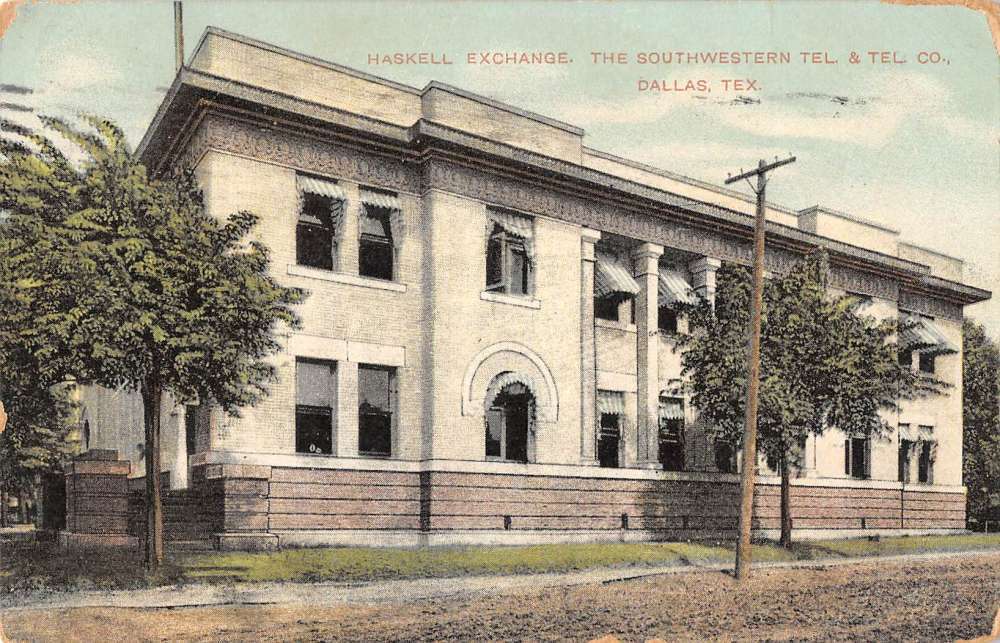
The Haskell Exchange — ca. 1910

telephone_haskell-exchange_postmarked-1910_ebayThe switchboard hub in Old East Dallas… (click for larger image)

by Paula Bosse

Above, the building that housed the Haskell Exchange of Southwestern Telegraph and Telephone (the company which later became Southwestern Bell Telephone and, eventually, part of AT&T), located at the southeast corner of Bryan and Haskell in Old East Dallas. It was so cute and quaint back in 1910 (the year this postcard was mailed). AT&T still has a building on this very same corner — over a century later. Unfortunately, the building stopped being quaint a long time ago. See the same location today, here. Some awnings might help….

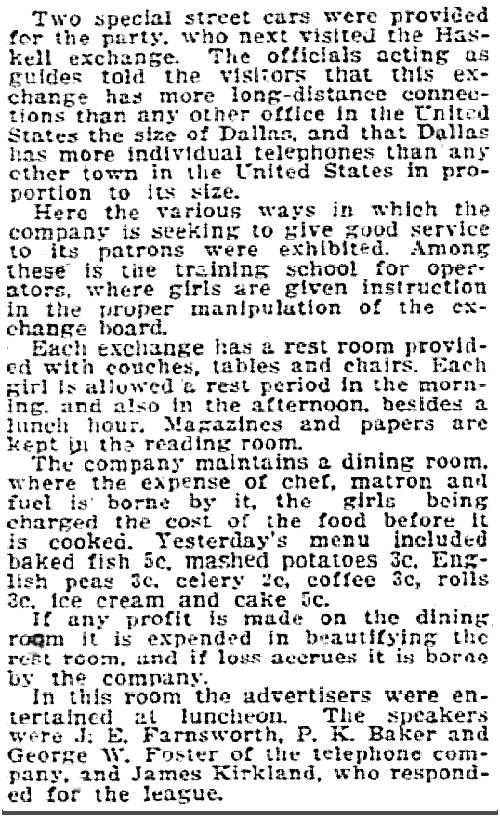
Below is part of an article describing a tour of the Exchange taken by the Dallas Advertising League in 1911 (click for larger image):

haskell-exchange_dmn_021111
Dallas Morning News, Feb. 11, 1911

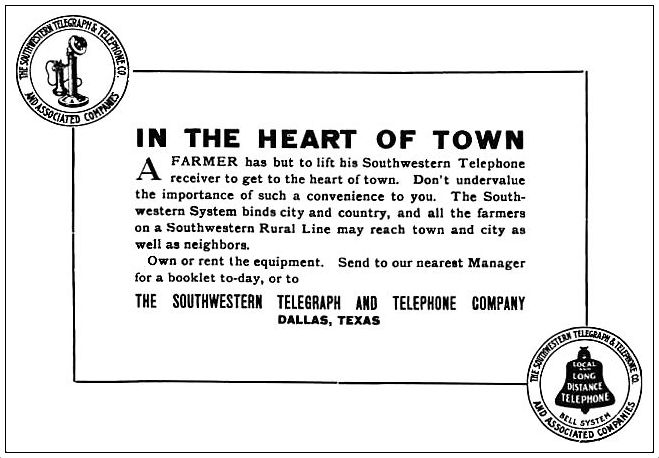
ad-southwestern-telephone-telegraph_1912
Cattle Raisers’ Association of Texas, 1912

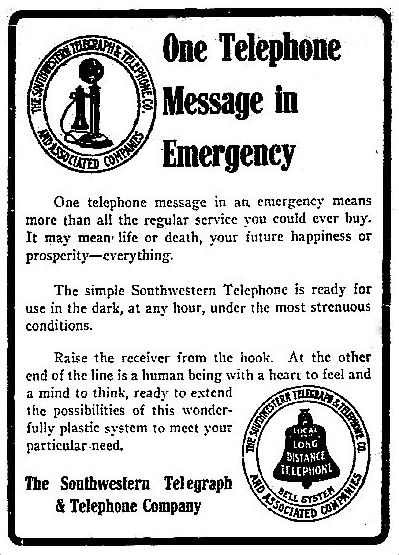
ad-southwestern-telephone-telegraph_dmn_050212
DMN, May 2, 1912

haskell-exchange_ca-1915_DHSDallas Historical Society

***

Sources &  Notes

More about the operators of Southwestern Tel. & Tel. (with photos of their “rest room”) can be found in the Flashback Dallas post “Work and Play in Telephone Land,” here.

In this case “exchange” did not mean the same thing as telephone exchanges such as “Taylor,” “Emerson,” “Lakeside,” “Fleetwood,” “Riverside,” etc. Read more at Wikipedia here and here for the distinctions.

*

Copyright © 2016 Paula Bosse. All Rights Reserved.
Preston Sturges: Camp Dick’s Most Famous Former Cadet? — 1918

preston-sturges_camp-dick_dallas_1918
Preston Sturges playing dress-up, Camp Dick, Dallas, 1918

by Paula Bosse

While researching my Veteran’s Day post on Camp Dick cadets, I came across a 1941 Dallas Morning News article about Hollywood screenwriter and director Preston Sturges, whose latest movie The Lady Eve was about to open at the Palace. The article mentioned that Sturges had been stationed at Camp Dick, the WWI aviation boot camp for the U.S. Signal Corps, located in the old racetrack at Fair Park. Preston Sturges — a master of the screwball comedy — is one of my favorite writer-directors (in addition to The Lady Eve, everyone should watch Sullivan’s Travels), so I was interested to find out more about his time in Dallas. I didn’t think I’d find anything but a passing mention of it anywhere, but, surprisingly, it turns out Sturges himself wrote about his Camp Dick days — in a book I actually own and had started but had never finished!

Sturges was sent to Dallas in March, 1918. He was 19 years old. Born in Chicago, he had spent much of his childhood in France, tagging along with his eccentric four-times married bohemian mother who seems to have known every intellectual and artiste of the day (not only was she a close friend of dancer Isadora Duncan and Marcel Duchamp, she had also been romantically involved with Aleister Crowley — you can’t get much more bohemian than that!).

Sturges’ account of his time at Camp Dick (which appeared in Chapter 28 of the posthumously-published Preston Sturges by Preston Sturges) is amusing, describing such things as the heat (“the midday temperature of a Texas summer wasn’t really intended for human beings”), the latrines, and the food. He also remembered the nightmare of the Spanish Influenza pandemic, which was particularly deadly in the close quarters of military camps. (You can read the entirety of Sturges’ memories of his days at Camp Dick here.)

The heat was a real problem for the cadets. One of my favorite images conjured by Sturges’ chapter on the camp is this one:

Out on the parade ground, boys fell over from [the intense heat] all the time and had to be revived with cold water and a sponge. Nights we would climb up the shaky apex of the large roller coaster in the corner of the fairgrounds to try to find a breeze.

One of his memories stumped me a bit, though. He wrote the following about the buildings that stood around Fair Park:

In Dallas, we were sent to a place called Camp Dick, then known as a concentration camp. In a later war, such a facility was called a boot camp. Camp Dick was actually the Dallas fairgrounds with a fence thrown around them. Most of the buildings on the fairgrounds were huge reproductions of the products for sale within them in the prewar days when the fair was open. There was a building in the shape of a gigantic Mazola bottle; another like a huge Gulden’s mustard pot; an enormous Log Cabin Syrup edifice; a massive chili bowl; buildings representing almost anything edible or potable that one could think of….

My last memory of Camp Dick is of standing retreat against the hot sunset, the cadets at attention against the silhouetted background of the massively enlarged Sanka coffee pot, Bromo Quinine bottle and Coca-Cola bottle buildings, and in front of us Lieutenant Pennypacker, more or less at ease on the back of the fiery steed presented to him by the grateful citizens of Dallas.

I’ve never heard of any Fair Park buildings shaped like these things. (There was that giant cash register at the Texas Centennial….) Perhaps Mr. Sturges misremembered? Or indulged in a little fanciful poetic license? Or maybe these buildings DID exist? (And if they did, I’d love some corroboration, ’cause that would be cool.)

Sturges was at Camp Dick only a few months. From there he was sent to the School of Military Aeronautics in Austin and then to Park Field in Millington, Tennessee. He was in the middle of flight training there when, anti-climactically, the war ended. After several years of working in a family business, he became a successful Broadway playwright and was soon whisked off to Hollywood, where, in 1940, he won the first Oscar ever awarded for screenwriting (The Great McGinty). He was considered then — and is considered now — to be one of Hollywood’s greatest comedic screenwriters.

If you’d like to read Preston Sturges’ memories of training at Camp Dick, mosey on over here. Among other tidbits, you’ll read the amusing story behind the be-goggled photo of Cadet Sturges at the top of this post.

***

Sources & Notes

The romanticized photo at the top (the one Sturges wrote about in the book) was taken at Camp Dick in 1918. The quoted passage is also from the book, Preston Sturges by Preston Sturges, His Life In His Own Words, adapted and edited by Sandy Sturges (New York: Touchstone/Simon & Schuster, 1991). I highly recommend getting this book if you’re a fan of classic Hollywood. You can browse through it on Google Books, here, and purchase it here.

More on Sturges at Wikipedia, here.

Dive deeper: another photo of Sturges taken in Dallas in 1918 appeared in The Dallas Morning News on March 27, 1941, titled “At Camp Dick” — it shows a smiling Sturges sitting in a “dummy pilot seat.” If the photo was taken at Camp Dick, the unnamed photographer must have taken “action shots” as well as portraits of the camp’s cadets which Sturges wrote about in his autobiography. (Sturges writes in his amusing story that none of the cadets had ever been near a plane at that point, but they all wanted to be seen as dashing goggle-and-scarf-wearing flying aces.)

*

Copyright © 2016 Paula Bosse. All Rights Reserved.