Flashback : Dallas

A Miscellany: History, Ads, Pop Culture

Category: 1920s

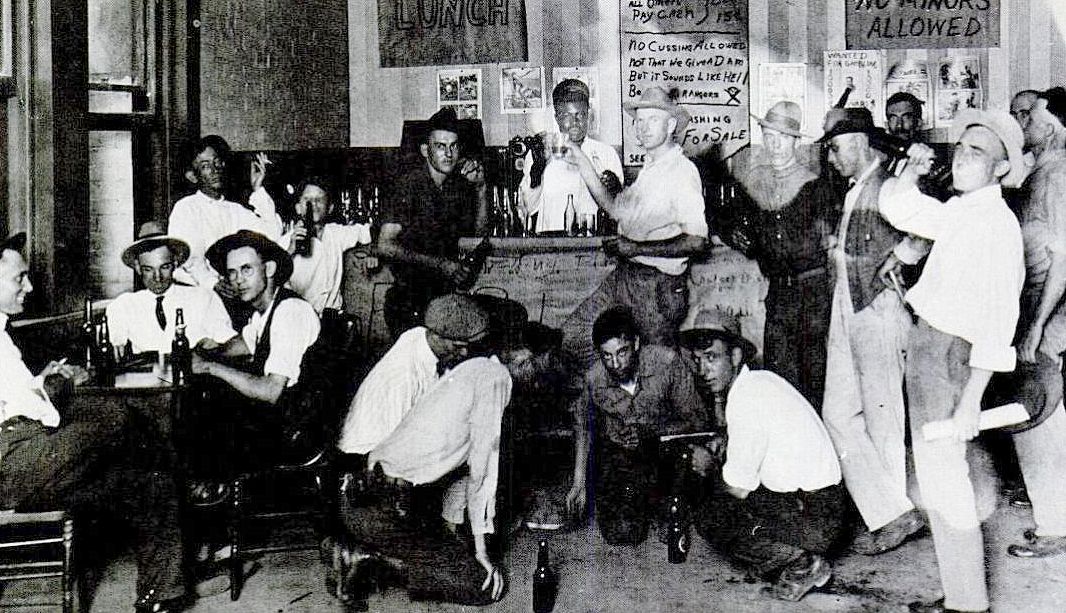
Hoisting a Few in the Basement Speakeasy

speakeasy_greene

by Paula Bosse

It’s tax day. Here’s a photo of men drinking illegally and gambling. Cheers!

“Dallas voted for Prohibition October 1917 — but it didn’t go dry, as this workingman’s speakeasy (a word not developed then) shows. One sign assures drinkers ‘No Neer Beer Served.’ This is a basement of some downtown building, address unknown.”

***

Photo and caption from Dallas, The Deciding Years by A. C. Greene (Austin: Encino Press, 1973).

Click picture for larger image.

*

Copyright © 2014 Paula Bosse. All Rights Reserved.

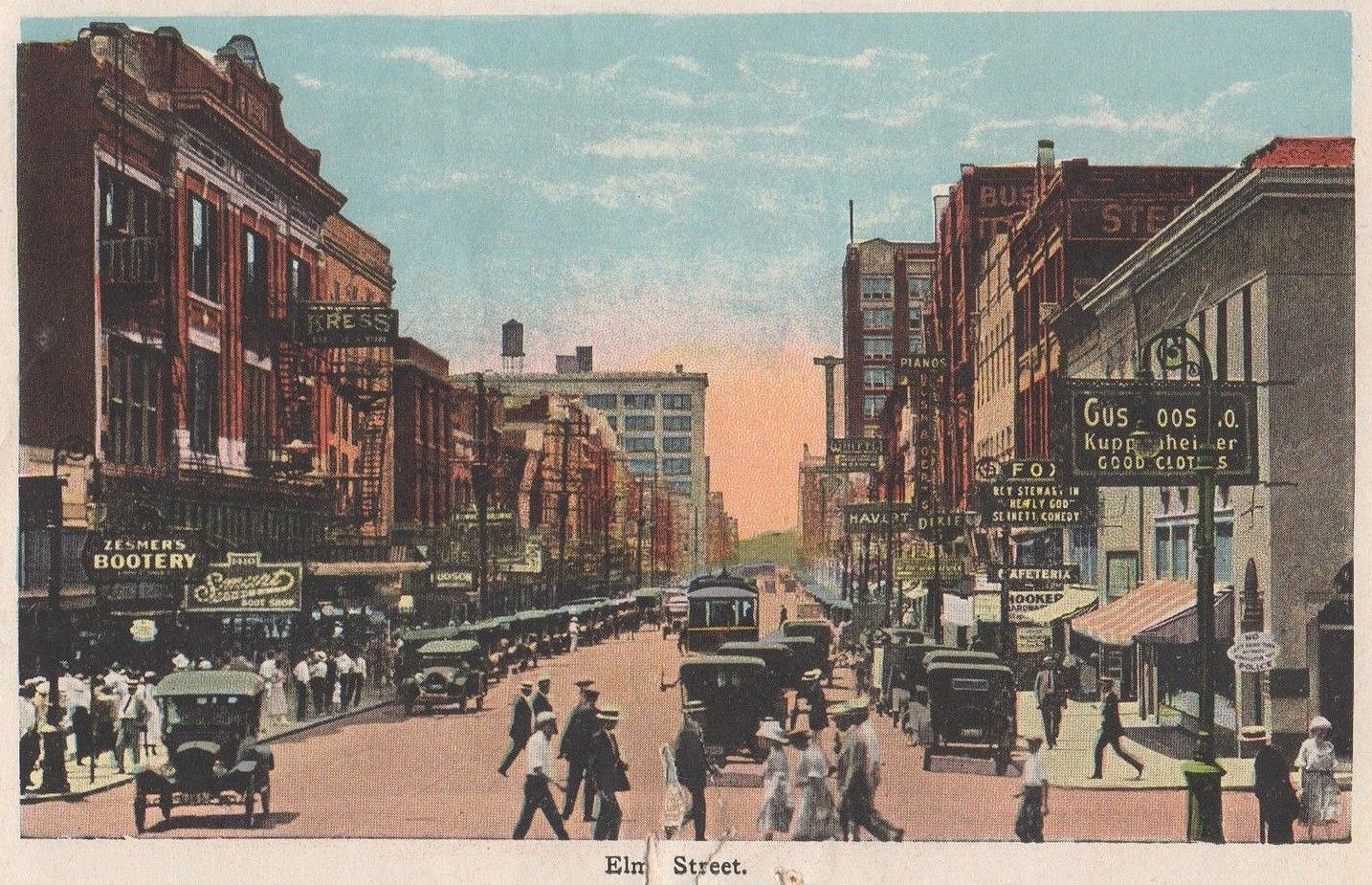
A Colorful Elm Street — 1920s

elm-st-color_1920s

by Paula Bosse

A bustling Elm St. — looking west from Akard — in “color,” in the early ’20s. I love this. You can practically walk down the street and window-shop.

Click for very large image.

*

Copyright © 2014 Paula Bosse. All Rights Reserved.

Oriental Oil Company: Fill ‘er Up Right There at the Curb

gas-pump_commerce_c1912An Oriental Oil Co. competitor, at 1805 Commerce

by Paula Bosse

I cropped this detail from a much larger view of Commerce Street because this incidental, everyday moment caught my attention. Was that man filling his automobile with gasoline? Was that square, boxy, hip-high thing full of gas, right there at the curb of one of the city’s busiest streets? The sign above the pump reads “PENNSYLVANIA AUTO OIL GASOLINE SUPPLY STATION.” I looked into it, and now I know more about early gas pumps and stations than I ever thought I would.

In the very early days of automobiles, one would have to seek out a supplier of gasoline (such as a hardware store or even a drugstore) where you would buy a gallon or two and carry it home with you in a bucket or something and then carefully pour it into your car’s gas tank using a trusty funnel. After a few years of this inconvenient way to gas up, these curbside pumps began to pop up in larger cities. The pump seen above was at 1805 Commerce St. and belonged to the Pennsylvania Oil Company. It opened in early 1912. That got me to wondering about other such fueling stations, and it seems the first in Dallas may have belonged to the Oriental Oil Company, just down the street from the one seen above, at 1611 Commerce. Here is a fuzzy image of it, from the same, larger photo the detail above was taken from. (Click for larger image.)
oriental-oil_1611-commerce_skyline-det

Could this photo have been taken there? It was listed on eBay merely as “Oriental Oil Company, Dallas, 1910-1920.”

oriental-oil-co_ebay

Oriental Oil’s first “auto station” opened in February, 1911, where “facilities have been arranged so as to fill the cars along the sidewalk.”

oriental-oil_dmn_022611(Dallas Morning News, Feb. 26, 1911)

Drive-up “stations” had begun to appear a few years before, on the West Coast.
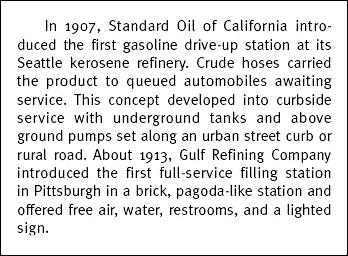
gas-stations_dot-pdf_p33(Texas Dept. of Transportation, 2003)

In a 1924 Dallas Morning News article (see below), the pump seen in the above photos was described thusly:

Dallas’ first gas filling station had a one-gallon blind pump on the curb which was then thought to be the last word in equipment. Now if a filling station is not equipped with a visible five-gallon pump it is thought to be behind the times and the gas now sold must be water white, when in the old days it was most any color.

This, I think, is what the Oriental and Pennsylvania rolling tanks looked like — the make and model may be different, but I think the general design is the same:

gas-pump-1913

When it was empty, it would be rolled away to be re-filled. I’m not sure about the payment system. Coupon books are mentioned in one of the ads, but I don’t know how (or with whom) one would redeem them as these pumps appear to be self-serve. Perhaps there was a slot for coins/coupons, and everyone worked on the honor system.

It seems that its placement would cause a lot of congestion on a major street like Commerce (which at the time was still shared with skittish horses), but Commerce was also a hotbed of automobile dealerships (Studebaker, Stutz, and Pierce-Arrow dealerships, for example, were within a couple of blocks of the Oriental and Pennsylvania filling stations).

The Oriental Oil Company — a forgotten, early oil company — had an interesting history. The Dallas-based company began business in 1903, starting their company “in a barn in the rear of the Loudermilk undertaking establishment.”

oriental-oil_mercury_123103(Southern-Mercury, Dec. 31, 1903)

They were a fast-growing oil company (“an independent concern which in spite of the strong opposition of the oil trust is now enjoying permanent and growing prosperity”Greater Dallas Illustrated, 1908), and they were one of the first to open a refinery in Texas (they eventually had two refineries in West Dallas). The company’s primary concern in its early years was the manufacture of various oils and greases for industrial use.
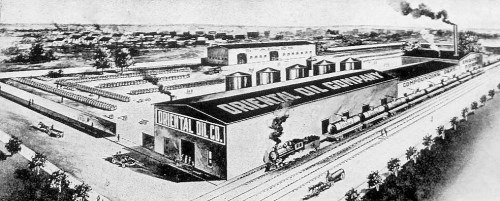
oriental-oil-factory-c1908Oriental Oil Company Factory, corner of Corinth St. and Santa Fe tracks, circa 1908

In 1911, understanding just how profitable the new world of retail gasoline sales could be, they installed their first pump at the curb of 1611 Commerce St., near Ervay (“right behind the Owl Drug Store”). A 1924 Dallas Morning News account of the company (see below) states that this was the first gas pump … not only in Dallas … but in the entire state of Texas. I’m not sure if that’s true, but the Smith Brothers who ran Oriental Oil were certainly go-getters — the Smiths were grandsons of Col. B. F. Terry, organizer of the famed Terry’s Texas Rangers, and one of the brothers, Frank, was an early mayor of Highland Park and a three-term president of the Dallas Chamber of Commerce.

ad-1911_oriental-oil_dmn_100811(DMN, Oct. 8, 1911)

ad-1912_oriental-oil_dmn_012812(DMN, Jan. 28, 1912)

Shortly after opening their first pump on Commerce, demand was such that a second pump was soon opened at 211 Lane St. (a mere half a block away!). The DMN reported on Oct. 19, 1911 that a competitor — Consumers’ Oil and Auto Company — was going to be right across the street: “Permission was given to the Consumers’ Oil and Auto Company to place a gasoline tank under the sidewalk at 214 Lane street.” And in March 1912 the Pennsylvania Oil Company was installing ITS underground tank for the pump seen in the photo at the top — again, less than a block away. And in 1916 Oriental opened its splashy new “‘Hurry Back’ Auto Station” right across the street from where that Pennsylvania tank had been. (That Commerce-Ervay area was certainly an early gas station hotbed!)

ad-1916_oriental-oil_dmn_082916(DMN, Aug. 29, 1916)

Newspaper reports also cite claims made by the company that the station mentioned in the ad above — at Commerce and Prather — was the first drive-in gas station in the United States. I’m sure this was good truth-stretching PR for Oriental more than anything, because this claim was not true (Seattle and Pittsburgh seem to be battling each other for that honor). It might not have been the first, but when this “auto station” opened in 1916 (assuming it was “new” as this ad states), it was still pretty early in the history of the drive-in filling station. Also, by 1916, “Hurry Back” had become the company’s slogan as well as the name of its gasoline.

ad-1918_oriental-oil_dmn_102218(DMN, Oct. 22, 1918)

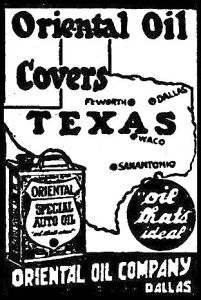
ad-1920_oriental-oil_jewish-monitor_1920(Jewish Monitor, 1920; detail)

ad-oriental-oil_dmn_041121(DMN, Apr. 11, 1921)

oriental-oil_ad_dmn_030522(DMN, Mar. 5, 1922)

I love these ads!

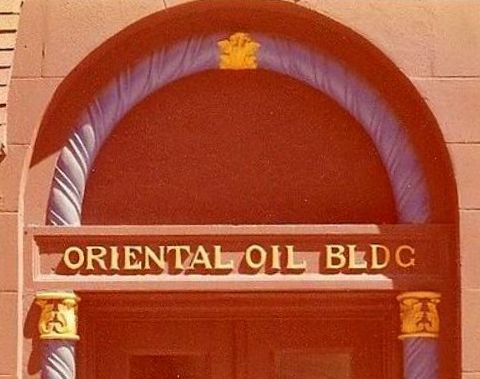
By 1927, the company boasted at least 18 filling stations, two refineries, and branches in Fort Worth and San Antonio. In 1927 they had moved into new offices in the “Oriental Building” at the nexus of Live Oak, St. Paul, and Pacific. A newspaper report described the building as being “finished in Oriental colors with Oriental decorations and is marked at night by very attractive lighting” (DMN, May 1, 1927).
oriental-oil_bldg_1977_flickr

The Oriental Oil Company declared bankruptcy in 1934, selling off their property, refineries, and their name. No more Oroco gas. A lot of companies went bust during the Great Depression, but I’m not sure what precipitated Oriental Oil’s bankruptcy. Actually, I’m surprised by how little information about the Oriental Oil Company I’ve been able to find. Afterall, it and its “Hurry Back” gasoline played a major role in getting the residents of Dallas off their horses and behind the wheel, a major cultural and economic shift that changed the city forever. And it all started at that weird little curbside gas pump on Commerce Street.

***

Sources & Notes

The first two images are details of a photograph by Jno. J. Johnson (“New Skyline from YMCA”), 1912/1913, from the DeGolyer Library, Central University Libraries, Southern Methodist University, viewable here.

Snippet of text from A Field Guide to Gas Stations of Texas by Dwayne Jones (Texas Department of Transportation, 2003).

Illustration of the two 1913 Tokheim portable gas pumps from An Illustrated Guide to Gas Pumps, Identification and Price Guide, 2nd Edition by John H. Sim (Iola, WI: Krause Publications, 2008).

Drawing of the Oriental Oil Company Factory from Greater Dallas Illustrated (Dallas: American Illustrating Co., 1908 — reprinted by Friends of the Dallas Public Library in 1992).

All ads and articles, unless otherwise noted, from The Dallas Morning News.

Color photo of the pink, purple, and gold Oriental Oil Bldg. is a detail from a photo taken around 1977, on Flickr, here.

For an interesting (and mostly accurate) mini-history of the Oriental Oil Company, then in its 20th year of operation, see the Dallas Morning News article “First Dallas Filling Station on Commerce Had One-Gallon Pump” (June 22, 1924).

Some nifty info on early gas stations (yes, really) here.

More info with some really great illustrations and photos here.

Another surprisingly fun and informative article is here.

*

Copyright © 2014 Paula Bosse. All Rights Reserved.

Downtown Dallas, ca. 1923 — Zooming in on the Details

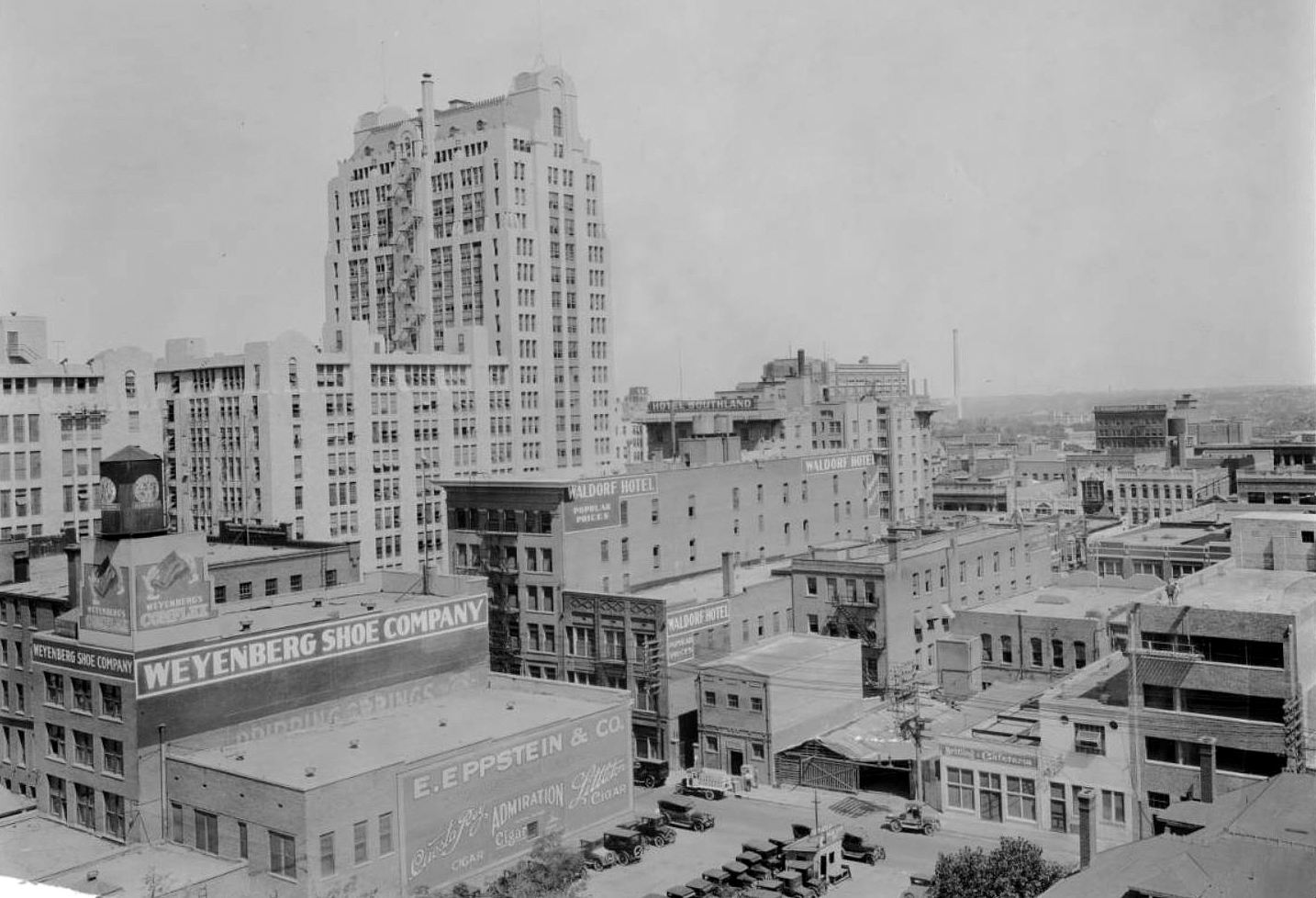
downtown-dallas_degolyer_smuThere’s a lot going on here (click for larger image) / Photo: SMU

by Paula Bosse

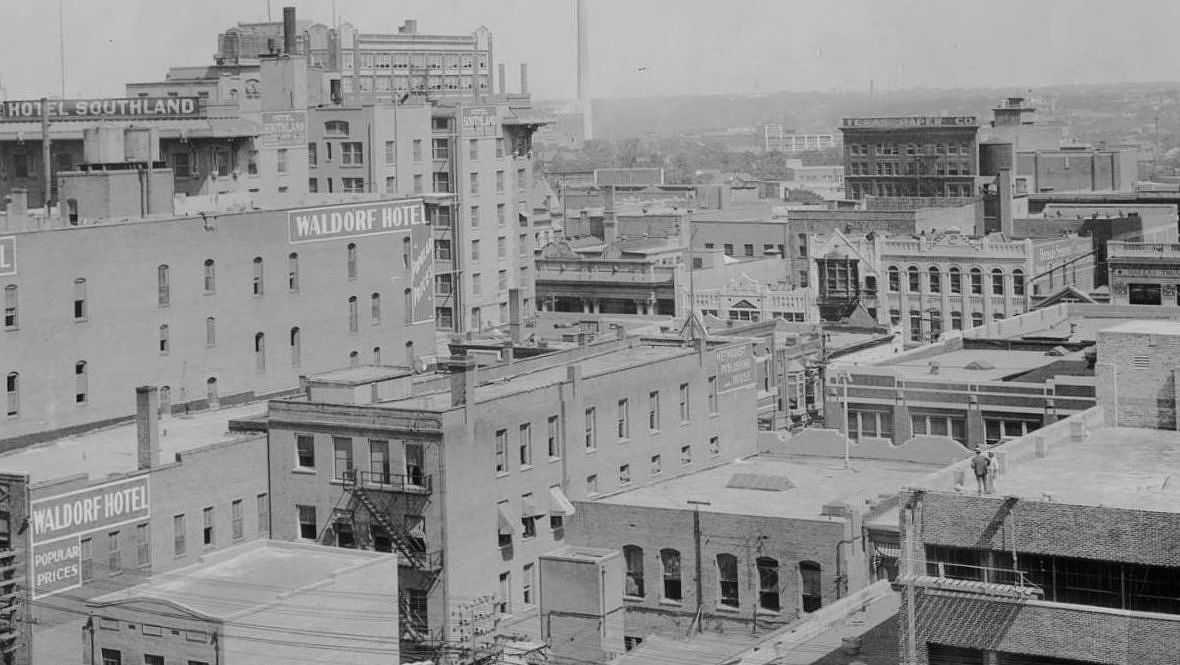
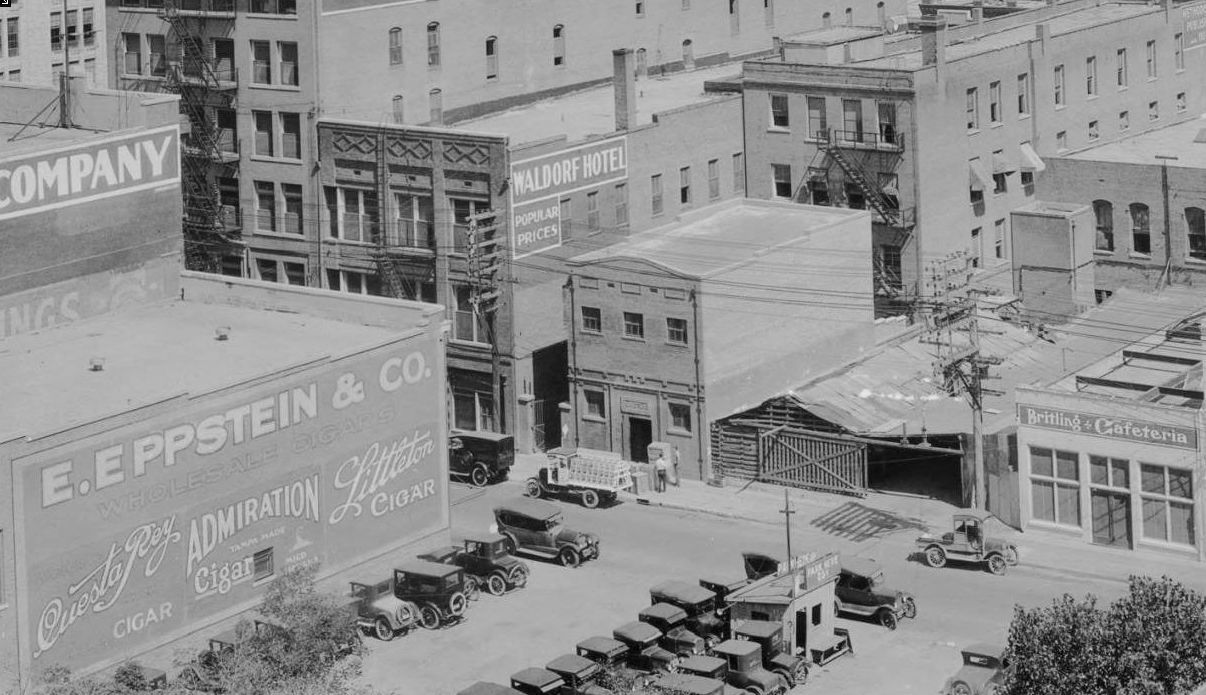
When I see photos like this I always want to zoom in as far as I can, to see the tiny details and everyday moments that might have been captured unwittingly by the photographer. Luckily, this photo has been scanned at such a high resolution (thank you, DeGolyer Library!) that it’s easy to zoom in and wander around it. (Click all of these pictures for much larger images.)

This particular photograph, from the DeGolyer Library at SMU, is attributed to Charles A. McAfee. The DeGolyer caption reads: “Downtown Dallas looking northwest at Santa Fe building complex (center left); Weyenberg Shoe Company at 1300-1302 Jackson; Waldorf Hotel, 1302 Commerce, and the Southland Hotel.” The Britling Cafeteria was at 1316 Commerce — its rear entrance on Jackson is visible in the photo. Here are a few more of the businesses in that 1300 block of Jackson Street, bounded by S. Field and S. Akard (from the 1923 city directory):

1923-directory_jackson-st

And it ALSO shows lots of signs and ads painted on the sides of buildings (some of which might still exist), two men standing on a roof surveying the skyline, a couple of guys talking on the sidewalk, a cafe next door to something that might be a crude garage, cars in a lot where it costs 25 cents to park, and a cool water tower on top of a shoe company. All of which add up to make this a much more interesting and lively photograph than originally presumed.

downtown_degolyer-b

downtown_degolyer-c

downtown_degolyer-d

downtown_degolyer-e

downtown_degolyer-f

***

Photograph of downtown Dallas attributed to Charles A. McAfee; from the DeGolyer Library, Central University Libraries, Southern Methodist University; access it here. I’ve corrected the color.

Trying to pin a date down (SMU has it as “circa 1920”), I’m guessing the photograph might have been taken around 1923, as the Britling Cafeteria opened for business on November 28, 1922. (I was so interested in that cafeteria that I wrote about it: read the Flashback Dallas post “The Britling Cafeteria Serves Those Who Serve Themselves,” here.)

For other photos I’ve zoomed in on to see the details, see here.

Click photos for much larger images.

*

Copyright © 2014 Paula Bosse. All Rights Reserved.
The Pasadena Perfect Home — 1925

g

by Paula Bosse

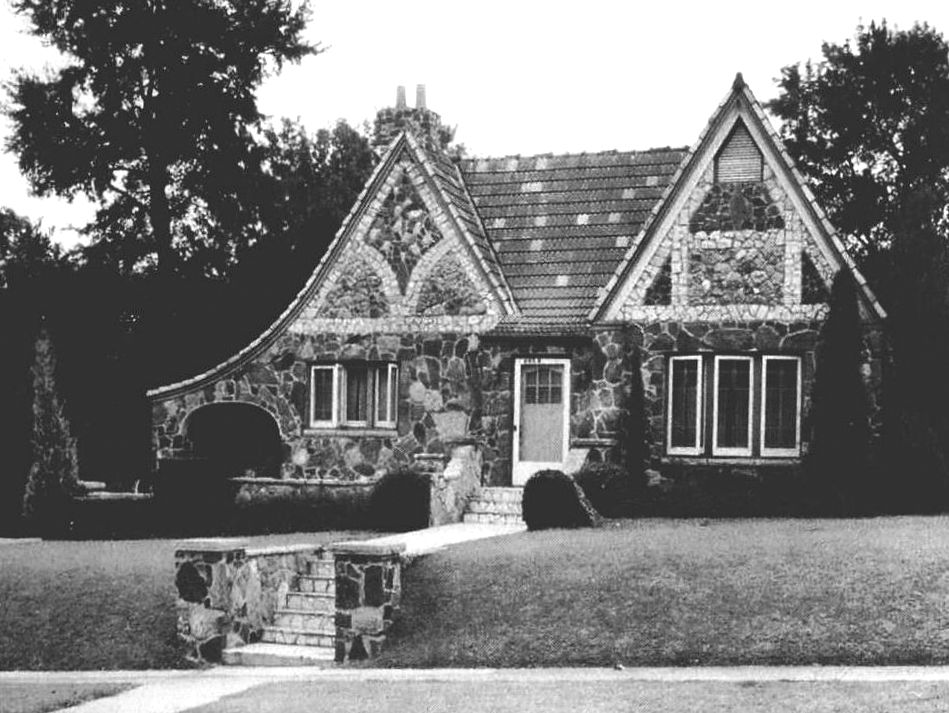
A few weeks ago, I wrote about the “Blandings Dream House” promotion in which the marketing department of the studio behind the Cary Grant movie “Mr. Blandings Builds His Dream House” built several houses around the country. The houses were built and furnished locally, with the contractors sharing in the (massive) advertising blitz. Once the home was completed, people toured the  house, with a small admission going to charity. One of those houses was built in Dallas (in Preston Hollow). That was in 1948. Twenty-three years BEFORE that, the Dallas Times Herald sponsored something called “The Pasadena Perfect Home,” built and marketed in a similar manner.

In the early 1920s, land in the general area we now know as Lakewood was pretty much undeveloped. There was a lot of open space — some farmland, the occasional cotton patch. White Rock Lake was becoming a popular recreational destination, but it was still WAAAAY out beyond the center of Dallas. But by the mid-’20s, developers started developing. A few of the neighborhoods that sprang to life at this time were Lakewood, Hollywood Heights, and Santa Monica. In 1925 — in the part of town then being referred to as “New East Dallas” — a 40-acre parcel of land near the Hollywood/Santa Monica subdivisions began to be planned. The small tract of 130 lots was to be known as Pasadena, located just north of Gaston, comprised of Pasadena, Wildgrove, and Shook avenues, bordered by Auburn Ave. and White Rock Rd.

The developer came up with the brilliant idea of marketing his investment by building two “perfect homes” and, while they were under construction, to promote the bejabbers out of them in the pages of the Dallas Times Herald, the project’s sponsor (and namesake). Just like the Blandings builders did a couple of decades later, local construction crews, plumbers, electricians, stone masons, etc. were contracted to build the “Dallas Times Herald Pasadena Perfect Homes” in exchange for their businesses appearing in a veritable onslaught of advertising-slash-publicity (which soon became publicity-slash-advertising). Each step of progress in the months-long construction of the houses was breathlessly reported in the Times Herald in regular reports, and looky-loos (i.e. potential buyers) were heartily encouraged to drive out to watch the goings-on. Make a day of it! This pleasant hard-sell to “own a bit of paradise in the heart of New East Dallas” was covered more as a community event than as the clever marketing gimmick it was.

When the two homes were completed, there was an official opening on February 21, 1926. This boggles the mind, but apparently 20,000 people (TWENTY-THOUSAND PEOPLE!) showed up for this event. All that promotion worked. Lots in the little neighborhood sold quickly.

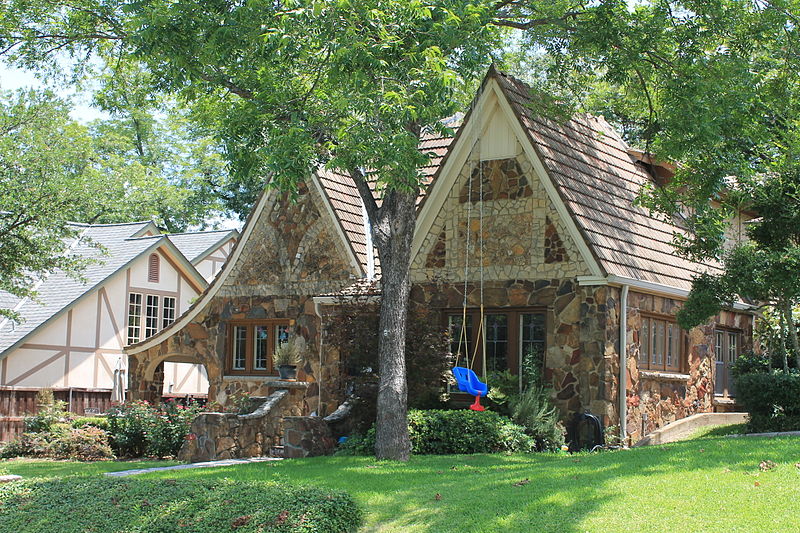
The original “perfect home” pictured above is still there, on Wildgrove. In fact, the house, designed by architect Arthur E. Thomas, was placed on the National Register of Historic Places in 2006 (listed as “The Dallas Times Herald Pasadena Perfect Home”). It’s well worth a nice Sunday drive to check out this home and the other homes in this lovely historic area. The Pasadena neighborhood remains unsullied by the McMansion-ization that has destroyed the charm of much of Dallas’ older neighborhoods, and driving down Pasadena’s tree-lined streets is an absolute joy.

Above, the house from a 2011 Google maps photo.

A photo I took at the end of February, 2014, Instagramized.

***

Sources & Notes

For more on the Dallas Times Herald Perfect Home(s) (and a couple of other photos, on pages 2 and 38), see the article by Sam Childers in the Fall, 2002 issue of Legacies, here. There is also some info here.

A little more info on this home (building materials, etc.) is here.

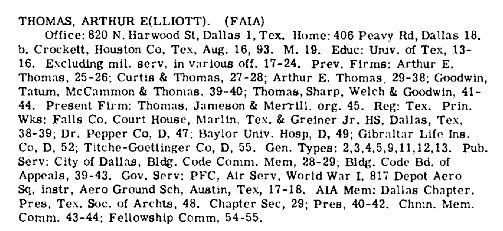
The architect of this house is Arthur E. Thomas, and he designed some pretty impressive buildings in Dallas, such as the Dr Pepper headquarters and Baylor Hospital, and, most impressively, he was one of the Centennial Architects who worked on the Centennial buildings in Fair Park in 1936. But I have found very little about him online. A brief bio is here. The following list of his projects is from a 1956 AIA directory.

Click pictures for larger images.

*

Copyright © 2014 Paula Bosse. All Rights Reserved.
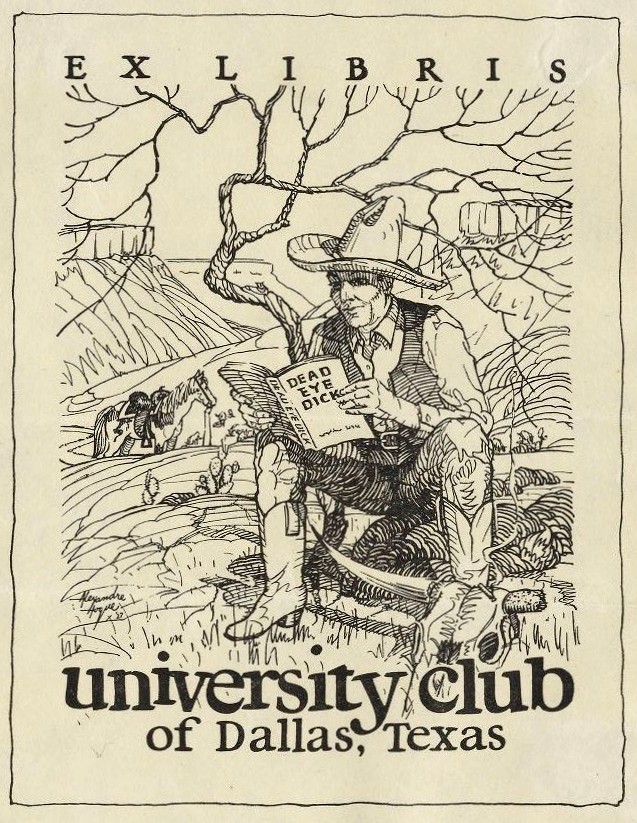
Alexandre Hogue and the Lost “Dead Eye Dick” Bookplate — 1927

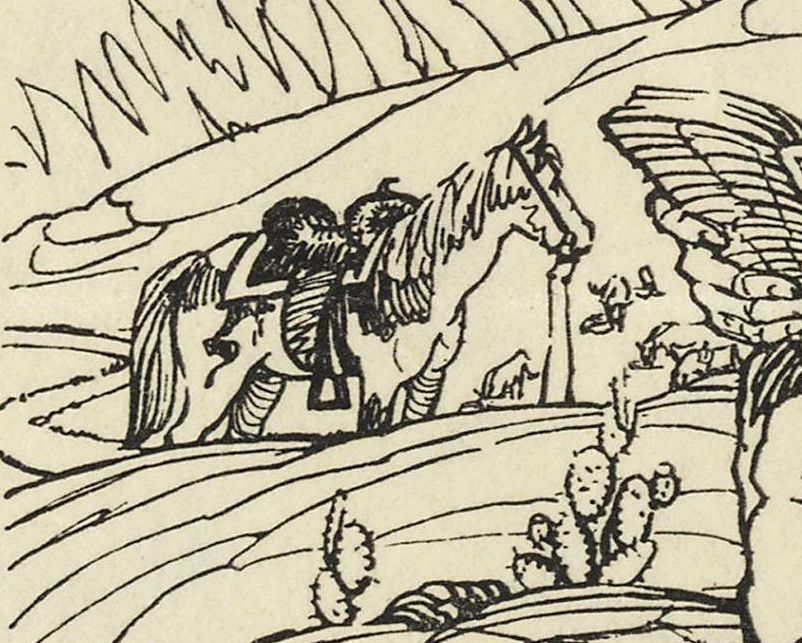
hogue_bookplate_1927_full

by Paula Bosse

I am a huge fan of the paintings and prints by the Dallas Nine group, and Alexandre Hogue — one of the members of the group — has always been one of my favorite artists. I stumbled across this early, uncharacteristic work by him last night while looking for something else. I was browsing though a digital bookplate collection (…as one does…), and when I saw the thumbnail image of this western scene, I wondered who had drawn it. The citation had no artist attribution and noted merely that it was produced for the University Club of Dallas. As I have a background in rare books and Texas art, I thought I might know the artist, so I checked the signature. I never expected this drawing to have been done by Alexandre Hogue.

The bookplate was executed by Hogue for the University Club, a group whose well-heeled and literate members met in a tony downtown penthouse. It was done in 1927 when Hogue was working as an art instructor at the Dallas YWCA; his own work had begun to attract positive critical attention, but he had yet to make a big splash. I’ve checked various sources, but I don’t see mention anywhere of Hogue doing this sort of thing. Was he commissioned? Did he do it on spec, hoping to possibly network with influential members and perhaps improve his chances of showing his work there? Whatever his reason, things seem to have paid off, because he was showing his art at the club and participating in group shows there by 1928.

So here it is, art-lovers, a heretofore mostly (if not totally) unknown piece of Alexandre Hogue-iana from 1927 — a little piece of anonymous ephemera which has been stashed away for years in a bookplate collection in Illinois.

hogue_bookplate_1927_det

hogue_bookplate_sig_1927

***

Sources & Notes

This bookplate is from the John Starr Stewart Ex Libris Collection, Rare Book and Manuscript Library, University of Illinois at Urbana-Champaign. It can be seen here.

If you are unfamiliar with Alexandre Hogue’s work, see here for a few examples of his work as well as those of his fellow Dallas Nine artists.

Also, there is a show featuring Hogue’s works currently on at the Dallas Museum of Art. For details see here.

And a short, informative video, presented by Susan Kalil, author of Alexandre Hogue: An American Visionary, can be viewed here.

Another uncharacteristic example of Hogue’s work, is the incredible “Calligraphic Tornado” (1970), which I’ve posted here.

*

Copyright © 2014 Paula Bosse. All Rights Reserved.

Lowest Greenville: “A Small Town of Our Own” — 1925

by Paula Bosse

Anyone who has ever lived in Lower or Lowest Greenville knows that it feels kind of like a small town. Below are the words of a man who thought the same way in 1925.

MOST WONDERFUL OF ALL
But I have witnessed nothing so marvelous as the growth of Dallas since I settled here, Dec. 5, 1921, and built a home at 5615 Sears street. People who stick close to business in the downtown district really do not know what is going on in this teeming city. Our suburban store district, just north of Ross and Greenville avenues, comprises three furniture stores, two hardware stores, four drug stores, six groceries, two dry goods stores, half a dozen filling stations, a Pig Stand or two, a plumbing shop, a fire station, an ice factory, a cleaning and pressing establishment, barber shops, shoemakers’ shops, two gents’ furnishing stores and a Masonic lodge. Practically all these and others, for I am sure I have overlooked some, have been established since I settled in the community four years ago. In fact, we have a small town of our own. But then the modern city of Dallas is made up of a number of such complete units, with one grand central business district, which is thought of and looked upon by outsiders as Dallas.
(Dallas Morning News, March 15, 1925)

These were the words of Dallas resident John T. Hyde. His Lowest Greenville neighborhood was, in 1925, a “suburban” outpost which had experienced unbelievable growth in the early 1920s. Mr. Hyde (who lived right off Greenville — behind where Trader Joe’s is now) would probably be shocked and dismayed by the wild over-indulgences associated with the annual St. Patrick’s Day festivities along his beloved Greenville Avenue. In fact, today’s the day. So, kids, think of Mr. Hyde — an early champion of one of Dallas’ greatest neighborhoods — and please pledge to refrain from puking (…etc.) all over it today. I’m sure he — and the rest of us — would appreciate it.

***

Sources & Notes

Top photo from Mark Doty’s wonderful book Lost Dallas (Charleston: Arcadia Publishing, 2012). Photo from the Texas/Dallas History and Archives Division, Dallas Public Library). Click for larger image.

John T. Hyde’s memories excerpted from the article “Southern Planters Trekked to Texas” by W. S. Adair (DMN, March 15, 1925).

See more photos of Lowest Greenville from this period in the Flashback Dallas post “Bel-Vick’s Anchor: The Angelus Arcade and The Arcadia Theatre — 1920s.”

More Flashback Dallas posts on Lower Greenville/M Streets can be found here.

*

Copyright © 2014 Paula Bosse. All Rights Reserved.

Southwestern Bell Telephone Goings-On, Circa 1928

by Paula Bosse

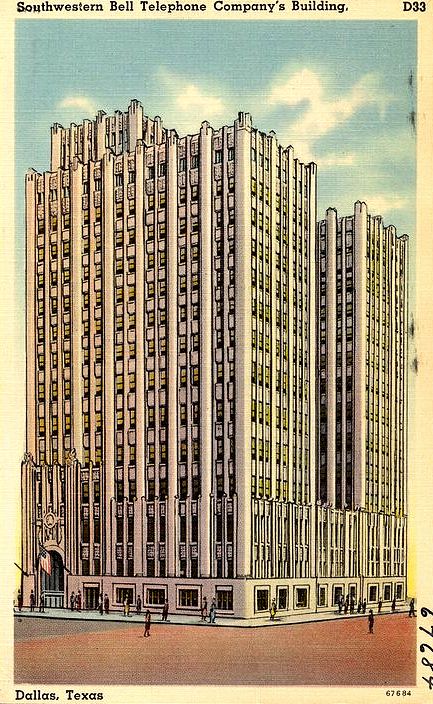
The beautiful Southwestern Bell Telephone Company building, designed by Lang & Witchell in 1929.

From the book Dallas Landmarks:

Dallas’ first telephone exchange opened on June 1, 1881, with 40 subscribers. There were several competing telephone companies before 1925 when Southwestern Bell became the sole provider. The number of telephones in used quickly soared from 30,000 in 1922 to 200,000 in 1949.

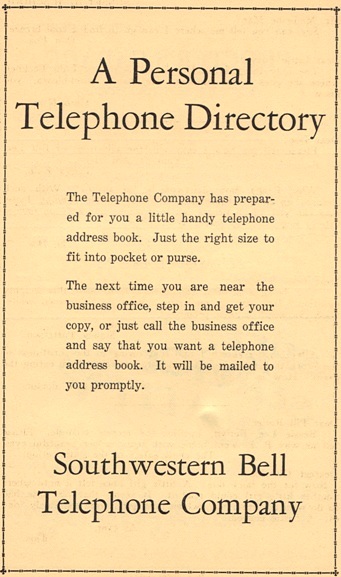
The relatively few telephone subscribers at the time the building was going up might explain this folksy little notice about a “personal telephone directory” that the fine folks at Southwestern Bell have been working on night and day, just for you. Next time you’re in the neighborhood, why don’t you just drop right on in and pick one up? Set a spell. Take your shoes off. Y’hear?

***

Sources & Notes

Postcard from the Boston Public Library Tichnor Brothers Postcard Collection on Flickr, here.

Quote from the book Dallas Landmarks, by Preservation Dallas and Dallas Heritage Village (Charleston: Arcadia Publishing, 2008). p. 31.

Quaint little ol’ phone book ad, from, of all places, the Nov. 1928 issue of “The Stampede,” the school magazine published by and for the students of Sunset High School in Oak Cliff.

*

Copyright © 2014 Paula Bosse. All Rights Reserved.


2400 McKinney Avenue — 100+ Years and Counting

by Paula Bosse

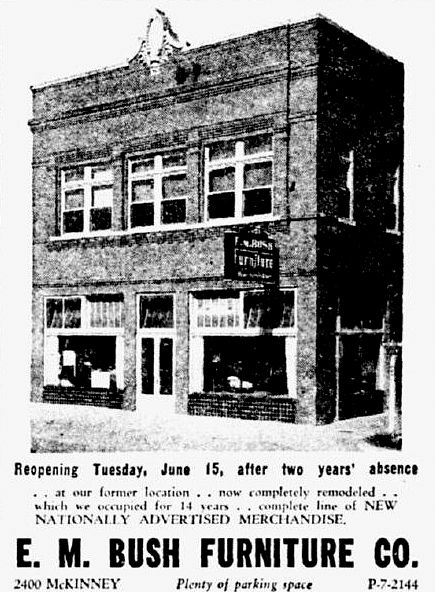
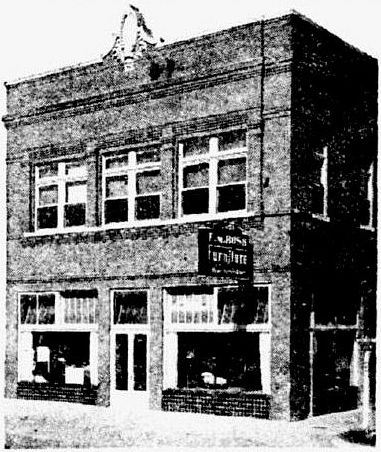
I came across this ad and wondered just where on McKinney Avenue this building had been. The ad was from 1948, but the building certainly looked older than that. I’m not sure when the building was built (update: it was built in 1909), but by at least 1929 the Hughes Auction Market was conducting furniture auctions there. An ad from 1929 invites the public to attend the regular auctions in which their two floors were packed to the gills with furniture and household goods that “positively must sell.” Prospective buyers were promised a large parking lot and a “comfortable, cool building.”

In the summer of 1933, a longtime Dallas furniture salesman, E. M. Bush, opened his retail business in the building and remained there for many years, perhaps until 1958 when he moved to Snider Plaza.

I wondered what’s at 2400 McKinney these days, and, I have to say … I’m shocked to find that the building is actually still there! On McKinney Avenue! And it looks very much the same as it does in the photo above (and, presumably, since it was built) — a little more elegant, perhaps, as it’s now part of the fabulous Hotel ZaZa — but the building looks pretty much the same. The building has survived! I feel like crying.

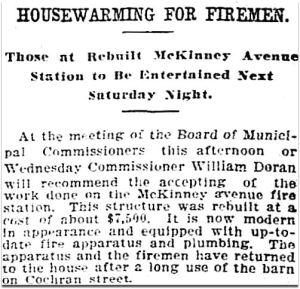
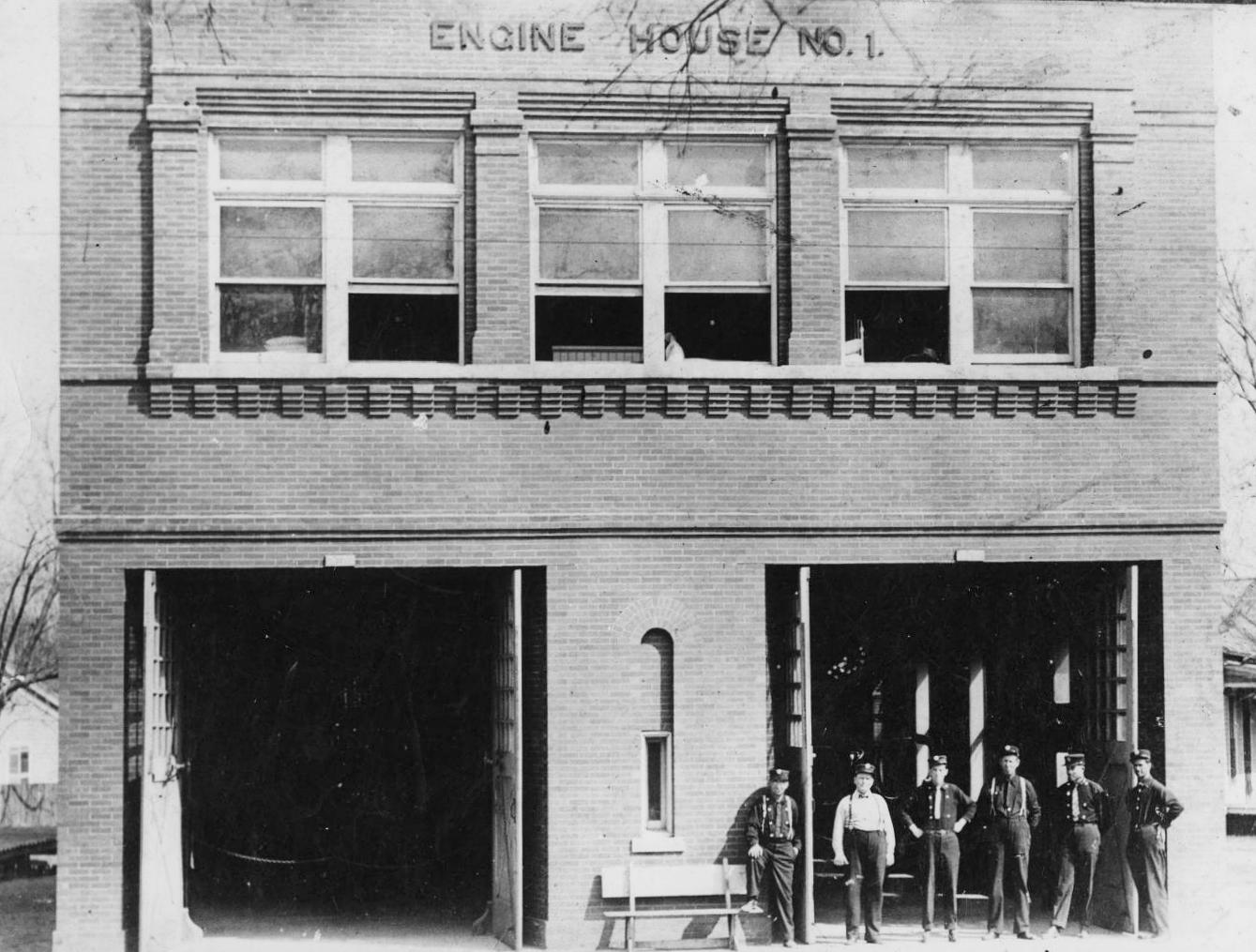
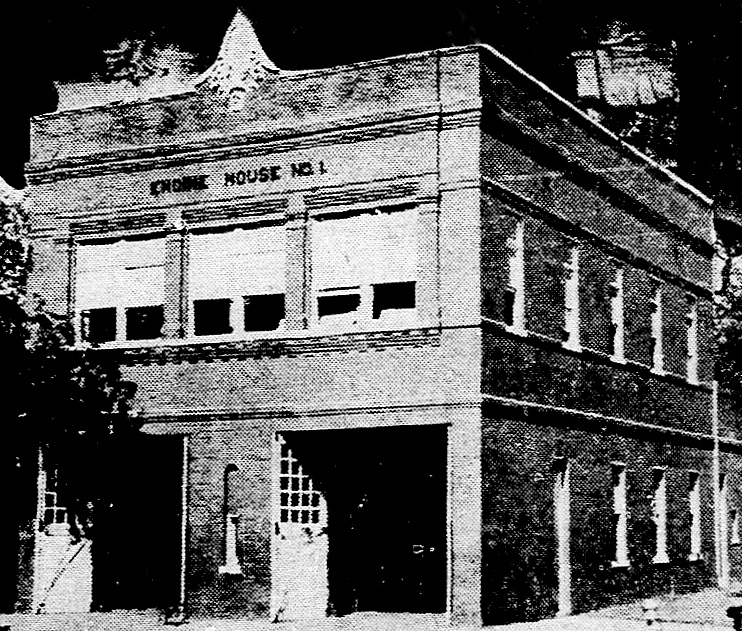
But wait, there’s more. What was this building originally? It was a firehouse! More specifically, it was Engine House No. 1, in use until 1928. The fire station that originally occupied this location was built in 1894 (see what it looked like in 1901 here, third photo down). By 1909, automobiles were placing horse-drawn fire engines, one of many reasons the station house needed to be modernized. Newspaper articles from 1909/1910 used the words “rebuilt” and “remodeled” almost interchangeably, so it’s unclear whether the original building was completely, or only partially demolished and then rebuilt, using materials from the original structure. The “new” engine house re-opened in January, 1910.

rebuilt_dmn_012510
Dallas Morning News, Jan. 25, 1910

Here’s a photo from its early days:

engine-house-no-1_mckinney

And from the 1920s:

fire-dept_mckinney-leonard-photo_1920s

The city ordered the building sold in 1928 when plans had been made to move personnel and equipment from McKinney and Leonard to a new station at Ross and Leonard.

To have a 100-plus-year-old building still standing in “newer-is-better” Dallas — and in Uptown — is quite a feat!

***

Sources & Notes

E. M. Bush Furniture Co. ad from 1948.

Photo of Stay ZaZa Art House and Social Gallery from the Hotel ZaZa website.

Firehouse photo from The Dallas Firefighters Museum. More on this station here.

Most images are larger when clicked.

*

Copyright © 2014 Paula Bosse. All Rights Reserved.


Speaking of the Arcadia and Its “Rustic Simplicity”…

arcadia_architectural-renderingArcadia Theater, 1927…

by Paula Bosse

Above is a rendering of architect W. Scott  Dunne’s design for the Arcadia Theater on Greenville Avenue, at Sears Street, between Ross Avenue and Belmont. (The low-flying bi-plane is a nice touch.) Among the many Dallas theaters designed by Dunne were the Esquire in Oak Lawn and the Texas Theatre in Oak Cliff (as well as another entertainment mecca, the Fair Park Band Shell).
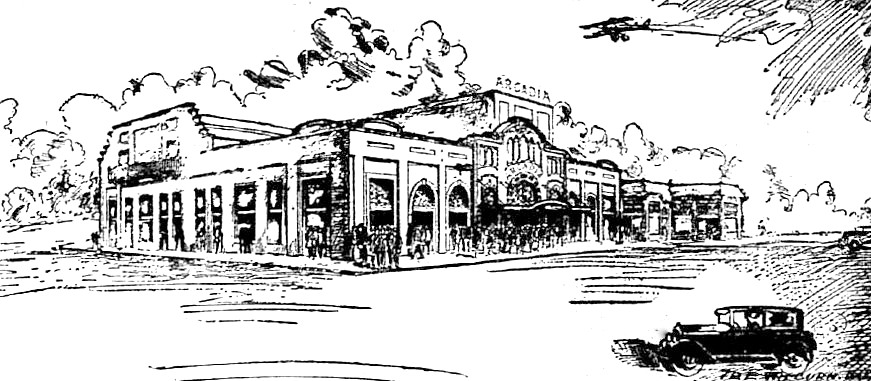
The Dallas Morning News had this to say about Dunne’s concept for the new “suburban theater” in 1927:

W. Scott Dunne, architect of Arcadia, is working out an interior design that should prove in harmony with the theater’s name — an atmospheric design of as near rustic simplicity as is possible in a theater.

“Rustic”!

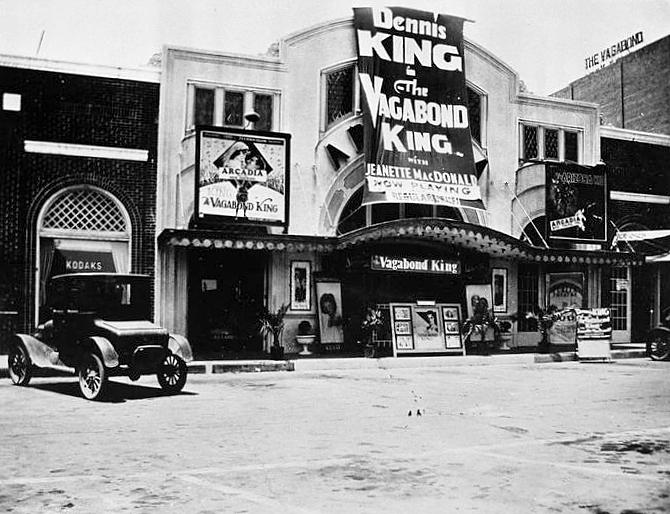
A photo of the not-particularly-rustic exterior in 1930:

arcadia-theater_1930_portal1930

The fabulous giant tree marquee, posted previously (link to post below), from about this time can be seen here.

All went well for many years until 1940 or ’41 when the original 1927 building was badly damaged in a fire; it had to be gutted and completely overhauled by architects Pettigrew & Worley. John A. Worley wrote an article for Box Office magazine about the rebuilding process (link below), including the hard-to-believe tidbit that the firm had been “vigorously instructed to studiously avoid any pretense of ‘super-colossal’ — or, more thoroughly defined, we were told to steer clear of that ‘regal’ air, which had been known to impel theater patrons to take off their shoes before daring to walk across the foyer.

The article even has a photo of the lopped-off, now-sadly diminished tree sign. (The author — in something of a reach — explains that the “stump” was there as a symbol of the “Arcadian” nature of the theater.) (You just know that both Pettigrew and Worley were praying for the go-ahead to just get rid of it already.)

1941

There was another bad fire in 1958, which led to further renovation. By then, that tree was loooooong gone and but a dim memory.

There sure were a lot of fires at the ol’ Arcadia. Including the final, fatal one, in 2006. R.I.P. And from the ashes sprang the present-day Trader Joe’s.

***

Sources & Notes

Photo showing “The Vagabond King” (1930), from the Hardin-Simmons University Library via the Portal to Texas History, here.

Photo showing “stump” is from the June 21, 1941 issue of Boxoffice.

An interesting article on the Arcadia — and life along Lowest Greenville — can be found in a Lakewood Advocate article “The Rise and Fall of the Arcadia,” here.

The original post that spurred a further look into the early days of the Arcadia — and the one with the crazy huge electric tree marquee — can be found in the Flashback Dallas post “The Arcadia Theater Sign You’ve Never Seen,” here.

*

Copyright © 2014 Paula Bosse. All Rights Reserved.