Flashback : Dallas

A Miscellany: History, Ads, Pop Culture

Category: 1920s

NOW HEAR THIS: THE BELL TELEPHONE “LOUD SPEAKER” IS AT THE FAIR! — 1921

telephone_sw-bell_dmn_100821_photoYou might want to step back a few thousand feet… (click for larger image)

by Paula Bosse

When was the last time you wondered about the history of the public address system? If you’re like me, the answer to that is probably “never.”

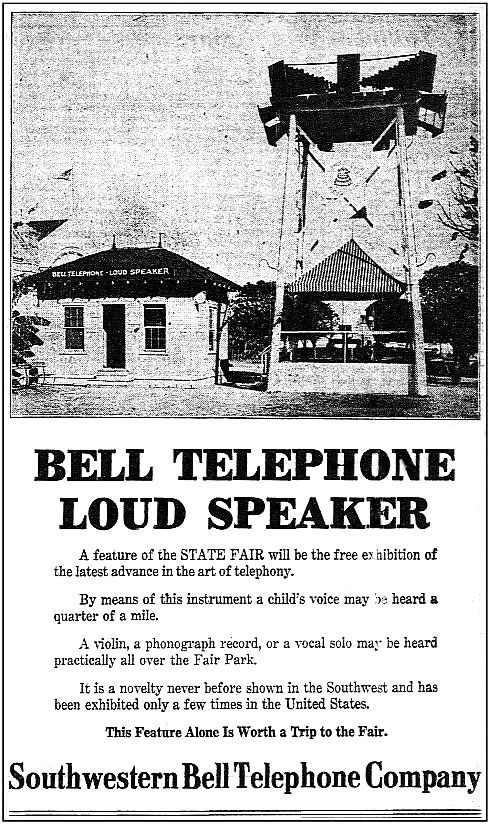
The photo above shows the new technical innovation from the army of Bell Systems engineers that was going to be demonstrated at the 1921 State Fair of Texas: the “Loud Speaker.” The ad (always click images and clippings for larger images):

telephone_sw-bell_dmn_100821
Dallas Morning News, Oct. 8, 1921

*

BELL TELEPHONE LOUD SPEAKER
A feature of the STATE FAIR will be the free exhibition of the latest advance in the art of telephony.
By means of this instrument a child’s voice may be heard a quarter of a mile.
A violin, a phonograph record, or a vocal solo may be heard practically all over the Fair Park.
It is a novelty never before shown in the Southwest and has been exhibited only a few times in the United States.
This Feature Alone Is Worth a Trip to the Fair.
Southwestern Bell Telephone Company

*

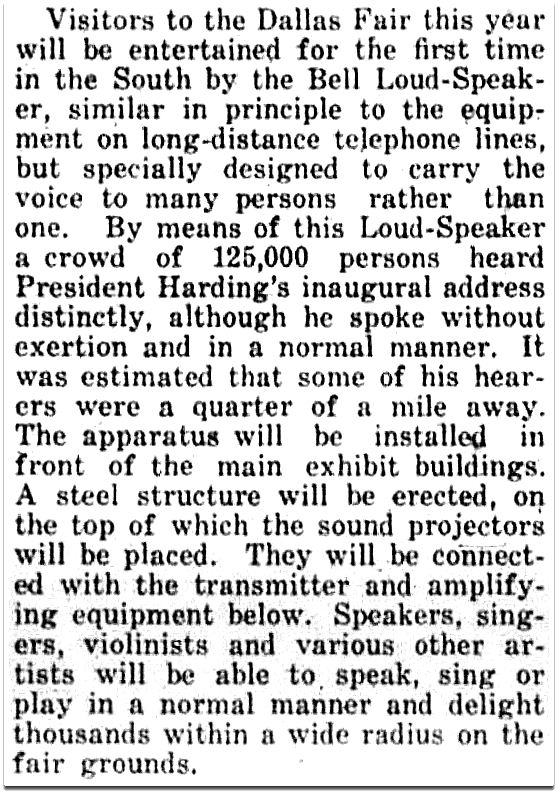
My technical expertise is pretty much non-existent, but, basically, this was the introduction of the public address system as developed by Bell Telephone, using their cutting-edge transmitters and amplifying equipment (the articles below contain more information).

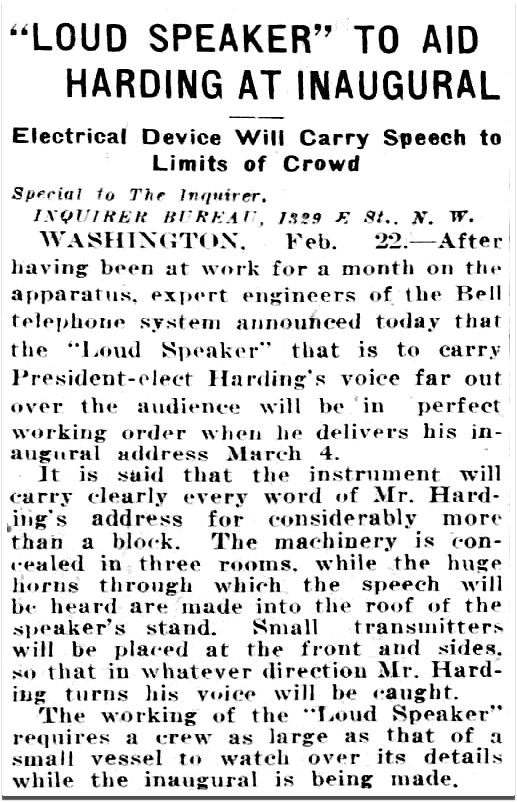
An earlier version of this particular set-up had debuted the previous year at the Republican National Convention in Chicago. (Imagine attending a large, noisy political convention with speakers whose voices weren’t amplified.) It had also been used for President Harding’s inauguration speech at the beginning of 1921, a first.

state-fair_loud-speaker_coleman-tx-democrat-voice_100721Coleman Democrat Voice, Oct. 7, 1921

This was before the days of mainstream radio — Dallas’ first commercial broadcasting station, WFAA, didn’t go on the air until June, 1922. The loudspeaker system used at the fair in 1921 allowed entertainment acts and World Series play-by-play to be played loudly overhead, for most of the fairgoers to hear (which sounds a little annoying to me, but it was newfangled novelty and people were quite taken with it).

state-fair_loud-speaker_dmn_101121
DMN, Oct. 11, 1921

state-fair_loud-speaker_dmn_101221
DMN, Oct. 12, 1921

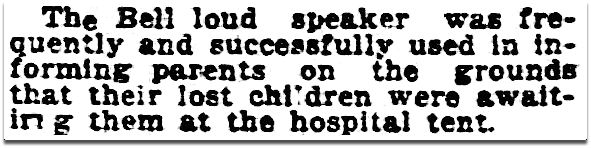
It also came in handy to make announcements and to page parents of lost children.

state-fair_loud-speaker_dmn_101521
DMN, Oct. 15, 1921

The amplification at public events was enthusiastically received and much appreciated, but the real end Bell was working toward was the ability to transmit and broadcast live events happening long distances away (and also to transmit recorded music without any substantial loss of sonic quality — radio, here we come!).

state-fair_loud-speaker_dmn_101621bDMN, Oct. 16, 1921

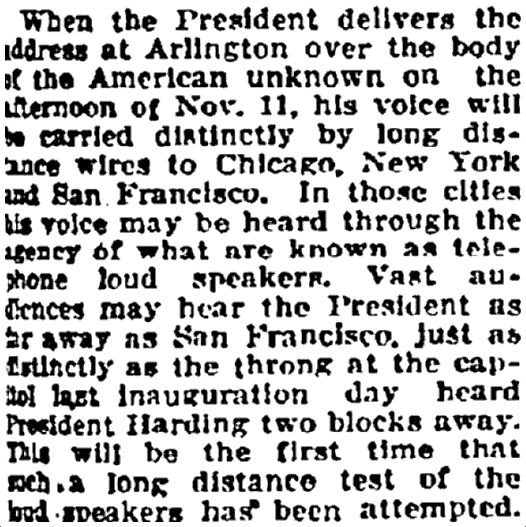
In fact, the equipment exhibited at the fair was the same equipment used less than a month later when President Harding presented his Armistice Day address to the nation. Not only was his voice amplified to the large crowd listening to him at Arlington National Cemetery, it was also transmitted and then broadcast through “loud speakers” to crowds in New York and San Francisco — another first.

state-fair_loud-speaker_harding_tulsa-daily-world_121121
Tulsa Daily World, Dec. 11, 1921

And Texas got to experience this new technology earlier than most others in the country. Little did those Bell engineers realize in 1921 that 30-some-odd years later the booming voice of a gigantic cowboy could be heard greeting visitors all over Fair Park.

**

A few clippings about the vaunted “loud speaker” before it made its way to the State Fair:

harding_loud-speaker_philadelphia-inquirer_022321
Philadelphia Inquirer, Feb. 23, 1921

harding_loud-speaker_winnipeg-tribune_030821
Winnipeg Tribune, March 8, 1921

harding_loud-speaker_dmn_100521_wire
DMN (from wire reports), Oct. 5, 1921

And an article on the exciting prospects of what lay ahead:

loud-speaker_tulsa-daily-world_121121
Tulsa Daily World, Dec. 11, 1921

***

Sources of clippings as noted.

Click for larger images!

*

Copyright © 2016 Paula Bosse. All Rights Reserved.

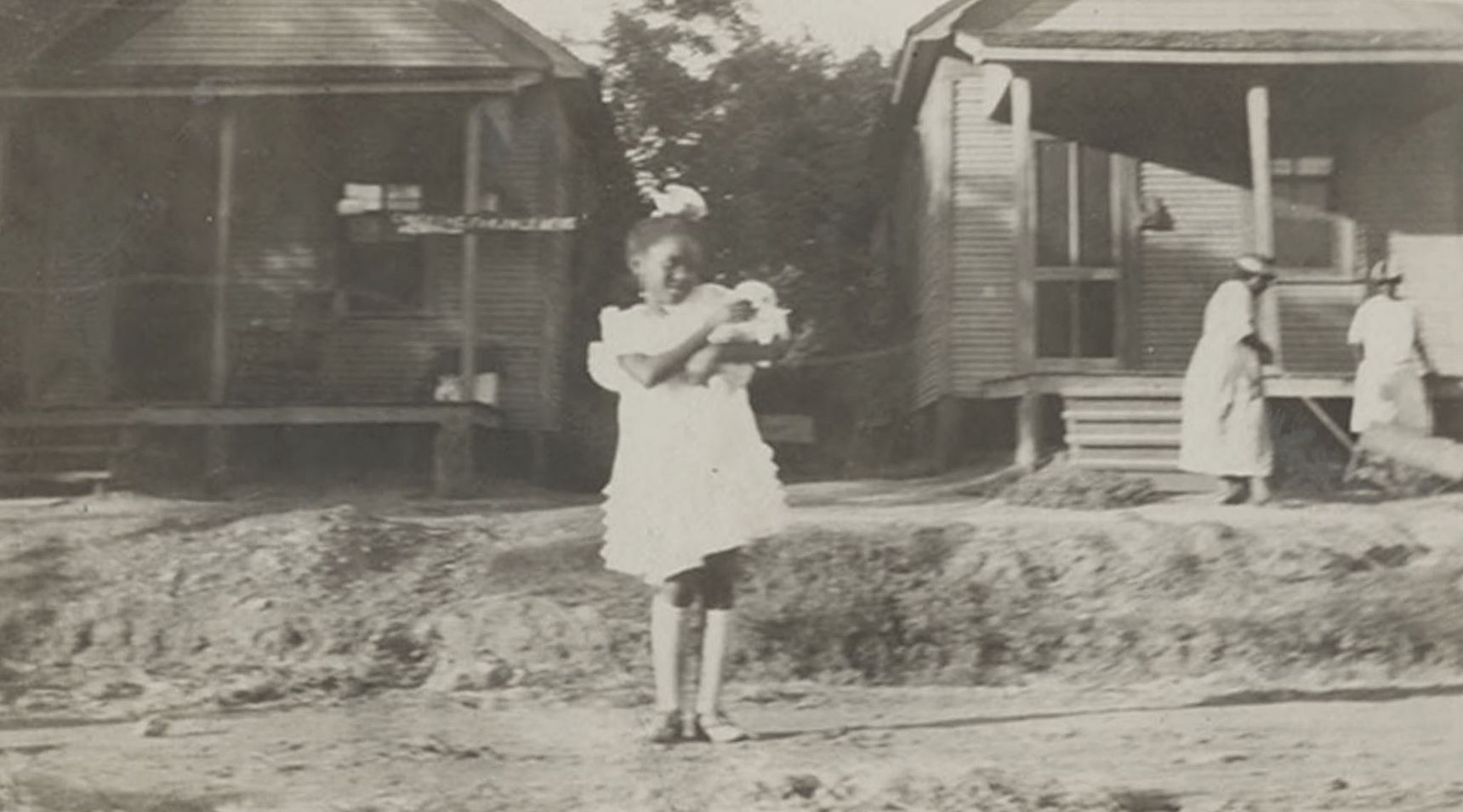
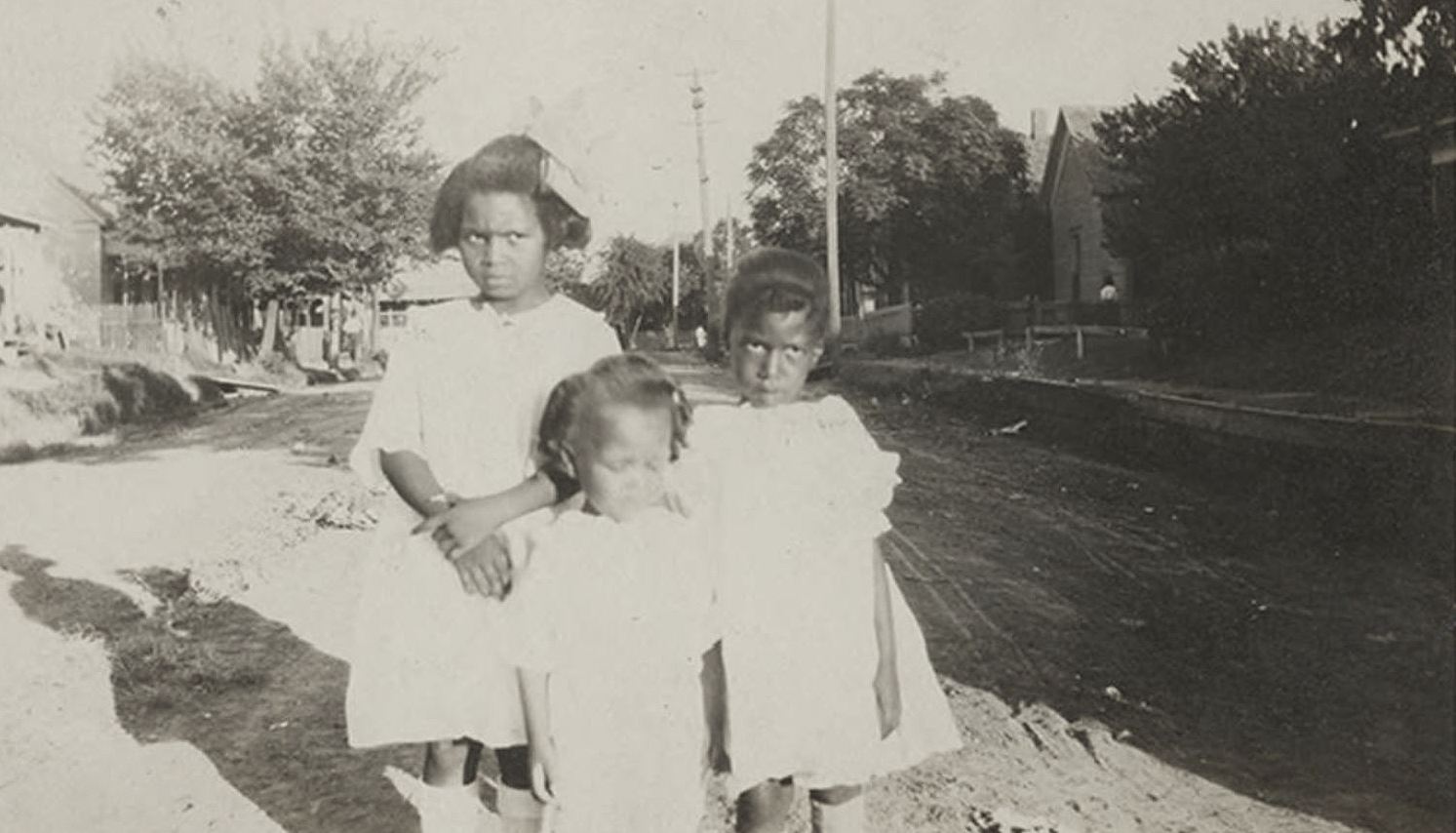
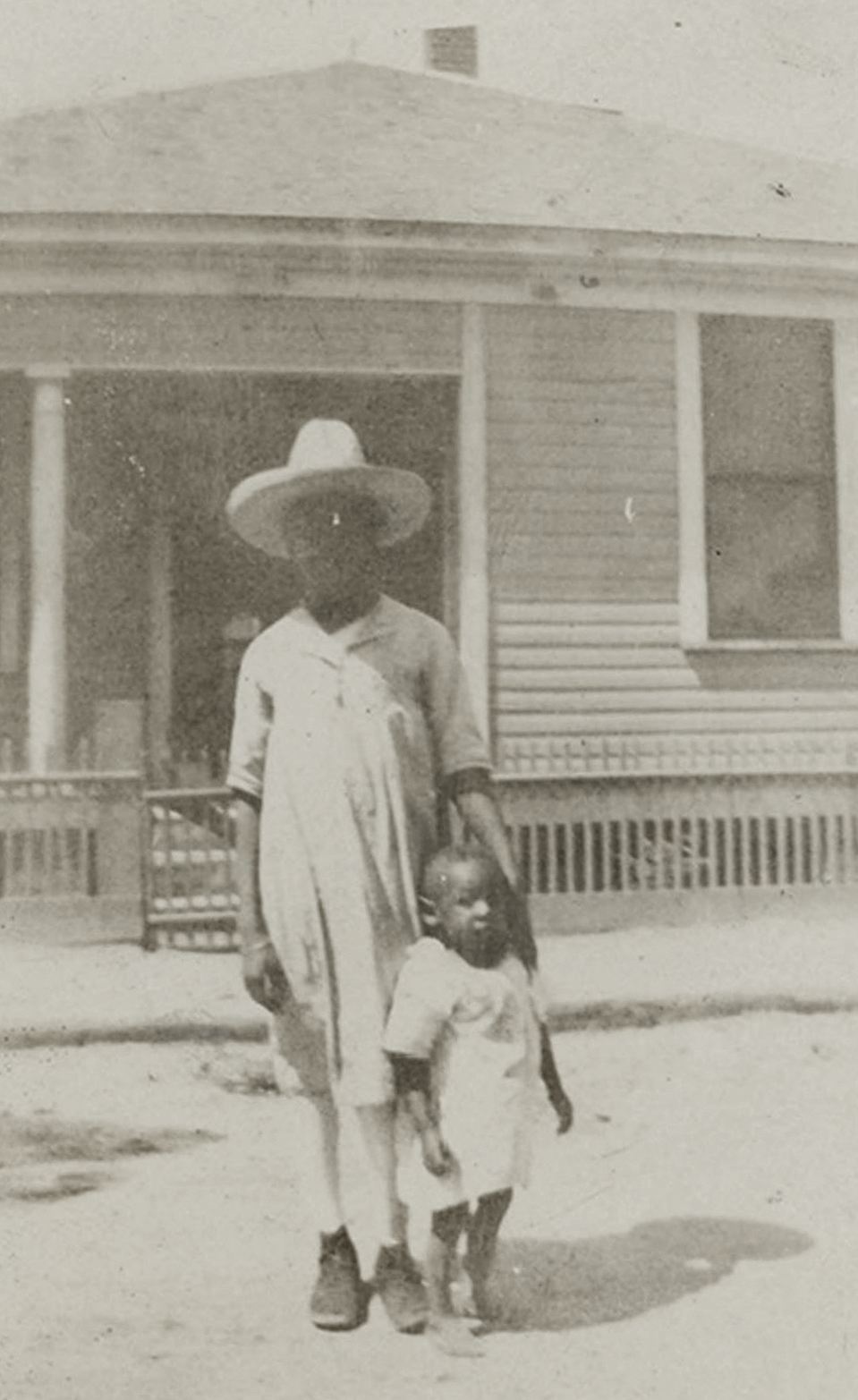
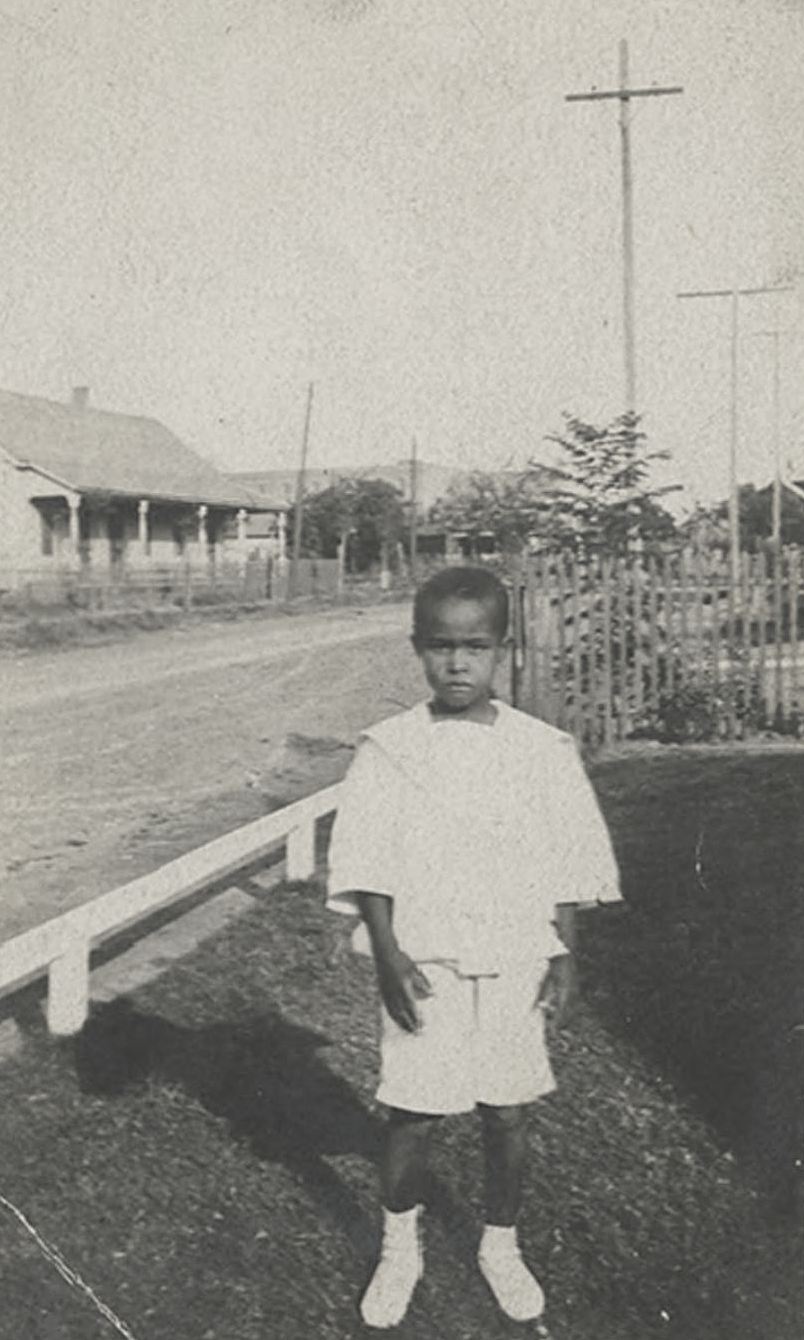
The Kids of State-Thomas

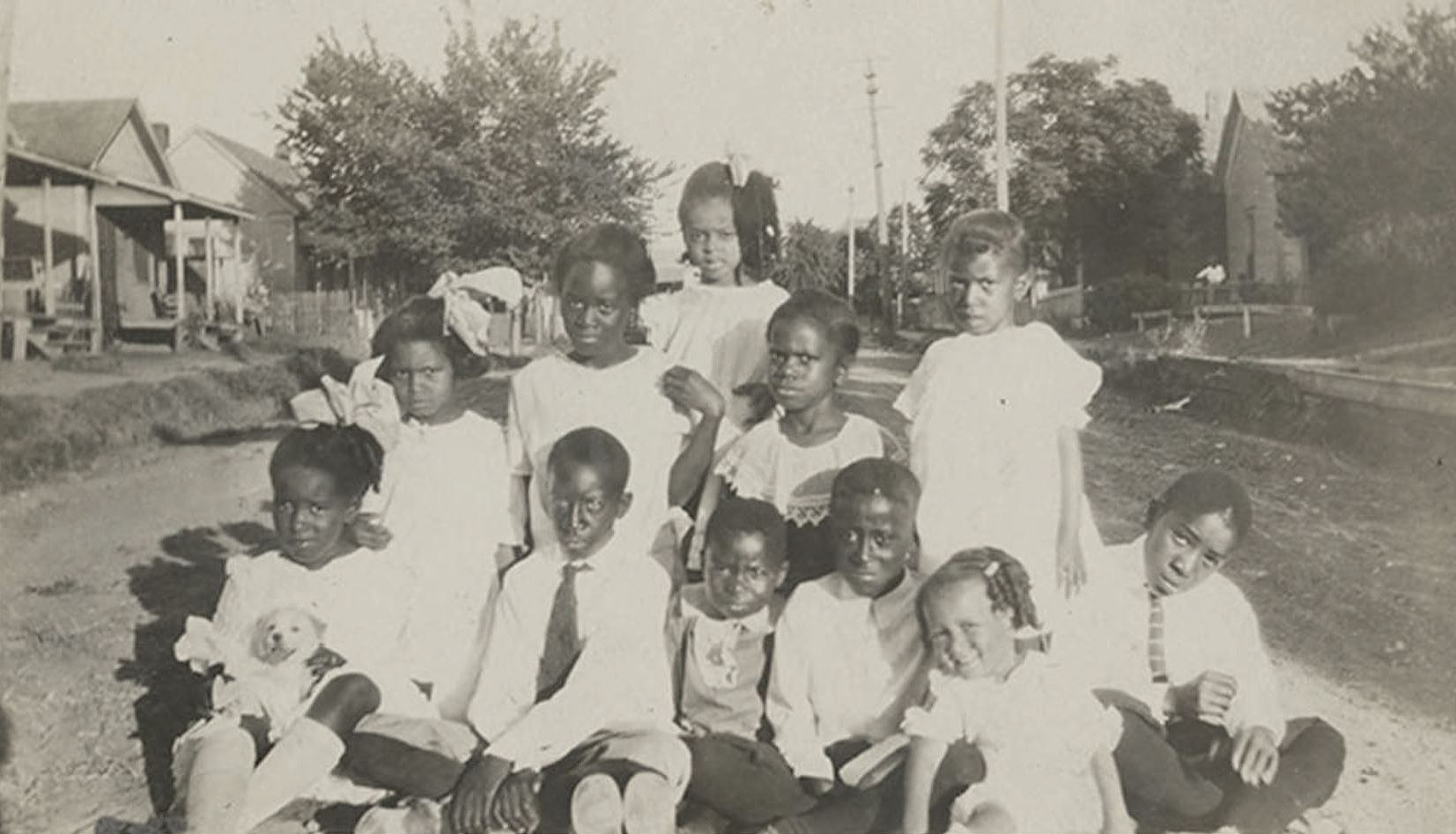
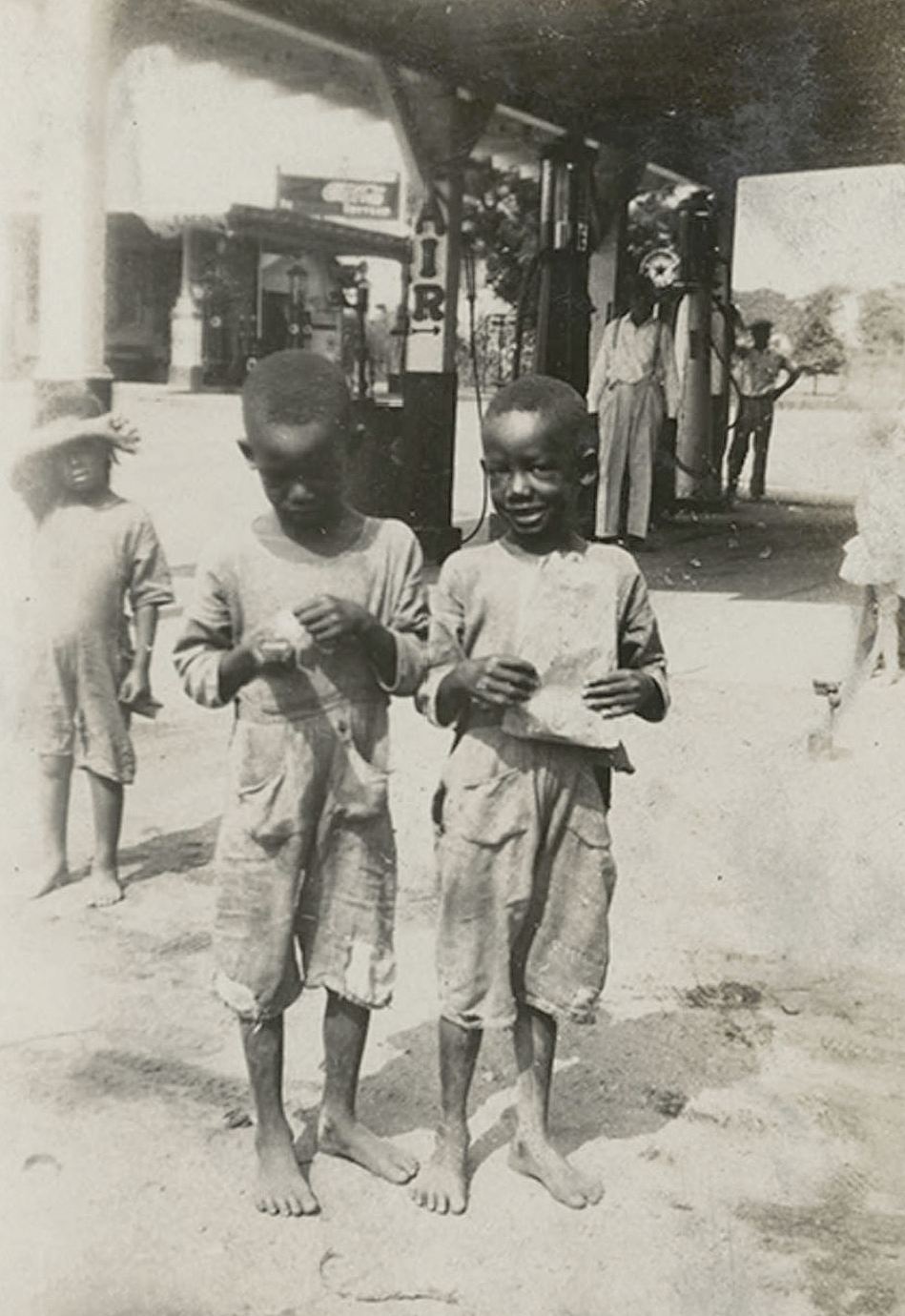
african-american-children_cook-coll_smu_1George W. Cook Collection, SMU

by Paula Bosse

More great photos from the George W. Cook Collection at SMU’s DeGolyer Library! Click photos to see larger images.

african-american-children_cook-coll_smu_2

african-american-children_cook-coll_smu_3

african-american-children_cook-coll_smu_4

african-american-children_cook-coll_smu_5

african-american-children_cook-coll_smu_6

***

Sources & Notes

All photos from the George W. Cook Dallas/Texas Image Collection, DeGolyer Library, Central University Libraries, Southern Methodist University. Additional information for each photo can be found for photo 1 here; photo 2 here; photo 3 here; photo 4 here; photo 5 here; and photo 6 here.

The State-Thomas area (also known in the past as Freedman’s Town and North Dallas) was once a vibrant African-American neighborhood which has now become swallowed up by “Uptown.” A short history can be found here (scroll down to “Freedman’s Town”).

Other State-Thomas-related photos can be found in these Flashback Dallas posts:

  • “The Allen Street Taxi Company,” here
  • “The Dunbar Branch: Dallas’ First Library for the African-American Community, 1931-1959,” here

Photos are big. Click them!

*

Copyright © 2016 Paula Bosse. All Rights Reserved.


Zap Those Extra Pounds Away in Mrs. Rodgers’ Electric Chair — 1921

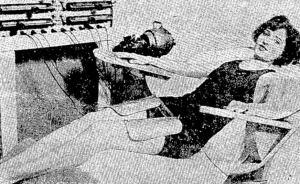
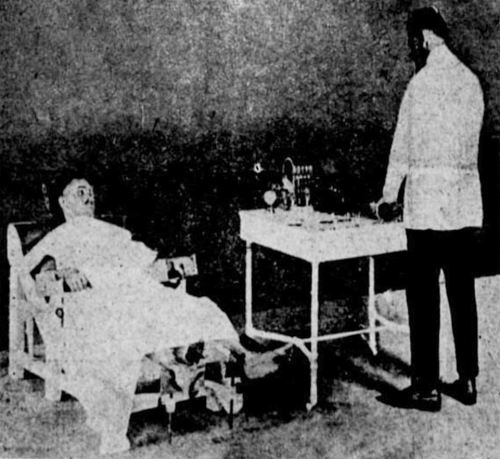
ergotherapy_jewish-monitor_090921_detThrowing the switch in 3-2-1… (click for larger image)

by Paula Bosse

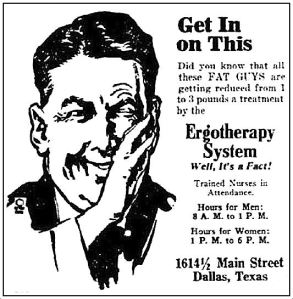
While looking for something completely unrelated (which is always the best way to find unexpected things), I came across this full-page ad which appeared in the Sept. 9, 1921 edition of The Jewish Monitor (click to see a larger image):
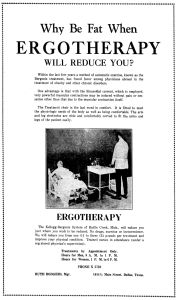
ergotherapy_jewish-monitor_090921

Why Be Fat When
E R G O T H E R A P Y
WILL REDUCE YOU?

Within the last few years a method of automatic exercise, known as the Bergonie treatment, has found favor among physicians abroad in the treatment of obesity and other chronic disorders.

One advantage is that with the Sinusoidal current, which is employed, very powerful muscular contractions may be induced without pain or sensation other than that due to the muscular contraction itself.

The Treatment chair is the last word in comfort. It is fitted to meet the physiologic needs of the body as well as being comfortable. The arm and leg electrodes are wide and comfortably curved to fit the arms and legs of the patient easily. 

ERGOTHERAPY

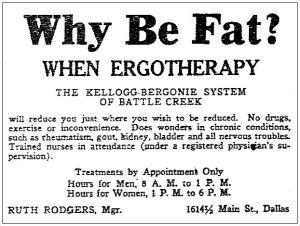
The Kellogg-Bergonie System of Battle Creek, Mich., will reduce you just where you wish to be reduced. No drugs, exercise or inconvenience. We will reduce you from one (1) to three (3) pounds per treatment and improve your physical condition. Trained nurses in attendance (under a registered physician’s supervision).

Treatments by Appointment Only

Hours for Men, 8 A.M. to 1 P.M.
Hours for Women, 1 P.M. to 6 P.M.
Phone X 5759
Ruth Rodgers, Mgr.
1614 1/2 Main Street, Dallas, Texas.

*

“The arm and leg electrodes are wide and comfortably curved” — there’s a line one doesn’t often encounter in an ad!

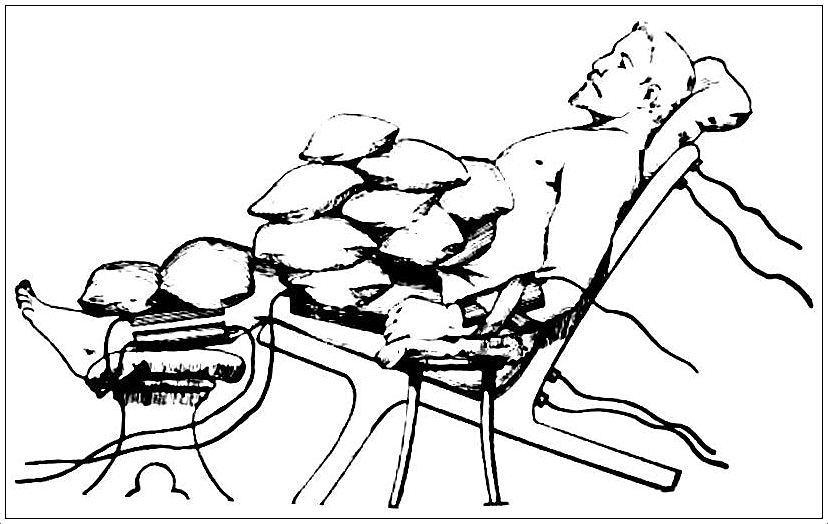
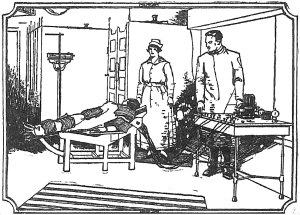
So what was this treatment of obesity that required “no drugs, exercise or inconvenience”? Well, basically, it was a low-voltage electric chair in which the naked, smock-draped “patient” reclined on wet towels and was covered with sandbags (which weighed up to 100 pounds). Electrodes were attached to the arms, legs, and abdomen. When the switch was flipped, electrically-provoked exercise began, and electric current caused muscular contractions (up to 100 a minute) without fatigue to the “exerciser.” All sorts of physiologic things were happening during these sessions, including a whole bunch of sweating. Patients would lose from 1 to 3 pounds during their time in the chair, hose themselves down and walk away refreshed.

Jean Albard Bergonié (1857-1925) was a French doctor/researcher/inventor who specialized in radiology in the treatment of cancer, and this odd electric chair was something of a departure from his oncology studies. It was used to treat a variety of ailments and conditions such as obesity, heart conditions, diabetes, “suppressed uric acid elimination,” and, later shell-shock. Professor Bergonié died in 1925 as the result of prolonged exposure to radium in his research to find a cure for cancer (in the years before his death, he had lost an arm and fingers to continual X-ray exposure). The Institut Bergonié continues in Bordeaux, France as a cancer research center.

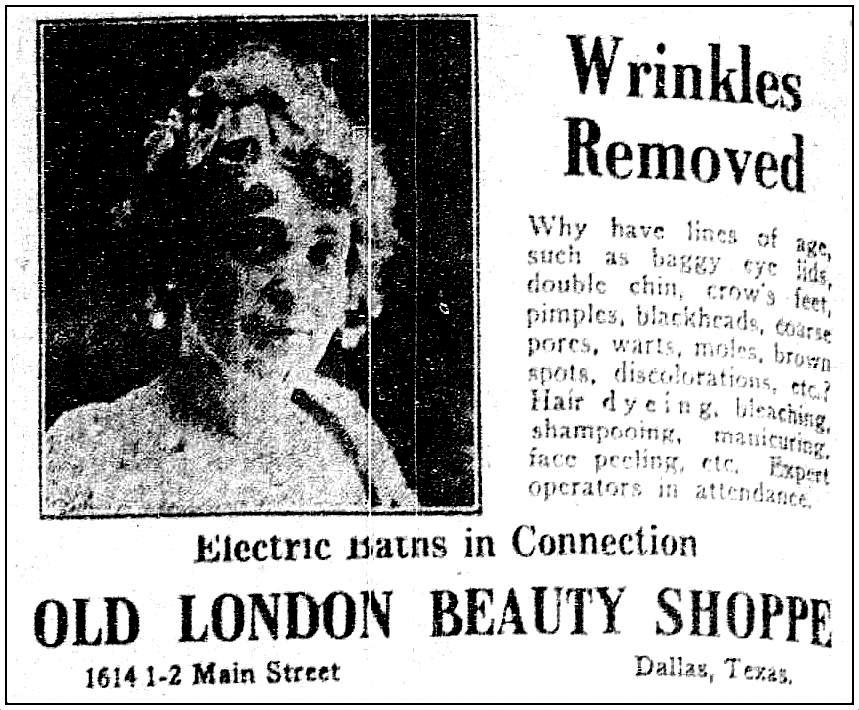
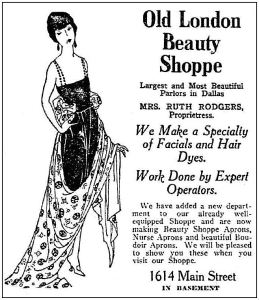
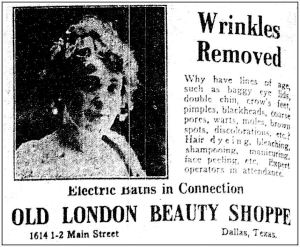
So back to the chair. By the time of the 1921 ad above, Bergonié’s “ergotherapy” had become a weight-loss feature in beauty spas and salons. The ads I found mentioning the electric chair as something corpulent men and women of means might have seen in Dallas newspapers appeared between July and October of 1921, touting the miracle chair at Mrs. Ruth Rodgers’ beauty salon, The Old London Beauty Shoppe at 1614 ½ Main Street, a couple of doors from Neiman-Marcus.
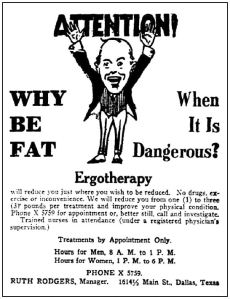
ergotherapy_071721
July, 1921

I don’t know if it didn’t catch on or whether it just wasn’t mentioned in ads, but the chair made its final appearance in an Old London Beauty Shoppe ad in early October of the same year.

The splashiest news about Bergonié’s invention was a few months later, in early 1922, when it was revealed that the UK’s Queen Mary had availed herself of the chair in order to slim down in time for her daughter’s wedding, with Prof. Bergonié himself apparently operating the current flow. The best part of the lengthy and breathless article about the plump royal allowing herself to lie in this electric chair as she was rather unceremoniously weighted down with royal sandbags was this sentence:

[Mrs. David Lloyd George, the wife of the British prime minister] lost no time in telling Queen Mary all she knew about Professor Bergonie, the famous French ergotherapist, and his marvelous electric chair, which is said to jar fat from the human frame with the ease and almost the rapidity of a man peeling a tangerine.

Hey, I want that!

One would assume that sort of free publicity would be a boon to spas and salons offering State-side ergotherapy — I have a feeling Mrs. Rodgers had moved on by then and was probably kicking herself for concentrating on the more mundane treatment of wrinkles and sagging skin and the administering of marcel waves (her specialty).

Below, some views of The Chair over the years (all pictures larger when clicked).
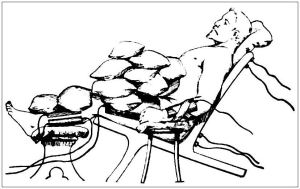
ergotherapy_1913-medical-bk_ebay

Above, a drawing from a 1913 medical book, found here.

*
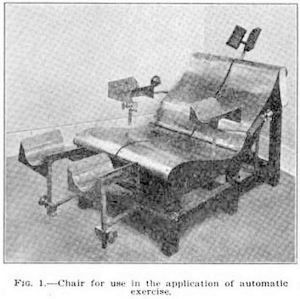
ergotherapy_medical-record_050115

From the journal Medical Record, May 1, 1915.

*
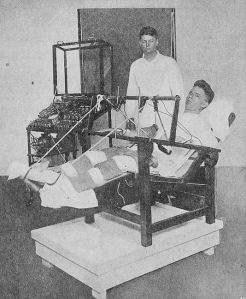
bergonie-chair_shell-shock_electrical-experimenter_feb-1919

A World War I soldier being treated for shell-shock, from The Electrical Experimenter (Feb. 1919), here (continued here).

*
ergotherapy_012321
Jan., 1921

Ruth Rodgers was the proprietress of the Old London Beauty Shoppe (later the Old London School of Beauty Culture), which seems to have operated in Dallas from the ‘teens to at least the late-1930s. The location during the period of the ergotherapeutic chair was in the basement of 1614 Main Street.

*
ergotherapy_dmn_081421
Aug., 1921

Mrs. Rodgers did it all. That might be her in the ad.

*
ergotherapy_081421
Aug., 1921

*

ergotherapy_082121
Aug., 1921

It’s a bit unusual seeing ads like this directed toward men.

*
ergotherapy_san-francisco-chronicle_092521
San Francisco Chronicle, Sept. 25, 1925

*
queen-mary_1922

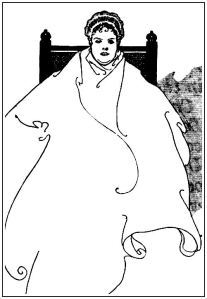
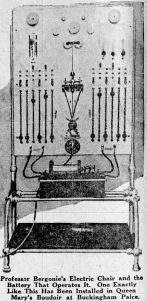
Above, a very Aubrey Beardsley-esque depiction of the “distressingly stout” Queen Mary, ready to undergo her course of treatments. Read the full, widely-circulated article from February, 1922, “Queen Mary’s Jarring Anti-Fat Ordeal; Yearning for a Girlish Figure to Grace Her Daughter’s Wedding, the Queen-Mother Got One by Sitting in an Electric Chair and Losing 3½ Pounds a Week,” here. (They don’t write headlines like that anymore….) The photo below, showing the control panel, was also part of the article.
queen-mary_1922_battery

*

ergotherapy_ogden-standard-examiner_041826

The caption for this photo (which appeared five years after the cutting-edge Ruth Rodgers was offering it to Dallas patrons): “The new French electric chair on which one reclines in comfort while form-fitting electroids [sic] direct the fat-melting current, as demonstrated by Alice Harris, a stage beauty who must keep thin.” (Ogden Standard-Examiner, April 18, 1926)

*

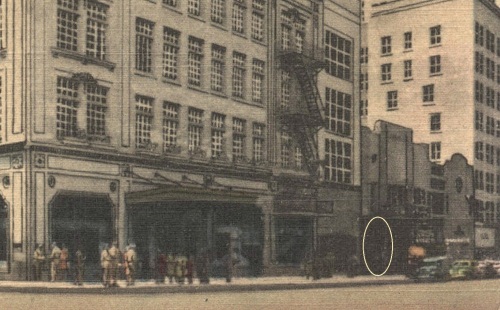
And, finally, to bring this back to Dallas, the location of Mrs. Rodgers’ Old London Beauty Shoppe in 1921 — 1614½ Main Street (basement) — is circled (this building was later the Everts Jewelry store before it moved across the street to the north side of Main). To the left is Neiman-Marcus, at the corner of Main and Ervay. (Full view of this postcard, from the collection of the DeGolyer Library, SMU, is here.)
1614-main_n-m_degolyer_smu_det

***

Sources & Notes

Top photo is a detail from the ad below, which appeared in the Sept. 9, 1921 edition of The Jewish Monitor; it can be accessed via the Portal to Texas History, here.

Read a doctor’s account of just how Bergonie’s chair worked, in the article “Modern Treatment of Obesity” by Edward C. Titus (Medical Record, Jan. 24, 1920), here.

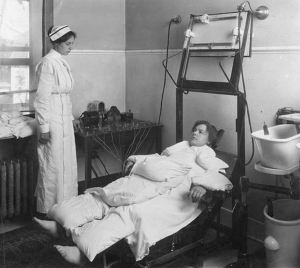
I’m not sure about the connection of this chair to J. H. Kellogg (the treatment in the ad was referred to as “The Kellogg-Bergonie System of Battle Creek, Mich.”). It appears that he and Bergonie might have developed similar chairs independently of one another and decided to form some sort of partnership — either by mutual agreement or court edict. Here is a photo of Kellogg’s “patented electrotherapy exercise bed” used in his Battle Creek sanitarium:
kellogg-chair
via Oobject (more Kellogg contraptions here)

And speaking of Mr. Kellogg, might I direct your attention to a previous Flashback Dallas post — “Electricity in Every Form — 1909” — here.

Click pictures for larger images

*

Copyright © 2016 Paula Bosse. All Rights Reserved.

The Mitchell Building: Home to Cotton Gins, Rockets, Frozen Beverages, A/C Units, Slackers, Squatters, Hipsters, and Urban Loft-Dwellers

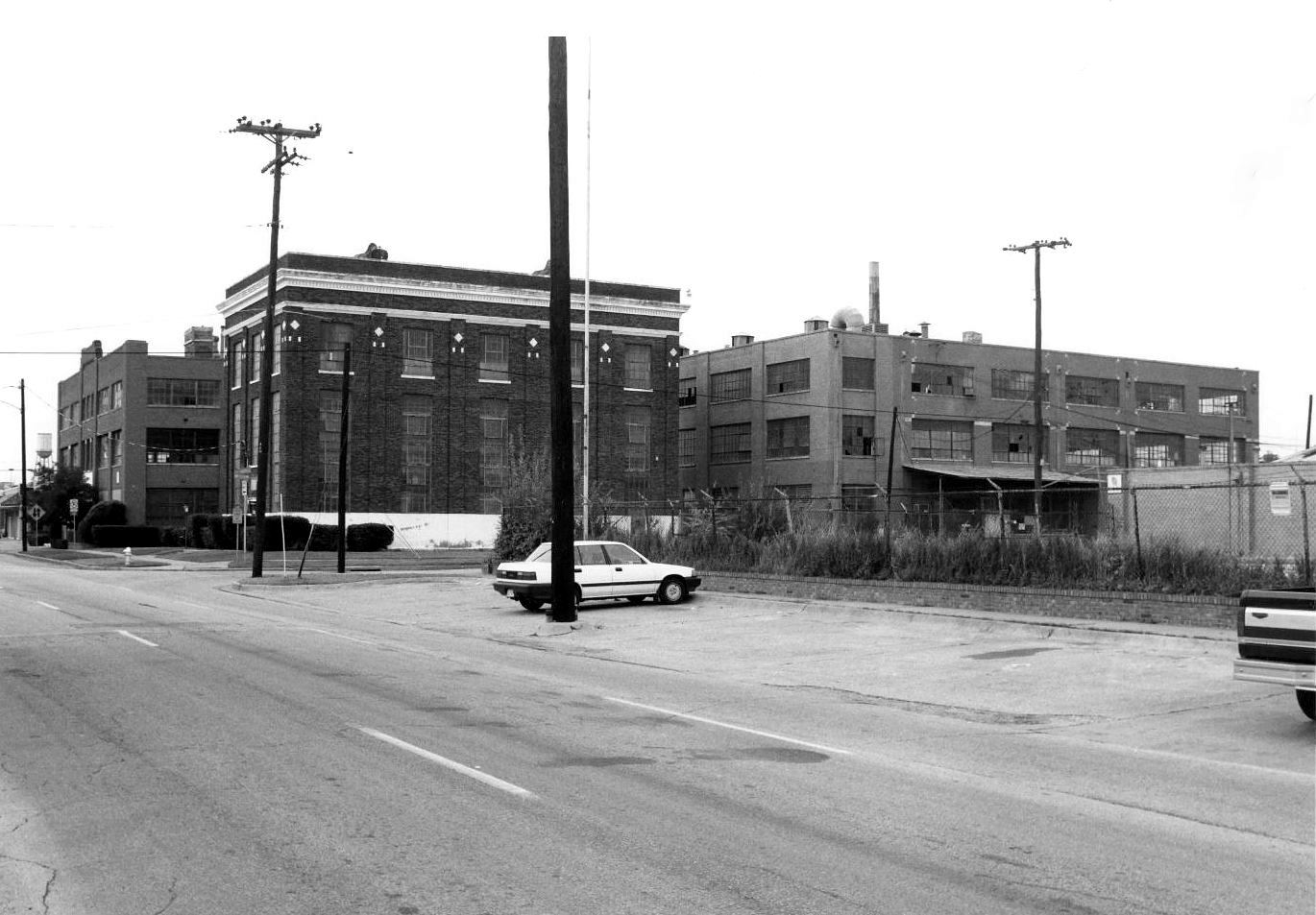
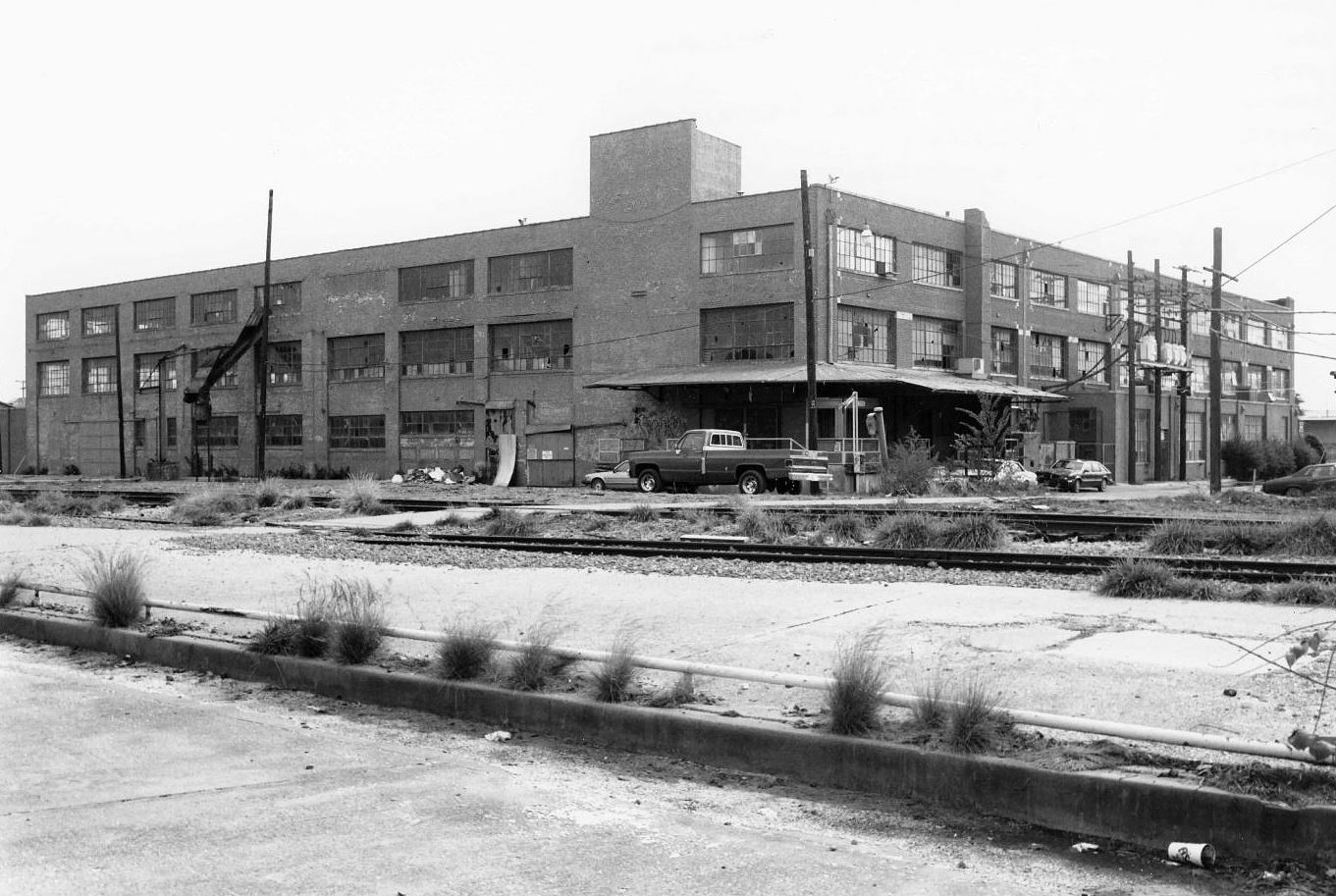
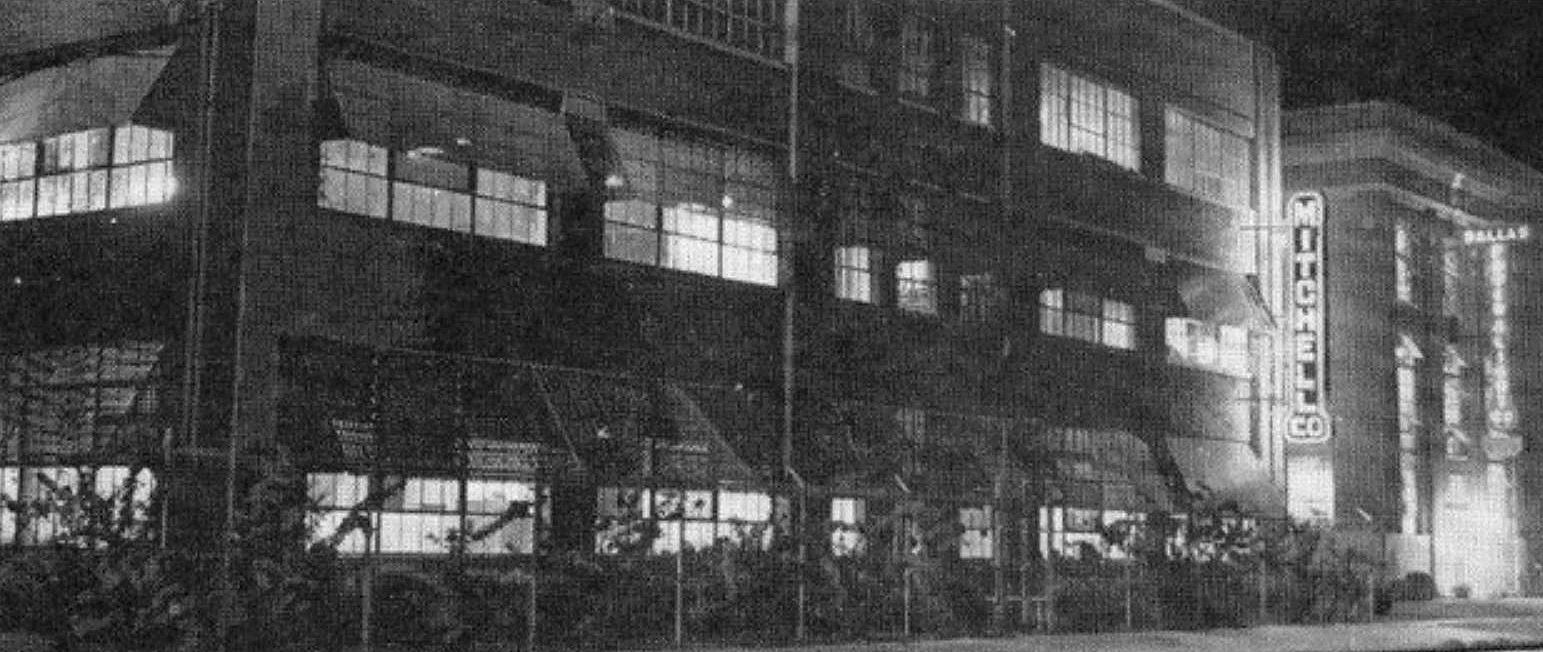
mitchell-bldg_oct-1988_appl-natl-register-hist-placesIn 1988, the building had seen better days… (click for larger image)

by Paula Bosse

In 1928, the John E. Mitchell Company (discussed previously here, here, and here) arrived in Dallas from St. Louis and built their J. A. Pitzinger-designed 2-story factory at 3800 Commerce Street (a wing was added the next year, and a third story was added the year after that). It produced cotton gins and farm implements. As strange as it seems today, Dallas was once the largest producer of cotton gin machinery in the United States. The Mitchell Company was located in a mostly industrial area very close to several other cotton gin manufacturers (such as the nearby  Continental Gin Company and Murray Company). At the height of their production, these Dallas factories were  responsible for half of the world’s cotton gins.

When World War II hit, the company became an important defense contractor and produced munitions for the U.S. Navy and U.S. Army, making things such as “anti-submarine projectiles,” anti-aircraft shells, rocket nozzles, and “adapters for incendiary bomb clusters.”

After the war, the Mitchell Company continued to manufacture agricultural implements but diversified by turning out other types of machinery, like automobile air conditioners and and cleaning systems. As the 1960s dawned, they developed the machine that made ICEE frozen slushy drinks (forever immortalized by 7-Eleven as The Slurpee).

After the death of company president John E. Mitchell, Jr. in 1972, the business began a slow slide downward. The company appears to have gone out of business in the early 1980s. In the fall of 1982, the company’s equipment was sold at public auction, and, in 1984, the building became the temporary home of the Junior Black Academy of Arts and Letters.

In the 1980s, Deep Ellum and Exposition Park began to explode with new bars, clubs, and galleries. If it was cool, it was in Deep Ellum and Expo Park; if it was in Deep Ellum and Expo Park, it was cool. Artists and musicians began to move into many of the neighborhood’s old warehouses. These usually run-down buildings — in which bohemian types lived (not always legally) and used as studio spaces — were huge and (in the beginning) cheap. The Mitchell Building became something of a ground zero for wild parties and was described in a fantastic 1995 newspaper article by Shermakaye Bass (linked below) as both a “flophouse” and “an artists commune and downtown slacker den.” The building was closed and boarded up by its owners in early 1995 in order to avoid code-violation citations, but by 1999 the building had been purchased, cleaned up, modernized, and converted into 79 loft apartments. Today, the Mitchell Lofts have been a part of the Expo Park scene for almost 20 years.

*

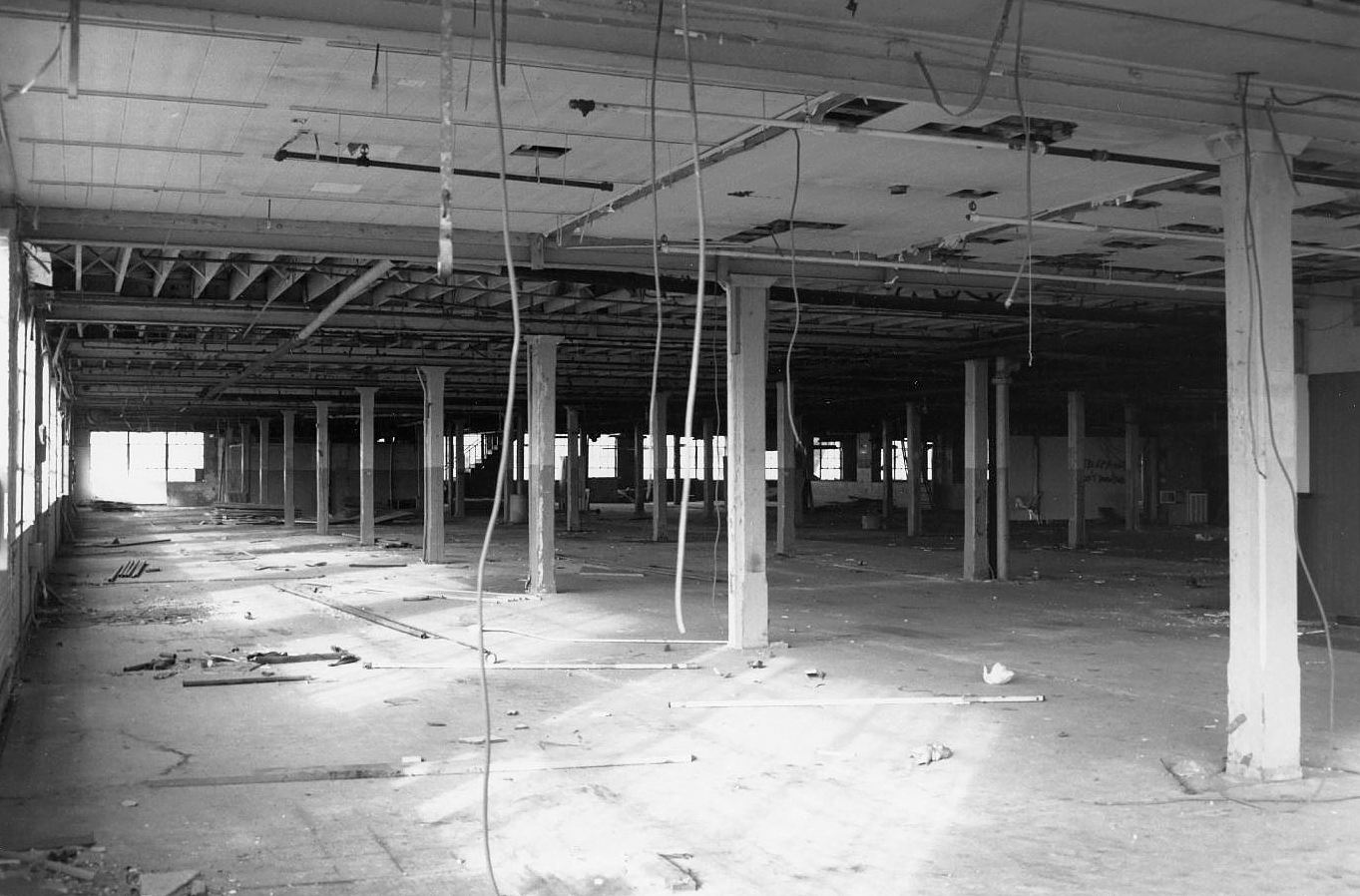
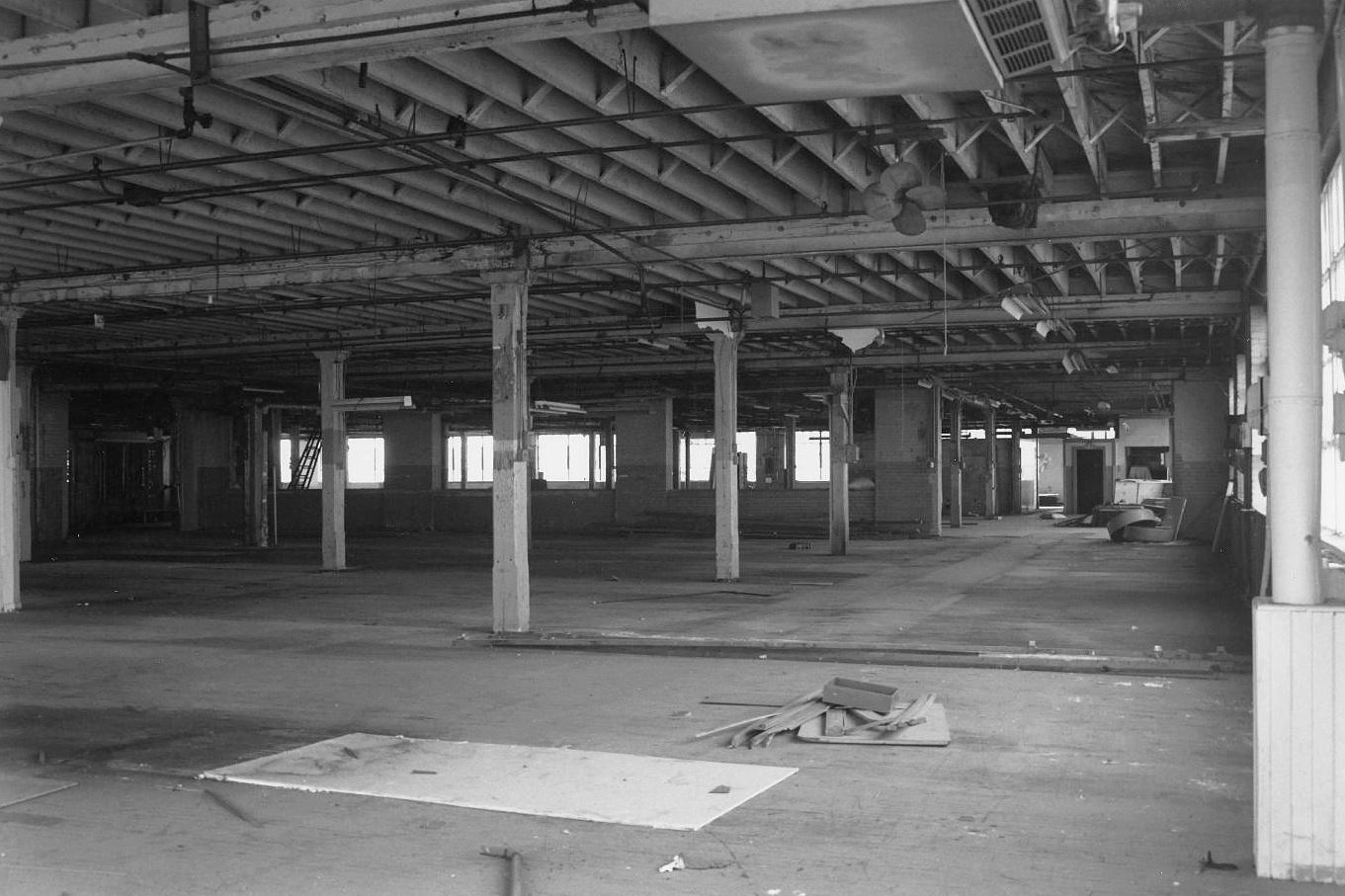
In 1991, the Mitchell Building was listed on the National Register of Historic Places. The photographs below (and the one at the top) were included in the application form. They were taken by Daniel Hardy of Hardy-Heck-Moore in October, 1988. Things weren’t looking great for the building in 1988. It must have been quite an undertaking to convert this large L-shaped building (which had certainly seen better days) into hip, sleek lofts.

Below, looking northwest on Commerce. The Mitchell Building is in an L-shape — the smaller building in the foreground is an old Dallas Power and Light substation, built around 1925. (Click photos to see larger images.)

mitchell-bldg_oct-1988_2

*

The back, from the old T&P/Missouri-Pacific railroad tracks.

mitchell-bldg_oct-1988_3

*

And two interior views of the second floor.

mitchell-bldg_oct-1988_4

mitchell-bldg_oct-1988_5

*

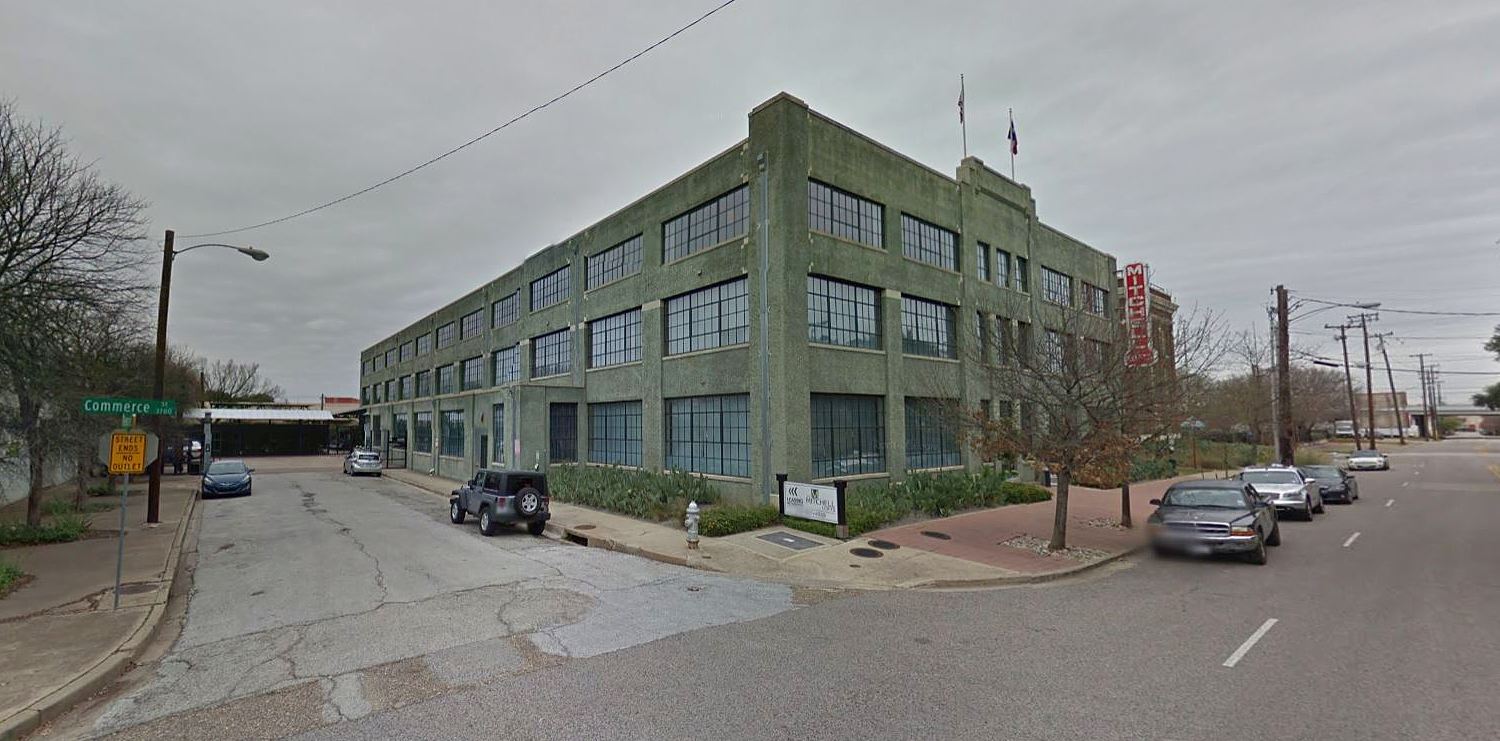
Here’s what the exterior looks like today, spiffified. (Explore it on Google Street view here.)

mitchell-lofts_google_jan-2016Google Street View (Jan. 2016)

mitchell-building_google
Google Maps

**

mitchell_sign_war-bk
Mitchell War Book, ca. 1945

mitchell-building_flickr_colteraFlickr

***

Sources & Notes

Photos are from the application to the National Register of Historic Places; in addition to the photos, there is a thorough history of both the building and the John E. Mitchell Company, written by David Moore of Hardy-Heck-Moore. The 28-page form can be found in a PDF, here. (3/14/17 UPDATE: The link no longer works for me, and I am unable to find the document. Here’s the full URL: ftp://ftp.dallascityhall.com/Historic/National%20Register/John_E_Mitchell_Plant.pdf.)

More info on the Mitchell Company and its building through the years can be found in the following Dallas Morning News articles:

  • “Dallas Gets Gin Factory” (DMN, March 17, 1928) — the announcement that a permit has been granted for the construction of a two-story brick factory and warehouse
  • “John E. Mitchell Exemplifies Faith as Secret to Success,” by Helen Bullock (DMN, July 17, 1949) — an entertaining profile of John E. Mitchell, Jr.
  • “Demise of a Dream Factory — Deep Ellum’s Historic Mitchell Building Leaves a Legacy of Artistic and Industrial Vision,” by Shermakaye Bass (DMN, Feb. 5, 1995) — for those who grew up when Deep Ellum was experiencing its (first) renaissance, the article is a great snapshot of what things were like in Deep Ellum and Exposition Park back in the ’80s and early ’90s

See what the Mitchell Lofts look like now in this Candy’s Dirt article from 2014; more photos are here. Pretty hard to believe people used to manufacture things like cotton gins and anti-aircraft missiles there.

The Mitchell Lofts website is here.

Click pictures and clipping to see larger images.

*

Copyright © 2016 Paula Bosse. All Rights Reserved.


The Historic Masonic, Odd Fellows, and City Cemeteries

cemeteries_1920s_photo-e
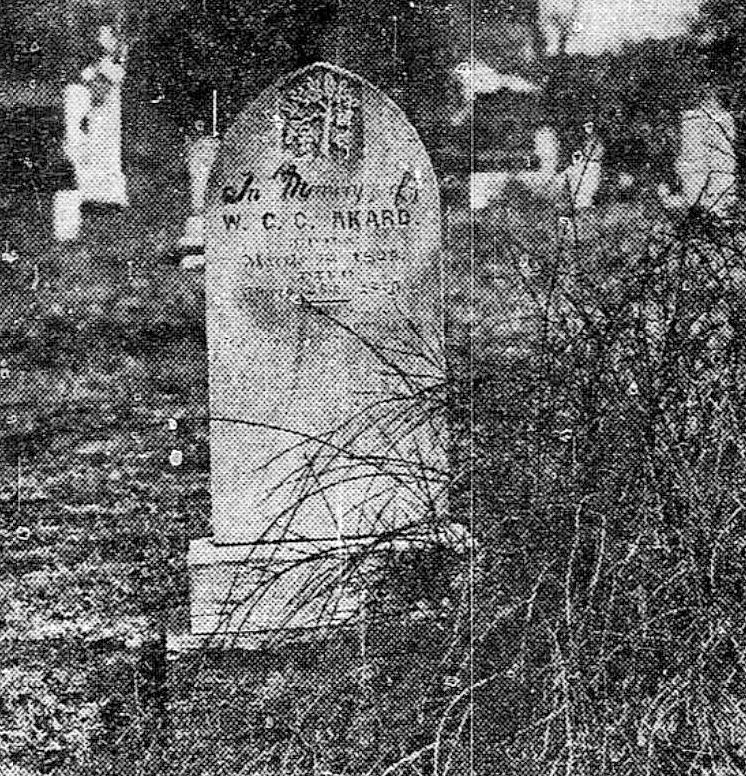
Tombstone of W. C. C. Akard, 1826-1870… (click for larger image)

by Paula Bosse

The other day I posted a photo of the Dallas skyline and pointed out that the land occupied by Memorial Auditorium/Dallas Convention Center was once the site of a cemetery (or, rather, several cemeteries: the old City Cemetery, the Masonic and Odd Fellows Cemeteries, and the Jewish Cemetery.

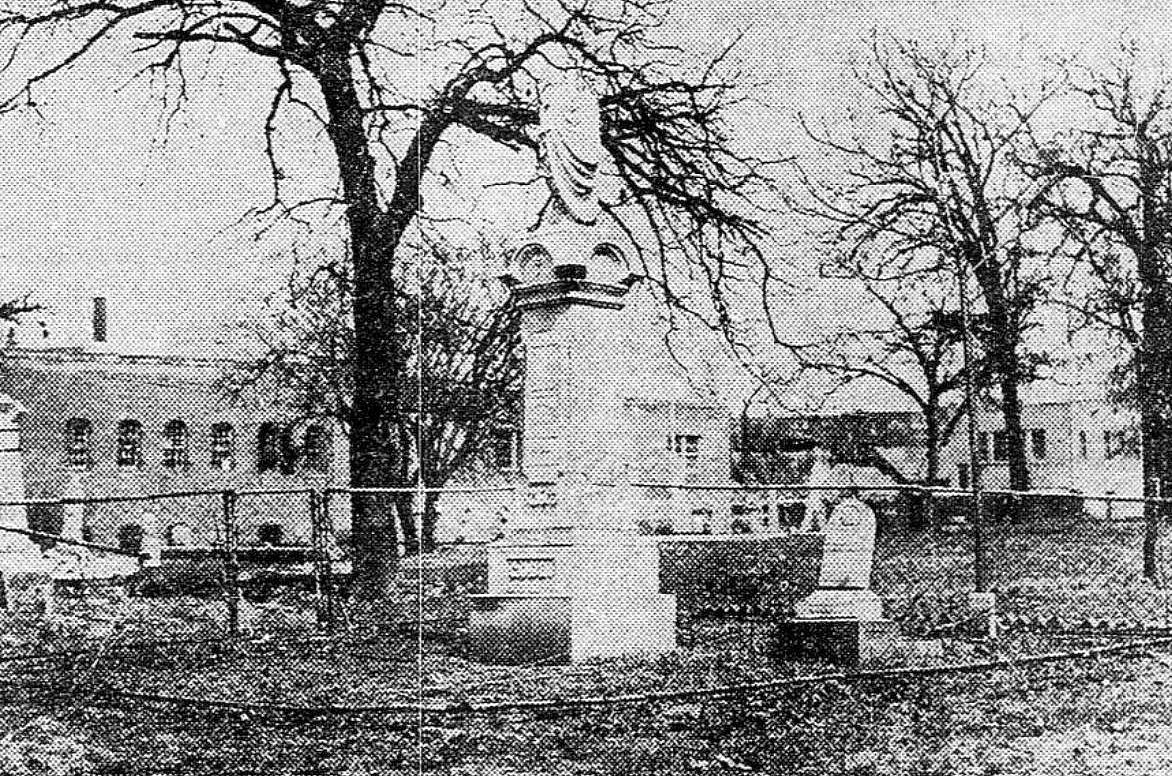
By the 1920s, the grounds were overgrown and grave markers were in various states of disrepair; there were about 500 graves, but many of the remains of those buried there had been moved (resulting in more than a few somewhat alarming gaping holes!). As the 1920s were winding down, fewer and fewer burials were taking place in these cemeteries, but people were still being interred throughout the 1920s — some of these appear to have been indigents without funds to be buried elsewhere.

The oldest grave markers dated to the 1850s. Many of those buried there were important Dallasites: mayors, politicians, pioneer businessmen, doctors, and judges — many of the markers bore names which are now part of everyday life in Dallas (names such as Harwood, Ervay, Akard, Crowdus, Browder, Marsalis, etc.). Over the years, cemetery land had been encroached upon bit by bit (by the Santa Fe railroad, for one) causing many graves to be unceremoniously destroyed. As the city grew and this land (which was once beyond the city limits) became more and more valuable for developers, many of the graves were moved and the remains relocated to other cemeteries. But many remained, and there was concern that the land was being neglected. For decades, the city of Dallas was petitioned by civic leaders to officially protect, beautify, and maintain this land. It wasn’t really until the construction of the convention center in the 1950s that these plans began to take shape. Remaining graves and markers are now part of the Pioneer Park Cemetery at Pioneer Plaza.

Below is a detail from an 1882 map, showing the original locations of the four cemeteries, just beyond the southern edge of the city limits. The Masonic Cemetery occupied the northern section, and the Odd Fellows Cemetery occupied the southern section. The City Cemetery adjoined both, immediately to the east (just west of Akard). The tiny Jewish Cemetery is seen on the southeastern edge of the City Cemetery (in later years Masonic Street cut through the City Cemetery land, and the Jewish Cemetery was just south of the street and right next to the old Columbian School). (See the changed boundaries of the cemeteries on a 1905 Sanborn map here.)

map_1882_cemeteries
Jones & Murphy’s Map of the City of Dallas, Texas, 1882 (det.)

*

The photo at the top of this post shows the grave of W. C. C. Akard (1826-1870). (Incidentally, according to a 1939 Dallas Morning News article, he apparently pronounced his name “Ay-kard” rather than “ACK-erd” as we do today.) The photos below show the run-down Masonic-Odd Fellows cemetery in the 1920s.

*

cemeteries_1920s_photo-a

The Masonic and Odd Fellows Cemetery, with the Magnolia Building in the background.

*

cemeteries_1920s_photo-b

Cheek-by-jowl with a growing urban Dallas.

*

cemeteries_1920s_photo-c

I love this photo, with train cars on the Marilla Street tracks and the Butler Brothers building in the distance, just east of where City Hall now stands.

*

cemeteries_1920s_photo-d

Another interesting image, looking to the northwest, with the Santa Fe freight depot (still standing on Young Street near Griffin) at the top right. (The cemetery land was apparently fifteen feet above the surrounding street level.)

**

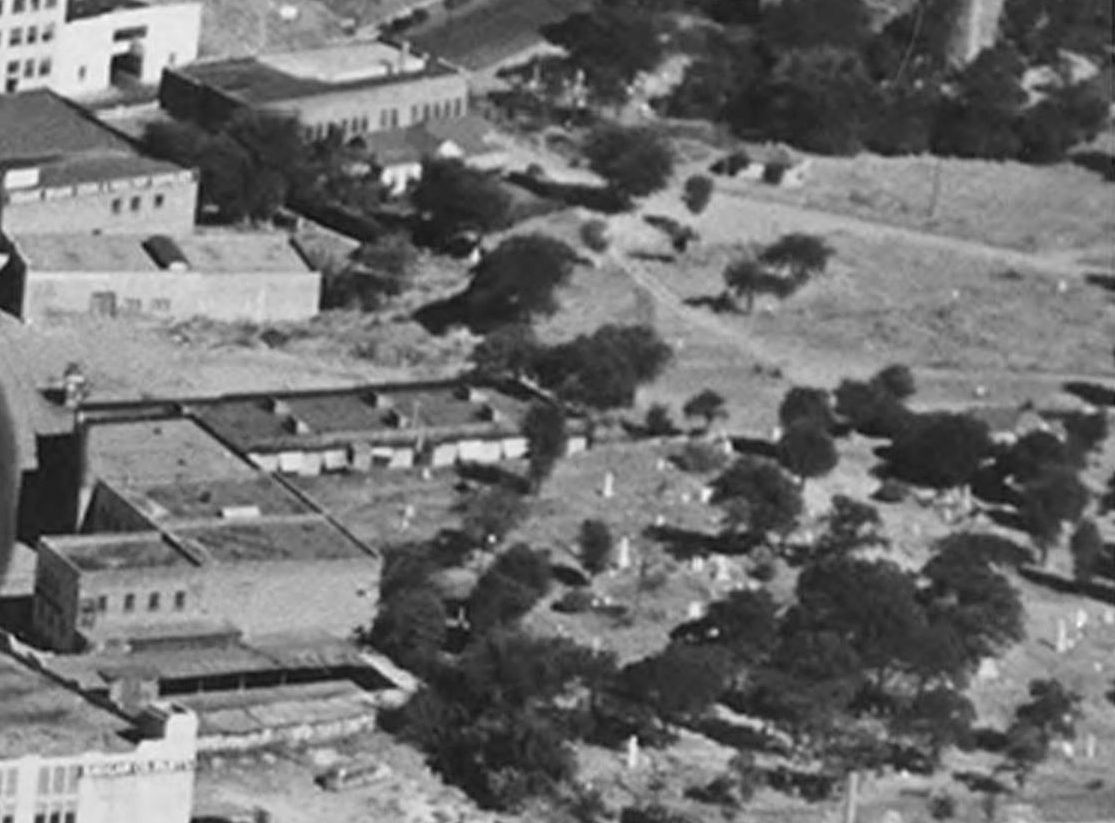
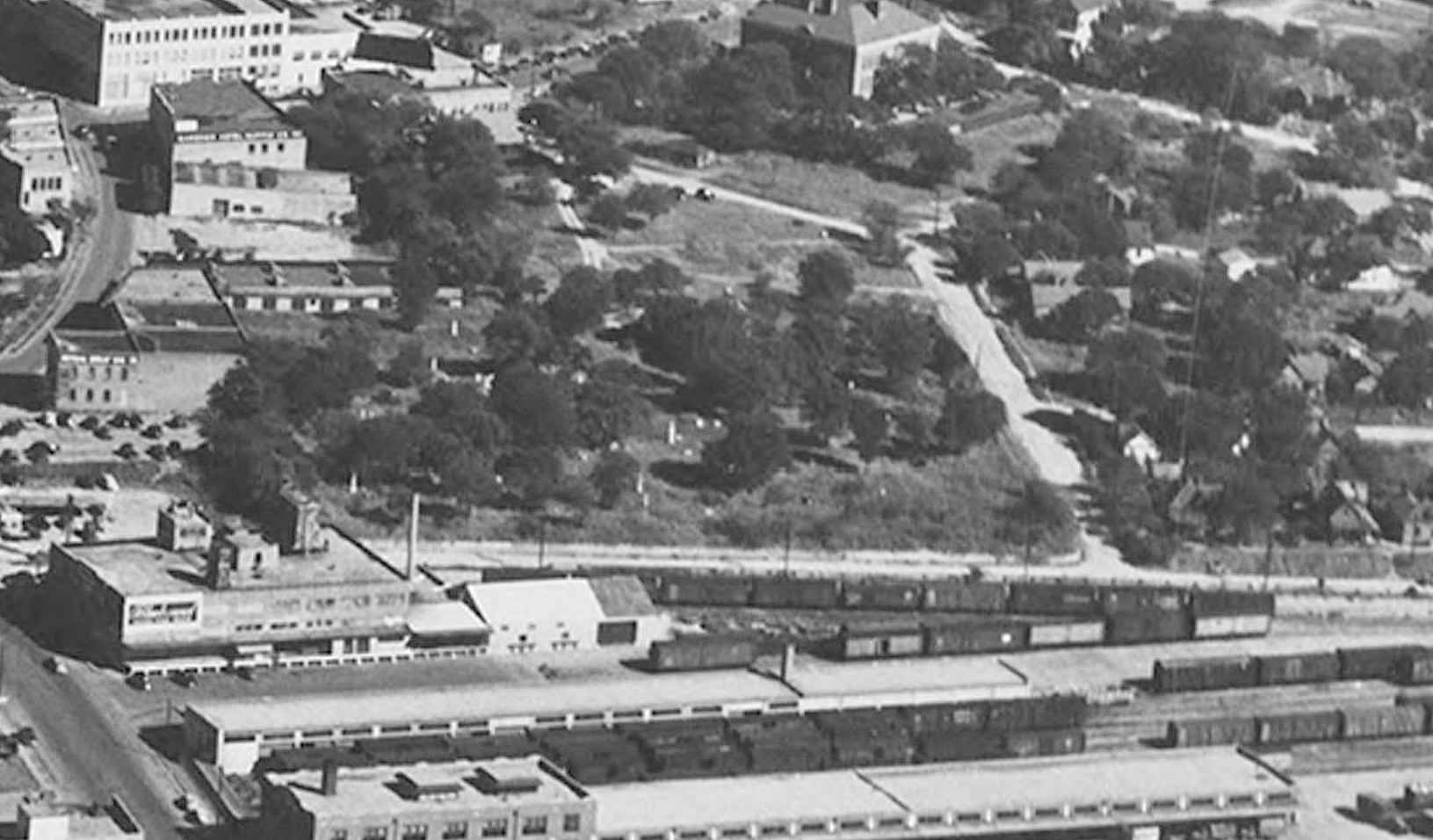
Below are a few extreme close-ups from aerial photographs by Lloyd M. Long (from the Edwin J. Foscue Map Library, Southern Methodist University — links to the original full photos can be found beneath each image). Cemetery markers are visible in these photos taken from the west.

cemeteries_1938_foscue_smu_longAbove, a detail from a 1938 photo.

*

cemeteries_1939_foscue_smu_longDetail from a 1939 photo.

*

cemeteries_1949_foscue_smu_long
And a detail from a 1949 photo.

*

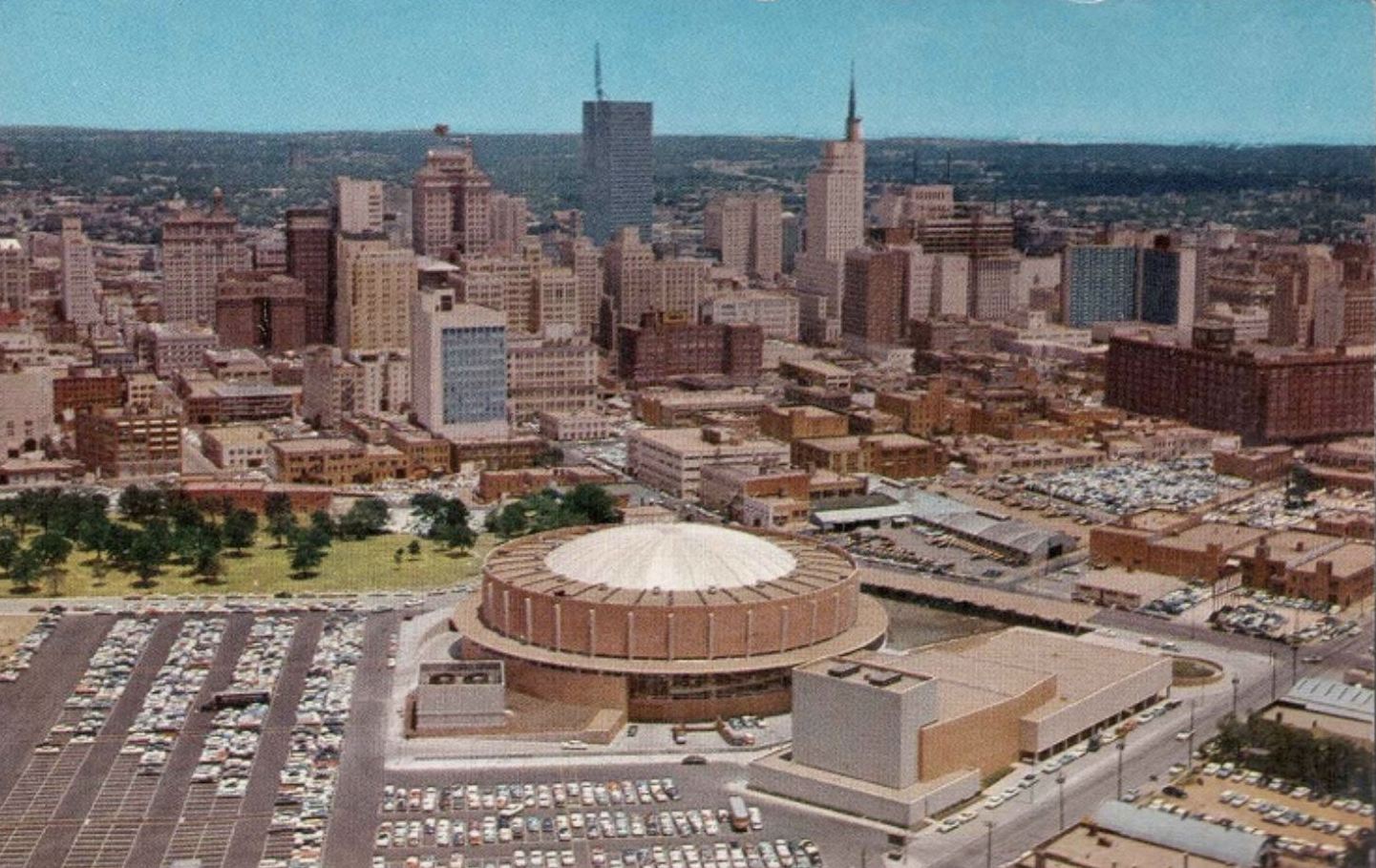
dallas-convention-center_flickr_coltera

And the “after” photo, with much of the old cemetery land used as the site of Memorial Auditorium.

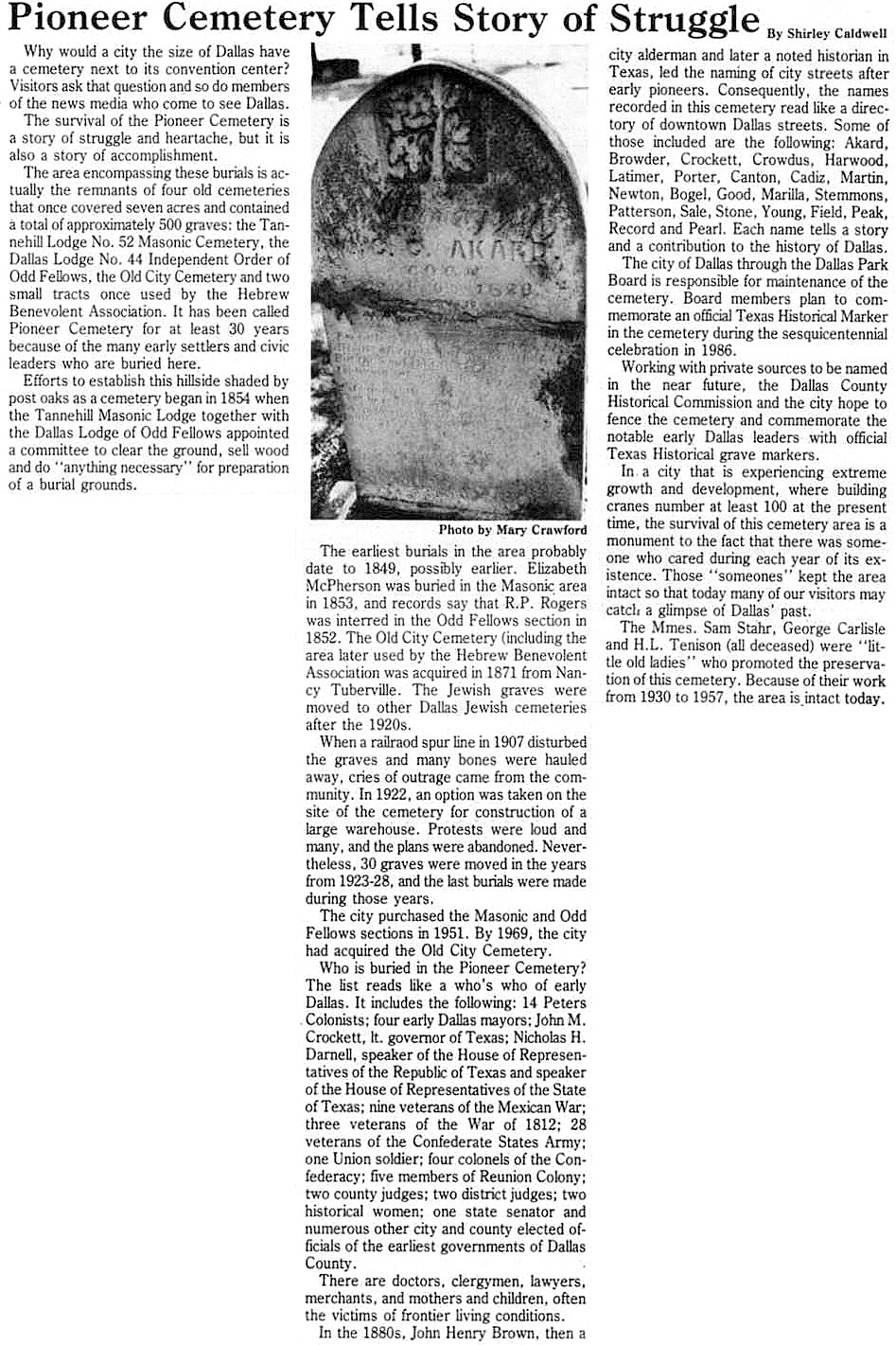
Below, a short history of the cemeteries, which appeared in the July, 1985 issue of Historic Dallas magazine: “Pioneer Cemetery Tells Story of Struggle” by Shirley Caldwell. (Click to read.)


pioneer-cemeteries_historic-dallas_july-1985_portal
via UNT’s Portal to Texas History

***

More on this cemetery can be found on Julia D. Quinteros de Hernandez’s timeline, here.

A collection of newspaper stories about the adjacent “Old City Cemetery” (some of which describe shocking disturbances of the land and of graves) can be found on Jim Wheat’s site, here.

More on Dallas’ older cemeteries can be found in Frances James’ article “Cemeteries in Dallas County: Known and Unknown” (Legacies, Fall, 1996), here.

Information about how the city dealt with the plight of the cemeteries amidst the looming possibility of development can be found in the Dallas Morning News article “Park Board Protests Motel at Auditorium” by Francis Raffetto (DMN Dec. 18, 1958).

A bird’s-eye view of Pioneer Plaza can be seen on Bing, here (zoom in to see the historic markers in the lower right corner).

All images and clippings are larger when clicked.

*

Copyright © 2016 Paula Bosse. All Rights Reserved.


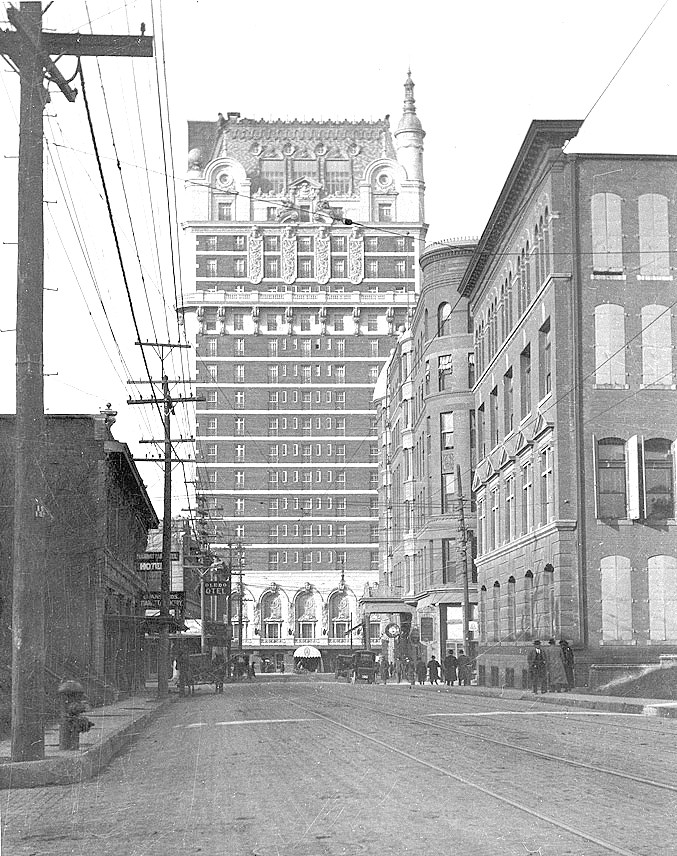
The Adolphus, The Oriental, The Magnolia

adolphus_magnolia_oriental_TSHA-1977-annual-mtg_portal_sm
Akard looking north… (click me!!)

by Paula Bosse

This is just great. I’ve never seen this photo, which was taken sometime between 1922 and 1924. Dallas has never looked more … architectural. (Click that photo — it’s worth seeing it bigger.)

The view is looking north on Akard toward Commerce, from some building on or near Jackson Street. The Adolphus Hotel (built in 1912 and still standing) is straight ahead, the shorter Oriental Hotel (1893-1924) is in the middle, and the Pegasus-less Magnolia Petroleum Building (built in 1922 and still standing) towers above both of them.

I don’t think I’ve seen the Oriental from this angle. And I’ve never noticed all those windows in the Magnolia Building that look directly across into other windows. (That must be … strange.) And since I recently posted photos of this same block of S. Akard, I immediately recognized the short building with the odd-shaped cut-out/crest-like decoration in it opposite the Oriental.

Here’s the same view a few years earlier — about 1913, before the Magnolia was built:

adolphus_1913_dpl_via-d-mag-online

I love these photos. And how nice that two of these landmark buildings are still alive and kicking!

***

Sources & Notes

Top photo appeared in the program for the 1977 Texas State Historical Association Annual Meeting of 1977 (held, appropriately enough, in the Baker Hotel, which was built on the corner previously occupied by the Oriental); I found it on the Portal to Texas History site, here. (Dear printers of things like this: please never EVER use brown ink to print photographs. If anyone knows of a cleaner, sharper copy of this great photo, please let me know!)

Second photo is from the Texas/Dallas History Division, Dallas Public Library; I found it posted on the D Magazine site, accompanying the article “How Haunted Is the Adolphus Hotel?” here.

Photos larger when clicked.

*

Copyright © 2016 Paula Bosse. All Rights Reserved.


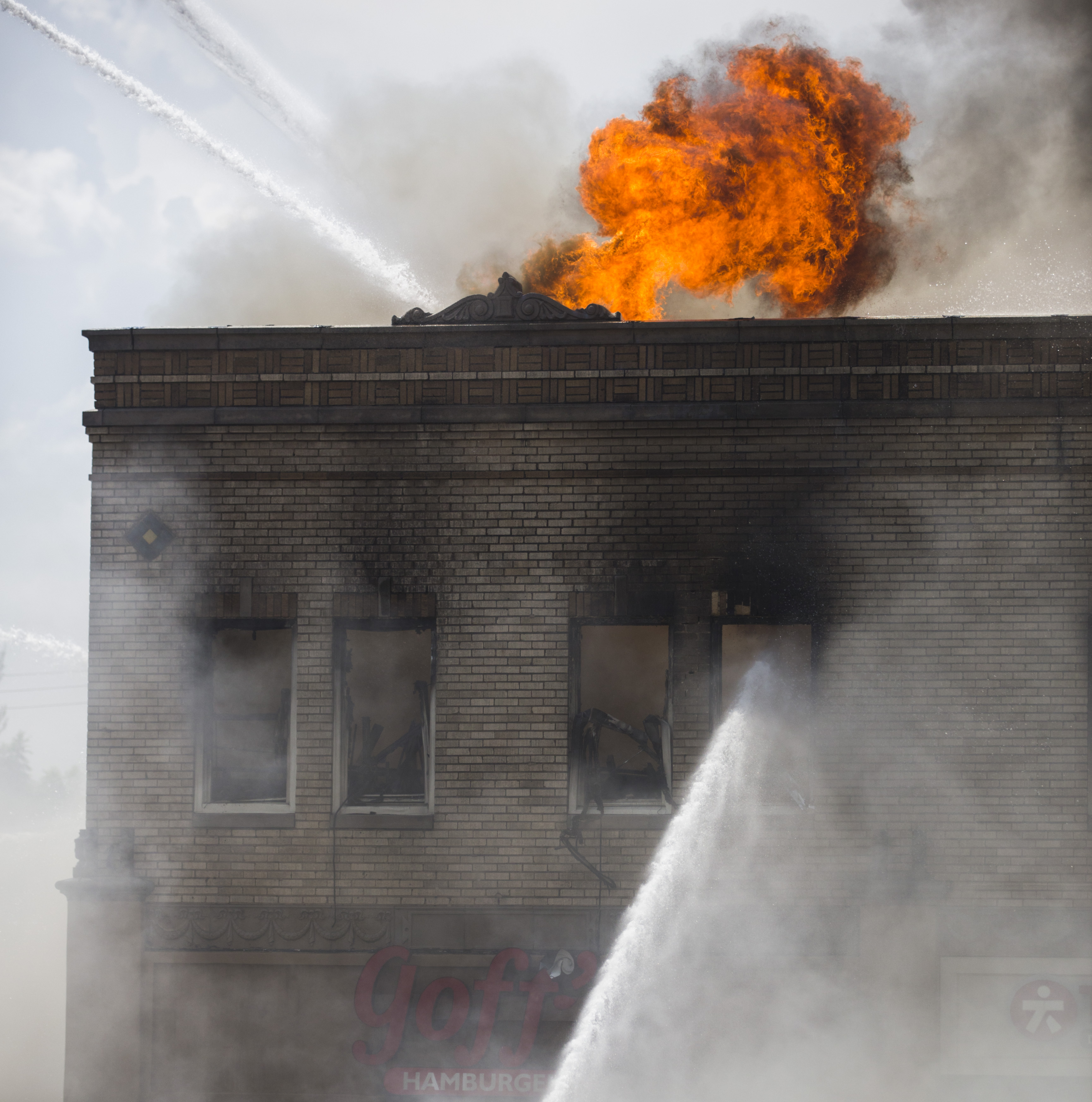
University Park’s “Couch Building” Goes Up In Flames (1929-2016)

goffs_fire_dmn-081216_ashley-landis-photo
Photo: Ashley Landis/DMN (click for huge image)

by Paula Bosse

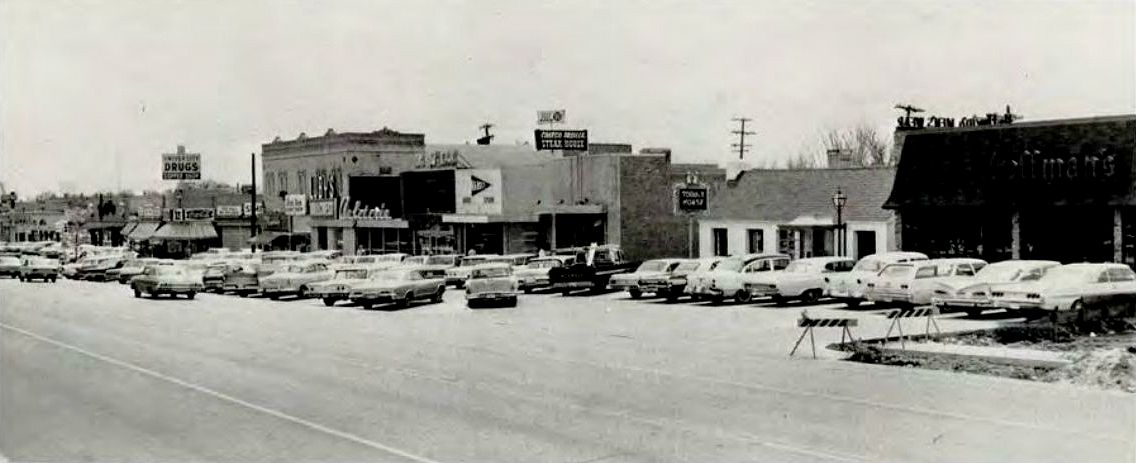
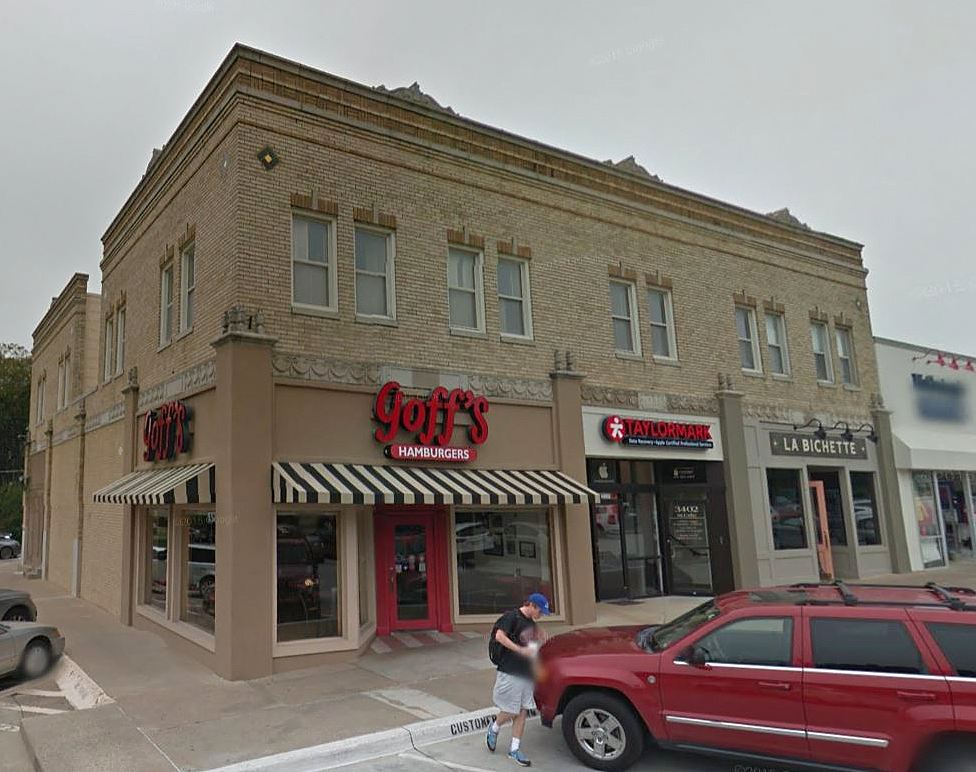
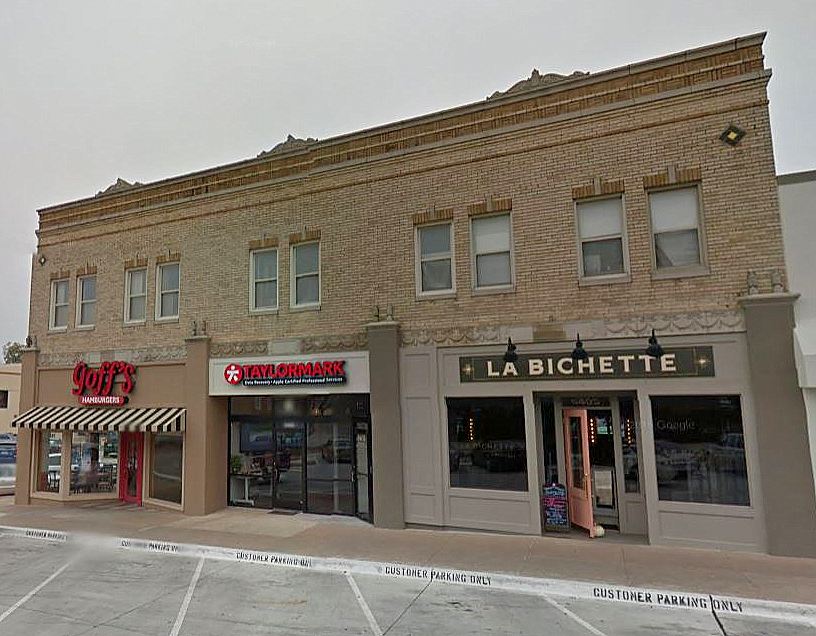
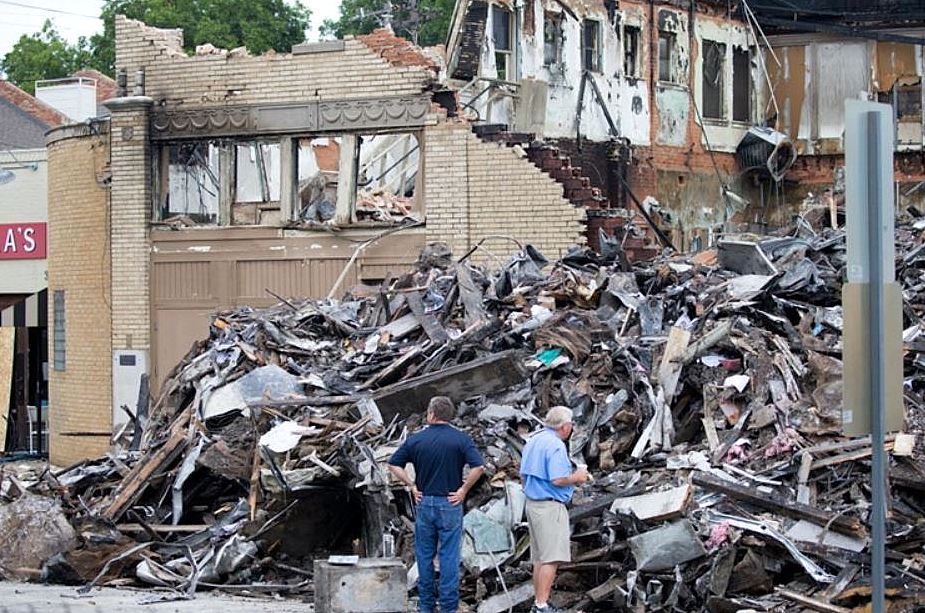
Yesterday, fire erupted in the old University Park building at the northwest corner of Hillcrest and McFarlin. The building — which housed Goff’s Hamburgers and several other businesses — is, today, a pile of rubble. I’ve always loved this building — every time I’d drive past it I’d smile, happy that the only truly distinctive non-SMU building along that part of Hillcrest was still standing. And now it isn’t.

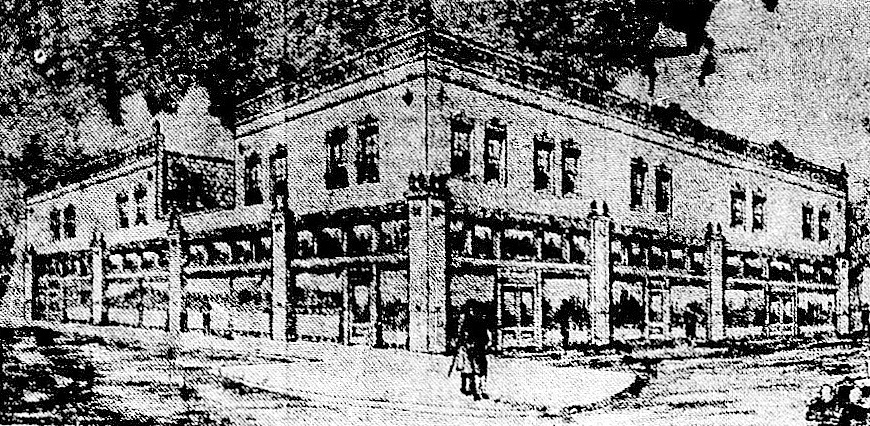
The building — which was built in 1929 across Hillcrest from McFarlin Auditorium — had a rocky start. SMU really, really didn’t want it to be built.

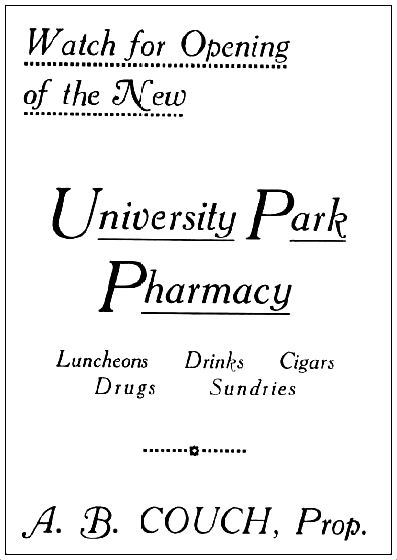
A. B. Couch (1895-1970) came to Dallas around 1914 from Waco to attend pharmacy school. In 1921, a few years after becoming a pharmacist, he opened his own drugstore, the University Pharmacy, at the southwest corner of Hillcrest and Roberts avenues (Roberts was renamed McFarlin Boulevard in 1928).

university-park-pharmacy_couch_1920-rotunda
Coming soon… (1920 SMU Rotunda yearbook)

Business must have been good, because in February of 1923, Couch bought the vacant property across the street. Three years later, he applied for a permit to build a business on the property, and that’s when the Robitussin hit the fan.

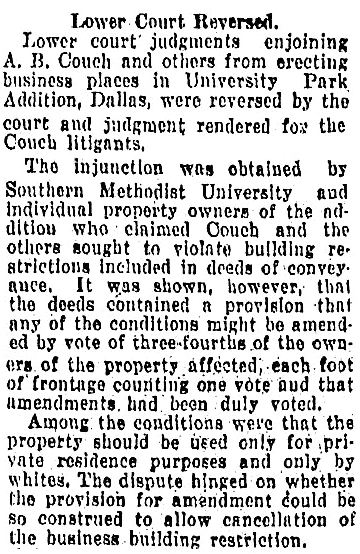
It’s a bit confusing, but, basically SMU, the original owner of the property (and all that surrounded it), put their land west of the campus (west of Hillcrest) on the market, but it could be sold only with specific restrictions — there were several of these restrictions, but the two cited most frequently were that land in this University Park Addition was to be developed solely for residential purposes, and that these homes were to be occupied by white people only. Somehow, in transferring property and re-deeding and re-re-deeding — and all sorts of other real estate transactions I don’t understand — the contract for the large lot purchased by Mr. Couch was drawn up with the restrictions omitted (“an oversight”). Couch was insistent on building businesses on the land he’d purchased, and SMU was adamant that he not be allowed to. Cue the lawsuit. (An overview of this case — in the appeals court — can be read here. It’s interesting, if confusing.)

The court case dragged on and on, through injunctions and appeals, and, finally, in December of 1928, the Supreme Court of Texas ruled in favor of Couch. (Click to see a larger image.)

couch_FWST_120628_supreme-court-of-tx-ruling
Fort Worth Star-Telegram, Dec. 6, 1928

In the spring of 1929, Couch released the drawing of the two-story F. J. Woerner-designed building he planned to build:

couch-bldg_woerner-rendering_1929

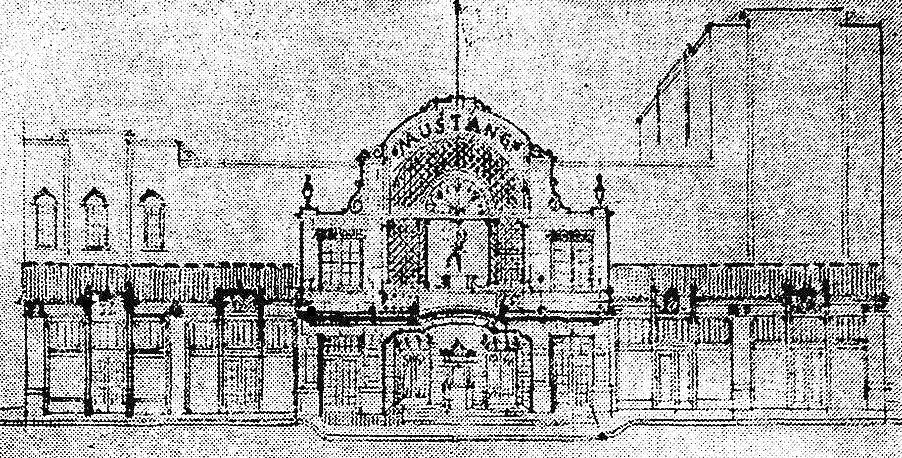
He also announced that he would build in this same block, a $125,000, 1,000-seat cinema: the Mustang Theater, which, though not yet built, had been leased for 10 years to R. J. Stinnette, who ran the Capitol Theater downtown. The building was designed by W. Scott Dunne, the architect of many of Dallas’ movie theaters (the Texas Theatre, the Arcadia, the Melba, the Dal-Sec, etc.).

mustang-theater_scott-dunne_rendering_1929

It doesn’t appear that the Mustang Theater was ever built, probably because the Varsity Theater in Snider Plaza (a stone’s throw away) had been announced that very same week (the Varsity opened in the fall of 1929).

So, forget the Mustang. Couch’s building — which was called, yes, “The Couch Building” — opened in 1930 or ’31. Its official address was 3402 McFarlin, but the address of the new location of the University Pharmacy was 6401 Hillcrest. There were a couple of stores next to the pharmacy, and offices upstairs (it seemed a popular location for doctors and real estate agents). Mr. Couch lived next door, at 3404 McFarlin (in a house which was, ironically, destroyed by fire in 1932).

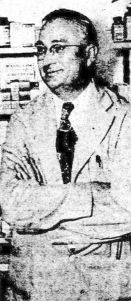
That simple but lovely building stood on that corner for almost 90 years. Until yesterday. Sorry about that, A. B.

a-b-couch_pharmacist_1940sAndrew Bateman Couch, pharmacist

*

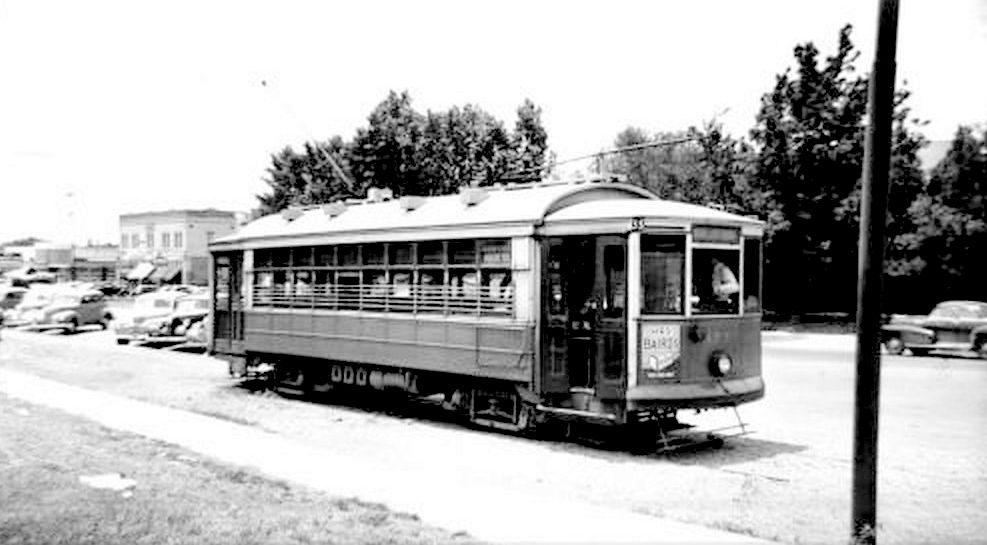
Below a photo taken on June 13, 1947, showing the “Highland Park/SMU” streetcar sitting at the end of the line, just south of Snider Plaza, with an 18-year-old Couch Building behind and to the left of the streetcar.


couch-bldg_061347_ebay

Below, the same view of Hillcrest looking south, from the 1965 SMU Rotunda yearbook. (Note that an unrelated University Pharmacy — this one owned by Harold Simmons — is seen at the southwest corner of Hillcrest and McFarlin. Couch sold his drugstore business in 1943, and a new pharmacy, which passed through several hands, opened across the street in Couch’s original 1921 location.)
drag3_smu-rotunda_19651965 SMU Rotunda

goffs_google_november-2015Google Street View, Nov. 2015

goffs_google_nov-2015_frontGoogle Street View, Nov. 2015

goffs_rubble_dmn-photo_081316_ting-shen-photographerDMN photo, Aug. 13, 2016 — Ting Shen, photographer

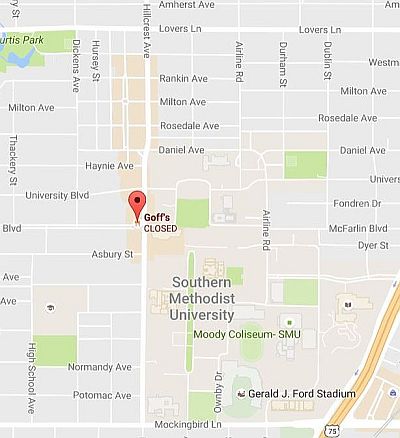
hillcrest-mcfarlin_map_goffs
Google Maps, Aug. 13, 2016 

***

Sources & Notes

Top and bottom photos are from the Dallas Morning News; see their coverage here, here, and here. That top photo is VERY large on The News’ website — look at all the detail of the brick and decoration.

Footage of the fire and its aftermath, from WFAA, can be watched here (scroll down to see all video footage).

Photo with the streetcar is from eBay; I saw it in the Retro Dallas, Texas Facebook group, posted by Dallas historian Teresa Musgrove Gibson.

Take a look at the 1921 Sanborn map, here. This building would be built at what is the northwest corner of Roberts (later McFarlin) and Hillcrest. University Park is pretty wide open in 1921.
*

Copyright © 2016 Paula Bosse. All Rights Reserved.

Neiman-Marcus Expands — 1927

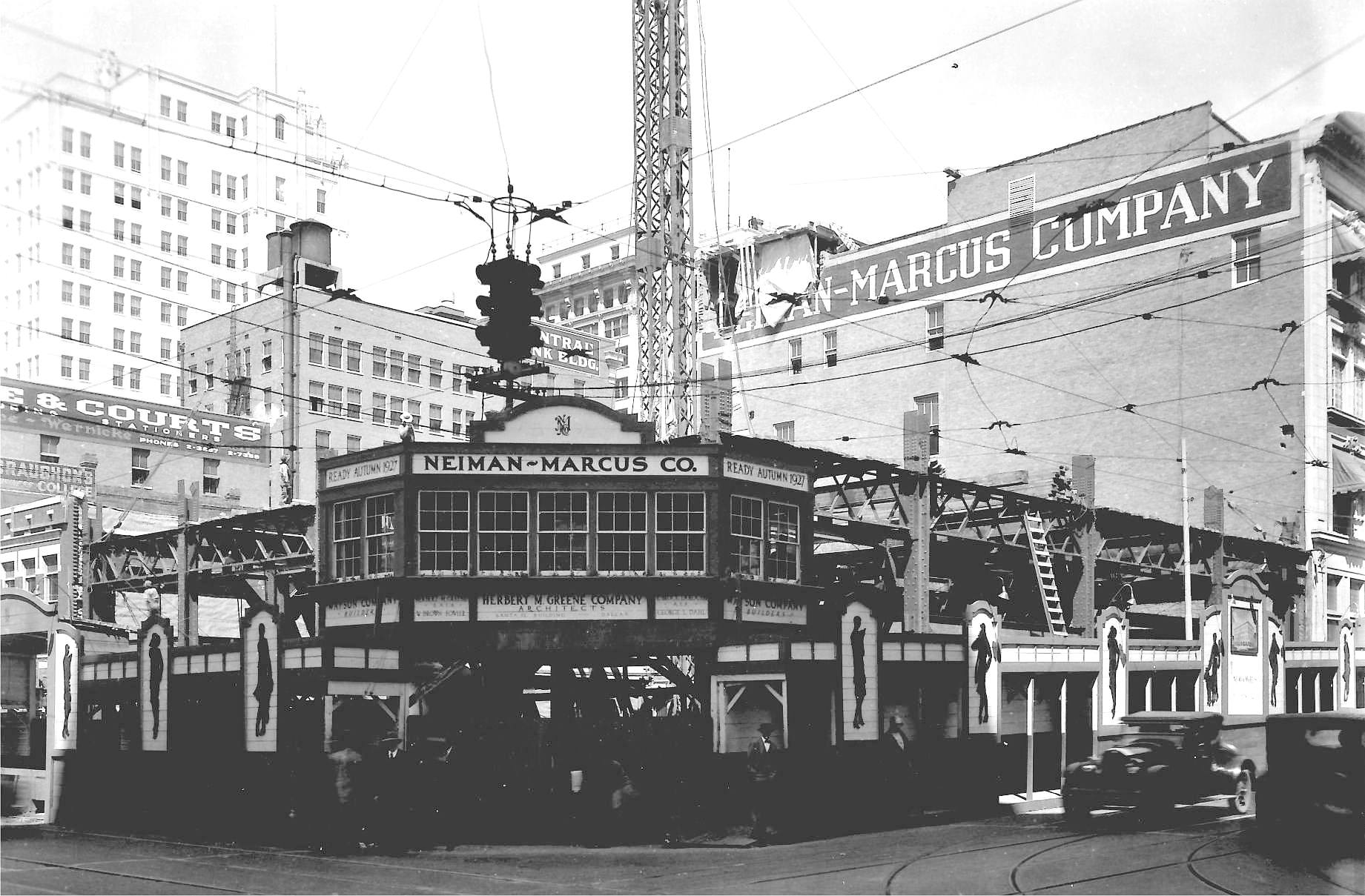
n-m_construction_1927_pioneers-of-dallas-co-FB-page_coll-frances-james_2The first addition under construction, 1927…

by Paula Bosse

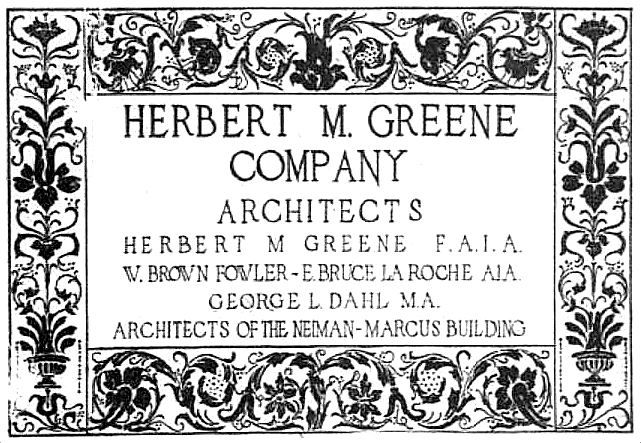
In 1927, construction began on Neiman-Marcus’ first expansion. The addition was adjacent to the famed department store, which had occupied its spot at Main and Ervay since its construction in 1914. (This was the company’s second location – their original store, which opened in 1907 at Elm and Murphy, was destroyed by fire in 1913.) The store had outgrown its old building, and expansion was deemed necessary. The new addition was designed by the Herbert M. Greene architectural firm, led by George L. Dahl. While the new building was going up, the old building was being renovated and updated. 

The photo above shows the construction of the addition, which extended the store’s footprint from Main all the way to Commerce. One of the interesting features of this construction was the look of the site itself.

One of the features of the Neiman-Marcus project is the ornamental barricade, containing window boxes and fashionable silhouettes, which has been put up around the new construction. (Dallas Morning News, May 8, 1927)

It’s the nicest-looking hard-hat area I’ve ever seen!

The new building (which was four floors, but was designed so that sixteen additional stories could be added if needed) opened in October, 1927. Less than a month after the formal opening of this new building, another addition was announced — it opened the following year. With that “third unit” opening in 1928, Neiman-Marcus had increased its size by 50% (there would be further expansions over the years), and its sales were the highest in the company’s history. Also, notable at this time was the fact that a full 40% of the store’s sales were to people who lived “in other cities of the Southwest.”

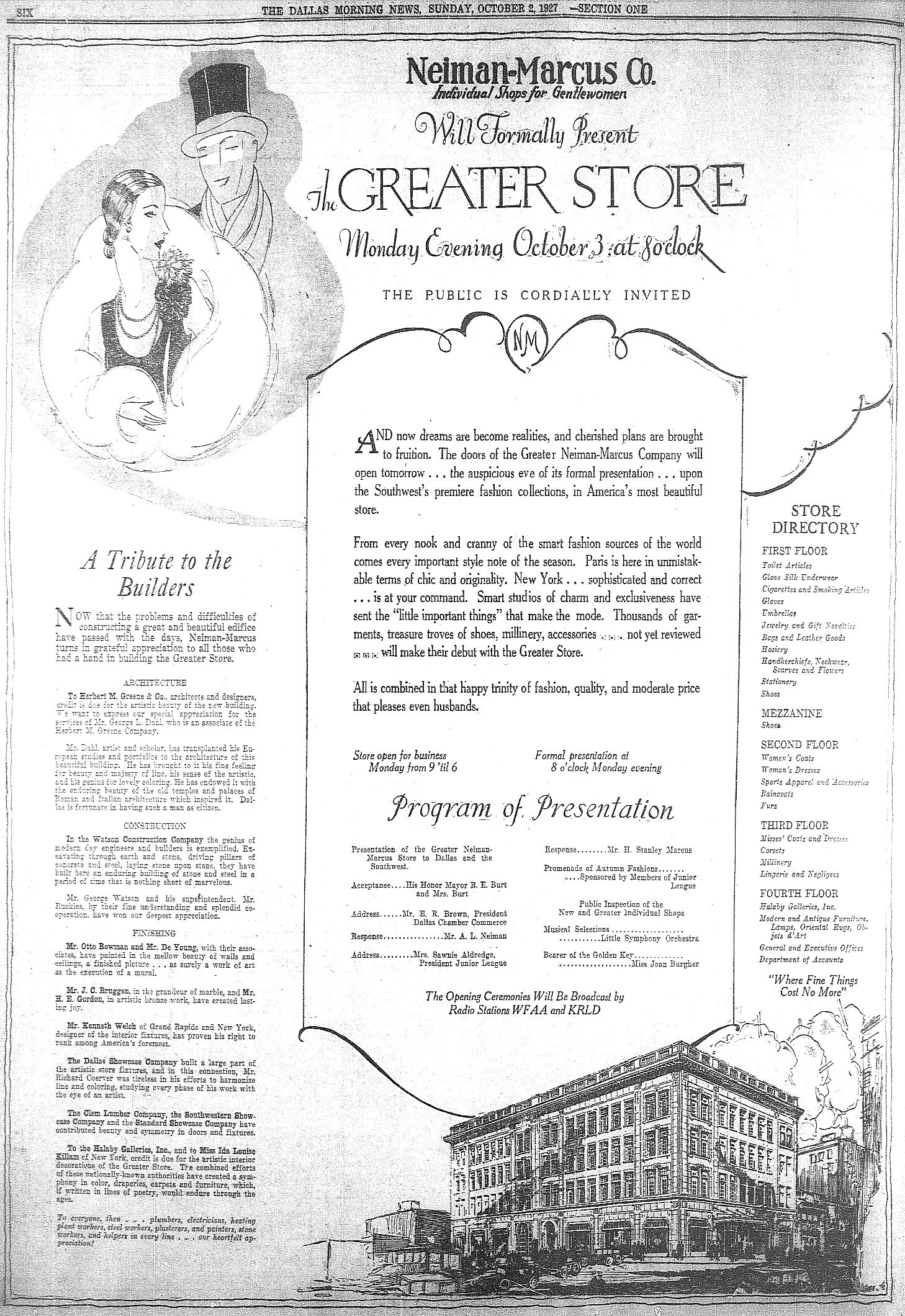
The formal opening on Oct. 3, 1927 attracted a crowd estimated at more than 25,000 people. Invited guests wore gowns and tuxedoes.

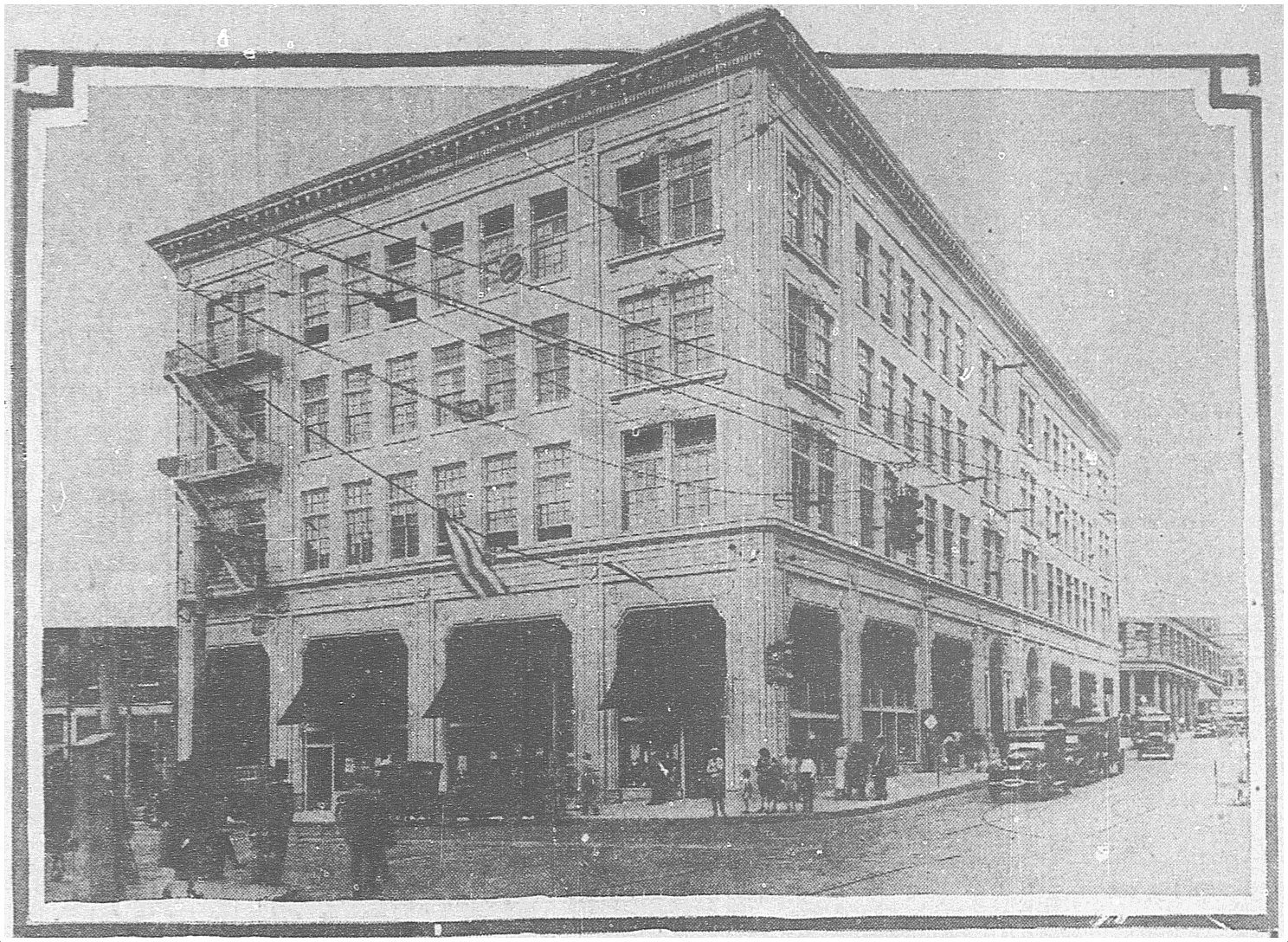
n-m_new-addition_dmn_100227
Expansion completed.

*

n-m_construction_dmn_100227_full-page-ad
Oct. 2, 1927 (full-page ad — click to see larger image)

n-m_addition_dmn_100227_architects
Oct., 1927

***

Sources & Notes

Top photo was posted in the Facebook group Pioneers of Dallas County; it is from the collection of Dallas historian Frances James.

A special section of The Dallas Morning News which coincided with the opening of the expanded store appeared in the October 2, 1927 edition of the paper; in it are several photos and articles.

Read more about the history of the Neiman Marcus building on Wikipedia, here.

*

Copyright © 2016 Paula Bosse. All Rights Reserved

The Twin Standpipes of Lakewood Heights: 1923-1955

lakewood_water-towers_reminiscencesAbrams and Goliad, y’all… (click for larger image)

by Paula Bosse

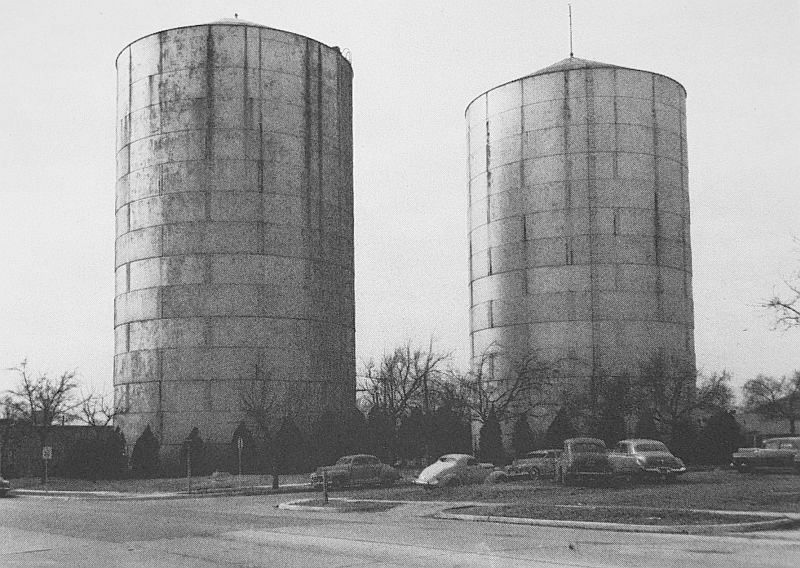
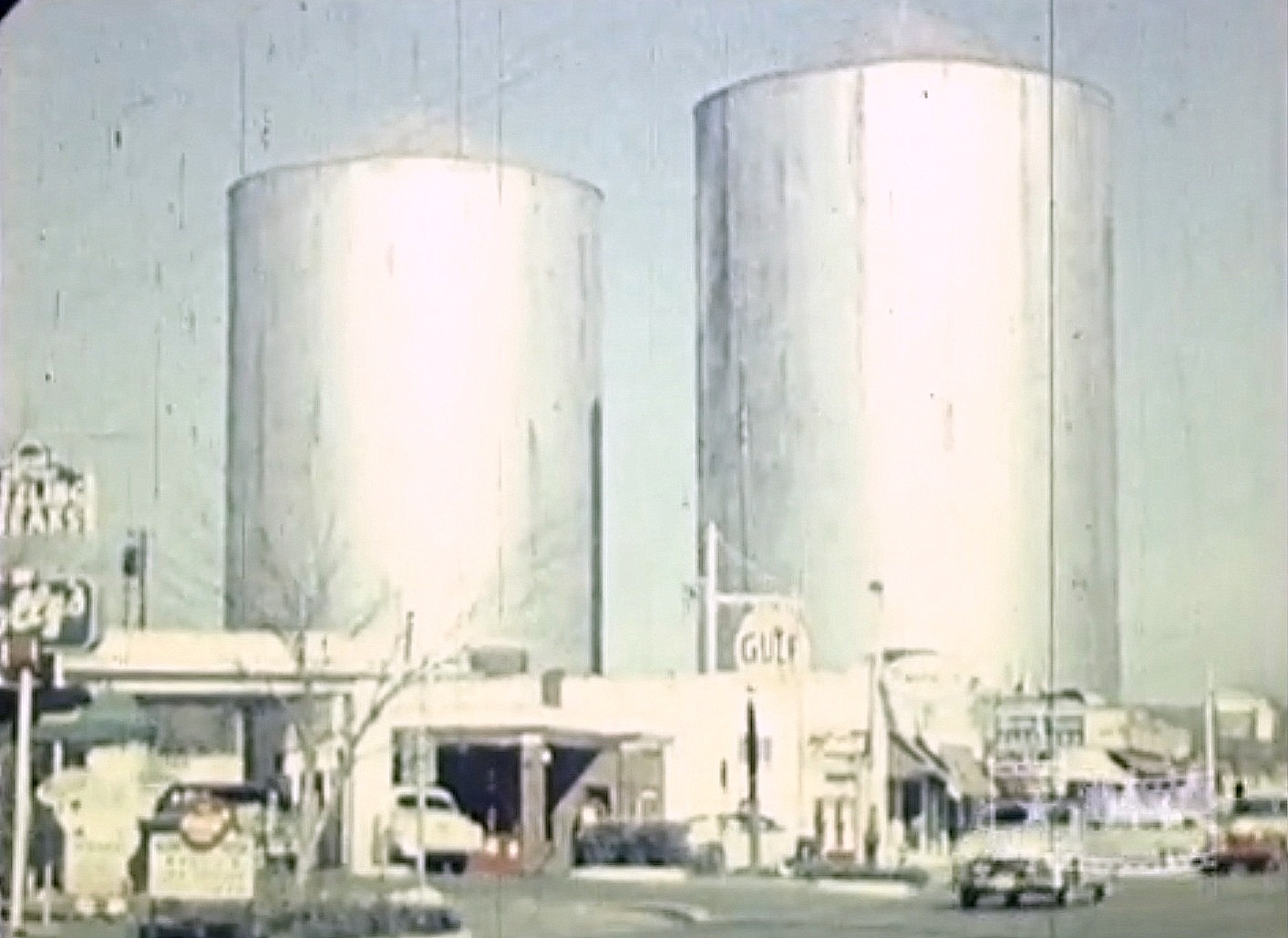
The two large water towers pictured above loomed over the East Dallas neighborhood of Lakewood Heights for over 30 years. They sat at the southwest corner of what was then known as Greenville Road (not to be confused with Greenville Avenue) and Aqueduct Avenue — the streets are known today as Abrams Road and Goliad Avenue. The towers replaced a previous (single) water tank, which, by the early 1920s, was proving inadequate for the needs of an exploding Lakewood area.

These water tanks — called “standpipes” — were really big: each was 100 feet tall, 60 feet in diameter, and held two million gallons of water. They were erected in October, 1923 and, rather surprisingly, stood until 1955. Even though I grew up in this part of town, I never knew about these tanks until a couple of years ago when I saw a photo in a Dallas history group. It’s hard to believe those industrial behemoths were smack dab in the middle of what is now a jam-packed residential neighborhood.

**

Here are a few photos featuring cameo appearance by the omnipresent tanks. In the first one, from the 1930s, they can be seen at the top right, ghostlike in the distance.

lakewood-shopping-ctr_streetcar-tracks_ca1938_reminiscences

*

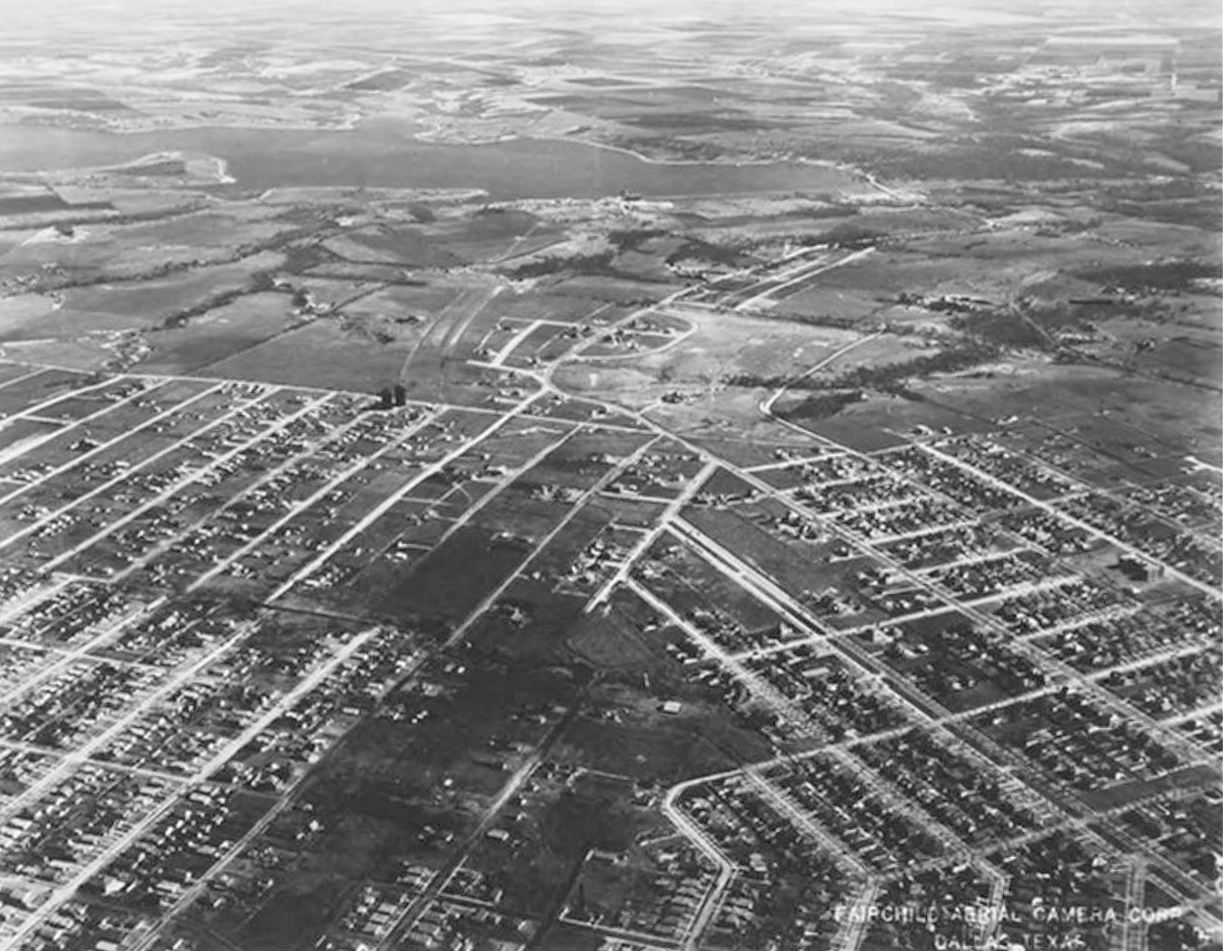
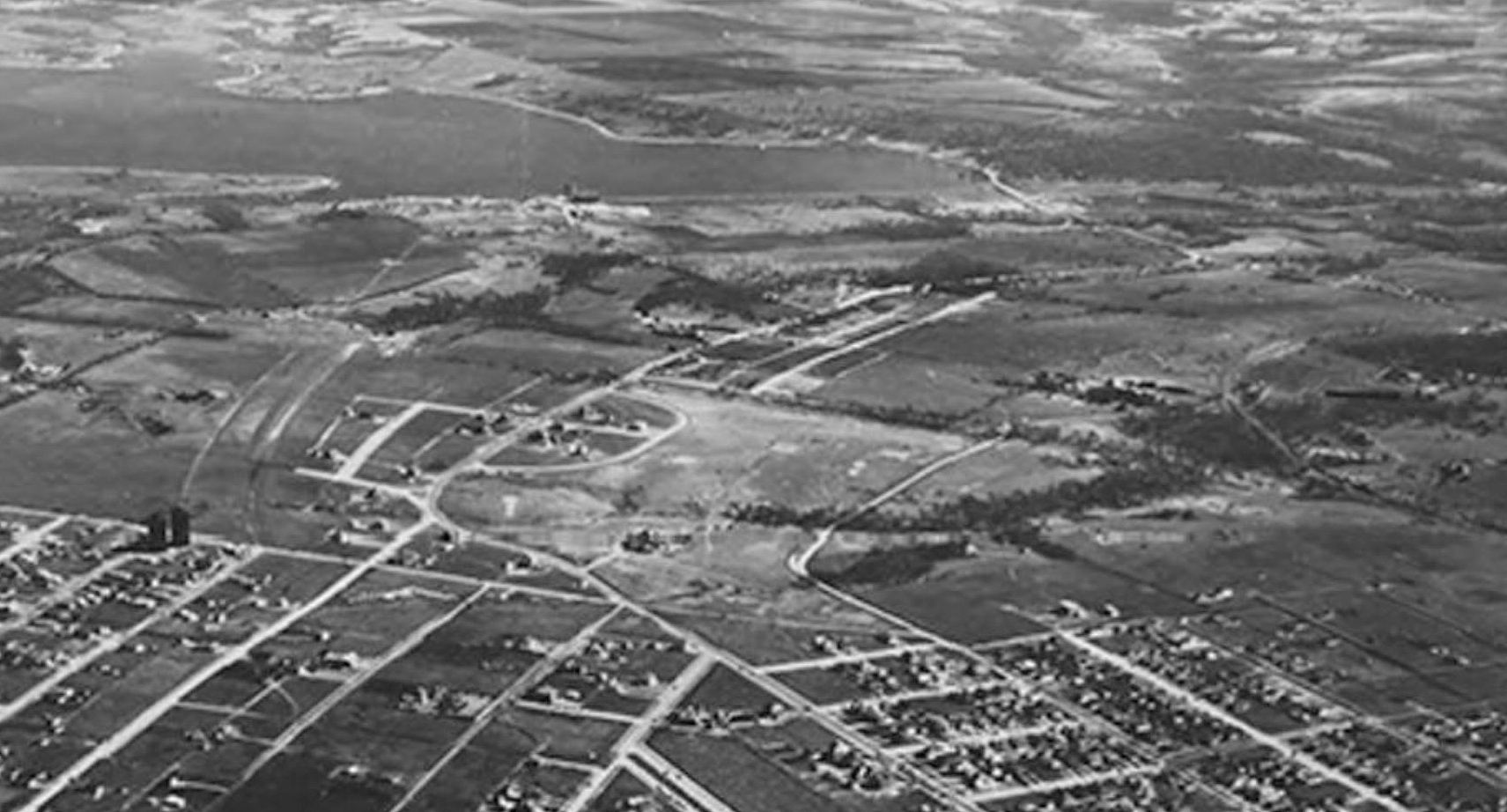
Then there’s this fantastic aerial shot of what would later become the fully developed Lakewood area (and beyond). Looking east, White Rock Lake is in the distance, and the two towers — brand new when this photo was taken in 1923, and taller than anything else in the photograph — are at the left.

east-dallas_lakewood_fairchild_1923_cook-coll_degolyer_smu

Let’s zoom in a bit:

east-dallas_lakewood_fairchild_1923_cook-coll_degolyer_smu_det

*

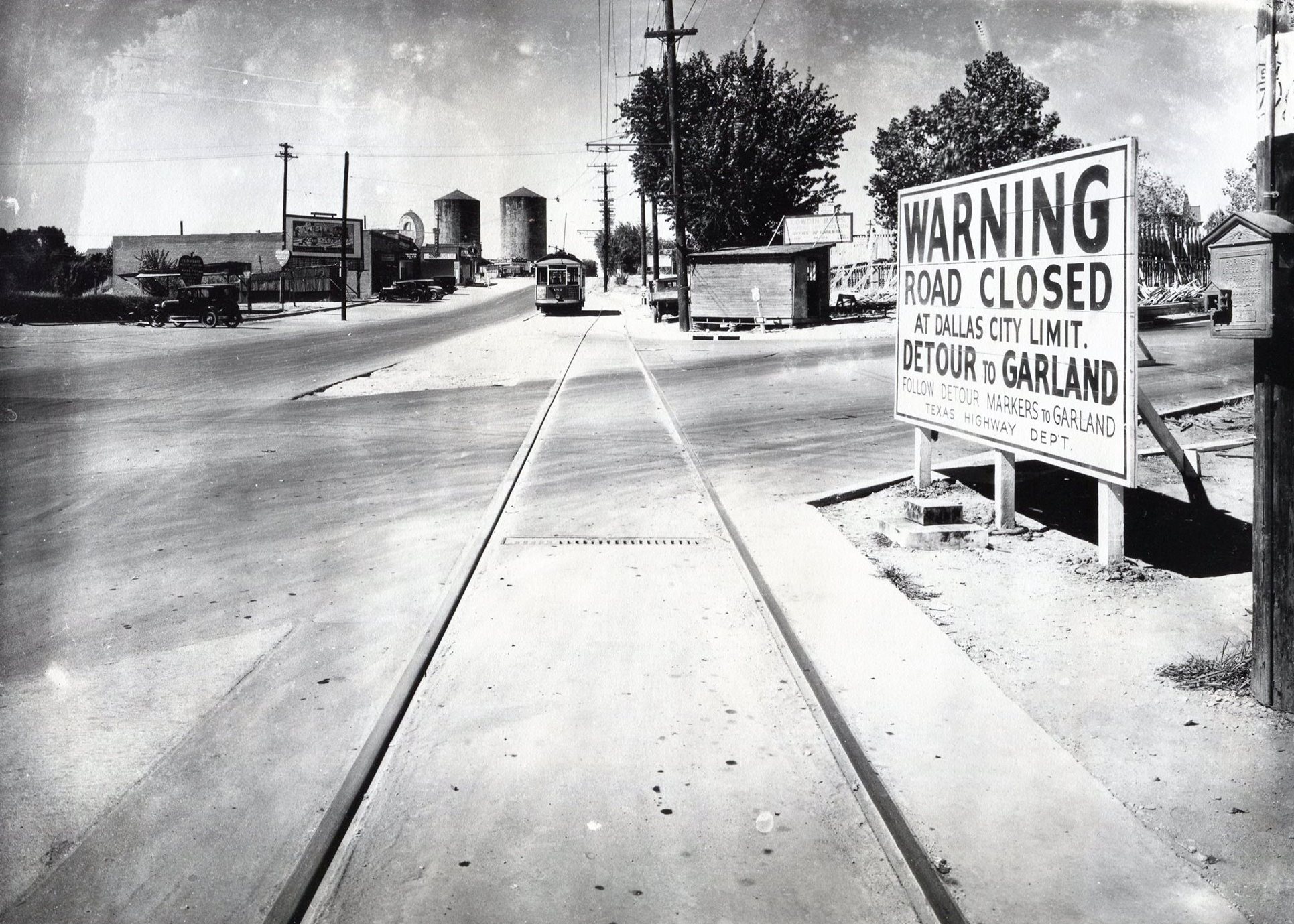
And here is a really wonderful photo which was posted in the Dallas History Facebook group by Mary Doster from the collection of her husband Jim Doster, showing Abrams, looking north, in 1925. (The location of the twin tanks was actually outside the Dallas city limits in 1919 — see the boundary on a 1919 map here.) I never get tired of seeing streetcars, especially traveling down streets I drive everyday.

water-tanks_abrams_dallas-hist-FB-jim-dosterCollection, Jim Doster

**

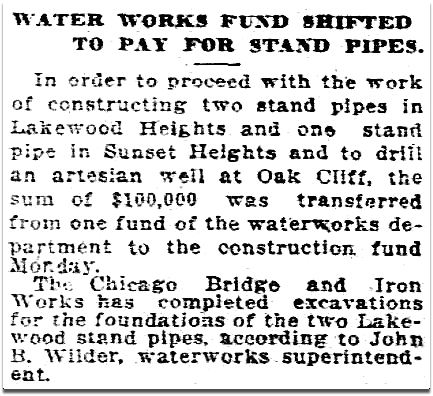
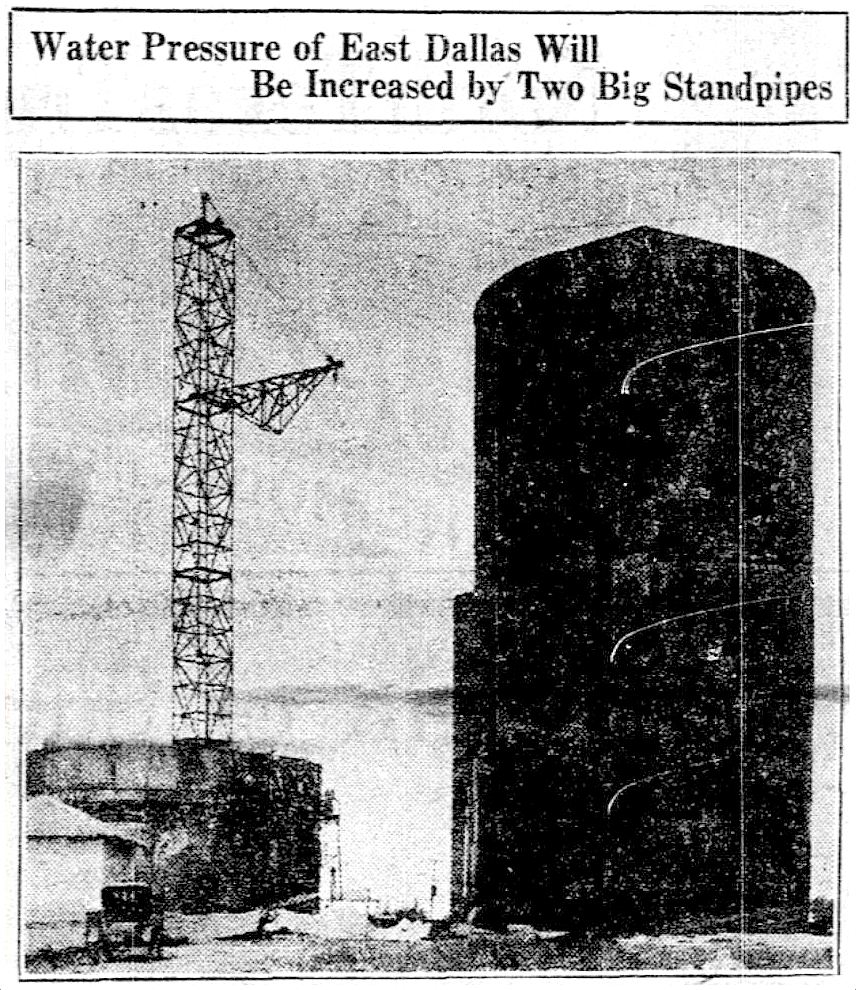
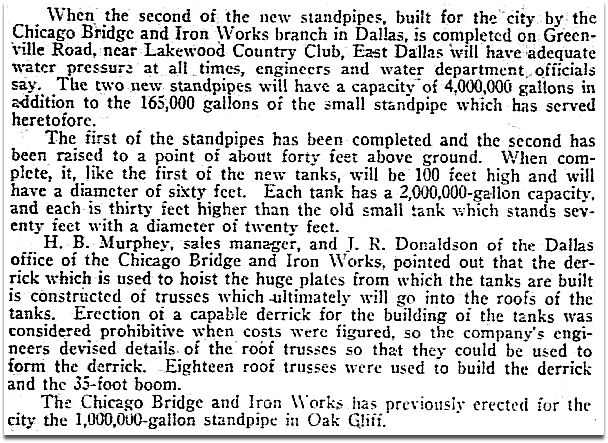
A few articles about the tanks’ beginning in 1923.

water-towers_dmn_022723Dallas Morning News, Feb. 27, 1923

water-towers_dmn_100723a
DMN, Oct. 7, 1923

water-towers_dmn_100723b
DMN, Oct. 7, 1923

*

Here’s a screenshot from a silent film produced by the City of Dallas waterworks department, showing them at traffic-level, with a view to the northwest from Abrams.

stand-pipes_lakewood_TAMI_water-dept-film_6.39

The tanks were dismantled in 1955 (pertinent articles are listed below, in the “Notes” section). Their fate, post-dismantling? One of them was destined to be reassembled in Tarrant County for the Hurst-Euless-Bedford water system, and the other one was “to be kept as stand-by storage for the city” (DMN, June 7, 1955).

standpipes_dmn_060755
RIP in HEB…

***

Sources & Notes

First two photos from the book Reminiscences, A Glimpse of Old East Dallas.

Aerial photo — titled “East Dallas — 1923” — is a Fairchild Aerial Surveys photograph, from the George W. Cook Dallas/Texas Image Collection, DeGolyer Library, Central University Libraries, Southern Methodist University; more information is here. (I have adjusted the color.)

Screenshot is from a City of Dallas silent film, shot for the water department — the film is in the TAMI collection here, and the standpipes pop up at the 6:39-ish mark. Thanks to John Botefuhr for posting the link to this film on the Lakewood 1925-1985 Facebook group.

More on the tanks’ removal in 1955 can be found in these Dallas Morning News articles:

  • “Familiar Old Landmark To Be Removed” (DMN, March 20, 1955)
  • “Offers Vary on Standpipe” (DMN, April 26, 1955)
  • “East Dallas Landmark Coming Down” (DMN, June 7, 1955 — has photo taken from inside the tank looking up as dismantling was underway)

The present-day view seen in the top photo — looking south on Abrams — can be seen on Google Street View here.

A very interesting Sanborn Map from 1922 — before the twin tanks were built, but still showing the “Lakewood Heights Water Works” — can be found here. There’s, like, nobody living there, man.

I’d love to see other photos of these particular “standpipes” — if anyone has any, forward them to me and I’ll include them in this post. Contact info is at the top.

As always, images are magically larger when clicked.

*

Copyright © 2016 Paula Bosse. All Rights Reserved.


Views of Elm Street, With Cameo Appearances by the Fox Theater — 1920s-1960s

fox-theater_sherrod_dpl
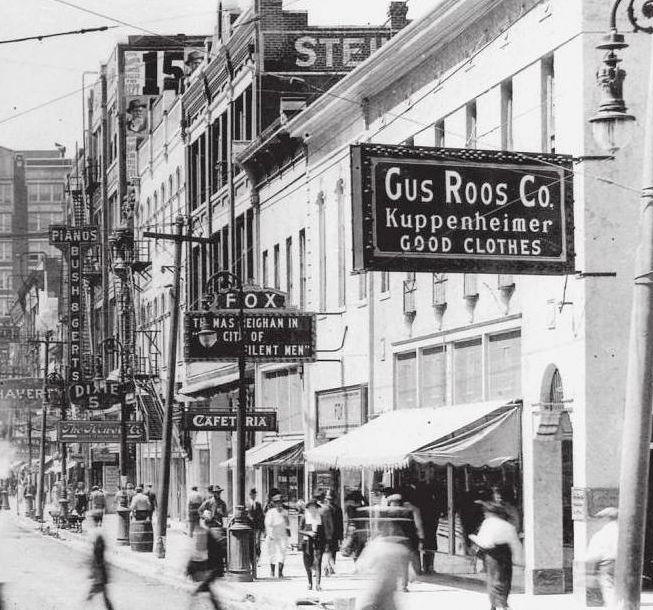
Elm looking west from Akard, ca. 1922

by Paula Bosse

From the earliest days of moving pictures, most downtown movie houses called Elm Street home. Some were originally vaudeville houses which occasionally featured short films between acts of the live revues, and some were theaters built expressly as move theaters. Most of the downtown theaters could be found on Elm Street, and the stretch between, say, Field and Harwood became known as “film row” or “theater row.” Most theaters were located on the north side of Elm in the blocks east of Akard Street, but a few found a home west of Akard. One of these — which I’ve seen in several of the photos I’ve posted — was the Fox Theater, located next to the Gus Roos store, at 1411 Elm, just west of the Akard intersection.
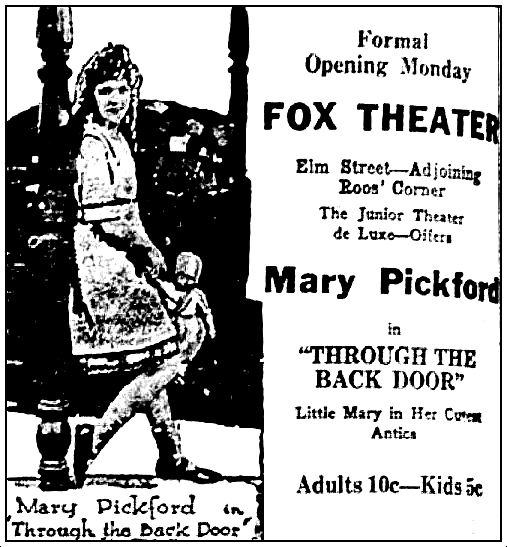
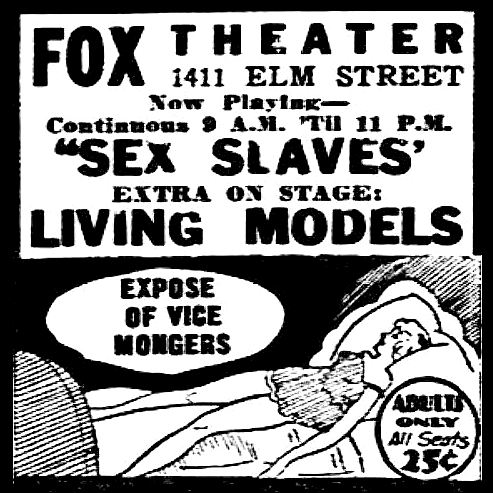
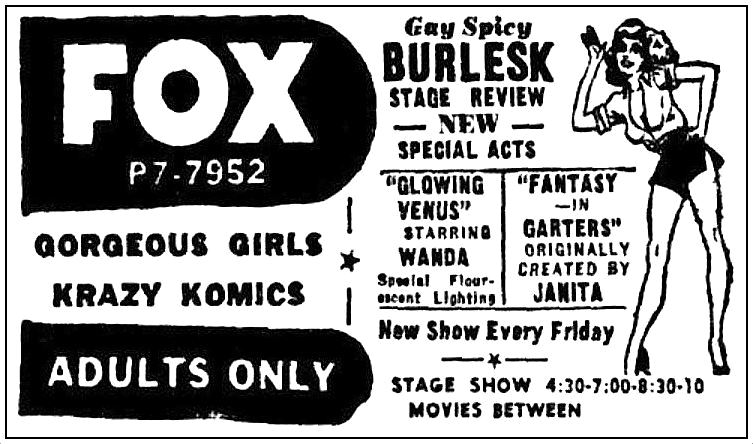
The Fox — which was named after owner Max Fox, a Polish immigrant who also owned the nearby Strand Theater — opened in the early months of 1922. During its 40-year history, it had something of a “colorful” life: despite opening with a sweet, family-friendly Mary Pickford movie and then showing mostly second-run features, it ultimately became one of Elm Street’s seedier theaters, showing cheap exploitation flicks and, later, becoming a “burlesk” house with on-stage strippers and “adult-only” fare playing continuously from 9 AM (!) to 11 PM. The Fox remained in business until the end of 1961 when property in the 1400 block began to be sold in order to build the First National Bank Building. (A comprehensive history of the theater can be found on Cinema Treasures.)

*

As I said, I’ve noticed the Fox Theater in a number of photos I’ve come across — some of which I’ve posted previously. Here are a few views of Elm Street in which the Fox pops up in a cameo appearance.

The top photo shows Elm looking west in about 1922. Down the street a bit you can see the Dixie Theater at 1315 Elm, one of the (if not THE) oldest permanent movie theater spaces in Dallas. The Dixie began life in 1909, the third theater in the location originally occupied by the Theatorium, which opened in 1906. (I wrote about the Dixie and other early “photoplay houses” in Dallas here.)

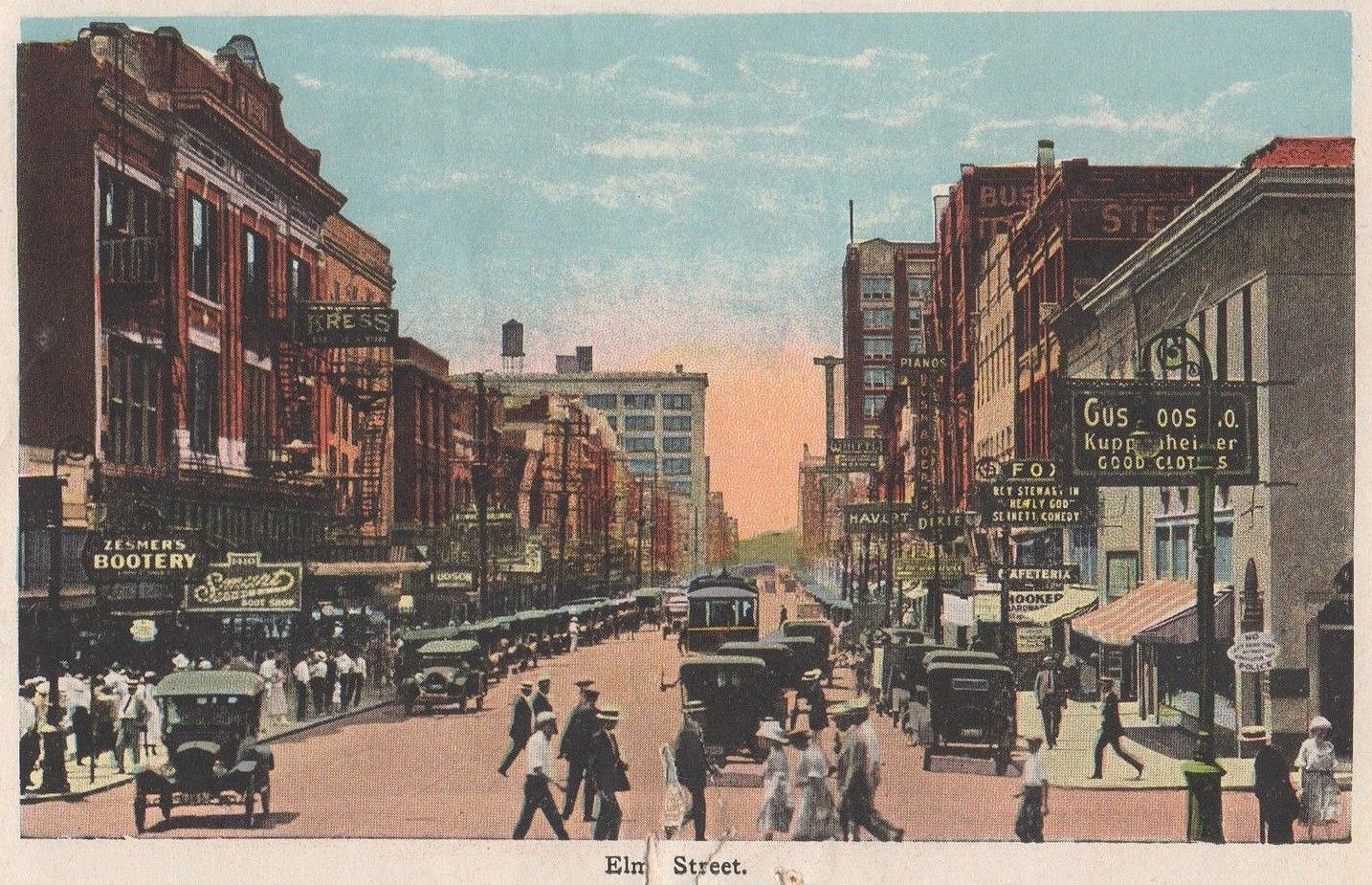
A similar view from about the same year is seen in this postcard (click to see a very large image):

elm-st-color_1920s

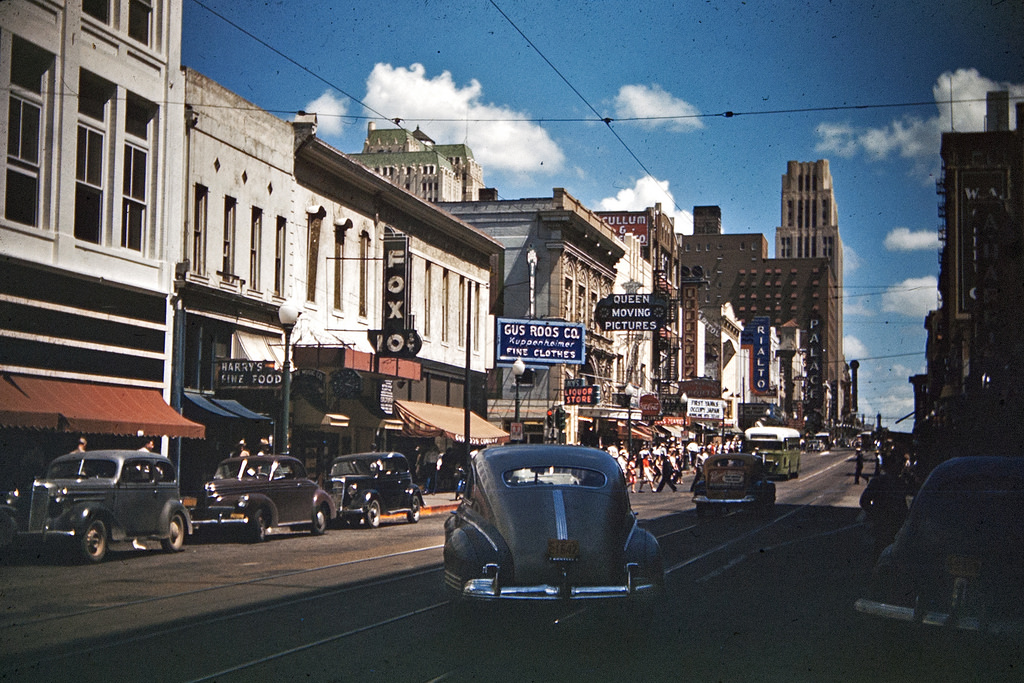
From the WWII-era, this fantastic color photo, looking east (the Queen, Telenews, Capitol, Rialto, and Palace theaters can be seen in this photo, with the silhouette of the Majestic Theatre’s sign seen way in the distance):

elm-street-color_1940s_jeppson-flickr

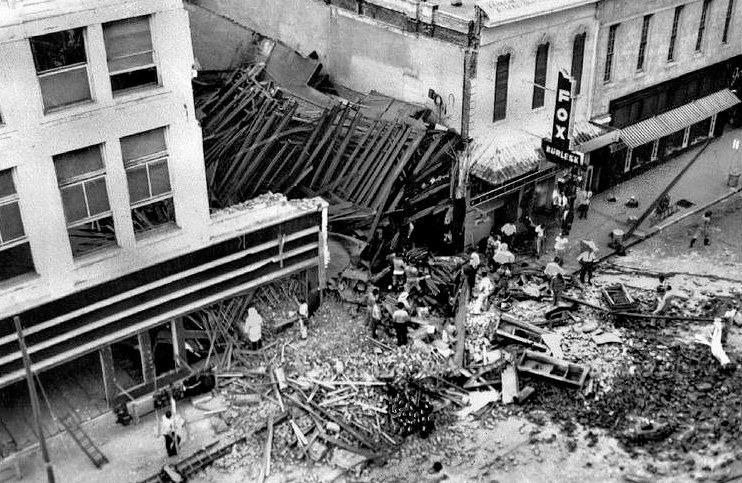
In 1955, the wall of the building next door to the theater collapsed, killing several people (I wrote about that building collapse, here):

building-collapse_observer-090511

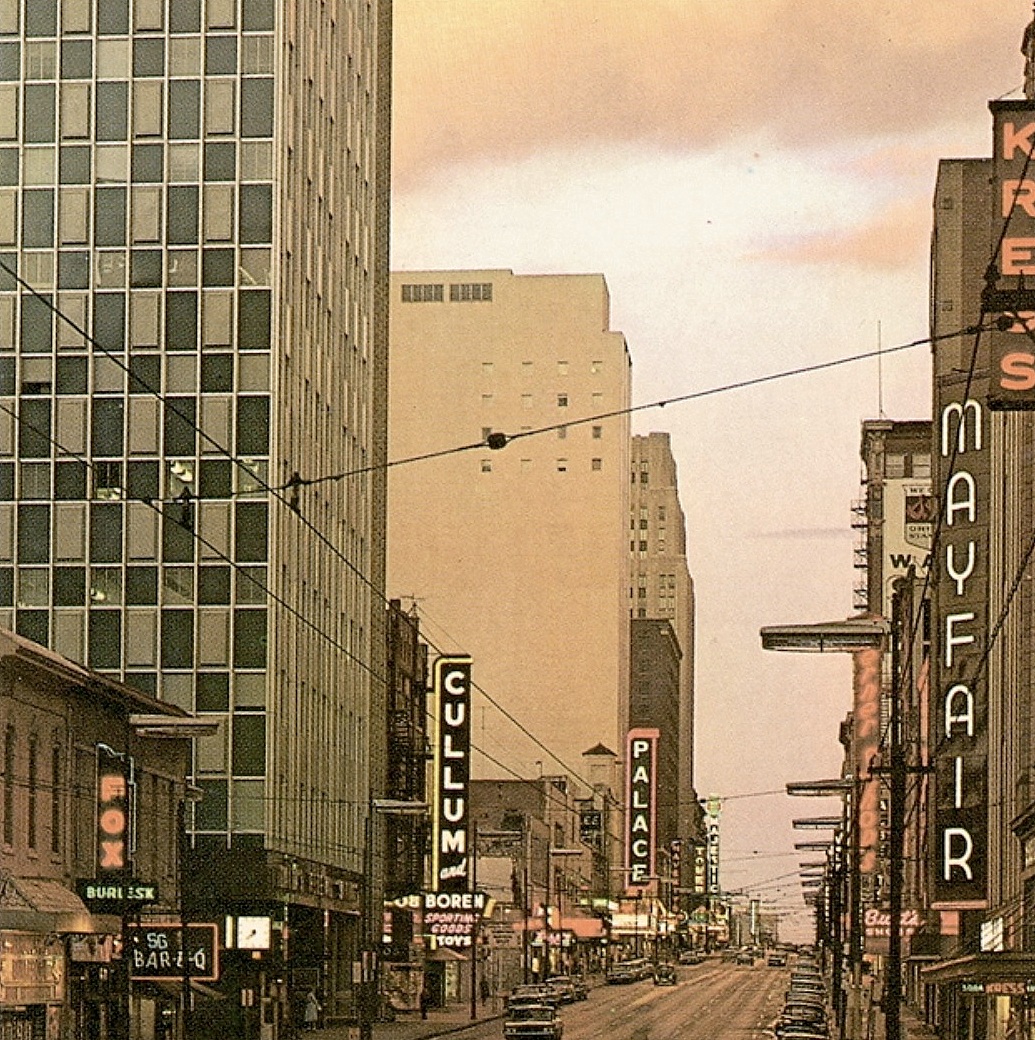
And, lastly, a photo of a decidedly less glamorous Elm Street, showing the “Fox Burlesk” in its final months, taken about 1961:

1400-block-elm_schaffershot54_flickr_ca-1961

**

fox-theater_032022
Dallas Morning News, March 20, 1922

fox-theater_pickford_dmn_031922
March 19, 1922

fox-theater_dmn_031940
1940

fox-burlesk_dmn_061850
1950

***

Sources & Notes

Top photo from Troy Sherrod’s book Historic Dallas Theatres; photo from the Dallas Public Library.

1940s color photo from Noah Jeppson’s Unvisited Dallas post, “Elm Street 1945,” here.

UPI photo showing the building collapse was posted a few years ago by Robert Wilonsky on the Dallas Observer’s Unfair Park blog, here.

Bottom color photo from Flickr user Schaffershot54, here.

Other Flashback Dallas posts on Dallas theaters can be found here.

*

Copyright © 2016 Paula Bosse. All Rights Reserved.