Flashback : Dallas

A Miscellany: History, Ads, Pop Culture

Category: 1930s

The Last Traces of Vickery Park Are Now Definitely Gone

vickery-park_demo_062118_d_PEBThe last vestige of a one-time summer destination…

by Paula Bosse

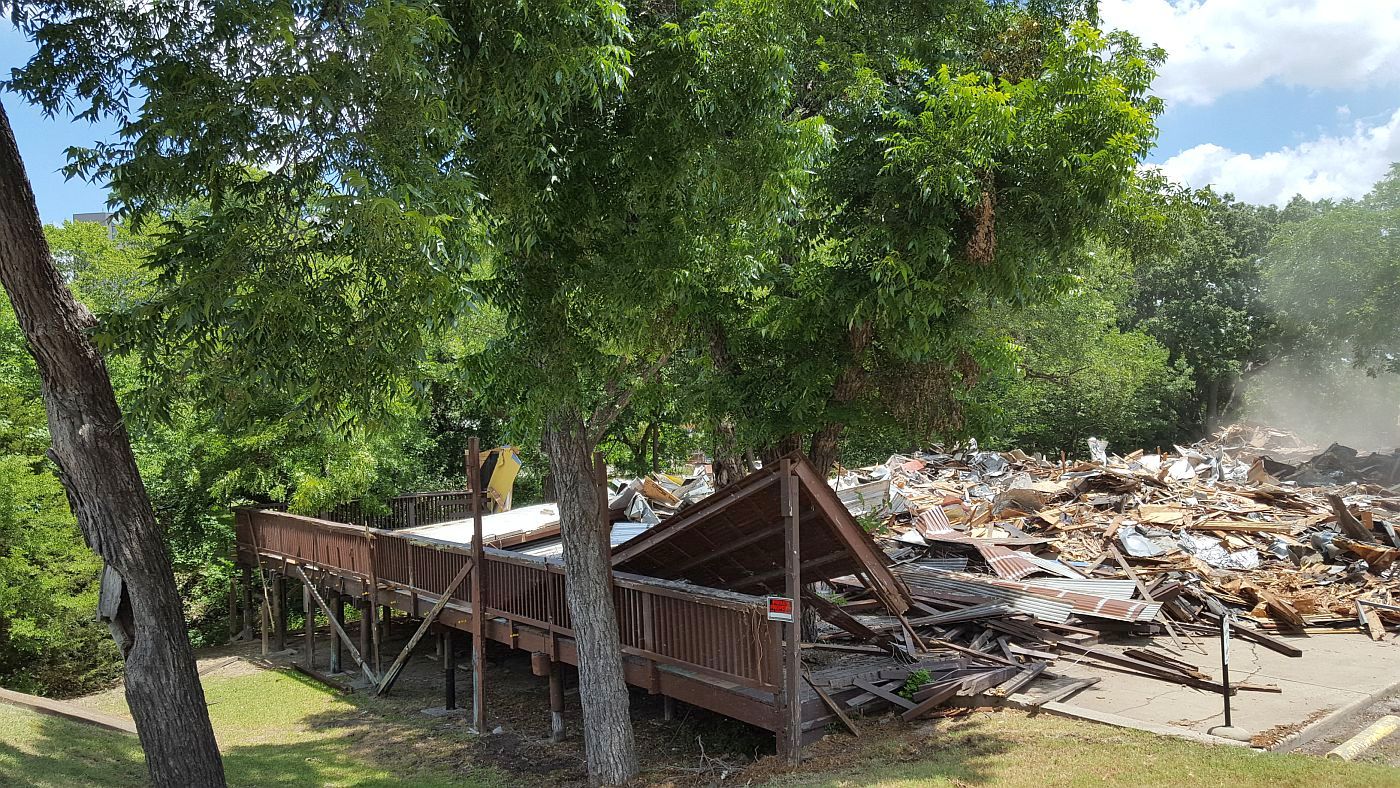
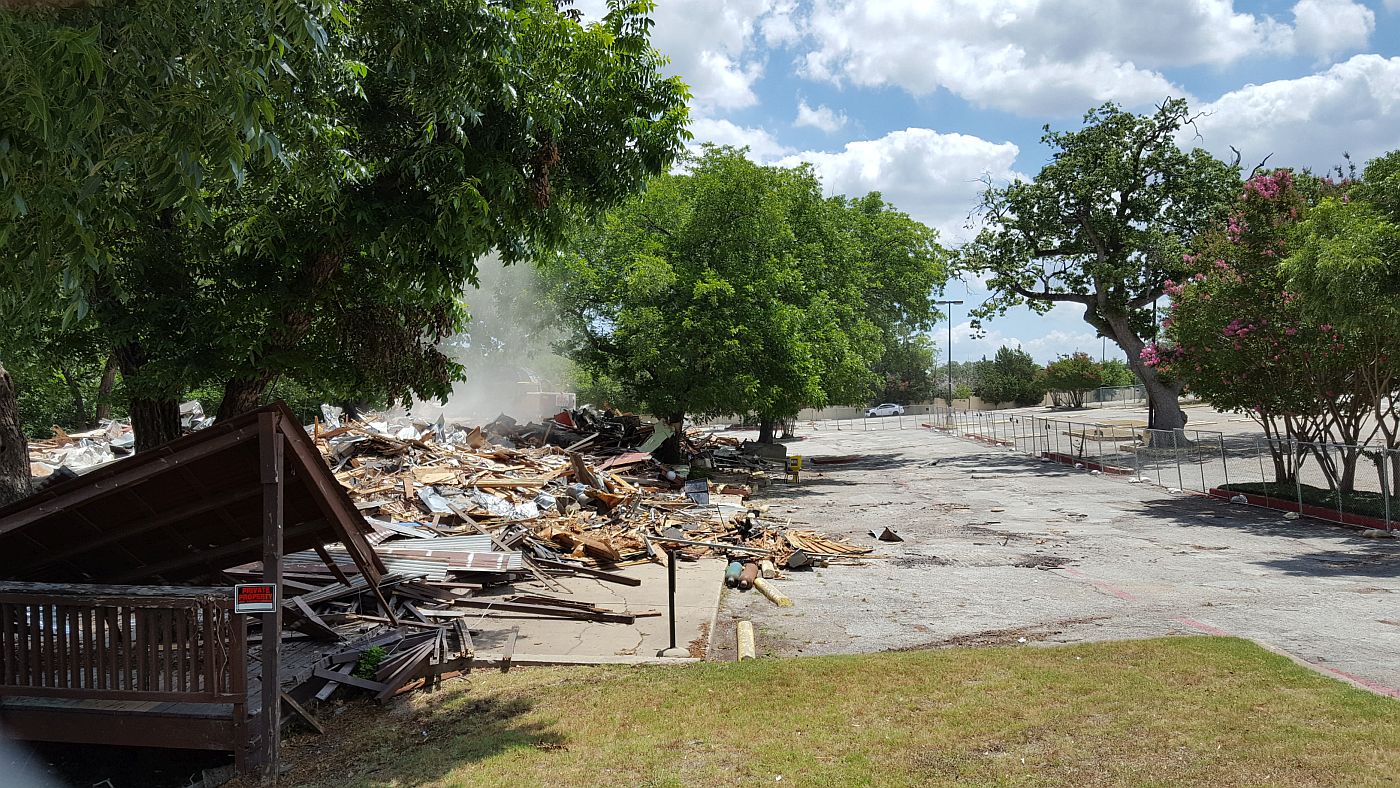
Driving along Greenville Avenue this morning, I noticed a pile of rubble where Vickery Park once stood (just south of Walnut Hill, across from Presbyterian Hospital). It seemed sadly ironic that the land which was once occupied by a fondly-remembered swimming pool and picnic area was heaped with demolished buildings on the first day of summer.

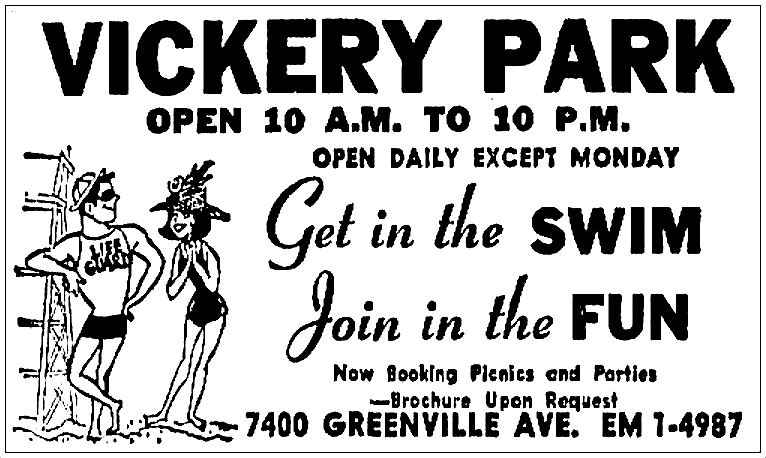
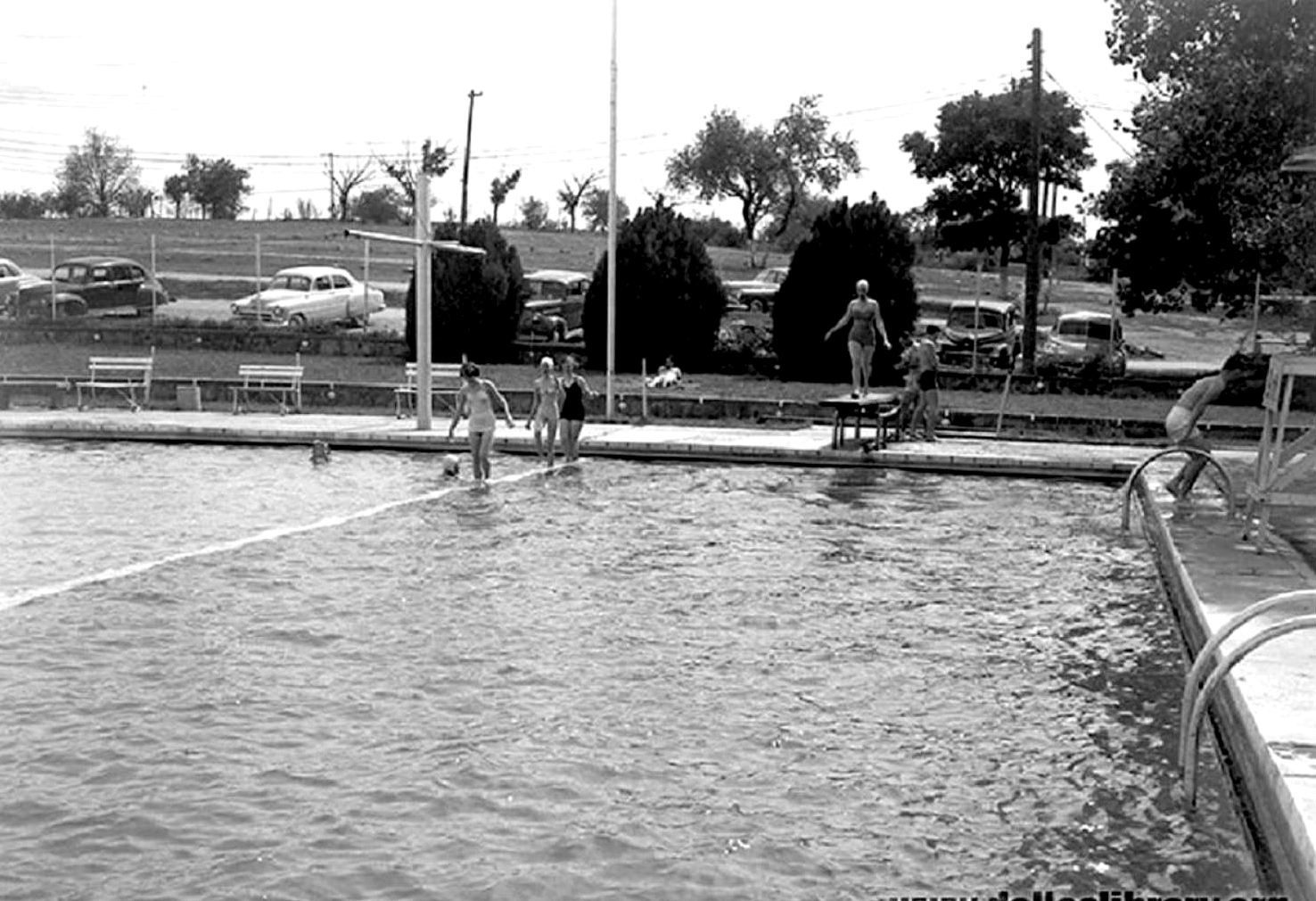
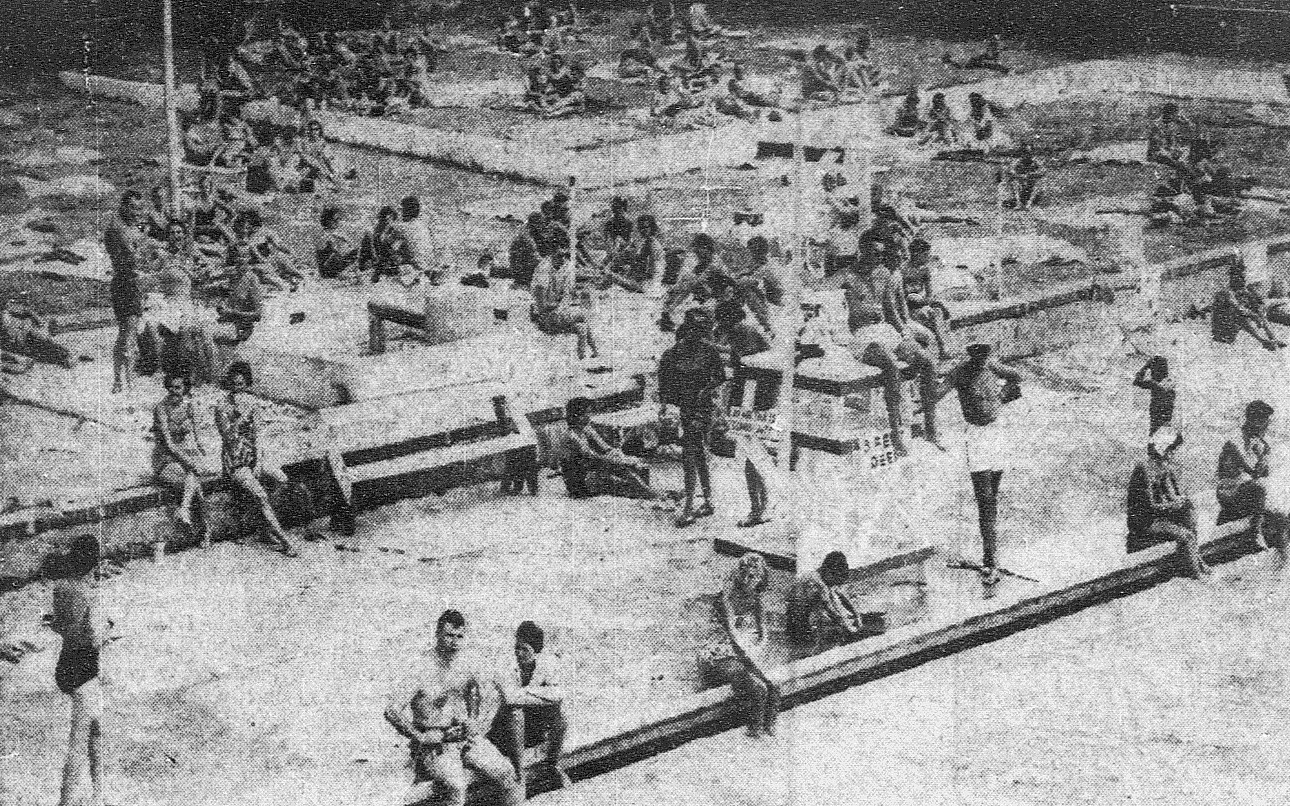
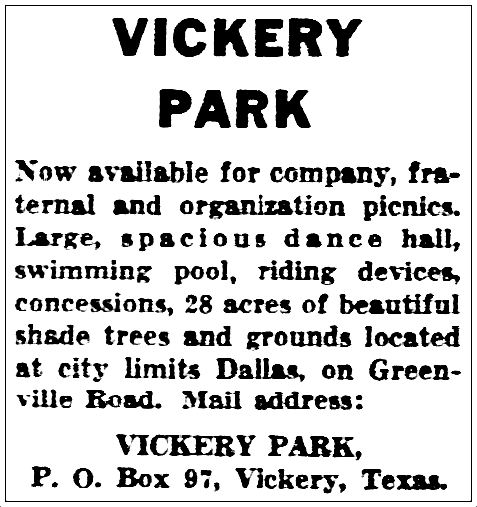
I never saw the huge swimming pool myself, but from everything I’ve read about it over the years, it seems to have been very, very popular with generations of Dallasites. It was built in the then-rural community of Vickery as far back as the 1930s (well before Vickery was annexed by the city of Dallas), and it was still open at least through the ’60s.

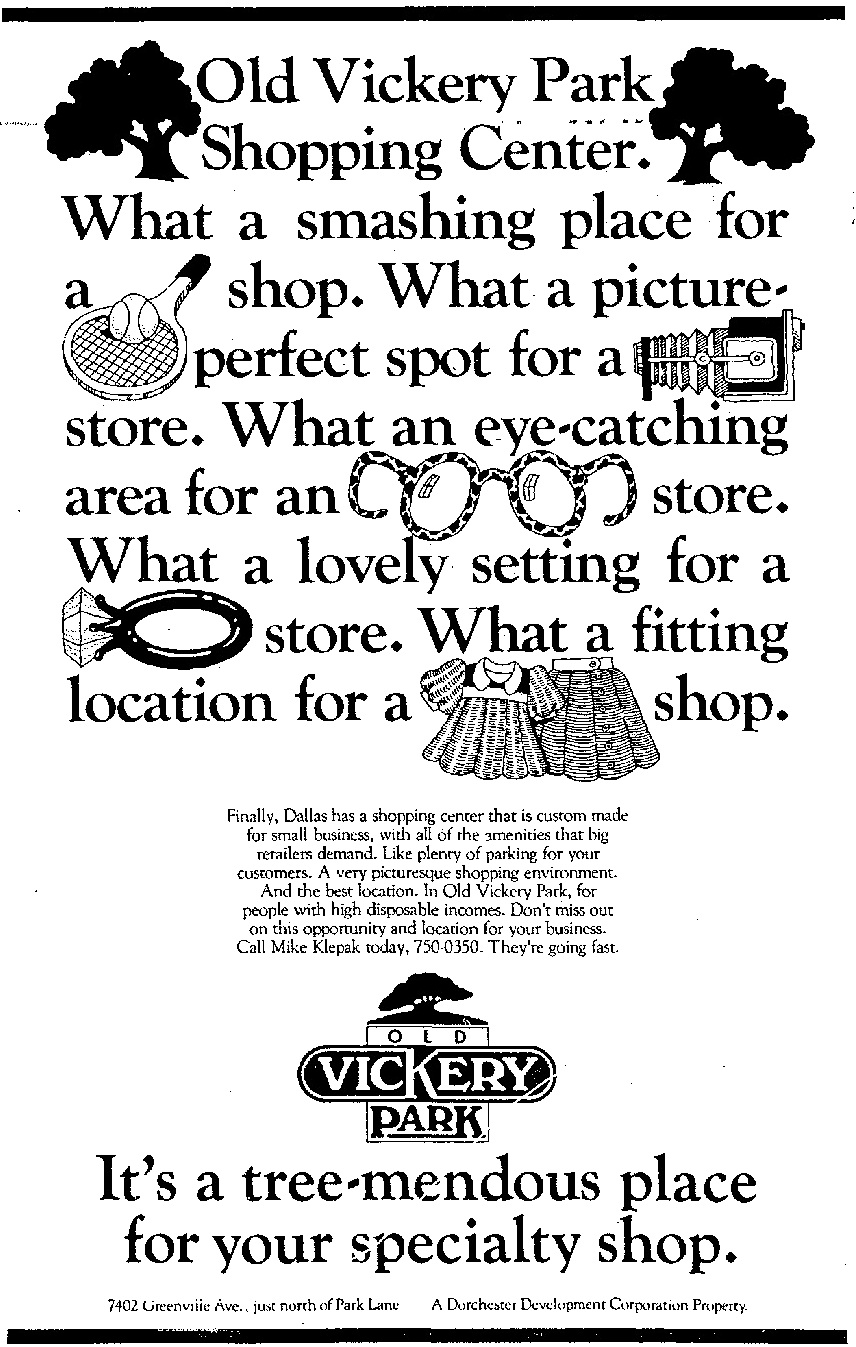
The pool and amusement park were long gone when the (now-demolished) small shopping and restaurant area was built in the mid-1970s on a very pretty wooded site alongside White Rock Creek. Initially, the developer envisioned lots of quaint little boutiques and cafes (similar to those found in the Quadrangle) dotting the banks of White Rock Creek, creating Dallas’ version of San Antonio’s River Walk. …No one has ever accused real estate developers of dreaming small.

It’s sad to see this anachronistic, funky little area go away. My vague memories of childhood games of miniature golf in the ’70s are about to get vaguer.

vickery-park_demo_062118_a_PEB

*

vickery-park_demo_062118_b_PEB

I’ve never known exactly where the pool was, but I think it might have been at the back right of the photo above, just off Pineland.

vickery-park-pool_dpl_pinterest

vickery-park-swimming-pool_1950s

vickery-park-swimming-pool_legacies_fall-2002

vickery-park-pool_19461946

swim_vickery-park_19651965

1978_vickery-park_sept-1978Sept., 1978

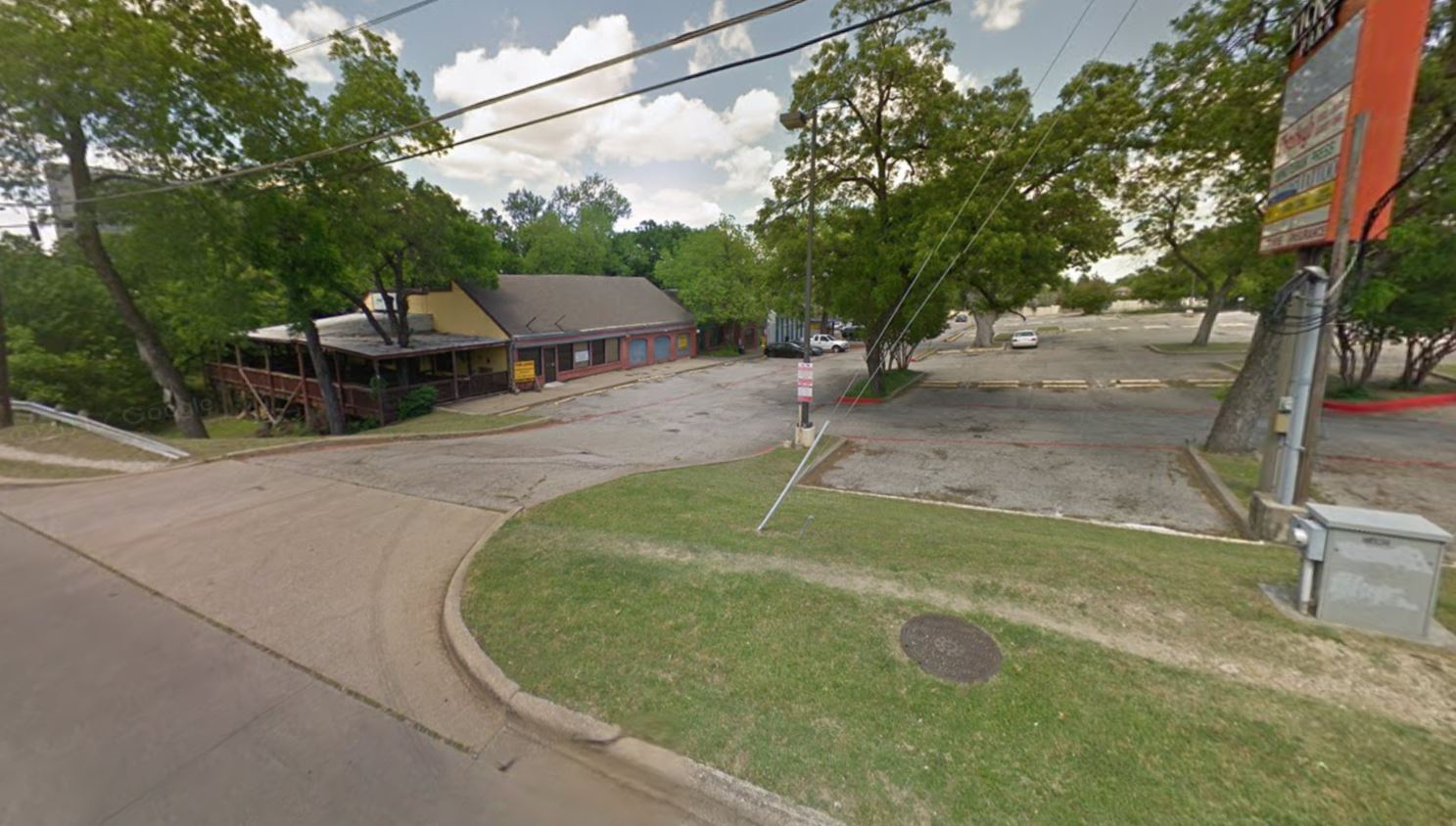
vickery_google_may-2017Google Street View

Above is a Google Street View from May, 2017. If you’d like to take a little virtual “drive” through the parking lot, hie yourself over to Google, here.

*

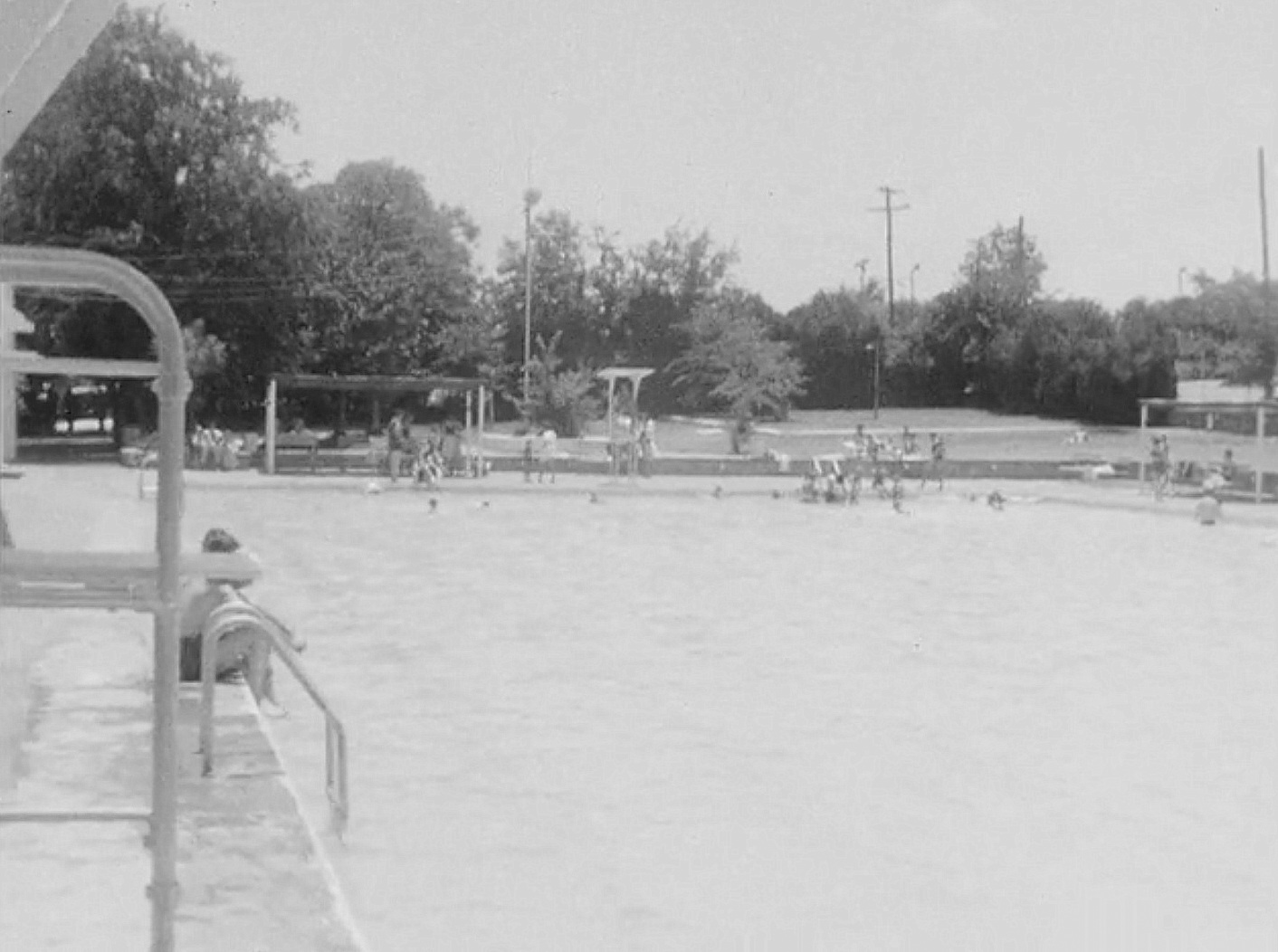
Here are two pieces of film footage showing the pool. The first one is from June, 1964 and is (silent) news footage shown on WBAP Channel 5. It’s a little unsettling, as it shows a boy being rushed off by ambulance after an accident, but it does have some interesting shots of the pool and the park, which I’ve certainly never seen before. I am unable to embed the video, but you can watch it here. (The script for the story is here.) (Footage is from the WBAP-TV News collection, UNT Libraries Special Collections.) Here is a screen capture:

vickery-pool_WBAP_portal_062364

The second is undated, but the clips are from home movies.

***

Sources & Notes

Rubble photos taken by me on June 21, 2018 — construction was underway. And it was extremely HOT.

The first historic photo appears to be a Dallas Public Library photo, with most of the watermark cropped off. I found it on Pinterest, here.

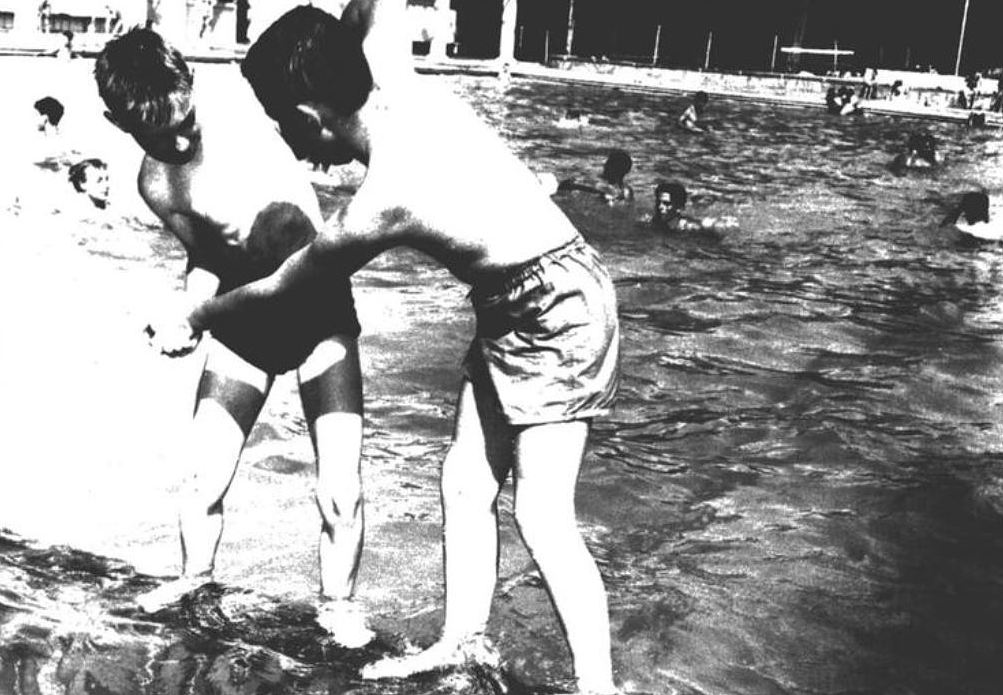
The third photo, showing two boys, was found in the Fall 2002 issue of Legacies.

There are memories-galore of Vickery here.

A couple of interesting tidbits:

  • The Vickery pool was used as an officers’ recreation club during World War II by the Fifth Ferrying Group; an aquatic meet was held there in June, 1945 which featured a variety of exhibitions, including a water ballet performed by “half a dozen mermaids from University Park.”
  • In the early 1970s, Vickery Park (…not to be confused with Vickery Place…) was owned by the Seventh Day Adventist Church. They reopened the park as a “family recreation center” — unlike the earlier days, alcohol was no longer sold. They sold the land to developers around 1974 or 1975; in the summer of 1975, the recreation center was bulldozed and the pool was paved over (and became a parking lot).

Articles on the disappearing community of Vickery can be found in the archives of The Dallas Morning News:

  • “Progress Overtakes Old Vickery” by Rena Pederson, with photos by Eli Grothe (DMN, August 3, 1975)
  • “Store Provides Feed For Thought On Town’s Past” (Vickery Feed Store) by Steve Kenny (DMN, Nov. 18, 1979)

*

Copyright © 2018 Paula Bosse. All Rights Reserved.

No Necking Along Country Roads Until Bonnie & Clyde Are Killed Or Captured — 1934

la-pistolera-de-texas_DHS-instagramNo parking! (image: Dallas Historical Society)

by Paula Bosse

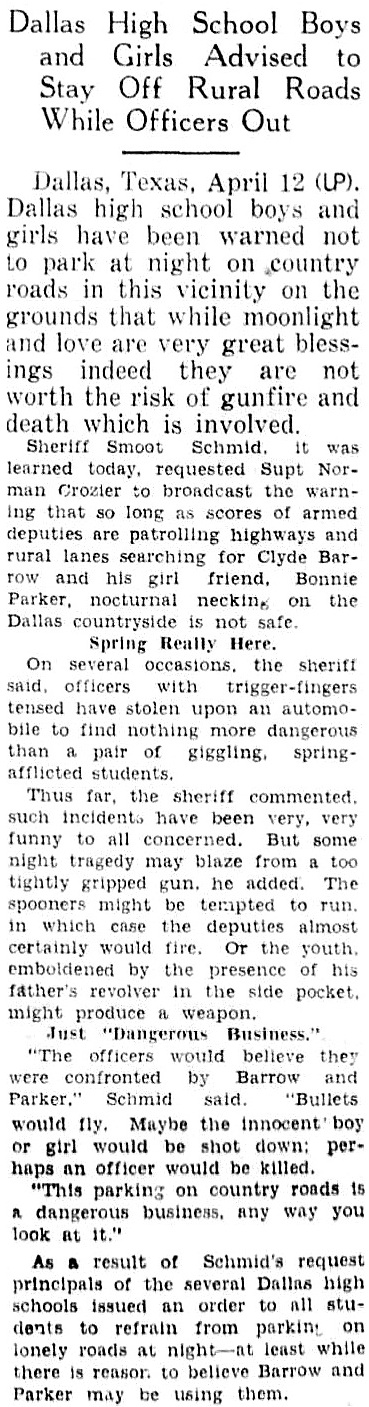
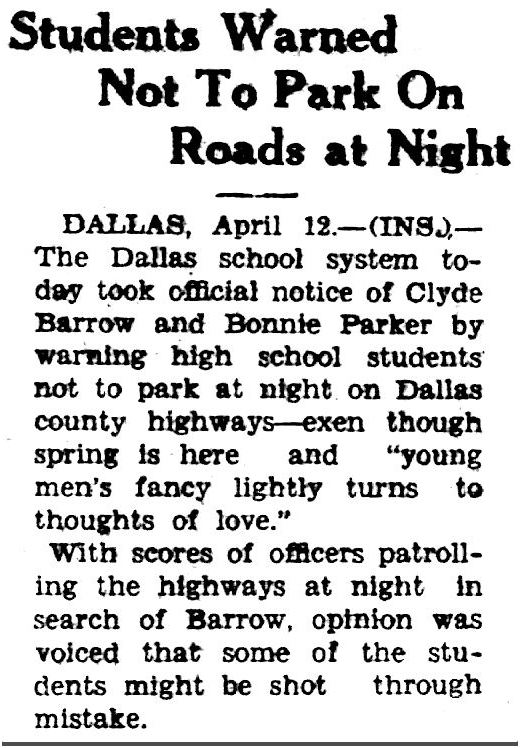
In April, 1934, at the height of Bonnie and Clyde’s murderous crime spree, Dallas County Sheriff Smoot Schmid issued a warning to amorous Dallasites to curtail their necking in cars parked along dark, deserted country roads — at least while the Barrow Gang was at large. He even asked school superintendent Norman Crozier to make a special broadcast to high school students, warning that such behavior could be dangerous, if not life-threatening. A Dallas Morning News article advised people from “parking” “until after Clyde Barrow is killed or captured.”

“It’s a request that all citizens should observe,” Sheriff Schmid said. “There are many officers taking part in the hunt for Barrow. Some of them are young and inexperienced. All of them are very anxious to catch Barrow. If someone should mistake one of them for a hijacker he might get killed, or kill the officer. Either way it would be a terrible thing. I just want to prevent any unnecessary trouble if I can.” (“Sheriff Warns Against Parking,” DMN, April 13, 1934)

A few weeks later, Bonnie and Clyde were ambushed and killed in Louisiana. Once their deadly rampage had ended, Dallasites were, presumably, free to resume their “nocturnal necking.”

bonnie-clyde_no-necking_austin-american_d_041334 Austin American, April 13, 1934 (click for larger image)

necking_shreveport-times_041334_headline

necking_shreveport-times_041334
Shreveport Times, April 13, 1934

bonnie-clyde_no-parking_cuero-record_041834Cuero (TX) Record, April 18, 1934

***

Sources & Notes

Top image is the lurid front cover of a rare 1935 Mexican publication about Bonnie Parker and Clyde Barrow titled “La Pistolera de Texas” — it is from the collection of the Dallas Historical Society and was featured on their Instagram feed (more info is here).

More Flashback Dallas posts on Bonnie & Clyde can be found here.

*

Copyright © 2018 Paula Bosse. All Rights Reserved.


Oak Lawn Ice & Fuel Co.

oak-lawn-ice-and-fuel-co_krystal-morrisThe fleet… (click to see larger image) / Photo: Krystal Morris

by Paula Bosse

Above, another great Dallas photo shared by a reader — this one shows the Oak Lawn Ice & Fuel Co., which sold ice to independent dealers and to retail customers. Krystal Morris sent in the family photo — her great-great-grandfather J. F. Finney is standing next to the horse-drawn wagon.

The first mention I found of the Oak Lawn Ice & Fuel Co. was in a notice of “New Texas Charters” in Dec., 1912 (there was a classified ad from Dec., 1909, but that appears to be either another company with the same name or an earlier incarnation of the business seen above). Below, an ad from 1913:

1913_oak-lawn-ice_19131913

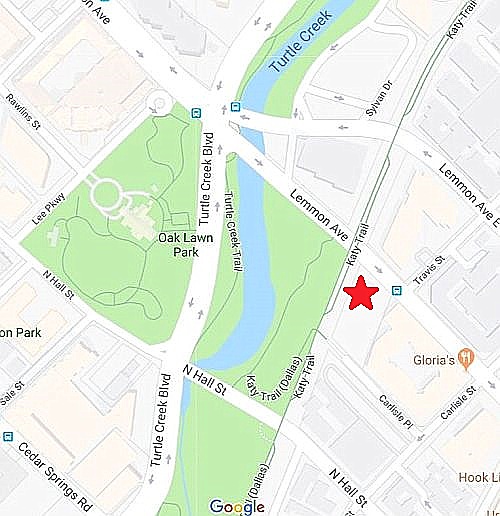
The company was located at 3307 Lemmon Avenue, at the MKT railroad track (now the Katy Trail) — on Lemmon between the railroad tracks and Travis Street (see the location on a map composed of two badly-cobbled-together Sanborn maps from 1921 here). The location is marked on a present-day Google map below (click to see a larger image):

lemmon-and-katy-trail_google-map

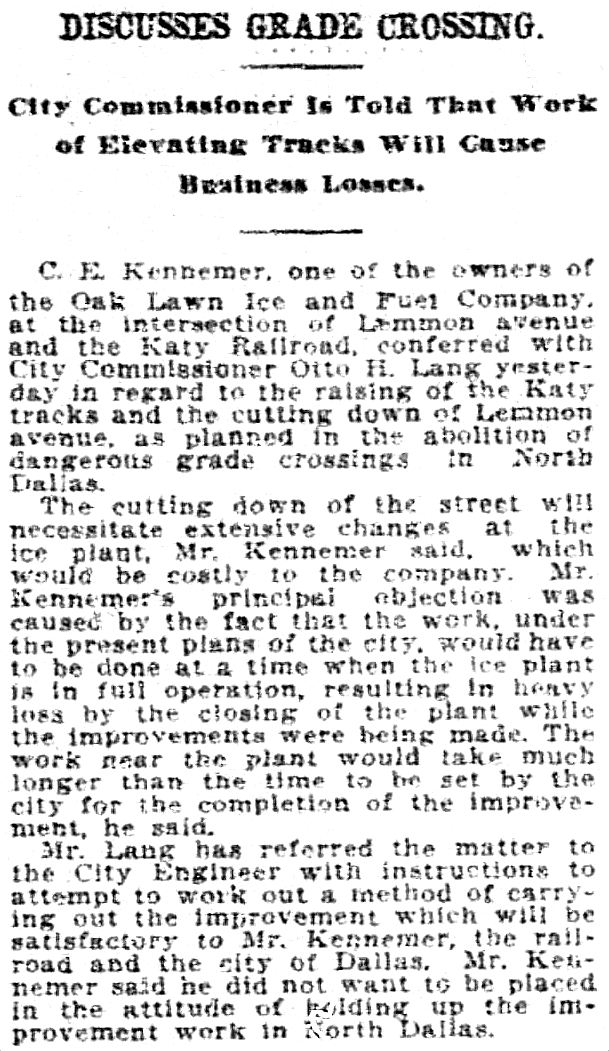
In 1917, the City of Dallas, in partnership with the Missouri, Kansas & Texas Railroad began to eliminate grade crossings in the Oak Lawn area — one of those crossings was at Lemmon Avenue: Lemmon was to be lowered and the MKT tracks were to be raised. Oak Lawn Ice & Fuel Co. General Manager Clarence E. Kennemer (who, along with his brothers, operated something of an ice empire in Texas) was concerned about the negative impact of this construction on his business. (All images are larger when clicked.)
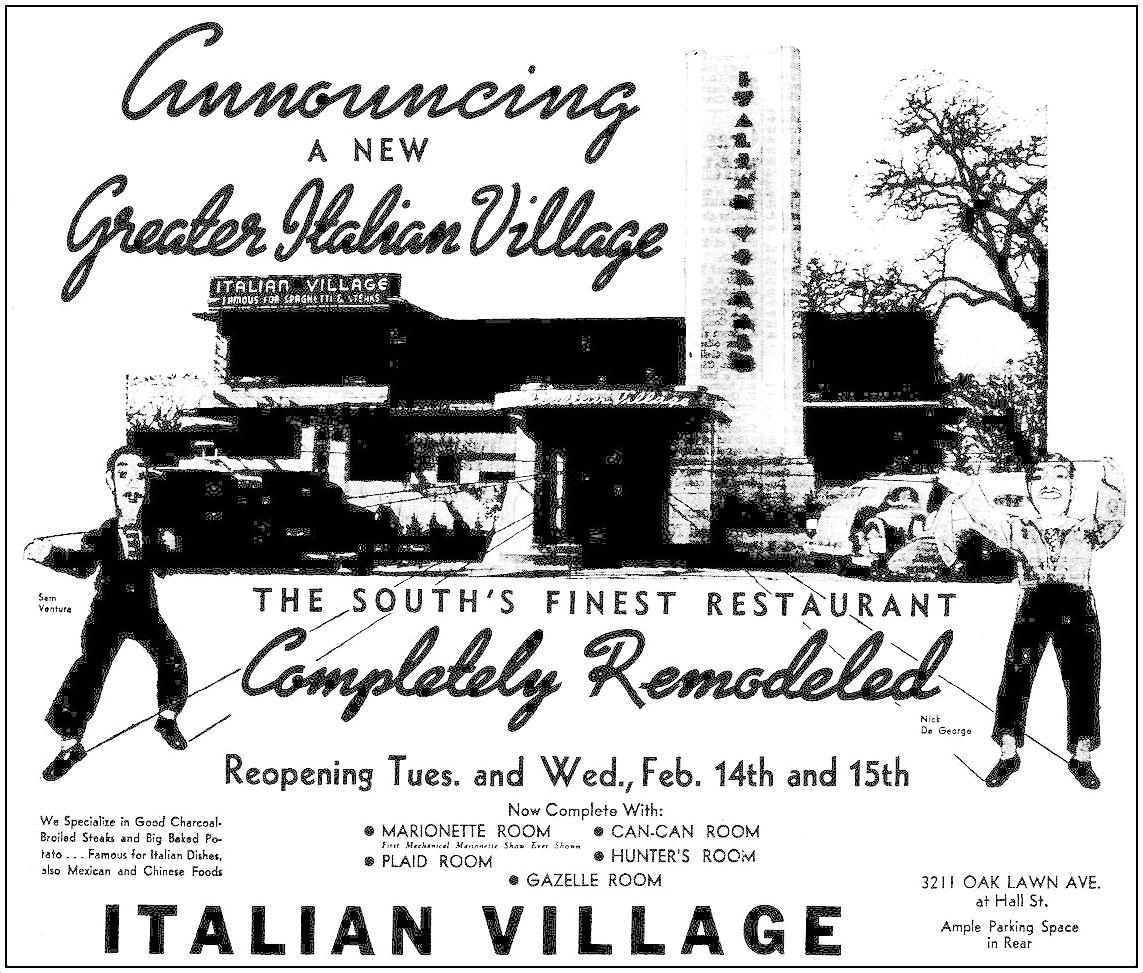
1917_oak-lawn-ice_dmn_013117_katy-crossing     Dallas Morning News, Jan. 31, 1917

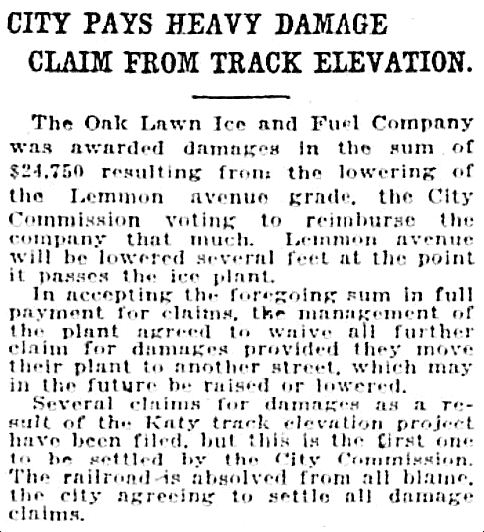
To the surprise of many, the ice company was awarded damages by the city.

1917_oak-lawn-ice_dmn_120617_katy-crossingDMN, Dec. 6, 1917

Things apparently continued fairly well until 1920 when the company began to experience tensions with its residential neighbors. Early in the year, city building inspectors responded to nuisance complaints and ordered the company to move its horse stables as they were too close to adjoining residences (ice delivery even into the 1940s and possibly 1950s was often done via horse-drawn wagons). Later the same year, still-unhappy neighbors filed suit to “force the company to remove its plant from the thickly settled residence district” (DMN, Dec. 1, 1920). The ice company appears to have won the lawsuit, since the company (under various names) was at 3307 Lemmon until at least 1939 or ’40, but these problems might have led them to build a new plant at Cole and what is now Monticello in 1922 (as with the Lemmon location, this new plant was also built alongside the MKT tracks). The mere prospect of this new icehouse was met with loud protests by the new neighborhood — before construction even began — but a judge ruled in favor of the ice people. Construction went ahead, and the plant was a neighborhood fixture for many years. (See the location on a 1921 Sanborn map here; “Gertrude” — near the top edge — was the original name of Monticello Avenue.)

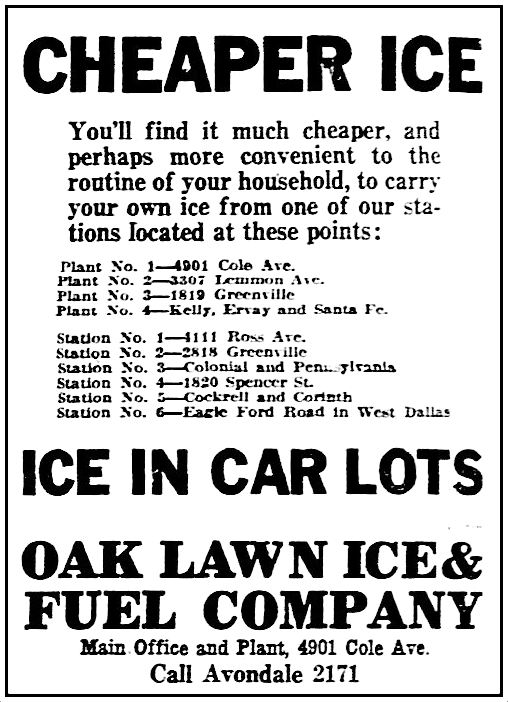
In 1923, ads for the Oak Lawn Ice & Fuel Co. began displaying both addresses: the original location, 3307 Lemmon, was now being referred to as “Plant No. 2,” and the new location, 4901 Cole, was being referred to as the “Main Office/Plant No. 1.”

1923_oak-lawn-ice_1923-directory
1923 Dallas city directory

By 1924 the company expanded as it absorbed other ice companies.

1924_oak-lawn-ice_sept-19241924

By 1925, “Oak Lawn Ice & Fuel Company” had become “American Ice Co.” (another C. E. Kennemer enterprise).

1925_american-ice-co_aug-19251925

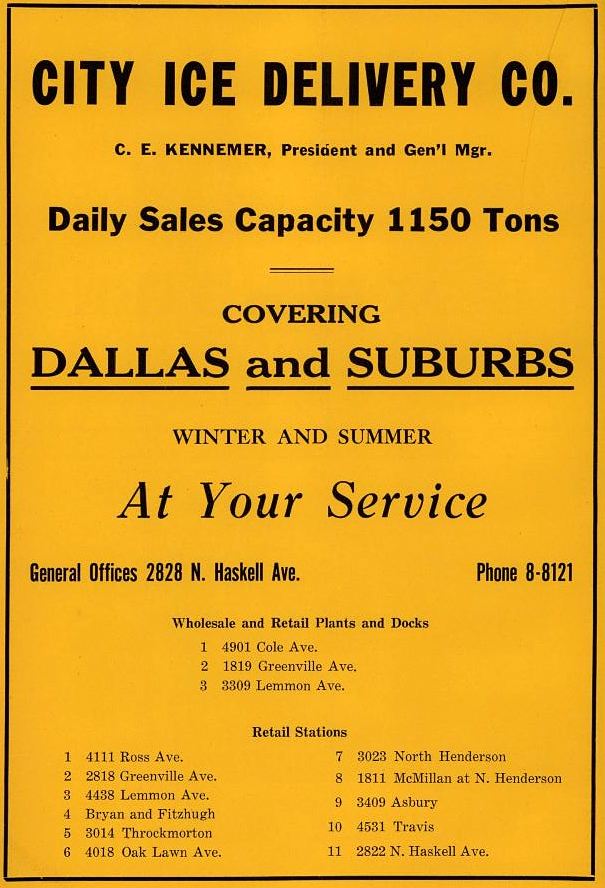
By 1933, American Ice Co. was swallowed up by City Ice Delivery Co.

city-ice-delivery_1934-directory1934 Dallas city directory

In the late 1930s or early 1940s City Ice Delivery Co. was acquired by Southland Ice (the forerunner of the Southland Corp., owners of 7-Eleven convenience stores). The Lemmon Avenue location became a meat-packing plant sometime in the mid-’40s (if neighbors were bent out of shape by an ice company, imagine how they felt about a meat-packing plant!); the Cole location became a 7-Eleven store and later a Southland Corp. division office.

*

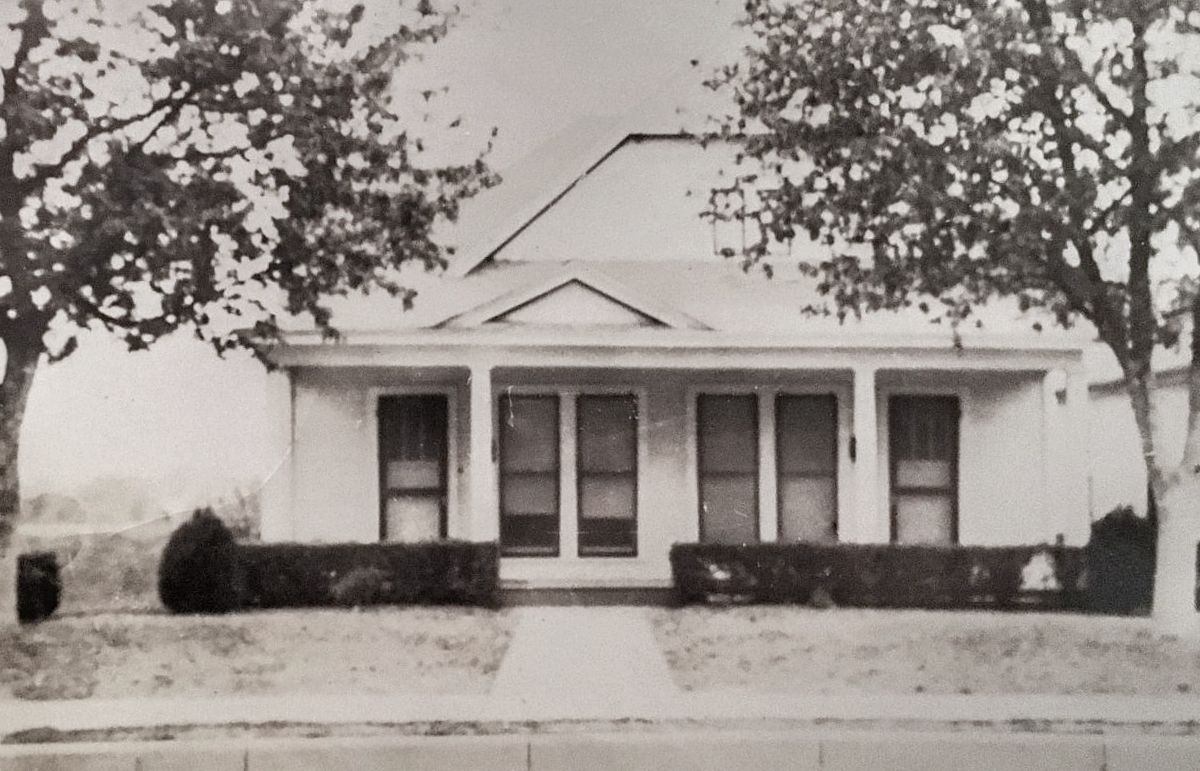
But back to Jonathan F. Finney, the man standing next to the ice wagon in the top photo. He came to Dallas from Alabama around 1916 and bought a house at 3001 Carlisle Street, where he lived for most of his life in Dallas. His occupation was “ice dealer,” and he seems to have worked in both the wholesale and retail areas, as a driver, a salesman, and even for a while the owner of his own company. His great-great-granddaughter Krystal Morris (supplier of these wonderful family photos) says she believes he was the manager of the Oak Lawn Ice & Fuel Co. The 1932 directory lists him as foreman of the City Ice Delivery Co., and as he lived at 3001 Carlisle, it seems to make more sense he was working at the Lemmon Ave. location (which was less than half a mile away from his home) rather the Cole Ave. location. The actual address of the photo at the top is unknown, but it may show the Lemmon Ave. location when Finney was working as an independent ice dealer, standing beside his own wagon.

Below, the Finney family around 1920 (J. F., daughters Thelma and Viva Sue, and wife Wenona), and below that, their house at 3001 Carlisle (which was at the corner of Carlisle and Sneed — seen in a 1921 Sanborn map here).

finney-family_krystal-morris-photoFinney family, circa 1920 / Photo: Krystal Morris

finney-home_3001-carlisle_krystal-morris-photo3001 Carlisle, Finney family home / Photo: Krystal Morris

J. F. Finney, born in 1885, died in Dallas in 1962, long after the era of necessary daily ice deliveries to residences and businesses. The occupation listed on his death certificate was “painter” but I have a feeling “once an iceman, always an iceman.”

***

Sources & Notes

All photographs are from the family photos of Krystal Morris and are used with her permission. Thank you, Krystal!

The history of ice delivery is very interesting, especially to those of us who have never lived in a house without an electric refrigerator. Here are links-a-plenty on the subject:

  • “Icehouses — Vintage Spaces with a Cool History” by Randy Mallory (Texas Highways, Aug., 2000) here (additional photos can be found in the scanned issue on the Portal to Texas History site, here)
  • “Keeping Your (Food) Cool: From Ice Harvesting to Electric Refrigeration” by Emma Grahn on the Smithsonian National Museum of American History blog, here
  • “Delivering the Ice: Ice Wagons” — from an online exhibit based on an exhibit that was on display at the Woods Hole Historical Museum in Woods Hole, Massachusetts during the summer of 2015, here
  • “Portals to the Past: Golden Days of Home Delivery (ice, as well as bread, milk, groceries, etc.) by Waco historian Claire Masters, here
  • “The Iceman Cometh” by Dick Sheaff from the Ephemera Society of America blog, here

Here’s a fantastic little clip of a woman ice deliverer manning the tongs (and wearing heels):


*

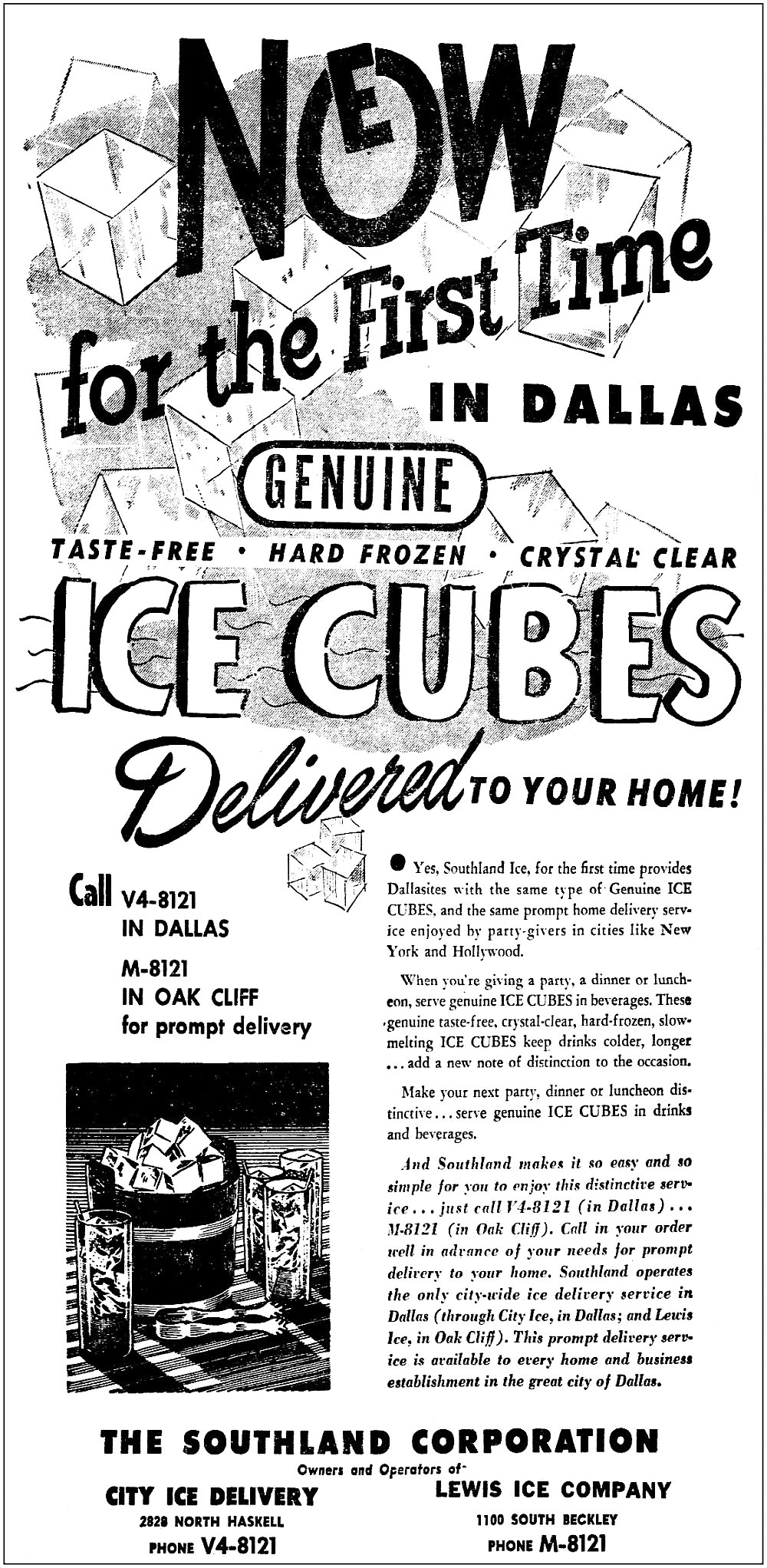
And, lastly, the Southland Corp. to the rescue with an ad from Dec., 1948 with news of the arrival in Dallas of “genuine” ice cubes! “Now for the first time in Dallas: Genuine Taste-Free, Hard Frozen, Crystal Clear Ice Cubes delivered to your home!”

city-ice-delivery_southland-ice_dec-1948
1948

All images are larger when clicked.

*

Copyright © 2018 Paula Bosse. All Rights Reserved.
State Fair Coliseum / Centennial Administration Building / Women’s Museum / Women’s Building

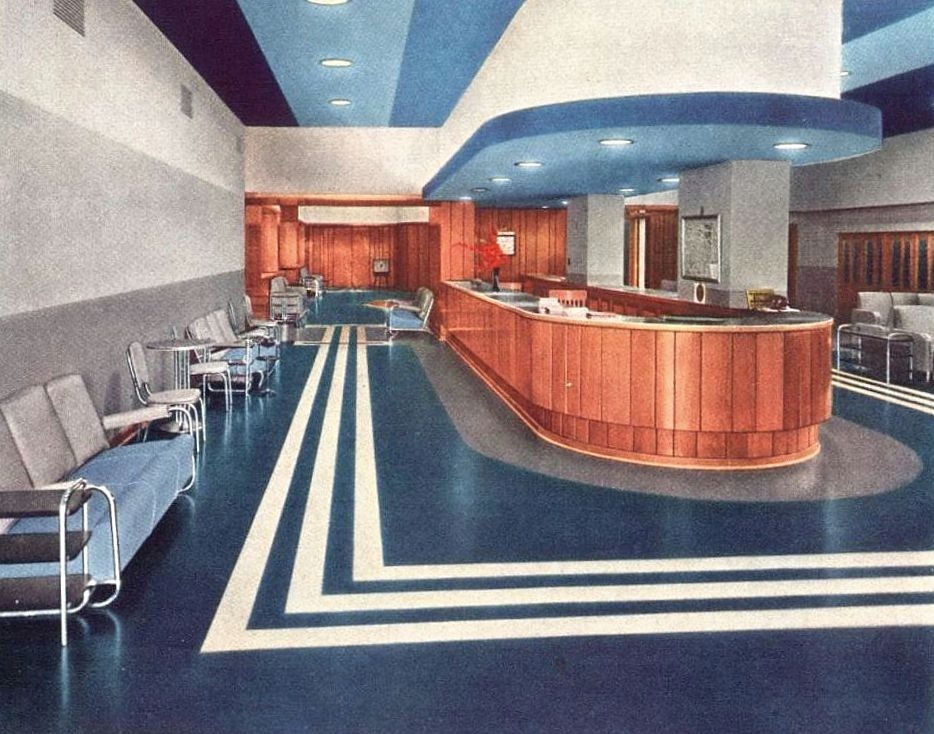
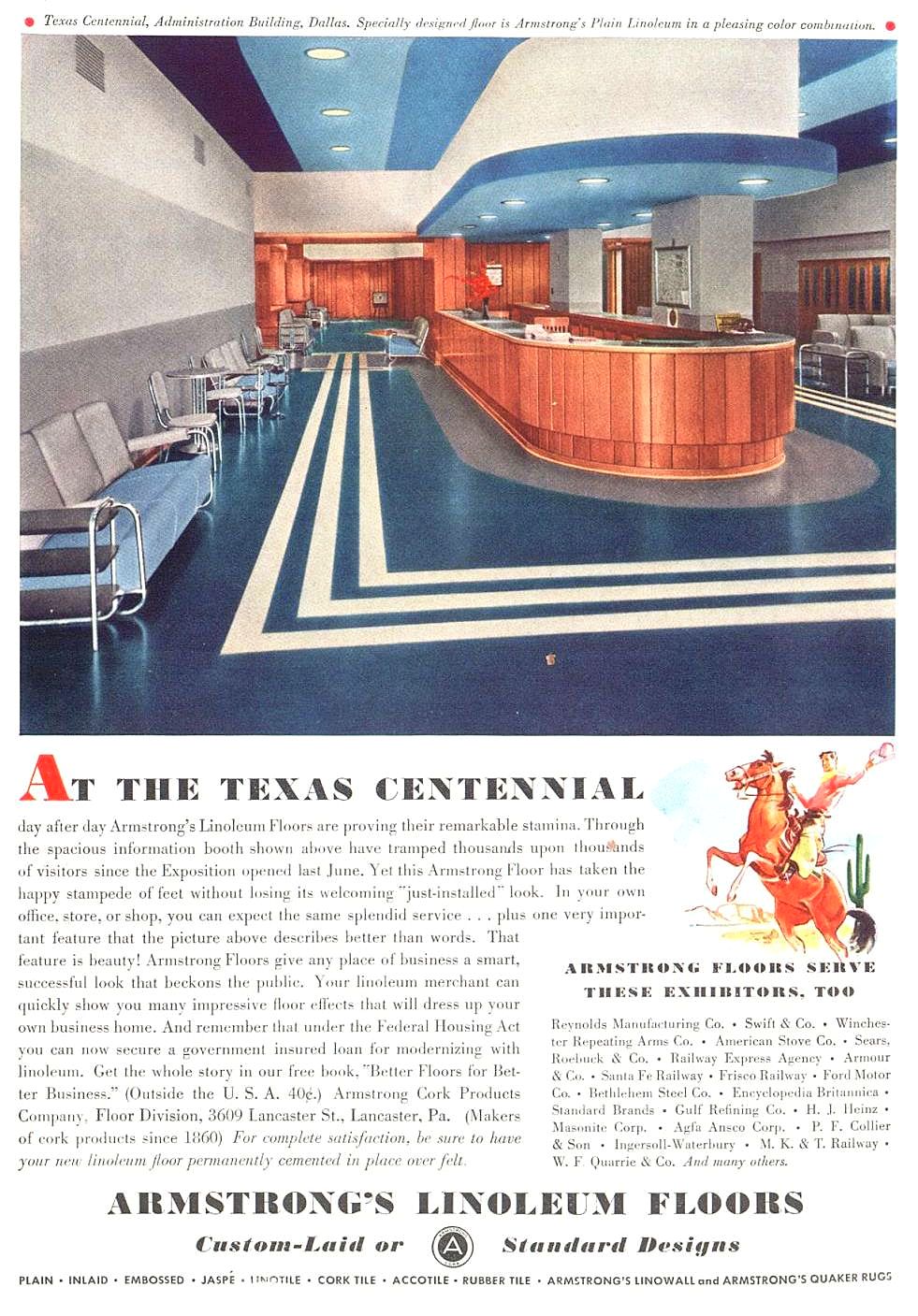
tx-centennial_armstrong-linoleum-ad_1936_detAdministration Building interior, 1936…

by Paula Bosse

Thursday night I attended a very entertaining Dallas Historical Society presentation at the Hall of State in Fair Park: “An Evening With Jim Parsons: Lost Fair Park,” in which the author of Fair Park Deco and DFW Deco talked about many of the buildings constructed for the Texas Centennial Exposition in 1936 which are no longer with us.

One of Jim’s asides was that there are very, very few color photos of the Centennial buildings and murals taken in 1936. If you’ve seen a Centennial view in color, it’s probably a colorized postcard. Kodachrome film was introduced in 1935 and was, sadly, not in wide use by visitors to Fair Park in 1936 (or by the Centennial organization).

When he said that, though, I remembered an ad I had come across that I thought was pretty cool, simply because it shows the interior of one of the Centennial buildings when it was brand new (…well, it was sort of new — more on that below). The ad is for Armstrong Linoleum and it features a color photo showing one of their custom linoleum floors installed in the Centennial Administration Building, an interior I’d never seen. And it’s in color! (Check out the furniture and the recessed lighting!) Here’s the full ad, which appeared in national magazines in 1936 (click for larger image).

ad- tx-centennial_armstrong-linoleum_19361936 ad

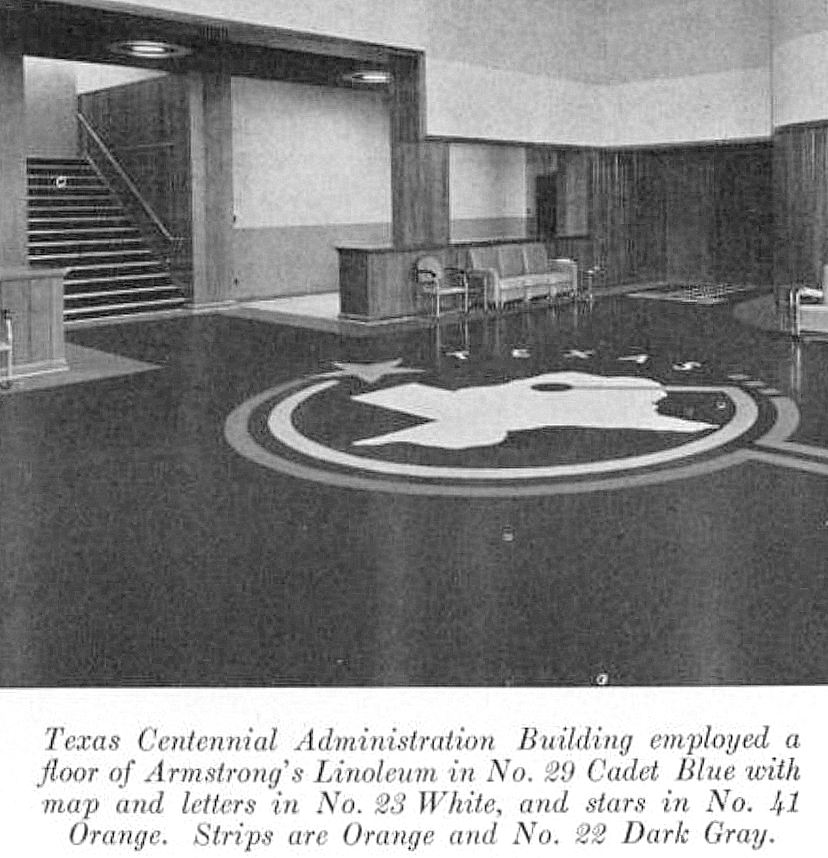
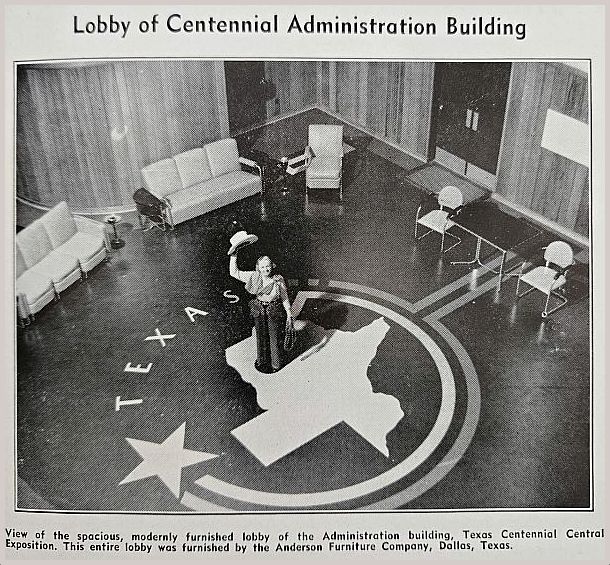
And — hallelujah — I found another photo of the interior — also from the helpful Armstrong people (I don’t know if they had the concession to outfit all the Centennial buildings, but, if so, I’d love to see all of their designs). Unfortunately this one is not in color, but it shows a fantastic Texas-centric custom design, laid down in fabulous linoleum.

tx-centennial_armstrong-linoleum_admin-bldg_texas-floor

And another one:

tx-centennial_administration-bldg-floor_southwest-business-mag_june-1936
Southwest Business, June 1936

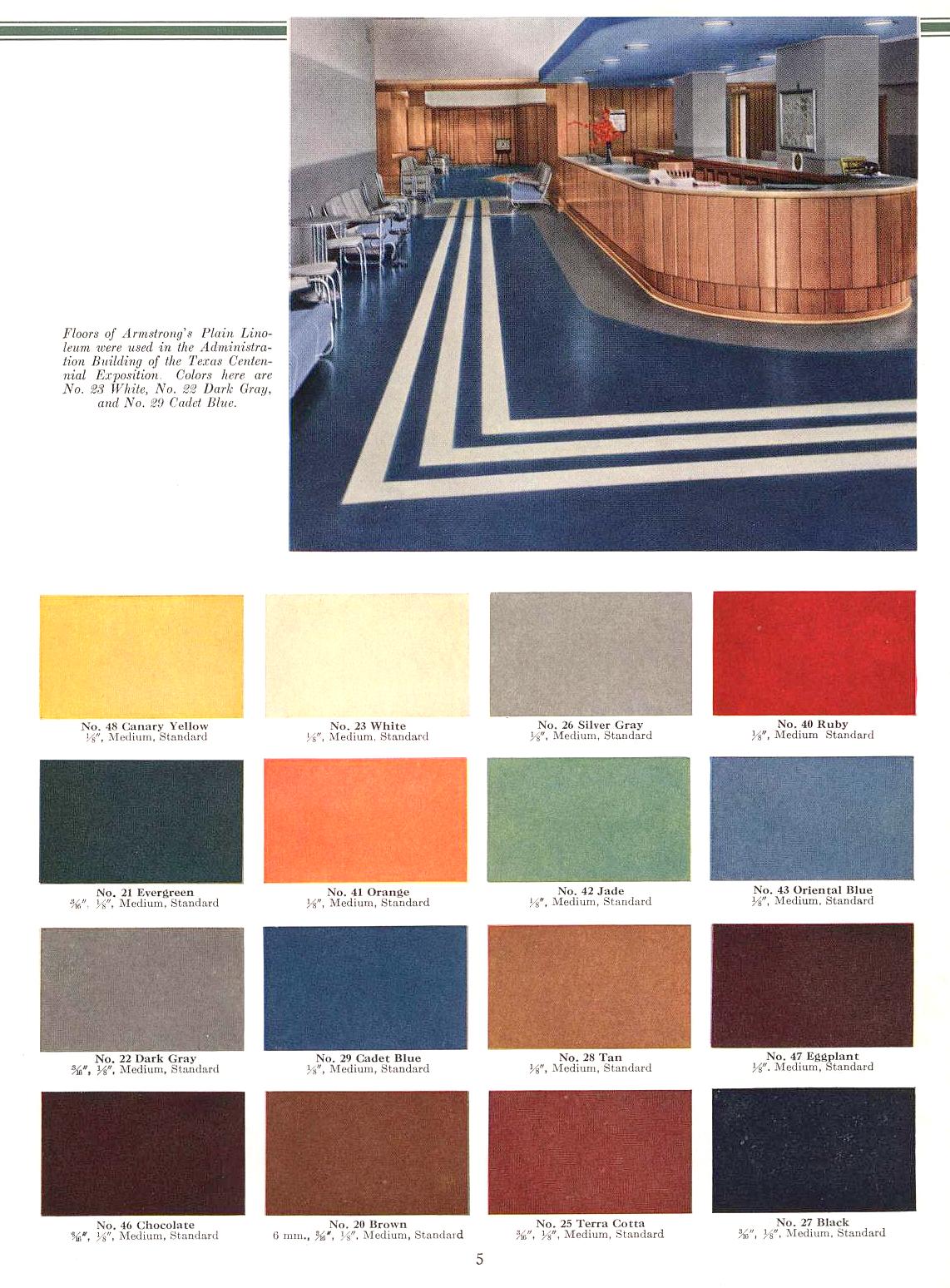
Imagine that floor in Cadet Blue, White, Orange, and Dark Gray. This is from a trade publication called Armstrong’s Floors and Walls for Homes and Public Buildings, published around 1950 (and fully scanned here). A cropped version of the photo of the top is also included here (that floor, by the way, is in White, Dark Gray, and Cadet Blue), with handy swatches (which, reproduced below, lose some accuracy in color).

tx-centennial_armstrong-linoleum_admin-bldg_colors

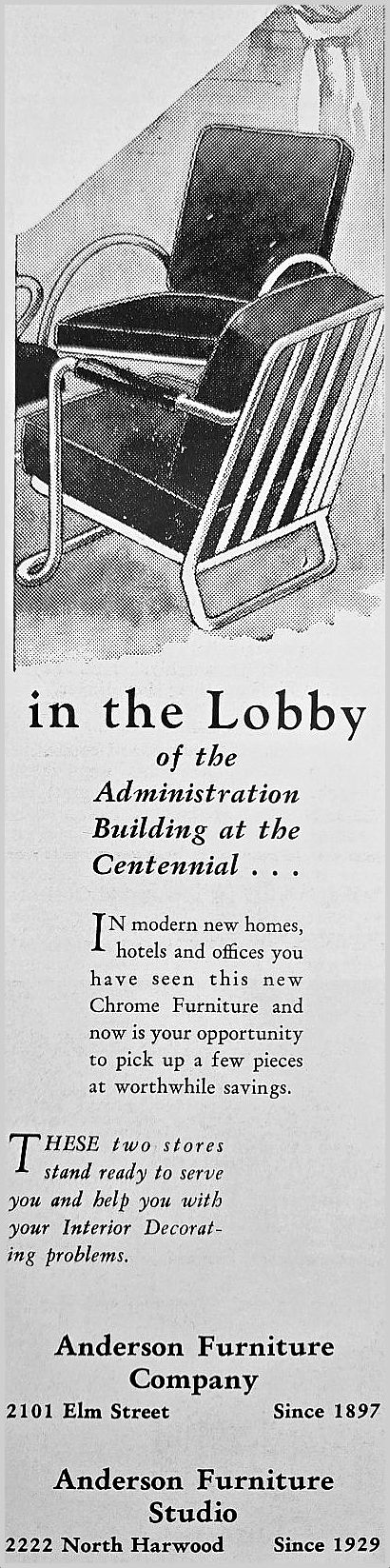
And just because I found an ad for those cool chairs:

tx-centennial_furniture_southwest-business-mag_oct-1936Southwest Business, Oct. 1936

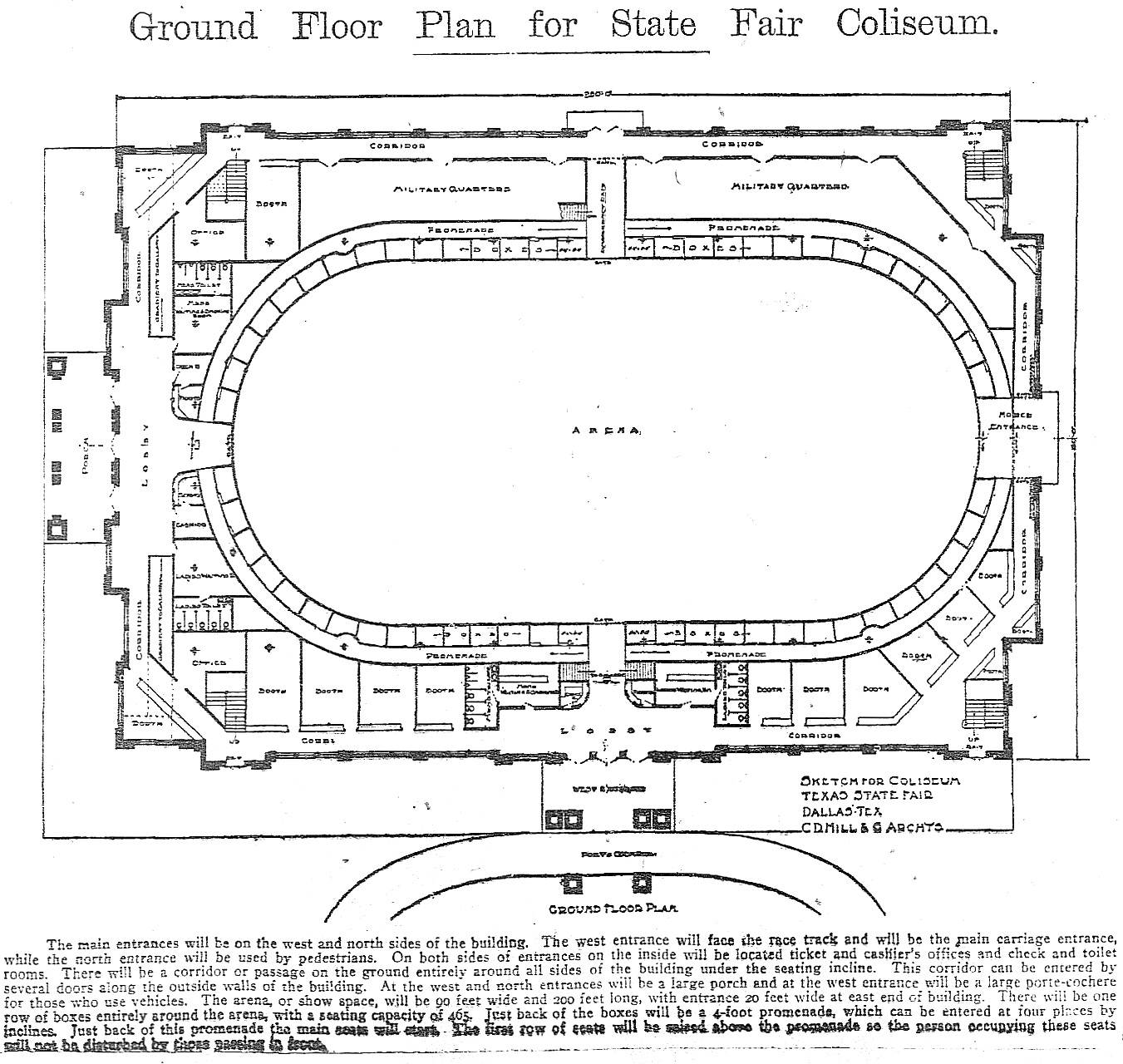
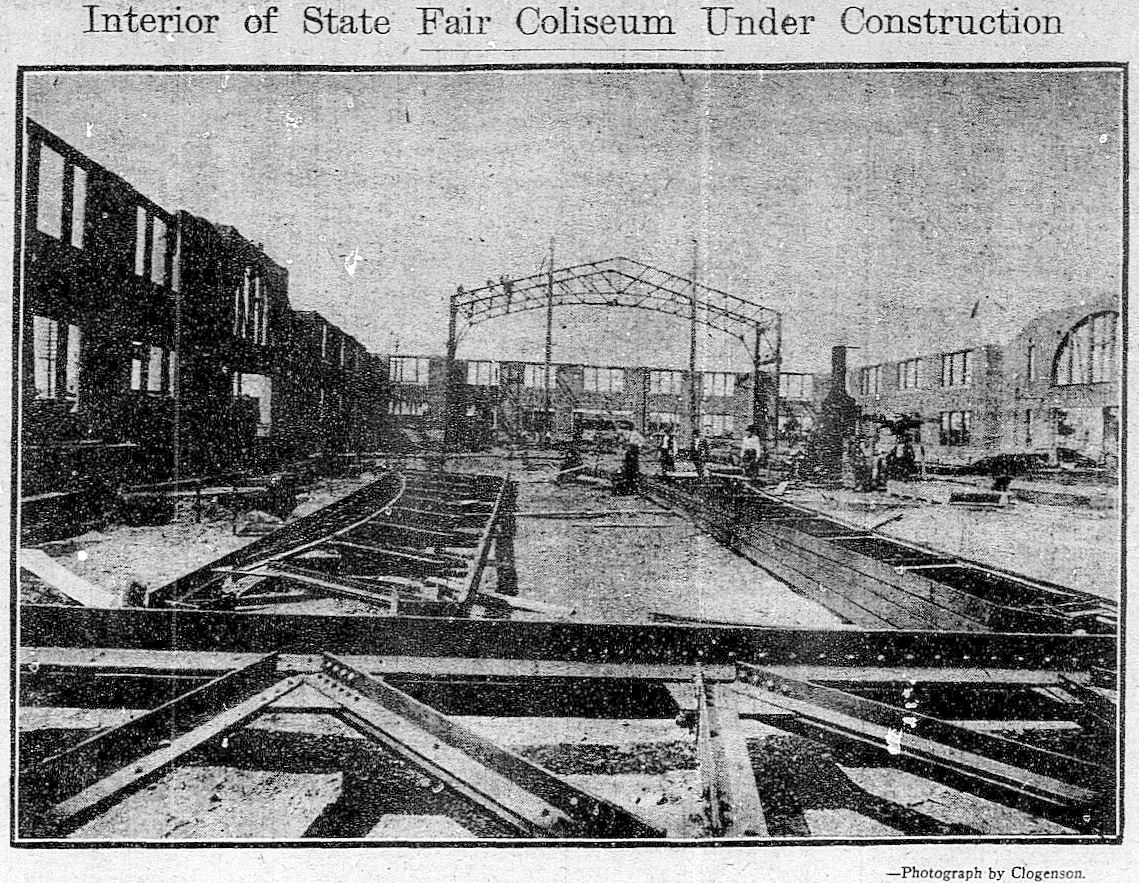
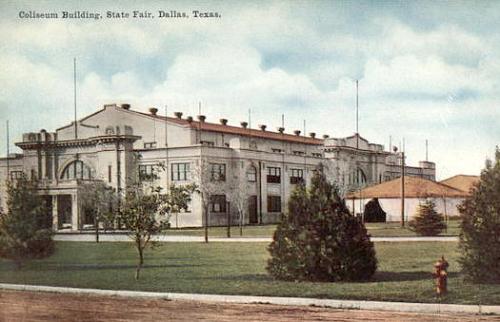
The Centennial Administration Building — which housed the hundreds of office workers and executives behind the running of the Texas Centennial Exposition — was actually the very first Centennial building completed (at the end of December 1935). Most of the Centennial buildings were newly built in 1936, but the Administration Building was actually an old building given a new stucco façade and completely remodeled — it even acquired a second floor inside the huge structure. This building was originally known as the State Fair Coliseum, built in 1910, designed by architect C. D. Hill (who designed many buildings in Dallas, including the still-standing Municipal Building downtown (built in 1914) and the Melrose Hotel (1924).

state-fair-coliseum_dmn_062009_drawingDallas Morning News, June 20, 1909

state-fair-coliseum_dmn_050710_constructionDMN, May 7, 1910

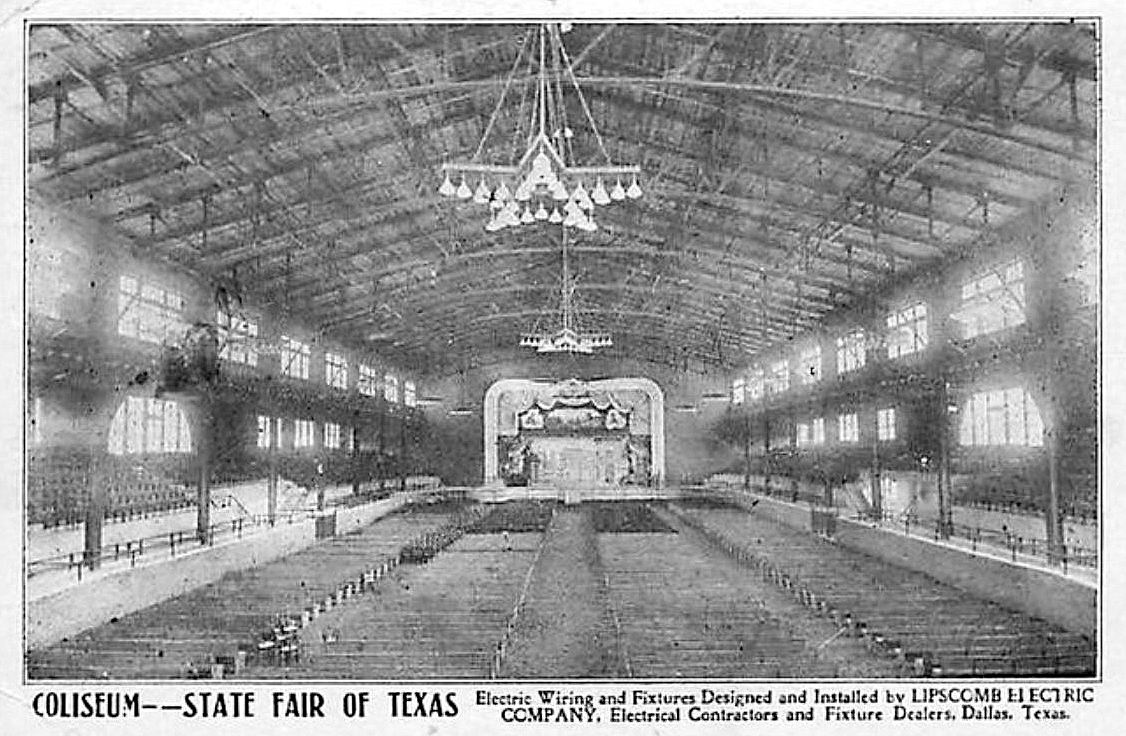
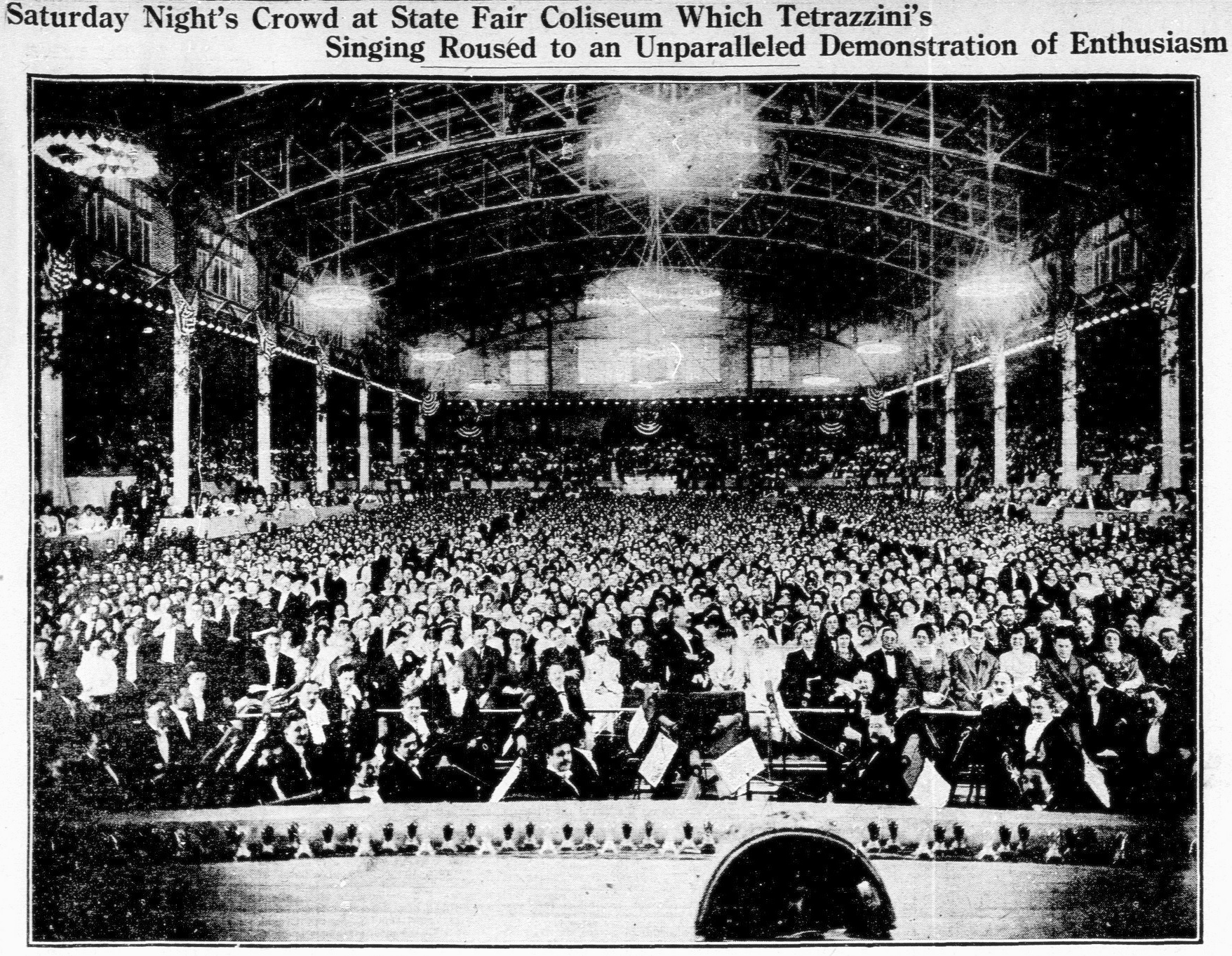
It was BIG. It had a seating capacity of 7,500.

state-fair-coliseum_flickr_coltera

state-fair-coliseum_dmn_030413DMN, March 4, 1913

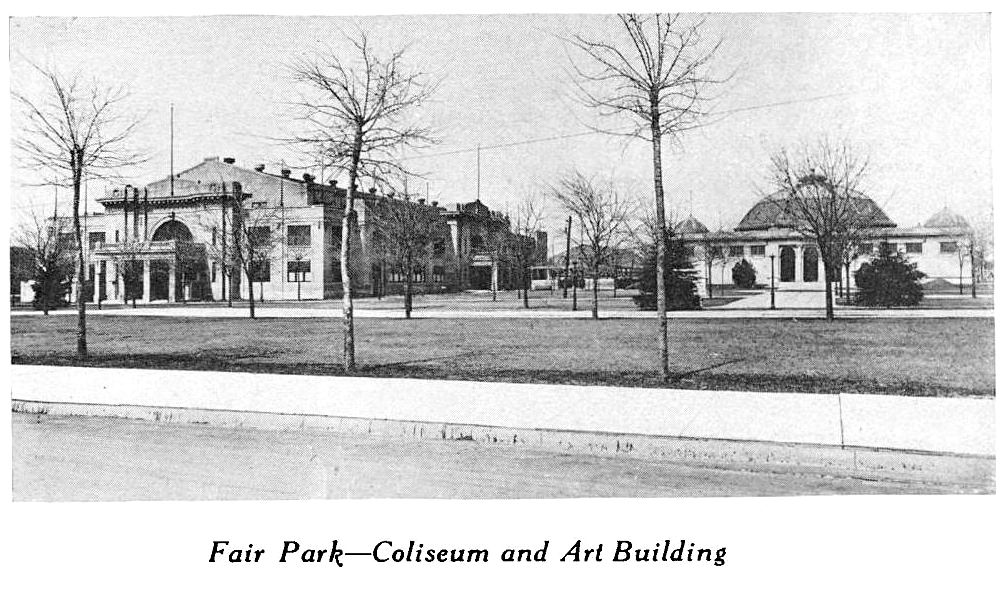
This was the first building you’d see as you entered Fair Park, as it was right inside the front entrance on Parry Avenue (after you entered, the building would be on your left).

Coliseum Building, State Fair Dallas, TX

park-board-bk_fair-park-coliseum_1914

It was the city’s first official municipal auditorium, and it hosted everything from livestock shows, conventions, large civic gatherings, and the occasional opera.

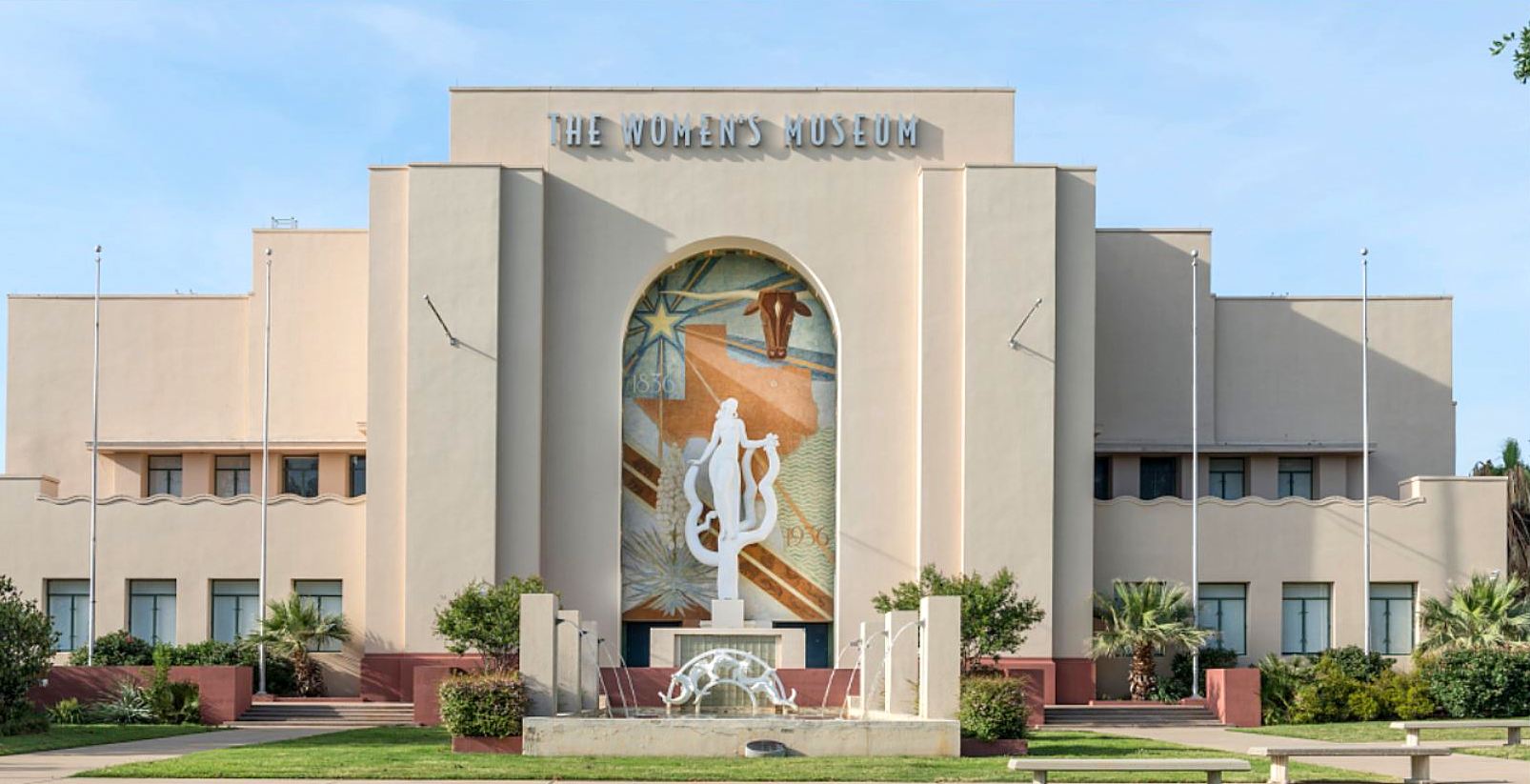
Fast-forward a few decades: in 2000 the building became the home of the Women’s Museum. The museum closed in 2011 and is now called the Women’s Building and is used for special events.

A photo of the building from 2014:

womens-museum_fair-park_2014_carol-highsmith_library-of-congressphoto: Carol Highsmith, Library of Congress

See a Wikimedia photo of this building in 2016 here — click it again (and again) to see it really big, and linger on the mural by Carlo Ciampaglia and the sculpture by Raoul Josset. See interior photos of the space in 2009 during its time as the Women’s Museum here and here. I’m not sure if the exposed brick and steel are from the original 1910 building, but I certainly hope so! And, lastly, exterior photos from 2009 showing the side of the building here, and here

***

Sources & Notes

This building can be seen on this aerial Google view, here. It is currently the Women’s Building, and it is available for special events — more about this building from the Friends of Fair Park, here.

Black-and-white postcard showing the interior of the Coliseum is from Flickr.

Black-and-white photo “Coliseum and Art Building” is from Report for the Year 1914-1915 of the Park Board of the City of Dallas, With a Sketch of the Park System (Dallas: Park Board, 1915), which can be accessed as part of the Dallas Municipal Archives via the Portal to Texas History, here.

And since this whole post was spurred by Jim Parsons’ talk the other night, here’s a link to the book he and David Bush wrote: Fair Park Deco: Art & Architecture of the Texas Centennial Exposition.

*

Copyright © 2018 Paula Bosse. All Rights Reserved.

Ghost Rails of the Belmont Streetcar Line

matilda-richmond_dan-parr-photo_FB-dallas-history-guild_april-2018Matilda & Richmond, April, 2018… (photo: Dan Parr)

by Paula Bosse

I grew up on Ellsworth, between Greenville Avenue and Matilda — just south of Mockingbird, just north of the M Streets. When I was a child, Matilda was only partially paved — in my neighborhood, maybe only from Mockingbird down to Kenwood? Otherwise, it was a dirt street (!) — and this was in the ’70s! Right around Kenwood was a weird mound which might not have looked like much to an adult, but to a child it was pretty strange. I can’t remember if the rails were visible — I’m pretty sure they were.

That line was the Belmont Line, which ended (began?) at Mockingbird (I think there was a later extension of sorts, but I think Mockingbird was the end of the line for streetcar passengers). As a kid, I knew that Matilda had been a long-gone streetcar line, but never having seen a streetcar outside of a movie, I couldn’t really imagine what it must have been like to have streetcars (and an interurban! — more on that below) moving up and down a street which was less than a block from my house.

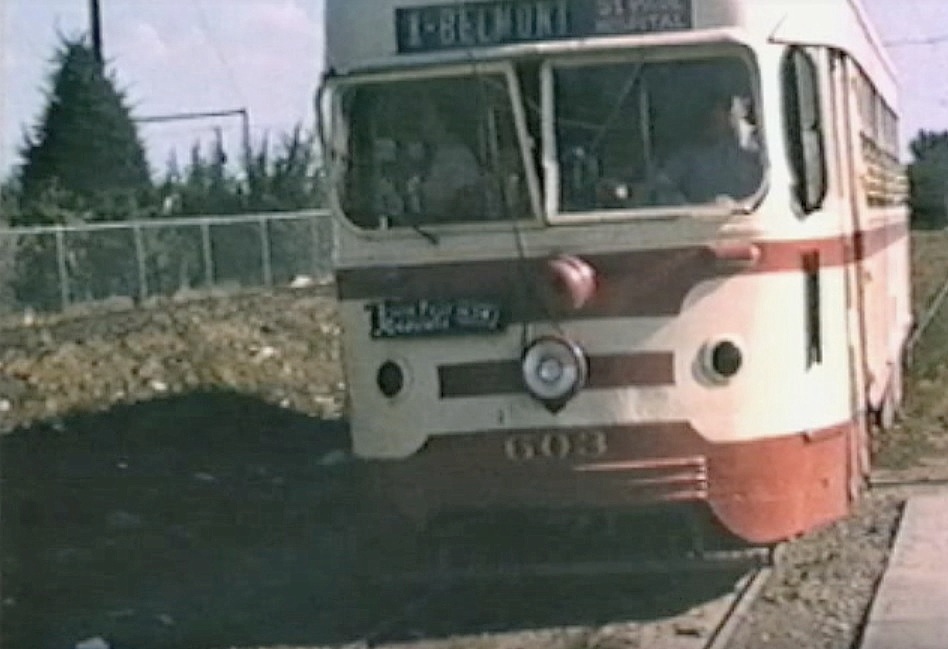
A few years ago I stumbled across the YouTube video below and was surprised to see actual footage of that streetcar rolling up Matilda. The first five minutes of the video contains 16mm footage (both black-and-white and color) shot around Dallas in 1953 and 1954 by Gene Schmidt. It’s GREAT! You’ll see streetcars-galore moving past all sorts of familiar and vaguely familiar sights around the city, from Oak Cliff to downtown to way out to Mockingbird and Matilda. It ends with the Belmont-Seventh car (car 603) pulling to the end of the line — the view is looking south down an unpaved Matilda Street from Mockingbird, with a glimpse of the Stonewall Jackson playing field at the left, on the other side of the fence. (The Matilda footage begins at 4:17.)

*

belmont-line_matilda-from-mockingbird_youtube-cap_ca1954Matilda, south from Mockingbird, ca. 1954 (Gene Schmidt)

Above, a screen capture from the video showing Matilda looking south from just south of Mockingbird. Stonewall Jackson Elementary School is at the left. Today the view looks like this.

*

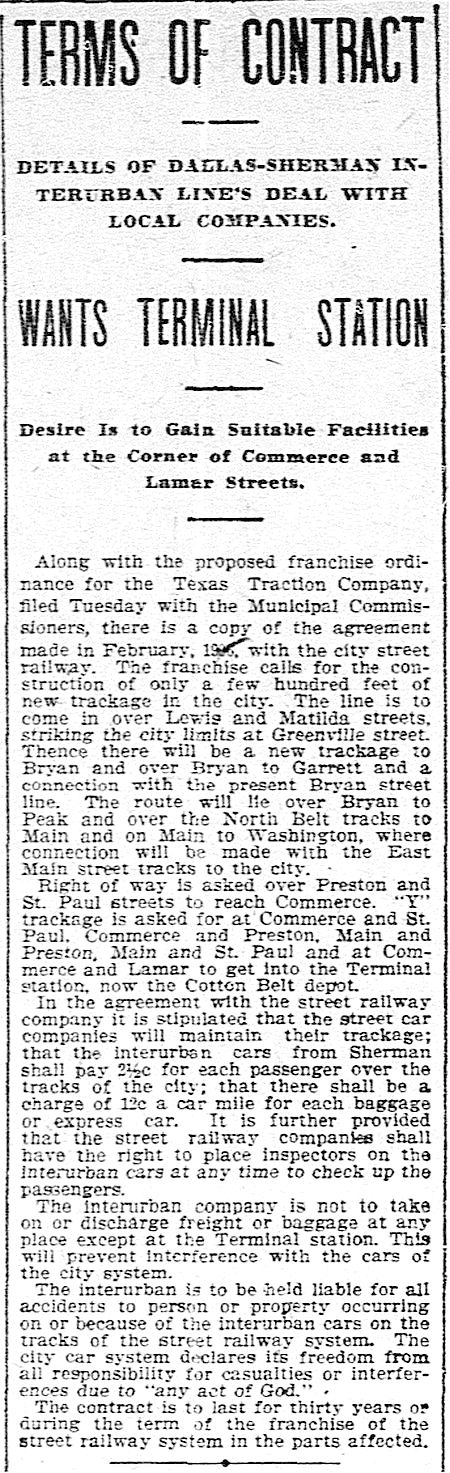
Before the streetcar arrived, Matilda was the artery that led the Texas Traction Company’s Sherman/Denison interurban into Dallas. This electric interurban service from the north, which closely followed the H&TC railroad line, arrived in Dallas in 1908, back when the official entry-point into the Dallas city limits was just off Matilda, near Greenville Avenue and Bryan Street.

1908_interurban_sherman-dallas_dmn_011608
DMN, Jan. 16, 1908 (click to read)

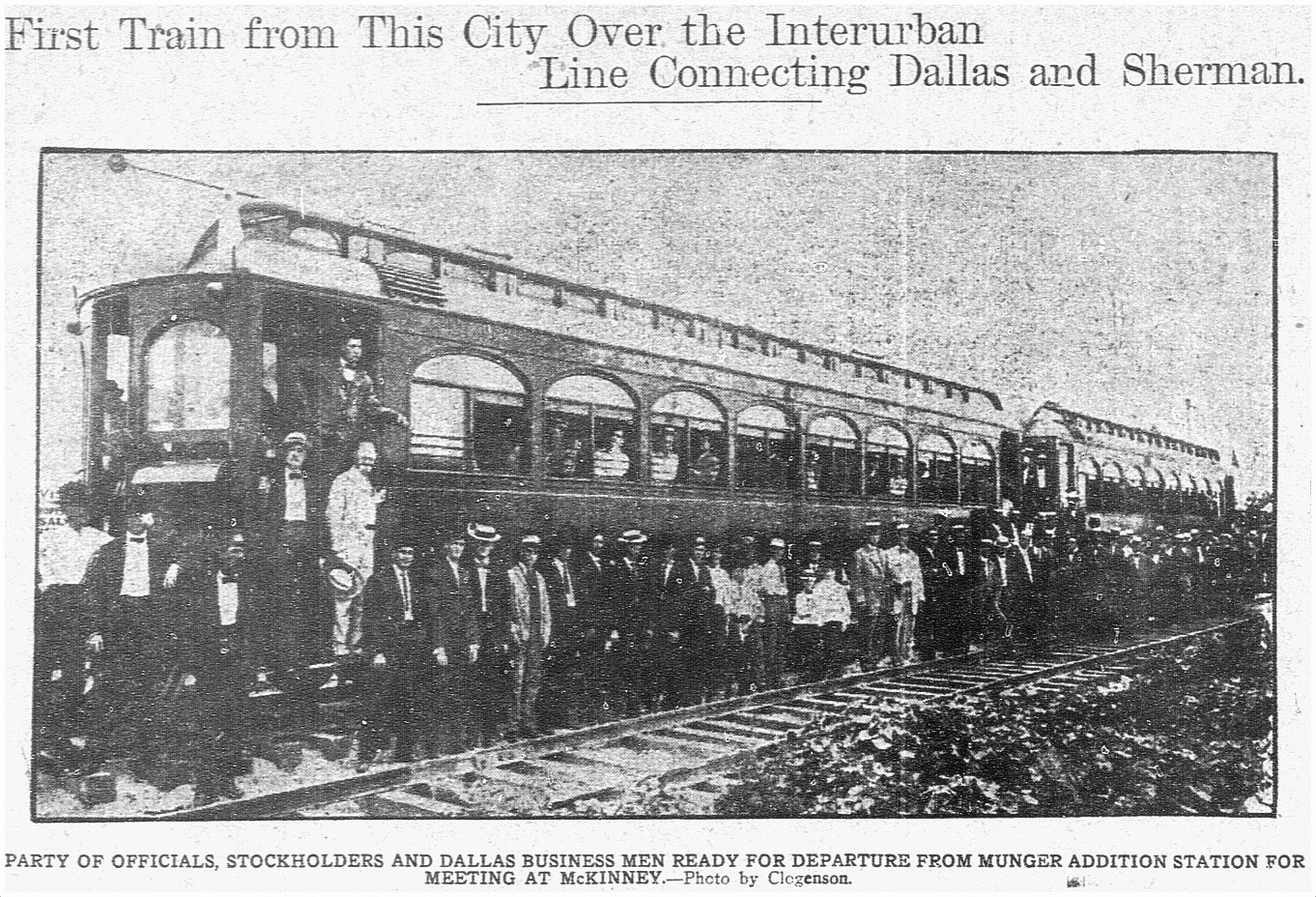
The interurban route connecting Sherman/Denison with Dallas opened on July 1, 1908 and lasted for 40 years, until its final run on December 31, 1948. (Read the Dallas Morning News article on the 1908 inaugural trip for big-wigs, “Many Make Trip Over Interurban,” July 1, 1908, here. Below is the accompanying photo. Image that running up and down Matilda — and, later, along other streets in Dallas — several times a day!)

interurban_sherman-dallas_dmn_070108
DMN, July 1, 1908

Dallas’ ever-increasing population began to move northward and eastward, necessitating public transportation which would connect these developing areas with the rest of the city. One of the early “suburban” lines was the Belmont Line, which branched off the Bryan Street line and served the Belmont Addition and beyond; it opened in 1913, but these early days appear to have been more of a private “dinky” service (see SMU’s dinky car on the beyond-the-city-limits tracks at Hillcrest and McFarlin, here). The Belmont line — as well as the Vickery Place and Mount Auburn lines — became part of the city’s official streetcar system in 1922.

Before the dinky service, riders were able to get on and off the large interurban cars at stops between Mockingbird and the area around Bryan and Greenville Ave. Even though interurbans and streetcars were able to travel on the same rails, it took years for dedicated streetcar tracks to be laid along Matilda.

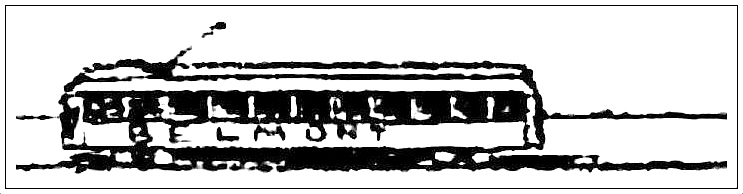
This detail of a real estate ad shows that the Belmont line had reached at least as far as Richmond by 1914 (I felt I had to include this because the finger is pointing at the exact location of the exposed rails in the photo at the top!):

1914_matilda-richmond_lakewood-heights-ad_det_050314
May, 1914 (detail from Lakewood Heights real estate ad — see full ad here)

By 1922 the Belmont line had extended north to Velasco; by 1925 it had gotten to McCommas; by 1936 it had made it up to Penrose; and by 1939 it had finally reached Mockingbird (in time for the opening that year of Stonewall Jackson Elementary School, located at Mockingbird and Matilda).

Dallas streetcars began to be phased out in 1955, and the Belmont line was one of the first to go — its last run was March 6, 1955: “The Belmont-Seventh streetcar line will go out of existence Sunday to be replaced by service with new Diesel buses” (Dallas Morning News, March 6, 1955). The new bus route in the Lower Greenville area would, for the most part, be along Greenville Avenue, one block west of unpaved Matilda Street.

In March, 1955, it was reported that the abandoned Belmont-Seventh streetcar tracks were deeded to the city by the Dallas Railway and Terminal Co., with the understanding that they would eventually be paved over. The tracks were on Matilda, Bryan, Cantegral, Live Oak, St. Paul, King’s Highway, Edgefield, Seventh, Bishop, and Colorado. In April, 1956, it was reported that the City Council had approved the sale of the streetcar viaduct over the Trinity River and the Matilda street right-of-way.

But what about that paving of Matilda? Mrs. K. E. Slaughter had thoughts on the matter in a letter-to-the editor in April, 1955:

Since removal of the Belmont streetcar line in part — Matilda and Bryan streets — would it not be advantageous to develop this section into an important use to the heavy automobile traffic? Matilda now is no more than useless tracks built up between a cow path. (DMN, April 7, 1955)

“Cow path” — ha!

Another annoyed News reader wrote in 1963 — eight years after the tracks had been abandoned — about the useless unpaved thoroughfare:

The abandoned almost-private right of ways, such as Matilda, nearly two miles south from Mockingbird, received by the city in a deal to permit an all-bus operation, have not yet been paved or otherwise improved. (DMN, Oct. 21, 1963)

I’m not sure when that paving finally happened — early ’70s? — I think it must have been done in stages. I don’t remember a time when the stretch between Mockingbird and Kenwood wasn’t paved, but I do remember Matilda being a dirt road south of Kenwood. I don’t have a good recollection of the year, but kids remember all sorts of weird things, and those mysterious mounds were pretty memorable. (UPDATE: See photos of Matilda being paved at Goodwin in 1971 here.) I wish I’d known what an interurban was when I was a child. That would have made my neighborhood seem a whole lot more interesting! Heck, it used to the Gateway to Sherman!

I’ve long despaired of having missed the streetcar age. But it’s nice to know that one ran so close to the house I grew up in.

belmont-line_matilda-mockingbird_youtube-cap_ca1954End of the line, ca. 1954… (Gene Schmidt)

belmont-car_lakewood-heights-ad-det_050314

***

Sources & Notes

Top photo taken by Dan Parr on April 15, 2018; it was originally posted to the Facebook group Dallas History Guild and is used here with permission. (Thanks, Dan!) The photo was taken at Matilda and Richmond, looking south on Matilda. See it on Google Street View, here. (Roadwork along Matilda is awful at the moment, but much-needed. Apparently it is being reduced to three lanes for automobiles with two bike lanes being added — read about it in the Lakewood Advocate, here.)

YouTube video shot by Gene Schmidt in 1953 and 1954; the direct link is here.

Another interesting video on YouTube was made by the City of Allen and contains period footage of the interurban that served North Texas. It’s a breezy 6-and-a-half  minutes, and it includes some cool shots of Dallas.

If you want to see a whole bunch of North Texas interurban photos, check out this great 83-page PDF compiled by DART, “History of the Interurban Railway System and Monroe Shops,” here.

Speaking of DART, they posted a cool 1925 map of streetcar and interurban lines, here — click the map to see a larger image. (In 1925, the Belmont line ended on Matilda at McCommas).

ALSO extremely cool is a Google map showing Dallas’ Historical Streetcar (and Interurban) Lines laid over a present-day Google map, here. Zoom in and out. Very useful!

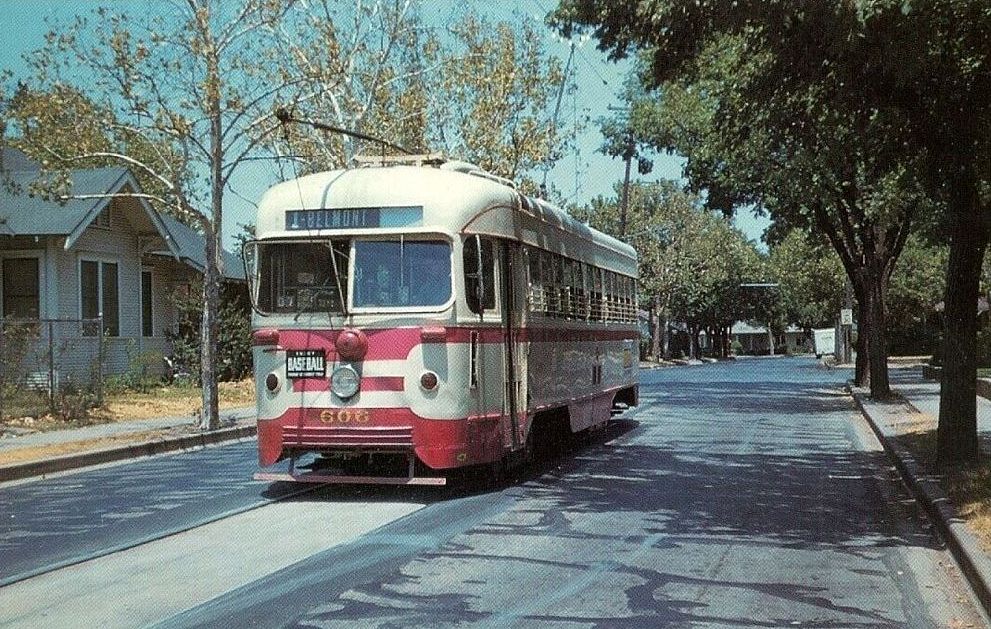
streetcar_belmont_color_ebayeBay

belmont-streetcar_new-moon_1940_palace_ebay1940, eBay

belmont-streetcar_1954_ebay1954, eBay

*

Copyright © 2018 Paula Bosse. All Rights Reserved.
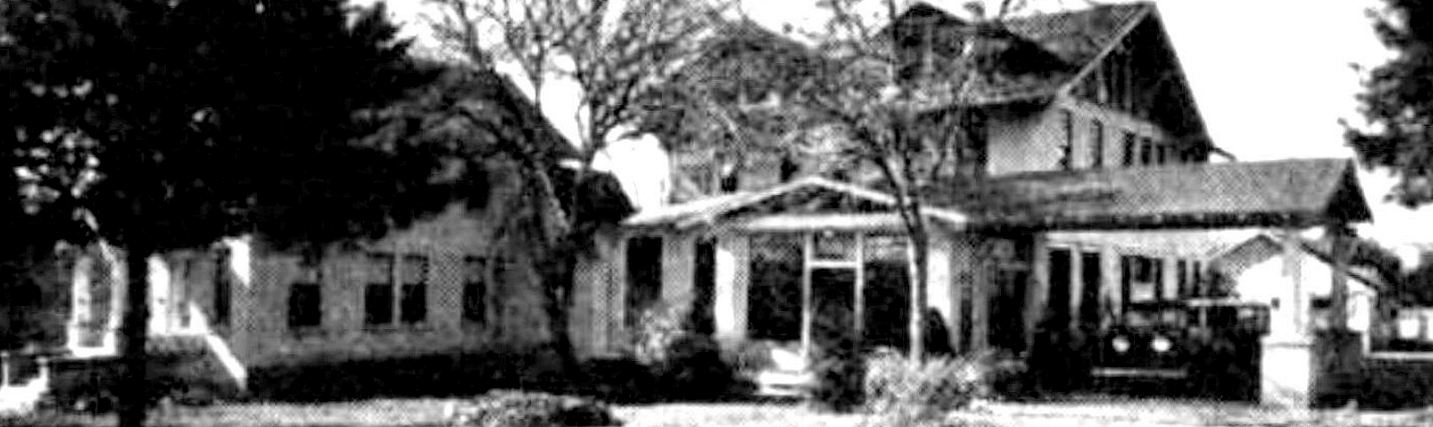
“The Cedars” Maternity Sanitarium, Oak Cliff — ca. 1923-1944

cedars-maternity-sanitarium_texas-state-journal-of-medicine_oct-1933_portalA “seclusion home for unwed mothers”…

by Paula Bosse

The rather blurry photo above shows a “maternity sanitarium” for unwed mothers, where “unfortunate women” could spend their days in seclusion until their babies were born there on the premises. The home/sanitarium was called “The Cedars” and was located on N. Ravinia Drive in the Beverly Hills area of Oak Cliff; when it opened, it was just outside the Dallas city limits. (It has nothing to do with The Cedars area south of downtown; its name may have had something to do with the name of a nearby street which intersected Ravinia. …Or it might have been located near a cedar grove. …Or it might have been used to subliminally suggest famed Cedars-Sinai Hospital.)

The sanitarium was opened around 1923 by Mrs. Lillie Perry (1876-1929), a woman who might have had some personal experience with the “fallen women” she cared for, as it appears she might have had a child out of wedlock herself. When she died in 1929, her daughter Lillian Hanna took over the running of the sanitarium. Lillian died in 1938, and that seems to have been around the time that the home became part of the Volunteers of America organization, which, among its many social services, provided maternity care for women and also assisted in adoption placement. The last mention I saw of “The Cedars” was in 1944.

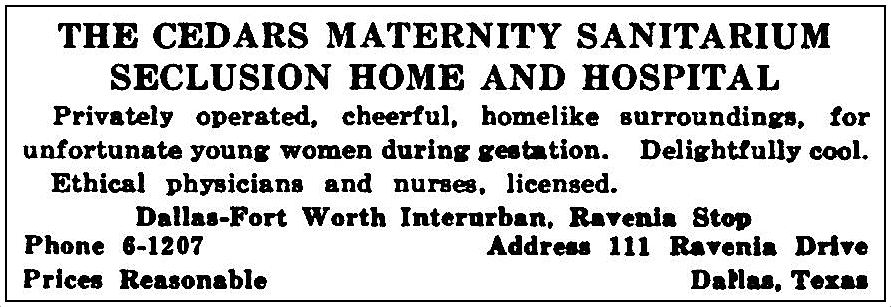
The photo above appeared in an ad placed in the Oct., 1933 issue of the Texas State Journal of Medicine with the accompanying text (for larger images, click pictures and clippings):

cedars-maternity-sanitarium_tx-state-journal-of-medicine_oct-1933_portal_text
1933

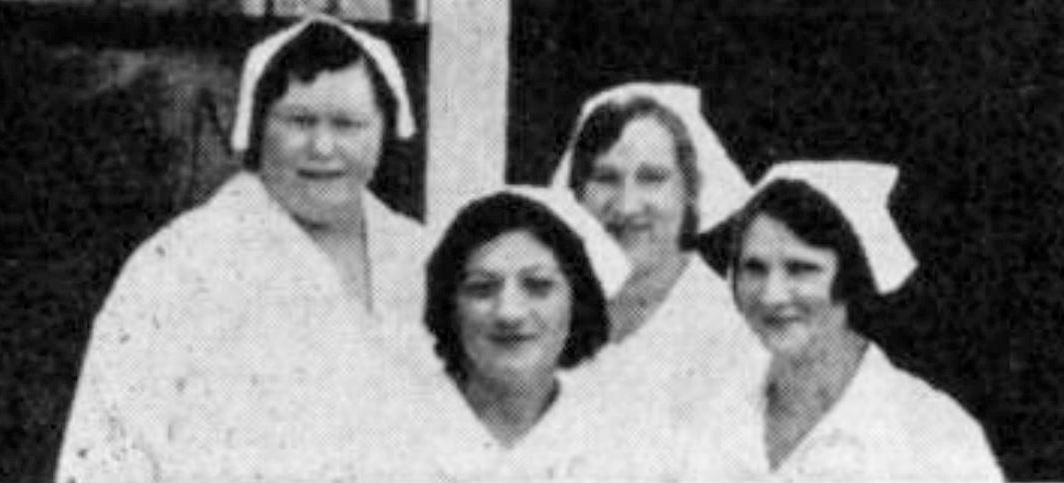
Another ad, featuring friendly-looking nurses, appeared in the same issue, a few pages earlier:

cedars-maternity-sanitarium_tx-state-journal-of-medicine_oct-1933_portal_nurses

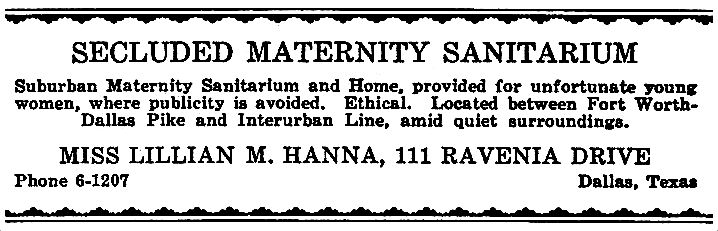
cedars-maternity-sanitarium_tx-state-journal-of-medicine_oct-1933_portal_nurses_text1933

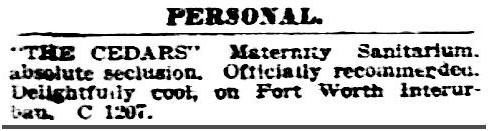
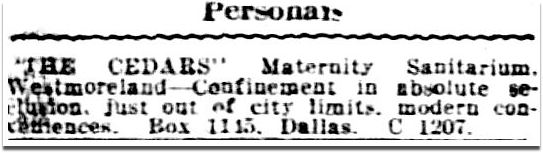
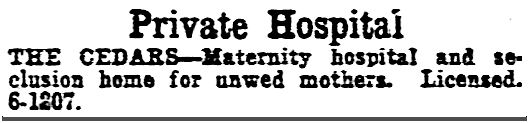
Below are a few discreet newspaper ads for The Cedars which appeared over the years in the “personals” section of the classifieds.

cedars-maternity-home_dmn_070623
1923

cedars-maternity-home_dmn_042724_westmoreland
1924

cedars-maternity-home_dmn_1006291929

cedars-maternity-home_dmn_0105311931

cedars-maternity-home_dmn_0418341934

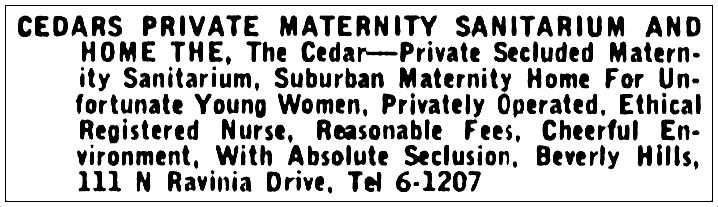
1937_cedars-maternity-sanitarium
Listing from the 1937 Dallas city directory

***

Sources & Notes

Ads from the Texas State Journal of Medicine appeared in the October, 1933 issue, which can be found scanned in its entirety on the Portal to Texas History site, here.

Homes for “unwed mothers”/”unfortunate girls”/”fallen women” were generally places families sent their daughters in order to avoid the social stigma that unmarried girls and women faced when pregnant. They just kind of “disappeared” for several months and had their babies in secret, often feeling pressured to put their children up for adoption. An interesting Salon article on the topic is “The Children They Gave Away” by Sarah Karnasiewicz.

More on the Beverly Hills neighborhood of Oak Cliff can be found in articles from Heritage Oak Cliff and Preservation Dallas.

Thanks to Patricia M. who wrote to ask me a question about this place. I’ve learned a lot of interesting things about Dallas I would never have thought to look into were it not for obscure questions from readers. Like this one! Thanks, Patricia!

*

Copyright © 2018 Paula Bosse. All Rights Reserved.
The L. P. Sigler Jewelry Store, Peak & Elm

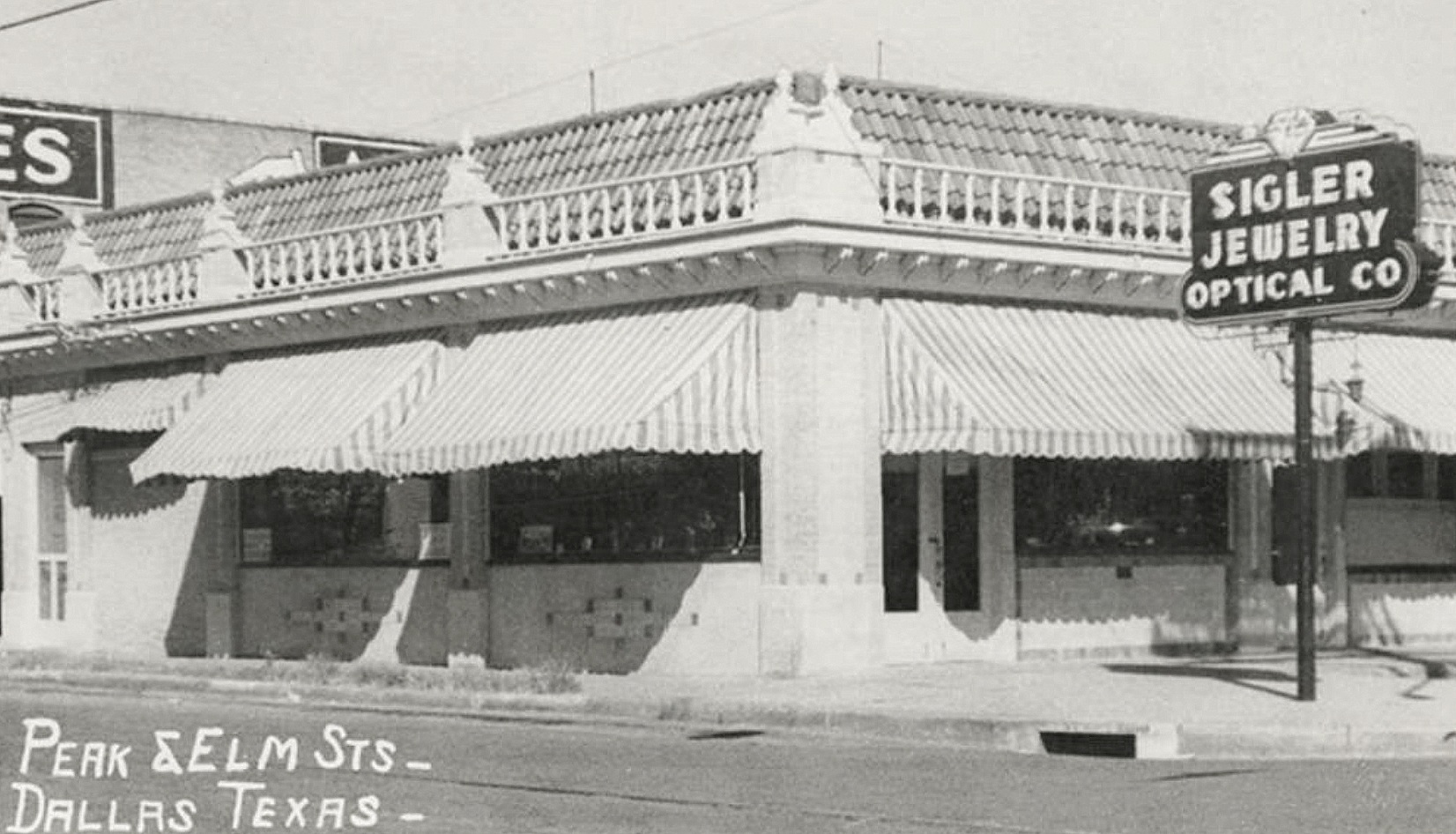
peak-and-elm_cook-collection_degolyer_SMUNorth Peak & Elm, southeast corner… (click for larger image)

by Paula Bosse

Dr. Lough Phillip Sigler (1884-1951) was an optometrist who moved to Dallas from Denton County in 1908; the following year he opened a jewelry and watch store inside an Old East Dallas pharmacy at 4301 Elm Street, at the northeast corner of Elm and North Peak, eventually expanding into the adjoining storefront. In 1930 he moved across the street into a brand new building at the southeast corner of Peak and Elm: 132 N. Peak, seen in the photo above.

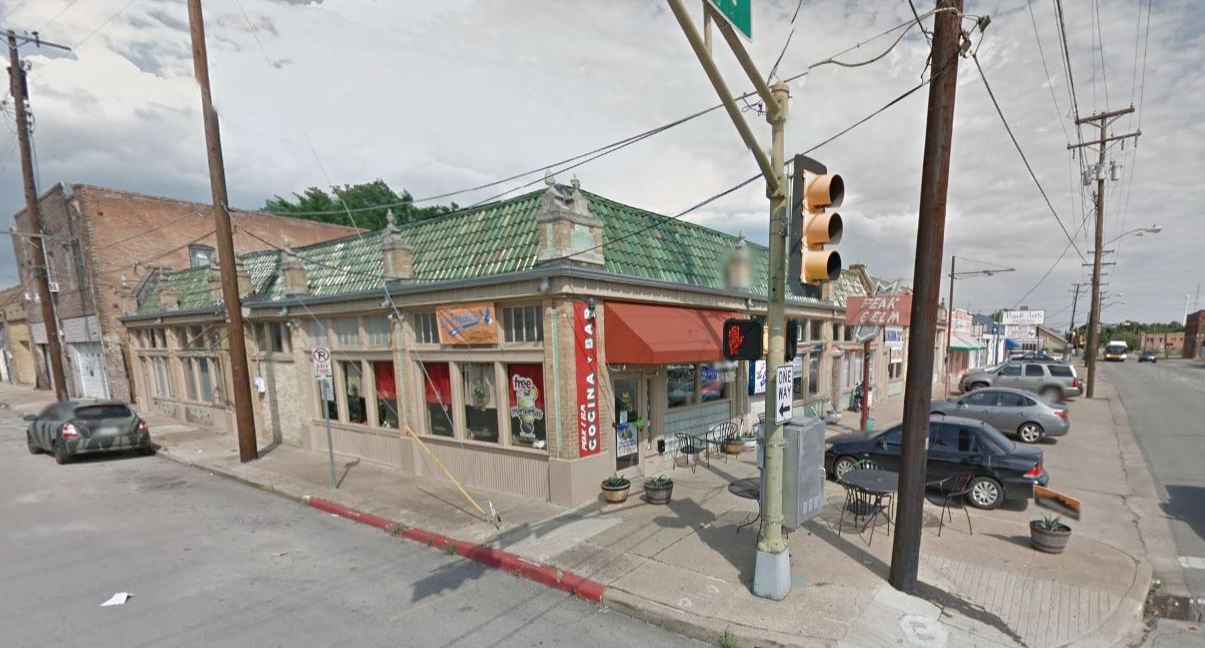
This type of neighborhood retail strip of shops and cafes was a common site throughout the city, and there are several still standing, most of which I’ve seen in Old East Dallas and Oak Cliff. I love these strips, and, thankfully, the one seen in the photo still stands.

peak-and-elm_googleGoogle Street View, 2016

The jewelry company founded by Dr. Sigler had an amazingly long life: the store opened at Peak and Elm in about 1910 (at the northeast corner) and remained in business (at the southeast corner) until well into the 1970s. The business which currently stands at 132 N. Peak is a very charming Mexican restaurant called Peak & Elm Cocina y Bar (check it out!).

***

Sources & Notes

Top image — “Peak & Elm Sts.” — is from a real photo postcard in the George W. Cook Dallas/Texas Image collection, DeGolyer Library, Central University Libraries, Southern Methodist University; more information on this photo can be found here.

If I had to guess the date of the image, I’d guess around 1930 when Sigler moved into the new location. The strip appears to have been built in 1929, with its first tenants showing up in the 1930 city directory. See it today on Google Street View, here.

Just as an interesting historical note, directly across Peak from Sigler’s jewelry store were car barns and machine shops for some of the city’s electric railway streetcars — they can be seen in a 1922 Sanborn map here. Those blocks are currently occupied by Dallas Area Rapid Transit facilities.

The 1922 map showing blocks occupied by Mr. Sigler’s store(s) is here (his first location at 4301-03 Elm is seen, but the building which housed his later store at 132 N. Peak is not seen as it would not be built for another seven or eight years). 

*

Copyright © 2018 Paula Bosse. All Rights Reserved.
 

The Ray Hubbard Estate, Lakewood

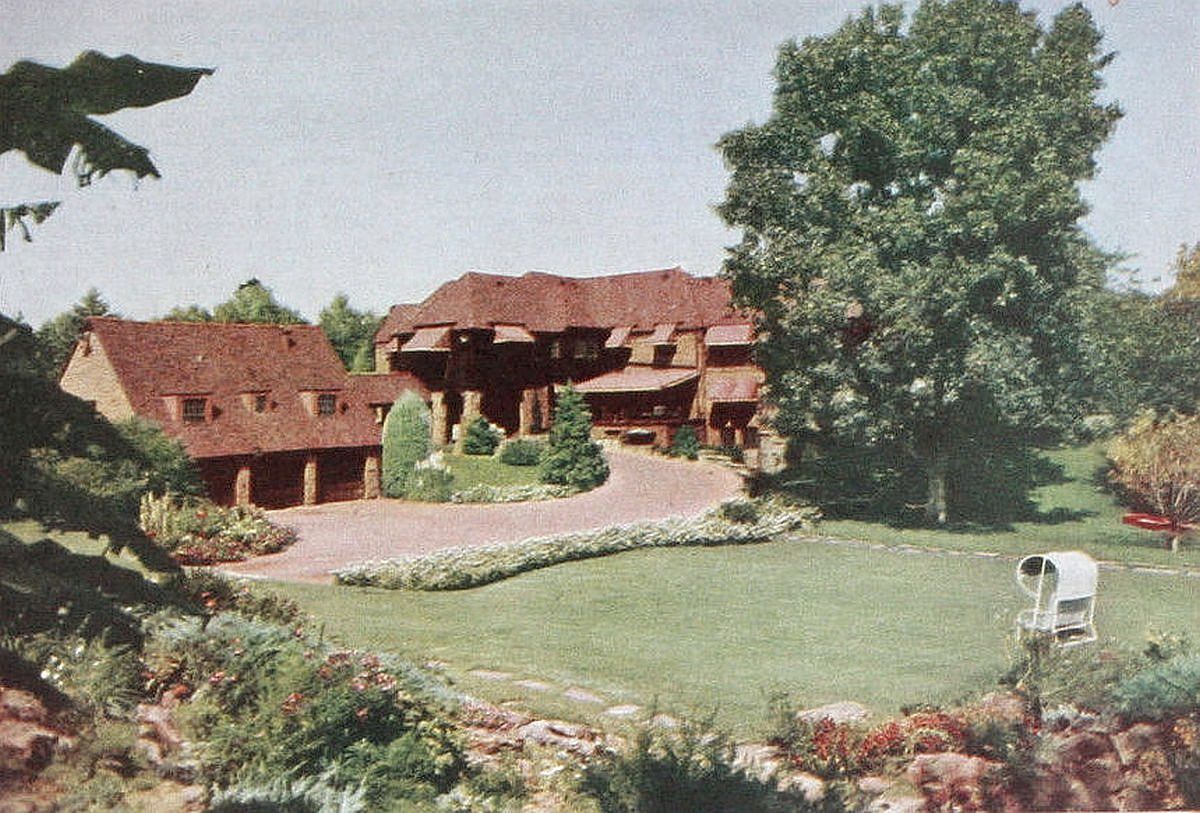
ad-evervess_mrs-ray-hubbard_1948_detA country estate in the heart of Lakewood, 1948… (click for larger image)

by Paula Bosse

Lakewood has a lot of beautiful homes — large and small — but the (very large) Raymond E. Hubbard estate at the corner of Lakewood Boulevard and Brendenwood Drive is quite the show-stopper. Built in 1934, the two-and-a-half-acre property is about a mile from White Rock Lake and was known for years for its spectacular landscaping and gardens, much of which was the personal handiwork of owner Ray Hubbard (1893-1970). Hubbard amassed his wealth as an independent oilman during the boom years, but he was known in his later life for his lengthy tenure as president of the Dallas Park Board.

From a 1938 Dallas Morning News article:

Mr. Hubbard is that phenomenon known as a natural tiller of the soil. In the short space of two years he has taken a barren hill and transformed it into a blaze of beauty in the form of a rock garden he designed himself. In the symphony of color, he has even had the subtlety to plant a few onions because there is a blue-green cast to the leaves of the onion that is found in no other plant. Carnations, pansies and pinks mingle in profusion as well as a thousand other oddities you have never seen the likes of  before. (“Edens in Preview,” DMN, April 10, 1938)

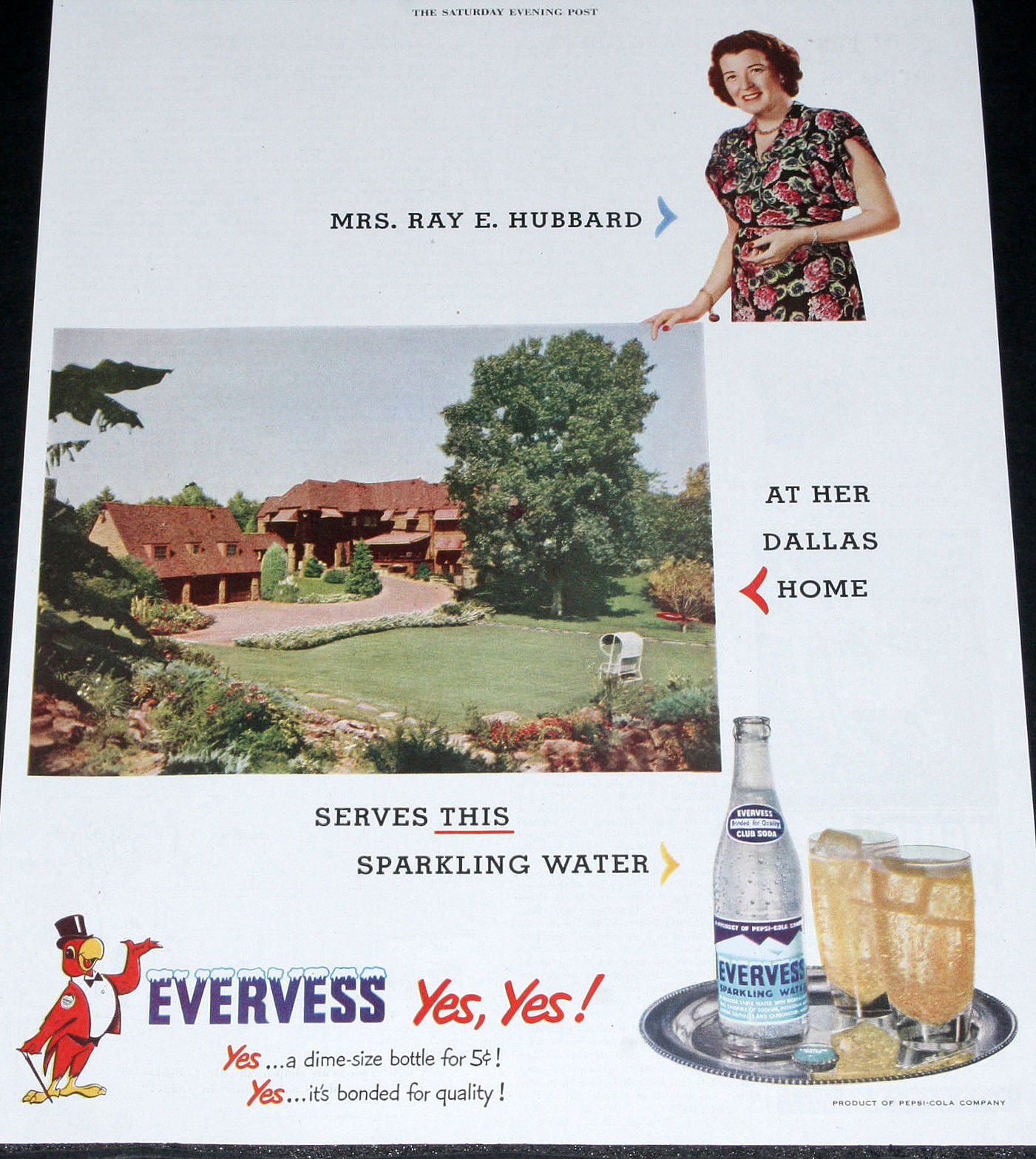
In 1948, his wife, Janet Hubbard, was seen in an ad for Evervess Sparkling Water, with photos of both Mrs. Hubbard and a view of the impressive “backyard” of their Lakewood home. (Click ad to see larger image.)

ad-evervess_mrs-ray-hubbard_1948Saturday Evening Post, 1948

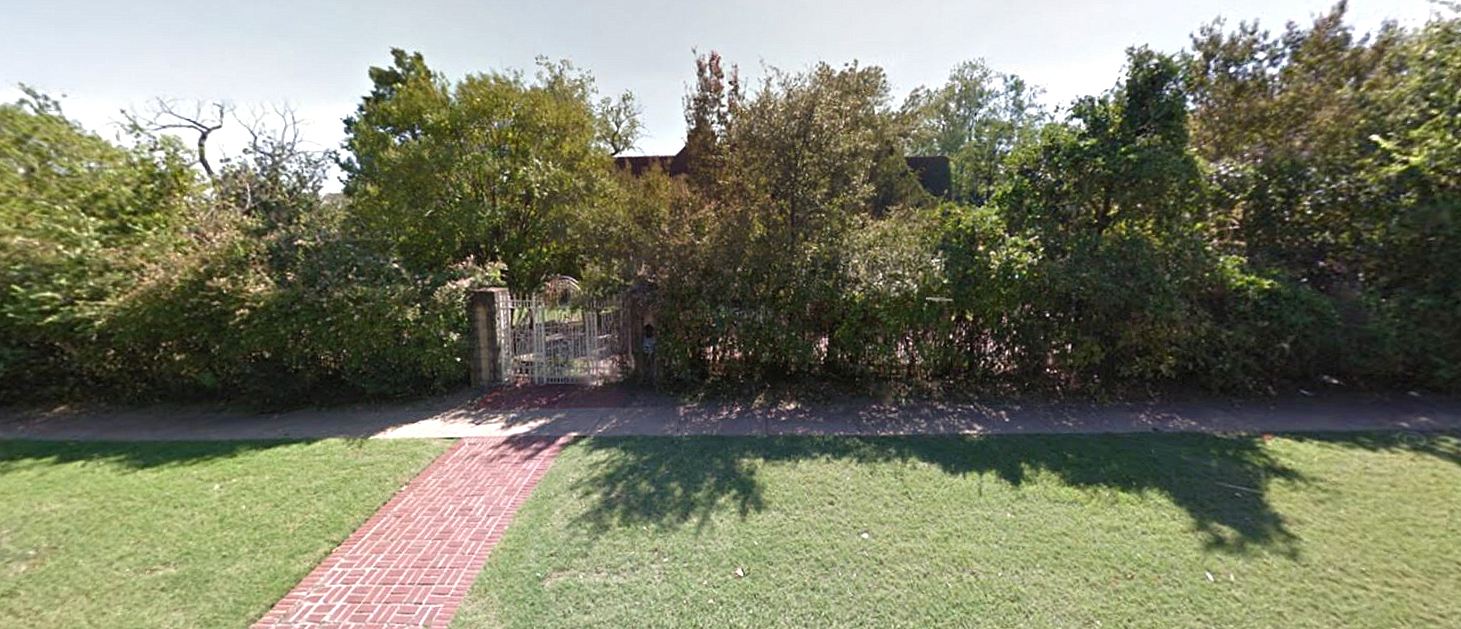
I came across this ad a few years ago but had no idea where the house was located or who Ray Hubbard was, other than the probable namesake of the lake which bears his name (the Rockwall-Forney reservoir was named Lake Ray Hubbard in January, 1967, in honor of Hubbard’s devotion to civic affairs and his decades-long service to Dallas parks). I was surprised to learn that this was the somewhat mysterious and foreboding-looking house I’d passed years ago, looking run-down and deserted, surrounded by overgrown shrubs and bushes. The 2012 Google Street View looked like this:

hubbard-house_google-street-view_oct-2012Google Street View, Oct. 2017

Back then the overgrown approach to the house looked like this, and was probably something of a thorn in the side of the Lakewood Boulevard residents.

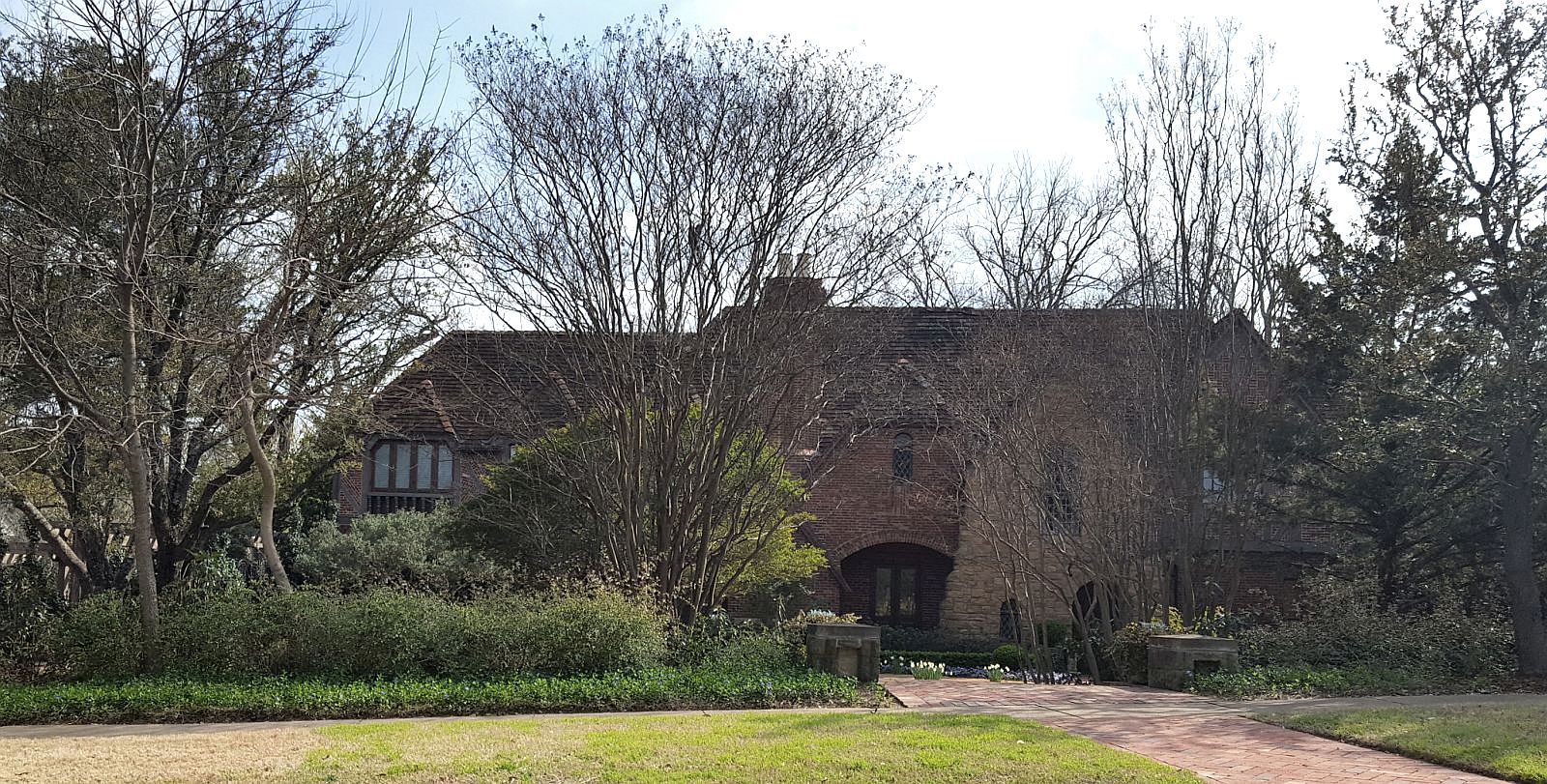
Since Google Street View was so out-of-date, I decided to drive by the house today to see what it looked like in 2018. It’s beautiful!

hubbard-house_lakewood-blvd_031519_PBphoto: Paula Bosse

The reason for the transformation? The property was bought and restored by Hunter Hunt (grandson of one-time richest man in the world — and White Rock Lake resident — H. L. Hunt) and his wife, Stephanie Hunt. And they did a wonderful job! If I had some, I’d raise a toast to the couple with an ice-cold glass of Evervess Sparkling Water!

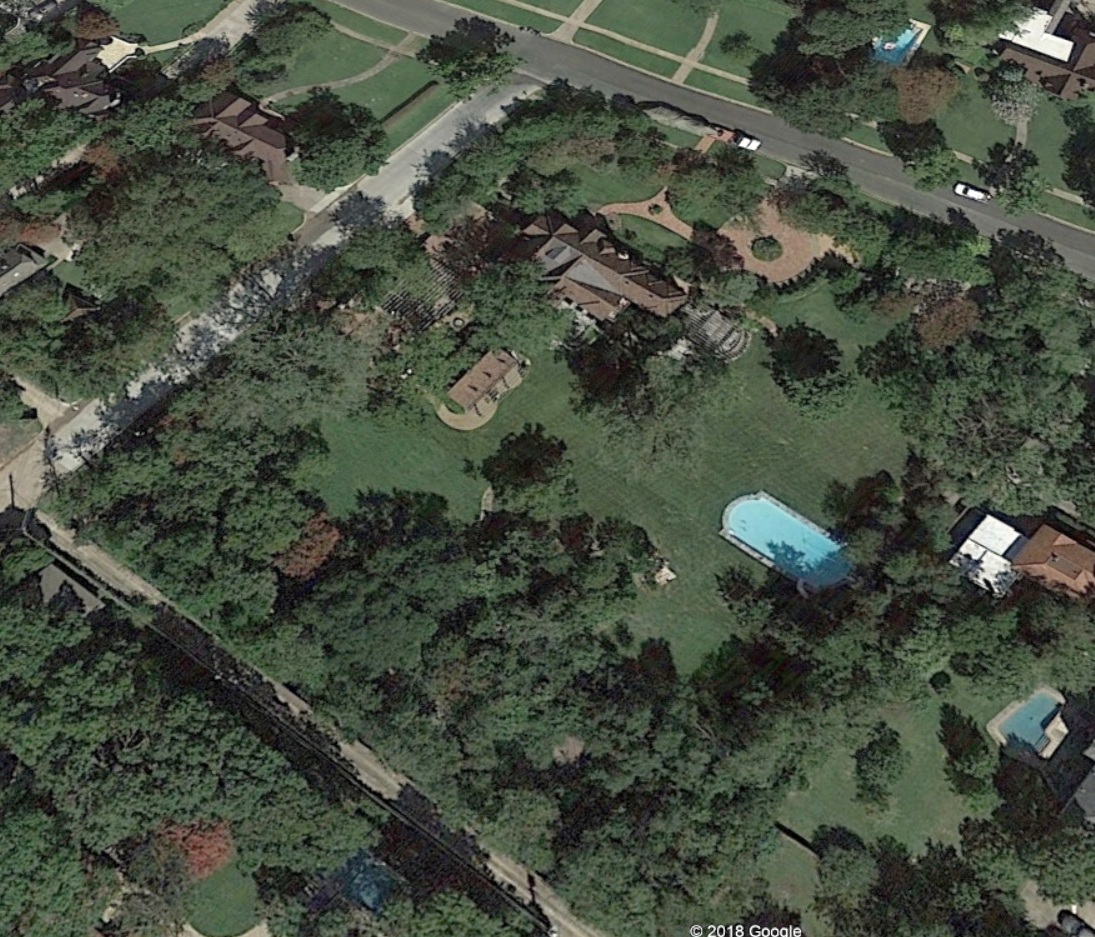
ray-hubbard-estate_google-earth_2017
Google Earth, 2017

*

hubbard_ray-e-hubbard_find-a-grave

Even though I now know who Ray Hubbard was, I’ll probably still find myself unintentionally (and, okay, sometimes intentionally) calling the lake named after him “Lake Ray Wylie Hubbard” (another former Dallas resident of note, but we’ll leave that for another time…).

***

Sources & Notes

Ad found on eBay. This image is from an item offered several years ago, but as luck would have it, another seller has it for sale right now, here. Perhaps if you’re friends with Hunter and Stephanie Hunt, this would make a nice stocking stuffer. (This Evervess advertisement seems to have been part of a 1948 ad campaign featuring society women, their homes, and their favorite sparkling water: another ad, featuring Mrs. Homer Lange and her Chicago home, can be seen here.)

Photo of Ray E. Hubbard is from Find-a-Grave; read a biographical sketch about Mr. Hubbard’s life on the site, here. Not included in this information was that during Hubbard’s 27 years heading the Park Board (1943-1970), the Dallas park system expanded from 4,400 acres to more than 15,000 acres, and the number of parks increased from 54 to 150.

Read about Stephanie and Hunter Hunt and their Hunt Institute at SMU, here.

If anyone knows the original architect of the Hubbard house, please let me know!

For more on Lakewood Boulevard, I really enjoyed the 1992 Lakewood Advocate article “Lakewood Boulevard’s First Resident Looks Back On the Area’s Development; Mrs. Barnett’s Late Husband, Marshall, Built the First House on Lakewood Boulevard in the 1920s,” here.

See a 1932 view of the 7100 block of Lakewood Blvd. (with White Rock Lake at the end of the street), here; this photo was taken two years before the construction of the Hubbards’ house, which would  be built three blocks to the west (Dines and Kraft photo from the Flashback Dallas post “‘Reminiscences: A Glimpse of Old East Dallas,'” here).

*

Copyright © 2018 Paula Bosse. All Rights Reserved.
Forest Avenue-Area Flooding, South Dallas — 1935

flooding_forest-avenue_lloyd-long_052035_ebayBeyond the levees… (click for larger image)

by Paula Bosse

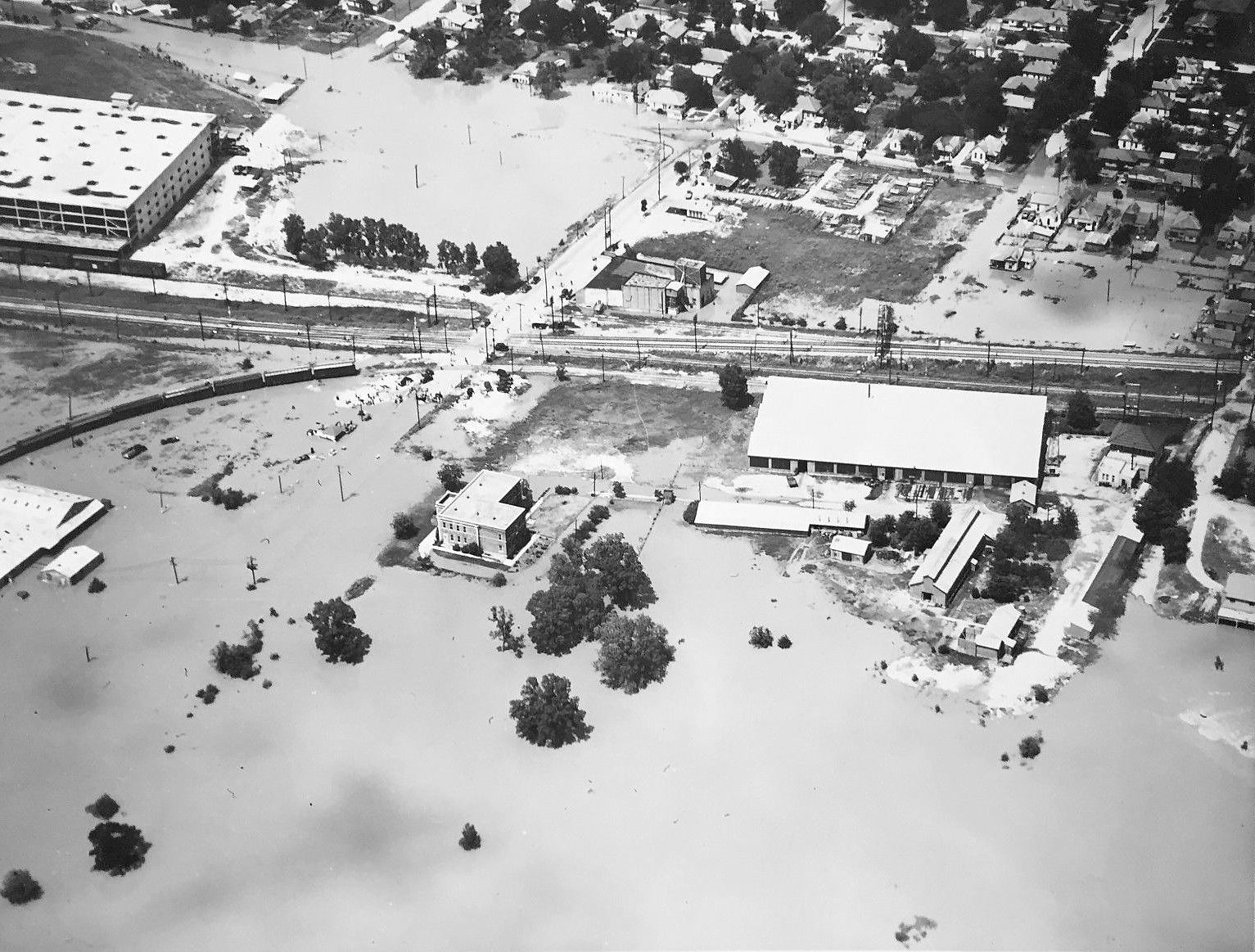
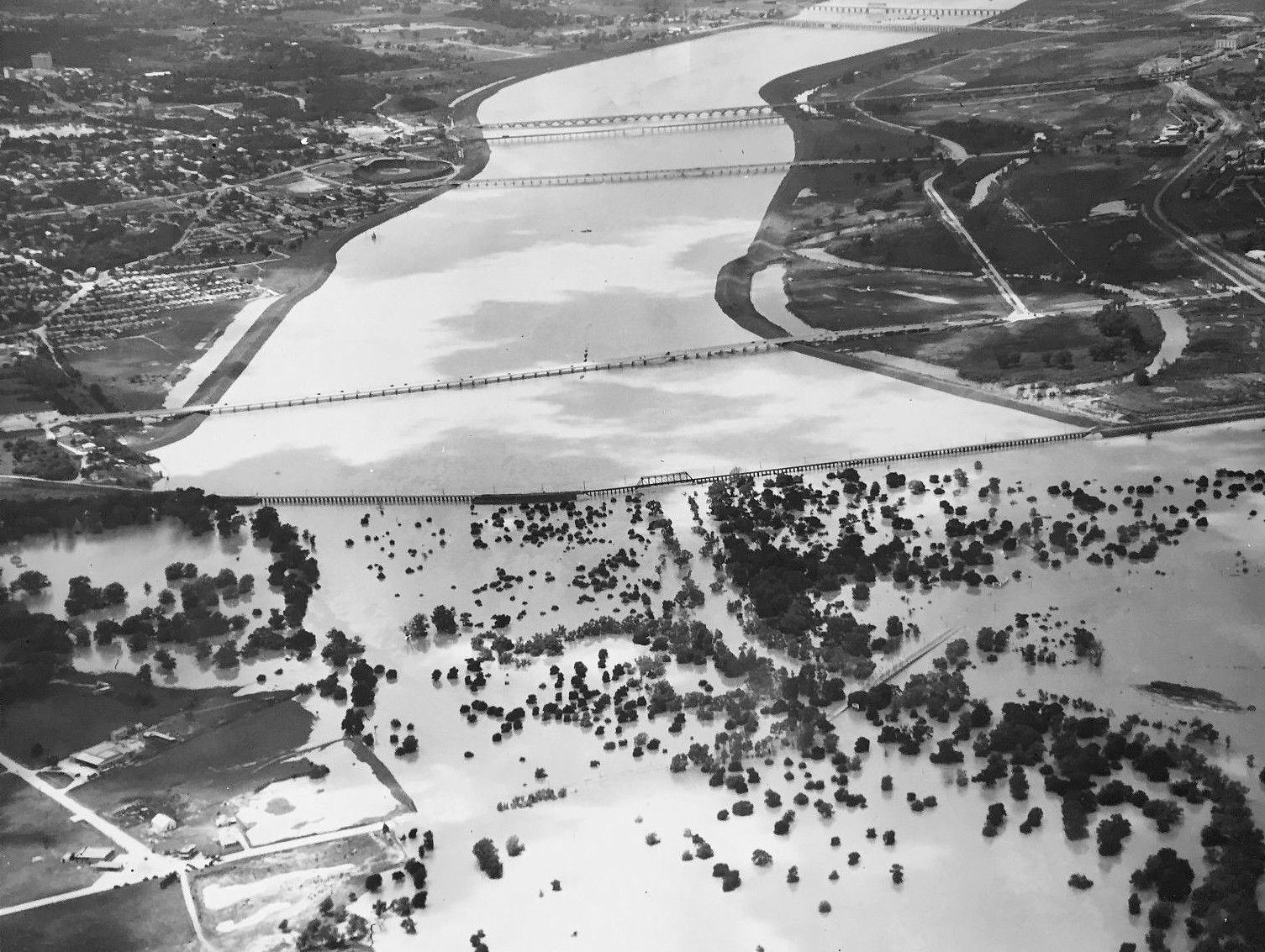
Sometimes the Trinity River is a puny little trickle, sometimes it’s a raging torrent. Here are aerial photos taken from around Forest Avenue (now MLK Blvd.) by Lloyd M. Long, showing the major flooding of May, 1935.

Here is the lead sentence from The Dallas Morning News, May 21, 1935 (the day after these photos were taken):

With sections of South Dallas inundated for the first time since the record 1908 flood, numerous bridges and highways and thousands of acres of lowlands hidden by its swirling, muddy currents, the roaring Trinity slowly was receding Monday night at Dallas after reaching a crest of 42.10 feet at 11 a.m. (DMN, May 21, 1935)

flooding-levee-district-from-forest-ave_lloyd-long_052035_ebay

There was great rejoicing that that the new-ish levees had held the waters and prevented the wide-scale flooding seen in 1922. But once you got to the Forest Avenue bridge (which ran below the Corinth St. viaduct and the Santa Fe railroad trestle), things got real bad real fast. In the photo above, the levee protection ends exactly at the railroad trestle — the Forest Avenue bridge is mostly underwater. The river above the trestle: a beautiful feat of engineering; below: water, water everywhere.

Below the Forest Ave. bridge where the levee protection ended, flood conditions were far worse than those created by the 1922 inundation. (DMN, May 21, 1935)

Again, sometimes the Trinity is just a trickle….

***

Sources & Notes

Both photos (by Lloyd M. Long) are from 2017 eBay auctions: the top photo here, and the bottom photo here.

More on Dallas flooding can be found in these Flashback Dallas posts:

  • “The Nellie Maurine: When a Pleasure Boat Became a Rescue Craft During the Great Trinity River Flood of 1908,” here
  • “One of the Victims of the Great Trinity Flood: The T & P Railroad Trestle — 1908,” here
  • “The Trinity River at the City’s Doorstep,” here
  • “Cole Park Storm Water Detention Vault,” here

Maybe it’s just me, but I was really taken with that little L-shaped building in the top photo which was, briefly, its own island. What was it? It was part of the Guiberson Oil Well Specialty Corporation, founded in 1919 at 1000 Forest Avenue — the building seen in the photo was built in 1926. It’s still standing (here) and appears to be part of Faubion & Associates, a manufacturer of retail display cases and store fixtures.

Click photos to see larger images.

*

Copyright © 2018 Paula Bosse. All Rights Reserved.
Happy 4th Anniversary, Flashback Dallas!

tx-centennial_stamp_cook-coll_degolyer_SMU

by Paula Bosse

This weekend marks the fourth anniversary of this blog. It’s hard to believe, but, completely coincidentally, this is my 1,000th post! That’s a lotta Dallas. (Some might argue that’s too MUCH Dallas….) There are now just over 9,000 Flashback Dallas followers across various social media platforms, and it’s always nice to know there are others out there who share my interest in Dallas history. Thank you to all who read, follow, share, and comment. It wouldn’t be as much fun if I were just typing for myself.
Thank you! And now, Year 5!

–Paula

***

Sources & Notes

“Texas Centennial Exposition Stamp” from the George W. Cook Dallas/Texas Image Collection, DeGolyer Library, Central University Libraries, Southern Methodist University; more information on this image can be found here.

*

Copyright © 2018 Paula Bosse. All Rights Reserved.