Flashback : Dallas

A Miscellany: History, Ads, Pop Culture

Category: 1940s

Hunting Pecans in the Park
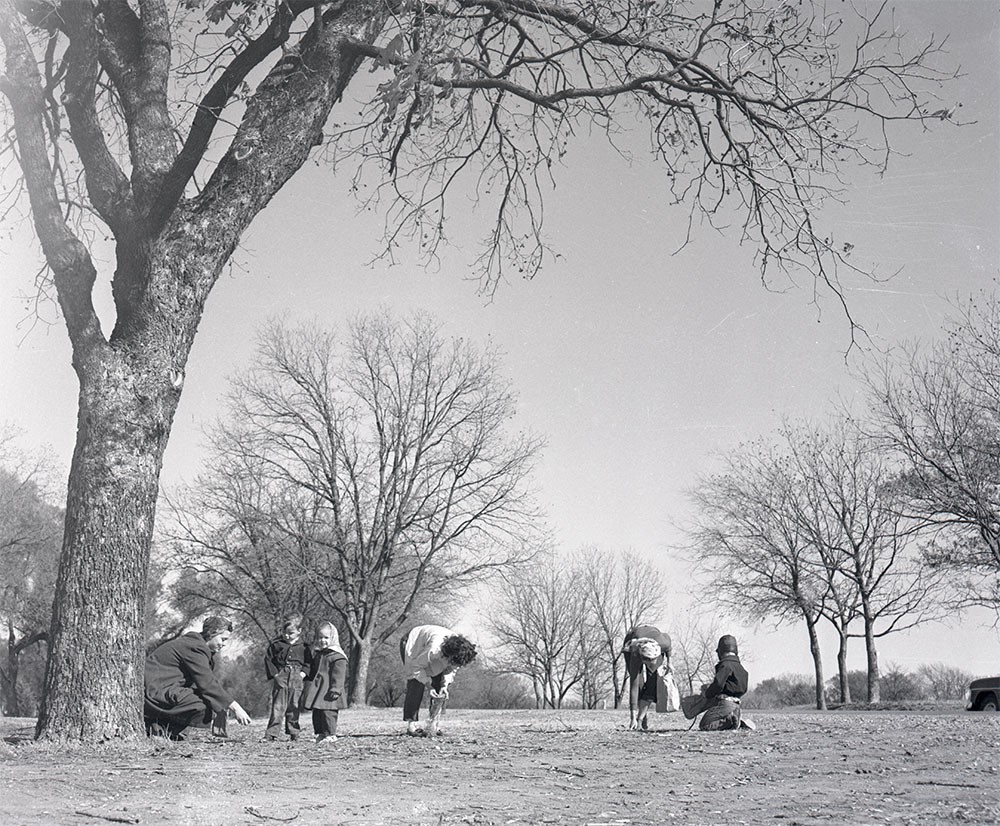
On a nut-meat mission, White Rock Lake Park, 1952

by Paula Bosse

A few days ago, the Dallas Public Library posted a version of the mural below on its social media accounts. The title of the mural is “Gathering Pecans” by Dallas artist Otis Dozier. It was painted in 1941 as a New Deal federally commissioned work to hang in the Arlington Post Office (it now hangs in the Amon Carter Museum in Fort Worth). I love this mural — not only because I’m a fan of Dozier’s work, but also because it captures something that was once a common practice for families: going to a public place like a park (or as seen in the mural, somewhere along the side of the road) and picking up pecans.

Amon Carter Museum of American Art

When I was a child, my mother used to take me and my brother to White Rock Lake Park (or occasionally to Reverchon Park) to gather pecans. It was fun. Like a really easy Easter egg hunt with really small eggs. The 1952 photo at the top predates my own time hunting for fallen pecans, but I swear, that could be me, bundled up in a coat and scarf, having fun with my family on a crisp, sunny day.

We’d pick up the nuts (so. many. pecans…) and drop them into a paper sack. Then we’d take them home and lay sheets of newspaper on the dining room table, and the whole family — including my father and aunt — would spend an afternoon cracking pecans and picking out the “meat” with special nutcracking instruments. Next stop: a delicious dessert. I absolutely loved all of this.

I asked my (much younger) co-workers if they ever did this — went to a park to gather pecans. There were a couple of vague “…maybe?…” responses, but most had never heard of such a thing. How sad!

If your family doesn’t do this, consider it. It’s one of my favorite fall memories. And you’ll get an almost-free pecan pie out of it!

Just remember: picking up fallen pecans from the ground in a public park is okay (I think), but shaking branches or disturbing trees to make pecans fall is NOT allowed (and might also lead to a fine). Here are some boys sitting next to a sign that says “Please! Threshing Prohibited.” See those long sticks they’ve got? When that photographer leaves, they’re going to be “threshing.”
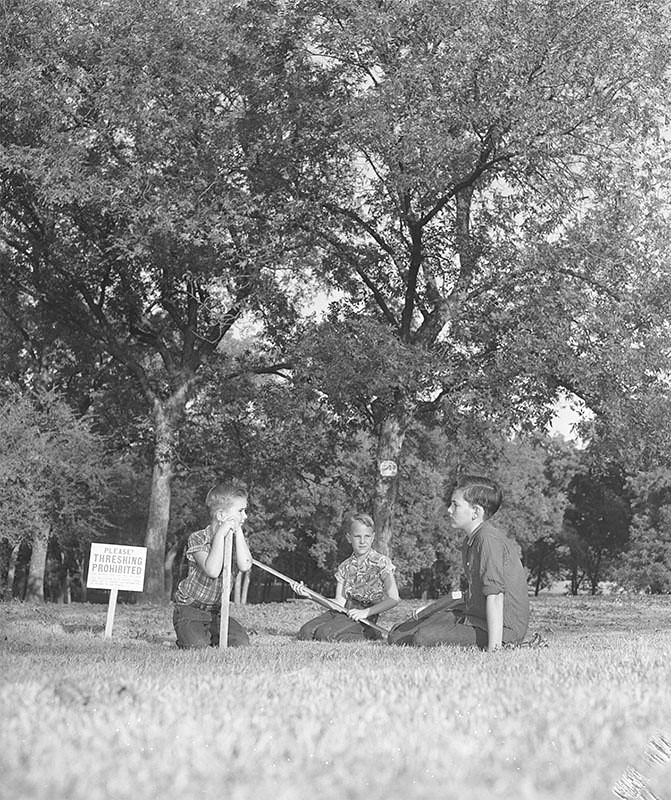
Don’t do it! Please! Hunt on the ground.
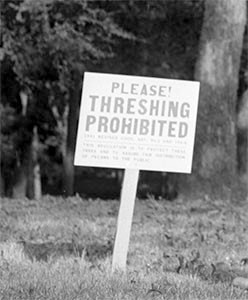
And don’t wander onto private property unless you have permission. Don’t be like Dinks McClain! He might have been acquitted, but he had to go through a lot of nut-based hassle to be a free man again!
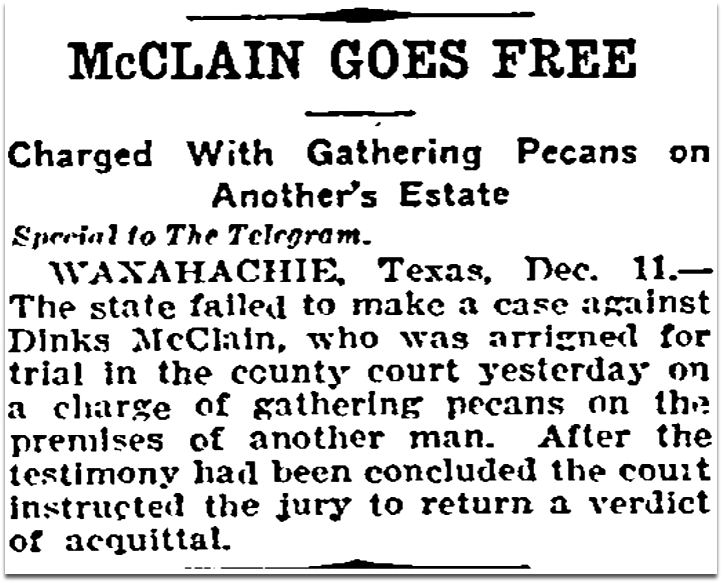
Fort Worth Star-Telegram, Dec. 11, 1907

*

Poaching nuts from private property is not the only thing to beware of. If you browse through the Dallas Morning News and Fort Worth Star-Telegram online archives using the search term “pecan gatherers” or “gathering pecans” or “hunting pecans,” etc., you will see an absolutely eye-popping number of articles about severe injuries and death (!) suffered by people just innocently out looking for some pecans. Lots of people fell out of trees (STAY ON THE GROUND!!), lots of people were shot (in a variety of scenarios), someone drowned, I think (…interesting), and snakes were everywhere. Avoid all these things. And don’t trespass. Don’t be a Dinks McClain. Stay on the ground, stay on public land, and stay away from errant bullets and snakes.

**

Lastly, here’s a 1926 newspaper article (all sub-headlines included!) all about this vanishing tradition:

GYPSY CALL OF THE FALL WOODS HEARD BY DALLAS MOTORISTS 

Autumn Leaves and Pecans on Dallas Roads Are Popular 

Autumn Tang Brings Forth Many Drivers 

Roads Near Dallas Are Crowded on Week-End Afternoons

Seek Fall Leaves 

Decorations and Pecans Are Gathered to Take Home 

Autumn has failed to chill the ardor of Dallas motorists. On the contrary, they are attracted by the briskness of a fall afternoon drive and by the flaming beauty of autumn leaves or the promise of pecans on and under wayside trees. 

Now that the early nights prevent the after-dinner twilight rides of the late summer, Dallasites are saving their drives for week-end and holiday afternoons. On Saturday and especially on Sunday afternoons thousands of local motorists are driving on country roads near Dallas or through the more woodsy of the parks and city addresses to view the beauty of the changing autumn. Others go with the practical motive of finding pecans, and many of these are rewarded.

Roads Are Near

On Saturday afternoon the more popular roads leading from Dallas are crowded with automobiles. No matter in what part of Dallas the motorist lives, he can find a thoroughfare near his home, leading to woods colored by the approach of winter. White Rock Lake, South Beckley avenue, the Holmes street road, Stevens Park, Reverchon Park, Oak Lawn Park, Turtle Creek Boulevard, the Maple avenue road and the Lemmon avenue road are some of the favored drives. On them the motorist will find autumn beauty in profusion.

Many Dallas hostesses are using the gorgeously colored fall leaves as decorations. Even when the motorists are not planning to entertain at home, many take back bunches of the leaves to bring some of the fall color into living and dining-rooms.

Perhaps the most popular fall tree is the sumac, whose scarlet stands out against the darker red and the brown of other leaves. Seen from the roadside, the brilliant leaves have provided an irresistible attraction to stop and gather some to many automobilists. Ash, oak and darker leaves also make their gypsy calls from the woods.

Find Pecans 

Pecans as well as decorative leaves are found in many directions from Dallas. Those motorists fortunate enough to have friends with a farm or estate along a water course are making the most of their friendships, while others are forced to rely upon finding trees on unposted land or by the roadside. Most of the pecan hunters are rewarded with enough of the nuts to crack and pick out on the ride back, though fee are able to get a supply sufficient to last through the late fall evenings by the fire.

The brisk coolness of the autumn week-end afternoon, made golden by a pleasant ineffectual sun, not only has not discouraged Dallas automobilists, but the tang of the fall has brought out many who took only short drives during the summer. (Dallas Morning News, Nov. 7, 1926)

***

Sources & Notes

The top photo was taken in November 1952 and is from the Hayes Collection, Dallas History & Archives, Dallas Public Library (PA76-1/11502.2). The description accompanying the photograph: “Hunting pecans at the north end of White Rock Lake are B. B. Rakestraw of Tyler, left, and J. T. White of 7322 Benning. The crisp Fall weather was bringing pecan meat lovers out throughout the city. High winds helped solve the problem of getting nuts.”

The second photograph was taken October 16, 1953 and is also from the Hayes Collection (PA76-1/16051.1). The description of this photo: “Tommy and Danny Wheeler waiting for pecans to fall.”

“Gathering Pecans” is a post-office mural by Otis Dozier (1941); the image reproduced here is from the collection of the Amon Carter Museum of American Art, Fort Worth, Texas — more info is here.

Watch this short film from the Amon Carter Museum on the mural’s relocation and restoration:

*

Pecan tree trivia: in an Oct. 15, 1950 DMN article (“Plenty of Pecans Await Searchers at Dallas Parks”), it is noted that, in 1950, there were approximately 20,000 pecan trees in Dallas parks — half of them were in White Rock Lake Park.

*

Copyright © 2025 Paula Bosse. All Rights Reserved.
An Artist’s Conception of a Future Dallas

Vision of a new downtown library…

by Paula Bosse

I came across a collection of drawings recently that I think are just fantastic. They show what Dallas could be if we all just want it enough. The captions are giddy and exuberant, with the exhortation “Let’s build for the future.” It’s the sort of Chamber of Commerce boosterism which is a Dallas mainstay. Dallas dreams big and bold.

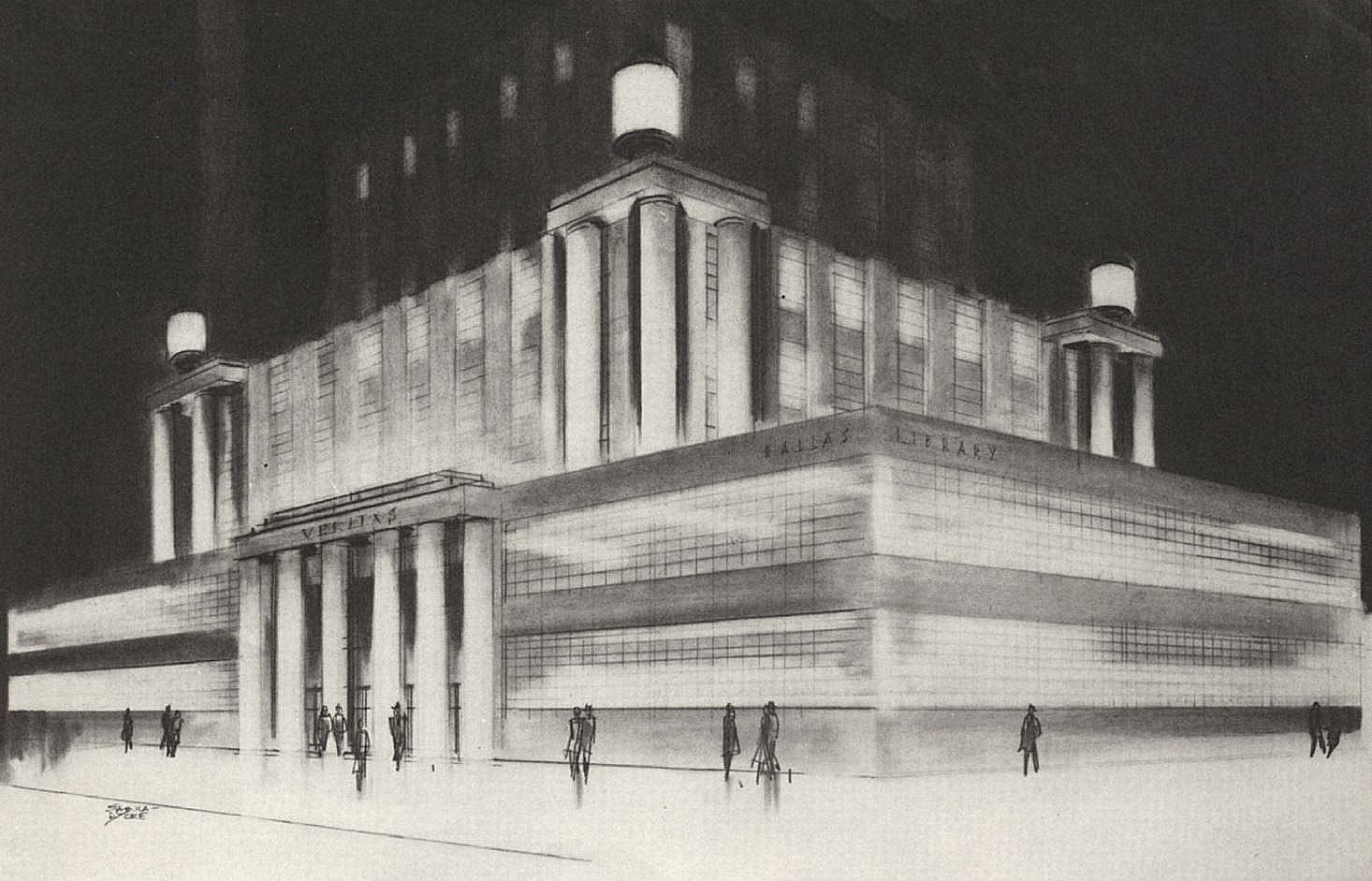
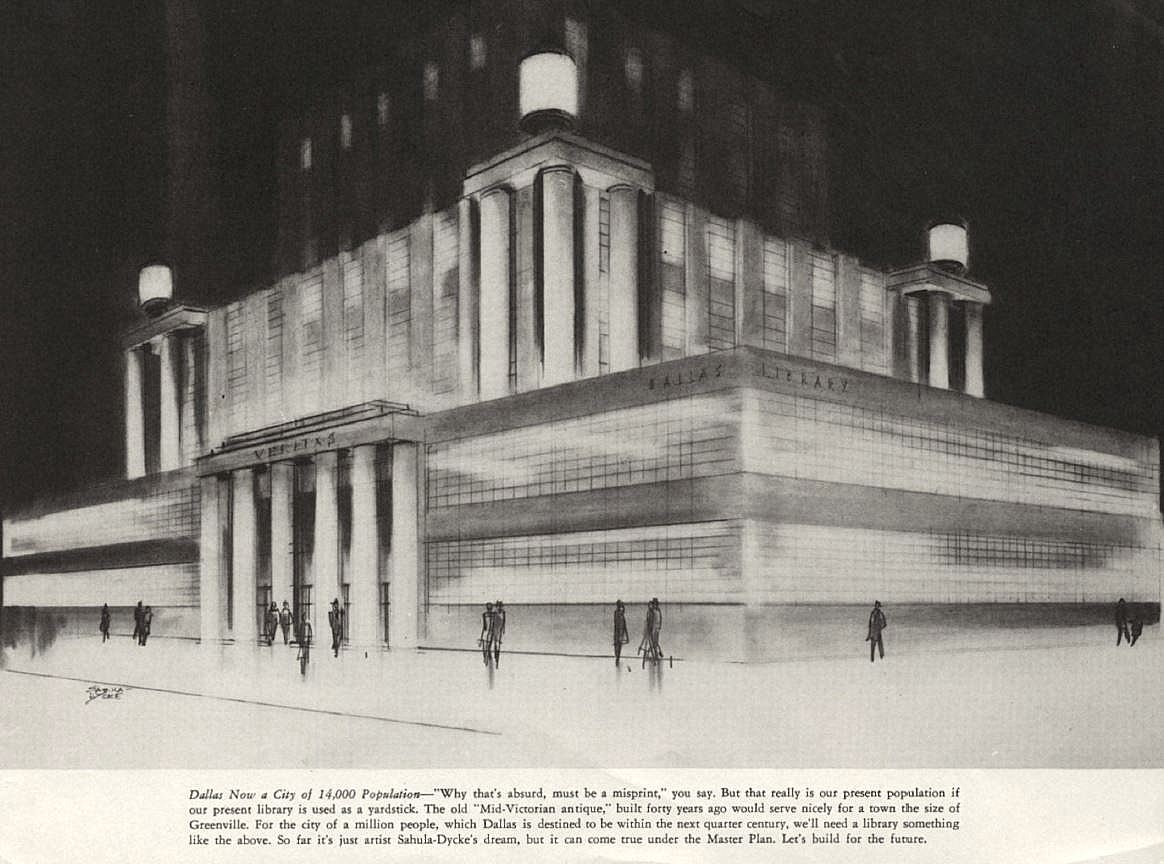
It’s not the ideas that I find so intriguing (although, they’re interesting), it’s the artwork. These drawings are great. The monumental, Deco-ish buildings exude a quiet power. Most of them are set against a dark sky, which adds extra awe-inspiring heft. I really, really love these drawings. It’s a shame most of these conceptions remained just that. I would have loved that library (above)! The artist is Ignatz Sahula-Dycke — more about him at the end of this post.

The drawings are not dated, but my guess is late 1930s or very early 1940s. Promotional captions accompany each picture. Click to see full-screen images. Enjoy!

**

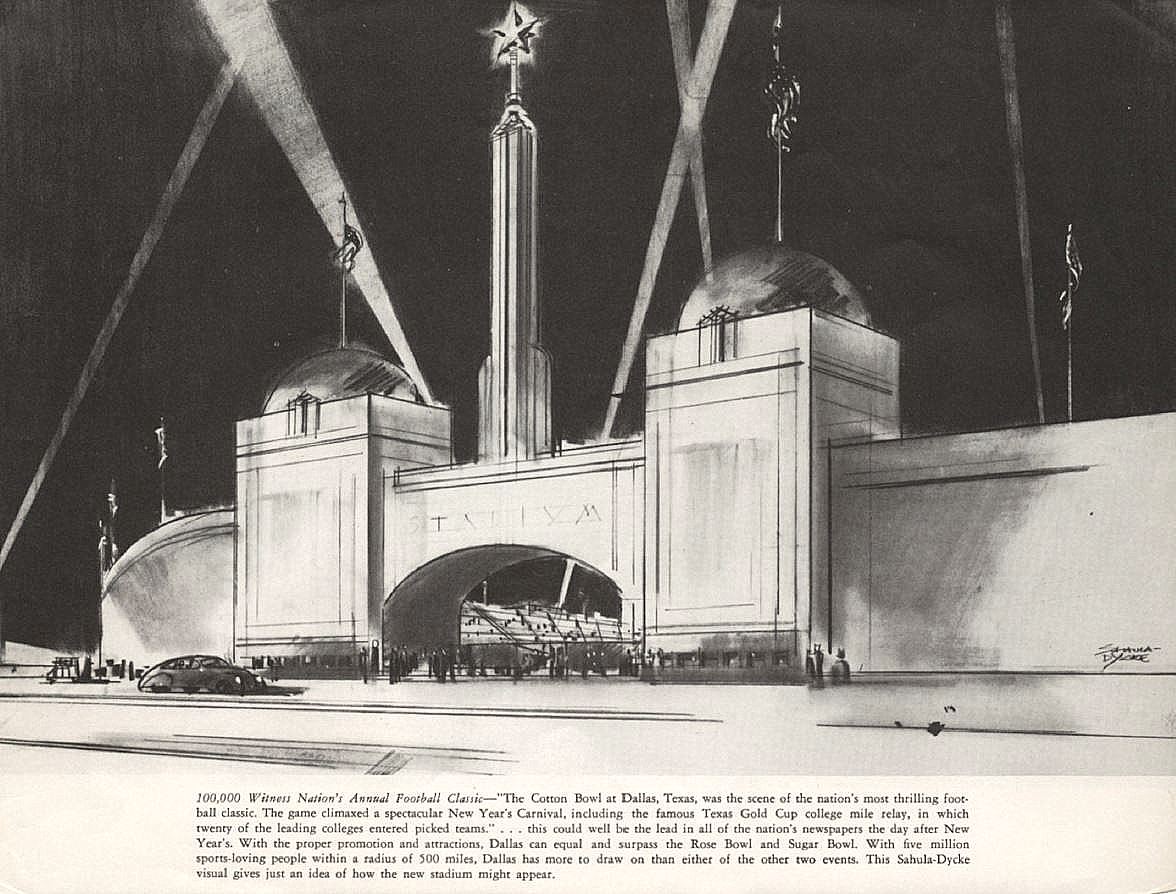
A NEW SPORTS STADIUM AT FAIR PARK

100,000 Witness Nation’s Annual Football Classic — “The Cotton Bowl at Dallas, Texas, was the scene of the nation’s most thrilling football classic. The game climaxed a spectacular New Year’s Carnival, including the famous Texas Gold Cup college mile relay, in which twenty of the leading colleges entered picked teams.” … This could well be the lead in all of the nation’s newspapers the day after New Year’s. With the proper promotion and attractions, Dallas can equal and surpass the Rose Bowl and Sugar Bowl. With five million sports-loving people within a radius of 500 miles, Dallas has more to draw on than either of the other two events. This Sahula-Dycke visual gives just an idea of how the new stadium might appear.

*

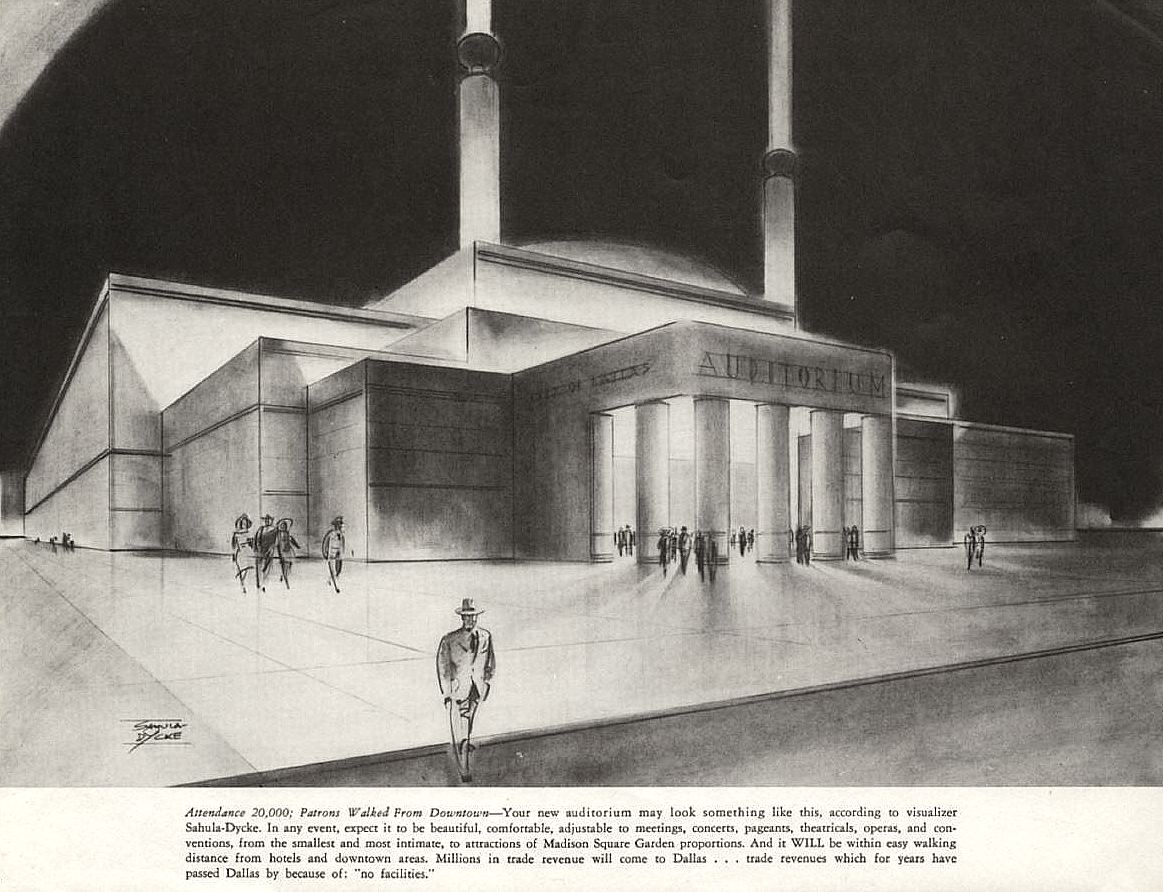
A CITY AUDITORIUM / CONVENTION CENTER

Attendance 20,000; Patrons Walked From Downton – Your new auditorium may look something like this, according to visualizer Sahula-Dycke. In any event, it’s expected to be beautiful, comfortable, adjustable to meetings, concerts, pageants, theatricals, operas, and conventions, from the smallest and most intimate, to attractions of Madison Square Garden proportions. And it WILL be within easy walking distance from hotels in downtown areas. Millions in trade revenue will come to Dallas… trade revenues which for years have passed Dallas by because of: “no facilities.”

*

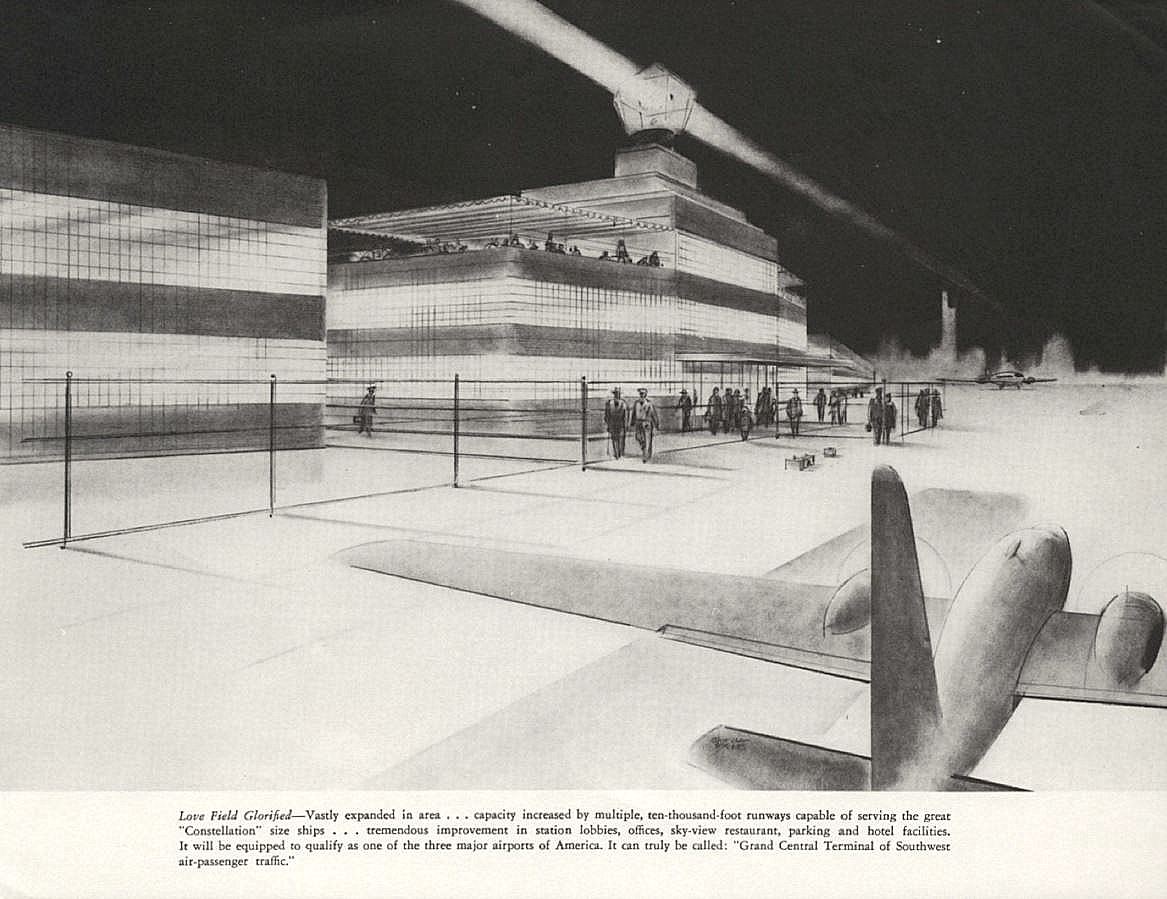
AN EXPANDED LOVE FIELD

Love Field Glorified — Vastly expanded in area… capacity increased by multiple, ten-thousand-foot runways capable of serving the great “Constellation” size ships… tremendous improvement in station lobbies, offices, sky-view restaurant, parking and hotel facilities. It will be equipped to qualify as one of the three major airports of America. It can truly be called: “Grand Central Terminal of Southwest air-passenger traffic.”

*

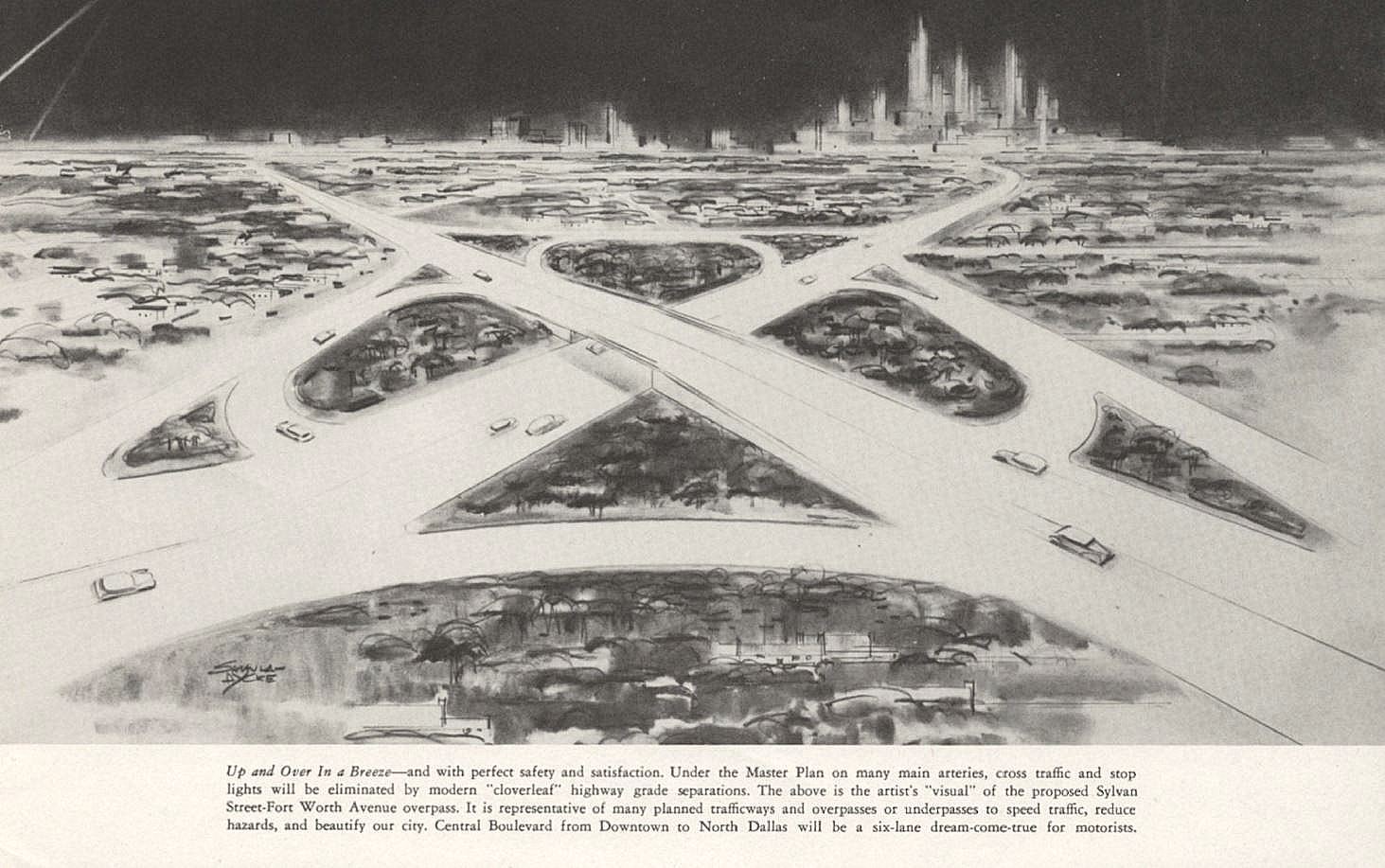
HIGHWAYS

Up and Over In a Breeze — and with perfect safety and satisfaction. Under the Master Plan on many main arteries, cross traffic and stop lights will be eliminated by modern “cloverleaf” highway grade separations. The above is the artist’s “visual” of the proposed Sylvan Street-Fort Worth Avenue overpass. It is representative of many planned trafficways and overpasses or underpasses to speed traffic, reduce hazards, and beautify our city. Central Boulevard from Downtown to North Dallas will be a six-lane dream-come-true for motorists.

*

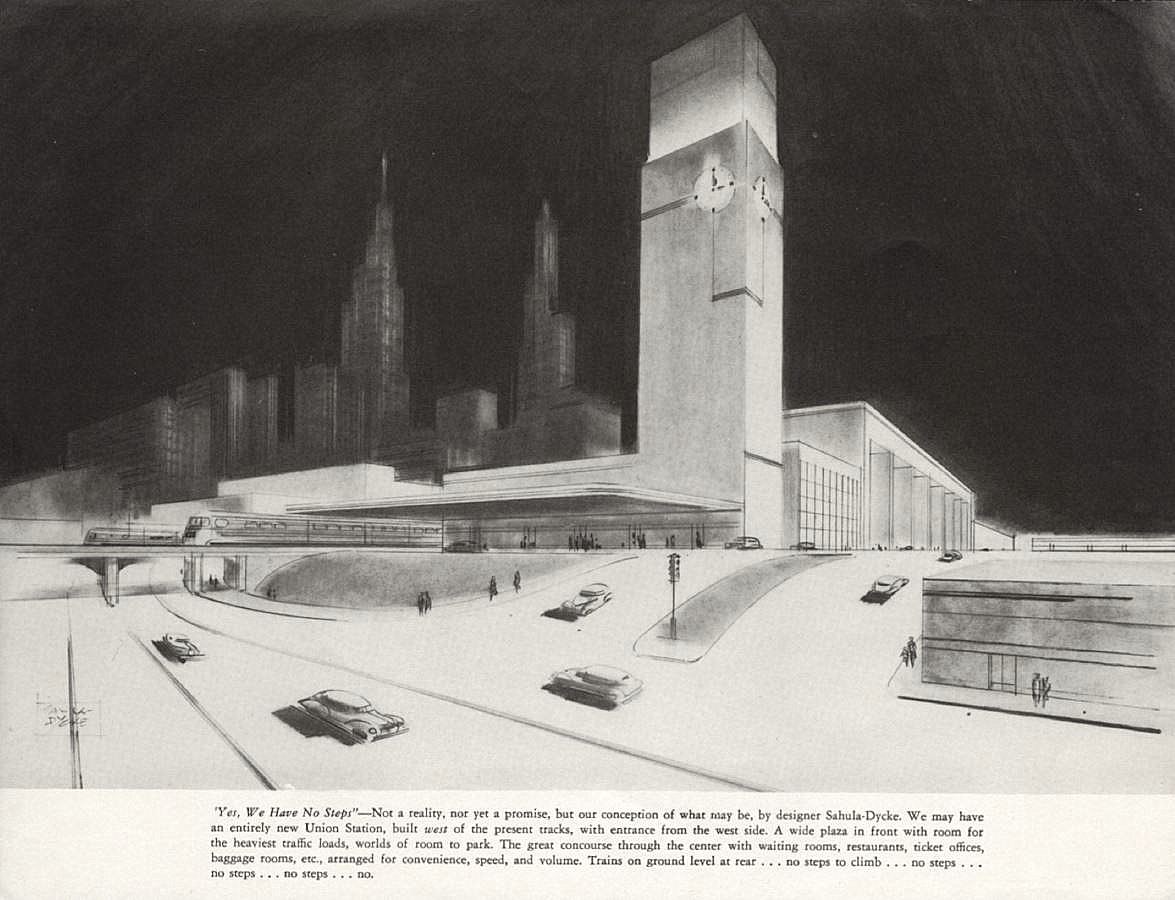
A NEW UNION STATION (…no steps!!!)

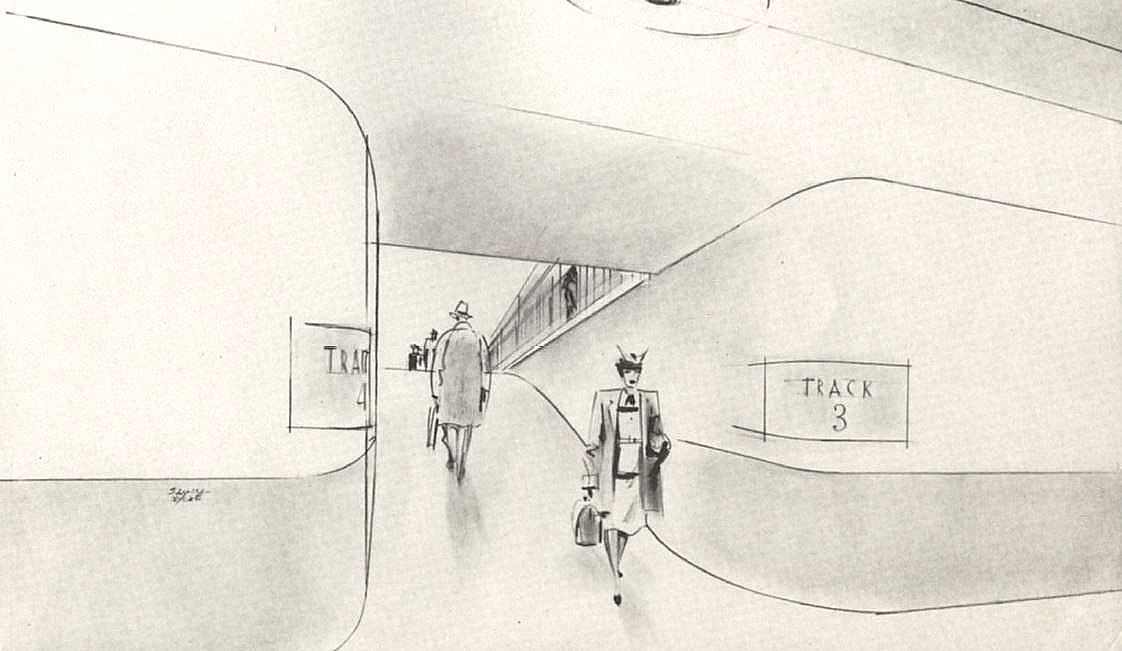
“Yes, We Have No Steps” — Not a reality, not yet a promise, but our conception of what may be, by designer Sahula-Dycke. We may have an entirely new Union Station, built WEST of the present tracks, with entrance from the west side. A wide plaza in front with room for the heaviest traffic loads, worlds of room to park. The great concourse through the center with waiting rooms, restaurants, ticket offices, baggage rooms, etc, arranged for convenience, speed, and volume. Trains on ground level at rear… No steps to climb… no steps… no steps… no steps… no.

*

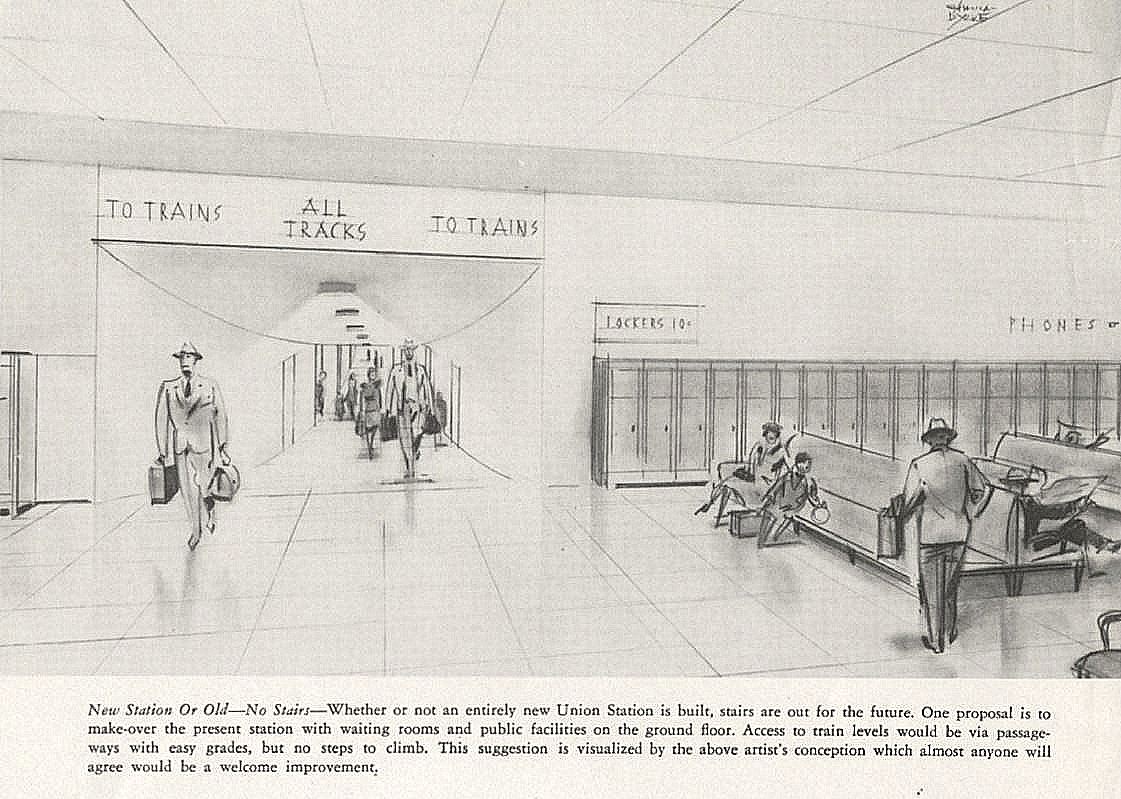
UNION STATION INTERIOR (…seriously, we mean it: NO STEPS!)

New Station Or Old — No Stairs — Whether or not an entirely new Union Station is built, stairs are out for the future. One proposal is to make over the present station with waiting rooms and public facilities on the ground floor. Access to train levels would be via passageways with easy grades, but no steps to climb. This suggestion is visualized by the above artist’s conception which almost anyone will agree would be a welcome improvement.

*

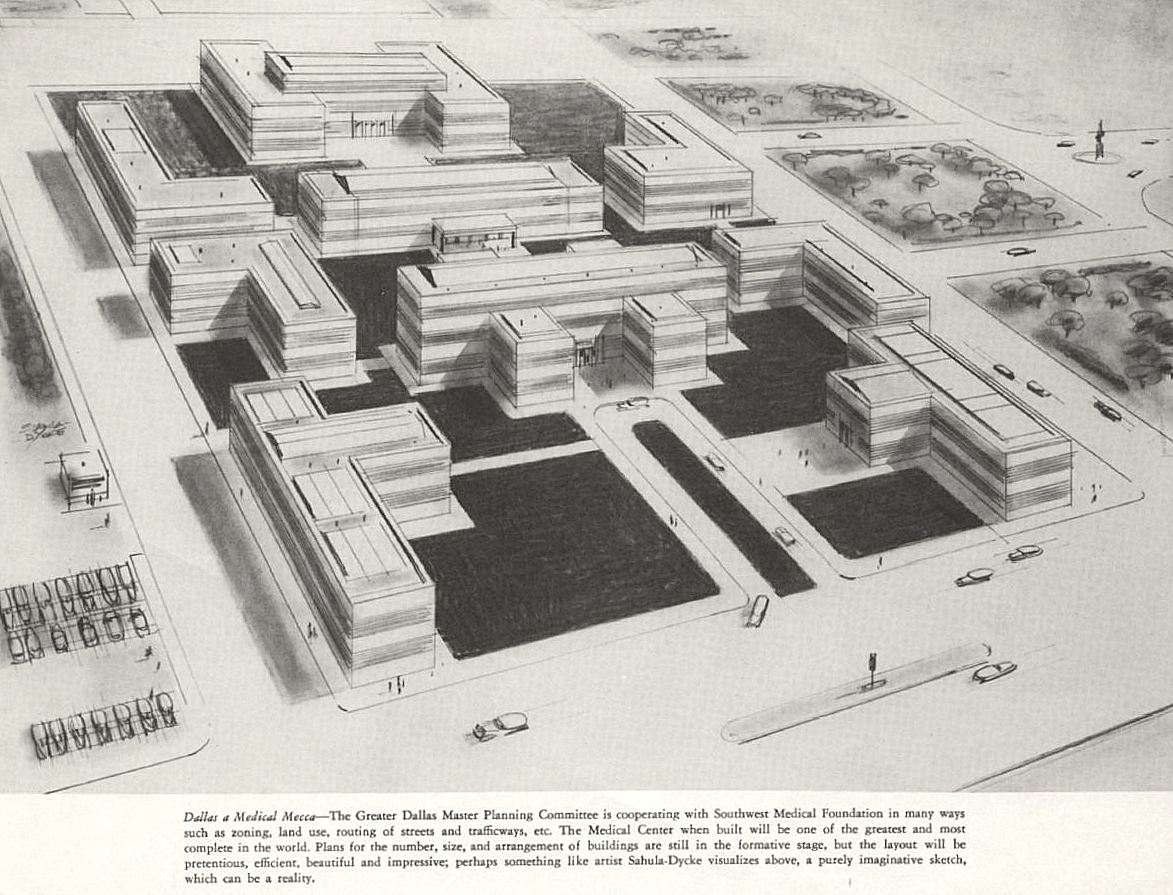
MEDICAL CENTER

Dallas a Medical Mecca — The Greater Dallas Master Planning Committee is cooperating with Southwest Medical Foundation in many ways such as zoning, land use, routing of streets and trafficways, etc. The Medical Center when built will be one of the greatest and most complete in the world. Plans for the number, size, and arrangement of buildings are still in the formative stage, but the layout will be pretentious, efficient, beautiful and impressive; perhaps something like artist Sahula-Dycke visualizes above, a purely imaginative sketch, which can be a reality.

*

CENTRAL LIBRARY

Dallas Now a City of 14,000 Population — “Why that’s absurd, must be a misprint,” you say. But that really is our present population if our present library is used as a yardstick. The old “Mid-Victorian antique,” built 40 years ago would serve nicely for a town the size of Greenville. For the city of a million people, which Dallas is destined to be within the next quarter century, we’ll need a library something like the above. So far it’s just artist Sahula-Dycke’s dream, but it can come true under the Master Plan. Let’s build for the future.

**

I don’t know the date of these drawings. My guess would be the late ’30s or very early ’40s. (The Union Station drawing shows a building that looks like the Mercantile Bank Building. Plans for the Mercantile were announced to the public in 1940.) In a Dallas Morning News article (“‘Greater Dallas’ Appeals Stir Chamber to Renewed Action,” DMN, Dec. 8, 1937), many of the things covered in the captions above were hot topics at the annual meeting of the Dallas Chamber of Commerce. A “Master Plan” was later developed by Harland Bartholomew in the early ’40s. After a break for the war, the plan was finally put before the voters in April 1945.

The plans changed some between 1937 and 1945, but the visions touted in the drawings above were similar to the plans accepted favorably by Dallas voters. (The one part of this Master Plan that failed — and which is not mentioned in the drawings — is the vote on whether to “unify” the City of Dallas by annexing the Park Cities and Preston Hollow. Everyone was all for it… except for Highland Park and University Park, who chose to remain unannexed.) See an ad that appeared in March 1945, a week before the election, listing all the things Big D was hoping to build and develop here

**

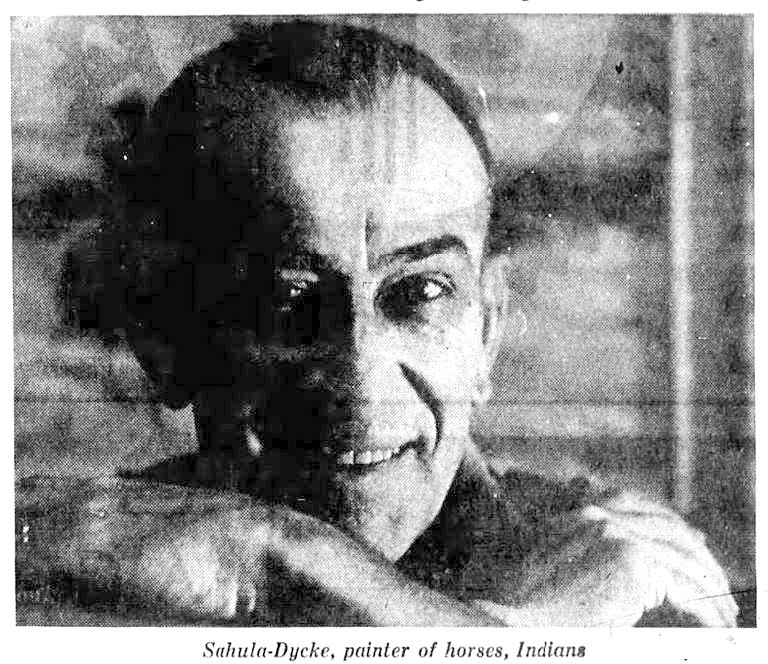
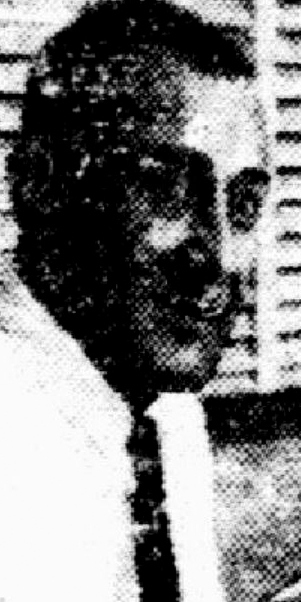
The artist of these conceptions was Ignatz Sahula-Dycke (1900-1982). Ignatz Sahula (known as “Iggie” to his friends) was born in Bohemia (Austria), near Prague, and immigrated with his family to the United States when he was a child. At some point he added his mother’s maiden name “Dycke” to his name — his mother was an artist and a descendant of 17th-century Flemish painter Anthony van Dyck. He studied art in Chicago and, after a stint in the U.S. Navy during World War I, worked for a variety of businesses as a commercial artist. He came to Dallas around 1937 and worked for many years at the Tracy-Locke advertising agency, eventually becoming Creative Art Director of the Dallas office. He actually left Dallas for a while to focus on his art but came back to Dallas a few years later and ended up working for Tracy-Locke for 14 years. His paintings and illustrations center around horses and Southwestern subjects such as desert landscapes and western themes. A good biography and photo of him can be found here, in an article from Western Art & Architecture.

Sahula-Dycke, 1950s

Santa Fe New Mexican, July 28, 1968

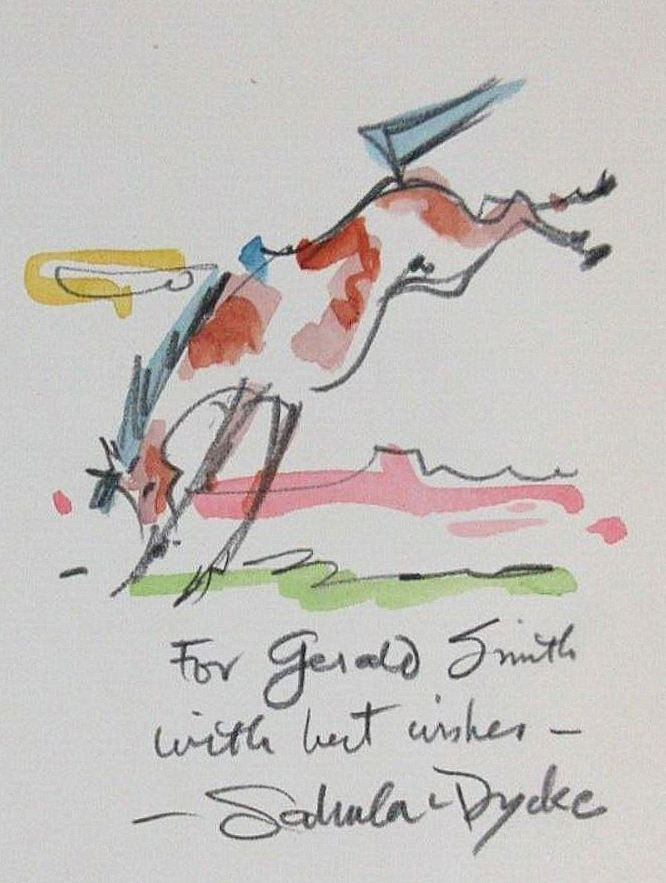
Iggie’s favorite subject was horses. Below is a little sketch he did when inscribing Alias Kinson, or The Ghost of Billy the Kid, a 1963 novel he wrote and illustrated, along with his author’s photo. (The back cover is here, complete with what may be a self-penned biography for this self-published book.)

***

Sources & Notes

All Dallas Master Plan images drawn by Ignatz Sahula-Dycke are from the Master Plan Vertical Files of the Dallas History and Archives, Dallas Public Library.

Inscription with watercolor-highlighted sketch and author photo are from an inscribed copy of Sahula-Dycke’s novel, Alias Kinson, currently listed on eBay.

A related Flashback Dallas post regarding Bartholomew’s Master Plan: “‘Your Dallas of Tomorrow’ — 1943.”

*

Copyright © 2025 Paula Bosse. All Rights Reserved.
Snow in Irwindell — 1940

Snow day in Irwindell…

by Paula Bosse

We have snow in Dallas! It’s always exciting for those of us who have grown up here and haven’t really experienced snow that many times in our lives. It’s pretty and magical and, unless you have to drive or walk in it, a welcome treat.

I came across this artwork back in 2018 and have been meaning to post it on a snow day. We’ve had snow since then, but I never got around to it until now. Better late than never.

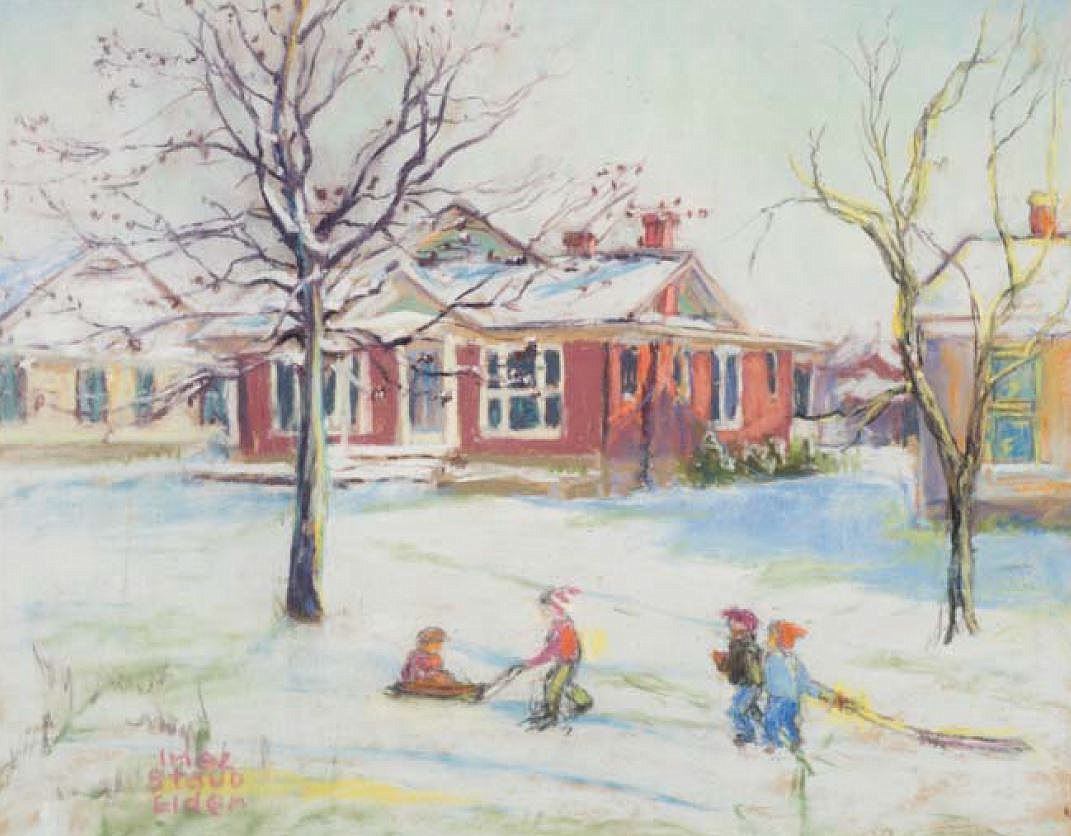
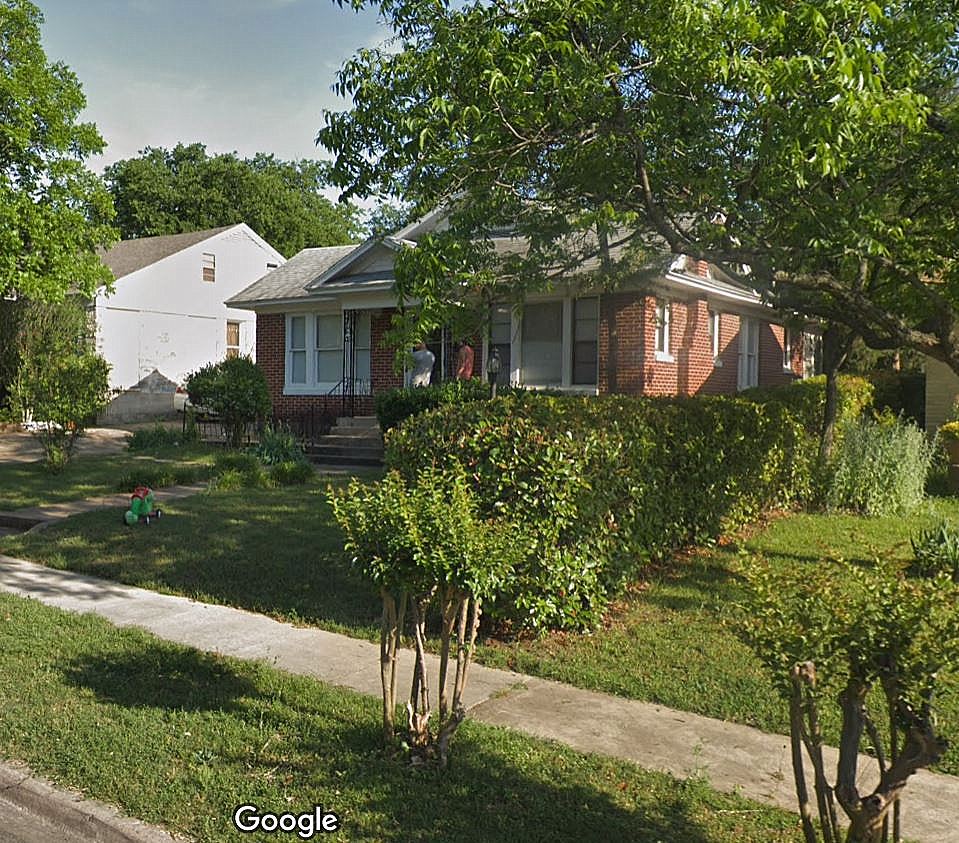
“My Dallas Home, 1940” (pastel on paper) is by Dallas artist Inez Staub Elder (1894-1991). It shows a snowy scene, with children playing, one of them on a sled. A house is in the background. One would assume from the title that the house was Inez’s house. Her address in 1940 — and for years before and after — was 3339 Gibsondell, in the Irwindell neighborhood of Oak Cliff. Looking at the house on Google Street View, it is apparent that 3339 is not the house seen in the drawing. I figured that if Inez was sketching a winter scene of her neighborhood, she might have done it inside, looking out a window. So I reversed the view from her home, and the house seen in the drawing is one across the street, at 3334 Gibsondell. The brick house has been painted gray, but the image below shows what it looked like when I was originally researching this, back in 2018 — still red brick.

The pictured house is here (Google Street View image from May 2018).

*

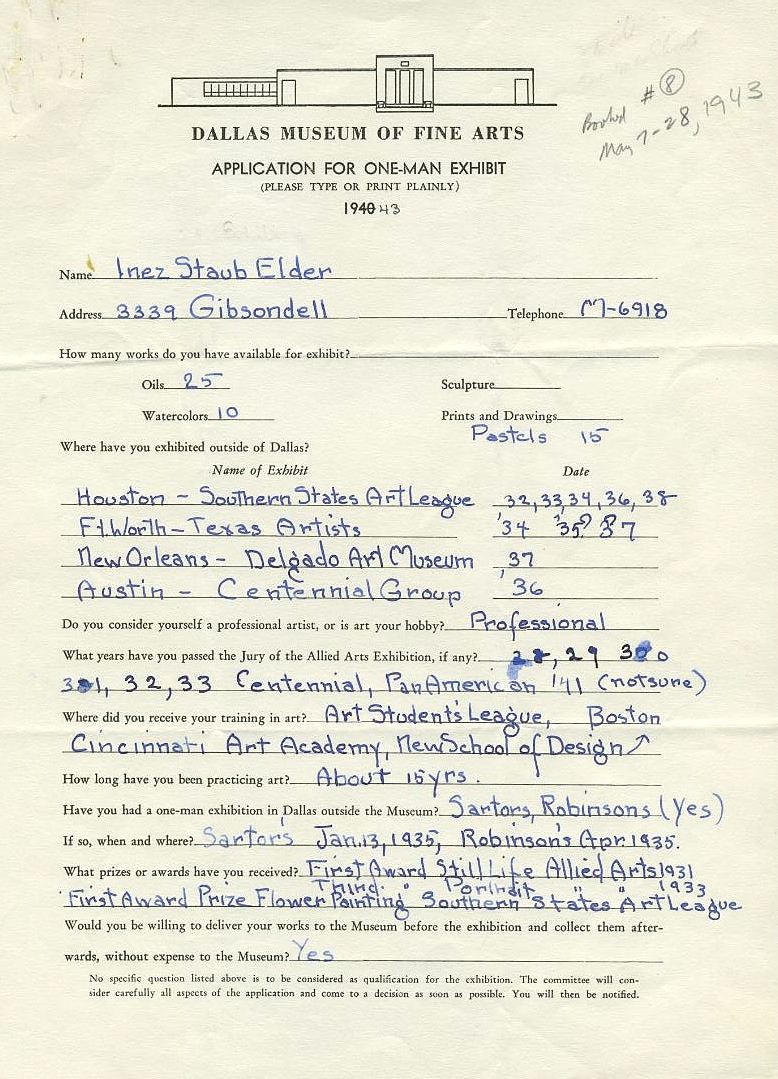
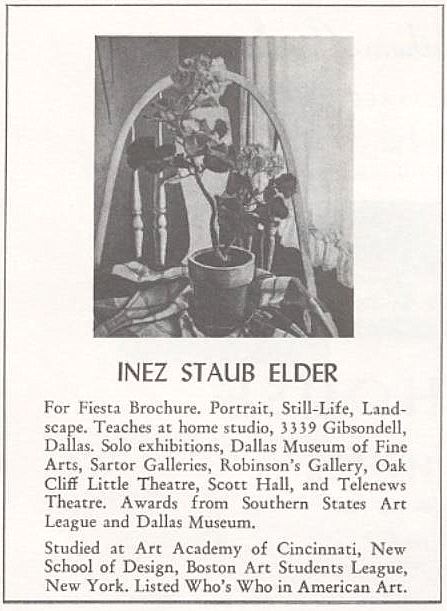
Inez Staub Elder, born in Ohio, lived in Dallas for decades. She regularly exhibited and also taught art. Below is an application she filled out for a show at the Dallas Museum of Fine Arts in 1943.

From a 1957 publication:

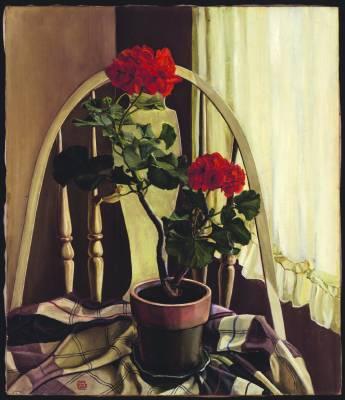
The geranium in color:

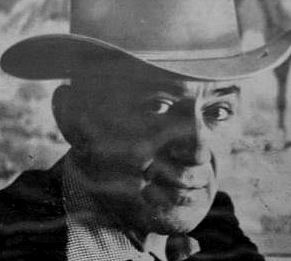
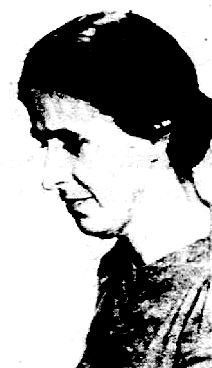
The only image I’ve been able to find of Inez Staub Elder, taken around the time of “My Dallas Home, 1940” is below.

***

Sources & Notes

Top image of painting by Inez Staub Elder titled “My Dallas Home, 1940” (pastel on paper) is from the David Dike Gallery catalog of the October 27, 2018 auction — this was lot 323.

The Dallas Museum of Fine Arts 1943 “Application for One-Man Exhibit” is from the Dallas Museum of Art Exhibition Records, Portal to Texas History, here.

The black-and-white image of the geranium is from the catalog “La Fiesta of Art, 1957,” Bill and Mary Cheek Collection, Portal to Texas History, here.

Color image of the geranium still life is from AskArt.

Read more about Irwindell/The Dells District at the Heritage Oak Cliff website.

*

Copyright © 2025 Paula Bosse. All Rights Reserved.
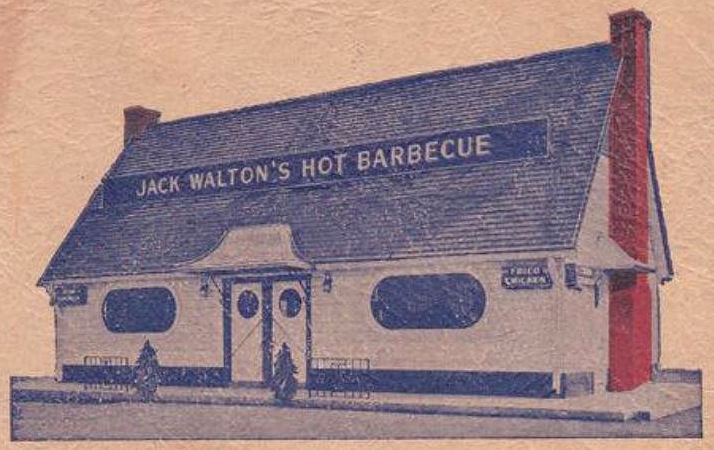
Jack Walton’s Hot Barbecue

jack-waltons-barbecue_bell-collection_DHS_ca-1946_3a
Restaurant No. 1, Haskell & San Jacinto…

by Paula Bosse

Arden Lee “Jack” Walton was born in Panola County (on his World War I registration card, he listed his home as Fairplay, Texas, which a town name I’m certainly glad to know exists). After the war, he moved to Dallas and opened his first restaurant — Walton’s Place — around 1925 or 1926. By the 1930s, he seems to have settled on barbecue as his primary specialty and had several of his self-named restaurants/drive-ins around town, branching out to Fort Worth in the early ’40s.

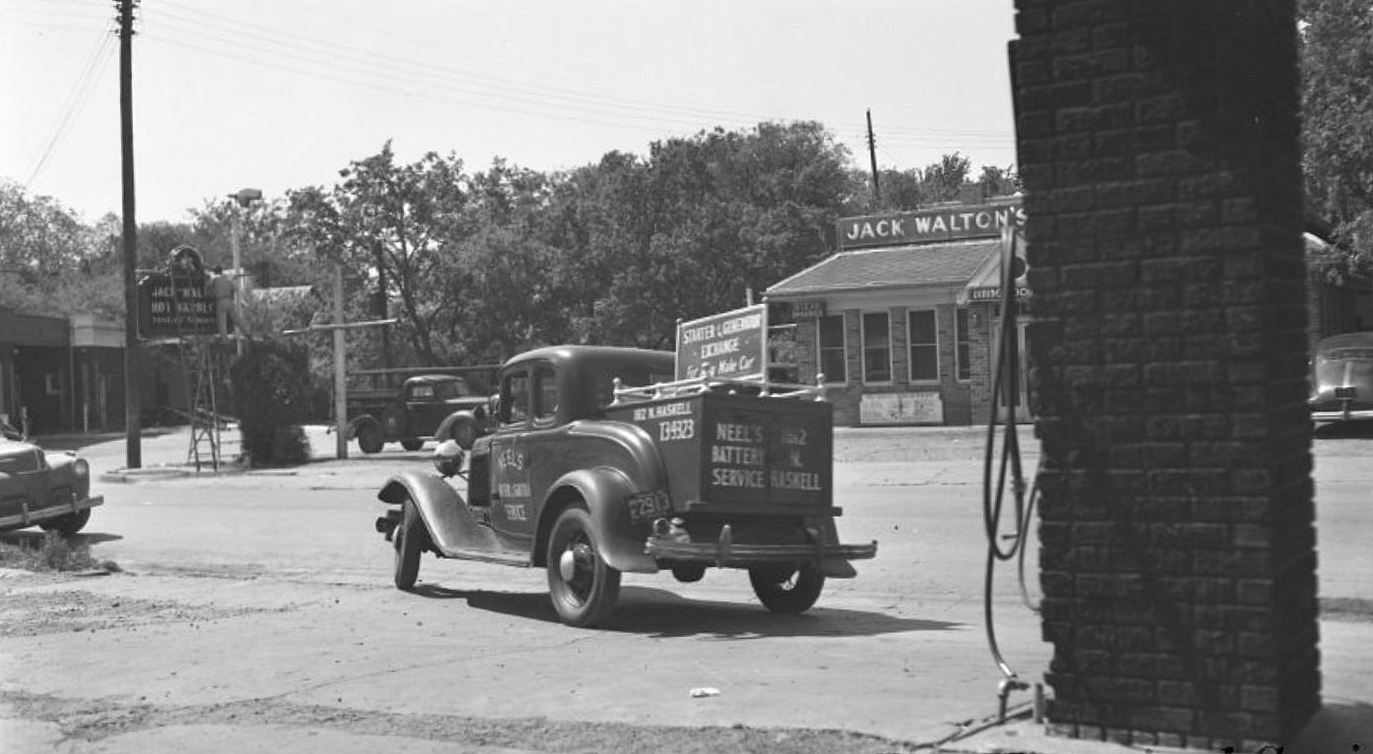
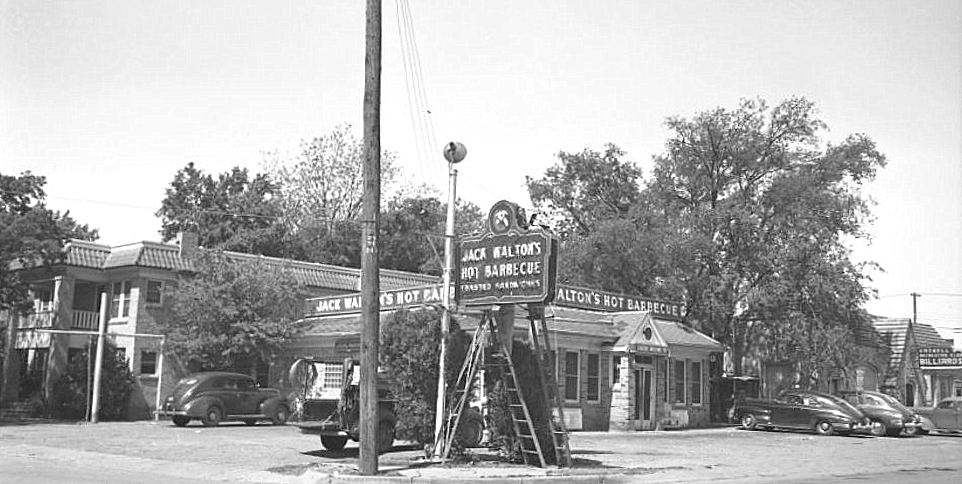
The photo above, from about 1946, is probably Walton’s first location, at Haskell and San Jacinto in Old East Dallas. The two photos below — showing a man working on the neon sign — were taken at the same time. (The photographer, James Bell, was a Dallas native back in town visiting — he took tons of unusual photos, often focusing on trucks, buses, cars, juke boxes, and various coin-operated machines. I’m sure he liked the look of the truck. They’re definitely amateur photos, but they’re great.)

jack-waltons-barbecue_bell-collection_DHS_ca-1946_2

jack-waltons-barbecue_bell-collection_DHS_ca-1946_1

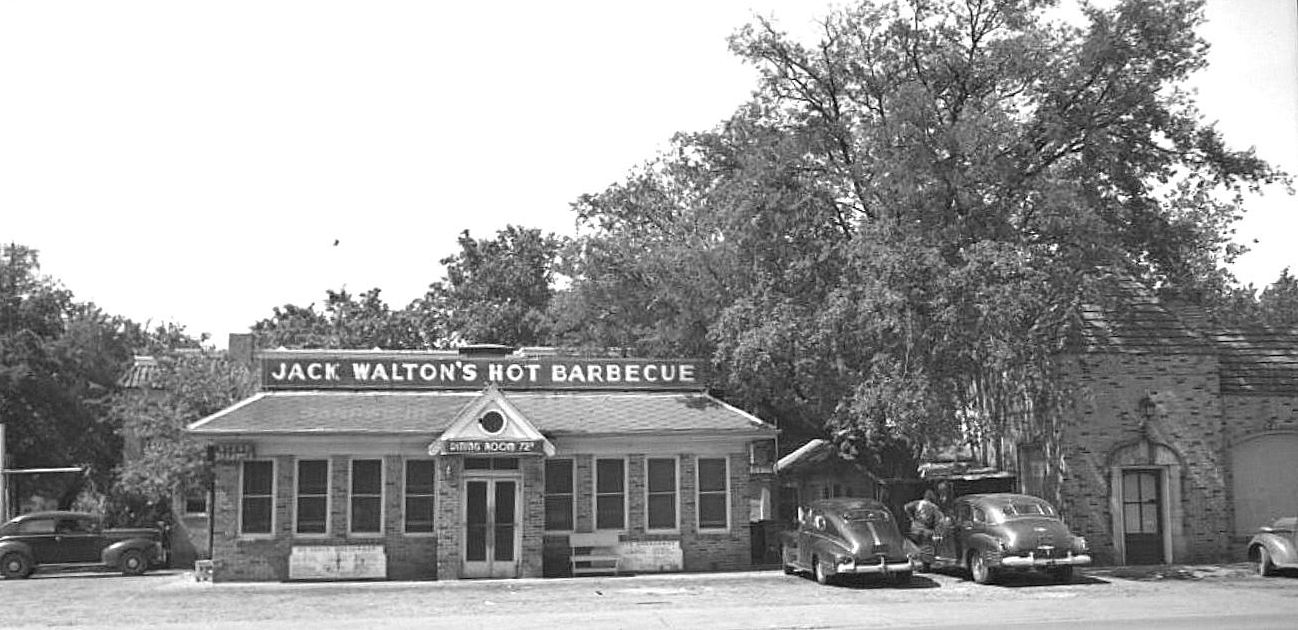
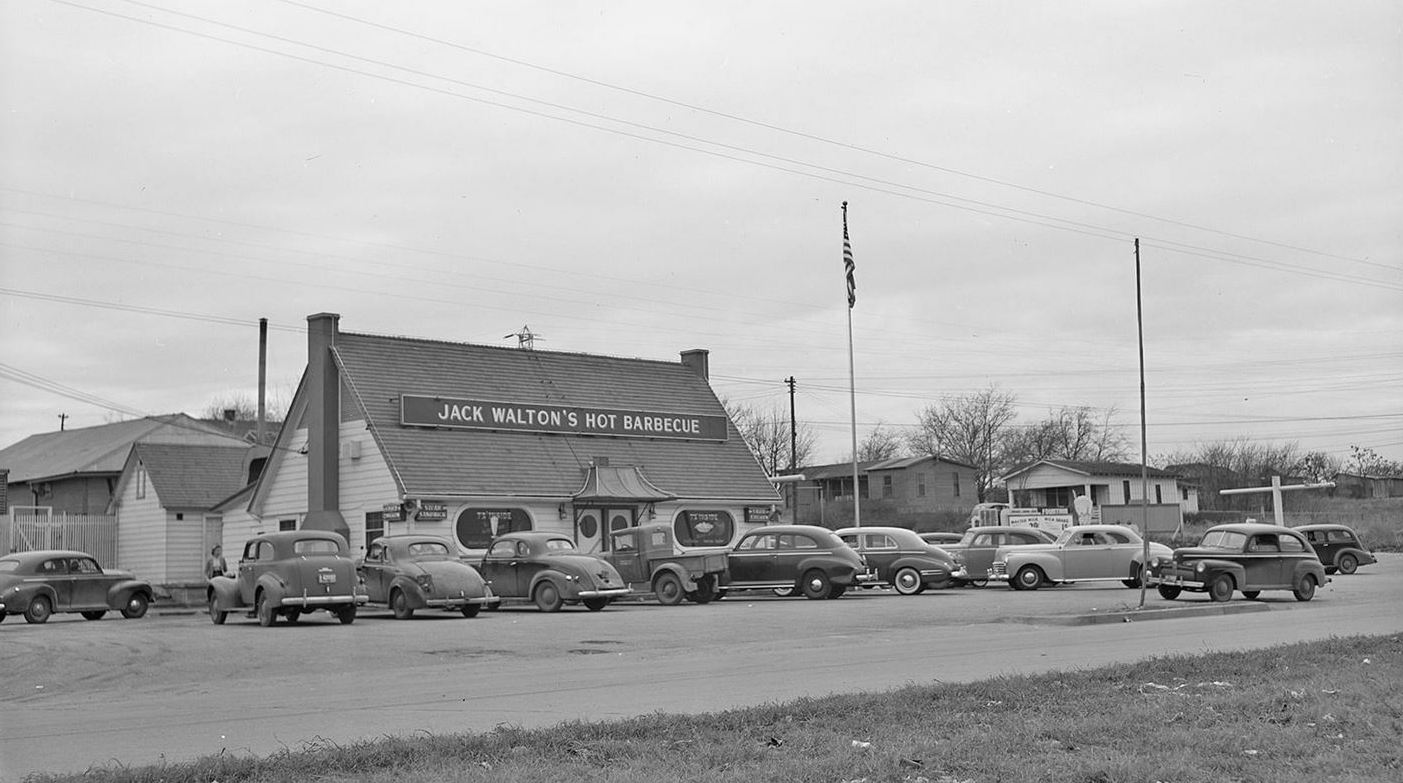
The photo that crops up on places all over El Internet (the photo below) is one which has a variety of conflicting information attached to it, including photographer, date, and location. As far as I can tell, I think the photo was taken by Arthur Rothstein in Fort Worth, in the very early ’40s (the FW location, at 1900 E. Lancaster, opened around 1940). I think most of the locations had a similar design. (See a typical menu here.)

jack-waltons-barbecue_traces-of-texas_arthur-rothenstein_ca-1943_cropped

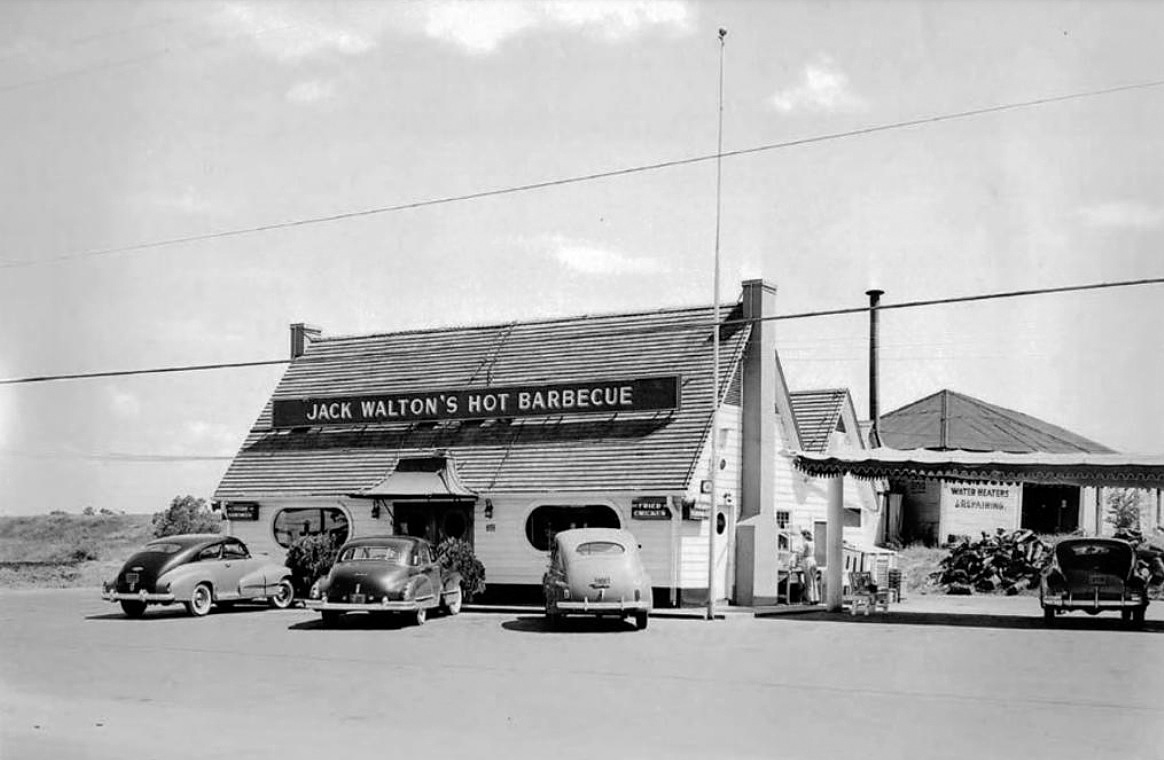
Here’s another photo (location unknown):

jack-waltons-hot-barbecue_smokelore_bookfrom the book Smokelore

jack-waltons-barbecue_worthpoint_menu-back

jack-waltons-barbecue_worthpoint_menu-front

Walton was very successful in his toasted sandwich endeavors (he also made some savvy real estate deals). When he died, he was described as “the barbecue baron of Dallas.”

…When he died. Jack Walton died on Feb. 19, 1960, at the age of 62. He was visiting one of his restaurants, at Tom Field Circle and Hwy. 183. The manager — Jack’s brother-in-law — had been drinking on the job, and Jack fired him on the spot. So the brother-in-law shot him, telling the police later that Walton “started fussing at me and told me to get out.” He shot him at close range, so inebriated that only two of the shots hit their target. He was DOA at Baylor. (Read the AP wire story here.)

At least one of Walton’s restaurants was taken over by the Semos family — the Haskell location lasted under non-Walton management for quite a while.

*

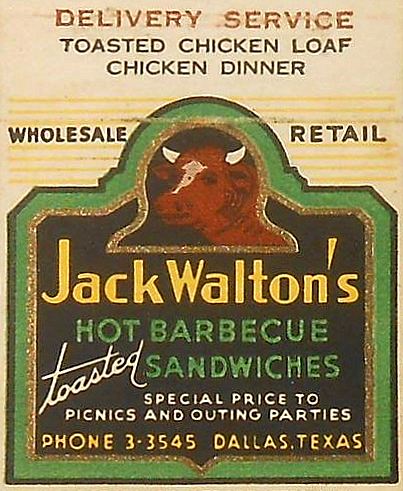
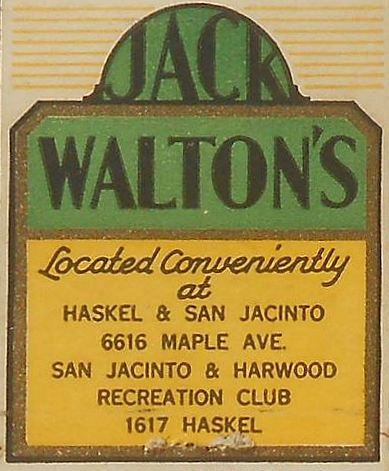
When I saw this matchbook cover several years ago, I was quite taken with the phrase “toasted chicken loaf.” What was a “chicken loaf”? I have to say, it didn’t sound that appetizing.

jack-waltons-BBQ_matchbk_1

jack-waltons-BBQ_matchbk_2

Chicken loaf was (apparently) a very popular food in days gone by, similar to meat loaf (it was made with chopped, shredded, or minced chicken, eggs, breadcrumbs/rice/some sort of cereal, etc., with the addition of hard-boiled eggs and/or pimentos and/or peas and/or whatever else was lying around). There are lots of ads in newspapers beginning around 1900 showing it as a “potted” meat, sold in cans alongside Underwood Deviled Ham and Vienna sausages, etc. I can understand this as a cost-saving meal during the Depression, but it was also very popular in restaurants (several local restaurants advertised that they sold entire take-out “loafs”), and it was a favorite of many as a Sunday dinner (or as a way to use leftover chicken in the pre- and post-casserole days). By the ’40s, recipes started adding the dreaded gelatin (“Jellied Chicken Loaf”). Um, yes. There was also … wait for it … MOCK chicken loaf! I’m not sure what that was, but it probably got people through WWII and food-rationing.

While searching for “chicken loaf” info in the Dallas Morning News archives, I saw a few delicacies listed in grocery ads which one might be hard pressed to find on the shelves of one’s local supermarket today: oyster loaf, liver loaf, and deviled tongue — all sold in cans. There was also a New Year’s Eve recipe in there for “Hot Sardine Canapes,” with toast “cut in fancy shapes.”

FYI.

***

Sources & Notes

First three photos were taken by James Bell in about 1946; they are from the James H. Bell Collection, Dallas Historical Society — they can be accessed here, here, and here. (I have straightened and cropped the photos.)

The photo which is probably by Arthur Rothstein is from the Traces of Texas Facebook page.

Menu detail art is from Worthpoint; matchbook scans from eBay.

jack-waltons-barbecue_bell-collection_DHS_ca-1946_1_sm

*

Copyright © 2023 Paula Bosse. All Rights Reserved.
Woodrow Teens Hang Around — 1948

woodrow-yrbk-1948_soda

by Paula Bosse

Photos from the 1948 Woodrow Wilson High School yearbook show how kids hung out in post-war Lakewood and Lower Greenville. I don’t know where some of these photos were taken — if you do, please let me know!

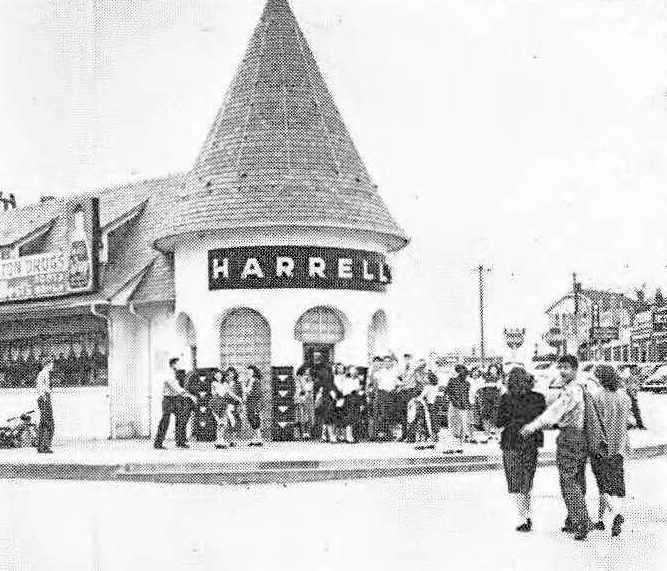
Above, there were lots of soda shops/pharmacy fountains to patronize. Including Harrell’s, in the familiar-to-anyone-who-has-spent-any-time-in-Lakewood turreted still-there building, below.

woodrow-yrbk-1948_harrells

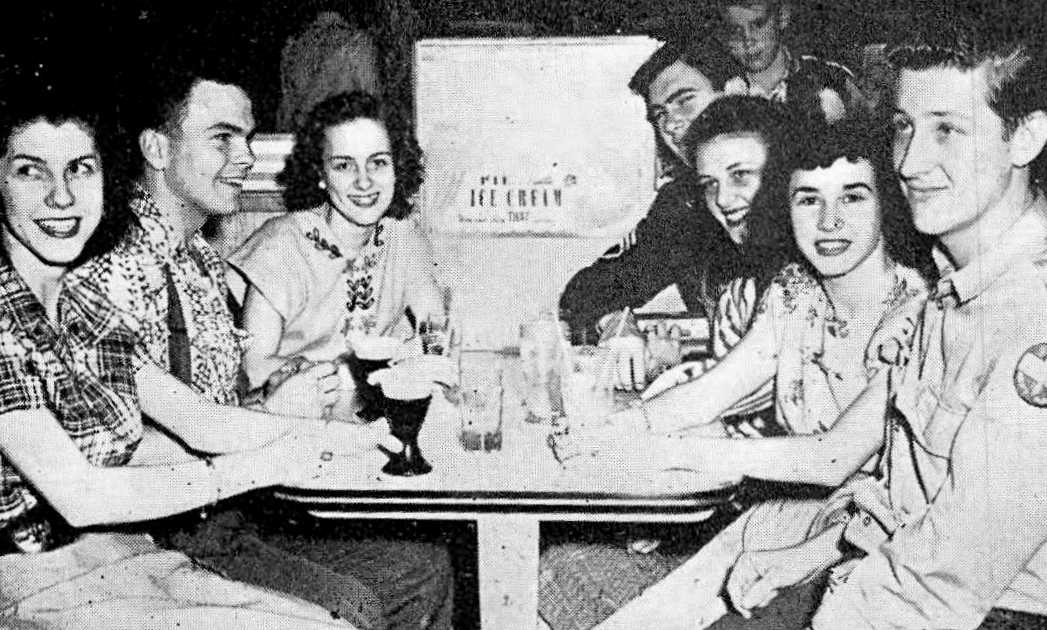
And here:

woodrow-yrbk-1948_table

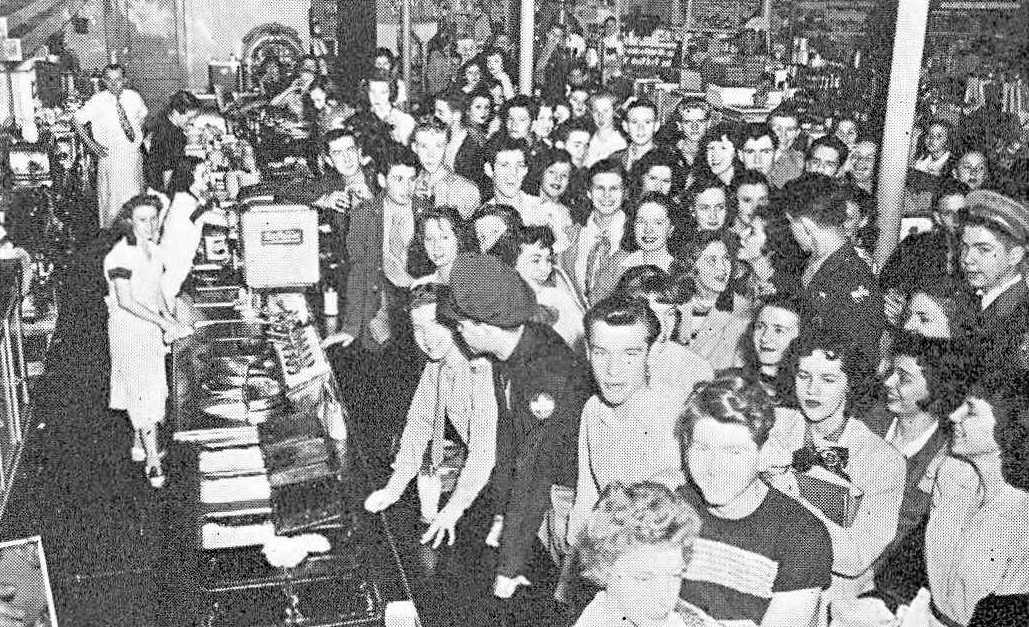
And here:

woodrow-yrbk-1948_crowd

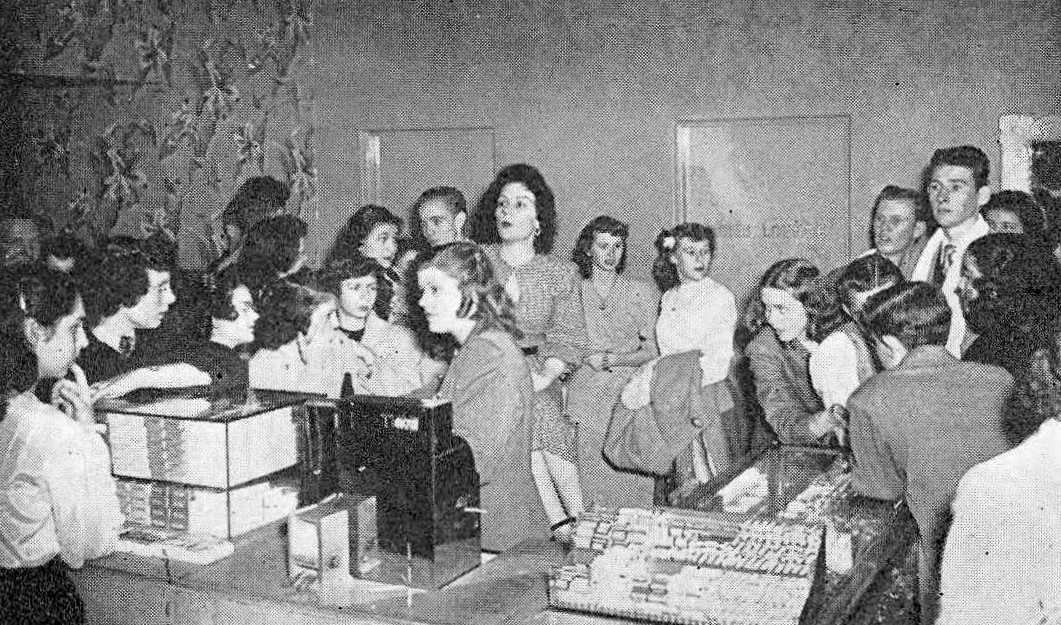
And here, where dressed-up teens are waiting for a table:

woodrow-yrbk-1948_waiting

And here, the “fancy” Sammy’s on Greenville Avenue (right across the street from the less fancy Sammy’s):

woodrow-yrbk-1948_sammys

I have been obsessed with this building (just south of the intersection of Greenville and Ross) my whole life. Was there open-air dining upstairs? Dancing?

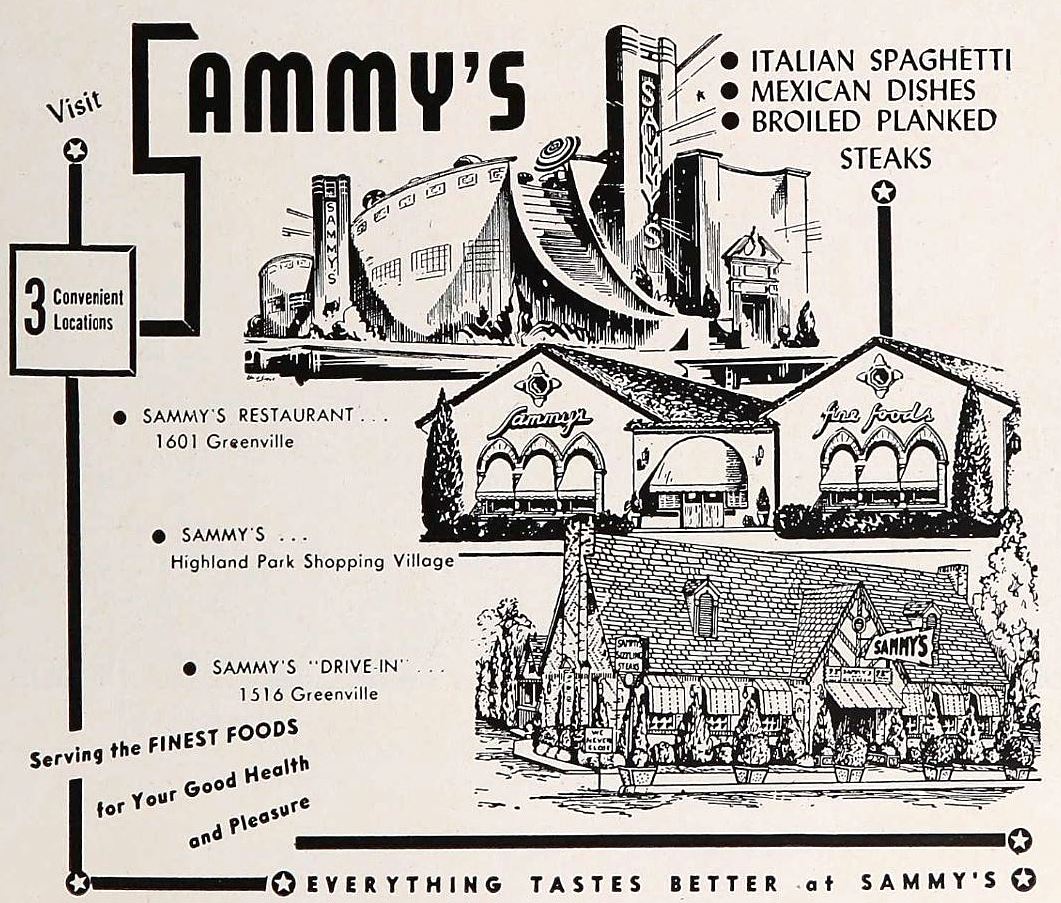
Since I mentioned it, these were the three Sammy’s which were in operation in 1945 — the two on Greenville and one in Highland Park Village:

sammys_HPHS_1945_yrbk

So, yeah, there was lots of hanging around for Woodrow kids back in 1948.

woodrow-yrbk-1948_page

***

Sources & Notes

All images (except the ad for Sammy’s) are from the 1948 Crusader, the yearbook of Woodrow Wilson High School.

Sammy’s ad is from the 1945 Highland Park High School yearbook.

woodrow-yrbk-1948_page_sm

*

Copyright © 2023 Paula Bosse. All Rights Reserved.
Dads’ Day at Hockaday — 1947

hockaday_dads-day_life-mag_cornell-capa_1947_cokesMid-day snack in Lower Greenville

by Paula Bosse

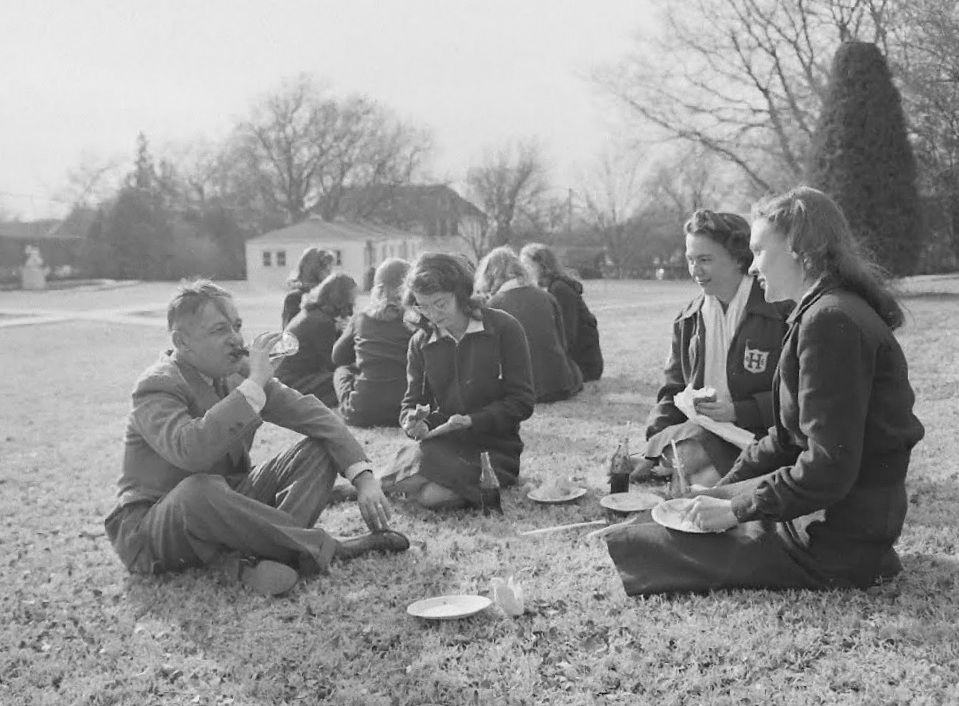
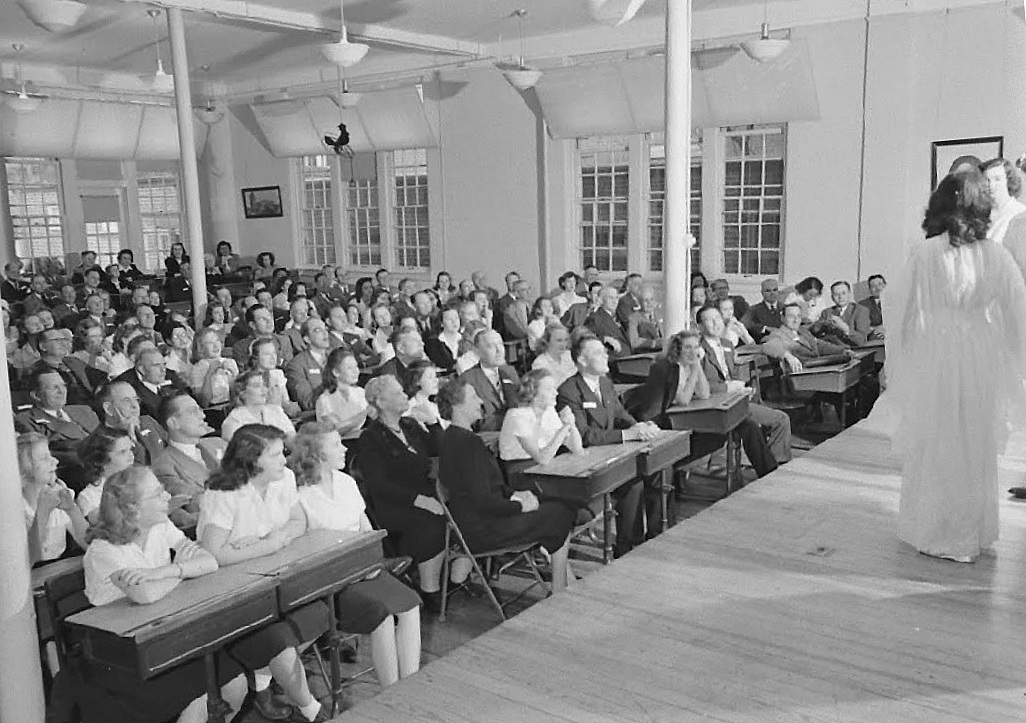
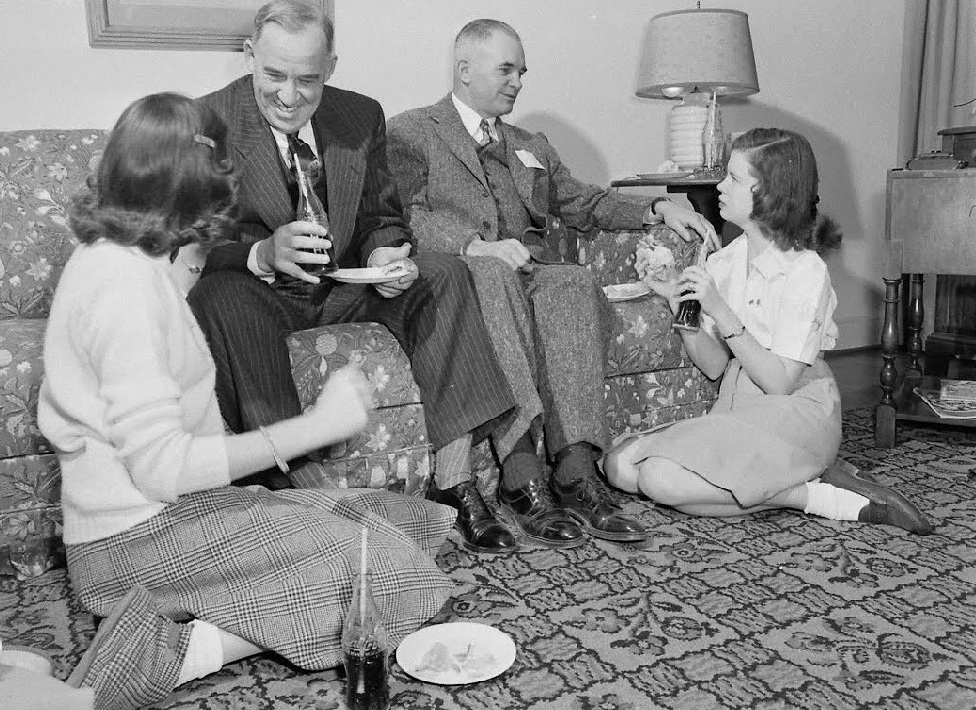
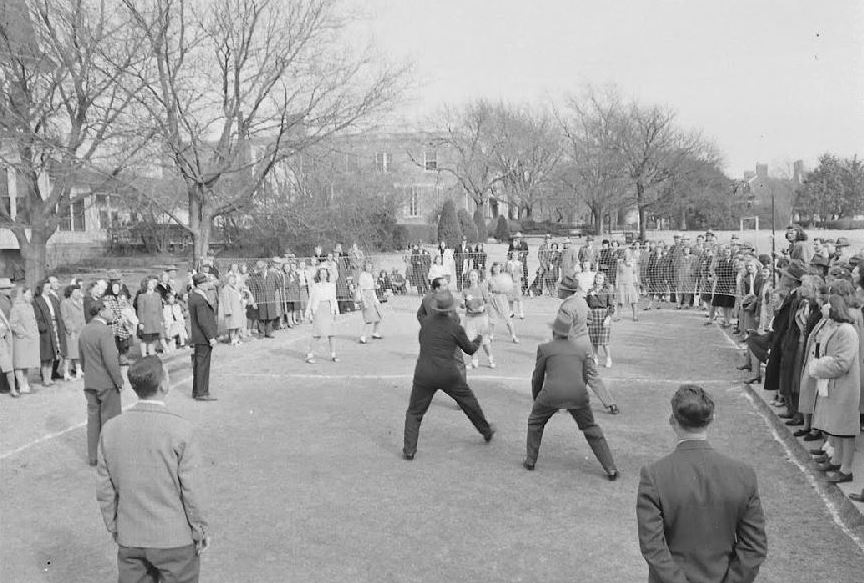
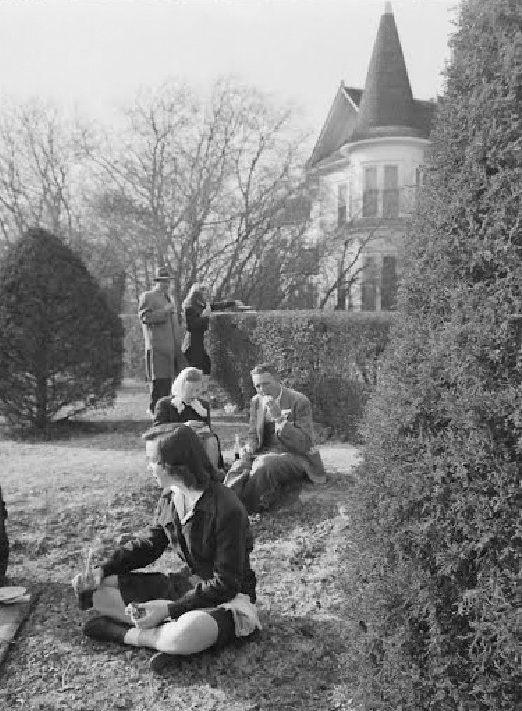
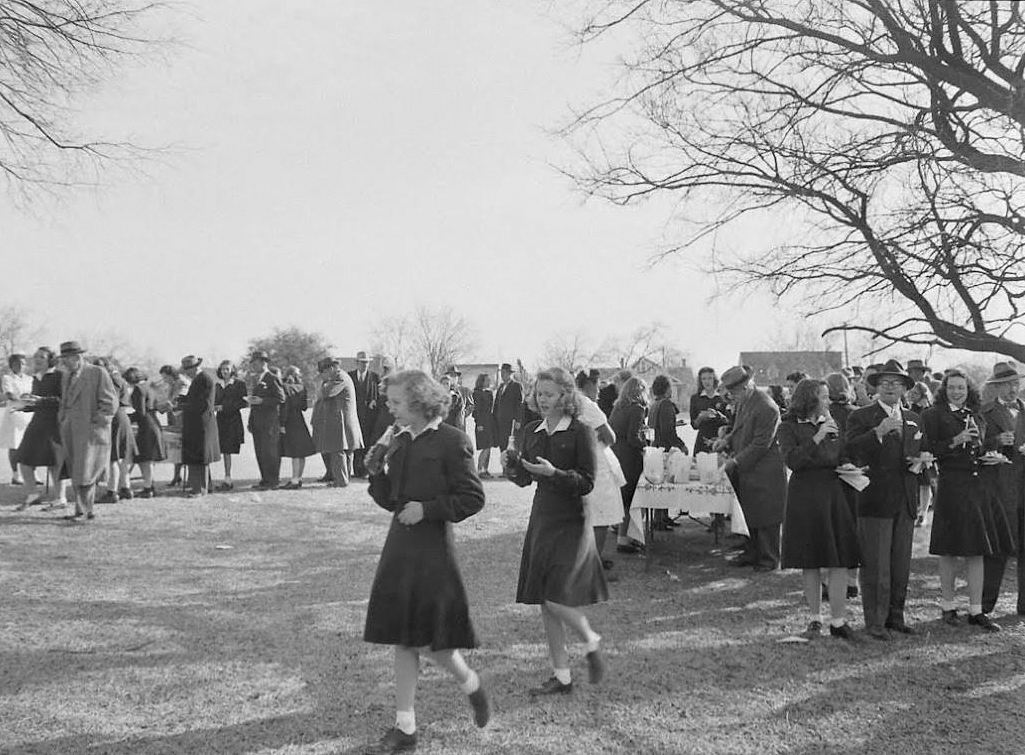
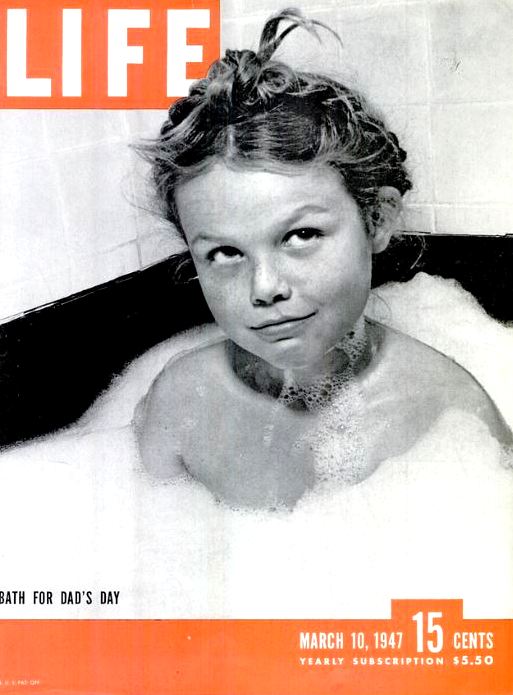
“Dads’ Day” at the Hockaday School for Girls, was a big thing. In this annual celebration, fathers (many of whom traveled from other states) would spend a few hours on the campus with their daughters, attend special programs and performances, visit classrooms, engage in friendly sporting matches against their daughters (volleyball, softball, kickball), and enjoy refreshments. In 1947, there was an al fresco Coke and hamburger lunch. But the big event was that night: a formal dinner in the Crystal Ballroom of the Baker Hotel. And, luckily for us, the Dads’ Day festivities of February 1947 were captured by Life magazine photographer Cornell Capa. A few of the photos appeared in the March 10, 1947 issue, in the story “Dad Has His Day; Texas Schoolgirls Invite Fathers to Come and Be Dates for a Day.” This Dads’ Day story even got the cover. Below are photos by Capa which weren’t used in the story.

*

Dads watching one of several presentations in their honor:

hockaday_dads-day_life-mag_cornell-capa_1947_performance

*

Sitting in a classroom. I don’t know who this girl is, but I love this photo of her. (If readers recognize any of the people in these photographs, please comment below.)

hockaday_dads-day_life-mag_cornell-capa_1947_desk

*

Hangin’ with the girls, enjoying refreshments:

hockaday_dads-day_life-mag_cornell-capa_1947_indoors_cokes

*

Volleyballing with hats on (I love this photo!):

hockaday_dads-day_life-mag_cornell-capa_1947_game

*

Enjoying more refreshments (lotta Coke at Hockaday…). (Note Bosque Bonita in the background, the property’s original house, Greenville and Belmont. Read more here.)

hockaday_dads-day_life-mag_cornell-capa_1947_bosque-bonita

*

More refreshments on a chilly February day:

hockaday_dads-day_life-mag_cornell-capa_1947_lunch

*

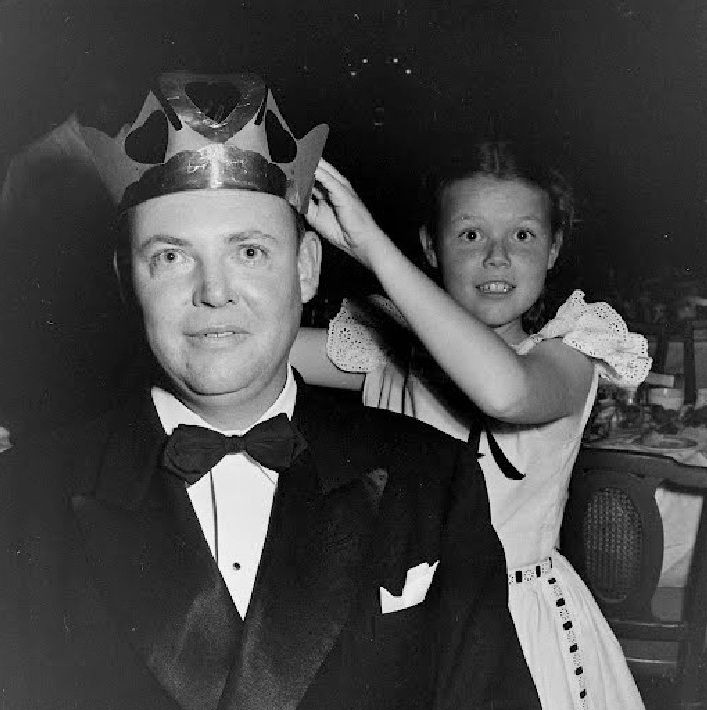
Girls who attended Hockaday as a boarding school, in a dorm, making the paper crowns which fathers will wear at the formal dinner at the Baker Hotel:

hockaday_dads-day_life-mag_cornell-capa_1947_dorm

*

Below, Ann Seidenglanz (whose preparations for this big dinner were captured in the pages of Life — she even made the cover!) places a crown on her father’s head (Charles B. Seidenglanz):

hockaday_dads-day_life-mag_cornell-capa_1947_crown

*

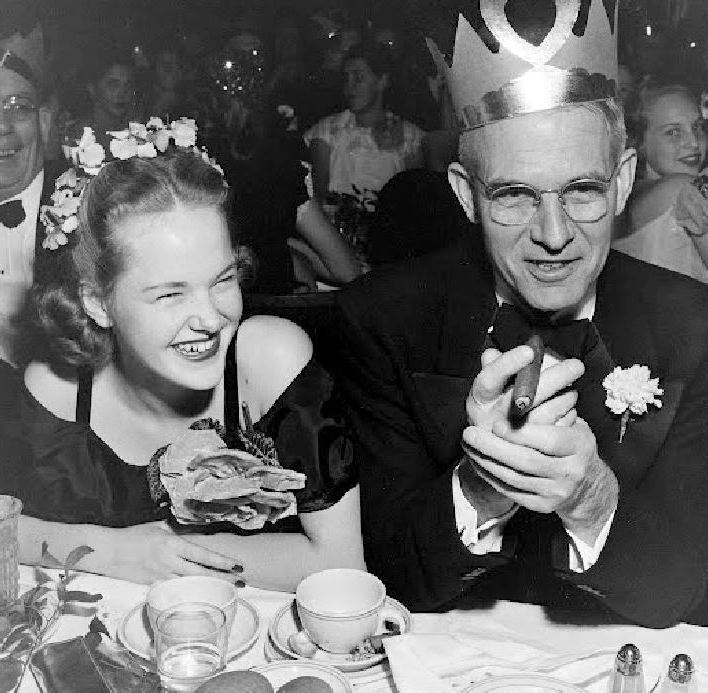
I don’t know who these people are, but I love this photo:

hockaday_dads-day_life-mag_cornell-capa_1947_baker-hotel

*

Jerrie Marcus was accompanied by her father, Stanley Marcus. (Jerrie Marcus Smith died in March of this year. Please check out the book she wrote about her great aunt Carrie Marcus — A Girl Named Carrie: The Visionary Who Created Neiman Marcus and Set the Standard for Fashion.)

hockaday_dads-day_life-mag_cornell-capa_1947_stanley-marcus_daughter - Copy

*

Miss Ela Hockaday, founder of the legendary school and, at the time of this photo, its president emeritus.

hockaday_dads-day_life-mag_cornell-capa_1947_miss-hockaday

***

Sources & Notes

Photos are by Cornell Capa, taken on assignment for Life magazine — none of the photos above appeared in the published article (March 10, 1947). See the published story here; see the photos Capa shot (almost all of which were never published) here. All photos Copyright: ©Time Inc.

hockaday_dads-day_life-mag_cornell-capa_cover_031047

None of the people in the photos above are identified, other than covergirl Ann Seidenglanz. And Stanley Marcus is obviously instantly recognizable to any Dallasite. If you can identify any of the others seen above, I’d be happy to add their names to this post.

Also, check out the lengthy Dallas Morning News story which preceded this Dads’ Day event (with studio photos of several fathers and daughters), in the DMN archives: “News of Women.” DMN, Feb. 9, 1947, Section III, p. 1, 2, 13.

More about the Greenville Avenue-era Hockaday campus can be found in the Flashback Dallas post “Belmont & Greenville: From Caruth Farmland to Hub of Lower Greenville.”

And you are always welcome to follow me on Patreon, where it’s Flashback Dallas every day, for as little as $5 a month.

hockaday_dads-day_life-mag_cornell-capa_1947_cokes_sm

*

Copyright © 2023 Paula Bosse. All Rights Reserved.
Cowboys Love Cokesbury’s — 1947

cokesbury_092847

by Paula Bosse

Today is my late father’s birthday. He was, in every respect of the word, a “bookman.” Every year on his birthday I post something bookstore-related.

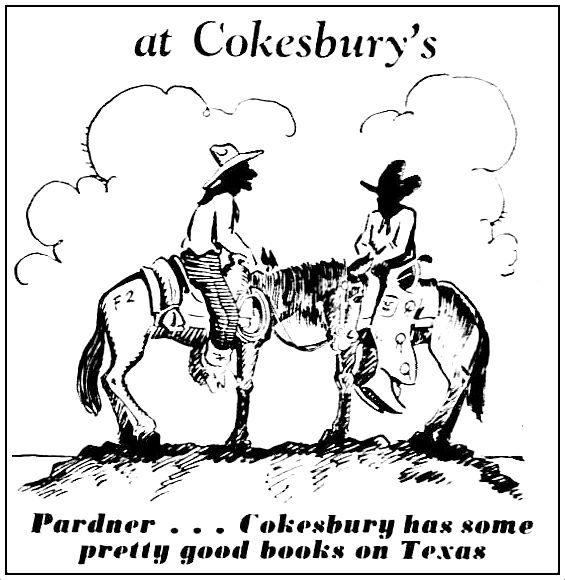
His specialty was Texana and Western Americana. This Texas-themed Cokesbury’s ad is from September 1947, the same month The Aldredge Book Store opened (the store my father — Dick Bosse — eventually owned, a store which was also known for having “some pretty good books on Texas”).

***

Sources & Notes

This ad appeared in the Sept. 28, 1947 edition of The Dallas Morning News.

Read other Flashback Dallas posts on bookstores here.

*

Copyright © 2023 Paula Bosse. All Rights Reserved.
Tabletop Jukeboxes — 1940

sammys_greenville-ave_juke-boxes_hagley-museum_1940Sammy’s, Greenville Ave., 1940

by Paula Bosse

Who isn’t thrilled to find yourself sitting in a booth at a restaurant with your own personal tabletop jukebox? You don’t see them much these days — the only place I can think of that still has them is Campisi’s. They were an absolute thrill to me as a child. I wonder how many of those little machines were broken by overly curious children who went crazy pushing all the buttons and twisting the knobs to flip the pages to see song selections by people they’d never heard of like Patti Page and Artie Shaw?

I just happened upon a collection of these coin-operated machines — called “wallboxes” — here. I had to look to see if Dallas was represented, and, yes, Dallas is represented. Thrice.

*

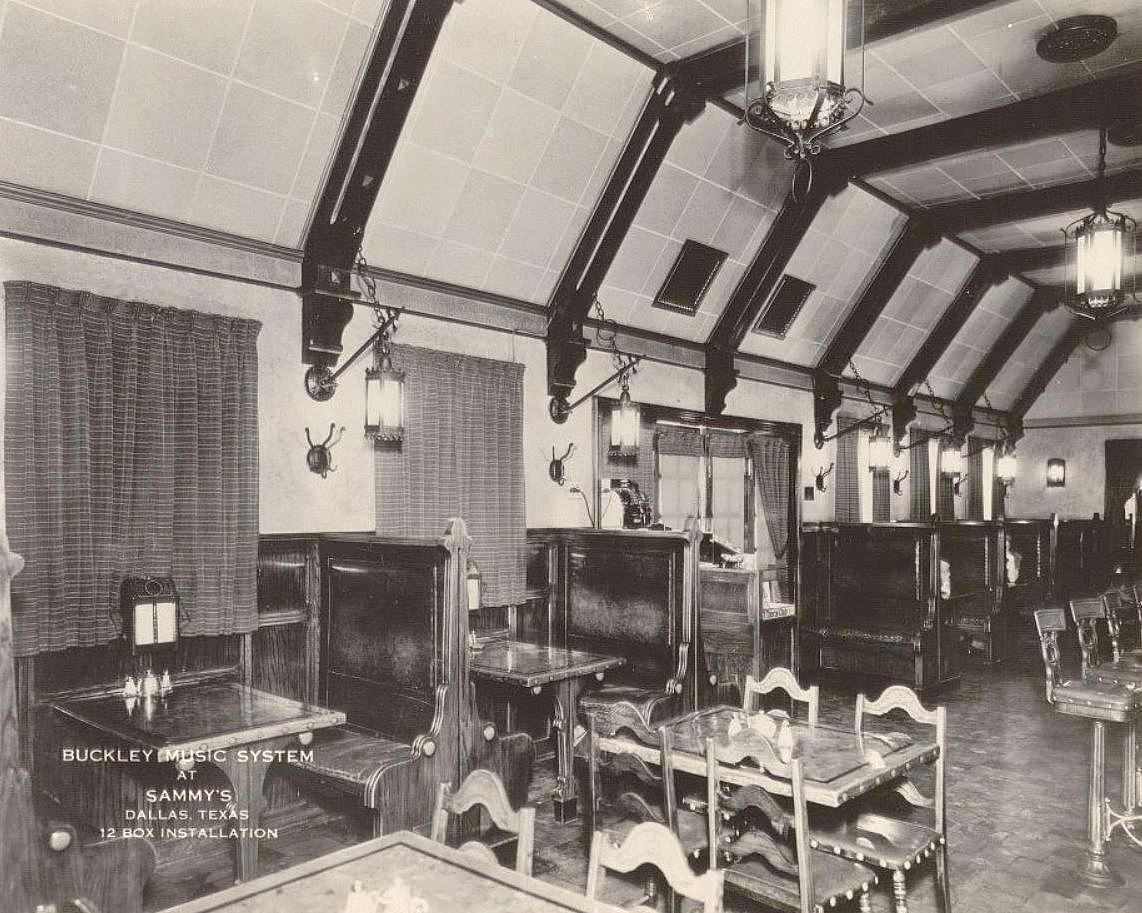
At the top, SAMMY’S — 1516 GREENVILLE AVENUE (below Lowest Greenville, one block south of Ross)

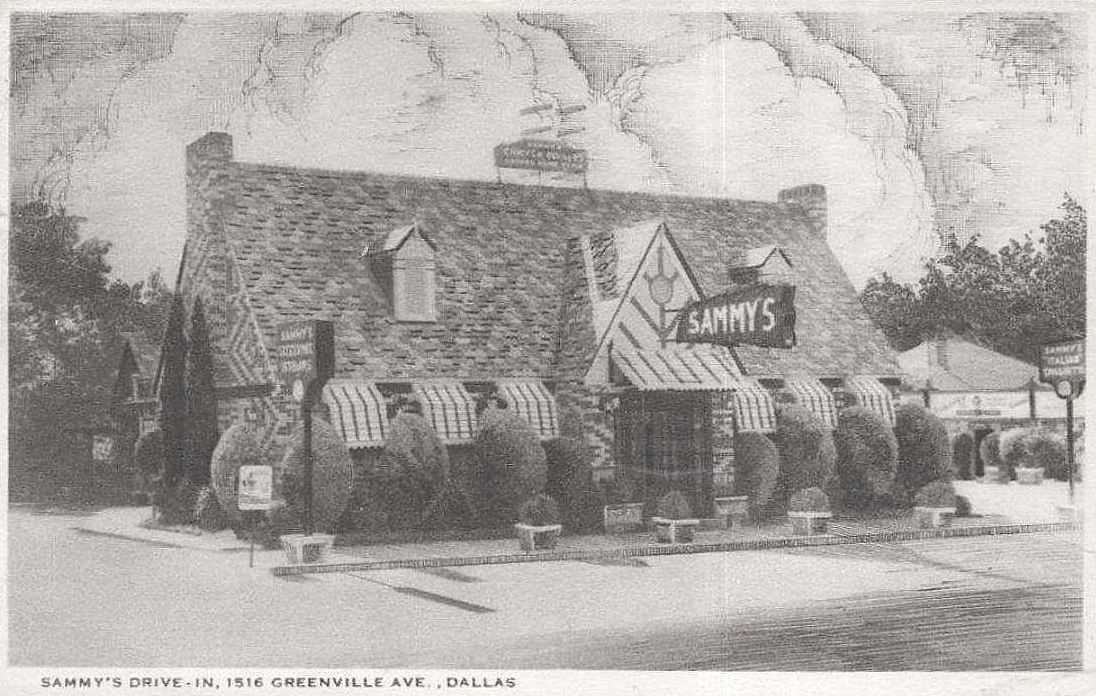
There were several locations of Sammy’s restaurants around town, but this was, I think, the first. (I’m pretty sure the building is still there — it just keeps getting renovated and turned into different restaurants/bars.) (UPDATE: Thanks to a comment on my Facebook page, I now realize that, according to Google Street View, the building that once housed Sammy’s bit the dust sometime between 2012 and 2013, when it became a parking lot. See it in 2007 on Google here.) This is the first time I’ve seen a photo of its interior. Below: what it looked like in its heyday.

sammys_postcard_1516-greenville-ave

*

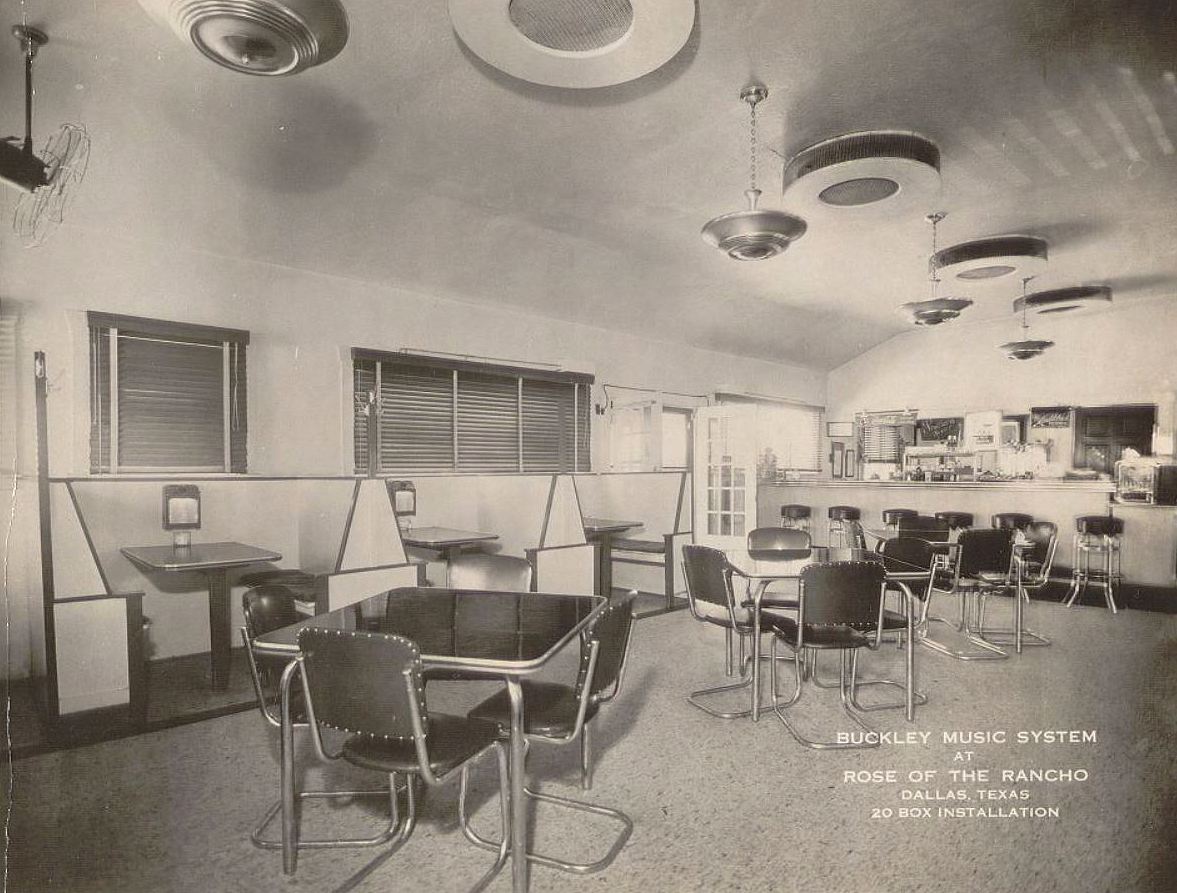
ROSE OF THE RANCHO (later just The Rancho) — 4401 BRYAN STREET (in Old East Dallas, at Burlew Street)

Named after a popular movie, this cafe (which was busted a few times for selling liquor without a license) was in business near the Mrs. Baird’s plant at Bryan and Carroll, from at least 1936 to 1978, which is a long time for a restaurant. A 1938 newspaper article about a sorority’s Rush Week noted that the Delta Theta Kappas were attending a “stagette” supper there in September 1936.

The photo below, from 1940, shows an interesting interior. Sort of Art Deco-in-a-goldfish-bowl. There’s a lot to like here — I’m feeling hints of “nautical” — except for those booths, which look like the most uncomfortable restaurant seating I’ve ever seen. Browsing the songs on one of those little jukeboxes would at least have offered a bit of respite and distraction from obsessing over how inhospitably uncomfortable that bench you were sitting on was.

rose-of-the-rancho_juke-boxes_hagley-museum_1940Rose of the Rancho, 1940

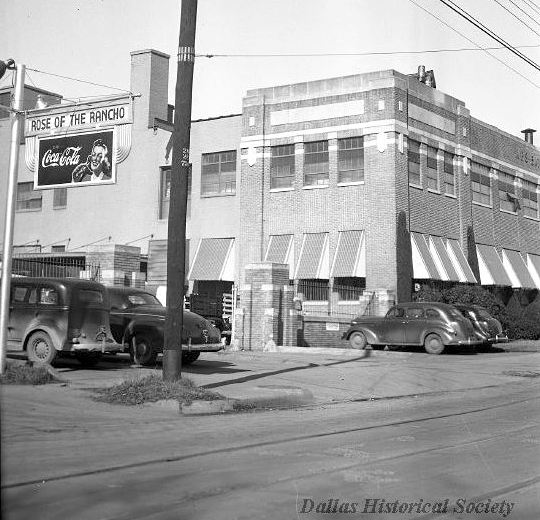
I came across the photo below when I was cataloging a collection of photos from the mid 1940s at the Dallas Historical Society — I remembered “Rose of the Rancho,” mainly because of its unusual name. Sadly, the photo shows only the sign (but, as a bonus, it does show the Mrs. Baird’s building, which I keep hearing is about to be renovated any day now). (It’s interesting to note, tangentially, that the guy who took this photo — and all in the collection I was working on — was obsessed with jukeboxes and other coin-operated machines. I feel confident that he stopped in at the Rancho for at least a cup of coffee, armed with a fistful of nickels in order to run through a few hits of the Mills Brothers or Andrews Sisters.)

rose-of-the-rancho_4401-bryan_mrs-bairds_DHS_bell-coll_1944Rose of the Rancho, 1944 (Dallas Historical Society)

*

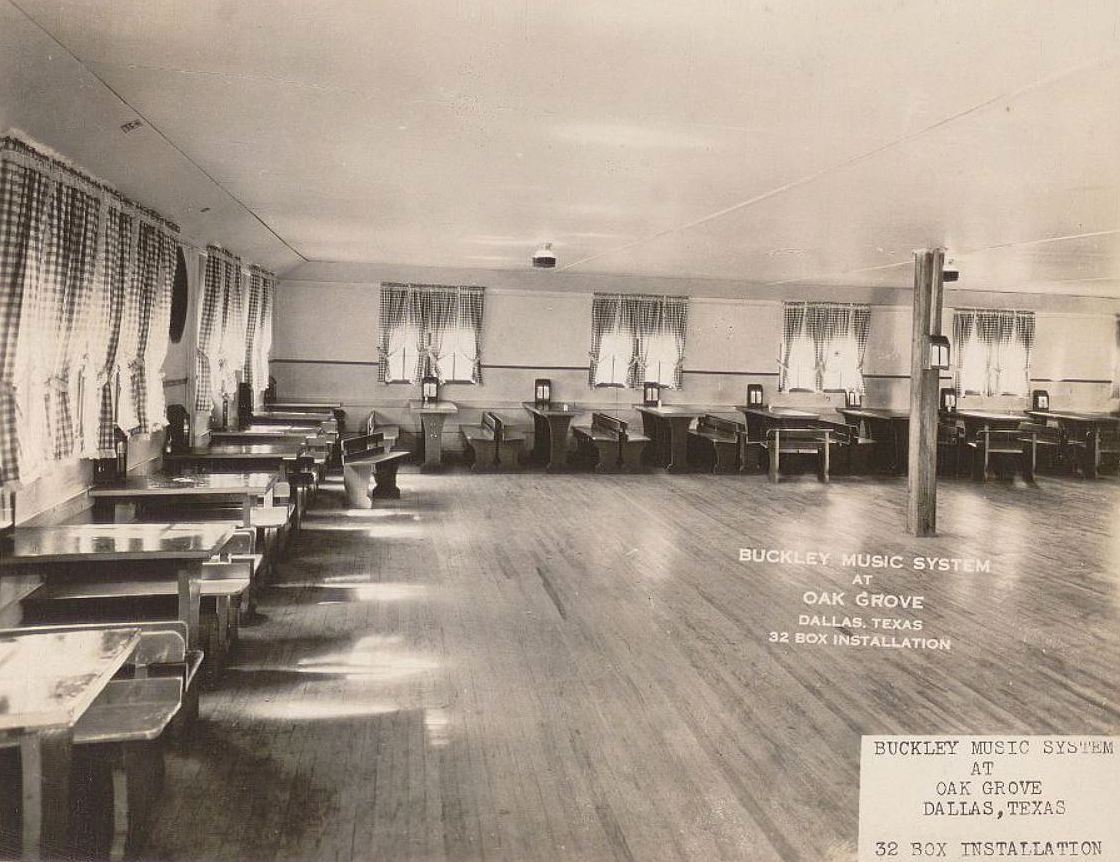
OAK GROVE CAFE — 2630 N. HASKELL (near Weldon Street)

I couldn’t find much about this place, but it had a lot more of the jukebox units installed in it than the other two places: 32 boxes! Imagine if each table had its own concert going on. …And then multiply that by 32. I think those speakers directionalized (is that a word?) the sound so that it kept pretty much to the immediate area. Otherwise, “spillover” music at varying volumes could have been one of many things that tried the patience of waitresses just trying to get through their shifts. …Or it could have been great: different musical offerings at different tables, all day long. Bing Crosby with eggs and toast at table 4, “Stardust” with corned beef at table 6, and Harry James, hold the onions, at the counter. (UPDATE: I’m obviously not well acquainted with this technology. Thanks to the comment below by Bill Parrish, I realize that all of these tabletop machines played the same thing, and each table could adjust the volume. I think I like my idea of 30 different machines chaotically playing 30 different songs simultaneously, but that would have been pretty obnoxious!)

oak-grove_hagley-museum_juke-boxes_1940Oak Grove Cafe, 1940

***

Sources & Notes

The three photos stamped with “Buckley Music System” are all from the Hagley Digital Archives, here (scroll to find the specific photos).

The 1944 photo (which I have cropped) showing the Rose of the Rancho sign and the Mrs. Baird’s building is from the James H. Bell Collection, Dallas Historical Society — more information is here.

More on the Buckley Music System can be found here.

See one of these machines in action (with French narration!) in a YouTube video here.

If you’d like to support the work I do, please check out my Patreon subscription page here, where every day I try to post something new which hasn’t been posted here on the blog.

sammys_greenville-ave_juke-boxes_hagley-museum_1940_sm

*

Copyright © 2023 Paula Bosse. All Rights Reserved.
Uncle Scooter Reads the Funnies: 1940-41

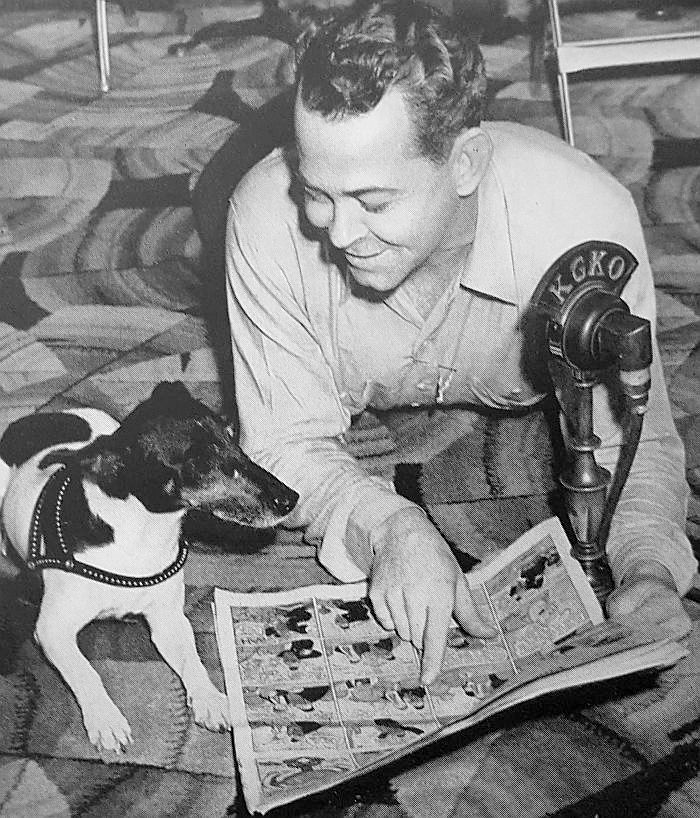
radio_uncle-scooter_wfaa-wbap-kgko-combined-family-album_1941Little Man and Uncle Scooter…

by Paula Bosse

Several years ago, I was flipping through a promotional booklet for radio stations WFAA, WBAP, and KGKO, and I came across the photo above. I think about this photo a lot. It shows radio personality “Uncle Scooter” lying on the floor next to a KGKO microphone, reading the comics over the air to a vast audience of children and pointing out something pertinent to his trusty companion, a fox terrier named Little Man. I love this photograph. It makes me smile every time I see it. Wouldn’t it be great if this was how he actually conducted his broadcasts — on the floor with his doggie next to him? Here’s the caption:

uncle-scooter_dog_wfaa-wbap-kgko-combined-family-album_1941_caption

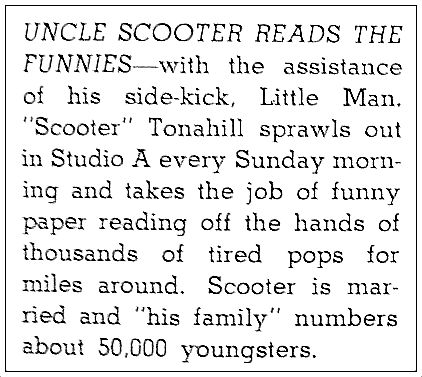
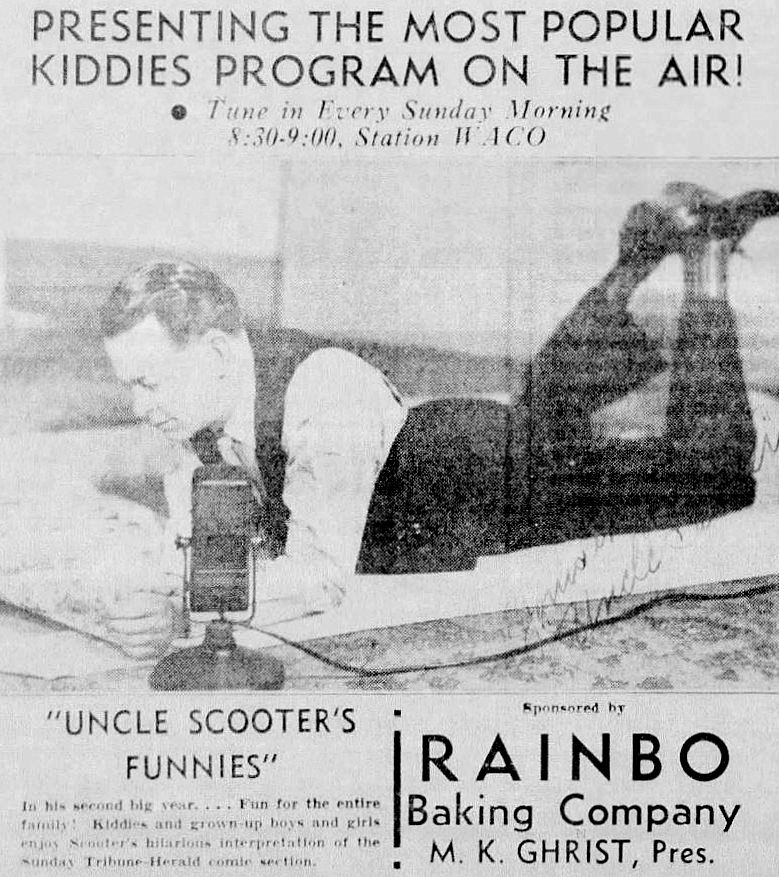
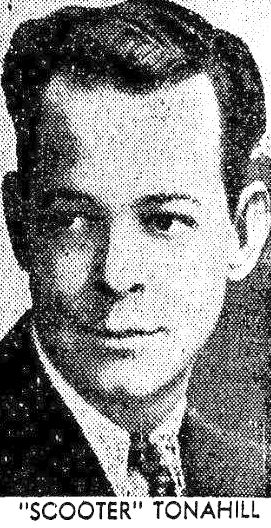
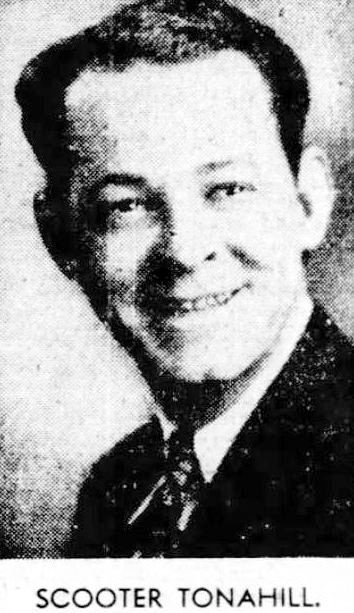
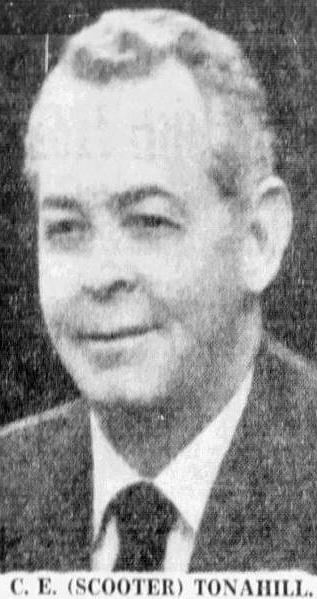
Clarence E. Tonahill (1904-1954) — known to everyone as “Scooter” — appears to have begun his radio career in Waco at the appropriately named station WACO. He then worked at KGKB in Tyler, then returned for a few years to WACO, and then to KTSA in San Antonio. Like most people in broadcasting in those days, he did a little bit of everything: he was an announcer, a newsreader, a sportscaster, and an entertainer. One of his most popular shows was just him reading the Sunday comics over the air for children. Below, a WACO ad from 1937 showing Uncle Scooter, again, lying on the studio floor (no dog, though).

uncle-scooter_waco-tribune-herald_010337Waco Tribune-Herald, Jan. 3, 1937

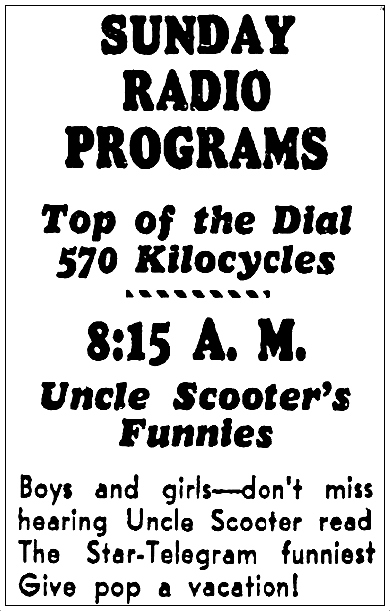
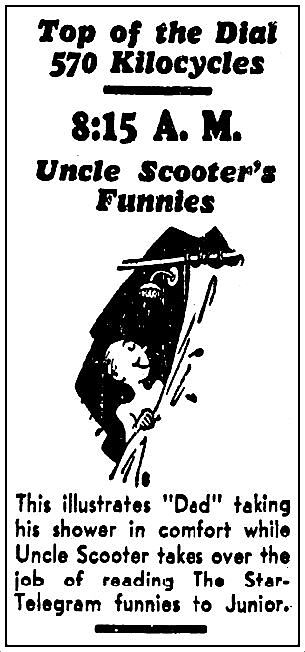
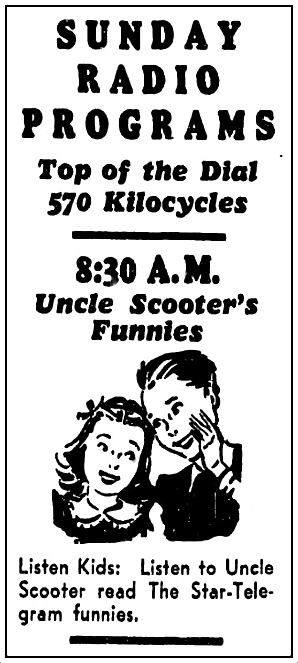
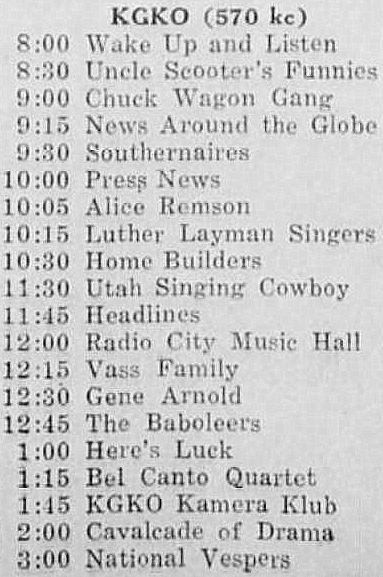
Around September 1939, he moved to Fort Worth to begin a busy stint at KGKO, a DFW station co-owned by The Dallas Morning News and The Fort Worth Star-Telegram (this was part of the very unusual WFAA-WBAP radio broadcasting partnership). He started as an “announcer” (which might well have included cleaning up the studio!), but he quickly graduated to doing a lot of sports-announcing and color commentary (football and boxing), man-on-the-street interviews, and personal appearances. He also hosted several shows, including a weekday morning show called “Sunrise Frolic.” But Sundays… Sunday mornings were set aside for his funnies-reading.

1940_radio_uncle-scooter_FWST_090840Fort Worth Star-Telegram, Sept. 1940

1940_radio_uncle-scooter_FWST_091540FWST, Sept. 1940

1941_radio_uncle-scooter_FWST_031641FWST, March 1941

The Sunday lineup on KGKO, before and after the funnies:

1940_radio_uncle-scooter_bryan-tx-eagle_121440Bryan Eagle, Dec. 1940

I see listings for the show in 1940 and 1941 — and then, briefly, in 1947. His obituary says that Tonahill retired from his career as a broadcasting personality in 1946 and opened his own business in Fort Worth, Scooter’s Radio Supply (a supplier of broadcasting equipment to stations around the country).

He must have been a bright, friendly voice on the radio. I’d love to know the role Little Man played (Little Man was Scooter’s real-life pet and was described in a magazine profile as Scooter’s “favorite hobby”). I have fond (if somewhat vague) memories from my childhood of Bill Kelley reading the comics on The Children’s Hour on Channel 5 — but I can say without hesitation that things on The Children’s Hour would have been a whole lot more interesting if he’d just had a cute little dog with him!

1940_scooter-tonahill_FWST_042040_kgko-ad_det_photo1940_scooter-tonahill_FWST_100940_kgko-ad_det_photo1940

1954_tonahill-clarence-e_FWST_072654_obit_photo1954

kgko_19391939

***

Sources & Notes

Top photo from “WFAA, WBAP, KGKO Combined Family Album” (Dallas-Fort Worth, 1941).

radio_uncle-scooter_wfaa-wbap-kgko-combined-family-album_1941_sm

*

Copyright © 2023 Paula Bosse. All Rights Reserved.
Dallas: “Outstanding Educational Center” — ca. 1943

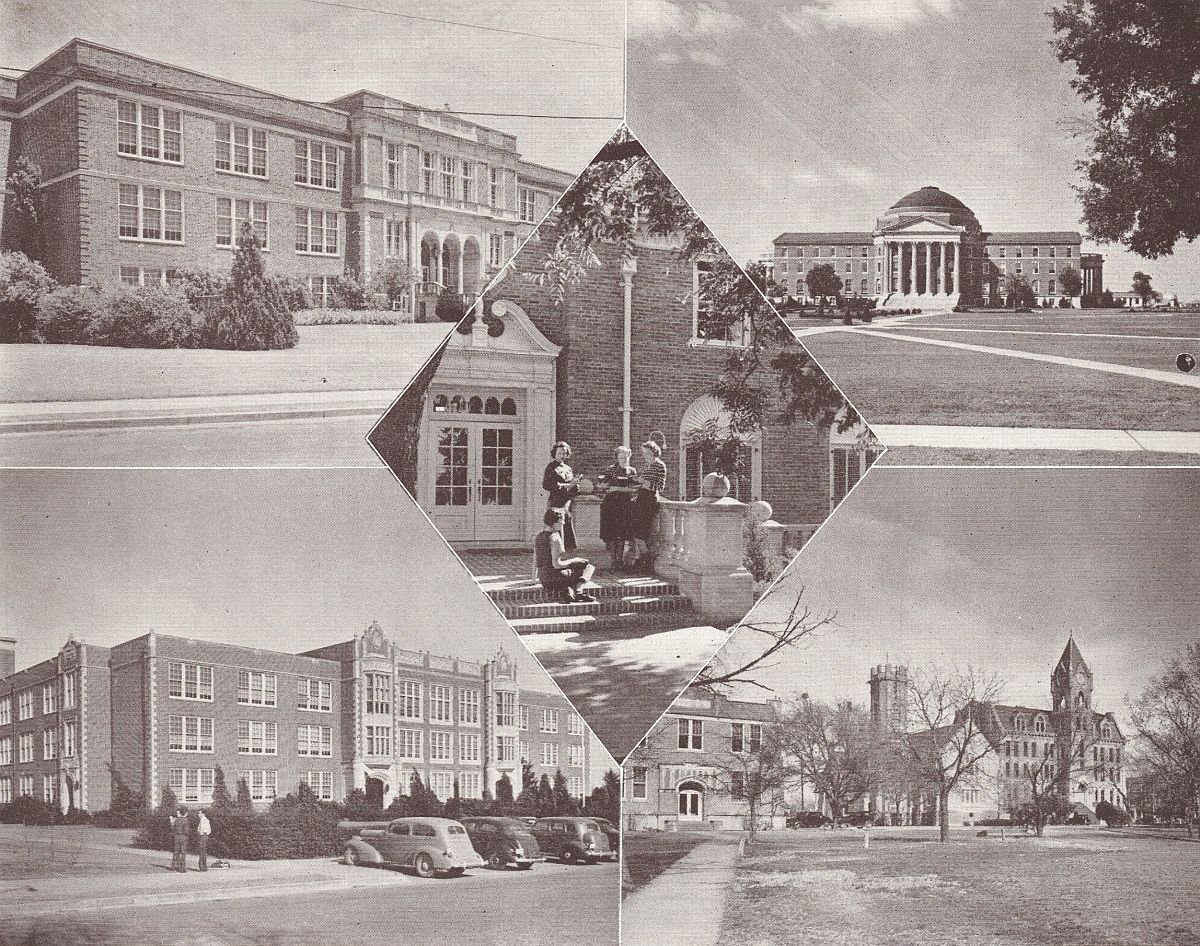
education_so-this-is-dallas_lone-star-annex_ca-1943_photosFive education hotspots…

by Paula Bosse

From So This Is Dallas, a publication meant to lure new residents to the city by touting key aspects of what makes it worth your while to pack your bags and relocate NOW. This is the page that focused on education.

Dallas… Outstanding Educational Center

Early in its history, Dallas set a high standard for its schools, and so well has it maintained those standards, that it stands high among cities of the nation in the educational advantages it offers to the children of its people and to those of the surrounding states.

From kindergartens for tiny tots to great universities and colleges for those seeking the higher degrees of learning, Dallas can furnish any specialized or general training that the young citizen may require.

There are 62 elementary schools, 8 senior high schools, and 4 junior high schools in the public school system of Dallas and the surrounding residential cities. Several new junior high schools are planned, and new elementary schools are organized as rapidly as they are needed.
The public schools also offer evening classes for the training of adults, and vocational training for adults or those of school age who prefer the specialized fields.

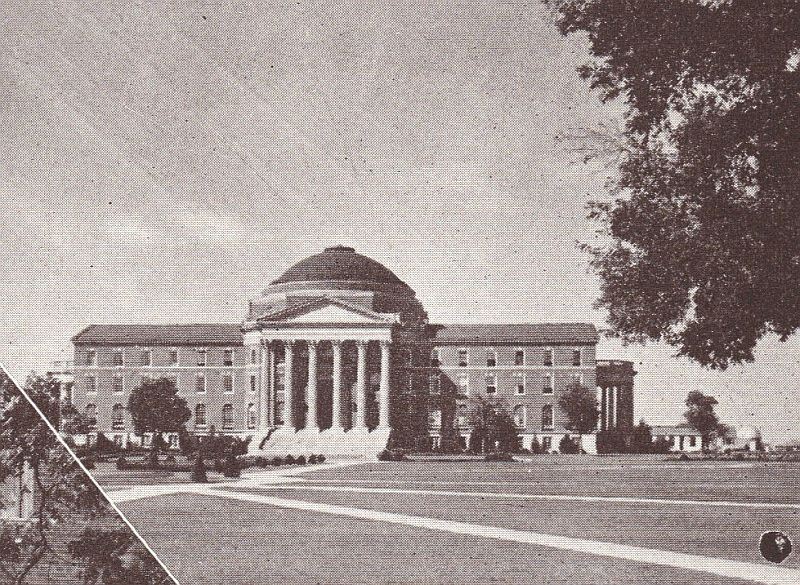
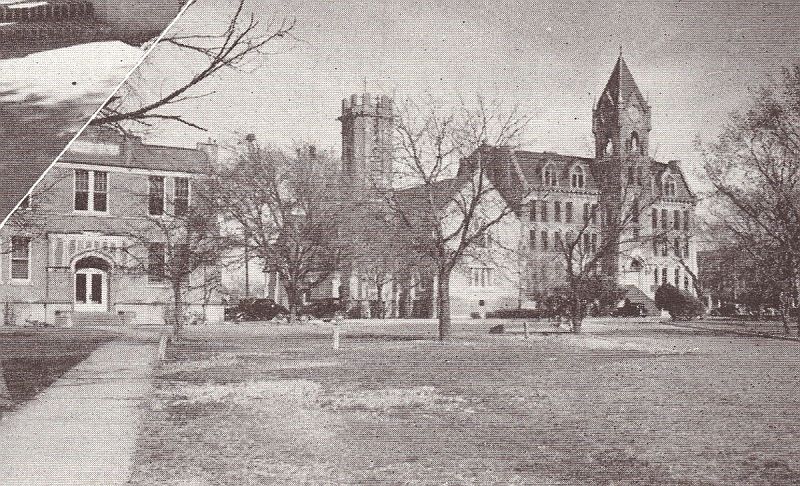
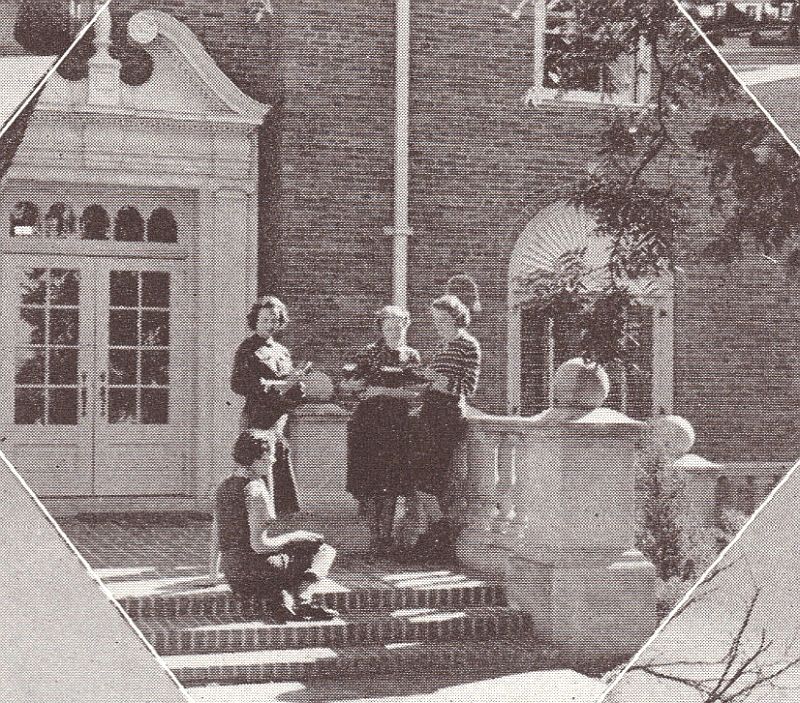
In the field of higher learning, there is Southern Methodist University, the medical and dental schools of Baylor University, Miss Hockaday’s School for Girls, and the Terrill School for Boys. Several well-rated business schools offer training in business administration, and there are dozens of recognized schools of music, art, the dance, drama, trades, and professions. Only a few miles to the west, at Arlington, is the state’s great school, the North Texas Agricultural College.

*

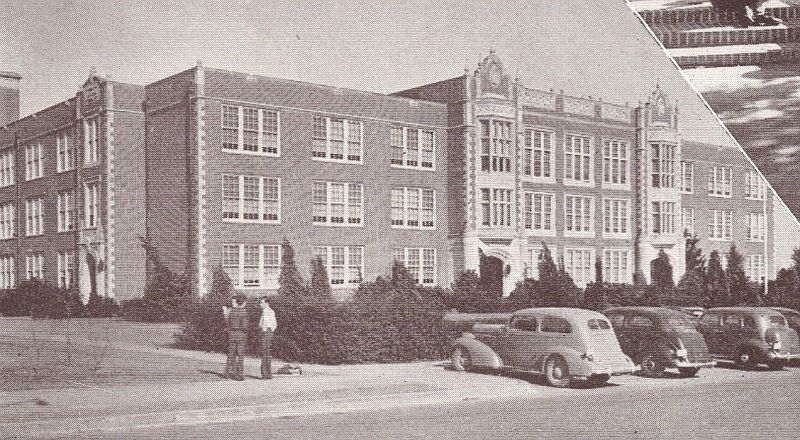
North Dallas High School:

education_so-this-is-dallas_ca-1943_lone-star-annex_photos_NDHS

Southern Methodist University:

education_so-this-is-dallas_ca-1943_lone-star-annex_photos_SMU

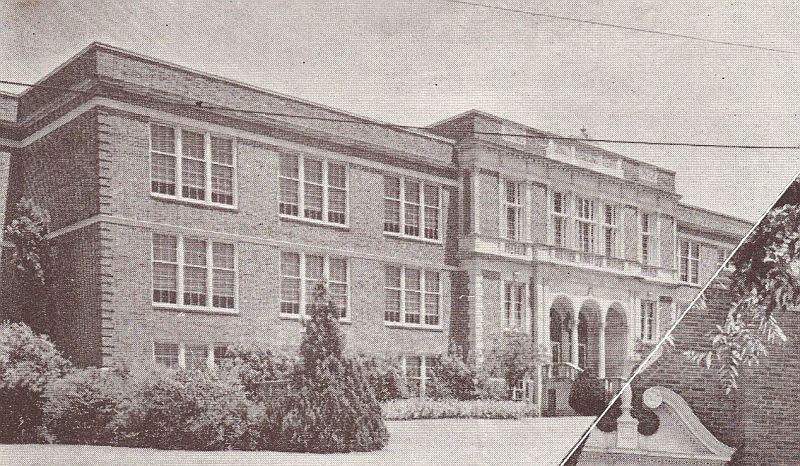
Woodrow Wilson High School:

education_so-this-is-dallas_ca-1943_lone-star-annex_photos_WWHS

The Terrill School for Boys:

education_so-this-is-dallas_ca-1943_lone-star-annex_photos_terrill-school

Miss Hockaday’s School for Girls:

education_so-this-is-dallas_ca-1943_lone-star-annex_photos_hockaday

**

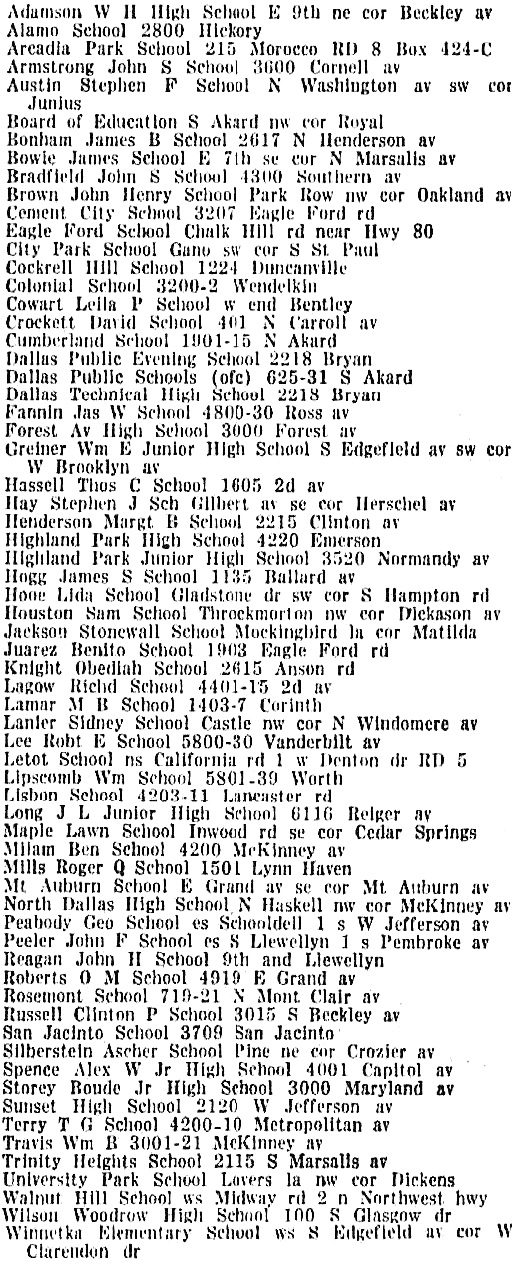
Why not post lists of schools from the 1943 Dallas directory? First, Dallas Public Schools (White):

schools_1943-directory_white

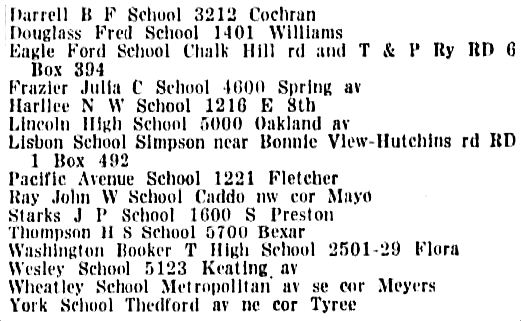
Dallas Public Schools (Black):

schools_1943-directory_black

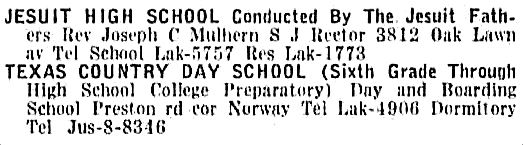
Dallas Private Schools:

schools_1943-directory_private

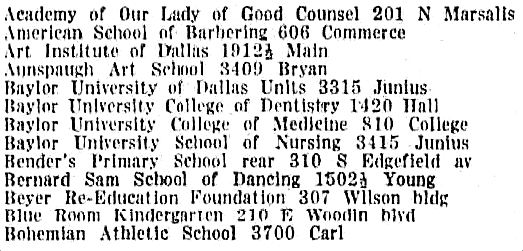
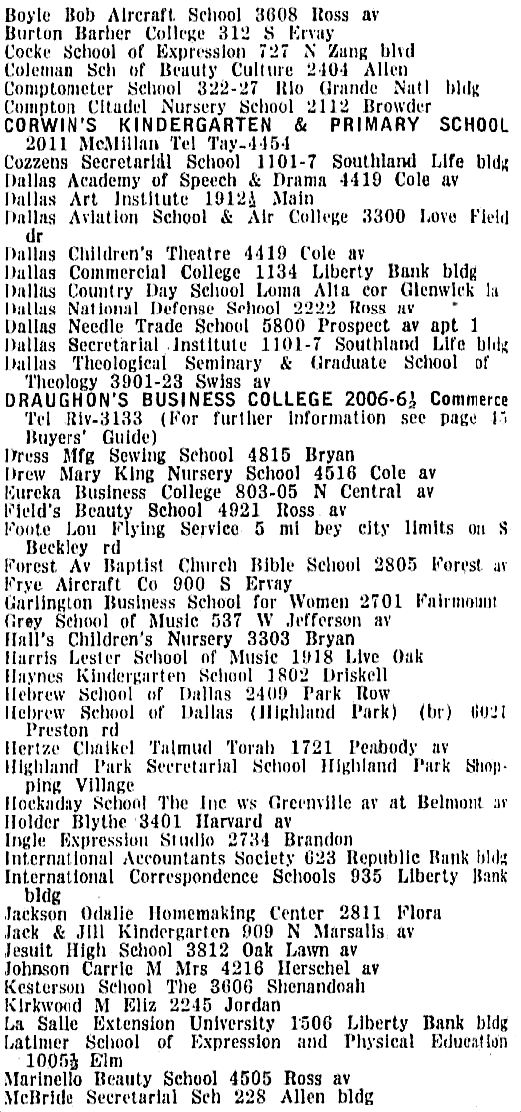
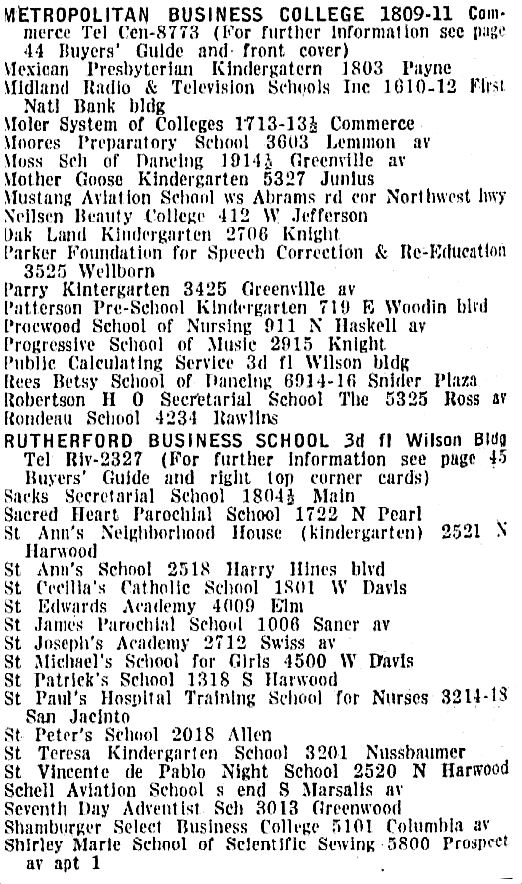
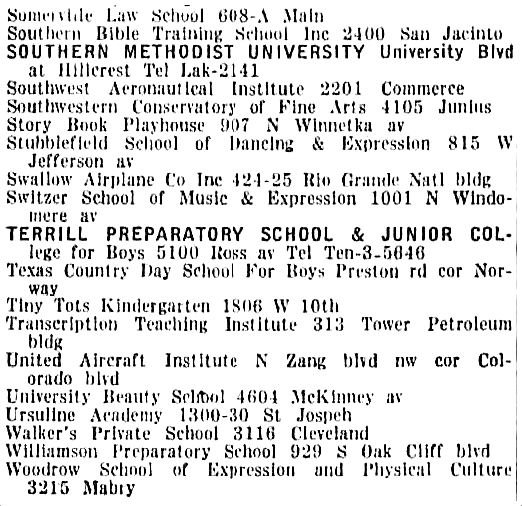
Dallas Schools, Colleges, Academies, and Odd Stuff:

schools_1943-directory_colleges_prep_1

schools_1943-directory_colleges_prep_2

schools_1943-directory_colleges_prep_3

schools_1943-directory_colleges_prep_4

And a lot of business schools….

***

Sources & Notes

Photos and text from So This Is Dallas, published around 1943 by The Welcome Wagon, with photos by Parker-Griffith; courtesy of the Lone Star Library Annex Facebook page.

See other Flashback Dallas posts using bits from this booster publication (circa 1943 and 1946) here.

education_so-this-is-dallas_lone-star-annex_ca-1943_photos_sm

*

Copyright © 2023 Paula Bosse. All Rights Reserved.