“Go Away! Can’t You See I’m Listening to WFAA?” — 1947

by Paula Bosse
Priorities.
*
Copyright © 2014 Paula Bosse. All Rights Reserved

by Paula Bosse
Priorities.
*
Copyright © 2014 Paula Bosse. All Rights Reserved
 “Have you had your lemonade today?”
by Paula Bosse
Above, the intersection of South Ervay (at left, with cars headed north) and Jackson Street (at right, with pedestrians walking east), about 1946. All those little shops…. And look at that cool Sun Drop Lemonade ad painted on the Jackson Street side of the building! Below, that same corner today (2014).

…Yep.
**
UPDATE: When I posted this photo originally, I thought it showed the southwest corner of S. Ervay and Commerce, but reader Brian Pranger corrected me on Twitter. He is absolutely correct when he suggested that the view is actually the northeast corner of S. Ervay and Jackson (I have corrected the errors above). Just to verify, I found an aerial photo of the intersection from 1935 that shows the building in question. Here is a detail with my clunky labeling (click for larger image):
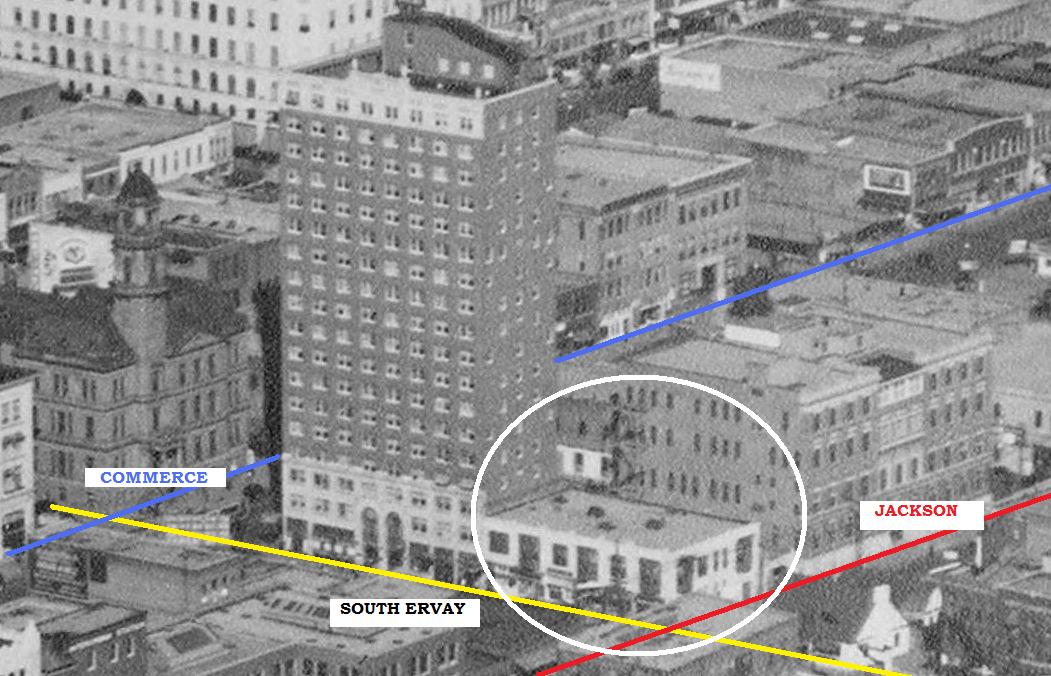
Thank you, Brian! (And I ALWAYS welcome corrections!)
***
Top photo from Jim Wheat’s Dallas County, Texas Archives. Wheat estimates the photo was taken around 1946, with the following businesses identified: Modern Finance Co., 204 S. Ervay; South Ervay Barber Shop, 208 S. Ervay; Apex Hotel (probably pretty dodgy, but who wouldn’t want to stay at the “Apex Hotel”!), 208 1/2 S. Ervay; Perfect Hand Laundry & Dry Cleaning, 210 S. Ervay.
“Today” photo from Google Street View.
The last image is a detail from a 1935 aerial view of the “Mid-Town Business District,” taken by Lloyd M. Long; it is part of the Edwin J. Foscue Map Library, Central University Libraries, Southern Methodist University. SMU’s labeled version of this map can be seen here (the building in question is adjacent to the Allen Building, which on SMU’s map is #38, at the top right — use the zoom function to see all sorts of things!).
*
Copyright © 2014 Paula Bosse. All Rights Reserved.
 Produce seller, Pearl Street Market
by Paula Bosse
Last week I wrote about the produce market area in the neighborhood where the Farmers Market was eventually built, mainly because I had come across the above undated and unidentified photograph. I really wanted to know more about this photo, and the more I read about the area known in the ‘teens through the ’50s as the Pearl Street Market, the more I became fascinated by it.
I love this photo, but, sadly, I never found out who cafe-namesake Bob Taylor was, and I never discovered the identity of the man sitting on the sidewalk with his produce. BUT, I did realize that this produce seller was right across the street from one of the biggest wholesale produce sellers in Dallas, the Hines Produce Company. In fact, the photo below might show my mystery man’s view across the street. Both photos show the intersection of the 2000 block of Canton and the 400 block of South Pearl, the heart of the Pearl Street Market.
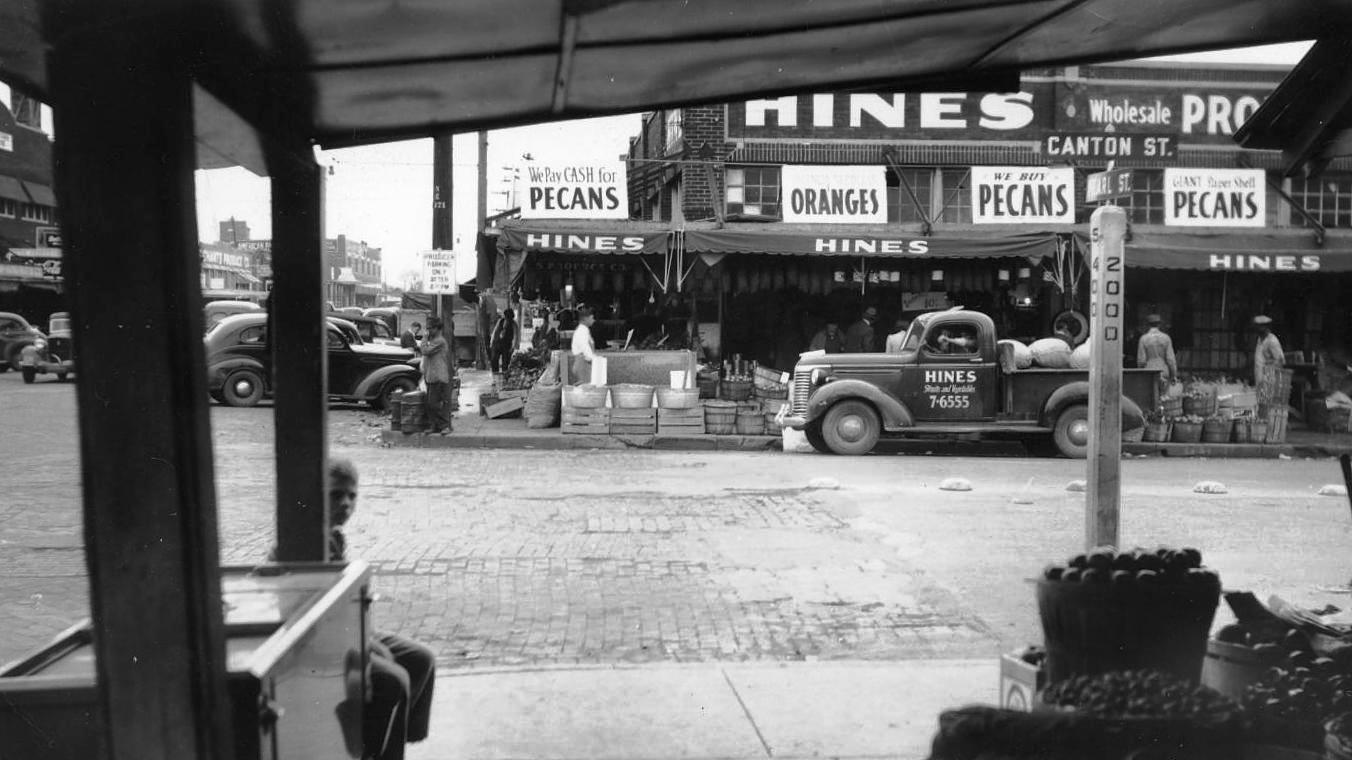 Hines Wholesale Produce Company, Canton & S. Pearl
These two scenes look so wholesome — produce peddlers selling their fresh fruits and vegetables, quaint old cars and trucks parked along streets that are still vaguely familiar-looking, and the overall old-fashioned-ness of everything — all presented in nice, sharp, black-and-white photographs that always make me feel a little nostalgic, even though I wasn’t actually around back then and have nothing, really, to be nostalgic about.
But “wholesome” is not a word that would have been associated with the Pearl Street Market. In fact, this was a part of town your mother would probably strongly suggest you not visit. Here are a few of the illicit activities that went on here on a fairly regular basis:
A typical police blotter story went something like this:
[Miss Esther Lee Bean] told physicians she was attacked by another woman who broke a beer bottle on her head and then used the jagged neck of the bottle as a weapon, cutting her several times on the right arm…. The affray occurred in a cafe in the 400 block of South Pearl. (Dallas Morning News, Dec. 17, 1938)
So … yes, very nostalgic.
Crime was a big problem, but what seems to have been even more upsetting to the people of Dallas was the general squalor of the place. Sanitary conditions were appalling. Rotting fruit and vegetables were thrown in the street, and live chickens were kept in cages, doing things that chickens do (which probably shouldn’t be done that close to things people might eat). And there were NO public toilets in the area — visiting farmers (who often bypassed the flea-bag hotels and slept in their trucks — or even on the sidewalks) routinely used the alleys as “comfort stations.” And then there were the rats. LOTS of rats. A staggering number of rats. Rats absolutely everywhere. Typhus? Not just a rumor. City sanitation crews would come by daily to hose the place down, but there was so much solid matter going down the drains that sewers were frequently clogged. It was, in a word, disgusting.
 A typical hotel near Pearl & Canton, a bit cleaner by the ’50s
For years this part of Dallas, just south of the central business district, had been a place where farmers (and produce brokers) had been selling their fruits, vegetables, poultry, eggs, pecans, and whatever else they could haul into town. It was all very informal, and for much of that time it was completely unregulated. This part of town had been the base of the “truck farmers” since at least 1912. Before that, the market was at Pearl and Main, and in the earliest days it was at Ervay and Elm.
In 1914 a city-sanctioned (and presumably regulated) municipal retail market where vendors would sell directly to consumers was proposed, but eventually consumers became irritated that the produce they bought at the municipal market was significantly more expensive than that which could be purchased from the “hucksters” who parked along Pearl Street and roamed residential neighborhoods. The Pearl Street vendors sold primarily to wholesale customers, but over time, they opened up their stalls to the public and did a bustling business with housewives. The wholesale market was hit pretty hard by the 1930s as the number of independent grocers — once the major buyers on Pearl Street — diminished as chain stores took over. Those housewives became more and more important as time went on.
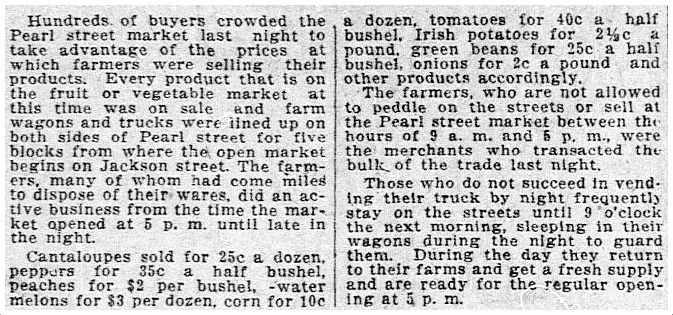 DMN, July 17, 1921 (click to enlarge)
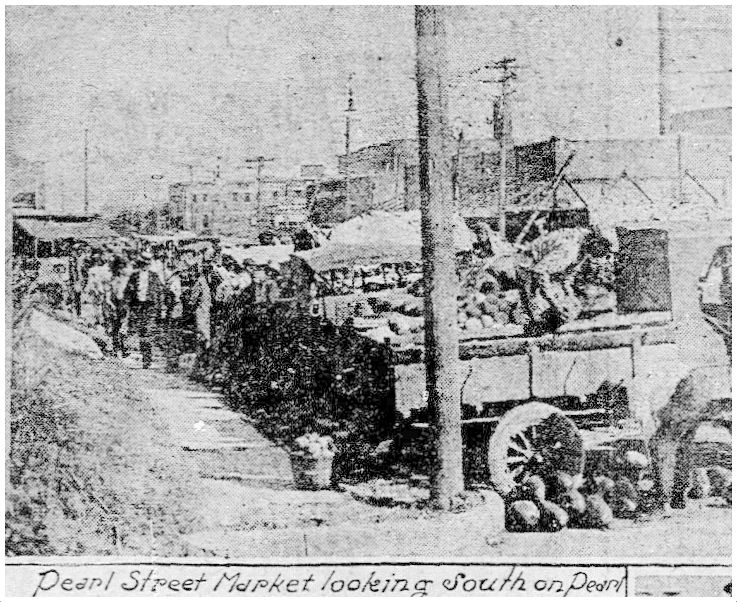

 DMN, July 17, 1921
By the 1920s, the Pearl Street Market was well-established, and it was where one went to buy fresh (and “fresh”) fruits and vegetables. And according to this real estate ad, business was booming:
 DMN, Nov. 4, 1923
In 1933, The Dallas Morning News printed a fantastic, full-page, Runyonesque article about the “Pearl Streeters,” written by Eddie Anderson, who interviewed the colorful characters of the area and described the buzzing street life. With tongue only partially in cheek, he wrote: “Chicago has its Water Street. In New York you will find it on Washington. And if you go abroad there is the famous Smithfield Market of London and the vaulted bazars of Constantinople. In Dallas, it is Pearl Street.” Below, a photo that accompanied the story (click for larger image).
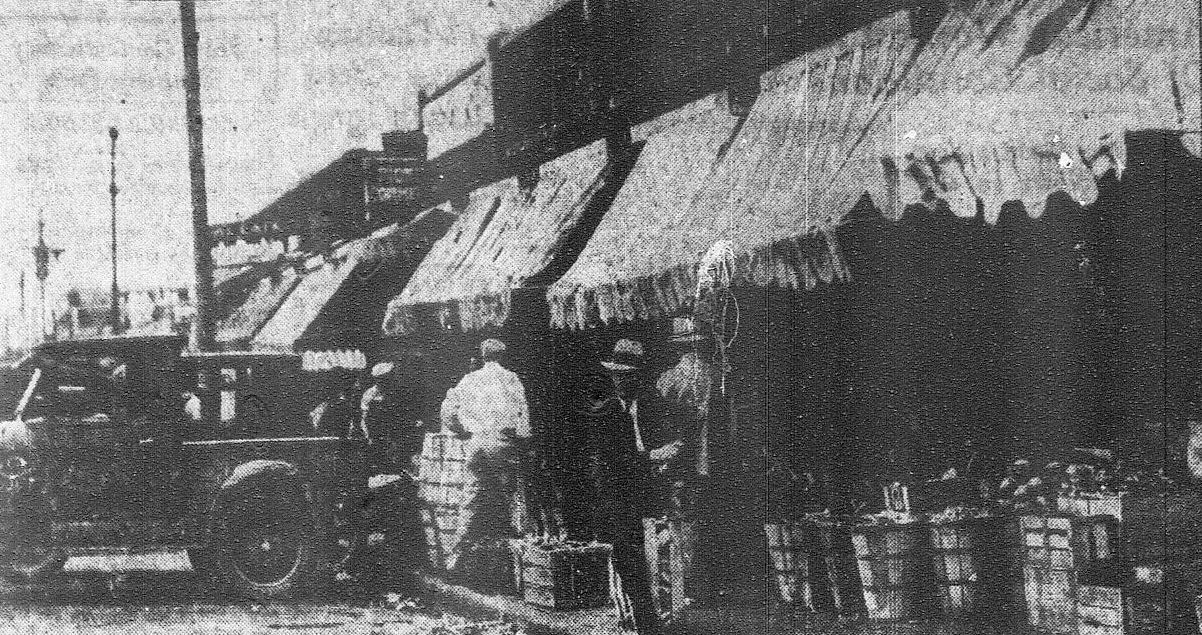
Anderson’s story was certainly entertaining, but it mostly glossed over the area’s more unsavory aspects. By 1938, there were louder and louder demands to clean up the neighborhood. Housewives organized and protested the deplorable conditions of the area, echoing points covered in a scathing Morning News editorial in which it was described as “a hazard to the health of the city because of the number of persons who visit it and because 75 per cent of the vegetables and poultry consumed in Dallas pass through that market” (DMN, Aug. 17, 1938).
In the early 1940s, the city finally stepped in and built the forerunner to the Farmers Market that we know today. By the 1950s, things in the squalor department had settled down a bit, and photos featuring pretty suburban housewives examining the produce and smiling children sampling fresh strawberries.
Nary a rat to be seen.
*
A street map of the Canton & Pearl area in about 1920, back when Canton Street was still part of an uninterrupted grid. (Note that many of the street names have changed over the years.)

***
Top photo (with Bob Taylor’s Cafe in the background) is from the author’s collection.
Photos of the Hines Produce Co. and the Prestwood (?) Hotel are from the Dallas Municipal Archives’ Dallas Farmers Market / Henry Forschmidt Collection, via the Portal to Texas History. You can browse this great collection here.
Map detail is from the very large “1919 Map and Guide of Dallas & Suburbs” (C. Weichsel Co.), via the Portal to Texas History, here.
The following DMN articles on the Pearl Street Market/Farmers Market are worth a read:
And even though I linked to it above, it’s so good and such a fun read that I’m going to mention it again: I highly recommend Eddie Anderson’s “Pearl Street Market As It Sees Itself” (May 14, 1933), here. Edward Anderson was an interesting guy: read about him at the Handbook of Texas here; read about his novels and see photos, here. All these years I’ve had his novel Thieves Like Us on my bookshelf, but I had never gotten around to reading it. Now I have a reason to!
I’ve gathered a pretty entertaining collection of crime reports from the Pearl & Canton neighborhood into one handy document, which can be read in all its seedy glory, here. SERIOUSLY. THIS IS FANTASTIC STUFF!
*
Copyright © 2014 Paula Bosse. All Rights Reserved.
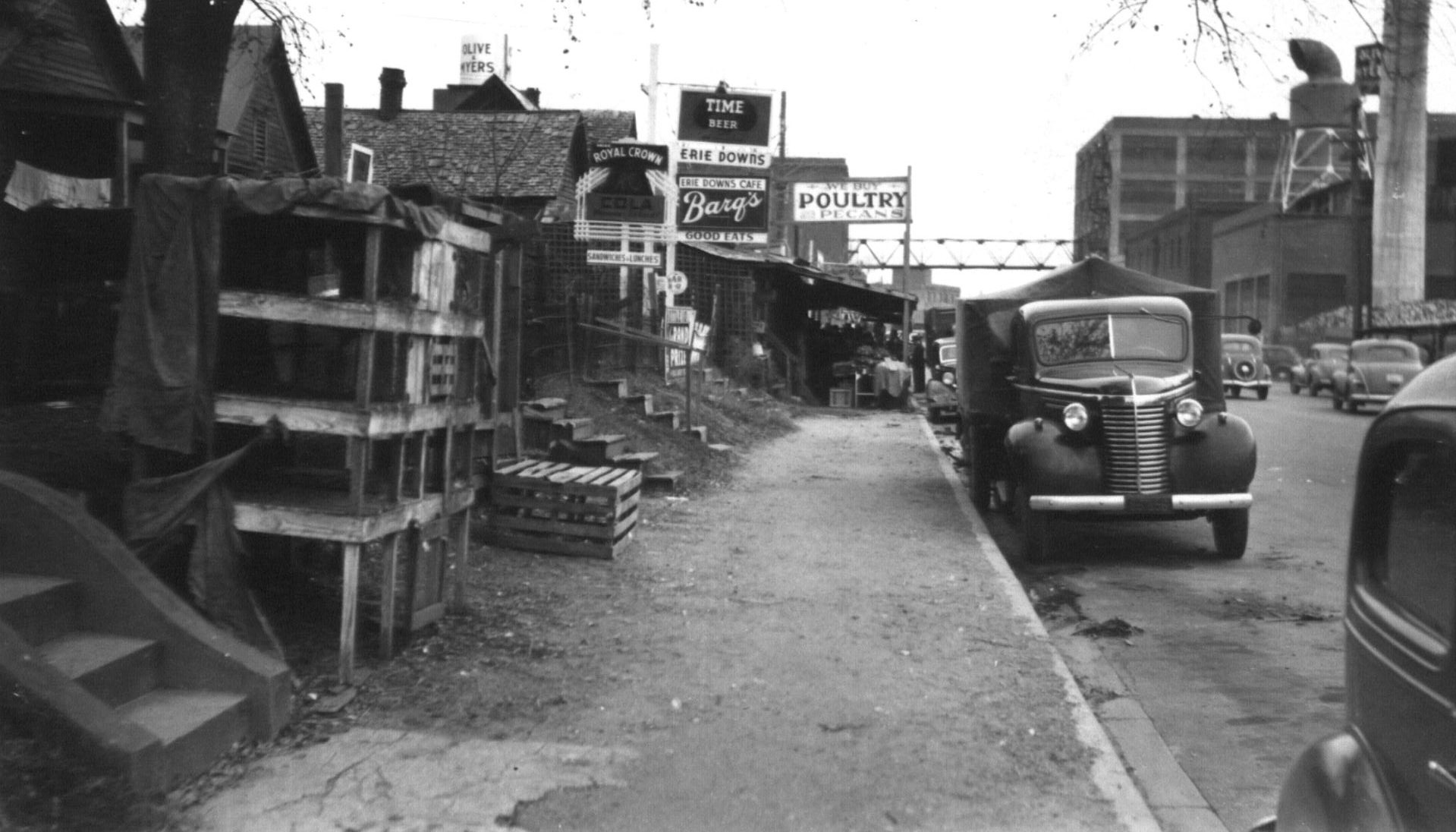 The 2100 block of Canton — there’s a lot going on here (click for much larger image)
by Paula Bosse
While reading about the “produce market district” (aka the wholesale fruit and vegetable businesses in the Farmers Market area), I came across the above unlabeled photograph. At first glance I thought the building at the top right was the Adam Hats building/Ford assembly plant, but the neighborhood didn’t look right. But on seeing the two Olive & Myers signs (a manufacturer I have to admit I’d never heard of), this seems to be a view of Canton Street, looking east from Cesar Chavez. The only thing that remains today is that cool building, which now contains pricey lofts and is known simply as “2220 Canton.” Below, the same view today.

The Olive & Myers Manufacturing Company was founded in Dallas in 1899 by two Iowa transplants and became a very successful furniture wholesaler and manufacturer. The company was housed in a large complex of buildings grouped near the Farmers Market; the six-story building seen above was built around 1925. Even though it was quite attractive back then, the building’s current incarnation as super-swanky luxury digs (with a heated rooftop pool) would certainly put those poultry sellers of yore to shame.
The sidewalk chicken coops may be gone, and the neighborhood no doubt smells a lot better, but, I have to say … a seedy and unsavory 1940s-era Canton Street looks a whole lot more lively and interesting than the scrubbed and fumigated 21st-century version.

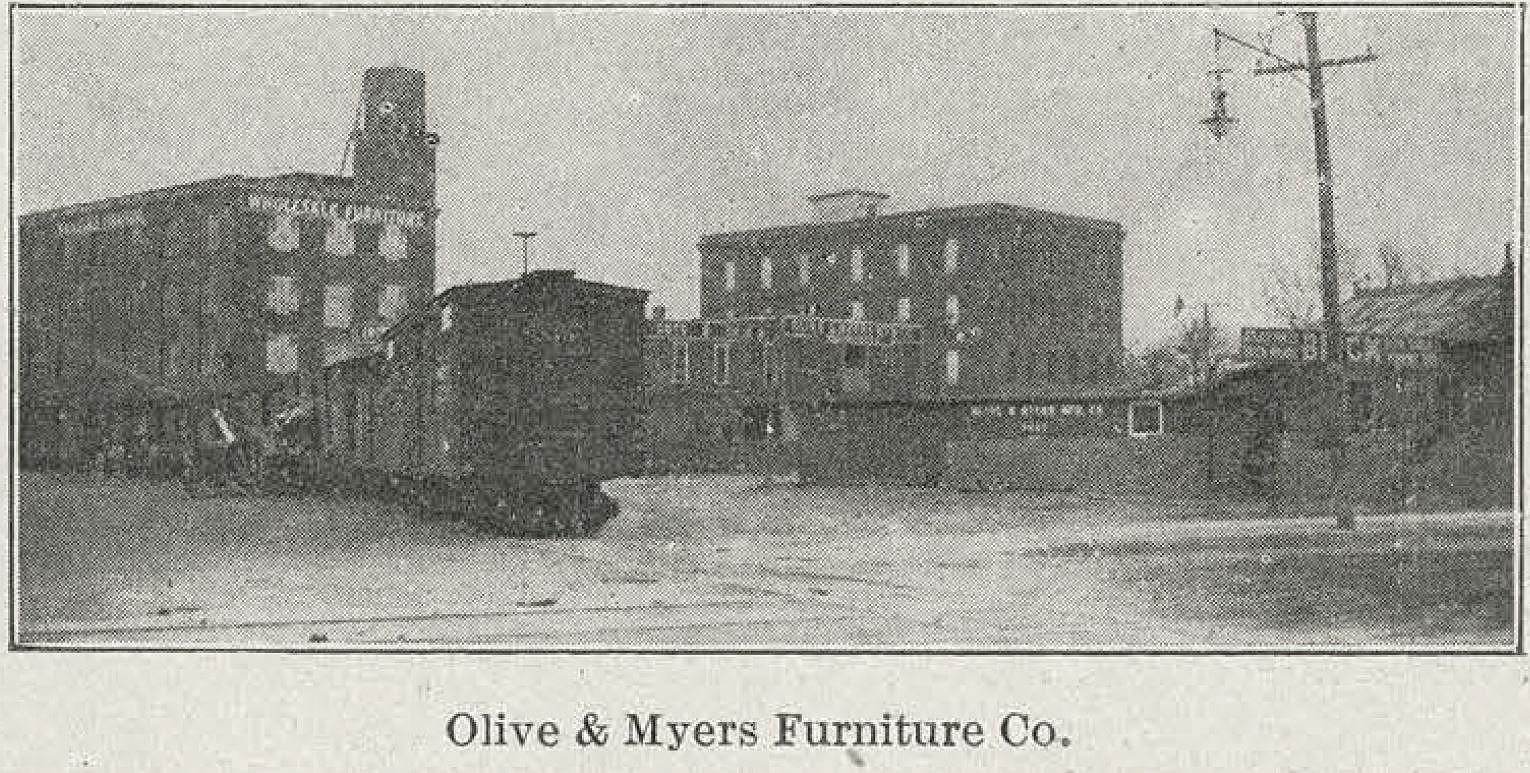 ca. 1905

ca. 1910
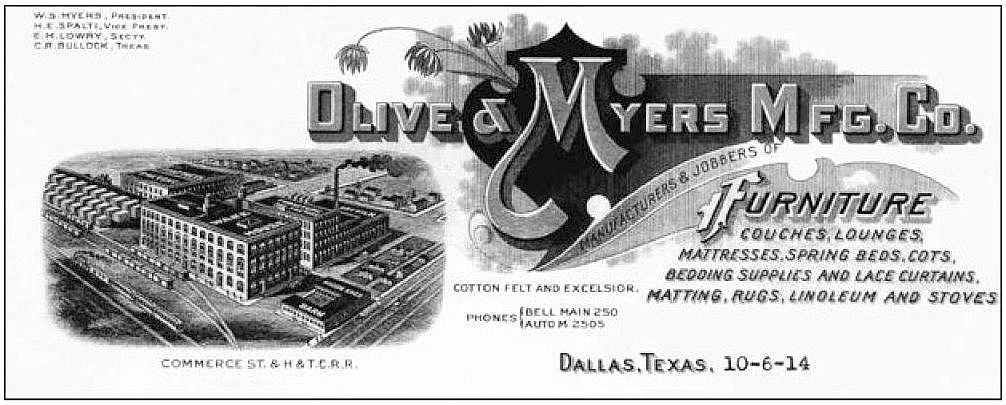
 1936 Texas Centennial ad – click to see very large detail of buildings
***
Top photo is from the Dallas Municipal Archives, via the Portal to Texas History. It was included in a large scrapbook — I looked at every single page, which was a bit of a slog, but persistence paid off, and I was rewarded with this incredible photo which was ALL THE WAY AT THE END — p. 166 of 169! The scrapbook page is here. (The Erie Downs Cafe is listed in the 1942 and 1945 city directories as being at 2117 Canton.)
Color image from Google Street View, 2014.
Olive-Myers logo from a 1937 ad.
The circa-1905 photo is from a publication I neglected to note, but which I know is in the collection of the DeGolyer Library, Southern Methodist University.
The blurry circa-1910 photo is from a publication called “History of an Opportunity: Facts About Dallas and Texas,” accessible in a PDF here; DeGolyer Library, SMU.
The letterhead dated “10-6-14” is from the Spring, 2013 issue of Legacies, via the Portal to Texas History.
For a follow-up post of sorts, I wrote about the darker side of the market area — full of crime and vermin — in the post “The Runyonesque Pearl Street Market, Full of Colorful Characters and an Army of Rats,” here.
Click pictures for larger images.
*
Copyright © 2014 Paula Bosse. All Rights Reserved.
 The Rogers Lacy Hotel, designed by Frank Lloyd Wright
by Paula Bosse
Feast your eyes on that fantastic skyscraper. That building was *this close* to being built in Dallas. And even though it was designed in 1946 (!), it looks modern enough to fit right in with the city’s celebrated 21st-century skyline.
Frank Lloyd Wright designed this 47-story hotel for millionaire East Texas wildcatter Rogers Lacy, to be built at the southwest corner of Commerce and Ervay, catty-corner from the also fabulous (if not quite so futuristic-looking) Mercantile National Bank Building.
Even though he had a firm distaste for the overly-populated, traffic-clogged, modern American city, Wright jumped at the chance to design a hotel smack dab in the middle of one of the country’s largest and fastest-paced cities. In fact, the Lacy Hotel was one of Wright’s pet projects, and he went all-out in his attempt to convince his wavering client of the merits (both aesthetic and utilitarian) of the multi-million-dollar skyscraper he had, apparently, been dreaming of for decades.
While Wright worked on swaying Lacy in his favor, John Rosenfield — the influential arts critic of The Dallas Morning News — worked on winning over the people of Dallas. Rosenfield really pulled out the stops when writing about the project; his promotion of the proposed hotel (in print as well as behind-the-scenes) was as tireless as it was passionate.
The startlingly new architectural design combined with Wright’s salesmanlike pronouncements on how he had transcended what he saw as the crushing gloom of hotel space caused quite a bit of excitement. Lacy, the Texas oil man with deep pockets, was eventually won over. But a client’s enthusiasm and an architect’s full-bore persuasion can sometimes go only so far. After an initial gung-ho response from the Lacy camp, communication with Wright began to get spotty (causing a freak-out at Taliesin), and plans never really got underway. When Lacy died unexpectedly at the end of 1947, the project was scrapped, and Frank Lloyd Wright’s dream of a soaring glass skyscraper was never realized.
If only we could go back and nudge Rogers Lacy to sign off on this building’s construction. It’s amazing how Wright’s concept here predicted the later glass-clad, atrium-centered architecture that has been a Dallas staple for decades. If Wright’s Lacy building were announced today — even without the weight of Frank Lloyd Wright’s name attached to it — I think news of its construction would, again, be met with excitement.
***
The Frank Lloyd Wright drawing of the proposed Rogers Lacy Hotel is from the cover of the Spring 2009 issue of Legacies: A History Journal for Dallas and North Central Texas. Charles T. Marshall’s extremely entertaining article, “Where Dallas Once Stood: Frank Lloyd Wright and the Rogers Lacy Hotel,” is in this issue, and it’s a great read, illustrated with photos of the key players and additional architectural drawings of the hotel; you can read the full article here.
Wright’s biggest champion in Dallas was legendary Dallas Morning News critic John Rosenfield (he and Wright were also personal friends). His articles on the proposed Rogers Lacy hotel appeared in the DMN, including the ones listed below:
*
Copyright © 2014 Paula Bosse. All Rights Reserved.

by Paula Bosse
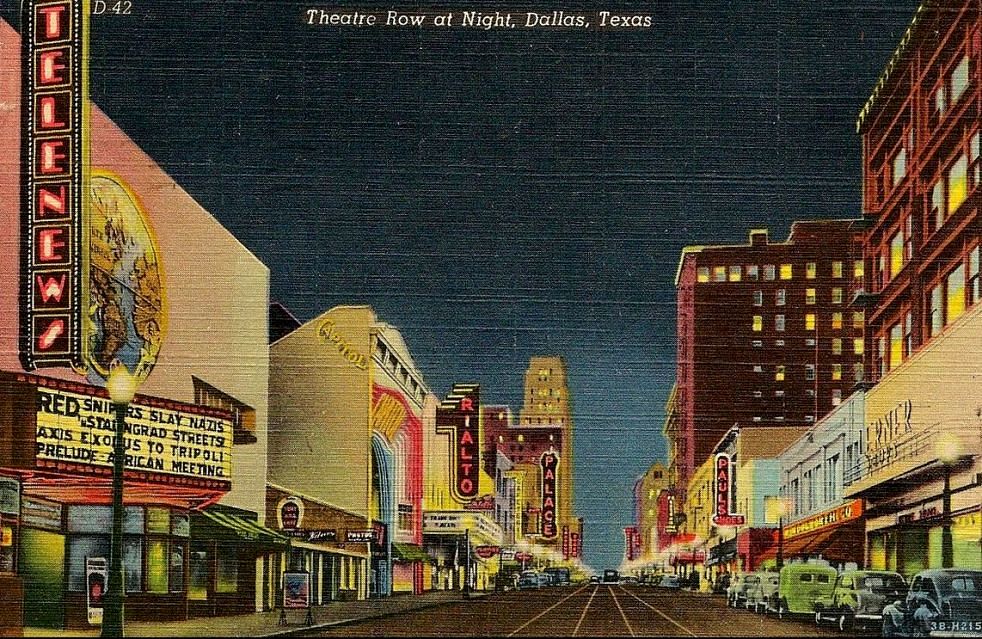
You know how you look at some of those fantastic postcards from the ’40s that don’t look real and you wonder, “Is that from a photograph, or is that just an artistic interpretation?” Well, it’s both.
In the above “before” and the below “after,” it’s interesting to note what’s been kept in and what’s been taken out. And how a fairly ho-hum daytime view becomes a dazzling night-time scene. Either way, it’s an Elm Street I’ll — sadly — never experience.
***
Black-and-white photograph of Elm Street’s “Theater Row” from the Texas State Historical Association.
Click pictures for larger images.
*
Copyright © 2014 Paula Bosse. All Rights Reserved.
by Paula Bosse
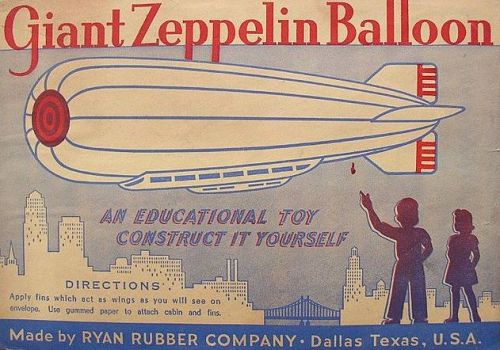
Bet you didn’t know that giant Zeppelin balloons were made in Dallas (or maybe Forney…). They were. The Ryan Rubber Company’s balloon factory opened in Forney in 1946, managed by Lester G. Norris with the help of his wife, Gladys.
***
Source of Zeppelin ad unknown.
See a photo of the Norrises at work and read the accompanying article “Picture Blocks and Balloons Big Business for These Men” (Dallas Morning News, Nov. 28, 1949).
*
Copyright © 2014 Paula Bosse. All Rights Reserved.
 800 block of Exposition…
by Paula Bosse
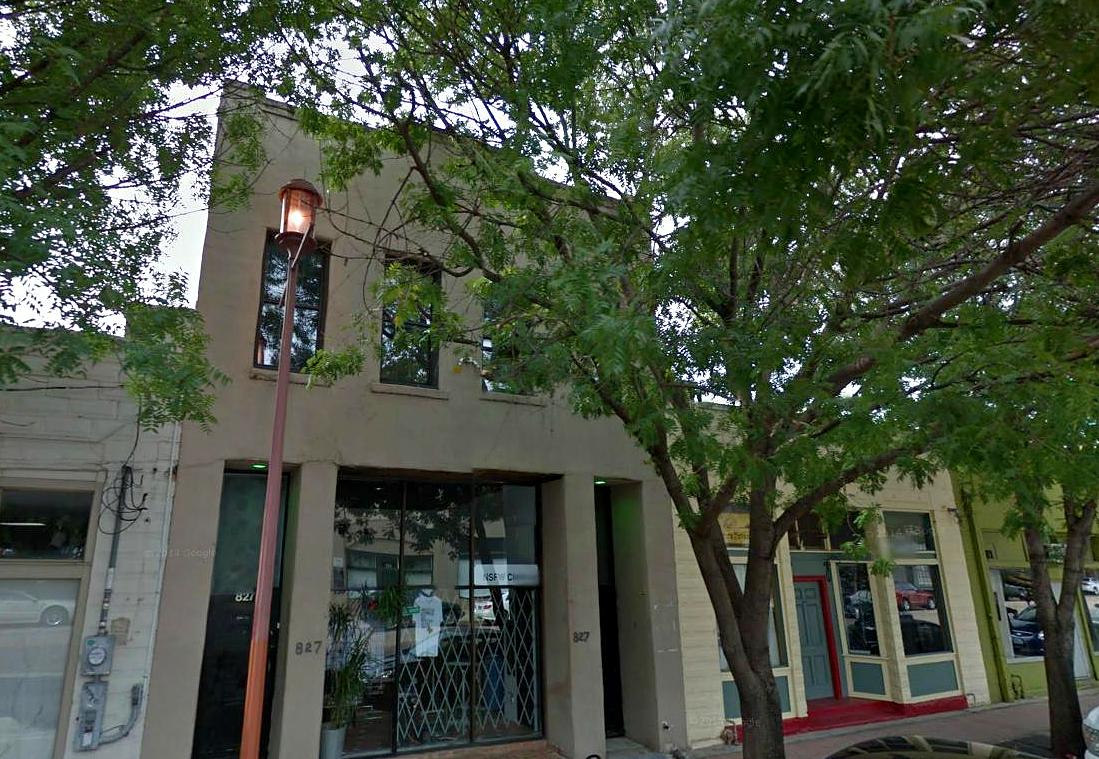
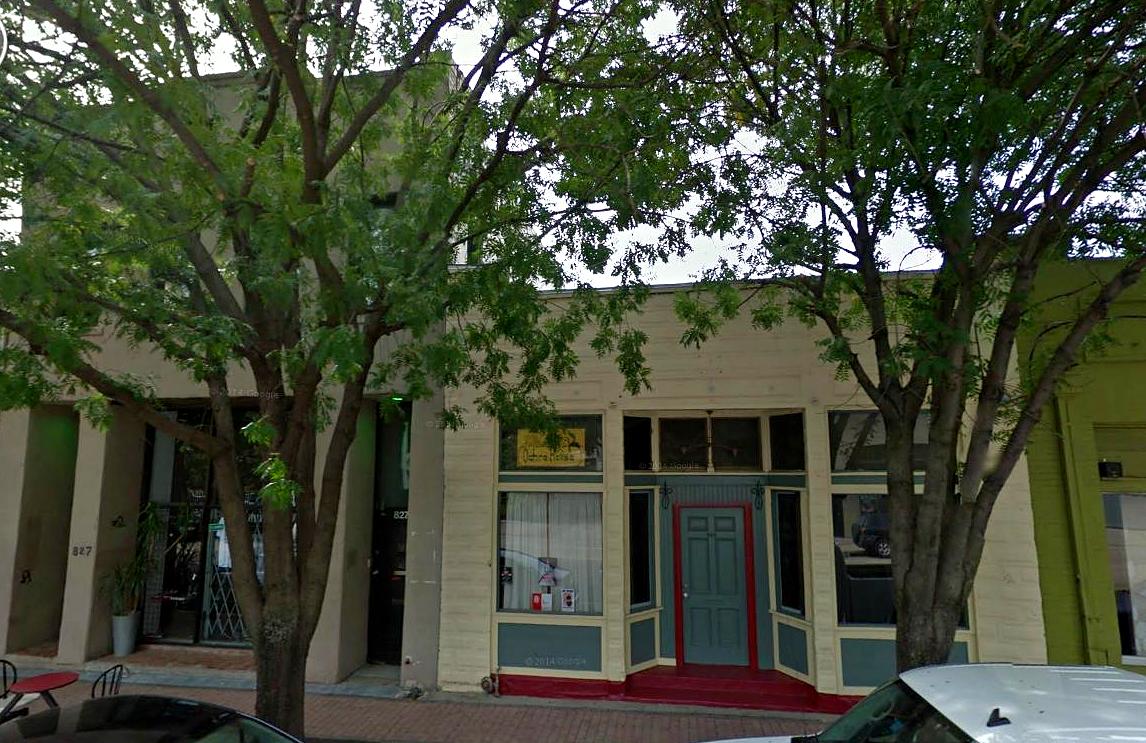
Next time you stop by the Amsterdam Bar at 831 Exposition Avenue, whip out your phone and show this photo to your drinking buddies — this is what the street looked like two doors down, just after World War II. The two-story building at 827 Exposition was home to Lief Dry Goods and the Lief Hotel, and the single-story 825 Exposition was divided into McNeill’s Tin Shop and the Fair Way Cleaners & Laundry (it currently houses the Ochre House theater space). Today the neighborhood has lost much of its grittiness (and head-in parking), but the buildings are still recognizable almost 70 years later. Below, present-day 827 and 825 Exposition Avenue.
***
Top photo from Jim Wheat’s Dallas County Texas Archives.
Bottom two images from Google Street View.
*
Copyright © 2014 Paula Bosse. All Rights Reserved.
 Oh dear…
by Paula Bosse
I’m not sure what’s happened here, but it looks like the interurban has emerged victorious.
***
I don’t know the original source of this photo, but I came across it on the Northern Texas Traction History Group on Facebook. The electric-powered interurban car is the big red one on the left; the puny (but cute) electric-powered green streetcar is on the right. The view here is looking north on Record, from just south of Young Street, inside what would one day be called “Communications Center”: the Dallas Morning News Building is on the left, and the not-yet-built WFAA studios will later be to the immediate right (east). The long-gone Hotel Jefferson is north of Ferris Park (the hotel was catty-corner from Union Station, across Houston Street). In the distance you can see the tippy-top of the Old Red Courthouse, just above the green streetcar. Also, those now-gone smokestacks that were such a fixture on the skyline are straight ahead.
*
Copyright © 2014 Paula Bosse. All Rights Reserved.
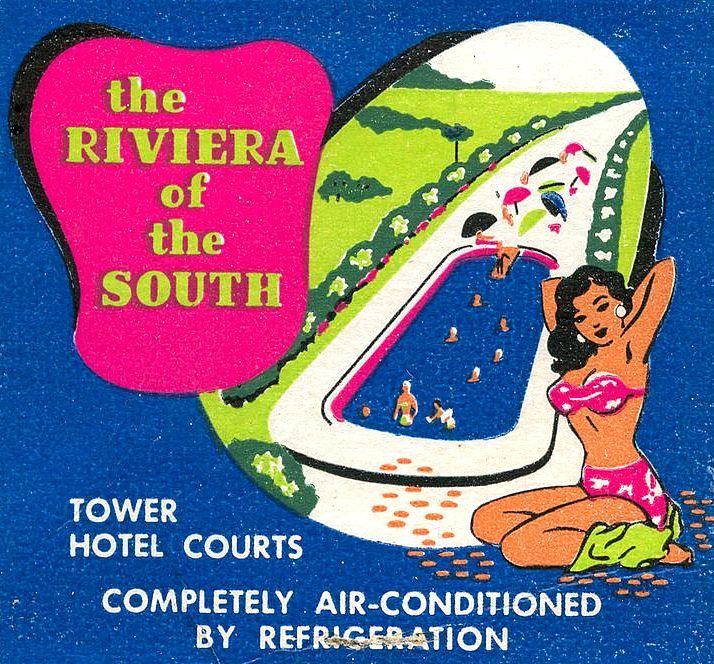 The paradise of Harry Hines awaits…
by Paula Bosse
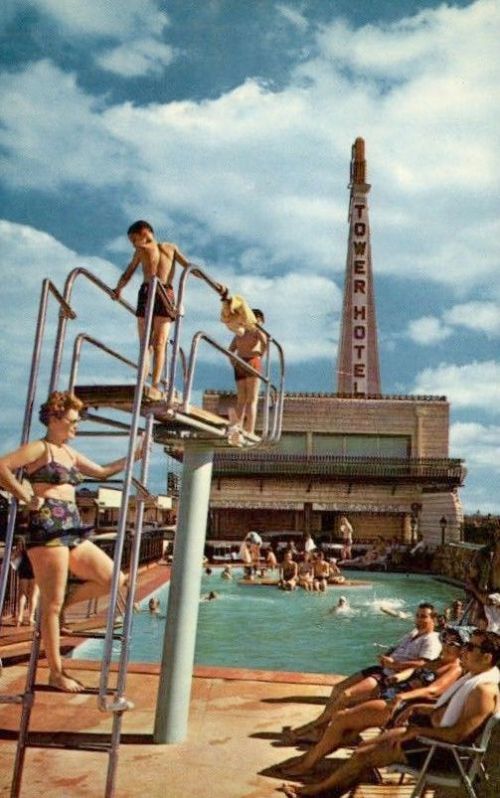
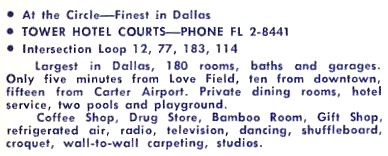
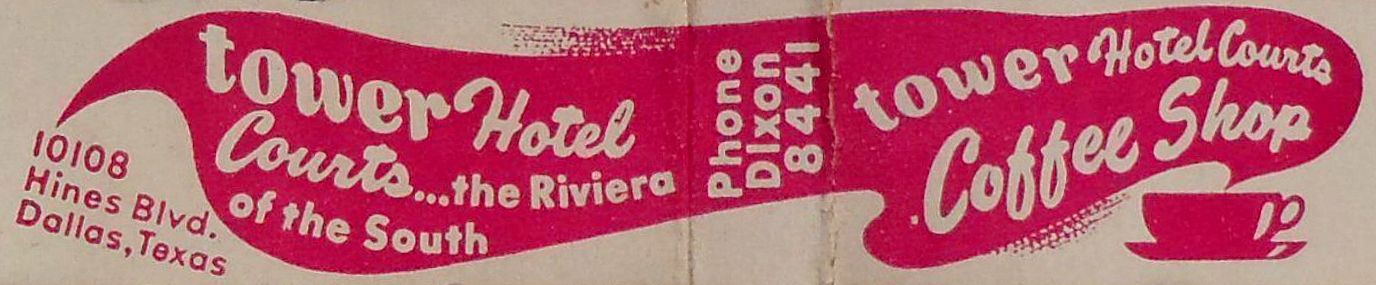
The Tower Hotel Courts opened in the fall of 1946. Their address makes my had spin: at “The Circle” where highways 77, 183, 114, and Loop 12 intersect. “10108 Harry Hines” would have been easier to fit on the stationery, but mention of all those highways just made everything more exciting. (It also gave some indication to prospective guests of what would be awaiting them, such as constant traffic noise and the ever-present whiff of exhaust in the air. “You can’t say we didn’t warn you, madam.”)
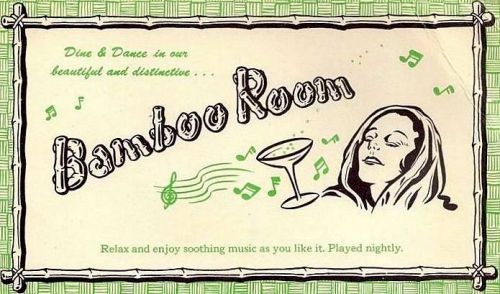
The fancy motel was five speedy minutes away from Love Field, which seems handy, because if you had an hour or seven to kill before your flight, wouldn’t you want to spend it there in the fabulous-looking Bamboo Room? I would! (Even though I’m pretty sure that matchbook cover is a little more glamorous than the actual Bamboo Room.)
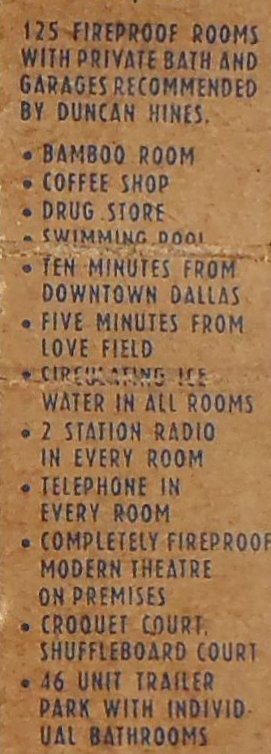
If you were going to stay for a day or two and not just a few drinks, there were all sorts of things waiting for you: two pools (one a very large children’s wading pool), a theater, a croquet court AND a shuffleboard court, “circulating ice water,” and … stand back … a 2-station radio in every room. Somewhere in amongst all of this was a 46-unit trailer park (“with individual bathrooms”).
It’s not hard to see why they called the Tower Hotel Courts “The Riviera of the South.”
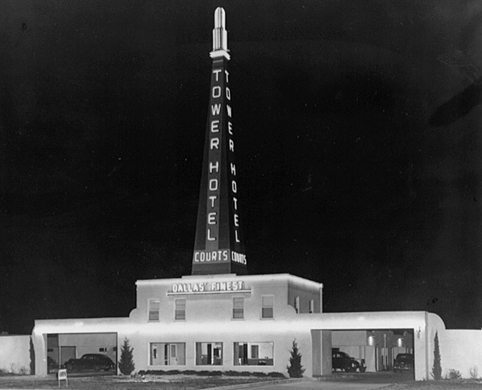
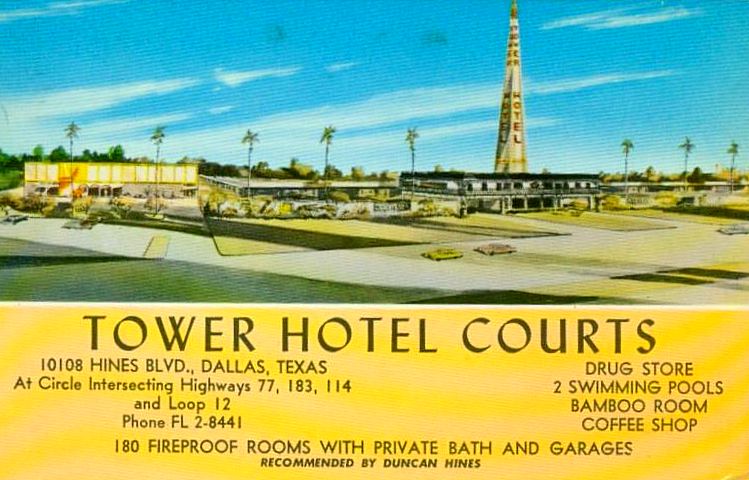
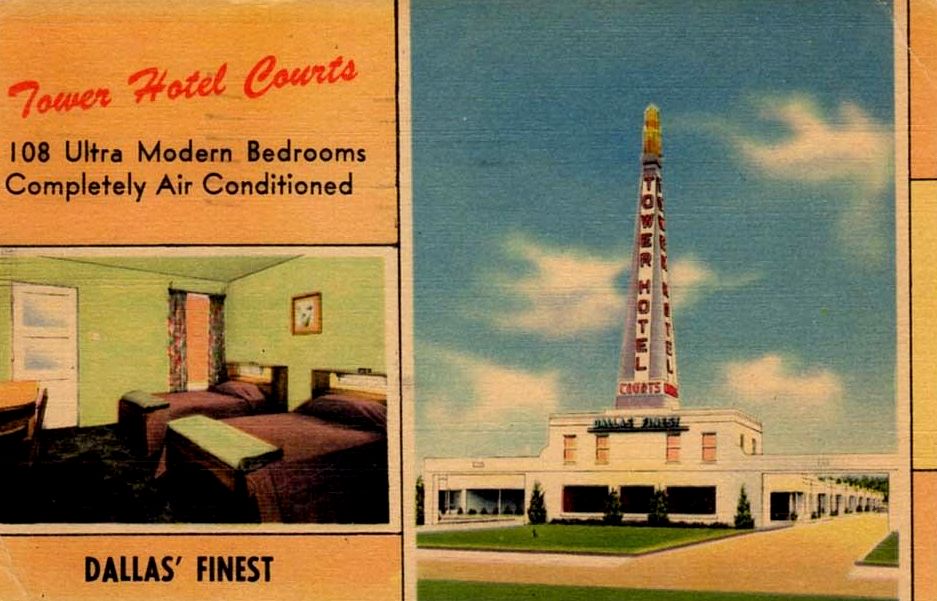 Ultra Modern!
 Owner’s wife and kids?
***
First and last images from Flickr; Bamboo Room image also from Flickr.
Several of these pictures are larger when clicked.
*
Copyright © 2014 Paula Bosse. All Rights Reserved.
 Flashback : Dallas