Flashback : Dallas

A Miscellany: History, Ads, Pop Culture

Category: 1940s

Roth’s, Fort Worth Avenue
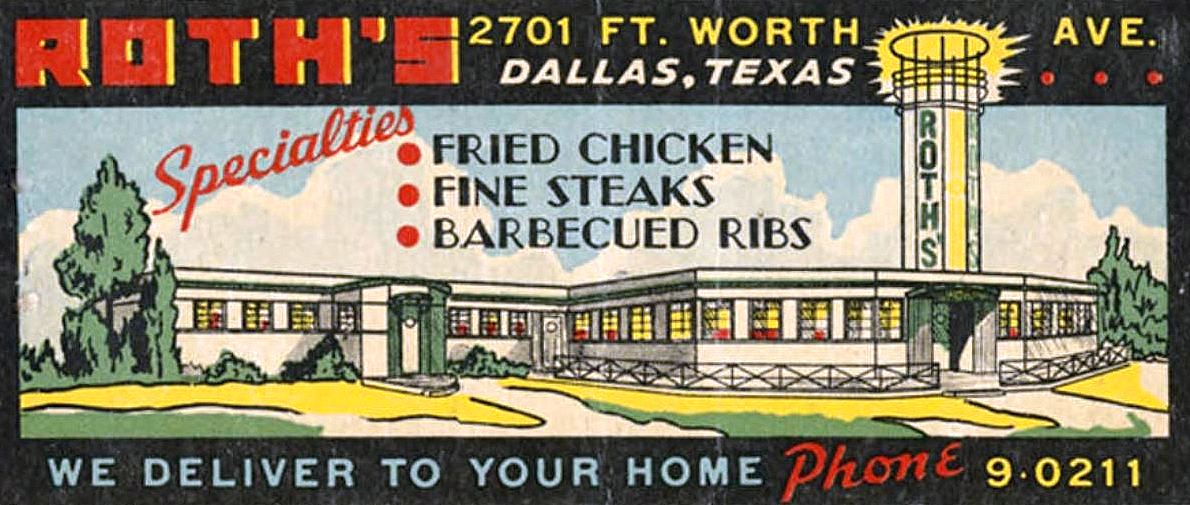
roths_cook-collection_smuSign me up, Mr. Roth…

by Paula Bosse

When I see a building like this, I always hope I can find a photo of it somewhere, but all I’ve been able to come up with is this energetic rendering from a 1940s matchbook cover. Roth’s (which was advertised variously as Roth’s Cafe, Roth’s Restaurant, and Roth’s Drive-In) was in Oak Cliff, on Fort Worth Avenue. It opened in about 1940 or ’41 and operated a surprisingly long time — until about 1967. When Roth’s opened, its address was 2701 Fort Worth Avenue, but around 1952 or ’53 the address became 2601. (I think the numbering might have changed rather than the business moving to a new location a block down the street.)

During World War II, Mustang Village — a large housing development originally built for wartime workers (and, later, for returning veterans and their families) — sprang up across Fort Worth Avenue from the restaurant. It was intended to be temporary housing only, but because Dallas suffered such a severe post-war housing shortage, Mustang Village (as well as its sister Oak Cliff “villages” La Reunion and Texan Courts) ended up being occupied into the ’50s. Suddenly there were a lot more people in that part of town, living, working, and, presumably, visiting restaurants.

As the 1960s dawned, Mustang Village was just a memory, and Roth’s new across-the-street neighbor was the enormous, brand new, headline-grabbing Bronco Bowl, which opened to much fanfare in September 1961. I don’t know whether such close proximity to that huge self-contained entertainment complex hurt or helped Roth’s business, but it certainly must have increased traffic along Fort Worth Avenue.

Roth’s continued operations until it closed in 1967, perhaps not so coincidentally, the same year that Oak Cliff’s beloved Sivils closed. Ernest Roth, like J. D. Sivils, most likely threw in the towel when a series of “wet” vs. “dry” votes in Oak Cliff continued to go against frustrated restaurant owners who insisted that their inability to sell beer and wine not only damaged their own businesses but also adversely affected the Oak Cliff economy. The last straw for Sivils and Roth may have been the unsuccessful petition drive in 1966/1967 to force a “beer election” (read about it here in a Morning News article from Aug. 17, 1966).

As far as that super-cool building seen at the top — I don’t know how long it remained standing, but when Roth’s closed, a mobile home dealer set up shop at 2601 Fort Worth Avenue, and mobile homes need a lot of parking space….

The building on the matchbook cover above is, unfortunately, long gone (as is the much-missed Bronco Bowl); the area today is occupied by asphalt, bland strip malls, and soulless corporate “architecture” (see what 2701 Fort Worth Avenue looks like today, here).

*

The man behind Roth’s was Ernest W. Roth, a Hungarian immigrant who had worked for many years as maître-d’ at the Adolphus Hotel’s tony Century Room. He decided to go out on his own, and around 1940, he and his business partner Joseph Weintraub (who was also his brother-in-law) opened the Oak Cliff restaurant which boasted two dining rooms (with a seating capacity of 350, suitable for parties and banquets), fine steaks, and, on the weekends, a live band and dancing. Ernest’s wife, Martha, and their son Milton were also part of the family business. When the restaurant opened, there wasn’t much more out there on the “Fort Worth cut-off,” but the place must have been doing something right, because Roth’s lasted for at least 27 years — an eternity in the restaurant business. It seems to have remained a popular Oak Cliff dining destination until it closed around 1967.

*

The real story, though, is the Roth family, especially Ernest’s mother, Johanna Roth, and even more especially, his older sister, Bertha Weintraub.

Johanna Rose Roth was born in 1863 in Budapest, where her father served as a member of the King’s Guard for Emperor Franz Josef. She and her husband and young children came to the United States about 1906 and, by 1913, eventually made their way to San Antonio. In the ’40s and ’50s she traveled by airplane back and forth between San Antonio and Dallas, visiting her five children and their families — she was known to the airlines as one of their most frequent customers (and one of their oldest). She died in Dallas in 1956 at the age of 92.

Johanna’s daughter Bertha Roth Weintraub had a very interesting life. She too was born in Hungary — in 1890. After her husband Joe’s death in the mid ’40s, a regular at her brother’s restaurant, Abe Weinstein — big-time entertainment promoter and burlesque club empresario — offered Bertha a job as cashier at the Colony Club, his “classy” burlesque nightclub located across from the Adolphus. She accepted and, amazingly, worked there for 28 years, retiring only when the club closed in 1972 — when she was 82 years old! It sounds like she led a full life, which took her from Budapest to New York to San Francisco to San Antonio to Austin and to Dallas; she bluffed her way into a job as a dress designer, ran a boarding house in a house once owned by former Texas governor James Hogg, hobnobbed with Zsa Zsa Gabor and Liberace, was a friend of Candy Barr, and, as a child, was consoled by the queen of Hungary. She died in Dallas in 1997, a week and a half before her 107th birthday. (The story Larry Powell wrote about her in The Dallas Morning News — “Aunt Bertha’s Book Filled With 97 Years of Memories” (DMN, Nov. 17, 1987) — is very entertaining and well worth tracking down in the News archives.)

weintraub-bertha-roth_texas-jewish-post_021590
Bertha Roth Weintraub

I feel certain that the extended Roth family found themselves entertained by quite a few unexpected stories around holiday dinner tables!

***

Sources & Notes

Matchbook cover (top image) is from the George W. Cook Dallas/Texas Image Collection, DeGolyer Library, Central University Libraries, Southern Methodist University; more info is here.

Photo of Bertha Weintraub is from The Texas Jewish Post (Feb. 15, 1990), via the Portal to Texas History, here.

*

Copyright © 2017 Paula Bosse. All Rights Reserved.
1710 Hall: The Rose Room/The Empire Room/The Ascot Room — 1942-1975

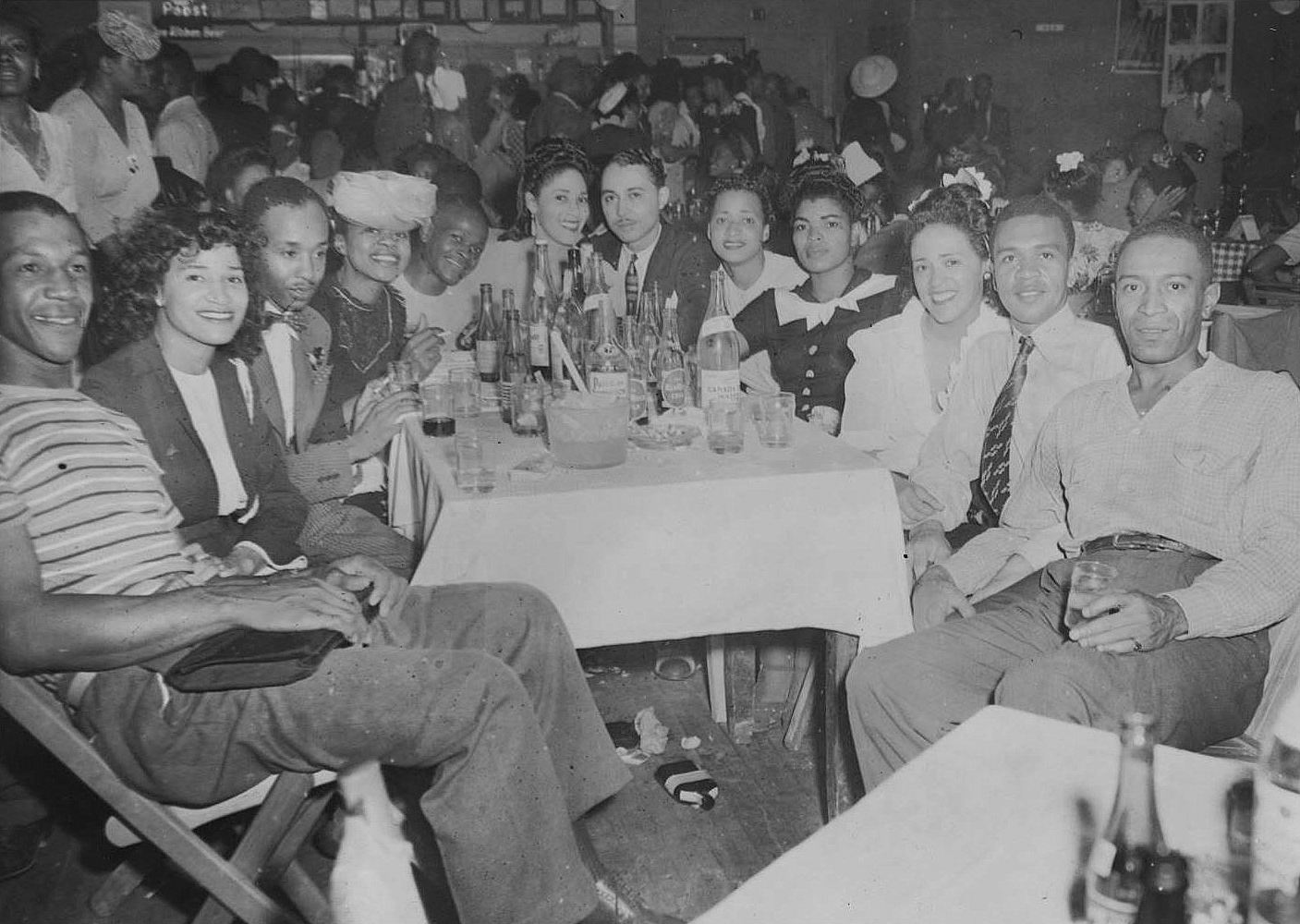
rose-ballroom_aug-1942_cook-collection_degolyer_smuThe Rose Ballroom, 1942

by Paula Bosse

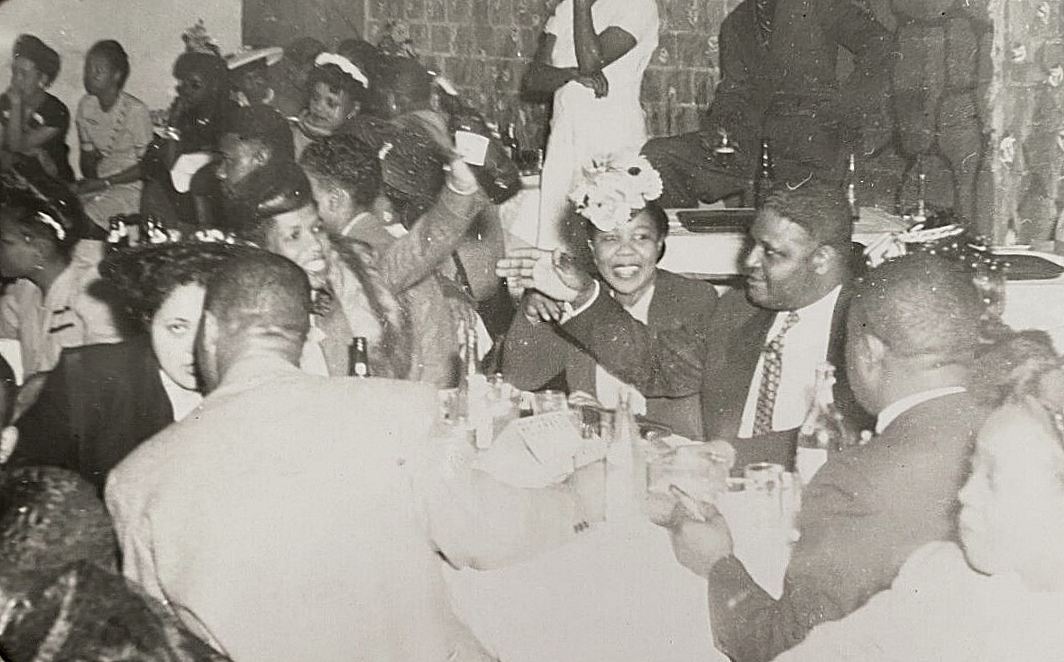
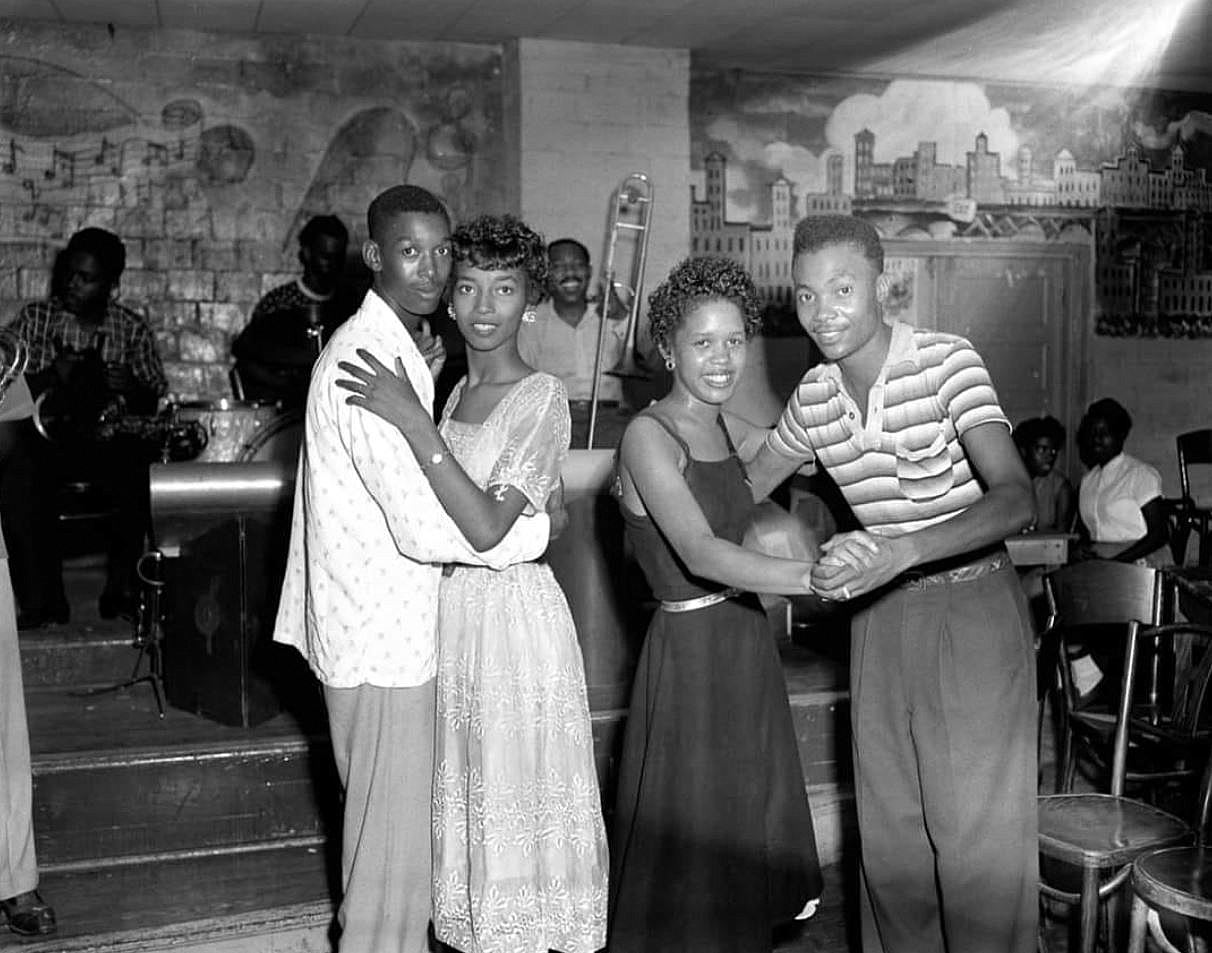
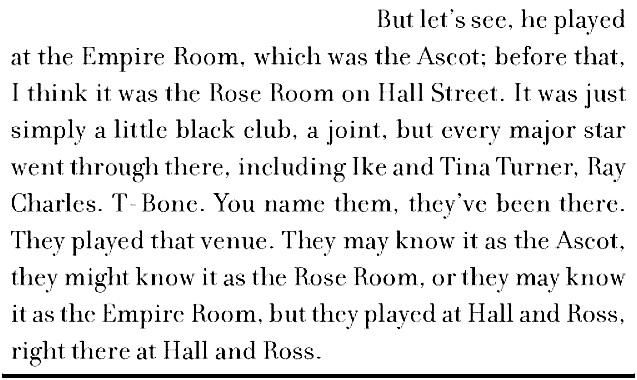
The photo above was taken at the Rose Ballroom at 1710 Hall Street (a few steps off Ross Avenue) in August, 1942. 1710 Hall was the home to a string of very popular black nightclubs: the Rose Ballroom (1942-1943), the Rose Room (1943-1951), the Empire Room (1951-1969) (not to be confused with the nightclub of the same name in the Statler Hilton), and the Ascot Room (1969-1975). There seems to have been some overlap of owners and/or managers and/or booking agents, but they all appear to have been very popular “joints” (as described by Freddie King’s daughter), where both big-name touring musicians as well as popular local acts played. Icons T-Bone Walker and Ray Charles were regulars (there are stories of Ray Charles sleeping on the Empire Room’s stage during the time he was living in Dallas in the ’50s). Everybody seems to have played there. Below, a quote from Wanda King, talking about her father, blues legend Freddie King — from the book Texas Blues: The Rise of a Contemporary Sound by Alan Govenar (all clippings and photos are larger when clicked):

rose-room_freddie-king_wanda-king_texas-blues_govenar

Some of the acts scheduled to appear in early 1946 at the Rose Room were Erskine Hawkins, Louis Armstrong, Lionel Hampton, Buddy Johnson, and Andy Kirk. …Wow.

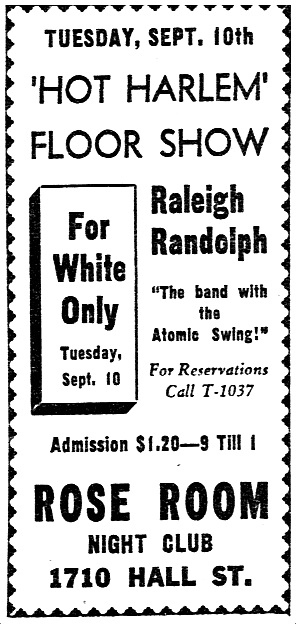
In the days of segregation, when Dallas police threatened to shut the club down if the owner allowed white patrons to mix with black patrons, the club scheduled “white only” nights where Caucasian audiences could see their favorite non-Caucasian performers. (Before these special club nights, which seem to have started in 1945, a revue would be taken “on the road” — over to the Majestic Theatre on Elm Street — to perform live onstage.)

rose-room_dmn_092945-ad
1945

rose-room_dmn_090846_ad
1946

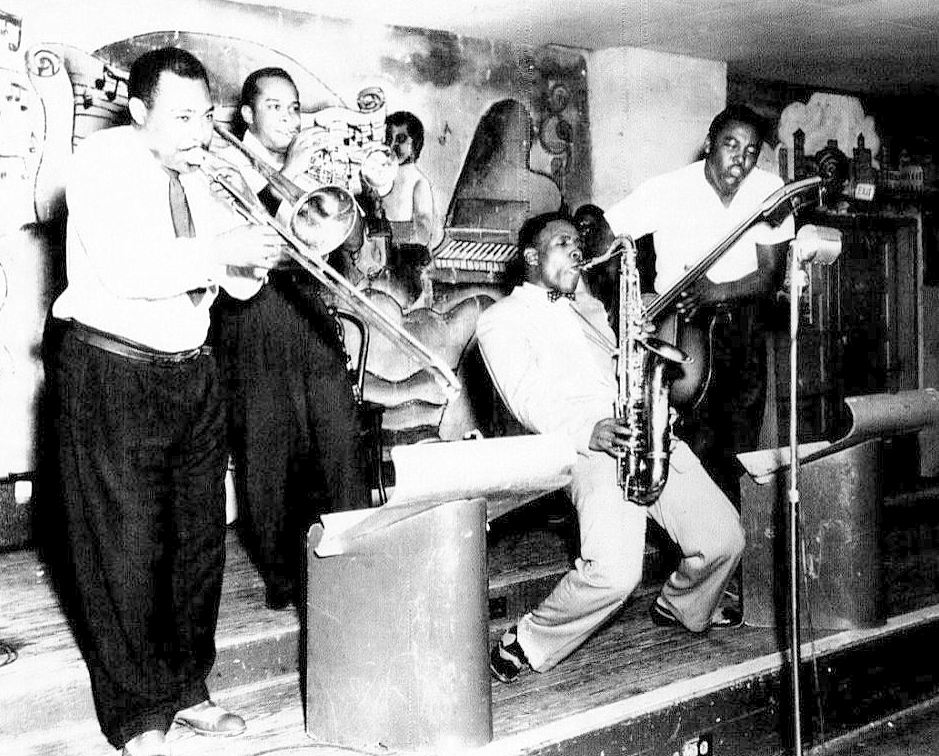
The photo up there at the top showed the audience — here’s the stage (1946 photo of the E F Band by Marion Butts, from the Marion Butts Collection, Dallas Public Library):

rose-room_the-e-f-band_marion-butts_dpl_1946

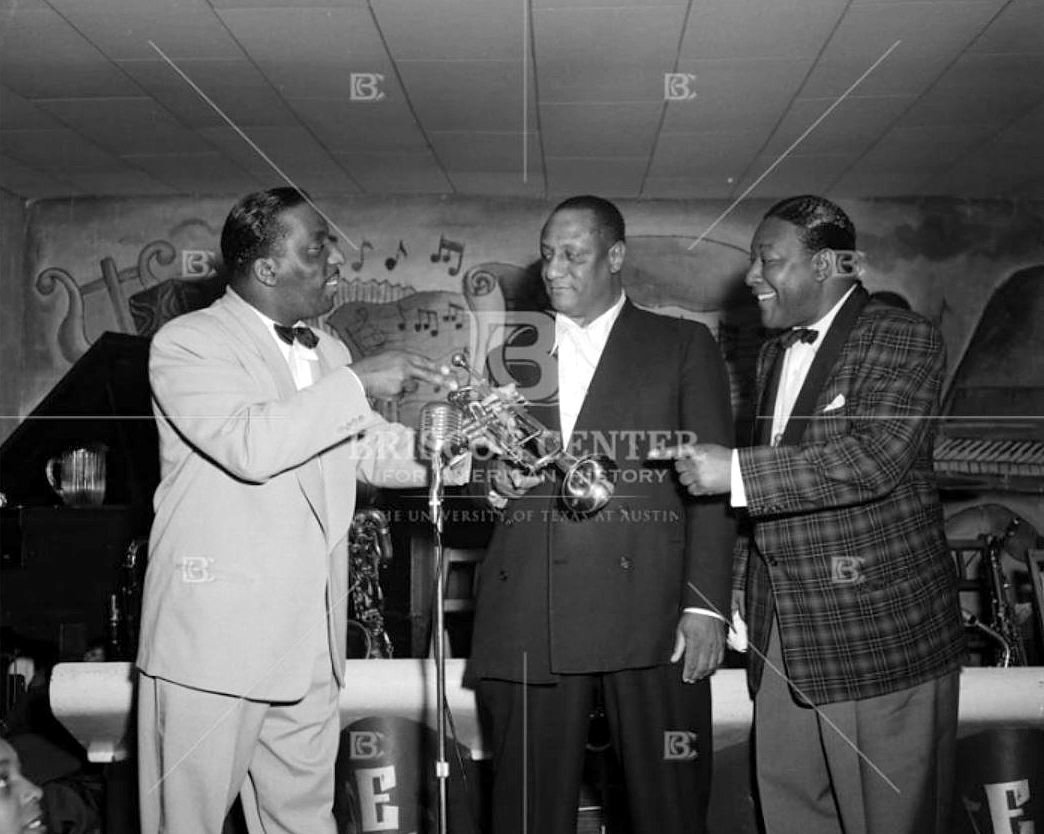
And here’s what the stage looked like when the club became the Empire Room (onstage is Joe Johnson in a 1954 photo by R. C. Hickman, taken from a great article about Hickman in Texas Highways, here):

empire-room_joe-johnson_1954_r-c-hickman_tx-highways_020299

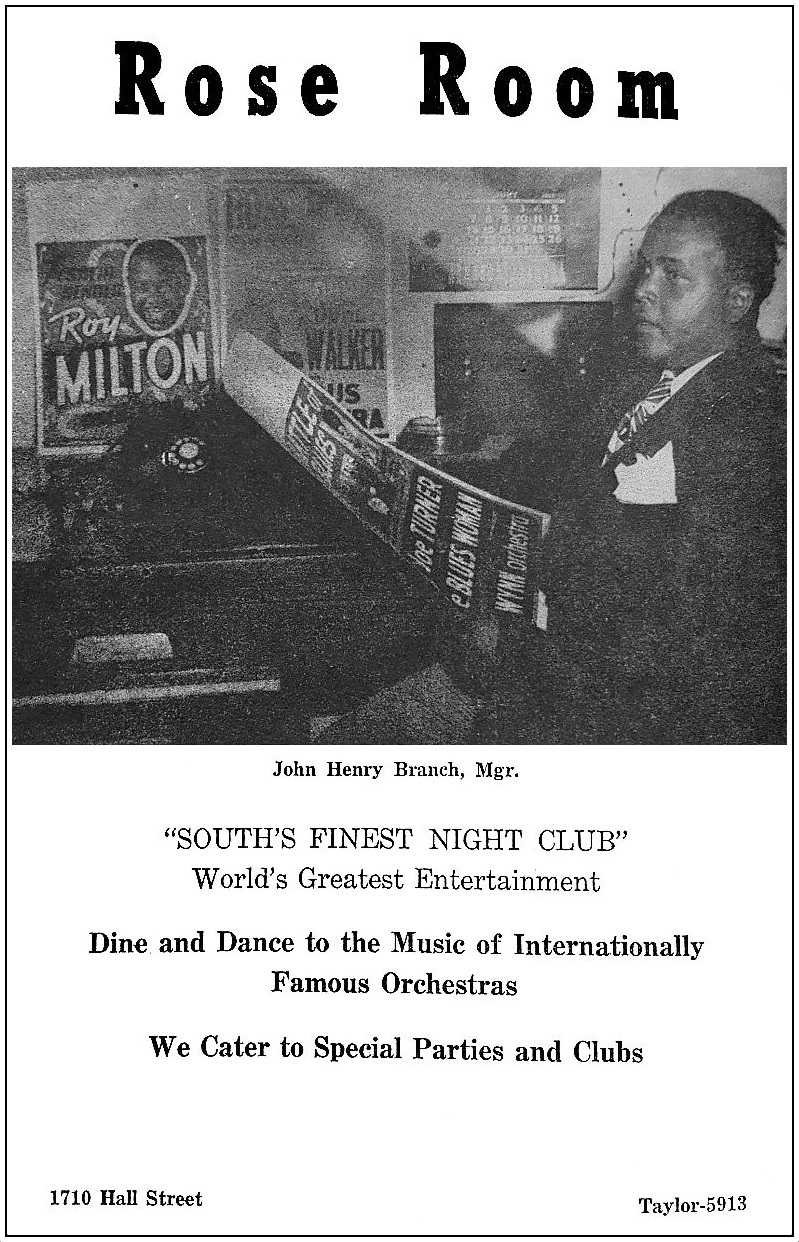
One thing that probably helped set the Rose Room/Empire Room apart from a lot of the other clubs in town at this time was the man who booked the shows — and who booked acts all over the area: John Henry Branch. The guy knew everyone. Here he is in an ad from 1947:

rose-room_1947-1948-negro-directory_dallas

Aside from booking acts and musicians for black clubs, he also booked acts for white clubs — including Jack Ruby’s Carousel and Vegas clubs. In fact, Branch chatted with Ruby at the Empire Room the night before Ruby shot Oswald — Ruby had come in to check on a piano player Branch was booking for a gig at the Vegas Club in Oak Lawn. Branch supplied testimony to the Warren Report, and while it’s not all that riveting (because there wasn’t that much to tell), it’s still interesting to hear how Branch describes his own club and Ruby’s personality (“You can’t never tell about him — he’s a weird person.”) — you can read his testimony here.

I have to admit, I’d never heard of the Rose Room or the Empire Room before I saw the photo at the top of this post. I really missed out. So much fantastic music! And I missed it. It’s just another reminder that Dallas has an incredible music history.

rose-room_texas-blues_govenar-brakefieldfrom the Texas African American Photography Archive

rose-room_1944-45-directory_hall-street
1700 block of Hall Street, 1944-45 city directory

What’s at 1710 Hall these days? A vacant lot — soon to be developed, no doubt. Ross Avenue ain’t what it used to be….

rose-room_photo_green-cover_ebayeBay

empire-room_teenage-dance_hickman_080656Teen dance, Aug. 6, 1956 (photo by R. C. Hickman)

empire-room_l-g-mccutcheon_hickman_042351_briscoe-center_watermarkApr. 23, 1951 (photo by R. C. Hickman, Briscoe Center, Univ. of TX)

**

UPDATE: After many fruitless attempts to find a photo of the exterior of this building, I stumbled across it in a 1973 filmed report from KERA, recently uploaded by the G. William Jones Film and Video Collection at SMU. Below is a screenshot showing the Ascot Room a couple of years before it finally closed, looking a little worse for wear. The 8-minute film (which you can watch here) shows tons of locations in the Black neighborhoods of South Dallas (along Forest Avenue/MLK Blvd.) and “North Dallas” (along Hall Street) — the Ascot Room can be seen briefly at the 1:46 mark. (More on this film can be found in the Flashback Dallas post “Black Dallas — 1973.”)

ascot-room_june-1973_kera-collection_jones-collection_SMUAscot Room, 1973 (screenshot, Jones Collection, SMU)

***

Sources & Notes

Top photo from the George W. Cook Dallas/Texas Image Collection, DeGolyer Library, Central University Libraries, Southern Methodist University; more info on this photo is here. Someone has written this on the photo: “Aug. 42, Dallas, Rose Room” — in August, 1942 the club was known as the Rose Ballroom; it changed its name to the Rose Room in early 1943.

1973 screenshot is from a 1973 film (my guess is that it was broadcast on Channel 13’s “Newsroom”) from the KERA Collection, G. William Jones Film and Video Collection, Hamon Arts Library, Southern Methodist University.

Wanda King quote is from the book Texas Blues: The Rise of a Contemporary Sound by Alan Govenar (College Station: Texas A & M University Press, 2008).

Rose Room ad featuring John Henry Branch is from the 1947-48 Dallas Negro City Directory (with thanks to Pat Lawrence!).

More about the hopping Hall Street area can be found in the Flashback Dallas post “Life on Hall Street — 1947,” here.

*

Copyright © 2017 Paula Bosse. All Rights Reserved.
Casa Linda Animal Clinic, Est. 1948

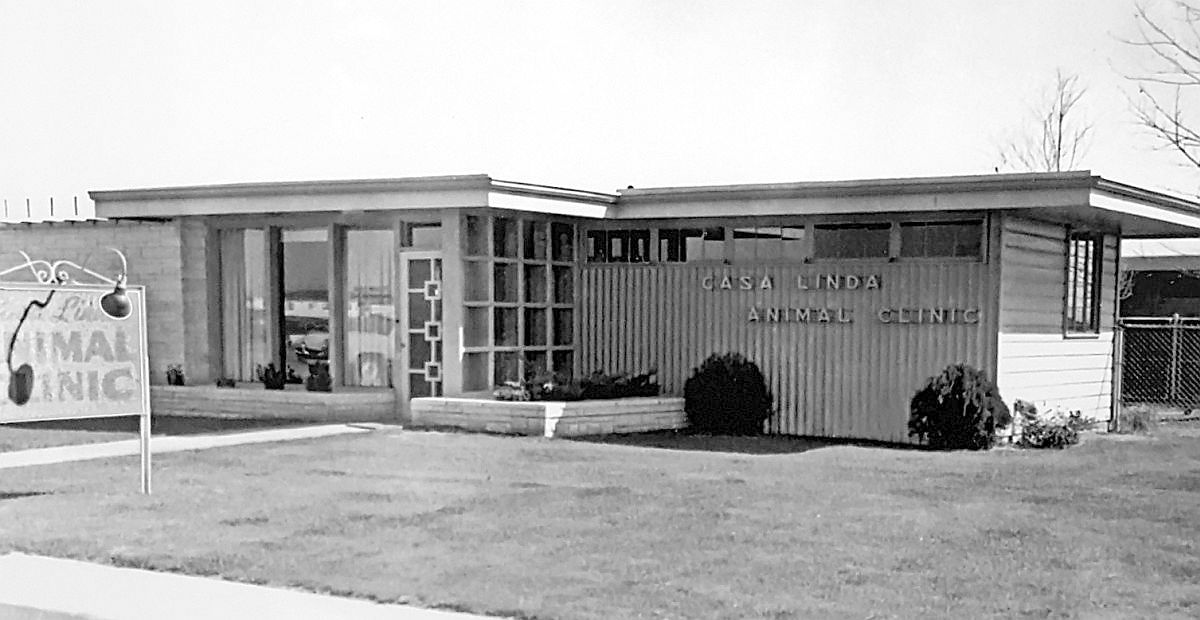
casa-linda-animal-clinic_bwIf only Garland Rd. & Jupiter still looked like this…

by Paula Bosse

Sometimes you can find interesting historical photos in the most unexpected places — like my mother’s veterinarian’s office. The photo above shows the cool mid-century design of the Casa Linda Animal Clinic, at 11434 Garland Road, just past the intersection with Jupiter.

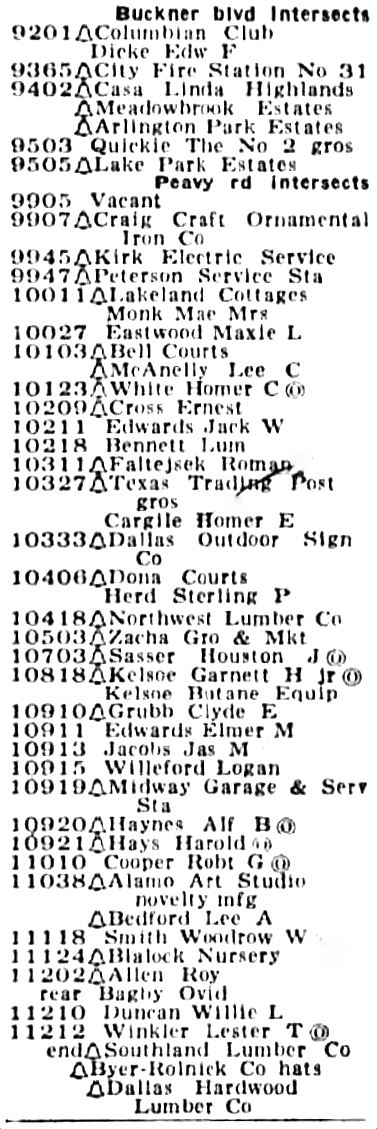
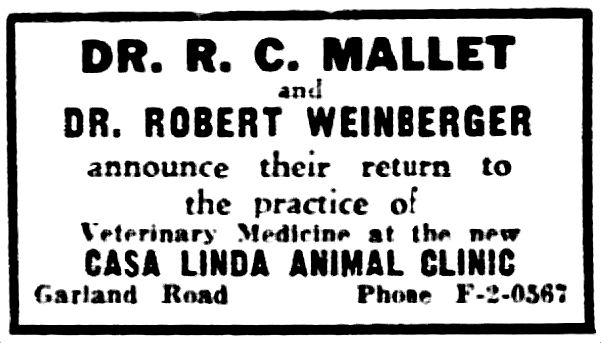
Two young veterinarians — Robert Weinberger and Roland Mallett — opened the animal clinic/hospital/boarding kennel in June, 1948, out in the boonies. I’m not actually sure that that stretch of Garland Road was even technically in Dallas in 1948. The 1948 city directory shows Garland Road ending at the 11200 block (with no cross-streets after Peavy). (Click to see a larger image.)

garland-road_1948-directory
1948 Dallas directory

When Weinberger and Mallett (whose name is often seen spelled as “Mallet”) opened their veterinary practice, theirs was the very last business (or residence) between the Dallas and Garland boundary. (To see how empty things were around there, check out a couple of pages from the 1952 Mapsco, here; the first one shows a developed area around White Rock Lake, Forest Hills, and Casa Linda, and the second one shows a much less developed area once you’ve passed Jupiter Road — and anything east of Shiloh is either a bleak no-man’s land or … Garland.) (I’ve never heard of Hudson Airport, seen on the second map — north of Northwest Highway, between Jupiter and Garland Road — so that’s cool to see.)

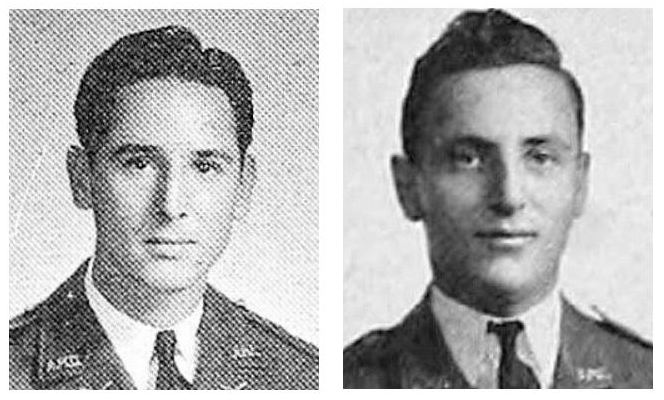
But back to the Casa Linda Animal Clinic (and it’s not really in Casa Linda, but I’m not sure what that area is). Being so far out in the sticks in 1948 probably explains how a couple of fairly recent Texas A&M veterinary school grads (and former WWII servicemen) who were still in their 20s were able to buy land for their first practice. The money they saved on real estate was apparently put into building a well-appointed clinic (according to Dr. Weinberger’s obituary, the clinic itself was “designed in collaboration with Texas A&M as sort of a showpiece of a modern, small-animal veterinary clinic”). Below, photos of Mallett, on the left, and Weinberger, from their vet school days at A&M — both were Class of ’44.

mallett-1943_weinberger-1942_texas-a-m-yearbooks

casa-linda-animal-clinic_dmn_060848
June 1948

The building today (seen here on Google Street View) looks nothing like it did in the photo at the top. It has been almost 70 years, but the building has either been drastically remodeled or is a new building. (Perhaps exterior work was done on it all the way back in 1951 when a car ran through the front wall.)

The clinic has gone through several partners and owners over the past 69 years, but it’s nice that it’s kept the same name all this time. I would assume that it has become something of a neighborhood fixture and has probably treated the pets of several generations of Casa Linda, Casa View, and Lochwood residents. …Maybe even some from Garland.

And now I know more about my mother’s veterinary clinic than she does!

***

Sources & Notes

Top photo is on the wall of the Casa Linda Animal Clinic. I wish more businesses would post old photos like this. If the (very nice) staff saw me taking this photo of a photo this morning, they probably wondered what I was doing. I’m afraid I didn’t ask permission to reproduce it, so it seems only right that I direct you to their website if you live in the area and are looking for a veterinarian.

Photo of Roland C. Mallett (1920-2010) is from the 1943 Texas A&M yearbook; photo of Robert Weinberger (1922-2009) is from the 1942 yearbook. Both graduated in 1944.

Read more at the Dallas Morning News archives:

  • “Dallas Veterinarians Open Casa Linda Animal Hospital” (DMN, June 20, 1948) — with photo of newly constructed building
  • “And the Wall Came Tumbling Down” (DMN, July 28, 1951) — photo shows Dr. Mallett looking at a car that had crashed into the animal hospital (no people — or animals — were injured)

Current boundary map of Garland can be found here.

*

Copyright © 2017 Paula Bosse. All Rights Reserved.

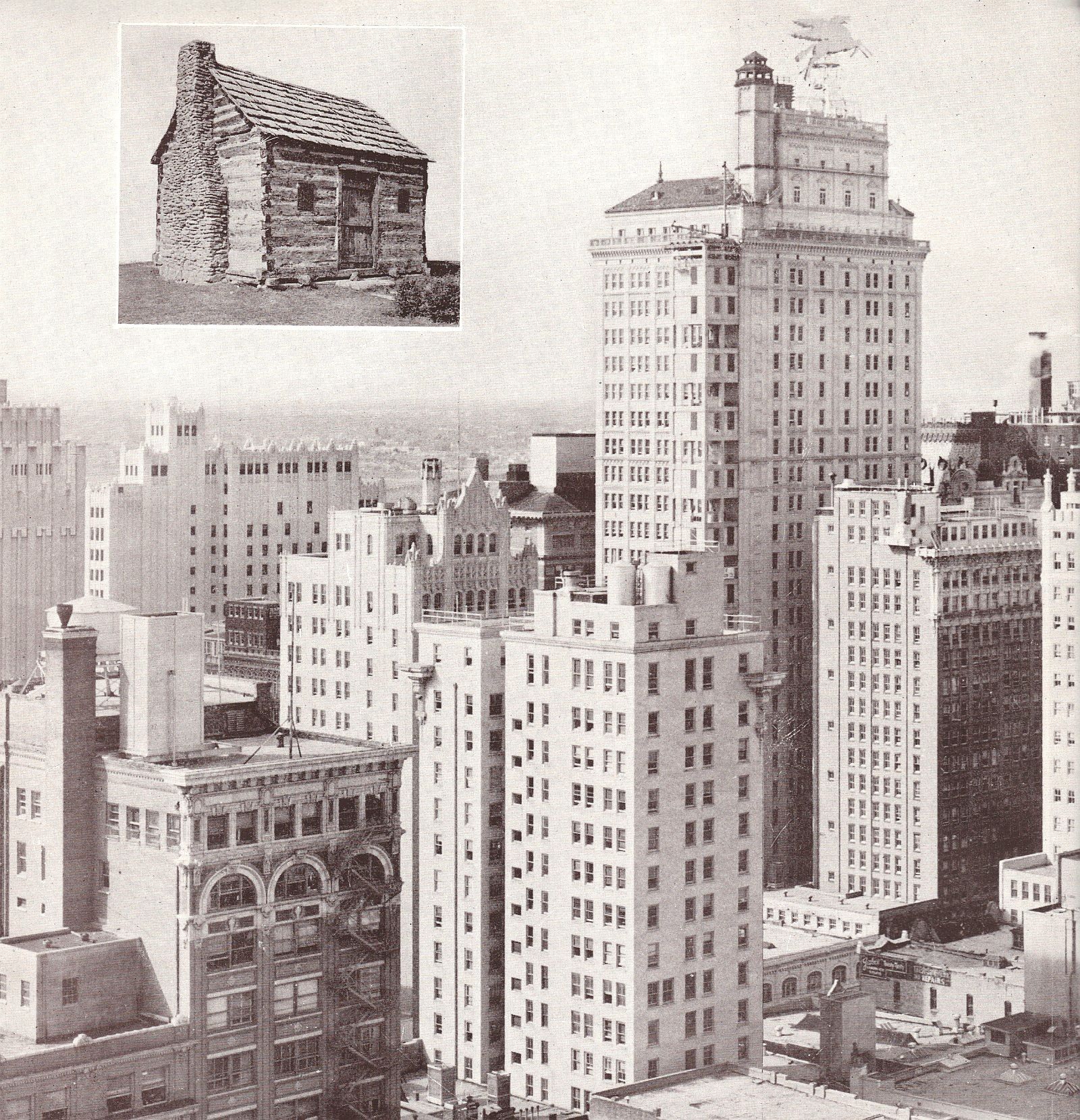
A Century of Growth: From Log Cabin to Skyscrapers

cityscape_cabin_so-this-is-dallas_ca-1943Ol’ JNB wouldn’t recognize the place… (click for larger image)

by Paula Bosse

To think it all began with John Neely Bryan’s little log cabin on the banks of the Trinity…. 

***

Photo from the booklet So This Is Dallas (Dallas: The Welcome Wagon, circa 1943); courtesy of the Lone Star Library Annex Facebook page.

*

Copyright © 2017 Paula Bosse. All Rights Reserved.
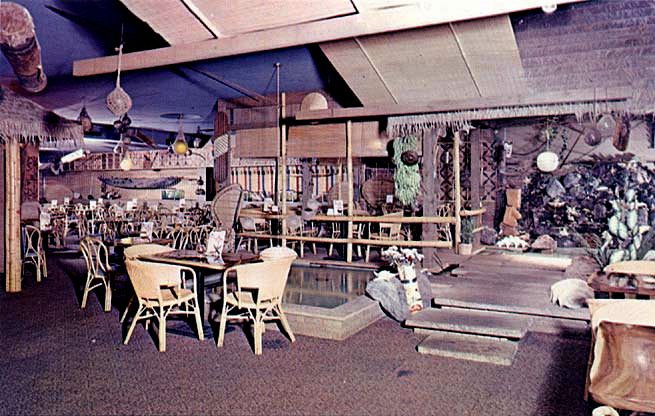
Dobbs House: Love Field’s Airport Restaurant

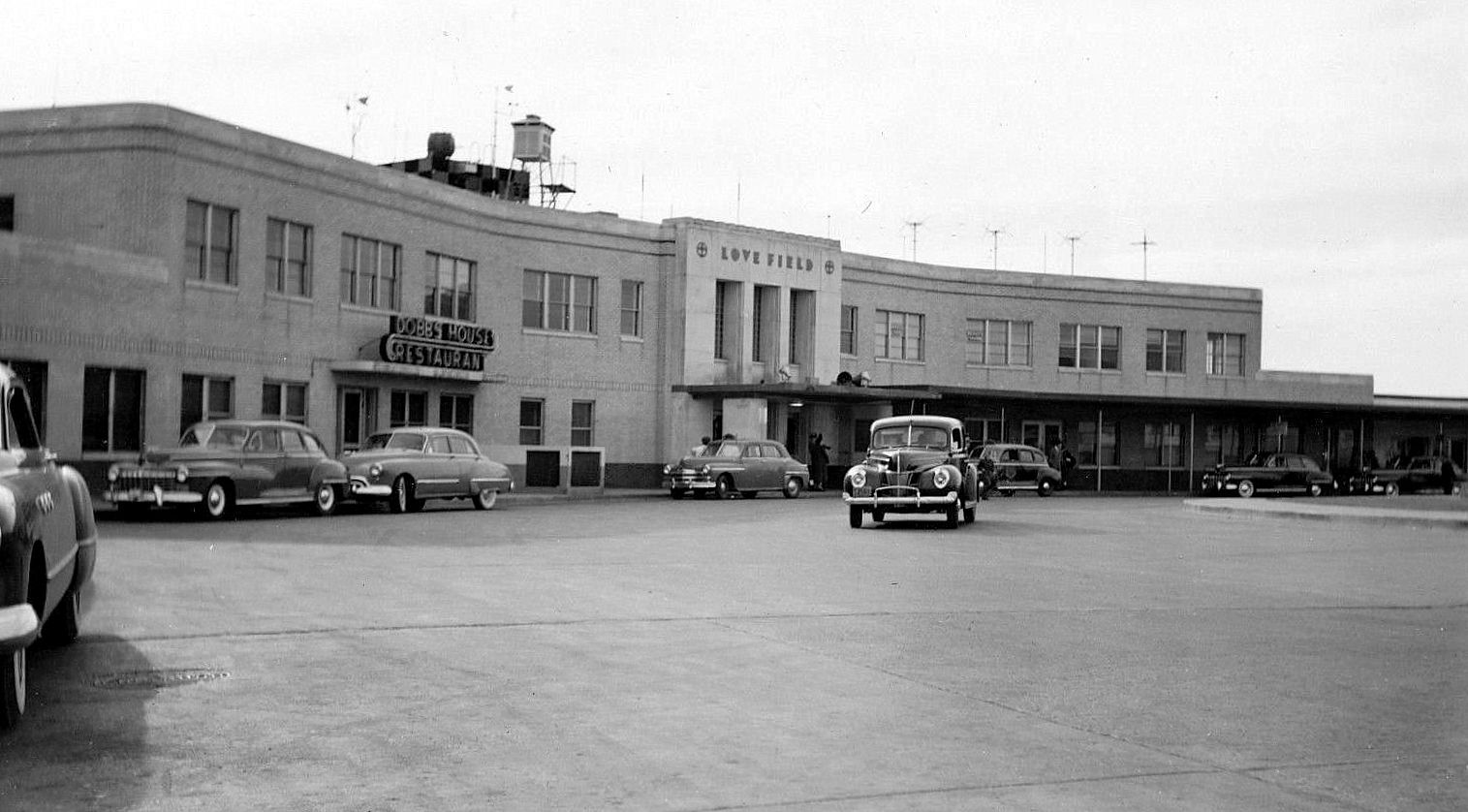
love-field_dobbs-house-restaurant_ebayDallasites’ favorite airport restaurant… (click for larger image)

by Paula Bosse

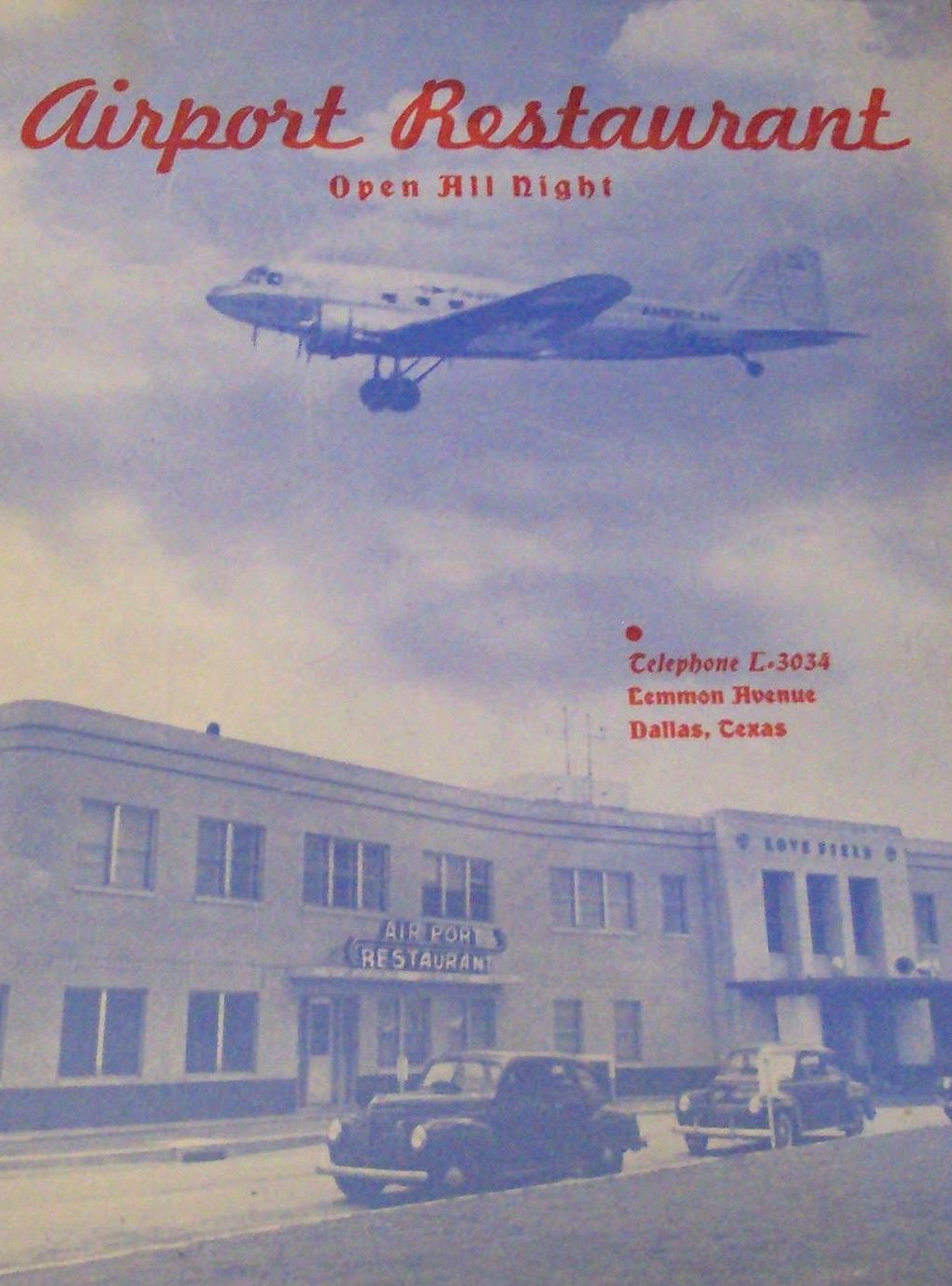
Dobbs House was a national restaurant and catering company, found chiefly in airports (although they did have non-airport restaurants, and at one point they had bought out the Toddle House chain). When the “new” Love Field terminal opened in 1940 (see the heart-stoppingly beautiful Art Deco front entrance at night, here), it had what was probably a very nice, perfectly serviceable, 24-hour restaurant. It was rather unimaginatively called “Airport Restaurant,” and it seated about 75 in the coffee shop and 100 in the dining room. And its “modern  blue and yellow leatherette furniture” was probably delightful.

love-field_airport-restaurant_menu_ebay_cropped

A lot of people probably enjoyed a hot cup of coffee while seated on that modern leatherette. But in 1944, the Hull-Dobbs company waltzed in and took over the restaurant and catering business and agreed to pay the city what seems like a miniscule $500 a month (about $7,000 in today’s money). The administration building, which housed the restaurant, was undergoing remodeling at the time, and I guess the city was giving the company something of a break. In 1945, though, Hull-Dobbs began to pay 5% of their gross revenue to the city, rather than a flat monthly fee. (I’m guessing that 5% was quite a bit more than $500.)

Business was good. REAL good. It was almost too good, because almost every newspaper article which mentioned the restaurant (called Dobbs House, part of a national chain) noted how busy it was and how it was almost impossible for a person to find an empty seat. It was known for its good food (see a 1955 menu here), and one of the main reasons it was always crowded was because local people dined at the restaurant, taking up precious seats intended for hungry travelers. Dallasites loved to drive out to the airport for a nice meal, followed by a leisurely couple of hours watching airplanes take off and land.

But, basically, Love Field had become a major metropolitan airport, and its success — and the resulting increase in traffic and the overall crush of humanity — meant that everyone was running out of space.

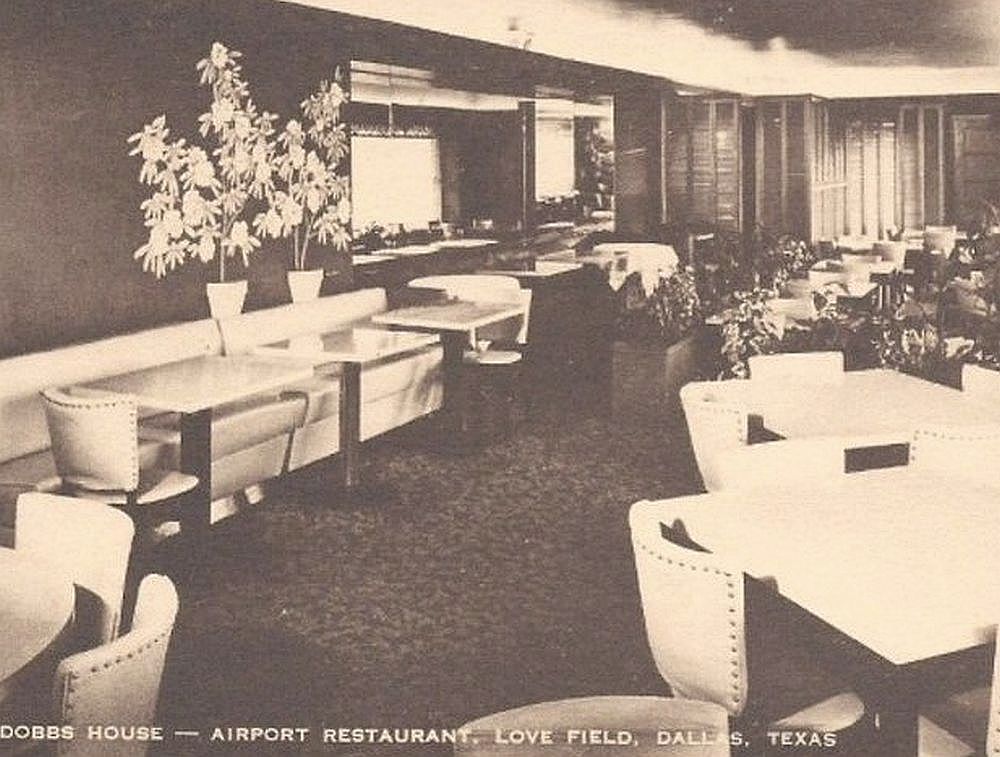
The airport had outgrown its beautiful 1940 Art Deco terminal, and a new, equally heart-stoppingly beautiful terminal opened in 1958. Dobbs House moved into its more spacious quarters with a freshly signed ten-year contract. …And by now they were paying a whole lot more than $500 a month. According to a January, 1957 Dallas Morning News article, the restaurant offered a high bid of just over $15,000 a month to retain the restaurant concession at the airport.

The restaurant and catering business were not all that the Dobbs company was running. Not only did they have a “swanky” restaurant at the new terminal, they also had a non-swanky restaurant and a basement cafeteria. They also had, at various times, control of the following concessions: cigar, shoeshine, gift shop (including apparel, candy, and camera shops), and … parking (!). This was on top of their land-office business catering and restauranting. James Dobbs knew a thing or two about business — he didn’t get fantastically wealthy just selling 15-cent cups of coffee and black-bottom pie….

dobbs-house_love-field_love-field-FB-page
via Dallas Love Field Facebook page

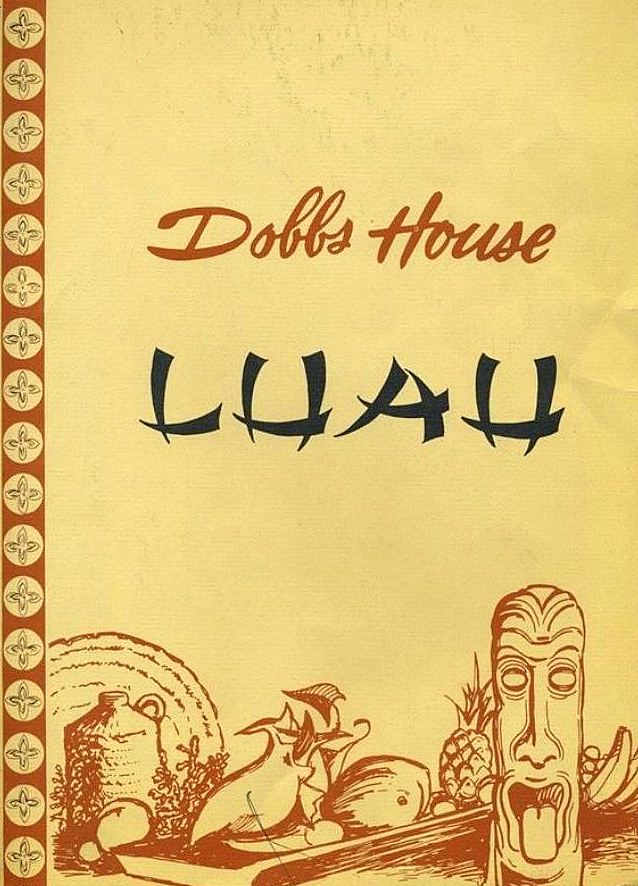
In 1958, Dobbs House opened the exotic Luau Room, which served Polynesia cuisine. This was another Dobbs eatery that was very popular with Dallasites, and it lasted many, many years.

dobbs-house_luau_menu_ebay
via eBay

The Luau Room was a sort of early “theme” chain from the Dobbs people, and it was a feature at several Dobbs House-served airports. The photo below might be the Dallas location. Might be Charlotte, or Orlando, or Houston.

dobbs-house_luau
via Tiki Central — check out the comments

Dobbs House  was a fixture of the Dallas airport/restaurant scene for a surprisingly long time. Dobbs House was still at Love Field in the 1980s — possibly into the ’90s. And when Dallas-Fort Worth International Airport opened, the Dobbs people slid right in. DFW was huge — and they had control of everything. (Alcohol sales alone must have been enormous!)

For D/FW’s first two decades, a single company operated all of the bars and restaurants that generate about $40 million in sales each year. Dobbs House had the food and beverage contract from 1974 until 1993, when Host Marriott Services took over the operations. (DMN, May 22, 1996)

Dobbs House was in business here for almost 50 years. That’s a pretty good run for a restaurant in Dallas. (And I hear their cornbread sticks were to die for.)

***

Sources & Notes

Top photo showing Dobbs House Restaurant at Love Field found on eBay several months ago.

Airport Restaurant menu (ca. 1940-1944) found on eBay, here.

The Dobbs House cornsticks recipe is contained in the 1960 book How America Eats by Clementine Paddleford — used copies are out there, but they are surprisingly expensive. But from what I hear, if you want that recipe, it’s probably worth it!

An interesting side note about James K. Dobbs, head of the company that bore his name: even though he was a resident of Memphis, he actually died in a Dallas hospital in September, 1960, having been sent here for asthma treatment, and having recently suffered his second heart attack. He was 66. His company had grown to include about 125 restaurants at the time of his death. He had also made huge sums of money in automobile dealerships.

Photos and clippings are larger when clicked.

*

Copyright © 2017 Paula Bosse. All Rights Reserved.


Dallas’ Population, Per the 1940 Census

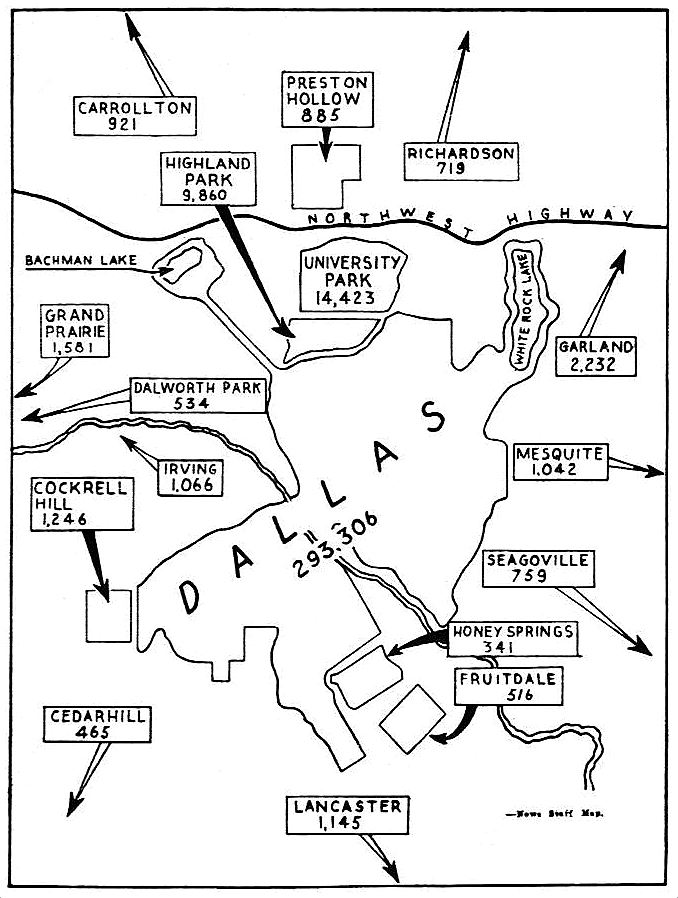
census-1940_dmn_063040
Those numbers seem so quaint… (click for larger image)

by Paula Bosse

For those who get excited reading census figures, I give you the results of the 1940 census as it pertains to Dallas County.

According to the Dallas Morning News article “12 Per Cent Gain Shown in City” (DMN, June 30, 1940), the population of Dallas County in 1940 was 398,049 in an area of 859 square miles; the density was 463 people per square mile. For some perspective, in 2010 the population of Dallas County was just under 2.4 million, with an area of 909 square miles — giving us a recent density of something like 2,700 people per square mile (and it’s only getting more cramped every day).

Dallas County was big, but it wasn’t the biggest in the state in 1940 — that honor went to Harris County, with a population of 529,479; Bexar County came in third with 337,557.

So which communities were the biggest winner and the biggest loser as far as population change since the 1930 census? They were the incorporated areas of University Park and Cement City. University Park had a whopping 243% gain in population since the 1930 census, and poor Cement City had a 200% plunge.

Another interesting statistic (from the Census of Agriculture) showed that in 1940 Dallas County had 3,522 farms; in 1930 the county had 5,106. In 2012, the Census of Agriculture (in a PDF here) showed 839 farms (which is actually more than I would have guessed).

The Dallas area was growing rapidly — even with a bit of a slow-down during the Great Depression — but the population growth following WWII was quite a bit more: the population in 1950 jumped to around 615,000 — an increase of more than 54%. After that, there was no looking back.

The map at the top is interesting. I love the fact that in 1940 Richardson was a teensy little town of 719 — smaller than the beyond-the-city-limits Preston Hollow which boasted a healthy 885 people. (And … Honey Springs? I’d never heard of it. But now I know the facts, from the Handbook of Texas, and I know the color, from the Dallas Trinity Trails blog.)

For those who want to go the extra mile, the full breakdown of the census numbers can be found in the Dallas Morning News archives in the article cited above.

***

Sources & Notes

It looks like the official numbers might have been changed a bit after the article cited above was printed. The very informative chart of Dallas County’s population through the decades (seen here) has the population a bit higher, at 398,564.

More Dallas County stats — stats-a-plenty — at Wikipedia.

*

Copyright © 2017 Paula Bosse. All Rights Reserved.
 

“Enemy Aliens” and the WWII Internment Camp at Seagoville

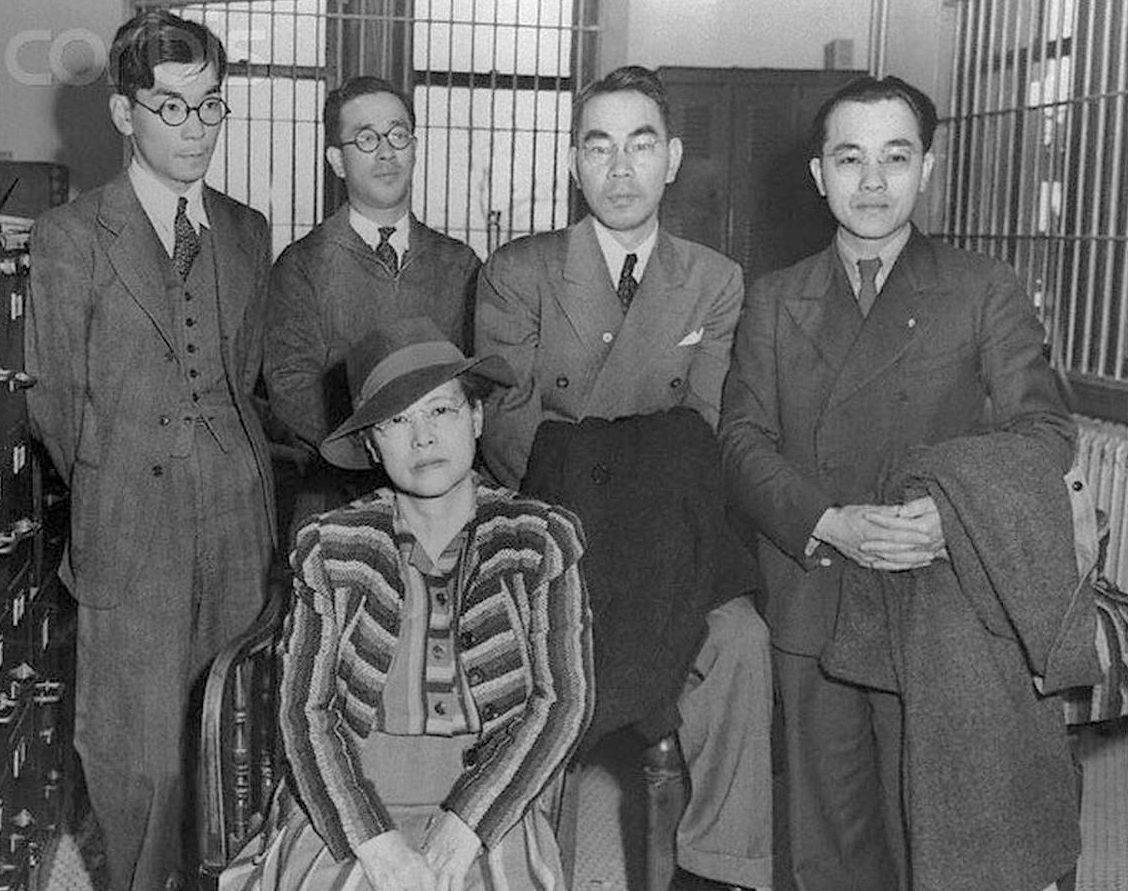
japanese_dallas_wwii_corbisDallasites rounded up the day after Pearl Harbor… (click for larger image)

by Paula Bosse

I think most of us know about the sad period in American history of Japanese internment camps when, following Japan’s bombing of Pearl Harbor, the United States “interned” men, women, and children of Japanese descent (often including whole families, some of whom were born in America or were naturalized American citizens). I’ve always thought of these camps as being in the western part of the country. I had no idea until just a couple of days ago that there were three “enemy alien” internment camps in Texas — and one of them was in Dallas County.

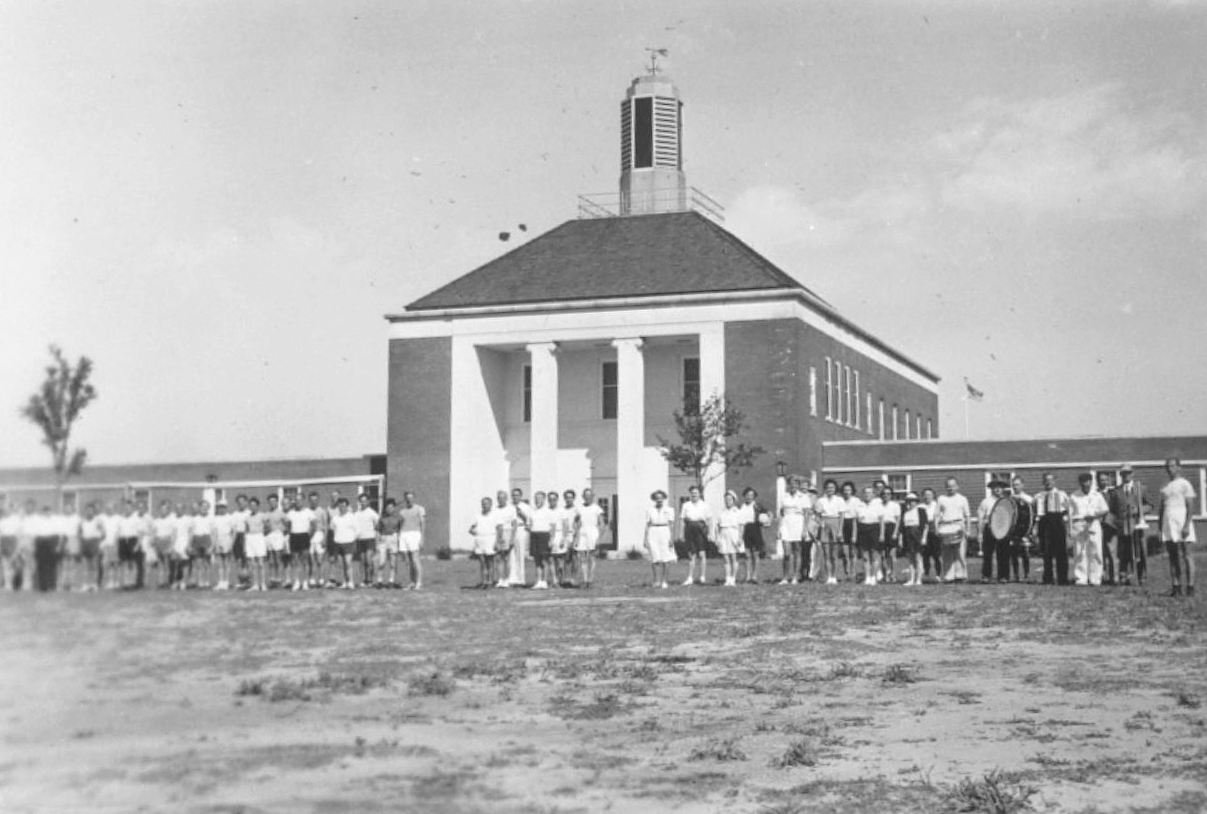
For a full history of the camp in Seagoville — which is a mere 20 miles southeast of Dallas — there are several links at the bottom of this post. But, briefly, the “camp” was originally built as a federal women’s prison in 1938 on 800 acres of farmland. The United States entered World War II as a result of Japan’s bombing of Pearl Harbor on Dec. 7, 1941, and, suddenly, authorities began scrambling to round up enemy aliens living in the U.S.: people born in countries we were now at war with — primarily those of Japanese, German, and Italian descent — were rounded up and questioned. Many were arrested, and some were interned in camps where they were basically kept prisoner for the duration of the war. Even though the bulk of the initial internees were, oddly enough, from Latin America (most of them Japanese, most sent from Peru), there were also several who, before the war, had been living in the United States for decades without any problems. (See a dizzying number of links at the bottom of this post for more on the Texas internment camps at Seagoville, Kenedy, and Crystal City.)

Below, the Seagoville camp.

seagoville_aerial_thc

seagoville-internment-camp_ut-inst-texan-cultures

In December, 1941, authorities in every city in the country were swooping down on foreign nationals (or sometimes just people who looked foreign or spoke with an accent), hauling them in for questioning, often arresting them for nothing more than the fact that they had been born in another country. Dallas was certainly no exception. Unsurprisingly, immediately following the bombing of Pearl Harbor, Dallas’ few Japanese residents were rounded up. All ten of them. The photo at the top shows five of the first detainees, at the Dallas jail.

Most of Dallas’ Japanese residents worked for the Japan Cotton Company, an important cotton broker which had occupied space in the Dallas Cotton Exchange building since the late 1920s. (For a bit of weird trivia, the father of famed gossip columnist Liz Smith was working as a cotton buyer for the company during the war, commuting to work from Fort Worth.) If they weren’t working for the Japan Cotton Company, they were probably members of two Japanese families with long ties to Dallas: the Muta and Sekiya families, owners of the respected Oriental Art Company since 1900.

oriental-art-company_1921-ad1921 ad

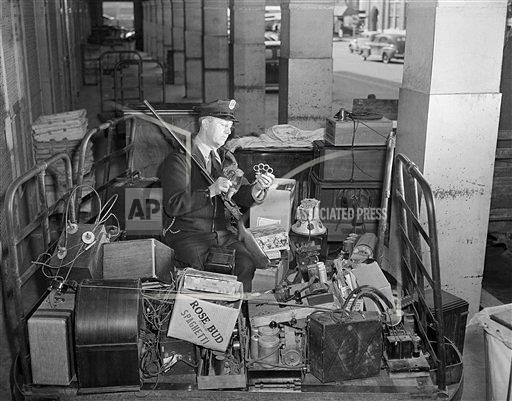
In February 1942, the Associated Press photo below appeared in several newspapers, along with the following caption: “This is a portion of the contraband radios, cameras, guns, that were seized during all-night raids on residences of enemy aliens in Dallas County, Texas, by federal and local officers. Scores of aliens also were taken into custody.”

wwii_aliens_AP_1942

Lubbock Avalanche, Feb. 26, 1942 (click to read)

The first internees arrived in the Dallas area in April 1942. The group was comprised of 250 women and children (“citizens of the Axis nations”) who had been arrested in Panama. They were interned in Seagoville, displacing the federal women prisoners who had previously been held there — they were transferred to a prison in West Virginia.

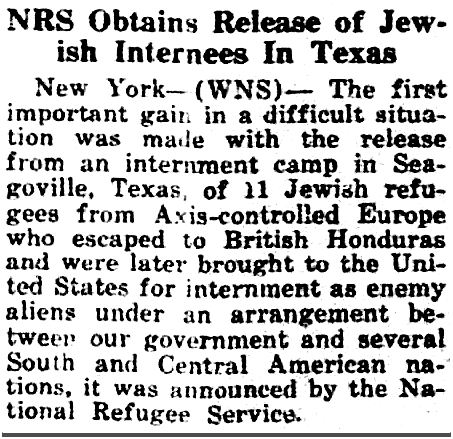
Jewish refugees sometimes found themselves tossed into enemy alien internment camps — simply because they had fled homelands which happened to be “Axis-controlled” countries with which the U.S. was at war (even though it seems highly unlikely that a German Jew would be an ardent Nazi sympathizer, gathering classified information to send the Führer’s way). Yes, Seagoville had detainees from all over the place. It was quite the melting pot. There was even a Bavarian princess in there. I wonder if a single person in that camp, held against his or her will for months and years, posed any actual threat to Allied forces.

seagoville_wwii_wisconsin-jewish-chron_milwaukee_052843
Wisconsin Jewish Chronicle, May 28, 1943

Germans and Italians were able to “blend in” to American society, but Asian men and women had a harder time and were more often harassed. The person who seems to have most disliked and distrusted Japanese people was top Dallas police detective Will Fritz — in fact, The Dallas Morning News called Fritz “one of Dallas’ most enthusiastic Jap-haters” (DMN, Feb. 17, 1943). Let’s just say that Capt. Fritz wasn’t going to be sending the wartime Welcome Wagon to any prospective Dallas residents of Japanese descent.

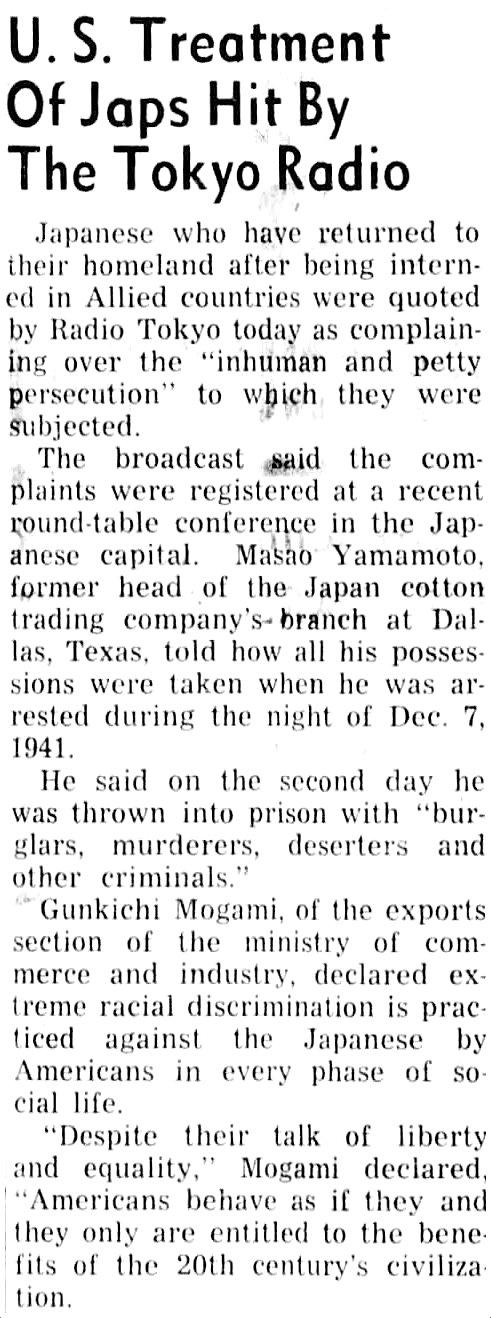
One Dallasite who was pretty angry and unhappy with the situation was Masao Yamamoto, an executive with the Japan Cotton Company who had lived in Dallas since 1928. He and his wife and two young sons (one of whom was born in Dallas) were living what appears to have been a nice life in the M-Streets when they were “detained.” Ultimately, the Yamamoto family was deported and sent to Tokyo, six months after the photo at the top of this post was taken (Mr. Yamamoto is the third from the left in the top photo) — they were part of a sort of prisoner swap.

After his deportation, Mr. Yamamoto complained to the Japanese press about his treatment in Dallas, where he said he was arrested, relieved of his possession, and thrown in jail with “burglars, murderers, deserters and other criminals.” (Click to see larger image.)

yamamoto_santa-cruz-sentinel_021843UPI wire story, Feb. 16, 1943

Will Fritz just about had a seizure when he heard of Yamamoto’s complaints, insisting that he was not mistreated and that he was a dangerous enemy agent: “Any apology that may be due should go to the murderers and burglars instead of Yamamoto. […] He was deported for we have absolute proof he was an agent of the Imperial Japanese Government and that his cotton-buying story was just another Jap blind. I consider him one of the most dangerous of enemy agents” (DMN, Feb. 17, 1943). (This is from the article which described Fritz as “one of Dallas’ most enthusiastic Jap-haters.”)

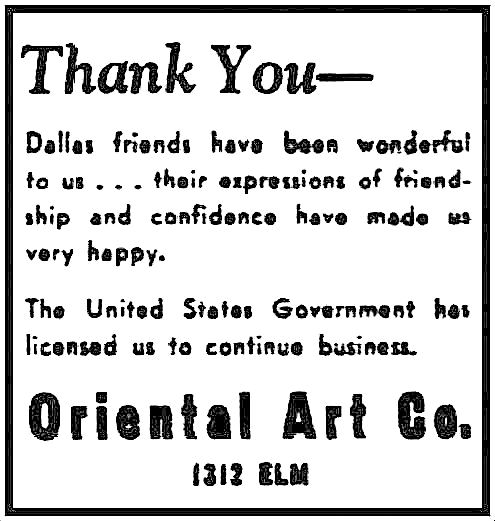
But even in the midst of all this paranoid nastiness, there were occasional heartwarming moments. After the attack on Pearl Harbor, the Oriental Art Company — the 40-year-old business owned by Hideo Muta (who came to Dallas in 1900) — was ordered closed. In a show of support, 200 of his friends, neighbors, and customers signed a petition vouching for his staunch American patriotism (which is plainly evident in his 1951 obituary in which he is described as a “patriot”). In the ad below, the 73-year-old Muta acknowledged the support of his Dallas friends and announced the reopening of his business in an ad taken out on Dec. 15, 1941: “Thank You — Dallas friends have been wonderful to us … their expressions of friendship and confidence have made us very happy. The United States Government has licensed us to continue business. Oriental Art Co., 1312 Elm.”

oriental-art-co_dmn_121541
Dec. 15, 1941

Mr. Muta was spared the “enemy alien” internment camp, but, along with other Asian men and women residing in the United States, he was barred from becoming a naturalized U.S. citizen because of the “Oriental Exclusion Act.” The inability of Mr. Muta to become a U.S. citizen did not dampen his enthusiasm for American democracy: he paid his poll tax every year, even though he was not allowed to vote, and he was a proud member of the Dallas Chamber of Commerce for over 25 years.

The Seagoville Enemy Alien Detention Station was closed in May, 1945, and the site was returned to the Bureau of Prisons.

***

Sources & Notes

Photos of the Seagoville camp are from the Institute of Texan Cultures (UTSA).

Articles of interest from The Dallas Morning News:

  • “Six Japanese Taken in Custody By Local Police” (DMN, Dec. 8, 1941)
  • “Dallas Japs Questioned” (DMN, Dec. 9, 1941)
  • “Six Suspected Germans Held in Dallas Roundup of Aliens; Total of Jap Prisoners Rises to 10” (DMN, Dec. 9, 1941)
  • “Enemy Aliens In Dallas, 776; Arrested, 30: But All Suspects Are Closely Watched By G-Men and Police” (DMN, Dec. 19, 1941)
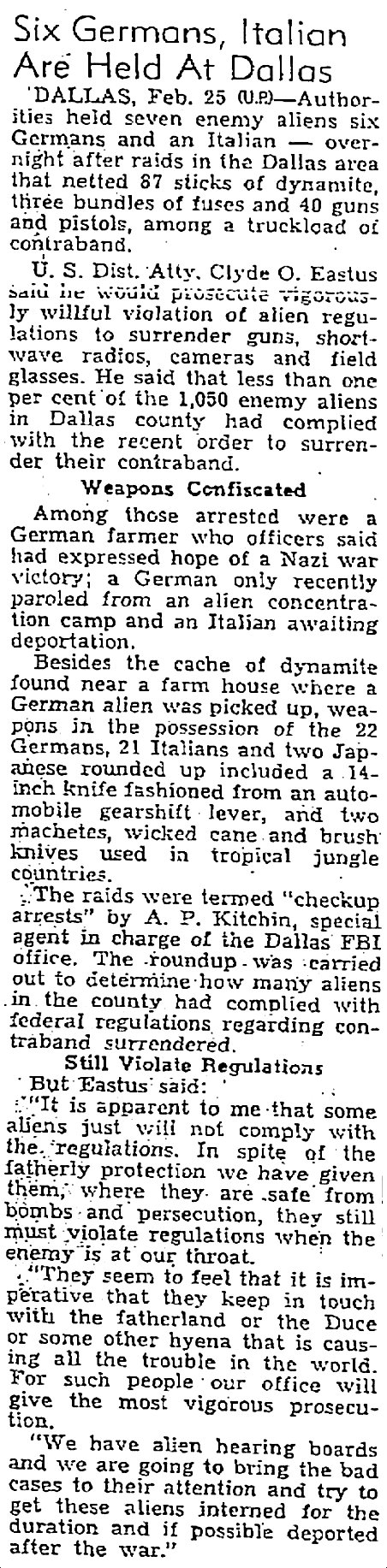
  • “FBI Rounds Up 50 Enemy Aliens, Seizes Arms, Cameras, Radios” (with photos of Dallas residents of Japanese, German, and Italian descent as well as seized “contraband”) (DMN, Feb. 25, 1942)
  • “Women Aliens Are Interned At Seagoville; 250, Including Their Children, Arrive Here From Panama” (DMN, April 11, 1942)
  • “Chilly Welcome Given 15 Japs From Coast; O.K. to Come to Dallas, Were Told; Still More On Way, Inform Police (DMN, April 23, 1942)
  • “Japs Leave Dallas” and “Tokyo-Bound Jap Lad Takes Candy Six-Gun as Souvenir” (about the deportation of the Yamamoto family, with photo) (DMN, June 6, 1942)
  • “Fritz Sheds No Tears For Mr. Yamamoto” (DMN, Feb. 17, 1943)
  • “Japanese Woman Revisits Seagoville” by Roy Hamric (profile of Masayo Ogawa) (DMN, Sept. 8, 1970)
  • “American Gulag: When Seagoville Housed the Aliens” by Kent Biffle (DMN, July 23, 1978)

More articles on the Seagoville internment camp:

  • One of the best articles I’ve read on the camp was an interview with two men (Erich Schneider and Alfred Plaschke) who, as American-born children of German parents, were interned at Seagoville and were later deported to Nazi Germany (in a prisoner exchange) where they experienced the terrifying bombing of Dresden. Both families returned to the United States after the war. The article by Mark Smith — “German-Americans Recall Horror of Deportation — Hundreds of Detainees Sent to Nazi Germany in POW Trade” — appeared in the Houston Chronicle on Nov. 11, 1990, and can be read here.
  • “Seagoville Enemy Alien Detention Station” (Texas Historical Commission), here
  • “World War II Internment Camps” (Handbook of Texas), here
  • “Seagoville, South America, and War — A Historic Intersection” by Kathy Lovas (Legacies, Fall, 2000), here
  • “Seagoville Detention Facility” (Densho Encyclopedia), here (and for more on the Japanese-American experience overall, see the main page, here)
  • “The Japanese Texans” by John L. Davis (Institute of Texan Cultures), here (opens a PDF)

Thanks to friend Julia Barton for posting about (and suddenly making me aware of) the Seagoville camp.

All photos and clippings are larger when clicked.

*

Copyright © 2017 Paula Bosse. All Rights Reserved.
The Sam Houston Zephyr Leaving Union Station, Crossing Over the Triple Underpass — 1950

zephyr_triple-underpass_1950_portalThe SHZ heading out of Dallas… (click for larger image)

by Paula Bosse

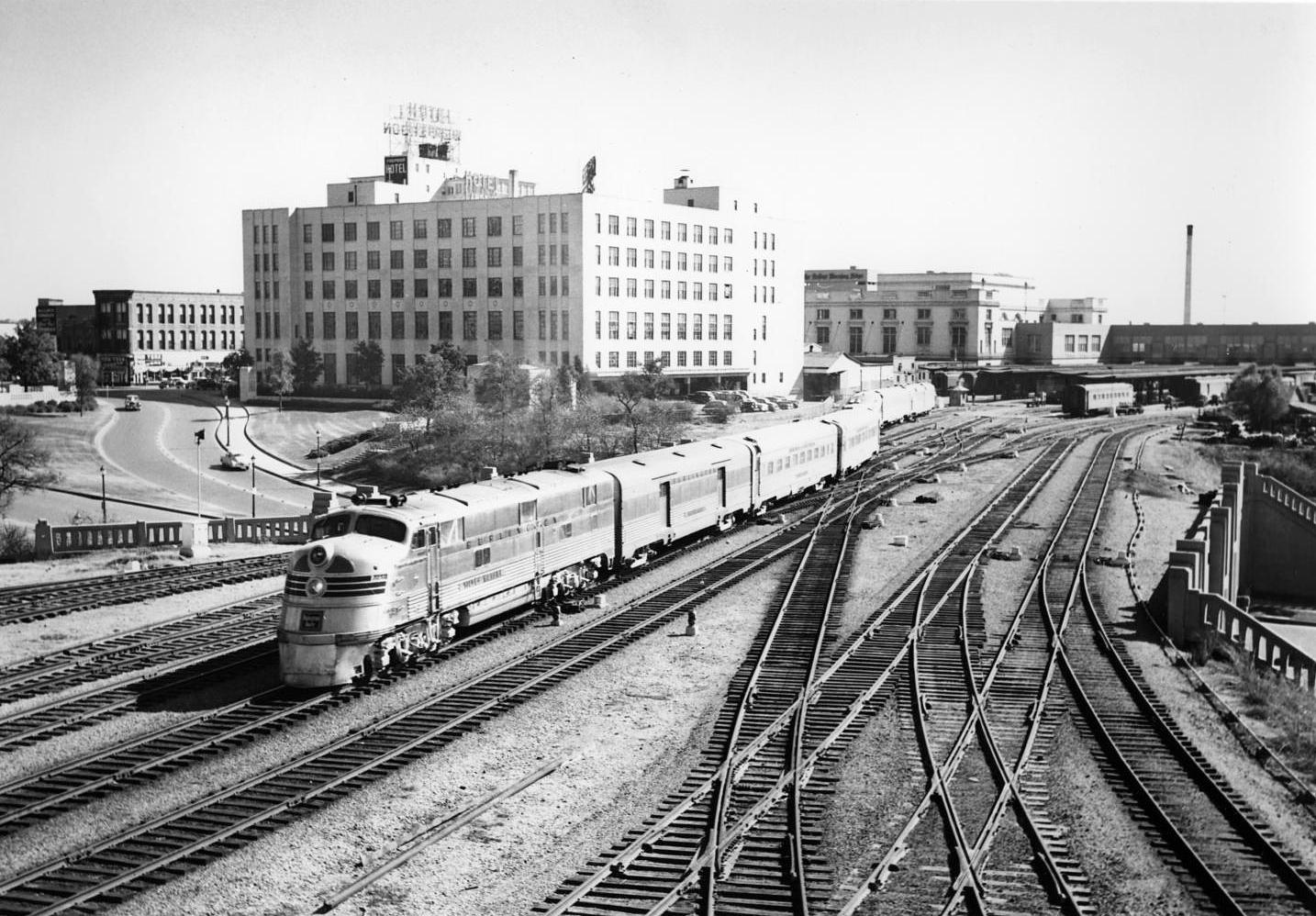
The title pretty much says it all. The Sam Houston Zephyr passenger train is seen crossing over the Triple Underpass, heading out of Dallas. Next stop: Fort Worth. The Post Office Terminal Annex is the tall white building, the Jefferson Hotel is behind it (with the sign on its roof), and Union Station is in the background, just right of center, with the Dallas Morning News building peeking over its roofline. The Old Red Courthouse would be out of frame to the left.

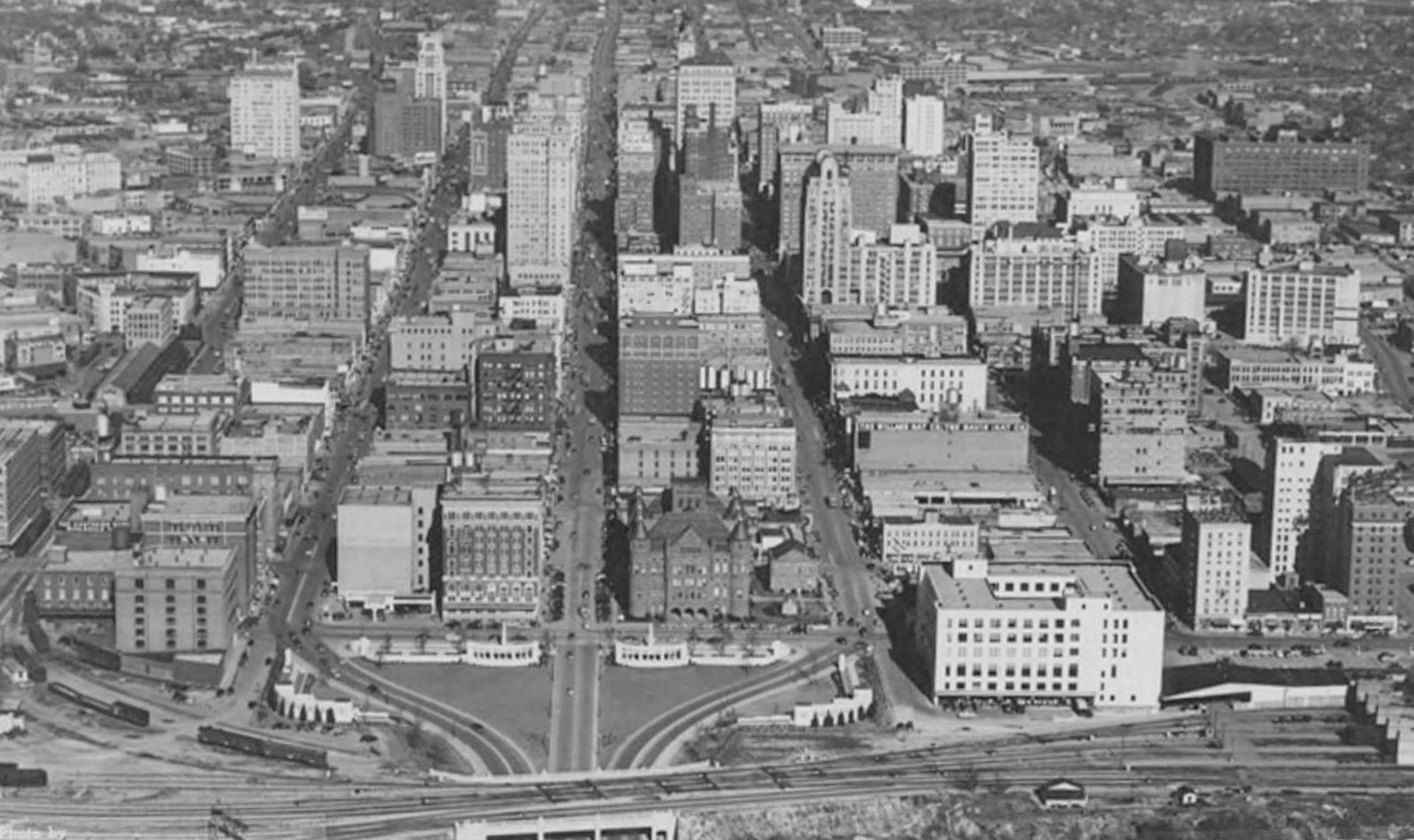
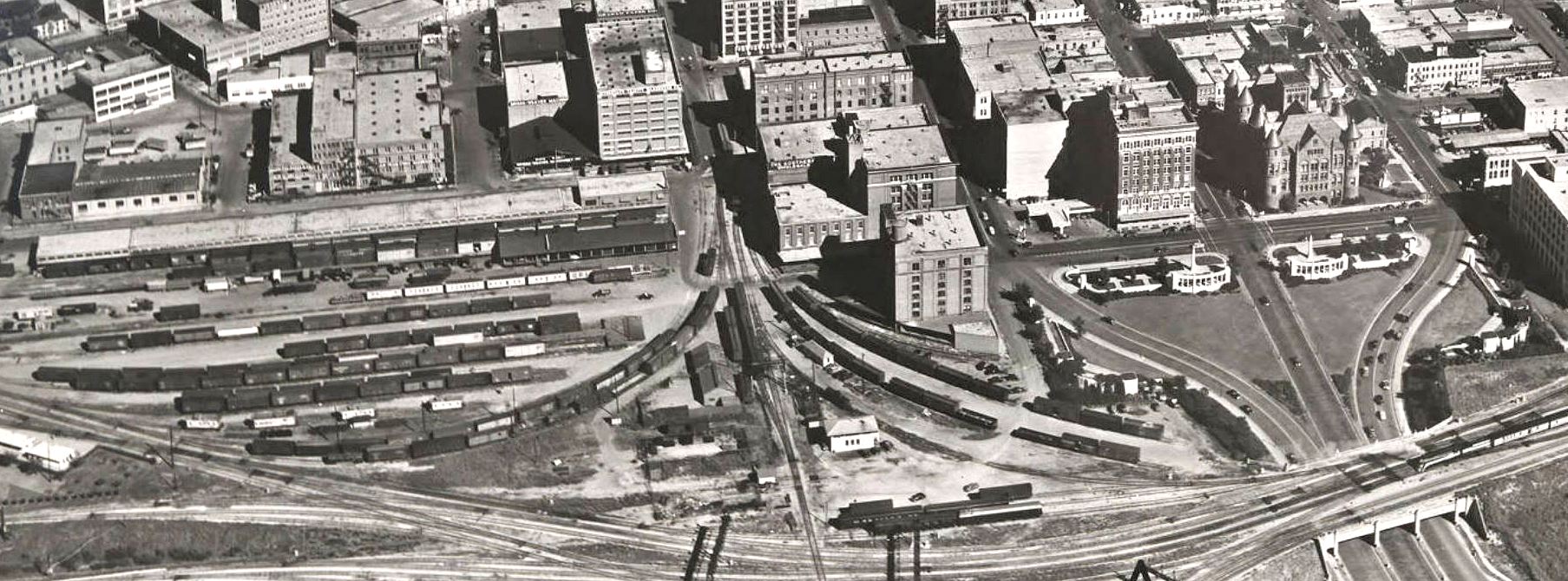
Below, a view of downtown from the west, with the Triple Underpass partially cut off at the very bottom, and Union Station just out of frame at the right.

downtown_aerial-photo-service_postcard_cook-collection_smu_cropped

In asking members of Facebook’s Texas Railroad History group about the top photo, Gerald Preas, one of the members, made this comment, full of interesting little tidbits (slightly edited by me):

The large building in the center is the USPO Terminal Annex. I started working there in August 1963. The buildings between TA and Union Station were part of Railway Express, used for sorting mail to and from RPO cars. That stack in back was the power station for Union Station — it had its own electric and water system, maybe sewage, too. I drank many times that cool sweet well-water. Notice cars around TA loading dock. I supervised that dock 1968/69 — we had to keep the area open. Now look where train is bending, people would park off ballast, but cars turning would swing out further and hit parked cars. That tree on the upper right led down grade to vacant parting lot. I was coming up that path when the President was shot.

***

Sources & Notes

Top photo shows the Fort Worth and Denver’s Sam Houston Zephyr train No. 4, northbound from Houston, leaving the Dallas Union Terminal Station, heading to Fort Worth. The photo was taken by Roger S. Plummer in 1950; photo from the Museum of the American Railroad, via UNT’s Portal to Texas History, here.

(Other photos of the Sam Houston Zephyr taken in Dallas — and one in Fort Worth — by Roger S. Plummer between 1949 and 1955 can be found on the Portal to Texas History site, here.)

Bottom image titled simply “Dallas, Texas” is an Aerial Photo Service postcard, from the George W. Cook Dallas/Texas Image Collection, DeGolyer Library, Central University Libraries, Southern Methodist University. I’ve edited the image a bit — see the original image and description here.

An aerial view of the same area today can be seen here, via Google.

A previous Flashback Dallas post on the stunningly beautiful Texas Zephyr can be found here.

Thanks to the members of the Texas Railroad History group on Facebook for their comments and help.

Both photos are larger when clicked.

*

Copyright © 2016 Paula Bosse. All Rights Reserved.


The Katy Building, Commerce Street

m-k-t_katy-bldg_flickr_coltera“The Katy Serves the Southwest…” (click for larger image)

by Paula Bosse

A couple of days ago I posted a photo of an M-K-T train leaving Dallas and, today, coincidentally, I came across a photo of the Katy Building, the railroad’s headquarters, at Commerce and Market. This photo shows Commerce looking west toward the Old Red Courthouse from Austin Street. An interurban car is heading east.

See the same view today, via Google Street View, here.

A photo I really love — which shows a view from about the same time looking east on Commerce — can be seen in a previous post, “Commerce & Record Streets — 1946,” here.

***

Photo from Flickr, here.

*

Copyright © 2016 Paula Bosse. All Rights Reserved.

The M-K-T Pulling Out of Dallas

mkt-leaving-dallas_peter-stewart_austin_ebayTrain whistles don’t sound so lonesome in the daytime…

by Paula Bosse

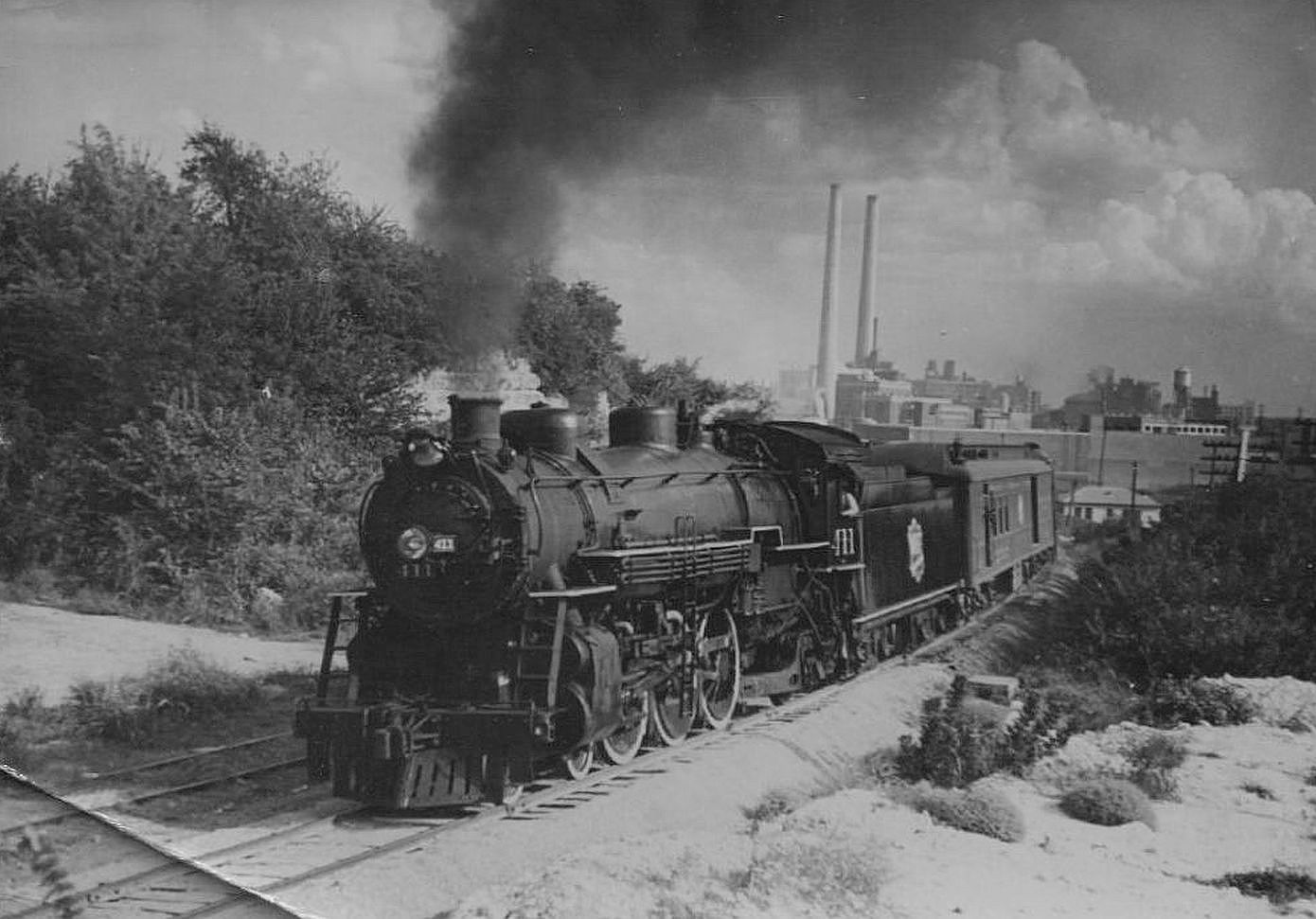
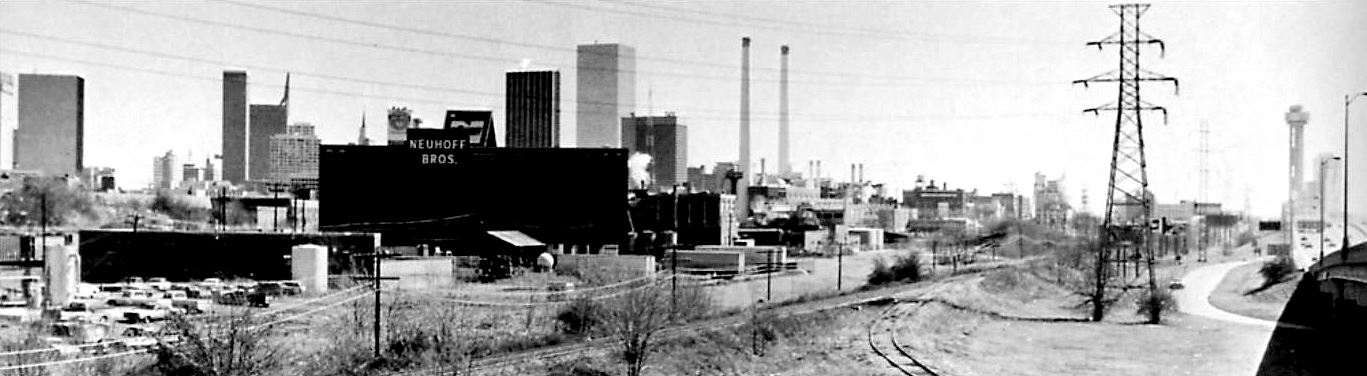
Above, an undated photo I came across on eBay a couple of months ago, showing a Missouri-Kansas-Texas train heading north from the Katy yard at the northwest corner of downtown. In the background are the twin DP&L smokestacks which were iconic landmarks until they were demolished in order to build the American Airlines Center and Victory Park. Below, a later photo taken from about the same location.
neuhoff_dpl_reunion-tower

The area between Dealey Plaza and the Neuhoff meat packing plant was crammed with tracks; below is a detail from a mid-1940s aerial photo (click to see a larger image).

aerial_long_foscue-lib_smu_1940s_det

The M-K-T split about where the photo at the top was taken, as can be seen in the Sanborn map below (from 1927) between Turtle Creek and McKinney Avenue. One track headed north, the other cut through Oak Lawn and Highland Park (now the Katy Trail), crossing Mockingbird at the Dr Pepper plant near Central Expressway.

sanborn_vol-2_key_1927

mkt-logo

***

Sources & Notes

Top photo from eBay, with the photographer of this “vintage snapshot” credited as “Peter Stewart, Austin, Texas.” (There is a crease to the lower left corner.) It is undated, but when posted to the Texas Railroad History group on Facebook, commenters suggested mid-to-late-1930s to early ’50s. It’s a bit grainy, but the number on the engine appears to be 411.

The second photo, showing the Neuhoff plant and Reunion Tower, is from the collection of the Dallas Public Library.

The aerial shot is a detail from this photo by Lloyd M. Long, from the Edwin J. Foscue Map Library, Central University Libraries, Southern Methodist University.

The map detail is from the “key” page of the 1927 Sanborn Fire Insurance Map, here. Speaking of Sanborn maps, this one from 1921 shows M-K-T tracks galore behind the DP&L plant.

Click pictures to see larger images.

*

Copyright © 2016 Paula Bosse. All Rights Reserved.