Flashback : Dallas

A Miscellany: History, Ads, Pop Culture

Category: Historic Ads

“Oak Cliff Is To Dallas What Brooklyn Is To New York” — 1891

ad-oak-cliff_mercury_031291The Southern Mercury, March 12, 1891 (click for larger image)

by Paula Bosse

Oak Cliff and the whole “Brooklyn” comparison is not a new one. Developers were using it to lure people to the “soft green cliffs” of the newly-incorporated area where “there is not a night in the hot months of summer when discomfort is felt from the heat” and where “people from all parts of the United States can be observed enjoying the delights of the seaside in the interior of Texas.” A veritable paradise. Just like Brooklyn.

Hats off to the enthusiastic scribe who penned this incredibly wordy advertisement beckoning the “live and progressive” readership of The Southern Mercury to invest in the ground-floor of Dallas’ Brooklyn.

*

OAK CLIFF, THE BEAUTIFUL RESIDENCE AND EDUCATIONAL CITY OF THE SOUTHWEST

The city of Oak Cliff derives its name from the massive oaks that crown the soft green cliffs and stands about two hundred and fifty feet above and to the southward and westward of the city of Dallas, overlooking the city, and the view is carried away over the city proper. Cool and healthful breezes prevail during the heated term, and there is not a night in the hot months of summer when discomfort is felt from the heat, and sound and refreshing sleep is not possible. To the south and southwest for hundreds of miles stretches level and unobstructed prairie, over whose bosom these breezes sweep from the gulf without infection from any unsalubrious conditions.

The Oak Cliff Elevated railway, substantially constructed, forms a belt of ten miles, encircling Oak Cliff, but at no place more than three miles from the business section of Dallas. Cars run every ten minutes day and night from either side of the court house, Dallas. Fare, five cents.

Oak Cliff is a wonderful and well-nigh magical growth of two years; the first house was completed at Oak Cliff twenty-seven months ago. It now has a population of about seven thousand, a large proportion of whom are from amongst the best people of the different towns of the state of Texas. They are a live and progressive people. Oak Cliff has just incorporated, and one of the first moves of the city government will be the building of several large, commodious fine brick and stone public school buildings, and provide for a large free school fund.

Oak Cliff contains a strictly moral people; intoxicating liquors cannot be found anywhere within her limits, – in keeping with this general policy, no sort of questionable resorts are tolerated.

Oak Cliff now has 1,500 to 2,000 residences, costing from $1,500 to $50,000. It has thirty miles of paved streets and avenues; is now building about six miles of cross-town street railway, to be operated by electricity. It has a successful water system, affording pure, clear spring water. A hotel costing $100,000 has been in successful operation since last June.

Oak Cliff has a park of about 150 acres of natural rustic beauty, diversified with hill and dale, and set off with clumps of royal trees. In the park is a beautiful lake with an average depth of 20 feet, equipped with good boats, where people from all parts of the United States can be observed enjoying the delights of the seaside in the interior of Texas.

Oak Cliff is to Dallas what Brooklyn is to New York.

For further information, address,

Dallas Land & Loan Co., Dallas, Texas.

***

Ad from the pages of The Southern Mercury, March 12, 1891.

A previous come-on from the developers of Oak Cliff can be found here.

*

Copyright © 2014 Paula Bosse. All Rights Reserved.
Send Your Kids to Prep School “Under the Shadow of SMU” — 1915

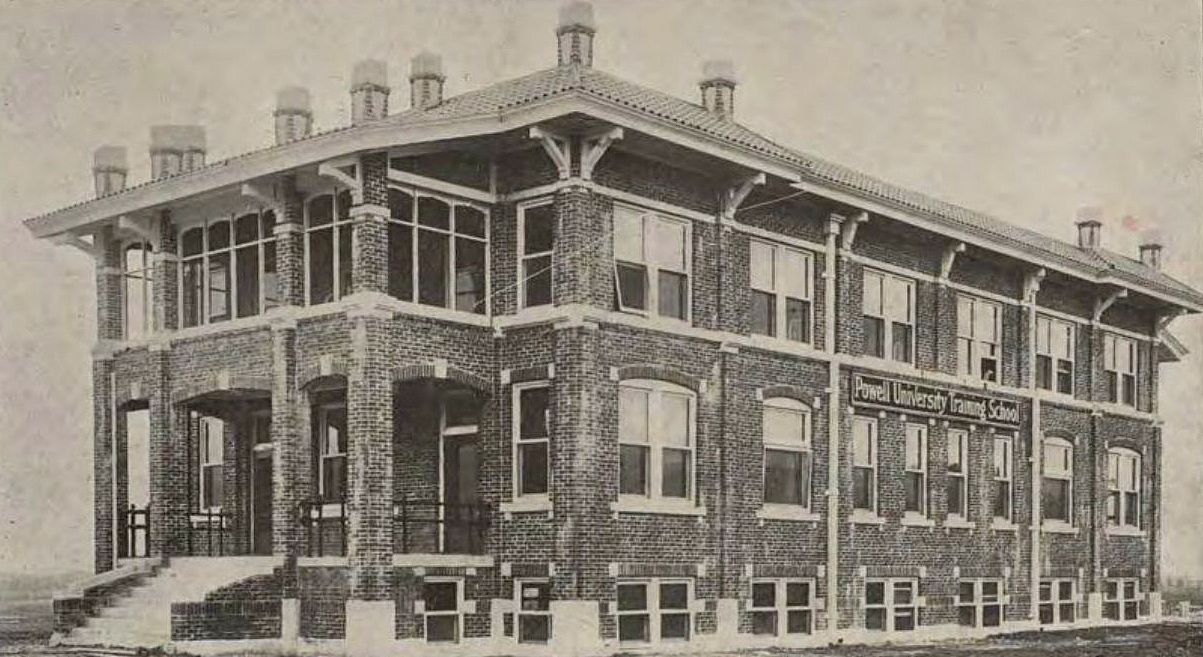
powell-prep_rotunda_1916Powell University Training School, 1915

by Paula Bosse

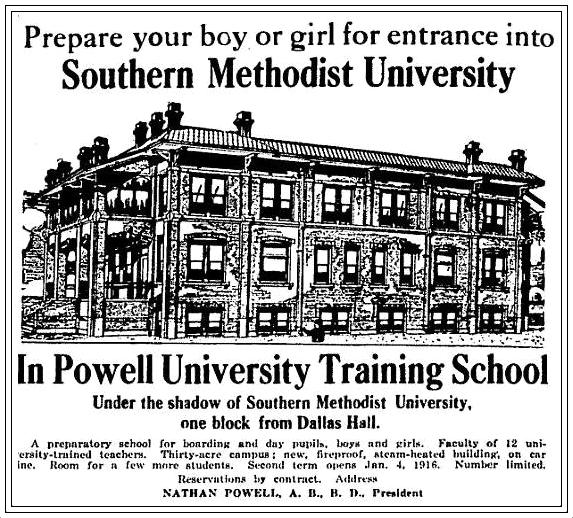
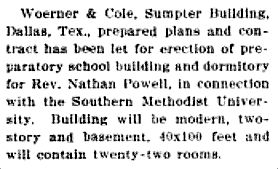
Nathan Powell (1869-1963) was a former Methodist minister who opened his prep school, Powell University Training School, on thirty acres of open land, just across an unpaved road from SMU (which was still in the very early days of its construction). SMU and the Powell school shared more than just adjacent addresses — which they both rather idealistically touted as being “situated on high ground overlooking the university campus and the city” — they also opened on the same day, September 15, 1915.

The location and the opening date were not a coincidence, as Dr. Powell was one of the Methodist movers and shakers who originally promoted the idea of Dallas as the site for a new Methodist university. The following (perhaps exaggerated) sentence can be found in the (perhaps overly laudatory) profile of Powell in one of those ubiquitous late-19th, early-20th century “mug books,” A History of  Texas and Texans (1916):

Beyond his activities as a minister and teacher, the most notable achievement in the life and career of Doctor Powell lies in the fact that he was the sole originator and promoter of the great Southern Methodist University at Dallas, which began its first year September 15, 1915.

Powell University Training School lasted for only about twelve years, until Powell’s rather sudden retirement in 1927 (the good reverend’s “retirement” might have been precipitated by numerous lawsuits and mounting debt). When the school closed, Dr. Powell and his family moved to Harlingen to — as his obituary states — “help organize the grapefruit growers of the Rio Grande Valley.” He operated a citrus nursery himself for a while until it was destroyed by a 1933 hurricane. Nathan Powell died in Harlingen in 1963 at the age of 94.

It’s always exciting to see old buildings still standing in Dallas, and, happily, this one is still around — and it still looks good. Fittingly, it’s currently home to an early-child development center. Next time you’re near the intersection of Binkley and Hillcrest, go take a look.

*

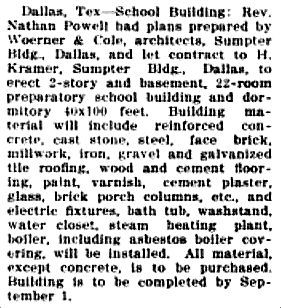
powell_tx-trade-rev-industrial-record_071515a*powell_tx-trade-rev-industrial-record_071515bBoth items from the Texas Trade Review & Industrial Record, July 15, 1915

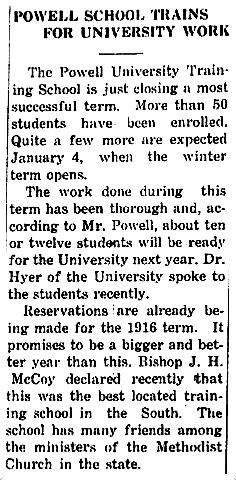
powell_school_ad_smu-times_121815SMU Times, Dec. 18, 1915 (click for larger image)

powell_school_smu-times_121815SMU Times, Dec. 18, 1915

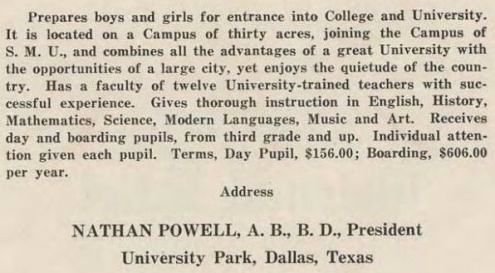
ad-powell-prep_smu-rotunda-19161915 (click to read text)

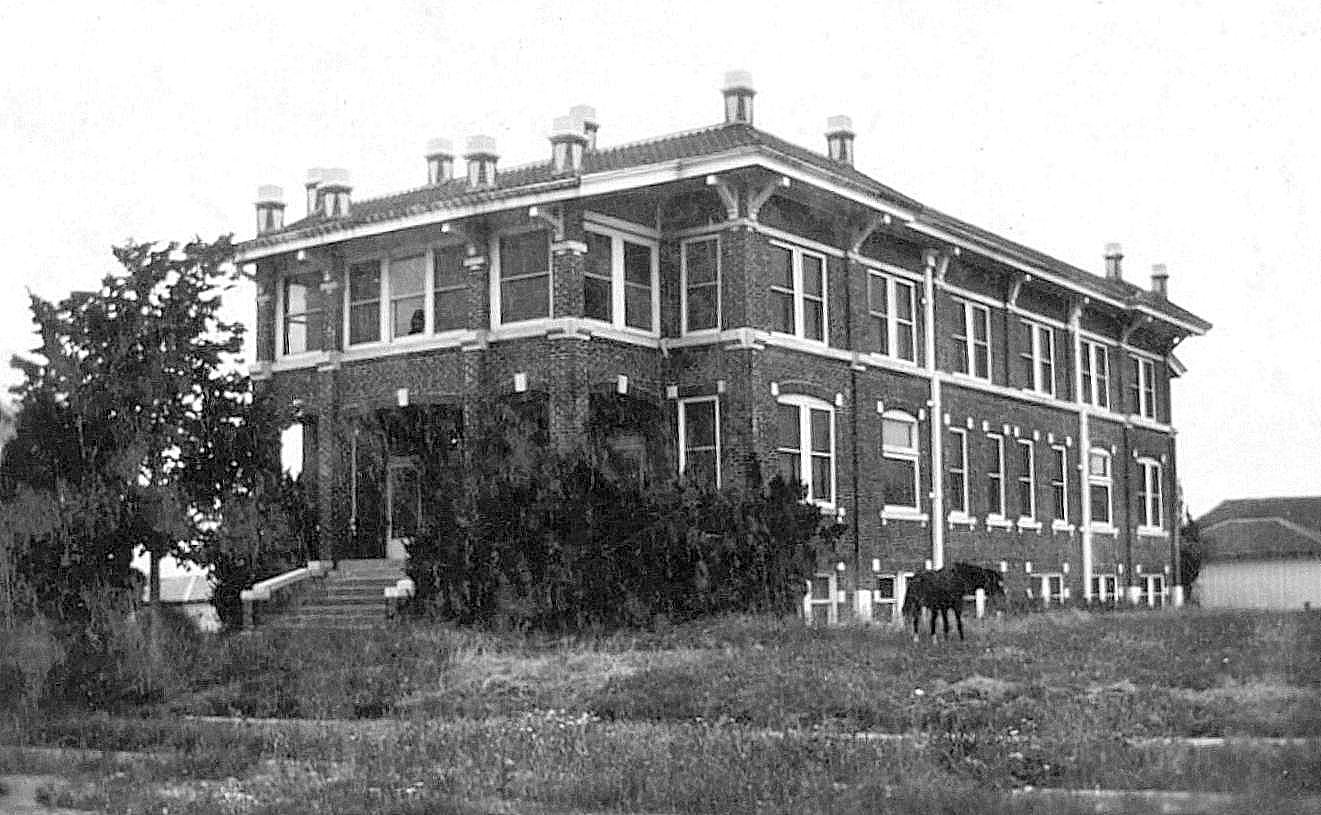
Below, after the school closed. Looking a little shaggy. I would have guessed the photo was from much earlier, but it’s dated 1931. Complete with horse.

powell-univ-training-school_brown-bk_university-park_19311931, Brown Book, University Park Public Library

***

Sources & Notes

Top image and bottom ad appeared in the very first edition of The Rotunda, SMU’s yearbook for their inaugural year, 1915-16.

More on Rev. Powell’s early life and involvement with the founding of Southern Methodist University can be read in A History of Texas and Texans by Frank W. Johnson (Chicago and New York: American Historical Society, 1916), here.

Information regarding Powell’s retirement in Harlingen is from “The Chronological History of Harlingen” by Norman Rozeff (circa 2009), in a PDF here.

Powell’s obituary can be found in The Dallas Morning News, Nov. 8, 1963: “Dr. Powell Dies; Helped Found SMU.”

Currently occupying 3412 Binkley is The Community School of the Park Cities. According to the history page of their website (here), the building has been operated as a school since at least the 1950s.

I’m not sure what the actual facts are concerning Nathan Powell’s role in the founding of SMU. There are very few results when searching the internet. Most newspaper articles connecting him with the university seem to have been generated by Powell himself. If Powell was as important in the history of SMU as he claimed to be, it’s surprising to see so little information on any connection. Was Powell’s assertion that he was the driving force behind the creation of SMU a blatant lie? Was it merely an exaggeration of the truth? Or was it accurate, but something happened to cause the university to distance itself from him? A collection of papers in the SMU archives (which I have not seen) seems to indicate that there were those in Methodist circles who disputed Powell’s claims, as Elijah L. Shettles took it upon himself to prove that Nathan Powell was the driving force behind the very existence of SMU. An overview of the collection — The Elijah L. Shettles Papers on the Founding of Southern Methodist University — can be found here.

(I’ve found an article from the Fort Worth Star-Telegram in 1910 that had Powell all but saying Fort Worth — not Dallas — would be the best choice for the university’s location. Read that article and see other photos of the school — and also read about the lawsuit against Powell (which had nothing to do with SMU) that took thirteen years to reach trial and ended in quite a hefty judgement, in a PDF here.)

See more of SMU’s first year in previous posts here and here.

*

Copyright © 2014 Paula Bosse. All Rights Reserved.
“Speed With Safety” on the Crimson Limited — 1930

crimson-ltd_interurban_1930

by Paula Bosse

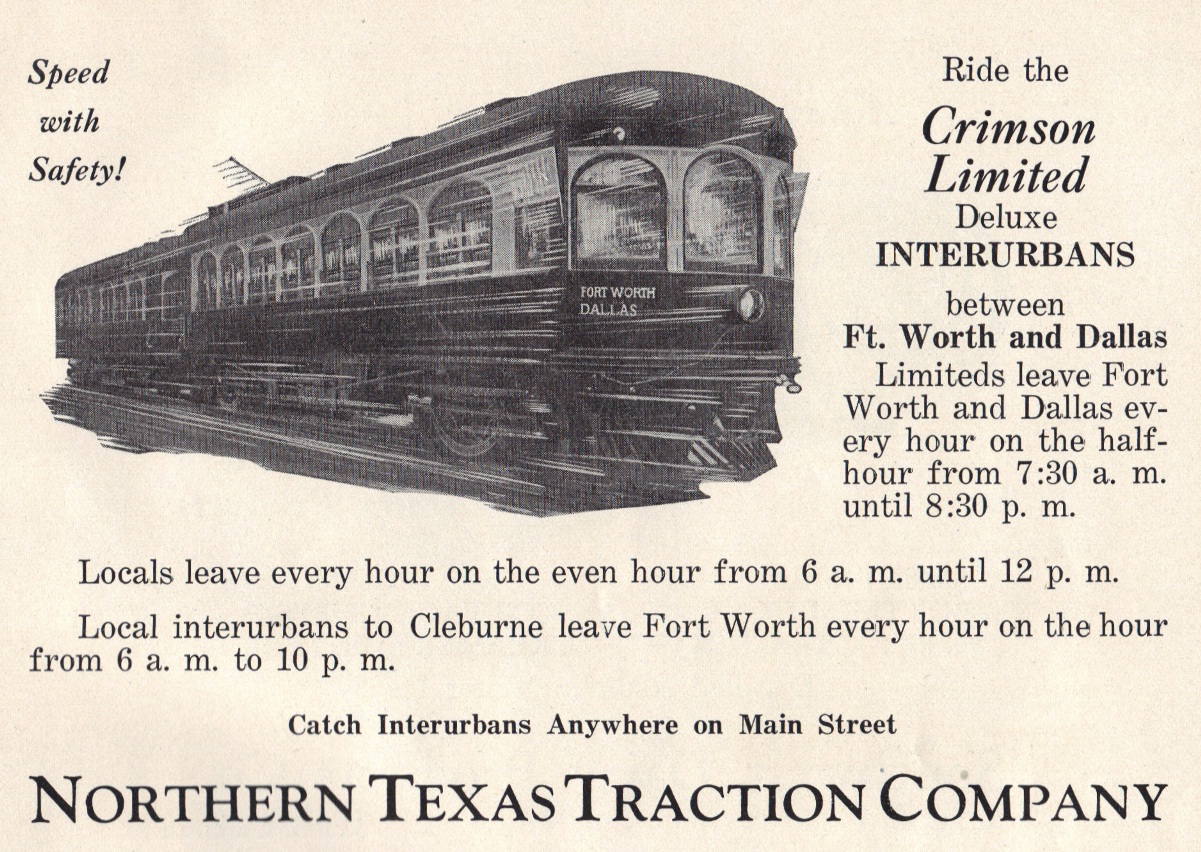
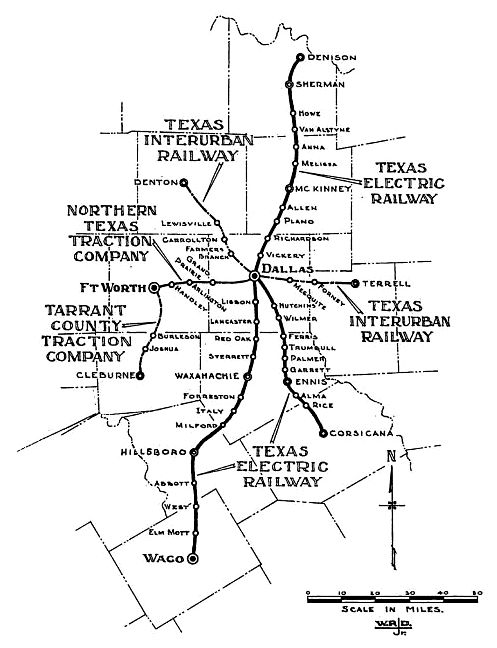
A 1930 ad for the Crimson Limited deluxe interurbans (electrified railway trains) that ran between Dallas and Fort Worth, a couple of years before the company went into receivership, put out of business by the rise of automobile culture. Even though the writing was pretty much on the walls, the Northern Texas Traction Company fought hard to reverse the decline in ridership by introducing these fancy Crimson Limited cars:

The most notable of their moves was the introduction of the Crimson Limited in October of 1924. The Crimson Limited was the name given to the upgraded interurban service to Dallas because the cars were painted bright red. The trailer car saw the most extensive upgrades. The bench seats in the rear half of the car were removed and replaced with wicker chairs. The rear doors were converted to windows giving the car a ‘parlor car’ appearance. Additional upgrades were implemented in 1927. Although the public approved of the new more luxurious trains and more modern streetcars, they continued to abandon mass transit for the automobile. (–North Texas Historic Transportation, Inc.)

Wicker chairs? Pure LUXURY!

interurban-map

***

Sources & Notes

The ad is from an old magazine I can’t cite because it’s stuck in a box in a closet somewhere.

The quote is from a page on the North Texas Historic Transportation site.

For more on this topic, check out the nice, meaty, image-filled post (which includes an ad touting the somewhat vague “Special Conveniences for Ladies”) on the Hometown by Handlebar blog, here. (Hometown by Handlebar is a really great Fort Worth history blog that might prove I was separated at birth from a twin sibling I knew nothing about!)

Not quite sure what an “interurban” is? Fret not. Wikipedia’s here to help, here.

*

Copyright © 2014 Paula Bosse. All Rights Reserved.

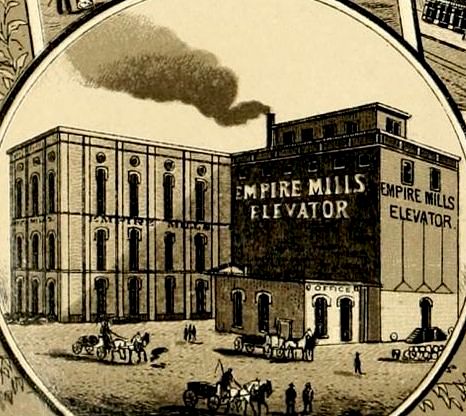
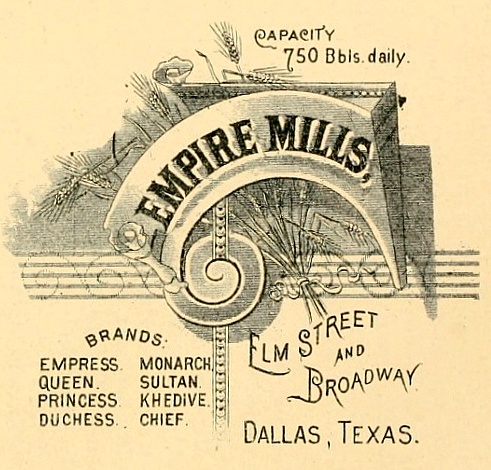
Empire Mills — Grinding Wheat Into Wedding Presents Since the Cleveland Administration

empire-mills_imm-gd_1889aFlour central!

by Paula Bosse

Exciting news hit the pages of The Dallas Herald on March 26, 1885:

A contract was closed last night for the erection of a mammoth 250-barrel, full roller flouring mill with all the latest machinery in this city. The promoters are W.C. Howard, J. Rauch and S.T. Stratton. It will be called the Empire Mills.

The mill opened in September, with the company’s proclamation that their new “roller mills” were “the largest and finest ever erected in the South.” It was located at Elm and Broadway, near the Trinity River. In a newspaper interview, John Neely Bryan’s son described the location of his father’s famous cabin as being “at the top of the hill, about where Empire mills are now located” (Dallas Morning News, Aug. 11, 1889). So, about where Dealey Plaza is today. Wheat was a major crop in North Texas, and the mill was a successful and important addition to the growth of the city.

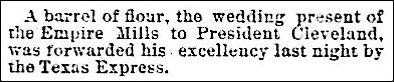
But it wasn’t all crushing and grinding. One must occasionally participate in the world of social niceties. So when the president of the United States is getting married, what better way to commemorate the occasion than by presenting the happy couple with a romantic and self-promoting barrel of flour?

cleveland-flour_dmn_053086DMN, May 30, 1886

cleveland-flour_dmn_070586DMN, July 5, 1886

One wonders what the newlyweds exclaimed as they tore the bow from that barrel? It probably wasn’t, “Oh! Flour! How stupendous!”

empire-mills_clifton-church_1894

empire-mills_souv-gd

empire-mills_imm-gd_1889b

***

Sources & Notes

Top and bottom images from an ad in The Immigrants Guide to Texas (1889).

Photograph by Clifton Church, ca. 1894.

Next to last illustration from Souvenir of Dallas, Texas (c. 1888).

Roller mill? Right this way.

*

Copyright © 2014 Paula Bosse. All Rights Reserved.

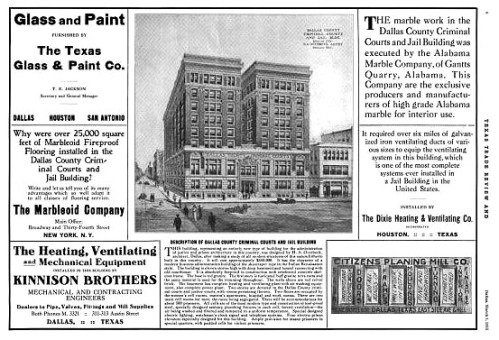
Dallas County Criminal Courts Building and Jail — 1915

Dallas County Criminal Courts and Jail Building, TX

by Paula Bosse

Admit it — that picture above is probably the most attractive jailhouse you’ve ever seen. The first couple of floors were devoted to the courtrooms and administration offices of Dallas’ criminal courts system, but this was primarily the county jail, designed by Dallas architect H.A. Overbeck. Still standing, it faces the Old Red Courthouse (Main St. is in the foreground of the picture above, Houston St. is at the left) — it was even built with a tunnel connecting the two buildings. I’ve always liked this building, but for some reason it’s weird to think of it as a jailhouse. It’s hosted celebrity outlaws like Clyde Barrow and Raymond Hamilton, Benny Binion, and Billie Sol Estes, but  its main claim to fame is its connection to the Kennedy assassination: not only was Jack Ruby tried in one of the downstairs courtrooms for the murder of Lee Harvey Oswald (whom he shot while Oswald was in the process of being transferred to the county jail), but, as a reader notes in the comments, Ruby also spent considerable time there upstairs, as a prisoner, incarcerated in a cell overlooking Dealey Plaza.

When this building opened in 1915, it was a veritable showplace — one of the country’s most modern (and attractive) jails. Here’s what it offered:

This building, representing an entirely new type of building for the administration of justice in prison architecture in this country, was designed by H.A. Overbeck, architect, Dallas, after making a study of all modern architecture of this nature hitherto built in this country. It will cost approximately $550,000. It has the character of a modern business administration building of the skyscraper type in the Italian Renaissance style. The building is eleven stories high with deep basement and tunnel connecting with old courthouse. It is absolutely fireproof in construction with reinforced concrete skeleton frame. The base is red granite. The first story is rusticated buff granite terra cotta and the same material is used for the trimming throughout. The walls above are red velvet brick. The basement has complete heating and ventilating plant with air washing equipment, also complete power plant. Two stories are devoted to the Dallas County criminal courts and justice courts, with rooms pertaining thereto. Two floors are occupied by the women’s cell rooms, matron’s apartments, hospital and work rooms. There are two main cell rooms for men: the races being segregated. There will be accommodations for about 500 prisoners. All cells are of the most modern type and construction of tool-proof steel, specially designed sanitary plumbing fixtures in each cell, forced ventilation – the air being washed and filtered and tempered to a uniform temperature. Special designed electric lighting, Watchman’s clock signal and telephone systems. Four electric prison elevators especially designed for this building. Ample provision for insane prisoners in special quarters, with padded cells for violent prisoners. (Texas Trade Review and Industrial Record, March1, 1915)

(When you go to architecture school you probably don’t envision designing a building with padded cells and “ample provision for insane prisoners.”)

The building will celebrate its 100th anniversary next year. With any luck, by then work will have begun on its much-needed restoration.

criminal-courts-jail_tx-trade-review_march-1915-full-page

***

Sources & Notes

For a perhaps easier-to-read view of the ad from The Texas Trade Review and Industrial Record, see it here.

For an interesting article on a push for the building’s restoration — and to see tons of photographs taken inside the deteriorating jail and courtrooms — check out “Old Courthouse, Jail a Fading Bit of Dallas Lore” by Tom Benning (Dallas Morning News, May 13, 2014), here.

UPDATE — June 30, 2016: Well, it looks like big changes are coming for the (interior) of the old jail — read about them here.

*

Copyright © 2014 Paula Bosse. All Rights Reserved.

J. M. Howell’s Dallas Nurseries — 1880s

howell_rose-garden-etc_1888The Cedar Springs-Fairmount-Howell triangle

by Paula Bosse

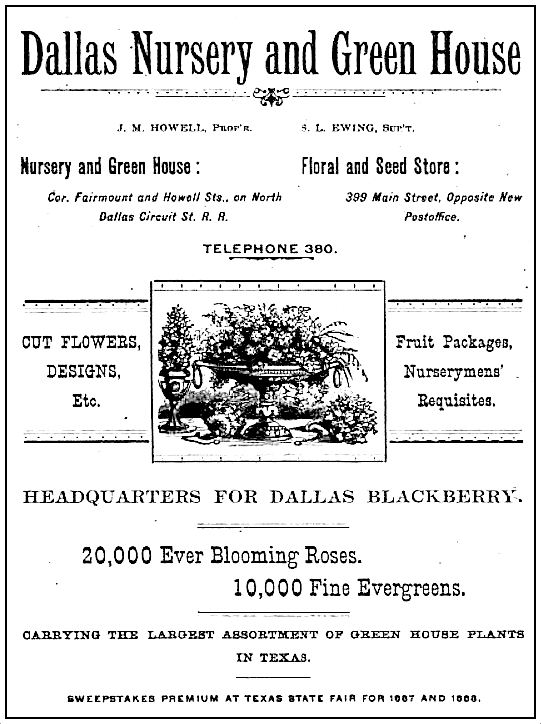
Dallas fruit grower and nurseryman J. M. Howell (1849-1925) was something of a “fruit visionary.” He gave us the “Dallas Blackberry” — something he was quite proud of. He also had dreams of giving Texans more shade.

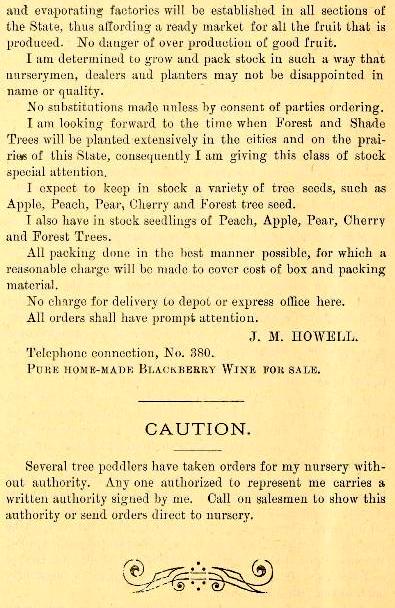
I am looking forward to the time when Forest and Shade Trees will be planted extensively in the cities and on the prairies of this State, consequently I am giving this class of stock special attention.

Fruit and shade. I can get on board with that. He also issued some very pretty catalogs.

howell_catalog-cover_1888

howell-catalog_1888-title-page

howell_catalog_back-cover_1887

howell-catalog_intro1_1888

howell-catalog_intro2_1888

howell-nursery_1888-directory1888 Dallas directory

howell_dallas-nursery_1891-directory1891 Dallas directory

***

Sources & Notes

Above images are from scans of Howell’s catalogs on the Internet Archive: the entire 1887-88 catalog is here; the 1888-89 catalog is here. Included in these catalogs are descriptions of Howell’s inventory and his planting instructions to get the best yields from Dallas’ soil and climate.

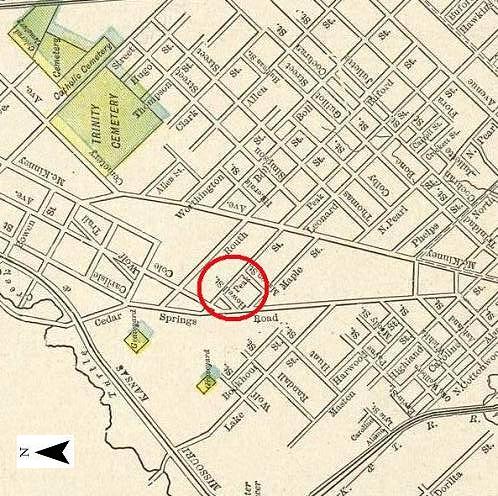
I LOVE the top image. This area — called “Howell’s Addition” — was at the northern edge of the city limits at the time. In March of 1891 the street name “Peak” was changed to “Fairmount” at Howell’s behest. In fact, Howell named the following streets: Fairmount, Maple, Routh (after his in-laws), and Howell. (His uncle was the namesake of nearby Thomas Avenue.) Below is a map showing the area around 1890 — there seems to be a lot of development around him. The rose gardens and orchards may be gone, but at least he got a street named after him.

howell-map-1898Map ca. 1891, confusingly rotated to show same view as top image.

That triangular plot of land is still there (it was the location of the old Casa Dominguez restaurant for many years). Sadly, it’s not much of a scenic vista these days. Uptown could do with a few more orchards and a lot less of everything else.

Howell was a guy who got around. Among other things, he is credited with introducing the magnolia tree to Dallas. Also, he was particular to peaches, and he planted acres and acres and acres of peach trees in Parker County, hoping they’d be a big cash-crop one day — and he was right! For more on Howell, see the Dallas Morning News article “Nurseryman Named Routh Street,” a great “Dallas Yesterday” profile by the always informative Sam Acheson (DMN, Dec. 14, 1970).

*

Copyright © 2014 Paula Bosse. All Rights Reserved.


The Smith Brothers Can Set You Up With a Hearse … Or a Cab — 1888

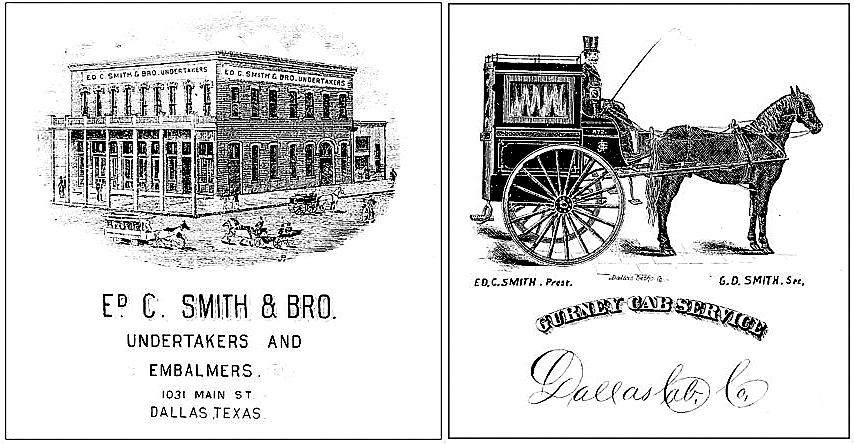
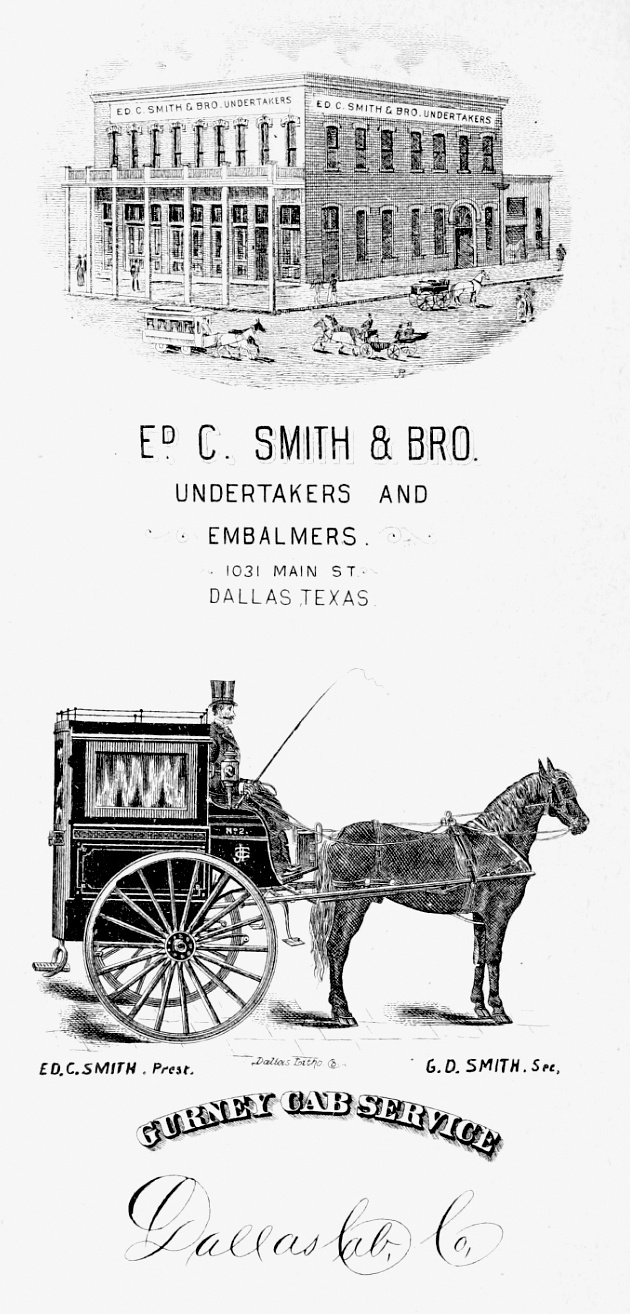
ad-dallas-cab-undertaker_imm-gd-1889Need a ride? (click for larger image)

by Paula Bosse

Need a hearse? No? Then how ’bout a cab?

Diversification is the key to success! Ed. C. and G. D. Smith — of the Ed. C. & Bro. Undertakers and Embalmers — branched out from the hum-drum world of mortuary science and entered the exciting world of transportation-for-hire (it really IS only a short jump from hearse to cab). Their Dallas Cab Co. provided the city with something brand new: Gurney cab service.

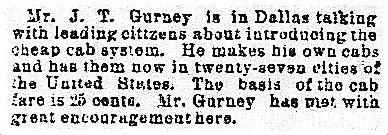
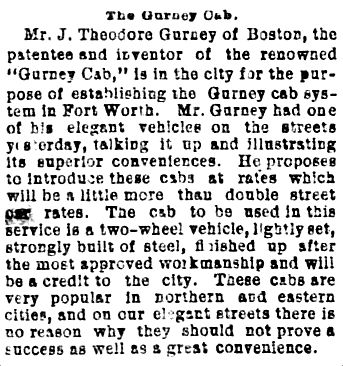
The “Gurney cab” was the invention of Bostonian J. Theodore Gurney — it was a two-wheeled, horse-drawn cab into which passengers entered through the back and, for a quarter, rode in sleek, well-appointed comfort. This new form of conveyance was an alternative to the larger, clunkier, slower “hacks.” Gurney patented his cab in 1883 and traveled around the country promoting his vehicle to large cities. He visited Dallas in March, 1888:

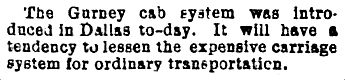
gurney_dmn_031888Dallas Morning News, March 18, 1888

He must have been pretty persuasive, because the “Gurney cabs” went on the streets less than three weeks later:

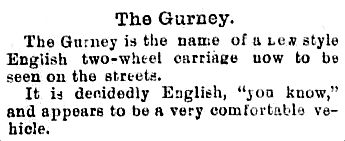
gurney_fwdailygazette_040588Fort Worth Daily Gazette, April 5, 1888

Gurney worked his way around Texas. Next stop was Fort Worth:

gurney_fwdailygazette_041488FWDG, April 14, 1888

Then Austin:

gurney_austin-weekly-statesman_042688Austin Weekly Statesman, April 26, 1888

As to whether the more familiar hospital “gurney” (a wheeled stretcher) has any connections, some say yes and some say no (both arguments can be read here). Wouldn’t it be great if those Smith boys went into stretcher manufacturing a few years later? Cabs — stretchers — hearses: they’ve got you covered … coming and going.

***

Ads from The Immigrant’s Guide to Texas — City of Dallas, 1888. They did, in fact, appear on the same page.

ad-dallas-cab-undertaker_imm-gd_1889

An interesting article — “The Short, Contentious, History of the Gurney Cab Company in San Francisco” by Donald Anderson — can be read here.

The fare for hiring a Gurney cab was 25 cents, which according to the Inflation Calculator, was about $6.00 in today’s money.

Click top ad for larger image.

*

Copyright © 2014 Paula Bosse. All Rights Reserved.

Newspaper Subscriptions by the Bushel

dallas-herald_wheat_112664Dallas Herald, Nov. 26, 1864

by Paula Bosse

No Confederate money, please.

WHEAT
Will be taken in payment for
Subscription to the Dallas Herald, at the rate
of Two bushels for six months, delivered at this office,
or any mill in this vicinity.

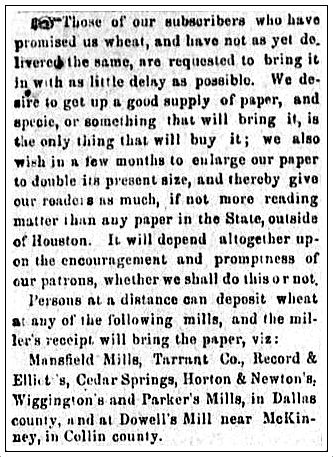
dallas-herald_wheat_020965Dallas Herald, Feb. 9, 1865

Those of our subscribers who have promised us wheat, and have not as yet delivered the same, are requested to bring it in with as little delay as possible. We desire to get up a good supply of paper, and specie, or something that will bring it, is the only thing that will buy it; we also wish in a few months to enlarge our paper to double its present size, and thereby give our readers as much, if not more reading matter than any paper in the State, outside of Houston. It will depend altogether upon the encouragement and promptness of our patrons, whether we shall do this or not.

Persons at a distance can deposit wheat at any of the following mills, and the miller’s receipt will bring the paper, viz:

Mansfield Mills, Tarrant Co., Record & Elliott’s, Cedar Springs, Horton & Newton’s, Wiggington’s [sic] and Parker’s Mills in Dallas county, and at Dowell’s Mill near McKinney, in Collin county.

(Note: the Civil War-era Dallas Herald was two pages: front and back of a single sheet.)

dallas-herald_wheat_subscription_050465Dallas Herald, May 4, 1865

Wheat will be taken in payment for Subscription to the Dallas Herald, at the rate of Two bushels for six months, delivered at this office, or at any of the following mills, and the miller’s receipt to, viz:

Mansfield Mills, Tarrant County; Record & Elliott, Cedar Springs, Horton & Newton’s, Wigginton’s and Parker’s Mills, in Dallas county, and Dowell’s Mill, near McKinney, Collin county.

***

All of the above from the Dallas Herald collection via UNT’s Portal to Texas History site,

Wikipedia entry on Confederate money here; entry on commodity money here.

*

Copyright © 2014 Paula Bosse. All Rights Reserved.

Ads for Slaves Lost, Found, and For Sale in the Pages of The Dallas Herald

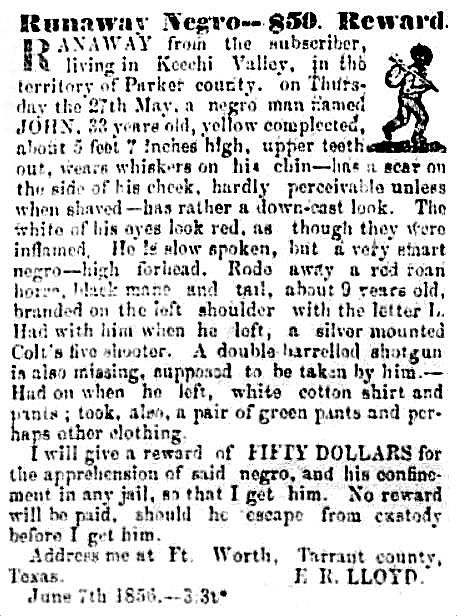
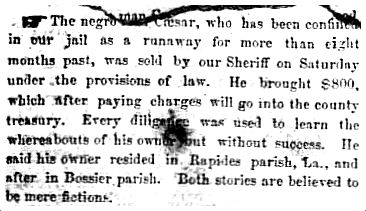
runaway_negro_dallas-herald-1856Dallas Herald, June 7, 1856

by Paula Bosse

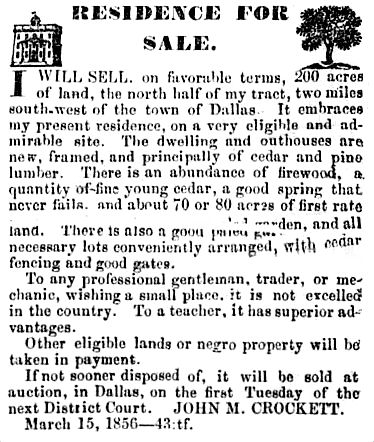
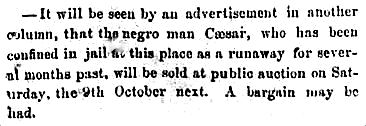
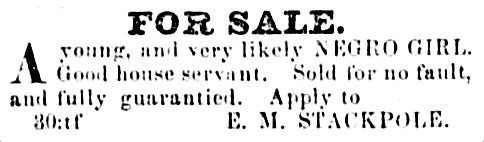
When one is browsing through Texas newspapers from the 1850s and 1860s, one shouldn’t be surprised to see things like this. But that doesn’t make them any less shocking. Black men and women were not regarded as people, but as property — in all of these “ads” you could easily substitute “horse” for “negro.” I think I always wanted to believe that slavery wasn’t much of an issue in Dallas — but it was. The name of one man, E. M. Stackpole, a successful shopkeeper, kept coming up a lot in these advertisements. In addition to the general merchandise of his store, he seemed to do a pretty brisk trade in buying, selling, hiring (more like leasing from other slave-owners), and hiring out slaves. One of his ads is below. (By the way, the word “likely” was a common adjective for slaves; it meant, basically, “worthy of purchase.”)

trade_for_negro_dallas-herald_1856March 15, 1856

negro-auction_dallas-herald_091558Sept. 15, 1858

negro-auction_dallas-herald_102058Oct. 20, 1858

negro_for_sale_dallas-herald_18611861

***

Sources & Notes

All advertisements from The Dallas Herald, via UNT’s Portal to Texas History site.

My lack of knowledge about slavery in Texas is appalling. The Wikipedia entry provides a good overview; read it here.

*

Copyright © 2014 Paula Bosse. All Rights Reserved.

The Texas Land & Mortgage Company — 1912

ad-texas-land-mortgage_19121912

by Paula Bosse

The Texas Land and Mortgage Company of London, Ltd. was the first mortgage company in the state of Texas. The Dallas branch of the English company opened in 1882 at a time when British investment across Texas was booming; it was one of the few speculation firms in the state that grew and prospered into the 20th century. Much development of the city in this period can be attributed to loans granted by the Texas Land & Mortgage Company.

The building they occupied (built by them in 1896) was located at the northwest corner of Commerce and Field, across Field from where the Adolphus has stood since 1912. The building in the 1912 ad looks a little different from the one in the photo below, taken four years earlier. It’s not a terribly attractive building in either photo, but there is some improvement in the later picture, and it IS vastly superior to the 7-Eleven occupying that corner today.

texas-land-mortgage_grtr-dal-ill_19081908

***

Advertisement from the pages of The Cattle Raisers’ Association of Texas, March 1912.

Bottom photograph from Greater Dallas Illustrated (Dallas: Friends of the Dallas Public Library, 1992 — originally published in Dallas in 1908).

For a short biography of A.G. Wood, the Scottish general manager of the Texas Land & Mortgage Co., see the Encyclopedia of Texas (1922) entry here.

Click pictures for larger images.

*

Copyright © 2014 Paula Bosse. All Rights Reserved.