Flashback : Dallas

A Miscellany: History, Ads, Pop Culture

Category: Advertisements

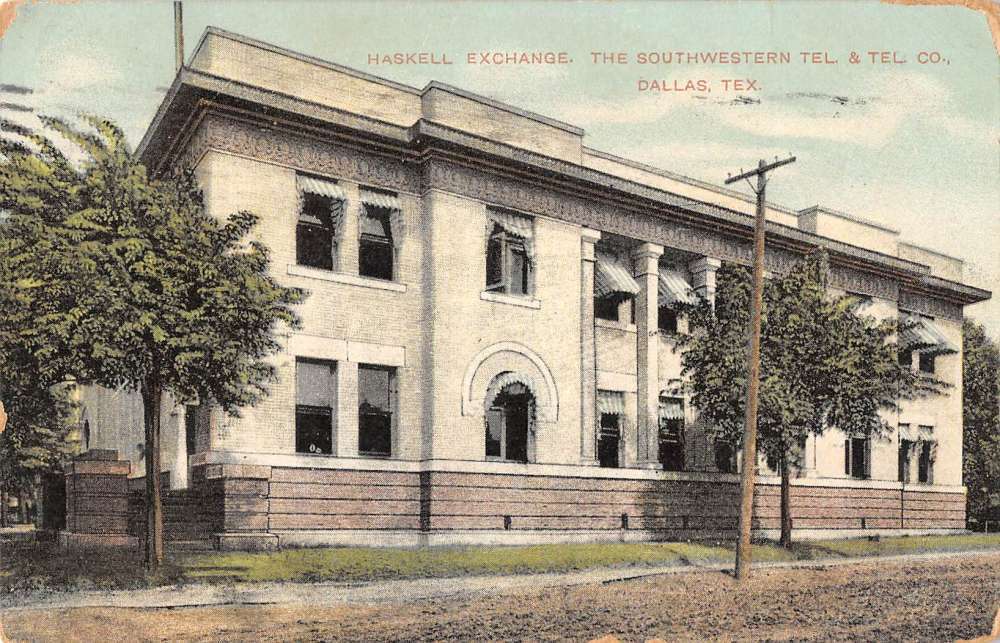
The Haskell Exchange — ca. 1910

telephone_haskell-exchange_postmarked-1910_ebayThe switchboard hub in Old East Dallas… (click for larger image)

by Paula Bosse

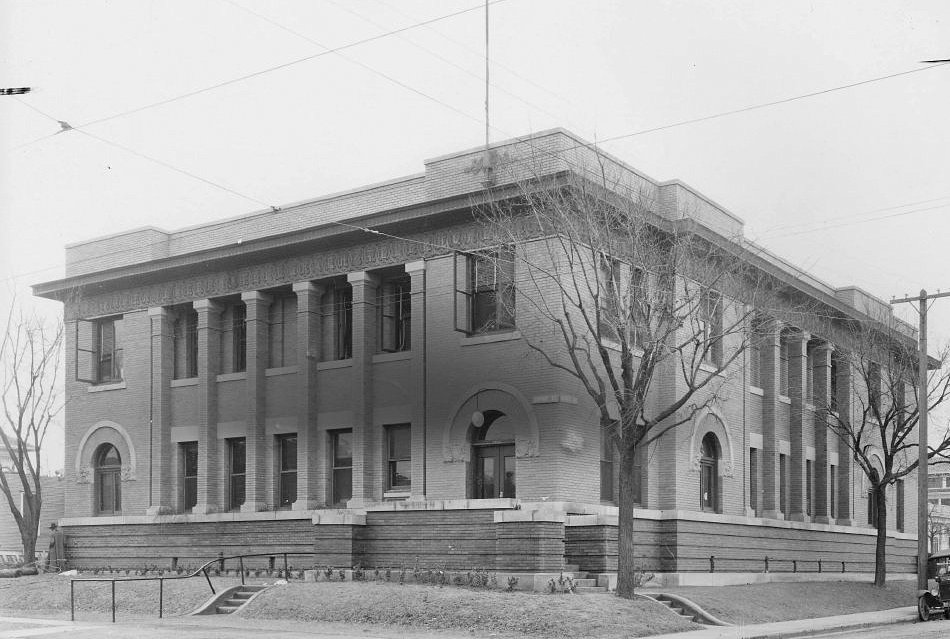
Above, the building that housed the Haskell Exchange of Southwestern Telegraph and Telephone (the company which later became Southwestern Bell Telephone and, eventually, part of AT&T), located at the southeast corner of Bryan and Haskell in Old East Dallas. It was so cute and quaint back in 1910 (the year this postcard was mailed). AT&T still has a building on this very same corner — over a century later. Unfortunately, the building stopped being quaint a long time ago. See the same location today, here. Some awnings might help….

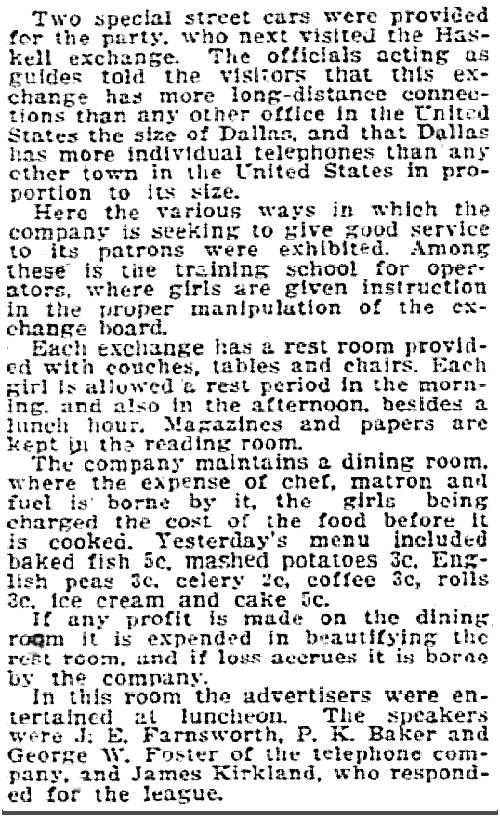
Below is part of an article describing a tour of the Exchange taken by the Dallas Advertising League in 1911 (click for larger image):

haskell-exchange_dmn_021111
Dallas Morning News, Feb. 11, 1911

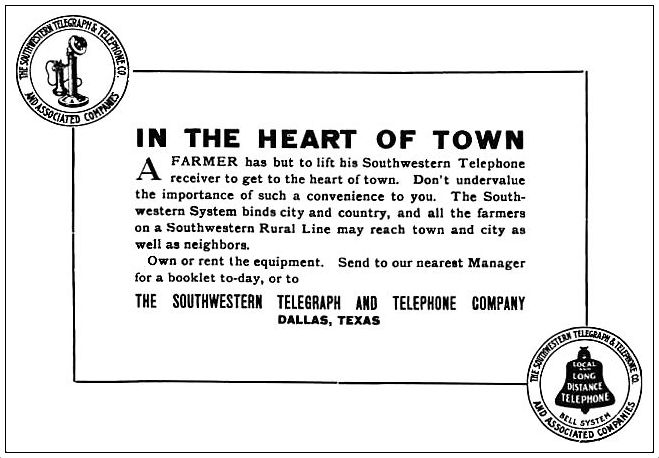
ad-southwestern-telephone-telegraph_1912
Cattle Raisers’ Association of Texas, 1912

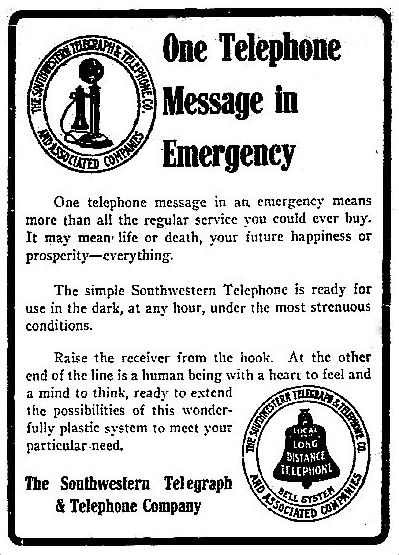
ad-southwestern-telephone-telegraph_dmn_050212
DMN, May 2, 1912

haskell-exchange_ca-1915_DHSDallas Historical Society

***

Sources &  Notes

More about the operators of Southwestern Tel. & Tel. (with photos of their “rest room”) can be found in the Flashback Dallas post “Work and Play in Telephone Land,” here.

In this case “exchange” did not mean the same thing as telephone exchanges such as “Taylor,” “Emerson,” “Lakeside,” “Fleetwood,” “Riverside,” etc. Read more at Wikipedia here and here for the distinctions.

*

Copyright © 2016 Paula Bosse. All Rights Reserved.
What’s Playing at the Palace? — 1950s

elm-street_ten-commandments_1957_flickr_coltera.JPGFilm Row: Elm & Ervay, looking west… (click for large image)

by Paula Bosse

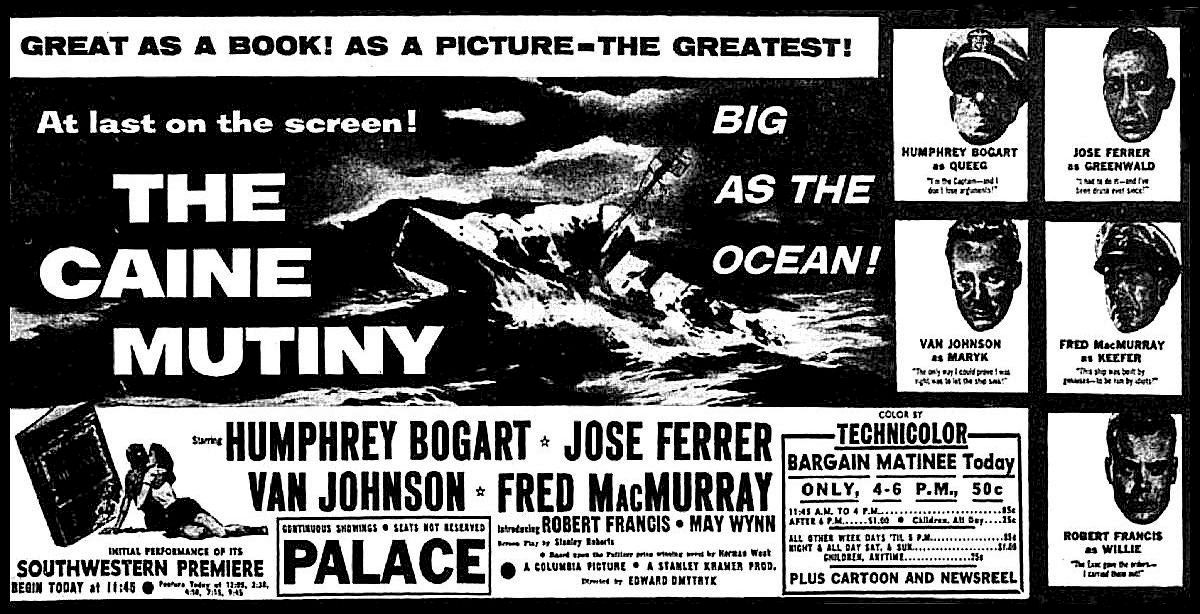
In the 1950s, the two prestige movie theaters in Dallas were the Majestic and the Palace, mainstays of “Theater Row” and just a few blocks apart on Elm Street. The Palace Theater (at Elm and Ervay, across from the Wilson Building) is seen in the two postcards featured here. The one above shows Elm Street looking west. “The Ten Commandments” is playing, placing the date that photo was taken sometime between February and May, 1957. The postcard below shows an eastward-looking view with “The Caine Mutiny” on the marquee, dating that photo to the latter half of July, 1954.

elm-street_looking_east_palace_night_flickr_coltera

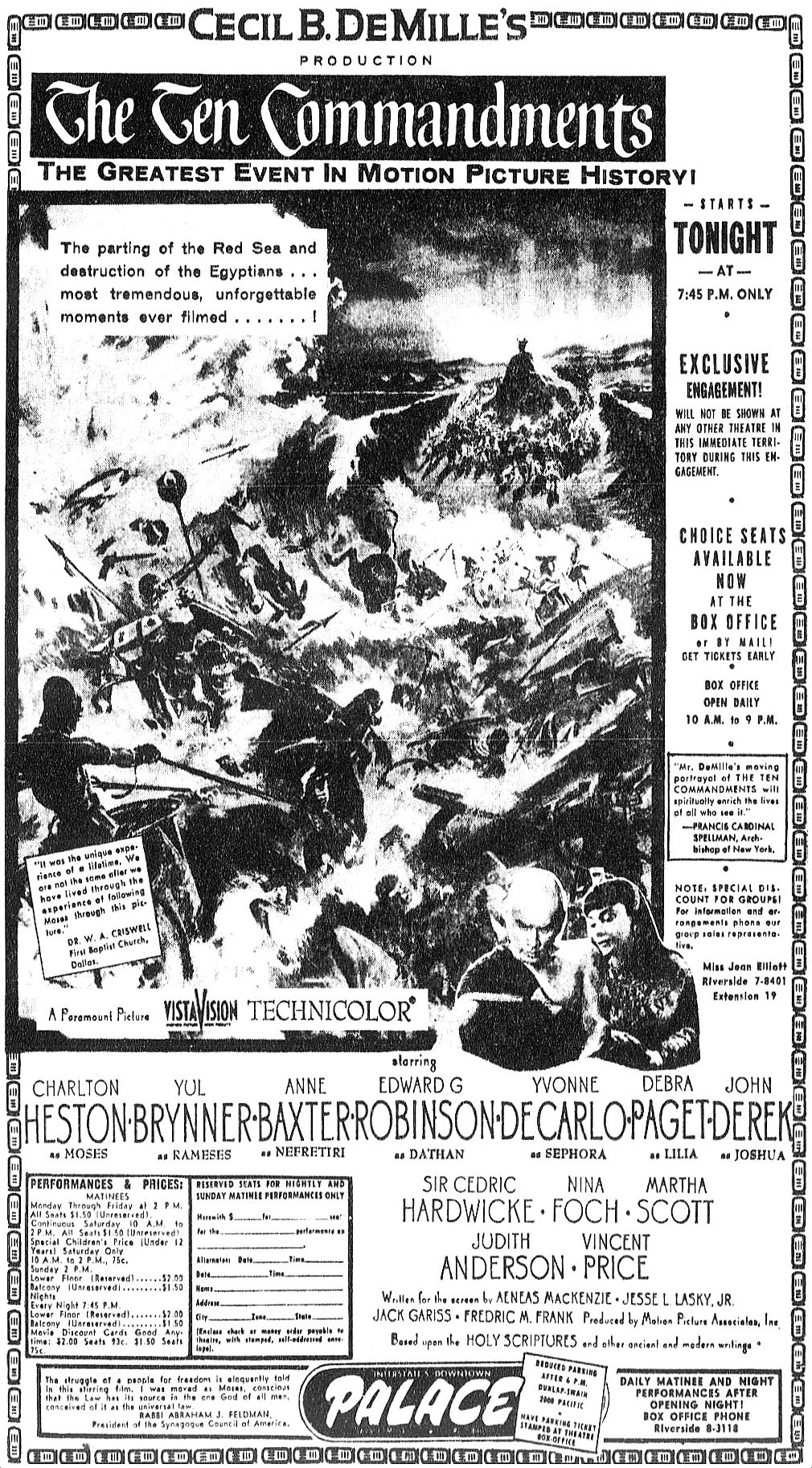
“The Ten Commandments” was a huge, huge hit and ran for 11 weeks — no movie had ever run that long in the history of Dallas theaters (it had beat out the then-champ, “Sergeant York,” which had had a seven-week run at the Majestic in 1941).

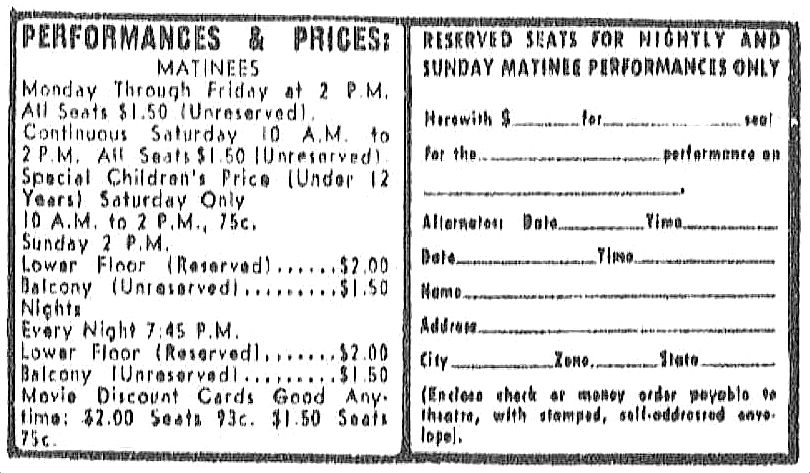
It was also one of the longest movies to ever play in Dallas. We’re talking a running time of almost 4 hours (with an intermission), something which not only tested the endurance of audiences but also severely limited the number of showings per day. It was an “event” picture, and, accordingly, prices were higher and reserved seats were offered.

ten-commandments_palace_dmn_021457_ad_det_reserved-seatsFeb., 1957

The number of people in Dallas who saw that movie at the Palace is staggering: over 100,000! Even after its run at the Palace ended, it continued to draw crowds when it moved down the street to the Tower.

The opening-day ad for the movie:

ten-commandments_palace_dmn_021457_ad
Feb. 14, 1957

There were a couple of things I found interesting about this ad. One was that it had a blurb by First Baptist Church of Dallas’ chief Baptist,  W. A. Criswell.

ten-commandments_palace_dmn_021457_ad_det_criswell

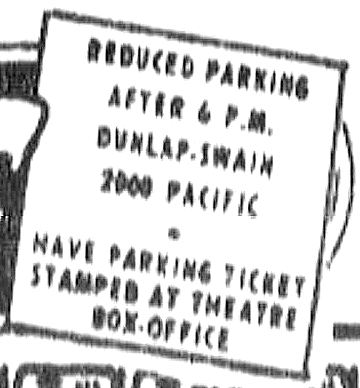
The second was that patrons could park behind the theater — on Pacific — at the Dunlap-Swain station. (Parking downtown for large crowds in those days must have been challenging —  not everyone took streetcars or, later, buses.)

ten-commandments_palace_dmn_021457_ad_det_parking

*

caine-mutiny_palace_dmn_071654_opening-nightJuly, 1954

***

Sources & Notes

Both postcards found on Flickr, posted by the unstoppable Coltera: the top one here, the bottom one here.

“The Ten Commandments” ran at the Palace Theater from Feb. 14, 1957 to May 2, 1957. The film that followed was “Boy On a Dolphin,” which featured the debut of super-sexy Sophia Loren in a U.S. movie. …Which is an interesting counterpoint.

“The Caine Mutiny” ran from July 16, 1954 to July 29, 1954.

A previous post about the Palace — “Next-Door Neighbors: The Palace Theater and Lone Star Seed & Floral — 1926” — can be found here.

Click pictures and clippings to see larger images.

*

Copyright © 2016 Paula Bosse. All Rights Reserved.
 

Thanksgiving, 1891: The First Turkey-Day Football Game in Dallas

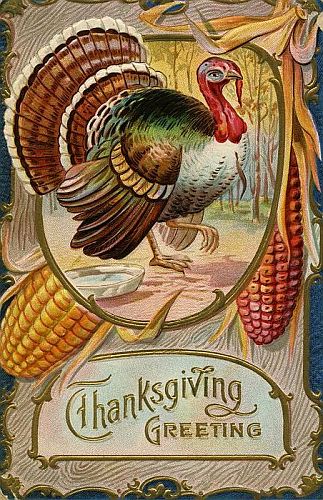
thanksgiving-card_pinterest_sm

by Paula Bosse

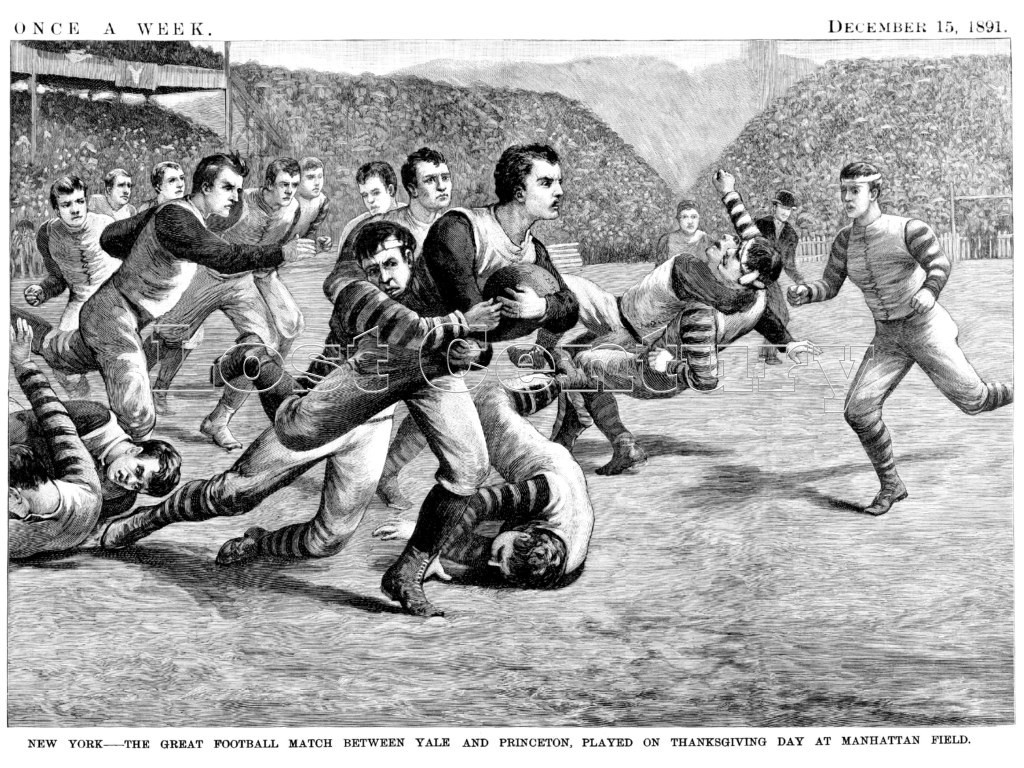
Thanksgiving is a holiday known for eating until you’re full as a tick and football — the highlight for many is the traditional Dallas Cowboys game. But when was the very first Thanksgiving Day football game played in Dallas? 125 years ago — in 1891. It was played on November 26, 1891 in Oak Cliff (…which wasn’t strictly part of Dallas at the time, but… yeah, 1891). The game was between teams from Dallas and Fort Worth, teams which had been organized only a few months previously. The sport of “rugby football” had been gaining popularity around the United States, particularly as a college sport. One of the biggest games of the young sport was the university game played on Thanksgiving Day. In 1891, the Yale-Princeton Thanksgiving game was played in New York before thousands and thousands of spectators. Yale won that year, 19-0 (see the exciting illustration below in which helmets for players are non-existent, but a man who appears to be the referee is wearing a stylish bowler hat). (Click for larger image.)

thanksgiving__football_yale-princeton_1891_lost-century

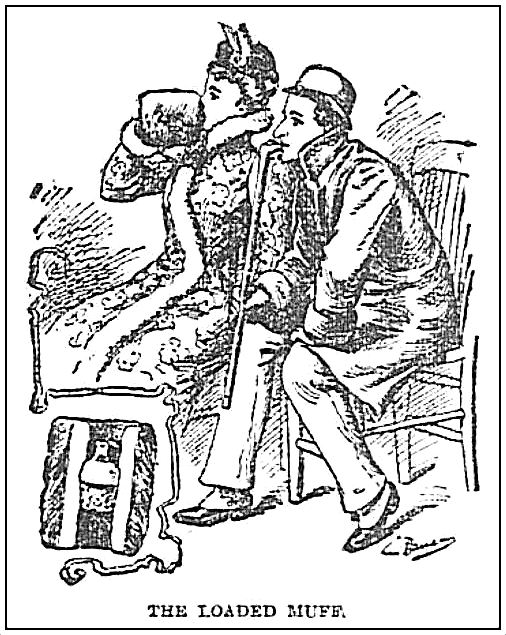
This Ivy League game was almost more of a society event than a sporting event. To get a feel for the atmosphere of these university games, read this really great contemporary article — “The Man of Fashion, We Observe Thanksgiving Day with Great Eclat” by Albert Edward Tyrrell — on the fashions and behavior of these generally well-heeled crowds (it also contains an interesting look at how Thanksgiving was celebrated in 1891, by the swells as well as the non-swells). My favorite piece of minutiae was that young ladies were not above sneaking flasks of liquor into games, hidden in their fashionable hand-warmers. I give you “the loaded muff”:

football_thanksgiving_loaded-muff_dmn112291

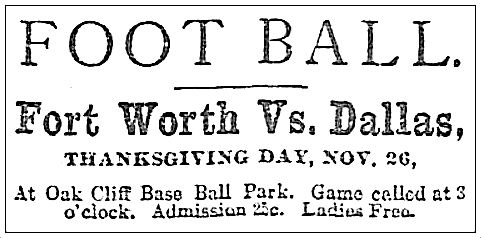
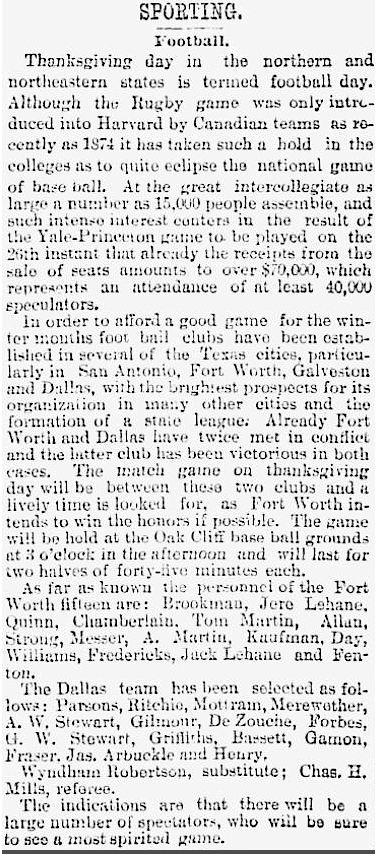
But I digress. However much those early Texas football enthusiasts might have hoped for similar large, flask-sipping crowds, the first Thanksgiving football game held in Dallas (and possibly in Texas) attracted a smaller crowd of hundreds rather than thousands (including “about 100 ladies”). Though the crowd was miniscule compared to the one up in New York that day, it did not lack in boisterousness and excited appreciation.

thanksgiving_football_dmn_112591_ad
Dallas Morning News, Nov. 25, 1891

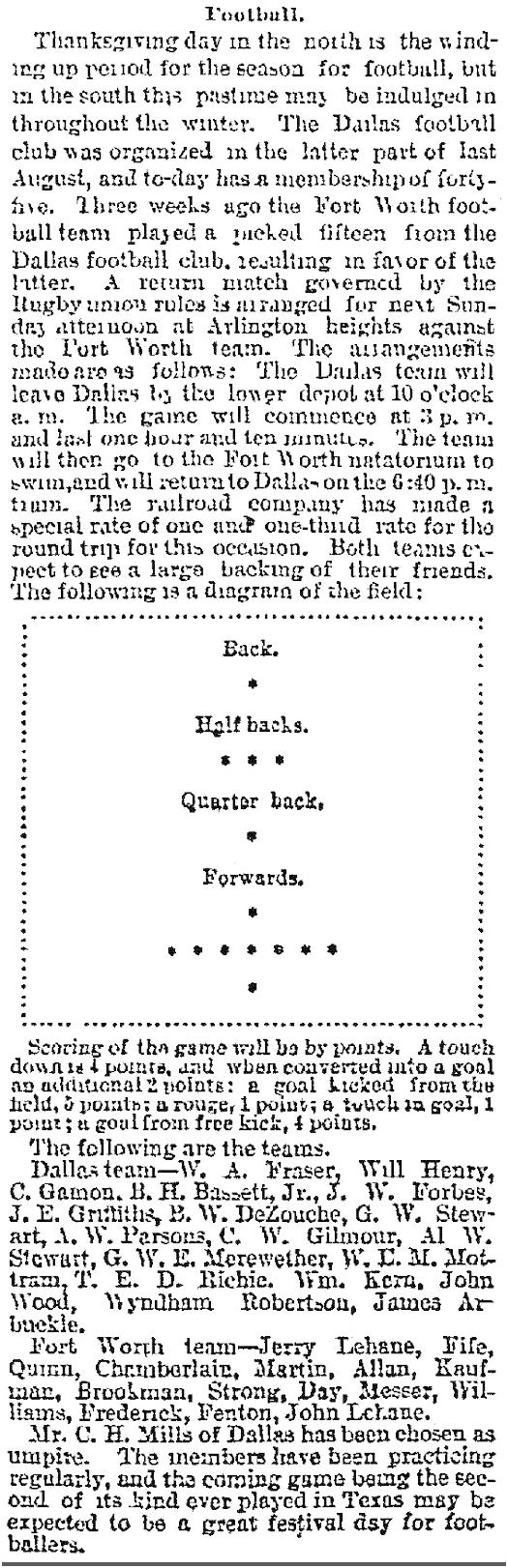
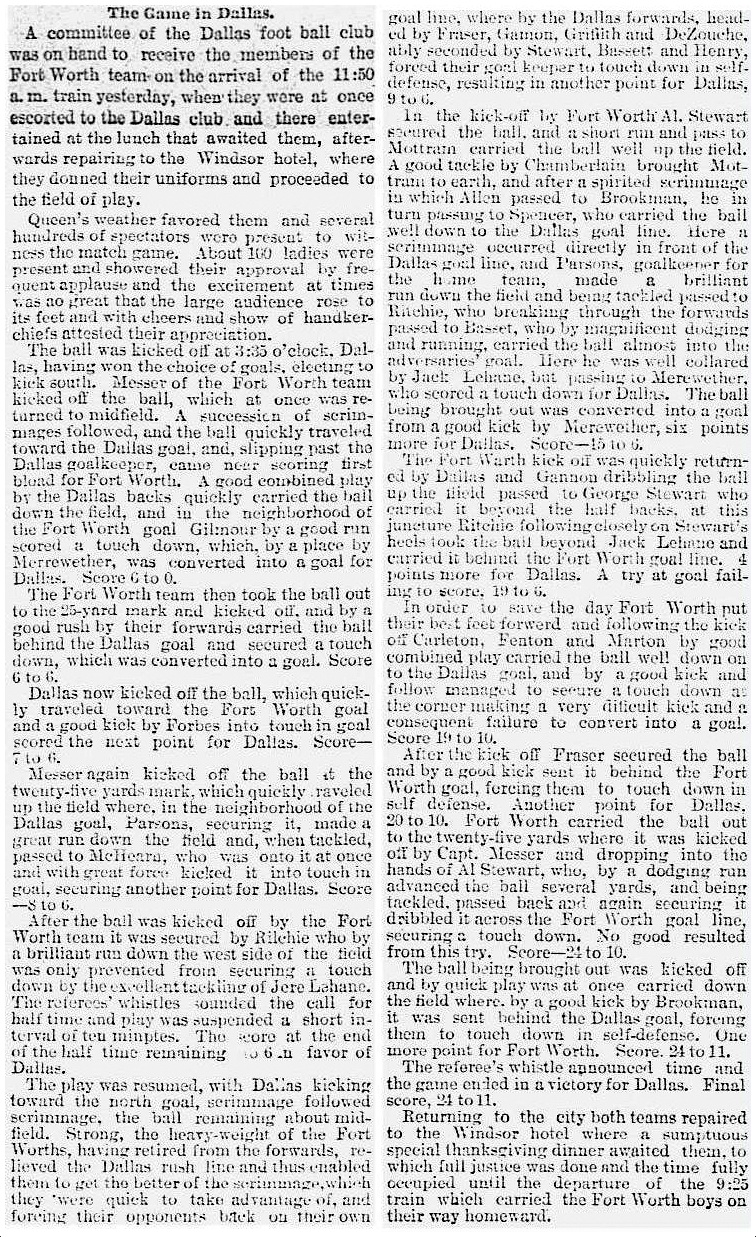
Dallas and Fort Worth had met twice before their matchup in Oak Cliff — both times with Dallas emerging victorious, and … not to be too anti-climactic, but the big inaugural Thanksgiving Day game on November 26, 1891 resulted in another Dallas win (24-11). (This shouldn’t be too surprising, seeing as the overwhelming majority of the players on the Dallas team of 15 grew up playing rugby in rugby-playing countries: 7 were British and 5 were Canadian —  only 3 were native-born Americans. Still. Whatever it takes.) (The dullish play-by-play of the game can be read  below.)

So what else was going on in Dallas in the Thanksgiving season of 1891? Here are a few morsels.

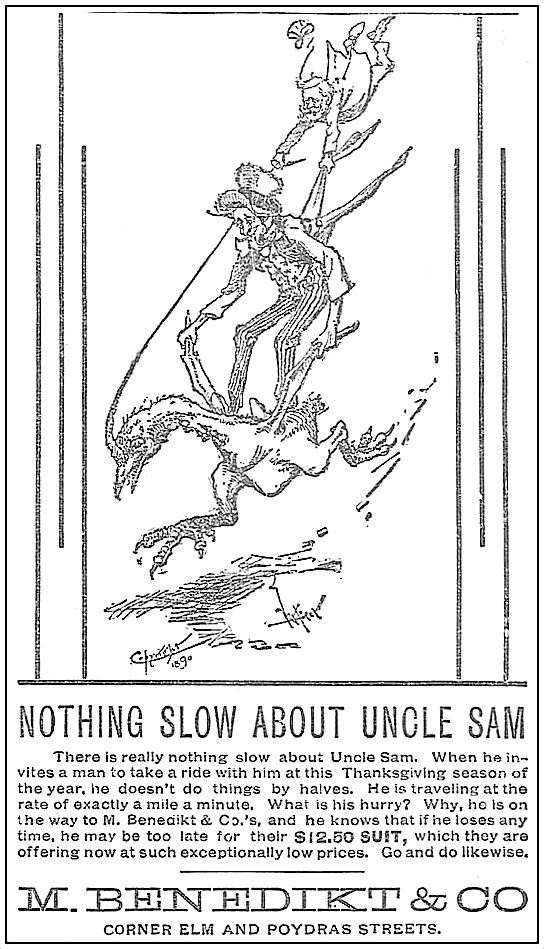
Men might have contemplated getting a new $12.50 suit from M. Benedikt & Co. (a suit which would cost about $335.00 today) — especially after seeing this eye-catching Uncle-Sam-riding-a-(scrawny)-turkey ad. (Click pictures to see larger images.)

ad-thanksgiving_benedikt_dmn_112191
DMN, Nov. 21, 1891

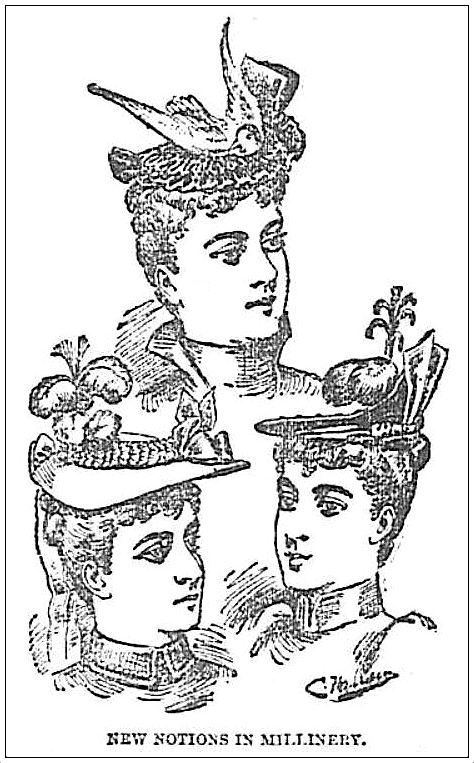
Ladies were kept up-to-date on the millinery, dress, and hairstyle fashions of the season by reading newspaper articles such as “What Is Really Worn, The Fashions That Find Favor at Thanksgiving” (which can be read here).

thanksgiving_milinery_dmn_112291
DMN, Nov. 22, 1891

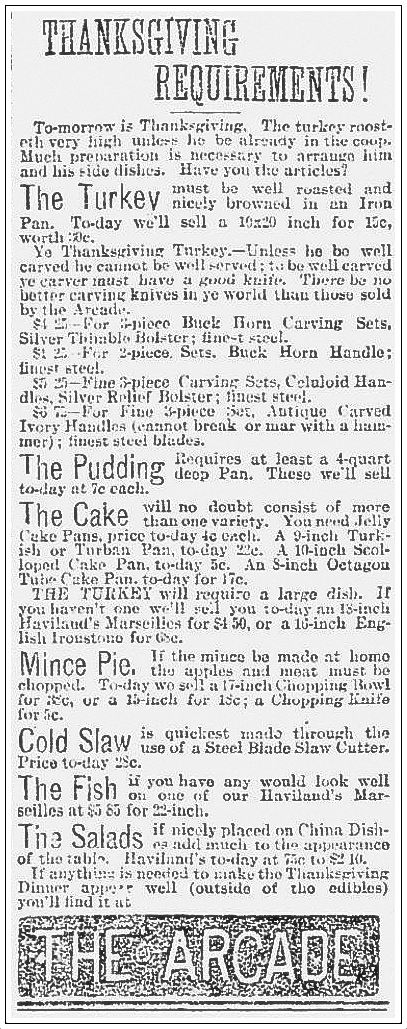
And stores that sold cookware, bakeware, and china took out ads to inform Dallasites that they really needed some new items in order to properly prepare for the big day — one’s guests shouldn’t be forced to be served a feast from tacky serving dishes or eat from chipped plates.

ad-thanksgiving_dmn_112591
DMN, Nov. 25, 1891

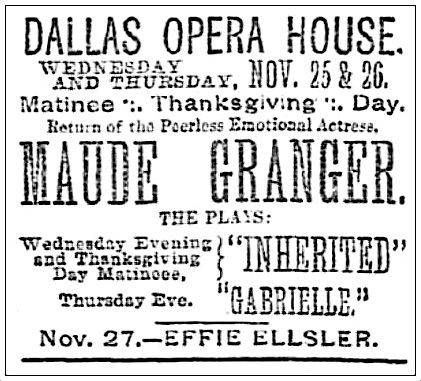
If one wasn’t spending Thanksgiving Day attending one of the city’s many church services, feeding the children at the Buckner Orphans Home, feeding one’s guests and one’s family, visiting friends, or trekking over to Oak Cliff to see that football game, he or she might have considered attending a matinee at the Dallas Opera House — Maude Granger (“The Peerless Emotional Actress”) was back in town and raring to emote.

thanksgiving_theater_dmn_112491
DMN, Nov. 24, 1891

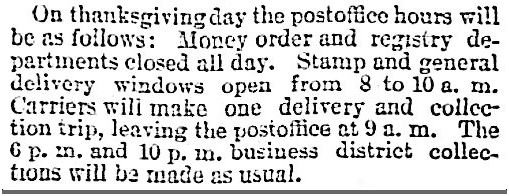
Almost everyone had the day off from work, but, oddly enough, most postal workers had to work at least part of the day. Neither rain nor sleet nor tender turkey breasts and cranberry sauce stayed those couriers from the swift completion of their appointed rounds, I guess.

thanksgiving_post-office_dmn_112591
DMN, Nov. 25, 1891

At least no one was dreading/eagerly anticipating Black Friday back in ’91.

**

Back to football. First, a friendly D-FW practice run before the Big Game.

thanksgiving_football_dmn_111491
DMN, Nov. 14, 1891

The pre-game article.

thanksgiving_football_dmn_112591
DMN, Nov. 25, 1891

The post-game article.

thanksgiving_football_dallas-fw_dmn_112791_highlights
DMN, Nov. 27, 1891

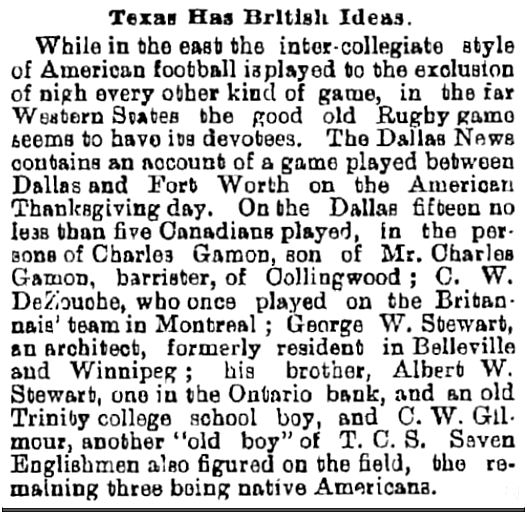
And an article from a proud Canadian newspaper, boasting of the number of Queen Victoria’s faithful subjects playing for the Dallas team.

thanksgiving__football_manitoba-free-press_121191
The Manitoba Free Press, Dec. 11, 1891

***

Sources & Notes

Thanksgiving card found on Pinterest.

Illustration of the 1891 Yale-Princeton game is from the Lost Century of Sports website, here. (I’m not really a sports fan, but if I were, this website of 19th-century sports might be one of my favorites!)

For more on how Thanksgiving finally came to be celebrated in Texas in 1874 (it took a long time for the Southern states to agree to celebrate what many thought was a “Yankee abolitionist holiday”), see my post “Encouraging Dallasites to Observe Thanksgiving — 1874,” here.

Happy Thanksgiving!

Most pictures and clippings larger when clicked.

*

Copyright © 2016 Paula Bosse. All Rights Reserved.
Empire Central and Its Fabulous Empire Club

empire-central_1958_ebay_det“Northwest Dallas” in 1959 — how quaint… (click for larger image)

by Paula Bosse

“Empire Central.”

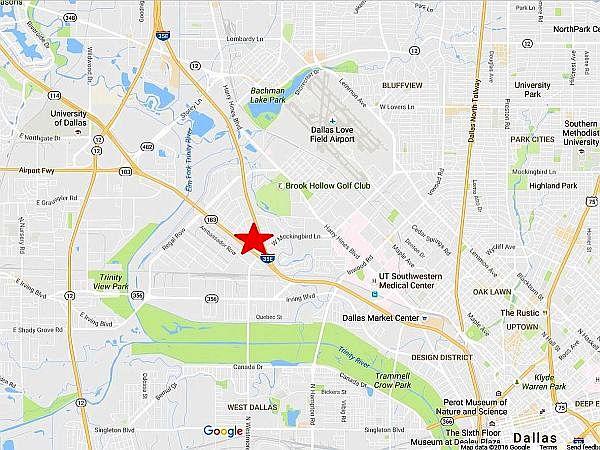
I have to admit that I’d never heard of anyplace in Dallas called Empire Central, but because I wanted to post the picture above (which I love) (and which is  from a 1959 ad), I felt I should at least look into finding out what and where it was and broaden my horizons a bit. So I did. It was (is?) an “office community” built in 1958 on 90 acres of land (later expanded), located in the “V” between Hwy. 77 (soon to be Stemmons Freeway) and Hwy. 183 (aka Empire Freeway, soon to be John W. Carpenter Freeway), with W. Mockingbird on the south and Dividend Drive on the north(-ish). It was developed as an office park as part of the already existing 1,200-acre Brook Hollow Industrial District (which, when its development began in 1953, was beyond the city limits) — both areas were developed by Windsor Properties. Empire Central was announced in 1957.

Unsurprisingly, almost every early newspaper story about plans for the new district mentioned what was considered to be its sexiest, most novel attraction: the Empire Club, an on-site dining and recreation club for employees — executives and underlings alike — who worked in the “community’s” office buildings. It was a round, 45,000-square-foot structure that sat on 9 acres and featured a distinctive roof which utilized 24 tamarack logs “more than 100 feet long, imported here especially for the club from the virgin forests of Washington” (DMN, Nov. 24, 1957). Its amenities included a sunken garden, a terraced dining room, lounge, swimming pool, putting green, and shuffleboard court, all nestled in a “garden-like atmosphere.” What a great perk!

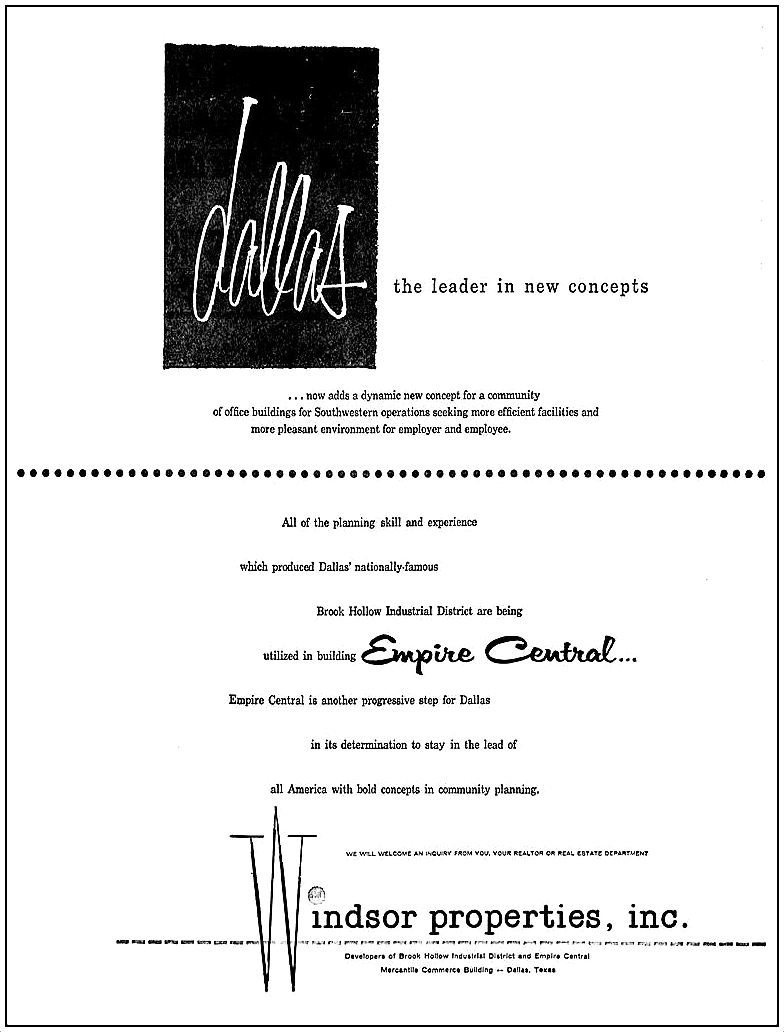
The club was important in the conceptualization of the office park, as the developers insisted that a happy employee was a productive employee, as can be seen in the text from a 1959 advertisement which ran the week the club opened:

Two fundamental concepts were taken into consideration by Windsor Properties, Inc., in designing Empire Central.

First was the realization that the company able to attract the most capable employees at a given wage would be most successful. Second, the urbanization of our population has created the need for a measure of community life.

The Empire Club, as the heart of Empire Central, is designed to accomplish both objectives for management.

And that club looked cool. It was a cutting-edge design from the always impressive George Dahl, one of Dallas’ top architects. (Dahl worked on several other projects with W. C. Windsor — Sr. and Jr. — including a prison (?!) and several other buildings in the Empire Central District.) Dahl’s previous big round building — Memorial Auditorium/Dallas Convention Center — had opened in 1957, just months before construction began on this unusual and sophisticated clubhouse, something one would certainly not expect to find plonked down in the middle of such prosaic surroundings.

empire-central_dmn_101859_empire-club_det

empire-central_dmn_101859_empire-club_pool_det

empire-central_dmn_101859_map_det

Below, the full ad, which appeared the week the new Empire Club opened in October, 1959 (click to see larger image):

empire-central_dmn_101859_empire-club
Oct., 1959

At some point (or maybe always) the club began to be used by outside groups. In the ’60s, it was the site of a lot of Junior League and debutante activities and dances. In 1966 the Empire Club became The Round House restaurant (in which could be found the Fatted Calf club). The last listing I could find of a restaurant or club at that address (which was, originally, 100 Empire Central Drive and, later, 1100 Empire Central Place) was in 1971. Sadly, that cool-looking building was torn down somewhere along the way. What a shame! I just discover a George Dahl-designed building I’d never seen — in a part of town I’d never heard of — and *poof*! … it’s gone. …At least I didn’t have time to get too attached.

**

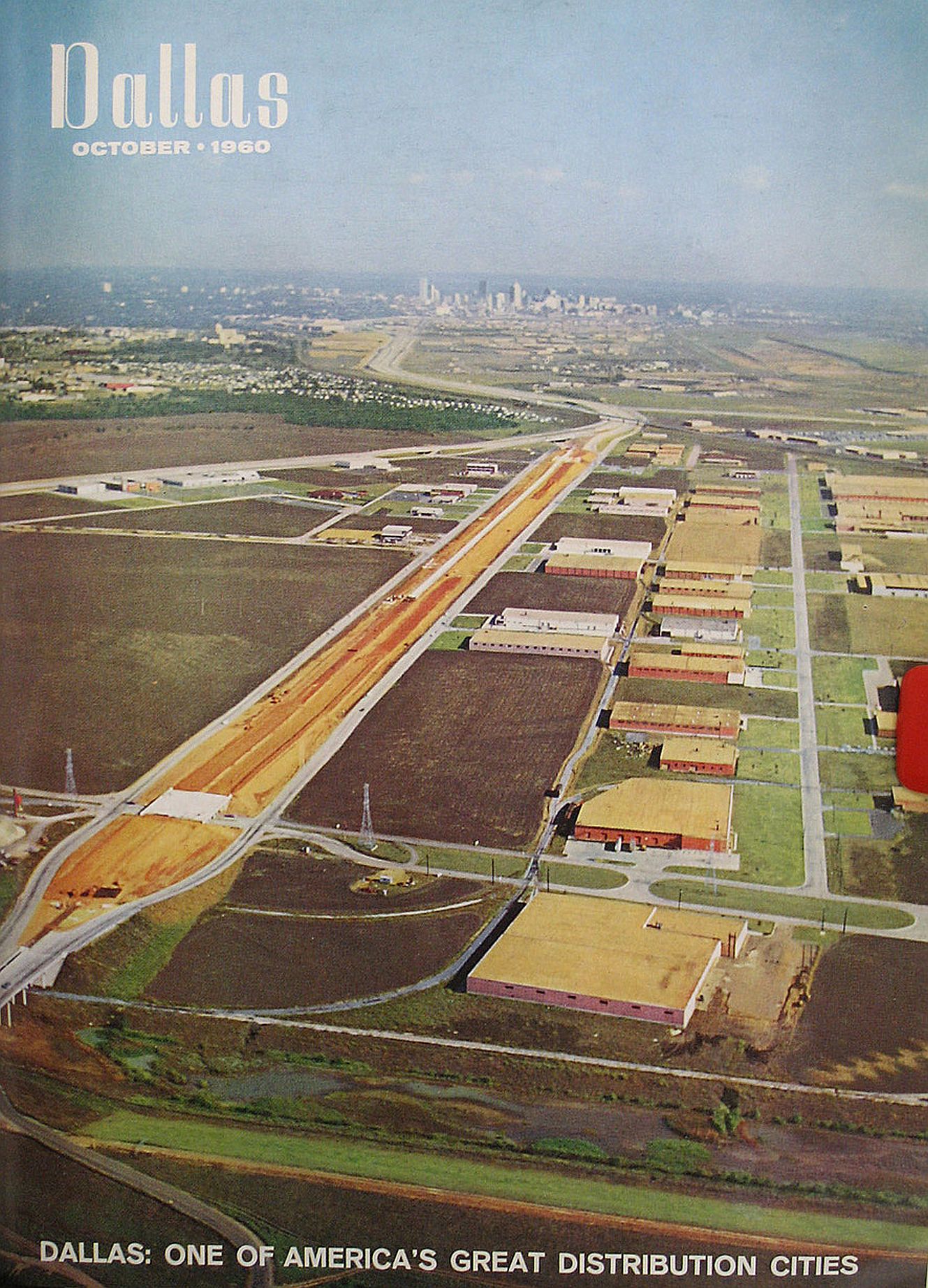
Here’s a great photo from 1960 (click it — it’s really big) looking southeast toward downtown from about Regal Row (bridge in foreground), with the new and improved Carpenter Freeway/Hwy. 183 in the center, and Stemmons — coming in from the left — meeting it in the distance; the Mockingbird bridge is just beyond it, just above the point. The Empire Central district — in between Stemmons and Carpenter — looks kind of puny here. You  might have to squint, but you can see the brown, round Empire Club building in the center of the triangle. If you listen closely, you might be able to hear a Southwestern Drug Company secretary splashing happily in the heated pool.

empire-central_183-construction_1960_dallas-freeways-site

*

empire-central_1958_ebay
1958 ad

empire-central_dmn_011958_ad
Jan., 1958

empire-central_google
Google Maps

***

Sources & Notes

Top image is from a full-page magazine ad from 1958, found on eBay.

The 1960 photo appeared on the cover of Dallas magazine (October, 1960); I found it on the unbelievably thorough Dallas-Fort Worth Freeways site (main page is here, this photo is linked from here).

This area — what is it called? The consensus seems to be “Brook Hollow.” Or maybe “Stemmons Corridor” (the Wikipedia entry for the latter is here).

The Flashback Dallas post on the area’s 1920s-era namesake golf club — “Brook Hollow Country Club — 1940s” — is here.

(Thank you, Dallas History Facebook group for the helpful tidbits!)

Think it should be bigger? Click it!

*

Copyright © 2016 Paula Bosse. All Rights Reserved.
 

Lady Godiva and the “Flesh Shows” of the Texas Centennial — 1936

tx-centennial_streets-of-paris_ticket_cook-coll_smuGeorge W. Cook Collection/SMU

by Paula Bosse

When one thinks of the Texas Centennial Exposition, the splashy 6-month extravaganza held at Fair Park to celebrate the 100th anniversary of Texas independence, one might not immediately think of the three things associated with the big show that were making headlines around the country (and were undoubtedly responsible for healthy ticket sales): according to Variety, the Centennial had “all the gambling, wining and girling the visitor wants” (June 10, 1936).

The Dallas exposition (and the coattail-riding Frontier Exposition, which was held at the same time in Fort Worth) was “wide open” in 1936: there was gambling, liquor, and nudity everywhere. The Texas Rangers cracked down on some of the gaming in the early days, but alcohol and girlie shows continued throughout the expo’s run.

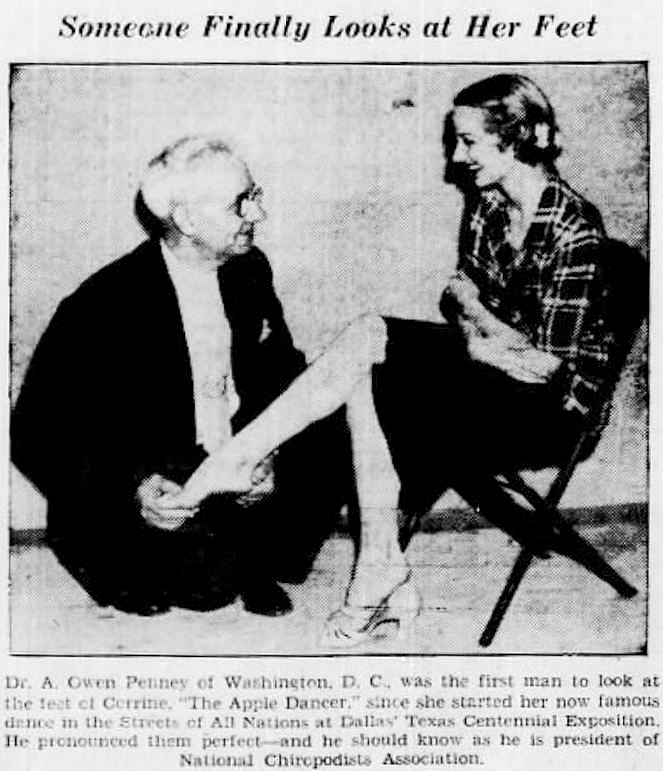
As far as the nudity, it really was everywhere. It’s a little shocking to think that this sort of thing was so widely accepted in very conservative Dallas — 80 years ago! — but it was (despite some local pastors disdainfully referring to the big party as the Texas Sintennial). Many of the acts — and much of the personnel — had appeared in a version of the same revue in Chicago in 1933 and 1934. Some of the offerings for the Centennial visitor: peep shows a-plenty, the clad-only-in-body-paint “Diving Venus” named Mona Lleslie (not a typo), a naked “apple dancer” named Mlle. Corinne who twirled with a “basketball-sized ‘apple'” held in front of her frontal nether regions, and the somewhat obligatory nude chorus girls. There was also an “exhibit” in which nude women were on display as “artists’ models,” posing for crowds of what one can only assume were life-drawing aficionados who were encouraged to render the scene before them artistically (…had they planned ahead and brought a pencil and sketchpad); those who lacked artistic skill and/or temperament were welcome to just stand there and gawk. (Click photos and ads to see larger images.)

corinne_apple-dancer_cook-collection_smu

tx-centennial_apple-dancer_dmn_070536

tx-centennial_apple-dancer_franklin-ind-evening-star_071136Franklin, Indiana Evening Star, July 11, 1936

Another attraction was Lady Godiva, who, naked, rode a horse through the Streets of Paris crowds. Her bare-breastedness even made it into ads appearing in the pages of staid Texas newspapers. (Click to see larger images.)

tx-centennial_lady-godiva_dmn_060436_sm
June, 1936

There were two areas along the Midway where crowds could find these saucy attraction: Streets of Paris (which Time magazine described as appealing to “lovers of the nude”) and Streets of All Nations (“for lovers of the semi-nude”). Lady Godiva was part of the Streets of Paris, and she rode, Godiva-esque, nightly. The gimmick (beyond the gimmick of a naked woman riding a horse in Fair Park) was that she was supposed to  be a Dallas debutante who rode masked in order to conceal her identity. The text below is from the ad above.

MASKED…but unclothed in all her Glory…Riding a milk-white steed. […] Miss Debutante was introduced to Dallas society in 1930. She was later starred in Ziegfeld’s Follies, in “False Dreams, Farewell,” “Furnished Rooms,” and other Broadway successes. She appeared in motion pictures, being starred in “Gold Diggers of 1935,” “Redheads on Parade” (yes, she is a redhead) and other picture successes.

SHE WILL STARTLE DALLAS SOCIETY! JUST AS THE STREETS OF PARIS WILL BE THE SENSATION OF THE CENTENNIAL SEASON .. WHO IS SHE?

And, of course, none of that was true (including the fact that this “Lady Godiva” rode a white horse — apparently one could not always be found), but I’m sure it got local pulses racing. My guess is that there were several Ladies Godiva (none of whom were members of Dallas society). One woman was actually named as the Centennial’s exhibitionist horsewoman. I haven’t been able to find mention of a “Paulette Renet” anywhere other than the caption of this photo, but here she is:

godiva_madera-tribune_082936

godiva_madera-tribune_082936-caption
Madera (California) Tribune, Aug. 29, 1936

Another photo featuring what appears to be the same woman, with this caption: “No white horse for Lady Godiva, at the Texas Centennial Exposition in Dallas. A feature of the ‘Streets of Paris,’ a midway show, Godiva rode a ‘paint pony,’ first week because no white one was available.”

godiva_altoona_penn-tribune_062336
Altoona (Pennsylvania) Tribune, June 23, 1936

I think this is still the same woman, but on a rare white steed:

lady-godiva_cook-collection_smu

The Godiva who appeared in the March of Times newsreel “Battle of a Centennial” appears to be a different woman. (Watch a 45-second snippet of the newsreel which features both a glimpse of Lady Godiva and a head-shaking son of Sam Houston wondering what the deal is with the younger generation — here.)

godiva_march-of-time_1936

Imagine seeing performers and attractions like this along the Fair Park midway today!

*

godiva_dmn_070536-detJuly, 1936 (ad detail)

tx-centennial_lady-godiva_dmn_060436-det
June, 1936 (ad detail)

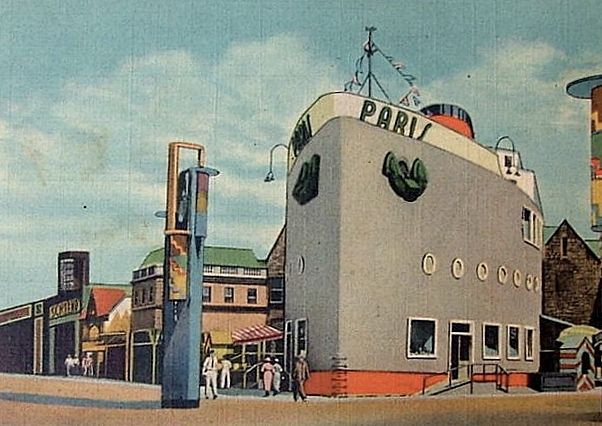
What was the Centennial Club? It was an exclusive, invitation-only private club located within the very large George Dahl-designed building which housed the Streets of Paris (and which was shaped like the famed S. S. Normandie ocean liner). It had three levels (“decks”) and housed a lounge, dining rooms, a main clubroom, and a “dance pavilion” — all air conditioned. From various decks, well-heeled patrons could look down at the action going on below: the milling throngs of the hoi polloi, the Streets of Paris shows, and the Midway.

centennial-club_dmn_061636
June, 1936

tx-centennial_streets-of-paris_art-institute-chicago

tx-centennial_streets-of-paris_ebay_rppc

tx-centennial_streets-of-paris

Can’t miss the ridiculously large land-locked ocean liner in the center of the photo below. Mais oui!

normandie_winters_dhs

**

The articles below on “gals, likker, and gambling” are GREAT. They are from the show biz trade publication Variety, which really latched onto the rampant nudity on view at the Texas Centennial. Remember: 80 years ago! (The abbreviation of “S. A.” in the headline of the second article stands for “sex appeal.”) (As always, click to see larger images.)

sex_variety_061036
Variety, June 10, 1936

sex_variety_062436
Variety, June 24, 1936

nudity_variety_070136
Variety, July 1, 1936

***

Sources & Notes

Top photo shows an admission ticket to the Streets of Paris, from the George W. Cook Dallas/Texas Image Collection, Central University Libraries, Southern Methodist University; more information is here. Another interesting item from this collection is a brochure (here) which describes Streets of Paris as “the smartest, most sophisticated night club in America. Here you will find the gay night life of Paris in a setting of exotic splendor.”

Photo of “Mlle. Corrine” also from the Cook Collection at SMU; more info on that photo here.

Photo of Lady Godiva on a white horse (with the words “Dallas Centennial” near the bottom … um, bottom of the image … is also from the Cook Collection at SMU, here.

The photo showing the night-time crowd outside the Streets of Paris Normandie is from the Ryerson & Burnham Archives, Art Institute of Chicago; more info here.

The aerial photograph showing the S. S. Normandie is from Willis Cecil Winters’ book Fair Park (Arcadia Publishing, 2010); photo from the collection of the Dallas Historical Society.

All other sources noted, if known.

See quick shots of the Streets of Paris and the Streets of All Nations in the locally-made short film “Texas Centennial Highlights,” here (Streets of Paris is at about the 7:00 mark and the more risqué bits showing the parasol chorus girls followed by Mlle. Corinne and her apple dance (I mean, it’s not really shocking, but … it still kind of is…) at the 8:45 mark. (Incidentally, there appears to be a new book on Corinne and her husband — Two Lives, Many Dances — written by their daughter.)

A very entertaining history of the State Fair of Texas and the Texas Centennial Exposition can be found in the article “State Fair!” by Tom Peeler (D Magazine, October, 1982), here.

A Flashback Dallas post on the feuding Dallas and Fort Worth Centennial celebrations can be found here.

More Flashback Dallas posts on the Texas Centennial can be found here.

Click pictures and clippings to see larger images.

*

Copyright © 2016 Paula Bosse. All Rights Reserved.
“Teen-Age Downbeat”

teen-age-downbeat_broadcasting-mag_051859_detWBAP’s “Teen-Age Downbeat,” 1959 (click for larger image)

by Paula Bosse

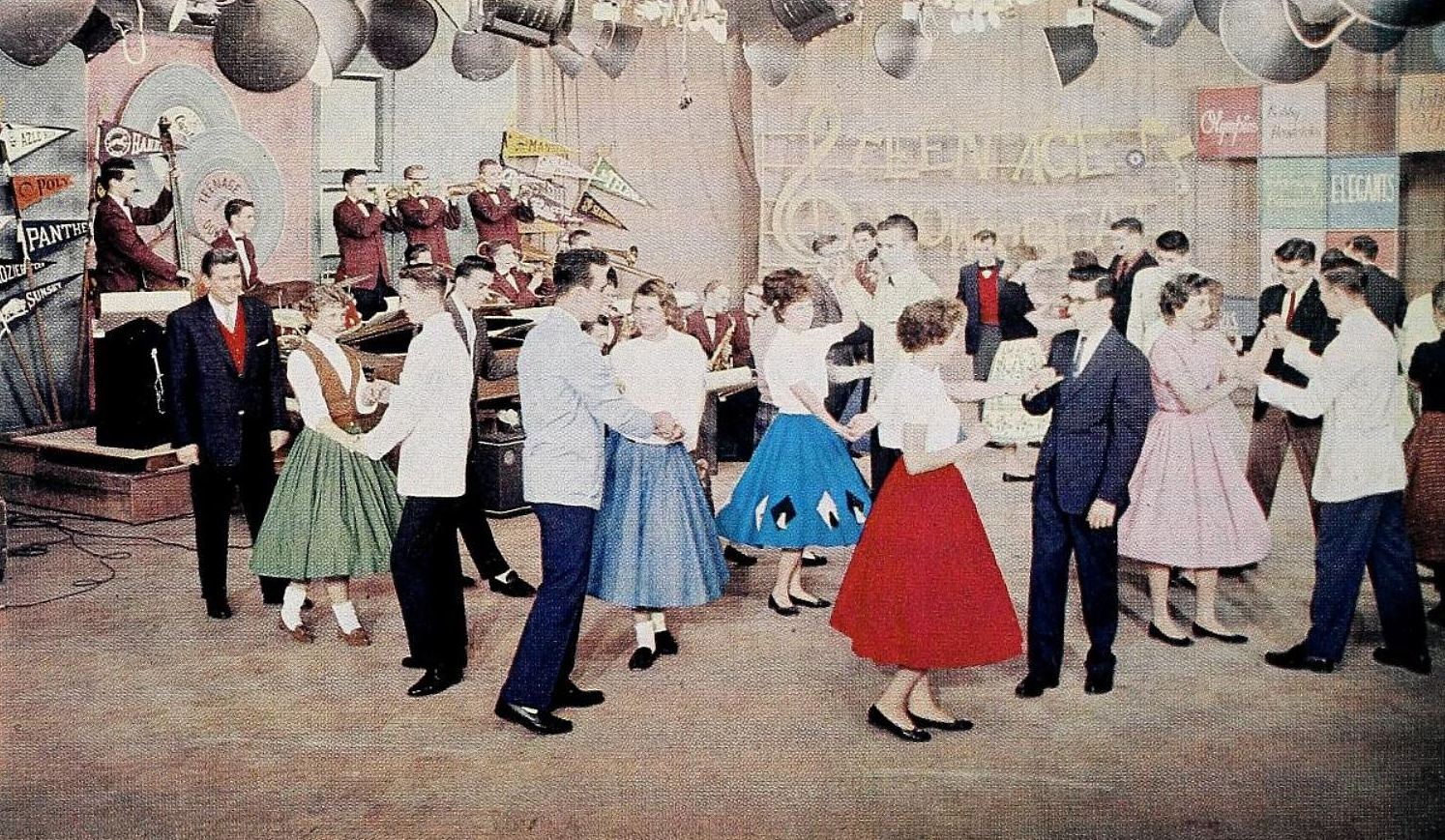
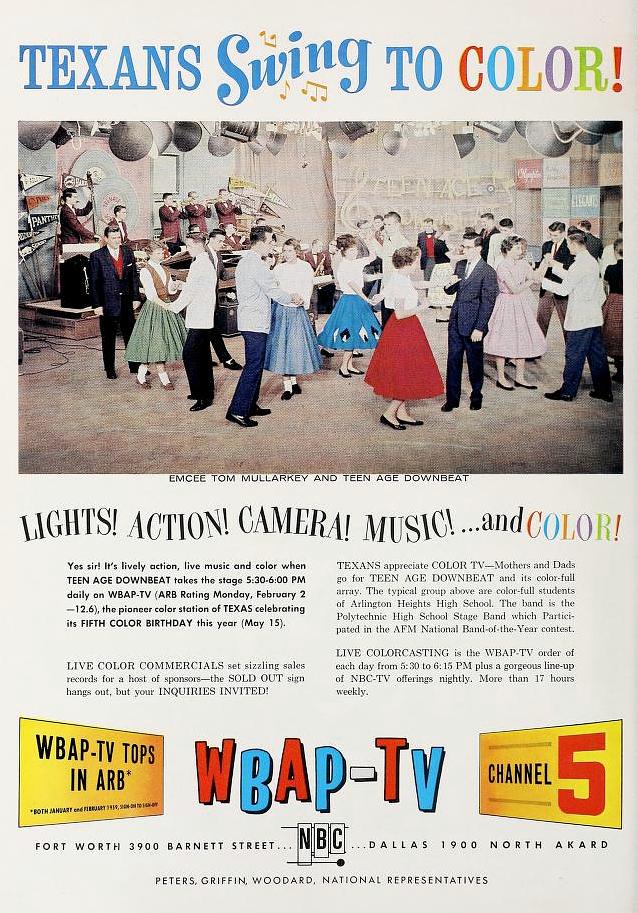
“Teen-Age Downbeat” — Fort Worth’s answer to “American Bandstand” — debuted on WBAP-TV in January, 1958 — in COLOR. It featured teens from the Dallas-Fort Worth area (…or maybe I should say from the Fort Worth-Dallas area…) who would play and dance to their favorite records. The host was WBAP broadcaster Tom Mullarkey (seen above at the left, wearing the red vest). The show was quite popular and lasted as best I can tell, from January, 1958 until July, 1961 (the last mention in The Fort Worth Star-Telegram was July 1, 1961). I’m guessing those kids danced to a lot of Fabian.

teenage-downbeat_fwst_010558FWST, Jan. 5, 1958

teen-age-downbeat_sponsor-mag_080860“Sponsor” trade magazine, Aug. 8, 1960

teen-age-downbeat_unt-lab-bandNorth Texas State College’s Lab Band with director Gene Hall

teenage-downbeat_fwst_022661
FWST, Feb. 26, 1961

teen-age-downbeat_broadcasting-mag_051859
“Broadcasting” trade magazine, May 18, 1959

teen-age-downbeat_xmas_1958_fortworthhistorical-IG“Toys For Tots” campaign, Christmas 1958

***

Sources & Notes

The color photo (which appeared in a full-page WBAP ad in the trade magazine Broadcasting) shows non-teen Tom Mullarkey watching over the dancers from Arlington Heights High School, as the Polytechnic High School Stage Band plays some happenin’ tunes. (I do see two Dallas high school pennants in the photo: Crozier Tech and Sunset.)

The photo showing director Gene Hall with the North Texas State College (now the University of North Texas) Laboratory Band was found at UNT’s Portal to Texas History site, here. The photo is not dated, but a blurb in The Fort Worth Star-Telegram mentioned that Hall and the band were to appear on “Teen-Age Downbeat” on Feb. 5, 1959.

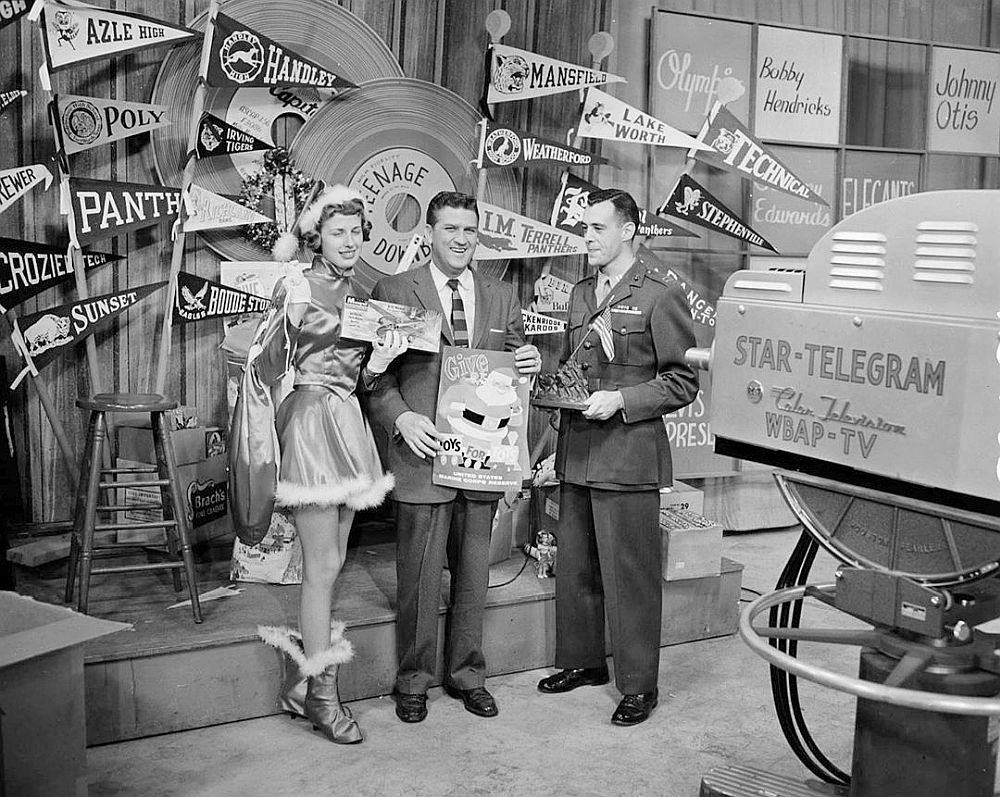
Photo of the “Toys For Tots” campaign, featuring a sexy Santa’s helper, Tom Mularkey, and a Marine Corps (Reserve?) officer was found on the Instagram feed of @fortworthhistorical.

*

Copyright © 2016 Paula Bosse. All Rights Reserved.

NOW HEAR THIS: THE BELL TELEPHONE “LOUD SPEAKER” IS AT THE FAIR! — 1921

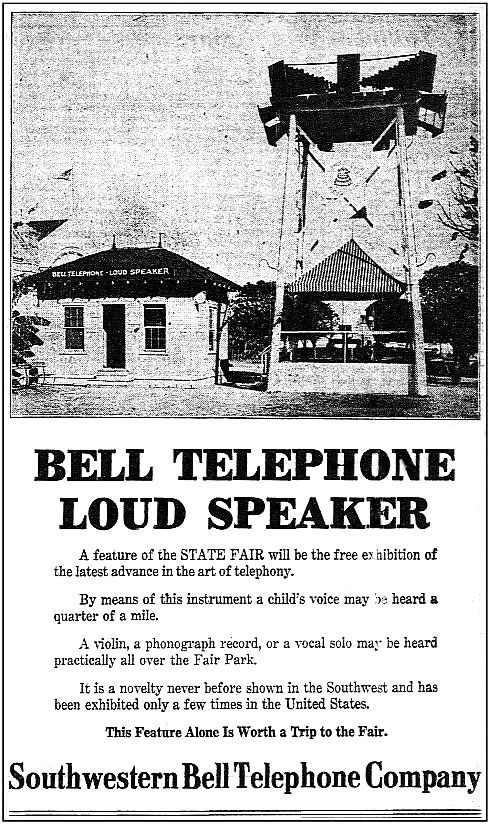
telephone_sw-bell_dmn_100821_photoYou might want to step back a few thousand feet… (click for larger image)

by Paula Bosse

When was the last time you wondered about the history of the public address system? If you’re like me, the answer to that is probably “never.”

The photo above shows the new technical innovation from the army of Bell Systems engineers that was going to be demonstrated at the 1921 State Fair of Texas: the “Loud Speaker.” The ad (always click images and clippings for larger images):

telephone_sw-bell_dmn_100821
Dallas Morning News, Oct. 8, 1921

*

BELL TELEPHONE LOUD SPEAKER
A feature of the STATE FAIR will be the free exhibition of the latest advance in the art of telephony.
By means of this instrument a child’s voice may be heard a quarter of a mile.
A violin, a phonograph record, or a vocal solo may be heard practically all over the Fair Park.
It is a novelty never before shown in the Southwest and has been exhibited only a few times in the United States.
This Feature Alone Is Worth a Trip to the Fair.
Southwestern Bell Telephone Company

*

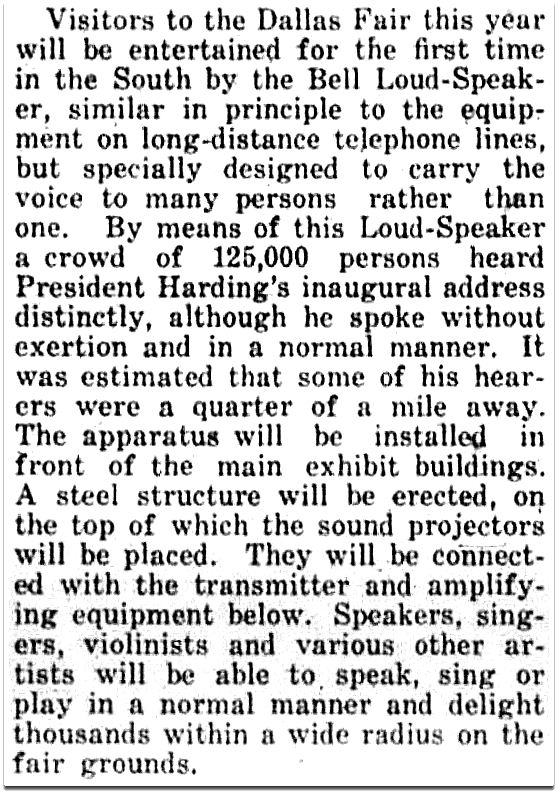
My technical expertise is pretty much non-existent, but, basically, this was the introduction of the public address system as developed by Bell Telephone, using their cutting-edge transmitters and amplifying equipment (the articles below contain more information).

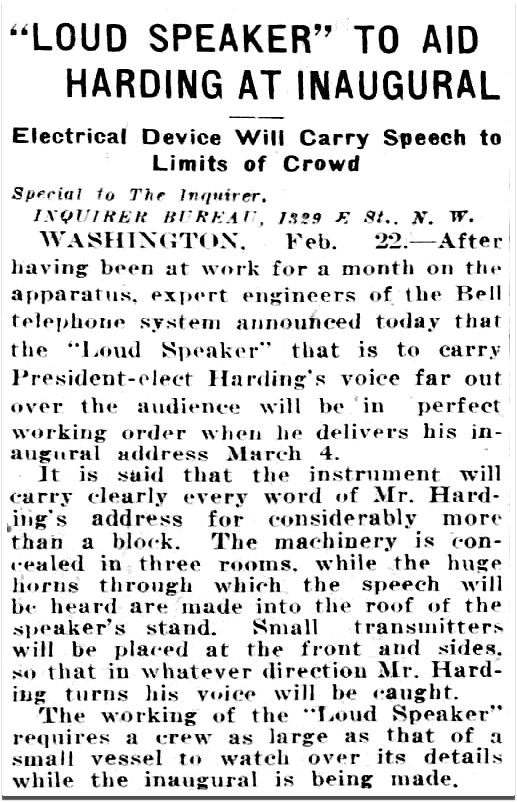
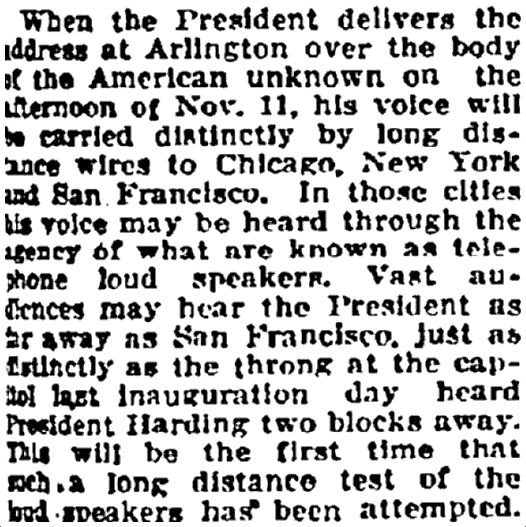
An earlier version of this particular set-up had debuted the previous year at the Republican National Convention in Chicago. (Imagine attending a large, noisy political convention with speakers whose voices weren’t amplified.) It had also been used for President Harding’s inauguration speech at the beginning of 1921, a first.

state-fair_loud-speaker_coleman-tx-democrat-voice_100721Coleman Democrat Voice, Oct. 7, 1921

This was before the days of mainstream radio — Dallas’ first commercial broadcasting station, WFAA, didn’t go on the air until June, 1922. The loudspeaker system used at the fair in 1921 allowed entertainment acts and World Series play-by-play to be played loudly overhead, for most of the fairgoers to hear (which sounds a little annoying to me, but it was newfangled novelty and people were quite taken with it).

state-fair_loud-speaker_dmn_101121
DMN, Oct. 11, 1921

state-fair_loud-speaker_dmn_101221
DMN, Oct. 12, 1921

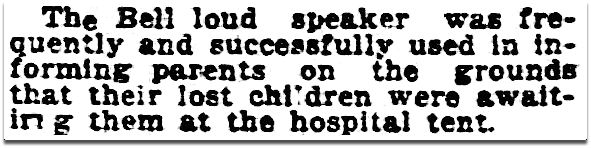
It also came in handy to make announcements and to page parents of lost children.

state-fair_loud-speaker_dmn_101521
DMN, Oct. 15, 1921

The amplification at public events was enthusiastically received and much appreciated, but the real end Bell was working toward was the ability to transmit and broadcast live events happening long distances away (and also to transmit recorded music without any substantial loss of sonic quality — radio, here we come!).

state-fair_loud-speaker_dmn_101621bDMN, Oct. 16, 1921

In fact, the equipment exhibited at the fair was the same equipment used less than a month later when President Harding presented his Armistice Day address to the nation. Not only was his voice amplified to the large crowd listening to him at Arlington National Cemetery, it was also transmitted and then broadcast through “loud speakers” to crowds in New York and San Francisco — another first.

state-fair_loud-speaker_harding_tulsa-daily-world_121121
Tulsa Daily World, Dec. 11, 1921

And Texas got to experience this new technology earlier than most others in the country. Little did those Bell engineers realize in 1921 that 30-some-odd years later the booming voice of a gigantic cowboy could be heard greeting visitors all over Fair Park.

**

A few clippings about the vaunted “loud speaker” before it made its way to the State Fair:

harding_loud-speaker_philadelphia-inquirer_022321
Philadelphia Inquirer, Feb. 23, 1921

harding_loud-speaker_winnipeg-tribune_030821
Winnipeg Tribune, March 8, 1921

harding_loud-speaker_dmn_100521_wire
DMN (from wire reports), Oct. 5, 1921

And an article on the exciting prospects of what lay ahead:

loud-speaker_tulsa-daily-world_121121
Tulsa Daily World, Dec. 11, 1921

***

Sources of clippings as noted.

Click for larger images!

*

Copyright © 2016 Paula Bosse. All Rights Reserved.

Adamson High School People and Places, Part 1 — 1960s

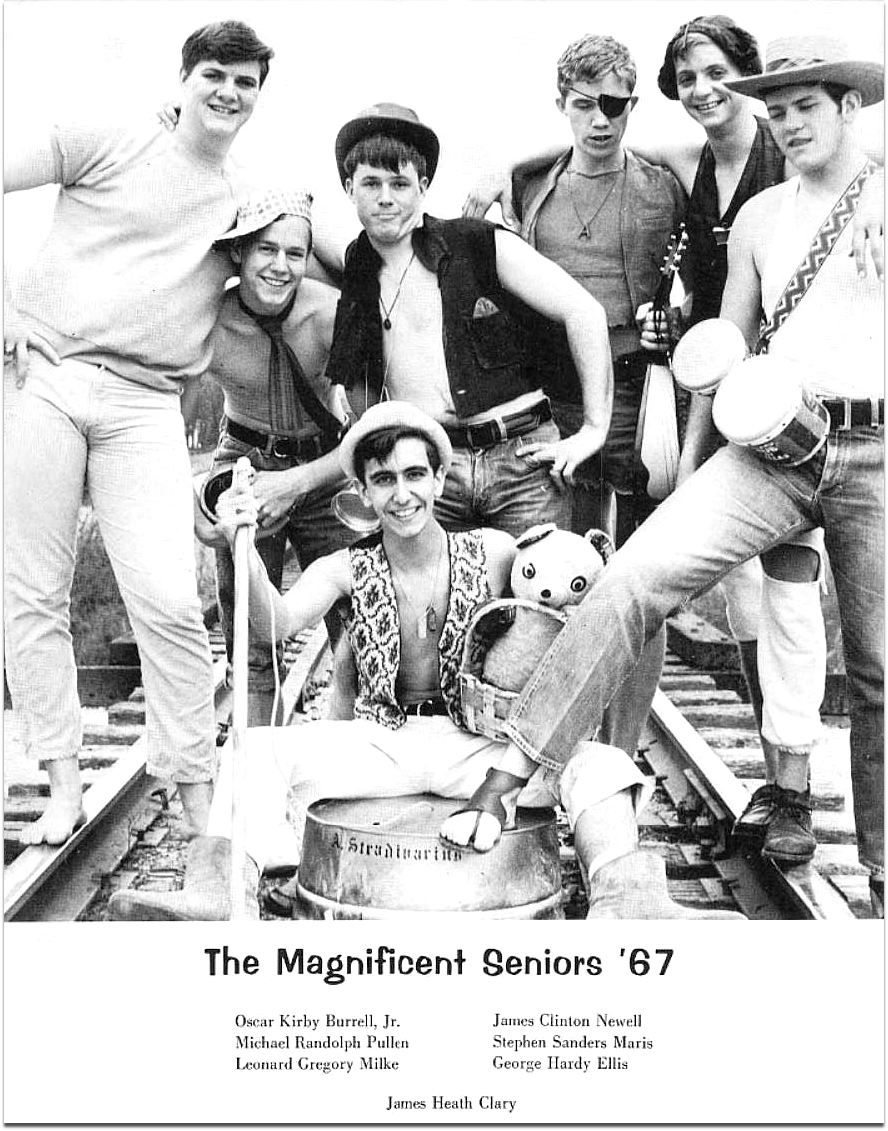
adamson-high-school_1967-yrbk_magnificent-seniors_adThe super-groovy Magnificent Seven of 1967

by Paula Bosse

Here are a whole bunch of 1960s ads from Adamson High School’s yearbooks. Go Leopards! (Click to see larger images.)

Above, a group of guys took out an ad for themselves in their 1967 senior yearbook:

  • Oscar Kirby Burrell, Jr.
  • James Clinton Newell
  • Michael Randolph Pullen
  • Stephen Sanders Maris
  • Leonard Gregory Milke
  • George Hardy Ellis
  • James Heath Clary

Thumbs up for creativity, guys!

Below, churches, lotsa churches, including:

  • Cliff Temple Baptist Church (from the 1961 yearbook)
  • First Church of the Nazarene (1961)
  • Galilean Baptist Church (1961)
  • Grace Temple Baptist Church (1961)
  • Polk Street Baptist Church (1964)
  • Oak Cliff Presbyterian Church (1966)
  • Western Heights Church of Christ (1966)
  • Grace Temple Baptist Church (1967)

And then you’ve got your garages and gas stations, including:

  • O. B. Goodman’s Gulf Service Center (1967)
  • Herbie Dodd Wynnewood Texaco (1965)
  • Navarro Custom Automotive (for all your hot rod needs) (1966)

And Safety Brake Service over the years: 1961, 1964, 1965.

One must eat:

  • The Old South (1961)
  • Speedy Chick No. 4 (1965)
  • Inky’s Charcoal Burger (1966)
  • Woody’s Pancake House (1965)
  • Big Daddy’s Grill (1966)
  • Goff’s Hamburgers (don’t forget Mrs. Goff’s Ice Cream) (1966, 1967)

And then everything else:

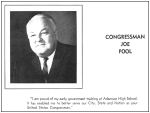
  • U.S. Congressman Joe Pool (1967)
  • Colbert’s (women’s clothing) (1967)
  • Raven’s Pharmacy (1966)
  • John Hiegel’s One Hour Martinizing (1966)
  • King’s Book Store (1966)
  • Ketchum & Killum Sporting Goods (you read that right) (1965)
  • Crosswinds Apartments (1965)
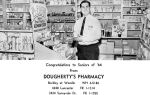
  • Dougherty’s Pharmacy (1964)
  • Doris Wood Bridal & Party Service (1966)
  • Bronco Bowl (…RIP…) (1966)

adamson_1966-yrbk_doris-wood-bridal

adamson_1966-yrbk_bronco-bowl

***

Sources & Notes

Ads from the 1961, 1964, 1965, 1966, and 1967 W. H. Adamson High School yearbooks.

See the companion post (which shows the school and students — mostly from 1966), here.

*

Copyright © 2016 Paula Bosse. All Rights Reserved.
The State Fair of Texas: “A Son-of-a-Gun in ’51” — 1951

state-fair-poster_1951_pinterest

by Paula Bosse

In honor of opening day of the 2016 State Fair of Texas, a poster from the 1951 fair. Proto-Big Tex imagery was being used well before the giant cowboy’s debut the following year (see, that hand thing is going on even back then…).

Welcome back, SFOT!

***

Poster found on Pinterest.

*

Copyright © 2016 Paula Bosse. All Rights Reserved.
Zap Those Extra Pounds Away in Mrs. Rodgers’ Electric Chair — 1921

ergotherapy_jewish-monitor_090921_detThrowing the switch in 3-2-1… (click for larger image)

by Paula Bosse

While looking for something completely unrelated (which is always the best way to find unexpected things), I came across this full-page ad which appeared in the Sept. 9, 1921 edition of The Jewish Monitor (click to see a larger image):

ergotherapy_jewish-monitor_090921

Why Be Fat When
E R G O T H E R A P Y
WILL REDUCE YOU?

Within the last few years a method of automatic exercise, known as the Bergonie treatment, has found favor among physicians abroad in the treatment of obesity and other chronic disorders.

One advantage is that with the Sinusoidal current, which is employed, very powerful muscular contractions may be induced without pain or sensation other than that due to the muscular contraction itself.

The Treatment chair is the last word in comfort. It is fitted to meet the physiologic needs of the body as well as being comfortable. The arm and leg electrodes are wide and comfortably curved to fit the arms and legs of the patient easily. 

ERGOTHERAPY

The Kellogg-Bergonie System of Battle Creek, Mich., will reduce you just where you wish to be reduced. No drugs, exercise or inconvenience. We will reduce you from one (1) to three (3) pounds per treatment and improve your physical condition. Trained nurses in attendance (under a registered physician’s supervision).

Treatments by Appointment Only

Hours for Men, 8 A.M. to 1 P.M.
Hours for Women, 1 P.M. to 6 P.M.
Phone X 5759
Ruth Rodgers, Mgr.
1614 1/2 Main Street, Dallas, Texas.

*

“The arm and leg electrodes are wide and comfortably curved” — there’s a line one doesn’t often encounter in an ad!

So what was this treatment of obesity that required “no drugs, exercise or inconvenience”? Well, basically, it was a low-voltage electric chair in which the naked, smock-draped “patient” reclined on wet towels and was covered with sandbags (which weighed up to 100 pounds). Electrodes were attached to the arms, legs, and abdomen. When the switch was flipped, electrically-provoked exercise began, and electric current caused muscular contractions (up to 100 a minute) without fatigue to the “exerciser.” All sorts of physiologic things were happening during these sessions, including a whole bunch of sweating. Patients would lose from 1 to 3 pounds during their time in the chair, hose themselves down and walk away refreshed.
Jean Albard Bergonié (1857-1925) was a French doctor/researcher/inventor who specialized in radiology in the treatment of cancer, and this odd electric chair was something of a departure from his oncology studies. It was used to treat a variety of ailments and conditions such as obesity, heart conditions, diabetes, “suppressed uric acid elimination,” and, later shell-shock. Professor Bergonié died in 1925 as the result of prolonged exposure to radium in his research to find a cure for cancer (in the years before his death, he had lost an arm and fingers to continual X-ray exposure). The Institut Bergonié continues in Bordeaux, France as a cancer research center.

So back to the chair. By the time of the 1921 ad above, Bergonié’s “ergotherapy” had become a weight-loss feature in beauty spas and salons. The ads I found mentioning the electric chair as something corpulent men and women of means might have seen in Dallas newspapers appeared between July and October of 1921, touting the miracle chair at Mrs. Ruth Rodgers’ beauty salon, The Old London Beauty Shoppe at 1614 ½ Main Street, a couple of doors from Neiman-Marcus.

ergotherapy_071721
July, 1921

I don’t know if it didn’t catch on or whether it just wasn’t mentioned in ads, but the chair made its final appearance in an Old London Beauty Shoppe ad in early October of the same year.

The splashiest news about Bergonié’s invention was a few months later, in early 1922, when it was revealed that the UK’s Queen Mary had availed herself of the chair in order to slim down in time for her daughter’s wedding, with Prof. Bergonié himself apparently operating the current flow. The best part of the lengthy and breathless article about the plump royal allowing herself to lie in this electric chair as she was rather unceremoniously weighted down with royal sandbags was this sentence:

[Mrs. David Lloyd George, the wife of the British prime minister] lost no time in telling Queen Mary all she knew about Professor Bergonie, the famous French ergotherapist, and his marvelous electric chair, which is said to jar fat from the human frame with the ease and almost the rapidity of a man peeling a tangerine.

Hey, I want that!

One would assume that sort of free publicity would be a boon to spas and salons offering State-side ergotherapy — I have a feeling Mrs. Rodgers had moved on by then and was probably kicking herself for concentrating on the more mundane treatment of wrinkles and sagging skin and the administering of marcel waves (her specialty).

Below, some views of The Chair over the years (all pictures larger when clicked).

ergotherapy_1913-medical-bk_ebay

Above, a drawing from a 1913 medical book, found here.

*

ergotherapy_medical-record_050115

From the journal Medical Record, May 1, 1915.

*

bergonie-chair_shell-shock_electrical-experimenter_feb-1919

A World War I soldier being treated for shell-shock, from The Electrical Experimenter (Feb. 1919), here (continued here).

*

ergotherapy_012321
Jan., 1921

Ruth Rodgers was the proprietress of the Old London Beauty Shoppe (later the Old London School of Beauty Culture), which seems to have operated in Dallas from the ‘teens to at least the late-1930s. The location during the period of the ergotherapeutic chair was in the basement of 1614 Main Street.

*

ergotherapy_dmn_081421
Aug., 1921

Mrs. Rodgers did it all. That might be her in the ad.

*

ergotherapy_081421
Aug., 1921

*

ergotherapy_082121
Aug., 1921

It’s a bit unusual seeing ads like this directed toward men.

*

ergotherapy_san-francisco-chronicle_092521
San Francisco Chronicle, Sept. 25, 1925

*

queen-mary_1922

Above, a very Aubrey Beardsley-esque depiction of the “distressingly stout” Queen Mary, ready to undergo her course of treatments. Read the full, widely-circulated article from February, 1922, “Queen Mary’s Jarring Anti-Fat Ordeal; Yearning for a Girlish Figure to Grace Her Daughter’s Wedding, the Queen-Mother Got One by Sitting in an Electric Chair and Losing 3½ Pounds a Week,” here. (They don’t write headlines like that anymore….) The photo below, showing the control panel, was also part of the article.

queen-mary_1922_battery

*

ergotherapy_ogden-standard-examiner_041826

The caption for this photo (which appeared five years after the cutting-edge Ruth Rodgers was offering it to Dallas patrons): “The new French electric chair on which one reclines in comfort while form-fitting electroids [sic] direct the fat-melting current, as demonstrated by Alice Harris, a stage beauty who must keep thin.” (Ogden Standard-Examiner, April 18, 1926)

*

And, finally, to bring this back to Dallas, the location of Mrs. Rodgers’ Old London Beauty Shoppe in 1921 — 1614½ Main Street (basement) — is circled (this building was later the Everts Jewelry store before it moved across the street to the north side of Main). To the left is Neiman-Marcus, at the corner of Main and Ervay. (Full view of this postcard, from the collection of the DeGolyer Library, SMU, is here.)

1614-main_n-m_degolyer_smu_det

***

Sources & Notes

Top photo is a detail from the ad below, which appeared in the Sept. 9, 1921 edition of The Jewish Monitor; it can be accessed via the Portal to Texas History, here.

Read a doctor’s account of just how Bergonie’s chair worked, in the article “Modern Treatment of Obesity” by Edward C. Titus (Medical Record, Jan. 24, 1920), here.

I’m not sure about the connection of this chair to J. H. Kellogg (the treatment in the ad was referred to as “The Kellogg-Bergonie System of Battle Creek, Mich.”). It appears that he and Bergonie might have developed similar chairs independently of one another and decided to form some sort of partnership — either by mutual agreement or court edict. Here is a photo of Kellogg’s “patented electrotherapy exercise bed” used in his Battle Creek sanitarium:

kellogg-chair
via Oobject (more Kellogg contraptions here)

And speaking of Mr. Kellogg, might I direct your attention to a previous Flashback Dallas post — “Electricity in Every Form — 1909” — here.

Click pictures for larger images

*

Copyright © 2016 Paula Bosse. All Rights Reserved.