Flashback : Dallas

A Miscellany: History, Ads, Pop Culture

Category: Advertisements

Back When Preston Royal Was “Exotic” and Had Its Very Own Elephant

safari-preston-royal

safari-preston-royal-back

by Paula Bosse

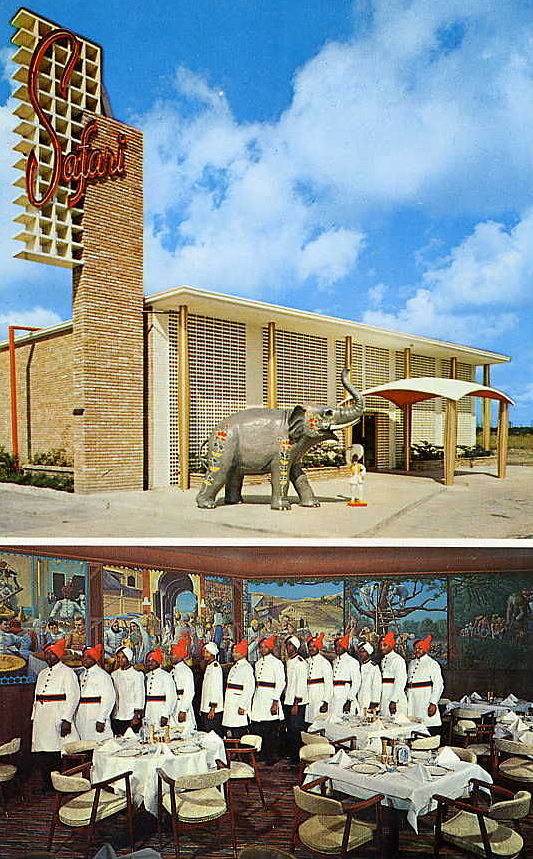
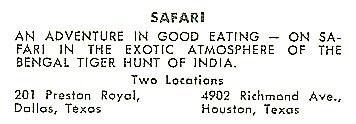
Dallas had a restaurant like this?! Yes, it did. (EDIT: It has been brought to my attention in the comments that the image above shows the *Houston* location. But I have been assured that the Dallas location had its very own elephant standing guard outside — so I will not have to ignominiously change the title of this post!)

The Safari Steak House was in the Preston Royal Shopping Center at the northeast corner of Preston & Royal (in the space now occupied by the venerable Royal China restaurant). The decor shown in the postcard above is something else — someone put their whole heart and soul into that, from the elephant and, um, elephant wrangler (“mahout“?) out front, to the ornate wood carving and the somewhat… busy murals inside. And the uniformed staff is pretty impressive, too.

Here are photos of the DALLAS Safari, taken in 1961 by Squire Haskins (photos from the UTA Libraries, Special Collections — click the links below the photos for full descriptions and large images). (Thanks, Tom Bowen, for sharing these links in the comments.)

safari_squire-haskins_1961_UTA_1via UTA Libraries, Special Collections

safari_squire-haskins_1961_UTA_2via UTA Libraries, Special Collections

Guy T. Jones opened the Safari in mid 1956 (I think the Houston location was opened later — it was open by at least 1959). I could find almost no early advertising for the place — perhaps Jones blew his advertising budget on elephants and murals. At this point, the shopping center was basically still under construction — the eastern-edge building (home of the Safari) opened about a year after the larger northern-edge building. There used to be a gap between the two buildings, which can be seen in the photo immediately above and can (sort of) be seen in the 1955 ad below, which shows a model of what the finished shopping center would look like.

preston-royal-shopping-center_032755-adAd detail, March 1955

In 1974, Royal China (which is a fantastic place, by the way) took over the space.

I really wish I’d seen that elephant, which — according to the comment below — “was highly visible and well lit at night.” I certainly hope so!

*

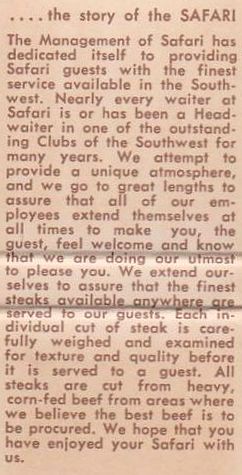
From the cover of the menu:

safari-matchbook-a

safari-matchbook

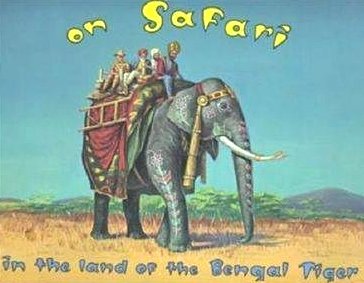
safari-matchbook_story

safari-preston-royal_menu-1969

*

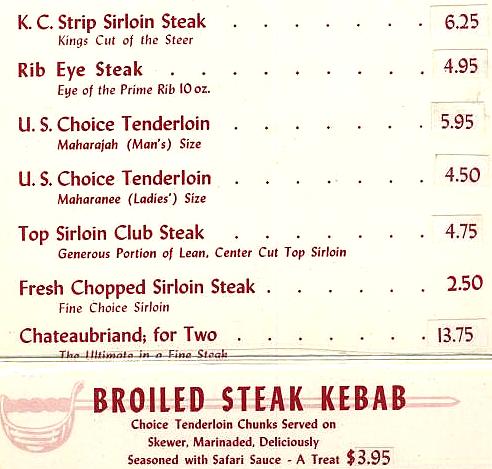
Below, the steak menu. One could choose between the “Maharajah (Man’s) Size” and the “Maharanee (Ladies’) Size.” Or get the kebabs of skewered beef “deliciously seasoned with Safari Sauce — A Treat.”

safari-menu

*

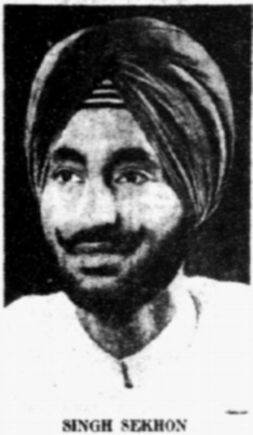
One of the stars of the restaurant was Iqbal “Ike” Singh Sekhon, who started working as the restaurant’s host while studying for his Master’s degree at SMU. He left a few years later to run the fabulous La Tunisia.

safari_dmn_062756-photo

safari-menu-logo

***

Sources & Notes

Edit (Sept. 2022): Wow. This post had a bunch of problems! All I can say is that this was one of my very earliest posts. I was so enamored of that elephant that I made a couple of very glaring errors.

First off, the original title of this post was “Back When Preston Royal Village Was ‘Exotic’ and Had Its Very Own Elephant.” The Safari Steak House was in the Preston Royal Shopping Center, located on the northeast corner of Preston and Royal; the Preston Royal Village shopping center, is on the northwest corner. I’ve (ignominiously) changed the title, but… yikes.

And, as mentioned in the first paragraph, the postcard at the top shows the Houston location, not the Dallas location. Incidentally, the Houston building is still there — it can be seen in a 2011 Google Street View capture here.

The two photos by Squire Haskins (linked below the images) are from the Squire Haskins Photography Inc. Collection, University of Texas at Arlington Libraries, Special Collections (thanks, Tom!). They are dated 1961, one year before a major fire at the restaurant. They reopened the following month, with what sounds like quite an update in decor. I’m not sure when the “gap” between the two shopping center buildings was filled in, but that would have been a good time to expand.

*

Copyright © 2014 Paula Bosse. All Rights Reserved.

Early Dallas Radio & “Verified Reception Stamps”

ekko_wrr

by Paula Bosse

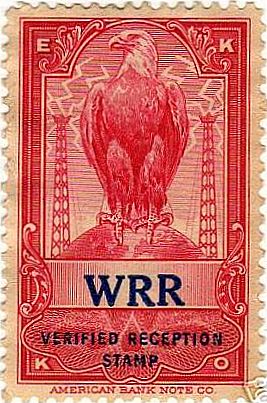
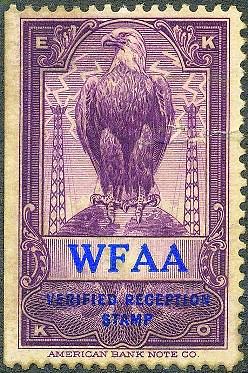
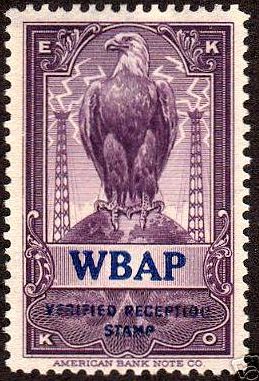
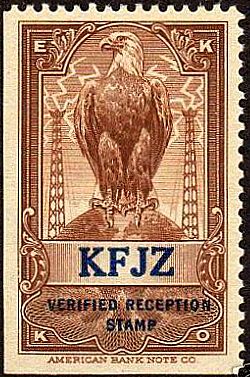
Chances are you’ve never heard of “Verified Reception Stamps” which were issued in the 1920s by a company in Chicago called EKKO. I certainly hadn’t. The stamps (referred to by collectors as “Cinderellas”) were enthusiastically and obsessively collected in the mid-’20s — people were really into it. Basically, it seems to have been a clever form of advertising which banked on both the public’s fascination with early radio and the then-very-popular hobby of stamp collecting.

How did it work? Briefly, the EKKO company printed these stamps for subscriber radio stations around the country (and later for stations in Canada, Mexico, and Cuba). Once the radio stations received them, they issued them to listeners who wrote in to affirm that they had, in fact, picked up their station on the wireless. The listener had to prove it by stating the time he or she had tuned in and then give a short synopsis of the program they had heard. Oh, and they had to enclose a dime. (The dime was probably the most important part of this whole fad — at least for the broadcasters.) In return, the station would check their logs and “verify” that the dime-sender probably DID hear the station, and one of these little stamps would be sent out post haste. The EKKO company also conveniently printed up albums for collectors to paste the stamps into. I’m not sure how one was expected to fill up the book (with pages devoted to each state), since there’s no way you’d be able to pick up the signals of all those stations, but I guess that’s what gets collectors’ blood racing. It’s the thrill of the chase. The verified reception stamp-collecting fad died out as the Depression set in, and it became hard to justify spending one’s precious hard-earned dimes on a frivolous hobby.

*

Verified reception stamps were issued by the five main stations in the Dallas-Fort Worth area in the 1920s. WRR, at the top, was the first radio station in Dallas and one of the earliest stations in the country. It began broadcasting as a sort of early police radio in 1920 and received its official broadcasting license in 1922. It remains an oddity in the radio world as it is a commercial radio station that is owned and operated by the City of Dallas.

*

ekko_wfaa

WFAA signed on in 1922 and was part of the nascent Dallas Morning News media empire.

*

ekko_wbap

WBAP, a Fort Worth station, also signed on in 1922. Someone thought it might be cute if “WBAP” stood for “We’ll Be At the Party.” More serious-minded station people went with “We Bring a Program” which, really, isn’t much better.

*

ekko-kfjz

KFJZ (another Fort Worth station) came along in 1923. Its founder sold the station five years later for a good chunk of change and then went to work for WBAP.

*

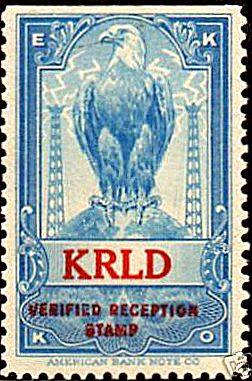
ekko-krld

KRLD began broadcasting in 1926 and was acquired by The Dallas Times Herald a year later.

*

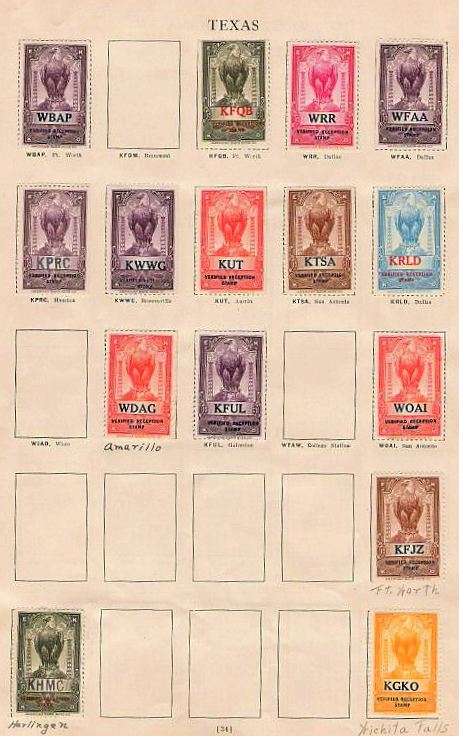
ekko-texas-stations

A sample page of the “Texas” portion of the official EKKO stamp album.

*

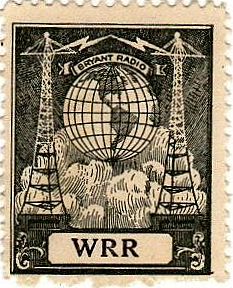
ekko_wrr-globe

The EKKO company had some competition in the PM Bryant Co. Bryant stamps required no “verification” — you just sent them your dime and got a stamp. Their stamps had no eagle, but they DID have transmitter towers and the essential lightning bolts.

*

And now you (and I) know!

***

Sources & Notes

An incredibly comprehensive history of Dallas radio is the DFW Radio Archives site — its main page is here. The pages dealing with the stations broadcasting in DFW in the 1920s are here and here. I highly recommend reading the very interesting account about how WRR evolved from an experimental police communication transmission tool to a full-fledged entertainment station.

*

Copyright © 2014 Paula Bosse. All Rights Reserved.

The Stretch of “Theater Row” They Never Talk About

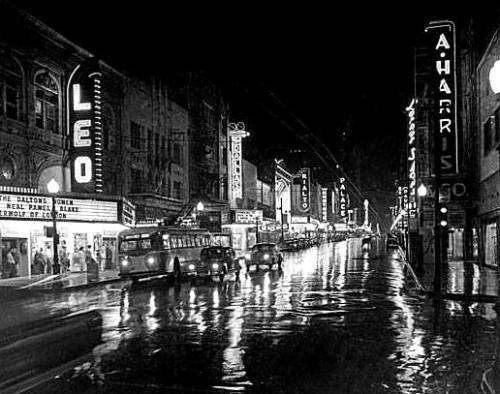
leo-theater
The “other end” of Film Row

by Paula Bosse

It’s April, 1952, and you’ve got a hot date Friday. Movies are good for date night. What to see? Why not catch a bold, frank, and true “adult” double-bill at the Leo? In the early-’50s, the Leo Theater, at 1501 Elm Street, was at the other end of “Theater Row” — on the metaphorical “other side of the tracks” from the classy Majestic and Palace — and it was one of those places that your mother probably wouldn’t approve of.

leo-theater_dmn-0405521952

The ad above shows a typical Leo double-feature: “Pin-Down Girl” (aka “Racket Girls”) from 1951, a searing look at lady wrestlers and prostitution (the trailer below has a moment that’s actually pretty shocking, and you’ll laugh at yourself immediately afterward for having been shocked), and “Honky Tonk Girl” (aka “Hitchhike to Hell”) from 1941 about teenagers and, well, prostitution. There were at least two exploitation movies titled “Honky Tonk Girl,” so I’m not sure which is the correct poster for the particular cinematic treasure on the Leo bill, but I really love the artwork of this one, so in it goes.

honky-tonk-girl_poster

Here’s the trailer for “Pin-Down Girl” (which is handy, because it gives you about all you really need to satisfy a piqued curiosity without wasting a lot of your time):

**∙*

***

Sources & Notes

I don’t have a source for the top photo, but I believe I have seen it attributed to the Dallas Public Library. If this is incorrect, please let me know.

A little background on the Leo Theater (1948-1953), originally the Queen (1913-1948), can be found in the comments section here.

But if you want to know just what was going on in these not-quite-but-fast-approaching seedy Dallas theaters, you owe it to yourself to read a great passage from Troy Sherrod’s Historic Dallas Theatres (Arcadia Press, 2014), here (scroll down to the caption).

*

Copyright © 2014 Paula Bosse. All Rights Reserved.

Need a Handgun? Head Over to Titche’s! — 1963

titches_gunstitches_guns_dmn_110563c

by Paula Bosse

Titche’s was a nice department store. In 1963 it was a good place to buy a well-tailored suit, shop for fine crystal, and, apparently, get a gun.

***

Sources & Notes

Ad from Nov. 5, 1963.

*

Copyright © 2014 Paula Bosse. All Rights Reserved.


“Start Your Day the Happy Way … with The Dallas Morning News” — 1961

ad-DMN_dmn_101461
(click for larger image)

by Paula Bosse

A word from a secretary:

I’m a secretary, and I prefer The Dallas Morning News.

My boss refers to me as his “Girl Friday” because I am more than an ordinary secretary. I make more money than an ordinary secretary makes, too.

Questions come up from time to time and I am able to supply the answers … simply because I start my day the happy way … with The Dallas Morning News.

I read it all … the news, editorials, even glance through the business and sports sections. I pay particular attention to current affairs, both foreign and domestic.

For myself, I browse the women’s pages … the fashion news, club activities, and all the special features. The advertising is very helpful. I do most of my shopping during the lunch hour. I always know where to go for what I want without having to shop around.

If you are a secretary and would like for your job to be more interesting … and valuable, too … here’s a tip. Start your day the happy way with The Dallas Morning News.

*

Copyright © 2014 Paula Bosse. All Rights Reserved.


Oriental Oil Company: Fill ‘er Up Right There at the Curb

gas-pump_commerce_c1912An Oriental Oil Co. competitor, at 1805 Commerce

by Paula Bosse

I cropped this detail from a much larger view of Commerce Street because this incidental, everyday moment caught my attention. Was that man filling his automobile with gasoline? Was that square, boxy, hip-high thing full of gas, right there at the curb of one of the city’s busiest streets? The sign above the pump reads “PENNSYLVANIA AUTO OIL GASOLINE SUPPLY STATION.” I looked into it, and now I know more about early gas pumps and stations than I ever thought I would.

In the very early days of automobiles, one would have to seek out a supplier of gasoline (such as a hardware store or even a drugstore) where you would buy a gallon or two and carry it home with you in a bucket or something and then carefully pour it into your car’s gas tank using a trusty funnel. After a few years of this inconvenient way to gas up, these curbside pumps began to pop up in larger cities. The pump seen above was at 1805 Commerce St. and belonged to the Pennsylvania Oil Company. It opened in early 1912. That got me to wondering about other such fueling stations, and it seems the first in Dallas may have belonged to the Oriental Oil Company, just down the street from the one seen above, at 1611 Commerce. Here is a fuzzy image of it, from the same, larger photo the detail above was taken from. (Click for larger image.)
oriental-oil_1611-commerce_skyline-det

Could this photo have been taken there? It was listed on eBay merely as “Oriental Oil Company, Dallas, 1910-1920.”

oriental-oil-co_ebay

Oriental Oil’s first “auto station” opened in February, 1911, where “facilities have been arranged so as to fill the cars along the sidewalk.”

oriental-oil_dmn_022611(Dallas Morning News, Feb. 26, 1911)

Drive-up “stations” had begun to appear a few years before, on the West Coast.
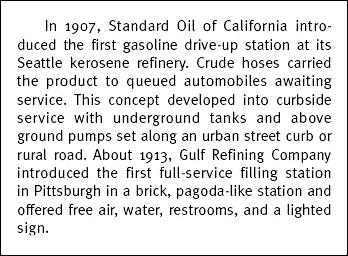
gas-stations_dot-pdf_p33(Texas Dept. of Transportation, 2003)

In a 1924 Dallas Morning News article (see below), the pump seen in the above photos was described thusly:

Dallas’ first gas filling station had a one-gallon blind pump on the curb which was then thought to be the last word in equipment. Now if a filling station is not equipped with a visible five-gallon pump it is thought to be behind the times and the gas now sold must be water white, when in the old days it was most any color.

This, I think, is what the Oriental and Pennsylvania rolling tanks looked like — the make and model may be different, but I think the general design is the same:

gas-pump-1913

When it was empty, it would be rolled away to be re-filled. I’m not sure about the payment system. Coupon books are mentioned in one of the ads, but I don’t know how (or with whom) one would redeem them as these pumps appear to be self-serve. Perhaps there was a slot for coins/coupons, and everyone worked on the honor system.

It seems that its placement would cause a lot of congestion on a major street like Commerce (which at the time was still shared with skittish horses), but Commerce was also a hotbed of automobile dealerships (Studebaker, Stutz, and Pierce-Arrow dealerships, for example, were within a couple of blocks of the Oriental and Pennsylvania filling stations).

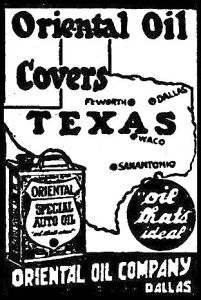
The Oriental Oil Company — a forgotten, early oil company — had an interesting history. The Dallas-based company began business in 1903, starting their company “in a barn in the rear of the Loudermilk undertaking establishment.”

oriental-oil_mercury_123103(Southern-Mercury, Dec. 31, 1903)

They were a fast-growing oil company (“an independent concern which in spite of the strong opposition of the oil trust is now enjoying permanent and growing prosperity”Greater Dallas Illustrated, 1908), and they were one of the first to open a refinery in Texas (they eventually had two refineries in West Dallas). The company’s primary concern in its early years was the manufacture of various oils and greases for industrial use.
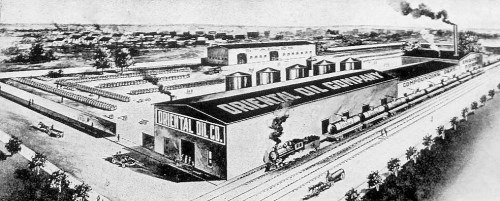
oriental-oil-factory-c1908Oriental Oil Company Factory, corner of Corinth St. and Santa Fe tracks, circa 1908

In 1911, understanding just how profitable the new world of retail gasoline sales could be, they installed their first pump at the curb of 1611 Commerce St., near Ervay (“right behind the Owl Drug Store”). A 1924 Dallas Morning News account of the company (see below) states that this was the first gas pump … not only in Dallas … but in the entire state of Texas. I’m not sure if that’s true, but the Smith Brothers who ran Oriental Oil were certainly go-getters — the Smiths were grandsons of Col. B. F. Terry, organizer of the famed Terry’s Texas Rangers, and one of the brothers, Frank, was an early mayor of Highland Park and a three-term president of the Dallas Chamber of Commerce.

ad-1911_oriental-oil_dmn_100811(DMN, Oct. 8, 1911)

ad-1912_oriental-oil_dmn_012812(DMN, Jan. 28, 1912)

Shortly after opening their first pump on Commerce, demand was such that a second pump was soon opened at 211 Lane St. (a mere half a block away!). The DMN reported on Oct. 19, 1911 that a competitor — Consumers’ Oil and Auto Company — was going to be right across the street: “Permission was given to the Consumers’ Oil and Auto Company to place a gasoline tank under the sidewalk at 214 Lane street.” And in March 1912 the Pennsylvania Oil Company was installing ITS underground tank for the pump seen in the photo at the top — again, less than a block away. And in 1916 Oriental opened its splashy new “‘Hurry Back’ Auto Station” right across the street from where that Pennsylvania tank had been. (That Commerce-Ervay area was certainly an early gas station hotbed!)

ad-1916_oriental-oil_dmn_082916(DMN, Aug. 29, 1916)

Newspaper reports also cite claims made by the company that the station mentioned in the ad above — at Commerce and Prather — was the first drive-in gas station in the United States. I’m sure this was good truth-stretching PR for Oriental more than anything, because this claim was not true (Seattle and Pittsburgh seem to be battling each other for that honor). It might not have been the first, but when this “auto station” opened in 1916 (assuming it was “new” as this ad states), it was still pretty early in the history of the drive-in filling station. Also, by 1916, “Hurry Back” had become the company’s slogan as well as the name of its gasoline.

ad-1918_oriental-oil_dmn_102218(DMN, Oct. 22, 1918)

ad-1920_oriental-oil_jewish-monitor_1920(Jewish Monitor, 1920; detail)

ad-oriental-oil_dmn_041121(DMN, Apr. 11, 1921)

oriental-oil_ad_dmn_030522(DMN, Mar. 5, 1922)

I love these ads!

By 1927, the company boasted at least 18 filling stations, two refineries, and branches in Fort Worth and San Antonio. In 1927 they had moved into new offices in the “Oriental Building” at the nexus of Live Oak, St. Paul, and Pacific. A newspaper report described the building as being “finished in Oriental colors with Oriental decorations and is marked at night by very attractive lighting” (DMN, May 1, 1927).
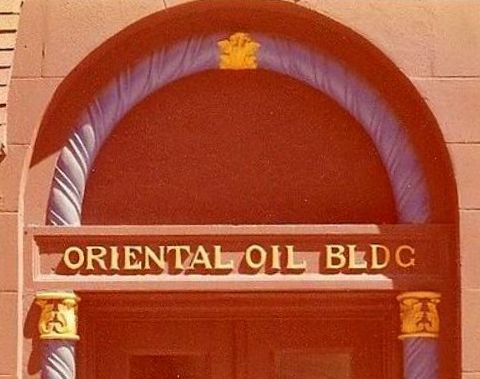
oriental-oil_bldg_1977_flickr

The Oriental Oil Company declared bankruptcy in 1934, selling off their property, refineries, and their name. No more Oroco gas. A lot of companies went bust during the Great Depression, but I’m not sure what precipitated Oriental Oil’s bankruptcy. Actually, I’m surprised by how little information about the Oriental Oil Company I’ve been able to find. Afterall, it and its “Hurry Back” gasoline played a major role in getting the residents of Dallas off their horses and behind the wheel, a major cultural and economic shift that changed the city forever. And it all started at that weird little curbside gas pump on Commerce Street.

***

Sources & Notes

The first two images are details of a photograph by Jno. J. Johnson (“New Skyline from YMCA”), 1912/1913, from the DeGolyer Library, Central University Libraries, Southern Methodist University, viewable here.

Snippet of text from A Field Guide to Gas Stations of Texas by Dwayne Jones (Texas Department of Transportation, 2003).

Illustration of the two 1913 Tokheim portable gas pumps from An Illustrated Guide to Gas Pumps, Identification and Price Guide, 2nd Edition by John H. Sim (Iola, WI: Krause Publications, 2008).

Drawing of the Oriental Oil Company Factory from Greater Dallas Illustrated (Dallas: American Illustrating Co., 1908 — reprinted by Friends of the Dallas Public Library in 1992).

All ads and articles, unless otherwise noted, from The Dallas Morning News.

Color photo of the pink, purple, and gold Oriental Oil Bldg. is a detail from a photo taken around 1977, on Flickr, here.

For an interesting (and mostly accurate) mini-history of the Oriental Oil Company, then in its 20th year of operation, see the Dallas Morning News article “First Dallas Filling Station on Commerce Had One-Gallon Pump” (June 22, 1924).

Some nifty info on early gas stations (yes, really) here.

More info with some really great illustrations and photos here.

Another surprisingly fun and informative article is here.

*

Copyright © 2014 Paula Bosse. All Rights Reserved.

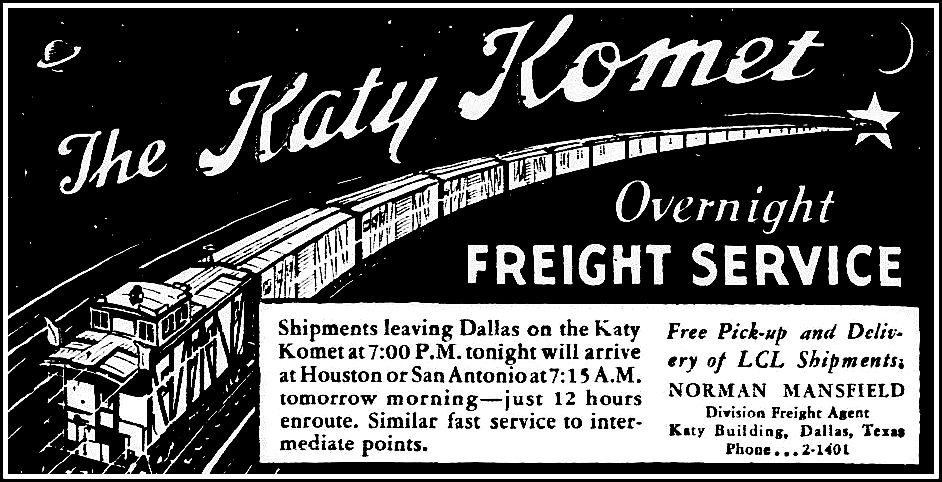
The Katy Komet — 1933

ad-katy-komet_dmn_031733

by Paula Bosse

What a great ad! Next stop, Venus!

***

This Katy Komet overnight freight service ad appeared in the The Dallas Morning News on March 17, 1933.

Click for bigger, BETTER image!

*

Copyright © 2014 Paula Bosse. All Rights Reserved.
The Sexton Foods Building and the Former Life of the School Book Depository

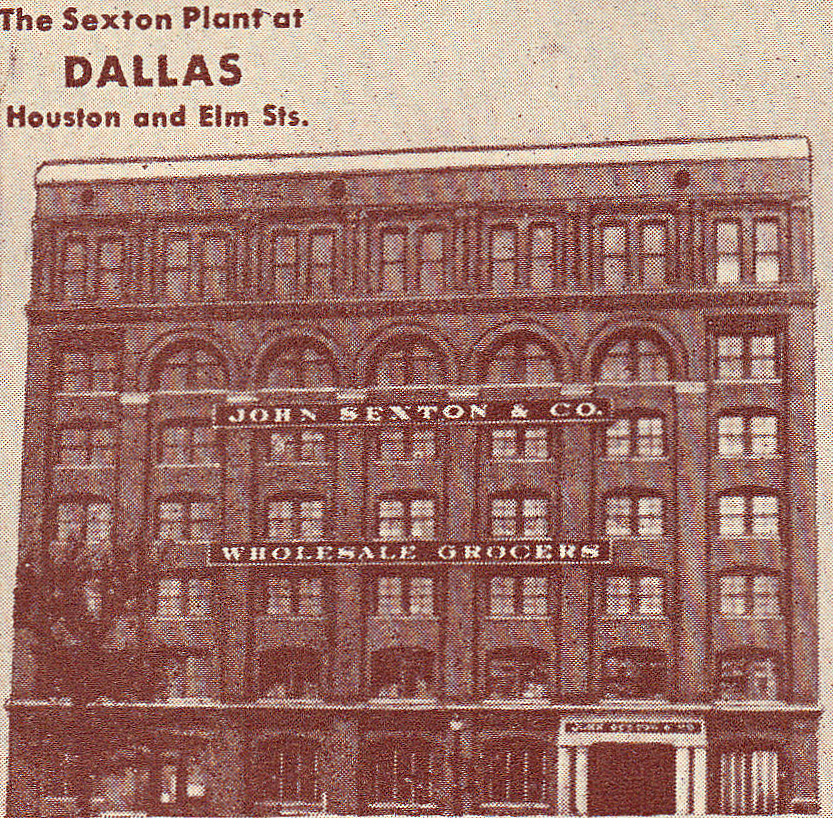
sexton_croppedLook familiar? (click for larger images)

by Paula Bosse

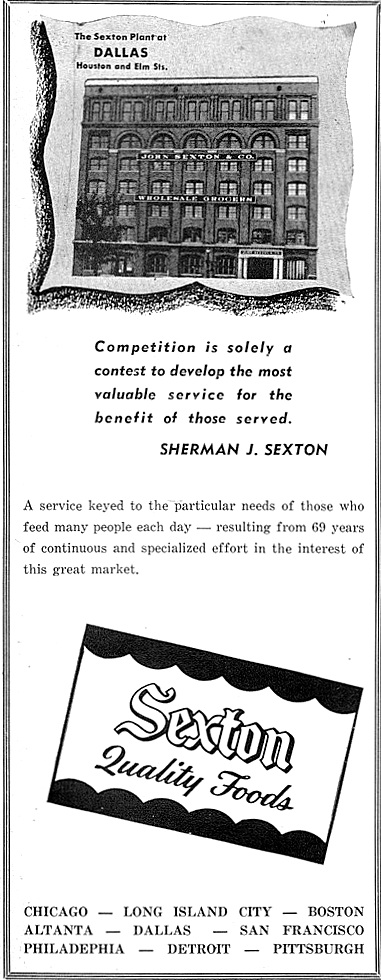
Look familiar? The building above would later become the Texas School Book Depository. But prior to that, the building housed Sexton Foods, a Chicago-based wholesale grocer which occupied the building for twenty years (1941-1961). The building was known commonly in town as “the Sexton building,” even after it was leased to the Texas School Book Depository in 1963, which explains why some people — citizens and police officers alike — were still referring to it by that name on the day of the Kennedy assassination (and this has apparently caused confusion amongst those wading deep into the “assassination literature”). The photo above is cropped from an ad I came across in The Dude Wrangler, a dude ranch quarterly (!), published in Bandera. The ad (which is reproduced in full down the page a bit) is from 1953, but the photo of the building appears to have been taken earlier.

The leasing of the building by D. Harold Byrd to the John Sexton Wholesale Grocery Company of Chicago (initially for only five years) was announced in The Dallas Morning News on Nov. 28, 1940 (“Wholesale Grocery Leases Building at Houston and Elm”). The Sexton Co. was scheduled to move in on Dec. 8 “following a general remodeling which will include installation of elevators, rearranging of partitions and painting.” They remained in the building until 1961.

sexton_19511951

sexton_foods_dallas_19531953

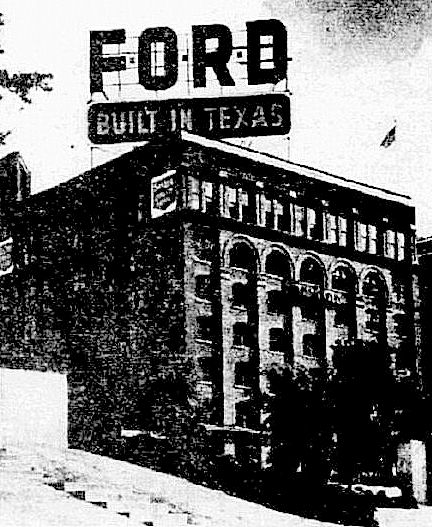
In 1953 (before anyone from Hertz was planning on putting a billboard up there), the Ford people erected a giant neon sign on top of the building to commemorate the 50th anniversary of the founding of the Ford Motor Company. In fact, it was so big that it had half a mile of neon tubing in it and was touted as being the largest animated neon sign in the Southwest. Now there’s a sign that probably caused a few car accidents!

sexton-bldg_ford-sign_1953
1953

*

Before the Sexton company moved in, the building housed the Perfection-Aire air-conditioning  company. Newspaper articles announced the renovation of the building for the A/C people — the company went into receivership a couple of years later.

perfection-aire_dmn_0314371937

*

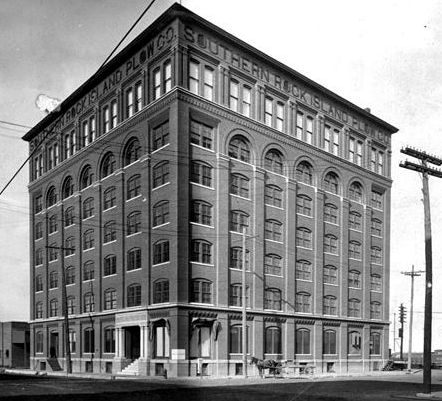
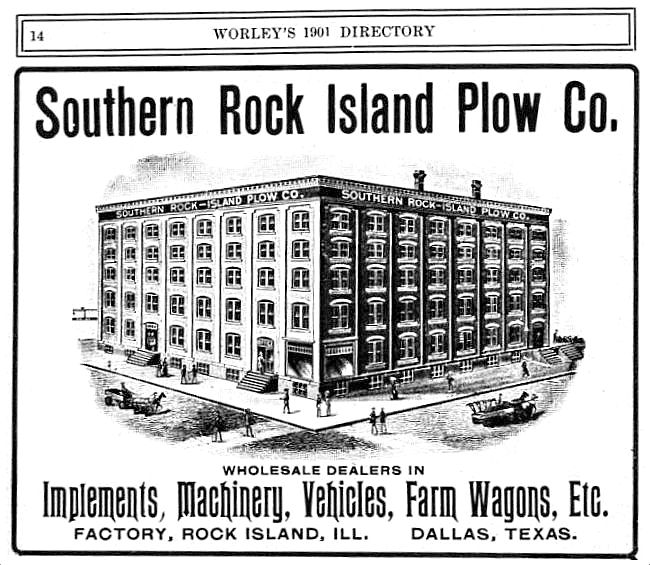
Before that, it was the site of the Southern Rock Island Plow Co., which was the original owner of the property (1894) and which built the building in 1903 after the first building was destroyed in a fire after it was hit by lightning on May 4, 1901.

rock-island-plow_DMN-c1910circa 1910

Above, the Southern Rock Island Plow Co. Building which still stands, famous as the “Texas School Book Depository”; below, the building originally built by the plow company which was destroyed by fire  in May, 1901.

southern-rock-island-plow_1901_pre-current-bldg_1901-directory1901, Dallas city directory

***

Sources & Notes

Sexton Co. ad from a 1953 issue of The Dude Wrangler ; the top image is a detail from that ad.

More on the history of the building as it pertains to the Rock Island Plow Co. is here.

More on the Sexton Foods Co. is here.

More info, specifically on the Texas School Book Depository, is here.

Official site of the current occupant, the Sixth Floor Museum, is here.

*

Copyright © 2014 Paula Bosse. All Rights Reserved.
 

Nardis of Dallas: The Fashion Connection Between “The Dick Van Dyke Show” and the Kennedy Assassination

by Paula Bosse

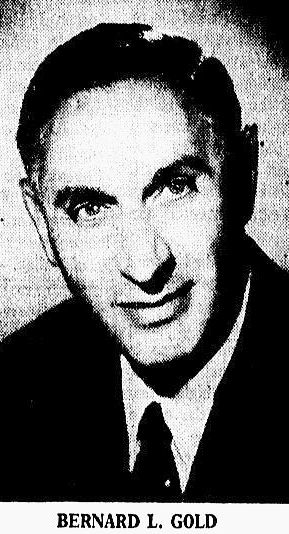
I started watching reruns of The Dick Van Dyke Show on Channel 11 when I was a kid. I still love the show, and I’ve seen every episode countless times. Which is kind of an odd jumping-off point for a post on a Dallas clothing manufacturer, but there you are. The company was Nardis of Dallas, a successful manufacturer of women’s apparel, owned by the Russian-born Bernard “Ben” Gold who arrived here in 1938 from New York City where he had operated a taxi company for many years.

Gold moved to Dallas at the request of his brother who, along with a man named Joe Sidran (“Sidran” spelled backwards is “Nardis”) was an owner in a near-bankrupt dress company. Ben Gold became a part-owner (and later the sole owner) and quickly turned the business around. When he brought in the International Ladies’ Garment Workers’ Union, other Dallas garment manufacturers were shocked (Time magazine used the word “horrified”). He also shook things up by employing African-American workers, the first such company in town to do so. The company eventually grew to become the largest clothing manufacturer in Dallas, with clients around the country and around the world. Nardis was one of the first Dallas clothing companies to have an apparel collection made in a foreign country: his upscale “House of Gold” boutique line specialized in silk, beaded, and sequined dresses and gowns, hand-made in Hong Kong.

Nardis of Dallas was originally located at 409 Browder, with factories at 211 North Austin, the 400 block of S. Poydras (at Wood Street), and, finally, at 1300 Corinth (at Gould St.), where they built their 75,000-square-foot “million-dollar plant” in 1964 (a quick check of Google Maps shows the building still there, but it appears to be vacant). Below are two photos of their S. Poydras location.

nardis_squire-haskins_UTA_wood-and-poydras

Above, Wood Street at the left (Andrew’s Cafe is listed at 1008 Wood St. in the 1960 Dallas directory); below, Nardis garment workers.

AR447-R812

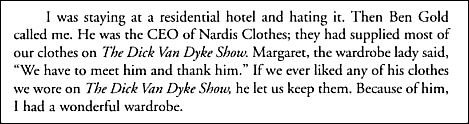
So how does this all connect to The Dick Van Dyke Show? If you’re a fan of the show and a faithful reader of closing credits like I am, you’ve probably seen the “Fashions by Nardis of Dallas” credit at the end of some episodes, right under the Botany 500 credit. And, like me, you might have wondered, “How did THAT happen?” How does an apparel-maker from Dallas network itself into a primo gig supplying fashions to a top Hollywood television show? I have no idea how the initial contact was made, but I DO know that Dick Van Dyke Show star Rose Marie and Nardis owner Ben Gold became very good friends while she was appearing in a production of Bye, Bye Birdie at the Dallas Summer Musicals in 1965. She mentions Gold several times in her autobiography.

Excerpt from “Hold the Roses” by Rose Marie

She spent much of her off-stage time in Dallas with Gold and his wife, and, in fact, when Gold was fatally injured in a traffic accident that summer, Rose Marie (then recently widowed herself) stayed with his wife Tina for several days at Tina’s request.

So, no big Dick Van Dyke Show story, but, as is no doubt known to the hyper-vigilant members of the JFK-assassination community, Nardis of Dallas DOES have an interesting connection to that. In 1941, Abraham Zapruder, who had worked in the garment industry in New York, moved to Dallas and began working for Ben Gold as a Nardis pattern-cutter. His name even appears in a couple of classified ads in The Dallas Morning News.

June 1945

Jan. 1948

While at Nardis — before he left to start his own clothing company — Zapruder worked with a woman named Jeanne LeGon (later Jeanne De Mohrenschildt) who, with her husband George (suspected by some of being a CIA operative), was friends with Lee Harvey Oswald in the early ’60s. Yep. That’s an interesting, head-spinning coincidence.

And I owe all this trivial Nardis-related knowledge to wondering for years about a single card seen in the closing credits of the unquestionably stylish and fashion-forward Dick Van Dyke Show.

nardis-label_ebay

***

Sources & Notes

Fashion photographs from MyVintageVogue.com (1952, 1955, and 1956, respectively). Other Nardis fashion photos from My Vintage Vogue can be found here. (If you’re interested in vintage fashion, fashion photography, and vintage advertising, this is a great website.)

Photos of the Nardis plant at S. Poydras and Wood are by Squire Haskins, from the Squire Haskins Photography Inc. Collection, University of Texas at Arlington Libraries, Special Collections — more info on the exterior shot is here; more on the interior shot here.

Passage about Gold from Rose Marie’s autobiography, Hold the Roses (Lexington: University Press of Kentucky, 2002), p. 192.

Dick Van Dyke Show closing credits card from a 1965 episode.

Nardis of Dallas logo from a clothing tag, found on eBay.

Additional background information on Gold from Time magazine, June 12, 1950.

See another Flashback Dallas post on Nardis — “Nardis Sign-Painters: ‘Everything in Sportswear’ — 1948” — here.

nardis_texas-jewish-post_122354
1954 ad, detail

*

Copyright © 2014 Paula Bosse. All Rights Reserved

Do Not Become an April Fool: Tips from E. M. Kahn & Co. — 1898

by Paula Bosse

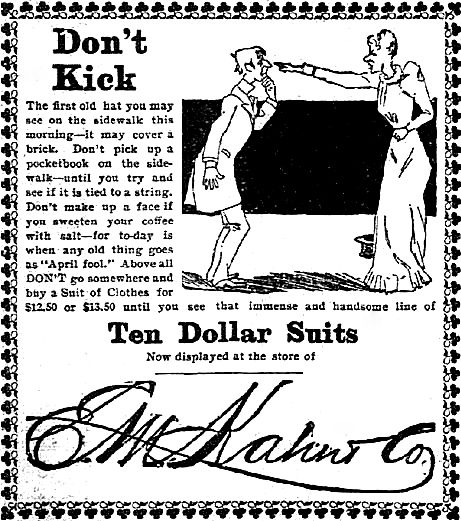
Pranks in 1898 were high-larious.

Do NOT be a fool and pass up that ten-buck suit, man, or you’ll have hell to pay with the missus.

***

Ad appeared in The Dallas Morning News, April 1, 1898.

*

Copyright © 2014 Paula Bosse. All Rights Reserved.