Flashback : Dallas

A Miscellany: History, Ads, Pop Culture

Category: Advertisements

2400 McKinney Avenue — 100+ Years and Counting

by Paula Bosse

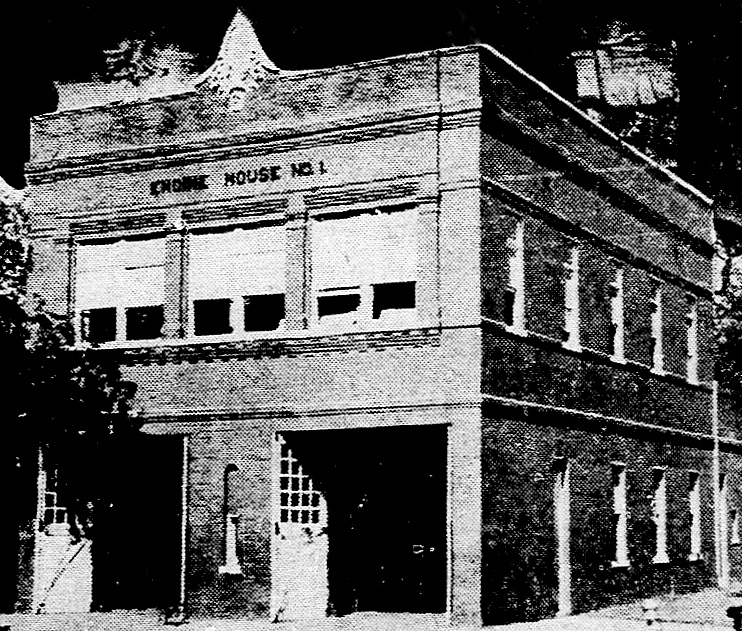
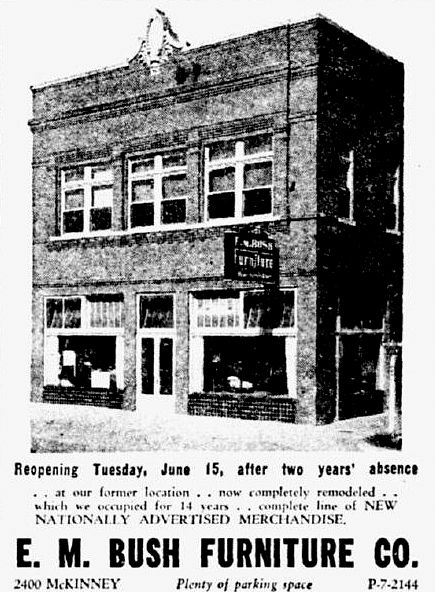
I came across this ad and wondered just where on McKinney Avenue this building had been. The ad was from 1948, but the building certainly looked older than that. I’m not sure when the building was built (update: it was built in 1909), but by at least 1929 the Hughes Auction Market was conducting furniture auctions there. An ad from 1929 invites the public to attend the regular auctions in which their two floors were packed to the gills with furniture and household goods that “positively must sell.” Prospective buyers were promised a large parking lot and a “comfortable, cool building.”

In the summer of 1933, a longtime Dallas furniture salesman, E. M. Bush, opened his retail business in the building and remained there for many years, perhaps until 1958 when he moved to Snider Plaza.

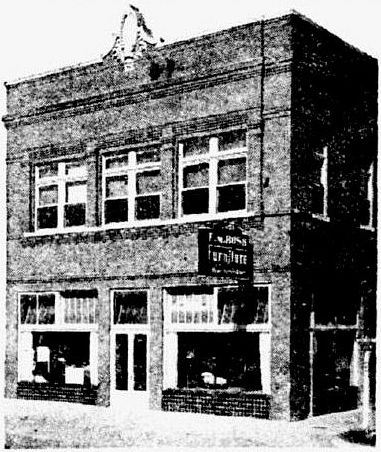
I wondered what’s at 2400 McKinney these days, and, I have to say … I’m shocked to find that the building is actually still there! On McKinney Avenue! And it looks very much the same as it does in the photo above (and, presumably, since it was built) — a little more elegant, perhaps, as it’s now part of the fabulous Hotel ZaZa — but the building looks pretty much the same. The building has survived! I feel like crying.

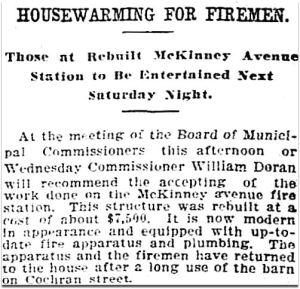
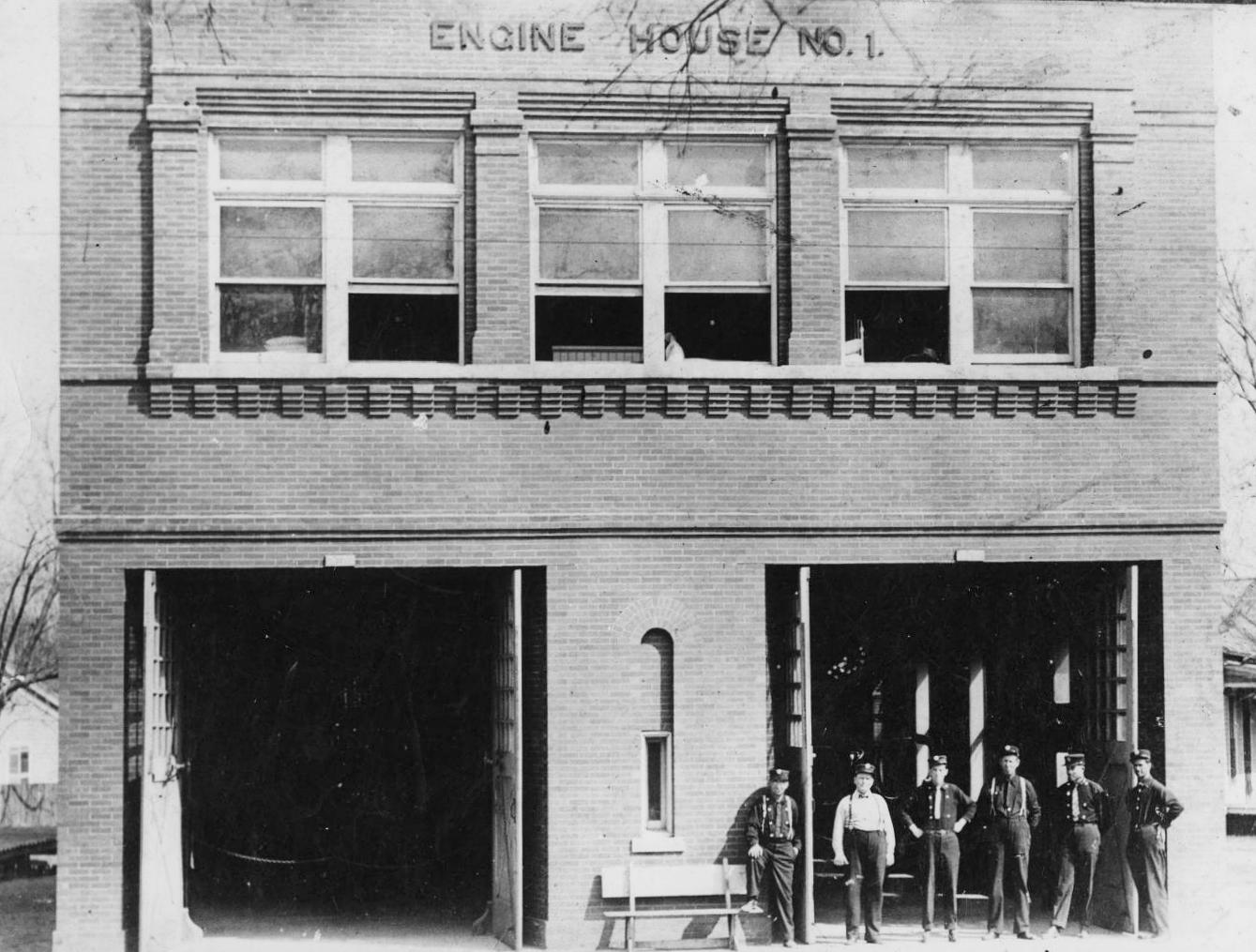
But wait, there’s more. What was this building originally? It was a firehouse! More specifically, it was Engine House No. 1, in use until 1928. The fire station that originally occupied this location was built in 1894 (see what it looked like in 1901 here, third photo down). By 1909, automobiles were placing horse-drawn fire engines, one of many reasons the station house needed to be modernized. Newspaper articles from 1909/1910 used the words “rebuilt” and “remodeled” almost interchangeably, so it’s unclear whether the original building was completely, or only partially demolished and then rebuilt, using materials from the original structure. The “new” engine house re-opened in January, 1910.

rebuilt_dmn_012510
Dallas Morning News, Jan. 25, 1910

Here’s a photo from its early days:

engine-house-no-1_mckinney

And from the 1920s:

fire-dept_mckinney-leonard-photo_1920s

The city ordered the building sold in 1928 when plans had been made to move personnel and equipment from McKinney and Leonard to a new station at Ross and Leonard.

To have a 100-plus-year-old building still standing in “newer-is-better” Dallas — and in Uptown — is quite a feat!

***

Sources & Notes

E. M. Bush Furniture Co. ad from 1948.

Photo of Stay ZaZa Art House and Social Gallery from the Hotel ZaZa website.

Firehouse photo from The Dallas Firefighters Museum. More on this station here.

Most images are larger when clicked.

*

Copyright © 2014 Paula Bosse. All Rights Reserved.


Dr Pepper: “Sparkly, Playful” — 1959

dr-pepper-1959

by Paula Bosse

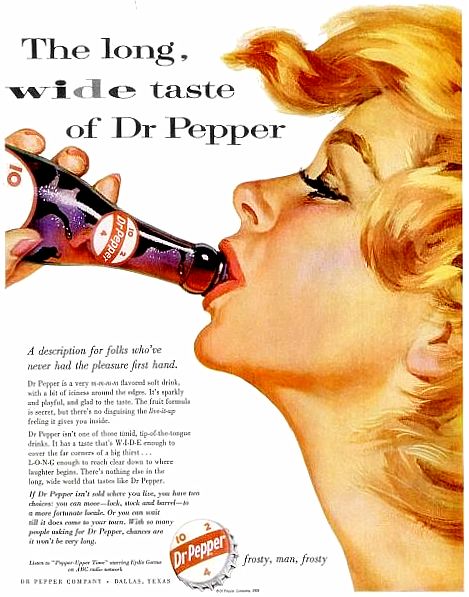
An early national advertisement for a product on its way to becoming more than just a regional soft drink. I grew up right down the street from the Dr Pepper plant. And, yes, I am still pissed.

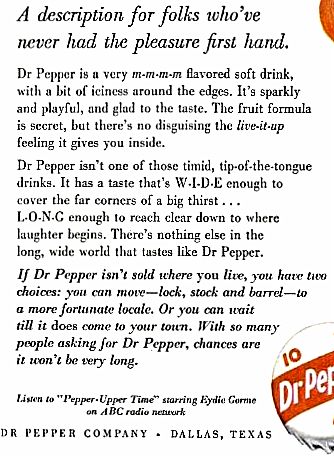
And here, a bit larger, the wordy and intensely caffeinated copy that seems to have been written by a Madison Avenue flat-earther:

*

Copyright © 2014 Paula Bosse. All Rights Reserved.

Hagey Infirmary, No Patient Too Frail — 1894

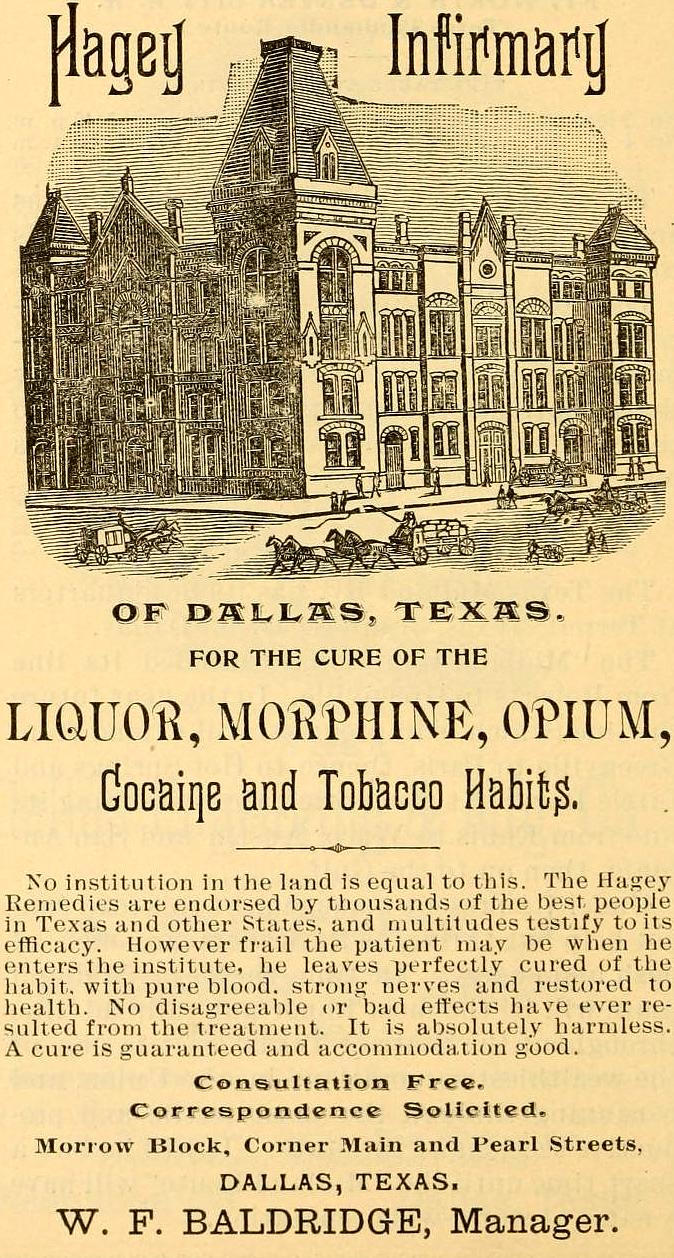
“A cure is guaranteed…” (click for larger image)

by Paula Bosse

Hagey Infirmary
of Dallas, Texas.

For the cure of the

LIQUOR, MORPHINE, OPIUM,
Cocaine and Tobacco Habits.

No institution in the land is equal to this. The Hagey Remedies are endorsed by thousands of the best people in Texas and other States, and multitudes testify to its efficacy. However frail the patient may be when he enters the institute, he leaves perfectly cured of the habit, with pure blood, strong nerves and restored to health. No disagreeable or bad effects have ever resulted from the treatment. It is absolutely harmless. A cure is guaranteed and accommodation good.

Consultation Free.

Correspondence Solicited.

Morrow Block, Corner Main and Pearl Streets,
Dallas, Texas.
W. F. BALDRIDGE, Manager.

***

From the Souvenir Guide of Dallas (Dallas: D. M. Anderson Directory Co., 1894).

The Hagey Infirmary was at 516 Main (now the 2100 block of Main, at Pearl), from about 1893 to 1894 (possibly 1895).

*

Copyright © 2014 Paula Bosse. All Rights Reserved.

L. Craddock & Co. — Pioneer Whiskey Purveyors

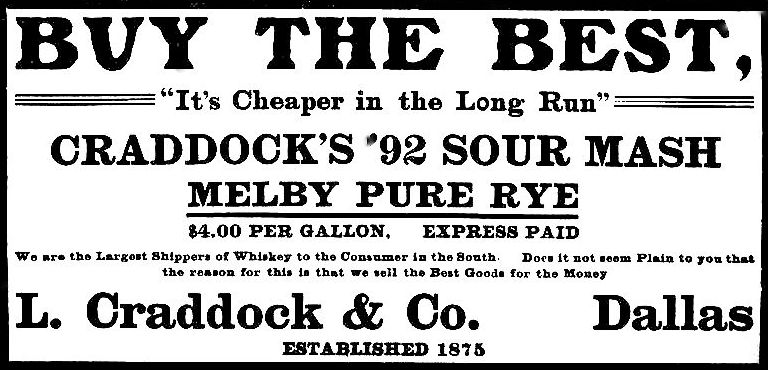
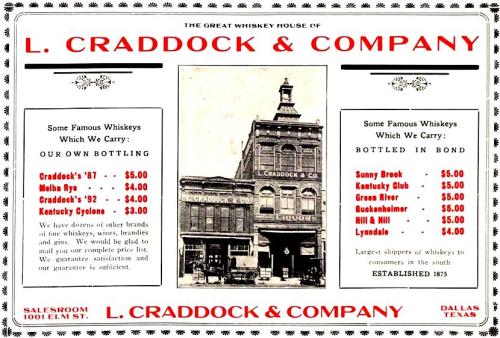
L. Craddock ad, 1912

by Paula Bosse

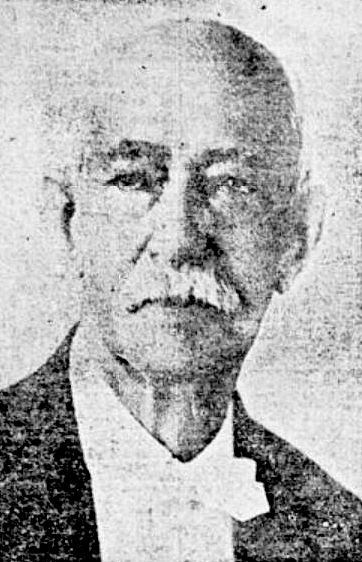
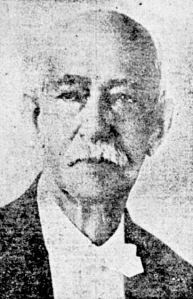
L. Craddock, an Alabama native born in 1847, arrived in Dallas in 1875 and opened a liquor business at Main and Austin streets in a building built by the Odd Fellows. It was a success, becoming one of the largest such businesses in a young, thirsty city.

Feeling a flush of civic pride, Mr. Craddock branched out beyond the retail world of alcohol sales, and in the late 1870s he opened the city’s second theatrical “opera house,” conveniently housed on the second floor of his liquor emporium, above his saloon and retail business. The theater was immensely popular and hosted the important performers and lecturers of the day, until the much larger Dallas Opera House arrived on the scene and siphoned off Craddock’s audiences. He closed the second-floor theater in the mid-1880s (a space which, presumably, continued to be used as an IOOF meeting hall) but kept the business on the ground floor.
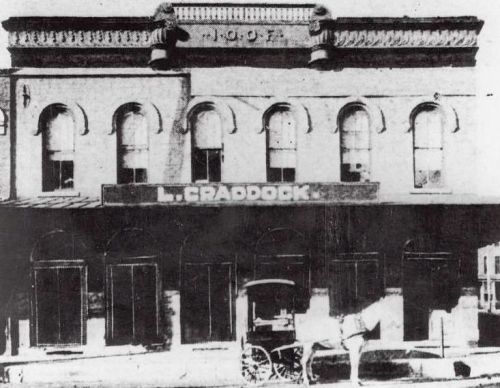
The first location, at Main & Austin, with theater on second floor (1880s)The first location, at Main & Austin, with theater on second floor (1880s)

In 1887 Craddock decided to change careers. He sold his company to Messrs. Swope and Mangold (more on them later) and retired from the liquor trade — if only temporarily. I’m not sure what prompted this somewhat unexpected decision (I’d like to think there was some juicy, illicit reason), but, for whatever reason, he decided to give real estate a whirl. Craddock was certainly a savvy wheeler-dealer and he probably did well buying and selling properties in booming Dallas, but (again, for whatever reason) he seems to have tired of real estate, and, by at least 1894 (if not sooner), he had returned to the whiskey trade and had built up an even more massive wholesale liquor business than before.
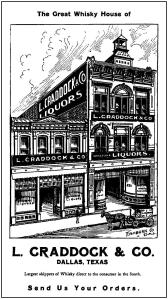
ad_craddock-liquors-19061907 (click for much larger image)

He had a new, larger building, this time on Elm, between N. Lamar and Griffin. In the company’s incessant barrage of advertising, he touted the company’s unequaled, unstoppable success as purveyors of the finest alcohol available. One ad even took on something of a hectoring, lecturing tone as it admonished the reader with this snappy tagline:

“We are the Largest Shippers of Whiskey to the Consumer in the South. Does it not seem Plain to you that the reason for this is that we sell the Best Goods for the Money.”
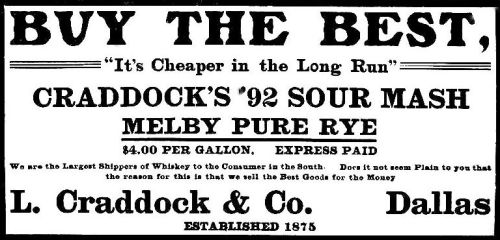
1906

Arrogant or just supremely confident, Craddock was rolling in the dough for many, many years. Until … disaster struck. Prohibition. With the inevitable apocalypse about to hit the alcoholic beverage industry, L. Craddock threw in the towel and retired. For good this time. I’m sure many a faithful L. Craddock & Co. customer stocked up on as much as they could hoard in the final weeks of the prices-way-WAY-higher-than-normal going-out-of-business sale.

Craddock retired to Colorado, but in 1922, he returned to present to the city a valuable ten-acre tract of land in the old Cedar Springs area — land he asked be used as a park. Craddock Park remains a part of the Dallas Parks system today.
craddock_dmn_120322Dallas Morning News, Dec. 3, 1922

It’s interesting to note that in every article about Mr. Craddock that appeared during and after Prohibition — such as the articles reporting his generous gift to the city — there was never any mention of what kind of business he had been in or how he had made his great fortune. Even in his obituary. He was always vaguely described as a “pioneer businessman.”

Speaking of his obituary (which, by the way, was the place I actually saw his first name finally revealed — it was Lemuel), L. Craddock — Dallas’ great retailer of beer, wine, and spirits — died on December 2, 1933. Three days before the repeal of Prohibition. THREE DAYS. O, cruel fate.

**

ADDED: Interesting tidbit about a legal matter brought by Federal prosecutors. In 1914, Craddock was found guilty of “illicit liquor dealing” — shipping barrels of whiskey (labeled “floor sweep”) into the former Indian Territory of Oklahoma. Craddock wrote a check for the fine of $5,000 right there in the courtroom. The three men who actually did the deed were sentenced to a year and a day at Leavenworth. (I’m never sure how much faith to put in the Inflation Calculator, but according to said calculator, $5,000 in today’s money would be approaching $115,000. I think ol’ Lemuel was doing all right, money-wise. I’m guessing this “floor sweep” thing was not an isolated incident.)
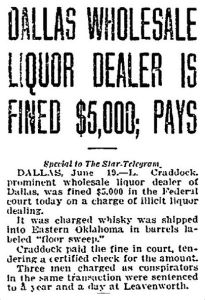
craddock_FWST_061914Fort Worth Star-Telegram, June 19, 1914

***

Sources & Notes

Top L. Craddock & Co. ad from 1912.

Photograph of first location, with theater, from Historic Dallas Theaters by Troy Sherrod (Charleston: Arcadia Publishing, 2014).

Ad featuring rendering of second Craddock location at Elm & Poydras, signed Fishburn Co. Dallas, from 1906.

Photograph of L. Craddock from a Dallas Morning News interview in which he reminisces about the Craddock Opera House, published December 3, 1925. It’s an informative interview about early Dallas (like REALLY early Dallas) — the article can be read here.

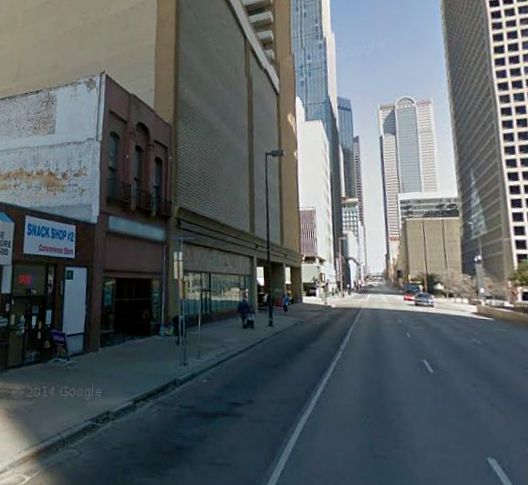
Update: I’ve wondered if this building downtown is the Craddock building, cut down and uglified. The current address is 911 Elm (I assume that the addresses for that stretch of Elm changed when the cross-street configuration changed). The Dallas Central Appraisal District gives the construction date of that building as 1937, but the DCAD dates are frequently not accurate. I don’t know. It’s very similar (missing the third floor…) and in about the exact same spot. Looks like it to me. That poor 100-plus-year-old building needs some loving attention. Here is a Google street view from early 2014:
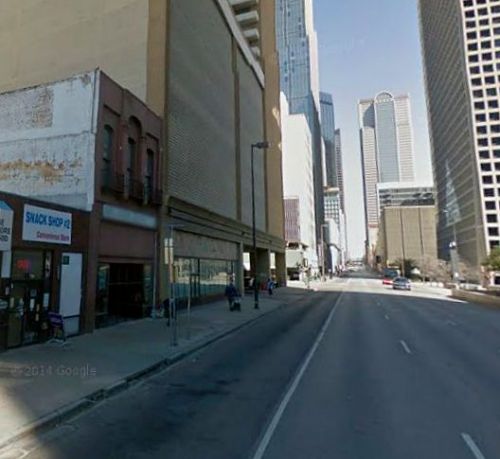
craddock_google_feb-2014

Most images in this post are larger when clicked.

*

Copyright © 2014 Paula Bosse. All Rights Reserved.

Gus Roos Men’s Clothing — 1951

Elm and Akard and familiar skyline…

by Paula Bosse

One of the top men’s clothiers, right there at Roos Corner. (Pegasus!)

*

Copyright © 2014 Paula Bosse. All Rights Reserved.
Red Bryan’s Smokehouse — BBQ, Oak Cliff-Style

red-bryans-smokehouse_bbq_postcard_ebay_ca-1950

by Paula Bosse

Everybody in Dallas knows about Sonny Bryan, and some remember Red Bryan, but I didn’t know there was another Bryan forebear, who started the family barbecue dynasty: Elias Bryan. Elias and his wife, Sadie, arrived in Oak Cliff from Cincinnati in 1910 and opened a barbecue stand. Elias begat Red, and Red begat Sonny. And there was much trans-generational smoking of meat. The Bryans have been a BBQ fixture in Dallas for over 100 years.

Fun facts about William Jennings “Red” Bryan:

  • Red studied botany at SMU, which might explain his initial career as a florist until he was inevitably pulled back into the family business. He opened his first place in the early 1930s in a retired Interurban car, known affectionately as “The Tin Shack.”
  • In the late ’40s, now well established and wanting swankier digs, he commissioned the respected architect Charles Dilbeck to design the new restaurant. (Dilbeck designed some of the most beautiful homes in Dallas, several of which are in Lakewood, but this was probably his first — and only — barbecue joint.)

And the rest is, as they say, barbecue — and Oak Cliff — history.

*

red_bryan_bbq_dth_0205561

*

Red, 1951

*

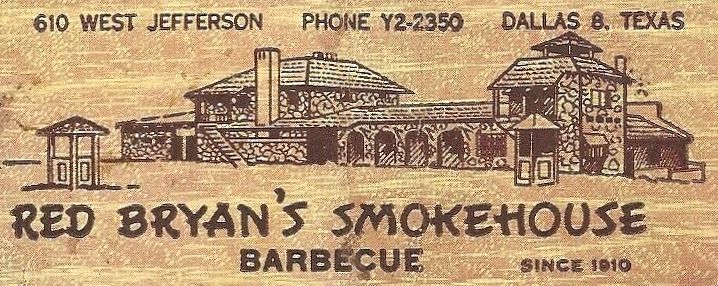
red-bryans-bbq_matchbook_ebay

***

Sources & Notes

Postcard (circa 1950) at top from eBay. This is printed on the back:


red-bryans-smokehouse_bbq_postcard_caption_ebay

Ad from 1956.

Much more on Red Bryan’s Smokehouse, with lots of photos of its construction, can be found in the Oak Cliff Advocate article “The King of Oak Cliff Barbecue” by Gayla Brooks, here.

Even more cool stuff, including early photos of the family business, can be found in the Texas Monthly article “Bryan Family Artifacts and Mementos” by Daniel Vaughn, here.

Sonny Bryan’s website is here.

*

Copyright © 2014 Paula Bosse. All Rights Reserved.
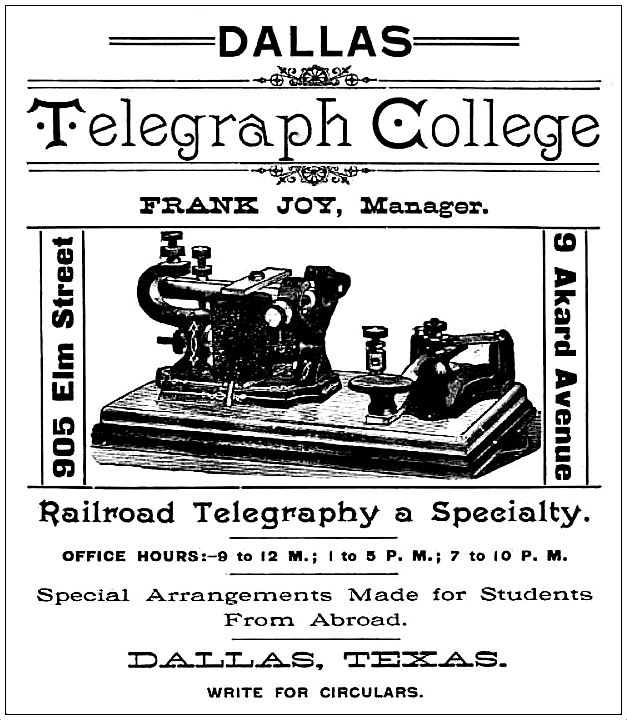
Start Your Brilliant Career at Dallas Telegraph College — c. 1900

dallas_telegraph_college_ad_1904

by Paula Bosse

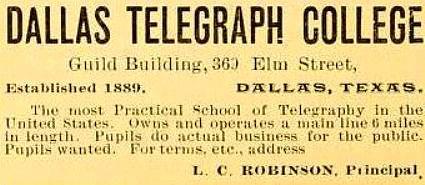
The Dallas Telegraph College opened in 1889 and admitted both men and women as students (if not from the beginning, certainly by the early years of the new century).

dallas-telegraph-college_1889-directory1889 ad (click to see larger image)

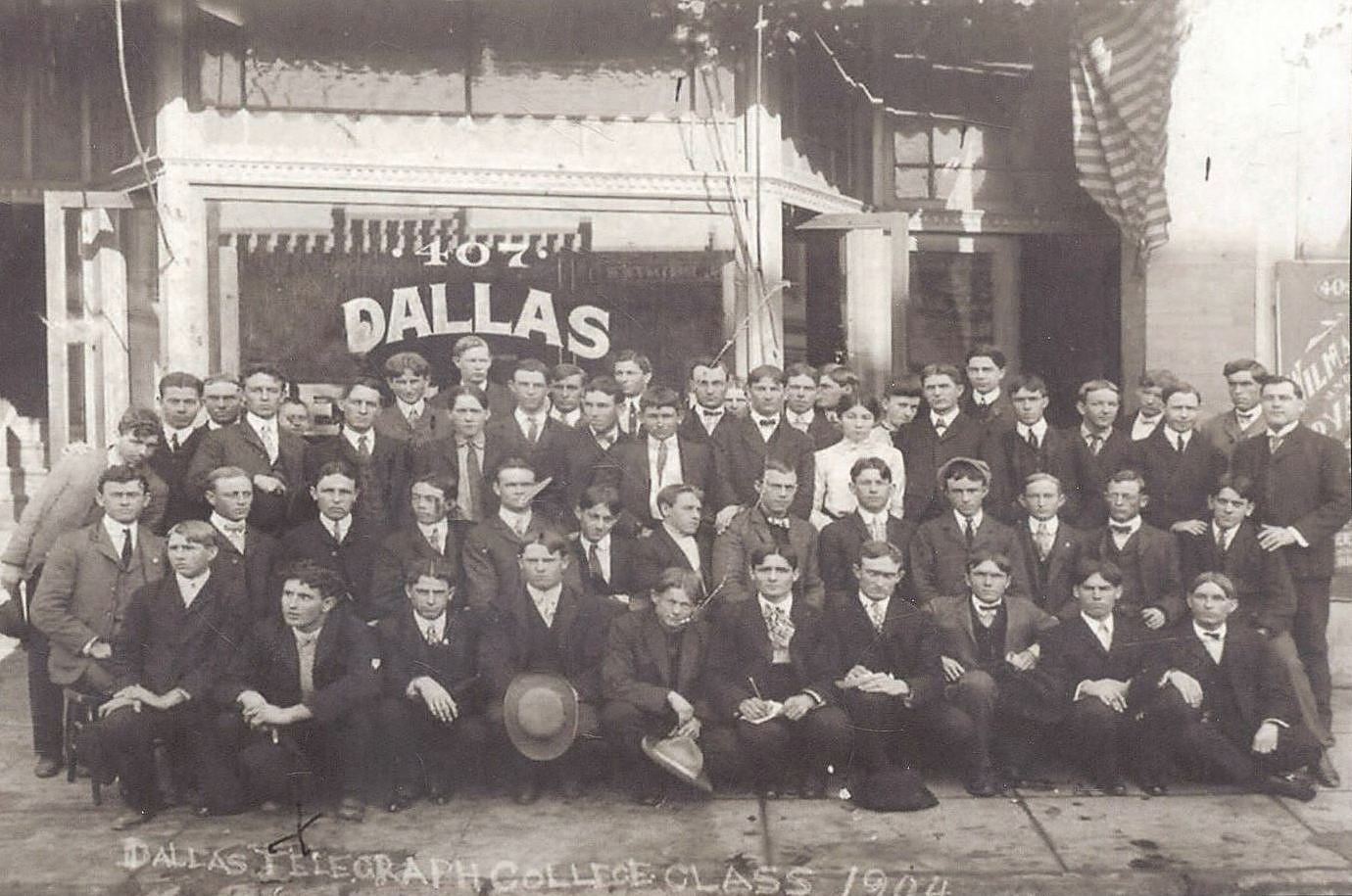
In the 1904 photo below, you’ll see one lone woman in the group.

dallas-telegraph-college_1904_ebay1904

Below, the text of a 1908 ad — published in a San Antonio newspaper in hopes of drawing students to Dallas from around the state — rather optimistically promised hard-working students the possibility of earning an “enormous” salary and maybe even becoming the head of a railroad!

The Dallas Telegraph College is a school of more than state reputation. Prof. L. C. Robinson is president, with J. E. Hyle as superintendent. As is well known, telegraphy is not only one of the pleasantest of studies, but offers a brilliant career to the man who ‘makes good.’ A great many railroad presidents started as operators. The men who have made good now head railroad systems at enormous salaries. What one man has done, another may do. The Dallas Telegraph College has been a chartered institution for fifty [sic — this should be “twenty”] years. Why not send for one of their beautiful catalogues?

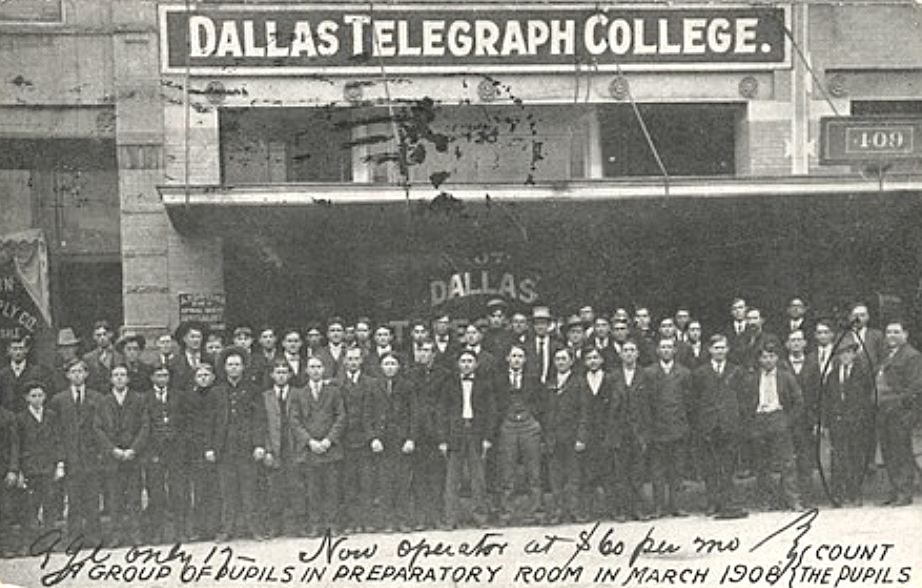
dallas_telegraph_college1908 ad

dallas-telegraph-college_1908_cook-coll_degolyer-lib_SMU
1908, via DeGolyer Library, SMU

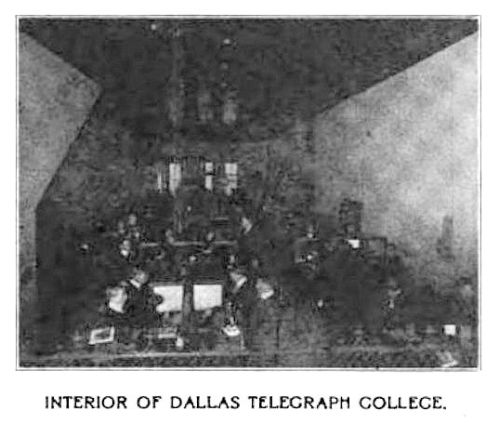
According to a 1912 article by Lewis N. Hale on Texas schools and colleges in Texas Magazine, the students learned to ply their trade by tapping (…as it were) into the actual railroad telegraph lines which, rather conveniently, ran right through their classrooms. A very murky photo from that Texas Magazine article is below.

dallas-telegraph-college_tx-mag_1912_photo

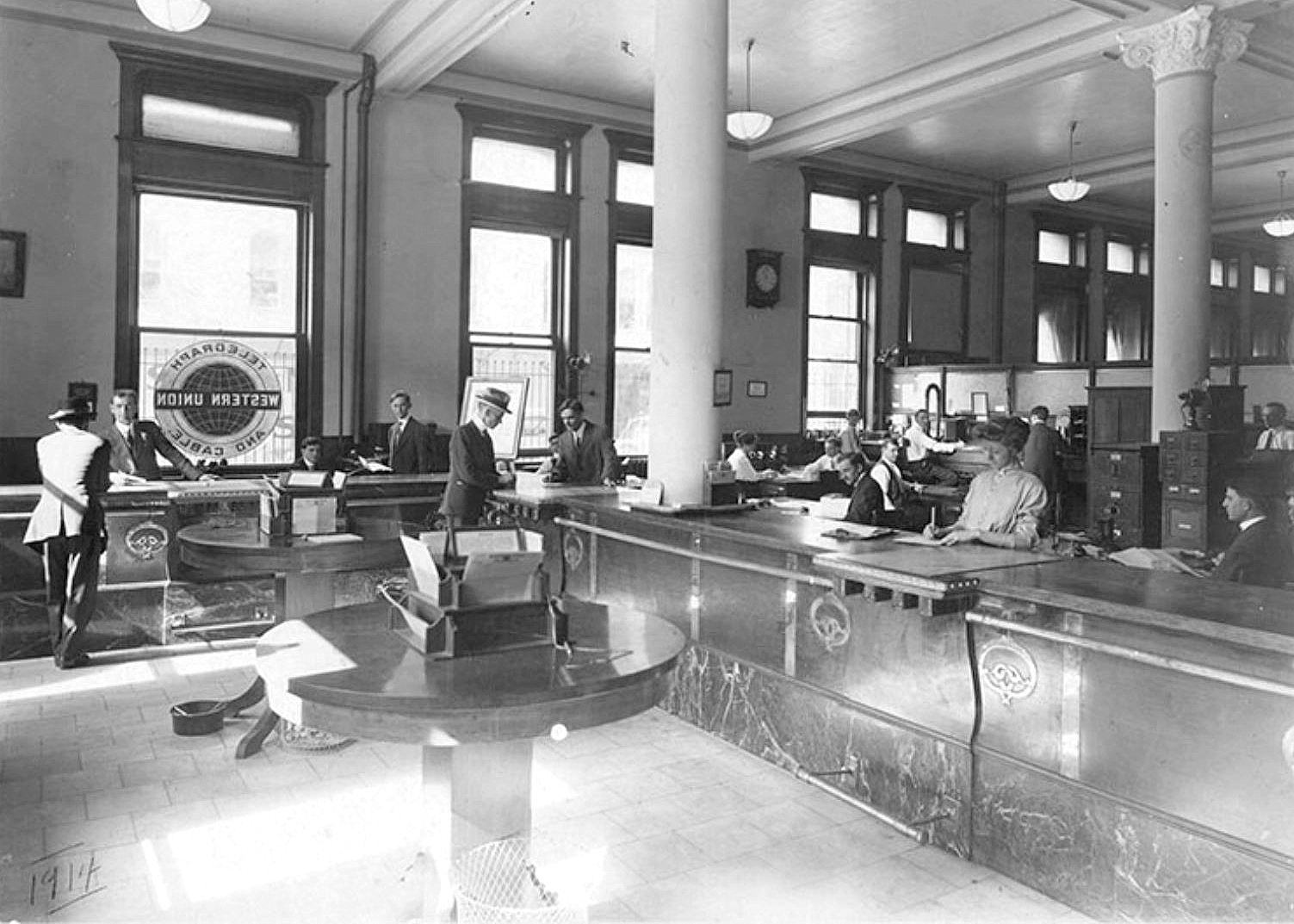
The goal of students was to secure employment in a nice, well-appointed office, such as Dallas’ Western Union headquarters, shown below in 1914.

western-union_trust-bldg_1914_DPLvia Dallas Public Library

Next stop: an enormous salary!

***

Sources & Notes

Top ad (“Learn Telegraphy”) from 1904. Second ad from 1889 (from the pages of the Dallas city directory). Third ad (with Guild Building address) from 1894.

Photo showing 1904 class from eBay.

1908 photo showing students standing in front of the building from the George W. Cook Dallas/Texas Image Collection, DeGolyer Library, Southern Methodist University; more info on this card is here.

Western Union office photograph — “[Western Union Telegraph Company interior main office – Trust building at 801 Main Street]” (1914) — is from the DPL Van Orden Western Union Telegraph collection of the Dallas Public Library Dallas History and Archives Division (Call Number PA2007-2/2).

An entertaining read on the history of telegraph service in Texas by Mike Cox can be found here.

The Handbook of Texas entry on telegraph service in Texas can be found here.

Absolutely EVERYTHING that you (and Ed McMahon) would ever want to know about the telegraph and telegraphy is here.

*

Copyright © 2014 Paula Bosse. All Rights Reserved.

Meet Me at the Kitten Lounge — 1968

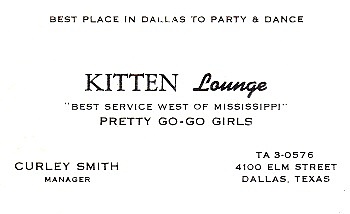
kitten-lounge_1968

by Paula Bosse

KITTEN LOUNGE
Best Place in Dallas to Party and Dance
“Best Service West of Mississippi”
Pretty Go-Go Girls
Curley Smith, Manager
TA 3-0576
4100 Elm Street
Dallas, Texas

From the manly, go-go-girl-loving pages of a 1968 issue of Texas Peace Officer magazine. No doubt a happening place, at Elm & Haskell. Peace officers welcome!

*

Copyright © 2014 Paula Bosse. All Rights Reserved.
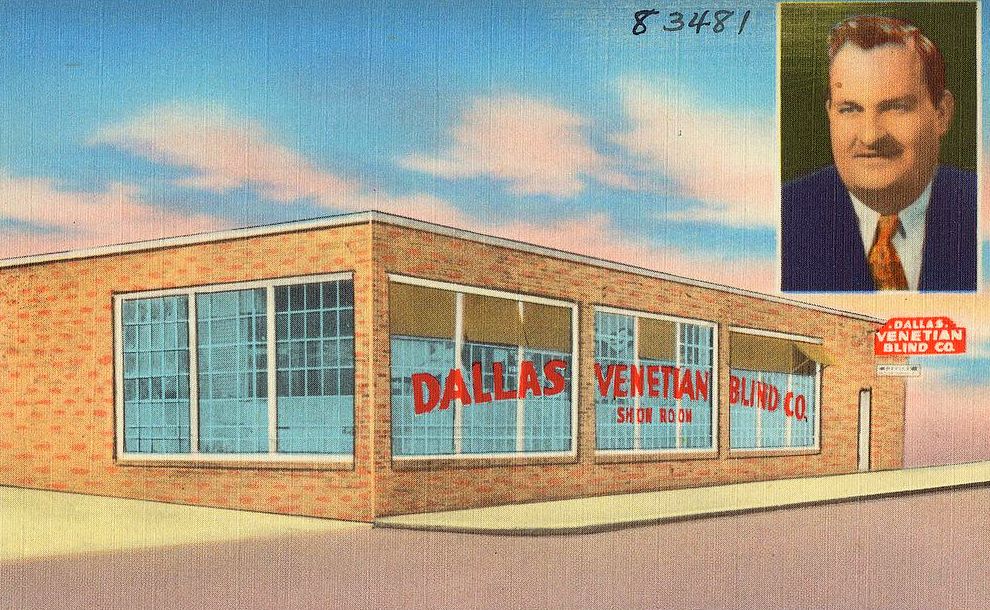
Dallas Venetian Blind Company — 1619 Hall Street

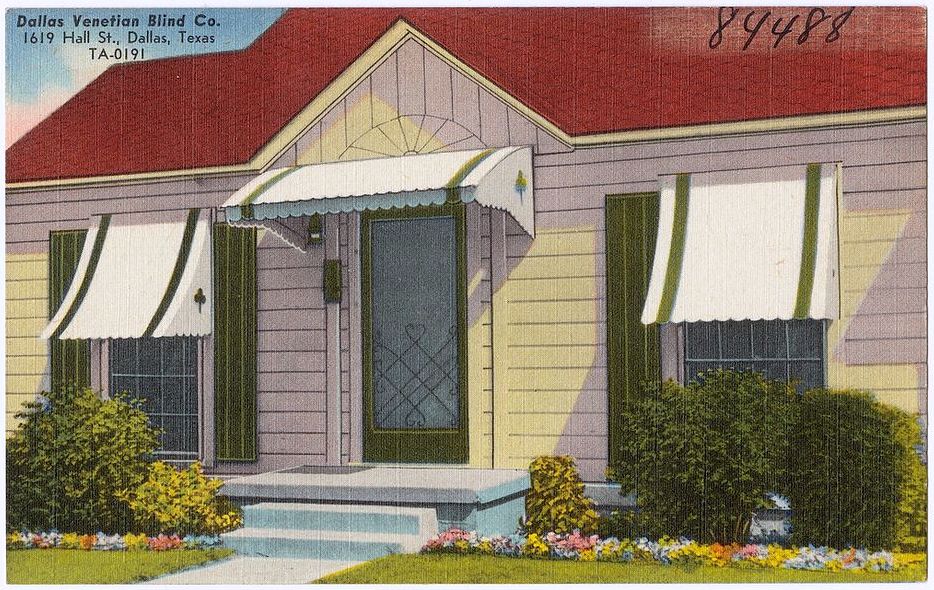
dallas-venetian-blind-company

by Paula Bosse

This is the sort of old postcard I love. It shows an impossibly idealized version of the past. This lovely house, with its impeccably manicured lawn and bright, shiny awnings is not a home, but the location of a business. It’s the Dallas Venetian Blind Company, at 1619 Hall Street, a few steps from Ross Avenue. When I see old postcards and photographs of places like this, I always wonder about the people who lived and worked there. So who went to work every day in that cute little house, living and breathing all-things Venetian blinds?

The owner of the Dallas Venetian Blind Company was J.S. “Joe” Herold. He was born in Austin in 1905 and moved to Dallas when he was a teenager. He started out in the floor finishing business and didn’t open his “Venetian blind concern” until many years later, in 1942. He was married, had a daughter, lived on Reiger near Fitzhugh, and enjoyed hunting and fishing. He was a “Square Deal” candidate for an East Dallas seat on the City Council in 1951, running against candidates representing the equally quaintly-named “Nonpartisan Association” and “Citizens’ Charter Association.” By 1960 he seems to have moved to Quitman, still fighting the good fight in the blinds game. But, sadly, far away from this wonderful little house which MUST have had Venetian blinds in those windows, even though I can’t see any! And now, Joe Herold — sit back — this is your life!

room
The showroom, at 3230 Ross Avenue, right around the corner from the cute little house. This expansion had happened by at least 1947.

Business must have been good in those post-war years, because Joe had ads in 1950 boasting three telephone numbers: the main shop, the showroom, and, yes, Joe’s own car phone (which seems very early for car phones)!

dallas-venetian-blind-company_wagonload_postcard

Dallas Morning News, April 19, 19501950 ad

***

Postcards from the absolutely fantastic Boston Public Library Tichnor Brothers Postcard Collection on Flickr, here.

Click postcards for larger images.

*

Copyright © 2014 Paula Bosse. All Rights Reserved.
Delta Air Lines’ First Passenger Flight — 1929

by Paula Bosse

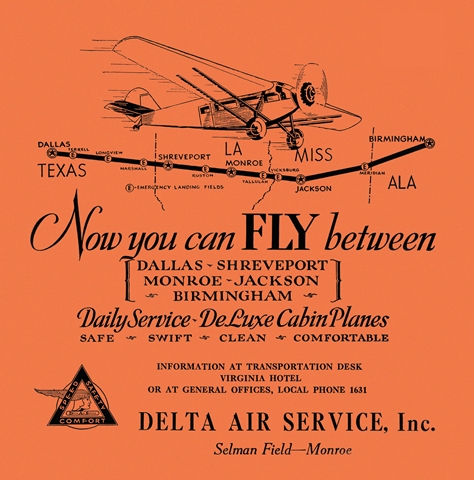
Delta Air Lines has had a longer — and more important — association with Dallas than you might think. On June 17, 1929, Delta made its first-ever passenger flight, from Dallas to Jackson, Mississippi via Shreveport and Monroe, Louisiana. According to the Love Field website, “Early flights operated from a passenger terminal near Bachman Lake, which later served as Southwest Airlines’ first headquarters building.” On that first flight, the five passengers sat in wicker chairs and could roll down windows (!) for needed ventilation. The flight took five hours. One of the first ads, from the Delta Flight Museum page, looked like this:

Delta passenger service ad ca. September 1929.

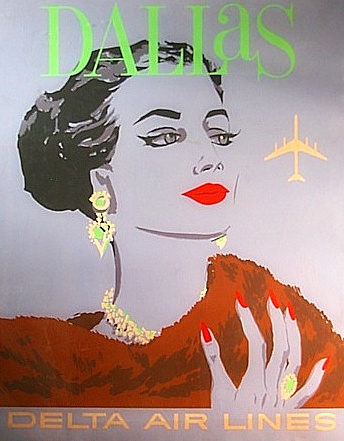
Forty-some-odd years later, the ads — and Dallas — got a bit more sophisticated.

delta_dallas_fur

delta_dallas_fredric-sweney_playing-cardsArtist: Fredric Sweney

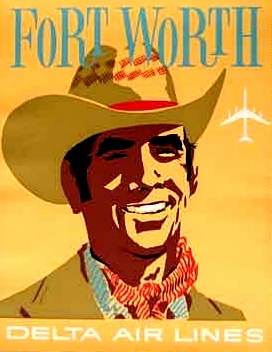
And we can’t leave out Cowtown!

delta_fort-worth

**

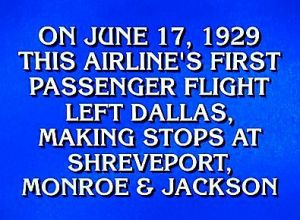
UPDATE, June 20, 2017: This almost-three-year-old post got a TON of hits yesterday, and I couldn’t figure out why. Eventually, though, I tracked it down: it had to do with yesterday’s Final Jeopardy question (or is it “answer”?):

delta_jeopardy_061917

Nice to see that Jeopardy is incorporating Dallas history into the show!

***

Top travel poster — showing Fort Worth in the distance, I guess? — by Jack Laycox.

For a really well-researched article by Timothy Harper describing that first flight, click here (the Dallas bit is contained in the last seven paragraphs).

*

Copyright © 2014 Paula Bosse. All Rights Reserved.