Flashback : Dallas

A Miscellany: History, Ads, Pop Culture

Category: African American Dallas

Black Troops from Dallas, Off to the Great War
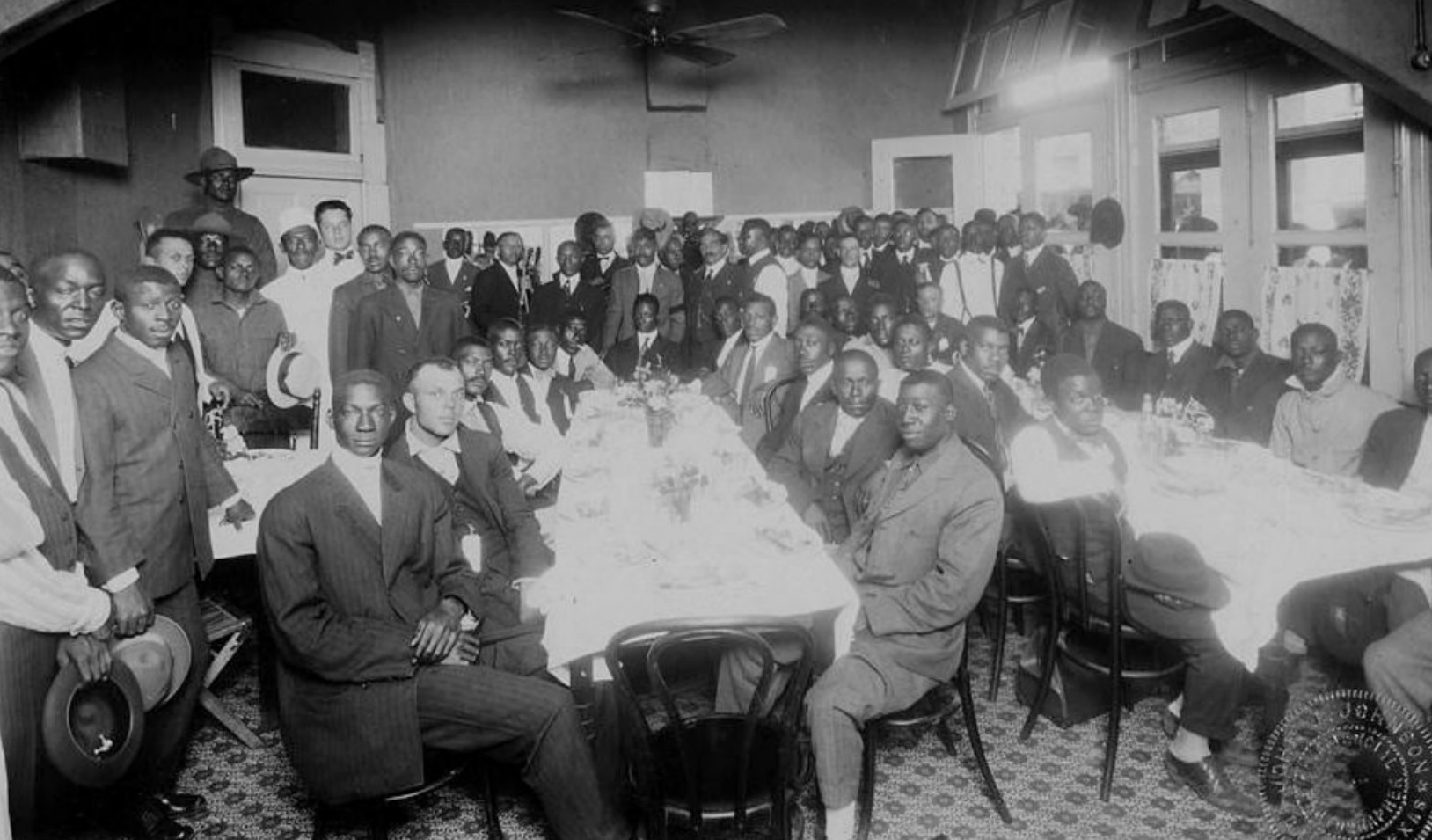
WWI_black-soldiers_dallasRecruits in Dallas

by Paula Bosse

Above is a photo from the National Archives, described only as “Negro recruits having a turkey dinner just before leaving for a training camp. Dallas, Texas.” At the bottom right is the seal of Dallas photographer John J. Johnson who had worked for The Dallas Morning News as a photographer before World War I but was apparently working in a commissioned or freelance capacity here. The photo was taken on June 11, 1918, but the location is not known.

Eight months earlier, Black draftees left Dallas for the first time — they were headed to Camp Travis in San Antonio. (Click articles for larger images.)
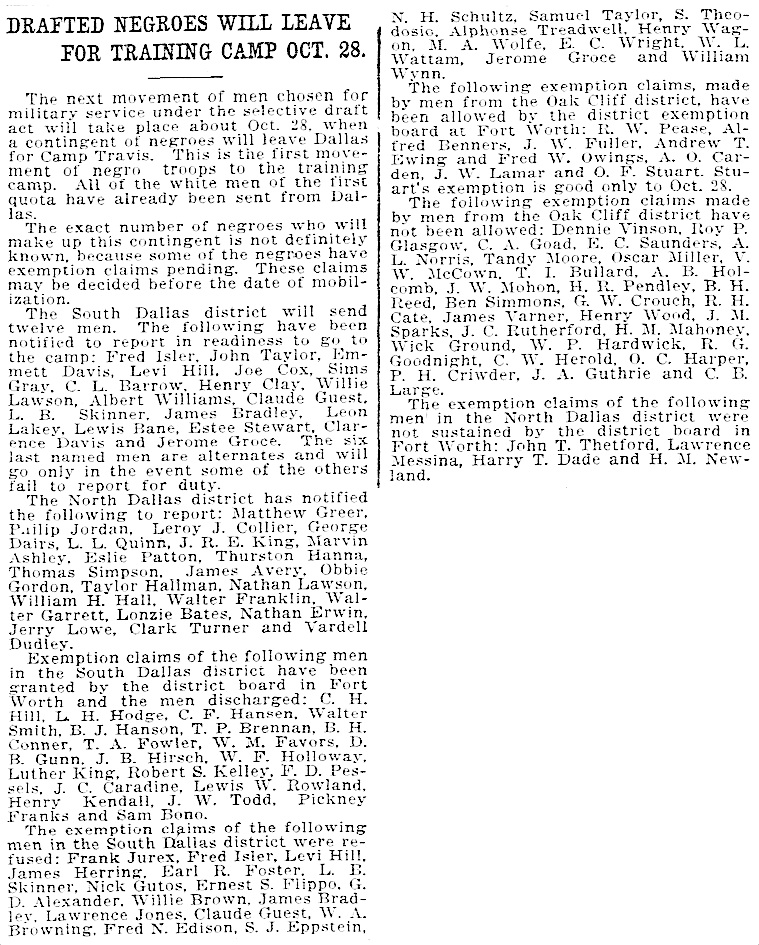
WWI_black-draftees_dmn_101817Dallas Morning News, Oct. 18, 1917

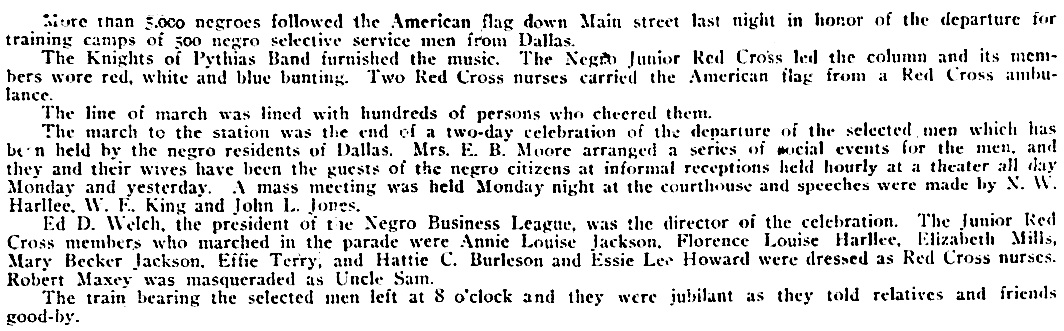
Much larger contingents of Black men left for training camp in the summer of 1918: more than 500 men left from Dallas and more than 200 from Fort Worth at the end of July. The photo below appeared in The Dallas Morning News under the headline “Scene at Union Station Last Night, When 500 Negroes Left for Camp.” (This photo was taken by John J. Johnson, the same photographer who took the photo at the top of this post.)
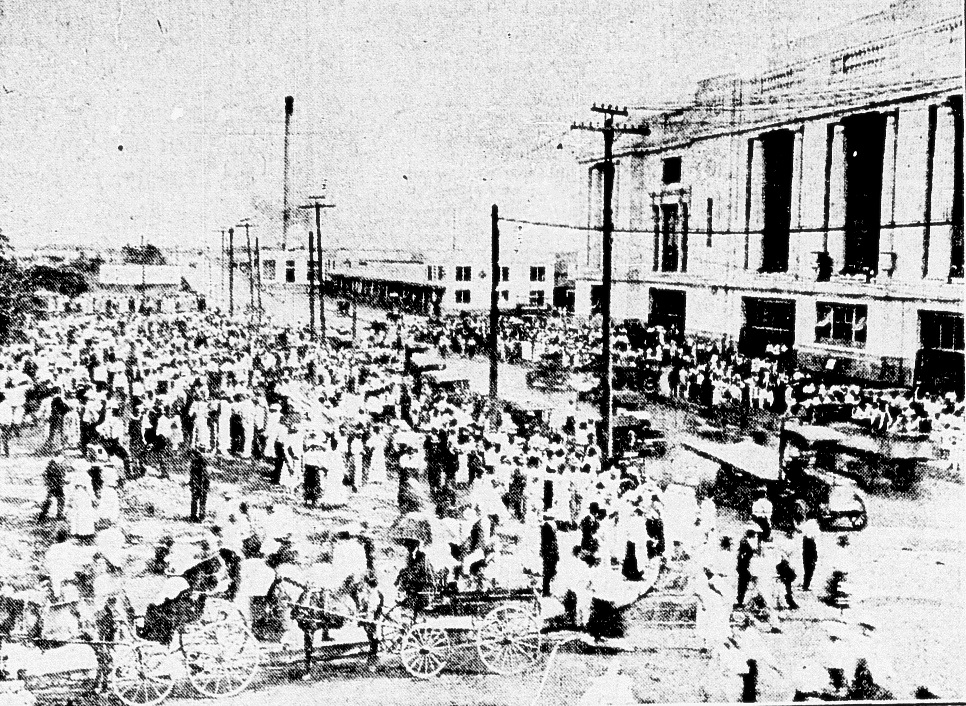
black-recruits_dmn_073118-photo

black-recruits_dmn_073118_captionPhoto and caption from the DMN, July 31, 1918
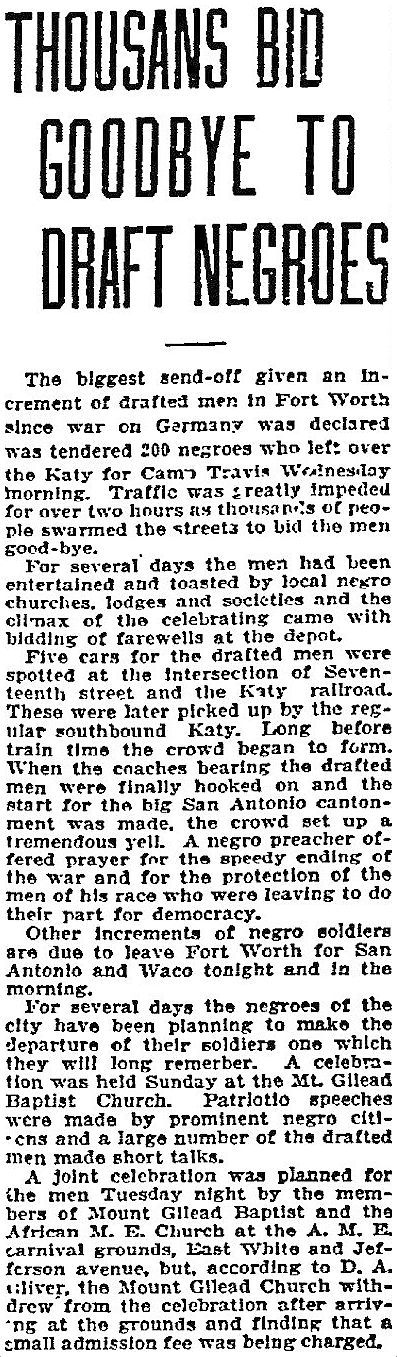
black-draftees_FWST_073118
Fort Worth Star-Telegram, July 31, 1918

There was a sizable number of Black soldiers at Camp Bowie in Fort Worth, and many of the reports from Fort Worth on the training of the “negro troops” are hard to read. I don’t think of myself as naive, but the blatant racism that was absolutely everywhere in the mainstream press at the time is stunning. Even when attempting to be complimentary, you see things like this:

If you imagine that the fact that these recruits are negroes made any difference to the white soldiers in camp you are mistaken, for the white soldiers cheered and threw up their hats as truck after truck of negroes passed by, and the darkies shouted back lustily. […]

“I’se glad I got heah at last,” said a big negro as he lined up for classification. “I won’t have to pick no mo’ cotton, no sah; all I’se have to do is to parade in a nice new uniform an’ get three meals an’ a nice new gun….” (Fort Worth Star-Telegram, Sept. 25, 1918)

I’m sure the white soldiers were happy to see fellow recruits showing up, but the journalists — in story after story — treated the “negroes” (they were rarely called “men”) as bumbling caricatures, inevitably quoted in dialect. The United States armed forces were not integrated until 1948, and Black troops were segregated from white troops, both in camp and on the battlefield (when they were allowed to fight — they were largely kept in service positions such as stevedores).

On this Memorial Day, I share a report from Ralph W. Tyler, a Black journalist who had reported throughout the war from the front lines, on the casualties of African American soldiers who died during World War I in the service of the U.S. Army:
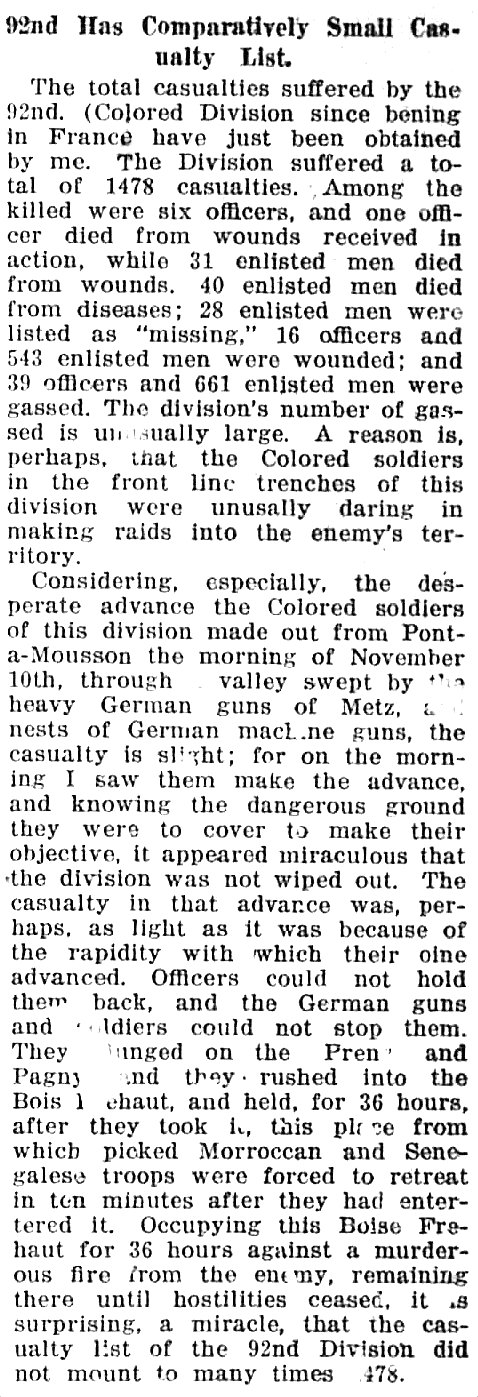
casualties_black-troops_dallas-express_011119Dallas Express, Jan. 11, 1919

***

Sources & Notes

Top photo by John J. Johnson, from the National Archives is titled “Negro recuits [sic] having a turkey dinner just before leaving for a training camp. Dallas, Texas”; it can be accessed on the National Archives site here. An annotated version of this same photo appears under the title “Colored Troops — Negro recruits having a turkey dinner just before leaving for a training camp. Dallas, Texas” is here. (If anyone has additional info on the details of this photo, I’d love to know.)

“92nd Has Comparatively Small Casualty List” is an excerpt from Ralph W. Tyler’s article “General Order Commends Colored Officers” which appeared in The Dallas Express, Jan. 11, 1919. The full article can be read here.

For more info on the history of Black American soldiers, see the Wikipedia entry here; for info on the all-Black 92nd Infantry Division, see here.

Also, check out the blurb for the book Unjustly Dishonored: An African American Division in World War I by Robert H. Ferrell, here.

I’ve put a few articles on African American soldiers in WWI (including those cited above) in a PDF. A few of the articles appeared in the major Dallas and Fort Worth newspapers, and a couple appeared in The Dallas Express, the city’s newspaper published for a Black readership (including a rousing article by N. W. Harllee on the parade and celebration thrown by the city to honor the returning Black troops — WELL worth reading). Also included are a couple of unbelievable articles from the national press (including a lengthy one by a noted Stars and Bars reporter titled “Negro Soldiers Stationed at French Ports Sing and Dance While Unloading Ships”). The PDF can be accessed here (with articles in varying degrees of legibility).

The stirring and exhortative article “Dallas Gives Soldiers Befitting Celebration” by N. W. Harllee is in the PDF just mentioned, but it can also be found in a scan of The Dallas Express, here. UPDATE: Every scan of this article is hard to read, so I’ve tweaked the contrast to make it easier to read. You’ll have to magnify this sucker to read it, but it’s in a PDF here.

*

Copyright © 2014 Paula Bosse. All Rights Reserved.
Deep Ellum / Deep Elm / Deep Elem Blues

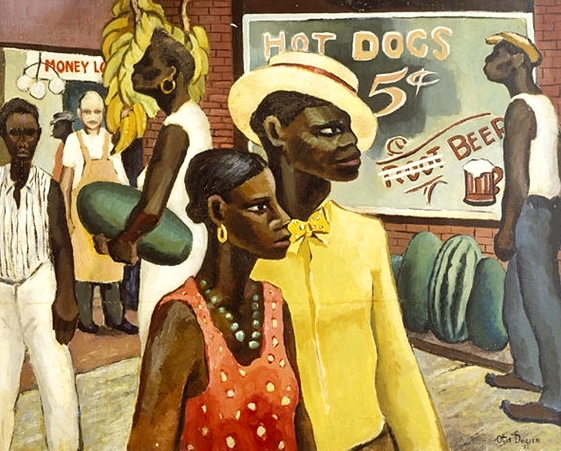
deep-elm-otis-dozier_1932“Deep Elm” – Otis Dozier, 1932

by Paula Bosse

“Deep Ellum Blues” has become a standard blues song, warning of/extolling the vices found in the once-thriving, predominantly black area of town, where a lot of people — black and white — enjoyed themselves (after dark) in clubs and bars, immersed in the sometimes shady goings-on that one tends to find on the other side of the tracks. The song (sometimes irritatingly called “Deep Elem Blues”) was first recorded in 1935 by the Lone Star Cowboys (popular performers in the Dallas area, better known as the Shelton Brothers). And now it’s become a blues standard, sung around the world by people who have no idea what a “Deep Ellum” is.

Below are four versions of the song that I like. (I searched for early performances by black musicians, but, according to Deep Ellum experts Alan Govenar and Jay Brakefield, there is only one that anyone seems to know about — by Booker Pittman, grandson of Booker T. Washington, and I couldn’t find it.)

But first, if you haven’t seen this wonderful short documentary by Alan Govenar about Deep Ellum in its original prime, it’s a must-see. (Bill Neely sings “Deep Ellum Blues” in this — it’s great. Listen for the extra verses.)

Below, the original version by the Lone Star Cowboys, who later changed their name to The Shelton Brothers and were well-known to Dallas audiences through their regular appearances at the Big D Jamboree and on local radio. (Listen to their follow-up, “What’s the Matter with Deep Elem?”)

My personal favorite, this hopping western-swing-big-band-rock-n-roll version by the always fabulous one-time Dallas resident Hank Thompson.

I can’t leave off this turbo-charged rockabilly version by Dallas’ own “Groovey” Joe Poovey!

And, finally, for good measure, one weird version, by the always reliable Charlie Feathers.

Remember y’all: KEEP YOUR MONEY IN YOUR SHOE!

***

Sources & Notes

“Deep Elm” painting by Otis Dozier (1932) — one of the Dallas Nine group — from the collection of the Dallas Museum of Art.

“Deep Ellum” film by Alan Govenar, one of Dallas’ leading blues and cultural historians and archivists. For more on the 1985 short film, see the FolkStreams site here. For Alan Govenar’s Documentary Arts website, see here.

For more on the history of Deep Ellum, I highly recommend Deep Ellum and Central Track, Where the Black and White Worlds of Dallas Converged by Alan B. Govenar and Jay F. Brakefield (Denton: UNT Press, 1998), as well as their recent revised/expanded book Deep Ellum, The Other Side of Dallas (College Station: Texas A & M University Press, 2013). Govenar and Brakefield have written the definitive history of Deep Ellum in these two volumes. You can read a bit about the song from the latter book here.

I wrote about another interesting song, “Dallas Blues” — considered by many to be the first blues song ever published — in the post “I’ve Got the Dallas Blues and Main Street Heart Disease,” here.

*

Copyright © 2014 Paula Bosse. All Rights Reserved.
Jordan Moore

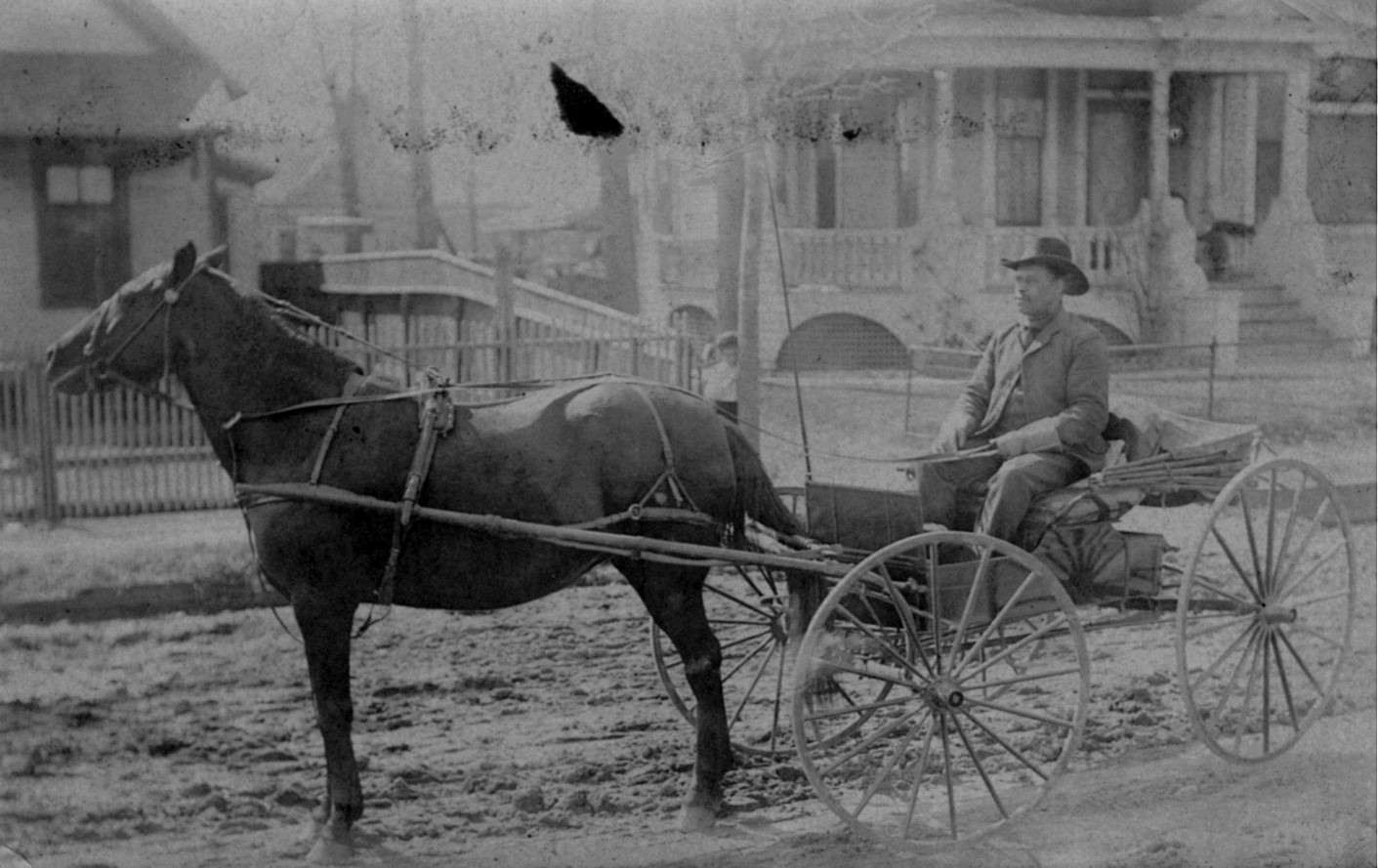
jordan-moore-buggy_c1905Jordan Moore, about 1905 (click for larger image)

by Paula Bosse

When wandering around the internet, one often encounters arresting images. Like the one above. There’s something about that photograph that grabs your attention. The stoic man in the buggy, the stiff, straight-standing horse, the child hiding behind the pole, the partial view of the porch of a fancy house, and the horrible, horrible condition of that street. The description reads simply: “Photograph of Jordan Moore seated in a horse-drawn carriage. Houses are visible in the background.” I wondered if I should know who Jordan Moore was, because the name wasn’t familiar. The photograph was in the collection that had been donated to the Dallas Historical Society by J. L. Patton, a prominent African-American educator. I found a few more photos of Mr. Moore in Patton’s collection, but I still had no idea who Jordan Moore was. So I did a little research.

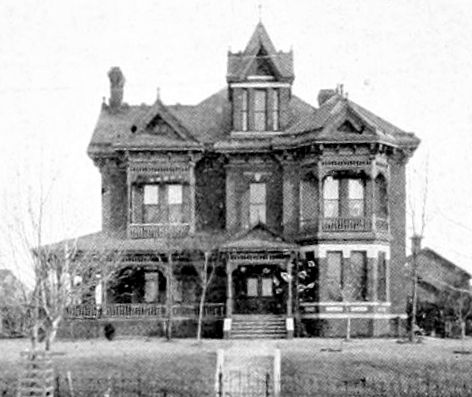
Jordan Moore was born in Virginia in 1863. At some point he made it to Texas, perhaps in the early 1880s, and then to Dallas a few years later. By 1893 he was working for Mrs. Miranda Morrill, who had moved to Dallas in 1886, following the death of her husband, Judge Amos Morrill. Though born in Tennessee, Mrs. Morrill had moved to Texas as a child in 1834 and had strong ties to the state (one of her uncles was a signer of the Texas Declaration of Independence). When she arrived in Dallas, she built an imposing mansion at Ross and Harwood and, as she had no children, she and her servants (as they were listed on census forms) had that huge house to themselves to ramble around in. Mrs. Morrill was a prominent mover-and-shaker in town, devoting her time and money to a host of worthy social causes. In her employ was Jordan Moore, who is listed variously as her coachman and yardman, and who resided on the property. He worked for her until she died in 1906 at the age of 80.

(Mrs. Morrill’s obituary is interesting for many reasons, but particularly because amongst her surviving family members were her half-brothers R. L. Moore and S. J. Moore, sons of Mrs. Morrill’s stepfather. I don’t know if Jordan Moore was born into slavery and was owned by members of Mrs. Morrill’s family, but it’s interesting that he shared a surname with his employer’s family.)

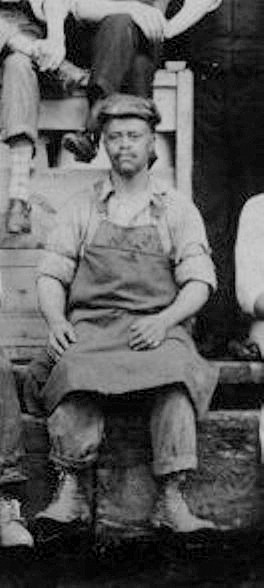
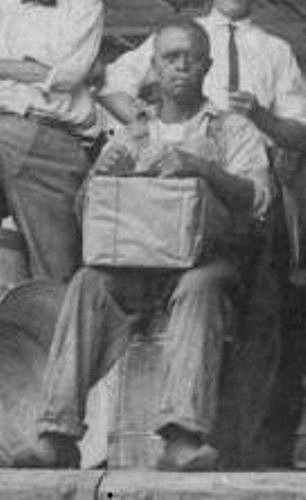
In 1907, after Mrs. Morrill’s death, Mr. Moore had moved to rooms elsewhere and went to work as a porter for the very large, very successful Huey & Philp Hardware Company at Griffin and Elm. Below are a couple of photographs of Moore and co-workers on the loading docks. He does not look very happy. He stayed at the job for 11 years but moved around from rooming house to rooming house — from Ross to Cochran to N. Harwood to Masten. (One of the captions on these photos states that Mr. Moore purchased a house on Cochran St. in 1900. I don’t think that’s correct. If he did buy a house, he doesn’t appear to have ever lived in it.)

Jordan Moore died on January 22, 1918, from complications of  diabetes. He was 54. He never married and had no children, and the friend he had been staying with when he died offered scant and approximate guesses as to dates and places when asked to supply them for the official death certificate.

I wondered why all these photos of a man who apparently left no family and had lived a fairly commonplace life had made their way into the personal collection of J. L. Patton, a principal at Booker T. Washington High School and a pioneer in education for African-American students in Dallas. And then I noticed that the name of the “informant” on the death certificate was Samuel Stanton, a long-time friend with whom Moore had been staying in his last days. Moore was the godfather of Mr. Stanton’s daughter, and Mr. Stanton’s daughter was Mr. Patton’s mother. Patton would have been 12 when Moore died, and he would certainly have remembered him — and one hopes he had fond memories of him.

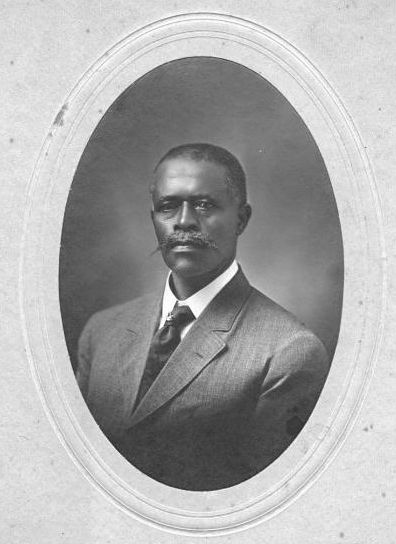
Jordan Moore was buried in Alpha Cemetery, one of the few “negro” cemeteries of the time, near the old freedmen’s town of Alpha, near present-day Preston and Alpha Road. Below are more photographs of Mr. Moore, now in the collection of the Dallas Historical Society.

jordan-moore-portrait_18901890

moore-loading-dock_c1905Mr. Moore (seated, second from left), Huey & Philp loading dock, ca. 1907

moore-det

moore-with-box_loading-dock_c1910Mr. Moore (seated, with box), Huey & Philp loading dock, ca. 1910-15

moore-box-det

jordan-moore-photo_c1910sca. 1910-15

morrill-house_1898Mrs. Morrill’s house at Ross & Harwood, 1894

morrill-house_lost-dallas_doty_dmnThe Morrill house — next stop: demolition, 1920

huey-philp_19091909 ad

huey-philp_1913_dmn_080212Huey & Philp Hardware Co., at Griffin and Elm — ca. 1913

***

Sources & Notes

Photos of Jordan Moore from the Dallas Historical Society’s J. L. Patton Collection, once viewable at UNT’s Portal to Texas History website. Top photo, c. 1905.

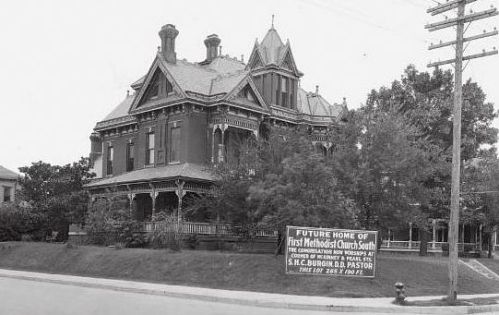
The first photo of Mrs. Morrill’s house at Ross and Harwood is from Clifton Church’s book Dallas, Texas Through a Camera (Dallas, 1894). (As an interesting aside, Church was married to Morrill’s niece.) In the book Dallas Rediscovered, the house is described thusly: “Mrs. Miranda Morrill’s dark, brooding residence, completed in 1886 by A. B. Bristol at the southwest corner of Harwood, was leveled in 1920 for construction of the First United Methodist Church.”

The second photo of the Morrill house is from Mark Doty’s book Lost Dallas (Charleston: Arcadia Publishing, 2012).

Huey & Philp Hardware Co. ad from Worley’s 1909 Dallas directory.

Lang & Witchell drawing of the Huey & Philp building is from a Dallas Morning News blog post by Steve Brown, here.

More on the accomplishments of J. L. Patton from the Handbook of Texas, here.

*

Copyright © 2014 Paula Bosse. All Rights Reserved.
 

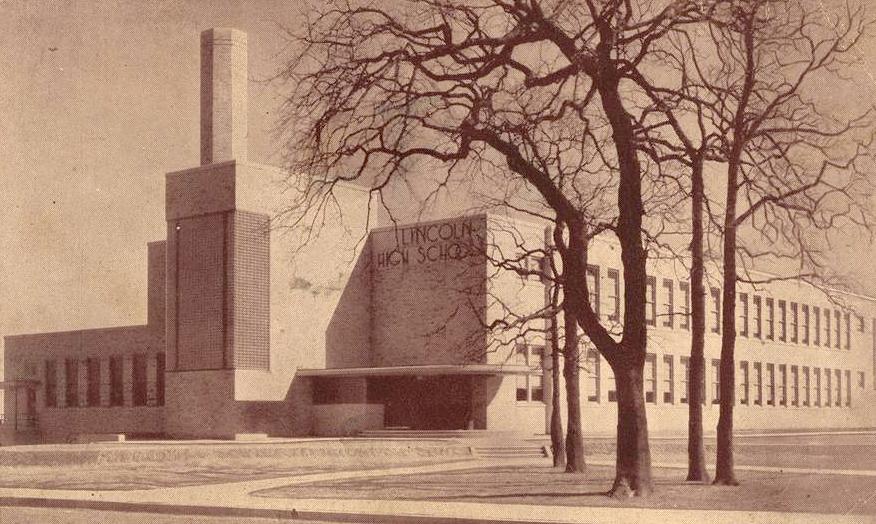
Lincoln High School — 1939

lincoln-high-school_1939The cool deco design of Lincoln High School… (click for larger image)

by Paula Bosse

When it opened on eleven acres in South Dallas in January, 1939, Lincoln High School was one of the largest high schools in Dallas, and one of the largest African-American high schools in the entire South. Shockingly, in 1939 it was one of only TWO (!) high school for black students in Dallas. As one would expect, its opening was greeted with great enthusiasm, and students rushed to enroll, pushing its capacity to a maximum. At its height, it had over 3,000 students. The building was designed by architect Walter C. Sharp, who designed many schools in and around Dallas, and with those clean lines and glass bricks, it’s pretty cool.

***

Photo from the J. L. Patton Collection, Dallas Historical Society.

For more on the background of Lincoln High School, see the info from the “Open Plaques” project here.

Click photo for larger image.

*

Copyright © 2014 Paula Bosse. All Rights Reserved.

“How to Use Central Expressway” — 1949

by Paula Bosse

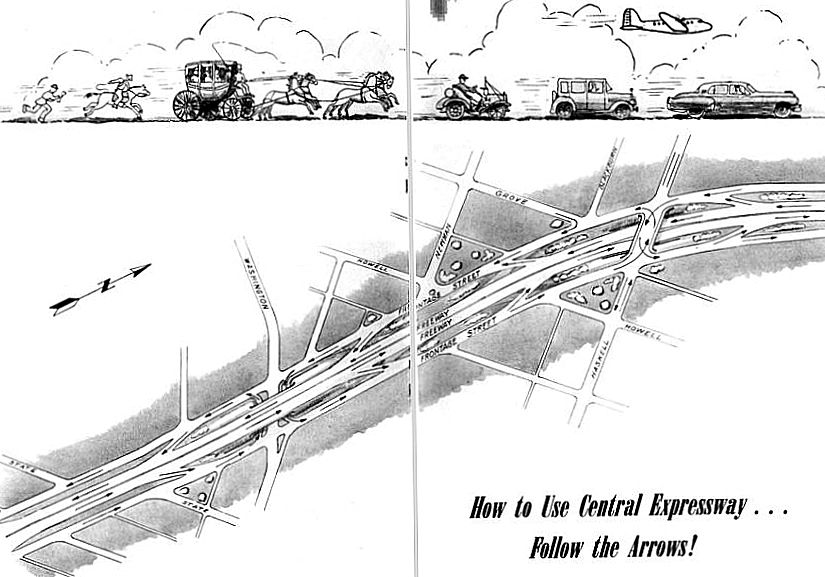
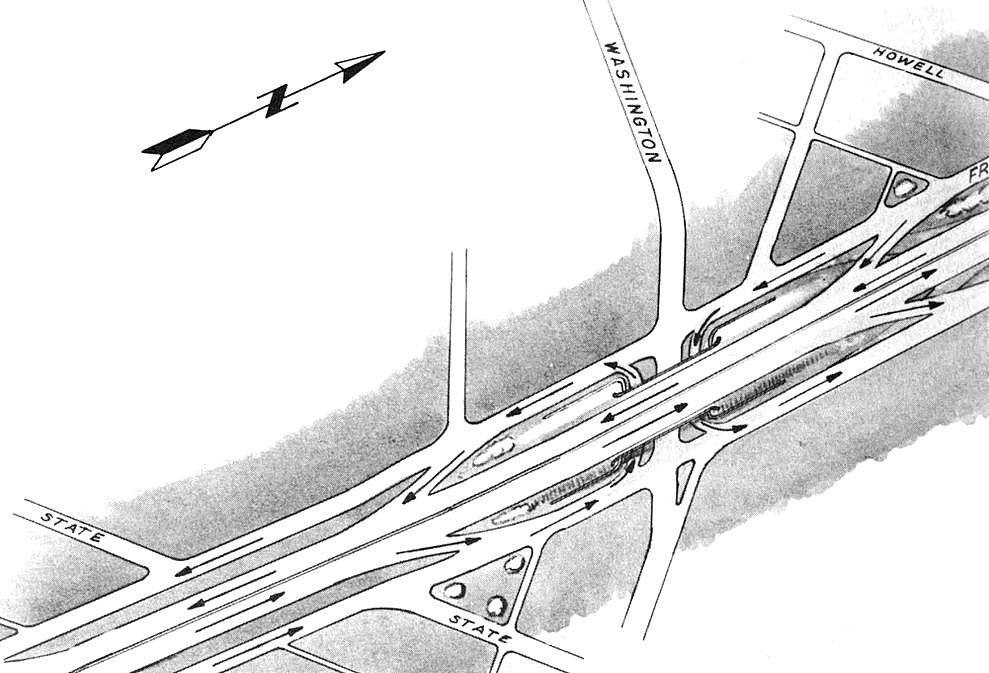
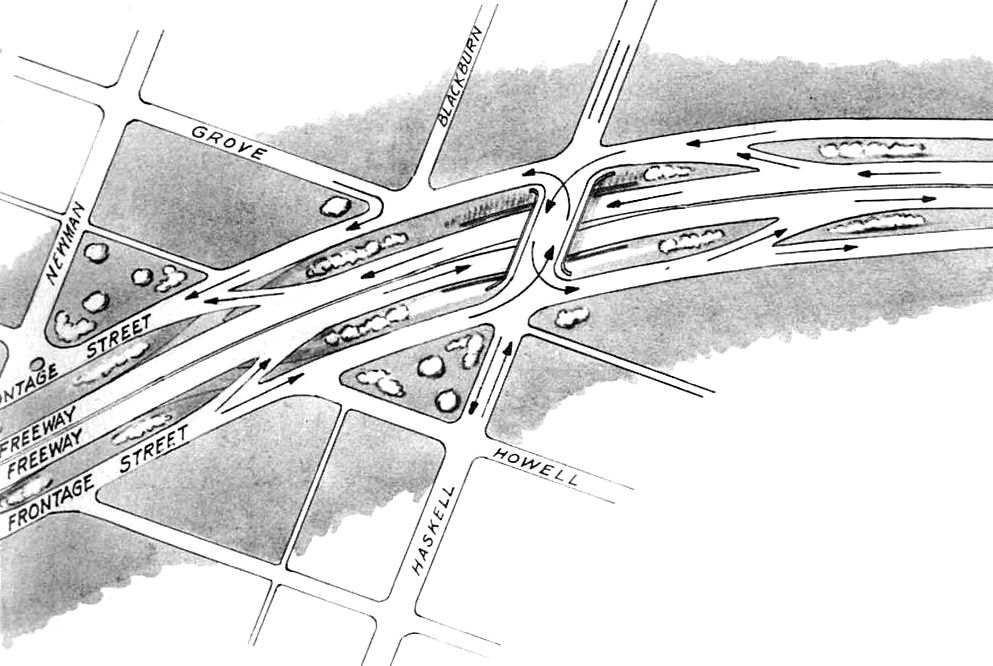
It got only to Fitzhugh from downtown at this point, but the freeway concept was new enough that Dallas drivers needed some instruction on how to use Central Expressway. Cute.

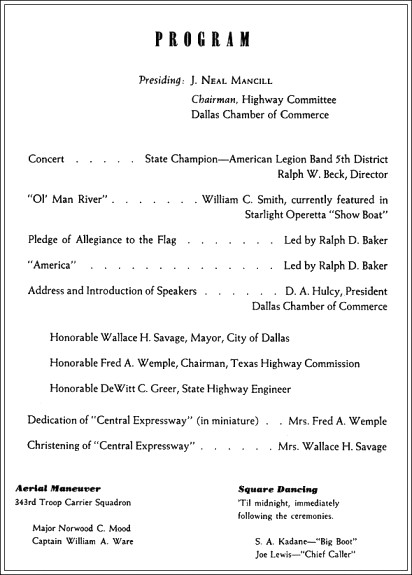
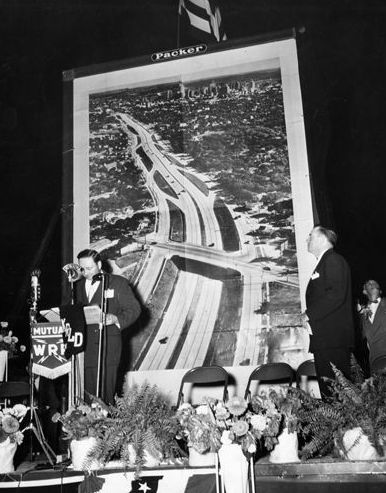
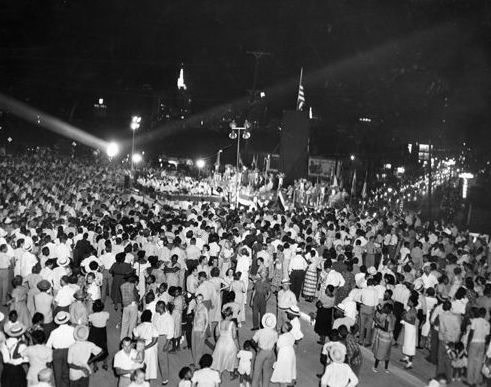
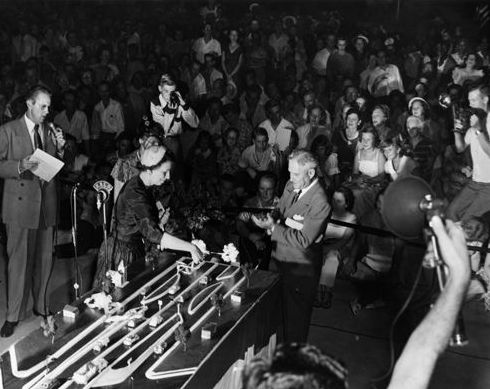
Cuter still, the dedication ceremony. It included the singing of — what else? — “Old Man River,” the Pledge of Allegiance, some sort of aerial fly-over, and, of course, square dancing (two square dances, one for white dancers, one for black). Oh, and the mayor’s wife christened the expressway with a bottle of cologne. (How much more Dallas can you get?) (Many of the images and articles below are larger when clicked.)

The opening ceremonies were covered extensively by the local papers. My favorite tidbit from the coverage was a quote by Mayor Wallace Savage on how the new highway will psychologically benefit the city’s drivers. His hope and expectation is that driving along Central Expressway will make drivers “more relaxed when they get home from the office, and in a better mood when they get to the office from home.” Again, cute.

*

central_opening_haskins_briscoe-ctr1

Above, Neal Mancill, Chairman of the Highway Committee of the Dallas Chamber of Commerce. Photo by Squire Haskins.

central_opening_haskins_briscoe-ctr2

The segregated celebration had black celebrants in one area and white celebrants in another. Photo by Squire Haskins.

central_opening_haskins_briscoe-ctr3

Mrs. Fred Wemple, wife of the Chairman of the Texas Highway Commission, cutting the ribbon on a miniature replica of Central Expressway. Photo by Squire Haskins.

*

But back to the lesson. THIS is how you use Central Expressway — just follow the arrows! The two halves of the larger map above are here magnified (click!) to more easily facilitate wistful inspection of an artifact from a simpler time when the city looked forward to experiencing a calm, restful, non-stop drive along the Central Expressway.

ht-use-central-1

ht-use-central-2

central-expressway

***

To peruse the entire pamphlet titled Central Expressway… San Jacinto to Fitzhugh, Dedication August 19, 1949 (Dallas: Dallas Chamber of Commerce, 1949), click here.

Photos by Squire Haskins from the Dolph Briscoe Center for American History.

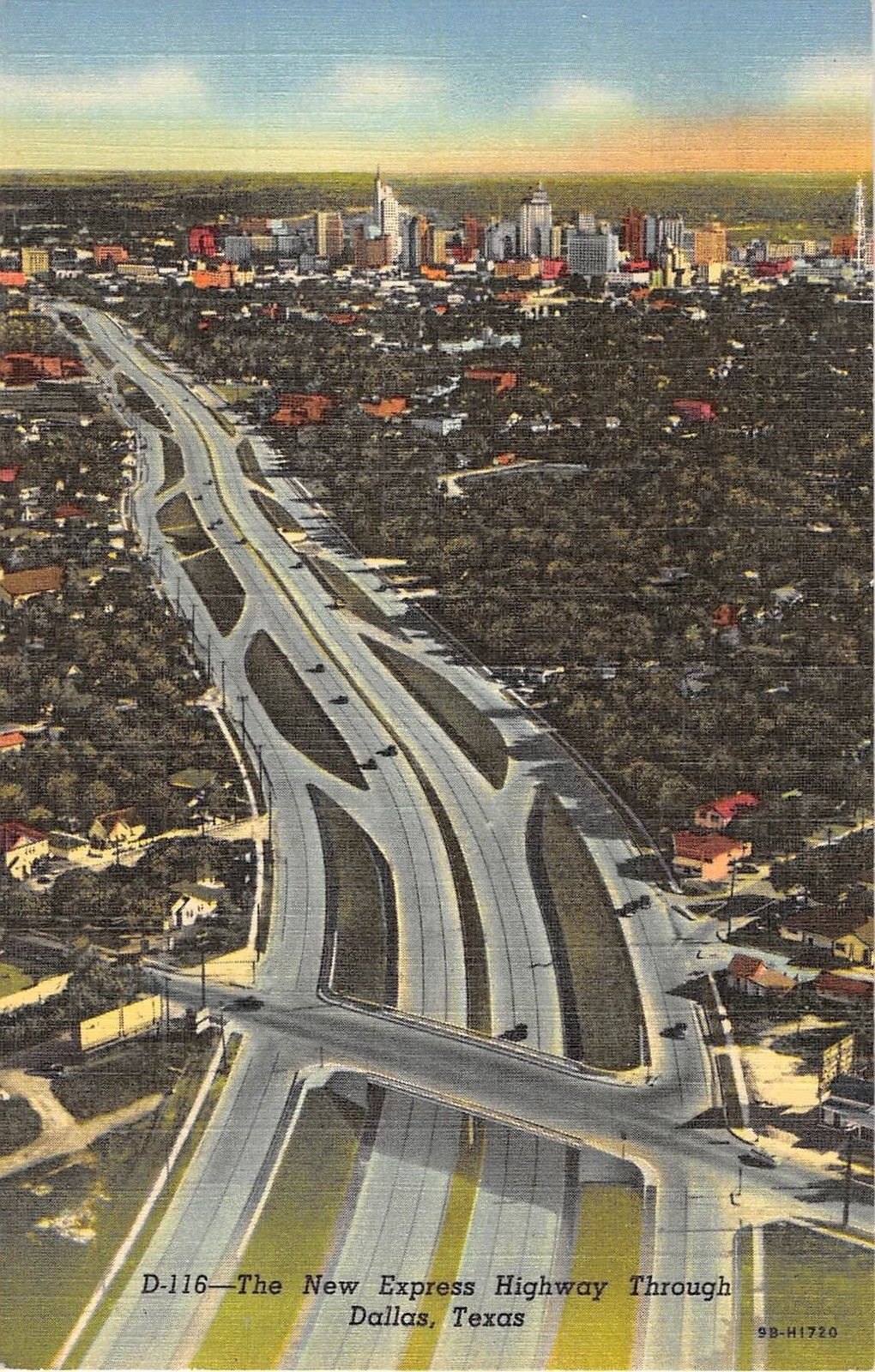
Postcard from a photo by Squire Haskins (click to see GIGANTIC image).

When in doubt, click pictures to see if images are larger.

*

Copyright © 2014 Paula Bosse. All Rights Reserved.

Leaving Dallas on the Katy Flyer — ca. 1914

leaving-dallas-katy-flyer1

by Paula Bosse

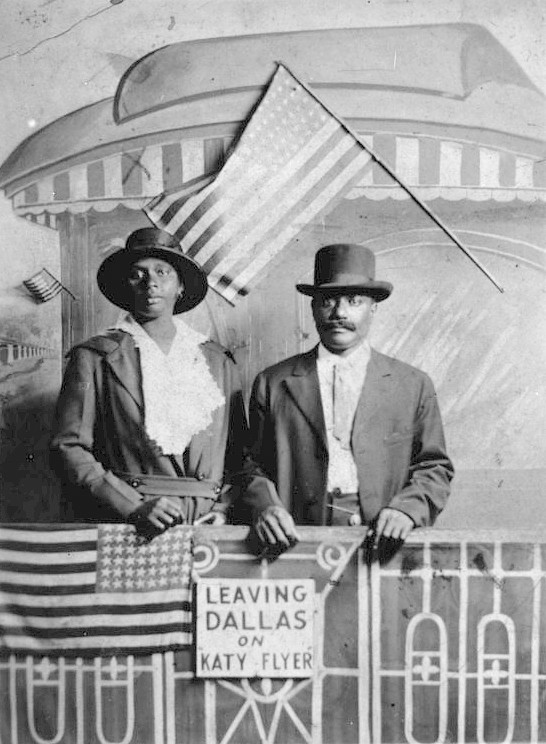
Who doesn’t love kitschy novelty photos? These “Leaving Dallas on the Katy Flyer” snapshots don’t disappoint with their cartoony backdrops — like something you’d see along a seaside boardwalk.

katy-flyer_three-men_1915_ebay
The people above are not identified, but, below, it’s a bunch of Order of Railroad Telegraphers union bigwigs. They probably had a wild time in Dallas. One or two of them look like they might be nursing a hangover.

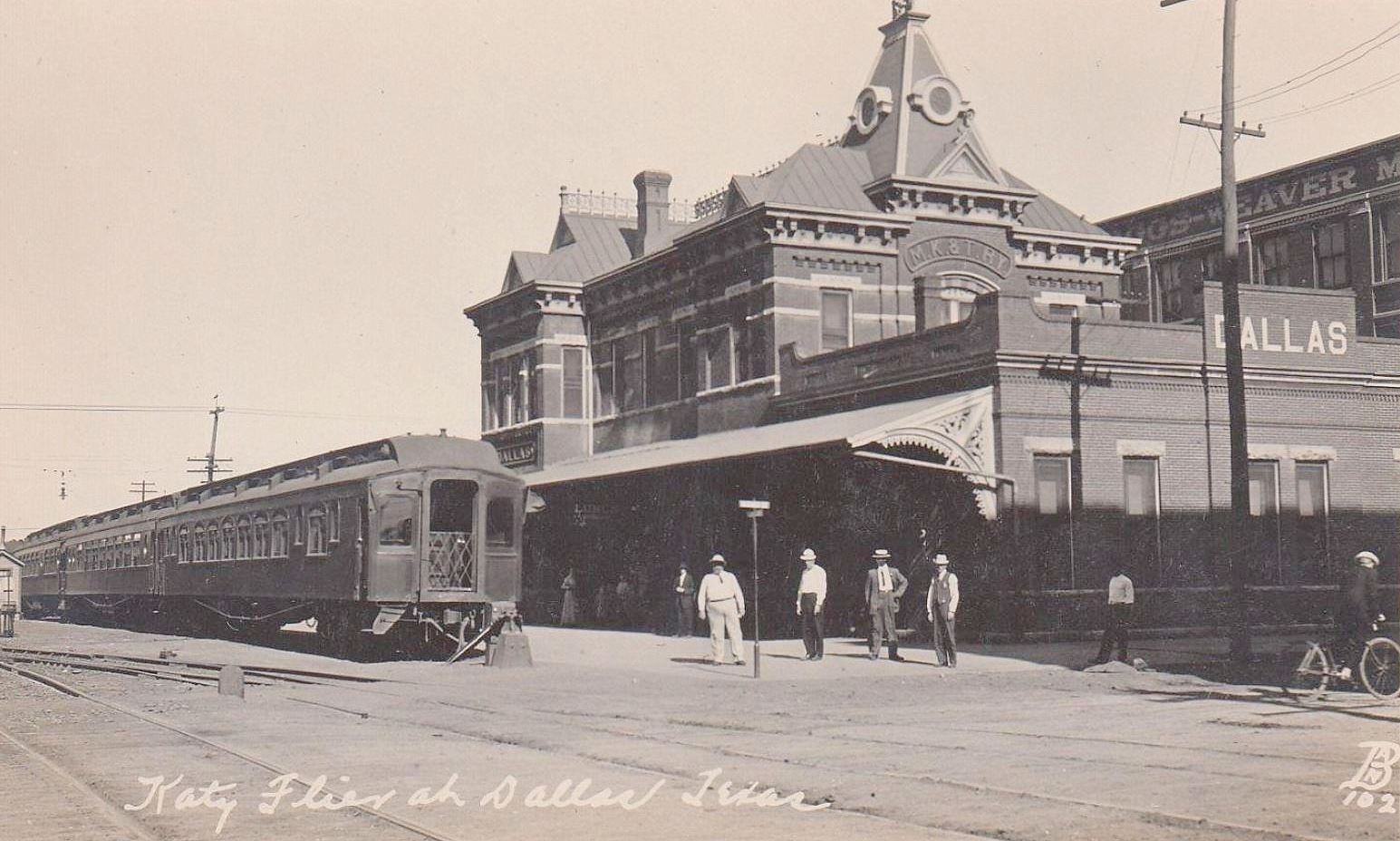
And just where was the point of departure from Big D for these Katy Flyer travelers? From the beautiful MKT passenger depot, formerly holding down the rails at Ross and Market.

katy-flyer_MKT_ebay_rppc

***

Sources & Notes

Top “real photo postcard” is from the J. L. Patton Collection, Dallas Historical Society.

Second photo was found on a postcard website.

Third photo is from eBay.

“O.R.T. General Committee” photo from — what else? — an issue of The Railroad Telegrapher (Feb. 1914).

Photo of the Missouri, Kansas & Texas depot is another real photo postcard, found on eBay.

See another Katy Flyer post — “M-K-T Railroad’s ‘Katy Flyer Route’ — 1902” — here.

*

Copyright © 2014 Paula Bosse. All Rights Reserved.


Booker T. Washington Marching Band — 1937

booker-t-washington_marching-band_1937_dhs

by Paula Bosse

Marching band. Everyone’s favorite class in high school. Band director A. S. Jackson is at the right.

***

Sources & Notes

From the J. L. Patton Collection, Dallas Historical Society.

*

Copyright © 2014 Paula Bosse. All Rights Reserved.