Flashback : Dallas

A Miscellany: History, Ads, Pop Culture

Category: Architecture/Significant Bldgs.

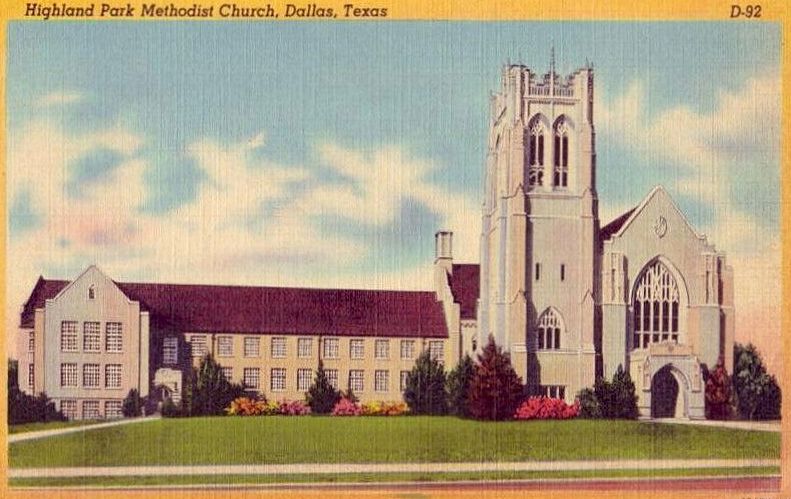
Highland Park Methodist Church — 1927

hp-methodist-church_1927-degolyerHighland Park Methodist Church, 1927 (click for larger image)

by Paula Bosse

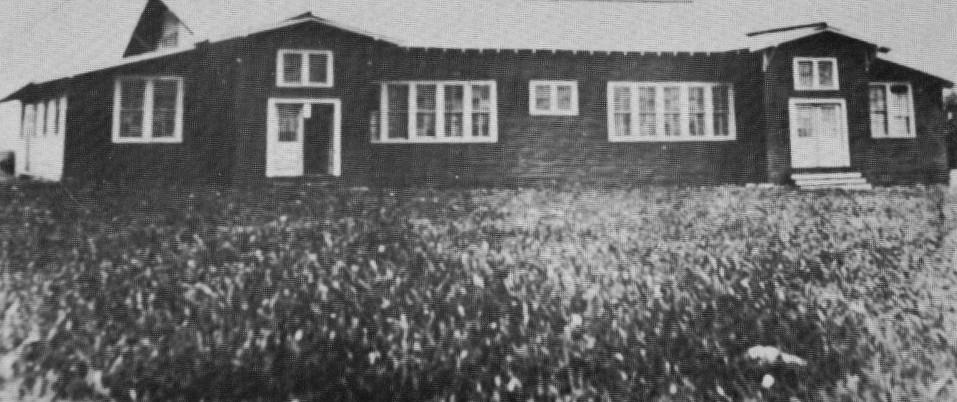
The beautiful Highland Park Methodist Church (now Highland Park United Methodist Church) was designed by architects Mark Lemmon and Roscoe DeWitt (who also designed several of the buildings on the adjacent SMU campus, as well as Woodrow Wilson and Sunset high schools, to name only a few of their projects). According to the HPUMC website, the first church — a temporary building which was referred to as “The Little Brown Church” — was built at Mockingbird and Hillcrest in 1917. It wasn’t until 1927 that the beautiful French Gothic-inspired building we know today was built on that same site. (At one time, Highland Park Methodist Church was the largest Methodist church in the world.)

(Incidentally, Mark Lemmon built his lovely cottage-like home on Mockingbird, across the street from both the church and the SMU campus, where at any time of the day or night, he could look out his front window and gaze with satisfaction upon his beautiful church and the ever-growing university campus dotted with buildings he had designed.)

hp_methodist-church_post-card-series“The Little Brown Church” — built 1917

hpmc_postcard_color

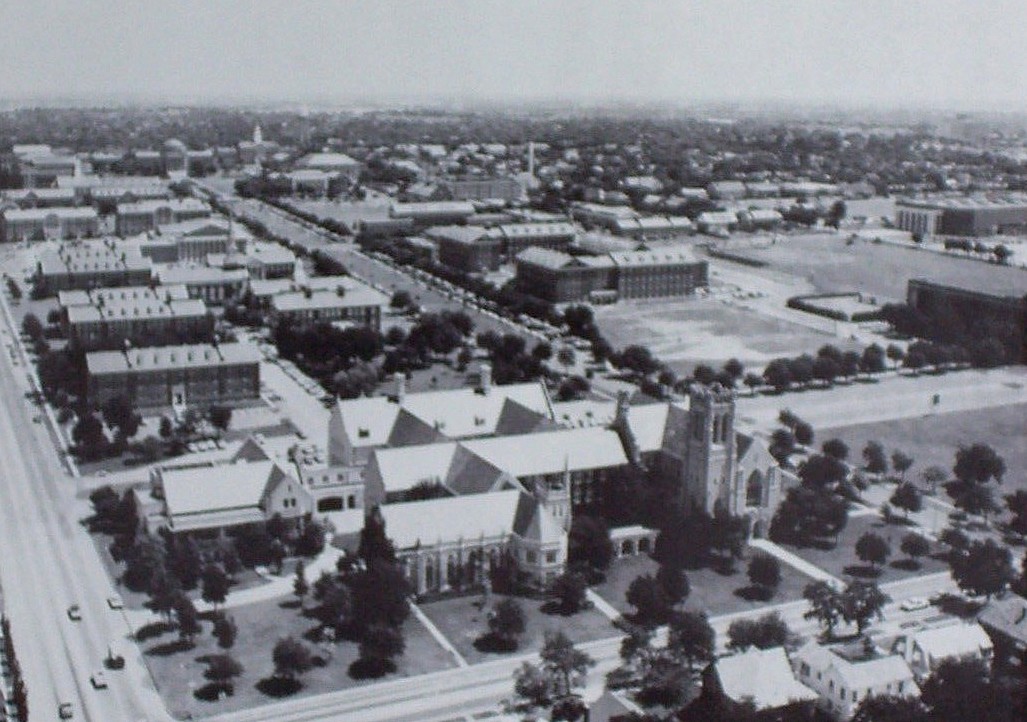
hpmc_golden-prologue-backChurch and SMU campus, Hillcrest and Mockingbird, 1960s

Highland Park Methodist Church Dallas, TX

***

Top photo by Joseph Neland Hester, taken in 1927. From the DeGolyer Library, Central University Libraries, Southern Methodist University; photo can be seen here. (UPDATE: I erroneously labeled the direction of this photo previously. It actually shows the back of the church, looking toward Mockingbird. It would have been taken from about where the Meadows Museum is now. If this is incorrect, please let me know!)

Photo of “The Little Brown Church” from the Park Cities Bank Heritage Series, used courtesy Lone Star Library Annex Facebook Group.

Aerial view from the back cover of Golden Prologue to the Future: A History of Highland Park Methodist Church by Doris Miller Johnson (Parthenon Press, 1966).

Other images from postcards.

For more on the history of Highland Park United Methodist Church check out the Wikipedia page here; check out the church’s history page here.

All photos larger when clicked.

*

Copyright © 2014 Paula Bosse. All Rights Reserved.

Dallas’ Frank Lloyd Wright Skyscraper — 1946

frank-lloyd-wright_rogers-lacy_1946-smThe Rogers Lacy Hotel, designed by Frank Lloyd Wright

by Paula Bosse

Feast your eyes on that fantastic skyscraper. That building was *this close* to being built in Dallas. And even though it was designed in 1946 (!), it looks modern enough to fit right in with the city’s celebrated 21st-century skyline.

Frank Lloyd Wright designed this 47-story hotel for millionaire East Texas wildcatter Rogers Lacy, to be built at the southwest corner of Commerce and Ervay, catty-corner from the also fabulous (if not quite so futuristic-looking) Mercantile National Bank Building.

Even though he had a firm distaste for the overly-populated, traffic-clogged, modern American city, Wright jumped at the chance to design a hotel smack dab in the middle of one of the country’s largest and fastest-paced cities. In fact, the Lacy Hotel was one of Wright’s pet projects, and he went all-out in his attempt to convince his wavering client of the merits (both aesthetic and utilitarian) of the multi-million-dollar skyscraper he had, apparently, been dreaming of for decades.

While Wright worked on swaying Lacy in his favor, John Rosenfield — the influential arts critic of The Dallas Morning News — worked on winning over the people of Dallas. Rosenfield really pulled out the stops when writing about the project; his promotion of the proposed hotel (in print as well as behind-the-scenes) was as tireless as it was passionate.

The startlingly new architectural design combined with Wright’s salesmanlike pronouncements on how he had transcended what he saw as the crushing gloom of hotel space caused quite a bit of excitement. Lacy, the Texas oil man with deep pockets, was eventually won over. But a client’s enthusiasm and an architect’s full-bore persuasion can sometimes go only so far. After an initial gung-ho response from the Lacy camp, communication with Wright began to get spotty (causing a freak-out at Taliesin), and plans never really got underway. When Lacy died unexpectedly at the end of 1947, the project was scrapped, and Frank Lloyd Wright’s dream of a soaring glass skyscraper was never realized.

If only we could go back and nudge Rogers Lacy to sign off on this building’s construction. It’s amazing how Wright’s concept here predicted the later glass-clad, atrium-centered architecture that has been a Dallas staple for decades. If Wright’s Lacy building were announced today — even without the weight of Frank Lloyd Wright’s name attached to it — I think news of its construction would, again, be met with excitement.

***

Sources & Notes

The Frank Lloyd Wright drawing of the proposed Rogers Lacy Hotel is from the cover of the Spring 2009 issue of Legacies: A History Journal for Dallas and North Central Texas. Charles T. Marshall’s extremely entertaining article, “Where Dallas Once Stood: Frank Lloyd Wright and the Rogers Lacy Hotel,” is in this issue, and it’s a great read, illustrated with photos of the key players and additional architectural drawings of the hotel; you can read the full article here.

Wright’s biggest champion in Dallas was legendary Dallas Morning News critic John Rosenfield (he and Wright were also personal friends). His articles on the proposed Rogers Lacy hotel appeared in the DMN, including the ones listed below:

  • “Famed Architect Confers on New Dallas Hotel Plans” (DMN, March 28, 1946)
  • “47-Story, Windowless Dallas Hotel Designed by Celebrated Architect” (DMN, July 28, 1946) — Rosenfield’s extensive, soaring description of the planned building
  • “Dallas’ Dream Hotel Soon Coming To Life” (DMN, Aug. 11, 1946)
  • “Wright Bares Lacy Hotel Plans” (DMN, June 22, 1947) — the unveiling to the Dallas public of the final plans (which was accompanied by the images contained in the Legacies article linked above)

*

Copyright © 2014 Paula Bosse. All Rights Reserved.

Happy 75th Anniversary, Stonewall!

1938-stonewall-jackson-elementary-school_renderingStonewall Jackson Elementary School, 1938 rendering (click for larger image)

by Paula Bosse

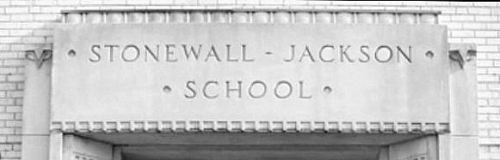
Classes begin today for students in DISD schools, one of which is Stonewall Jackson Elementary School, located at Mockingbird and Matilda. Stonewall turns 75 years old this year (2014), and I’m proud to say it’s where I spent many years as a happy student. When I learned recently that the school had originally been built as a single-story building (instead of the two stories we know today), I was pretty surprised, and this little unknown nugget prompted me to look into the early years of my alma mater.

In the 1920s and ’30s, Dallas was expanding very quickly northward from Vickery Place, the residential neighborhood around Belmont and Greenville. As the area we now know as Lower Greenville and the M Streets was developed, the two elementary schools (Vickery Place School, then at Miller and McMillan, and Robert E. Lee, at Matilda and Vanderbilt) were soon filled to capacity. Building a new school to serve burgeoning “Northeast Dallas” was an immediate necessity. So in 1938, the city purchased a 9-acre chunk of land along Mockingbird, one block east of Greenville Avenue and right alongside the Denison interurban tracks that ran on Matilda (when I was growing up a couple of blocks away, I used to see remains of those tracks but didn’t know what they had been used for — I wrote about those tracks here and here). The land had been part of the vast Caruth land holdings.

The building was designed by architect C. H. Griesenbeck. It had eleven classrooms, a cafeteria, and an auditorium with a seating capacity of 400. Although originally built as a one-story building, Griesenbeck was mindful that expansion would be necessary in the future, and his design took into account that a second story would be added in the years to come. Construction began in late 1938 and was scheduled to be completed for the opening of the 1939-40 school year.

The name of the new school was decided upon a few months later:

“Stonewall Jackson’s name was chosen for the new school, Dr. Norman R. Crozier, superintendent, said because of the high ideals of Thomas Jonathan Jackson, one of the unique and romantic figures of the War Between the States, and as a companion to its nearest school, Robert E. Lee.” (Dallas Morning News, Feb. 1, 1939)

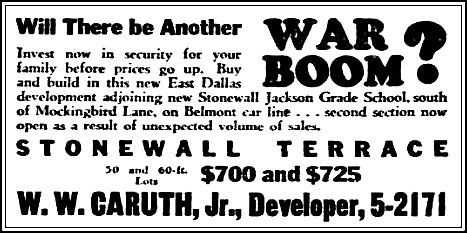
But if you’re going to sink a hundred thousand dollars into a school, you’ve got to have houses for families to live in to make sure your future student pool doesn’t run dry — and at that time very few houses had been built that far north. Cut to W. W. Caruth, Jr., son of the Caruth family patriarch who basically owned everything north of Mockingbird (Caruth owned a huge expanse of land once estimated at being over 30,000 acres). Not long after selling the land at Mockingbird and Greenville to Dr Pepper, Caruth fils began to develop the land around the then-under-construction school — he called the new neighborhood “Stonewall Terrace.”

The property went fast.

stonewall-terrace_dmn_092339September, 1939

As the neighborhood was taking shape and the construction of the school building was nearing completion, the school’s official boundaries were announced:

“Boundaries of the Stonewall Jackson School will be from the alley south of Morningside on the east side of Greenville Avenue and from the alley south of Mercedes on the west side of Greenville to the M-K-T Railroad on the north.” (DMN, Sept. 3, 1939)

Despite some problems with labor shortages, the school managed to open on time, on Sept. 13, 1939, the start of the new school year.

The school and the neighborhood grew quickly, and the number of students soon doubled. In 1950 the school board approved preliminary plans for an addition to the school. This addition (which would cost $369,000 and be handled by the architectural firm of Tatum & Quade) would include a first-floor wing with four classrooms, a gymnasium, and a lunchroom, and a second story containing eight classrooms, a library, and a music room. (The cost of construction would probably have been quite a bit more had the original architect not had the foresight to design the building with the expectation that a second story would be added in the future.)

The construction was substantial enough that it had to be done during the 1951-52 school year. Because the old lunchroom was being dismantled while the new wing was being built, students were required to bring their lunches the entire year. All they could get at school was milk. No fish sticks, no Salisbury steak, no chess pie. Just milk. Sorry, kids.

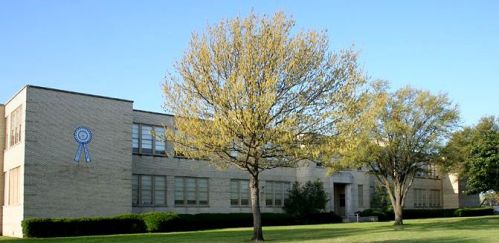
The new addition was completed in time for the beginning of the 1952 school year. And that’s the version of the building that stands today, looking pretty much unchanged.

stonewall_front

It was a cool building then, and it’s a cool building now. It’s sad to see how much of the playing fields keep disappearing as ugly portable buildings take over, but the new garden is a great new addition — I wish they’d had that when I was there.

I really loved that school. When I was a student there, grades went from 1st to 7th, and I loved all seven years I spent there. Thanks for the great childhood memories, Stonewall. And Happy 75th Anniversary!

stonewall-nowPhoto: DISD

***

Sources & Notes

Top image is architect C. H. Griesenbeck’s architectural rendering of Stonewall Jackson Elementary School, originally a one-story building.

Here are a few articles to check out in the Dallas Morning News archives:

  • “$11,250 Offer Made for New School Site” (DMN, Oct. 26, 1938)
  • “Contracts for $104,150 Let on Northeast Dallas School” (DMN, Dec. 22, 1938)
  • “New Northeast Dallas School Named Jackson; Board Pays Tribute to Famous General” (DMN, Feb. 1, 1939)

And, yes, it probably sounds weird to outsiders, but students actually do call the school “Stonewall” — just like we call Woodrow Wilson High School (the high school Stonewall feeds into) “Woodrow.” It’s like a secret handshake.

Below, an undated photo from DISD’s Pinterest board (if you squint, you can see the Piggly Wiggly at the southwest corner of Mockingbird and Matilda).

stonewall_DISD-pinterest

UPDATE: After years of controversy, Stonewall Jackson Elementary School will be rechristened “Mockingbird Elementary” in 2018. Whatever its name, it’s still a great school!

*

Copyright © 2014 Paula Bosse. All Rights Reserved.

Oak Cliff Presbyterian Church, Organized 1890

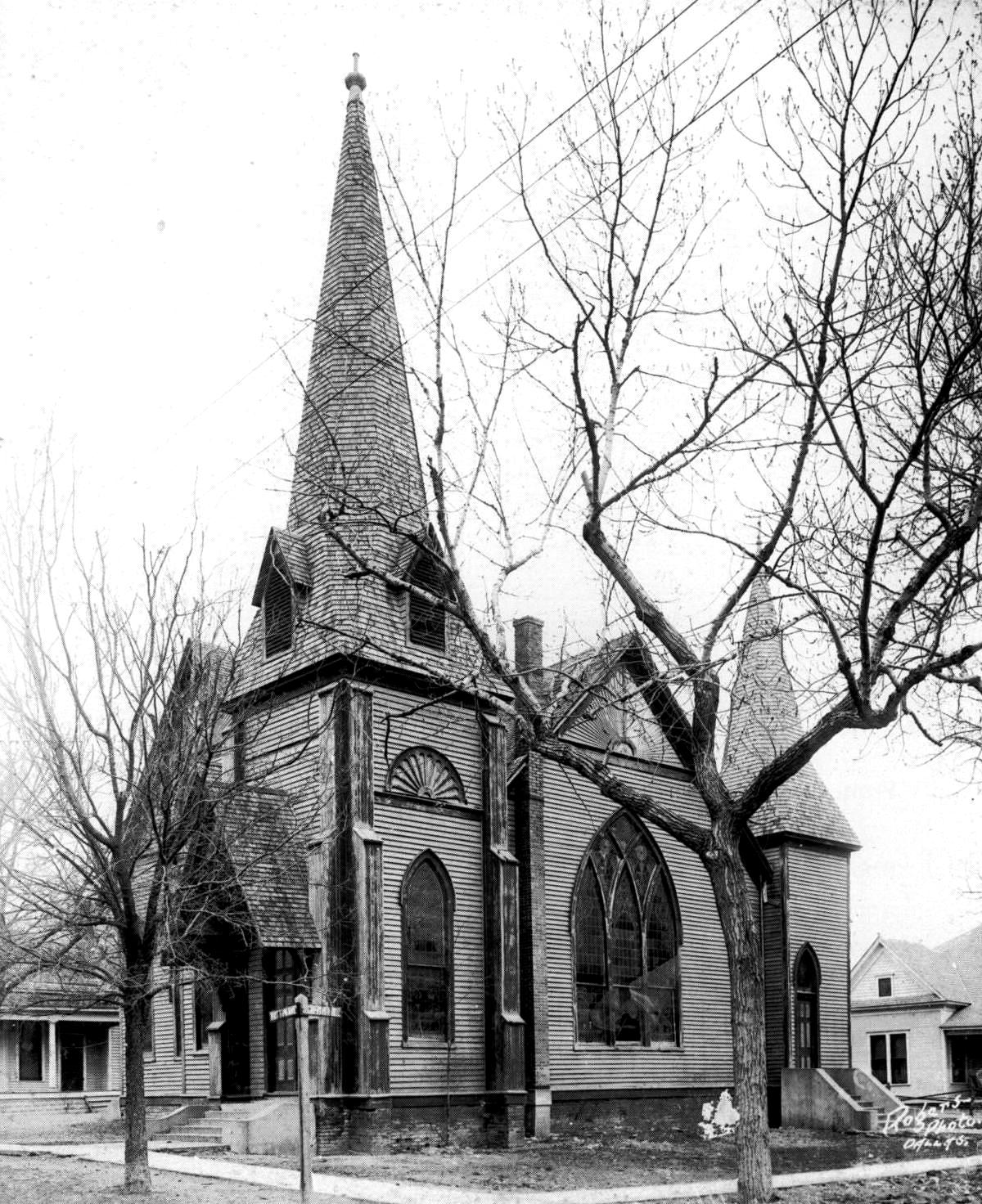
oak-cliff-presbyterian_smOak Cliff Presbyterian Church, ca. 1897

by Paula Bosse

I came across this photograph of a church a couple of days ago and was mesmerized by its charming woodiness. According to its caption, it was the Oak Cliff Presbyterian Church, at the corner of Ninth Street and St. George (now Patton). Its first pastor was the Rev. W. L. Lowrance who had organized the church in 1890 with fewer than twenty members. Church membership grew steadily, and in 1923, having finally outgrown the small wood frame building, the congregation moved to their next location at Tenth and Madison (contributing to Tenth Street’s appearance in Ripley’s Believe It Or Not as the street having more churches per mile than any other street in the world). At some point this lovely church was razed.

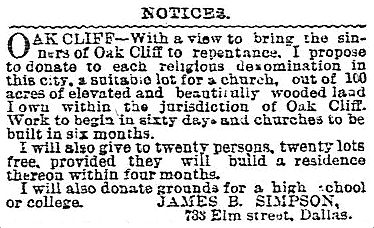
I’ve found little else on its earliest history. but I came across this advertisement placed in The Dallas Morning News in 1891:

simpson_oak-cliff-land-donation_dmn_031491(DMN, March 14, 1891)

Col. James B. Simpson was something of a learned Renaissance-man around Dallas. He had been the editor of The Dallas Herald for many years and was a civic leader with real estate interests. I’m not sure if this ad has anything to do with the establishment of the Oak Cliff Presbyterian Church, but it’s interesting to note that construction of the new church was mentioned as being under construction one month after this ad’s appearance. Time was running out for those Oak Cliff sinners (even though one newspaper report stated that the building wasn’t occupied until 1893).

Rev. Lowrance, an apparently well-liked and respected pastor, retired at the end of 1903.

lowrance_dmn_122903-photo“Dr. W. L. Lowrance of Oak Cliff”

lowrance_dmn_dmn_122903(DMN, Dec. 29, 1903 — click for larger image)

The Oak Cliff Presbyterian Church lives on, now on S. Hampton. One can only assume that the building it occupies today is not quite as charming as the little woody one that was built 120 years ago.

***

Sources & Notes

Top photo (by the Rogers Photo Studio, circa 1897) appeared in the Fall 2009 issue of Legacies magazine, here.

Though the first Oak Cliff Presbyterian Church was on Ninth St., the second one was on Tenth St., and that seems reason enough to direct attention to the article “Road to Glory: Tenth Street Becomes Church Street” by René Schmidt — it appeared in the same issue of Legacies as the church photo, and you can read it here.

Read more about this “Street of Churches” and its staggering fourteen churches (!) in the May 1, 1950 edition of The Dallas Morning News.

*

Copyright © 2014 Paula Bosse. All Rights Reserved.

Henry Stark’s “Bird’s Eye View of Dallas” — 1895/96

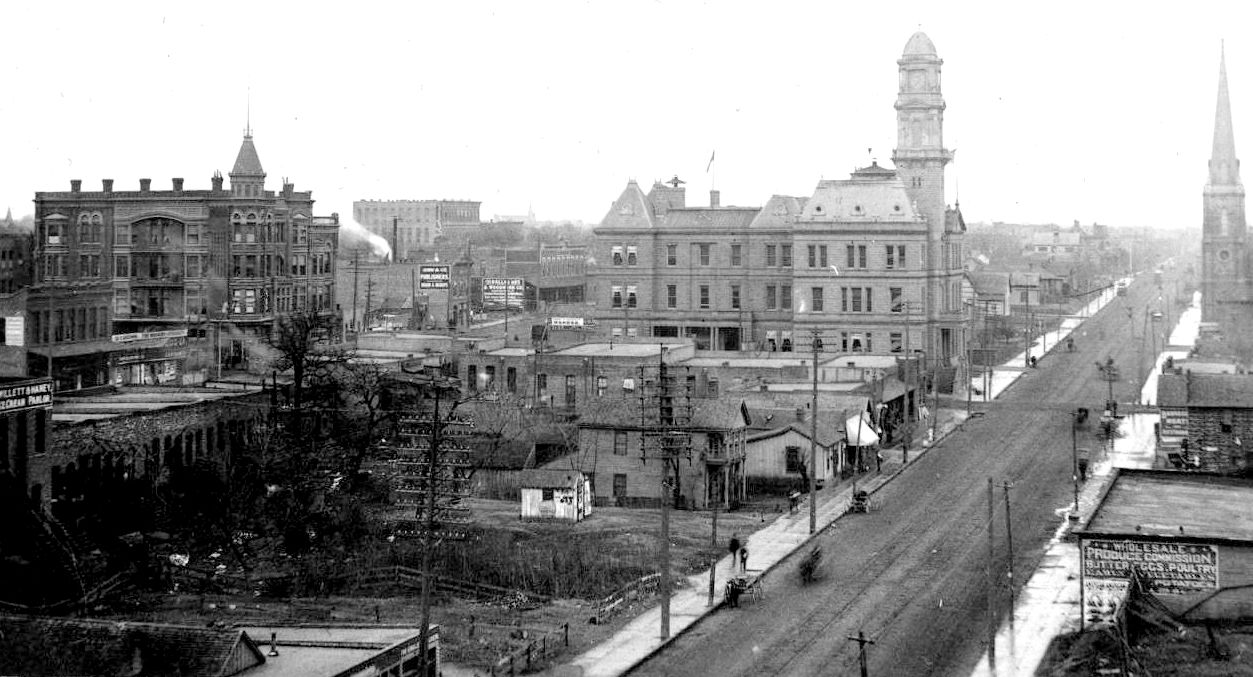
stark_downtown_1895-96_hplCommerce St. looking east from about Akard

by Paula Bosse

In the winter of 1895-1896, a St. Louis photographer named Henry Stark traveled to Texas, photographing scenes and vistas across the state. According to The Handbook of Texas, he is believed to be “the first photographer to have made an extensive photographic record of Texas.” A collection of his photos was published under the title Views in Texas.

The photograph above shows Commerce Street looking east, with the post office and its tall clock tower dominating the scene (the clock shows that it is 9:35 in the morning). The Old Post Office was bounded by Main, Ervay, Commerce, and St. Paul.

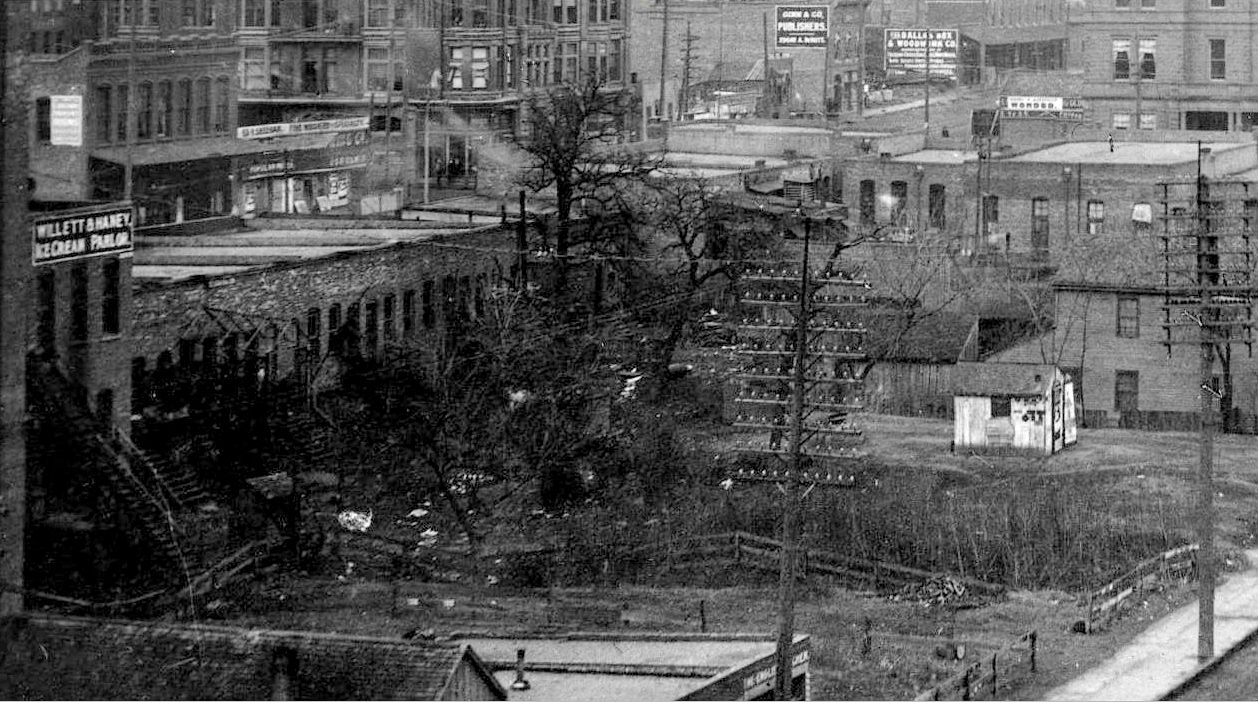
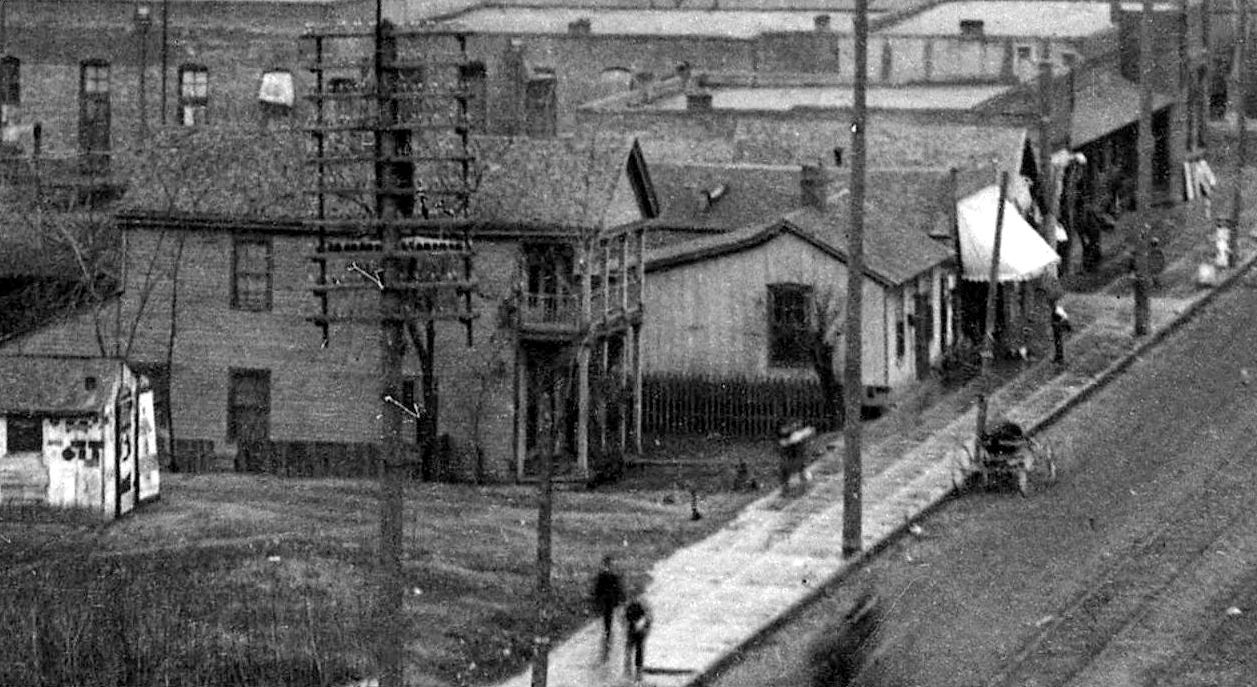
This is a great photo, showing Dallas as I’ve never seen it before. I’ve zoomed in to see the “hidden” details. (All photos are larger when clicked.)

stark_det1What is the building on the left? It’s very unusual-looking. (UPDATE: See the comments below. This appears to be the adjoining Bookhout and Middleton Buildings at Ervay and Main.)

stark_det2This is my favorite detail. All that trash. And vacant lots. And a haphazard, meandering fence. Are those steps leading to rear entrances of buildings facing Main? And those utility poles! That block looks kind of squalid. Not Dallas at its best. I think this would be around Akard. (UPDATE: A reader wrote to say that this looks like a “ravine” — that the fence may be following the course of an old stream — something that might explain why that area of prime real estate hadn’t been developed yet.)

stark_det3Houses just a few steps from the giant post office building. Horse-drawn buggies parked at the curb. People on the sidewalk. What looks like a man with his hands on his hips looking down at a child. Or maybe a dog.

stark_det4A bustling Commerce Street at the intersection of Ervay, with trollies in the distance.

*

This photograph shows almost exactly the same view as one I posted earlier under the title “Something Like N.Y.” — check out the 1904 version here.

***

Sources & Notes

The photograph, by Henry Stark, is from the Houston Metropolitan Research Center, Houston Public Library. The resolution is a bit grainy when trying to enlarge the details — to explore the photo for yourself, see it here.

What little is known of Henry Stark can be read in the brief Handbook of Texas bio, here.

For another Henry Stark photo, see the post “Oak Cliff Trolley — 1895,” here.

For other examples of photographs I’ve zoomed in on to reveal unintended vignettes, see here.

*

Copyright © 2014 Paula Bosse. All Rights Reserved.

Expo Park, Circa 1946: Dry Goods, Rooms to Let, Sheet Metal, and Head-In Parking

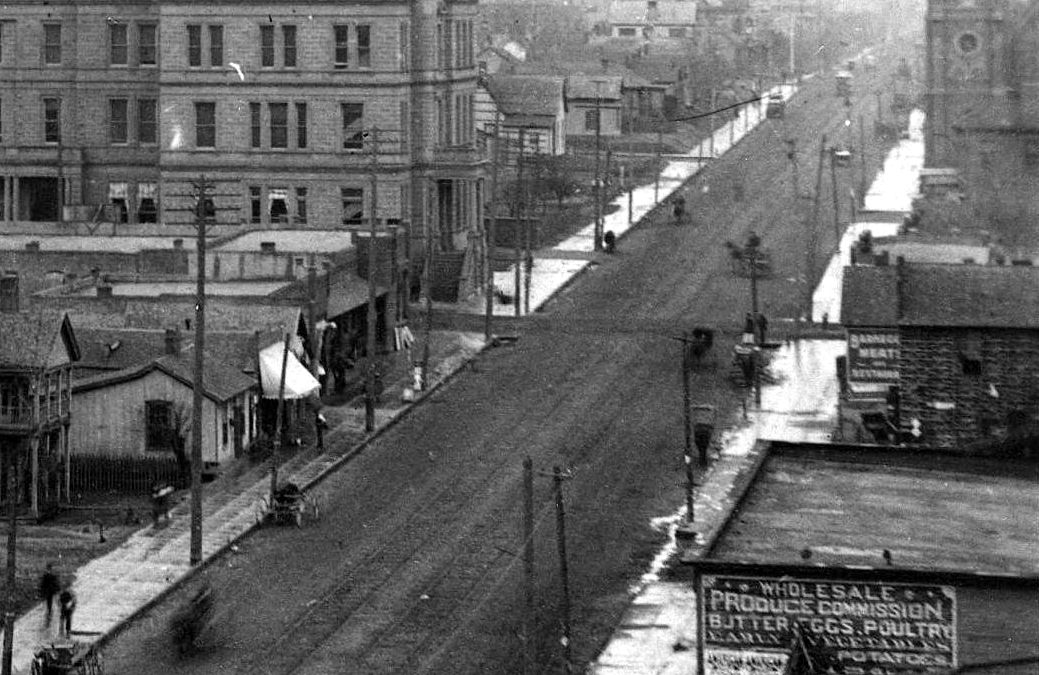
exposition-827-825_c1946_jim-wheat800 block of Exposition…

by Paula Bosse

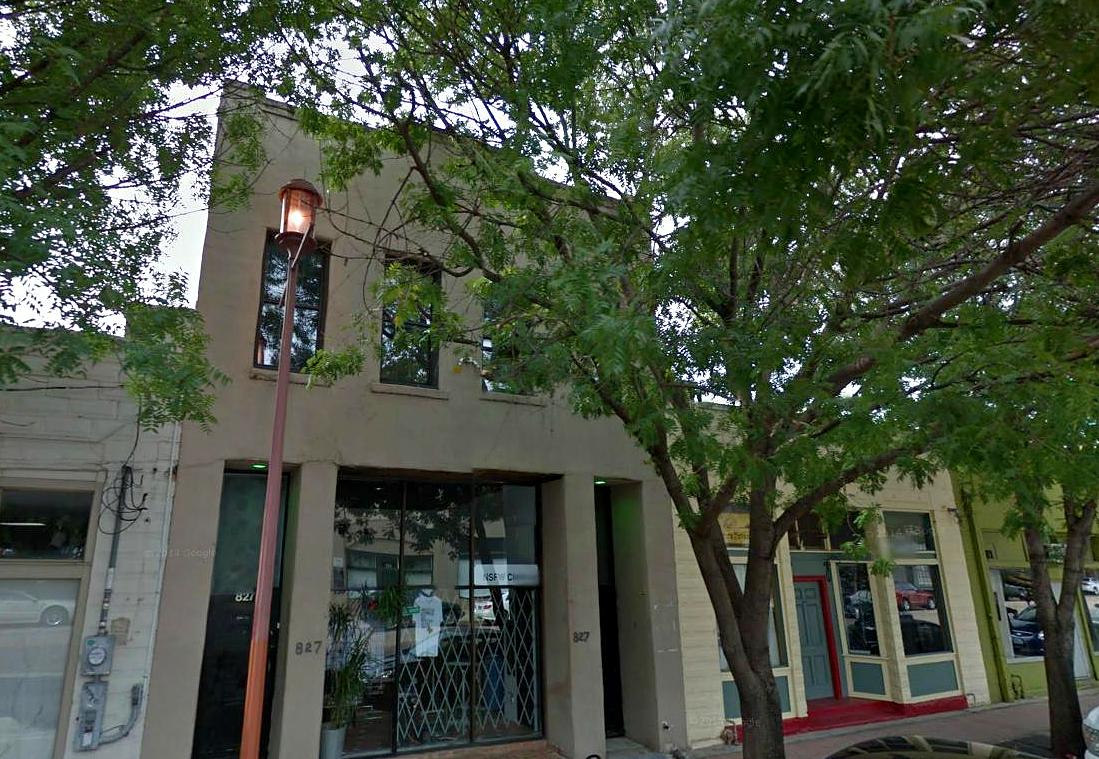
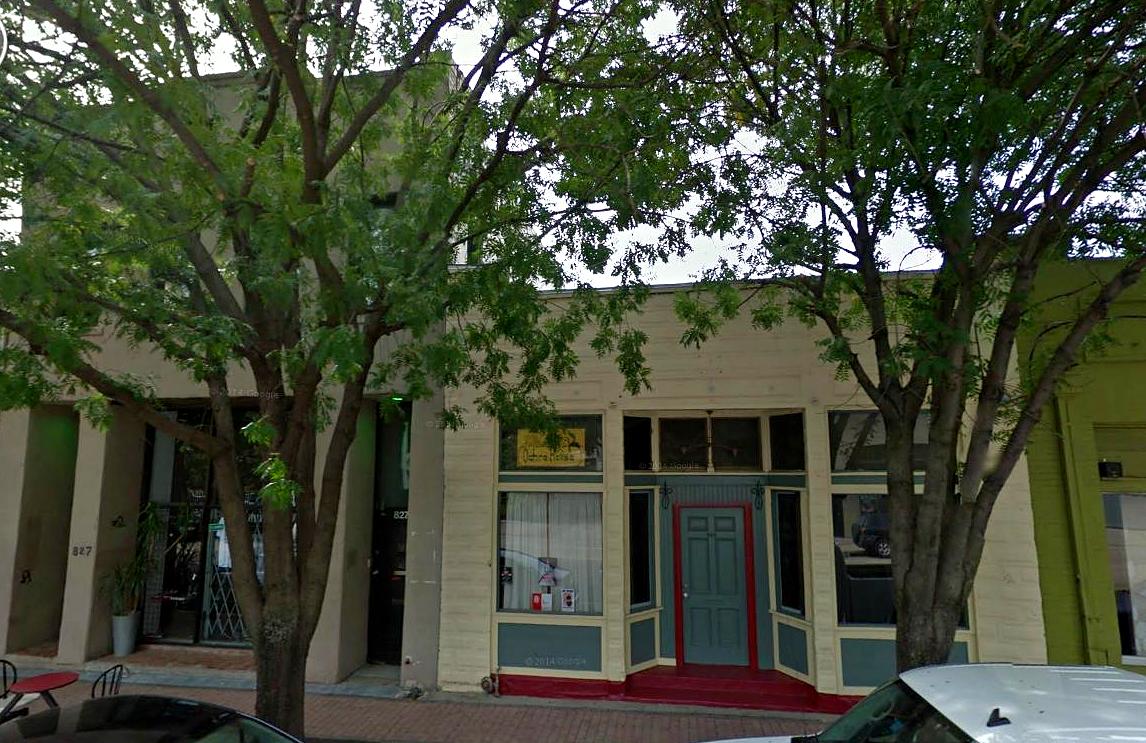
Next time you stop by the Amsterdam Bar at 831 Exposition Avenue, whip out your phone and show this photo to your drinking buddies — this is what the street looked like two doors down, just after World War II. The two-story building at 827 Exposition was home to Lief Dry Goods and the Lief Hotel, and the single-story 825 Exposition was divided into McNeill’s Tin Shop and the Fair Way Cleaners & Laundry (it currently houses the Ochre House theater space). Today the neighborhood has lost much of its grittiness (and head-in parking), but the buildings are still recognizable almost 70 years later. Below, present-day 827 and 825 Exposition Avenue.

exposition_827-google

exposition_825-google

***

Sources & Notes

Top photo from Jim Wheat’s Dallas County Texas Archives.

Bottom two images from Google Street View.

*

Copyright © 2014 Paula Bosse. All Rights Reserved.

William Lescaze’s Ultramodern Magnolia Lounge — 1936

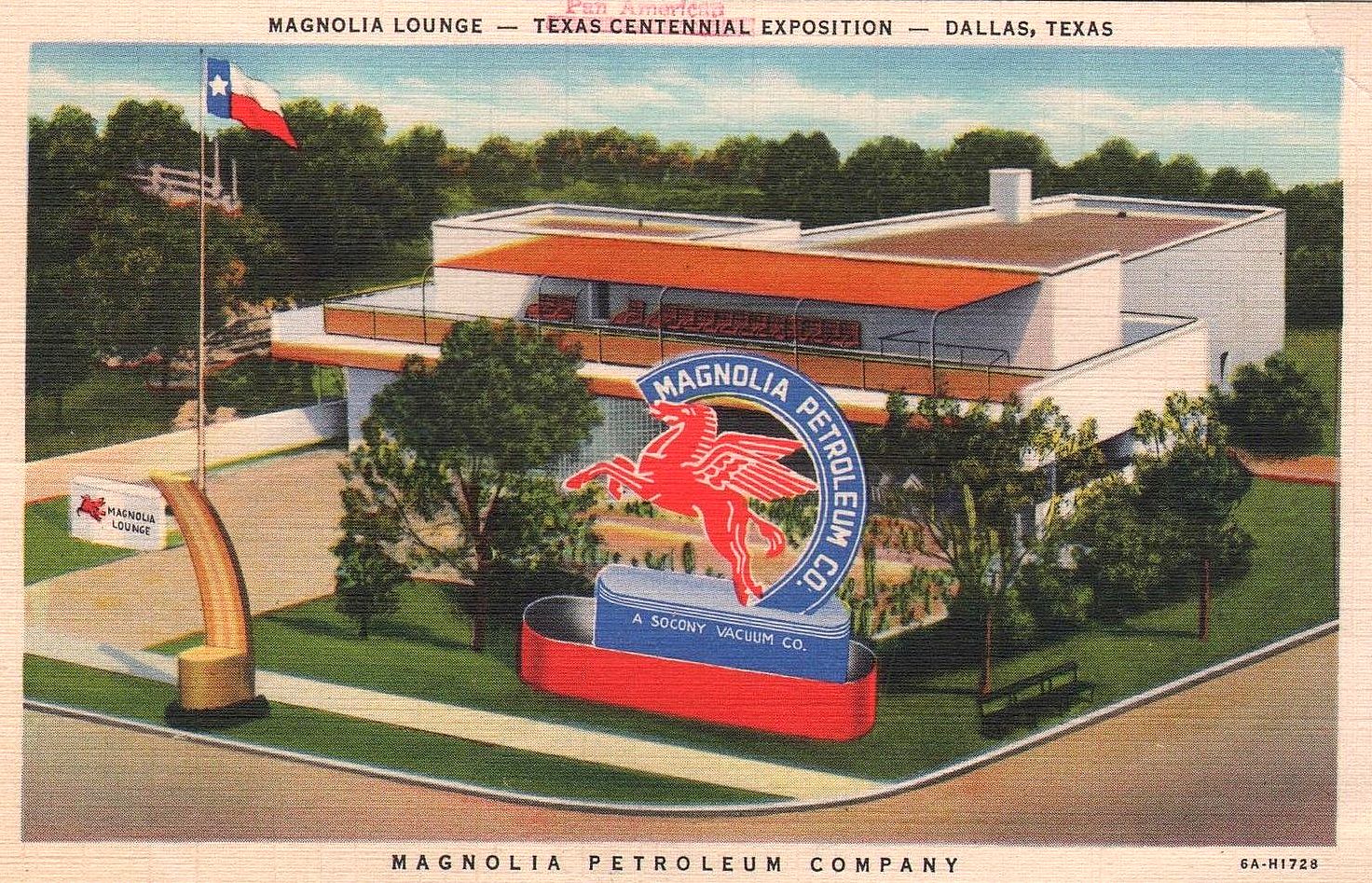
magnolia-lounge_tx-centennial

by Paula Bosse

The sleekly cool Magnolia Lounge, designed by Swiss-born American architect William Lescaze for the Texas Centennial, is considered the first International-style building built in Texas, and though it feels perfectly at home in Art Deco Fair Park, it looks completely different and much more modern that the buildings around it. It was built by the Magnolia Petroleum Company as a place for visitors to the Centennial Exposition to relax and cool off (it boasted a 20-ton refrigeration plant). The Magnolia Company’s slogan for their building was “Be Our Guest and Rest at the Magnolia Lounge.” In other words, this was the most insistently fabulous rest stop ever built!

How did we GET this cool building? Two words: Stanley Marcus.

“Young retailer Stanley Marcus was dispatched to New York City by Dallas-based Magnolia Petroleum to find the most up-to-date architect of the United States for their Centennial pavilion. Marcus chose William Lescaze, who had just designed the first International-style skyscraper in the United States [the PSFS Building in Philadelphia, which opened in 1932].” (– Virginia Savage McAlester)

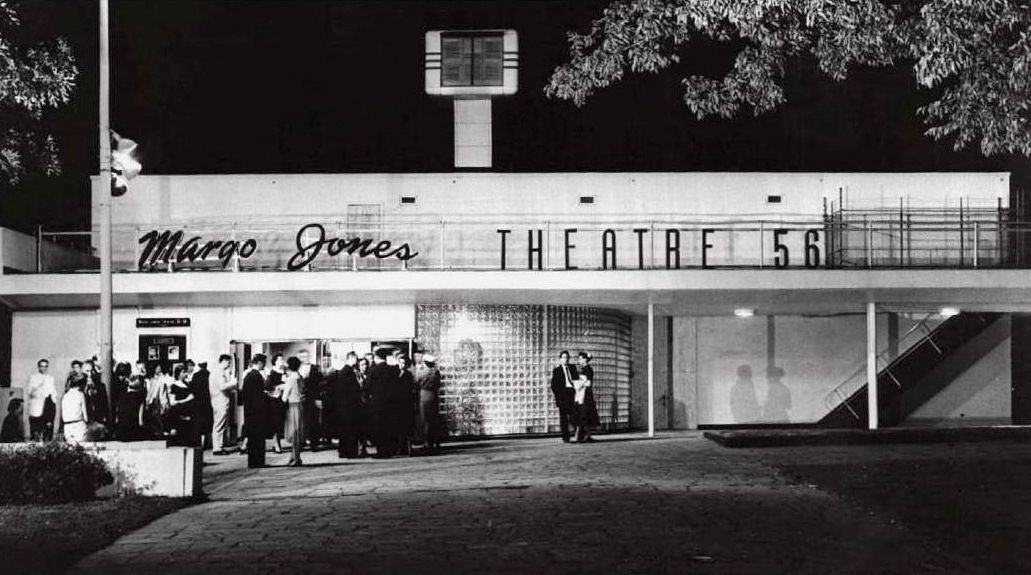
It was a popular oil company-branded “comfort station” for fair visitors until 1942 when the Magnolia Petroleum Co. (who had owned the building), gave title of the Magnolia Lounge to the State Fair, which used it for many years to house its general offices. In 1947, the space became Theatre ’47, Margo Jones’ legendary regional theater where, among other achievements, she produced plays of a young Tennessee Williams and introduced the innovation of theater-in-the-round. After Jones’ death in 1955, the theater carried on for a few years but eventually closed in 1959. After some difficult lean years for the building (during which demolition was considered!), it has been home to organizations such as the Friends of Fair Park, and it is now an active performance space again. And all is well with the world.

margo-jones_theatre-56_dpl

***

Sources & Notes

Postcard of the Magnolia Lounge from the vast wilds of the internet. Click it. It’s huge.

The Virginia McAlester quote is from a Friends of Fair Park advertising section in the Oct. 1989 issue of Texas Monthly.

Photograph of Theatre ’56 from Historic Dallas Theatres by D. Troy Sherrod, from the collection of the Dallas Public Library. (The theater struggled to continue after the sudden death of Margo Jones in 1955, which I wrote about here.)

For more on the history of the Magnolia Lounge, see the official Fair Park home page here; also, check out the the City of Dallas page devoted to this building, here.

And for more on this cool building, particularly in connection with Margo Jones, see the page on the always informative Watermelon Kid site, here.

A lengthy description of the building can be found in the article “Daylight Movies of Texas Scenes To Reward Visitors to Magnolia’s Cool Lounge” (The Dallas Morning News, April 26, 1936).

The Wikipedia page on architect William Lescaze is here.

*

Copyright © 2014 Paula Bosse. All Rights Reserved.


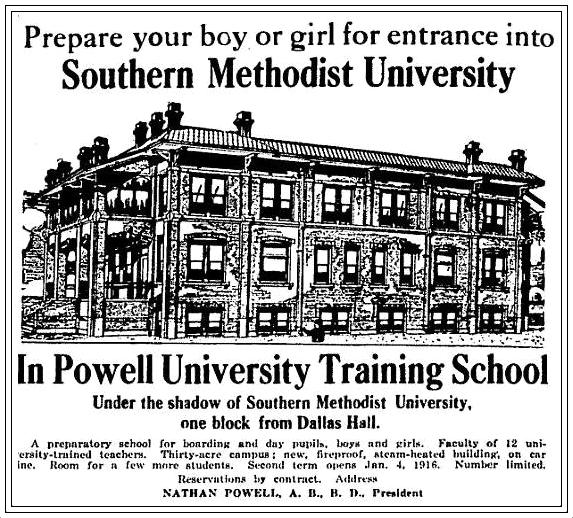
Send Your Kids to Prep School “Under the Shadow of SMU” — 1915

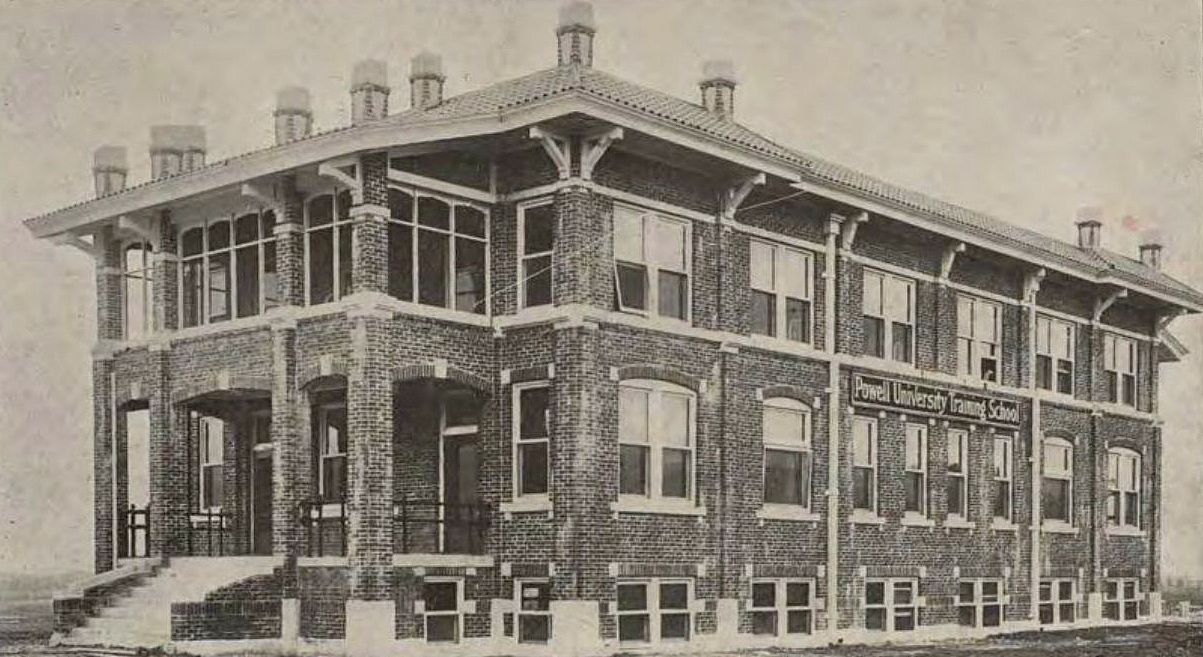
powell-prep_rotunda_1916Powell University Training School, 1915

by Paula Bosse

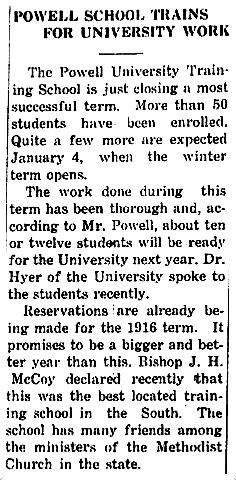
Nathan Powell (1869-1963) was a former Methodist minister who opened his prep school, Powell University Training School, on thirty acres of open land, just across an unpaved road from SMU (which was still in the very early days of its construction). SMU and the Powell school shared more than just adjacent addresses — which they both rather idealistically touted as being “situated on high ground overlooking the university campus and the city” — they also opened on the same day, September 15, 1915.

The location and the opening date were not a coincidence, as Dr. Powell was one of the Methodist movers and shakers who originally promoted the idea of Dallas as the site for a new Methodist university. The following (perhaps exaggerated) sentence can be found in the (perhaps overly laudatory) profile of Powell in one of those ubiquitous late-19th, early-20th century “mug books,” A History of  Texas and Texans (1916):

Beyond his activities as a minister and teacher, the most notable achievement in the life and career of Doctor Powell lies in the fact that he was the sole originator and promoter of the great Southern Methodist University at Dallas, which began its first year September 15, 1915.

Powell University Training School lasted for only about twelve years, until Powell’s rather sudden retirement in 1927 (the good reverend’s “retirement” might have been precipitated by numerous lawsuits and mounting debt). When the school closed, Dr. Powell and his family moved to Harlingen to — as his obituary states — “help organize the grapefruit growers of the Rio Grande Valley.” He operated a citrus nursery himself for a while until it was destroyed by a 1933 hurricane. Nathan Powell died in Harlingen in 1963 at the age of 94.

It’s always exciting to see old buildings still standing in Dallas, and, happily, this one is still around — and it still looks good. Fittingly, it’s currently home to an early-child development center. Next time you’re near the intersection of Binkley and Hillcrest, go take a look.

*

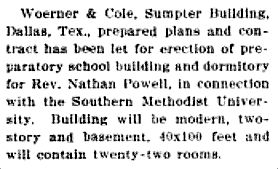
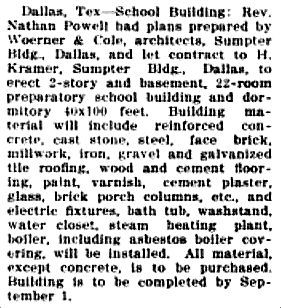
powell_tx-trade-rev-industrial-record_071515a*powell_tx-trade-rev-industrial-record_071515bBoth items from the Texas Trade Review & Industrial Record, July 15, 1915

powell_school_ad_smu-times_121815SMU Times, Dec. 18, 1915 (click for larger image)

powell_school_smu-times_121815SMU Times, Dec. 18, 1915

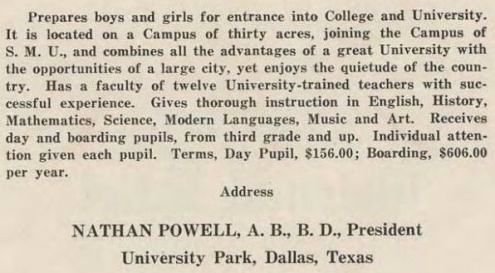
ad-powell-prep_smu-rotunda-19161915 (click to read text)

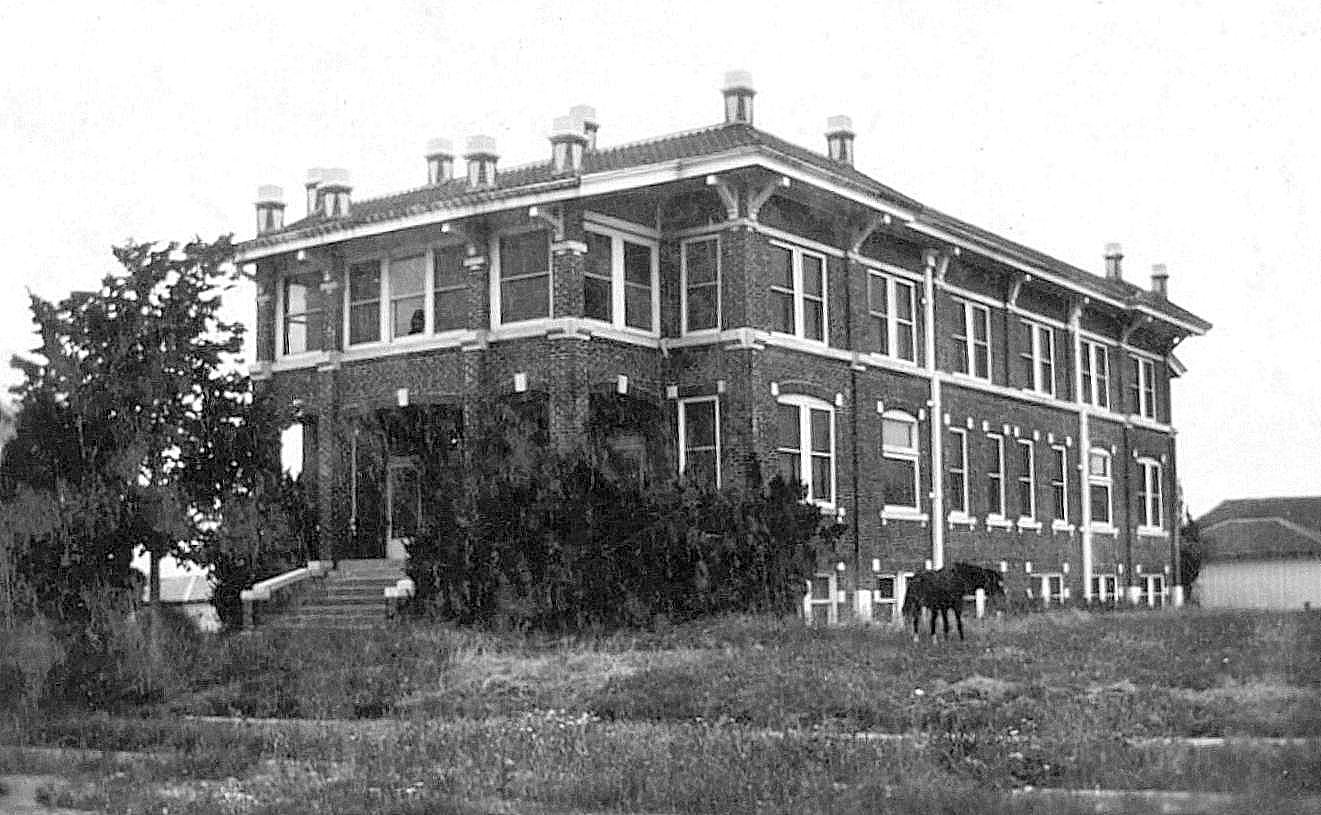
Below, after the school closed. Looking a little shaggy. I would have guessed the photo was from much earlier, but it’s dated 1931. Complete with horse.

powell-univ-training-school_brown-bk_university-park_19311931, Brown Book, University Park Public Library

***

Sources & Notes

Top image and bottom ad appeared in the very first edition of The Rotunda, SMU’s yearbook for their inaugural year, 1915-16.

More on Rev. Powell’s early life and involvement with the founding of Southern Methodist University can be read in A History of Texas and Texans by Frank W. Johnson (Chicago and New York: American Historical Society, 1916), here.

Information regarding Powell’s retirement in Harlingen is from “The Chronological History of Harlingen” by Norman Rozeff (circa 2009), in a PDF here.

Powell’s obituary can be found in The Dallas Morning News, Nov. 8, 1963: “Dr. Powell Dies; Helped Found SMU.”

Currently occupying 3412 Binkley is The Community School of the Park Cities. According to the history page of their website (here), the building has been operated as a school since at least the 1950s.

I’m not sure what the actual facts are concerning Nathan Powell’s role in the founding of SMU. There are very few results when searching the internet. Most newspaper articles connecting him with the university seem to have been generated by Powell himself. If Powell was as important in the history of SMU as he claimed to be, it’s surprising to see so little information on any connection. Was Powell’s assertion that he was the driving force behind the creation of SMU a blatant lie? Was it merely an exaggeration of the truth? Or was it accurate, but something happened to cause the university to distance itself from him? A collection of papers in the SMU archives (which I have not seen) seems to indicate that there were those in Methodist circles who disputed Powell’s claims, as Elijah L. Shettles took it upon himself to prove that Nathan Powell was the driving force behind the very existence of SMU. An overview of the collection — The Elijah L. Shettles Papers on the Founding of Southern Methodist University — can be found here.

(I’ve found an article from the Fort Worth Star-Telegram in 1910 that had Powell all but saying Fort Worth — not Dallas — would be the best choice for the university’s location. Read that article and see other photos of the school — and also read about the lawsuit against Powell (which had nothing to do with SMU) that took thirteen years to reach trial and ended in quite a hefty judgement, in a PDF here.)

See more of SMU’s first year in previous posts here and here.

*

Copyright © 2014 Paula Bosse. All Rights Reserved.

Up North in Denton: “Famous School and College County”

denton-co-courthouse-1928Denton County Courthouse, 1928 (click for larger image)

by Paula Bosse

Okay, so it’s not Dallas, but who in Big D doesn’t love Little D? Besides, this is just too great a photo to keep to myself.

And in case you need to bone up on your 1928 Denton County stats for “Jeopardy” or something, look no further (click for larger image):

denton-co-courthouse_1928b

“Kindergarten to College Degree —
Board at home and be educated free.”

Free!

*

Might as well see where the photo of the courthouse was taken from: the Wright Opera House (now Recycled Books). Here it is, about 1900:

denton-opera-house_1900_tx-historian_1982The Wright Opera House, built in 1899, shown here in 1900 (click for much larger image)

***

The photo of the courthouse and the ad are both from, where else, the program for the 52nd Annual Convention of the State Firemen’s Association of Texas, held in Denton in June of 1928. If you’re into firefighting ephemera or old Denton photos, you might want to peruse it yourself: click here. (From the collection of the Denton Public Library.)

Photo of the Opera House from the article “Faded Echoes: A History of the Wright Opera House in Denton” by Clare Adkins, featured in the September, 1982 issue of Texas Historian, accessible through the Portal to Texas History, here.

Click pictures for larger images.

*

Copyright © 2014 Paula Bosse. All Rights Reserved.

Gusher at Old Red! — 1890

artesian_bywaters-hogue_color-smu“Artesian Well Gushes on the Courthouse Grounds”
Partial view of the mural by Jerry Bywaters & Alexandre Hogue (1934)

by Paula Bosse

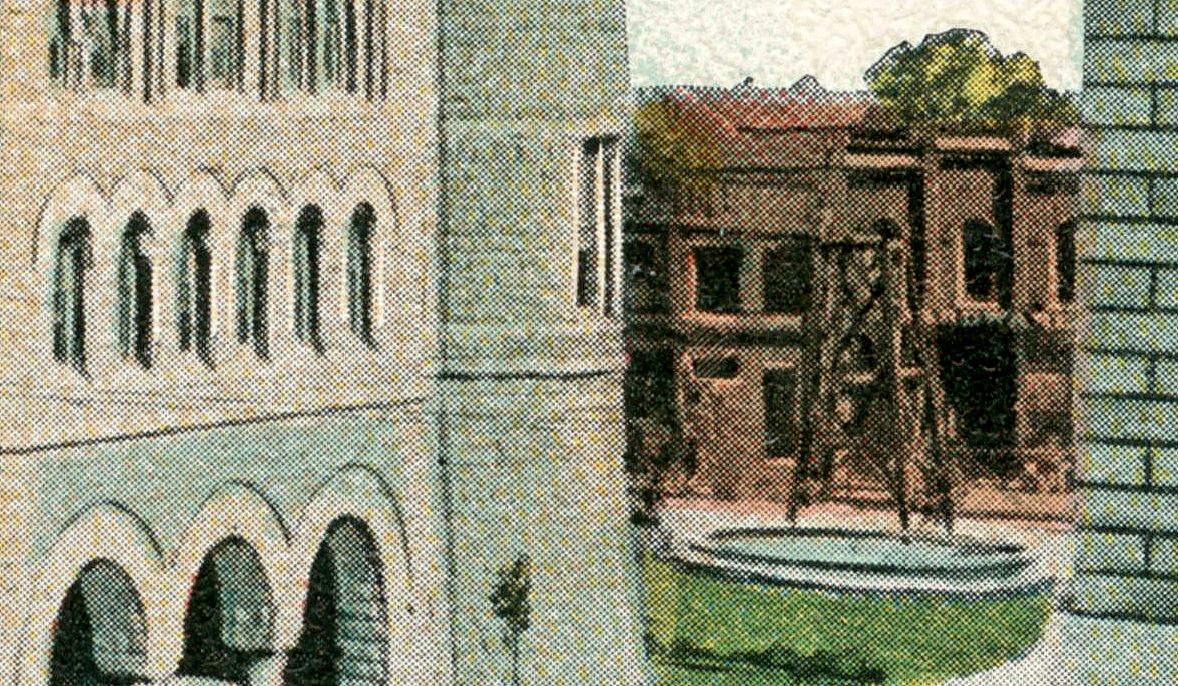
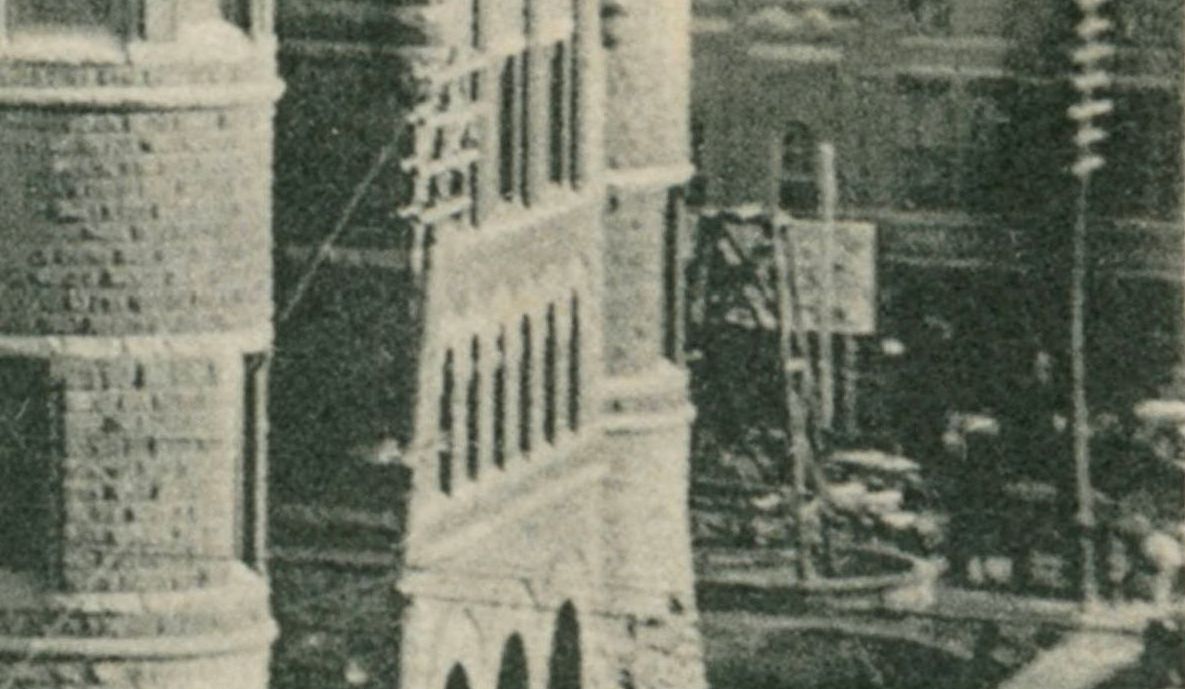
Several months ago, I was looking at the postcard of the Old Red Courthouse shown below. I thought it was interesting because I hadn’t seen that view before. And then I noticed what looked like a derrick just to the right of the courthouse. What was that? It  looked like it was standing over a tank of water, kind of like a windmill. And then I got distracted and didn’t come back to it until I read of an (unrelated) old well having been uncovered in present-day Dealey Plaza a year or two ago, and I remembered this postcard. Was that a well? On the courthouse property? And now I know: it was, in fact, an artesian well that had been sunk on the courthouse lawn in the fall of 1890, and its success was an INCREDIBLY important factor in Dallas’ growth as a city.

artesian_old-red_postcard-color_degolyer

artesian_old-red_postcard-color_degolyer-det

artesian_old-red_postcard-bw_degolyer

artesian_old-red_postcard-bw_degolyer-det

In 1890, Dallas was growing at a remarkable rate, and like any large city, it needed a reliable source of water. In Dallas, that was a problem. Wells were dotted around town — many on private property — but a large supply of water for the ever-increasing community was needed, and needed fast. I gather things were reaching a critical point when The Dallas Morning News printed a letter from a reader named S. T. Stratton in January of 1890. Stratton, a long-time resident of Dallas, suggested digging an artesian well on courthouse property. (And while they were down there, they could check for the possibility of oil and gas.)

artesian-old-red_STRATTON-dmn_010890DMN, Jan. 8, 1890

It seems that this might not have been an idea many people would have taken seriously at the time, because several pages away in the same issue of the paper was this little tidbit encouraging readers to seriously consider this as a viable option. (This was unsigned, but it seems likely it was written by DMN publisher G. B. Dealey.)
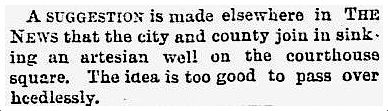
artesian-old-red_dmn_010890DMN, Jan. 8, 1890

The idea gained popularity, and a “special committee on artesian water” convened in February, deciding to go forward with the plan; the city and the county would divide the cost.

artesian-old-red_dmn_020690DMN, Feb. 6, 1890

Later in the year, drilling began, and on Oct. 9, 1890, water was hit. The flow at first was slow, but then, just like in the movies … a gusher! A Dallas News reporter had been writing a story on the initial success when, before he was able to file his report, the well suddenly became the biggest story in the city, in the state, and even around the country. When the drill hit 1,000 feet, the water began to shoot up with such force that it was estimated the well would produce in excess of one million gallons a day. There must have been incredible excitement in the wee hours of that morning, and the reporter’s story of the gusher is pretty thrilling to read — that last sentence is wonderful: “The water at 1 o’clock this morning was clear and it sparkled beautifully in the rays of electric lights.”

gusher_dmn_101090_updateDMN, Oct. 10, 1990

Below is the headline of the in-depth coverage of the successful well (full story linked at bottom of this page). Throngs of people crowded around the well, jubilant politicians patted themselves on the back, and men from the surrounding area wanted one for their towns (Marsalis declared he would get one for Oak Cliff, post haste!). What a scene it must have been. Finally, with that massive reservoir of water underneath the city, Dallas was assured of its continued growth.

gusher_dmn_101190-headlineDMN, Oct. 11, 1890

A story that ran in the national business journal Manufacturer’s Record underlines the importance of the well’s discovery to business investors around the country:

This successful experiment effectively settles the water supply problem of Dallas, and it removes the last obstacle possible to be urged against the rapid building up of Dallas. It insures an unlimited supply of the finest water not only for domestic use, but for manufacturing purposes, which, taken in connection with cheap fuel and ample distributing facilities in a land where various lines of raw material abound, leaves no question as to the success of manufactures. (Quoted in the DMN, Oct. 21, 1890)

Not only was the well’s success being discussed in the national press, but it was also popping up in local ads, like this one from a real estate company which appeared in the pages of the DMN on Oct. 12, 1890:

THE ARTESIAN WELL
Is ‘a Thing of Beauty and a Joy Forever.’
And the hour the drill pierced the water-bearing strata and the precious fluid gushed forth at the rate of 1,000,000 gallons a day forms a new era in the history of the metropolis of the southwest. Every foot of ground in Dallas has increased in value by no inconsiderable amount, but the few lots left on the market in Hall’s second addition will still be sold at $100 each, easy terms.

So I’ve learned something new. I probably should have known about this, at least in connection with the series of PWAP murals produced in 1934 by Jerry Bywaters and Alexandre Hogue, two of my favorite Dallas artists. They painted ten murals throughout the old City Hall (later known as the Municipal Building), each illustrating a high point in the city’s history. The decade 1890-1900 was commemorated by a depiction of the artesian well and all that water discovered flowing beneath the grounds of the then-under-construction Dallas County Courthouse. Unbelievably, the murals were destroyed (!) when the building underwent renovation in 1956. Had they still  been around, I probably would have seen them, and I would have learned about this whole artesian well thing many, many years ago!

artesian_bywaters-hogue_bw-smuWho is the sinister-looking man in the dark coat?

*

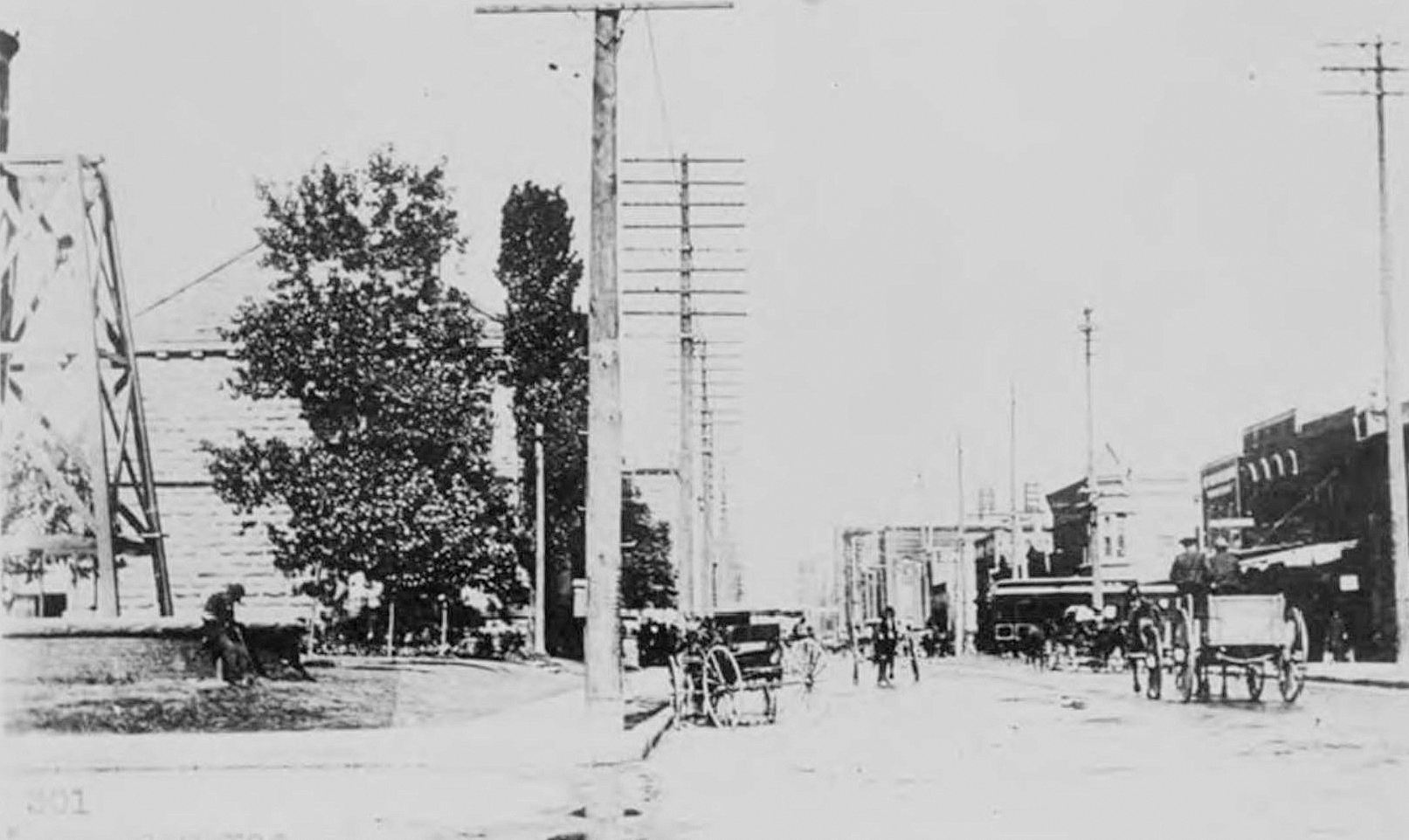
A street-level view from about 1900, showing Commerce Street east from Houston Street showing the artesian well at the left — I believe this served as a public watering trough for horses.

gusher_east-on-commerce-from-houston_degolyer-lib_SMU_1900via DeGolyer Library, SMU

*

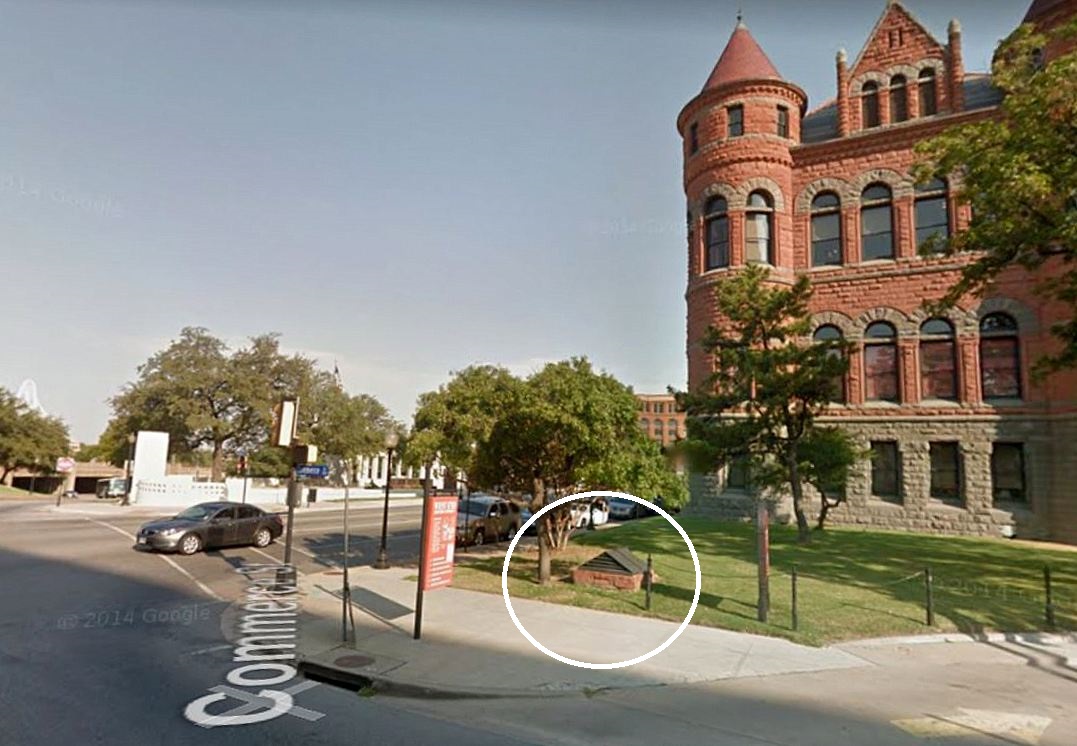
UPDATE: I went to see the capped well today (July 20, 2014). It’s under a shady tree at the southwest corner of the Old Red Courthouse, at Commerce & Houston streets. It isn’t marked at all and is fairly inconspicuous. Even though I’ve known about the existence of this well for only a couple of days, I was so happy to see it — still there, where it’s been for almost 125 years. It was like seeing an old friend.

Photo by Paula Bosse

The view below (looking across Houston Street toward Dealey Plaza from Commerce) shows where this capped well is.

gusher_commerce-and-houston_google-street-view_2011Google Street View (2011)

*

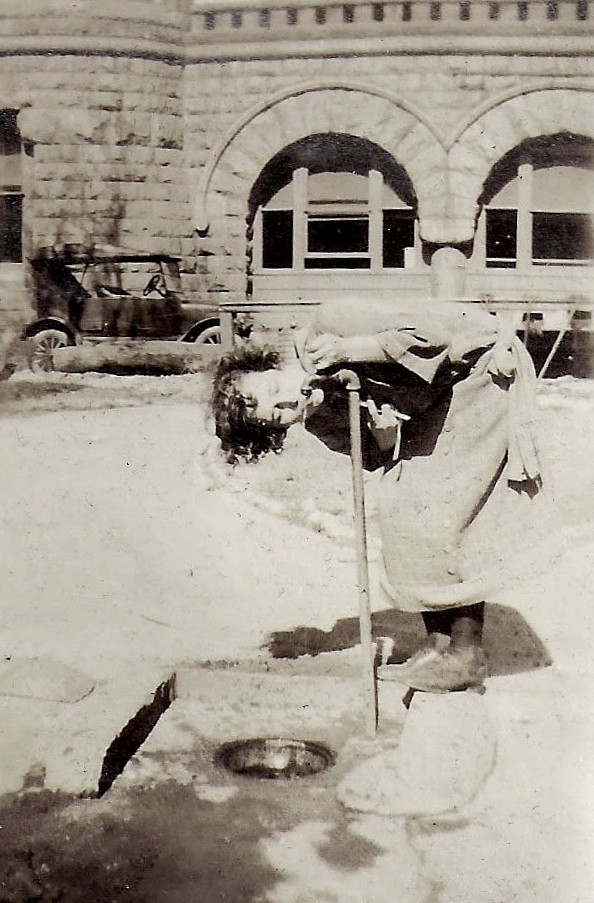
The wonderful photo below is from the 1920s and shows a young woman stopping for a drink on the courthouse lawn.

gusher_old red_ann-hoffman-collection_1920sFrom the collection of Ann Hoffman

***

Sources & Notes

The color image of the Bywaters and Hogue mural is a photograph taken by Jerry Bywaters in 1956 before the murals were destroyed; the black and white photo is by Harry Bennett. Both are from The Bywaters Special Collections, Hamon Arts Library, Central University Libraries, Southern Methodist University. See more information on the color image here, and the black and white image here.

Both postcards are from the DeGolyer Library at SMU: the color postcard can be accessed here; the black and white one here. The black and white image has been cropped — missing is the amusing note on the front of the card, dated 1-4-07: “Dear Faye, can you imagine me a long-haired Texan, brandishing a bowie knife? Ross.”

The circa-1900 photograph showing the well at the left side of the photo is titled “East on Commerce, Commerce and Houston streets, 1900” and is from the Collection of Dallas Morning News negatives and copy photographs, DeGolyer Library, SMU — more info is here.

The photo of the young woman on the courthouse lawn is from the collection of Ann Hoffman and is used with permission; taken in the 1920s, it shows a friend of her Great Aunt Nora stopping for a drink of water. Thank you for sharing, Ann!

All news clippings from The Dallas Morning News.

To read the report of the initial, somewhat tentative early-in-the-day well success, the DMN article from Oct. 10, 1890 is in a PDF here. For the crazy, jubilant, people-beside-themselves-with-joy report of the gusher, the entire article from Oct. 11, 1890 is here.

Not exactly sure what an artesian well is? Wikipedia to the rescue, here.

*

Copyright © 2014 Paula Bosse. All Rights Reserved.