Flashback : Dallas

A Miscellany: History, Ads, Pop Culture

Category: Architecture/Significant Bldgs.

George Dahl’s Sleek Downtown Library — 1955
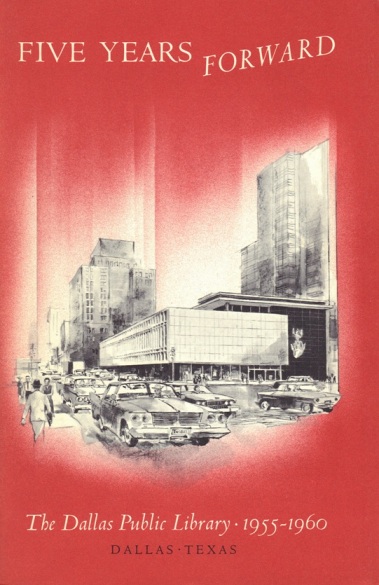
1DPL_cover-sm

by Paula Bosse

This little 31-page booklet was issued to commemorate the fifth anniversary of the Dallas Public Library. The library was built on the site of the old (beautiful!) Carnegie Library and was vacated when the current library (the J. Erik Jonssen Central Library) opened on Young St. in 1982. Unbelievably, the building has remained empty for over 30 years.

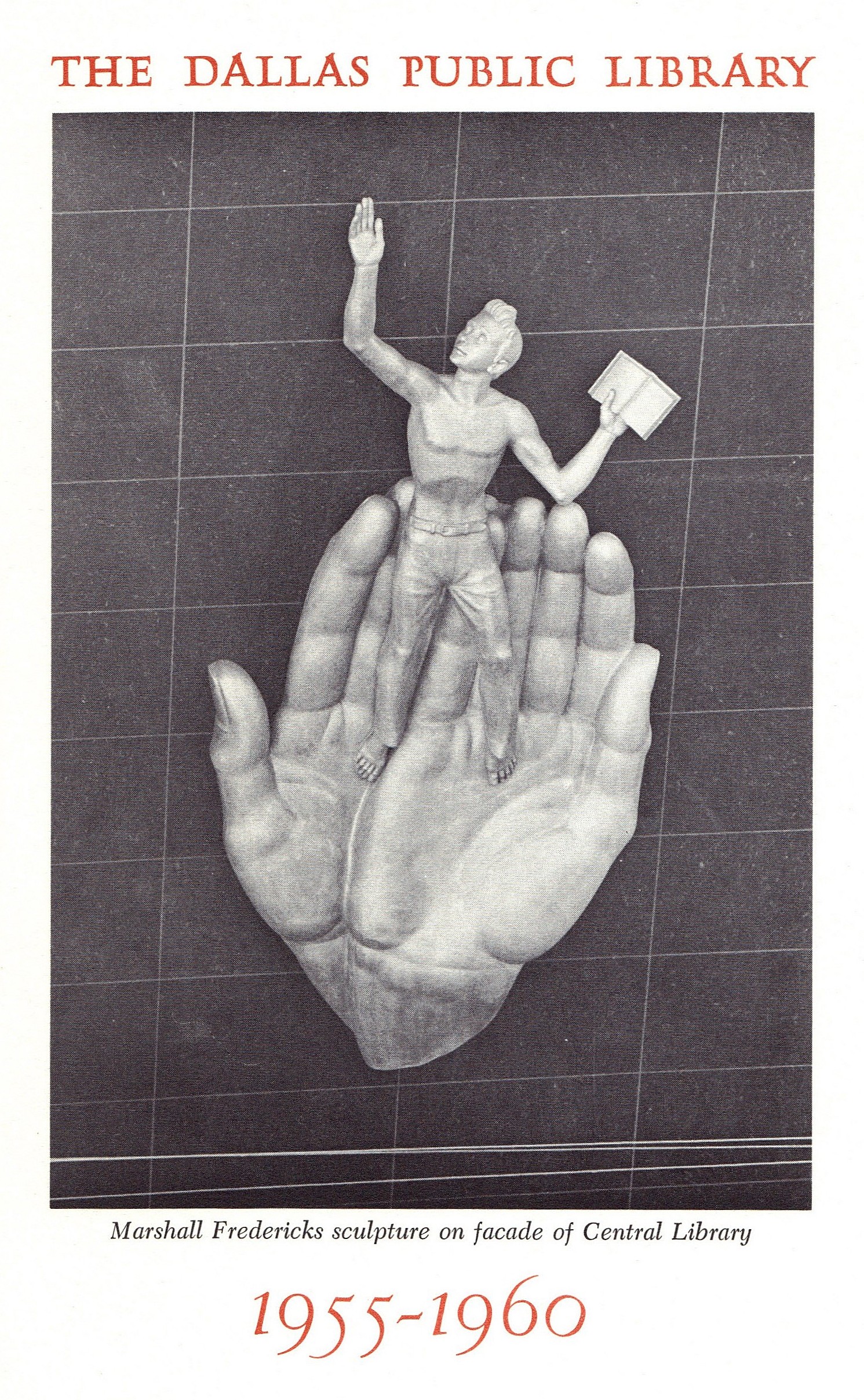
This is the only downtown building I have very distinct memories of from childhood. My mother took us to the library often, and I LOVED that place. I loved the building, the space, the books, the adventure of being downtown — I loved everything but that creepy sculpture of the kid standing in the hands that hung on the outside of the building!

This great library was designed by the legendary (and prolific!) Dallas architect, George Dahl. He moved easily from the streamlined grandeur of the Art Deco buildings of Fair Park to the sleek mid-century-modern-cool of this wonderful downtown library.
2DPL_hands-sculpture
I know there are fans of this sculpture (“Youth in the Hands of God” by Marshall Fredericks), but I’m afraid I am not one of them. I loved art as a child (in fact, I can remember checking out framed art reproductions from this very library), but, as I said, even as a kid, I strongly disliked that creepy sculpture. The kid was fine, it was those giant disembodied hands. When the library moved to its current location in 1982, this sculpture was left behind to languish for years inside the empty building. It was eventually sold, and the boy and the hands are now resting comfortably in retirement, somewhere in Michigan.

3DPL_lobbybertoiaThere was a huge controversy about the Harry Bertoia sculptural screen seen above, hanging over the circulation desk. (I LOVED this piece as a kid!) The mayor — R. L. Thornton — HATED it, and the brouhaha-loving newspapers launched themselves into the fray by running apoplectic editorials which, of course, only fanned the flames of outrage. After the “scandal” died down, the art was eventually given the okay to stay, but not before a lot of people made a lot of noise about how the city of Dallas had wasted the $8,500 it had spent on the commission. Unlike the discarded hands sculpture, the screen was moved to the new library, where it remains today.

4DPL_outdoorterrace

5DPL_familylivingThis is how I remember the library. Lots of space, cool furniture, and flooded with light.

6DPL_children

7DPL_av

8DPL_globe

9DPL_planningcomm

10DPL_checkingoutI LOVE this photo!

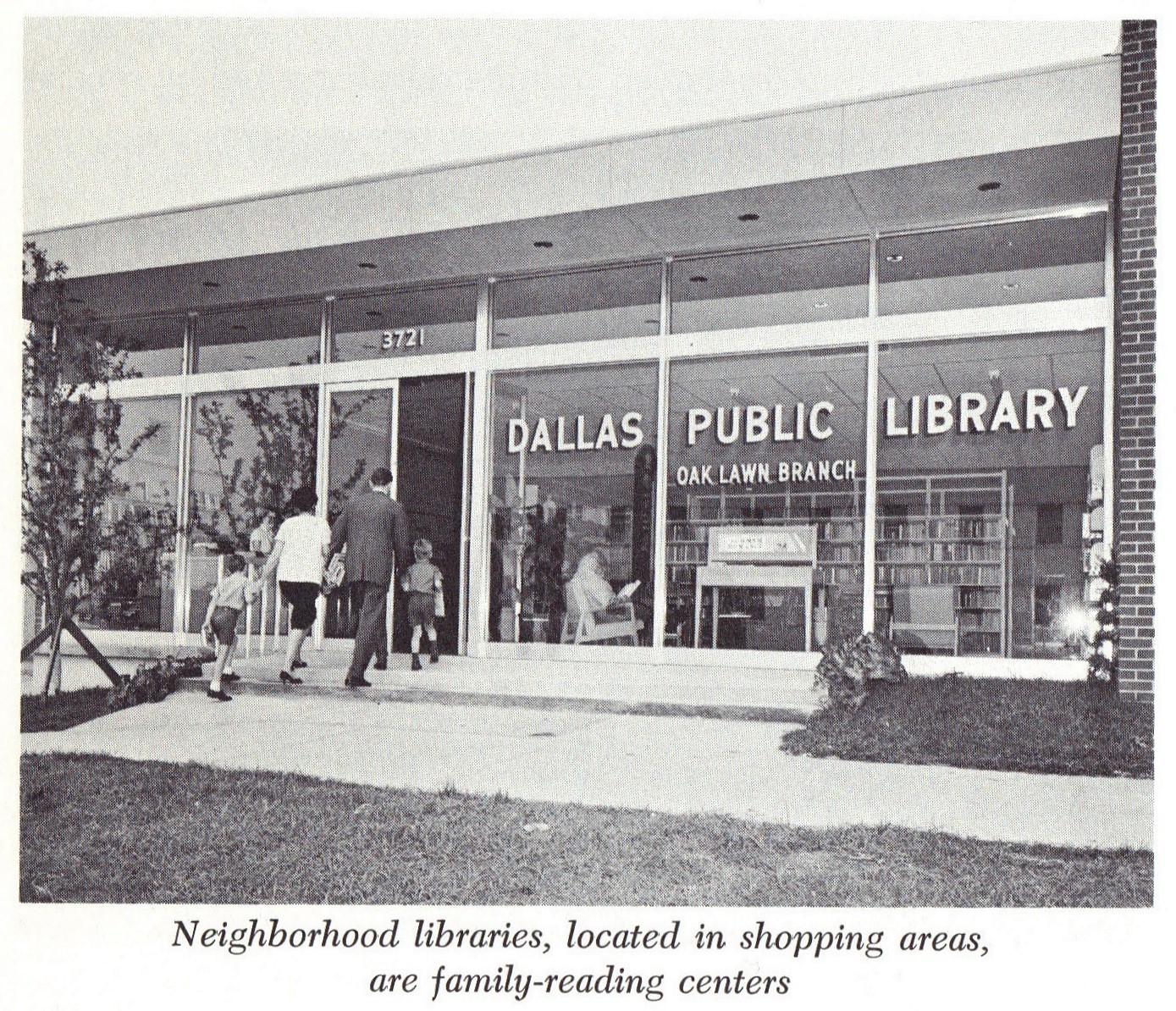
11DPL_oaklawnbranch

12DPL_teens

14DPL_schiwetzcropA detail of the front cover artwork, by Texas artist E. M. “Buck” Schiwetz. I love the driver in the cowboy hat (he must have been awfully small or that car must have been awfully big to accommodate that hat). The energetic frisson of downtown Dallas in the Mad Men era is dampened a bit by those damn hands on the building that seemed to follow you everywhere you went!

***

Sources & Notes

All images from the booklet Five Years Forward: The Dallas Public Library, 1955-1960, compiled and written by Lillian Moore Bradshaw and Marvin Stone. Drawings by E. M. (Buck) Schiwetz. Photographs by C. D. Bayne. (Dallas: Carl Hertzog for Friends of the Dallas Public Library, 1961). (Photos from the archives of the Dallas Public Library.)

More on the history and construction of the Old Dallas Central Library (as well as tidbits about the ridiculous controversy regarding the commissioned art) is here.

Even MORE on the artwork scandals (the hands, the hands, the HANDS!) as well as photos of the beautiful Carnegie Library that was razed to build the 1955 library can be found here.

And just because it’s weird, here’s a postcard showing an early, possibly even creepier depiction of the “hands” sculpture (if those are the “hands of God”…). I guess they wanted to get a postcard out before the sculpture was finished and installed.

dallas-public-library_dahl_postcard

I’ve posted one further image from this booklet — a drawing of the 1961 Dallas skyline by E. M. “Buck” Schiwetz  — here.

UPDATE — Dec., 2017: The Dallas Morning News has moved its operations to the long-vacant library, insuring this wonderful building’s continued existence for many more years! More here.

Click pictures for larger images (some are MUCH larger — click twice!).

*

Copyright © 2014 Paula Bosse. All Rights Reserved.
 

Munger’s Improved Continental Gin Company

continental-gin_munger-from-natl-reg-appA Dallas landmark… (click for larger image)

by Paula Bosse

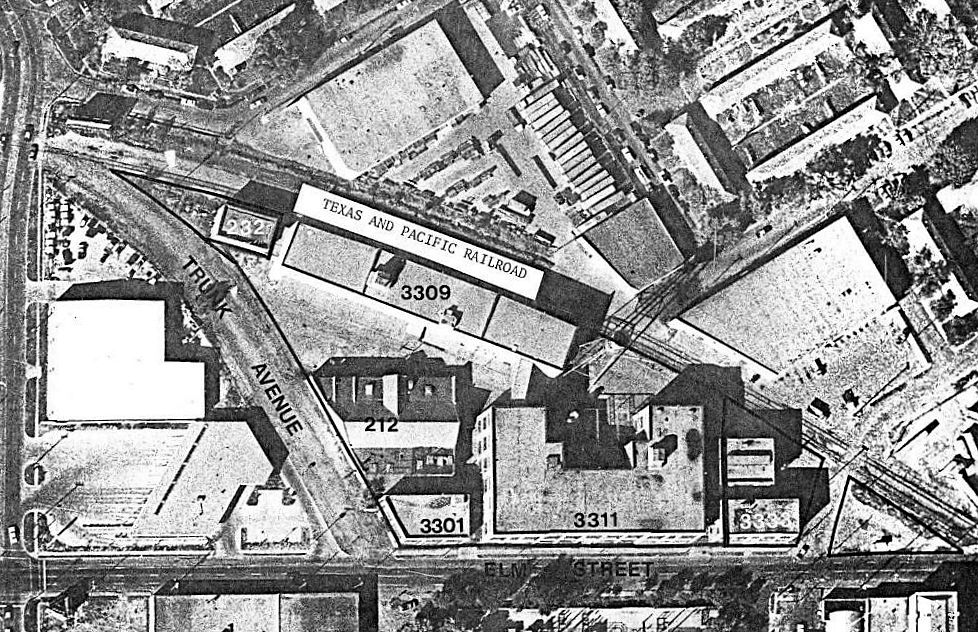
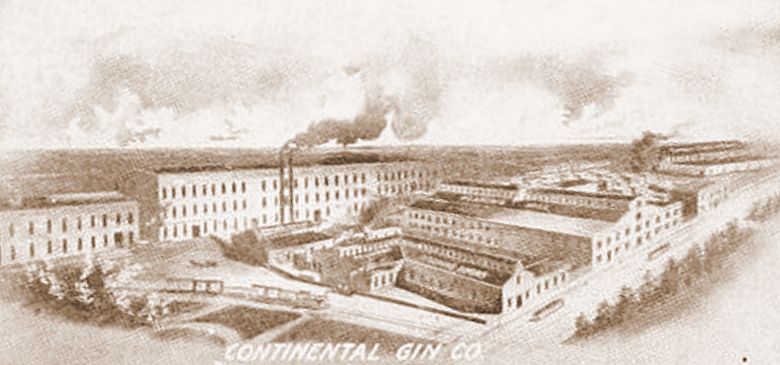
The Continental Gin Co. complex of buildings at Elm and Trunk is a Deep Ellum fixture which was successfully petitioned by the city in 1983 to be added to the National Register of Historic Places. No longer a manufacturing hub, it is now home to artists’ studios and residential lofts. The earliest of the buildings still standing were built in 1888 and the latest ones (the ones closer to Elm) were built in 1914. The company was incredibly successful, which was no surprise when one realizes that fully ONE-SIXTH of the world’s cotton grew within a 150-mile radius of Dallas at the time! It’s no wonder that Dallas was a hotbed of cotton gin manufacturing.

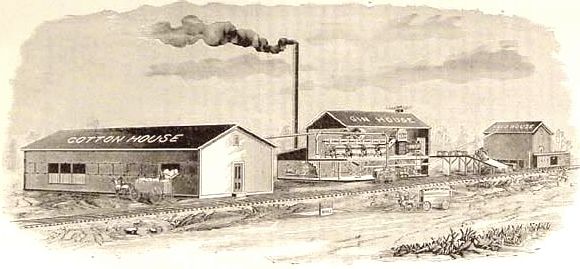
continental-gin_munger-drawing_Munger Catalogue and Price List, 1895

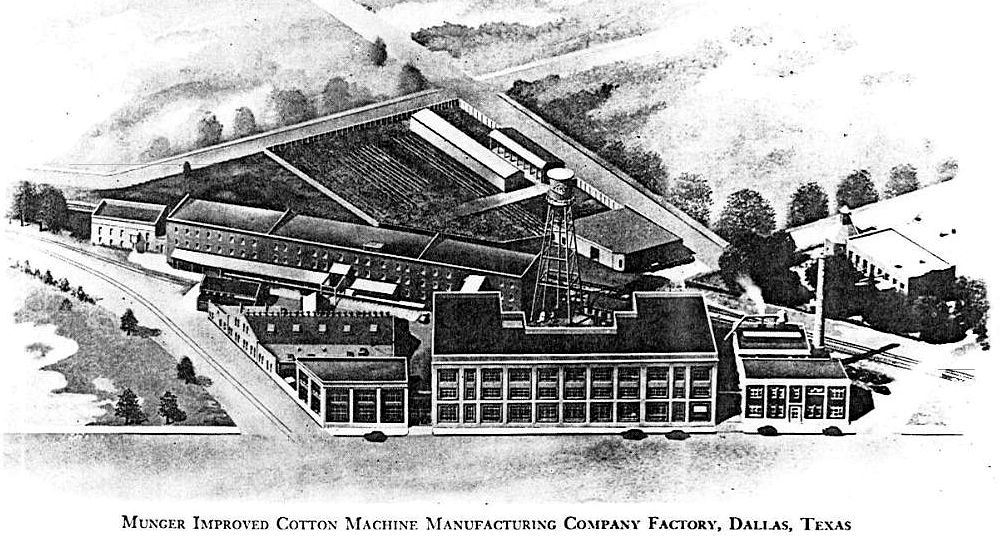
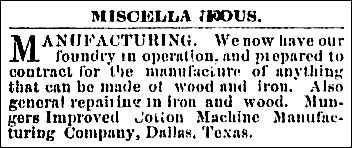
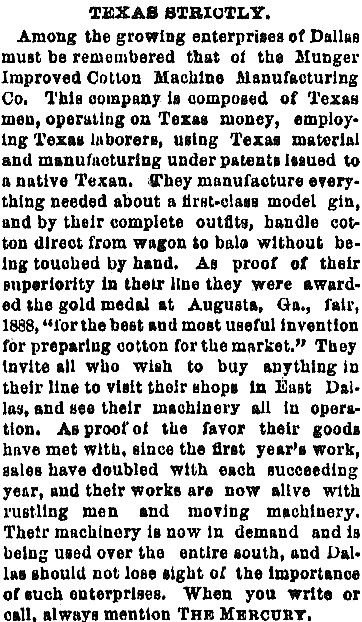
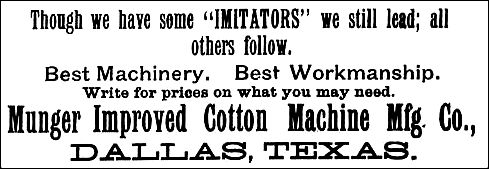
Robert S. Munger (yes, that Munger) patented several inventions that improved the cotton ginning process, and in 1888 he built a large manufacturing plant for his Munger Improved Cotton Machine Company. In 1900, after several extremely successful years, his company and several other companies that held important industry patents were absorbed by the Continental Gin Co. of Birmingham, Alabama, and, practically overnight, the Continental Gin Co. became the largest manufacturer of cotton gins in the United States. Munger retained a financial interest in the company, but he left the running of the business to his brother, S.I. Munger. R.S. Munger turned his creative talents to real estate and developed the exclusive Munger Place neighborhood. The Continental Gin Co. closed in 1962.

continental-gin-co_1912The Standard Blue Book of Texas, 1912-1914

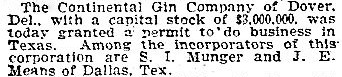
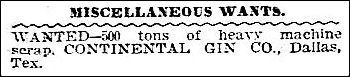
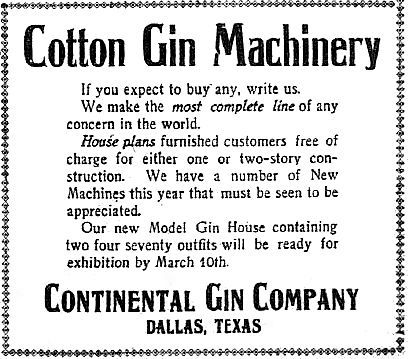
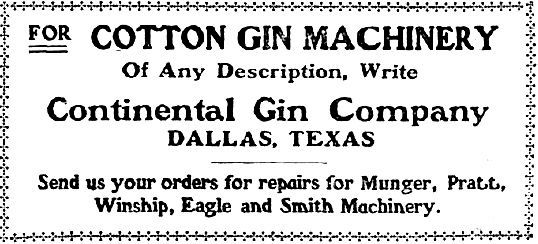
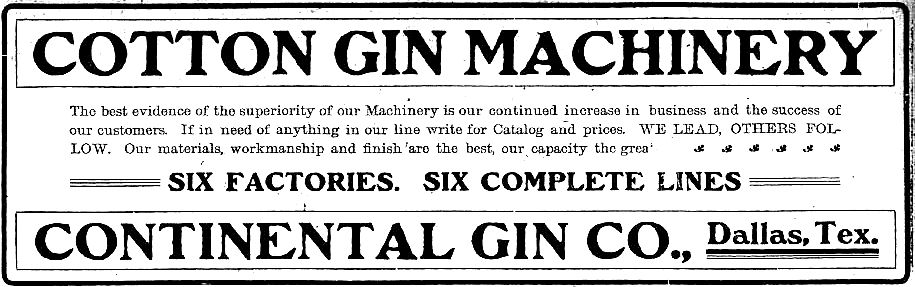
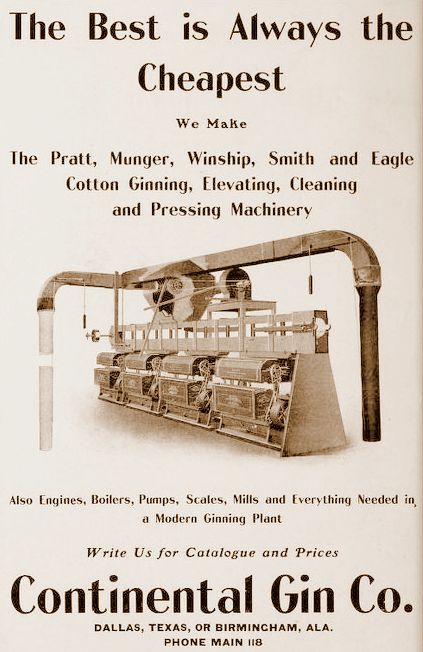
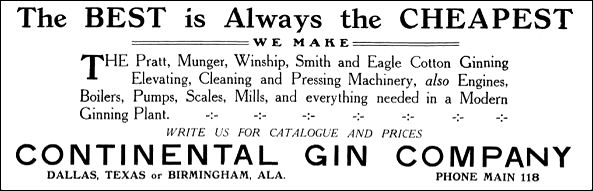
A few newspaper items regarding the Munger Improved Cotton Machine Company and the Continental Gin Company.

munger_dal-herald_101387The Dallas Herald, Oct. 13, 1887

munger_merc_053089The Southern Mercury, May 30, 1889

munger_merc_072892The Southern Mercury, July 28, 1892

munger_merc_041393The Southern Mercury, April 13, 1893

continental-gin_dmn_072600Change is imminent. (Dallas Morning News, July 26, 1900)

continental-gin_dmn_042001FIVE HUNDRED TONS! (DMN, Apri 20, 1901)

continental-gin_dmn_032203DMN, March 22, 1903

continental-gin_dmn_082005DMN, Aug. 20, 1905

continental-gin_dmn_060107DMN, June 1, 1907

continental-gin_worleys_1909Worley’s Dallas Directory, 1909

continental-gin_ad_dallas-police_1910Dallas Police, 1910

continental-gin-aerial-natl-reg-appPhotograph that accompanied the application to the National Register of Historic Places regarding the structures under consideration: 3301-3333 Elm St. and 212 & 232 Trunk Ave. (Landis Aerial Photography, 1980)

***

Sources & Notes

Handbook of Texas biography of Robert Sylvester Munger (1854-1923) is here.

The top image (which, by the way, took me FOREVER to find, is labeled as the Munger company, but the expansion would seem to indicate that this is the Continental Gin Company, after 1914. Whatever the case, it’s a great image!

That image and the aerial photograph of 1980 are included in the city’s application to have the complex included in the National Register of Historic Places, submitted in 1983. The detailed application — as a Texas Historical Commission PDF — can be accessed here.

The second image, of the early days of the Munger Improved Cotton Machine Company is from a bookseller’s online listing for Munger’s 13th Annual Catalogue and Price List (1895) — the item may still be available for a mere $435 and can be found here.

See an aerial view of what the area looks like today, via Google, here.

To see an incredible 1914 photograph of the buildings and the residential area to the north, see my post “The Continental Gin Complex — 1914,” here.

More on Robert S. Munger and more early company ads can be found in the post “R. S. Munger’s Cotton Gin Manufactory,” here.

*

Copyright © 2014 Paula Bosse. All Rights Reserved.
 

Southwestern Bell Telephone Goings-On, Circa 1928

by Paula Bosse

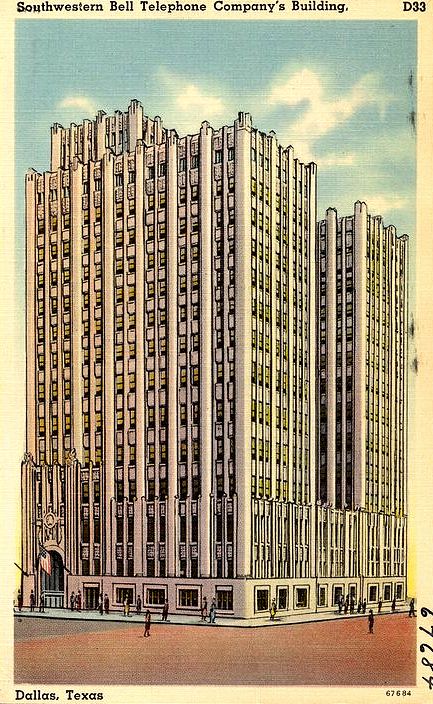
The beautiful Southwestern Bell Telephone Company building, designed by Lang & Witchell in 1929.

From the book Dallas Landmarks:

Dallas’ first telephone exchange opened on June 1, 1881, with 40 subscribers. There were several competing telephone companies before 1925 when Southwestern Bell became the sole provider. The number of telephones in used quickly soared from 30,000 in 1922 to 200,000 in 1949.

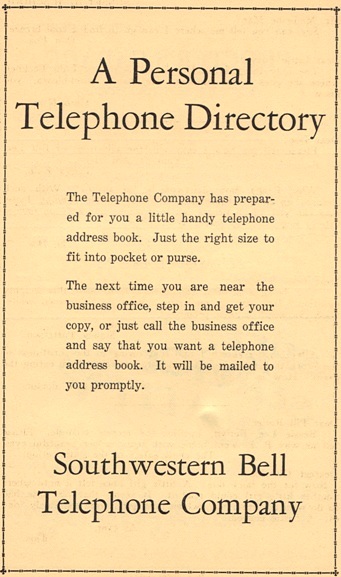
The relatively few telephone subscribers at the time the building was going up might explain this folksy little notice about a “personal telephone directory” that the fine folks at Southwestern Bell have been working on night and day, just for you. Next time you’re in the neighborhood, why don’t you just drop right on in and pick one up? Set a spell. Take your shoes off. Y’hear?

***

Sources & Notes

Postcard from the Boston Public Library Tichnor Brothers Postcard Collection on Flickr, here.

Quote from the book Dallas Landmarks, by Preservation Dallas and Dallas Heritage Village (Charleston: Arcadia Publishing, 2008). p. 31.

Quaint little ol’ phone book ad, from, of all places, the Nov. 1928 issue of “The Stampede,” the school magazine published by and for the students of Sunset High School in Oak Cliff.

*

Copyright © 2014 Paula Bosse. All Rights Reserved.
 

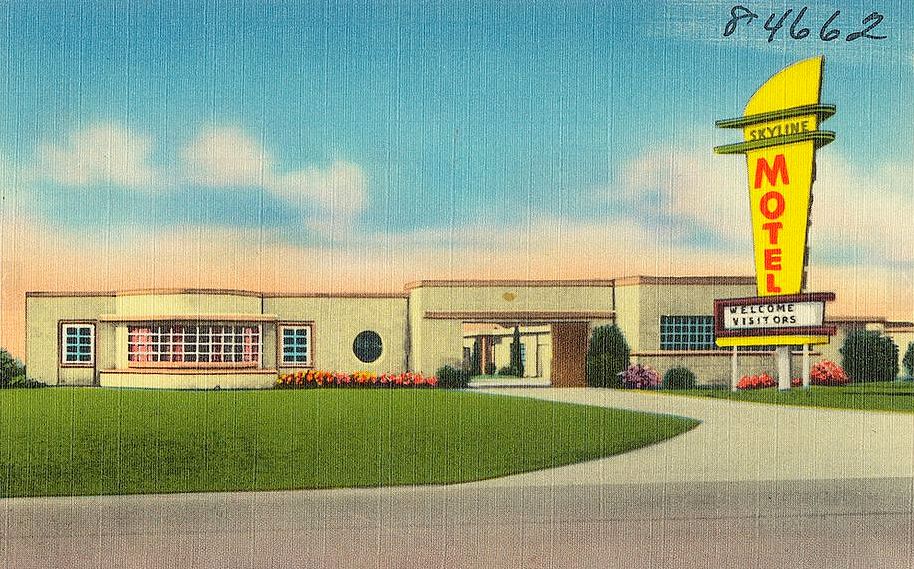
Motel Skyline / Skyline Motel — “The Motel of Distinction” (1947)

motel-skyline_postcard

by Paula Bosse

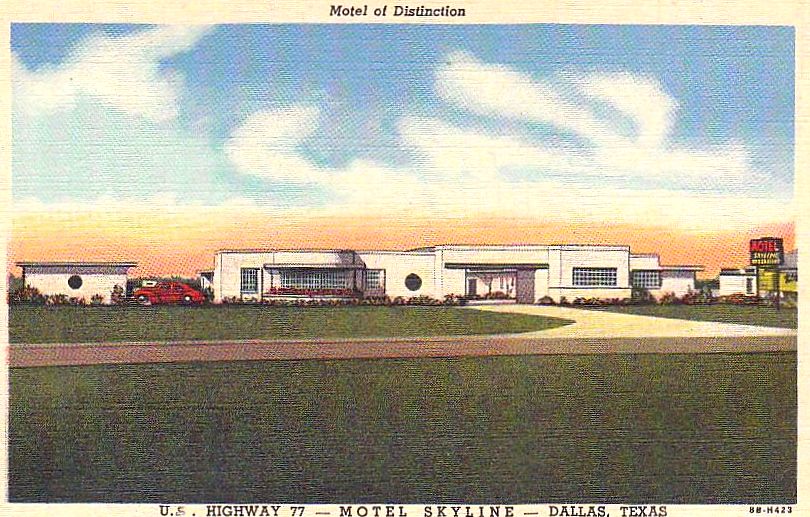
THIS is a great, great-looking motel. I only hope it looked half as sleek in real life. It was, rather surprisingly, designed in 1947 by the architect George Marble who was known for his large Tudor-revival homes in the pricier areas of Dallas (particularly Highland Park and Lakewood), so this is a major divergence in style. 1947 seems a little late for something this Deco-looking, but, no matter — this is just a fantastic building.

The “Motel Skyline” (or “Skyline Motel” as it was being referred to in ads not long after it opened in September, 1947) was located at 6833 Harry Hines, near West Mockingbird, just past Love Field. It’s not a great neighborhood these days, but perhaps it was better 60-some-odd years ago, when Harry Hines was the route that the old Hwy. 77 followed. The 30-unit “motor hotel” was built at a cost of $250,000 — it boasted year-round air conditioning and “mattresses of fiberglass.” 

I don’t know how long the place lasted — perhaps until the mid- or late-’60s, when advertising petered out and by which time the probably no-longer-so-sleek motel seems to have started catering to customers paying by the week and by the month. It might not have gotten as seedy as I fear it might have, as I saw only a couple of fairly run-of-the-mill appearances on the police blotter (cash stolen from a sleeping customer and a likely suicide in one of the rooms). Still, I shudder to think of that once-beautiful building ending its days cheek-by-jowl with modern-day Harry Hines.

It’s nice to know Dallas once had this wonderful building, if only for a little while. If anyone has photographs of the actual building, I’d love to see them, even though I know I would probably be disappointed.

*


1962 ad

***

Check out the kind of architectural design that George N. Marble is actually known for (residential, palatial), here.

Second postcard from the absolutely fantastic Boston Public Library Tichnor Brothers Postcard Collection on Flickr, here.

Matchbook from Flicker, here.

Click postcards for larger images. It’s worth it.

*

Copyright © 2014 Paula Bosse. All Rights Reserved.
2400 McKinney Avenue — 100+ Years and Counting

by Paula Bosse

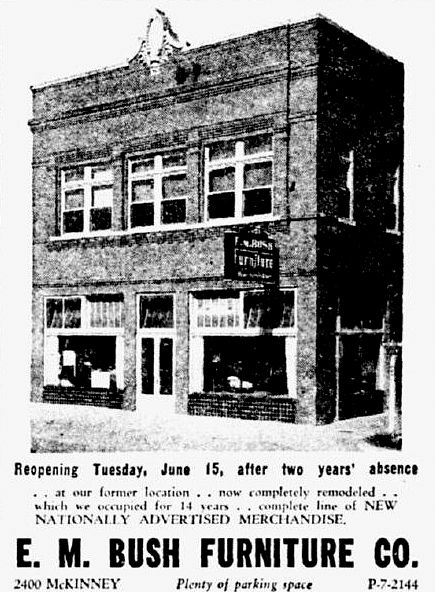
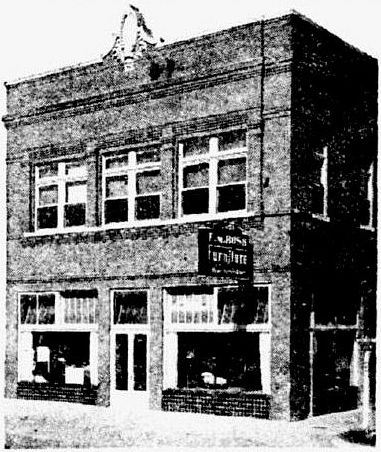
I came across this ad and wondered just where on McKinney Avenue this building had been. The ad was from 1948, but the building certainly looked older than that. I’m not sure when the building was built (update: it was built in 1909), but by at least 1929 the Hughes Auction Market was conducting furniture auctions there. An ad from 1929 invites the public to attend the regular auctions in which their two floors were packed to the gills with furniture and household goods that “positively must sell.” Prospective buyers were promised a large parking lot and a “comfortable, cool building.”

In the summer of 1933, a longtime Dallas furniture salesman, E. M. Bush, opened his retail business in the building and remained there for many years, perhaps until 1958 when he moved to Snider Plaza.

I wondered what’s at 2400 McKinney these days, and, I have to say … I’m shocked to find that the building is actually still there! On McKinney Avenue! And it looks very much the same as it does in the photo above (and, presumably, since it was built) — a little more elegant, perhaps, as it’s now part of the fabulous Hotel ZaZa — but the building looks pretty much the same. The building has survived! I feel like crying.

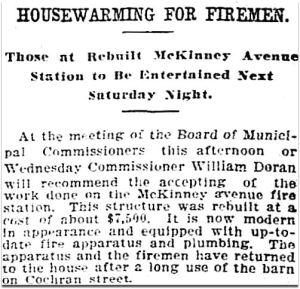
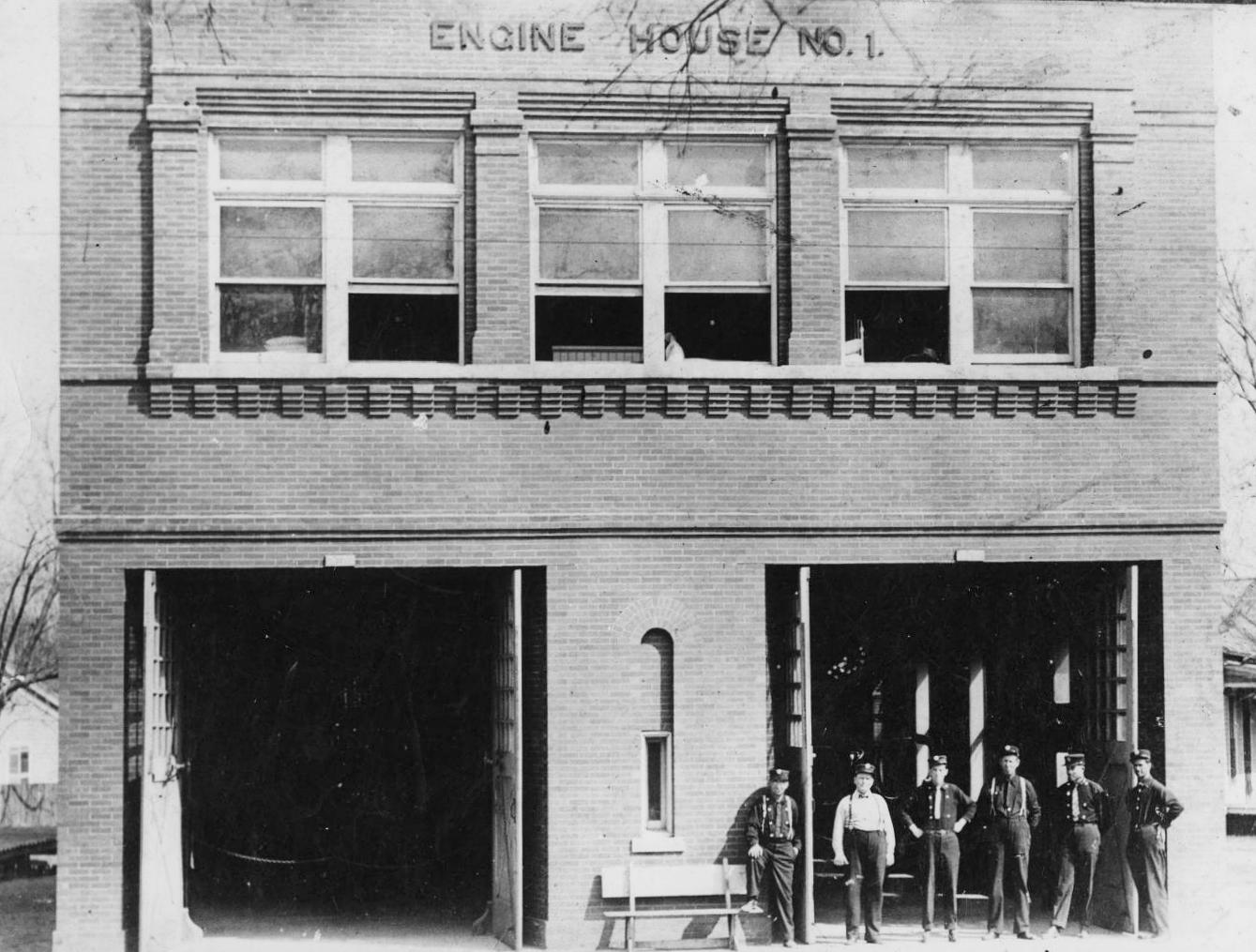
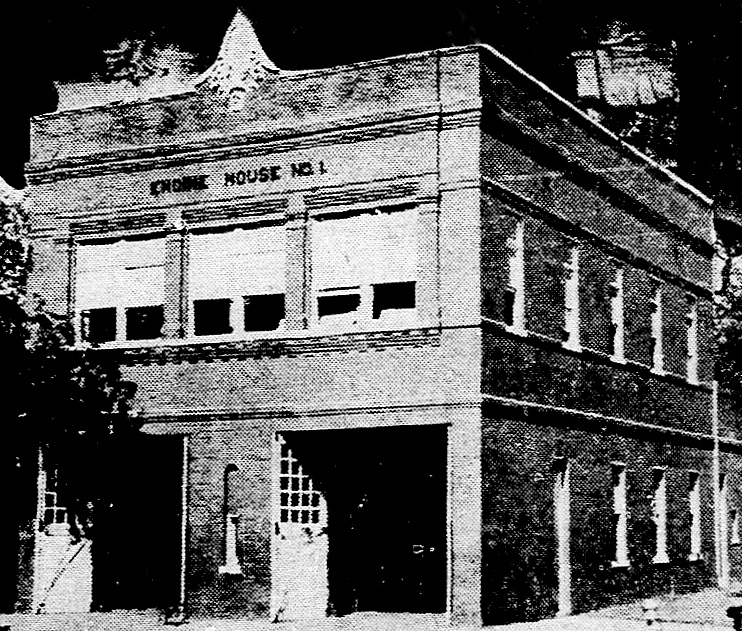
But wait, there’s more. What was this building originally? It was a firehouse! More specifically, it was Engine House No. 1, in use until 1928. The fire station that originally occupied this location was built in 1894 (see what it looked like in 1901 here, third photo down). By 1909, automobiles were placing horse-drawn fire engines, one of many reasons the station house needed to be modernized. Newspaper articles from 1909/1910 used the words “rebuilt” and “remodeled” almost interchangeably, so it’s unclear whether the original building was completely, or only partially demolished and then rebuilt, using materials from the original structure. The “new” engine house re-opened in January, 1910.

rebuilt_dmn_012510
Dallas Morning News, Jan. 25, 1910

Here’s a photo from its early days:

engine-house-no-1_mckinney

And from the 1920s:

fire-dept_mckinney-leonard-photo_1920s

The city ordered the building sold in 1928 when plans had been made to move personnel and equipment from McKinney and Leonard to a new station at Ross and Leonard.

To have a 100-plus-year-old building still standing in “newer-is-better” Dallas — and in Uptown — is quite a feat!

***

Sources & Notes

E. M. Bush Furniture Co. ad from 1948.

Photo of Stay ZaZa Art House and Social Gallery from the Hotel ZaZa website.

Firehouse photo from The Dallas Firefighters Museum. More on this station here.

Most images are larger when clicked.

*

Copyright © 2014 Paula Bosse. All Rights Reserved.
 

Speaking of the Arcadia and Its “Rustic Simplicity”…

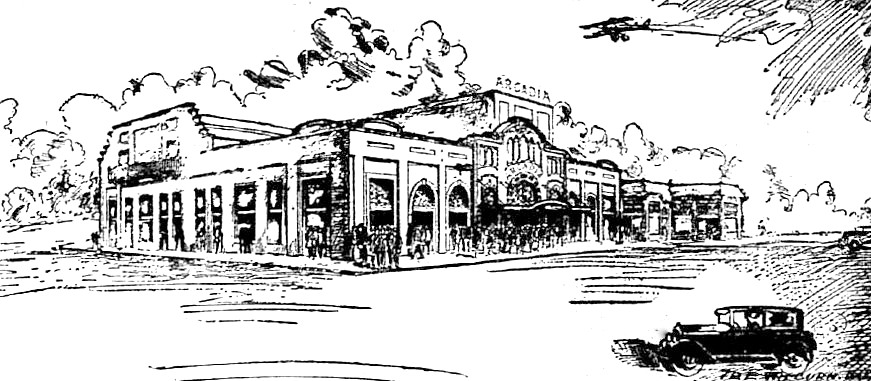
arcadia_architectural-renderingArcadia Theater, 1927…

by Paula Bosse

Above is a rendering of architect W. Scott  Dunne’s design for the Arcadia Theater on Greenville Avenue, at Sears Street, between Ross Avenue and Belmont. (The low-flying bi-plane is a nice touch.) Among the many Dallas theaters designed by Dunne were the Esquire in Oak Lawn and the Texas Theatre in Oak Cliff (as well as another entertainment mecca, the Fair Park Band Shell).

The Dallas Morning News had this to say about Dunne’s concept for the new “suburban theater” in 1927:

W. Scott Dunne, architect of Arcadia, is working out an interior design that should prove in harmony with the theater’s name — an atmospheric design of as near rustic simplicity as is possible in a theater.

“Rustic”!

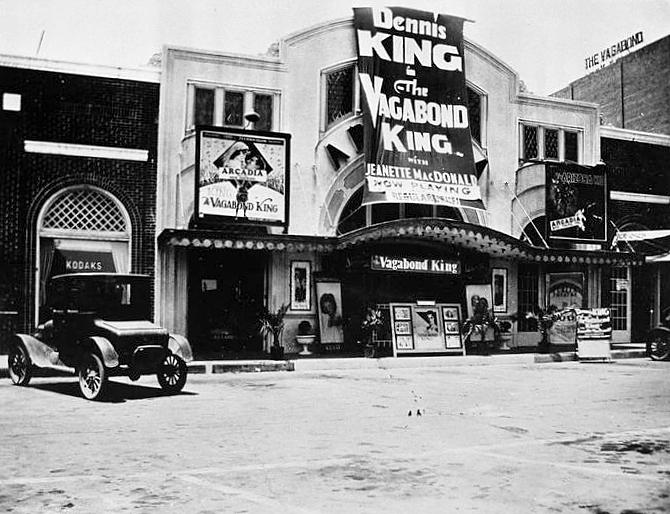
A photo of the not-particularly-rustic exterior in 1930:

arcadia-theater_1930_portal1930

The fabulous giant tree marquee, posted previously (link to post below), from about this time can be seen here.

All went well for many years until 1940 or ’41 when the original 1927 building was badly damaged in a fire; it had to be gutted and completely overhauled by architects Pettigrew & Worley. John A. Worley wrote an article for Box Office magazine about the rebuilding process (link below), including the hard-to-believe tidbit that the firm had been “vigorously instructed to studiously avoid any pretense of ‘super-colossal’ — or, more thoroughly defined, we were told to steer clear of that ‘regal’ air, which had been known to impel theater patrons to take off their shoes before daring to walk across the foyer.

The article even has a photo of the lopped-off, now-sadly diminished tree sign. (The author — in something of a reach — explains that the “stump” was there as a symbol of the “Arcadian” nature of the theater.) (You just know that both Pettigrew and Worley were praying for the go-ahead to just get rid of it already.)

1941

There was another bad fire in 1958, which led to further renovation. By then, that tree was loooooong gone and but a dim memory.

There sure were a lot of fires at the ol’ Arcadia. Including the final, fatal one, in 2006. R.I.P. And from the ashes sprang the present-day Trader Joe’s.

***

Sources & Notes

Photo showing “The Vagabond King” (1930), from the Hardin-Simmons University Library via the Portal to Texas History, here.

Photo showing “stump” is from the June 21, 1941 issue of Boxoffice.

An interesting article on the Arcadia — and life along Lowest Greenville — can be found in a Lakewood Advocate article “The Rise and Fall of the Arcadia,” here.

The original post that spurred a further look into the early days of the Arcadia — and the one with the crazy huge electric tree marquee — can be found in the Flashback Dallas post “The Arcadia Theater Sign You’ve Never Seen,” here.

*

Copyright © 2014 Paula Bosse. All Rights Reserved.


Dallas Power & Light Building, Night and Day

by Paula Bosse

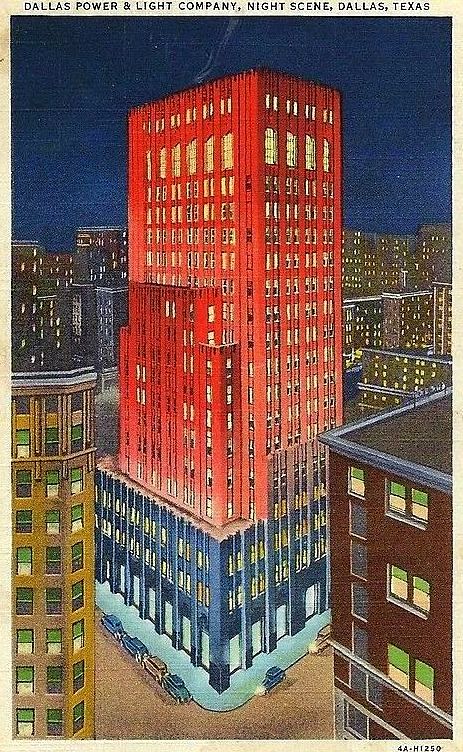
Such an incredible building, designed by architects Lang & Witchell in the zig-zag moderne/Art Deco style and built in 1931 to house the corporate offices of the Dallas Power & Light company. I wondered from that night scene whether the building was illuminated at night, and it was. From the city’s application to the National Register of Historic Places: “The building was spotlighted with revolving colors at night, emphasizing it as a downtown landmark; this was discontinued during the energy crisis in 1975.” Argh!

This is a building that is beautiful by night and beautiful by day.

***

Sources & Notes

A detailed description of the architectural elements of the DP&L building is in a PDF containing the city’s application of several buildings to be considered for the National Register of Historic Places. The section on the DP&L building begins at page 68 and can be found here.

A photo of one of the portrait busts on the facade of the building is a nod to Thomas A. Edison, King of Electricity, and it can be seen here in an almost Hitchcockian cameo.

*

Copyright © 2014 Paula Bosse. All Rights Reserved.
Highland Park Shopping Village

hp-village_postcard

by Paula Bosse

Highland Park — the ritzier of the two “Park Cities” — is home to the exclusive Highland Park Shopping Village, which began construction in 1930 and is one of the chi-chi-est of chi-chi shopping areas in the country. And it’s beautiful. I still can’t believe I spent numerous nights there, watching midnight showings of The Rocky Horror Picture Show. They let the less-monied freakier Dallasites in on weekends after the sun went down.

***

Sources & Notes

Check out the Village’s eye-popping history timeline here. It’s pretty funny to think there used to be a DIME STORE there!

*

Copyright © 2014 Paula Bosse. All Rights Reserved.