Flashback : Dallas

A Miscellany: History, Ads, Pop Culture

Category: Crime/Law Enforcement

Hoisting a Few in the Basement Speakeasy

speakeasy_greene

by Paula Bosse

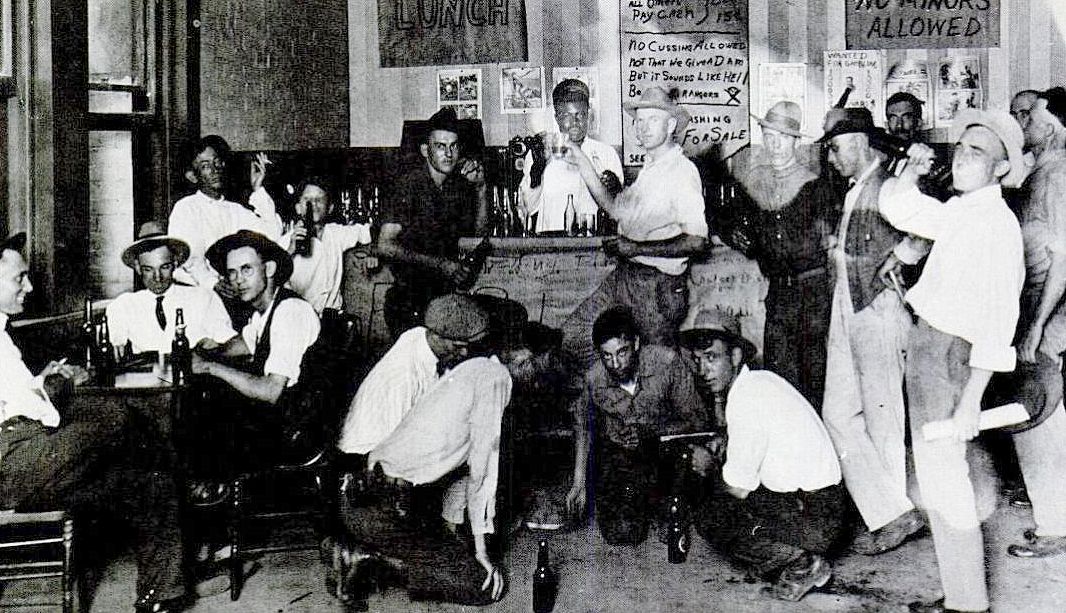
It’s tax day. Here’s a photo of men drinking illegally and gambling. Cheers!

“Dallas voted for Prohibition October 1917 — but it didn’t go dry, as this workingman’s speakeasy (a word not developed then) shows. One sign assures drinkers ‘No Neer Beer Served.’ This is a basement of some downtown building, address unknown.”

***

Photo and caption from Dallas, The Deciding Years by A. C. Greene (Austin: Encino Press, 1973).

Click picture for larger image.

*

Copyright © 2014 Paula Bosse. All Rights Reserved.

How Lincoln’s Assassination Was Reported in Dallas — 1865

lincoln_harpers-engraving

by Paula Bosse

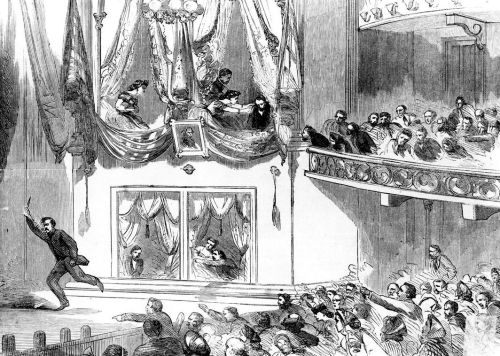
Abraham Lincoln was shot by John Wilkes Booth on April 14, 1865; he died the next morning. I wondered how the news had been reported in Dallas. I couldn’t find the first mention of the assassination in The Dallas Herald, but it seems there may have been a special “extra” edition published on or just after April 29th — a full two weeks after the fact! The one thing I kept encountering in general Google searches were mentions of the vicious, celebratory editorial that appeared in the pages of the Herald — these reports always quote the line “God Almighty ordered this event or it could never have taken place.” I found that editorial. It appeared in the two-page Dallas Herald on May 4, 1865, along with detailed reports of the assassination.

lincoln_dallas-herald_masthead_050465

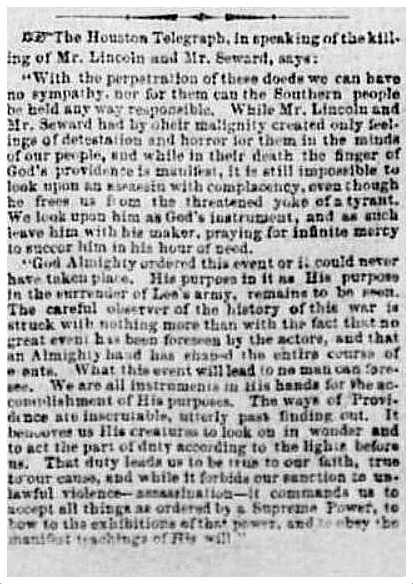
lincoln_dallas-herald_houston-tel-050465

The image resolution here is pretty bad (it is transcribed below), but, yes, this eye-poppingly vitriolic editorial did appear in the pages of The Dallas Herald — but it did not originate with the Herald (which is not to say that the Dallas editor wasn’t in agreement with the sentiments expressed). The editorial was reprinted from the Houston Tri-Weekly Telegraph (which had run it ten days previously, on April 24); its appearance in the Dallas paper is even clearly prefaced with the following: “The Houston Telegraph, in speaking of the killing of Mr. Lincoln and Mr. Seward, says…” — so it’s unclear why so many historians and authors mention this editorial as being the product of The Dallas Herald.

The editorial was unsigned, but it was probably written by William Pitt Ballinger, whose previous flame-fanning tirades against the president in the pages of the Telegraph must have caused even hard-core Confederate-leaning brows to raise. I’ve transcribed the full editorial below. For whatever reasons, the Dallas Herald omitted the first and last paragraphs — probably because of space limitations, but one would like to think that even a pro-Confederacy newspaper would think it best to leave out a phrase such as “The killing of Mr. Lincoln and Mr. Seward may be more wonderful than the capitulation of armies.” Yikes. Imagine a mainstream newspaper printing something like that following the assassination of President Kennedy.

Below is the full astonishing text of the editorial that originally appeared in the Houston Tri-Weekly Telegraph on April 24, 1865. The stark reality of historical events and the contemporaneous tenor of the times can look a lot different when seen from a distance of 150 years.

*

We publish to-day the most astounding intelligence it has ever been our lot to place before our readers — intelligence of events which may decide the fate of empires, and change the complexion of an age. The killing of Mr. Lincoln and Mr. Seward may be more wonderful than the capitulation of armies.

With the perpetration of these deeds we can have no sympathy, nor for them can the Southern people be held any way responsible. While Mr. Lincoln and Mr. Seward had by their malignity created only feelings of detestation and horror for them in the minds of our people, and while in their death the finger of God’s providence is manifest, it is still impossible to look upon an assassin with complacency, even though he frees us from the threatened yoke of a tyrant. We look upon his as God’s instrument, and as such leave him with his maker, praying for infinite mercy to succor him in his hour of need.

God Almighty ordered this event or it could never have taken place. His purpose in it as His purpose in the surrender of Lee’s army, remains to be seen. The careful observer of the history of this war is struck with nothing more than with the fact that no great event has been foreseen by the actors, and that an Almighty hand has shaped the entire course of events. What this event will lead to no man can foresee. We are all instruments in His hands for the accomplishment of His purposes. The ways of Providence are inscrutable, utterly past finding out. It behooves us His creatures to look on in wonder and to act the part of duty according to the lights before us. That duty leads us to be true to our faith, true to our cause, and while it forbids our sanction to unlawful violence — to assassination — it commands us to accept all things as ordered by a Supreme Power, to bow to the exhibitions of that power, and to obey the manifest teachings of His will.

What will [be] the result of these tremendous events, no man can foresee. Theories will present themselves to every man’s mind. We have a dozen all equally probable, and all equally uncertain. Let us wait in patience for the next scene in this terrible drama.

***

Top image is an engraving of the assassination in Ford’s Theatre from Harper’s Weekly, April 29, 1865.

Editorial is from The Houston Tri-Weekly Telegraph, published April 24, 1865 (Vol. 31, No. 13). You can view a scan of the original newspaper via the indispensable Portal to Texas History, here (it is at the top right of the page, last column). Reprinted without the first and last paragraph by The Dallas Herald ten days later on May 4, 1865 (Vol. 12, No. 36).

Editorial is probably by William Pitt Ballinger, a Galveston attorney. His editorial screeds for the Telegraph are mentioned in the just-published Loathing Lincoln: An American Tradition from the Civil War to the Present, by John McKee Barr (LSU Press, 2014), p. 53 — read an excerpt here. Read more about Ballinger — the “brilliant attorney and political insider” — here.

An interesting article titled “The Last Newspaper to Report the Lincoln Assassination” is here. The article is about The Houston Tri-Weekly Telegraph, but it looks like The Dallas Herald was even SLOWER to report the news.

lincoln_dallas-herald_extra_050465

“We received on Saturday last [April 29] the dispatches containing the assassination of Mr. Lincoln and Mr. Seward, by a letter from Maj. Stackpole to his family at this place, and published them in an extra. There was some little discrtepancy and an omission in them as published then, which we find corrected in the Houston Telegraph’s dispatches which we publish to-day.” (Dallas Herald, May 5, 1865)

*

Copyright © 2014 Paula Bosse. All Rights Reserved.

City Hospital, a Pump Station, and the County Jail — 1894

Hospital, pump house, jail (click for larger image)

by Paula Bosse

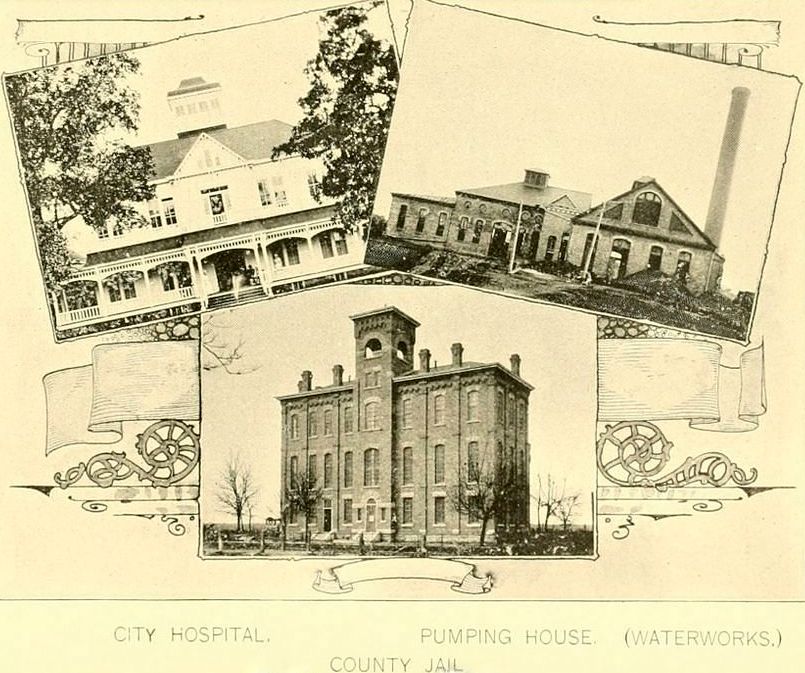
From 1894, an odd grouping of buildings: the City Hospital, a Dallas Waterworks Pumping House, and the Dallas County Jail. From a distance of 120 years, they’re all rather pleasant-looking, a word that would never be used to describe their 21st-century institutional counterparts. I wondered how many of the buildings had made it to the 20th century. Happily, they all did.

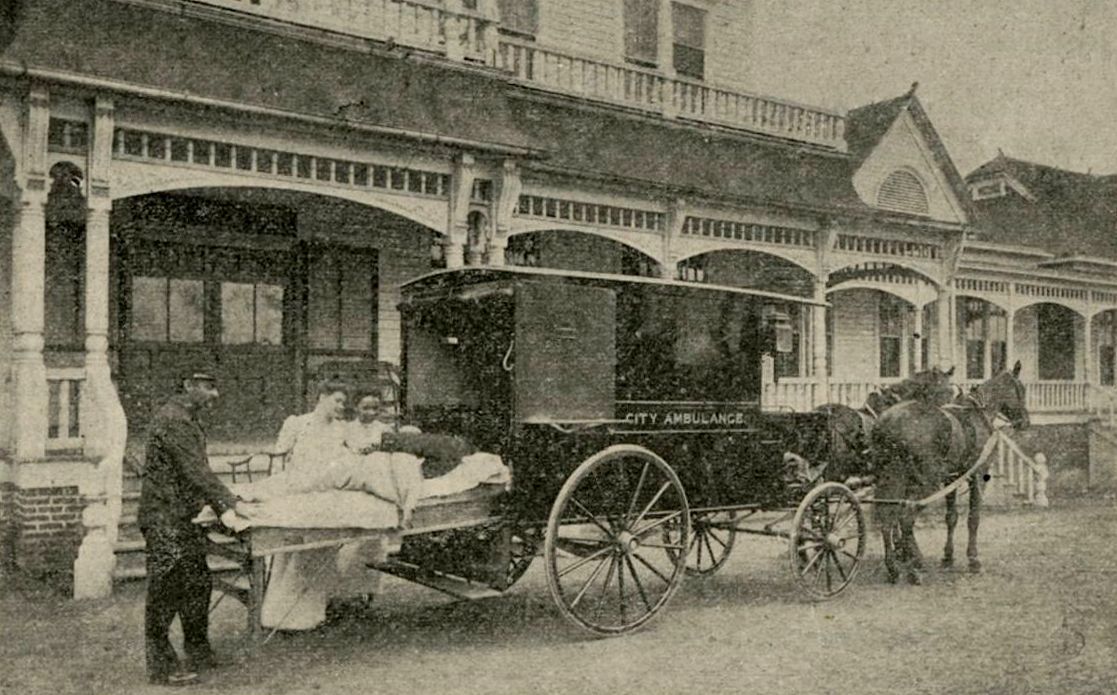
City Hospital opened in May of 1894 at Maple and Oak Lawn (it later became known as Parkland Hospital, the name coming from the 17 acres of land it occupied that had originally been planned as a city park). Here it is in about 1903, as a patient arrives in a horse-drawn ambulance. This wooden building was replaced in 1913 by the brick building that — yay! — still stands (in amongst its recent expansion and expansion and expansion by real estate mogul Crow the younger).

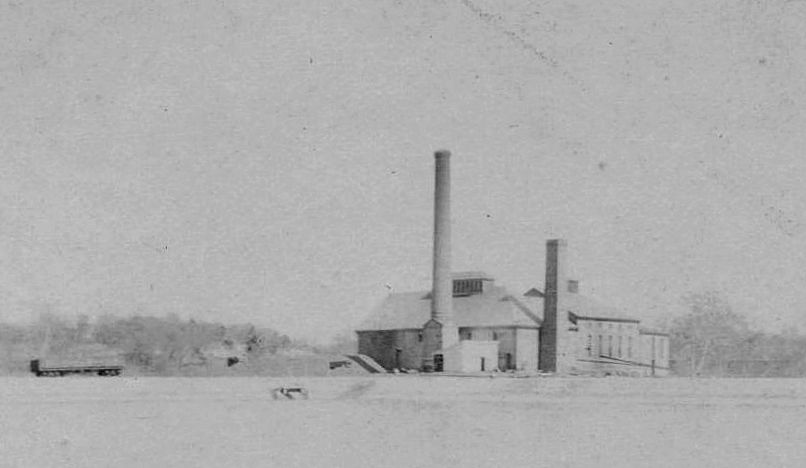
I looked all over for a later photograph of the “pumping station” but was unable to find a definite photo. I knew that it was built after the original pump house at Browder’s/Browder Springs in City Park and before the one now housing the Sammons Center for the Arts and the one at White Rock Lake. I think it might be this one, the Turtle Creek station, shown above during the devastating 1908 flood. If this is the same pump station, it looks as if there was quite a bit of expansion to this structure, too.

Dallas Morning News, Feb. 4, 1914

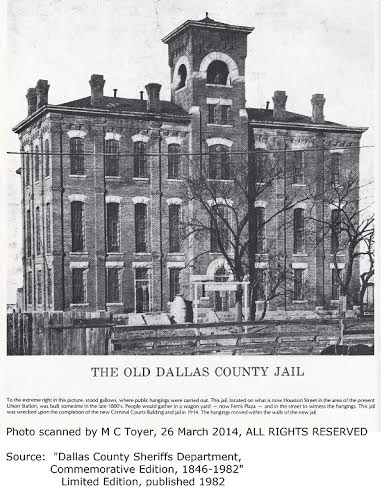
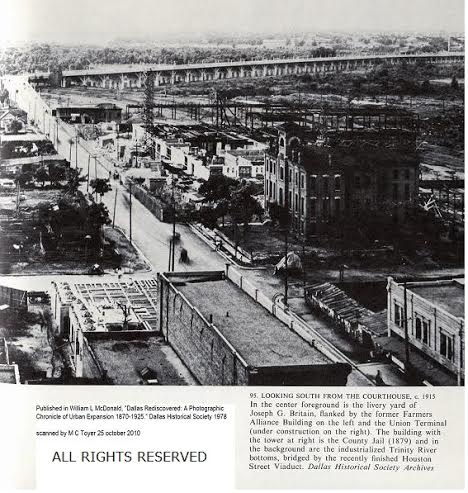
The building that changed the most from the pristine structure in the original 1894 photo was the Dallas County Jail, which was located at Houston and Jackson streets. Built in 1881, it was 13 years old in the original photograph. By the time it was 33 years old, it was almost unrecognizable, as can be seen (…sort of) in this photo, even with the horrible resolution. The jail had to keep expanding to keep up with demand and became a hulking mess. In the first decade of the century, reports began to appear in the newspapers of the deplorable conditions of the old jail and demands were made to improve conditions for prisoners. A new jail was built and the old one was auctioned off to the the Union Terminal Company which demolished the building in 1916, as the finishing touches were put on its Union Station, mere steps away from the former jail.

DMN, May 23, 1916

UPDATE: Thanks to reader M.C. Toyer, I have a couple of really great photos of the Old County Jail!

I’m not sure of the date of the one above, but the one below (such a great photo!) is dated 1915, the year the Old County Jail was finally emptied of its inmates, and a year before it was demolished.

Thanks for the great photos, MC!

***

Original photograph of the three buildings is by Clifton Church and appeared in his wonderful book Dallas, Texas Through a Camera (Dallas, 1894).

The photo of the ambulance in front of City Hospital is from the UT Southwestern Archives, with another photo of the same period here. A collection of newspaper articles on the hospital’s early history is here. An article on the City Hospital that pre-dated this one, with some harrowing descriptions of medical care in Dallas in 1875 is here.

The flooded Turtle Creek pump station is from the Dallas Municipal Archives. Other photos of this station can be seen here.

Bottom two photos of the Old County Jail sources are as captioned.

For more photos on the Dallas Waterworks/Turtle Creek Pump Station/Water Filtration Plant, see a later post of mine, here.

Click photos to enlarge.

*

Copyright © 2014 Paula Bosse. All Rights Reserved.
Mrs. Turner Attacked Miss Hulsey in the Spoolroom with a Knife

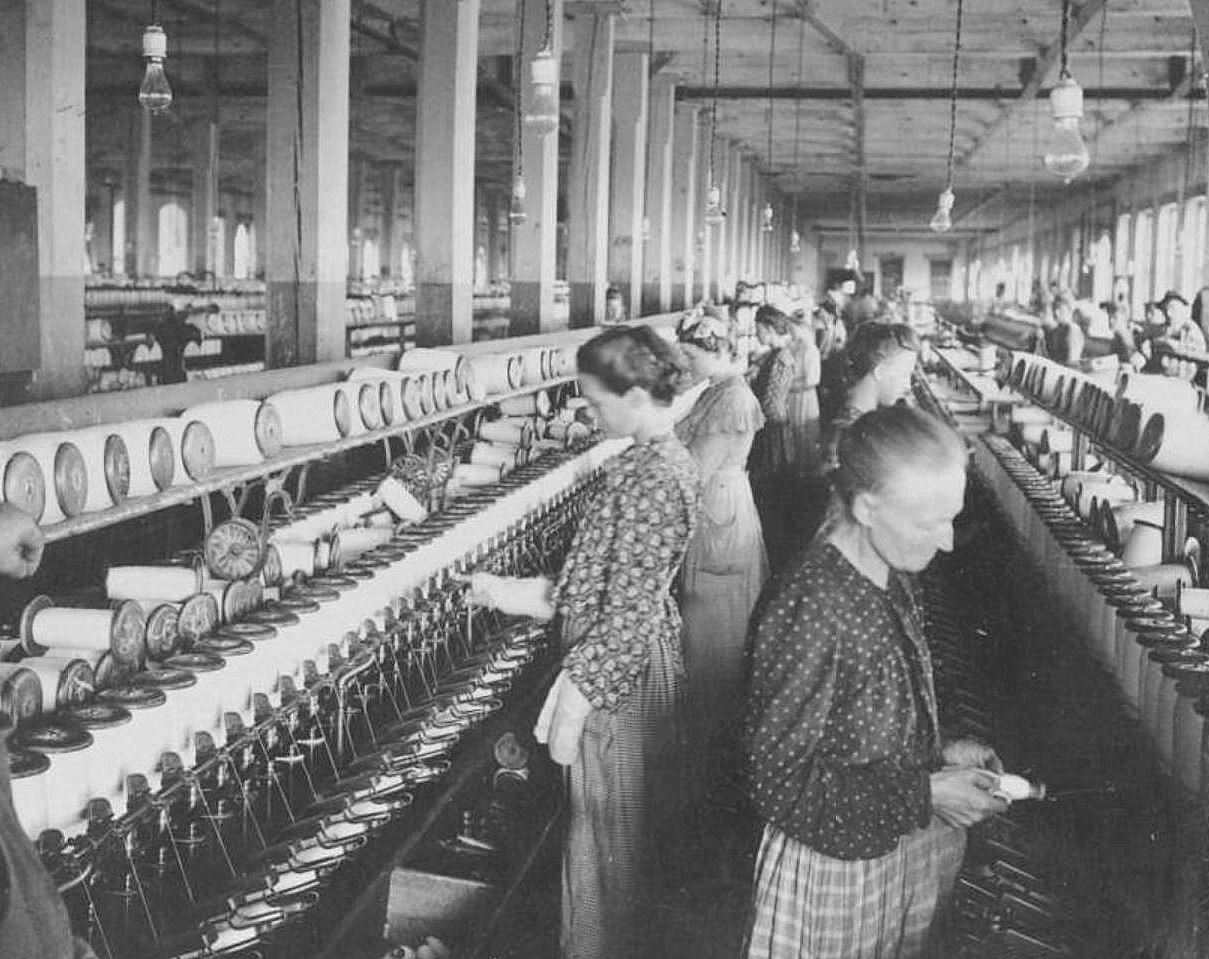
spoolroom_jones-coll_degolyer_smuSpoolroom of the Dallas Cotton Mills…

by Paula Bosse

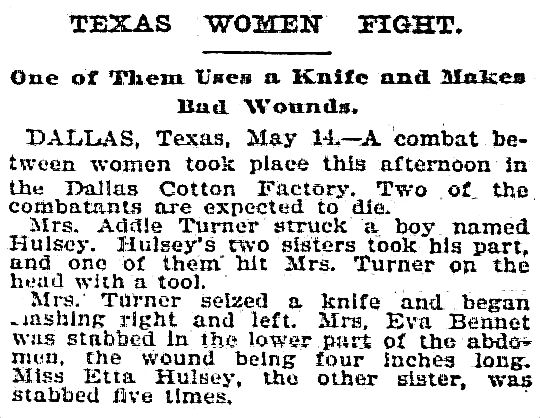
The spoolroom of the Dallas Cotton Mills was no place for the faint of heart, as this eyeball-popping story from The Dallas Morning News will attest (click for larger image):

dallas-cotton-mills_attack_dmn_051697DMN, May 16, 1897

The story even made it into the pages of The New York Times:

spoolroom-slashing_nyt_051597
NYT, May 15, 1897

(The women apparently survived.)

*

Sources & Notes

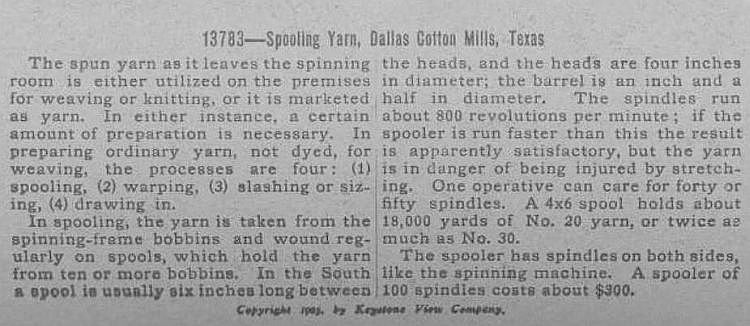
Photo (“Spooling Yarn, Dallas Cotton Mills, Dallas, Texas”) is from a stereograph, circa 1905, from the Lawrence T. Jones III Texas Photographs Collection, DeGolyer Library, Central University Libraries, Southern Methodist University; it is accessible here.

The descriptive text from the back of the card:

spoolroom_jones-coll_degolyer_smu_text

*

Copyright © 2014 Paula Bosse. All Rights Reserved.

Mme. Koneman, High-Class Milliner

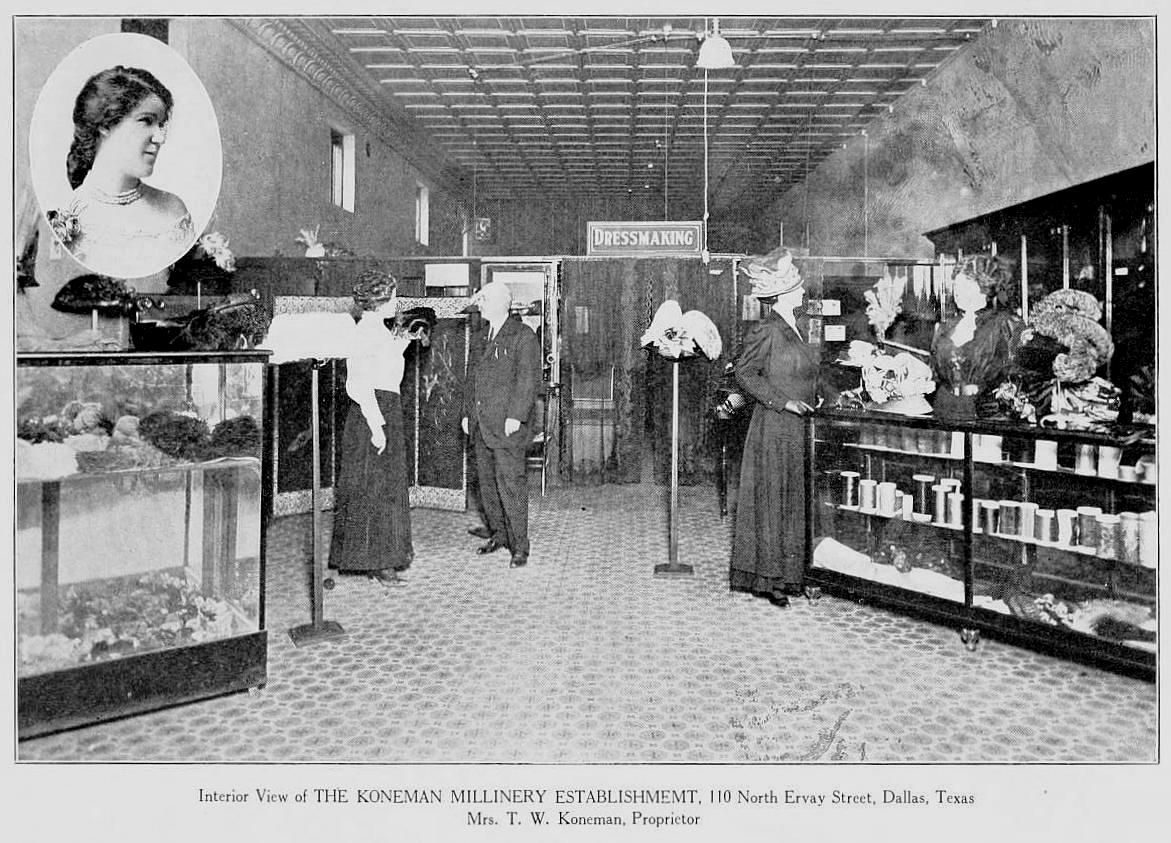
Madame Koneman’s fashion emporium, 1912 (click for larger image)

by Paula Bosse

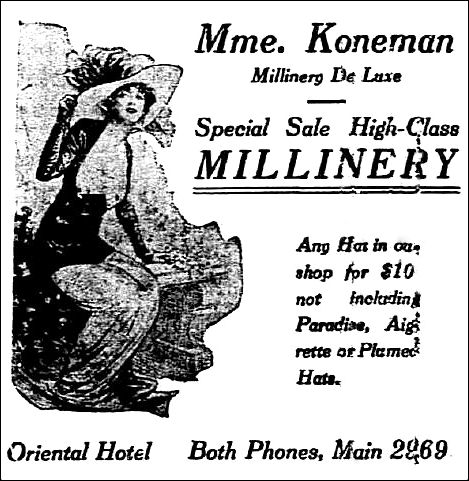
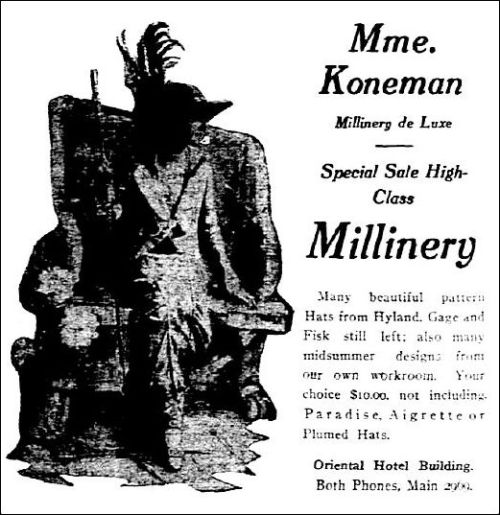
Behold, the Koneman Millinery Establishment, which actually looks a little plain for a millinery shop housed in the ornate Oriental Hotel building. When I see old ads or photos like this, I always wonder about the people pictured in them. I’m assuming that the woman in the oval inset at the left was the proprietess, “Mme. Koneman.” So who WAS she, this woman who had a “high-class” business that catered to a “high-class” clientele? I poked around a little and found these ads from 1913.

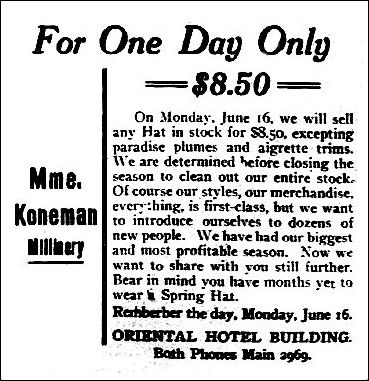
koneman-millinery_dmn_060113

koneman-millinery_dmn_060813

koneman-millinery_dmn_061413

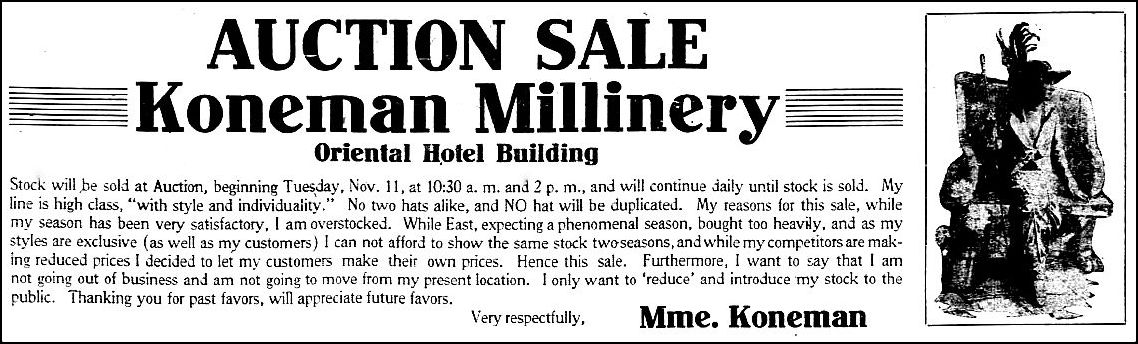
koneman-millinery_dmn_110913(click for larger image)

Ooh. Those last few sentences of the above ad seem a little defensive, as if she’s addressing nasty gossip. “Furthermore, I want to say that I am not going out of business.” When you see a sentence like that — in an advertisement — that sends up some furiously waving red flags. And … just one month after that ad, this miniscule tidbit in teeny-tiny letters appeared in the paper at the end of 1913:

Dallas Morning News, Dec. 21, 1913

Oh dear. D-I-V-O-R-C-E. And, guess what? There were no more ads for the millinery shop.

But, alarmingly, THIS appeared on the wire services on February 17, 1917:

Fort Worth Star-Telegram, Feb. 17, 1917

Oh DEAR! Shot by a widower with two children, who tried to kill both her and himself after he flew into a jealous rage in a New Orleans hotel lobby. Working with feathers and plumes and felt and velvet (probably) does not prepare one for being shot at!

Ten days after being shot, it was reported that the 36-year old Mrs. Koneman (whose first name was either “Matilda” or “Mathilda”) was released from the hospital in New Orleans. The jealous suitor, 40-year old Edgar J. Hargrave (or “Hargrove”), remained in the hospital, slowly recovering (but with a bullet still lodged in his head!). “Policemen expect to arrest Hargrave on a charge of shooting with intent to murder as soon as he is able to leave the institution.” He was an “oil salesman” from Houston.

One week later, Hargrave/Hargrove was released from the hospital and was transferred to Parish Prison where he awaited arraignment on attempted murder. Meanwhile, Matilda/Mathilda, a material witness in the case, had been arrested when the D.A. heard she was about to leave town. Out on a $650 bond, she was ordered to stay in the city until the arraignment.

On March 16, one month after being shot in the lobby of the Grunewald Hotel, Mrs. Koneman was in court recounting her near-death experience, and I’m sure the people back in Dallas were eating up every last morsel in the scandalous testimony about the spurned lover who tried to kill the divorcée who used to sell them great big hats with aigrette plumes in that bleakly unadorned hat shop over on Ervay!

koneman-testifies_dmn_031617-smDMN, March 16, 1917 (click for larger image)

(UPDATE: A reader kindly forwarded me a more detailed account of the shooting incident between the spurner and the spurnee, in a longer article from the New Orleans Times-Picayune (Feb. 17, 1917). Click here to read the article, with a blurry photo of Hargrave.)

And then — rather anticlimactically — the trail ran cold. What was the verdict? What happened to Edgar? Whither Mme. Koneman? Mrs. Koneman was reported to be living in Galveston at the time of the shooting, but by the summer of 1922 she was back in Dallas, checked into the Southland Hotel. The last shred of info I found about her was this classified ad from June, 1922, which raises even more questions.

DMN, June 15, 1922

I’m not really sure what this was all about, but it’s safe to say there would have been very few lags in the conversation between Dallas and California!

***

Top ad from The Standard Blue Book of Dallas, 1912-1914 (Dallas: A. J. Peeler & Co.).

“Dallas Woman Shot” article from the Fort Worth Star-Telegram, Feb. 17, 1917. This was a wire service story that was printed around the country, but, oddly enough, the news doesn’t seem to have made its way into the DMN until ten days after the shooting!

All other ads and articles from the Dallas Morning News. The Koneman Millinery ads were from 1913.

*

Copyright © 2014 Paula Bosse. All Rights Reserved.

Not Every ‘Good Luck Trailer Park’ Story Has a Happy Ending — 1964

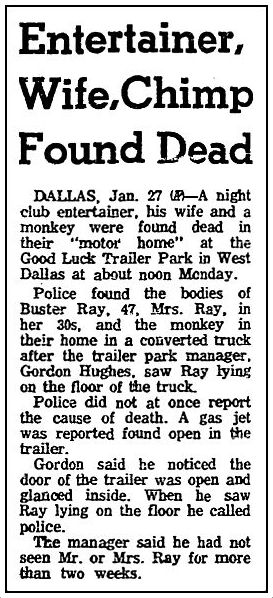
chimp_fwst_012864Fort Worth Star-Telegram, Jan. 28, 1964

by Paula Bosse

“Entertainer, Wife, Chimp Found Dead.” THAT is a headline.

Had I not known that the (ironically named) Good Luck Trailer Park on W. Commerce had been a favorite with visiting circus folk, I might have been a little more surprised by the weird circumstances reported in this article. As it was, I was only mildly surprised.

(I kind of think the chimp did it….)

***

Sources & Notes

Hats off to the Fort Worth Star-Telegram‘s headline writer. The story ran in the Star-Telegram on Jan. 28, 1964.

The victims — Harold Allen Ray and his wife Nadine (and unnamed monkey) — were later determined to have died of accidental carbon monoxide poisoning.

“Buster Raye” (stage name of Harold Ray) had been a comedian and master of ceremonies who seems to have played a lot of burlesque joints/strip clubs as the between-stripper entertainment. He was billed as “The Mighty Mite of Mirth.” In a Feb. 24, 1948 review of his act, The Bryan Eagle wrote:

Buster Raye, diminutive master of ceremonies, stole the show with a clever line of chatter punctuated with juggling, acrobatics, songs, imitations. His jokes were well handled with none of the vulgarity common to many floor shows.

I’m not sure where the monkey fits in.

buster-raye_corpus_042948Corpus Christi Caller-Times, April 29, 1948

*

Copyright © 2014 Paula Bosse. All Rights Reserved.


Dear JFK: Welcome to Big “D” — Love, DP

Nov. 22, 1963

by Paula Bosse

Sorry, Dr Pepper, but this might be the most unfortunate, unintended instance of product placement ever.

***

Sources & Notes

AP photo, November 22, 1963.

*

Copyright © 2014 Paula Bosse. All Rights Reserved.
“Dallas Motor Cycle Cops” — 1910

dallas-police_motorcycles_1910_bReady and on the job…

by Paula Bosse

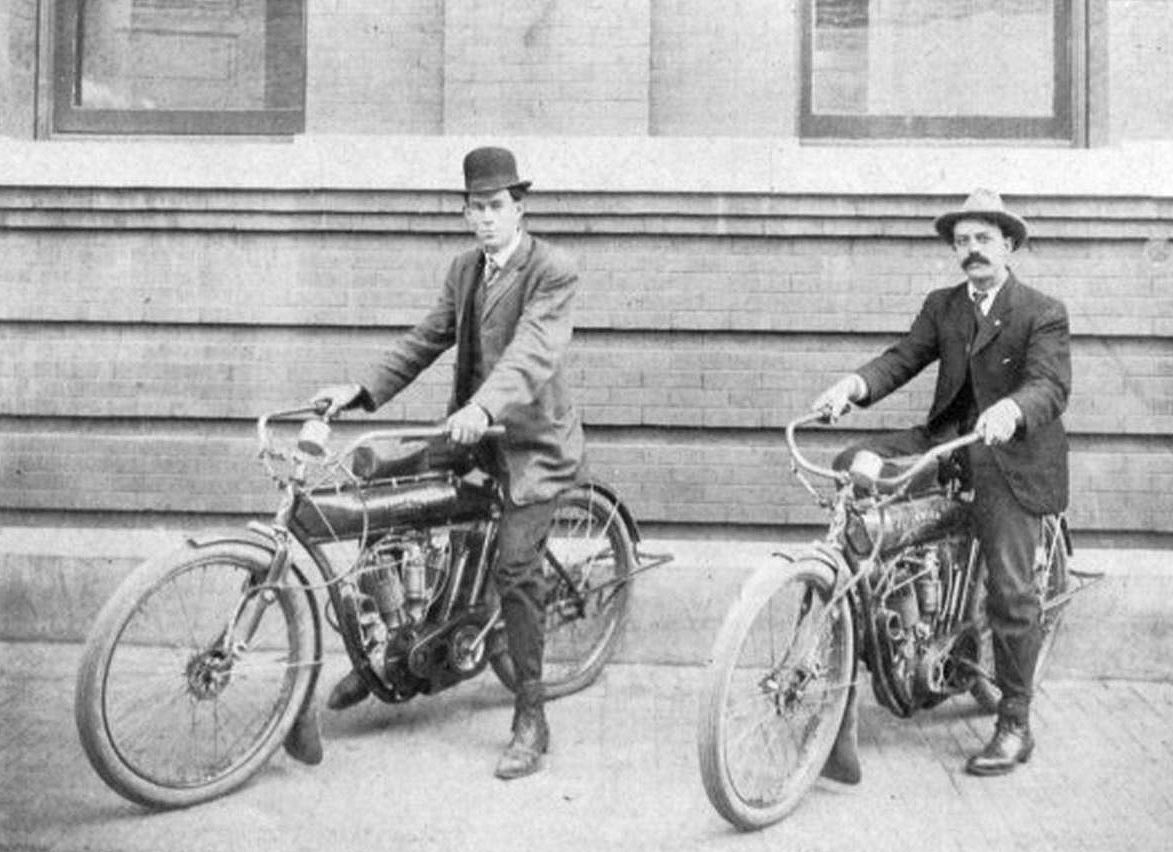
These photos of the Dallas Police Department’s “Motor Cycle Cops” appeared in a police publication from 1910.  We see them astride their machines, — one in a bowler hat — waiting for their call. Above, the “cops” are identified as B. G. Ford and A. W. Schulz; below, T. R. McSwain and S. R. Dean.

dallas-police_motorcycles_1910_a

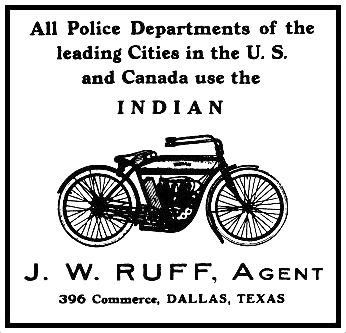
I can’t vouch for the models of the bikes, but this ad for Indian Motorcycles appeared just pages away.

ad-indian-motorcycles_1910

***

Sources & Notes

From a book with almost no publication info; it is presented simply as Dallas Police Department (Dallas, 1910). It’s got great photos and can be found on the Portal to Texas History site, here.

By 1951, the DPD’s allegiance had shifted to Harley-Davidson, as can be seen in the post “The Dallas Police Department & Their Fleet of Harleys — 1951.”

*

Copyright © 2014 Paula Bosse. All Rights Reserved.
Where to Put That JFK Memorial? — 1964

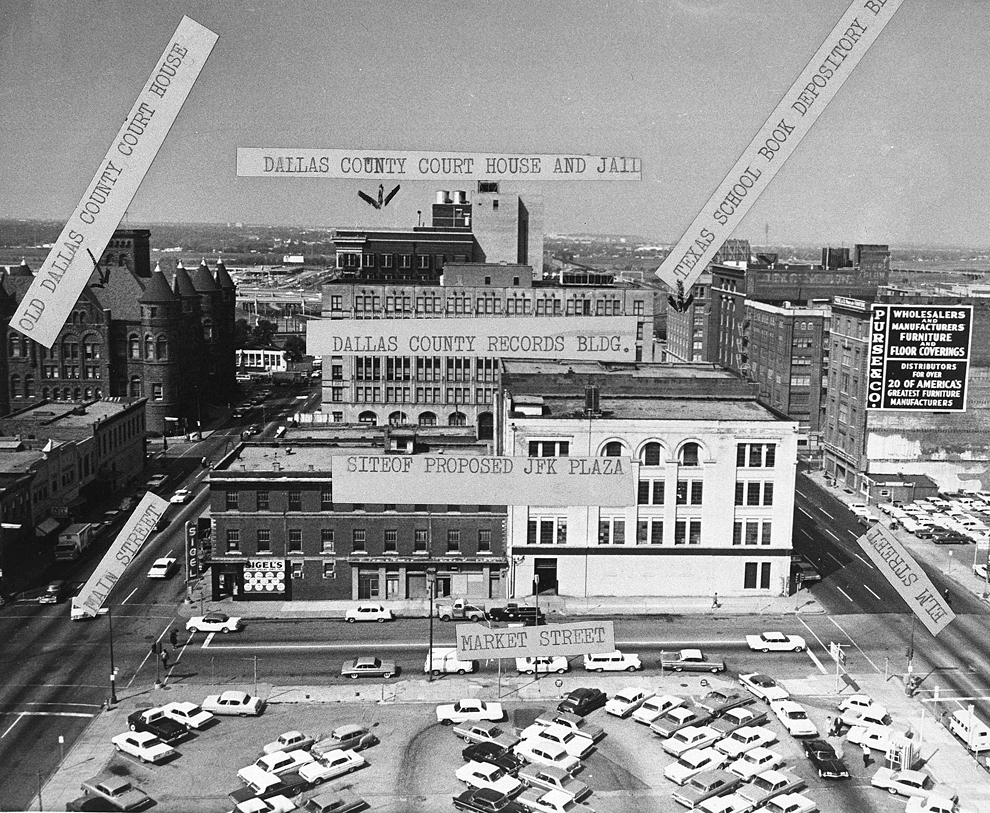
Looking west, 1964 (AP photo)

by Paula Bosse

I’m not really into the whole assassination thing, which may explain why I’ve never seen this 1964 Associated Press photo (with or without the labels). Despite the connections to “that dark day,” I think this is a really interesting view of the city, from an unusual vantage point.

Here’s another similar photo, from April 1964 — this one from United Press International. UPI’s caption:

DALLAS: Site of Memorial Park. The area outlined in white is the block where the John F. Kennedy Plaza will be created as a memorial to the late president. The outline traces buildings now on the site which will be removed on completion of the new county courthouse.

jfk-memorial_proposed_apr-1964_UPI_ebayApril 1964 (UPI Telephoto)

The original location for the memorial was in the block immediately to the east of the Records Building, not the Old Red Courthouse, where it eventually was placed. I’m not sure why the location changed, but by the time architect Philip Johnson, designer of the memorial, was on board, the site had moved one block south.

*

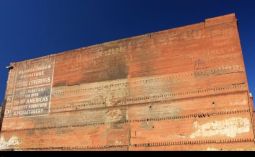
The Purse & Co. sign seen at the right side of the top photo is still visible today — it’s probably the largest and most familiar ghost sign downtown. Here’s a picture that was linked to Google maps. (I think I prefer it as a ghost sign.)

***

Sources & Notes

Top photo by Ferd Kaufman for the Associated Press, 1964.

Bottom UPI Telephoto found on eBay.

*

Copyright © 2014 Paula Bosse. All Rights Reserved.
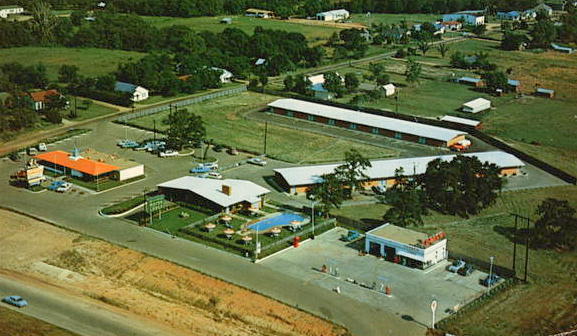
Ted Hinton’s Motor Lodge — From Bonnie & Clyde to Motel Heliport

hintons-motor-lodge_front“7 miles from Downtown Dallas” — choppers welcome

by Paula Bosse

What does a man who ambushed and killed Bonnie and Clyde do once he’s retired from law enforcement? He opens a motor lodge, of course!

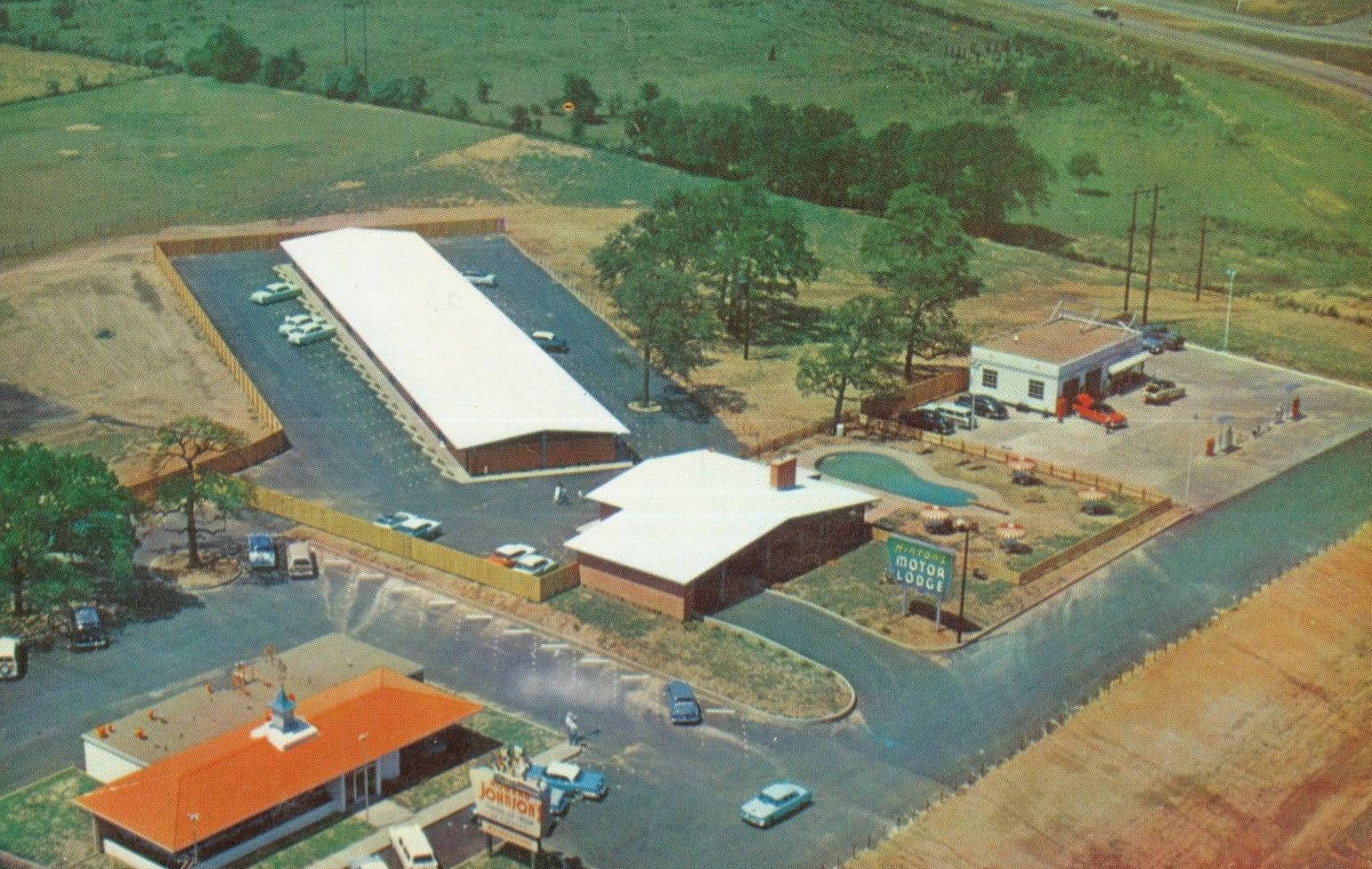
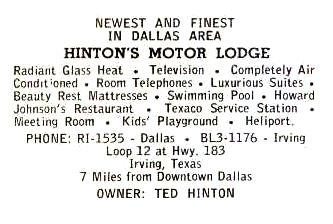
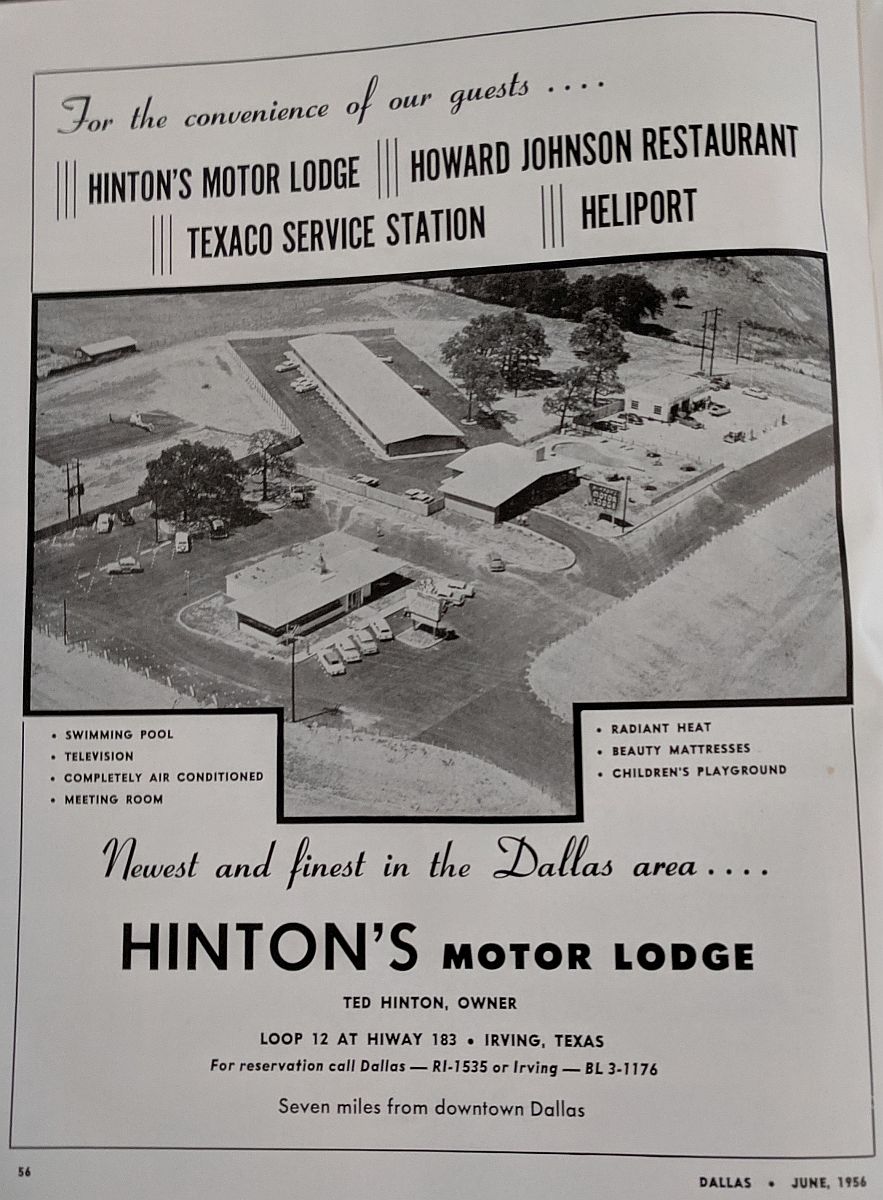
I was initially drawn to this image because of an unexplained lifelong fascination with Howard Johnson’s restaurants (I think I was only ever in one — the one on Mockingbird at Central, where my father introduced me to the inexplicable root beer float). But the interesting thing about this postcard is not the HoJo’s, it’s the motel next door, Hinton’s Motor Lodge, an establishment that was in business from 1955 to 1970, in Irving, very near to where Texas Stadium would be built in 1971 (Loop 12 at Hwy. 183). Why would a motor lodge be interesting? Because the owner was Ted Hinton (1904-1977), the former Dallas County Deputy Sheriff who was one of the six men who tracked down, ambushed, and killed Bonnie and Clyde in 1934. (Hinton was recruited for the posse because he would be able to identify both of them: he had known Clyde Barrow growing up, and he had apparently had a crush on Bonnie Parker in the days when she was working as a waitress and he was working for the post office.)

After killing two of the most notorious celebrity outlaws of all-time, it must have been hard to know where to turn next. He retired from the Dallas County Sheriff’s Department in 1941 and, as he was a pilot, he trained flyers for the US Army Air Corps during WWII. The fact that Hinton was a pilot MUST explain the inclusion of a “heliport” (!) in the list of motel amenities, alongside Beauty Rest mattresses, a swimming pool, and a playground for the kids.

I’m sure that, on occasion, Hinton ate next door at Howard Johnson’s. But I bet none of the other patrons had any idea that the guy sipping coffee in the next booth was one of the men who gunned down Bonnie and Clyde in a hail of gunfire that even Sam Peckinpah might have considered “a bit much.”

Aerial View of Hinton's Motor Lodge Dallas

hintons-motor-lodge_back

ad-hinton-motor-lodge_dallas-mag-june-1956_reddit“Dallas” magazine, June 1954 (via Reddit)

***

Sources & Notes

An interesting short video about Ted Hinton’s connections to Bonnie and Clyde in his youth is recounted here by Hinton’s son “Boots.”

And a newsreel featuring film footage of the aftermath of the ambush — and apparently shot by Hinton himself with a 16mm movie camera loaned to him by a Dallas Times Herald photographer — can be seen here.

*

Copyright © 2014 Paula Bosse. All Rights Reserved.