Flashback : Dallas

A Miscellany: History, Ads, Pop Culture

Category: Dallas Skyline

Dallas Skyline at Night — ca. 1965

downtown_chamber-of-commerce_ca1965Goodnight, Pegasus…

by Paula Bosse

It might just be because this photo is so grainy, but it’s very dreamy-looking — a sort of soft-focus view of Dallas’ sophisticated nighttime skyline.

***

Sources & Notes

The photo is credited to the Dallas Chamber of Commerce. I’m pretty sure this came from a high school yearbook, but I’m afraid I neglected to note which one.

See another great photo from the same period in the Flashback Dallas post “Nighttime Skyline — 1965.”

*

Copyright © 2016 Paula Bosse. All Rights Reserved.

On Top of the World: The Southland Center

skyline_construction_squire-haskins_UTA_1Executive privilege…

by Paula Bosse

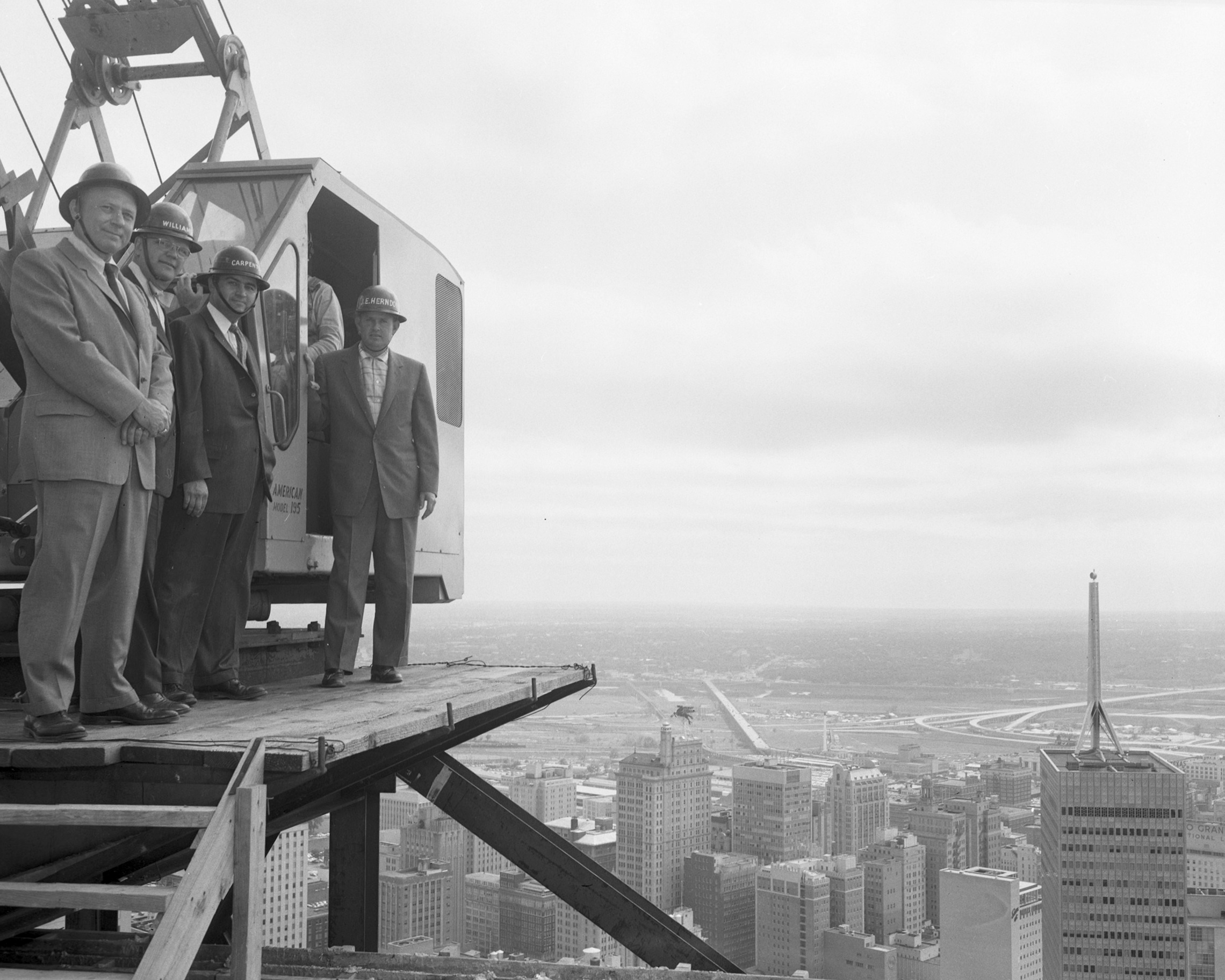
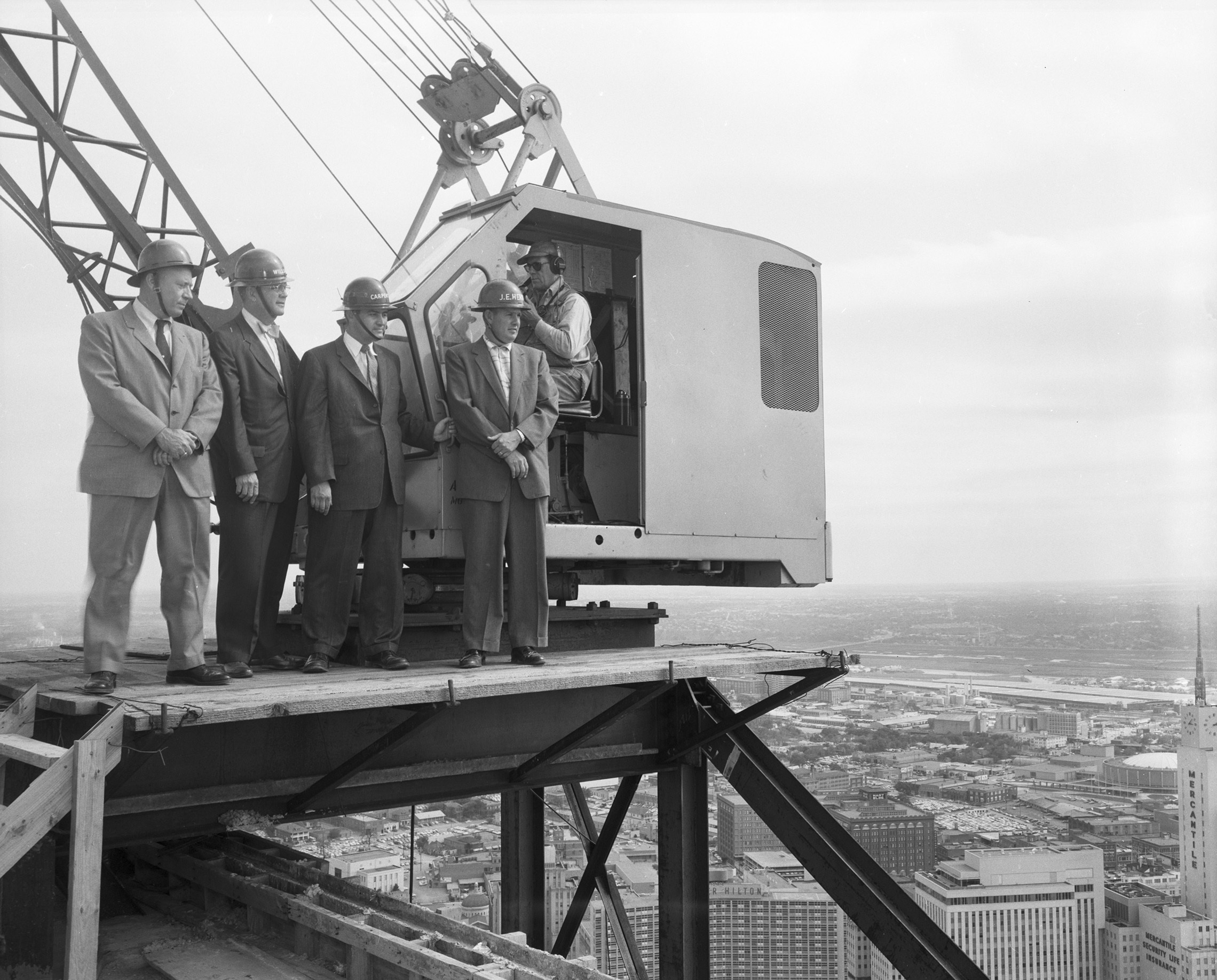
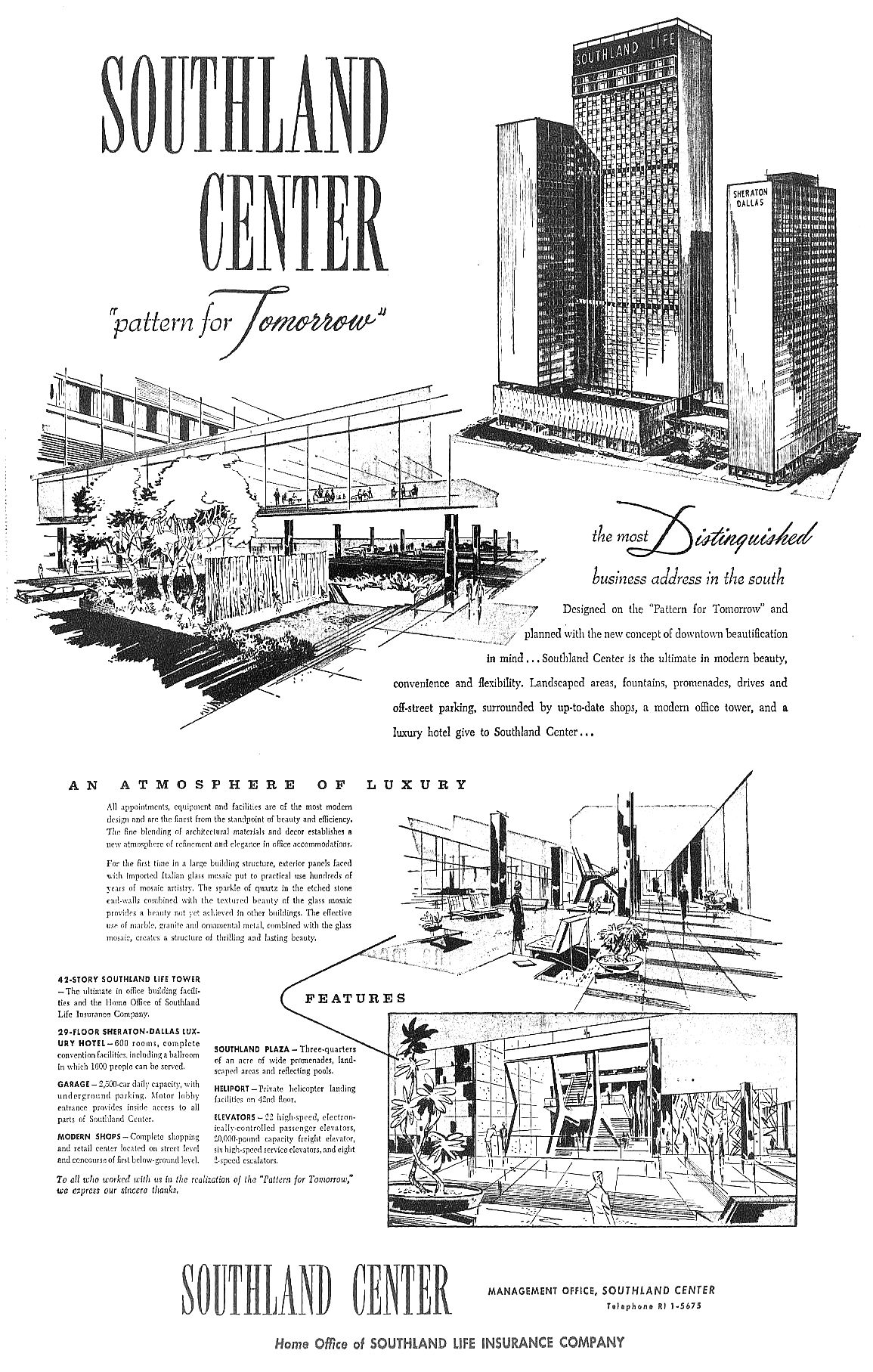
Here are a couple of cool, vertigo-inducing photos taken by Squire Haskins in 1958 or very early 1959 showing Southland Life Insurance executives and a crane operator perched atop the under-construction Southland Center, which included the Southland Life building (which was the tallest building in Dallas for a while) and the Sheraton Hotel. Once completed and opened in April, 1959, there was an observation deck at the top of the Southland Life building, offering an unequaled, unobstructed view of the city.

skyline_construction_crane_squire-haskins_UTA

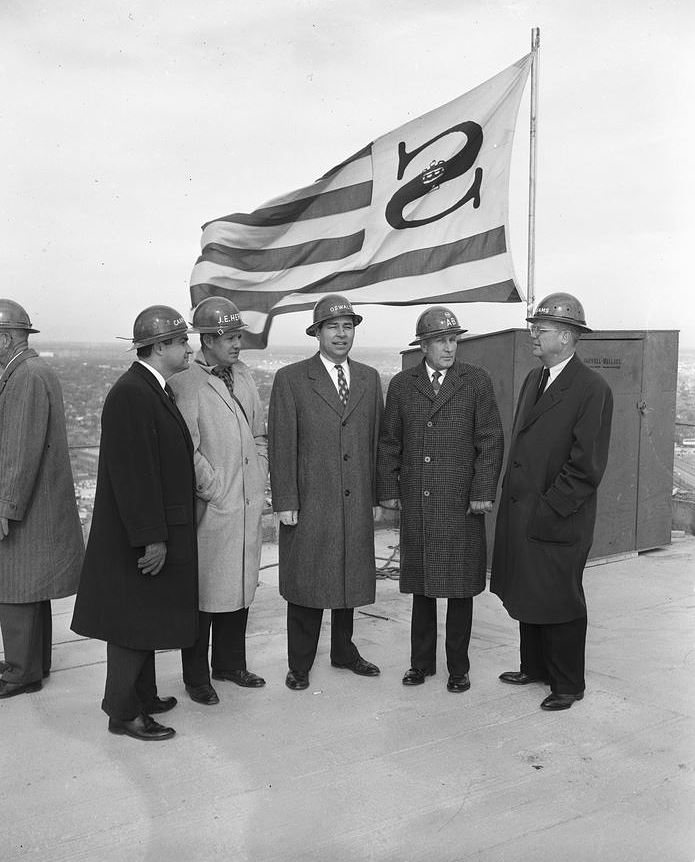
The building under construction in these photos is unidentified, but the familiar Sheraton logo seen elsewhere with the same men is a tip-off.

sheraton_construction_squire-haskins_UTA

Here’s what it all looked like when it opened. Click to see a larger image.

ad-southland_sheraton_april-1959
April, 1959

***

Sources & Notes

Photos are by Squire Haskins, from the Squire Haskins Photography, Inc. Collection, Special Collections, University of Texas at Arlington Libraries. Info on the top photo can be found here.

Some of the men in the photos are Dan C. Williams (President, Southland Life), Ben H. Carpenter (Executive Vice-President), William H. Oswalt, III (Vice-President, Director of Project Development for Southland Center), J. E. Herndon, and “A. B.”

A related Flashback Dallas post — “Sheraton Dallas, Original Version — 1959” — is here.

*

Copyright © 2016 Paula Bosse. All Rights Reserved.

Dallas Theater Center

dtc-downtown_dallas-park-dept_portalFLW’s DTC

by Paula Bosse

Frank Lloyd Wright’s Dallas Theater Center is seen here nestled amongst the woody landscape of Turtle Creek. There’s a lot of varied architecture going on in this photo!

***

Sources & Notes

Photograph is from the Dallas Park and Recreation Department Collection, Dallas Municipal Archives; it is accessible via the Portal to Texas History, here.

The text on the back:

Opened in 1959, this Center provides pleasure for thousands of Dallasites and visitors yearly through a repertory of plays presented in its Kalita Humphreys Theater. This $1,000,000 Center, the last completed building and only theater designed by Frank Lloyd Wright, also incorporates a children’s and teen theater and a private school of drama.

*

Copyright © 2016 Paula Bosse. All Rights Reserved.

When Every Skyscraper Was a Distinctive Landmark

skyline_akard-royalSoak it in…

by Paula Bosse

I love this photo, taken from the southern edge of downtown, at S. Akard (running from left to right in the photo) and Royal, a street which once ran one block north of Canton (map below). Today, the convention center would be behind the photographer, and the I. M. Pei-designed City Hall would be pretty much straight ahead. I’m always going to prefer the grittier-looking downtown Dallas of days gone by to today’s shinier, glitzier version. I couldn’t get the exact angle, but today’s view from more or less the same vantage point looks like this, and it just isn’t as interesting. (I’ve never actually heard anyone broach the topic, but am I the only one who thinks that Pei’s City Hall now looks weirdly and hopelessly dated? Kind of tired and stuck in the ’70s? If nothing else, those yucky white flagpoles out front need to go!)

When this photo was taken, you could actually still see all those famous buildings — before they were dwarfed and engulfed by all those over-eager underclassmen!

***

Sources & Notes

Photo from a site managed by Andrew K. Dart, full of photos from negatives he rescued when they were thrown out by KDFW-TV, many from the archives of KRLD. This photo is from a page of Dallas skyline photos, here.

Here’s a map that shows S. Akard and Royal streets, which Mr. Dart identified as being the intersection seen in this photo by zooming in on the street sign (click for larger image):

map_akard-royal_1952-mapsco1952 Mapsco

*

Copyright © 2016 Paula Bosse. All Rights Reserved.

Dallas’ Mid-Century Skyline

skyline_statler_mercantile_republic_ebayBack then: more sky, fewer parking lots (click for larger image)

by Paula Bosse

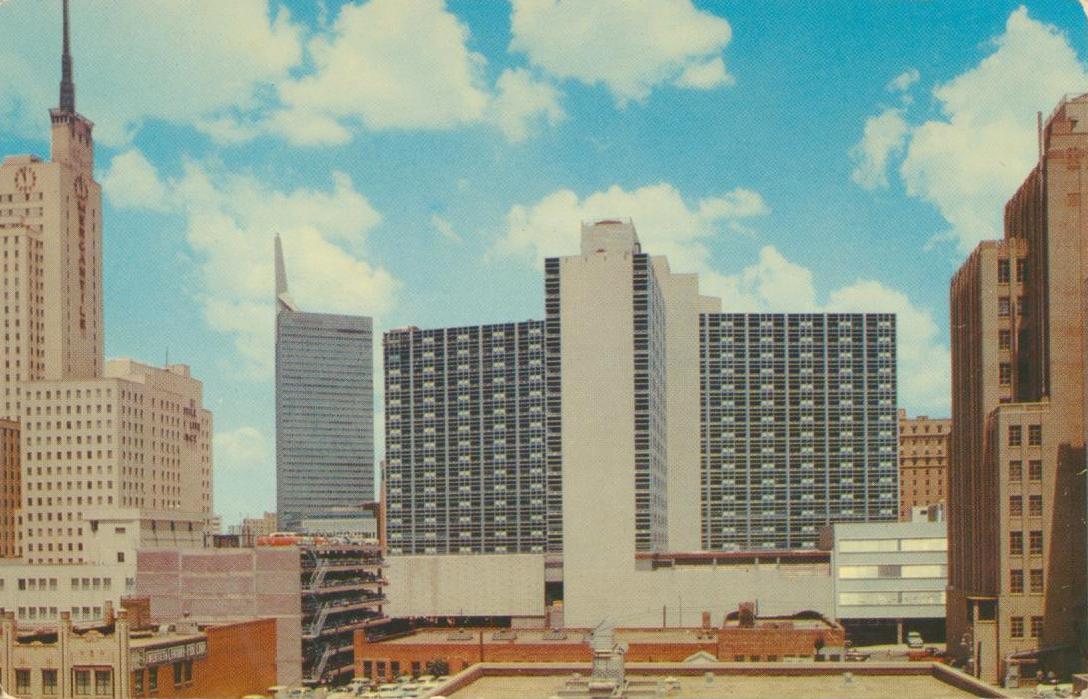
Dallas architecture at mid-century: the Mercantile Bank Building, the Republic Bank Building, the Statler-Hilton (from behind!), and … a multi-level parking garage. Dallas is nothing if not a city full of banks, banks (and more banks), flashy hotels, and parking lots. Then and now.

***

Slightly fuzzy postcard from eBay. The Statler-Hilton (which this postcard identifies as the “Hilton-Statler”) isn’t often seen from behind like this in photos (not really its best side). Other than the three main buildings (and the old library, which is as architecturally cool as the other three), I think that just about everything else in this photo is gone. There are now parking lots (…yay…) where the buildings at the right and at the bottom left are seen — there’s even a parking lot where the parking garage once stood! (Dallas really loves its parking lots.) At least we managed not to tear down the most architecturally significant buildings seen here. (Even though the number of downtown parking spaces could be exponentially increased if we pulled those suckers down and replaced them with multi-multi-story garages!)

*

Copyright © 2016 Paula Bosse. All Rights Reserved.

Happy 2nd Anniversary, Flashback Dallas!

skyline-1914_cook_degolyer_smuDallas, New Year’s Day, 1914 (click for larger image) (photo: SMU)

by Paula Bosse

Two years! Time really does fly when you’re having fun. Without duplicating the entirety of my anniversary post of last year, I just want to thank everyone who reads this blog. I’m still excited and enthusiastic to delve into and explore Dallas’ past, and whenever I sit down at my computer to research something or write about a photo or a person or a forgotten moment of the city’s history, I know I’ll always come across something interesting. I haven’t been disappointed yet.

My mini Dallas archive here is now at 639 posts (which, I have to say, I find pretty unbelievable), and I’ve recently surpassed 5,000 followers. It’s encouraging to know there are so many people interested in the history of our city, a city often accused of having no regard for the importance of its own past. There are a lot of us who do care.

Thank you for reading!

***

Photo is titled “Dallas Sky Line, January 1st, 1914,” taken by Jno. J. Johnson; it is from the George W. Cook Dallas/Texas Image Collection, DeGolyer Library, Central University Libraries, Southern Methodist University, and it can be viewed here. (I’ve manipulated the color.) The photograph may have been taken from the roof of the still-standing Butler Brothers building, about where the City Hall now stands, looking north. (Johnson’s photo of the 1913 skyline can be seen here.)

I want to take this opportunity to personally thank the Central University Libraries of SMU — and especially the DeGolyer Library — for providing so much of their collection online in such high-quality images. It is, hands down, the best digital collection of historical Dallas images available online. Thank you, SMU!

*

Copyright © 2016 Paula Bosse. All Rights Reserved.

A-Bomb in Akard Street! — 1950

mcgrath-frank_atomic-aftermath-downtown-dallas_1950See Pegaus up there in the cloud of smoke and debris? (click for larger image)

by Paula Bosse

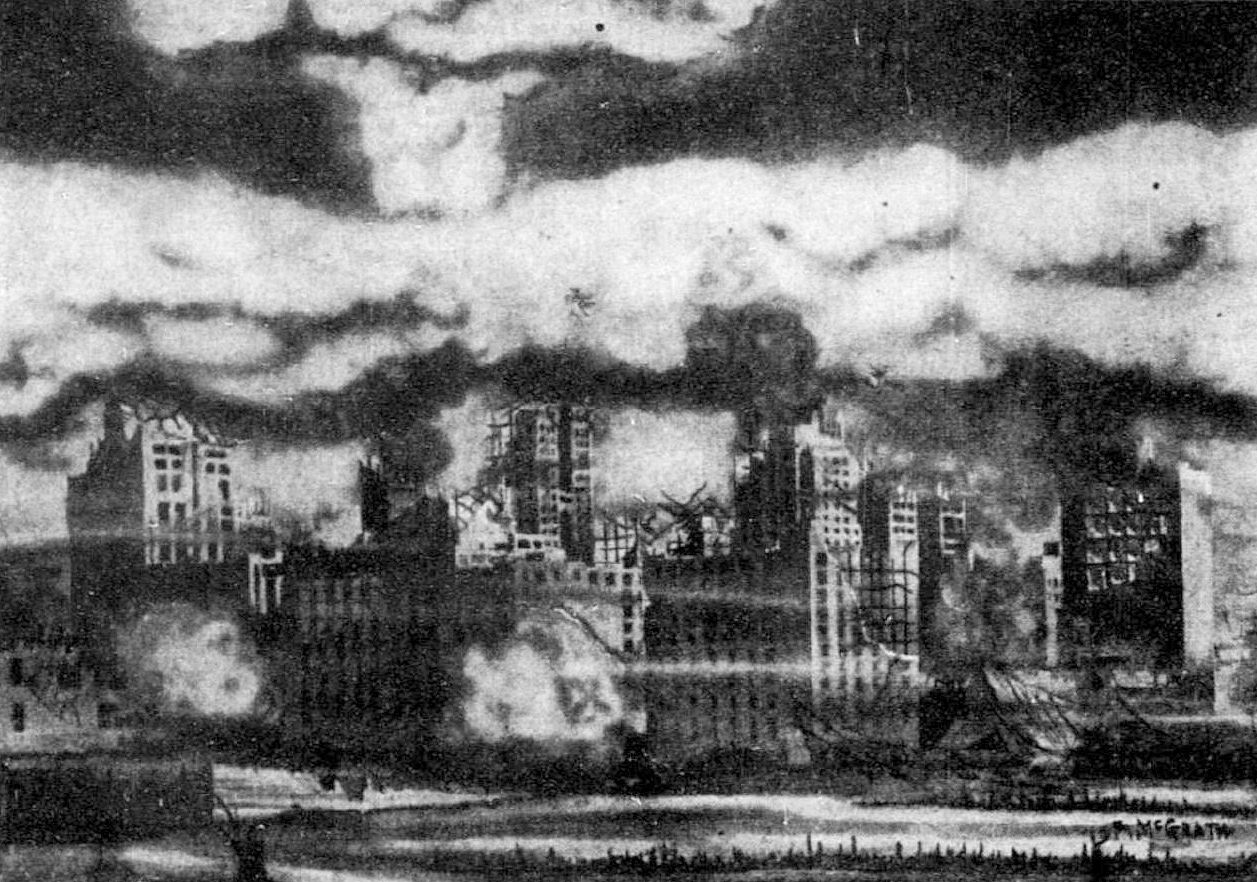
The image above, from 1950, is a depiction of what downtown Dallas might look like if an atomic bomb were dropped at the corner of Main and Akard (which is weirdly specific).

In 1950 Russia detonated a nuclear bomb during atomic tests and President Truman announced that the United States would increase and intensify research and production of thermonuclear weapons. It was a scary time for the world. The atomic bombings of Hiroshima and Nagasaki were still fresh in everyone’s minds, and news of the even more frightening hydrogen bomb was everywhere in 1950.

The drawing above is by Dallas artist Frank McGrath. It isn’t terribly realistic — Big D probably wouldn’t survive a nuclear blast —  but it’s nice that Frank spared Pegasus from annihilation.

***

Sources & Notes

There were bomb shelters all over the Dallas area. There was a (surprisingly) large shelter on the grounds of Fair Park. Watch a video tour here. And read the Flashback Dallas post “‘Dallas Is a Major Target Area!’ Know Where Your Nearest Fallout Shelter Is.”

Read about the tenor of the times in the article “Hydrogen Bomb — 1950,” here.

The title of this post is a direct reference to a great song by one of my favorite bands, The Jam. Listen to “A-Bomb in Wardour Street,” here. This time it’s nuclear apocalypse in London, but change the accent and, sure, it could be Dallas. (I knew I’d work The Jam in here one day!)

*

Copyright © 2016 Paula Bosse. All Rights Reserved.

Collision on the Streetcar Viaduct — 1929

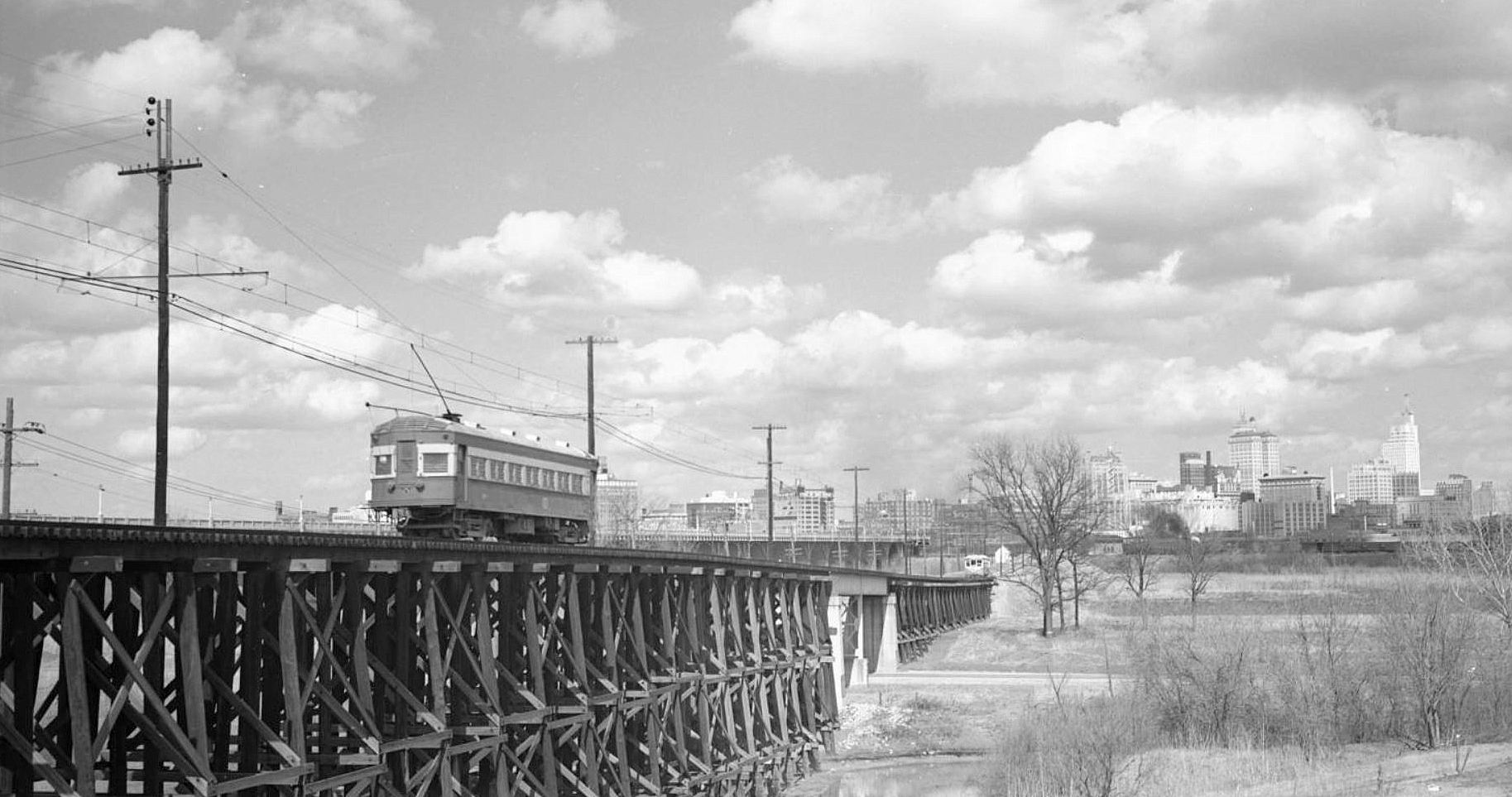
interurban_trestle_1946_denver-pub-lib_lgThe new streetcar viaduct, 1946

by Paula Bosse

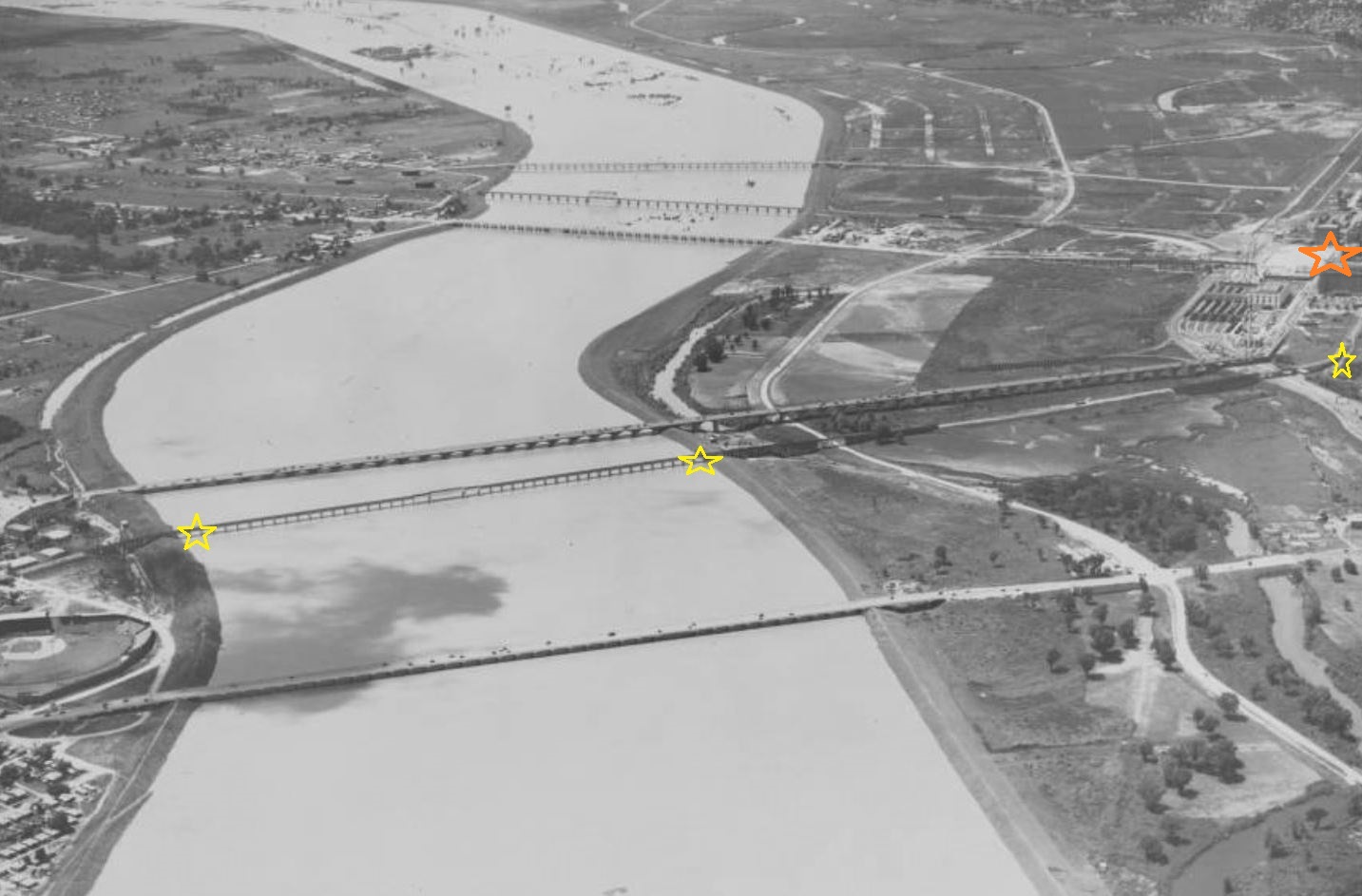
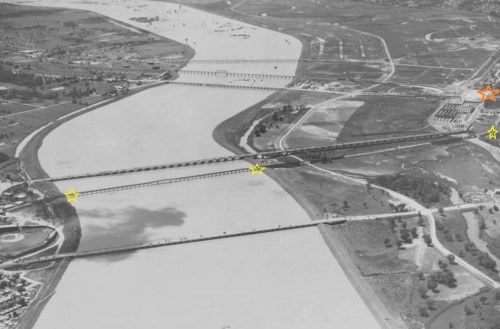
For many, many years there was a special trestle that spanned the Trinity River which was for the exclusive use of streetcars and Interurbans. There were also trestles and viaducts for the exclusive use of trains and automobiles. Below is a photo showing the  viaductal activity in 1935, with the streetcar trestle — sometimes called the “Street Car Viaduct” or the “Trinity River Viaduct” marked in yellow and the Old Red Courthouse and Dealey Plaza (then under construction) marked in orange.
viaducts_1935_foscue_smu

The viaduct immediately above it was the Houston Street viaduct, for automobiles.

For many, a streetcar ride across the viaduct seems to have been a little on the harrowing side. There were no guardrails to prevent a car from going over the side, and even when the original wooden trestle had been bolstered with stronger materials, it was still described by commuters as being rickety. I like this quote of a man remembering a typical ride in the 1950s:

I always enjoyed the slight tingle of fear I experienced on the trestle over the river, as one could not see the trestle itself from the car window. One had the feeling of being suspended with no support when looking out the window.

And these two memories:

The streetcar trestle ran parallel to the Houston St. Viaduct where the current newer bridge is to downtown. No railings and just depended on gravity to hold the cars on the rails. The cars would buck and sway as they crossed the river bottoms as the motormen made up time on their schedules. Seemed like they were really going fast to me at the time, but probably not in today’s terms.

*

The [newer streetcars] used to scare me to death rocketing across the Trinity River high in the air with no sidewalls except just over the river itself! You were able to look straight down from high above ground… those newer cars had softer springs and the faster they went, the more they rocked side to side over the less than flat tracks!

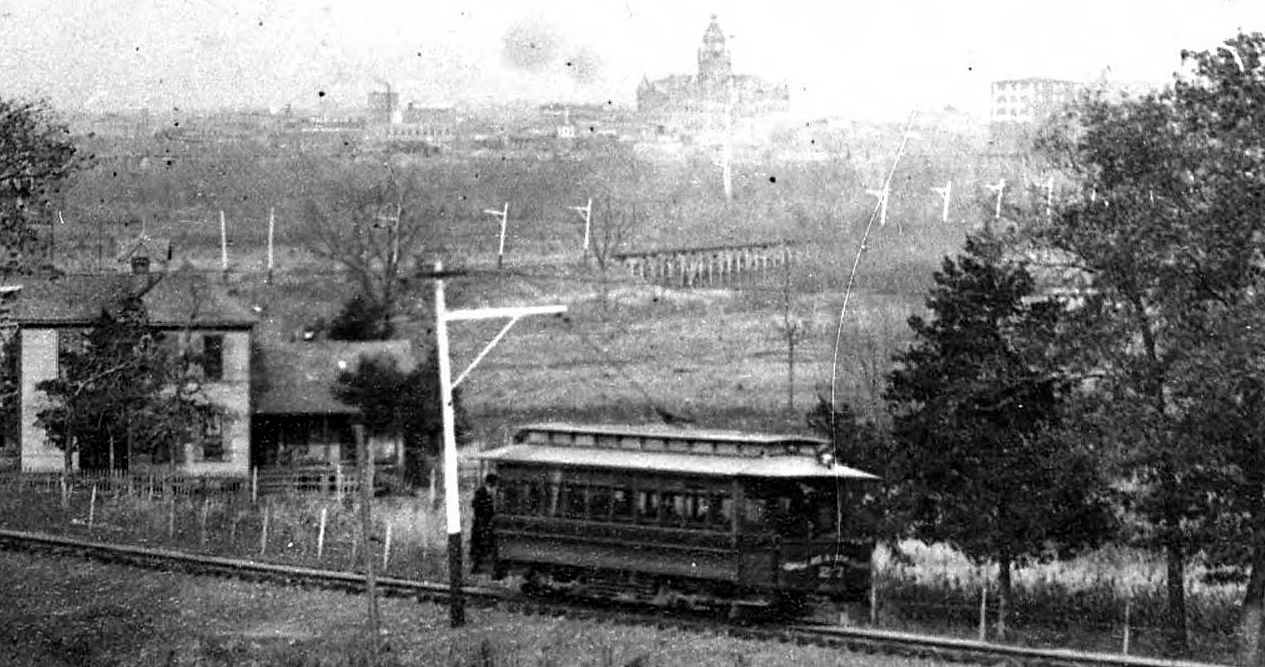
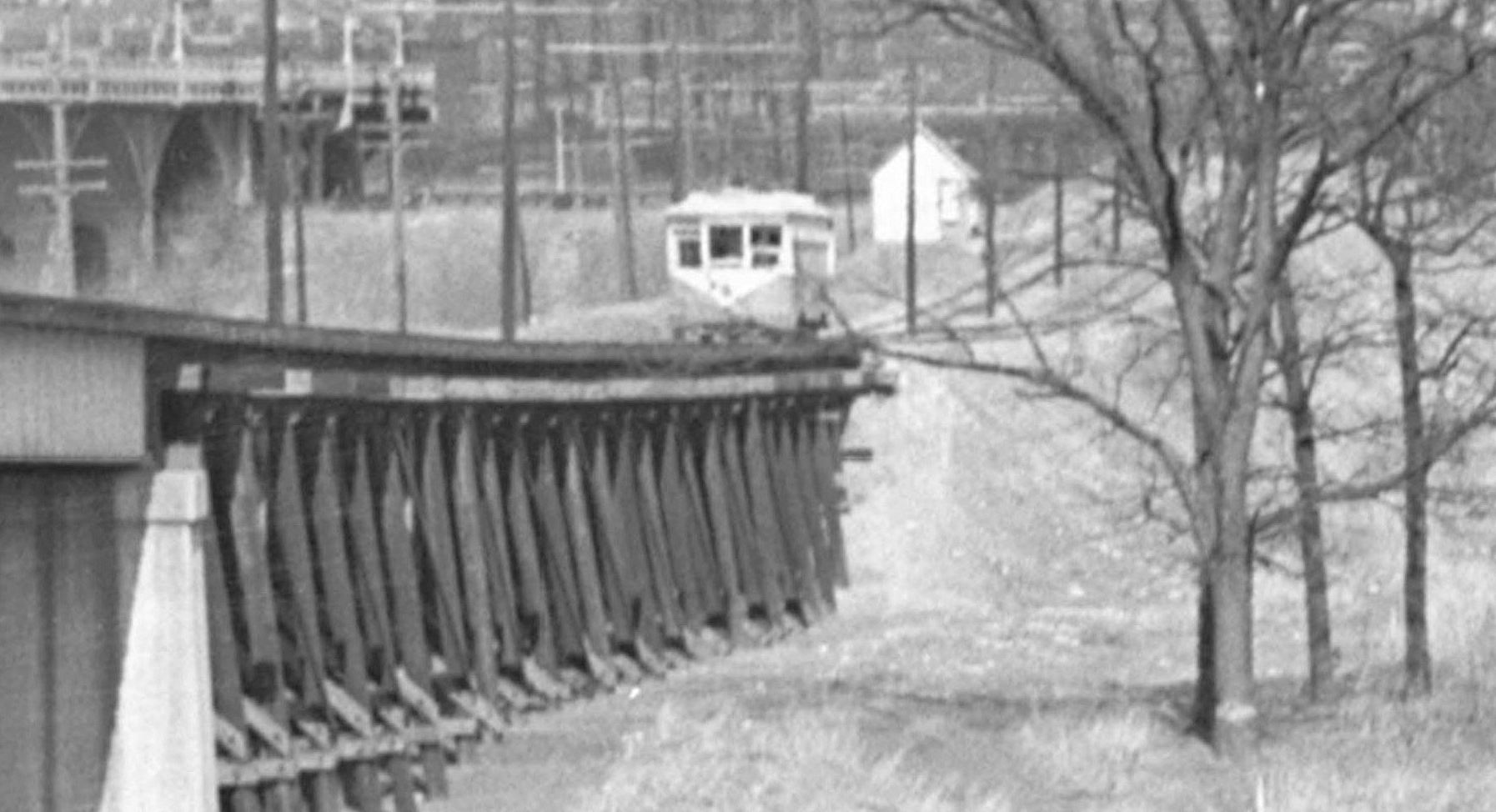
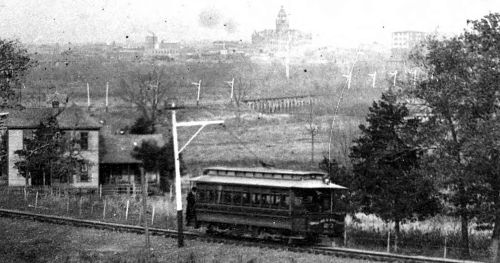
Here’s a photo when it was in its original rickety state, back in 1895 (this is a detail of a larger photo, taken on the Oak Cliff side of the river, with the trestle — and the not-yet-old Old Red Courthouse — visible in the background).
trolley_oak-cliff_det1

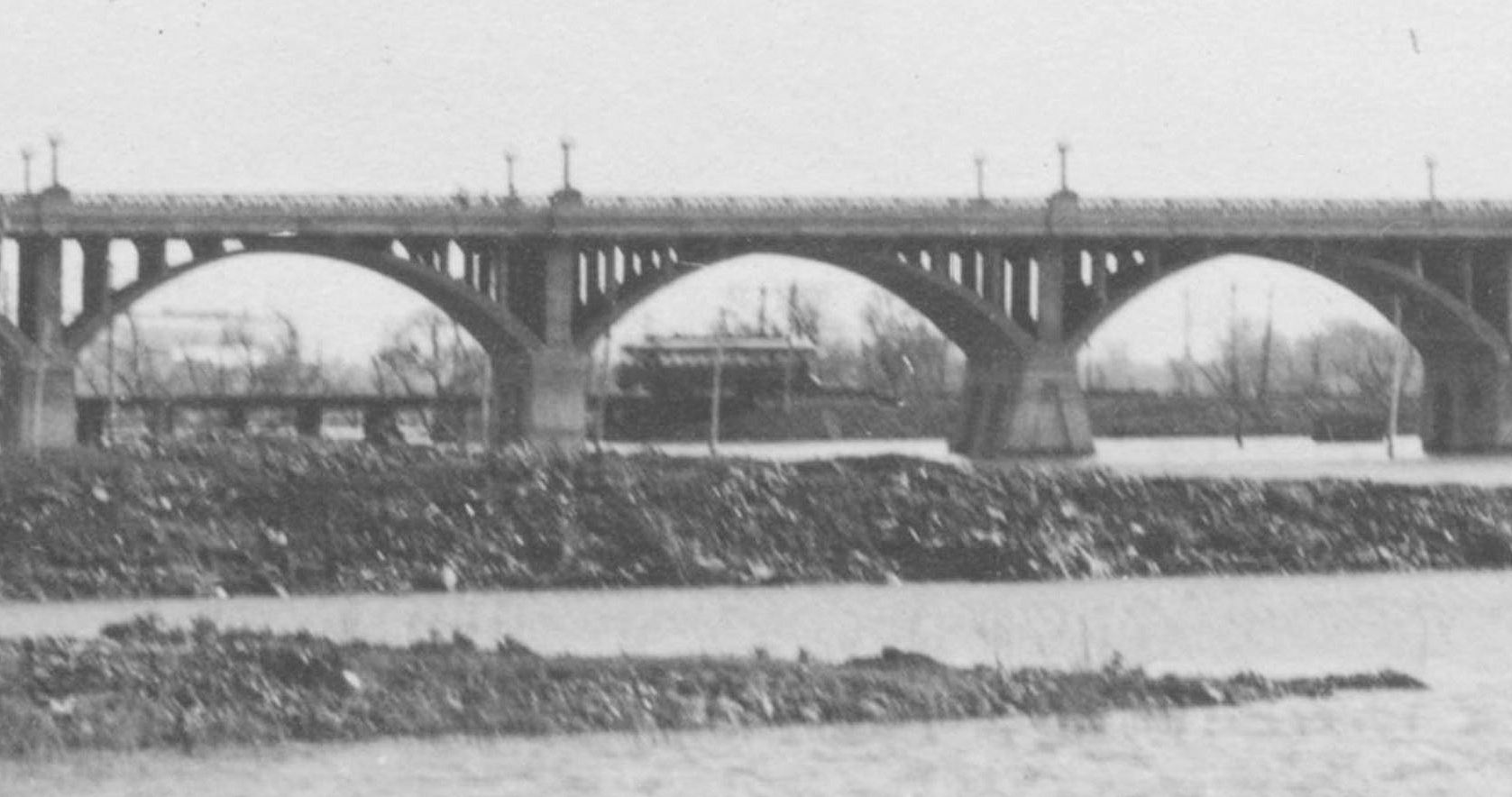
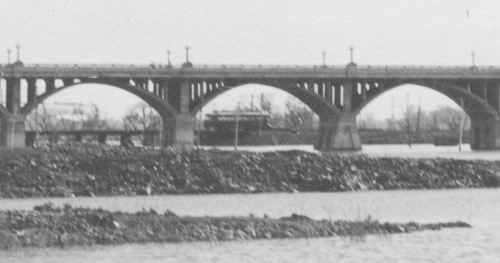
Here it is in 1914 at river-bottom level, with a happy little trolley chugging along with the Oak Cliff/Houston Street viaduct looming over and in front of it. (This is a detail of a larger photo in the George W. Cook Collection, DeGolyer Library, SMU — here).
streetcar-trestle-cook-coll_smu_det_1914

And here’s a sturdier version of the viaduct, in 1946.

streetcar-crossing-trinity_1946-denverpublib

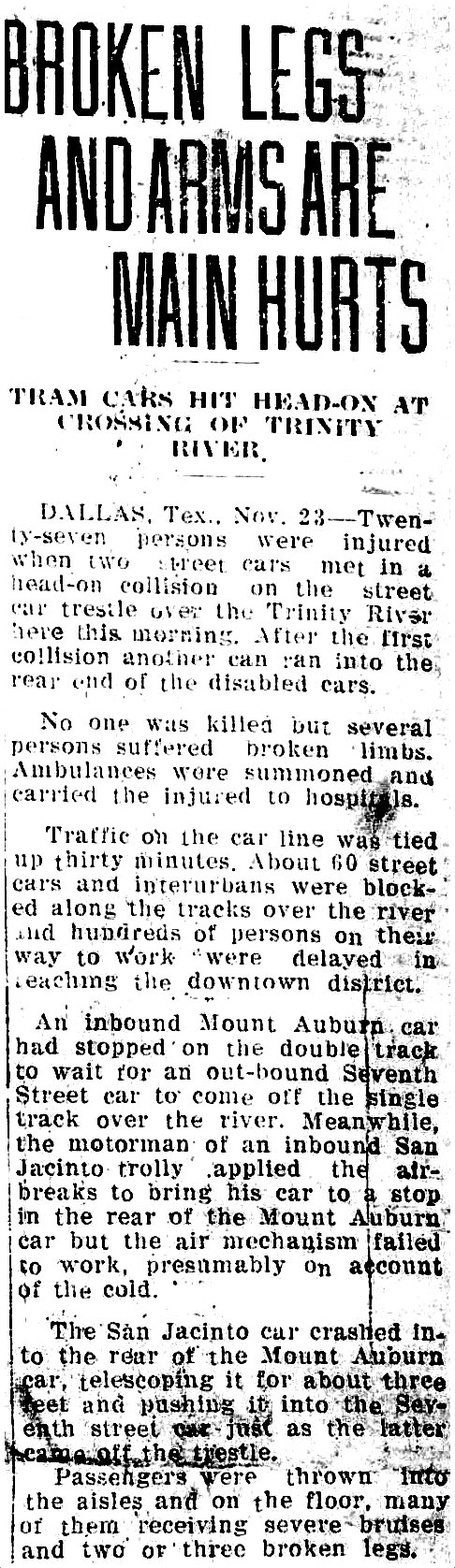
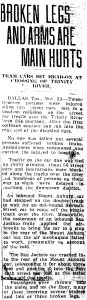
But now to the collision on the viaduct, which happened on the morning of November 23, 1929. Back then — at that iteration of the viaduct — the trestle had only a single track. While one streetcar or Interurban car crossed the bridge toward Oak Cliff, a car wanting to cross over from Oak Cliff had to wait until the westbound car had made its mile-long trip. That must have made for a lot of impatient riders. Even though the so-called “block signal” system worked well for the most part, there were the occasional accidents, including the one involving three cars on Nov. 23, 1929. Below, a front-page report of the collision(s) from The Waxahachie Daily Light (click for larger image).
streetcar-trestle-collision_waxahachie-daily-light_112329Waxahachie Daily Light, Nov. 23, 1929

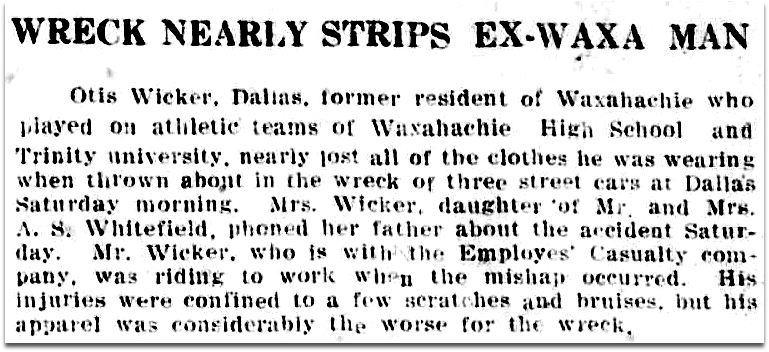
The Waxahachie paper even had a local angle (although it’s unclear just how this man “nearly lost all of the clothes he was wearing”).
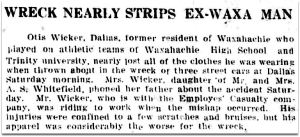
streetcar-trestle-collision_waxahachie-daily-light_112329-sidebarWaxahachie Daily Light, Nov. 23, 1929

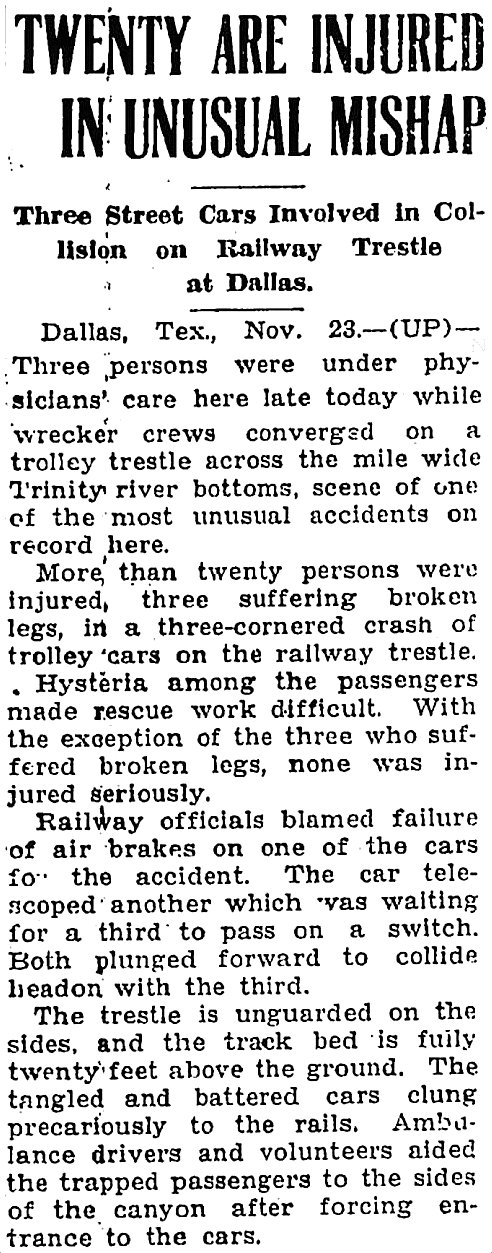
Since it happened during the morning rush hour, just about every other newspaper in Texas scooped The Dallas Morning News, which wasn’t able to run its story until the next day (and its report was surprisingly dull).

The UP wire story that ran in the Joplin, Missouri paper was far more exciting.

streetcar-trestle-collision_joplin-MO-globe_112429Joplin Globe, Nov. 24, 1929

Thankfully none of the streetcars fell off the trestle, but I’m sure that possibility was probably the daily fear/resigned expectation of generations of nervous travelers.

**

The most interesting thing in the DMN article is the last paragraph:

Plans in the making for the new street car crossing of the Trinity River call for a double track over the channel, eliminating the necessity of waiting on block signals.

In February 1931, that new double-track streetcar viaduct opened for business, and I’m sure there was a citywide sigh of relief.

 **

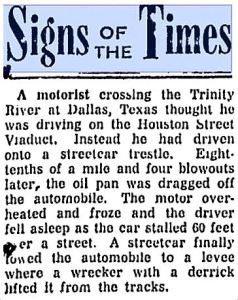
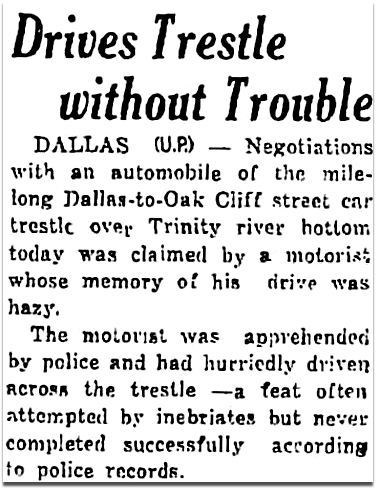
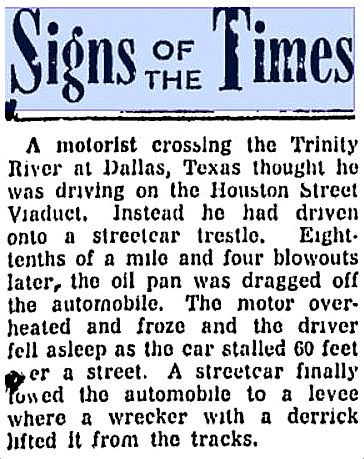
One last little amusing tidbit about this viaduct: it was not unheard of for those having indulged in excessive amounts of alcohol to try to drive their automobiles (either on purpose or by accident) over this already-kind-of-scary trestle intended for electric-powered railway use only.
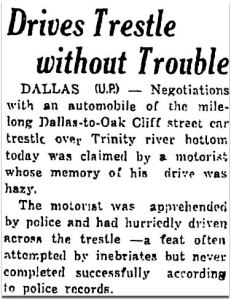
streetcar-trestle-mexia-weekly-herald_011333_drunk-motoristMexia Weekly Herald, Jan. 13, 1933

trestle_beaver-valley-PA-times_120852
Beaver Valley (Pennsylvania) Times, Dec. 8, 1952

***

Sources & Notes

Top photo titled “T. E. clouds, sky, city, from east levee close to wooden trestle 320 just passed, at rear, car 320 on Trinity River Bridge, Dallas, Tex.,” taken on Feb. 16, 1946 by Robert W. Richardson, is from the Western History/Genealogy Dept., Denver Public Library.

Photo showing the viaducts across the Trinity is titled “Central Levee District,” taken on May 20, 1935 by Lloyd M. Long, from the Edwin J. Foscue Map Library, Southern Methodist University; the labeled photo is here, the unlabeled photo is here.

Don’t know what “block signaling” is? Wikipedia to the recue.

 Lastly, just because I like it, a magnified detail from the top 1946 photo, showing a streetcar at the downtown end of the viaduct.
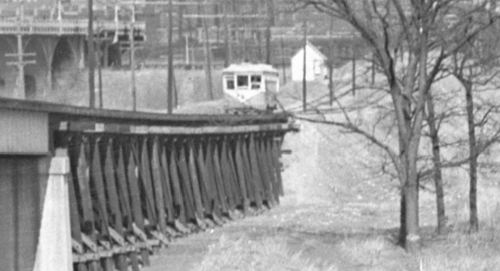
interurban_trestle_1946_det-streetcar

*

Copyright © 2016 Paula Bosse. All Rights Reserved.

A Bird’s-Eye View Over the Washington Theater

washington-theater_aerial_dmn_lost-dallas_dotyAs the crow flies…

by Paula Bosse

This wonderful photo shows an aerial view looking northeasterly over the top of the Washington Theater, Dallas’ first ornate movie palace. It was located between N. Akard and N. Ervay, at 1615 Elm Street — now the site of Thanksgiving Tower. I think the street at the top right edge of the photo is Live Oak, which used to come all the way through to Elm. I love this photo.

***

Sources & Notes

Photo from Lost Dallas by Mark Doty (Charleston: Arcadia Publishing, 2012).

Bird’s-eye view today-ish (with 1615 Elm marked):

1615-elm-street_bingBing Maps

The Washington Theater was in business at 1615 Elm from 1912 to 1927. More on the Washington in the Flashback Dallas post “The Washington Theater — Dallas’ First Movie Palace,” here.

*

Copyright © 2016 Paula Bosse. All Rights Reserved.
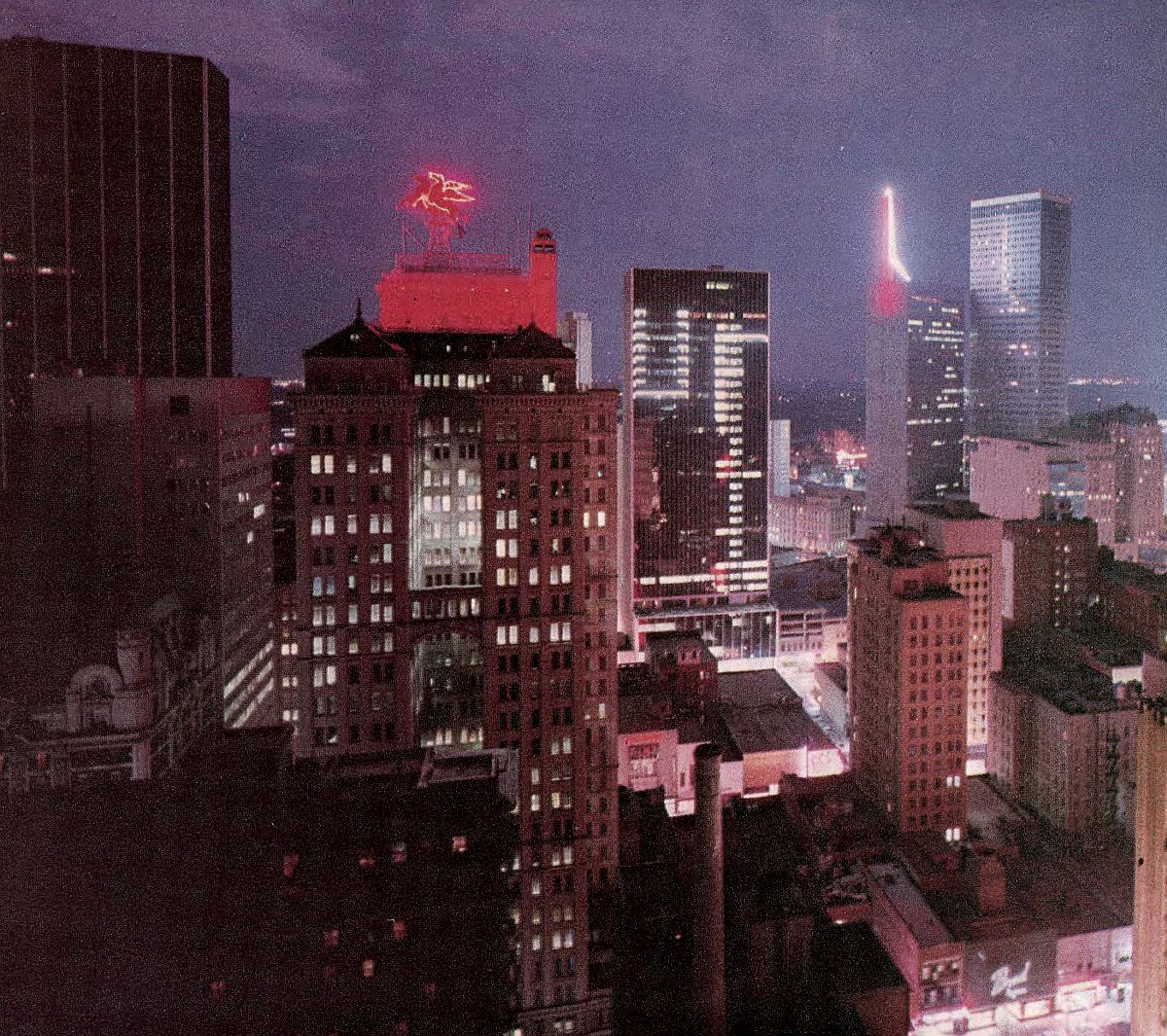
Views of Dallas by Bruno Lore — 1931

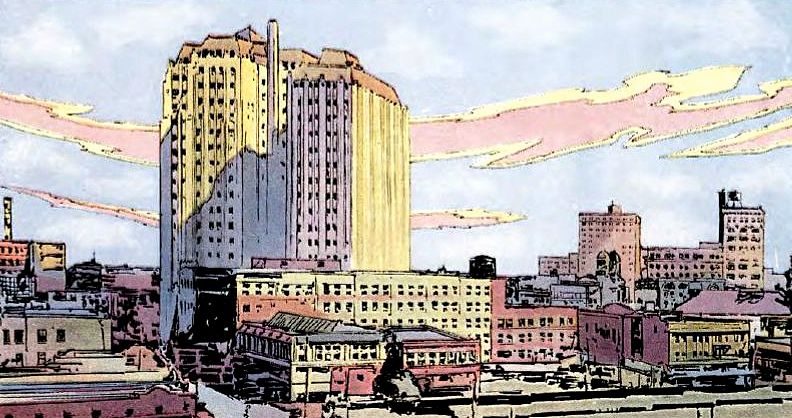
skyline_smu_1931Bruno Lore’s Dallas, in purples and pinks

by Paula Bosse

Bruno J. Lore (1890-1963) was a Fort Worth artist and illustrator who spent much of his career working for the Southwestern Engraving Company. Known as “the dean of Fort Worth commercial artists,” Lore had a long and successful career, counting among his many clients colleges and universities who commissioned him to create artwork for their yearbooks (and, perhaps as a friendly or persuasive perk, he was often asked to pick the campus beauties who would be featured in those same yearbooks). Even though information about Lore is scant, he seems to have had steady yearbook work, with his illustrations appearing in several Southern and Southwestern college annuals, primarily in the 1920s and ’30s. In Dallas, his artwork appeared in editions of SMU’s Rotunda.

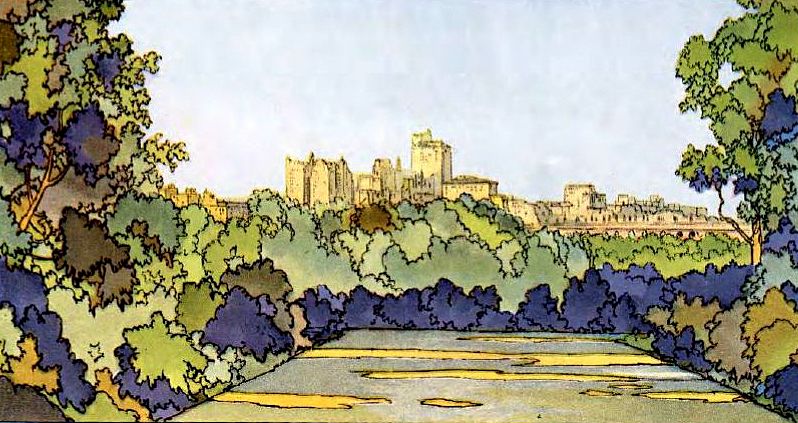
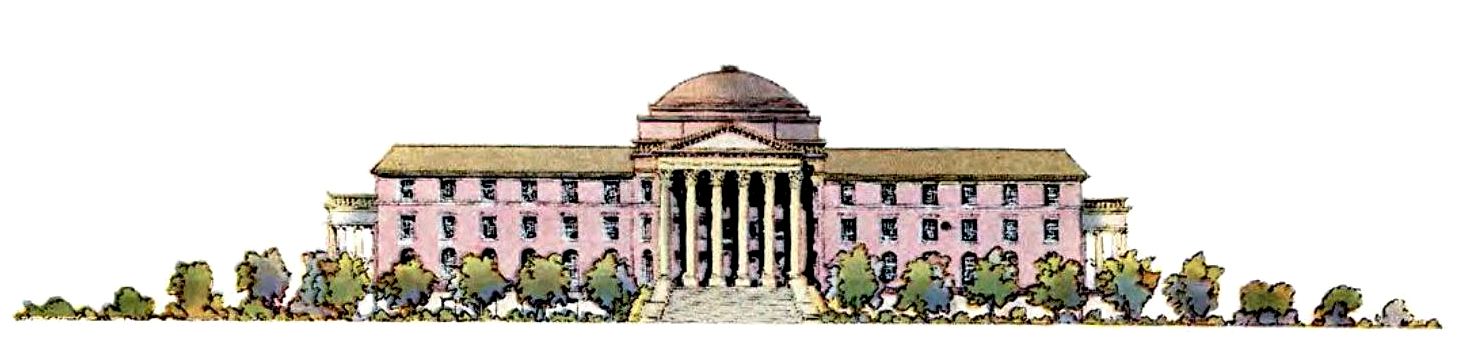
Below are Lore’s vividly colorful views of the SMU campus and the Dallas skyline which appeared in the 1931 Rotunda and provided a lively, modern exuberance to an otherwise fairly standard college yearbook.

rotunda_1931_advertising-header

smu-rotunda_1931-intto

dallas-hall_smu-rotunda-1931

skyline_smu-rotunda-1931

skyline-3_smu-rotunda-1931

skyline-5_smu-rotunda-1931

skyline-2_smu-rotunda-1931

skyline-6_smu-rotunda-1931

skyline-4_smu-rotunda-1931

skyline-8_smu-rotunda-1931

skyline-7_smu-rotunda-1931

saddleburr_smu-rotunda-1931

students_smu-rotunda-1931

smu-1931rotunda_1931_title-page

*

Lore was doing yearbook work (along with his other commissions) into at least the ’40s. His later years seem to have been focused on Western art, and he produced several paintings. He seems to be most fondly remembered by collectors as the artist who was responsible for several decades’ worth of Western-themed cover art for souvenir annuals of the Fort Worth Rodeo and the Southwestern Exposition and Fat Stock Show.

lore_FWST_012173Fort Worth Star-Telegram, Jan. 21, 1973

***

Sources & Notes

All artwork is from the 1931 Rotunda, yearbook of Southern Methodist University. The above illustrations are unattributed, but it seems fairly certain that they are by Bruno J. Lore, who is mentioned in the school’s newspaper, The Daily Campus, as providing the artwork for the 1931 Rotunda. This edition of the yearbook also contains eight somewhat more staid views of campus scenes in pencil or ink and wash which are attributed to Lore. Lore’s yearbook work was apparently done remotely, and he often worked from photographs.

*

Copyright © 2015 Paula Bosse. All Rights Reserved.