Flashback : Dallas

A Miscellany: History, Ads, Pop Culture

Category: Disasters and Emergencies

Forest Avenue-Area Flooding, South Dallas — 1935

flooding_forest-avenue_lloyd-long_052035_ebayBeyond the levees… (click for larger image)

by Paula Bosse

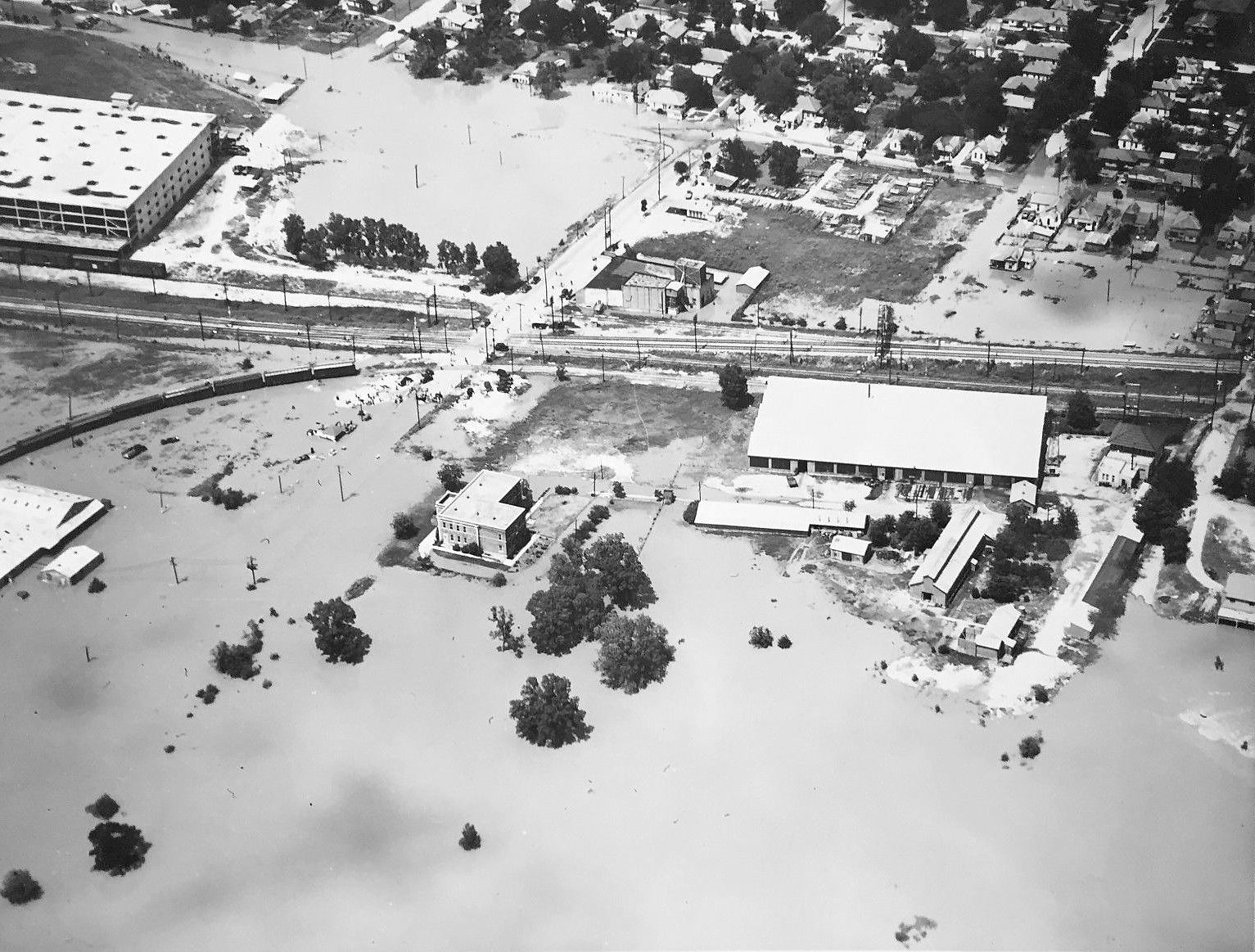
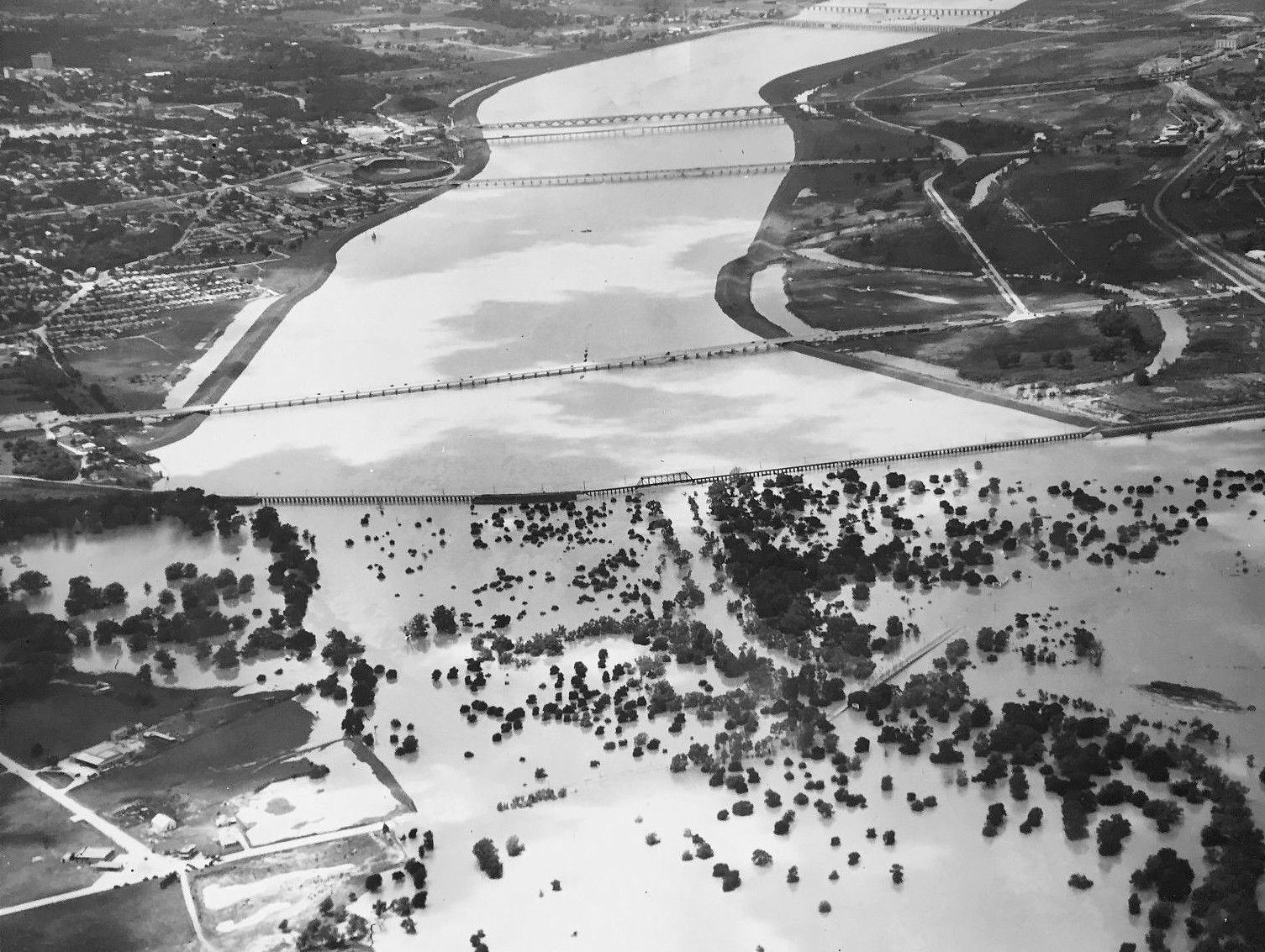
Sometimes the Trinity River is a puny little trickle, sometimes it’s a raging torrent. Here are aerial photos taken from around Forest Avenue (now MLK Blvd.) by Lloyd M. Long, showing the major flooding of May, 1935.

Here is the lead sentence from The Dallas Morning News, May 21, 1935 (the day after these photos were taken):

With sections of South Dallas inundated for the first time since the record 1908 flood, numerous bridges and highways and thousands of acres of lowlands hidden by its swirling, muddy currents, the roaring Trinity slowly was receding Monday night at Dallas after reaching a crest of 42.10 feet at 11 a.m. (DMN, May 21, 1935)

flooding-levee-district-from-forest-ave_lloyd-long_052035_ebay

There was great rejoicing that that the new-ish levees had held the waters and prevented the wide-scale flooding seen in 1922. But once you got to the Forest Avenue bridge (which ran below the Corinth St. viaduct and the Santa Fe railroad trestle), things got real bad real fast. In the photo above, the levee protection ends exactly at the railroad trestle — the Forest Avenue bridge is mostly underwater. The river above the trestle: a beautiful feat of engineering; below: water, water everywhere.

Below the Forest Ave. bridge where the levee protection ended, flood conditions were far worse than those created by the 1922 inundation. (DMN, May 21, 1935)

Again, sometimes the Trinity is just a trickle….

***

Sources & Notes

Both photos (by Lloyd M. Long) are from 2017 eBay auctions: the top photo here, and the bottom photo here.

More on Dallas flooding can be found in these Flashback Dallas posts:

  • “The Nellie Maurine: When a Pleasure Boat Became a Rescue Craft During the Great Trinity River Flood of 1908,” here
  • “One of the Victims of the Great Trinity Flood: The T & P Railroad Trestle — 1908,” here
  • “The Trinity River at the City’s Doorstep,” here
  • “Cole Park Storm Water Detention Vault,” here

Maybe it’s just me, but I was really taken with that little L-shaped building in the top photo which was, briefly, its own island. What was it? It was part of the Guiberson Oil Well Specialty Corporation, founded in 1919 at 1000 Forest Avenue — the building seen in the photo was built in 1926. It’s still standing (here) and appears to be part of Faubion & Associates, a manufacturer of retail display cases and store fixtures.

Click photos to see larger images.

*

Copyright © 2018 Paula Bosse. All Rights Reserved.

“Enemy Aliens” and the WWII Internment Camp at Seagoville

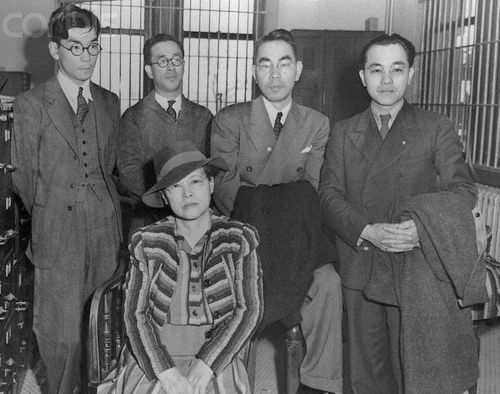
japanese_dallas_wwii_corbisDallasites rounded up the day after Pearl Harbor… (click for larger image)

by Paula Bosse

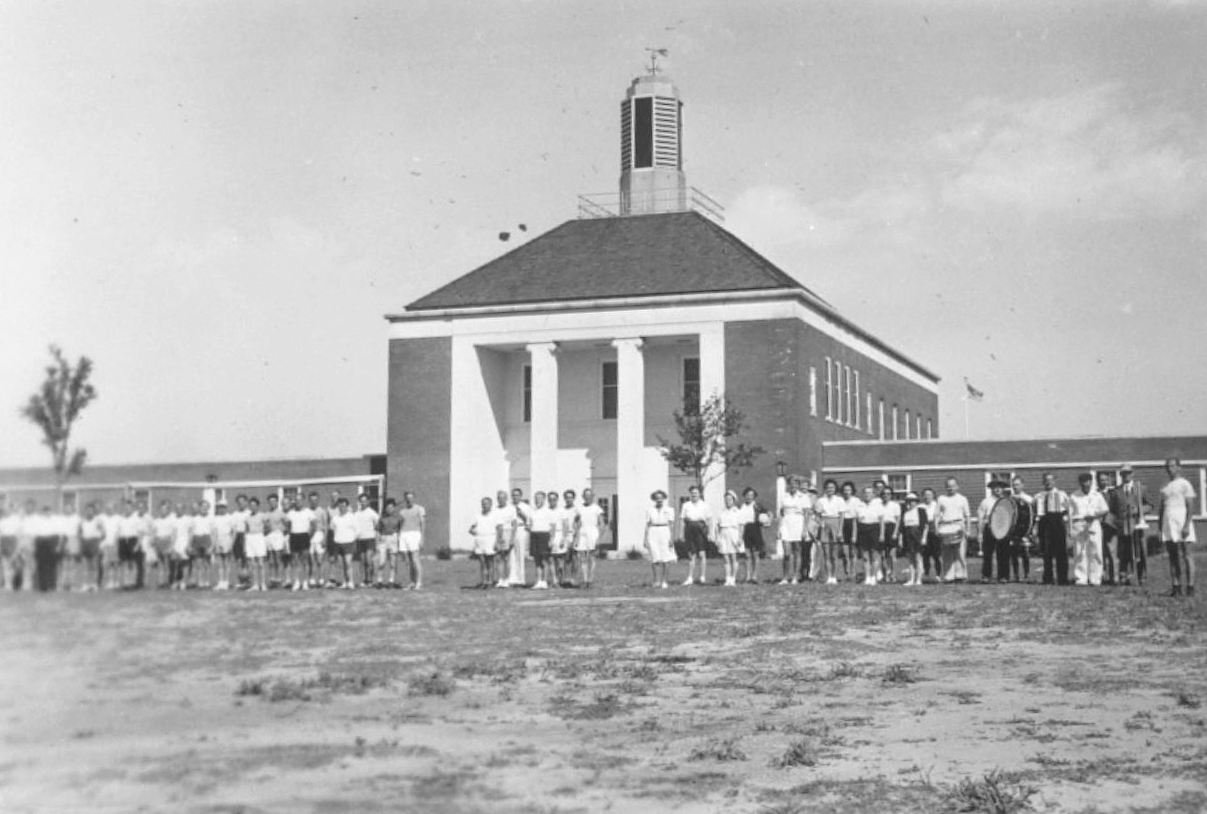
I think most of us know about the sad period in American history of Japanese internment camps when, following Japan’s bombing of Pearl Harbor, the United States “interned” men, women, and children of Japanese descent (often including whole families, some of whom were born in America or were naturalized American citizens). I’ve always thought of these camps as being in the western part of the country. I had no idea until just a couple of days ago that there were three “enemy alien” internment camps in Texas — and one of them was in Dallas County.

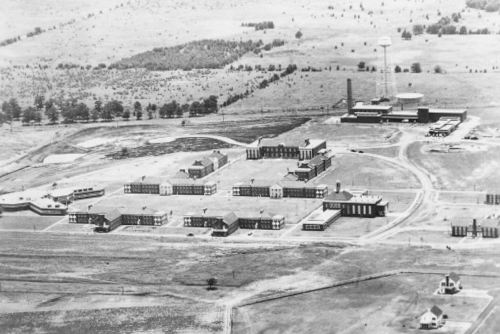
For a full history of the camp in Seagoville — which is a mere 20 miles southeast of Dallas — there are several links at the bottom of this post. But, briefly, the “camp” was originally built as a federal women’s prison in 1938 on 800 acres of farmland. The United States entered World War II as a result of Japan’s bombing of Pearl Harbor on Dec. 7, 1941, and, suddenly, authorities began scrambling to round up enemy aliens living in the U.S.: people born in countries we were now at war with — primarily those of Japanese, German, and Italian descent — were rounded up and questioned. Many were arrested, and some were interned in camps where they were basically kept prisoner for the duration of the war. Even though the bulk of the initial internees were, oddly enough, from Latin America (most of them Japanese, most sent from Peru), there were also several who, before the war, had been living in the United States for decades without any problems. (See a dizzying number of links at the bottom of this post for more on the Texas internment camps at Seagoville, Kenedy, and Crystal City.)

Below, the Seagoville camp.
seagoville_aerial_thc

seagoville-internment-camp_ut-inst-texan-cultures

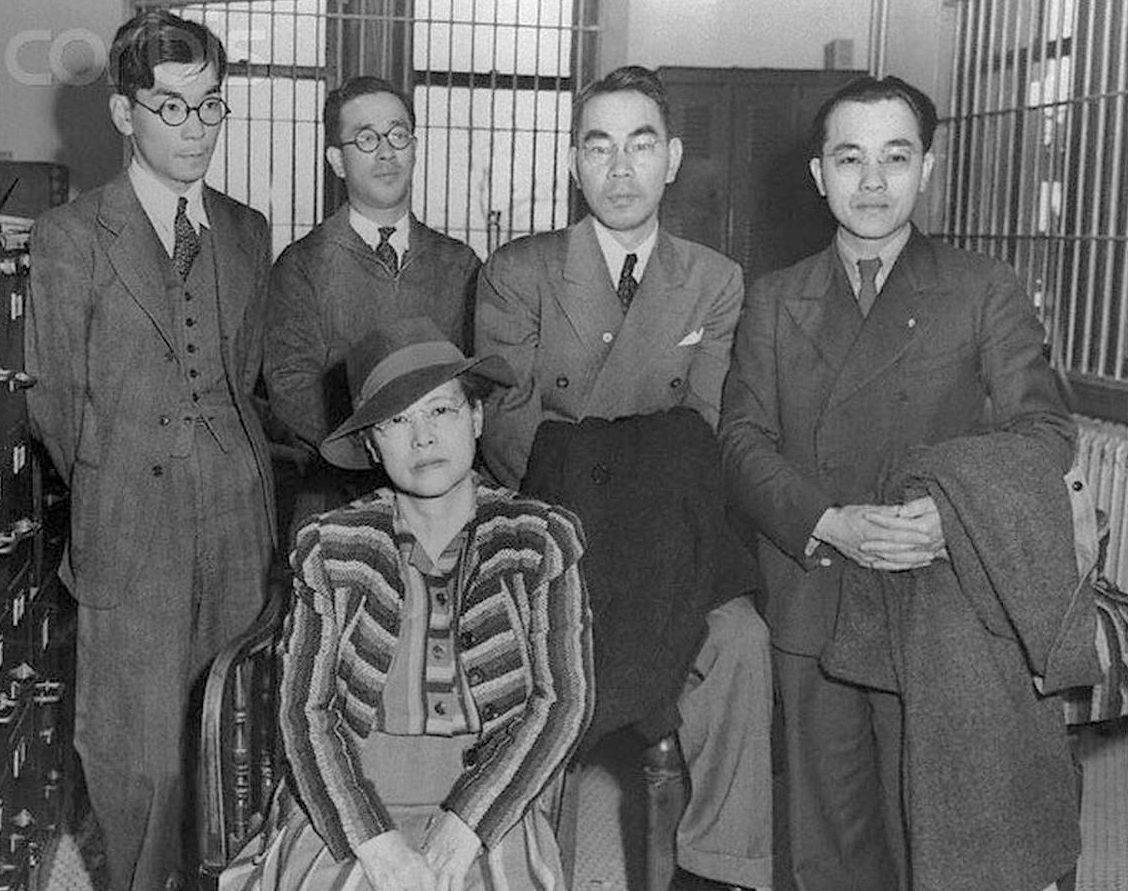
In December, 1941, authorities in every city in the country were swooping down on foreign nationals (or sometimes just people who looked foreign or spoke with an accent), hauling them in for questioning, often arresting them for nothing more than the fact that they had been born in another country. Dallas was certainly no exception. Unsurprisingly, immediately following the bombing of Pearl Harbor, Dallas’ few Japanese residents were rounded up. All ten of them. The photo at the top shows five of the first detainees, at the Dallas jail.

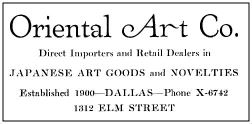
Most of Dallas’ Japanese residents worked for the Japan Cotton Company, an important cotton broker which had occupied space in the Dallas Cotton Exchange building since the late 1920s. (For a bit of weird trivia, the father of famed gossip columnist Liz Smith was working as a cotton buyer for the company during the war, commuting to work from Fort Worth.) If they weren’t working for the Japan Cotton Company, they were probably members of two Japanese families with long ties to Dallas: the Muta and Sekiya families, owners of the respected Oriental Art Company since 1900.
oriental-art-company_1921-ad1921 ad

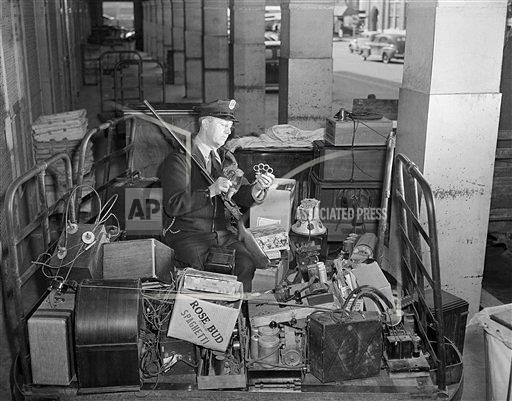
In February, 1942, the Associated Press photo below appeared in several newspapers, along with the following caption: “This is a portion of the contraband radios, cameras, guns, that were seized during all-night raids on residences of enemy aliens in Dallas County, Texas, by federal and local officers. Scores of aliens also were taken into custody.”
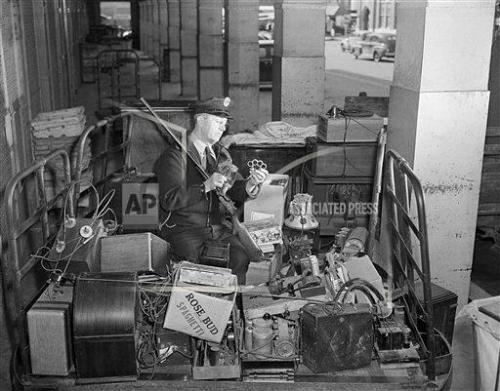
wwii_aliens_AP_1942

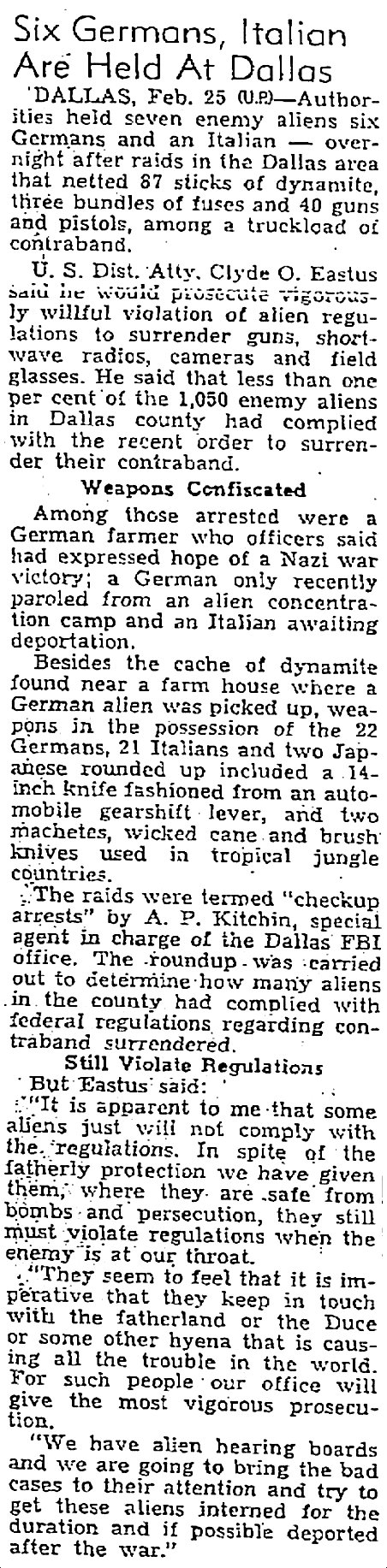
wwii-alien-roundup_lubbock-avalanche_022642
Lubbock Avalanche, Feb. 26, 1942 (click to read)

The first internees arrived in the Dallas area in April, 1942. The group was comprised of 250 women and children (“citizens of the Axis nations”) who had been arrested in Panama. They were interned in Seagoville, displacing the federal women prisoners who had previously been held there — they were transferred to a prison in West Virginia.

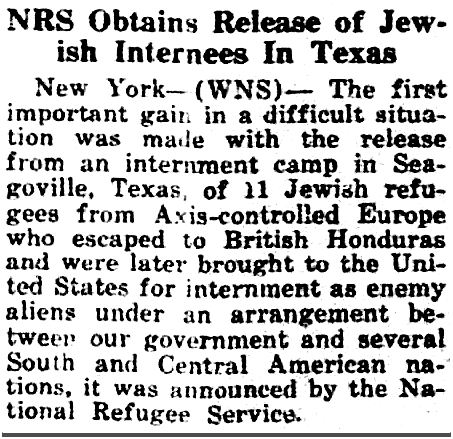
Jewish refugees sometimes found themselves tossed into enemy alien internment camps — simply because they had fled homelands which happened to be “Axis-controlled” countries with which the U.S. was at war (even though is seems highly unlikely that a German Jew would be an ardent Nazi sympathizer, gathering classified information to send the Führer’s way). Yes, Seagoville had detainees from all over the place. It was quite the melting pot. There was even a Bavarian princess in there. I wonder if a single person in that camp, held against his or her will for months and years, posed any actual threat to Allied forces.
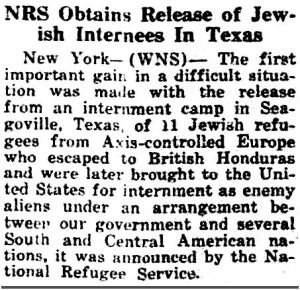
seagoville_wwii_wisconsin-jewish-chron_milwaukee_052843
Wisconsin Jewish Chronicle, May 28, 1943

Germans and Italians were able to “blend in” to American society, but Asian men and women had a harder time and were more often harassed. The person who seems to have most disliked and distrusted Japanese people was top Dallas police detective Will Fritz — in fact, The Dallas Morning News called Fritz “one of Dallas’ most enthusiastic Jap-haters” (DMN, Feb. 17, 1943). Let’s just say that Capt. Fritz wasn’t going to be sending the wartime Welcome Wagon to any prospective Dallas residents of Japanese descent.

One Dallasite who was pretty angry and unhappy with the situation was Masao Yamamoto, an executive with the Japan Cotton Company who had lived in Dallas since 1928. He and his wife and two young sons (one of whom was born in Dallas) were living what appears to have been a nice life in the M-Streets when they were “detained.” Ultimately, the Yamamoto family was deported and sent to Tokyo, six months after the photo at the top of this post was taken (Mr. Yamamoto is the third from the left in the top photo) — they were part of a sort of prisoner swap.

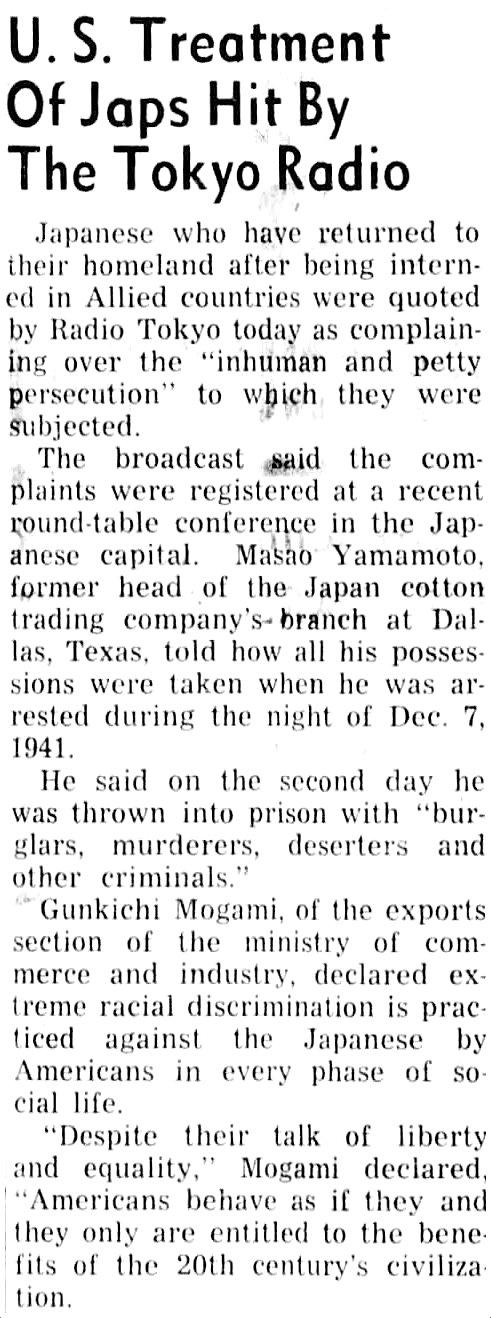
After his deportation, Mr. Yamamoto complained to the Japanese press about his treatment in Dallas, where he said he was arrested, relieved of his possession, and thrown in jail with “burglars, murderers, deserters and other criminals.” (Click to see larger image.)
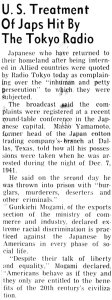
yamamoto_santa-cruz-sentinel_021843UPI wire story, Feb. 16, 1943

Will Fritz just about had a seizure when he heard of Yamamoto’s complaints, insisting that he was not mistreated and that he was a dangerous enemy agent: “Any apology that may be due should go to the murderers and burglars instead of Yamamoto. […] He was deported for we have absolute proof he was an agent of the Imperial Japanese Government and that his cotton-buying story was just another Jap blind. I consider him one of the most dangerous of enemy agents” (DMN, Feb. 17, 1943). (This is from the article which described Fritz as “one of Dallas’ most enthusiastic Jap-haters.”)

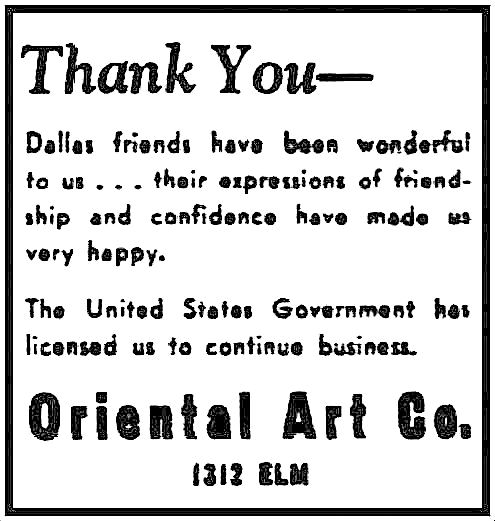
But even in the midst of all this paranoid nastiness, there were occasional heartwarming moments. After the attack on Pearl Harbor, the Oriental Art Company — the 40-year-old business owned by Hideo Muta (who came to Dallas in 1900) — was ordered closed. In a show of support, 200 of his friends, neighbors, and customers signed a petition vouching for his staunch American patriotism (which is plainly evident in his 1951 obituary in which he is described as a “patriot”). In the ad below, the 73-year-old Muta acknowledged the support of his Dallas friends and announced the reopening of his business in an ad taken out on Dec. 15, 1941: “Thank You — Dallas friends have been wonderful to us … their expressions of friendship and confidence have made us very happy. The United States Government has licensed us to continue business. Oriental Art Co., 1312 Elm.”
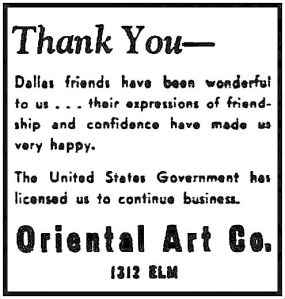
oriental-art-co_dmn_121541
Dec. 15, 1941

Mr. Muta was spared the “enemy alien” internment camp, but, along with other Asian men and women residing in the United States, he was barred from becoming a naturalized U.S. citizen because of the “Oriental Exclusion Act.” The inability of Mr. Muta to become a U.S. citizen did not dampen his enthusiasm for American democracy: he paid his poll tax every year, even though he was not allowed to vote, and he was a proud member of the Dallas Chamber of Commerce for over 25 years.

The Seagoville Enemy Alien Detention Station was closed in May, 1945, and the site was returned to the Bureau of Prisons.

***

Sources & Notes

Photos of the Seagoville camp are from the Institute of Texan Cultures (UTSA).

Articles of interest from The Dallas Morning News:

  • “Six Japanese Taken in Custody By Local Police” (DMN, Dec. 8, 1941)
  • “Dallas Japs Questioned” (DMN, Dec. 9, 1941)
  • “Six Suspected Germans Held in Dallas Roundup of Aliens; Total of Jap Prisoners Rises to 10” (DMN, Dec. 9, 1941)
  • “Enemy Aliens In Dallas, 776; Arrested, 30: But All Suspects Are Closely Watched By G-Men and Police” (DMN, Dec. 19, 1941)
  • “FBI Rounds Up 50 Enemy Aliens, Seizes Arms, Cameras, Radios” (with photos of Dallas residents of Japanese, German, and Italian descent as well as seized “contraband”) (DMN, Feb. 25, 1942)
  • “Women Aliens Are Interned At Seagoville; 250, Including Their Children, Arrive Here From Panama” (DMN, April 11, 1942)
  • “Chilly Welcome Given 15 Japs From Coast; O.K. to Come to Dallas, Were Told; Still More On Way, Inform Police (DMN, April 23, 1942)
  • “Japs Leave Dallas” and “Tokyo-Bound Jap Lad Takes Candy Six-Gun as Souvenir” (about the deportation of the Yamamoto family, with photo) (DMN, June 6, 1942)
  • “Fritz Sheds No Tears For Mr. Yamamoto” (DMN, Feb. 17, 1943)
  • “Japanese Woman Revisits Seagoville” by Roy Hamric (profile of Masayo Ogawa) (DMN, Sept. 8, 1970)
  • “American Gulag: When Seagoville Housed the Aliens” by Kent Biffle (DMN, July 23, 1978)

More articles on the Seagoville internment camp:

  • One of the best articles I’ve read on the camp was an interview with two men (Erich Schneider and Alfred Plaschke) who, as American-born children of German parents, were interned at Seagoville and were later deported to Nazi Germany (in a prisoner exchange) where they experienced the terrifying bombing of Dresden. Both families returned to the United States after the war. The article by Mark Smith — “German-Americans Recall Horror of Deportation — Hundreds of Detainees Sent to Nazi Germany in POW Trade” — appeared in the Houston Chronicle on Nov. 11, 1990, and can be read here.
  • “Seagoville Enemy Alien Detention Station” (Texas Historical Commission), here
  • “World War II Internment Camps” (Handbook of Texas), here
  • “Seagoville, South America, and War — A Historic Intersection” by Kathy Lovas (Legacies, Fall, 2000), here
  • “Seagoville Detention Facility” (Densho Encyclopedia), here (and for more on the Japanese-American experience overall, see the main page, here)
  • “The Japanese Texans” by John L. Davis (Institute of Texan Cultures), here (opens a PDF)

Thanks to friend Julia Barton for posting about (and suddenly making me aware of) the Seagoville camp.

All photos and clippings are larger when clicked.

*

Copyright © 2017 Paula Bosse. All Rights Reserved.

The 1957 Tornado, Seen From Old East Dallas

tornado_live-oak_040257_rusty-williams_dplThe view from Liberty & Live Oak… (click for larger image)
by Paula Bosse

Great shot of the historic Dallas tornado (which killed 10, injured at least 200, and left about 500 people homeless) as it was plowing through Oak Cliff and West Dallas on April 2, 1957, seen from the 2800 block of Live Oak.

Aside from the tornado, this is an interesting view looking toward downtown, the Medical Arts Building, and the Republic Bank Building (that rocket must have been Dallas’ tallest lightning rod at the time!). The building containing the strip of businesses at the right still stands (I love these buildings — there are a lot of them in the older parts of town) — a present-day view can be seen on Google, here. What stood out to me was a Burger House — I didn’t know of any other than the one on Hillcrest, but this one stood at 2811 Live Oak from 1950 or ’51 until about 1976.

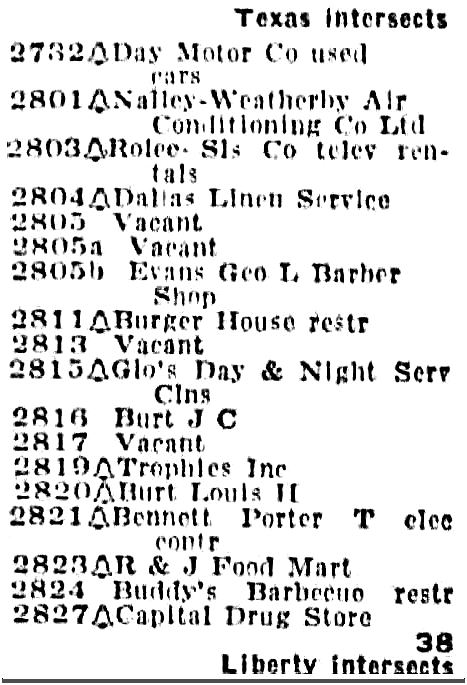
Below, the businesses in the 2800  block of Live Oak — between Texas and Liberty — from the 1956 city directory (click for larger image):

live-oak_1956directory

***

Sources & Notes

Top photo from the book Historic Photos of Dallas in the ’50s, ’60s, and ’70s by Rusty Williams (Nashville: Turner Publishing Company, 2010); from the collection of the Dallas Public Library.

Film footage of the tornado can be found in several videos on YouTube, here.

One of the newspaper reports on the tornado which captures the terror felt by those in the twister’s path and is well worth reading in the Dallas Morning News archives is “‘Roar of Thousand Trains’ Precedes the Killer Funnel” by James Ewell (DMN, April 3, 1957). Of particular interest is the story of T. M. Davisson who hid with a customer in a large empty steel tank on his property.

A previous Flashback Dallas post — “Tornado As Learning Tool — 1957” — is here.

Photo and clippings are larger when clicked.

*

Copyright © 2016 Paula Bosse. All Rights Reserved.


Knox Street Fire — 1961

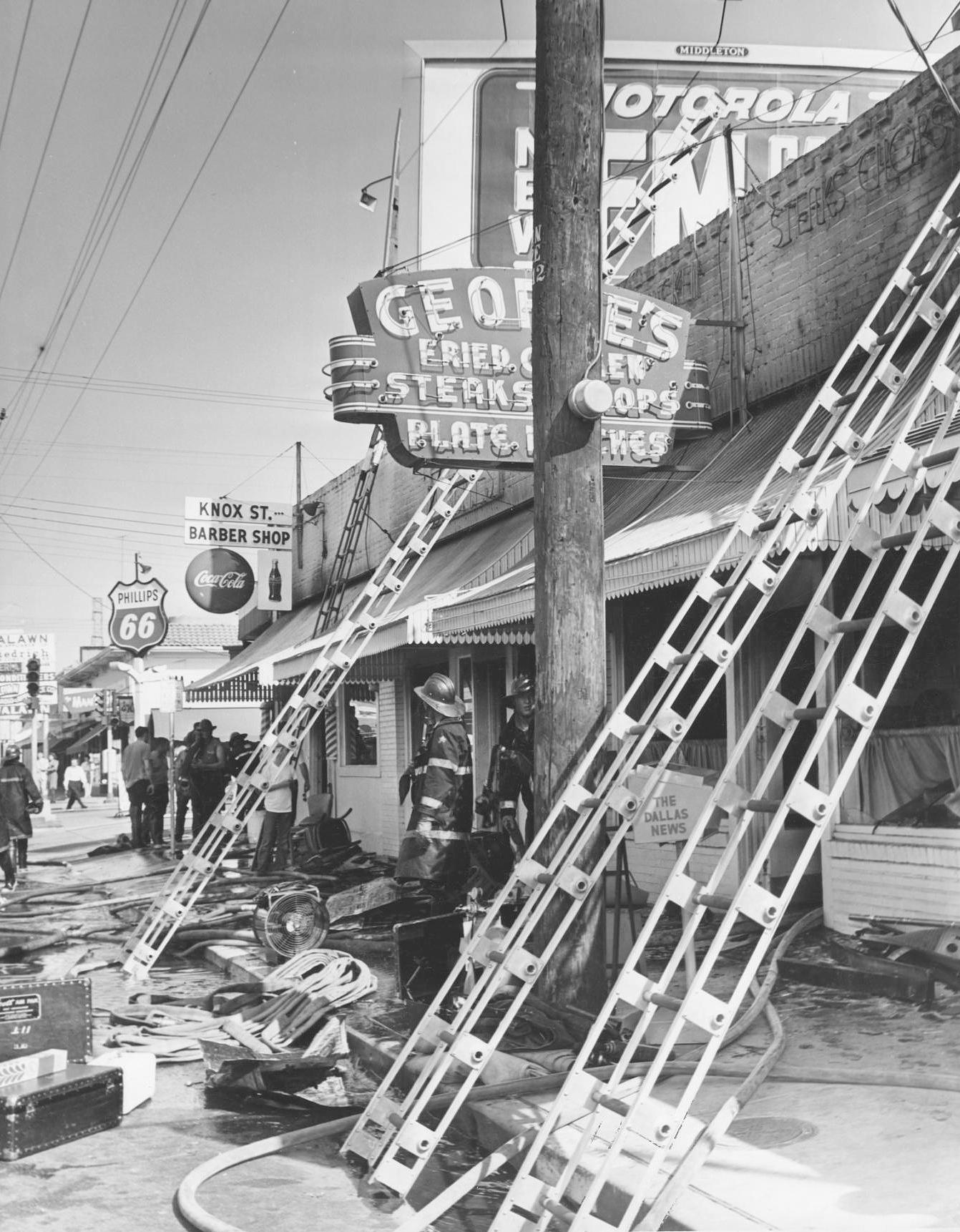
knox-street-fire_3100-block_052161_unt_portal_dallas-firefighters-museum3100 block of Knox, after a 4-alarm fire…

by Paula Bosse

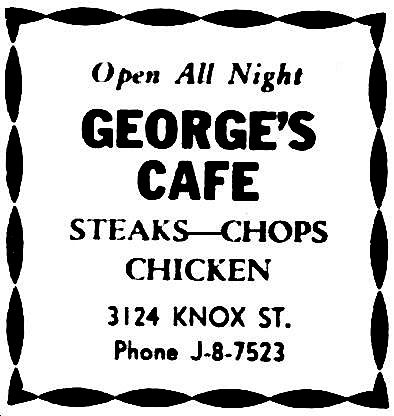
I often run across photos that aren’t particularly historical, but they’re interesting because they show a part of town with which I’m familiar, but which looks very different today. The photo above shows the 3100 block of Knox Street, between McKinney and Cole, looking toward Cole (seen at the stoplight). It shows the aftermath of a 4-alarm fire that broke out on May 21, 1951 and destroyed three businesses: George’s Cafe (at 3124 Knox), the Knox Street Barber Shop (3128 Knox), and Foster’s Food Store (3122 Knox) — the building housing these business survived, but it is long-gone; the land is now occupied by On The Border.

There were no fatalities at the scene, but, sadly, Charles William Layne, a 13-year-old neighborhood boy who suffered from a heart condition, collapsed while running to see what the commotion was and later died.

I looked up one of the businesses affected by the fire: George’s Cafe, owned by George Bartlett, who opened the business at 3124 Knox in 1937. Apparently those early days were difficult, and Bartlett barely kept the business afloat. The only thing that seemed to keep him going was the fear of losing the money his widowed mother had loaned him after she had mortgaged her home. A heartwarming rags-to-riches article about Bartlett appeared in the pages of The Dallas Morning News (“Shot at the Moon” by Kenneth Foree, DMN, Nov. 28, 1946).

Digging a bit, I saw that Bartlett had tried to sell the cafe several times but never seems to have found a buyer. The for-sale ads stopped after 1964. The last appearance of the cafe in the Dallas directory was in 1965. Bartlett died in 1966.

But Bartlett wasn’t kidding when he was interviewed by Kenneth Foree in that Dallas News article: it was very hard making money running the place. So hard, in fact, that in order to keep from going under, he had to take on a side job: he became a bookie, taking bets on basketball games, football games, and horse races. He was arrested twice (in 1959 and 1963) and spent 90 days in jail after being convicted on book-making charges. When arrested in 1963 after having been caught flushing receipts down the toilet as the vice squad broke down his door (a case which was later no-billed), the 57-year-old Bartlett told the arresting officer, “I just can’t make any money in the cafe business” (“Bookmaking Raid Nets Two Arrests” by Hugh Aynsworth, DMN, Nov. 17, 1963). He was shown in a news photo wearing handcuffs and pajamas. Oh, George. What would your mother have said?

UPDATE: I stumbled across news footage from 1963 of poor George on the worst day of his life, described above: in it, he is seen being arrested on camera — in his pajamas — after vice cops raided his East Dallas home. He has a black eye, which he sustained when cops caught him attempting to flush evidence. You can watch the short, silent video here — and you can read the news script which would have been read by the news anchor over the footage, here (it will explain those loaves of bread). Below is a screen shot.

bartlett-george_bookie-raid_nov-1963_WBAP_portalKXAS-NBC 5 News Collection, UNT

**

georges-cafe_dmn_062245
June 22, 1945

Below, the businesses in the 3100 block of Knox Street at the time of the fire. The businesses that burned were located in a building torn down many years ago and replaced by On The Border (the view today is here).

knox-street_3100-block_1962-directory
1962 Dallas directory

***

Sources & Notes

The photo at the top is from the Dallas Firefighters Museum collection, via the Portal to Texas History — more info is here.

Screen shot of George Bartlett is from footage shot on Nov. 16, 1963, from the KXAS-NBC 5 News Collection, UNT Libraries Special Collections, via the Portal to Texas History.

*

Copyright © 2016 Paula Bosse. All Rights Reserved.

November 22, 1963: Will Fritz and the JFK Investigation

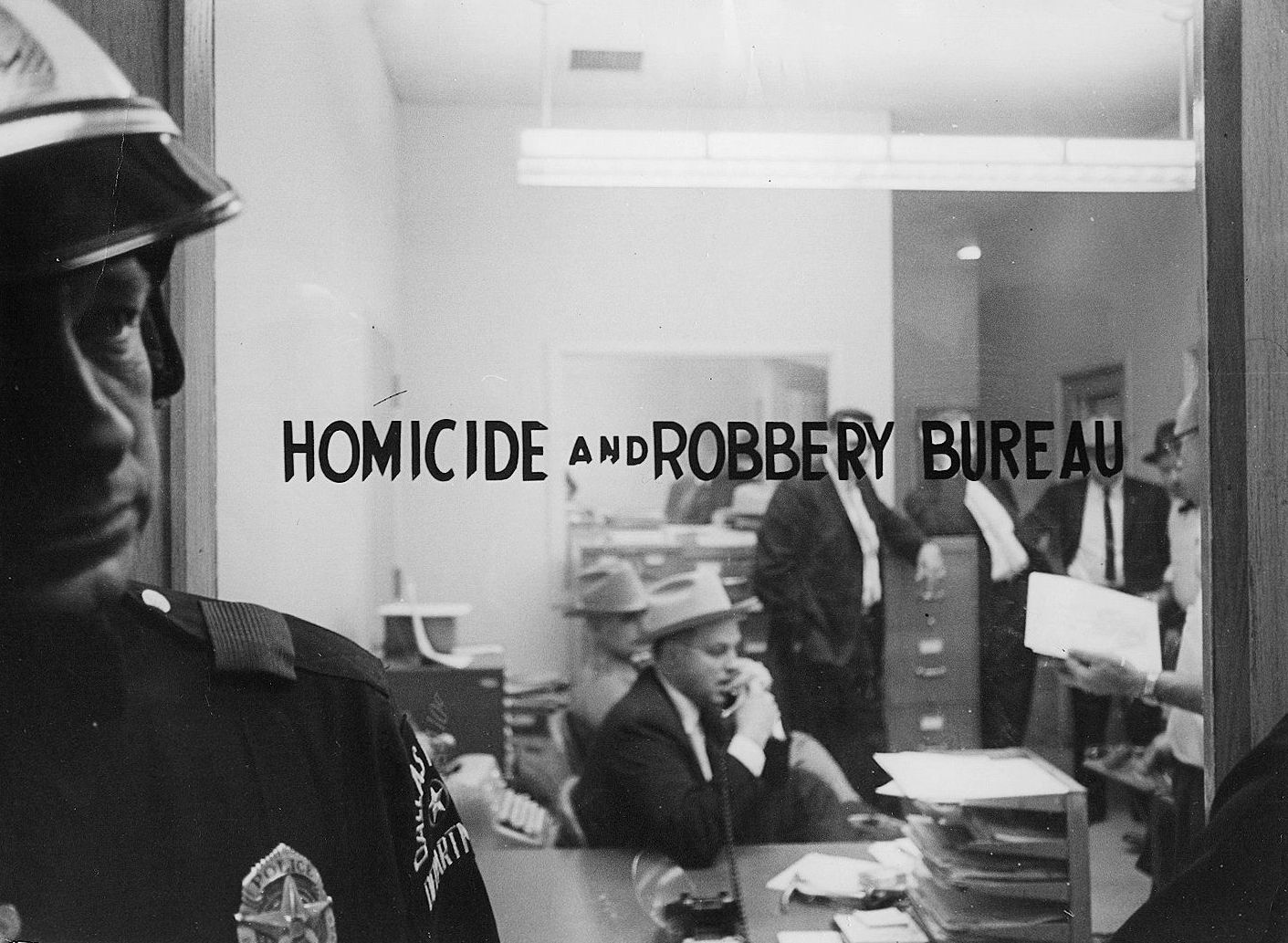
jfk_dpd_post-assassination_ebayThe men of the Homicide & Robbery Bureau at work (click for larger image)

by Paula Bosse

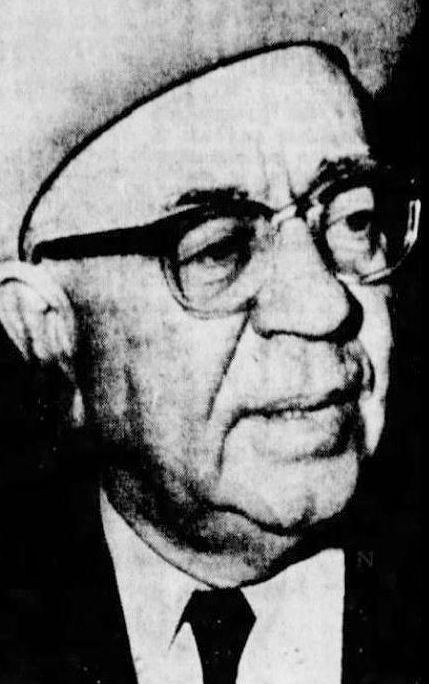
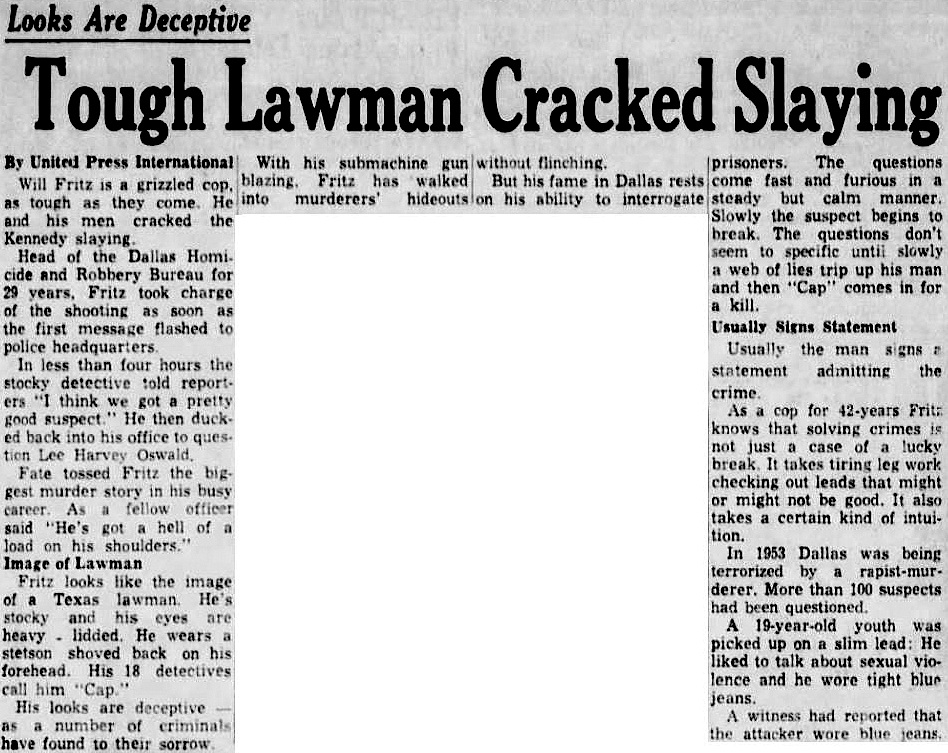
After the unthinkable had happened on the streets of Dallas — the assassination of a U.S. president — the Homicide and Robbery Bureau of the Dallas Police Department, led by Will Fritz, Captain of Detectives, sprang into action and quickly apprehended Lee Harvey Oswald as a suspect in the shooting of President John F. Kennedy. The FBI, the Secret Service, the Texas Rangers, and the whole of the Dallas Police Department worked together, but Fritz was the face of the investigation.

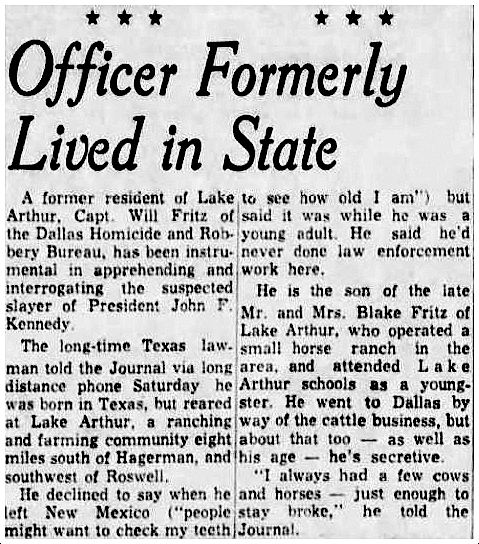
Will Fritz (1895-1984) was born in Dublin, Texas and grew up in New Mexico. He joined the Dallas Police Department in 1921 and remained on the force for 49 years, retiring in 1970 at the age of 74. He was considered one of the top police interrogators in the state and was a dedicated lawman — so dedicated he lived just steps away from police headquarters in the White Plaza Hotel (originally the Hilton Hotel, now the Indigo).

The success rate of Fritz’s detectives was impressive:

The record of Fritz and the Police Department’s Homicide and Robbery Bureau — which he has led since its formation — is a nationally enviable one. Over the past quarter century, he and his aides have solved roughly 98 per cent of the 54 to 98 homicides committed each year. (Dallas Morning News, March 1, 1959)

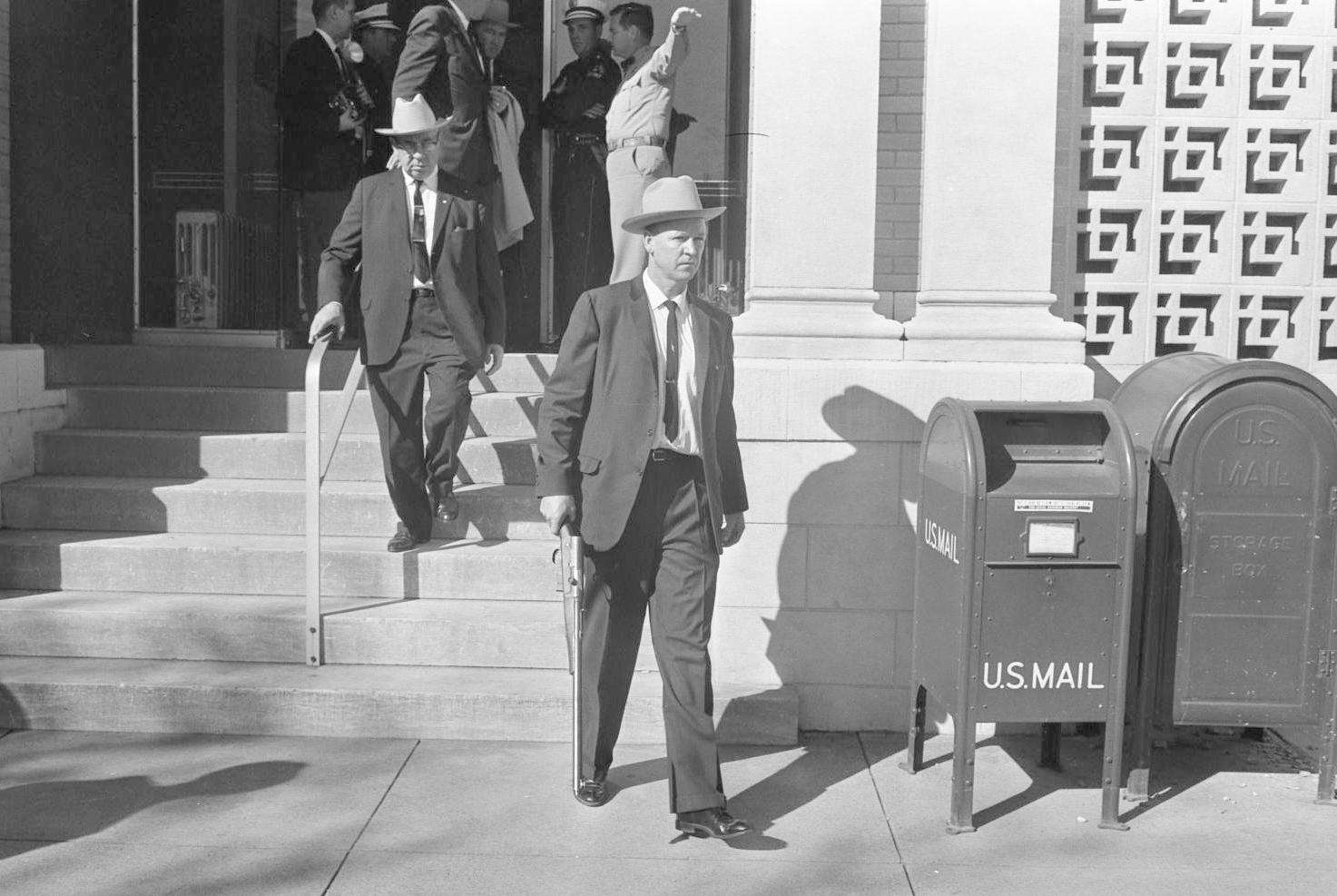
Fritz served for almost half a century with the DPD, involved in all sorts of colorful cases, but he’ll always be most remembered for the events surrounding the JFK assassination. The photo above shows his detectives at work in the Homicide office in the aftermath of the Kennedy assassination; the photo below shows him exiting the Texas School Book Depository with DPD detective Elmer Boyd (carrying rifle).

jfk_fritz_school-book-depository_112263_portal

*

*

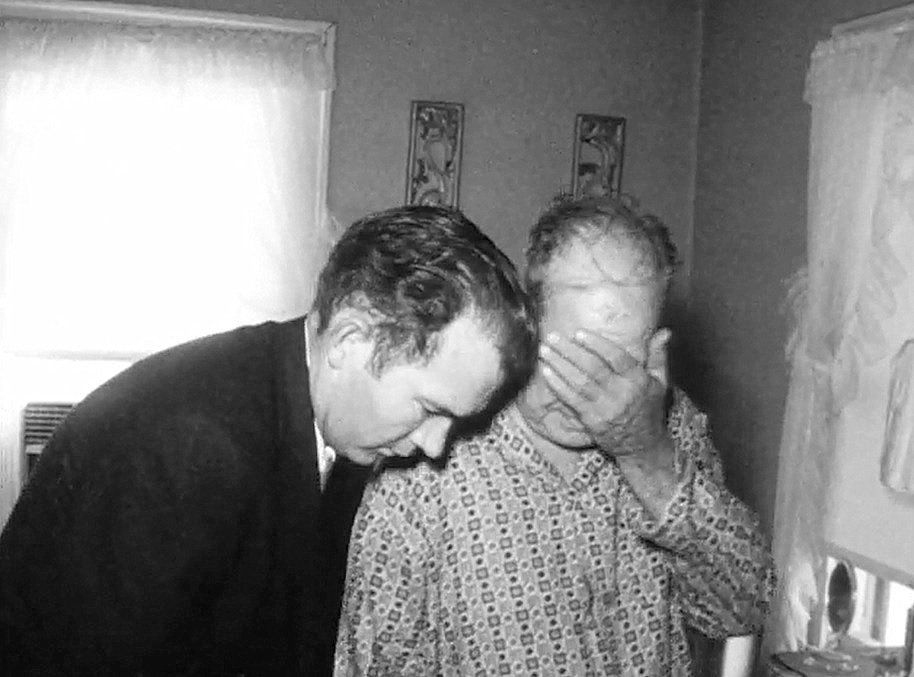
jfk_fritz_albuquerque-journal_112463-photo

jfk_fritz_albuquerque-journal_112463a

jfk_fritz_albuquerque-journal_112463b

jfk_fritz_albuquerque-journal_112463_sidebar
Above photo and clippings from the Albuquerque Journal, Nov. 24, 1963

***

Sources & Notes

Top photo showing a Dallas police officer standing outside the Homicide and Robbery Bureau is from a 2015 eBay listing. The reverse of the photo is stamped “Paris Match/Marie Claire.”

Photo showing Fritz walking down the steps of the Texas School Book Depository, taken on November 22, 1963 by Dallas Times Herald staff photographer William Allen. It is from the Sixth Floor Museum’s Dallas Times Herald Collection, which is hosted online by the University of North Texas Libraries, via the Portal to Texas History, here (with additional information here).

More about Capt. Will Fritz from the Handbook of Texas History, here.

A really interesting profile of Fritz can be found in the 1959 Dallas Morning News article “Captain Fritz: Stays With the Case” by Don Freeman (DMN, March 1, 1959).

Other Flashback Dallas posts related to the assassination of President John F. Kennedy can be found here.

Click on photos and clippings to see larger images.

*

Copyright © 2016 Paula Bosse. All Rights Reserved.


The John E. Mitchell Company’s WWII Munitions Work (Part 3)

mitchell-war-book_ebay
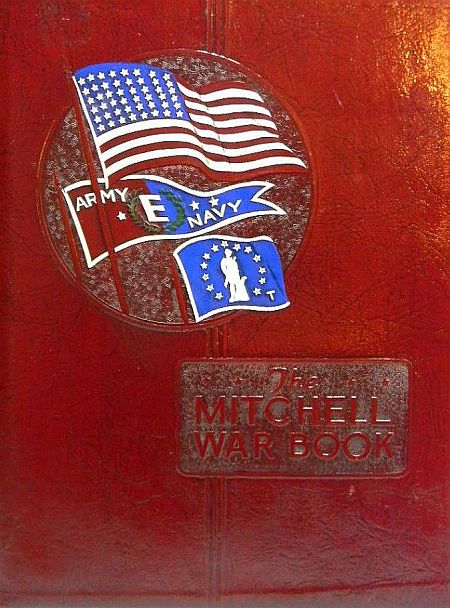
The Mitchell War Book

by Paula Bosse

My previous two posts have been on the John E. Mitchell Company’s period as a full-time contract manufacturer of munitions and materiel for the Navy and Army. I had planned for my third Mitchell post to be about the building itself, but I just happened across this book — The Mitchell War Book — and I thought I would go ahead and slip this in now. I’ll write about the building next.

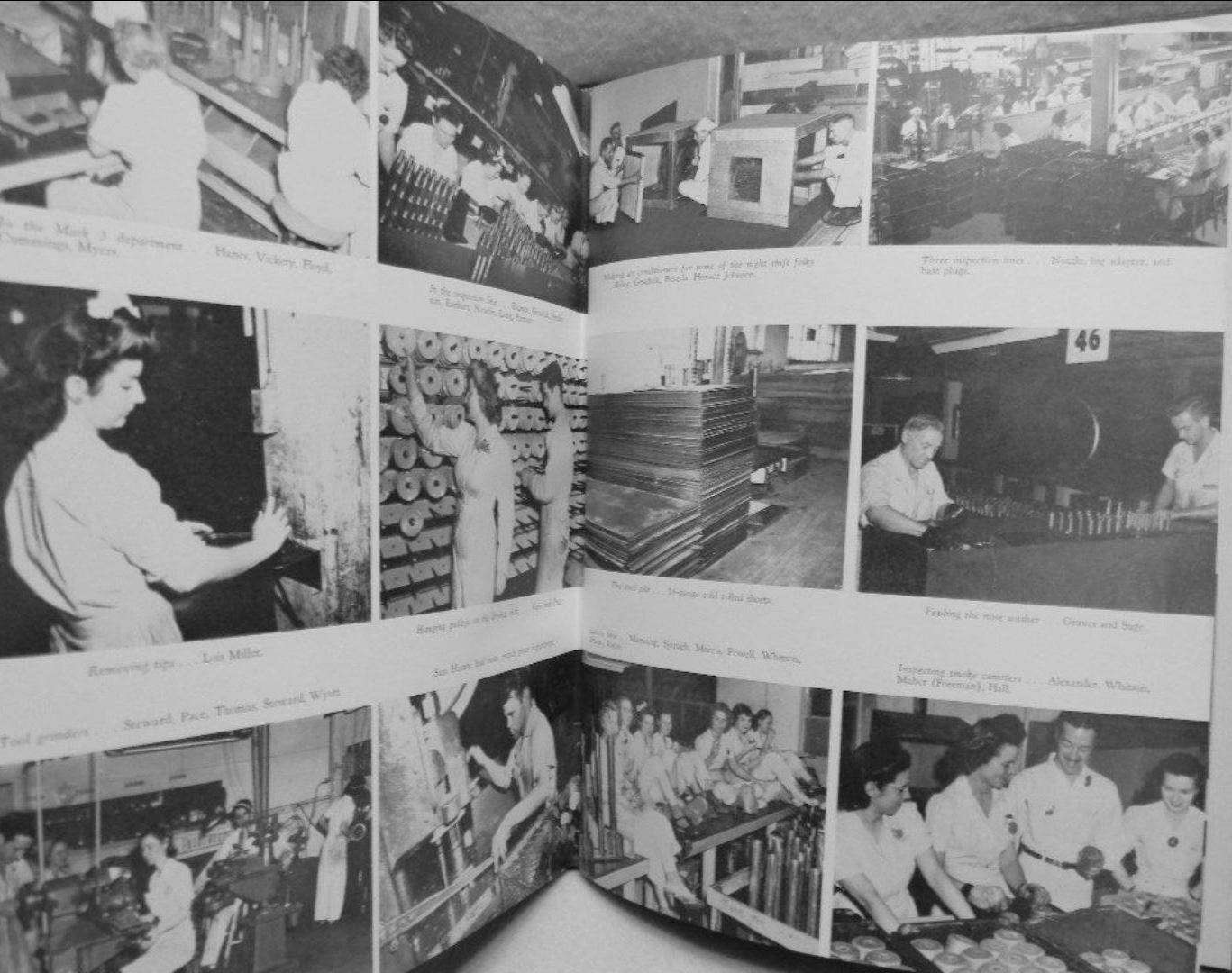
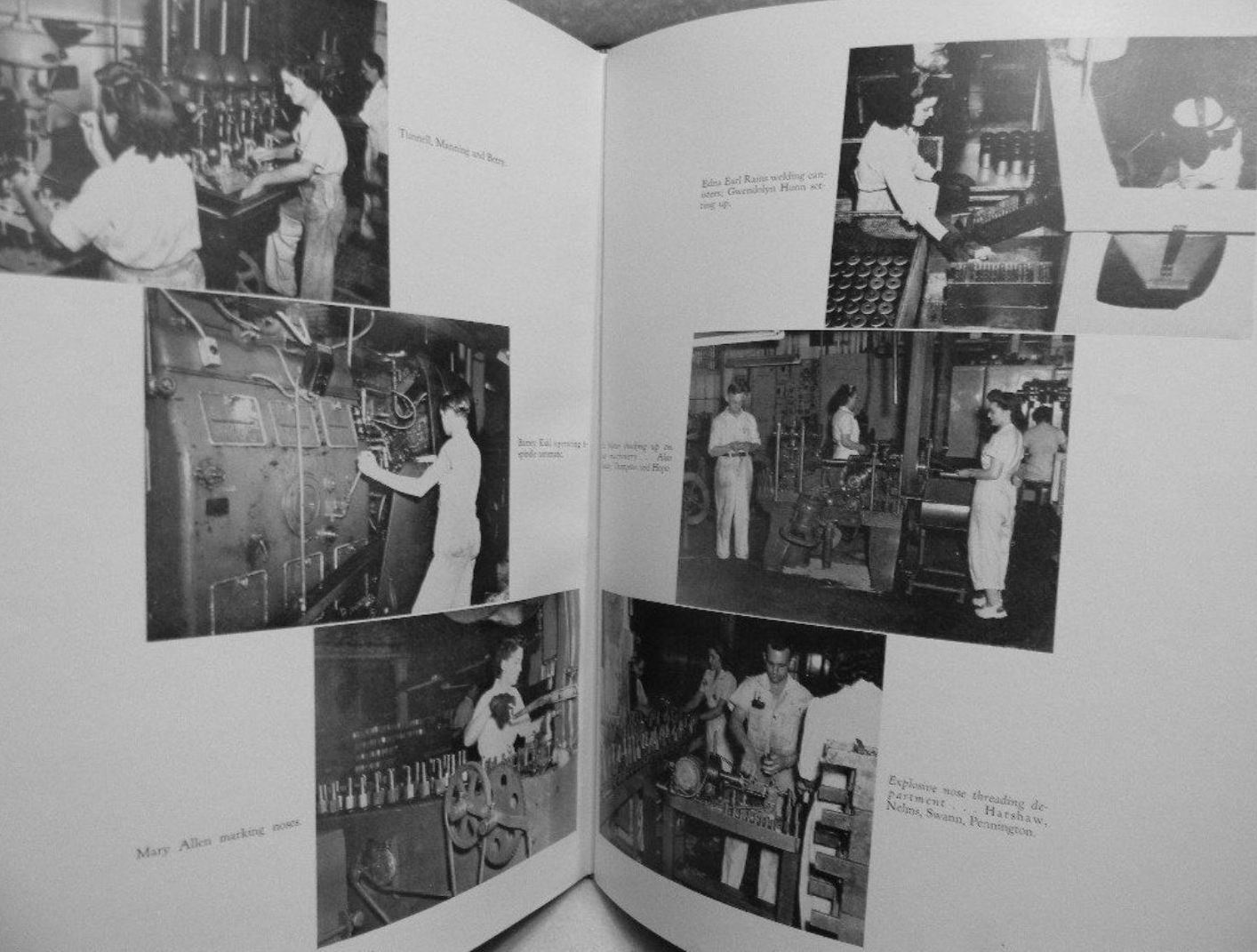
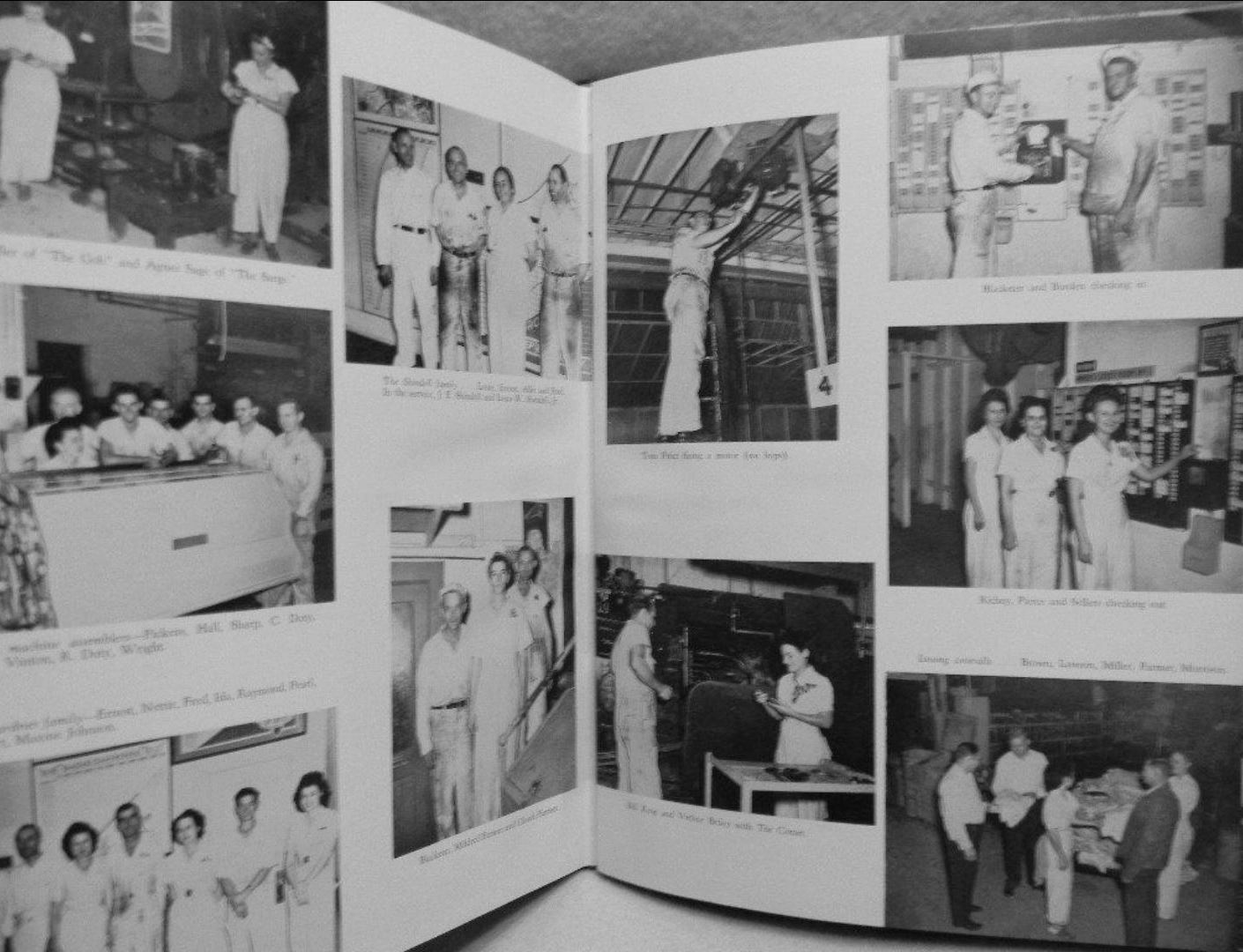
The book appears to be similar to a high school yearbook, with tons of photographs of Mitchell personnel at work on the factory floor and hanging out with their fellow war-workers in lighter off-duty moments. I’ve never seen this book (though I’d love to!), but it appears to be packed with pages and pages of photos.

Hundreds (if not thousands) of Dallasites worked in this factory while the Mitchell Company owned it — who knows? A relative of yours might be in here if he or she worked in it during the war. Below are photographs from a current eBay listing (click photos for larger images):

war-bk_1

war-bk_2

war-bk_3

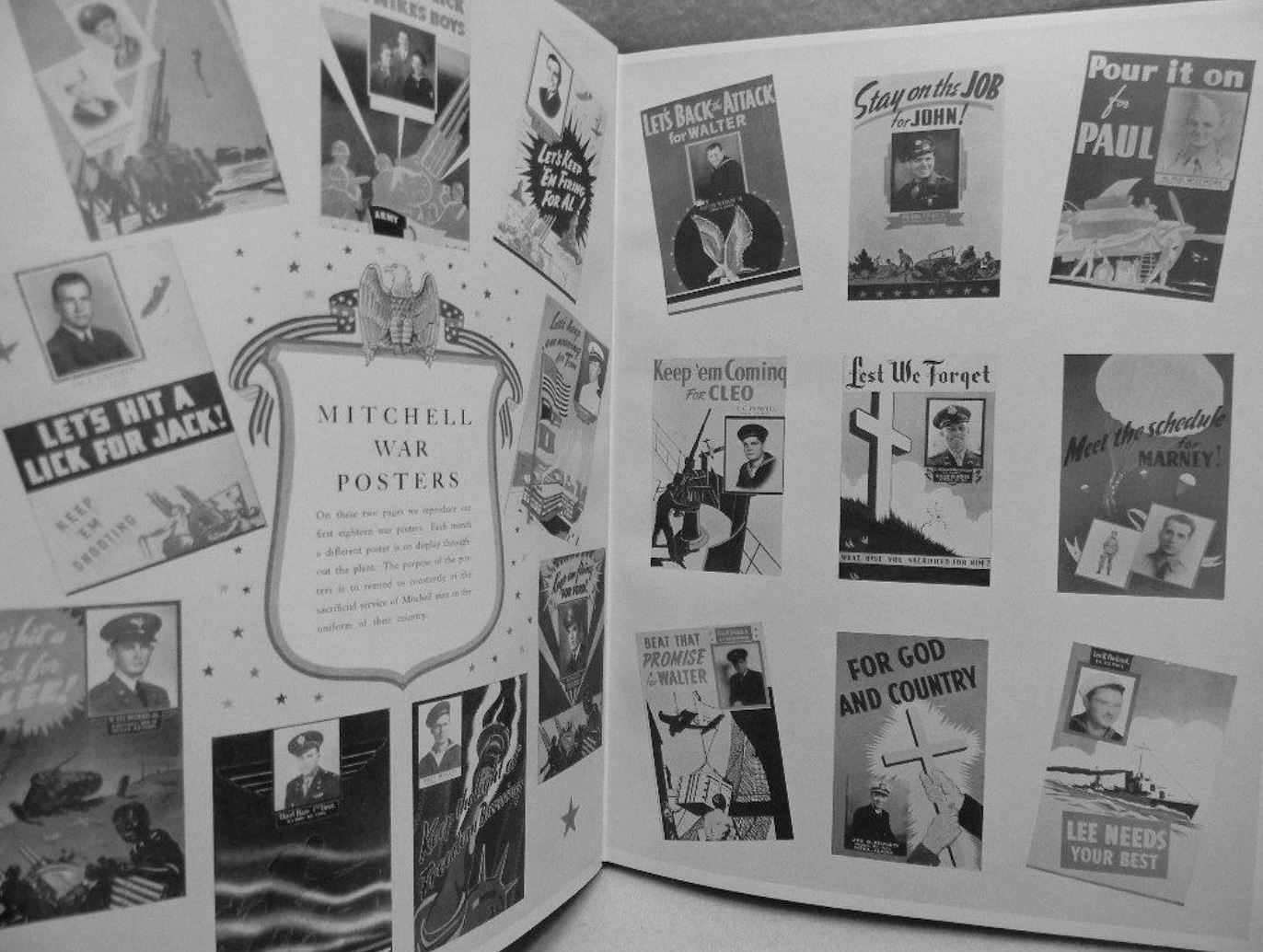
war-posters_war-bk_ebay

The posters above are interesting. When I posted a card the other day describing what this was all about (see it here), I didn’t fully understand. The company made these posters as reminders to the workers who they were working for: their fellow employees who were serving overseas.

war-bk_4

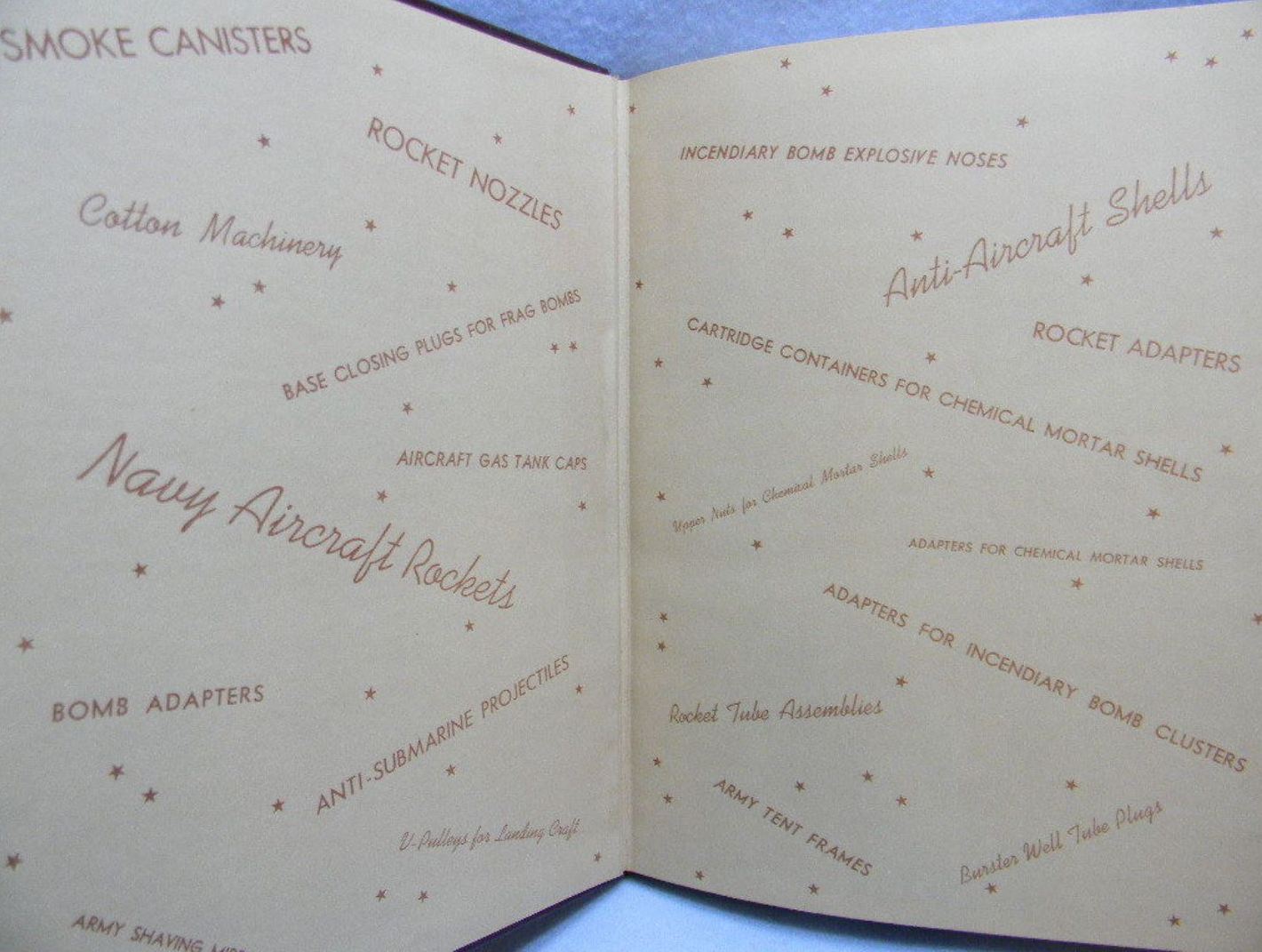
Above, the book’s endpapers show the various items the Mitchell Company was manufacturing for the U.S. Navy and U.S. Army.

war-bk_5

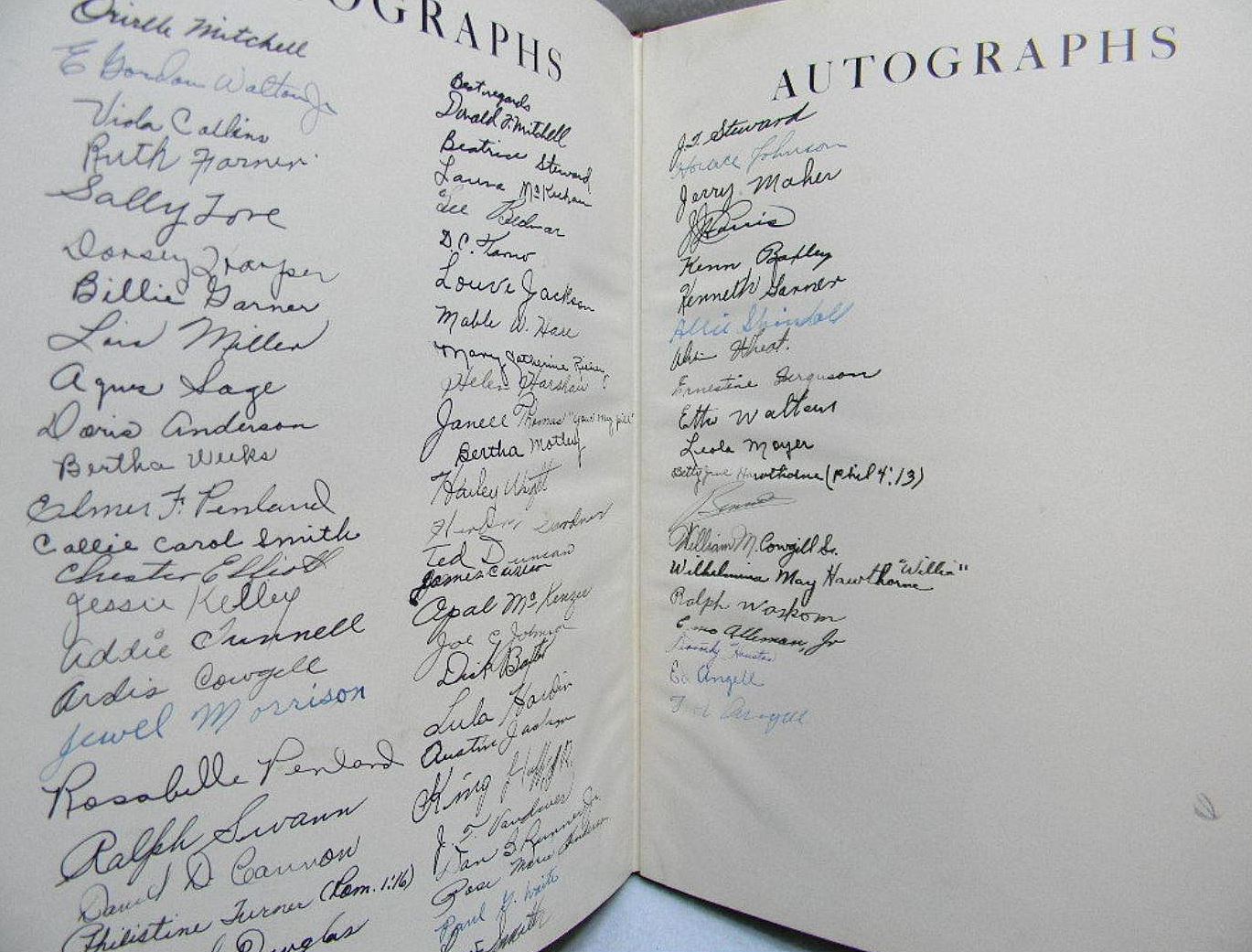
A few “autographs” of the John E. Mitchell Company’s wartime workers. Anyone you recognize?

***

Sources & Notes

As mentioned above, these photographs are from a current eBay listing, here.

Seems this book is pretty hard to find. I see only one other copy for sale — at about the same price — from a bookseller in Austin, here.

If you’re unwilling to fork over a fistful of cash but still want to look through the book, then hie yourself to the downtown Dallas Public Library to browse through the 127 pages of their only (non-circulating) copy; bibliographic details on the book from the DPL site, here (or if you don’t have a DPL account, here).

The two previous Flashback Dallas posts on the John E. Mitchell Company’s time as a munitions factory can be found here and here.

*

Copyright © 2016 Paula Bosse. All Rights Reserved.


The John E. Mitchell Company’s WWII Munitions Work (Part 2)

mitchell_17

by Paula Bosse

This is the second part of a post containing a series of postcards issued by the John E. Mitchell Company, which, before World War II was primarily a manufacturer of cotton and agricultural implements. It was located at 3800 Commerce in Exposition Park, a few blocks from Fair Park. During the war, the company ceased producing agricultural machinery and began producing munitions and materiel for the Navy and Army. (Part 1 can be found here.) The cards in a landscape format are larger when clicked.

*

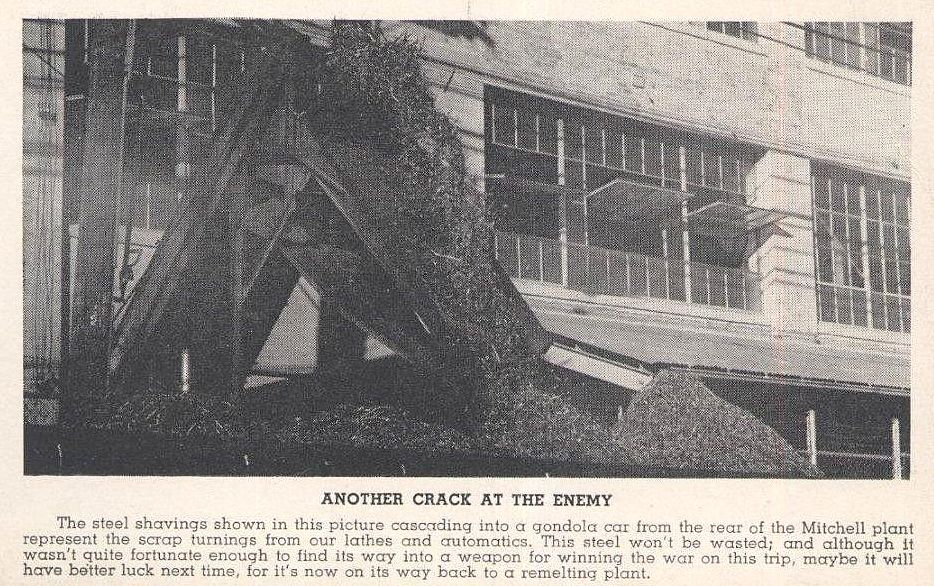
The card at the top shows the back of the (still-standing) building, behind which ran railroad tracks of the Missouri-Pacific railway. The card’s text:

ANOTHER CRACK AT THE ENEMY

The steel shavings shown in this picture cascading into a gondola car from the rear of the Mitchell plant represent the scrapped turnings from our lathes and automatics. This steel won’t be wasted; and although it wasn’t quite fortunate enough to find its way into a weapon for winning the war on this trip, maybe it will have better luck next time, for it’s now on its way back to a remelting plant.

*

mitchell_11

RECORD BREAKERS

This card will introduce you to Mr. and Mrs. Lewis J. Smith, the John E. Mitchell Company’s star tapping machine operators, shown here tapping base closing plugs for parafrag bombs.

It wasn’t so long ago that the Smiths’ sons, Dudley and Raleigh Smith, held the company production record on this machine. Then Dudley joined the Army and Raleigh joined the Navy. Mr. and Mrs. Smith decided the record should be kept in the family. So far it has.

*

mitchell_12

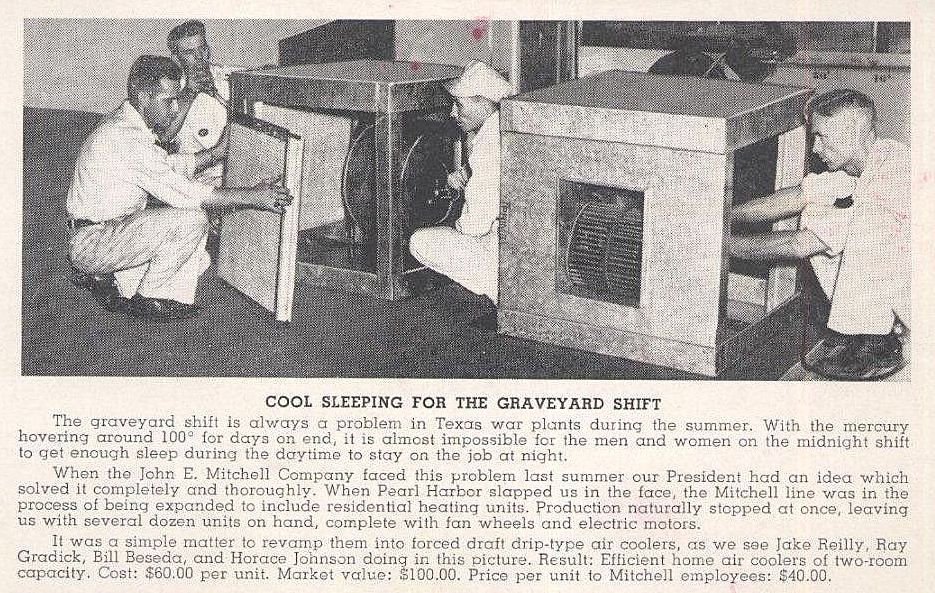
This is one of the most interesting cards in this collection. After the war, the Mitchell Company began to manufacture a wide variety of things, including heaters and air conditioners for cars. This problem of graveyard shift workers being unable to sleep during the summer months because of the oppressive heat must have been a big problem during the war, when factories such as this had to be running 24 hours a day. This was a brilliant solution.

COOL SLEEPING FOR THE GRAVEYARD SHIFT

The graveyard shift is always a problem in Texas war plants during the summer. With the mercury hovering around 100° for days on end, it is almost impossible for the men and women on the midnight shift to get enough sleep during the daytime to stay on the job at night.

When the John E Mitchell Company faced this problem last summer our President had an idea which solved it completely and thoroughly. When Pearl Harbor slapped us in the face, the Mitchell line was in the process of being expanded to include residential heating units. Production naturally stopped at once, leaving us with several dozen units on hand, complete with fan wheels and electric motors.

It was a simple matter to revamp them into forced draft drip-type air coolers, as we see Jake Reilly, Ray Gradick, Bill Beseda, and Horace Johnson doing in this picture. Result: Efficient home air coolers of two-room capacity. Cost: $60.00 per unit. Market value: $100.00. Price per unit to Mitchell employees: $40.00.

*

mitchell_13

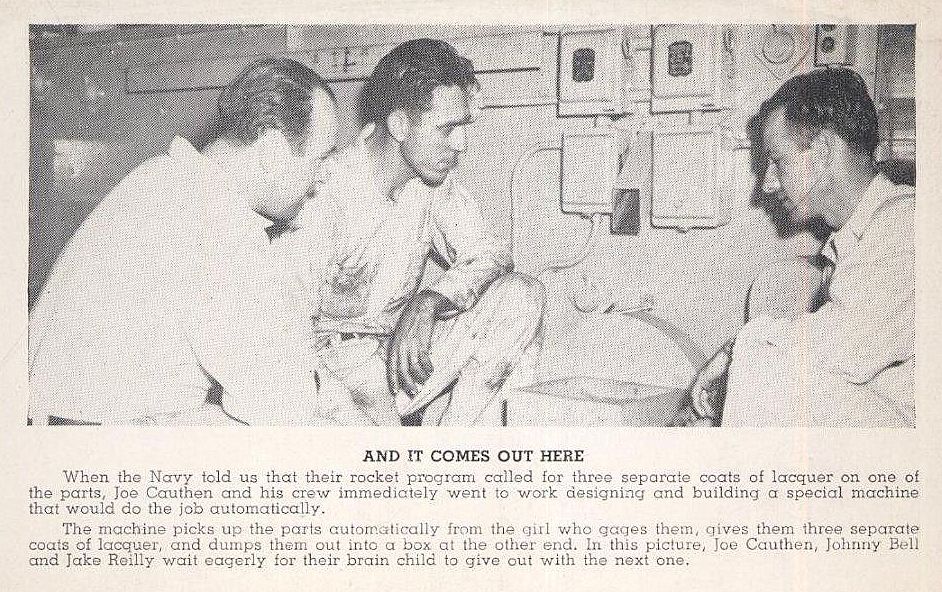
AND IT COMES OUT HERE

When the Navy told us that their rocket program called for three separate coats of lacquer on one of the parts, Joe Cauthen and his crew immediately went to work designing and building a special machine that would do the job automatically.

The machine picks up the parts automatically from the girl who gages them, gives them three separate coats of lacquer, and dumps them out into a box at the other end. In this picture, Joe Cauthen, Johnny Bell and Jake Reilly wait eagerly for their brain child to give out with the next one.

*

mitchell_14

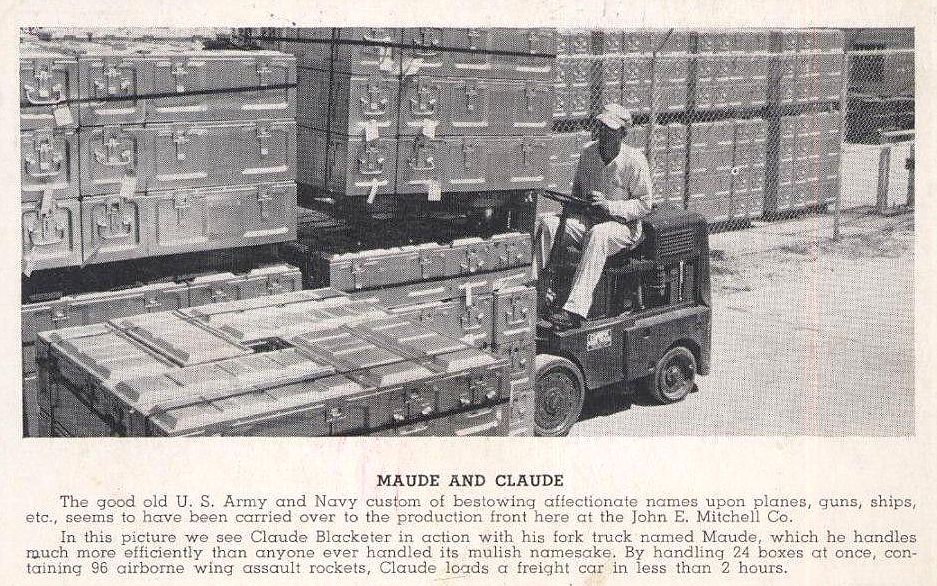
MAUDE AND CLAUDE

The good old U. S. Army and Navy custom of bestowing affectionate names upon planes, guns, ships, etc., seems to have been carried over to the production front here at the John E. Mitchell Co.

In this picture we see Claude Blacketer in action with his fork truck named Maude, which he handles much more efficiently than anyone else ever handled its mulish namesake. By handling 24 boxes at once, containing 96 airborne wing assault rockets, Claude loads a freight car in less than 2 hours.

*

mitchell_15

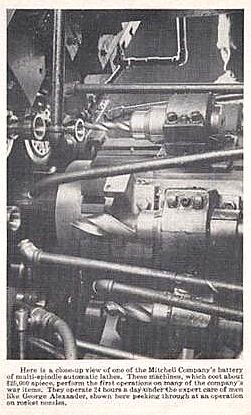
Here is a close-up view of one of the Mitchell Company’s battery of multi-spindle automatic lathes. These machines, which cost about $25,000 apiece, perform the first operations on many of the company’s war items. They operate 24 hours a day under the expert care of men like George Alexander, shown here peeking through at an operation on rocket nozzles.

*

mitchell_16

PRESSURE BOY

Here’s one of the many presses with which the Mitchell factory is equipped, each operatable with a series of interchangeable blanking, stamping, forming, and drawing dies. This particular press has a capacity of 300 tons and forms the end frame for a Mitchell cotton machine in one lick.

*

mitchell_19

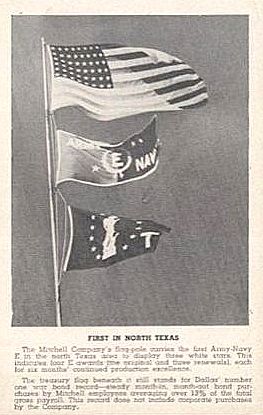
FIRST IN NORTH TEXAS

The Mitchell Company’s flag-pole carries the first Army-Navy E in the north Texas area to display three white stars. This indicates four E awards (the original and three renewals), each for six months’ continued production excellence.

The treasury flag beneath it still stands for Dallas’ number one war bond record – steady month-in, month-out bond purchases by Mitchell employees averaging over 13% of the total gross payroll. This record does not include corporate purchases by the Company.

***

Sources & Notes

Postcards found on eBay. Many of these are currently for sale, here.

Part 1, containing more of these postcards, is here.

Coming next: a look at the building built by the Mitchell Company in 1928, which is still standing in Expo Park, now repurposed as residential loft space.

mitchell-building_google
Google Maps (click for larger image)
*

Copyright © 2016 Paula Bosse. All Rights Reserved.


The John E. Mitchell Company’s WWII Munitions Work (Part 1)

mitchell_5

by Paula Bosse

The John E. Mitchell Company arrived in Dallas in 1928 to join the other nearby manufacturers of cotton gins and other agricultural equipment. They built their factory at 3800 Commerce, between Benson and Willow Streets, in the area now commonly referred to as Exposition Park, a few blocks from Fair Park. (The building still stands and has been converted into lofts. More on the building itself in Part 3.)

In 1942, during World War II, the large cotton machinery factory gradually transformed itself into one wholly concerned with war production, primarily manufacturing munitions for the Navy, but also producing ordnance parts for the Army.

Below are a series of postcards, produced by the Mitchell Company, touting their contribution to the war effort and acknowledging their workers. The second half of these cards will be contained in the next post. (Most of the cards are larger when clicked.)

*

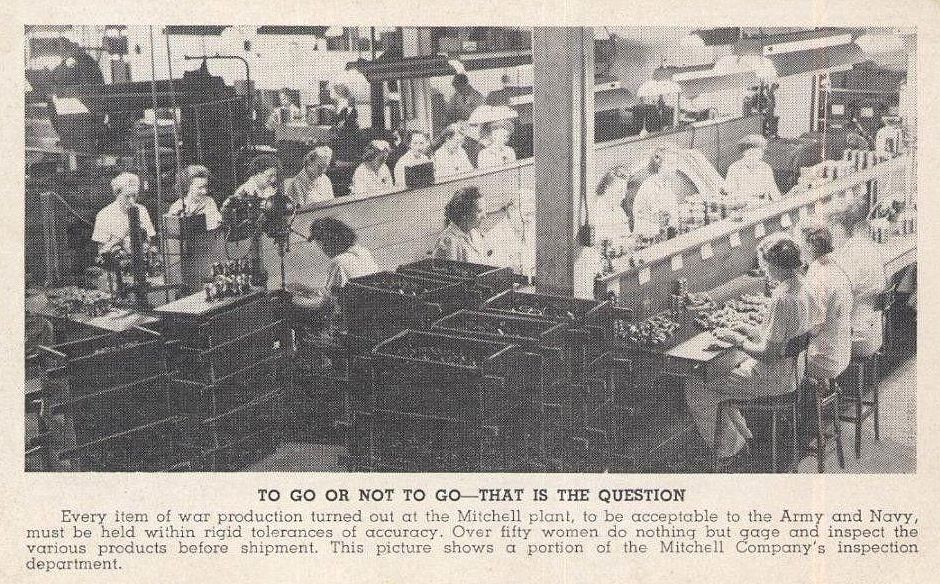
The top card shows part of the plant’s inspection department:

TO GO OR NOT TO GO — THAT IS THE QUESTION

Every item of war production turned out at the Mitchell plant, to be acceptable to the Army and Navy, must be held within rigid tolerance of accuracy. Over fifty women do nothing but gage and inspect the various products before shipment. This picture shows a portion of the Mitchell Company’s inspection department.

*

mitchell_1

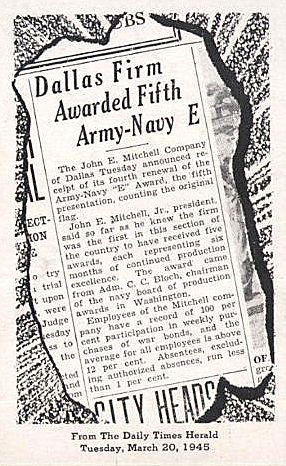
DALLAS FIRM AWARDED FIFTH ARMY-NAVY “E”

The John E Mitchell Company of Dallas Texas announced receipt of its fourth renewal of the Army-Navy E award, the fifth presentation, counting the original flag.

John E Mitchell, Jr., president, said so far as he knew the firm was the first in this section of the country to have received five awards, each representing six months of continued production excellence. The award came from Adm. C. C. Bloch, chairman of the navy board of production awards in Washington.

Employees of the Mitchell company have a record of 100 per cent participation in weekly purchases of war bonds, and the average for all employees is above 12 per cent. Absentees, excluding authorized absences, run less than 1 per cent.

From the Daily Times Herald, Tuesday, March 20, 1945

*

mitchell_2

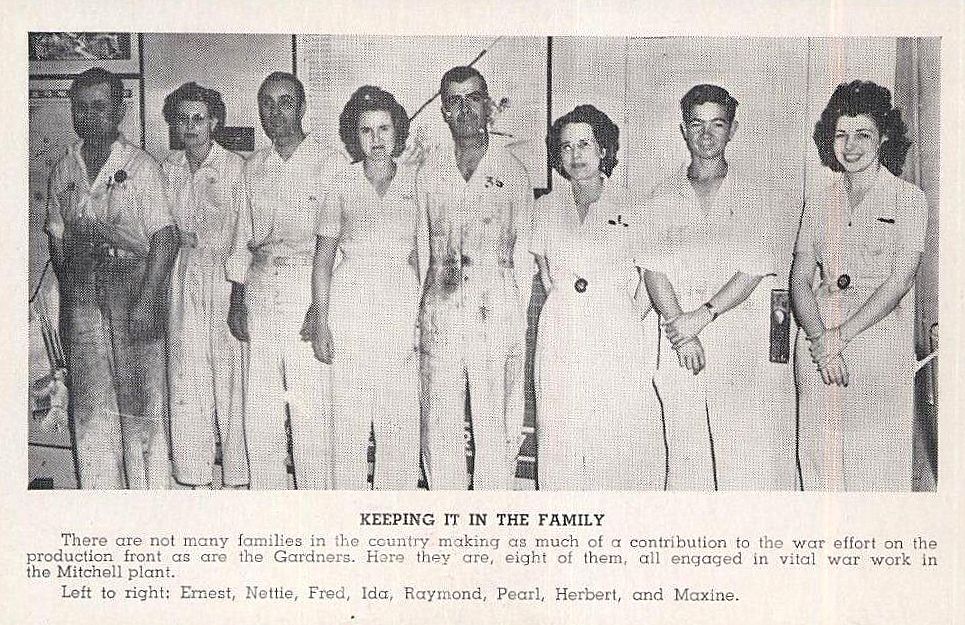
KEEPING IT IN THE FAMILY

There are not many families in the country making as much of a contribution to the war effort on the production front as are the Gardners. Here they are, eight of them, all engaged in vital war work in the Mitchell plant.

Left to right: Ernest, Nettie, Fred, Ida, Raymond, Pearl, Herbert, and Maxine.

*

mitchell_4

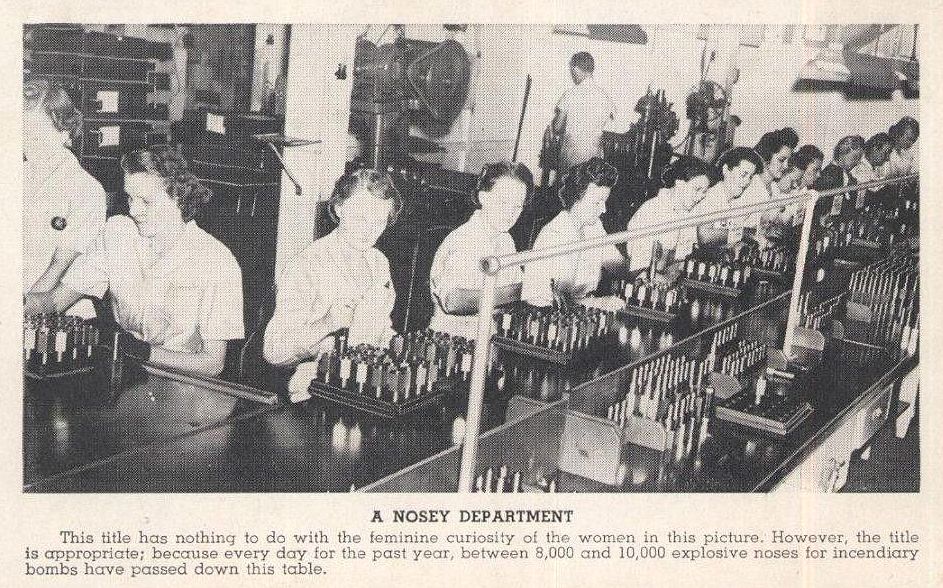
A NOSEY DEPARTMENT

This title has nothing to do with the feminine curiosity of the women in this picture. However, the title is appropriate; because every day for the past year, between 8,000 and 10,000 explosive noses for incendiary bombs have passed down this table.

*

mitchell_6

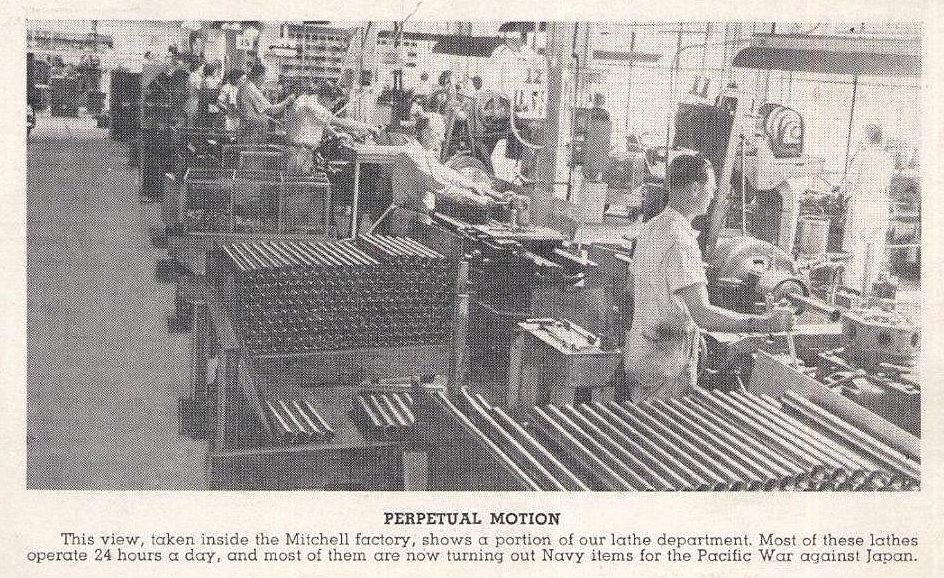
PERPETUAL MOTION

This view, taken inside the Mitchell factory, shows a portion of our lathe department. Most of these lathes operate 24 hours a day, and most of them are now turning out Navy items for the Pacific War against Japan.

*

mitchell_7

BIG JOKE

When this picture was taken, our president, John Mitchell, had evidently pulled off some sort of wisecrack which everyone seemed to enjoy, especially Mr. Mitchell himself.

The scene: one of the Mitchell Company’s regular Monday assembly meetings. The honored guests: Barney Kidd and Raleigh Smith, former Mitchell employees, now representing their company in both branches of the armed services.

*

mitchell_9

MEET OUR INDUSTRIAL CHAPLAIN

Let us introduce you to Art Isbell, the Mitchell Company’s industrial chaplain, shown here consulting with receptionist Doris Aday.

One of the first concerns in the nation to retain a full time industrial chaplain, the Mitchell Company has already discovered how important his services can be. Handling funeral arrangements, visiting the sick, helping with personnel problems, rendering spiritual guidance, Art Isbell has made himself invaluable to Mitchell men and women and has already endeared himself to the hearts of many through his patient understanding and never-failing cooperation.

*

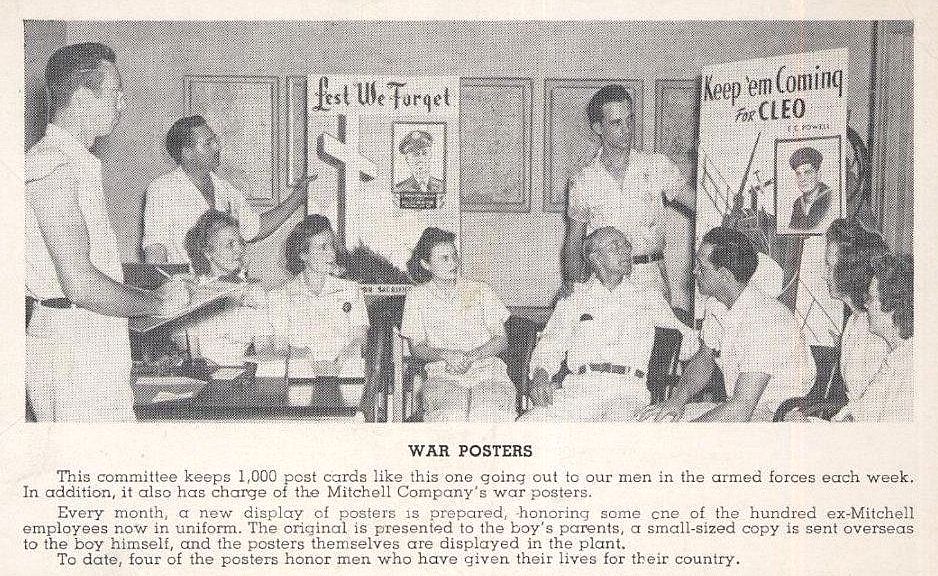
mitchell_10

WAR POSTERS

This committee keeps 1,000 post cards like this one going out to our men in the armed forces each week. In addition, it also has charge of the Mitchell Company’s war posters.

Every month, a new display of posters is prepared, honoring some one of the hundred ex-Mitchell employees now in uniform. The original is presented to the boy’s parents, a small-sized copy is sent overseas to the boy himself, and the posters themselves are displayed in the plant.

To date, four of the posters honor men who have given their lives for their country.

***

Sources & Notes

Postcards found on eBay last year. I was a little surprised to find that most of them are still available for purchase, here.

For more on the Mitchell Company’s early days as a munitions plant, see the Dallas Morning News article “E Award Given Plant Doing Munitions Job” (DMN, Dec. 29, 1942).

The Mitchell Lofts building is a long way from being war-time production plant. Here is what it looks like today.

mitchell-building_google
Google Maps (click for larger image)
Another Flashback Dallas post on a local munitions plant (this one downtown) —  “2222 Ross Avenue: From Packard Dealership to ‘War School’ to Landmark Skyscraper” — is here.

Part 2 features more of these postcards of the Mitchell Company’s war work, here.

Part 3 will focus on the building itself.

Check back!

*

Copyright © 2016 Paula Bosse. All Rights Reserved.


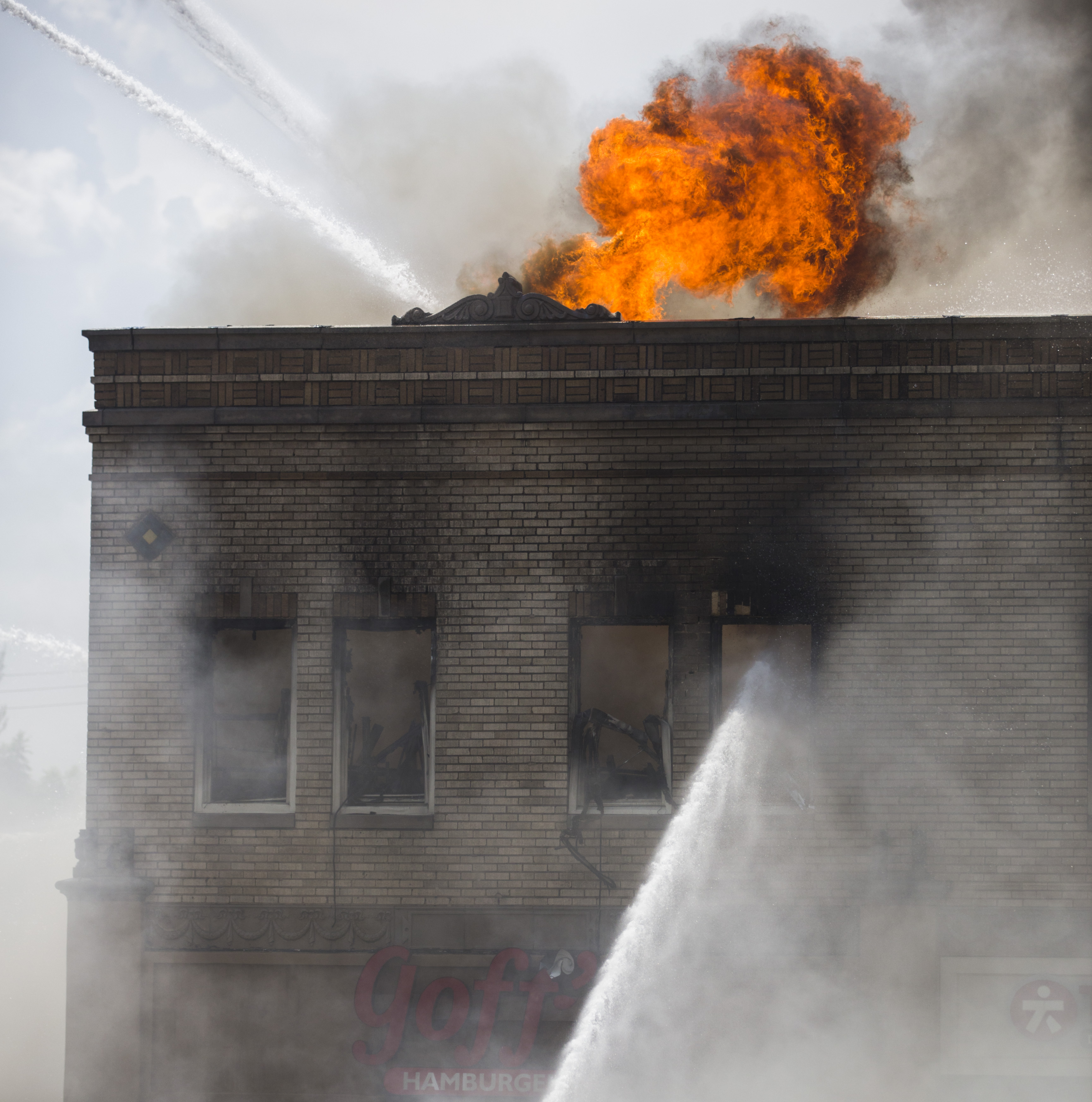
University Park’s “Couch Building” Goes Up In Flames (1929-2016)

goffs_fire_dmn-081216_ashley-landis-photo
Photo: Ashley Landis/DMN (click for huge image)
by Paula Bosse

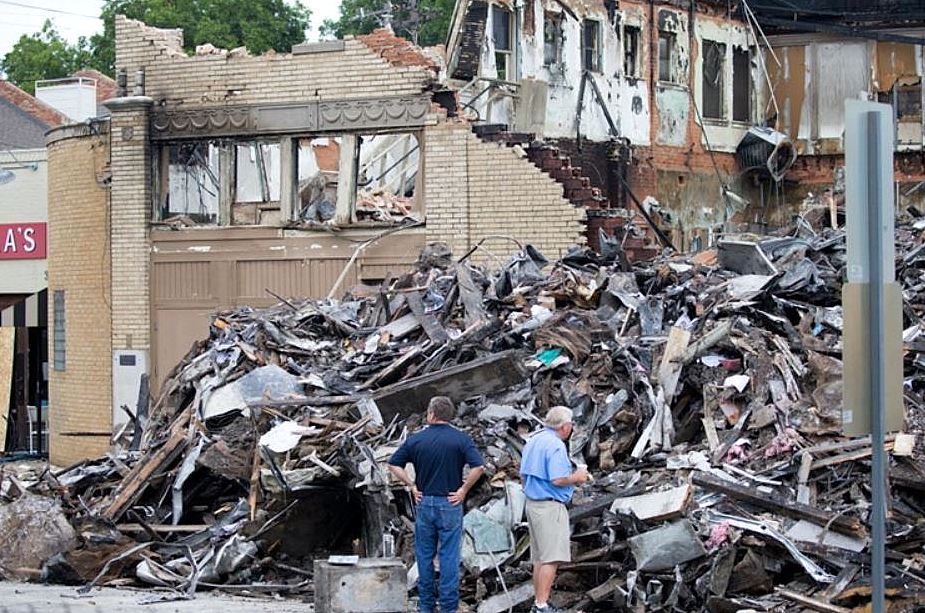
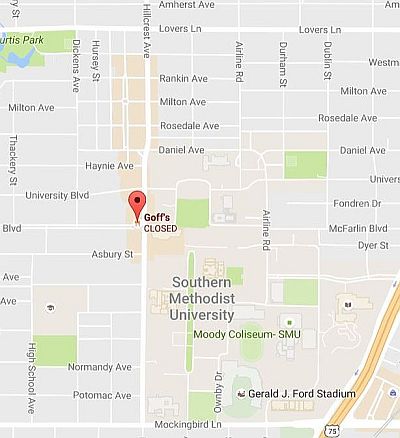
Yesterday, fire erupted in the old University Park building at the northwest corner of Hillcrest and McFarlin. The building — which housed Goff’s Hamburgers and several other businesses — is, today, a pile of rubble. I’ve always loved this building — every time I’d drive past it I’d smile, happy that the only truly distinctive non-SMU building along that part of Hillcrest was still standing. And now it isn’t.

The building — which was built in 1929 across Hillcrest from McFarlin Auditorium — had a rocky start. SMU really, really didn’t want it to be built.

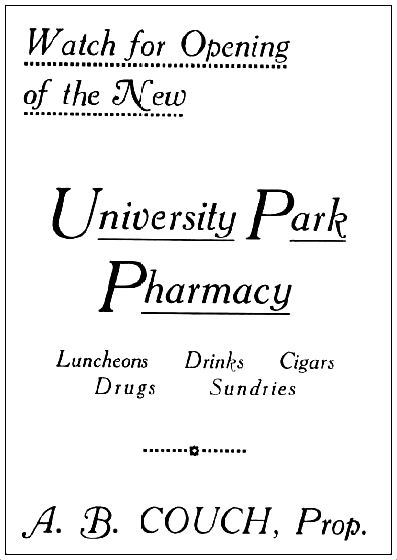
A. B. Couch (1895-1970) came to Dallas around 1914 from Waco to attend pharmacy school. In 1921, a few years after becoming a pharmacist, he opened his own drugstore, the University Pharmacy, at the southwest corner of Hillcrest and Roberts avenues (Roberts was renamed McFarlin Boulevard in 1928).
university-park-pharmacy_couch_1920-rotunda
Coming soon… (1920 SMU Rotunda yearbook)

Business must have been good, because in February of 1923, Couch bought the vacant property across the street. Three years later, he applied for a permit to build a business on the property, and that’s when the Robitussin hit the fan.

It’s a bit confusing, but, basically SMU, the original owner of the property (and all that surrounded it), put their land west of the campus (west of Hillcrest) on the market, but it could be sold only with specific restrictions — there were several of these restrictions, but the two cited most frequently were that land in this University Park Addition was to be developed solely for residential purposes, and that these homes were to be occupied by white people only. Somehow, in transferring property and re-deeding and re-re-deeding — and all sorts of other real estate transactions I don’t understand — the contract for the large lot purchased by Mr. Couch was drawn up with the restrictions omitted (“an oversight”). Couch was insistent on building businesses on the land he’d purchased, and SMU was adamant that he not be allowed to. Cue the lawsuit. (An overview of this case — in the appeals court — can be read here. It’s interesting, if confusing.)

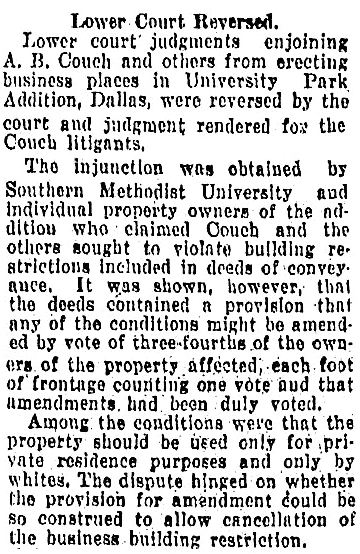
The court case dragged on and on, through injunctions and appeals, and, finally, in December of 1928, the Supreme Court of Texas ruled in favor of Couch. (Click to see a larger image.)

couch_FWST_120628_supreme-court-of-tx-ruling
Fort Worth Star-Telegram, Dec. 6, 1928

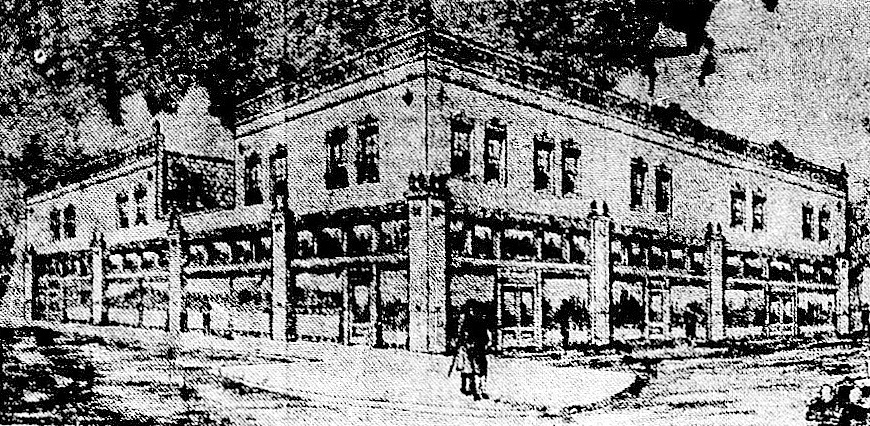
In the spring of 1929, Couch released the drawing of the two-story F. J. Woerner-designed building he planned to build:

couch-bldg_woerner-rendering_1929

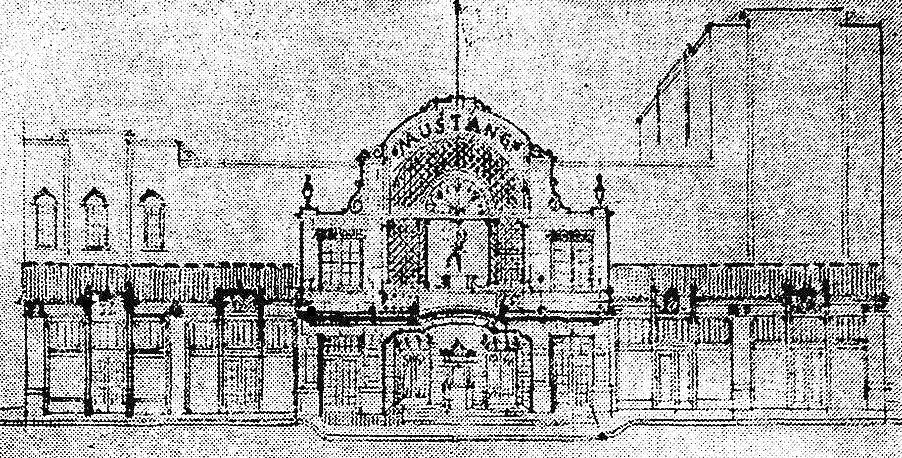
He also announced that he would build in this same block, a $125,000, 1,000-seat cinema: the Mustang Theater, which, though not yet built, had been leased for 10 years to R. J. Stinnette, who ran the Capitol Theater downtown. The building was designed by W. Scott Dunne, the architect of many of Dallas’ movie theaters (the Texas Theatre, the Arcadia, the Melba, the Dal-Sec, etc.).

mustang-theater_scott-dunne_rendering_1929

It doesn’t appear that the Mustang Theater was ever built, probably because the Varsity Theater in Snider Plaza (a stone’s throw away) had been announced that very same week (the Varsity opened in the fall of 1929).

So, forget the Mustang. Couch’s building — which was called, yes, “The Couch Building” — opened in 1930 or ’31. Its official address was 3402 McFarlin, but the address of the new location of the University Pharmacy was 6401 Hillcrest. There were a couple of stores next to the pharmacy, and offices upstairs (it seemed a popular location for doctors and real estate agents). Mr. Couch lived next door, at 3404 McFarlin (in a house which was, ironically, destroyed by fire in 1932).

That simple but lovely building stood on that corner for almost 90 years. Until yesterday. Sorry about that, A. B.

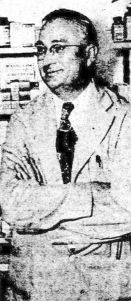
a-b-couch_pharmacist_1940sAndrew Bateman Couch, pharmacist

*

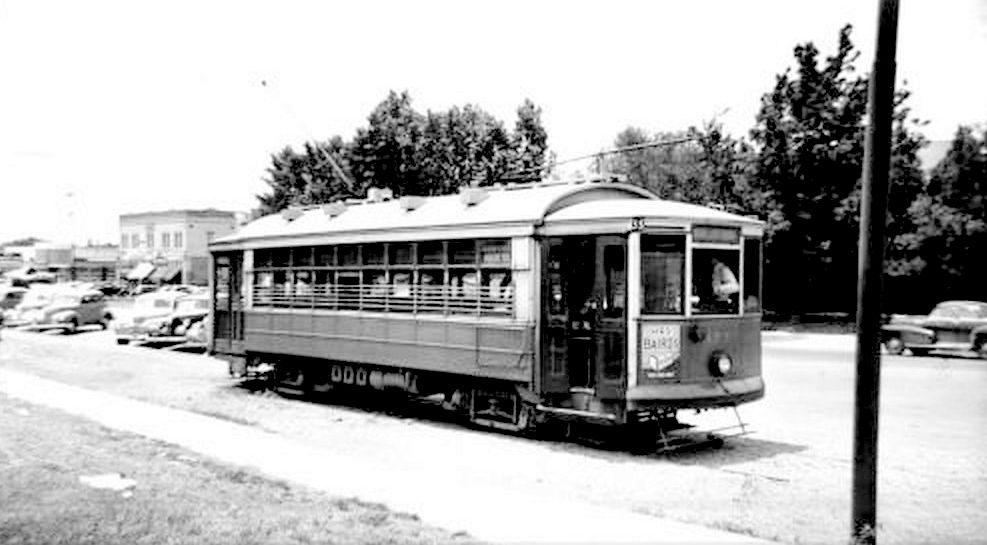
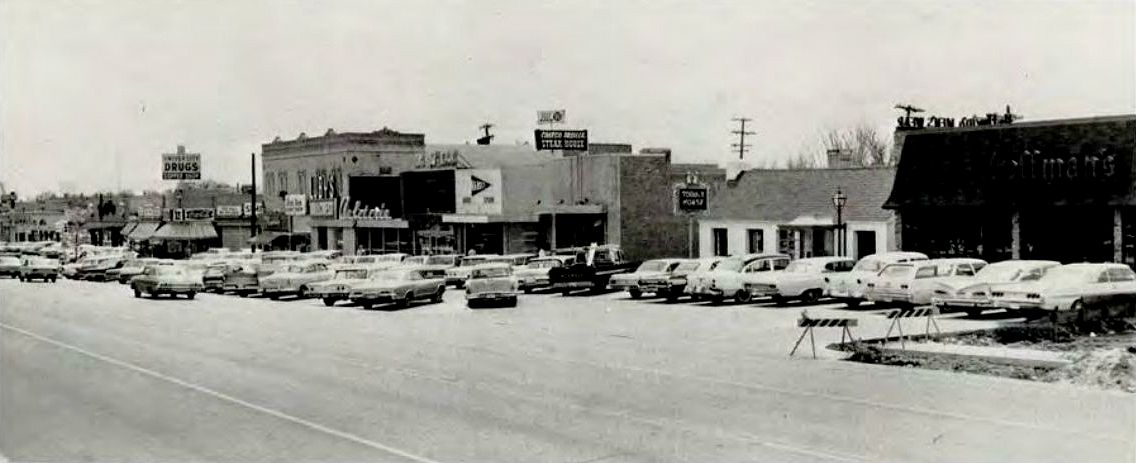
Below a photo taken on June 13, 1947, showing the “Highland Park/SMU” streetcar sitting at the end of the line, just south of Snider Plaza, with an 18-year-old Couch Building behind and to the left of the streetcar.


couch-bldg_061347_ebay

Below, the same view of Hillcrest looking south, from the 1965 SMU Rotunda yearbook. (Note that an unrelated University Pharmacy — this one owned by Harold Simmons — is seen at the southwest corner of Hillcrest and McFarlin. Couch sold his drugstore business in 1943, and a new pharmacy, which passed through several hands, opened across the street in Couch’s original 1921 location.)

drag3_smu-rotunda_19651965 SMU Rotunda

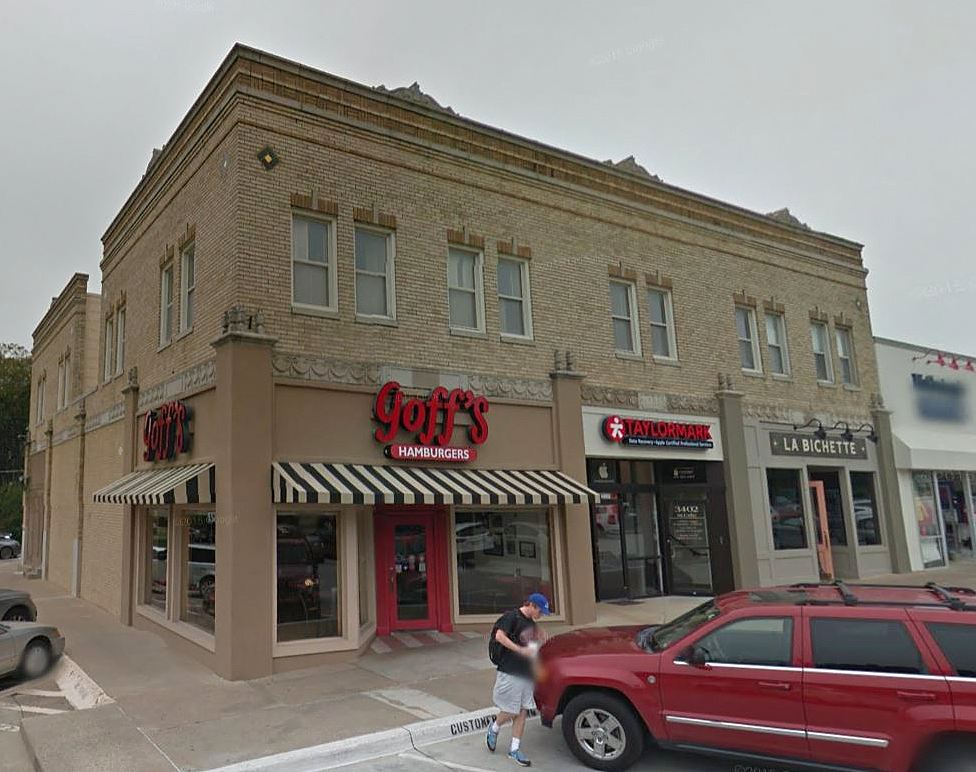
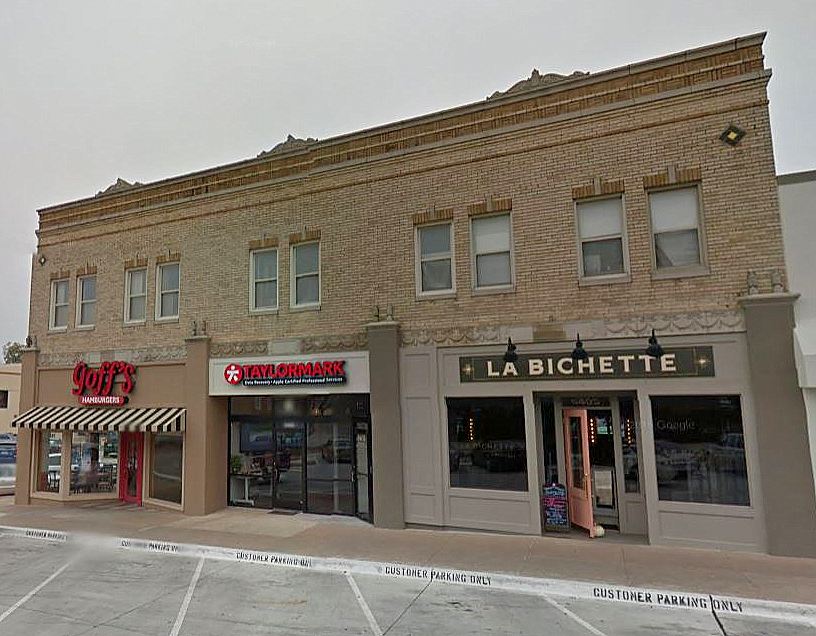
goffs_google_november-2015Google Street View, Nov. 2015

goffs_google_nov-2015_frontGoogle Street View, Nov. 2015

goffs_rubble_dmn-photo_081316_ting-shen-photographerDMN photo, Aug. 13, 2016 — Ting Shen, photographer

hillcrest-mcfarlin_map_goffs
Google Maps, Aug. 13, 2016 

***

Sources & Notes

Top and bottom photos are from the Dallas Morning News; see their coverage here, here, and here. That top photo is VERY large on The News’ website — look at all the detail of the brick and decoration.

Footage of the fire and its aftermath, from WFAA, can be watched here (scroll down to see all video footage).

Photo with the streetcar is from eBay; I saw it in the Retro Dallas, Texas Facebook group, posted by Dallas historian Teresa Musgrove Gibson.

Take a look at the 1921 Sanborn map, here. This building would be built at what is the northwest corner of Roberts (later McFarlin) and Hillcrest. University Park is pretty wide open in 1921.

*

Copyright © 2016 Paula Bosse. All Rights Reserved.

Lt. Mary L. Roberts, The “Angel of Anzio” — The First Woman Awarded the Silver Star

silver-star_feb-22-1945Roberts (left) and two fellow Army Nurse Corps nurses receiving the Silver Star

by Paula Bosse

The opening paragraph from a chapter in Tom Brokaw’s book The Greatest Generation:

There are so many impressive numbers connected to World War II that it’s difficult for one or two to catch your eye. Here are a few that caught me by surprise: more than sixty thousand women served in the Army Nurse Corps. Sixteen died as a result of enemy action. Sixty-seven nurses were taken prisoner of war. More than sixteen hundred were decorated for bravery under fire or for meritorious service.

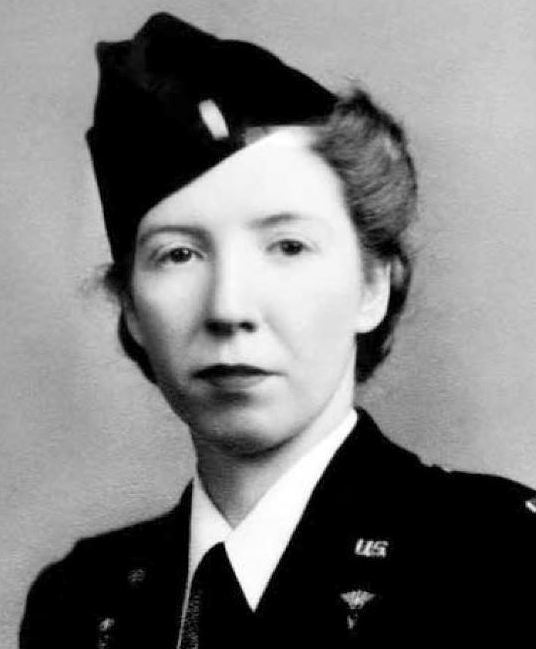
The chapter is titled “Mary Louise Roberts Wilson,” a profile of Mary L. Roberts, a Methodist Hospital nurse who enlisted in the Army Nurse Corps in 1942. She served with the 56th Evacuation Hospital Unit alongside many other medical professionals from Dallas (the unit — sometimes called the “Baylor Unit” — was organized by the Baylor University College of Medicine in Dallas). She knew she would be serving overseas in field hospitals in combat zones.

As far as seeing action, the worst of the worst for the 56th was on February 10, 1944 when their hospital tents on the Anzio beachhead in Italy were attacked by German long-range artillery shells for a full thirty minutes. Several operations were underway during the attack, and Roberts, the chief nurse of the operating tent, managed to keep a calm head and help to maintain as much order as possible.

“I wanted to jump under the operating table, but first we had to lower litter cases to the floor. Pieces of steel already were ripping through tents. There were four litters. I saw a patient on the operating table had his helmet near him so I put it over his head to give him that much protection.” (Mary L. Roberts, Dallas Morning News, Feb 23, 1944)

When the shelling ended, two enlisted men in the operating tent had been wounded, and elsewhere in the field hospital, two nurses had been killed and several other personnel wounded. As a result of their exceptional bravery, outstanding leadership, and “gallantry in action,” Roberts and two other nurses, 2nd Lt. Rita Virginia Rourke and 2nd Lt. Elaine Arletta Roe were awarded the Silver Star. No women had ever received the medal. As 1st Lt. Roberts had seniority, she was the first woman in history to be decorated for heroism in action.

Maj. General John P. Lucas surprised her and the other two nurses on Feb. 22, 1944 with an informal presentation of the medals at the same Anzio hospital that had been shelled only twelve days earlier. After the brief pinning ceremony, the nurses immediately returned to their duties, all feeling they were accepting acknowledgement for their team, not for themselves alone. Roberts spent 29 months overseas, and tended to more than 73,000 patients.

After the war, when Lufkin-native Mary Roberts returned home, she worked for almost 30 years as a nurse at a VA hospital in Dallas, and, rather late in life, she married fellow veteran Willie Ray Wilson. Mrs. Wilson died in 2001 at the age of 87. She was buried with full military honors.

roberts_texas-women-first_mcleroy_UTA1944 (Fort Worth Star-Telegram Archives, UTA)

roberts_dmn_022344-photo1944

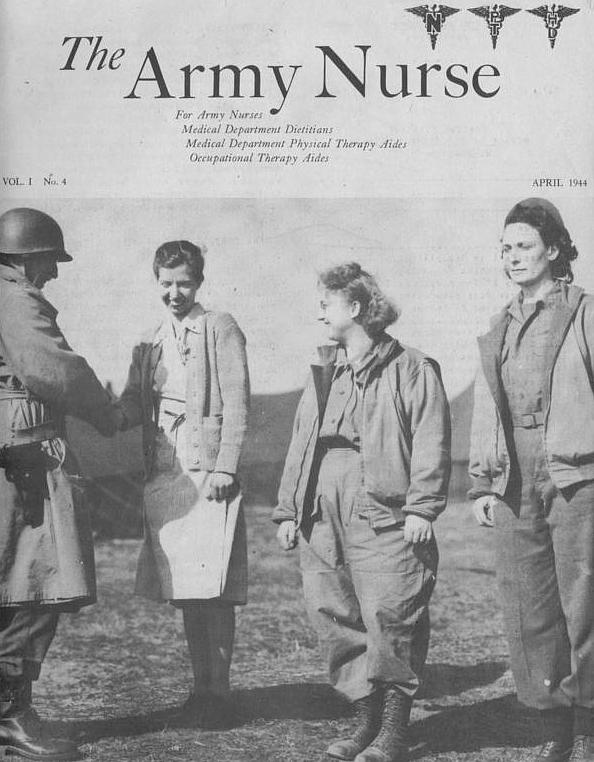
roberts-cover_army-nurse_april-1944Presentation of the Silver Star at Anzio

roberts_obit-photoMary Roberts Wilson (1914-2001)

***

Sources & Notes

Top photo and first quote from The Greatest Generation by Tom Brokaw (New York: Random House, 1998).

For an exceedingly detailed history of the 56th Evacuation Hospital Unit, with several photographs, see here.

Articles on Mary Roberts from The Dallas Morning News archives:

  • “Baylor Unit In Action” (DMN, Aug. 26, 1942): photo of unit, including Roberts, working around an operating table
  • “Dallas Nurse, Two Others Win Medals” (DMN, Feb. 23, 1944): “The award, denoting exceptional bravery went to Lt. Mary L. (Pinky) Roberts, 1205 North Bishop, Dallas, Texas, chief nurse in an operating room hit by shell fragments.”
  • “Nurses of Dallas Unit Serving at Anzio Doing Jobs Cheerfully Despite Many Hardships” by Wick Fowler (DMN, March 31, 1944)
  • “Ends Military Career: WWII Recalled By Heroic Nurse” (DMN, July 26, 1964): photo and interview with Mary Roberts Wilson on her retirement from the U. S. Army Reserve
  • “Happiness Is Being Part of a Team” by Jane Ulrich Smith (DMN, May 16, 1972), photo and interview, on her retirement from the Veterans Administration Hospital
  • “Compassion Revisited: Nurse Reunites With GI She Treated For Serious Injuries In WWII” (DMN, Nov. 4, 1999): a reunion with former patient Dewey Ellard of Mobile, Alabama, brought together by Tom Brokaw
  • “Distinguished Career In Medicine Followed — WWII Gallantry — VA Hospital Honors Longtime Nurse — Who Won Silver Star in ’44” (DMN, Nov. 6, 2001): interview with the then-87-year-old Mrs. Wilson, published two-and-a-half weeks before her death
  • “Mary Wilson, ‘Angel of Anzio,’ Dies at 87 — WWII Nurse Known For Kindness Was Decorated For Bravery Under Fire” (DMN, Nov. 24, 2001)

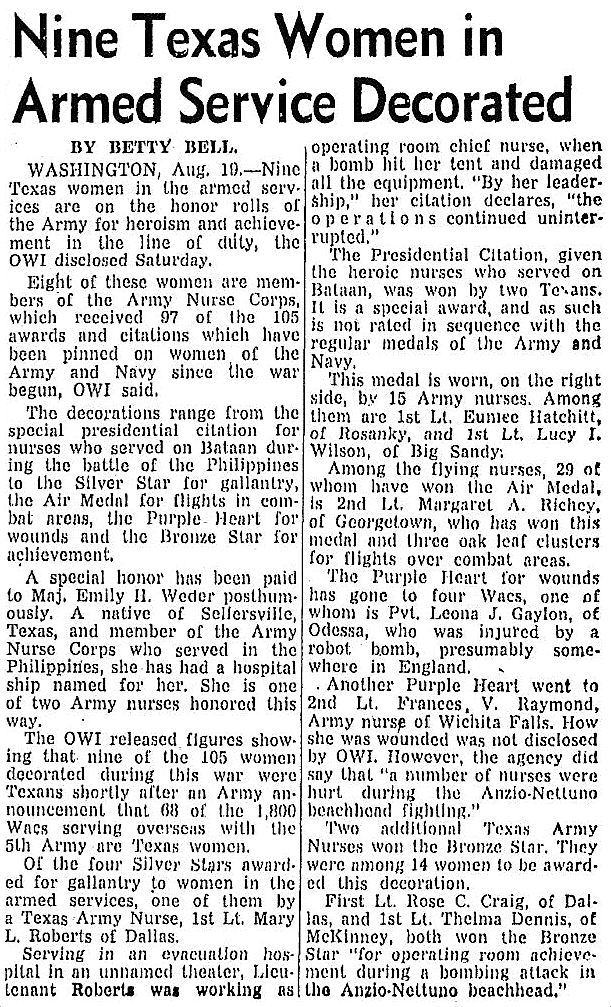
Other women who were honored in 1944 for heroism and achievement in the line of duty:

women_ww2_medals_FWST_082044Fort Worth Star-Telegram, Aug. 20, 1944

Click pictures and articles for larger images.

*

Copyright © 2016 Paula Bosse. All Rights Reserved.