Flashback : Dallas

A Miscellany: History, Ads, Pop Culture

Category: HOF

Dads’ Day at Hockaday — 1947

hockaday_dads-day_life-mag_cornell-capa_1947_cokesMid-day snack in Lower Greenville

by Paula Bosse

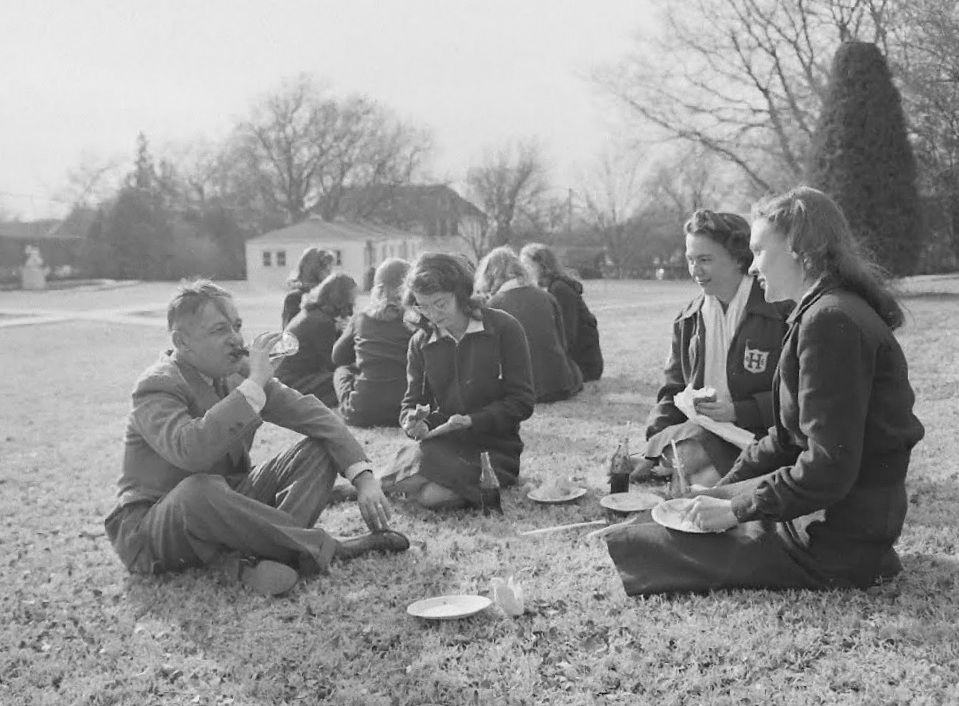
“Dads’ Day” at the Hockaday School for Girls, was a big thing. In this annual celebration, fathers (many of whom traveled from other states) would spend a few hours on the campus with their daughters, attend special programs and performances, visit classrooms, engage in friendly sporting matches against their daughters (volleyball, softball, kickball), and enjoy refreshments. In 1947, there was an al fresco Coke and hamburger lunch. But the big event was that night: a formal dinner in the Crystal Ballroom of the Baker Hotel. And, luckily for us, the Dads’ Day festivities of February 1947 were captured by Life magazine photographer Cornell Capa. A few of the photos appeared in the March 10, 1947 issue, in the story “Dad Has His Day; Texas Schoolgirls Invite Fathers to Come and Be Dates for a Day.” This Dads’ Day story even got the cover. Below are photos by Capa which weren’t used in the story.

*

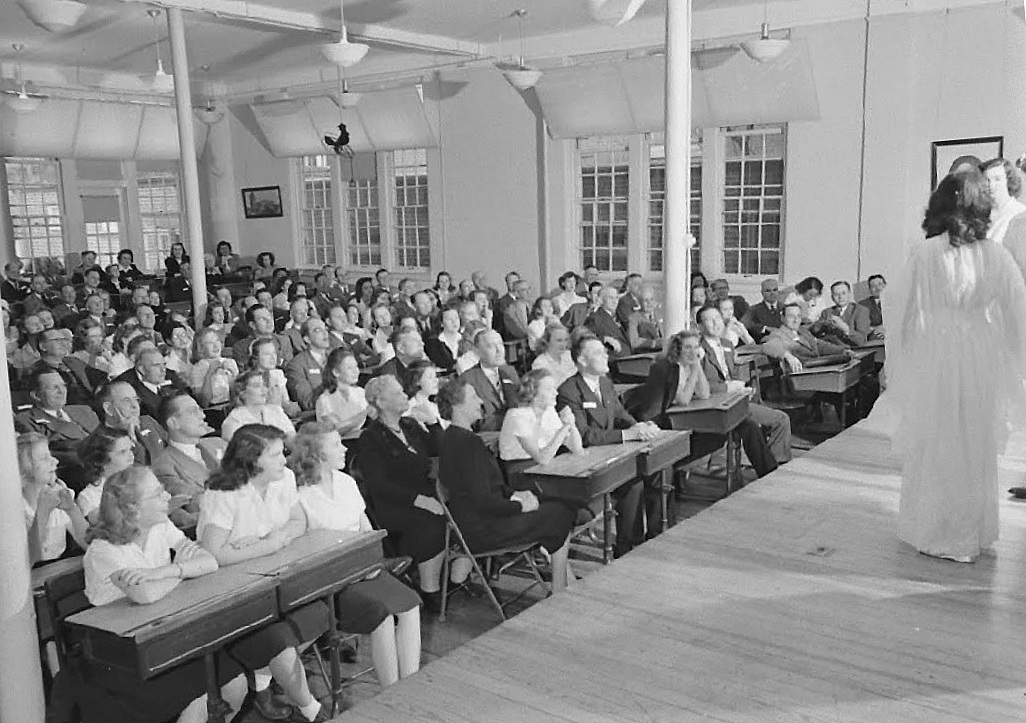
Dads watching one of several presentations in their honor:

hockaday_dads-day_life-mag_cornell-capa_1947_performance

*

Sitting in a classroom. I don’t know who this girl is, but I love this photo of her. (If readers recognize any of the people in these photographs, please comment below.)

hockaday_dads-day_life-mag_cornell-capa_1947_desk

*

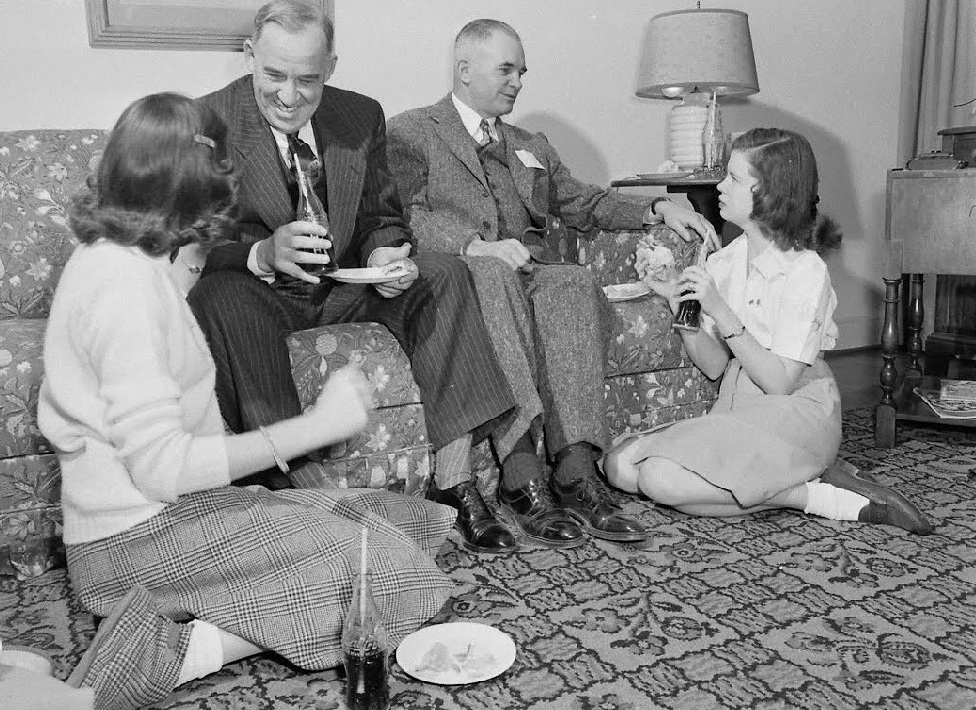
Hangin’ with the girls, enjoying refreshments:

hockaday_dads-day_life-mag_cornell-capa_1947_indoors_cokes

*

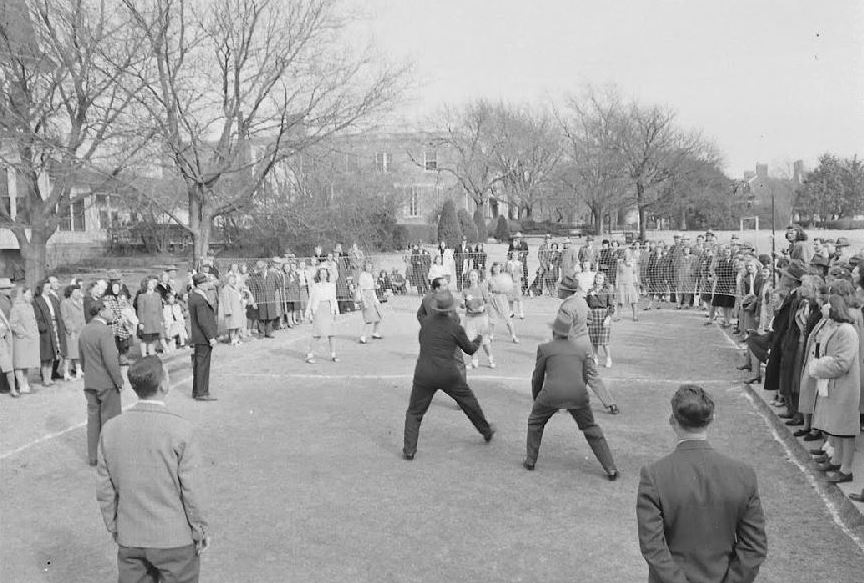
Volleyballing with hats on (I love this photo!):

hockaday_dads-day_life-mag_cornell-capa_1947_game

*

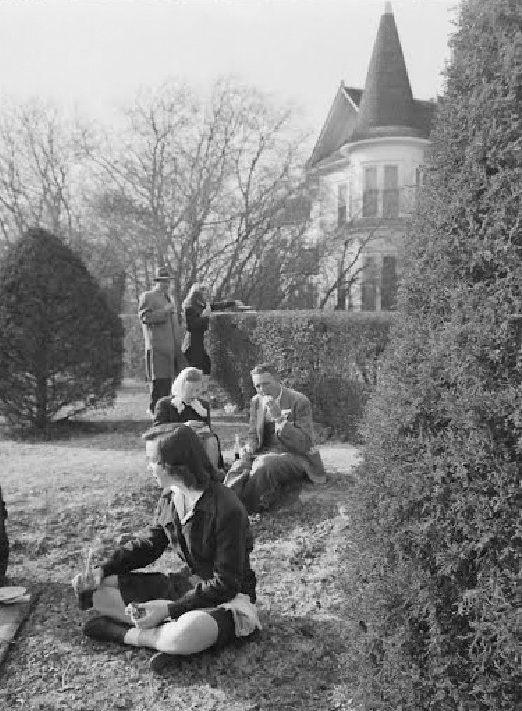
Enjoying more refreshments (lotta Coke at Hockaday…). (Note Bosque Bonita in the background, the property’s original house, Greenville and Belmont. Read more here.)

hockaday_dads-day_life-mag_cornell-capa_1947_bosque-bonita

*

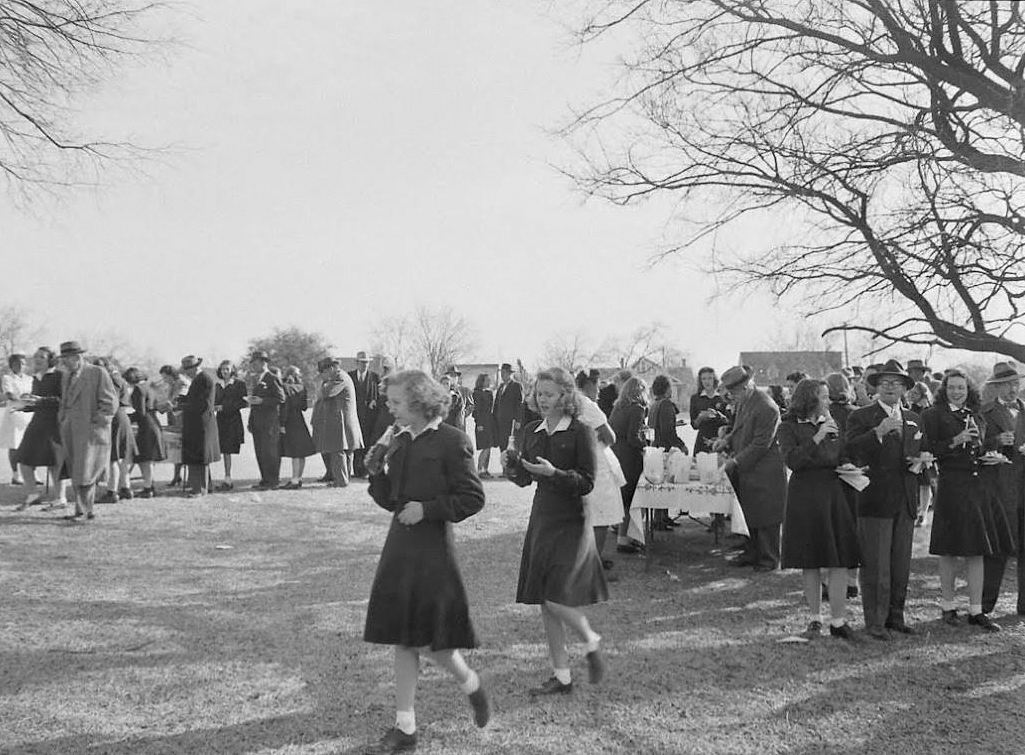
More refreshments on a chilly February day:

hockaday_dads-day_life-mag_cornell-capa_1947_lunch

*

Girls who attended Hockaday as a boarding school, in a dorm, making the paper crowns which fathers will wear at the formal dinner at the Baker Hotel:

hockaday_dads-day_life-mag_cornell-capa_1947_dorm

*

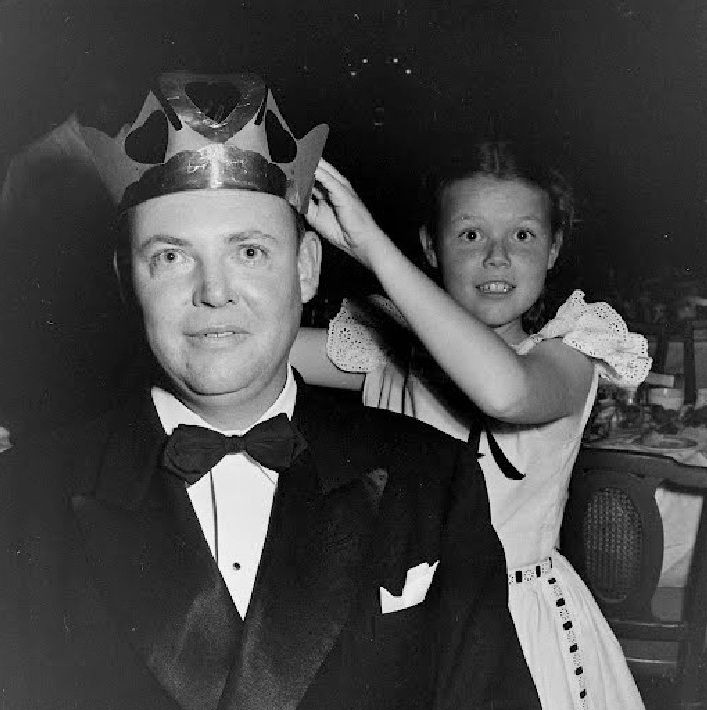
Below, Ann Seidenglanz (whose preparations for this big dinner were captured in the pages of Life — she even made the cover!) places a crown on her father’s head (Charles B. Seidenglanz):

hockaday_dads-day_life-mag_cornell-capa_1947_crown

*

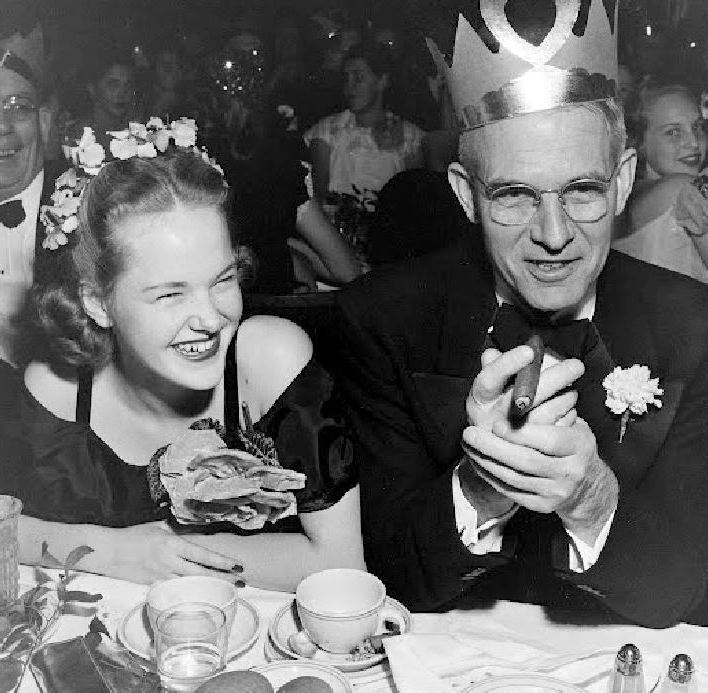
I don’t know who these people are, but I love this photo:

hockaday_dads-day_life-mag_cornell-capa_1947_baker-hotel

*

Jerrie Marcus was accompanied by her father, Stanley Marcus. (Jerrie Marcus Smith died in March of this year. Please check out the book she wrote about her great aunt Carrie Marcus — A Girl Named Carrie: The Visionary Who Created Neiman Marcus and Set the Standard for Fashion.)

hockaday_dads-day_life-mag_cornell-capa_1947_stanley-marcus_daughter - Copy

*

Miss Ela Hockaday, founder of the legendary school and, at the time of this photo, its president emeritus.

hockaday_dads-day_life-mag_cornell-capa_1947_miss-hockaday

***

Sources & Notes

Photos are by Cornell Capa, taken on assignment for Life magazine — none of the photos above appeared in the published article (March 10, 1947). See the published story here; see the photos Capa shot (almost all of which were never published) here. All photos Copyright: ©Time Inc.

hockaday_dads-day_life-mag_cornell-capa_cover_031047

None of the people in the photos above are identified, other than covergirl Ann Seidenglanz. And Stanley Marcus is obviously instantly recognizable to any Dallasite. If you can identify any of the others seen above, I’d be happy to add their names to this post.

Also, check out the lengthy Dallas Morning News story which preceded this Dads’ Day event (with studio photos of several fathers and daughters), in the DMN archives: “News of Women.” DMN, Feb. 9, 1947, Section III, p. 1, 2, 13.

More about the Greenville Avenue-era Hockaday campus can be found in the Flashback Dallas post “Belmont & Greenville: From Caruth Farmland to Hub of Lower Greenville.”

And you are always welcome to follow me on Patreon, where it’s Flashback Dallas every day, for as little as $5 a month.

hockaday_dads-day_life-mag_cornell-capa_1947_cokes_sm

*

Copyright © 2023 Paula Bosse. All Rights Reserved.

Fair Park at Night — ca. 1912

fair-park_fountain_luminous_night_postcard_ebay_postmarked-1913

by Paula Bosse

The postcard above — “Luminous Fountain by Night at Fair Park, Dallas” — is one I’ve never seen. And it’s beautiful!

This ornamental fountain was commissioned by the City of Dallas Park Board in 1912 and debuted at that year’s State Fair.

On July 18, 1912, it was reported that the mayor and members of the Park Board were touring Fair Park to see how progress was coming on the new women’s and children’s “comfort station” (restroom and lounge) — during the inspection they decided a fountain would be nice in front of the main exhibition building. Five days later (!), the Park Board voted on it and appropriated $2,500 for the project (approximately $80,000 in today’s money). That afternoon committee members went out to Fair Park and decided it would go “in the middle walk, half way between [the] Exposition Building and the street” (Dallas Morning News, July 23, 1912). And less than a month after that, a design had been made and published. It was to be 30 feet in diameter at the base and 24 feet high. When the State Fair of Texas opened on Oct. 12, 1912, the fountain was completed. It took less than 3 months. From “You know what? A fountain would look real good here…” to DONE!

fair-park_fountain_DMN_081812_drawingDallas Morning News, Aug. 18, 1912

Here’s a photo of it, sans water, from a book published in 1915:

park-board-bk_fair-park-fountain_1914

The weirdest little tidbit about this fountain’s debut at the 1912 State Fair is that there was a display of fish swimming around in it, courtesy of the Government Fish Hatchery at San Marcos.

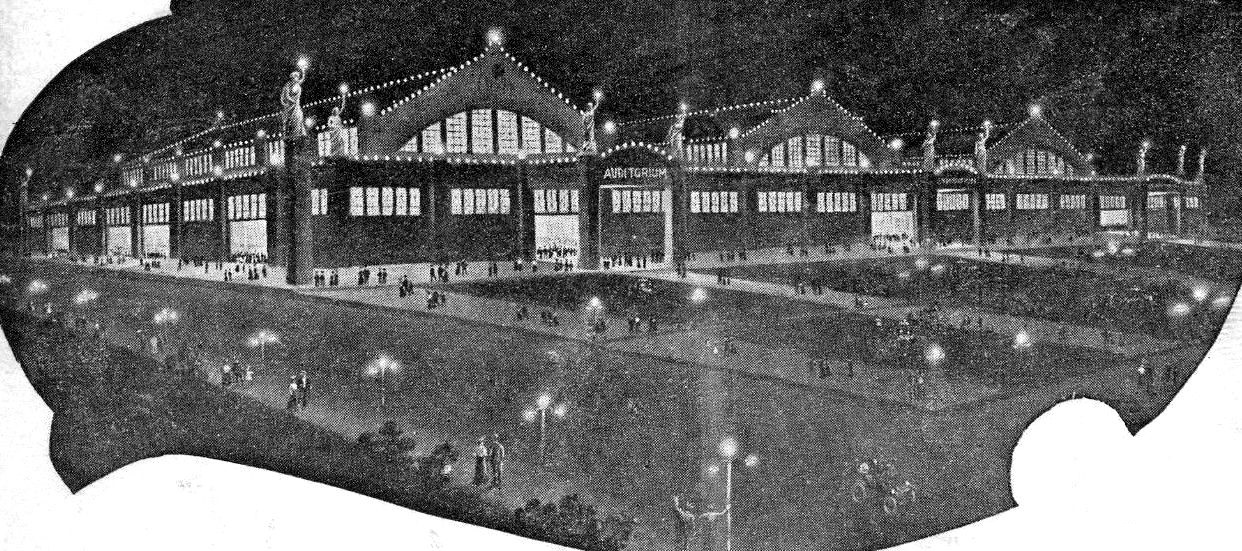
The fountain was in front of the huge Exposition Building. Here’s a circa-1908 depiction of people milling about at night outside the building (a building which really does need a fountain in front of it!).

fair-park_exposition-bldg_night_det_ebay_postmarked-1908

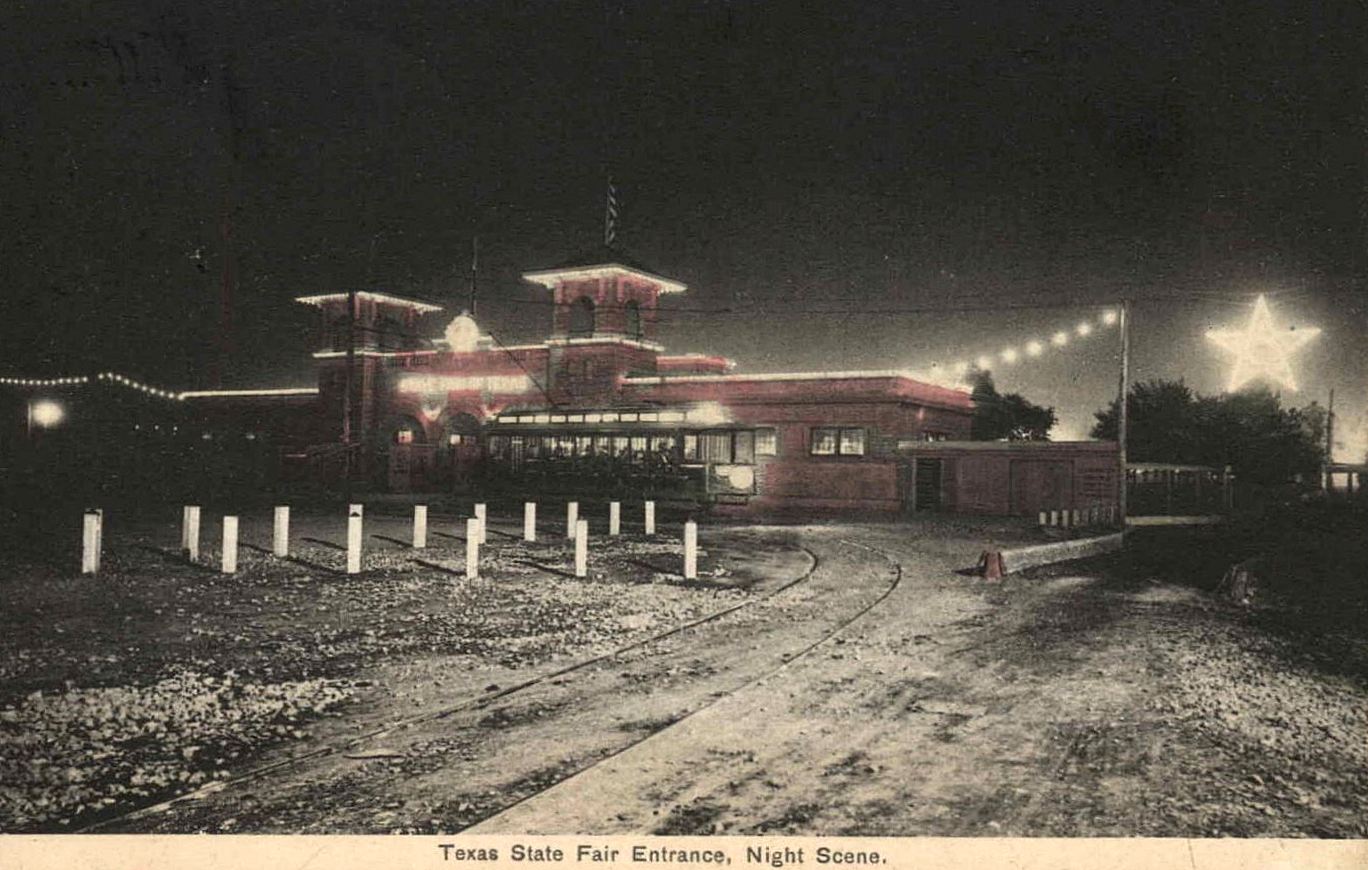
Back to that top image — I love it. “Illumination” was really big at the time (see “The Grand Elm Street Illumination — 1911”) — I’m surprised I don’t see more postcards like this — even if they’re just fake day-for-night images. A similar “nighttime in Fair Park” postcard is the one below, showing the entrance (this postcard has a 1909 postmark).

fair-park_entrance_night_postcard_ebay_postmarked-1909

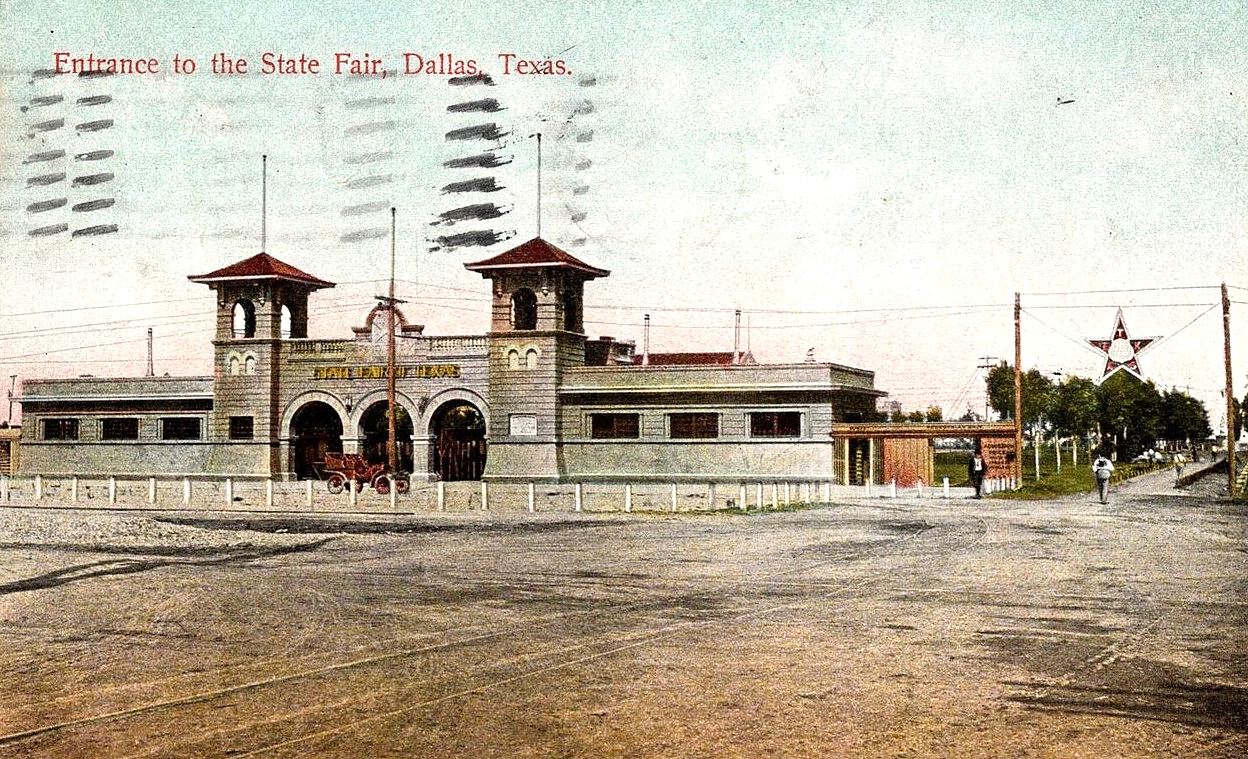
Since I have a postcard of the entrance from this same period showing what it looked like during the day (postmarked 1910)….

fair-park_entrance_day_postcard_ebay_postmarked-1910

That star is pretty cool, especially at night.

I’m pretty sure that fountain bit the dust a long, long time ago. Maybe when everything was being revamped for the 1936 Texas Centennial Exposition. It’s a shame. I don’t think there can ever be too many fountains.

***

Sources & Notes

Top postcard — “Luminous Fountain by Night at Fair Park, Dallas” (postmarked 1913) — is available now on eBay, here; one is also currently available on Card Cow here. I’m pretty sure this is going to be a strong contender for my favorite image of the year.

Photo of “Fountain, Fair Park” is from the book “Park System, Dallas, Texas, 1915,” here — from the Dallas Municipal Archives via the Portal to Texas History.

The postcards have pretty much all come from eBay over the years.

If you want even more of this sort of thing, perhaps you’d like to support me on Patreon for as little as $5 a month. I’m somehow managing to post daily there with “exclusive” content! I’m not sure how long I can keep this up, but if you’d like to see more Flashbacky stuff, hie thee to Patreon.com!

fair-park_fountain_luminous_night_postcard_ebay_postmarked-1913_sm

*

Copyright © 2023 Paula Bosse. All Rights Reserved.

Courthouse in the Mist/Smoke/Murk — 1901

old-red_dallas-courthouse_1901_degolyerThe ethereal Old Red Courthouse…

by Paula Bosse

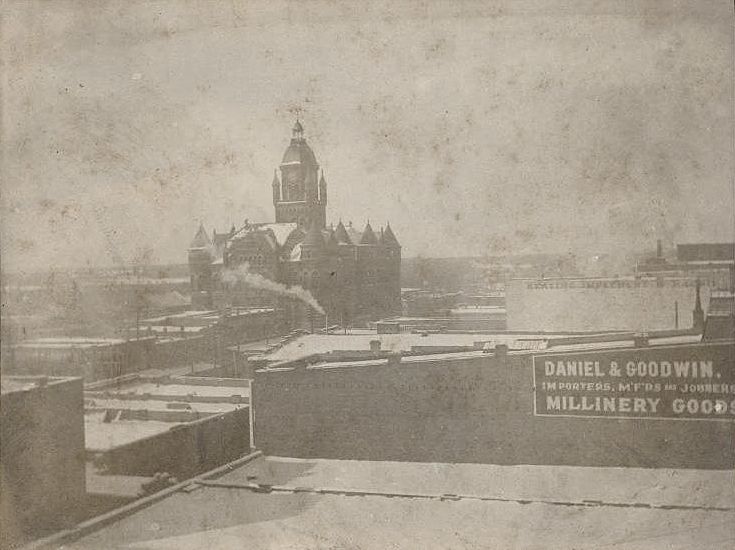
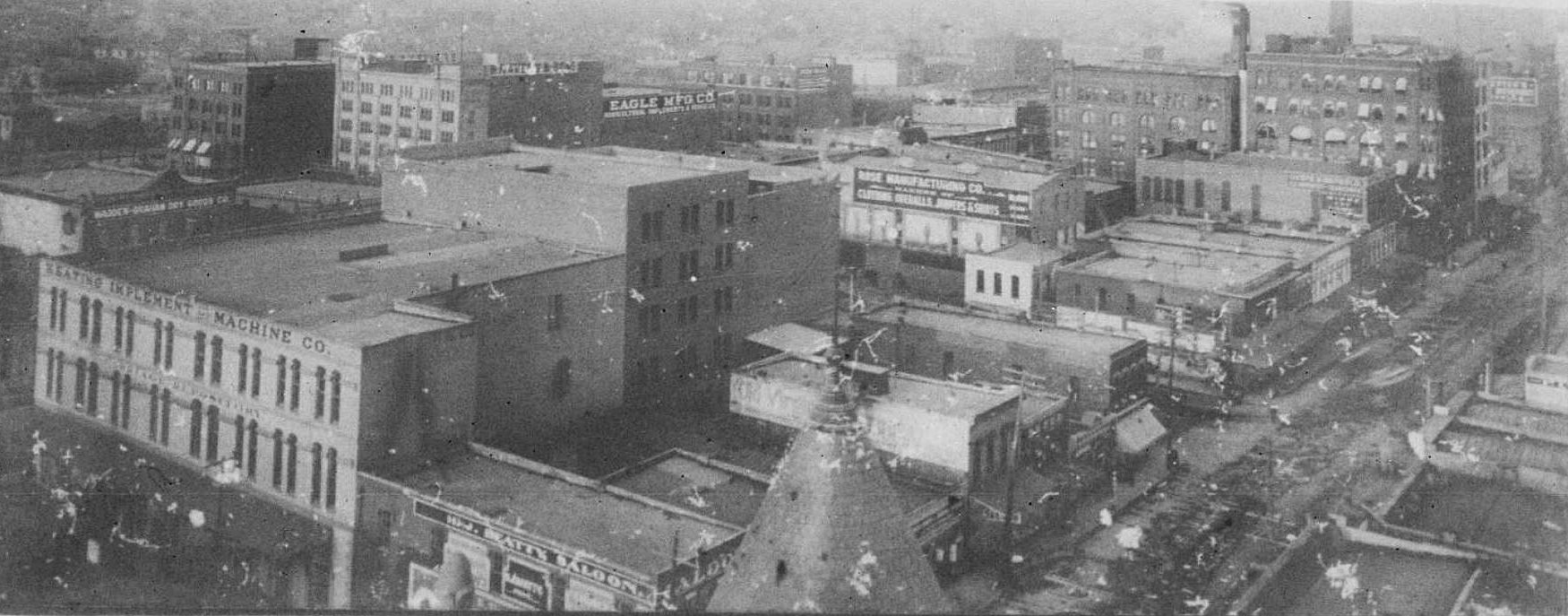
I love this photo of the Old Red Courthouse from 1901. (I guess in 1901 it would have been the New Red Courthouse….) The dreamy quality is probably due less to a romantic mists of Avalon effect (which, incidentally, I’ve seen from the Glastonbury tor, and it’s beautiful!) and maybe due more to just a lot of soot and smoke. …Or something altogether more prosaic, like a damaged photograph or plate. Here’s the courthouse a little closer:

old-red_dallas-courthouse_1901_degolyer_det

In the image at the top of the page, you can see some of the words for the “Keating Implement & Machine Co.” painted on the white building, seen just above the “Daniel & Goodwin” building on the right side of the photograph. The photo below shows the view from the courthouse, taken about 1900. In the bottom left corner, you can see the Keating building. The reverse view isn’t soft and mysterious (or even all that interesting), but I like that Old Red gets in a tiny Hitchcock-like cameo in the center foreground.

old-red_northeaset-from-courthouse_1900_degolyer_SMU

***

Sources & Notes

Top photo — titled “[Dallas Courthouse]” — is from the George A. McAfee Photographs collection, DeGolyer Library, SMU Libraries; more information on this photo can be found here.

The view from the courthouse — titled “Looking northeast from Courthouse circa 1900” — is from the Collection of Dallas Morning News negatives and copy photographs, DeGolyer Library, SMU Libraries; more information on this photo can be found here.

Please consider supporting me on Patreon, where I post exclusive content several times a week.

old-red_dallas-courthouse_1901_degolyer_sm

*

Copyright © 2023 Paula Bosse. All Rights Reserved.

Black Women’s Equestrian Company K (American Woodmen) — 1920s

black-womens-equestrian-contingent_cook-coll_degolyer-lib_SMUGeorge W. Cook Collection, DeGolyer Library, SMU

by Paula Bosse

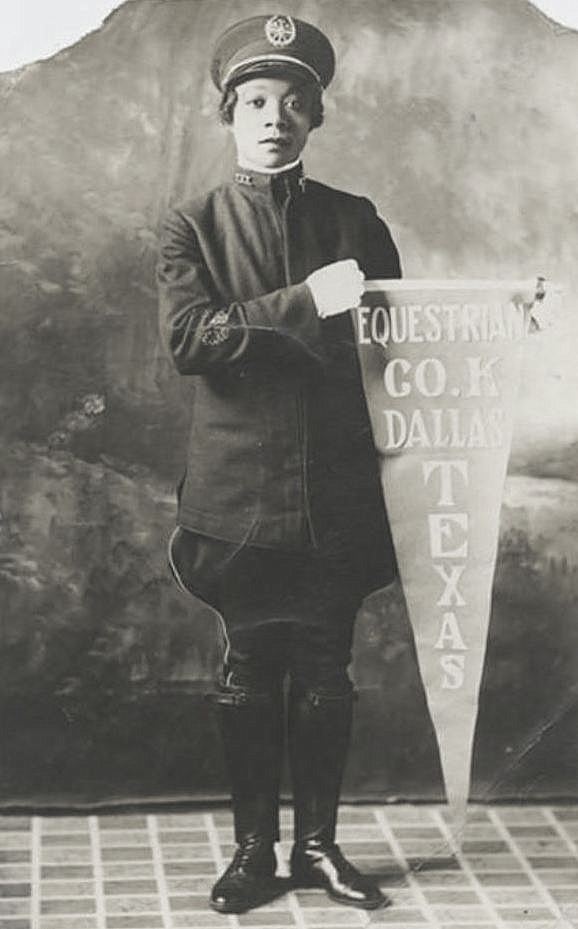
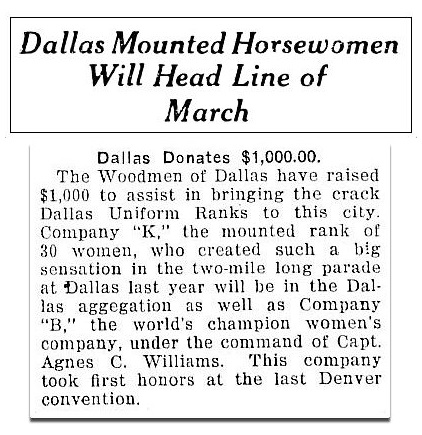
Above, a photograph of an African American woman holding a pennant which reads “Co. K — Dallas, Texas.” Company K was a women’s equestrian unit of Dallas Camp No. 86, consisting of at least 30 members — it was one of the various “uniformed ranks” of the American Woodmen, a Black fraternal organization. These groups competed in drills and marched in parades, and, from what I gather, they were meant to be seen as something of a symbol of strength, purpose, and resolve. Company K won many drilling contests and was active, from what I can tell, from at least 1922 to at least 1930.

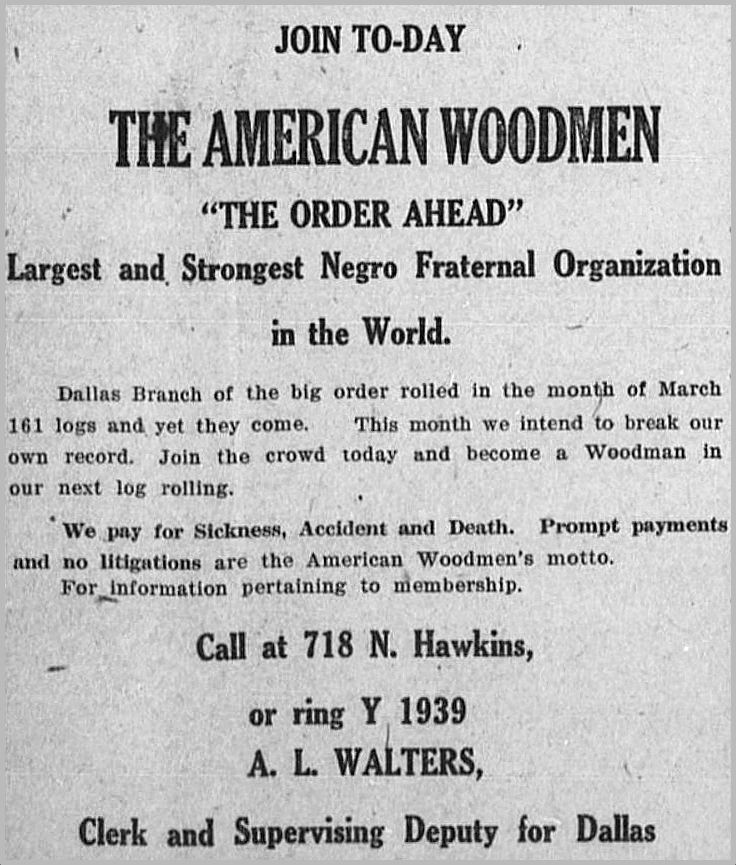
The American Woodmen (not to be confused with the Woodmen of the World, an exclusively white organization) was a national fraternal benefit association which provided loans and insurance coverage to members. It was open to Black men and women. During the 1920s, the Woodmen offices were located at 714 N. Hawkins, at Central (the address was originally 718 N. Hawkins, as seen in the ad below). Members could join various extracurricular “uniform ranks” if they so chose.

american-woodmen_dallas-express_041720Dallas Express, Apr. 17, 1920

The American Woodmen Uniform Ranks were overseen by the national “Commander,” Maj. Gen. John L. Jones (many fraternal organizations borrowed liberally from the military, as seen in their fondness for uniforms, “officer” ranks, precision drilling, etc.). While in Dallas for the Woodmen’s District Encampment in August 1922, Jones told a reporter:

“The American Woodmen in establishing their uniform rank department intended to instill in those who joined it a higher appreciation for the value of the Negro soldier and hero. No other fraternity has thus established that branch of their organization.” (Dallas Express, Aug. 12, 1922)

When uniformed members of these various divisions drilled and paraded — hundreds at a time — it was an impressive, powerful sight. It was good PR, not only for the group selling insurance, but also for Black Americans who rarely had the opportunity to participate in this type of uniformed display of earnest, pillar-of-the-community solidarity. (See a typical group of the “Uniform Ranks” — which also included marching bands and nurses — in a 1924 photo showing the Louisville, Kentucky Camp, here.)

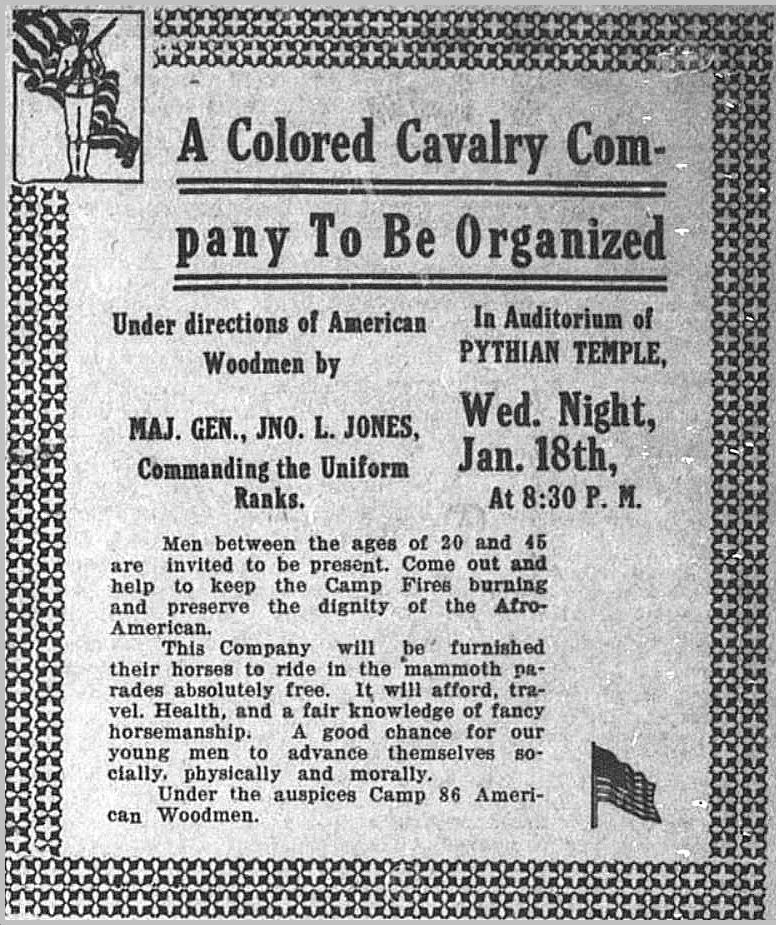
But back to Company K. I haven’t found any photos of them with horses, but I assume they really did ride horses. Below is an ad from January 1922, recruiting men for a Woodmen “cavalry.” I assume there was a similar version of this ad seeking female recruits.

woodmen_american-woodmen_cavalry_dallas-express_011422Dallas Express, Jan. 14, 1922

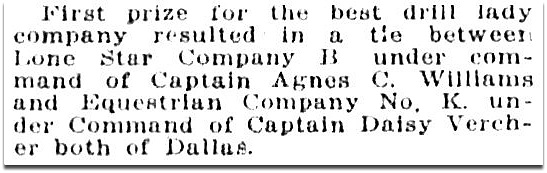
In an early competition at an “encampment” (a meeting of various American Woodmen companies, or “camps”), Company K tied for first place with another Dallas unit, Lone Star Company B. (Read coverage of this huge days-long encampment in the pages of the Black newspaper, The Dallas Express, hereThe Dallas Morning News did not mention the event.) The Dallas Encampment was at Riverside Park, a large open space where visitors set up military-style barracks/tents and competed in various military-like precision drills over the course of a few days. Riverside Park was the former Negro Play Park, at what is now Sabine and Denley in Oak Cliff, near the Trinity (it is now, I believe, Eloise Lundy Park). Not only was Riverside Park the site for several encampments and a place where Black families picnicked and gathered for special occasions, it was also the home of Negro League baseball games (these games were so popular among both Black and white Dallasites that a special section for white fans had to be installed during the Jim Crow era, when racial segregation was enforced by law). But back to Company K.

equestrian-co-k_dallas-express_081922_portal_detDallas Express, Aug. 19, 1922

The parade mentioned in the article below is described in the Express article “Woodmen Stage Big Parade” (Aug. 19, 1922). It sounds like it was a pretty big deal.

equestrian-co-k_black-dispatch_OKC_031523_headline_excerptBlack Dispatch (Oklahoma City, OK), Mar. 15, 1923

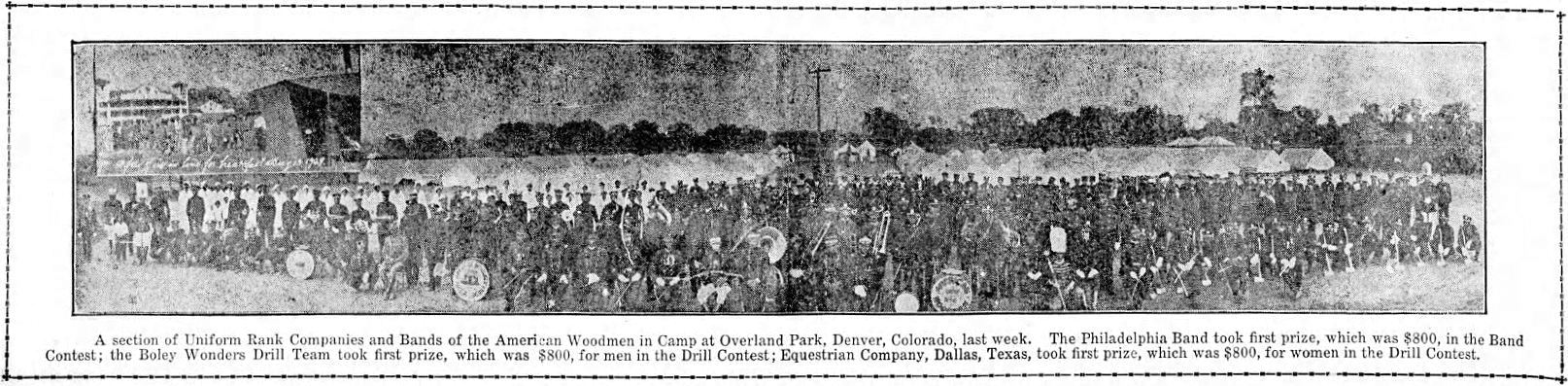
The incredibly low-resolution photo below was taken at the 1929 Encampment in Denver — it shows the scale of an encampment, with tents visible behind the posed participants. The caption says that Dallas’ Equestrian Co. K won the first prize for women in the drill contest — the prize (which, amazingly, was the same as the first prize for men) was $800, which, in today’s inflation-adjusted money would be about $15,000! 

equestrian-co-k_black-dispatch_OKC_090529_photoBlack Dispatch (OKC), Sept. 5, 1929

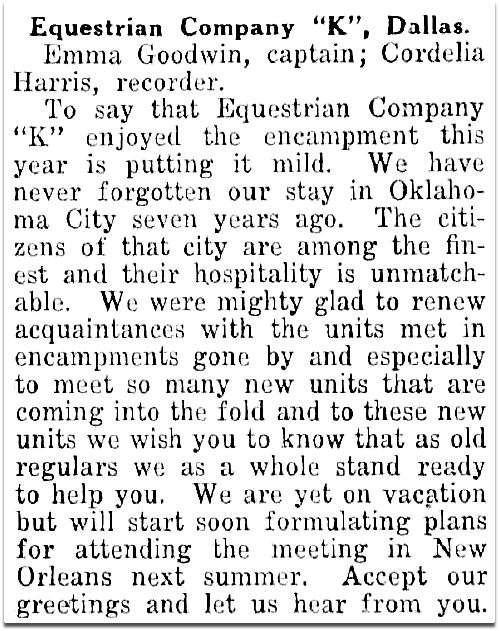
In an excerpt from a chatty overview of the women’s drilling groups, Company K spokeswomen say how happy they are to be back in Oklahoma City.

black-dispatch_OKC_071030_detBlack Dispatch (Oklahoma City), July 10, 1930

Most fraternal organizations are, as the name would imply, men-only. Yeah, they may have their female “auxiliary” organizations to give the women something to do, but the American Woodmen (Woodpeople?) included women in important roles. And it certainly paid off — the women of Equestrian Company K regularly won competitions and regularly brought the bacon home. 

*

100% of what is contained in this post is information I didn’t know until I set out to discover what “Equestrian Co. K, Dallas, Texas” referred to. As always, it’s exciting to learn about something I had never known about.

***

Sources & Notes

Top photo — “[Member of African American Women’s Equestrian Contingent, Company K, of Dallas, Texas]” — is from the George W. Cook Dallas/Texas Image Collection, DeGolyer Library, Southern Methodist University; more information on this photo can be found on the SMU Libraries site, here.

There is very little information on the internet about these American Woodmen women’s companies, so I’ve collected the article “Echoes from the Forest — Uniform Rank Department, American Woodmen” (The Black Dispatch, Oklahoma City, July 10, 1930), which lists female personnel for several Dallas companies, including the equestrian company, drill companies, a hospital company, and a nurse company — read the PDF here.

Read about the American Woodmen Benevolent Society (not to be confused with the (white) Woodmen of the World organization) in two very informative and interesting blog posts, here and here.

Read about Black soldiers during World War I in the sort-of related Flashback Dallas post “Black Troops from Dallas, Off to the Great War,” here.

black-womens-equestrian-contingent_cook-coll_degolyer-lib_SMU_sm

*

Copyright © 2023 Paula Bosse. All Rights Reserved.

The Mercantile Bank Building — 1951

mercantile_squire-haskins_dec-1951_UTASquire Haskins Collection, UTA Special Collections

by Paula Bosse

Photo of one of my favorite downtown buildings, the Mercantile, taken by ace photographer Squire Haskins in December 1951. See a very large image of this at the UTA website, here. Zoom in and take a look around. Check out all the landmarks. You’ll probably find Waldo while you’re at it.

***

Sources & Notes

“Downtown Dallas — Mercantile Building” by Squire Haskins, taken on Dec. 11, 1951; from the Squire Haskins Photography, Inc. Collection, University of Texas at Arlington Libraries, Special Collections — more information can be found here. (I have slightly cropped the image.)

mercantile_squire-haskins_dec-1951_UTA_sm

*

Copyright © 2023 Paula Bosse. All Rights Reserved.

The Bullen Store, Exposition Avenue — 1896-1936

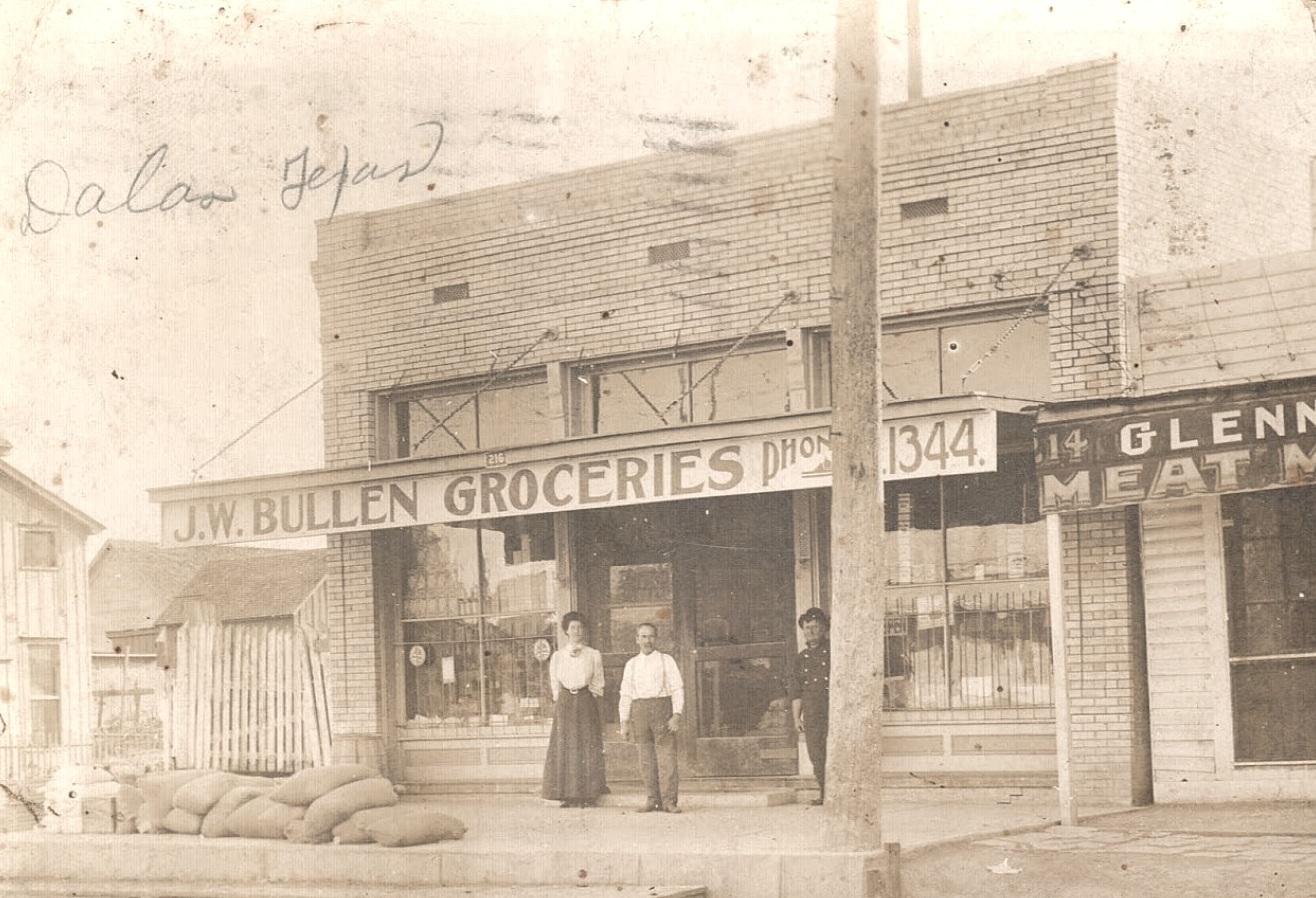
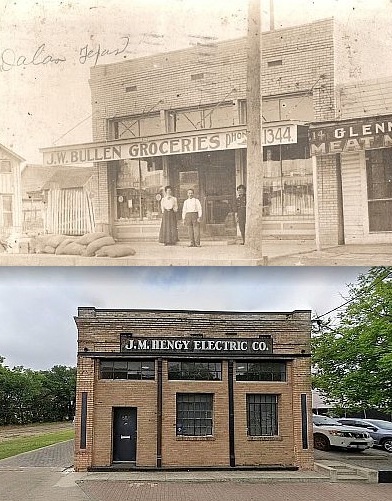
bullen-store_exposition-avenue_ca-1905Exposition Ave., ca. 1905 (photo: Bullen family, used with permission)

by Paula Bosse

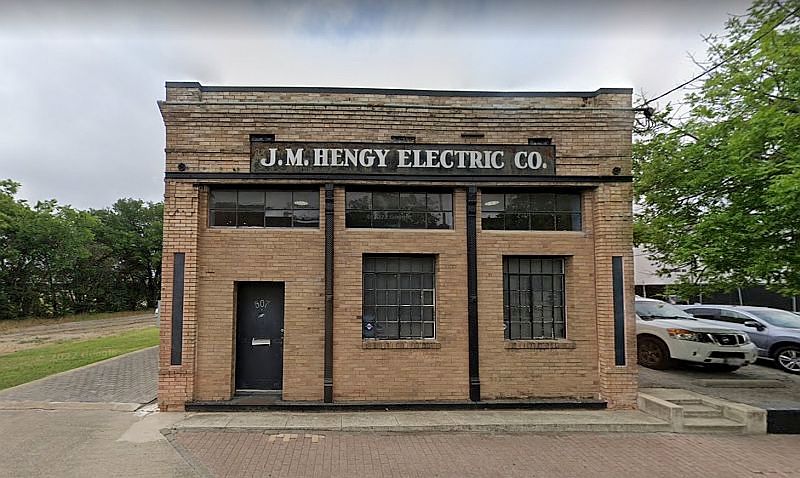
If you’re reading this, you probably have a fascination with old buildings. When was it built? What had it been? How has it not been torn down? One such building — which, though interesting, doesn’t really strike one as particularly old — is the small building at 507 Exposition Avenue, a few blocks from Fair Park. Actually, the thing that jumped out at me was the sign on the building reading “J. M. Hengy Electric Co.” — back in 2015 I wrote a long post about the exceedingly litigious Hengy family (“F. J. Hengy: Junk Merchant, Litigant”) (J. M. was the grandson of F. J.). The Hengy Electric Co. was in business at that location from at least the 1930s until at least the 1960s. I’m not sure why the current owners kept this sign, but I’m glad they did, because it’s why I noticed it.

This building was most likely built in the 1890s, and it was home to a grocery store owned by J. W. Bullen (John Wesley Bullen Sr.), a Tennesse native who came to Texas in the late 1870s and, after a few years of farming in the area, settled in Dallas. He worked for the Santa Fe railroad for a while before opening this grocery on Exposition Avenue in the 1890s — easy to give directions to because the Gulf, Colorado and Santa Fe (GC&SF) Railway tracks ran right alongside the store. Bullen’s grocery was a neighborhood mainstay for at least 40 years. He retired in 1936, and he and his wife, Mary, eventually moved to California to live with their daughter. J. W. Bullen died in California in 1948, at the age of 89 — his life spanned the Civil War to the advent of television.

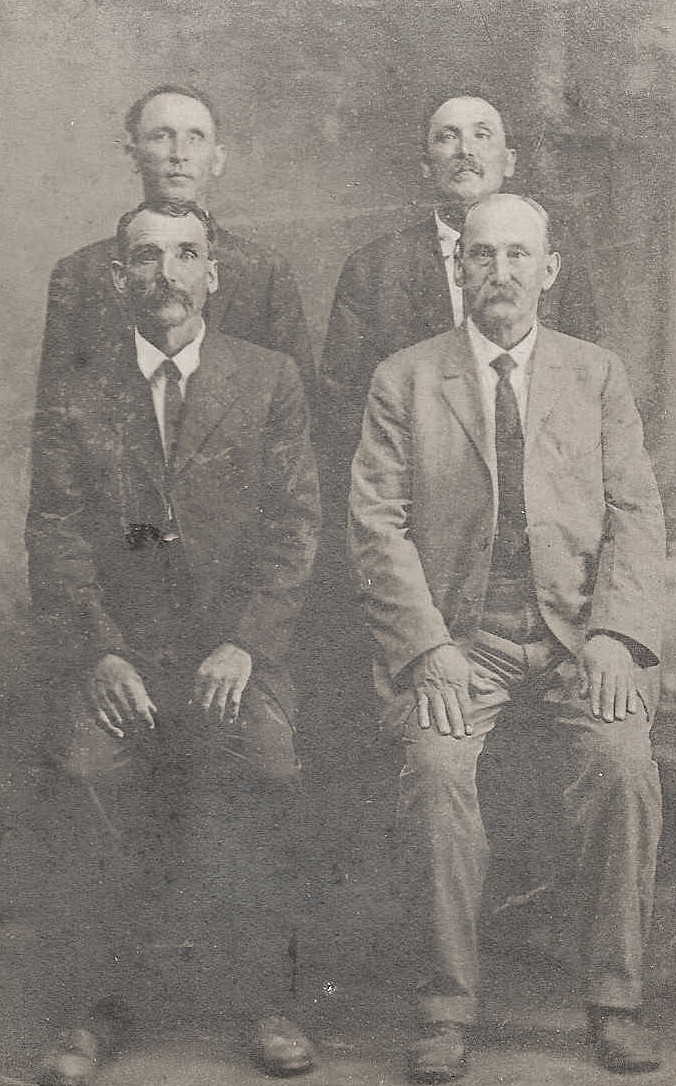
Below, J. W. Bullen is shown with his brothers, Thomas, James, and Joseph — he is at the bottom right.

bullen-j-w_sitting-right_ancestryvia Ancestry.com

I came across the photo at the top of this post on the Dallas Historical Society discussion forum (“The Phorum”) back in 2017 (it’s taken 5½ years for me to finally write this!) — the thread is here. A Bullen relative posted this photo, and I was ecstatic to see it! It’s such a great image — I have never seen a photo of Exposition Park from this period. (I asked Mr. Bullen — the man who posted this photo — if I could reproduce it, and he very nicely gave me permission.)

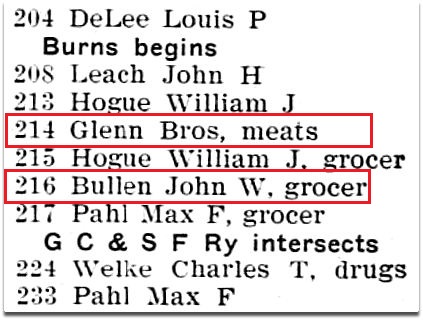
I would guess that the photo dates from sometime around 1904-1906, when the Glenn Brothers meat market occupied the space next door (originally 214 Exposition and later 505 Exposition).

1905-directory_bullen-glenn-bros1905 Dallas city directory

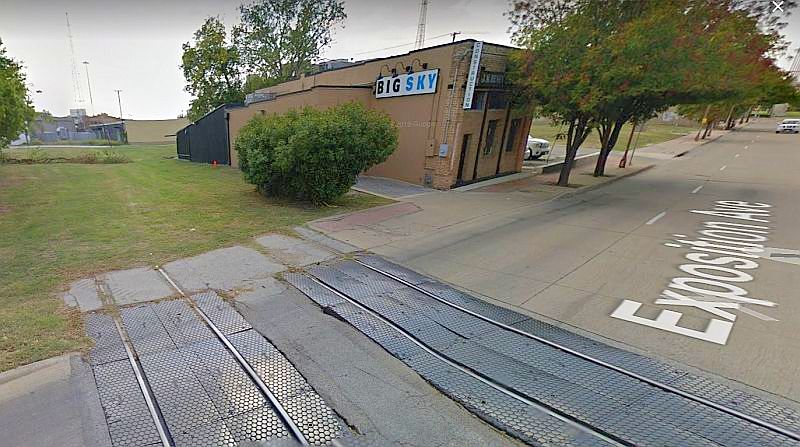
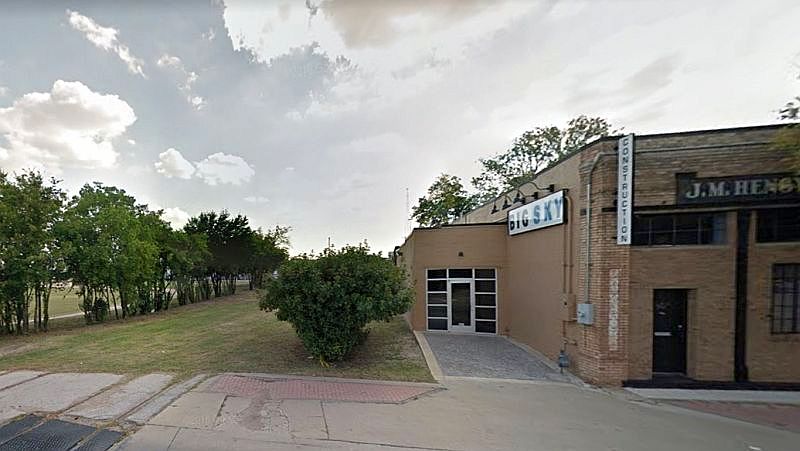
The Hengy business originally occupied the Glenn Bros. space for several years, from at least 1930. After Bullen’s retirement, Hengy moved into the larger space at 507 Exposition. Today it is occupied by Big Sky Construction.

507-exposition_google-street-view_may-2022
Google Street View, May 2022

The railroad tracks have been pulled up, but below are two Google Street Views from 2012 showing where they once were — they couldn’t have been much closer to Bullen’s store! That’s got to have rattled the merchandise (and the store’s occupants) several times a day.

507-exposition_google-street-view_sept-2012Google Street View, Sept. 2012

507-exposition_google-street-view_sept-2012_bGoogle Street View, Sept. 2012

*

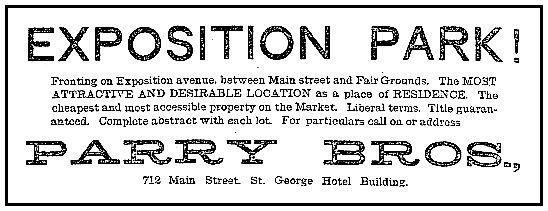
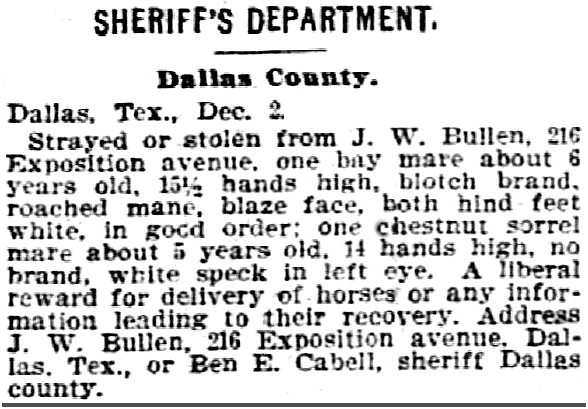
The address of Bullen’s store was originally 216 Exposition Avenue. After the citywide address change in 1911, it became 507 Exposition Avenue. The store was in business by at least 1896, but a newspaper article on the 62nd wedding anniversary of Mr. and Mrs. Bullen says that the business began in 1893. At this time, development of Exposition Park was exploding (see the 1889 ad I posted yesterday, here).

expo-park_ad_dmn_1012891889

If you look at Sanborn maps of this area (the 1899 map is here, the 1905 map is here, and the 1921 map is here) you see that almost all of the buildings in the area are houses (designated by the letter “D,” for “dwelling”). Having only ever known the area in recent times, it’s hard to imagine this ever having been an almost entirely residential neighborhood. And, back in the 1890s, it was also full of livestock.

bullen_dmn_120397_stolen-horsesDallas Morning News, Dec. 3, 1897

*

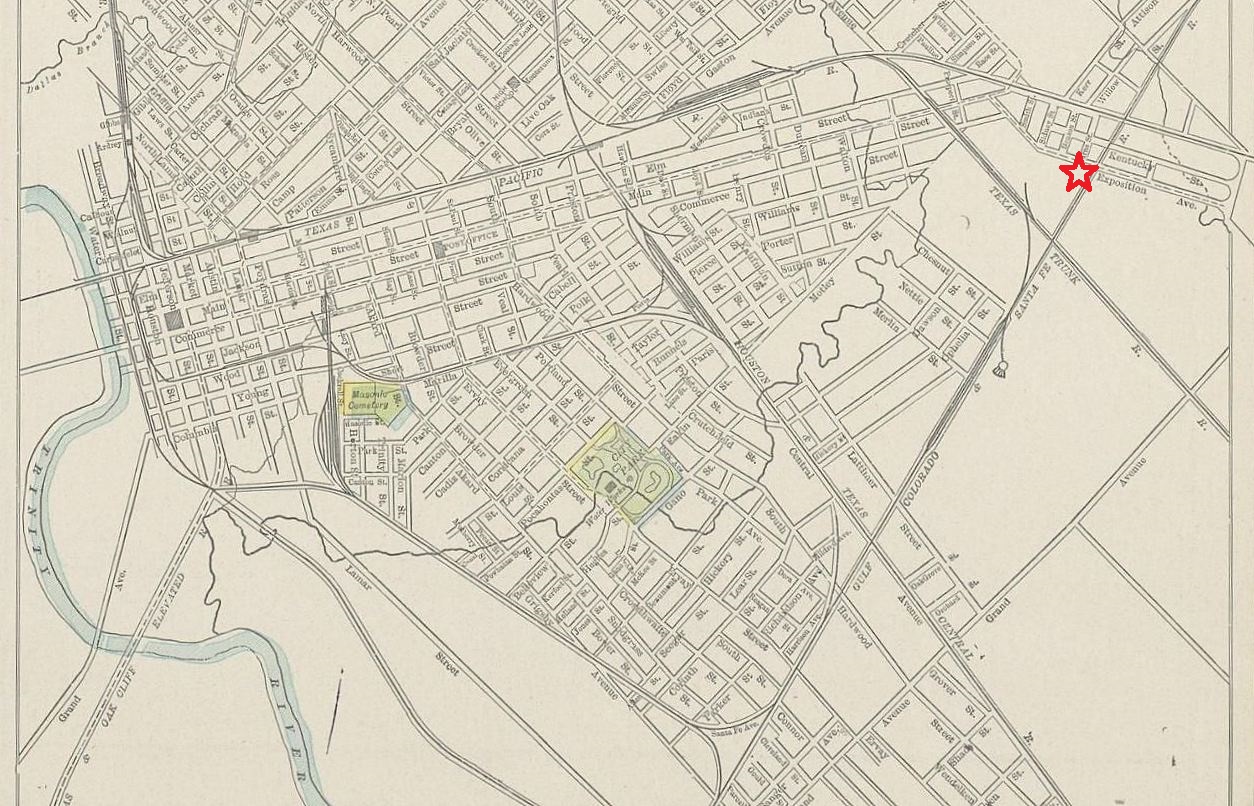
Here’s a map of Dallas from 1898, with Bullen’s store way on the edge of the world, under the star.

1898-map_bullen-store_expositionvia Portal to Texas History

*

507-exposition_then-now_ca-1905-2022

***

Sources & Notes

Photo is from the family collection of Joseph Bullen II, used with permission.

I would LOVE to see historical photos of the Expo Park area — from any time, really, but especially from the time it was primarily residential. If you have any photographs, please let me know!

See this building today on Google Street View, here.

Biographical information on J.W. Bullen from “J. W. Bullens Observe Their Anniversary” (Dallas Morning News, Nov. 22, 1942).

More Flashback Dallas posts on Exposition Park can be found here.

bullen-store_exposition-avenue_ca-1905_sm

*

Copyright © 2023 Paula Bosse. All Rights Reserved.

Triple Underpass — ca. 1936

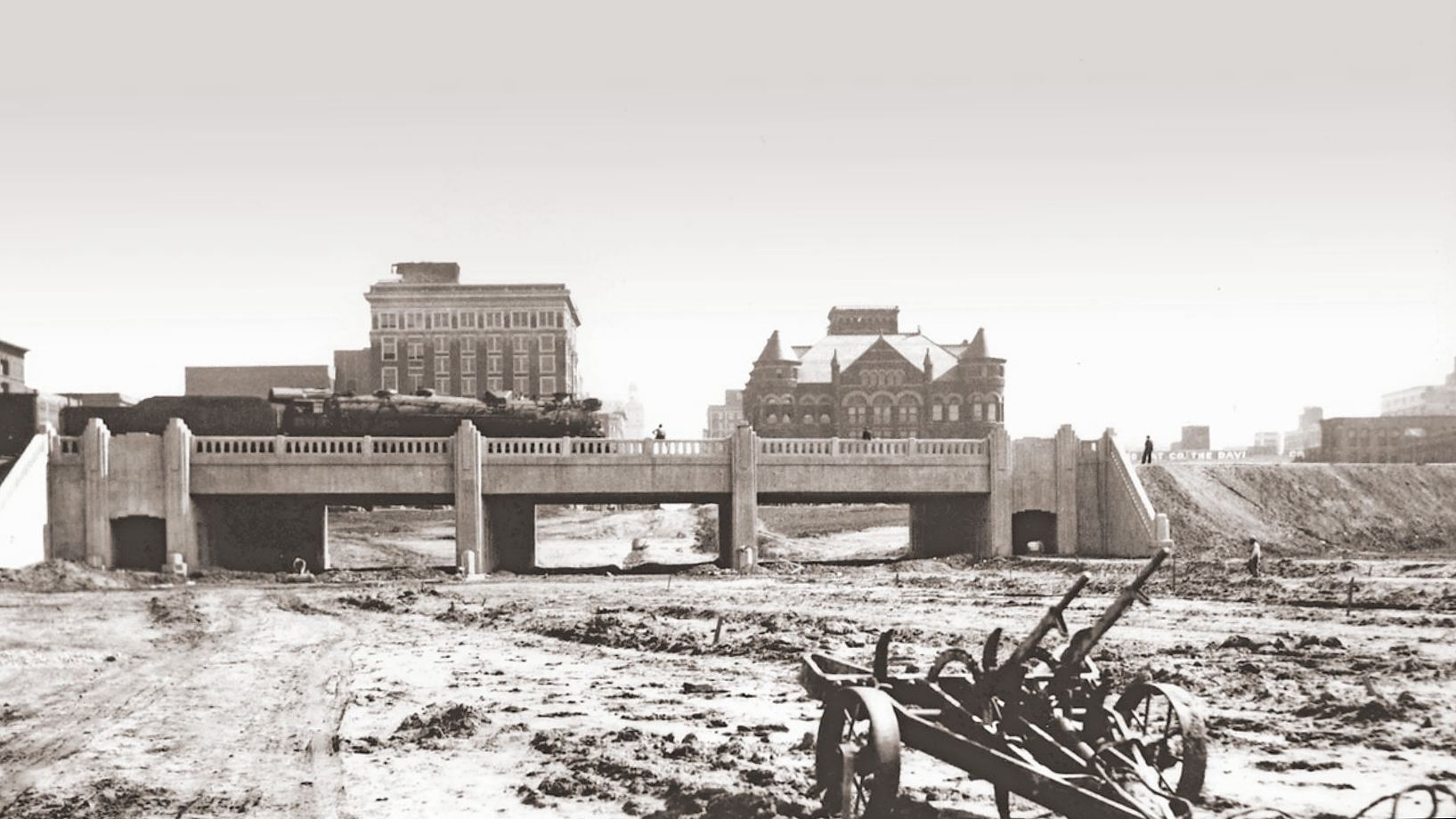
triple-underpass_ca-1936_us-bureau-public-roadsThe Gateway to Dallas, or the the Gateway to Oak Cliff?

by Paula Bosse

Above, a fantastic photo showing the new Triple Underpass, about 1936, with the view toward Oak Cliff. (Compare this with a similar view, from the 1950s, here.)

Below, a little earlier, with the view to the east, back toward town.

triple-underpass_construction_looking-east_austin-bridge-and-road-co

The triple underpass was built by the Austin Bridge & Road Company between 1934 and 1936, finishing up just in time to welcome the onslaught of visitors to the Texas Centennial Exposition. I encourage you to visit the company’s public Facebook post here, which includes these and other great photos of this Dallas landmark (including a “then and now” comparison and a history of their involvement in the project). Below is an excerpt from that post:

Once called the “Gateway to Dallas,” the triple underpass near Dealey Plaza was built by Austin Bridge Company and Austin Road Company starting in 1934. The underpass, a joint project with the Texas Highway Department and City of Dallas, created access to the western edge of downtown Dallas under the Union Terminal tracks. Contending with up to 80 trains a day complicated the job, requiring close cooperation with the railway companies. The triple underpass was hailed as a modern marvel, built of concrete with square balusters in a handsome art-deco style. It was unveiled with great excitement in 1936, during Texas Centennial celebrations.

***

Sources & Notes

Top image is a U.S. Bureau of Public Roads photo showing the new underpass, looking to the west.

Both photos and the excerpt are from a post on the Austin Bridge & Road Facebook page, which you can find here.

triple-underpass_ca-1936_us-bureau-public-roads_sm

*

Copyright © 2022 Paula Bosse. All Rights Reserved.

Elks-a-Plenty — 1908

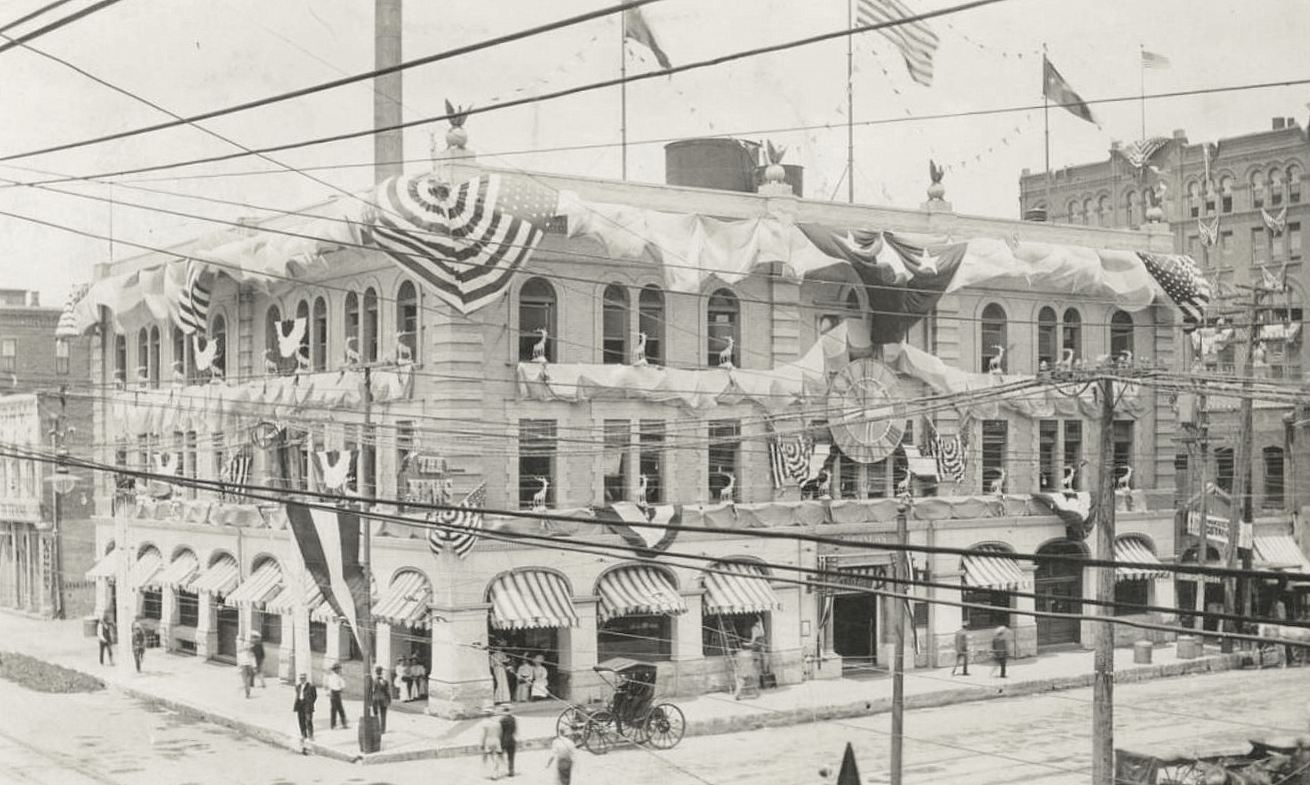
dmn-bldg_decorated-for-elks-convention_1908_cook-collection_SMU_fullBegirt with ruffles and studded with elks…

by Paula Bosse

Conventions have always been important to Dallas. One of the most important conventions ever to descend upon the city was the annual convention of the Benevolent and Protective Order of Elks in July 1908. There were approximately 38,000 attendees, but when you added to that number spouses and various others with business, social, or just looky-loo interests, it was estimated that more than 100,00 out-of-towners clogged the streets of our fair burg during the time of the convention. Dallas was a sizeable city in 1908, but the sudden swarming into town of 100,000 people (twice the actual population of the city!) must have been… challenging. (And profitable!)

Dallas welcomed the Elks with enthusiasm and open arms. Everyone knew they were coming, and everywhere there were splashes of the Elk colors, purple and white. A special (and later notorious) semi-permanent arch was erected to span Main Street at Akard. And businesses competed with one another to see who could decorate their building with the most spectacular and festive bunting.

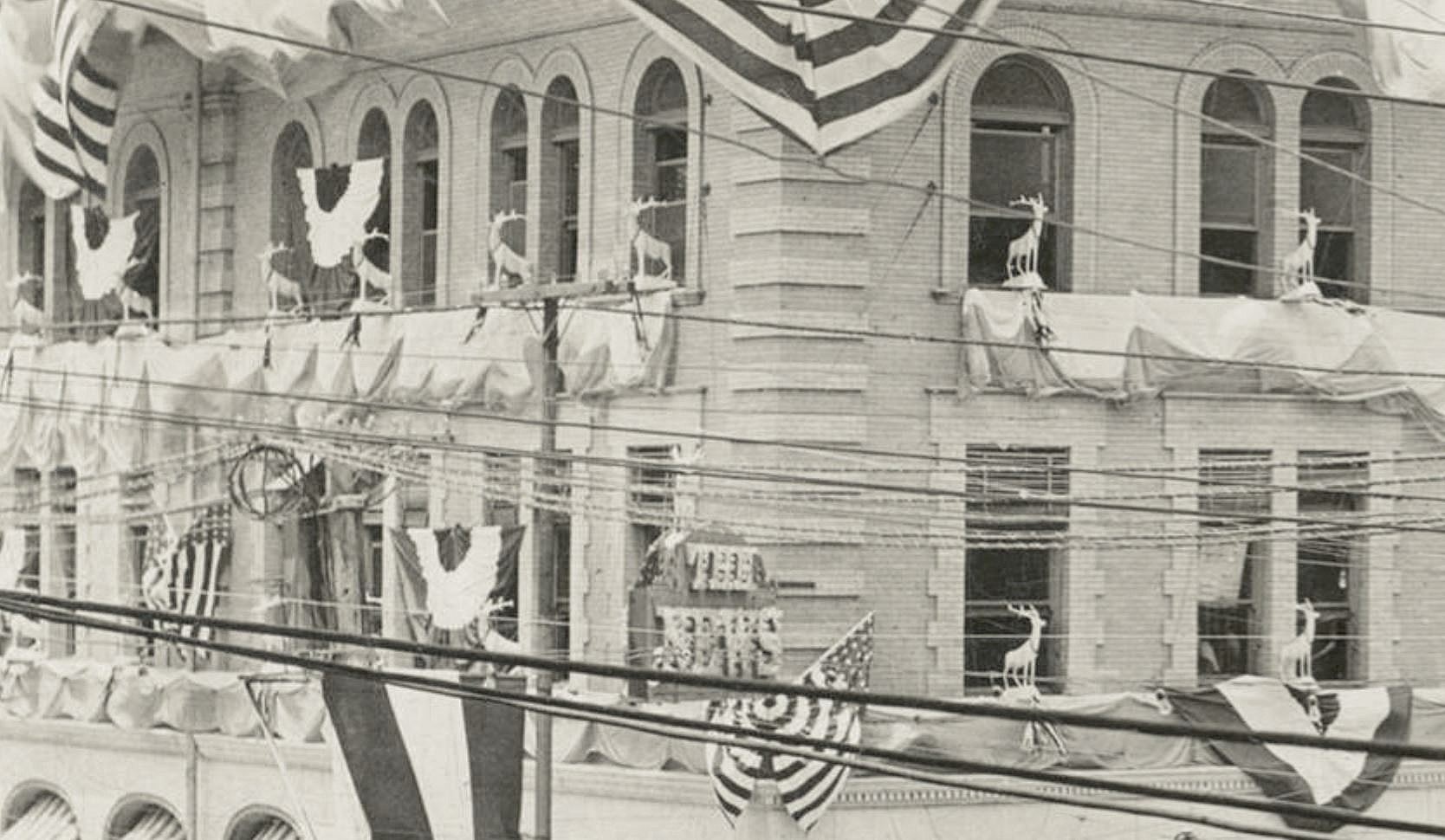
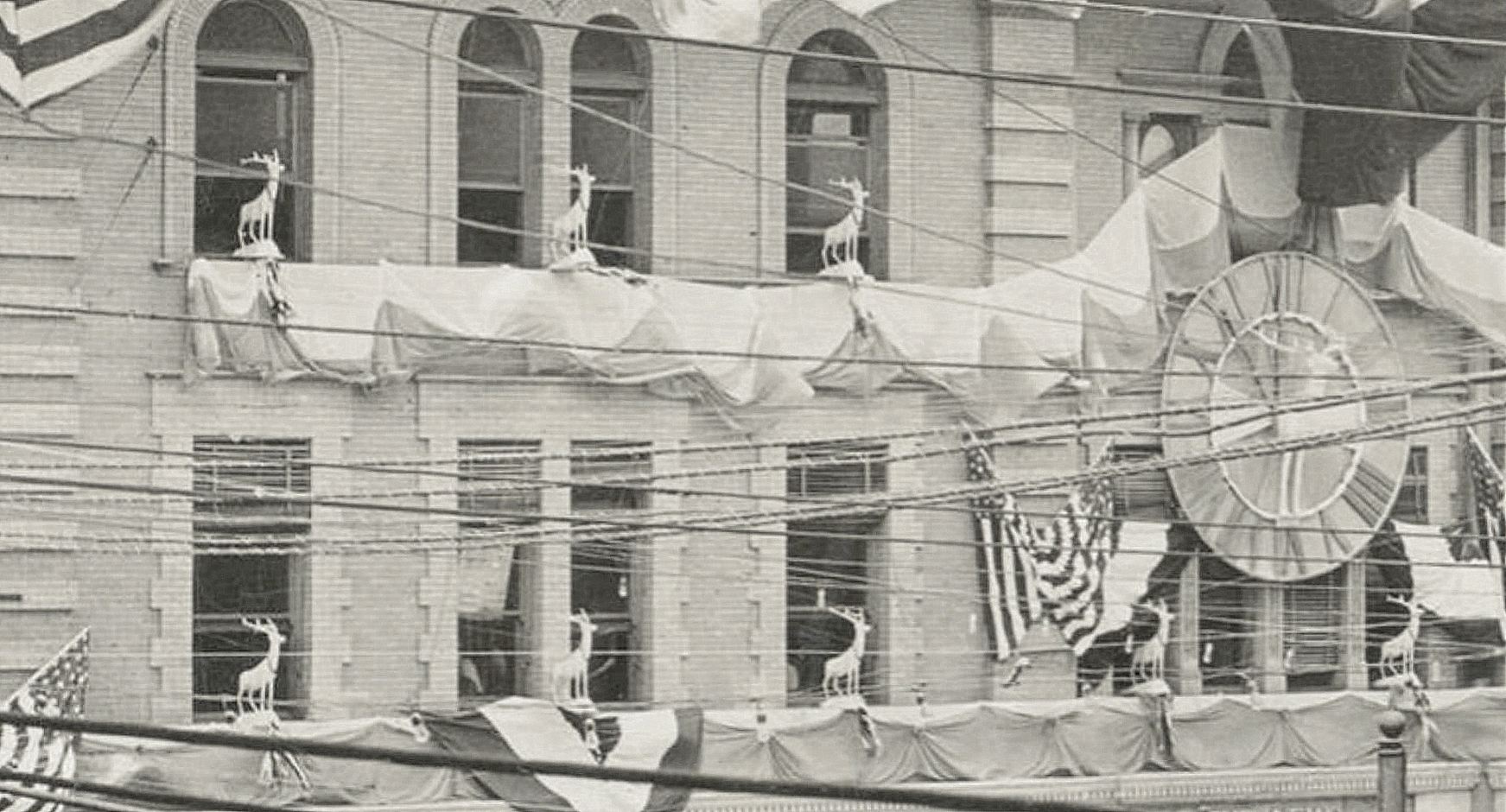
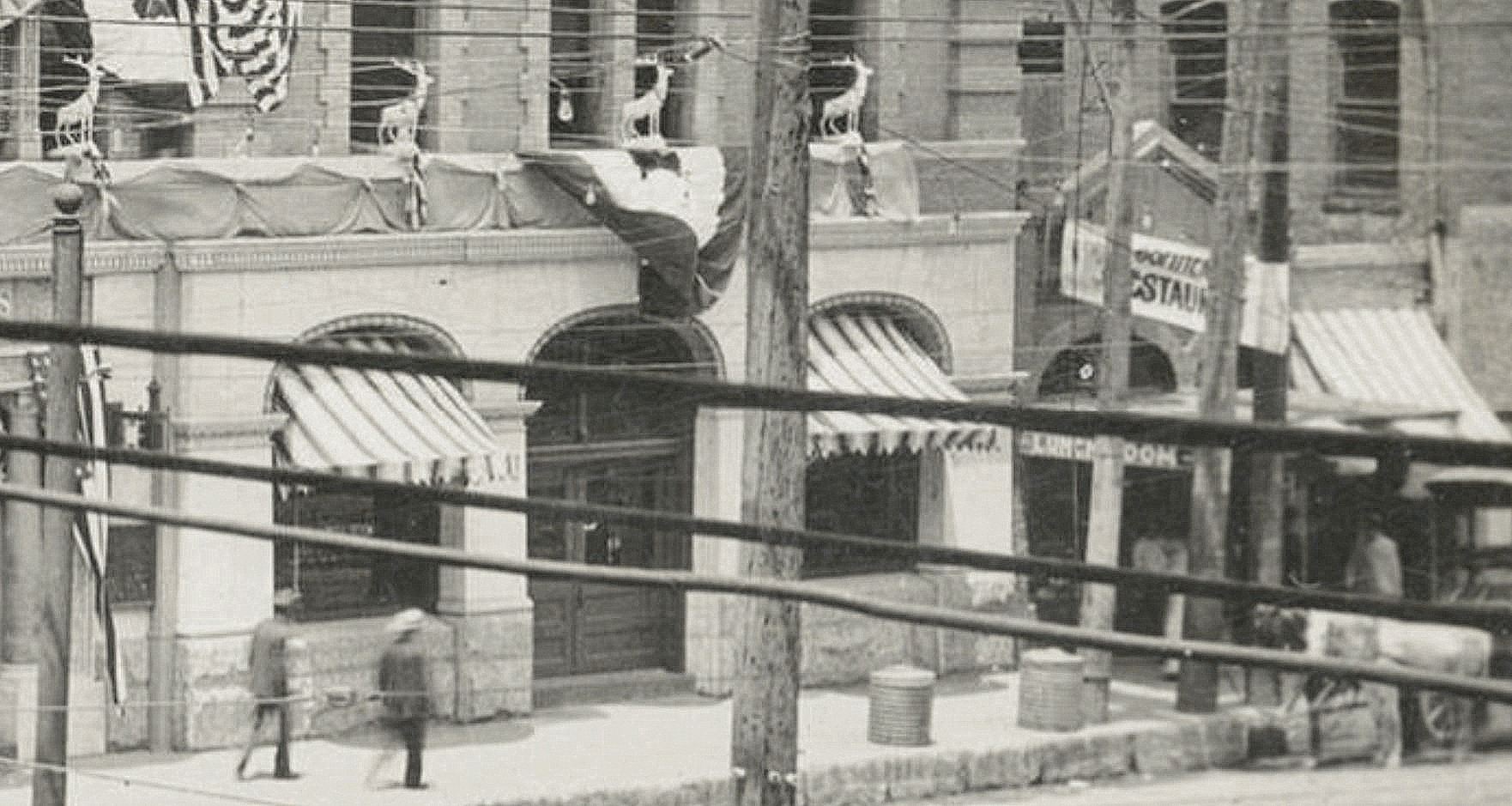
Above is a photo of the Dallas Morning News Building at the northwest corner of Commerce and Lamar, crammed full of flags, bunting, pennants, cowbells, lights, little statues of elks, medium-sized statues of elks, and large statues of elks. (There is an elk in every window.) It also had a large clock erected which was perpetually stuck at an Elk-y 11:00 and a parallelogram-shaped sign which lit up to flash the Elk greeting “Hello, Bill!” So… a lot. But what might seem like overkill — like The News was trying a little too hard to be noticed… the Elks loved it. LOVED IT. They loved it so much that they awarded the newspaper an award of $250 for the best decorated building in the city (that would be about $8,000 in today’s money!). Scroll down to read a breathless description of these decorations, with details of absolutely everything that was flapping, clanging, flashing, billowing, and throbbing at Commerce and Lamar in the summer of 1908. (I have to put this sentence from the article here because I love it so much: “To the bottom of each of these flags are attached small cowbells of different tones, so that with every strong whiff of wind there is a discordant but merry jingle.”)

So, those elk statues. I mean… they’re fantastic. Little elks in every window, illuminated by a single electric bulb positioned “between the forefeet” of each mini-elk. And then there are the larger ones appearing to step out of — or off of — the building. But back to those little elks — are you wondering what happened to them after the conventioneers headed back home? Wonder no more!
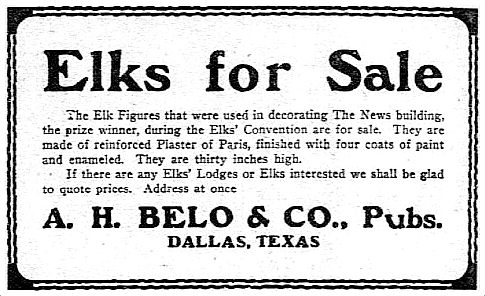
elks_news-bldg_belo-ad_071808Dallas Morning News, July 18, 1908

That would have been a great souvenir!

The photo at the top of this post (by Frank B. Secrest of Hunt County) was issued that summer as a postcard. The News did not miss an opportunity to mention it:
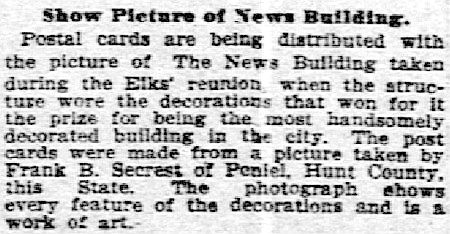
elks_news-bldg_dmn_080708DMN, Aug. 7, 1908

*

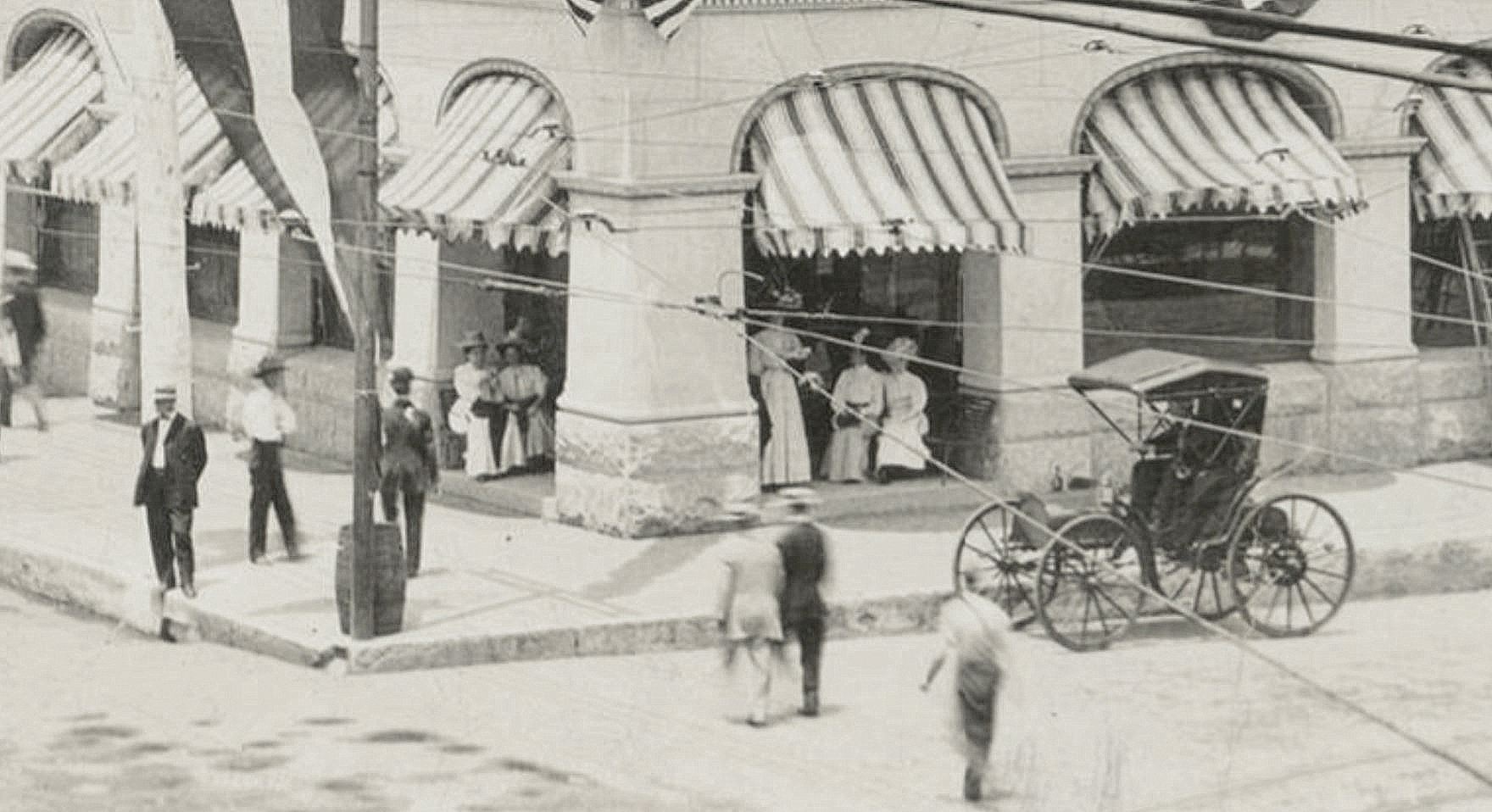
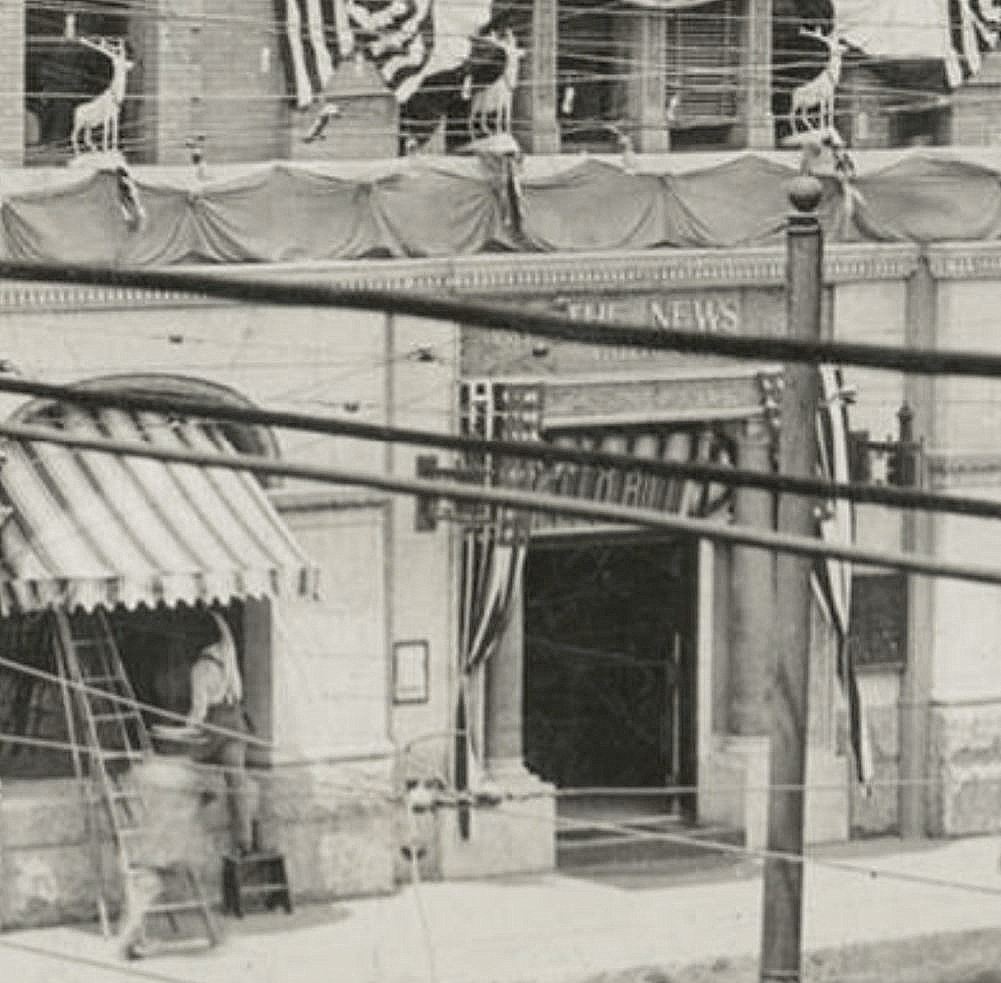
And because I love to zoom in on these sorts of photos, here are a few magnified details:
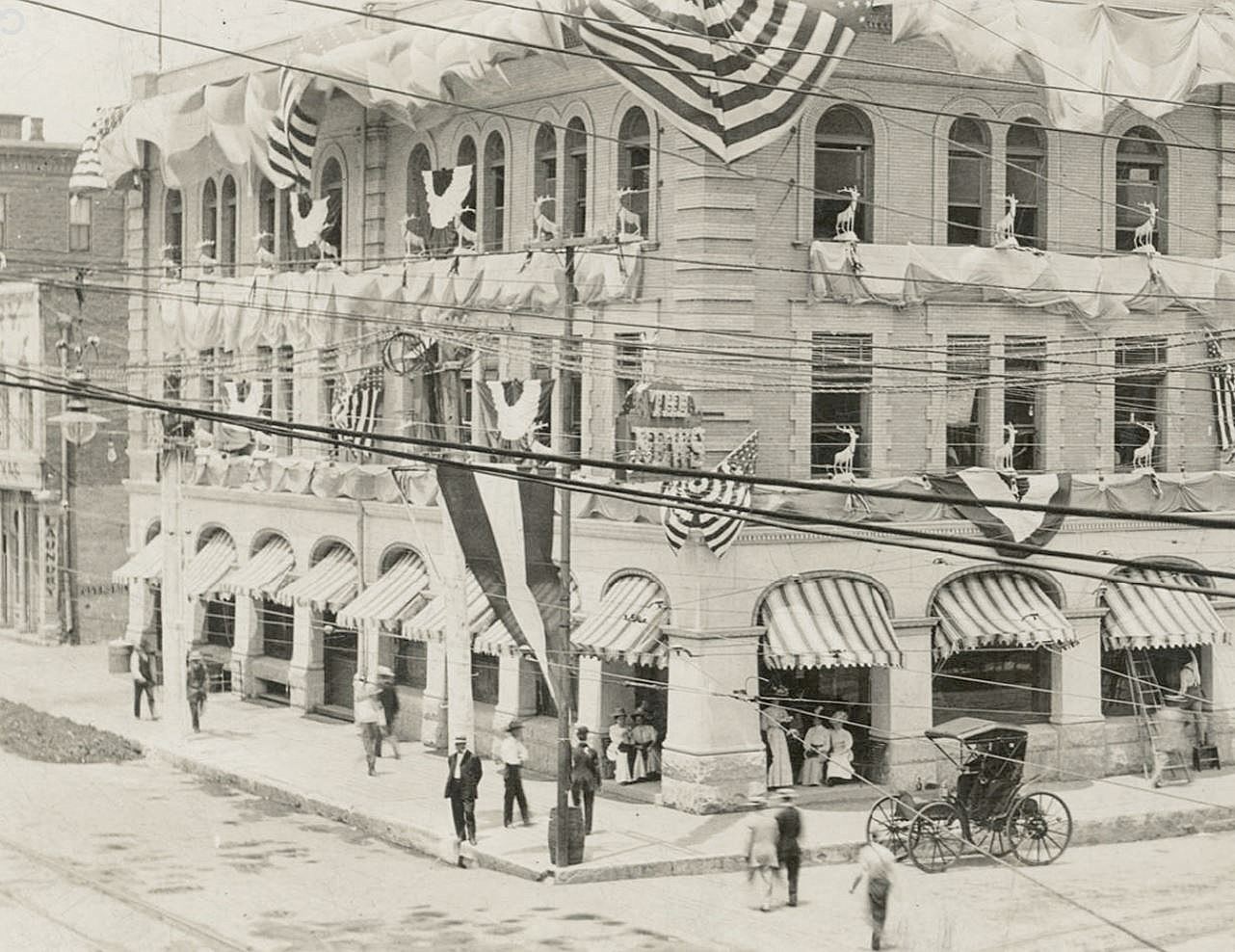
dmn-bldg_decorated-for-elks-convention_1908_cook-collection_SMU_det-2

dmn-bldg_decorated-for-elks-convention_1908_cook-collection_SMU_det-3

dmn-bldg_decorated-for-elks-convention_1908_cook-collection_SMU_det-4

dmn-bldg_decorated-for-elks-convention_1908_cook-collection_SMU_det-5

dmn-bldg_decorated-for-elks-convention_1908_cook-collection_SMU_det-6

dmn-bldg_decorated-for-elks-convention_1908_cook-collection_SMU_det-7

**

Here is a lengthy description of the decorations, from The Dallas Morning News — direct from the horse’s mouth:

To decorate The News Building in celebration of the coming of the Elks has been the labor of two men for more than a month, and of a dozen for two days: for, though it was only three days ago that the first bit of color appeared on the outer walls, the preparations were begun in the seclusion of a workshop early in June. The draping of the building with bunting and flags was done under the direction of W. T. Senter of the National Decorating Company of St. Louis, and of Edward A. Gebhard, librarian of The News. In working out their scheme they have used 4,200 yards of bunting, purple, white and purple, and twenty-four immense flags, and disposed of it in such artistic fashion as to avoid a sense of crowding.

PURPLE, WHITE AND PURPLE RUFFLES

The building is thrice begirt with big ruffles of purple, white and purple. But, to begin at the topmost, three large flags, one the United States, another the Texas and the other The News’ flag, float high above the Lamar street side of the building. To the bottom of each of these flags are attached small cowbells of different tones, so that with every strong whiff of wind there is a discordant but merry jingle. From one to the other of the flagstaffs hundreds of small pennants in the colors of the Elks flutter gayly in the breeze. Festooned from the heavy cornice which crowns the building are heavy folds of purple, white and purple so arranged that with every vagrant breeze it swells and sinks like the surface of water. Once on the Lamar street side, over the entrance, again at the corner and once on the Commerce street side this bunting is gathered around an immense United States flag, fashioned fan-shape. Poised on the cornice of the building at the corner, as if surveying the land preparatory of a leap, is the graceful figure of an elk, five and a half feet high, made out of plaster of Paris, painted and enameled until he glistens.

The two lower ledges of the building are draped in similar fashion, except that the streamers at these places are narrower than those that festoon the cornice. Above the main entrance on the Lamar street side and extending from below the second story to the third-story ledge is the piece de resistance. Here set in an embrasure of the building, is a clock dial twelve feet in diameter. The gilt letters marking the divisions of the circle are two feet high. The hands point to the hour of 11. The pure white head and shoulders of an elk seven feet high are shown in the center one foot forward, as if he were about to emerge from the fluffy mass of purple and white bunting that forms the background dial. On each side an immense flag is gathered in a way to make it fan-shaped. Circling the clock dial are six large incandescent lights.

WHOLE HERD OF ELKS

From the third-story corner of the building, above which stands a five and one-half foot Elk, as if surveying the country from a precipice, are festooned two twelve-foot flags that fall almost to the second-story ledge of the building. One is gathered around on the Commerce and the other on the Lamar street side. And there yet remains to speak of the most distinctive feature of the whole scheme of decoration. The News, in preparation for this event, had made a whole herd of elks. There are forty-two of them, each thirty-two inches tall, and one, mounted on a pedestal, stands poised from the ledge of every window in the building. They are pure white, made of plaster Paris, painted twice and then enameled. Between the forefeet of every one is an electric bulb. The elks are from models designed by Mr. Gebhard and were cast in The News Building.

BRILLIANT ILLUMINATION

Of course the whole building is brilliantly lighted. In addition to the electricity used ordinarily, which lights the exterior of The News Building pretty well, bulbs have been studded profusely midst the decorations and over the Lamar street entrance is a parallelogram of electric lights which illuminate the sign, “Hello, Bill!”

*

The article then launches into more self-promotion, with an, admittedly, interesting description of the layout of the News Building:

ATTRACTS GENERAL ATTENTION

The building of The News attracted general attention from the thousands of visiting Elks. Many expressed their surprise that a city the size of Dallas had such a complete, modern building and equipment, and the compliments concerning The News as a newspaper have been very pleasing.

The News Building has all the modern fireproof features. It occupies a space of 300×100, having three floors and a basement, the whole being used by the newspaper. Its business office is one of the handsomest in the State, and, as one visitor remarked, it looks more like a prosperous bank than the ordinary newspaper office.

The first floor is given up to the business and circulation departments, the press room and the mailing department. In the basement are the paper storage rooms and the power department. On the second floor are the editorial rooms, telegraph rooms and the general circulation department and the newspaper job department, besides the Employes’ Library and Recreation Room. On the third floor are the composing and the linotype rooms, the stereotype room and the engraving department.

INDIVIDUAL ELECTRIC MOTORS

Every piece of machinery in the house is operated by its own individual electric motor. Power is supplied from two immense engines and generators combined, the engine room being one of the show places in the building, having a metal ceiling and white glazed brick on the walls, with a cement floor. The press room contains two three-deck presses, one quadruple press and one sextuple press.

TWO DAILY NEWSPAPERS

The Dallas News is the offspring of The Galveston News, which was established in 1842. The two papers are under the same management. The publication offices of The News, Galveston and Dallas, 315 miles apart, are connected by special wires for interchange of news matter. The Galveston paper supplies the southern part of the State and the Louisiana border, while the other covers all North Texas and goes well into Arkansas, Oklahoma and New Mexico.

THREE SPECIAL TRAINS

For upward of a quarter of a century the two papers have operated at their own expense, every day in the year, three special newspaper trains, one running Galveston to Houston, one Dallas to Denison and the third Dallas to Fort Worth. The Dallas News covers hundreds of thriving towns throughout its territory, many of them before breakfast time, through its unrivaled facilities of distribution. Starting in 1885, The Dallas News has been a continuous success, and has achieved an enviable reputation wherever American newspapers are known. As an advertising medium it is in a class by itself so far as papers in this section of the country are concerned. Starting at 1885 with thirty-three classified ads in its Sunday issue, it now runs each Sunday about 2,000. It is a success because it is enterprising and because it is clean, both in its news columns and in its advertising columns; because it is fair-minded and because its efforts have always been uplifting from a moral and intellectual standpoint and fair to every interest.

*

And then it launches into many, many testimonials from Elk visitors on how much they love the decorations. This is the first. You get the idea.

J. T. McNulty of Baltimore, grand trustee of the Elks, prominent in National circles of the Knights of Columbus and a central figure in the Ancient Order of Hibernians of America, who has traveled largely and visited every State in the Union, being prominent in business and political circles said: “I have been to many conventions, my son, and have seen many decorations, but the one at The News plant, in my estimation ‘takes the cake,’ figuratively and literally speaking. It is the most unique, the most artistic and the most beautiful I have ever seen in all my attendance at conventions in this country, and I have attended many of them. I was agreeably surprised at the way Dallas has decorated, but nothing gave me such a shock of pleasurable surprise as the first sight I had of The News’ decorations.”

*

And this is the dark and grainy photo that ran with the article:
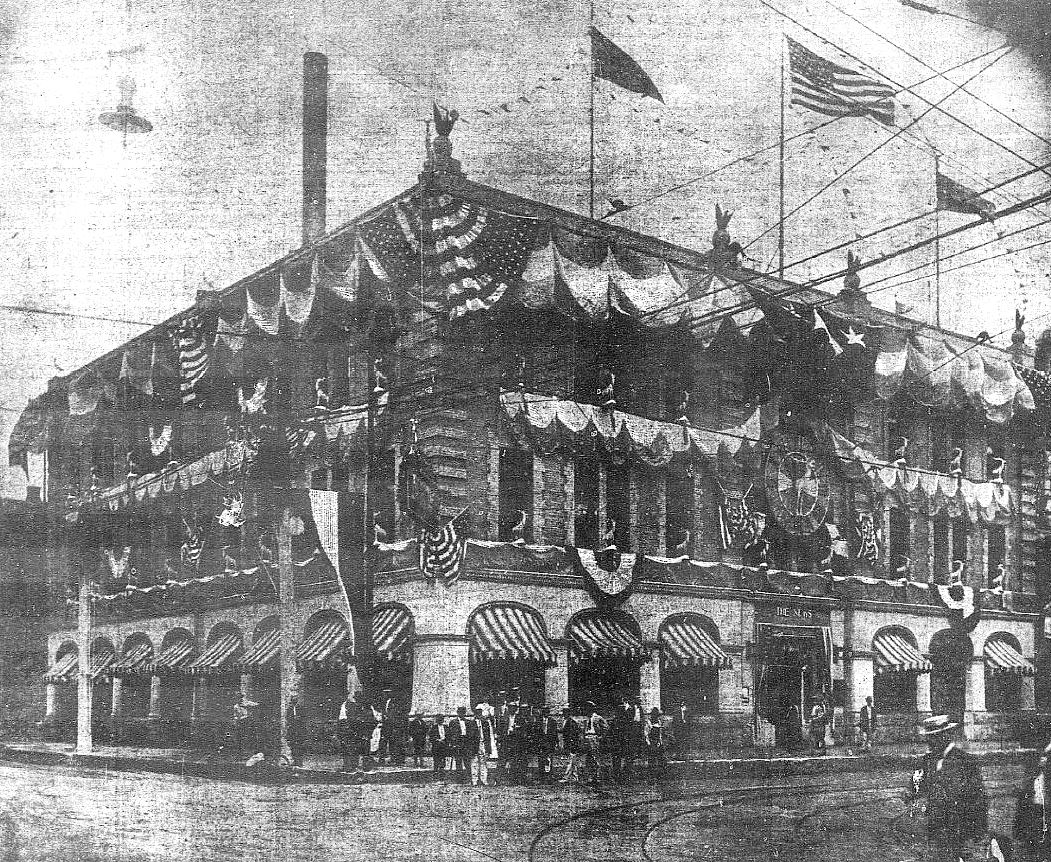
dmn-bldg_elks_dmn_071508_photoDMN, July 15, 1908

**

I kinda want an elk statue now. Also, according to the article, I now know the Morning News has its own flag. Can someone point me to more info?

**

Most of the larger downtown buildings went crazy with decorations, such as the Oriental Hotel (southeast corner of Commerce & Akard), seen here festooned up the wazoo. If you see a photo from 1908 with a Dallas building that’s looks like this, blame it on the Elks.

oriental-hotel_postcard_elks_1908_ebay

***

Sources & Notes

Top photo — titled “[The News, First Prize for Decorations, Dallas, Texas]” — is from the George W. Cook Dallas/Texas Image Collection, DeGolyer Library, Southern Methodist University; more info on this photograph (postcard) can be found here.

Lengthy quote is from the article “Dallas News Building Decorated In Honor of the Elk’s Grand Lodge Which Is Now Holding Its Annual Session and Grand Jubilee in This City,” The Dallas Morning News, July 15, 1908.

More Elks-related Flashback Dallas posts:

And more photos of this beautiful Dallas News Building can be found in these posts:

dmn-bldg_decorated-for-elks-convention_1908_cook-collection_SMU_full_sm

*

Copyright © 2022 Paula Bosse. All Rights Reserved.

Claes Oldenburg in Dallas — 1962

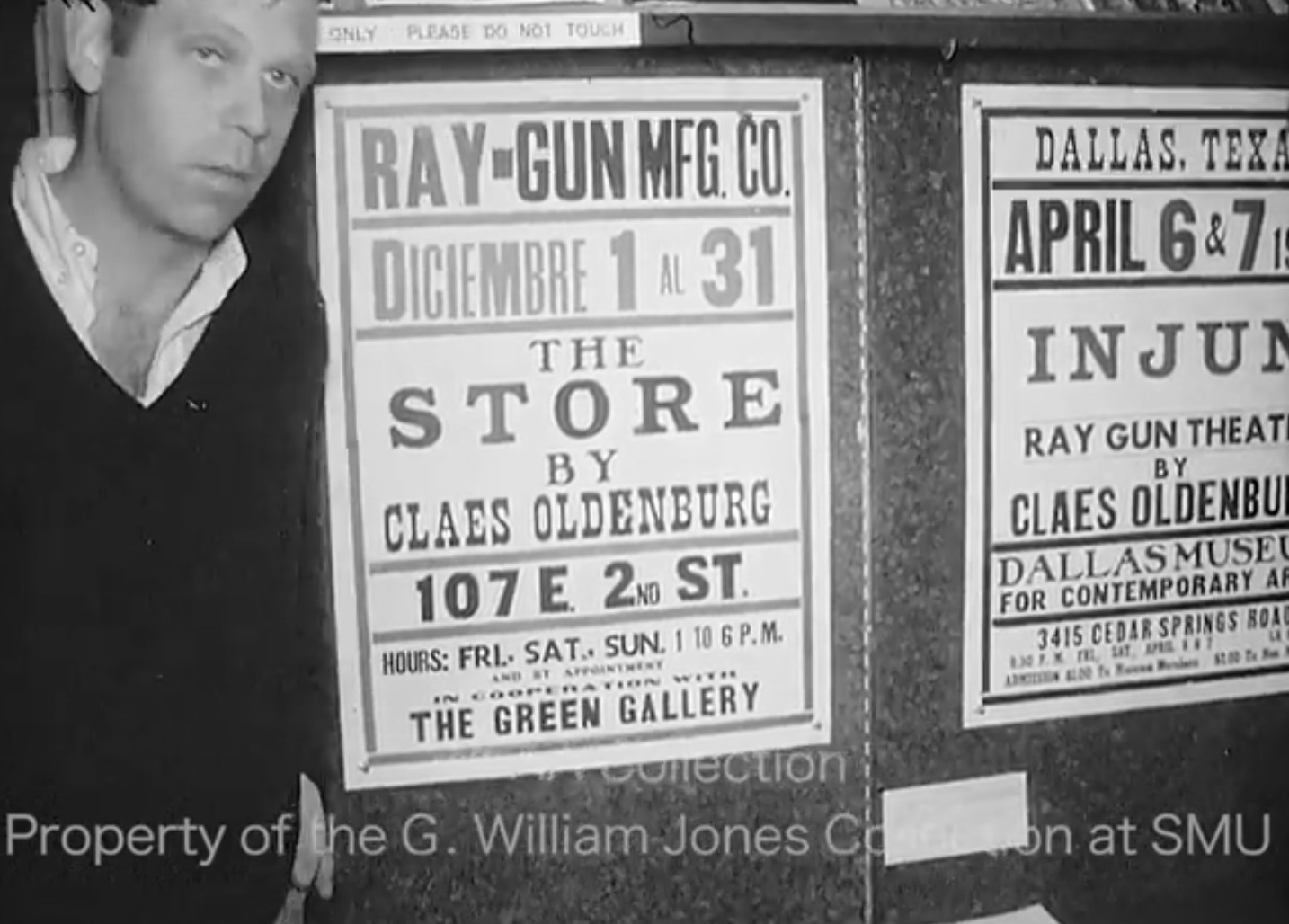
oldenburg-claes_dallas-museum-for-conteporary-arts_april-1962_WFAA_jones-film_SMU_postersClaes Oldenburg at the DMCA, April, 1962 (WFAA Collection, SMU)

by Paula Bosse

Claes Oldenburg, the Swedish-born American sculptor, died this week at the age of 93. Among his connections to Texas are two of my favorite Oldenburg pieces: the fabulous “Monument to the Last Horse,” a permanent fixture of Donald Judd’s Chinati Foundation in Marfa, which he created with his wife Coosje van Bruggen, and the much-missed “Stake Hitch,” a site-specific work commissioned by the Dallas Museum of Art (installed in the brand-new DMA in 1984, and, sadly, de-installed in 2002 after a nasty contretemps between Oldenburg and the museum).

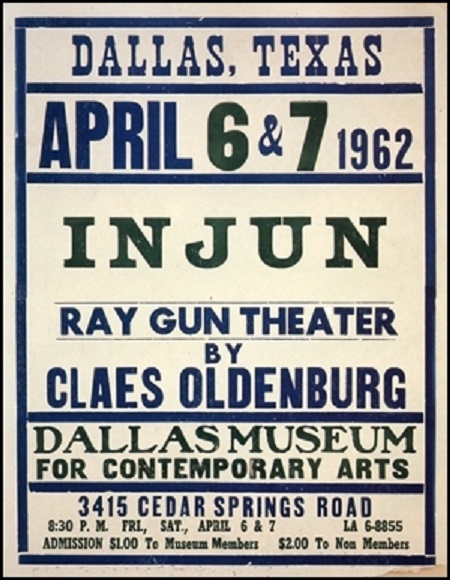
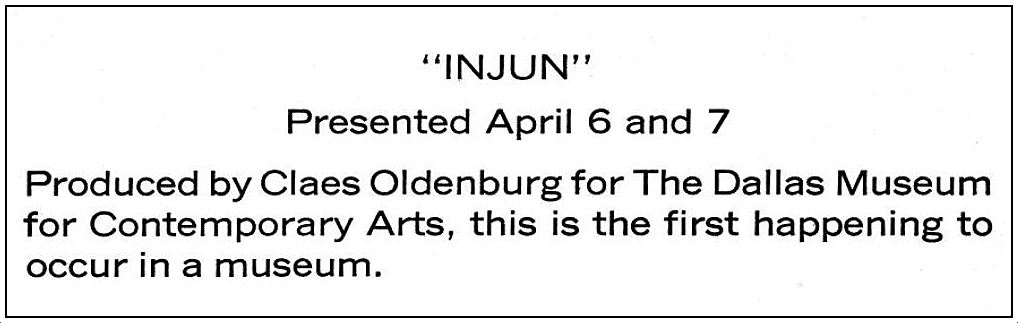
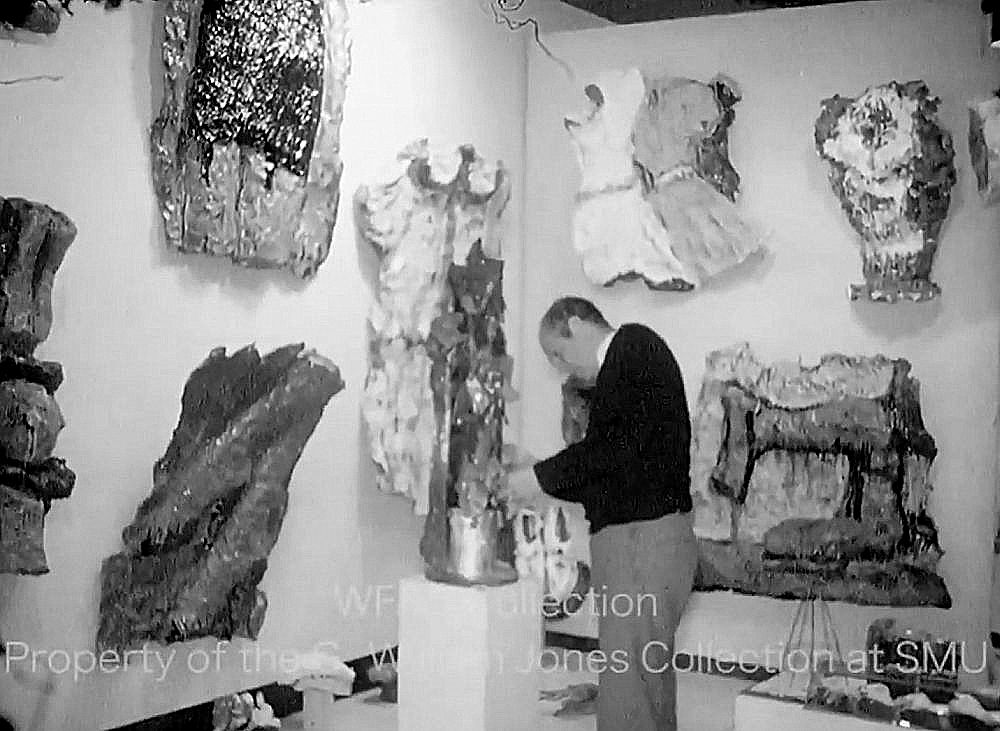
Oldenburg’s first visit to Dallas was in April, 1962, at a time when he was known mainly to NYC art-world hipsters — well before he had achieved anything approaching his later international acclaim. He came to Dallas to present “The Store,” a pop art installation which was part of the group show “1961” at the Dallas Museum for Contemporary Arts (the DMCA was merged with/absorbed by what is now the Dallas Museum of Art in 1963). While Oldenburg was in Dallas exhibiting “The Store” (comprised of 45 individual works, the placement of which he re-created from the original December, 1961 show in Manhattan), he also presented “Injun,” the first-ever “happening” held outside New York or Los Angeles and the first such interactive event commissioned by a museum (Oldenburg’s Ray Gun Theater performance-art “happenings” were much talked about and had gained a cult following in New York, and having him in Dallas to present a “happening” was a definite “get” for the DMCA).

“The Store” and “Injun” — and Claes Oldenburg himself — were very un-Dallas. The reception Oldenburg received from Dallas’ followers of edgier contemporary art appears to have been positive, but his work was handily dismissed by Dallas Morning News art critic Rual Askew, who, invoking the “royal we,” wrote this rather laborious sentence:

Claes Oldenburg’s ‘The Store,’ a painted-plaster waste of time in our view, has interest as assembled pattern with carnival colors at a considerable distance perhaps, but displaces space out of all proportion to aesthetic experience. (DMN, April 15, 1962)

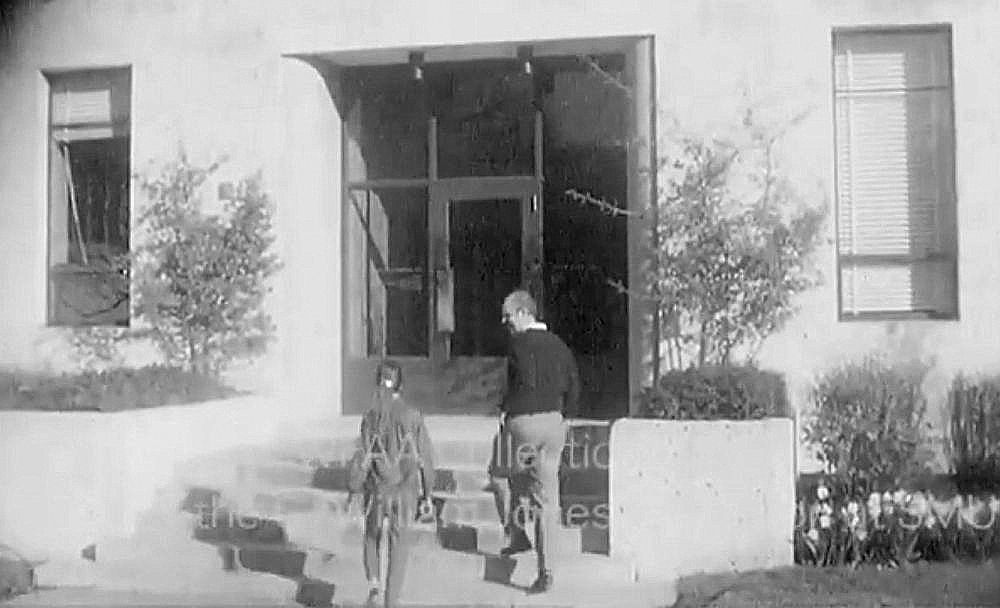
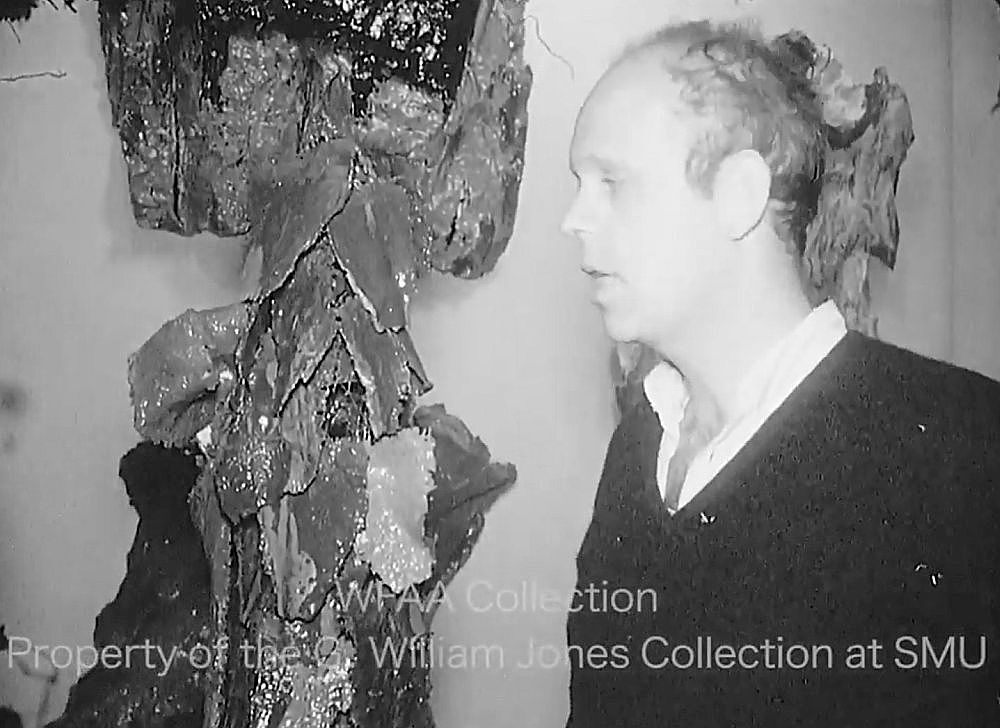
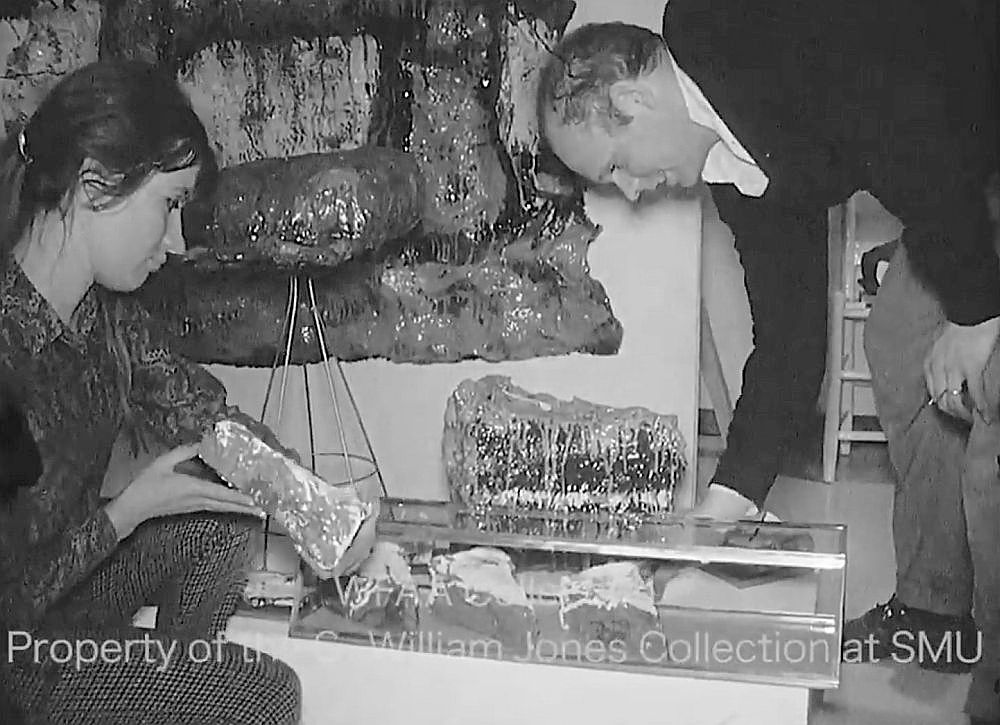
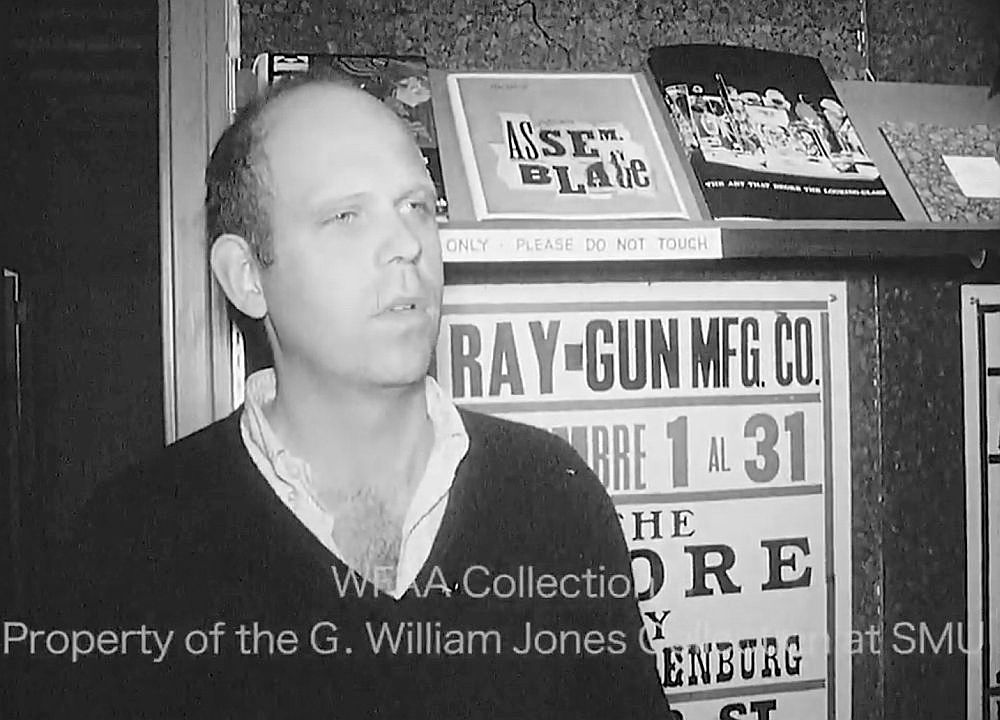
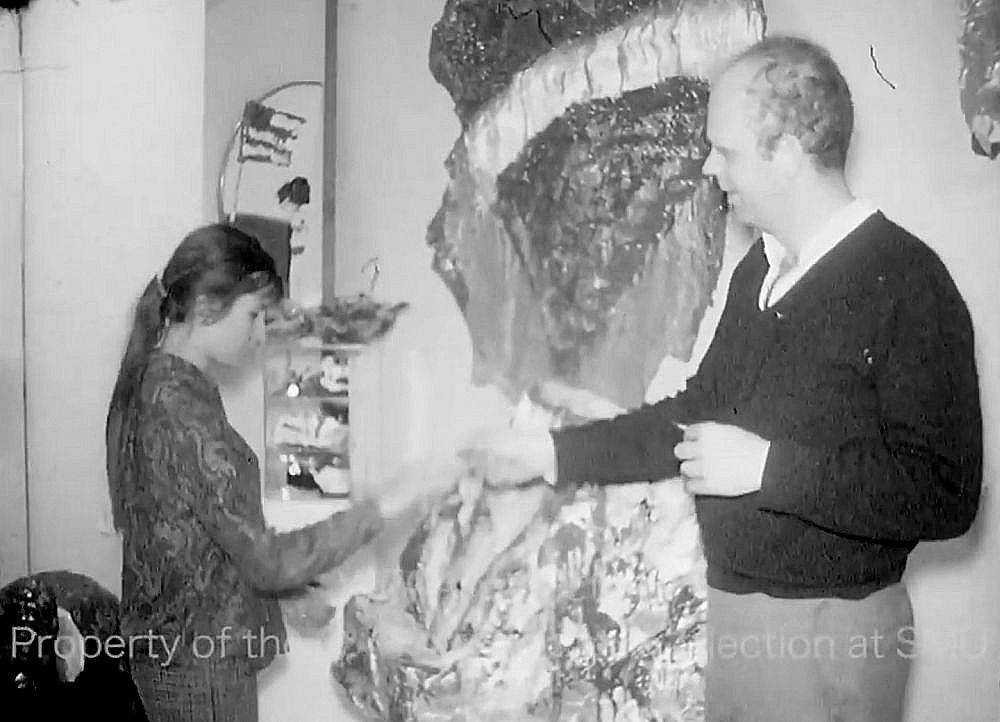
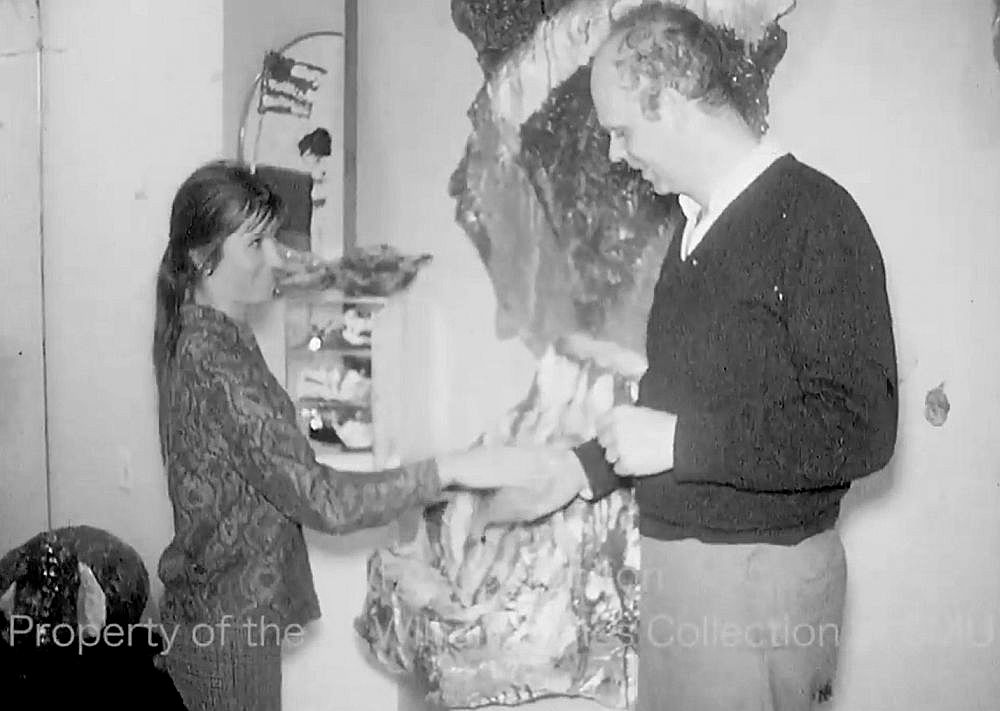
As I work with the WFAA Collection (held by the G. William Jones Collection at SMU’s Hamon Arts Library), I was pretty excited when film footage popped up showing Oldenburg and his first wife (and his collaborator), Patty Mucha, at the DMCA. I knew that the DMCA was somewhere in Oak Lawn (it was at 3415 Cedar Springs), but I had never seen an image of it until this footage. The Oldenburgs are seen walking into the DMCA, tinkering with the installation before the show opened, inspecting the store’s “foods” and other “merchandise,” and playfully “playing store” and exchanging imaginary cash at his “cash register.” Sadly, there is no sound for the one-minute-45-second film, but — being an art history major (that always sounds pretentious…) — I really, really love this. A young, happy Claes Oldenburg in a moth-eaten sweater, here in Dallas, in the early years of what would become an artistically important career is pretty cool to see.

I have been meaning to write this post since I first saw the WFAA footage two years ago. I’m sorry that it’s taken the death of the artist to finally get me to do it. RIP, Claes.

*

UPDATE: Morgan Gieringer, Head of UNT Special Collections, alerted me to a WBAP-Channel 5 news script they have in their collection which describes much the same sort of thing that is going on in the WFAA-Channel 8 film above. In the script, Oldenburg discusses some of the pieces — read the two pages here. (The Ch. 5 report was filmed on March 29, 1962, which could be the same date as the Ch. 8 footage.)

*

“The Store” at the Dallas Museum for Contemporary Arts, 1962 — in vivid color:

oldenburg-claes_the-store_DMCA_1962_DMAvia Dallas Museum of Art

via Dallas Museum of Art

1961_claes-oldenburg_catalog_DMCA_1962_injun“1961” catalogue, via DMA/Portal to Texas History

Screenshots from the WFAA footage, showing Oldenburg and his wife, Patty (who worked alongside her husband and was a frequent participant in the “happenings”) preparing “The Store” for its opening at the DMCA.

oldenburg-claes_dallas-museum-for-conteporary-arts_april-1962_WFAA_jones-film_SMU_ext

oldenburg-claes_dallas-museum-for-conteporary-arts_april-1962_WFAA_jones-film_SMU_1

oldenburg-claes_dallas-museum-for-conteporary-arts_april-1962_WFAA_jones-film_SMU_2

oldenburg-claes_dallas-museum-for-conteporary-arts_april-1962_WFAA_jones-film_SMU_3

oldenburg-claes_dallas-museum-for-conteporary-arts_april-1962_WFAA_jones-film_SMU_4

oldenburg-claes_dallas-museum-for-conteporary-arts_april-1962_WFAA_jones-film_SMU_5

oldenburg-claes_dallas-museum-for-conteporary-arts_april-1962_WFAA_jones-film_SMU_7

***

Sources & Notes

Top image (and all other black-and-white images) are screenshots from the WFAA Newsfilm Collection, G. William Jones Film and Video Collection, Hamon Arts Library, Southern Methodist University; the footage was filmed in early April 1962 (or possibly late March 1962); the clip may be viewed on YouTube, here.

The color photograph of “The Store” and the poster for “Injun” are both from a publication of the Dallas Museum of Art, here.

Other Oldenburg-related sources:

  • The “1961” exhibition catalogue — this group-show featured heavy-hitting up-and-comers such as Robert Rauschenberg, Roy Lichtenstein, Robert Motherwell, James Rosenquist, Joseph Albers, Morris Louis, Jasper Johns, Jim Dine, and Richard Diebenkorn — can be viewed in a fully scanned Dallas Museum for Contemporary Arts catalogue here, via the Dallas Museum of Art Exhibition Records, Portal to Texas History
  • Candid photos from the “Injun” performance can be seen here
  • See several great photos of Oldenburg taken during the installation of “Stake Hitch” in 1984, in a DMA Bulletin here, here, here, and here
  • Watch a short video about “The Store” when it was restaged at the Museum of Modern Art in 2013, with comments on the pieces by Oldenburg; see what the pieces shown in the 1962 black-and-white film made in Dallas looked like 51 years later, in color, in the MoMA video, here

On my blog High Shrink (non-Dallas stuff), you can read more about Oldenburg in a post I really enjoyed writing, “Claes Oldenburg’s ‘Slice of Bread; Tombstone for Ed Kienholz — 1974.”

oldenburg-claes_dallas-museum-for-conteporary-arts_april-1962_WFAA_jones-film_SMU_posters_sm

*

Copyright © 2022 Paula Bosse. All Rights Reserved.
Bud Biggs: 12 Watercolors of Dallas — ca. 1955

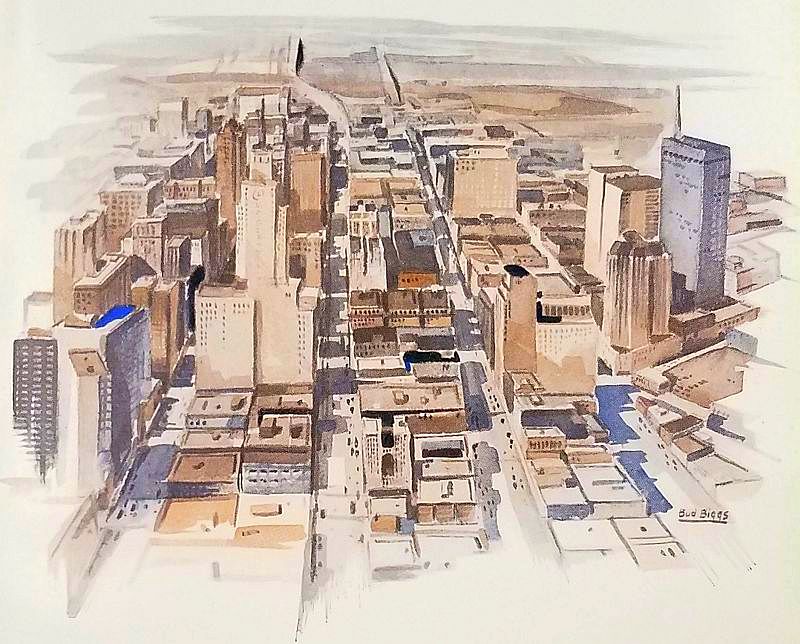
1-1956-january_dallas-mag_bud-biggs“Aerial View of Downtown Dallas” by Bud Biggs
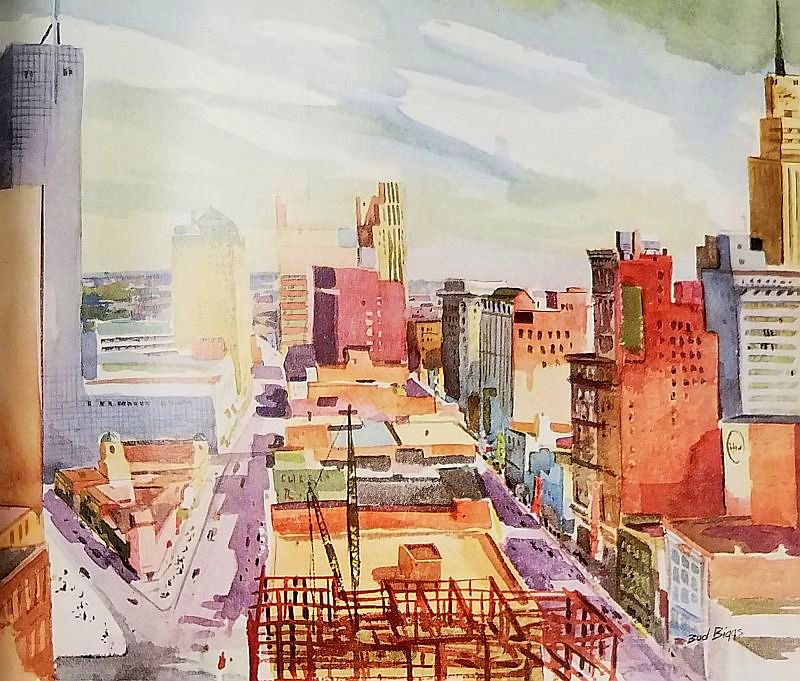
by Paula Bosse

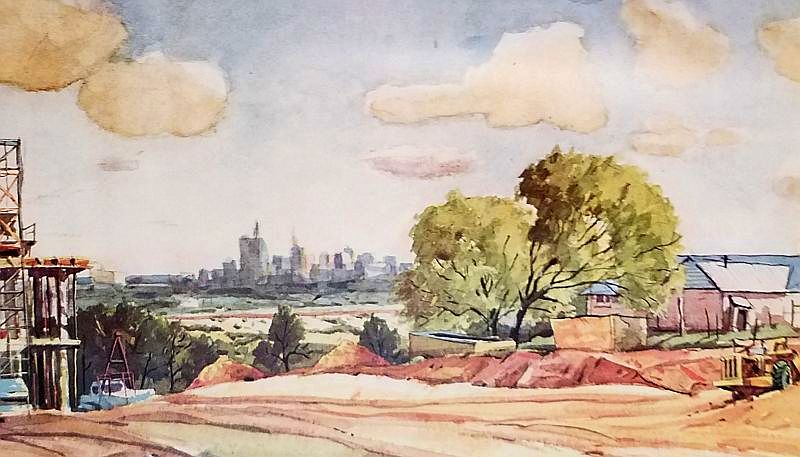
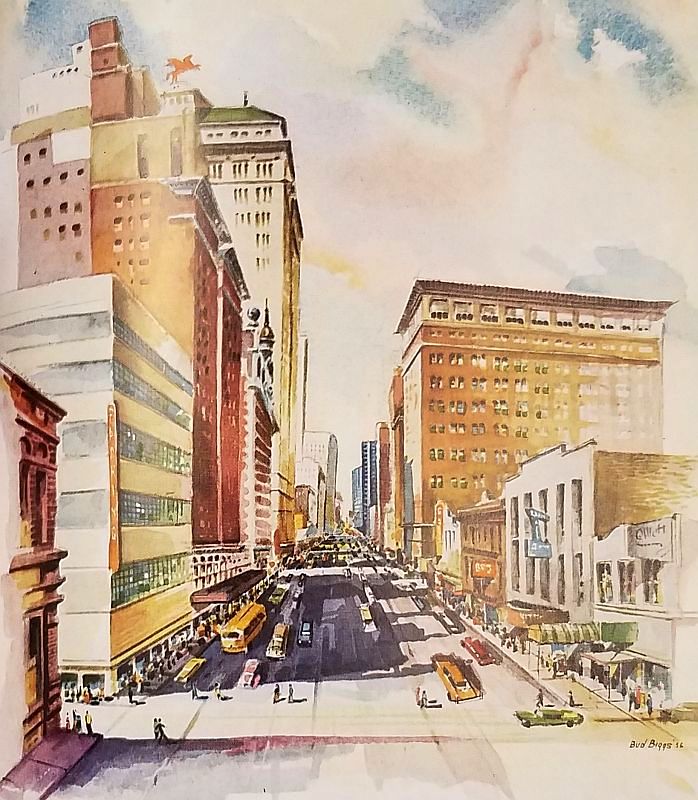
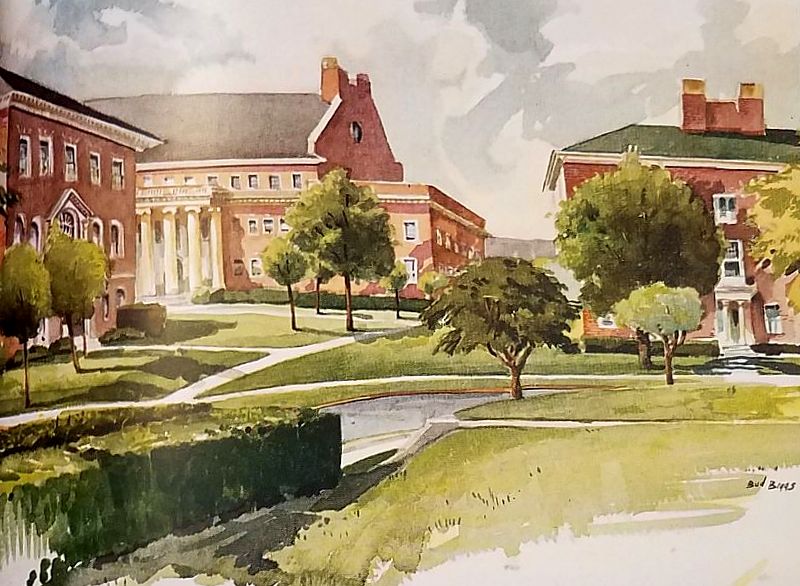
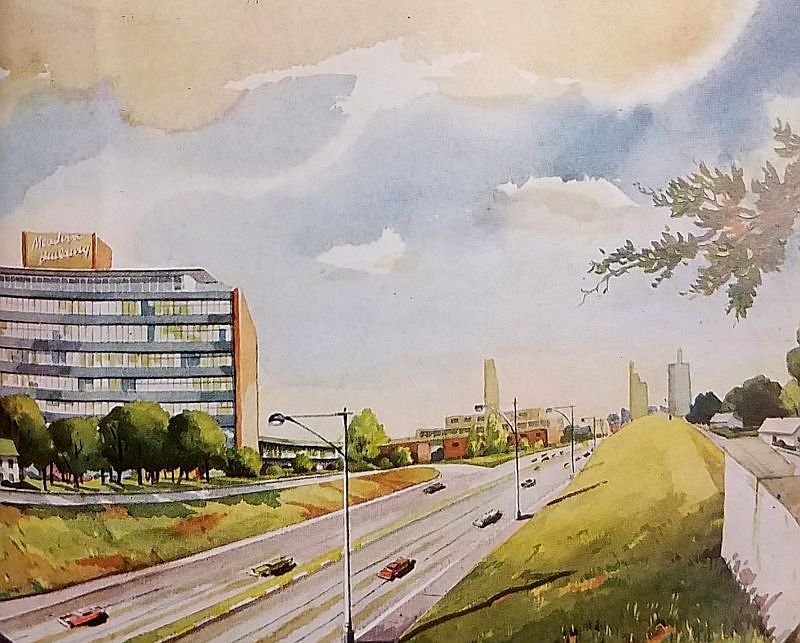
Back in 2018 I posted Christmas-themed magazine cover art by Dallas artist/illustrator Bud Biggs — it was one of my favorite images posted that year (see the post here). I knew that it had been one of the 12 monthly covers by Biggs used in 1956 for Dallas magazine, the Dallas Chamber of Commerce publication. Since then, I’ve managed to turn up all 12 watercolors. Some of them are going to look a little wonky with unfortunate glare patches — this is because I was unable to photograph them lying flat. I’ve done my best! I’ve paired them with the titles which were printed in the Dallas Morning News — I hope I’ve gotten the right titles with the right paintings. 

*

Above, “Aerial View of Downtown Dallas” by Bud Biggs (this painting appeared on the cover of the January, 1956 issue of Dallas magazine).
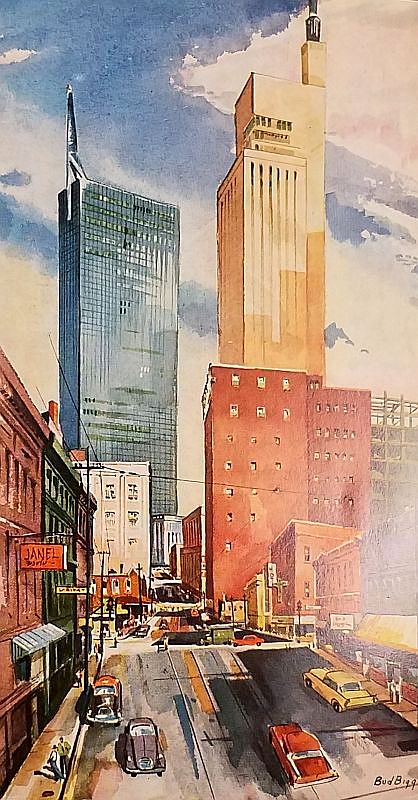
*

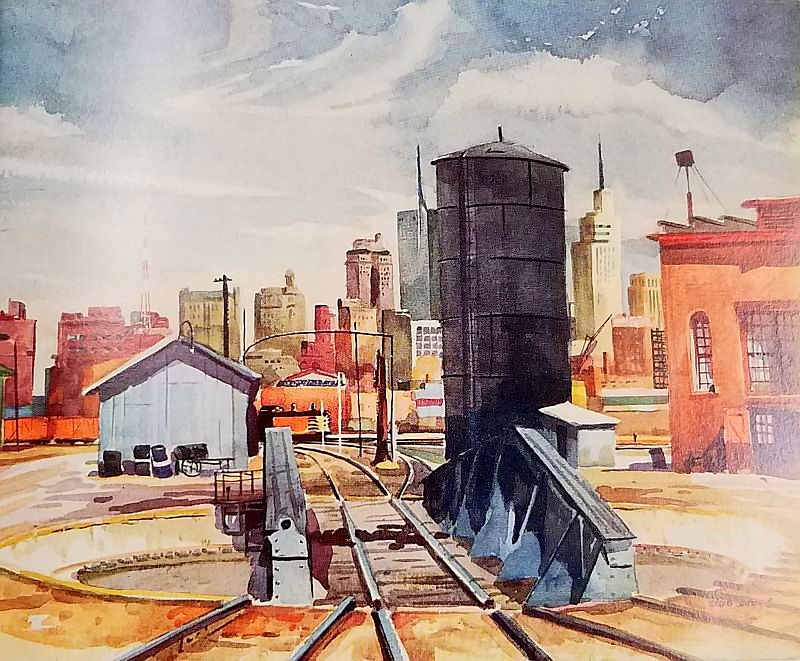
Below, “The Katy Round House” by Bud Biggs (February, 1956 cover)

2-1956-february_dallas-mag_bud-biggs

*

“Looking Up Pacific” by Bud Biggs (March, 1956 cover)

3-1956-march_dallas-mag_bud-biggs

*

“Ervay Street” by Bud Biggs (April, 1956 cover)

4-1956-april_dallas-mag_bud-biggs

*

“Ground-breaking, Dallas University” by Bud Biggs (May, 1956 cover)

5-1956-may_dallas-mag_bud-biggs

*

“Commerce Street” by Bud Biggs (June, 1956 cover) 

6-1956-june_dallas-mag_bud-biggs

*

“SMU Legal Center” by Bud Biggs (July, 1956 cover)

7-1956-july_dallas-mag_bud-biggs

*

“Central Expressway” by Bud Biggs (August, 1956 cover)

8-1956-august_dallas-mag_bud-biggs

*

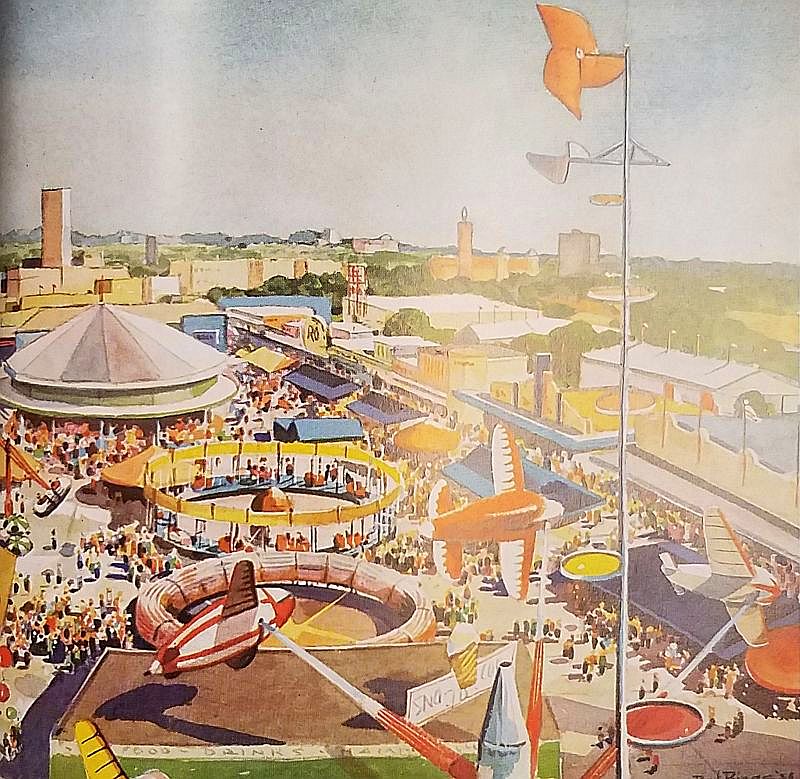
Midway, State Fair of Texas” by Bud Biggs (September, 1956 cover)

9-1956-september_dallas-mag_bud-biggs

*

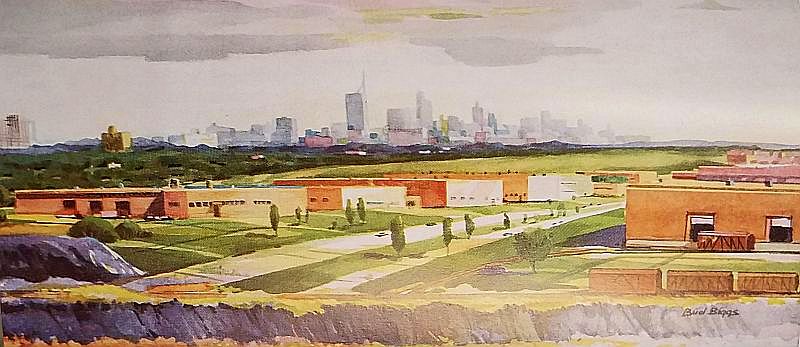
“Trinity Industrial District” by Bud Biggs (October, 1956 cover)

10-1956-october_dallas-mag_bud-biggs

*

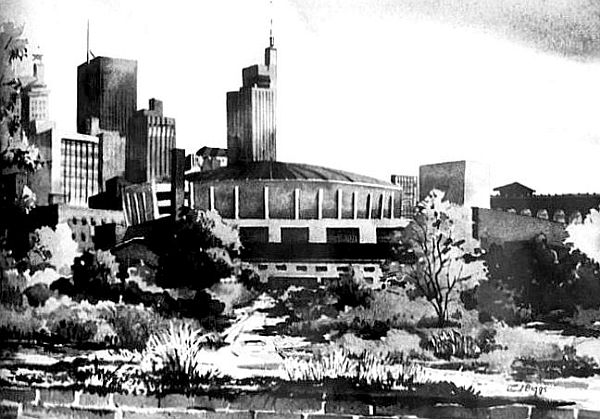
“City Auditorium” by Bud Biggs (November, 1956 cover) — sadly, I was unable to find this one in color.11-1956-november_dallas-mag_bud-biggs_BW

*

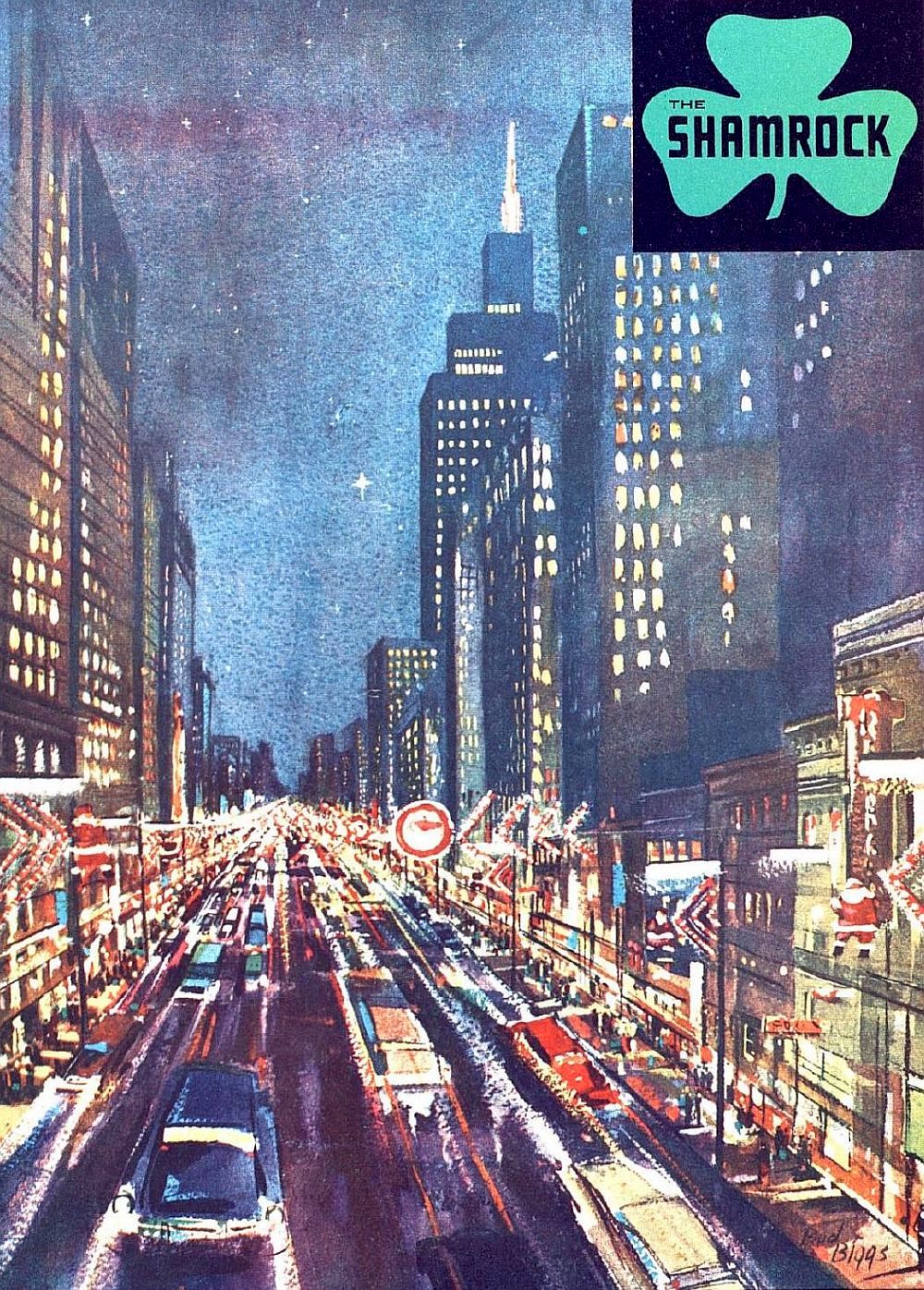
“Main Street, Christmas Night” by Bud Biggs (used for the cover of the December, 1956 issue of Dallas and for the cover of the Christmas, 1959 issue of the Shamrock Oil & Gas publication, The Shamrock)

xmas_bud-biggs_shamrock-mag_1959_texas-tech

**

This series of 12 paintings won the “Best Covers of 1956” award from the American Association of Commerce Publications, and in 1958 all 12 of the original watercolors were purchased by Southwest Airmotive Company to be displayed in their new Love Field terminal. I have no idea where these paintings are today. I love them. 

*

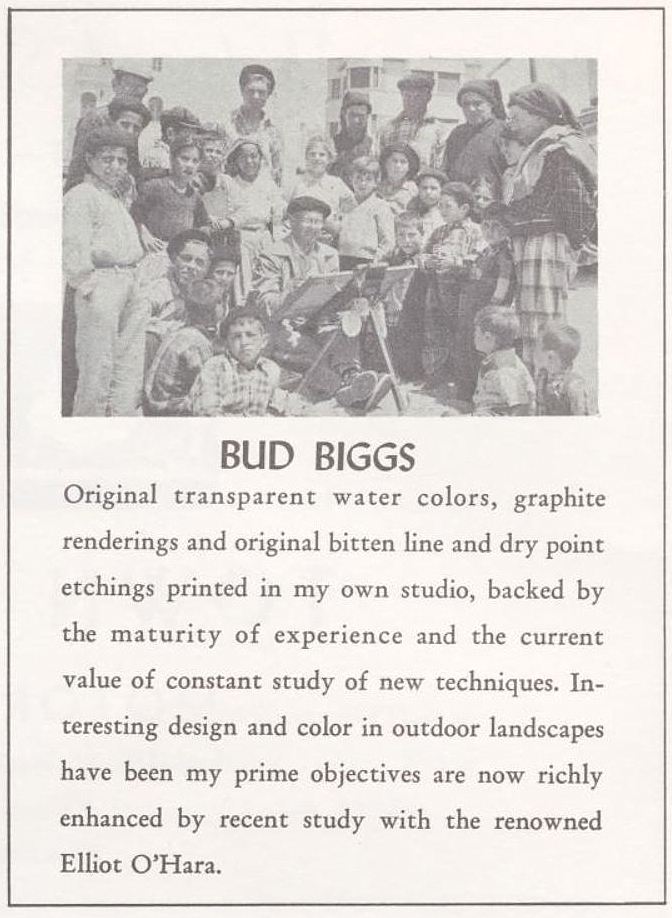
Dallas native Bancroft Putnam “Bud” Biggs (1906-1985) attended Forest Ave. High School, SMU, and the St. Louis School of Fine Arts. He was primarily a commercial artist, working for Dallas artist Guy Cahoon before opening his own advertising studio. He produced fine art as well, specializing in watercolors, and was a respected art instructor. Below is an ad placed in the publication La Fiesta of Art (1957) to coincide with an art show in Highland Park Village. He is seen sitting at an easel. I had never heard of Bud Biggs before that Christmas post in 2018 — someone needs to round up his works and publish them!

biggs-bud_la-fiesta-of-art_1957_portal

***

Sources & Notes

Information on the 12 paintings is from the Dallas Morning News article “Art & Artists: Biggs Series Bought by Firm” by Rual Askew, Feb. 20, 1958.

2-1956-february_dallas-mag_bud-biggs_sm

*

Copyright © 2022 Paula Bosse. All Rights Reserved.