Flashback : Dallas

A Miscellany: History, Ads, Pop Culture

Category: Dining and Drinking

From El Chico and the Cuellar Family: Feliz Navidad!

xmas_el-chico_cook-collection_degolyer_SMU

by Paula Bosse

…y Prospero Año Nuevo!

xmas_el-chico_cook-collection_degolyer_SMU_2

***

Sources & Notes

Images from a matchbook cover in the George W. Cook Dallas/Texas Image Collection, DeGolyer Library, Central University Libraries, Southern Methodist University; more on the item can be found on the SMU site here.

A couple of super-folksy El Chico commercials can be watched here.

*

Copyright © 2017 Paula Bosse. All Rights Reserved.


Historic Neon: The Super-Cool Sigel’s Sign

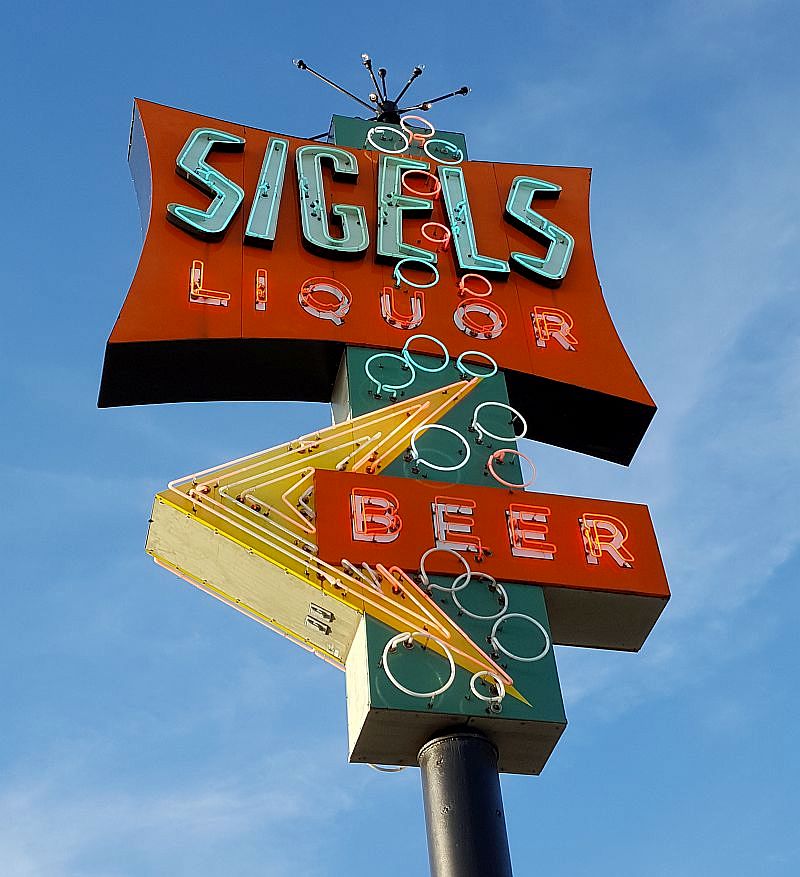
sigels-neon-sign_greenville-ave_072717One of Dallas’ favorite neon signs… (photo: Paula Bosse)

by Paula Bosse

I stopped by Sigel’s liquor store the other day (as one does…) and saw this legendary Sigel’s sign, recently installed in its new home in the parking lot of the Sigel’s store on Greenville Avenue, between Lovers Lane and Southwestern Boulevard, across from the Old Town Shopping Center. I love this neon sign. (See a very large image of it here.)

The sign’s design can be traced back to Dallas artist Marvin M. Sigel (whose great-uncle Harry Sigel founded the business in 1905) — this Fabulous Fifties design was created around 1953 specifically for the then-new store at 5636 Lemmon Avenue (at Inwood). When that store closed in 2009, the sign was refurbished and moved up to the company’s Addison location until that store fell victim to the company’s bankruptcy and was closed. Here’s a video of the fabulous sign when it was in Addison, with close-ups of its flashing neon and dancing bubbles:


*

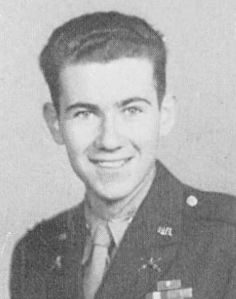
Marvin Meyer Sigel was born in Poland in 1932 and settled in Dallas in 1937 with his immigrant parents, both of whom had been doctors in Poland (his mother a dentist, his father an M.D.), although only his father continued to practice medicine in the United States. He lived in the vibrant Jewish enclave of South Dallas and went to Forest Avenue High School where he seems to have been a popular kid, interested in art, drumming, and ROTC. Below, a photo from the 1949 yearbook with the caption “Marvin ‘Hot Drums’ Sigel plays with the Swing Band.”

sigel-marvin_forest-avenue-high-school_drums_1949

His Forest Avenue High School senior photo, from 1949:

sigel-marvin_forest-avenue-high-school_1949

And his 1953 senior photo from the University of Texas:

sigel-marvin_university-of-tx_1953_senior

After studying art at both SMU (under Ed Bearden and DeForrest Judd) and the University of Texas and receiving his B.F.A. from UT in 1953, Sigel served a stint in the Eighth Army in Korea. Back in Dallas, he was remarkably active in the local art community — for decades — as both a fine artist and as an art instructor. He also worked for a while at Peter Wolf Associates, in advertising (on projects for companies like Braniff), and he even did a lot of the tedious paste-up work for Sigel’s ads (back when every picture of a bottle of wine or spirits had to be cut out individually and pasted into one of those huge ads!). But his passion was art, and at the same time he had those regular-paycheck gigs, he also managed to maintain a furious pace of painting new pieces to exhibit at a dizzying number of art shows. Below is an example of one of his watercolors, from 1957 (which was recently offered at auction by David Dike Fine Art). The title? “Cocktail Abstraction” — appropriate subject matter for a member of the Sigel family!

sigel-marvin_cocktail-abstraction_1957_david-dike-fine-art_jan-2016
“Cocktail Abstraction” by Marvin Sigel (1957)

When the Sigel’s Liquor store No. 7 opened at Lemmon & Inwood, it was suggested by family members that, hey, we have an artist in the family, let’s get Marvin to design a sign for us. According to Marvin, his cousin Sidney Sigel, who ran the company, probably just wanted a “rectangular sign with block letters,” but other family members wanted something newer and more exciting — something modern that would jump out of a sea of boring rectangular signs with block letters and draw attention. And it certainly did just that. If, as reports have it, that dazzling neon sign was designed in 1953, Marvin Sigel was only 21 years old!

When news broke 56 years later, in 2009, that the Lemmon & Inwood store was closing, there was a concerned uproar from the public about what would happen to the sign. Mr. Sigel was a bit taken aback by how much the people of Dallas had grown to love that sign and considered it a city landmark. Marvin Sigel, then 77 years old, said in a 2009 Dallas Morning News interview, “It was clever, but I figured it would be replaced by something more clever in a half-dozen years.”

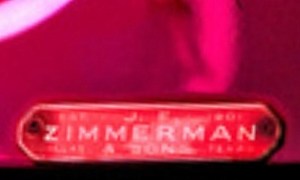
The sign was built by the venerable Dallas firm of J. F. Zimmerman & Sons (est. 1901) who for generations had installed decorative neon elements all around town and had built innumerable lighted signs for companies big and small — their work could be seen on the Mercantile Building’s wonderful tower, on the exterior of the downtown Titche’s store on Main Street, and in the instantly recognizable signs for places as varied as the Cotton Bowl, Big Town, and, presumably, various other Sigel’s stores around the city.

The sign which was moved from Store No. 7 at Lemmon & Inwood to Addison had on its pole a small plaque (seen here) which said:

This Non-Conforming Sign designed by Marvin Sigel was built in the early 1950s. It was moved from Dallas, TX at Lemmon Ave. & Inwood. After being granted a variance it was refurbished to Code and installed here in June of 2009. Sign refurbished and installed by Starlite Sign of Denton, TX.

Interestingly, the plaque on the new location of the sign has a slightly different text:

sigels-sign-plaque_greenville-ave_072717

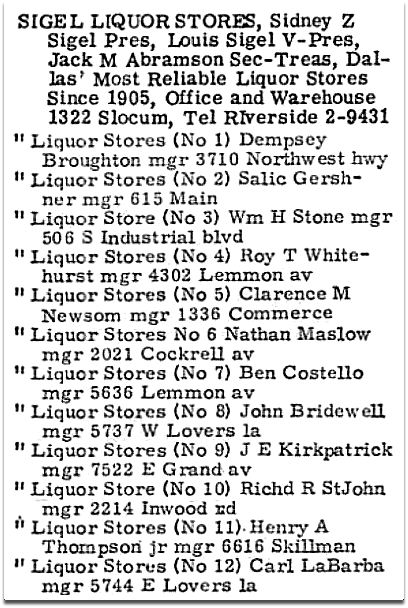
It appears that this is a different Sigel’s sign. In 1965, there were two Sigel’s stores on Lovers Lane: Store No. 8 was along the Miracle Mile on West Lovers Lane, near what is now the Dallas North Tollway, and Store No. 12 was on East Lovers Lane at Greenville (then near Louanns nightclub).

sigels-stores_1965-dallas-directory
1965 Dallas directory

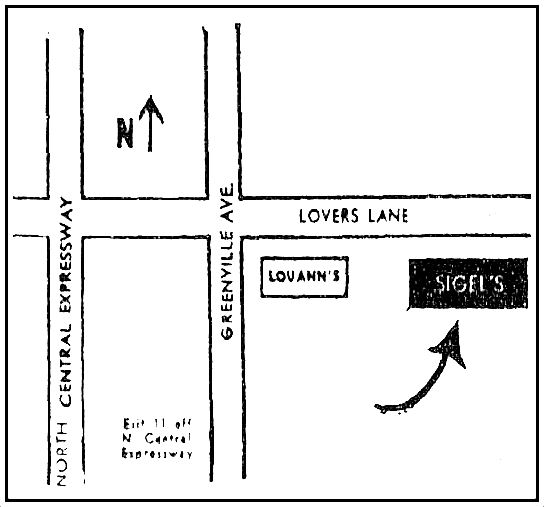
In an April 22, 2009 Dallas Morning News article by Jeffrey Weiss (“The Story Behind That Sigel’s Sign”), is this quote from Mr. Sigel’s son, David S. Z. Sigel, about the original sign at Lemmon & Inwood, with mention of another similar sign: “He created the designs for this sign, as well as a similar but smaller sign which stood outside the Lovers Lane store (where Central Market now stands) for many years.” Here’s a map from a November, 1964 grand opening ad for the new store at 5744 E. Lovers Lane:

lovers-lane_new-store_110664
Detail from a grand opening ad, Nov. 6, 1964

So is the sign currently standing in the parking lot of the Sigel’s Fine Wines & Great Spirits at 5757 Greenville Avenue the sign which originally stood only a short four-tenths of a mile away? I hope so! And if it is, welcome back to the neighborhood, cool sign!

Whichever sign this is, it is one of the greatest neon designs Dallas has ever had, and I’m so happy it’s survived for over a half-century, through phenomenal city growth, physical displacement, and even company bankruptcy.

Thanks, Marvin, for designing this wonderful sign! And thanks, Starlite Sign of Denton, for the beautiful refurbishing!

***

Sources & Notes
*

Top photo and photo of blue plaque taken by me on July 27, 2017 at the Sigel’s store at 5757 Greenville Avenue.

YouTube video by Andrew F. Wood, shot in Addison in 2013.

Sources for other images as noted.

The Zimmerman & Sons nameplate can be seen on the original Lemmon & Inwood sign here (click to enlarge), posted on Flickr by Tim Anderson (a detail of his photo can be seen below) (there is another Zimmerman nameplate posted in the comments on that Flickr page); what appears to be a Zimmerman plate is on the side of the sign at the Greenville Avenue location facing the store’s entrance, not on the side seen in my photo at the top.

zimmerman-nameplate_sigels-sign_lemmon-inwood_flickr-det

Please check out the Dallas Morning News article in the DMN archives titled “Sigel’s Sign Designer Surprised by Its Fame — Project for Family’s Liquor Store Wasn’t a Hit with Boss, He Recalls” by Jeffrey Weiss (April 28, 2009) in which Marvin Sigel discusses his famous sign.

Also, check out these related (online) DMN articles:

  • “Sigel’s Beverages, A 111-Year-Old Dallas Chain, Filed for Bankruptcy; Wants to Close 5 Stores” by Maria Halkias (Oct. 21, 2016), here
  • “Sigel’s Iconic Neon Sign Returning to Dallas After Years Wasting Away in Addison” by Robert Wilonsky (March 27, 2017), here

If anyone can verify that this sign is, in fact, the sign from Store No. 12 (Lovers & Greenville), please let me know!

UPDATE: Marvin Sigel died on Feb. 23, 2019 at the age of 87 (his obituary is on the Dallas Morning News website, here). After I wrote this post, Marvin’s son, David, contacted me to let me know his father had seen this and was delighted to know that people still appreciated his work. This was one of the most popular posts of the year. People absolutely still love your sign, Marvin! RIP.

sigels-sign_rain_bosse_121520photo: Paula Bosse, 2020

sigels-sign_night_bosse_121520photo: Paula Bosse, 2020

*

Copyright © 2017 Paula Bosse. All Rights Reserved.

Roth’s, Fort Worth Avenue

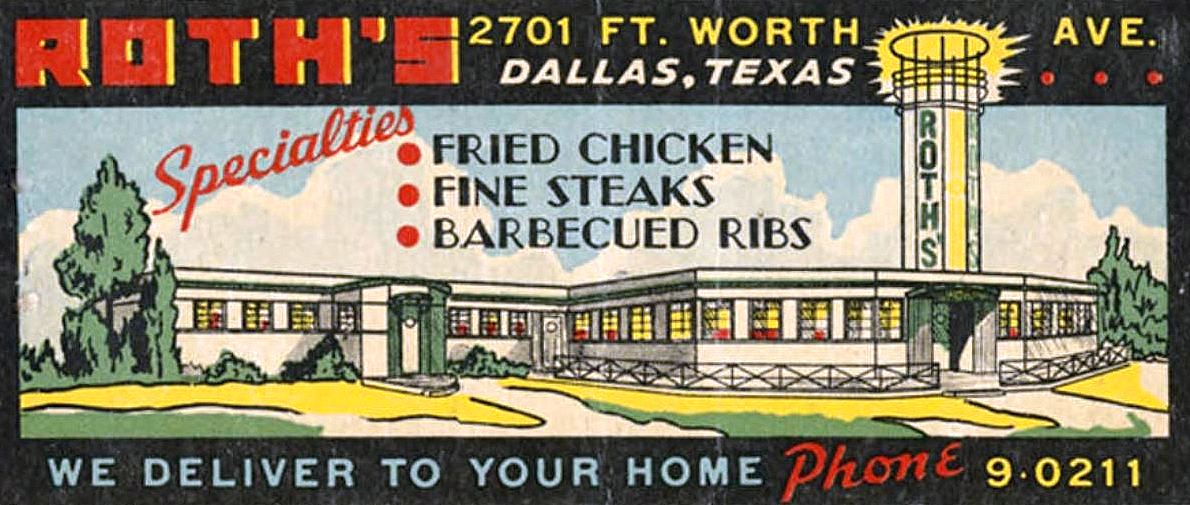
roths_cook-collection_smuSign me up, Mr. Roth…

by Paula Bosse

When I see a building like this, I always hope I can find a photo of it somewhere, but all I’ve been able to come up with is this energetic rendering from a 1940s matchbook cover. Roth’s (which was advertised variously as Roth’s Cafe, Roth’s Restaurant, and Roth’s Drive-In) was in Oak Cliff, on Fort Worth Avenue. It opened in about 1940 or ’41 and operated a surprisingly long time — until about 1967. When Roth’s opened, its address was 2701 Fort Worth Avenue, but around 1952 or ’53 the address became 2601. (I think the numbering might have changed rather than the business moving to a new location a block down the street.)

During World War II, Mustang Village — a large housing development originally built for wartime workers (and, later, for returning veterans and their families) — sprang up across Fort Worth Avenue from the restaurant. It was intended to be temporary housing only, but because Dallas suffered such a severe post-war housing shortage, Mustang Village (as well as its sister Oak Cliff “villages” La Reunion and Texan Courts) ended up being occupied into the ’50s. Suddenly there were a lot more people in that part of town, living, working, and, presumably, visiting restaurants.

As the 1960s dawned, Mustang Village was just a memory, and Roth’s new across-the-street neighbor was the enormous, brand new, headline-grabbing Bronco Bowl, which opened to much fanfare in September 1961. I don’t know whether such close proximity to that huge self-contained entertainment complex hurt or helped Roth’s business, but it certainly must have increased traffic along Fort Worth Avenue.

Roth’s continued operations until it closed in 1967, perhaps not so coincidentally, the same year that Oak Cliff’s beloved Sivils closed. Ernest Roth, like J. D. Sivils, most likely threw in the towel when a series of “wet” vs. “dry” votes in Oak Cliff continued to go against frustrated restaurant owners who insisted that their inability to sell beer and wine not only damaged their own businesses but also adversely affected the Oak Cliff economy. The last straw for Sivils and Roth may have been the unsuccessful petition drive in 1966/1967 to force a “beer election” (read about it here in a Morning News article from Aug. 17, 1966).

As far as that super-cool building seen at the top — I don’t know how long it remained standing, but when Roth’s closed, a mobile home dealer set up shop at 2601 Fort Worth Avenue, and mobile homes need a lot of parking space….

The building on the matchbook cover above is, unfortunately, long gone (as is the much-missed Bronco Bowl); the area today is occupied by asphalt, bland strip malls, and soulless corporate “architecture” (see what 2701 Fort Worth Avenue looks like today, here).

*

The man behind Roth’s was Ernest W. Roth, a Hungarian immigrant who had worked for many years as maître-d’ at the Adolphus Hotel’s tony Century Room. He decided to go out on his own, and around 1940, he and his business partner Joseph Weintraub (who was also his brother-in-law) opened the Oak Cliff restaurant which boasted two dining rooms (with a seating capacity of 350, suitable for parties and banquets), fine steaks, and, on the weekends, a live band and dancing. Ernest’s wife, Martha, and their son Milton were also part of the family business. When the restaurant opened, there wasn’t much more out there on the “Fort Worth cut-off,” but the place must have been doing something right, because Roth’s lasted for at least 27 years — an eternity in the restaurant business. It seems to have remained a popular Oak Cliff dining destination until it closed around 1967.

*

The real story, though, is the Roth family, especially Ernest’s mother, Johanna Roth, and even more especially, his older sister, Bertha Weintraub.

Johanna Rose Roth was born in 1863 in Budapest, where her father served as a member of the King’s Guard for Emperor Franz Josef. She and her husband and young children came to the United States about 1906 and, by 1913, eventually made their way to San Antonio. In the ’40s and ’50s she traveled by airplane back and forth between San Antonio and Dallas, visiting her five children and their families — she was known to the airlines as one of their most frequent customers (and one of their oldest). She died in Dallas in 1956 at the age of 92.

Johanna’s daughter Bertha Roth Weintraub had a very interesting life. She too was born in Hungary — in 1890. After her husband Joe’s death in the mid ’40s, a regular at her brother’s restaurant, Abe Weinstein — big-time entertainment promoter and burlesque club empresario — offered Bertha a job as cashier at the Colony Club, his “classy” burlesque nightclub located across from the Adolphus. She accepted and, amazingly, worked there for 28 years, retiring only when the club closed in 1972 — when she was 82 years old! It sounds like she led a full life, which took her from Budapest to New York to San Francisco to San Antonio to Austin and to Dallas; she bluffed her way into a job as a dress designer, ran a boarding house in a house once owned by former Texas governor James Hogg, hobnobbed with Zsa Zsa Gabor and Liberace, was a friend of Candy Barr, and, as a child, was consoled by the queen of Hungary. She died in Dallas in 1997, a week and a half before her 107th birthday. (The story Larry Powell wrote about her in The Dallas Morning News — “Aunt Bertha’s Book Filled With 97 Years of Memories” (DMN, Nov. 17, 1987) — is very entertaining and well worth tracking down in the News archives.)

weintraub-bertha-roth_texas-jewish-post_021590
Bertha Roth Weintraub

I feel certain that the extended Roth family found themselves entertained by quite a few unexpected stories around holiday dinner tables!

***

Sources & Notes

Matchbook cover (top image) is from the George W. Cook Dallas/Texas Image Collection, DeGolyer Library, Central University Libraries, Southern Methodist University; more info is here.

Photo of Bertha Weintraub is from The Texas Jewish Post (Feb. 15, 1990), via the Portal to Texas History, here.

*

Copyright © 2017 Paula Bosse. All Rights Reserved.

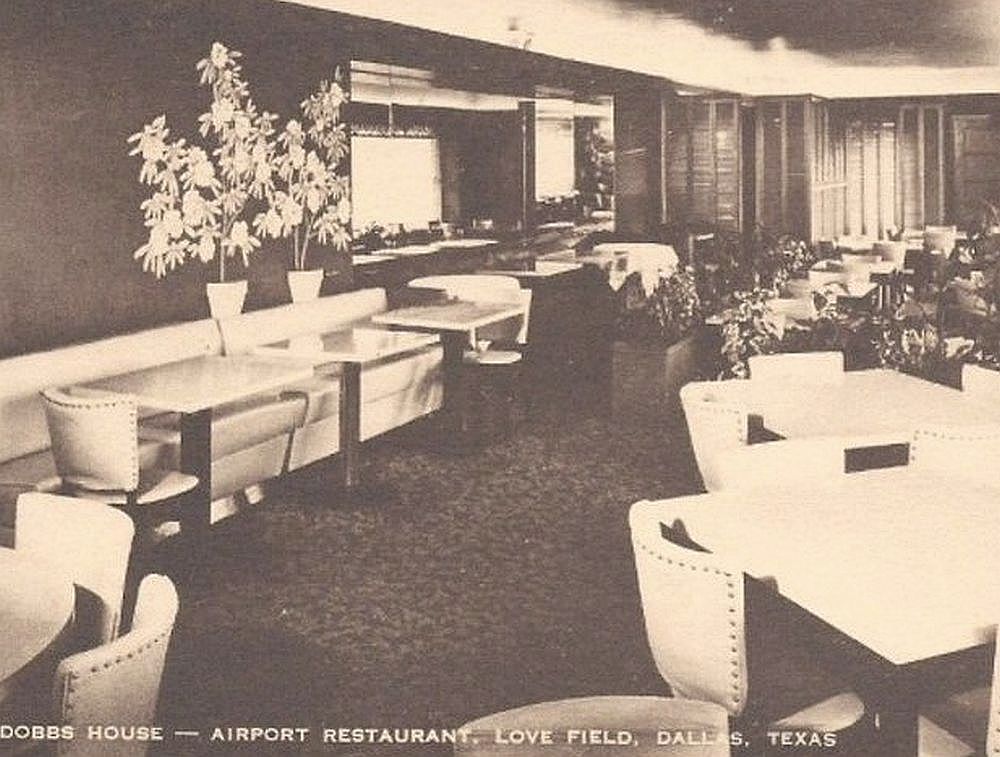
Dobbs House: Love Field’s Airport Restaurant

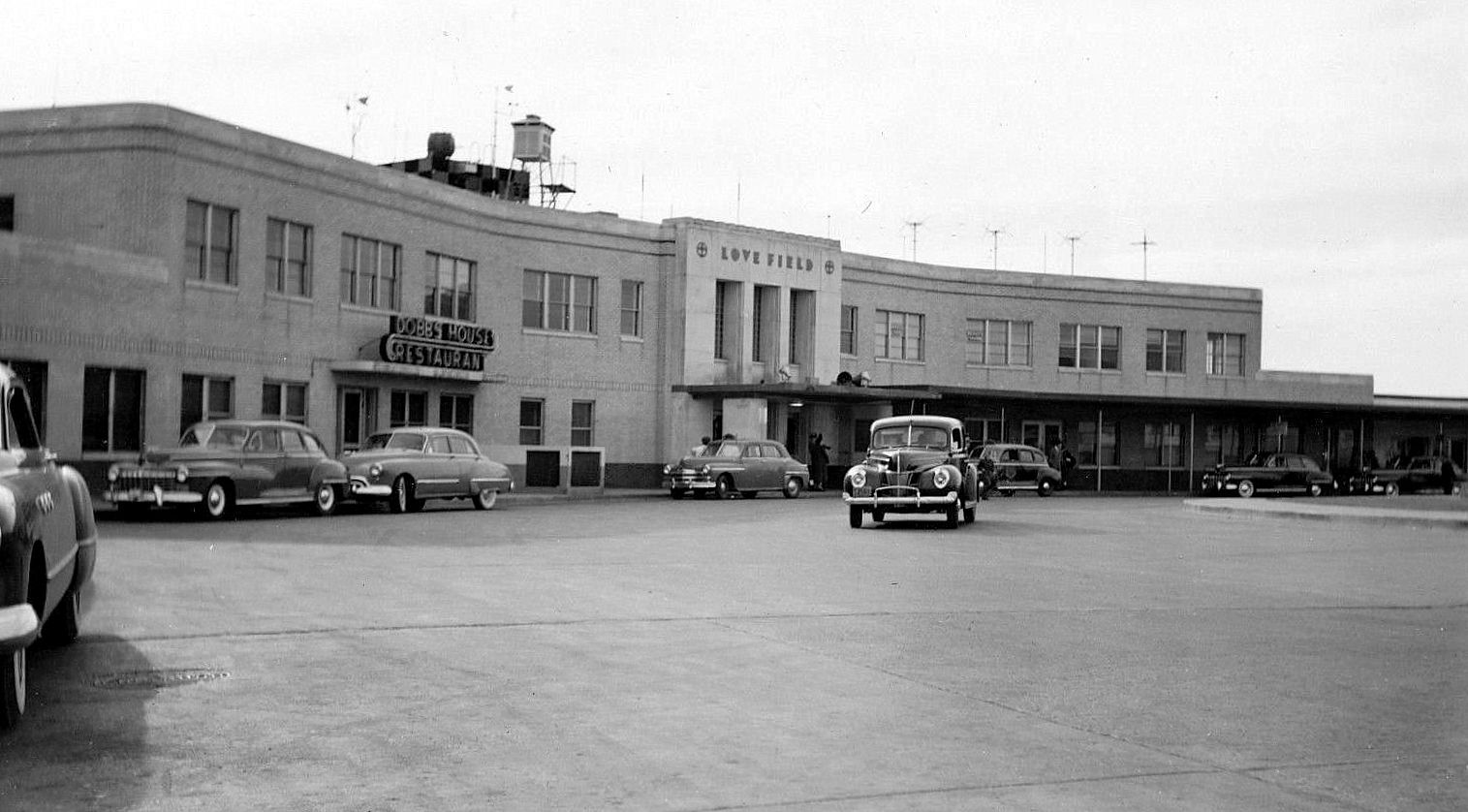
love-field_dobbs-house-restaurant_ebayDallasites’ favorite airport restaurant… (click for larger image)

by Paula Bosse

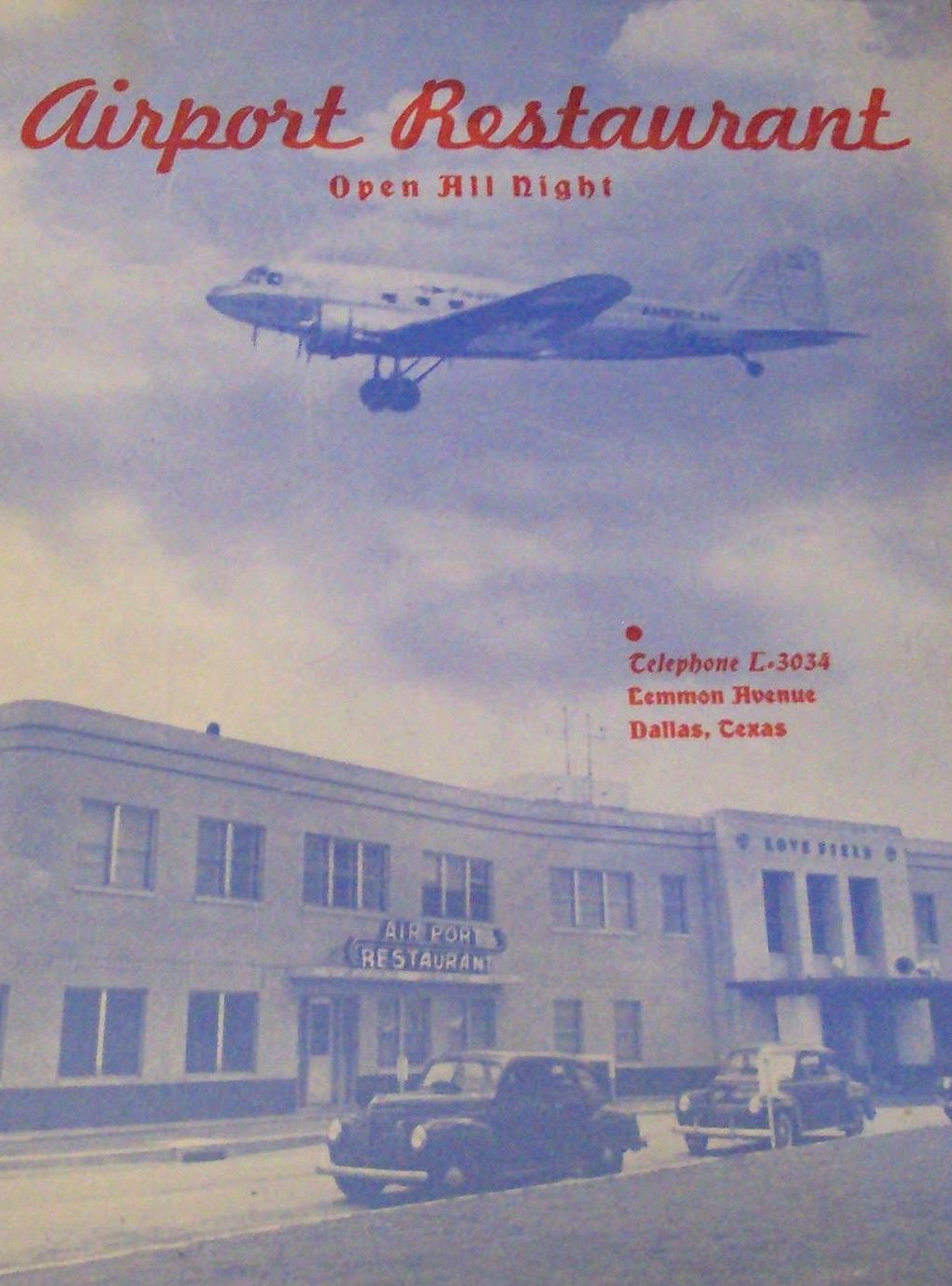
Dobbs House was a national restaurant and catering company, found chiefly in airports (although they did have non-airport restaurants, and at one point they had bought out the Toddle House chain). When the “new” Love Field terminal opened in 1940 (see the heart-stoppingly beautiful Art Deco front entrance at night, here), it had what was probably a very nice, perfectly serviceable, 24-hour restaurant. It was rather unimaginatively called “Airport Restaurant,” and it seated about 75 in the coffee shop and 100 in the dining room. And its “modern  blue and yellow leatherette furniture” was probably delightful.

love-field_airport-restaurant_menu_ebay_cropped

A lot of people probably enjoyed a hot cup of coffee while seated on that modern leatherette. But in 1944, the Hull-Dobbs company waltzed in and took over the restaurant and catering business and agreed to pay the city what seems like a miniscule $500 a month (about $7,000 in today’s money). The administration building, which housed the restaurant, was undergoing remodeling at the time, and I guess the city was giving the company something of a break. In 1945, though, Hull-Dobbs began to pay 5% of their gross revenue to the city, rather than a flat monthly fee. (I’m guessing that 5% was quite a bit more than $500.)

Business was good. REAL good. It was almost too good, because almost every newspaper article which mentioned the restaurant (called Dobbs House, part of a national chain) noted how busy it was and how it was almost impossible for a person to find an empty seat. It was known for its good food (see a 1955 menu here), and one of the main reasons it was always crowded was because local people dined at the restaurant, taking up precious seats intended for hungry travelers. Dallasites loved to drive out to the airport for a nice meal, followed by a leisurely couple of hours watching airplanes take off and land.

But, basically, Love Field had become a major metropolitan airport, and its success — and the resulting increase in traffic and the overall crush of humanity — meant that everyone was running out of space.

The airport had outgrown its beautiful 1940 Art Deco terminal, and a new, equally heart-stoppingly beautiful terminal opened in 1958. Dobbs House moved into its more spacious quarters with a freshly signed ten-year contract. …And by now they were paying a whole lot more than $500 a month. According to a January, 1957 Dallas Morning News article, the restaurant offered a high bid of just over $15,000 a month to retain the restaurant concession at the airport.

The restaurant and catering business were not all that the Dobbs company was running. Not only did they have a “swanky” restaurant at the new terminal, they also had a non-swanky restaurant and a basement cafeteria. They also had, at various times, control of the following concessions: cigar, shoeshine, gift shop (including apparel, candy, and camera shops), and … parking (!). This was on top of their land-office business catering and restauranting. James Dobbs knew a thing or two about business — he didn’t get fantastically wealthy just selling 15-cent cups of coffee and black-bottom pie….

dobbs-house_love-field_love-field-FB-page
via Dallas Love Field Facebook page

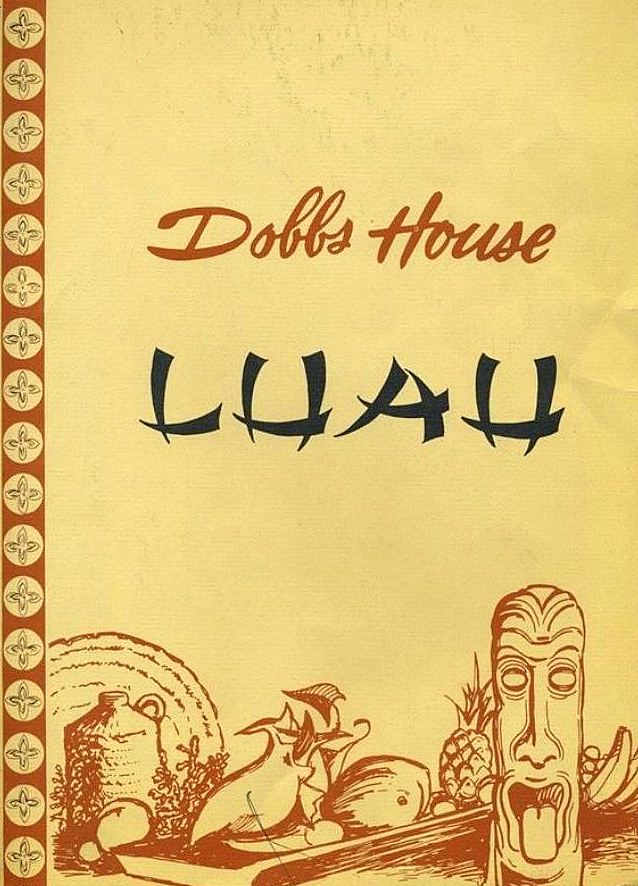
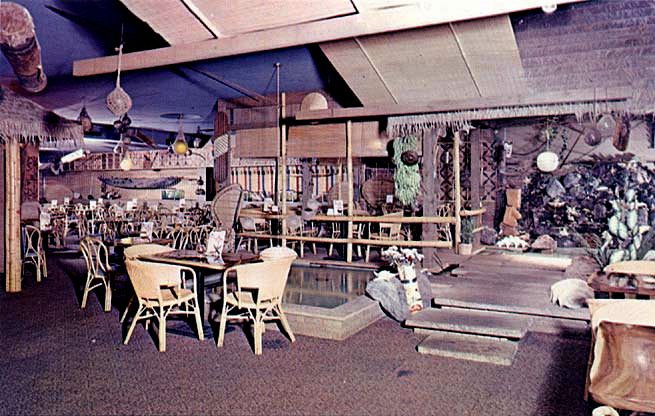
In 1958, Dobbs House opened the exotic Luau Room, which served Polynesia cuisine. This was another Dobbs eatery that was very popular with Dallasites, and it lasted many, many years.

dobbs-house_luau_menu_ebay
via eBay

The Luau Room was a sort of early “theme” chain from the Dobbs people, and it was a feature at several Dobbs House-served airports. The photo below might be the Dallas location. Might be Charlotte, or Orlando, or Houston.

dobbs-house_luau
via Tiki Central — check out the comments

Dobbs House  was a fixture of the Dallas airport/restaurant scene for a surprisingly long time. Dobbs House was still at Love Field in the 1980s — possibly into the ’90s. And when Dallas-Fort Worth International Airport opened, the Dobbs people slid right in. DFW was huge — and they had control of everything. (Alcohol sales alone must have been enormous!)

For D/FW’s first two decades, a single company operated all of the bars and restaurants that generate about $40 million in sales each year. Dobbs House had the food and beverage contract from 1974 until 1993, when Host Marriott Services took over the operations. (DMN, May 22, 1996)

Dobbs House was in business here for almost 50 years. That’s a pretty good run for a restaurant in Dallas. (And I hear their cornbread sticks were to die for.)

***

Sources & Notes

Top photo showing Dobbs House Restaurant at Love Field found on eBay several months ago.

Airport Restaurant menu (ca. 1940-1944) found on eBay, here.

The Dobbs House cornsticks recipe is contained in the 1960 book How America Eats by Clementine Paddleford — used copies are out there, but they are surprisingly expensive. But from what I hear, if you want that recipe, it’s probably worth it!

An interesting side note about James K. Dobbs, head of the company that bore his name: even though he was a resident of Memphis, he actually died in a Dallas hospital in September, 1960, having been sent here for asthma treatment, and having recently suffered his second heart attack. He was 66. His company had grown to include about 125 restaurants at the time of his death. He had also made huge sums of money in automobile dealerships.

Photos and clippings are larger when clicked.

*

Copyright © 2017 Paula Bosse. All Rights Reserved.


The Stage Door Restaurant: Elm Street’s “Home of Lox and Bagels” — 1965-1968

stage-door_youtube_1966A Reuben sandwich sings to me, like a siren to a sailor…

by Paula Bosse

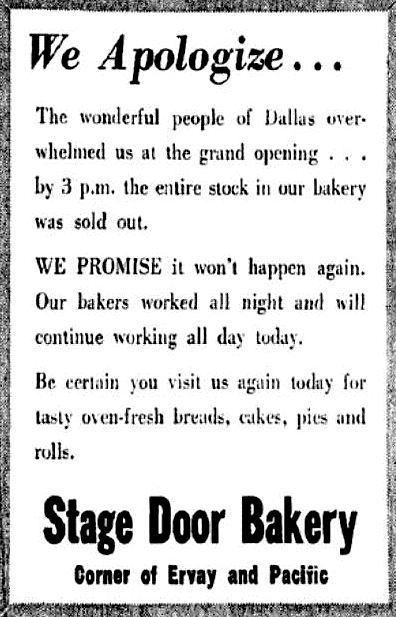
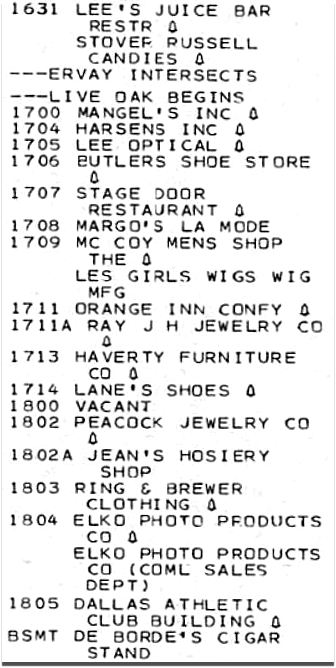
Why does Dallas have so few delis? Here’s one that seemed to be pretty popular in the 1960s: the Stage Door Restaurant and Delicatessen (and bakery), located at 1707 Elm, between the Palace Theater and the Dallas Athletic Club. It opened in June 1965 and lasted until the end of 1968 (when it was replaced by a restaurant called King Beef). I doubt there was any connection with the famous Stage Deli in New York, but manager Milton Stackel certainly had kosher cred of his own, having worked for twenty years at Grossinger’s, the legendary Jewish resort in the Catskill Mountains. I’m not sure how he found himself operating an eatery in downtown Dallas, Texas, but I’m glad he was here.

To any Milton Stackel-like entrepreneurs out there reading this:

DALLAS NEEDS DELIS!!


Authentic Jewish delicatessens!

Please!

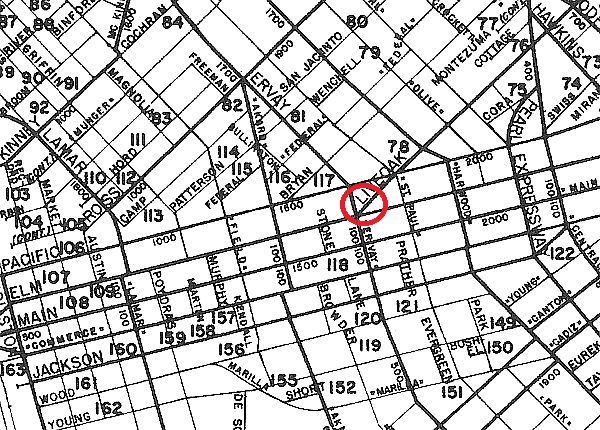
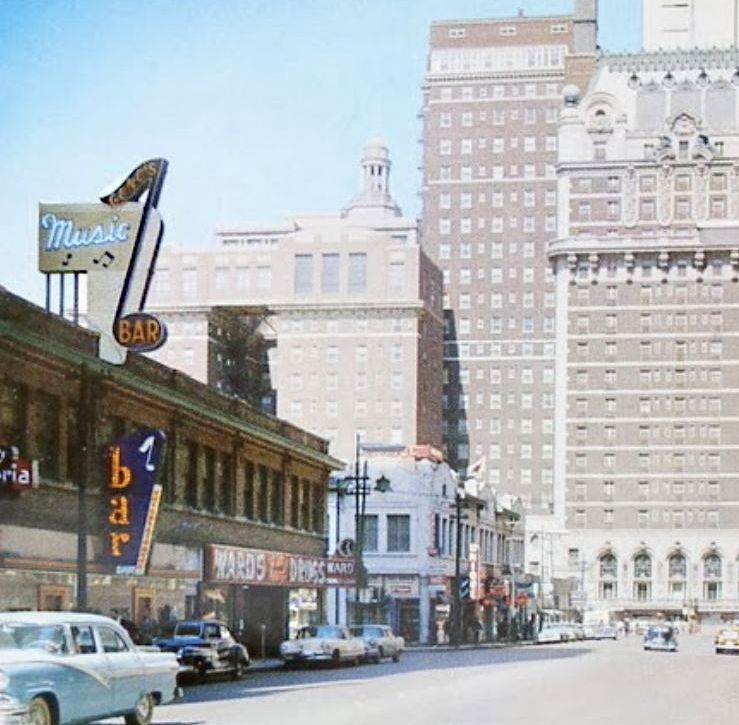
The apparently quite popular eatery was located at/near the old five-point Elm-Ervay-Live Oak intersection (seen here a dozen years earlier — the Stage Door would later be between Lee Optical and Haverty’s). There were two dining areas, one of which was The Playbill Dining Room which served an “international-type cuisine in a Gay Nineties atmosphere.” There was also a thriving take-out deli and the nearby bakery. And now? Come on, Dallas restaurateurs! Get to work!

*

stage-door-bakery_dmn_060465
June 1965

stage-door-restaurant_texas-jewish-post_122365_portal
Texas Jewish Post, Dec. 23, 1965

This ad shows the bakery entrance next door.

stage-door-bakery_dmn_112465
Nov. 1965

stage-door_dmn_112564

stage-door-restaurant_texas-jewish-post_122365_portal-det
Texas Jewish Post ad detail, Dec. 23, 1965

stage-door_1707-elm_1952-mapsco
1952 Mapsco

stage-door_1966-directory
1966 Dallas directory

1700-block-elm_1966-directory
Elm Street, 1966 Dallas directory

***

Sources & Notes

Top image is a screengrab from a YouTube video, here, containing footage shot downtown by Lawrence W. Haas on Memorial Day, 1966.

Read more about the opening of the new business (and see a photo of the interior) in the Dallas Morning News article “Stage Door Restaurant Makes Debut in Dallas” (DMN, June 3, 1965).

*

Copyright © 2017 Paula Bosse. All Rights Reserved.

Gene’s Music Bar, The Lasso Bar, and The Zoo Bar

genes-music-bar_dallas-memorabiliaGene’s Music Bar, S. Akard Street (click for larger image)

by Paula Bosse

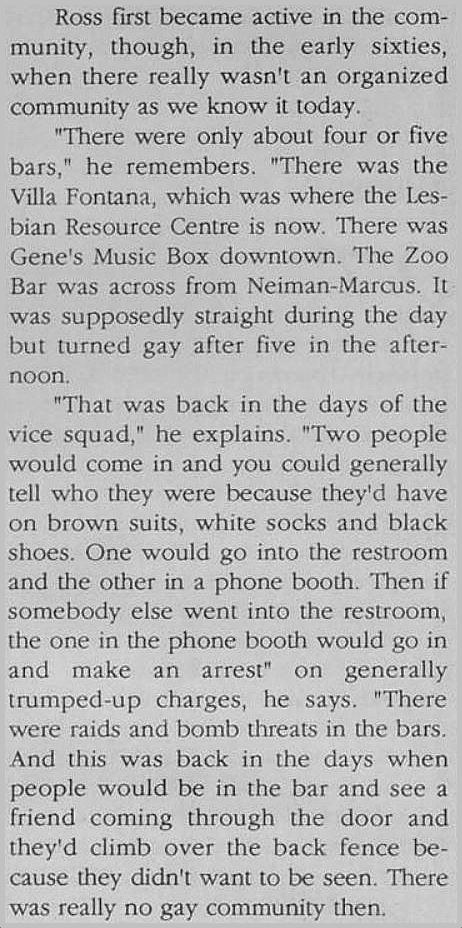
In Dallas’ pre-Stonewall days, there were only a handful of gay bars in the city, and they weren’t widely known beyond those who frequented them. Those were the days when “homosexual behavior” was illegal, and vice raids on gay bars and clubs were frequent occurrences. In an interview with the Dallas Voice Alan Ross remembered what the bar scene was like in Dallas in those days (click for larger image):

gay-dallas_dallas-voice_092190_alan-ross
Dallas Voice, Sept. 21, 1990

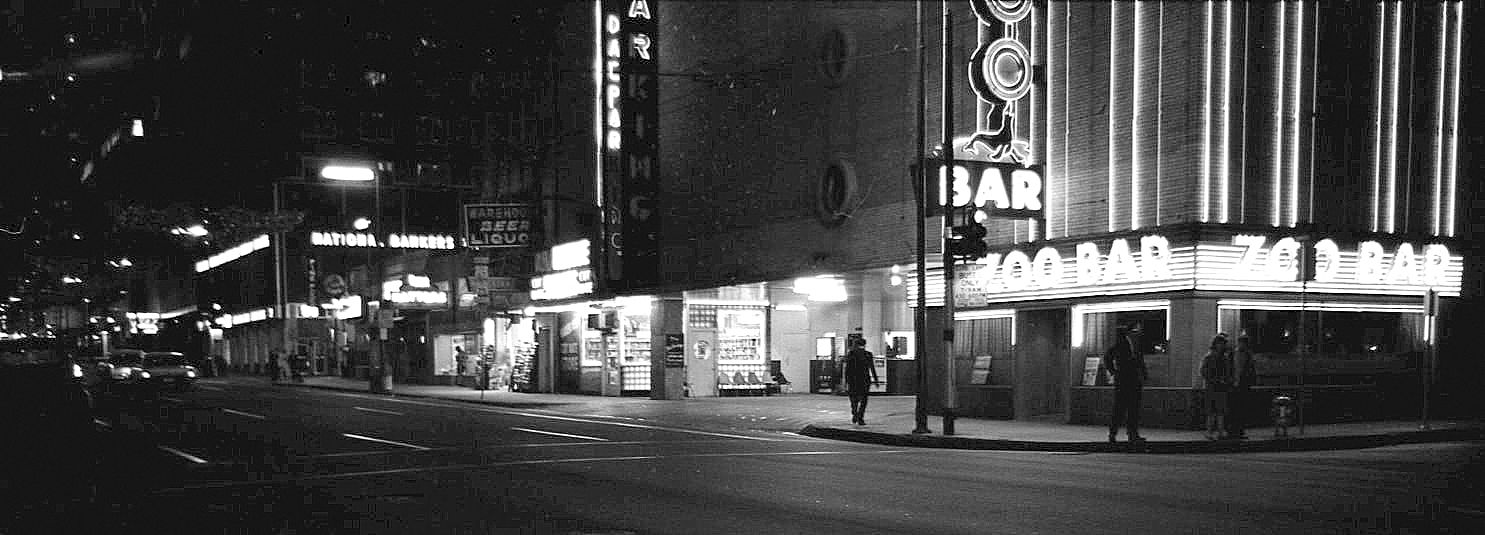
There was the well-appointed Le Boeuf Sur Le Toit (later renamed Villa Fontana), one of Dallas’ earliest gay bars, located on Skiles Street near Exall Park in the area now known as Bryan Place, and there were rougher, seedier places, generally downtown. Three of those downtown bars (which apparently catered to a “straight” clientele during the day and a gay clientele at night) were Gene’s Music Bar and The Lasso — both on S. Akard, in the shadow of the Adolphus Hotel — and The Zoo Bar, on Commerce, “across from Neiman-Marcus.”

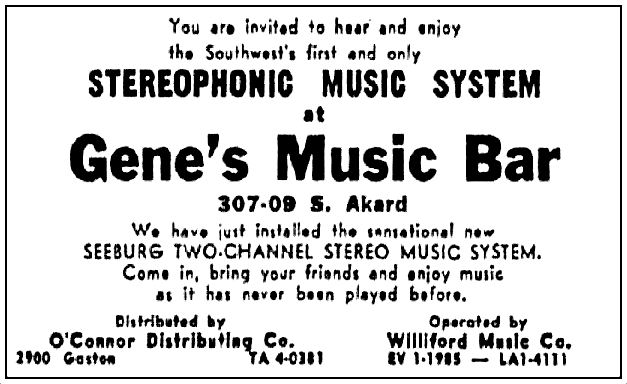
Gene’s Music Bar (pictured above) at 307-09 S. Akard began as a place where hi-fi bugs could sip martinis and listen to recorded music played on “the Southwest’s first and only stereophonic music system.” Not only did it have the sensational Seeburg two-channel stereo system, but it also boasted one of the best signs in town.

genes_dmn_110958
Nov. 1958

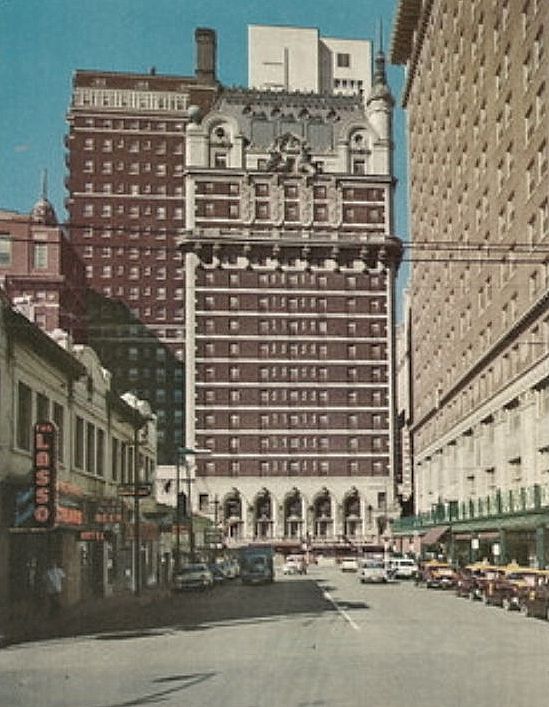
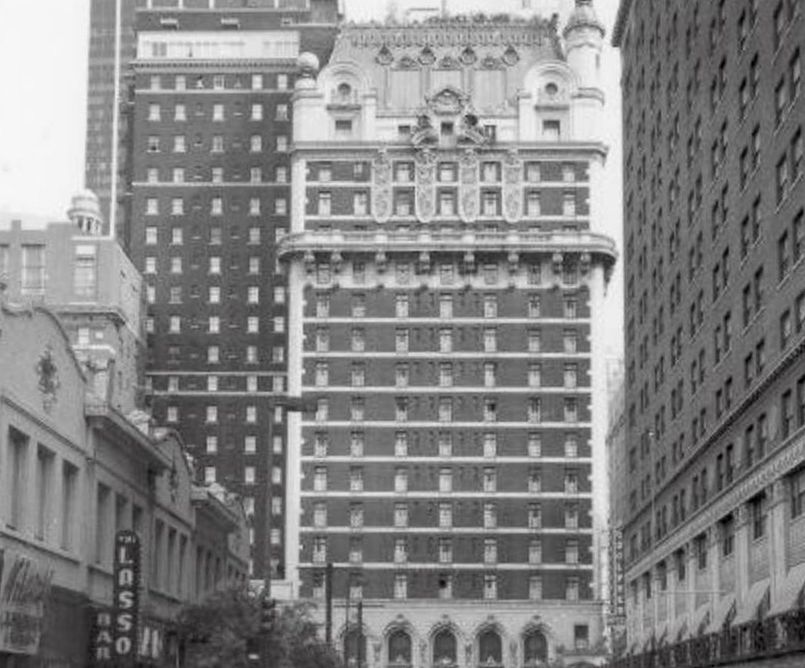
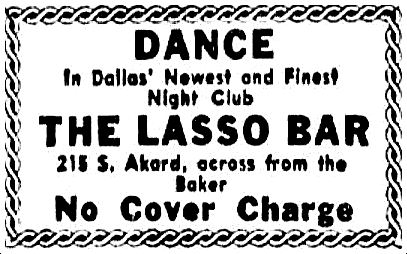
The Lasso Bar at 215 S. Akard was in the next block, across from the classy Baker Hotel, and a hop, skip, and a jump from the elegant Adolphus. Its proximity to the impressive Adolphus meant that the Lasso snuck its way into lots of souvenir picture postcards and Dallas Chamber of Commerce publicity photos. Its sign was pretty cool, too.

lasso-bar_postcard

adolphus_lasso-bar_tx-hist-comm

lasso-bar_dmn_031358
March, 1958

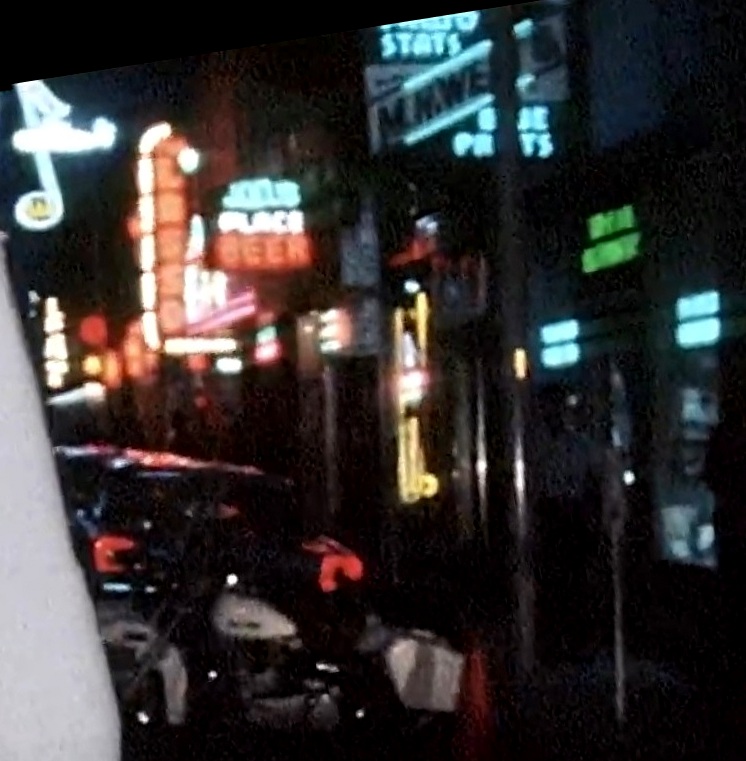
The image below gives you an idea of what that block looked like at night, neon blazing. (This super-blurry screenshot is from WFAA-Channel 8 coverage of 1969’s Texas-OU weekend, here — at 6:16 and 9:13.)

lasso-bar_jones-film_WFAA_101169

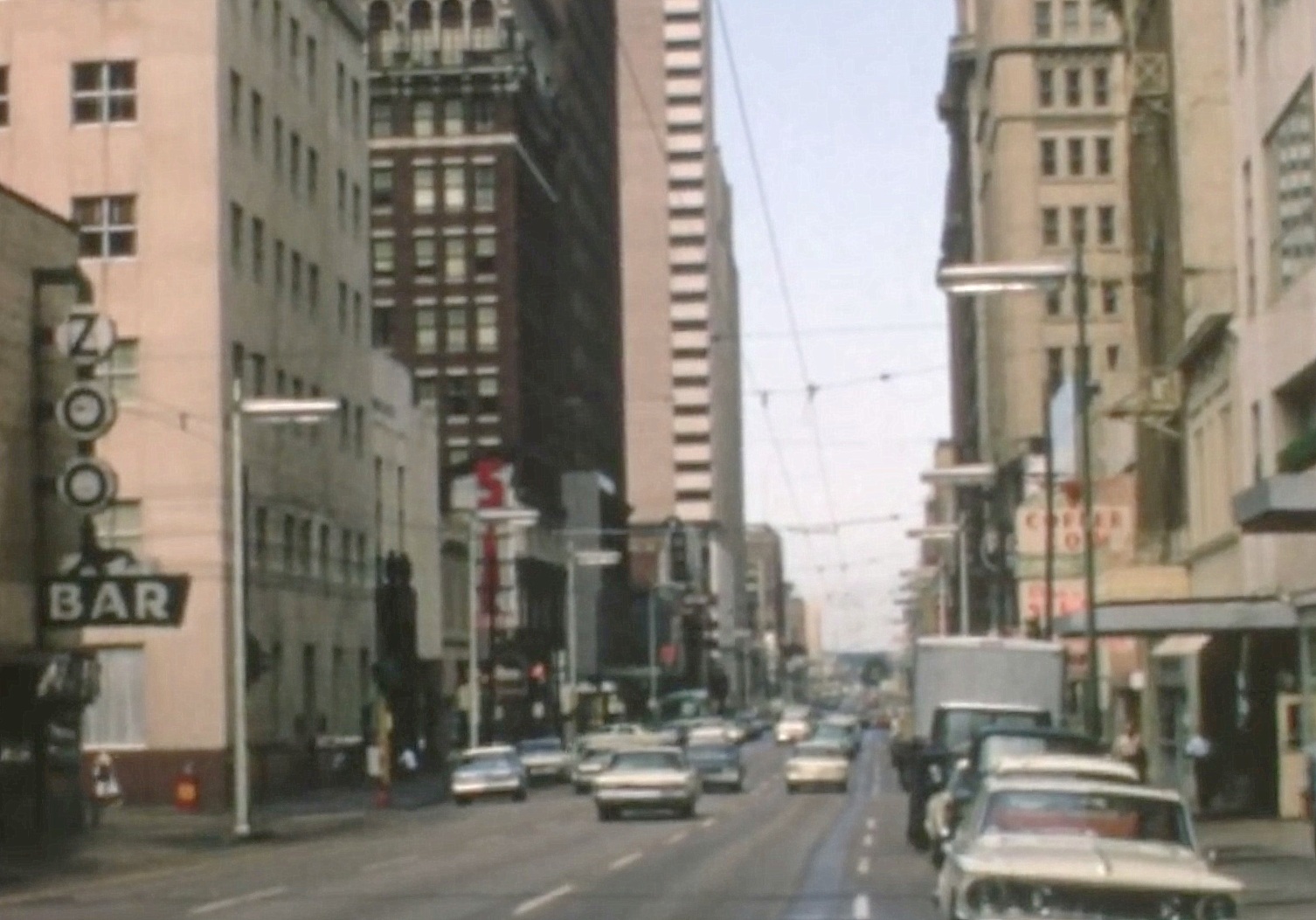
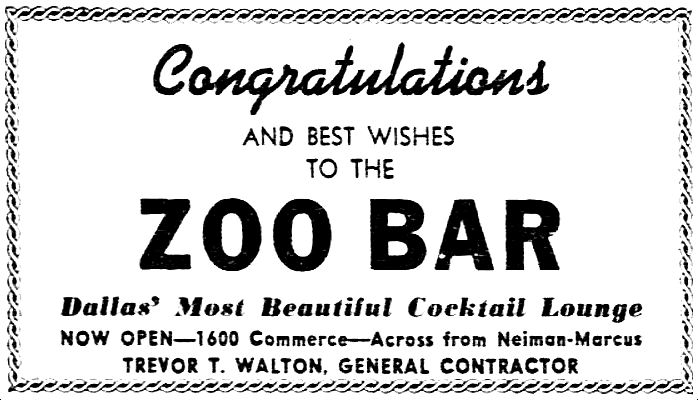
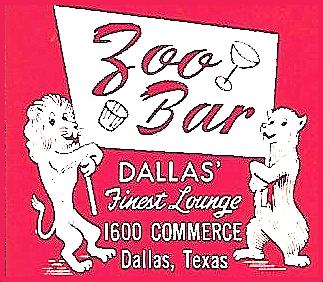
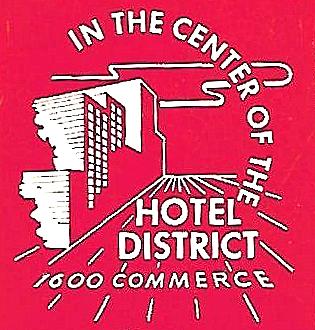
The Zoo Bar at 1600 Commerce began as a cocktail lounge and often had live piano music. It was across from Neiman’s and it was 3 blocks from Jack Ruby’s Carousel Club (downtown Dallas ain’t what it used to be). It also had a better-than-average sign.

zoo-bar_youtube_19661966

zoo-bar_dth-photo_112263_sixth-floor-museum_portal_croppedNov., 1963

zoo-bar_dmn_092752
Sept., 1952

zoo-bar_matchbook_ebay_2     zoo-bar_matchbook_ebay_1

These three downtown bars, popular as hangouts for gay men, had their heyday in the 1960s and ’70s. By the mid 1970s, the LGBT scene was shifting to Oak Lawn. An interesting article about the uneasy relationship between the “old” Oak Lawn and the “new” Oak Lawn can be found in a Dallas Morning News article by Steve Blow titled “Last Oak Lawn Settlers Brought Controversy” (Dec. 9, 1979).

***

Sources & Notes

Top photo of Gene’s Music Bar is from the blog Old Dallas Stuff.

Color photo of the Lasso and the Adolphus is from an old postcard. Black-and-white photo of the Lasso and the Adolphus is from the Texas Historical Commission site, here.

Blurry shot of Gene’s Music Bar and the Lasso Bar at night is a cropped screenshot from daily footage shot by WFAA-Channel 8 on Oct. 11, 1969 — the night before the Texas-OU game; from the WFAA Newsfilm Collection, G. William Jones Film and Video Archive, Hamon Arts Library, SMU.

Color image of the Zoo Bar and Commerce Street is a screenshot from home movie footage of the 1966 Memorial Day parade in downtown Dallas, shot by Lawrence W. Haas, viewable on YouTube. Black-and-white photo of the Zoo Bar from the Sixth Floor Museum Collection, via the  Portal to Texas History, here (I’ve cropped it). Zoo Bar matchbook from eBay.

Read more about Dallas’ gay bar scene in the article I wrote for Central Track, “Hidden in Plain Sight, A Photo History of Dallas’ Gay Bars of the 1970s,” here.

More on the the persistent arrests and police harassment that went on in gay clubs in Dallas for many, many years can be found in the Dallas Voice article by David Webb, “DPD Vice Unit Wages 50-Year War Against Gay Men” (Aug. 3, 2007), here.

*

Copyright © 2016 Paula Bosse. All Rights Reserved.


The Moskovitz Cafe

moskovitz-cafe_winegarten-schechterA stool is waiting for you… (click for larger image)

by Paula Bosse

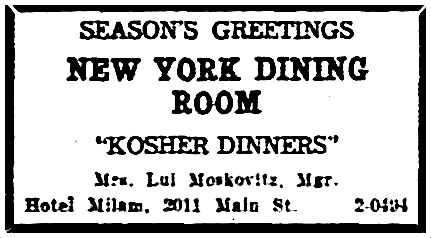
The Moskovitz Cafe was located at 2216 Elm Street, between S. Pearl and what is now Cesar Chavez Blvd., in an area of predominantly Jewish businesses. The restaurant served “Kosher and American cooking” and was owned and run by Lui Moskovitz, a Romanian immigrant, and his Polish-born wife, Eva. Eva, recently widowed, had arrived in Dallas in about 1928 with her three children and seems to have married Lui that same year. They had run another restaurant before the Moskovitz Cafe: the New York Kosher Dining Room on Commerce had been located across from the Adolphus Hotel for several years before it moved to 2011 Main, around the corner from City Hall. After that closed, they ran the Moskovitz Cafe between about 1937 and about 1944.

In 1945 there was no Lui or Eva Moskovitz in the Dallas directory. There was, however, an Eva Haberman — it appears that the Moskovitzes had split, Lui had left town, and Lui’s ex-wife had taken back the name of her late first husband. At this time she must have been about 60 years old, but she worked for the next few years as a department store seamstress and lived with one or more of her three sons from her marriage to Nathan Haberman. She died in April, 1961. Not only is there no trace of Lui after his time in Dallas, there is also no trace of 2216 Elm.

moskovitz_dmn_0101361936 ad

moskovitz-cafe_elm-st_1943-directory
Elm St. businesses, 1943 Dallas directory (click for larger image)

moskovitz_map
Location of Moskovitz Cafe (det. of a 1919 map)

***

Sources & Notes

Photo appeared in the book Deep in the Heart: The Lives & Legends of Texas Jews, A Photographic History by Ruthe Winegarten and Cathy Schechter (Austin: Eakin Press, 1990); from the collection of the Dallas Jewish Historical Society.

I’m not sure who the people in the photo are. When the Moskovitz Cafe opened, Lui would have been in his mid-40s and Eva would have been in her early 50s. UPDATE: Per the comment below (from Eva’s grandson), the woman in the white apron is the proprietress, Eva Moskovitz, and the man at the cash register is her son, Jack Haberman.

More information about Mrs. Eva Haberman can be found in her obituary, published in The News on April 19, 1961.

All images larger when clicked.

*

Copyright © 2016 Paula Bosse. All Rights Reserved.


Bull Pen Barbecue/Austin’s Barbecue — 1949-2000

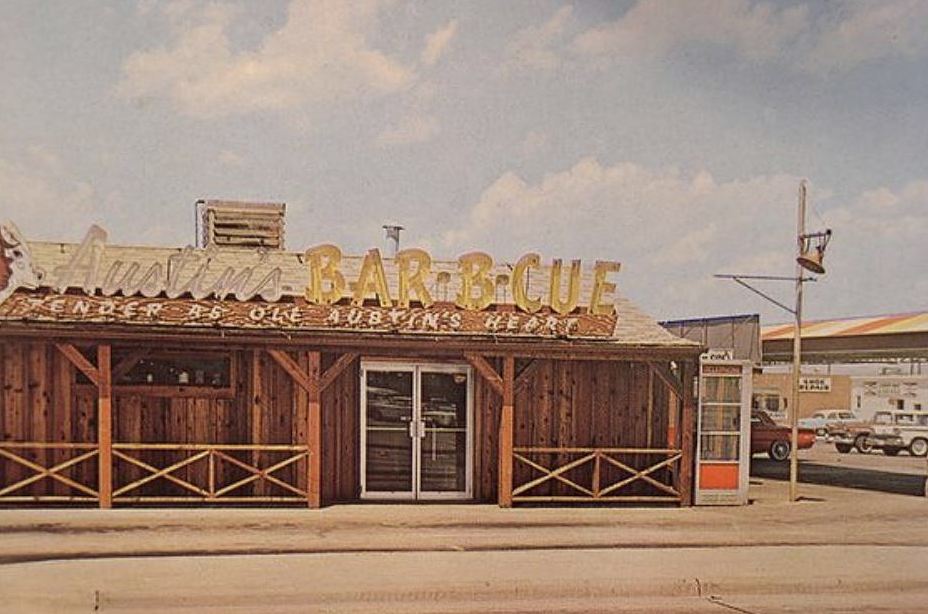
austins-barbecue_postcard_pinterest“As Tender as Ole Austin’s Heart…”

by Paula Bosse

One of my major failings as a Dallasite is that I don’t know Oak Cliff. Like at all. Every time I go over there, I get lost. I can’t remember my family ever going to Oak Cliff when I was a kid, except to visit the zoo. This explains why I had no idea how important a cultural landmark Austin’s Barbecue was when I posted a bunch of Oak Cliff ads the other day. That post has been shared hundreds and hundreds of times now and, inevitably, the only thing people mention — and rhapsodize about — is Austin’s Barbecue. …I had no idea!

The famed BBQ joint at the northeast corner of Illinois Avenue and Hampton Road opened in 1949 as B & G Barbecue but soon became known as Bull Pen Barbecue, run jointly by owners Bert Bowman and Austin Cook. In 1956 or 1957, another Bull Pen opened in Arlington. After Oak Cliff went dry (a dark day for many Oak Cliffites), Bowman — who firmly believed that BBQ and beer were a match made in heaven — left for Arlington and Cook stayed in Oak Cliff and changed the restaurant’s name to Austin’s Barbecue. (“Bull Pen Barbecue” was still appearing in ads as late as Oct. 1957 — the official name changeover seems to have  happened in 1958.)

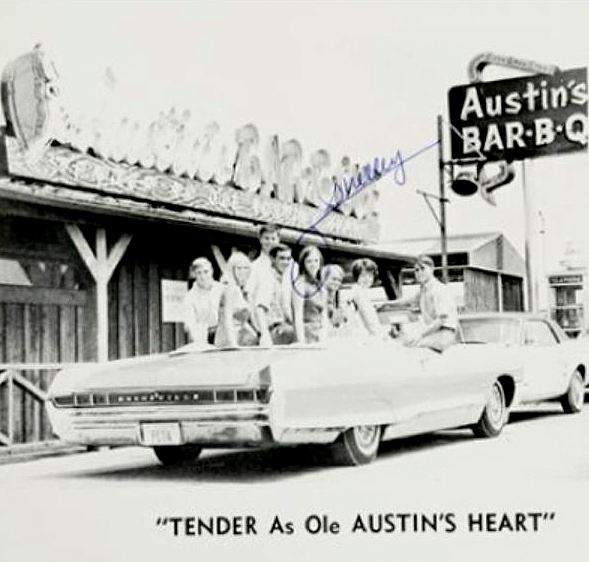
austins-bar-b-q_sunset-high-school_1967-yrbk1967 Sunset High School yearbook

*

The following memory of starting the business was apparently written by Austin Cook in 1990:

Dear Family & Friends,

I will try to tell you a little more about my being in the restaurant business. We borrowed $10,000 and bought out some one and it was B and G Barbecue. You see I always spell out Barbecue because when I went in business they hadn’t started abbreviating it like it is today.

After we had been there awhile we changed the name to The Bull Pen. Our slogan was “Come in and Shoot the Bull with Austin and Bert.” We used that name until they voted beer out of Oak Cliff. That really set us back, but maybe it was the best thing for us. We put another place in Arlington and that place was going pretty good. My partner wanted to get rid of the place in Oak Cliff. I traded him my part of the one in Arlington for his part in the one in Oak Cliff. Everyone said I was crazy.

When we bought that first place it was way out in the country, but they were building a bunch of houses not too far away. There was an airport across the street from the place. They kept talking about building a shopping center where the airport was. I remember the first day we ran a hundred dollars, and I thought we would never make it.

We started making money and we paid that ten thousand dollars back and we drew fifty dollars a week just like I was making in the grocery store. We started out with a barbecue sandwich and a hamburger. Then we started adding different things until we had a menu. We started getting those workers in the houses, and the business took off. We had beer also to go with the barbecue. My mother wasn’t too happy about that, but Dad said if that was the way I wanted to make my living it would be all right. In about a year or two we had a customer make us up a menu and we put in Barbecue plates for one dollar and twenty five cents. When I left they we were getting $4.99 for them. After I left I think they went to over seven dollars.

They always told me that you weren’t a success until you were in debt a hundred thousand dollars, and I went to the bank and borrowed all they would let me have. Then I went to my landlord and sold him the idea that I wanted to improve his property, and he loaned me the balance I needed to remodel, and I built a restaurant that held a hundred and twenty-five. Many times I was almost broke and didn’t know what I was going to do, but something always happened and I came out of it.

*

Both the Bull Pen in Arlington and Austin’s in Oak Cliff were successful and long-lived. Austin Cook retired at the end of 1993, and the business was taken over by his stepson, John Zito who had already been working at the restaurant for several years. Austin’s Barbecue closed in July, 2000, and the building was demolished soon after, replaced with an Eckerd drug store (now a CVS). Bert Bowman (born Glynbert Lee Bowman) died in 1989 at the age of 66; Austin O. Cook died at in 2006 at 86. And now I kind of feel like I know them, and I’m really sorry I never sampled their sandwiches.

*

Below, a Bowman and Cook timeline (most pictures and clippings are larger when clicked).

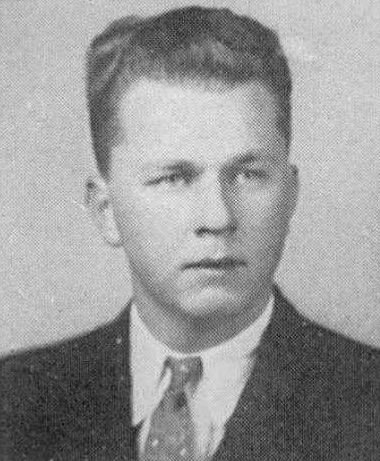
austin-cook_sunset-high-school_1937Austin Cook, Sunset High School, 1937

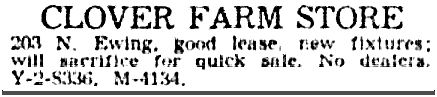
Before Cook and Bowmen met — probably around 1947 — each had been dabbling in different businesses. In early 1947, Cook leased a Clover Farm Store building at 203 N. Ewing and opened the Libby & Cook grocery with partner Lendal C. Libby.

LIBBY-COOK_dmn_021047February, 1947

LIBBY-COOK_1947-directory1947 Dallas directory

Bert Bowman worked there as a meat-cutter.

bowman_1947-directory_GROCERY-w-AUSTIN1947 Dallas directory

The grocery store was in business at least into 1949, the year that Bowman and Cook decided to ditch the groceries and start their own business at 2321 W. Illinois, in a part of Oak Cliff which was just starting to be developed. Their BBQ place was originally called B & G Barbecue, which — according to Cook’s letter above — was the name of the restaurant he and Bowman bought out. I guess they felt it was easier to keep the name for awhile.

b-and-g-1951-directory1951 Dallas directory

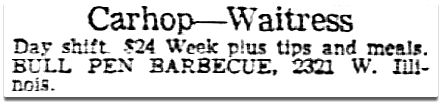
The name “Bull Pen Barbecue” didn’t come until later. In fact, the first appearance of the Bull Pen name associated with this address doesn’t show up in local newspaper archives until a want-ad placed in the summer of 1952.

bull-pen_dmn_082652_FIRSTAugust, 1952

A probably related “Bull Pen No. 2” opened in South Dallas in 1953. It appears to have been very short-lived.

bull-pen-no-2_dmn_100853
October, 1953

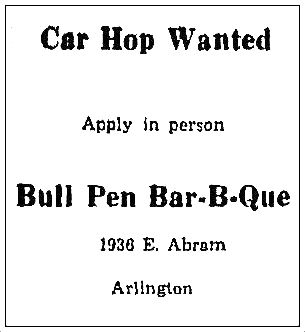
By the fall of 1957, Cook and Bowman had opened another Bull Pen — this one in Arlington, and this one a success.

bull-pen_arlington_grand-prairie-daily-news_091557
September, 1957

And then Oak Cliff went dry, the worst thing that could happen to a restaurant that sold a lot of beer. Similar businesses which relied heavily on beer sales began to desert Oak Cliff. Bowman did not think their original drive-in could survive, but Cook disagreed. Bowman sold his half-interest in the Oak Cliff location to Cook, and Cook sold his half-interest in the Arlington location to Bowman. Cook changed the name of his now solely-owned restaurant to Austin’s Barbecue, and his success continued, despite the fact that he could no longer sell beer. He was doing well enough that, in 1961, he opened a second location, on Harry Hines across from Parkland Hospital (a location which lasted through 1964).

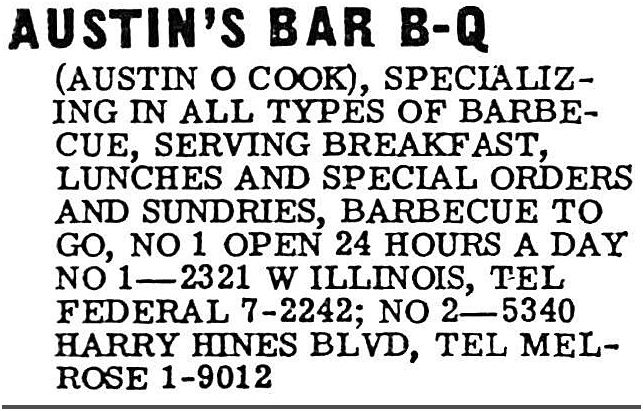
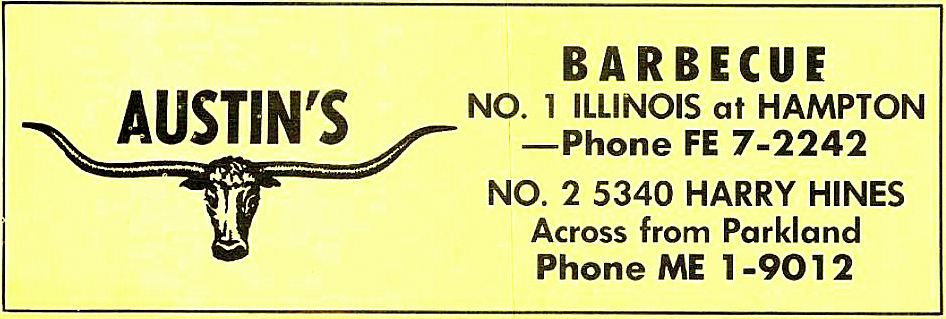
austins-barbecue_1962-directory_two-locations
1962 Dallas directory

austins-barbecue_1963-directory_two-locations_ad
1963 Dallas directory

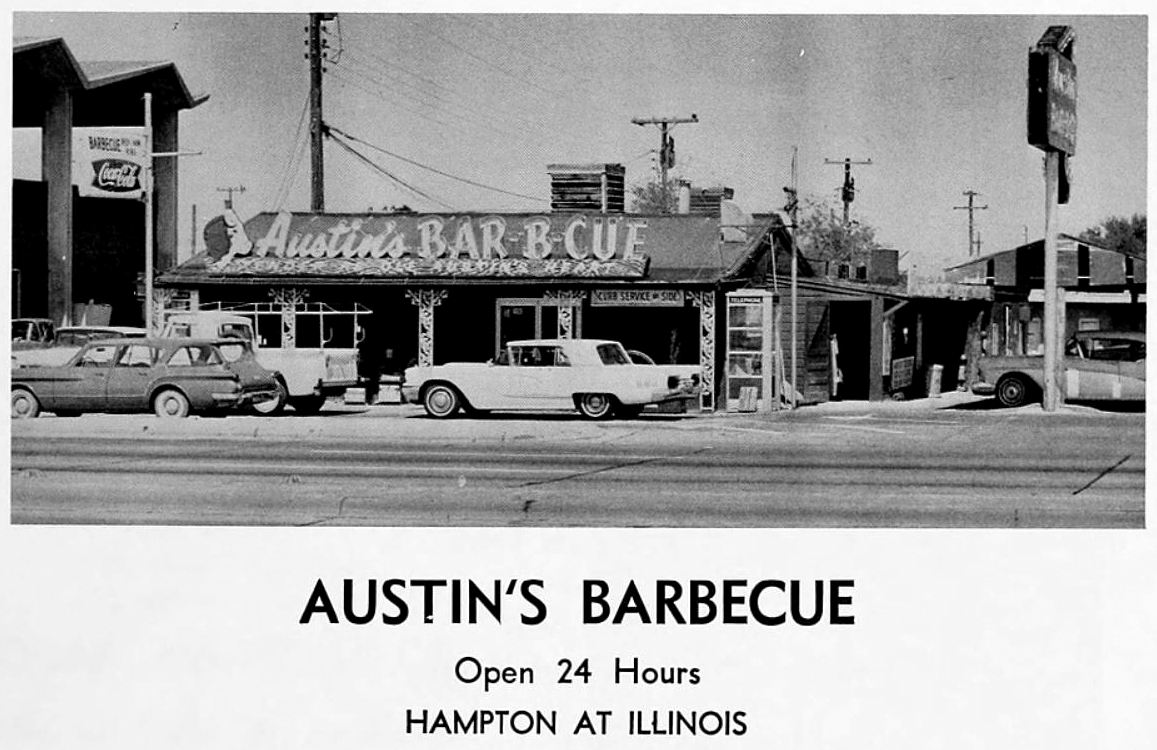
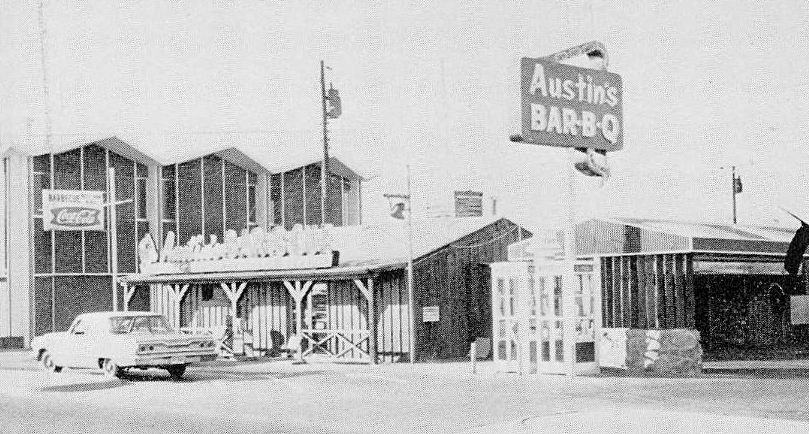
By 1963, Austin’s was a well-established teen hang-out and wisely placed ads in Oak Cliff high school annuals. Apparently everyone went there!

oak-cliff_austins_bar-b-cue_kimball-yrbk_19631963 Kimball High School yearbook

austins-bar-b-q_sunset-high-school_1964-yrbk.det1964 Sunset High School yearbook

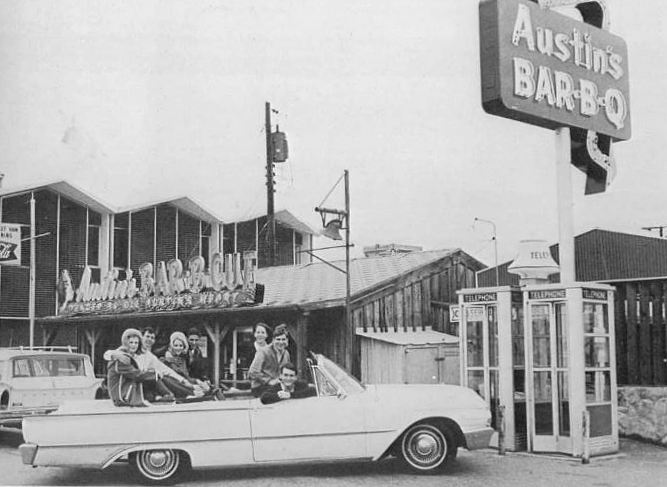
austins_car-teens_flickr-coltera
Date and source unknown, via Flickr

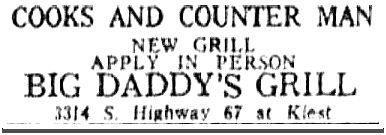
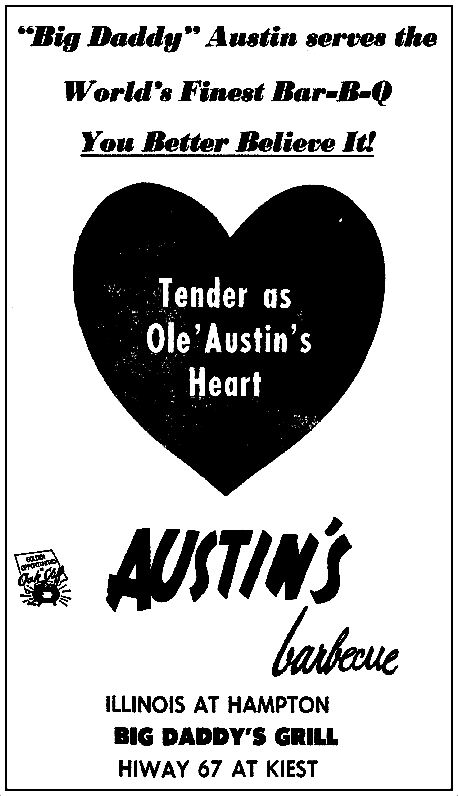
In 1964, Cook — known as “Big Daddy” — opened another restaurant, this one called Big Daddy’s Grill.

big-daddys_dmn_063064June, 1964

austins-barbecue_dmn_081466-adAugust, 1966

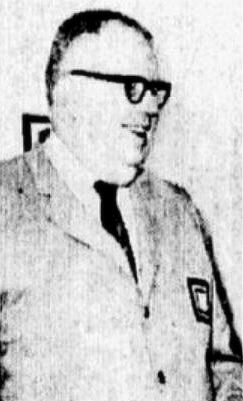
The restaurant was a bona fide Oak Cliff landmark, and Cook was an active participant in community business affairs. Below, a detail of a photo showing Cook as a member of the Oak Cliff Chamber of Commerce.

austin-cook_dmn_082568-photo-det
late 1960s

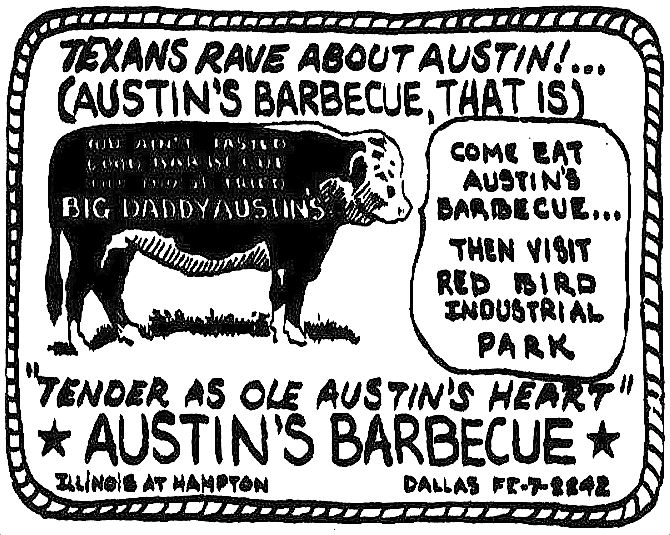
Cook participated in a series of Oak Cliff Chamber of Commerce campaigns and even included oddities like “Come eat Austin’s barbecue… and then visit Red Bird Industrial Park” in his ads. Make a day of it!

austins-barbecue_092968
September, 1968

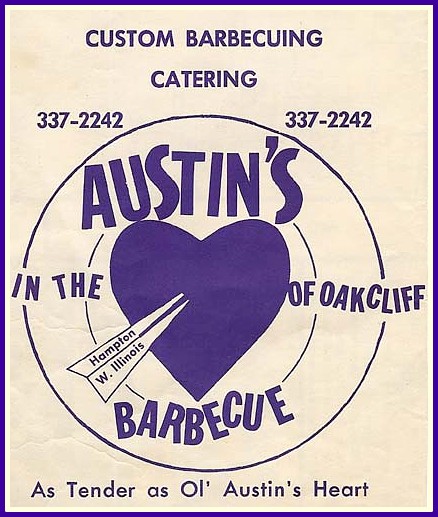
ad_austins-barbecue
via OakCliff.org

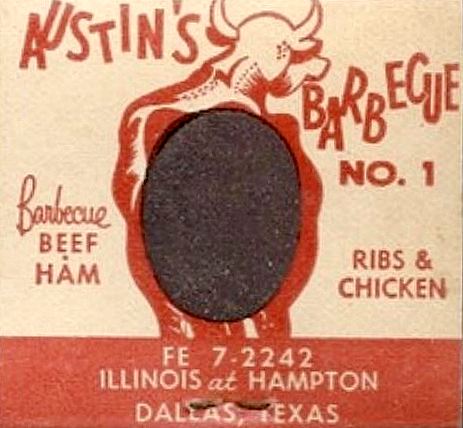
austins_matchbk_flickr_coltera
via Flickr

***

Sources & Notes

Color postcard at the top found on Pinterest, here.

The letter from Austin Cook was quoted on the DHS Phorum, here. More from the Phorum on The Bull Pen/Austin’s is here.

More can be found in the Dallas Morning News archives in the following stories:

  • “Austin’s Bar-B-Q Grows With Oak Cliff” (DMN, Aug. 14, 1966)
  • “Barbecue To Go — Staff, Customers Mourn Closing of Oak Cliff Institution” (DMN, July 13, 2000)
  • “Closed But Not Forgotten — Oak Cliff Eatery Marks Half-Century of Barbecue With Memorable Auction” (DMN, Aug. 27, 2000)
  • “John P. Zito — Operated Oak Cliff Landmark Austin’s Barbecue For 19 Years” by Joe Simnacher (DMN, Oct. 14, 2003)

Read the obituaries of Bert Bowman (1989) and Austin O. Cook (2006) here.

The Oak Cliff Advocate article “A Look Back at Austin’s Barbecue” by Gayla Brooks is here (with tons of memories from readers in the comments).

Not mentioned in this post is the connection of Officer J. D. Tippit (who moonlighted as a keeper of the peace at Austin’s) and other tangential/coincidental associations to the Kennedy assassination. It’s well documented elsewhere. Google is your friend.

*

Copyright © 2016 Paula Bosse. All Rights Reserved.

The 101 Bar: Patrick Hannon, Prop. — ca. 1917

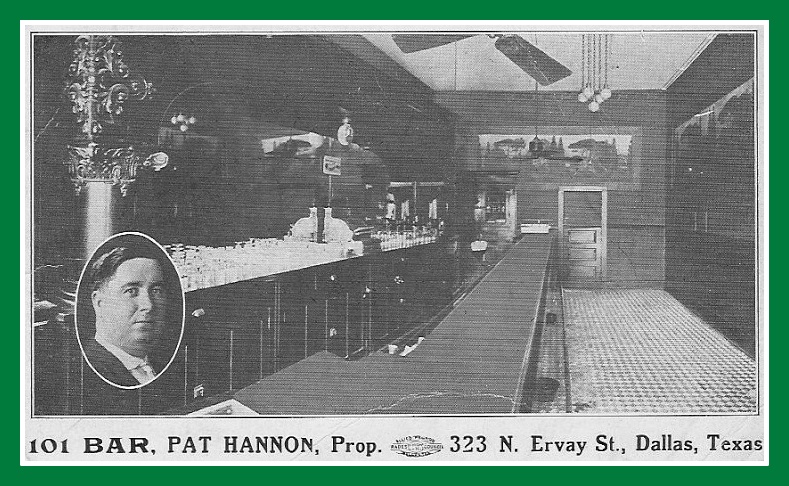
101-bar_ca-1917
Pat Hannon’s dreams are about to be dashed…

by Paula Bosse

The 101 Bar was located at 323 North Ervay, on the southwest corner of Ervay and Bryan — it is now the site of Thanksgiving Square. The owner was Patrick Hannon who had worked in saloons in Dallas from at least 1908. The bar pictured above opened around 1917 but lasted only a few months — by the time the 1918 directories were printed, 323 N. Ervay was listed as “vacant.” Pat had worked his way up the competitive saloon trade in Dallas, from bartender to owner, only to be cut down by Prohibition. Had Prohibition not gone into effect in 1918 (with Dallas County voting to start even earlier, in October, 1917), this fine-looking  bar might have had a long, boozy life. Pat disappeared from the directory completely in 1918, but he was back in 1919, with a new occupation: butcher. Meat-cutting is all well and good and certainly pays the bills, but I bet in his idle moments, Pat’s thoughts turned to daydreams of his old Ervay St. bar.

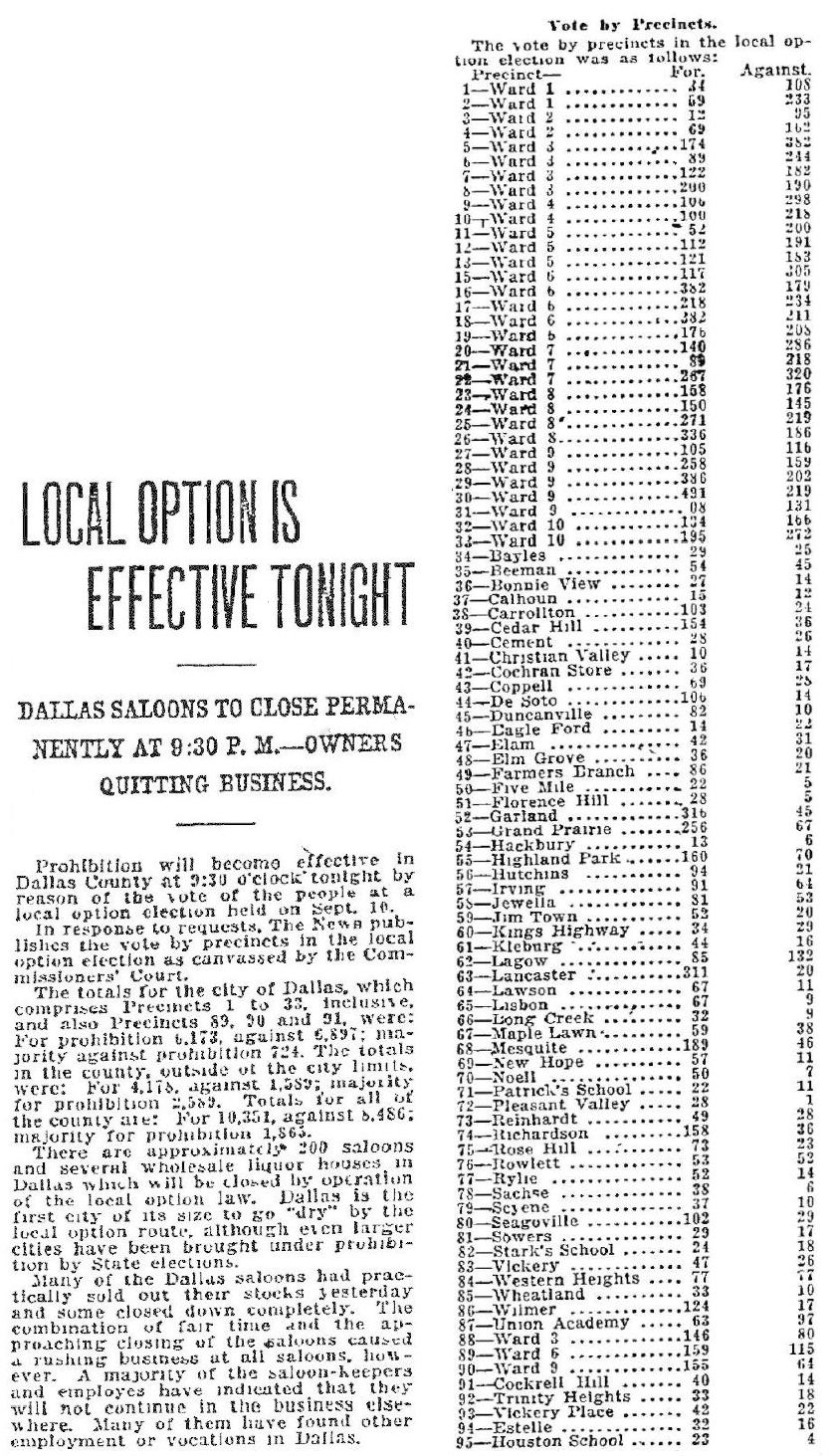
The 1917 Dallas directory showed 183 bars operating in Dallas; the next year, zero.

Bad timing, Pat.

***

Sources & Notes

I’m not sure where the photo came from — some random web page, I think.

Why did Dallas County go dry so early? Because of a “local option” vote in September 1917. The city of Dallas voted against it, but the surrounding communities voted overwhelmingly FOR it. (You could still drive over to Fort Worth for legal beer and hooch, though.) Election results below (click for larger image). 

prohibition_local-option_dmn_102017Dallas Morning News, Oct. 20, 1917

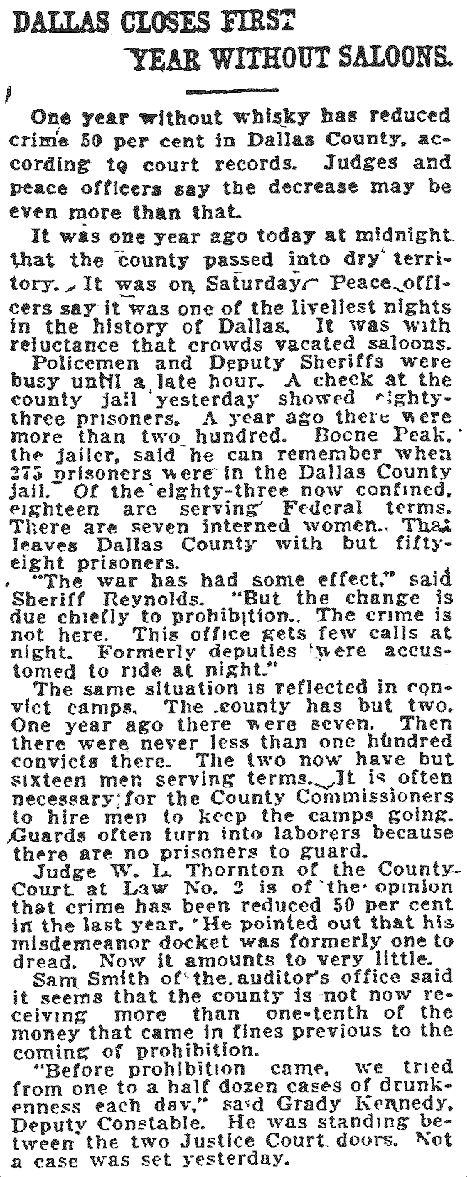
How were things faring a year later?

probibition_dallas-co_dmn_102018DMN, Oct. 20, 1918

This has been a rather tenuously-associated St. Patrick’s Day post (Irish name, bar, green border), but … Happy St. Patrick’s Day!

*

Copyright © 2016 Paula Bosse. All Rights Reserved.

The Filling Station on Greenville Avenue: From Bonnie & Clyde to Legendary Burger Place

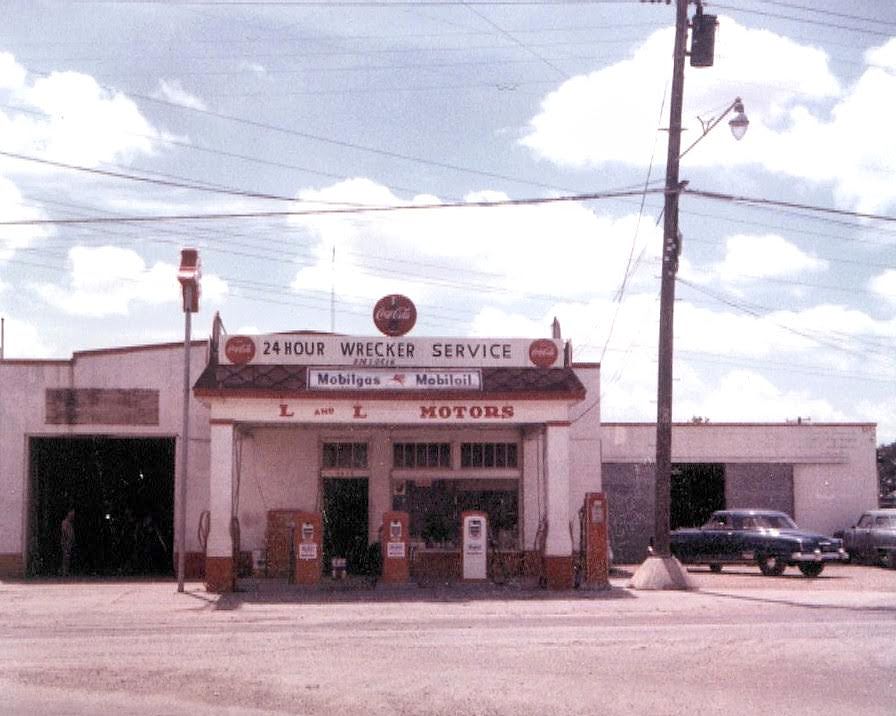
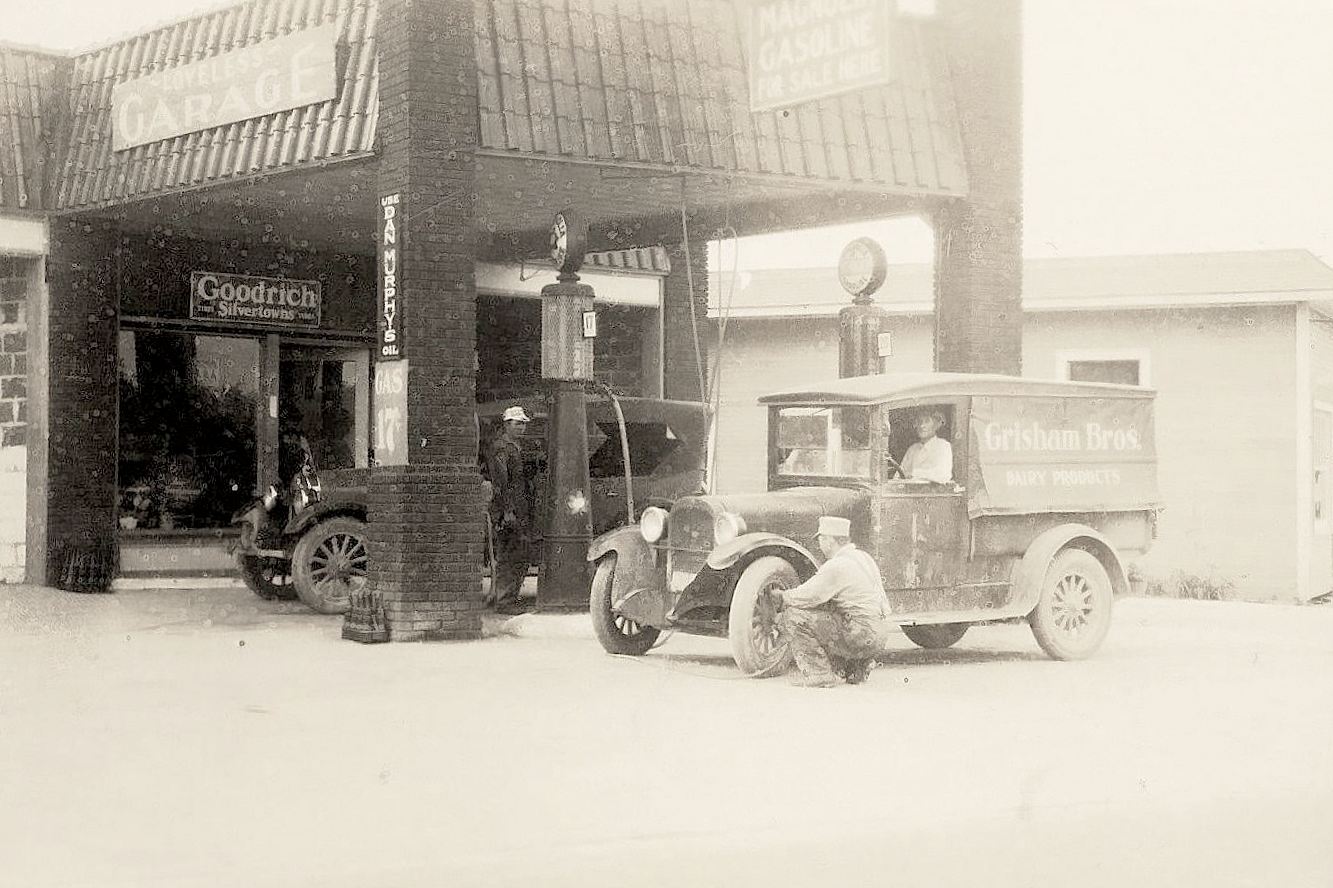
loveless-station_extThe Loveless filling station, Vickery, TX… (click for larger image)

by Paula Bosse

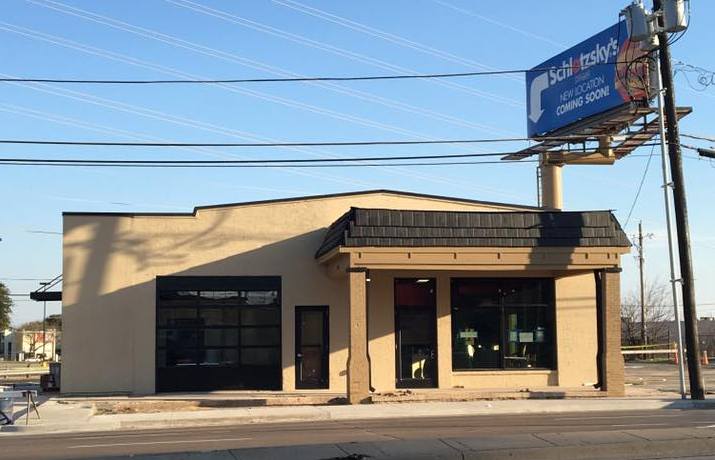
Perhaps you’ve driven past the site of the much-loved former burger place The Filling Station at Greenville Avenue and Park Lane recently and saw that the old building was undergoing renovation. Construction has ended, and a new Schlotzsky’s (the sandwich shop founded in Austin in 1971) has opened at 6862 Greenville Avenue. And it’s pretty cool that they’ve preserved this old 1930s building, a landmark to many Dallasites.

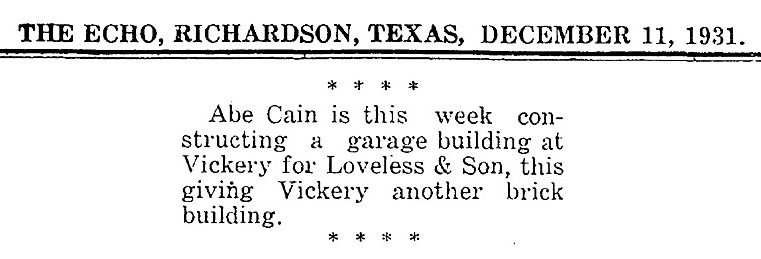
The original filling station and garage was built, according to family members, about 1931 — it was one of the first brick  buildings in the small community of Vickery (which was annexed by Dallas in 1945). The construction even made the columns of the Richardson Echo (Dec. 11, 1931):
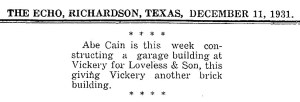
loveless-garage_richardson-echo_121131

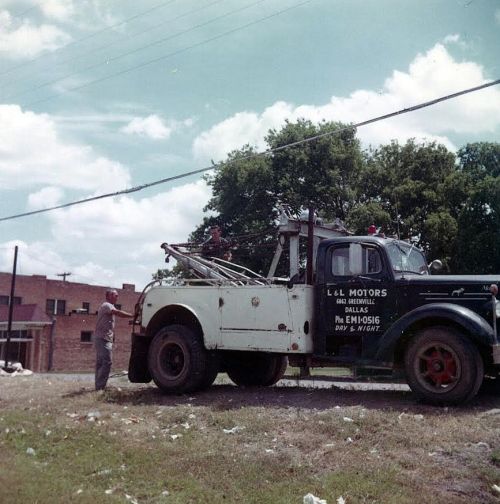
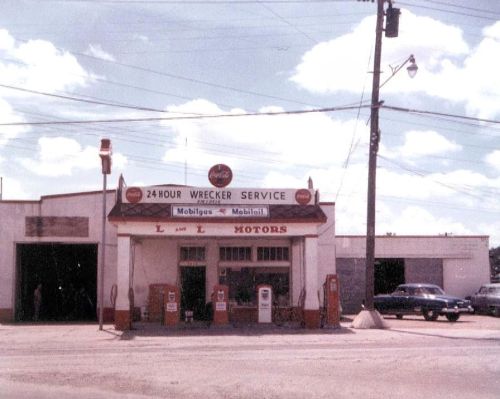
The business had begun in the early ’20s in another building across the street, but things were definitely looking up for the garage and its owners, William Homer Loveless and his son J. W. Loveless, when the new building went up. L & L Motors lasted 50 or so years until the early 1970s, when the once-sleepy Vickery area had exploded into part of “Upper Greenville,” an entertainment mecca lined with bars, restaurants, discos, and strip joints.

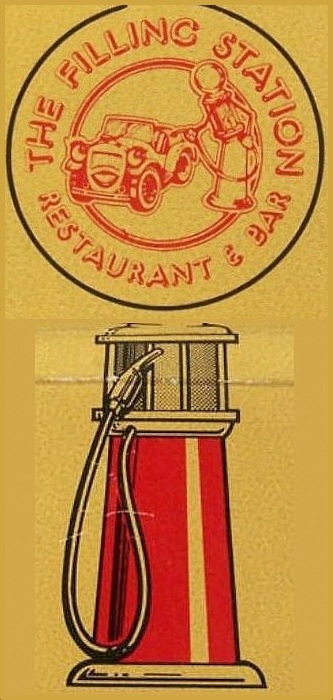
The Filling Station, a theme restaurant and bar decorated with gas station memorabilia, opened in 1975 and lasted a remarkable 29 years, closing in 2004. Filling Station super-fans still have fond memories of both the building and its menu of “theme” foods and drinks with names like “sedanwiches,” the Ethyl burger, the Tail Pipe, and the Ring Job.

Beyond being a nostalgic favorite from the go-go days of Upper Greenville, the real reason this place has always had historic appeal to Dallasites is because it is one of the still-standing Dallas-area locations with a tie to Bonnie and Clyde. According to Loveless family lore, the pair bought gas at the station at least once, sometime back in the ’30s. According to Sonya Muncy, whose father, J. W. Loveless, took over the station after her grandfather passed away:

“That was my daddy’s station and his dad’s before. When he got hurt in an auto accident and couldn’t work anymore, he sold it, and it became the first Filling Station restaurant. I think my mom still has pics of Daddy in front of it when he came out of the Army. Gas was 9 cents a gallon with 3 cents tax, for a total of 11 cents a gallon. He had the coldest Cokes around! Across the street where Park and Ride is was my grandmother’s house. I remember playing at the station as a kid and helping Daddy work on cars. When I got my first car, he made me change the oil and rotate the tires! Lol. It was called L & L Motors with Mobil gas. […] Bonnie & Clyde also got gas there and Daddy said they were always nice to him.”

Kevin Wood remembered when his grandparents happened to be at the station when Bonnie and Clyde stopped in:

“The day Bonnie and Clyde came in to fuel, Clyde shook my Pops’ hand.”

And in a later comment:

“My grandmother and grandfather were in the store the day B & C came in … always said they were very nice.”

*

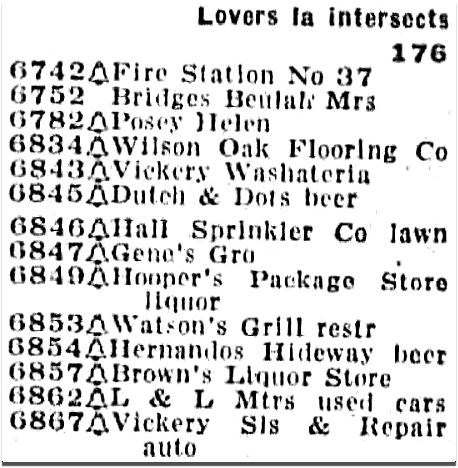
FUN FACT: Jack Ruby apparently ran a short-lived tavern called Hernando’s Hideaway right next door, at 6854 Greenville in the early or mid ’50s (he seems to have owned it and later sold it). It appears the building was torn down at some point. So … Bonnie and Clyde and Jack Ruby, together at last, cheek by jowl.
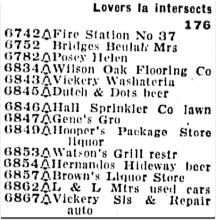
hernandos-hideaway_jack-ruby_1956-directory
Greenville Ave., 1956 directory

*

For as long as I can remember, I’ve checked out this old building every time I drive by it, marveling that it has managed to remain standing all these years, and always afraid it won’t be there the next time I pass it. So thank you, Steve Cole, owner of this Schlotzsky’s, for bringing it back to life and appreciating it as much as a lot of the rest of us do.

**

The photos in this post were kindly sent to me by Jeb Loveless, grandson of Homer Loveless, the original owner. Below, perhaps the oldest photo of the building, in the Bonnie and Clyde era.
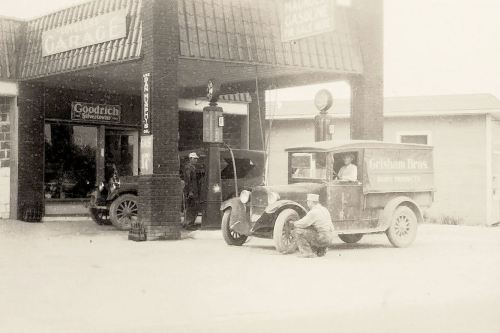
loveless-station_collection-of-jeb-lovelessphoto: collection of Jeb Loveless

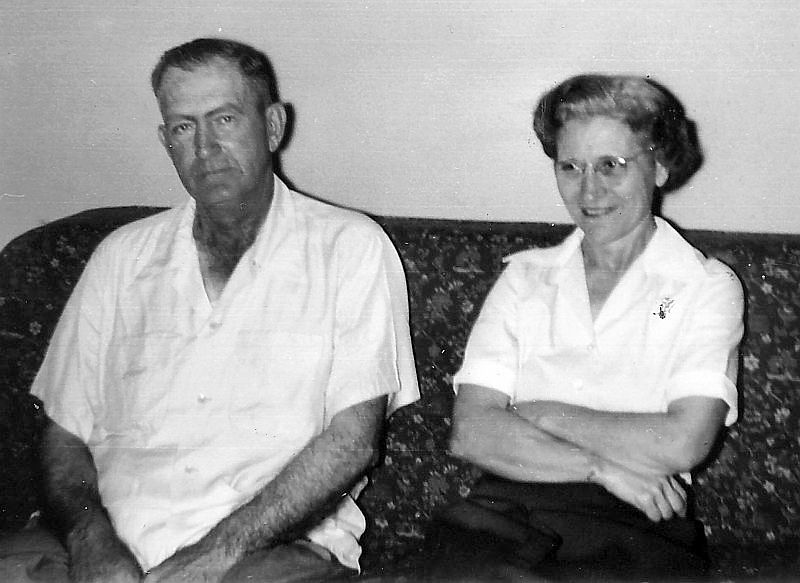
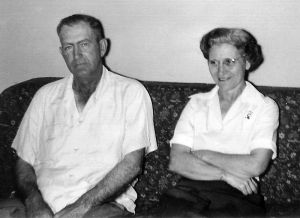
Below, Homer Loveless and his wife Jewel in 1956.
loveless_homer-and-jewel_april-1956

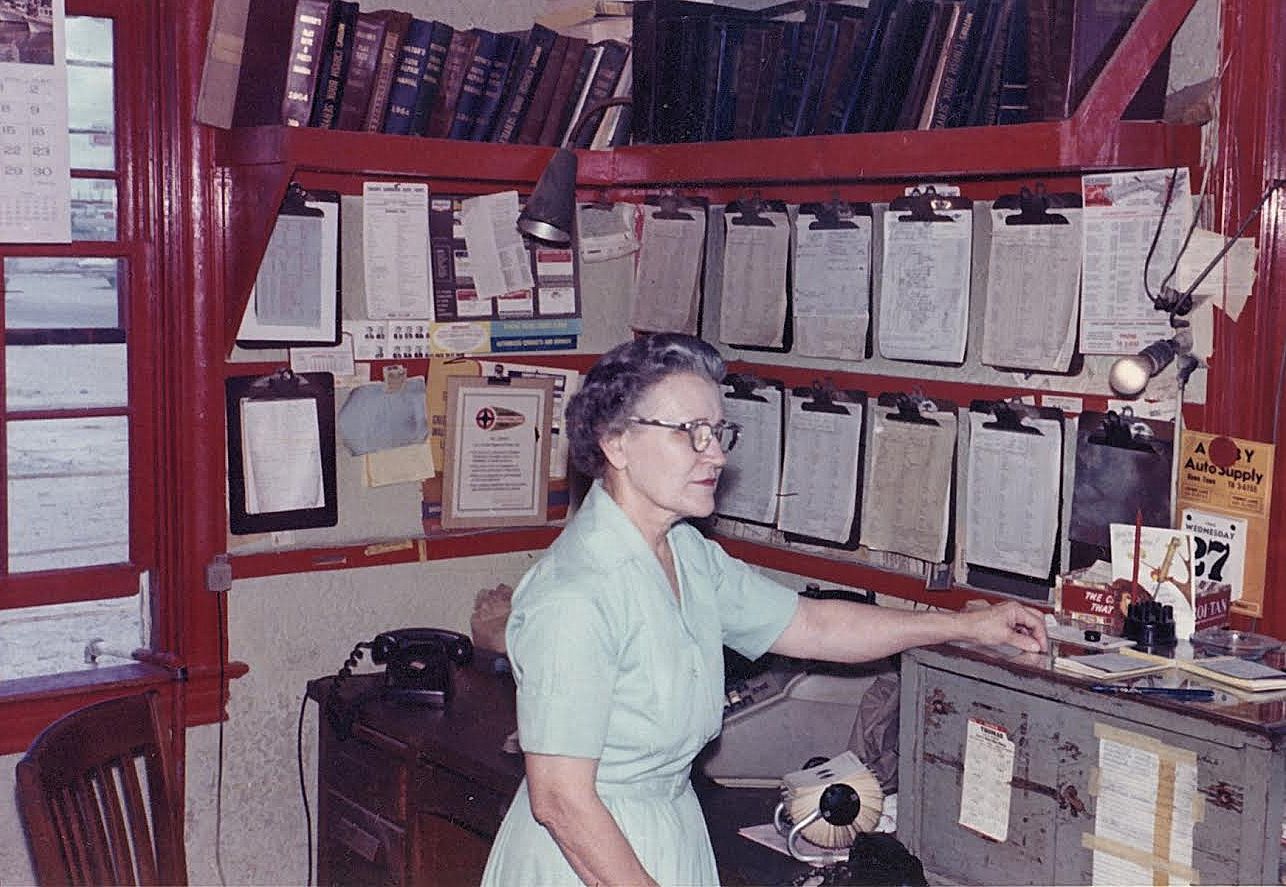
Jewel at work.

loveless-station_jewel-loveless

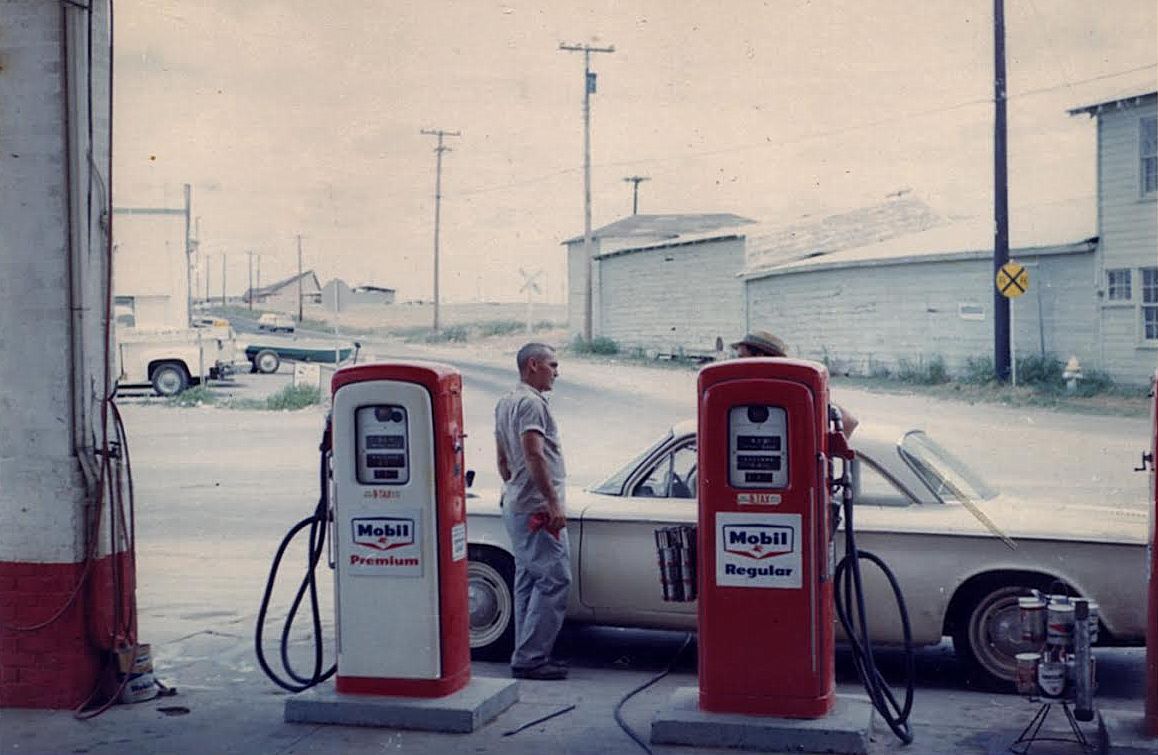
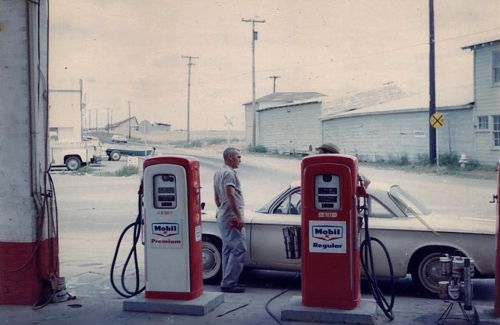
Homer and Jewel’s son (and co-owner) J. W., at the pumps.
loveless-station_jw-loveless

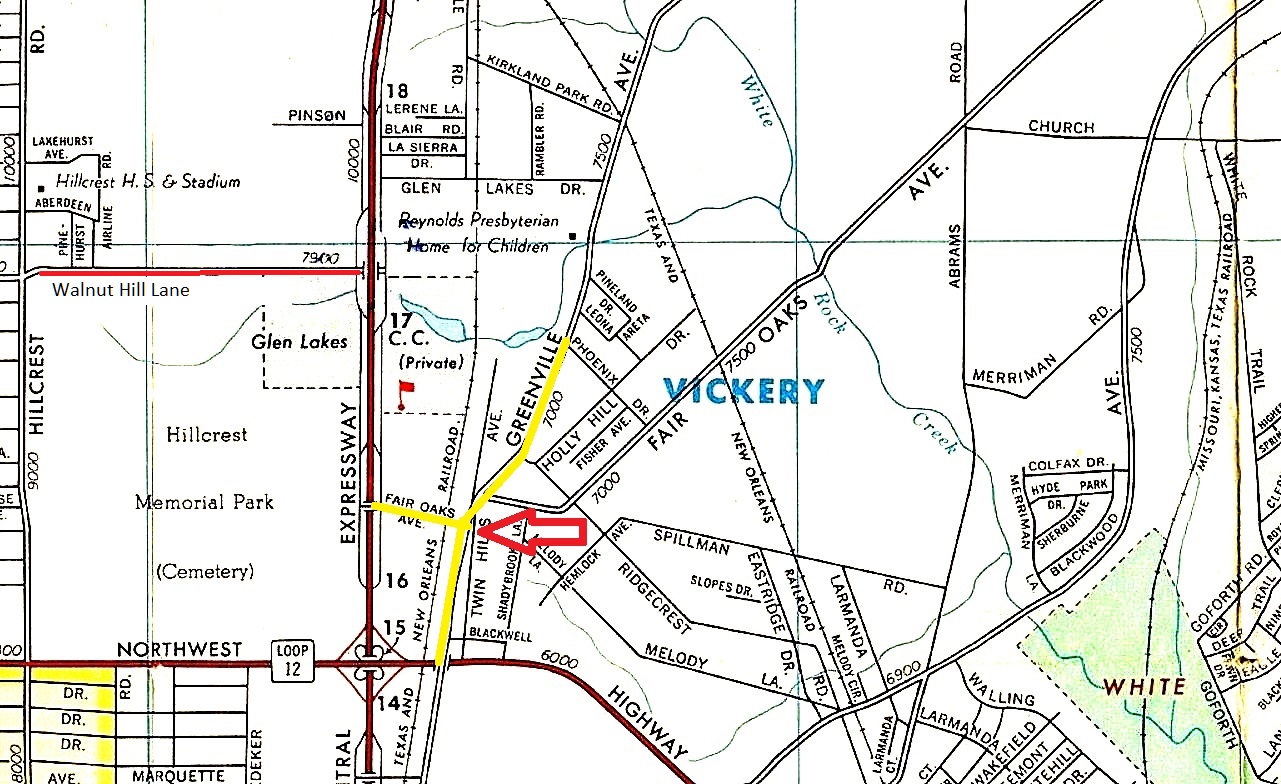
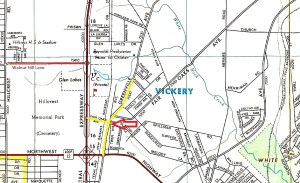
UPDATE: I couldn’t for the life of me figure out what roads I was looking at here. Thanks to Danny Linn, I now know that the road straight ahead is what shows on 1962 maps as being the tail end/very beginning of Fair Oaks (this little bit still exists between Greenville and Central but is restricted to buses) — the view is looking west toward Central Expressway; the Corvair at the pumps is headed south on Greenville. A detail of this area from a 1962 map is below  — note that Park Lane did not yet exist. (The full 1962 Enco map is here.)
filling-station_vickery_1962-map(click me!)

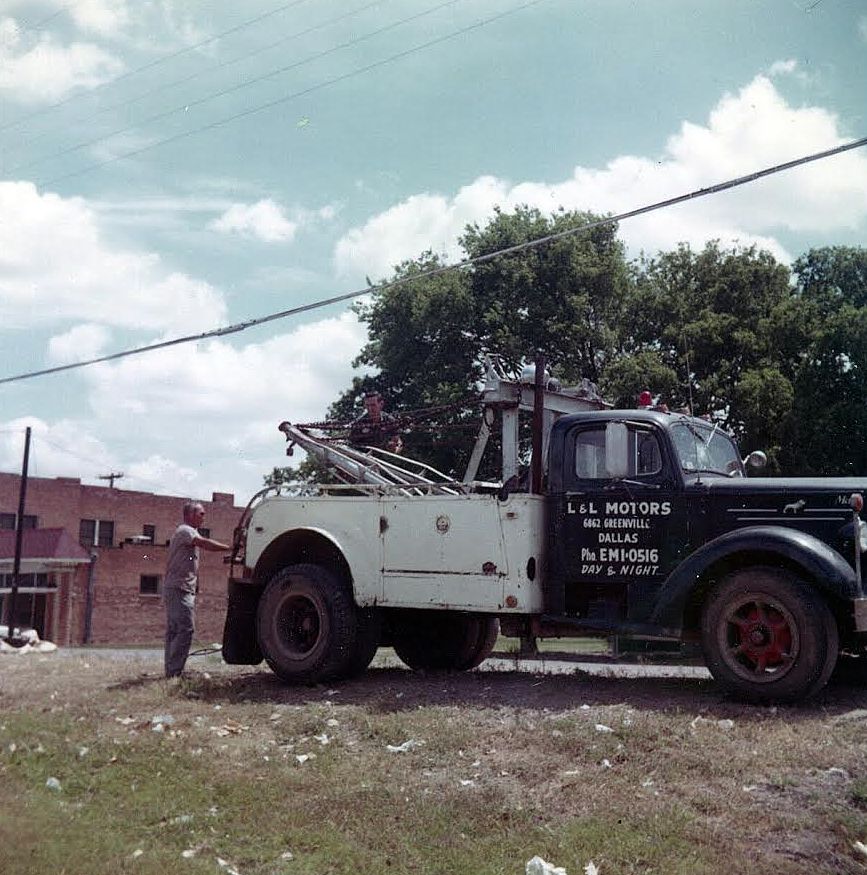
J. W. with the tow truck.

loveless-station_towtruck_1964

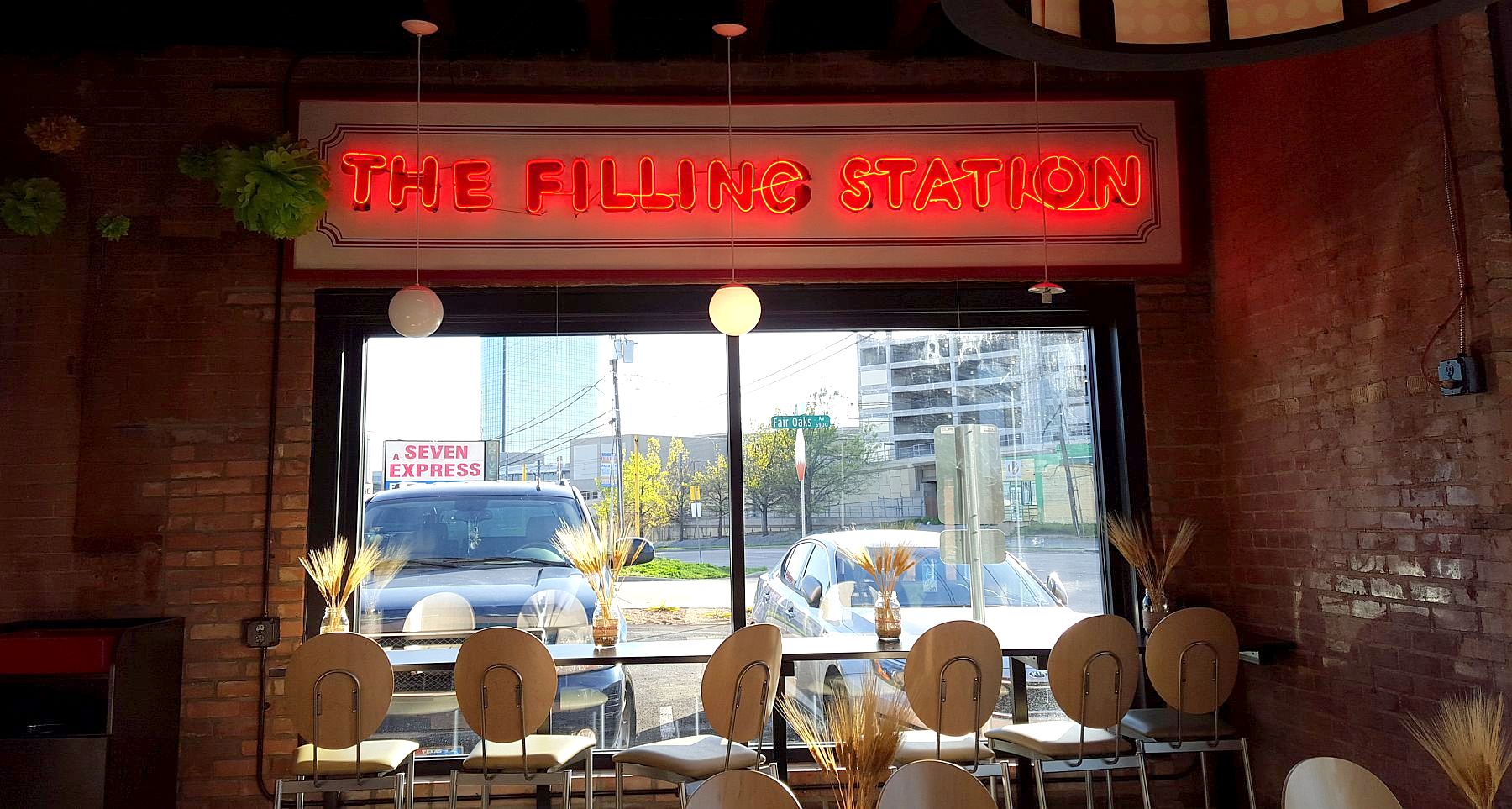
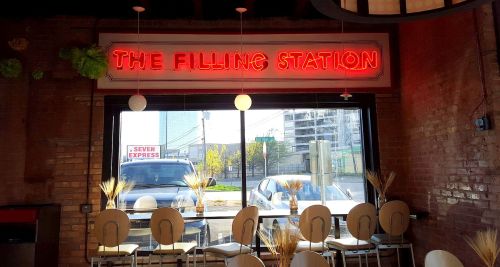
And here is what the old Loveless garage looks like today, as a Schlotzsky’s, decorated with the original neon sign from its days as The Filling Station restaurant as well as with several of the photos reproduced in this post.
filling-station_neon-sign_2016photo: Paula Bosse

**

Aside from the Bonnie and Clyde connection, this little building (which has managed to stay standing for over 80 years — a feat in Dallas!) is known by most as the home of still-missed Filling Station restaurant.
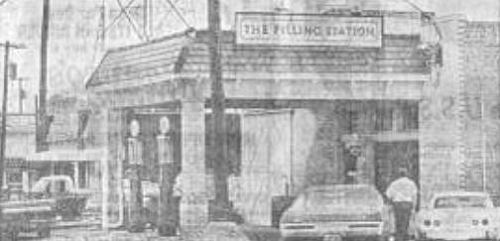
filling-station_dth

Below, an interesting 1976 quote from Filling Station co-owner Bob Joplin about the “cutthroat” competition between ’70s-era Upper Greenville bars and restaurants (numbering at the time more than 50), wondering how long his place might stay alive:

“The average life of a new place on Greenville is probably about 18 months. If that. Hell, around the corner here — the Yellow Rose of Texas — how long was it open? Three months? Maybe less? […] We’re going great right now, but we’ve only been open a little more than a year. Check back with me later — we may be here, we may not.” (DMN, Nov. 14, 1976)

The surprising longevity of The Filling Station — 29 years in business! — is why the strangely unceremonious and surprisingly brief announcement of the Filling Station’s demise (which appeared in the pages of The Dallas Morning News on July 2, 2004) is so odd — its closure merited only ten words: “The Filling Station on Upper Greenville Avenue has also closed.” 29 years! That’s an eternity in the Dallas restaurant world.
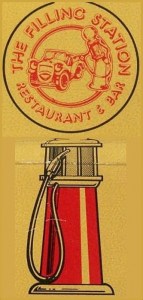
filling-station_matchbook_ebay
eBay

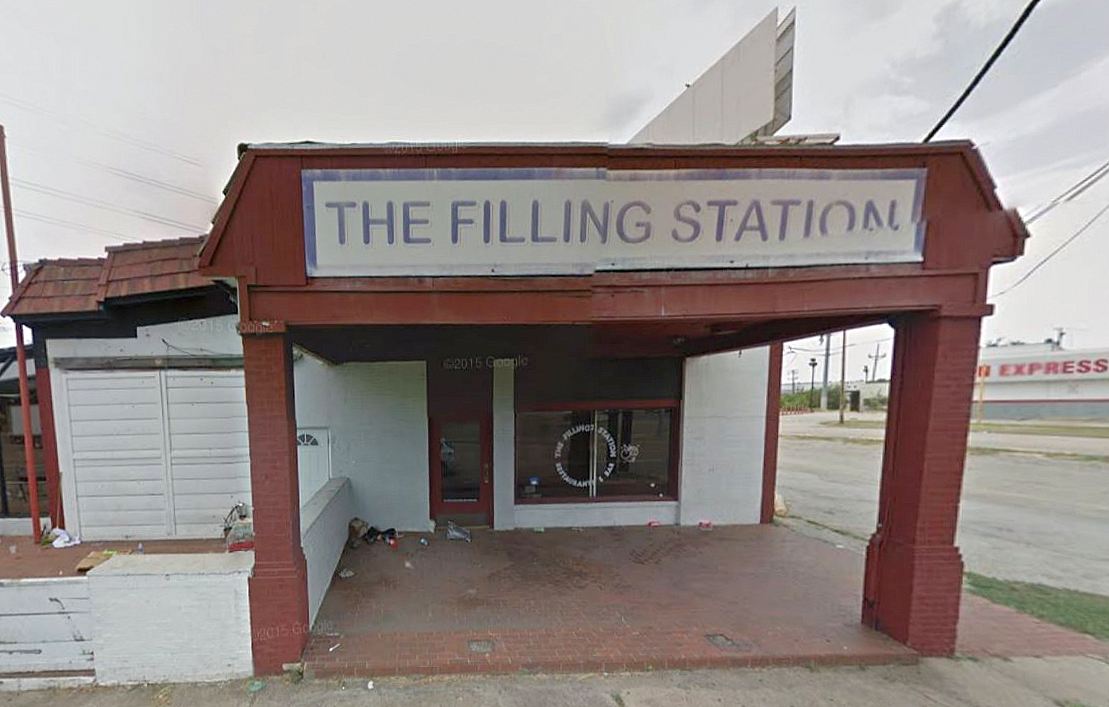
A few other businesses occupied the building, but none managed to stay open very  long. The building was vacant for several years, and it was definitely looking bedraggled when the Schlotzsky’s people came knocking.
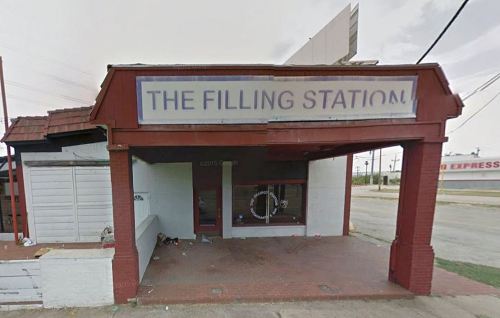
filling-station_google_aug-2015Long-vacant — Google Street View, Aug. 2015

And here it is, after renovation, preparing for its opening day as a Schlotzsky’s — the building now actually looks more like its original design, seen in the photo at the top of this post.
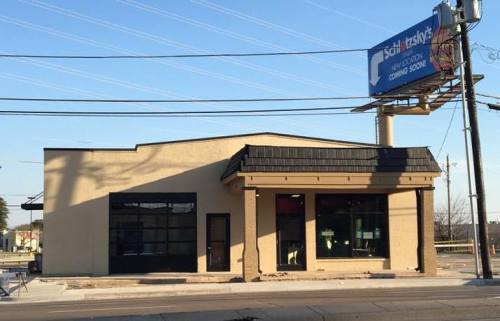
schlotzskys_facebook-pageSchlotzsky’s Facebook page

***

Sources & Notes

The photos of the L & L Motors garage and filling station in Vickery — and the Richardson Echo clipping — were sent to my by Jeb Loveless, grandson of Homer and Jewel Loveless and nephew of J. W. Loveless. He has graciously allowed me to use the photographs in this post. Thanks, Jeb! (Several of these photos were given to the owner of the new Schlotzsky’s and can be seen on the walls inside.)

Quotes from family members whose relatives met Bonnie and Clyde when they stopped in at the gas station are from comments on the Dallas History and Retro Dallas Facebook pages (used with permission).

A Lakewood Advocate interview with the owner of this Schlotzsky’s, Steve Cole, is here. He talks about his dedication to saving as much of the structure as possible, keeping the original brick walls and the wood floors.

To take a photographic tour through what remained of the old Filling Station, see the real estate listing on Zillow here (click on the first picture and a slideshow of large photos will open).

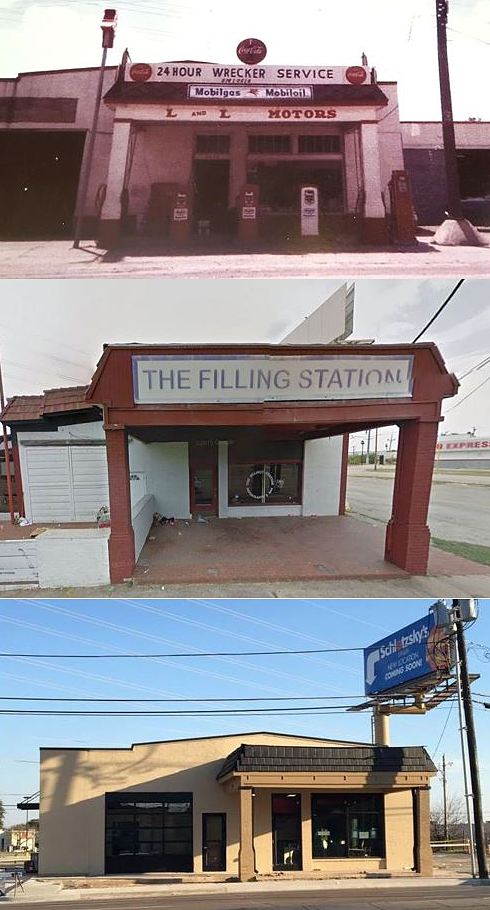
Here’s a then-and-now look at the building over the years:

filling-station_then-now

Related articles in The Dallas Morning News:

  • “William Loveless Dies After Illness” (DMN, June 12, 1960), obituary of the original owner, W. H. Loveless
  • “A Filling Station Which Pumps Beer” by Patty Moore (DMN, Aug. 8, 1975), the first review of the new restaurant, The Filling Station

Click photos and clippings for larger images.

*

Copyright © 2016 Paula Bosse. All Rights Reserved.