Flashback : Dallas

A Miscellany: History, Ads, Pop Culture

Category: Entertainment

Orson Welles In Dallas — 1934-1940

orson-welles_cornell-tour_1934
Orson at 18 — publicity photo used for the Cornell tour, 1934

by Paula Bosse

Today is the 100th anniversary of the birth of Orson Welles. Welles was one of the truly great, innovative theater and film directors, an actor with a commanding presence, and a delightfully entertaining raconteur. His frenetically creative work on the New York stage, on radio, and in film (he wrote, produced, directed, and acted in his first film, Citizen Kane, when he was only 25) earned him/saddled him with the hard-to-deny sobriquet “Boy Genius.” His rise up the show-biz ladder was a quick one.

Orson’s first professional acting gig was as an unknown 18-year old repertory player in the touring company of famed actress Katharine Cornell who, along with British actor Basil Rathbone, starred in the three plays performed on the tour, which stopped in Dallas for a two-night engagement at the Melba theater, in February, 1934. The three plays performed in Dallas on February 19 and 20 (one a matinee) were “Romeo and Juliet” (Orson played Mercutio), “The Barretts of Wimpole Street” (he played Octavius Moulton-Barrett), and “Candida” (he played Marchbanks). Cornell was a huge draw, and there was a rush for tickets. The Melba begged her to extend her stay and add performances, but she declined.

The young Welles had gotten reviews on the tour which ranged from a dismissive mention in Variety that he was unable to speak Shakespeare’s lines properly and audibly (!), to raves from Charles Collins of The Chicago Tribune:

The cast is brilliant, and many of the secondary characters are acted with consummate skill. This is particularly true of Orson Welles’ Mercutio, which is an astonishing achievement for a youth still new on the stage. In his duel with Tybalt and his death scene, this Mercutio is a complete realization of Shakespeare’s bravest blade.

The star of the show was the then-very-famous Katharine Cornell, around whom most of the articles and reviews centered (she was, for instance, breathlessly reported to be staying at the Melrose during her Dallas stay) (I wonder if the lowly company players — i.e. Orson Welles — stayed there as well?). The Dallas Morning News theater critic, John Rosenfield — who mentioned this 1934 Dallas appearance in almost every succeeding article he ever wrote about Orson Welles over the next several decades — wrote the following before he saw Orson’s performances in any of the three plays:

Orson Welles, 18-year-old actor, who is apparently bulky enough to hold his own with adults, will be Mercutio. (DMN, Feb. 19, 1934)

After he saw his Mercutio:

Orson Welles’ Mercutio was up to the best standards known for this role. (DMN, Feb. 20, 1934)

When the tour finished, Welles quickly became a presence in the New York theater world. One of his early successes as a producer and director was his production of the so-called “Black Macbeth”/”Negro Macbeth”/”Voodoo Macbeth” — a hugely popular staging of Shakespeare’s “Macbeth” with an all-black cast, done under the auspices of the Federal Theatre Project in 1936. In August of that year — just two and a half years after his appearance as an unknown at the Melba — he took the production to Dallas where it made a splash at the Texas Centennial in the brand new bandshell.

macbeth_texas-centennial_dmn_081336Aug., 1936

macbeth_playbill_dallas_LOC(click for larger image)

Rosenfield was impressed by the lush design and the electric and inventive spectacle, but he was not a fan of the performances. A few years later, on the eve of the release of Citizen Kane, he wrote the following (which was much harsher than his original 1936 review):

We saw this production in Dallas during the Texas Centennial and could marvel at the artistic futility of such ingenuity. The Negro Macbeth, however, was something to be seen if only to be despised. (DMN, Oct. 29, 1941)

Oh dear.

In 1940, Welles was working on his first film, the legendary Citizen Kane. As filming began to wind down, he decided to go out on a short lecture tour because he was in desperate need of money (an all-too-common circumstance he found himself in throughout the entirety of his career). His topic was a vague “anecdotes of the stage and theories on the drama” — and it sounds like his “performances” were largely unscripted and unrehearsed. 

On October 29, 1940 — only a week or two after wrapping production on Citizen Kane — 25-year old Orson Welles spoke at McFarlin Auditorium on the SMU campus as part of the Community Course series of lectures. His topic: The Actor’s Place in the Theater. It was another packed house of adoring and/or curious Dallasites. Rosenfield was both entertained and annoyed by the rambling “lecture,” but Orson was undoubtedly delighted to talk for two hours before an adoring crowd, answer their questions about his craft, and collect a $1,200 check.

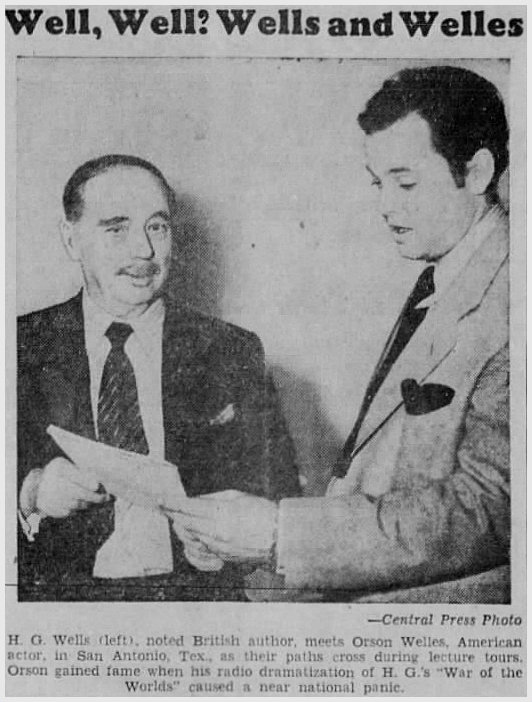
Orson’s appearance in Dallas was particularly noteworthy for the fact that the speaker scheduled to appear on the McFarlin stage just three days later was … H. G. Wells! At the time of this lecture tour, Orson was best known for his infamous 1938 radio adaption of H. G. Wells’ The War of the Worlds, the frighteningly realistic production that panicked the nation and led thousands to believe that the earth was being attacked by Martians. Rather surprisingly, Welles and Wells had never met.

According to a blurb in a Phoenix newspaper, Orson had cancelled a previously-scheduled meeting in Tucson in order to fly into Dallas earlier than planned. My guess is that he saw that H. G. Wells was also lecturing in Texas and realized that H. G.’s lecture in San Antonio the night before Orson’s own appearance in Dallas on the 29th was the only chance he had to meet the man who had provided the source-material for his (to-date) greatest career triumph.

A quick timeline:

  • Sun. Oct. 27, 1940: Orson arrives in Dallas, staying at the Baker Hotel.
  • Mon. Oct. 28: In the morning, Orson flies down to San Antonio to meet H. G. Wells and attend his lecture. The two meet, get along famously, have their photos taken, and give a short joint interview to San Antonio radio station KTSA (see below for link to recording). That evening, both fly to Dallas. Later that night, Orson (well known as an amateur magician) pops into The Mural Room in the Baker Hotel to catch the floor show featuring popular magician Russell Swann.
  • Tues. Oct. 29: H. G. Wells leaves Dallas for Denver, continuing his lecture tour. That morning Orson drives to Fort Worth to present a lecture and attend a luncheon at the River Crest Country Club. That night, he presents his lecture at McFarlin Auditorium at Southern Methodist University. After his lecture, he catches Russell Swann’s magic show for a second time. At 3:00 a.m. he flies to San Antonio for his lecture there.
  • Wed. Oct. 30: Orson lectures in San Antonio. It is the second anniversary of the broadcast of “The War of the Worlds.” Conveniently, newspapers around the country begin to run the photos of Welles and Wells taken on the 28th.
  • Thurs. Oct. 31: A Martian-free Halloween.
  • Fri. Nov. 1: H. G. Wells is back in Dallas for his lecture that night at McFarlin Auditorium.

welles-wells_san-antonio_102840

welles-wells_pottstown-pa-mercury_103140Pottsdown (PA) Mercury, Oct. 31, 1940

h-g-wells_dmn_102940DMN, Oct. 29, 1940

Whew.

Happy 100th, Orson! And thanks for everything.

***

Sources & Notes

Dates and sources of newspaper clippings as noted.

“Macbeth” playbill from the Library of Congress, here.

The timeline for the Welles-Wells meeting and their Dallas-related activities were gleaned from a report in the Oct. 30, 1940 edition of The Dallas Morning News.

And now, links galore.

  • Watch an entertaining short clip in which Orson talks about mind-reading and fortune-telling — which he says he indulged in on the Cornell tour — here.
  • Read the profile of the 18-year-old phenom which appeared in newspapers during the run of the Katharine Cornell tour, here.
  • Read about the “Voodoo Macbeth” here (scroll to the bottom to see fantastic photos).
  • Listen to the interview with Orson Welles and H. G. Wells that aired on San Antonio station KTSA, the day they met for the first time, on Oct. 28, 1940 — here.
  • Read about that still-chilling Mercury Theatre radio broadcast of The War of the Worlds, here.

Finally, my favorite Orson Welles-related quote from the erudite and not-without-humor arts critic of The Dallas Morning News, John Rosenfield. He wrote the following in his review of the set-in-Haiti “Macbeth” — about the aesthetic viability of future Shakespeare productions tailored for specific audiences:

…Mr. Welles hasn’t started a movement. His Negro “Macbeth” does not inspire us to corroborate a fabled Texas lawyer and make Antonio “The Merchant of Ennis.” (DMN, Aug. 16, 1936)

“THE MERCHANT OF ENNIS”! Someone! Make this happen!

*

Copyright © 2015 Paula Bosse. All Rights Reserved.

Aerial View of the Centennial Fairgrounds — 1936

fair-park_1936_red-oak-kidThe Texas Centennial: a “World’s Fair” for Dallas

by Paula Bosse

This fantastic photo (by one of Dallas’ top aerial photographers, Lloyd M. Long) shows the impressive expanse of Fair Park’s new Art Deco splendor — most of the buildings seen here were built especially for the 1936 Texas Centennial Exposition, and most of those are, thankfully, still standing.

***

Sources & Notes

Lloyd M. Long photo, found on Red Oak Kid’s Flickr stream, here.

To see this photo REALLY big, click here.

*

Copyright © 2015 Paula Bosse. All Rights Reserved.

The Periphery of the Texas State Fair Never Looked Better

state-fair_postcard_carrie-ednaApproaching the Fair Grounds…

by Paula Bosse

A couple of pretty, but unusual views of the fairgrounds, turn-of-the-century-ish. The message on the postcard at the top: “Carrie the fair was real good this year better than it has been for years. Edna”

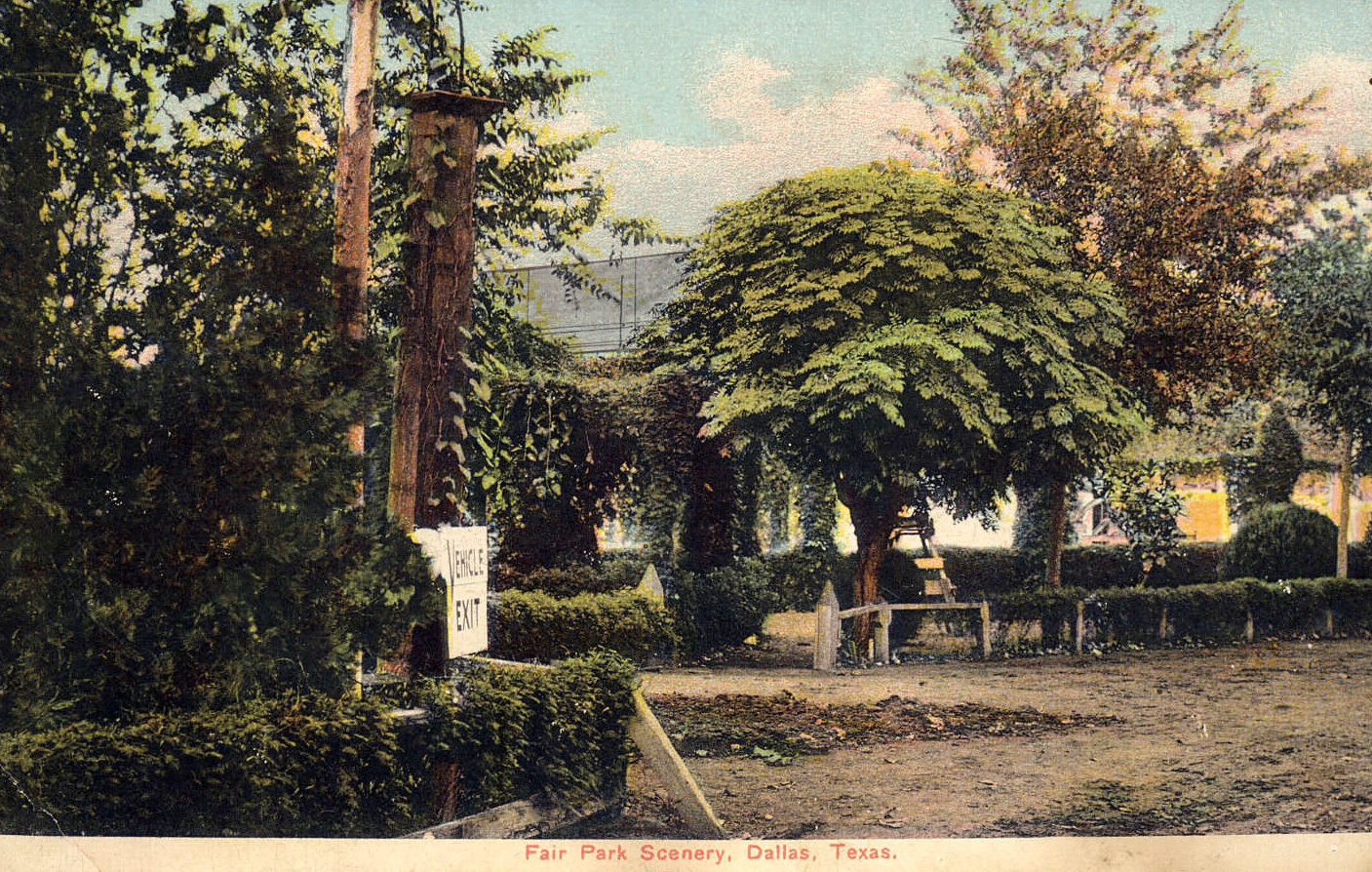
And then there’s this view, “Fair Park Scenery.” Same period as the top one? Later? It shows the “Vehicle Exit.” “Vehicles” meaning buggies and wagons?

state-fair-grounds_postcard_vehicle-exitLeaving the Fair Grounds… 

I think the top postcard shows the entrance — I have another view of the entrance that looks like this, from around 1900 (see it here). And the bottom card? “Scenery” near the Vehicle Exit. So … a parking lot? Or a road leading to the exit? Whatever it is, it’s not really all that “scenic.” Both postcards are fairly odd choices for picture postcards of the Texas State Fair, as neither one shows anything of the actual fair! But if people had fond memories of driving into or out of the State Fair, these were the postcards to buy!

***

Sources & Notes

Postcards from eBay. The second one is a photo by Clogenson.

Top postcard’s 2-cent stamp was issued in Nov. 1903, per Wikipedia.

*

Copyright © 2015 Paula Bosse. All Rights Reserved.
Mardi Gras: “Our First Attempt at a Carnival Fete” — 1876

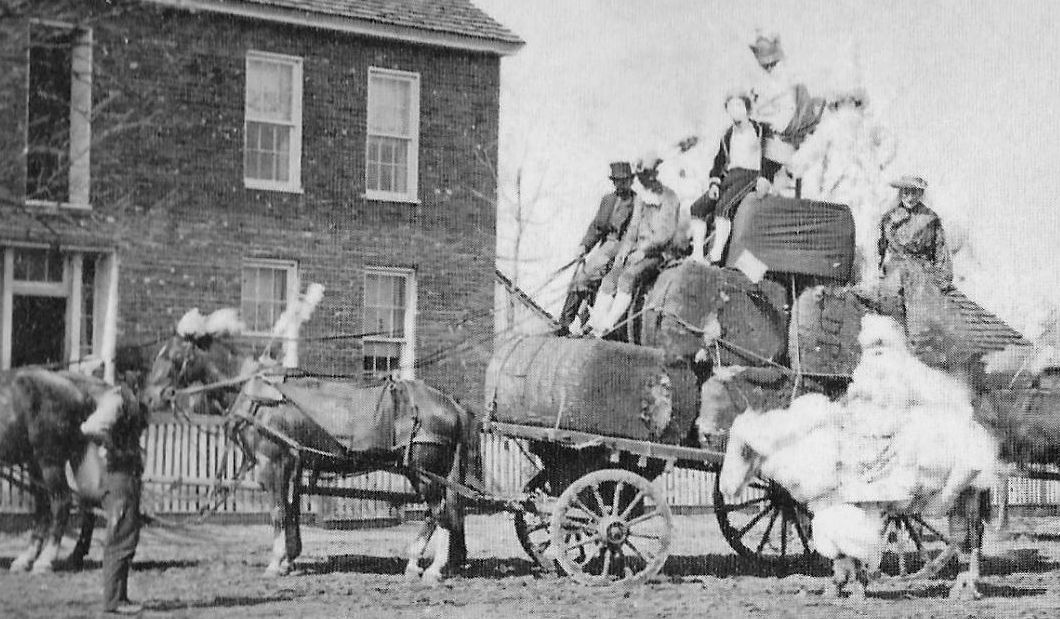
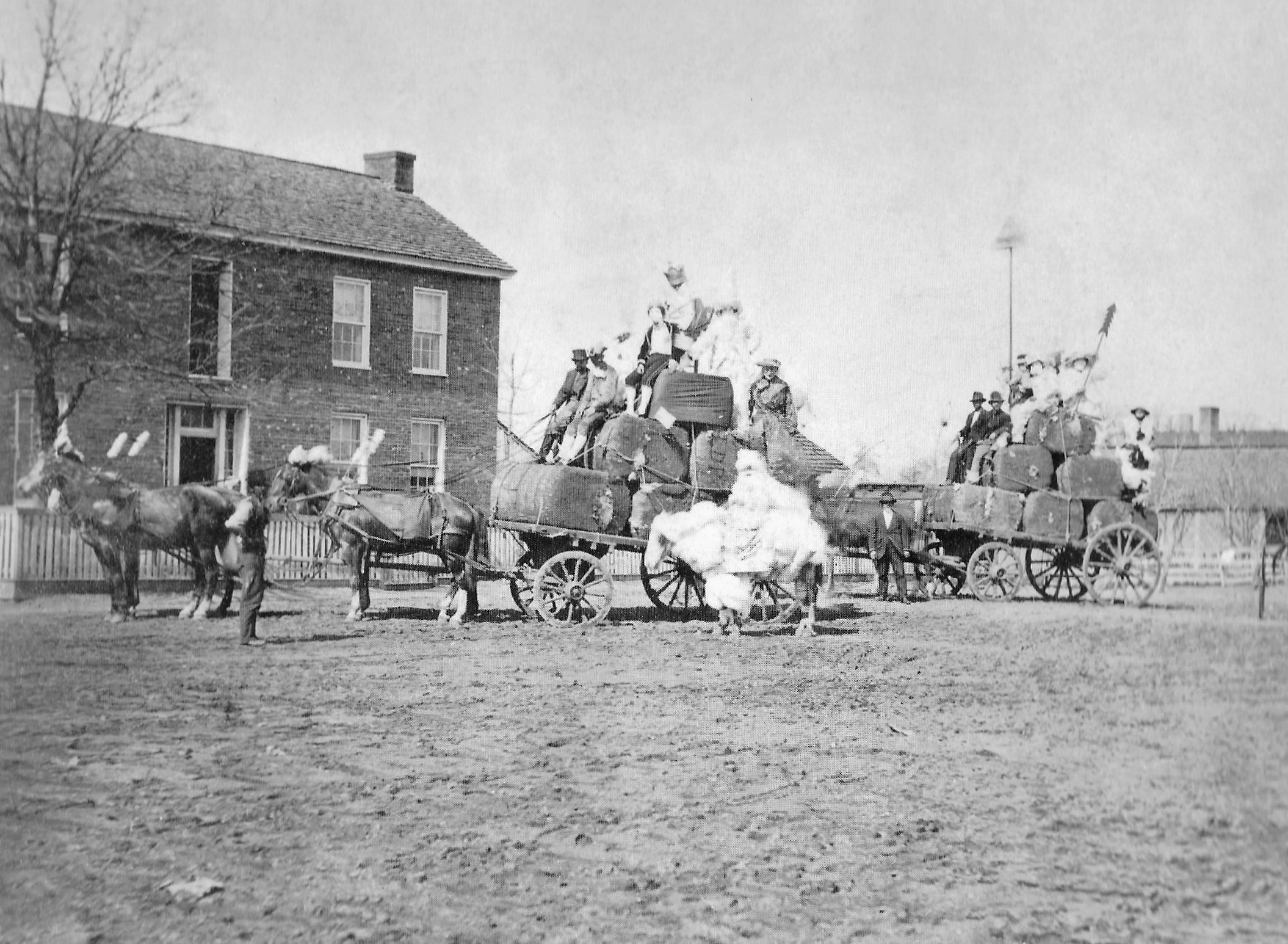
mardi-gras_dhs_1876When cotton was Rex (click for much larger image)

by Paula Bosse

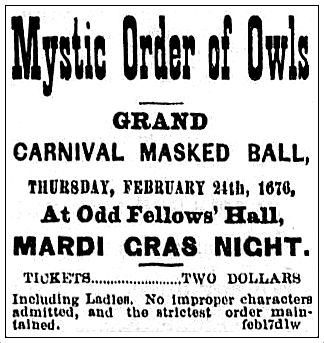
In the 1870s, if a Dallas resident wanted to celebrate the glitzy revelry of Mardi Gras with a parade and balls and didn’t want to travel all the way to New Orleans, the place to go was Galveston. Galveston had a lock on Texas Mardi Gras galas. But Dallas being Dallas, there were soon plans to stage a massive Carnival right here. The day-long celebration debuted on February 24, 1876, which, oddly, was on a Thursday. (Mardi Gras that year was actually on Tuesday, Feb. 29, and it was probably celebrated early in Dallas so as not to interfere with the hey-we-got-here-first celebrations in New Orleans and Galveston.)

It was estimated that the festivities cost the city more than $20,000 (which, if the Inflation Calculator is to be believed, would be the equivalent of almost $450,000 in today’s money). The city was cleaned up in preparation for the anticipated onslaught of visitors and was decorated with flags and bunting along the lengthy parade route of Main, Elm, and Commerce streets. Revelers had elaborate costumes made for the processions and the grand masked balls, some with fabric imported for the occasion from France

mardi-gras_dal-herald_021876Dallas Herald, Feb. 18, 1876 (not 1676!)

The Dallas Herald and The Dallas Commercial were incessant in their whipping up of excitement for the big day. And it worked. People streamed into town from all over Texas. Hotels were packed, and it was estimated that over 20,000 spectators watched one or both of the day’s parades.

The following day, The Dallas Herald apparently devoted their entire front page to coverage of the event, under this wordy headline:

A Day in Dallas, Our First Attempt at a Carnival Fete. The City Aglow with Enthusiasm and Wild with Rollicking Revelry. Visit of King Momus — His Cordial Reception by the People — The Procession in His Honor. The Season of Merry-Making Brought to a Happy Close with Balls and Bouts — Well Done, Dallas!

(Sadly, this issue is not available online, perhaps because there were none found to scan as it sold out more than five editions and was probably the paper’s best-selling edition to-date.)

Dallas’ first Mardi Gras had been an unqualified triumph, and newspaper editors and city leaders were beside themselves with joy. The parade — and the city — had been covered enthusiastically and favorably by newspapers around the country, and the success of the huge celebration was seen as having been better advertising for the exuberant and growing city than could ever have been hoped.

Galveston? Pffft!

**

A few tidbits from that first Mardi Gras.

There were very few “incidents” reported surrounding the festivities. That’s not to say there weren’t a lot of incidents that occurred that day, just that not a lot of them found their way into the newspapers (apparently whiskey was free-flowing all day long, and one suspects there were “incidents” aplenty connected with that). Among the very few non-“jolly” things that happened on Carnival Day and the day following included the following:

  • A small boy had been run over by a carriage (“but not dangerously hurt”)
  • A child and a horse had been burned severely when a can of gasoline was thrown into a bonfire “to increase the flame”
  • A member of the Stonewall Greys who had participated in the noontime parade had fallen whilst “foolishly scuffling” and had “received a slight but painful wound from a bayonet”

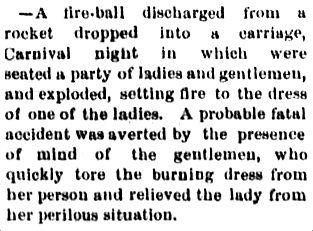
Also, there was some sort of “fireball discharged from a rocket” which caused some consternation:

fireball_dal-herald_022676Dallas Herald, Feb. 26, 1876

*

All residences and businesses along the parade route during the evening procession were “commanded” to be illuminated. Even if gasoline-fueled bonfires were raging along the parade route, the elaborate procession was probably poorly lit.

*

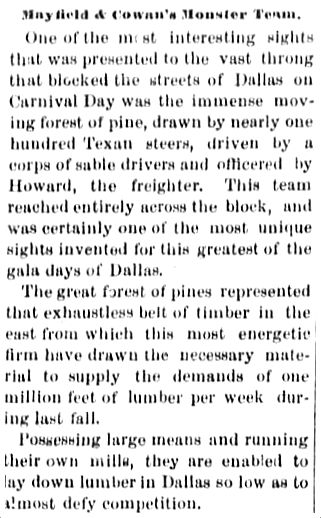
My favorite “float” was the huge wagon of lumber meant to draw attention to East Texas timber and the thriving lumber industry in Dallas. One report said “the immense moving forest of pine” was drawn by “32 yoke of oxen” — another said “nearly 100 Texan steers.” Whatever it was, that must have been spectacular to see.

oxen-team_dal-herald_022676Dallas Herald, Feb. 26, 1876

*

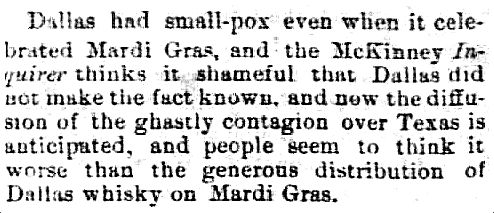
The massive amount of publicity and praise that Dallas received quite clearly irked other cities. Austin seemed especially perturbed. There had been a small outbreak of smallpox in McKinney preceding the big day, and several digs at Dallas (like the one below) appeared in newspapers around Texas, accusing the city’s leaders of knowingly endangering the welfare of the entire state just so they could put on their little parade. The exaggerated furor passed fairly quickly, and the het-up schadenfreude expressed by rival cities was amusing.

small-pox_austin-weekly-standard_031676Austin Weekly Standard, Mar. 16, 1876

*

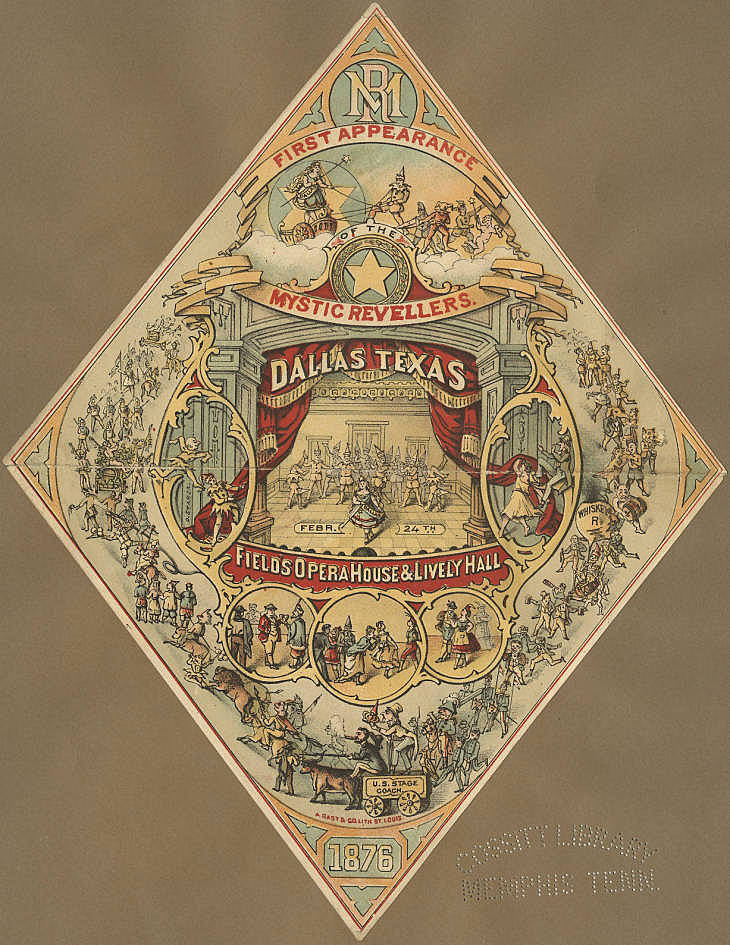
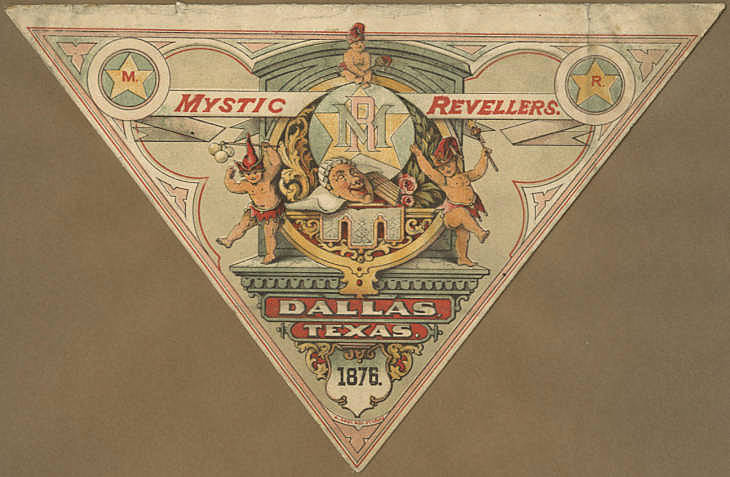
An invitation issued by the Mystic Revellers:

mardi-gras_mystic-revellers_invitation_1876_memphis-public-library

mardi-gras_mystic-revellers_1876_envelope_memphis-public-libraryColton Greene Collection, Memphis Public Libraries

*

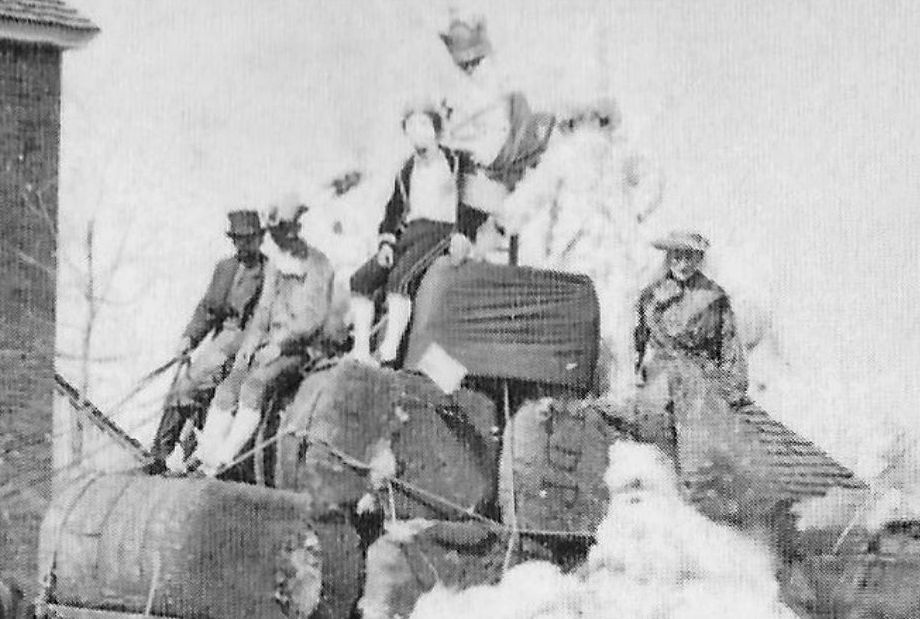
The photo at the top shows the parade wagons representing the brand new Dallas Cotton Exchange (which seems to have been organized the previous month). As described in The Galveston Daily News, the Cotton Exchange’s offering “represent[ed] King Cotton enthroned on six bales of cotton, with numerous subjects appropriately costumed, and occupying two cars” (Feb. 25, 1876). Below are a couple of magnified details of the photo. I’m not sure, but it looks as if the horse and rider in the foreground are covered with cotton. Like tarring and feathering … but fun … and with cotton. The King of Cotton is surrounded by what look like henchmen. The masked man on the right in the elaborate costume is both cool and kind of creepy. (Click both photos for larger images.)

mardi-gras_1876-det1

mardi-gras_1876-det2

***

Sources & Notes

Top photo appeared in the book Historic Photos of Dallas by Michael V. Hazel (Nashville: Turner Publishing Co., 2006); photo from the Dallas Historical Society.

Newspaper clippings as noted.

To read the coverage of Dallas’ Mardi Gras parades and balls —  “a grand pageant and general jollification” — see the front page of The Galveston Daily News (Feb. 25, 1876), here (third column, top of page — zoom controls are on the left side of page).

I wrote a previous post called “Mardi  Gras Parade in Dallas — ca. 1876” which features a photograph which might be from this first Mardi Gras. That post and photo can be seen here.

Happy Mardi Gras!

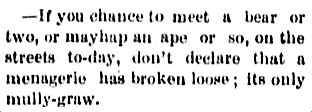
mully-graw_dal-herald_022476Dallas Herald, Feb. 24, 1876

Photos larger when clicked.

*

Copyright © 2015 Paula Bosse. All Rights Reserved.
Roseland — 1916

roseland_terrill-yrbk_1916The Roseland Theater, 1613 Main St. (click for larger image)

by Paula Bosse

Despite its grainy quality, I really like this photo. It shows people walking past the Roseland Theater at 1613 Main Street, a theater I’d never heard of. I couldn’t find out much about it other than that it doesn’t seem to have lasted very long (from at least 1914 until at least 1916). It was owned/managed by P. G. Cameron, who ran several theaters and was in the general “amusements” business around town (he had run the Fair Grounds Skating Rink back in the aughts for a short while, until the place was shut down because of the discovery of a prostitution operation being conducted there … on city-owned property).

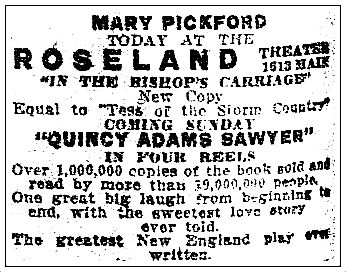
roseland_dmn_050914Dallas Morning News, May 9, 1914

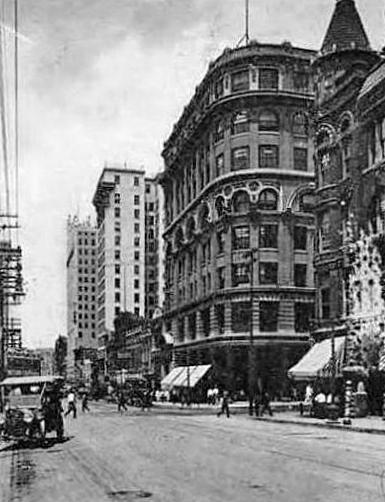
In 1916, the north side of Main Street contained three theaters: the Nickelodeon (1607 Main), the Roseland (1613 Main), and the Best (1615 Main). This is the much-beleaguered (and now mostly demolished) block of Main, which in 1916 was anchored by the dazzling Praetorian and Wilson buildings. The Roseland occupied part of what was once the Everts Jewelers building. Below, another view of this block in 1916, with the theater(s) on the right, about halfway between the tall white Praetorian Building and the stately rounded Wilson Building.

main-st_1916_smu-rotunda_sm Another grainy photo, Main looking west

I like this Roseland photo because it’s a candid shot taken by a teenager on the sidewalk of a lively downtown Dallas who had happened upon his teacher away from school. And the sign is cool. Too bad it’s so hard to see.

roseland_terrill-yrbk_1916_det

***

Sources & Notes

Photo from the 1916 Terrillian, the Terrill School yearbook. (The caption for the photo of one of the school’s teachers: “Passing by or coming out, Mr. F.?”)

Photo of Main Street, looking west, from the 1916 Rotunda, the yearbook of SMU.

See what the 1600 block of Main looked like in 1909, here. Much of the block has been demolished.

See the 1921 Sanborn map showing this block, here.

Below, a recent (2015) Google Street View of the building that housed the Roseland: the really lovely shorter white building. This building may already have been razed. What a shame. (UPDATE — 2018: Yep, demolished.) The current view (as I assume this block is ever-changing) can be seen on Google Street View here.

roseland_google2015, not long for this world….

*

Copyright © 2015 Paula Bosse. All Rights Reserved.
 

The Dallas Aquarium: The Building Emblazoned With Seahorses — 1936

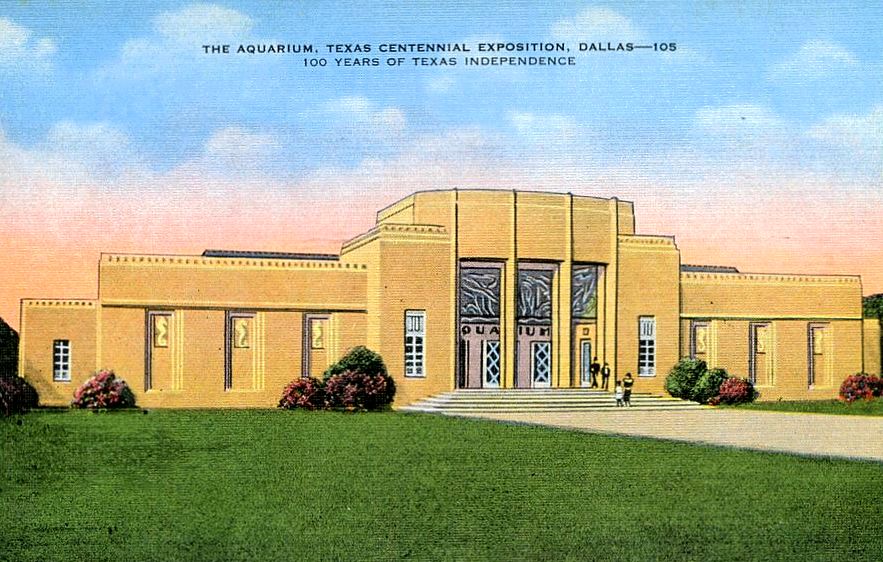
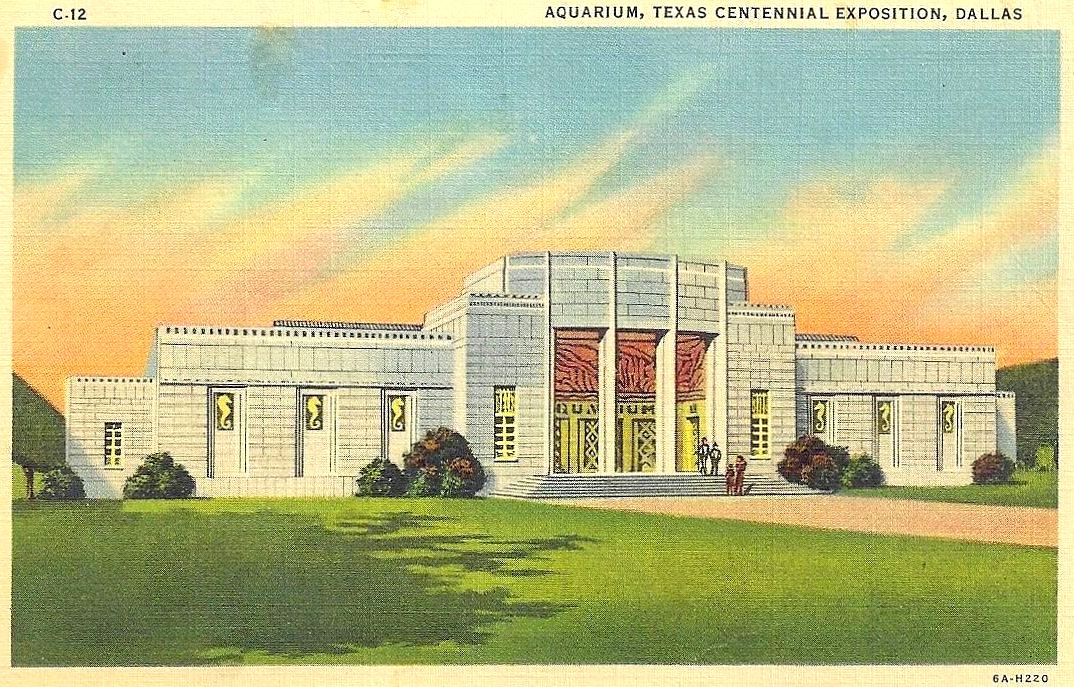
tx-centennial_aquariumThe Dallas Aquarium at Fair Park, 1936… (click for larger image)

by Paula Bosse

Out of all the buildings at Fair Park, the one I have the fondest memories of is the Dallas Aquarium, one of the buildings built in 1936 for the Texas Centennial Exposition which was specifically intended to be a permanent structure which would be available year-round to the citizens of Dallas, well after the Centennial had ended (some of these other “civic buildings” included the Museum of Fine Arts, the Museum of Natural History, the Hall of State, the bandshell, etc.). The Centennial buildings were designed by different architects, usually working in teams — the aquarium was designed by Fooshee & Cheek (best known for their previous triumph, Highland Park Village), Hal B. Thomson, and Flint & Broad. It ended up costing the city about $200,000 ($50,000 over the initial budget), and tussles with the Park Department and the City Council over its budget and space requirements meant that at various times it was suggested that the aquarium find a home at the Marsalis Park Zoo in Oak Cliff rather than at Fair Park, or that it just be shelved altogether.

fair-park-aquarium_1936

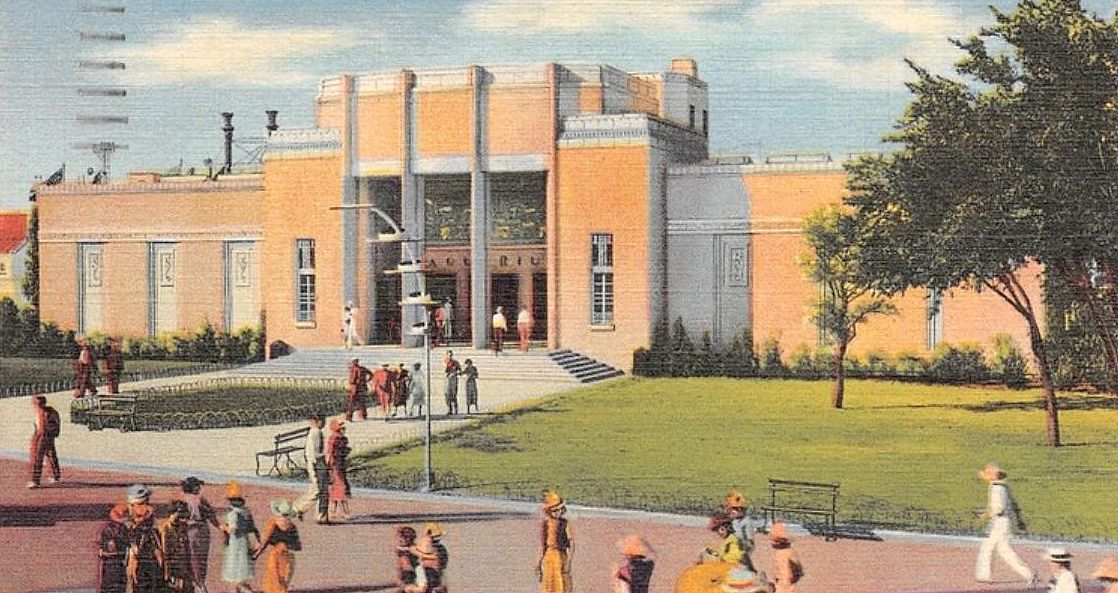
But everything worked itself out in the end, and its popularity at the Centennial was huge. HUGE. Most people in our part of the country had never been to an aquarium and had never seen fish outside of a lake or river or hatchery. According to reports in the newspapers during its construction in early 1936, not only was the Dallas Aquarium the first aquarium in Texas, it was also only the 12th aquarium in the entire United States — and it was the only one in the country in a “strictly inland city.” So unless visitors to the Centennial that year had traveled extensively, chances were slim that they’d ever seen anything like this.

fair-park_aquarium_postcard

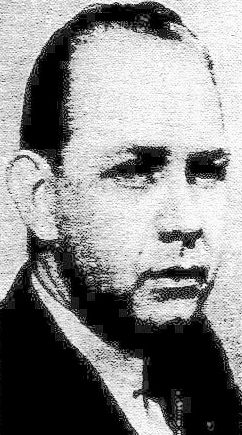
At the time that plans were being discussed for the Fair Park facility, there was something of a tropical fish fad going on around the country. The Dallas Aquarium Society — a small group of “tropical fish fanciers” — was organized in June, 1935, and in September of that year, they had enough pull to put on an exhibition of their personal collections in small tanks on an upper floor of the Dallas Gas Company. People who had never before seen anything but a goldfish in a fish bowl were fascinated, and there were several “gee-whiz” articles in the papers describing the fishy wonders that could be found that fall at the gas company. The president of the Dallas Aquarium Society was Pierre Fontaine — an advertising man and “authority on marine life” — and he must have made quite an impression with the Centennial board, because in February of 1936, he was chosen to be the head of the already-under-construction Dallas Aquarium. (Though apparently a hobbyist when appointed, Fontaine served for decades as the respected director of the Dallas Aquarium — and later the Dallas Zoo.)

aquarium_fontaine_1936
Pierre Fontaine, 1936

The fish on display during the Centennial were almost exclusively freshwater fish. Not only would it have been prohibitively expensive to ship the thousands and thousands of gallons of salt water that would have been needed, it would also have been extremely costly to purchase and maintain the special non-corroding equipment necessary to equip such tanks. But Fontaine must have pushed, because the city gave the go-ahead for a paltry 500 gallons of salt water from the Gulf to be shipped up for the opening of the Exposition, so at least a few exotic saltwater-dwelling creatures and plants were able to share their DeMille-moment in the Centennial spotlight with their freshwater brethren. (At the time, “artificial” salt water was not yet an option as it now is, and only natural salt water could be used.)

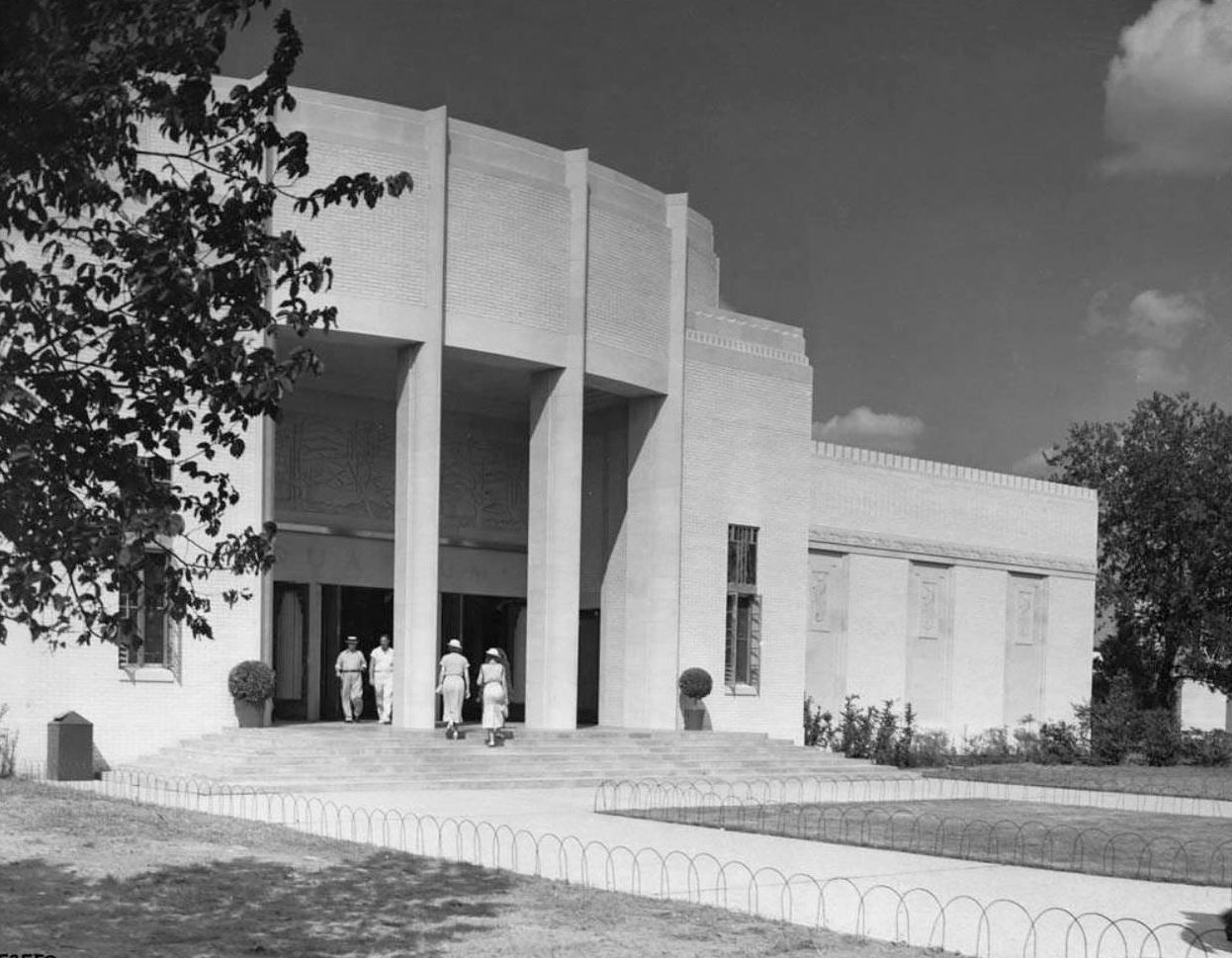
aquarium_art-institute-of-chicago_1936Art Institute of Chicago Collection

The 1936 Centennial aquarium building still stands. After extensive renovation, it now houses the “Children’s Aquarium,” which I haven’t visited, but which I’m confident is entertaining and educational. I’m pretty sure, though, that it is a completely different aquarium from the one of my childhood memories (when museums were basically designed for adults and were rarely “interactive”). I loved going to the aquarium. I remember it being dark and cool and kind of dreamy inside. Mysterious and exotic. I loved the little neon fish that playfully (or nervously) darted all around the tanks, the big, slow-moving fish that looked back at me like nonchalant cud-chewing cows in a field, the tiny skittering crabs, the turtles, the undulating plants … I loved all of it.

But what I really remember are the seahorses on the side of the building — whichever architect came up with that perfect little detail deserves a special place in heaven. I loved them as a child, and I love them now. The acres and acres of art deco fabulousness created for the Texas Centennial are absolutely thrilling, but those solemn and quietly elegant seahorses all in a row on the side of the Dallas Aquarium will always be my personal favorite little nostalgic detail in the whole of beautiful, beautiful Fair Park.

seahorses_pb-det

The Aquarium today (click to enlarge) / photo: Paula Bosse

*

UPDATE — Oct. 2020: It has been announced that the Children’s Aquarium will be closing permanently. This news is almost as upsetting as seeing Big Tex in flames.

UPDATE — Sept. 2021: Good news! It looks like the aquarium will be reopening in time for the 2021 State Fair of Texas. Read about it here.

***

Sources & Notes

Top two images are postcards based on the original architectural drawings, issued before the aquarium was built, found somewhere on the internet.

The third color image is a postcard from a photograph taken after the Centennial was underway.

Photo of the exterior of the present-day aquarium was taken by me in 2013.

The website for the Children’s Aquarium at Fair Park is here.

For an absolutely FANTASTIC well-illustrated article titled “The Metamorphosis of the Dallas Aquarium at Fair Park Into the Children’s Aquarium at Fair Park, With Historical Annotations” by Barrett L. Christie, Aquarium Supervisor, see p. 5 of the “Drum & Croaker” PDF, here. I really loved this article — especially the “Annotations of Historical Interest” at the end (p. 14). Seriously — this is a great read. I’m as layman as you’re gonna get regarding this topic, and I was fascinated by all of this. I’m going to have to write about that mysterious severed human leg found on the roof in 1954!

*

Copyright © 2015 Paula Bosse. All Rights Reserved.

Elvis at the Big D Jamboree — 1955

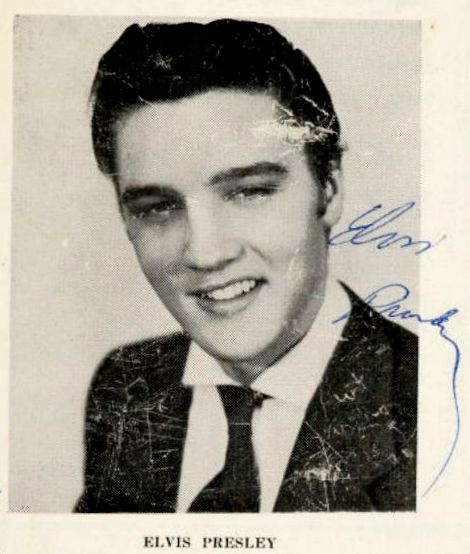
elvis_big-d-jamboree_program_090355-photo

by Paula Bosse

Today is Elvis Presley’s birthday — a perfect time to present a nostalgic look back at the early days of his fame, before he broke nationally and when it was still pretty easy to get a ticket to see him. Here are a few tidbits from his appearance on Sept. 3, 1955 at the legendary Big D Jamboree (held at the equally legendary Sportatorium). Happy Birthday, E!

*

elvis_big-d-jamboree-program-090355Big D Jamboree program, Sept. 3, 1955

*

elvis_big-d-jamboree_090355That night’s schedule — E’s all over it

*

elvis_big-d-jamboree-ad_dmn_090355Typos like this wouldn’t be a problem soon

***

Sources & Notes

Photo of Elvis and the two clippings from the Big D Jamboree program to that night’s show, Sept. 3, 1955 (which the ad is promoting).

*

Copyright © 2015 Paula Bosse. All Rights Reserved.

Texas Centennial Promotion on Hyper-Drive! — 1936

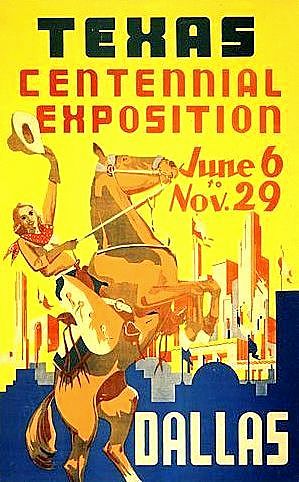
tx-centennial_poster_cowgirl_briscoe-ctr

by Paula Bosse

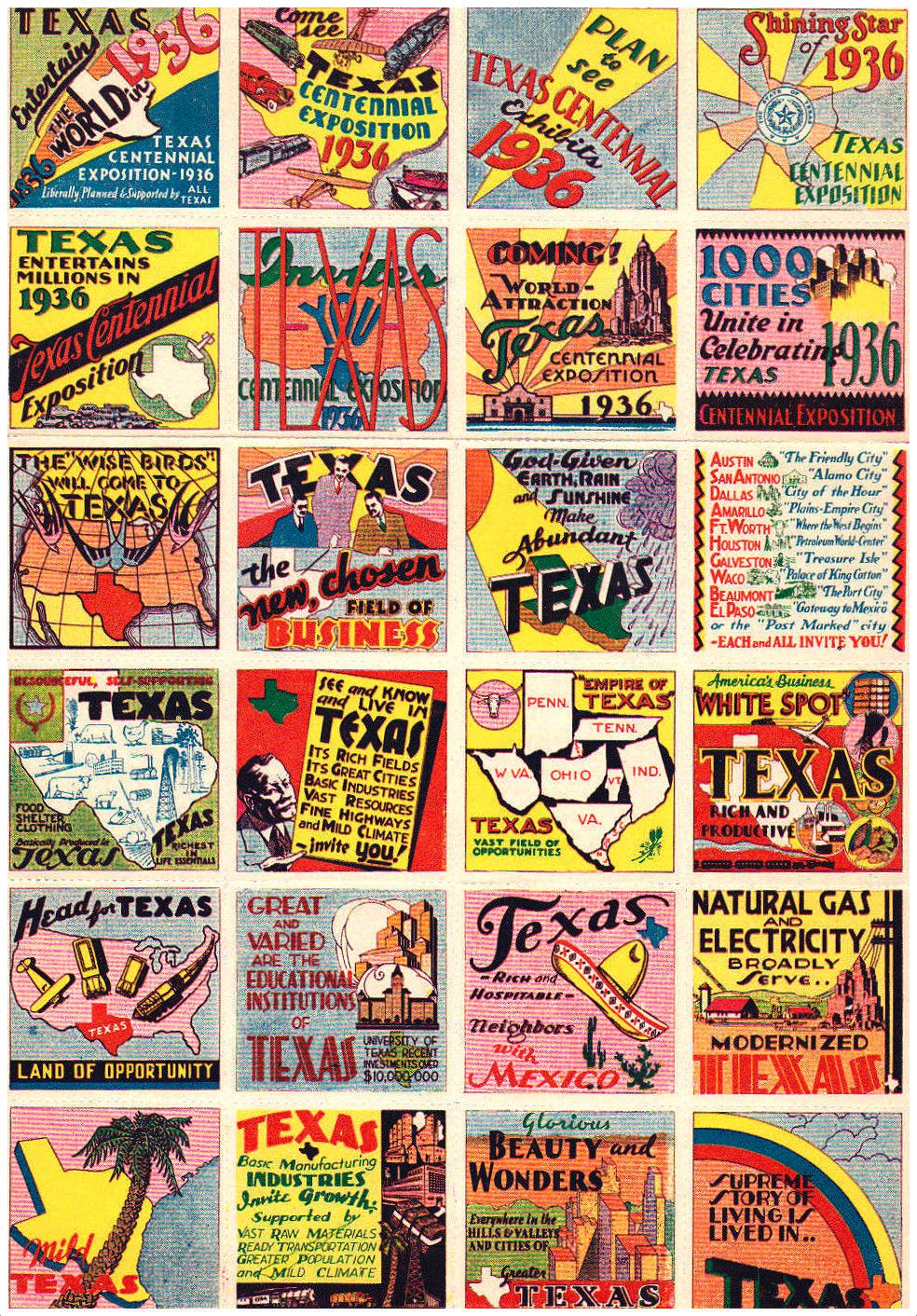
A bit of color and giddy enthusiasm on a gray day.

tx-centennial_promo_sheet(click for MUCH larger image)

***

Top image is a Texas Centennial poster from the Ephemera Collection of the Dolph Briscoe Center for American History. I would provide a link, but I am unable to find it now. It was online a few months ago!

Source of bottom image is unknown. Probably eBay. A long, long time ago.

*

Copyright © 2014 Paula Bosse. All Rights Reserved.

Old Red Goes Hollywood (sort of…) — 1964

buchanan_trial-oswald_1964Old Red’s star turn in The Trial of Lee Harvey Oswald (click for larger image)

by Paula Bosse

An interesting (if a bit fuzzy) screenshot of the Old Red Courthouse from one of Larry Buchanan’s Dallas-made films, “The Trial of Lee Harvey Oswald” (1964), about what might have happened had LHO lived to face trial. As with most of Buchanan’s extremely low-budget films, it drags and has clunky acting (…I have to admit that I didn’t watch the whole thing), but it’s interesting to fast-forward through to see the bits shot out on the streets of downtown. I really like this view of the courthouse. It seems familiar and unfamiliar at the same time.

***

Yes, you can watch the whole film on YouTube — free! Mosey on over here. The movie’s tagline: “Not a Newsreel … A Full-Length Motion Picture Filmed Secretly in Dallas.” Uh-huh. And as far as the movie having been “suppressed” (as is mentioned at the  beginning of the film) … well, let’s just say Larry worked in advertising for many years and knew a thing or two about marketing.

For other posts I’ve written about Larry Buchanan (I kind of feel I know him now — he would have been a lot of fun to shoot a movie with!), click here.

*

Copyright © 2014 Paula Bosse. All Rights Reserved.

David Wade, Gourmet: Have Ascot, Will Travel

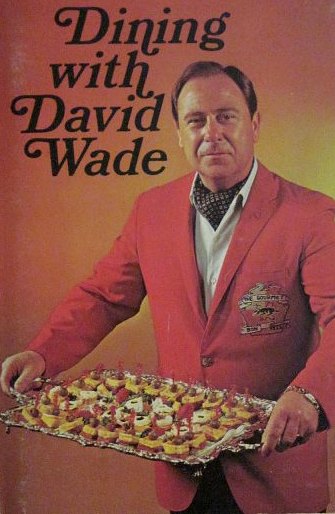
david-wade_dining-with_cover

by Paula Bosse

A few years ago, when I was a bookseller, I posted the following on a personal blog — it turned out to be the most commented-on and most clicked-on post I’d ever written. I wrote it a bit snarky, but I was amazed by the response it elicited: people (both in Texas and beyond) apparently have a strong affection for — and a seemingly deeply personal attachment to — local TV gourmand David Wade. Here’s what I wrote.

*

I just received an order for a David Wade cookbook I’ve had listed for four years:

DAVID WADE’S KITCHEN CLASSICS (Dallas: David Wade Industries, 1969). 300pp. Photographs, index. The ascot-clad TV gourmet presents recipes as well as photos of himself with celebrities such as Mickey Mantle (page 99, opposite the recipe for Crabmeat Tetrazzini). A couple of small splotches to fore-edge; one rubbed spot on cover. No dust jacket. Inscribed by Wade. $12.50

I don’t know if people outside of Texas (and maybe outside of Dallas) would be familiar with David Wade, described, tellingly, not as a “chef” but as a “food demonstrator.” He had a local TV show that must have started in the ’50s or ’60s, but I saw him in the ’70s and into the ’80s. And, yes, he DID wear an ascot, and a blazer, as seen above, from the front cover of another cookbook from the David Wade oeuvre.

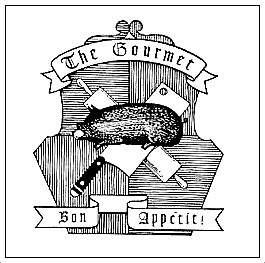
He had a catchy theme song (which compared him to Rembrandt and Edison) and he had his very own coat of arms, which I have vivid, rather frightening memories of from my childhood (I always imagined that poor pig being whacked over the head with the rolling pin and then hacked apart by the cleaver — Bon Appetit, little piggie!):

david-wade-show_logo

I was just a kid, but I remember cringing a bit at his deep-voiced cheesiness. I don’t actually remember much about the food or the actual program, but I can still hear that unnaturally calm, deep voice oozing around inside my head. But what did I know? He was an incredibly popular local TV personality. Yeah, he might have used an over-abundance of big words (…words like “over-abundance”), but, to be fair, he also had a folksy charm and was pleasantly inoffensive.

I’m not sure the same can be said for his food, however. Here are a few of the recipes which some lucky lady in South Carolina who bought the cookbook might be whipping up in a few days:

  • Squash Loaf
  • Citrus Surprise Steak
  • Liver Yucatan (featuring grated American cheese (can you actually grate American cheese?), macaroni, canned mushrooms, and sugar)
  • Baked Stuffed Fish with Pecan Grape Sauce
  • Deep Sea Loaf (made with canned tuna, gelatin, sweet pickle juice, avocado, and three tablespoons of sugar … among other equally distressing ingredients)
  • Salmon & Green Olive Casserole (with cream and “salmon liquid” straight from the can)
  • Apple & Banana Soup (these are the ingredients: chicken stock, apple, banana, potato, onion, cream, curry powder, chives)
  • Kidney Bean Tuna Salad
  • Meat Loaf Pizza
  • Pineapple Mint Cake
  • Quick Clove Jelly Cake
  • Sahib Eight Boy Chicken Curry (…I have no idea…)
  • Yam Peanut Puffs

Bon Appetit!

*

After I wrote that post, I was inundated by people looking for information on where to find all sorts of much-loved David Wade recipes (especially his famed “Turkey in a Sack”) and where they could find his apparently quite popular Worcestershire Powder. There were also many, many comments from people who just wanted to share personal memories of David Wade, invariably describing him as a warm and gracious, down-to-earth, gentle man. “Classy, but not pretentious.”

Wade began his TV career in Dallas at WFAA in 1949, hosting a 15-minute show about dogs (?!) called “Canine Comments” — it became so popular that it was syndicated around the country. He won awards for that show. It was VERY popular. In 1952, Wade was also appearing on WFAA radio as “The Hymn Singer,” singing religious songs and talking about each song’s history and composer. Along the line he made the switch to food.

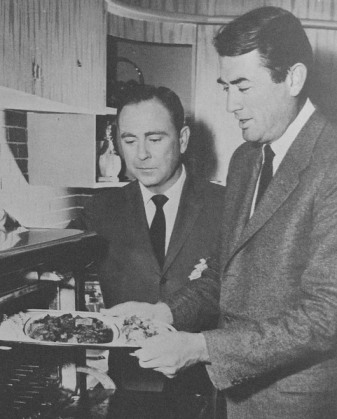
He was “demonstrating” food preparation at personal appearances and on local television by 1957, and in the early 1960s he became a nationally known figure when he commuted to New York from Dallas to tape regular spots for a show called “Flair” in which he frequently appeared with celebrities, guiding them through the preparation of a dish.

david-wade-gregory-peckWith Gregory Peck, 1960s

Eventually, his Dallas-based TV shows were syndicated all over the U.S., and he was so popular locally that he decided to run for mayor in 1971 (he lost to Wes Wise). He continued in his role as a cooking instructor and media figure until his retirement.

David Wade, a much-beloved man who lived and worked in Dallas for the bulk of his career — died in Tyler in March of 2001 at the age of 77. He had been a fixture on Texas television and had published numerous cookbooks. And in between rhapsodizing on good food and wine, he even taught untold thousands how to cook fish in the dishwasher and how to roast a turkey in a paper sack.

***

Sources & Notes

David Wade’s obituary is here.

A warm and fuzzy nostalgic look back at Wade can be read at CraveDFW, here; a super-snarky (and kind of amusing) LA Weekly post critiquing Wade’s recipes can be read here.

Regarding Wade’s run for Mayor of Dallas, check out the Dallas Morning News interview with him conducted by Carolyn Barta, in which he expounds on his vision for the future of Dallas, in the article “Wade Feels Need to Communicate” (March 21, 1971).

Next: The little-known devastating and traumatic childhood event that resulted in David Wade becoming an orphan at the age of 5. Read “David Wade: Overcoming Childhood Trauma” here.

*

Copyright © 2014 Paula Bosse. All Rights Reserved.