Flashback : Dallas

A Miscellany: History, Ads, Pop Culture

Category: Sports

Dallas High School’s 1915 Basket Ball Season

basketball_dallas-high-school_1915-girls-photo_dhs-yrbk
A winning season for the girls!

by Paula Bosse

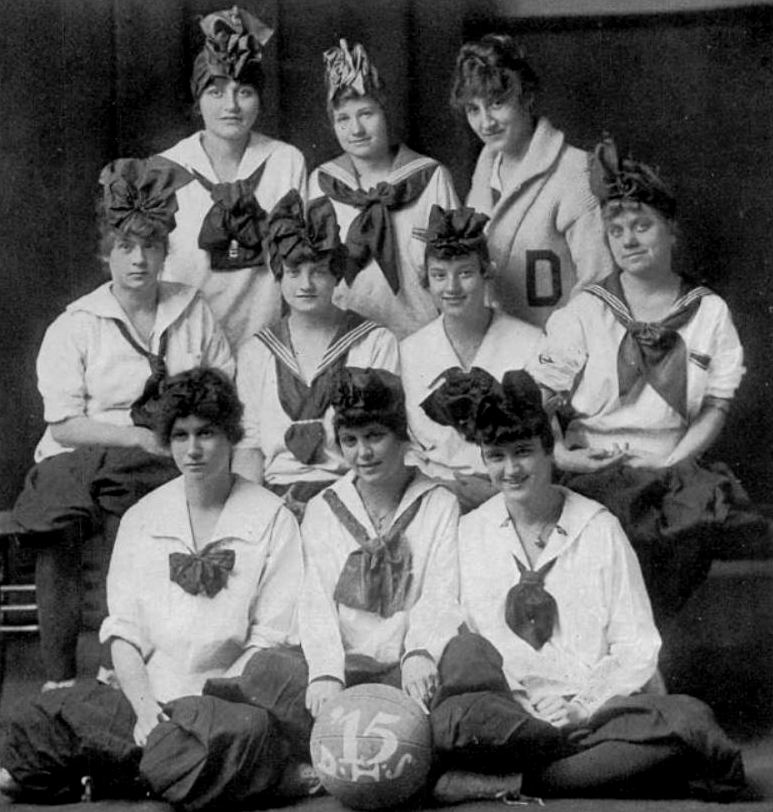
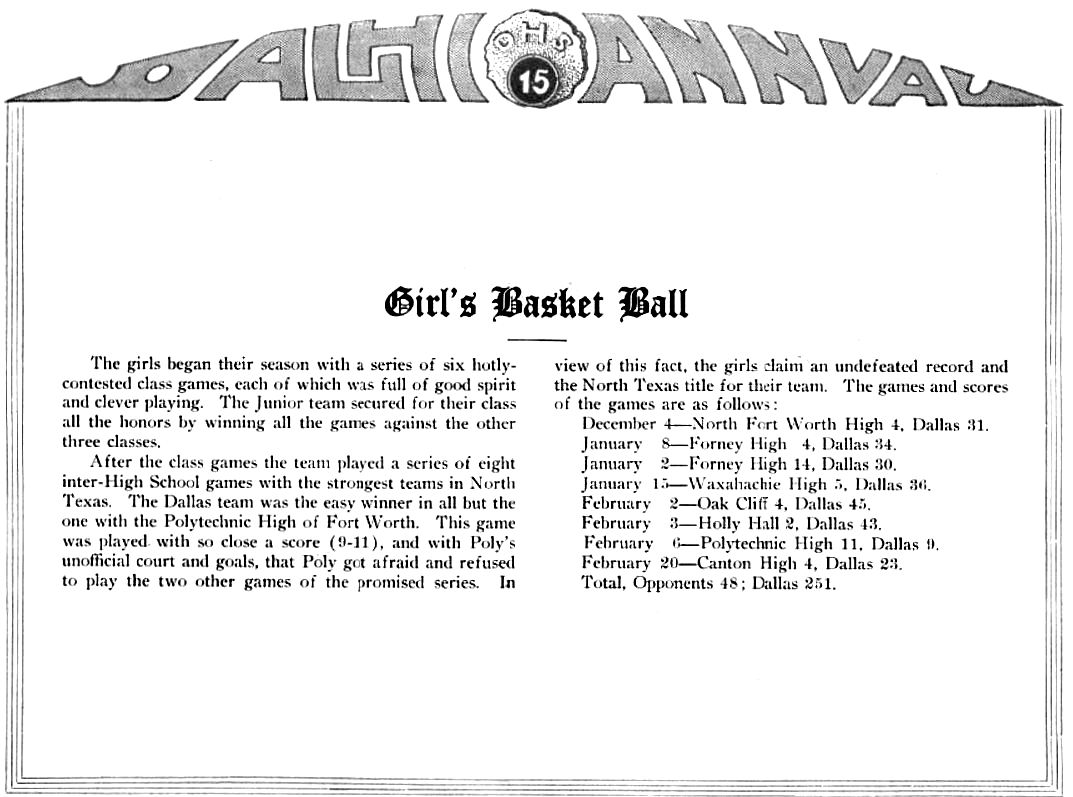
The girls’ basketball (or “basket ball”) team of Dallas High School (later known as Crozier Tech) had a great season in 1915! They won 7 of their 8 games, losing only to Fort Worth’s Polytechnic High (by one measly basket). Most of their opponents were trampled by the DHS team, several managing to score  no more than a mere 2 or 4 points (!). And, let’s face it, without the drag caused by those elaborate and cumbersome uniforms and … um … headgear, DHS would no doubt have scored even higher.

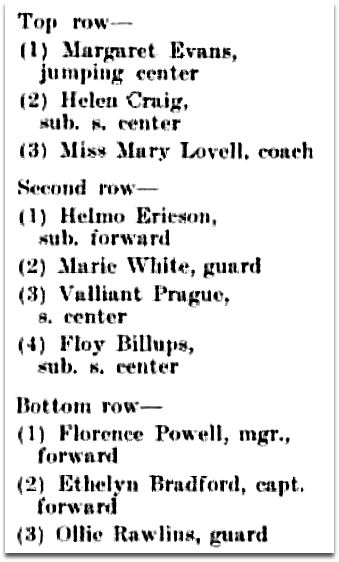
Below, the roster (containing some great names like Helmo, Valliant, Floy, and Ollie).

girls-basketball-team_dhs_1915

And the wrap-up of the season, from the yearbook, with more than a hint of bitterness toward the Fort Worth team:

basketball_dallas-high-school_1915-girls_text_dhs-yrbk

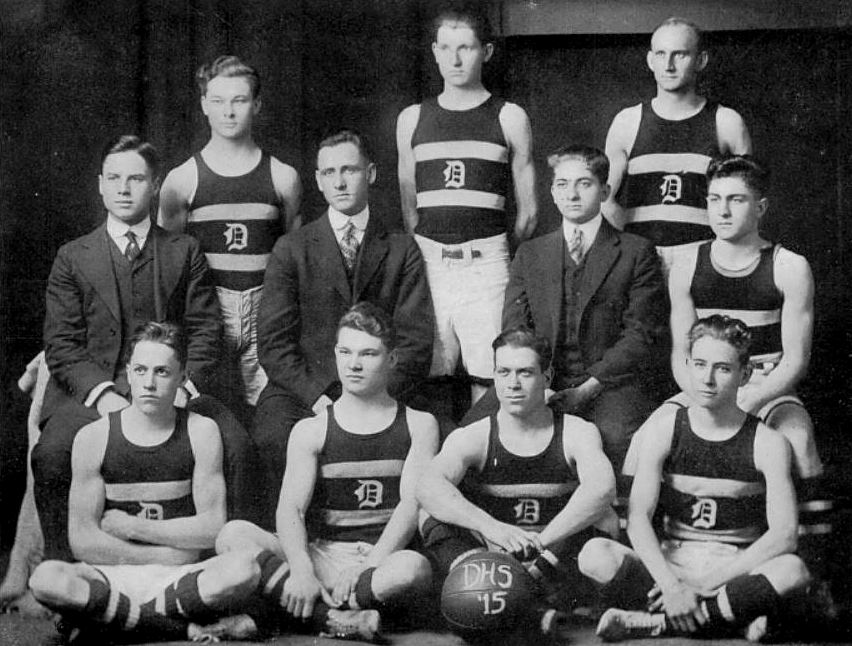
And the boys’ team? Oh dear. They won only 4 out of 8 games. But at least their uniforms were better suited to the sport.

basketball_dallas-high-school_1915-boys_dhs-yrbk

basketball_dallas-high-school_1915-boys_text_dhs-yrbk

dallas-high-school_1915

***

Sources & Notes

From the pages of the 1915 Dallas High School yearbook — the “Dal-Hi” annual.

*

Copyright © 2015 Paula Bosse. All Rights Reserved.

A Dip in the HP Pool — 1924

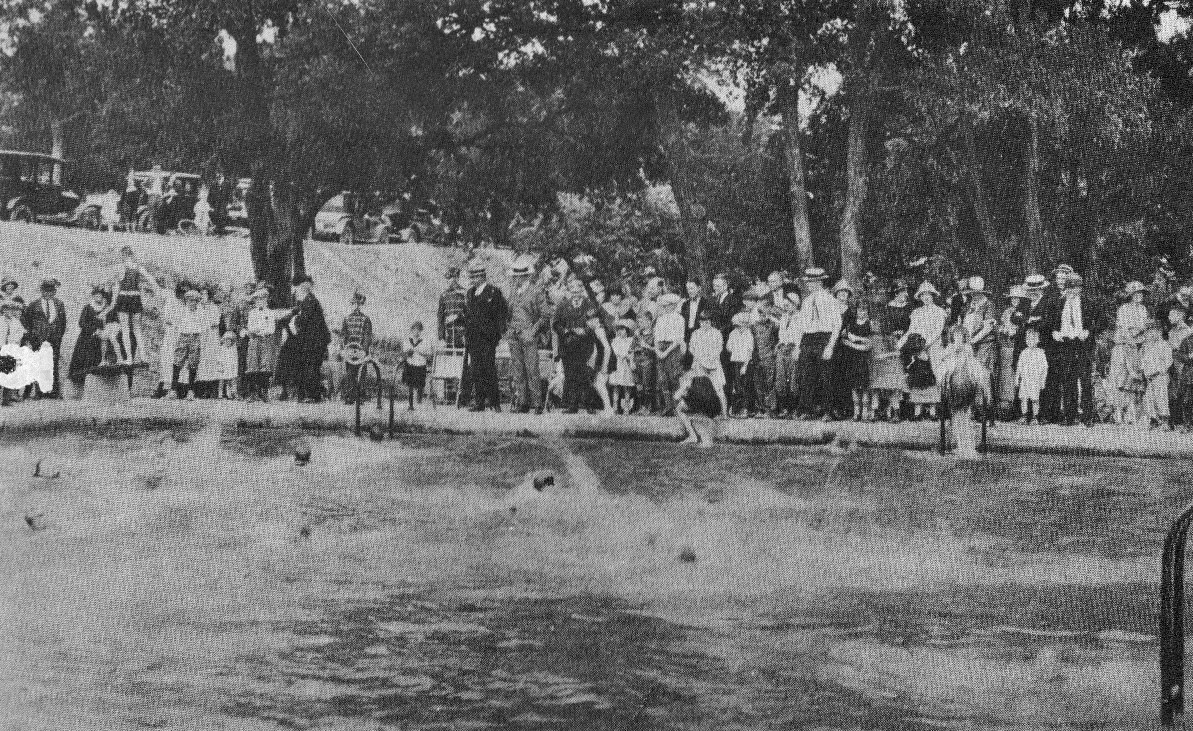
hp-pool_aDedication & formal opening of the HP pool, 1924

by Paula Bosse

Even though “municipal pool” and “Park Cities” don’t really seem to belong in a sentence together, the still-going-strong pool in Highland Park is over 90 years old. The photo above shows crowds gathered at the formal opening of the brand new Highland Park swimming pool, dedicated on May 17, 1924. The caption of this photo which ran in The Dallas Morning News on May 18, 1924 reads: “The above shows the group of Highland Park citizens gathered at the new municipal swimming pool Saturday afternoon for the formal opening exercises. Mayor Frank M. Smith is seen standing in the middle of the group. Seated by his side is former mayor Henry L. Davis in whose administration the movement for the installation of the pool was started.”

Oh, to have witnessed the fabulously wealthy (or near-fabulously wealthy) sashaying down the street toward the pool, dressed in their mandated bathrobes and swimsuits. Or their raincoats and swimsuits. (“[Regulations governing use of the pool require that] swimmers must dress at home in their bathing suits, but may come through the streets to the pool so clad if they wear a raincoat or a bathrobe over their swimming garb.” — Dallas Morning News, May 18, 1924)

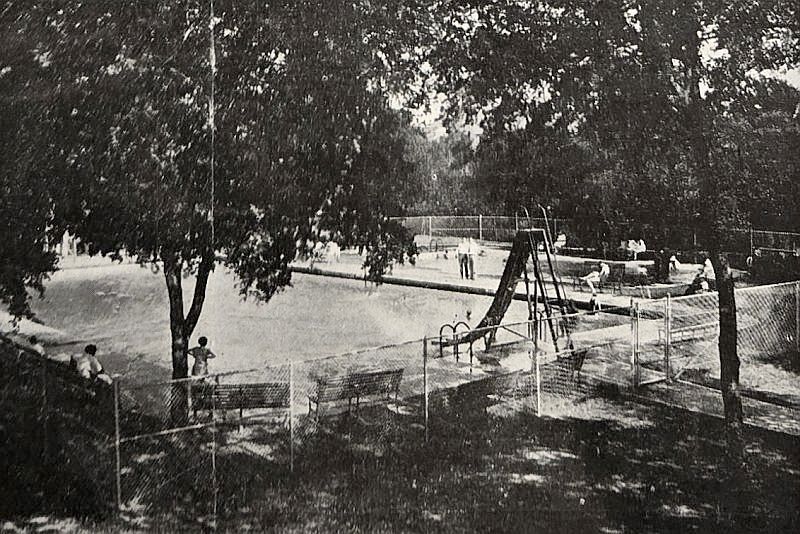
The municipal pool is in Davis Park on the south side of Lexington Avenue, in the “natural amphitheater” between St. Johns and Drexel. The 50 x 100-foot pool (reduced somewhere along the way from the original plan of a 60 x 140-foot pool) cost about $10,000 when it was built with municipal funds in 1924. The pool was very popular amongst Highland Park residents, and, as can be seen in the photos, it was located in one of the prettiest settings in Dallas.

hp-pool_highland-park-paper_june-1927_DPL

***

Sources & Notes

Top photo is from a postcard issued as part of the Park Cities Bank “Heritage Series” in the 1970s; the credit line on the postcard reads “Donated by Mr. Burton Gilliland.” Thanks to the Lone Star Library Annex Facebook group for use of the image. (The printed description of the postcard has an incorrect date of 1923.)

Bottom photo is from Highland Park (an interesting newspaper published by developers Flippen-Prather), June 1927, Periodicals Collection, Dallas History and Archives, Dallas Public Library.

More on the pool’s opening can be found in the Dallas Morning News article “Highland Park Pool Dedicated Saturday” (May 18, 1924).

Official site of the HP pool? Here it is.

*

Copyright © 2015 Paula Bosse. All Rights Reserved.

Nolan Ryan’s Celebratory Pancake Breakfast — 1972

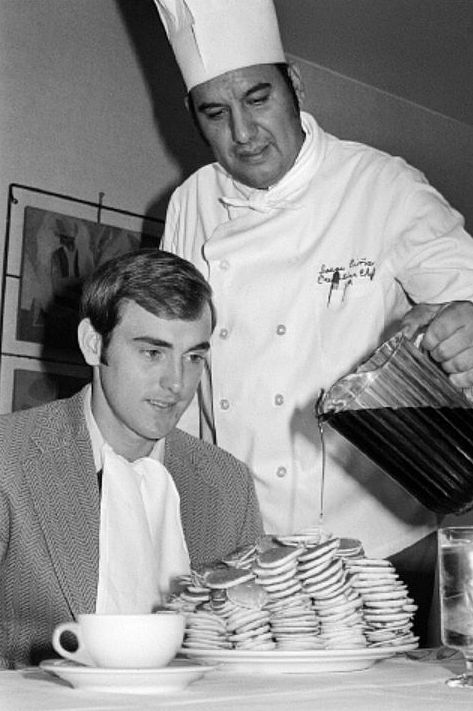
nolan-ryan© Bettmann/CORBIS

by Paula Bosse

In 1972, future baseball hall-of-famer and Texas Rangers legend Nolan Ryan (then a California Angel) was photographed in Dallas as he sat mesmerized by a platter of 302 silver-dollar pancakes and an iced-tea-sized pitcher of syrup. The celebratory breakfast was served to him at the Sheraton Dallas the morning after he became only the sixth pitcher in major league history to strike out more than 300 batters in a season. (His opponents the previous night — September 25, 1972 — had been the Rangers, the team he would one day play for and preside over as president and CEO.)

The UPI Telephoto wire photo ran on Sept. 27, 1972 above the following caption:

302 PANCAKES — Ever wonder what 302 strikeouts in a season will get you? If you’re a batter, you may lose your job, but if you’re a pitcher like Nolan Ryan, left, of the California Angels, [you] will at least get 302 silver dollar pancakes. This was the breakfast that awaited Ryan Tuesday after his 3-hit, 12-strikeout win over the Texas Rangers Monday. The executive chef at the Sheraton Dallas [Isaac Pina] produced the breakfast for the Alvin native, a former New York Met, who is the sixth pitcher in major league history to strike out more than 300 batters in one season.

Twelve strike-outs!

ryan_FWST_092672Fort Worth Star-Telegram, Sept. 26, 1972

Judging by the expression on his face at the next day’s breakfast table, it’s pretty obvious the 25-year old Nolan Ryan enjoyed his triumph.

***

Sources & Notes

Photo ©Bettmann/CORBIS. The photo is also seen on this page, from The Guardian, which shows a collection of really great historic baseball photos — a bit of a surprise, coming from a British newspaper!

The photo was published in newspapers around the country; the quoted wire copy appeared in the Sept. 27, 1972 edition of The Waxahachie Daily Light.

To read a passage from the book Nolan Ryan’s Pitcher’s Bible in which he writes about the importance of his high-carb breakfasts (Day One: Pancakes…), see here.

The Wikipedia entry on Nolan Ryan is here; his stats are here.

*

Copyright © 2015 Paula Bosse. All Rights Reserved.


The Marietta Mask

marietta-mask_doak_boys-life_oct55SMU football star Doak Walker in an ad from Boys’ Life, Oct. 1955

by Paula Bosse

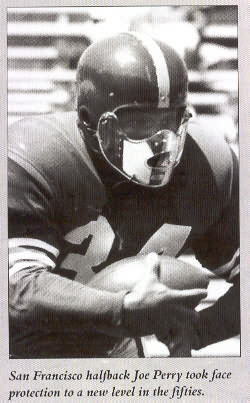
Dr. Thomas M. Marietta (1910-1995), a Dallas dentist, devised a startlingly new invention in 1947: a specially-made facemask. Initially, the mask was created to protect the face of a Dallas hockey player who had recently sustained a broken nose and would have been unable to play without a mask for fear of further injury. Marietta’s creation was a success — not only did the player get back on the ice, but tentative inquiries from other sports teams began to trickle in. But what changed everything were the masks he made for TCU’s star quarterback Lindy Berry, who had suffered a broken jaw, and Texas A&M’s fullback Bob Smith, who had a badly broken nose. Without the odd-looking masks that protected their entire faces, they would not have been able to play out the seasons. The masks were an unqualified success, and the doc went commercial.

marietta-face-mask_marion-OH-star_112251_wireDr. Marietta (Marion Ohio Star, Nov. 22, 1951 — full article is here)

In 1951, football players did not generally wear facemasks. It was commonplace for players to rack up a dizzyingly large number of injuries such as broken and dislocated jaws and noses, knocked-out teeth, facial lacerations, major bruising, concussions, etc. An article appeared in The Dallas Morning News on Aug. 31, 1951 describing what this whole facemask thing was about and how the Texas Aggies were about to try a revolutionary experiment by equipping “possibly half of the A&M team” with Dr. Marietta’s newfangled masks. Coach Ray George approved a trial test of the masks, saying that his primary concerns were reduction of facial injuries, elimination of head injuries, and improvement of athletic performance. A&M’s trainer, Bill Dayton, predicted that the wearing of facemasks would become universal among players in the coming years.

Many head injuries happen as the result of a player ducking his head. We believe that by the use of this face gear we can eliminate head ducking, and our players will see where they are going. When they watch their opponents, they are able, by reflective action, to keep their heads out of the way. (A&M trainer Bill Dayton, DMN, Aug. 31, 1951)

The various incarnations of the Marietta Mask over the next couple of decades were used in various sports by children, by college athletes, and by professionals. Dr. Marietta patented several designs for masks and helmets and had a lucrative manufacturing business for many years. In 1977 the business was sold, and the Marietta Corp. became Maxpro, a respected name in helmets.

Football and hockey will always be extremely physical sports with the very real possibility of injury, and though there’s need for further improvement, Dr. Marietta’s invention helped lower the danger-level quite a bit. Thanks to a mild-mannered dentist from Dallas, a lot of athletes over the years managed to avoid all sorts of nasty head and facial injuries. Thanks, doc.

*

marietta-mask_corbis_oct1954Oct. 1954 (©Bettmann/CORBIS)

marietta_joe-perry

marietta-mask_envelope

***

Sources & Notes

Photo ©Bettmann/CORBIS; the original caption: “An outer-space look is given by this all-plastic mask lined with foam rubber. It was designed by Dr. M. T. Marietta, a Dallas, Texas dentist.”

Joe Perry photo from HelmetHut. To see some pretty wacky versions of early masks from a Marietta catalog, see images from HelmetHut.com, here.

Read the following newspaper articles:

  • “Mask Maker: Dentist Helped Wolves Win Title (Abilene Reporter-News, Nov. 29, 1950) — regarding the Colorado City (TX) Wolves and their injured player, Gerald Brasuell, the team’s tackle who wore Dr. Marietta’s mask and was able to play despite having a triple-fracture to his jaw, here
  • “Broken Jaw Protection: Doctor’s Face Mask Enables Injured Gridders To Play” (Marion, Ohio Star, Nov. 22, 1951), here

To see several of Marietta’s patents (including abstracts and drawings), see them on Google Patents, here.

And to read an interesting and entertaining history of the football facemask (and I say that as someone who isn’t really a sports person), check out Paul Lukas’ GREAT piece “The Rich History of Helmets,” here. (If nothing else, it’s worth it to see the cool-but-kind-of-weird-and-scary, crudely-fashioned, one-of-a-kind facemask made out of barbed wire wrapped in electrical tape!)

And because a day without Wikipedia is like a day without sunshine, the facemask/face mask wiki is here.

*

Copyright © 2015 Paula Bosse. All Rights Reserved.

SMU Football Players’ Unusual Summer Job: Strutting and Parading at the Dog Track — 1937

greyhounds_mickey-mouse_010835_cropped
It was kind of like this… (click for larger image with caption)

by Paula Bosse

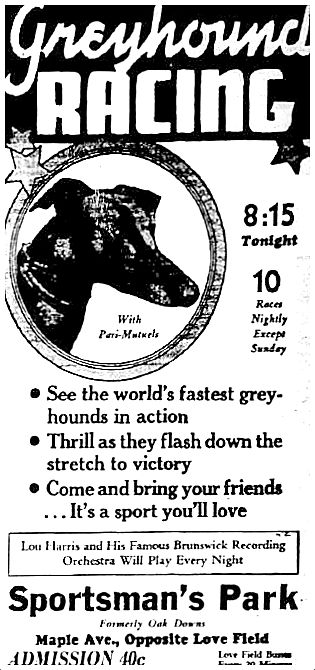
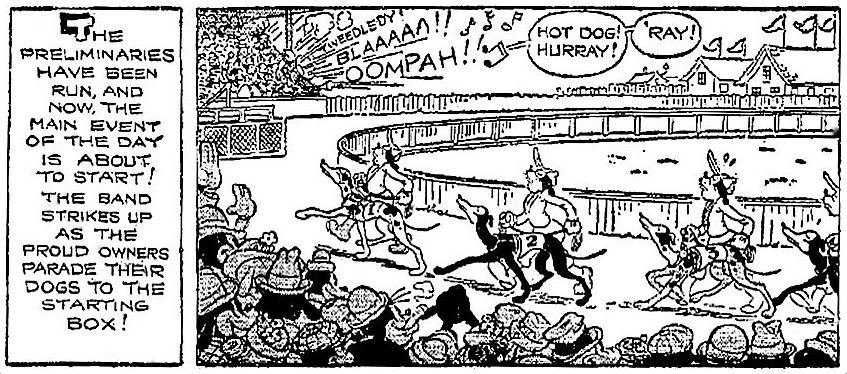
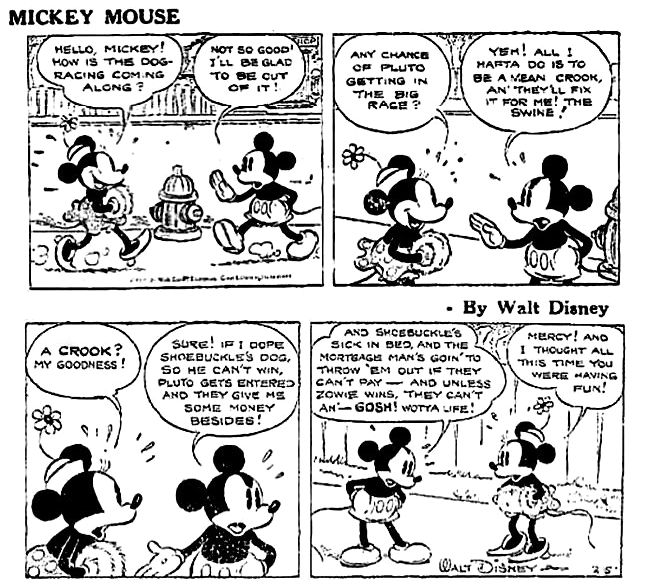
In doing research for my recent post on the Oak Downs/Sportsman’s Park greyhound racing track across from Love Field, I came across, of all things, a 1935 Mickey Mouse comic strip story arc about dog racing. The first panel of one of the early strips is above. Its caption:

The preliminaries have been run, and now, the main event of the day is about to start! The band strikes up as the proud owners parade their dogs to the starting box.

So when I came across a 1937 story about financially-strapped SMU football players earning extra money during the off-season by parading greyhounds around our dog track, I couldn’t help but think of the cartoon panel above. …But with maybe more strutting.

Some of Matty Bell’s Southern Methodist University Mustangs already are picking up something more than pin money out at Sportsman’s Park, where greyhound racing is flourishing and gaining in popularity nightly. When Lou Harris’ jazz band strikes up a lively tune for the parade to the post you’ll see eight husky young athletes leading out the field of greyhounds in that race. They’re decked out in handsome uniform and they’ve learned to strut with the music and put on their part of the show in style. After finally placing the dogs in the starting box they keep fit running down the track to a stand where they wait until the race is over to catch the canines and then return them to their owners…. [Coach Bell] thinks the work in the open, combining strutting with running, will help keep off that excess poundage. Meantime some other coaches are wishing they had dog tracks in the vicinity of their schools.” (Dallas Morning News, April 30, 1937)

***

Sources & Notes

Mickey Mouse panel from the 9-week dog-racing story arc which ran between Jan. and March, 1935; this particular panel appeared in newspapers on Jan. 8, 1935.

Dallas  Morning News excerpt from George White’s “Sport Broadcast” column (DMN, April 30, 1937). I’m afraid I know nothing about Mr. White, except that, lordy, that man needed to pare down his sentences and use a lot more commas!

*

Copyright © 2015 Paula Bosse. All Rights Reserved.


Oak Downs: Dallas’ Brief Flirtation with Greyhound Racing

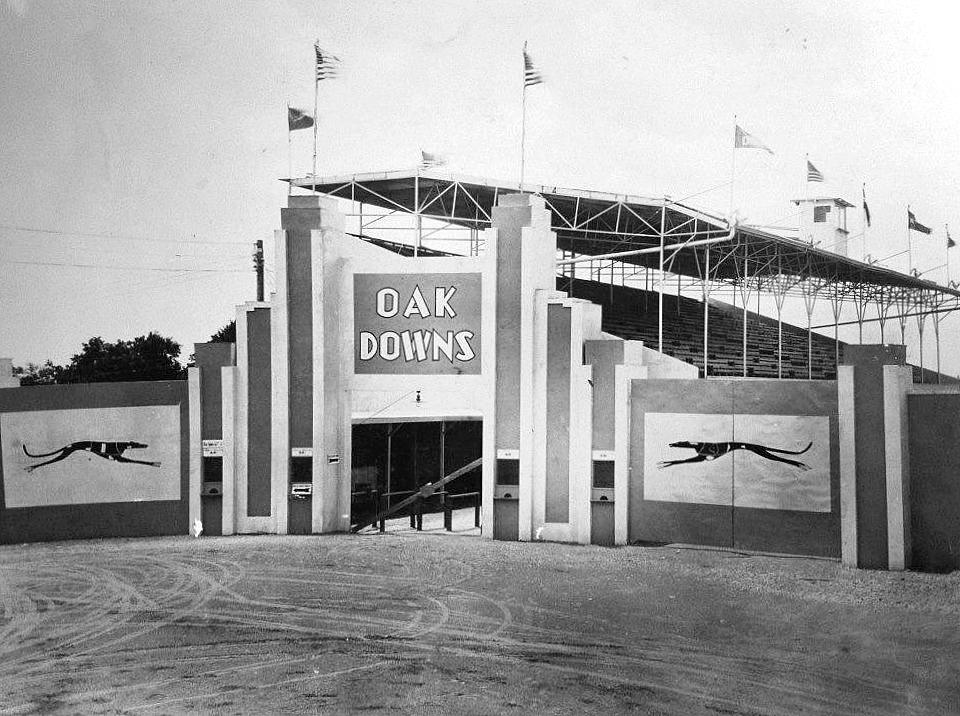
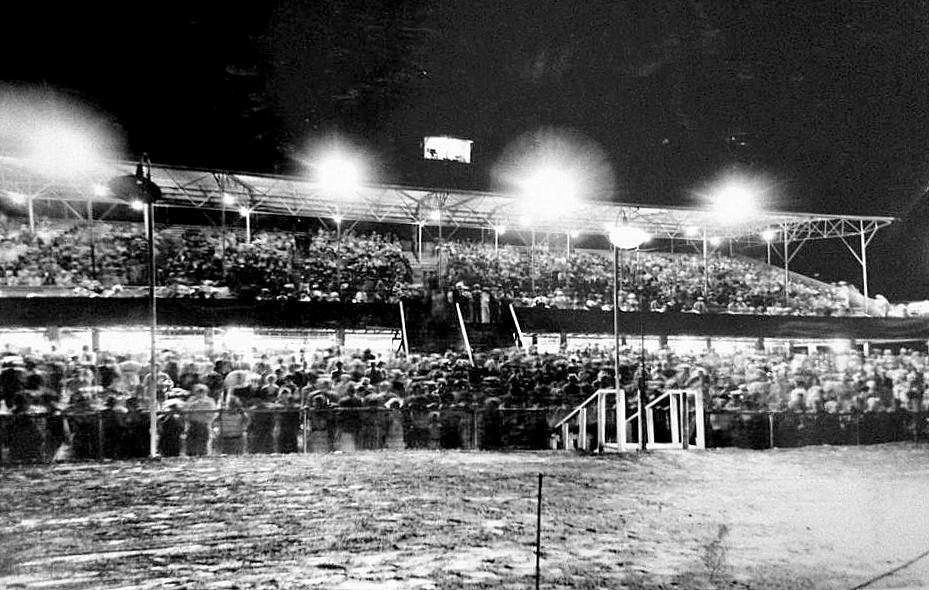
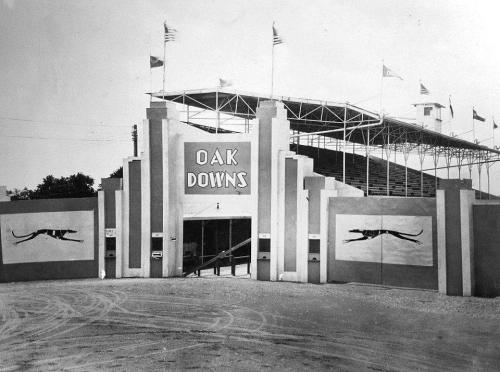
oak-downs_hurst_bwOak Downs greyhound track, ca. 1935 (photo courtesy Robert Hurst)

by Paula Bosse

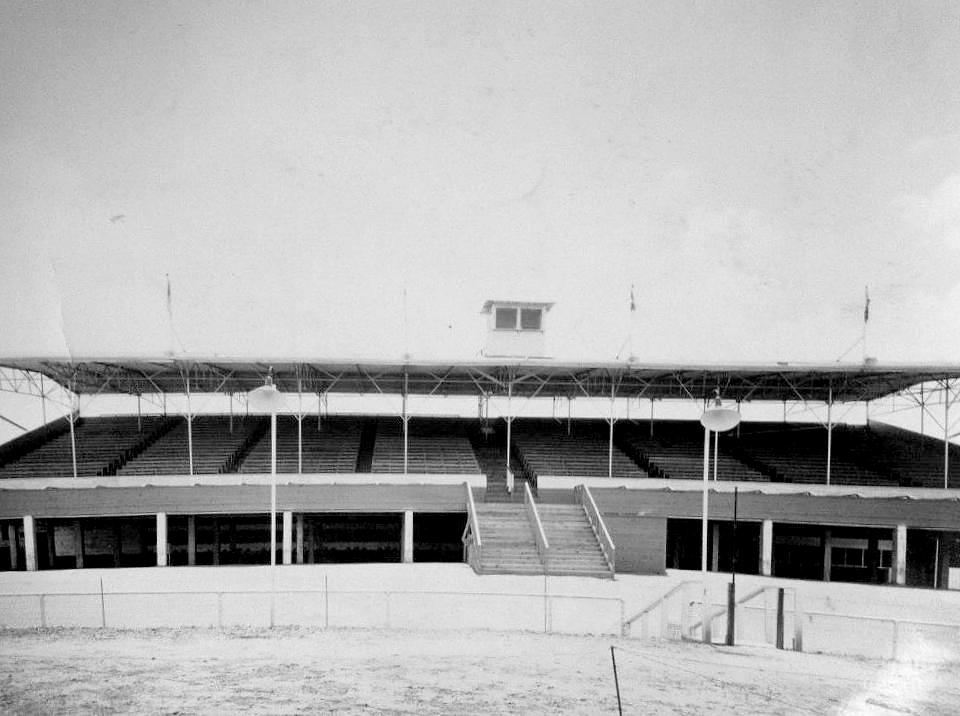
Robert Hurst has shared three great photos with me: the one above, and the two below. They show Oak Downs, a greyhound racing track that he thought might have been in Oak Cliff. A dog track? In Dallas? That was news to me. Mr. Hurst came across the photos a few years ago when going through the belongings of his grandparents, Lt. Col. and Mrs. C. W. Newman. As far as he knew, they had no particular interest in dog racing, and he wasn’t sure why they would have been in possession of photos of a greyhound track. I was a little hesitant to delve into anything having to do with dog racing, but these wonderful photographs piqued my interest. (For the faint of heart, this post focuses almost exclusively on the somewhat vague and constantly changing laws on parimutuel betting in Texas, with very little on the troubling aspects of greyhound racing.)
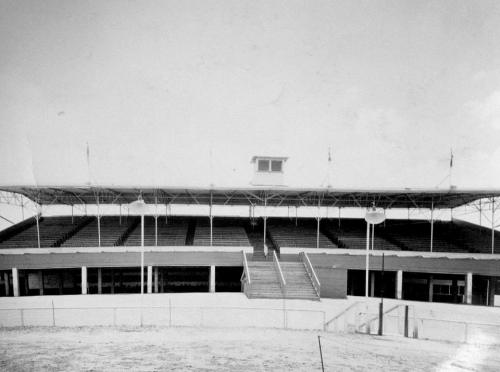
oak-downs_grandstand_day_hurst_bwGrandstand, daytime (click for larger image) (courtesy Robert Hurst)
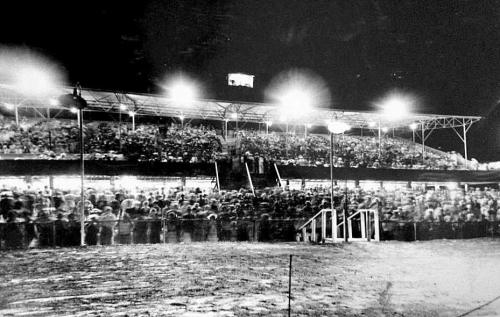
oak-downs_grandstand_night_hurst_bwGrandstand, nighttime (courtesy Robert Hurst)

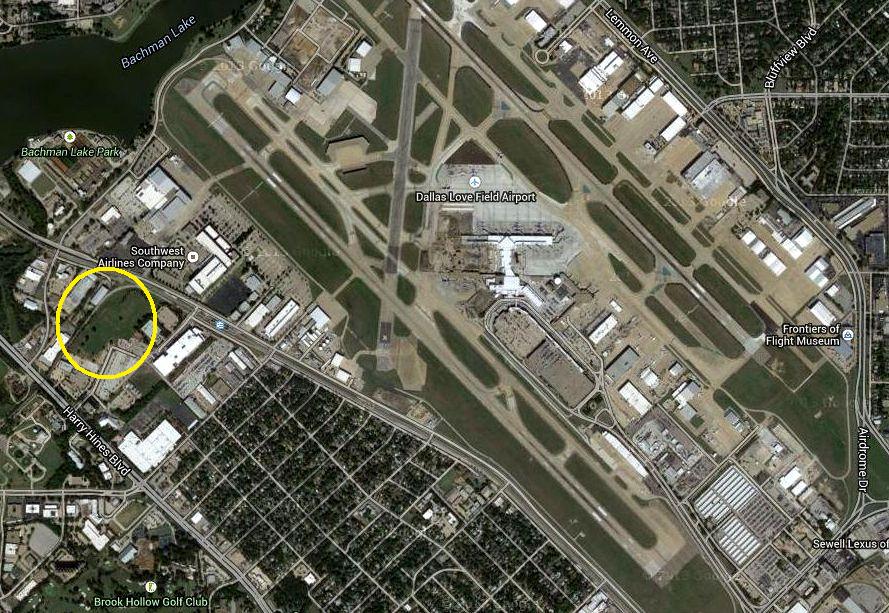
The track was located not in Oak Cliff, but right across the street from Love Field — an area that was “north of the city” in the 1930s. It was to the west of the airfield, with the address listed, popularly, as Maple Avenue, but officially as Denton Drive (just north of Burbank Road).
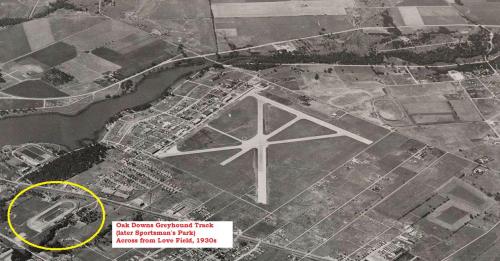
aerial_oak-downs_smu-foscue_1930s1930s (Edwin J. Foscue Map Library, SMU)
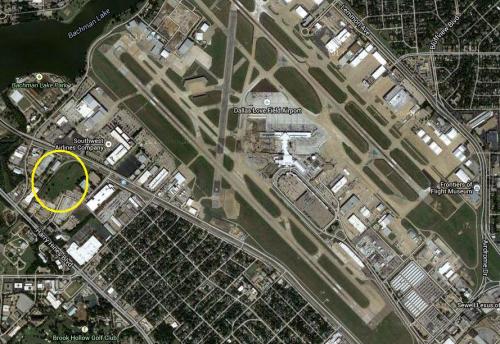
aerial_oak-downs_google2014 (Google Maps)

*

The first mention I can find of greyhound racing in Dallas was in 1898 at events held at the Fair Park horse racing track — the “sport” then was “coursing.” I don’t want to go into it, but live hares and jackrabbits were used, and it didn’t end well for them. (Competitive coursing is, I believe, now illegal in Texas, but open-field coursing is considered hunting and is legal.)

The first professional greyhound racing track to take the “blood” out of “blood sport” by utilizing an electric rabbit lure, was in California in 1919. The first track in the Dallas area to use an electric rabbit seems to have been one that opened near Grand Prairie in 1928; the news stories made sure to mention that there would be no wagering going on because, unlike other states where dog racing had been going on for some time and was quite popular as a gambling sport, parimutuel betting was not legal in Texas. Racing at that early track doesn’t seem to have lasted very long — probably because the spectators were not allowed to wager on the contests. Another track opened just outside Fort Worth at Deer Creek in 1934 (right after Texas had legalized betting on horse races in 1933), but, again, it doesn’t seem to have lasted long.

So, in the early ’30s, Texas was not really a hot-bed of dog racing enthusiasts. What was popular was horse racing — the two most popular tracks in the area were the Fair Park track in Dallas, and Arlington Downs in Arlington. The state legislature had voted in 1933 to allow parimutuel betting on horse races, hoping to raise revenue in the dark days of the Depression. People might not have been able to afford a new pair of shoes, but they managed to scrounge up money to bet with. Gambling on horse races was big business. But betting on dog races? Was it legal, too? It sounds like the law was surprisingly vague. Dog racing was not expressly written into law as being illegal — but people just seemed to understand it to be illegal. Proponents of greyhound racing — the so-called “Sport of Queens” — were adamant that they would force the state to address the issue and clarify the law — they would sue if they had to. A track in San Antonio had taken its case to a State Court of Appeals (after having been shut down by local authorities), and the court ruled that parimutuel wagering at dog tracks in Texas was not illegal. A precedent had bet set, and a few dog racing tracks began to open around the state, their owners and operators feeling they were relatively safe from prosecution.

In early 1935, 31-year old Winfield Morten, a “wealthy sportsman” who owned several businesses and a lot of Dallas real estate, decided he’d open a greyhound track on his 40 acres of land along Maple Ave./Denton Dr., just west of Love Field. He received his state business charter in May, 1935 (just days after the San Antonio ruling), and he made plans to open his dog racing “plant” — Oak Downs — in June. As they said back then, “pari-mutuel betting would be fully in vogue.”

Many people did not want a dog racing track in Dallas (or anywhere in Texas, really). Owners of horse tracks (and the powerful people who were in bed with them) feared that they’d lose some of that sweet gambling moolah to the upstart “dogmen.” Outside the racing world, there was the fear/expectation that with dog tracks would come the inevitable gambling and sleazy criminal element. (Dog racing was generally seen as somehow more unsavory and déclassé than horse racing, which is odd, because the horse racing industry has never been known as a squeaky-clean one.) Also, apart from the gambling-related issues, many people were probably aware of (and disturbed by) persistent accusations of animal mistreatment. Interestingly, at this same time — during the first few months of 1935 — none other than Mickey Mouse was involved in a comic strip story arc that lasted several weeks in which he was hanging out at a dog track training his dog Pluto for a race. It wasn’t long before the comic strip (which was usually full of typical comic strip silliness and gentle humor) turned surprisingly dark, and Mickey found himself involved in a world of doping, gambling, extortion, and threatened violence (!). If Walt and Mickey were against the evils of dog racing, shouldn’t everybody be? I wonder if the strip was reflecting public opinion or shaping public opinion?
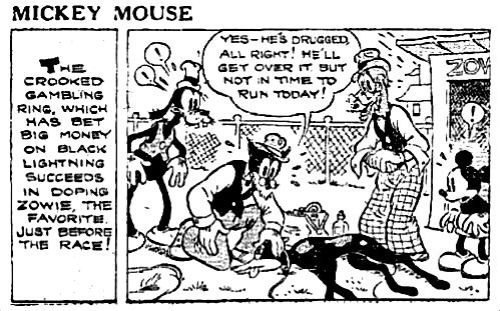
mickey_021935Poor Zowie! (Originally run Feb. 19, 1935)
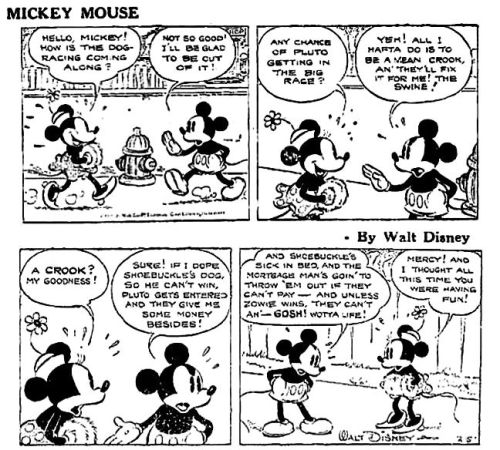
mickey_020535Mickey’s in a tough spot (click to enlarge) (Feb. 5, 1935)

Not only was the prospect of a “seedy” dog track unpalatable for many in an image-conscious city gearing up for its upcoming Centennial-Exposition-moment in the national spotlight, but there were those who were still convinced that gambling on anything but horse races in Texas was illegal — despite what the appeals court had ruled in the San Antonio case. Several interested district attorneys from around the state petitioned the State Supreme Court for a definite ruling. In the meantime, Dallas D.A. Robert L. Hurt and Dallas County Sheriff Smoot Schmid (greatest name in law enforcement EVER) threatened to shut down the not-yet-opened Oak Downs if it allowed wagering. Battle lines were drawn, and both sides believed they were in the right.

Track manager Jack Thurman said the city’s threats didn’t scare him. He’d open as scheduled, with plans for a full season of 48 days of racing (every day but Sunday), sleek hounds, an electric rabbit, and full-tilt betting. The day before Oak Downs was scheduled to open, its operators wisely obtained an injunction against Hurt (and, basically, the Sheriff’s Department and the Texas Rangers), which prevented the track from being shut down — they would open without fear of incident, under full legal protection of a court order. Not a happy guy, Hurt said he would file a motion to dissolve the injunction … immediately!

Oak Downs opened on June 18, 1935 to a large crowd of curious spectators, most of whom had never seen a dog race. The betting windows were open, but there was little betting. There were problems with the electricity in the stadium on opening day — the electric-powered rabbit that the greyhounds chased was not running on full power, and it moved so slowly that it was caught in two separate races by the probably confused dogs. (The second night there was too much juice, and the rabbit shot away from the pack so quickly that the dogs lost sight of it and just stopped running altogether. Hard to have a race if the dogs don’t actually run.) But the crowd seemed happy, and they weren’t overly concerned by the glitches happening there at the track or by the political and legal wranglings that were swirling downtown.

The crowds and the betting increased over the next few days, hinting at a rosy future for the track’s operators. But the races and the attendant wagering continued for only eleven days. The United States Fifth Circuit Court of Appeals refused to interfere with the wishes of State law enforcement — and State law enforcement wanted Oak Downs to cease with the gambling. So there was no more parimutuel betting at Oak Downs. After trying to struggle by without the sexy allure of betting — left with nothing but exhibition races and weird novelty events involving dog-riding monkeys — Oak Downs was forced to close its season prematurely on June 29.

Bye-bye, abbreviated inaugural season. No more betting on Doctor Snow, or Dixie Lad, or Rowdy Gloom, or Miss Cutlet, or Pampa Flash, or Billie Hobo, or Blond Hazard, or Mellow Man. Oh, Mellow Man, we hardly knew ye.

In February, 1936, Morten applied to the Texas Racing Commission for permission to race horses at his track, but the idea was quickly shot down by the Dallas City Council. The very profitable horse track at Fair Park was out of commission for 1936 as it was being used as part of the Centennial Exposition. Privately owned at the time, the track was leased to the Centennial Corporation, and the City Council — the members of which were no doubt on very friendly terms with the Fair Park track owner — felt it would be “unfair” to allow a competitor to horn in on the massive profits to be had. So … no dice (…as it were).

By September of 1936, Morten changed Oak Downs’ name to Sportsman’s Park and brought in new operators (including a former Texas Ranger). Oak Downs had joined other dog tracks in a new round of legal action which was slowly working its way through the courts. Without any ruling yet from the Supreme Court, they ignored an injunction that had been filed against them and defiantly opened up their betting windows again. Four of the men were fined and jailed briefly for contempt of court. But after months of mixed messages and conflicting rulings from various judges around the state, confused and fed-up lawmen were unsure of the actual legality of dog track betting, and, grudgingly, they allowed the wagering at Oak Downs to continue as they, too, awaited a high court decision.

As reported in Texas newspapers, on Oct. 28, 1936 the Texas Supreme Court finally ruled on the matter of whether or not dog racing could be wagered on legally in the state of Texas:

We do not find any provision in the penal code defining gaming which can be construed to include dog racing or betting on dog racing. It is not a game prohibited by law. […] This court is fully conscious of the pernicious and unwholesome effects upon society of betting on dog races and keeping premises for dog racing where betting is allowed, but the proper agency for the suppression of those wrongs is the Legislature, and until it sees proper to further legislate in the matter, the courts are without power to suppress these evils by injunction.

In other words, the Texas House and Senate were going to have to take up the issue if they really wanted to do away with legalized betting on dog races (which they did), because it was their fault that they hadn’t been specific enough when they wrote their original law.

So betting was back “in vogue” once again. And now with absolutely no threat of arrest. The remainder of the 1936 season continued without problems, and when the 1937 season opened in April, it was “the first greyhound meet in Dallas free of danger of being interfered with by law enforcement agencies” (DMN, April 22, 1937), but … as there were bills to outlaw betting on dog racing AND horse racing percolating through the current Texas legislature, it was thought that the 1937 season might also be the last season of racing in Texas.

In May, 1937, Governor James V. Allred addressed the Texas Congress, urging them to repeal the current law allowing parimutuel gambling on horse racing (with the knowledge that this would almost certainly also apply to the outlawing of dog racing, as that bill had just passed the House and was headed to the Senate). Here are a couple of passages from his speech, a transcription of which appeared in newspapers throughout the state on May 28, 1937:

I do not know how to state in words a stronger case for repeal of the race track gambling law than I have already given to this Legislature from time to time. I have quoted Washington, Franklin, Blackstone, Shakespeare, Brisbane, McIntyre and the Holy Bible. I have pointed out the living evidence of undesirables, of doping, of thuggery, of embezzlement, of bank failures, of suicides, and narcotic rings. Each month of the life of this law sees addition to the numbers of these human tragedies….

And, finally, a mention of the evils of racing with regard to the animals themselves:

There is no record of a horse ever being doped except to run a race. All the races ever run are not worth the agony and cruelty dealt even one of these poor, helpless beasts! I appeal to all who love good horses, I appeal to all who believe in preventing cruelty to animals to join with me in demanding that this law be repealed.

Allred’s lengthy and impassioned speech — which addressed every argument the pro-gambling forces were wont to … trot out … must have touched a few nerves (with both the public and the politicians), because in June, both bills passed with huge margins. (The bill outlawing the betting on dog racing passed in the Senate 22-1 and in the House 109-12. With passage of the new law, betting on dog races could now incur a fine of up to $500 and a jail term of up to ninety days; the penalty of “keeping a place of betting on dogs” was two to four years in the state penitentiary.)

So no more parimutuel betting in Texas. No more dog racing. No more horse racing.

And that was that for the state’s dog tracks. What was next for Oak Downs … er, Sportsman’s Park? Three words: “midget auto racing” (i.e. the racing of very small cars, not the racing of cars operated by very small drivers).

Besides the regular auto races, two added events give promise of furnishing fans with a few thrills as well as a laugh or two. Fast cowponies will be featured in a half-mile sprint with a race for roosters rounding out the show. Winner of the cowpony race will receive $15, while the winning rooster will be rewarded with $5. Entries are open to any and all owners of ponies or roosters. (Dallas Morning News, Aug. 27, 1937)

Somehow I don’t think five-buck-purse rooster races figured into Mr. Morten’s big dreams back at the beginning of 1935.
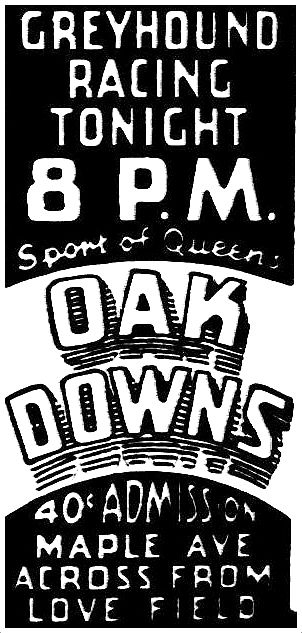
ad_oak-downs_0622351935

*

ad-dmn_0422371937

***

Sources & Notes

Top three photos of Oak Downs greyhound racing track used by kind permission of Robert Hurst. He came across them several years ago in the belongings of his grandparents, Lt. Col. Campbell Wallace (C. W. “Bub”) Newman and Martha Price Newman. Col. Newman was a cavalry officer who served in WWI, WWII, and Korea; between WWI and WWII, he worked in Dallas as a contractor and was employed for a time at Oak Downs where he worked in track operations. (That’s why he had these photos!) [And by no means do I mean to imply that this career military man was involved in any sort of shady goings-on. In fact, from what I can tell, Oak Downs seems to have been run by a fairly “clean” group of people. The perception/reputation of dog racing at the time wasn’t great, but nothing I’ve read about this track suggests that anything unscrupulous was going at the track, behind the scenes, or amongst the personnel who worked there.] He was also an avid polo player and was a good friend (and polo teammate) of Winfield Morten who owned the track. Many thanks, Mr. Hurst, for the use of these wonderful photos!

Black and white aerial view of the Love Field/Bachman Lake area was taken by Lloyd M. Long in the 1930s; photo is from the Edwin J. Foscue Map Library, Southern Methodist University. The unlabeled photo (a detail of which is used above) can be accessed here; a labeled version of this photo (with some streets and buildings identified) can be accessed here.

I highly encourage people to see out the transcript of Governor James V. Allred’s FANTASTIC impassioned speech before members of the Texas House and Senate, which appeared in newspapers around Texas on or around May 28, 1937. As far as politics is concerned, I’m the most cynical person in the world, but this is an incredible speech.

More on the history of parimutuel gambling in Texas from Wikipedia, here.

An explanation of just what parimutuel betting is, is here.

Parimutuel racing was legalized again in Texas in 1987. The current state of racing in Texas can be read about in the Dallas Morning News article “A Last Hurrah for Texas Horse Racing” (May 3, 2014) by Gary Jacobson, here.

I’m quite honestly shocked to learn that greyhound racing is legal in the state of Texas. There seems to be really only one active track with live racing in the state (in South Texas), and the only upside to this appalling fact is that attendance has been in steep decline for years.

*

Copyright © 2015 Paula Bosse. All Rights Reserved.

Brook Hollow Country Club — 1940s

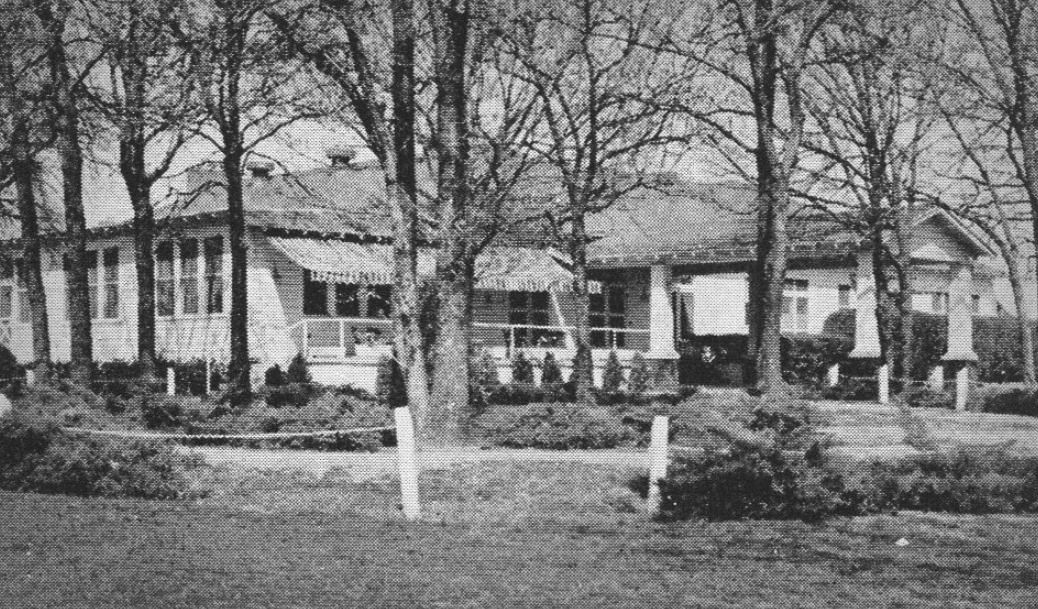
brook-hollow-country-club_1940sA modest clubhouse…

by Paula Bosse

A photo of Brook Hollow Country Club from a 1940s guide for newcomers. This photo is from a page of the area’s country clubs. This looks positively quaint.

***

Sources & Notes

From an early edition of “So This Is Dallas,” a guide for new residents of Dallas — this edition is from the early ’40s. Thanks to the Lone Star Library Annex Facebook group for loan of the image.

The Brook Hollow Golf Club is a bit swankier these days. The official site is here.

*

Copyright © 2014 Paula Bosse. All Rights Reserved.

The Peruna Monument — 1937

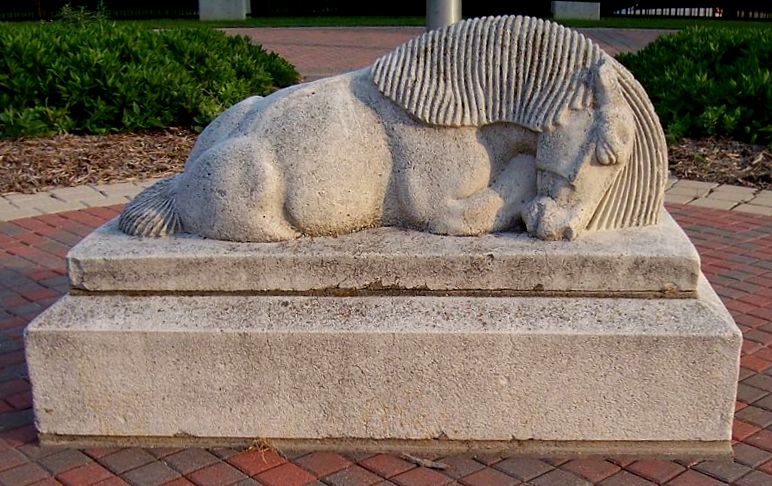
owen_peruna_monument_flickrMichael Owen’s Peruna monument today, SMU campus (photo by David Steele)

by Paula Bosse

When Peruna — SMU’s beloved Shetland pony that served as the Mustangs’ first live mascot — died in 1934, there was an immediate call to erect a memorial monument over the little horse’s grave, but it wasn’t until 1937 that a serious push for the erection began. Money was raised by the student council, which asked every student to contribute at least ten cents to the fund, and the search was on for the right sculptor.

The commission went to young Michael G. Owen, Jr., who, at only 21, was the same age as many of the students who were hiring him. (It has been erroneously reported that Owen attended SMU, but he did not.) Michael Owen was well-known within the Dallas art community and had made a mark for himself as something of an artistic prodigy — as a teenager, he had been on the periphery of the movement that spawned the Dallas Nine group of Regionalist artists, and he had  been mentored by many of the older artists, most notably Jerry Bywaters.

owen_peruna_smu-campus_050537
SMU Semi-Weekly Campus, May 5, 1937 (click for larger image)

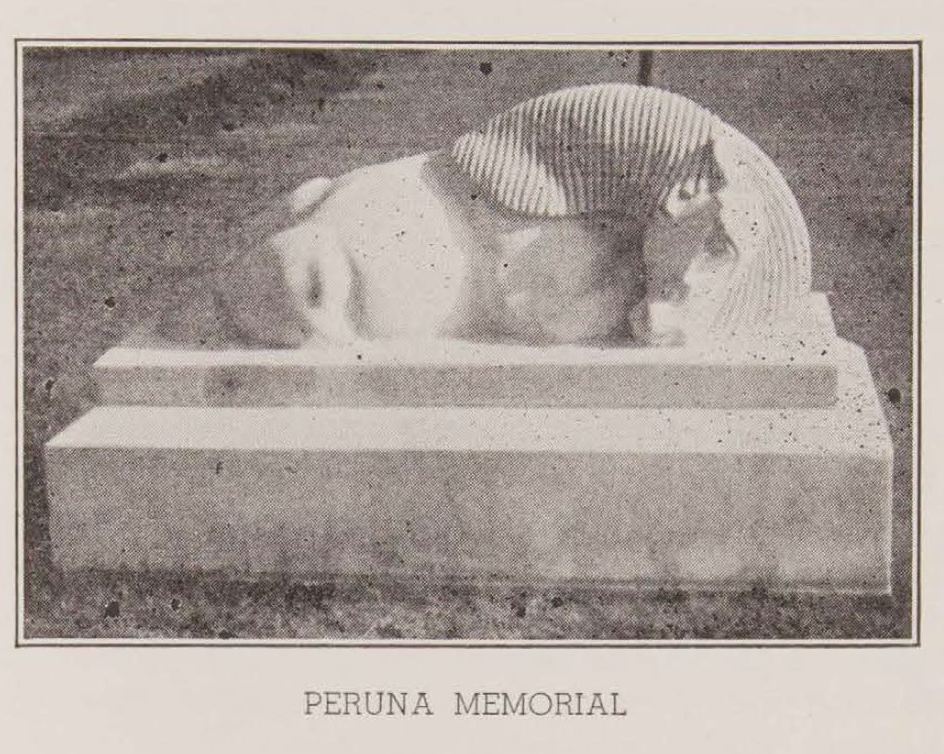
Owen worked quickly and completed the memorial — which was six feet long and four feet high and carved from 2,800 pounds of hard limestone — in time for the unveiling just outside Ownby Stadium on May 19, 1937.

The result was a quietly emotional — and even a very sweet — monument depicting the small slumbering horse atop a stone slab, with an inscription reading “Peruna I.” Jerry Bywaters wrote a glowing review of the piece, even though he seems a bit taken aback to find what he called “a memorial to a midget horse” on a college campus to be “one of the best pieces of memorial sculpture in the State.”

“Accustomed to seeing rather bad sculptured monuments erected to Confederate soldiers, Texas Rangers, political dignitaries or such abstract ideas as justice, plenty, or  beauty, it is slightly confusing to find a very good piece of sculpture set up as a memorial to a midget horse. […] Whatever the paradox of the situation, this monument is surely one of the best pieces of memorial sculpture in the State.” (Jerry Bywaters  in The Dallas Morning News, May 23, 1937)

peruna-memorial_mike-owen_m-book_1937_SMU-archives1937 (SMU Archives)

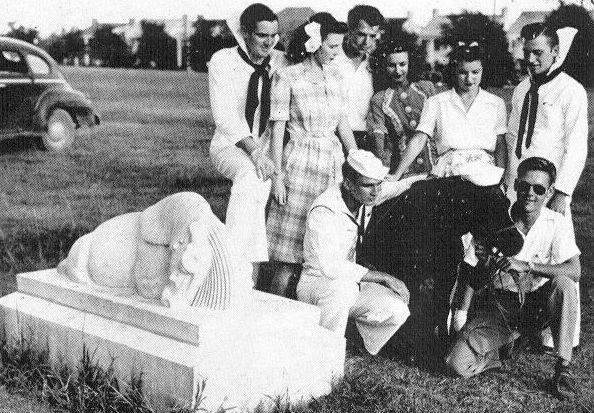
When Ownby Stadium was demolished and the new Ford Stadium built, the Peruna I monument was moved to the new stadium where it has become a memorial to all the Perunas.

owen_peruna-memorial_wiki_1944With Peruna III, during WWII (Wikipedia)

owen_peruna-statue_1950-degolyer-DET1950 (DeGolyer Library, SMU)

***

Sources & Notes

Top photo by David Steele, from Flickr, here.

Article from SMU’s The Semi-Weekly Campus (May 5, 1937, p. 3), here.

Photo of Peruna III with sailors from the Peruna page on Wikipedia, here.

Bottom photo (cropped) of the Peruna monument from the DeGolyer Library, Central University Libraries, Southern Methodist University, here.

Previous Flashback Dallas posts on Mike Owen:

  • “Give a 15-Year Old 8,400 Pounds of Soap and He’ll Carve You a Radio Transmitter — 1930” is here.
  • “Michael G. Owen, Jr. — Dallas Sculptor of Lead Belly” — is here.

UPDATE: Read about a recently discovered large painting by Owen up for auction in Dallas in 2019 here.

The previous post on the untimely demise of Peruna is here.

owen_peruna_monument_flickr_sm

*

Copyright © 2014 Paula Bosse. All Rights Reserved.

Little Peruna: He Died With His Mustang Bridle On — 1934

peruna-rotunda_1933Peruna, waiting for the Mustangs to score (photo: SMU)

by Paula Bosse

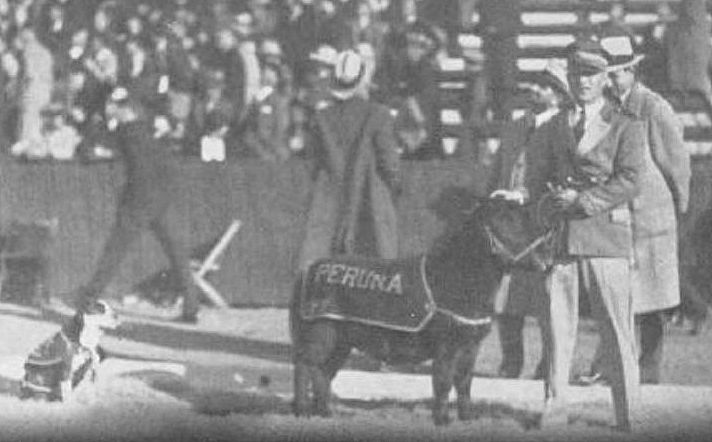
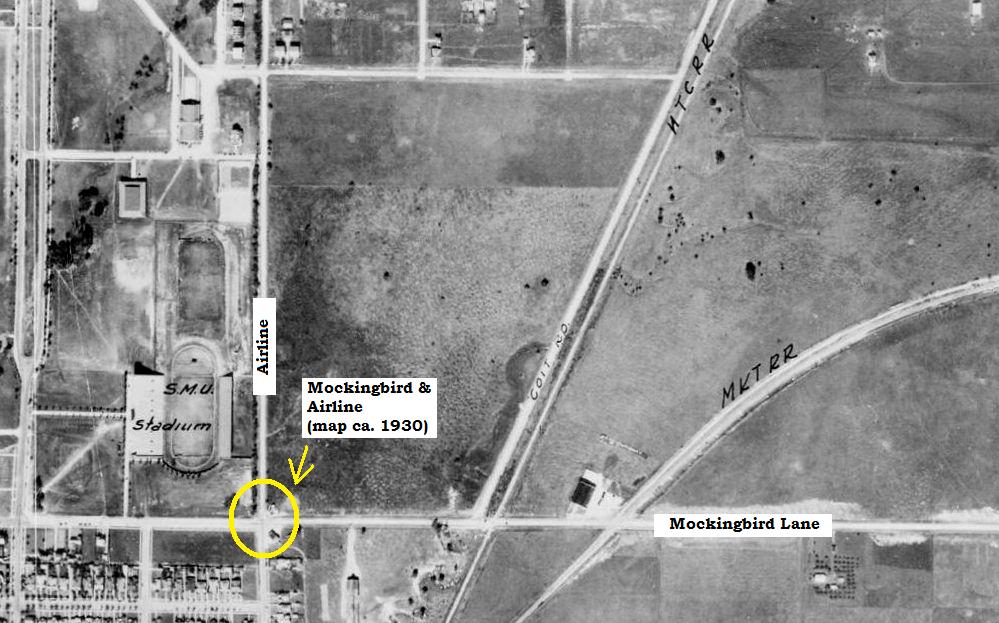
On October 30, 1934, shortly before midnight, Peruna, the 28-inch-tall little black Shetland pony mascot of the Southern Methodist University Mustangs, somehow liberated himself from his stable and wandered across campus and out into the intersection of Mockingbird and Airline where he was, sadly, struck by a hit-and-run driver and died soon after. As the newspaper account noted the next day, when the tragic accident occurred, “He was wearing a bridle of Red and Blue, the Mustang colors.”

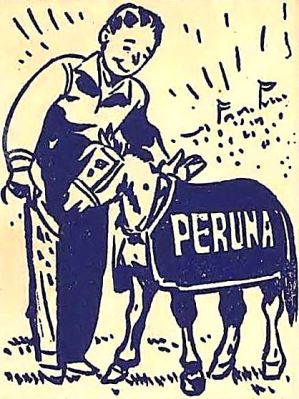
Peruna had been the football team’s mascot for only two years, but he was an immensely popular attraction, and he was treated as something of a celebrity wherever he appeared, both at home and when traveling with the football team and the Mustang band. He did things most horses didn’t do, like ride in taxi cabs and sashay though hotel lobbies. Crowds at football games loved watching the little horse race across the field — even the ardent  supporters of the opposing teams were charmed by him. And he was, of course, much loved at SMU; his death was a hard blow to the student body.

When he was buried at Ownby Stadium, the band played the usually rousing fight song as a mournful dirge, and the flags on campus flew at half mast.

I’m an animal lover, and stories about the demise of animals are not things I normally find entertaining, especially when phrases like “the midget pony,” “the wee mascot,” “the stout-hearted little mascot,” and “the midget wonder horse” are constantly (and effectively) used by journalists to tug at the readers’ heart-strings. But the Peruna obituary/funeral coverage that was printed in The Dallas Morning News is so wonderfully and ridiculously over-the-top that that one yearns to know who wrote the uncredited story. I have created a little scenario in my head in which the writer had been (and I apologize…) “saddled” with writing a story about a horse’s funeral, but instead of handing it in the pedestrian short-and-vaguely-moving report that was expected, he decided — to hell with it — that he would just go full-throttle and produce the most outrageously grief-stricken story ever written about the untimely death of a college mascot. After what one assumes was the downing of much whiskey and much chuckling to himself (I suspect this was written by a sportswriter), a 500-word obit ran on Nov. 1, 1934:

CO-EDS AND GRID STARS SOB AS PERUNA IS BURIED
(The Dallas Morning News, Nov. 1, 1934)

In sight of the very gridiron on which he pranced to lasting fame, Peruna, stout-hearted little mascot of the Southern Methodist University Mustangs, was laid to rest Wednesday afternoon.

As co-eds sobbed openly and hardened football heroes found difficulty in brushing back the tears, the body of the diminutive pony was lowered into its grave in the shadow of Ownby Oval. His coffin was draped in red and blue, the school colors, and a huge M, the Mustang emblem, graced the top of the casket.

Across the way, on the campus of the big university itself, the flag fluttered at half mast. The school band, looking noticeably bare without Peruna prancing about, playing “Peruna,” the varsity song, in the tempo of a dirge. Hundreds of heads were bowed when the strains of the alma mater, “Varsity,” offered a final tribute to the wee mascot.

Peruna’s career was as colorful as that of the team he represented. Given to the school in November, 1932, by T. R. Jones, loyal Mustang supporter, the midget horse immediately became the constant companion of the team on its journeys from one side of the continent to the other.

Only last week Peruna was feted in New York, parading through the lobbies of the city’s swankiest hotels, whose clerks sniff haughtily at the thought of a dog or a cat entering the sacred portals of their hostelries….

In was in Shreveport where he slipped and cut his leg as he started to Centenary Stadium in a taxicab. His wound was stitched, and the faithful little animal pranced proudly with the band during the between-halves parade.

But Peruna prances no more. And if the music of Bob Goodrich and his Mustang band at Austin Saturday fails by a scant margin of being at its peppiest, it will be because the band has dedicated every tune on that day to the memory of its best friend.

That must have been fun to write.

The year following Peruna’s demise, the Rotunda — SMU’s yearbook — featured a two-page illustrated spread “Dedicated to the famous Mascot of the Mustangs … ‘Peruna.'”

peruna_memorial_rotunda_1935

See Peruna’s very, very sweet memorial statue on the SMU campus here.

The loss of Peruna left the Mustangs without a mascot. Peruna’s son was proffered as a replacement, but even though “Little Peruna had been dressed in its father’s blanket and was prepared to give its all for SMU,” the school declined to bring Peruna fils on board. A successor — Peruna II — was eventually appointed, the first of many over the past eighty years. We’re now up to, I believe, Peruna IX, and the little stallion is still as popular as ever. May the “stout-hearted little mascot” continue to prance proudly for the SMU Mustangs.

peruna_smu-rotunda_19391939 Peruna (SMU Rotunda)

peruna_varsity-shop_cully-culwell_culwell-ranch_1960-SMU-rotunda1960 Peruna (SMU Rotunda)

***

Sources & Notes

Top photo from the 1933 SMU yearbook, The Rotunda. The two-page spread is from the 1935 Rotunda.

For an idea of what the area looked like at the time of Peruna’s terrible midnight accident — large open fields to the north and east of the campus, and, to the south, a probably dimly-lit Mockingbird Lane — here is a detail from a 1930 aerial map from the Edwin J. Foscue Map Library at Southern Methodist University (the full map can be seen here):

smu-aerial_1930(click for larger image)

Check out these articles in the Dallas Morning News archives:

  • “Car Kills Peruna Back From Victory Over New Yorkers; SMU Mascot Known To Over Half Nation, Dies With Bridle On” (DMN, Oct. 31, 1934)
  • “Co-Eds and Grid Stars Sob As Peruna Is Buried” (DMN, Nov. 1, 1934)
  • “Grieving Mustangs Won’t Take Son of Peruna for Mascot” (DMN, Nov. 11, 1934)

Peruna on Wikipedia, here.

If you really want to know about Peruna, though, you need to go to the horse’s mouth — his page on the SMU website, here.

Read about the Peruna monument by Dallas artist Michael G. Owen, Jr. which was dedicated on the SMU campus in 1937, here.

*

Copyright © 2014 Paula Bosse. All Rights Reserved.

The Dallas Cowboys’ Horrible Inaugural Year — 1960

dallas-cowboys-logo_1960

by Paula Bosse

Thanksgiving means different things to different people. For some it’s about spending time with family, for some it’s about ingesting an unimaginable amount of good food, and for others it’s all about watching the Cowboys game.

Here’s a look back at the inaugural season of the Dallas Cowboys, 1960:

  • Head coach: Tom Landry.
  • Home field: Cotton Bowl.
  • Results: 0 wins, 11 losses, 1 tie.
  • They were ranked last in the Western Conference.
  • They had the worst record of any team in the NFL that season.

The team got better, but as far as the Cowboys, there was absolutely nothing for Dallas to be thankful for that year — except that they’d never have to re-live Season 1 again.

***

Yep, Wikipedia. Read it and weep, sports fans.

*

Copyright © 2014 Paula Bosse. All Rights Reserved.