Flashback : Dallas

A Miscellany: History, Ads, Pop Culture

Category: Celebs

Muhammad Ali Visits Graham’s Barber Shop — ca. 1967
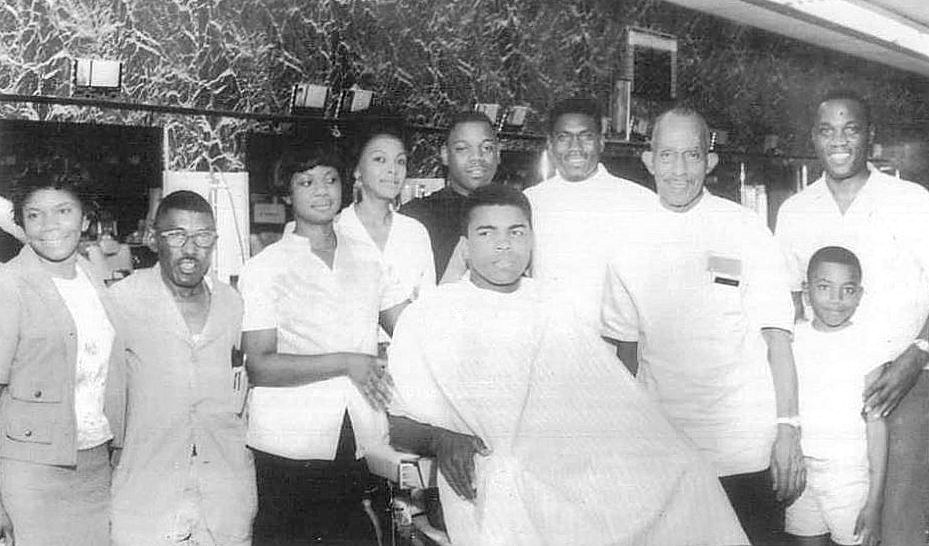
ali-muhammad_grahams-barber-shop_lincoln-high-school-yrbk_1967_photoMuhammad Ali in a Dallas barber chair

by Paula Bosse

I often just browse through the ads of old Dallas high school yearbooks on Ancestry.com. The other day, I saw the photo above and stopped and said to myself, “Is that Muhammad Ali?” I then looked at the text and, yes, that was, in fact, Muhammad Ali. Sitting in a barber chair in Dallas, Texas. What was the story behind that?

In my less-than-extensive research, I found three instances of Ali being in Dallas in or before 1967 (the year of this Lincoln High School yearbook ad). The first was in November 1960, just one month after the 18-year-old Olympic champion had won his first professional fight. He was tagging along with Archie Moore (who was acting as something of a mentor) when Moore came to Dallas to fight local boxer Willie Morris. (Morris had lost to the then Cassius Clay in the Olympic trials, and, in a somewhat bitter interview with The Dallas Morning News said this about the young upstart: “He’s not near as good as all this talk about him.”)

The photo of Ali in the barber chair isn’t from this 1960 visit, but he was specifically mentioned in a Dallas Times Herald article as being in the crowd of a Nov. 1960 event I wrote about a few years ago. There’s film footage of this, and I’ve scanned the crowds, hoping to find him, with no luck. But if you want to look to see if you can find him, that footage is linked in the Flashback Dallas post “Newly Discovered Footage of Jack Ruby — 1960.”

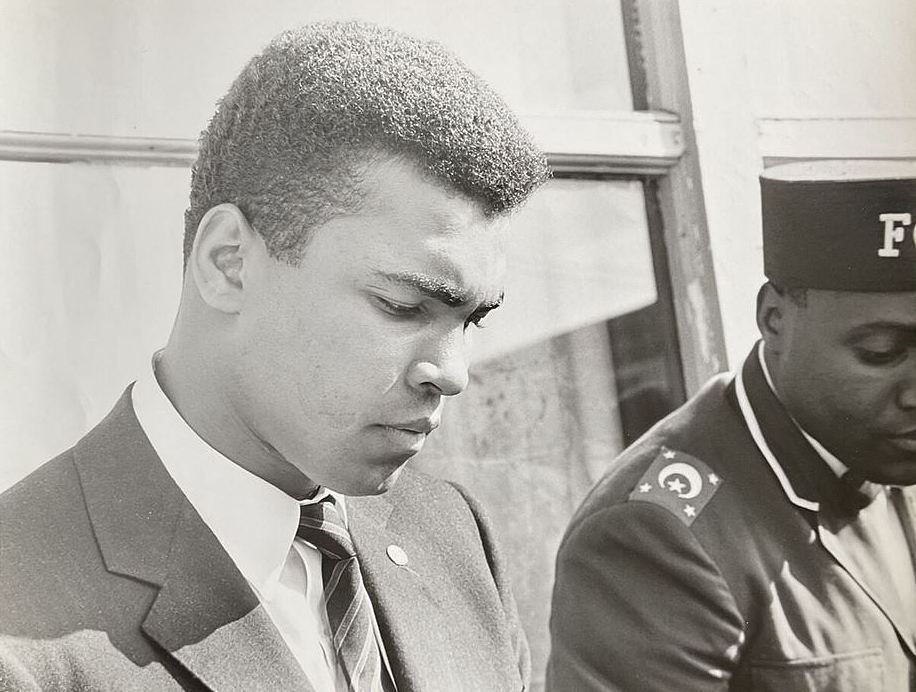
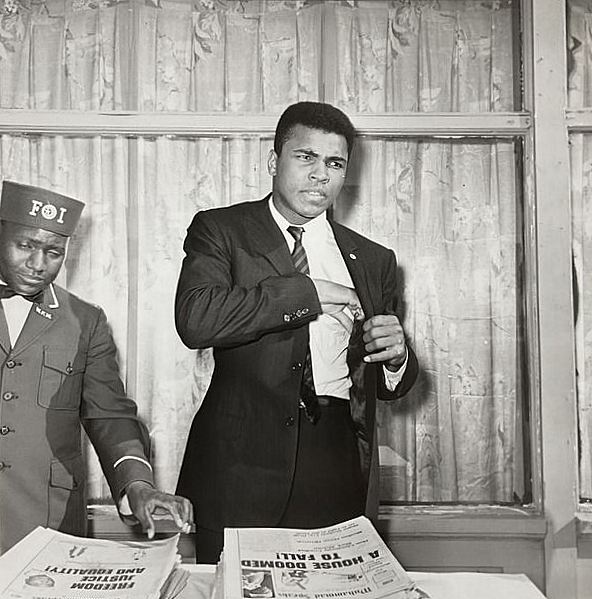
It’s more likely that the barbershop photo was taken in March 1967 when Ali, a Muslim, made two appearances in Dallas: the first was to “preach” at a local mosque, and the second (two days later) was to speak to students at Bishop College.

The mosque appearance was on Easter Sunday — March 26, 1967 — at Muhammad’s Mosque of Islam, described by Dallas Morning News sportswriter Bob St. John as being housed in “an old, pinkish building which used to belong to an insurance company and heretofore rested in reasonable obscurity on the corner across from Booker T. Washington High School.”

St. John continued: “On Sunday afternoon, it was no longer obscure. The old building rocked from its foundation as people filled it and lined the sidewalk outside and even poured into the streets, some coming to see Cassius Clay and others Muhammad Ali….”

The article mentions that Ali was living in Houston at the time, so it’s certainly possible he visited Dallas more often, but he was so famous at this time that it seems likely that the mere hint of his charismatic presence in town would have shown up in the papers. As it was, a visit by him to a Dallas barbershop was memorialized in this ad, which someone like me can now write about in a vaguely historical way (on a day which just happens to be Easter Sunday, the anniversary of Muhammad Ali’s 1967 Islamic sermon delivered across from Booker T. Washington High School).

**

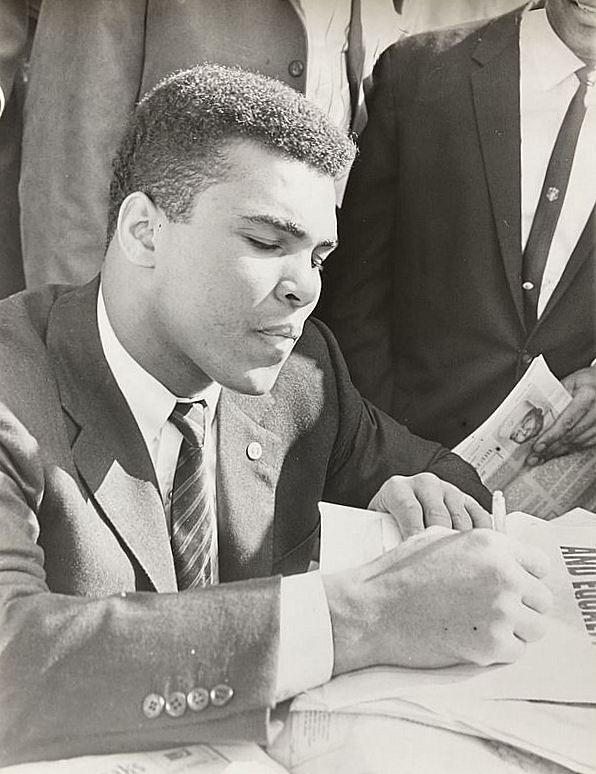
UPDATE: I was very excited to see the three photos below pop up recently on eBay — they show Ali at his mosque appearance (all three were taken on March 26, 1967 by Bob W. Smith, a Dallas news photographer). Ali is seen signing copies of a 20-cent Muslim paper called “Muhammad Speaks.” (A quote from Ali about why he was autographing these newspapers, from Bob St. John’s article: “A fish goes for bait. Then it’s hooked. I’m bait. Many would not buy if I didn’t autograph them. But once they’re bought… they’ll be sittin’ around some evening and pick up the paper. They’ll start reading. First thing you know, they’re hooked.”)
muhammad-ali_dallas_march-1967_a

muhammad-ali_dallas_march-1967_ebay_b

muhammad-ali_dallas_march-1967_ebay_c

**

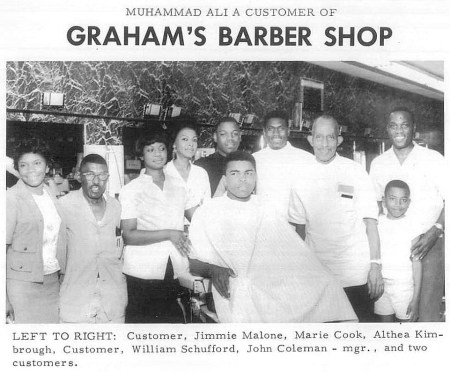
But back to the barbershop and Johnny Graham and a closer look at the two photos from the ad that originally caught my eye.
ali-muhammad_grahams-barber-shop_lincoln-high-school-yrbk_1967

“Muhammad Ali a Customer of Graham’s Barber Shop.” Ali is shown with an unidentified Graham’s customer, Jimmie Malone, Marie Cook, Althea Kimbrough, a customer, barber William Schufford, manager John Coleman, and two other customers.

*
ali-muhammad_grahams-barber-shop_lincoln-high-school-yrbk_1967_ford

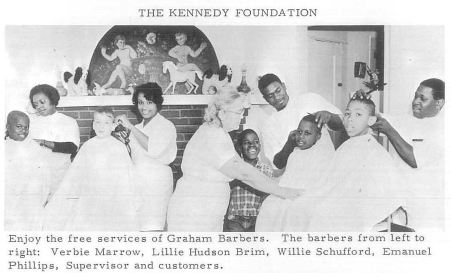
The photo above also appeared in the ad, showcasing Graham’s community service and his work with the Kennedy Foundation. “Enjoy the free services of Graham Barbers. The barbers from left to right: Verbie Marrow, Lillie Hudson Brim, Willie Schufford, Emanuel Phillips, Supervisor, and customers.”

*

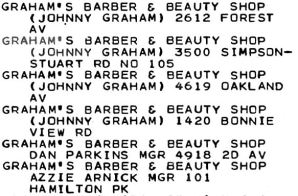
Johnny Graham was one of the most successful Black businessmen in Dallas at the time and was known for his philanthropic generosity. By the end of 1967, he owned eight barber shops and employed 135 barbers. Six of his shops are listed in the 1967 directory:
grahams-barber-shop_19671967 Dallas directory

***

Sources & Notes

Barbershop photos are from an ad in the 1967 Lincoln High School yearbook.

Photos of Muhammad Ali at Muhammad’s Mosque of Islam in Dallas were taken by news photographer Bob W. Smith on March 26, 1967, found on eBay.

The Dallas Morning News articles about Muhammad Ali in Dallas — and one about Johnny Graham:

  • “Morris Prefers Bout with Clay” (DMN, Nov. 26, 1960)
  • “Clay Makes Dallas Stop” by Bob St. John (DMN, Mar. 27, 1967)
  • “Clay Pleases Crowd With Speaking Form” by David Morgan (DMN, Mar. 29, 1967)
  • “Johnny Graham Offers Example” by Julia Scott Reed (DMN, Dec. 28, 1967)

Please consider supporting the work I do at Flashback Dallas by funding me on Patreon.

ali-muhammad_grahams-barber-shop_lincoln-high-school-yrbk_1967_photo_sm

*

Copyright © 2023 Paula Bosse. All Rights Reserved.
Uncle Scooter Reads the Funnies: 1940-41

radio_uncle-scooter_wfaa-wbap-kgko-combined-family-album_1941Little Man and Uncle Scooter…

by Paula Bosse

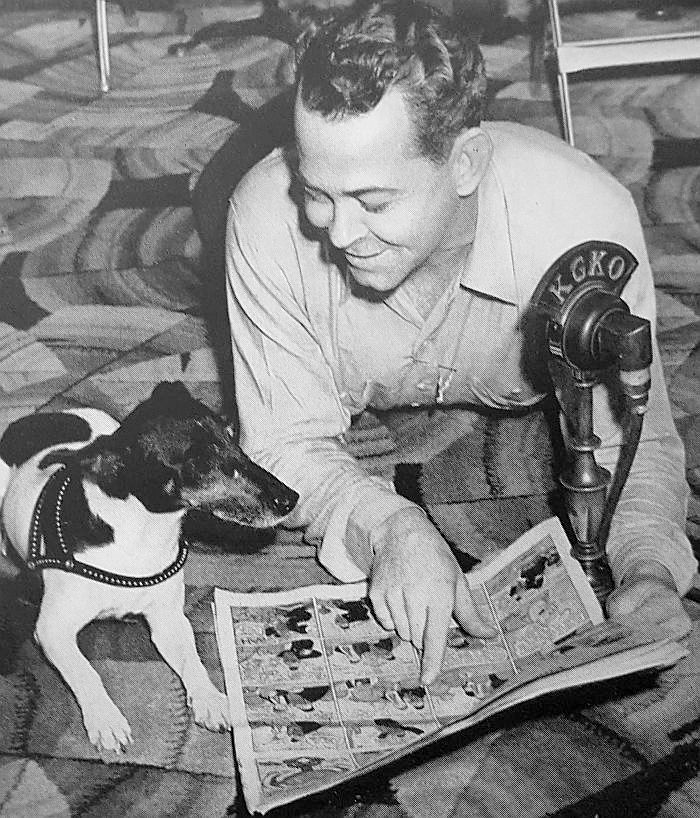
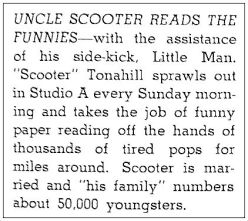
Several years ago, I was flipping through a promotional booklet for radio stations WFAA, WBAP, and KGKO, and I came across the photo above. I think about this photo a lot. It shows radio personality “Uncle Scooter” lying on the floor next to a KGKO microphone, reading the comics over the air to a vast audience of children and pointing out something pertinent to his trusty companion, a fox terrier named Little Man. I love this photograph. It makes me smile every time I see it. Wouldn’t it be great if this was how he actually conducted his broadcasts — on the floor with his doggie next to him? Here’s the caption:

uncle-scooter_dog_wfaa-wbap-kgko-combined-family-album_1941_caption

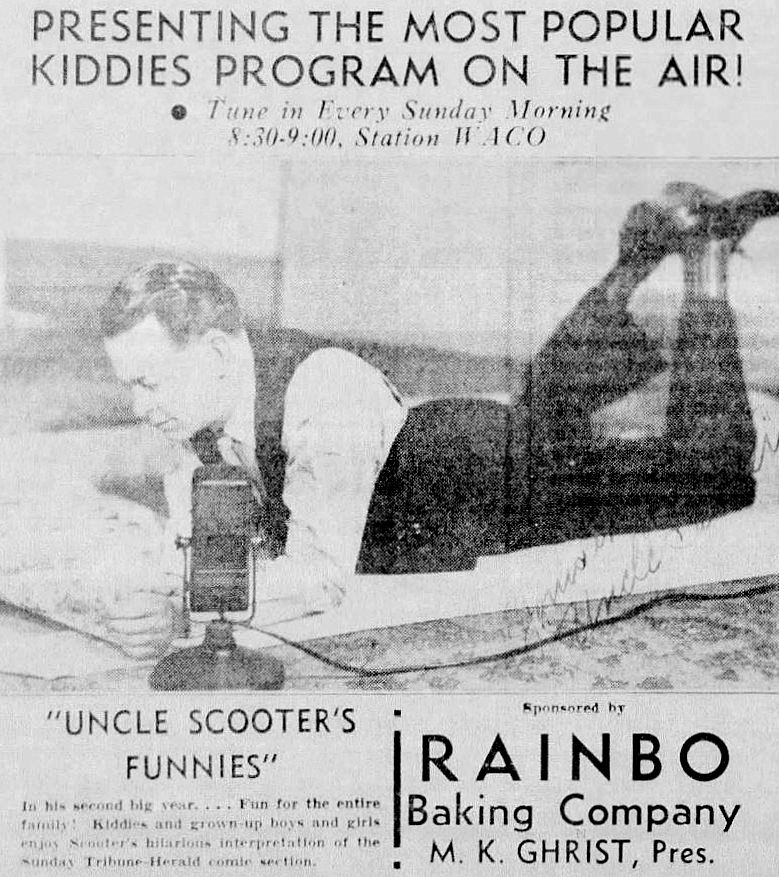
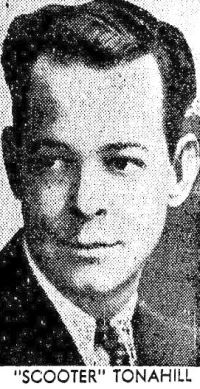
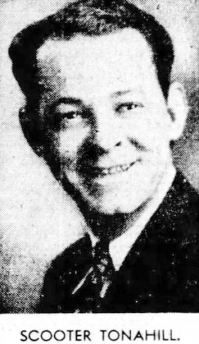
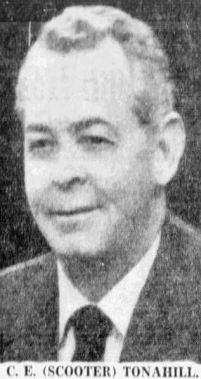
Clarence E. Tonahill (1904-1954) — known to everyone as “Scooter” — appears to have begun his radio career in Waco at the appropriately named station WACO. He then worked at KGKB in Tyler, then returned for a few years to WACO, and then to KTSA in San Antonio. Like most people in broadcasting in those days, he did a little bit of everything: he was an announcer, a newsreader, a sportscaster, and an entertainer. One of his most popular shows was just him reading the Sunday comics over the air for children. Below, a WACO ad from 1937 showing Uncle Scooter, again, lying on the studio floor (no dog, though).

uncle-scooter_waco-tribune-herald_010337Waco Tribune-Herald, Jan. 3, 1937

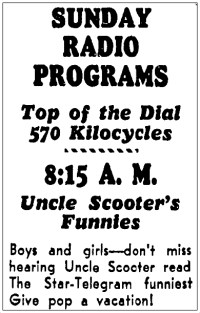
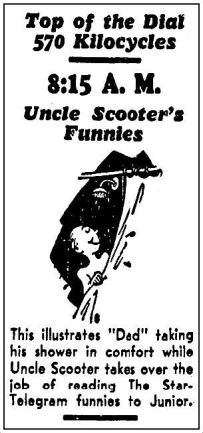
Around September 1939, he moved to Fort Worth to begin a busy stint at KGKO, a DFW station co-owned by The Dallas Morning News and The Fort Worth Star-Telegram (this was part of the very unusual WFAA-WBAP radio broadcasting partnership). He started as an “announcer” (which might well have included cleaning up the studio!), but he quickly graduated to doing a lot of sports-announcing and color commentary (football and boxing), man-on-the-street interviews, and personal appearances. He also hosted several shows, including a weekday morning show called “Sunrise Frolic.” But Sundays… Sunday mornings were set aside for his funnies-reading.

1940_radio_uncle-scooter_FWST_090840Fort Worth Star-Telegram, Sept. 1940

1940_radio_uncle-scooter_FWST_091540FWST, Sept. 1940

1941_radio_uncle-scooter_FWST_031641FWST, March 1941

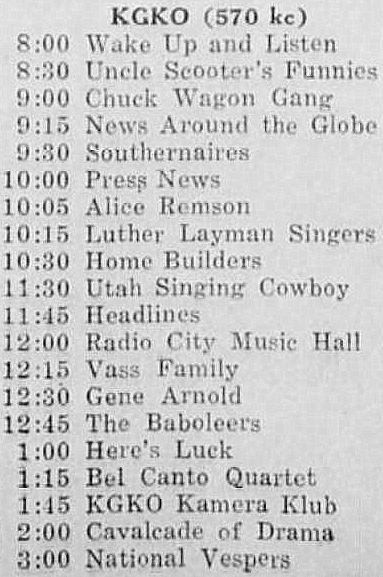
The Sunday lineup on KGKO, before and after the funnies:

1940_radio_uncle-scooter_bryan-tx-eagle_121440Bryan Eagle, Dec. 1940

I see listings for the show in 1940 and 1941 — and then, briefly, in 1947. His obituary says that Tonahill retired from his career as a broadcasting personality in 1946 and opened his own business in Fort Worth, Scooter’s Radio Supply (a supplier of broadcasting equipment to stations around the country).

He must have been a bright, friendly voice on the radio. I’d love to know the role Little Man played (Little Man was Scooter’s real-life pet and was described in a magazine profile as Scooter’s “favorite hobby”). I have fond (if somewhat vague) memories from my childhood of Bill Kelley reading the comics on The Children’s Hour on Channel 5 — but I can say without hesitation that things on The Children’s Hour would have been a whole lot more interesting if he’d just had a cute little dog with him!

1940_scooter-tonahill_FWST_042040_kgko-ad_det_photo1940_scooter-tonahill_FWST_100940_kgko-ad_det_photo1940

1954_tonahill-clarence-e_FWST_072654_obit_photo1954

kgko_19391939

***

Sources & Notes

Top photo from “WFAA, WBAP, KGKO Combined Family Album” (Dallas-Fort Worth, 1941).

radio_uncle-scooter_wfaa-wbap-kgko-combined-family-album_1941_sm

*

Copyright © 2023 Paula Bosse. All Rights Reserved.
Wes Wise, 1929-2022

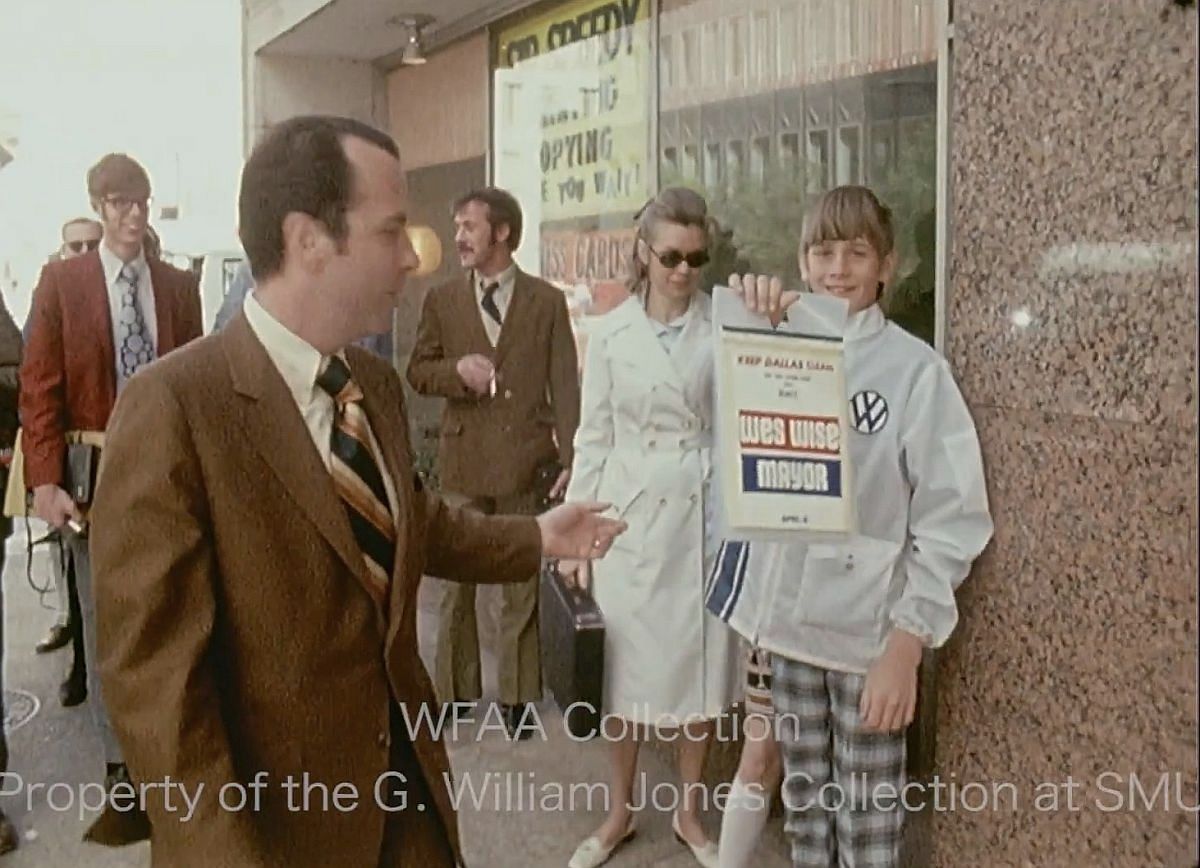
wise-wes_apr-1971_WFAA_SMUWes Wise and family campaigning for Mayor, April 1971

by Paula Bosse

Wes Wise, former 3-term Dallas mayor (1971-1976), has died. He was 94. Read his obituary in The Dallas Morning News, here. Also, a tribute to Wise from the Dallas Municipal Archives is here.

In the piece linked above, the Dallas Municipal Archives mentions this: “Wise is noted for being the first mayor since the 1930s not endorsed by the Citizens Charter Association.” The CCA was a powerful political organization I’ve only become aware of recently. It wasn’t really until I began working in the WFAA-Channel 8 News archives that I saw Dallas political history up close, and it was full of all these powerful groups I had never heard of which, for decades, could make or break candidates simply by deeming them endorsable. If you were running for mayor or City Council, you really wanted the support of the Citizens Charter Association. And you absolutely wouldn’t have dared poke at them with sharp sticks. …Wes Wise poked at them with sharp sticks.

I’ve been going through old Channel 8 News footage, chronologically, for a while now. I am, at present, making my way through April 1971, when Wise and his opponent — the establishment-backed (i.e. CCA-backed) Avery Mays — were in the midst of a runoff for Dallas mayor. Mays, a businessman and civic leader, was the hand-picked candidate of the Citizens Charter Association and, as such, was expected to win. Wise, a City Councilman and former sportscaster, was the self-assured maverick who loudly proclaimed that he was an independent candidate who would not have accepted CCA backing had it been offered. He was young, good-looking, and — with a background in broadcasting — was comfortable and confident in the limelight.

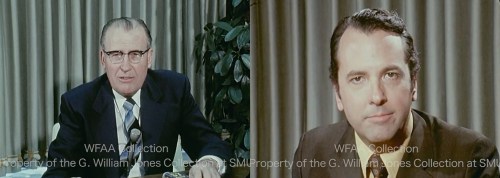
mays_wise_apr-1971_WFAA_SMU

There was a “debate” of sorts between the two on Channel 8, with each man given a minute to make a statement. It’s not on the level of Nixon and JFK, but there is a stark, generational contrast in the two men. I don’t see perspiration on Mays’ upper lip, but I’m getting a rattled, sweaty vibe from him. Wise, on the other hand, is all casual bravado.

Two clips of the candidates during this runoff campaign show the difference in styles of the two men: it’s Old Dallas vs. New Dallas.

  • Watch Avery Mays accuse his opponent Wise of being all talk and no action and being nothing more than a professional “TV and radio talker” (even though Wise had just finished serving a 2-year term on the City Council) — the clip is here.
  • Watch Wes Wise deliver his stinging rebuttal here.

Old Guard vs. New Blood. New Blood won, and Wes Wise led Dallas through the 1970s, a decade of huge change for the city.

***

Sources & Notes

Top image is a screenshot showing Wes Wise campaigning for mayor during the runoff race against Avery Mays on April 8, 1971. Wise is seen with his wife, Sally, and his son, Wyn. The clip is from the WFAA Newsfilm Collection, G. William Jones Collection, Southern Methodist University — it can be viewed on YouTube here (Wise is seen in the segments at 14:20 and 17:21).

An informative mini-biography on Wes Wise can be found here. (It’s interesting to see that, while in the army, Wise was an instructor in psychological warfare, the perfect training for both a broadcaster and a politician!)

More on Wes Wise at Wikipedia, here.

See a shot of Wes Wise in his sports broadcasting days in the Flashback Dallas post “Wes Wise, Dallas Texans, WFAA — 1961.”

wise-wes_apr-1971_WFAA_SMU_sm

*

Copyright © 2022 Paula Bosse. All Rights Reserved.

Stuart Margolin, 1940-2022

margolin-stuart_hillcrest-high-school_1955Hillcrest High School, 1955

by Paula Bosse

Everyone’s favorite character actor, Stuart Margolin, has died. He grew up in Dallas (Preston Hollow) and went to Hillcrest High School — until he was sent to what sounds like a reform school in another state. A brief look through the Dallas Morning News archives shows that he appeared in local theater productions as a child — he trod the boards in a production of A Midsummer Night’s Dream when he was 10. As a teenager, he was active in the Courtyard Theater in Oak Lawn, a school and theater led by Robert Glenn, who had also mentored other young Dallas actors such as Jayne Mansfield, Brenda Vaccaro, Ann Wedgeworth, and… Candy Barr). When he wasn’t acting — and apparently causing enough mayhem to get sent to reform school — he was a very good, avid junior golfer who competed in many tournaments (he is shown in one very grainy photo as a 13-year-old member of the DAC Country Club team, wearing a jaunty golf cap). There is no further mention of the young Margolin after 1955, when, one assumes, the teenager was shipped off to someplace not as cushy as Preston Hollow. He starts popping up again in newspaper stories in 1967, in the early days of his long and successful career in Hollywood when he was making regular appearances on TV shows such as Love American Style

His most-remembered role is Angel, sidekick to James Garner, in The Rockford Files. People loved this character. HE loved this character. He has said, with great affection, that he based Angel on streetwise guys he grew up with in Dallas. 

In 1979, though an established working actor and director in Hollywood, he moved back to Dallas for a couple of years, working on writing projects and establishing the production company River Entertainment.

margolin-stuart_dmn_022481_river-entertainmentFeb. 1981 (Dallas Morning News)

He tried for several years to establish a theater in the city, saying, “I don’t think there’s a professional theater here that is of a quality that this city deserves, a city that likes to view itself as Dallas does” (“Margolin’s Life Has Many Stages” by Joe Leydon, DMN, Apr. 20, 1980). (He was not a huge fan of the Dallas Theater Center and was especially unhappy that, in 1980, the DTC hadn’t had an Actors Equity contract in 20 years.)

At this time he also recorded a country/blues album, And the Angel Sings, of which he said:

I’m from [Dallas], and my musical influences are from this area. When I grew up in Dallas, I listened to a lot of blues — Muddy Waters, B.B. King, This record was made for the kind of people I grew up with. (The Daily Oklahoman, Apr. 22, 1980)

I just watched him in an old episode of The Mary Tyler Moore Show a couple of days ago and said to myself, “I love this guy.” I was always a fan of Stuart Margolin. RIP.

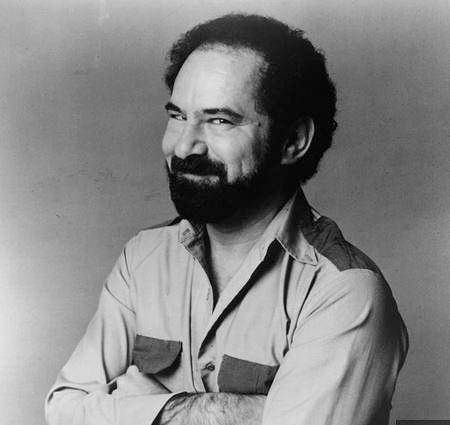
margolin-stuart

***

Sources & Notes

Top photo from the 1955 Hillcrest High School yearbook, The Panther.

margolin-stuart_hillcrest-high-school_1955_sm

*

Copyright © 2022 Paula Bosse. All Rights Reserved.

New Wheels for Margo Jones — 1955

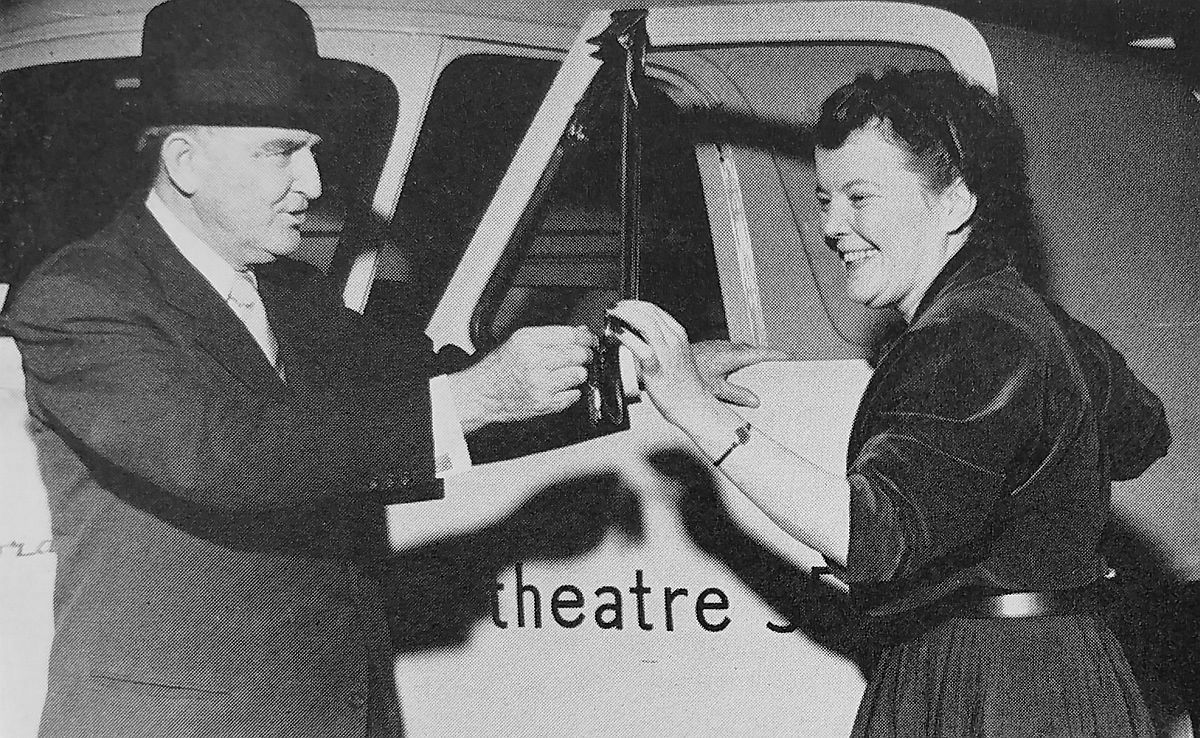
jones-margo_theatre-55_dallas-magazine_apr-1955DeWitt Ray and Margo Jones

by Paula Bosse

The photo above shows Dallas theater legend Margo Jones accepting the keys to a new Ford truck in March 1955. Below, the caption that appeared in the April 1955 issue of Dallas magazine:

GIFT FOR THEATRE ’55: Margo Jones, director of Theatre ’55, is shown as she accepts the keys to a new 1955 panel truck from DeWitt T. Ray, Dallas banker and member of Dallas Theatre ’55 board of trustees. The truck, gift of a group of 18 Dallas businessmen and civic leaders, will be used for transporting set furniture, props and other necessities for the theatre’s productions.

She looks very, very happy!

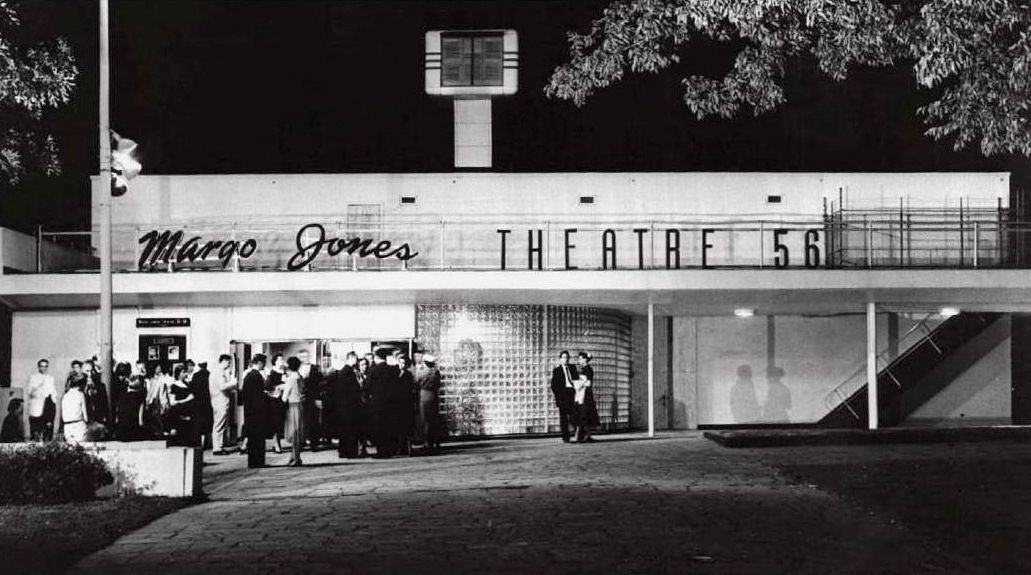
margo-jones_theatre-56_dpl

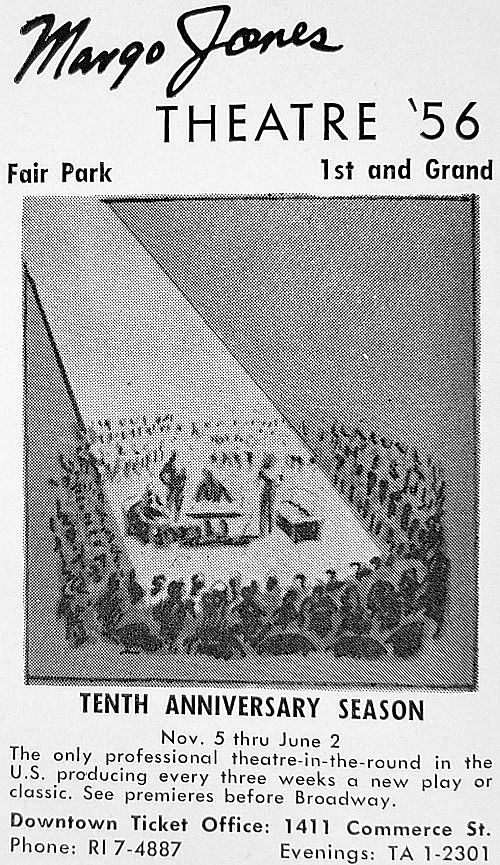
jones-margo_theatre-56_this-month-in-dallas_dec-1956_ad

***

Sources & Notes

Photo is from the April 1955 issue of Dallas, a periodical published by the Dallas Chamber of Commerce.

Photo of the exterior of the theater from the collection of the Dallas Public Library.

Ad from the Dec. 1956 issue of This Month in Dallas.

More on Margo Jones can be found in the following Flashback Dallas posts:

Watch “Sweet Tornado: Margo Jones and the American Theater,” the full documentary on Margo Jones produced by KERA-Channel 13, here.

jones-margo_theatre-55_dallas-magazine_apr-1955_sm

*

Copyright © 2022 Paula Bosse. All Rights Reserved.

Claes Oldenburg in Dallas — 1962

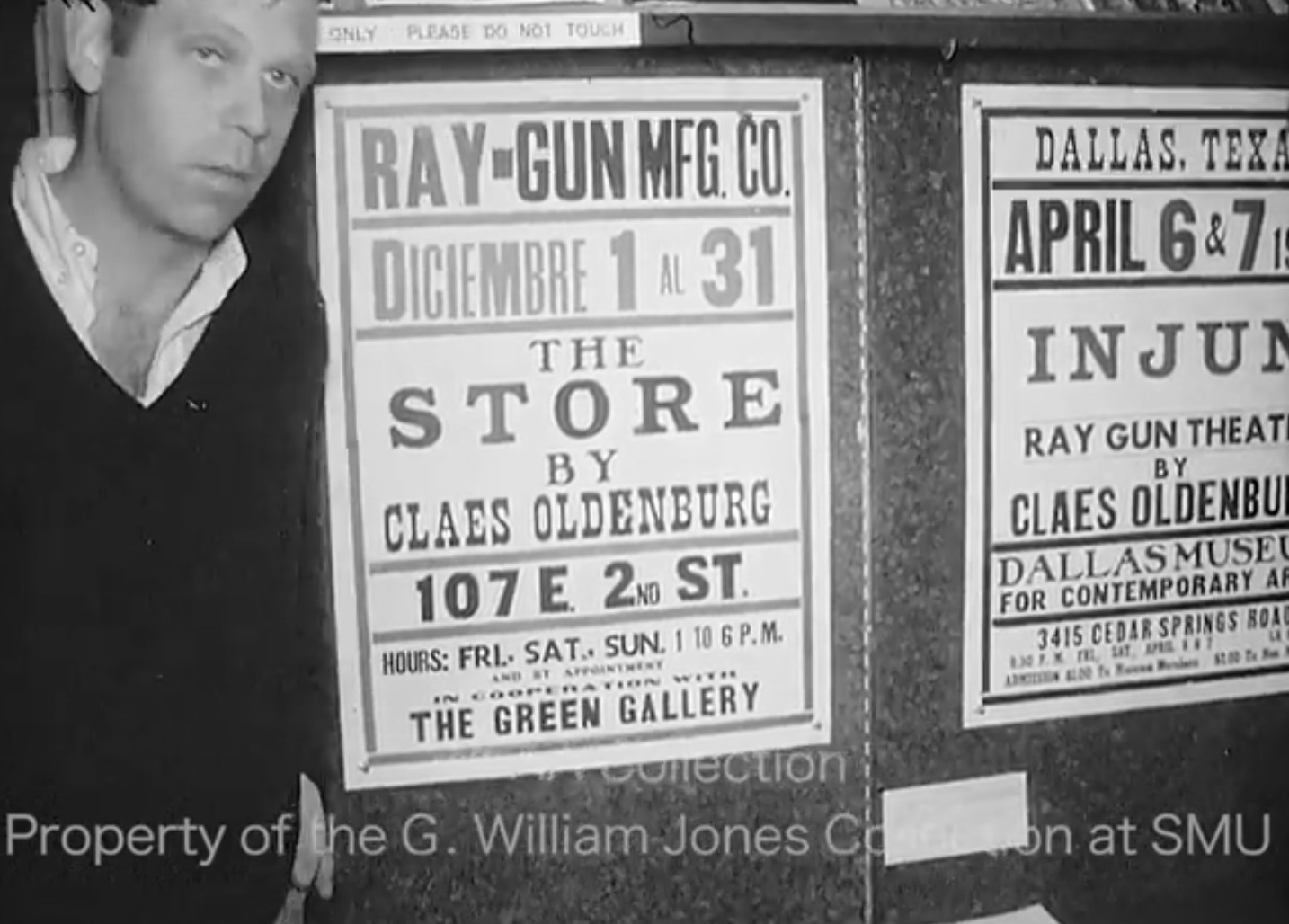
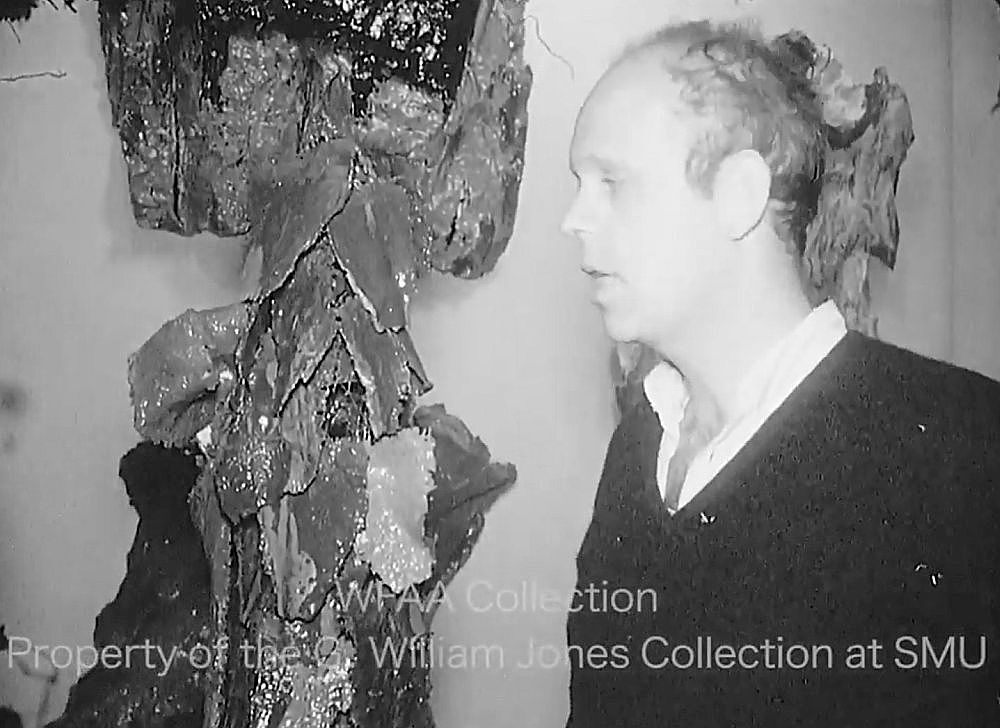
oldenburg-claes_dallas-museum-for-conteporary-arts_april-1962_WFAA_jones-film_SMU_postersClaes Oldenburg at the DMCA, April, 1962 (WFAA Collection, SMU)
by Paula Bosse

Claes Oldenburg, the Swedish-born American sculptor, died this week at the age of 93. Among his connections to Texas are two of my favorite Oldenburg pieces: the fabulous “Monument to the Last Horse,” a permanent fixture of Donald Judd’s Chinati Foundation in Marfa, which he created with his wife Coosje van Bruggen, and the much-missed “Stake Hitch,” a site-specific work commissioned by the Dallas Museum of Art (installed in the brand-new DMA in 1984, and, sadly, de-installed in 2002 after a nasty contretemps between Oldenburg and the museum).

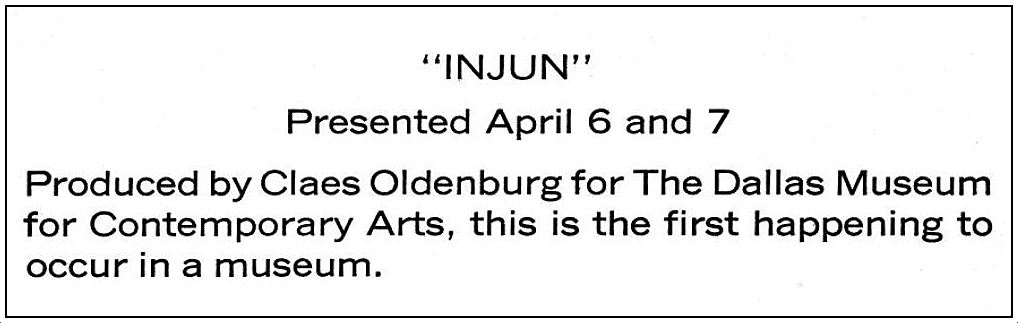
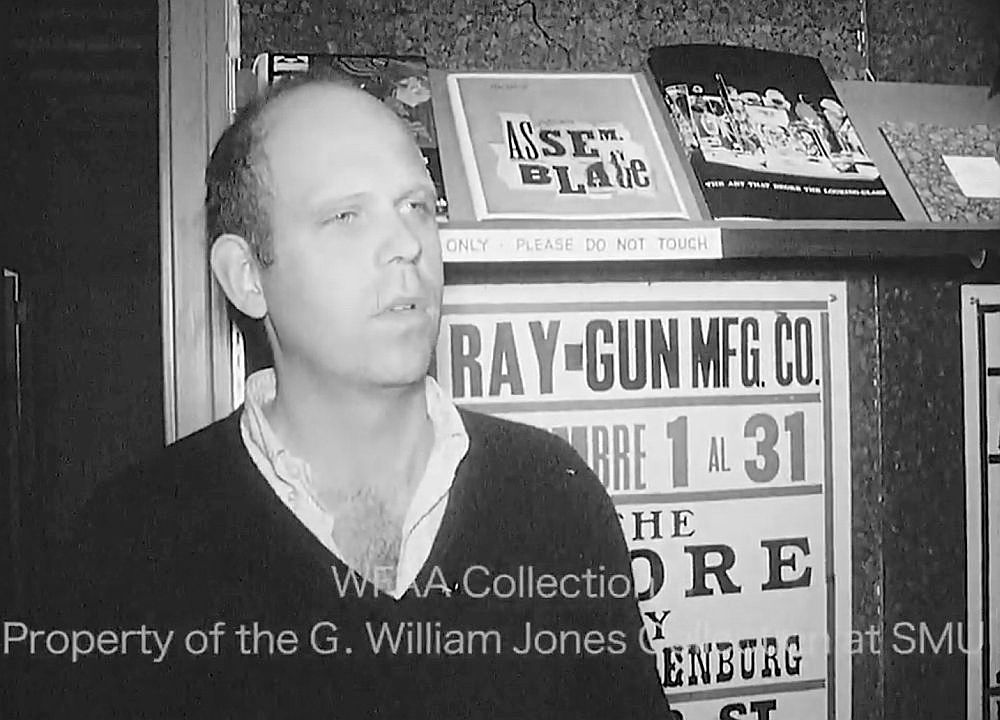
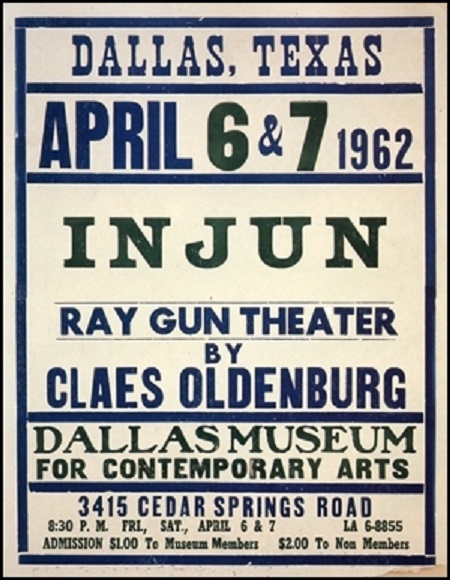
Oldenburg’s first visit to Dallas was in April, 1962, at a time when he was known mainly to NYC art-world hipsters — well before he had achieved anything approaching his later international acclaim. He came to Dallas to present “The Store,” a pop art installation which was part of the group show “1961” at the Dallas Museum for Contemporary Arts (the DMCA was merged with/absorbed by what is now the Dallas Museum of Art in 1963). While Oldenburg was in Dallas exhibiting “The Store” (comprised of 45 individual works, the placement of which he re-created from the original December, 1961 show in Manhattan), he also presented “Injun,” the first-ever “happening” held outside New York or Los Angeles and the first such interactive event commissioned by a museum (Oldenburg’s Ray Gun Theater performance-art “happenings” were much talked about and had gained a cult following in New York, and having him in Dallas to present a “happening” was a definite “get” for the DMCA).

“The Store” and “Injun” — and Claes Oldenburg himself — were very un-Dallas. The reception Oldenburg received from Dallas’ followers of edgier contemporary art appears to have been positive, but his work was handily dismissed by Dallas Morning News art critic Rual Askew, who, invoking the “royal we,” wrote this rather laborious sentence:

Claes Oldenburg’s ‘The Store,’ a painted-plaster waste of time in our view, has interest as assembled pattern with carnival colors at a considerable distance perhaps, but displaces space out of all proportion to aesthetic experience. (DMN, April 15, 1962)

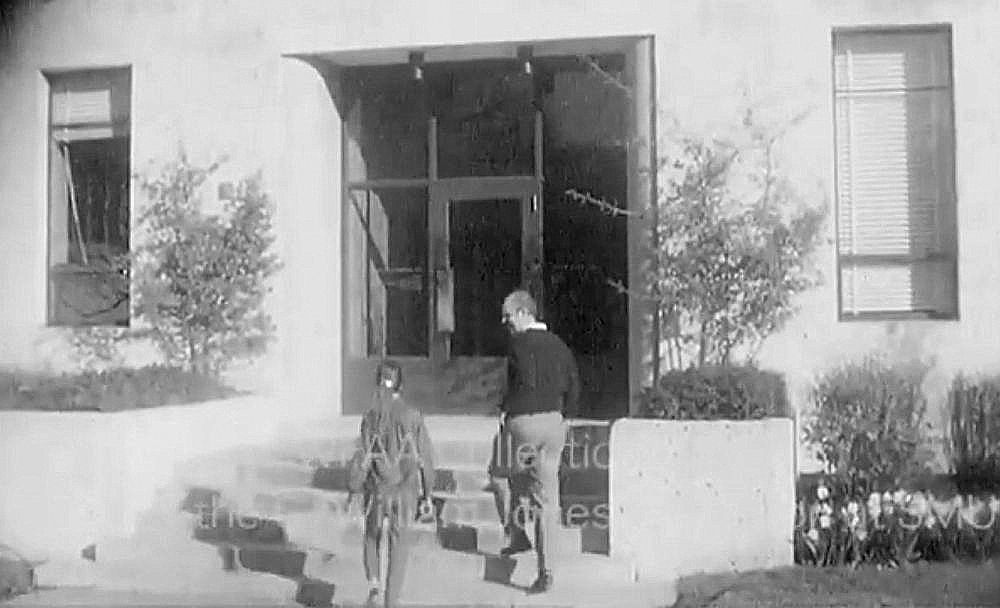
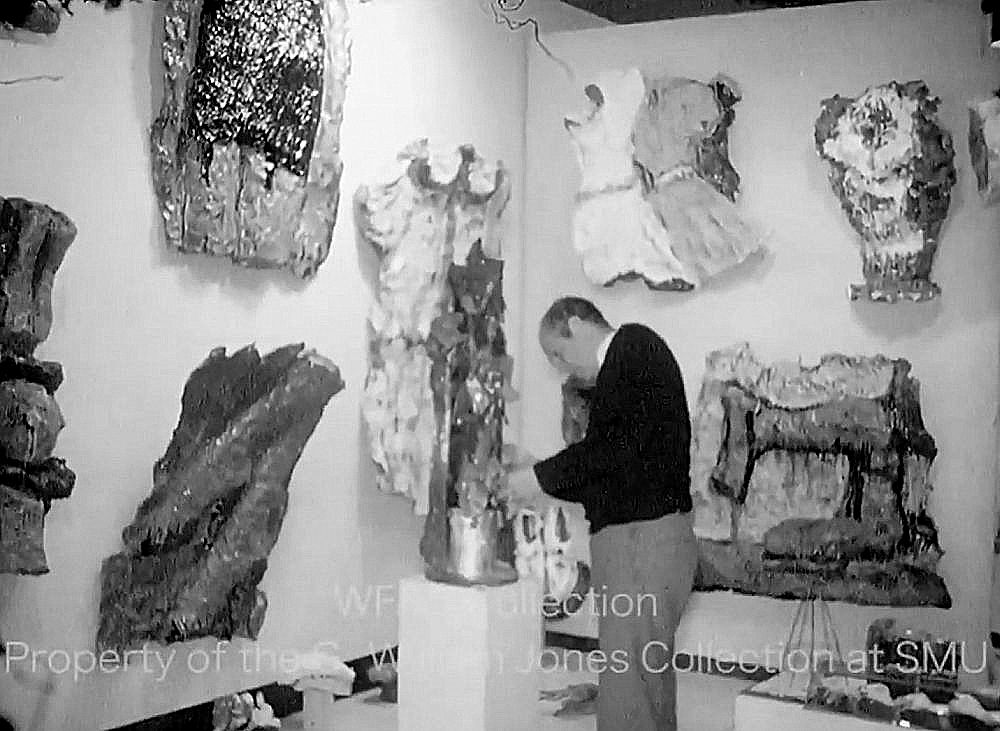
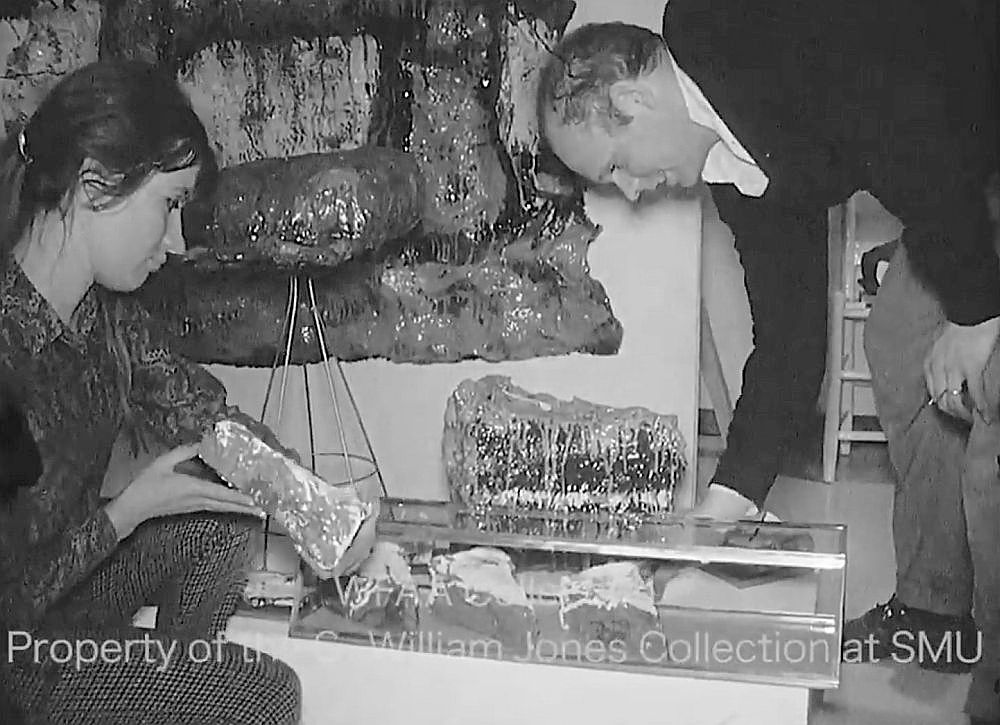
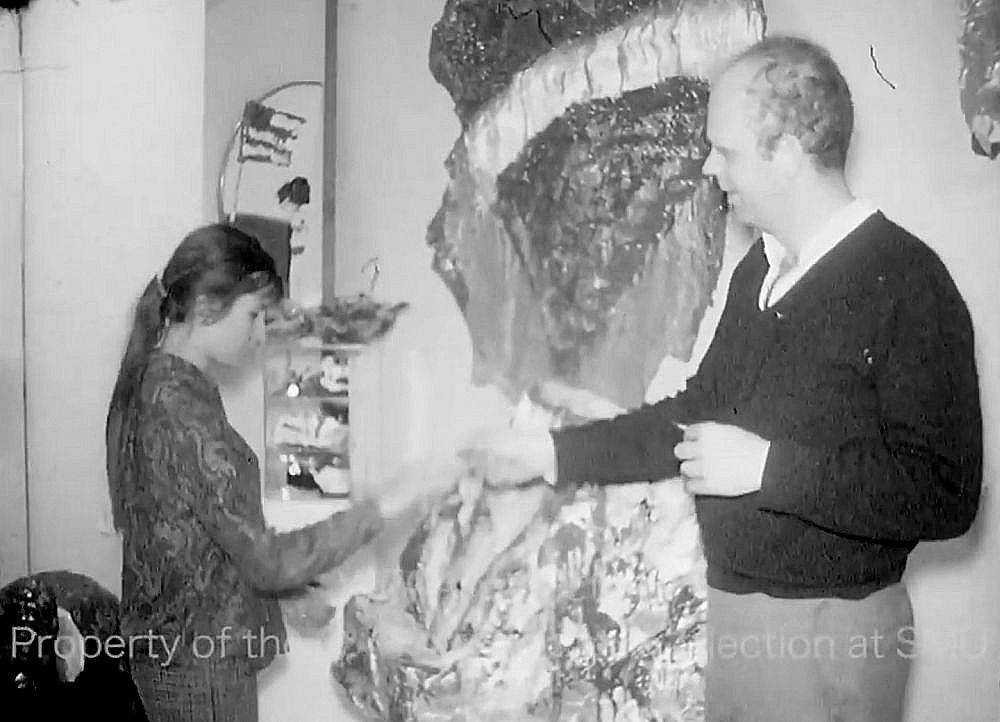
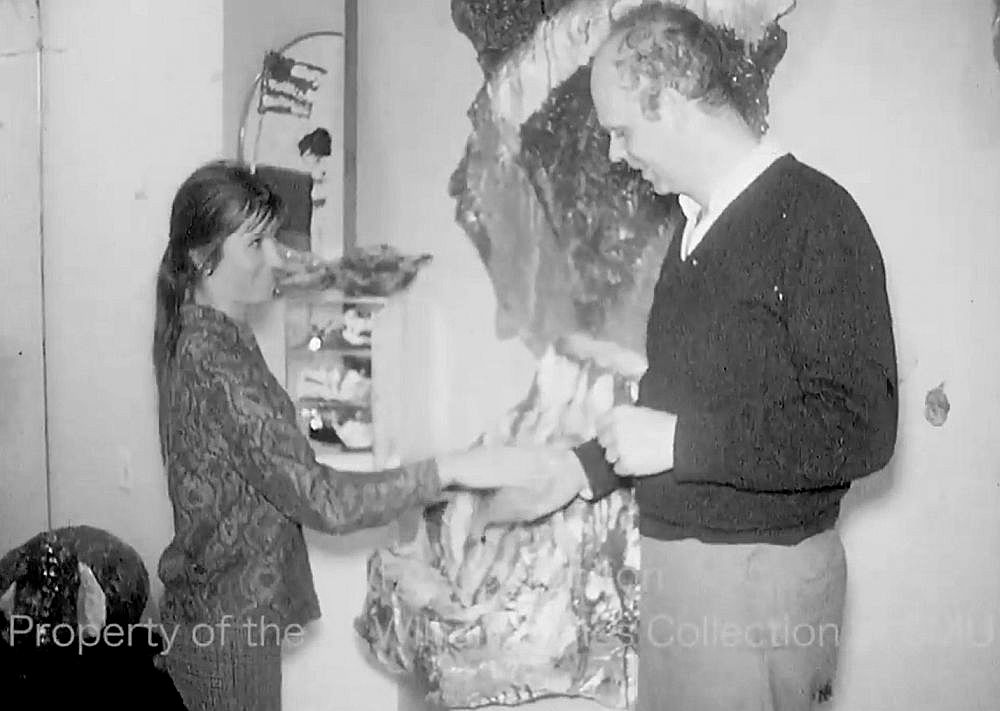
As I work with the WFAA Collection (held by the G. William Jones Collection at SMU’s Hamon Arts Library), I was pretty excited when film footage popped up showing Oldenburg and his first wife (and his collaborator), Patty Mucha, at the DMCA. I knew that the DMCA was somewhere in Oak Lawn (it was at 3415 Cedar Springs), but I had never seen an image of it until this footage. The Oldenburgs are seen walking into the DMCA, tinkering with the installation before the show opened, inspecting the store’s “foods” and other “merchandise,” and playfully “playing store” and exchanging imaginary cash at his “cash register.” Sadly, there is no sound for the one-minute-45-second film, but — being an art history major (that always sounds pretentious…) — I really, really love this. A young, happy Claes Oldenburg in a moth-eaten sweater, here in Dallas, in the early years of what would become an artistically important career is pretty cool to see.

I have been meaning to write this post since I first saw the WFAA footage two years ago. I’m sorry that it’s taken the death of the artist to finally get me to do it. RIP, Claes.

*

UPDATE: Morgan Gieringer, Head of UNT Special Collections, alerted me to a WBAP-Channel 5 news script they have in their collection which describes much the same sort of thing that is going on in the WFAA-Channel 8 film above. In the script, Oldenburg discusses some of the pieces — read the two pages here. (The Ch. 5 report was filmed on March 29, 1962, which could be the same date as the Ch. 8 footage.)

*

“The Store” at the Dallas Museum for Contemporary Arts, 1962 — in vivid color:

oldenburg-claes_the-store_DMCA_1962_DMAvia Dallas Museum of Art

via Dallas Museum of Art

1961_claes-oldenburg_catalog_DMCA_1962_injun“1961” catalogue, via DMA/Portal to Texas History

Screenshots from the WFAA footage, showing Oldenburg and his wife, Patty (who worked alongside her husband and was a frequent participant in the “happenings”) preparing “The Store” for its opening at the DMCA.

oldenburg-claes_dallas-museum-for-conteporary-arts_april-1962_WFAA_jones-film_SMU_ext

oldenburg-claes_dallas-museum-for-conteporary-arts_april-1962_WFAA_jones-film_SMU_1

oldenburg-claes_dallas-museum-for-conteporary-arts_april-1962_WFAA_jones-film_SMU_2

oldenburg-claes_dallas-museum-for-conteporary-arts_april-1962_WFAA_jones-film_SMU_3

oldenburg-claes_dallas-museum-for-conteporary-arts_april-1962_WFAA_jones-film_SMU_4

oldenburg-claes_dallas-museum-for-conteporary-arts_april-1962_WFAA_jones-film_SMU_5

oldenburg-claes_dallas-museum-for-conteporary-arts_april-1962_WFAA_jones-film_SMU_7

***

Sources & Notes

Top image (and all other black-and-white images) are screenshots from the WFAA Newsfilm Collection, G. William Jones Film and Video Collection, Hamon Arts Library, Southern Methodist University; the footage was filmed in early April 1962 (or possibly late March 1962); the clip may be viewed on YouTube, here.

The color photograph of “The Store” and the poster for “Injun” are both from a publication of the Dallas Museum of Art, here.

Other Oldenburg-related sources:

  • The “1961” exhibition catalogue — this group-show featured heavy-hitting up-and-comers such as Robert Rauschenberg, Roy Lichtenstein, Robert Motherwell, James Rosenquist, Joseph Albers, Morris Louis, Jasper Johns, Jim Dine, and Richard Diebenkorn — can be viewed in a fully scanned Dallas Museum for Contemporary Arts catalogue here, via the Dallas Museum of Art Exhibition Records, Portal to Texas History
  • Candid photos from the “Injun” performance can be seen here
  • See several great photos of Oldenburg taken during the installation of “Stake Hitch” in 1984, in a DMA Bulletin here, here, here, and here
  • Watch a short video about “The Store” when it was restaged at the Museum of Modern Art in 2013, with comments on the pieces by Oldenburg; see what the pieces shown in the 1962 black-and-white film made in Dallas looked like 51 years later, in color, in the MoMA video, here

On my blog High Shrink (non-Dallas stuff), you can read more about Oldenburg in a post I really enjoyed writing, “Claes Oldenburg’s ‘Slice of Bread; Tombstone for Ed Kienholz — 1974.”

oldenburg-claes_dallas-museum-for-conteporary-arts_april-1962_WFAA_jones-film_SMU_posters_sm

*

Copyright © 2022 Paula Bosse. All Rights Reserved.

The DALLASOUND — 1971

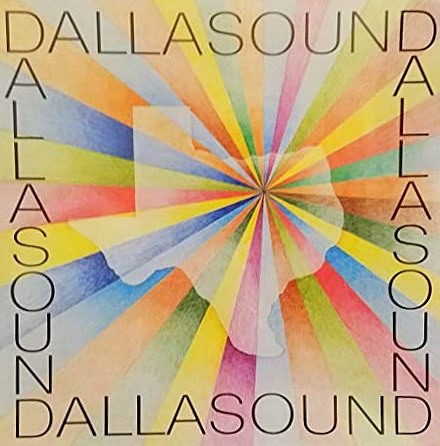
dallasound_1971_amazon
Staight outta Big D…

by Paula Bosse

The Boston Symphony Orchestra had Arthur Fiedler and its popular-music offshoot, The Boston Pops. The Dallas Symphony Orchestra had Anshel Brusilow and The Dallasound. 

Brusilow, a Philadelphia native, came to Dallas in 1970 as the resident conductor of the Dallas Symphony Orchestra. The DSO was in financial straits at the time, so in a bid to increase the orchestra’s demographic reach, Brusilow borrowed Fiedler’s idea and formed his own “pops” orchestra, which played jazzy arrangements of pop songs and light classical music. He named this sideline project “The Dallasound.” It was very popular, but it didn’t improve the financial problems of the DSO, and Brusilow was gone after only 3 years. He then went on to accept a teaching a position at North Texas State University (now the University of North Texas). After 9 years at UNT, he began teaching at SMU’s Meadow School of the Arts in 1983. Brusilow died in 2018 — he spent the last 48 years of his life in Dallas.

*

Here are the liner notes for the Dallasound album (1971):

THE DALLAS SYMPHONY ORCHESTRA

One of America’s oldest orchestras, the Dallas Symphony Orchestra was founded in 1900. Through the years, it has served its community and the entire North Texas area with the finest in music from the greatest composers the world has known. From a modest beginning — with 35 members giving a handful of concerts a season — the Dallas Symphony Orchestra currently has 85 members and performs more than 160 concerts each season. Its membership would comprise a “Who’s Who” of some of the finest artists in the world.

With its reputation for the classics well-established, the Dallas Symphony Orchestra now adds another brilliant facet to its already illustrious history — the DALLASOUND — a new sound and a new concept in music making. A big band sound incorporating the latest and most exciting modern-day pop sounds – special arrangements of tunes by the Beatles, Simon and Garfunkel, Jim Webb and many others.

Featured as special guest artists on the first recording on the DALLASOUND Label are three outstanding jazz musicians from the Dallas area — Paul Guerrero on drums, Jack Petersen on guitar and Al “Little Al” Wesar on Fender bass. Arrangements are by one of the most gifted arrangers in the business — Wilfred Holcombe of Trenton, New Jersey. Not just stock orchestral arrangements, but the swingingest, rockingest big band arrangements around! Settle back and listen to some of the most exciting music you will ever hear made by a symphony orchestra!

ANSHEL BRUSILOW

Like many of the world’s great violinist/conductors, Anshel Brusilow laid aside his Stradivarius several years ago and took baton in hand in earnest. His extensive performing and conducting experience with three of the world’s greatest conductors — Eugene Ormandy, George Szell and Pierre Monteux — placed him in good stead on the podium. He came to Dallas after two extremely busy years and more than 300 concerts with the Chamber Symphony of Philadelphia, including five recordings with RCA Victor.

With him he brought the DALLASOUND and a new era for Dallas’s symphony orchestra. Completely at home with the standard symphonic fare, he is equally proficient when ” swinging” with the DALLASOUND. Thousands of Dallasites have been converted to the new sound a symphony orchestra can make, a fact which substantiates Anshel Brusilow’s theory that the Dallas Symphony Orchestra belongs to all the people of a community and must therefore serve them in as many ways as it can. Thanks to Anshel Brusilow, the Dallas Symphony embarks on a new direction in music — the DALLASOUND!

The album’s musical offerings included arrangements of George Harrison’s “Something” and “My Sweet Lord,” The Carpenters’ “We’ve Only Just Begun,” The Doors’ “Light My Fire,” Tom Jones’ “It’s Not Unusual” and “Delilah,” and everyone’s favorite ubiquitous weird song from the late ’60s, “MacArthur Park.”

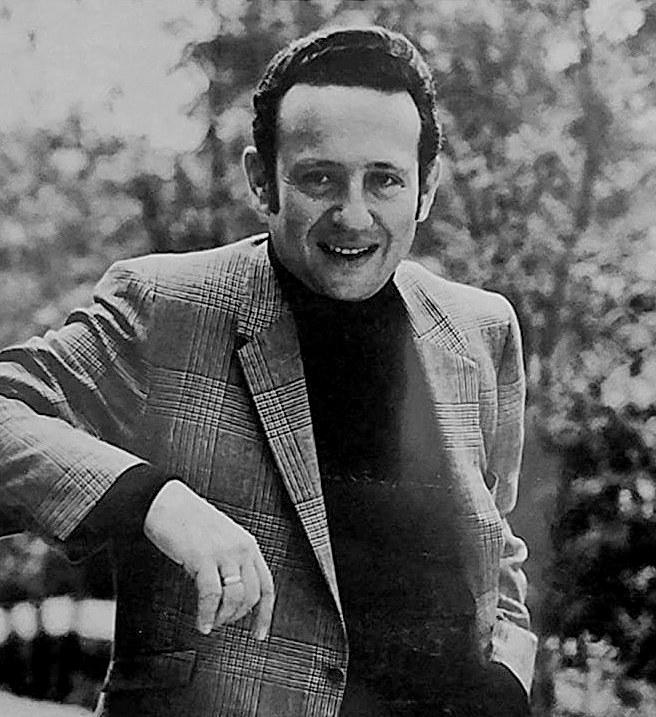
dallasound_back-cover_amazon_brusilowAnshel Brusilow

dallasound_back-cover_amazon_det

dallasound_back-cover_amazon_logo

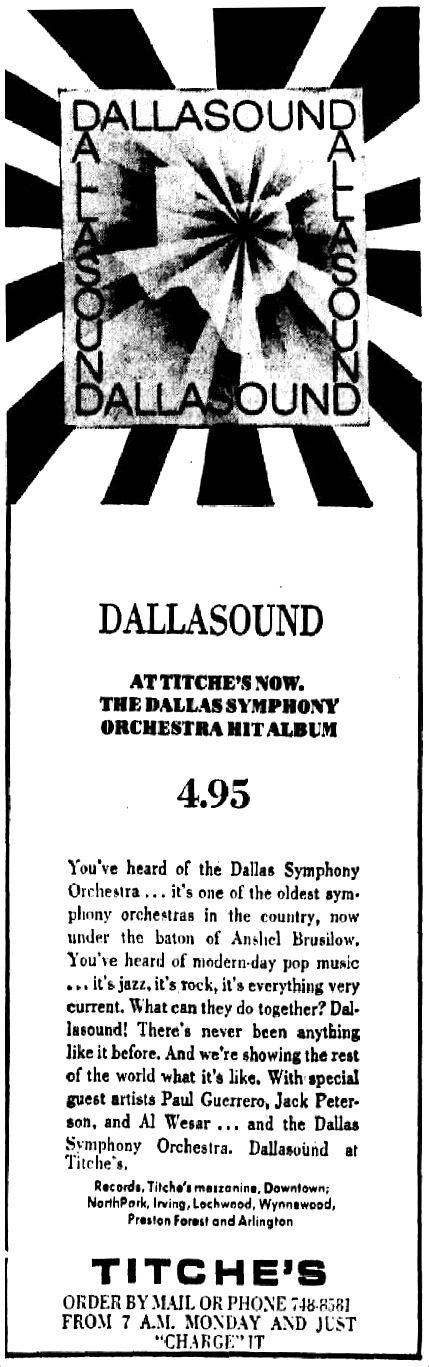
dallasound_030771_adTitche’s ad, March, 1971

***

Sources & Notes

Images from the front and back cover of the DALLASOUND album were found on Amazon, here.

A really good interview with Anshel Brusilow can be found in the “High Profile” article by Marty Primeau (Dallas Morning News, July 17, 1983).

dallasound_1971_amazon_sm

*

Copyright © 2022 Paula Bosse. All Rights Reserved.

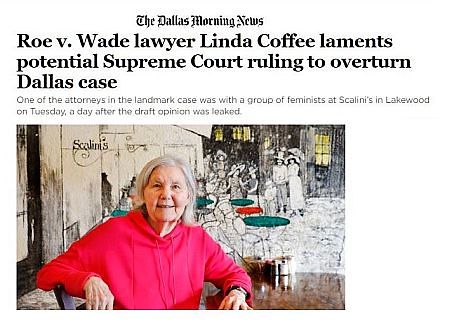
Response to “Leak” from the Dallas Attorney Who Took Roe v. Wade to the Supreme Court

coffee-linda_dmn-headline_050422Dallas Morning News headline, May 4, 2022/photo: Tom Fox

by Paula Bosse

Great work by BeLynn Hollers of The Dallas Morning News for getting comments from Linda Coffee — the Dallas attorney who took her case, Roe v. Wade, to the U.S. Supreme Court (along with her co-counsel, Sarah Weddington) — on the leaked Supreme Court draft decision which appears to signal the overturning of her landmark court case. The story, “Roe v. Wade Lawyer Linda Coffee Laments Potential Supreme Court Ruling to Overturn Dallas Case” (Dallas Morning News, May 4, 2022) can be found here (paywall). Below is the video interview with Coffee, posted on YouTube, here.

The previous DMN interview of Linda Coffee by BeLynn Hollers — “Dallas Lawyer Linda Coffee Launched Landmark Roe vs. Wade Abortion Rights Case with a $15 Filing Fee” (Dallas Morning News, Dec. 16, 2021) — can be found here (paywall). The video interview from that article is posted on YouTube here.

And, from 1970, what may be Linda Coffee’s first-ever television interview about the Dallas case (which was just beginning its long trek to the Supreme Court) has recently been found in the WFAA Newsfilm Collection at SMU (G. William Jones Film & Video Collection, Hamon Arts Library, Southern Methodist University). She was, incredibly, only 27 years old. It is posted on YouTube here. (Read the YouTube notes for background info on this interview.)

*

I wrote about Linda Coffee’s Dallas days in the Flashback Dallas post “Linda Coffee, The Dallas Attorney Who Took Roe v. Wade to the U.S. Supreme Court.”

And, again, thank you, Linda.

*

Copyright © 2022 Paula Bosse. All Rights Reserved.

Dallas Entertainment Awards — 1961

dallas-entertainment-awards_1961_cover_SMUAnd the winner is…

by Paula Bosse

Here’s an interesting piece of Dallas entertainment history: a program for the 1961 Dallas Entertainment Awards, held in the Century Room, the swanky nightclub in the Adolphus Hotel. The awards were nicknamed “the Billy award,” or “the Billys.” Dresscode: “semi-formal.” Here are a few highlights.

*

BEST RADIO PERSONALITY

Nominees are: Nick Ramsey (KVIL), Ted Cassidy (“Profile of an Orchestra,” WFAA), Meg Healy (KIXL), Hugh Lampman (“Music ’til Dawn,” KRLD — the previous year’s winner), Irving Harrigan & Tom Murphy (“Murphy and Harrigan Show,” KLIF), Jim Lowe (WRR), and Chem Terry (KRLD). 

So – Ted Cassidy? Yes, that is the same Ted Cassidy who later played “Lurch” on TV in The Addams Family (he also played “Thing”). He worked for WFAA radio for a few years and is a trivia answer in JFK-related quizzes regarding Dallas media coverage of the assassination.

cassidy-ted_dallas-entertainment-awards_1961_SMU_bw

*

BEST MALE VOCALIST

Nominees are: Mark Carroll, Marty Ross, Earl Humphreys (the previous year’s winner), Skip Fletcher, Charlie Applewhite, Ron Shipman, and Trini Lopez.

Skip Fletcher? Yes, a member of those Fletchers. When he wasn’t frying up corny dogs he did a little singing, and even released at least one 45.

fletcher-skip_dallas-entertainment-awards_1961_SMU_bw

*

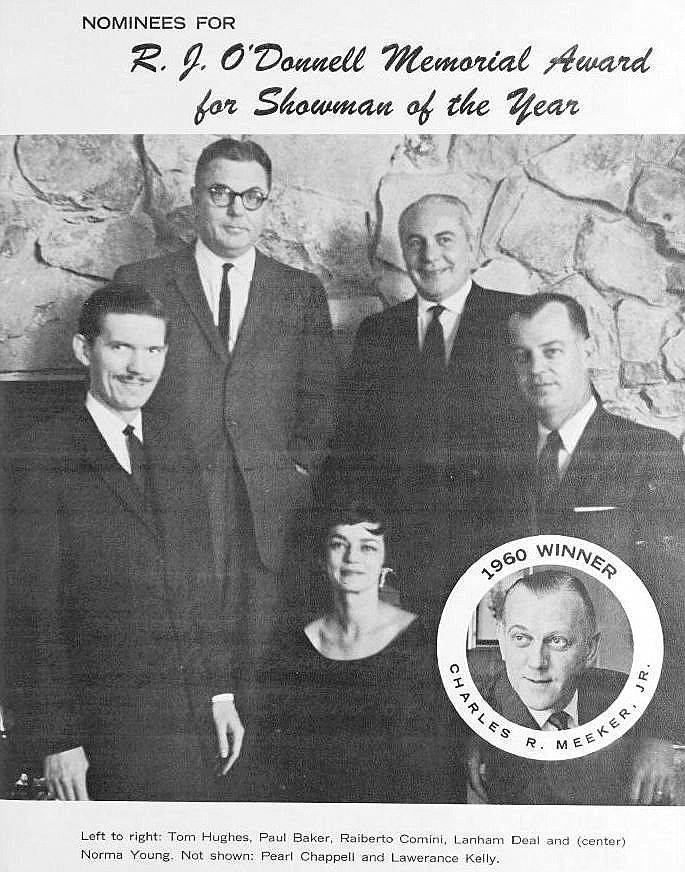
R. J. O’DONNELL MEMORIAL AWARD FOR SHOWMAN OF THE YEAR

Nominees are: Tom Hughes, Paul Baker, Raiberto Comini, Lanham Deal, Norma Young, Pearl Chappell, and Lawrence Kelly. (The previous year’s winner was Charles R. Meeker Jr.) A few names there which should be familiar to aficionados of Dallas live theater.

hughes-tom_paul-baker_raiberto-comini_lanham-deal_norma-young_charles-meeker_dallas-entertainment-awards_1961_SMU_bw

*

Producers of the event were Breck Wall and Joe Peterson, creators of the naughty “Bottoms Up” revue, which is probably still running somewhere. Some biographical information on the pair (click for larger image):

wall-breck_joe-peterson_dallas-entertainment-awards_1961_SMU_bw

*

Master of Ceremonies was Tony Zoppi, who wrote a column about the local nightclub scene for The Dallas Morning News. Whenever I read his old columns, I think that he must have had the BEST job in town — writing about the Dallas nightlife scene when it was at its sophisticated and sometimes seedy Mad Men-era apex.

zoppi-tony_dallas-entertainment-awards_1961_SMU_bw

*

And — a bit of a change of pace — a little bio of real estate titan Leo Corrigan, who owned the Adolphus, where the show was being held — he was, unsurprisingly, receiving an “Appreciation Award.”

corrigan-leo_dallas-entertainment-awards_1961_SMU_bw

*

And a couple of drawings of Dallas entertainment notables: Pappy Dolson, owner of Pappy’s Showland and legendary agent of strippers, and Joe Reichman, the leader of the Century Room orchestra who was billed as “the Pagliacci of the piano.”

pappy_pappys_dallas-entertainment-awards_1961_SMU

reichman-joe_dallas-entertainment-awards_1961_SMU

*

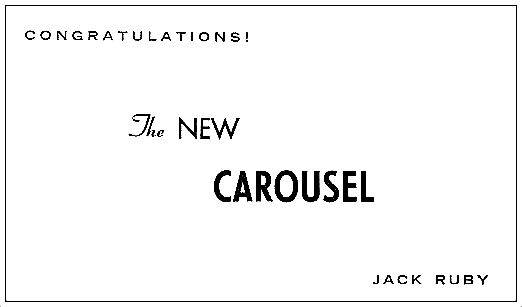
A few interesting ads include a little “howdy” from Jack Ruby (who was well known to several of the people mentioned above, some of whom testified to the Warren Commission about their relationships with him). 

ruby-jack_new-carousel_dallas-entertainment-awards_1961_SMU

An ad for Villa Fontana, a gay club, formerly known as Le Boeuf Sur Le Toit (The Bull on the Roof), then managed by Bob Strange. Gay clubs were illegal at the time, so you didn’t see a lot of ads for them. (I wrote an article for Central Track about some of the gay clubs in Dallas in the early ’70s — with photos — here.)

villa-fontana_gay-cllub_dallas-entertainment-awards_1961_SMU

And, the 24-hour greasy spoon known to generations of Dallasites, Oak Lawn’s Lucas B & B.

lucas-b-and-b_dallas-entertainment-awards_1961_SMU_bw

Here’s the photo enlarged. Unless something earth-shattering has happened that I don’t know about, that great sign is still standing on Oak Lawn near Lemmon, long after the restaurant closed.

lucas-b-and-b_dallas-entertainment-awards_1961_SMU_det

*

See the rest of the 44-page program — lots more photos, lots more nominees — in a PDF from the DeGolyer Library at SMU, here.

***

Sources & Notes

All images are from “Dallas Entertainment Awards — 1961,” from the Diane Wisdom Papers, Archives of Women of the Southwest, DeGolyer Library, SMU Libraries; more information and a link to the fully-scanned program is here.

dallas-entertainment-awards_1961_cover_SMU_sm

*

Copyright © 2022 Paula Bosse. All Rights Reserved.

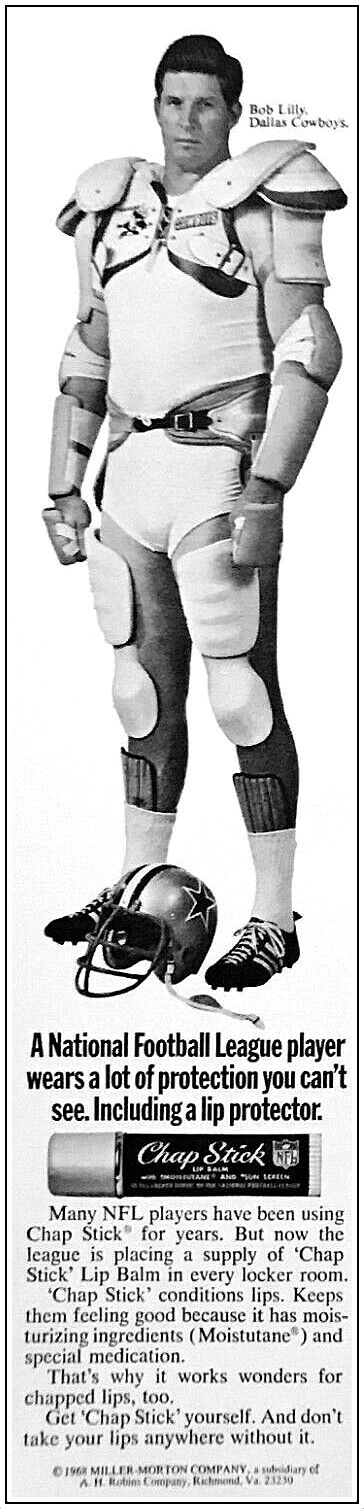
Bob Lilly, Chap Stick User — 1968

cowboys_bob-lilly_chapstick_1968-ad_2

by Paula Bosse

Must’ve been the Moistutane®.

cowboys_bob-lilly_chapstick_1968-ad_1_ebay

***

Sources & Notes

Ads found on eBay.

cowboys_bob-lilly_chapstick_1968-ad_2_det

*

Copyright © 2021 Paula Bosse. All Rights Reserved.