Flashback : Dallas

A Miscellany: History, Ads, Pop Culture

Category: Non-Celebs

Margaret Werry (Bosse): 1936-2025

by Paula Bosse

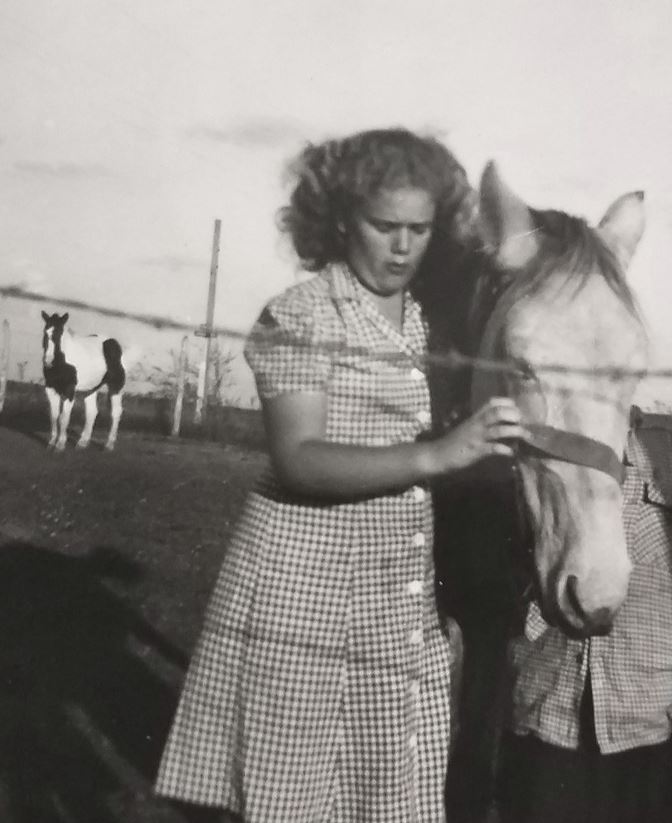
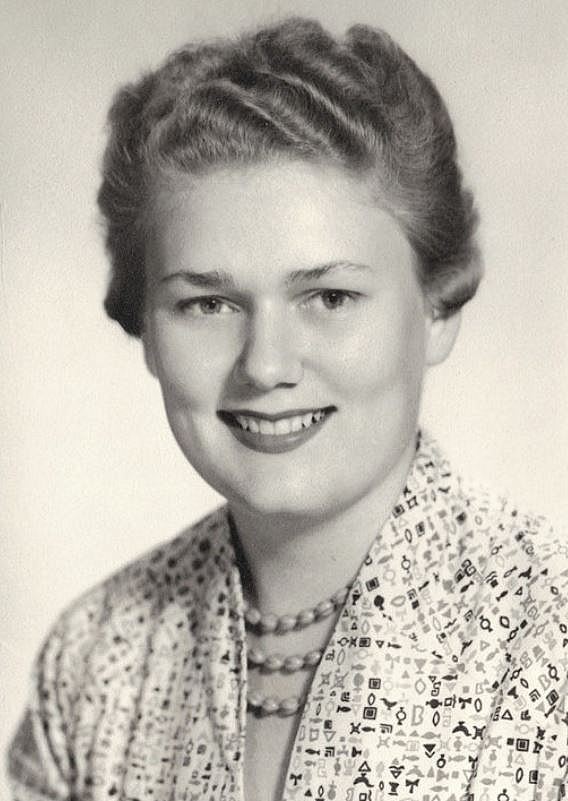
My mother, Margaret Werry (who was known as Margaret Bosse during much of her time as a political activist), died on May 16, 2025, in hospice care at Baylor Hospital in Dallas. She was 89.

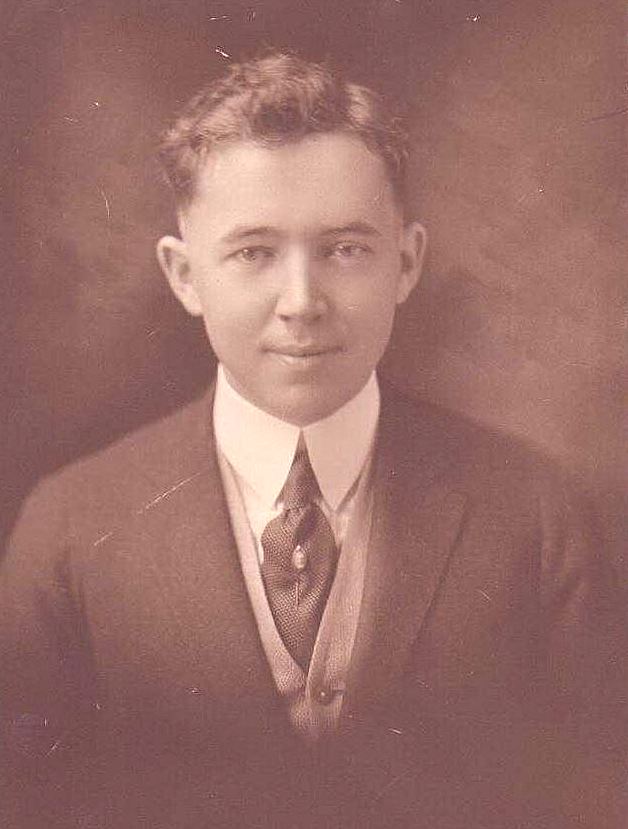
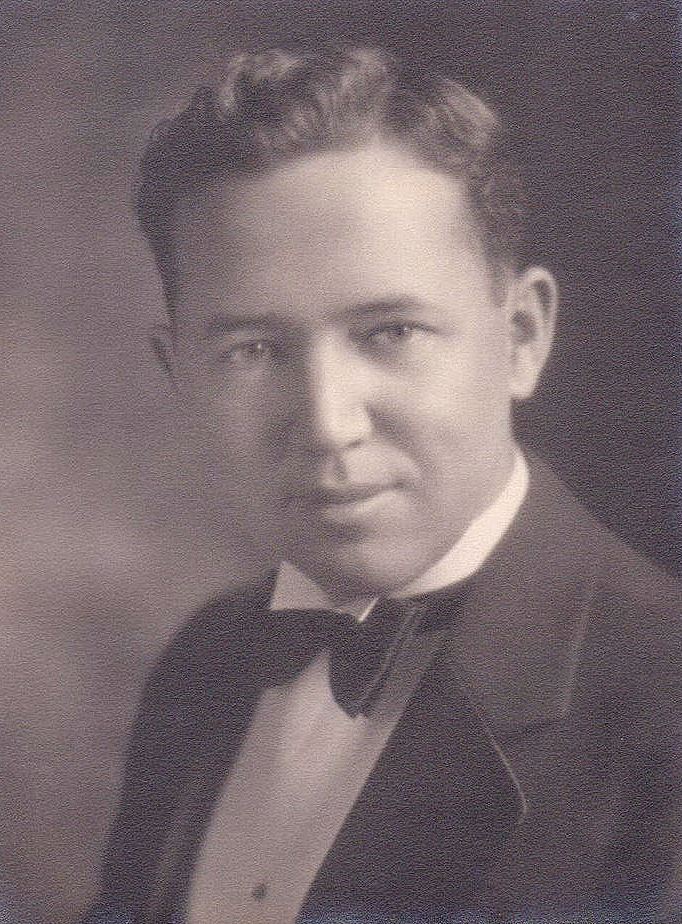
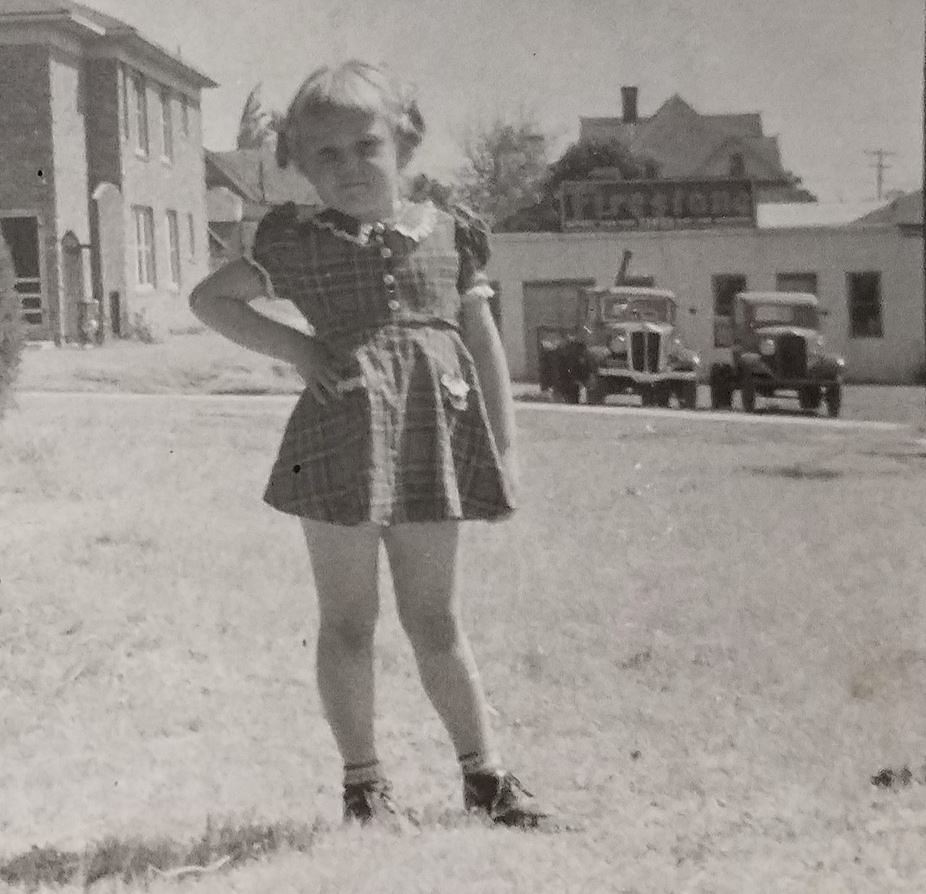
She was born in Dallas, grew up in Oak Lawn on Hartford Street, between Douglas and Wycliff, a couple of blocks from her grade school, Sam Houston Elementary. Instead of attending North Dallas High School, she chose to go to Crozier Tech downtown so she could focus on advanced science courses (she had dreams of going to medical school). She graduated at 16 and attended SMU, majoring in Comparative Literature. (See photos of both of my parents from SMU yearbooks here.)

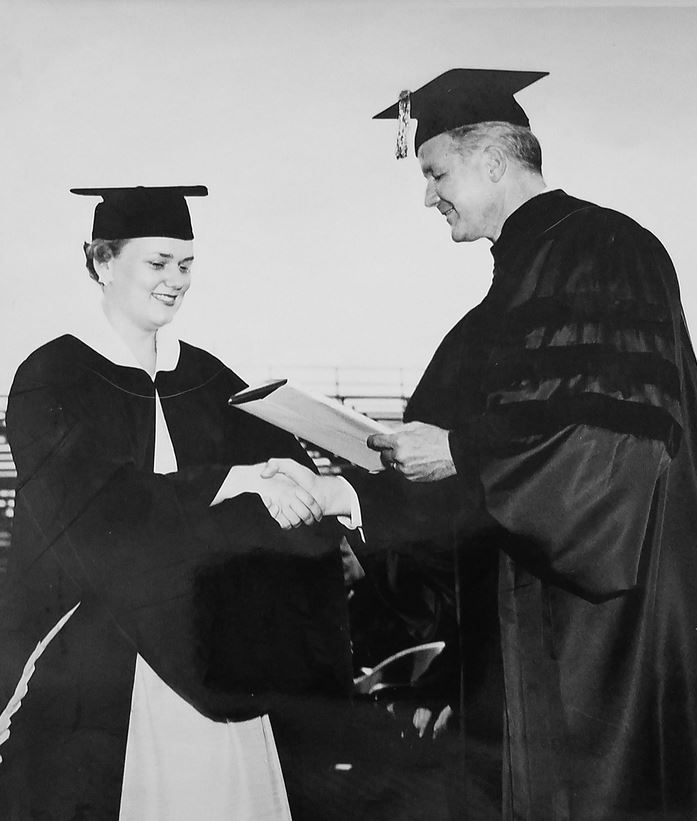
My mother with SMU president, Willis Tate

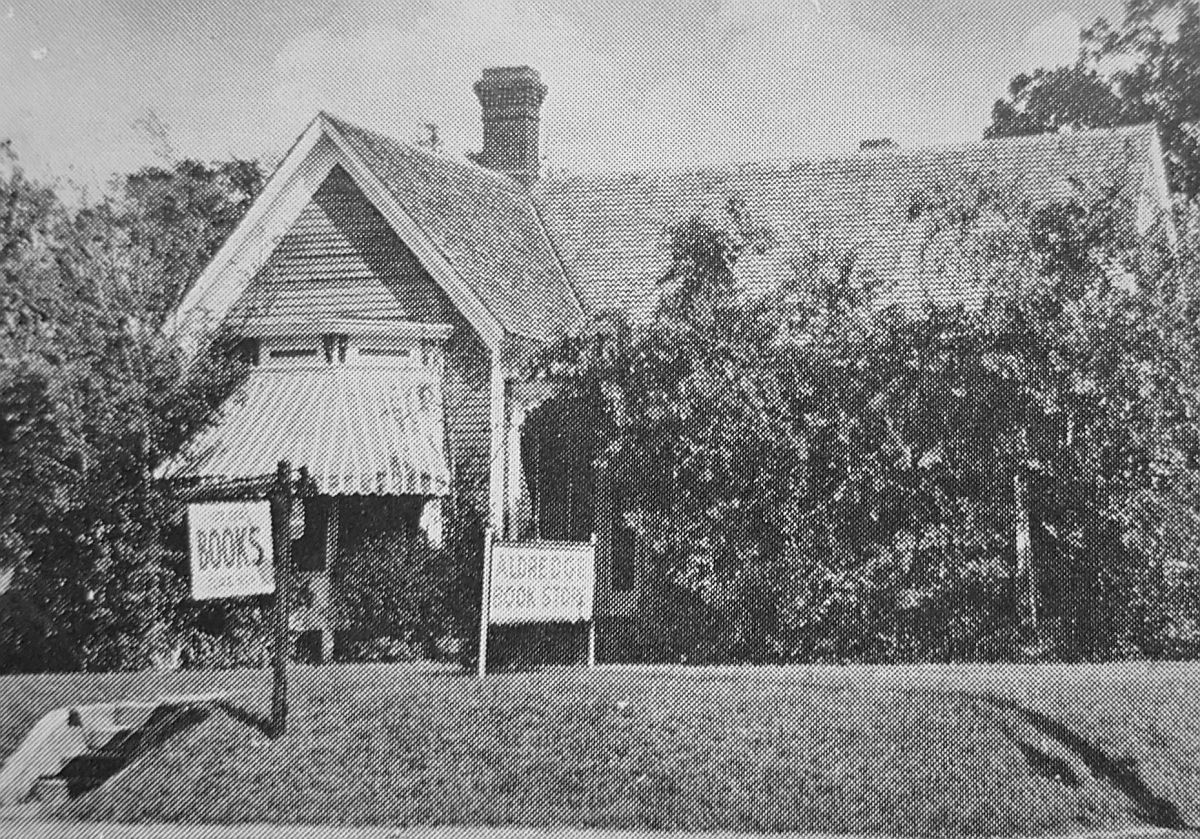
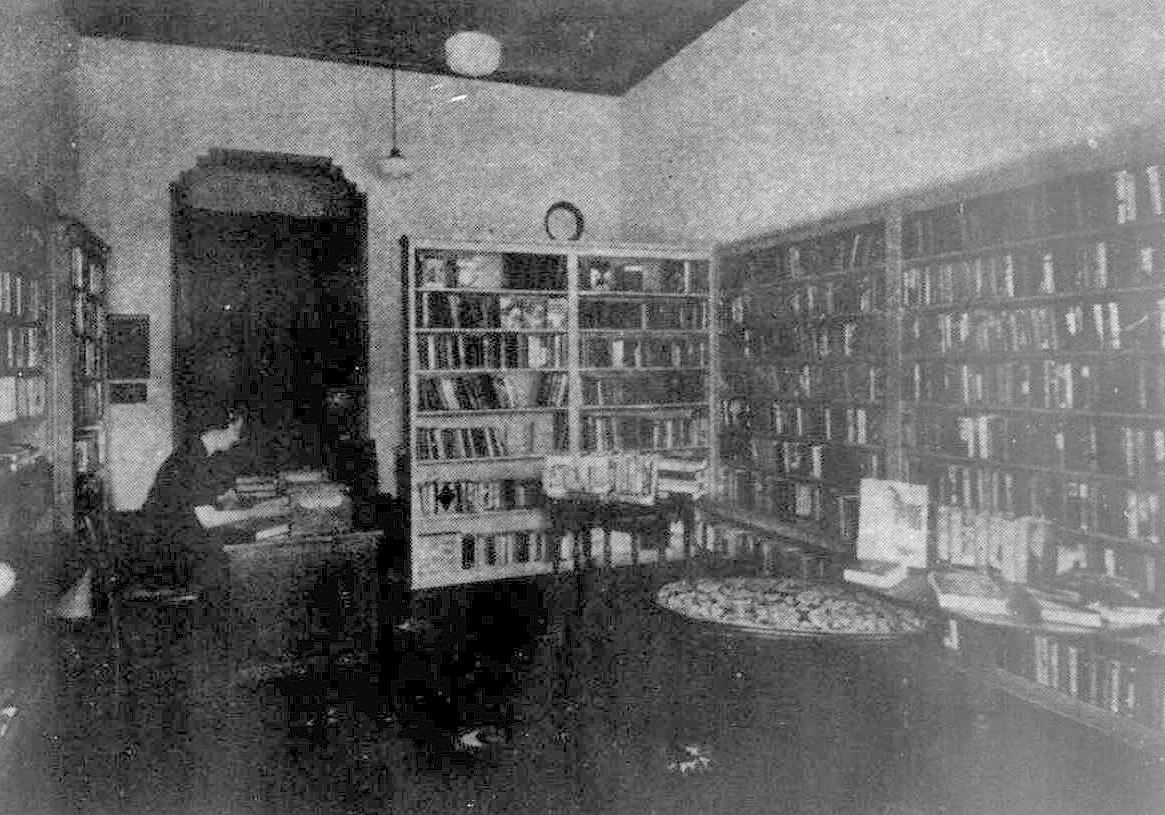
She spent a short time at UT medical school in Galveston, but her mother’s unexpected death brought her back home. She soon began working at an antiquarian bookstore on McKinney Avenue, located in an old Victorian house — The Aldredge Book Store, where she met my father, Dick Bosse, another former Comparative Literature major at SMU. They married a few years later. That bookstore was a home-away-from-home for my parents, for me, and for my brother. Every kid should be lucky enough to grow up in a used bookstore. (My parents divorced amicably in the ’80s and remained friends until his death in 2000. The obituary of my father written by my brother, Erik Bosse, is here.)

2800 McKinney Avenue, ca. 1960

My mother’s passions in life were working for progressive political causes and for advancing and promoting women’s issues. The 1970s and ’80s were a time of non-stop political activity for her. She was one of the small group of women who were connected in various ways to the First Unitarian Church on Preston Road who helped and supported attorney Linda Coffee in developing the case that became known as Roe v. Wade. She tirelessly worked for women’s rights, even helping to establish the Women’s Southwest Federal Credit Union here in Dallas at a time when mainstream banks and credit unions did not generally grant loans to women without their husband’s consent (!). She always described the ’70s as the most exciting time of her life. A lot was changing then, and she was right in the middle of it.

She was also a passionate animal-lover — our house was never without several cats. Some of her fondest childhood memories were her visits to the farm of her aunt and uncle, which she always described with idyllic nostalgia.

She also loved classic movies, Orson Welles, William Faulkner, and bookbinding, to name just four random things.

I remember her reading books to me and my brother. My favorite was The World is Round by Gertrude Stein, which I love to this day, and which I am convinced led to the love of writing and language my brother and I share.

My mother was the kindest person I knew (next to my father). She was smart, funny, and ethical, and, somehow, she never lost her patience when trying to help me with my math homework (sadly, I did not inherit her love of numbers and mathematics). She was a wonderful baker, and I will miss her amazing Christmas cookies and cakes.

And I’ll just miss her. I’ll miss her every day. Her health had been in decline for several years, and the last few months were difficult for her and for my brother and me. I am relieved she is no longer suffering, but it breaks my heart to lose her.

I received a lovely note from Charles Drum, who used to work with my parents at The Aldredge Book Store during those early days. Here is what he wrote:

I read about your mom’s passing. My thoughts are with you. Your mom could always make me laugh. It was a gift. Like your dad, she had a treasury of arcane knowledge to share. I wish I’d been able to talk to her in recent years. We had a lot of memories of ancient times.

Those days at the Aldredge Book Store, working with your dad, Sawnie [Aldredge, the original owner], Mimi [Sawnie’s wife and ABS fixture], and even Thelma [the somewhat irascible maid] were formative years for me and set standards of care, wit, camaraderie, and just plain fun that I was rarely able to match in following years. Your folks’ interests. stories, and above all their humor are a vivid part of me to this day.
 
Happy I sat down to write you.

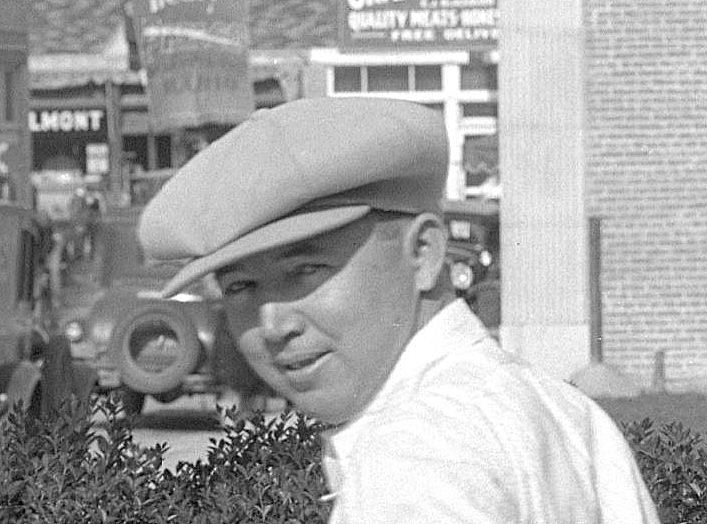
Thank you, Charlie. (See Charlie in a photo with my father, here.)

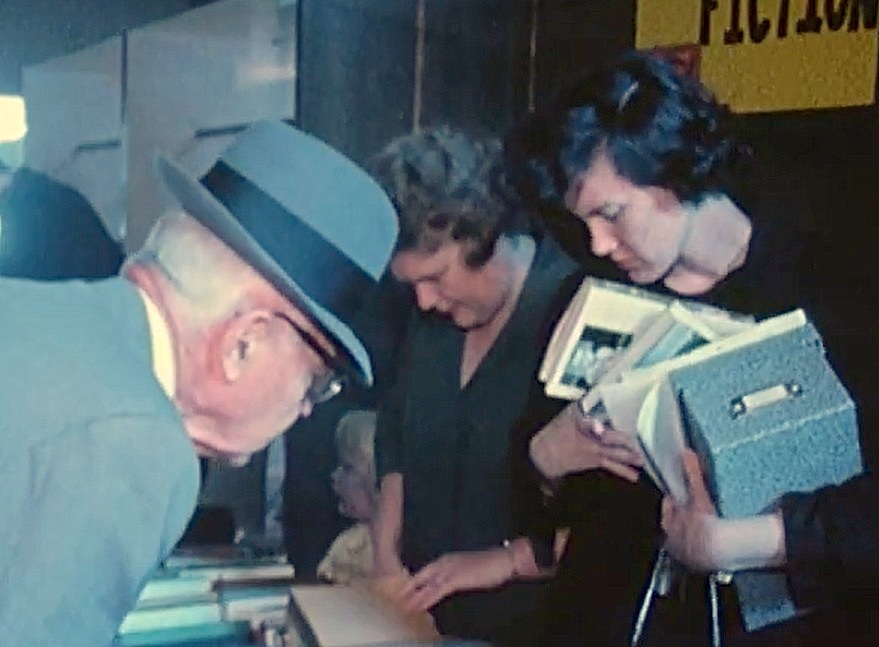
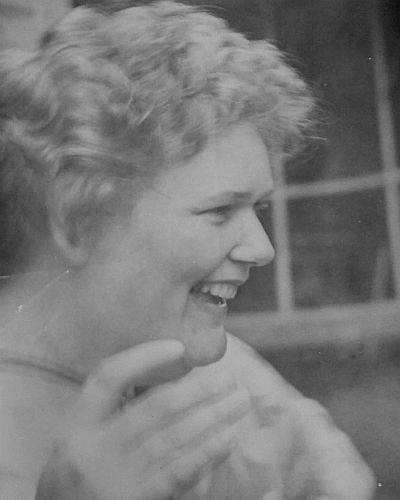
I recently came across this image of my mother and me at one of the hundreds of book sales and book events I found myself at during my childhood. (It’s hard to see me, but I’m in there, next to my mother, dwarfed by people and books and people with books.)

I’ll miss you, Mama. Thank you for all your memories of Dallas.

Thank you for everything.

***

Sources & Notes

Flashback Dallas posts about The Aldredge Book Store are here.

I understand friends of hers may be preparing a get-together to remember my mother. If you were a friend of hers and are interested in attending, please send me an email at the contact info at the top of this page.

*

Copyright © 2025 Paula Bosse. All Rights Reserved.
The Bullen Store, Exposition Avenue — 1896-1936

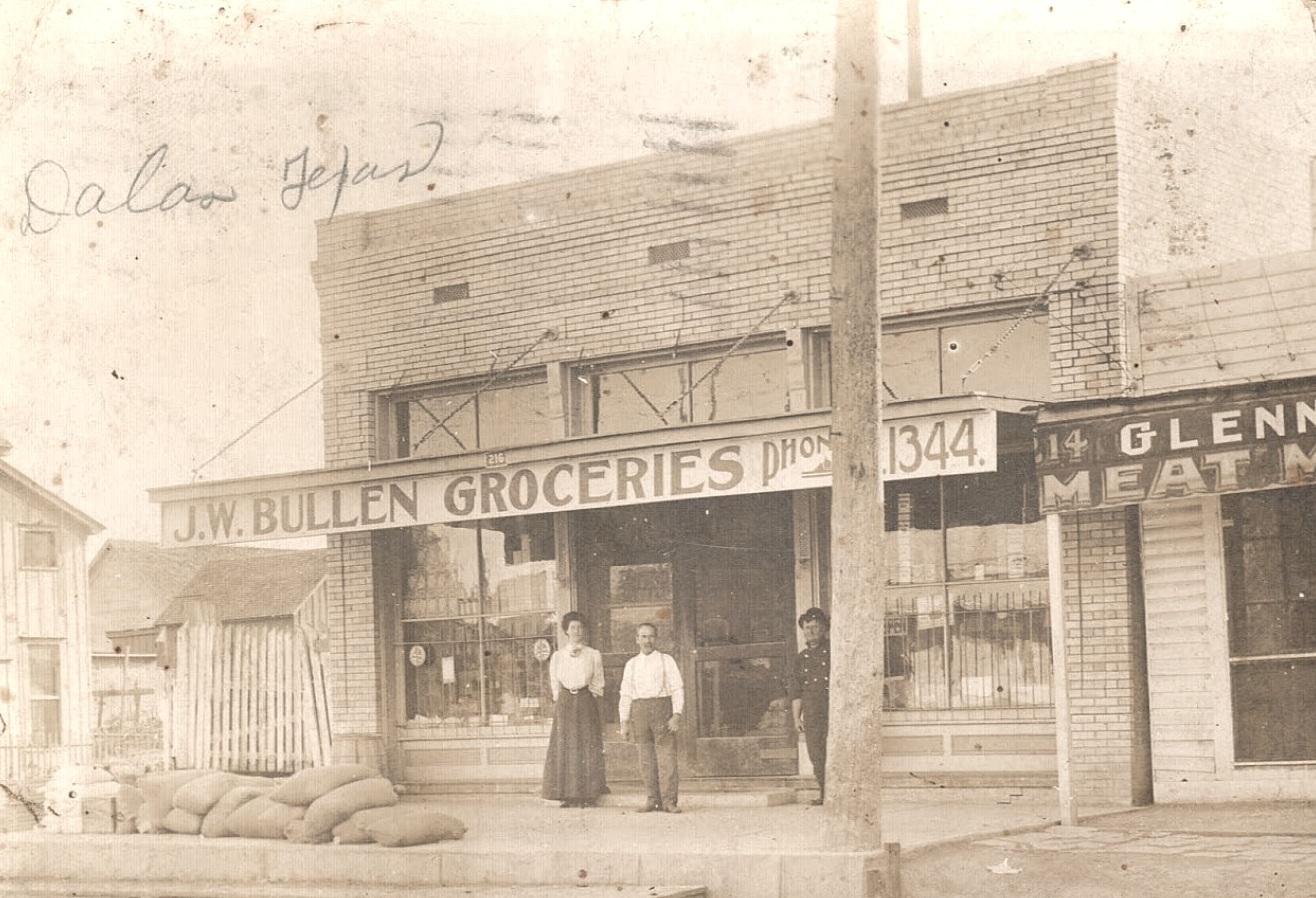
bullen-store_exposition-avenue_ca-1905Exposition Ave., ca. 1905 (photo: Bullen family, used with permission)

by Paula Bosse

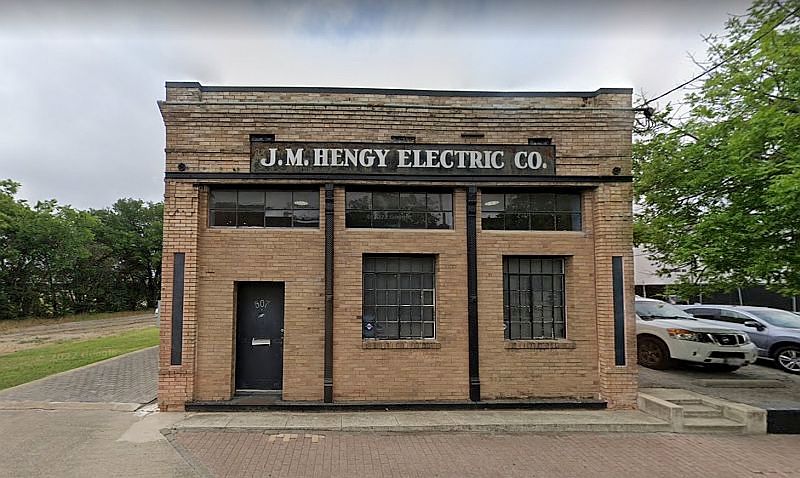
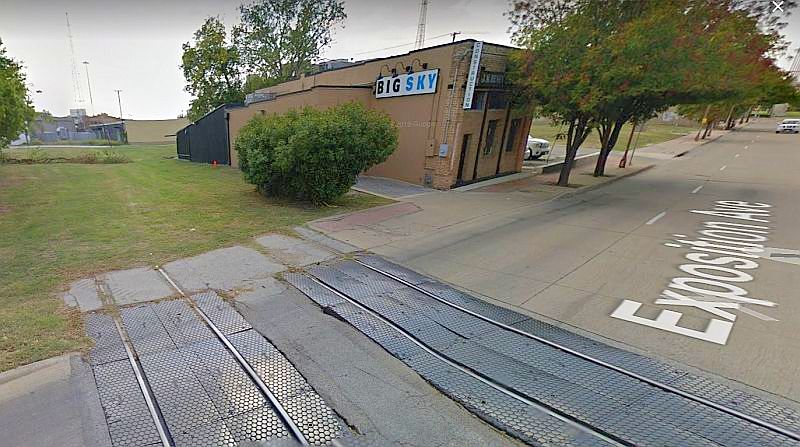
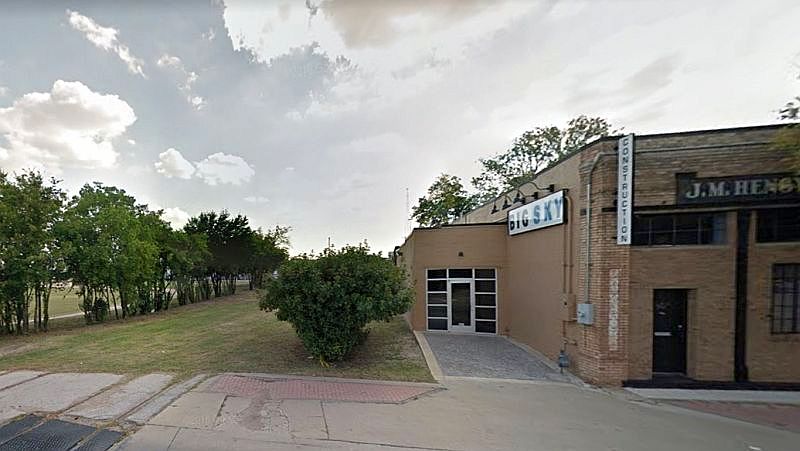
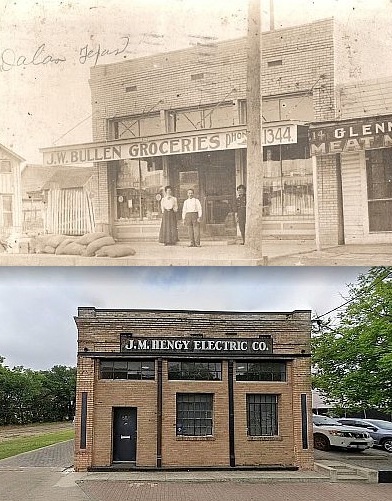
If you’re reading this, you probably have a fascination with old buildings. When was it built? What had it been? How has it not been torn down? One such building — which, though interesting, doesn’t really strike one as particularly old — is the small building at 507 Exposition Avenue, a few blocks from Fair Park. Actually, the thing that jumped out at me was the sign on the building reading “J. M. Hengy Electric Co.” — back in 2015 I wrote a long post about the exceedingly litigious Hengy family (“F. J. Hengy: Junk Merchant, Litigant”) (J. M. was the grandson of F. J.). The Hengy Electric Co. was in business at that location from at least the 1930s until at least the 1960s. I’m not sure why the current owners kept this sign, but I’m glad they did, because it’s why I noticed it.

This building was most likely built in the 1890s, and it was home to a grocery store owned by J. W. Bullen (John Wesley Bullen Sr.), a Tennesse native who came to Texas in the late 1870s and, after a few years of farming in the area, settled in Dallas. He worked for the Santa Fe railroad for a while before opening this grocery on Exposition Avenue in the 1890s — easy to give directions to because the Gulf, Colorado and Santa Fe (GC&SF) Railway tracks ran right alongside the store. Bullen’s grocery was a neighborhood mainstay for at least 40 years. He retired in 1936, and he and his wife, Mary, eventually moved to California to live with their daughter. J. W. Bullen died in California in 1948, at the age of 89 — his life spanned the Civil War to the advent of television.

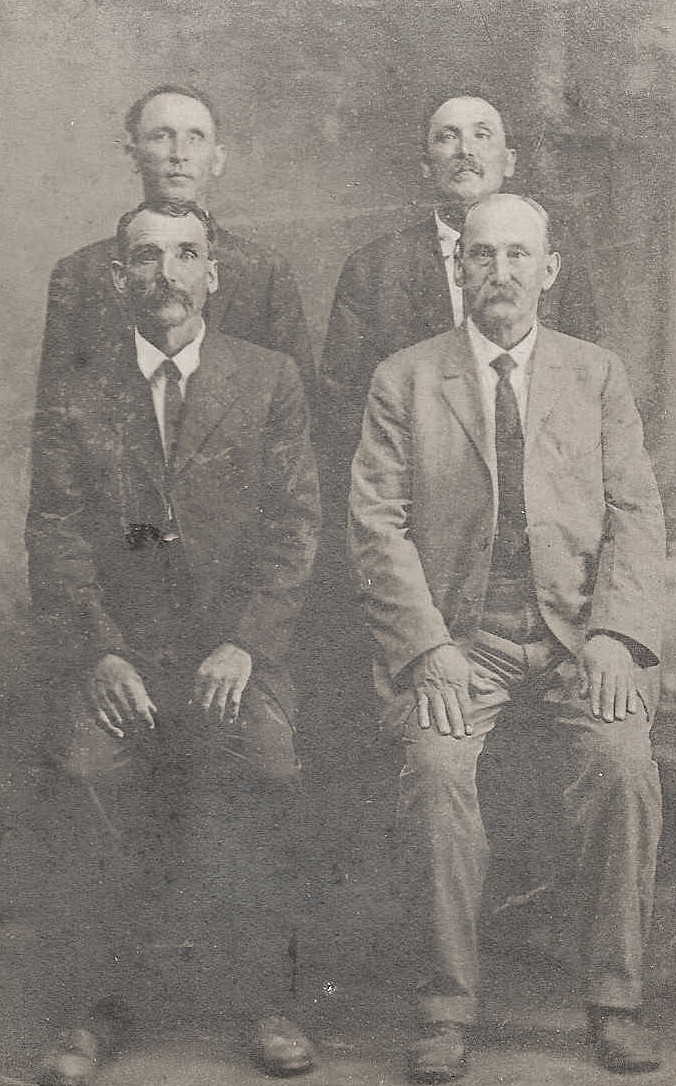
Below, J. W. Bullen is shown with his brothers, Thomas, James, and Joseph — he is at the bottom right.

bullen-j-w_sitting-right_ancestryvia Ancestry.com

I came across the photo at the top of this post on the Dallas Historical Society discussion forum (“The Phorum”) back in 2017 (it’s taken 5½ years for me to finally write this!) — the thread is here. A Bullen relative posted this photo, and I was ecstatic to see it! It’s such a great image — I have never seen a photo of Exposition Park from this period. (I asked Mr. Bullen — the man who posted this photo — if I could reproduce it, and he very nicely gave me permission.)

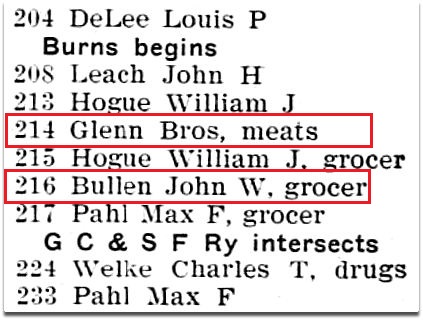
I would guess that the photo dates from sometime around 1904-1906, when the Glenn Brothers meat market occupied the space next door (originally 214 Exposition and later 505 Exposition).

1905-directory_bullen-glenn-bros1905 Dallas city directory

The Hengy business originally occupied the Glenn Bros. space for several years, from at least 1930. After Bullen’s retirement, Hengy moved into the larger space at 507 Exposition. Today it is occupied by Big Sky Construction.

507-exposition_google-street-view_may-2022
Google Street View, May 2022

The railroad tracks have been pulled up, but below are two Google Street Views from 2012 showing where they once were — they couldn’t have been much closer to Bullen’s store! That’s got to have rattled the merchandise (and the store’s occupants) several times a day.

507-exposition_google-street-view_sept-2012Google Street View, Sept. 2012

507-exposition_google-street-view_sept-2012_bGoogle Street View, Sept. 2012

*

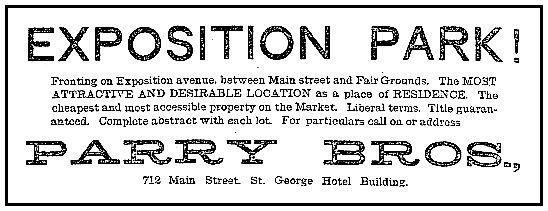
The address of Bullen’s store was originally 216 Exposition Avenue. After the citywide address change in 1911, it became 507 Exposition Avenue. The store was in business by at least 1896, but a newspaper article on the 62nd wedding anniversary of Mr. and Mrs. Bullen says that the business began in 1893. At this time, development of Exposition Park was exploding (see the 1889 ad I posted yesterday, here).

expo-park_ad_dmn_1012891889

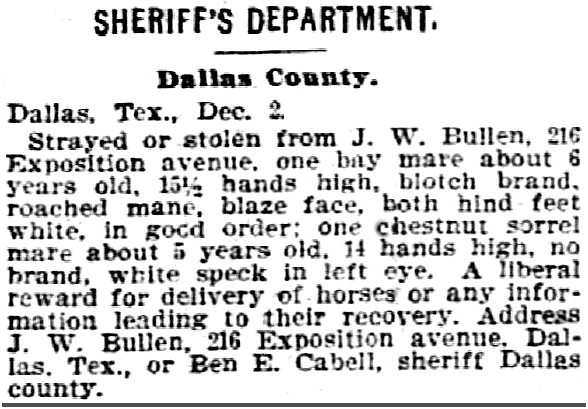
If you look at Sanborn maps of this area (the 1899 map is here, the 1905 map is here, and the 1921 map is here) you see that almost all of the buildings in the area are houses (designated by the letter “D,” for “dwelling”). Having only ever known the area in recent times, it’s hard to imagine this ever having been an almost entirely residential neighborhood. And, back in the 1890s, it was also full of livestock.

bullen_dmn_120397_stolen-horsesDallas Morning News, Dec. 3, 1897

*

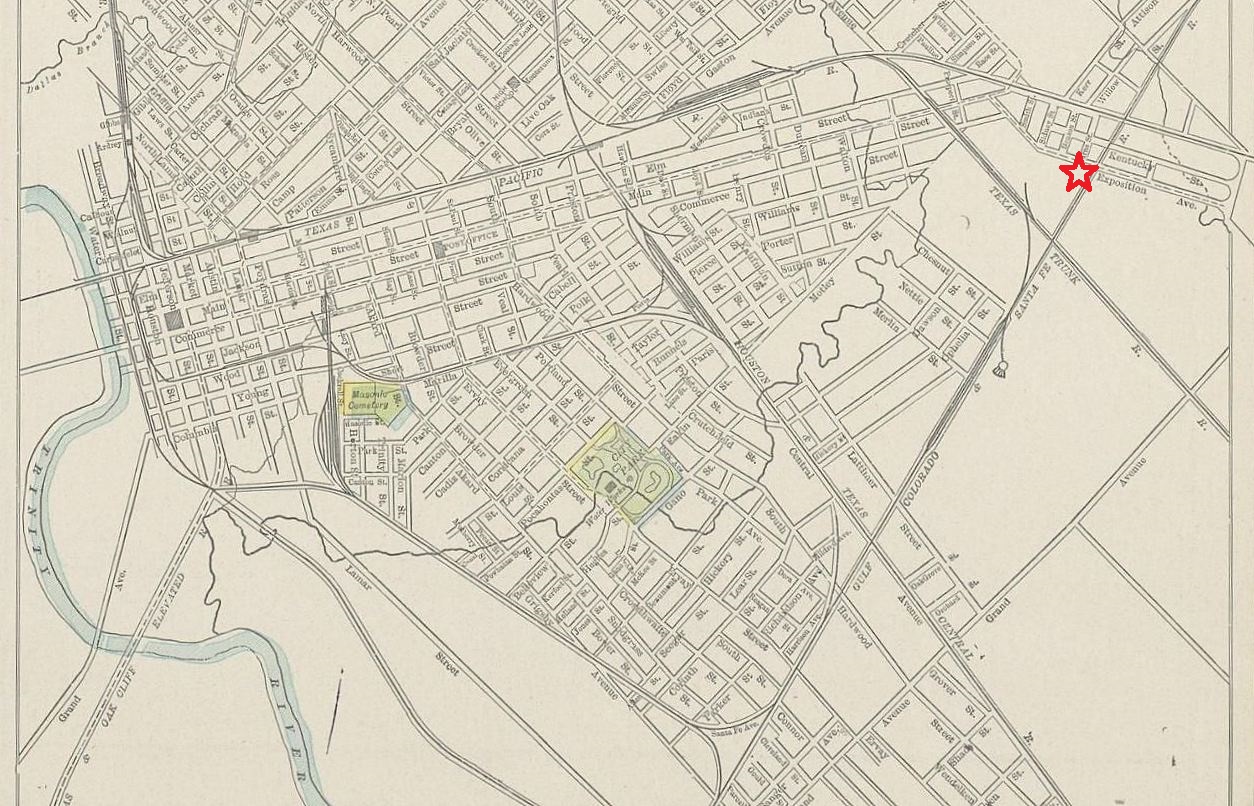
Here’s a map of Dallas from 1898, with Bullen’s store way on the edge of the world, under the star.

1898-map_bullen-store_expositionvia Portal to Texas History

*

507-exposition_then-now_ca-1905-2022

***

Sources & Notes

Photo is from the family collection of Joseph Bullen II, used with permission.

I would LOVE to see historical photos of the Expo Park area — from any time, really, but especially from the time it was primarily residential. If you have any photographs, please let me know!

See this building today on Google Street View, here.

Biographical information on J.W. Bullen from “J. W. Bullens Observe Their Anniversary” (Dallas Morning News, Nov. 22, 1942).

More Flashback Dallas posts on Exposition Park can be found here.

bullen-store_exposition-avenue_ca-1905_sm

*

Copyright © 2023 Paula Bosse. All Rights Reserved.
The Fountain: “A Resort for Gentlemen” — ca. 1911

by Paula Bosse

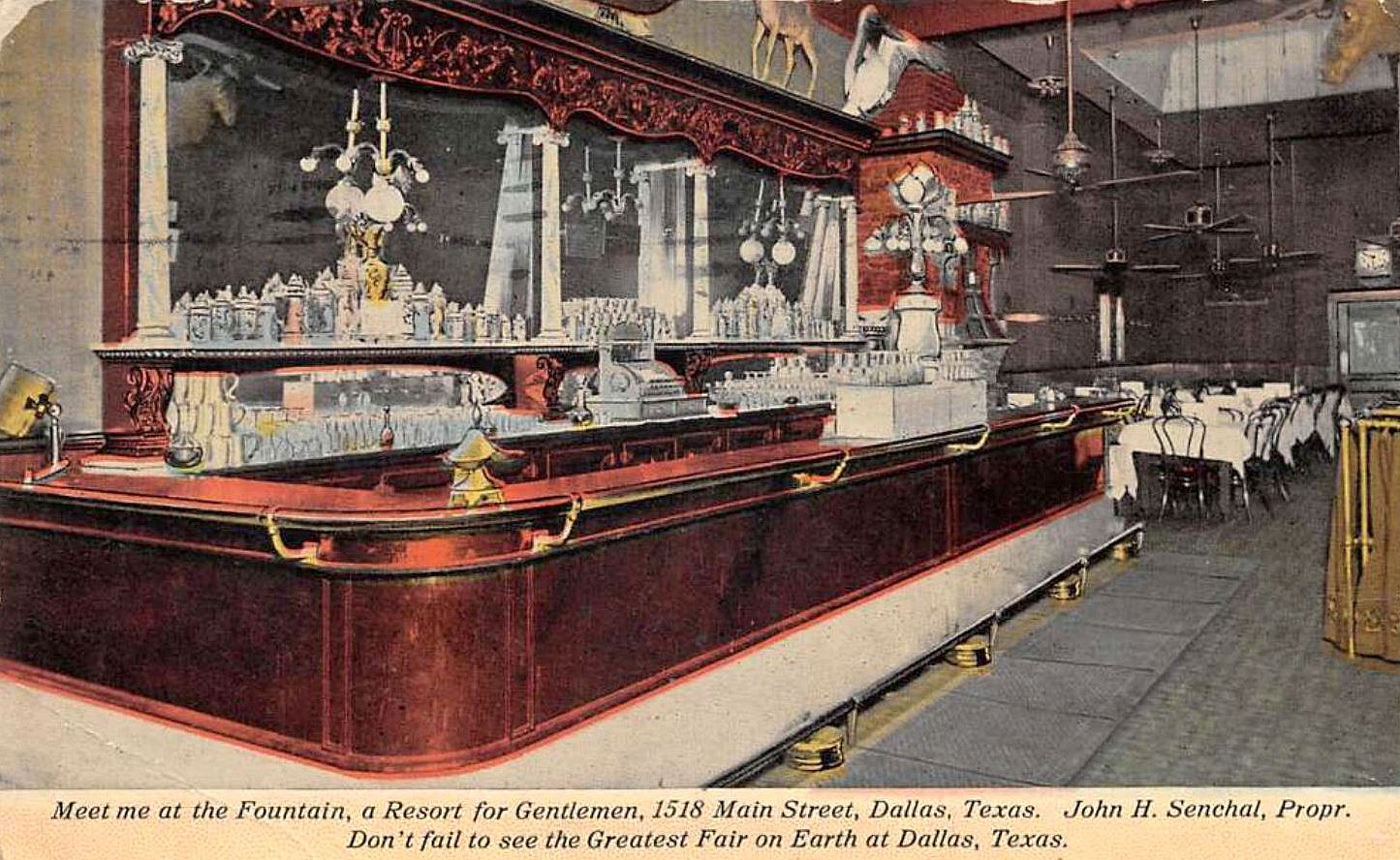
This postcard (which has a 1911 postmark) shows The Fountain, a well-appointed drinking establishment (not lacking in ceiling fans). The caption reads:

Meet me at the Fountain, a Resort for Gentlemen, 1518 Main Street, Dallas, Texas.
John H. Senchal, Propr.
Don’t fail to see the Greatest Fair on Earth at Dallas, Texas.

This bar-with-food was located on the south side of Main, steps away from the present location of Neiman Marcus. It was in the block seen in the picture below (it is just out of frame at the bottom right, next door to the Colonial Theater):

Main Street looking east from Akard

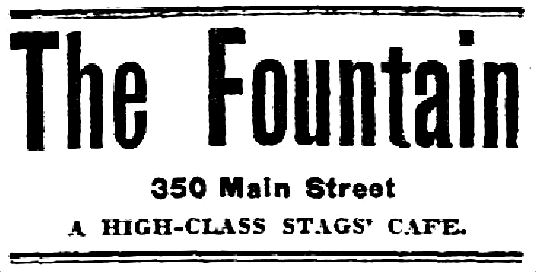
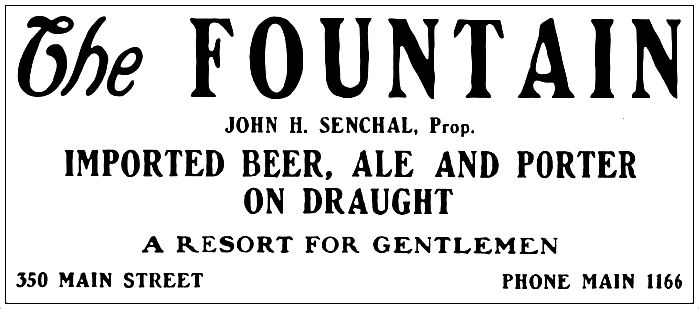
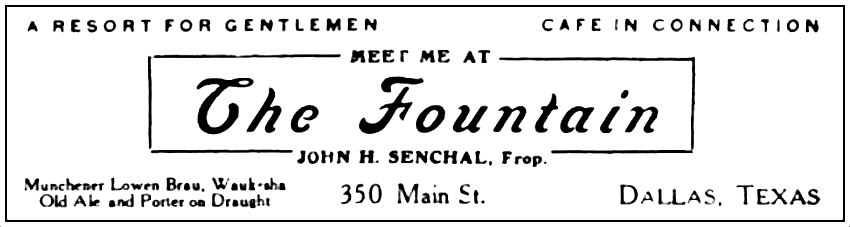
Its address was originally 350 Main — after the city-wide address change in 1911, it became 1518 Main. It appears to have opened in 1907 and was in business until at least 1918 (after Dallas voted to go “dry,” the former saloon became The Fountain Cafe). Here are a few early ads for the “High-Class Stags’ Cafe” in its early go-go “gentlemen’s resort” days: 

Dallas Morning News, Oct. 1907

Dallas directory, 1909

Dallas Police annual, 1910

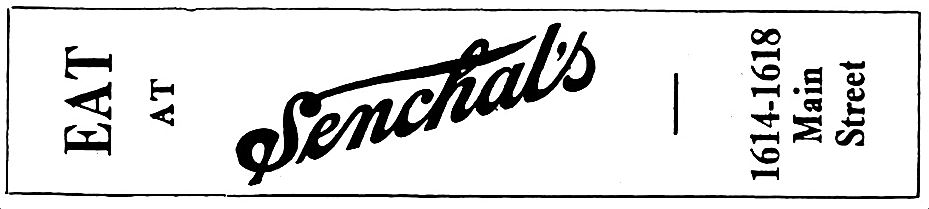
A few years later, the owner, John Henry Senchal, opened Senchal’s Buffet and Senchal’s Restaurant and Rathskeller at 1614-1618 Main.

Dallas directory, 1915

*

Johnnie Senchal — born in Galveston in 1875 to a French father and American mother — appears to have been a popular, civic-minded man’s-man. He frequently traveled with Dallas businessmen to other cities and states to act as a booster for the city. He also indulged in sporty activities such as being a regular wrestling referee and sponsoring horse races at the State Fair of Texas (in 1914 a $2,000 “Fountain Purse” was offered — in today’s money, more than $56,000!). One 1915 newspaper report said he was “probably the best known saloon man in the city.” He was very successful and was not hurting for money.

He also seems to have had a cozy relationship with members of the Dallas police department — a situation which is probably commonplace between saloon-owners and cops. One news story described how he had leapt to the defense of a policeman who was waylaid by a large group of men while he was walking prisoners to jail — a huge brawl broke out, and Senchal and the cop emerged victorious. Also — in a story which wasn’t fully explained — Senchal and another man ponied up $5,000 in bond money ($140,000 in today’s money!) for a Dallas policeman who was charged in the fatal shooting of a 17-year-old, Those are some strong ties between a saloonkeeper and the local constabulary, man.

In 1912 there was another confusing story concerning a man who had been arrested and convicted for being the owner/lessee/tenant of an establishment which was “knowingly permitted to be used as a place in which prostitutes resorted and resided for the purpose of plying their vocation. […] The house was a ‘disorderly house.’ Prostitutes resorted there and displayed themselves in almost a nude condition.” The man who was charged was seen there on a number of occasions “dancing with the prostitutes.” The man appealed his conviction because he had been charged with being the owner/lessee/tenant of this “bawdy house” — but the lessee/tenant was none other than Johnnie Senchal and another man. As far as I can tell, Senchal was not charged with anything regarding this case. 

But a couple of years later, in 1914, he was charged with running a “disorderly house” (a term often meaning a bordello or gambling den, but also meaning a place which is frequently the site of disturbances and is generally considered to be a public nuisance). It seems Johnnie and other were offering “cabaret” entertainment which might gotten out of hand. From The Dallas Morning News:

Alleging that the cabarets are conducted as “disorderly houses,” [charges were filed] on behalf of the State of Texas against owners of three restaurants in the downtown section. Affidavits accompanying the petitions alleged that women were allowed to drink at the places and to act in an unbecoming manner. (DMN, March 12, 1915)

I’m not sure exactly what constituted “an unbecoming manner,” but Johnnie Senchal was one of the men charged. At the very same time he was fighting this violation of the cabaret ordinance, it was reported that “an involuntary petition in bankruptcy has been filed in the United States court here against John Senchal and J. O. Walker, partners in the saloon business on Main Street. The petition was filed by local brewery agents and whisky houses” (DMN, June 20, 1915). Bankrupt! Even though he was apparently rolling in dough for years, he was rather ironically pushed to bankruptcy because he couldn’t pay his own bar tab.

And so Johnnie put the barkeeper’s life behind him. And I mean he REALLY put it behind him: he became a fervent speaker at Anti-Saloon League events, saying that having been forced out of the saloon game was actually a godsend — he was quoted as saying that his profits increased 75-80% when he stopped selling alcohol and became a full-time restaurateur. That seems unlikely, but that’s where he was in 1918, an improbable evangelist for Prohibition. 

Soon after, he and his family moved to Houston, where he opened a small cafe. On Oct. 9, 1929, after closing-time, Johnnie Senchal died in his cafe from a self-inflicted gunshot wound. He was 54 years old.

***

Sources & Notes

Postcard of The Fountain found on eBay.

Postcard of Main Street found on Flickr.

*

Copyright © 2022 Paula Bosse. All Rights Reserved.
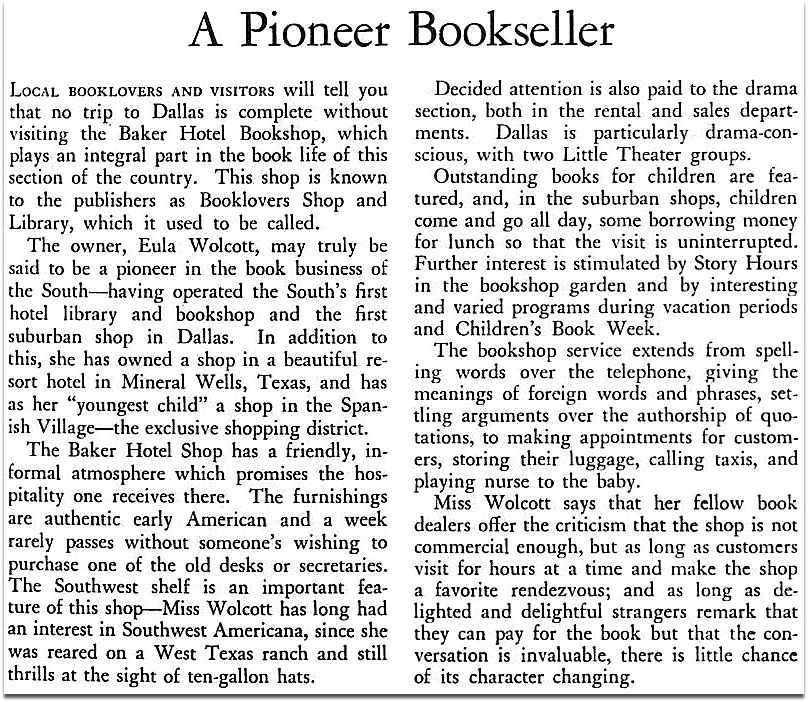
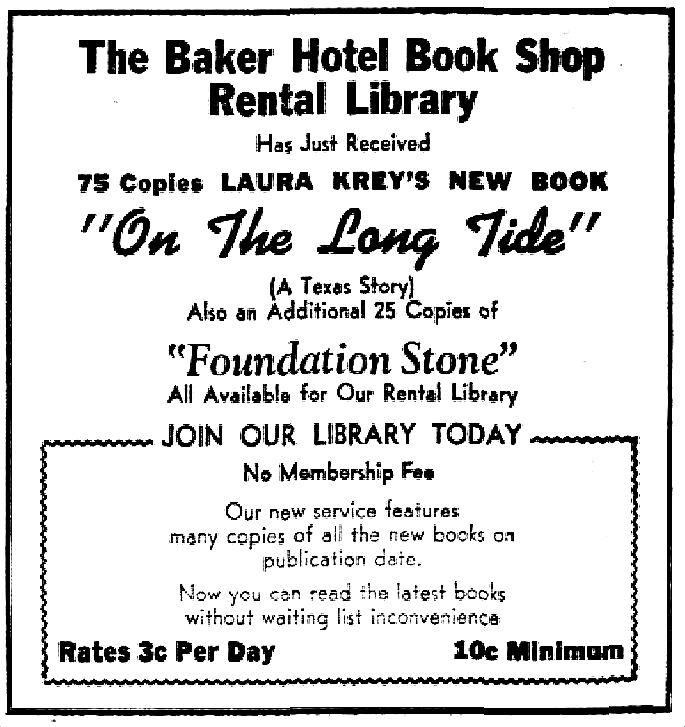
Eula Wolcott’s Baker Hotel Book Shop & Rental Library, 1926-1942

baker-hotel-book-shop_1934Eula Wolcott: bookseller, librarian (Publishers Weekly, 1934)

by Paula Bosse

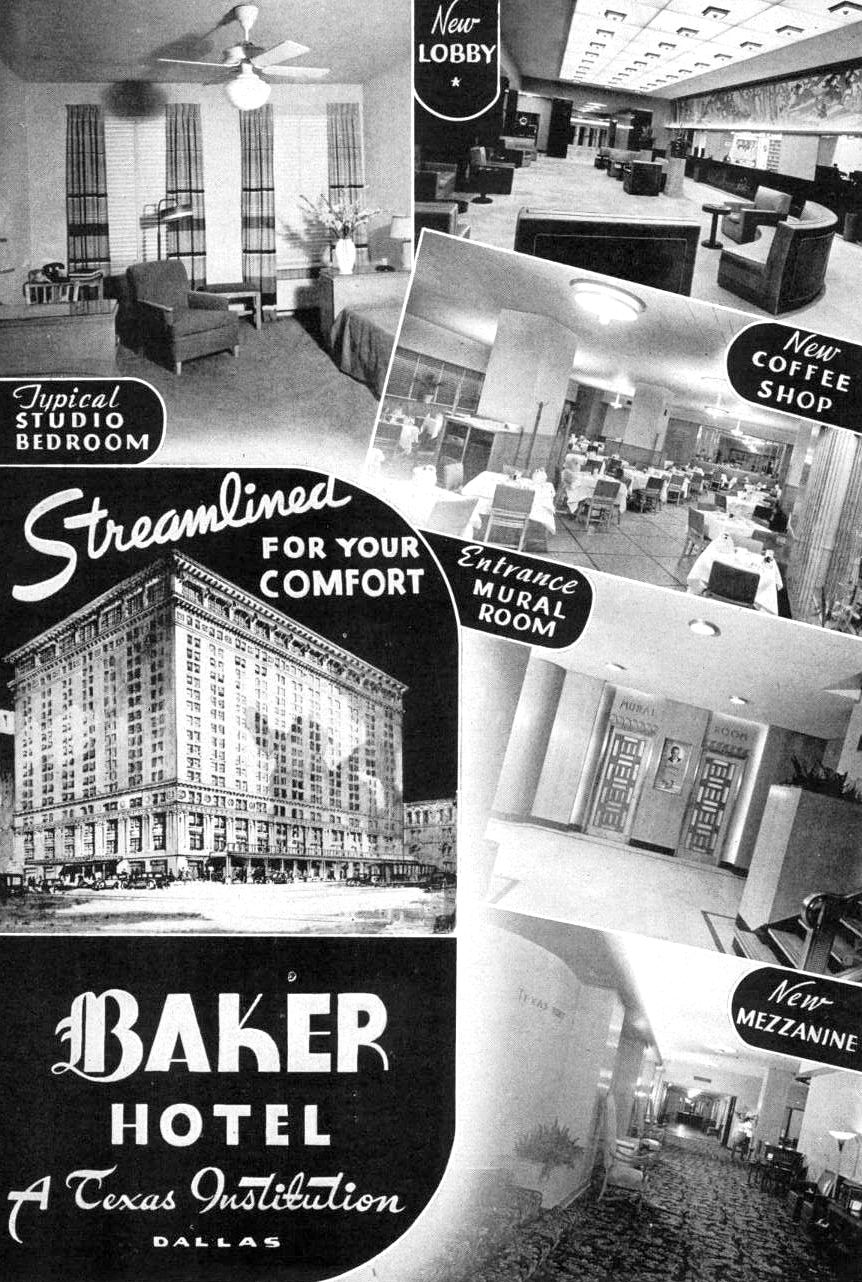
Today is the birthday of my late father, Dick Bosse, owner of the Aldredge Book Store. I always try to post something bookstore-related on his birthday. This year: Miss Eula Wolcott’s Baker Hotel Book Shop & Rental Library, located inside the Baker Hotel.

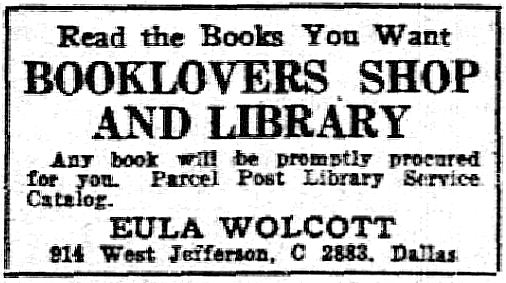
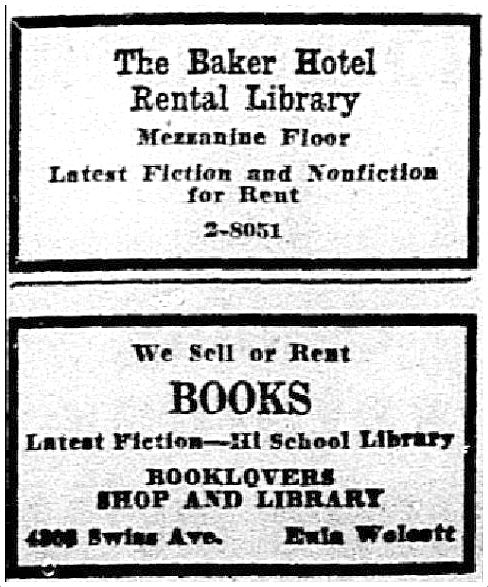
Eula Wolcott (1881-1962) was born in Waxahachie and had moved to Dallas by 1910. She appears to have had theatrical ambitions and studied voice and expression (she was billed as an “Experienced Concert Reader and Story Teller”). She opened a little book store and library in the early 1920s — the Booklovers Shop and Library was first on West Jefferson and later on Swiss Avenue. In 1926, she opened a similar shop inside the glamorous Baker Hotel, an enterprise she ran successfully until at least 1942 when another owner took over (she also apparently had a book shop inside the Baker Hotel in Mineral Wells). In 1931 she opened the rather confusingly-named “Baker Hotel Book Shop and Rental Library” in Highland Park — in the new “Spanish Village” (the original name for Highland Park Village). Below is a very enthusiastic profile from Publishers Weekly (click to see a larger image).

baker-hotel-book-shop_publishers-weekly_032434_eula-wolcott_textPublishers Weekly, March 24, 1934

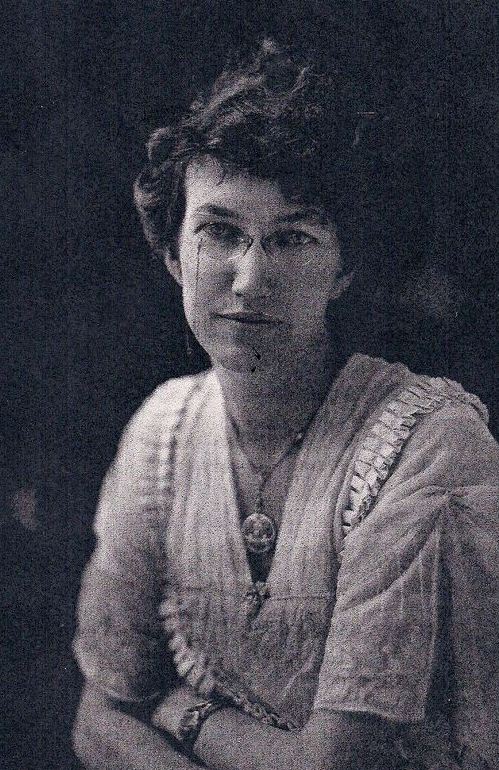
I wish the photo at the top had been better, because I’d love to get a good look at the decor. And Eula. I managed to find a photo of her.

wolcott-eula_ancestryEula Wolcott, via Ancestry.com

Here are a few ads:

booklovers_0420241924

baker-hotel_book-shop_DMN_oct-24-1926Two shops, one owner — 1926

baker-hotel_book-shop_1009271927

baker-hotel-book-shop_19371937

baker-hotel_book-shop_DMN_oct-25-19401940

She was active as a bookseller for many years and was also a familiar voice to radio listeners who tuned in to hear her book reviews on WFAA. 

One interesting piece of trivia about Eula’s hotel bookshop, shared with me by a former bookstore client of mine: the Baker Hotel Book Shop was the very first American bookstore that British author H. G. Wells ever visited. A lecture tour brought him to Dallas in 1940 — like many of the celebs of the day, he stayed at the Baker. I’m sure Eula was very happy to have Mr. Wells, a literary powerhouse, in her shop. Let’s hope he exhibited proper bookstore etiquette and purchased something!

baker-hotel_mural-room_dallas-directory_1942Baker Hotel, circa 1940

***

Sources & Notes

Top photo and article from the trade magazine Publishers Weekly, March 24, 1934.

Read more Flashback Dallas articles on the Dallas bookstore scene here.

baker-hotel-book-shop_1934_sm

*

Copyright © 2022 Paula Bosse. All Rights Reserved.
Gene de Jean Lifts a Curse on Dallas — 1970

gene-de-jean_WFAA_090470Curse lifted — all in a day’s work…

by Paula Bosse

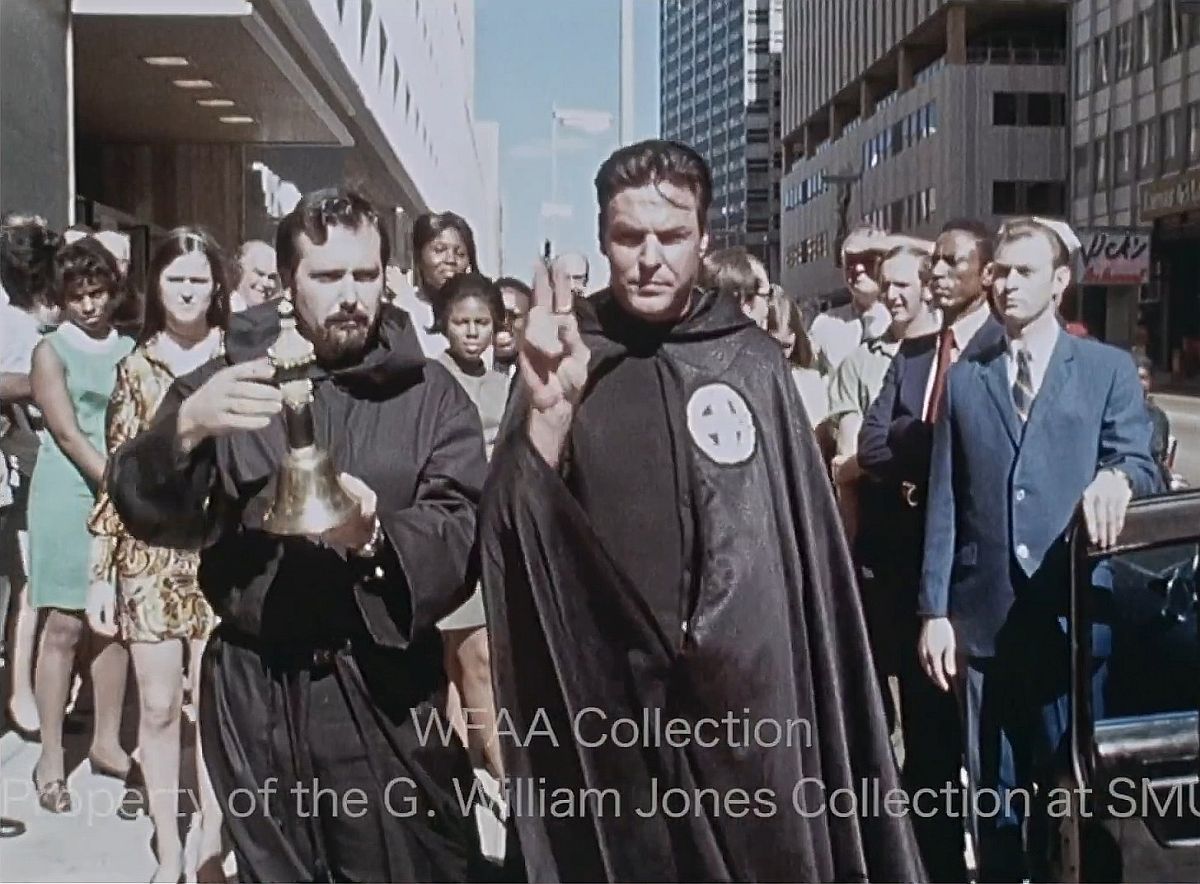
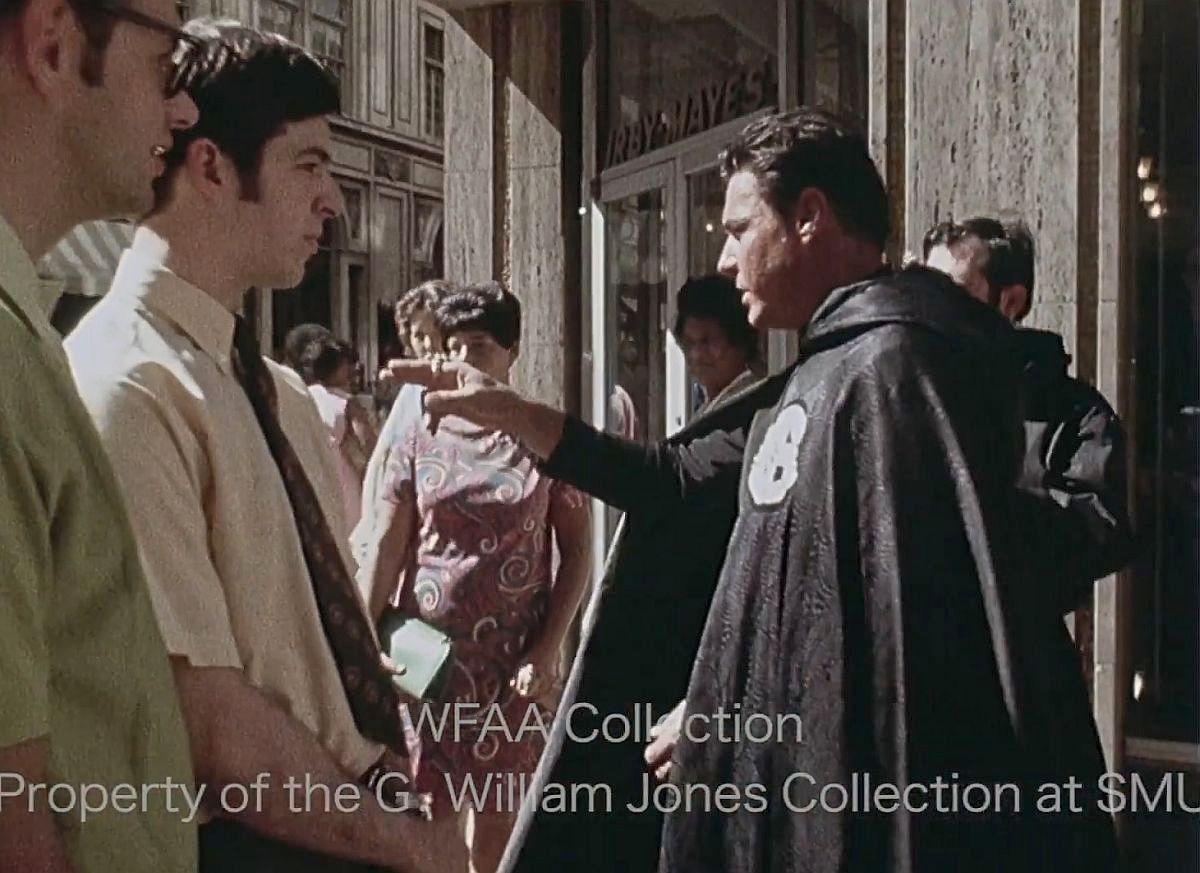
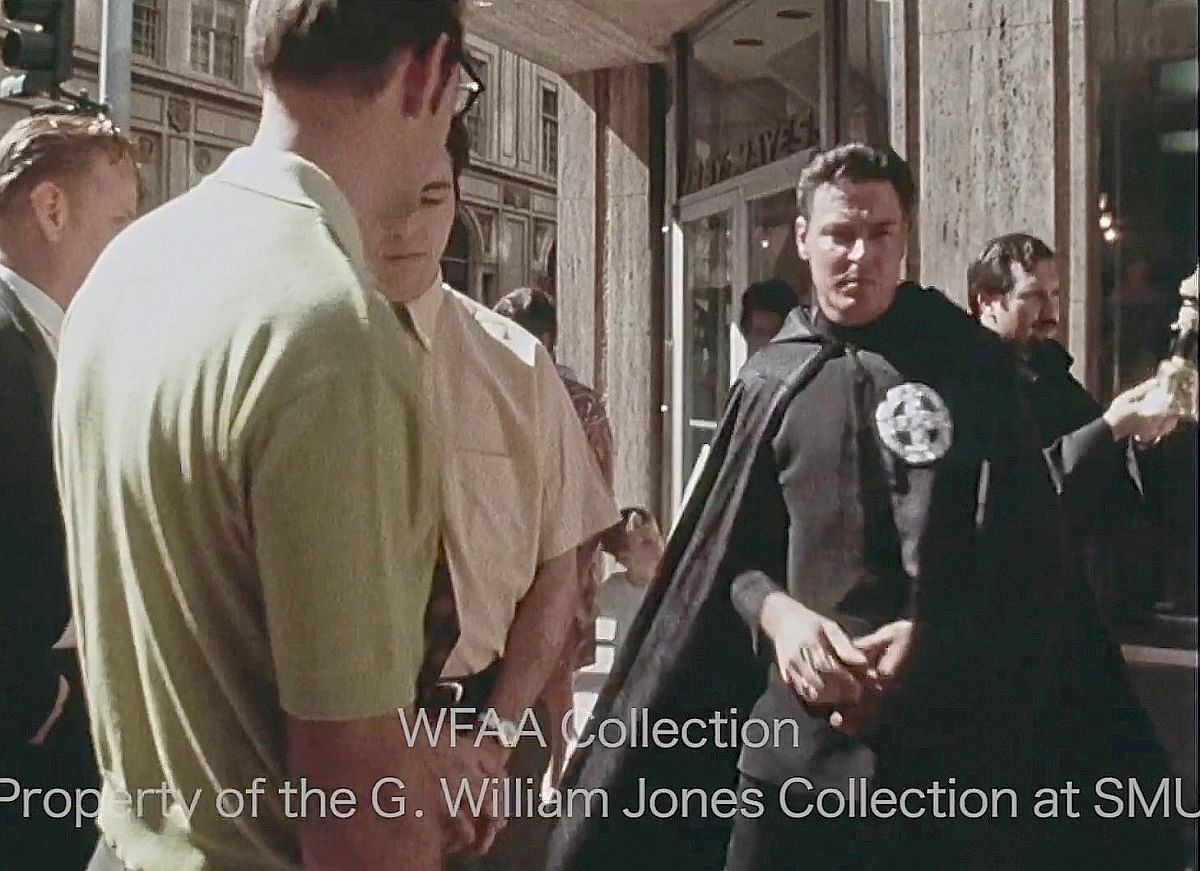
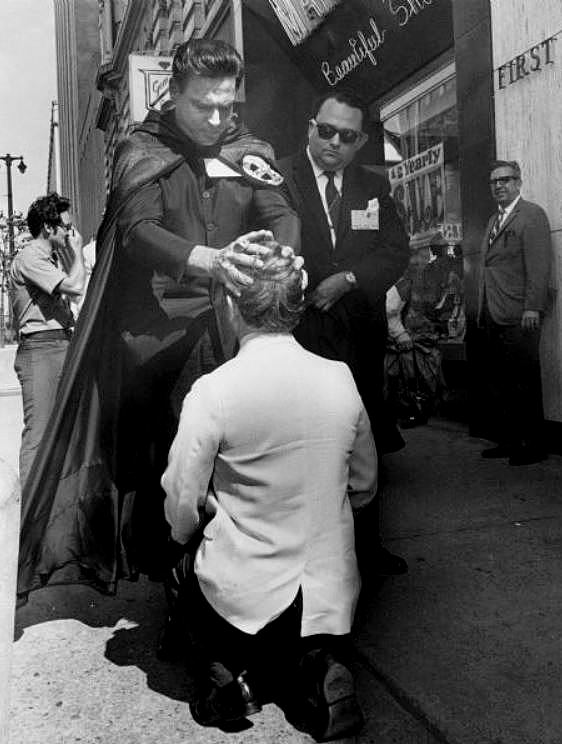
On Sept. 4, 1970, at the corner of Commerce and Ervay, a “white-magic warlock” named Gene de Jean conducted a ceremony to lift a heinous curse placed on Dallas in 1963 by a somewhat vague “malevolent black-magic coven” — this curse, which, uncoincidentally, preceded the JFK assassination, had apparently hung over the city for 7 long years. Fortunately, the media had been alerted, and we have film footage of the historic occasion in which a mysterious warlock lifted a nasty curse which no one in Dallas knew had been cast in the first place.

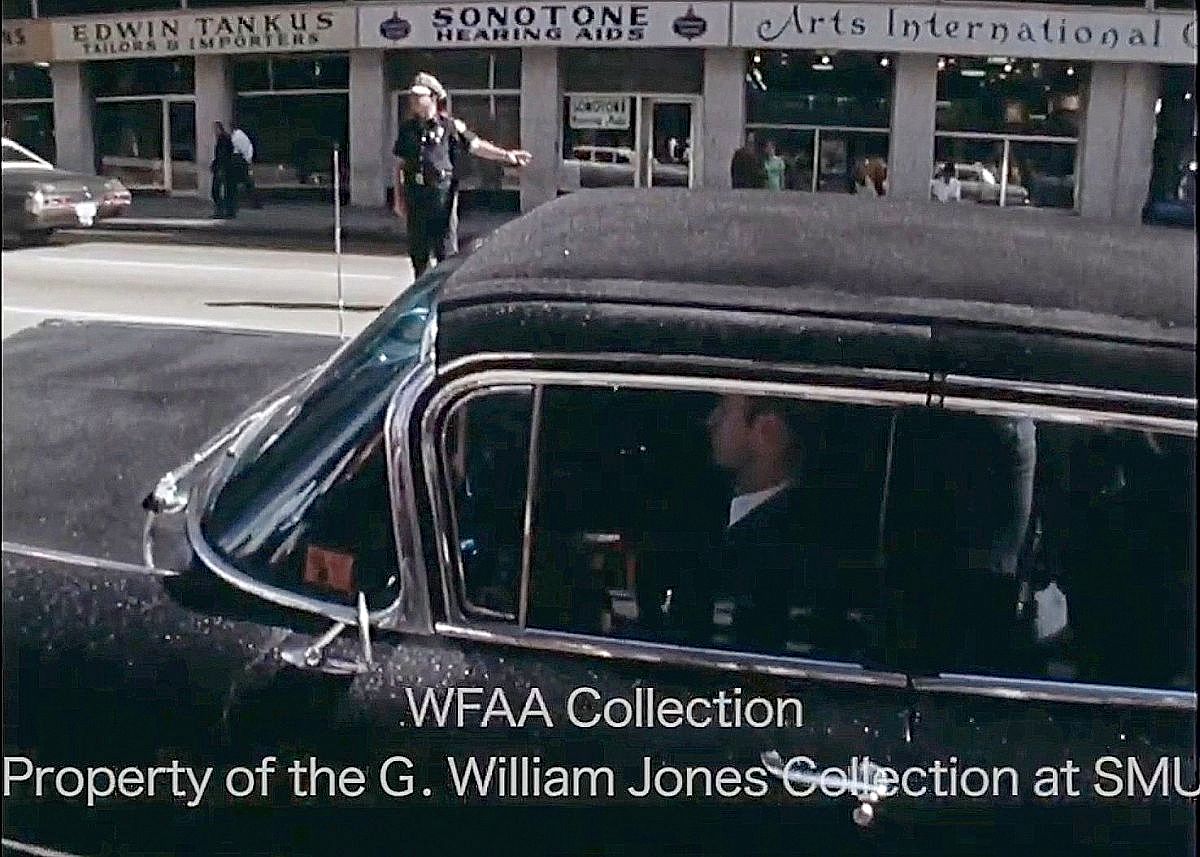
Do-gooding warlock Gene de Jean arrived in a “velvetized Cadillac” (a Cadillac COVERED IN BLACK VELVET!) with a be-robed bell-ringing acolyte, and, with Neiman-Marcus in the background, he uttered a few incantations and proclaimed the curse lifted. He also “blessed” a few random people in the crowd for good measure before walking back to the waiting velvetized warlock-mobile, his job done. In his wake there was much rejoicing and/or confused looks exchanged on Commerce Street. Thank you Mr. de Jean!

*

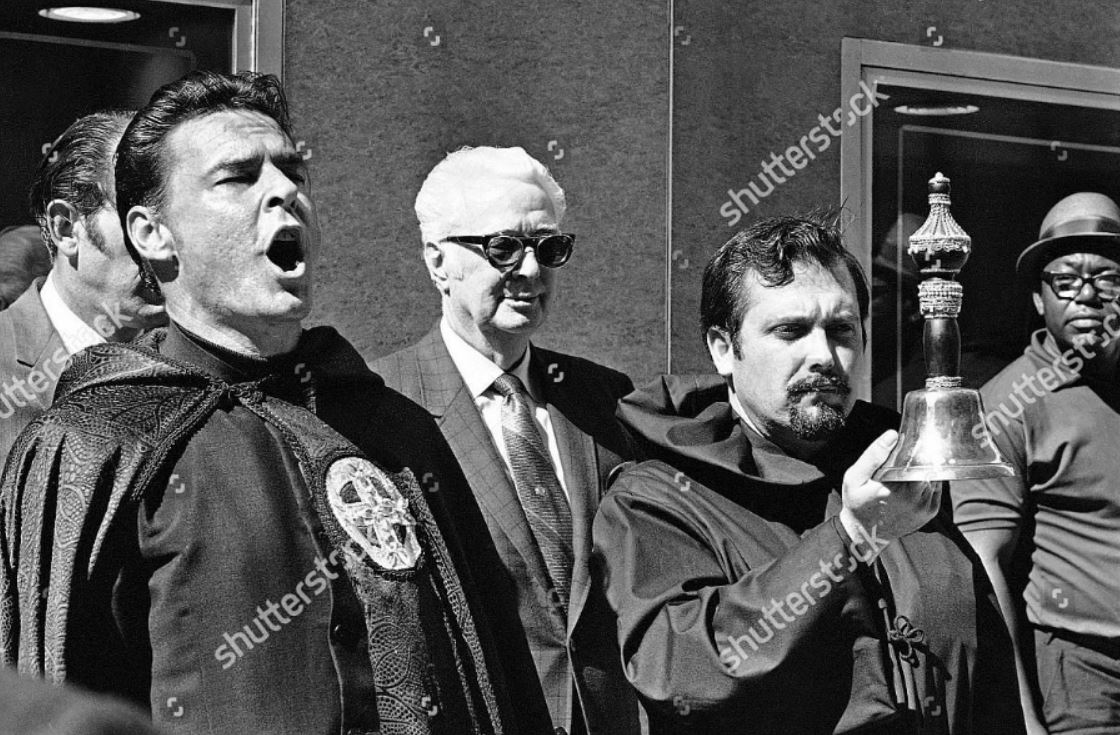
In something of a kill-joy article, the Associated Press revealed that “Gene de Jean” was a warlock stage-name. In non-warlock life he was Gene McIntosh, mild-mannered Houston psychologist. When pressed by the reporter, Gene said that it was “pure coincidence” that the Texas Association of Magicians was wrapping up its 25th annual convention 2 blocks away at the Statler Hilton (which can be seen in the background of the footage). So, yes, Gene McIntosh and Lee Thompson (the bell-ringing “acolyte”) were well-known Houston magicians/illusionists in town for a magicians’ convention. And — why not? — a friendly curse-lifting.

**

Here’s the footage — at the 12:19 mark — captured by a WFAA-Channel 8 News cameraman for posterity.

*

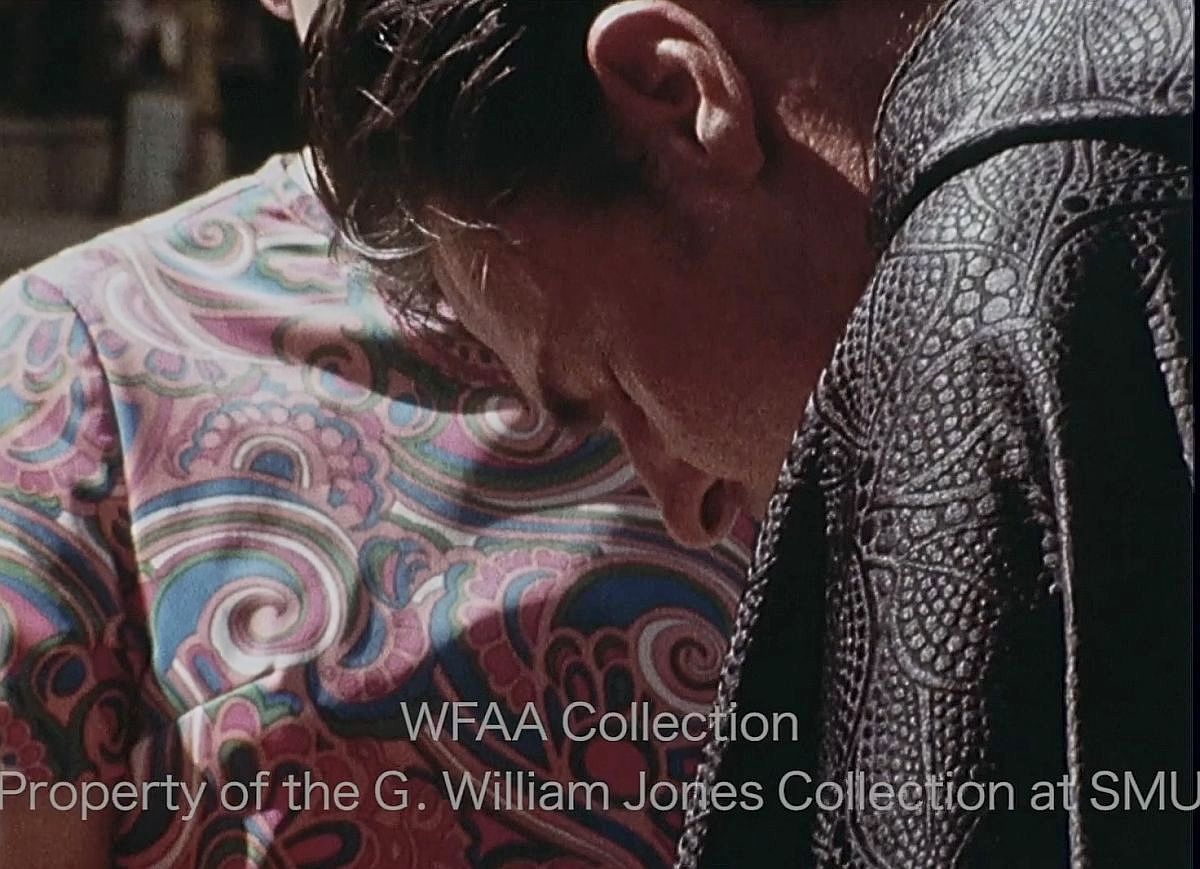
And a few screenshots of the warlock in action.

gene-de-jean_WFAA_090470_1

gene-de-jean_WFAA_090470_2

gene-de-jean_WFAA_090470_3

gene-de-jean_dallas_090470-shutterstock_ferd-kaufmanAssociated Press photo by Ferd Kaufman

gene-de-jean_WFAA_090470_velvetized-caddySeriously — how do you cover a car with velvet?

Voilà! Curse lifted!

**

Doing a little research, I have to say, when I came across the photo below, I felt a twinge of betrayal. Or at least disappointment. It shows Gene de Jean on the streets of Milwaukee (Milwaukee?!!) in June, 1970. The guy in the sunglasses is also seen with him in Dallas. The caption of this photo: “A self-described warlock (male witch) in black flowing cape bestowed a blessing right here in Old Milwaukee Tuesday. Gene De Jean blessed the city and a number of passersby at N. 3rd St. and W. Wisconsin Ave. He was in town for a magician’s convention.” Was it all just a schtick, Gene? And I thought we had something special.

gene-de- jean_milwaukee_june-1970via Wisconsin Historical Society

***

Sources & Notes

Video and screenshots are from the WFAA NewsFilm Collection, G. William Jones Film Collection, Hamon Arts Library, Southern Methodist University; the footage is from Sept. 4, 1970 and can be found on YouTube here (clip begins as the 12:19 mark).

When I posted a version of this on my Facebook page a few weeks ago, David B. commented with a couple of informative links about Gene McIntosh (who died in 2006): this overview of his career as a magician, and this tale of a stunt he performed while driving from Houston to Dallas in 1959, blindfolded the whole way. RIP, Gene.

gene-de-jean_WFAA_090470 sm

*

Copyright © 2021 Paula Bosse. All Rights Reserved.
Ross Graves’ Cafe: 1800 Jackson — 1947

graves-cafe_marion-butts_dpl_1947_cashierGraves Cafe… (photo by Marion Butts/Dallas Public Library)

by Paula Bosse

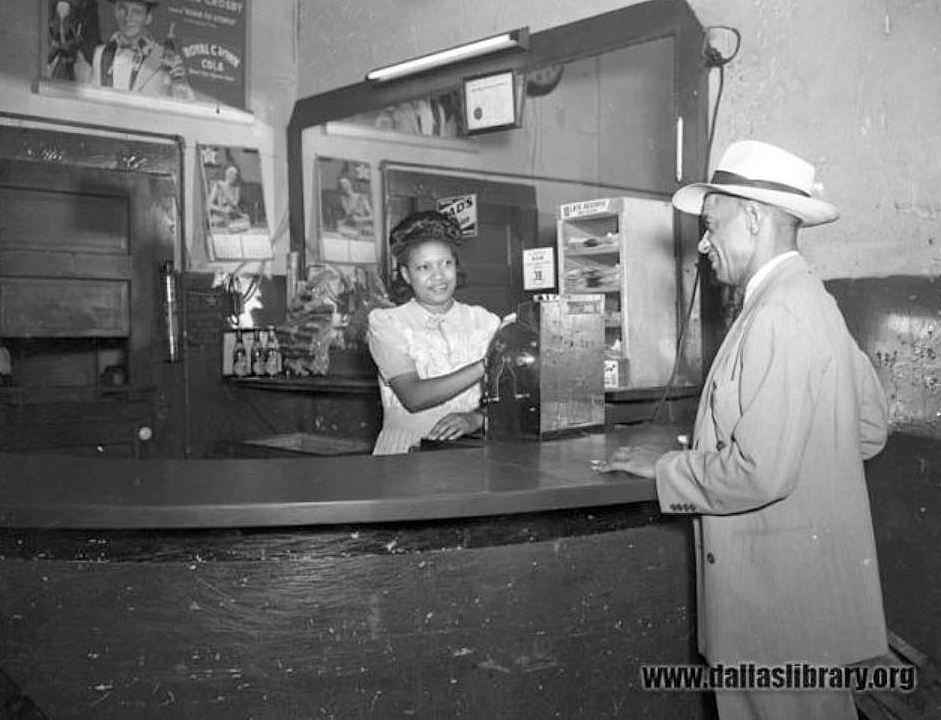
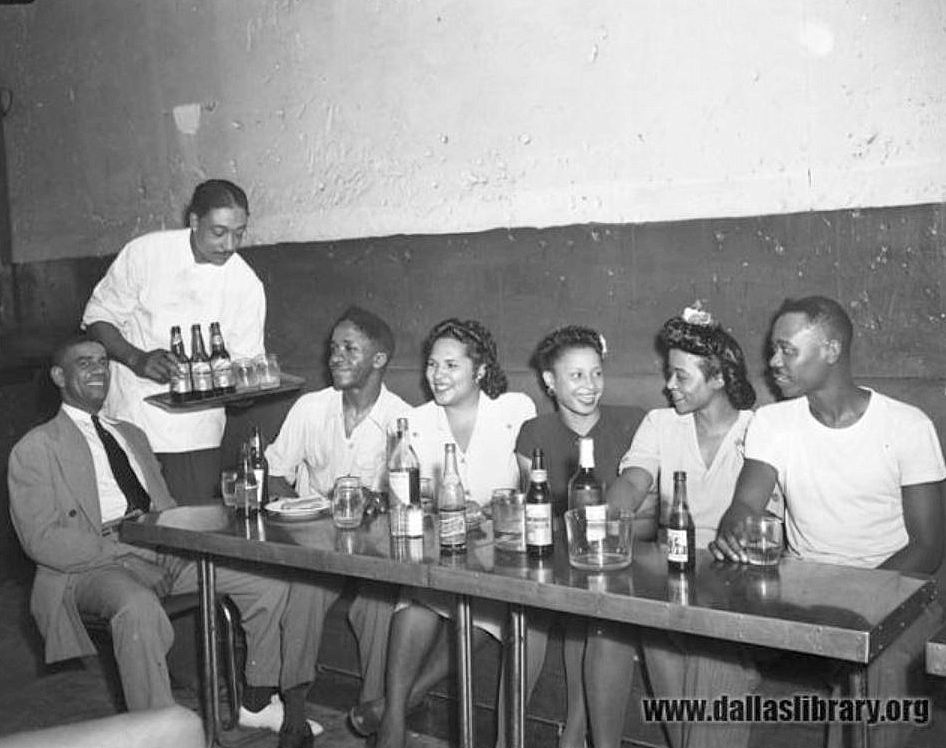
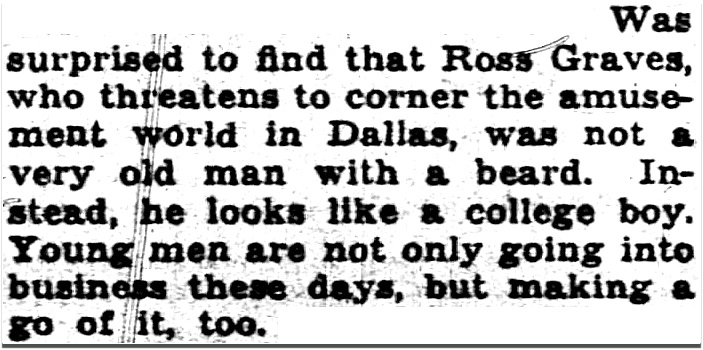
Ross Graves (1903-1973) seems to have been something of a successful bon vivant who dipped his toe into a variety of businesses catering to Dallas’ African-American community: he was the proprietor of, variously (and often simultaneously), a night club, a liquor store, a gas station, a barber shop, and, most successfully, a restaurant, which was in business for almost 20 years (sometimes referred to as Ross Cafe or Graves Place). Below is a photo from 1947 showing the Ross Graves Cafe at 1800 Jackson Street (at Prather) in downtown Dallas (we see the south side of Jackson, with the view to the west).

graves-cafe_1800-jackson_negro-directory_1947

This photo accompanied an ad with the following text:

graves-cafe_negro-directory_1947-48-text

He opened the cafe around 1937 and kept it going until 1955 when he “retired” (he also dabbled in dice-game-hosting at the cafe and was busted in 1954 on gaming charges — he was given a 2-year probated sentence the next year). (Also, the building was part of a large donation to the city in 1955 — more about that below.)

The photo at the top shows, I’m guessing, Mr. Graves standing at the cafe’s cash register with an employee in 1947. He’s also seen in the photo below.

graves-cafe_marion-butts_dpl_1947(photo by Marion Butts/Dallas Public Library)

**

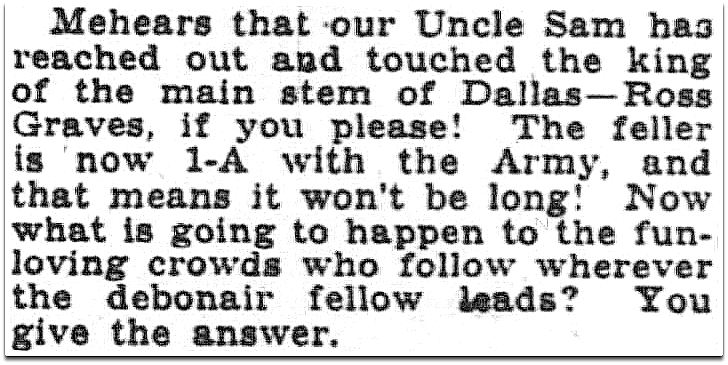
I was originally intrigued by the photo of the exterior of the cafe — I couldn’t picture where it had been. But in trying to find out more about the building, I learned about the life of Ross Graves and came across some interesting little tidbits which paint a a picture of a fun-loving man with an active social life, lots of friends, and a healthy bank account. Below are a few clippings from the Pittsburgh Courier, a newspaper published in Pennsylvania which served as something of a national newspaper for Black America, with political, sports, and entertainment news from around the country. There was always news from Dallas in it — in fact, they had a local office here (3306 Roseland). There was even a Dallas-based society/gossip columnist named Mrs. O. J. Cansler (whose column had the rather unfortunate name of “Kolumn Komments”). She was quite frothy and wrote with the breathless excitement one expects in a society columnist. (I highly encourage anyone with a subscription to Newspapers.com to check out her “kolumn” — it’s a breath of fresh air to read about Dallas’ Black community presented in such a lively and fun manner (or in ANY manner, really — you weren’t going to find any of what she was writing about in the Dallas Morning News or the Dallas Times Herald). Especially interesting are mentions of long-forgotten clubs and nightspots where bands and performers from Dallas’ vibrant musical scene played. Here are a few appearances of Ross (and his wife, Ruby) from the pages of the Pittsburgh Courier.

*

1939_graves_pittsburgh-PA-courier_111139_kolumn-komments_o-j-cansler
Pittsburgh Courier, Nov. 13, 1939

Graves was 36 years old at the time.

*

1942_graves_pittsburgh-PA-courier_080842_toppin-the-town_columnPittsburgh Courier, Aug. 8, 1942

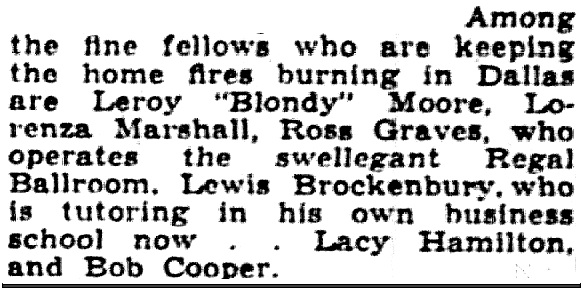
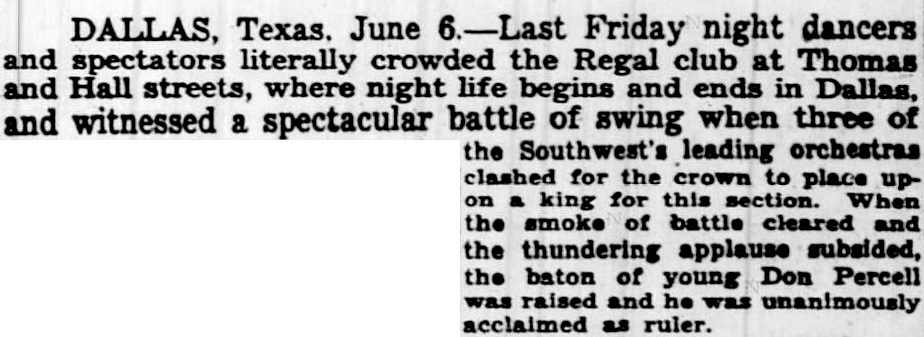
The Regal Ballroom (listed as the Regal Nite Club in city directories) was at 3216 Thomas, at Hall. It didn’t last very long, but while it did, it was, apparently, “swellegant”! Here’s a mention of it as the location of a swing band contest in 1940 (won by Don Percell):

graves_regal-club_pittsburgh-courier_060840Pittsburgh Courier, June 8, 1940

*

1942_graves_pittsburgh-PA-courier_101742_kolumn-komments_mrs-o-j-canslerPittsburgh Courier, Oct. 17, 1942

*

Graves’ second wife, Ruby Graves, was known for her “smart toggery.”

1944_graves_pittsburgh-PA-courier_101444_ruby-gravesPittsburgh Courier, Oct. 14, 1944

*

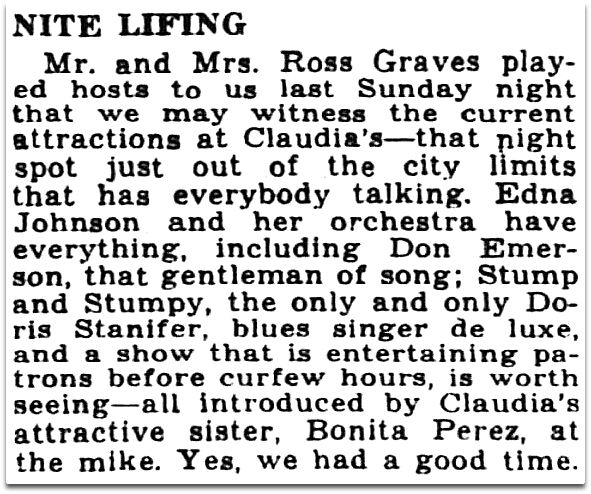
Ross and Ruby were quite the hosts:

1945_graves_pittsburgh-PA-courier_040745_kolumn-komments_mrs-o-j-canslerPittsburgh Courier, Apr. 7, 1945

I love this. This is the sort of thing you would never have read in the Morning News or the Times Herald. I want to know more about Claudia’s — “that night spot just out of the city limits that has everybody talking.”

*

graves-cafe_ad_pittsburgh-courier-051245Pittsburgh Courier, May 12, 1945

*

1946_graves_pittsburgh-PA-courier_062246_kolumn-komments_mrs-o-j-cansler
Pittsburgh Courier, June 22, 1946

Just popping up to NYC in their new Fleetwood to take in a boxing match. As one does.

**

Ross and Ruby eventually ended up living in a house on “swellegant” South Boulevard (2500 South Blvd.). At least one of their daughters was an Idlewild debutante, who made her debut in 1967 (read about the world of Black debutantes in 1937 Dallas here). Milam County native Ross Graves died on Dec. 4, 1973 at the age of 70. He had lived in Dallas for 50 years. And I bet he had a good time.

**

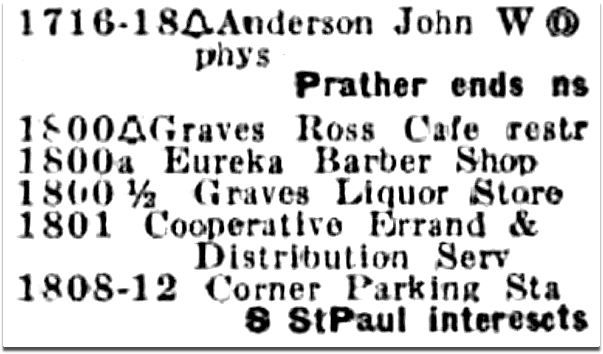
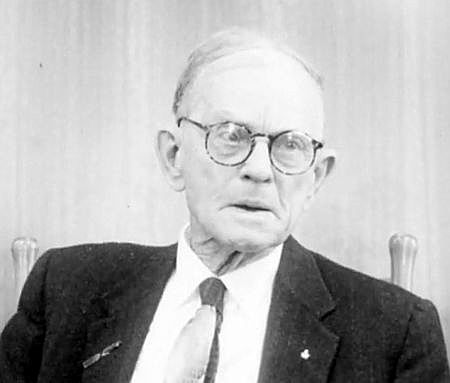
The location of Ross Graves’ Cafe was at 1800 Jackson Street, between Ervay and St. Paul, in a weird stretch of Jackson where two blocks were connected without a  break, in a row of buildings without an intersecting street. (The buildings are long gone, but the location can be seen on Google Maps here.) An interesting detail about these two blocks — the 1700 and 1800 blocks of Jackson Street — is that this property was owned by Dr. John W. Anderson, a prominent Black physician. After his death, his widow, Pearl C. Anderson, deeded the land to the Dallas Community Chest, the proceeds of which would be used to help needy Dallasites. (The donation was conservatively estimated at $200,000 at the time — about $2 million in today’s money). She donated the property in 1955, the same year Graves retired.

graves-cafe_dallas-directory-1947Jackson Street, 1947 Dallas city directory

***

Sources & Notes

Photos of the interior of Ross Graves’ Cafe are from the Marion Butts Collection, Dallas Public Library. Call Number for the top photo is PA2005-4/380.1; Call Number for the second is PA2005-4/380.2 (both are incorrectly identified as being in Deep Ellum).

The photo of the exterior of the cafe is from the Dallas, Texas Negro City Directory, 1947-1948 (many thanks to Pat Lawrence).

graves-cafe_marion-butts_dpl_1947_cashier_sm

*

Copyright © 2021 Paula Bosse. All Rights Reserved.
Rev. W. W. Stogner: The Courthouse Preacher

stogner_WBAP_03311959_portalRev. Stogner, 1959

by Paula Bosse

The Reverend Mr. W. W. Stogner (1873-1966) was something of a permanent fixture around the Dallas County Courthouse for a good 30 years. He was known as “the marrying preacher” who was Johnny-on-the-spot to marry any couple who had just obtained a marriage license and was in need of a man of the cloth. According to his own  estimation, he had married some 20,000 couples (!) — including my parents.

William Washington Stogner was born in Mississippi in 1873 and arrived in Dallas in 1907. Although he had preached since he was a teenager, he wasn’t ordained until he was 38 years old. He worked as a minister in Collin County and in Oklahoma for several years before returning to Dallas in 1926. From various newspaper reports, he appears to have set up shop as a marriage-focused pastor around 1935, roaming the hallways of the courthouse looking for newly licensed couples. (Detractors occasionally referred to him as the “Marryin’ Sam” of the Dallas County Courthouse, in a reference to the opportunistic character in the L’il Abner comic strip.)

In a 1960 Frank X. Tolbert profile in The Dallas Morning News, Rev. Stogner’s average workday went something like this:

He arrives at the Records Building each morning around 8 a.m. carrying a shopping bag in which are a Bible and much other reading matter. He often stations himself near the elevators leading to the County Clerk’s office, a good place to spot happy couples equipped with a marriage license but in need of a preacher. (Tolbert’s Texas, DMN, May 12, 1960)

In that article, the 88-year-old retired Baptist minister estimated he had, thus far, married 18,000 couples. Some he had encouraged to wait, not feeling they were ready, but most of them he joined together in holy matrimony. He said he married people in empty rooms of the courthouse — or even in hallways. He also married couples in his home in Oak Cliff (my parents were married in his home, having contacted him from information on a business card given to them by the good reverend after they had received their marriage license at the courthouse).

As he spent so much time at the courthouse, it’s no surprise that he conducted several  marriages right across the street in the jail. Like the comedy-of-errors wedding described in the story below (click for larger image):

stogner_dayton-oh-daily-news_wire-story_070558AP wire story, Dayton (OH) Daily News, July 5, 1958

*

The Rev. Mr. Stogner can be seen in a WBAP-Ch. 5 news clip from March 31, 1959 testifying in the court of Justice of the Peace W. E. Richburg in the trial concerning the falsification of documents in the marriage of an 18-year-old man to a 12-year-old girl (watch the silent clip here). Rev. Stogner looks a bit shell-shocked and testified that he thought the affidavit asserting the girl was 14 (and of legal age, with permission of a parent) was valid. It was not, and the marriage  was annulled. (The news script about this case can be read here.) You can’t win ’em all. 

*

Rev. Stogner died in 1966, two days short of his 93rd birthday. Think about that for a second: he was born in Reconstruction Mississippi and died a year before “Sgt. Pepper’s Lonely Hearts Club Band.” It’s pretty amazing to realize that my parents were married by a man who could remember being alive in the 1870s! 

***

Sources & Notes

Top image is a screen shot from the WBAP-Ch. 5 new clip “Court of Inquiry” from the KXAS-NBC 5 News Collection, UNT Libraries Special Collections, via the Portal to Texas History.

There is no film of the story about Rev. Stogner’s 90th birthday celebration at the Dallas County Courthouse, but the Feb. 12, 1963 script can be read at the Portal to Texas History here

*

Copyright © 2020 Paula Bosse. All Rights Reserved.

African-American Businesses and Notable Dallasites — 1930

mme-pratt-muisc-teacher_dallas-negro-directory_1930_portal_det“Madame Pratt” in her music studio

by Paula Bosse

I’ve recently posted lots of photos of black schools and black churches which appeared in the Official Directory: Dallas Negro Churches, Schools and Other Activities; Civic, Business, Fraternal, Social, Etc., an absolutely fantastic historical document (which is scanned in its entirety on the Portal to Texas History site here) — now I thought I’d post some of the businesses and people featured in the directory.

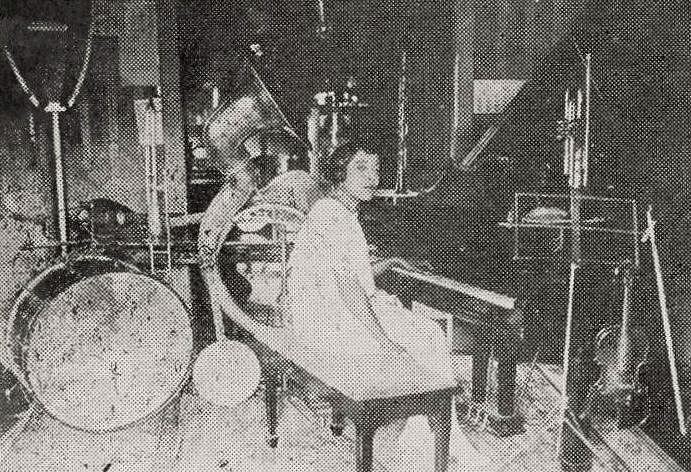
First is the woman seen above, Ella Rice Pratt (1893-1966) who was known professionally as “Madame Pratt” and seems to have taught an extremely wide range of musical instruments. According to this 1930 ad, she was “The only woman of her race in Texas who performs successfully upon two instruments at the same time.”  (Most images are larger when clicked.)

mme-pratt-muisc-teacher_dallas-negro-directory_1930_portal1930

Her 1966 obituaries (one of which is here ) list a string of accomplishments, including having studied music at the New England Conservatory in Boston, toured as a concert pianist, trained a 30-piece touring orchestra, and opened what was described as “the first music studio in Dallas where Negro musicians could receive training on all instruments” (Dallas Morning News, Oct. 3, 1966). Not only was she a notable Dallasite, so were members of her family: her father, Charles A. Rice was a principal at Booker T. Washington High School (and is the namesake of Charles Rice Elementary School), her mother, Sally Rice, was the first supervisor of Griggs Park, and her husband, T. W. Pratt was a long-time principal in Dallas schools (at the time of this directory he was the principal of the Pacific Avenue School (he might be seen in this photo which also appeared in the 1930 Negro Directory). The Pratts lived at 3612 Thomas Ave., near Washington, where Madame Pratt also had her studio. (Her headstone in Lincoln Memorial Park has musical notes engraved on it.)

*

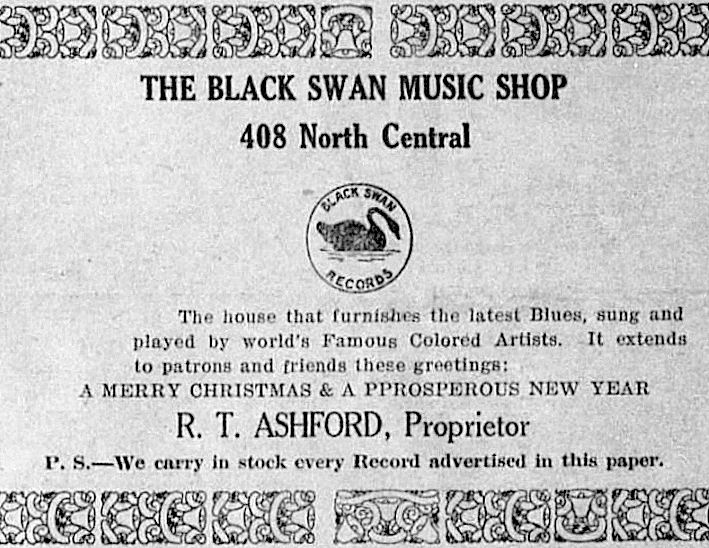
Speaking of music, R. T. Ashford was a prominent businessman (he was one of the founders of the Dallas Negro Chamber of Commerce) who owned R. T. Ashford’s Music Shop, a popular record store at 408 N. Central (at Swiss), just north of Deep Ellum. Before this 1930 directory was issued, Ashford had called his shop “Black Swan Music”(I’m not sure whether this was an “homage” to the Black Swan record label or some sort of partnership). Ashford’s store was apparently very popular and Ashford himself seems to have been taken seriously by record labels whenever he would recommend local talent (he appears to have figured prominently in Blind Lemon Jefferson’s recording career). Ashford moved from Central Avenue to Hall Street in 1931, but he was a Deep Ellum music and business fixture for many, many years. I think the location of Ashford’s record shop (if not the actual store) can be seen in this photo from 1919 (on the street-level floor of the Thorburn Broom & Brush building). (Fun fact, perhaps only to me: Ashford’s Music Shop was next door to a business proprietor named “Simpson.”)

ashfords-music-shop_dallas-negro-directory_1930_portal1930

ashford_dallas-express_122223Dallas Express, Dec. 1923

*

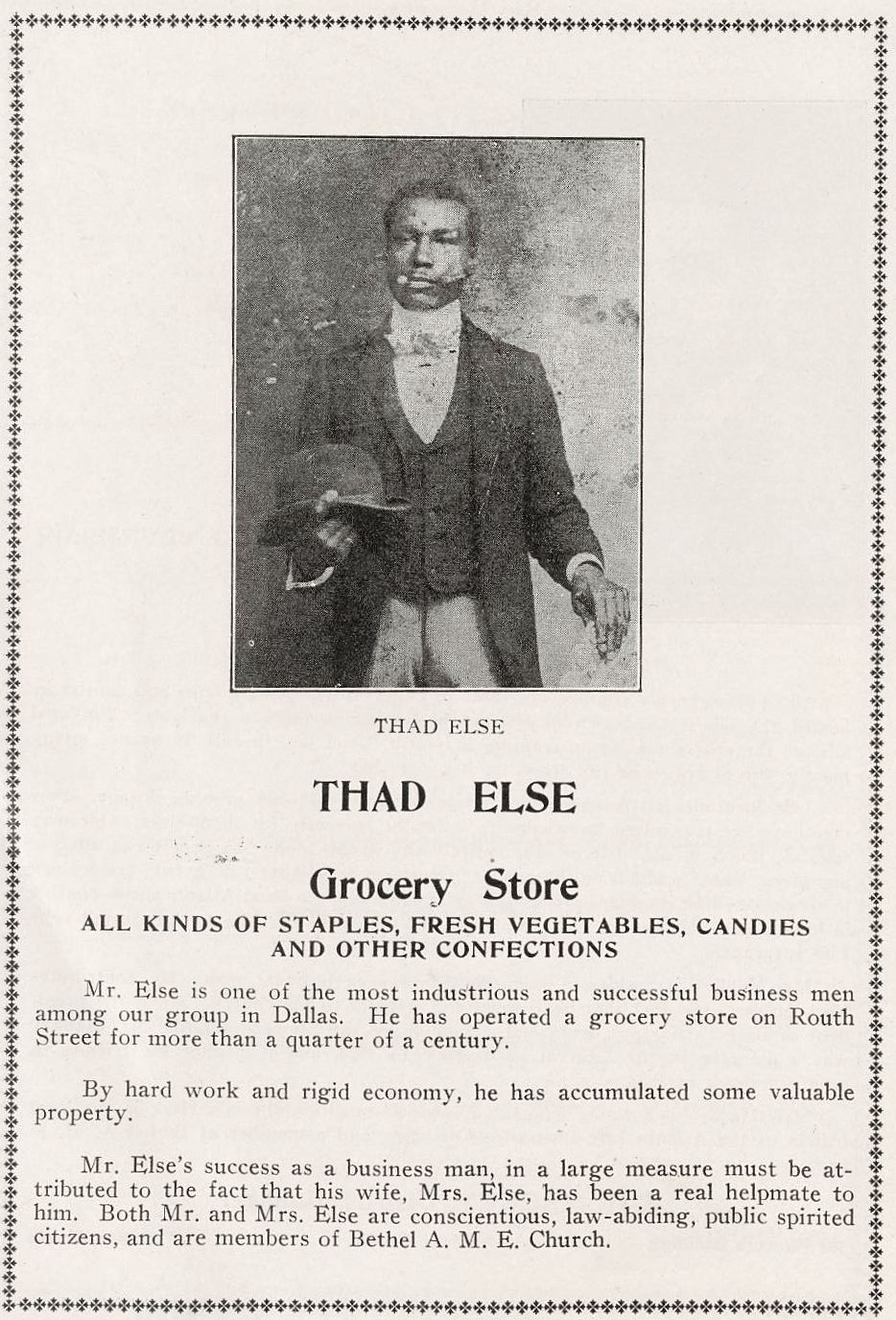
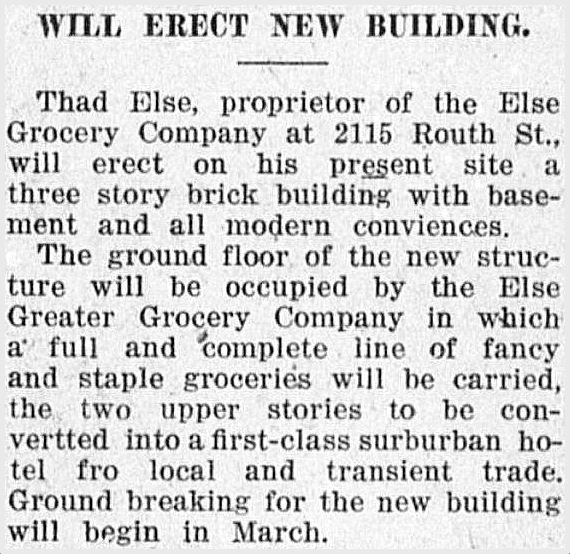
Another entrepreneur was Thad Self, whose main business seems to have been a grocery/general merchandise store on Routh Street south of Colby. He also owned a transfer company, a hotel/boarding house, a barber shop, a cafe, and at least one other general store. Most of his companies were located in buildings on the neighboring lots at 2113 Routh and 2115 Routh, one or both of which he appears to have purchased in 1913 for $100 (about $2,600 in today’s prices). He built a large three-story building on Routh in 1913 (which, according to this 1921 Sanborn map) was built over the Dallas Branch of the Trinity which snaked through downtown and the State-Thomas area — that  basement was probably pretty damp.

thad-else_dallas-negro-directory_1930_portal1930

thad-else_dallas-express_120619_HOTELDallas Express, Dec. 6, 1919

*

Speaking of hotels, one of the most prominent hotels in the era when blacks were not allowed to stay in “white” hotels by law was the Powell Hotel at 3115 State Street (between Ellis and Hugo), owned by D. H. Powell and his wife Susie. In May, 1929 Powell was issued a permit to tear down a frame house at 3115 State, and he built his 40-room hotel on the property soon after. The Powell Hotel was where almost every notable African-American visitor to the city stayed. By the late 1940s, Powell had built something of a hotel empire in Dallas with several locations. (I will have to write more about him in a future post!) I like this very early ad, from the 1930 directory, describing it as the “Powel Hotel & Pleasure Dome.” The photo shows a pleasant-looking place, but you and I and Kubla Khan and Coleridge would probably agree it’s no Xanadu.

powell-hotel_dallas-negro-directory_1930_portal1930

powell-hotel_legacies_spring-2007Dallas Public Library, via Legacies, Spring, 2007
*

Speaking of “resting places”… another essential element in any community is the funeral home. One of Dallas’ most prominent undertaking firms for black Dallas was the E. J. Crawford Funeral Home at 804 Good (now N. Good-Latimer, between Live Oak and Bryan), founded by Mr. Crawford in 1909. “The last word in funeralizing.”

crawford-funeral-home_dallas-negro-directory_1930_portal1930

crawford_e-j_dallas-express_020422Dallas Express, Feb. 4, 1922

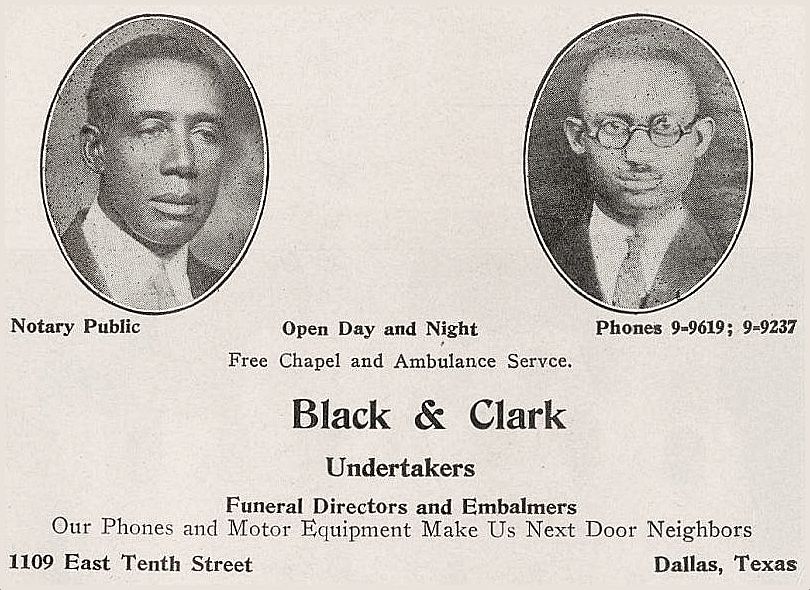
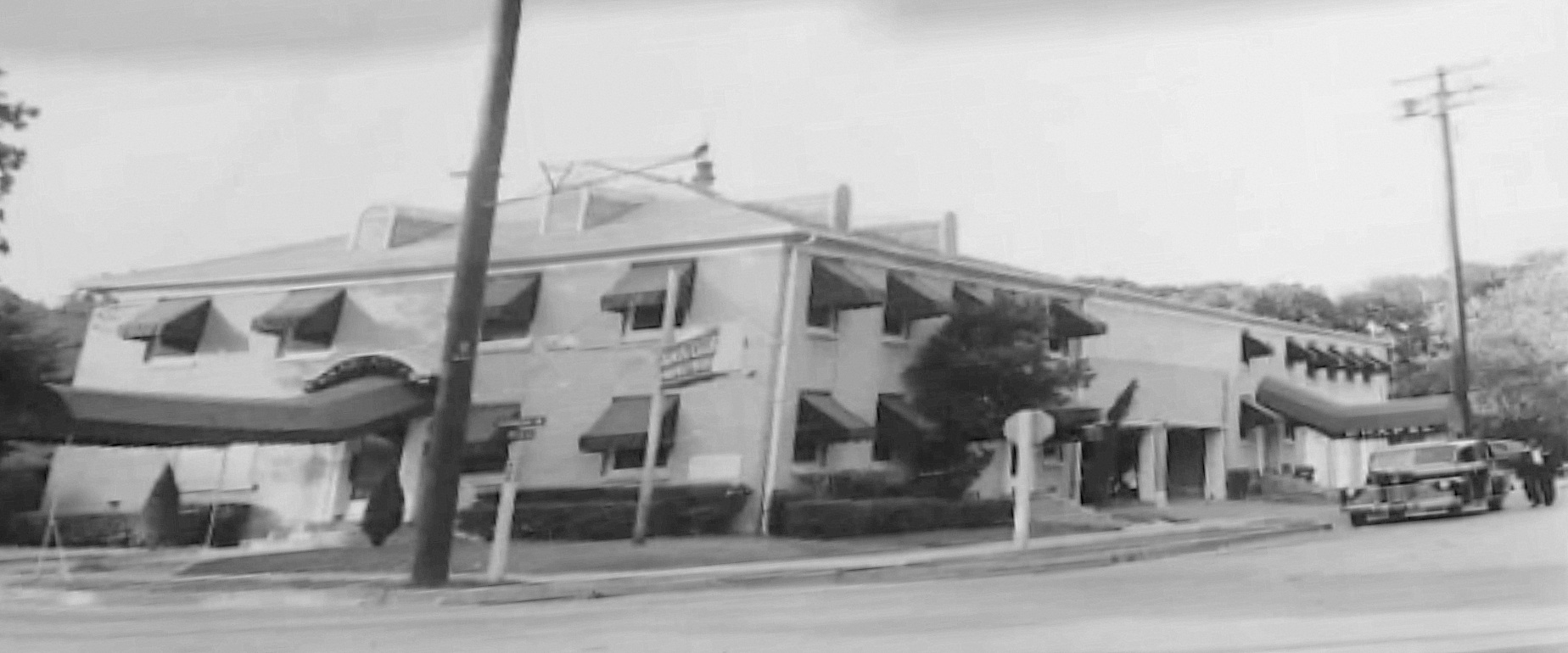
Another prominent funeral home/ambulance service was Black & Clark, founded originally around 1914 by S. C. Black; in 1927 he was joined by his nephew C. J. Clark. For years they were located in Oak Cliff, at 1109 E. Tenth St., west of what is now South R. L. Thornton, near Cliff Avenue. This funeral home is still in business, and there was recently a profile of the Dallas institution on Channel 5 News (watch it here).

black-and-clark-undertakers_dallas-negro-directory_1930_portal1930

black-and-clark_archives_1802-n-washington1802 N. Washington (woozy screenshot of photo in Ch. 5 news story)

*

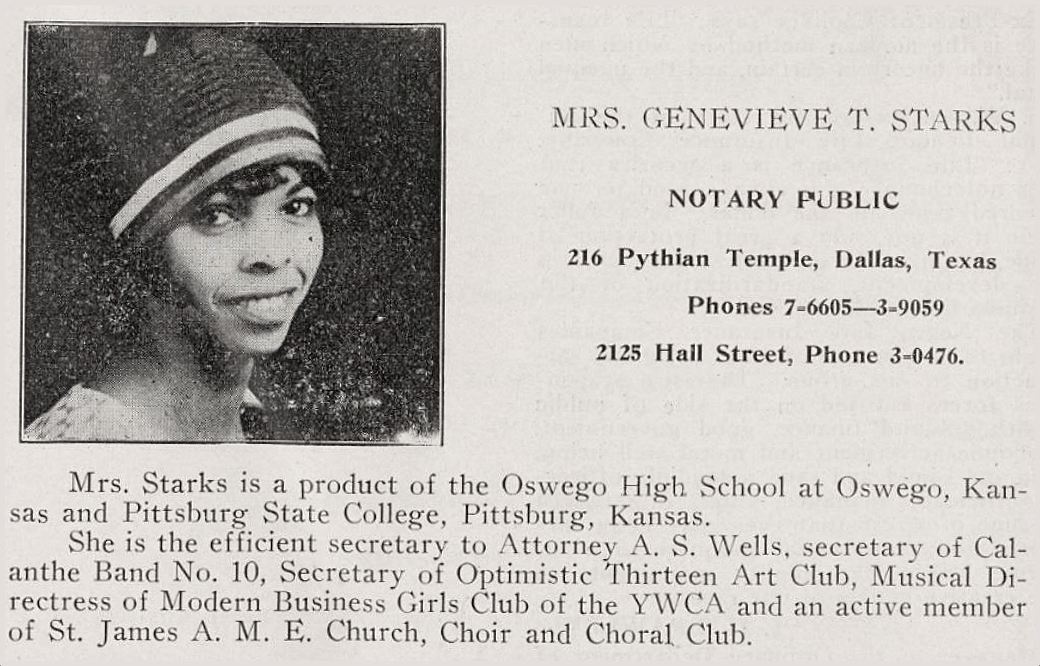
This is Genevieve T. Starks, a woman with a lot of extra-curricular activities! I love this photo.

genevieve-starks_dallas-negro-directory_1930_portal1930

*

The G Clef Club was organized around 1921 by Lincolnia Hayes Morgan, music supervisor for Dallas’ (black) public schools. A blurb about the group appeared in The Crisis, the official publication of the N.A.A.C.P.: “The objects of the club are to assist worthy music students and to raise the music standard of the community” (June, 1921).

g-clef-club_dallas-negro-directory_1930_portal1930

*

A popular singing group was the Belt Sacred Quartette (comprised of J. J. Mollis, J. Poindexter, F. W. Grant, and N. Tisdale) — listen to their recording of “I Have Another Building” below.

belt-sacred-quartette_dallas-negro-directory_1930_portal1930

belt-sacred-quartette_blackwell-OK-journal-tribune_072332Blackwell (OK) Journal-Tribune, July 23, 1932

*

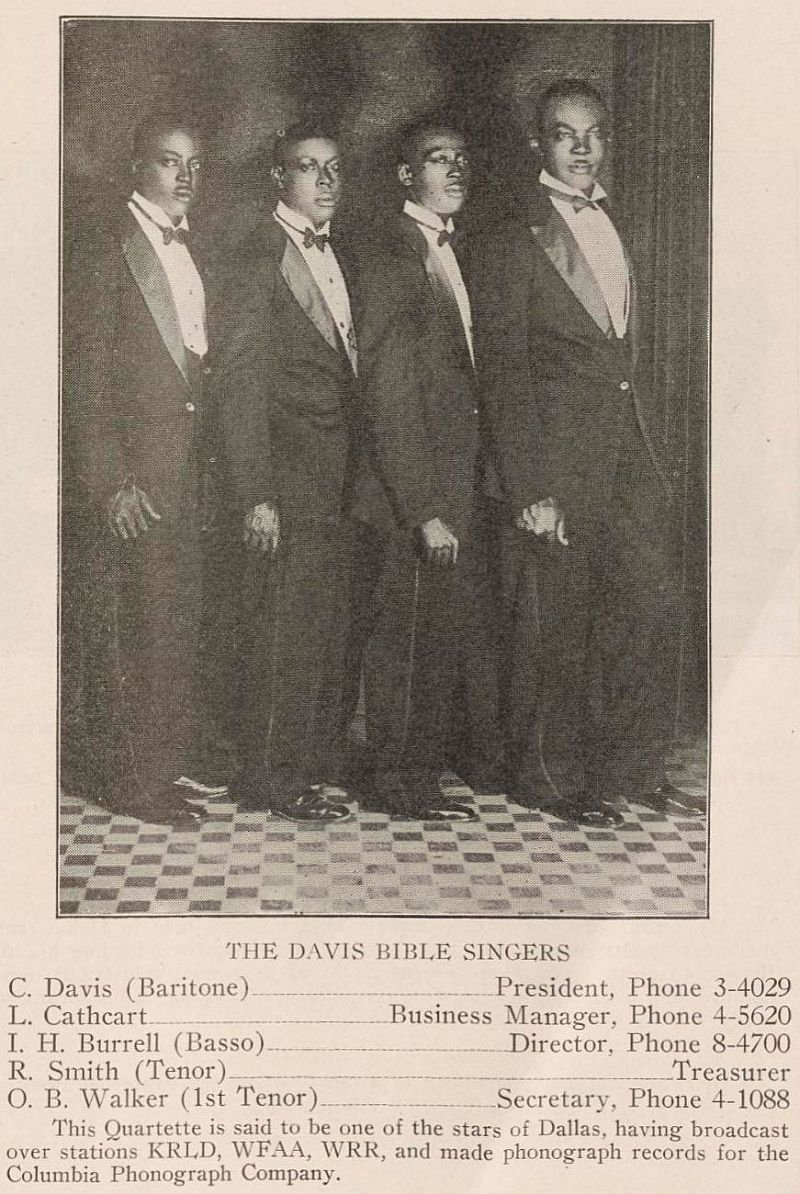
The Davis Bible Singers (C. Davis, I. H. Burrell, R. Smith, and O. B. Walker) seem to have been pretty popular, having appeared on KRLD, WFAA, and WRR radio. They even recorded for Columbia Records (listen to their great recording of “Daniel Saw the Stone” below).

davis-bible-singers_dallas-negro-directory_1930_portal1930

*

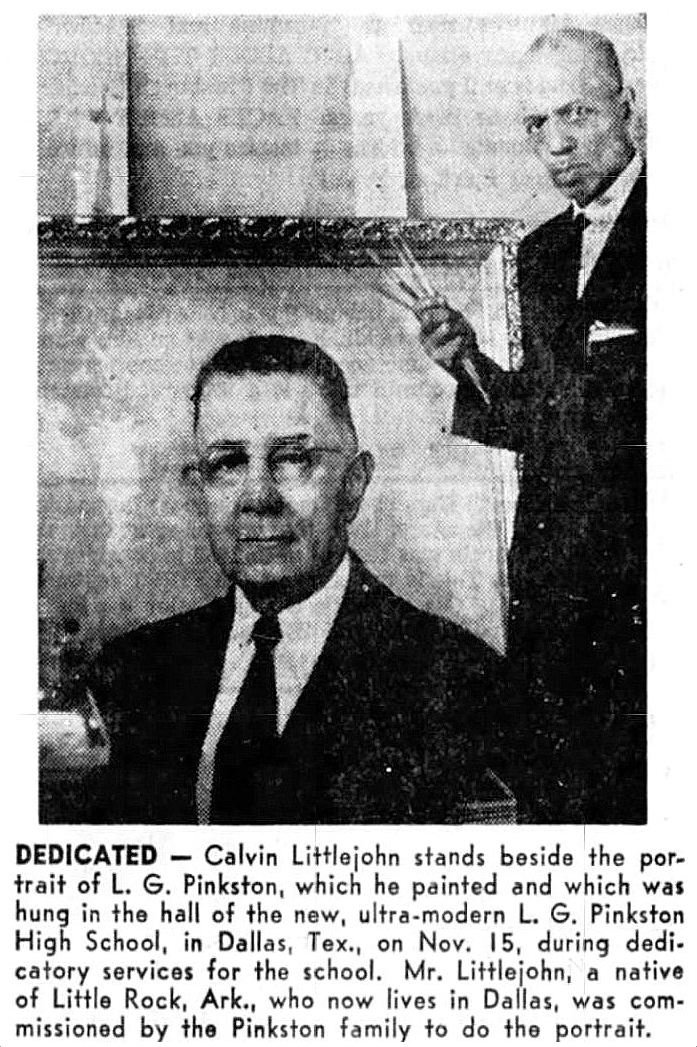
One of the most important doctors in Dallas in the 1920s and ’30s was Dr. Lee Gresham (L. G.) Pinkston (1883-1961), who opened the Pinkston Clinic at 3305 Thomas Avenue, between Hall and Central, in 1928 or 1929 (it made its first appearance in the 1929 city directory). In 1954, Pinkston — physician, surgeon, and civic leader — was one of the first five black doctors allowed to practice in a “white” Dallas hospital (St. Paul’s Hospital) — before that, the only hospital in Dallas where black doctors could practice was the Pinkston Clinic, which had 15 beds (32 beds were allotted for black patients at St. Paul’s in 1954). (See a photo of the five doctors here, Dr. Pinkston is seated.) A new West Dallas school — Pinkston High School — was named in Dr. Pinkston’s honor and opened in 1964, three years after his death. 

pinkston-clinic_dallas-negro-directory_1930_portal1930

pinkston-clinic_DHSDallas Historical Society

Below, a portrait of Dr. Pinkston with the artist, Calvin Littlejohn (whom I’d known only as a photographer previously), destined to hang in the new school.

pinkston-l-g_portrait_calvin-littlejohn_pittsburgh-PA-courier_112864Pittsburgh (PA) Courier, Nov. 28, 1964

***

Sources & Notes

All 1930 images are from Official Directory: Dallas Negro Churches, Schools and Other Activities; Civic, Business, Fraternal, Social, Etc. compiled by James H. Smith, 1930; from the Tarrant County Black Historical and Genealogical Society, via the Portal to Texas History. This fantastic resource is scanned in its entirety here.

See the two other Flashback Dallas posts which also use this wonderful directory as a source:

mme-pratt-muisc-teacher_dallas-negro-directory_1930_portal_det_sm

*

Copyright © 2020 Paula Bosse. All Rights Reserved.

Paul Giraud’s 1892 View of Dallas with Trinity River “Improvements” Which Were Never Made

1892_map_birdseye_paul-giraud_wikimediaClick to explore a larger image…

by Paula Bosse

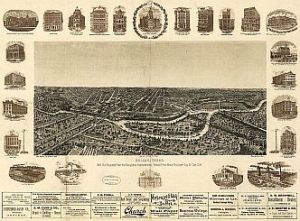
Above is a map titled “Dallas, Texas, With The Projected River And Navigation Improvements. Viewed From Above The Sister City of Oak Cliff.” It was a bird’s-eye view of the city drawn in 1892 by Dallas resident and businessman Paul Giraud.

If you click on the picture you will see a very large image which will allow you to look at all the tiny details. You’ll see a lot of stuff that never actually existed in Dallas, but which Giraud — an adamant and tireless proponent of a navigable Trinity waterway — hoped would become part of Dallas. It’s pretty cool and a lot of fun to wander through. (A good background history on Giraud’s “map” can be found on the Amon Carter Museum website here.)

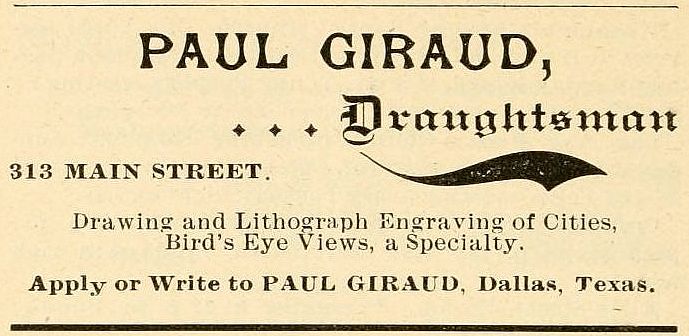
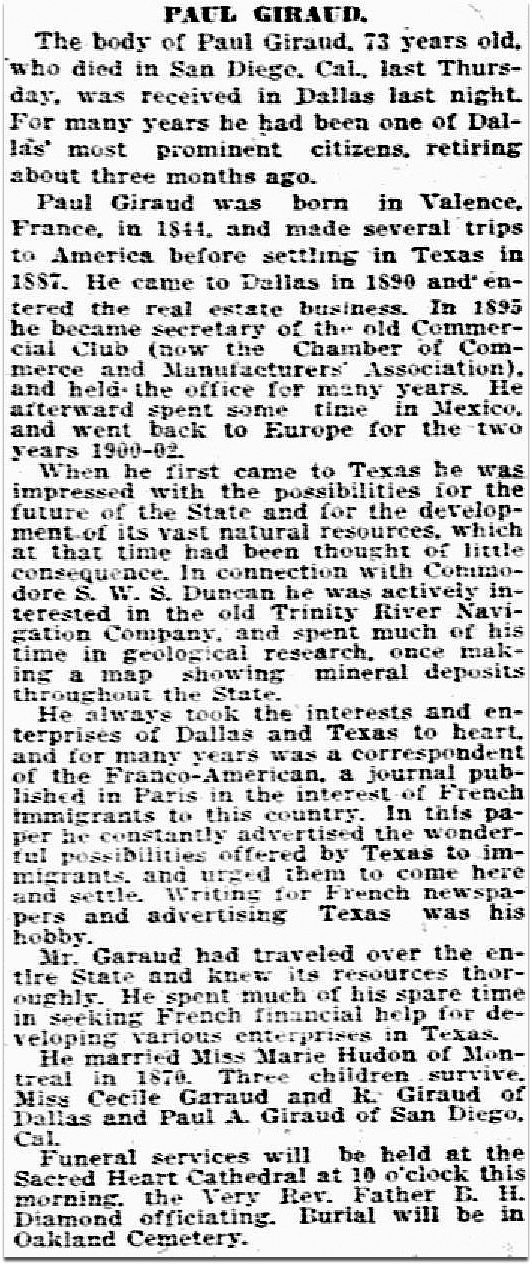
Born in France in 1844, Paul Giraud settled in Dallas in 1890 where he worked both in real estate and as a draftsman while also acting as a booster of Dallas and Texas to anyone who would listen, especially to Europeans and fellow Frenchmen who were considering the possibility of emigrating to the United States. He was also an inventor and secured at least one patent.

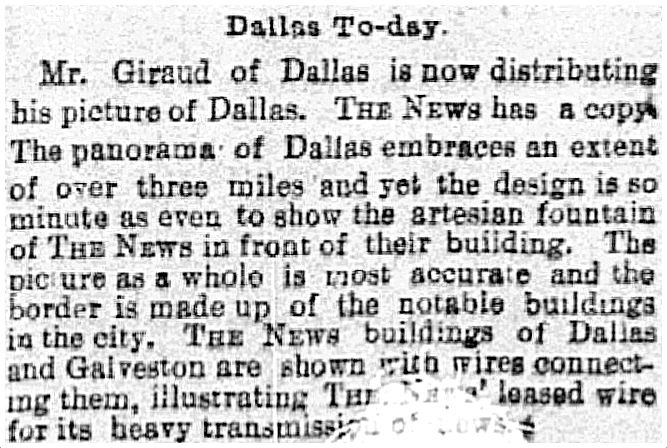
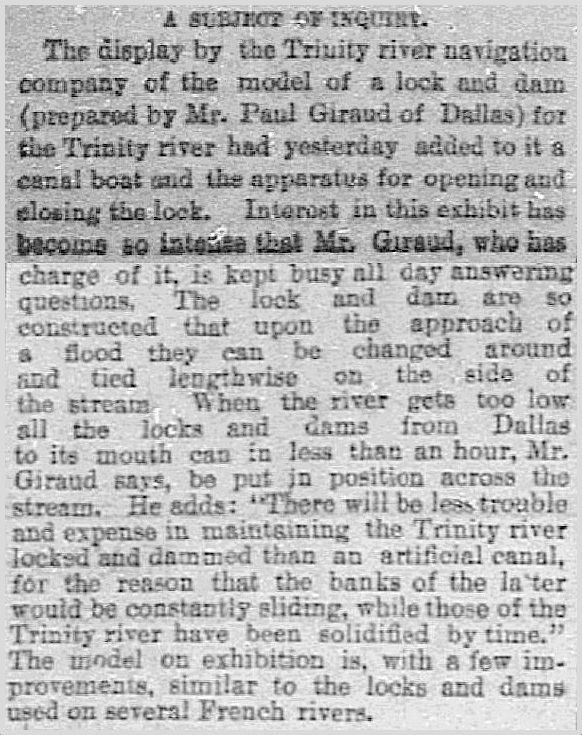
Giraud’s enthusiasm and dedication for the Trinity River scheme could be found in the bird’s-eye view seen above, in a miniature three-dimensional model with working locks and dams which he constructed for the 1892 State Fair, and in newspaper articles printed across the state which he wrote to assure readers (and investors) of the feasibility of the project.

All that work, but, sadly, Giraud’s dream was never realized — the Trinity won. But he did leave us with that fantastic, partially realistic bird’s-eye view of the city.

*

1892_map_birdseye_giraud_dmn_091892Dallas Morning News, Sept. 18, 1892

giraud_trinity-lock-and-dam-model_state-fair_dmn_102992
DMN, Oct. 29, 1892

paul-giraud-draughtsman_souv-gd_1894
Souvenir Guide of Dallas, 1894

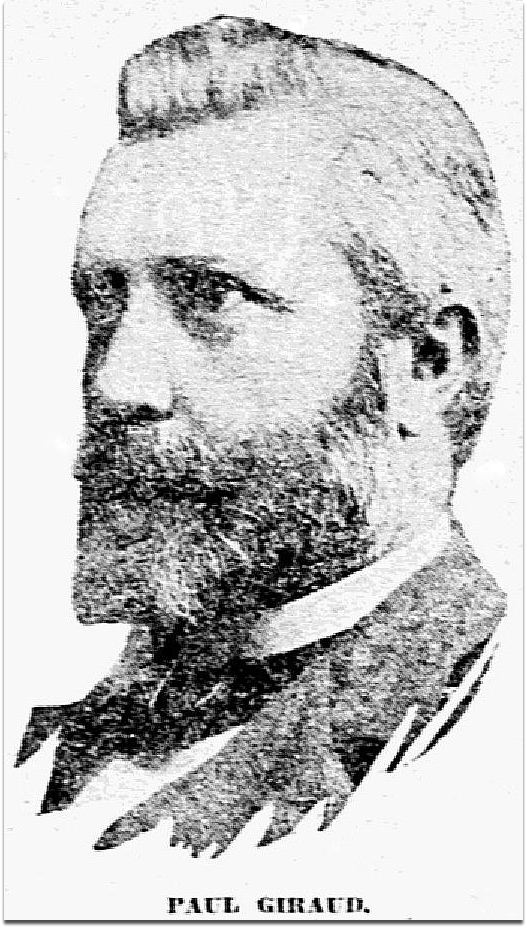
giraud-paul_dmn_121117_obit_photo

giraud-paul_dmn_121117_obit
Photo and obituary, DMN, Dec. 11, 1917 (click to read)

***

Sources & Notes

This map is in the collection of the Library of Congress, here; the picture at the top of this post links to the enlarged Wikimedia image here.

If you’d like to compare some of the buildings with Sanborn maps to see what was real and what was fanciful, you can find the 1892 Sanborn maps here (scroll down). It might be helpful to use Sheet 1 as a guide — if, for instance, you want to look at the area in the immediate vicinity of the courthouse (which was under construction at the time…), you see that you need Sheet 3, so you click on “Dallas 1892 Sheet 3” on the list of maps.

1892_map_birdseye_paul-giraud_wikimedia_sm

*

Copyright © 2020 Paula Bosse. All Rights Reserved.

The Henry Russells Take Possession of Their Rolls Royce Silver Wraith — 1948

russell-henry_life-mag_alternate
The car, the couple, the driver … Preston Hollow, 1948

by Paula Bosse

People seem to expect stories about painfully wealthy Texans to have larger-than-life outrageous elements. The April 5, 1948 issue of Life magazine devoted several pages to the Southwest’s “New Crop of Super Rich.” The photo showing Col. and Mrs. H. E. Russell at their Preston Hollow home appeared with the following caption:

New Rolls-Royce (price $19,500) was bought by Colonel Henry Russell of Dallas as a birthday present for his wife. She liked it because “it goes with my blue hat.” The Russells claim they are just “camping out” in their house, plan to turn it over to the servants and build a bigger one for themselves as soon as they get around to it.

One can only hope this was just gross exaggeration. Or a misinterpreted joke. Or just amusing fiction. Because if not … yikes. 

russell_rolls-royce_1948

Henry and Alla Russell had not been in Dallas very long when they took possession of their fabulous Rolls Royce — a Silver Wraith. When production of this model was announced in 1946, it was described as “the world’s most expensive automobile.” The Russell’s purchase made local news, with this blurb appearing in The Dallas Morning News on Feb. 12, 1948:

Col. and Mrs. H. E. Russell, 4606 Park Lane, have taken delivery on their new Rolls-Royce. Known as the Silver Wraith model, the silver and blue car features a bar, vanity and other luxuries. The price? $19,274. Dealers S. H. Lynch & Co. said the car was the first Rolls-Royce sold in the Southwest.

That postwar price would be the equivalent in today’s money of about $200,000. In a 1956 Dallas Morning News article, Frank X. Tolbert wrote that Col. Russell “is still driving his ’48 model, and it’s the only one we ever see around town although there may be one or two more” (DMN, “Rolls-Royce Hard To Find in State,” Nov. 15, 1956).

There had been Rolls Royces in Dallas before 1948, but according to S. H. Lynch — the Dallas dealer of imported British vehicles including Jaguars, Bentleys, MGs, Morris Minors, and James motorcycles (as well as other high-ticket British items such as English china) — he had sold only five or six of the prestigious automobiles while he had the dealership, and that only that first one bought by the Russells had stayed in Dallas.

rolls-royce_s-h-lynch_020148
S. H. Lynch & Co. ad, Feb. 1, 1948 (click for larger image)

rolls-royce_s-h-lynch_030748
March, 1948

In 1948, S. H. Lynch (located at 2106 Pacific, at Olive) was one of only three Rolls dealerships in the county, the others being in New York and Los Angeles. In postwar Britain, American dollars were in such demand that a Rolls spokesman said that at least 75% of his company’s production was earmarked for the U.S. — American orders would take priority over their U.K. counterparts.

s-h-lynch_postcard

Even though a Roller’s always going to wow the hoi polloi, it wasn’t always easy to find a trained mechanic, as Roy Lee discovered:

rolls-royce_abilene-reporter-news_072046
Abilene, TX Reporter News, July 20, 1946

We all have our bad days, I suppose.

***

Sources & Notes

The two photos of the Russells are from the Life magazine article “Southwest Has a New Crop of Super Rich” (the top photo was not published).

Col. Russell, an Army veteran of both world wars, appears to have been retired by the time he got to Dallas. The only clue to the source of what must have been fabulous wealth was the final line in the obituary of Mrs. Russell, which noted that he was the son (or possibly the grandson) of the founder of the Russwin Lock Co. Mrs. Russell died in a massive fire which destroyed the large Park Lane house in January, 1976; the colonel died about 15 years earlier, in New York.

*

Copyright © 2019 Paula Bosse. All Rights Reserved.