Flashback : Dallas

A Miscellany: History, Ads, Pop Culture

Category: Medical

When the Spanish Influenza Hit Dallas — 1918
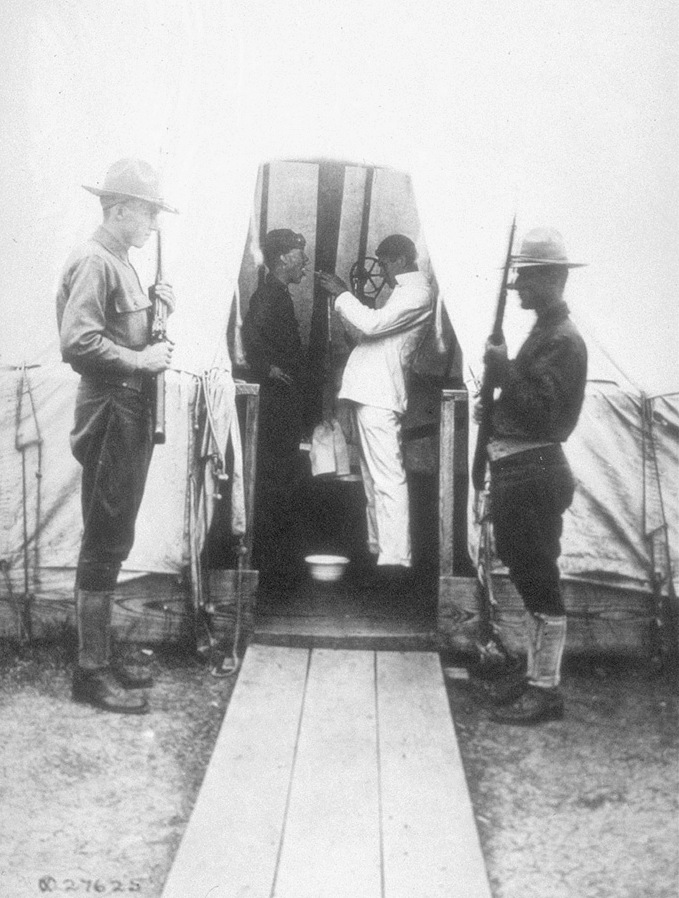
spanish-influenza_love-field_otis-historical-archives_nmhm_110618
American Red Cross at Love Field, spraying soldiers’ throats, Nov. 6, 1918

by Paula Bosse

The Spanish Influenza pandemic of 1918-1919 caused as many as 50 million deaths worldwide — about 600,000 of which were in the United States (11 times greater than the number of American casualties during World War I). Locally, the influenza first hit the soldiers at Camp Bowie in Fort Worth in September, 1918. The flu spread quickly, and on Sept. 27, it was reported that there were 81 cases in the camp. Well aware of the devastation the flu had wrought in other U.S. cities, most notably at military camps, Fort Worth was, understandably, taking the situation seriously. Dallas leaders, on the other hand, were all-but pooh-poohing the need for concern. On Sept. 29, The Dallas Morning News had a report titled “Influenza Scare is Rapidly Subsiding” — the upshot was that, yeah, 44 reported cases of “bad colds” had been reported in the city, but there’s nothing to worry about, people.

In the opinion of the military and civil doctors, the Spanish Influenza scare is unwarranted by local conditions. The few cases of grip, it is claimed, are to be expected as the result of the recent rainy weather.

Just two days later, though, officials were jolted out of their complacency when the (reported) cases jumped to 74 (click for larger image):
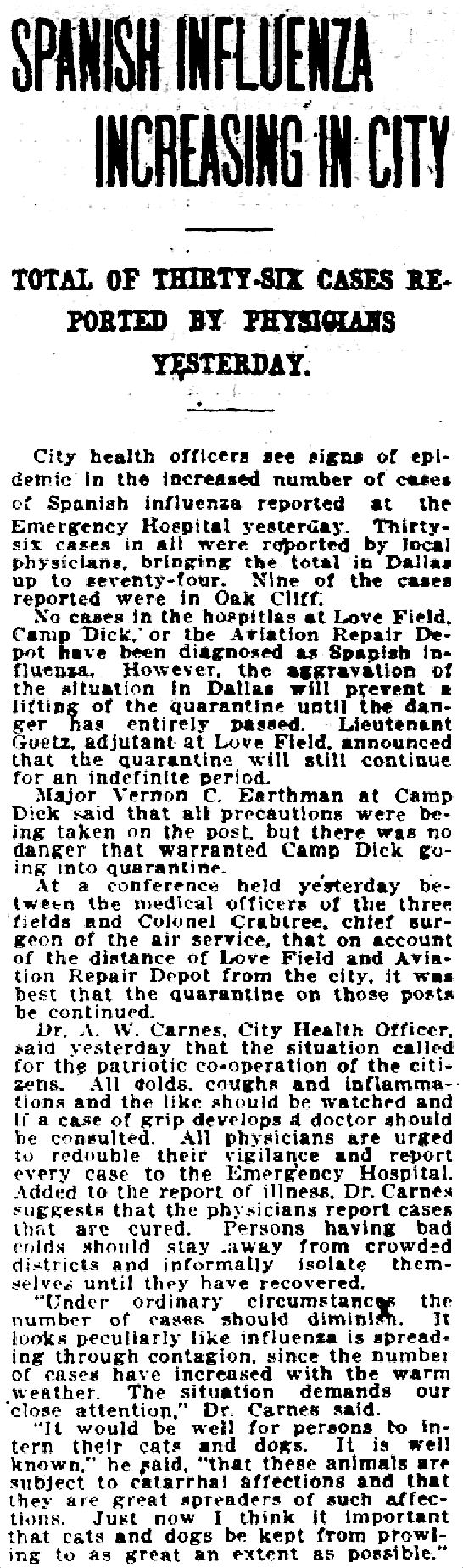
spanish-influenza-dmn-100218DMN, Oct. 2, 1918 (click for larger image)

The months of October and November were just a blur: the city was plunged into an official epidemic. There was no known cure for the flu, so a somewhat ill-prepared health department preached prevention. People were encouraged to make sure their mouths were covered when they coughed or sneezed, and they were directed to not spit in the street, on streetcars (!), in movie theaters (!!), or, well, anywhere. (Handkerchief sales must have soared and spittoon sales must have plummeted.)

At one point or another, places where people gathered in large numbers — such as schools, churches, and theaters — were closed. Trains and streetcars were required to have a seat for every passenger (no standing, no crowding) (…no spitting). The number of mourners at funerals (of which there were many) was limited. And there was a major push for citizens to clean, clean, clean their surroundings in an attempt to make the city as sanitary as possible. Instructions appeared often in the newspapers.

spanish-influenza_dmn_101218_tipsDMN, Oct. 12, 1918

It was estimated that there were 9,000 cases of Spanish Influenza in Dallas in the first six weeks. By the middle of December, when the worst of the outbreak was over, it was reported that there had been over 400 deaths attributed to the Spanish Influenza and pneumonia in just two and a half months.

spanish-influenza_FWST_121118Fort Worth Star-Telegram, Dec. 11, 1918

As high as these numbers were, Dallas fared much, much better than many other parts of the United States.
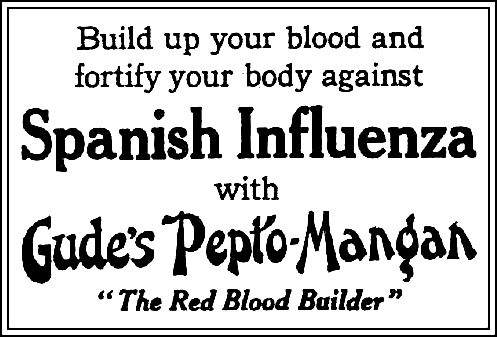
spanish-influenza_ad_dmn_101818_pepto-manganAd, DMN, Oct. 18, 1918

***

Sources & Notes

Photo at top was taken on November 6, 1918 and shows American Red Cross Workers spraying throats of military personnel based at Love Field in hopes of preventing the spread of the influenza. The photo is from the Otis Historical Archives, National Museum of Health and Medicine; I found it on the NMHM site, here. (Click photo for larger image.)

Ad for Pepto-Mangan (“The Red Blood Builder”) was one of a flood of medicines and tonics claiming to be effective in the fight against Spanish Influenza (none were).

For a detailed and remarkably well-researched, comprehensive history of the Spanish Influenza in Dallas, see the article prepared by the University of Michigan Center for the History of Medicine, here. It’s pretty amazing.

To read about the history of pandemics (including several good links regarding the Spanish flu), see the Flu.Gov site, here.

And, NO, Ebola is not transmitted like the flu. But it’s still good practice to cover your mouth when you cough or sneeze,wash your hands frequently, and never EVER spit in the street, because that’s just disgusting. ((This post was originally written in 2014 while Dallas was the center of the Ebola universe.))

More on the Spanish Influenza pandemic can be found in the Flashback Dallas post “Influenza Pandemic Arrives in Dallas — 1918.”

*

Copyright © 2014 Paula Bosse. All Rights Reserved.
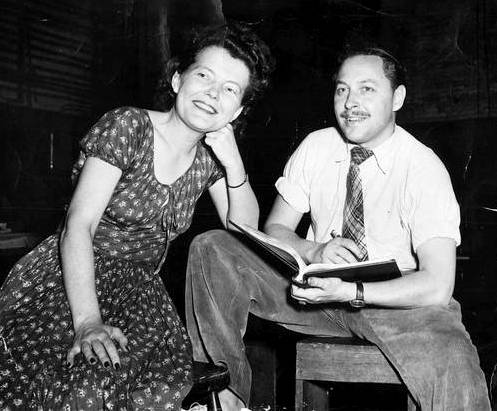
 

Margo Jones & Jim Beck: Both Legends in Their Fields, Both Victims of Carbon Tetrachloride

margo_tennessee
Margo Jones with Tennessee Williams

by Paula Bosse

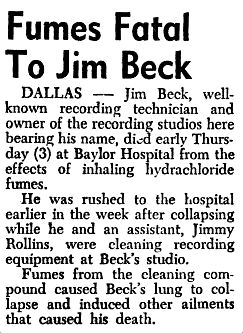
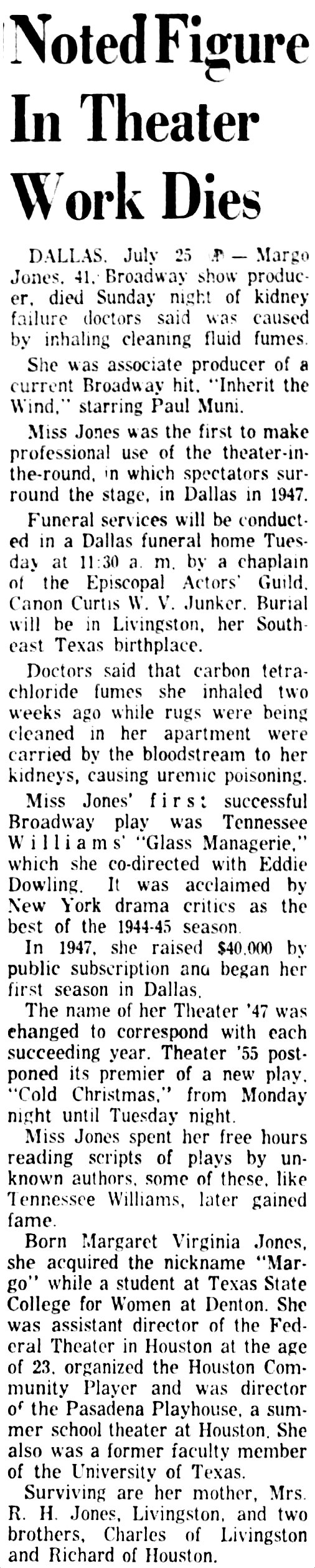
In reading about Dallas theater legend Margo Jones, I saw that she died from inhaling the lingering fumes of a cleaning agent that had been used to clean a rug in her apartment at the Stoneleigh Hotel: carbon tetrachloride. The only thing I knew about carbon tetrachloride was that it had also caused the early death of legendary recording engineer and producer Jim Beck (the man who discovered and produced the first records of Lefty Frizzell, Ray Price, et al.); Beck had been cleaning his recording equipment and had been overcome by the fumes. Both were rushed to the hospital when they were discovered unconscious, and both died about ten days later.

Margo Jones died on July 24, 1955, and Beck died less than a year later, on May 3, 1956. Jones was in her early 40s — Beck was only 39. Margo Jones was a creative powerhouse who was already revolutionizing regional theater, and Jim Beck’s enormous talent was the sole reason that Columbia Records was on the brink of moving their operations from Nashville to Dallas (a move that might very well have set the wheels in motion for Dallas to overtake Nashville as the nation’s recording center for country music). It is such a loss that both died so young,victims of something as mundane as cleaning fluid. With so much remarkable potential ahead of them, it’s sobering to imagine how different Dallas theater and the Dallas recording industry would be today had their careers lasted another two or three or four decades.

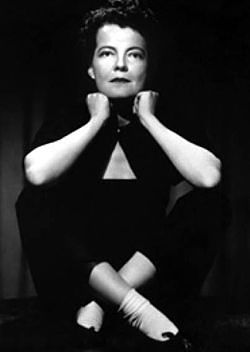
margo-jones-photo

margo-jones_austin-american_072655_obitAustin American, July  26, 1955 (click to see larger image)

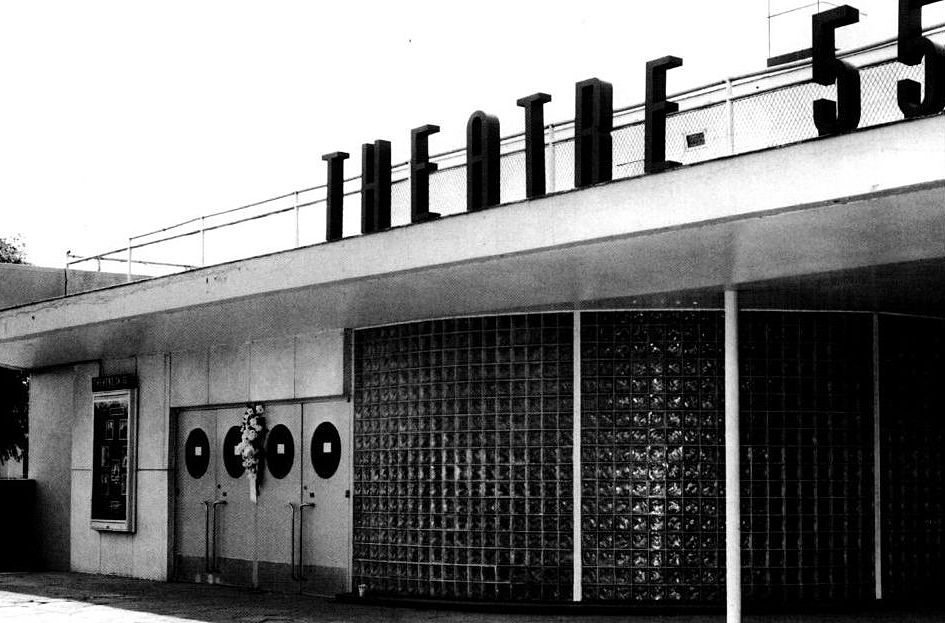
margo-jones_wreath_legacies_fall-2004Margo Jones’ Theatre ’55 with wreath on door (click for larger image)

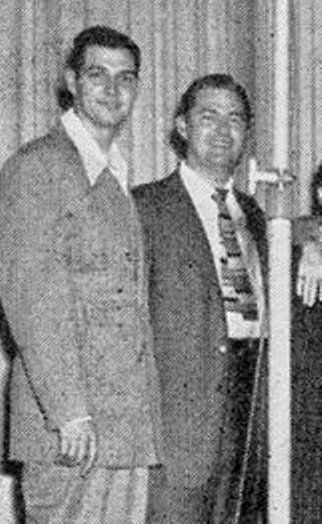
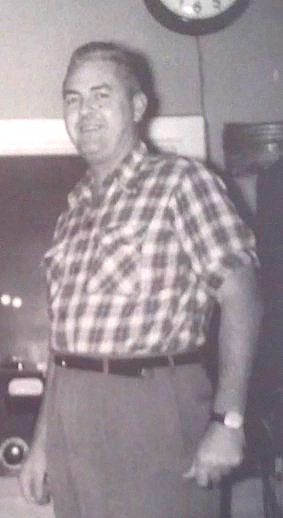
jim-beck_detJim Beck in his studio

jim-beck_hank-thompson_liberty-jamboree_c1951-detJim Beck (right) with Hank Thompson

jim-beck_billboard_051256bBillboard, May 12, 1956

jim-beck-studio-logo

***

Sources & Notes

Photo of Theatre ’55 (formerly the Magnolia Lounge in Fair Park) with wreath is from the story “‘I’m Doing It, Darling!’ — Dallas, Margo Jones, and Inherit the Wind” by Kay Cattarulla (Legacies, Fall, 2004 issue), which can be read here.

First photo of Jim Beck (which has been cropped) is from the Bear Family CD box set “Lefty Frizzell: Life’s Like Poetry.”

Photo of Jim Beck and country recording star Hank Thompson is a (cropped) Liberty Jamboree promotional photo, circa 1951.

Jim Beck Studio logo from the Handbook of Texas entry for the recording industry in Texas, here.

Margo Jones is very important. Read why here.

Jim Beck is very important. Read why here.

A bit morbid, perhaps, but Margo Jones’ death certificate can be viewed here; Jim Beck’s death certificate, here.

And, finally … kids, stay away from that carbon tetrachloride. It’s bad stuff.

For my previous post “Lefty Frizzell: It All Began on Ross Avenue,” click here.

*

Copyright © 2014 Paula Bosse. All Rights Reserved.
Dallas Medical College: 1900-1904

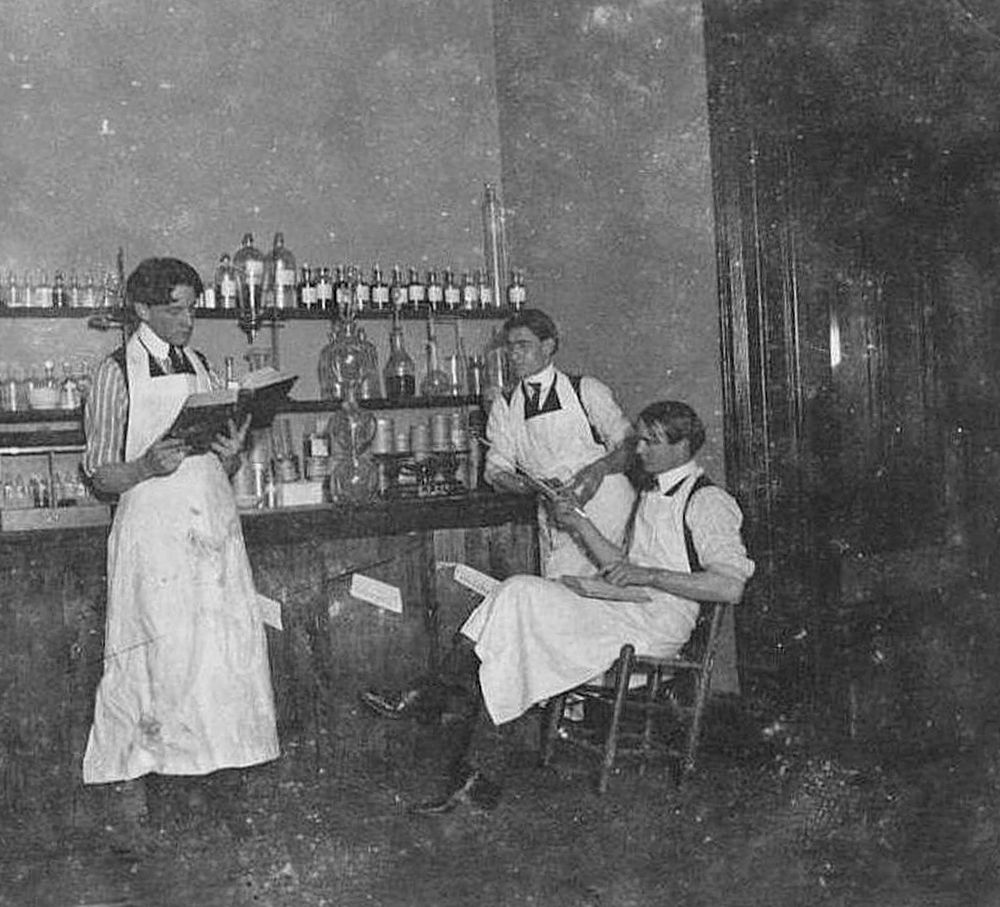
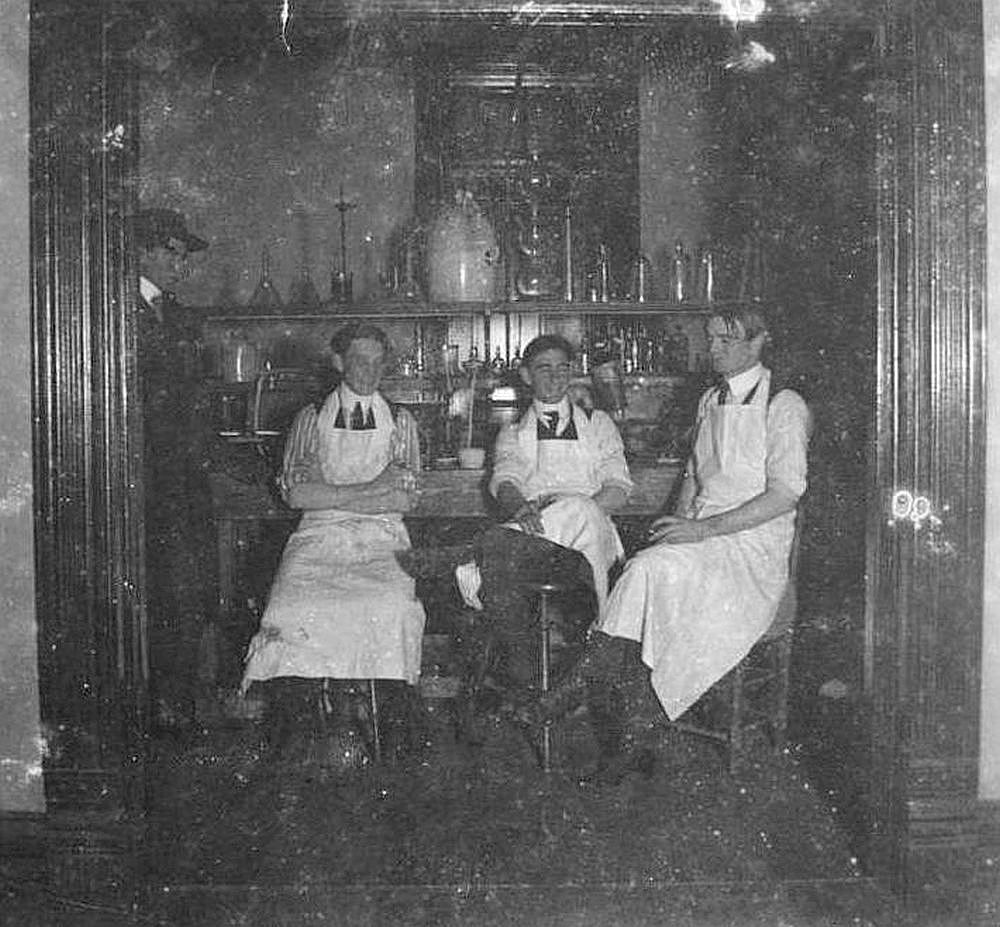
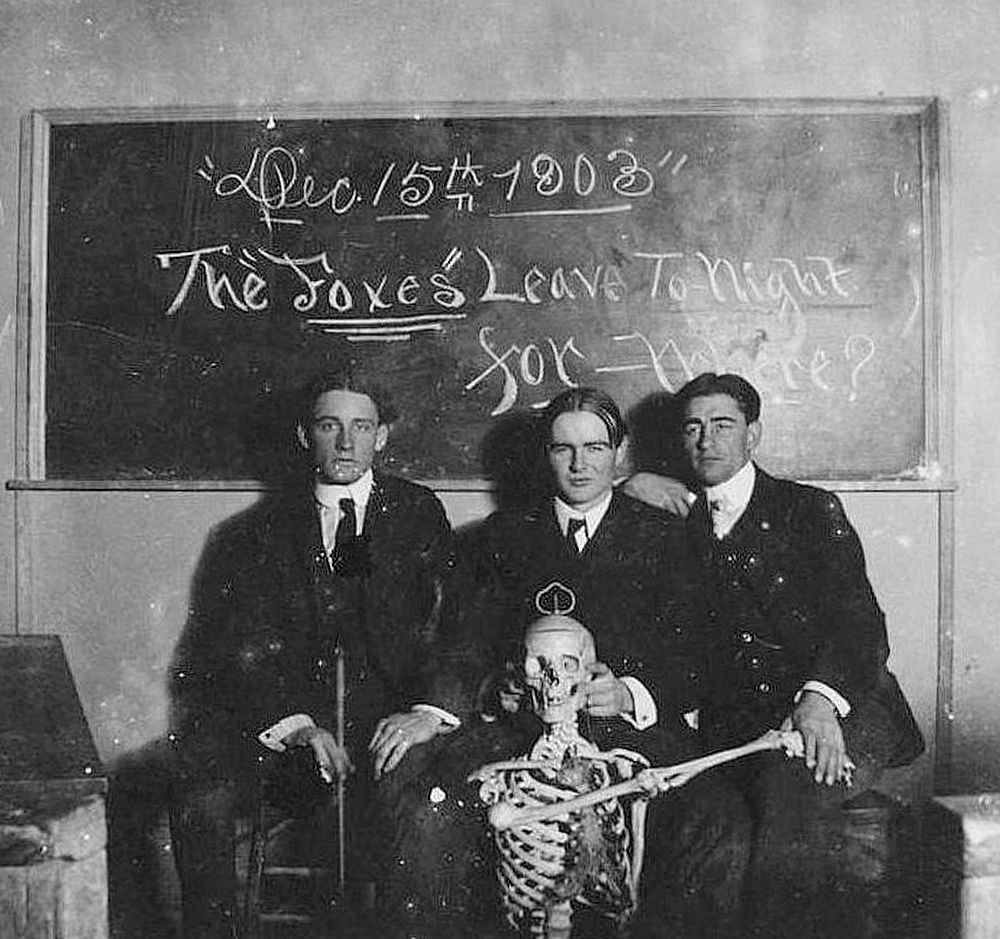
dallas-med-college_1903_utswPhotos from the UT Southwestern Library (click for larger image)

by Paula Bosse

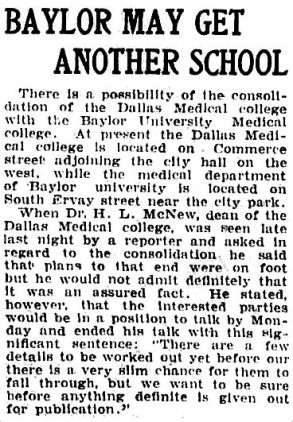
Between 1900 and 1910, Dallas had ELEVEN medical schools, some of dubious distinction. One of the earliest and most successful was Dallas Medical College, an offshoot of Trinity University which was eventually merged with Baylor College of Medicine. It was located on Commerce St. near Akard, neighbors with a fire station and the City Hall (the Adolphus Hotel now occupies this site). Here are several photos from the Dallas Medical College archives, showing three typical medical students engaging in typical medical school hijinks.

dallas-med-college_1903a_utsw

dallas-med-college_1903b_utsw

dallas-med-college_1903c_utsw

dallas-med-college_1903d_utsw

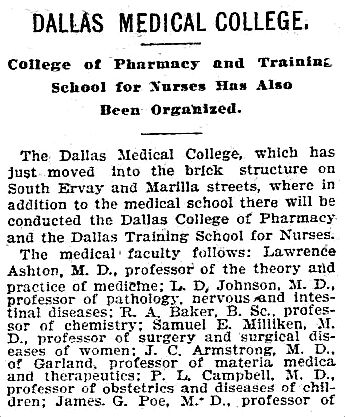
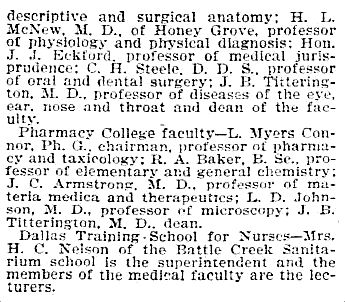
dallas-medical-college_dmn_020301adallas-medical-college_dmn_020301b Dallas Morning News, Feb. 3, 1901

dallas-medical-college_dmn_020301-sketchThe school’s first location on S. Ervay & Marilla (DMN, Feb. 3, 1901)

dallas-medical-college_dmn_092703DMN, Sept. 27, 1903

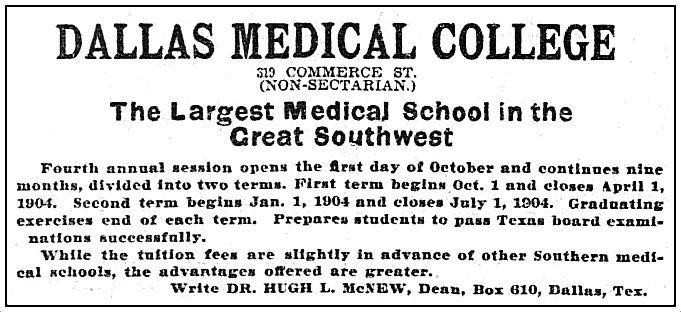
dallas-med-coll_southern-merc_111004Southern Mercury, Nov. 10, 1904

The official announcement of the merging, with details on how the two schools would function for the rest of the school year can be read here.

***

Sources & Notes

Photographs from the UT Southwestern Library, here and here.

More on early medical schools in Texas, with several paragraphs on Dallas, can be found in “Training the Healers” by Vernie A. Stembridge, M.D., an article from the May, 1999 issue of Heritage magazine (a publication of the Texas Historical Foundation) which can be read here.

*

Copyright © 2014 Paula Bosse. All Rights Reserved.
 

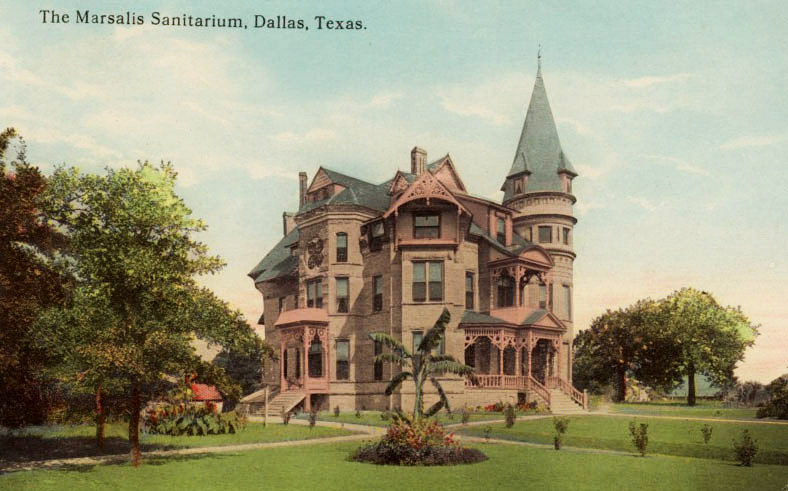
The Marsalis House: One of Oak Cliff’s “Most Conspicuous Architectural Landmarks”

marsalis_sanitarium_oak-cliffThe fabulous Marsalis house in Oak Cliff (click for larger image)

by Paula Bosse

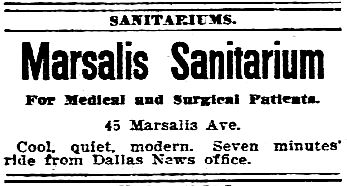
The Marsalis Sanitarium was a 15-bed private surgical and convalescent hospital in Oak Cliff, established in 1905 by Dr. J. H. Reuss and his partner, Dr. James H. Smart. Whether or not that building was actually pink (and I certainly hope that it was!), it was most definitely a show-stopper — one of those stunning structures that one doesn’t expect to see in and around Dallas because almost none of them still stand.

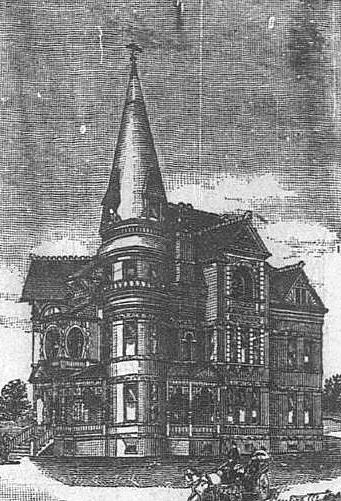
This grand home was built by Oak Cliff promoter and developer Thomas L. Marsalis in about 1889 as his personal residence at a reported cost of $65,000 (the equivalent of more than $1,750,000 in today’s money). It was located at what is now the southwest corner of Marsalis Avenue and Colorado Boulevard. The house was apparently never occupied. Supposedly, Marsalis’ wife did not want to live there because it was “too far from town” (!), but Marsalis’ financial distress throughout this time was probably more to blame.

marsalis-house_drawing
Dallas Morning News

Marsalis’ insolvency resulted in the foreclosure of the house in the early 1890s and its ultimate sale at public auction in 1903. The winning bidder at that auction was Dr. Reuss, and the house became the Marsalis Sanitarium soon after.

marsalis-sanitarium_tx-state-journal-medical-advertiser_dec-1905_portal
1905 ad (click for larger image)

marsalis_sanitarium_dmn_010109DMN, Jan. 1, 1909

marsalis-sanitarium_worleys-1909
Worley’s City Directory, 1909

Sometime after 1909 it became a girls’ seminary, and then in 1913 it fell into private hands. On August 10, 1914 the poor house burned to the ground. The headlines the next day read:

“Oil Starts Oak Cliff Early Morning Fire; Fisher Asserts Some One Set Old Building Ablaze; Firemen Find Structure Completely Enveloped in Flames and Interior Roaring Furnace.”

marsalis-house-fire_dmn_081114DMN, Aug. 11, 1914

Such a sad ending for such a beautiful house!

marsalis-home

***

Sources & Notes

1905 ad for the Marsalis Sanitarium from the December 1905 issue of the Texas State Journal of Medicine, found on the Portal to Texas History, here.

Black and white photograph of the Marsalis home in 1895 from the article in Legacies magazine, “Where Did Thomas L. Marsalis Go?” by James Barnes and Sharon Marsalis (which can be read here); photo from the collection of the Dallas Public Library.

For a biography of the family of Dr. Joseph H. Reuss, proprietor of the Marsalis Sanitarium, see here.

Click pictures for larger images.

*

Copyright © 2014 Paula Bosse. All Rights Reserved.
 

World War II “Victory Huts” at Parkland

parkland-victory-huts_c1945-utswPhoto: UT Southwestern Library

by Paula Bosse

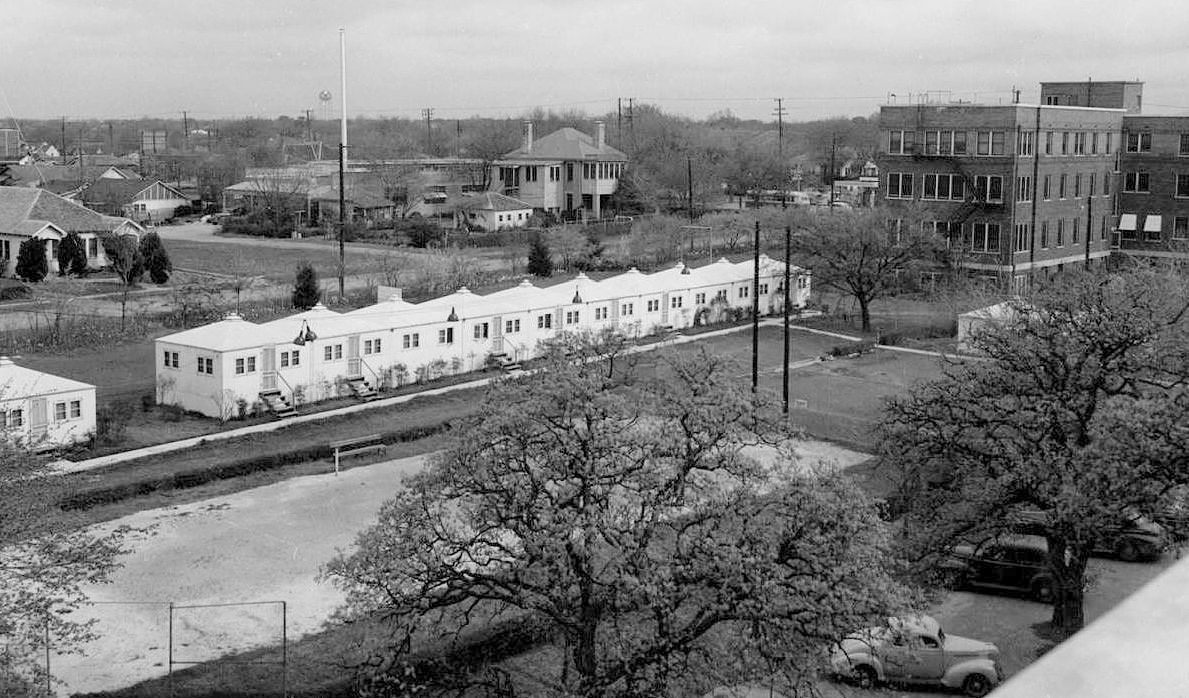
Above are a row of “Victory Huts,” behind the old Parkland Hospital at Maple & Oak Lawn, circa 1945. The description of the photo from the UTSW Library:

“Victory Huts” were prefabricated buildings developed during World War II as a method of providing quick housing for soldiers. The white “Victory Huts” behind the Parkland Nurses’ Home are believed to have been used first as housing for recovering servicemen during World War II, then after the war as housing for nursing students.

Victory Huts were the brainchild of builder H. F. Pettigrew and wealthy Dallas businessman Winfield Morten. Read about the beginnings of their wildly popular prefab buildings here.

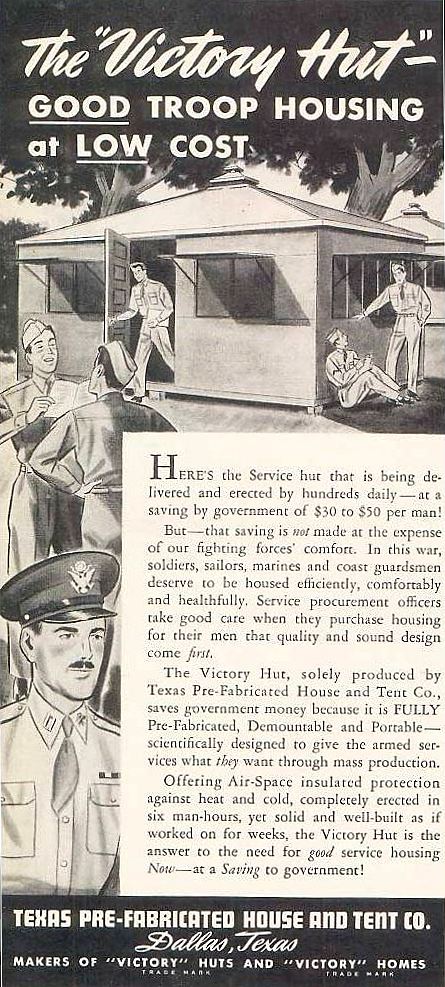
Below, an ad from the Dallas company that manufactured them, Texas Pre-Fabricated House and Tent Co.:

victory-huts_texas-historical-commission_flickr

And, after the war, just add some curtains, a few plants, and a white picket fence.

texas-pre-fabricated-housing-co_southwestern-medical-college_1944-yrbk-ad

***

Sources & Notes

Top photo and quote are from the Parkland Hospital Collection at the UT Southwestern Library, accessible here.

First advertisement from the Flickr stream of the Texas Historical Commission, here. Second ad from the 1944 Southwestern Medical College yearbook.

Victory Huts were widely used during World War II, as cheap housing for military personnel, military families, and as housing in internment camps. See the huts as they were used for Japanese/enemy alien internment camps in Texas, at Camp Kenedy, at Crystal City, and at Dodd Field/Fort Sam Houston.

*

Copyright © 2014 Paula Bosse. All Rights Reserved.
“Electricity in Every Form” — 1909

ad-sanitarium_moran_1909(Click for larger image)

by Paula Bosse

There was a lot going on in 1909 on the 7th floor of the Wilson Building in the “extensive apartments” occupied by a local “institution” affiliated with the Battle Creek Sanitarium. Individuals could (and apparently did) avail themselves of the following treatments:

Some of the therapeutic measures employed are: Baths of various kinds scientifically administered by trained attendants. Electricity in every form. Every kind of general and special Massage. Mechanical Vibration by the most recent and efficient apparatus. Hydrotherapy (the scientific use of water) in its great variety of application. Electric Light Baths. Physical Culture.

Just let that soak in. Or surge through you. Administering your voltage? Say hello to Dr. F. B. Moran, below.

moran_sanitarium_dmn_102730

Yes, indeed.

***

Sources & Notes

Ad from the 1909 Worley’s city directory.

Photo of Dr. Moran from a 1930 ad so long-winded and dull I couldn’t finish reading it or fit it in here.

See the Battle Creek Sanitarium contraptions in action here.

Click ad for larger image.

*

Copyright © 2014 Paula Bosse. All Rights Reserved.


Girl Doctors? No Way! — 1946

southwestern-med-coll_female_1946Photo from the UT Southwestern Library (click for larger image)

by Paula Bosse

Female medical students were fairly uncommon back in the 1940s, and, as this photo is described in the UT Southwestern archives, they were “so rare that they merited this photo captioned ‘Freshman Girl Students’ in the 1946-47 Southwestern Medical College yearbook, Caduceus.” I love this photo.

***

Photo is from the UT Southwestern Medical Center Library and can be accessed here.

Click photo for larger image.

*

Copyright © 2014 Paula Bosse. All Rights Reserved.

City Hospital, a Pump Station, and the County Jail — 1894

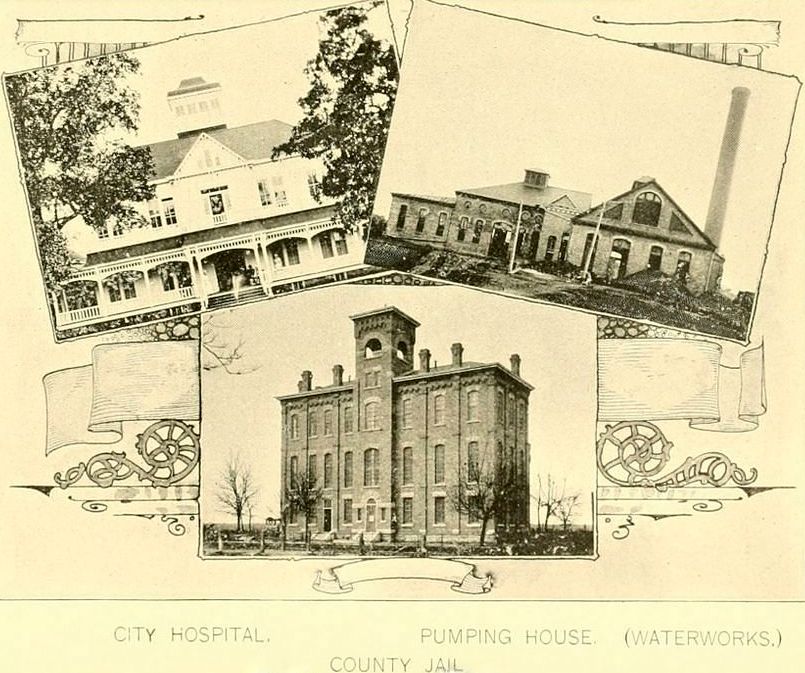
Hospital, pump house, jail (click for larger image)

by Paula Bosse

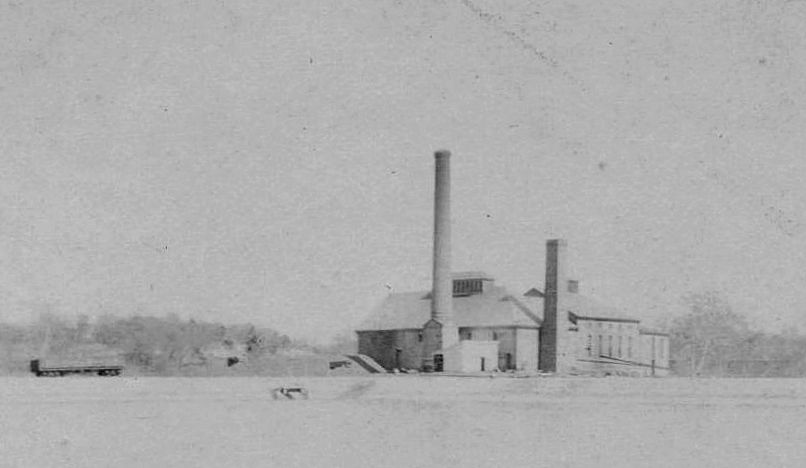
From 1894, an odd grouping of buildings: the City Hospital, a Dallas Waterworks Pumping House, and the Dallas County Jail. From a distance of 120 years, they’re all rather pleasant-looking, a word that would never be used to describe their 21st-century institutional counterparts. I wondered how many of the buildings had made it to the 20th century. Happily, they all did.

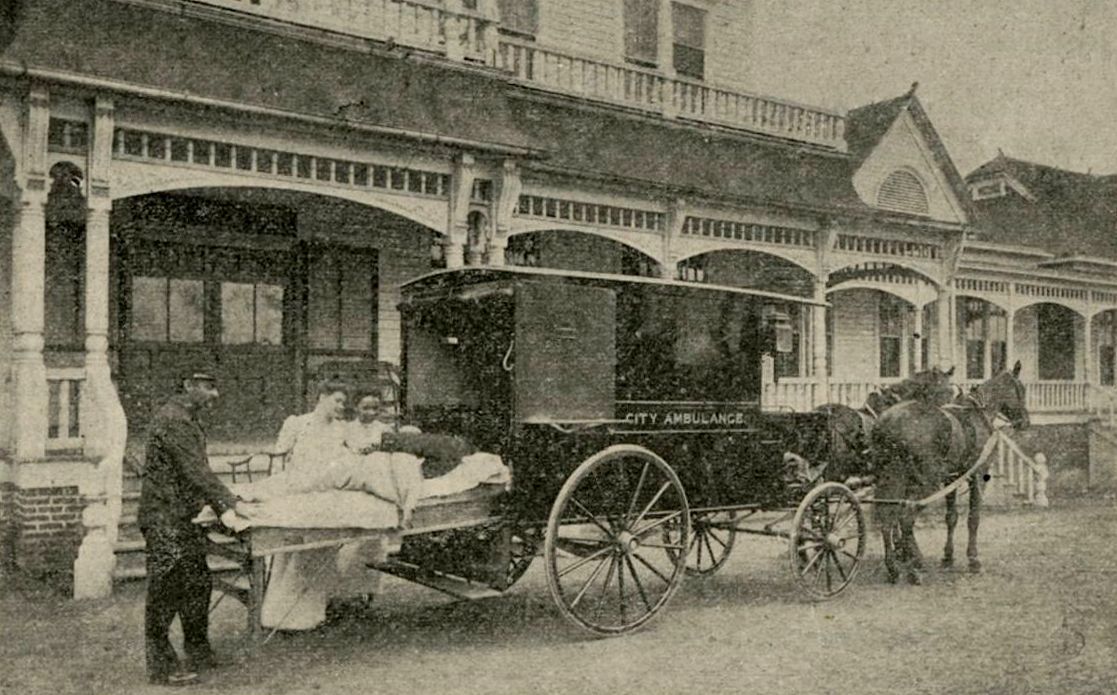
City Hospital opened in May of 1894 at Maple and Oak Lawn (it later became known as Parkland Hospital, the name coming from the 17 acres of land it occupied that had originally been planned as a city park). Here it is in about 1903, as a patient arrives in a horse-drawn ambulance. This wooden building was replaced in 1913 by the brick building that — yay! — still stands (in amongst its recent expansion and expansion and expansion by real estate mogul Crow the younger).

I looked all over for a later photograph of the “pumping station” but was unable to find a definite photo. I knew that it was built after the original pump house at Browder’s/Browder Springs in City Park and before the one now housing the Sammons Center for the Arts and the one at White Rock Lake. I think it might be this one, the Turtle Creek station, shown above during the devastating 1908 flood. If this is the same pump station, it looks as if there was quite a bit of expansion to this structure, too.

Dallas Morning News, Feb. 4, 1914

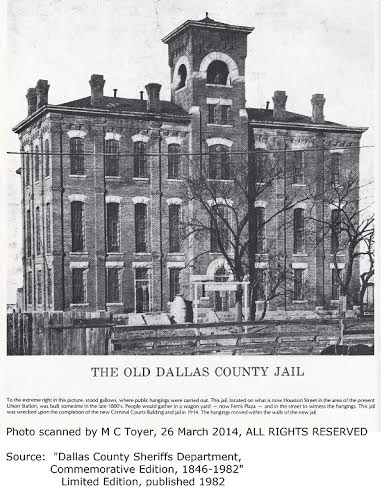
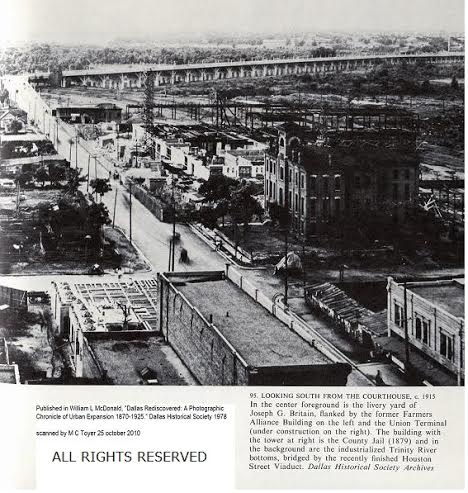
The building that changed the most from the pristine structure in the original 1894 photo was the Dallas County Jail, which was located at Houston and Jackson streets. Built in 1881, it was 13 years old in the original photograph. By the time it was 33 years old, it was almost unrecognizable, as can be seen (…sort of) in this photo, even with the horrible resolution. The jail had to keep expanding to keep up with demand and became a hulking mess. In the first decade of the century, reports began to appear in the newspapers of the deplorable conditions of the old jail and demands were made to improve conditions for prisoners. A new jail was built and the old one was auctioned off to the the Union Terminal Company which demolished the building in 1916, as the finishing touches were put on its Union Station, mere steps away from the former jail.

DMN, May 23, 1916

UPDATE: Thanks to reader M.C. Toyer, I have a couple of really great photos of the Old County Jail!

I’m not sure of the date of the one above, but the one below (such a great photo!) is dated 1915, the year the Old County Jail was finally emptied of its inmates, and a year before it was demolished.

Thanks for the great photos, MC!

***

Original photograph of the three buildings is by Clifton Church and appeared in his wonderful book Dallas, Texas Through a Camera (Dallas, 1894).

The photo of the ambulance in front of City Hospital is from the UT Southwestern Archives, with another photo of the same period here. A collection of newspaper articles on the hospital’s early history is here. An article on the City Hospital that pre-dated this one, with some harrowing descriptions of medical care in Dallas in 1875 is here.

The flooded Turtle Creek pump station is from the Dallas Municipal Archives. Other photos of this station can be seen here.

Bottom two photos of the Old County Jail sources are as captioned.

For more photos on the Dallas Waterworks/Turtle Creek Pump Station/Water Filtration Plant, see a later post of mine, here.

Click photos to enlarge.

*

Copyright © 2014 Paula Bosse. All Rights Reserved.

Atkins’ Rattlesnake Oil — Beware of Fraudulent Imitations!

by Paula Bosse

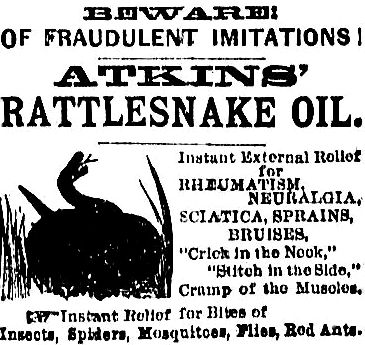
“From the Aboriginal Indians of this country — the early trappers — and pioneers learned that Rattle Snake Oil was the best remedy for rheumatism, pains, sprains, bruises, etc. Every cabin had its bottle hanging ready, from the rafters. The day will come when every house will have it again.”

That little tidbit appeared under the heading “Folk-Lore” in the October 9, 1888 issue of the Dallas-based Southern Mercury newspaper. As there was no company name or product attached, it appeared to be a mere space-filling “factoid” rather than an advertisement. Conveniently, though, it was just a hop, skip, and a jump across three ink-smeared pages from a large ad for Atkins’ Rattlesnake Oil, an ad that warned the reader to “Beware of Fraudulent Imitations!” before it launched into a long list of testimonials from the once-weak and infirm. The ad ended with “Geo. T. Atkins, Dallas, Texas — For Sale by All Druggists.”

Southern Mercury, Oct. 9, 1888 (detail)

*

George T. Atkins was born in New York in 1837. Educated and having the bearing of a “trained businessman,” he drifted south and for some reason decided to join the Confederate army.

He was described by a fellow brigade member as a dark and handsome “compactly built” snappy dresser who “talked in a louder tone than the others, and [had] a peculiarly non-chalant, devil-may-care manner [that] emphasized his presence.” Atkins became a captain and quartermaster in the Fourth Kentucky Cavalry and though his position did not require participation on the battlefield, he was painted as something of a hot-dogging thrill-seeker: “[T]he gallant captain was frequently found in the ‘thickest of the fray,’ notably in the desperate battle at Saltville, where he recklessly and conspicuously rode up and down the lines, seeming determined to get himself killed.”

After the war, he eventually made his way to Texas with his family, arriving in Dallas in 1876 and settling into a large house at Ross Avenue and Masten Street (now St. Paul). At some point he opened a drugstore on Elm which seems to have been quite a successful enterprise. Perhaps it was his close proximity to drugs and medicinal compounds that prompted Atkins to launch his lengthy (and presumably lucrative) side-business as a snake oil manufacturer and salesman.

As far as I can tell, his “rattle snake oil” ads started around 1888. “Snake oil” has become a synonym for fraudulent wares sold by hucksters who know their products are ineffective but figure they can make a quick buck by grossly exaggerating — if not outright lying about — the magically curative properties of whatever it is they’re selling. As an actual “druggist,” Atkins probably had at least a little credibility compared to the other latter-day medicine-show men flogging their tonics and elixirs out of the back of a wagon before the law ran them out of town.

Southern Mercury, 1890 (det)

In fact, Atkins was, himself, such an expert flogger that his claim in ads that the United States Patent Office had officially ruled that his rattlesnake oil was “The Only True and Genuine Rattlesnake Oil” is automatically suspect, even though the editors of the Dallas Morning News (who, by the way, were no stranger to the popular and socially prominent Atkins, a man with, let’s not forget, a hefty newspaper advertising budget) published in its pages the following blurb (probably supplied by “the plaintiff”):

Dallas Morning News, Dec. 12, 1888

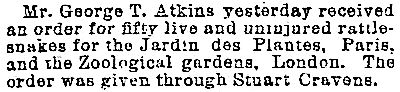
 1888 was a good year, and Atkins was riding a snake-oil wave of good publicity. There were even reports in the local papers that Dallas’ favorite herpetologically-inclined drugstore owner was hustling “live and uninjured rattlesnakes” to interested parties in Paris and London. I don’t know … maybe…. Probably just some more creative publicity.

DMN, June 3, 1888

Atkins continued to run his drugstore and sell his snake oil until 1892 when, out-of-the-blue, he was assigned to dig the Texas Trunk Railroad out of receivership. The appointment seemed a little odd, but Atkins was a savvy businessman and a charming and persuasive speaker (he occasionally spoke in front of the Dallas City Council in a manner described as “felicitous and lucid”) — he could easily have back-slapped his way into the job. Despite the fact that he had no background in the railroad business, he seems to have spent several fairly productive years in the position. (His son, by the way, legitimately worked his way up through the ranks of the M-K-T, from lowly freight clerk to powerful executive VP.)

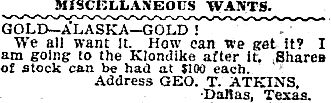
Eventually the railroad job ended and, in the waning years of the nineteenth century, Atkins seemed to be flailing a bit — he set the snake oil aside for a moment and placed an ad in the DMN classifieds soliciting investors to stake a claim in a Klondike gold scheme — at a mere $100 a share!

DMN, Aug. 8, 1897

 He continued in the rattlesnake oil biz until at least 1907, but at some point that began to fade away (or his inventory finally ran out), and he and his wife began running a boarding house. By 1918, though, he was tired of being a landlord and, at the age of 80, Atkins was finally ready to retire.

DMN, Oct. 20, 1918

The large 12-room house at Ross and Masten sold after spending a lengthy time on the market, and Atkins and his wife moved to Lemmon Avenue, where, ultimately, he died on August 8, 1920.

DMN, Aug. 9, 1920

 George T. Atkins placed COUNTLESS snake oil ads in newspapers for something like twenty years. Each ad had his name on it. Boldly. Proudly. And there’s nary a mention of the famous Atkins’ Rattle Snake Oil in his obit! That’s a shame, because, to me, that’s the single most interesting thing about the man. He was a career snake oil salesman! He was also one of Dallas’ very first advertising empresarios — an entrepreneur who had a natural flair for the creative hard-sell and knew how to wield it.

“TAKE NO SUBSTITUTE!”

*

Southern Mercury, Dec. 20, 1900 (click to enlarge)

***

Quotes about Atkins’ time in the Confederate army from Kentucky Cavaliers in Dixie, Reminiscences of a Confederate Cavalryman by George Dallas Mosgrove (Madison: University of Wisconsin Press/Bison Books, 1999 — originally published in 1895); pp. 116-117.

Atkins’ physical examination of his snake oil, published in Chemist and Druggist (1890) can be seen here.

More on the Texas Trunk Railroad here.

*

Copyright © 2014 Paula Bosse. All Rights Reserved.

Hagey Infirmary, No Patient Too Frail — 1894

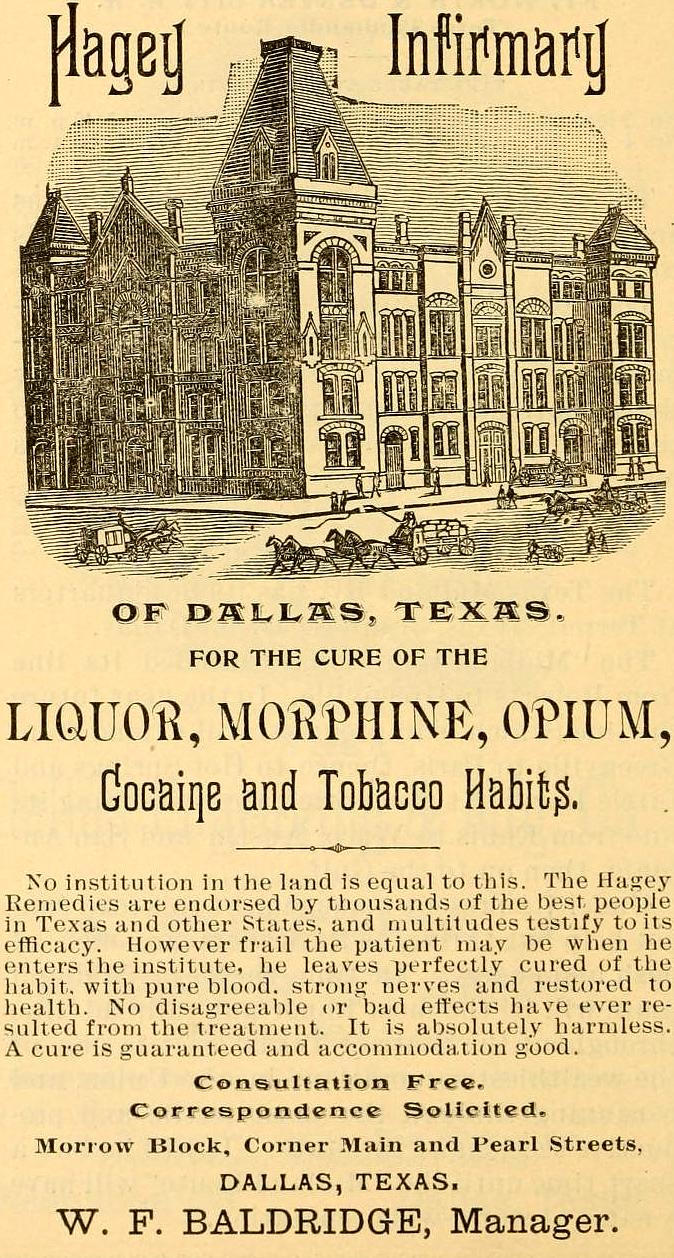
“A cure is guaranteed…” (click for larger image)

by Paula Bosse

Hagey Infirmary
of Dallas, Texas.

For the cure of the

LIQUOR, MORPHINE, OPIUM,
Cocaine and Tobacco Habits.

No institution in the land is equal to this. The Hagey Remedies are endorsed by thousands of the best people in Texas and other States, and multitudes testify to its efficacy. However frail the patient may be when he enters the institute, he leaves perfectly cured of the habit, with pure blood, strong nerves and restored to health. No disagreeable or bad effects have ever resulted from the treatment. It is absolutely harmless. A cure is guaranteed and accommodation good.

Consultation Free.

Correspondence Solicited.

Morrow Block, Corner Main and Pearl Streets,
Dallas, Texas.
W. F. BALDRIDGE, Manager.

***

From the Souvenir Guide of Dallas (Dallas: D. M. Anderson Directory Co., 1894).

The Hagey Infirmary was at 516 Main (now the 2100 block of Main, at Pearl), from about 1893 to 1894 (possibly 1895).

*

Copyright © 2014 Paula Bosse. All Rights Reserved.