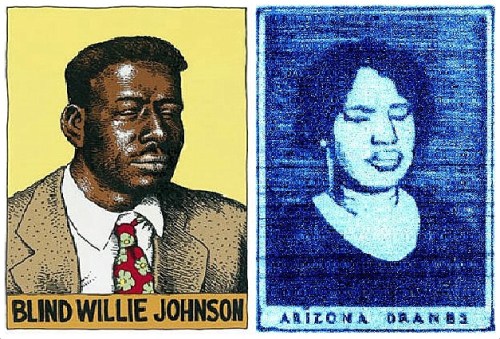
Today a little Sunday-go-to-meetin’ music, courtesy of two powerful singers who recorded at about the same time — late 1920s — and who both spent time in Dallas. Blind Willie Johnson was from Marlin, Texas, but he recorded much of his music in Dallas and regularly played street corners in Deep Ellum. Arizona Dranes, also a native Texan, lived in Dallas for several years and was, like Johnson, blind. Listening to both of them, you can hear their influence in the gospel and blues music that came after them. Read about the short life and career of Blind Willie Johnson here. Read about the life and career of Arizona Dranes from Michael Corcoran, here and here. And listen to their music below. It’s fantastic. (All of the tracks by Johnson were recorded in Dallas.)
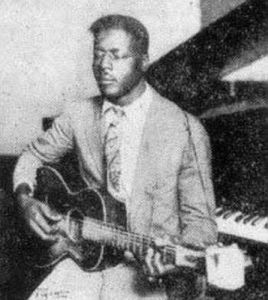
Blind Willie Johnson, 1927-ish?
That guitar!
*
*
Here he is with his wife singing behind him.
*
Johnson’s song “Dark Was the Night, Cold Was the Ground” was included on the Voyager Gold Record, a collection of music chosen to represent Earth’s culture and diversity, carried into space aboard the Voyager.
*
*
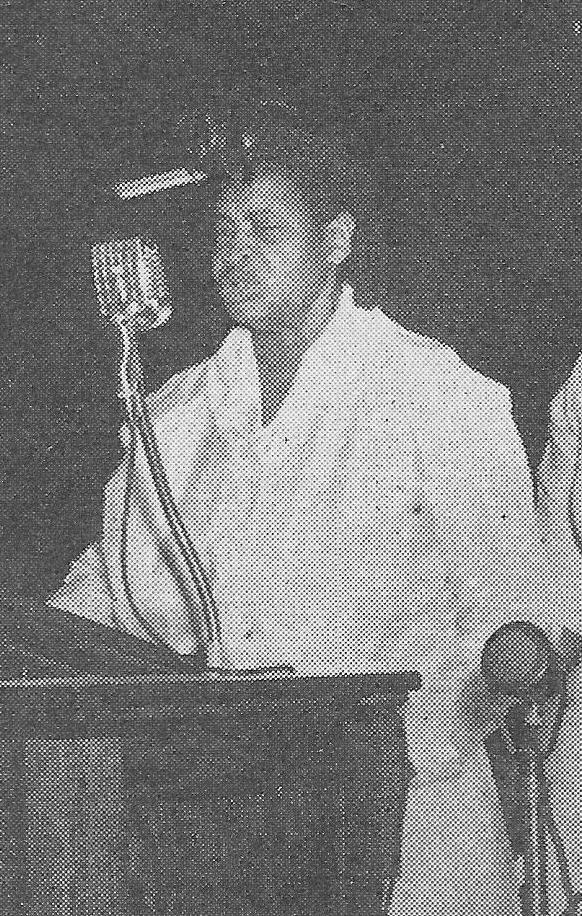
Arizona Dranes in 1953
That voice!
*
The song below starts off deceptively “plinky” but picks up considerably when Arizona starts to sing.
*
Want to know more about Arizona Dranes? Michael Corcoran can tell you what you need to know.
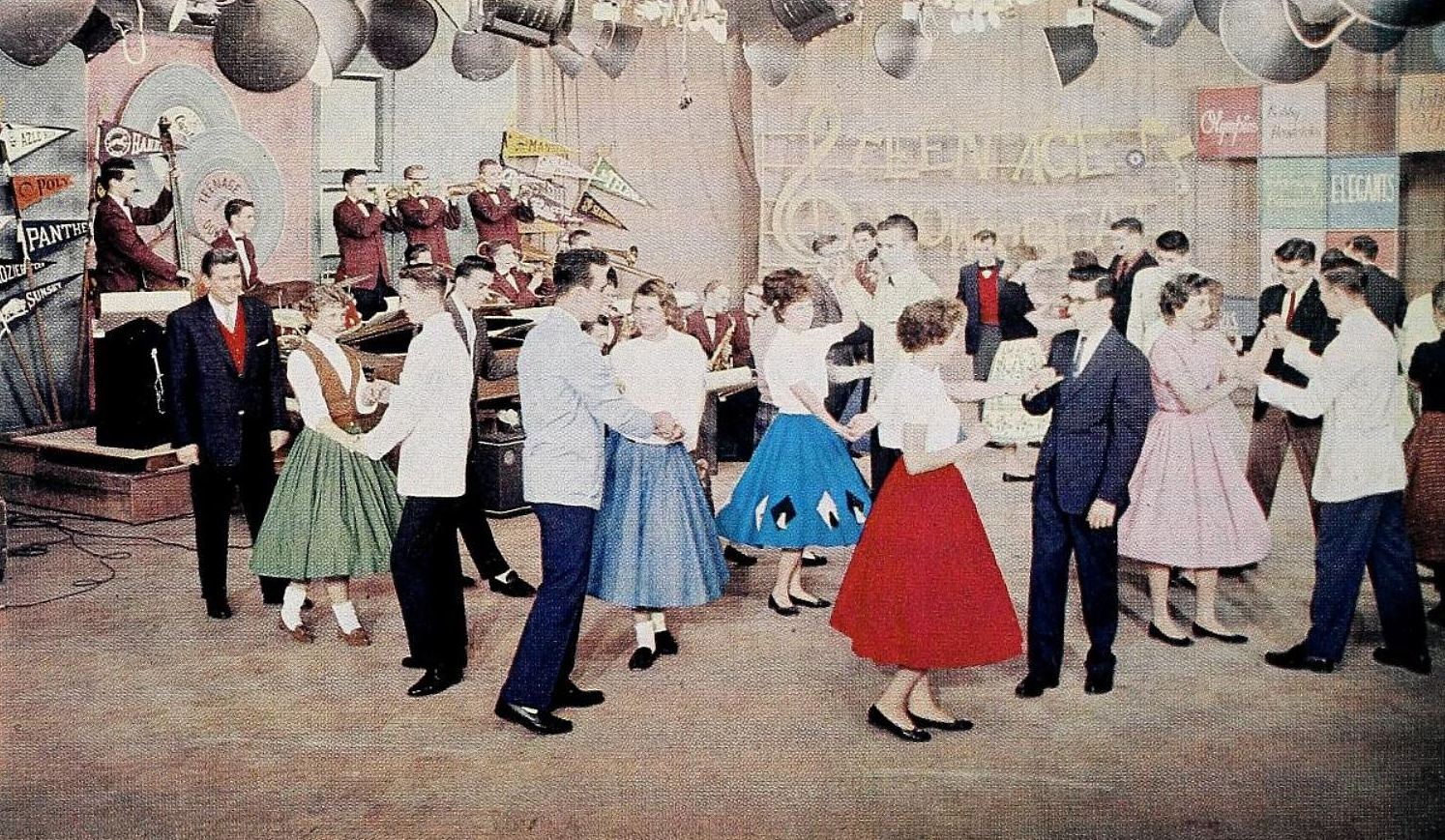
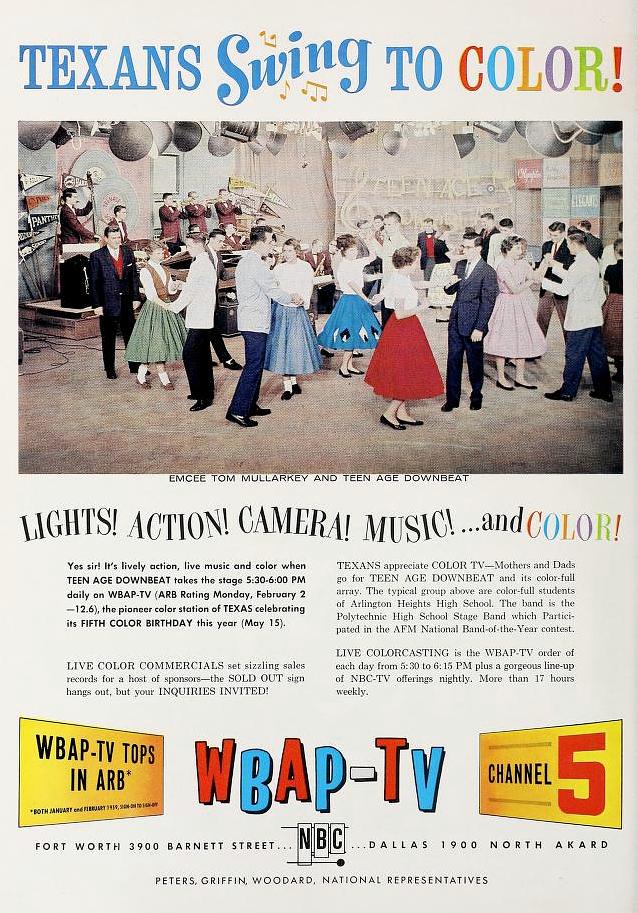
WBAP’s “Teen-Age Downbeat,” 1959 (click for larger image)
by Paula Bosse
“Teen-Age Downbeat” — Fort Worth’s answer to “American Bandstand” — debuted on WBAP-TV in January, 1958 — in COLOR. It featured teens from the Dallas-Fort Worth area (…or maybe I should say from the Fort Worth-Dallas area…) who would play and dance to their favorite records. The host was WBAP broadcaster Tom Mullarkey (seen above at the left, wearing the red vest). The show was quite popular and lasted as best I can tell, from January, 1958 until July, 1961 (the last mention in The Fort Worth Star-Telegram was July 1, 1961). I’m guessing those kids danced to a lot of Fabian.
FWST, Jan. 5, 1958
“Sponsor” trade magazine, Aug. 8, 1960
North Texas State College’s Lab Band with director Gene Hall
FWST, Feb. 26, 1961
“Broadcasting” trade magazine, May 18, 1959
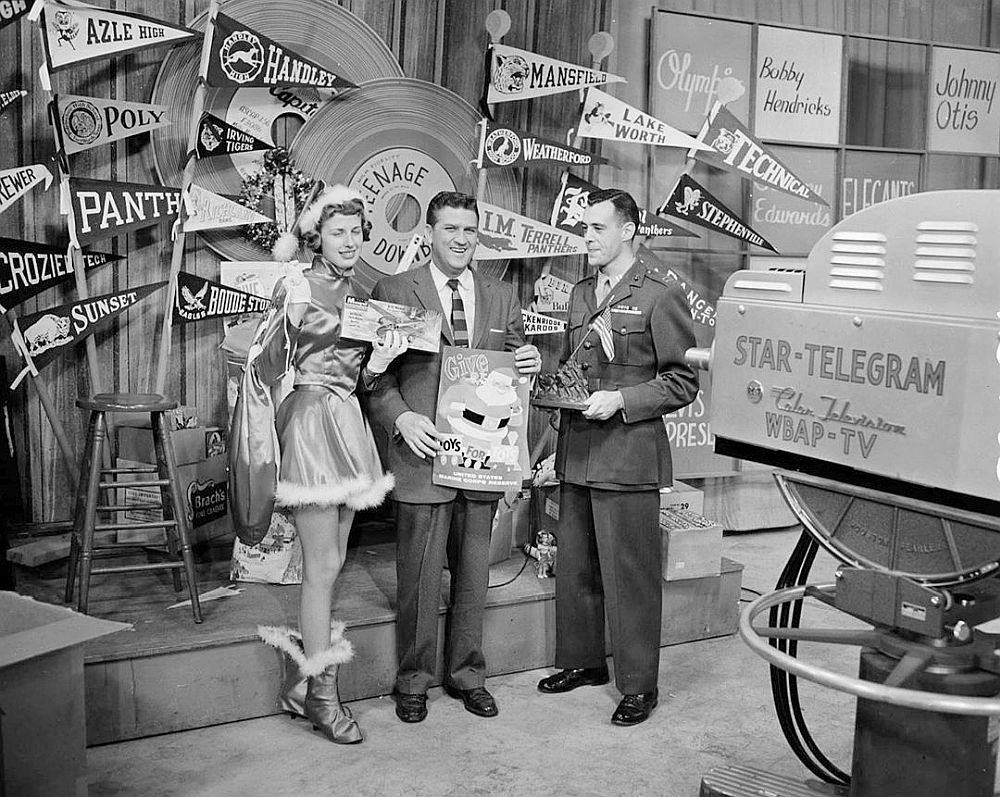
“Toys For Tots” campaign, Christmas 1958
***
Sources & Notes
The color photo (which appeared in a full-page WBAP ad in the trade magazine Broadcasting) shows non-teen Tom Mullarkey watching over the dancers from Arlington Heights High School, as the Polytechnic High School Stage Band plays some happenin’ tunes. (I do see two Dallas high school pennants in the photo: Crozier Tech and Sunset.)
The photo showing director Gene Hall with the North Texas State College (now the University of North Texas) Laboratory Band was found at UNT’s Portal to Texas History site, here. The photo is not dated, but a blurb in The Fort Worth Star-Telegram mentioned that Hall and the band were to appear on “Teen-Age Downbeat” on Feb. 5, 1959.
Photo of the “Toys For Tots” campaign, featuring a sexy Santa’s helper, Tom Mularkey, and a Marine Corps (Reserve?) officer was found on the Instagram feed of @fortworthhistorical.
In the 1890s, Dallas had a big cocaine problem. And a big morphine problem. And a big opium problem. In fact, the whole country did. Before the over-the-counter dispensing of these drugs was made illegal, they were easily obtained in any drugstore. Cocaine was especially cheap: a nickel or a dime (the equivalent of about two bucks in today’s money) could get you plenty. Things seem to have hit the breaking point in Dallas in 1892, with scads of lurid cautionary tales about crazed and doomed hopheads filling the papers, but the problem had been building for a while.
With this sudden surge in readily available opiates came a surge in institutions attempting to help the addicted kick their habit. Between 1893 and 1895 or 1896, there were three such places one could go to “take the cure” in Dallas: the Dallas Ensor Institute (which was located at what is now 1213 Elm Street, between Griffin and Field, where Renaissance Tower now stands), the Hagey Infirmary (in what is now the 2100 block of Main, just east of Pearl), and, most famously, the Keeley Institute (which for many years was on Hughes Circle in The Cedars, just south of Belleview, between S. Akard and S. Ervay). The first two were gone after only a couple of years, but the Dallas branch of the then-famous Keeley Institutelasted in Dallas at a few different locations until at least 1936.
*
The text of the 1894 Dallas Ensor Institute ad above:
No Gold – No Mineral The Dallas Ensor Institute For the Cure of Liquor, Morphine, Cocaine and Tobacco Habits No. 287 Elm Street, Opened in the City of Dallas on the 1st day of July, 1893, and has successfully cured Two Hundred and Sixty-Three people all told, who are to-day sober men with the exception of three. We Guarantee a Cure in every case, to the entire satisfaction of the patient, or it COSTS HIM NOTHING REMEMBER, NO CURE, NO PAY. Consultation Free and Correspondence Solicited. Address Lock Box 367. C. B. BEARD, Manager Call and see us
*
The more widely known Keeley Institute opened in Dallas around 1895 (click ad for larger image).
Dallas Morning News, Oct. 31, 1895
The text is worth a read of its own:
It’s interesting that the Keeley ad and the Ensor ad both admit to being less than perfect in their success rate — to the tune of “three.” I wonder if they were the same three people?
1899
*
Even though the addiction rate was getting to be something of an epidemic — especially, it seems, among women — pharmacists were split on whether the city council should ban sales of these drugs except when ordered by a doctor. While all of them saw first-hand the hopeless addicts who came in every day proffering scrounged dimes, many were loath to lose the steady business — they were making a pretty good living. It wasn’t until about 1901 that the city council outlawed the sale of narcotics unless accompanied by a prescription; the State of Texas enacted a similar law four years later. Not that that stopped people from continuing to “hit the pipe” (a phrase I was surprised to see had been around in 1910), but it probably did save many lives in the days when addiction was not very well understood and was not very effectively treated.
***
Sources & Notes
Dallas Ensor Institute ad from the Souvenir Guide of Dallas (Dallas: D. M. Anderson Directory Co., 1894).
Interested in more on a druggy Dallas?
See an ad for the Hagey Infirmary in my post “Hagey Infirmary, No Patient Too Frail — 1894,” here.
See my post “‘Delusions of Affability’ — Marijuana in 1930s Dallas,” here.
And, heck, see my other cocaine-related post, “New Year, New Teeth — 1877” — about a dentist who might have been dipping into his own medicine chest a little too frequently — here.
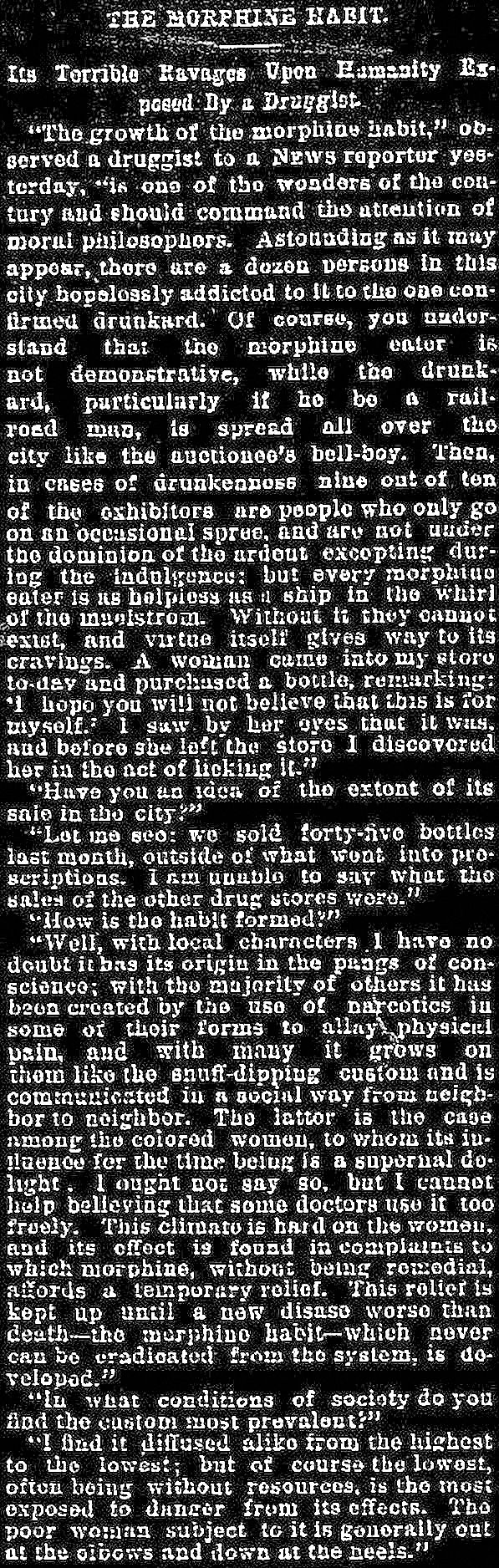
See the Dallas Morning News article “When Dope Sold Like Aspirin,” by Kenneth Foree (DMN, Sept. 5, 1951) for a really interesting look at Dallas during its first wave of drug problems. Imagine, if you will, the sight of a woman so in need of a fix that, despite having vehemently assured the druggist only moments earlier that the “medicine” she was purchasing was not for her, she began to lick the bottle before she even left the store. Cocaine is a hell of a drug….
A Dallas Morning News article which was cited by Kenneth Foree in the above article was this one, from 1887 (click to see a larger image):
DMN, Sept. 5, 1887
The song referenced in the Foree article mentioned above is “Take a Whiff on Me,” which Lead Belly — who played around Deep Ellum in the ‘teens and ’20s — recorded in the 1930s. One of the verses of the song sometimes called “Cocaine Habit Blues” has a Dallas shout-out: “Walked up Ellum and I come down Main / Tryin’ to bum a nickle just to buy cocaine / It’s oh, oh, baby take a whiff on me.” Hear his version of the song (and read the lyrics) here (the “Ellum” line is at the 1:29 mark).
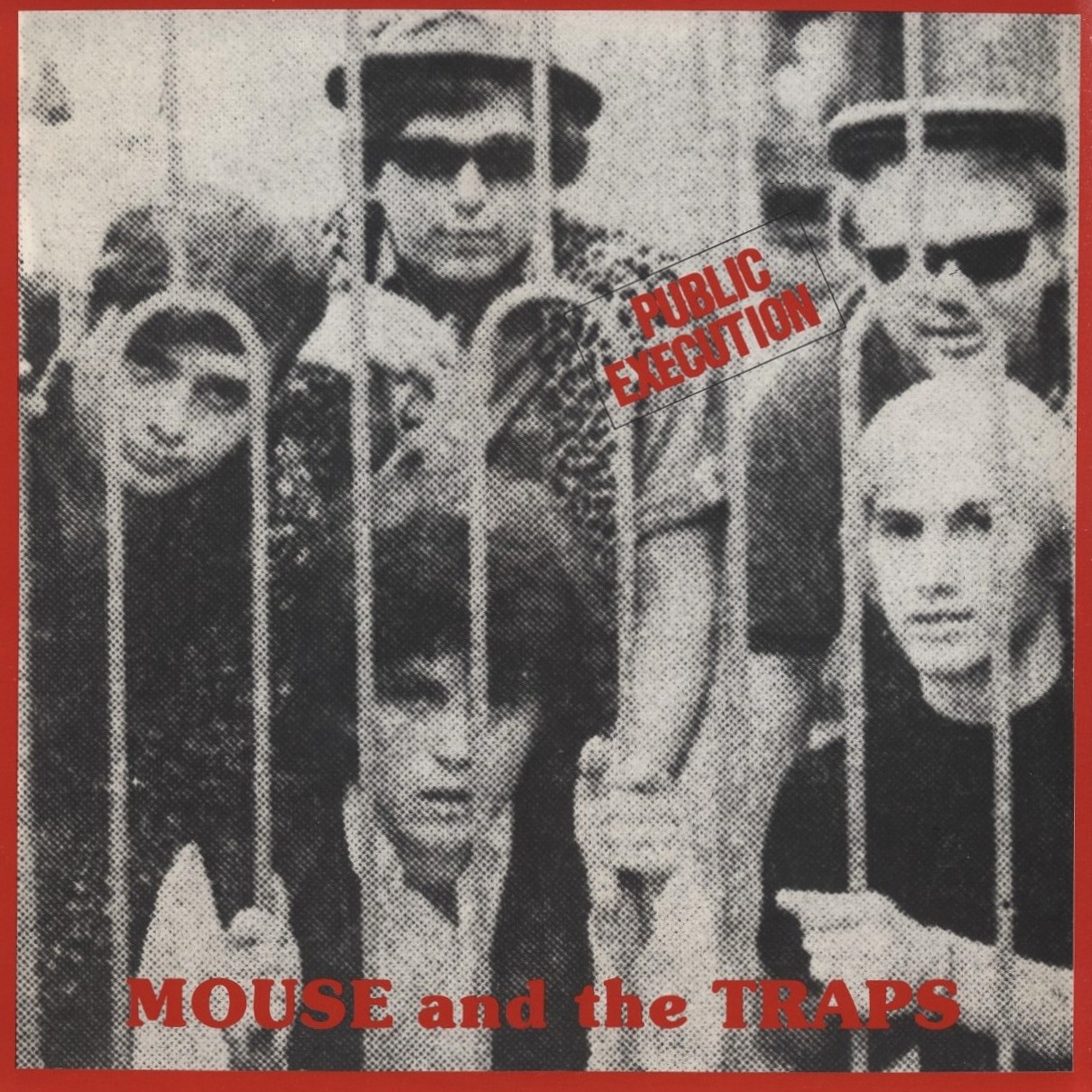
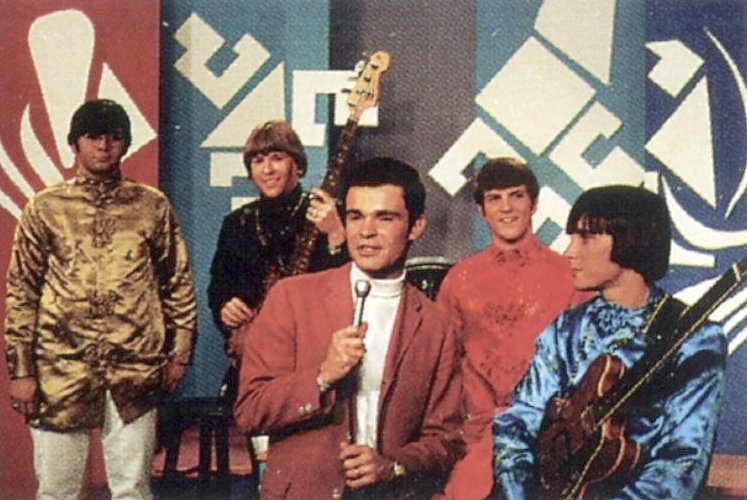
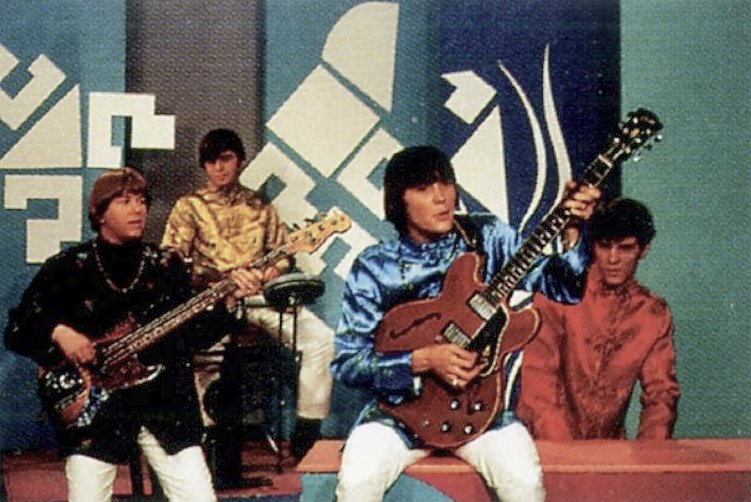
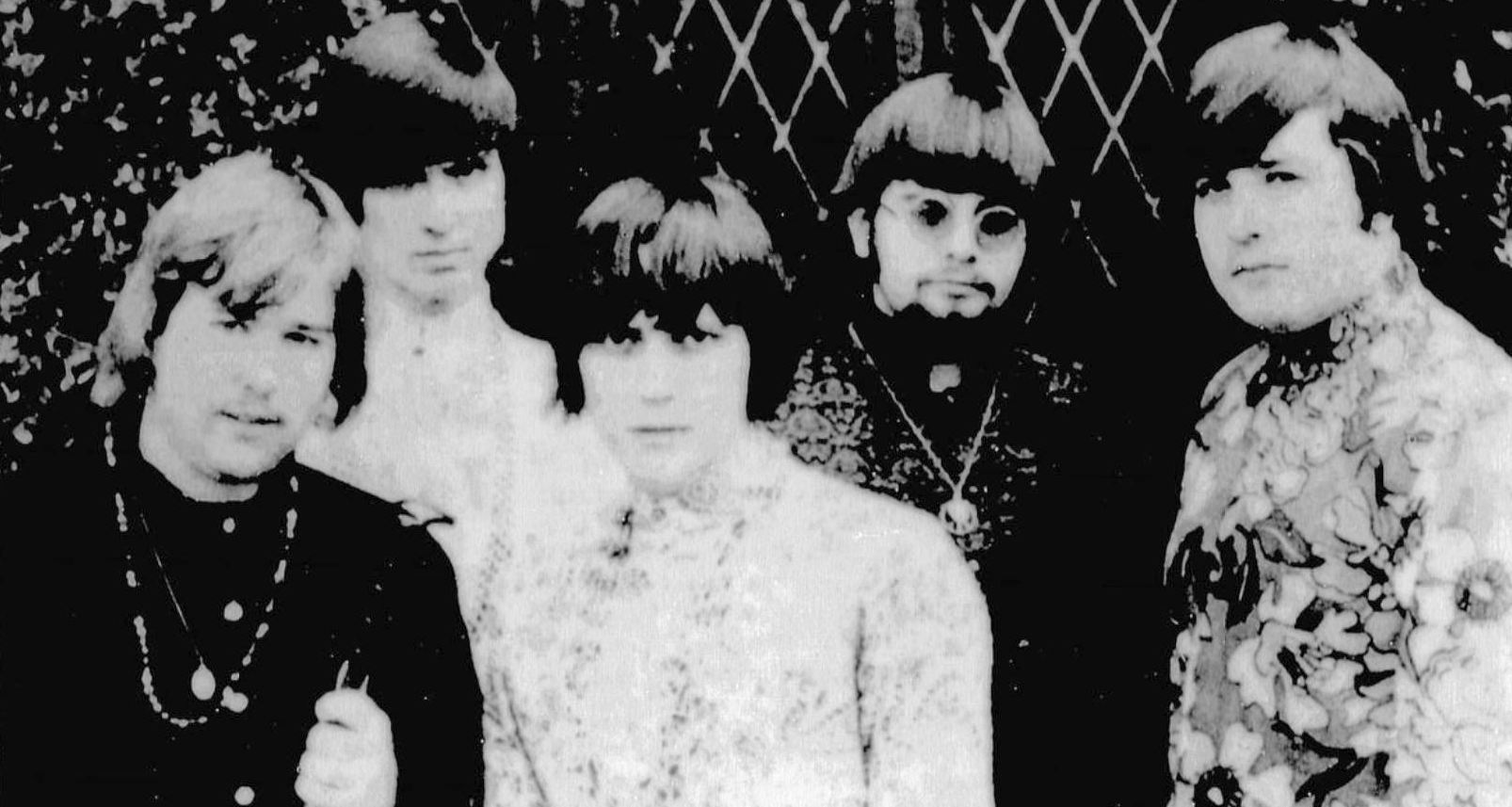
Mouse in the center, Bugs top right (click for even larger image)
by Paula Bosse
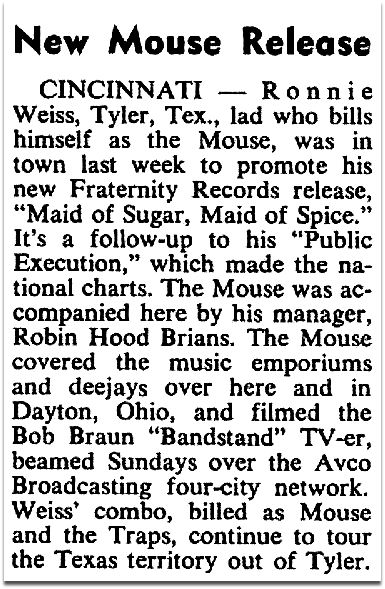
Last Tuesday, my friend Carlos Guajardo and I were each asked to present a favorite vinyl album at the Tuesday Night Record Club, a monthly event organized by Brian McKay and held at the historic Texas Theatre. My choice was a French import called Public Execution by Mouse and the Traps, a collection of the Texas band’s singles issued during their fairly short career (roughly 1965 to 1970). I bought this at a time when all of my disposable income was going to alternative record stores Metamorphosis and VVV, and I feel fairly certain that I bought this album at Metamorphosis. ’60s garage rock may be my favorite genre of music, and Texas garage rock is, for whatever reason, usually the best.
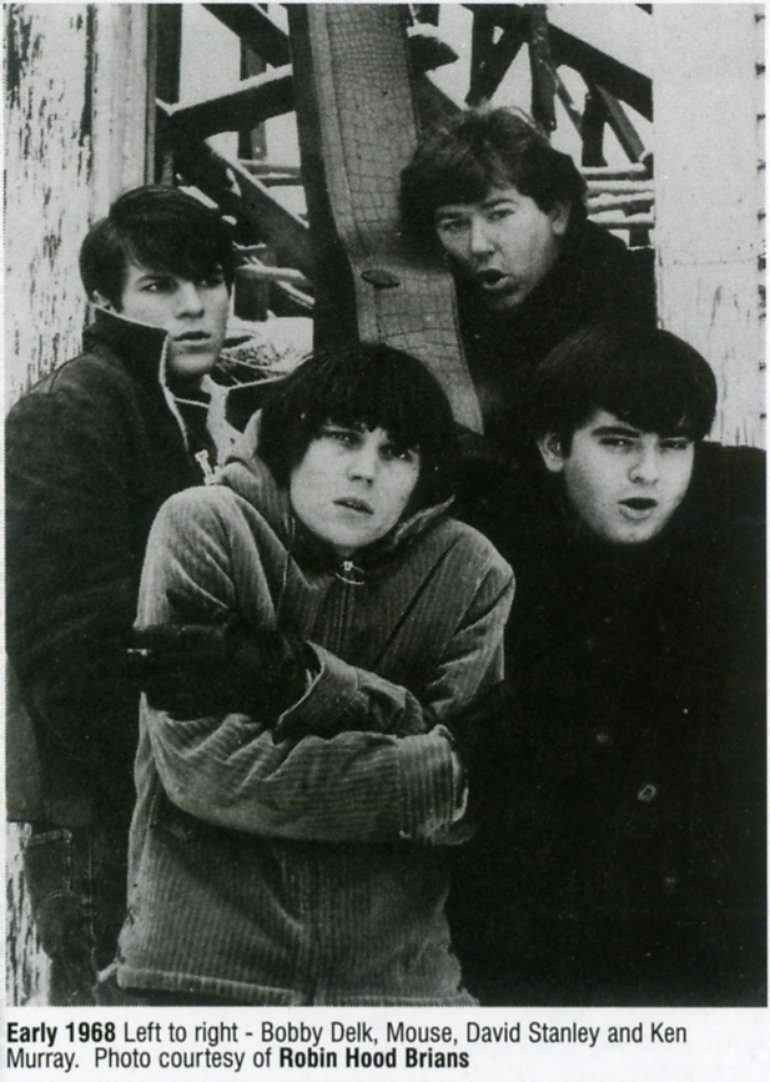
Mouse and the Traps was a band formed in Tyler, Texas in 1965, with Ronnie Weiss (whose nickname was “Mouse”) on vocals and guitar, Bugs Henderson on lead guitar, David Stanley on bass, Ken “Nardo” Murray on drums, and Jerry Howell on keyboards. Even though most of the band members grew up in Tyler and almost all of their singles were recorded there (recordings produced by the great Robin Hood Brians, who was only a couple of years older than the band), the band pretty much moved to Dallas when they began to get a lot of airplay on local stations, notably KLIF. I actually always thought they were a Dallas band, and, damn it, I’m still considering them a Dallas band.
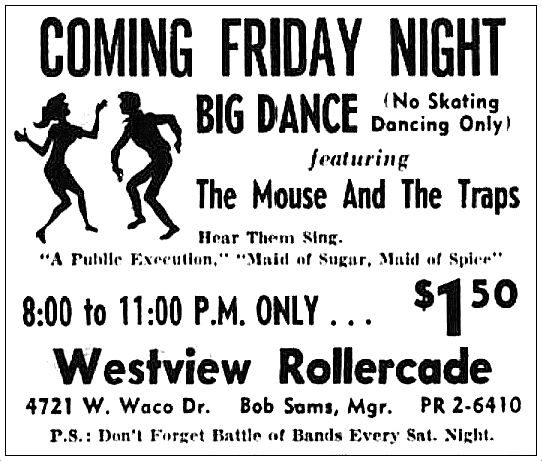
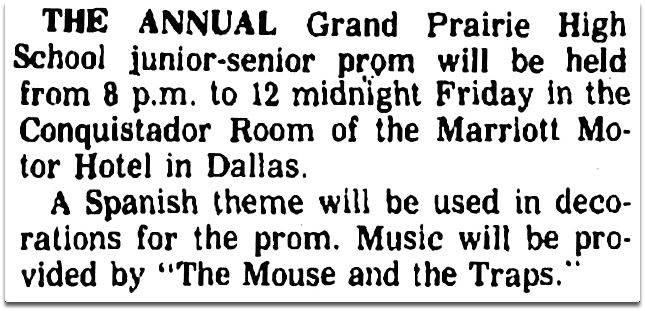
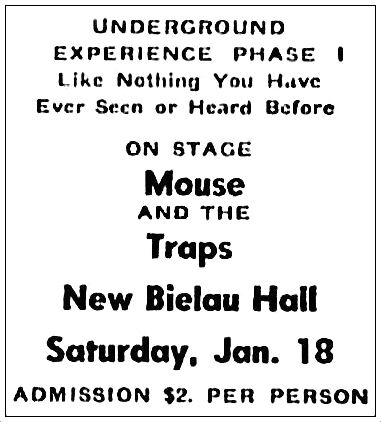
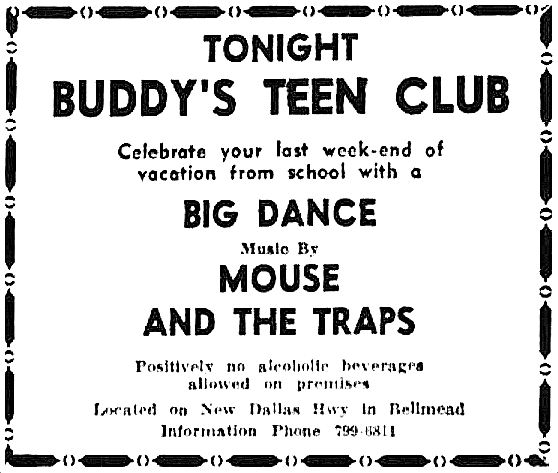
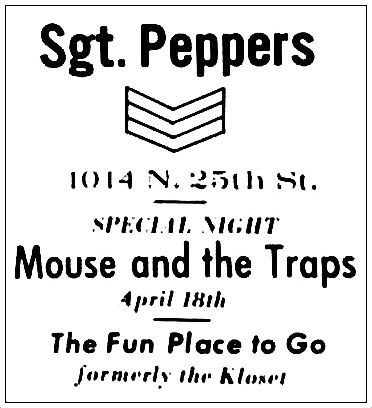
Mouse and the Traps toured around the state feverishly, playing clubs, colleges, parties, and even proms. There were occasional forays beyond Texas, but, for the most part, they remained a (very popular) regional band. Their first single — the unapologetically Dylan-esque “A Public Execution,” was released at the end of 1965 on the Fraternity label; it was their only record to show up on the Billboard charts, as a “bubbling under” track, not quite reaching the Top 100. After a couple of years, Bugs Henderson (who later became “guitar legend Bugs Henderson”) left the band and was replaced by Bobby Delk. Their personnel history is a little fuzzy, but I think Bugs re-joined the band briefly before the group finally disbanded sometime in 1970, after releasing a series of well-regarded singles and after almost five years of endless live dates. For most bands that had found little commercial success, that would have been the last most people would have heard of them. But most bands weren’t “Nugget” bands.
In 1972, Lenny Kaye included Mouse and the Traps on his revered (and influential) “Nuggets” compilation, propelling the band from “slowly-fading memory” to “newly-appreciated cult band” and introducing them to a whole new international audience. The band is now regarded as “proto-punk” and an important Texas garage band.
Their garage recordings are probably the most admired, but they dabbled in every ’60s style imaginable, including psychedelia, folk rock, breezy pop, and West Coast country, with hints of Dylan, The Beatles, The Yardbirds, Them, Donovan, and the Sir Douglas Quintet. There’s even a “Get Smart”-inspired novelty song in there. My favorite song of theirs, “Maid of Sugar, Maid of Spice,” is generally considered their finest single, assuring them a place in the pantheon of great garage songs. The stinging, electrifying guitar of Bugs Henderson is fantastic.
The band re-formed for several reunion shows over the years, but, sadly, Bugs Henderson died in 2012. No more reunion shows featuring the original line-up.
As far as the Dallas connection during the height of their career, there is precious little I’ve been able to find, as far as contemporary local photos, ads, or newspaper mentions. Despite the cultural revolution which began with the explosive arrival of the Beatles to the U.S. in 1964, “teenage” music in the ’60s was not taken seriously enough at the time to warrant much coverage in the major newspapers.
One of the few mentions of the band I found was as a support act on a Sonny and Cher show at the Fair Park Music Hall in early 1966. Also on the bill: The Outcasts from San Antonio, and Scotty McKay from Dallas (who can be seen performing two pretty good songs in a clip from one of Dallas director Larry Buchanan’s “schlock” movies, “Creature of Destruction,” here).
Feb., 1966
They also appeared on the TV music show “Sump’n Else” “Upbeat” (in 1968, post-Bugs). (Thanks to Jim for pointing out in the comments that these two color photos actually show the band on the Cleveland-based syndicated teen show “Upbeat,” hosted by Don Webster. TV listings show that the band appeared on the show in April, 1968, along with the Boxtops and several other performers.)
Photos: Robin Hood Brians
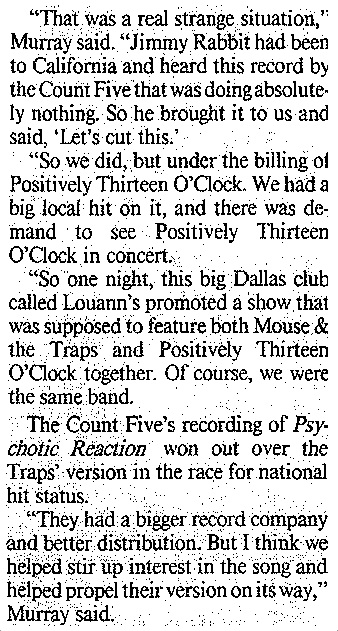
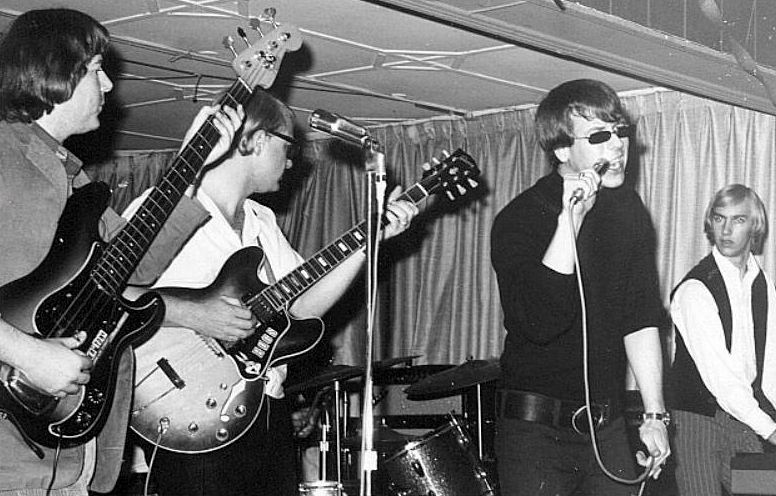
They also played a memorable show at Louanns in 1966 where they appeared on a double-bill as two separate bands. In 1966 Jimmy Rabbit, a popular DJ on KLIF who was a big supporter of the band, asked them to perform as his backing band on a (great!) recording of “Psychotic Reaction” — a very early cover (perhaps the first) of the song by the Count Five. The song was recorded in Tyler by Robin Hood Brians with Rabbit on vocals and was released under the name Positively Thirteen O’clock. Unsurprisingly, with Rabbit being a DJ on the top station in town, it became a huge local hit. Ken “Nardo” Murray talked about it in a 1988 interview (read the full interview here). Click for larger image.
Fort Worth Star-Telegram, May 17, 1988
And here they are at Louanns, with Rabbit at the mic, backed up by Dave Stanley, Bugs Henderson (he has “Bugs” and a picture of Bugs Bunny on his guitar!), and Jerry Howell:
If anyone has any Dallas-related photos or memorabilia of Mouse and the Traps, I’d love to see them! I’d also love to hear from people who saw them perform in the ’60s.
*
Billboard, May 21, 1966
Waco Tribune Herald, Aug. 11, 1966
Grand Prairie Daily News, May 9, 1968
Weimar Mercury, Jan. 16, 1969
North Texas State University newspaper, Feb. 7, 1969
Waco Tribune Herald, Aug. 30, 1969
Waco Citizen, April 13, 1970
***
Sources & Notes
A few Mouse and the Traps tidbits:
The band was originally called “Mouse.” “The Traps” was added when the second single, “Maid of Sugar, Maid of Spice” came out in 1966.
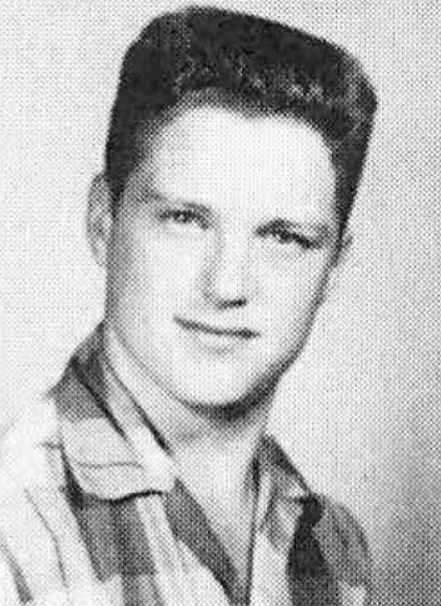
The “Henderson” listed as co-writer with Ronnie Weiss of a few of the early Mouse and the Traps songs (including the first two singles) was not Bugs Henderson (who was born Harry Fisher Henderson but was known as “Buddy” in the pre-“Bugs” days) — it was Knox Henderson, a high school pal from Tyler, seen below from a 1955 John Tyler High School (Tyler, TX) yearbook.
More on the band — including photos and newspaper articles — can be found here. Also included is additional information on Robin Hood Brians who has produced artists as diverse as ZZ Top, the Five Americans, James Brown, David Houston, and John Fred and His Playboy Band (whose “Judy In Disguise” knocked the Beatles out of the #1 spot on the national charts).
The great Merle Haggard died today, on his 79th birthday. My earliest music memories are hearing his songs on the radio. Even people who don’t listen to country music know who Merle Haggard is (and are probably fans).
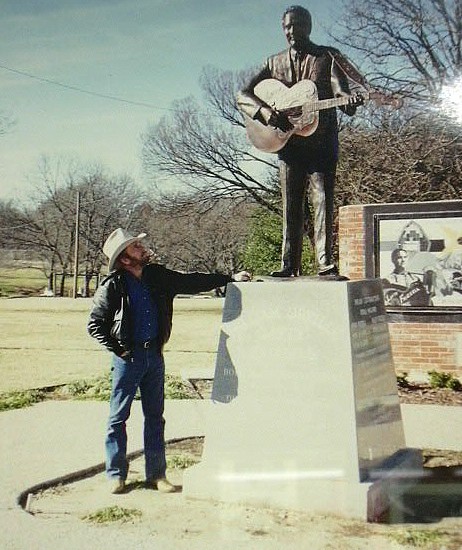
One of his idols was Lefty Frizzell, the Corsicana-born legend whose first hits were recorded in Dallas. Merle helped raise the funds in the late ’80s and early ’90s for the wonderful statue of Lefty which now stands in Jester Park in Corsicana. The picture above shows Merle visiting the statue. (Whenever I’m in Corsicana, I always drop by Jester Park to spend some time with Lefty.)
As far as Merle and Dallas, the earliest mention I could find was from January, 1965. Country music was covered only sporadically in the pages of The Dallas Morning News back then, but his early-’65 stop at the Sportatorium may have been Merle’s first appearance in Dallas — appropriately enough, it was at the Big D Jamboree. “California country music team” Merle and Bonnie Owens were guest performers, along with Billy Grammer and James O’Gwynn of the Grand Ole Opry, and the regular Jamboree cast of thirty, for the Jan. 30, 1965 Saturday-night Big D Jamboree show.
RIP, Merle. Thanks for everything.
***
The top picture is a photo I took of an original photograph which is hanging in the Lefty Frizzell Museum, which is also in Corsicana’s Jester Park (as part of the Pioneer Village).
Merle’s obituary in Variety — which includes entertaining salty quotes from the man himself — is here.
Sonny James, center, with fiddle (photo: SonnyJames.com)
by Paula Bosse
Sonny James — the much-loved Country Music Hall of Fame singer — died yesterday (Feb. 22, 2016). When I was a child, his version of “Runnin’ Bear” was my favorite song, and it was played endlessly throughout the ’70s on Dallas’ classic country stations like KBOX and WBAP. I was surprised to learn a few years ago, that the Alabama-born Sonny James lived in Dallas for several years, and that Dallas was where he was performing regularly when he exploded into the national consciousness with his first #1 hit, “Young Love.”
1952
Before he made his way to Dallas, Sonny James had been making a name for himself as a performer on Shreveport’s Louisiana Hayride. One of his first appearances in Dallas was during his Hayride Days: he was a guest on the Big D Jamboree in the summer of 1952.
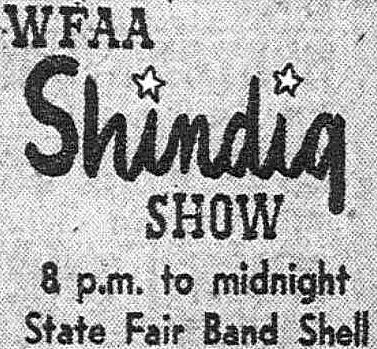
He must have made quite a splash, because only a month later, he had left the Hayride, moved to Dallas, and was signed to appear on the show “Saturday Nite Shindig,” the WFAA-sponsored answer to the Big D Jamboree, which debuted on October 11, 1952. (As “Saturday Night Shindig,” the radio show had been a WFAA staple since it began in 1944; Sonny James was hired to be part of a new “Shindig,” which was revamped from a folksy half-hour show to a 4-hour live music show and was broadcast from Fair Park.)
“Yeoow! More Zip than a Singed Cat!” (Click for larger image.)
Oct. 8, 1952
Oct. 10, 1952
It was an immediate hit, and Sonny became the main draw and something of a teen heart-throb. Less than a month after the announcement of his permanent gig as a “Shindigger,” he also got his own radio show on WFAA, Tuesday and Thursday mornings from 11:00 to 11:15.
Pretty soon, the Shindig revue was being simulcast on TV and radio, live from Fair Park (from the bandshell when it was warm, and from various other buildings during cold and inclement weather).
April 11, 1953
The Shindig show seems to have died away in 1954 or 1955. Sonny James headed back to the Sportatorium and the Big D Jamboree (which was run by his manager, Ed McLemore). One show of note was this one in 1955, with his old Louisiana Hayride pal Elvis Presley. (McLemore made sure that even though Elvis was the headliner, Sonny’s name was actually bigger!)
April 15, 1955
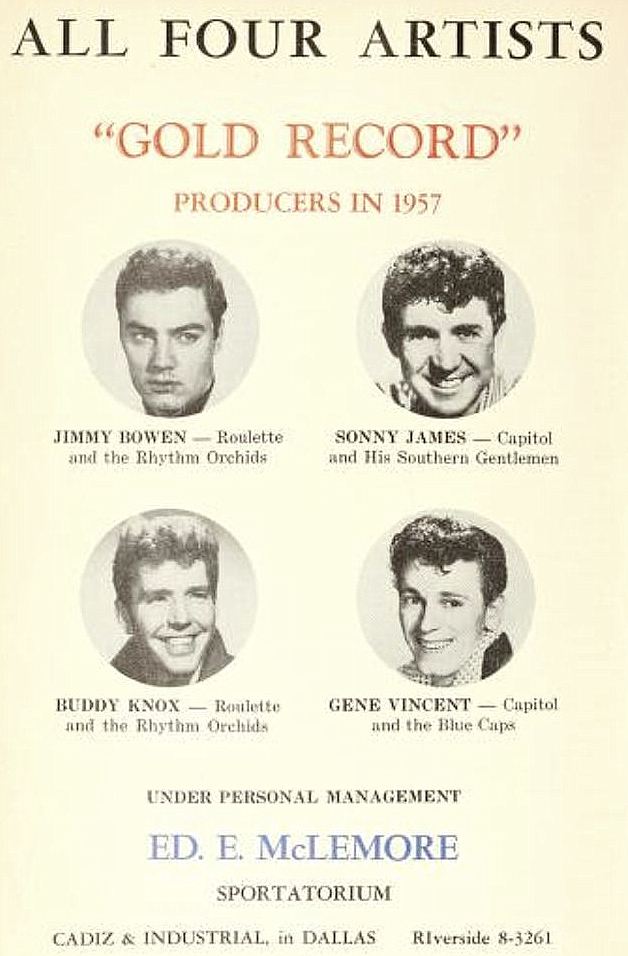
Sonny James had been recording for Capitol for several years, with some success, but it wasn’t until the end of 1956 that he had his mammoth #1 crossover hit, “Young Love,” which made him a national star. Apparently, he kept a residence in Dallas for a while (the last address I see for him in Dallas was in 1955 at 4718 Capitol, between N. Carroll and Fitzhugh). While living in Dallas, he was a steadfast member of the Church of Christ at East Side and Peak, and he frequently participated in area fishing contests (in fact, there might have been more mentions of his extracurricular fishing exploits in the local papers than there were mentions of his show-biz exploits — his fishing activities were often covered using his real name, Jimmie Loden). One person who lived in the same neighborhood Sonny did recalled on a Dallas-history message board that Sonny worked on Saturday mornings bagging groceries at a store on the corner of Capitol and Fitzhugh.
Sonny James went on to be a much-loved country performer who racked up a number of hits and was, apparently, one of the nicest guys around. He was most definitely a Southern Gentleman. Thanks, Sonny.
*
Nov. 8, 1952
1953
Sept. 12, 1953
Billboard, Oct. 3, 1953
Aug. 21, 1954
Radio Annual and Television Yearbook, 1957
Radio Annual and Television Yearbook, 1958
***
Sources & Notes
Sonny James’ obituary form the Hollywood Reporter is here. His Wikipedia page is here.
To get an idea of the absolutely HOT hillbilly and rockabilly music that was being performed in Dallas in the years that Sonny James was here, check out this fantastic sampling of recordings from the Big D Jamboree:
*
See a few photos of Sonny James in Dallas at SonnyJames.com here (click thumbnails for larger images — the photo of Sonny sitting in the wings watching Elvis on stage at the Big D Jamboree is pretty great!).
A couple of good articles about Sonny James’ time in Dallas (written while he still considered himself a resident of the city) can be found in the Dallas Morning News archives:
“Success Won’t Spoil Mr. James” by Tony Zoppi in his “Dallas After Dark” column (DMN, Feb. 10, 1957)
“Sonny Snubs That Las Vegas ‘Loot'” by, of all people, Frank X. Tolbert in his “Tolbert’s Texas” column (May 13, 1957), in which Sonny — fresh off his 2.5-million-selling “Young Love” hit — talked about having a clause in contracts saying he would not perform in places with drinking, “clinch dancing,” and gambling, mostly because he did not want to exclude his teenage fans from being able to see him perform.
A good interview with Sonny James — packed with photos — appeared in the January, 1958 issue of TV Radio Mirror, a full scan of which you can find here. Even after he had hit the mega-big-time, Sonny said he continued to keep an apartment in Dallas. In the story there is a photo of his Dallas girlfriend, Doris Farmer (née Shrode) — she and Sonny took out a marriage license in July, 1957 (seen here) — I’m not sure when they married, but Sonny and Doris were happily married until Sonny’s death, almost 60 years.
Another performer who lived in the DFW area at the same time as Sonny James and who was also on the cusp of national stardom was Pat Boone, who had his own show on WBAP while attending college in Denton. Sonny and Pat were friends and even appeared on a few bills together. They were both also members of the Church of Christ, which both no doubt felt was an important bond. I wrote about Pat Boone’s time in DFW in the Flashback Dallas post “Pat Boone, Host of Channel 5’s ‘Teen Times’ — 1954,” here.
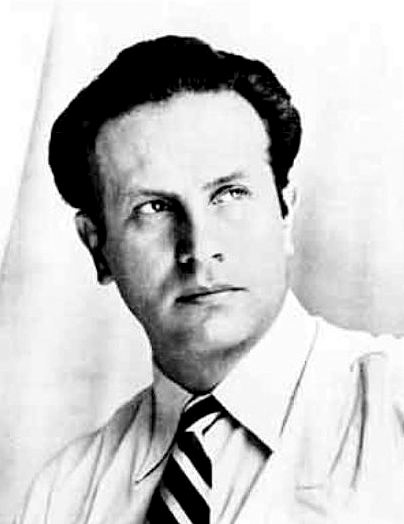
“Best friends” Menuhin and Dorati in Dallas, Jan. 1947
by Paula Bosse
When Antal Dorati was appointed conductor of the Dallas Symphony Orchestra in 1945, Dallas suddenly began to see a lot of violinist Yehudi Menuhin.
In a 1954 article about Yehudi Menuhin’s close ties to Dallas, John Rosenfield — the influential arts editor of The Dallas Morning News — wrote that when Menuhin was in town for a performance for the Civic Music Association in 1945, he was “casually asked” (probably by Rosenfield himself) what he thought of Antal Dorati as a possible conductor for the then-long-dormant Dallas Symphony Orchestra.
“He’s my best friend … he’s wonderful … he’s great,” said Yehudi, who was promptly carried around town to talk to businessmen again interested in re-forming the orchestra. (DMN, Sept. 5, 1954)
A short while later, Dorati was hired as musical director of the “new” Dallas Symphony Orchestra, and, as a result, best friend Yehudi was in and out of town frequently during Dorati’s four seasons in Dallas. Not only did he perform frequently as a soloist with the DSO, but it was not unheard of for Yehudi to sometimes drop by and sit in with the orchestra during rehearsals. Menuhin often stayed with Dorati when touring the central United States or based himself at the Melrose Hotel, which he used as a sort of mid-continent pied-à-terre.
One of the great passions the two men shared was a love for the music of Hungarian composer Bela Bartok. Dorati, born in Budapest, studied piano under Bartok and was a champion of his work throughout his career. Menuhin had performed Bartok’s Violin Concerto to great acclaim, and near the end of Bartok’s life, after the two men had met and bonded, Menuhin commissioned him to compose a sonata for violin.
Dorati and Menuhin often collaborated on performances featuring Bartok’s works, and when it was known that Dorati was all-but-signed to be the new DSO conductor, there was much speculation that Bartok himself might come to Dallas, but Bartok’s death in September, 1945 put an end to those hopes.
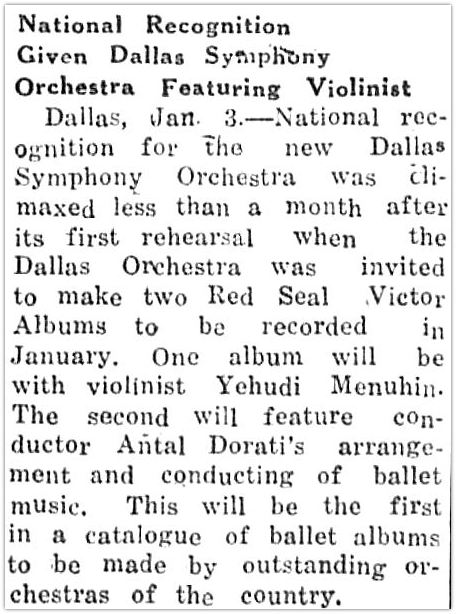
The first RCA Victor Red Seal recordings of Dorati’s Dallas Symphony Orchestra took place in January, 1946. One of the recordings featured Menuhin performing Bartok’s Concerto for Violin and Orchestra.
Denison Press, Jan. 4, 1946
Below, the first movement of the recording.
* The second movement is here; the third movement is here.
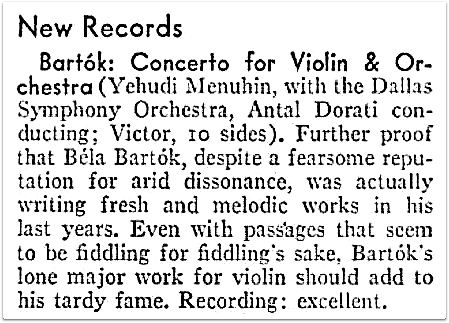
The recording was well-received.
Time magazine, June 16, 1947
RCA Victor ad, 1947
Of perhaps greater note, was the fact that Yehudi Menuhin conducted for the very first time in Dallas — the first orchestra he ever waved a baton at was the Dallas Symphony Orchestra, in 1946. No doubt because of their great friendship, Dorati coached the 30-year-old Menuhin on the finer points of conducting when the violin virtuoso expressed interest in learning what things were like on the other side of the podium. Menuhin first conducted the DSO on April 6 1946, for an invited audience.
Santa Cruz (CA) Sentinel, Apr. 7, 1946
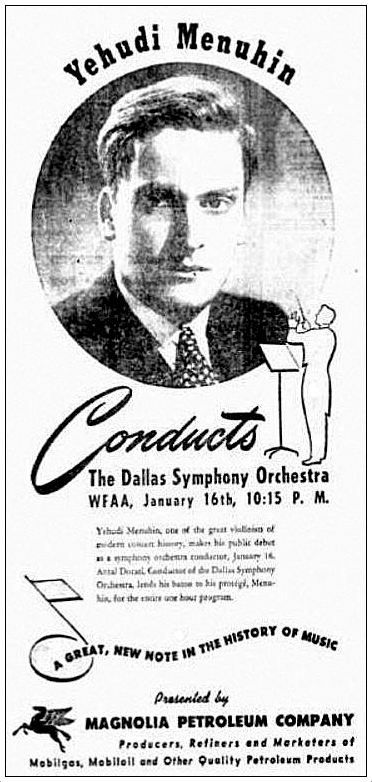
He was ready to go “public” on January 16, 1947, conducting the DSO for one of its regularly scheduled national broadcasts originating from WFAA.
Jan. 11, 1947
The text from the ad:
Yehudi Menuhin, one of the great violinists of modern concert history, makes his public debut as a symphony orchestra conductor, January 16. Antal Dorati, Conductor of the Dallas Symphony Orchestra, lends his baton to his protégé, Menuhin, for the entire one hour program.
Protégé!
Even though Menuhin insisted at the time that this brief foray into the world of conducting was fleeting and not a signal of any sort of career change, Yehudi Menuhin did go on later to direct many of the world’s great orchestras.
**
The friendship between Dorati and Menuhin lasted (from what I can tell) until Dorati’s death in 1988 (the decade-younger Menuhin died in 1999). They were personal friends and like-minded professional equals.
Between Menuhin and Antal Dorati, the Dallas Symphony Orchestra conductor, exists a friendship and a mutuality of musical aspiration that has resulted in outstanding musical collaborations. (John Rosenfield, DMN, Jan. 15, 1947)
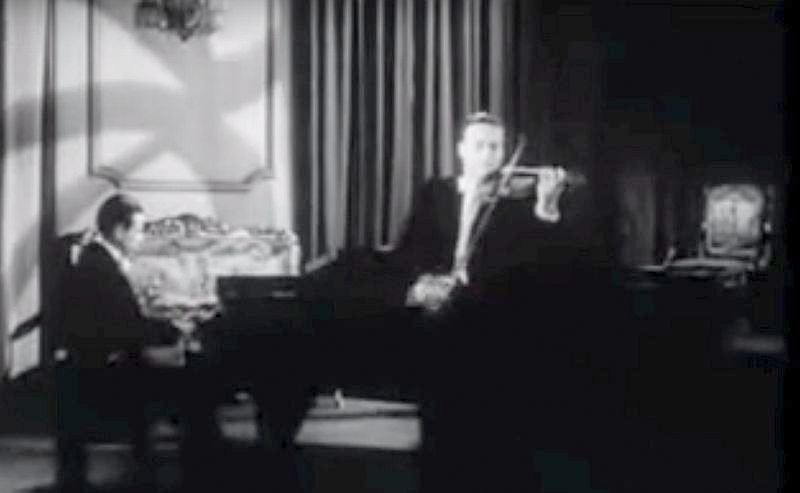
Below, the only film I’ve been able to find of the two men together, filmed in 1947 during the time when Dorati was engaged in Dallas (although this was not DSO-related and was filmed in Los Angeles). The piece being performed is Brahms’ Hungarian Dance No. 4; Dorati accompanies Menuhin on piano (you finally see him near the end!).
Top photo of Menuhin and Dorati in preparation for Menuhin’s public debut as a conductor is from Texas Week magazine (Jan. 25, 1947), here.
The YouTube videoof Brahms’ Hungarian Dance No. 4 was filmed at the Charlie Chaplin studios in Hollywood in the fall of 1947 (according to consumer reviews here).
Links-a-lot:
Yehudi Menuhin Wikipedia entry is here. His obituary is here.
The news this week that the Dallas Symphony Orchestra’s musical director, Jaap van Zweden, was leaving town to pursue a glitzier gig was seen as an inevitable move to many of his disappointed fans. The DSO has been something of a springboard for conductors working their way up the conductor career ladder. Another celebrated conductor who spent a few years in Big D before rising to the heights of international acclaim was Hungarian-born Antal Dorati (1906-1988).
Dallas had classical music concerts in the 19th century, but the roots of what we now know as the Dallas Symphony Orchestra reach back to about 1900, under the direction of Hans Kreissig, who had settled in Dallas in 1887.
Dallas Morning News, Jan. 13, 1897
For various reasons (lack of community interest, lack of financial support, etc.), some of these early seasons were truncated or suspended — there was a gap of several years after Kreissig’s tenure, for instance, and there were no performances during most of 1936 and 1937 because of activities surrounding the Texas Centennial and renovations to the Music Hall (the DSO performed at the Music Hall in Fair Park). The most noteworthy suspension of performances was during World War II when the symphony was “temporarily dissolved”: not only was the financial state of the organization not good at this time, but the war itself had depleted the ranks of the performers — the DSO shut down completely in 1942 because conductor Jacques Singer and several of his musicians had enlisted or were drafted. John Rosenfield, the arts editor of The Dallas Morning News and an ardent classical music lover, wrote often during this time how the loss of the DSO was a crushing cultural blow to the city.
When the war ended, Dallas’ music-lovers (and musicians) clamored for the return of the DSO. A search began for a conductor who was not only a superior musical director but who would also be able to build an orchestra from scratch; they found that man in 39-year-old Antal Dorati, a former student of Zoltan Kodaly and Bela Bartok who had made a name for himself as a musical director for ballet companies such as the Ballet Russe de Monte Carlo and the Ballet Theater — his DSO appointment was announced in the fall of 1945.
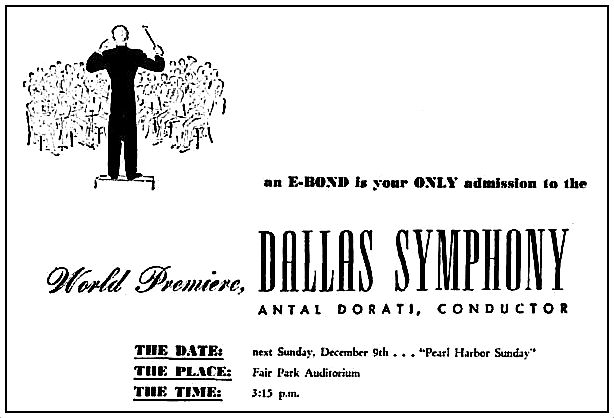
Somehow, in only two months, Dorati managed to put an orchestra together, prepare the season’s schedule, rehearse the musicians, and present the first performance of the “reborn” Dallas Symphony Orchestra on December 9, 1945.
DMN, Dec. 5, 1945
The response to that first concert was rapturous:
The crowd was somewhat stunned by the excellence of the ensemble that will bear Dallas’ name. To many, grown realistic or cynical in the years’ cultural struggles, the new orchestra was an unbelievably precious gift. Nothing so fine was expected by even the optimists. And it belonged to them with the promise that it would stay for all the time they could foresee. (John Rosenfield review, “Capacity Audience Thrills To Reborn Dallas Symphony, DMN, Dec. 10, 1945)
During the intermission of this debut performance, Dorati was interviewed on the radio and had nice things to say about Dallas:
I fell in love with Dallas not last September when I was engaged but as far back as 1937. When I visited here year after year with the Ballet Theater. I said to myself that if I ever withdrew from the ballet and became a resident conductor for an American symphony, I would like it to be the Dallas Symphony Orchestra.” (DMN, Dec. 10, 1945)
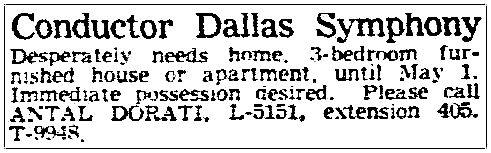
One little thing the Maestro was unable to accomplish, though, was to find a place for his family to live. The severe lack of postwar housing affected even the wealthy cultural elite!
Dec. 13, 1945
And, with that, the DSO was back. It toured. A LOT. And made recordings. And appeared on national radio broadcasts. With Dorati at the helm, the Dallas Symphony Orchestra was making a name for itself and garnering a very positive national reputation.
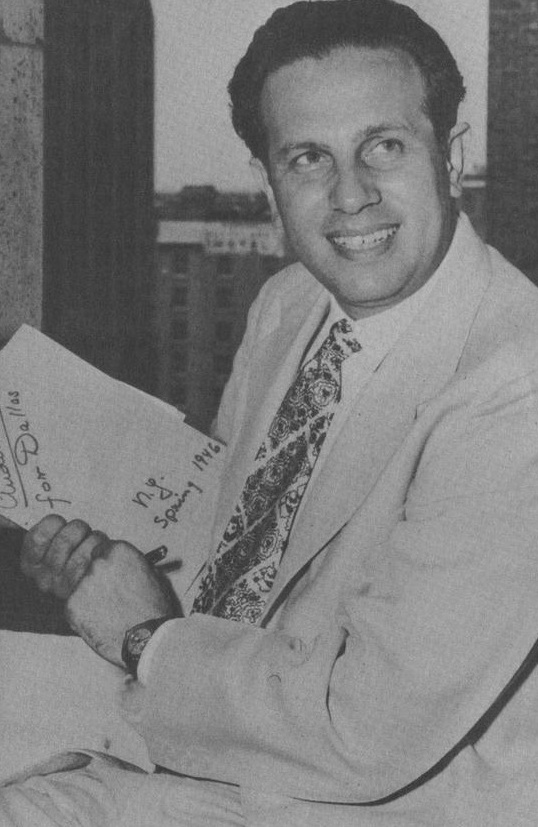
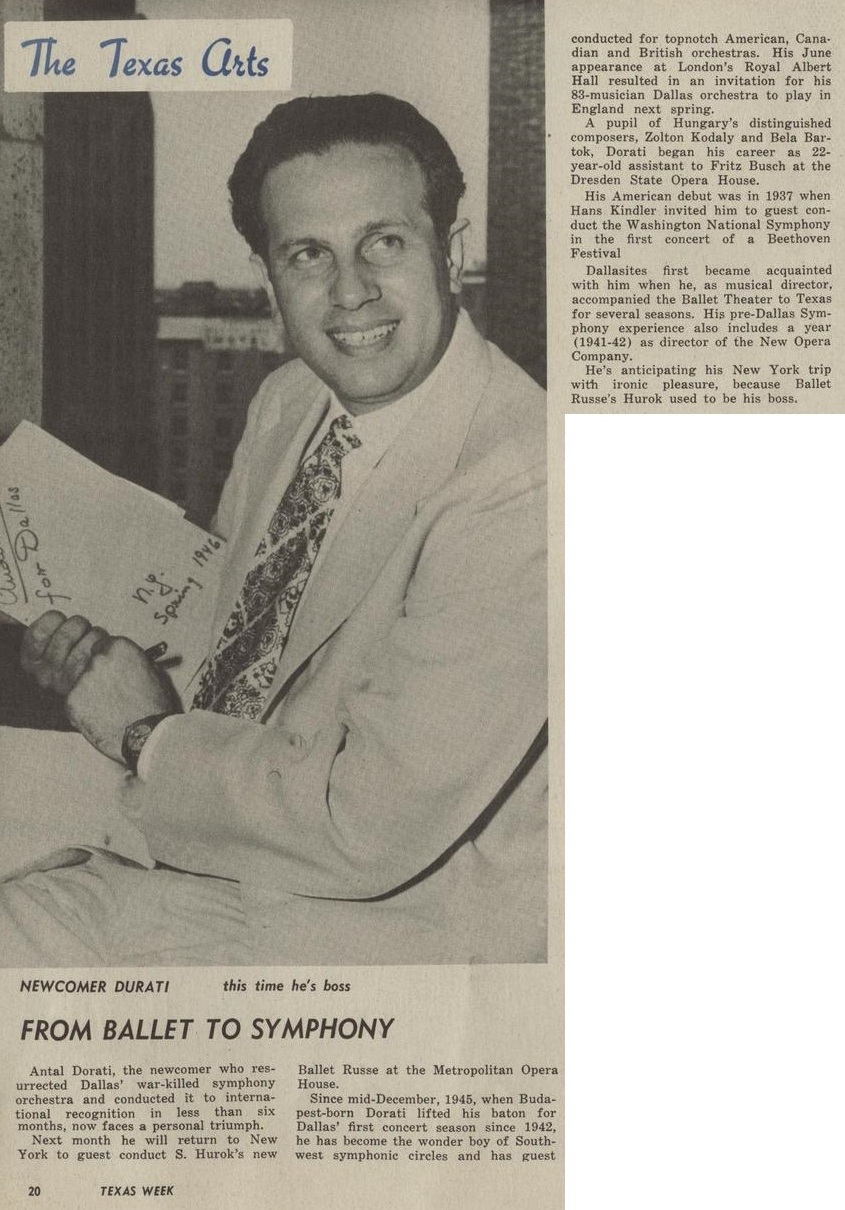
A typical article about the young, photogenic Dorati went something like the one below, in which Dorati was described as “the wonderboy of Southwest symphonic circles.”
Texas Week, Aug. 17, 1946
After a fairly short but incredibly productive time in Dallas, Antal Dorati accepted the position of conductor of the Minneapolis Symphony Orchestra in January 1949. His successor, Walter Hendl (a startlingly “honest” obituary of the controversial Hendl appeared in the London Telegraphhere), was appointed a few short weeks later, and Dorati’s final concert was April 3, 1949.
April 3, 1949
John Rosenfield’s melancholy review/farewell appeared the next day in The Dallas Morning News, and one imagines it tooks weeks for his tears to dry.
The spectacularly successful musical director and conductor, whose 4-season regime ended with an emotion-laden farewell concert, modestly disclaimed the founder’s role in Dallas Symphony history. The 1945-49 period was one of high-intentioned and nobly-adventurous endeavor….” (John Rosenfield, DMN, April 4, 1949)
And with that, the Maestro headed to Minneapolis, having built the post-war Dallas Symphony Orchestra into a nationally respected organization.
**
Waco News Tribune, Dec. 6, 1946
Waco News Tribune, Dec. 13, 1946
***
Sources & Notes
Top photo and article from the Aug. 17, 1946 issue of Texas Week, the short-lived magazine that was sort of a Texas version of Life, via the Portal to Texas History, here. Text may have been written by Paul Crume.
Linksapalooza:
The Dallas Symphony Orchestra Wikipedia entry is here; the official DSO site is here; the Handbook of Texas entry is here.
The Antal Dorati Wikipedia entry is here; his official site is here.
Listen to pianist William Kapell perform Prokofiev’s Piano Concerto No. 3 in C major, Op. 26 with the Dallas Symphony Orchestra under the direction of Antal Dorati (recorded at the Fair Park Auditorium the same week he made his “Adios, Dallas!” announcement in Jan., 1949), here.
More on Dorati and his close friend Yehudi Menuhin in my post “Yehudi Menuhin and Antal Dorati: A Collaborative Friendship,” here.
And, yes, the correct spelling should be “Antal Doráti.”
The 200 block of Central Ave., about 1937… (Dallas Public Library photo)
by Paula Bosse
I’ve seen this photograph of Deep Ellum for years, and I’ve always loved it. But for some reason, I always thought this showed Elm Street — across from the Knights of Pythias Temple, just west of Good-Latimer (probably because that’s where a recent club with the same name was located). In fact, this scene was captured a couple of blocks west, just north of Elm, on Central Avenue, sometimes referred to as Central Track, along the Houston & Texas Central railroad tracks — a part of Deep Ellum that’s been gone for more than 60 years.
After Central Expwy. replaced Central Ave. (1952 Mapsco)
This area — which many have described as being the very heart of Deep Ellum in the 1920s through the 1940s (and which was somewhat ironically referred to as “the gay white way of the Negro in Dallas” by an uncredited WPA writer) — was demolished to make way for the construction of North Central Expressway (which closely followed the H&TC Railway tracks). This photo was taken in the 200 block of North Central Avenue, looking south toward Elm (the building farthest in the background, jutting out to the left, is across Elm, on the south side of the street). To the immediate left of this photo (out of frame) was the old union depot (read about it here).
You can see that the Sanborn map from 1921 shows that same building jutting out. (See the full Sanborn map here; it might be more helpful to see this detail rotated to show the same view as the photo, here.)
1921 Sanborn map, detail (click for larger image)
Information about The Gypsy Tea Room is scant. The proprietor was a man named Irvin Darensbourg, whose family was from the black community of Killona, Louisiana in St. Charles Parish; they appear to have been of French Creole extraction, and the family’s last name was probably correctly spelled as D’Arensbourg.
The Darensbourgs were an interesting family (and not just because their mother’s maiden name was Louise Jupiter!). There were several children, and at least two of them were professional musicians: Percy Darensbourg (1899-1950) and Caffery (often spelled “Caffrey”) Darensbourg (1901-1940). Both played with several jazz bands, and Percy even made a few recordings, playing banjo. Below are a couple of promotional photos showing them at work in the 1920s, when they were still based in New Orleans, before they settled in Dallas. (These are cropped details — click pictures to see the full photos.)
Percy Darensbourg, with Lee Collins‘ band, 1925 or 1926:
Listen to Percy on banjo, here:
And, below, Caffery Darensbourg, with Manuel Perez’s Garden of Joy Orchestra (click photo to see full band — the other band members are identified here):
The first of the brothers to arrive in Dallas from New Orleans was Percy, in about 1929, and for the next few years he continued to make his living as a professional musician. Caffery followed in 1932 and opened the short-lived Frenchie’s Creole Inn on Boll Street. Their non-musician brother Irvin was here by 1935 and promptly opened the Green Tavern at 217 Central Avenue, just a few doors down from Percy’s drinking establishment, the Central Tavern Inn, at 223 Central. At about this same time, Percy was also running a club at 3120 Thomas called The Gay Paree — which The Dallas Morning News described as a “swanky negro night club” (April 12, 1938) in a short mention of Percy’s being fined for selling alcohol to an already-inebriated customer.
But back to that 200 block of Central Avenue — the one pictured in the photo at the top. Between 1937 and 1939, Irvin also owned/ran a small restaurant or cafe — and later a pool hall — out of 219½ Central. The Darensbourgs had that block locked up.
*
In 1935, a song called “In a Little Gypsy Tea Room” by Bob Crosby swept the country. It was a huge hit. Suddenly there were scads of places popping up all over calling themselves The Gypsy Tea Room or The Little Gypsy Tea Room. Some might have been actual tearooms, but there were also a lot of clubs and bars with the “tea room” name — the most famous of these was The Gypsy Tea Room in the Tremé district of New Orleans, at Villere & St. Ann, which opened the same year the song was being played incessantly by every dance band in the nation. This famous New Orleans nightclub booked the biggest jazz bands around and was a legendary musician’s hangout.
The Darensbourgs most likely knew the club, its owner, its patrons, and the musicians who played there. Perhaps Irvin Darensbourg decided to name his own little Gypsy Tea Room in Dallas in honor of the New Orleans landmark. Whatever the case, Deep Ellum’s Gypsy Tea Room appears to have come and gone fairly quickly (and one assumes there was more than tea being sipped inside).
*
The life of a tavern and club operator could be a hard one, especially in those days, especially in the black neighborhoods of Deep Ellum and North Dallas. Irvin seemed to be forever sleeping on a relative’s couch and had a different address every few months. By 1940 he had moved to Fort Worth to open another bar, and after that … I’m not sure what became of him — but one hopes that he met a less violent end than his brothers did here in Dallas. According to Caffery’s death certificate, he died in 1940 after having been shot in the abdomen while “in a public place.” His death was ruled a homicide. Percy, who by all indications was the most stable and successful of the brothers, was also killed — in 1950 he was stabbed in the neck (!) while out on the street at 4:20 AM.
**
As for the original photograph, I’ve pored over it and looked through directories, but I can’t pinpoint the exact year this photo was taken or determine what the actual address of the Gypsy Tea Room was. Since it was mentioned in the WPA Dallas Guide and History, which was written and compiled between 1936 and 1940 and contains the only contemporary mention of the Tea Room, my guess is that this photograph was taken about 1937, as this was the last year that Old Tom’s Tavern (209 ½ Central) seems to have been in business (although the bar that replaced it was owned by the same person, and the sign seen in this photograph could well have remained up for a while).
Craig’s Cafe, at 213 Central, was in business between 1929 and at least 1946 when property began to be demolished in order to begin construction on the expressway. The Gypsy Tea Room looks to be either two or three doors down from Craig’s place. My guess is that it’s 219 Central. The 1937 street directory has Irvin Darensbourg (whose name is constantly mangled and misspelled everywhere) listed as being the proprietor of both the Green Tavern (at 217 Central) as well as an unnamed restaurant at 219-A (sometimes written as 219 ½) Central. The 1938 and 1939 directories specify Darensbourg’s business at this address in those years is a pool hall, not a restaurant. So I’m going to venture that Irvin Darensbourg ran the Gypsy Tea Room at 219 Central Avenue in 1937.
1937 Dallas directory
That was exhausting!
***
Sources & Notes
Photo of the Gypsy Tea Room at the top of this post is from the Texas/Dallas History & Archives Division of the Dallas Public Library: “Gypsy Tea Room Cafe located in Deep Ellum” is from the WPA Dallas Guide & History Collection of the Dallas Public Library — its call number is PA85-16/22.
Thanks to Bob Dunn of the Lone Star Library Annex for deciphering “Darensbourg” from this badly garbled printed name on the Gypsy Tea Room sign.
Here are a few of the numerous ways this Darensbourg’s family’s name is misspelled across the internet:
And I’m still not actually sure whether it’s “Irvin” or “Irving,” or “Caffery” or “Caffrey.”
When clicked, the photo of Percy Darensbourg above opens up to show the full band — the personnel is identified in a caption from the book Oh, Didn’t He Ramble: The Life Story of Lee Collins: “Lee’s band in Dallas, 1925 or 1926. From the left: Coke Eye Bob (Arthur Joseph?), Mary Brown, Freddie ‘Boo-Boo’ Miller, Octave Crosby, Henry Julien, ‘Professor’ Sherman Cook, Lee, and Percy Darensburg [sic].”
A couple of other versions of “In a Little Gypsy Tea Room,” if you must:
The version by The Light Crust Doughboys (no strangers to Deep Ellum), recorded in 1935 in Dallas at 508 Park, is here.
The at-least-peppier version by Louis Prima and His New Orleans Gang, also recorded in 1935, is here.
See what the area once occupied by the vibrant street life of Central Track looks like now, here. The expressway overpass is now planted about where the photo was taken. It’s a shame this important part of town — in a way it was Dallas’ second downtown — was bulldozed into oblivion.