Flashback : Dallas

A Miscellany: History, Ads, Pop Culture

Category: Music

Margo Jones & Jim Beck: Both Legends in Their Fields, Both Victims of Carbon Tetrachloride

margo_tennessee
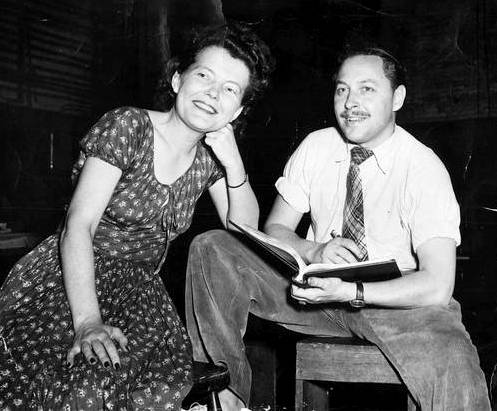
Margo Jones with Tennessee Williams

by Paula Bosse

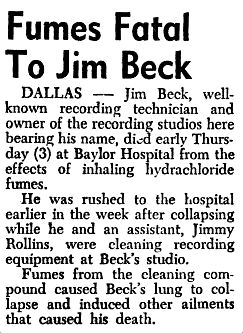
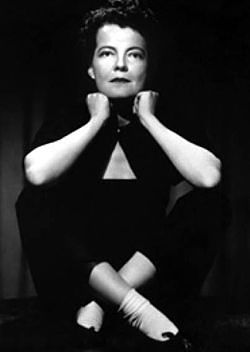
In reading about Dallas theater legend Margo Jones, I saw that she died from inhaling the lingering fumes of a cleaning agent that had been used to clean a rug in her apartment at the Stoneleigh Hotel: carbon tetrachloride. The only thing I knew about carbon tetrachloride was that it had also caused the early death of legendary recording engineer and producer Jim Beck (the man who discovered and produced the first records of Lefty Frizzell, Ray Price, et al.); Beck had been cleaning his recording equipment and had been overcome by the fumes. Both were rushed to the hospital when they were discovered unconscious, and both died about ten days later.

Margo Jones died on July 24, 1955, and Beck died less than a year later, on May 3, 1956. Jones was in her early 40s — Beck was only 39. Margo Jones was a creative powerhouse who was already revolutionizing regional theater, and Jim Beck’s enormous talent was the sole reason that Columbia Records was on the brink of moving their operations from Nashville to Dallas (a move that might very well have set the wheels in motion for Dallas to overtake Nashville as the nation’s recording center for country music). It is such a loss that both died so young,victims of something as mundane as cleaning fluid. With so much remarkable potential ahead of them, it’s sobering to imagine how different Dallas theater and the Dallas recording industry would be today had their careers lasted another two or three or four decades.

margo-jones-photo

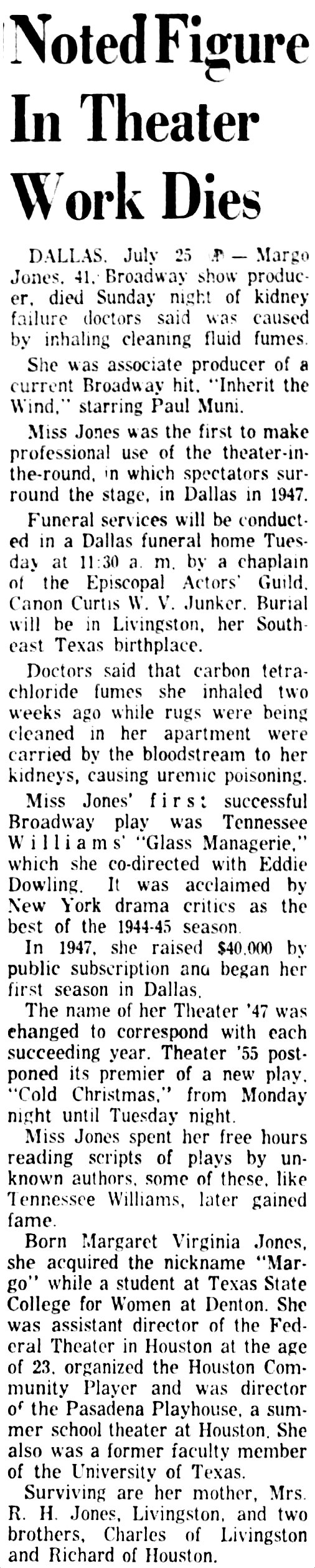
margo-jones_austin-american_072655_obitAustin American, July  26, 1955 (click to see larger image)

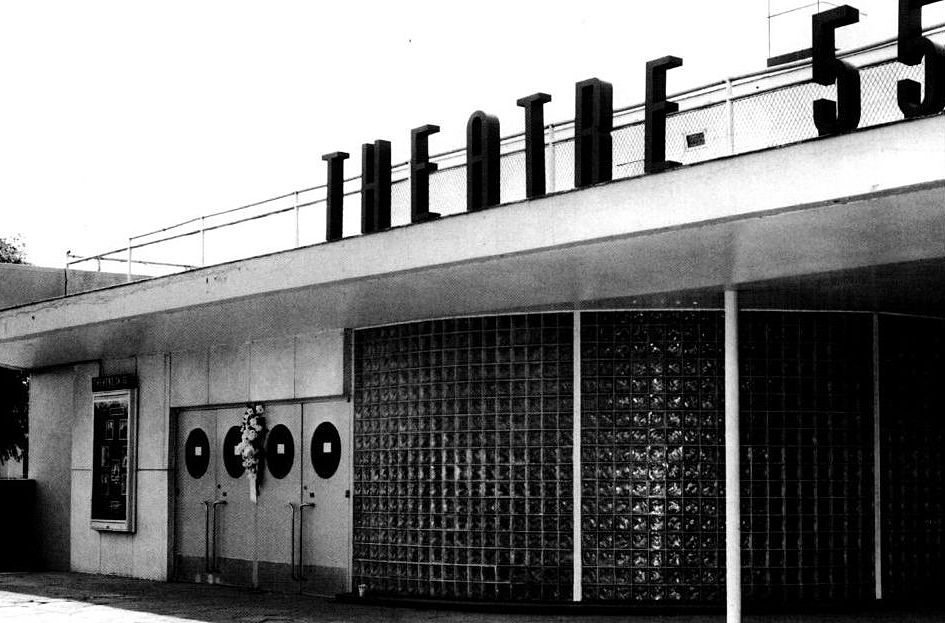
margo-jones_wreath_legacies_fall-2004Margo Jones’ Theatre ’55 with wreath on door (click for larger image)

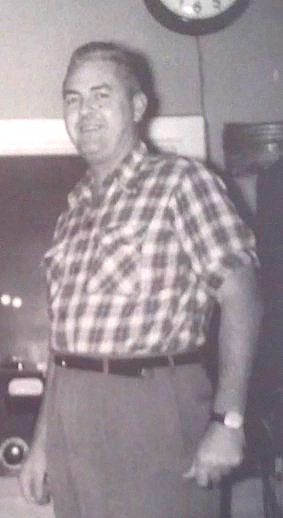
jim-beck_detJim Beck in his studio

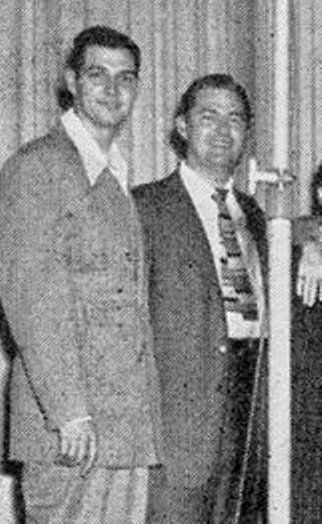
jim-beck_hank-thompson_liberty-jamboree_c1951-detJim Beck (right) with Hank Thompson

jim-beck_billboard_051256bBillboard, May 12, 1956

jim-beck-studio-logo

***

Sources & Notes

Photo of Theatre ’55 (formerly the Magnolia Lounge in Fair Park) with wreath is from the story “‘I’m Doing It, Darling!’ — Dallas, Margo Jones, and Inherit the Wind” by Kay Cattarulla (Legacies, Fall, 2004 issue), which can be read here.

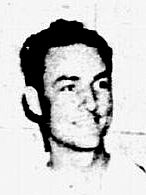
First photo of Jim Beck (which has been cropped) is from the Bear Family CD box set “Lefty Frizzell: Life’s Like Poetry.”

Photo of Jim Beck and country recording star Hank Thompson is a (cropped) Liberty Jamboree promotional photo, circa 1951.

Jim Beck Studio logo from the Handbook of Texas entry for the recording industry in Texas, here.

Margo Jones is very important. Read why here.

Jim Beck is very important. Read why here.

A bit morbid, perhaps, but Margo Jones’ death certificate can be viewed here; Jim Beck’s death certificate, here.

And, finally … kids, stay away from that carbon tetrachloride. It’s bad stuff.

For my previous post “Lefty Frizzell: It All Began on Ross Avenue,” click here.

*

Copyright © 2014 Paula Bosse. All Rights Reserved.

Michael G. Owen, Jr. — Dallas Sculptor of Lead Belly

leadbelly_three-views_paul-l_yelp

by Paula Bosse

Above, three views of “Leadbelly,” the sculpted head of the blues legend, by Michael G. Owen, Jr., 1943.

Michael Owen (profiled here previously as the 15-year-old soap-sculptor who made headlines at the 1930 State Fair of Texas), was the youngest member of the group of artists loosely affiliated with the Dallas Nine group who were making a name for themselves in the 1930s and ’40s. He studied life drawing as a student of Olin Travis and painting as a student of Jerry Bywaters, but he was most proficient as a sculptor. He is best known for his award-winning 1943 bust of bluesman Lead Belly, a piece in the permanent collection of the Dallas Museum of Art (which can be seen in a 1951 DMFA catalog here).

In a 1950 letter to the (then-) Dallas Museum of Fine Arts, Owen recounted how Lead Belly sat for him in New York and sang “Goodnight Irene” as Owen worked on a clay model. Owen was living in Greenbelt, Maryland at the time, and Louisiana-born Lead Belly was living in New York City, but I’d like to think that the two men reminisced about their formative days in Dallas where Owen was a much-talked-about young artist and Lead Belly performed on the streets of Deep Ellum with Blind Lemon Jefferson.

I noticed in the newspaper article that the stone was called black Belgian marble. Actually it isn’t so exotic. It was quarried not far from Charlottesville, Virginia, and is called Black Serpentine. It was the first time I have ever heard of the stuff being black. If you’ll notice it seems quite a bit more crystalline than marble.

The way I happened to do the head went like this. A young fellow I had known in Dallas by the name of Ralph Knight had gone to New York a year or so after I went to Washington. He was interested in folk music and became acquainted with Leadbelly. It was at Ralph’s instigation that I did the head — he got me the stone, sent pictures (I first roughed out the head in clay at home in Greenbelt) and then arranged the sitting at his apartment in New York. Leadbelly sat for me one afternoon and I finished the clay model at that time. From that I worked out the stone cutting, only being able to work on it in my spare time. All in all it was about a full month’s work, I guess. During the time he was “sitting” for me (playing his guitar and singing) he played “Goodnight Irene,” but at that time the folk music devotees did not consider the tune “true folk music.” Still it pleased me when it became a popular song. It’s too bad Leadbelly couldn’t have lived to see himself gain such popularity. (Mike Owen in 1950, from a letter excerpted in the book Lone Star Regionalism, The Dallas Nine and Their Circle)

Sadly, Mike Owen’s career stalled soon after this 1940s artistic high point. He eventually settled in Oregon, where he was sidelined by multiple sclerosis. He died in 1976 at the age of 60.

owen-michael_1930s
Mike Owen in his early 20s

I’m not sure how often the piece is displayed at the Dallas Museum of Art, but it’s a wonderful work of art. When I saw it a couple of years ago, I just stood and stared at it for ages. It’s really fantastic. And it’s fitting that it resides here in Dallas where Michael Owen was once a part of a group of Texas artists whose influence continues to be felt today.

It also seems fitting to throw in this classic from Mr. Ledbetter, who, like Mike Owen, spent time honing his craft in Dallas:

lead-belly-wikipedia

***

Sources & Notes

“Leadbelly” sculpture by Michael G. Owen, Jr. is in the collection of the Dallas Museum of Art.

Photo of the artwork is by Paul L. as posted on Yelp.

Photo of Lead Belly from Wikipedia.

Quote from Mike Owen’s letter to the DMFA (April 11, 1950) can be found in the superb book Lone Star Regionalism, The Dallas Nine and Their Circle, 1928-1945 by Rick Stewart (Austin: Texas Monthly Press, Dallas Museum of Art, 1985) — the best book on Dallas art of this period.

Read the Handbook of Texas entry about Huddie Ledbetter (aka Lead Belly/Leadbelly) here.

Other Flashback Dallas posts on Owen:

  • Young Mr. Owen’s star-turn as the teenager who carved the WFAA transmitter plant from 8,400 pounds of Ivory Soap is here.
  • Owen’s monument to SMU Mustangs’ mascot Peruna, commissioned in 1937, is here.

UPDATE: Read about a recently discovered large painting by Owen up for auction in Dallas in 2019 here.

*

Copyright © 2014 Paula Bosse. All Rights Reserved.


“I’ve Got the Dallas Blues and the Main Street Heart Disease”

dallas-blues-sheet-music

by Paula Bosse

“Dallas Blues” is an important milestone in the history of blues music. I gather this may be debatable, but it is cited as being the first “true blues song” ever published (at least by sources on Wikipedia). Written sometime before 1909 by Hart A. Wand, a white musician in Oklahoma, “Dallas Blues” was published as an instrumental in 1912; in 1918, lyrics were added by Lloyd Garrett.

I have to admit, when I read the opening lyrics, I assumed it was your typical Dallas-inspired ditty about how Dallas is a cold and heartless city that will chew you up and spit you out:

When your money’s gone, friends have turned you down,
And you wander ’round just like a houn’ (a lonesome houn’),
Then you stop to say, ‘Let me go away
From this old town (this awful town).’

But then the next lines are:

There’s a place I know folks won’t pass me by,
Dallas, Texas, that’s the town I cry! (Oh hear me cry!)
And I’m going back, going back to stay
There till I die (until I die).

Ha! That was unexpected.

Below are a few versions of “Dallas Blues” — fast and slow, some with vocals, and one hot instrumental. Enjoy. I hope those juicy peaches are still hanging on your trees!

**

Ted Lewis’ version from 1931, with Fats Waller’s first vocal appearance on record and Benny Goodman on clarinet. Most of the lyrics have been left out, but this is great

*

Louis Armstrong’s recording, from 1929:

*

George Lewis’ slowed-down version:

*

And, lastly, Isham Jones’ instrumental version — this one is hopping!

***

Sources & Notes

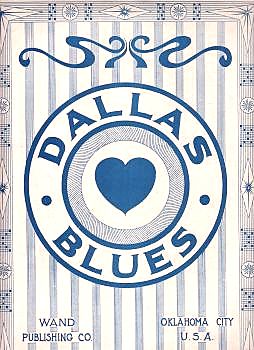
Sheet music from an Art & Seek story on Texas Blues (with sound clips) by Jerome Weeks, here.

Wikipedia entry on the song, here.

Complete lyrics to the song, here.

I’ve got the Dallas Blues and the Main Street heart disease
(It’s buzzin’ ’round),
Buzzin’ ’round my head like a swarm of little honey bees
(Of honey bees).

Interested in Dallas-related blues songs? Check out my previous post “Deep Ellum / Deep Elm / Deep Elem Blues,” here.

*

Copyright © 2014 Paula Bosse. All Rights Reserved.

Dewey Groom and The Longhorn Ballroom

longhorn-ballroom-logo

by Paula Bosse

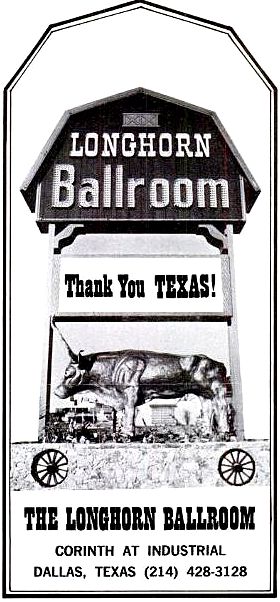
Growing up in Dallas with a father who was a classic country music fan, I’d always heard of The Longhorn Ballroom. And I’d always heard of Dewey Groom. You can’t have one without the other. The place is still around, but it keeps opening and closing and opening and closing. I don’t even know if it’s active at the moment, which is a real shame, because that place is COOL. I came too late to have seen the place at its glorious height as one of the country’s premiere country ballrooms. And I also came too late to witness the infamous Sex Pistols appearance there in the ’70s. I DID make it once or twice when it was going through its “alternative” period, booking bands that normally played in Deep Ellum. And I loved it. It was HUGE. Western kitsch everywhere. And a regular clientele comprised of people you’d either want to sit down and talk with for three hours or do your best to avoid completely — mostly the former. Below is a transcribed interview with Dewey Groom as it appeared (typos and all) in an old, obscure country music magazine that must have belonged to my father. At the end of this post are a few Dewey-factoids.

Even though his contributions are often overlooked, Dewey Groom was an important figure in the history of entertainment in Dallas. He died in 1997 at the age of 78. Thanks, Dewey!

*
longhorn-ballroom_billboard_112170

***

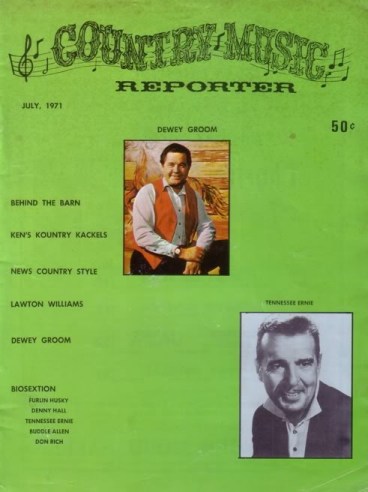
deweygroom_mag-cover-1971-sm*

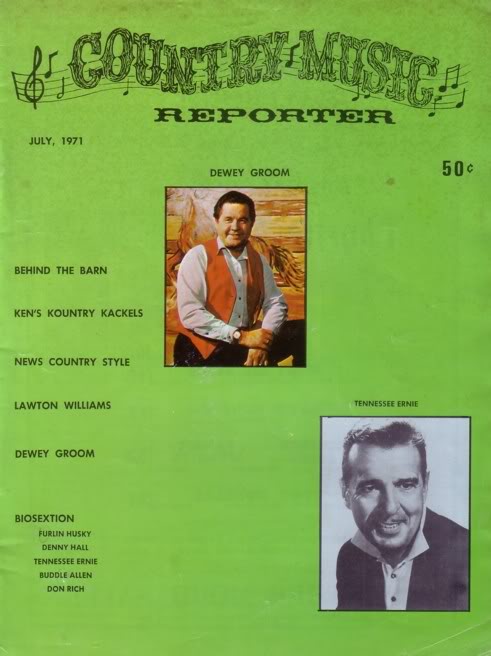
COUNTRY MUSIC REPORTER (Grand Prairie, Texas) – July 1971
“Dewey Groom: From the Mabank Flash To Big Daddy of Country Music”
(writer uncredited — presumably Wayne Beckham, the magazine’s editor)

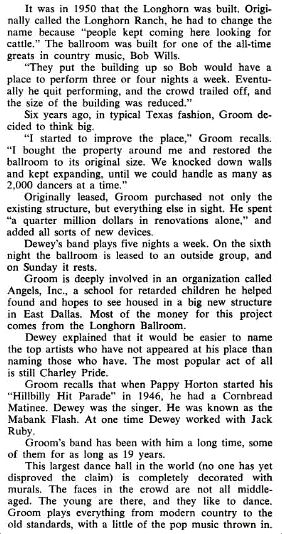
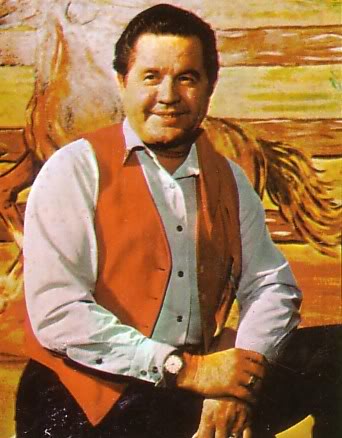
Back before he combined dancehall-keeping with his country singing, Dewey Groom was known on Dallas radio as the Mabank Flash – a reference to his Van Zandt County origins. He likes to talk of those origins, but he won’t complain nowadays if you call him the Lawrence Welk of country music.

I found him happy about his success as owner of the million-dollar Longhorn Ballroom on Corinth off Lamar [in Dallas, Texas]. But he was more inclined to talk of Angels Inc., the school for retarded children he helped found and hopes to see housed in a big new structure off Buckner, in East Dallas.

If he succeeds, it will be due to the middle-aged faithful who regularly go in thousands to the Longhorn to hear celebrities like Charley Pride or Jerry Lee Lewis, or simply to reassure themselves that the Mabank Flash of Dallas’ immediate postwar years is still in voice.

“I can’t yodel anymore,” Groom told me in the quiet-before-the-storm of a Friday afternoon, “but I still put in my 30 minutes singing and laughing up there with my band every working night – and I’m still hopeful that I don’t have an enemy in the world.”

Likely, he doesn’t; he’s climbed high in his 23 years of dancehall-keeping since he opened at 1925 1/2 Main in the old Bounty Ballroom. He’s on the phone steadily to Nashville picking the talent that makes the Longhorn one of the biggest sound chambers anywhere for the Nashville Sound.

Only big name he’s missed is Johnny Cash – and he, Groom avows, is the biggest: a real philosopher and humanist.
dewey-groom_color

Back in Groom’s youth the big name, he says, was Jimmie Rodgers, the old blues singer who started country music. But even before Rodgers became famous in the ’20s, the Groom family was a gospel singing crowd for certain.

“Daddy sang and my uncle was a singing schoolteacher,” he says. “In Deep East Texas, singing schools were everywhere. I joined. They taught you to read music and keep time. Gospel singing is pretty close to country music; so evenings we’d go across the fields to Uncle Bert Wise’s and listen to Jimmie Rodgers. Uncle Bert had the only phonograph around and got all the new records.”

Dewey imitated what he heard, but his friends said everything came out like Gene Autry. He believed them and went to look for a wider audience. He landed in Dallas at 10 with his guitar, but instead of instant fame, found work in a garage.

“I’d get up in the night and hang around a midnight radio show – I’d drop in on Bill Boyd’s old live 6 a.m. program on WRR,” he recalls. “Sometimes he’d let me sing on that show – the big time.”

But it wasn’t until he donned a uniform in 1941 that Groom had a real chance to stretch his lungs. He started singing in army rec halls and when he got overseas became the “Western part” of a divisional GI band which entertained for 42 months in the New Guinea area and Australia.

“I guess I became a professional then,” he reminisces, “but it was Hal ‘Pappy’ Horton that got me going in civilian life. I won $50 first prize on Pappy’s old Hillbilly Hit Parade in 1946. Then when he started his noon-time Cornbread Matinee, I was the singer. The show was a tremendous hit for 200 miles around Dallas. Pappy brought in Gene Autry and Roy Acuff. I was a hit, too. I played school shows and they used to tear the buttons off my clothes. Nobody knew it, but the Mabank Flash’s wife was making those pretty clothes I wore. I was the biggest thing in country singing around here, but she was the biggest thing in keeping me going.”

But Pappy died and the school shows Groom loved petered out. Too many bands were vying for a chance to put on shows in the schools. So Groom went to playing dances.

He ended up with Jack Ruby at the Silver Spur.

“I made Jack a lot of money,” he recalls, “at the time when he was deep in debt.”

“What kind of man was he?” I asked.

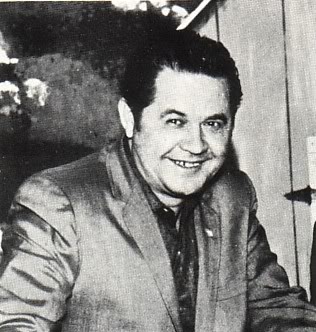
“A driver, and a talker – very emotional. Everybody liked him. He’d do anything in the world for you. But he didn’t understand country music. He wanted a sophisticated place, which you can’t have. He ran away my followers as fast as they turned up. Finally, the police that hung around the place told me I ought to get into business for myself. I borrowed $500 and opened up.”
dewey-groom_bw

It’s been a rough haul, says Groom, and he’s made it through several locations only because he understands the business – and that takes years.

Too many men rise and fall. Bob Wills, for instance, was the biggest bandleader in the world at one time – he outdrew Tommy Dorsey. Now – well, Groom will have a “tribute” dance for Wills, a man whom, next to Pappy Horton (whom he reveres as a great and good man), Groom admires most.

He cut his professional teeth on Wills’ songs – especially San Antonio Rose which, he confides, is simply an earlier Wills hit, Spanish Two Step, played backwards. Groom also has a taped narrative of Wills’ life, which has been a big radio hit. He expects the Wills Tribute Night to be a success.

“You can squeeze 2,000 people into the Longhorn,” he says, “and I guarantee the top guest stars from $1,500 to more than $2,000. They always make more than the guarantee. This week, it’s Ray Price. Other big names are Charley Pride, the Negro country singer, who I rank next to Johnny Cash, and people like George Jones, Tammy Wynette, Harold Morrison and Conway Twitty.”

As a lifetime member of the Country Music Hall of Fame, Groom is certain that another gospel-singer-type – Jimmy Davis, former governor of Louisiana – will go in the Hall of Fame this year.

Groom is sentimental about the old times and old-timers, but he knows it’s harder to please people nowadays. Variety is demanded. Even a little pop gets mixed with country music.

“People think I’m rich and I guess sometimes I want them to think so,” he confides, “but I don’t want to be. I want friends and I want to finish that school for Angel Inc. If I can do these two things, I’ll be happier even than I was when I was the Mabank Flash.”

“Daddy Dewey,” as he is known by many artists and fans, knows practically all the stars. He has had many of them on his stage. Dewey has contributed much to many artists in helping to get them started. Through the years he has recorded many records and written many songs as well.

The Longhorn Ballroom came about in October, 1968. Since then he has also purchased the old Guthrie Club and torn out the wall to increase the seating capacity to over 2,000, on a 4 1/2 acre plot that cost nearly $500,000.

Dewey Groom has become an authority on country music. He is often called upon for informative opinions on new country clubs or organizations. Many fellow club owners are personal friends and often obtain information about artists and business – [there’s no] bitterness that often comes in competition.

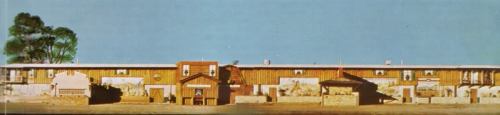
It’s been a long way since Dewey first traded a bull-calf for a guitar to the present-day Longhorn Ballroom. It is without doubt “America’s Most Unique Ballroom.” A landmark in Dallas, and one of the few western ballrooms in America. Hand-painted murals cover the walls and country decor prevails. Top country artists appear here weekly [and] Dewey’s own 12-piece band appear[s] nightly.

**

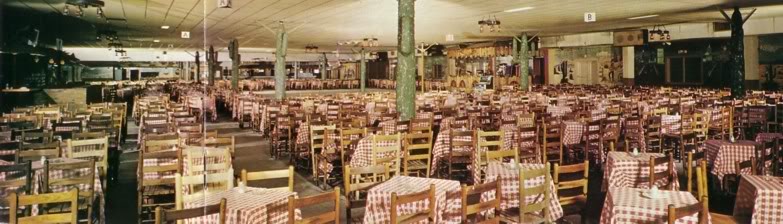
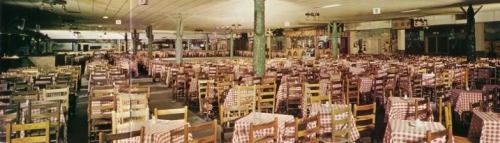
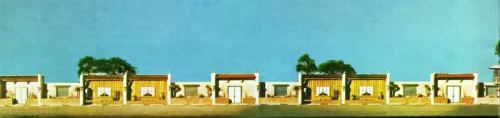
Below, photos from the article showing a partial view of the sprawling interior, complete with fantastic cactus pillars, as well as a couple of exterior shots showing Western street-scenes outside the club in a horseshoe around the parking lot. (Click to see larger images.)
dewey-groom_longhorn-ballroom_int

dewey-groom_longhorn-ballroom_ext1

dewey-groom_longhorn-ballroom_ext2

***

Sources & Notes

Incidentally, I have moved this post from another blog I had a long time ago. Without question, this got more hits and more comments (…more than 50!) than anything else I’d ever posted. People loved the Longhorn Ballroom, and a lot of them miss the days of dancing and drinking at the legendary dancehall (which just happened to be in a very seedy part of town, at Corinth and Industrial). Long live the Longhorn! (Also, I think it’s high time we bring “Dewey” back into the baby-name-pool. Along with “Roscoe.” … And maybe “Lon.” Pass it on.)

A short interview with Dewey on his retirement — “Adios, Longhorn Ballroom” by Mike Shropshire — was printed in Texas Monthly (March 1986) and can be found here.

Dewey Groom’s record label, Longhorn Records, was fairy active. He even put out some recordings of himself. I just listened to “Butane Blues” and I realized it was the first time I’d ever heard his voice (Dave Dudley meets Malcolm Yelvington). Listen to his recording on YouTube here.

Check out a cool photo of Dewey and his band in the early ’50s here.

A weird little detour into Dewey’s 8-page Jack Ruby-related file in the Kennedy assassination investigation (in which “barber” is listed as his profession) can be found here.

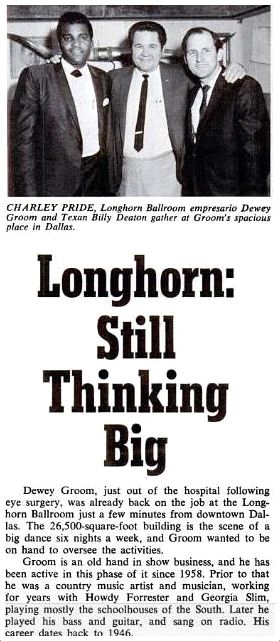
Below a short piece from Billboard (Nov. 21, 1970).
dewey-groom-billboard-112170adewey-groom-billboard-112170b

And, finally, a nice history of the Longhorn Ballroom by Jeff Liles (who booked bands there for a while in the post-Dewey era) can be read on the Dallas Observer website here.

*

Copyright © 2014 Paula Bosse. All Rights Reserved.

Deep Ellum / Deep Elm / Deep Elem Blues

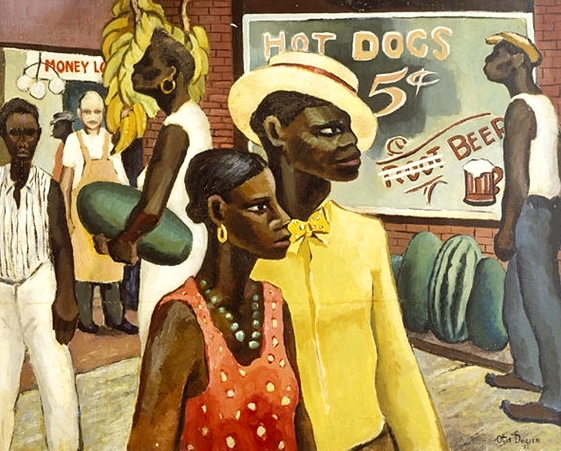
deep-elm-otis-dozier_1932“Deep Elm” – Otis Dozier, 1932

by Paula Bosse

“Deep Ellum Blues” has become a standard blues song, warning of/extolling the vices found in the once-thriving, predominantly black area of town, where a lot of people — black and white — enjoyed themselves (after dark) in clubs and bars, immersed in the sometimes shady goings-on that one tends to find on the other side of the tracks. The song (sometimes irritatingly called “Deep Elem Blues”) was first recorded in 1935 by the Lone Star Cowboys (popular performers in the Dallas area, better known as the Shelton Brothers). And now it’s become a blues standard, sung around the world by people who have no idea what a “Deep Ellum” is.

Below are four versions of the song that I like. (I searched for early performances by black musicians, but, according to Deep Ellum experts Alan Govenar and Jay Brakefield, there is only one that anyone seems to know about — by Booker Pittman, grandson of Booker T. Washington, and I couldn’t find it.)

But first, if you haven’t seen this wonderful short documentary by Alan Govenar about Deep Ellum in its original prime, it’s a must-see. (Bill Neely sings “Deep Ellum Blues” in this — it’s great. Listen for the extra verses.)

Below, the original version by the Lone Star Cowboys, who later changed their name to The Shelton Brothers and were well-known to Dallas audiences through their regular appearances at the Big D Jamboree and on local radio. (Listen to their follow-up, “What’s the Matter with Deep Elem?”)

My personal favorite, this hopping western-swing-big-band-rock-n-roll version by the always fabulous one-time Dallas resident Hank Thompson.

I can’t leave off this turbo-charged rockabilly version by Dallas’ own “Groovey” Joe Poovey!

And, finally, for good measure, one weird version, by the always reliable Charlie Feathers.

Remember y’all: KEEP YOUR MONEY IN YOUR SHOE!

***

Sources & Notes

“Deep Elm” painting by Otis Dozier (1932) — one of the Dallas Nine group — from the collection of the Dallas Museum of Art.

“Deep Ellum” film by Alan Govenar, one of Dallas’ leading blues and cultural historians and archivists. For more on the 1985 short film, see the FolkStreams site here. For Alan Govenar’s Documentary Arts website, see here.

For more on the history of Deep Ellum, I highly recommend Deep Ellum and Central Track, Where the Black and White Worlds of Dallas Converged by Alan B. Govenar and Jay F. Brakefield (Denton: UNT Press, 1998), as well as their recent revised/expanded book Deep Ellum, The Other Side of Dallas (College Station: Texas A & M University Press, 2013). Govenar and Brakefield have written the definitive history of Deep Ellum in these two volumes. You can read a bit about the song from the latter book here.

I wrote about another interesting song, “Dallas Blues” — considered by many to be the first blues song ever published — in the post “I’ve Got the Dallas Blues and Main Street Heart Disease,” here.

*

Copyright © 2014 Paula Bosse. All Rights Reserved.
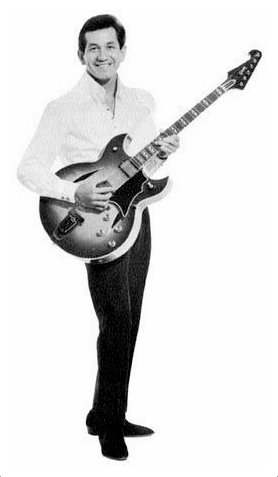
Trini Lopez: Little Mexico’s Greatest Export

trini-lopez-photo_bw

by Paula Bosse

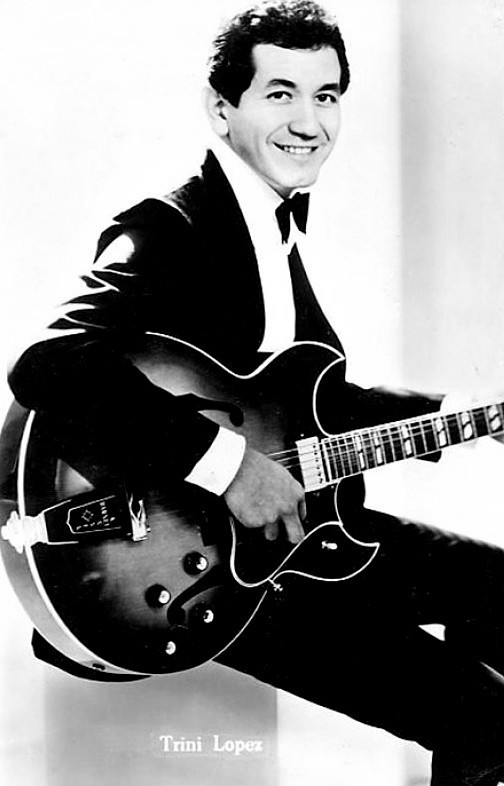
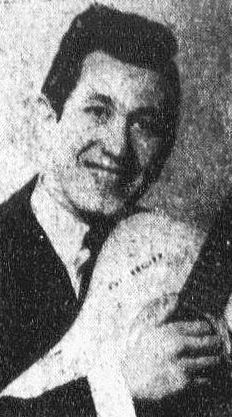
Trini Lopez has sold millions of records. MILLIONS. He was born in Dallas in 1937 and grew up in the Little Mexico area of town. He started his career when he was a teenager at Crozier Tech High School, singing and playing guitar in a popular combo. He played at dozens of school dances and parties, and, with a steady and faithful following, he was much in demand at countless venues around town, including a regular 2:30-6:30 p.m. Sunday matinee spot at Club Vegas (Oak Lawn & Lemmon), one of the many clubs in the city run by Jack Ruby.

Jack Ruby — the personable Latin from Manhattan, reports surprising success with his Sunday night Fiestas at Club Vegas….

“There is a wide demand for Latin music in Dallas,” said the Oak Lawn impresario…. He is opening at 2:30 p.m. Sundays for matinee dances featuring Trini Lopez and his orchestra. The versatile Lopez combo offers an occasional Yanqui tune in addition to the likes of the “Jack Ruby Mambo.” (Tony Zoppi’s column in The Dallas Morning News, Dec. 19, 1956)

(I really want to hear that “Jack Ruby Mambo”!)

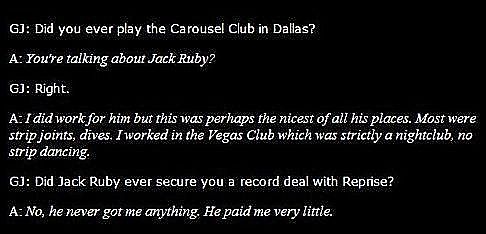
Speaking of the “Latin from Manhattan” (?!):

trini-rubyHa! (From Gary James’ really great interview w/ Trini — see link at end.)

He also appeared on local TV, including Channel 8 shows hosted by a pre-Peppermint Jerry Haynes: “Jukebox” and “Top Ten Dancing Party.”

trini-lopez_19581958 publicity photo

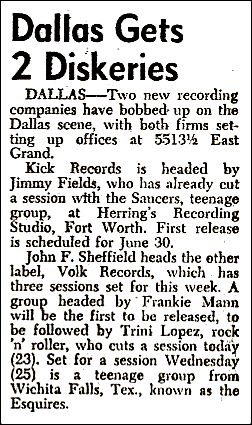
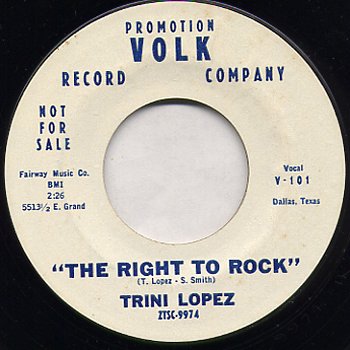
Trini’s first single was “The Right to Rock” — the first song he ever wrote — recorded in 1958 on a small Dallas label called Volk (did anyone else ever record for this label?).

trini_volk_billboard_062358Billboard, June 23, 1958

It’s a great little rockabilly number, but it didn’t really make any waves outside of Dallas (although it’s since found new life in the cult-y world of vintage rockabilly reissues).

volk-label

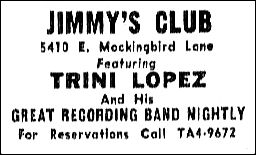
Trini then recorded a few singles for King, but those went nowhere as well, and Trini and his combo continued to play small clubs in and around DFW, wondering when the big break was going to come.

trini-lopez_jimmys-club_dmn_011159Jan., 1959

After a gig in Wichita Falls, Trini met fellow-Texan Buddy Holly who had been impressed by the young singer’s performance and encouraged him to contact his producer, Norman Petty, about recording some tracks at Petty’s studio in New Mexico. Trini jumped at the chance, but, unfortunately, the time in the studio at Clovis turned out to be a career low-point (see below for a link to the Gary James interview in which Trini gives a bitter and scathing account of that whole experience). Trini returned to Dallas and immediately fired his band and started a new one, determined that he would succeed, despite the prevailing (spoken and unspoken) racism he was continuing to run up against in the music business.

A few months after Buddy Holly’s death, the Crickets contacted Trini and asked him to travel to Los Angeles to discuss the possibility of becoming their new lead singer. Trini, seeing this as the big break he’d been waiting for, disbanded the combo and set out to the West Coast alone. The “audition” never really materialized, and Trini was stuck in California with no money and no prospects. He played a few small clubs and then settled into PJ’s for an extended and very successful engagement. It was there, in 1963, that the “big break” finally happened: he was discovered by producer Don Costa, who recommended that Frank Sinatra sign him to Reprise Records. Next thing you know, Trini had recorded his debut album, “Trini Lopez at PJ’s,” and the first single, “If I Had a Hammer,” was a huge smash hit, selling millions of copies and reaching #1 in 38 countries. Trini Lopez became an international star.

trini-lopez_photo_bw

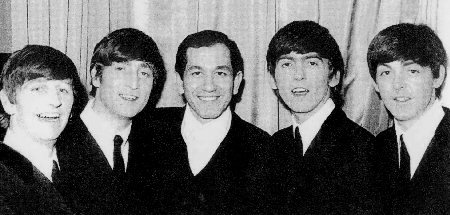
At the beginning of 1964, he was booked for a series of shows in Paris where he shared the bill with The Beatles, just as they were about to hit big in the US (their Ed Sullivan appearance was less than a month away). Beatlemania was in full force in Europe, but Trini was also getting his share of attention. 

trini-lopez_beatles_1964

And, the rest, as they say, is history.

*

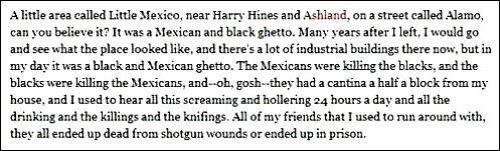
A couple of interesting things, Dallas-wise. My Trini Lopez knowledge is fairly scant, but having read a lot about him over the past couple of days, the one thing that keeps coming back when he talks about the Little Mexico section of town (invariably referred to by him as a “ghetto”) is how violent a place it was. He also recounts the deep and dehumanizing racial prejudice he and other Mexican-Americans experienced living in Dallas. When he left for Los Angeles in 1959/1960, he left for good. He came back regularly to visit his family (I remember having him pointed out to me by my parents in a restaurant once), but I’m not sure he would have ever wanted to live here again.

trini-lopez_wilonsky_052906From an interview by Robert Wilonsky (Dallas Observer, May 29, 2006)

*

Below are a few random interviews and tidbits.

Trini developed his own beat, a Tex-Mex style of rock and roll now popularly known as “the Trini beat” and which Trini describes as “American music with a Mexican feeing.” (DMN, July 12, 1964)

And from the same article:

“People in Dallas told me I had the talent but suggested I change my name. I said ‘No.’ I told them Italians had made it as Italians, Jews as Jews, and Negroes as Negroes. I wanted to make it as a Mexican. No one of Mexican-American heritage had made it before in the entertainment world. I wanted to be the first.” (DMN, July 12, 1964)

(According to Trini, the person who suggested he change he name was John F. Sheffield who owned Volk Records. Sheffield was okay with “Trini,” but he insisted the “Lopez” had to go. He suggested “Roper.” Trini refused and threatened to walk. Sheffield relented.)

trini-lopez_earl-wilson_july-1965a(Click for larger image – continues below.)

trini-lopez_earl-wilson_july_1965bEarl Wilson’s syndicated column (July 1965)

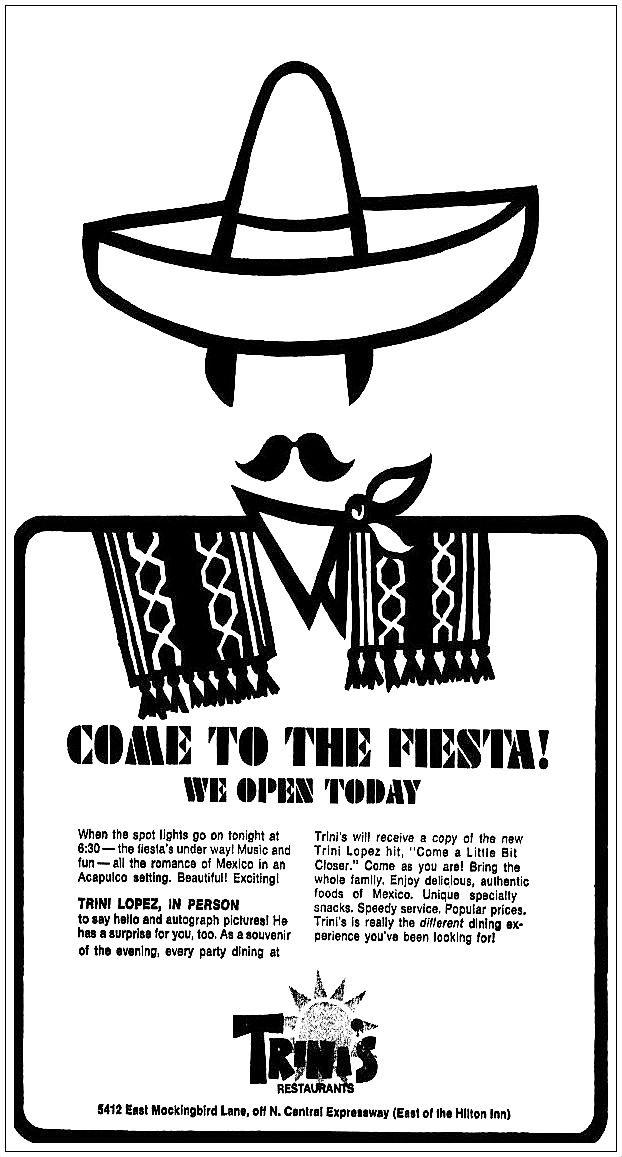
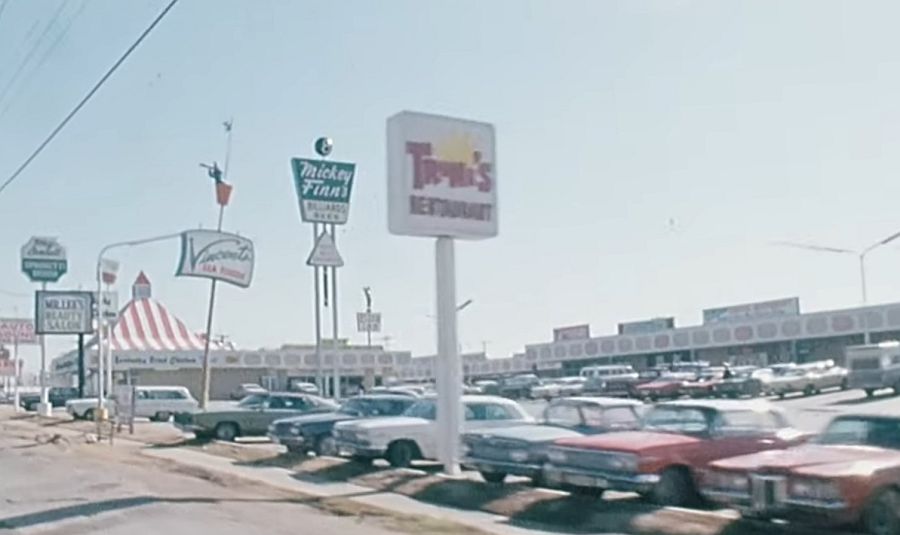
In 1969, Trini Lopez became a restaurateur and opened “Trini’s” at 5412 East Mockingbird, across from the old Dr Pepper plant (click for larger image):

trinis_restaurant_031969
March, 1969

trinis_sightseeing-film_KERA_1970_jones-film_SMU - croppedScreenshot, KERA, 1970 (Jones Film Collection, SMU)

**

UPDATE: Sadly, Trini Lopez died on April 11, 2020 from complications of COVID-19. He was 83. Read his obituary in Variety here

***

Sources & Notes

Full Dallas Observer interview by Robert Wilonsky is here.

There are a lot of garbled accounts of Trini Lopez’s career scattered across the internet. One that seems mostly right is here.

The essential  interview with Trini by Gary James I’ve mentioned a couple of times above, is here. I think the interview is from 2002. His memories of growing up in Dallas are interesting, unvarnished, and well worth reading. He also talks about the racial prejudice he met with when attempting to record with Norman Petty and the resulting mutiny of his band in Clovis which led to their being fired by Trini immediately upon their return to Dallas.

Read Trini’s tribute to his parents — an essay he wrote in the early 1980s — here

Trini Lopez’s official website is here.

Discovering Trini and his music has been surprisingly fun! Thanks, Trini! Check out this great, infectiously joyful performance of “La Bamba” with Jose Feliciano at a music festival in San Antonio in 1974. (Trini was performing “La Bamba” when he was still in Dallas, before Ritchie Valens had a hit with it — when Valens’ version hit the airwaves, Trini was crushed that someone had beaten him to recording it. He may not have recorded it first, but he had the bigger hit with it a few years later.)

*

Copyright © 2014 Paula Bosse. All Rights Reserved.
Lefty Frizzell: It All Began on Ross Avenue

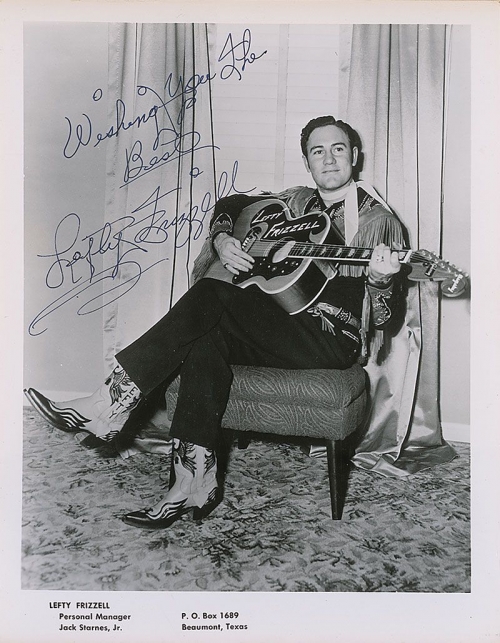
lefty_promoThe Man

by Paula Bosse

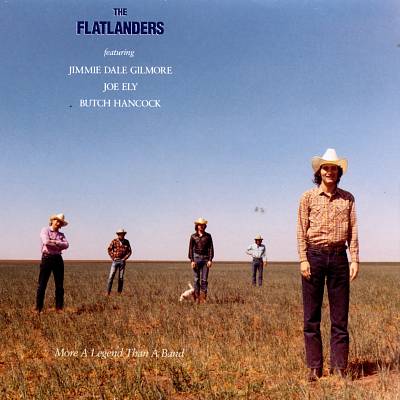
Lefty Frizzell was born on this day in 1928 in Coriscana. His Dallas connection? He was “discovered” by Dallas producer Jim Beck and recorded many of his early hits at Beck’s downtown studio. He played a lot of gigs around town, including several appearances over the years on the Big D Jamboree. But even if there weren’t any iron-clad Dallas connections, I’d have to mention him anyway. Not only is he one of country music’s most influential artists (up there in the Holy Trinity with Hank Williams and George Jones), he’s my favorite singer. Of any genre. EVER.

Take a listen to his first single, recorded on July 25, 1950 at the celebrated Jim Beck Studio at 1101 Ross Avenue: “If You’ve Got the Money, I’ve Got the Time” (which the Dallas Morning News — a bit dismissive of the “hillbilly” set — weirdly mangled into “I’ve Got the Money If You Can Spare the Time”). It was an incredible smash hit, and it kicked off a spectacular career, during which he was at almost Beatles-level popularity, with four singles in the top ten at the same time.

*

And another clip, this time a live performance from “The Porter Wagoner Show.”

*

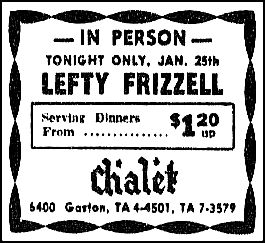
And, lastly, something I just found today, an ad for an appearance by Lefty in January 1963, when his career had dipped a bit (he would have a big come-back hit with “Saginaw, Michigan” at the end of the year). I’ve never heard of The Chalet (a supper club, I think), but its address of 6400 Gaston means that it was in the space where the Dixie House is now, in Lakewood. Maybe it’s only exciting to a superfan such as myself, but knowing that Lefty performed in my neighborhood, in a place in which I’ve actually spent a not insignificant amount of time, well … that’s just damn cool. Happy Birthday, Lefty!

lefty-chalet_dmn_012563January 1963

***

Sources & Notes

To read my post on the untimely death of Jim Beck (and see photos of him, which are few and far between), click here.

*

Copyright © 2014 Paula Bosse. All Rights Reserved.
Jerry Scoggins, From WFAA Staff Musician to Pop Culture Icon

jerry-scoggins_wfaa-1941
Jerry Scoggins in the WFAA studios, 1941

by Paula Bosse

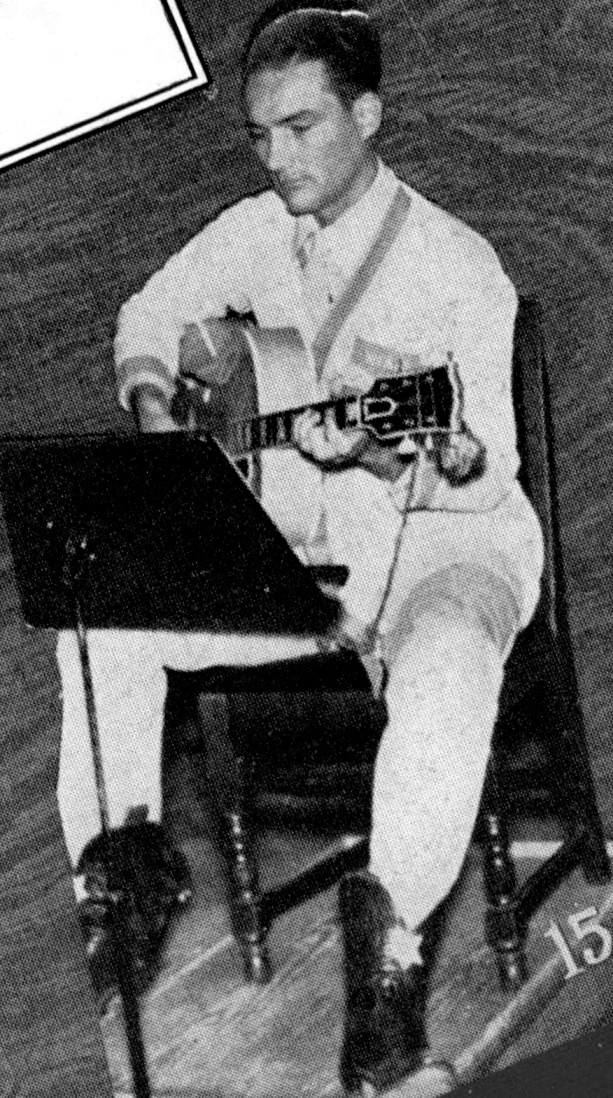
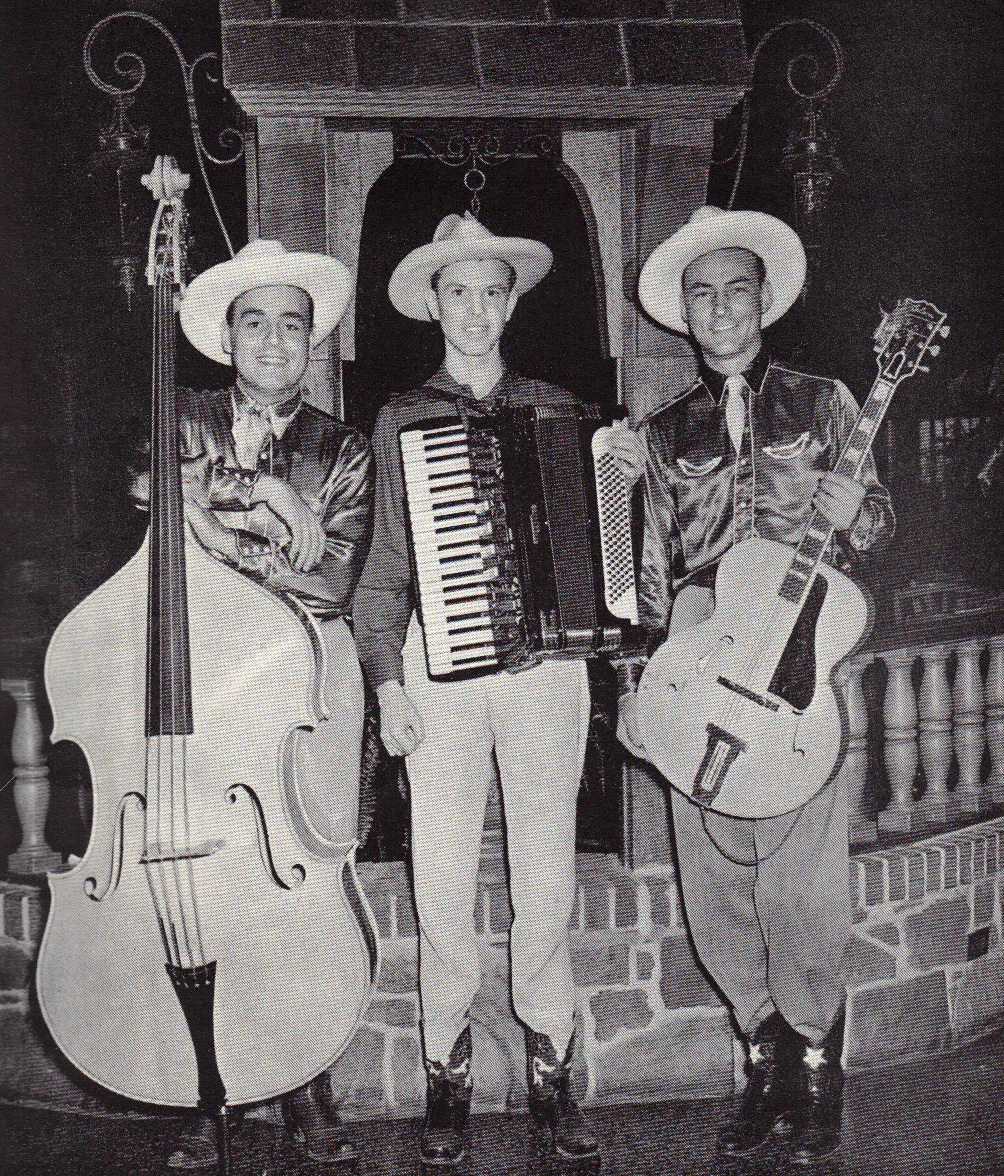
You know Jerry Scoggins. You DO. You can sing along with his most famous recording. But you might not know his name — even if you do know it, you’re not sure why you know it. And you’ve almost certainly never seen a picture of him. But there he is in the photo above, in 1941, at the studios of WFAA radio where he was a staff musician and occasional on-air personality. The caption reads: “Guitarist Jerry Scoggins arrives for a rehearsal in shiny cowboy boots.”

During his time at WFAA (he was there almost a decade — he started when the station still had studios in the Baker Hotel), Jerry was in countless bands — in fact, he often had several going at the same time. Some of his bands were: The Bumblebees, the Tune Tumblers (with a then-unknown Dale Evans as the group’s “girl singer”), Three Cats & a Canary, The Baboleers, and The Cowhands.

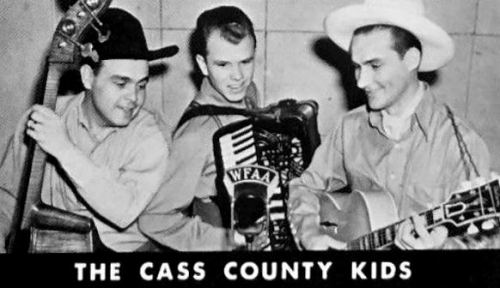
His main group, though, was the Cass County Kids, a popular trio that performed western music and who claimed to have a repertoire of over 500 songs (!).

cass-co_kids_wfaa1_1941_caption

In 1945, after years of working as mostly anonymous radio musicians, the Kids finally hit the big time. Gene Autry asked them to join him, and they left Dallas for Hollywood, changing their name in the process — at Autry’s request — to the (slightly) more age-appropriate Cass County Boys. They appeared in movies, on television, and on record with Autry for several years, and from all accounts, the Cass County Boys had a long and happy career.

cass-county-kids_wfaa-postcard_det_ebay

By 1962, Jerry was still in California, but at that point he was working as a stockbroker, singing only on weekends. I’m not exactly sure how it happened, but — seemingly out of the blue — he was asked by TV producers to sing the theme song for a new CBS television show called The Beverly Hillbillies. Backed by the great Flatt & Scruggs, Jerry sang “The Ballad of Jed Clampett,” and his voice became known to millions of people, overnight. And here it is more than fifty years later, and I bet you know all the words to the song. It has become a permanent fixture in American pop culture.

And that’s why you know Jerry Scoggins.


*

jerry-scoggins_bevhill_end-credits

*

ADDED, Sept. 2023: A reader just sent me this clip showing Scoggins (with Earl Scruggs, Roy Clark, and others) performing the song in 1993 as Buddy Ebsen dances along. This is so great!!

scoggins-jerry_1993_youtubeJerry Scoggins, 1993 (from YouTube video)

*

And here’s Jerry with the Cass County Boys, singing a novelty song called “Which Way’d They Go?” (Jerry’s the good-looking one on the right):

***

Sources & Notes

The top photo of Jerry Scoggins and the large photo of the Cass County Kids are from the WFAA-KGKO-WBAP Combined Family Album (Dallas, 1941). The small photo of the Cass County Kids is from eBay.

Jerry Scoggins was born in 1911 in Mount Pleasant, Texas (in Titus County, right next door to Cass County). He died in 2004 at the age of 93. His obituary in the Los Angeles Times is here. More on Jerry from Wikipedia, here.

A nice overview of the Cass County Kids/Boys is here.

*

Copyright © 2014 Paula Bosse. All Rights Reserved.
“Meet Me in Dallas” by Jack Gardner (1915)

meet-me-in-dallas_sheet_music_1915“Be sure and meet me…”

by Paula Bosse

“Tell your friends
You’ll meet them in Dallas,
In the town
Where there is no malice.”

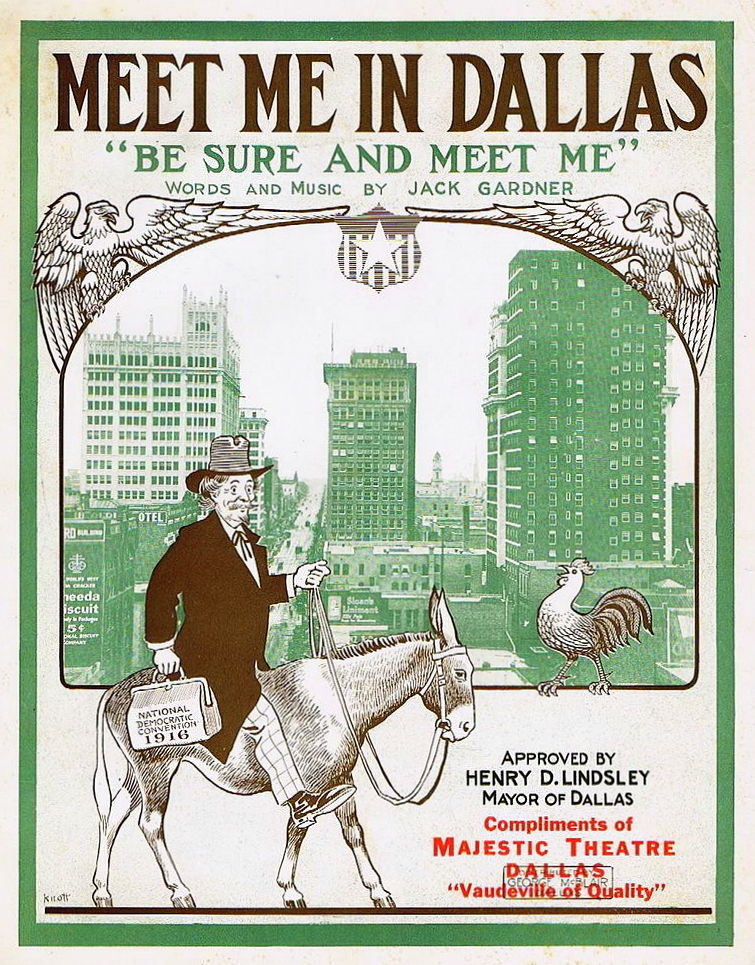
Yes, those immortal lyrics are by Jack Gardner, a musician, bandleader, and an “entertainment manager” at the tony Adolphus Hotel. For some reason, he was chosen as the man to write a persuasive ditty which (it was hoped) would sweep the country and lure the 1916 Democratic National Convention to Dallas. Sadly, the song did not set the world (nor Democratic loins) on fire, and (spoiler!) St. Louis got the convention.

As we see above, the mayor-approved city-jingle was issued with sheet music cover art by Dallas Morning News cartoonist John Knott and a great background photo of downtown, with the Adolphus and Busch Building (now the Kirby Building) featured prominently.

If you’d like to wallow in the vamp-y march that IS “Meet Me in Dallas,” the sheet music has been scanned in its entirety by Baylor University here. You can play it and sing it in the privacy of your own home!

If you would like to read about how the Texas Democratic Party was hoping to snag the national convention with this song, you can read about it in this article by Paula Lupkin that appeared in the Fall 2012 issue of Legacies.

And, lastly, a little check-in with Jack, to see what he was doing years later in 1938. This blurblet from St. Petersburg’s Evening Independent has him in Florida, working as a traveling musician with his dance band, settling into a one-week gig at the Detroit Hotel. Not only has he persuaded the anonymous reporter that his name is “synonymous with good dance music in the Southwest,” but he still seems to be resting on his long-faded “Meet Me in Dallas” not-quite-brush-with-the-big-time laurels.

meet_me_in_dallas_gardner_interview_1938

gardner-jack_adolphus_crop

***

Sources & Notes

Top image from the Frances G. Spencer Collection of American Popular Sheet Music at Baylor University, here. (Click picture for larger image.)

Photo of Jack Gardner and His Orchestra is from the wilds of the internet.

I’m sure Mr. Gardner’s ditty was the bee’s knees, but it’s not to be confused with the wonderfully seedy 1969 country song of the same name by the fabulous Jeannie C. Riley (read about that song here).

*

Copyright © 2014 Paula Bosse. All Rights Reserved.