Flashback : Dallas

A Miscellany: History, Ads, Pop Culture

Category: Downtown

Main Street Looking East — 1920s

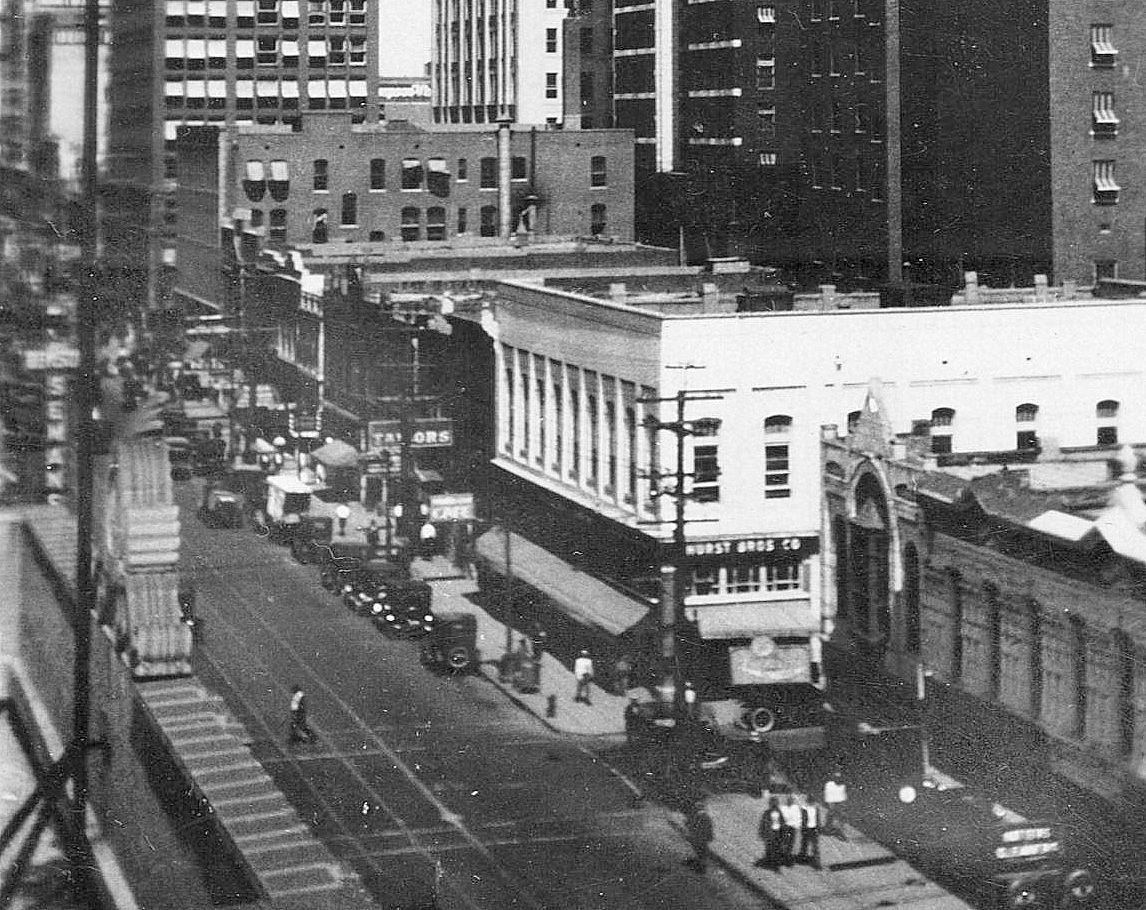
main-street_east_ca-1925_erik-swansonEast from the 1200 block of Main (photo courtesy Erik Swanson)

by Paula Bosse

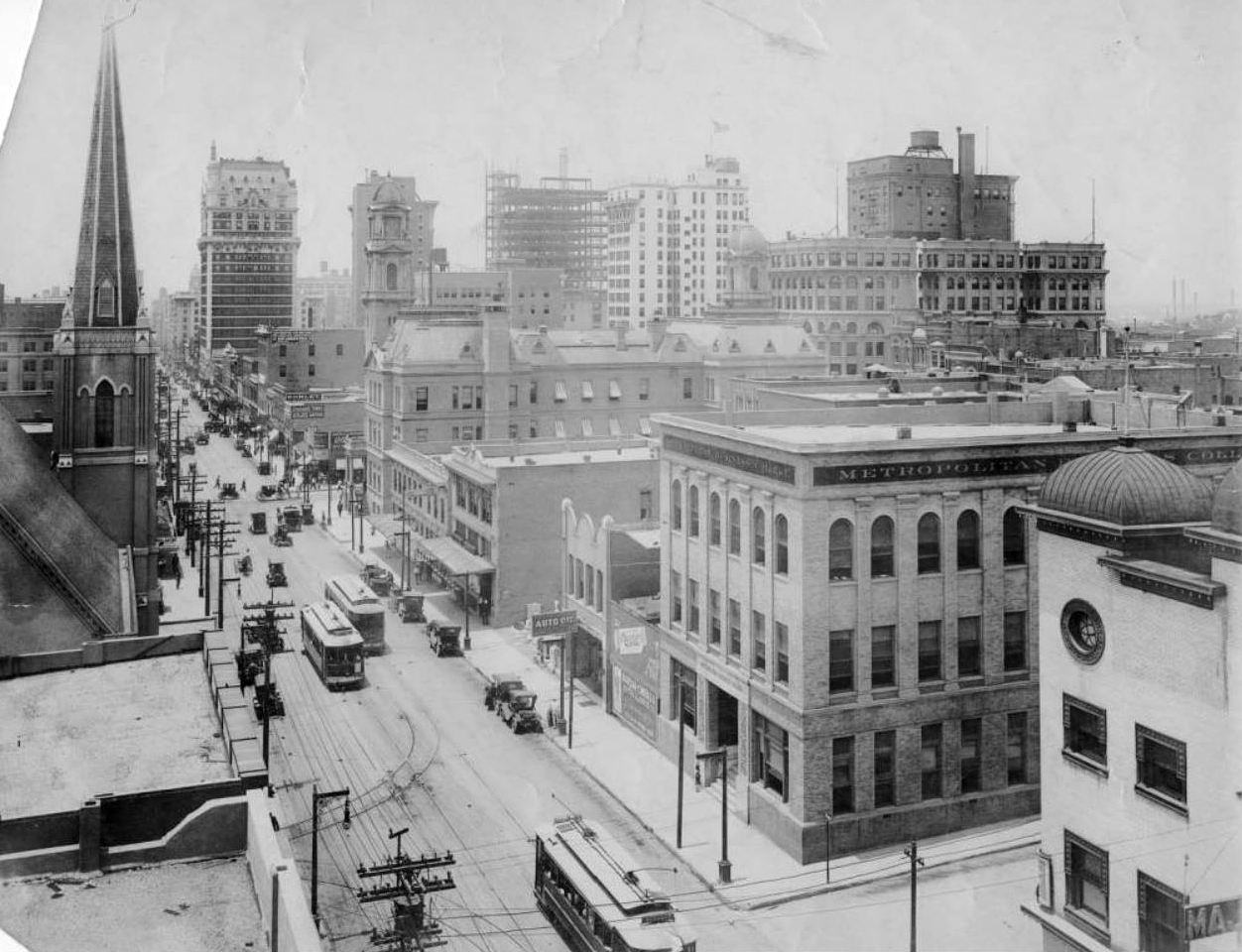
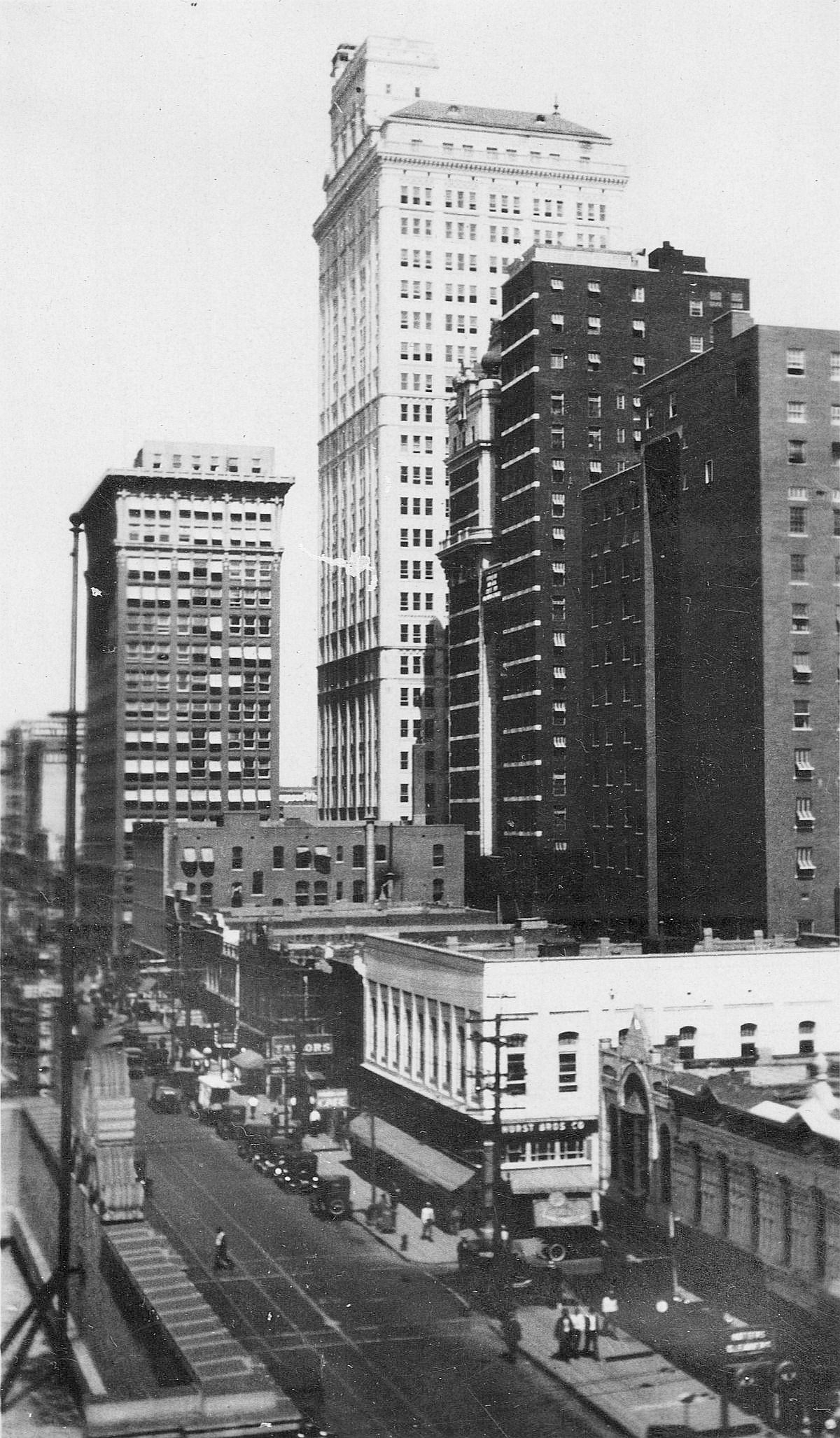
This great photo (sent in by reader Erik Swanson) shows Main Street around 1925. The white building seen in the lower right is Hurst Bros., a men’s clothing shop, which was at the southeast corner of Main and Field (1300-1304 Main). It was a little confusing to me at first because it looks like there is a street behind it (to the south), which would have been Commerce, but then the Magnolia Building and the Adolphus would all be out of place. But what appears to be a street was just a wide alleyway/passage (seen on the 1921 Sanborn map here — Main east of Akard can be seen on the Sanborn map here).

The very tall building is the Magnolia, at Commerce and Akard (it opened in 1922 — Pegasus wasn’t added until 1934); to the right, across Akard, is the Adolphus Hotel and the Adolphus Annex. The tall building to the left of the Magnolia is the Southwestern Life Building (southeast corner Main and Akard, demolished in 1972, now a small open plaza area). The 4-story building at the southwest corner of Main and Akard is the Andrews Building. The white building in the center is Hurst Bros. (southeast corner Main and Field), and across Main can be seen the sign for the men’s clothing shop Benson-Semans.

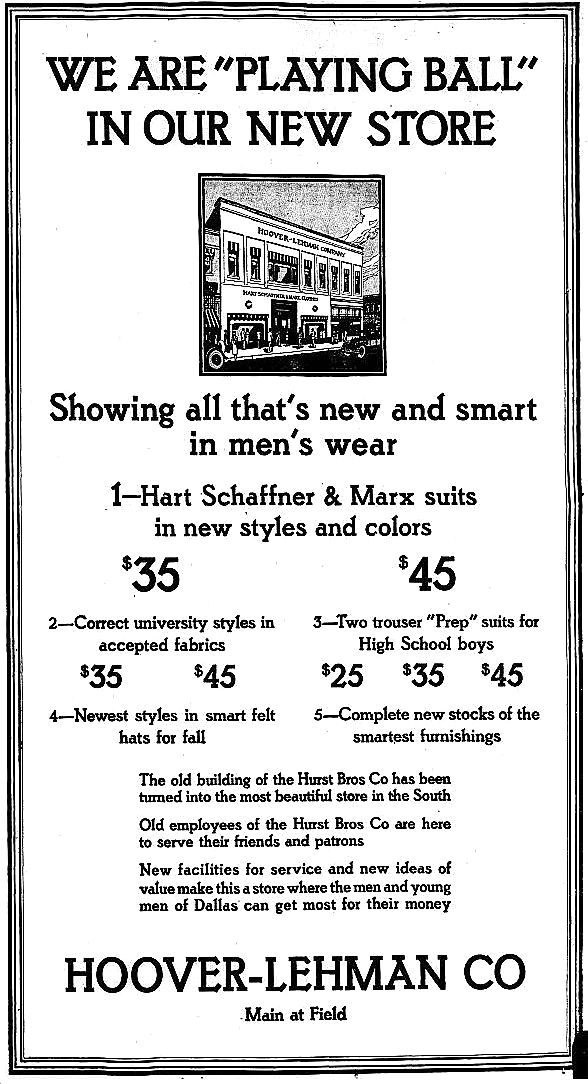
Hurst Bros. was gone by 1929 when it became Hoover-Lehman, another clothing store, and Benson-Semans appears to have vacated that space around 1926, helping to date the photo between 1922 and 1926.

*

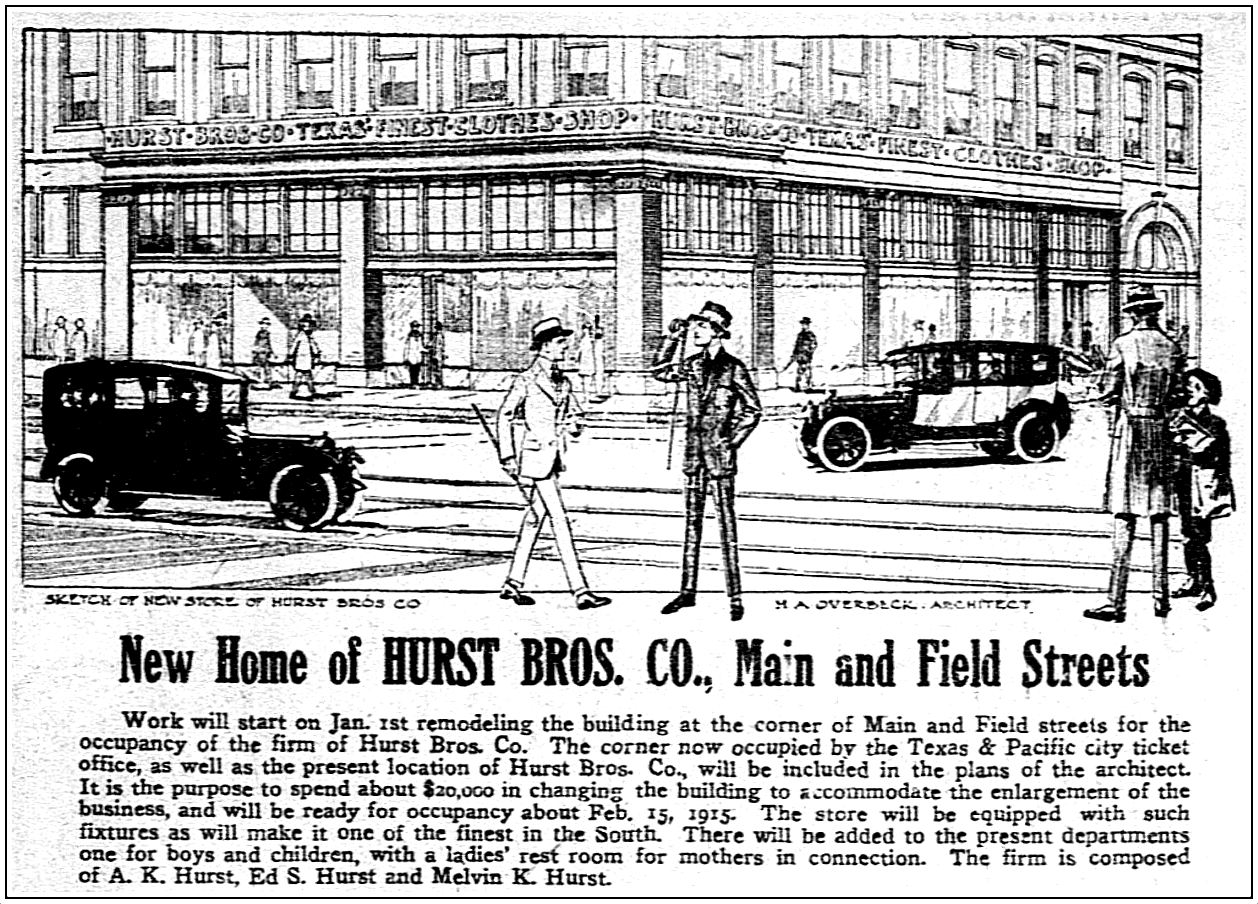
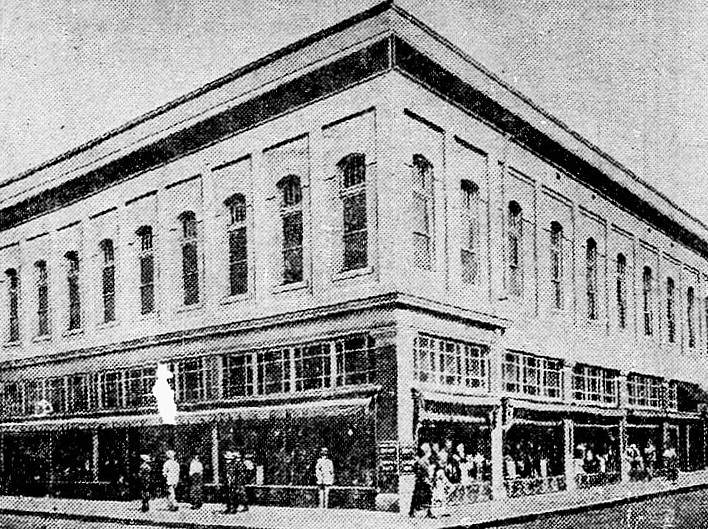
The Hurst brothers, Melvin K. Hurst and Edgar S. Hurst (along with their father, Alfred K. Hurst) began their men’s clothing business around 1912 and moved into the building seen in this photo in 1915 (it was renovated by prominent Dallas architect H. A. Overbeck, whose still-standing courts building and jail was built at about the same time). The business was dissolved in 1929, and its stock, fixtures, and lease were acquired by a longtime employee who, with a partner, remodeled the store and reopened it as the Hoover-Lehman Co. (A present-day Google Street View of this southeast corner of Main and Field can be seen here.)

main-street_east_ca-1925_hurst-bros-det_erik-swansonDetail from top photo, ca. 1925 (click for larger image)

hurst-bros_dmn_112214_adAd from Nov., 1914

hurst-bros_1920sLate 1920s

hurst-bros_hoover-lehman_091329Sept., 1929

***

Sources & Notes

Top photo sent in by Erik Swanson, used by permission. The photo may have been taken by his grandfather, F. V. Swanson, an optometrist (see the post “Thompson & Swanson: ‘The Oldest Exclusive Optical House in Dallas,” here). Thanks for the great photo, Erik! (Update: Sadly, local music favorite Erik Swanson died on Feb. 16, 2021 at the age of 57 — he had been suffering from ALS. RIP, Erik. And thanks for the great music.)

All images are larger when clicked.

*

Copyright © 2018 Paula Bosse. All Rights Reserved.

Thompson & Swanson: “The Oldest Exclusive Optical House In Dallas”

thompson-swanson_1914-ad_erik-swansonDon’t blink… (1914 ad, courtesy Erik Swanson)

by Paula Bosse

Dr. Alfred F. Thompson (1862-1942) and Dr. Frank V. Swanson (1885-1949) opened their “manufacturing opticians” practice, Thompson & Swanson, in 1911. In addition to examining and treating patients, they also ground lenses and manufactured their own glasses, something which I gather was somewhat unusual in 1911 for such a small practice.

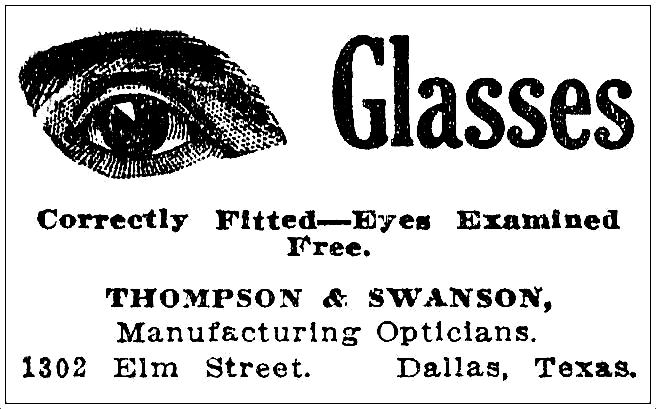
They first set up shop on Elm Street, and their ads — generally eyeball-themed — were always attention-grabbers: not only did they stare at you from newspaper pages, they also seemed to follow you around the room.

thompson-swanson_1911-ad1911 ad

They soon moved to the Sumpter Building, in late 1912 (ad at top), directly across from the brand new Praetorian Building. By February of 1916 they’d hit the big-time and were actually in the Praetorian Building, Dallas’ tallest building and its most impressive address. Not only were they in the building, they were at street-level, which guaranteed that practically everyone who spent time downtown was familiar with Thompson & Swanson, if only because they passed the Praetorian Building. The ad below, featuring the building, is fantastic, in a weird-fraternal-order kind of way. (The ad at the top is also kind of weird — you can practically hear the spooky theremin.) (Click ads to see larger images.)

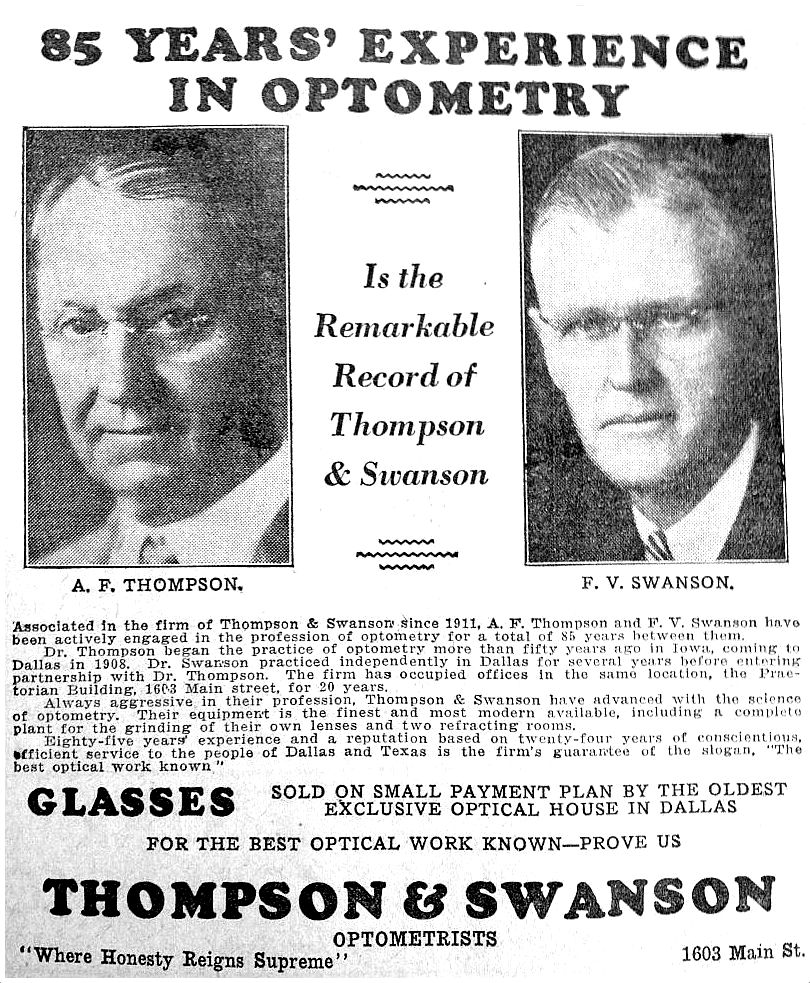
thompson-swanson_1923-ad_erik-swanson1923 ad (courtesy Erik Swanson)

Thompson & Swanson’s business history:

thompson-and-swanson_erik-swanson(courtesy Erik Swanson)

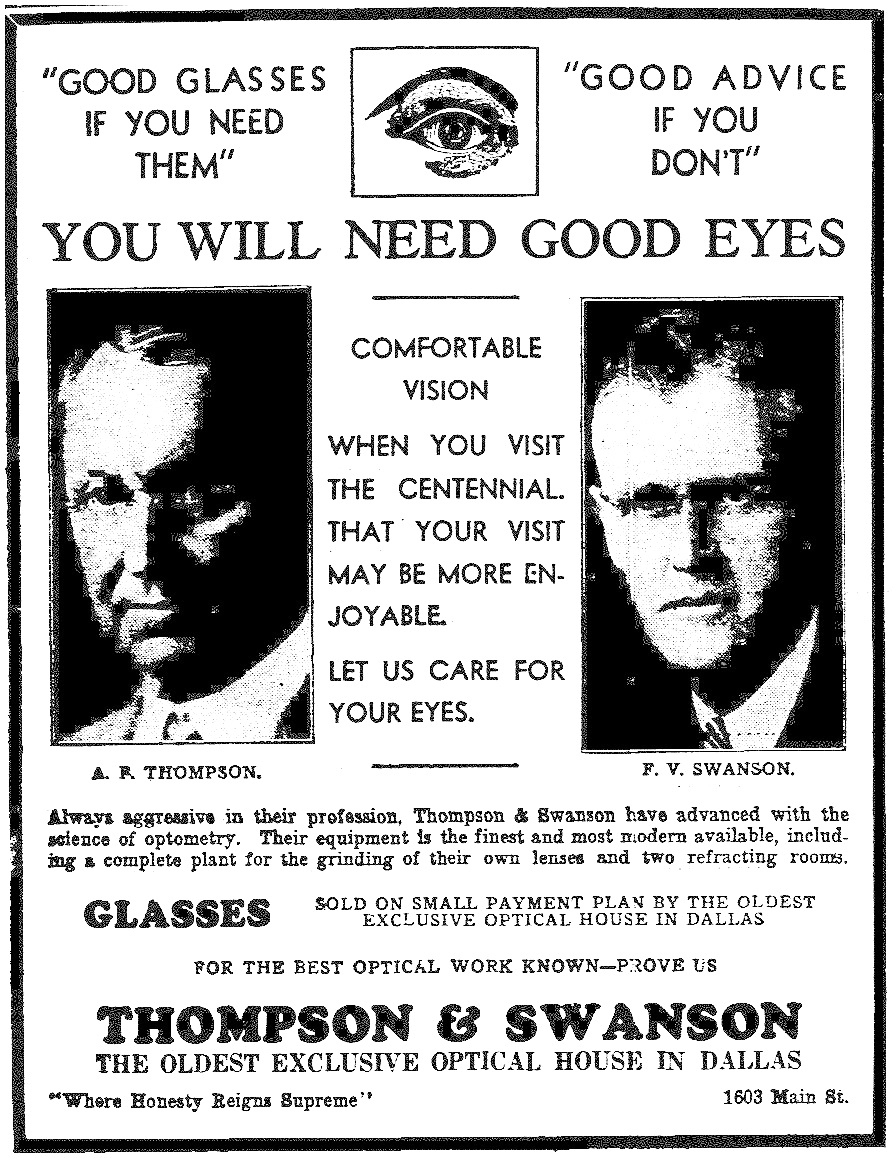
Similar ad, but aimed at the Texas Centennial visitor. “Good glasses if you need them, good advice if you don’t.”

thompson-swanson_june-1936June, 1936

The successful partnership of Thompson and Swanson lasted into the early 1940s. After Dr. Thompson’s death in 1942, Dr. Swanson continued at the same address as “Swanson & Son,” a practice with his son, Dr. F. V. Swanson, Jr.

***

Sources & Notes

The top ad, the ad with the Praetorian Building, and the “85 Years’ Experience in Optometry” ads were very kindly sent to me by Erik Swanson (grandson of Dr. Swanson); they are used with permission. I love old ads, especially ones that feature Dallas buildings. Regarding the location of his grandfather’s business in the Praetorian Building, Erik wrote: “Little did he know there would one day be a giant eyeball at the location where he had his optician shop.” Ha! Now when I see that giant eyeball I’ll think of Thompson & Swanson (and hear that spooky theremin).

I was doubly happy to exchange emails with Erik because I’ve been a fan of his Western Swing bands for many years. His current band is Shoot Low Sheriff (listen to them here), but I first became a fan when I heard his former band, Cowboys & Indians. Thanks for the ads, Erik!

UPDATE: Sadly, Erik Swanson died on Feb. 16, 2021 at the age of 57. He had been suffering from ALS. RIP, Erik. Thank you for the hours of entertainment your music provided me and thousands of others.

*

Copyright © 2018 Paula Bosse. All Rights Reserved.

“A Glimpse of Dallas” — ca. 1909

postcard_charles-e-arnoldCommerce Street, looking west from St. Paul…

by Paula Bosse

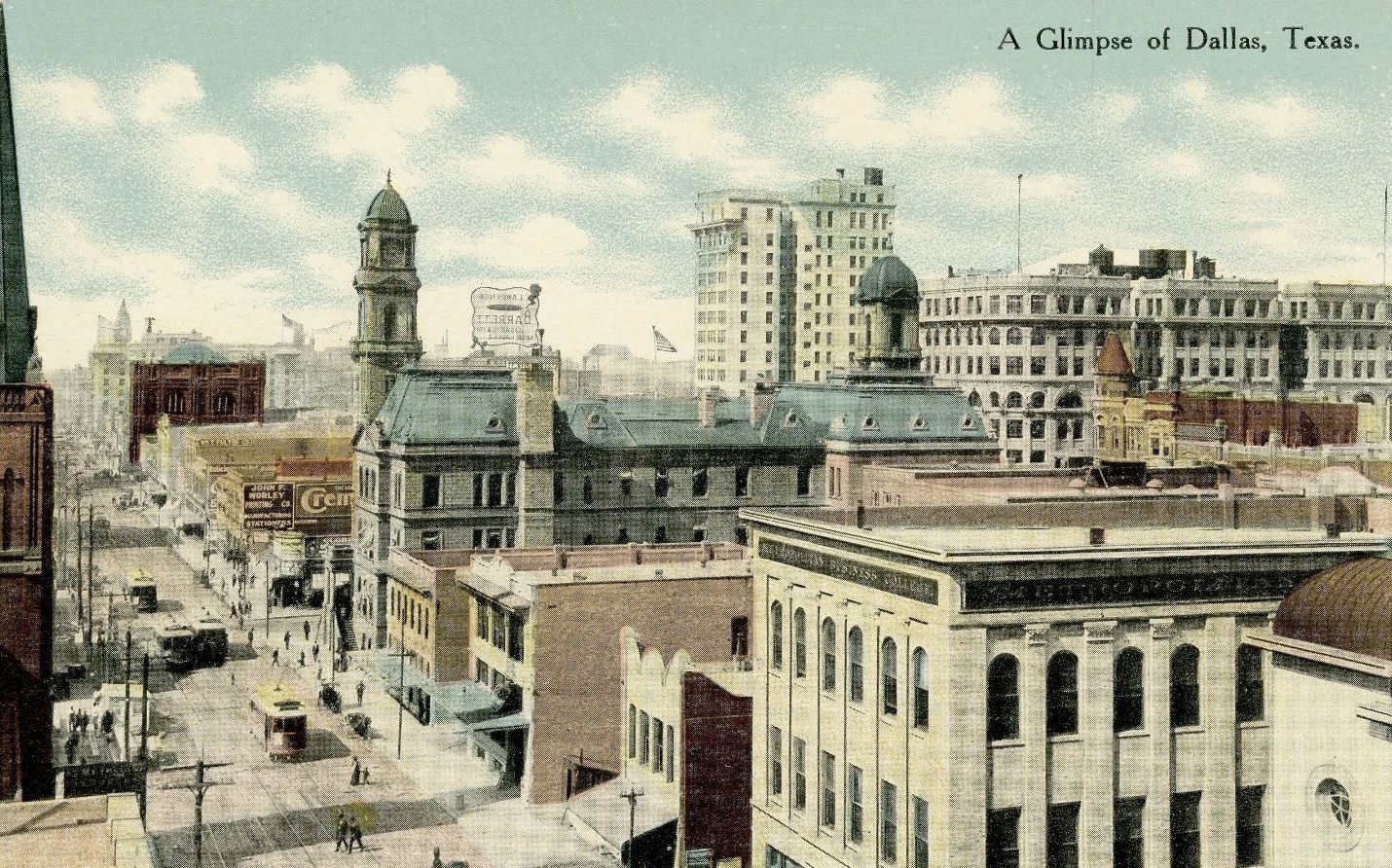
This very attractive postcard shows a growing downtown Dallas, looking west from Commerce and St. Paul, photographed by Charles E. Arnold from the YMCA building (which once sat in the block now occupied by the Statler). The Wilson Building can be seen at the top right, the Praetorian Building (then the tallest building in the city) is to its left, and the Post Office and Federal Building is in the center. The photo was probably taken in 1909 or 1910 (the Praetorian was completed in 1908 and the Adolphus Hotel (not seen in this postcard) was under construction in 1911.

The photo below, taken by Jno. J. Johnson from the exact same vantage point, shows the many changes to the skyline which happened over a very short span of time. The photo below is from about 1913.

new-skyline_c1912_degolyer_smuvia DeGolyer Library, SMU

I zoomed in on this photo in a previous post, “Horses, Carriages, Horseless Carriages: Commerce Street — 1913,” here.

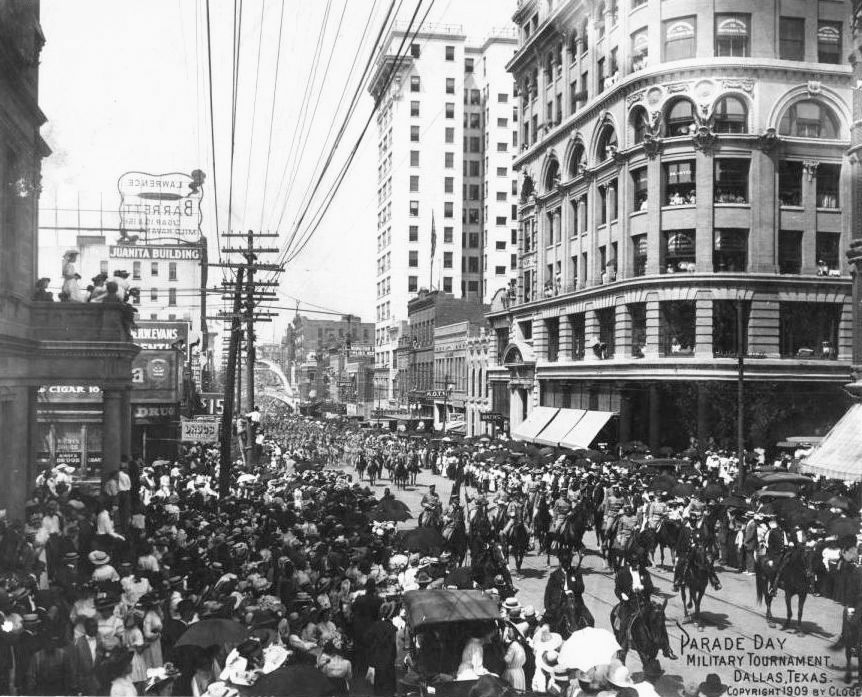
The large “Barrett Cigar” sign seen in the top postcard image is also visible in a 1909 photo by Clogenson, below — it can be seen at the left, atop the Juanita Building on Main Street, opposite the Praetorian.

parade-day_1909_clogenson_degolyervia DeGolyer Library, SMU

I zoomed in on this photo in the post “Parade Day — 1909,” here.

This was the beginning of staggering growth for Dallas, and new skyscrapers seemed to be going up every month.

***

Sources & Notes

I came across the postcard image a couple of years ago — I noted that the photographer was C. E. Arnold, but I did not note the source.

The two photos are from the DeGolyer Library, Central University Libraries, Southern Methodist University; further information on each photo can be found at the links posted immediately below the images.

All images are larger when clicked.

*

Copyright © 2018 Paula Bosse. All Rights Reserved.

“All the Beer You Can Drink In an Hour For 60 Cents” — 1935

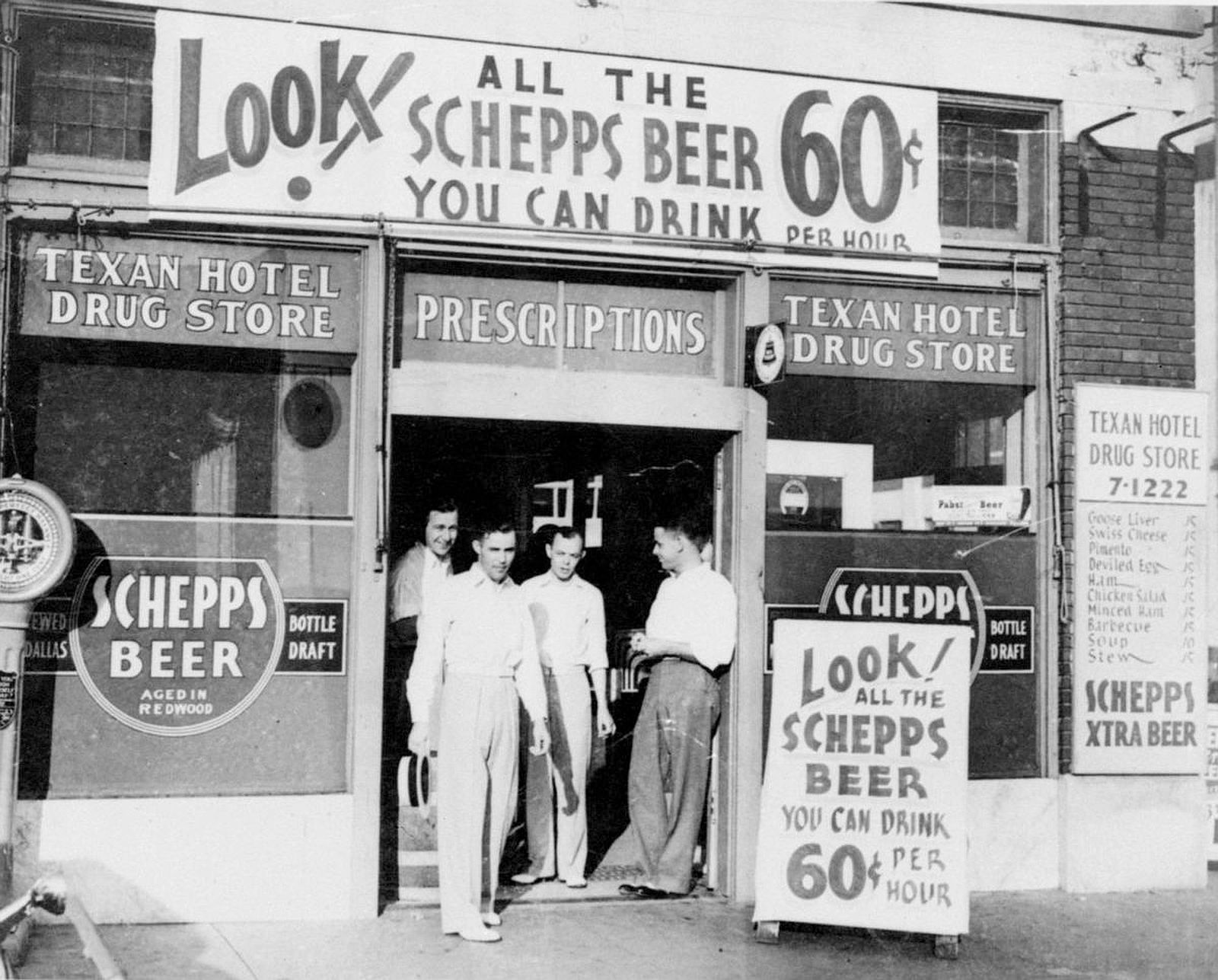
beer_60-cents_AP_1935LOOK!

by Paula Bosse

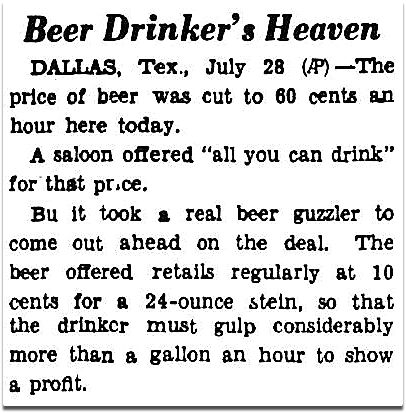
Summertime in Big D. It’s hot. REAL hot. For some, the only way to properly slake that nagging thirst is with a tall frosty mug of beer. In the summer of 1935, the management of the Texan Hotel Drug Store (at the northeast corner of S. Houston and Jackson streets) decided to offer a headline-grabbing promotion: “ALL THE SCHEPPS BEER YOU CAN DRINK: 60¢ PER HOUR!” (60¢ in 1935 would be the equivalent of about $11.00 today.) Sounds like a bargain, right? Maybe. Depends on your constitution — it meant that you would have to consume over a gallon of beer in one hour to save any money. (Not a problem for some, I realize.)

This made national news — there’s even newsreel footage. The photo above is from an AP wire story, accompanied by this caption: “A Dallas beer parlor offered ‘all the beer you can drink’ for 60 cents an hour. There were plenty of takers, but the proprietor said none had beaten him. The drinker would have to consume more than nine pints an hour to show a profit.”

beer_scranton-PA-repubican_072935
Scranton (PA) Republican, July 29, 1935

Speaking of newsreel footage, you can watch it here. As you can see, there certainly were a lot of very enthusiastic Dallas beer-drinkers doing their very best to surpass that gallon hurdle in order to feel they’d spent their money (and their hour) wisely.

Ah, back when you could guzzle beer in a drugstore. (Several drugstores that same year — including this one — were routinely getting busted for selling illicit whiskey.)

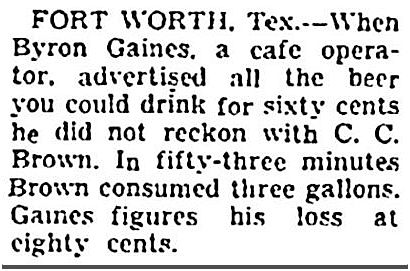
The promotion appears to have been a hit, both publicity-wise and beer-sales-wise. The Dallas proprietor said no drinker had managed to come out ahead, but in Fort Worth, men appear to be made of stronger stuff. Cafe operator Byron Gaines hadn’t anticipated Chauncey C. Brown, a hops-loving patron described as “heavy-set” and “amiable.”

beer_FW_olean-NY-times-herald_081235Olean (NY) Times Herald, Aug. 12, 1935

According to United Press reports (this made national news, too), Brown took 58 minutes (rather than 53), but that “seven minutes of that time was spent in playing a slot machine.” It’s good to have hobbies.

***

Sources & Notes

AP photo, taken in July 1935, from the Press of Atlantic City site, here

Newsreel footage is from Critical Past (and can be purchased), here.

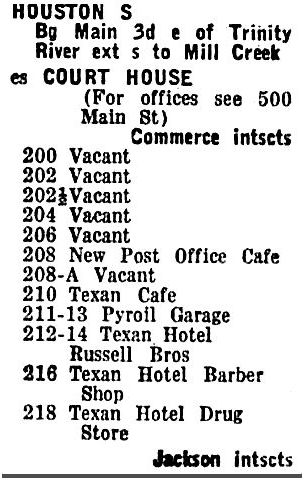
The Texan Hotel Drug Store was located at 218 S. Houston St. (northeast corner of Houston and Jackson) — see what the corner looks like today, here.

texan-hotel_south-houston_1936-directory
1936 Dallas directory

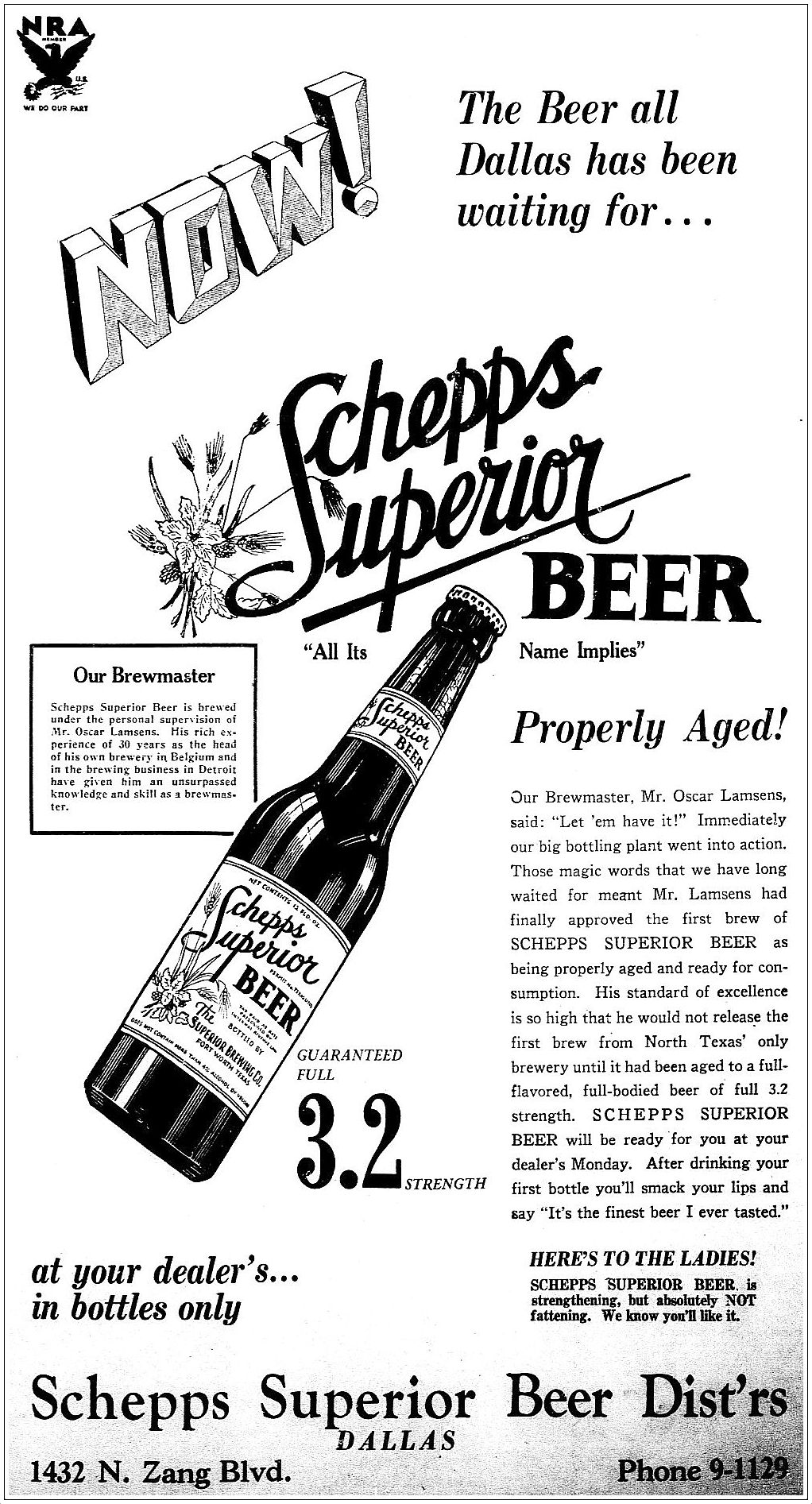
And … Schepps Beer? I was familiar with Schepps dairies, but not a Schepps brewery. But, yes, the same Schepps family produced highly guzzleable beer. The Schepps Brewing Co. launched in 1933 and lasted into the early ’40s; their downtown brewery was located on Young Street, about where the current City Hall/Convention Center now stand. (Schepps Beer was founded by brothers Julius Schepps and George Schepps, sons of pioneer Dallas baker Joe Schepps, whose Schepps Bakery was a highly profitable business. Joe’s brother Nathan Schepps joined his brother in Dallas about 1912 and started his Schepps Dairy by following his brother’s bakery wagons with his dairy wagon and selling his products to his brother’s customers. So even though it’s not a DIRECT family link, it’s pretty close: Julius and George Schepps were the  nephews of the founder of the very long-lived Schepps Dairy. ALSO, their sister, Rebecca Schepps, married Carl Metzger, son of another Dallas dairy titan, Jake Metzger. So the beer guys had close ties to two of the largest local dairies.)

Read a very entertaining interview with George Schepps in the September 1981 D Magazine article “Uncle George” by Connie Durham, here (scroll down for his memories of Schepps Beer).

Scheppps Xtra Light Lager (“light” meaning a light lager, not a beer low in calories) made a brief return to Dallas shelves in 1978 when the Julius Schepps Wholesale Liquor Co. brought it back; it was brewed at the Spoetzl Brewery in Shiner and was sold in “shortnex” bottles (stubby non-longnecks). More can be found in the Dallas Morning News article “Dallas Firm Bottles Touch of Nostalgia” by Dennis Fulton (DMN, July 9, 1978).

(Click pictures and articles to see larger images.)

schepps-beer_nov-1933Nov. 1933

schepps-beer_aug-1934Aug. 1934

schepps-beer-bottle-cap

*

Copyright © 2018 Paula Bosse. All Rights Reserved.

The United States Coffee & Tea Co. — 1911

us-coffee-tea_1911_ad_photoCoffee, coffee, everywhere, at Elm & Akard… (click for larger image)

by Paula Bosse

Above, a photo from a 1911 ad for the United States Coffee and Tea Company, importers and roasters. The text of the ad:

The above photograph shows a recent importation of the finest green coffees grown. Weight 40.000 pounds — just forty days supply.

A tril will convince you that our fresh Coffees are superior — Five delivery wagons covering the entire city each day insures prompt service.

UNITED STATES COFFEE AND TEA COMPANY

Corner Elm and Akard Streets   –   Phone Main 703

The company seems to have been founded about 1908 by George W. Wilson and a very young Henry Seeligson. (Click article to see a larger image.)

us-coffee-tea_greater-dallas-illus-1908
Greater Dallas Illustrated, 1908

According to a 1912 ad (which rather breathlessly promised: “WE ROAST COFFEE EVERY MINUTE OF THE DAY”), the company was the “largest retail dealers in Coffee, Tea, Spices and Butter in the Southwest.”

us_coffe-tea_may-1912
1912

The photo at the top shows their building at the northeast corner of Elm and Akard; a few years later they moved down Elm to the northwest corner of Elm and Ervay, just a couple of doors east of the Palace Theater (you can see part of their building behind a photo of the Wilson Building here) — this location was once threatened by a fire which broke out in the bakery owned by Frank A. Carreud:

us-coffee-tea_dmn_070322_fire
Dallas Morning News, July 3, 1922

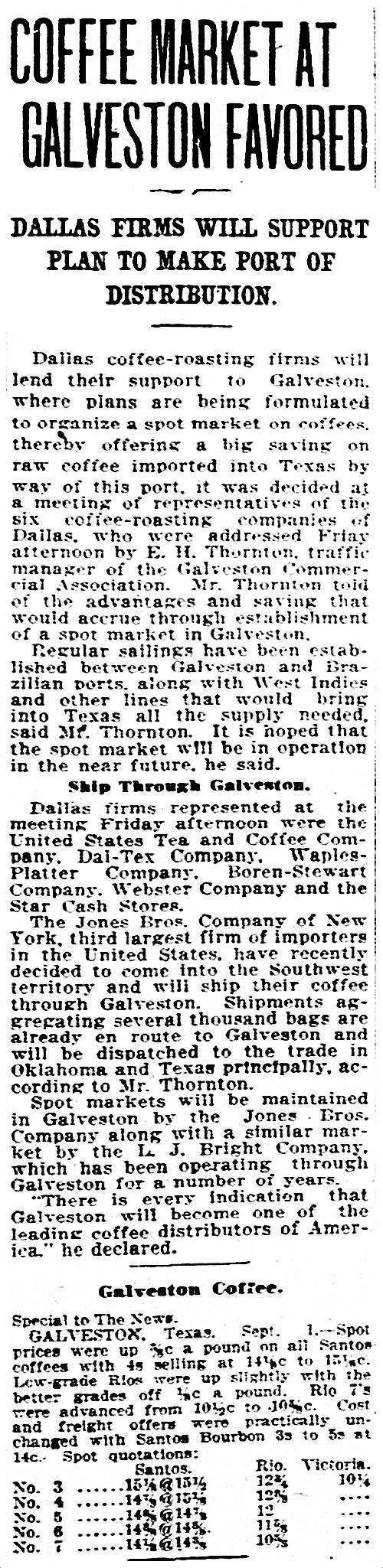
There was a surprising amount of coffee-roasting going on in Dallas in the early decades of the twentieth century. In 1922 the big boys were trying to organize a coffee spot market in Galveston, port to Brazilian coffee and West Indies spices.

us-coffee-tea_dmn_090222
DMN, Sept. 2, 1922

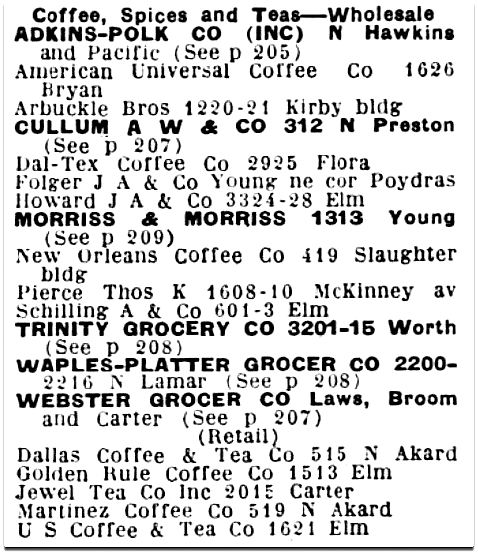
coffee-merchants_1922-directory
1922 Dallas directory

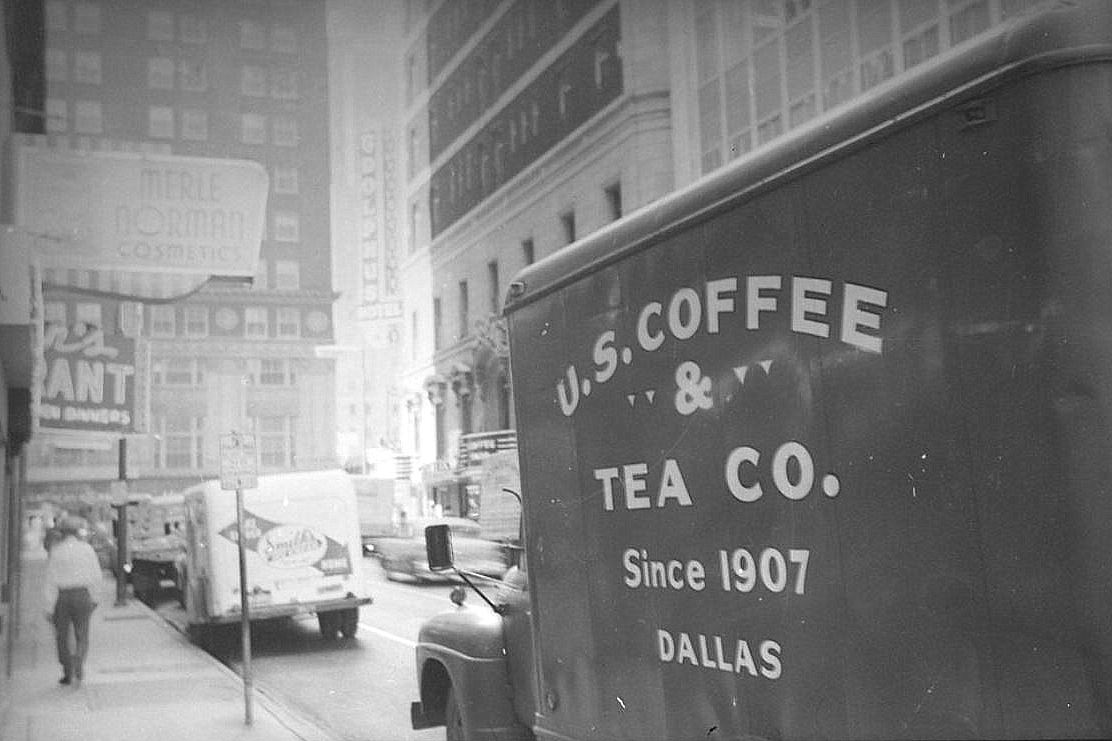
The company was bought by H. L. Hunt’s HLH Parade Co. in 1961; Hunt sold it to the Texas Wholesale Grocery Corp. in 1963 when it appears to have ceased operations under the U. S. Coffee and Tea name. Here’s a photo of a company van sometime before then:

u-s-coffee_city-of-dallas-historic-preservation_flickr

And now I have an intense desire for a cup of coffee.

***

Sources & Notes

Top photo from an ad which appeared in a Terrell School yearbook.

Bottom photo from the City of Dallas Historic Preservation Flickr collection, here — the undated photo was taken by the city’s staff photographer.

Sources of other images/clippings as noted.

*

Copyright © 2018 Paula Bosse. All Rights Reserved.

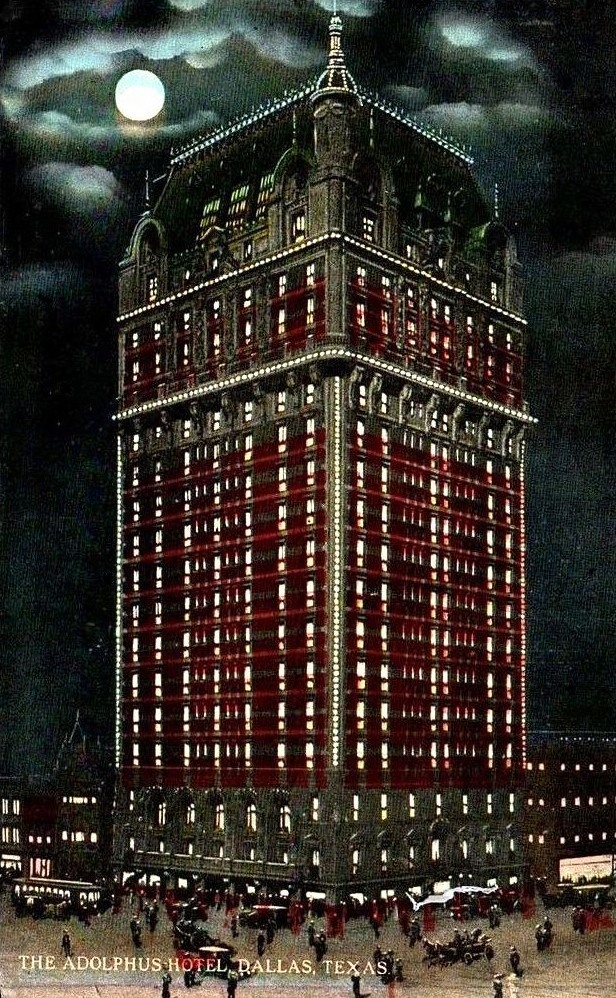
The Adolphus By Moonlight

adolphus_night_postcard_postmarked-1914Nighttime in Big D… (click for larger image)

by Paula Bosse

When the beautiful Adolphus Hotel opened in 1912, it was the tallest building in Dallas — in other words, it was the building nearest to the moon.

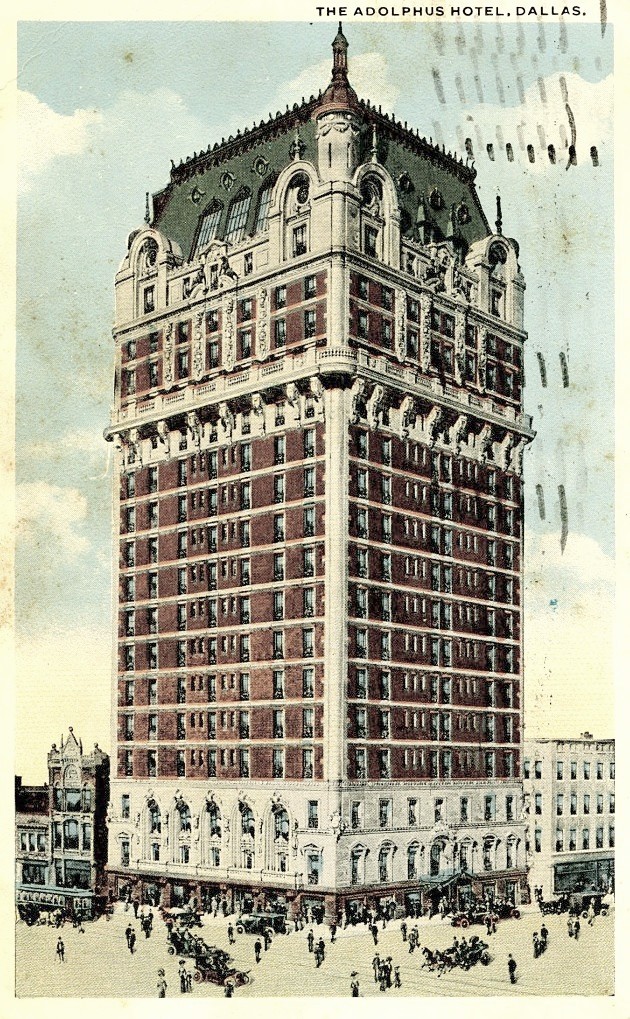
Remarkably, it, the people, and the horses, looked just the same in the daylight!

adolphus_1910s_postcard
Daytime in Big D…

“Postcard magic” is magic, indeed. It’s all about judicious addition and subtraction.

***

Sources & Notes

Both postcards were found lounging in forgotten corners of the internet. The cards were issued before 1914. Both are larger when clicked

*

Copyright © 2018 Paula Bosse. All Rights Reserved.

A Bird’s-Eye View to the North

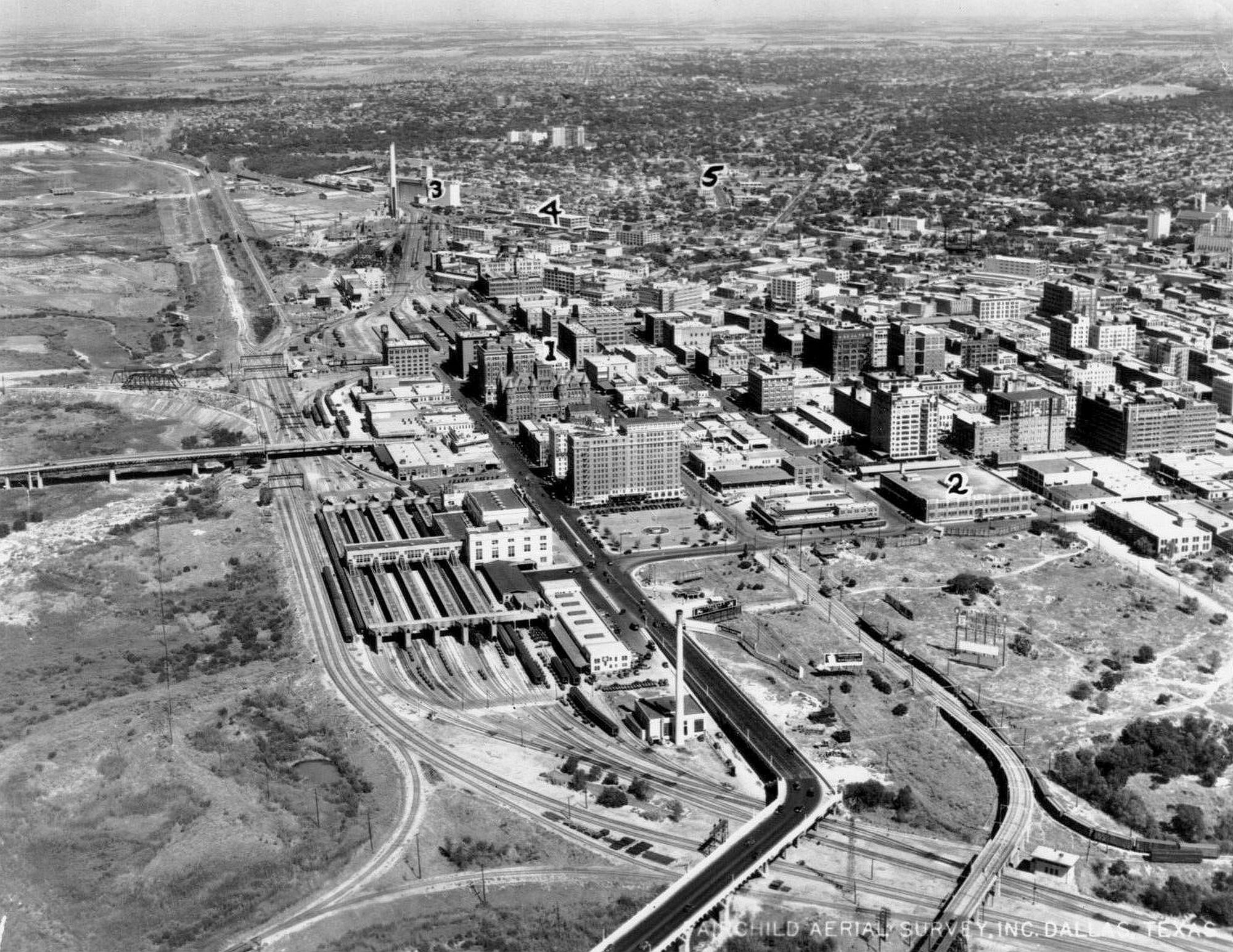
downtown_fairchild-aerial-survey_lgAs the crow flies… (click for much larger image)

by Paula Bosse

This is a great view, produced by the Fairchild Aerial Survey Co., taken sometime between 1925 (when the Ferris Plaza waiting station was built) and 1934 (when the land between the Trinity and the courthouse began to be cleared to begin construction of the “million-dollar project” which would eventually be known as Dealey Plaza and the Triple Underpass).

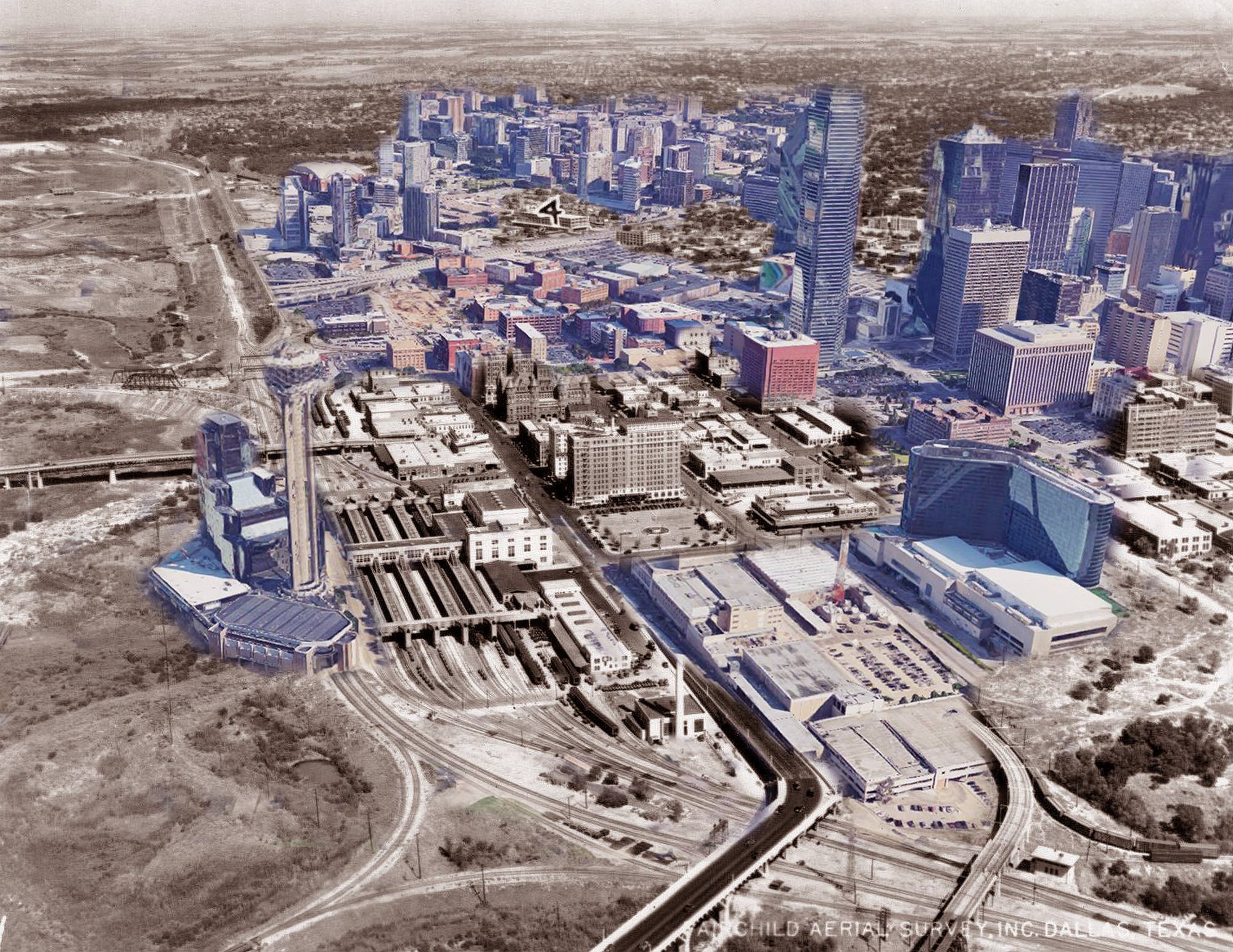
UPDATE: Brian Gunn posted this fantastic now-and-then overlay on the Dallas History Guild Facebook page. I love this. Thank you, Brian!

downtown-aerial_fairhchild-survey_brian-gunn-overlay

These images are huge. Click ’em!

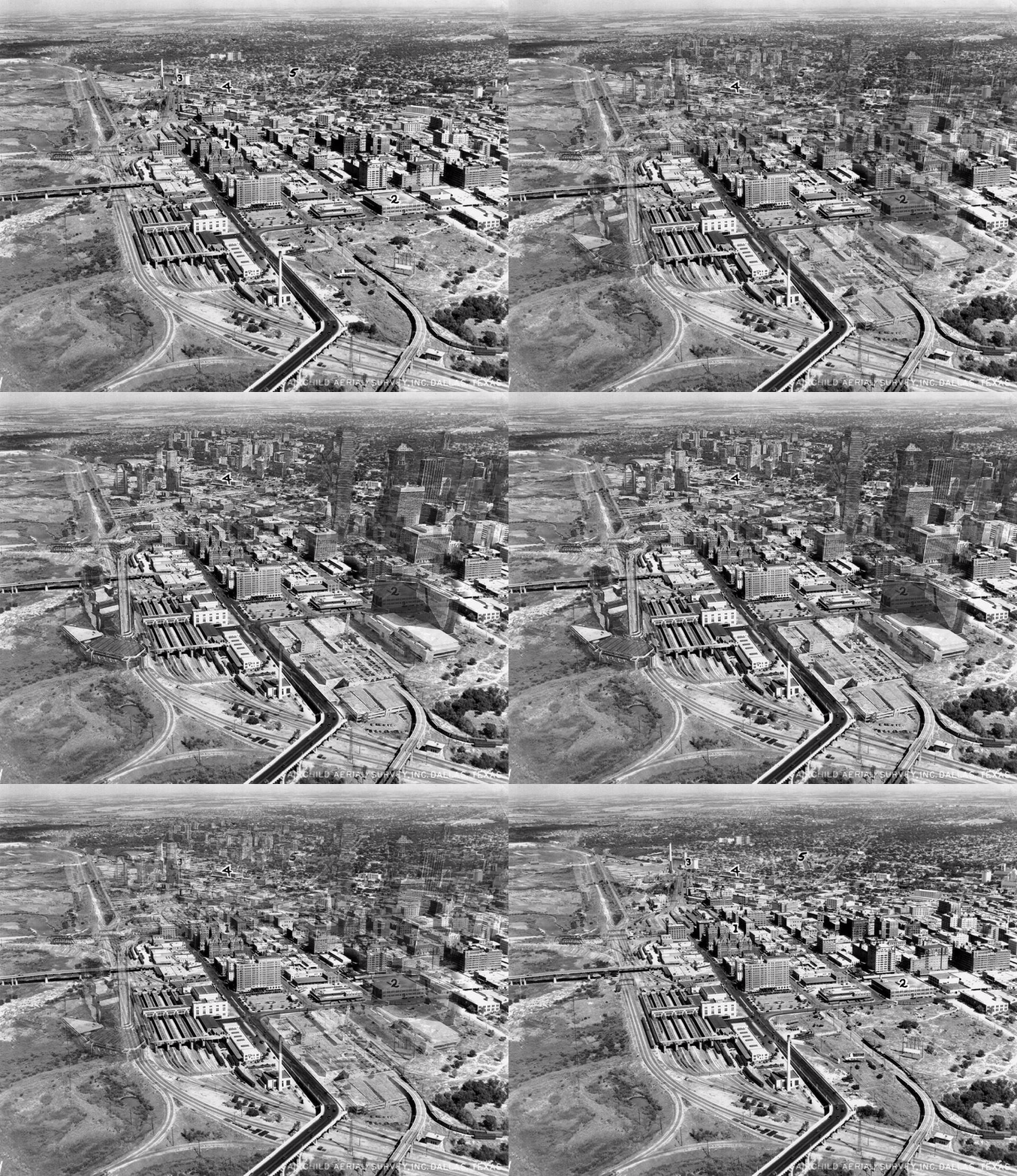
UPDATE #2: Such participation from Flashback Dallas readers! Eric Hanson has now animated Brian Gunn’s overlay. Watch Dallas shoot up! Thank you, Eric! (Click GIF to see it slightly larger.)

eric-hanson_GIF-overlay

***

Sources & Notes

Photo found on eBay.

*

Copyright © 2017 Paula Bosse. All Rights Reserved.


Newly Discovered Footage of Jack Ruby — 1960

jack-ruby_WFAA-1960_jones-collection_SMU_det

by Paula Bosse

The WFAA Telefilm Collection — part of the G. William Jones Film and Video Collection, housed at the Hamon Library at Southern Methodist University — is an incredible assemblage of film footage shot by WFAA cameramen, some of which was never included in Channel 8’s televised news stories; a lot of it is silent, filmed mostly as B-roll material. It’s a fascinating historical treasure trove of local and national (and international) events filmed between 1960 and 1978. Jeremy Spracklen — the collection’s Moving Image Curator — and his assistant, Scott Martin, regularly post entertaining short clips from this vast resource to social media.

Which brings us to the clip posted yesterday — Dec. 6, 2017 — which featured footage of a 1960 parade held in downtown Dallas at Christmastime, with shots of festively decorated Main Street and Elm Street, including nice views of the old Palace Theater. Watch it here on Vimeo.

The clip was posted last night on the Jones Collection’s Facebook page — before I watched it, I read the comment by Bert Harris: “Did you notice Jack Ruby combing his hair right toward the end of the clip?? Wild!!

What?!

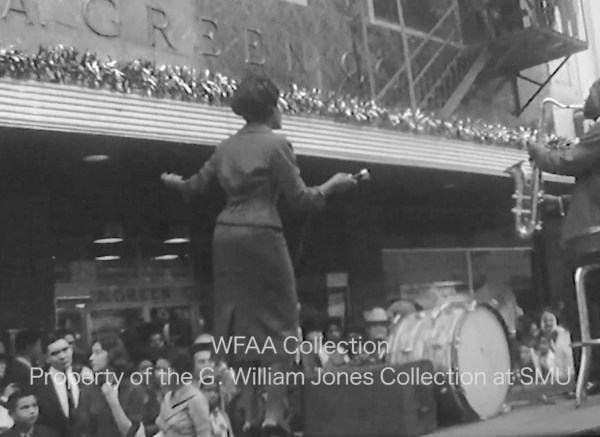
Yes, at the very end of the short clip you see Jack Ruby (!) standing in a crowd of people in front of the W. A. Green department store combing his hair and adjusting his famous fedora. It’s very short, but it’s unmistakably Jack Ruby. You never know who’s going to pop up in these snippets of everyday life in Dallas, captured decades ago by WFAA cameramen! So now SMU has a few frames of what has just become historic film footage — footage which has probably been unseen for 57 years — there’s a good chance this never even aired and was merely B-roll footage. I never imagined it would be an exciting event to watch Jack Ruby comb his hair.

I contacted curator Jeremy Spracklen at SMU, and he was pretty excited about the discovery. He even cut a brand new clip this afternoon, isolating the Ruby footage and slowing it down considerably. It’s COOL. Here it is:

Below are some screen captures. I’ve had to lighten them a bit — click pictures to see larger images. Ruby and a friend are in the center of the first frames, then as the clip ends, he’s in the lower left corner.

Who is the guy with Ruby, and what is he holding in his hand? UPDATE: My first thought was that it might be Ruby’s roommate George Senator (from all accounts a good-natured guy who was perpetually out of work and out of cash — Ruby often helped him out, including inviting him to stay for a while at his apartment in early 1962). I didn’t really think he looked like the scarce few photos of him I’d found, but others in the comments below seem to think it might be him. He’s holding a Minox “spy” camera, which was an expensive tiny camera which had been sold for years in several stores in Dallas (and which was offered used in classified ads in The News in 1960 for $75 — about $125 today). By the man’s look of utter fascination with it, it appears that it probably belonged to Ruby. The man can be seen looking through it in the longer clip at the :50 mark. (See one of the first Minox ads found in a Dallas paper — sold by Linz Jewelers in 1951 — here, and in the year of this footage, in 1960, in a Neiman-Marcus ad, here, priced at $139.50, about $1,200 today.)

jack-ruby_WFAA-1960_jones-collection_SMU_2

jack-ruby_WFAA-1960_jones-collection_SMU_3

jack-ruby_WFAA-1960_jones-collection_SMU_4

jack-ruby_WFAA-1960_jones-collection_SMU_5

jack-ruby_WFAA-1960_jones-collection_SMU_6

***

Sources & Notes

The clip is compiled from WFAA news footage shot on November 26, 1960; it is from the WFAA Newsfilm Collection, held at the Hamon Arts Library, Southern Methodist University. The original clip (1:22) showing a holiday parade in downtown Dallas can be watched on Vimeo here; the slowed-down clip showing only the Jack Ruby footage can be watched on Vimeo here.

According to coverage of the event in the Dallas Times Herald (“Mile of Dimes Parade Lures Great and Small,” Nov. 27, 1960), the parade was the “Mile of Dimes” parade sponsored by the Dallas Junior Chamber of Commerce and the Salvation Army. It took place on Saturday, Nov. 26, 1960. In addition to the parade, there was a “show” staged on Elm and Ervay which had bands performing on the back of a flatbed truck. Two of the acts performing that day were the Joe Johnson combo and singer Jewel Brown — both of whom were mainstays in Ruby’s clubs: at the time of the parade, Johnson’s band was booked into a long run at the Vegas Club/Club Vegas in Oak Lawn, and Brown was appearing seven nights a week (!) at the Sovereign Club on Commerce Street (which Ruby would later rename “the Carousel Club” around March, 1961). So that explains why he was there, nonchalantly combing his hair on the street as his “employees” perform in front of him.

Footage of the musical performers begins at the 1:00 mark in the longer clip. Houston-born Jewel Brown can be seen at 1:07. She was pretty much a smash in Dallas, getting loads of good press; she later hit it big appearing with Louis Armstrong in Las Vegas — you can watch a fantastic clip of her singing here. Read a March, 1967 interview with her in which she discusses her working relationship with Ruby here.
ruby_band_1.09_jones-collection_SMU

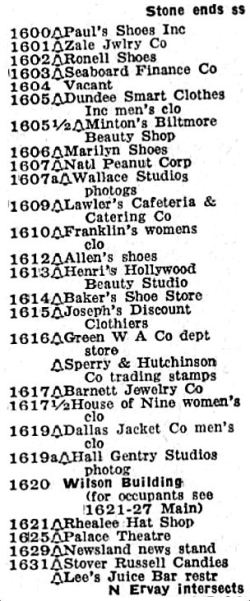
Ruby was standing outside the W. A. Green department store at 1616 Elm Street, which was next door to the Wilson Building; the Palace Theater was directly across the street.
elm-street_1600-block_1961 directory1961 Dallas directory

In addition to the musical performers mentioned above, other celebrities appearing in the parade footage that day were actresses/sexpots Sheree North and Lynne Forrester, who were appearing in Clare Boothe Luce’s play “The Women” at Casa Manana (:34), and orchestra leader Freddy Martin, who was appearing at the Statler’s Empire Room (:45). According to the Times Herald article, one celeb who was also there that day was recent Olympian Cassius Clay (later known as Muhammad Ali), fresh from his gold-medal performance at the Olympics. Though wearing his U.S. Olympic team jacket, the 18-year-old future-legend somehow went unnoticed in the crowd which was apparently quite wrapped up in the musical offerings that day.

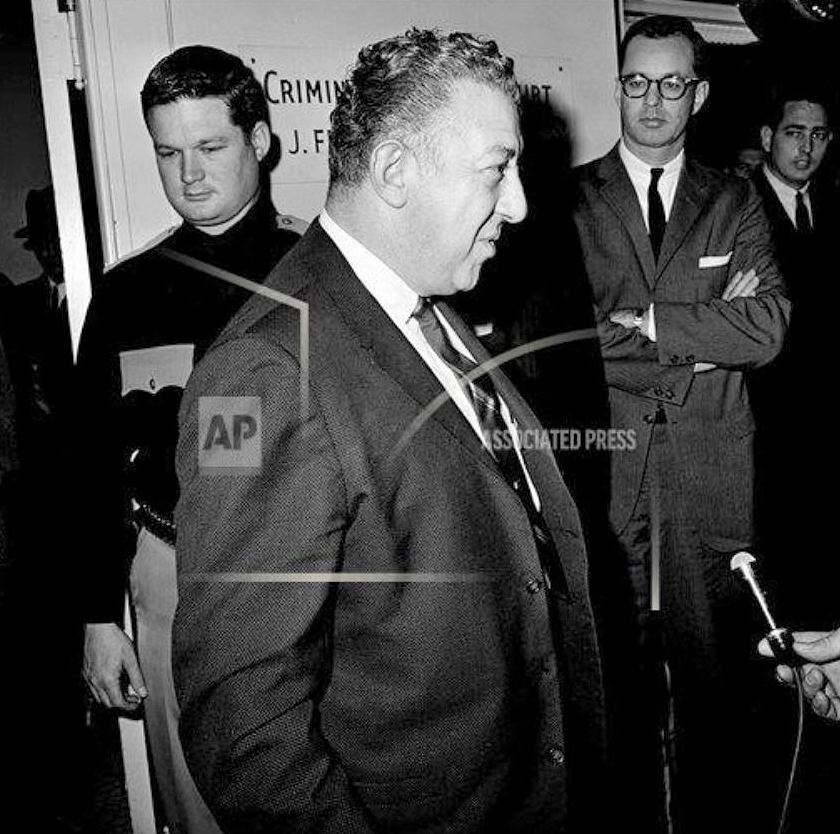
Here is a photo of George Senator, possibly the man standing next to Ruby. This photo was taken on Nov. 24, 1963 at the Dallas Police Station; it is from the Fort Worth Star-Telegram Collection, University of Texas at Arlington Libraries, UTA — more info is here (I have cropped and flipped this detail). Another photo of Senator from the same night can be seen on the Portal to Texas History site, here.

senator-george_FWST-collection_UTA_112463.det_flipped

And these two Associated Press photos were taken on March 9, 1964, showing Senator at the Jack Ruby trial.
senator-george_at-jack-ruby-trial_associated-press-website_030964_1

senator-george_at-jack-ruby-trial_associated-press-website_030964_2

*

I’ve mentioned the WFAA Newsfilm Collection several times — it is an amazing collection of WFAA-Channel 8’s archival news footage, out-takes, and B-roll material. Curator Jeremy Spracklen has been uploading bite-size segments to Twitter and Facebook — it’s a lot of cool stuff you’re probably not going to be able to find anywhere else. They’re very entertaining. Follow them on social media!

*

Copyright © 2017 Paula Bosse. All Rights Reserved.

George Dahl’s Downtown Public Library Is Now the Home of The Dallas Morning News

14DPL_schiwetzcrop

by Paula Bosse

Today is the official beginning of the next step in the history of the George Dahl-designed building at Commerce and Harwood which once housed the Dallas Public Library: after years of abandonment and deterioration, it is now the miraculously preserved and spiffed-up home of The Dallas Morning News! Read Robert Wilonsky’s valentine to the beautiful building — along with photos old and new — on the News site, here.

And while we’re at it, let’s look back to the beginnings of the building as the wonderfully modern Dallas Public Library in one of my very first Flashback Dallas posts, “George Dahl’s Sleek Downtown Library — 1955,” here.

Thank you, DMN, for saving and resuscitating this landmark Dallas building!

*

Copyright © 2017 Paula Bosse. All Rights Reserved.
 

“New Terminal Passenger Station” — 1916

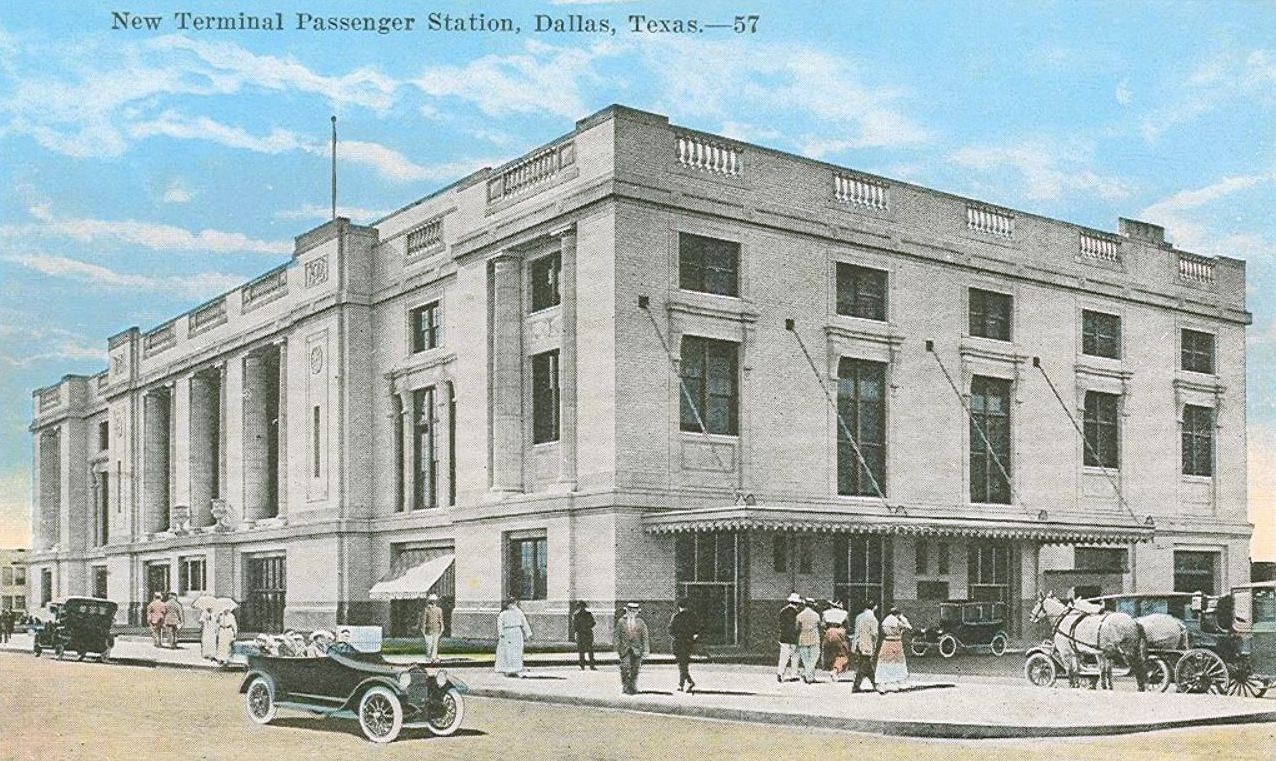
union-station-postcard_1916Union Station, open for business…

by Paula Bosse

I love this postcard view of Dallas’ own Union Station, brand new in 1916. Minus the horses, it looks very much like this today.

***

Sources & Notes

Postcard found on eBay. 

*

Copyright © 2017 Paula Bosse. All Rights Reserved.