Flashback : Dallas

A Miscellany: History, Ads, Pop Culture

Category: Downtown

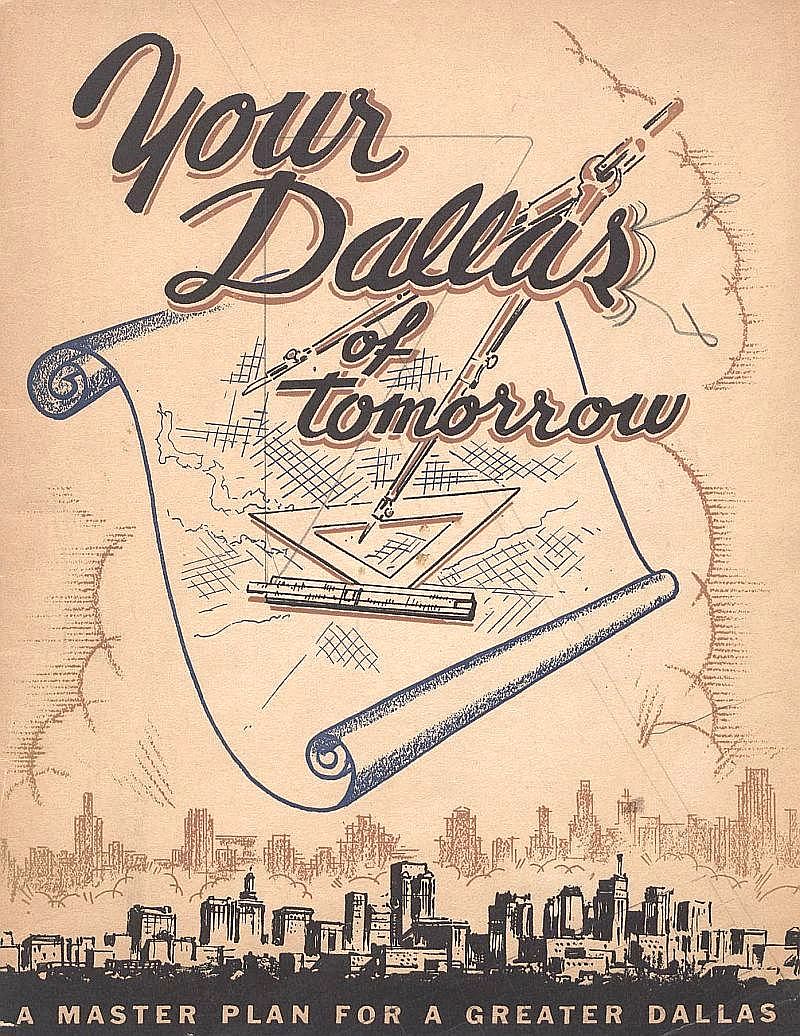
“Your Dallas of Tomorrow” — 1943

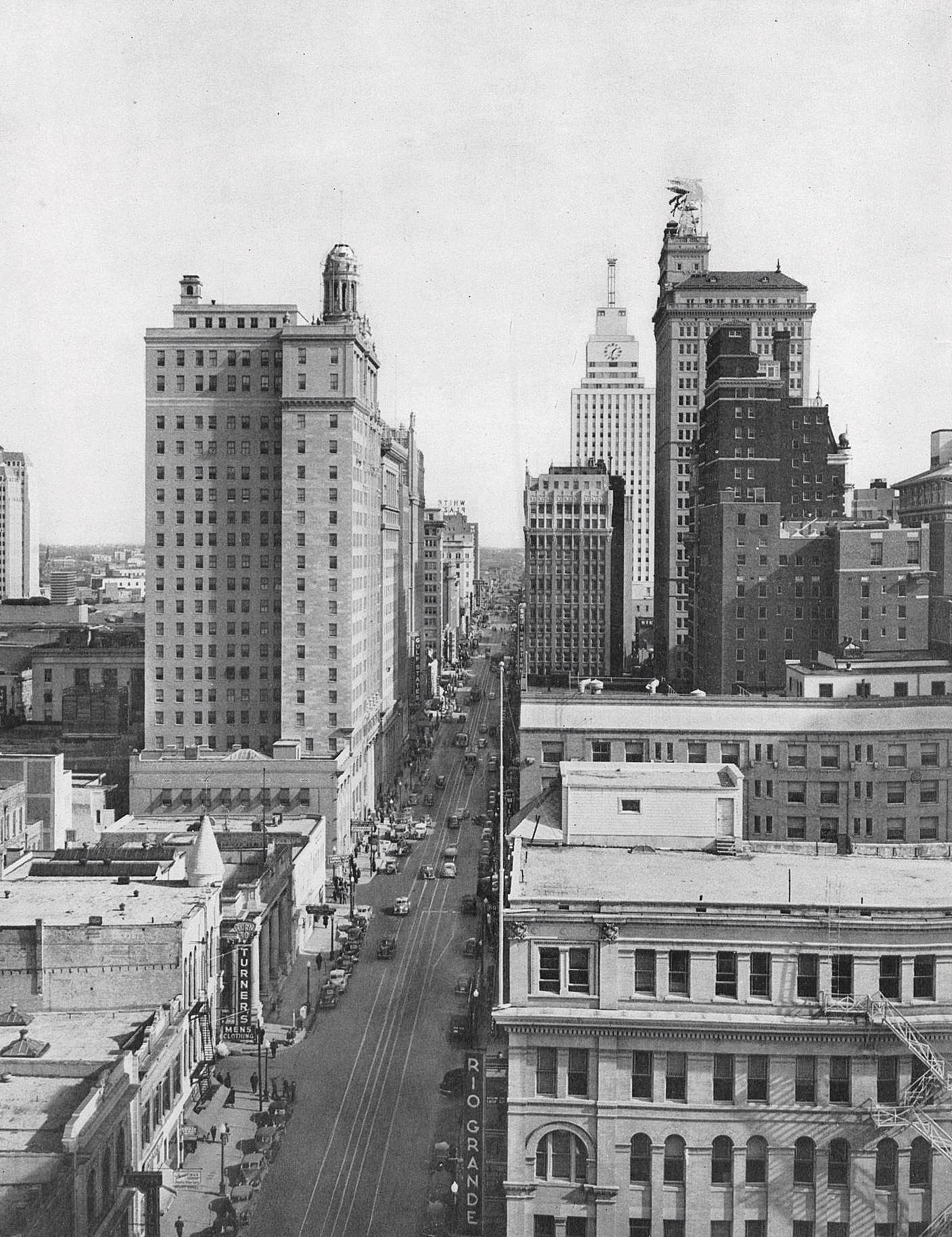
downtown_your-dallas-of-tomorrow_1943_portalMain Street, 1943… (click for larger image)

by Paula Bosse

Harland Bartholomew, a St. Louis urban planner and civil engineer, was asked by the City of Dallas in 1943 to prepare a master plan for Dallas which would address the needs of the city’s post-war growth and livability. As then-mayor Woodall Rodgers said, “We need another Kessler Plan and have waited long enough to start. We want to be ready to put Dallas ahead when the war is over and we will have great opportunities to put a master plan in effect” (Dallas Morning News, April 1, 1943).

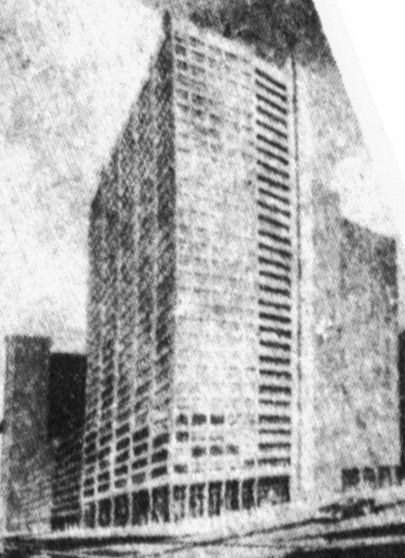
Read Bartholomew’s incredibly thorough 51-page report titled “Your Dallas of Tomorrow” here. It has been scanned in its entirety and is presented (courtesy of the Dallas Municipal Archives) on UNT’s Portal to Texas History site. In addition to the report, there are drawings, graphs, maps, and the wonderful photo seen above showing an already-vibrant metropolis, with its newest addition to the skyline, the Mercantile Bank Building. Below are a few other things from Bartholomew’s master plan I found interesting. (All images are larger when clicked.)

your-dallas-of-tomorrow_1943_portal_cover

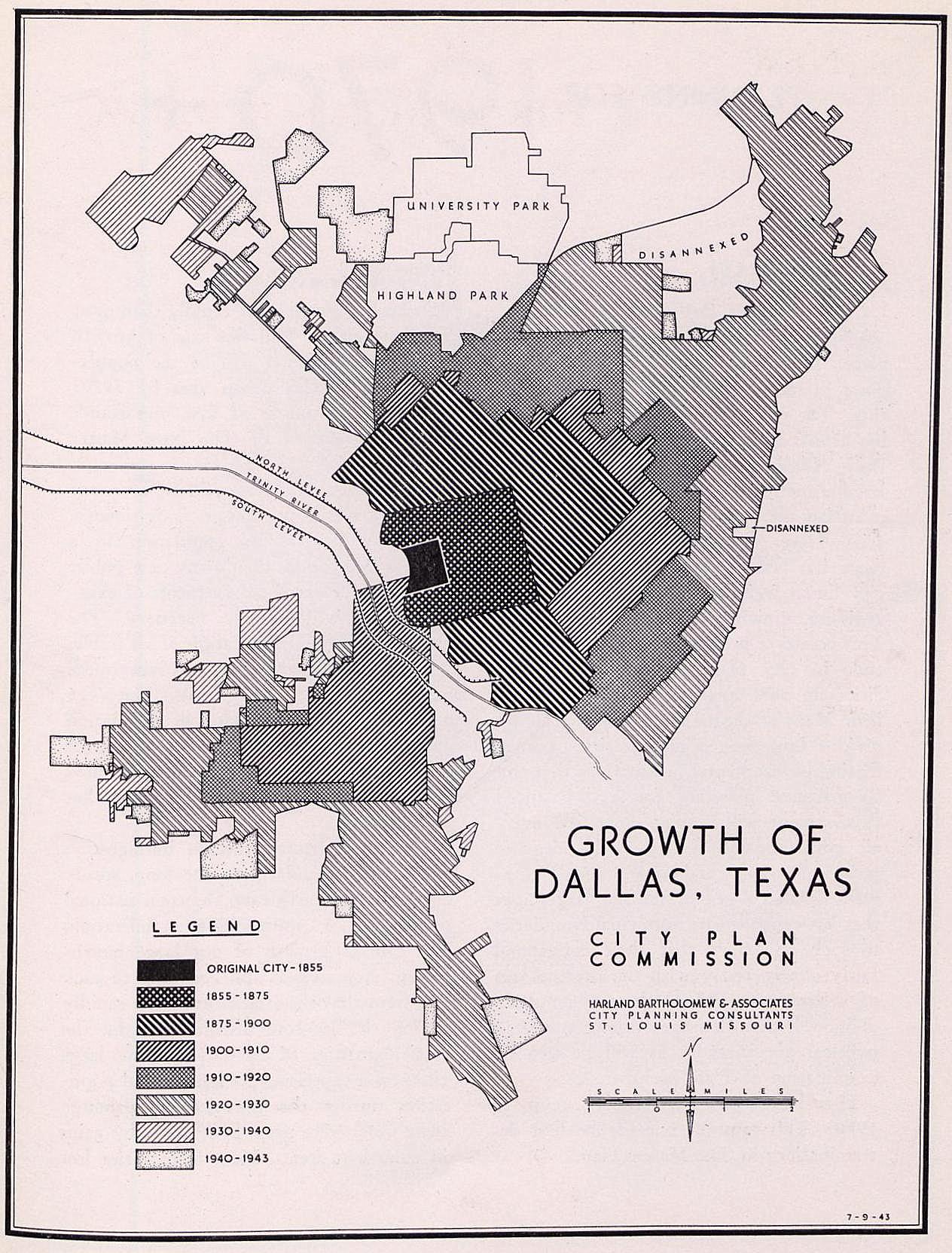
This map showing the growth of the city, from 1855 to 1943, is really interesting. Check out the “disannexed” areas. (I think that area east of the Park Cities was disannexed because landowners — which included W. W. Caruth — argued that it was undeveloped farmland and shouldn’t be subjected to city taxation. …I think.)

growth-of-dallas-to-1943_your-dallas-of-tomorrow_portal

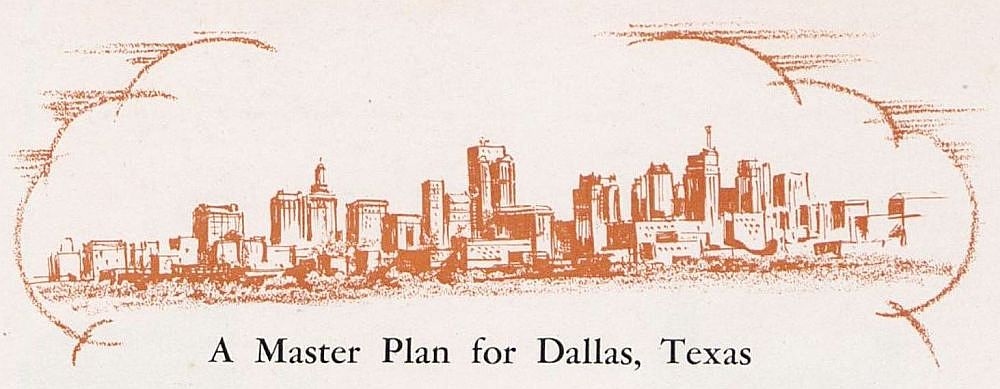
A somewhat recognizable skyline.

skyline_your-dallas-of-tomorrow_1943_portal

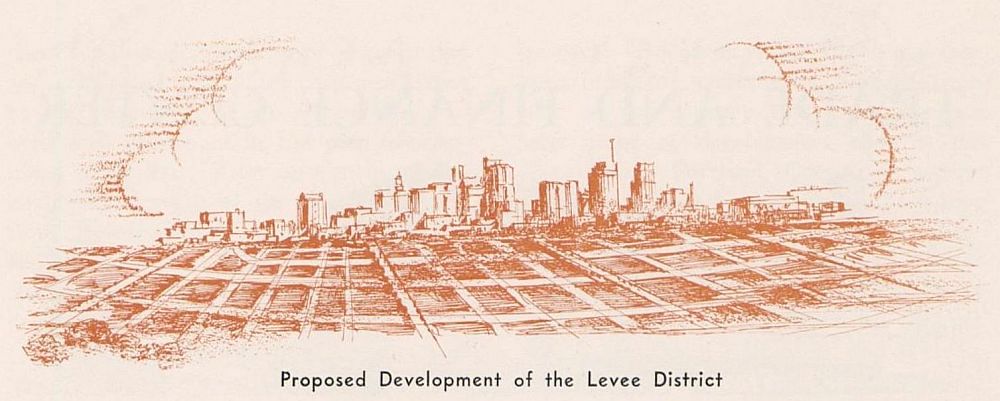
Levee District.

levee-development_your-dallas-of-tomorrow_portal

The old Union Depot at the edge of Deep Ellum, demolished in 1935.

union-depot_your-dallas-of-tomorrow_1943_portal

There is much more in this interesting report, including quite a bit of good historical information on the development and growth of Dallas.

***

Source & Notes

All images from “Your Dallas of Tomorrow, A Master Plan for Dallas, Texas,” prepared by Harland Bartholomew and Associates of St. Louis, Missouri in September, 1943. Booklet from the Dallas Municipal Archives, accessible on the Portal to Texas History, here.

The report above was the first one issued — and it was the most glitzy. The ones that followed were more down-to-business. Some of the plans were implemented, some were not. See all of the reports of the master plan prepared by Bartholomew and Associates — issued between 1943 and 1946 — here. If you like maps, this link has your name all over it!

*

Copyright © 2017 Paula Bosse. All Rights Reserved.

Map of Downtown Dallas, For the Curious Conventioneer — 1962

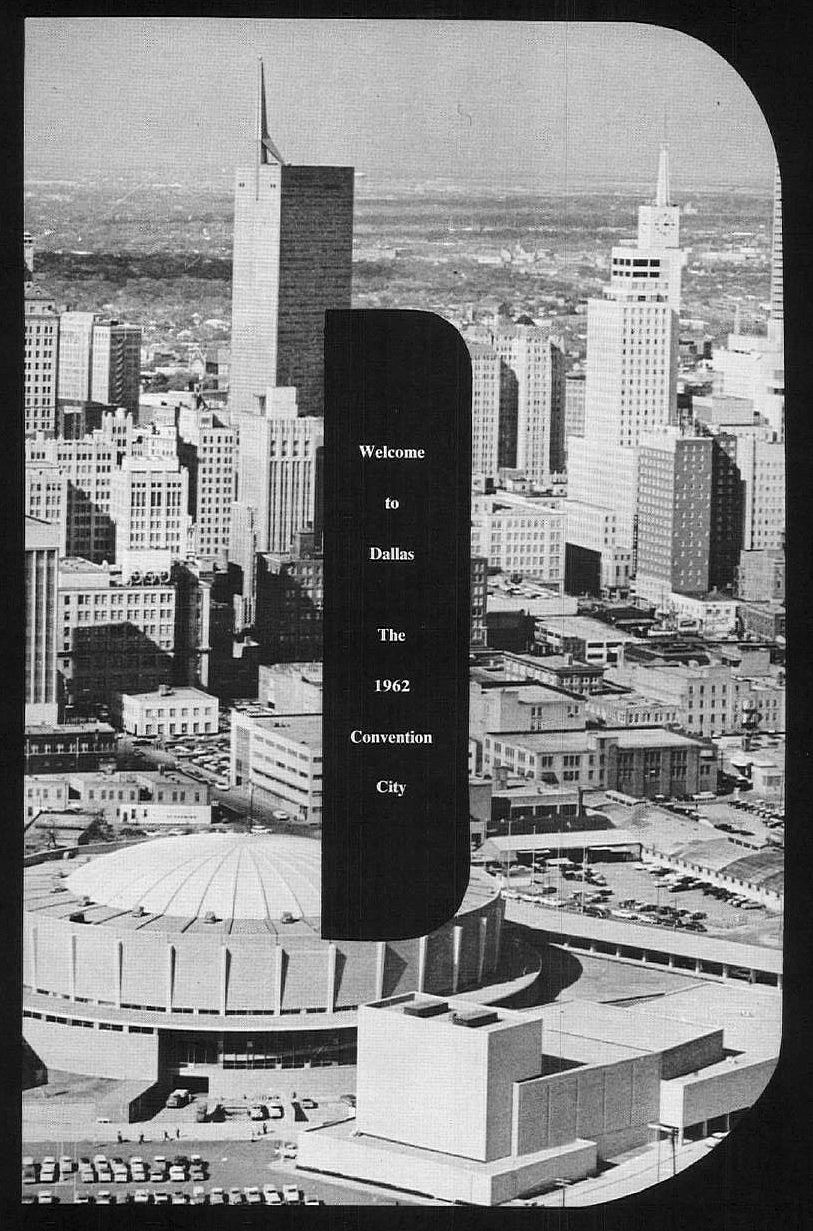
big-d_aia-convention_aia-journal_aprill-1962Welcome to Convention City!

by Paula Bosse

In May, 1962, the American Institute of Architects (AIA) had their national convention in Dallas. The April 1962 edition of the AIA Journal contained a boosterific article on Big D’s exciting architecture, a handy bibliography of previous Journal articles on specific Dallas projects and architects, a few photos, and a helpful map of downtown, containing, I suppose, the Big City sites that the visiting architect might find worth a look. In addition to your staples like Neiman-Marcus, the relatively new Statler Hilton, and the Republic Bank Building, it also contained a lot of … odd things. Like Magicland, M & M Leathercraft, and Ring and Brewer Western Wear. AND a lot of bars. A lot. Some of them pretty seedy. And several of which employed the talents of “exotic” dancers. (Hey, what happens in Dallas stays in Dallas.)

The map is actually pretty good — even though many of the simply-drawn buildings look absolutely nothing like their real counterparts (I mean … come on, architects!) — it’s helpful because it shows exactly where so many of these off-the-beaten-path bars and restaurants and shops were located. For instance, I’ve heard my aunt talk for years about her favorite Happy Hour destination back in the ’60s, but it wasn’t until I saw this map that I actually knew where Victor’s Lounge was: across Commerce from the Statler Hilton (right next to the architect’s favorite Dallas stop, Warehouse Cut-Rate Liquors).

Check it out. The alphabetical key is printed on the map, the numerical key is below. Click the map so you, too, can find out where exactly Sol’s Turf Bar was and which thoroughfare one needed to take to reach the Sportatorium (’cause if there’s anything architects love more than magic tricks, it’s professional wrestling!).

downtown-dallas-map_aia-journal_april-1962_convention

1. YMCA
2. Magicland; Phil’s Delicatessen
3. Rheinishcherhoff Restaurant
4. Cattlemen’s Restaurant
5. Majestic Theatre
6. Capri Theater
7. Tower Theater; Sigel’s Liquors
8. Corrigan Tower
9. Tower Petroleum Bldg.
10. Miller Bros. Jewelry
11. Ring & Brewer Western Wear
12. Filet Restaurant
13. Mexico City Restaurant
14. First National Motor Bank
15. Rio Grande Life Bldg.
16. National Bank of Commerce
17. E. M. Kahn Department Store
18. Texas Bank Bldg.
19. Wholesale Merchants Bldg.
20. James K. Wilson Co.
21. Santa Fe Bldg.
22. WFAA Radio Station
23. Oriental Cafe
24. Davis Bldg.
25. First National Bank
26. Cullum & Boren Sporting Goods
27. Palace Theater
28. 211 North Ervay Bldg.; Forget-Me-Not Gift Shop
29. Praetorian Bldg.; Shoe Center
30. Eatwell Cafe
31. Black Angus Restaurant
32. Mobil Bldg. (Magnolia Bldg.)
33. Golden Pheasant Restaurant; Hoffman’s Men’s Wear
34. Melody Shop; Shoe Center
35. Sol’s Turf Bar
36. Copper Cow Restaurant
37. Reynolds-Penland Department Store
38. E. M. Kahn Co.
39. Dreyfuss & Son
40. Volk’s Department Store; Rogers Factory Shoe Store
41. Mercantile Security Bldg.
42. Dallas Mercantile Bldg.; Tall Fashions
43. Victor’s Lounge
44. Warehouse Liquors
45. Town & Country Restaurant
46. Skeffington’s Men’s Wear
47. Lone Star Gas Co.
48. M & M Leathercraft
49. National Bankers Life Bldg.
50. Zoo Bar
51. Steak House Unique
52. Dallas Power and Light
53. 209 Browder Bldg.
54. Bell Telephone Co.
55. Federal Reserve Bank
56. Community Chest
57. Employers Insurance
58. Reserve Life Bldg.
59. Life Bldg.; Moore-DeGrazier Jewelry Co.
60. Theater Lounge (burlesque)
61. Horseshoe Lounge
62. Carousel Club (burlesque)
63. Colony Club (burlesque)
64. Brockles Restaurant

***

Sources & Notes

Photo and map from the April 1962 issue of AIA Journal. The entire issue is contained in a PDF, here. The Dallas content begins on page 39 of the PDF. The bibliography — which contains articles that I’d actually love to read! — can be found on page 83 of the PDF.

*

Copyright © 2017 Paula Bosse. All Rights Reserved.

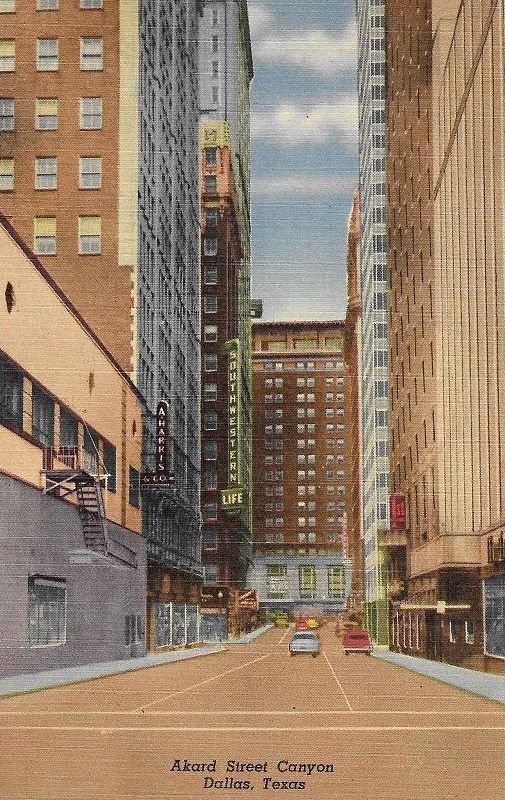
The “Akard Street Canyon” — ca. 1962

downtown-dallas_aia-journal-april-1962Looking north toward Main, and beyond…

by Paula Bosse

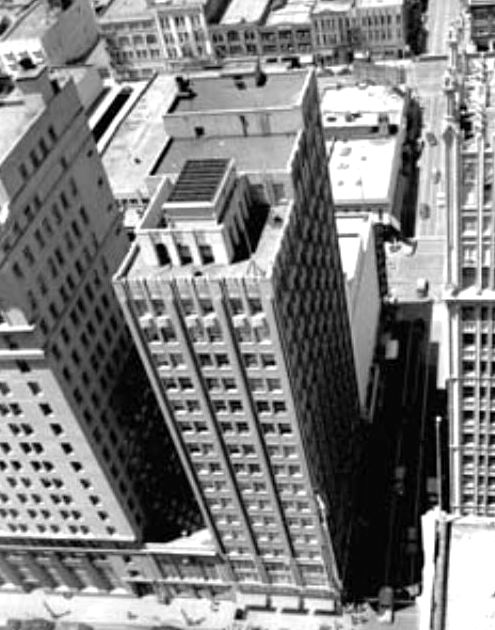
A view of the dowtown “canyon” — looking north on Akard from just south of Main, published in 1962, but probably taken in 1961 — possibly from the Baker Hotel.

A few of the tall buildings which made up the walls of the “canyon“:

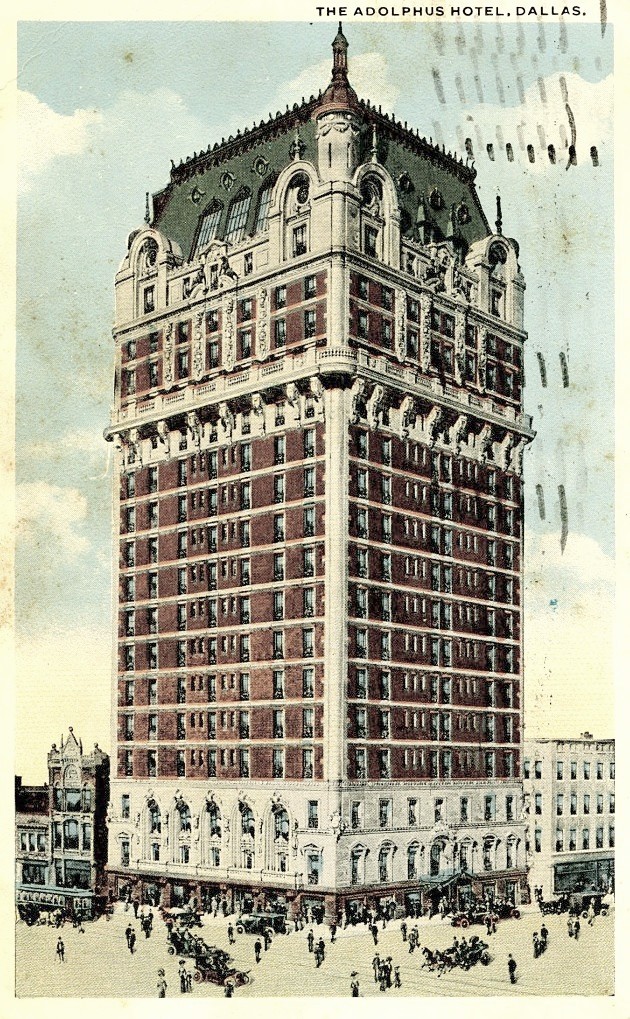
Adolphus Hotel — northwest corner of Commerce and Akard, built in 1911/12, designed by architects Barnett, Haynes & Barnett. The Adolphus — the oldest building in this group and the tallest building in the city when it was built — is definitely one the canyon’s anchors, but in the photo above it is mostly — if not entirely — out of frame at the left foreground.

adolphus_1910s_postcard

Magnolia Building — northeast corner of Commerce and Akard (seen at right foreground of photo); called the “Mobil Building” in the 1962 Dallas directory, built in 1922; Alfred C. Bossom, architect. Now the Magnolia Hotel.

magnolia-building_postcard_pre-pegasus

Adolphus Tower — southwest corner of Main and Akard, built in 1954; Wyatt Hedrick, architect (click pictures to see larger images). The building is currently being remodeled for office use.

adolphus-tower_jan-1955_ad-det_sm

Southwestern Life Building — southeast corner of Main and Akard, built in 1911/12; Otto H. Lang, architect. Bill Clements (before he became Governor of Texas) bought the building on spec in 1965, then had it demolished in 1972. It was a parking lot for many years. It is now Pegasus Plaza, an attractive open area.

southwestern-life-bldg_1913-directory

Gulf States Building — northwest corner of Main and Akard; originally known as the Marvin Building, built in 1927, with a later addition of upper stories designed by Lang and Witchell. Converted to lofts.

gulf-states-bldg_dpl

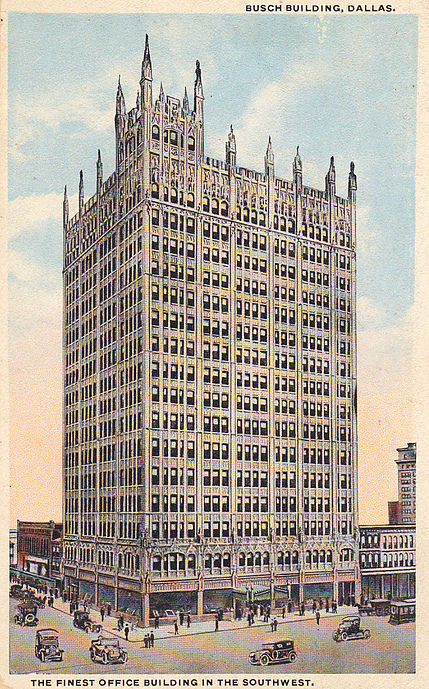
Kirby Building — northeast corner of Main and Akard. The Kirby Building — the beautiful white building at center right in the top photo — was designed by the same architects who designed the Adolphus Hotel, Barnett, Haynes & Barnett, with a 1924 annex designed by Lang and Witchell. When construction began in 1912, the building was originally called the Busch Building, named after Adolphus Busch, whose hotel was just a stone’s throw away (it was called the Great Southern Life Building from 1918 to 1922 and was renamed “Kirby” when it was purchased in 1922 by John H. Kirby). When the building opened in 1913, its most prominent tenant was the A. Harris department store, which occupied the first five floors and the basement. On December 31, 1960, it was announced that the parent company of pioneer Dallas department store Sanger’s (which, at the time of this announcement was part of the Federated Stores chain, but which had opened as Sanger Bros. in Dallas in 1872) had acquired another pioneer Dallas department store, A. Harris & Co. (established in 1892, though Adolph Harris had been in business in Dallas since 1887). The newly christened “Sanger-Harris” store settled into the old Harris space in the Kirby in 1961. It’s hard to tell, but it looks as if there is both an “S” on the corner of the building in this photo (for “Sanger’s”?) as well as the “A. Harris & Co.” sign affixed to the Akard side of the building. The A. Harris store had been a Dallas landmark at Main and Akard for almost 50 years, but it seems the sign would have come down by the time of the official change in name (which happened on July 10, 1961). So perhaps this photo was taken between January and July of 1961, when both stores were actually operating under the same roof and accepting either store’s credit card. The Kirby is now a snazzy apartment building.

busch_bldg_postcard

Mayfair Department Store — 1414 Elm, southwest corner of Elm and Akard. Built in 1946, this Dallas outpost of a department store chain was designed by George L. Dahl and has been converted to apartments.

mayfair-dept-store_dahl_feb-1947

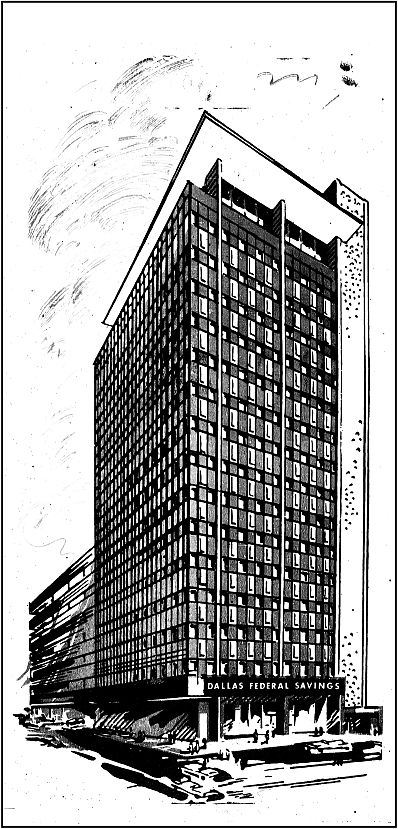
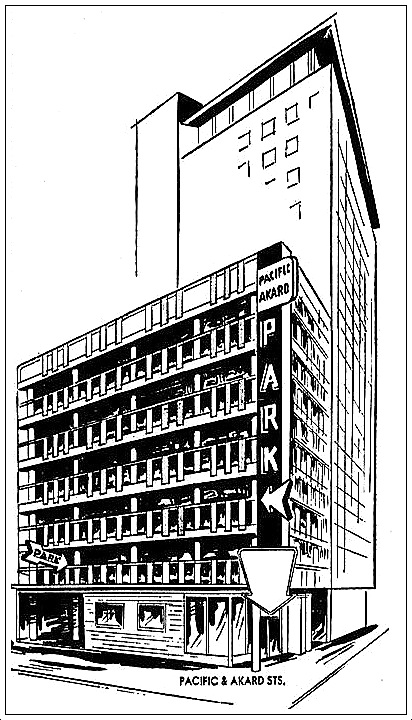
Dallas Federal Savings and Loan Building  —  1505 Elm, northeast corner of Elm and Akard. This blue, gray, and white building was built in 1956/57 and was designed by George Dahl. One of Dallas’ earliest movie theaters — the Queen Theater, built in 1912 — was demolished in 1955 to make way for the new office building. (A brand new parking garage was built at the same time.) Converted to condos and apartments.

dallas-federal-savings-and-loan_1505-elm_1957_sm     dallas-federal-savings_parking-garage_1957_ad-det

Fidelity Union Tower — northeast corner of Pacific and Akard, built in 1959/60, designed by Hedrick & Stanley; called the Mayflower Building for a short time. Now the Mosaic, converted to residences.

fidelity-union-tower-mayflower-bldg_hedrick-and-stanley_1958

511 North Akard — between Patterson and San Jacinto, built in 1958/59, designed for the Relief and Annuity Board of the Southern Baptist Convention by architects Thomas, Jameson & Merrill. Currently apartments, with a 7-Eleven at street-level.

511-akard_1958-rendering_advance-leasing_ad-det

All but one of these buildings are still standing, and most have been converted into apartments and condos. The view up Akard today (here) doesn’t look as much like a canyon as it did 55 years ago, due mainly to the loss of the Southwestern Life Building at Main and Akard.

Below is a photo looking south on Akard, with the Baker Hotel (on Commerce) straight ahead. That “third wall” formed by the Baker makes things a little more “canyon-esque.” (Note the Queen Theater at the left.)

akard_mayfair_pinterest

And, finally, a postcard of “The Akard Street Canyon” which tourists could share with the family back in Poughkeepsie.

akard-canyon_ebay

***

Sources & Notes

Top photo from the April, 1962 issue of AIA Journal (which is scanned in its entirety in a PDF, here).

Adolphus Hotel postcard from the Portal to Texas History.

Bird’s-eye view of the Gulf States Building from the collection of the Dallas Public Library.

Photo looking south on Akard from Pinterest.

Sketches and renderings of buildings mostly from ads, almost all of which appeared when the building in question opened.

For several photos showing the view south on Akard over the years, see the Flashback Dallas post “Akard Street Looking South, 1887-2015,” here.

*

Copyright © 2017 Paula Bosse. All Rights Reserved.

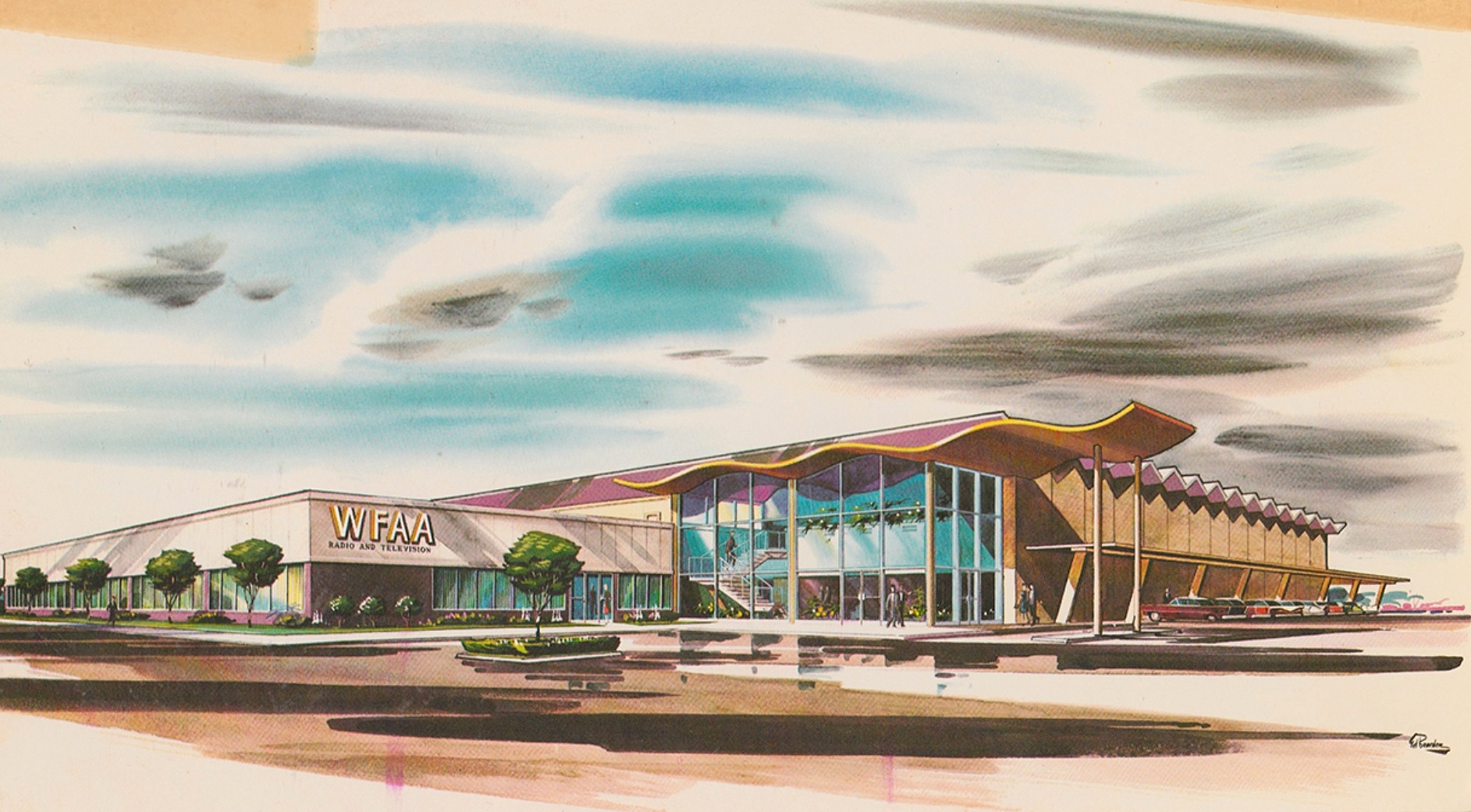
The WFAA Studios, Designed by George Dahl, Rendered by Ed Bearden — 1961

wfaa_george-dahl_ed-bearden_postcard“Communications Center”

by Paula Bosse

Above, the WFAA studios, seen in a wonderful painting by Dallas artist Ed Bearden. The image is from a postcard touting the brand new ultra-modern building designed by one of Dallas’ top architects, the prolific George L. Dahl. The building still stands at Young and Record streets, next to the home of its then-sister-company, The Dallas Morning News (appropriately, the News building was also designed by Dahl … as was the soon-to-be HQ of The News, the old Dallas Public Library at Commerce and Harwood).

The super-cool mid-century “WFAA AM-FM-TV broadcasting plant” was completed in 1961. It opened to much fanfare in April of that year, with star-studded festivities featuring personal appearances by a host of ABC stars such as Connie Stevens, Johnny Crawford, and Nick Adams. If catching a glimpse of “Cricket” or the Rifleman’s son didn’t wow you, the public was also invited to tour the building and gawk at its state-of-the-art radio and television studios. This large 68,000-square-foot building allowed WFAA radio and WFAA-TV to be housed under the same roof. Before this, the AM and FM radio stations were broadcasting from studios atop the Santa Fe Building, and Channel 8 was broadcasting from their television studios on Harry Hines, at Wolf (studios which they sold to KERA at the end of 1959).

Aside from the innovative “folded-plate” concrete roof, one of the first things I noticed about this building was the staircase behind a “wall” of plate glass — I was instantly reminded of the staircase from the old Rogers Electric building (now Steinway Hall) on the Central Expressway service road at McCommas — all it needed was a gigantic ficus tree. (Unsurprisingly, that building — built in 1959 — was also designed by the very, very busy George Dahl.)

Cool building, cool architectural design, cool artistic rendering.

**

Below is an early pre-construction rendering of the WFAA building, from 1959.

wfaa_bw_rendering_1959

*

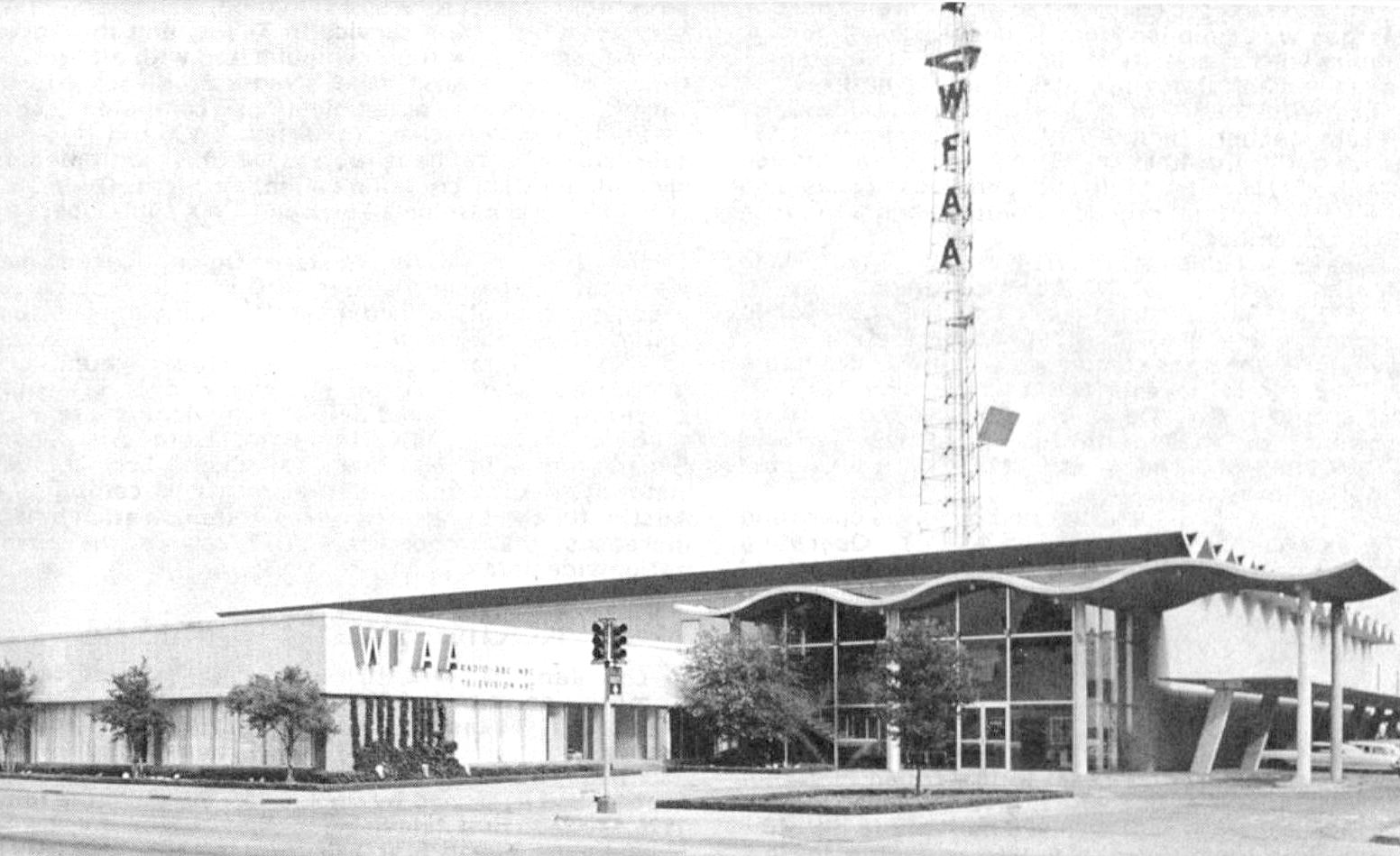
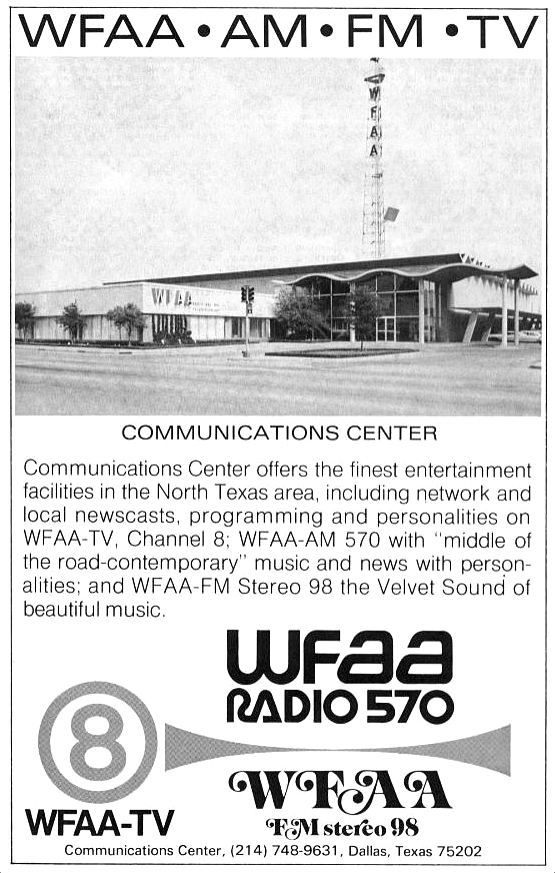
And a photo from the early 1970s.

wfaa_texas-almanac_1974-75

*

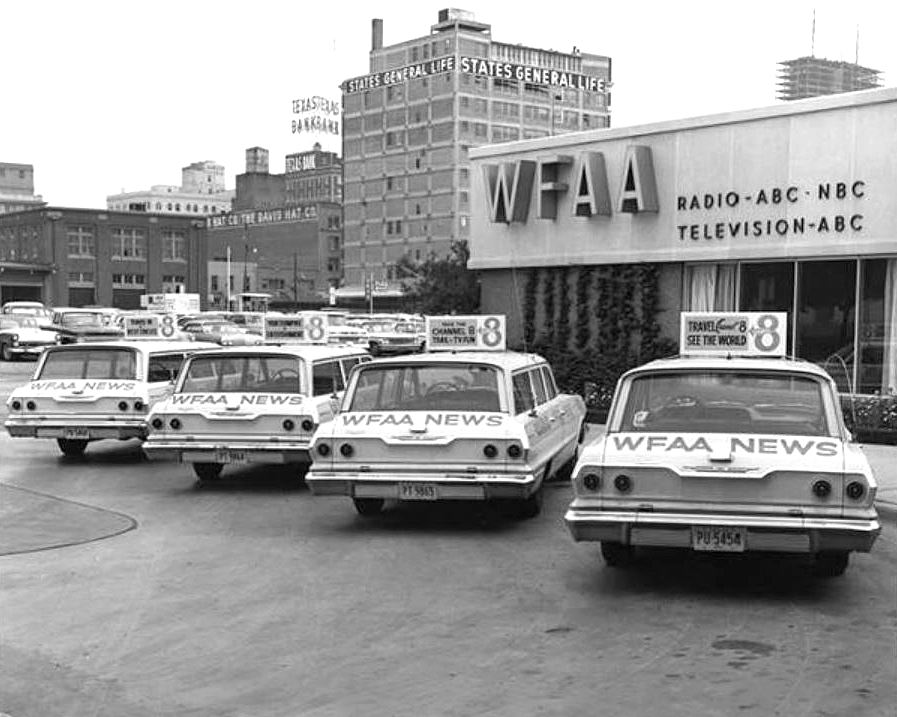
And here’s a view taken from the side of the building in 1963, looking toward Young Street.

wfaa_news-vehicles_belo-records_degolyer_smu_1963

*

The early-’70s photo above was taken from this ad from the 1974-75 Texas Almanac. Ah, “Communications Center.” (I have to say, I’ve never heard of “WFAA-FM Stereo 98” nor their slogan “The Velvet Sound of Beautiful Music.” In fact, by the time this edition of the Almanac was published, WFAA-FM no longer existed — it had changed both its name — to KZEW — and its format — to rock.)

wfaa_texas-almanac_1974-75_portal

***

Sources & Notes

Color postcard found on the entertaining blog Texas Pop Culture; see the post — which includes scans of the reverse side of the card — here.

Bearden’s signature is a bit hard to make out — the slightly distorted magnified signature can be seen here.

The more I see of Ed Bearden’s work, the more I like it. See his Dallas skyline from 1958 here; see his Dallas skyline from 1959 here.

Photo of the Channel 8 news vehicles is from the Belo Records collection, DeGolyer Library, Central University Libraries, Southern Methodist University; more info on this photo is here.

More on architect George L. Dahl can be found at the Handbook of Texas, here, and at Wikipedia, here.

Read more about the history of FM radio in Dallas — including histories of WFAA-FM and KZEW — at the indispensable website of local broadcasting history — DFW Retroplex, here.

*

Copyright © 2017 Paula Bosse. All Rights Reserved.

Mosaic Restoration at Downtown’s St. Jude Chapel

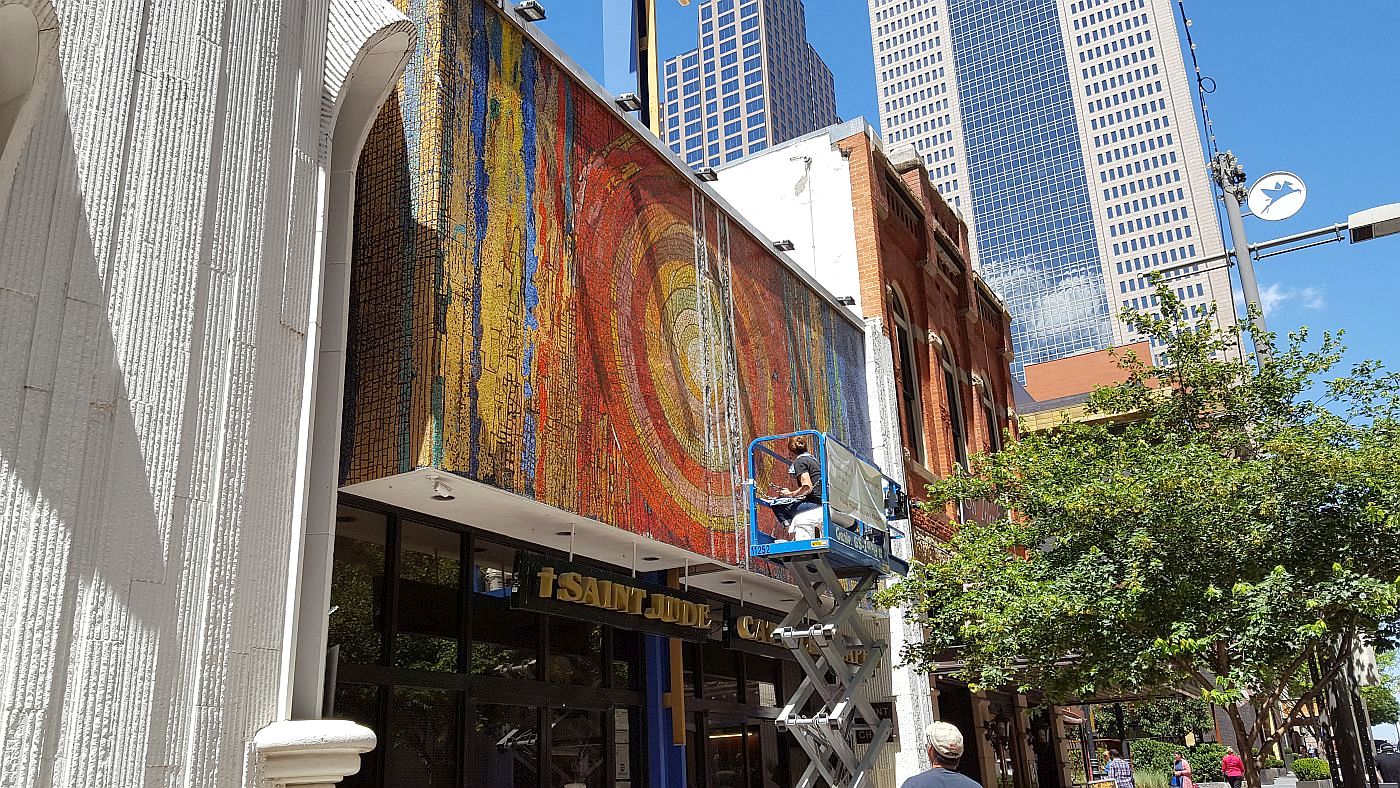
st-jude-chapel_scaffold_052417_bosse_bosseTile by tile by tile… (click for larger image)

by Paula Bosse

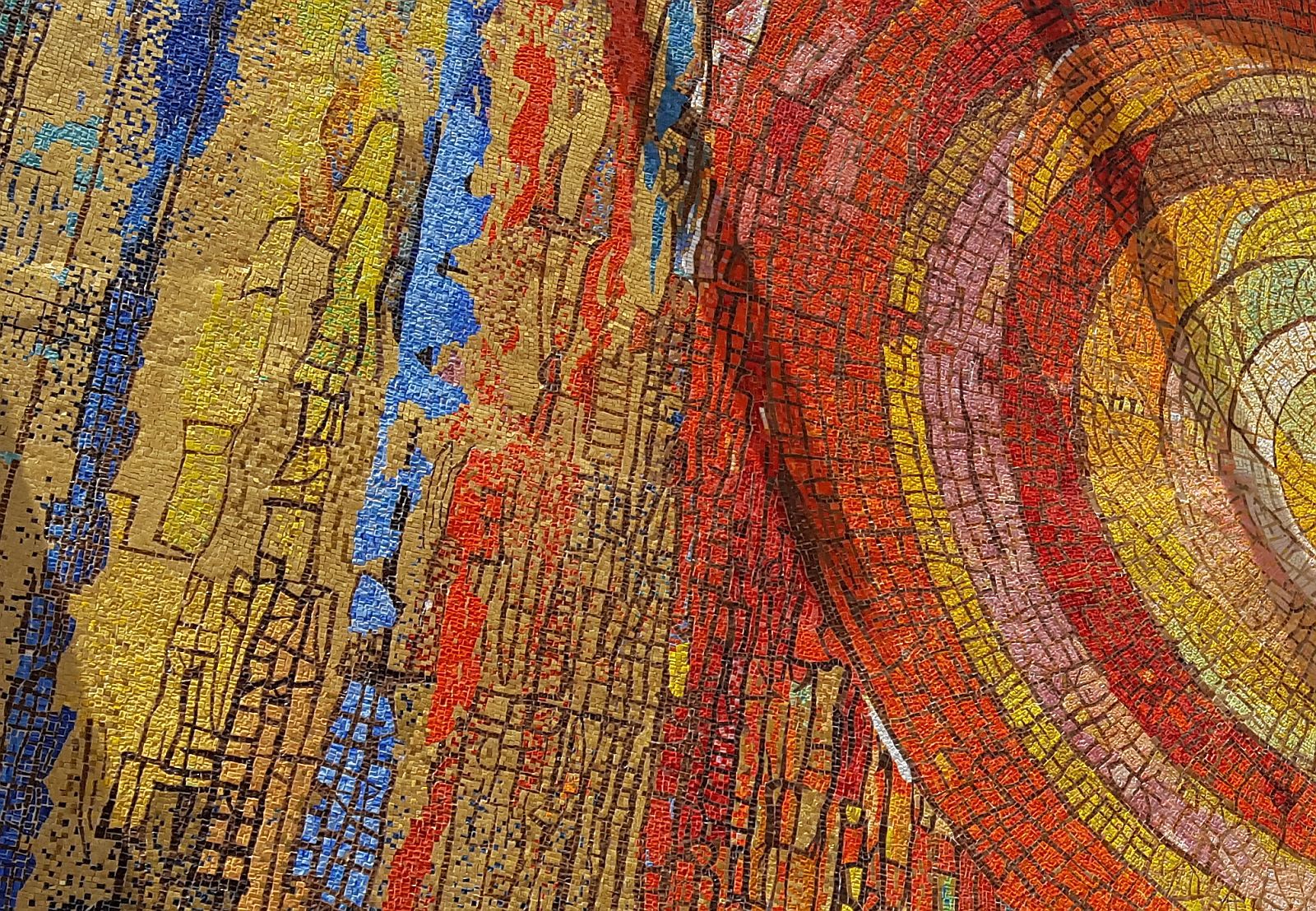
A couple of weeks ago I went downtown to check out the restoration of the large mosaic above the entrance to the St Jude Chapel on Main Street. The 1968 Gyorgy Kepes mosaic (which I wrote about here) is undergoing needed repair work, restoration, and cleaning, in preparation for next year’s 50th anniversary of the downtown chapel. The work on mosaics inside the chapel as well as the large one outside is being done by artist and preservationist Julie Richey of Julie Richey Mosaics in association with Art Restorations, Inc.

As you can imagine, the outdoor mosaic overlooking Main Street has, for 50 years, weathered everything from intense summer heat, freezing temperatures, automobile exhaust, slight shifting of the building’s structure, damage to individual tiles, mildew, grout decomposition, and a host of other factors, all of which led to the much-needed restoration work.

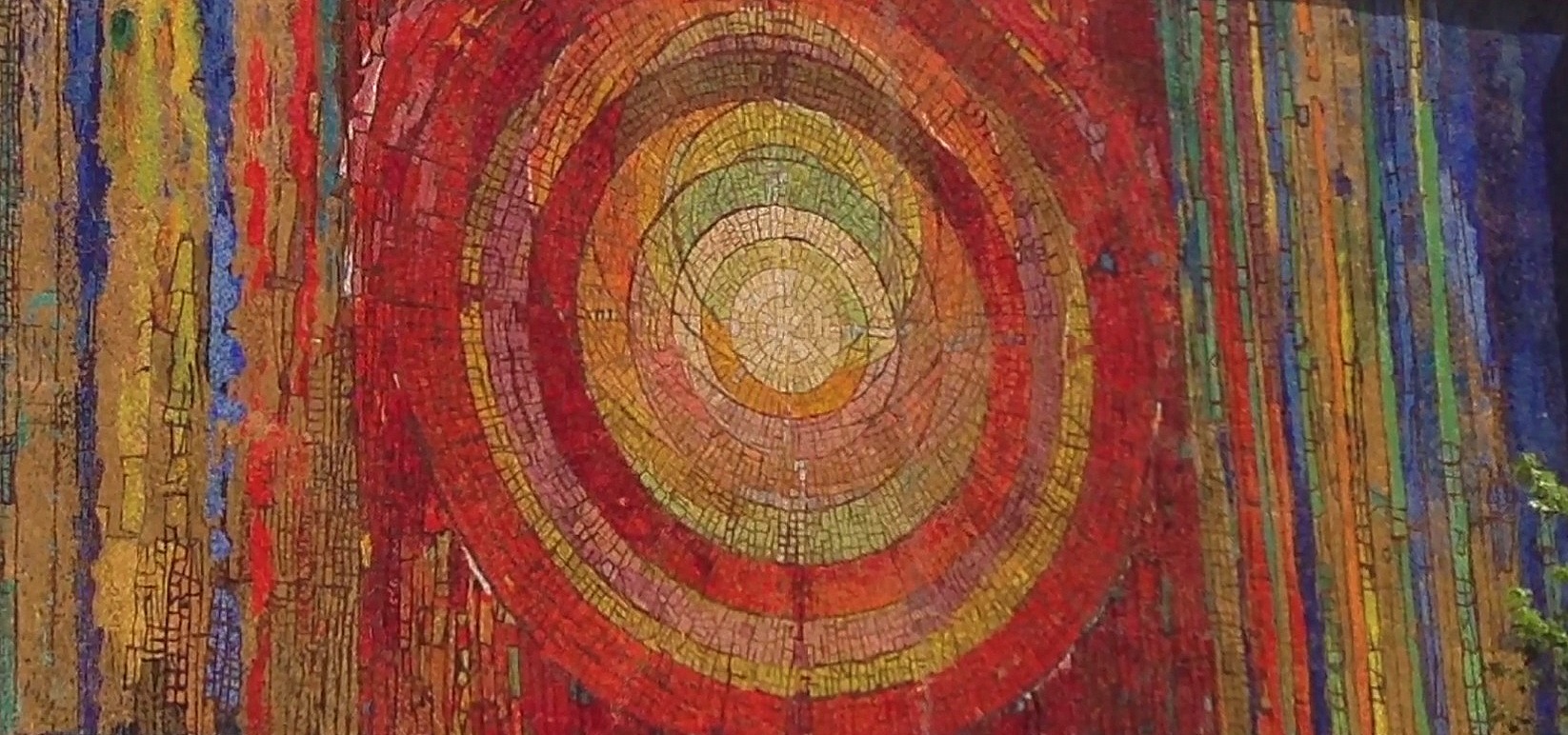
A couple of things that I found interesting, in talking with Julie Richey and Cher Goodson (of Art Restorations, Inc.) was that there are over 800,000 glass smalti tiles (or tesserae) forming the sunburst mosaic. 800,000! I had no idea it was so large until I was standing right below it. After missing or damaged tiles have been replaced, all 800,000-plus will be cleaned — by hand, I think — with, as Cher told me, Dawn dishwashing liquid (good for cleaning greasy dishes, oil-soaked waterfowl, and Venetian glass tiles). Speaking of those tiles, one of the most serendipitous moments in this project was when Julie was able to track down slabs of smalti in New York which were the very same smalti used in the original 1968 mosaic — they had been kept in storage for 50 years, and they look brand new. That means that the tesserae being used to replace the damaged or missing tiles are from the exact same batch as the originals, which means the vivid colors, the composition, the opacity, and the surface texture are the same. That is an incredible stroke of luck!

The work should be wrapping up soon — if you’d like to catch the last few days of this project, hop downtown and say hello to the women doing such great work! (UPDATE: The project actually ended Friday. But you should still go down and take a look at it!) While you’re there, you should step inside to see the little chapel, a calm and peaceful oasis in the heart of downtown. There are several other mosaics inside — Julie and company did work on some of those as well, most notably the very large, striking “Risen Christ” above the altar.

Below are some photos I took inside and outside the chapel on May 24, 2017 — most are larger when clicked.

**

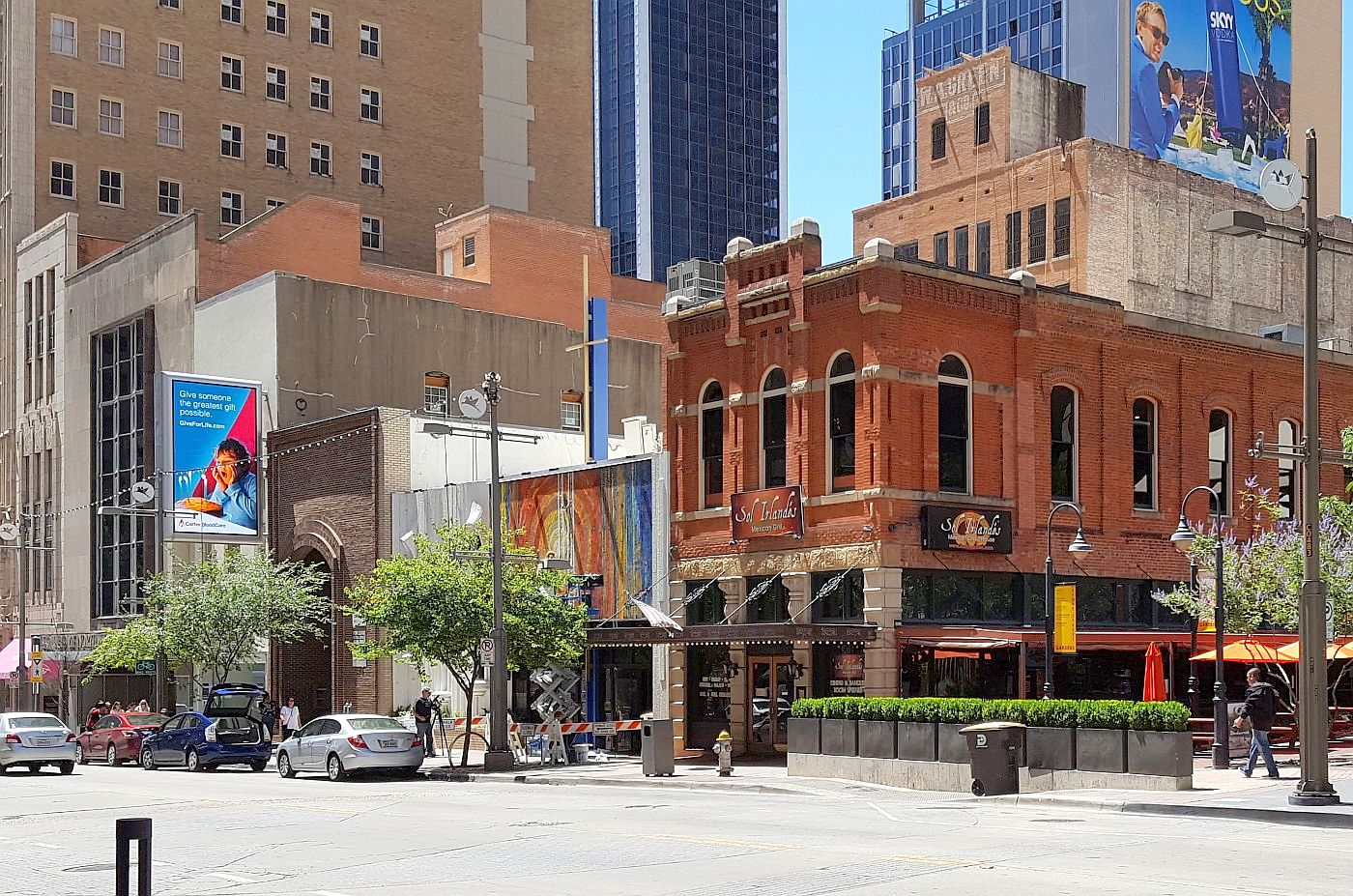
St. Jude Chapel is in the 1500 block of Main, between Ervay and Akard.

Here it is, seen from Neiman’s, across the street.

st-judes-chapel_sol-irlandes_052417_bosse

Below is part of the mosaic by Gyorgy Kepes — seeing it up close, you begin to realize that, yeah, there probably are more than 800,000 glass tiles up there. (Definitely click the photo to see a very large image.)

st-jude-chapel_mosaic_052417_det_bosse

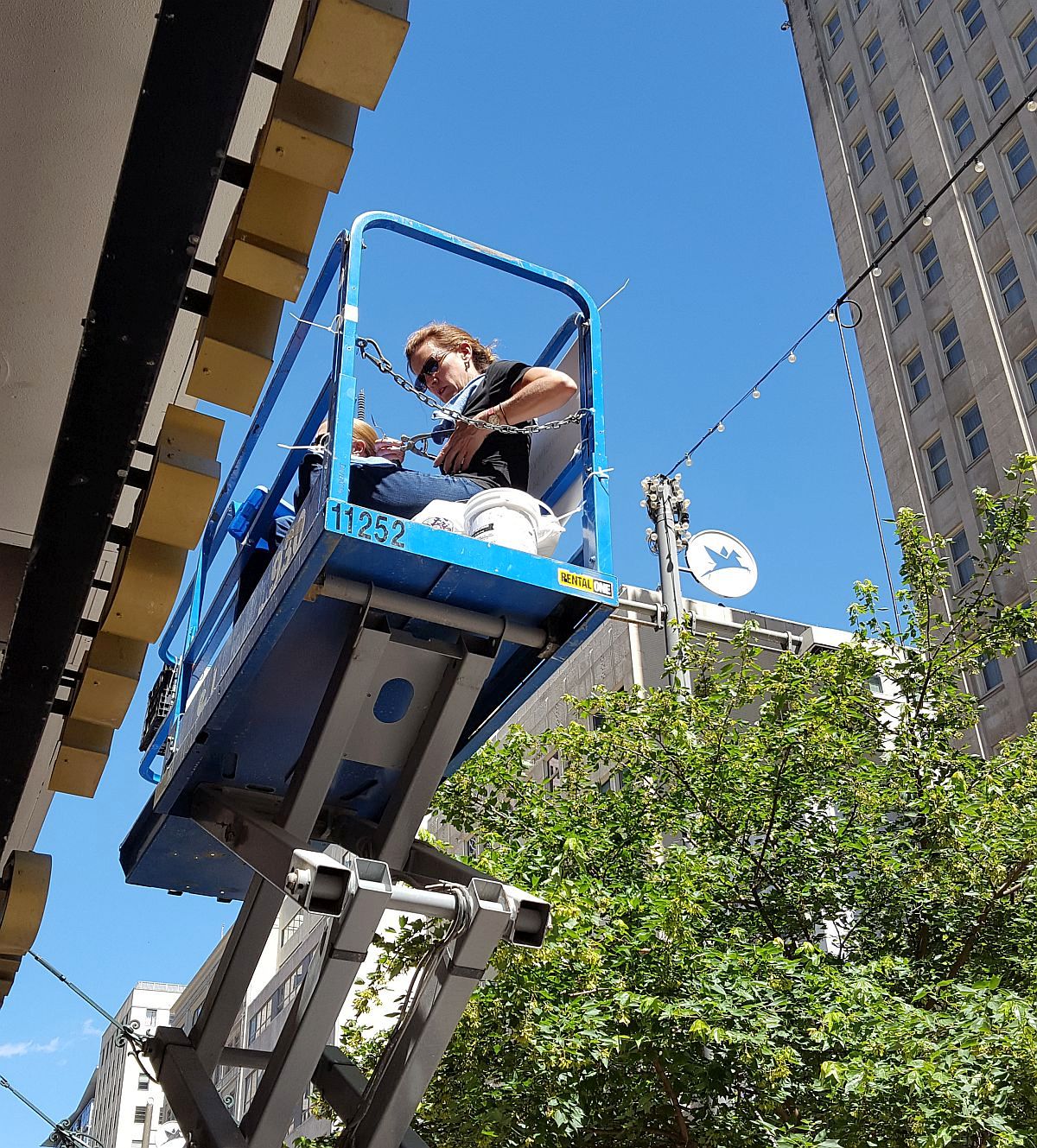
The photo at the top of the post shows the lift used to tackle the job; looking on is Dallas filmmaker Mark Birnbaum who is documenting the project. Below, Julie Richey and Lynne Chinn are raised up on the lift to do their torturously tedious and very, very detailed work (imagine working on this huge thing using tweezers!). Julie can be seen snipping “new” smalti to replace the damaged or missing tiles, working from photos, diagrams, grids, graphs, and guides to make sure the restoration is as close as possible to the original mosaic: the colors must match, the shapes must match, the placement must match.

st-jude-chapel_julie-richey_snipping_052417_bosse

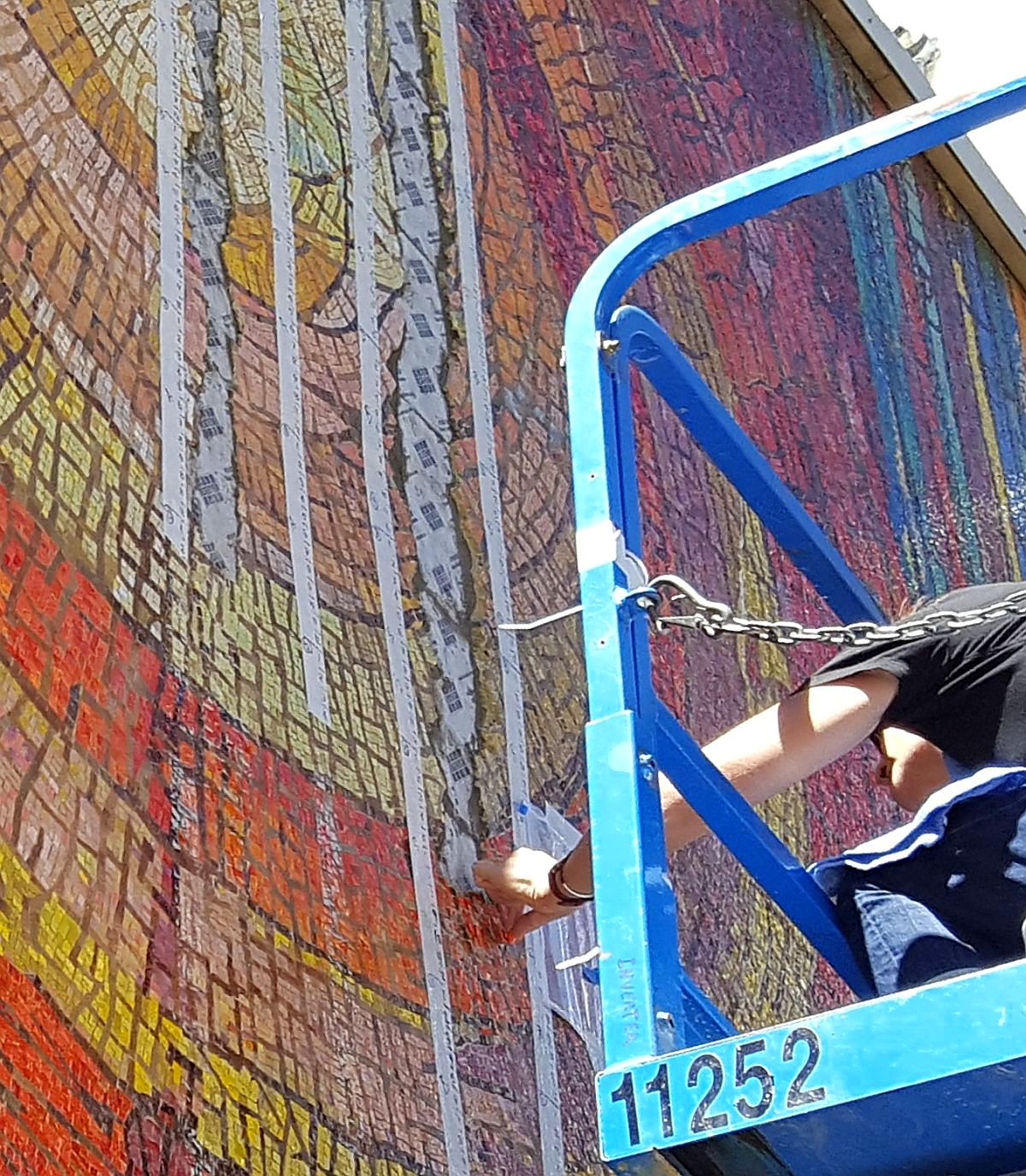
You really have to be focused to do work like this. Here, Julie is setting a tiny piece into that giant mosaic (the marked vertical strips of tape help map the mosaic and insure that everything goes back in exactly as it was originally placed in 1968.

st-jude-chapel_julie-richey-at-work_052417_det_bosse

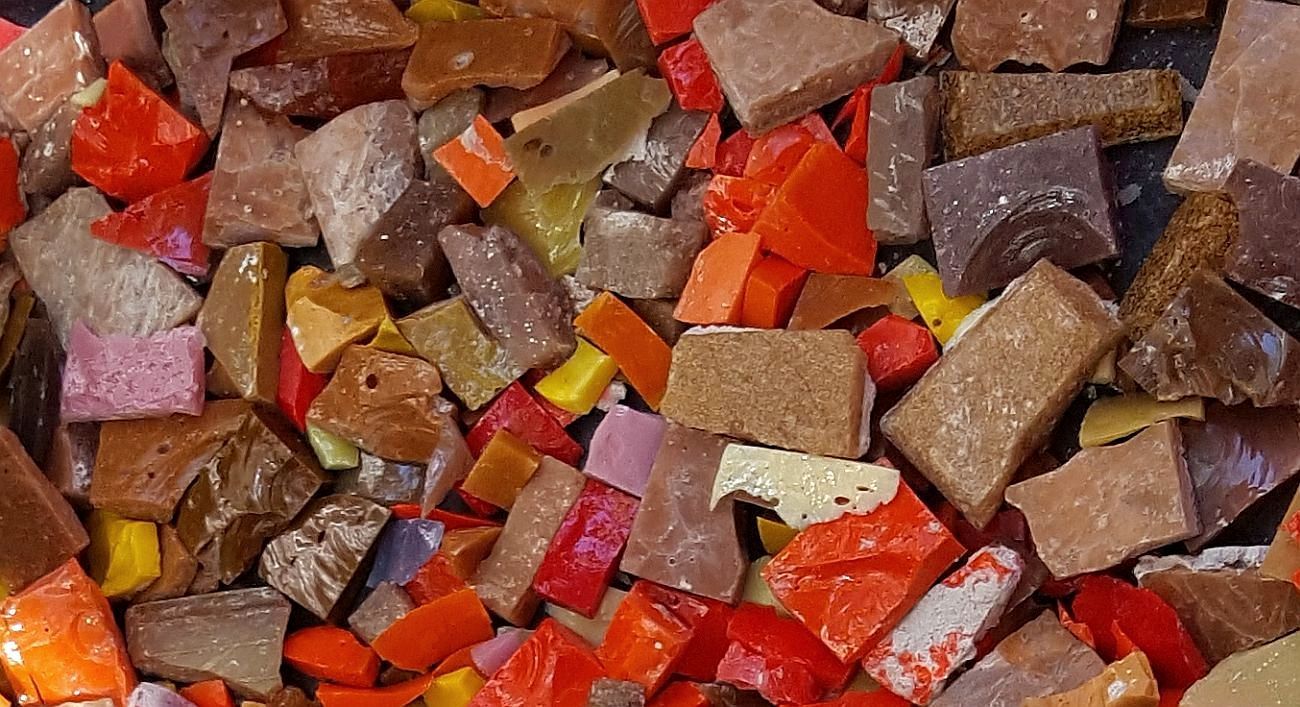
Speaking of snipping the smalti (which sounds like a naughty euphemism used amongst naughty mosaicists), here’s what’s left over, below. I talked to conservator Callie Heimburger, who gave me a lot of interesting information on how the whole intricate process worked — she was set up at a table on the sidewalk and had containers full of these beautiful discarded glass shards in front of her. I really wanted to scoop up a handful and sneak them into a pocket, but I managed to control myself.

st-jude-chapel_smalti-snippings_052417_bosse

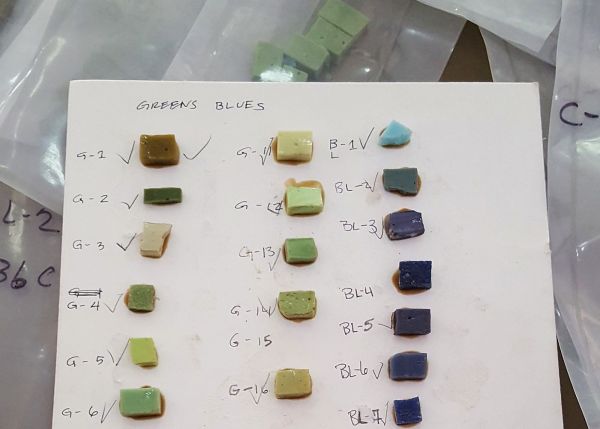
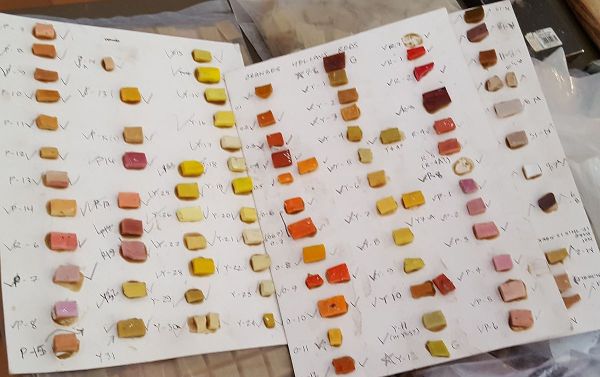
Everything is meticulously color-coded.

st-jude-chapel_greens-blues_052417_bossse

st-jude-chapel_oranges-yellows_052417_bosse

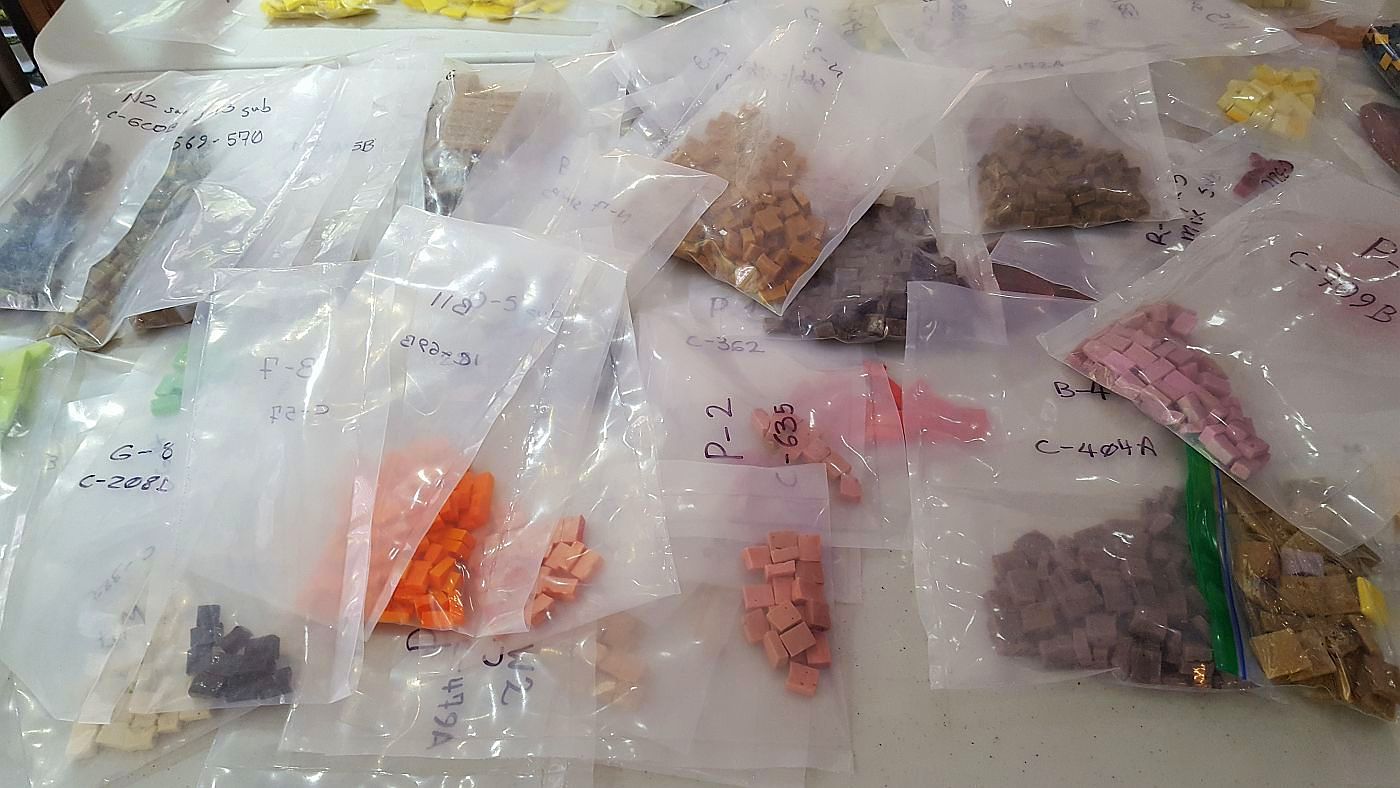
And smalti? Here are bags of “new” bagged tiles — not shown are the slabs or the larger pieces which look a little like brightly colored peanut brittle.

st-jude-chapel_bagged-tiles_052417_bosse

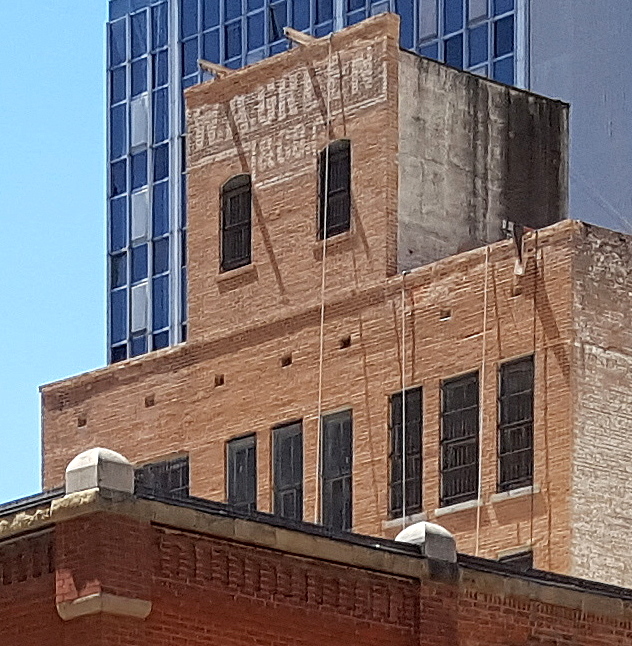
Julie asked if I wanted to go up on the lift and take a closer look. It was even more impressive (and a little overwhelming) to be right next to it. I also got to take a look over the top of the building. There Julie pointed out all that remains of one of downtown’s biggest and busiest retail stores, W. A. Green. I didn’t have the presence of mind to get a good photo up there, but here’s the “ghost sign,” seen from across the street.

w-a-green_ghost-sign_052417_bosse

**

Since I was there, I had to step inside to see what the little chapel looked like. It’s very charming. And the mosaics inside are also impressive.

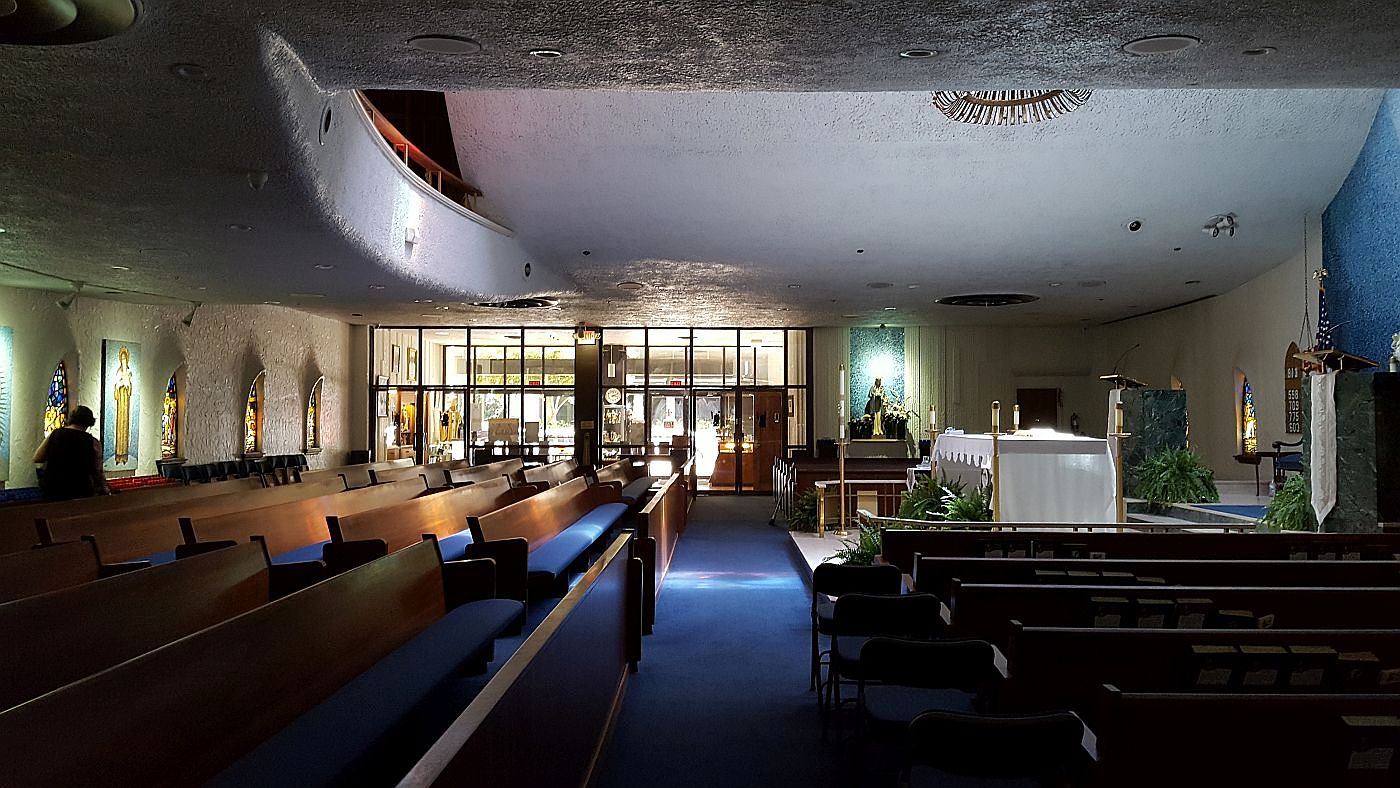
Here’s what you see as you step in.

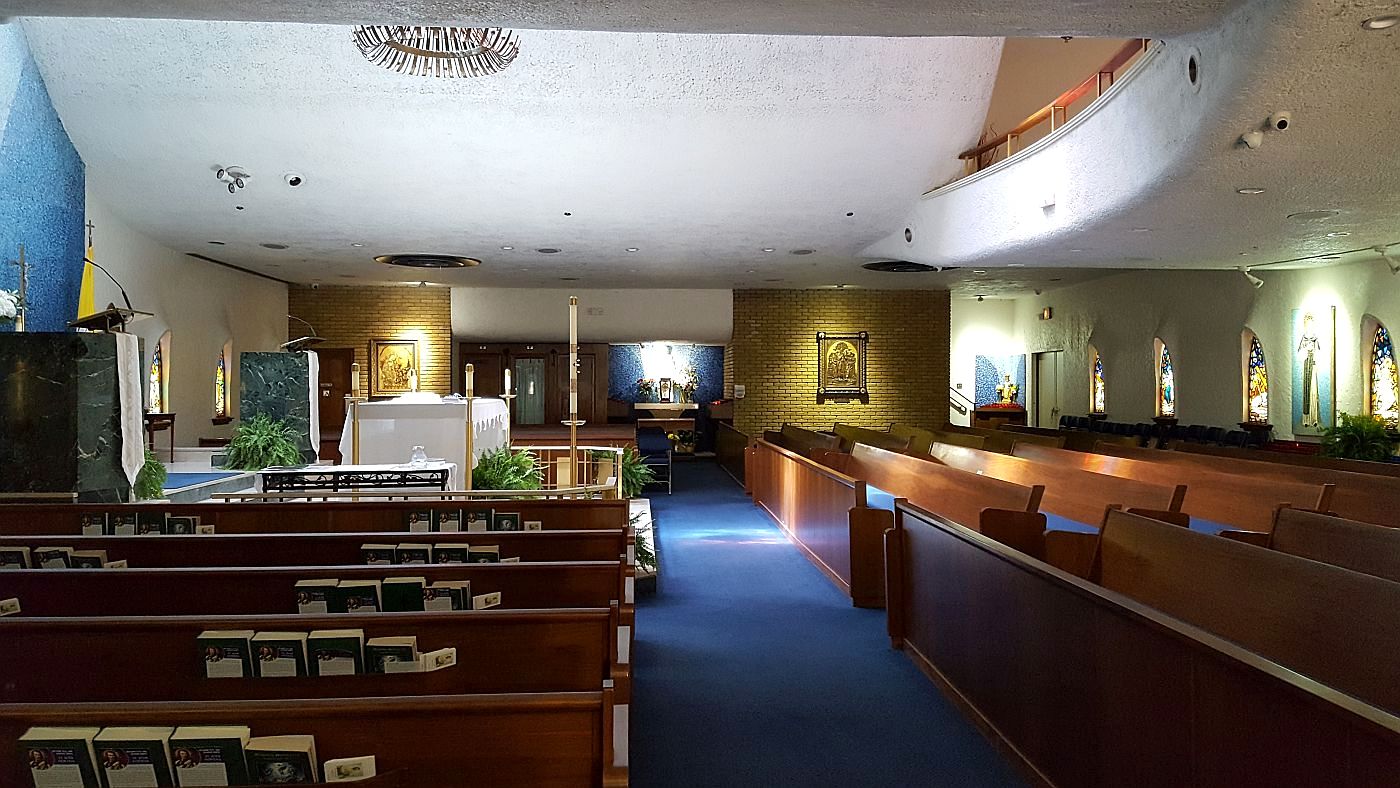
st-jude-chapel_toward-back-of-chapel_052417_bosse

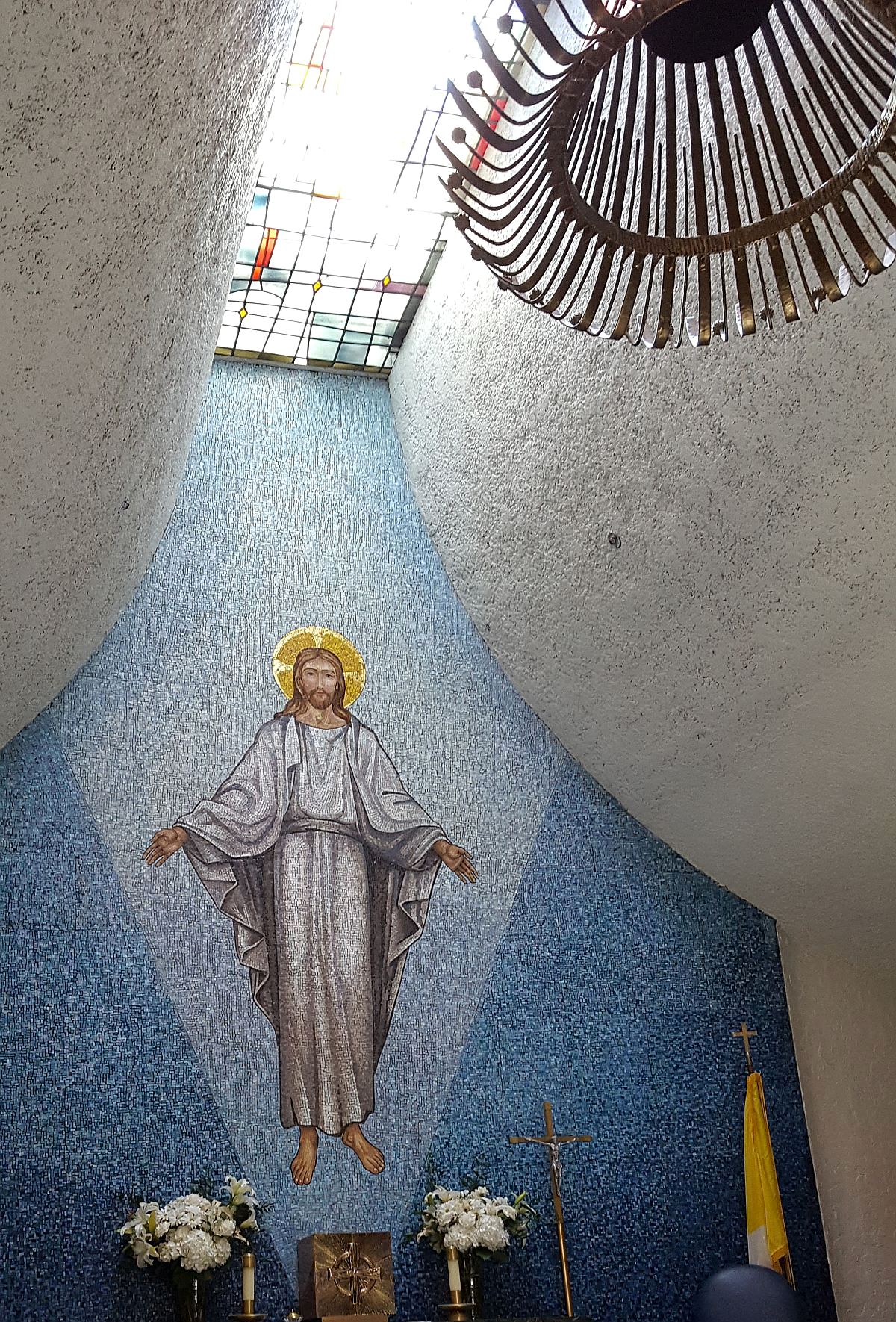
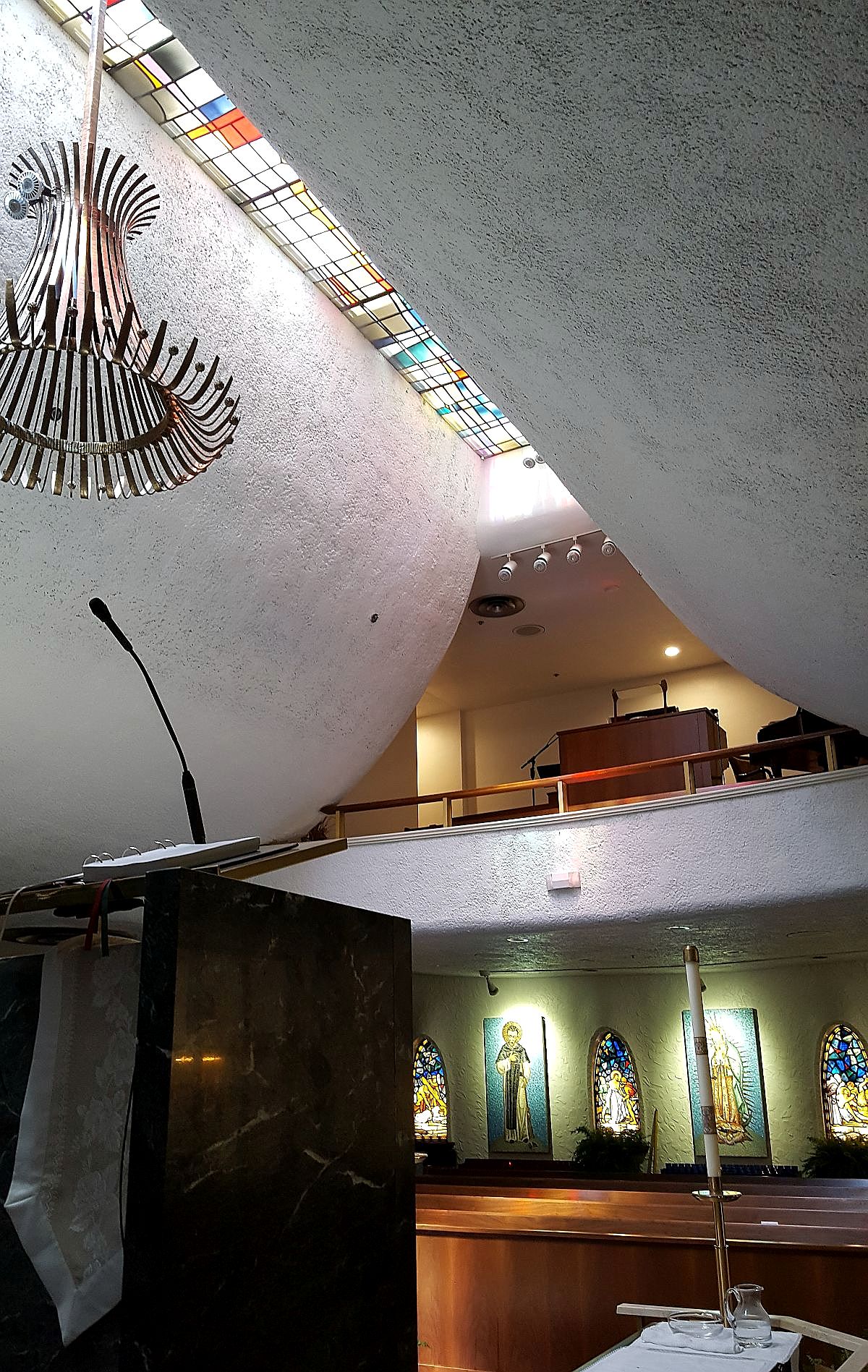
To your left is the altar. This lovely mosaic was also restored and cleaned. Also: curved walls, a stained glass skylight, and a light fixture that is one of my very favorite decorative elements of this chapel.

st-jude-chapel_altar_stained-glass-skylight_052417_bosse

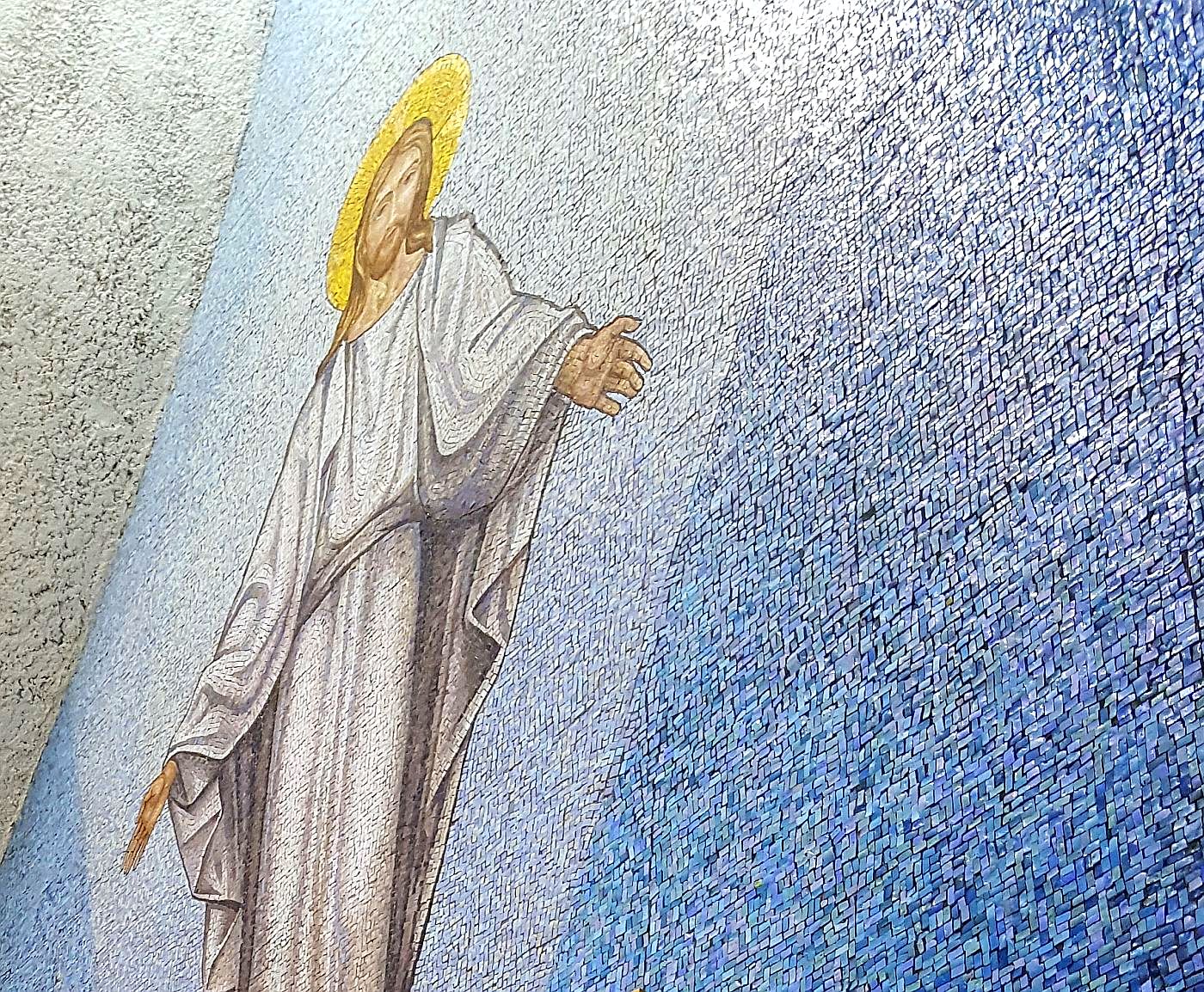
A closer look at “Risen Christ.”

st-jude-chapel_altar_det_052417_bosse

Turn around, and from the pulpit you can see the choir loft.

st-jude-chapel_choir-loft_052417_bosse

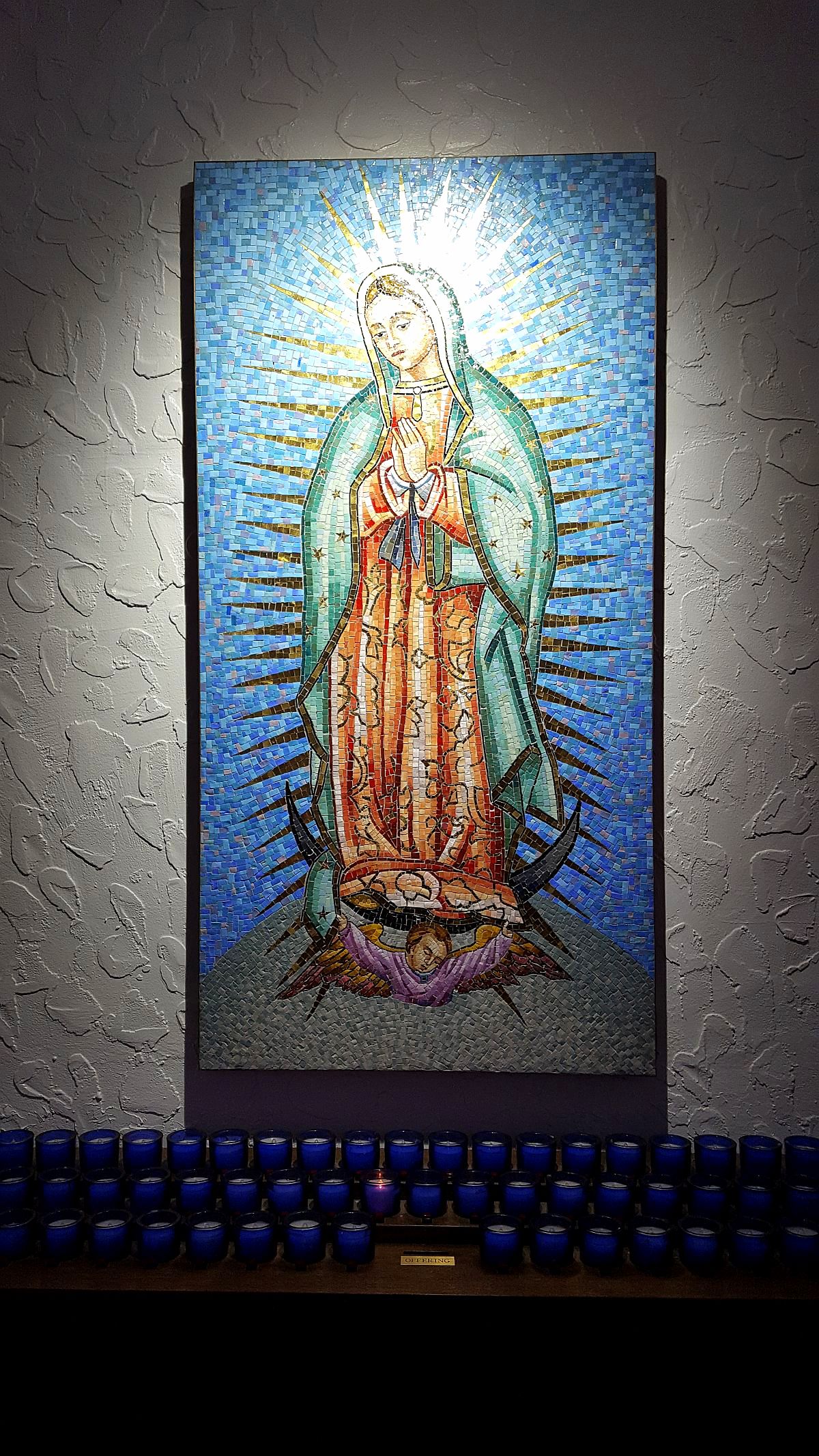
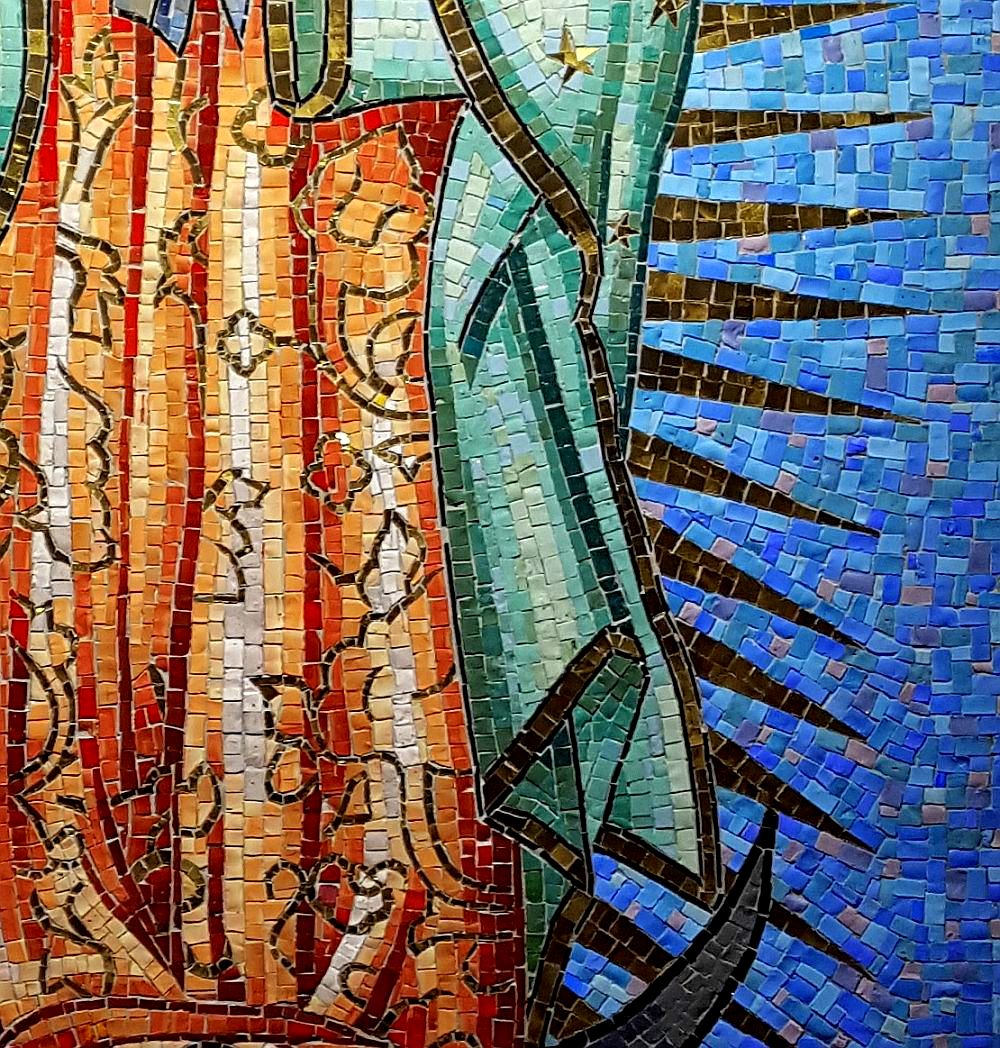
A wonderful depiction of Our Lady of Guadalupe.

st-jude-chapel_la-virgin_052417_bosse

A detail.

st-jude-chapel_la-virgin_det_052417_bosse

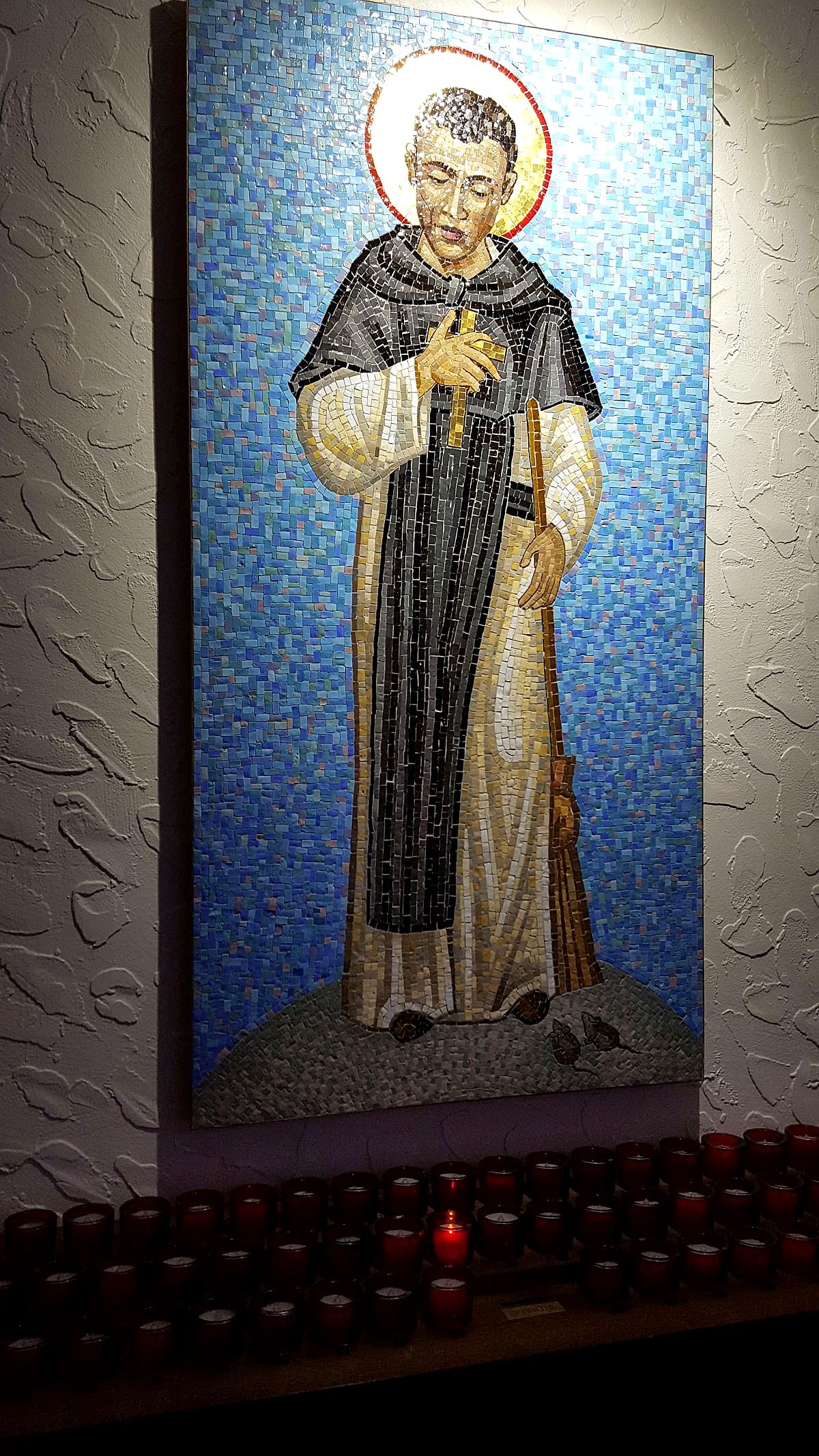
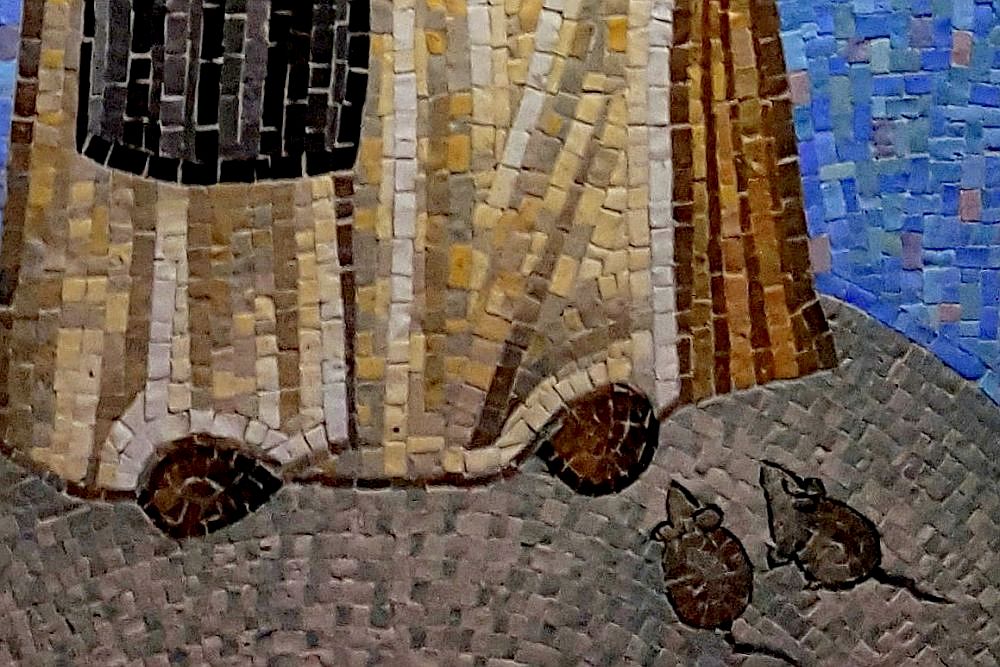
I’m afraid I’m not very well-versed on my saint iconography, but this might be St. Martin de Porres, with a broom, and mice at his feet.

st-jude-chapel_st-martin-de-porres_052417_bosse

Leave it to me to find these little mosaic mice, my favorite tiny discovery of the day.

st-jude-chapel_st-martin-de-porres_mice-det_052417_bosse

And here’s the view from the chapel toward Main Street.

st-jude-chapel_interior-with-view-to-street_053417_bosse

The St. Jude Chapel offers a nice, tranquil respite from a loud and busy downtown Dallas. You should visit sometime. All are welcome.

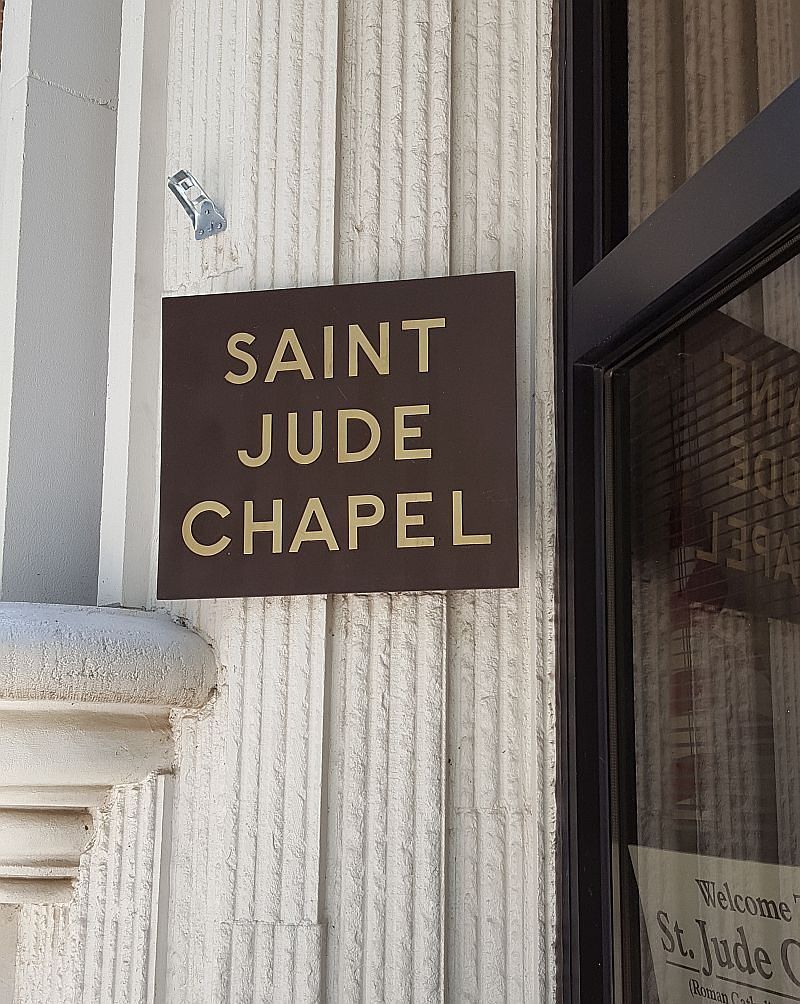
st-jude-chapel_sign_052417_bosse

**

UPDATE: Dallas filmmaker Mark Birnbaum was working on a short documentary of the project when I stopped by the site (you can see the back of his head in the top photo). His 10-minute film, “Genesis Mosaic,” can be viewed here.

***

Sources & Notes

Thanks so much to Julie Richey, Callie Heimburger, Cher Goodson, and Lynne Chinn for taking the time to chat with me. Julie Richey Mosaics website is here; Art Restorations, Inc. website is here.

You can see more on this project (including photos and video) on Julie’s Facebook page, here, and Art Restorations’ Facebook page, here; see photos from the Risen Christ restoration on Julie’s blog, here.

The St. Jude Chapel (Roman Catholic Diocese of Dallas) website is here; videos on the history of the downtown chapel are here.

All photos by Paula Bosse.

Images larger when clicked.

*

Copyright © 2017 Paula Bosse. All Rights Reserved.


Downtown Dallas, Last Week

ervay-north-from-commerce_det_052417_bosseSo many architectural styles! (click for larger image)

by Paula Bosse

Last week I went downtown to check on the restoration of the St. Jude Chapel mosaic (I’ll write about that soon…). Sadly, I’m hardly ever downtown, so I took the opportunity to walk around a bit and was struck by how much construction and beautifying is going on. Parts of it are verging on the overly hipsterized, but, generally, downtown is looking better these days than I’ve ever seen it.

I parked at an incredibly affordable parking garage behind Neiman’s — Dal-Park on Commerce just west of Ervay (you do not have to be a Neiman’s customer to park there). Three bucks! (Just drive slowly on your way out — it’s kind of cool, but it’s like going down a spiral staircase … in a car.)

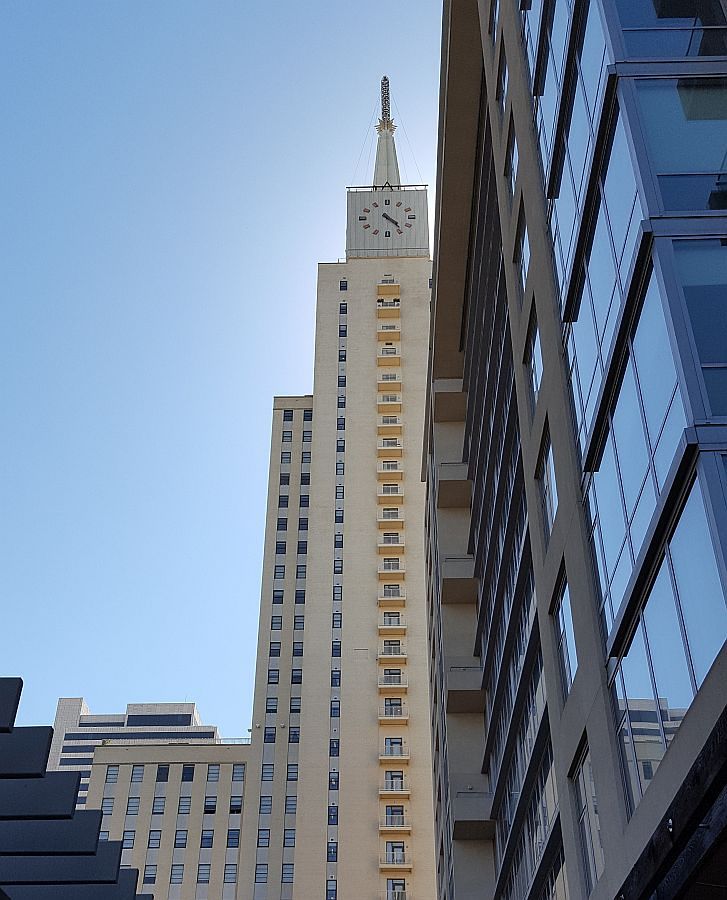
One of the first things you see when you emerge from the parking garage is the Mercantile Building. I never tire of seeing this building. (All photos in this post are much larger when clicked.)

mercantile-from-commerce_052417_bosse

*

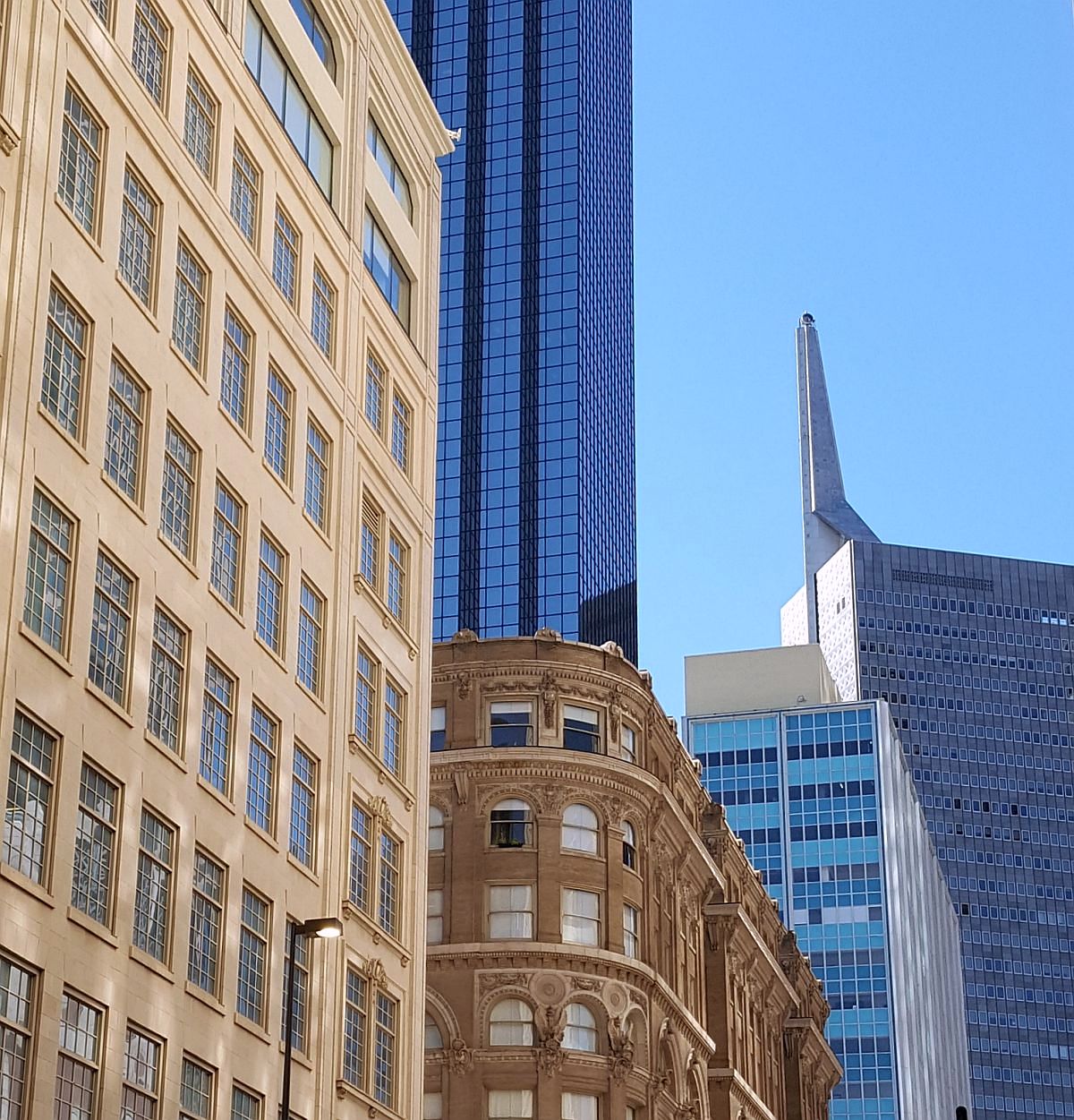
Head north on Ervay from Commerce and you see that great view seen in the top photo — it’s kind of crazy to see so many wildly different styles of architecture, from so many eras all clustered together: the Neiman Marcus building (opened in 1914) on the left, the Wilson Building (1904), 211 N. Ervay (1958), the Republic Bank Building (1954), Thanksgiving Tower (1982), and just out of frame to the right, the Mercantile Bank Building (1943). Too bad the Old Red Courthouse (1891) is in the other direction! 

Heading up Ervay from Commerce, Neiman’s takes up the whole block to your left. The display windows on this side might not get the glory of the Main Street side, but the display seen in the photo below is great. I chuckled to myself when I realized that the star of a Neiman Marcus window was corrugated cardboard. But those dogs are fantastic! The name of the Dallas artist who made them is Loran Thrasher and you can see other examples of similar works at his website — click on “Installations.”

neiman-marcus-window_loran-thrasher_dogs_052417_bosse

*

As you approach Main Street you see this elegant sign (Neiman-Marcus, for me, will always have that hyphen in it!). (See what this block looked like around 1920, looking south from Main, here.)

neiman-marcus-sign_ervay_052417_bosse

*

Turn left on Main, and you’ll see this wonderful building across the street, just west of Stone Place — it’s one of the oldest buildings downtown, built sometime between 1892 and 1899. (I wrote about this building — and its two immediate neighbors — here.) I love this building which was very nicely restored by the fine folks at Architexas about 15 years ago.

sol-irlandes_052417_bosse

*

After admiring the Sol Irlandes building I turned around to see this surreal sight several stories above street-level.

joule-pool_052417_bosse

It’s an infinity pool — part of the Joule hotel (see what the pool looks like from up there here). It was pretty odd. If I felt a twinge of vertigo looking at this from the ground, I can’t even imagine how I would handle looking down. If the view isn’t obstructed, those brave swimmers can get a pretty good look at Pegasus (who is probably also a little concerned). This must be quite a sight at night.

joule-pool_pegasus_052417_bosse

*

Just to the right of the Magnolia Building, you can see the Adolphus peeking through.

adolphus_052417_bosse

*

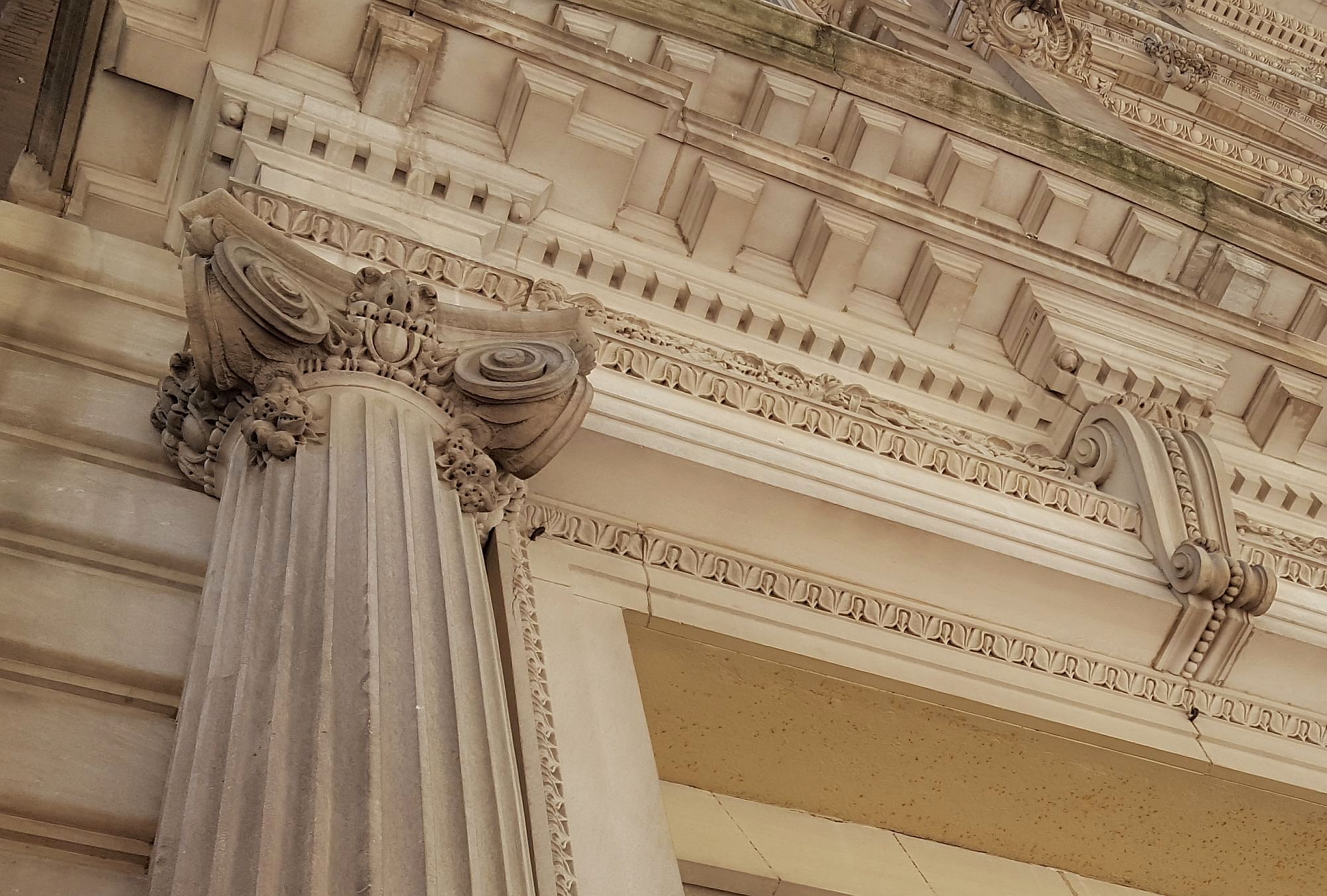
One of the most impressive buildings in Dallas is the Wilson Building, at Main and Ervay (…and Elm and Ervay). It’s even more impressive when you see it up-close. I love seeing all these intricate decorative details on a building so unlike anything else in Dallas. (See what it looked like under construction in 1902 here.) Thank you, Sanguinet & Staats, for building us such a lovely architectural landmark.

wilson-bldg_detail_052417_bosse

*

I decided to walk over to see how work on the Statler was coming, so I headed to Main Street Garden Park. This photo isn’t the best, but I wanted to get the Municipal Building (which is currently being restored to its original 1914 grandeur) in the same shot. The Statler is coming along nicely and should be open soon. I’ve always wanted to see inside that building. (Even if it no longer has its original heliport!)

municipal-bldg_statler_052417_bosse

*

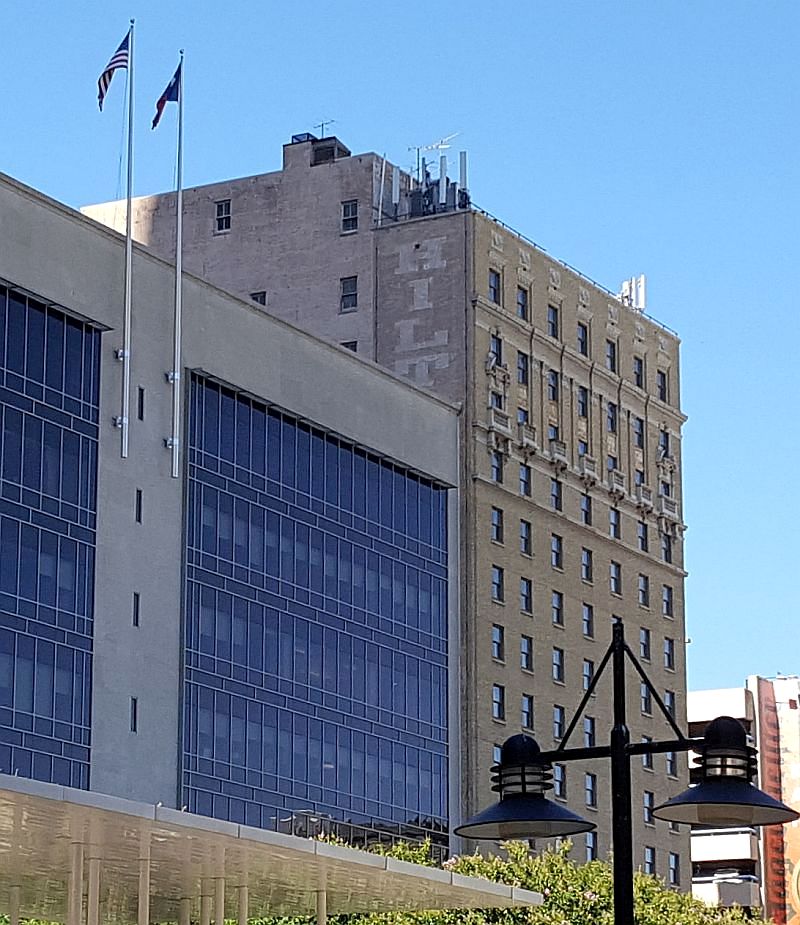
Speaking of the Statler Hilton Hotel (opened by Conrad Hilton in 1956), it’s nice to see that someone has repainted the “Hilt” on the side of what was the first hotel Conrad Hilton built anywhere, The Hilton Hotel, built at Main and Harwood in 1925 (it is now Hotel Indigo). (See the original “Hilton” sign in about 1925 here; it was repainted when it became the White Plaza a few years later.)

hilton-hotel_ghost-sign_052417_bosse

*

I took the photos above from St. Paul, looking east. I turned around and saw this great view of the Merc! It looks good from every angle. (Here it is around 1942, looking west from Harwood.)

mercantile-from-st-paul_052417_bosse

*

It’s nice to see that so many of Dallas’ landmark buildings are still looking good — and it’s also a little strange seeing the places I read about and write about every day standing right in front of me. I need to get back downtown again soon — there’s so much more to see.

***

Sources & Notes

All photos by Paula Bosse; they were taken on May 24, 2017.

All are much larger when clicked.

*

Copyright © 2017 Paula Bosse. All Rights Reserved.


A Bird’s-Eye View of the Central Business District

skyline_aerial_flickr_colteraThe Statler Hilton and the Merc at dusk… (click for larger image)

by Paula Bosse

I’ve recently experienced a long, long involuntary separation from my beloved laptop (the welling anxiety! the withdrawal pangs!), but now it’s back home from the shop, resting comfortably and ready to go back to work.

Here is a “welcome back” shot of the Dallas skyline, with a view to the southwest: the neon begins to come on in the CBD as “magic hour” arrives.

***

Postcard image posted on Flickr by the ever-reliable Christian Spencer Anderson (aka Coltera), here.

*

Copyright © 2017 Paula Bosse. All Rights Reserved.

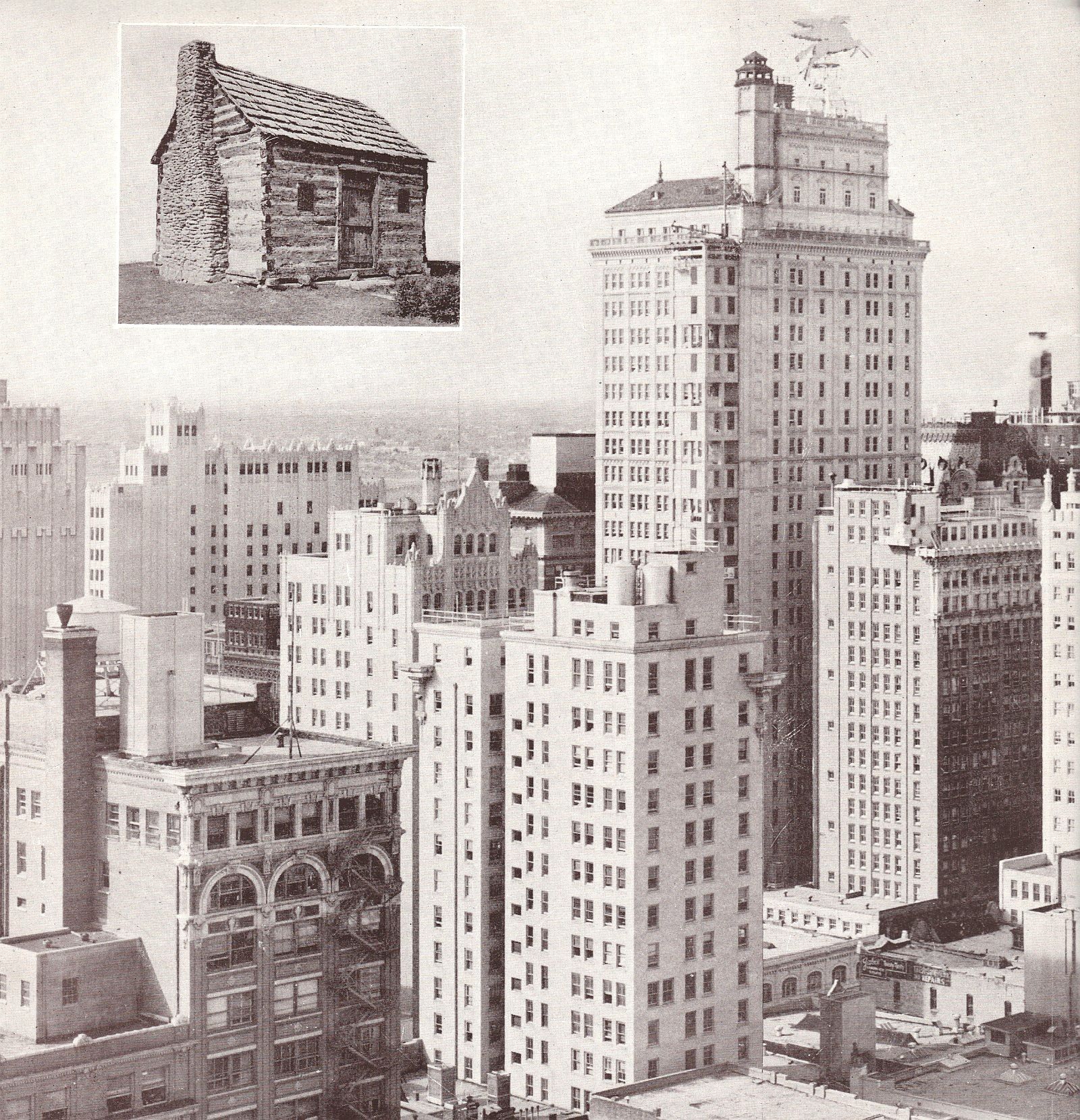
A Century of Growth: From Log Cabin to Skyscrapers

cityscape_cabin_so-this-is-dallas_ca-1943Ol’ JNB wouldn’t recognize the place… (click for larger image)

by Paula Bosse

To think it all began with John Neely Bryan’s little log cabin on the banks of the Trinity…. 

***

Photo from the booklet So This Is Dallas (Dallas: The Welcome Wagon, circa 1943); courtesy of the Lone Star Library Annex Facebook page.

*

Copyright © 2017 Paula Bosse. All Rights Reserved.

The Praetorian Building and Its 19th-Century Neighbors

praetorian_empire_main-street_postcard_ebay_detIn the shadow of the Praetorian —  Main Street, 1907

by Paula Bosse

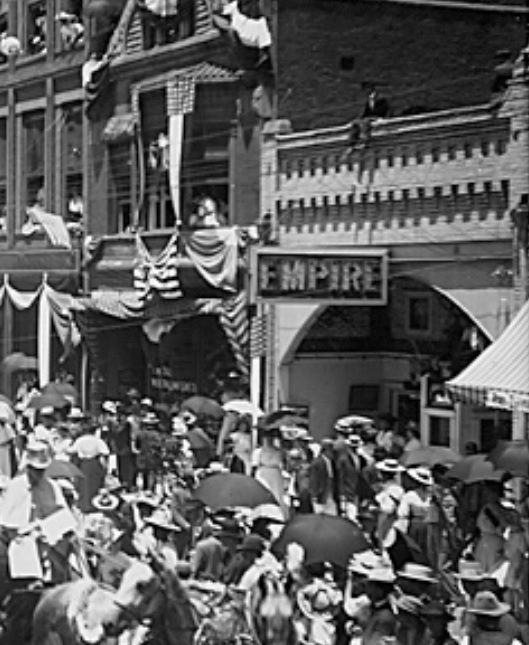
The photo below is a detail of a larger photo from the George W. Cook Collection treasure trove at SMU’s DeGolyer Library, which shows the Praetorian Building under construction. It appeared on a real-photo postcard which shows a postmark of July 25, 1907. What I found most interesting about this photo are the two buildings standing in its shadow, just west of Stone Street (now Stone Place). Here’s a close-up (click to see a larger image):
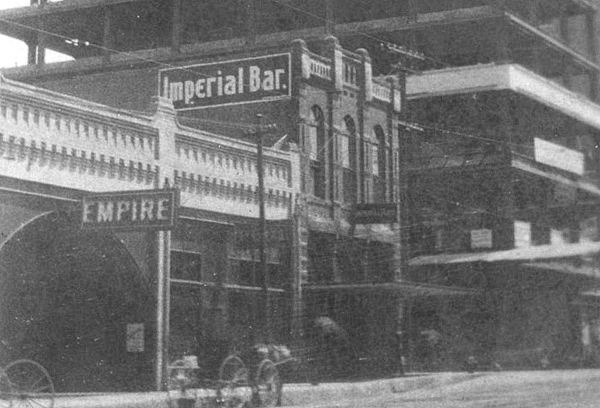
empire-imperial-praetorian_1907_cook-collection_SMU_det

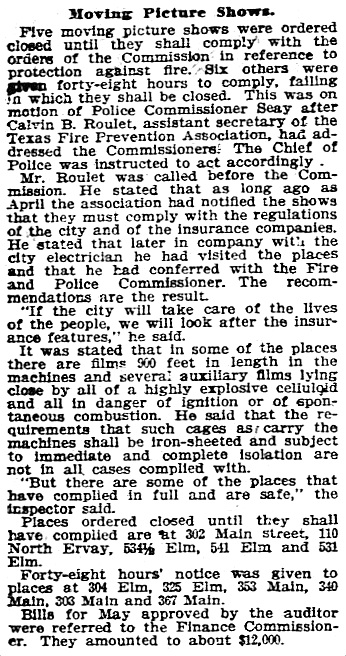
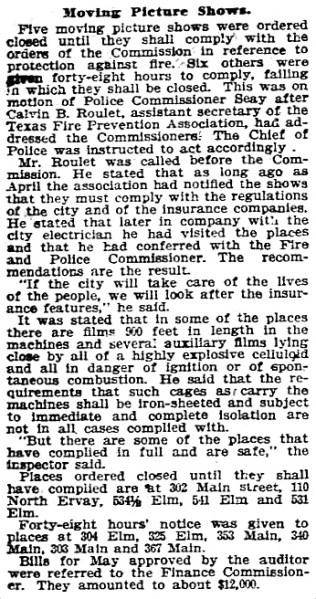
I knew that the building with “Imperial Bar” on the side is still standing (the Sol Irlandes restaurant at 1525 Main has been its occupant for several years), but I wondered about the one with the “Empire” sign. It took a bit of digging, but I’m happy to report that it was a very early movie theater. I had determined that the address of the building with the Empire sign was 353 Main Street (in what is today the 1500 block of Main) and found this article from 1907 about officials closing down “moving picture shows” which had not complied with fire precautions in the storing and projection of highly flammable celluloid film — one of these movie houses was at 353 Main (clippings and photos are larger when clicked):
fire-code-violations_moving-pictures_dmn_062507
Dallas Morning News, June 25, 1907

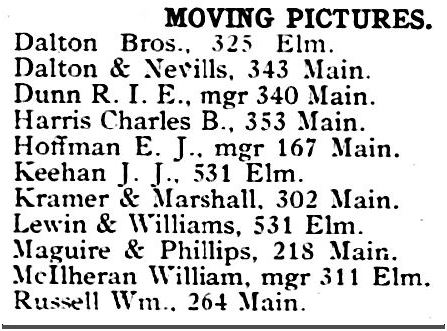
Below is a clipping from the Dallas city directory issued in 1907 — the first year a special “Moving Pictures” category was included in the directory.
1907-directory_harris-empire
1907 Dallas directory

These “picture shows” were listed not by theater name (if they had one), but by owner or manager. (This was the era of nickelodeons, which were not so much “theaters” as “viewing rooms” — a great article from 1908 about the sudden surge in popularity of the nickelodeon — what they were and what they were like — can be read here.) The theater at 353 Main was owned by Charles B. Harris (usually referred to as C. B. Harris, who had previously worked as a wholesaler for the Edison Phonograph Co. a couple of doors down the block). When the picture above was taken, the Empire was showing movies at 353 Main, men were playing pool for 45¢ an hour at the New Brunswick Billiard Hall next door at 355 Main, and Bartholomew Lynch was running the Imperial Bar on the corner, at 357 Main.

pool-hall_355_dmn_041307
DMN, April 13, 1907

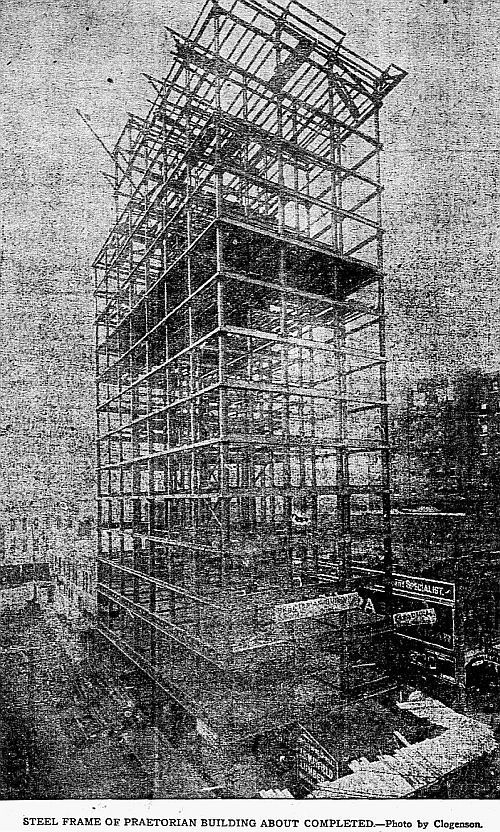
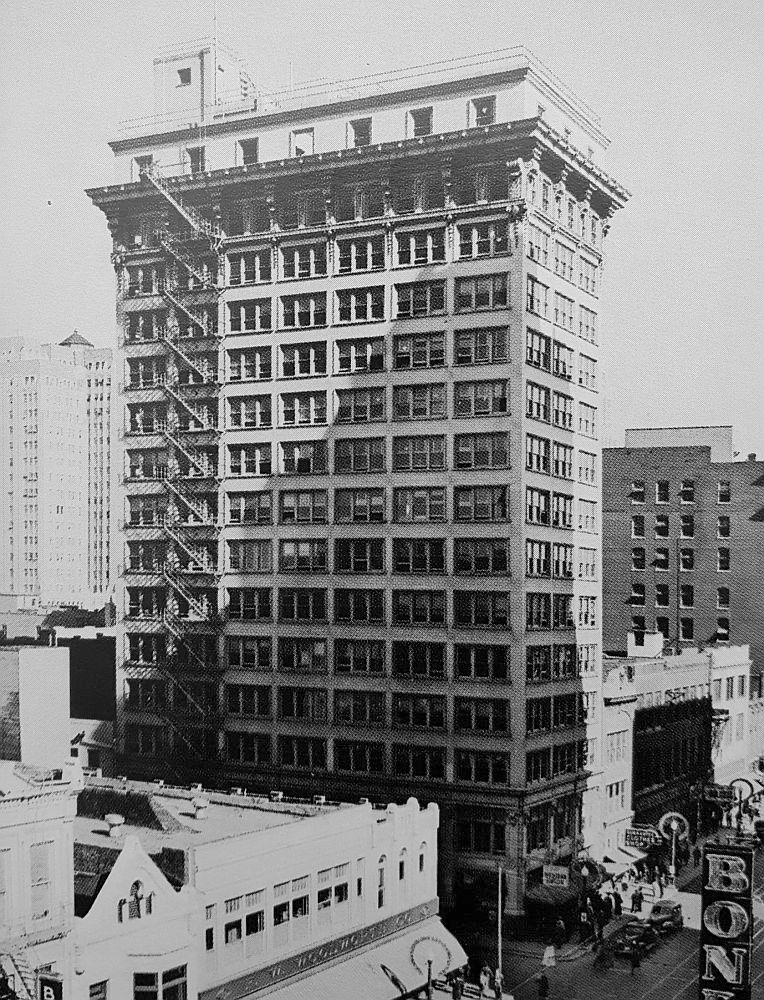
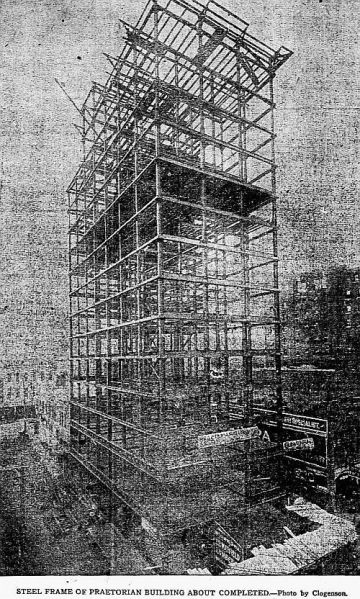
Construction of the C. W. Bulger-designed Praetorian Building — Dallas’ first skyscraper (14 stories!) — had begun in September, 1906. Here’s what it looked like in March, 1907:
praetorian_construction_dmn_031707
DMN, March 17, 1907

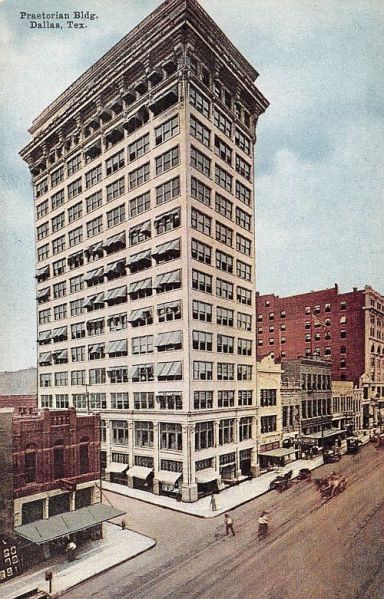
And here it is shortly after completion:
praetorian-building_main-street_postcard_ebay

In January, 1909, C. B. Harris decided to expand up and into the space next door. The Empire Theater stopped showing movies, and in March, 1909, it became a venue for live stage productions.
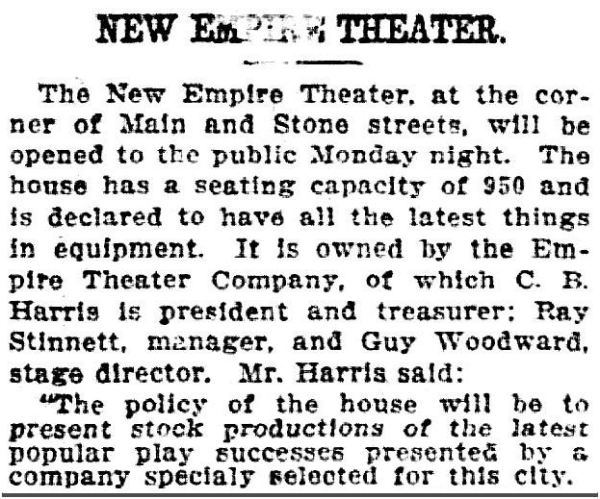
empire_dmn_032109_opening
DMN, March 21, 1909

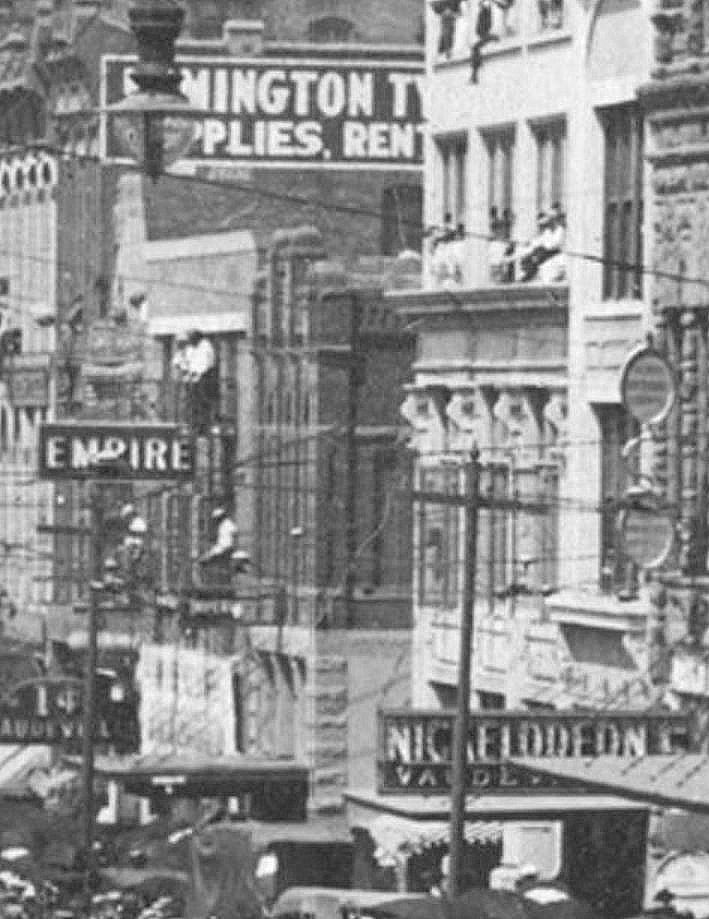
Here are a few photos showing the Empire and the finished Praetorian Building, around 1909. The first one may be one of the few to show the short-lived Colonial Theater (352 Main), a vaudeville house, across the street.

empire-imperial-praetorian_flickr_colteravia Flickr

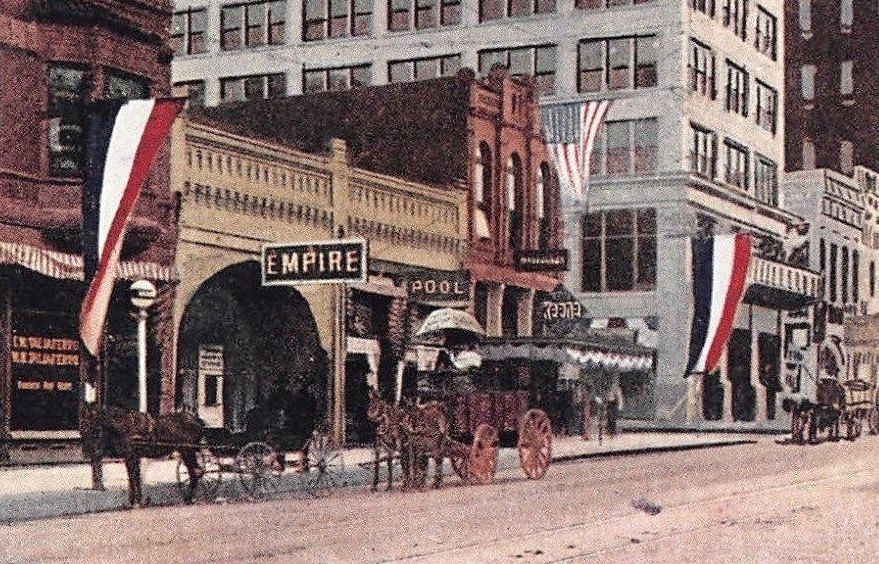
Here is another postcard view, showing the Empire (the detail of this image is at the top of this post).
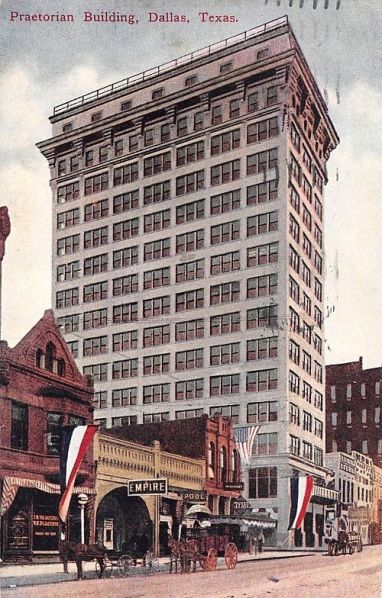
praetorian_empire__main-street_postcard_ebay

Below, a detail of a larger photo, also from around 1909.
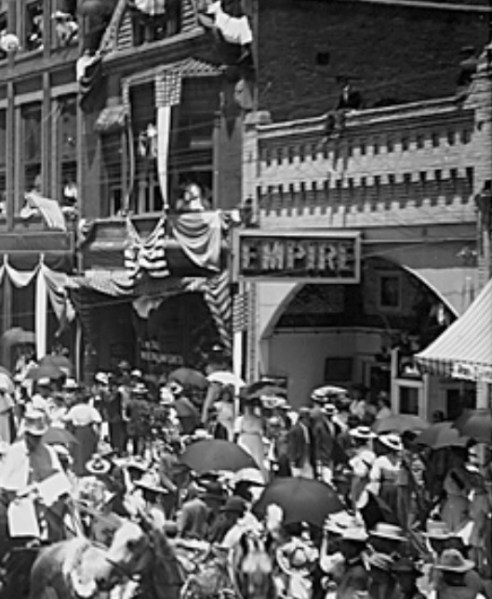
empire_ca-1908_parade_flickr

And below, a detail from a larger photo, with spectators watching a parade in August, 1909, showing the Empire with its new construction.
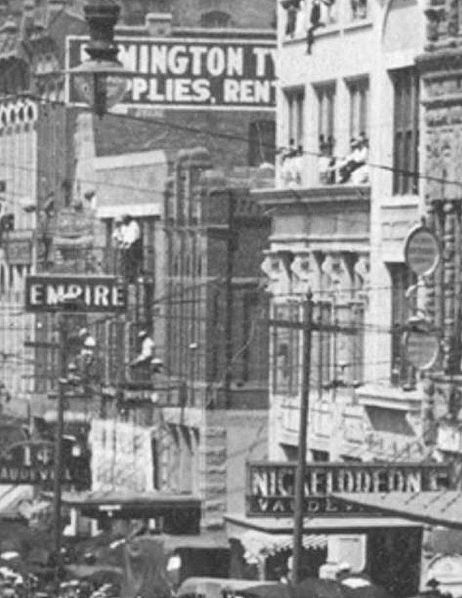
empire_parade-day_1909_degolyer_SMU_close-up

In December, 1909, Harris changed the name of the theater to the Orpheum — it became a vaudeville house.
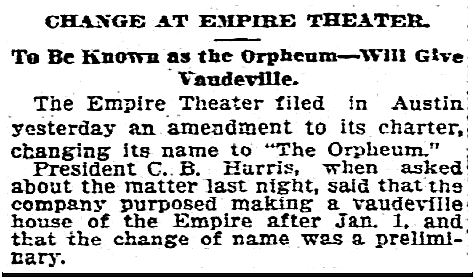
empire-orpheum_dmn_121409
DMN, Dec. 14, 1909

You can see the Orpheum Theater sign in this detail of a larger photo (click thumbnail on page to see full image). (Note that the Happy Hour Theater has taken over the Colonial’s space.)
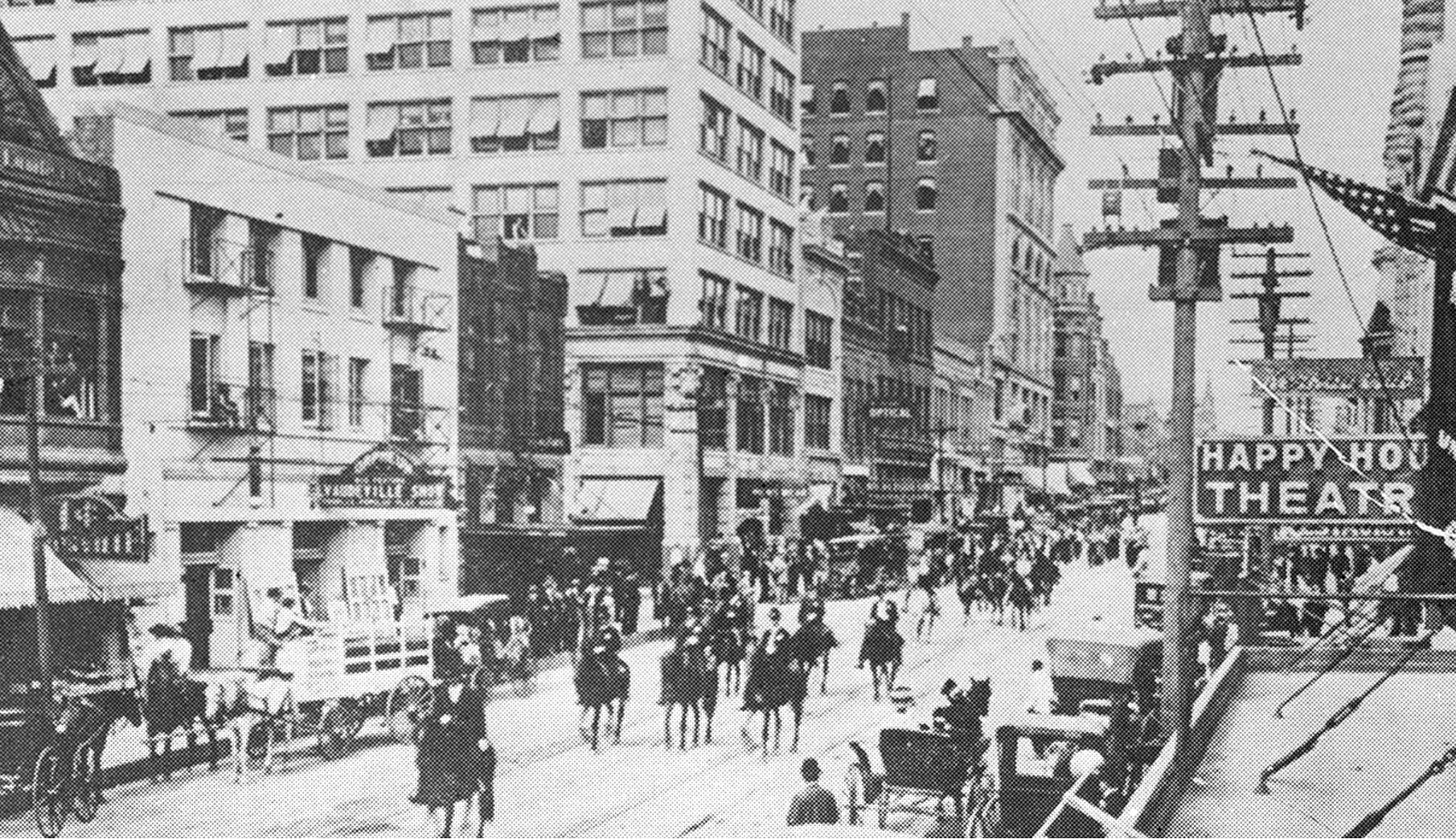
orpheum_happy-hour_praetorian_uta_det

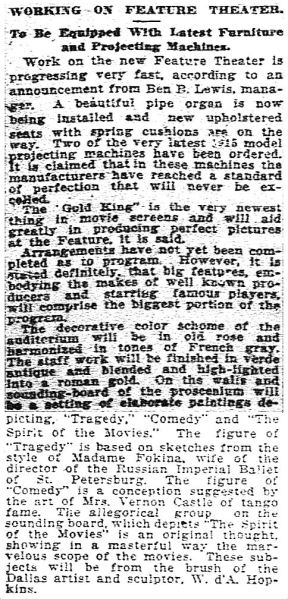
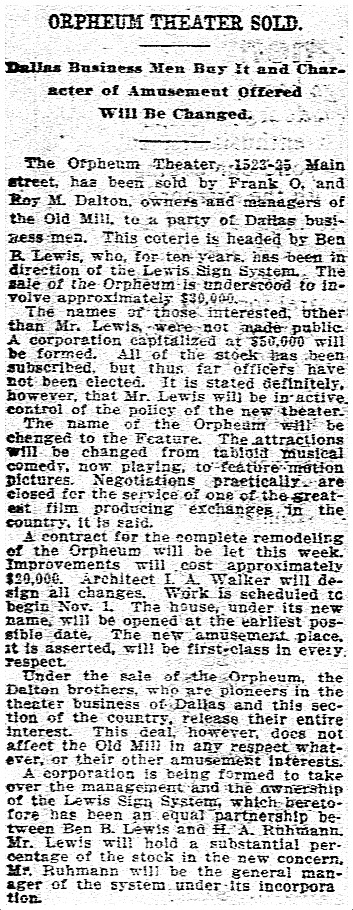
By 1914, the building’s address was 1521 Main (or, more specifically, 1521-23 Main), and ownership of the theater (which was now featuring “tabloid musical comedy”) had changed hands (to the Dalton brothers, who owned the Old Mill Theater). In October, 1914, the Daltons sold the theater. It was extensively remodeled and became the Feature Theater, a motion picture house (once again!).
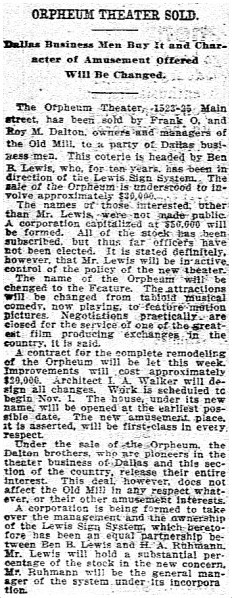
orpheum_dmn_101814_sold
DMN, Oct. 18, 1914

feature-theater_dmn_111514
DMN, Nov. 15, 1914

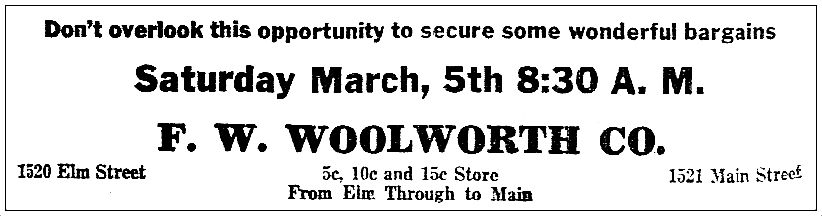
The Feature hung on through the Great War, but finally sputtered out in 1919. In 1920, Woolworth’s expanded into the space (they were already located on Elm Street, and the expansion afforded them entrances on both Elm and Main — and, I think, Stone. Woolworth’s had already been occupying the old Imperial Bar building on the corner when they took over the old Empire space (1525 Main). That was a big Woolworth’s store.
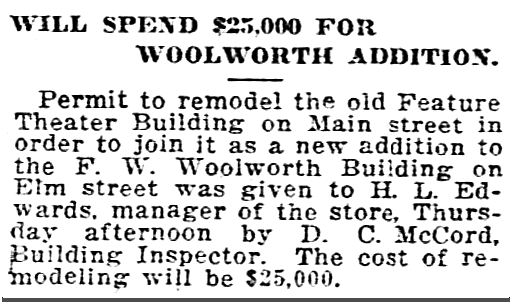
feature-theater_dmn_122420_woolworths
DMN, Dec. 24, 1920

woolworth_dmn_030421_grand-openingDMN, March 4, 1921

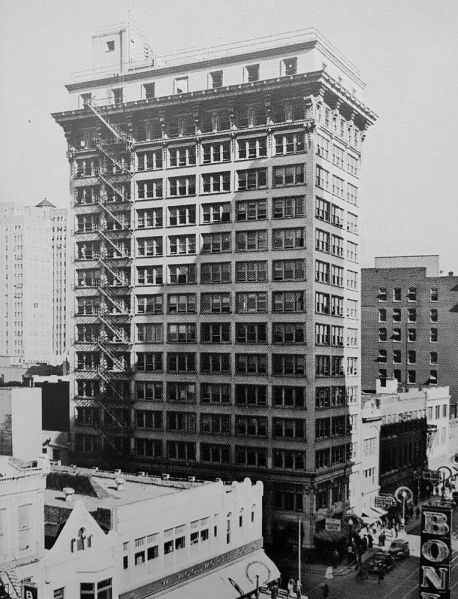
Here’s what our old pal, The Praetorian, and NKOTB, Woolworth’s, looked like around 1930.
praetorian_ca-1930_dallas-rediscovered-cushman-and-wakefield-inc

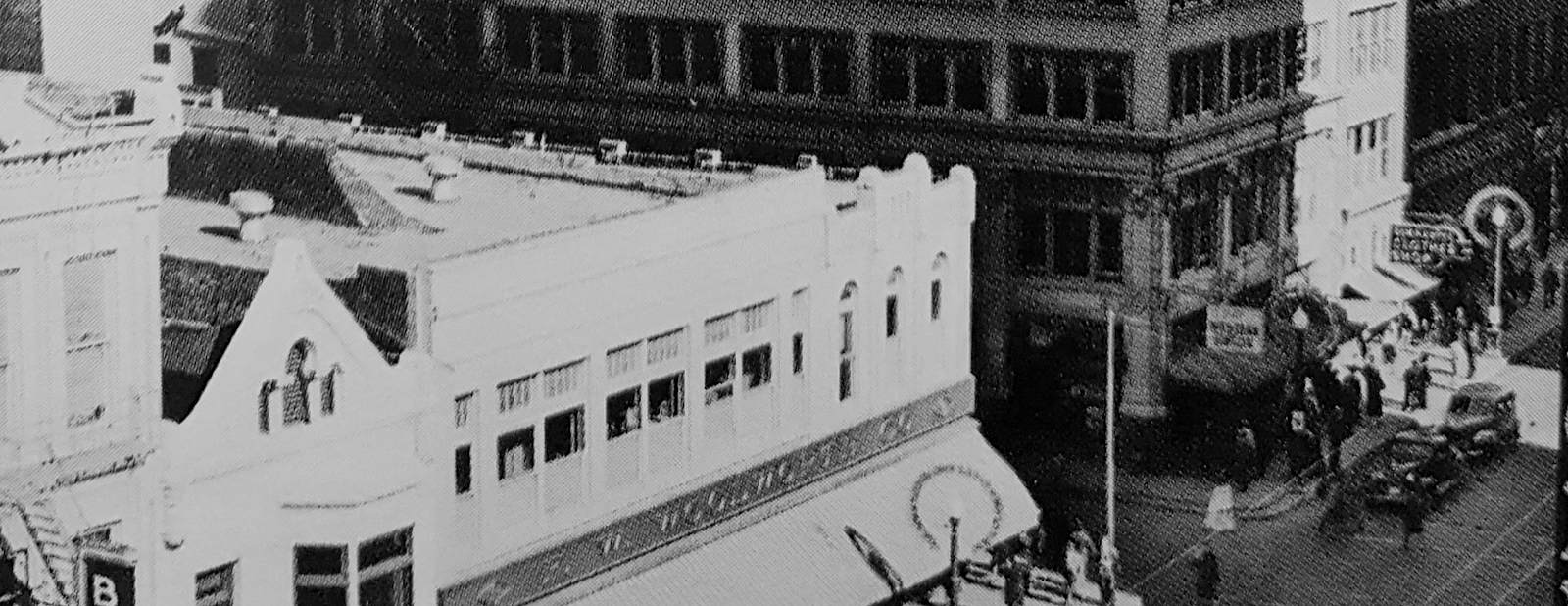
Here’s Woolworth’s closer up — you can see how the two buildings (the old Empire and the old Imperial Bar) have been joined together a little oddly.
praetorian_ca-1930_dallas-rediscovered_cushman-and-wakefield-inc

Here’s a street-level view from the 1940s.

praetorian_william-langley_DPL_ca-1940
via Dallas Public Library

Fast-forward to 1953: the Shaw Jewelry Company moved into the old Empire Theater space at 1521 Main.

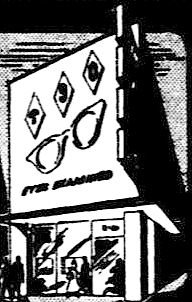
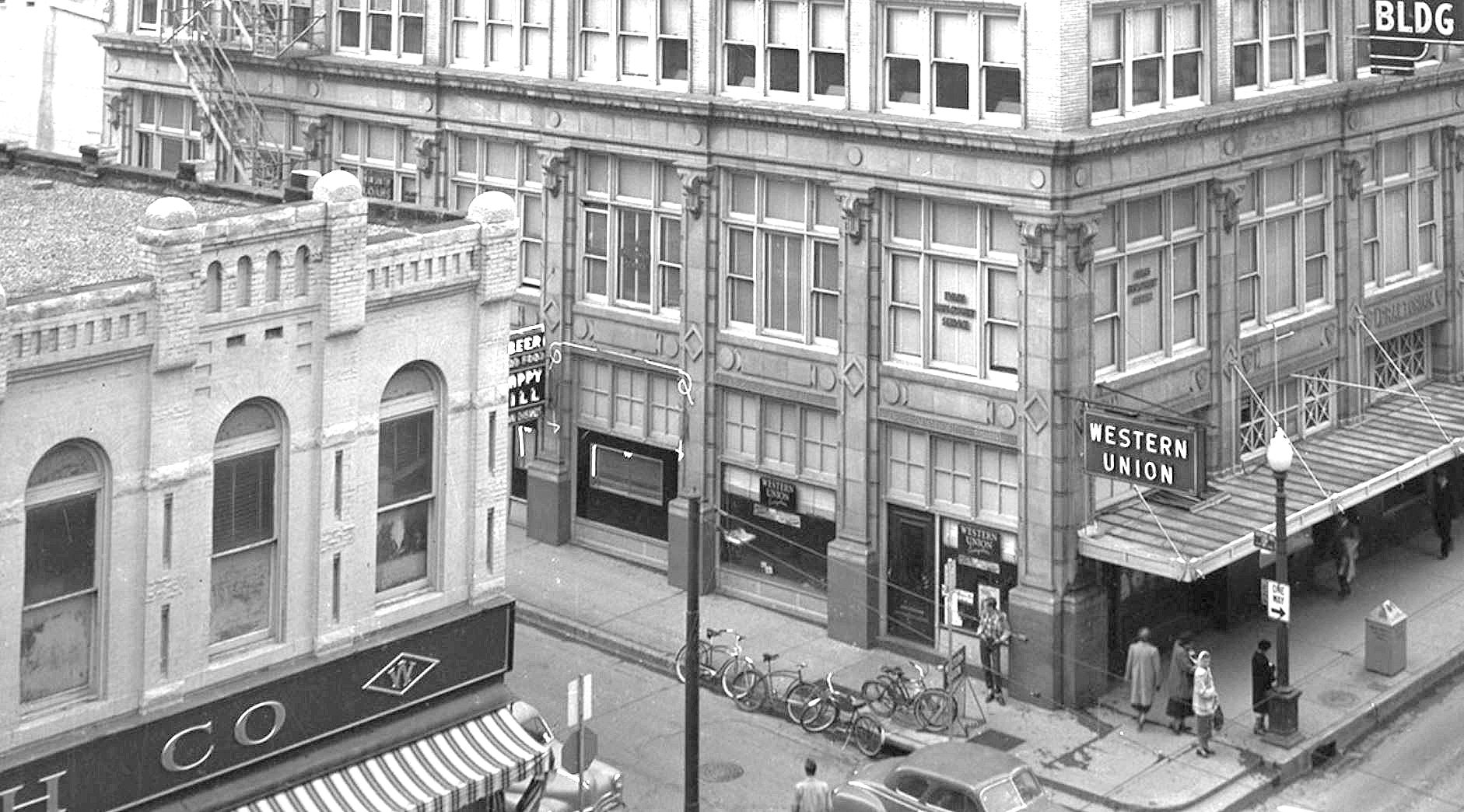
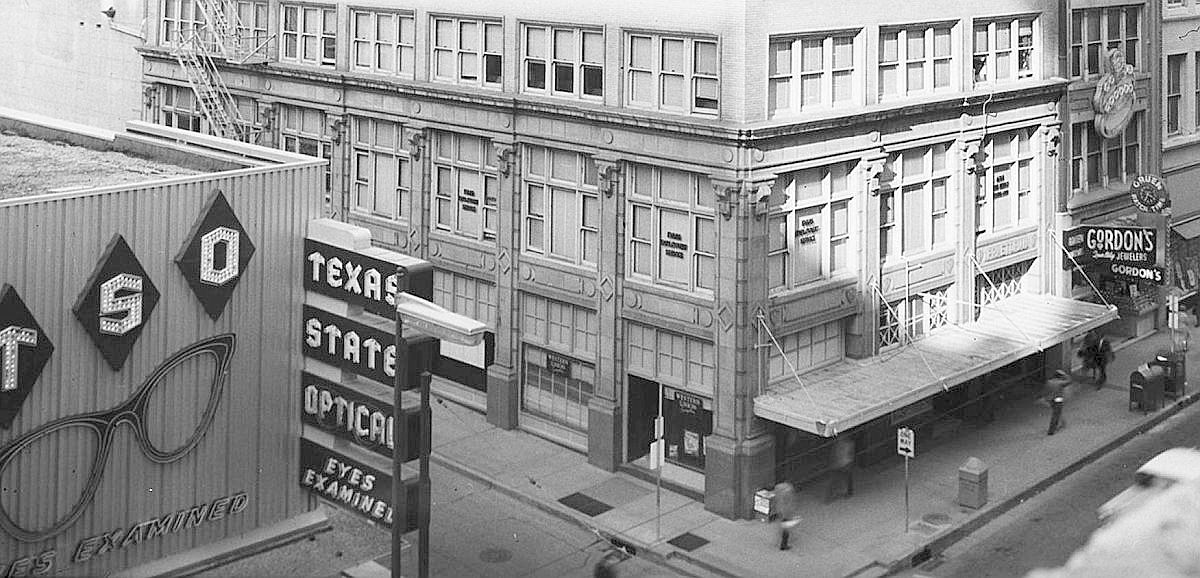
Meanwhile, next door, the old Imperial Bar space had become Texas State Optical. Sadly, someone thought it would be a good idea to wrap the original brick building (which has been estimated as having been built around 1895) in, I don’t know … aluminum siding? Here are before-and-after photos of that corner (Imperial Bar) building. It looked pretty good before TSO took over. (The detail below is from a Squire Haskins photo, via UTA — full photo is here — click thumbnail on UTA page to see a larger image). (I love the delivery boys’ bicycles parked at the curb outside the Western Union office.)
main-and-stone_praetorian_haskins_UTA_det

And here’s the same corner after “improvements” (this is another detail from another of Squire Haskins’ fab photos from the UTA collection — see the full photo here — click on thumbnail), circa 1950s.
tso_praetorian_squire-haskins_UTA_1950s

Oh dear. There should be a law….

tso_1525-main_dmn_102055_texas-state-optical
1955 (ad detail)

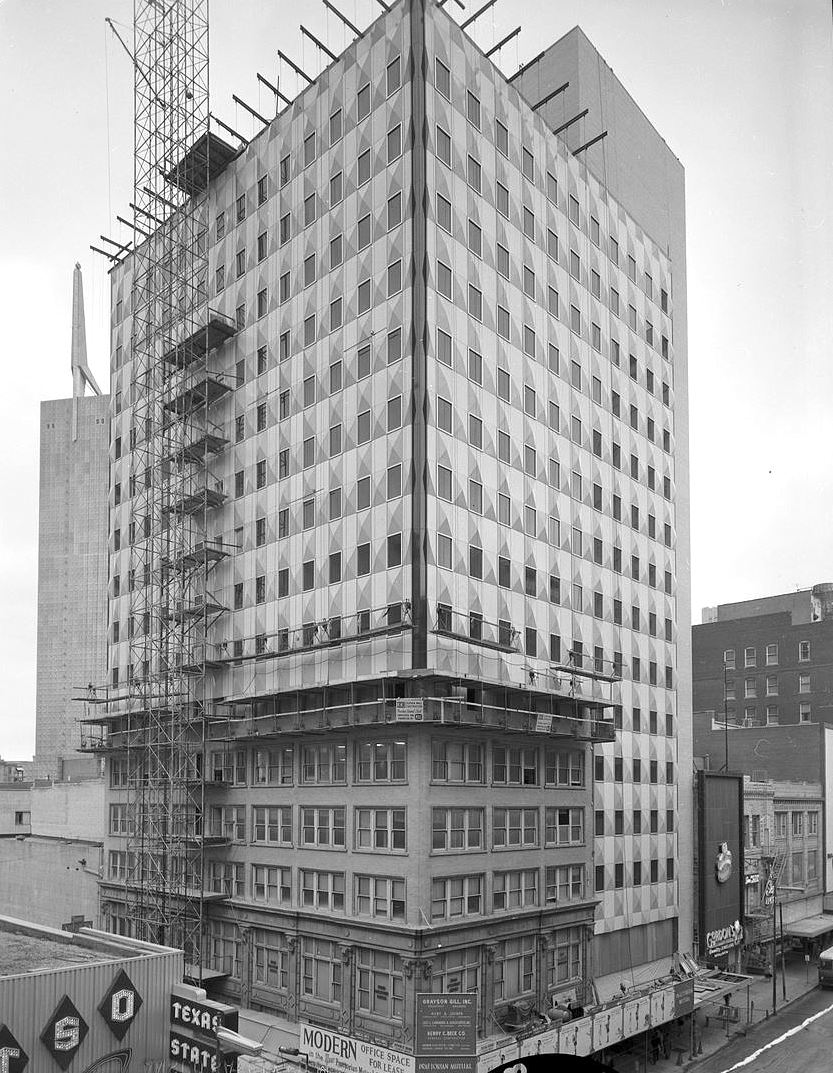
Speaking of “oh dear,” a few short years after this, the Praetorian Building expanded and was … argh … “re-clad.” Here’s a shot of it, mid-cladding, about 1961 (Squire Haskins photo info from UTA here).
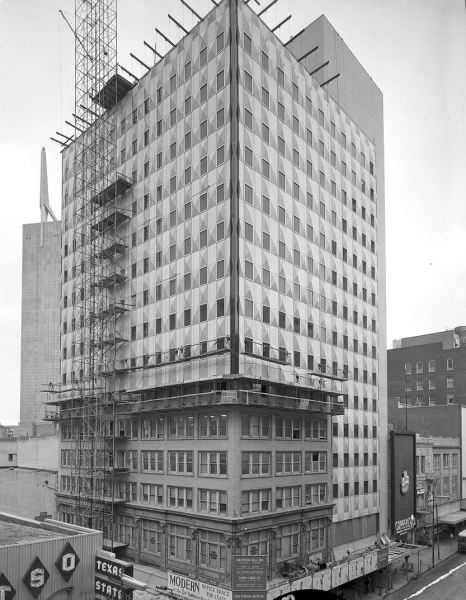
praetorian_recladding_ca-1961

I believe it was … yellow.

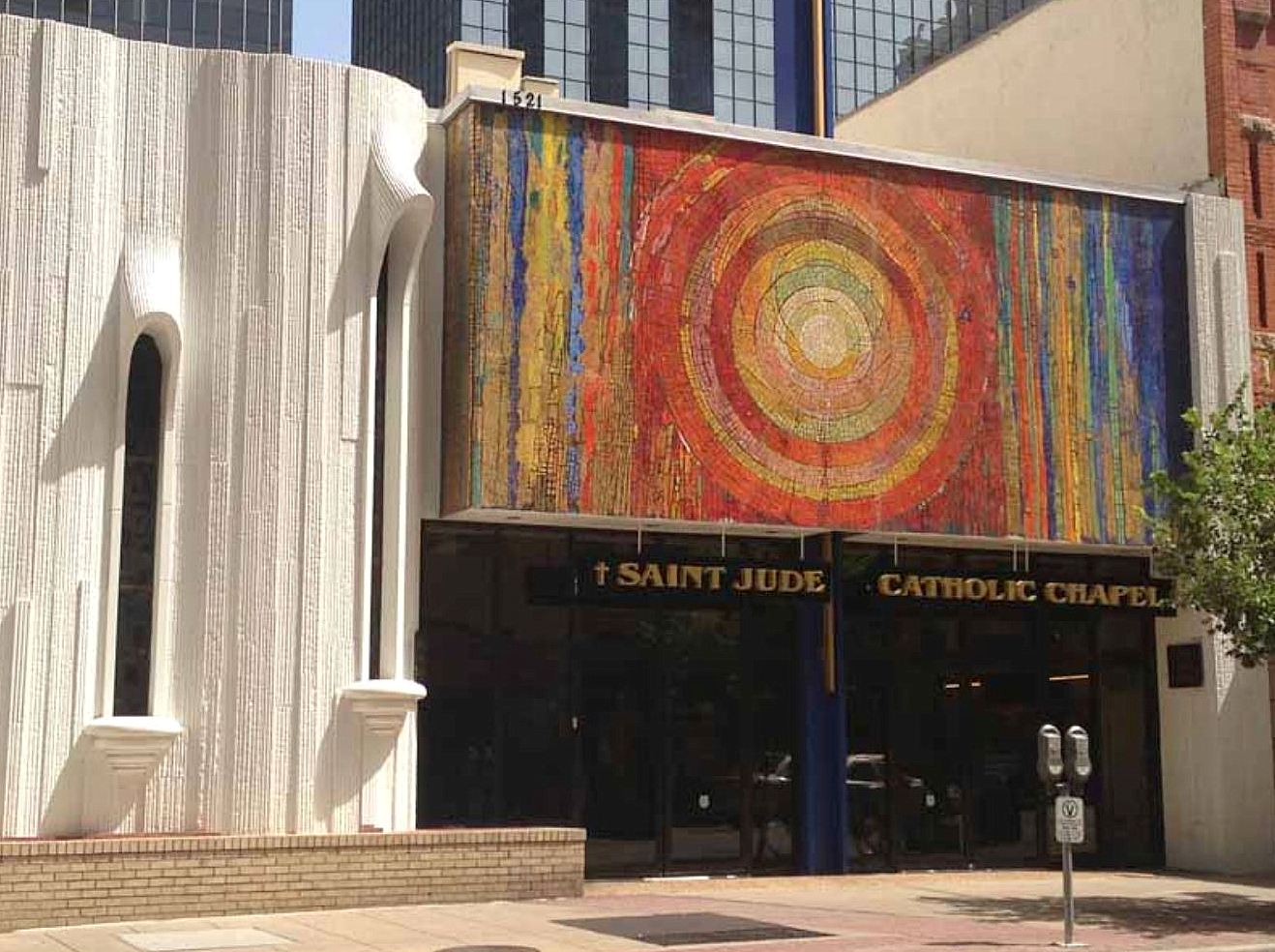
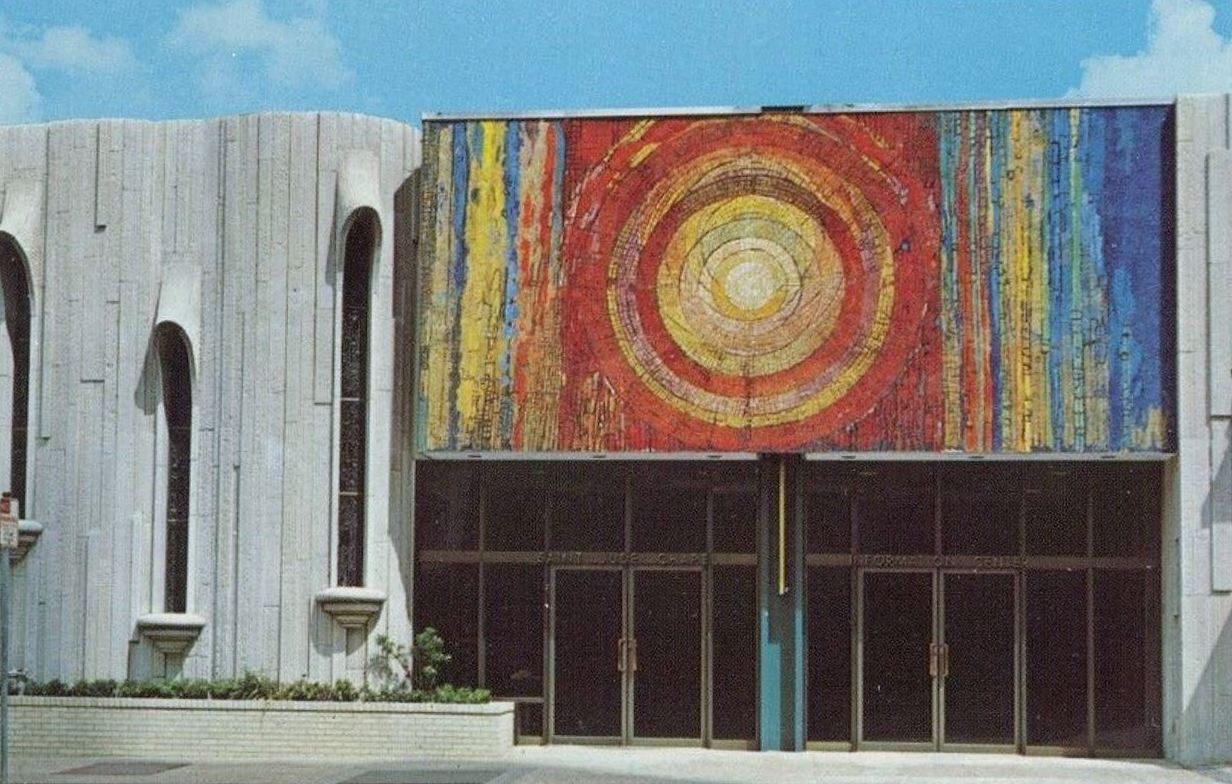
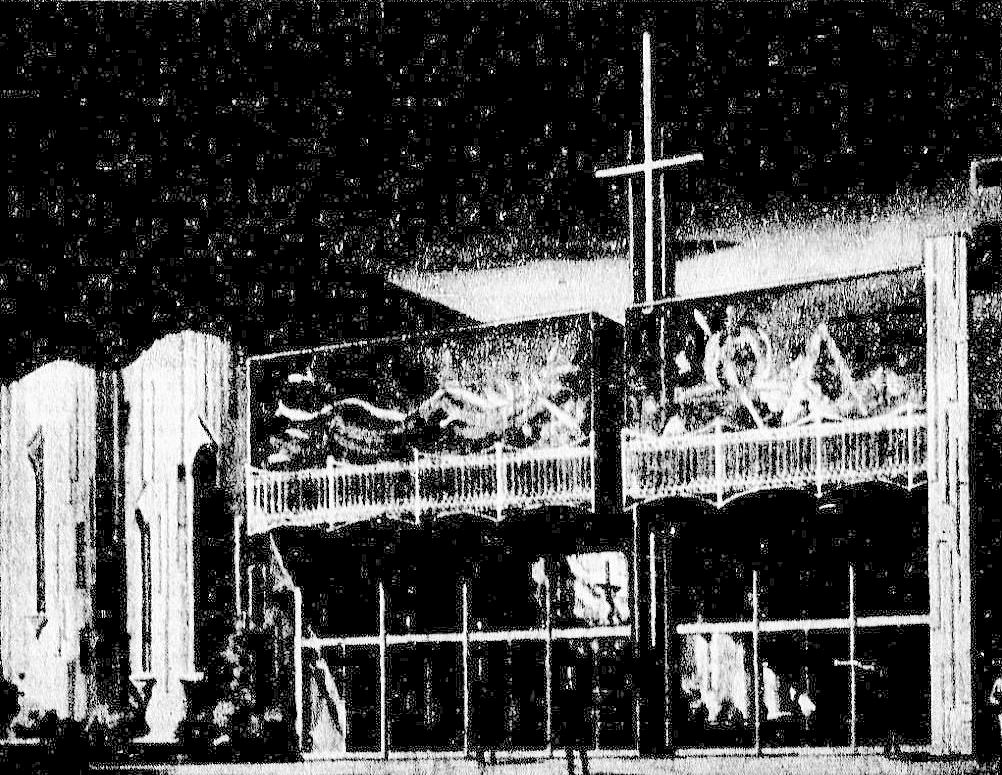
In 1968, the Saint Jude Catholic Chapel moved into 1521 Main — the old Empire Theater space. The front was adorned with a vivid mosaic by Gyorgy Kepes (I wrote about the mosaic here).

gyorgy-kepes_mosaic_st-jude-chapel_website_videovia St. Jude Chapel website

The chapel is still there.

TSO — and later Pearle Vision — lasted at 1525 Main for years. In 2001, renovation and restoration efforts to develop Stone Place began. 1525 Main was restored as closely as possible to its original design and became home to a succession of restaurants (it has been occupied by Sol Irlandes for several years). ArchiTexas did a GREAT job with the building’s restoration!! (Read a 2001 Dallas Morning News article about this project — and about the historic 1525 building: “Historic Downtown Buildings To Be Restored — Shops, Restaurants Will Breathe New Life Into Stone Place,” DMN, Feb. 21, 2001.)
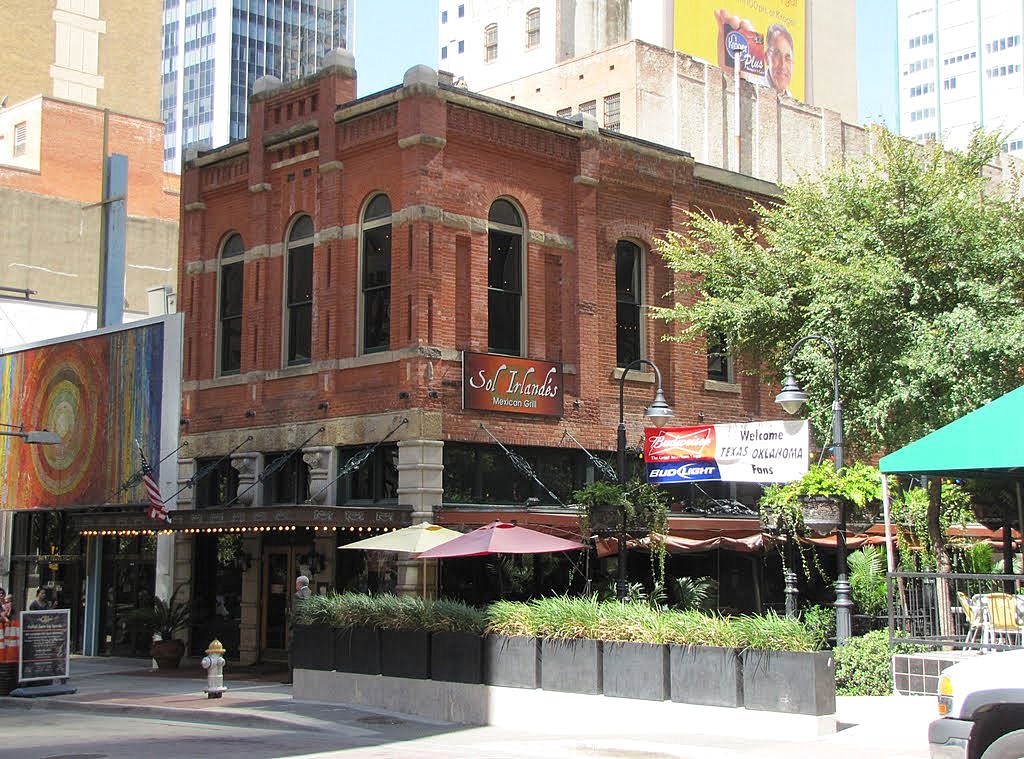
sol-irlandes_panoramio

So. Back to the top photo. There’s good news and bad news. Empire Theater building: still there. Imperial Bar building: still there. But the Praetorian Building — the most historically important of the three? The fabulous “skyscraper” was demolished in 2013 and replaced by a giant eyeball. Here’s a 2012 Dallas Morning News photo of it in mid death spiral, being slowly dismantled.

praetorian-pre-demo_dmn-photo_2012

See what this view looks like in the most recently updated Google Street View, here.

**

Interested in seeing the development of this block, as chronicled in Sanborn maps? Of particular interest is the northwest corner of Main and Stone — before 1911 the addresses of these two building were 353-355 Main and 357 Main; after 1911 the addresses changed to 1521-23 Main and 1525 Main. It appears that both buildings were built between 1892 and 1899.

  • 1885 — not a lot in this block yet — but there is a well
  • 1888 — a building has appeared one lot off Stone
  • 1892 — that building from 1888 is now nothing but “ruins” — likely the result of a fire
  • 1899 — the buildings we’ve been looking at in this post have appeared
  • 1905 — C. B. Harris’ Empire would occupy 353 Main by 1907 — possibly by 1906 (in 1905, Harris was working three doors down, at 347 Main, as an agent for the Edison Phonograph Co.)
  • 1921 — This map indicates that the 1521-23 building is two stories. Pictures going back to 1909 (see a couple above) seem to show three stories, but pictures of the building as part of Woolworth’s appear to show two floors (for comparison, the building on the corner at 1525 was two stories). So … what looks like a third floor on 1521-23 Main might be … architectural trompe l’oeil? Either that, or there was demolition and construction and demolition of the two-story building currently occupied by the St. Jude Chapel. This is confusing. Whatever the case, the renovation/restoration of these two buildings in 2001 shows them to look pretty much as they did in the top 1907 photo — once again, that original roofline is present. Below, the 1907 photo is on the left, a 2012 photo is on the right.
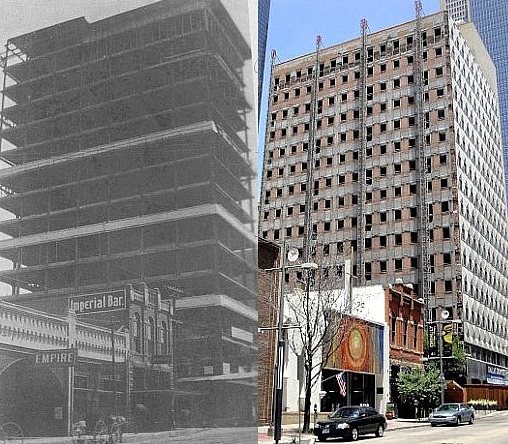
praetorian_main-stone_1906-1912

And here the buildings are today, minus the dearly departed Praetorian (RIP).
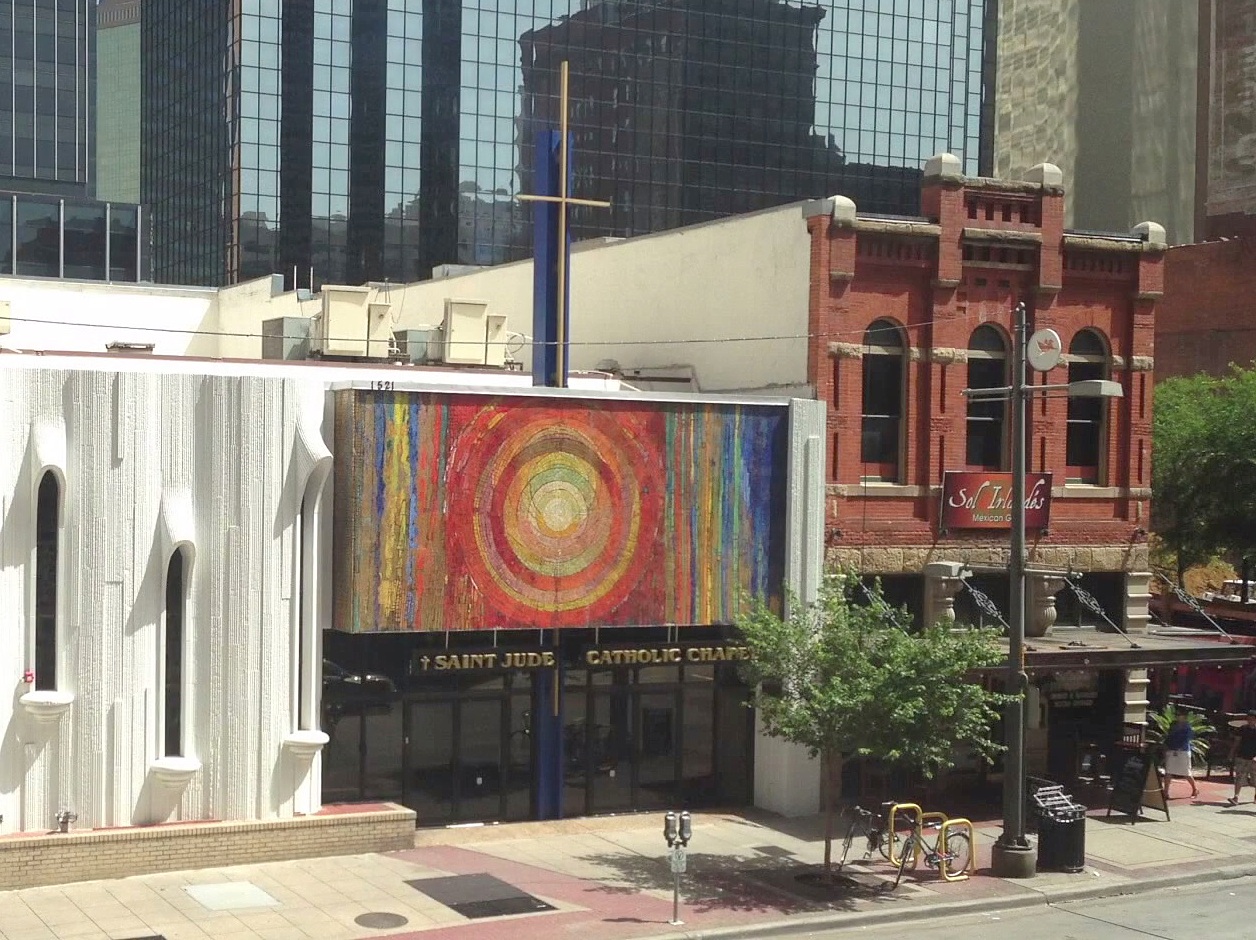
st-jude-chapel_website_present-day

Pretty cool.

***

Sources & Notes

Top photo from the George W. Cook Dallas/Texas Image Collection, DeGolyer Library, Central University Libraries, Southern Methodist University; more info is here. (I have edited the image slightly — and rather poorly — please see link for original image.)

The photo and detail showing Woolworth’s, circa 1930, is from William L. McDonald’s book Dallas Rediscovered; photo credit cites Cushman & Wakefield, Inc.

Sources of all other images noted, if known.

For an entertaining history of the construction of the Praetorian Building (which had MANY detractors and doubters), read check the archives of The Dallas Morning News for the article by Kenneth Foree, “First Skyscraper Had Its Skeptics” (Oct. 27, 1948).

More on the Praetorian Building on Wikipedia, here.

*

Copyright © 2017 Paula Bosse. All Rights Reserved.

The Saint Jude Chapel Mosaic by Gyorgy Kepes — 1968

gyorgy-kepes_mosaic_st-jude-chapel_websiteMain Street mosaic…

by Paula Bosse

Perhaps you’ve noticed the intensely colorful sunburst-like mosaic that adorns the Saint Jude Catholic Chapel at 1521 Main Street, near Stone Place. It’s hard to miss. The artist is Gyorgy Kepes (1906-2001), an important Hungarian-born avant-garde painter, photographer, and educator who immigrated to the United States in 1937. He taught for a short time at North Texas State University (now the University of North Texas) in the mid 1940s, and may be known best in Dallas for his work as artistic director for Temple Emanu-El in the late 1950s, a project which artfully brought together contemporary art, architecture, and design into a sacred space.
At the time Kepes was commissioned to create the mosaic for the new Saint Jude Chapel (which opened in 1968), he was immersed in founding the Center for Advanced Visual Studies at the Massachusetts Institute of Technology (MIT). One wonders how he found the time!

This mosaic — which as far as I know is untitled — is probably a familiar sight to people who work and live downtown, but most who pass it are completely unaware of the name of the artist. I hope I’ve helped correct that a bit. Thank you, Gyorgy Kepes — and thank you, Saint Jude Chapel — for this nice little addition to Dallas’ public art.

gyorgy-kepes_mosaic_st-jude-chapel_website_video_closeup

gyorgy-kepes_mosaic_st-jude-chapel_website_video

gyorgy-kepes_mosaic_st-jude-chapel_website_video_bw

st-jude-chapel_kepes_postcard_ebay

st-jude-chapel_kepes_postcard_ebay-captionPostcard and info, eBay

Below, an early rendering of the proposed building (1966), designed by architect Eugene F. Boerder. The vague mosaic design in this drawing suggests that Kepes might not have been attached to the project at this point, or that his design had not yet been determined.

st-jude_architects-rendering_1966_eugene-f-boerderArchitect’s rendering, Sept. 1966

***

Sources & Notes

Unless otherwise noted, photos from the Saint Jude Catholic Chapel website, here. The undated black-and-white photos are from a video history of the chapel, here.

Read about Gyorgy Kepes in overviews of his life and career from MIT, from the James Hyman Gallery, and from Wikipedia.

I have been unable to find any information about this mosaic. Had I not stumbled across Kepes’ name in a Sept. 14, 1968 Dallas Morning News article about the new chapel (which I was reading while researching the very interesting history of the building the St. Jude Chapel is in — and the building next to it) (that post is here), I’m not sure I’d be able to track down the identity of the artist. It’s surprising how little is out there about such a prominently displayed work of art!

UPDATE: Rather bizarrely, a few weeks after I wrote this, I learned that this mosaic was being restored — so I went downtown, met the restoration team, took some photos, and wrote the post “Mosaic Restoration at Downtown’s St. Jude Chapel.”

*

Copyright © 2017 Paula Bosse. All Rights Reserved.