For the past several years, I’ve been posting bookstore-related posts on the birthday of my late father, Dick Bosse, an antiquarian bookseller who began his career straight out of SMU at The Aldredge Book Store, a literary landmark to many, which he eventually ended up owning. This year’s offering goes back to 19th-century Dallas.
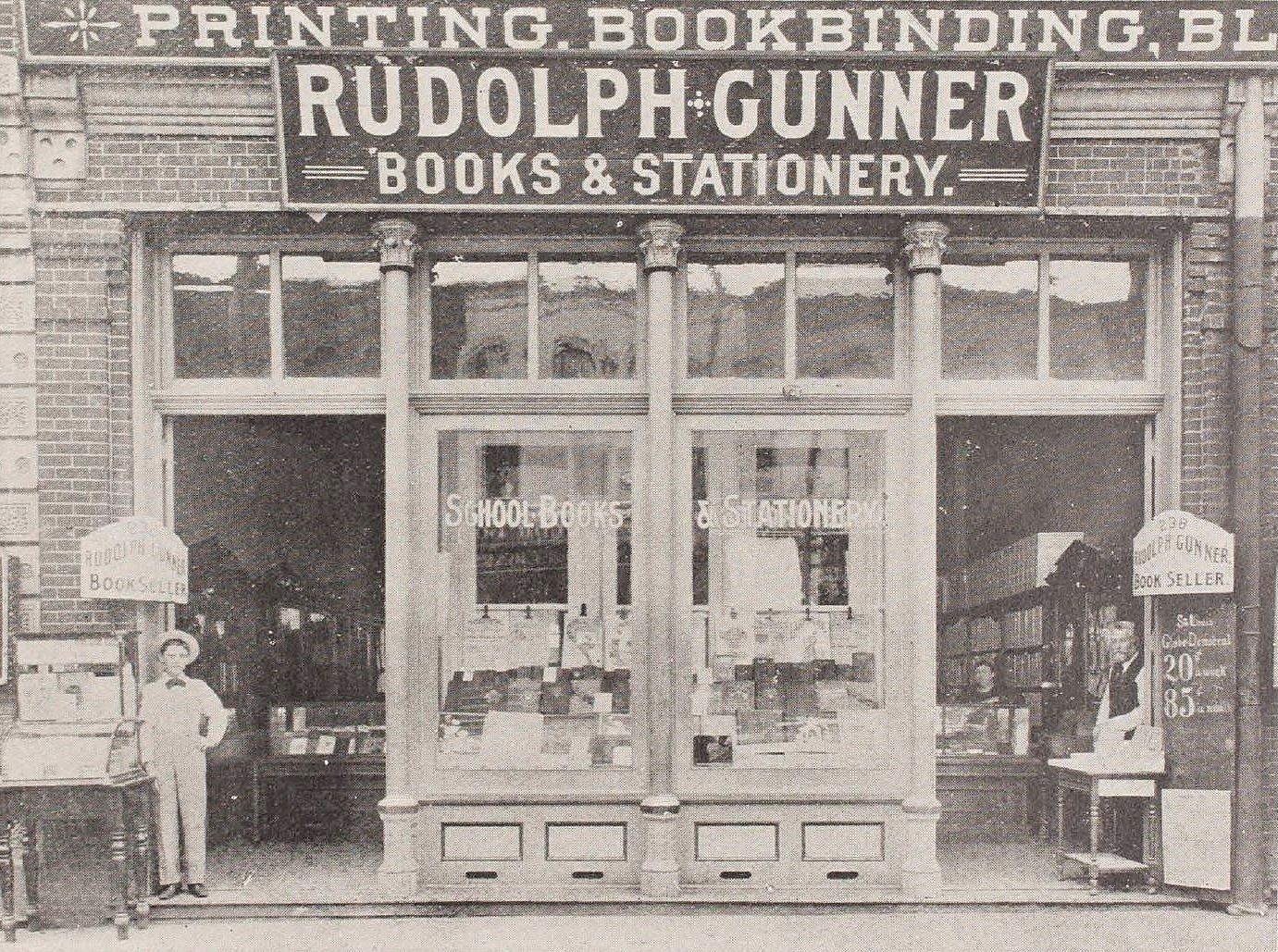
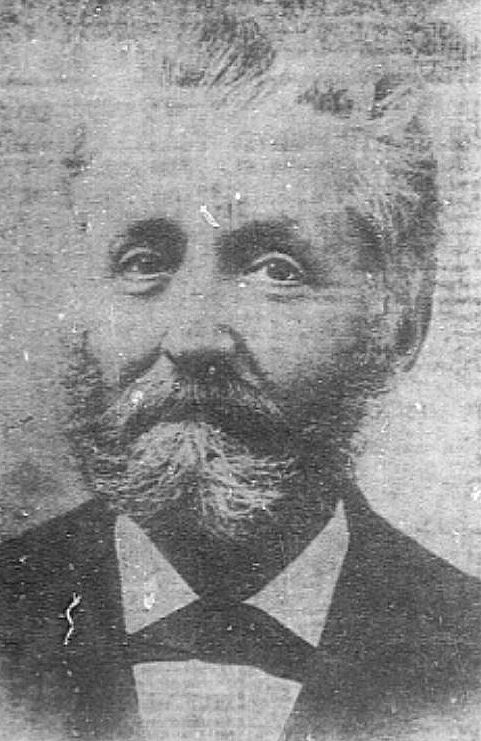
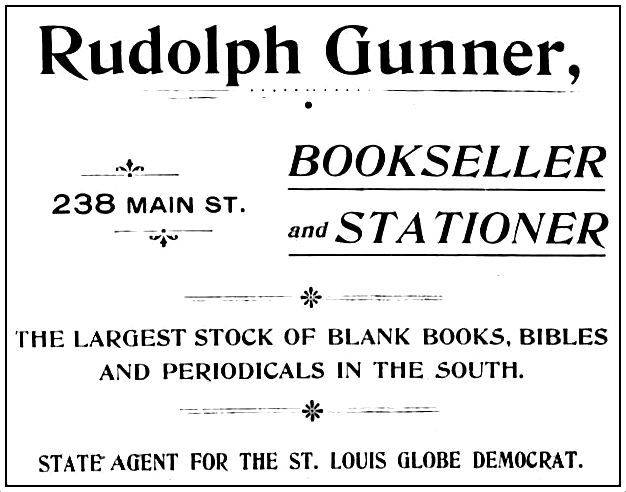
Above is a photo of the bookstore owned by Austrian immigrant Rudolph Gunner, located at 238 Main (later 1006 Main), between Poydras and Martin. Gunner (1833-1911) had, perhaps, one of the most impressive and colorful historical pedigrees of any Dallas resident. He served in the Austrian navy all over the world, but his most important service was as confidante and aide-de-camp to Emperor Maximilian and Empress Carlota of Mexico in the 1860s. That story is too big to tell here (Wikipedia is here to help), but it’s interesting that a man who was often referred to as “Maximilian’s best friend” eventually wound up in Dallas in 1885 and opened a bookstore, first on Elm Street, later on Main.
My father had a fascination with Mexico and used to talk about Maximilian quite a bit. I wonder if he knew Maximilian’s right-hand man lived out his days in Dallas, having spent several years as a bookseller?
Dallas city directory, 1896
*
In a sidenote, Gunner mentioned in several interviews that he had a LOT of historical documents and souvenirs from his military career serving in the Crimea, Egypt, Africa, and, especially, Mexico. I winced when I read this passage from an article by A. C. Greene in The Dallas Morning News (“Bookstore Owner Once Was Colorful General — He Headed Maximilian’s Mexico Palace Guard.” DMN, Apr. 18, 1993):
[A]t the time of his death in 1911 [his] home was at 1506 Fitzhugh. [His wife] was still living there, with a considerable collection of historic memorabilia, books, medals and military items, when the home burned, destroying everything but Gen. Gunner’s sword with the emperor’s crest.
Wow. All of that, gone. (And to answer my question above, I’m pretty sure my father would have known this, if only because he read A. C. Greene’s columns and probably even discussed this with him on a visit to the store.)
***
Sources & Notes
Top photo by Clifton Church, from his book Dallas, Texas, through a camera: a collection of half-tone engravings from original photographs (1894) — from the DeGolyer Library, SMU, here.
Read a first-hand account of Gunner’s time in Mexico in a Dallas Morning News article from Jan. 14, 1886 here; his DMN obituary (Aug. 25, 1911) is here.
Read previous Flashback Dallas articles on Dallas bookstores here.
I would love you to join me over on Patreon, where I upload Dallas history posts daily for subscribing members (as little as $5 a month!). If you would like to support what I do, check out Flashback Dallas on Patreon.
Imagine the “village” of Dallas in its very, very early days. 1852. That’s when pioneer Col. John C. McCoy (1819-1897) built the very pretty frame house seen in the photograph above. It had the honor of being the first frame house built in Dallas (and, in other firsts, McCoy had the distinction of being the first practicing lawyer in Dallas).
Commerce and Lamar streets, 1879. Col. John C. McCoy, one of Dallas’ first “leading citizens,” built this house at the corner of Commerce and Lamar in 1852, and it immediately became a landmark in the village — the one frame house in a colony of log cabins. The photograph, made in 1879, shows Mr. and Mrs. W. H. Taggart, Col. John C. McCoy and Miss Eliza McCoy on the porch. Standing at the gate are Capt. John M. McCoy (nephew of Col. McCoy and brother of Mrs. Taggart) and Cora and Laura Taggart, his nieces. (Southwest Business magazine, June 1940)
See what this view looks like now, here. Sadly, the Colonel’s white fence and grove of trees are gone.
When I was looking at this photo, I thought I should check to see what it looked like on the hand-drawn map of Herman Brosius from 1872. His maps were celebrated for their incredible attention to detail. I wrote about this map in a previous post (here), and… yes! The house seen in the photo has been realistically captured in Brosius’ map. As seen below — in the center of a detail from the map — it’s right there, at the southeast corner of Commerce and Lamar (facing Lamar), just south of the Methodist church. McCoy owned the entire block, and he did not skimp on the trees.
Read about the life of Col. John C. McCoy in Sixty Years in Texas by George Jackson at the Portal to Texas History, here, and in the Handbook of Texas entry on the Texas State Historical Society site, here. He is almost as important to the history of Dallas as his business partner, John Neely Bryan.
Col. John C. McCoy
***
Sources & Notes
Photo from the Dallas Historical Society — it and the caption appeared in Southwest Business magazine, June 1940.
Detail of “A Bird’s Eye View of the City of Dallas, Texas” (1872) by H. Brosius is from the Dallas Historical Society and can be seen in a very, very high-resolution scan on Wikimedia Commons here (click map to really zoom in on the very precise details). I wrote about this map in the 2018 post “The Bird’s-Eye View of Dallas by Herman Brosius — 1872.”
Portrait of Col. John C. McCoy from Find-a-Grave. (McCoy and his family are buried in Oakland Cemetery. More on the family can be found in a video recorded at the grave site and posted on the Facebook group Friends of Oakland Cemetery Dallas, here.)
I’ve seen SO MANY postcards of Dallas through the years that when I come across one that is completely new to me, it’s pretty exciting. Especially turn-of-the-century-ish cards, like the one above. This is the first I’ve ever heard of the Rodessia Hotel, which opened in Oct. 1904 at 361-363 Elm (the address later became 1601½ Elm). The hotel proprietor (as well as the proprietor of the street-level saloon underneath it) was German immigrant Joseph F. Rode (1858-1911).
Dallas Morning News, Oct. 2, 1904
And, because it’s so unusual to be able to note something like this, I must mention that Rode’s wife, Victoria Virginia “Nannie” Rode, was also a business owner.
DMN, Oct. 7, 1894
Even though I hadn’t heard of the hotel, I did know about the building. In fact, I wrote a whole post about it: “S. Mayer’s Summer Garden, Est. 1881.” It would have been a building everyone knew at the turn of the century. Here’s what it looked like when it was a young whippersnapper:
It was built in 1881 by Simon Mayer and was the site for many years of his very popular beer garden. Around 1902 it became the Clifton Hotel, and in Oct. 1904, J. F. Rode opened his interestingly named Rodessia Hotel, which remained in business until about 1920 (it was run after his death by the Widow Nannie and her second husband). Around 1920, another hotel — the La France — opened. See the building at various times in the post mentioned above, here.
So. The Rodessia was in business for at least 15 years. I still can’t believe I haven’t seen it pop up in at least one Elm Street postcard or photograph until now. Better late than never!
(Note: In the postcard at the top, just to the right of the hotel, is the David Hardie Seed Co., which I believe continues today as Nicholson-Hardie stores.)
***
Sources & Notes
Postcard from eBay.
Photo of Mayer’s Garden from the Dallas Public Library: “[Mayer’s Beer Garden, Dallas, Texas”], Call Number PA87-1/19-27-1.
This post originally appeared in a shorter version on the Flashback Dallas Patreon page, which I enthusiastically invite you to subscribe to!
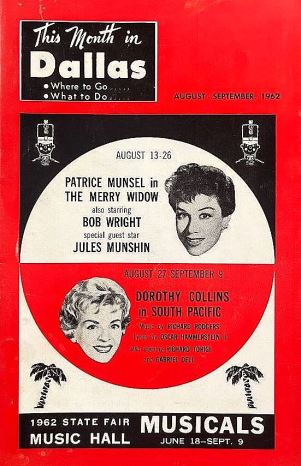
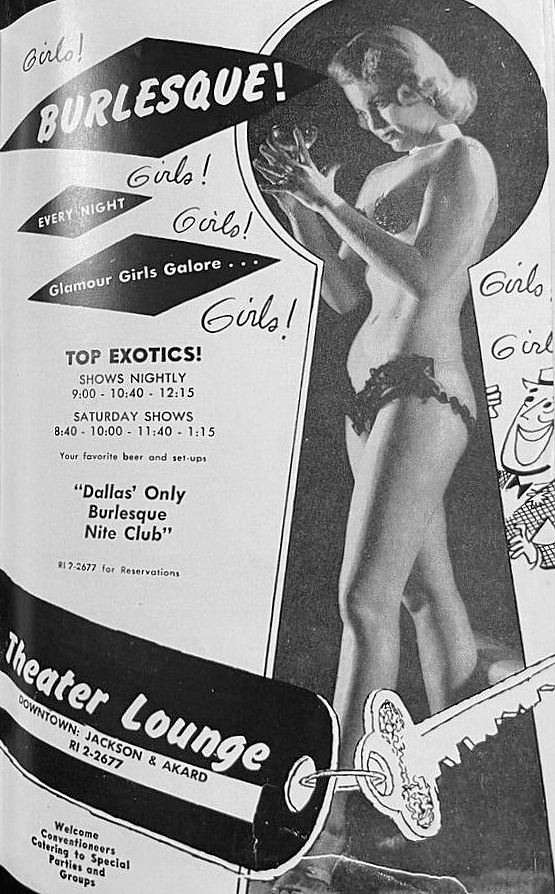
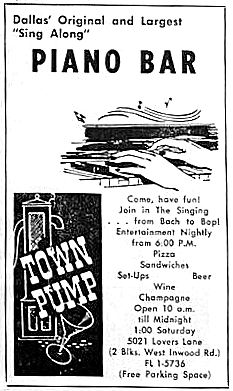
Downtown Dallas was a cool place for entertainment and dining in the early 1960s, from high-class clubs and lounges to famous and infamous strip joints (some of which were higher-class than others). A few months ago on eBay, someone scanned a bunch of pages of a magazine called This Month in Dallas (“Where to Go, What to Do”), which seems to have been aimed at the conventioneer or out-of-town visitor. (I’ve never heard of this publication, but I would LOVE to see more!)
As far as image quality, I’m at the mercy of the person doing the scanning, but here are several of the ads featured in the eBay listing. All appeared in the Aug./Sept. 1962 issue of This Month in Dallas. (At the top, a detail from an ad for Club Dallas — the full ad is below.)
*
Let’s just do them alphabetically.
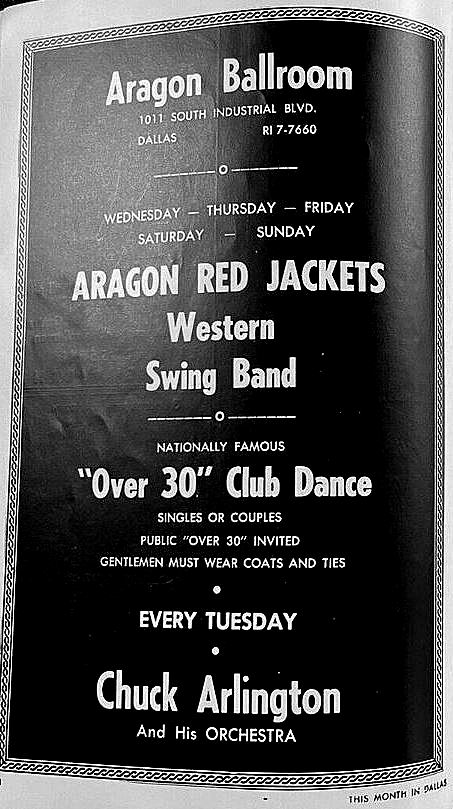
ARAGON BALLROOM, 1011 S. Industrial Blvd. (now S. Riverfront). Featuring the Aragon Red Jackets Western Swing Band, the “Over 30” Club Dance, and Chuck Arlington and His Orchestra.
*
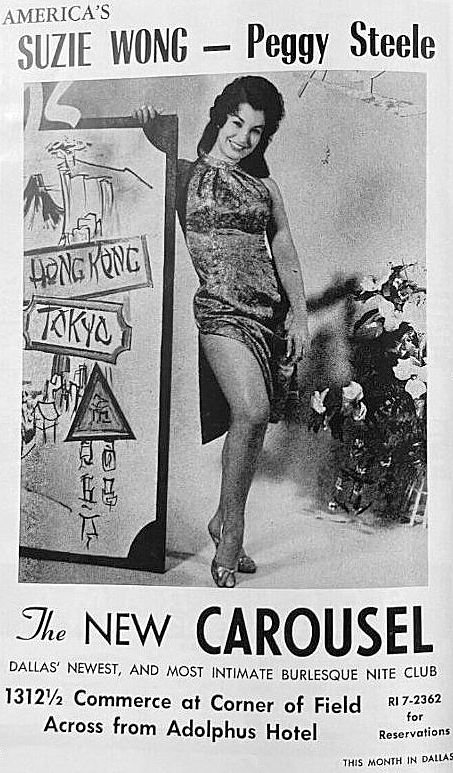
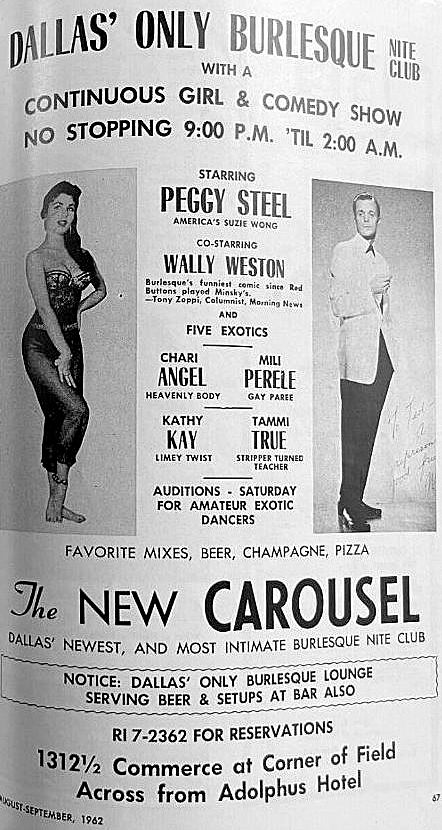
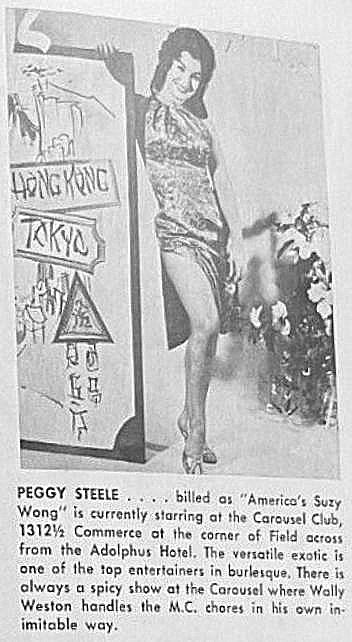
CAROUSEL CLUB (or “New” Carousel Club), 1312½ Commerce, at Field. Jack Ruby, proprietor. “Dallas’ Newest and Most Intimate Burlesque Nite Club.” This ad (the first of several) features stripper Peggy Steele, “America’s Suzie Wong.”
More CAROUSEL. “Dallas’ only burlesque nite club with a continuous girl and comedy show. No stopping, 9:00 PM ’til 2:00 AM.” “America’s Suzie Wong” is back, now spelled Peggy Steel. MC’d by comic Wally Weston.
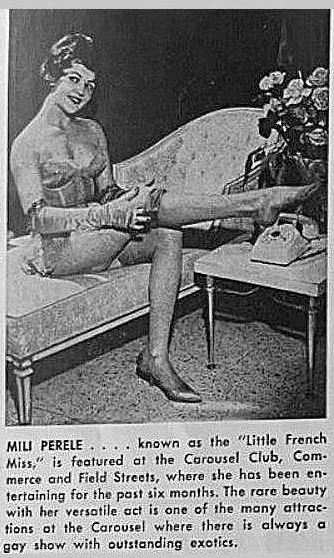
More CAROUSEL. Here’s Mili Perele, “the Little French Miss.”
More CAROUSEL. Heck, let’s throw in another Peggy Steel/e mention.
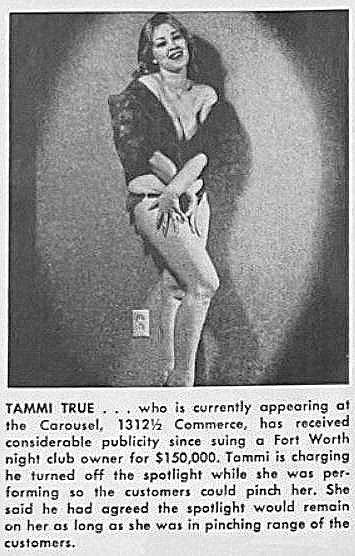
More CAROUSEL (Jack’s advertising budget was impressive). Tammi True, then in the midst of a pinching brouhaha.
*
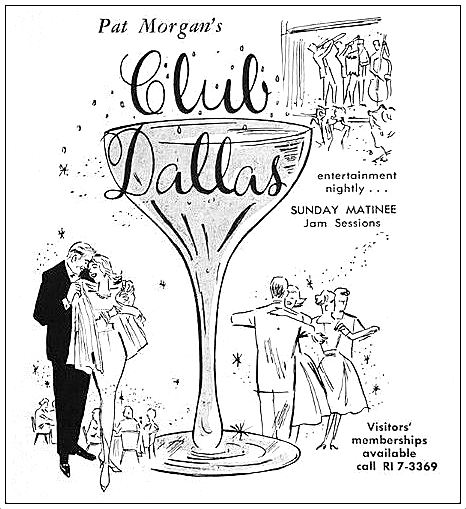
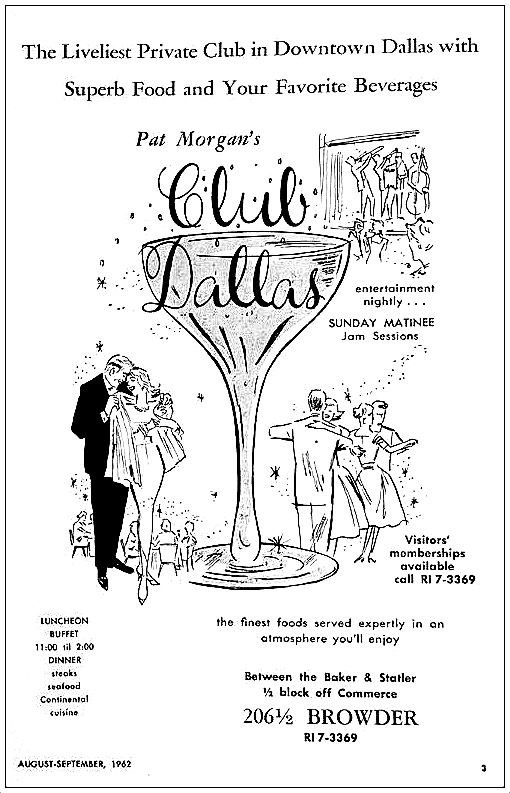
Pat Morgan’s CLUB DALLAS, 206½ Browder (just south of Commerce). I love this ad, but I’m not familiar with the establishment or Mr. Morgan. Looks like it opened in the summer of 1962 (“Owner Pat Morgan has eliminated the semi-nude waitresses and aims for the family trade” — Dallas Morning News, July 27, 1962), changed its name in September 1962 to simply “Pat Morgan’s,” and finally closed in February 1963. I bet he rued the day he dumped those semi-nude waitresses….
*
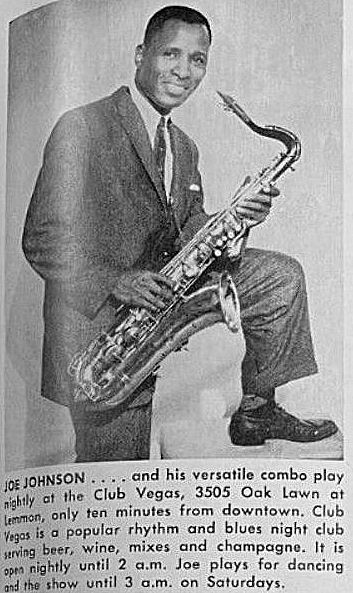
CLUB VEGAS, 3505 Oak Lawn. Yes, there was swinging nightlife beyond downtown. Club Vegas was famously owned by Jack Ruby’s sister, Eva Rubenstein. This club booked a lot of Black and Hispanic bands (for mixed audiences), including Joe Johnson and Trini Lopez. (I’ve been meaning to write about this place for the past 10 years!)
*
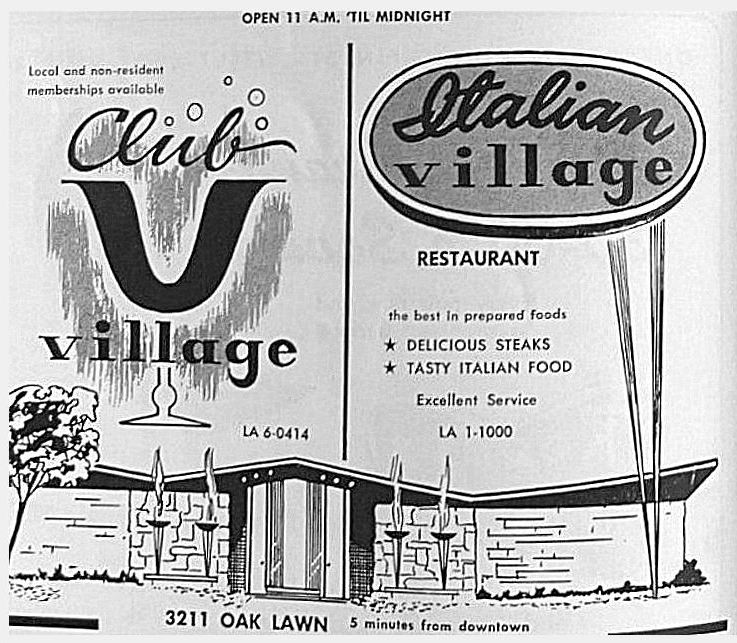
CLUB VILLAGE / ITALIAN VILLAGE RESTAURANT, 3211 Oak Lawn. Another happening place in Oak Lawn. I wrote and wrote and wrote about Sam Ventura’s Italian Village here.
*
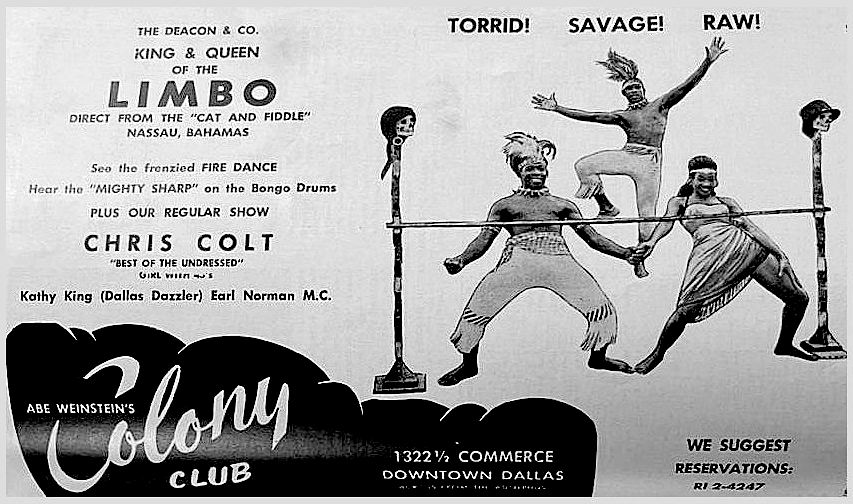
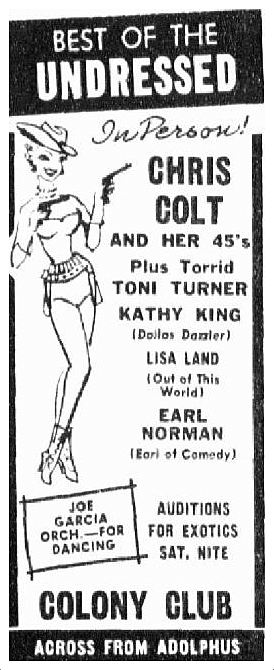
COLONY CLUB, 1322½ Commerce. Abe Weinstein, proprietor. The “high-class” strip joint. Also featured acts like Deacon & Co., King and Queen of the Limbo.
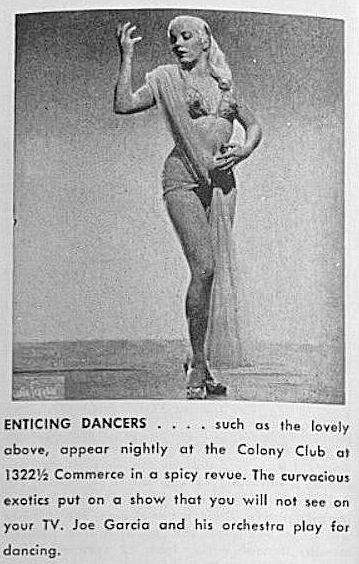
More COLONY CLUB. An unnamed exotic.
*
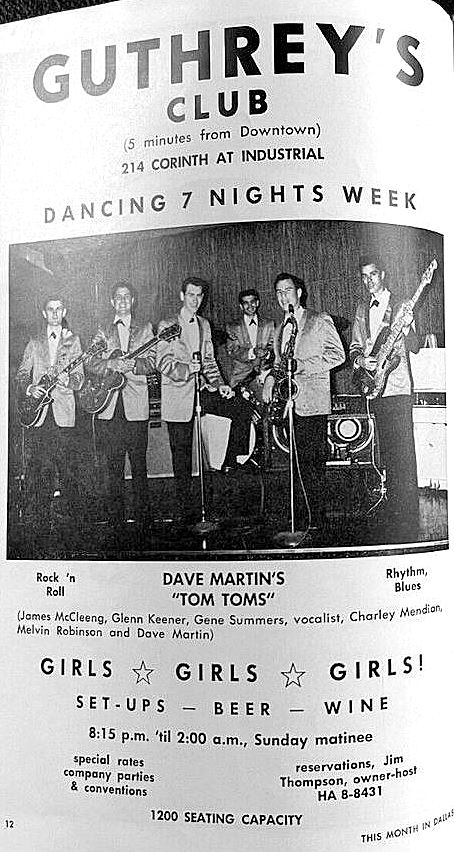
GUTHREY’S CLUB, 214 Corinth, at Industrial (now Riverfront). Very popular back in the day. “Girls! Girls! Girls! Set-ups, beer, wine.” This ad features Dave Martin’s Tom Toms (James McCleeng, Glenn Keener, Gene Summers — vocalist, Charlie Mendian, Melvin Robinson, and Dave Martin).
*
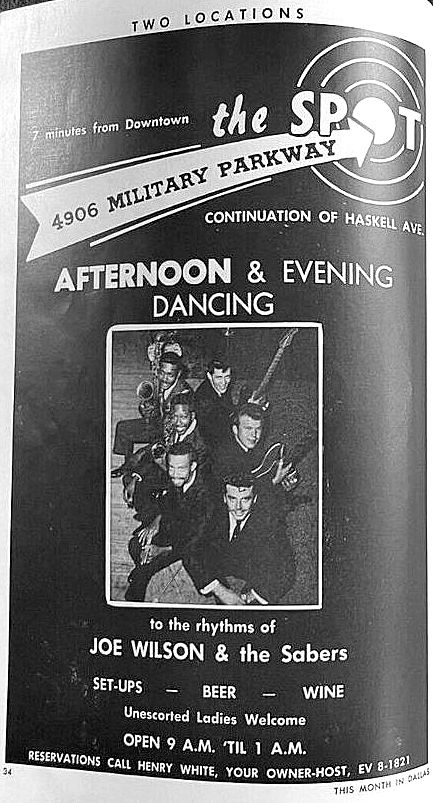
THE SPOT, 4906 Military Parkway. This ad features Joe Wilson & The Sabers.
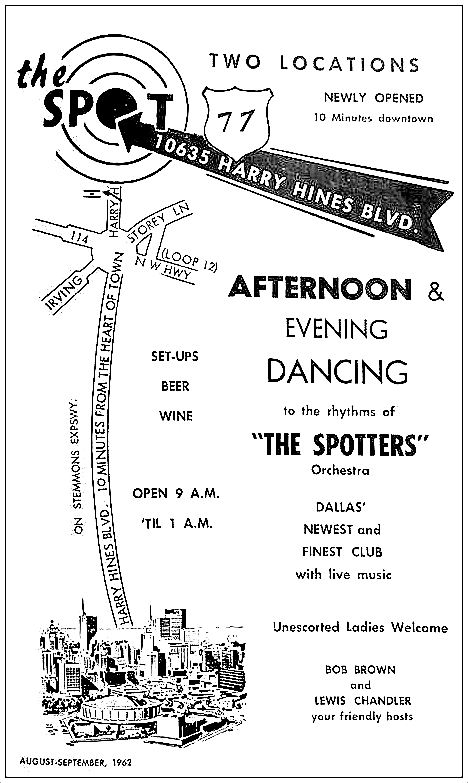
THE SPOT, the “other” location, 10635 Harry Hines. House band The Spotters.
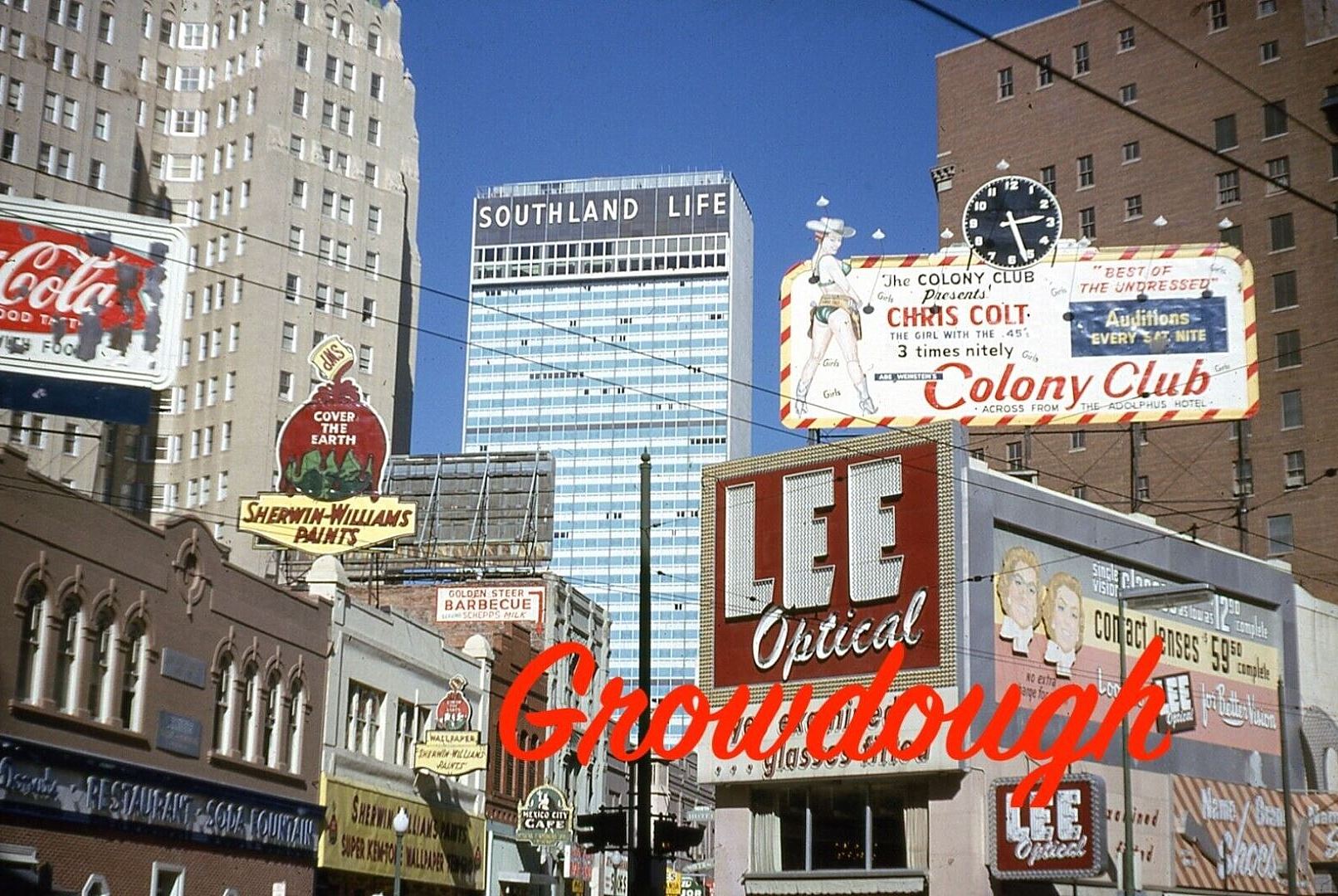
If only for the great, great, great Colony Club (“the best of the undressed”) billboard featuring Chris Colt (“the girl with the 45s”).
See this same view of the (one-time) intersection of Elm, Ervay, and Live Oak here and here. (The dazzling animated neon Coca-Cola sign was once where Chris Colt is showing off her 45s.)
I almost never post images with watermarks, but this photo is pretty spectacular. Look around the watermark!
I don’t know the seller of this color slide. I have no affiliation with the person. I get no cut in any sale. But I want someone reading this to BUY IT! Let’s keep this with someone who loves Dallas history! (And if you DO buy it and would like to send me a digital copy… well, I wouldn’t say no!) See this slide currently on eBay HERE. (HURRY!)
To see a naughty photo of Chris Colt, you can click on an antique collectors’ website here.
Colony Club ad, Nov. 22, 1962
And below is a photo of Colony Club owner Abe Weinstein in his younger years counting his moolah.
photo: Dallas Jewish Historical Society
***
Sources & Notes
Top image is from a color slide in a current eBay listing here. (Seller’s title: “Original Slide Dallas St Scene Colony Club Coca Cola Billboards Southland Life.”) There is no date, but Golden Steer Barbecue opened at 1713 Live Oak sometime in 1961.
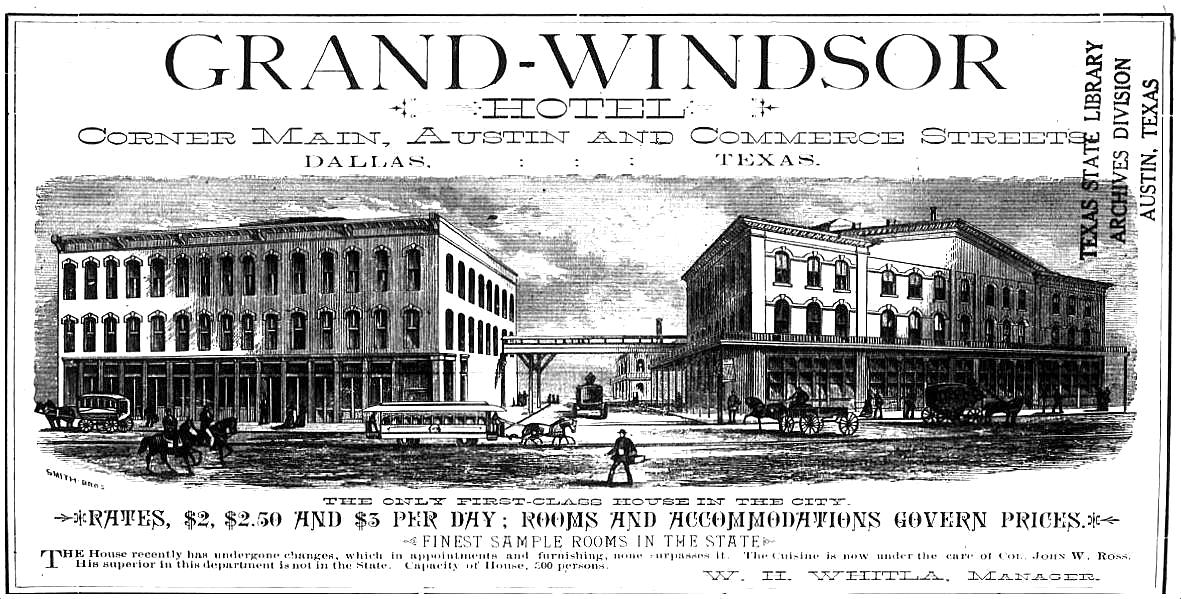
Behold, a feast of yesteryear (and this is just the game and fish dishes):
Dallas Herald, Nov. 25, 1877
**
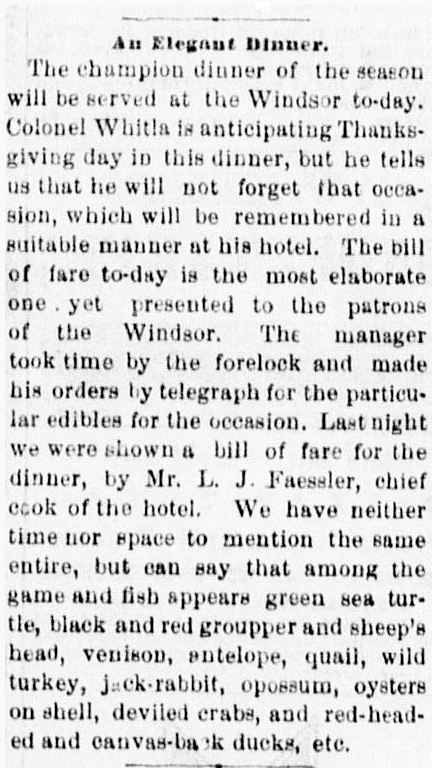
AN ELEGANT DINNER
The champion dinner of the season will be served at the Windsor to-day. Colonel Whitla is anticipating Thanksgiving day in this dinner, but he tells us that he will not forget the occasion, which will be remembered in a suitable manner at his hotel. The bill of fare to-day is the most elaborate one yet presented to the patrons of the Windsor.
The manager took time by the forelock and made his orders by telegraph for the particular edibles for the occasion. Last night we were shown a bill of fare for the dinner, by Mr L. J. Faessler, chief cook of the hotel. We have neither time nor space to mention the same entire, but can say that among the game and fish appears green sea turtle, black and red groupper and the sheep’s head, venison, antelope, quail, wild turkey, jack rabbit, opossum, oysters on shell, deviled crabs, and red-headed and canvas-backed ducks, etc.
*
Hava a Happy (Possom-Free) Thanksgiving!
***
Sources & Notes
Top ad for the Grand-Windsor Hotel from the 1878 Dallas directory. Originally two hotels (the Le Grande Hotel and the Windsor Hotel), they were joined by a little “sky-bridge” over Austin Street when they merged. See the Grand-Windsor on the 1885 Sanborn map here. (The room rates of $2-$3 back then would be the equivalent of about $60-$90, if you trust inflation calculators.)
Article is from the Nov. 25, 1877 edition of the Dallas Daily Herald, via the Portal to Texas History.
More Flashback Dallas posts on Thanksgiving can be found here;
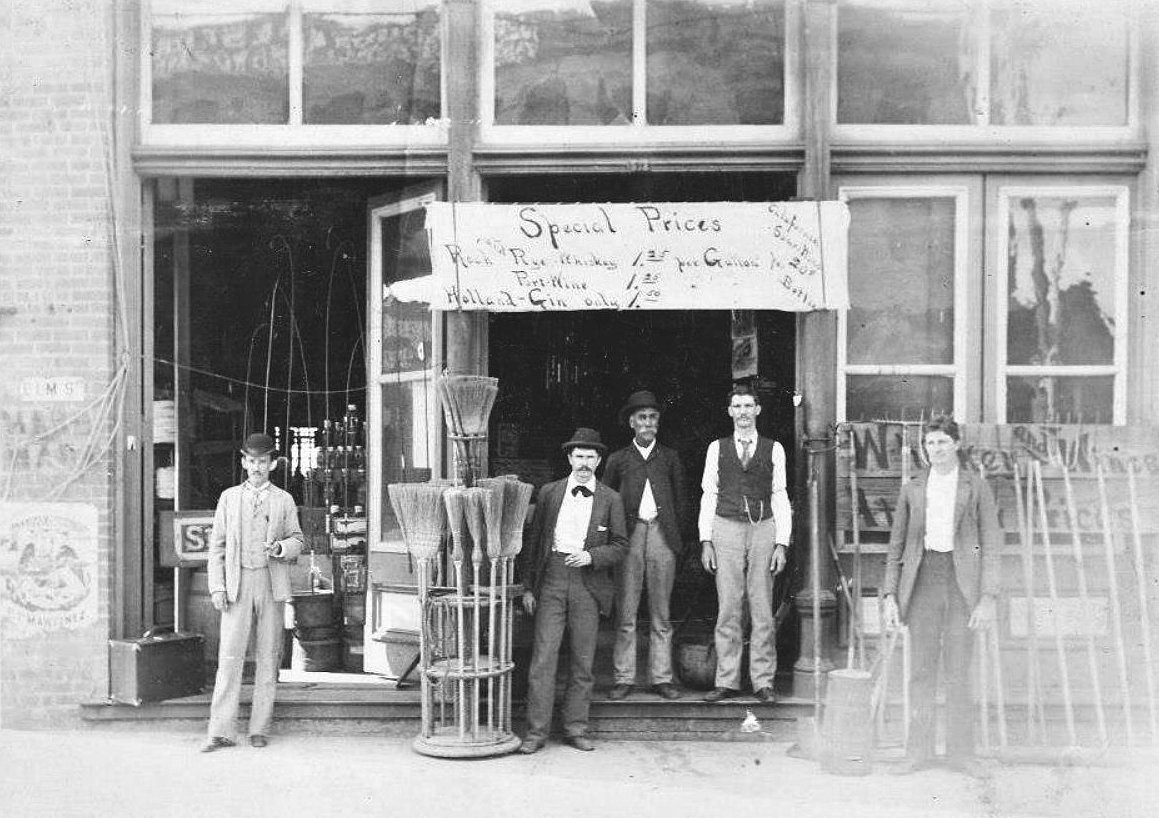
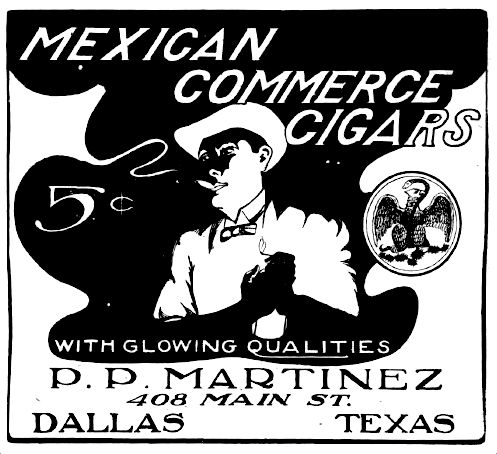
What more do you need in life than a gallon of whiskey, wine, or gin? And maybe some brooms. And a butter churn. The essentials. I don’t know anything about this photo, except that it does appear to be Dallas — you can see “Elm St.” on the brick wall at the left, just above an ad for Dallas cigar king P. P. Martinez. Not sure when the photo was taken — 1890s-ish? Below is a P. P. Martinez ad from 1908.
It’s hard to make out the “Special Prices” sign above the doorway, but some of the items you could purchase were rock and rye whiskey ($1.25 a gallon), port wine ($1.25 a gallon), and Holland gin (“only $1.50 per gallon”).
I had never heard of “rock and rye” whiskey until a few minutes ago. It was a whiskey cordial made with rock candy (!) and some sort of citrus or other flavor. So I’m guessing it was pretty sweet and powerful. It was often sold as a “tonic” because taxes were substantially less on medicines than on spirits. So goodbye, saloon staple, hello cough medicine! “Rock and rye” has made a recent comeback among whiskey-quaffing hipsters.
***
Sources & Notes
I have no idea where I found this photo back in 2014, but it’s great!
This post appeared in a slightly different form on my Patreon page a few months ago. If you’d like to receive daily Dallas-history postlets, check it out!
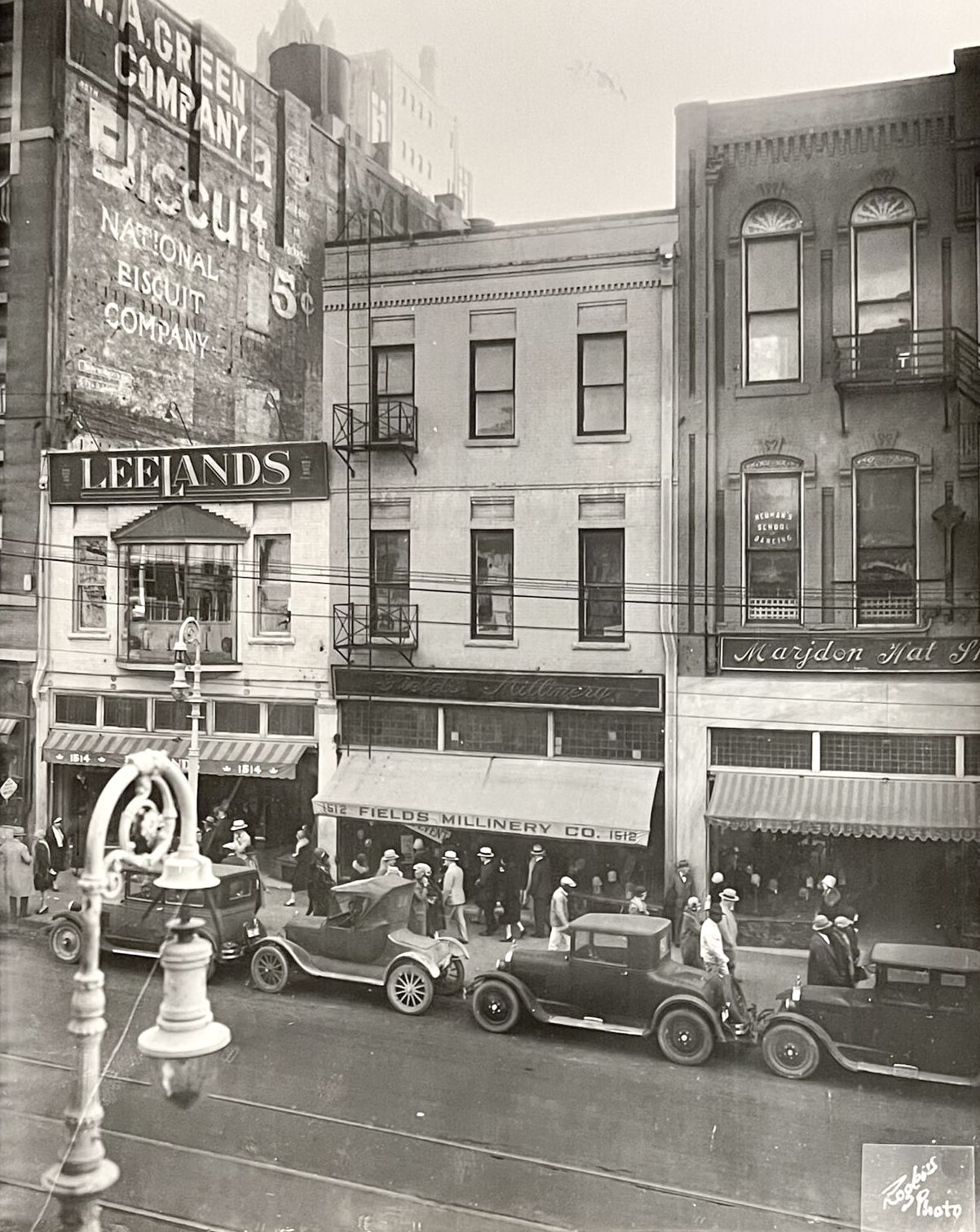
This is a great photo by Frank Rogers showing businesses on the south side of the 1500 block of Elm Street, between Stone and Akard (see it today on Google Street View here — some of these buildings are still standing). Mid-1920s? Back when Elm ran two ways, and you could park your rumble-seated roadster at the curb.
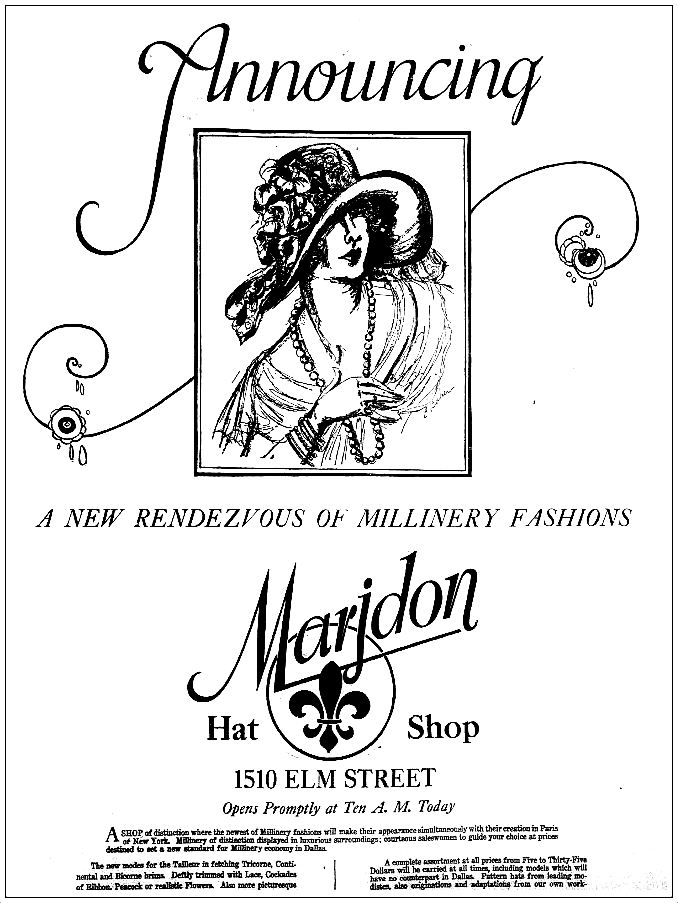
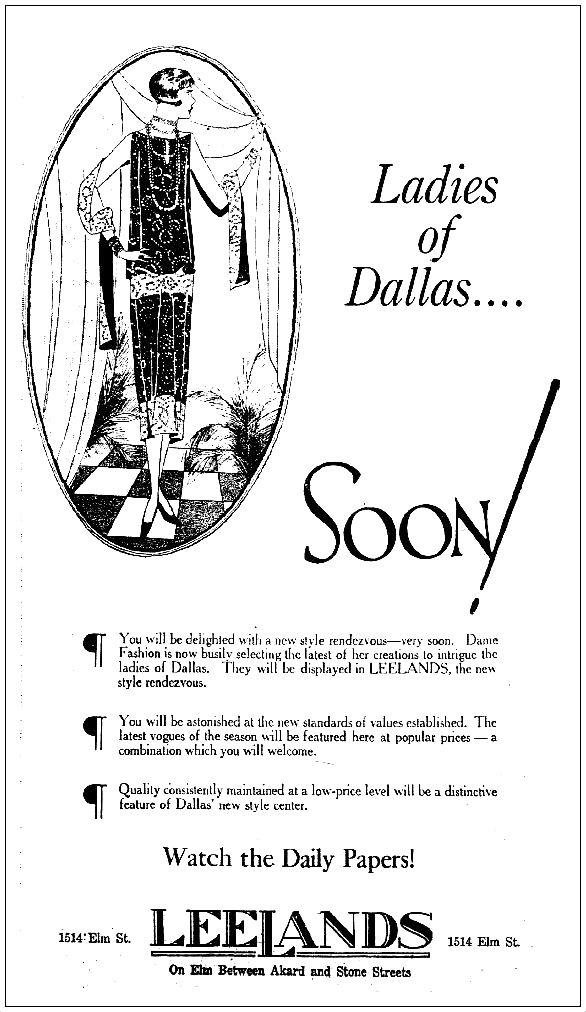
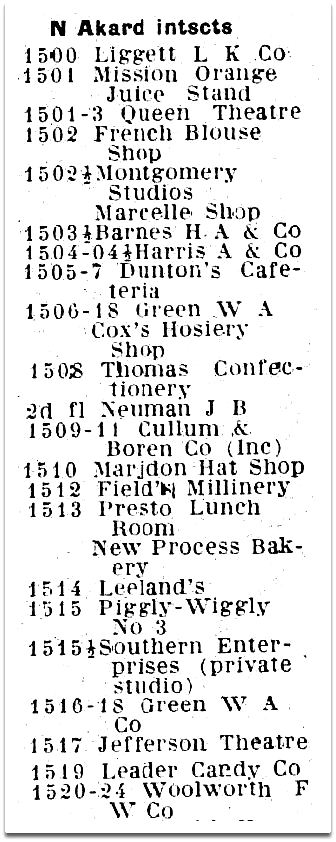
Mostly out of frame at the left is the W. A. Green department store (1516-18 Elm), then, moving east to west, Leelands women’s fashions (1514 Elm), Fields Millinery Co. (1512 Elm), part of the Marjdon Hat Shop (1510 Elm), and, above the hat shop, Neuman’s School of Dancing. (“Marjdon” must be one of the most annoying and hard-to-say business names I’ve come across.)
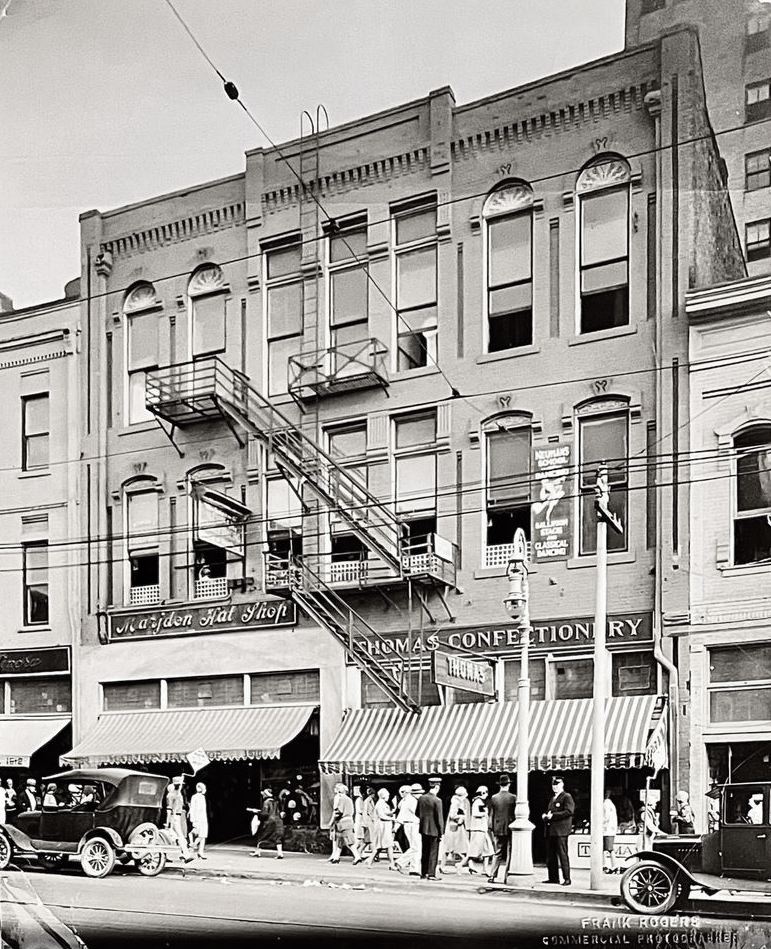
The block continues in the photo below, in another photo by Rogers (this building has been replaced and is now a parking garage).
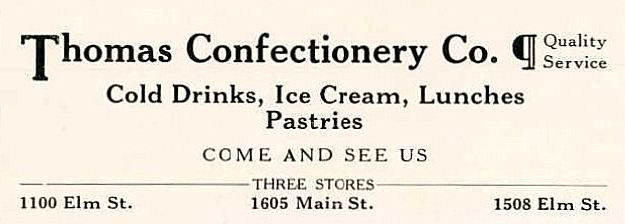
We see a full shot of Marjdon (that name…). Previously (1916-1924), that street-level space was occupied by the Rex Theater. Next door is Thomas Confectionery (1508 Elm, one of the company’s several downtown locations), which, according to the promotional postcard below was the “largest confectionery in the state.”
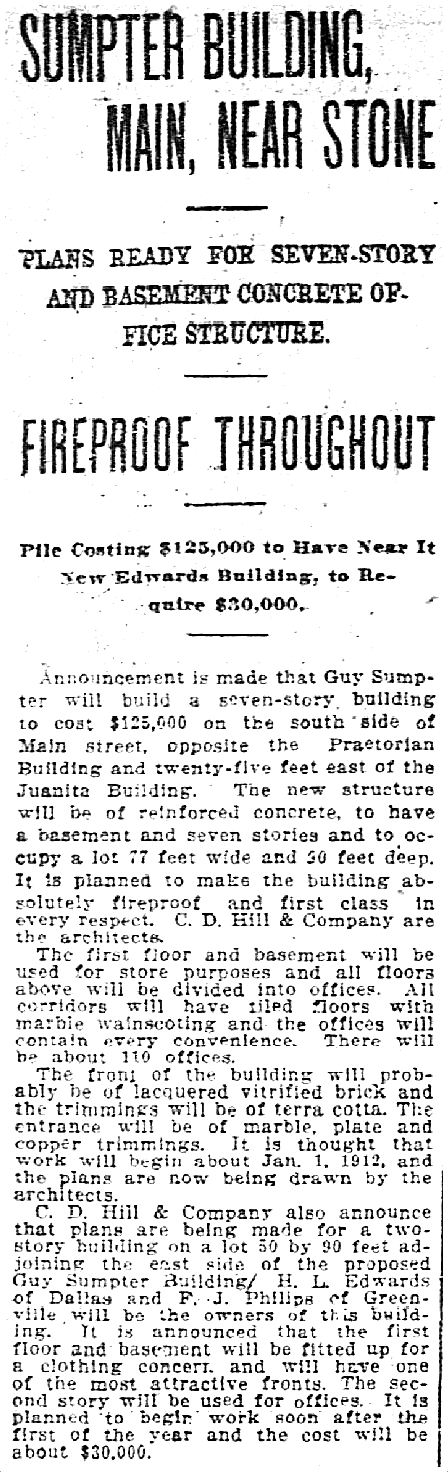
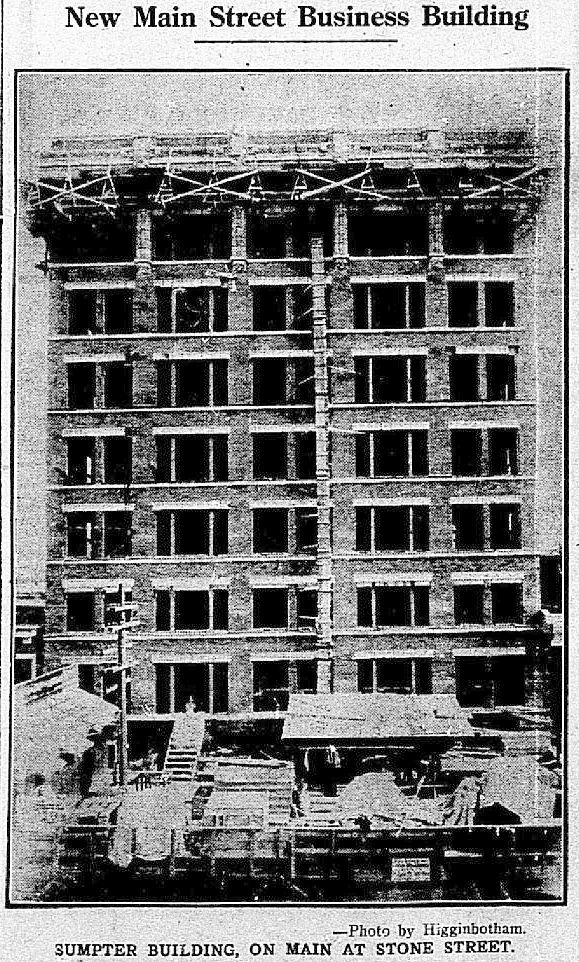
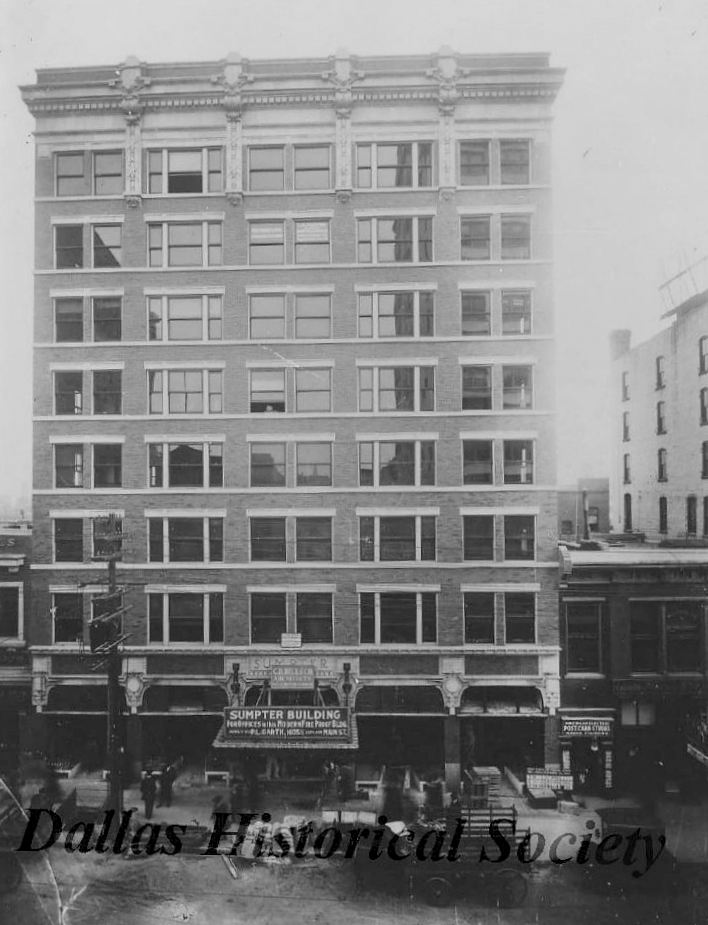
Behold, the Sumpter Building and a partial view of its little buddy, the Edwards & Phillips Building, which were built simultaneously. (See them on a 1921 Sanborn map here.) Both were designed by Dallas architect C. D. Hill, whose spectacular Municipal Building would be built a couple of years later, two and a half blocks away.
Guess what? Both are still standing — part of the Joule empire. See what they look like today — at 1604-1608 Main Street — on Google Street View here. (The shorter building has been through a multitude of renovations over the years, but at some point, by at least 2007, someone had restored it — however briefly — to its original design, as you can see in a 2007 Google Street View here — look how tired and dirty the Sumpter Building looked back then, before its recent scrubbed and rejuvenated revitalization.)
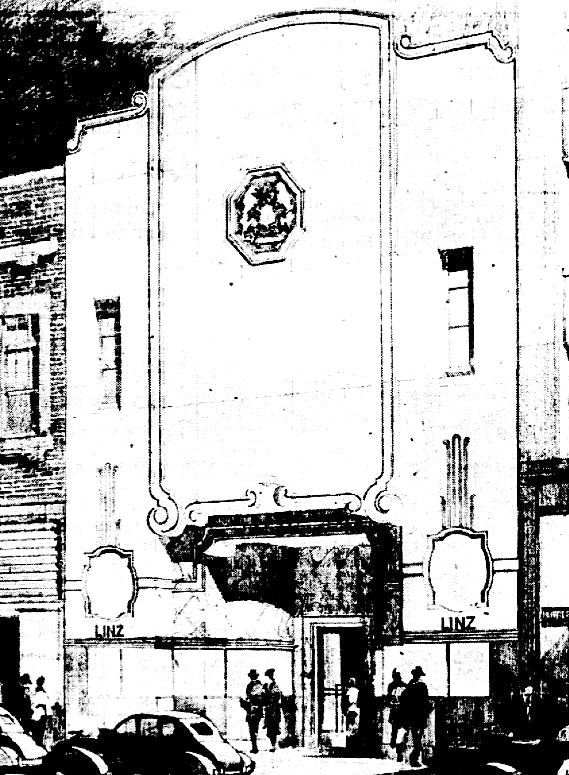
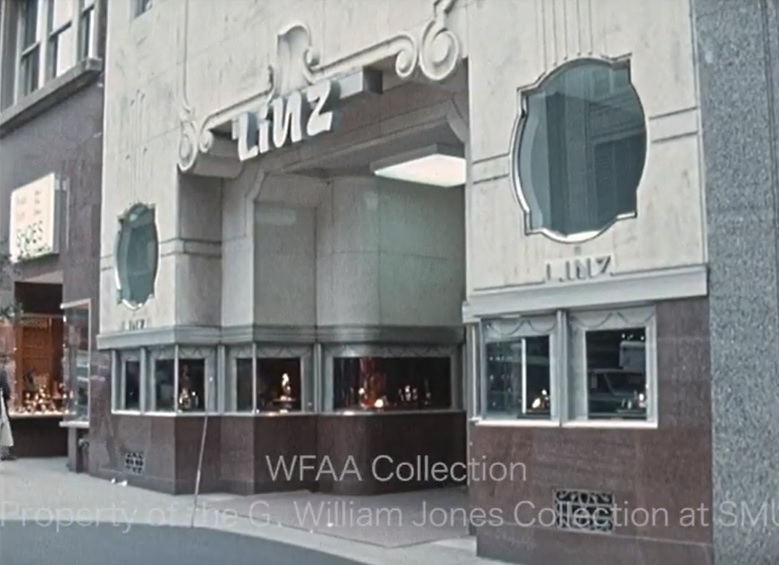
The Sumpter Building served primarily as office space over the years — architect C. D. Hill had a “penthouse” office on the top floor (I wonder if he knew that when he was drawing up the plans?) — and the smaller building was retail space on the ground floor and office space above. It might be remembered as the home of Linz Jewelers for several decades.
**
Dallas Morning News, Dec. 17, 1911 (click to read)
*
DMN, Mar. 7, 1912
*
DMN, Aug. 25, 1912
*
Dallas Historical Society, 1912
*
The smaller building debuted as home to retail tenant Matthews Brothers. (It is presently the home of another fashion mecca, Traffic Los Angeles (1608 Main).
April 1912
April 1912
*
In 1940, Linz took over the shorter building. Articles in The Dallas Morning News described “construction” and a new design by Lang & Witchell, but I think the building was just gutted and (weirdly) refaced.
Linz Bros. Jewelers (Lang & Witchell, 1940)
*
Here it is in living color, in 1970.
WFAA-Channel 8 News, Jan. 1970 (Jones Film Collection, SMU)
*
By the end of 1970, the building had undergone another (weird) “facelift” (and an expansion).
WFAA-Channel 8 News, Jan. 1971 (Jones Film Collection, SMU)
(The two screenshots above are from Channel 8 news reports about a fantastically successful jewelry heist in January 1970. Linz would never reveal the value of jewels stolen in the massive theft, but it was estimated at the time to be between $1.6 million and $3.5 million (the equivalent in today’s dollars of $12.5 million to $27 million!). It was the biggest burglary in Dallas history, and it was estimated to have been the biggest in the South. As far as I can tell, the crime was never solved. A great report on how it happened — with interesting little tidbits such as the fact that the robbers emptied a safe and took everything except for a few pieces of costume jewelry and that the burglars stopped for a break to brew a cup of coffee in the adjacent shoe store — can be found in the Dallas Morning News archives in the story “Gem Loss $3 Million?” by Robert Finklea (DMN, Jan. 13, 1970). It reads like a movie!
**
I’m always surprised to find these century-old buildings still standing downtown. Poor things have been through a lot.
*
Thank you to Chad K. for asking on Patreon if I knew anything about the history of these buildings. As it turned out, I knew NOTHING about the history of these buildings. I do now! Thanks for asking, Chad!
***
Sources & Notes
Top postcard from eBay.
1912 photo of the “Sumpter Building under construction” is from the Johnson Photographic Collection, Dallas Historical Society (A.77.87.967), here.
This post was inspired by a question from a supporter on Patreon. If you would like to join me on Patreon, where I post something every day, pop over here. (Thanks again, Chad!)
Several years ago, I maintained a long-running personal blog (back in the days when everyone had a blog — now everyone has a podcast). A recent comment on my Patreon page reminded me of an old blog post I wrote in 2010, several years before I began Flashback Dallas. I thought I would share it here (slightly rewritten). It’s a different sort of thing than I normally write on *this* blog — it’s pretty long and only tangentially connected with Dallas history — but it made me laugh to reread this 13 years later. (I have to add that since I wrote this back in 2010, the Municipal Building has been lovingly, *dazzlingly* restored by the University of North Texas and is no longer the hellhole I describe below! I haven’t seen the restored interior in person yet, but photos show some unbelievably amazing work! Thank you, UNT!)
**
October 27, 2010
I’m one of those people who receives a lot of jury summonses. I swear one year I got at least 3. Maybe 4. Do they keep sending them to me because I always report for jury duty like a responsible citizen is supposed to do? Is this good behavior working against me? So when I got a jury summons last month — a mere 4 months after my most recent jury duty on Cinco de Mayo — several unladylike words spilled out of me as I stood at the mailbox. I scanned the list of acceptable exemptions — there was a little empty checkbox next to the statement “I have been convicted of a felony.” Instant exemption! My first thought was, “Hmm. I’ve got six weeks….” It was tempting.
But I was still felony-free by the time I had to report yesterday (Oct. 26, 2010), so I somehow got myself up at the crack of dawn after only 4 or 5 hours of sleep and pointed my car in the direction of downtown. Most of my jury duty has been at the criminal courts building, which is easy to get to, and the chairs in the central jury room are plush and fairly comfy. This time, though — for the first time — I was summoned to a municipal court, where I guess they try people for non-death-penalty offenses like traffic tickets and zoning violations. If this day had any upside, it was that it would be my first visit to the beautiful Municipal Building. I couldn’t wait to see what that building — arguably the grandest building in Dallas — looked like inside.
But first I had to get there. I had to travel what felt like the entire length of downtown before I was able to turn left on Main and loop back to Harwood. I was sleep-deprived, caffeine-deprived, and just generally cranky, knowing that this whole thing was unnecessary, as I would no doubt be let go by noon, after having sat around for hours doing nothing but thinking unladylike things and wondering the whole time how this inefficient system keeps going.
Convenient parking? Ha! Fend for yourselves, suckers. At least Frank Crowley has a parking garage. Somehow, I found an unattended, cash-only lot along Commerce for the surprisingly affordable price of $2.00. My luck continued when I found that I actually had two one-dollar bills, which I stuffed through the narrow slot.
Despite my lengthy detour, I had arrived a little early and enjoyed a leisurely walk down Commerce. As I passed the building’s parking garage entrance/exit, I wondered if that was where Lee Harvey Oswald was shot. (It was.) I took my time, taking in the lovely, stately Municipal Building, which opened to rapturous acclaim in 1914 — it’s one of those cool old buildings that Dallas loves to tear down. I was really looking forward to stepping inside that grand palace, imagining an interior of marble, brass, etched glass, and ornate, highly polished, hand-carved wooden banisters.
I headed up the elegant, wide steps, walked in, and… oh… my… god. It was awful. AWFUL! But before I was treated to the full force of its awfulness, I was first greeted with the de rigueur metal detector. Which I set off. I stepped back and the officer asked me to raise each pant leg so he could see the tops of my shoes. I must have looked confused because he said, “We just want to make sure you’re not wearing an ankle holster.” Without thinking, I stupidly replied, “Pfft — I WISH,” and I instantly regretted it. But he laughed, and I continued on my way.
The Beaux-Arts-style Municipal Building, designed by architect C. D. Hill, is beautiful and stately. …On the outside. Here’s what it looked like almost 100 years ago:
Inside? Dear god. Depressingly institutional. Last “updated” circa the ’70s/’80s? Cramped and claustrophobic, bad paint, fluorescent lights, drop ceiling tiles, and absolutely no signage. I had to ask three people how to get to the central jury room! It’s a shame I found it, because I am going to have nightmares about that horrible place for a long time. There were about a hundred of us sitting on folding chairs in a room with dingy cream-colored walls trimmed with flat-turquoise paint. It reeked of the thousands of cigarettes which had no doubt been smoked over the past century by thousands of long-dead civil servants. The smell of stale smoke was embedded in every nook and cranny of that room. I think I would have preferred to serve my civic duty by picking up Miller Lite cartons from the side of the highway.
The worst thing about the room? The blaring TV. I don’t know why this has become acceptable, but it’s everywhere: in every waiting room there’s always a TV now — always on, stuck on a program you would never choose to watch. My fellow captive good citizens and I were subjected to a chirpy morning show (“Sweaters: to tuck or not?”) and lurid Hollywood gossip. I wondered if I could leave the room to get a breath of fresh air — it would be sheer relief to stand out in the hallway with the slumlords and the red-light-runners waiting their turn to go before the judge and take on City Hall. But I didn’t see anyone else doing that, so I sat, defeated, involuntarily learning about the finer points of sweater-tucking.
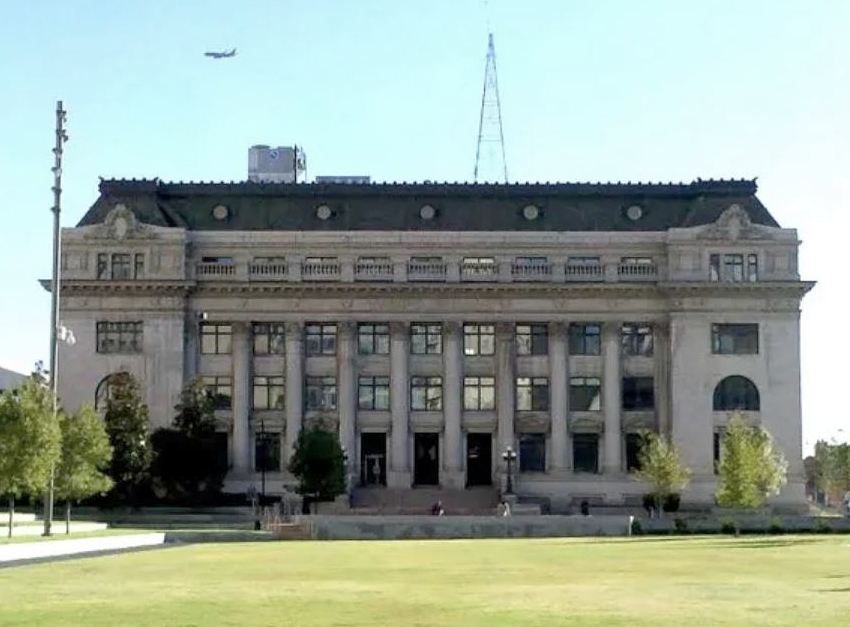
After an hour and a half or so, the marshal — who had a shaved head and wore taps on his shoes — announced that we were allowed a half-hour break. I hot-footed it out of there and left the building (I had to ask how to get out). I walked around the building admiring it, then walked across the street to a new park that’s sprung up since I was last downtown — a whole block of a park, lined with trees and terraced walkways — in downtown Dallas — with grass and everything! It’s cool. Here’s a photo I took of the municipal building from across the park (Main Street Garden):
Oct. 26, 2010 / photo: Paula Bosse
I saw several young hipsters walking their dogs. I bounced across a small playground, built on some sort of weird, springy, spongey surface. I thought how unusual and how nice this whole “open space” thing was. My half hour was up too soon. As I walked back, a possibly homeless man joined me and chatted with giddy enthusiasm about the Rangers being in the World Series, insisting to me that they were Going. To. Win. I laughed and said I believed him. It was such a beautiful day. How sad that I was heading back to the dark dungeon of the central jury room. I waited to cross the street with a couple of women I recognized as fellow potential jurors. They decided to blithely cross against a red light. There were six police cars parked in front of us, but not one cop to bust these scofflaws! I crossed on green, because I’d used up my luck finding a convenient parking spot, and as sure as the Rangers are Going To Win the World Series, I knew I would be instantly cited for pedestrian incivility the second I stepped off the curb to a flashing red light.
Back inside, I set off the metal detector a second time and showed my holster-free ankles to a different officer and followed the trail of breadcrumbs I’d left earlier. In the jury room — where women outnumbered men 4-1, and the median age was 60 — the two women who’d crossed on red were talking about the Laura Bush autobiography one of them was reading. Two other women were talking in excruciating detail about deaths of beloved pets. The guy next to me was nodding off, somehow oblivious to Wendy Williams chattering excitedly about Charlie Sheen and a hooker. A guy behind me had a laptop which kept making clanging sounds and which he’d plugged into an extension cord that snaked its way into the bowels of a mystery room behind an intimidating door marked “Private.”
There was no coffee in the building. (“There is NO coffee in the building,” the marshal had informed us earlier. “If you want a cup of coffee, you’re going to have to exit the building.”) HAD there been coffee, it would have been thin and stale and cold, and the powdered artificial creamer would not have dissolved, no matter how much you stabbed at the globules with a plastic stir stick. Like in the movie “Joe Versus the Volcano.” I kept thinking of that movie, because that godforsaken central jury room I was trapped in could have been the inspiration for the scene in that movie which my brother and I often reference:
*
I was so miserable. I contemplated committing some sort of petty property crime to relieve the tedium but reconsidered when I realized I’d only find myself back in the same building when my trial date came up. I was going to have to tough it out like an adult.
A middle-aged woman who looked like she was probably a hardcore, high-powered North Dallas realtor sat a couple of rows in front of me and seemed to be able to read only a sentence or two from her book (Famous Soviet Spies) before she grew bored and slipped her “We the People” bookmark back in and closed it, only to stare off into space, gathering the energy to raise the book again and read from it for 20 or 30 more aggressively-anti-Communist seconds.
The youngest person in the room sighed frequently and played a game on her phone.
An older Black man in a gimme cap and an older white man who had probably left his gimme cap in his truck talked together absolutely without pause for the entire time we were there. I couldn’t hear what they were talking about, but I have a feeling they’ll be spending Thanksgiving together this year.
Throughout my ordeal, I had longed to hear the snappy taps on the shoes of the marshal. He would be our savior — the one who could let us go. Finally, he returned. He called maybe 10 people and sent the rest of us on our way. It was 11:00 AM. I had been there only two and a half hours. It felt like a lifetime.
I got in my car, stopped for a burrito, headed home, and fell asleep on the couch. Civic duty done. I only hope I’m never called back to that depressing, confusing building. Pray you’re never called for jury duty there.
***
Sources & Notes
Blog post by Paula Bosse, originally published on Oct. 27, 2010 (revised July 2023).
Photo of the sad, dark Municipal Building at top is from Google Street View, Aug. 2007; photo from 2013 by Paula Bosse.
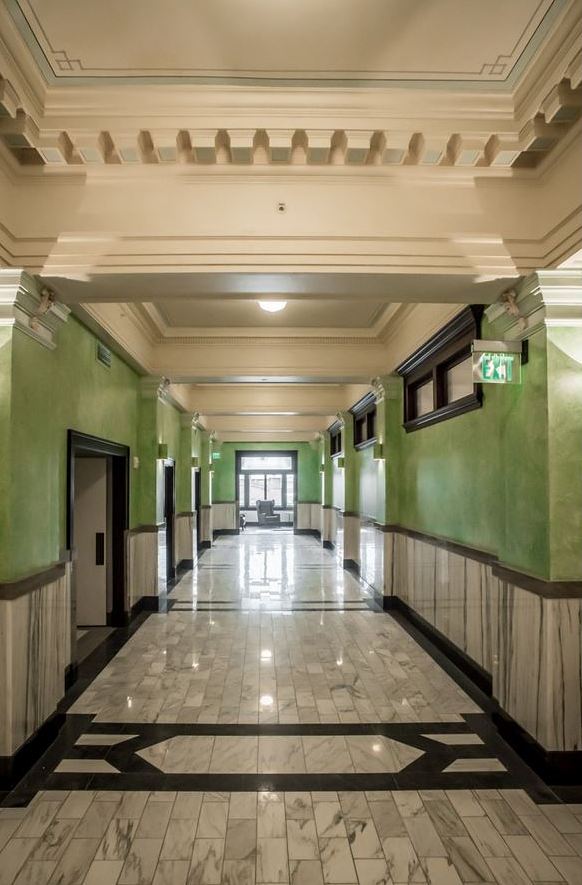
The City of Dallas and all of us who live here, should fall to our knees to thank the University of North Texas Law School and the team of incredible people who restored and renovated the former Municipal Building. Thankfully, all of my sarcastic descriptions above are no longer accurate. I mean, look at this photo of what a hallway looks like now:
That photo is one of several showing the restoration in the article “Bringing Historic Dallas Back to Life” by Preston Pressley, on LinkedIn, here (possibly behind a subscription wall).
See more photos — as well as the film “Restore” by Mark Birnbaum — on the Phoenix I Restoration and Construction site,here.
Look at this photo of the revitalized building today — more beautiful than I’ve ever seen it. Every inch of its exterior has been cleaned, spruced up, and restored. I kind of wish I could be called to jury duty there now!

 238 Main, circa 1894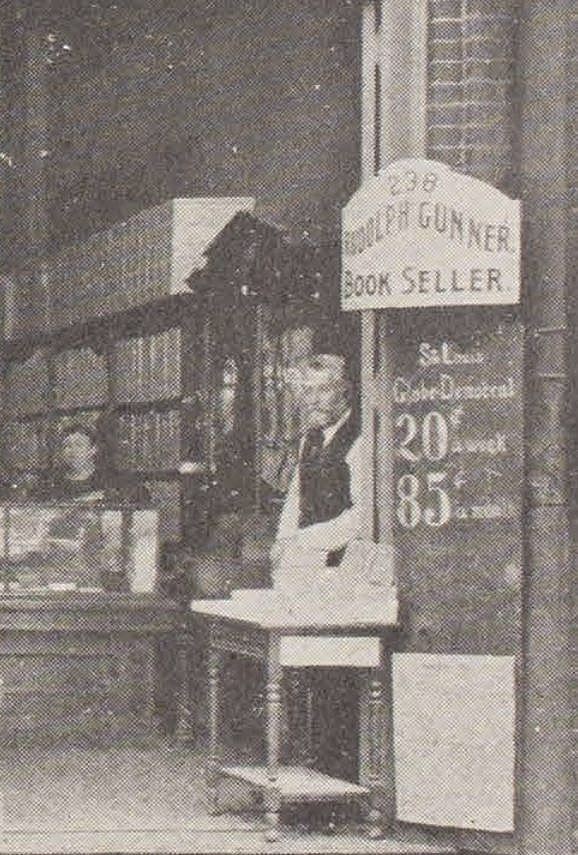
 Dallas city directory, 1896

 Col. John C. McCoy

 Dallas Morning News, Oct. 2, 1904














 Sad and gloomy, yearning for restoration (2007)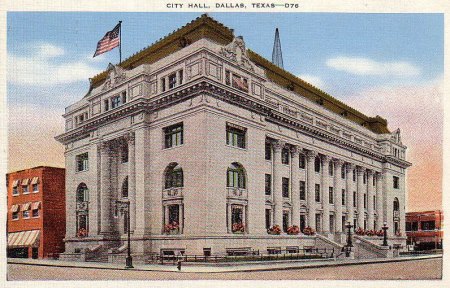


 Flashback : Dallas