Flashback : Dallas

A Miscellany: History, Ads, Pop Culture

Category: Downtown

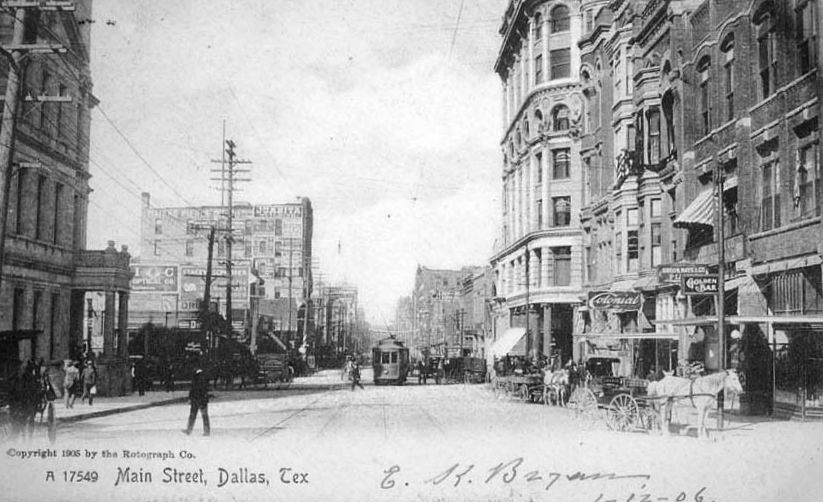
Main Street — 1905

main-st_1905A wide Main Street (click for larger image)

by Paula Bosse

Just another day on Main, here looking west from the middle of the block between Ervay and St. Paul. The Wilson Building is on the right, the Juanita Building is at the top left.

***

Postcard from eBay.

*

Copyright © 2014 Paula Bosse. All Rights Reserved.

The Elm Street Cave — 1967

elm-st-cracks_flickr_red-oak-kid_smThe Elm St. Cave – tourist attraction…

by Paula Bosse

In the wee hours of the morning of Jan. 11, 1967, a giant hole opened up on the south side of Elm Street — 200 yards long, 20 feet wide, and 15 feet deep — running roughly the entire length of the block between Griffin and Field. It was assumed that there was some connection between the cave-in and the adjacent construction of One Main Place. During the ensuing investigation into a cause, the consultations with geologists, the lawsuits, the repairs, the backfilling, etc., this very busy stretch of Elm was closed for an incredible seven months (!). Most of that time it was a gaping hole.

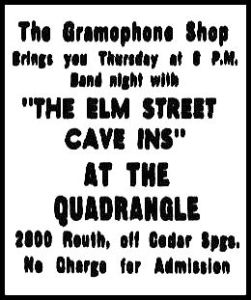
The hole was a major headache to city leaders and to downtown developers (…and to motorists), but it became an ongoing joke to everybody else. The “Elm Street Cave” and “Elm Street Cavern” were referenced everywhere for most of 1967. San Francisco had “The Summer of Love” that year, Dallas had “The Elm Street Cave-In.” It was the butt of endless jokes in local, out-of-town, and even out-of-state newspapers. A band sprang up calling themselves The Elm Street Cave-Ins.

cave-ins-band_dmn_062867June 28, 1967

A group of local lawyers known as The Skid Row Bar Association proclaimed to the press that it was “the last remaining scenic wonder in Dallas.” Curious tourists were drawn to the hole like camera-laden moths to a flame. “Talk about your ‘Deep Elm’!” became a punchline much bandied about by people who didn’t understand that something like that is moderately amusing once or twice, but that it tends to lose its sharpness after it’s repeated ten or fifteen times. And, bizarrely, it even found its way into an oddly defensive Sears ad (click to see a larger image).

ad_sears_dmn_070667-det_sm1967 Sears ad, detail

The hole was eventually filled in, and, in August — after months of jokes and inconvenience — the street was finally re-opened. Life returned to a pre-cave-in normalcy. The reason for the collapse was determined to be shifting rock formations below street level. One report said that workmen had “uncovered a huge crevice in the limestone beneath the street measuring 30 feet deep. They filled the crevice with concrete and tied together the broken sections of rock.” I’m not sure how comfortable I’d feel about a giant building sitting on shifting shale-covered limestone,* but apparently everything’s been fine ever since, and everyone — the engineers, the geologists, the One Main Place developers and tenants — lived happily ever after.

***

Sources & Notes

Associated Press photo of the lovely Judy Thedford and her fashionably large hair posing rather incongruously beside a car bumper appeared in newspapers across the country on Feb. 12, 1967. This scan is from the Red Oak Kid’s Flickr page, here.

The weird “Let’s quit apologizing! Dallas is worth seeing!” ad comes from a larger Sears advertisement that appeared in July 1967.

Related Dallas Morning News articles:

  • “Strip of Elm Collapses; Experts Remain Baffled” by Carolyn Barta (DMN, Jan. 12, 1967)
  • “Cracks on Elm Street Not Funny to City Hall” by Kent Biffle (DMN, Feb. 12, 1967)

*For people who (unlike myself) know something about geology, an article written in 1965 about the special problems regarding the One Main Place excavation and construction (“How to Support Skyscrapers” by Martin Casey — DMN, Nov. 28, 1965) might be interesting. There is much mention of Austin Chalk Limestone and Eagle Ford Shale, which made the One Main Place project quite troublesome to engineers. 

*

Copyright © 2014 Paula Bosse. All Rights Reserved.

When Halloween In Dallas Was Mostly “Trick” and Very Little “Treat”

halloween-trick-or-treat

by Paula Bosse

Dallas used to have some pretty bad Halloweens. Way more “trick” than “treat.” The word “riot” was used frequently to describe the typical Halloween night goings-on, when thousands of people clustered downtown and did unsavory things (such as drinking, fighting, pick-pocketing, mugging, and being generally obnoxious), while out in the “suburbs” (meaning far-flung locales such as East Dallas and Oak Lawn), marauding bands of young “pranksters” were keeping themselves busy breaking things and setting things on fire. Like kids do. Each Halloween, every policeman was called in for duty — only those in their sickbeds were exempt.

The worst of these Halloweens seemed to happen in the 1930s. Elm, Main, and Commerce, between Lamar and Harwood, were cordoned off from traffic. This is where upwards of 25,000 revelers would slowly cruise up and down the streets, causing mayhem and inflicting occasional bodily injury (much like the notorious Texas-OU weekends of later years). Even though the area was off-limits to automobile traffic, the streetcars still ran, and the poor drivers must have dreaded that night each year and steeled themselves for the worst, as if heading into battle.

Apparently Dallas revelers had a signature tradition, and it was to carry large wooden paddles — sometimes as large as canoe oars — and to swat people in the crowd on their backsides, usually women. At some point women also began to carry paddles, and they did their fair share of swatting, too. It was a paddling free-for-all.

1935 was a particularly noteworthy year, as it was the first Halloween after the state of Texas had voted to repeal Prohibition. Yes, people were drinking. And paddling. Sounds like a bad combination.

Below is a list of just a few of the reported instances of vandalism and “high-spiritedness” which routinely plagued the city every Halloween:

  • Broken streetlights
  • Broken windshields
  • Broken everything
  • Flooded streets from opened fire hydrants
  • The throwing of rocks
  • The throwing of eggs and rotting fruit
  • The throwing of stink-bombs
  • The throwing of WASHTUBS (!)
  • The setting of fires, both large and small
  • The malicious uprooting of shrubbery
  • The driving of cars on sidewalks
  • The reporting of false alarms to fire stations
  • Random gunfire
  • Occasional mysterious explosions
  • Extremely loud noise
  • Smoke
  • The overturning of outhouses
  • The soaping of windows
  • The breaking of windows
  • The breaking of soaped windows
  • The soaping of streetcar tracks
  • And the unsuccessful attempt one year by a small band of aspiring shake-down artists to “extort” money (rather than candy) from their eye-rolling neighbors by foregoing the chant of “Trick or Treat!” and demanding “Dime or Damage!”

In 1939, an intoxicated man who was “playfully threatening people with a knife” was playfully arrested.

In 1935, there was a huge mud-fight in Oak Lawn at Newton and Throckmorton which involved over 100 boys. Like greased pigs, an adrenaline-fueled, mud-encased 10-year old running from beleaguered and hopelessly out-numbered policemen — who, quite frankly, had bigger fish to fry that night — were almost impossible to catch. Spectators and passersby did not escape unscathed. Except for the dry cleaners the next day, Oak Lawn was not amused.

And in 1936, during the Texas Centennial, a policeman was suspended and demoted after an incident of “horseplay” at Parry and Exposition in which he had been shocking passing pedestrians by poking them with the end of a walking stick that had been hooked up to the battery of a police motorcycle. He got into trouble because one of his victims was a young woman who had been standing on wet pavement when the electrified stick touched her, resulting in a more-powerful-than-expected shock. She lost consciousness, fell to the ground, and hit her head on the sidewalk. Luckily, she recovered quickly and even requested that the officer not be punished, but the police chief was not so forgiving. He was understandably livid, especially when he discovered that a number of motorcycle cops had been doing the same thing. One imagines there were several new orifices opened up amongst the force in the days that followed.

But the pièce de résistance was in 1920 when several boys “anchored a block and tackle around a two-story house in Cockrell Hill and hoisted a wagon and a team of terrified mules up in the air” (DMN, Oct. 27, 1963). That right there required impressive organizational planning and a certain amount of entry-level engineering skill.

Eventually things settled down. By 1949 officials had finally put an end to the swarming, surging masses downtown. People began to celebrate Halloween with candy and costumes and haunted houses and parties. In 1966, a policeman was asked if things had improved from those earlier dark days:

There’s been an extensive change for the better in recent years. Police almost never get a call to let a cow out of a school house anymore. (DMN, Oct. 27, 1966)

And Halloween became more “treat” than “trick.” Good news for the City of Dallas. And for its mules. Bad news for the makers of Ivory soap and thick wooden paddles.

***

Sources & Notes

Selected tidbits gleaned from the frenzied coverage in The Dallas Morning News archives:

  • 1935: “Much Damage Done By Hoodlums During Halloween Rioting” (DMN, Nov. 1, 1935)
  • 1936: “Young Woman Victim of Police Prank Asks Jones Pardon Men” (DMN, Nov. 3, 1936)
  • 1939: “Witches Stage Costly Carnival For Halloween; Roughness Breaks Out In Downtown Crowd; Police, Firemen Busy” (DMN, Nov. 1, 1939)

Other Flashback Dallas posts on Halloween can be found here and here.

Happy Halloween!

*

Copyright © 2014 Paula Bosse. All Rights Reserved.


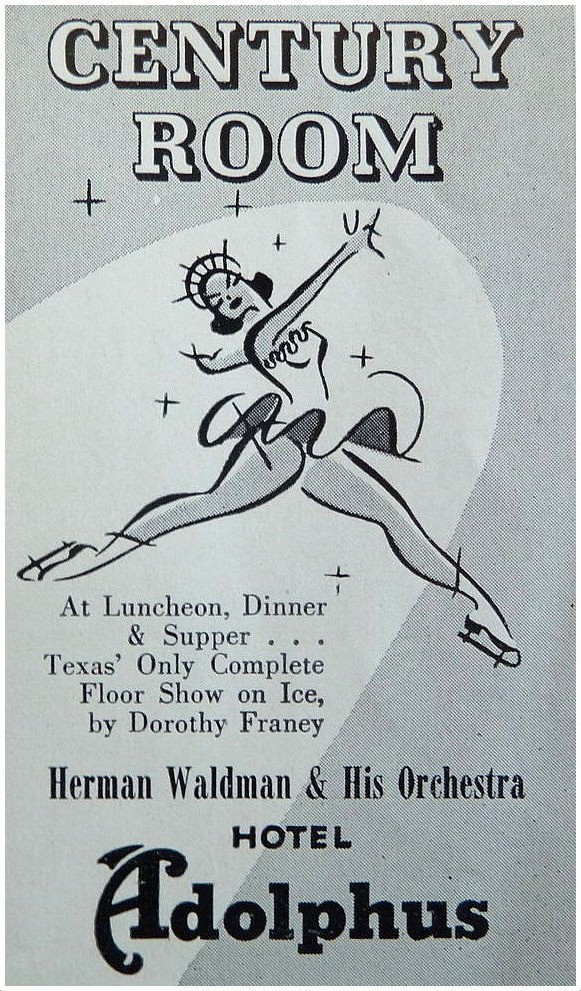
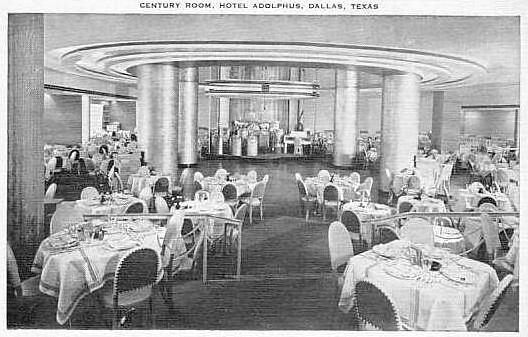
The Century Room’s Retractable Dance Floor

ad-adolphus-hotel_century-room_sm(click for larger image)

by Paula Bosse

If you’re getting all dressed up for a night on the town, you want to make sure you get your money’s worth, entertainment-wise. That’s why you head to the tony Century Room at the swank Hotel Adolphus. Not only is there dining and dancing, there’s also an ice show. Yep, an ice show. When “Texas’ Only Complete Floor Show on Ice” has wrapped up, a dance floor magically covers the ice, and you and your honey can trip the light fantastic to the fabulous strains of Herman Waldman & His Orchestra. Skates optional.

adolphus_hotel_century-room

adolphus_century-room

*

Copyright © 2014 Paula Bosse. All Rights Reserved.

Ferris Plaza Waiting Station — 1925-1950

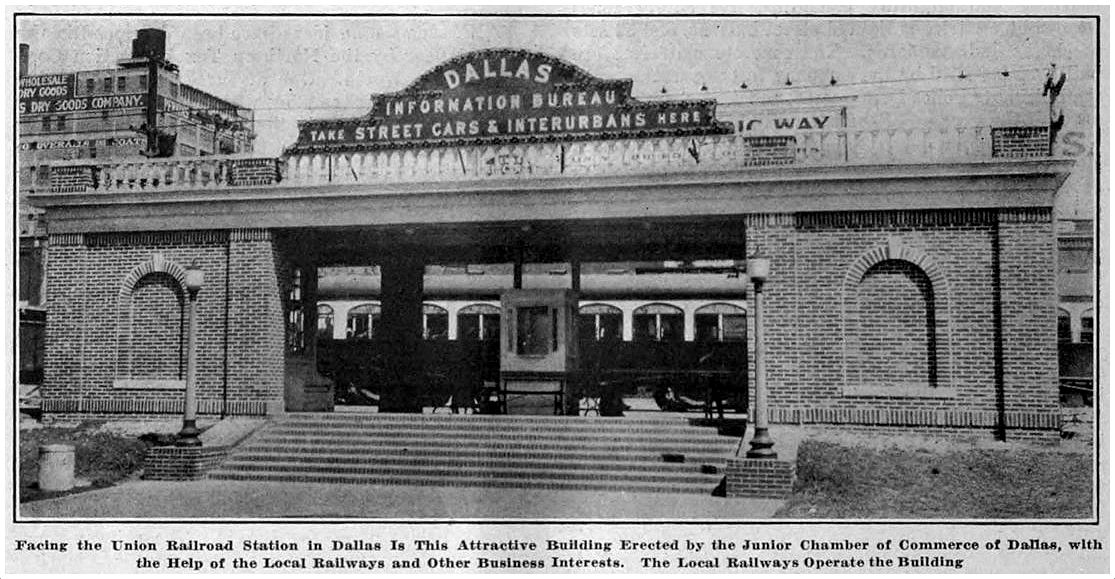
railway-info-bldg_1926From The Electric Railway Journal, 1926

by Paula Bosse

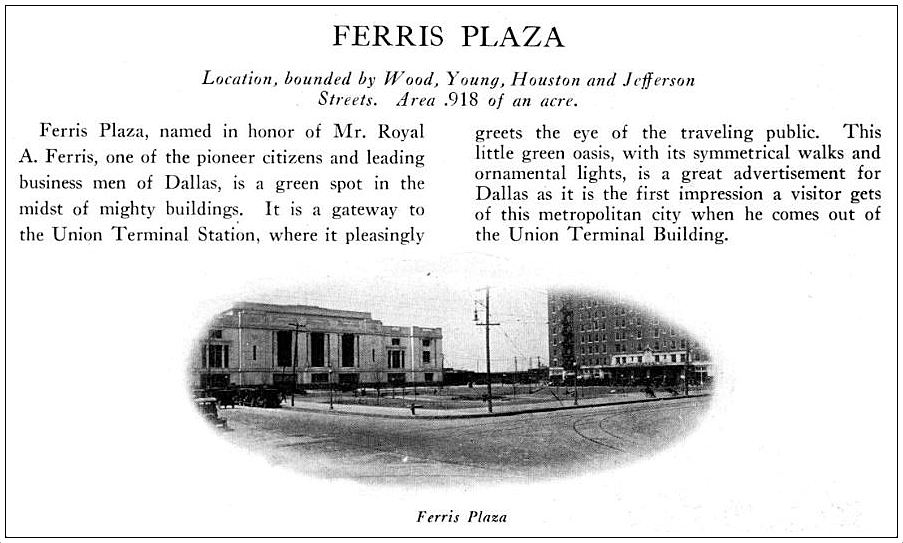
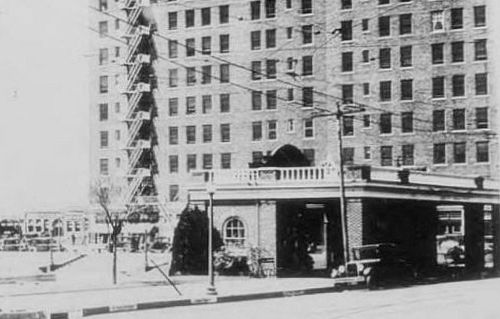
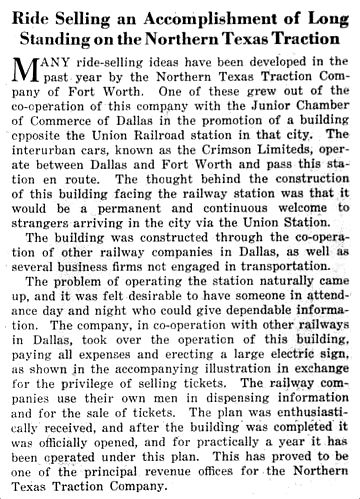
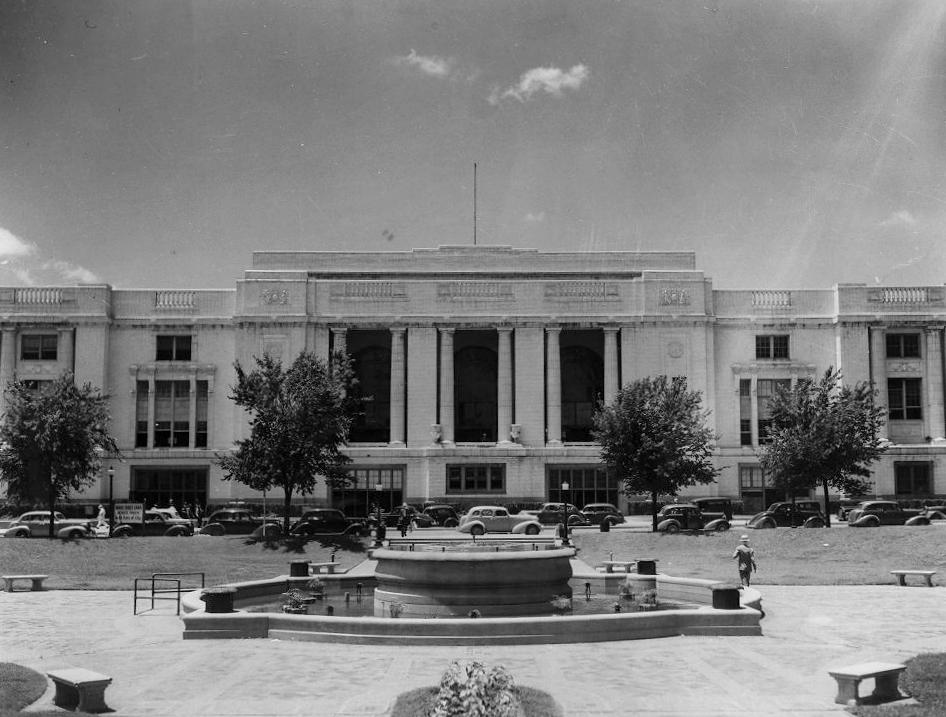
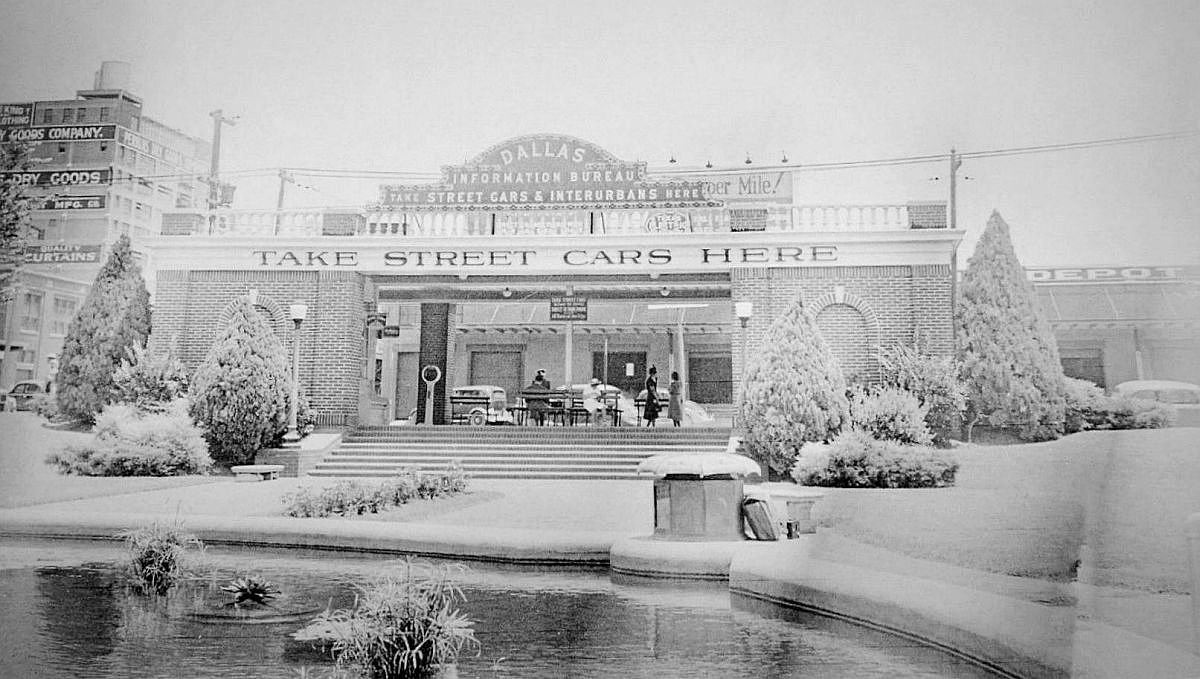
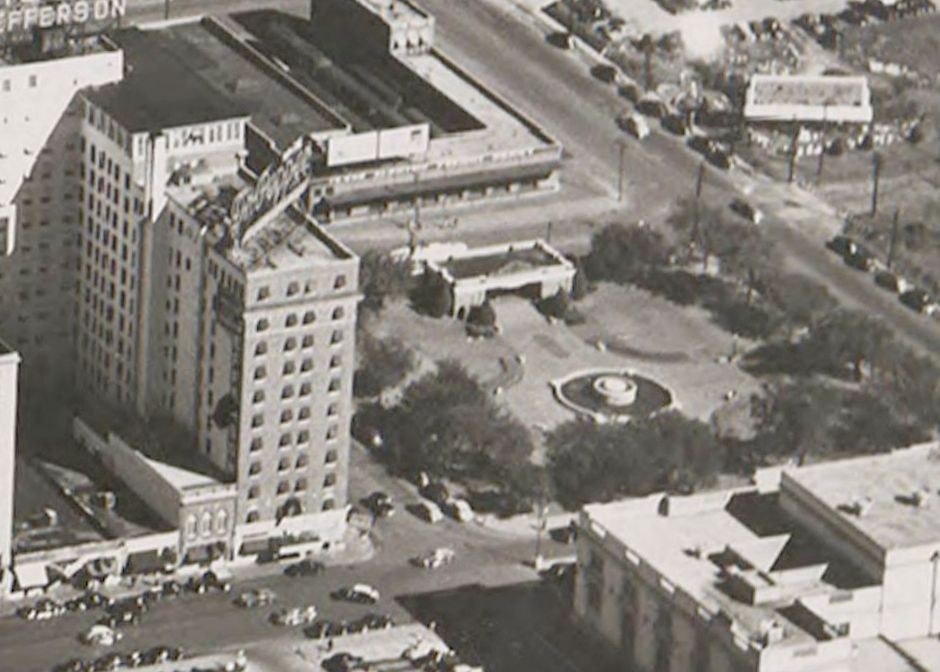
I came across the odd image above whilst digitally thumbing through a 1926 issue of The Electric Railway Journal (as one does…) and wondered what it was. It was definitely something I’d never seen downtown. Turns out it was a combination information bureau, covered stop in which to buy tickets for and await the arrival of interurbans and streetcars, a place to purchase a snack, and a location of public toilets (or, more euphemistically, “comfort stations”). It was located at the eastern edge of Ferris Park along Jefferson Street (which is now Record Street), with the view above facing Union Station. It was intended to be a helpful, welcoming place where visitors who had just arrived by train could obtain information about the city, and it was also a pleasant place to wait for the mass transit cars to spirit them away to points beyond. With the lovely Ferris Plaza (designed by George Dahl in 1925) between it and the front of the Union Terminal, this was considered The Gateway to the City long before Dealey’s Triple Underpass was constructed. (Click photos and articles to see larger images.)

ferris-plaza_park-and-playground-system_pubn_1921-23_portal

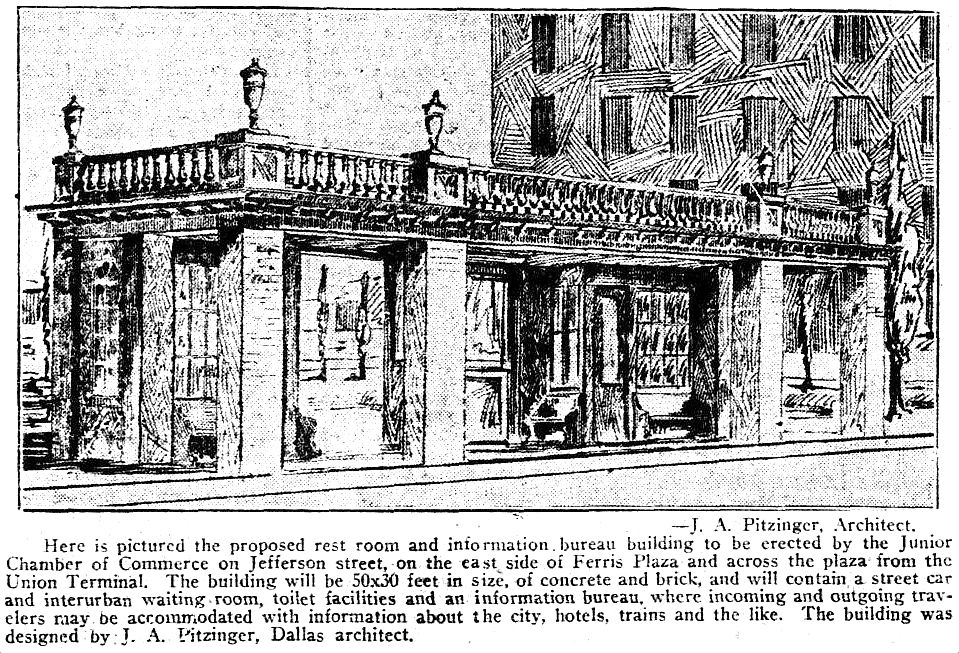
The “waiting station” was the brainchild of the Dallas Junior Chamber of Commerce which proposed the idea to the City of Dallas and, as it was to be built at the edge of a city park, the Park Board. The small (50 x 30) brick building — designed by Dallas architect J. A. Pitzinger — would cost $5,000 and would be paid for by funding from local businesses, including various transportation concerns (namely, the Northern Texas Traction Company). The “traction” companies would staff the information booth and sell tickets. The plans were accepted and permission was granted. Construction began in July, 1925, and the building was opened for waiting by October.

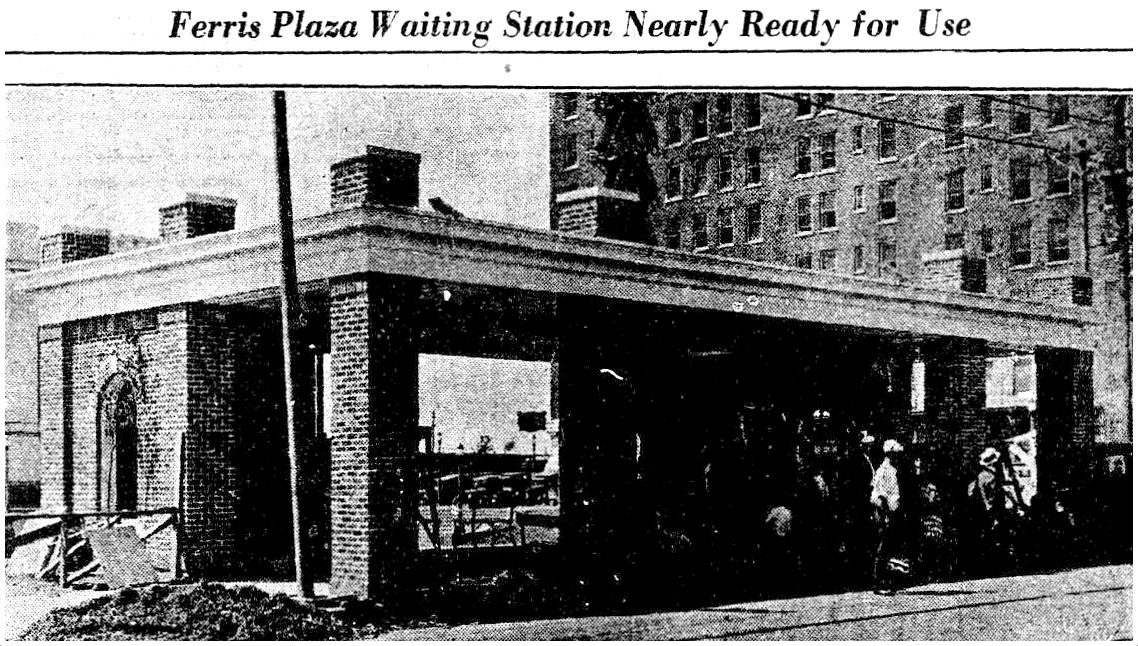
This improvement is the most recent of a number which have made of Ferris Plaza a beauty spot at the gateway of the city. Designed for a sunken garden, fringed with trees, the plaza is now adorned with a great fountain, illuminated with colored lighting at night, the gift of Royal A. Ferris. The new waiting station is in harmony with the general scheme of the plaza development, and combines beauty with utility. (Dallas Morning News, Sept. 20, 1925)

The little waiting station proved to be quite popular, and by the end of its first year the Northern Texas Traction Company (who operated interurban service between Dallas and Fort Worth) was very pleased, as interurban ticket sales at the station had become a solid source of company revenue. The Ferris Plaza station lasted a rather surprising 25 years. It was torn down in 1950, mainly because the interurbans had been taken out of service and there was no longer a need for it. Also, the park department was eager to get their park back and make it more “symmetrical.”

People would just have to wait somewhere else.

*

ferris-plaza-info-bureau_rendering_pitzinger_dmn_031625Architectural rendering by J. A. Pitzinger (DMN, March 16, 1925)

ferris-plaza-waiting-stn_dmn_092025Nearing completion (DMN, Sept. 20, 1925)

waiting-station_jefferson-hotel_degolyer-lib_SMU_croppedDeGolyer Library, SMU (cropped)

railway-info-bldg_1926_text_smThe Electric Railway Journal (Nov. 6, 1926)

ferris-plaza_union-station_dpl_1936Union Station, 1936 — view from the “waiting station” (Dallas Public Library)

waiting-station_ebay

ferris-plaza_aerial_smu_c1949-det1949 aerial view, showing “waiting station” just above plaza’s circular fountain

***

Sources & Notes

Top photo from The Electric Railway Journal, Nov. 6, 1926.

Very early photo and description of Ferris Plaza is from Park and Playground System: Report of the Park Board of the City of Dallas, 1921-1923, via the Portal to Texas History, here.

Cropped image showing the waiting station with the Jefferson Hotel in the background is from the DeGolyer Library, SMU — more info is here.

Photograph of Union Station from the Texas/Dallas History and Archives Division of the Dallas Public Library.

Aerial photo showing Ferris Plaza is from a larger view of downtown by Lloyd M. Long (the original of which is in the Edwin J. Foscue Map Library collection of the Central University Libraries, Southern Methodist University, and which can be viewed here).

To read about the Ferris Park restoration project, see here.

For a few interesting and weird tidbits about the block that eventually became Ferris Plaza (including the fact that it was thought to be haunted and that it was once the site of a brothel), check out this page on Jim Wheat’s fantastic site.

*

Copyright © 2014 Paula Bosse. All Rights Reserved.

Dallas Gets Vertical: 1887-1925

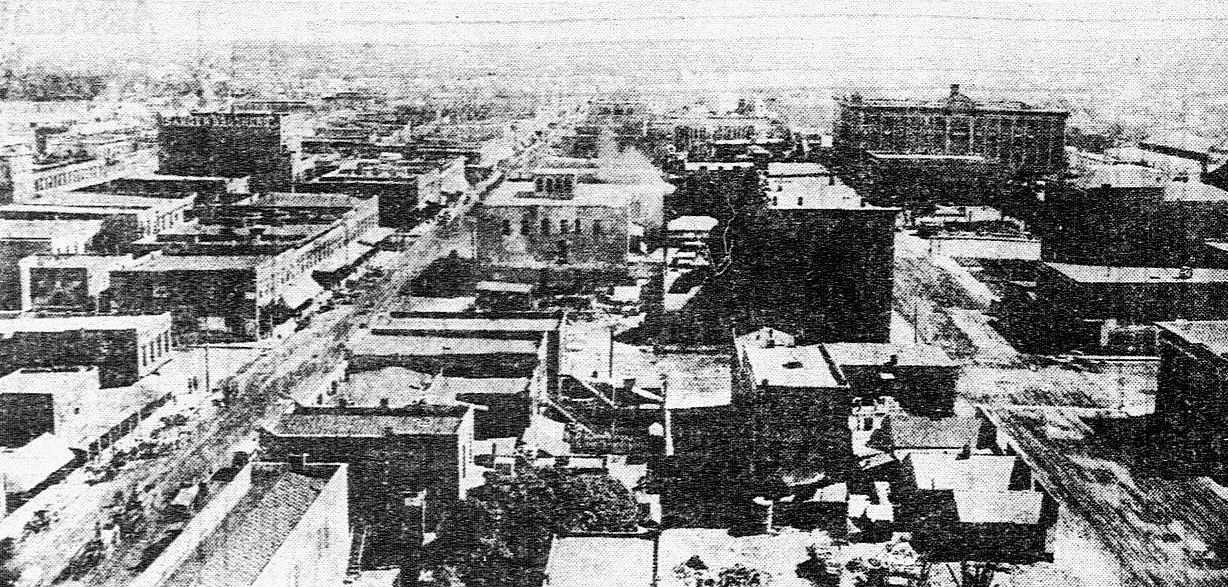
east-from-courthouse_1887Looking east from the courthouse, ca. 1887 (click for larger image)

by Paula Bosse

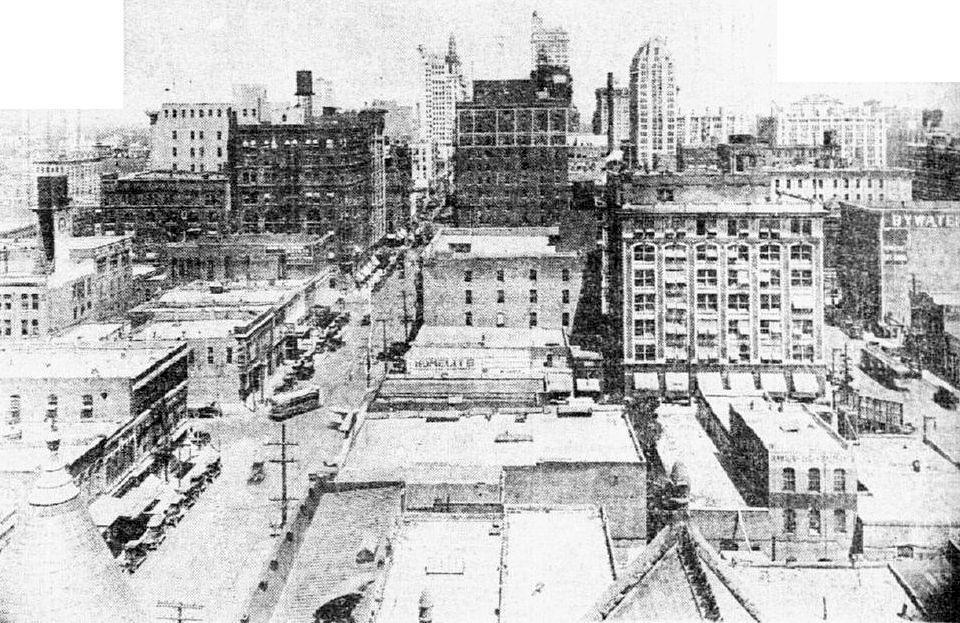
Above and below, the view of downtown Dallas looking east from the courthouse, with Main Street on the left and Commerce on the right. The top photo was taken about 1887 (the Grand Windsor hotel is the mammoth building in the top right corner), and the bottom one was taken about 1925. What a difference 38 years makes — the horizon has disappeared!

east-from-courthouse_1920s

***

Sources & Notes

Both photos appeared in The Dallas Morning News on Oct. 1, 1925. The caption reads: “[First photo]: View of Dallas looking east between Main and Commerce streets from the courthouse. It was taken about 1887. So far as known it is the only picture in existence which shows the Dallas Opera House at the southwest corner of Commerce and Austin streets. It also shows the old Grand Windsor Hotel. Note the vacant lots, and the unpaved condition of the streets and the horsedrawn vehicles on Main. [Second photo] This picture was made by H. B. Hillyer & Son.”

*

Copyright © 2014 Paula Bosse. All Rights Reserved.

“Dallas Skyline” by Ed Bearden — 1958

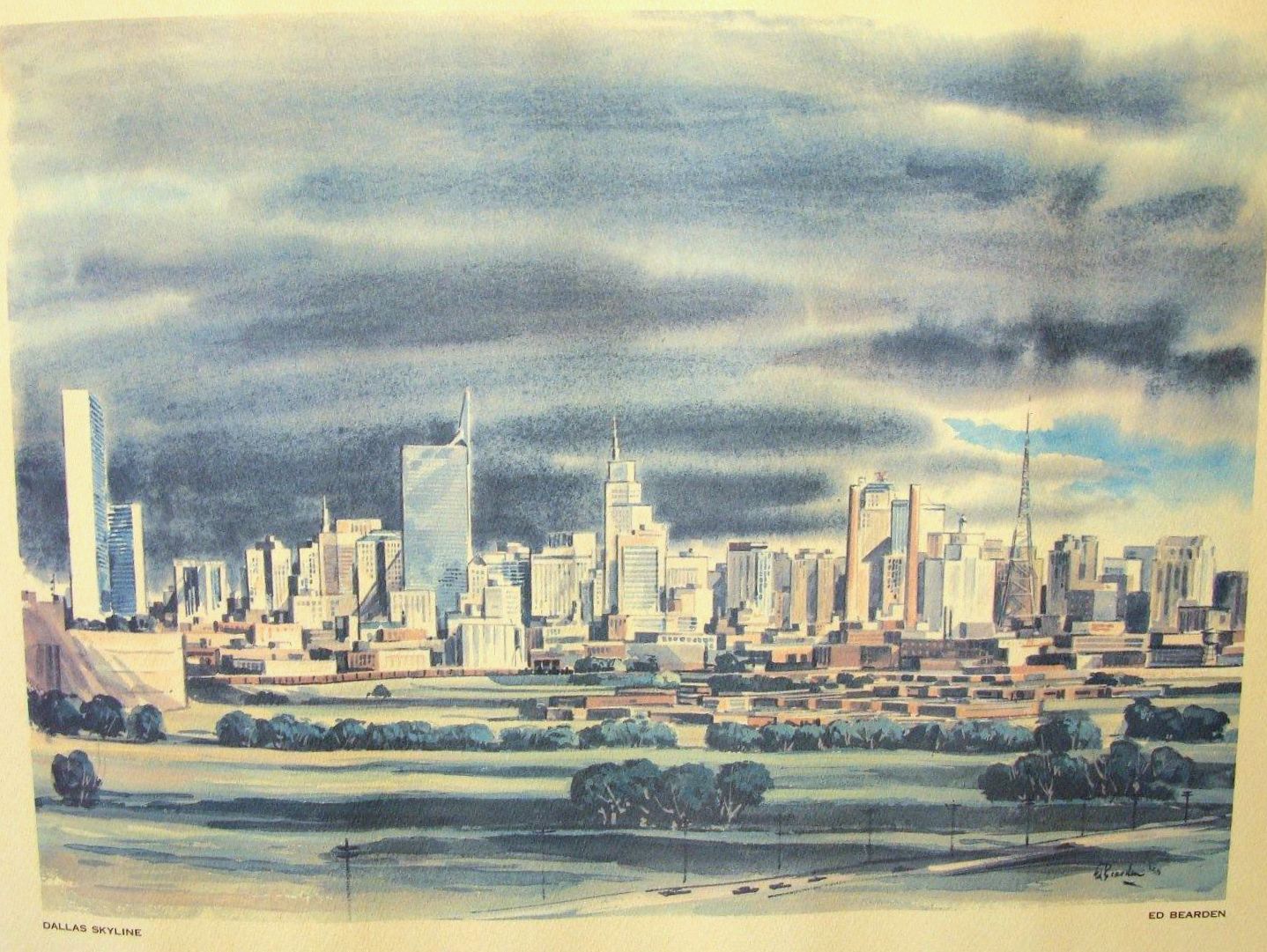
dallas-skyline_ed-bearden“Dallas Skyline” by Ed Bearden (click for much larger image)

by Paula Bosse

Ed Bearden (1919-1980) was a Dallas painter who studied under Jerry Bywaters and Otis Dozier and was loosely affiliated with the Dallas Nine group of artists. He worked with Bywaters at the Dallas Museum of Fine Art as Assistant Director, and he helped found the Dallas Museum for Contemporary Arts. He also spent several years at SMU — both as a student and as a member of the faculty — until he decided to leave to focus on his own art career. In addition to working as a fine artist, he also owned a commercial art business.

The constantly changing Dallas skyline was a particular favorite subject of his, and he returned to it again and again. The one above is a personal favorite. I’m not sure why I feel so nostalgic when I look at it, except that I swear that I saw this print as a child at my father’s bookstore. It’s a Dallas I’ve never known, but one I wish I had.

***

Apologies for the wonky image, but I can’t find a better scan of it. I’m assuming this was first a watercolor, then issued as a lithograph, then maybe printed as a broadside or a loose plate in a book? The date in the lower right corner is very difficult to make out — it looks like either 1958 or 1959. I’m going with 1958. ‘Cause I’m like that.

A brief biography of Ed Bearden can be found here.

An unlikely gig came Bearden’s way when director George Stevens asked him to draw the storyboards for the film Giant, hoping that having a Texas artist do them would lend an air of authenticity to the look and feel of the movie (and, in fact, Bearden’s sketches were used as reference by makeup and wardrobe personnel). Read more about this interesting assignment on SMU’s Hamon Arts Library site, and see some of Bearden’s sketches from the set in Marfa, here.

*

Copyright © 2014 Paula Bosse. All Rights Reserved.

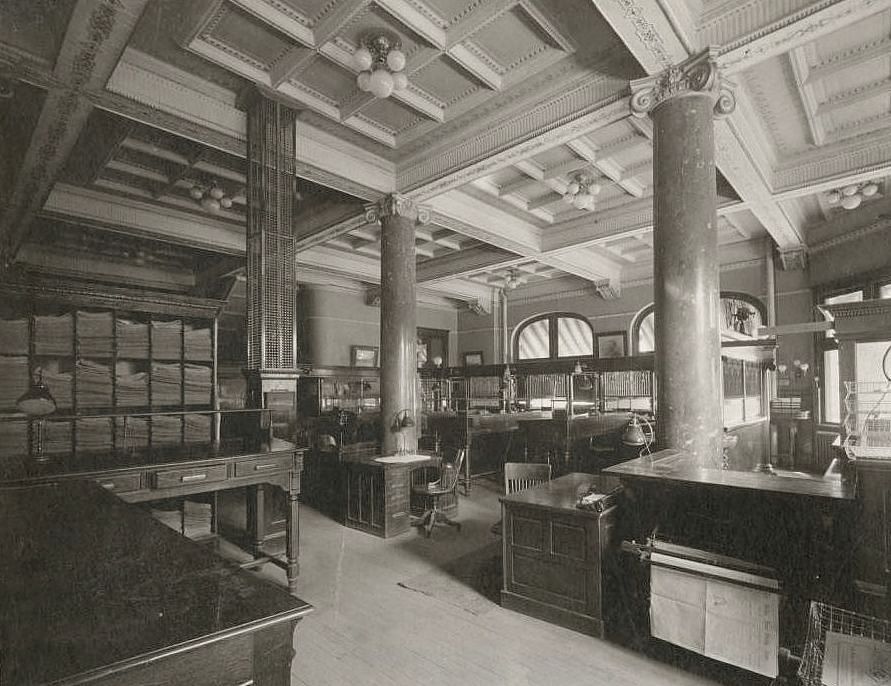
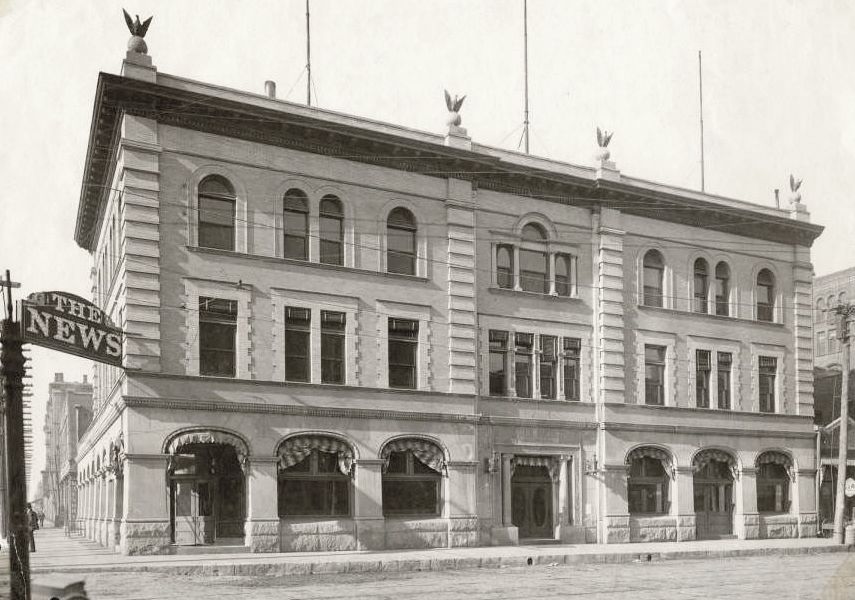
The Dallas Morning News Building, Inside and Out — ca. 1900

dmn_newsroom_c1903_degolyer_smuTurn-of-the-century DMN newsroom (click for larger image)

by Paula Bosse

Above: the empty (and almost sterile) “newsroom” of The Dallas Morning News, around 1903. There’s either a big fire somewhere, or news has taken the day off.

Below: the new Morning News building, about 1900. Located at the northwest corner of Commerce and Lamar, this is the Lamar side.

dmn_lamar-side_c1900_degolyer_smu

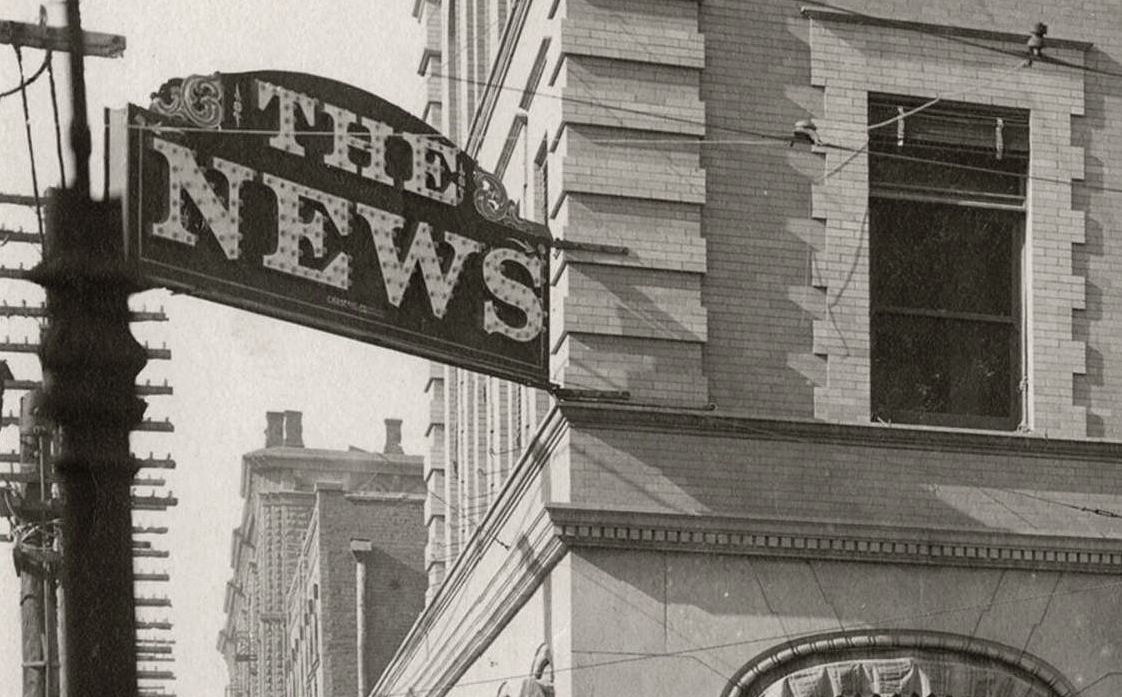
And the somewhat show-bizzy sign, studded with bulbs — one hopes it flashed at night.

dmn_lamar-side_c1900_degolyer-det1

***

Photo of the Dallas Morning News newsroom, circa 1903-1905, from the Belo Records collection, DeGolyer Library, Central University Libraries, Southern Methodist University; more info here.

Photo of the Dallas Morning News building (slightly cropped), circa 1900-1901, from the Belo Records collection, DeGolyer Library, Central University Libraries, Southern Methodist University. Original photo, along with additional information, can be found here.

See the other photos of the building from 1900 in these other posts:

  • “Loitering In Front of the Dallas Morning News Building — ca. 1900,” here
  • “Lively Street Life Outside the Dallas Morning News Building — ca. 1900,” here

All images larger when clicked.

*

Copyright © 2014 Paula Bosse. All Rights Reserved.

“A Cavalcade of Texas” — Dallas, Filmed in Technicolor, 1938

“A Cavalcade of Texas”

by Paula Bosse

(SCROLL DOWN TO WATCH THE FILM CLIPS.)

Brought to my attention last night in a Dallas history group was the heretofore unknown-to-me full-length, Hollywood-slick travelogue called “A Cavalcade of Texas,” shot around the state in 1938 under the auspices of Karl Hoblitzelle in his capacity as chairman of the Texas World’s Fair Commission. (Hoblitzelle also built the Majestic Theater and founded the Interstate Theatre chain.)

“A Cavalcade of Texas” — a 49-minute full-color travelogue touting the beauty, history, natural resources, and industries of the state — was made to be shown at the New York World’s Fair, but because of a variety of production and logistical problems, the film was, instead released theatrically. John Rosenfield, the legendary “amusements” critic for The Dallas Morning News, was suitably impressed. After an early preview of the film, he wrote:

The picture should be a revelation to the outlanders who still think of Texas as the backwoods with a hillbilly civilization. (DMN, June 27, 1939)

Ha.

The film opened in Dallas in October of 1939 at, unsurprisingly, The Majestic, second on a bill with a Ginger Rogers film (which was fitting, as Ginger had begun her professional career at The Majestic as a teenager). The pertinent paragraph from Rosenfield’s official review is amusingly snippy:

“Cavalcade” shoots the Houston skyline as a bristling metropolitan acreage but hides the Dallas buildings behind the towering Magnolia Building. Maybe we are sensitive about it but we don’t feel that architectural justice has been done. The Fort Worth aspect is glorified more than it deserves. (DMN, Oct. 15, 1939)

(Sorry, Fort Worth!)

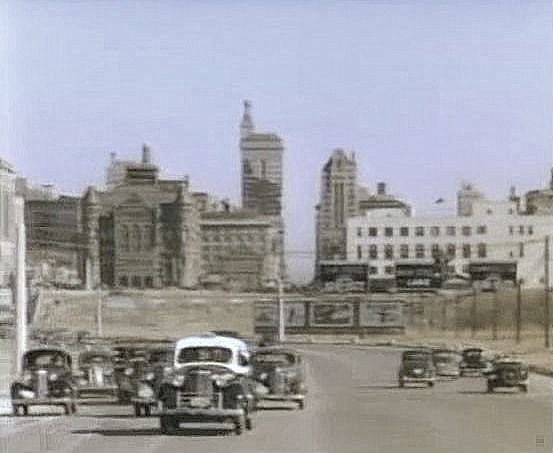
The Dallas scenes are only about 4 minutes’ worth of the whole film, but to see Dallas at this time in color — and moving — is kind of thrilling. The entire film is on YouTube, but I’ve bookmarked the two Dallas bits. First, after an interminable sequence on how fantastic things will be when we finally make that darn Trinity navigable, is a Dealey Plaza-less Triple Underpass, shots of Main Street (including the now partially obliterated 1600 block at the 17:52 mark, on the right), Fair Park (including a description of the Hall of State as “the Westminster Abbey of the New World” (!)), and a neon-lit Elm Street at night. (If you let it keep going, you’ll see “the Fort Worth aspect.”)

(I am having problems embedding this clip to begin at the 17:30 mark. If the above does not begin at the Dallas sequence, see it at YouTube, here.)

*

Twenty minutes later, the viewer is, for some reason, shown the Dallas Country Club with what I’m guessing are Neiman-Marcus models pretending to play golf.

(If the above does not begin at the Dallas Country Club sequence at 40:09, see it at YouTube, here.)

*

Those are just the Dallas bits — the whole film is an impressive undertaking, and it’s great to see documentary footage of this period in rich color, presented with incredibly high production values, in full Hollywood style.

cavalcade_101439_ad
Ad, Oct. 14, 1939 (click to see larger image)

***

Sources & Notes

“A Cavalcade of Texas” was directed, edited, and narrated by James A. Fitzpatrick and can be seen in full on YouTube, here.

Background on Karl Hoblitzelle can be read in information provided by the Handbook of Texas, here, and by the Dallas Public Library, here.

The wonderful and vibrant 1939 footage of downtown Dallas that was discovered on eBay a few months ago and “saved” by a group of preservation-minded Dallasites, which included Robert Wilonsky and Mark Doty, is one of my favorite Dallas-history-related stories of 2014. Watch that footage here.

*

Copyright © 2014 Paula Bosse. All Rights Reserved.

W. W. Orr: Buggies, Phaetons, Carriages — “Everything on Wheels!”

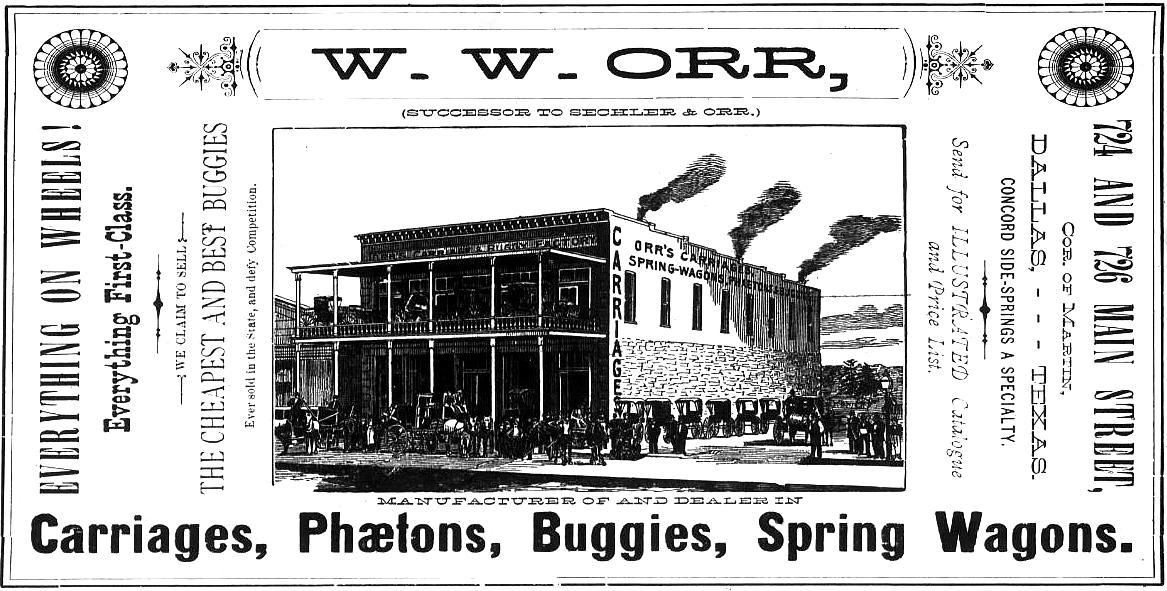
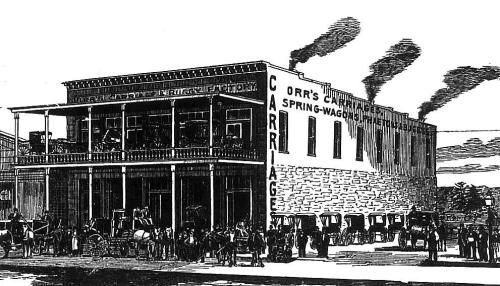
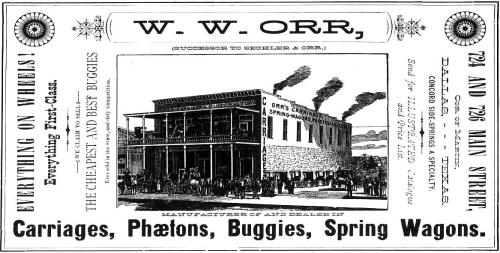
ad-orr-carriages_directory_1878-detW.W. Orr’s carriage business on Main St., 1878 (click for larger image)

by Paula Bosse

I came across the image above in the 1878 Dallas city directory, and my eye was immediately drawn to the novel open-air display of  buggies on the second floor of the building. I’ve never seen this before — the frontier version of the auto showroom!

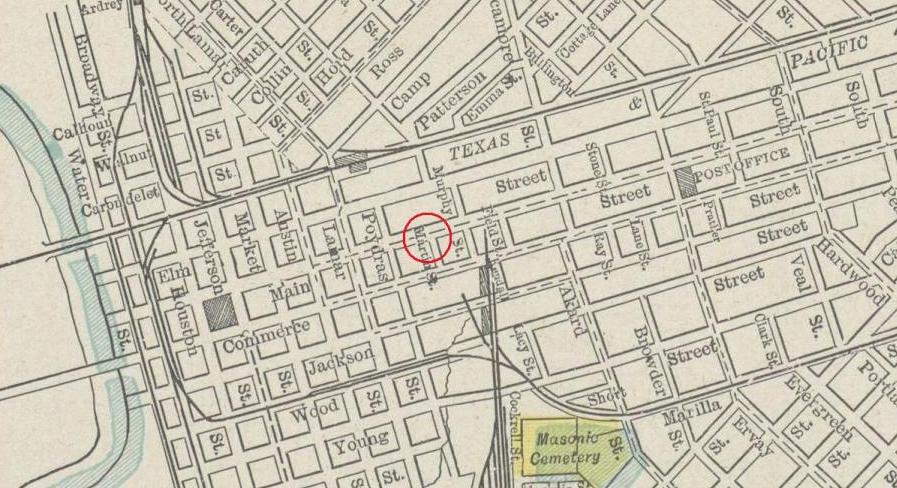
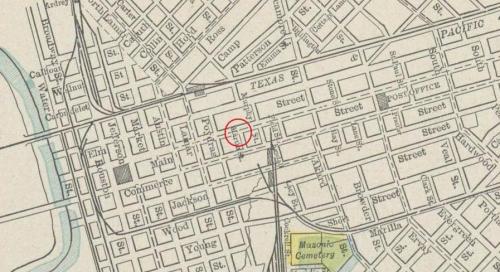
I hope this is a depiction of the actual shop owned by W. W. Orr at 724-726 Main Street (corner of Main and Martin — see map below) and not some sort of early augmented clip art. Orr ran a successful business selling buggies, phætons, and carriages, and he probably did have an imposing shop.

William Wallace Orr was born in Ohio, and after the Civil War he made his way to Texas, where he served for a short time as an East Texas postmaster before coming to Dallas where he and his wife, Amanda, operated a livery stable.
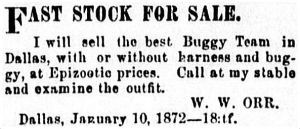
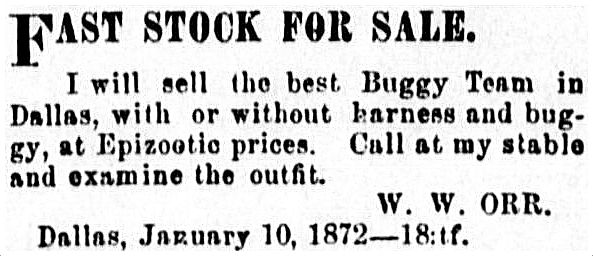
orr_dallas-herald_041973Dallas Herald, April 19, 1873

I’m not sure whether “epizootic” is used here as some sort of 19th-century tongue-in-cheek hard-sell advertising term (“His prices are INSANE!“) … or whether it means the horses have some sort of disease. I tend to think it’s the former.

The carriage business, which had started by 1878, is notable (to me, anyway) because it was housed in a building with a basement — I wasn’t aware that basements really existed in Dallas at the time. Orr rented out the basement beneath his “carriage repository” as a beer cellar. If TV westerns are anything to go on, drunken brawls in most drinking establishments of the time were to be expected. What might not be expected is an account of a bar fight to be reported like this:
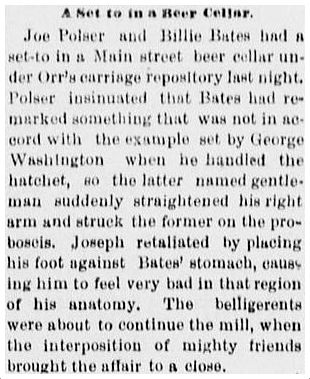
orr_cellar_dal-her_060278Dallas Herald, June 2, 1878

Regardless of what disreputable activities were going on in the cellar, it seems that Orr’s business of manufacturing and selling “everything on wheels” was a booming one.
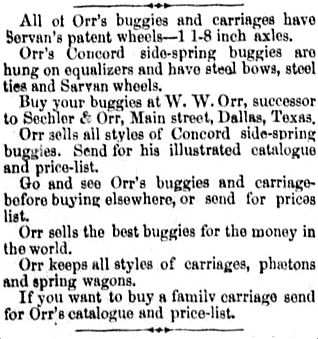
orr_dal-her_060380Dallas Herald, June 3, 1880

He had stylish conveyances, cheap prices, and good goods:
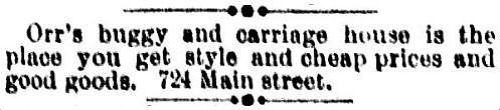
orr_dal-herald_081283Dallas Herald, Aug. 12, 1883

After the death of his wife in 1886 (she died of consumption at the early age of 42), Orr passed the business to his son. In poor health, he left Dallas for Mississippi, where he met a woman who nursed him back to health and whom he later married. After a few years of an apparently happy second marriage, W. W. Orr died in 1894. Cash savings, investments, and real estate holdings back in Dallas had left him a wealthy man, and, as might be expected, his family in Dallas was dismayed to learn that he had left his estate to his infant daughter in Mississippi. His three grown children from his first marriage were not happy, and they contested the will. (The case is covered exhaustively here. I think the baby daughter emerged victorious, but I’m not absolutely sure.)

It’s interesting that Orr and his first wife are buried side by side in Greenwood Cemetery. Amanda Melvine McQueen Orr has a large, ornate monument and headstone; W. W. has his name — and nothing else — carved into an unadorned marker. It would have been nice to have had a little a buggy in the corner. …Something.
orr-map_c1900

The location of Orr’s buggy and carriage house was at the corner of Main and Martin, shown above in a map from around 1900. (Click for larger image.)

And, below, is the full ad, with that incredible artwork! (Click it!)
ad-orr-carriages_directory_18781878

***

Sources & Notes

Illustrated ad from the 1878 Dallas city directory.

All other ads from The Dallas Herald, as noted.

Map is a detail from a map of Dallas, circa 1900, from the Portal to Texas History, here.

Amanda Orr’s headstone and memorial statuary can be seen in several photos here; W. W.’s sad unadorned slab can be seen here.

Phætons? They sound dangerous!

*

Copyright © 2014 Paula Bosse. All Rights Reserved.