Flashback : Dallas

A Miscellany: History, Ads, Pop Culture

Category: Downtown

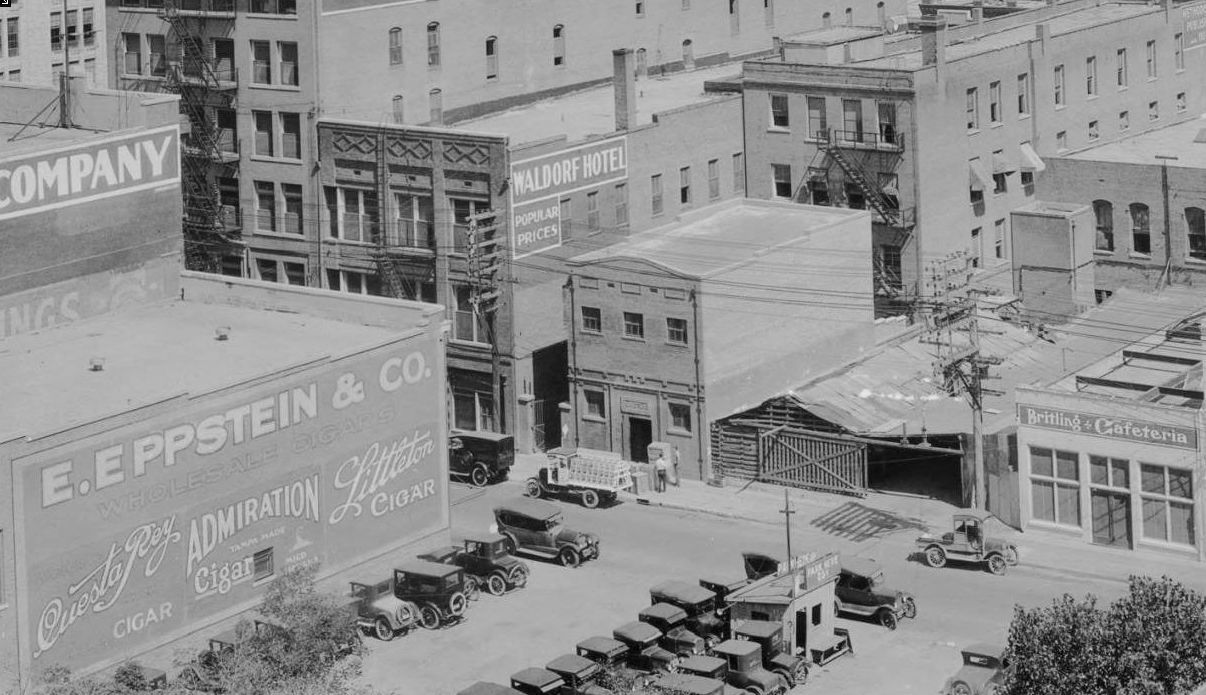
Downtown Dallas, ca. 1923 — Zooming in on the Details
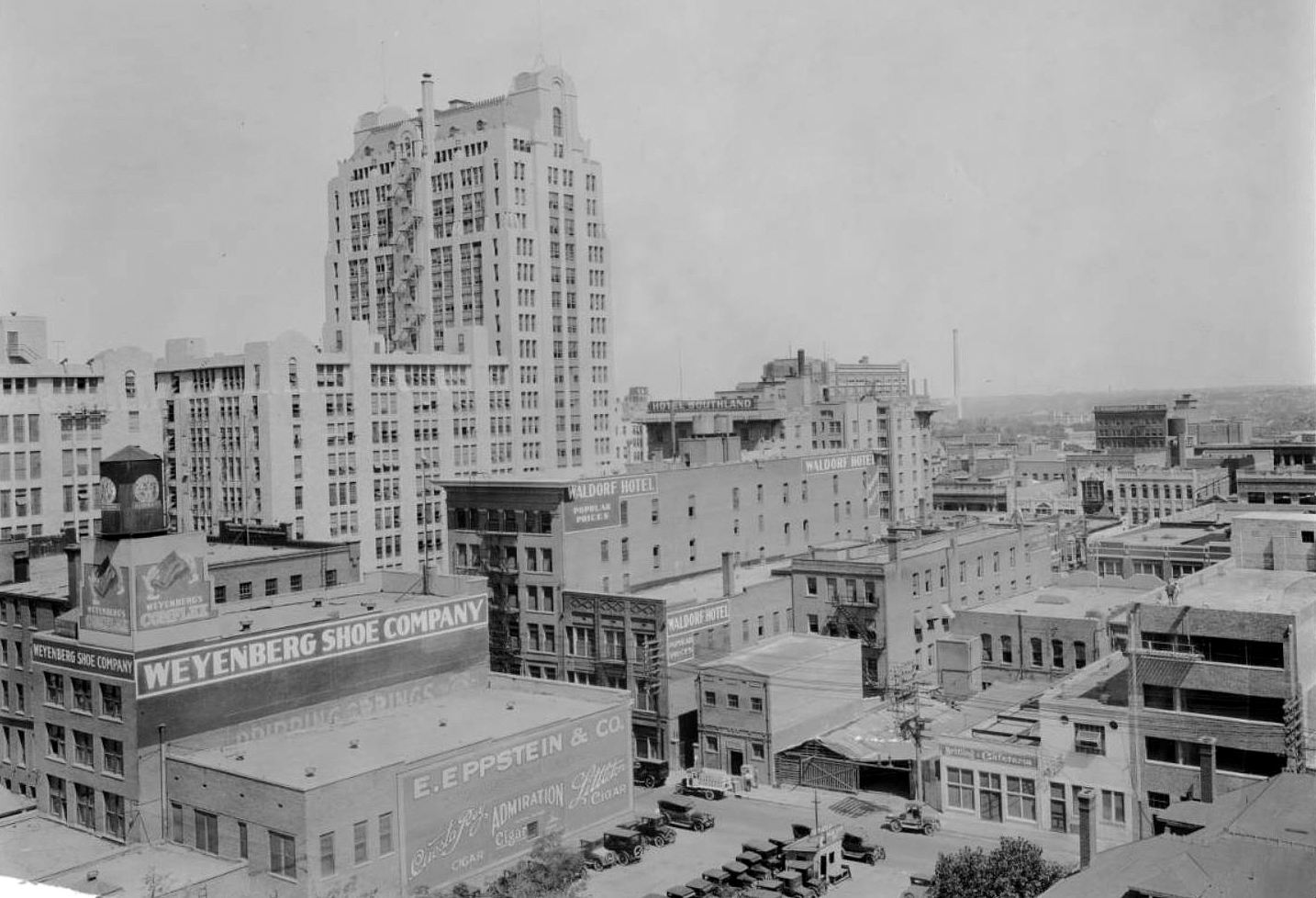
downtown-dallas_degolyer_smuThere’s a lot going on here (click for larger image) / Photo: SMU

by Paula Bosse

When I see photos like this I always want to zoom in as far as I can, to see the tiny details and everyday moments that might have been captured unwittingly by the photographer. Luckily, this photo has been scanned at such a high resolution (thank you, DeGolyer Library!) that it’s easy to zoom in and wander around it. (Click all of these pictures for much larger images.)

This particular photograph, from the DeGolyer Library at SMU, is attributed to Charles A. McAfee. The DeGolyer caption reads: “Downtown Dallas looking northwest at Santa Fe building complex (center left); Weyenberg Shoe Company at 1300-1302 Jackson; Waldorf Hotel, 1302 Commerce, and the Southland Hotel.” The Britling Cafeteria was at 1316 Commerce — its rear entrance on Jackson is visible in the photo. Here are a few more of the businesses in that 1300 block of Jackson Street, bounded by S. Field and S. Akard (from the 1923 city directory):

1923-directory_jackson-st

And it ALSO shows lots of signs and ads painted on the sides of buildings (some of which might still exist), two men standing on a roof surveying the skyline, a couple of guys talking on the sidewalk, a cafe next door to something that might be a crude garage, cars in a lot where it costs 25 cents to park, and a cool water tower on top of a shoe company. All of which add up to make this a much more interesting and lively photograph than originally presumed.
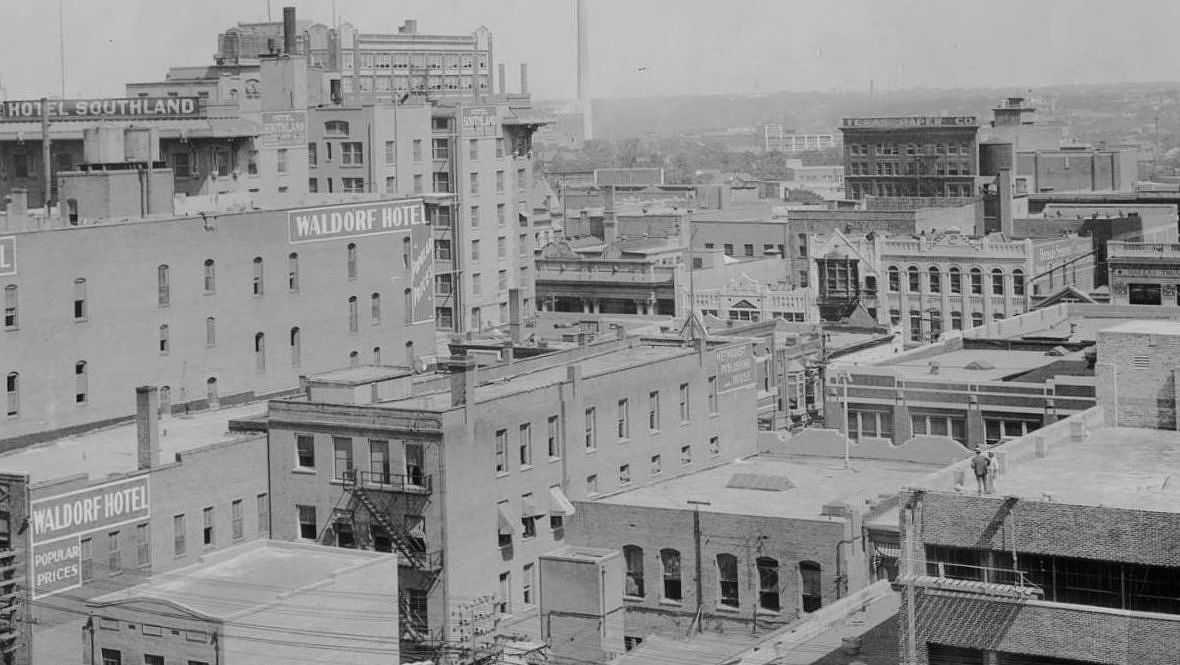
downtown_degolyer-b

downtown_degolyer-c

downtown_degolyer-d

downtown_degolyer-e

downtown_degolyer-f

***

Photograph of downtown Dallas attributed to Charles A. McAfee; from the DeGolyer Library, Central University Libraries, Southern Methodist University; access it here. I’ve corrected the color.

Trying to pin a date down (SMU has it as “circa 1920”), I’m guessing the photograph might have been taken around 1923, as the Britling Cafeteria opened for business on November 28, 1922. (I was so interested in that cafeteria that I wrote about it: read the Flashback Dallas post “The Britling Cafeteria Serves Those Who Serve Themselves,” here.)

For other photos I’ve zoomed in on to see the details, see here.

Click photos for much larger images.

*

Copyright © 2014 Paula Bosse. All Rights Reserved.
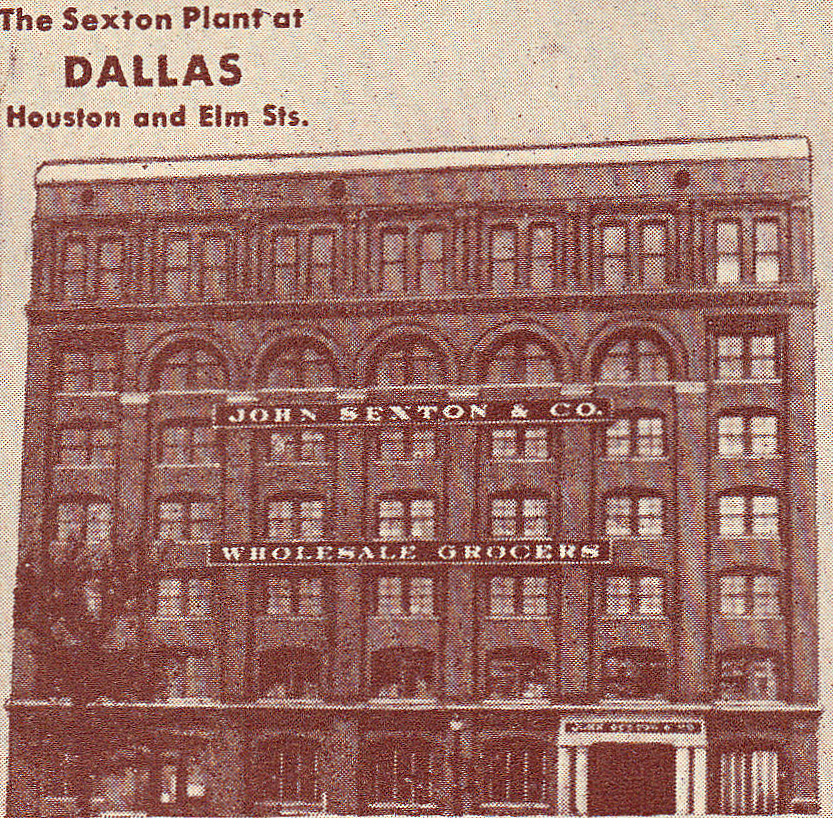
The Sexton Foods Building and the Former Life of the School Book Depository

sexton_croppedLook familiar? (click for larger images)

by Paula Bosse

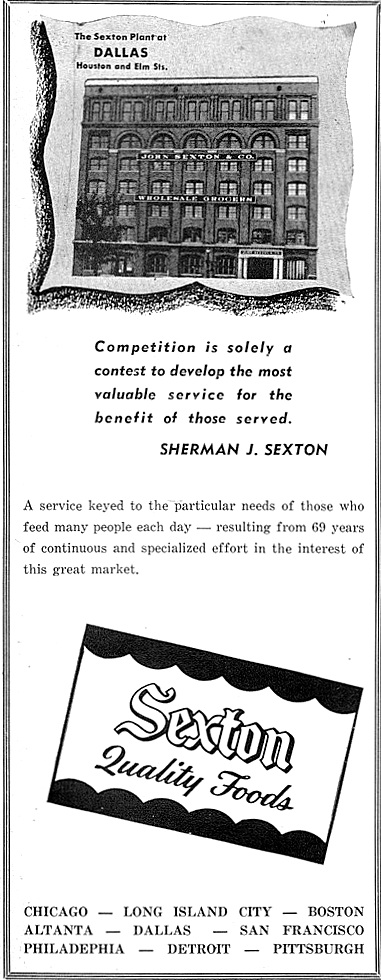
Look familiar? The building above would later become the Texas School Book Depository. But prior to that, the building housed Sexton Foods, a Chicago-based wholesale grocer which occupied the building for twenty years (1941-1961). The building was known commonly in town as “the Sexton building,” even after it was leased to the Texas School Book Depository in 1963, which explains why some people — citizens and police officers alike — were still referring to it by that name on the day of the Kennedy assassination (and this has apparently caused confusion amongst those wading deep into the “assassination literature”). The photo above is cropped from an ad I came across in The Dude Wrangler, a dude ranch quarterly (!), published in Bandera. The ad (which is reproduced in full down the page a bit) is from 1953, but the photo of the building appears to have been taken earlier.

The leasing of the building by D. Harold Byrd to the John Sexton Wholesale Grocery Company of Chicago (initially for only five years) was announced in The Dallas Morning News on Nov. 28, 1940 (“Wholesale Grocery Leases Building at Houston and Elm”). The Sexton Co. was scheduled to move in on Dec. 8 “following a general remodeling which will include installation of elevators, rearranging of partitions and painting.” They remained in the building until 1961.

sexton_19511951

sexton_foods_dallas_19531953

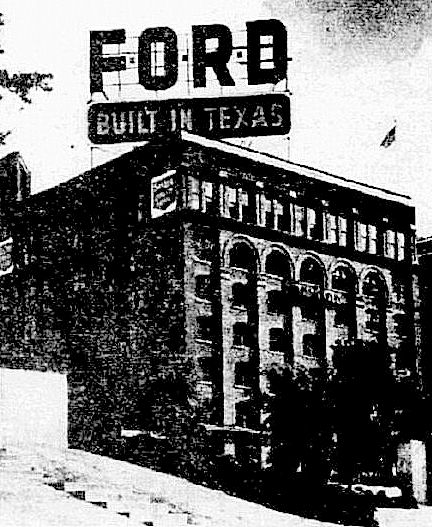
In 1953 (before anyone from Hertz was planning on putting a billboard up there), the Ford people erected a giant neon sign on top of the building to commemorate the 50th anniversary of the founding of the Ford Motor Company. In fact, it was so big that it had half a mile of neon tubing in it and was touted as being the largest animated neon sign in the Southwest. Now there’s a sign that probably caused a few car accidents!

sexton-bldg_ford-sign_1953
1953

*

Before the Sexton company moved in, the building housed the Perfection-Aire air-conditioning  company. Newspaper articles announced the renovation of the building for the A/C people — the company went into receivership a couple of years later.

perfection-aire_dmn_0314371937

*

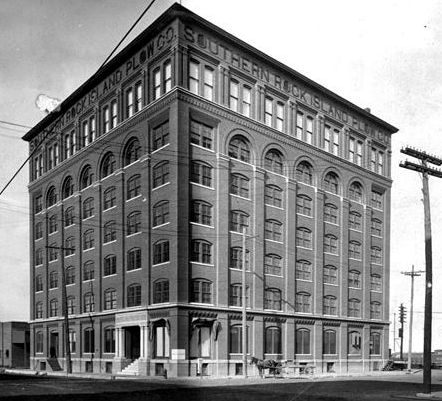
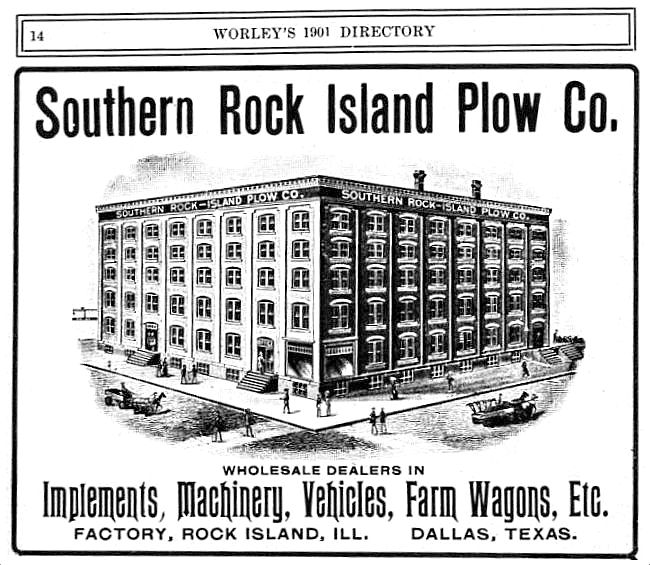
Before that, it was the site of the Southern Rock Island Plow Co., which was the original owner of the property (1894) and which built the building in 1903 after the first building was destroyed in a fire after it was hit by lightning on May 4, 1901.

rock-island-plow_DMN-c1910circa 1910

Above, the Southern Rock Island Plow Co. Building which still stands, famous as the “Texas School Book Depository”; below, the building originally built by the plow company which was destroyed by fire  in May, 1901.

southern-rock-island-plow_1901_pre-current-bldg_1901-directory1901, Dallas city directory

***

Sources & Notes

Sexton Co. ad from a 1953 issue of The Dude Wrangler ; the top image is a detail from that ad.

More on the history of the building as it pertains to the Rock Island Plow Co. is here.

More on the Sexton Foods Co. is here.

More info, specifically on the Texas School Book Depository, is here.

Official site of the current occupant, the Sixth Floor Museum, is here.

*

Copyright © 2014 Paula Bosse. All Rights Reserved.


Downtown Horse-Trading — ca. 1912

by Paula Bosse

This fantastic photo — taken between about 1912 and 1915 — shows a horse-trading day, taking place around S. Houston and Jackson streets.

Chenoweth’s Feed Store and wagon yard at Houston and Commerce was the scene of monthly trades days or First Mondays from the 1880s into the twentieth century. The crowd spilled over into the streets, blocking passage but no one complained. The old red courthouse survived.

***

Photo from the UT Southwestern Library.

Caption by A. C. Greene from his book Dallas, The Deciding Years (Austin: Encino Press, 1973).

Even though it seems very late to see horses in downtown Dallas, this photo appears to have been taken between 1912 and 1915 when Charles B. Tatum owned a saloon at the corner of Commerce and S. Houston (his sign can be seen painted on the wall facing Houston Street at the left). The MKT Building can be seen at the top right of the photo, indicating that this photo was taken west of S. Houston, almost to Jackson (the old county jail would have been behind the photographer. The same view today can be seen here.

The wagon yard Greene mentions can be seen in the 1905 Sanborn map, here.

Click photo for larger image.

*

Copyright © 2014 Paula Bosse. All Rights Reserved.

Joe Yee Cafe: The Best Chop Suey in Town

joe-yee-cafe-extChop suey *and* famous chicken house…

by Paula Bosse

I came across the above image and was enthralled. I’ve never heard of the Joe Yee Cafe, but this (granted) idealized picture is wonderful. The postcards above and below were from the early 1950s, and if you are familiar with the generally run-down neighborhood around Columbia and Fitzhugh these days, you may well shed a tear that something this charming and picturesque has been gone for many, many years.

joe-yee-cafe-interior

I love the surprising color scheme of the restaurant’s interior — those fabulous purples and greens! (The colors are a bit unexpected because they so loudly clash with the bold tomato red of the exterior.)

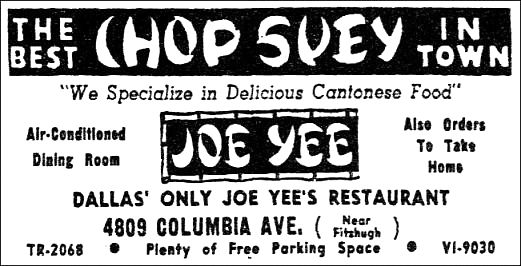
I did a little research to see what I could find out about Joe Yee’s Chinese restaurant. Seems that Mr. Yee’s cafe was in business by the 1930s, downtown, on Main Street near Field. It advertised steadily over the years, and its ads proudly proclaimed that the restaurant served “the best Chinese food you ever tasted” and was “completely air-conditioned.” Several newspaper accounts (particularly the society columns) mentioned it as a popular place for young people to grab a bite before and after dances at nearby downtown hotels. Business must have been pretty good for the place to have lasted so long at such a primo location. The cafe moved to the Columbia Street location in 1950 where it remained in business until at least late 1956 when a major fire struck.

joe-yee-cafe_matchbk

1938-joe-yee_dmn_1125381938

1943-joe-yee_dmn_0812431943

1953-joe-yee_dmn_0830531953

***

Sources & Notes

Top two early-’50s postcards are from the great Boston Public Library Tichnor Brothers Postcard Collection on Flickr, here.

In old photos of downtown Dallas one often sees “Chop Suey” signs along the streets. I’d love to know more about these restaurants in general, and about Chinese and Chinese-Americans in Dallas in the first half of the 20th century, if anyone can point me to a good source.

If background on Chop Suey is needed, might I point you to to the Wikipedia entry here, or the Snopes entry here.

*

Copyright © 2014 Paula Bosse. All Rights Reserved.


Sheraton Dallas, Original Version — 1959

Sheraton Hotel front

sheraton_hotel_back

by Paula Bosse

I love this somewhat fauvist depiction of Dallas in 1959 — it’s exactly what I wish the city actually looked like, yellow sky and all. All those clean, sharp lines and wide-open sidewalks! The foreshortening is completely out of whack here, with enormous cars and ant-size people — perhaps it’s a metaphor for the dismissive Texan view on pedestrian transport. (What are the two flags to right of the Texas flag?)

***

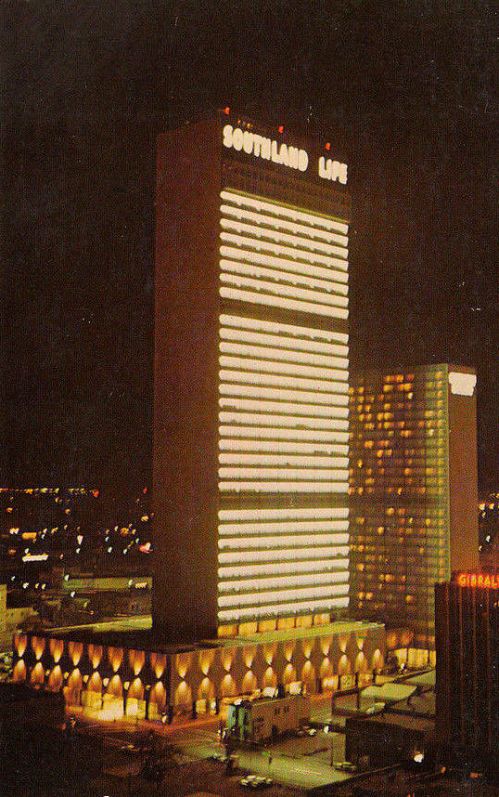
My knowledge of certain aspects of Dallas can be surprisingly spotty sometimes. I’ve seen the Sheraton building all my life, but I knew nothing of its history, or its connection to the Southland Life company (both were part of a complex of buildings, which, during construction, was being compared to Rockefeller Center). The inevitable Wikipedia page is here.

What the heck — here’s another angle: the mighty Southland Life building taking center stage this time, with the Sheraton standing in the wings, spear in hand, waiting to go back on.

southland-life_night

*

Copyright © 2014 Paula Bosse. All Rights Reserved.

Dallas Skyline by E. M. “Buck” Schiwetz — 1961

13DPL_schiwetz-drawing.jpg

by Paula Bosse

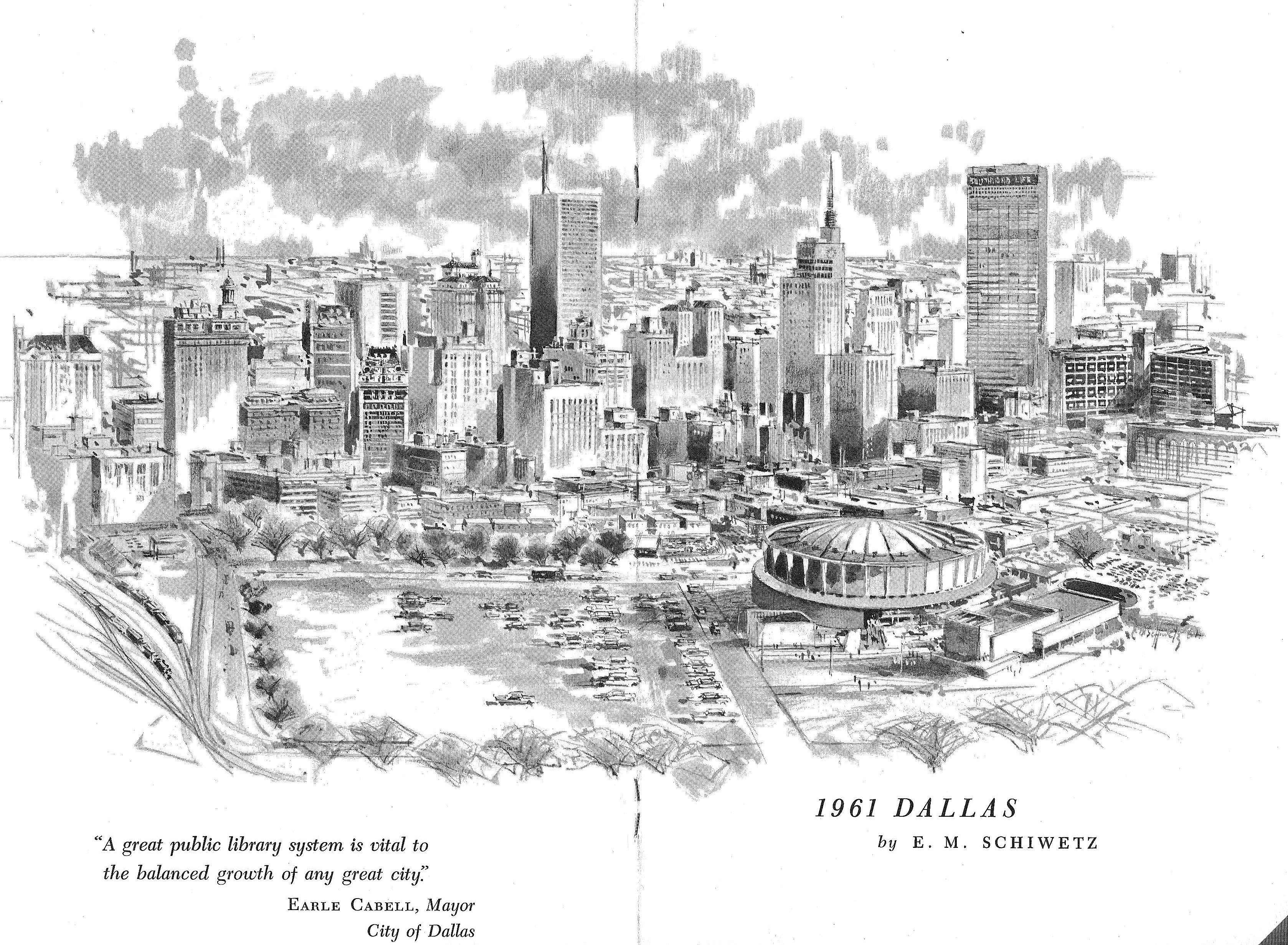
This drawing reminds me of those wonderful telephone book covers (the ones with all the hidden jokes and intricate details) that I used to pore over as a child. (By the way, when clicked, this image is absolutely HUMONGOUS. )

***

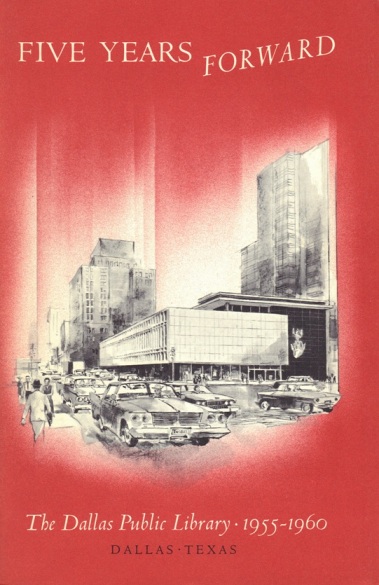
From the booklet Five Years Forward: The Dallas Public Library, 1955-1960 (more of which can be accessed here).

*

Copyright © 2014 Paula Bosse. All Rights Reserved.

George Dahl’s Sleek Downtown Library — 1955

1DPL_cover-sm

by Paula Bosse

This little 31-page booklet was issued to commemorate the fifth anniversary of the Dallas Public Library. The library was built on the site of the old (beautiful!) Carnegie Library and was vacated when the current library (the J. Erik Jonssen Central Library) opened on Young St. in 1982. Unbelievably, the building has remained empty for over 30 years.

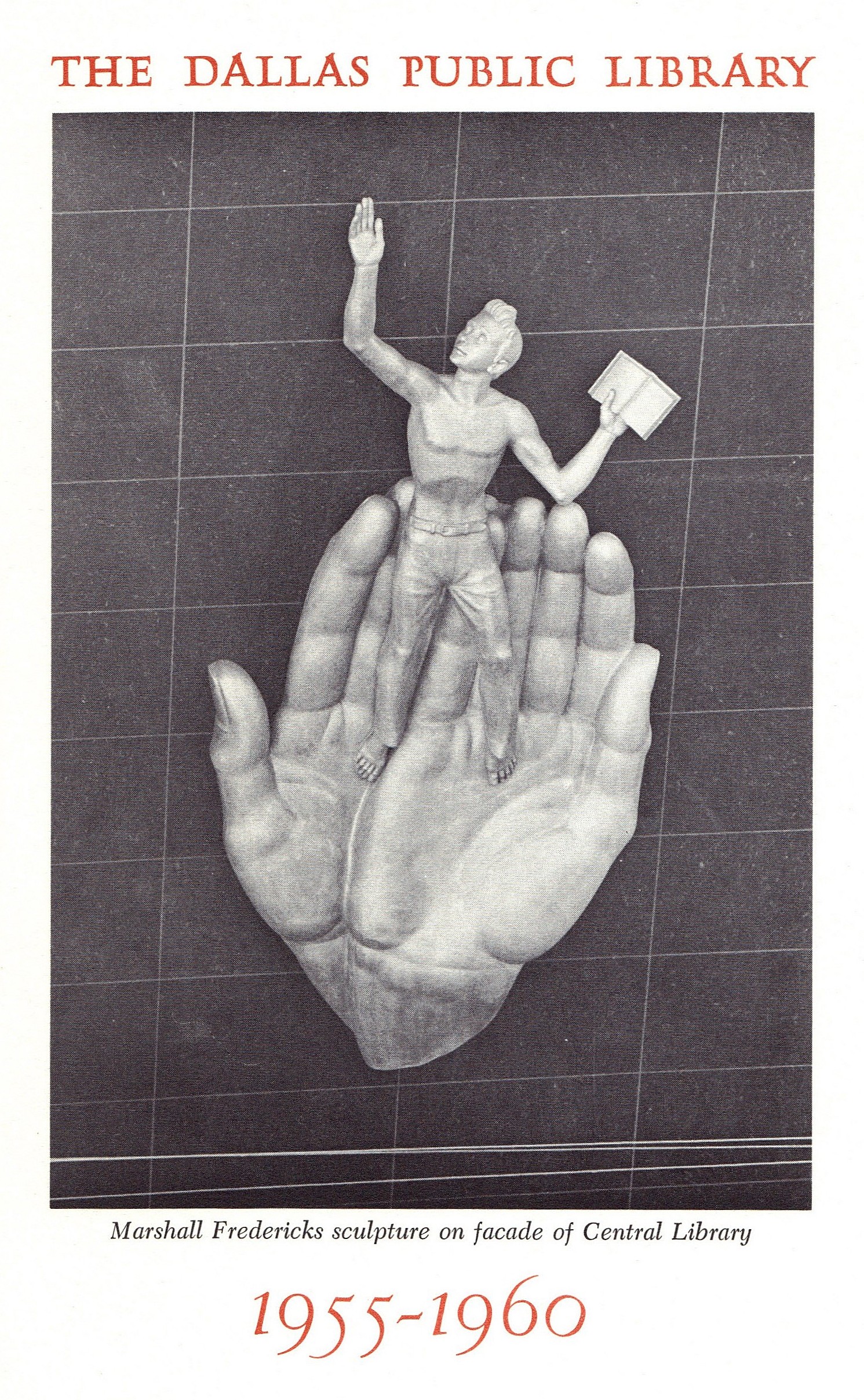
This is the only downtown building I have very distinct memories of from childhood. My mother took us to the library often, and I LOVED that place. I loved the building, the space, the books, the adventure of being downtown — I loved everything but that creepy sculpture of the kid standing in the hands that hung on the outside of the building!

This great library was designed by the legendary (and prolific!) Dallas architect, George Dahl. He moved easily from the streamlined grandeur of the Art Deco buildings of Fair Park to the sleek mid-century-modern-cool of this wonderful downtown library.

2DPL_hands-sculpture
I know there are fans of this sculpture (“Youth in the Hands of God” by Marshall Fredericks), but I’m afraid I am not one of them. I loved art as a child (in fact, I can remember checking out framed art reproductions from this very library), but, as I said, even as a kid, I strongly disliked that creepy sculpture. The kid was fine, it was those giant disembodied hands. When the library moved to its current location in 1982, this sculpture was left behind to languish for years inside the empty building. It was eventually sold, and the boy and the hands are now resting comfortably in retirement, somewhere in Michigan.

3DPL_lobbybertoiaThere was a huge controversy about the Harry Bertoia sculptural screen seen above, hanging over the circulation desk. (I LOVED this piece as a kid!) The mayor — R. L. Thornton — HATED it, and the brouhaha-loving newspapers launched themselves into the fray by running apoplectic editorials which, of course, only fanned the flames of outrage. After the “scandal” died down, the art was eventually given the okay to stay, but not before a lot of people made a lot of noise about how the city of Dallas had wasted the $8,500 it had spent on the commission. Unlike the discarded hands sculpture, the screen was moved to the new library, where it remains today.

4DPL_outdoorterrace

5DPL_familylivingThis is how I remember the library. Lots of space, cool furniture, and flooded with light.

6DPL_children

7DPL_av

8DPL_globe

9DPL_planningcomm

10DPL_checkingoutI LOVE this photo!

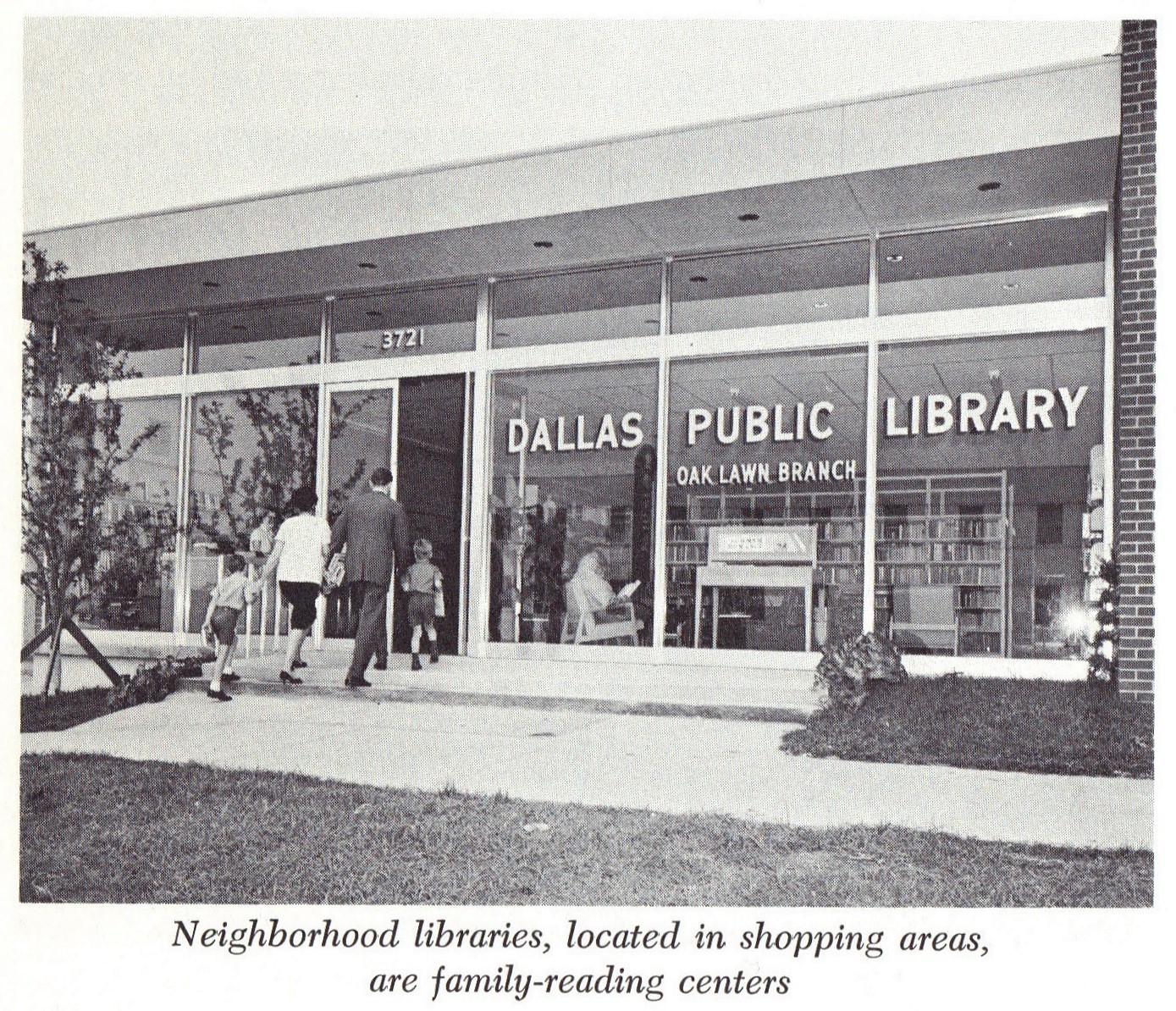
11DPL_oaklawnbranch

12DPL_teens

14DPL_schiwetzcropA detail of the front cover artwork, by Texas artist E. M. “Buck” Schiwetz. I love the driver in the cowboy hat (he must have been awfully small or that car must have been awfully big to accommodate that hat). The energetic frisson of downtown Dallas in the Mad Men era is dampened a bit by those damn hands on the building that seemed to follow you everywhere you went!

***

Sources & Notes

All images from the booklet Five Years Forward: The Dallas Public Library, 1955-1960, compiled and written by Lillian Moore Bradshaw and Marvin Stone. Drawings by E. M. (Buck) Schiwetz. Photographs by C. D. Bayne. (Dallas: Carl Hertzog for Friends of the Dallas Public Library, 1961). (Photos from the archives of the Dallas Public Library.)

More on the history and construction of the Old Dallas Central Library (as well as tidbits about the ridiculous controversy regarding the commissioned art) is here.

Even MORE on the artwork scandals (the hands, the hands, the HANDS!) as well as photos of the beautiful Carnegie Library that was razed to build the 1955 library can be found here.

And just because it’s weird, here’s a postcard showing an early, possibly even creepier depiction of the “hands” sculpture (if those are the “hands of God”…). I guess they wanted to get a postcard out before the sculpture was finished and installed.

dallas-public-library_dahl_postcard

I’ve posted one further image from this booklet — a drawing of the 1961 Dallas skyline by E. M. “Buck” Schiwetz  — here.

UPDATE — Dec., 2017: The Dallas Morning News has moved its operations to the long-vacant library, insuring this wonderful building’s continued existence for many more years! More here.

Click pictures for larger images (some are MUCH larger — click twice!).

*

Copyright © 2014 Paula Bosse. All Rights Reserved.


Protected: Never Tell an Irate Irishman That He Can’t Paint a Green Stripe Down Main Street — 1960

This content is password-protected. To view it, please enter the password below.

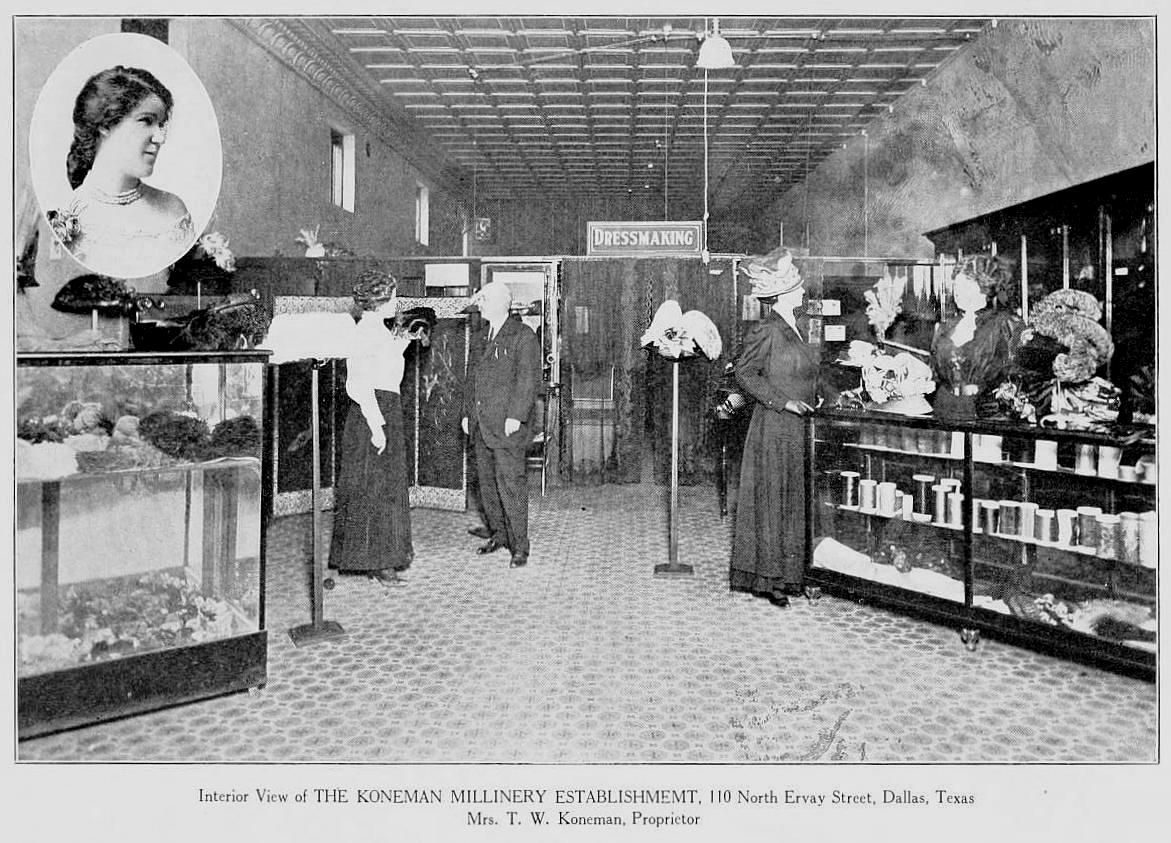
Mme. Koneman, High-Class Milliner

Madame Koneman’s fashion emporium, 1912 (click for larger image)

by Paula Bosse

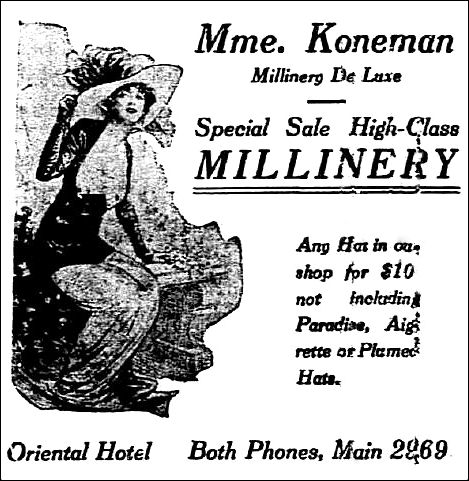
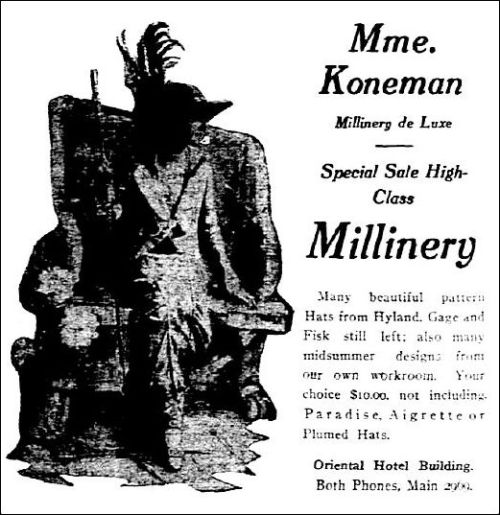
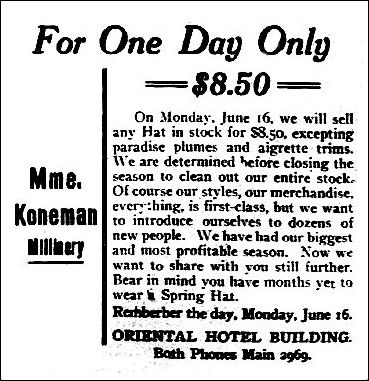
Behold, the Koneman Millinery Establishment, which actually looks a little plain for a millinery shop housed in the ornate Oriental Hotel building. When I see old ads or photos like this, I always wonder about the people pictured in them. I’m assuming that the woman in the oval inset at the left was the proprietess, “Mme. Koneman.” So who WAS she, this woman who had a “high-class” business that catered to a “high-class” clientele? I poked around a little and found these ads from 1913.

koneman-millinery_dmn_060113

koneman-millinery_dmn_060813

koneman-millinery_dmn_061413

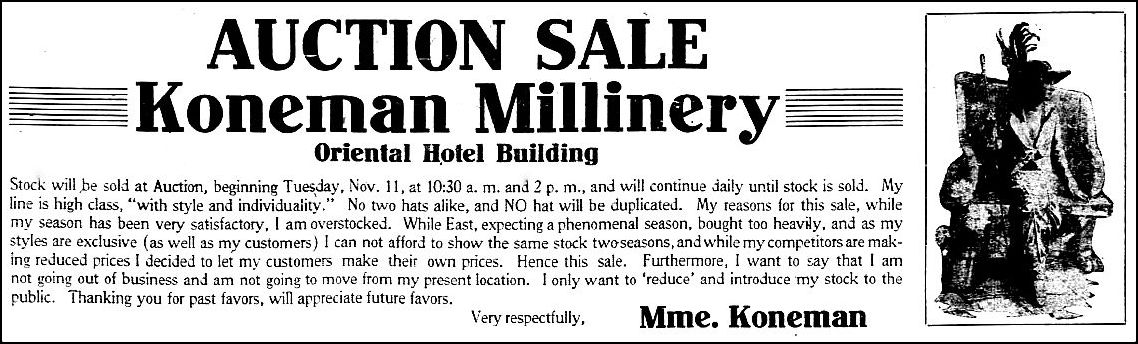
koneman-millinery_dmn_110913(click for larger image)

Ooh. Those last few sentences of the above ad seem a little defensive, as if she’s addressing nasty gossip. “Furthermore, I want to say that I am not going out of business.” When you see a sentence like that — in an advertisement — that sends up some furiously waving red flags. And … just one month after that ad, this miniscule tidbit in teeny-tiny letters appeared in the paper at the end of 1913:

Dallas Morning News, Dec. 21, 1913

Oh dear. D-I-V-O-R-C-E. And, guess what? There were no more ads for the millinery shop.

But, alarmingly, THIS appeared on the wire services on February 17, 1917:

Fort Worth Star-Telegram, Feb. 17, 1917

Oh DEAR! Shot by a widower with two children, who tried to kill both her and himself after he flew into a jealous rage in a New Orleans hotel lobby. Working with feathers and plumes and felt and velvet (probably) does not prepare one for being shot at!

Ten days after being shot, it was reported that the 36-year old Mrs. Koneman (whose first name was either “Matilda” or “Mathilda”) was released from the hospital in New Orleans. The jealous suitor, 40-year old Edgar J. Hargrave (or “Hargrove”), remained in the hospital, slowly recovering (but with a bullet still lodged in his head!). “Policemen expect to arrest Hargrave on a charge of shooting with intent to murder as soon as he is able to leave the institution.” He was an “oil salesman” from Houston.

One week later, Hargrave/Hargrove was released from the hospital and was transferred to Parish Prison where he awaited arraignment on attempted murder. Meanwhile, Matilda/Mathilda, a material witness in the case, had been arrested when the D.A. heard she was about to leave town. Out on a $650 bond, she was ordered to stay in the city until the arraignment.

On March 16, one month after being shot in the lobby of the Grunewald Hotel, Mrs. Koneman was in court recounting her near-death experience, and I’m sure the people back in Dallas were eating up every last morsel in the scandalous testimony about the spurned lover who tried to kill the divorcée who used to sell them great big hats with aigrette plumes in that bleakly unadorned hat shop over on Ervay!

koneman-testifies_dmn_031617-smDMN, March 16, 1917 (click for larger image)

(UPDATE: A reader kindly forwarded me a more detailed account of the shooting incident between the spurner and the spurnee, in a longer article from the New Orleans Times-Picayune (Feb. 17, 1917). Click here to read the article, with a blurry photo of Hargrave.)

And then — rather anticlimactically — the trail ran cold. What was the verdict? What happened to Edgar? Whither Mme. Koneman? Mrs. Koneman was reported to be living in Galveston at the time of the shooting, but by the summer of 1922 she was back in Dallas, checked into the Southland Hotel. The last shred of info I found about her was this classified ad from June, 1922, which raises even more questions.

DMN, June 15, 1922

I’m not really sure what this was all about, but it’s safe to say there would have been very few lags in the conversation between Dallas and California!

***

Top ad from The Standard Blue Book of Dallas, 1912-1914 (Dallas: A. J. Peeler & Co.).

“Dallas Woman Shot” article from the Fort Worth Star-Telegram, Feb. 17, 1917. This was a wire service story that was printed around the country, but, oddly enough, the news doesn’t seem to have made its way into the DMN until ten days after the shooting!

All other ads and articles from the Dallas Morning News. The Koneman Millinery ads were from 1913.

*

Copyright © 2014 Paula Bosse. All Rights Reserved.

Mardi Gras Parade in Dallas — ca. 1876/1877

mardi-gras_c1870s_degolyerMain St. looking east from Austin (click for larger image)

by Paula Bosse

What was happening downtown on this day, about 140 years ago? Mardi Gras, Dallas-style! Let’s wander around this parade photo, taken by Alfred Freeman. (Click photos to see larger images.)

mardi-gras_c1870s-det1This kid has a great, unobstructed second-story view of the parade below.

mardi-gras_c1870s-det2No glitz, no beads, no flashing.

mardi-gras_c1870s-det5Every time I look at the original photograph, my eye always goes to this woman.

mardi-gras_c1870s-det3Okay, that kid’s view is nothing compared to these guys who’ve scaled the Dallas Herald building.

mardi-gras_c1870s-det4In information about the 1876 parade, the Feb. 24, 1876 edition of The Dallas Herald advised: “To prevent accidents, owners of buildings having varandas [sic] will permit no one to stand on them, unless the same have been sufficiently strengthened.” I don’t know … some of those “varandas” look pretty shaky.

And down Main Street they go.

***

This is a stereograph photo by Alfred Freeman, from the Lawrence T. Jones III Texas Photographs Collection, DeGolyer Library, Central University Libraries, Southern Methodist University; it can be viewed here. (I have manipulated the color.) SMU has the photo as being “ca. 1870,” but the first Mardi Gras parade in Dallas wasn’t held until 1876. The view shows Main Street looking east, apparently taken from the roof of the Reed & Lathrop building on the northeast corner of Main and Austin.

UPDATE: This might be a photograph of the Mardi Gras celebration held in Dallas on February 24 (a Thursday…), in 1876. This was the first such celebration held in the city, and it was a massive undertaking, attracting more than 20,000 spectators. For weeks after the event, Alfred Freeman was advertising his Mardi Gras photographs with the following text: “Freeman, the artist, has nine different views of the Mardi Gras procession, for sale.”

mardi-gras_c1870s_freeman

Read about the first Mardi Gras parade in Dallas in the Flashback Dallas post “Mardi Gras: ‘Our First Attempt at a Carnival Fete’ — 1897,” here.

Click pictures for larger images.

*

Copyright © 2014 Paula Bosse. All Rights Reserved.