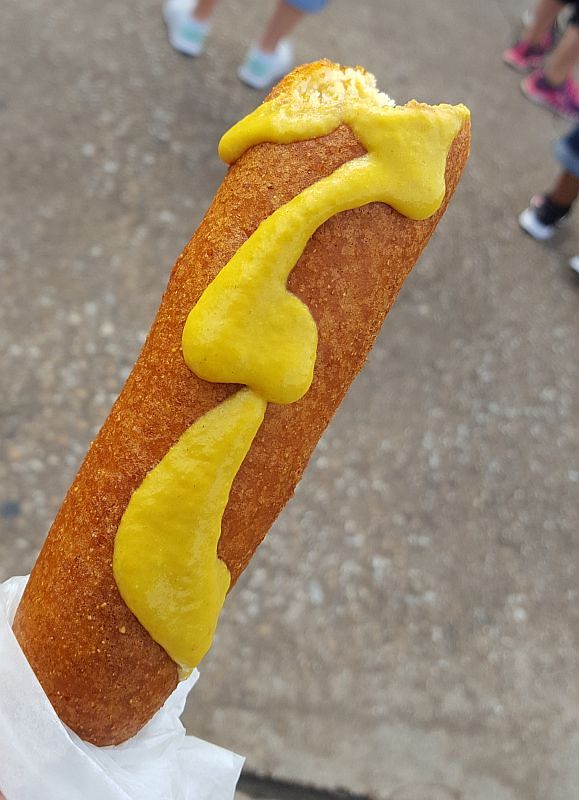
First day, y’all. Here’s how David Bates, one of my favorite contemporary Texas artists, sees it. Click it to see that corny dog real big.
***
Sources & Notes
“Corny Dog” by David Bates (lithograph, 1986), shown at the Tyler Museum of Art this summer in the show “David Bates: Selected Works From Texas Collections.” More on that exhibition is here.
The postcard above shows “Lovers’ Lane, Fair Grounds Park,” and contains the following message to the card’s recipient:
I will have you a fellow this summer & you all can visit this place.
Aw. That’s a true friend.
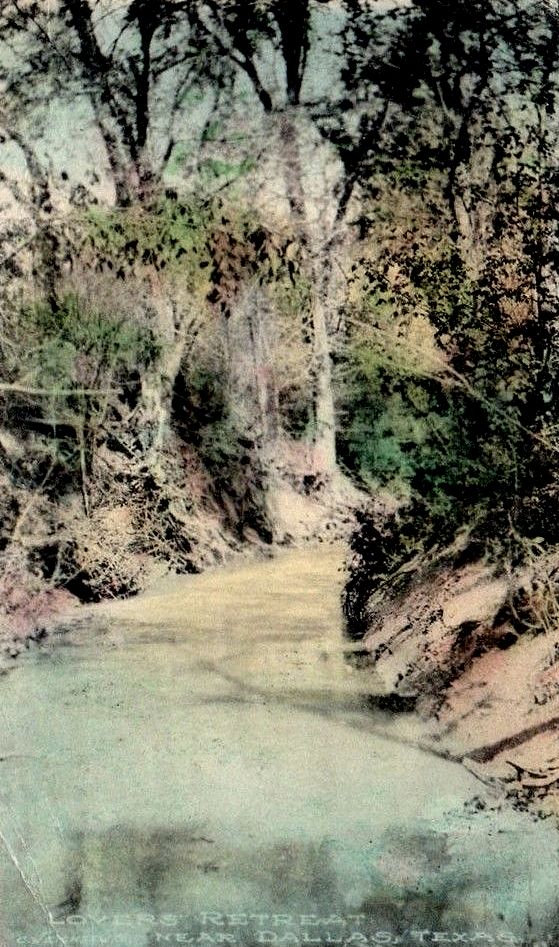
Below, another postcard from about the same time (around 1910), this one showing “Lovers’ Retreat, Near Dallas, Texas.”
This might be any old “romantic” place called “Lovers’ Retreat,” but at the time of this card’s publication, Lovers’ Retreat in Palo Pinto County, near Mineral Wells, was a well-known destination for Sunday drives, picnics, camping, church retreats, and family reunions. At 100 miles from Dallas, it would be stretching things to say this view is “near Dallas,” but postcards are sometimes not completely truthful.
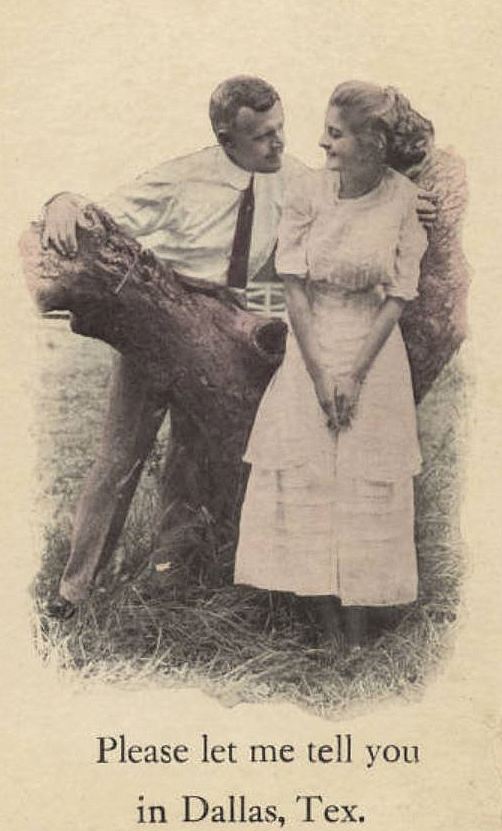
And for postcards that just strip away any confusion about local flora and fauna, let’s just cut to the chase. “Please let me tell you in Dallas, Tex.”
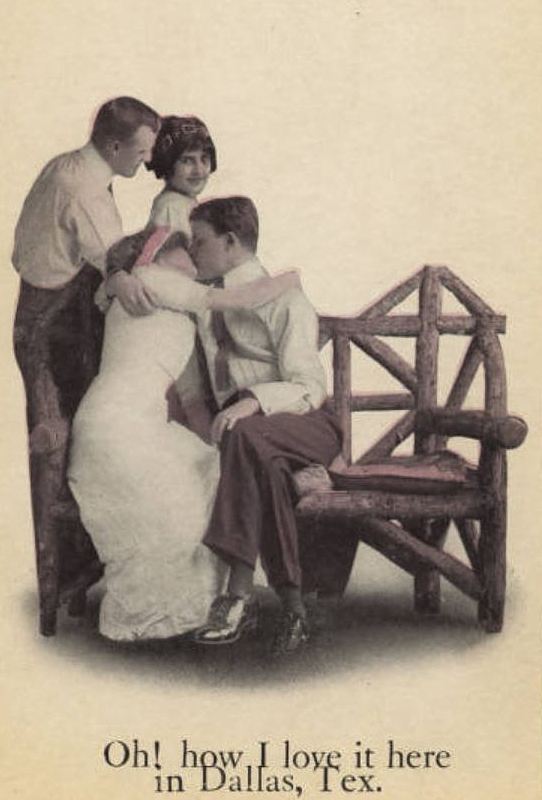
“Oh! How I love it here in Dallas, Tex.”
Speaking of lovers’ lanes, I’m not sure where that one at Fair Park (in the top postcard) was, but there were several “lovers’ lanes” around the city. The thoroughfare we know today as Lovers Lane was apparently known for years as a secluded place popular with couples looking for places in which to “spoon.” In a Dallas Morning News article, writer Kenneth Foree reminisced about the days when “it was nothing but a narrow black dirt road winding between two rows of bois d’arc trees.” He commented that “at times you could find lovers under nearly ever tree in Lovers Lane. They would park there in buggies in the early days, later in cars.” In the same article, Margaret L. Pratt, head of the Dallas Public Library’s Texas history department, remembered that “when Southern Methodist University was young and virtually treeless, students would often walk to nearby Lovers Lane for a shady hand-in-hand stroll” (“Walk a Miracle Mile” by Helen Bullock, DMN, Sept. 10, 1961).
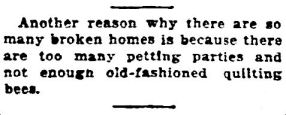
When the 1920s hit, “lovers lanes” around the country became hot topics of conversation. This was the “Jazz Age” and the era of the outrageous flappers — a time which an older, disapproving generation saw as scandalous and lacking in respect for propriety or morals. They felt that young women, in particular, were not acting at all “ladylike.” Suddenly the term “petting parties” was all over the newspapers. Young people (…and older people) were making out at parties, in movie theaters, and, especially, in cars parked at night along out-of-the-way country roads. Things were heading to hell in a handbasket.
DMN, 1922
When a Dallas deputy sheriff commented to the local newspapers in 1924 that these open-air necking sessions were out of control, the mayor, Louis Blaylock, said, “It’s getting so a man can not take his sweetheart out on the country road to court her or to propose to her…. Most of the folks celebrating their silver and golden anniversaries in Dallas can look back upon the time when the Lemmon avenue road and Mocking Bird Lane were the causes of all the trouble…. Things aren’t so much worse now than when I was a boy” (DMN, May 23, 1924). Mayor Blaylock — who was born in 1849 — was 74 years old at the time. The deputy sheriff was Not Amused (read his response, reprinted in the Sulphur Springs Daily News-Telegram, here). The mayor laughed off the deputy’s concerns, saying, “I believe that most of [this] talk is purely political and if my memory serves me right we experience this epidemic about every two years, just about election time,” (DMN, May 30, 1924).
(click to see larger image)
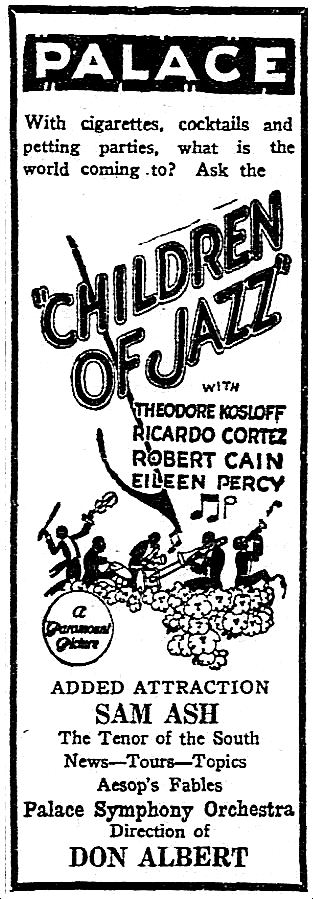
Despite the mayor’s pooh-poohing of the situation, petting-party outrage remained in the headlines throughout the ’20s … until the public’s attention turned to the next thing to be outraged about. Good for those scandalous pre-Code movies, though!
“Children of Jazz” at the Palace, 1923
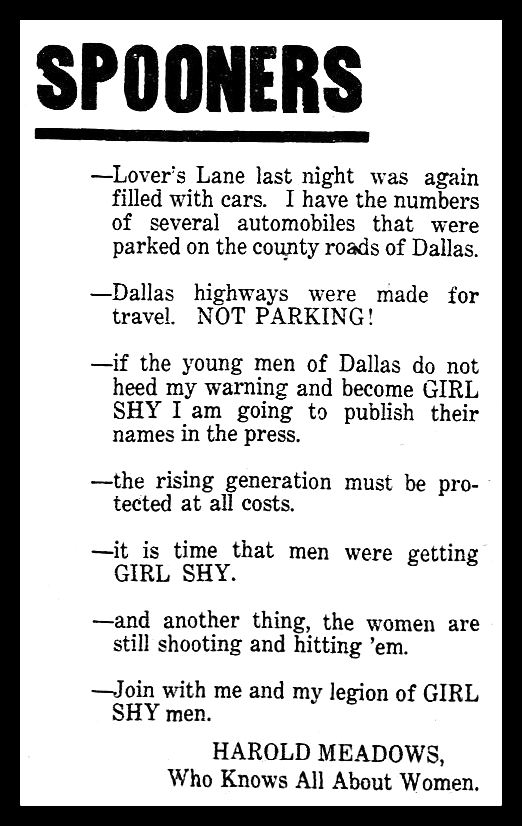
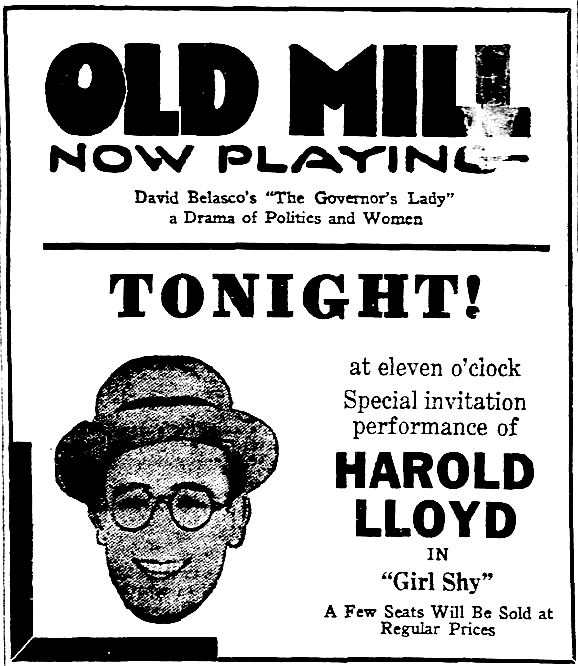
Below is a clever promotion for a movie called “Girl Shy” in which Harold Lloyd played a character named Harold Meadows (“who knows all about women”). It is addressed to the “spooners” of Dallas and is not identified as being an ad for movie.
May 20, 1924
“Girl Shy” at the Old Mill, May 23, 1924
***
Sources & Notes
Top two postcards are currently for sale here and here.
The two postcards featuring amorous couples are from the George W. Cook Dallas/Texas Image Collection, DeGolyer Library, SMU Libraries, Southern Methodist University; more information on these postcards can be found here and here.
A photo of young frolickers frolicking at Lovers’ Retreat in Palo Pinto County can be found on the Portal to Texas History website here.
Read about petting parties in an article from NPR,here.
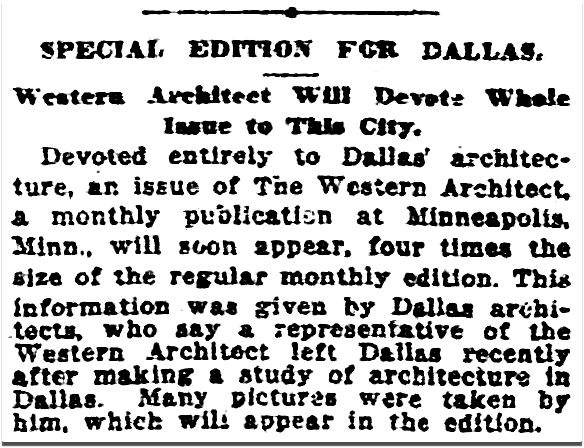
The 7-part Flashback Dallas series of buildings and houses featured in the Dallas issue of The Western Architect finally comes to an end! What I thought would be a quick and painless way to share tons of cool Dallas photos I’d never seen has turned into a seemingly endless dive into the research of a whole slew of buildings, most of which I knew very little (if anything) about. I feel like I’ve been through an immersive, three-week course in “Lang & Witchell”!
This final installment features buildings built by the city (mostly fire stations) and a few churches — six of these eight buildings are still standing. Today’s star architects are Hubbell & Greene.
*
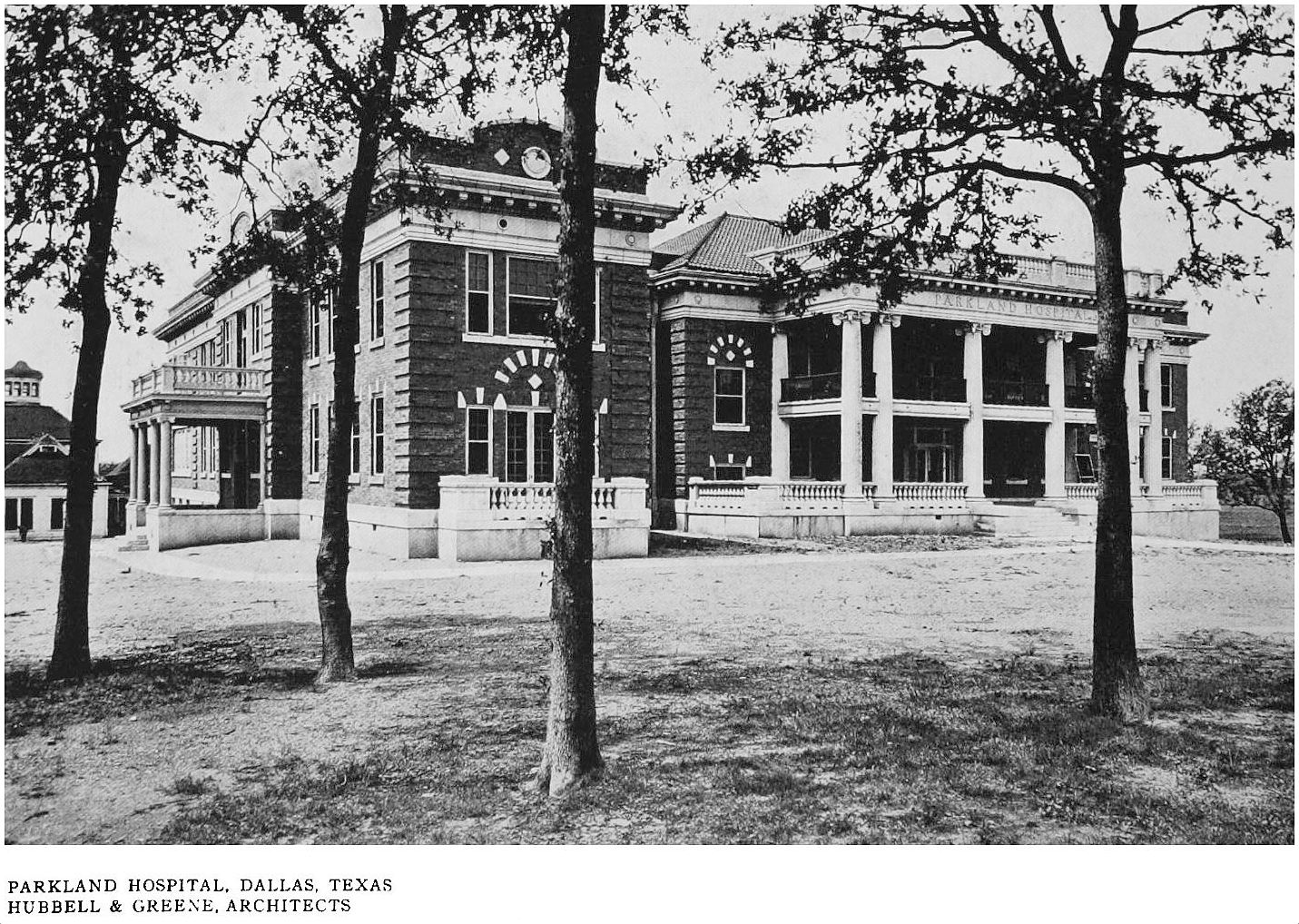
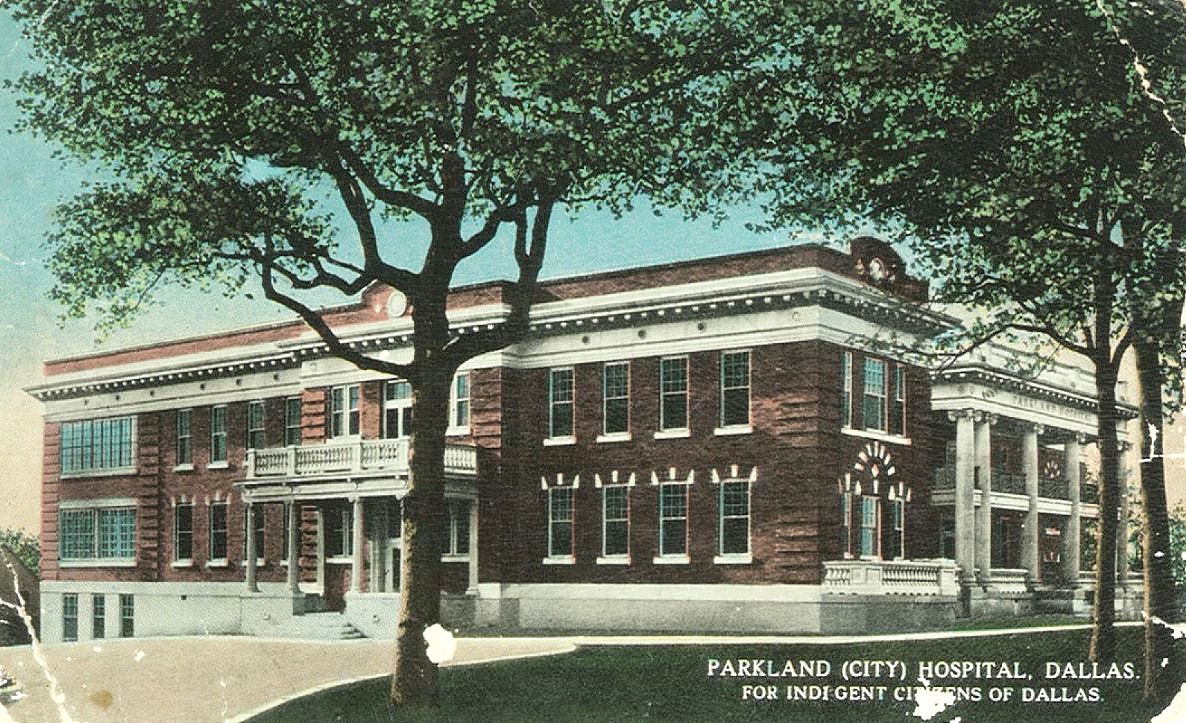
1. PARKLAND HOSPITAL (above), Oak Lawn & Maple avenues, designed by Hubbell & Greene. This new, sturdy, brick “city hospital” was built in 1913 on the beautiful park-like 20-acre-site of the previous city hospital (the old wood frame building — built in 1894 — was cut in pieces and moved farther back on the property, “across a ravine” — it was reassembled and for a time housed patients with chronic and contagious diseases and was the only institution in Dallas at the time that served black and Hispanic patients — part of this old building can be seen at the left in the background of the photo above). The new hospital was “entirely fireproof” and was built with very little wood — other than the doors, trim, and banister railings, it was all steel, cement, reinforced concrete, plaster, and brick. The original plans called for two wings, but the city had to put construction of the second wing on the backburner until funds became available. As it was, this one-wing hospital (with beds for 100 patients) cost in excess of $100,000 ($2.5 million in today’s money). The building still stands but is barely visible these days behind a wall, trees, and dense shrubbery — it is surrounded by a huge, recently-built complex of similarly-styled buildings. (See it on a 1921 Sanborn map, here.) (All images are larger when clicked.)
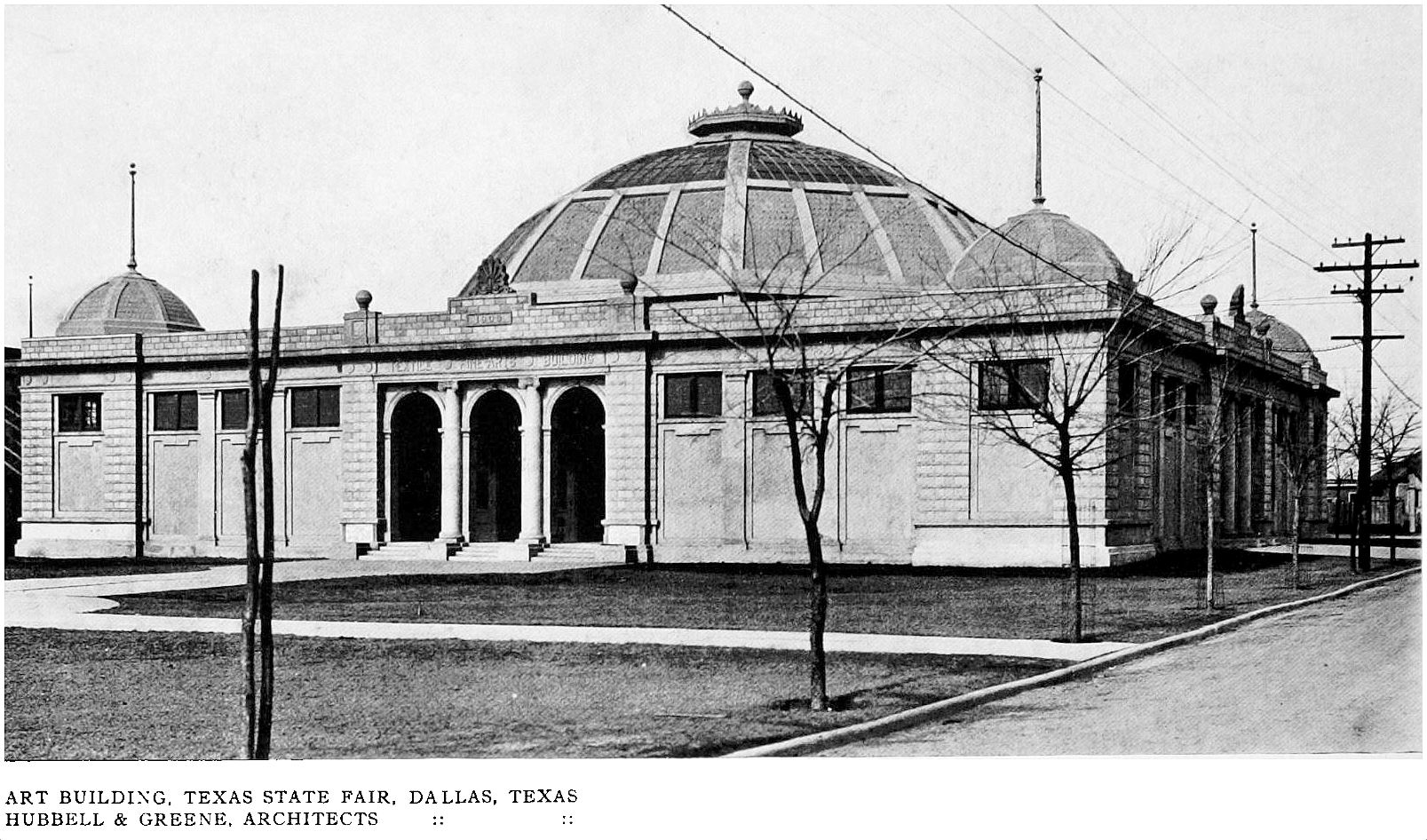
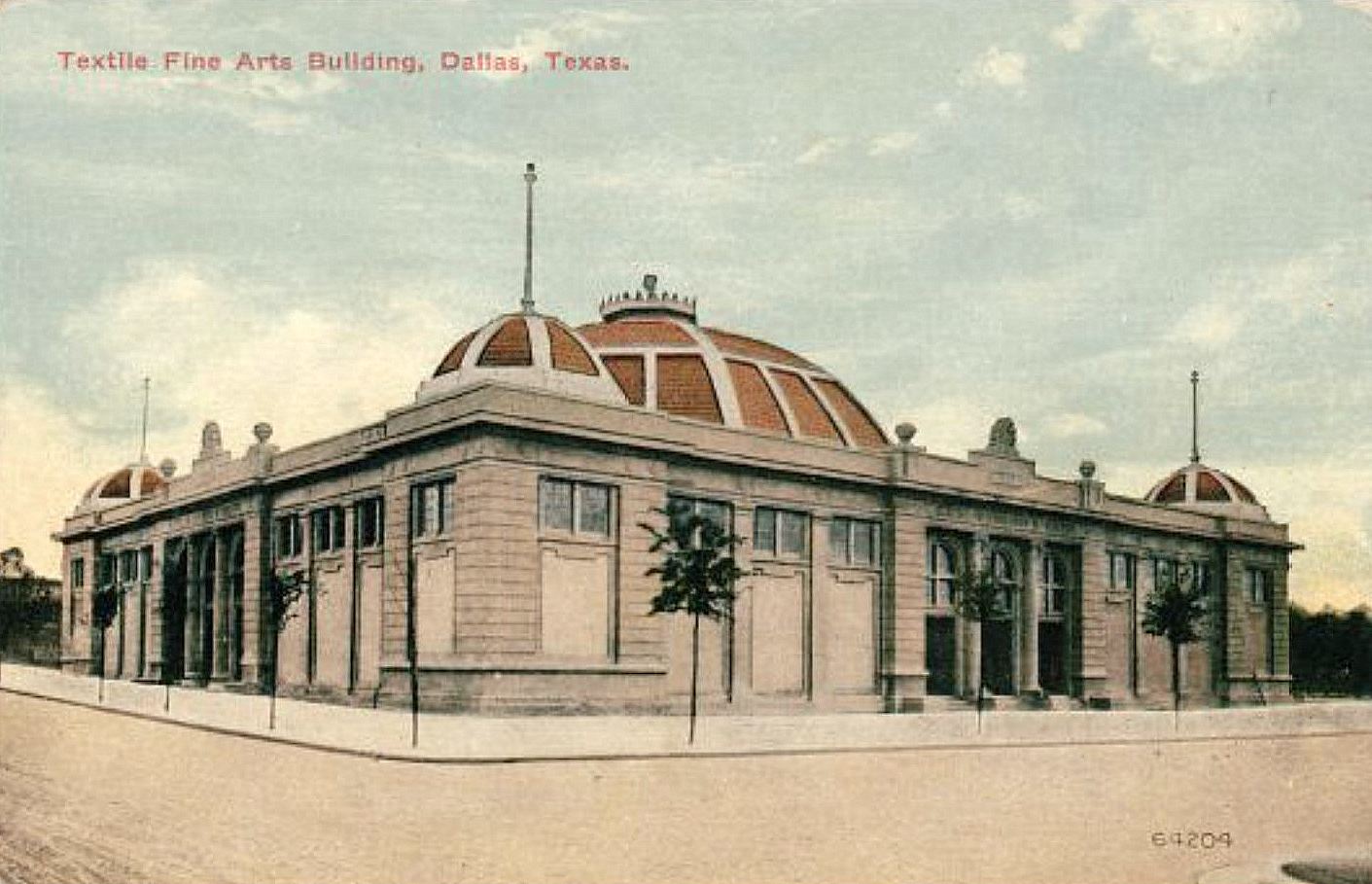
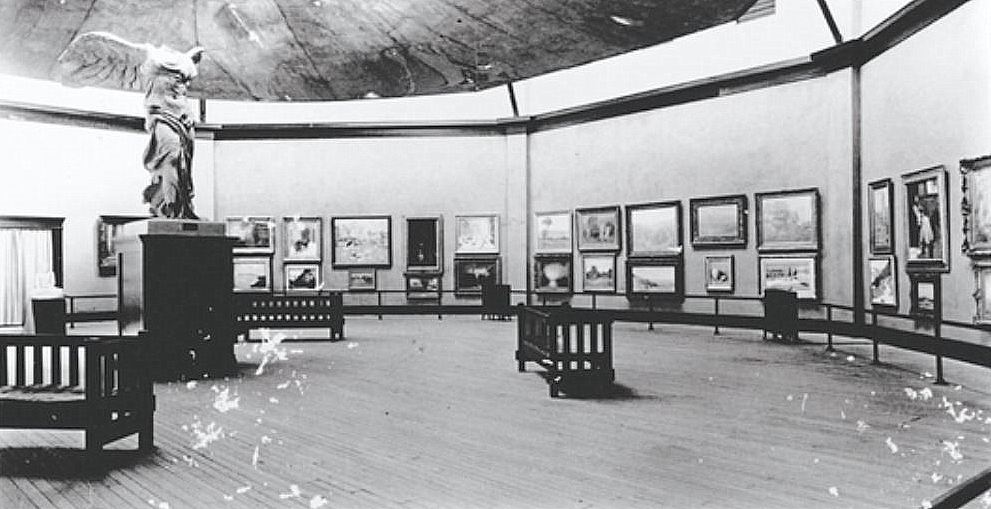
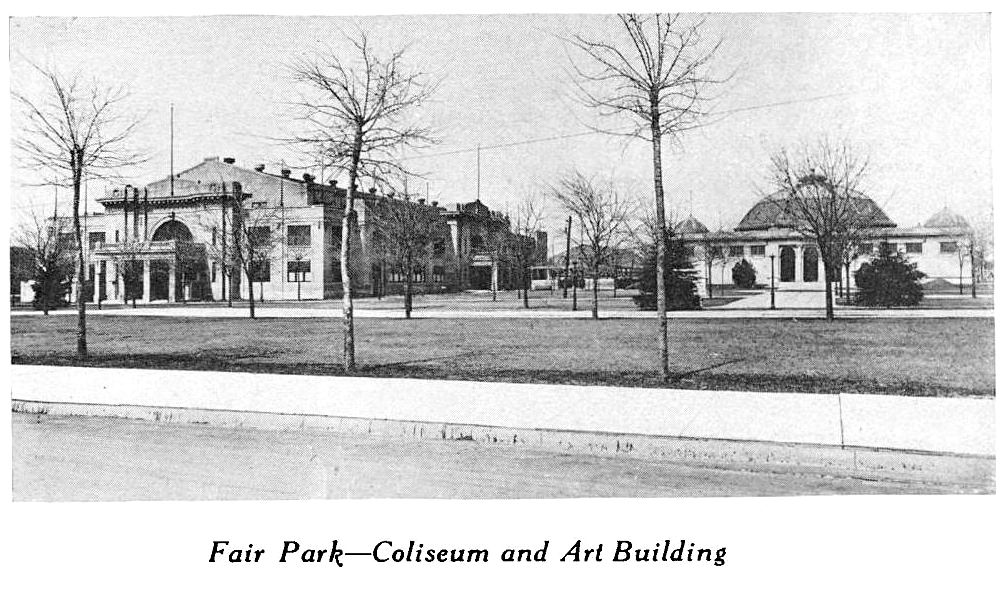
2. ART BUILDING, Fair Park, designed by Hubbell & Greene. Known as the Art & Ladies’ Textile Building when it was erected in 1908, this domed building gave Dallas its first public art museum. No longer would the 14 paintings owned by the Dallas Art Association (including works by Childe Hassam and Robert Henri) be relegated to being displayed (when staff was available) in a room in the public library. The building was initially built as a nod to “ladies” and was the place where textile crafts and artworks were displayed during the State Fair (Texas artist Julian Onderdonk was given the task of beating the bushes in New York City for works to be loaned for display in this building during the fair). The art gallery was set in the rotunda — a sort of gallery within a gallery — while textiles and other exhibits were shown in the outer area of the octagonal building. One interesting bit of trivia about the construction of this building is that it was built largely of cement blocks — 70,000, according to newspaper reports. In order to facilitate construction, a “cement block plant” was set up on the grounds in Fair Park, turning out hundreds of blocks a day, which were then laid out to “season” in the sun. (Incidentally, this building was under construction during the historic flood of 1908 — which the newspaper refers to as “the recent high water,” and the bad weather was slowing the construction process.) The building is no longer standing, but it seems to have lasted at least through the end of 1956. It stood just inside the Parry Avenue entrance, to the left, next to the Coliseum (now the Women’s Building) — the site is now occupied by a parking lot directly behind the D.A.R. house. (See it on a 1921 Sanborn map, here.)
via Dallas Museum of Art blog “Uncrated”
*
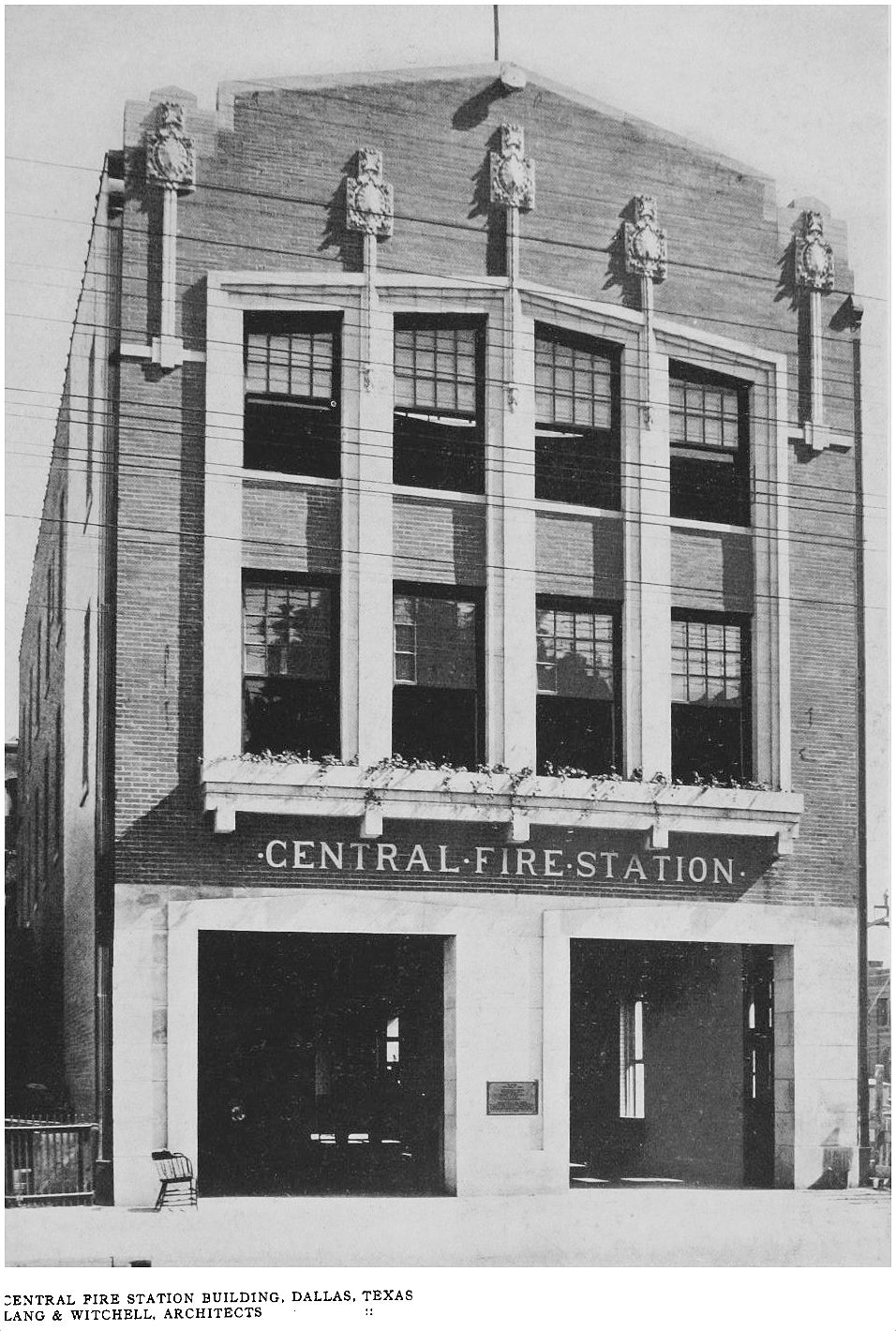
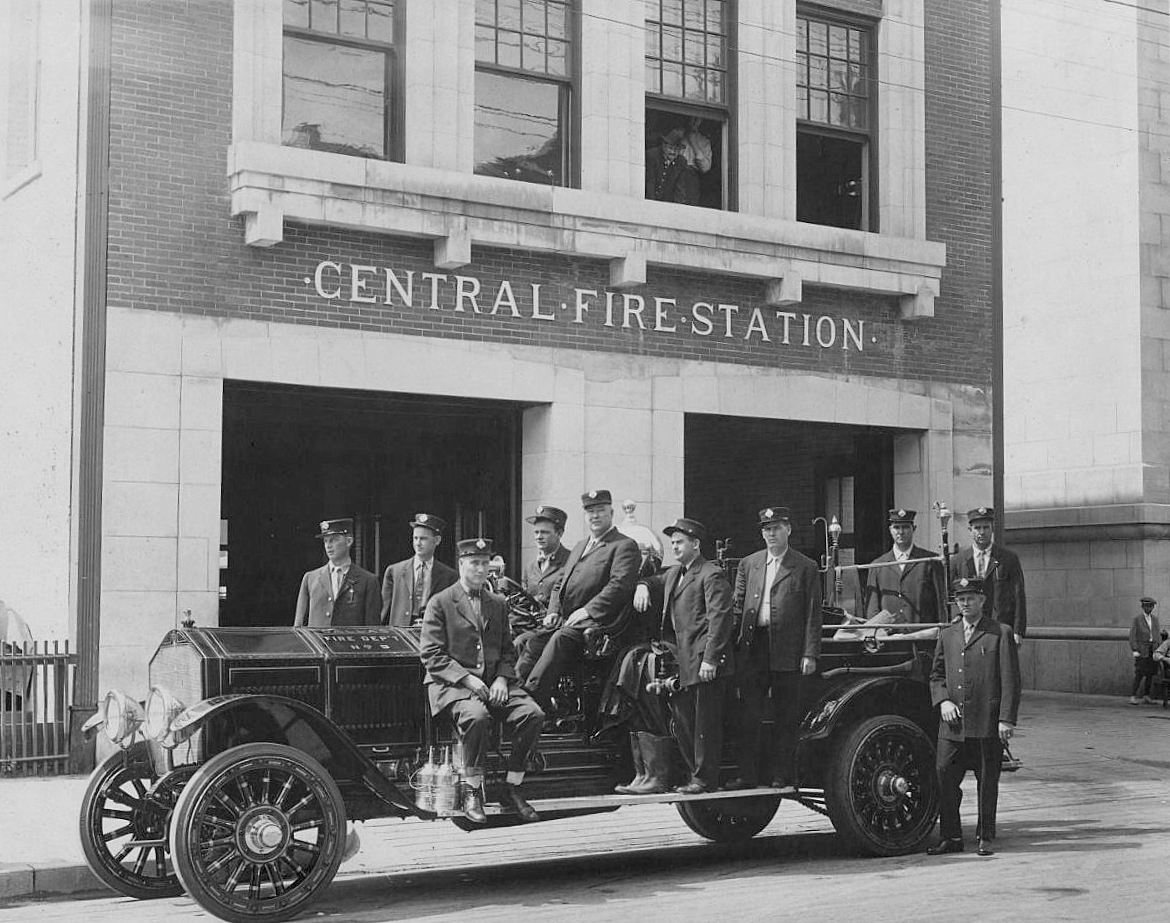
3. CENTRAL FIRE STATION, 2012 Main Street (adjoining the Municipal Building), designed by Lang & Witchell. When Adolphus Busch acquired the land Dallas’ City Hall and central fire station sat on (in order to build his Adolphus Hotel), there was a sudden springing to action to build new homes for both displaced entities. The new location for the firehouse was in an already-standing building facing Main, adjacent to the new Municipal Building — it became the new headquarters for the Dallas Fire Department in 1913. It was, I believe, the first Dallas firehouse built without horse stalls, as it housed only motorized firefighting vehicles. The building’s use as a fire station ended in the 1920s; it was thereafter used by other municipal offices: for a while in the 1930s its third floor was used as a women’s jail, and for many years it was the site of Dallas’ corporation court. It looks like the building is still there, but I’m unsure of its current use. (See it on a 1921 Sanborn map, here.)
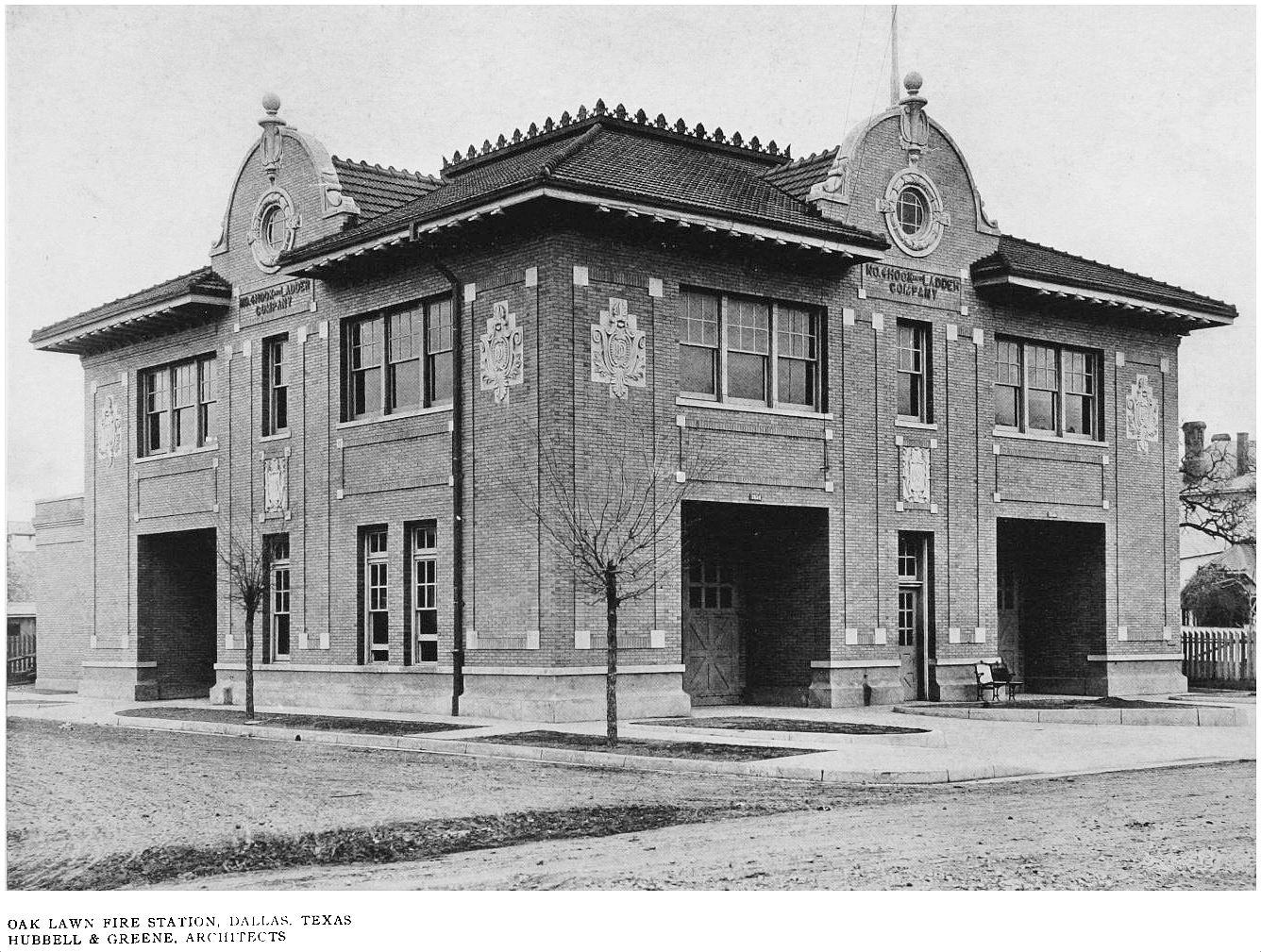
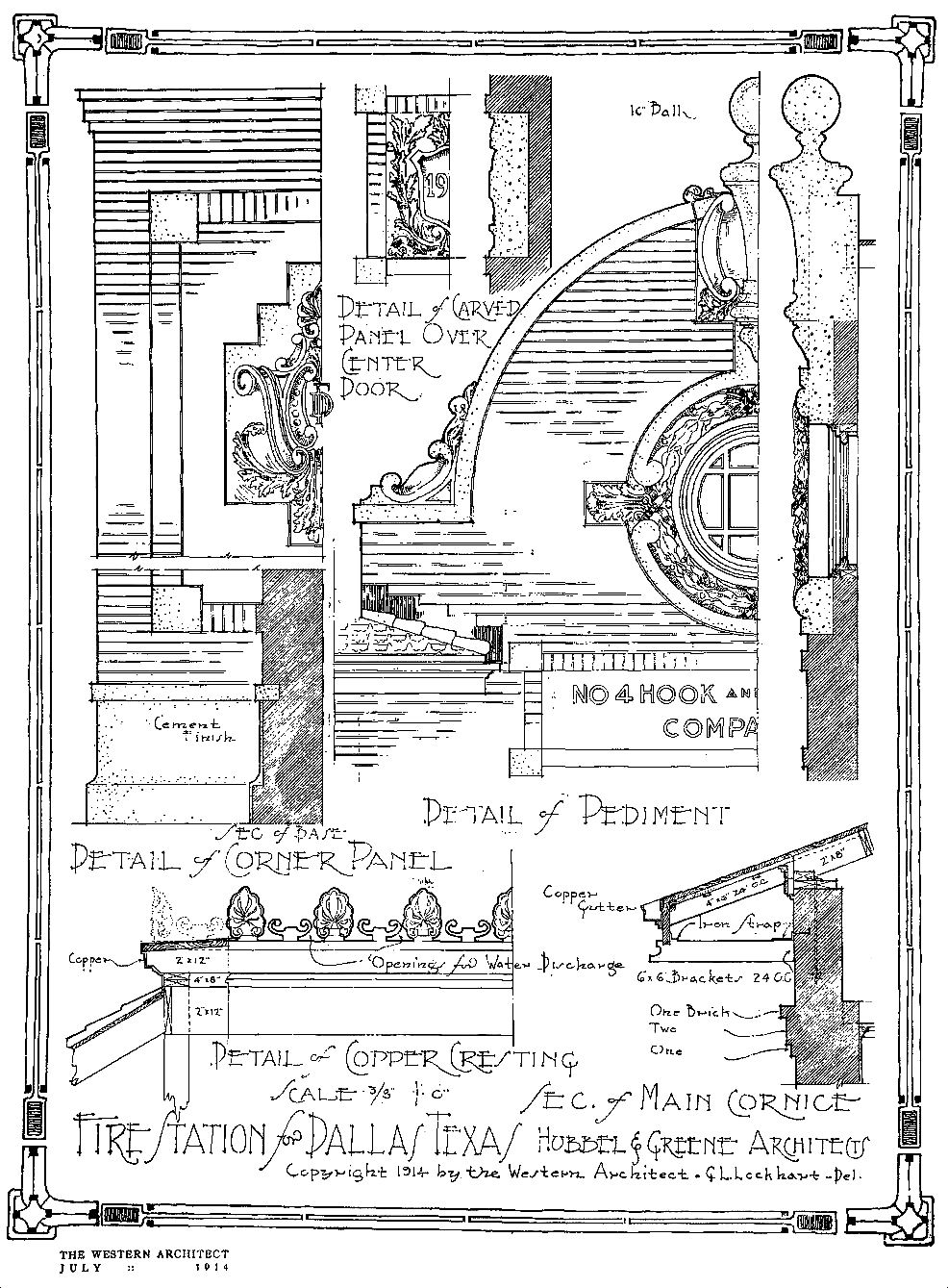
4. OAK LAWN FIRE STATION, Cedar Springs & Reagan, designed by Hubbell & Greene. This still-active firehouse (!) — Dallas’ first “suburban” fire station — was built in 1909 as the home of No. 4 Hook and Ladder Company. When construction of the building was announced, it was described as being a gray brick structure topped by a roof of “cherry red Spanish tiling.” It was — and still is — a beautiful building. (I’ve written about this firehouse previously, here.) (See it on a 1921 Sanborn map, here.)
*
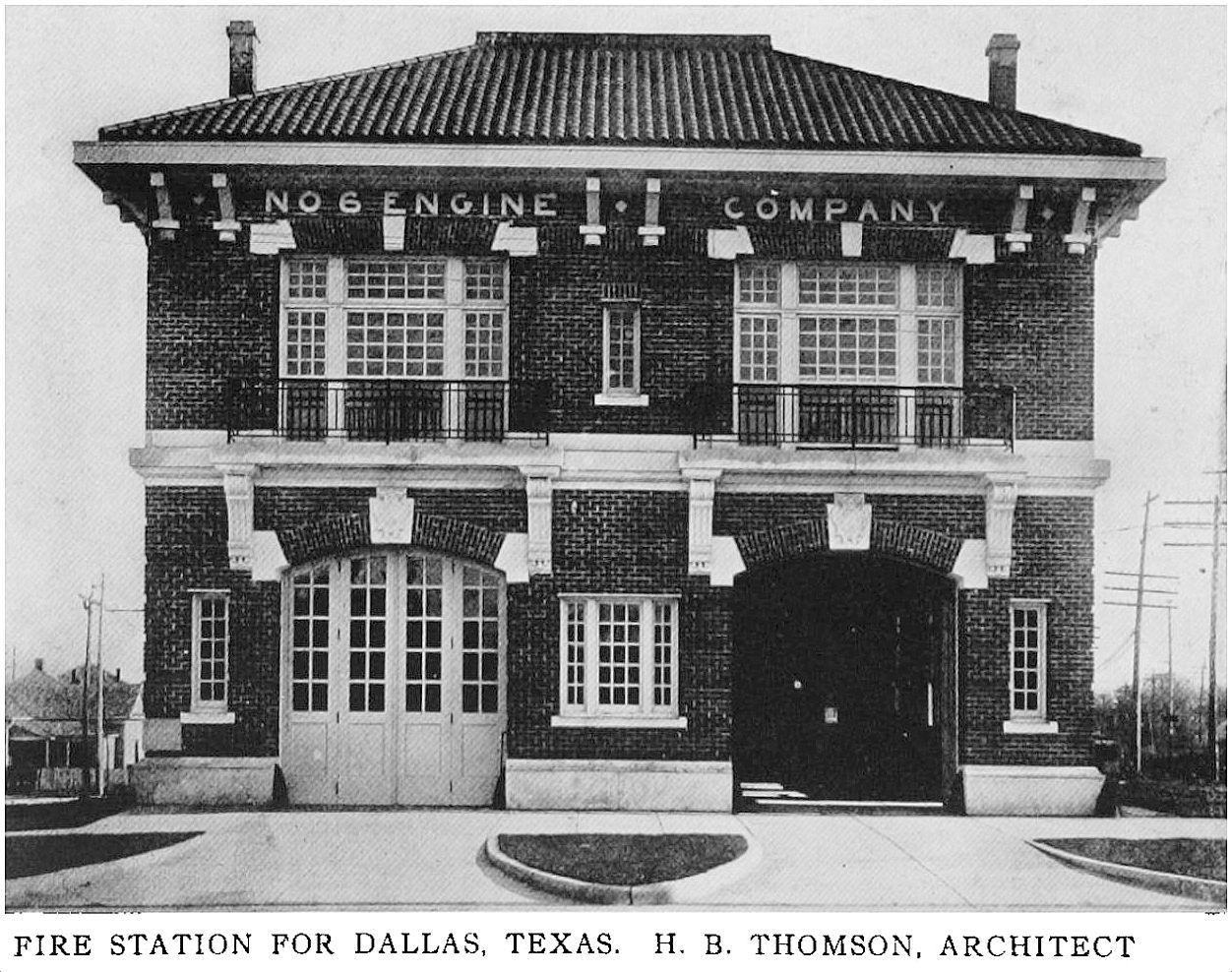
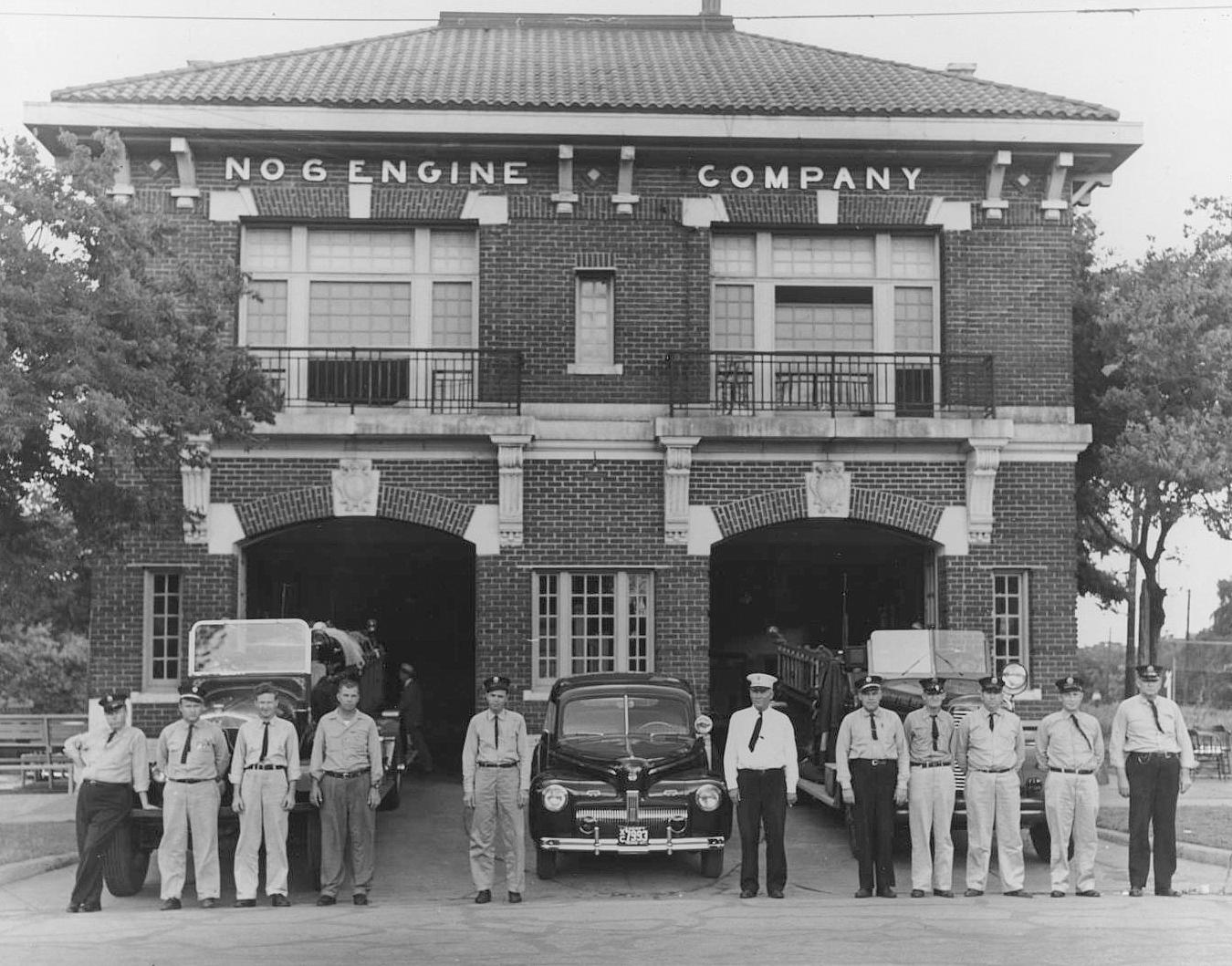
5. NO. 6 ENGINE COMPANY, Forest Avenue (now MLK Blvd.) & Kimble, South Dallas, designed by H. B. Thomson. This South Dallas fire station was built in 1913 and was in service until 1955 when it was demolished to make way for the “South Central Expressway” (see more photos in a previous post on this, here). (See it on a 1922 Sanborn map, here.)
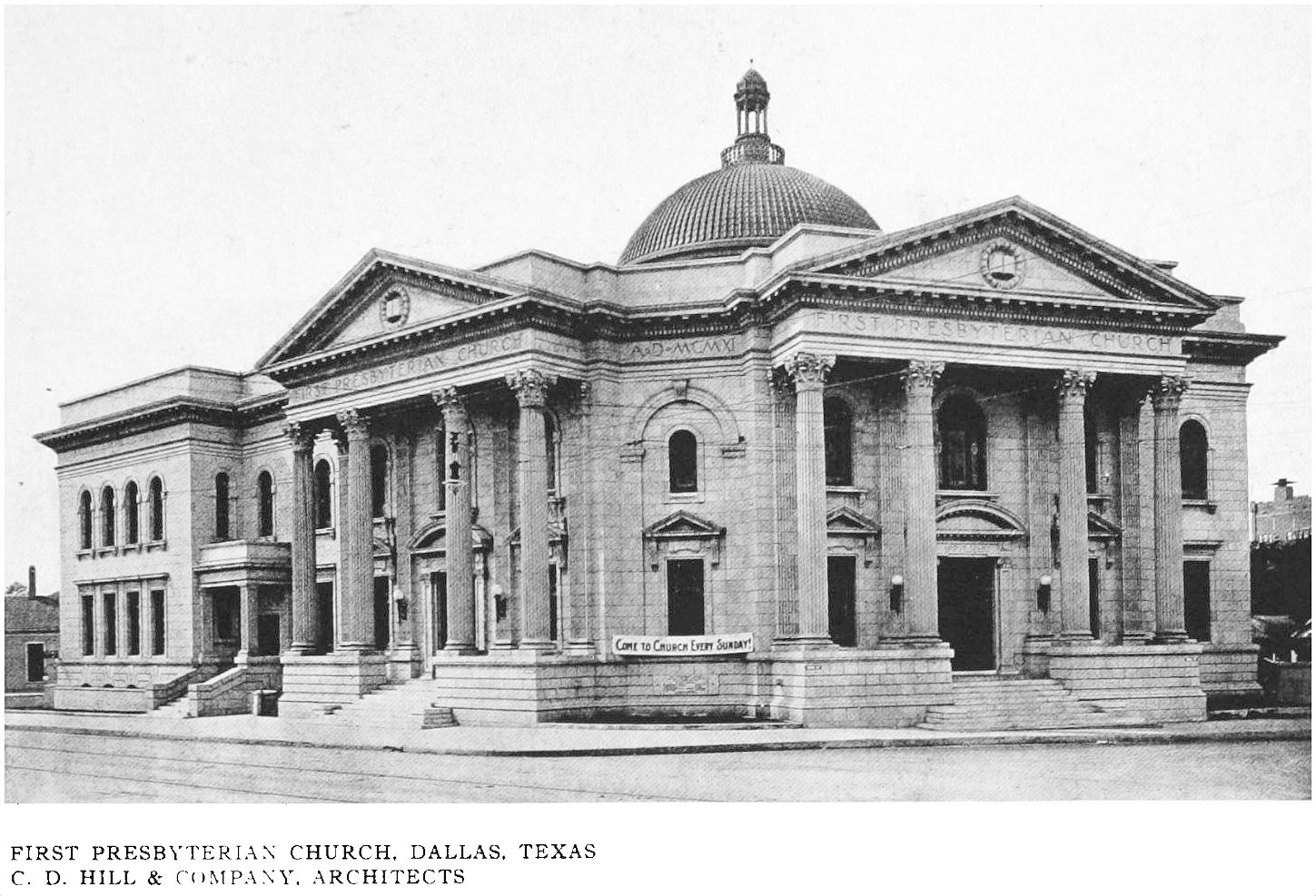
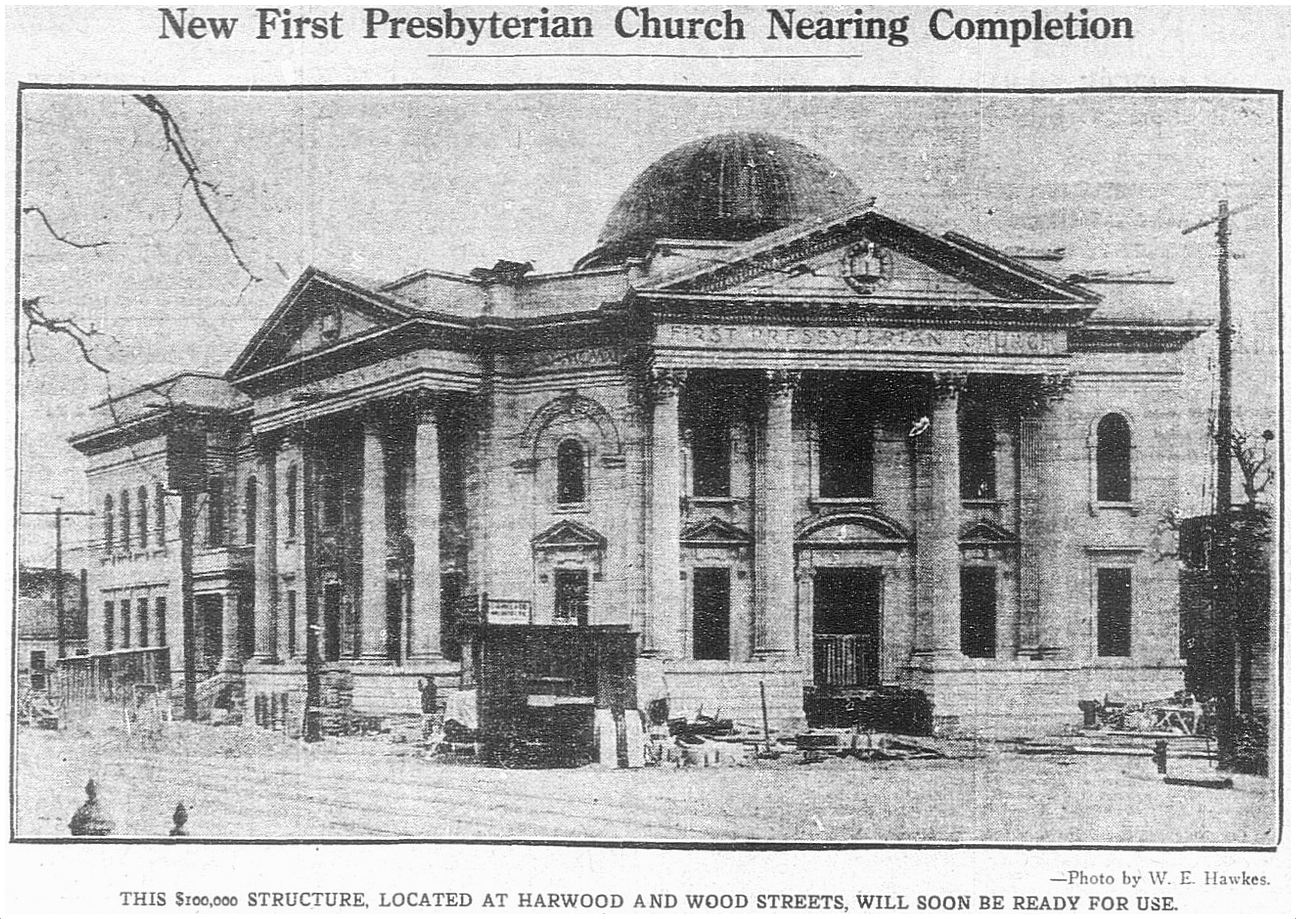
6. FIRST PRESBYTERIAN CHURCH, S. Harwood & Wood, designed by C. D. Hill. Built in 1911-12, this impressive building boasted “the largest monolith columns in the city” (a claim which might have been surpassed by architect Hill’s be-columned Municipal Building built soon after this church, two blocks away — and rivaled by Hubbell & Greene’s Scottish Rite temple, one block away). Still standing and much expanded, the church is still looking great. (See it on a 1921 Sanborn map, here.)
Dallas Morning News, March 24, 1912
*
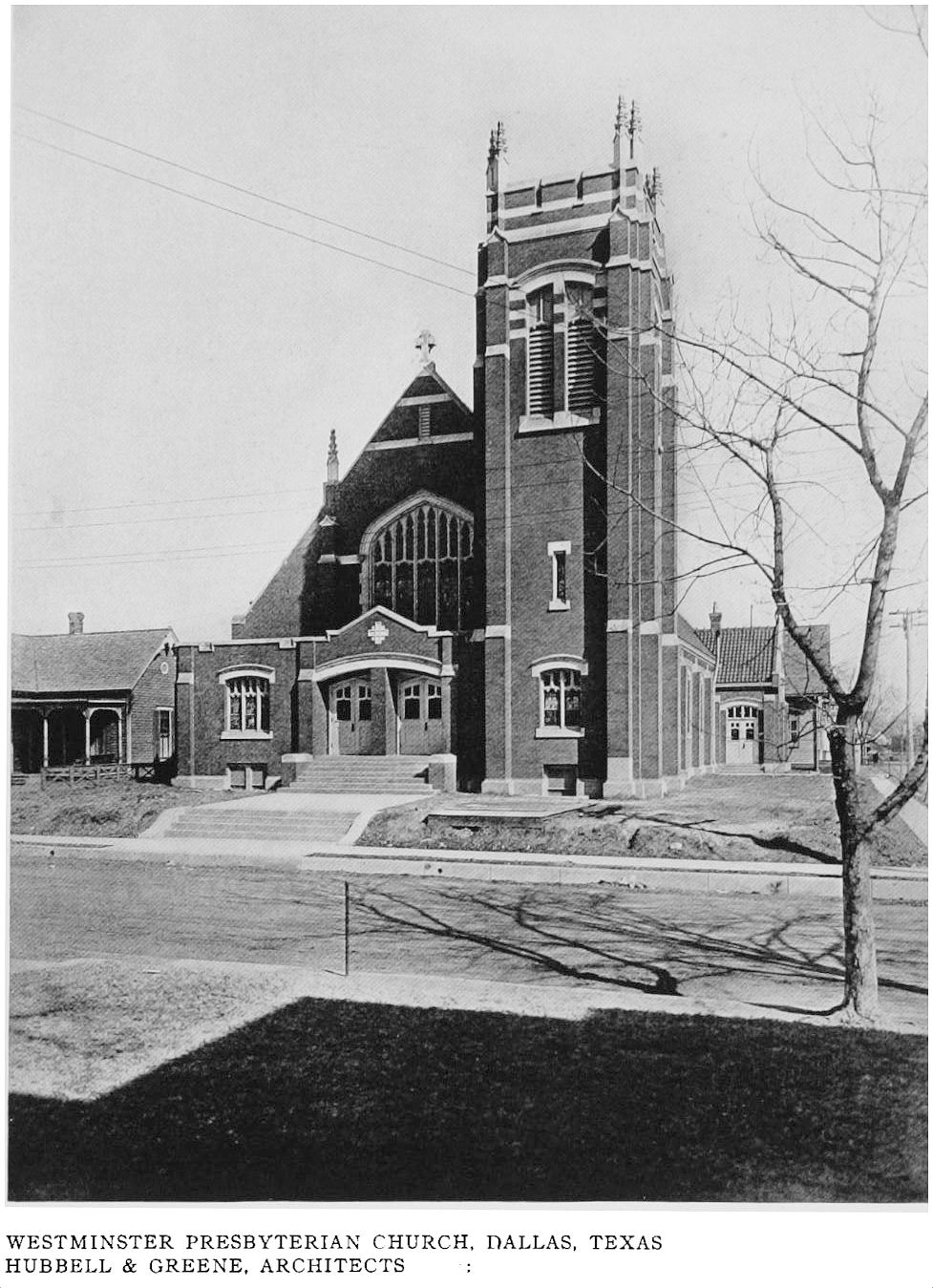
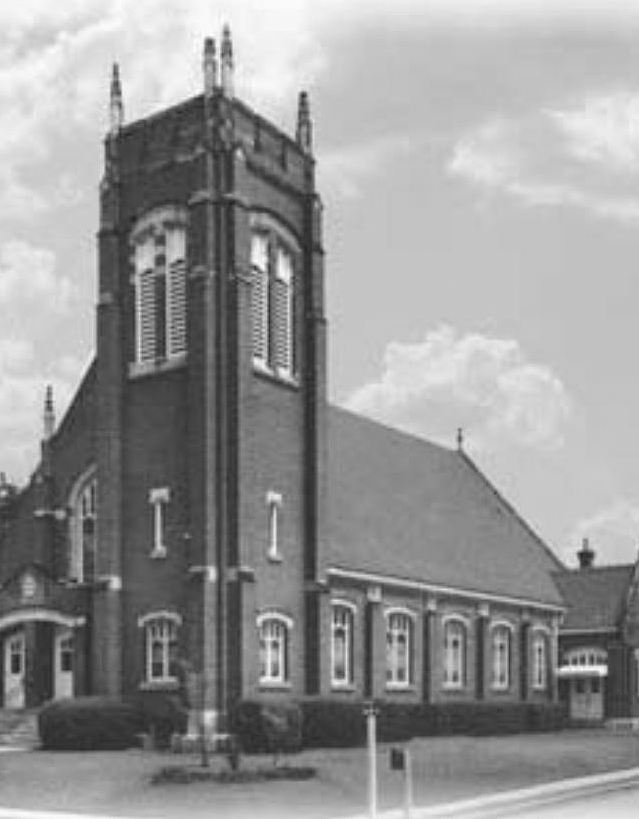
7. WESTMINSTER PRESBYTERIAN CHURCH, 2700 Fairmount (at Mahon), designed by Hubbell & Greene. Before looking this one up, I had no idea what part of town this church was in — I was surprised to see it was in the area now known as “Uptown” … and it’s still standing. This congregation (organized in 1892) had occupied churches in the McKinney Avenue/State-Thomas area for several years before this church was built in 1910-11. When the congregation moved to their current location on Devonshire in the 1940s, the building was taken over by Memorial Baptist Church. When that congregation was dissolved, the church was given — for free! — to the First Mexican Baptist Church (Primera Iglesia Bautista Mexicana). After several decades, they, too, eventually moved to a new location, and the old church has had a variety of occupants come and go. (Read about its recent past — and see tons of photos — at Candy’s Dirt, here.) (See it on a 1921 Sanborn map, here.)
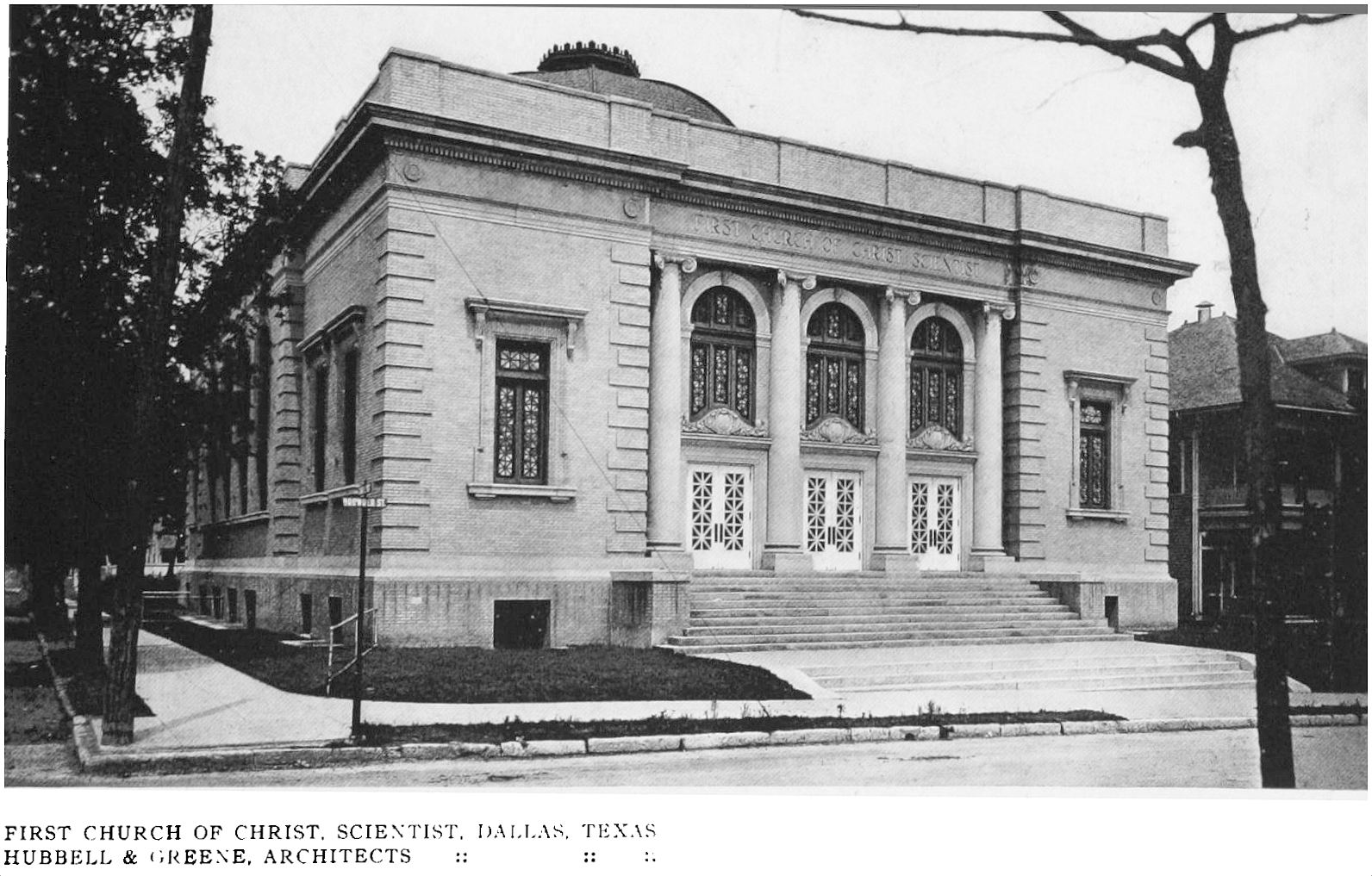
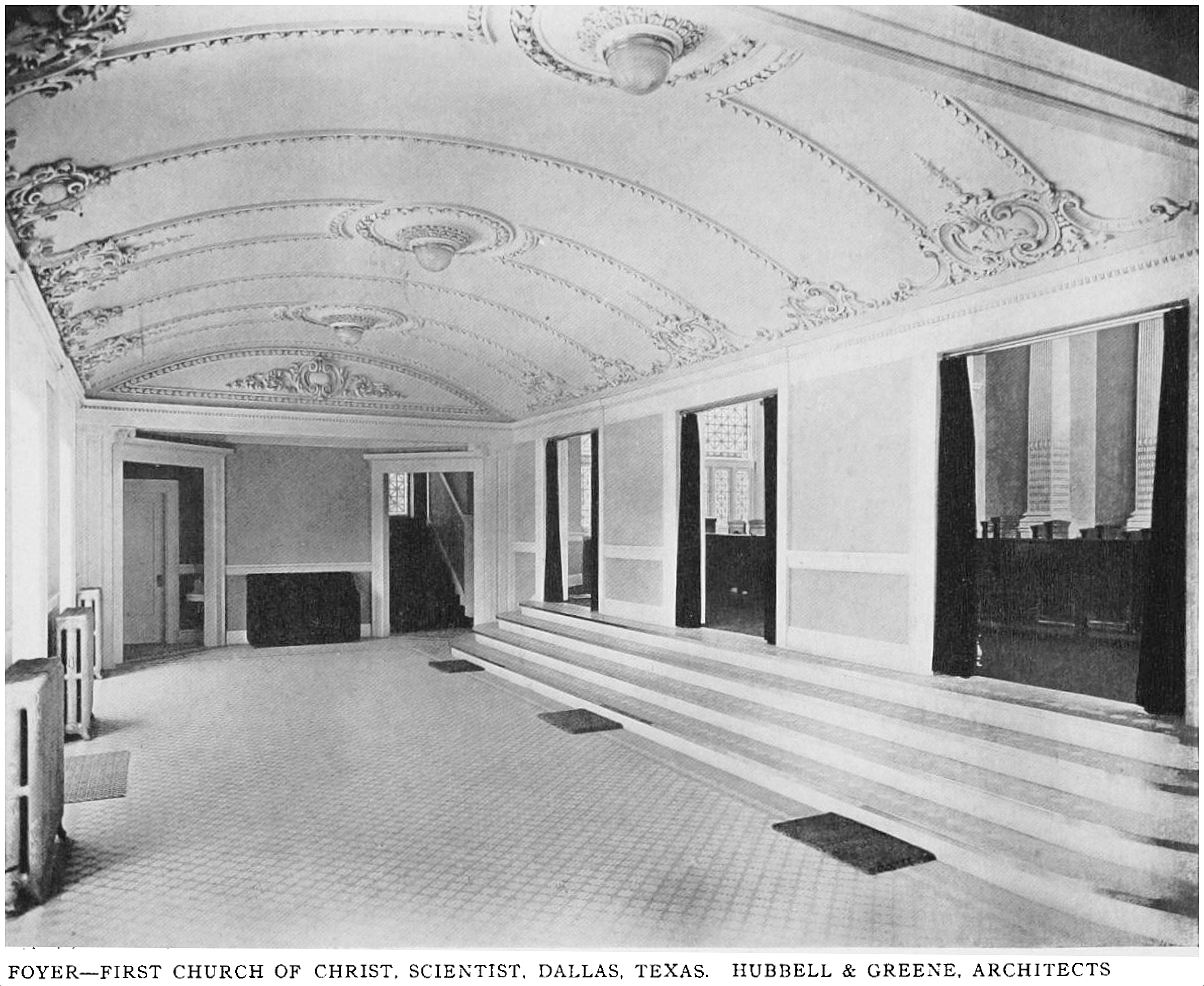
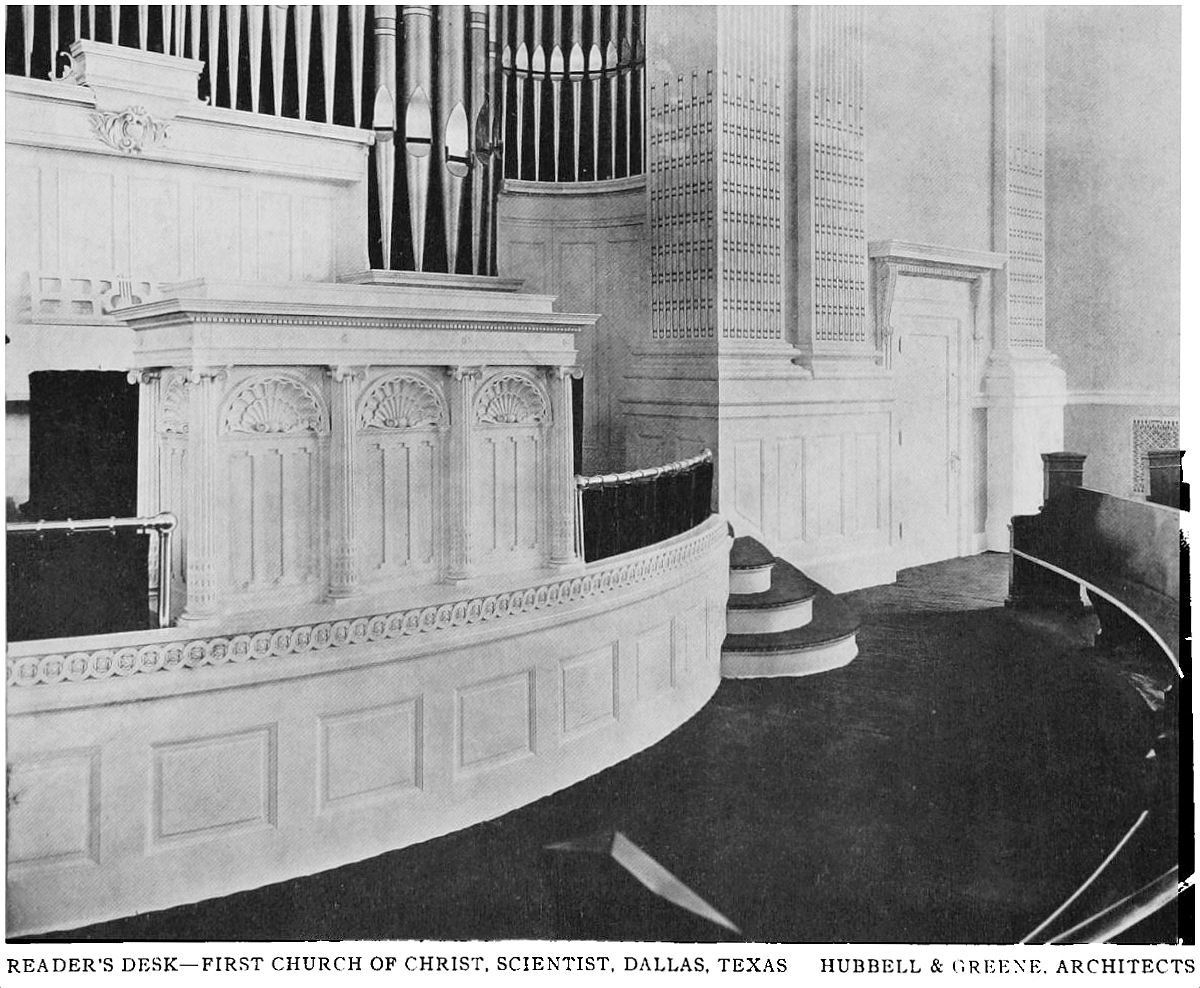
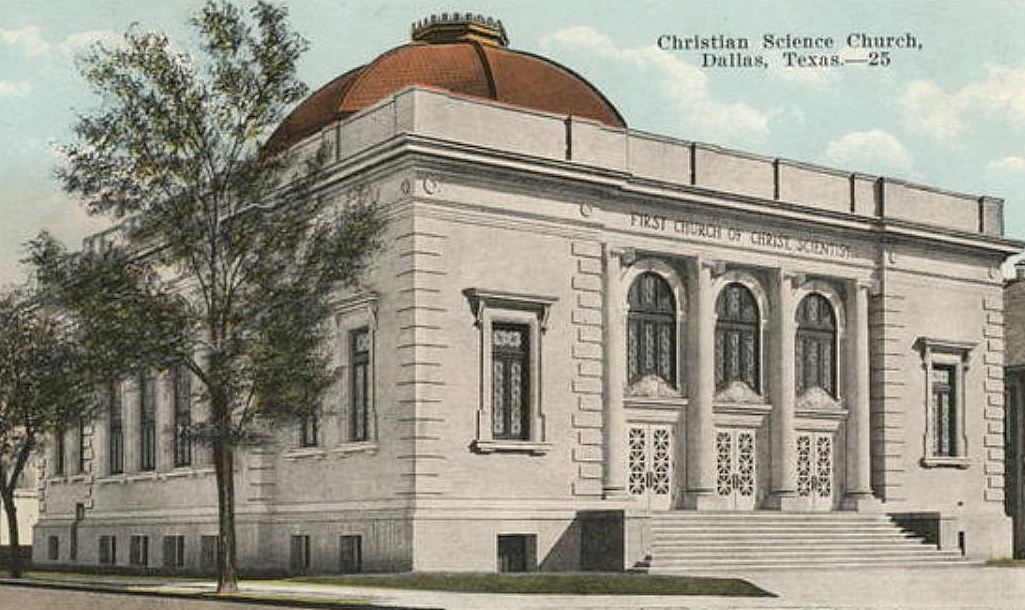
8. FIRST CHURCH OF CHRIST, SCIENTIST, corner of Cadiz & Browder, designed by Hubbell & Greene. This Christian Science church was built in 1910 on the southern edge of downtown for $100,000 (over 2.5 million dollars in today’s money). Following its days as a Christian Science church, it has had secular and non-secular occupants. It still stands (as a lonely building in what is mostly a sea of parking lots), and it is currently a house of worship once again. (See it on a 1921 Sanborn map, here.)
**
And that concludes this 7-part series featuring photos from the 1914 all-Dallas issue of the trade publication The Western Architect, which can be viewed in its entirety (with additional text), here (jump to p. 195 of the PDF for the July, 1914 scanned issue).
***
Sources & Notes
The Western Architect, A National Journal of Architecture and Allied Arts, Published Monthly, July, 1914. This issue, with text and critical analysis in addition to the large number of photographs, has been scanned in it entirety by the University of Illinois at Urbana-Champaign as part of its Brittle Books Program — it can be accessed in a PDF, here (the Dallas issue begins on page 195 of the PDF). Thank you, UIUC!
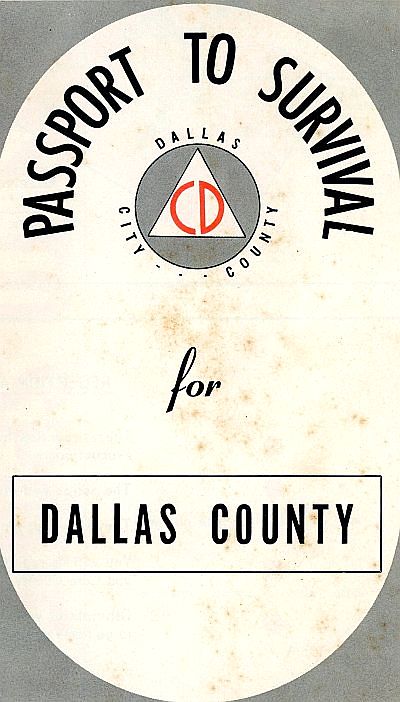
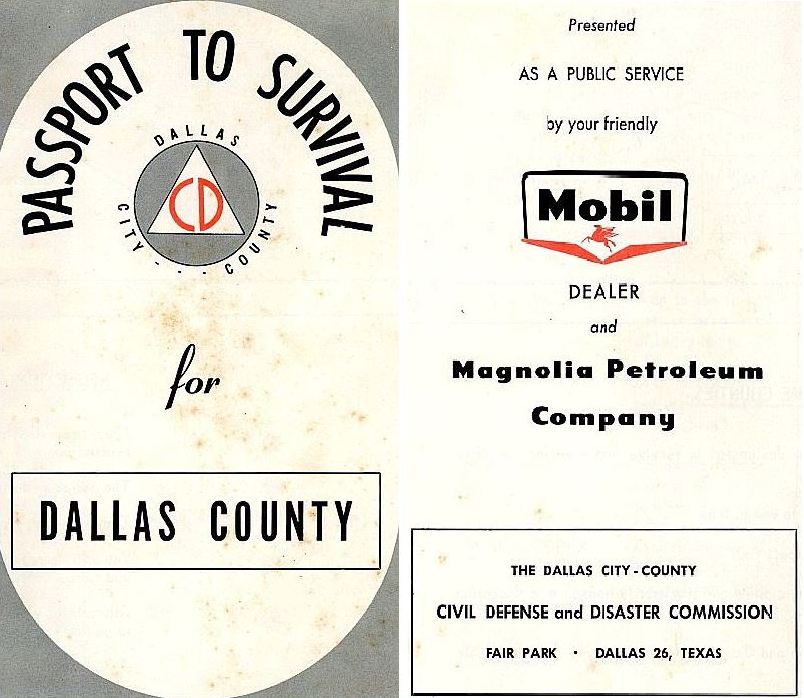
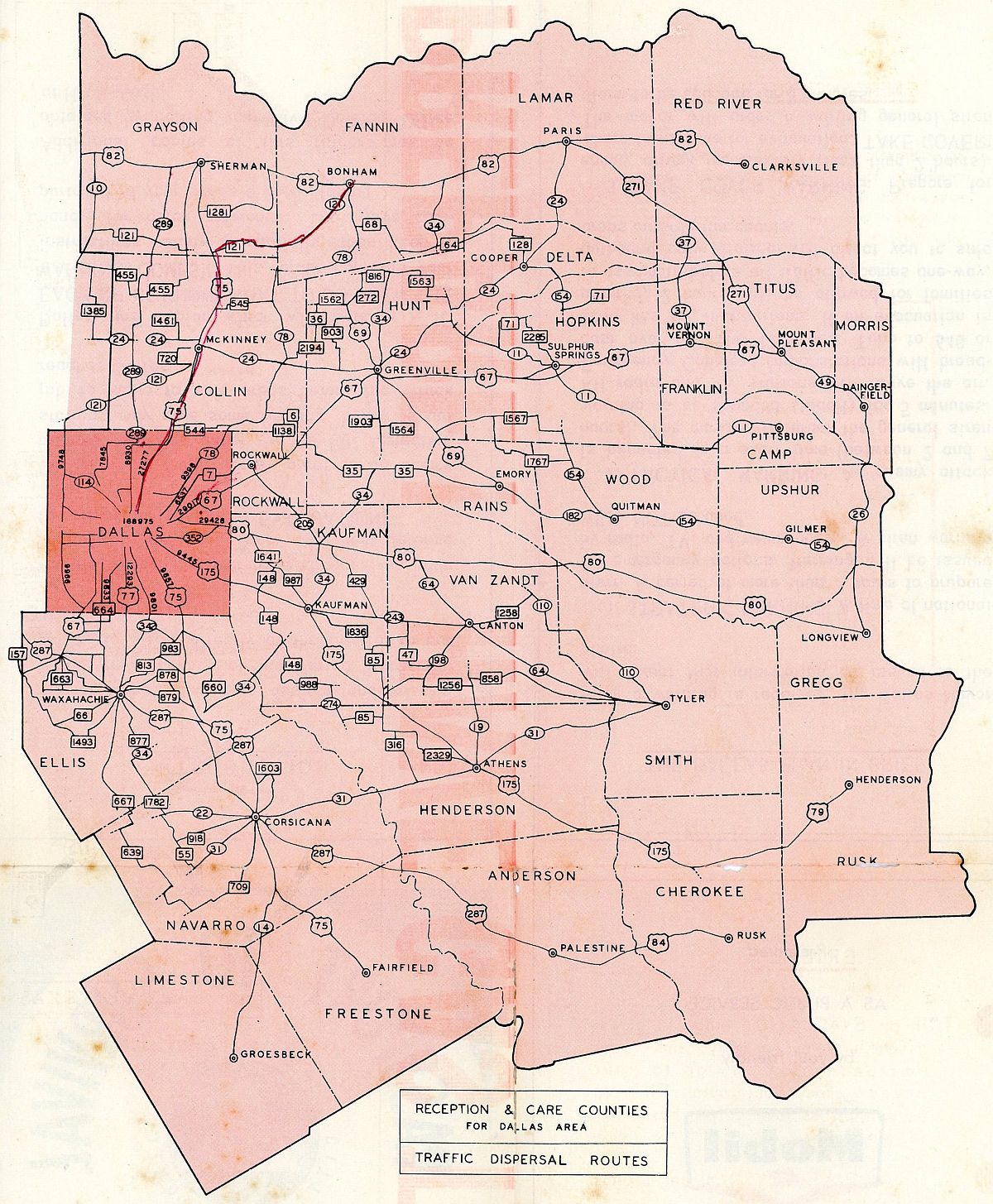
During the Cold War, the fear of nuclear attack was very real in the United States, reaching its peak of anxiety in the late 1950s and early 1960s. In 1958, the Dallas City-County Civil Defense Commission published a free informational pamphlet titled Passport to Survival, which contained evacuation maps for Dallas County, preparation tips, an emergency supply checklist, etc. Though the information contained in this publication could be applied to any disaster or emergency (nuclear-based or otherwise), it was printed a time when visions of Soviet atomic bombs were dancing in the heads of many concerned Americans. And this mild-mannered-looking pamphlet made sure you, Mr. and Mrs. Dallas County, knew that it was talking about a potential direct strike by nuclear missiles: “DALLAS IS A MAJOR TARGET AREA!” (See images from this pamphlet at the end of this post.)
The arrival of Passport to Survival (“presented as a public service by your friendly Mobil dealer and Magnolia Petroleum Company”) was heralded by a newspaper ad in November, 1958 (its eye-catching “DISASTER CAN HIT DALLAS!” artwork is seen above). (The full ad — with an exhortative letter by Commission chairman John W. Mayo, addressed to the people of Dallas — can be seen here.) I’m not sure how much “survival” there would be in case of a nuclear attack, but, like a good Boy Scout, one should at least be prepared.
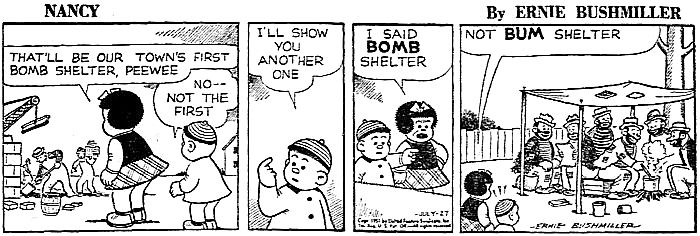
Backyard bomb shelters were necessary in Britain during World War II and saved countless lives during the almost nightly German air raids (I wrote about these shelters on another blog, here), but it was a new concept to post-war America. It wasn’t long, though, before bomb shelters became all the rage in the early ’50s as the Cold War heated up. If it’s becoming a common reference-point on the country’s funny-pages, it’s hit mainstream acceptance.
“Nancy” by Ernie Bushmiller, July 27, 1951
I’m not sure how many people were building these shelters, but they were certainly talking about them. When Highland Park Village announced their new underground parking garage in 1953, owners Flippen-Prather made sure to note that the two subterranean parking levels (the lowest of which was 20 feet below street level) would not only accommodate 300 vehicles, but, if needed, it could serve as a bomb shelter for 3,500 very well-dressed Park Cities residents seeking refuge.
But what really caused the mania for nuclear fallout shelters to reach its zenith was the Bay of Pigs Invasion in April of 1961. In May, 1961, ground was broken for construction of the $180,000 Civil Defense Emergency Operating Center at Fair Park (the first such center in Texas), adjacent to the Health and Science Museum. The underground bunker was to serve as a government operating and communications center for Dallas County in the event of a nuclear attack or natural disaster. It would house about 30 people (which would include the mayor and other city officials) and would be stocked with provisions for 14 days. It had its own water supply, electric generators, radios, and telephones. It was built to withstand a 20-megaton nuclear blast three miles away (i.e. downtown, where, presumably, the mayor and other city officials would be working when the 20-megaton bomb lit up Big D). When not in use as a shelter, it was to be maintained by the Health and Science Museum staff, and operated as a center for survival training. For many years it was open to the public, seven days a week. (It’s worth noting that the Civil Defense headquarters in Dallas was also located in Fair Park, at the building housing radio station WRR.)
The man behind the everything-you-need-to-know-about-Civil-Defense website CivilDefenseMuseum.com did a really interesting video walk-through of the surprisingly large decommissioned (if that’s the correct word to use here) Fair Park shelter in 2013:
*
1961 was THE year if you wanted to get into the bomb-shelter business. There was even a three-day “Fallout Survival Show” at Market Hall. You couldn’t open the pages of a magazine or newspaper without seeing ads for personal bomb shelters.
Some of the ads were kind of cozy:
Sept., 1961
Some were not:
Sept., 1961
Again, not all that many people were actually building them, but everyone was certainly talking about them. But in just a few short months … no one cared anymore. The ads disappeared. A lot of people who had been trying to sell them went broke. Those who survived (as it were) repurposed their products as “storm shelters” — turns out tornadoes were more of a pressing threat to Dallasites than Russian A-bombs.
Public shelters, however, didn’t disappear. In September, 1962, the very first public fallout shelter in Dallas was officially designated: the Southland Life Insurance Building could accommodate a staggering 30,000 people in the event of disaster. (The plan for this shelter was actually announced in 1954, and the Southland Center opened in 1959, but the official designation was not made until 1962.)
In 1966, Dallas had more than 300 official shelters, able to house 971,000 people:
…323 buildings in the city have been approved as shelters. The owners and managers of 204 of them have entered into agreements with the federal government and with the city to permit their use in emergencies as public shelters…. Shelters in Dallas can house 971,000 persons. Many of the buildings are permanently stocked with water, food supplies and medical supplies sufficient to sustain about 300,000 people for approximately two weeks. (“Maps at Fire Stations To Pinpoint Shelters,” Dallas Morning News, March 9, 1966)
Some of the permanent provisions kept in these places were water, food, “fortified crackers,” hard candy, bandages, iodine, and Geiger counters.
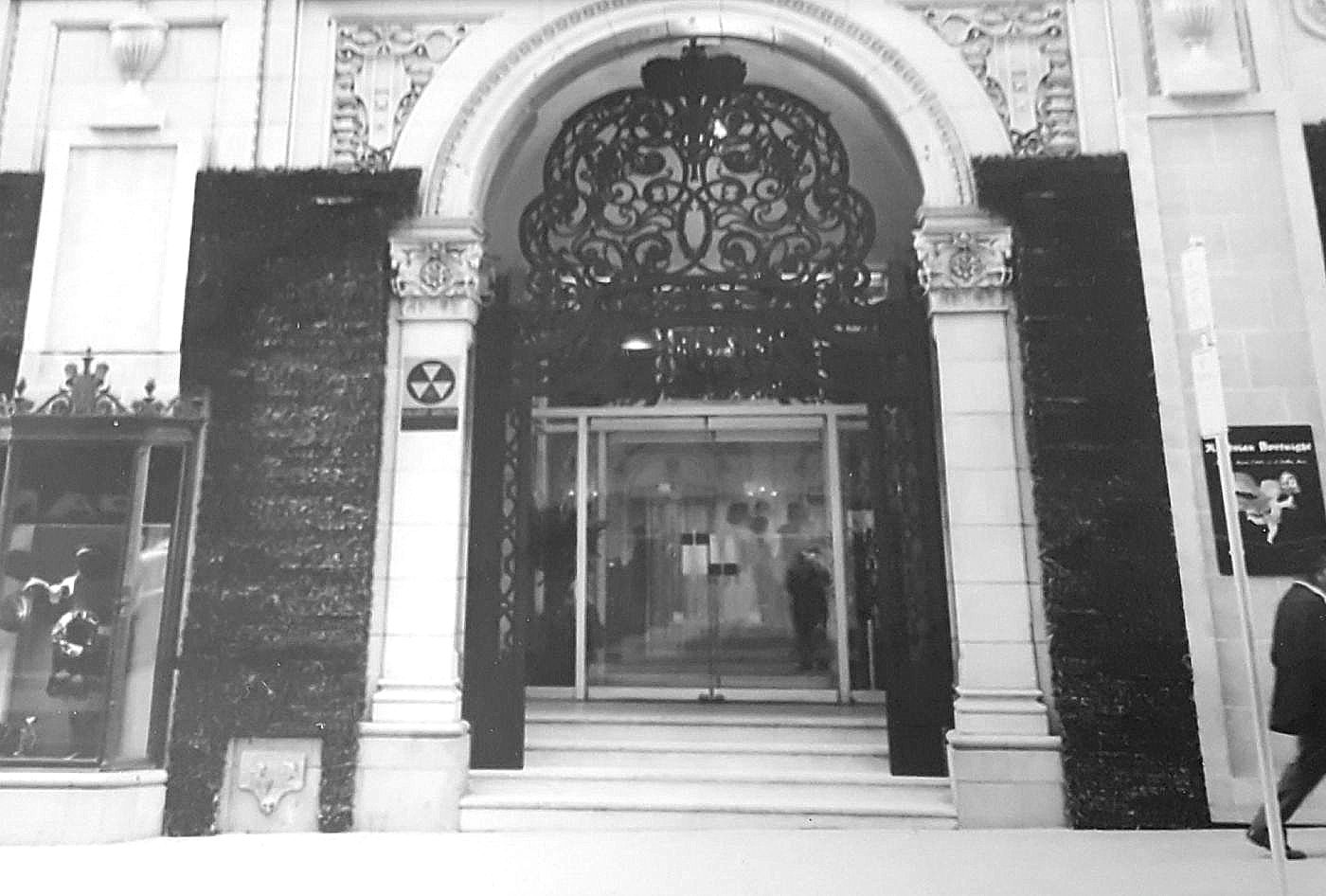
As one might expect, many of the city’s fallout shelters were in downtown buildings, their exteriors adorned with official Civil Defense signage. My favorite? Neiman-Marcus, of course, seen below in 1965, decorated for the Austrian Fortnight.
Neiman-Marcus, the most elegant bomb shelter in town…
If I were able to choose where to huddle during a nuclear attack, I think I’d choose Neiman’s. I’m sure Mr. Stanley made sure his basement was comfortable, tasteful, and well-appointed. …And one would have to expect he wouldn’t have had his guests living off hard candy and fortified crackers.
**
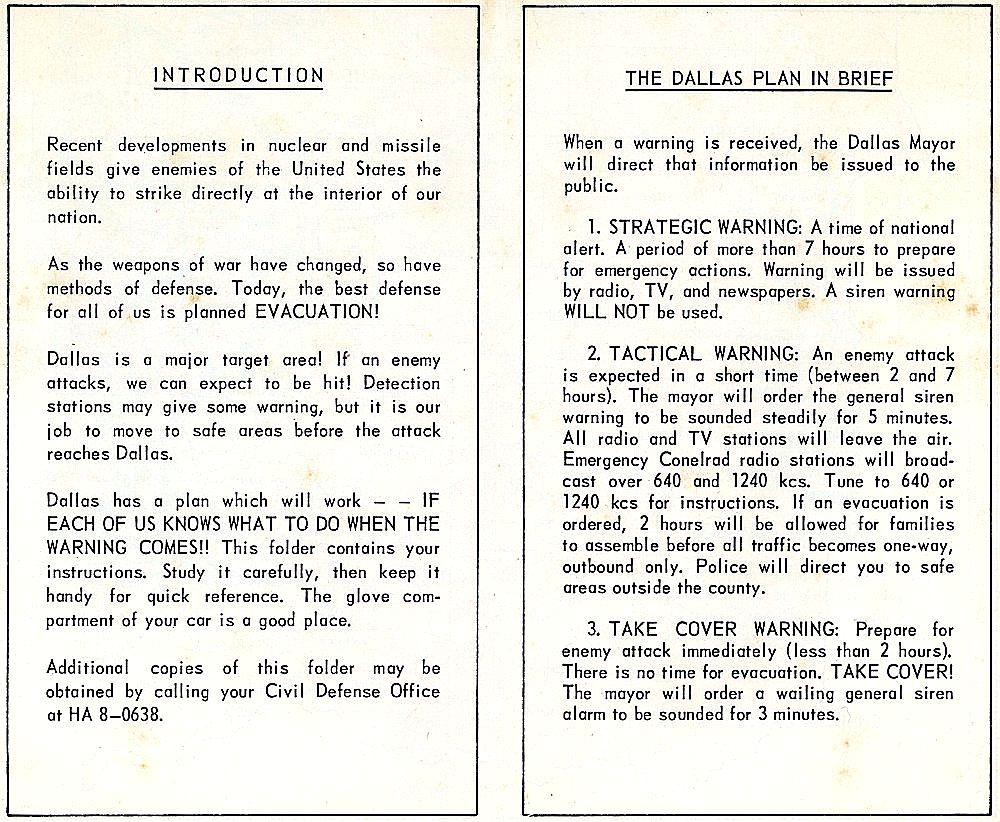
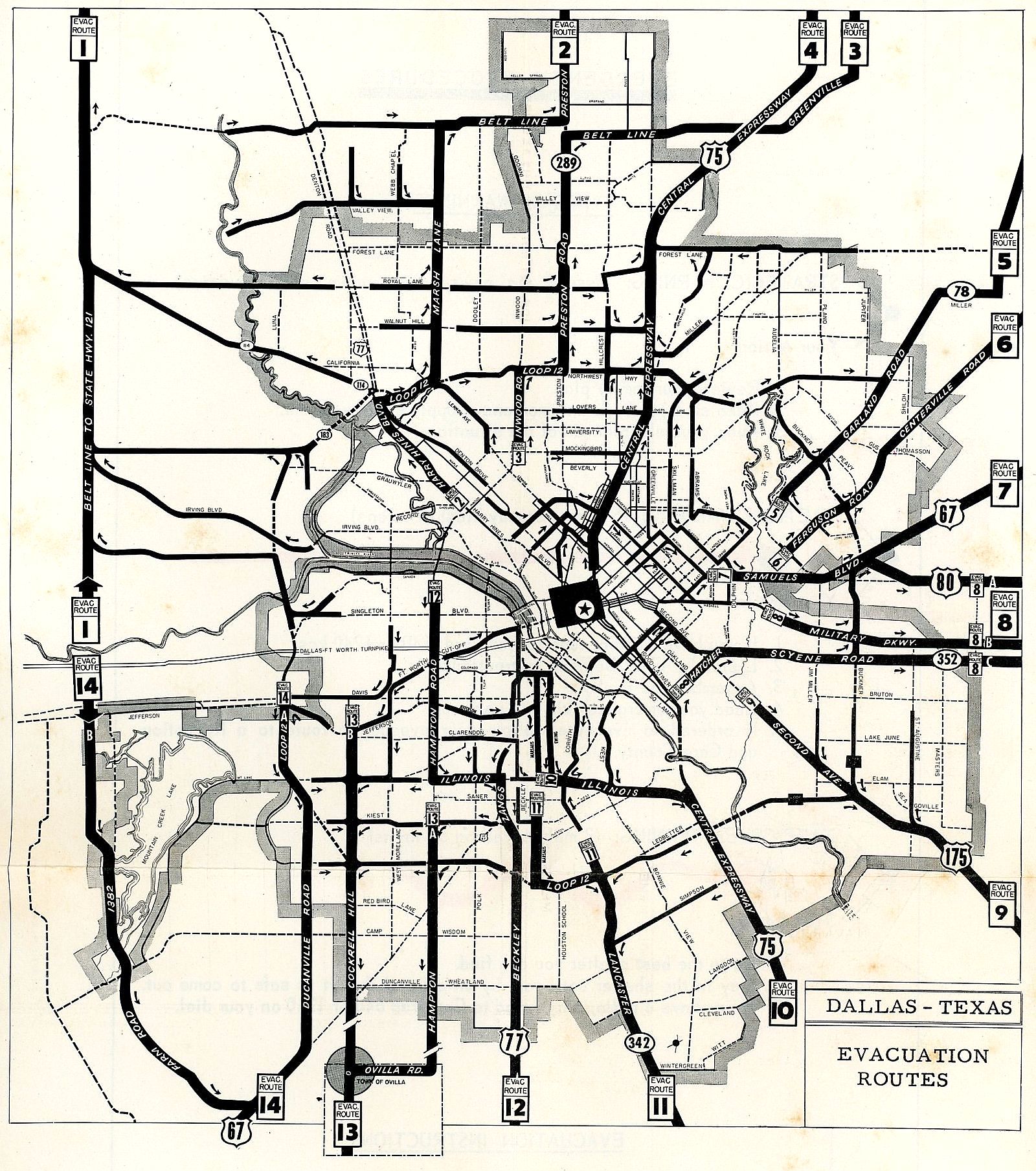
Below are images from the 1958 publication Passport to Survival (thanks to Jeff Hanning for his original scans, which precipitated this post) — all images are larger when clicked.
“Introduction” / “The Dallas Plan in Brief” (more information of CONELRAD is in this YouTube video):
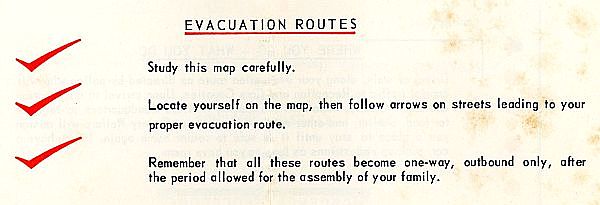
“Evacuation Routes.” (This plan did not sit well with the citizens of Grand Prairie as they were not included in the evacuation plans of either Dallas County or Tarrant County — this seems to have been a particularly odd oversight, seeing as Grand Prairie was a military aviation hub — home to Hensley Field and Chance Vought — and a likely target if DFW were attacked. As an editorial in the Grand Prairie Daily News-Texan stated somewhat bitterly: “Dallas seems to have it all sewed up.”) (Also interesting in these evacuation plans was that the county was divided into four divisions, the boundaries of which corresponded to school districts: District I covered the Dallas Independent School District, Division III covered the Highland Park Independent School District, District IV covered the “Negro Unit,” and District II covered every other school district in Dallas County not covered in the other divisions.)
“Reception & Care Counties For Dallas Area Traffic Dispersal Routes” (the person who owned this pamphlet was planning to hightail it to Bonham):
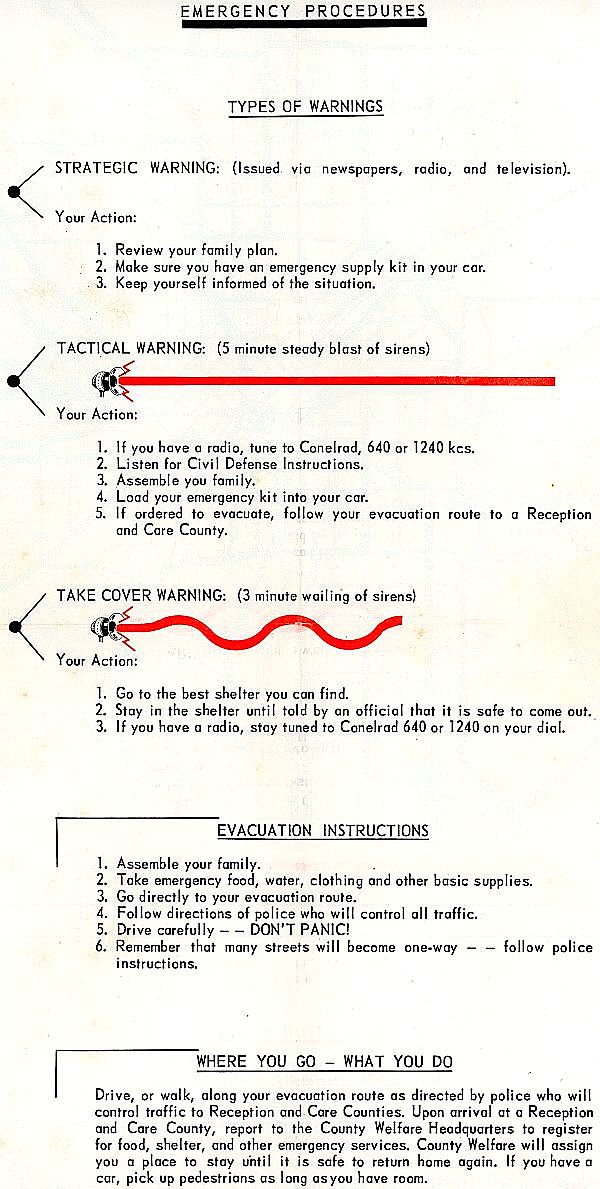
“Emergency Procedures”:
“Emergency Supply Kit” (do NOT forget the can opener!) / “Taking Cover”:
***
Sources & Notes
Thanks again to Jeff Hanning for sending me scans of his Passport to Survival, Dallas County pamphlet.
The photo of Neiman-Marcus is from the DeGolyer Library at SMU. The above image is a really bad photo I took as a reference photo for a project I was working on at SMU last year. The actual photograph in the DeGolyer collection is, of course, much better! Apologies to the DeGolyer Library! I would link to the photo in SMU’s online database, but a scan of that particular photo is not available.
As mentioned above, if you’re interested in Civil Defense in Dallas, the CivilDefenseMuseum.com site is where you need to be. There’s TONS of stuff there. In addition to the great video walk-though of the old Fair Park shelter, there are also several pages of photos here (click through all the pages by following the links at the bottom of each page).
More on the history of United States Civil Defense, here.
And two stories from the Lakewood Advocate on Dallas’ Civil Defense shelters and preparedness can be found here and here.
Thursday night I attended a very entertaining Dallas Historical Society presentation at the Hall of State in Fair Park: “An Evening With Jim Parsons: Lost Fair Park,” in which the author of Fair Park Deco and DFW Deco talked about many of the buildings constructed for the Texas Centennial Exposition in 1936 which are no longer with us.
One of Jim’s asides was that there are very, very few color photos of the Centennial buildings and murals taken in 1936. If you’ve seen a Centennial view in color, it’s probably a colorized postcard. Kodachrome film was introduced in 1935 and was, sadly, not in wide use by visitors to Fair Park in 1936 (or by the Centennial organization).
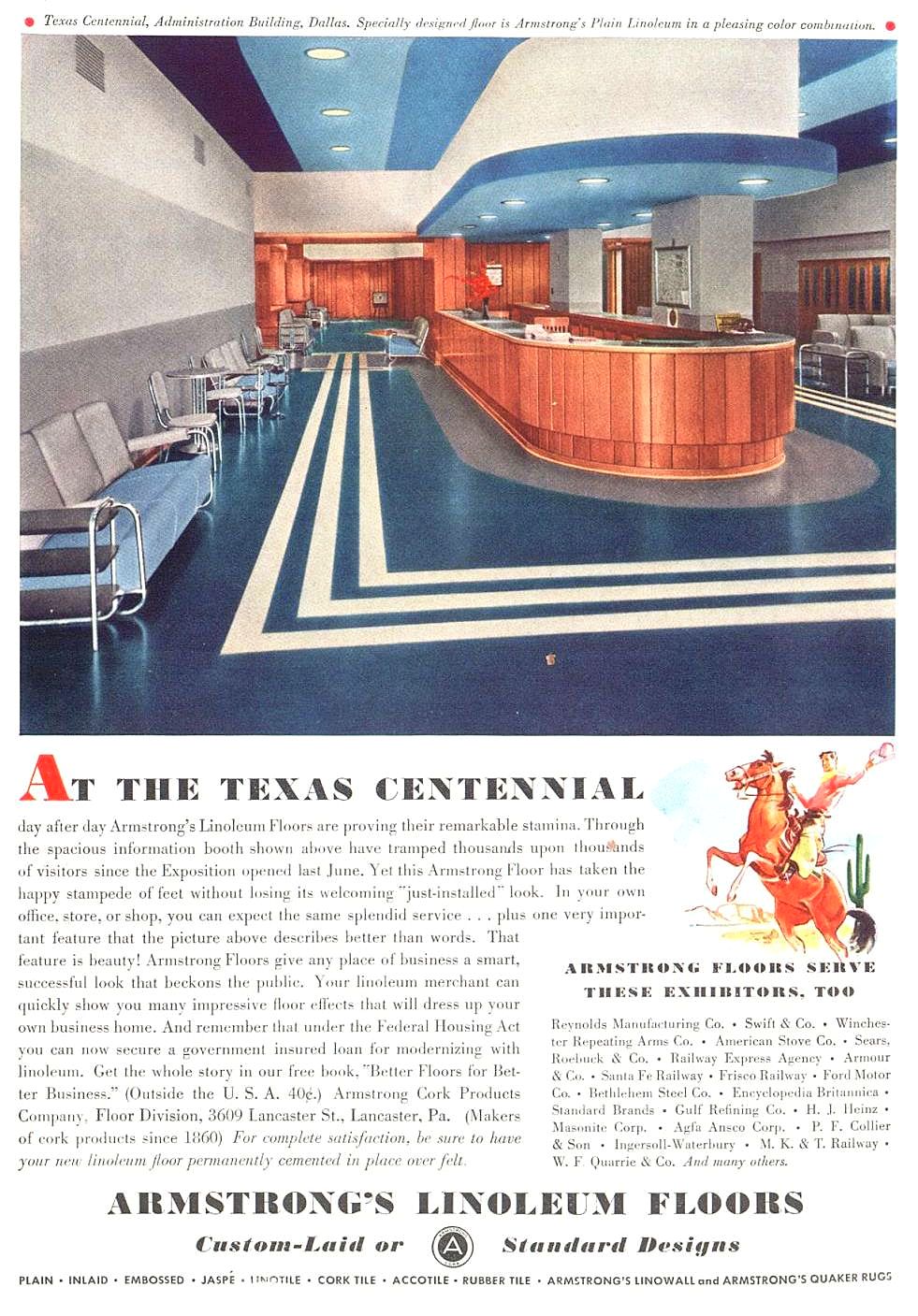
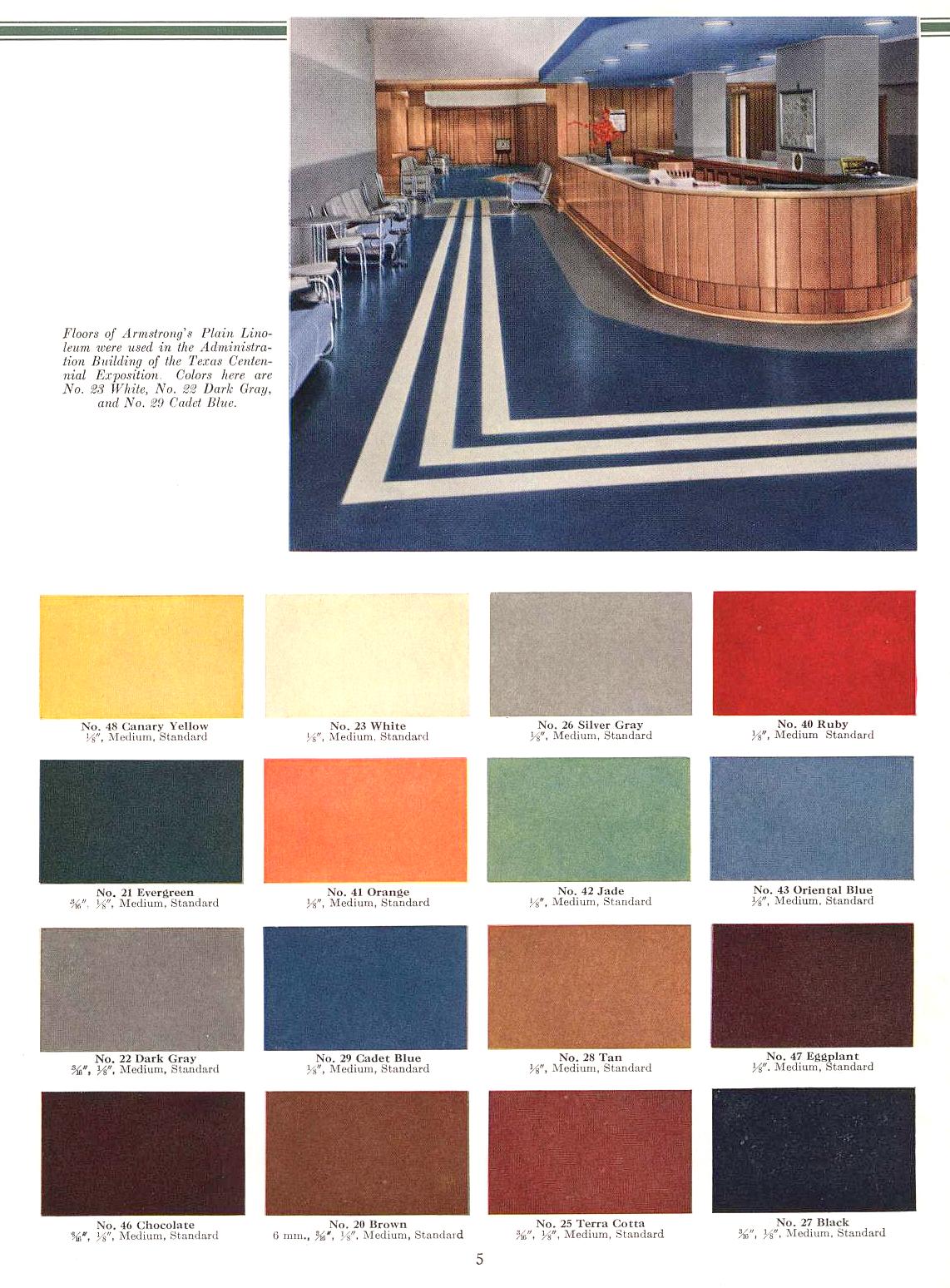
When he said that, though, I remembered an ad I had come across that I thought was pretty cool, simply because it shows the interior of one of the Centennial buildings when it was brand new (…well, it was sort of new — more on that below). The ad is for Armstrong Linoleum and it features a color photo showing one of their custom linoleum floors installed in the Centennial Administration Building, an interior I’d never seen. And it’s in color! (Check out the furniture and the recessed lighting!) Here’s the full ad, which appeared in national magazines in 1936 (click for larger image).
1936 ad
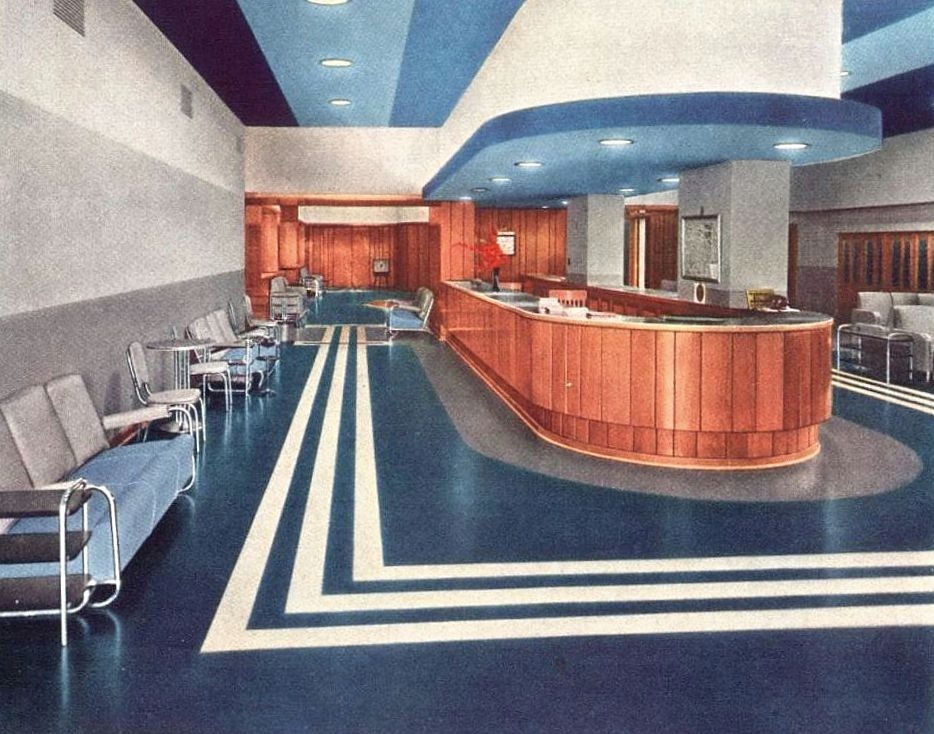
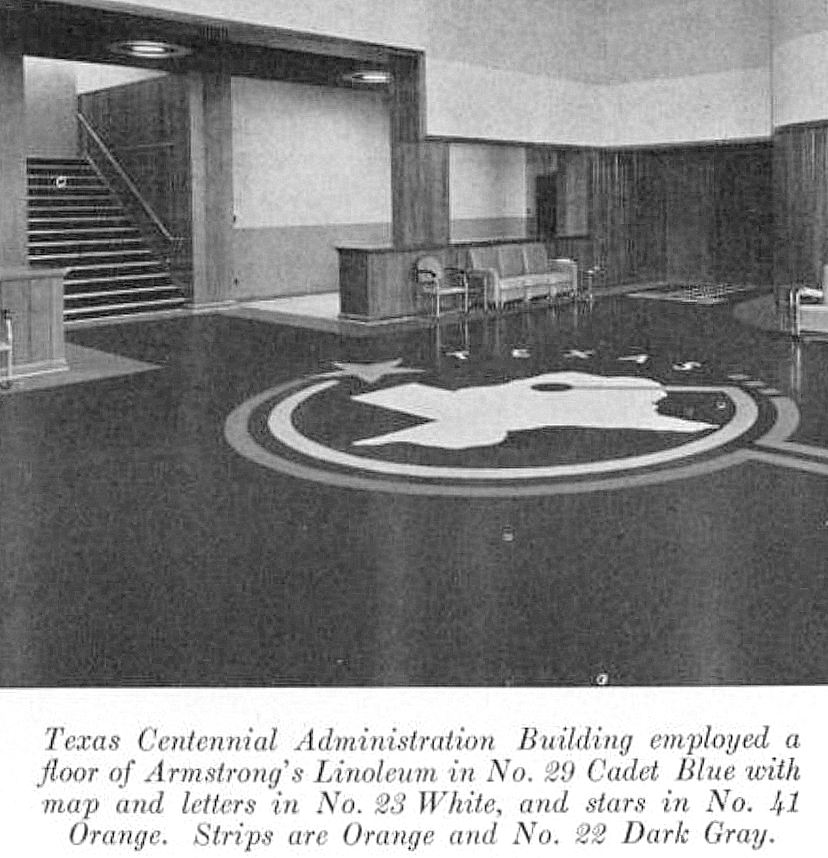
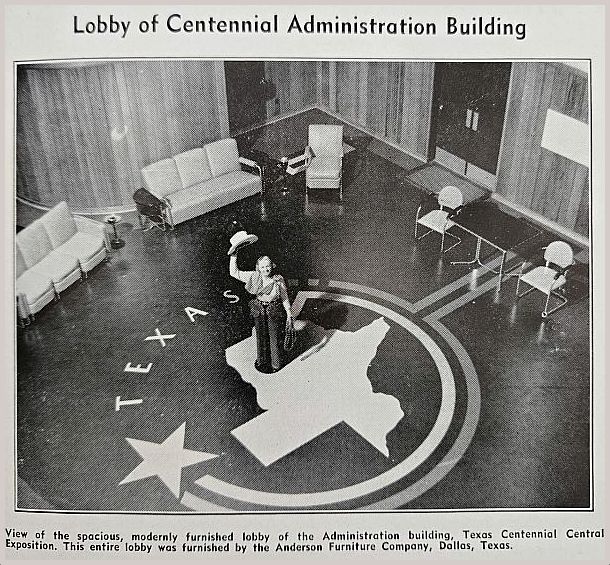
And — hallelujah — I found another photo of the interior — also from the helpful Armstrong people (I don’t know if they had the concession to outfit all the Centennial buildings, but, if so, I’d love to see all of their designs). Unfortunately this one is not in color, but it shows a fantastic Texas-centric custom design, laid down in fabulous linoleum.
And another one:
Southwest Business, June 1936
Imagine that floor in Cadet Blue, White, Orange, and Dark Gray. This is from a trade publication called Armstrong’s Floors and Walls for Homes and Public Buildings, published around 1950 (and fully scanned here). A cropped version of the photo of the top is also included here (that floor, by the way, is in White, Dark Gray, and Cadet Blue), with handy swatches (which, reproduced below, lose some accuracy in color).
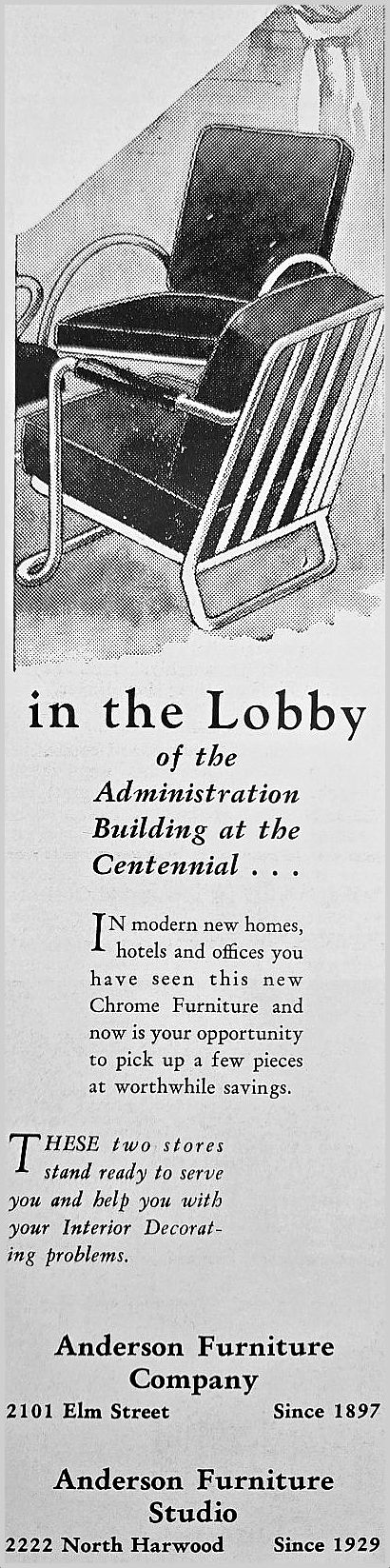
And just because I found an ad for those cool chairs:
Southwest Business, Oct. 1936
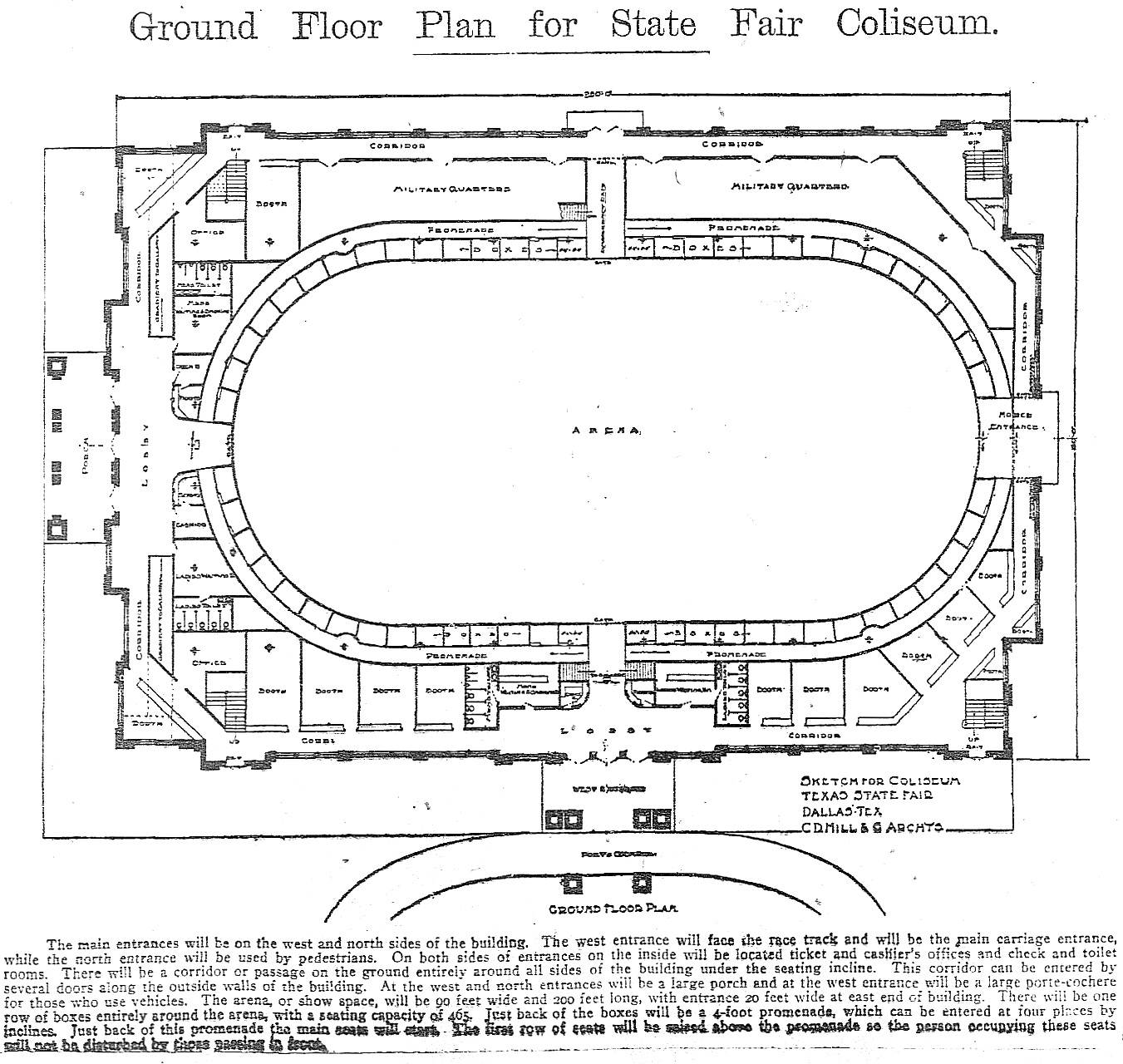
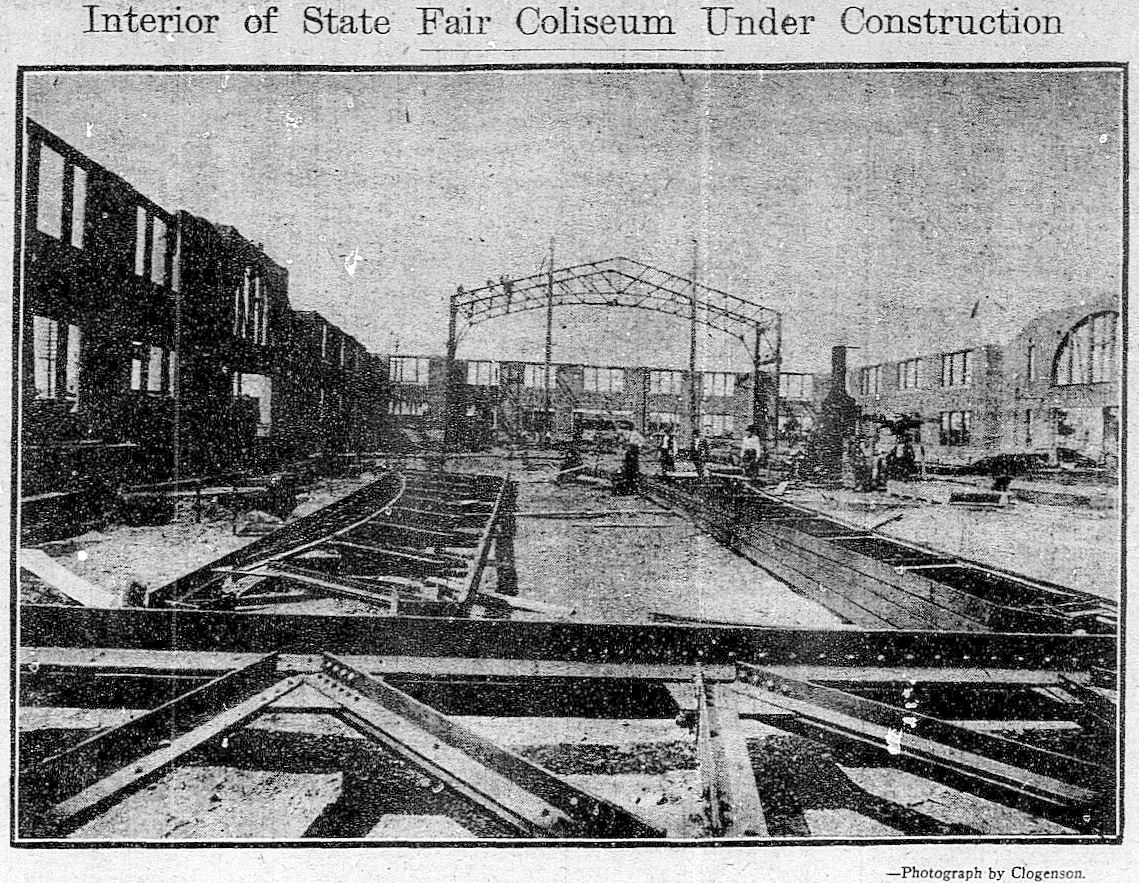
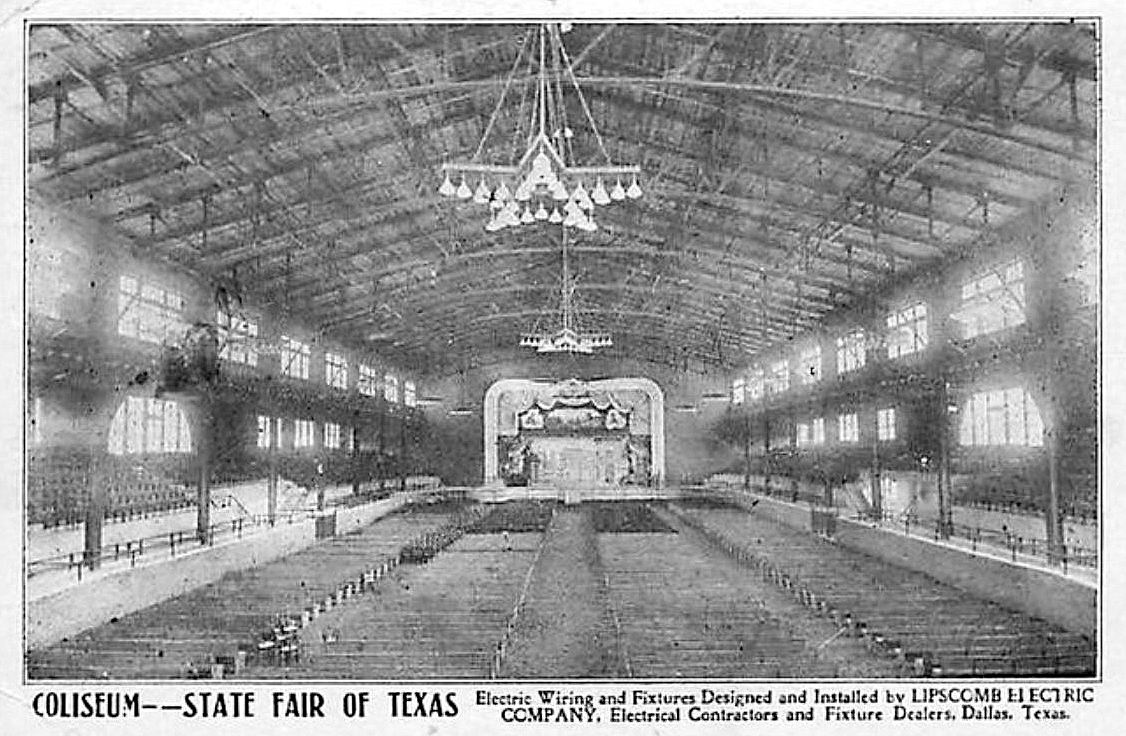
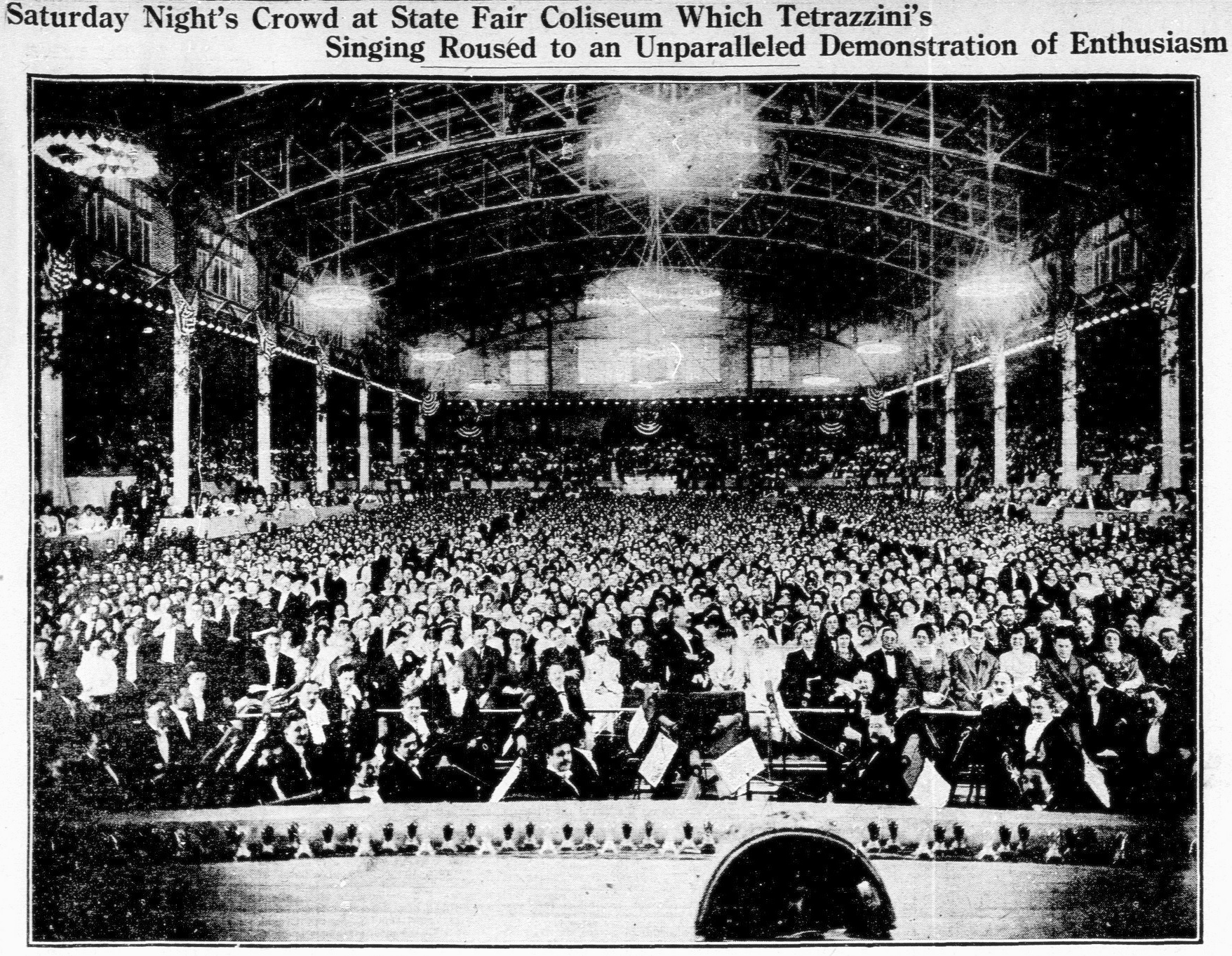
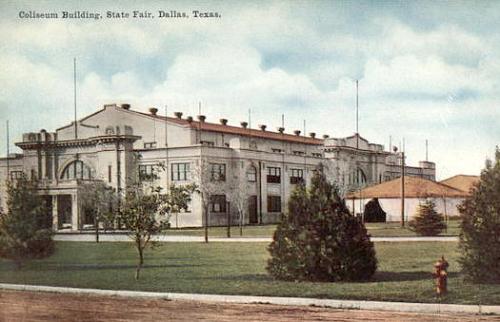
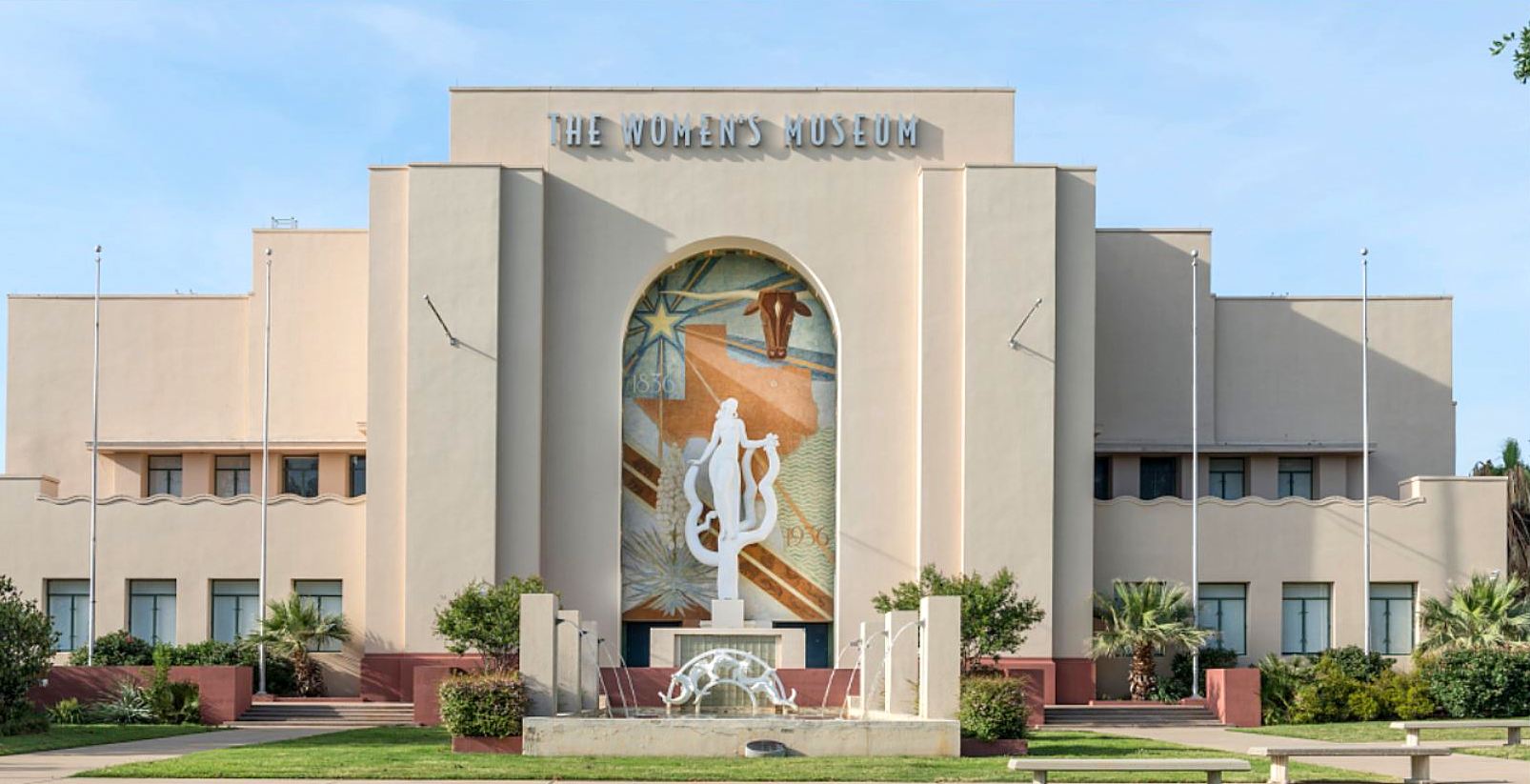
The Centennial Administration Building — which housed the hundreds of office workers and executives behind the running of the Texas Centennial Exposition — was actually the very first Centennial building completed (at the end of December 1935). Most of the Centennial buildings were newly built in 1936, but the Administration Building was actually an old building given a new stucco façade and completely remodeled — it even acquired a second floor inside the huge structure. This building was originally known as the State Fair Coliseum, built in 1910, designed by architect C. D. Hill (who designed many buildings in Dallas, including the still-standing Municipal Building downtown (built in 1914) and the Melrose Hotel (1924).
Dallas Morning News, June 20, 1909
DMN, May 7, 1910
It was BIG. It had a seating capacity of 7,500.
DMN, March 4, 1913
This was the first building you’d see as you entered Fair Park, as it was right inside the front entrance on Parry Avenue (after you entered, the building would be on your left).
It was the city’s first official municipal auditorium, and it hosted everything from livestock shows, conventions, large civic gatherings, and the occasional opera.
Fast-forward a few decades: in 2000 the building became the home of the Women’s Museum. The museum closed in 2011 and is now called the Women’s Building and is used for special events.
See a Wikimedia photo of this building in 2016 here — click it again (and again) to see it really big, and linger on the mural by Carlo Ciampaglia and the sculpture by Raoul Josset. See interior photos of the space in 2009 during its time as the Women’s Museum here and here. I’m not sure if the exposed brick and steel are from the original 1910 building, but I certainly hope so! And, lastly, exterior photos from 2009 showing the side of the building here, and here
***
Sources & Notes
This building can be seen on this aerial Google view, here. It is currently the Women’s Building, and it is available for special events — more about this building from the Friends of Fair Park, here.
Black-and-white postcard showing the interior of the Coliseum is from Flickr.
Black-and-white photo “Coliseum and Art Building” is from Report for the Year 1914-1915 of the Park Board of the City of Dallas, With a Sketch of the Park System (Dallas: Park Board, 1915), which can be accessed as part of the Dallas Municipal Archives via the Portal to Texas History, here.
This weekend marks the fourth anniversary of this blog. It’s hard to believe, but, completely coincidentally, this is my 1,000th post! That’s a lotta Dallas. (Some might argue that’s too MUCH Dallas….) There are now just over 9,000 Flashback Dallas followers across various social media platforms, and it’s always nice to know there are others out there who share my interest in Dallas history. Thank you to all who read, follow, share, and comment. It wouldn’t be as much fun if I were just typing for myself.
Thank you! And now, Year 5!
–Paula
***
Sources & Notes
“Texas Centennial Exposition Stamp” from the George W. Cook Dallas/Texas Image Collection, DeGolyer Library, Central University Libraries, Southern Methodist University; more information on this image can be found here.
The State Fair of Texas midway never gets old… (click for larger image)
by Paula Bosse
I haven’t been to the State Fair of Texas for several years, so I took a trip out to Fair Park this past Wednesday to see what’s new.
Food. The only thing I ever really want is the traditional Fletcher’s corny dog, and I’m happy to report they’re as good as ever.
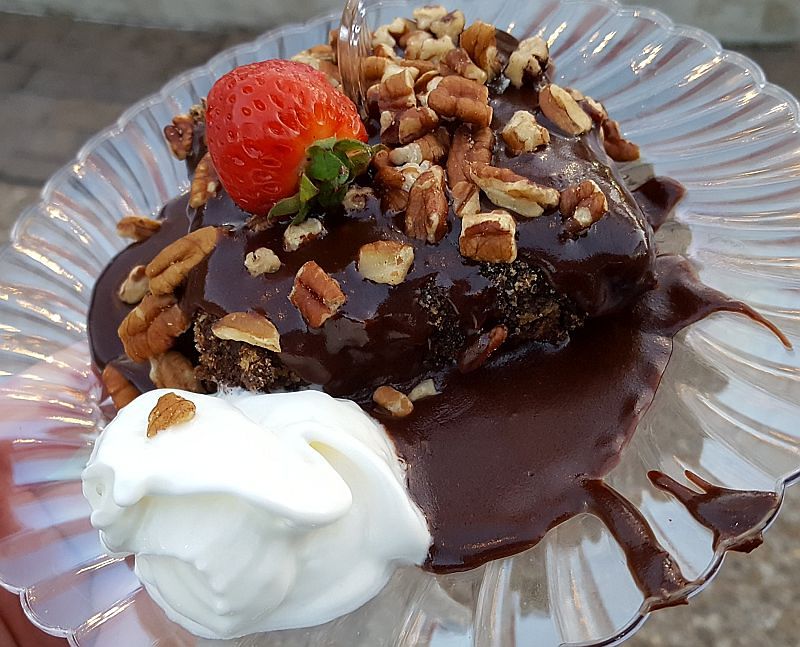
I also tried the Fried Texas Sheet Cake which was — and I can’t believe I’m saying this — too sweet, and just … too much. A bite would have been plenty. The topping of chocolate syrup and pecans was the best part. Maybe someone should offer a bowl of just that. …And then fry the whole thing — bowl and all. I’d probably try it.
When I saw the sign for “Fried Chicken Skin” I had to try it. I guess it’s something you either really want, or it’s something that makes you recoil in horror. I really wanted it. I was expecting more of a battered-Church’s-fried-chicken experience, but I don’t think there was any batter at all. I still liked it, but it could have been a lot more mouthwatering. It needed a bit more heft. (Speaking of fried skin — there’s a phrase I’ve never uttered — why aren’t there chicharrones at the fair? Done right, those things are incredible. Isn’t pork belly still a thing?) (And someone really should do battered fried chicken skin.)
It might have been healthier had I just swallowed the cute Big Tex earrings ($10, zero fat grams), which I almost went back for. It takes a special kind of person to be able to pull those off, and I’m afraid I’m not that whimsical. But I bet they make a great conversation-starter and help break the ice at parties.
Everything was remarkably clean. I mean really clean. …Freakishly clean. This is not the grimy, dirty, cigarette-butt-laden fair I remember as a kid, and I have to admit, I kind of missed the grime and trash. Also, I don’t remember the plush toys being so remarkably colorful. My retinas will never be the same. Click the photo below to get the full neon blast of color.
Speaking of things I miss, I also miss the seediness of the fairs from my childhood in the ’70s (certainly the seediest decade in modern times): the unkempt carnival barkers who never sounded like they were from Texas, the bored ride operators going about their repetitive jobs with a cigarette hanging from their mouth, the half-eaten candy apple stuck to the asphalt, and, yes the side shows. Without doubt, I think my favorite thing about the annual fair was seeing the huge banners emblazoned with vivid images of freaks and oddities — those banners were works of art and sheer advertising genius. I never wanted to see the shows, but I loved those banners, and I loved listening to the raspy voices of the going-through-the-motions barkers. Now? I saw a teeny booth along the midway wherein was what was purported to be the world’s smallest horse (yawn), and then there was the exhibit below featuring what appeared to be nothing more than a two-headed rattlesnake and a couple of two-headed turtles inside a little building about the size of a portable garden shed. But a kid will always be fascinated by anything with two heads. I realize my interest in two-headed creatures isn’t what it used to be, and I also realize that the day of the brilliant freak show banner art has come and gone.
When I was a kid, my favorite “ride” was always the German Funhouse. I did see one funhouse, which did not seem to be specific as to country of origin. These haunted houses get high marks for decorative impact. This is what you want to see at a state fair!
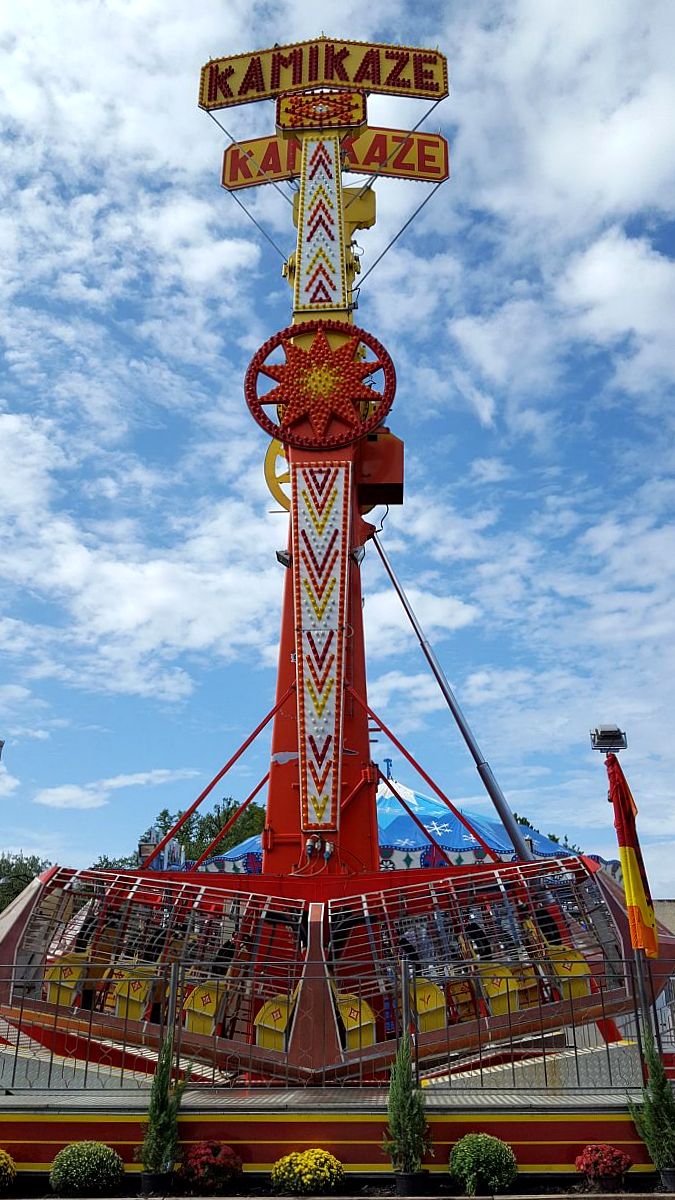
Incidentally, it will cost you 6 coupons to experience the full gory glory of “Scary Park” — that’s HALF the price of one order of fried chicken skin! Seems like a pretty good deal. There are some “extreme” rides that will cost you 150 coupons. ONE HUNDRED AND FIFTY COUPONS. That’s $75. I watched one of these rides, which began with two teenagers being strapped into some sort of horizontal harness. The second step was the signing of the waivers. Then the boys were raised way, way up and then dropped and flung across the sky from a height which makes me queasy just thinking about it. They swung back and forth a few times and were then lowered to terra firma, no doubt thrilled and nauseous. That makes a whirl on the quaint Kamikaze seem like a leisurely stroll around the neighborhood after a light meal.
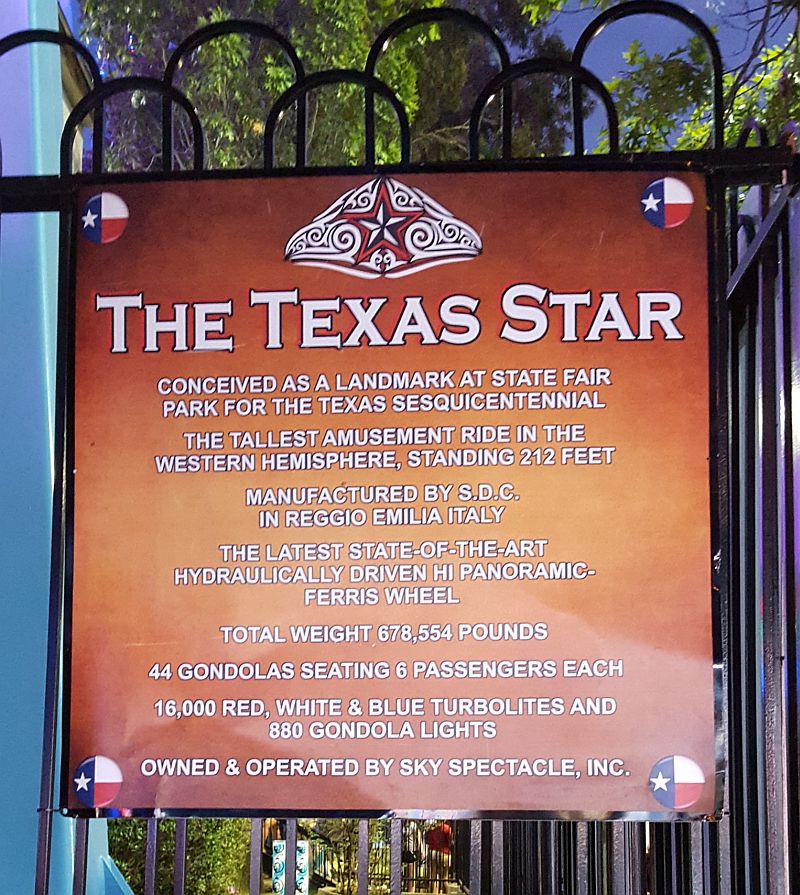
The Texas Star ferris wheel is pretty impressive and deserves a better photo than this, but look at the ground — you could eat off that!
In case you ever find yourself on Jeopardy and the category is “Amusement Park Rides,” this might be helpful.
I don’t know how many Fletcher’s stands there are at the fair, but this one on the midway is certainly the brightest. (And if you say “corn dog” in my presence I will be forced to correct you….)
My favorite sign at the fair was this one, at the beautiful entrance to the beautiful Hall of State: “NO FOOD, NO DRINK, NO BALLOONS.” Don’t even think about it.
And look at Hall of State at night. Nary a balloon in sight.
I was actually working in the Hall of State the day I took these photos, so I had a short walk around the park right after it opened (that corny dog was my breakfast!) and a longer walk around the midway at night. A few thoughts:
I’m the only person who wishes it weren’t quite so clean.
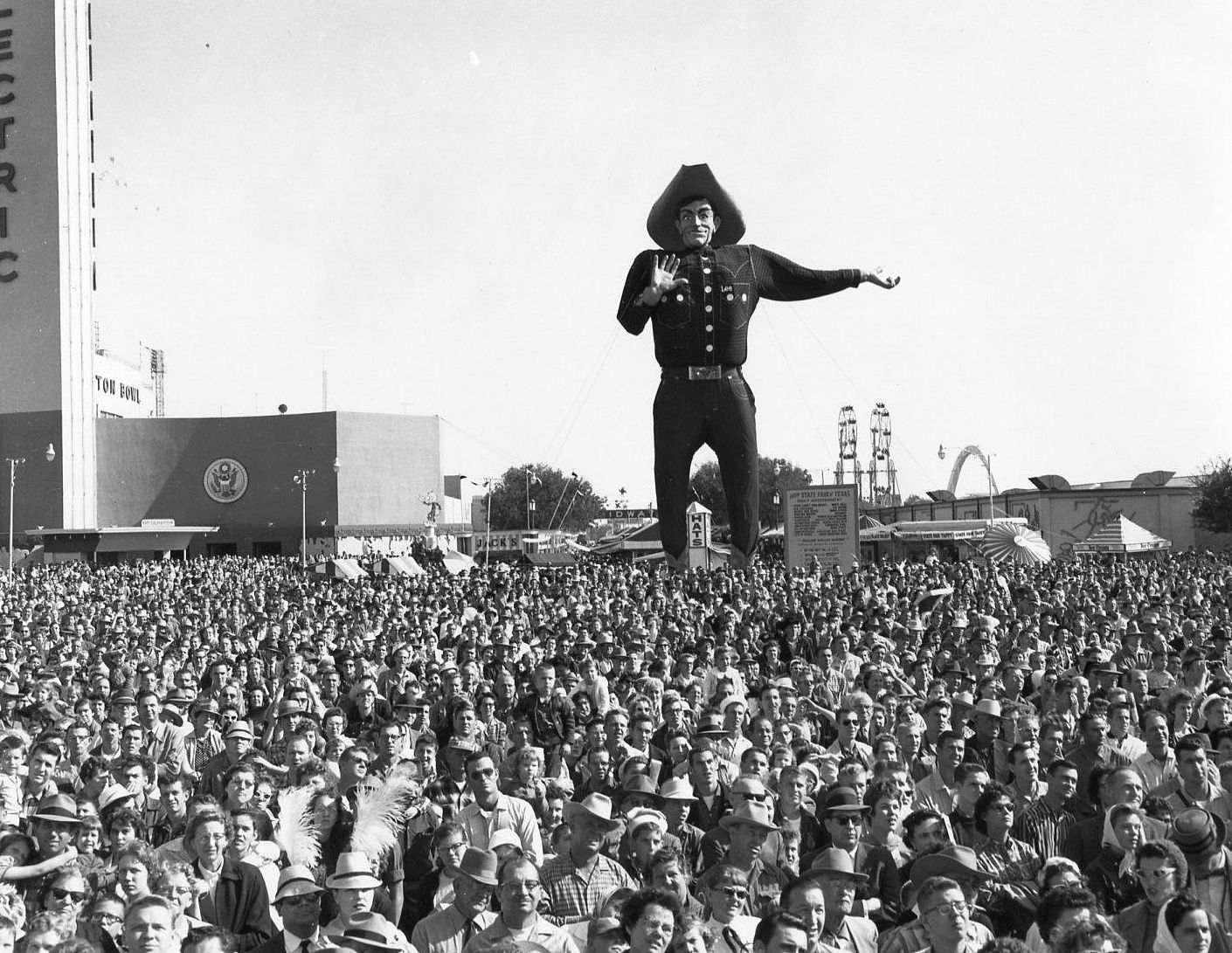
Neon Big Tex is way better than “new” post-flambé Big Tex. Everyone complains about the new Big Tex, and I’m one of them. There’s a new kid in town, Tex, and my allegiance is now firmly with Neon Big Tex, the old Centennial Liquor sign featuring a neon-outlined Big Tex recently planted in Fair Park.
I never liked the nightly parade as a kid, but I really enjoyed it this year. The floats were attractive, the cowboy on stilts and the unicyclist on a stuffed pony were fun and goofy, and the Carter High School band was really, really good (and brought memories of my high school marching band days back with a vengeance). Also in the parade were several policemen on horses. I wondered what happened when a horse would leave its … um … byproducts behind them in the (meticulously clean) street, and then I saw a policeman riding behind in a golf cart, with a shovel strapped to the side and a large receptacle in the back. I wonder if the officers draw straws before the parade to see who gets stuck with shovel-duty?
I did not visit any buildings. I saw no canned peaches, no automobiles, no butter sculptures, no livestock, no miracle mops, no pig races. I’ll have to leave those for next time.
The best thing about the fair is that everyone is happy — especially the children, who are often over-stimulated and beside themselves with excitement — and it reminds me how much I used to look forward to my annual visit.
Seeing the fair in the daytime and at nighttime are two completely different experiences. Daytime in general is overrated. Always choose nighttime!
***
Sources & Notes
All photos by Paula Bosse. Most are pretty big — click ’em!
The 2017 State Fair of Texas runs from Sept. 29 to Oct. 22. There’s plenty of time left!
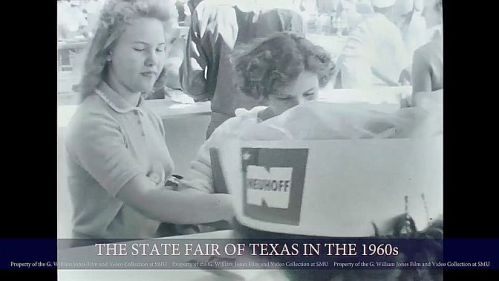
Everyone likes ice cream…. (G. William Jones Collection, SMU)
by Paula Bosse
Thanks to Twitter, I discovered this cool video of film clips of the State Fair of Texas, shot throughout the 1960s, courtesy of SMU’s WFAA Newsfilm Collection/G. William Jones Film and Video Collection, put together by Moving Image Curator Jeremy Spracklen. There are 15 or so clips, some in black and white, some in color, some silent, some with sound. This compilation runs about 24 minutes. Watch it. You’ll enjoy it — especially the montage of fair food at the end! (Make sure you watch in fullscreen.)
*
Here are a few screengrabs I took, to give you an idea of the content (images are much cleaner in the video!).
Getting ready for the fair.
Fair Park entrance.
Crowd, baby, binoculars.
Neuhoff hot dog stand.
The monorail (with a cameo by Big Tex).
I don’ t know who this guy is, but he’s in several shots and I love him! Here he is losing out to the woman who correctly guessed his weight.
Kids eating … Pink Things! “Made famous at Six Flags.”
Aqua Net and Moët. (I have to say, I’ve never seen champagne at the fair, but perhaps those are circles I don’t travel in.)
Everyone needs a corny dog fix.
Everyone.
Have a groovy time at this year’s State Fair of Texas!
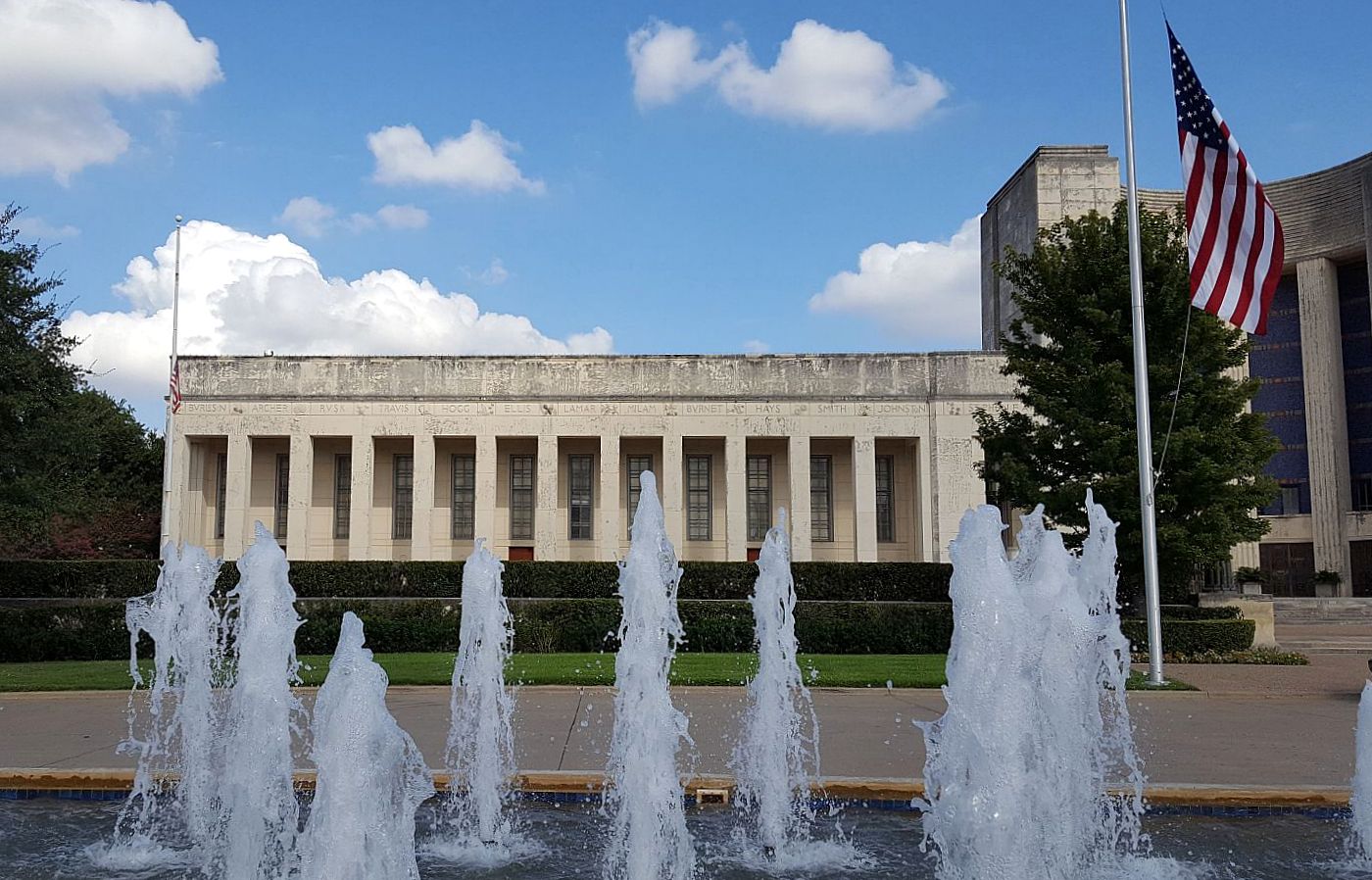
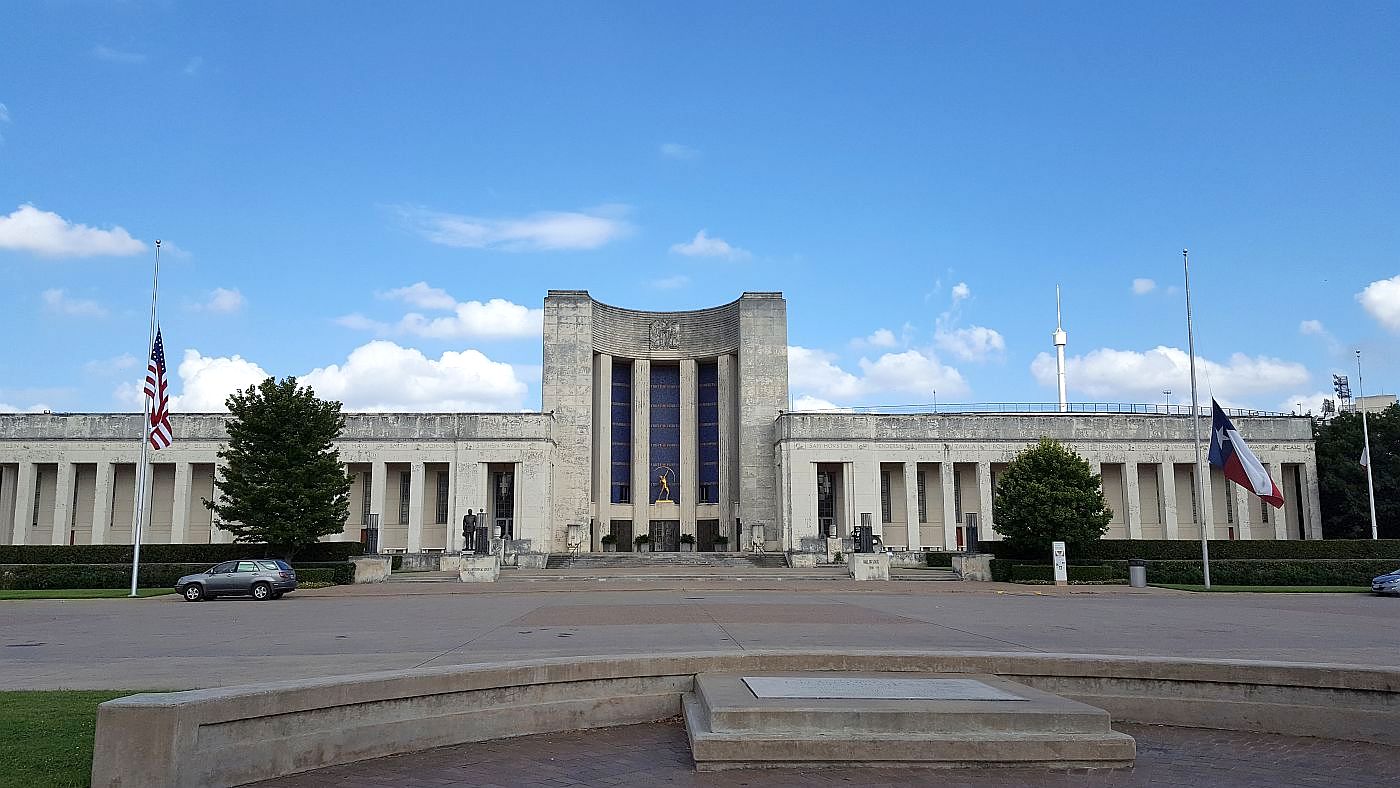
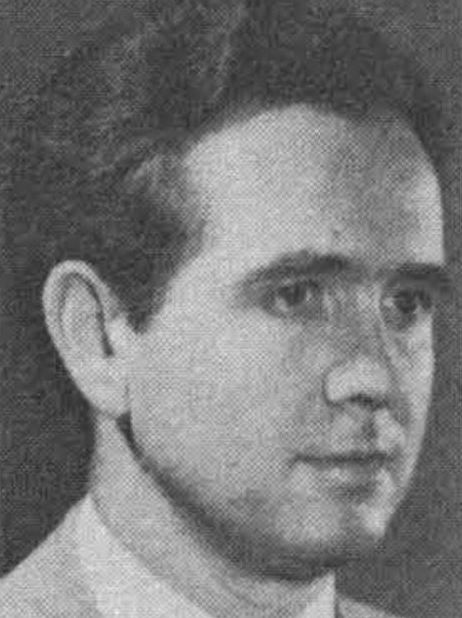
A large number of Texas architects had a hand in designing the Fair Park buildings built expressly for the Texas Centennial in 1936. One such architect was the young (still in his 20s!) Donald Barthelme (1907-1996) of Houston, the principal architect for the Centennial park’s crowning jewel, the Hall of State. Years ago — when the only Donald Barthelme I had ever heard of was the acclaimed writer (who was the son of the architect) — I read an amusing factoid about Barthelme’s amusing “signature” which adorns his beautiful building. It can be seen on the wing to the left of the Hall’s entrance — seen above. (I took the photo this week — the flags are at half-mast in honor of the recent death of former governor Mark White.)
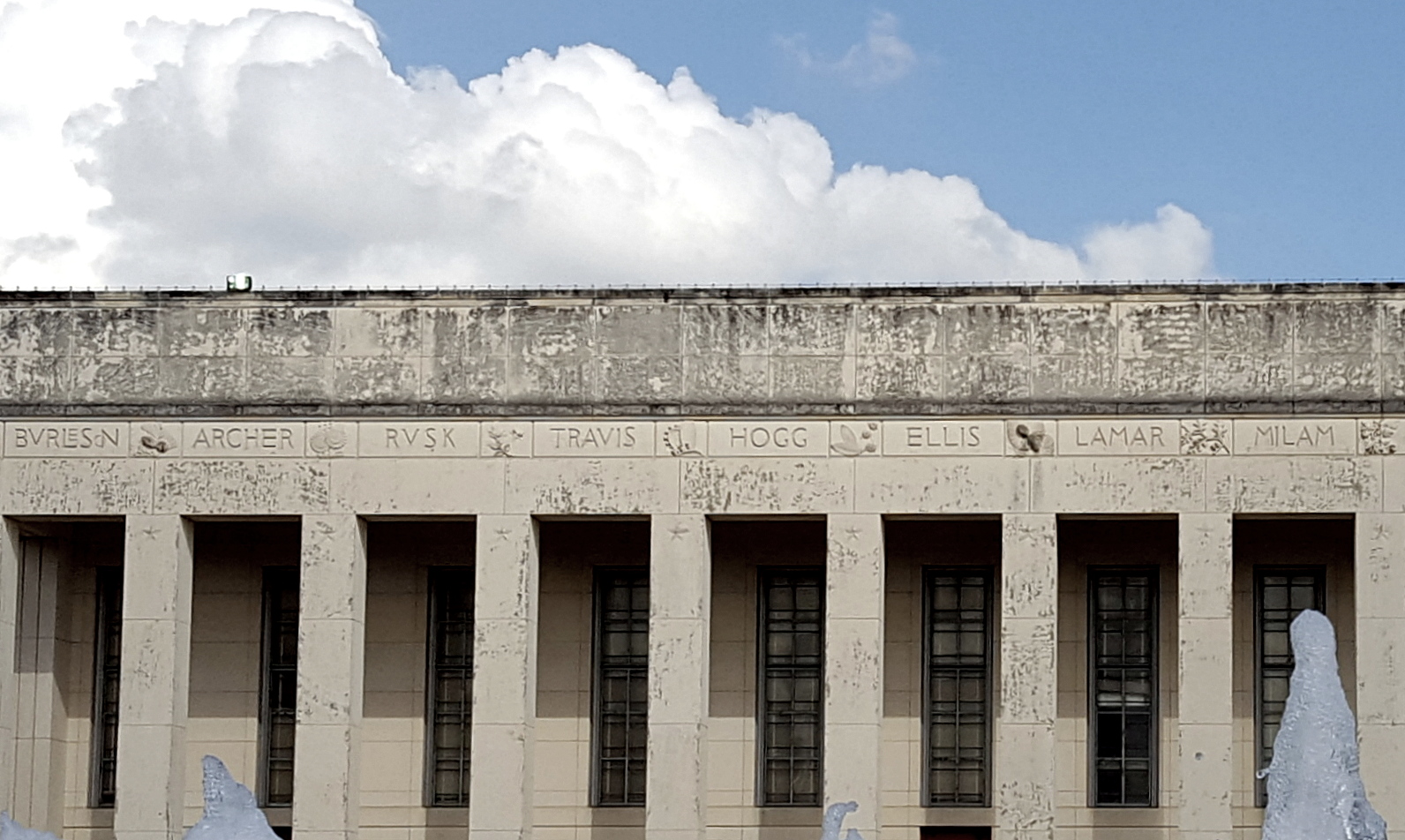
Around the top of the building is a frieze containing names of notable Texans. I’m sure a committee of some sort came up with this list of names which were carved into what was then the most expensive public building in Texas. All I can say is that it’s a shame they couldn’t have come up with just one more name — someone whose last name began with the letter “E,” because Mr. Barthelme arranged the first eight names to spell out his last name (which ended one letter too soon, at “M” — for Milam). I think if I had been in Barthelme’s position I might have just thrown in another name. Maybe “Erath.” …For closure. Click the photo below to see Mr. B’s winking historic signature.
A couple of sentences on the Hall of State by David Dillon, former architecture critic for The Dallas Morning News, written for the paper in November 1989:
Few Texans know who designed the Hall of State — it was Donald Barthelme of Houston, assisted by 10 other architects — yet 53 years after it opened it continues to stir us. It is a building of exceptional individual pieces held together by a powerful central idea — an exemplary period piece that reminds us what public design used to be, and what much contemporary civic architecture is not.
***
Sources & Notes
Photos of the Hall of State taken by me on Aug. 9, 2017.
Photos of Donald Barthelme, Sr. taken from the 1949 and 1950 yearbooks of the University of Houston where he was an Architecture professor for many years.
David Dillon quote from his article “An Old Friend Triumphs Anew: The Hall of State Redo Affirms the Power of Great Architecture” (DMN, Nov. 14, 1989), written after an extensive renovation to the building.

 “Corny Dog” by David Bates, 1986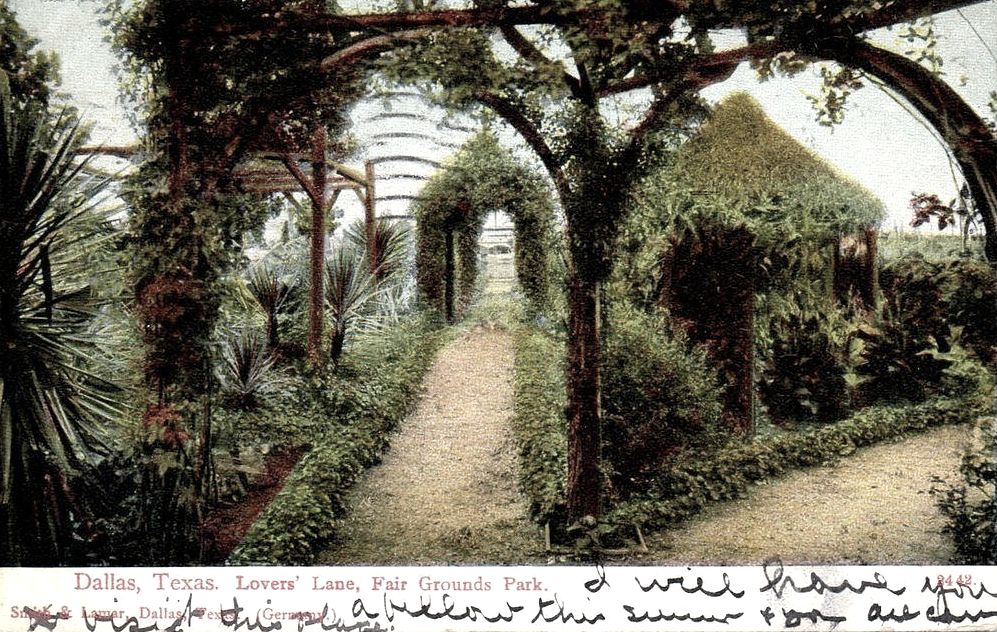
 DMN, 1922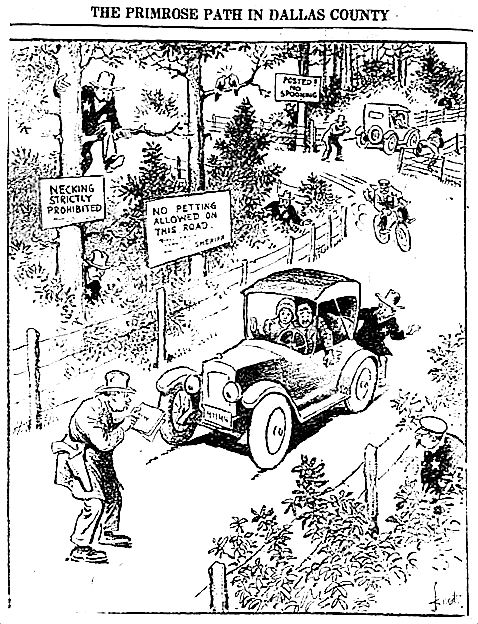












 Everyone likes ice cream…. (G. William Jones Collection, SMU)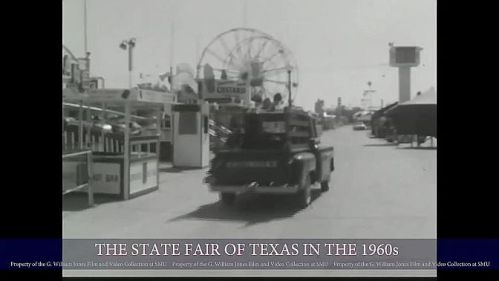





 Flashback : Dallas