Flashback : Dallas

A Miscellany: History, Ads, Pop Culture

Category: Oak Cliff/West Dallas

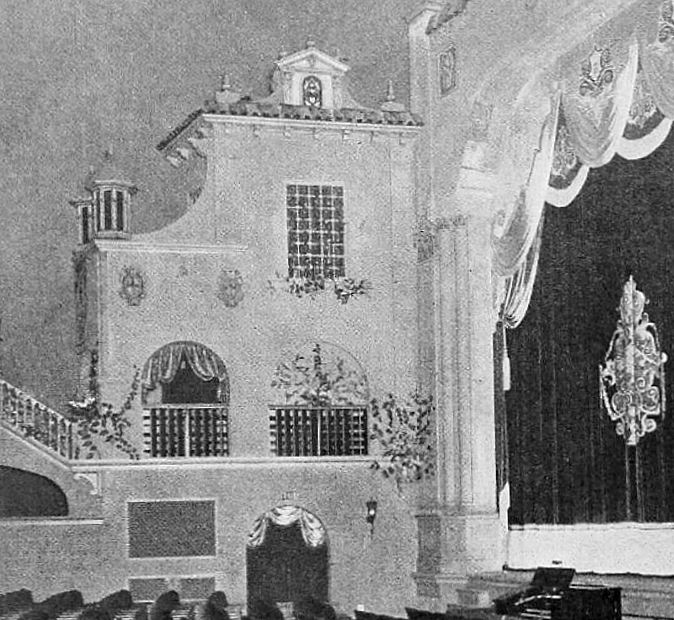
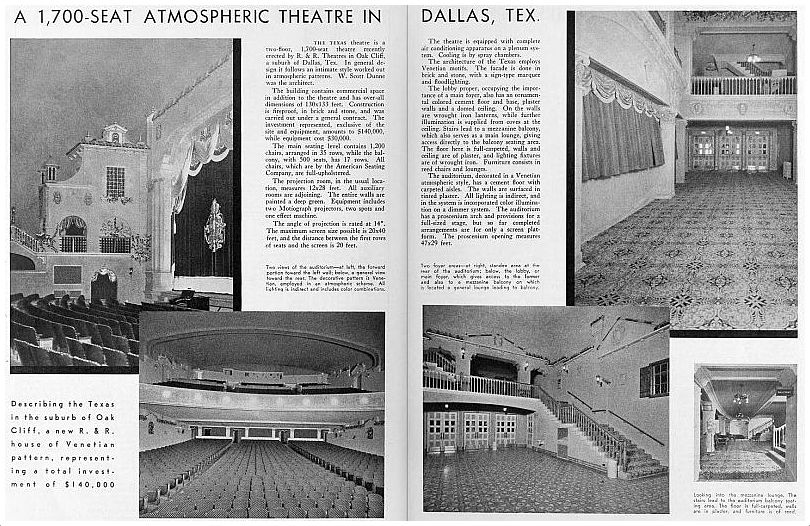
The Texas Theatre and Its Venetian-Inspired Decor

texas-theatre_motion-picture-herald_070232_det1A little bit of Venice in the O.C. (note organ at edge of stage)

by Paula Bosse

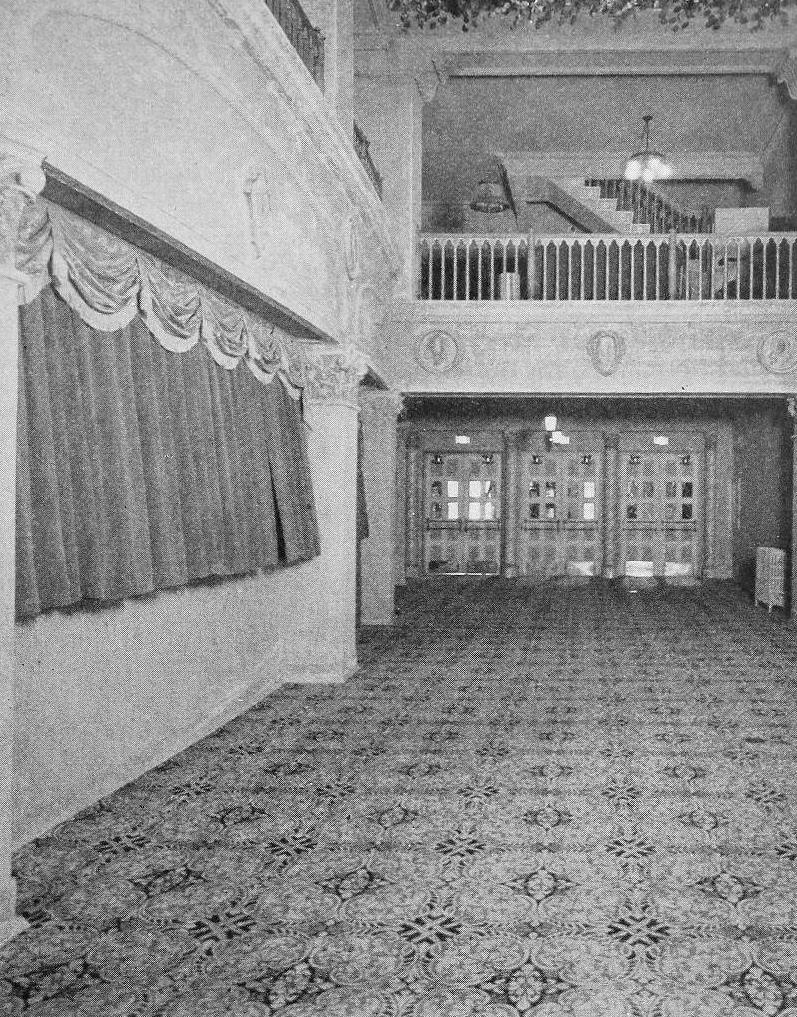
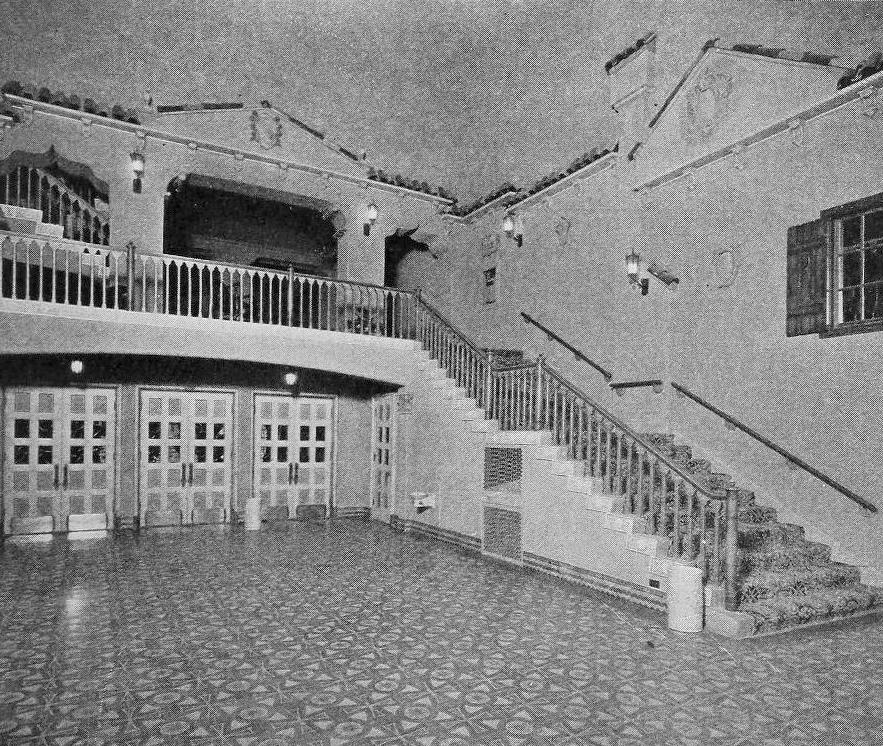
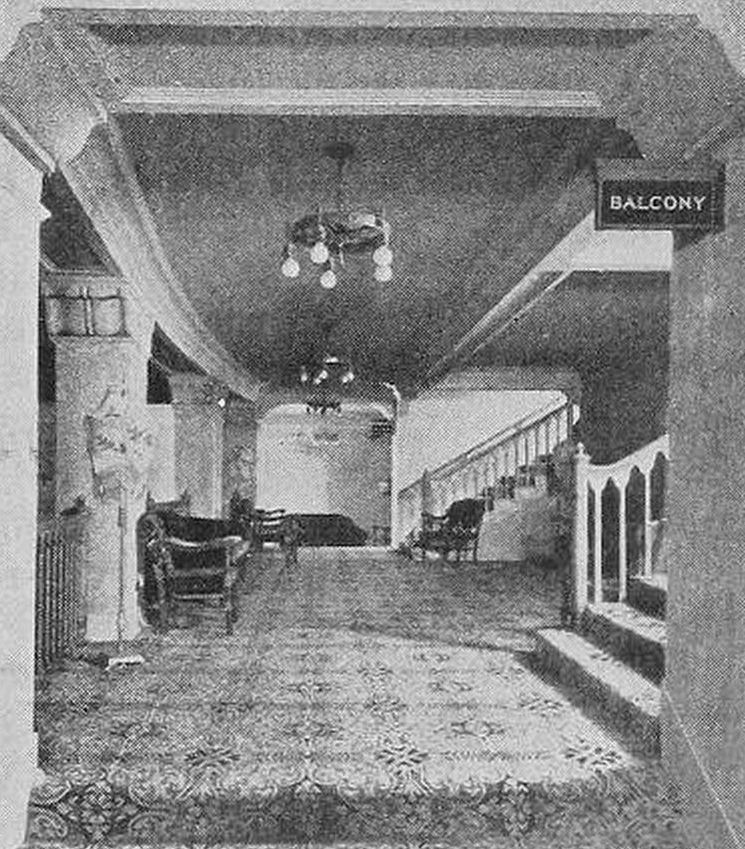
The Texas Theatre in Oak Cliff  — which opened in April, 1931 — was the first movie theater in Dallas built expressly to show movies with sound. It was also the largest “suburban” theater in the Dallas area — only downtown’s first-run Majestic and Palace theaters were larger. Below are photos of the theater’s “Venetian-style” interior, from the trade journal Motion Picture Herald.

texas-theatre_motion-picture-herald_070232_det2

texas-theatre_motion-picture-herald_070232_det3

texas-theatre_motion-picture-herald_070232_det4

texas-theatre_motion-picture-herald_070232_det5

***

Sources & Notes

Photos from Motion Picture Herald, July 2, 1932. For the full article, see the very large scan of page 1 here, and page 2 here.

texas-theatre_motion-picture-herald_070232

The Texas Theatre is still alive — its website’s history page is here.

My previous post, “The Texas Theatre — 1932” (which shows the theater’s exterior at the time this article was published), is here.

*

Copyright © 2016 Paula Bosse. All Rights Reserved.

Muriel Windham — An Oak Cliff Teenager’s 1940s Diary

muriel_colorMuriel, via Muriel Windham’s Diary

by Paula Bosse

About this time last year, Robert Wilonsky of The Dallas Morning News wrote an interesting article about a black-out imposed by the city of Dallas in January, 1942, just a few weeks after the attack on Pearl Harbor. In the middle of it, he linked to a diary entry written by a 14-year-old describing the event. For me, the most interesting thing about Wilonsky’s piece was the fact that someone had transcribed diary entries of a teenage girl growing up in Dallas in the 1940s. So I read the whole thing. And I loved it.

The teenager in question is Muriel Windham (1926-2005) who grew up in Oak Cliff and attended Peeler Elementary, Greiner Jr. High, and Sunset High School. She was a top student who was involved in lots of extracurricular activities, but her greatest joy was going to the movies and listening to comedians on the radio. She was absolutely obsessed — OBSESSED! — with Bob Hope. She attended SMU where she ultimately received a Master in English Literature degree and Master in Library Science degrees; she was head of the children’s department of the Dallas Public Library (as Muriel Brown) for many years and was a specialist in children’s literature. Somewhere in there she married G. W. Brown II and had three children.

But back to the diary. After her death in 2005, Muriel’s son David began transcribing his mother’s teenage diary — exactly as written, complete with misspellings and grammatical errors. It begins on January 1, 1940 (six weeks after she had turned 13) and ends in the summer of 1942. David Brown says he has years and years worth of her diaries — I hope he gets  back to transcribing them one day, because what’s on his blog now is utterly charming.

The diary is exactly like every other teenage girl’s diary. If you’re not of the female persuasion, you might not be able to handle the deep, deep plunge into teenybopperdom. It reads just like MY diary from when I was 13, except that my obsession wasn’t Bob Hope but a TV star from a 1970s TV show that might prove highly embarrassing were it to be revealed. If you have a low threshold for incessant mentions of Bob Hope by a moony adolescent or are not at all interested in entertainment of the early 1940s, this may not be for you. As I said, I loved it. I wish there were more Dallas-specific entries, because when those pop up, it’s pretty cool.

An introduction to the diary is here. The blog is written in reverse order — and it really should be read chronologically, so I suggest starting here at the very bottom and reading up the page; when it’s time for the next page, scroll down to the bottom and click  “Next Entries.” (You’ll get used to it.) There are 8 pages, and each entry is very short. It’s the perfect sort of thing to read when you stay in on a cold weekend. …But I’m not going to sugar-coat it: there is a LOT of Bob Hope to slog through! You’ve been warned!

**

muriel-windham_sunset-high-school_1943Muriel, 1943

muriel-windham_sunset-high-school_1944Muriel, 1944 — editor of the Sunset yearbook

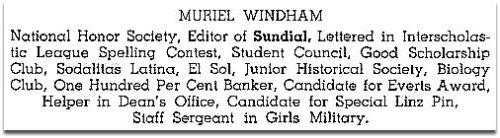
muriel-windham_sunset-high-school_1944-clubsSenior, over-achiever — 1944 yearbook

***

Sources & Notes

Black and white photos are from the Sunset High School yearbook, the Sundial.

Muriel Windham Brown’s obituary can be read here.

Muriel does actually get to meet Bob Hope once or twice, but the diary entries stopped before a pretty incredible meeting on April 22, 1943 at a benefit to sell war bonds at the Dallas Country Club. There was even a short article in The Dallas Morning News which chronicled what must have been the biggest moment in her 16 years: “Hope Thrills Girl As He Sells Bonds” (DMN, April 23, 1943). A couple of sentences from the article:

In the hustle and bustle of his bond sale at Dallas Country Club Wednesday afternoon a pretty, young girl shyly stepped up to Hope and caused him to sink to his knees in a swoon as she whispered she would pay $10,000 for his autograph. […] Hope treated her beautifully. He sat her down on the platform, left the mike occasionally to dash over, feel her pulse, stroke her brow and leave a light kiss on her forehead. (DMN, April 23, 1943)

I can’t even imagine how stunned Muriel must have been! (Her father worked as an executive, mostly in insurance and banking, and I have a feeling that the $10,000 check came from his employer, not his own bank account.)

Muriel’s family lived at 817 Brooks. No movie theater was all that far away by streetcar.

muriel_817-brooksGoogle Maps

A few more photos as she made her way through Sunset and SMU are here.

And, well, I kind of feel I have to….

bob-hope

*

Copyright © 2016 Paula Bosse. All Rights Reserved.


Winnetka Congregational Church, Org. 1914

winnetka-congregational-church_tulane-universityThe Oak Cliff church’s first pastor? (click for larger image)

by Paula Bosse

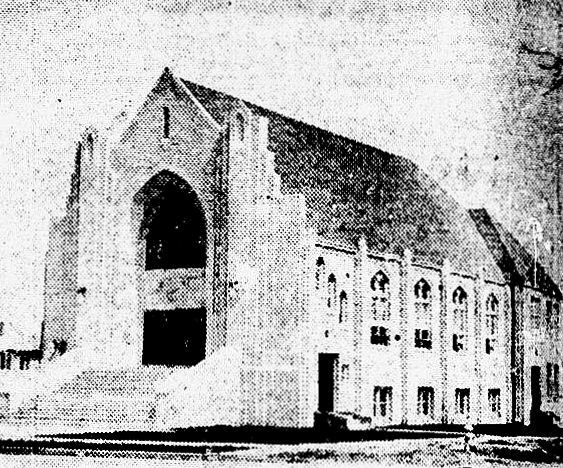
I stumbled across this photograph tonight and was really taken with it. It shows a man standing in front of the Winnetka Congregational Church in Oak Cliff, located at W. Twelfth and S. Windomere streets — on land now part of the property of the W. E. Greiner school. The church was organized in 1914, but by 1925 they were making plans to expand. A new church was built in 1929, just across W. Twelfth, facing Windomere.

winnetka-congregational-church

The new building still stands, but Winnetka Congregational Church doesn’t seem to have made it past the 1950s.

Nice though that newer church is, I think I prefer the smaller one from 1914 with the uncomfortable-looking man standing in front of it.

***

Sources & Notes

Top photo from the Tulane University Digital Library (with the name of the church misspelled as “Winnietka”), here.

I love Sanborn maps. Here’s one from 1922 which shows what the neighborhood looked like then. The original small wood frame church can be seen just north of a neighborhood completely undeveloped, except for the Winnetka School. Check out the very large map, here.

Background on the church can be found on the Oak Cliff Yesterday blog, here.

If you REALLY want to learn about this church’s history, there is a book, History of Winnetka Congregational Church, Dallas, Texas by Sarah E. Johnson (1935). Looks like the Dallas Public Library has a copy, here.

And, lastly, here’s what the church built in 1929/1930 looks like today. (The original church was built in the area seen in the background, now part of the Greiner campus.)

*

Copyright © 2015 Paula Bosse. All Rights Reserved.


Sivils Drive-In, An Oak Cliff Institution: 1940-1967

sivils_tichnorOak Cliff’s landmark hangout (click for larger image)

by Paula Bosse

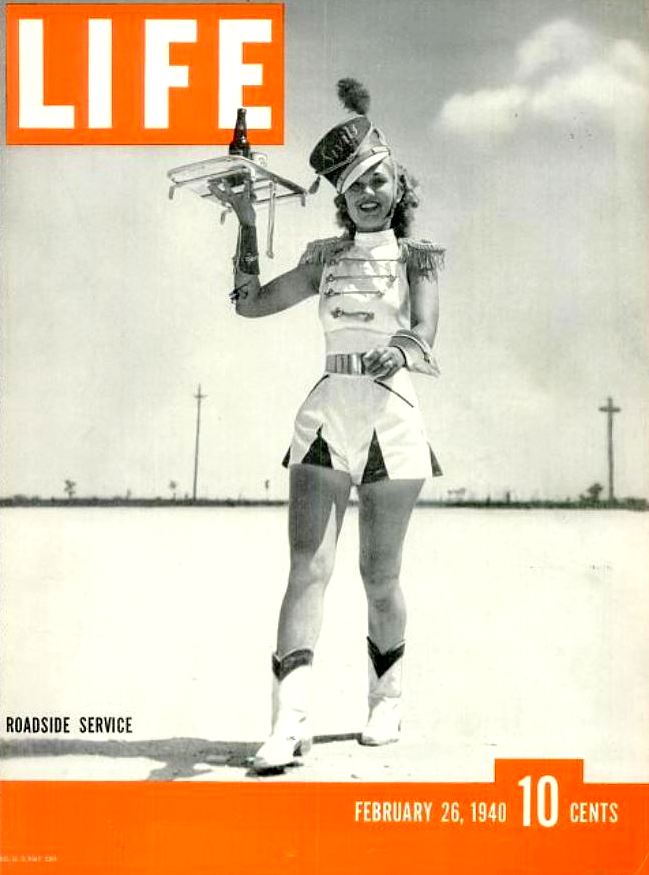
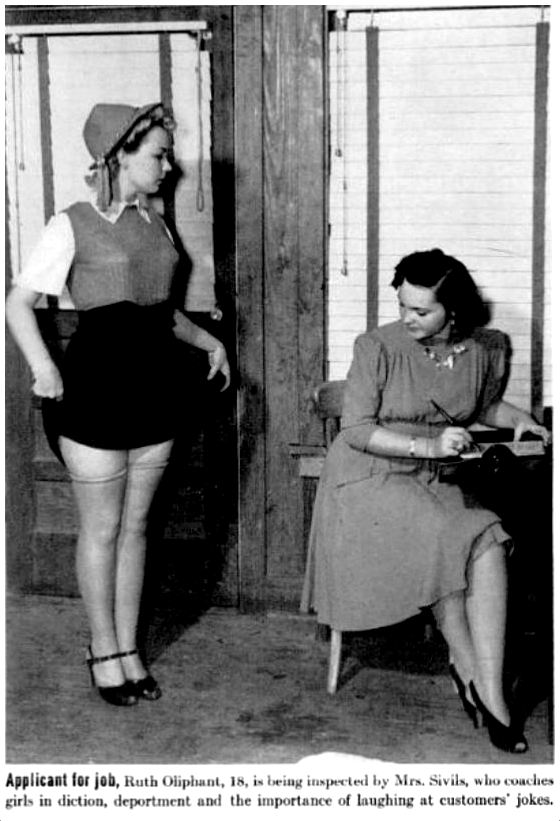
When J. D. Sivils (1907-1986) and his wife, Louise (1918-2006), brought their “Sivils” restaurant to Dallas in June 1940, their Houston drive-in of the same name had already been featured as a Life magazine cover story, garnering the kind of incredible national publicity that any business owner would have killed for! And all because of their carhops — “comely, uniformed lassies” whom Mrs. Sivils insisted on calling “curb girls” (which might have a slightly different connotation these days…). Life — never a magazine to overlook pretty young girls in sexy outfits — not only devoted a pictorial to the “curb girls,” they also put one of them (Josephine Powell of Houston) on the cover, wearing the Sivils’ uniform of (very, very short!) majorette’s outfit, plumed hat, and boots.

sivils_houston_life-mag_022640Feb. 26, 1940

louise-sivils_life-magazine_1940Louise Sivils and a prospective “curb girl” (Life)

Four months after the blitz of national attention the drive-in received from the Life story, Sivils came to Dallas. The drive-in was located in Oak Cliff at the intersection of West Davis and Fort Worth Avenue on “three acres of paved parking space.”

sivils-map

The day the drive-in opened, a photo of the not-yet-legendary Sivils appeared in The Dallas Morning News (see “Sivils to Open Dallas Place Thursday,” DMN, June 27, 1940). Other than this, there is surprisingly little in the pages of The News about this drive-in’s opening — surprising because it became such a huge part of the lives of Oak Cliff’s teens in the ’40s, ’50s, and ’60s. It’s one of those places that seems to have reached almost mythic proportions on the nostalgia scale.

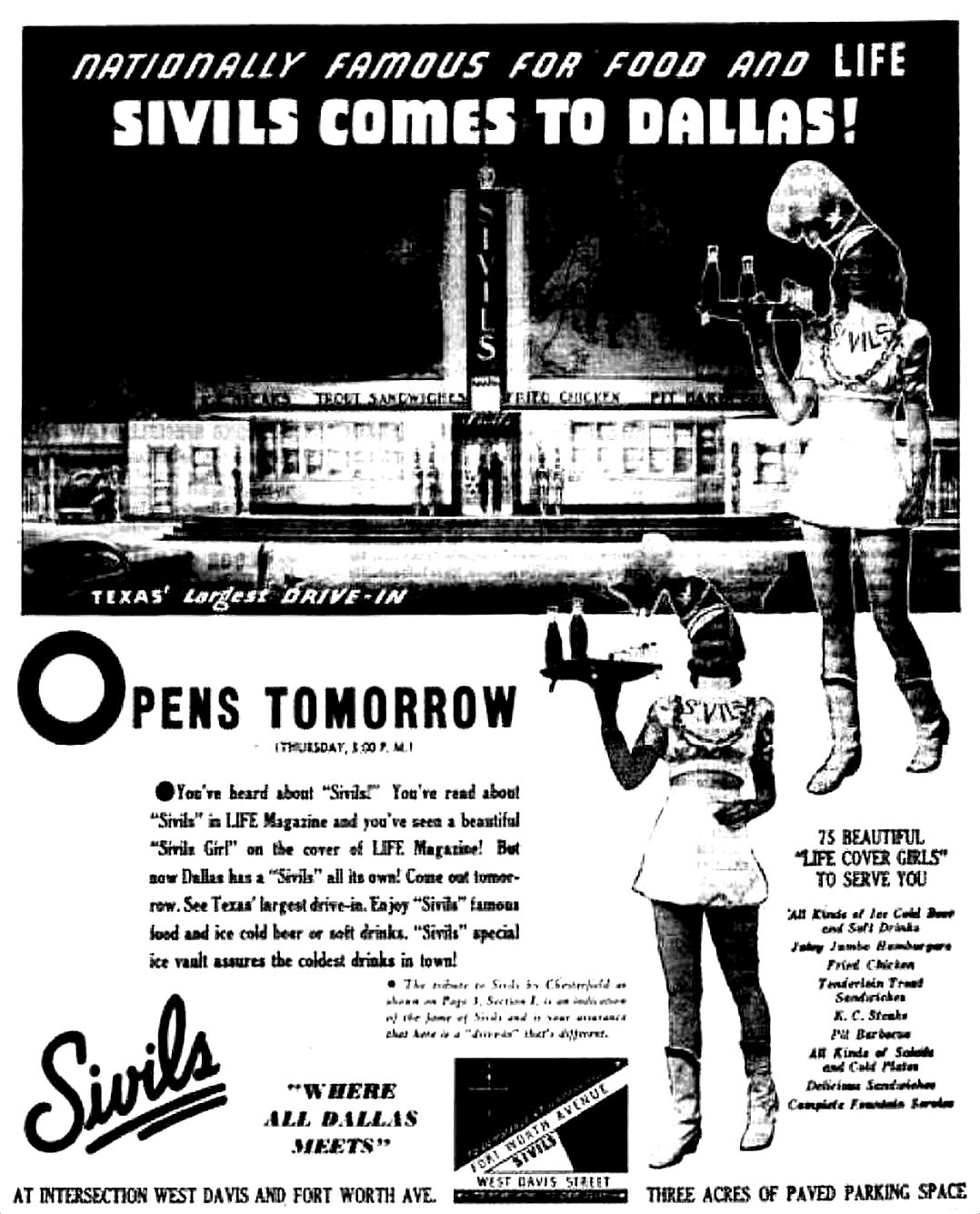
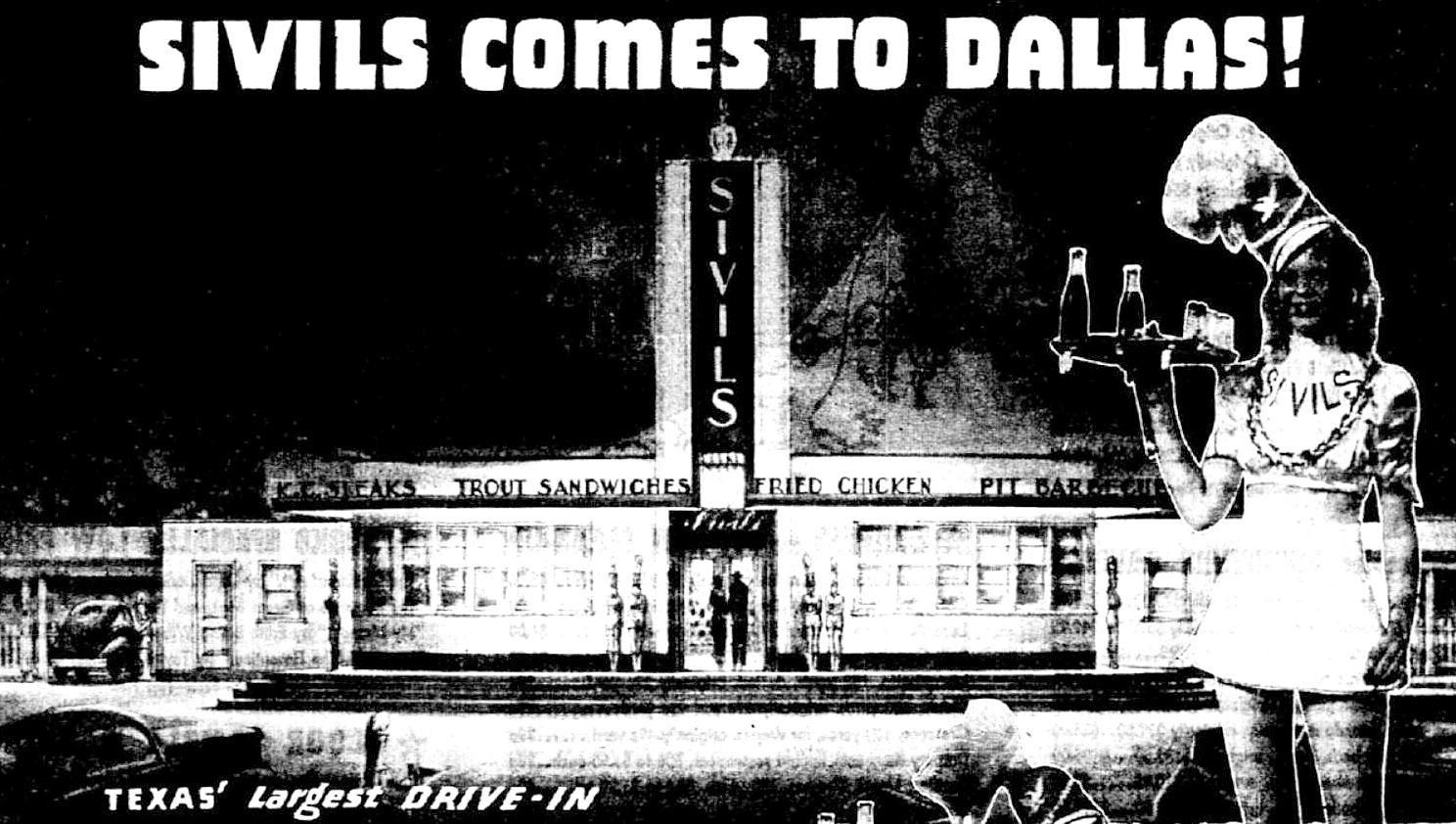
Sivils didn’t quietly sneak into town, though. Take a look at this very large, very expensive newspaper ad, which ran the day before OC’s soon-to-be favorite hang-out opened. (Click for larger image.)

sivils_dmn_062640_lgJune 26, 1940

*

Nationally Famous for Food and LIFE
SIVILS COMES TO DALLAS!

Texas’ largest drive-in
Opens tomorrow

(Thursday 3:00 PM)

You’ve heard about “Sivils”! You’ve read about “Sivils” in LIFE Magazine and you’ve seen a beautiful “Sivils Girl” on the cover of LIFE Magazine! But now Dallas has a “Sivils” all its own! Come out tomorrow. See Texas’ largest drive-in. Enjoy “Sivils” famous food and ice cold beer or soft drinks. “Sivils” special ice vault assures the coldest drinks in town!

75 Beautiful “LIFE Cover Girls” to Serve You

All Kinds of Ice Cold Beer and Soft Drinks
Juicy Jumbo Hamburgers

Fried Chicken
Tenderloin Trout Sandwiches
K.C. Steaks
Pit Barbecue
All Kinds of Salads and Cold Plates
Delicious Sandwiches
Complete Fountain Service

Sivils – “Where All Dallas Meets”
At intersection West Davis and Fort Worth Ave.
Three Acres of Paved Parking Space

*

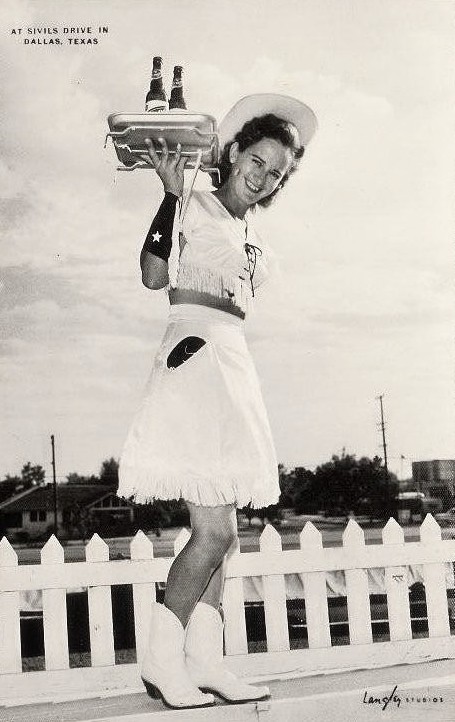
100-150 “curb girls” were employed by Sivils at any given time in those early days, and it was open 24 hours a day. The place was hopping. Sounds fantastic. Wish I’d seen it.

sivils_matchbook_coltera-flickrvia Flickr

sivils_carhop_postcard_ebay
eBay

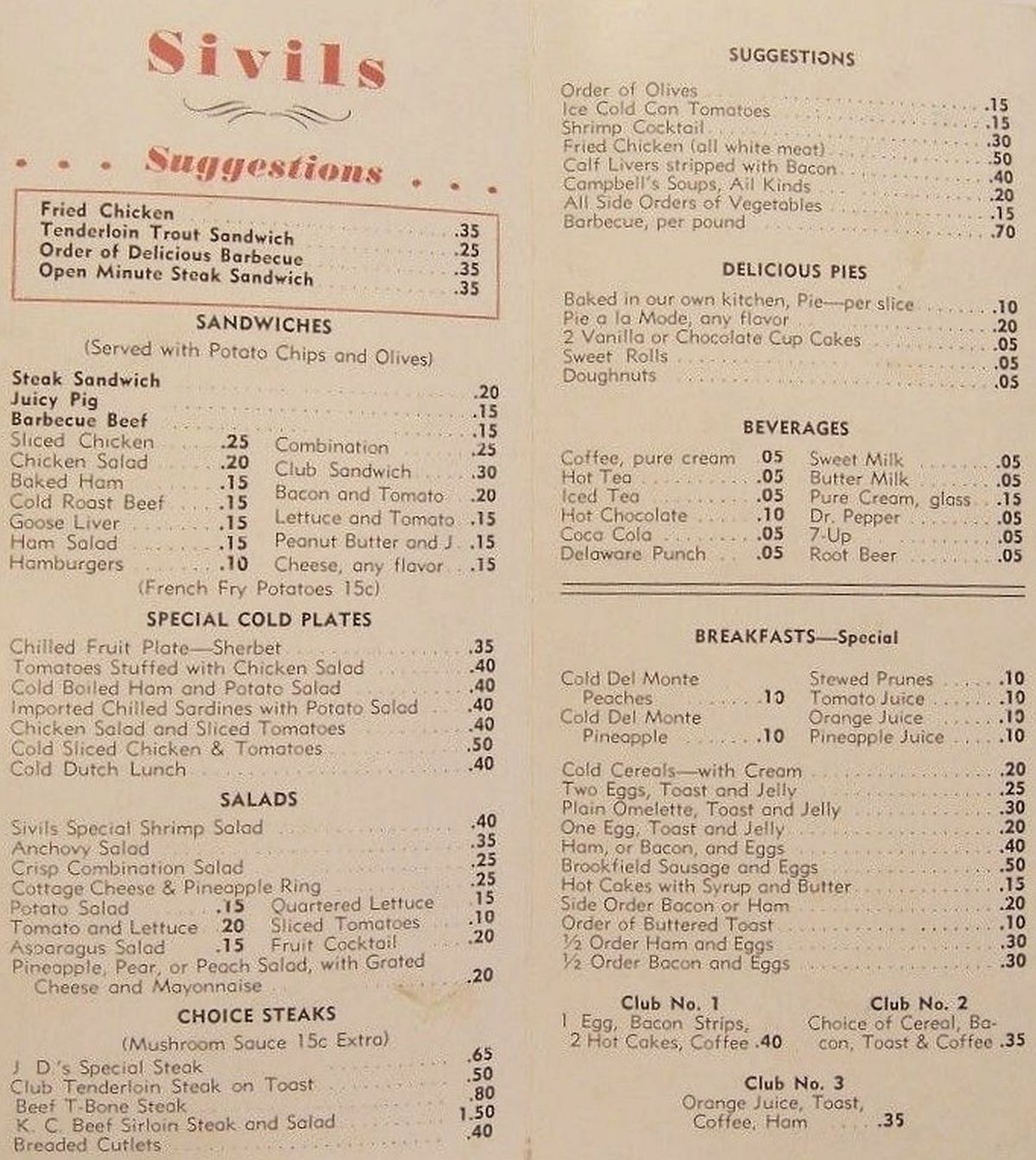
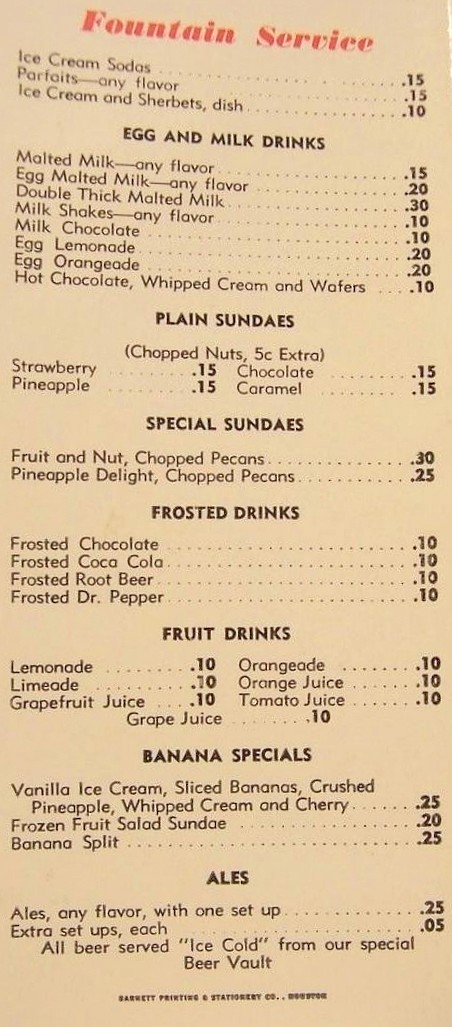
Below, a scanned menu (click to see larger images):

sivils-menu_1940s_ebay_cover

sivils-menu_1940s_ebay_b

sivils-menu_1940s_ebay_avia eBay

***

Sources & Notes

Top postcard from the Boston Public Library Tichnor Brothers Postcard Collection on Flickr, here.

Read the 4-page Life article (and see several photos of the Houston “curb girls”) here (use the magnifying glass icon at the top left to increase the size of the page).

Interesting quote from that article:“They work in 7½-hour shifts, six days a week, for which they get no pay but average $5 a day in tips.” Doesn’t sound legal…. (The Inflation Calculator tells us that $5 in 1940 money is equivalent to just over $83 in today’s money.)

Sivils closed in 1967, possibly because Mr. and Mrs. Sivils wanted to retire, but it seems more likely that Oak Cliff’s being a dry area of Dallas since the 1950s was killing its business. Check out the News article “Big Head Expected as Oak Cliff Beer Issue Foams” by Kent Biffle (DMN, Aug. 17, 1966) which appeared just months before another election in which the “drys” outvoted the “wets.” (More on Oak Cliff’s crazy wet-dry issues, here.)

J. D. Sivils was interviewed in a short documentary about Dallas carhops, filmed in the early 1970s. In it, he talks about the early days of Sivils and — best of all — there is film footage galore of the drive-in from his collection. Watch it in my previous post — “‘Carhops’ — A Short Documentary, ca. 1974” — here. (Below a screenshot of Sivils from the film.)

sivils-carhops-film

Read the article “Carhops, Curb Service, and the Pig Sandwich” by Michael Karl Witzel (Texas Highways, Oct. 2006) in a PDF, here (increase size of article with controls at top of page).

Another Flashback Dallas post on drive-in culture — “Carhops as Sex Symbols — 1940” — is here.

sivils_dmn_062640-det

Click pictures for larger images.

*

Copyright © 2015 Paula Bosse. All Rights Reserved.

Selling Kidd Springs Heights, 1909-1910

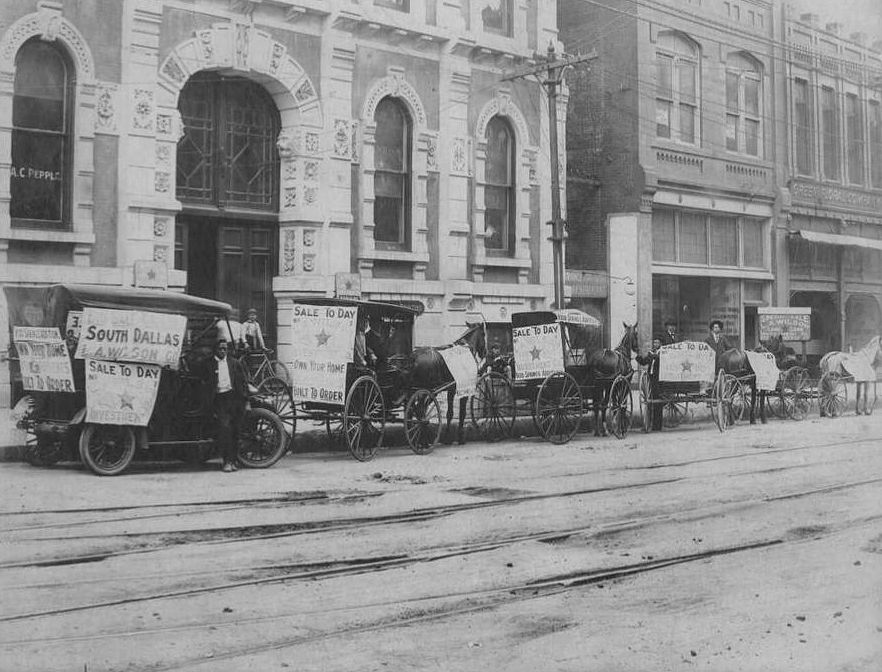
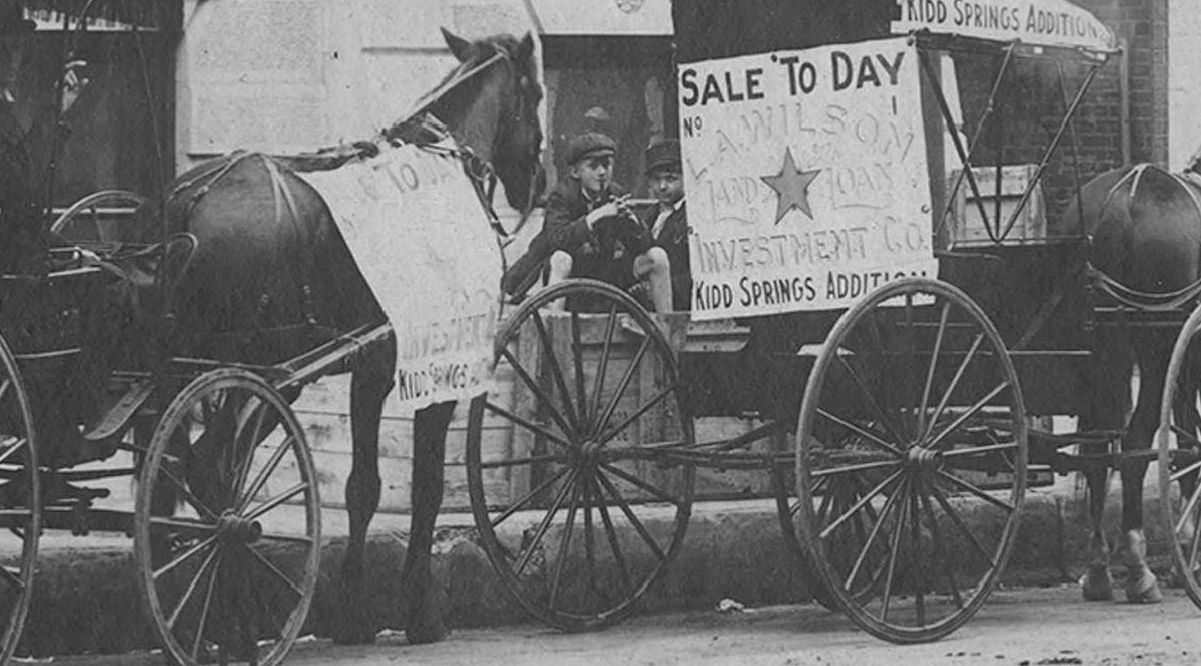
gaston-bldg_1910_cook-degolyerThe L. A. Wilson Co. is having a sale! (photo: SMU)

by Paula Bosse

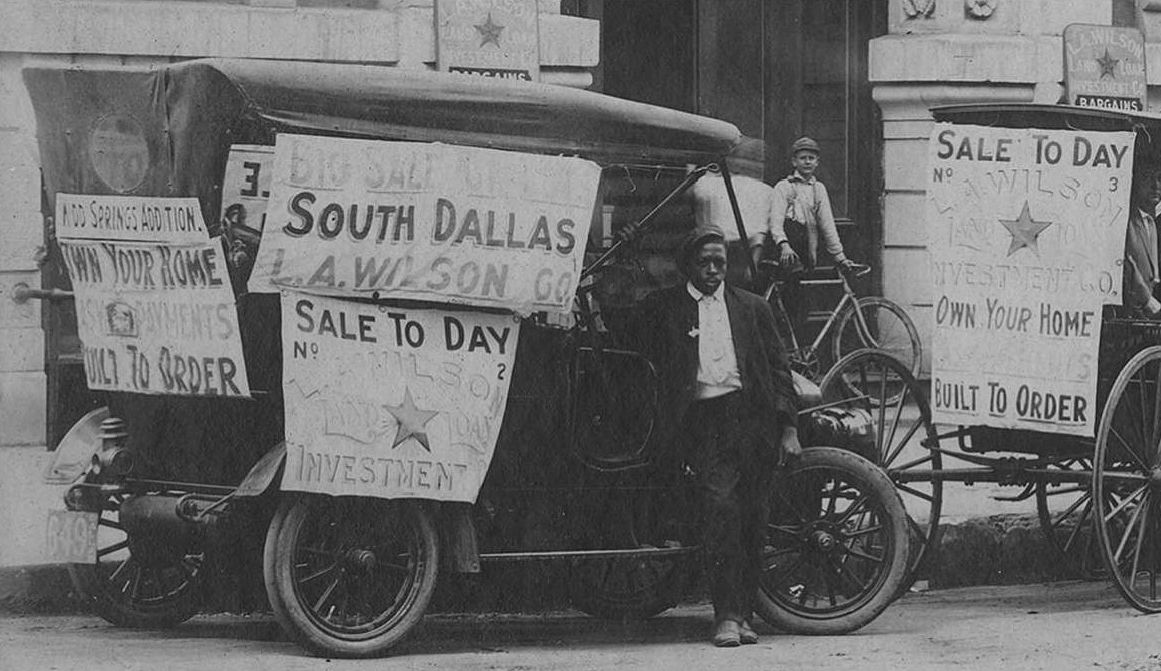
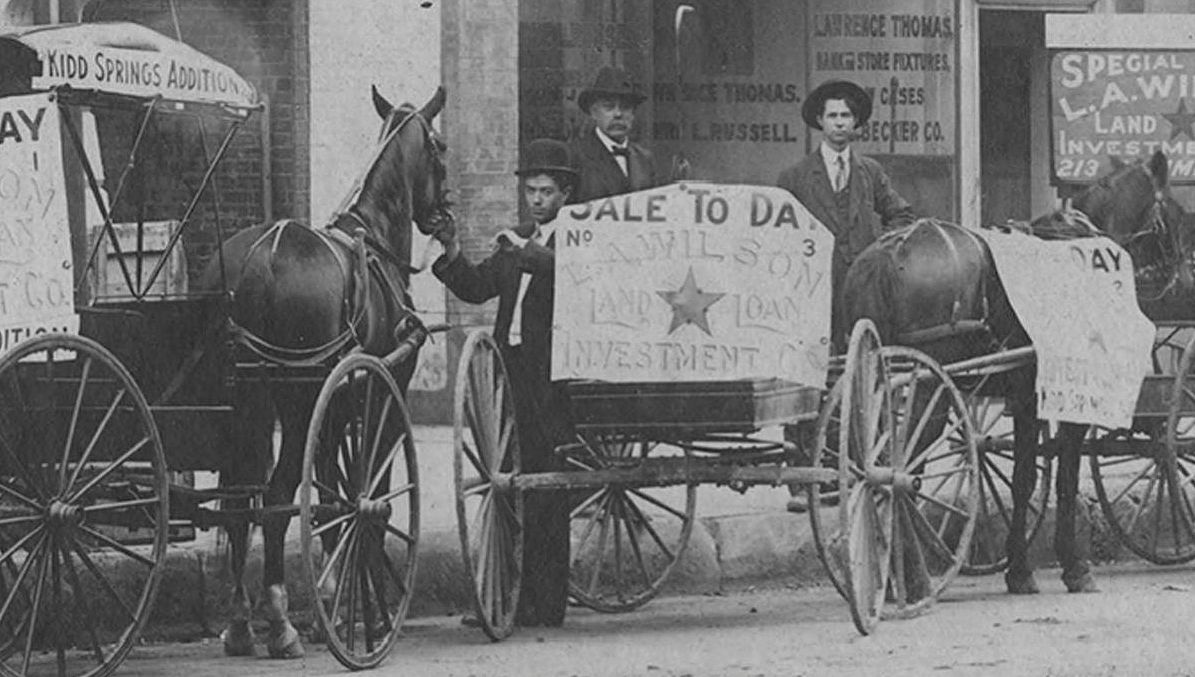
The above photo shows a car-and-buggy convoy belonging to the L. A. Wilson Land, Loan & Investment Company, stretched out in front of the Gaston Building at Commerce and S. Lamar. There’s a “Sale To Day” and they’re really pushing property in the Kidd Springs Addition in Oak Cliff. The date “April 20, 1910” is written on the back of the photo, and if that’s true, the big show here might be rooted more in desperation than in enthusiasm. The Wilson company began selling the 30-or-so lots in the new Kidd Springs Heights neighborhood in July of the previous year. An ad that appeared seven months before this photo was taken announced that there were only ten lots left. It looks like this was an impassioned display to make Kidd Springs seem more exciting and move that remaining property. People love parades.

(This is another great photo to zoom in on to see the details. All images are larger when clicked.)

gaston-bldg_1910_cook-degolyer-det1

gaston-bldg_1910_cook-degolyer-det4

gaston-bldg_1910_cook-degolyer-det5

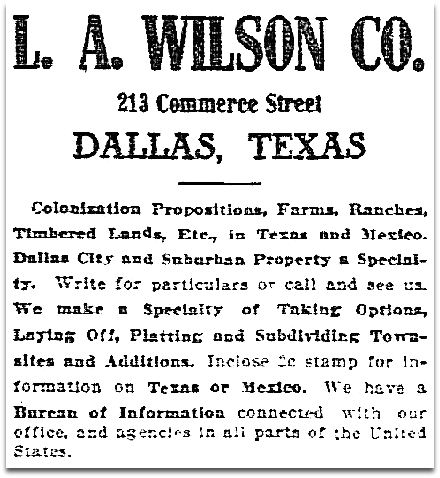
The L. A. Wilson Co. was a fairly large real estate company founded by Missouri-born Lewis A. Wilson (1851-1926); at the time of this photo, the company’s offices were in the Gaston Building at 213 Commerce. (In the photo immediately above, I think the man with the moustache is Mr. Wilson.)

wilson_dmn_070409-detDallas Morning News, July 4, 1909 (ad detail)

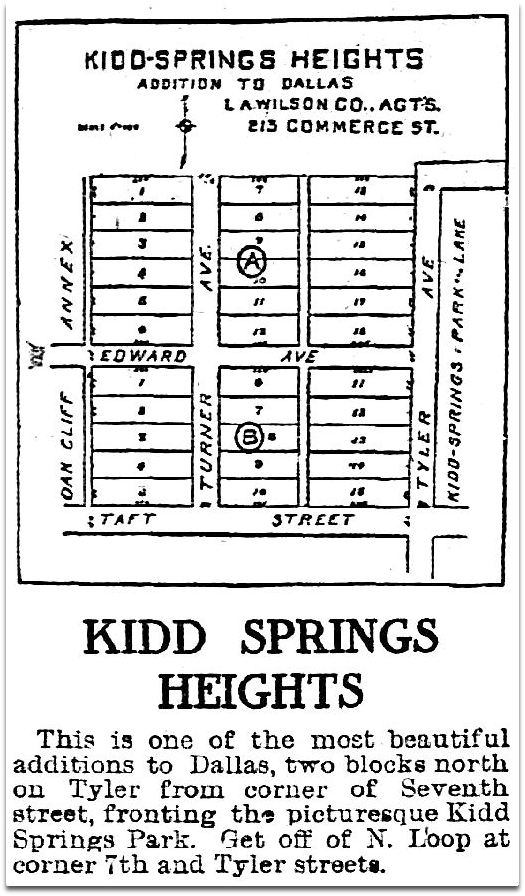
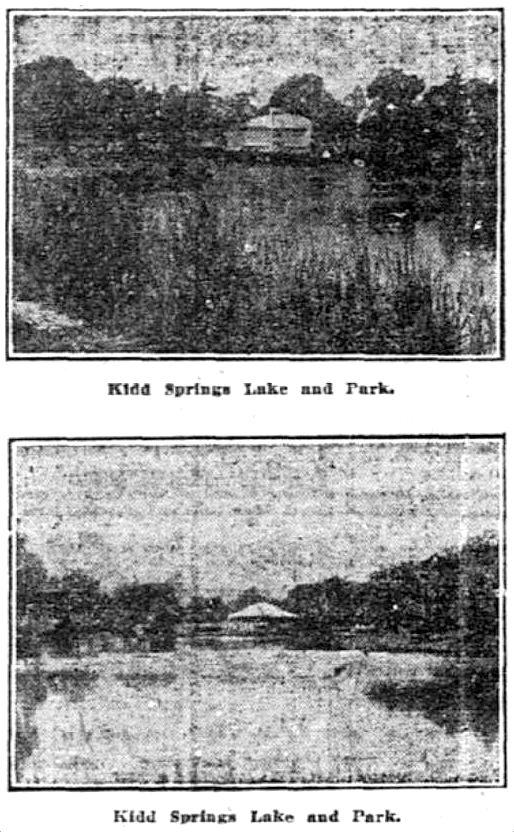
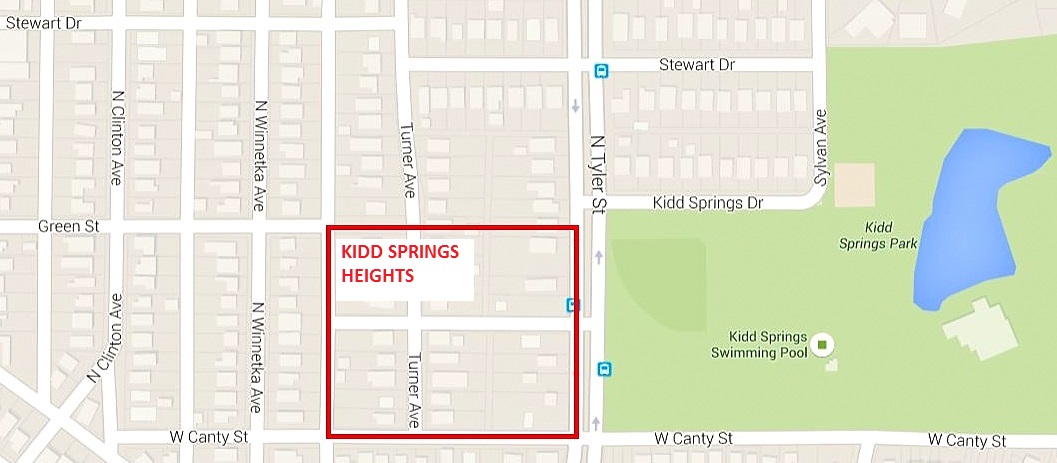
The first ad announcing the sale of lots in the Kidd Springs Heights area of Oak Cliff appeared on July 4, 1909. It included the two blocks north of what is now W. Canty, bounded by Turner Ave. on the west and N. Tyler (and Kidd Springs Park) on the east.

ad-wilson_dmn_070409-text

ad-wilson_dmn_070409-photosDMN, July 4, 1909

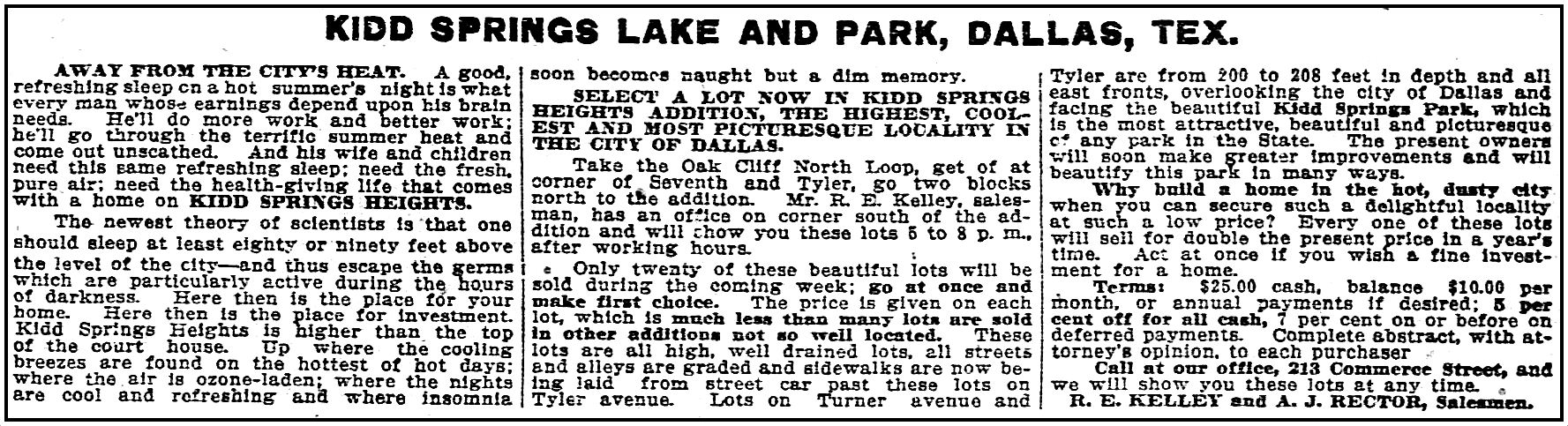
Four weeks later, a huge half-page ad ran in The Dallas Morning News, full of wonderful reasons why life would be better in Kidd Springs Heights:

The newest theory of scientists is that one should sleep at least eighty or ninety feet above the level of the city – and thus escape the germs which are particularly active during the hours of darkness. Here then is the place for your home. Here then is the place for investment. Kidd Springs Heights is higher than the top of the court house. Up where the cooling breezes are found on the hottest of hot days; where the air is ozone-laden; where the nights are cool and refreshing and where insomnia soon becomes naught but a dim memory.

The effusive sales copy is definitely worth a read (click ad below to read the full sales pitch).

wilson_kidd-springs-heights_dmnn_090109DMN, Aug. 1, 1909

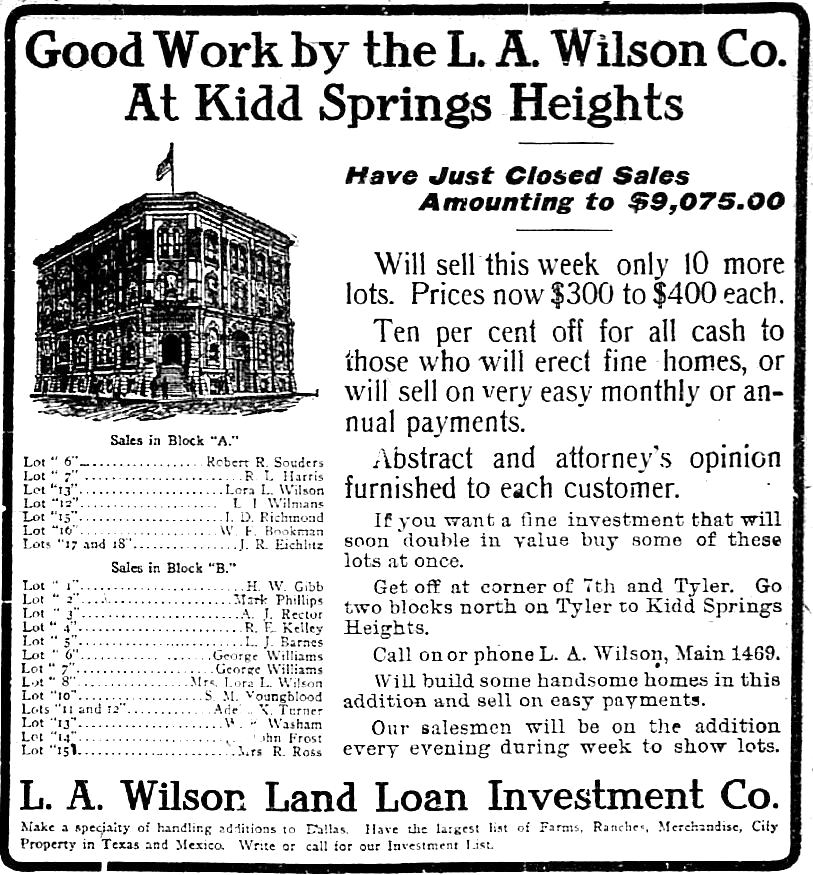
Six weeks later the following self-congratulatory ad appeared. (It’s interesting to note that of the twenty lots sold, two of them had been sold to Mrs. L. A. Wilson, and one each had been sold to the two salesmen. The next year’s telephone directory showed that the Wilsons lived on Live Oak, and the two salesmen lived in boarding houses.)

wilson-kidd-springs_dmn_091209DMN, Sept. 12, 1909

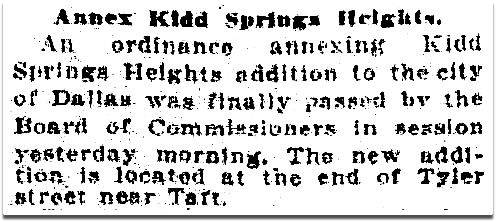
It wasn’t until 1921 that the tiny little Kidd Springs Heights was annexed to the city of Dallas.

annexed_dmn_051421DMN, May 14, 1921

Things may be different today, but in 1909, these were the boundaries of Kidd Springs Heights.

kidd-springs-heights_google_2015

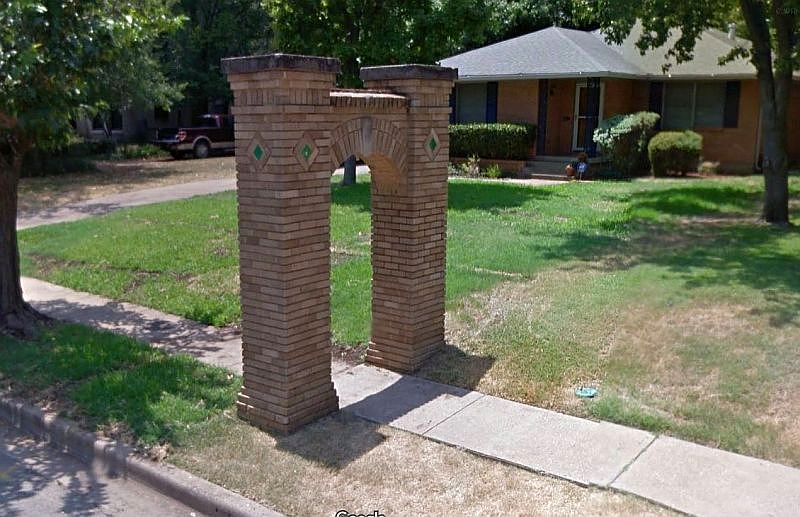
The most interesting odd thing about Kidd Springs Heights? There appear to be two brick archways placed (very awkwardly) across Turner Avenue from one another — each spanning the sidewalk. I can’t find any information about these, but it looks as if they were set right at the northern boundary of the Kidd Springs Heights Addition. Old maps (such as this one from 1919) show no development to the north of this boundary up into at least the ’20s (it doesn’t look as if this addition is even in Oak Cliff proper), so I guess they were there before those sidewalks and served as a welcoming gateway to a new development where germs did not dwell after nightfall.

arch_google
900 block of Turner Avenue (Google Street View)

(Check out both of these markers on Google Street View, here. It’s pretty strange-looking.)

If anyone has information on these markers, please pass it along!

***

Sources & Notes

Top photo is titled “L. A. Wilson Land Loan Investment Company, Gaston Building, Commerce Street” — the photographer’s name and the date are written on the back: W. R. Lindsay, April 20, 1910. It is from the George W. Cook Dallas/Texas Image Collection, DeGolyer Library, Central University Libraries, Southern Methodist University, and it can be viewed here. I have adjusted the color.

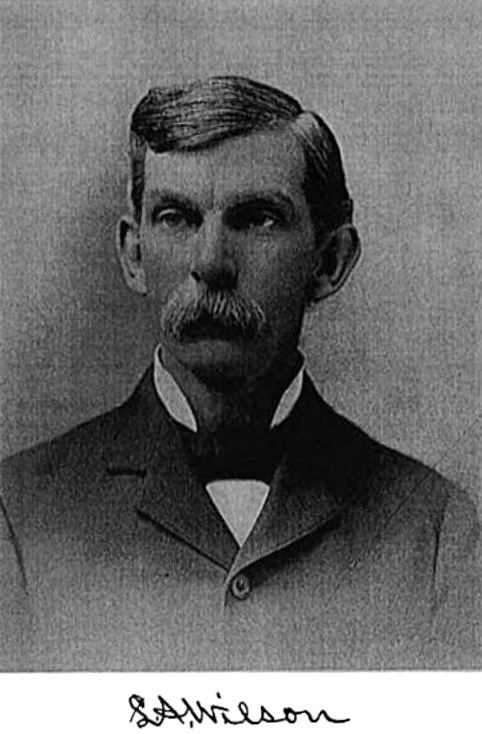
Lewis A. Wilson’s biography can be read in A History of Greater Dallas and Vicinity (1909), here. His photo:

wilson_hist-greater-dallas

The Kidd Springs Wikipedia entry is here.

The Sanborn map from 1922 showing this tiny neighborhood at about the middle of the page on the right can be found here. Note how few lots actually have houses built on them. (Taft is now W. Canty; Edwards is now Everts.)

The Murphy & Bolanz map can be seen here. (If the link doesn’t work, you may need to download the plug-in — information on how to do that is here.)

*

Copyright © 2015 Paula Bosse. All Rights Reserved.

Waking Up Every Day To an Unimpeded View of Lake Cliff Park

oak-cliff_5th-street_lake-cliff-park_ebayThe red-roofed Frank Rogers house, E. Fifth & N. Denver, Oak Cliff

by Paula Bosse

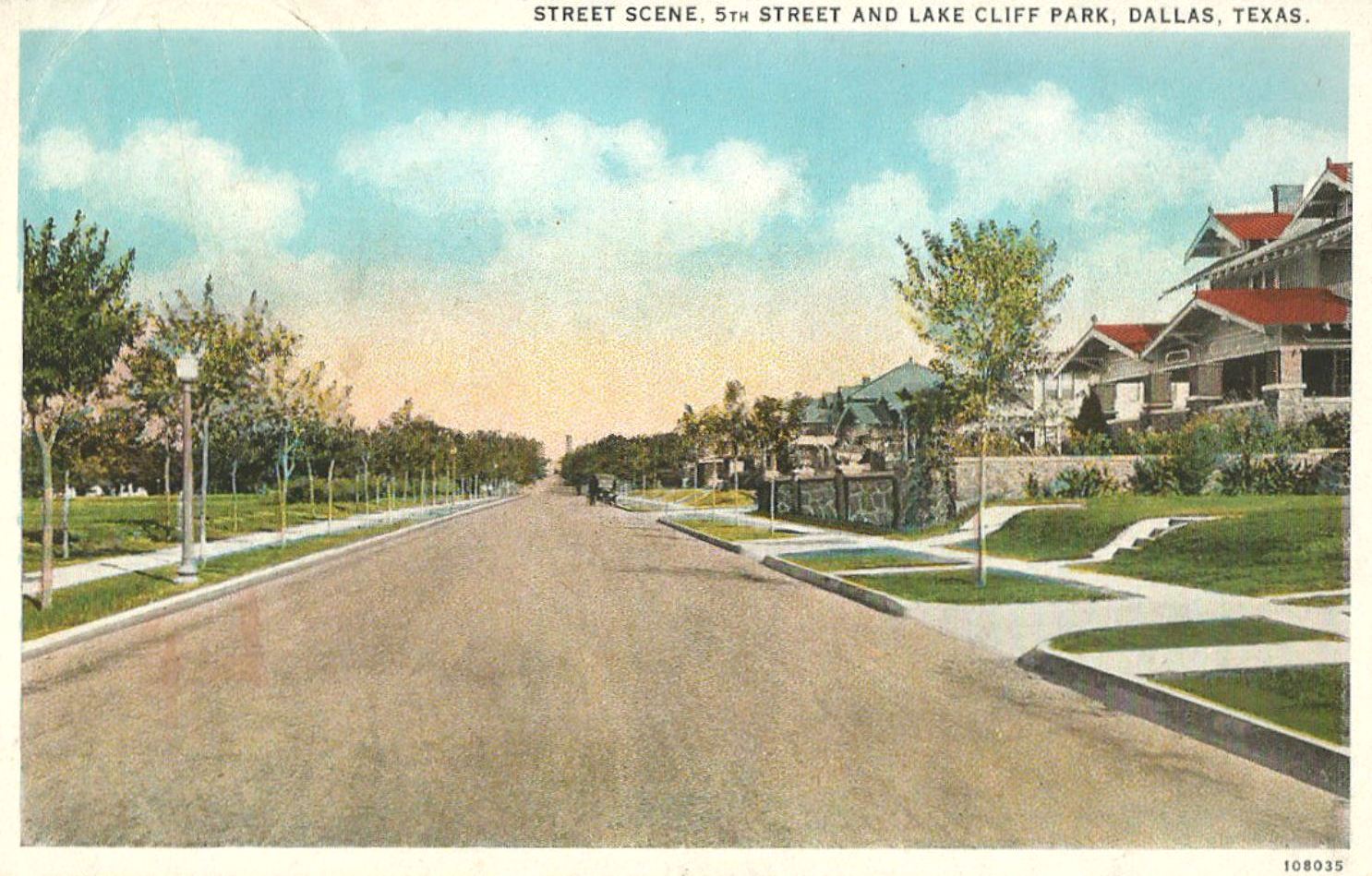
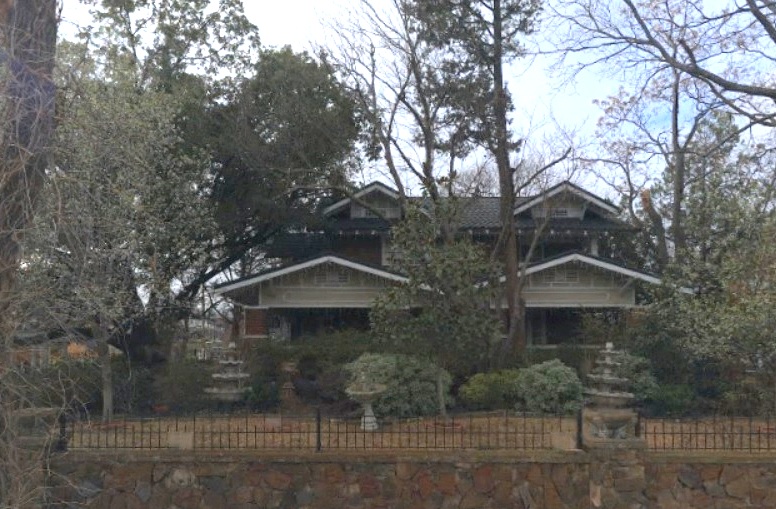
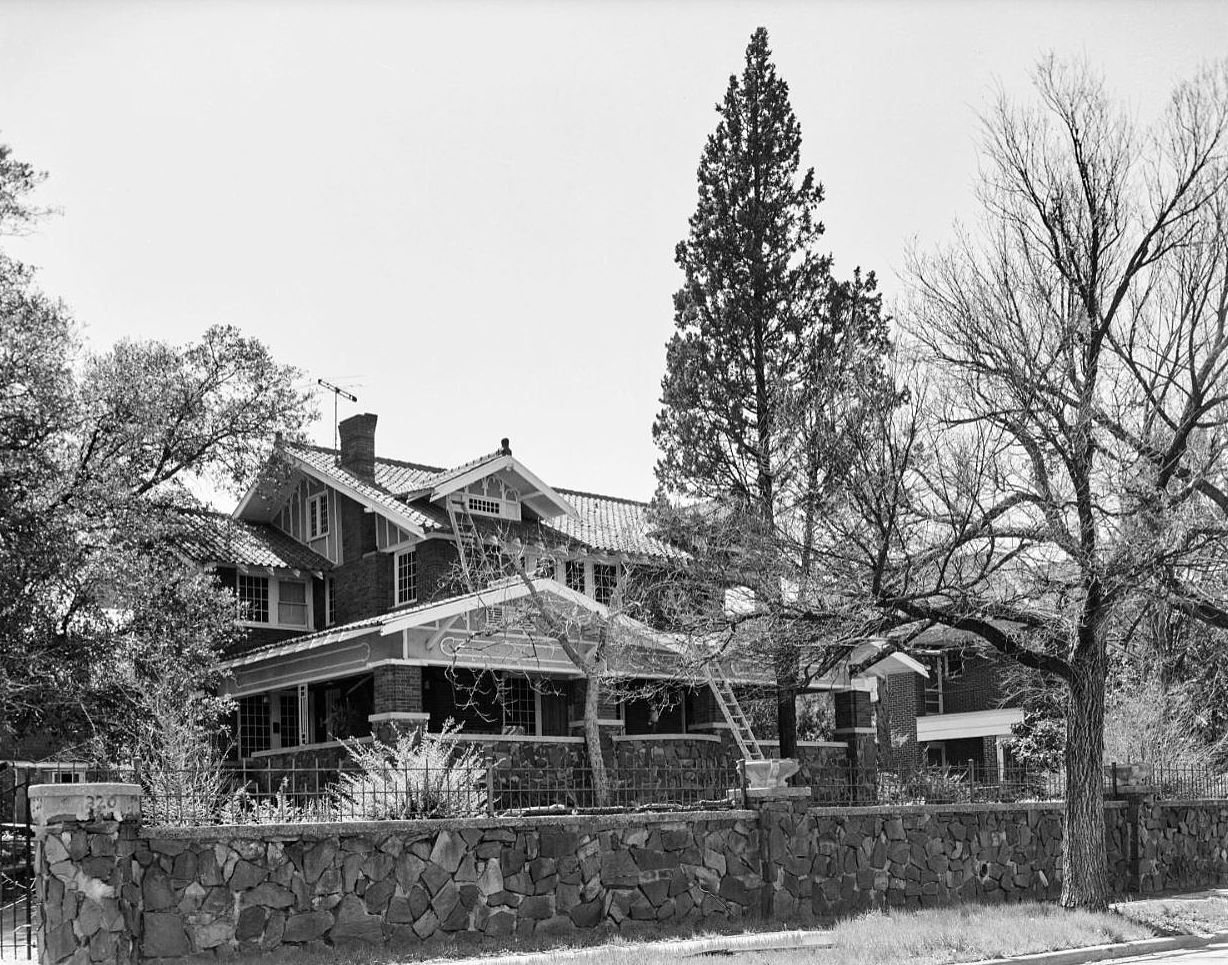
I saw this postcard of a row of houses on East Fifth Street in Oak Cliff and wondered if the house with the red roof and the low stone wall was still standing. Happily, it is. With a little digging, I discovered that the house at 320 E. Fifth Street was built in 1922 or very, very early 1923 for Frank Rogers, one of Dallas’ top photographers. A photographer would want to live with a beautiful view, and he certainly had it there — Lake Cliff Park was right across the street. (The artist Frank Reaugh also lived on East Fifth, a block or two to the west.) Frank Rogers (1878-1961) lived in the house he built at the corner of East Fifth and North Denver until his death at the age of 82.

It appears that Rogers bought the property in the survey area known as Robinson’s Park Place in December of 1920 for $8,000. The address does not exist until his house is built — it shows up for the first time in the 1923 city directory. The 1922 Sanborn map (see it here) shows the corner lot empty — as well as most of the rest of the lots along East Fifth between North Crawford and North Denver.

Here are a few bits and pieces of random information from a search on the address. In 1933, Rogers’ German Shepherd got loose. That park would have been an absolute paradise for a dog on the lam.

roger_dmn_090233Sept. 2, 1933

And in 1936, for some reason Rogers was selling a “Nubian milch goat,” a friendly source of milk which was, presumably, kept on the property. Was it being sold at the behest of neighbors? The publication Milch Goat Dairy (1917) informs us that “no member of the goat family is more peaceful or gentle than the Nubian, and while the bucks of this breed have the same odor that all goat bucks have, the odor is far less in this breed.” Still. The other well-heeled neighbors might have had a few goat-related issues.

320_dmn_111736-goatNov. 17, 1936

Nubian goat! (Wikipedia)

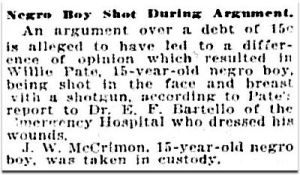
There was a room or small apartment at the rear of the house, and directories show that (at least through the ’20s) there was an ever-changing roster of lodgers who lived there — every year a different name was listed. They were most likely employees. In 1929, the occupant was J. W. McCrimon/McCrimmon, who may have been the same person who, as a minor in 1922, was accused of wounding another minor with a shotgun.

mccrimon_dmn_082922Dallas Morning News, Aug. 29, 1922

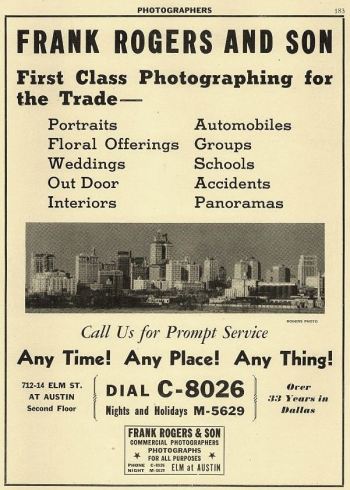
Frank Rogers began his career as a newspaper photographer who later ran his own photography studio with his son, Norman. He preferred commercial jobs to bread-and-butter studio portraiture, though he did both. Whatever kind of job he was doing, he preferred to use flash powder when he could, a practice which caused several injuries (and even fires!) over the years.

A news article in 1945 described one such incident: during a commissioned job in which he was taking hundreds of employee photographs for a large company, his flash-powder gun exploded and he was “seriously burned on the hands and face. His spectacles, physicians told him, probably saved his eyesight” (DMN, Feb. 10, 1945).

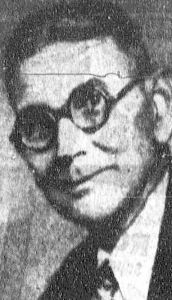
And here he is in those spectacles:

rogers-frank_portrait

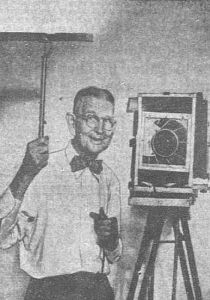
Here’s another photo of the happy-looking photographer, posing with his camera and the potentially incendiary accoutrement.

rogers-frank_at-work_ca-1950s

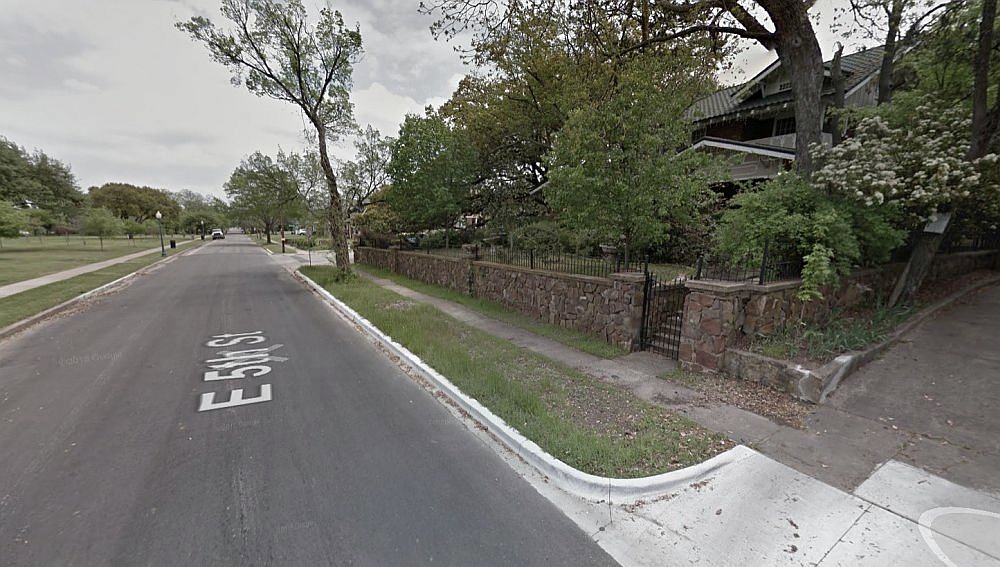
But back to the house. Here it is today.

rogers-house_googleGoogle Street View

And another view, this time with the front of the house visible.

rogers-house_bingBing StreetSide

If I had access to flash powder, I’d go out today and take an extremely well-lit photo of an old Dallas building (and hope I’d survive the experience) — as a nod to Frank Rogers, his cool house, and all the wonderful photos of Dallas he took in the first half of the 20th century. Thanks, Frank!

rogers-frank_ad_dallas-directory_1944-45
Frank Rogers and Son ad, 1944-45 Dallas directory

rogers-frank_1936-directory1936 Dallas directory

***

Sources & Notes

Postcard is from eBay.

Frank Rogers was a busy man. If you’re interested in Dallas history (and I’m guessing you are if you’re reading a Dallas history blog), you’ve probably seen dozens and dozens (and dozens) of his photos without even knowing it. The Frank Rogers Collection is housed at the Dallas Public Library. I’ve used a few of his photos in previous posts — one of my favorites is his view of the Akard Street Canyon, here.

Another photo of the house can be seen in the 1980 photo below, from the Texas Historical Commission Historical Resources Survey, via the Portal to Texas History, here.

rogers-frank_home_320-east-fifth_oak-cliff_portal_1980

Take a tour of the Lake Cliff Park area via Google Street View, here.

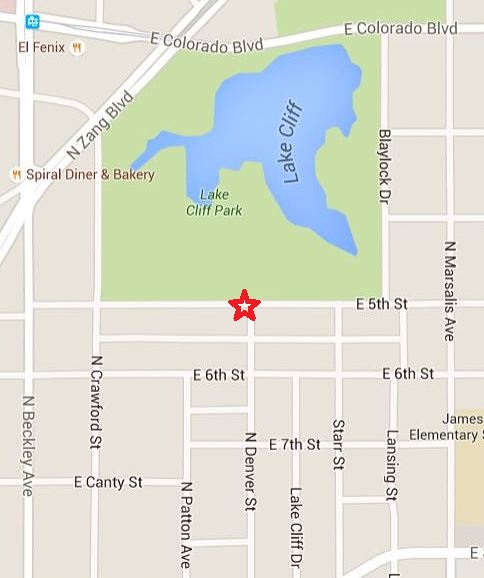
And finally, here’s where Frank’s house is, marked in red.

rogers-house_googleGoogle Maps

*

Copyright © 2015 Paula Bosse. All Rights Reserved.

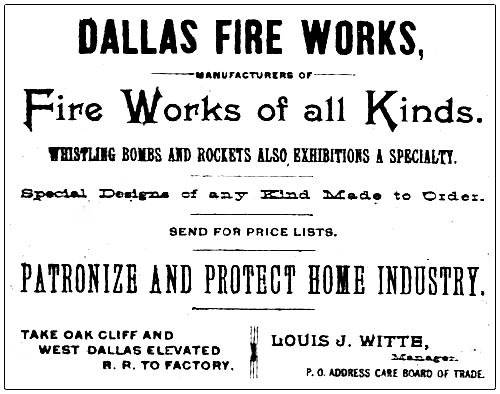
Dallas Fire Works Ad — 1891

ad-dallas-fireworks_1891-directory

by Paula Bosse

Even in the 1890s, Oak Cliff was encouraging people to buy local.

DALLAS FIRE WORKS
Manufacturer of
Fire Works of All Kinds.
Whistling Bombs and Rockets Also Exhibitions A Specialty.
Special Designs of any Kind Made to Order.
Send For Price Lists.
PATRONIZE AND PROTECT HOME INDUSTRY.
Take Oak Cliff and West Dallas Elevated R.R. to Factory.

Louis J. Witte, Manager.
P.O. Address Care Board of Trade.

Do NOT go to Fort Worth for your fireworks!

***

Ad from the 1891 city directory.

*

Copyright © 2015 Paula Bosse. All Rights Reserved.

Trinity Heights: The Tallent Furniture Studio and The Sunshine Home

tallents-furniture-store_oak-cliff_tichnorVermont & South Ewing… (click for larger image)

by Paula Bosse

The postcard image above shows a bird’s eye view of a few blocks in the Trinity Heights neighborhood of Oak Cliff, from the late 1940s. As I looked at it, I wondered a) what does this intersection look like now, b) what is that unlabeled building that looks like a jail behind the furniture store, and c) what was Tallent’s Furniture Studio?

Tallent’s Furniture Studio, owned by Raymond E. Tallent, was located at 815 Vermont Avenue.

tallent_dmn_010350-obit-photo

tallents-ad_dmn_081256-det1956

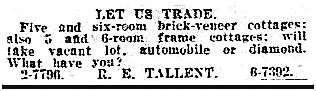
Not only did it house a furniture store, but it also served as an office for Tallent’s real estate business. According to Tallent’s obituary, he came to Dallas in 1920 and started his real estate business five years later. Starting out, he’d’ve been happy to trade you property for diamonds. “What have you?”

tallent_dmn_042928-real-estate-adApril, 1928

The first mention I found for the furniture store is this Christmas ad from 1947.

tallents_ad_121147Dec., 1947

Tallent died in January of 1950 at the age of 53. Both of his businesses continued after his death, and the furniture store was still going in the late 1960s.

So, nothing out of the ordinary — just a small business, like thousands of other small Dallas businesses. Probably the most interesting thing about Tallent was that he had the good taste to have that great promotional postcard made. That strange little building behind the store was a lot more interesting.

*

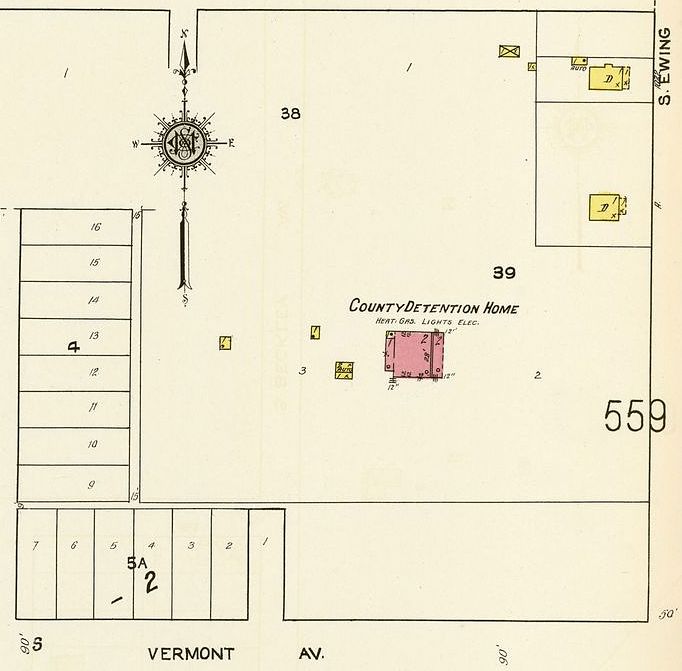
What was that building? The first time it popped up on a Sanborn map was 1922: it was identified as a “County Detention Home” (click for larger image).

detention-home_sanborn_19221922 Sanborn map detail — see full page here

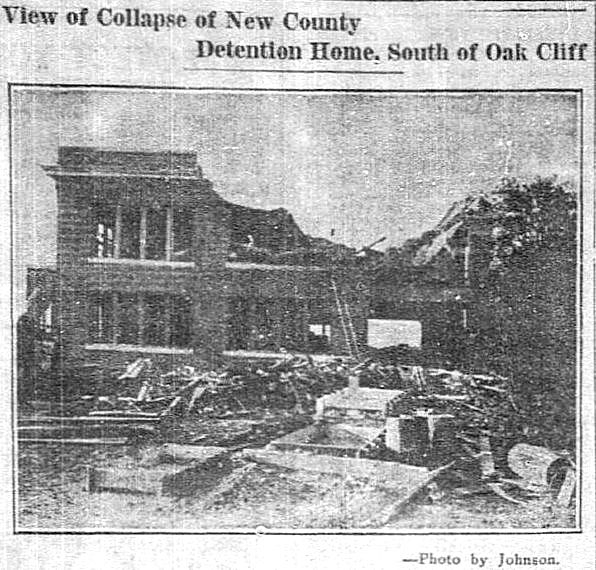
Despite its name, the “detention home” was not a correctional facility for juvenile delinquents, but it was a home for dependent children who had been made wards of Dallas County because of neglect or abandonment or because parents had died or were simply unable to care for them. This detention home was built in 1917 at 1545 South Ewing (“south of Oak Cliff”). During its construction in 1917, its roof collapsed, killing one of the workers.

detention-home-collapse_dmn-041317Dallas Morning News, Apr. 13, 1917

The home was almost immediately overcrowded, and its superintendents were constantly scrambling for an increase in funding. Children, ranging in age from toddlers to teenagers, lived there as long as they needed — some for a few months, some for several years. They attended nearby schools, and even though they were wards of the court and were living in an institution, the people who ran the place tried to make it as home-like as possible. In January, 1934, the name of the county facility was changed to the much more cheerful “Sunshine Home.”

In 1950, the Sunshine Home received $165,000 in bond money for improvements and expansion, adding modern structures to the large campus but still retaining the original two-story red brick building built in 1917.

In 1975, the Dallas County Sunshine Home and the Girls’ Day Center merged, and the former Sunshine Home was renamed Cliff House.

In 2014, the 28,000-square-foot property on just under five acres was put up for sale, and in early 2015 plans for a charter elementary school were approved.

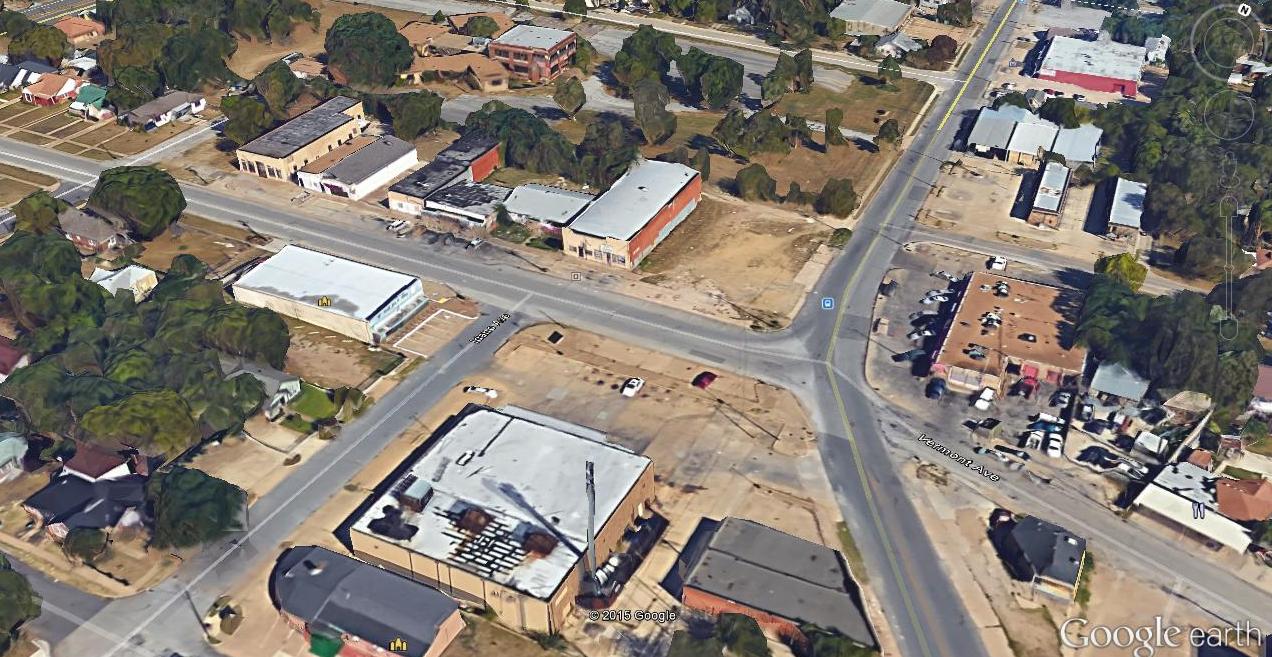
Below, a Google Earth image of the same view as the postcard featuring Tallent’s Furniture Studio, captured before the old Sunshine Home buildings had been demolished (click for larger image).

tallent_birdseye-google-earthGoogle Earth

The view is remarkably similar to the one taken more than 65 years earlier. A little bleaker these days, perhaps, but certainly still recognizable.

***

Sources & Notes

Top postcard is from the Boston Public Library Tichnor Brothers Postcard Collection; it is viewable here.

Information on the plans for the KIPP Truth Academy submitted to the City of Dallas (with interesting illustrations/maps on pages 10 and 11) can be found in a PDF, here.

A recent Google Street View of this block of Vermont Avenue can be seen here. The Tallent furniture store occupied the building to the left of the Vermont Grocery.

The heart-tugging article “For All Loving Care Bestowed, Sunshine Home, Space Small, Needs Much to Cheer Children” (DMN, July 24, 1941) — written by popular Dallas Morning News columnist Paul Crume — describes daily life in the Sunshine Home and can be found in the Dallas Morning News archives.

A then-and-now comparison (click for larger image):

tallent_then-now

*

Copyright © 2015 Paula Bosse. All Rights Reserved.


Dallas’ First Two Drive-In Theaters — 1941

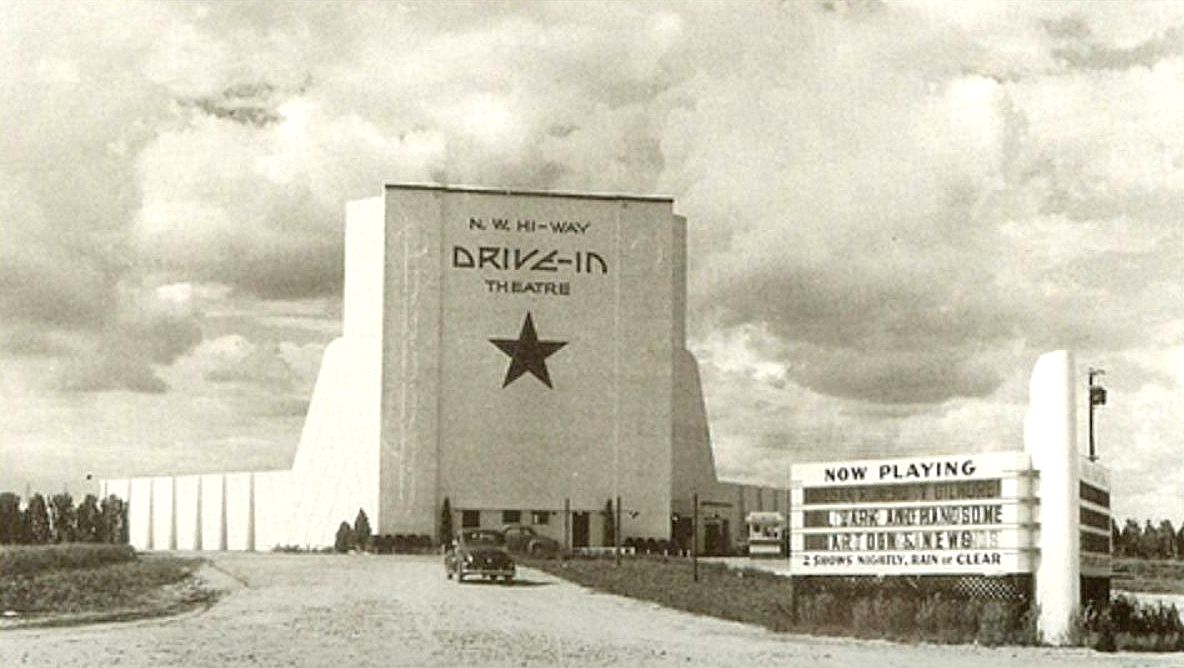
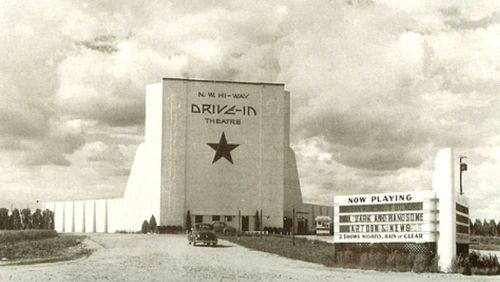
nwhwy-drive-in_july-1941Northwest Hi-Way Drive-In, July 1941

by Paula Bosse

The drive-in theater arrived in Dallas on June 20, 1941, the night that “Give Us Wings,” starring the Dead End Kids, played as the first feature of the Northwest Hi-Way Drive-In, located at the northwest corner of Northwest Highway and Hillcrest. It stood on twelve-and-a-half acres and had a 450-car capacity. The drive-in was opened by W. G. Underwood and Claude Ezell, who had opened similar outdoor movie theaters in San Antonio and Houston.

The Hi-Way (which appears to have usually been spelled “Highway”) featured something I had never seen in drive-in design: cars parked on terraced ramps, where the car behind was always slightly higher than the one in front of it so as to offer an unobstructed view, and speakers were on stands embedded in cement and were placed between cars (no in-car speakers).

Rain was apparently not a problem in this brave new world of outdoor entertainment — if it rained the show would go on (even though the opening was delayed by a few days because of rainy weather) — but fog was a problem, and in case of such weather, movie-goers would be issued a “fog-check” to come back another (fog-free) night.

A newspaper article appeared a few days before the theater’s opening, explaining what a drive-in was and how it worked. Here is the last paragraph:

According to Mr. Underwood 80 per cent of the people who attend drive-in theaters are non-theatergoers. These include people with children and no one to leave them with, semi-invalids, cripples and corpulent individuals who find it embarrassing to attend the regulation theaters. At the Drive-In there is no necessity for getting out of the car, an attendant meets you at the gate, takes your money and buys your tickets, while another wipes your windshield. A third pilots the car to a space on one of the ramps. These are widely spaced enough that any car may leave at any time. (Dallas Morning News, “Northwest Highway Drive-In To Open Tuesday, Rain Or Stars,” by Fairfax Nisbet, June 14, 1941)

Okay then.

The the weather eventually behaved, and the opening on June 20, 1941 was a success, with an almost-capacity audience. The drive-in had arrived in Big D.

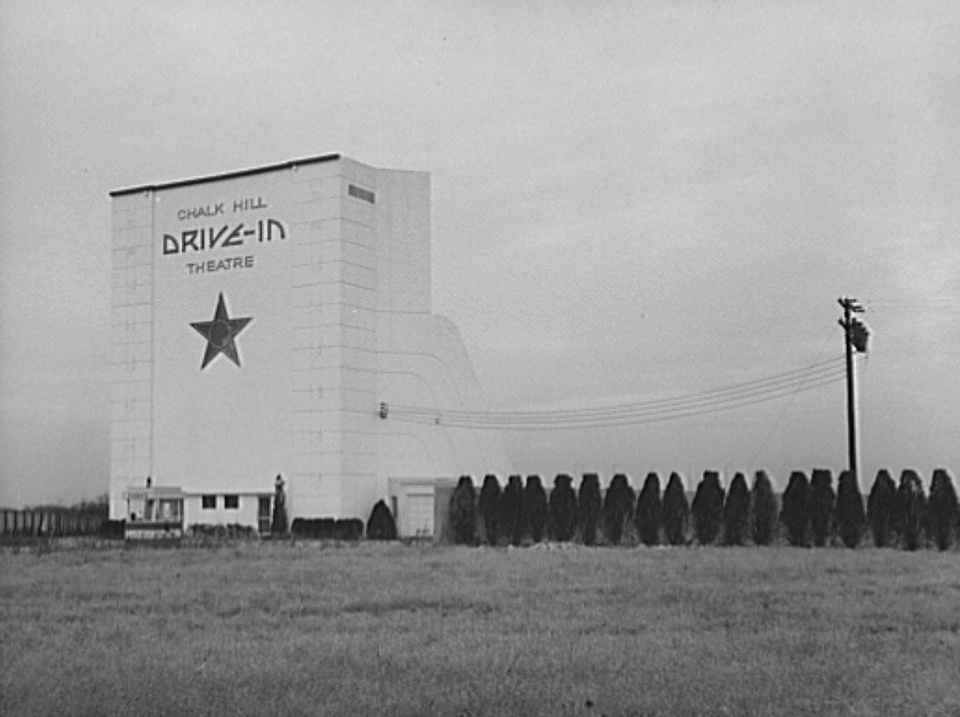
Two weeks later — on July 4, 1941 — Underwood and Ezell opened the Chalk Hill Drive-In in Oak Cliff, at about West Davis and Cockrell Hill Road. It looked almost exactly like the Northwest Highway drive-in, down to the great big star on the outside of it (to be replaced with a clown mural years later). The very first feature was “The Invisible Woman” with Virginia Bruce and John Barrymore.
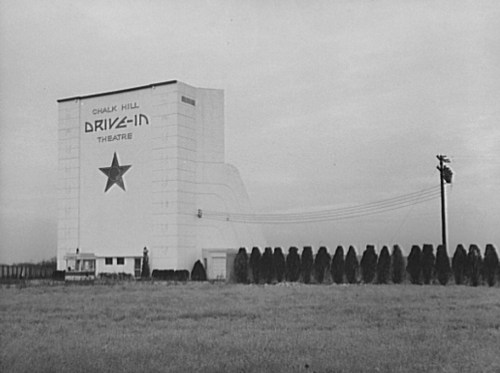
chalk-hill-drive-in_1942_LOC1942, out on the Fort Worth pike (Library of Congress)

Both theaters had successful and relatively long lives. The Northwest Highway drive-in closed in 1963 when the land was purchased for development (the most notable occupant of the new businesses that occupied that corner was probably the fondly remembered Kip’s restaurant).

The Chalk Hill Drive-In closed in the late 1970s, and from what I can tell, it spent a couple of decades abandoned and decaying.

*

A few random tidbits.

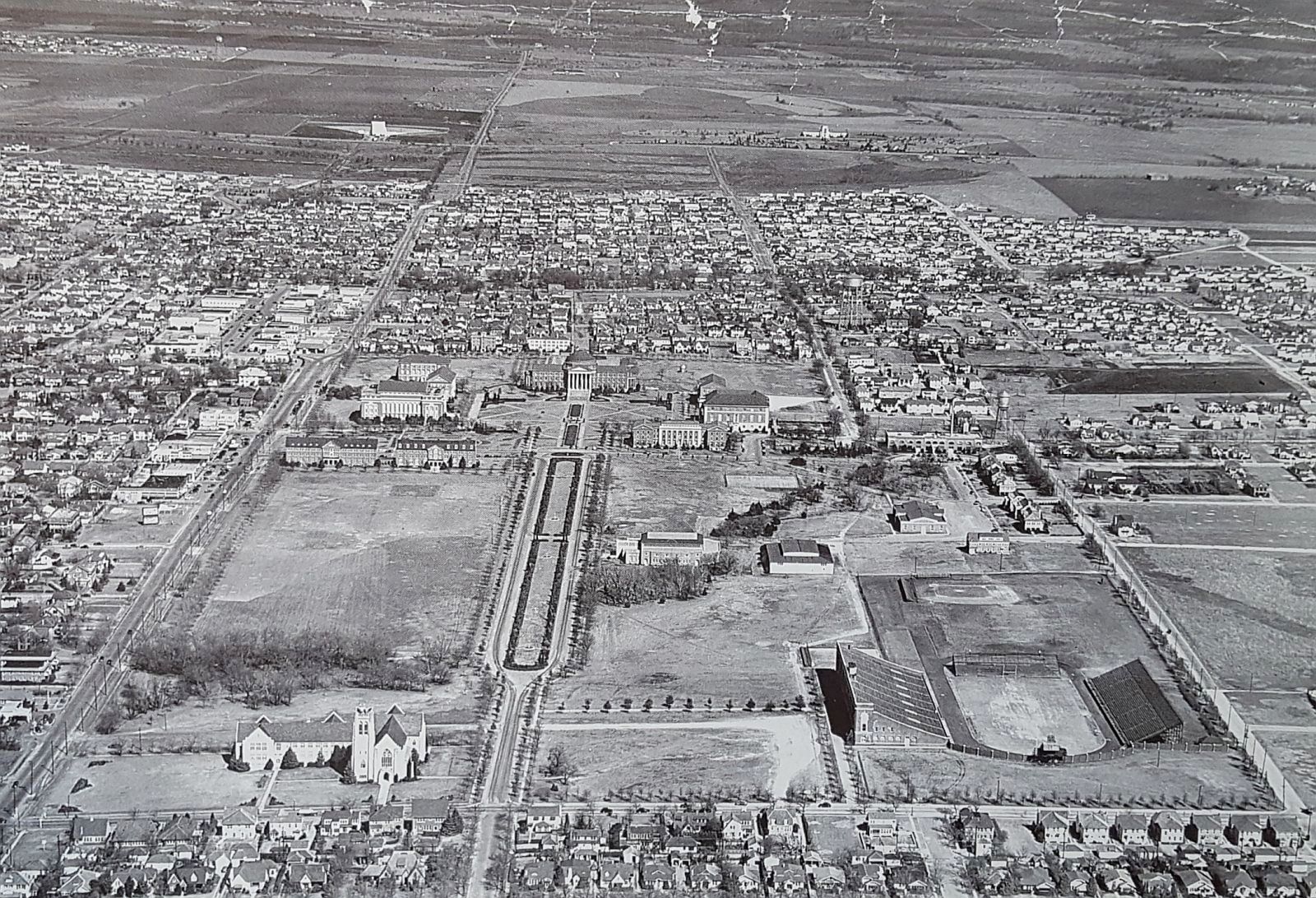
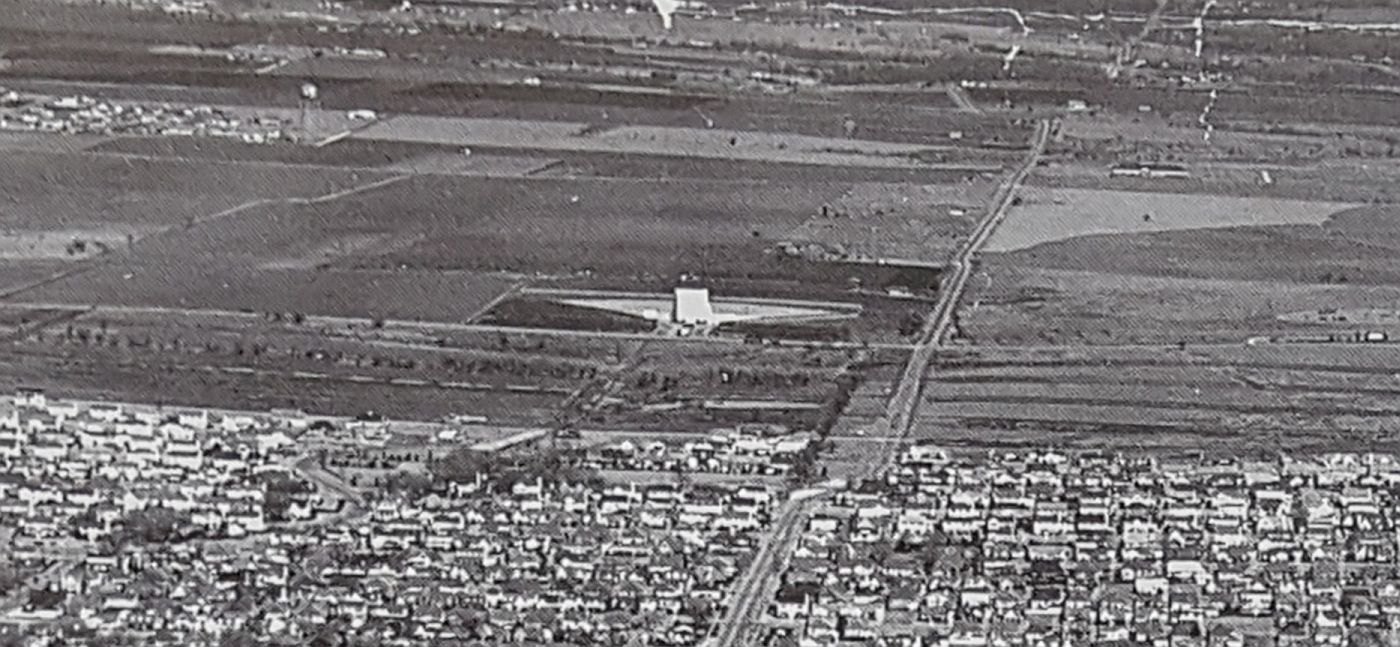
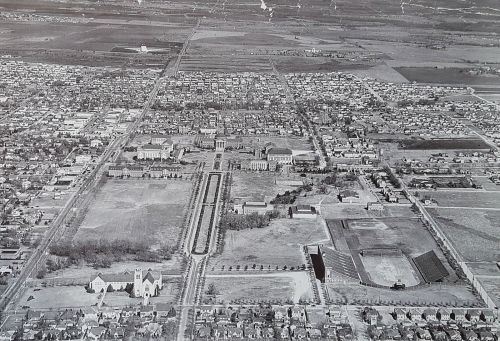
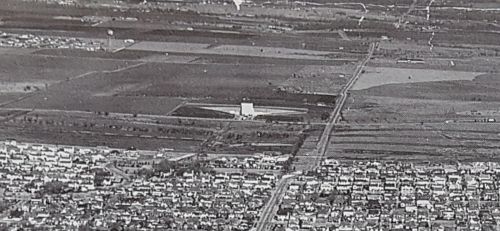
Here’s a 1945 aerial shot over SMU looking north — the drive-in is in the middle of all that wide-open Caruth farmland, seen just left of Hillcrest (the Hillcrest Mausoleum, built in 1936, can be seen to the right of Hillcrest; the Caruth Homestead is at the far right edge of the photo).
nw-hway-drive-in_1945_galloway_park-cities-photohistory

Here’s a detail, showing it up-close:
nw-hway-drive-in_1945_galloway_park-cities-photohistory_det

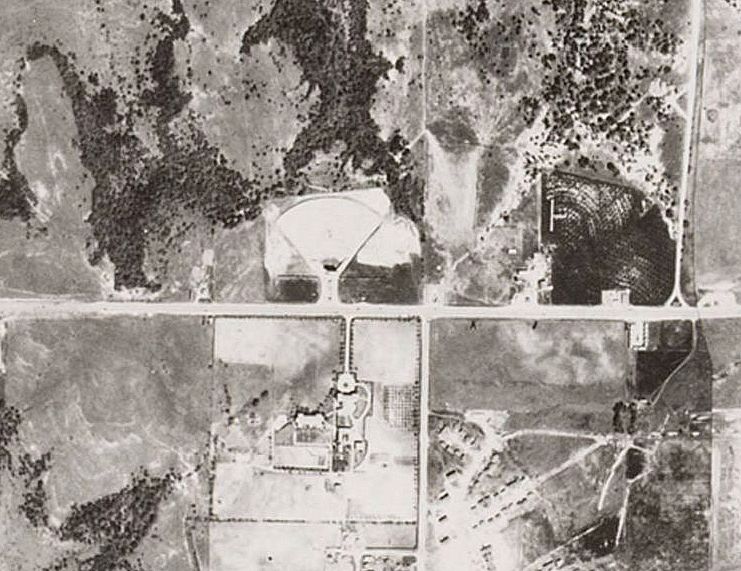
Two aerial shots by the United States Army Air Forces, taken for a USDA survey in 1945. First, the Northwest Highway Drive-In, with Northwest Highway running horizontally in the photo and Hillcrest running vertically.
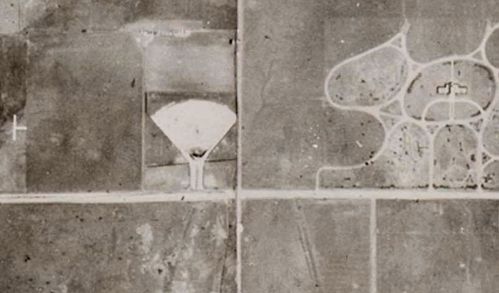
nwhwy-hillcrest_usaaf_fosucue_smu_1945SMU

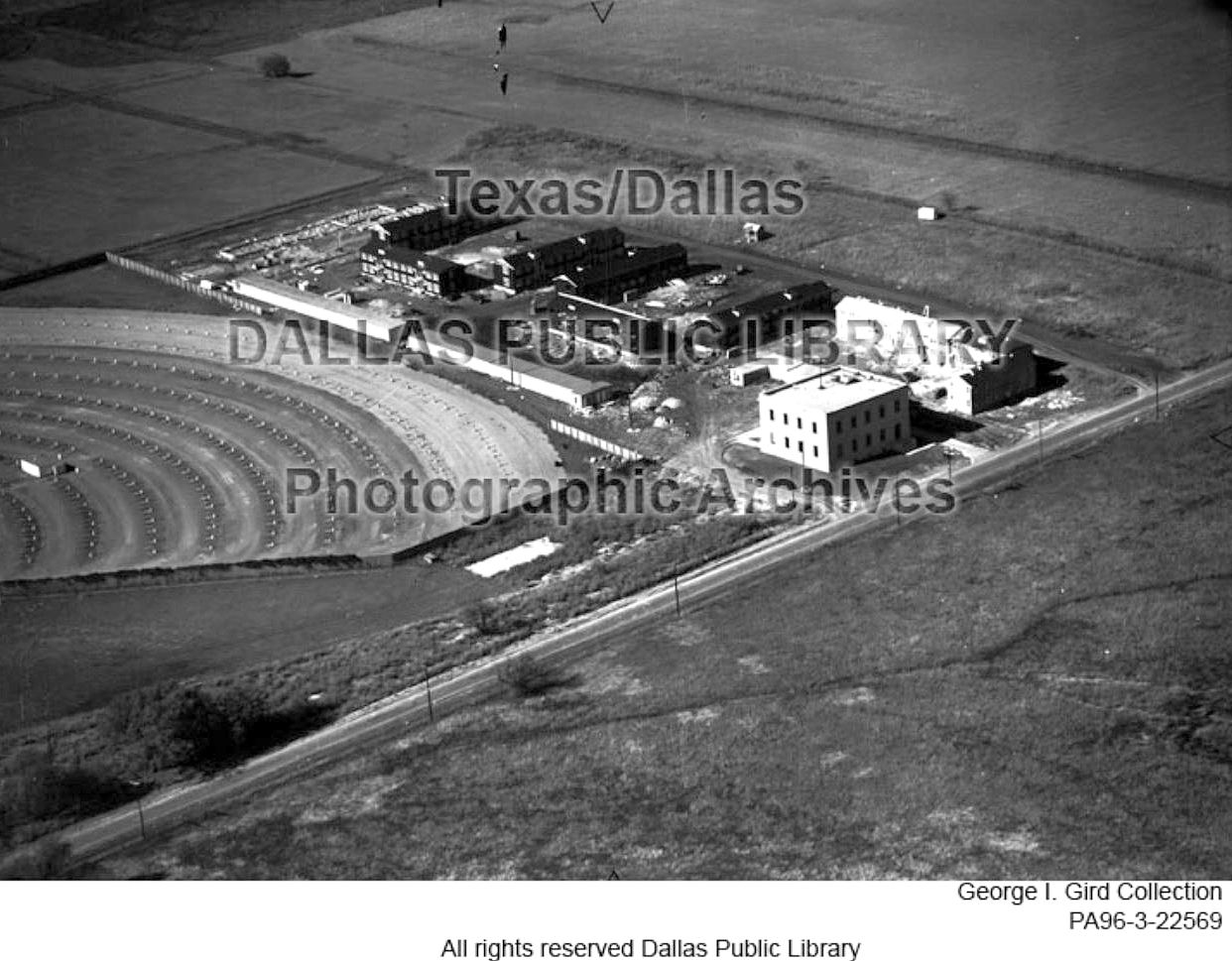
This aerial photo from 1947 shows a view to the northwest, with Hillcrest running from lower left corner to top right — it appears the photo was taken to show the new apartment complex just north of the parking area of the drive-in.
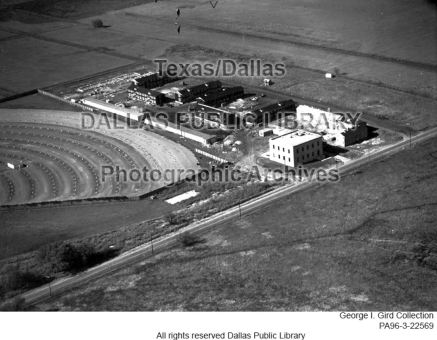
northwest-hi-way_drive-in_DPL_1947
Dallas Public Library

And Chalk Hill, with Highway 80 running horizontally:
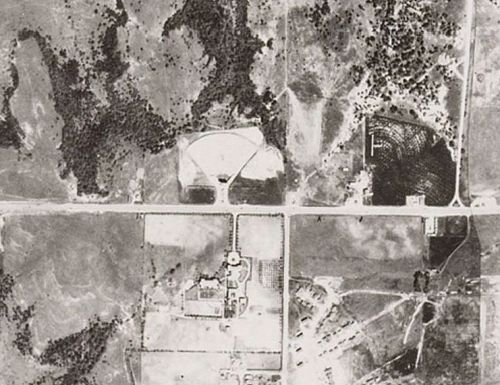
chalk-hill_usaaf_smu_1945SMU

Chalk Hill again, this photo from 1973, with the clown face and circus theme that many remember:
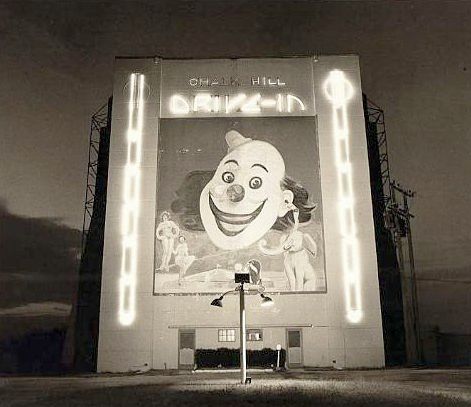
chalk-hill-drive-in_1973_smithsonian
Photo by Steve Fitch, Smithsonian American Art Museum

A couple of amusing livestock-oriented drive-in-related human-interest blurbs appeared in the pages of The Dallas Morning News:

Some cattle going from Waco to Wisconsin stampeded through University Park when their truck caught fire on Greenville. Police herded most of the steers into a Northwest Highway drive-in theater. Five were found nuzzling zinnias at a home on Southwestern. (Lorrie Brooks, DMN, Sept. 18, 1952)

Cattle in 1952, donkeys in 1955:

University Park police early Wednesday captured two pet donkeys who escaped their pen at the Northwest Highway Drive-In Theater during the night. A startled passerby spotted the two donkeys grazing contentedly on a lawn at Centenary and Hillcrest, about four blocks from the theater…. Bill Duckett, manager of the theater, reported the loss of the two pets, which he keeps for the entertainment of the theater’s small-fry patrons. (DMN, May 26, 1955)

***

Sources & Notes

I’m not sure of the source of the top photo, but I’m pretty sure of when it was taken: the marquee shows that the movie “Tall, Dark and Handsome,” starring Cesar Romero, was playing; that movie ran at the Northwest Hi-Way Drive-In July 12-14, 1941.

The aerial photo (by Capt. Lloyd N. Young) showing SMU and the land that lay north of it is from the Highland Park United Methodist Church Archives; I found it in Diane Galloway’s fantastic book The Park Cities, A Photohistory.

The two aerial photos are details of larger photographs from the collection of Dallas Aerial Photographs, 1945 USDA Survey, Edwin J. Foscue Map Library, Central University Libraries, Southern Methodist University. The full (labeled) Northwest Highway photo is here; the Chalk Hill photo is here.

Two other aerial photos (from 1958) are interesting because they are a bit closer and because you can see the terraced ramps — they can be seen here (apologies for the watermarks — photos from HistoricAerials.com).

The Wikipedia entry for the Drive-In Theater is here.

The patent (with illustrations) for the drive-in theater, filed by Richard M. Hollingshead, Jr. in 1932 is here (it’s a very interesting read). I had no idea a drive-in movie theater could be patented. This cool drawing is part of it (click it to see it larger):
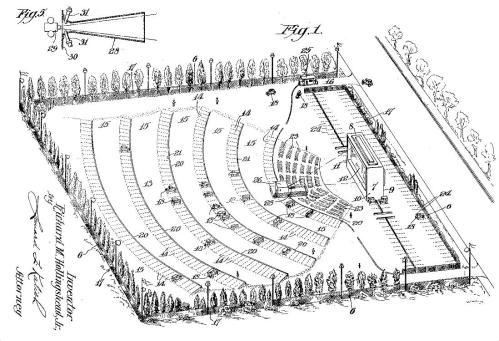
drive-in-patent_1

A great history of drive-ins in the Dallas-Fort Worth area can be found in the article “Starlit Skies and Memories” by Susan and Don Sanders; it appeared in the Spring, 1999 issue of Legacies, and can be read here. Great photos! (Who knew there was a drive-in on South Lamar — the Starlite — which catered exclusively to the black community?)

*

Copyright © 2015 Paula Bosse. All Rights Reserved.

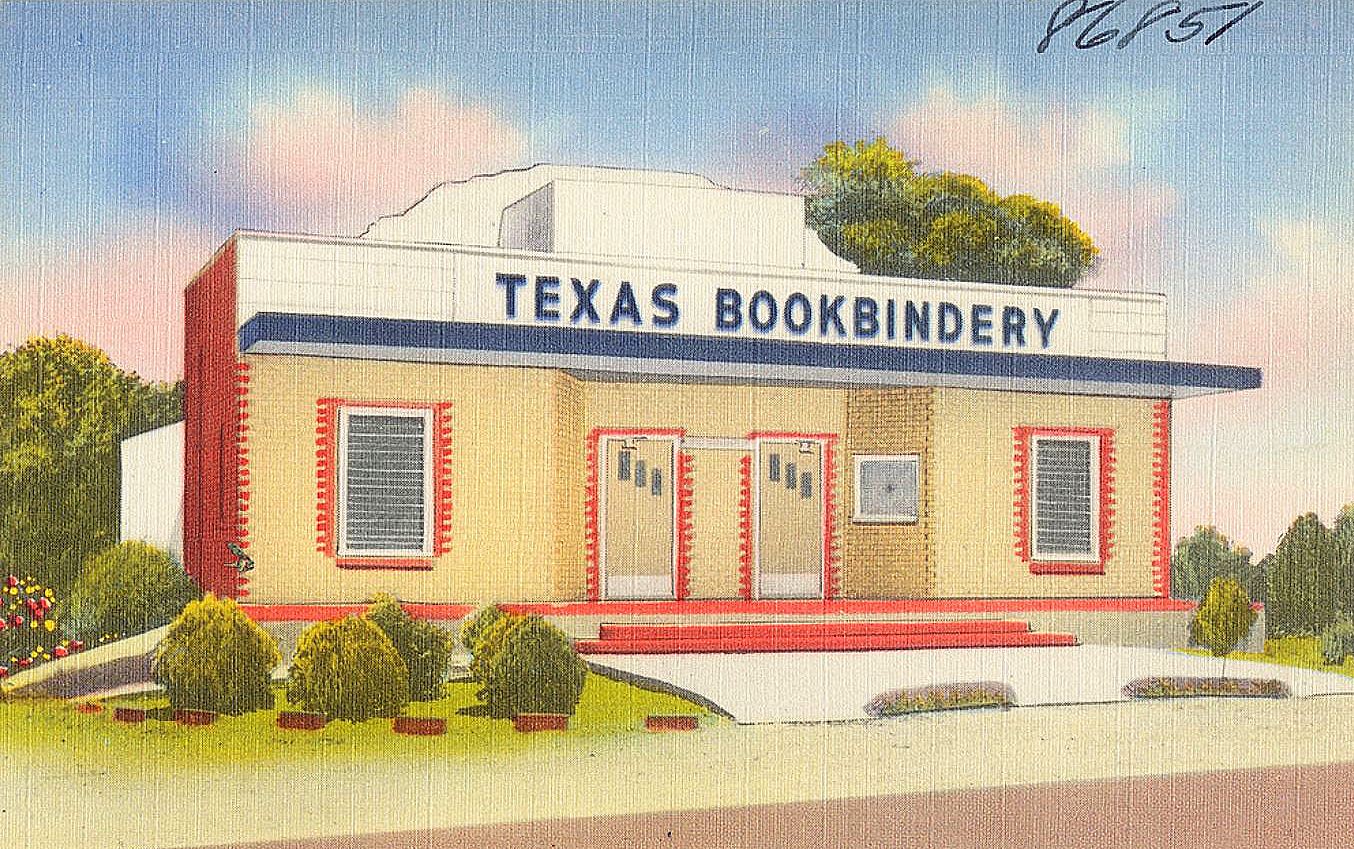
The Texas Bookbindery, Arcadia Park

texas-bookbindery_oak-cliff_tichnorThe Texas Bookbindery, be-shrubbed and gleaming in Oak Cliff’s Arcadia Park

by Paula Bosse

Old postcards, such as the one above, are perfect little fictional jewels. One knows instinctively when looking at them that they show a highly idealized version of reality. I almost didn’t want to find out too much about the Texas Bookbindery, because I love this image so much, and I was pretty sure that if the simple-but-charming building still stood, it wouldn’t really look like a happy little place atop a slight hill, with lovely landscaping, where butterflies flitted among the flowers and bluebirds sang in the nearby trees.

I didn’t find out much about the Texas Bookbindery, except that it seems to have been in business from at least the late 1940s until the late ’60s or early ’70s. It was managed by a man named T. Bernard White, who was featured in a 1948 Dallas Morning News article about the horrible things people do to library books (the Dallas Public Library sent the bindery what sounds like an unending stream of not-quite-destroyed books which were still repairable).

Apparently bookbinderies keep a pretty low profile, because the only other mention I found in the newspaper about this one was in 1962 when a large number of the 37 employees (“mostly women”) were overcome by fumes from poorly-vented gas heaters in the “one-story sheet-metal plant” (yes, a large sheet-metal structure extends behind the deceptively cheery street view). That story listed the address as 714 N. Justin, in the Arcadia Park area of Oak Cliff. I was almost afraid to plug that address into Google. As well I should have been. Here’s what that sweet little building looks like now (but …the shrubs! …the flowers! …the BLUEBIRDS!!):

tx-bookbindery-nowToday, via Google Street View

Poor little bookbindery.

UPDATE: A month after I wrote this post in November, 2014 the Google car drove down N. Justin and snapped a new Google Street View of the poor little bindery — it looked even sadder: it had a big hole in its roof. In March of 2017, that hole-in-the-roof image from December, 2014 has yet to be updated. See it here.

***

Sources & Notes

Postcard from the fantastic Boston Public Library Tichnor Brothers Postcard Collection on Flickr, here.

Click top pictures for larger image.

*

Copyright © 2014 Paula Bosse. All Rights Reserved.