Flashback : Dallas

A Miscellany: History, Ads, Pop Culture

Category: Oak Cliff/West Dallas

Waiting For a Streetcar on a Sunny Winter Day in Oak Cliff — 1946
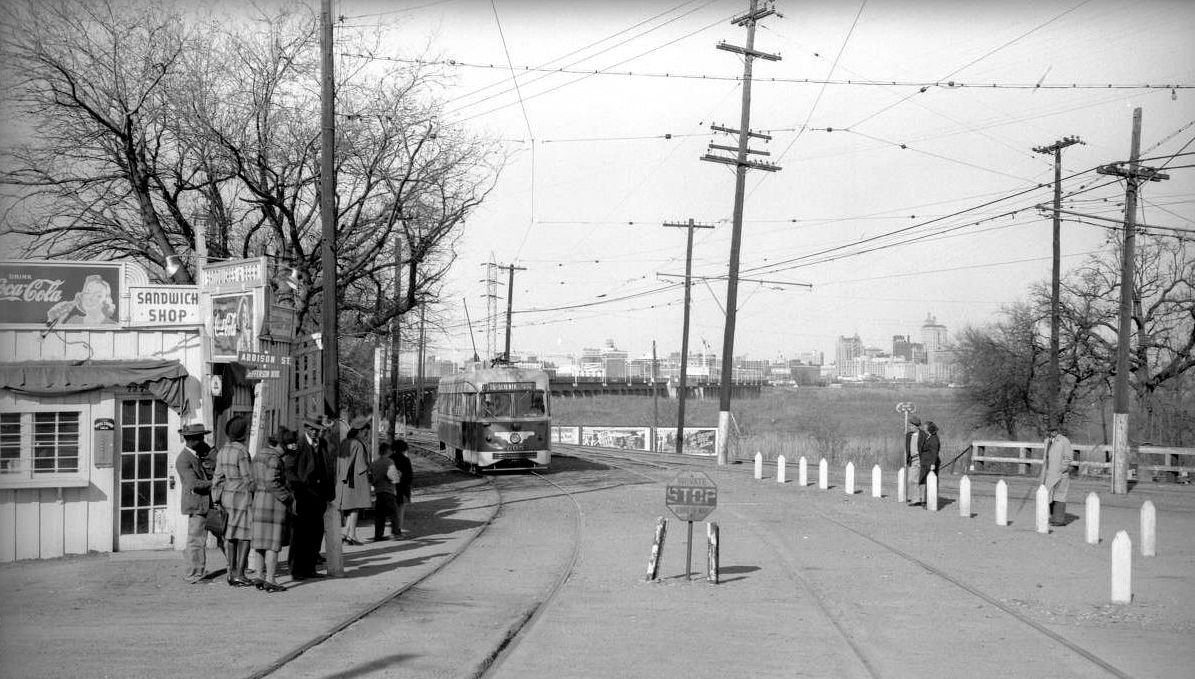
jefferson-addison_denver-pub-lib_1946Addison St. & Jefferson Blvd. in Oak Cliff — Feb., 1946 (click for larger image)

by Paula Bosse

I love streetcars, photos from the 1940s, fashions of the ’40s, and views of the Dallas skyline. And here are all of these things, in one great, GREAT photograph. We see people waiting for the streetcar on a sunny Saturday in February, 1946 — in Oak Cliff, at E. Jefferson Blvd. and Addison St. The people at the left (outside Helen’s Sandwich Shop) are about to catch the car that has just crossed the Trinity River and head into Oak Cliff; the people on the right are waiting to go to Dallas. The Oak Farms Dairy is just out of frame at the top left, and Burnett Field is just out of frame at the bottom right. The Dallas skyline looms across the Trinity.

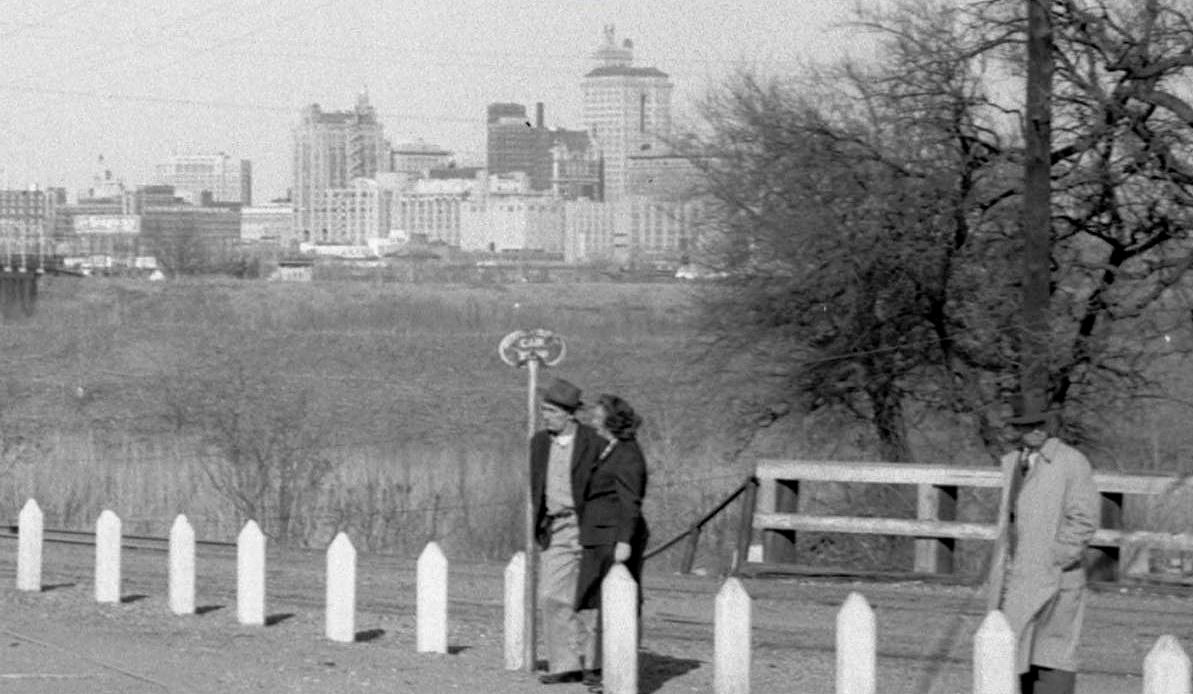
Below, I’ve zoomed-in a bit and cropped this fantastic photograph into two images to show, a bit more intimately, details of an ordinary moment in an ordinary day of ordinary people. What once was such a commonplace scene — people waiting for a streetcar or interurban — now seems completely out of the ordinary and quaintly nostalgic. (Nostalgic on its surface, anyway — not shown is the interior of the car which had specific black-only and white-only seating areas for passengers.) (As always, click for larger images.)

jefferson-addison-det1

jefferson-addison-det2

***

Photo by Robert W. Richardson, taken on February 2, 1946. From the Western History/Genealogy Dept., Denver Public Library, viewable here. More on rail enthusiast, writer, photographer, and preservationist Bob Richardson, here.

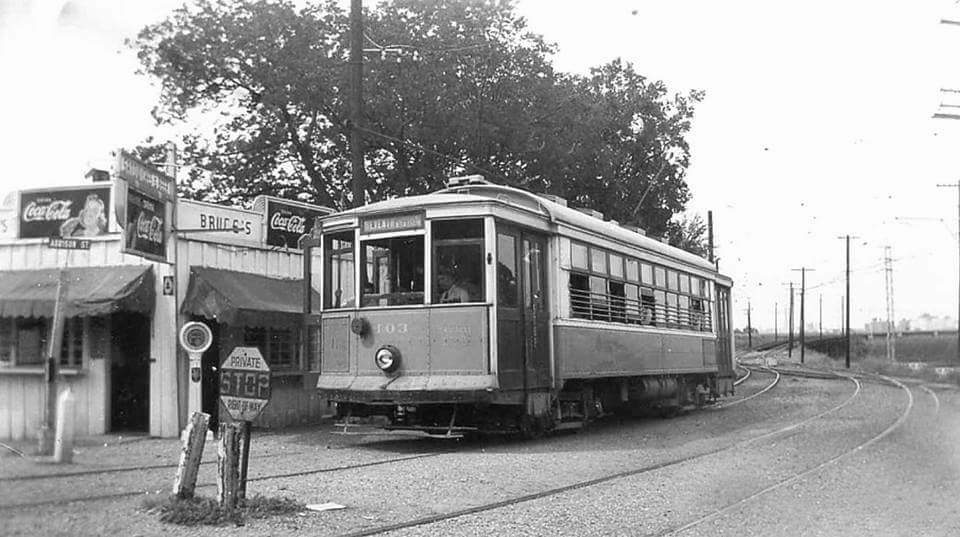
The same stop can be seen in this undated photo (source and photographer unknown):
oak-cliff-streetcar-stop_addison-jefferson

Streetcars ran back and forth across the Trinity River on a special trestle just south of the Oak Cliff Viaduct/Houston Street Viaduct. It had been in use since 1887 (through various renovations) and was demolished in the early 1970s to build the present-day Jefferson Street Viaduct.

To see a photo by the same photographer showing a streetcar actually on the trestle over the Trinity, see the post “Crossing the Trinity River Viaduct — 1946,” here.

Streetcar enthusiasts are incredibly, well, enthusiastic, and they keep precise track of where cars operated over their life spans. The car from the photo — Dallas Railway & Terminal Co. car #605 — was a PCC streetcar, built by the Pullman-Standard company in 1945; it was sold to the MTA in 1958 and was in operation in Boston for many years. See cool photos of the very same streetcar in operation over the years in both Dallas and Boston, here (scroll down to “605”). To see what the retired car looked like in 2002 — a bit worse for wear — click here.

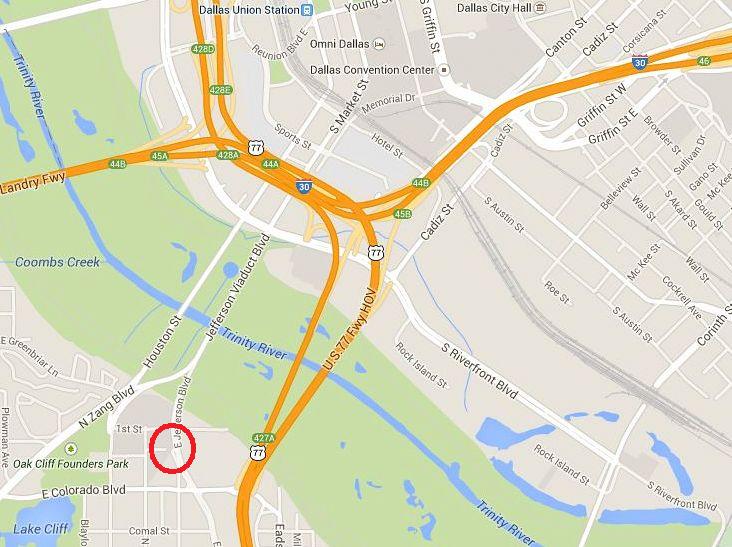
A distinctly less-wonderful view from roughly the same location, seen today, is here.
map_jefferson-addison_googleGoogle

Click pictures for larger images.

*

 Copyright © 2014 Paula Bosse. All Rights Reserved.

Oak Cliff Trolley — 1895

trolley_oak-cliff_stark_1895_hpl“Dallas from Oak Cliff” by Henry Stark, 1895/96 (click for larger image)

by Paula Bosse

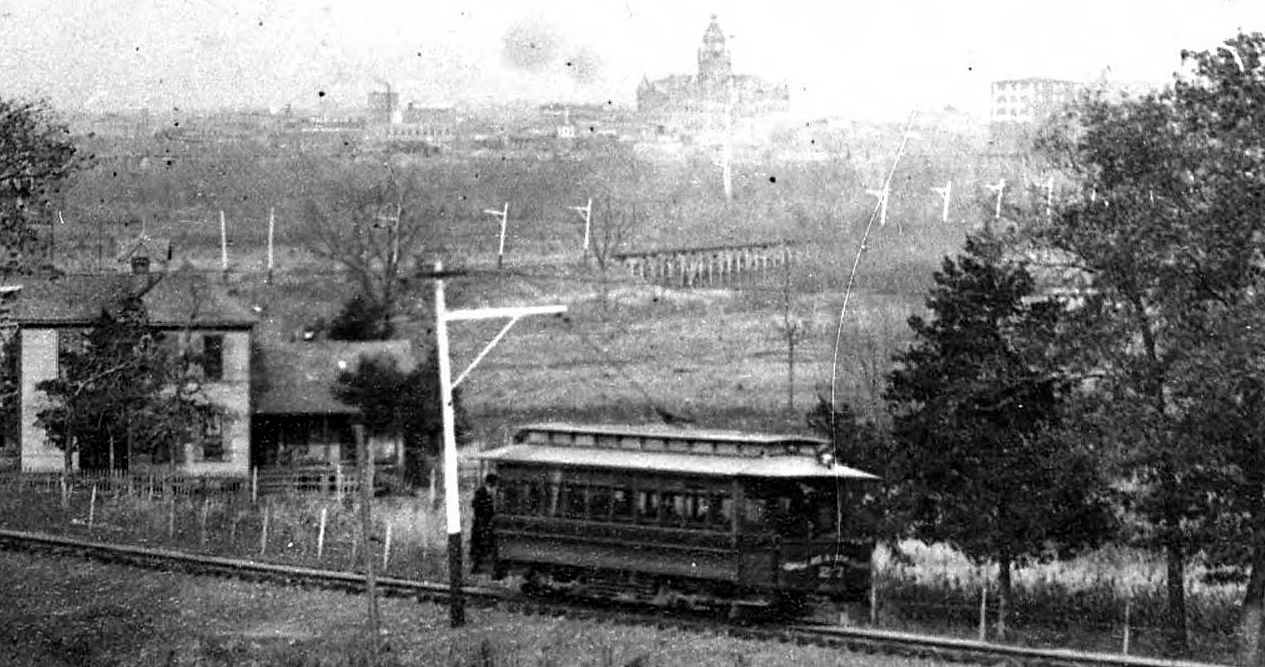
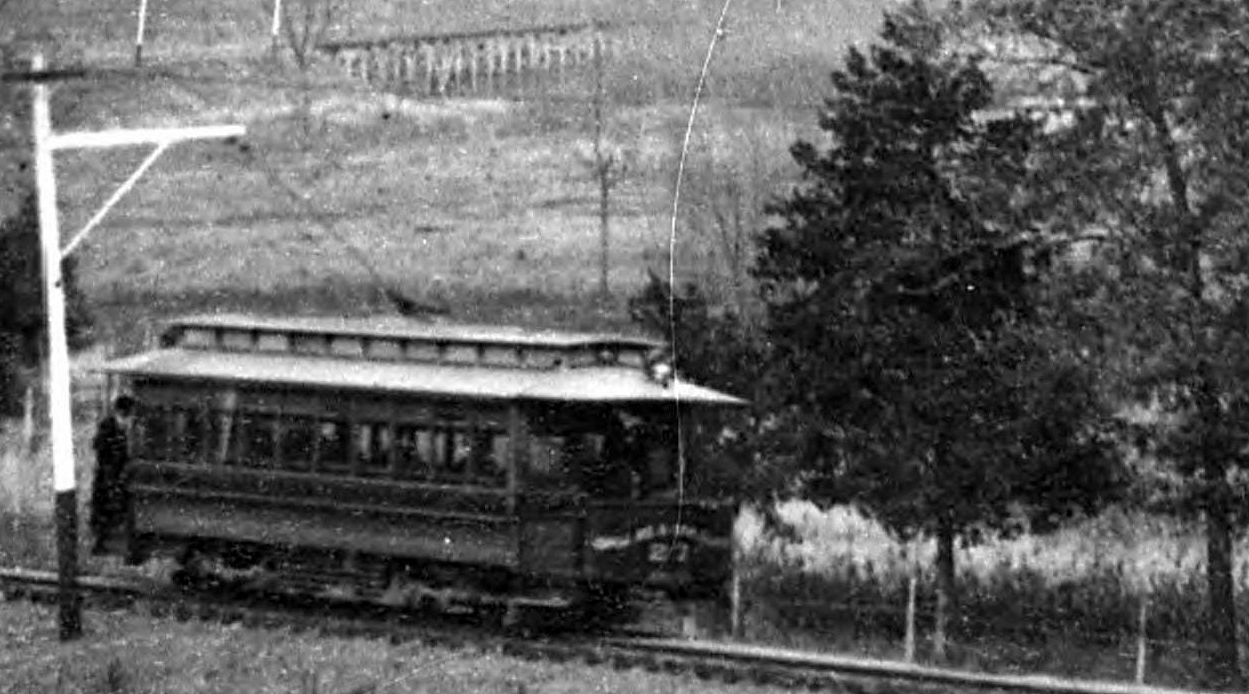
As present-day trolley service to Oak Cliff has been in the news in recent months, here’s a pastoral view of a little trolley chugging through the wilds of Oak Cliff in 1895. In the background, across the river, the still-fairly-new courthouse looms like a mirage. Below are a few details, magnified. (All images are much larger when clicked.) Enjoy!

trolley_oak-cliff_det1

trolley_oak-cliff_det2

trolley_oak-cliff_det3

trolley_oak-cliff_det4

***

Photo (labeled by the Houston Public Library as “Trolley moving through the woods”) is by Henry Stark, taken on a visit to Dallas in the winter of 1895/96; from the collection of the Houston Public Library — it can be viewed here.

For more on Henry Stark, see the previous post “Henry Stark’s ‘Bird’s Eye View of Dallas,'” here.

Other photos which I’ve “Zoomed In On the Details” can be seen here.

CLICK PHOTOS — REAL BIG.

*

Copyright © 2014 Paula Bosse. All Rights Reserved.
“Oak Cliff Is To Dallas What Brooklyn Is To New York” — 1891

ad-oak-cliff_mercury_031291The Southern Mercury, March 12, 1891 (click for larger image)

by Paula Bosse

Oak Cliff and the whole “Brooklyn” comparison is not a new one. Developers were using it to lure people to the “soft green cliffs” of the newly-incorporated area where “there is not a night in the hot months of summer when discomfort is felt from the heat” and where “people from all parts of the United States can be observed enjoying the delights of the seaside in the interior of Texas.” A veritable paradise. Just like Brooklyn.

Hats off to the enthusiastic scribe who penned this incredibly wordy advertisement beckoning the “live and progressive” readership of The Southern Mercury to invest in the ground-floor of Dallas’ Brooklyn.

*

OAK CLIFF, THE BEAUTIFUL RESIDENCE AND EDUCATIONAL CITY OF THE SOUTHWEST

The city of Oak Cliff derives its name from the massive oaks that crown the soft green cliffs and stands about two hundred and fifty feet above and to the southward and westward of the city of Dallas, overlooking the city, and the view is carried away over the city proper. Cool and healthful breezes prevail during the heated term, and there is not a night in the hot months of summer when discomfort is felt from the heat, and sound and refreshing sleep is not possible. To the south and southwest for hundreds of miles stretches level and unobstructed prairie, over whose bosom these breezes sweep from the gulf without infection from any unsalubrious conditions.

The Oak Cliff Elevated railway, substantially constructed, forms a belt of ten miles, encircling Oak Cliff, but at no place more than three miles from the business section of Dallas. Cars run every ten minutes day and night from either side of the court house, Dallas. Fare, five cents.

Oak Cliff is a wonderful and well-nigh magical growth of two years; the first house was completed at Oak Cliff twenty-seven months ago. It now has a population of about seven thousand, a large proportion of whom are from amongst the best people of the different towns of the state of Texas. They are a live and progressive people. Oak Cliff has just incorporated, and one of the first moves of the city government will be the building of several large, commodious fine brick and stone public school buildings, and provide for a large free school fund.

Oak Cliff contains a strictly moral people; intoxicating liquors cannot be found anywhere within her limits, – in keeping with this general policy, no sort of questionable resorts are tolerated.

Oak Cliff now has 1,500 to 2,000 residences, costing from $1,500 to $50,000. It has thirty miles of paved streets and avenues; is now building about six miles of cross-town street railway, to be operated by electricity. It has a successful water system, affording pure, clear spring water. A hotel costing $100,000 has been in successful operation since last June.

Oak Cliff has a park of about 150 acres of natural rustic beauty, diversified with hill and dale, and set off with clumps of royal trees. In the park is a beautiful lake with an average depth of 20 feet, equipped with good boats, where people from all parts of the United States can be observed enjoying the delights of the seaside in the interior of Texas.

Oak Cliff is to Dallas what Brooklyn is to New York.

For further information, address,

Dallas Land & Loan Co., Dallas, Texas.

***

Ad from the pages of The Southern Mercury, March 12, 1891.

A previous come-on from the developers of Oak Cliff can be found here.

*

Copyright © 2014 Paula Bosse. All Rights Reserved.

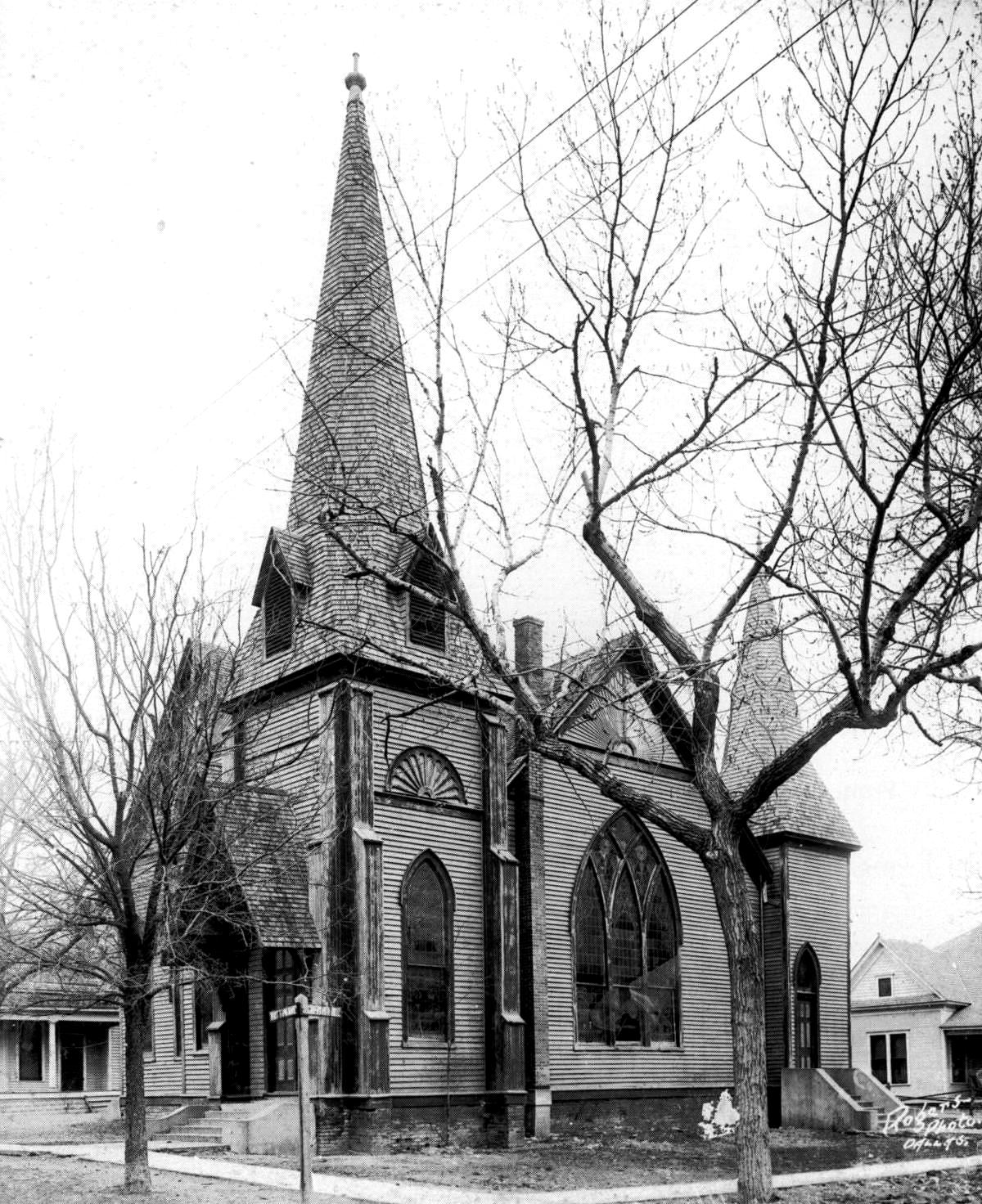
Oak Cliff Presbyterian Church, Organized 1890

oak-cliff-presbyterian_smOak Cliff Presbyterian Church, ca. 1897 (click for larger image)

by Paula Bosse

I came across this photograph of a church a couple of days ago and was mesmerized by its charming woodiness. According to its caption, it was the Oak Cliff Presbyterian Church, at the corner of Ninth Street and St. George (now Patton). Its first pastor was the Rev. W. L. Lowrance who had organized the church in 1890 with fewer than twenty members. Church membership grew steadily, and in 1923, having finally outgrown the small wood frame building, the congregation moved to their next location at Tenth and Madison (contributing to Tenth Street’s appearance in Ripley’s Believe It Or Not as the street having more churches per mile than any other street in the world). At some point this lovely church was razed.

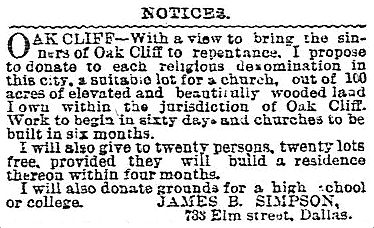
I’ve found little else on its earliest history. but I came across this advertisement placed in The Dallas Morning News in 1891:

simpson_oak-cliff-land-donation_dmn_031491(DMN, March 14, 1891)

Col. James B. Simpson was something of a learned Renaissance-man around Dallas. He had been the editor of The Dallas Herald for many years and was a civic leader with real estate interests. I’m not sure if this ad has anything to do with the establishment of the Oak Cliff Presbyterian Church, but it’s interesting to note that construction of the new church was mentioned as being under construction one month after this ad’s appearance. Time was running out for those Oak Cliff sinners (even though one newspaper report stated that the building wasn’t occupied until 1893).

Rev. Lowrance, an apparently well-liked and respected pastor, retired at the end of 1903.

lowrance_dmn_122903-photo“Dr. W. L. Lowrance of Oak Cliff”

lowrance_dmn_dmn_122903(DMN, Dec. 29, 1903 — click for larger image)

The Oak Cliff Presbyterian Church lives on, now on S. Hampton. One can only assume that the building it occupies today is not quite as charming as the little woody one that was built 120 years ago.

***

Top photo (by the Rogers Photo Studio, circa 1897) appeared in the Fall 2009 issue of Legacies magazine, here.

Though the first Oak Cliff Presbyterian Church was on Ninth St., the second one was on Tenth St., and that seems reason enough to direct attention to the article “Road to Glory: Tenth Street Becomes Church Street” by René Schmidt — it appeared in the same issue of Legacies as the church photo, and you can read it here.

Read more about this “Street of Churches” and its staggering fourteen churches (!) in the May 1, 1950 edition of The Dallas Morning News.

*

Copyright © 2014 Paula Bosse. All Rights Reserved.
 

Stevens Park Estates: “The Ideal Place for Your Home” — 1930

oak-cliff_stevens-park_dmn_092830
You deserve “maximum enjoyment”

by Paula Bosse

Do you dream of a home of your own? Then go and see the beautiful scenic Stevens Park Estates. “The Ideal Place for Your Home.” There you will find the ideal place for your “dream home.” A beautiful 146-acre park — 18 holes of golf — modern fan-shaped lots — broad sweeping boulevards — in fact, everything to make you realize the maximum enjoyment out of your home.

***

Sources & Notes

Ad from 1930.

History of Oak Cliff’s Stevens Park Estates can be found here and here.

*

Copyright © 2014 Paula Bosse. All Rights Reserved.

Keep Oak Cliff Kinky — 1923

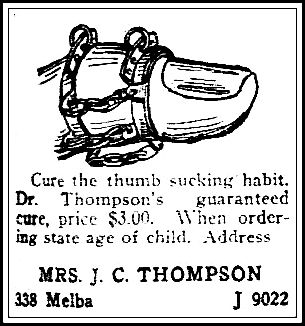
thumb-sucking_dmn_111823

by Paula Bosse

I’m not sure what more I can offer, except to say that in today’s money — with inflation taken into account — that little $3 bondage device for a child’s thumb would run you a cool 40 bucks in 2014. (Updated: in 2024, make that $55!)

I picture Mrs. J. C. Thompson assembling the inventory herself, at the kitchen table in her little frame house on Melba Street in Oak Cliff, the Victrola playing in the other room, having a chirpy one-sided conversation with the imaginary “Dr. Thompson.” I wonder if she sold any?

To quote the Messrs. Python: “Guaranteed to break the ice at parties!”

***

Sources & Notes

Ad from The Dallas Morning News, Nov. 18, 1923. I’m not sure there was a follow-up.

Whither Mrs. J. C. Thompson, OC entrepreneur?

*

Copyright © 2014 Paula Bosse. All Rights Reserved.

The Marsalis House: One of Oak Cliff’s “Most Conspicuous Architectural Landmarks”

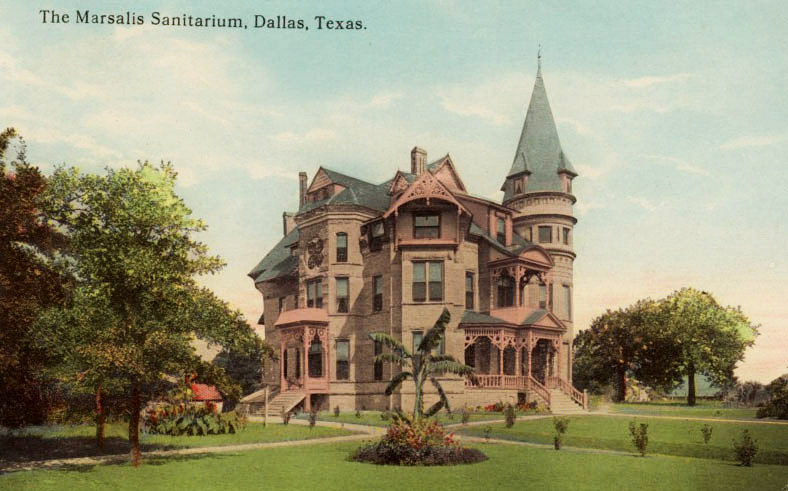
marsalis_sanitarium_oak-cliffThe fabulous Marsalis house in Oak Cliff (click for larger image)

by Paula Bosse

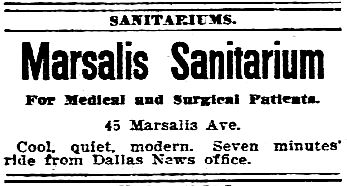
The Marsalis Sanitarium was a 15-bed private surgical and convalescent hospital in Oak Cliff, established in 1905 by Dr. J. H. Reuss and his partner, Dr. James H. Smart. Whether or not that building was actually pink (and I certainly hope that it was!), it was most definitely a show-stopper — one of those stunning structures that one doesn’t expect to see in and around Dallas because almost none of them still stand.

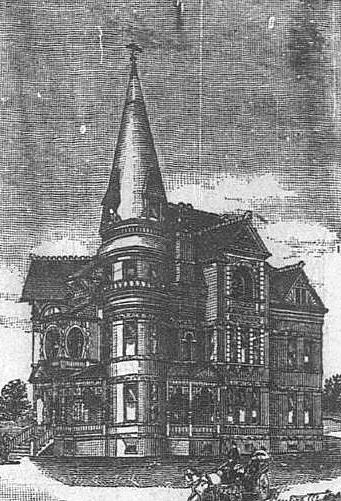
This grand home was built by Oak Cliff promoter and developer Thomas L. Marsalis in about 1889 as his personal residence at a reported cost of $65,000 (the equivalent of more than $1,750,000 in today’s money). It was located at what is now the southwest corner of Marsalis Avenue and Colorado Boulevard. The house was apparently never occupied. Supposedly, Marsalis’ wife did not want to live there because it was “too far from town” (!), but Marsalis’ financial distress throughout this time was probably more to blame.

marsalis-house_drawing
Dallas Morning News

Marsalis’ insolvency resulted in the foreclosure of the house in the early 1890s and its ultimate sale at public auction in 1903. The winning bidder at that auction was Dr. Reuss, and the house became the Marsalis Sanitarium soon after.

marsalis-sanitarium_tx-state-journal-medical-advertiser_dec-1905_portal
1905 ad (click for larger image)

marsalis_sanitarium_dmn_010109DMN, Jan. 1, 1909

marsalis-sanitarium_worleys-1909
Worley’s City Directory, 1909

Sometime after 1909 it became a girls’ seminary, and then in 1913 it fell into private hands. On August 10, 1914 the poor house burned to the ground. The headlines the next day read:

“Oil Starts Oak Cliff Early Morning Fire; Fisher Asserts Some One Set Old Building Ablaze; Firemen Find Structure Completely Enveloped in Flames and Interior Roaring Furnace.”

marsalis-house-fire_dmn_081114DMN, Aug. 11, 1914

Such a sad ending for such a beautiful house!

marsalis-home

***

Sources & Notes

1905 ad for the Marsalis Sanitarium from the December 1905 issue of the Texas State Journal of Medicine, found on the Portal to Texas History, here.

Black and white photograph of the Marsalis home in 1895 from the article in Legacies magazine, “Where Did Thomas L. Marsalis Go?” by James Barnes and Sharon Marsalis (which can be read here); photo from the collection of the Dallas Public Library.

For a biography of the family of Dr. Joseph H. Reuss, proprietor of the Marsalis Sanitarium, see here.

Click pictures for larger images.

*

Copyright © 2014 Paula Bosse. All Rights Reserved.
 

Back When the Kessler Couldn’t Catch a Break — 1957

kessler-theater-after-tornado_1957

by Paula Bosse

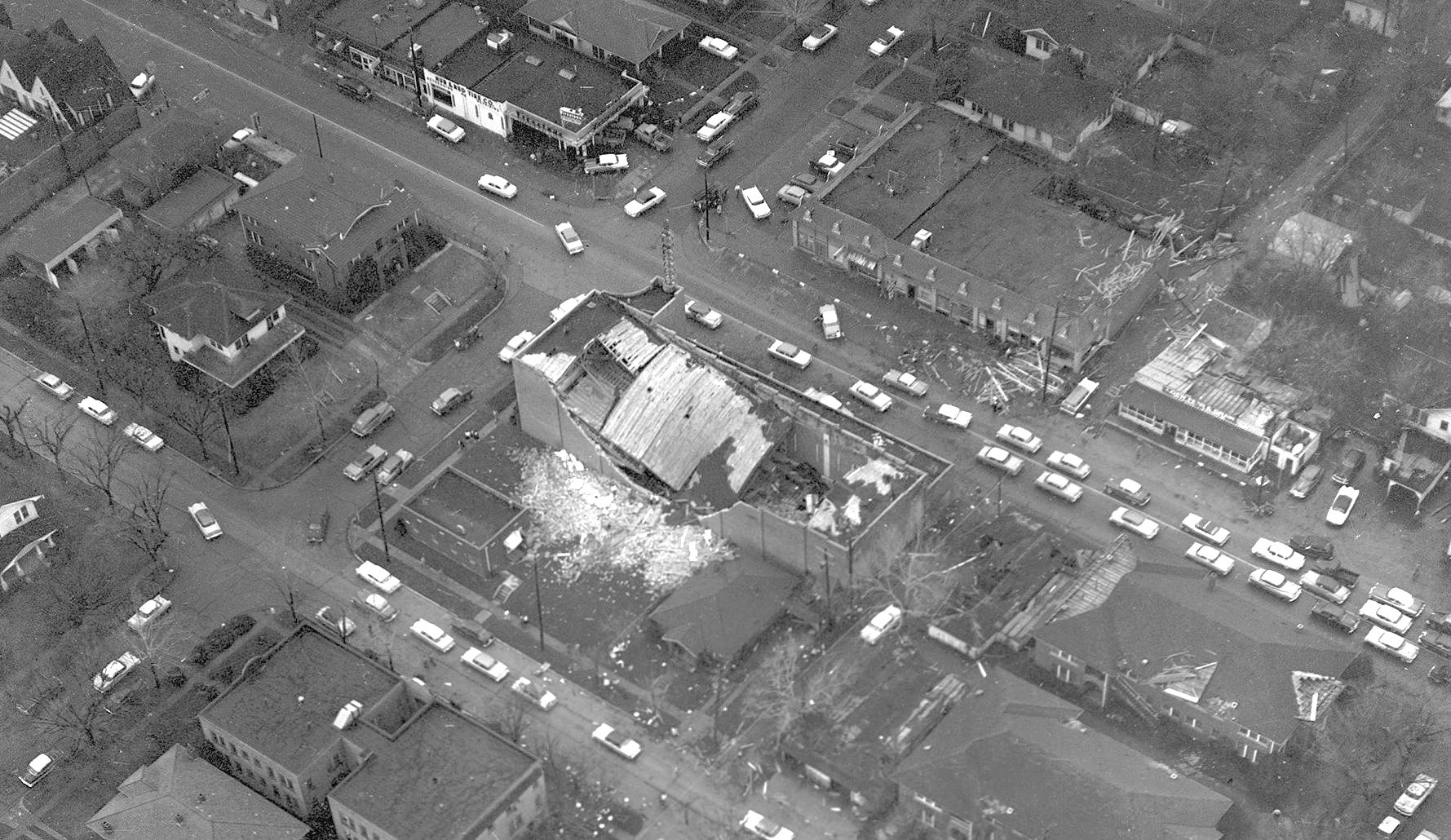
One of the casualties of the famous tornado that hit Dallas and Oak Cliff in 1957 was the Kessler Theater. In 1957, the Kessler — then only 15 years old — had hit hard times and was being used to house an evangelical church. It was rebuilt after the tornado, but soon after it was hit by a three-alarm fire. Conclusion? Do not disturb the entertainment gods — that place was meant to be a theater!

kessler_tornado_sherrod

From the post-tornado reports in The Dallas Morning News:

At the West Davis and Clinton business district, an evangelical church in a converted theater building at the intersection was caved in, leaving little more than two walls standing. The church’s cross from atop its more than 50-foot tower was crumpled in the gutter. (DMN, April 3, 1957)

And in a survey of the clean-up:

At Davis and Clinton, where the old Kessler Theater was being used as a revival center before the tornado, workmen were busy wrecking the building, completing what the tornado had started. […] J. T. Hooten, foreman for Winston A. Caldwell, explained that the damaged sections of the theater which might give way under a slight strain and cause further damage had to be torn out. His crew carefully but hurriedly dismantled the old Davis Street landmark. Hooten said the owner may rebuild the theater as a 1-story office building. (DMN, April 10, 1957)

Here is a detail of an aerial photo by photographer Squire Haskins, showing the damaged Kessler in the center (see the full, very large photo here):

kessler_tornado_squire-haskins_UTA_det

***

Sources & Notes

Top photo from an incredibly detailed website devoted to the 1957 Dallas tornado, the home page of which can be seen here.

Second photo from D. Troy Sherrod’s Historic Dallas Theatres (Charleston: Arcadia Publishing, 2014); photo from the collection of the Dallas Public Library.

Aerial photograph by Squire Haskins from the Squire Haskins Photography, Inc. Collection, UTA Libraries, Special Collections; more information is here (click the thumbnail to see a larger image).

Website of the recently (and beautifully) restored Kessler is here.

*

Copyright © 2014 Paula Bosse. All Rights Reserved.
 

The Oak Cliff Viaduct & The Weird Composite Photo — 1912

oak-cliff-viaduct-panorama_c1912_LOC

First you take a photo of the beautiful new Oak Cliff Viaduct, above.

Then you take a photo of the Dallas skyline, below.

dallas-panorama-skyline_1912_LOC

Then you put them together and get this bizarro Franken-photo!

oak-cliff-viaduct-panorama_skyline_c1912_LOC

It doesn’t look like any view of Dallas you’ve ever seen, but it still looks pretty damn cool.

***

Sources & Notes

All these panoramic photos are in the collection of the Library of Congress, all from the studio of Johnson & Rogers. The top photo has a copyright date of March, 1912, and the bottom two have copyright dates of August, 1912. See these panoramic photos (as well as one of the Buckner Orphan’s Home in 1911) on the Library of Congress site here.

Would this unusual composite have been done for a fanciful postcard or some other kind of promotional material (for the city or for the photographers)? Was it just done for fun? Tellingly, it’s the only one of the three without the studio’s imprint. If anyone has further info on this, please let me know!

These photos are HUGE. Click to see larger images — and use that horizontal scrollbar!

*

Copyright © 2014 Paula Bosse. All Rights Reserved.

What Do You Get When You Convert an Old Oak Cliff Firehouse Into a Restaurant?

firehouse-15_glorias

by Paula Bosse

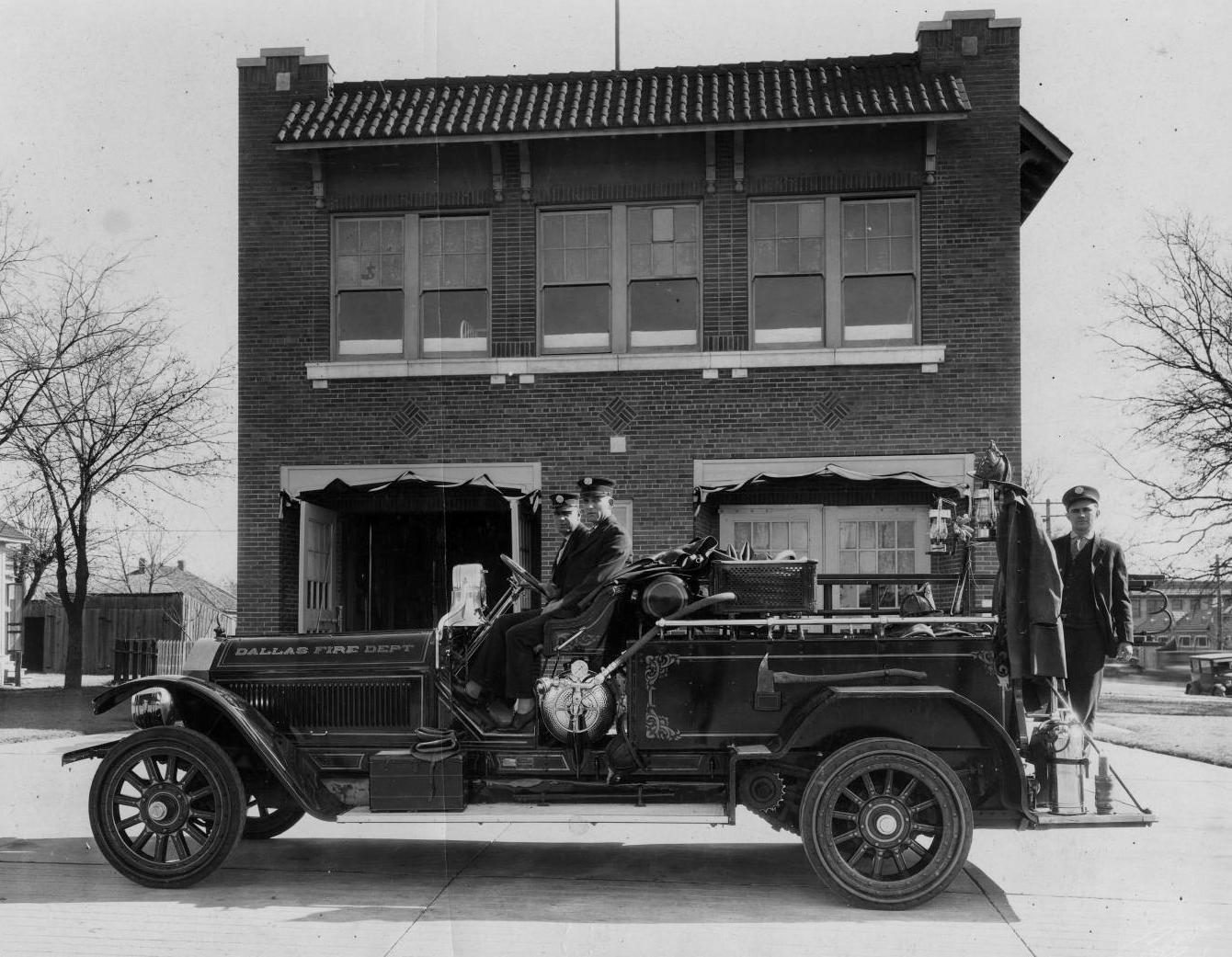
Station 15 — at Davis and Bishop — was a working firehouse decades before it was converted into Gloria’s restaurant in the Bishop Arts District. Here are the “before” photos.

station-15_oak-cliff

fire-station-15_oak-cliff

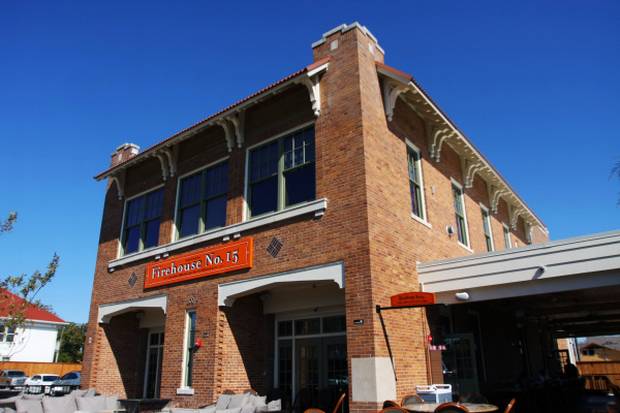
While you’re enjoying that incredible black rice (among other things…), take the time to enjoy your surroundings — it’s not every day you’re able to dine inside an old firehouse (don’t miss the brass fireman’s pole). Here’s the firehouse today:

firehouse-15_glorias_dmn

***

Sources & Notes

First and third photo from Dallas Firefighters Museum collection on the Portal to Texas History site here.

Second photo (circa 1931) is available for purchase here.

Photo of Gloria’s from The Dallas Morning News.

More info on Station 15 here.

Gloria’s website here.

*

Copyright © 2014 Paula Bosse. All Rights Reserved.