Flashback : Dallas

A Miscellany: History, Ads, Pop Culture

Category: South Dallas

Dallas in the ’20s

Pennsylvania Ave. & Meyers St.

by Paula Bosse

It’s taking so long for me to post these days!

Here is a collection of a few random places from Dallas in the 1920s.

*

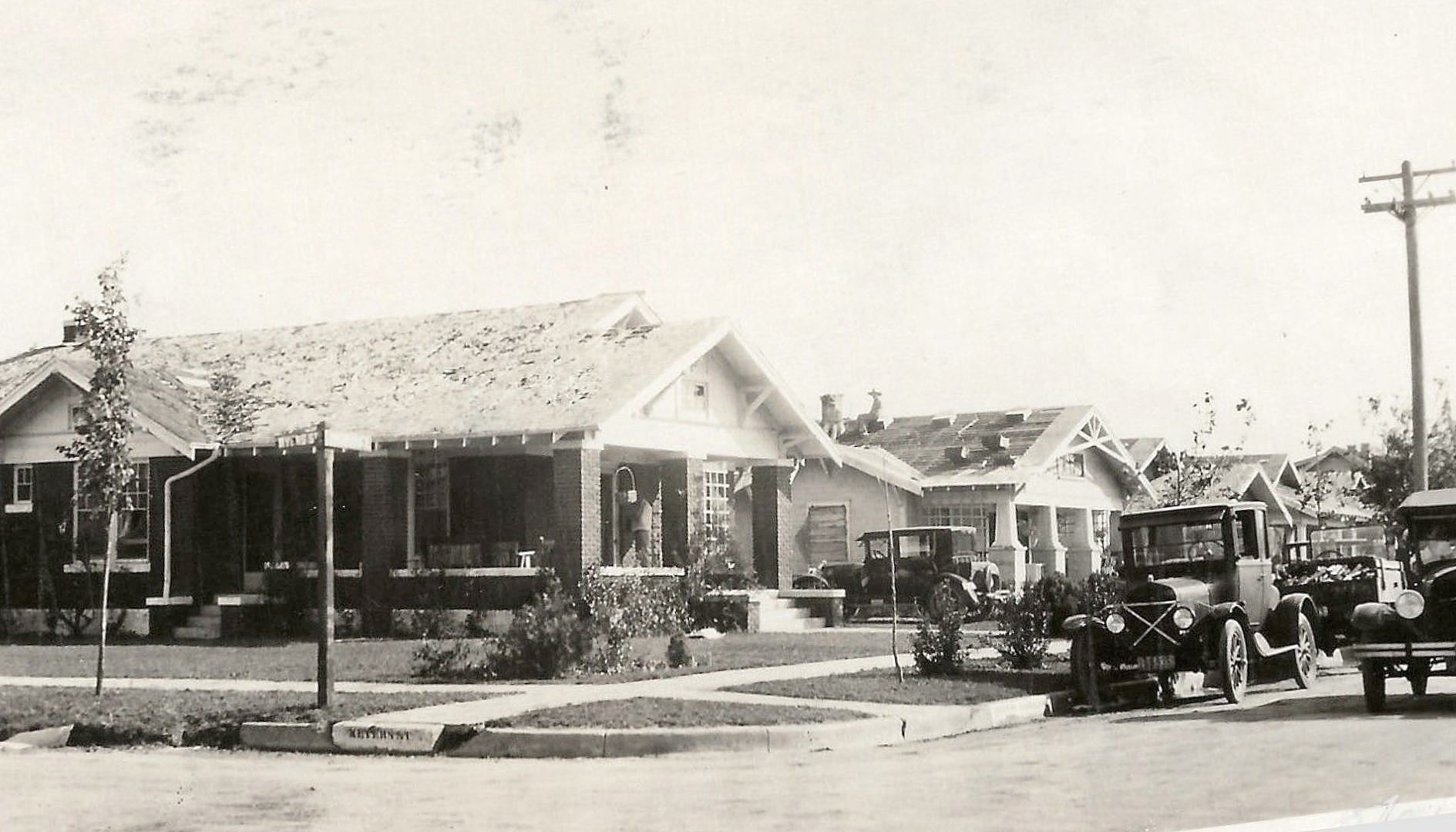
Above, South Dallas, circa 1926. This photo shows the 2900 block of Pennsylvania Avenue at Meyers Street. I love houses of this period, and I love this photo. This may just be poor resolution of the photograph, but it looks like the roof of the house in the foreground is damaged — the roof next door is being repaired.

The house on the corner is no longer there, but the second house — the one with the guys on the roof — is still there, minus some of its aesthetically pleasing design elements. See what this corner looks like in a recent Google Street View, here.

*
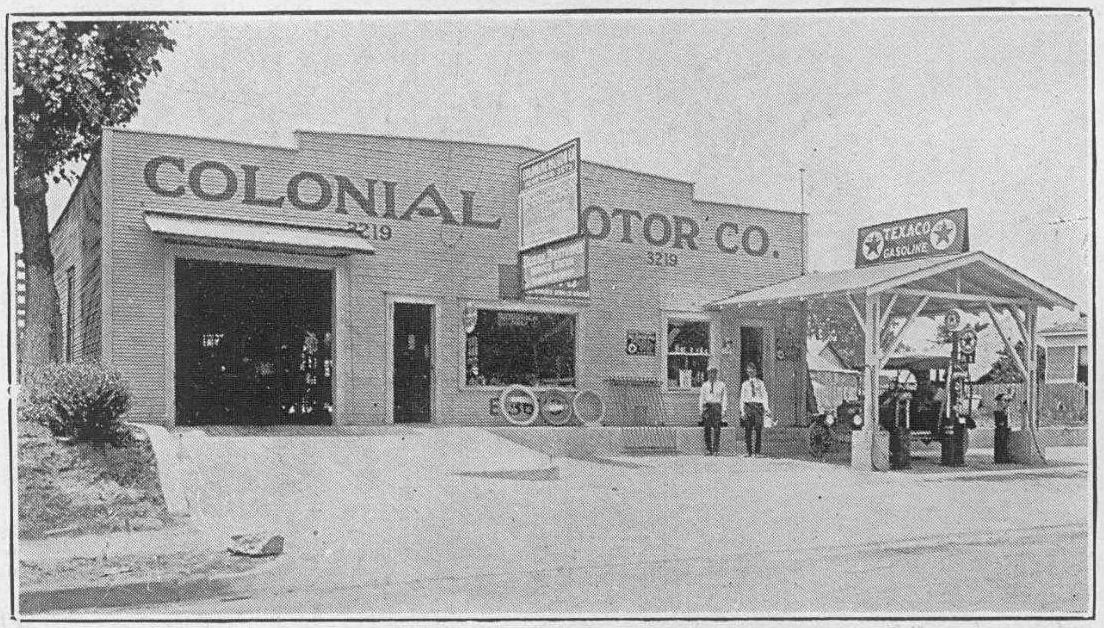
The Colonial Motor Co., 3219 Holmes Street, South Dallas.

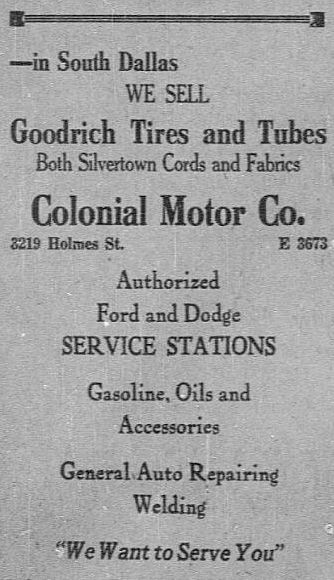
I can’t explain it, but I really love photos of old service stations and garages. The Colonial Motor Co. was in business as early as 1914. Around 1920, it moved to South Dallas, where owner R. F. Mitchell opened a garage at 3219 Holmes Street, just off Pennsylvania in the area known as Colonial Hill. According to the obituary of Mitchell’s son, the business lasted until 1988. That’s quite a run.
An interesting side note about the owner is that he was a motorboat enthusiast and participated in and organized boat races at White Rock Lake. The garage you see above did all the things that service stations do, but it was also the official retailer of Evinrude outboard motors in North Texas.

*
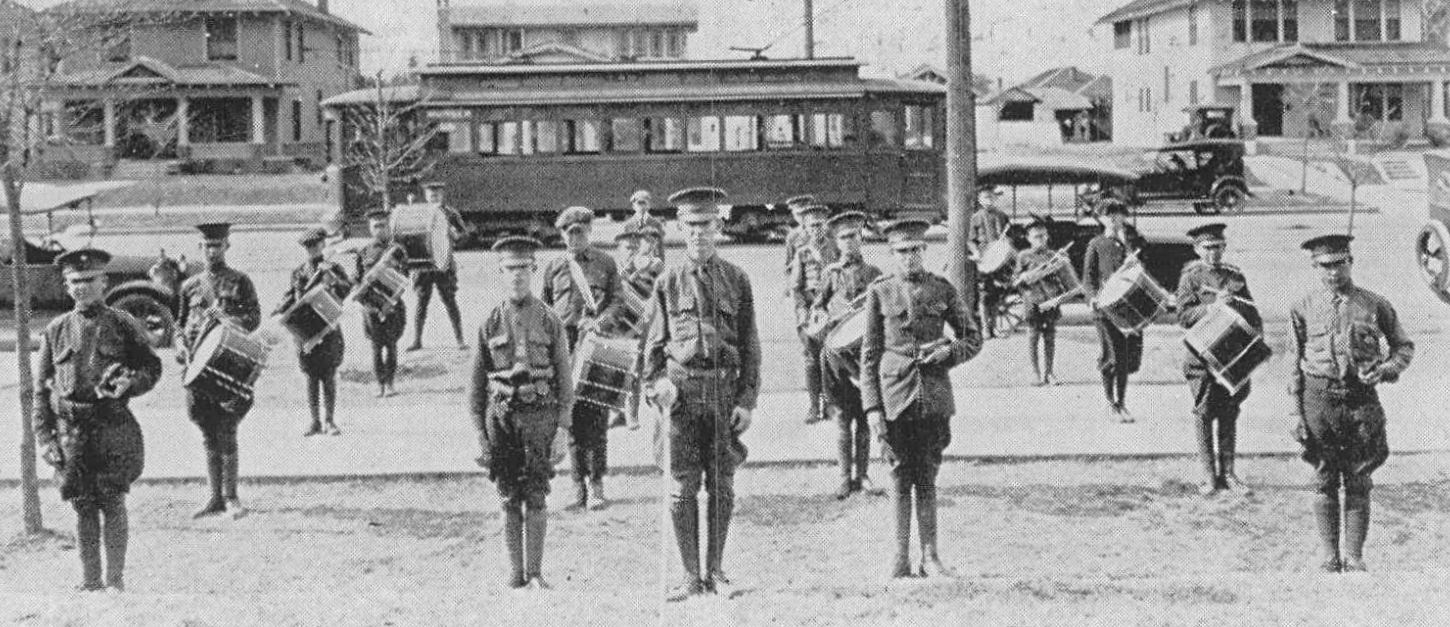
Still in South Dallas, this 1921 photo shows the Forest Avenue High School Drum & Bugle Corps. It’s not that exciting as a photo of a drum and bugle corps, but what is exciting is seeing the view of Forest Avenue behind them. This is now the 3000 block of Martin Luther King Jr. Boulevard, and nothing is this photo still exists. Not the houses, not the streetcar, not the people. It now, rather distressingly, looks like this.

The drum and bugle corps is facing the school, seen here, in a photo from 1924:
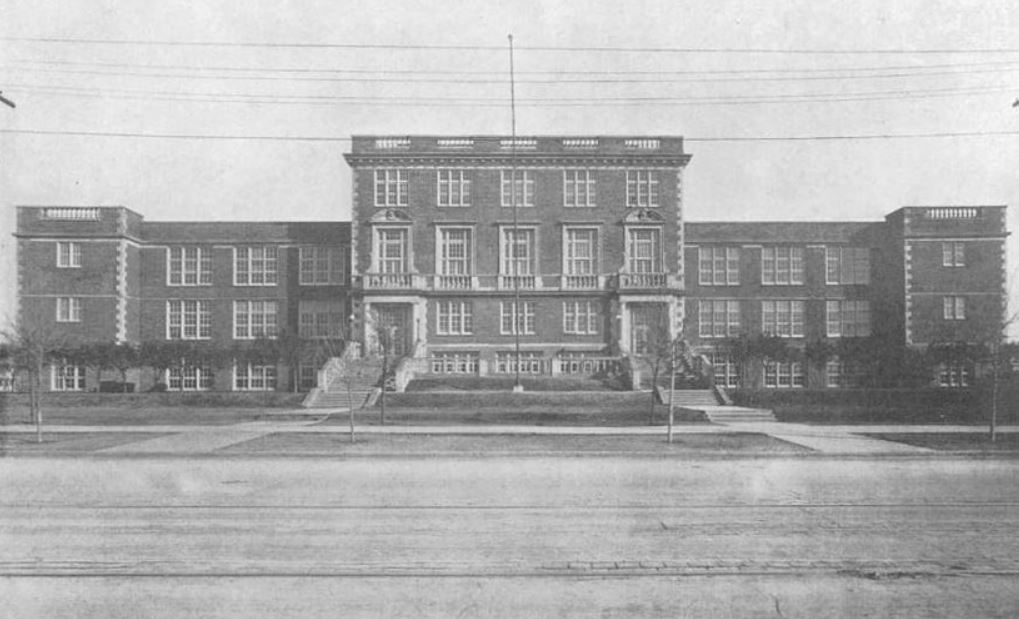
The school still stands. It’s now James Madison High School — and it still looks pretty good!

*
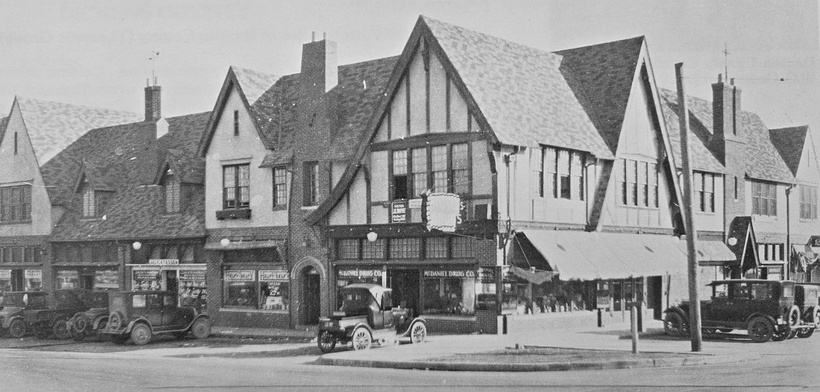
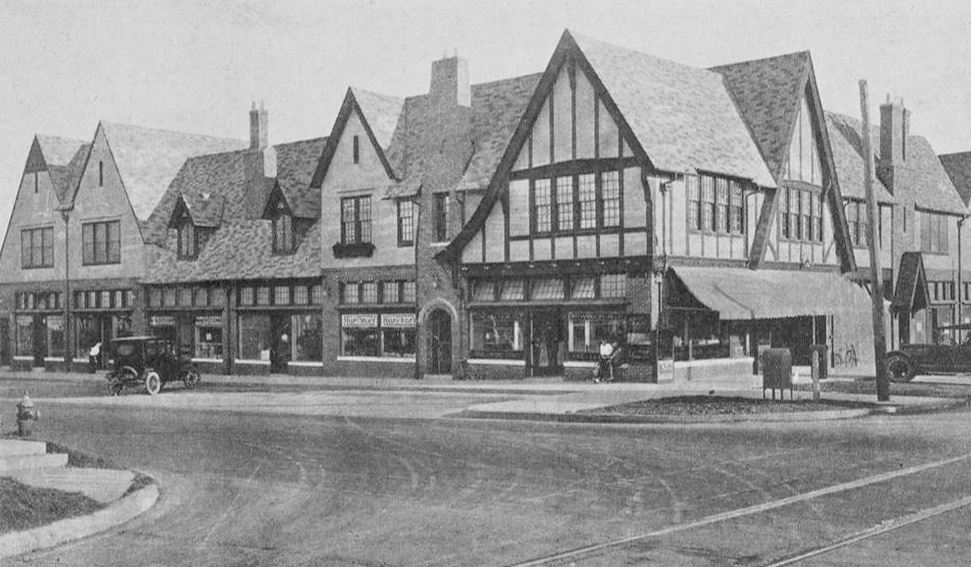
Over to Oak Cliff, to Cannon’s Village, West Davis & Edgefield, an Elizabethan-esque shopping strip built in 1922. Its history is in an Oak Cliff Advocate article here. See what it looks like today, on Google Street View, here. The photo above is from 1925. Another photo is below.
*
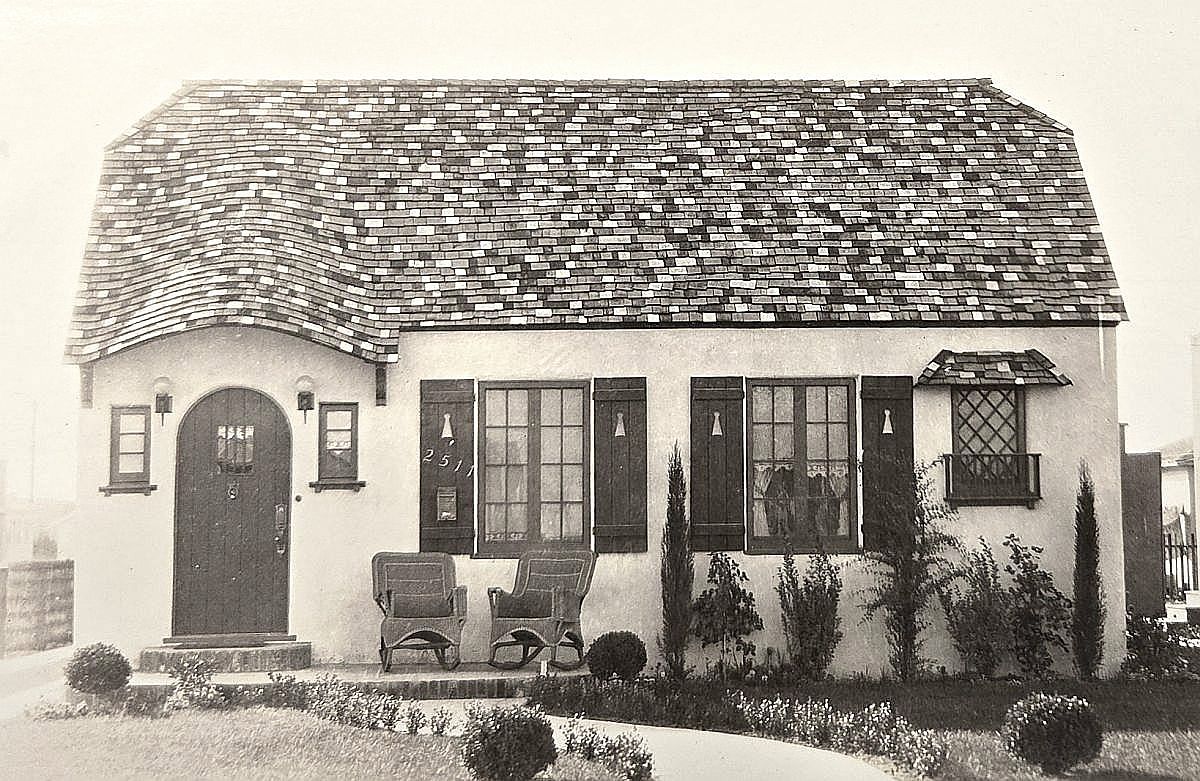
And finally, my dream house!

This house may (or may not) have been in Dallas. I choose to believe that it was here somewhere. All that’s known is the address: 2511. It’s almost too cute. Like something out of a fairy tale. That roof is incredible! And the little awning over the little window on the right! The chairs on the little porch. The weird, scrubby landscaping. Just everything! All it needs is some shade trees. I would live there in a heartbeat!

This is one of hundreds of photos of houses from the ‘teens-’30s which were used to sell house plans (and lumber). It is part of the R. M. Williamson Collection in the Dallas History and Archives. The locations of most of the houses are unknown — a lot are (were) probably in Dallas (East Dallas, Vickery Place, Belmont Addition, Oak Cliff, etc.), but a lot just don’t look Dallas-y to me at all (one is fully surrounded by a forest of very, very tall pine trees). But they’re all amazing. If the city of Dallas were filled with all the houses photographed in that collection, it would be a much more aesthetically pleasing city.

Read about this collection here — and read how these photos were used, here.

***

Sources & Notes

Top photo showing Pennsylvania and Meyers is from eBay.

Colonial Motor Co. photo is from the 1924 Forest Avenue High School yearbook; ad ran in newspapers in October 1920.

Drum and bugle corps photo and photo of Forest Avenue High School are from the 1921 and 1924 school yearbooks.

First Cannon Village photo is from a book I can’t remember the title of that I was browsing through in the Dallas History and Archives collection at the Dallas Public Library; second photo is from the Sidewalks of Dallas Instagram account.

Cute house photo is from the R. M. Williamson Collection, Dallas History and Archives, Dallas Public Library.

This post was drawn from several different posts which previously appeared on the Flashback Dallas Patreon page.

*

Copyright © 2025 Paula Bosse. All Rights Reserved.

The Forest Theater You’ve Never Heard Of — ca. 1912-1914

forest-avenue-theater_1638-forest_mike-cochranForest & Colonial in 1914 (courtesy Mike Cochran)

by Paula Bosse

There are so many posts I’ve begun but, for whatever reason, never finished. This is one of them. I started this one in 2015! I was sidetracked by a family member’s lengthy health setback, and I just never got back to it. But I’ve thought about it every time I’ve written about something in South Dallas.

This great photo — from about 1914 — was sent to me by Mike Cochran (he has a site on Denton history here). It shows a theater with a tie to his great-grandfather, Oscar F. Gould, who became something of a legend in the running of Interstate theaters in Dallas and Fort Worth (most notably the Majestic Theatres in both cities).

I think the reason I never finished the post was because it was hard to research. The theater lasted only a couple of years, and its name was incredibly confusing!

The Forest Avenue Theatre/Theater was in operation in, for sure, 1913 and 1914 — and possibly part of 1912 and part of 1915. It was located at 1638 Forest Avenue (now MLK Blvd.), at Colonial. The owner appears to have been Mike’s great-grandfather, O. F. Gould — as he was busy with the Dallas Majestic at the time, the Forest was managed by his son, Harry Gould.

Family lore suggests that the Forest was the first suburban theater in Dallas. There might have been a couple that pre-dated it in South Dallas and Oak Cliff, but it definitely is a very early moving-picture house outside of the downtown area.

The main Forest Avenue theater confusion has to do with its name. Oscar Gould’s theater was at 1638 Forest Avenue from… let’s just say 1913-1914. It was on the southwest corner of Forest and Colonial, in the heart of the lively South Dallas business district. About the time the Forest closed, the Colonial Theater popped up across the street, at 1702 Forest Avenue, on the southeast corner of Forest and Colonial. (I don’t think there was any relation, but there had been a previous Colonial Theater downtown about 6 years earlier — it can be seen in the foreground of the right side of this photo, at what would now be 1520 Main.) At some point, the Colonial changed its name to… guess what? The Forest Theater! THEN… in 1949, decades later, it changed its name back to “Colonial.” Why? Because there was a NEW Forest Theater (my head…), several blocks away, at 1914 Forest Avenue (which is still standing and is perpetually being re-envisioned). I don’t know how much arm-twisting was done, but in order to, I guess, prevent confusion between the modest neighborhood theater and the much larger and more sophisticated showplace down the street, the (second) Forest reverted back to “Colonial.” And that didn’t last long, because, in the blink of an eye, the “Colonial” at 1702 Forest disappeared and was replaced in 1949 by the Theater Lounge, which started out (I think) as a club presenting Black entertainment, before it eventually became Barney Weinstein’s famed South Dallas stripper mecca. So, there were (at the very least) three different Forest theaters, two (or, really, three) Colonial theaters, and two Theater Lounges.

That paragraph is why it’s taken me 9 years to write this post.

These buildings are still standing. Below is what the original Forest Avenue Theater looked like in 2019, before renovation work began on the block. (The numbering is different these days. See a 1922 Sanborn map here. The theater would have been in the “MainView” building.)

forest-ave-theater-block_google-street-view_may-2019_detGoogle Street View, May 2019

See the most recent Street View, here (the “original” Forest Avenue Theater building is on the right, the Colonial/Forest/Colonial/Theater Lounge is on the left).

**

Oscar F. Gould was an interesting person, and I hope his great-grandson Mike Cochran has written about him (and will direct me to a link I can add here). He protested the state law that made it illegal for theaters to open on Sundays, going so far as to be fined multiple times and to sue the state.

gould-oscar_FW-record_010122Fort Worth Record, Jan. 1, 1922

gould-oscar_exhibitors-herald_010926O. F. Gould, Exhibitors’ Herald, Jan. 9, 1926

*

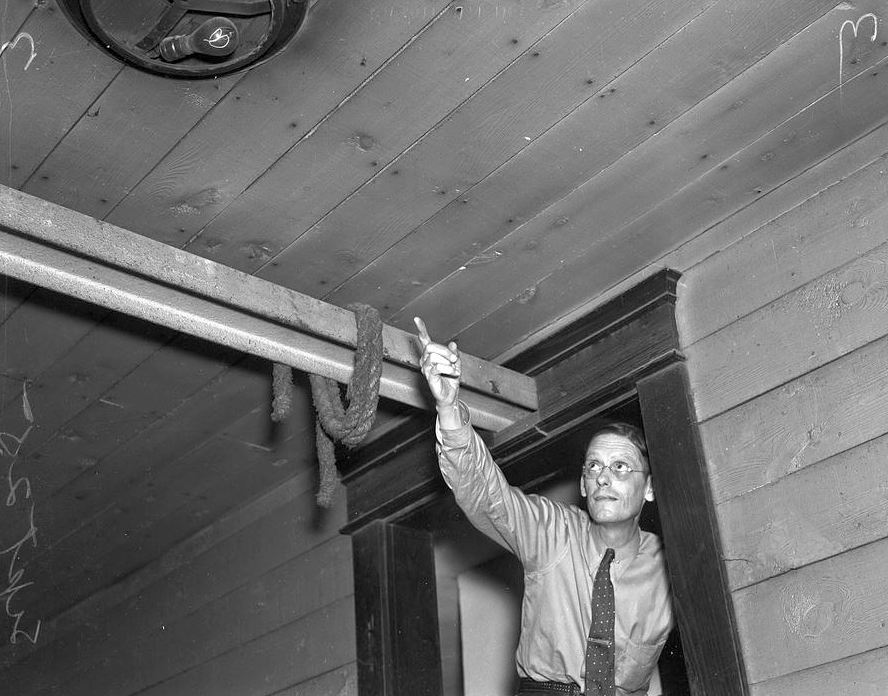
I like this related tidbit. The man who ran the Forest Avenue Theater was Oscar Gould’s son, Harry Gould, who, like his father, had a long and respected career running theaters. When the Forest closed, he operated theaters in Waco, Houston, and eventually Fort Worth. After several years, he ended up at the Palace in Fort Worth. This is a photo from his days at the Palace — the 1936 photo ran with this caption in the Fort Worth Star-Telegram:

Harry Gould, manager of the Palace Theater, points out the electric light which has burned continuously for the last 28 years, except when the current was shut off at the electric company’s power plant. Gould and other showmen who have been connected with the palace are superstitious about the light, believing it will bring good luck as long as it remains lighted.

gould-harry_palace-theatre-fort-worth_UTA_090536_FWST_longest-burning-bulb

I think the bulb is still burning, into what must be its 116th year. That’s a pretty good bulb. It was moved — still burning — when the theater was demolished and, last I saw, was in the Stockyards Museum in Fort Worth. (The lightbulb was profiled by Channel 8 in 1973, in a short, filmed report here.)

**

Thank you, MIke Cochran, for sharing your family photo! I’m sorry it took me NINE YEARS to write this!

***

Sources & Notes

The top photo is from the collection of Mike Cochran, used with permission. (Thank you, Mike!) On the left of the photo was Chapman’s Pharmacy, and at the right was Leader Grocery,

The movie showing is “A Man’s Faith,” produced by Siegmund Lubin and released in 1914.

Photo of Harry Gould and the lightbulb (Sept. 25, 1936) is from the Fort Worth Star-Telegram Collection, University of Texas at Arlington Libraries, here.

Need a daily dose of Dallas history? Please consider supporting me on Patreon!

forest-avenue-theater_1638-forest_mike-cochran_detail

*

Copyright © 2024 Paula Bosse. All Rights Reserved.

“This Month In Dallas” — Aug./Sept. 1962: The Clubs

club-dallas_this-month-in-dallas_aug-sept-1962_ebay_detClub Dallas, Browder Street

by Paula Bosse

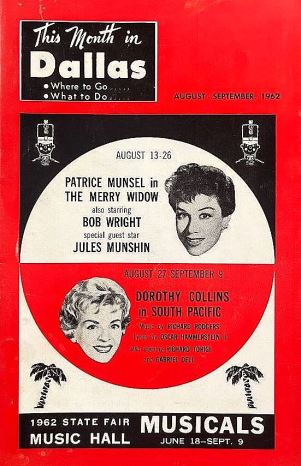
Downtown Dallas was a cool place for entertainment and dining in the early 1960s, from high-class clubs and lounges to famous and infamous strip joints (some of which were higher-class than others). A few months ago on eBay, someone scanned a bunch of pages of a magazine called This Month in Dallas (“Where to Go, What to Do”), which seems to have been aimed at the conventioneer or out-of-town visitor. (I’ve never heard of this publication, but I would LOVE to see more!)

this-month-in-dallas_aug-sept-1962_cover_ebay

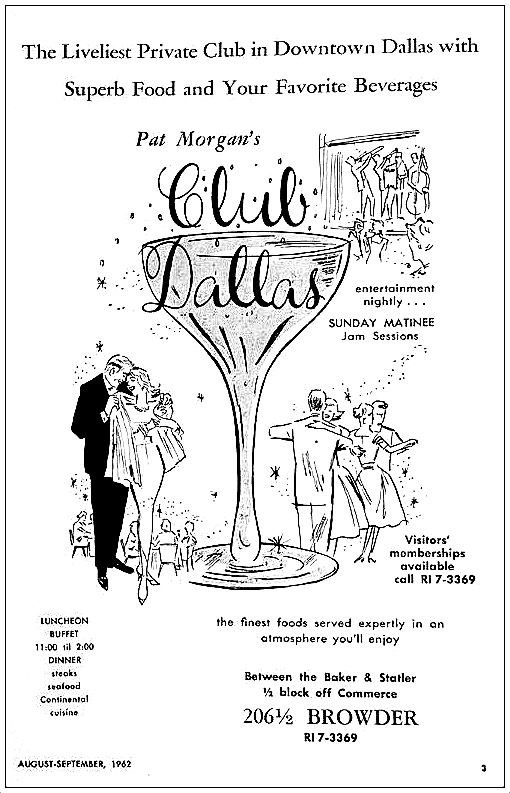
As far as image quality, I’m at the mercy of the person doing the scanning, but here are several of the ads featured in the eBay listing. All appeared in the Aug./Sept. 1962 issue of This Month in Dallas. (At the top, a detail from an ad for Club Dallas — the full ad is below.)

*

Let’s just do them alphabetically.

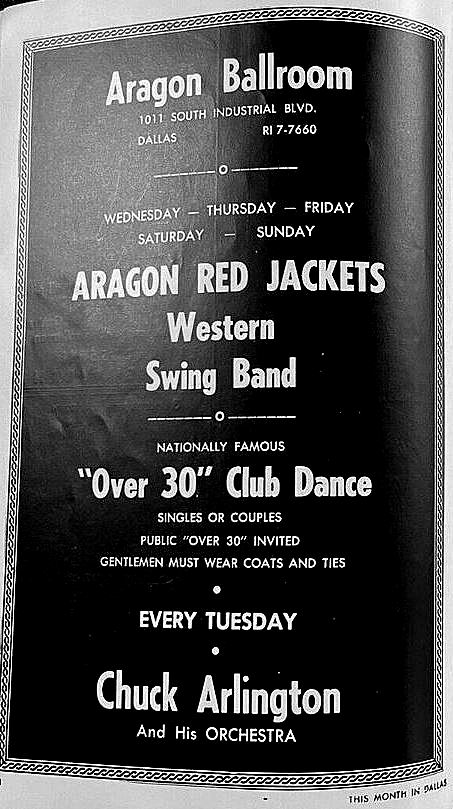
ARAGON BALLROOM, 1011 S. Industrial Blvd. (now S. Riverfront). Featuring the Aragon Red Jackets Western Swing Band, the “Over 30” Club Dance, and Chuck Arlington and His Orchestra.

aragon-ballroom_this-month-in-dallas_aug-sept-1962_ebay

*

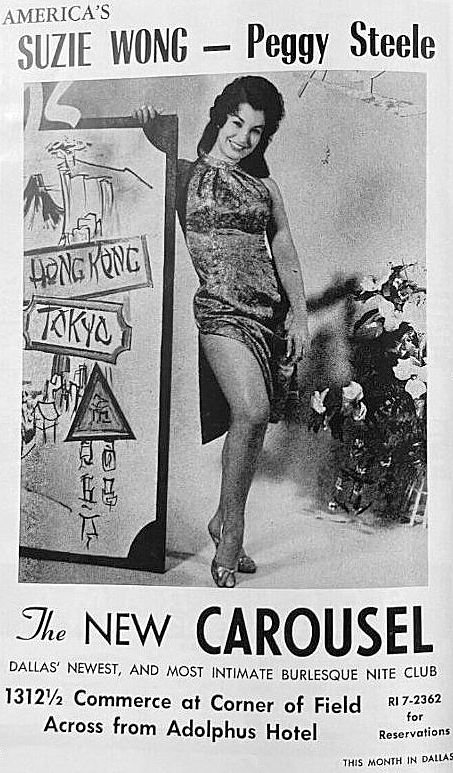
CAROUSEL CLUB (or “New” Carousel Club), 1312½ Commerce, at Field. Jack Ruby, proprietor. “Dallas’ Newest and Most Intimate Burlesque Nite Club.” This ad (the first of several) features stripper Peggy Steele, “America’s Suzie Wong.”

carousel_peggy-steel_this-month-in-dallas_aug-sept-1962_ebay

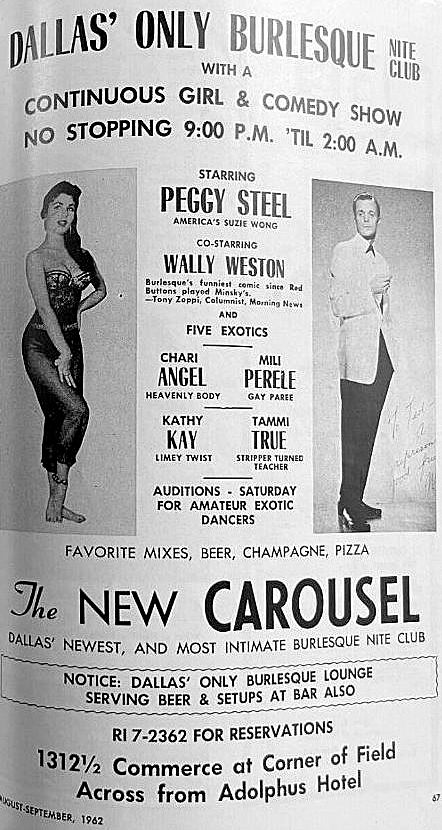
More CAROUSEL. “Dallas’ only burlesque nite club with a continuous girl and comedy show. No stopping, 9:00 PM ’til 2:00 AM.” America’s Suzie Wong” is back, now spelled Peggy Steel. MC’d by comic Wally Weston.

carousel_wally-weston_this-month-in-dallas_aug-sept-1962_ebay

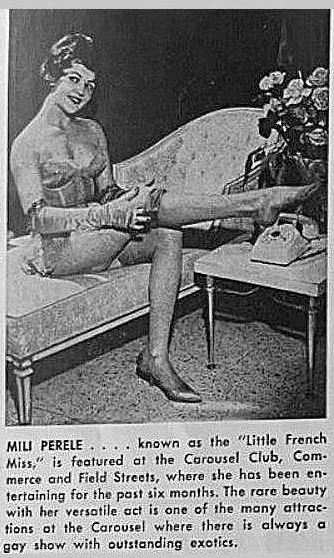
More CAROUSEL. Here’s Mili Perele, “the Little French Miss.”

carousel_mili-perele_this-month-in-dallas_aug-sept-1962_ebay

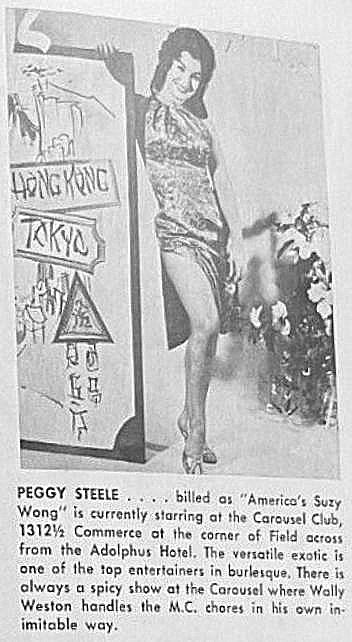
More CAROUSEL. Heck, let’s throw in another Peggy Steel/e mention.

carousel_steel-paggy_this-month-in-dallas_aug-sept-1962_ebay

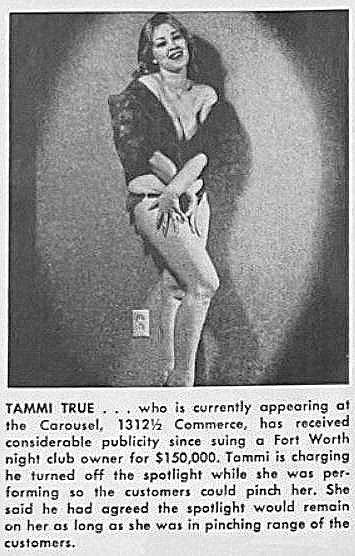
More CAROUSEL (Jack’s advertising budget was impressive). Tammi True, then in the midst of a pinching brouhaha.

carousel_tammi-true_this-month-in-dallas_aug-sept-1962_ebay

*

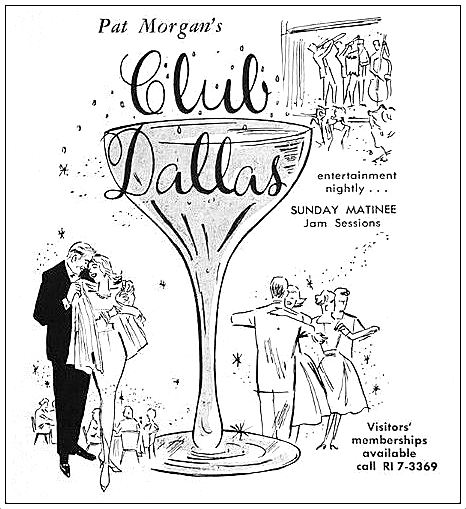
Pat Morgan’s CLUB DALLAS, 206½ Browder (just south of Commerce). I love this ad, but I’m not familiar with the establishment or Mr. Morgan. Looks like it opened in the summer of 1962 (“Owner Pat Morgan has eliminated the semi-nude waitresses and aims for the family trade” — Dallas Morning News, July 27, 1962), changed its name in September 1962 to simply “Pat Morgan’s,” and finally closed in February 1963. I bet he rued the day he dumped those semi-nude waitresses….

club-dallas_pat-morgan_this-month-in-dallas_aug-sept-1962_ebay

*

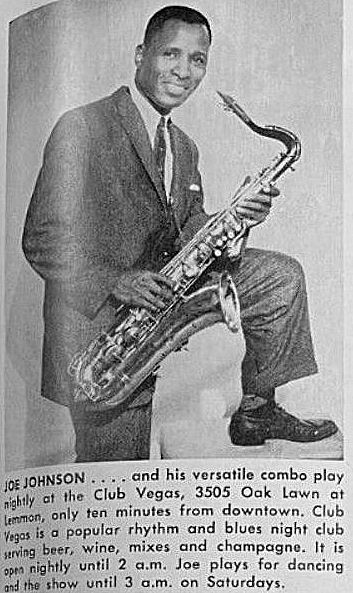
CLUB VEGAS, 3505 Oak Lawn. Yes, there was swinging nightlife beyond downtown. Club Vegas was famously owned by Jack Ruby’s sister, Eva Rubenstein. This club booked a lot of Black and Hispanic bands (for mixed audiences), including Joe Johnson and Trini Lopez. (I’ve been meaning to write about this place for the past 10 years!)

club-vegas_joh-johnson_this-month-in-dallas_aug-sept-1962_ebay

*

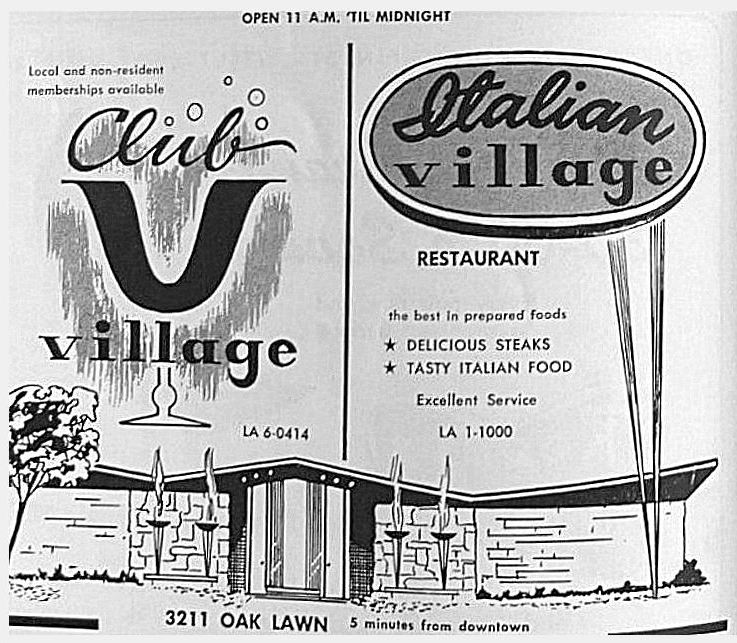
CLUB VILLAGE / ITALIAN VILLAGE RESTAURANT, 3211 Oak Lawn. Another happening place in Oak Lawn. I wrote and wrote and wrote about Sam Ventura’s Italian Village here.

club-village_italian-village_this-month-in-dallas_aug-sept-1962_ebay

*

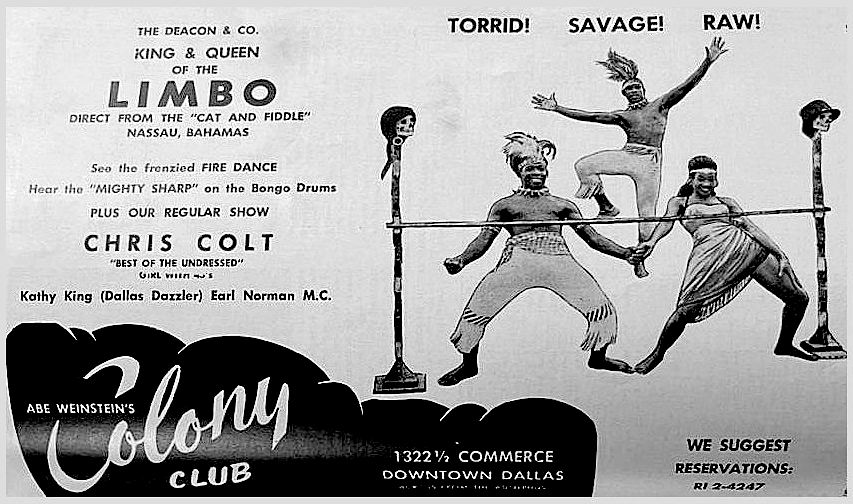
COLONY CLUB, 1322½ Commerce. Abe Weinstein, proprietor. The “high-class” strip joint. Also featured acts like Deacon & Co., King and Queen of the Limbo.

colony-club_limbo_this-month-in-dallas_aug-sept-1962_ebay

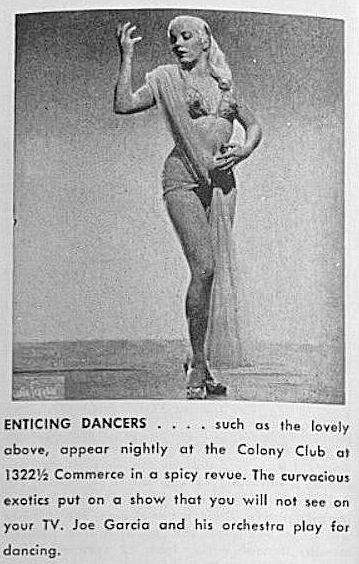
More COLONY CLUB. An unnamed exotic.

colony-club_this-month-in-dallas_aug-sept-1962_ebay

*

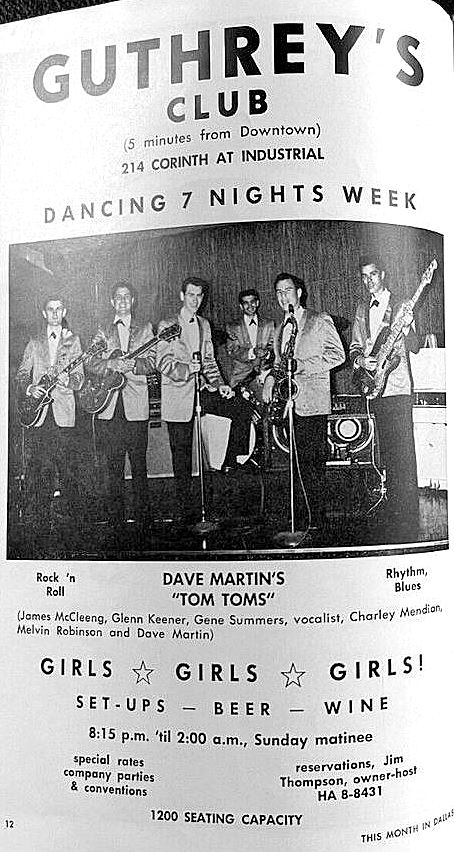
GUTHREY’S CLUB, 214 Corinth, at Industrial (now Riverfront). Very popular back in the day. “Girls! Girls! Girls! Set-ups, beer, wine.” This ad features Dave Martin’s Tom Toms (James McCleeng, Glenn Keener, Gene Summers — vocalist, Charlie Mendian, Melvin Robinson, and Dave Martin).

guthreys_dave-martins-tome-toms_this-month-in-dallas_aug-sept-1962_ebay

*

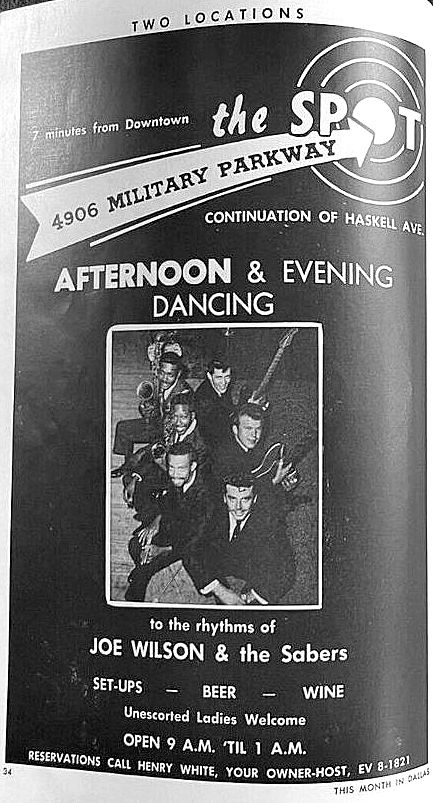
THE SPOT, 4906 Military Parkway. This ad features Joe Wilson & The Sabers.

spot_military-pkwy_this-month-in-dallas_aug-sept-1962_ebay

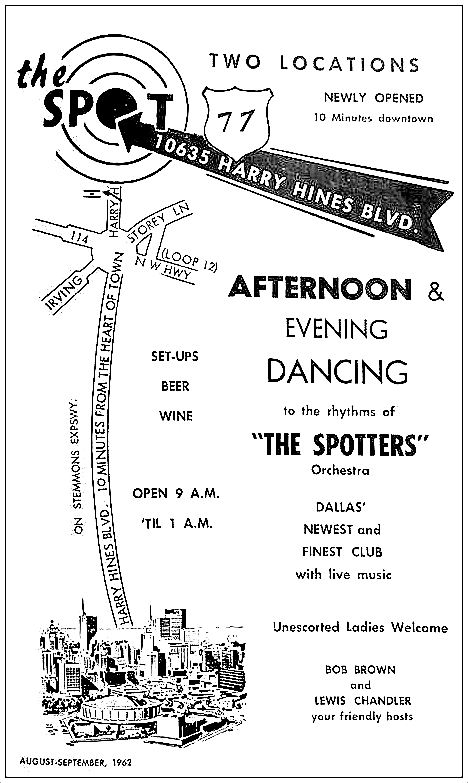
THE SPOT, the “other” location, 10635 Harry Hines. House band The Spotters.

spot_harry-hines_this-month-in-dallas_aug-sept-1962_ebay

*

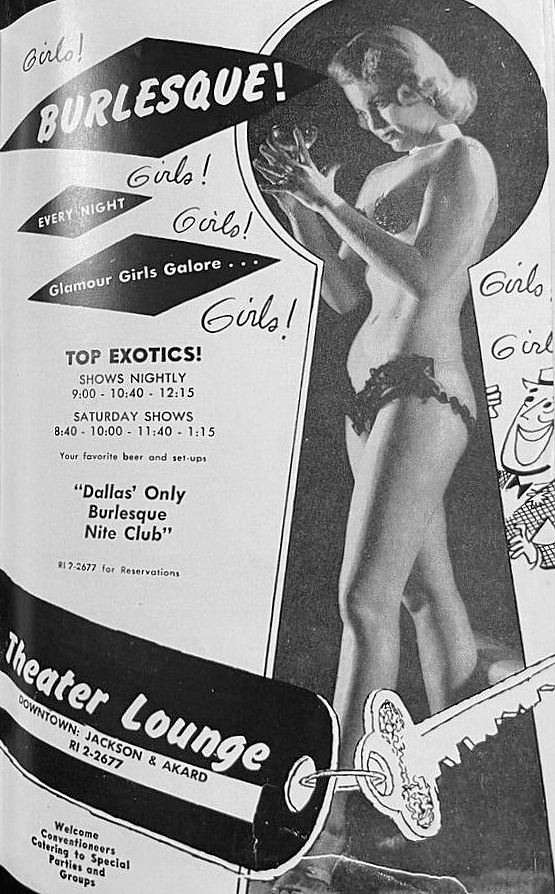
THEATER LOUNGE, 1326 Jackson, at Akard. Barney Weinstein, proprietor. “Glamour Girls Galore.”

theater-lounge_this-month-in-dallas_aug-sept-1962_ebay

*

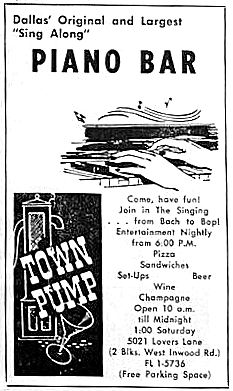
TOWN PUMP, 5021 Lovers Lane. “Dallas’ Original and Largest ‘Sing Along’ Piano Bar.” That is one scary sentence.

town-pump-piano-bar_this-month-in-dallas_aug-sept-1962_ebay

***

Sources & Notes

All ads from the Aug./Sept. 1962 issue of This Month in Dallas.

club-dallas_this-month-in-dallas_aug-sept-1962_ebay_det_sm

*

Copyright © 2023 Paula Bosse. All Rights Reserved.
Gritty Dallas — 1969

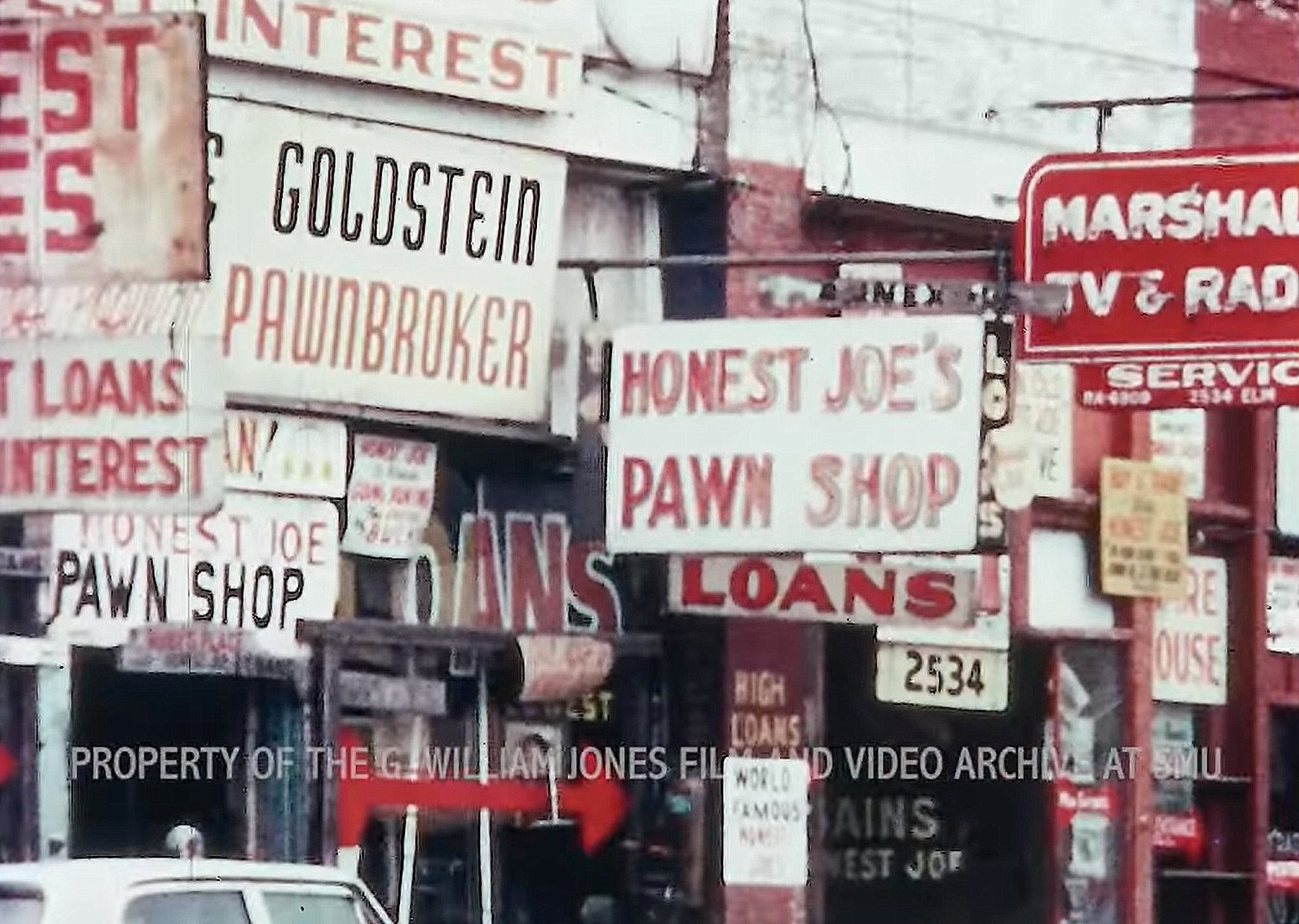
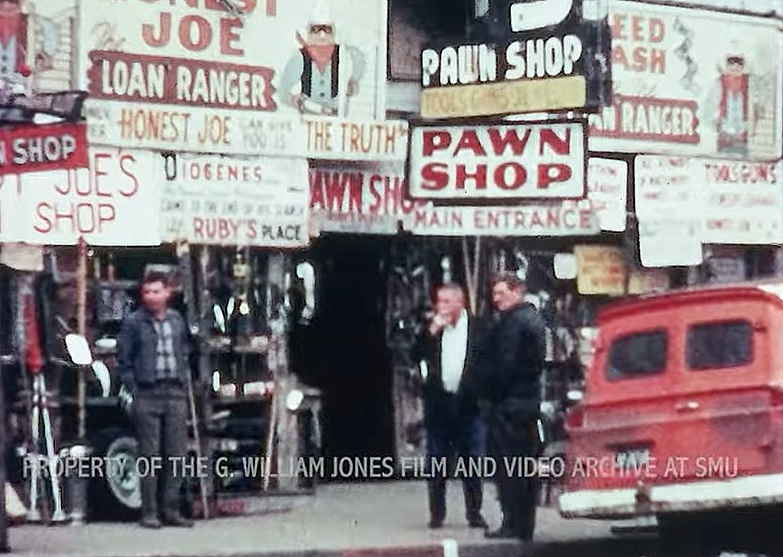
honest-joes-pawn-shop_deep-ellum_perkins-school-recruitment-film_1969_jones-film_SMU_5.13Honest Joe’s: sign overload in Deep Ellum

by Paula Bosse

Here are a few things I found when I clicked on something I normally wouldn’t have, but I’m glad I did. These are screenshots from a 20-minute film made in 1969 by SMU’s Perkins School of Theology. (I certainly hope SMU has the original somewhere — or at least a crisper copy — because the quality of this 54-year-old film is, as you can see in these screenshots, pretty low-resolution.) The title of this offering on YouTube is the supremely un-sexy “Perkins School of Theology (SMU) Orientation and Recruiting Film — 1969.” Which is all well and good, but, let’s face it, how many of us would click on that? I wouldn’t! But it was the thumbnail that drew me in — a shot of the Colony Club, the famous burlesque club on Commerce Street. What did that have to do with theology school? I clicked and started fast-forwarding until I found the Colony Club — and it paid off, because I found a bunch of cool shots of places that, for the most part, don’t exist anymore.

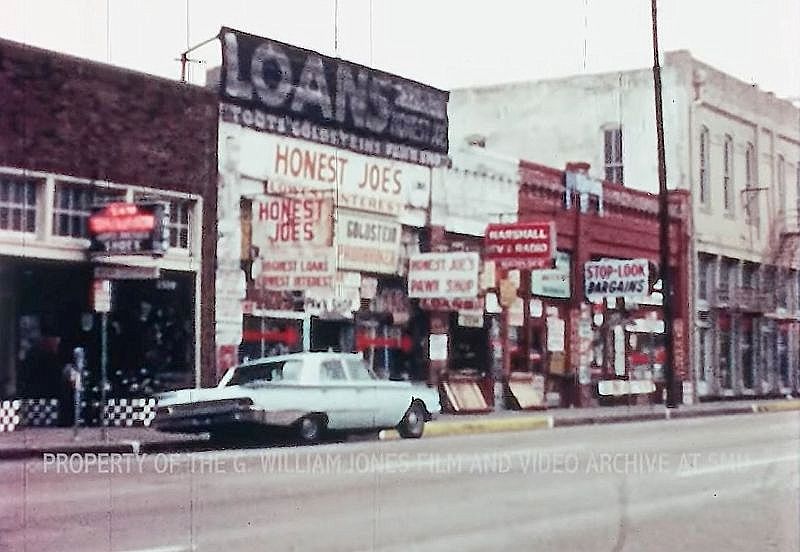
The image above shows one of dozens of pawn shops in Deep Ellum, Honest Joe’s Pawn Shop, owned by Joe Goldstein. (Various Goldstein family members ran a dizzying number of pawn shops in Deep Ellum. I mean a LOT.) In 1969, Honest Joe’s and its adjacent office and warehouse spread from 2516 Elm to 2526 Elm — most of these buildings still stand (see them today, here), but others were torn down to make way for the highway-palooza. (Two more photos of Honest Joe’s are at the end of this post.)

*

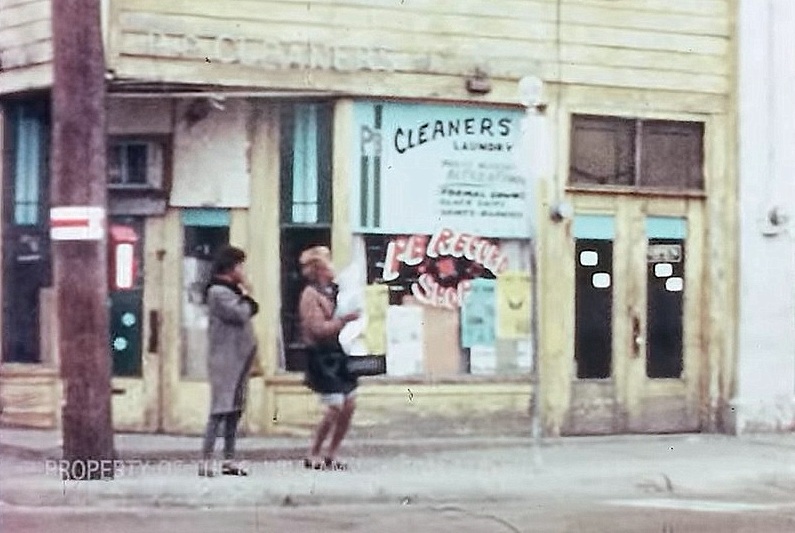
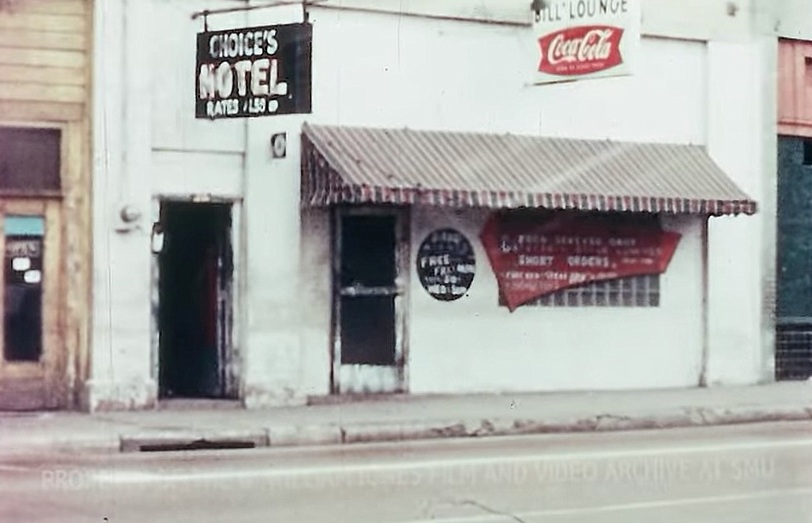
The two shots below were in the same block — keep panning right from the P B Cleaners (2700 S. Ervay, at Grand Avenue — now Al Lipscomb Way), and you’ll see Choice’s Hotel and Bill’s Lounge next door. What’s there now? Nothing.

p-b-cleaners_choices-hotel_perkins-school-recruitment-film_1969_jones-film_SMU_8.38

bills-lounge_choices-hotel_perkins-school-recruitment-film_1969_jones-film_SMU_8.33

*

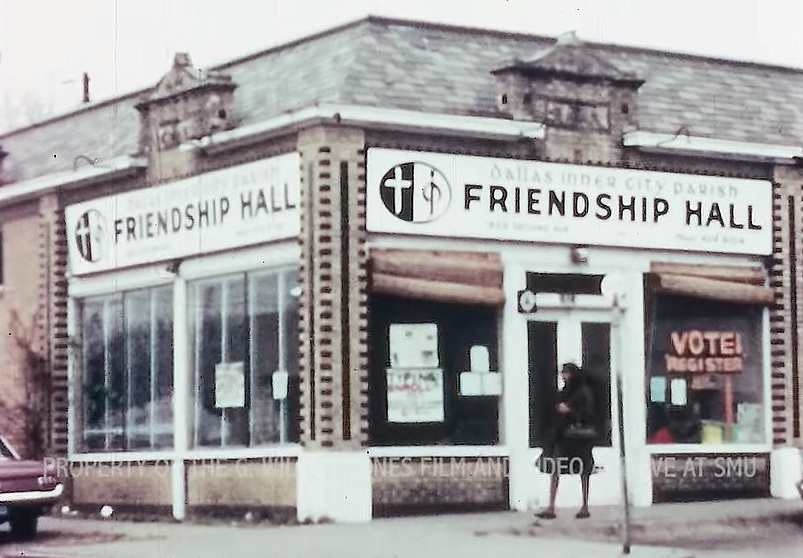
This is Friendship Hall (Dallas Inner City Parish), at 1823 Second Avenue. It was one of many businesses and homes condemned by the city and torn down to expand Fair Park and build new parking lots. See where this used to be, here.

friendshop-hall_perkins-school-recruitment-film_1969_jones-film_SMU_6.25

*

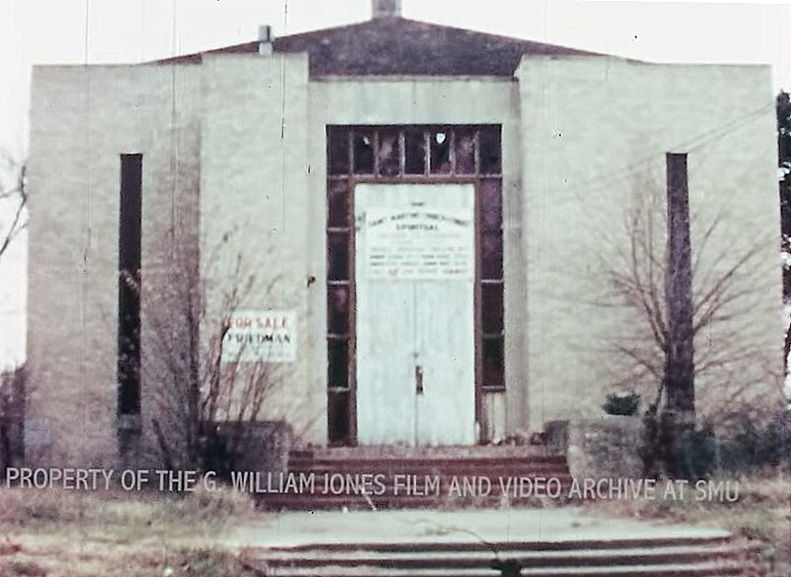
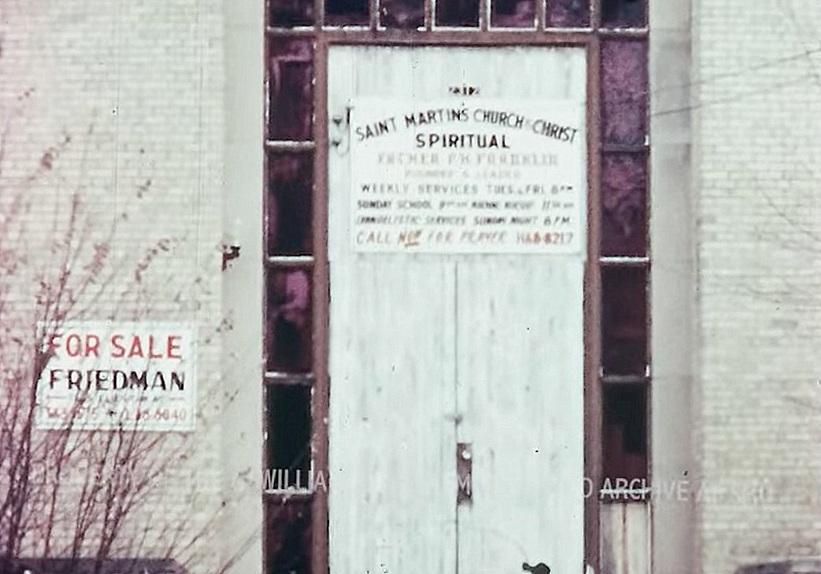
St. Martin’s Spiritual Church of Christ, 2828 Carpenter. This is such an unusual-looking building. It’s gone, but there’s a new church in its place, here.

st-martins-church-of-christ-spiritual_perkins-school-recruitment-film_1969_jones-film_SMU_8.03

st-martins-church-of-christ-spiritual_perkins-school-recruitment-film_1969_jones-film_SMU_8.08

*

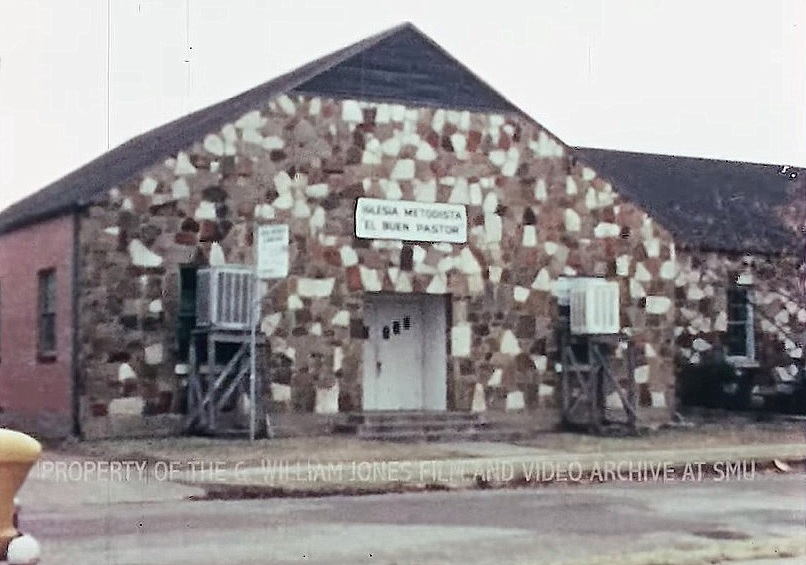
Iglesia Metodista, 1800 Park Avenue (at Beaumont), not too far from Old City Park. Wow, this area (a couple of blocks’ worth, anyway) has been developed way beyond what I would have guessed. The church once stood, I think, in this grassy area.

iglesia-methodista_perkins-school-recruitment-film_1969_jones-film_SMU_5.54

*

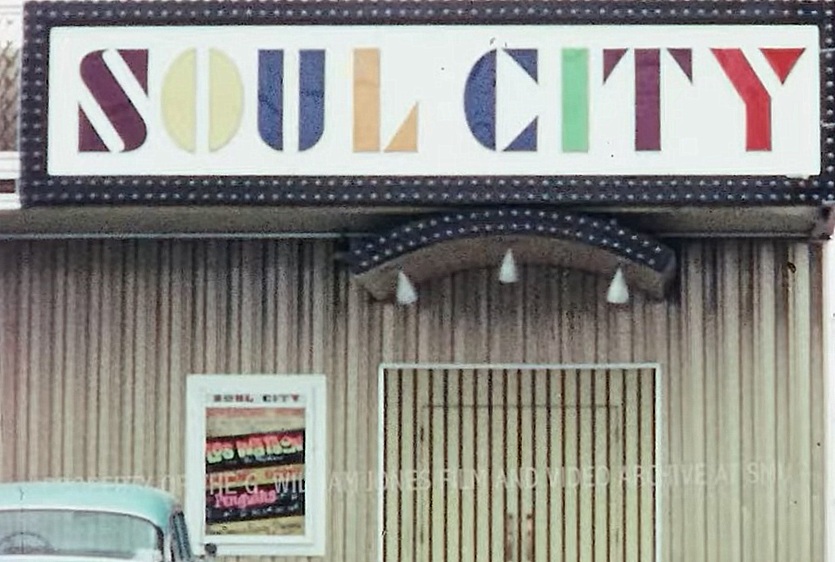
Soul City, 4714 Greenville Avenue, near University Blvd. (you might know it from its recent incarnation as a Vespa dealership). This wasn’t in a “gritty” neighborhood, but it was close to the filmmakers’ home, the SMU campus, and, surely, there were reprobates cavorting inside who could have benefited from a good Methodist sermon. From what I gather, this was a cool place for cool people to see cool bands. The building still stands, here. I don’t think it’s occupied at the moment.

soul-city_choices-hotel_perkins-school-recruitment-film_1969_jones-film_SMU_19.03

*

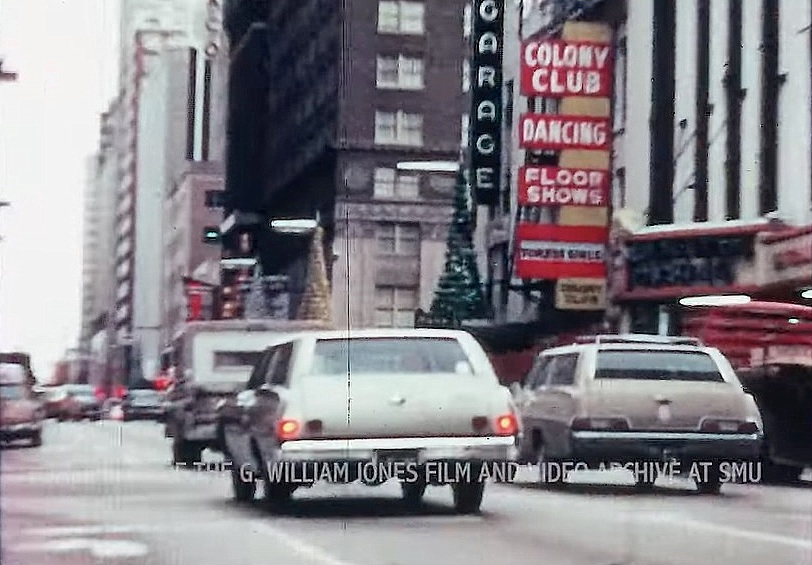
Speaking of reprobates, their Big D mecca for many years was Commerce and Akard, home to all sorts of places you probably wouldn’t book for a Mother’s Day brunch. Clogging up this area at various times were strip joints and dive bars, including the Colony Club, the Theatre Lounge, and the Carousel Club. The Colony Club was at 1322½ Commerce. That whole block (and the one just beyond it — across Akard — home to the Baker Hotel) went bye-bye a long time ago.

colony-club_perkins-school-recruitment-film_1969_jones-film_SMU_4.29

*

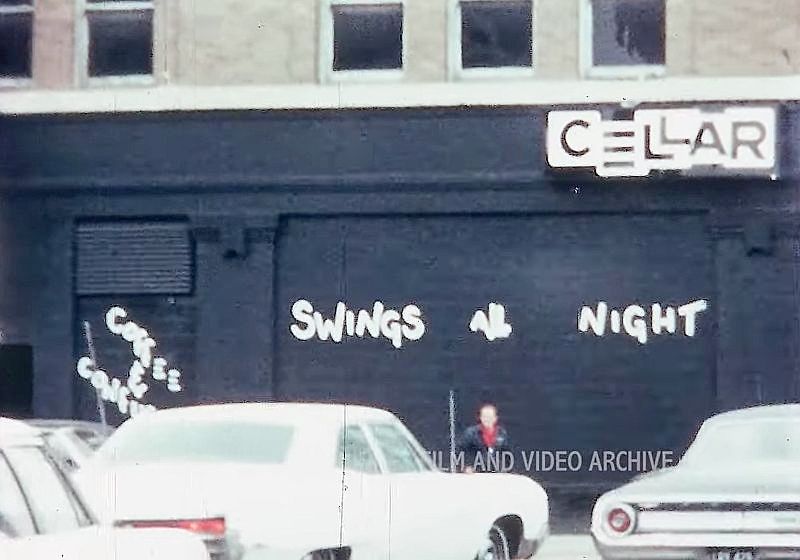
And, like Soul City, the legendary Cellar was cool, but I’ll bet there were more illicit substances in this downtown “coffeehouse” than in the Greenville Ave. club. “Swings all night.” It stood at 2125 Commerce (at what is now Cesar Chavez). This building appears to be gone.

cellar_perkins-school-recruitment-film_1969_jones-film_SMU_4.43

*

More shots of Honest Joe’s Pawn Shop, which took up a good chunk of the 2500 block of Elm. See what this view looks like today, here (I warn you: do not rotate 180 degrees). I assume the tall white building bit the dust for highway construction. I would have loved to have wandered around that place and chatted with Joe. I bet that guy saw some stuff. Deep Ellum has lost most of its grittiness. It used to be so cool. Thank you, seminary students from 1969, for preserving this for future generations, ’cause in a few years, the place won’t be recognizable.

honest-joes-pawn-shop_deep-ellum_perkins-school-recruitment-film_1969_jones-film_SMU_5.06

honest-joes-pawn-shop_deep-ellum_perkins-school-recruitment-film_1969_jones-film_SMU_17.41

***

Sources & Notes

All images are screenshots from the film “Perkins School of Theology (SMU) Orientation And Recruiting Film – 1969” — see it on YouTube here. It’s odd. It is from the keeps-on-giving G. William Jones Film and Video Archive, Hamon Arts Library, Southern Methodist University.

If you like this kind of thing, perhaps you will consider supporting me on Patreon. I post something there every day. More info is here.

honest-joes-pawn-shop_deep-ellum_perkins-school-recruitment-film_1969_jones-film_SMU_5.13_sm

*

Copyright © 2023 Paula Bosse. All Rights Reserved.
Black Dallas — 1973

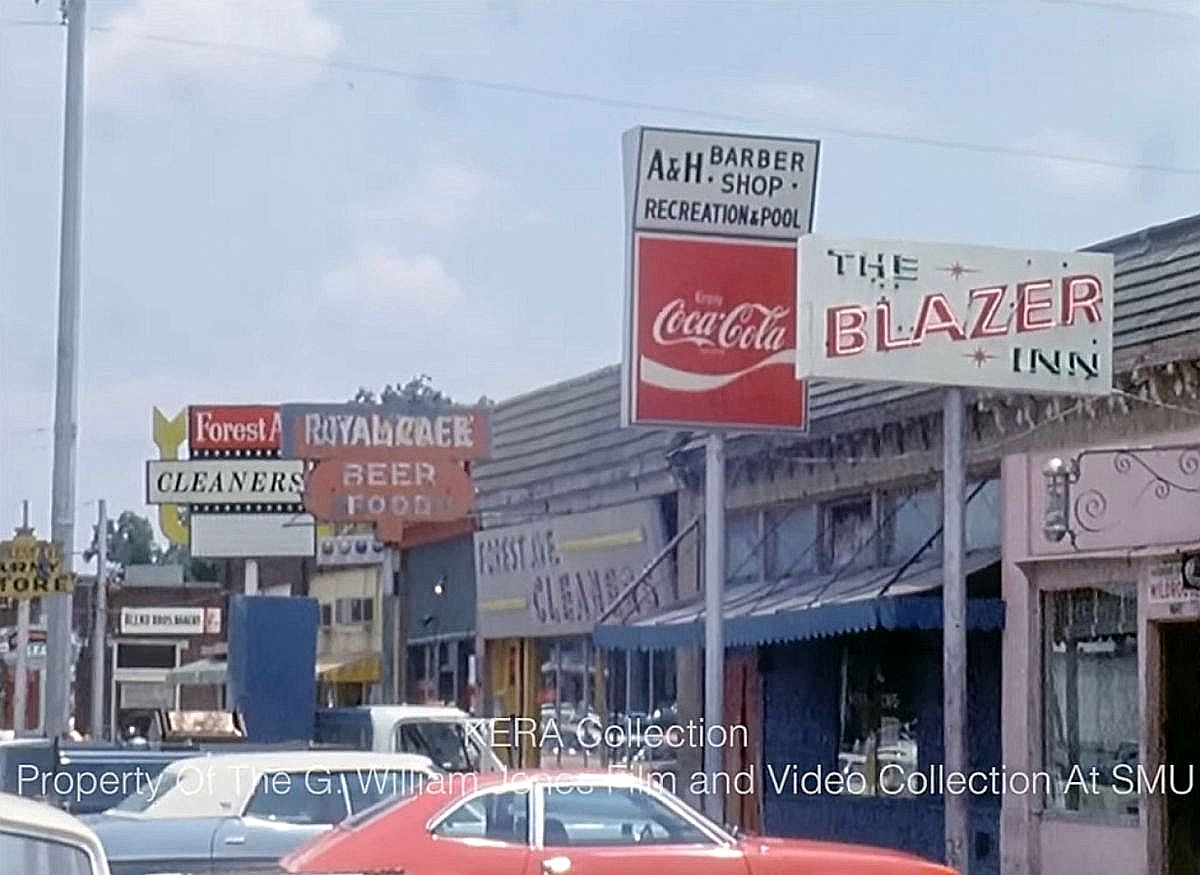
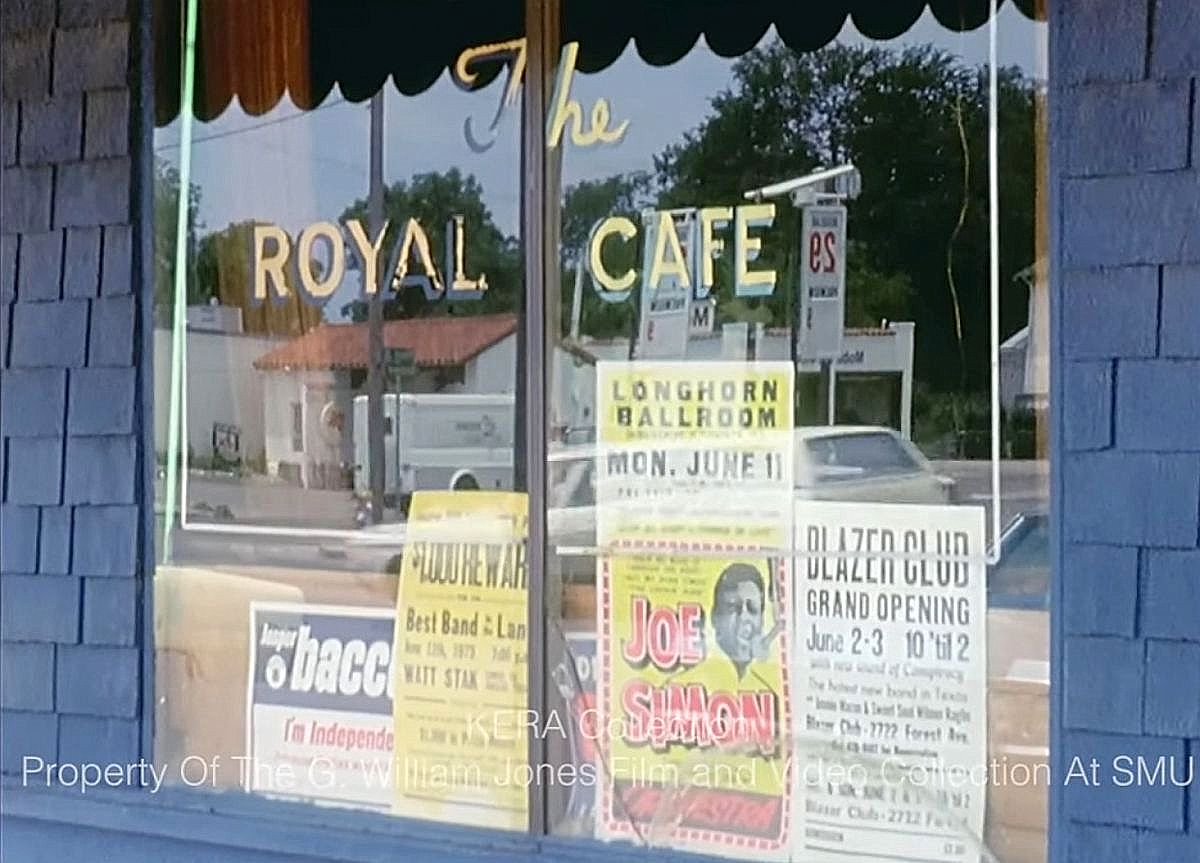
royal-cafe_june-1973_kera-collection_jones-collection_SMURoyal Cafe, 2726 Forest Avenue (now MLK Blvd.)

by Paula Bosse

The G. William Jones Film and Video Collection at SMU is the gift that keeps on giving (see their YouTube channel here). In addition to their vast non-Dallas-history holdings, they are the repository of the WFAA news film archives, which is an incredible collection of local news segments from Channel 8. And now they’ve begun digitizing and uploading film from KERA-Channel 13. There are all sorts of clips posted on the YouTube channel so far — I really, really loved the Blackie Sherrod profile — and I’m not even a sports fan! My guess is that a lot of it comes from the legendary local news show Newsroom, including the one I’m writing about here.

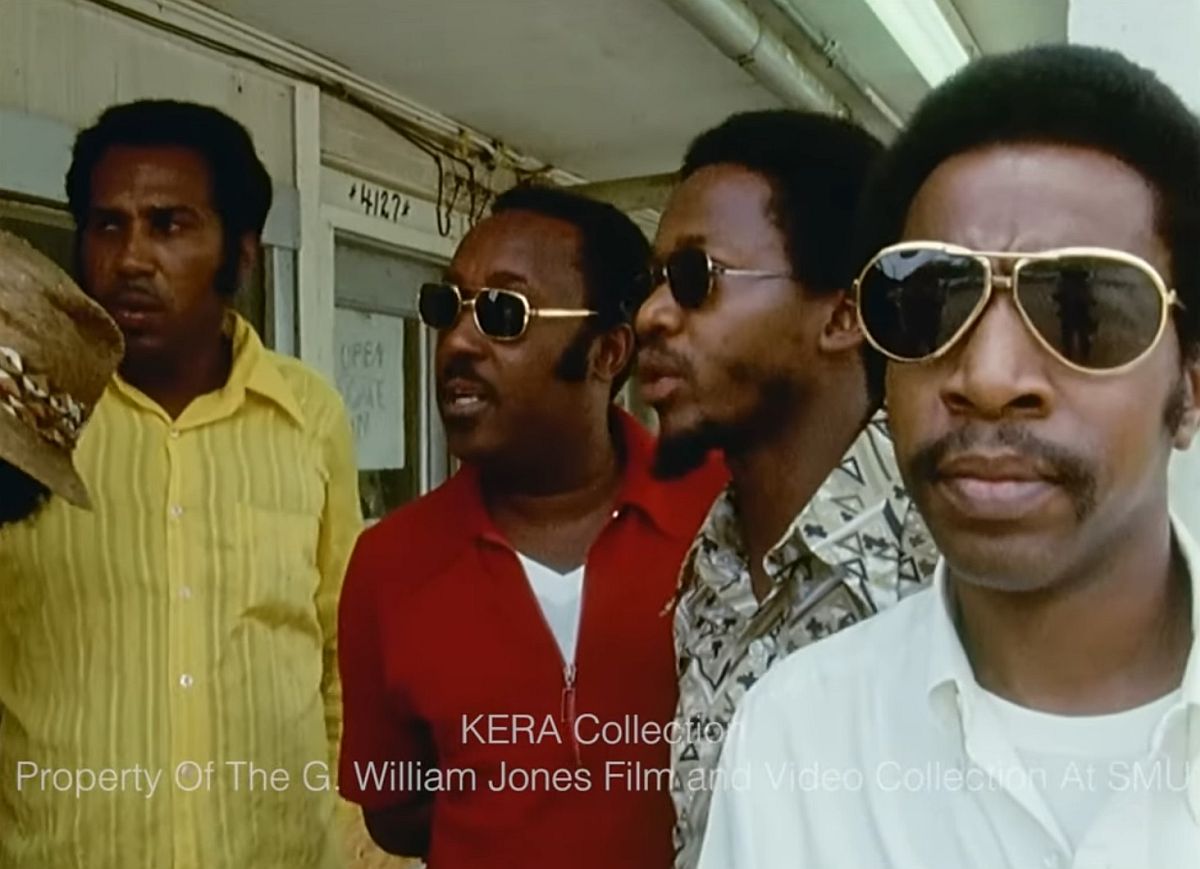
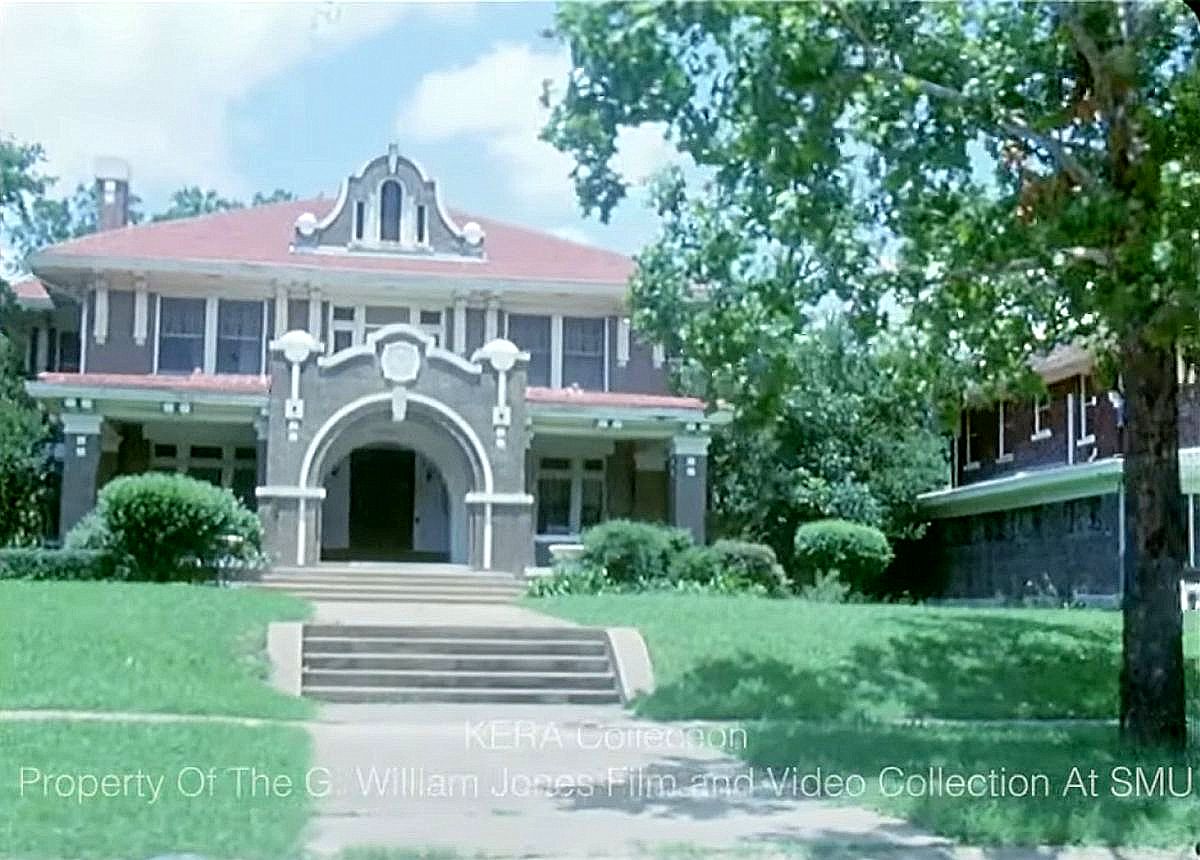
This story from 1973 was about a recent increase in crime in the Black neighborhoods of South Dallas and State-Thomas/Hall Street. Crime stories are pretty much the same decade in and decade out, but this piece is great because of the almost 8 full minutes of footage showing parts of town that the media largely ignored (ignores). I haven’t seen most of these areas as they existed when this piece was shot — many of these buildings don’t exist at all anymore. A couple of these places are “famous,” most are not. But this is just great. (Scroll to the bottom of the post for places and addresses seen in the film.)

*

I was particularly excited to see the exterior of the Ascot Room, which I wrote about in the Flashback Dallas post “1710 Hall: The Rose Room/The Empire Room/The Ascot Room — 1942-1975” — it was an important music club, but I had been unable to find any images of its exterior. Until now! Granted, it’s looking a bit long in the tooth in 1973, but this was so cool to see!

ascot-room_june-1973_kera-collection_jones-collection_SMUAscot Room (1710 Hall, at Ross)
*

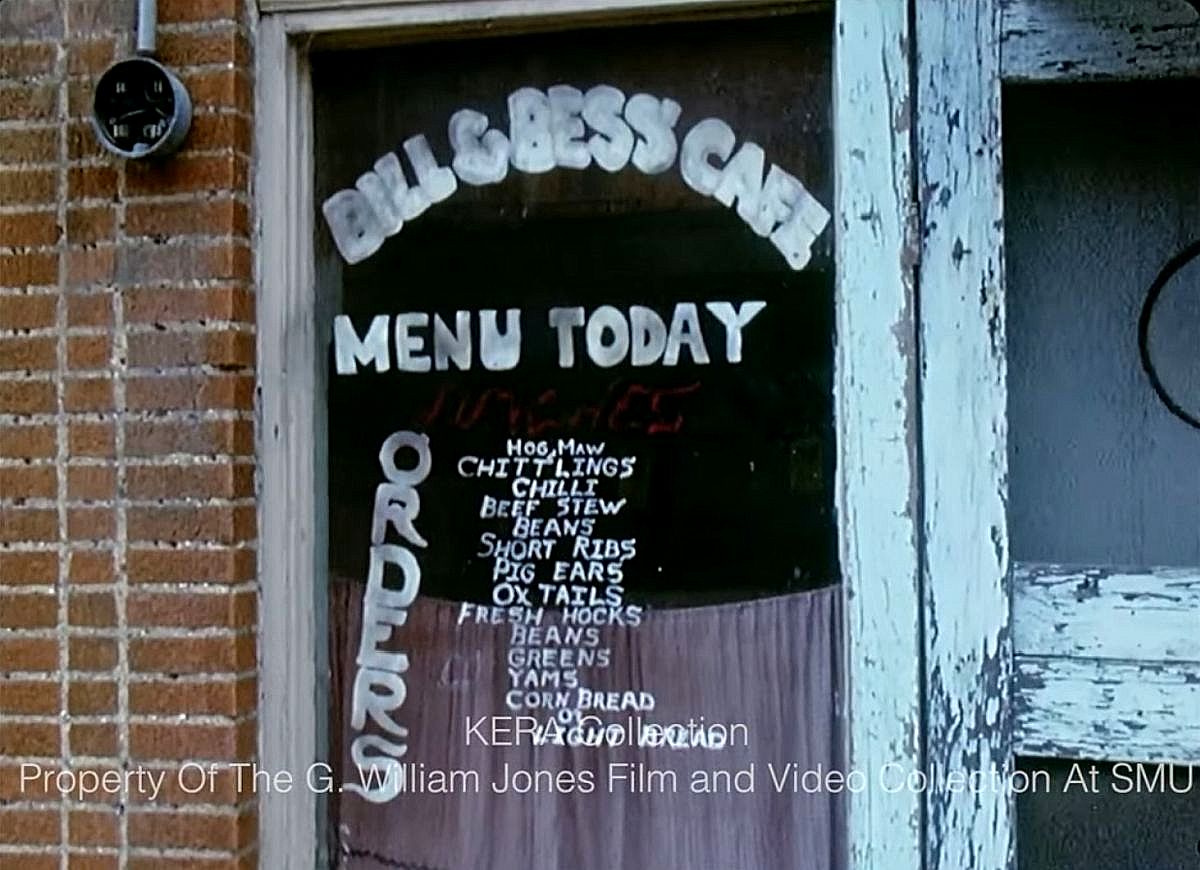
bill-and-bess-cafe_june-1973_kera-collection_jones-collection_SMUBill & Bess’ Cafe
*

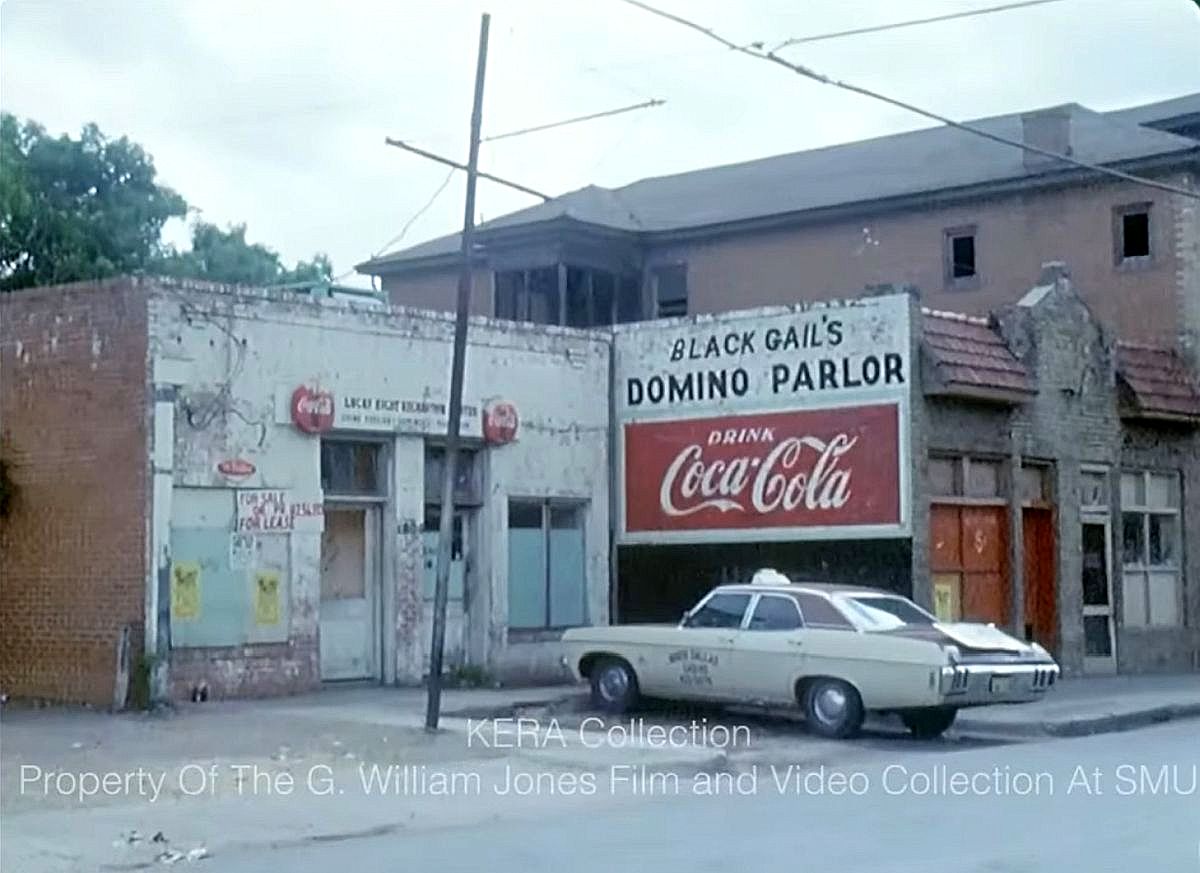
black-gails-domino-parlor_june-1973_kera-collection_jones-collection_SMULucky Eight Recreation Center (1804 Hall); Black Gail’s Domino Parlor
*

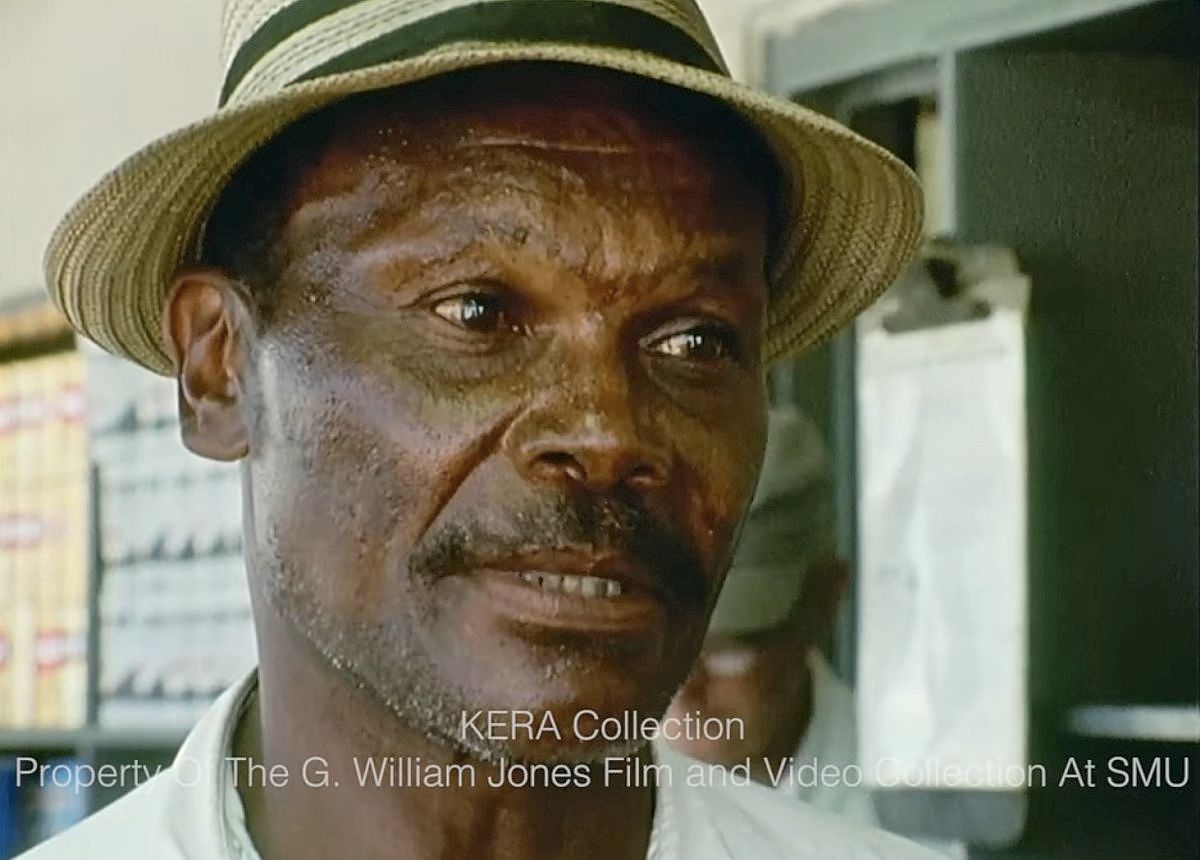
man-1_june-1973_kera-collection_jones-collection_SMU

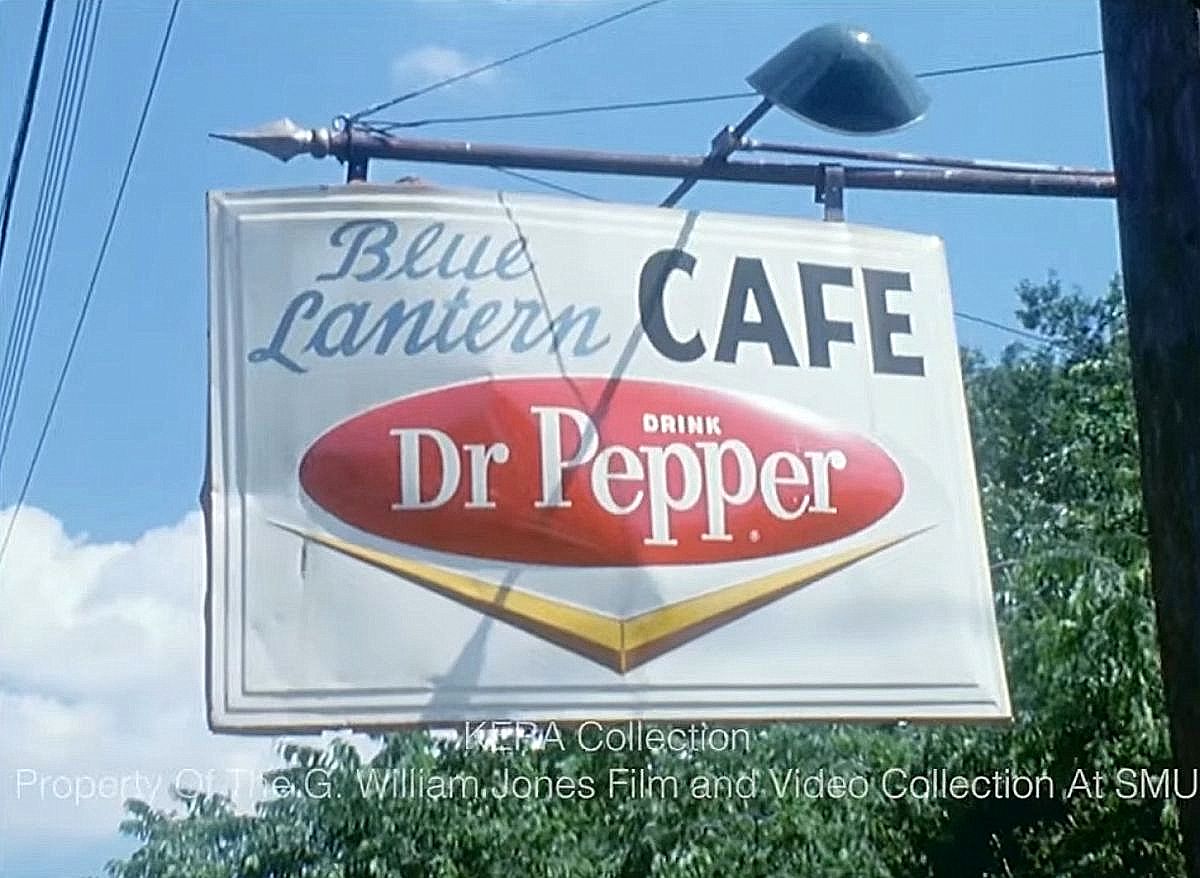
blue-lantern-cafe_june-1973_kera-collection_jones-collection_SMUBlue Lantern Cafe (1609 Hall)
*

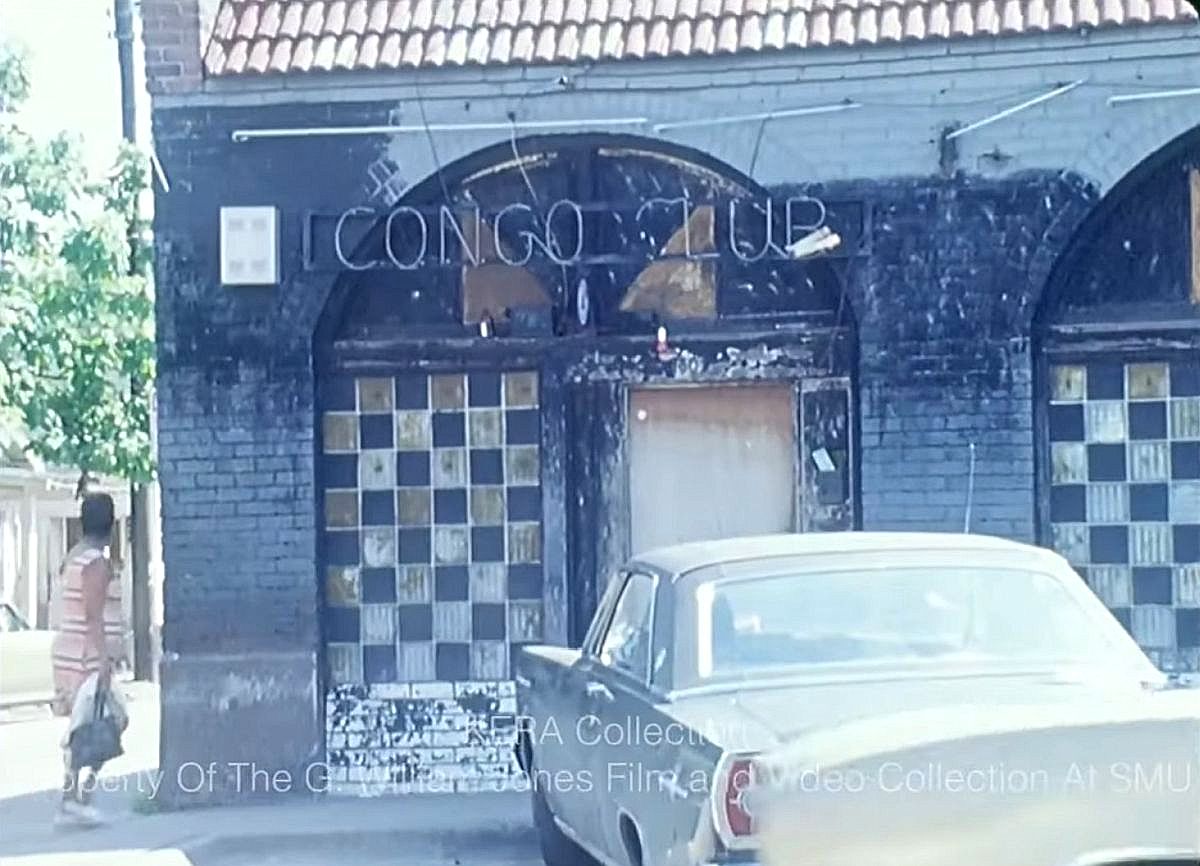
congo-club_june-1973_kera-collection_jones-collection_SMUCongo Club (1801 Hall, at Roseland)
*

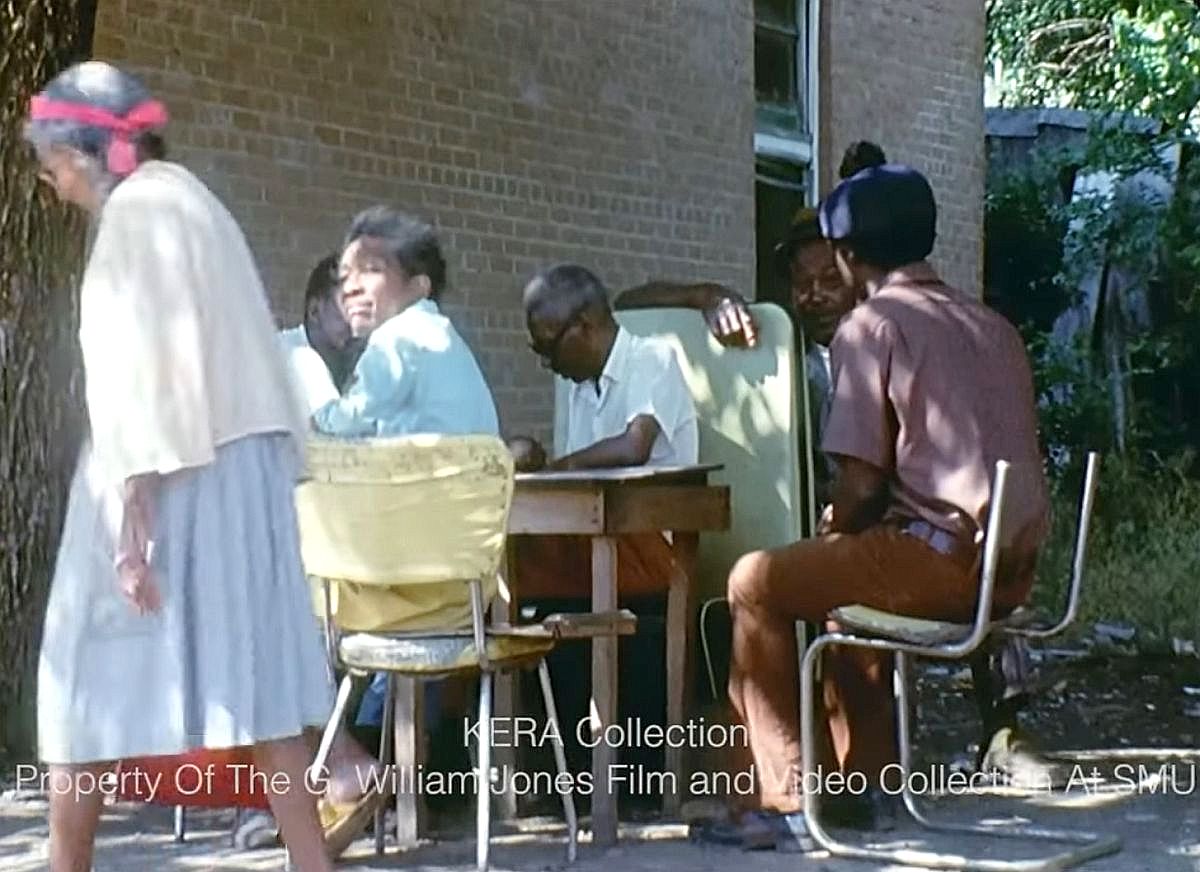
domino-game_june-1973_kera-collection_jones-collection_SMU

e-tx-bbq_june-1973_kera-collection_jones-collection_SMUEast Texas Bar-B-Q/East Texan Barbecue (2311 Hall)
*

man_june-1973_kera-collection_jones-collection_SMU

forest-ave_june-1973_kera-collection_jones-collection_SMU2700 block of Forest Avenue (now Martin Luther King Jr. Blvd.)
*

hall-st_june-1973_kera-collection_jones-collection_SMU1700 block of Hall Street, north from Ross
*

houses_june-1973_kera-collection_jones-collection_SMU

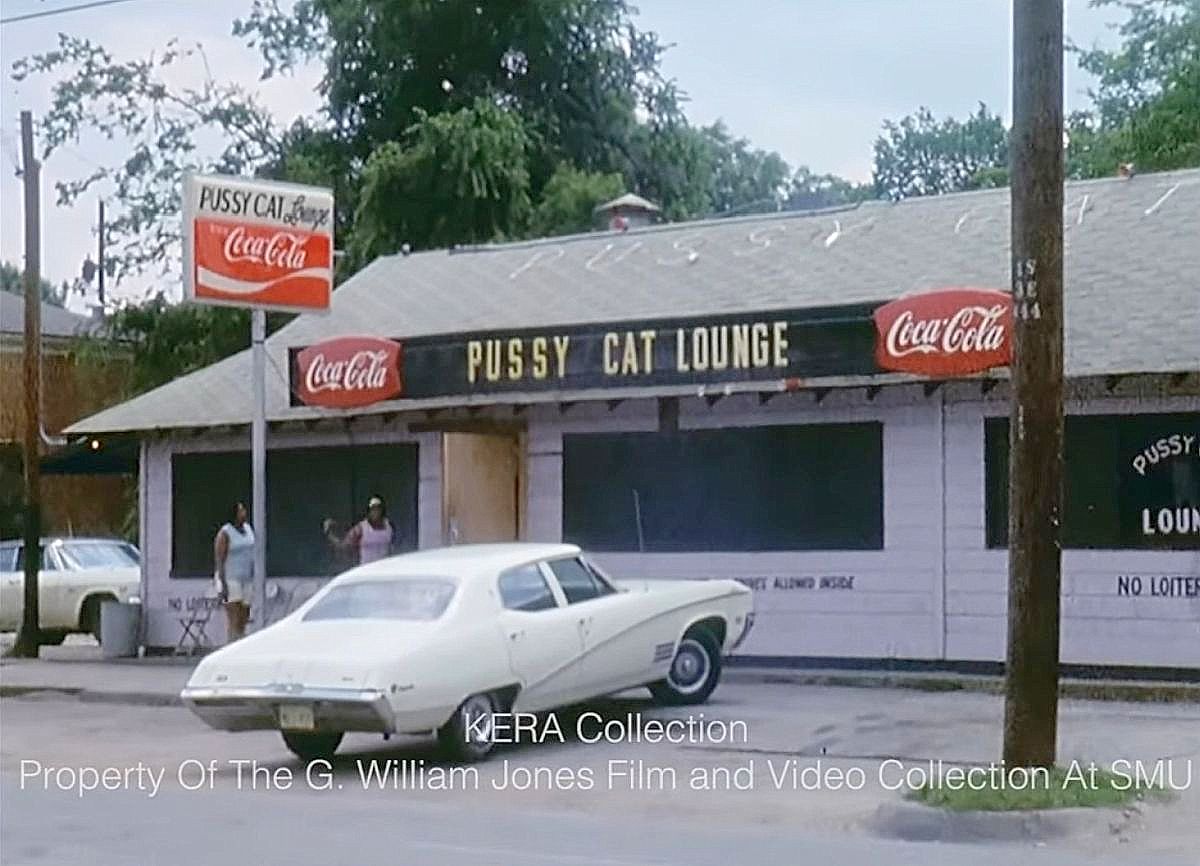
pussy-cat-lounge_june-1973_kera-collection_jones-collection_SMUPussy Cat Lounge (3410 Forest Ave. — now part of Fair Park)
*

men_june-1973_kera-collection_jones-collection_SMU

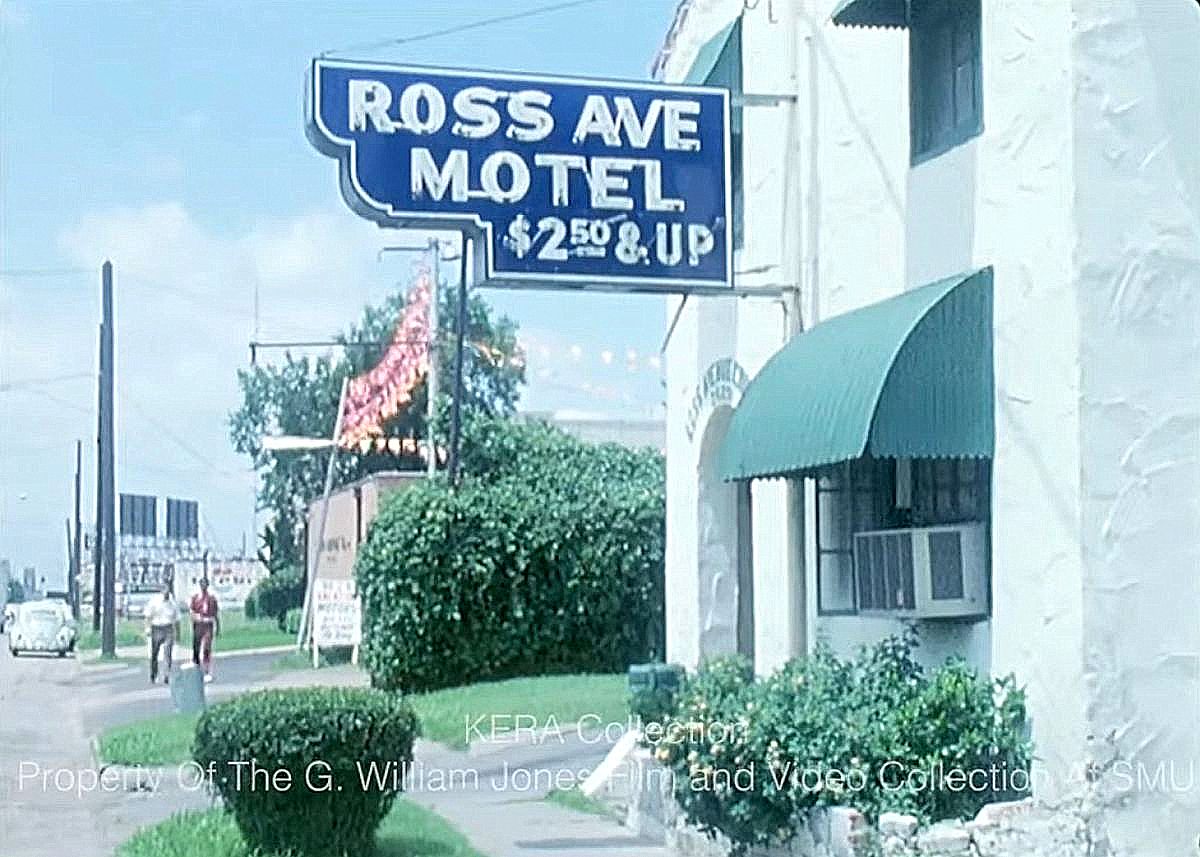
ross-avenue-motel_june-1973_kera-collection_jones-collection_SMURoss Avenue Motel (3629 Ross) — see what it looked like new here
*

south-blvd_june-1973_kera-collection_jones-collection_SMU2700 block of South Boulevard

Very cool! Thanks, SMU!

**

Here are some of the places seen in the film, with addresses (if I could find them), in the order they appear (several places make more than one appearance):

  • Pussy Cat Lounge:  3410 Forest Avenue (now MLK Blvd.)
  • Elite Theater (sign):  2720/2722 Forest Ave. (closed; originally the White Theater, which opened in 1934)
  • Blazer Inn:  2722 Forest (in the old theater)
  • A & H Barber Shop, Recreation, Pool:  2724 Forest
  • Royal Cafe:  2726 Forest
  • Royal Barber Shop:  1813 Hall
  • Soul Shop
  • Hall’s Hotel:  1809 1/2 Hall
  • Corner of Hall & Roseland
  • Busy Bee Cafe:  1612 Hall
  • Red Door
  • Black Gail’s Domino Parlor:  1802 Hall
  • Congo Club:  1801 Hall (at Roseland)
  • Ascot Room:  1710 Hall (at Ross)
  • East Texas Bar-B-Q (listed in directories as East Texan Barbecue):  2311 Hall
  • Mary’s Place
  • Bill & Bess’ Cafe
  • Watson’s Cafeteria:  1715 Hall
  • Jim’s Liquor:  1713 Hall
  • Alvacado Inn:  1726 Hall
  • Stewart Motors:  3509 Ross
  • Vacation Motors:  3623 Ross
  • Ross Avenue Motel:  3629 Ross
  • 1600 block of Hall, looking toward Ross
  • Your Thrift Shop:  1622 Hall (warehouse), 3302 Ross
  • Forest Avenue Store:  2716-A Forest
  • Hooper’s Jeweler:  2720 Forest
  • Front of old Elite Theater, then the Blazer Inn:  2722 Forest
  • 2700 block of South Blvd. shows homes at 2707 South Blvd. and 2711 South Blvd.
  • Liberty Bail Bond Service:  1611 Hall (Theodore Greer, bondsman)
  • Blue Lantern Cafe:  1609 Hall
  • Dallas Police Substation:  Bexar and Municipal streets

***

Sources & Notes

All images are screenshots from the YouTube video “KERA Report On Crime In Dallas — June 1973,” from the KERA Collection, G. William Jones Film and Video Collection, Hamon Arts Library, Southern Methodist University.

royal-cafe_june-1973_kera-collection_jones-collection_SMU_sm

*

Copyright © 2021 Paula Bosse. All Rights Reserved.
Miscellaneous Dallas #2

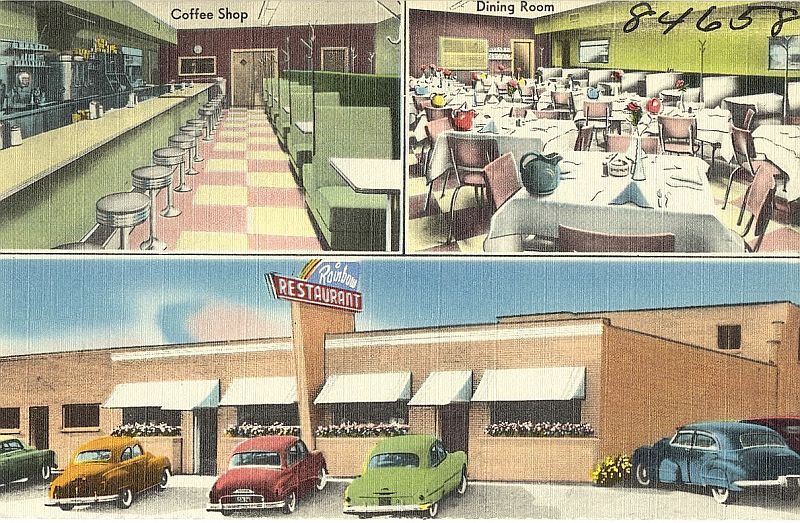
rainbow-restaurant_tichnor-bros-collection_boston-public-libraryOpen 24 hours, plenty of free parking…

by Paula Bosse

And now, a bunch of homeless, random images (all are larger when clicked).

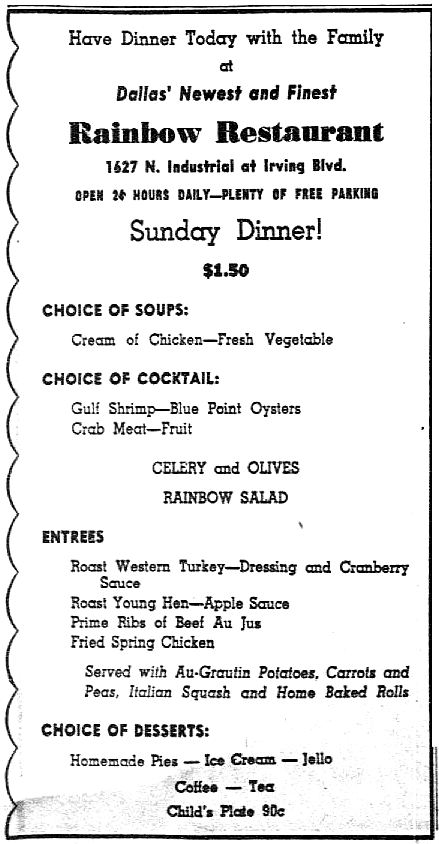
Above, the 24-hour Rainbow Restaurant, 1627 N. Industrial at Irving Blvd. Below, its menu.

rainbow-restaurant_ad_dec-19511951

*

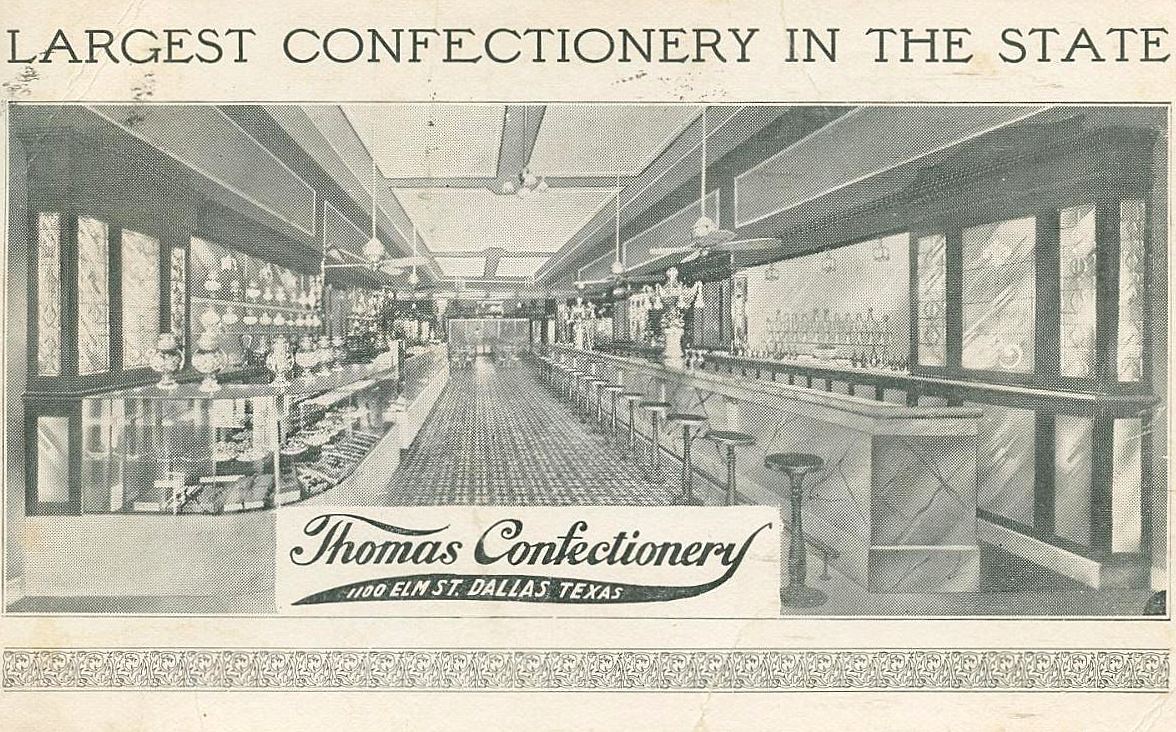
Thomas Confectionery, 1100 Elm Street. “Largest Confectionery In the State.” Popular date spot with the pre-flapper generation.

thomas-confectionary_postcard_1911_sam-rayburn-house-museum-via-portal1911 (via Portal to Texas History)

thomas-confectionery_0915121912. Dallas Morning News want-ad

*

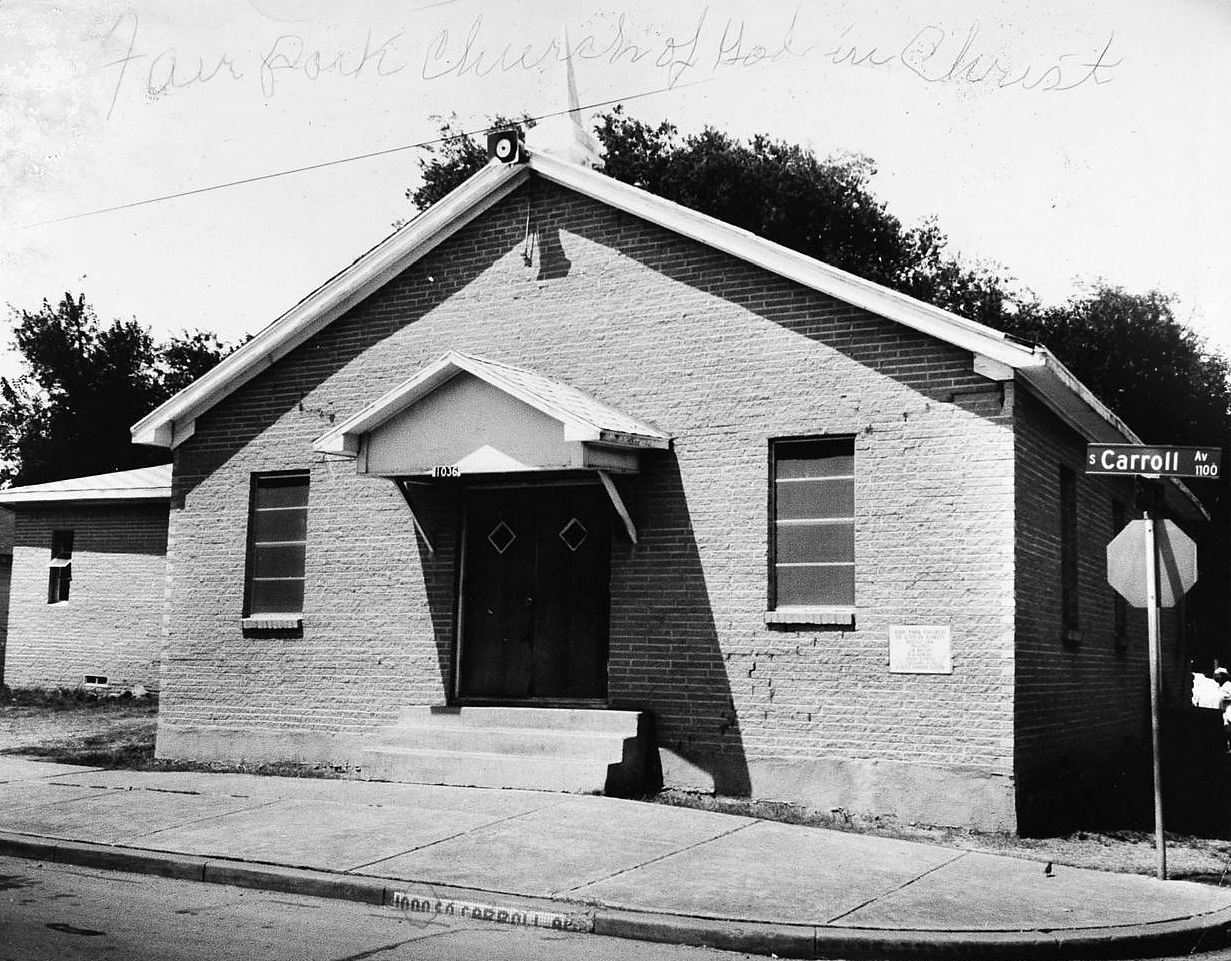
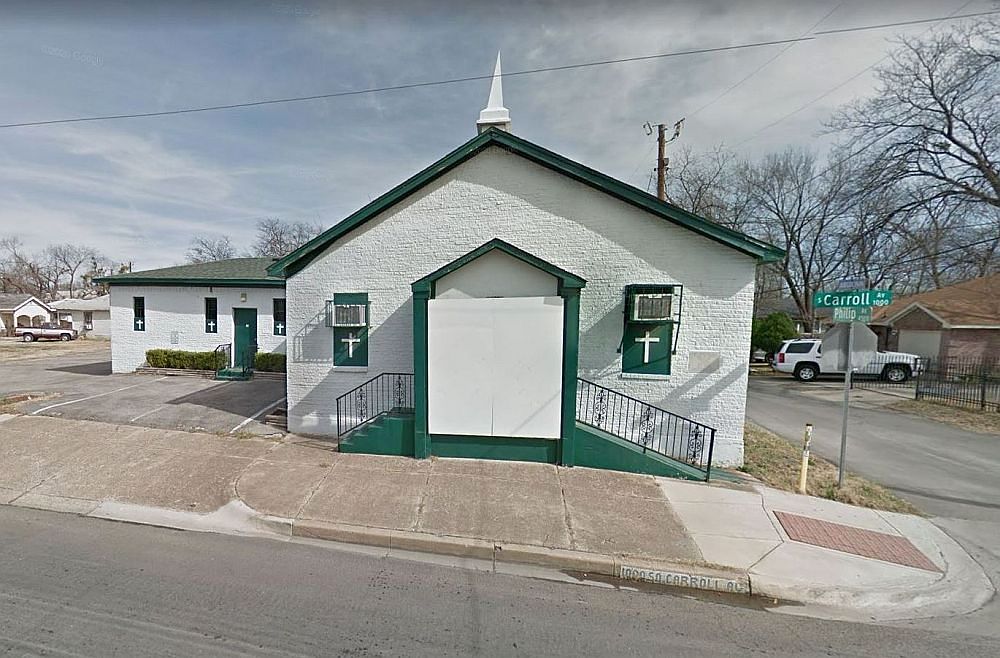
Fair Park Church of God in Christ, 1036 S. Carroll Ave.

fair-park-church-of-god-in-christ_1974_USC-libraries 1974 (via USC Libraries)

And it’s still standing! (I love that the curb tiles are still there.)

fair-park-church-of-god-in-christ_google-street-view-20172017 (via Google Street View)

*

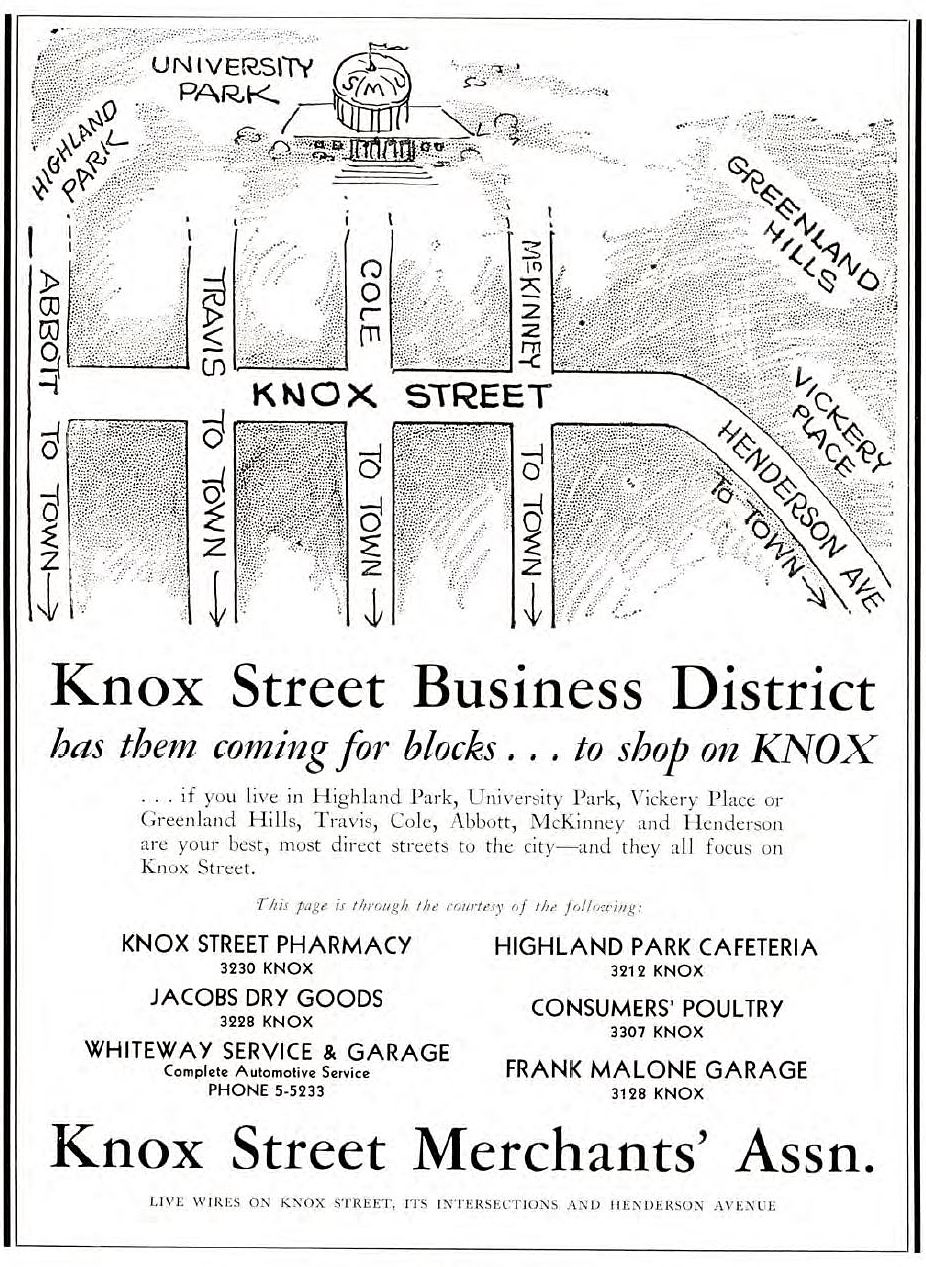
The Knox Street Business District, pre-Central Expressway. …Way pre.

knox-street-business-district_1932-smu-rotunda1932 (via SMU Rotunda)

*

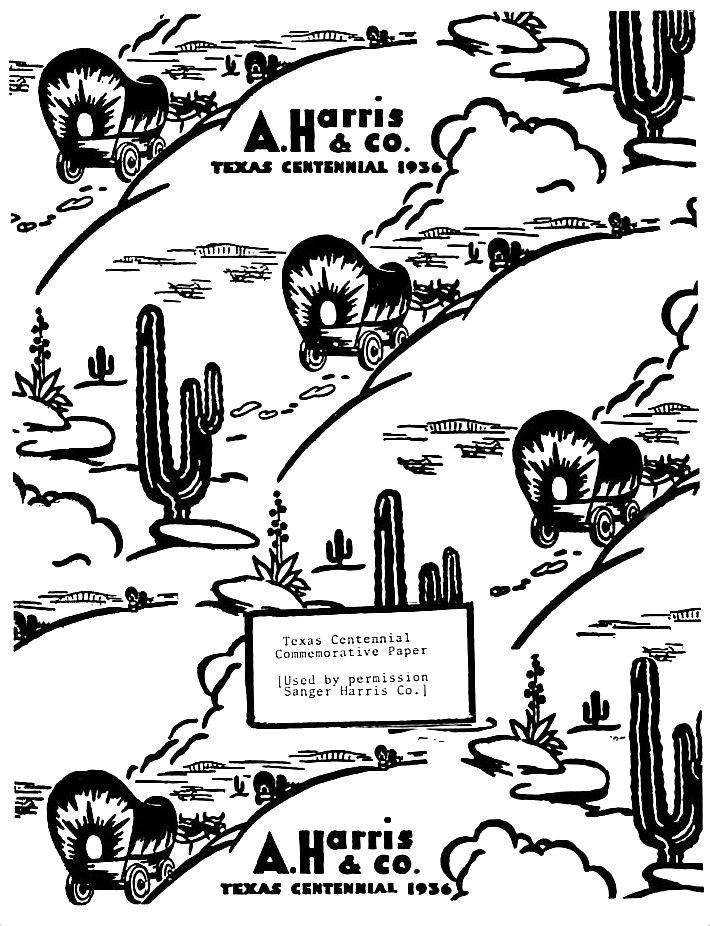
A. Harris & Co. — Texas Centennial Commemorative Paper (gift wrap?).

tx-centennial_a-harris_gift-paper_elm-fork-echoes_april-1986_portal-tx-hist1936 (via Portal to Texas History)

*

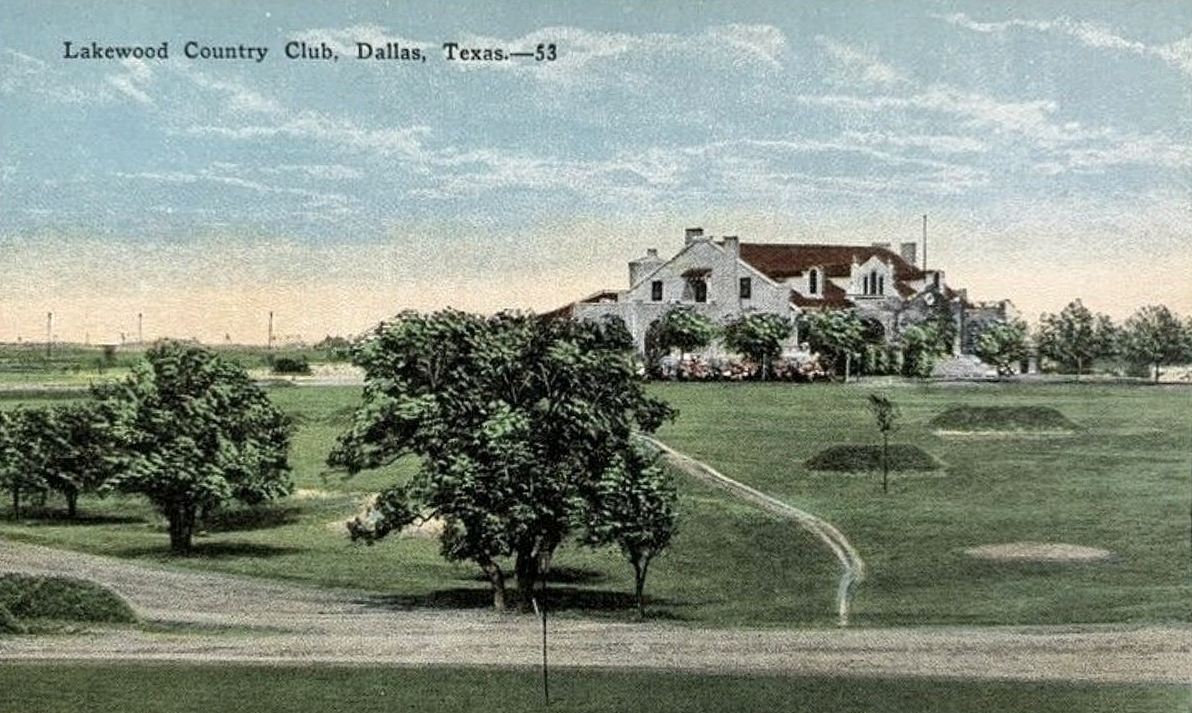
The Lakewood Country Club (see it before the landscaping in this photo from this post).

lakewood-country-club_postcard_ebay(via eBay)

*

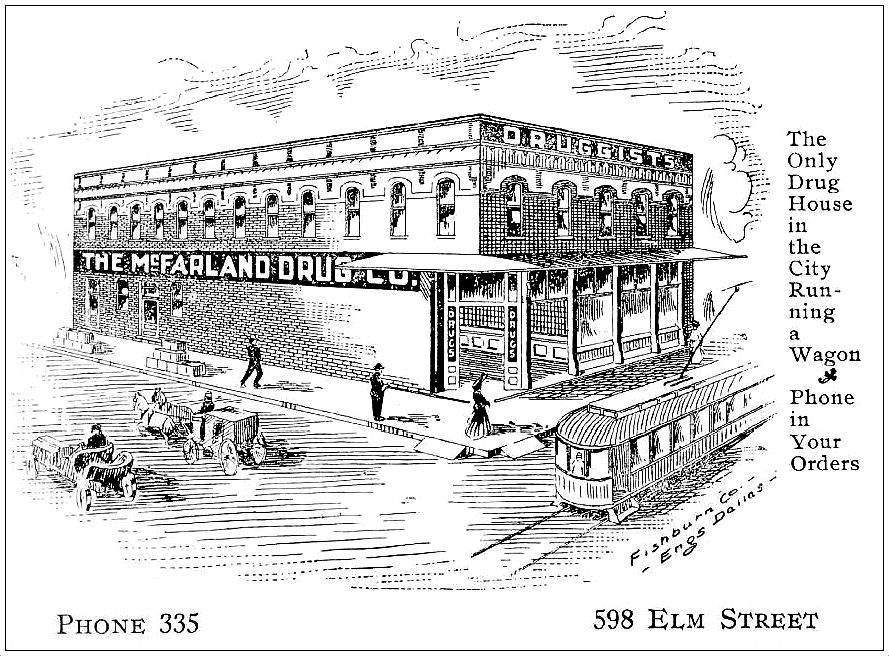
The McFarland Drug Co., 598 Elm, at Hawkins, in Deep Ellum (later became 2424 Elm).

mcfarland-drug-co_hints-to-housekeepers_degolyer_SMU_19051905 (via DeGolyer Library, SMU)

*

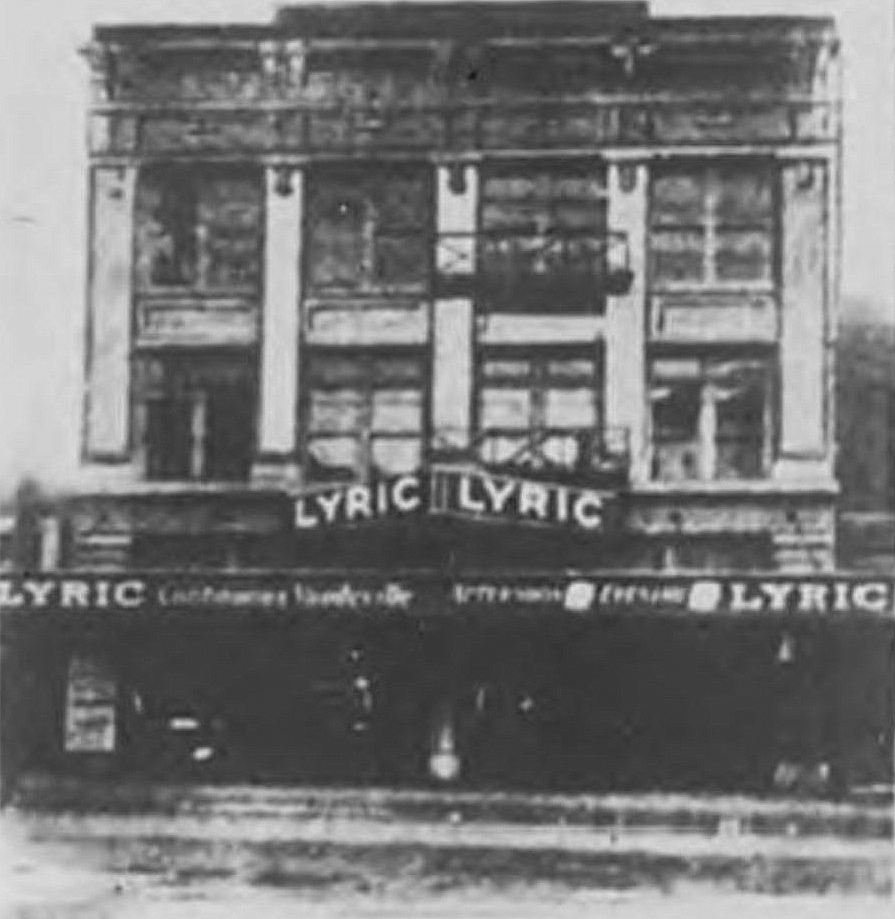
The Lyric Theatre, 364 Elm, near Stone (later 1602 Elm).

lyric-theater_degolyer-lib_SMU_dallas-theaters_nd1907-ish (via DeGolyer Library, SMU)

*

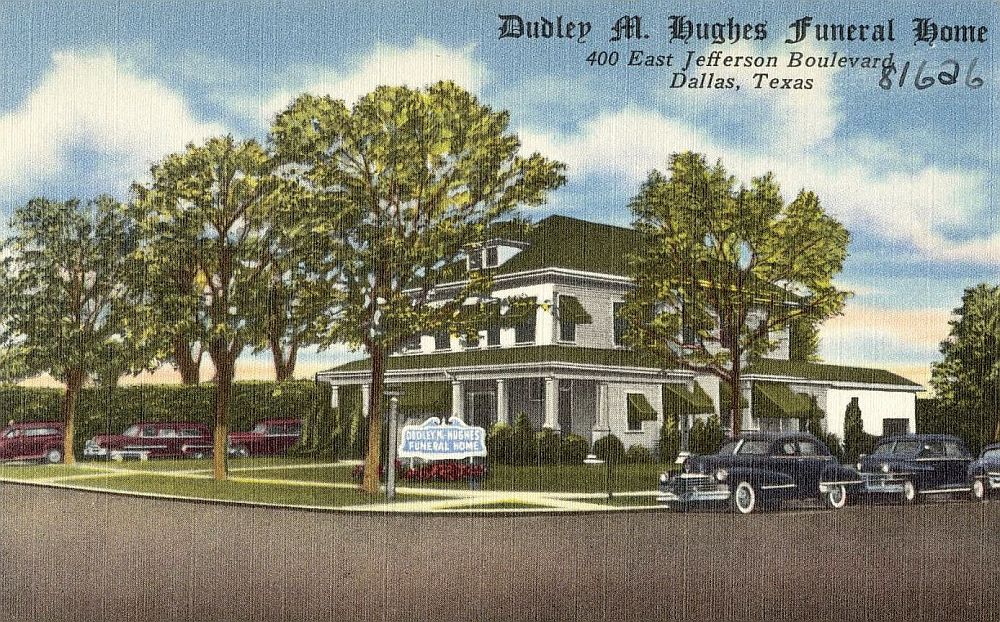
Dudley M. Hughes Funeral Home, 400 E. Jefferson Blvd, Oak Cliff.

dudley-hughes-funeral-home_tichnor-bros_boston-public-library(via Tichnor Bros. Collection, Boston Public Library)

*

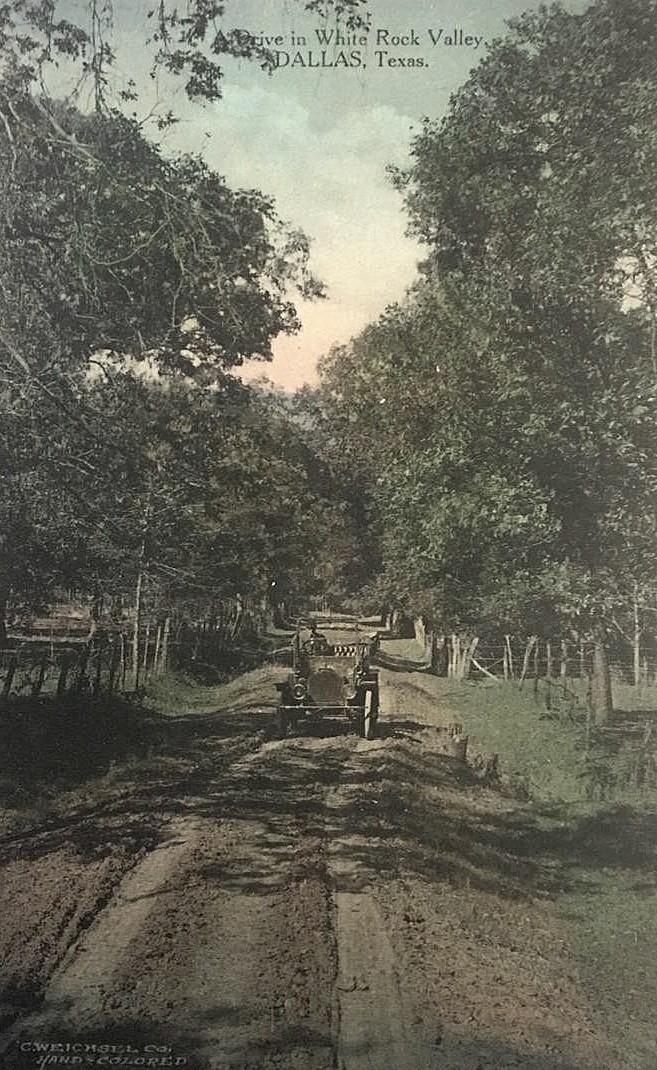
“A Drive in White Rock Valley.” Before the lake.

white-rock-valley_postcard_1912_ebay(via eBay)

***

Sources & Notes

Rainbow Restaurant postcard is from the Tichnor Bros. Postcard Collection, Boston Public Library.

See the first installment of “Miscellaneous Dallas” here.

rainbow-restaurant_tichnor-bros-collection_boston-public-library_sm

*

Copyright © 2021 Paula Bosse. All Rights Reserved.
Miscellaneous Dallas

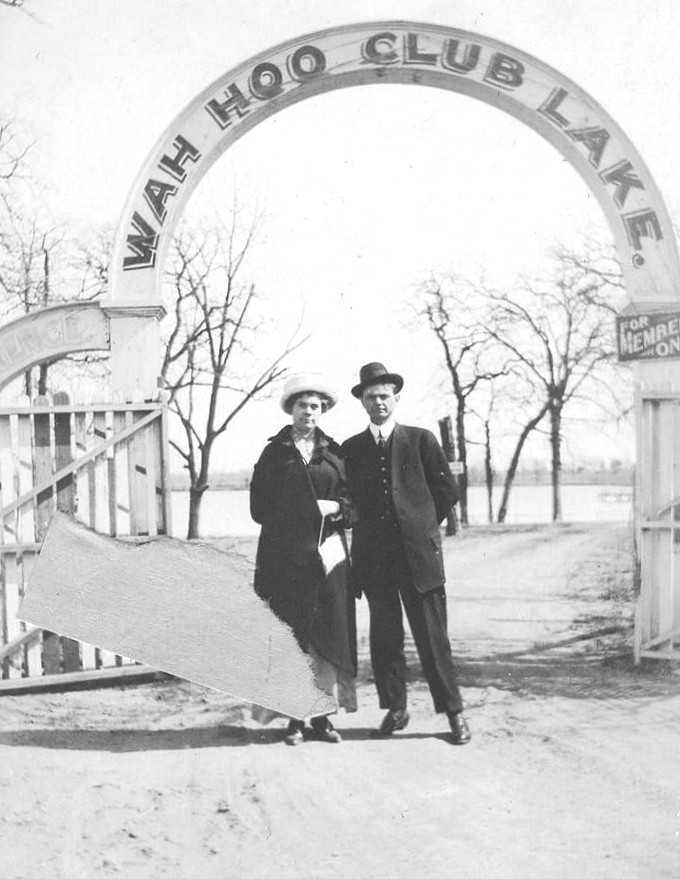
wah-hoo-club_lake_ebayWah Hoo Club Lake, Members Only…

by Paula Bosse

Here are several images, most in varying degrees of low resolution. I don’t know what else to do with them other than post them all together, randomly. No research. They’re just HERE! Enjoy!

Above, a handsome couple posing under the entrance to Wah-Hoo Club Lake (I’ve seen it more often spelled “Wahoo” — south of Fair Park).

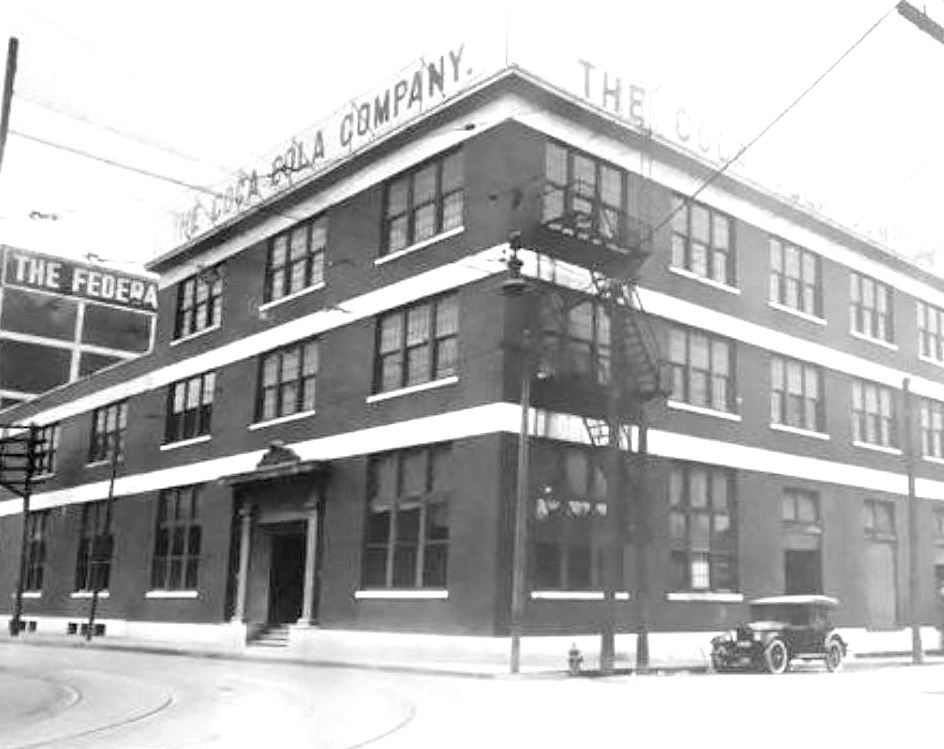
Below, the Coca-Cola Company building, McKinney and N. Lamar (still standing).

coca-cola_photo_ebay

*

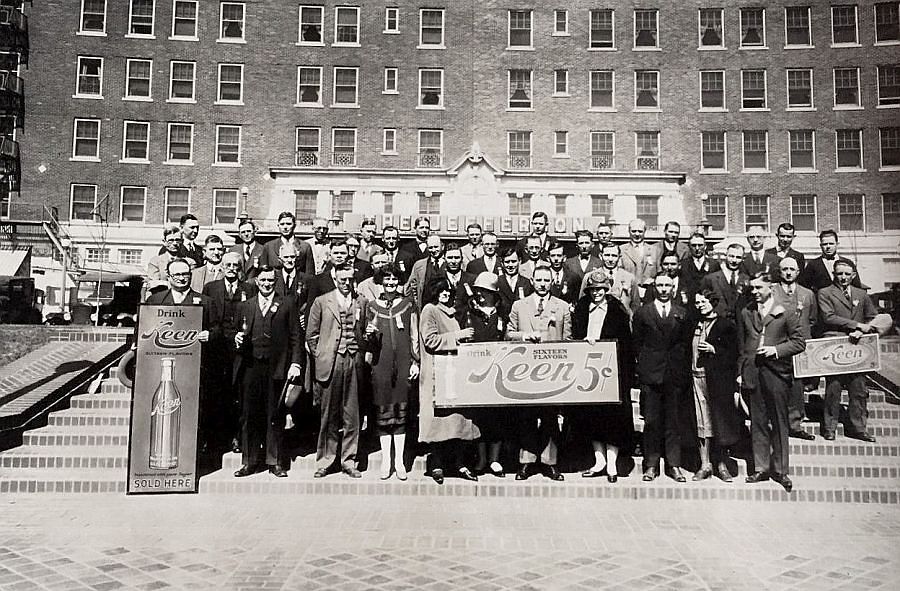
Speaking of Coke, here are some Keen folks, standing on the steps of the Jefferson Hotel (Union Station is out of frame to their right).

keen-soda_jefferson-hotel_frank-rogers-photo_ebay

*

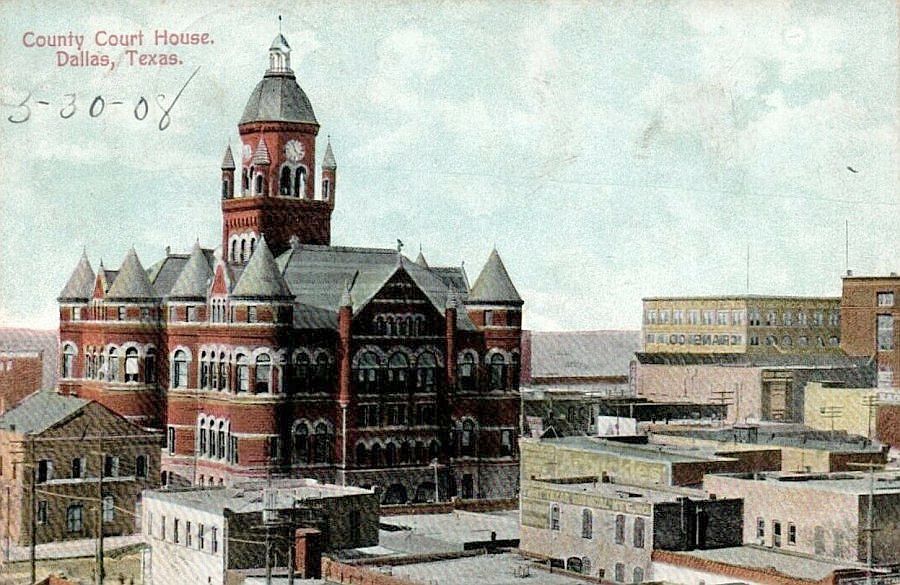
A couple of blocks away, the Old Red Courthouse, seen here from an unusual angle — looking toward the northwest (postcard postmarked 1908).

old-red_postcard_1908_ebay

*

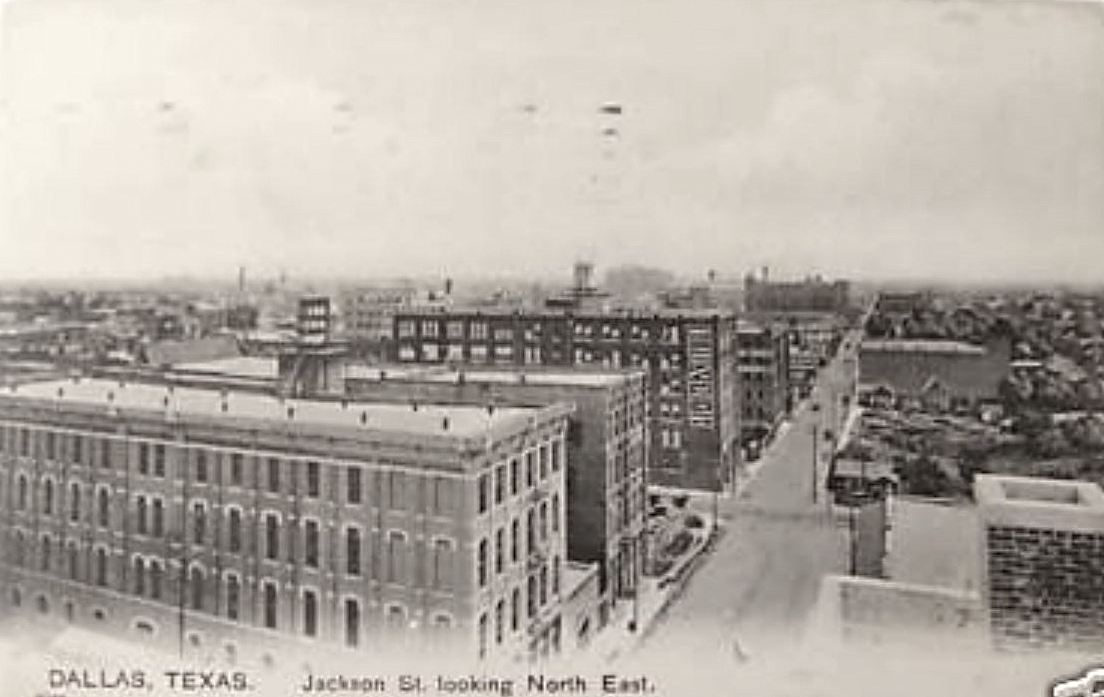
This is a super low-resolution image, but I’ve never seen it before, so, what the heck: I give you a fuzzy Jackson Street looking northeast (postmarked 1907).

jackson-street-looking-northeast_postcard_ebay_postmarked-1907

*

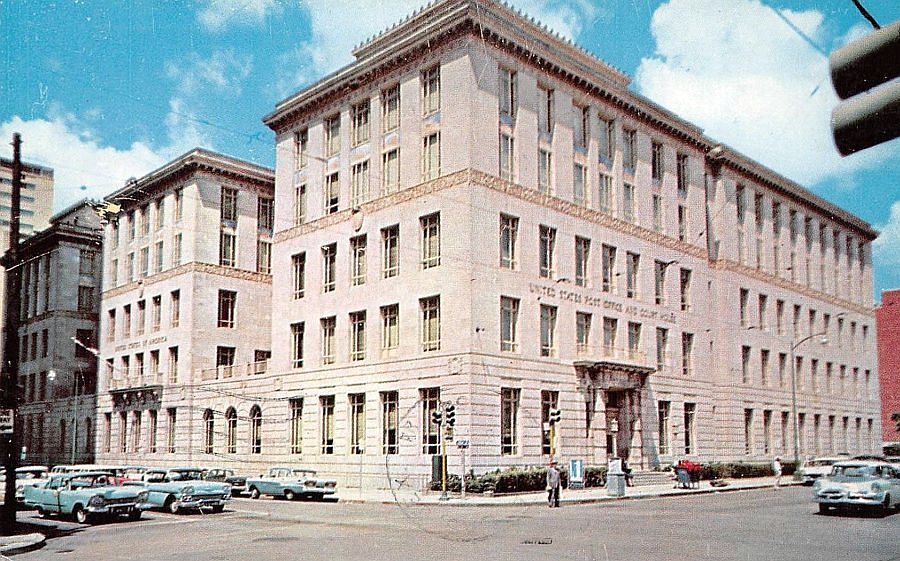
The “new” Post Office and Federal Building at Bryan and Ervay (postmarked 1964).

post-office_federal-bldg_bryan-ervay_postmarked-1964

*

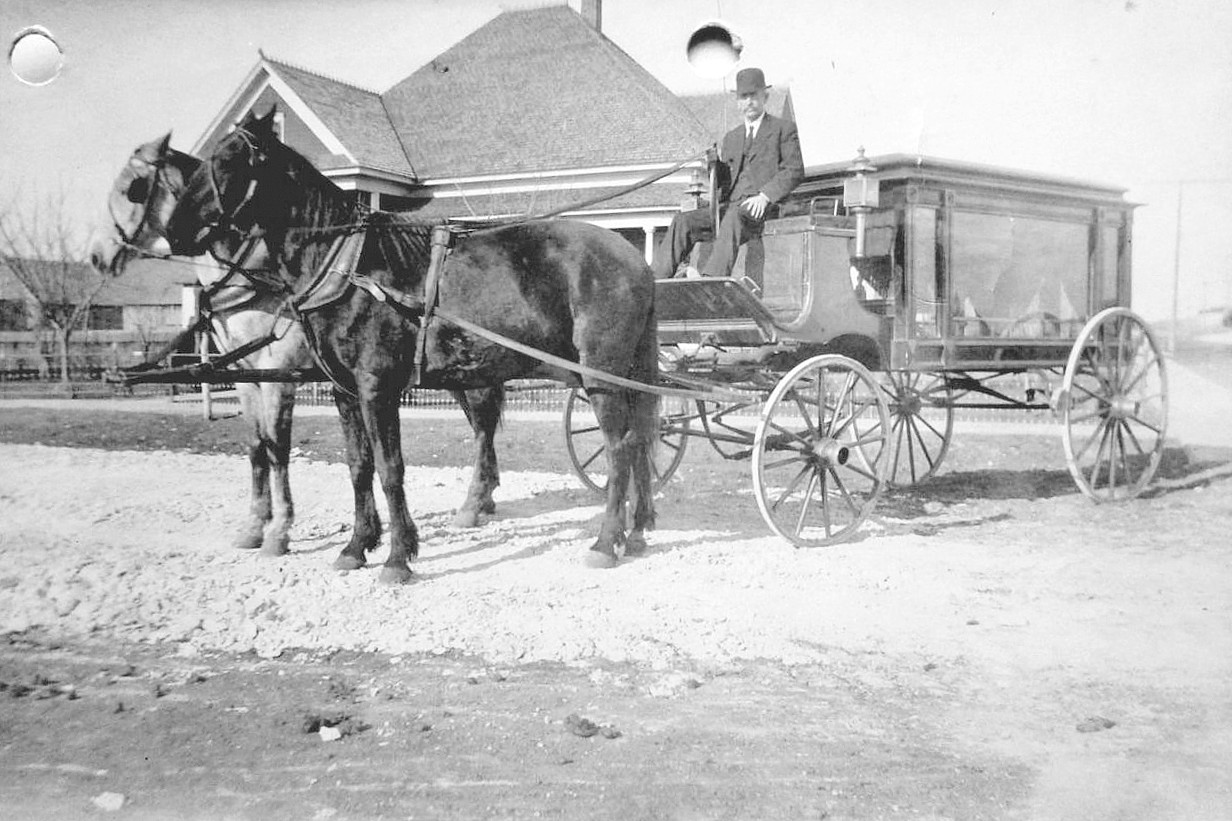
A jog over to Oak Cliff — here’s a horse-drawn hearse.

oak-cliff_hearse_horse-drawn_rppc_ebay

*

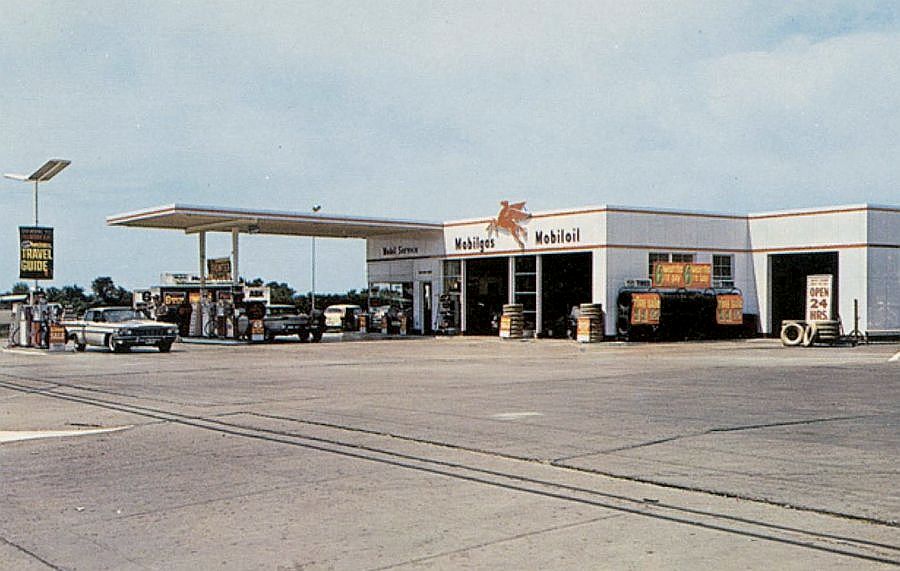
Up to Preston and Royal (northeast corner, I think) — a Mobil station.

preston-royal_10721-preston_corner_royal_flickr_coltera

*

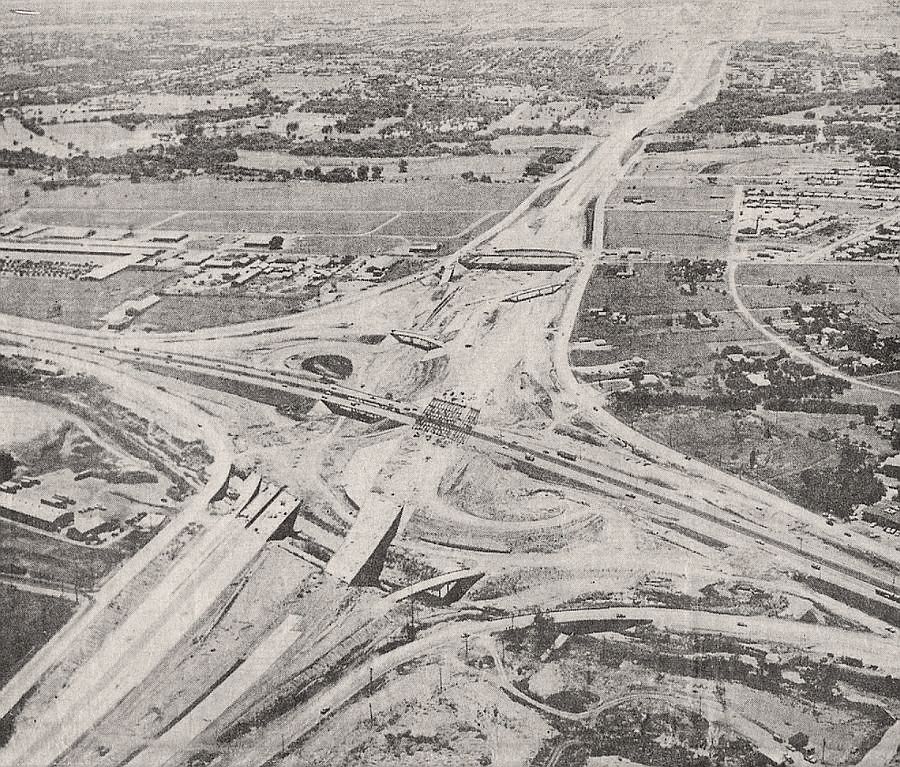
Even farther north, LBJ under construction, looking west at the intersection with Central (1967). (Can’t pass up the opportunity to link to one of the most popular photos I’ve ever posted which shows what is now LBJ and Valley View in 1958 — nothin’ but farmland.)

lbj-looking-west_at-75_flickr_red-oak-kid

*

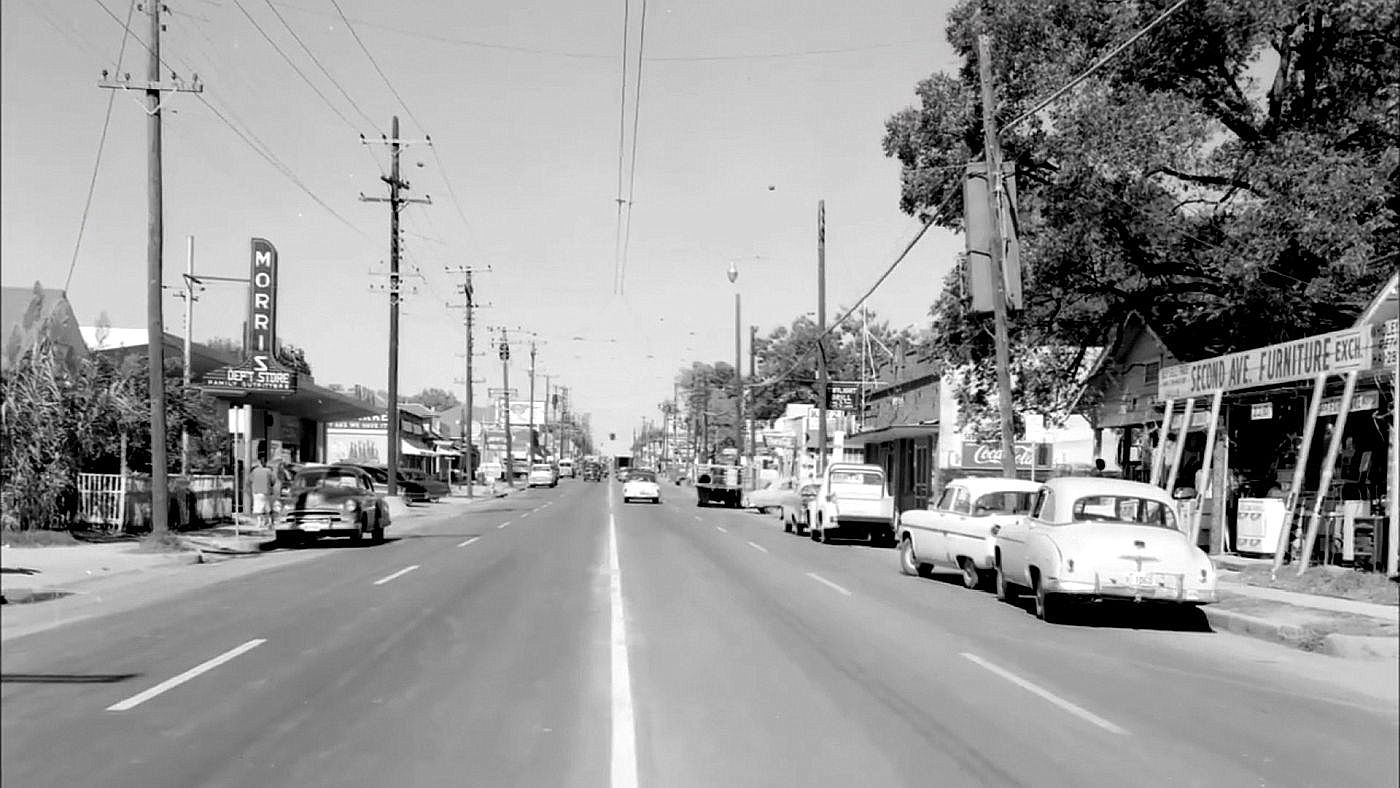
And, lastly, my favorite of these miscellaneous images: the 2200 block of 2nd Avenue (from about Metropolitan — a couple of blocks south of Fair Park). This part of town used to be really interesting. Unfortunately, it looks nothing like this now (see it on Google Street View here). This is a screenshot from the KERA-produced documentary “South Dallas Pop” (which you can watch in its entirety here).

2nd-ave_south-dallas-pop_KERA

***

Sources & Notes

All images found on eBay except for the following: Preston-Royal Mobil station, from Coltera’s Flickr stream; LBJ photo from Red Oak Kid’s Flickr stream; and the photo of 2nd Avenue, which is from the Dallas Public Library.

See “Miscellaneous Dallas #2” here.

wah-hoo-club_lake_ebay_det_sm

*

Copyright © 2020 Paula Bosse. All Rights Reserved.
Random Photos of Turn-of-the-Century-ish Houses

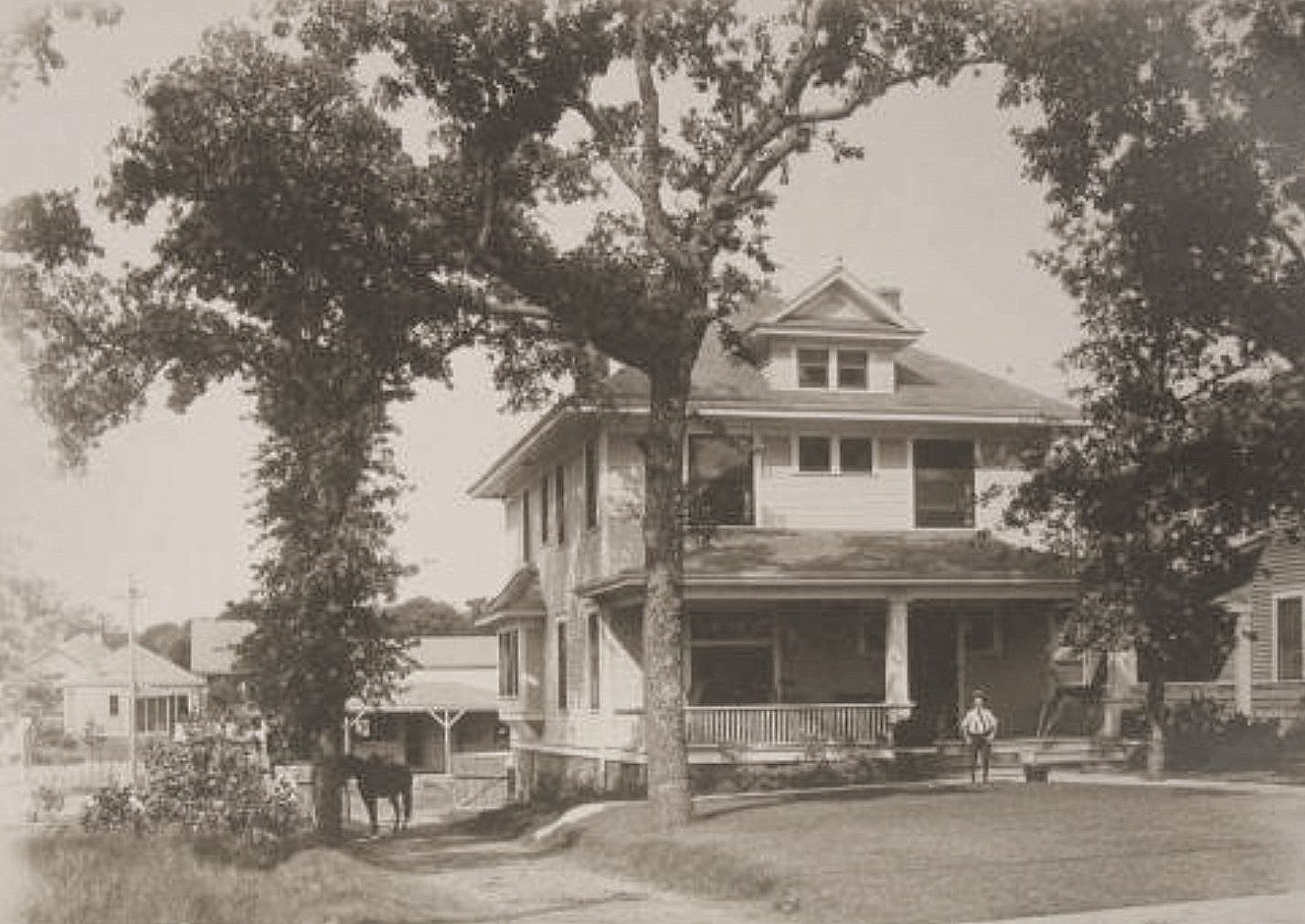
lemmon-avenue_house_rppc_ebayLemmon Avenue home, horse included….

by Paula Bosse

I love looking at old houses — especially ones which once occupied parts of town which are definitely no longer residential areas. It’s always sad to realize that the beautiful house you’re looking at — one which you can imagine living in now, in the 21st century — has, almost always, been torn down decades ago and replaced with something much less interesting. Thankfully, people 120 years ago used to have their homes photographed in order to print up picture postcards which they would then send to friends and relatives. Most of the images below come from these “real photo postcards,” and all show nice little glimpses into Dallas homes from before 1910. Only one of these houses is still standing. (All photos are larger when clicked.)

*

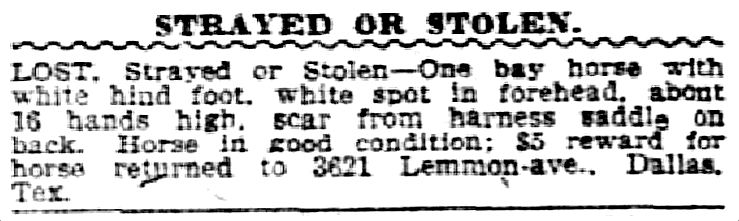
Sadly, the house above is not still standing. It’s a beautiful house. Even comes with a horse! The house was at 405 Lemmon Avenue in Oak Lawn. After the addresses in Dallas changed in 1911, the address became 3621 Lemmon (in the middle of the block between Welborn and Turtle Creek Park/Lee Park — apartments and a parking garage now occupy that whole block) — see it on a 1921 Sanborn map here. The owner was W. Leslie Williams, a real estate man. Family horses wandered off a few times, according to “strayed or stolen” ads placed in the paper, such as the one below.

williams_dmn_111211_strayed-horse
Nov. 1911

*

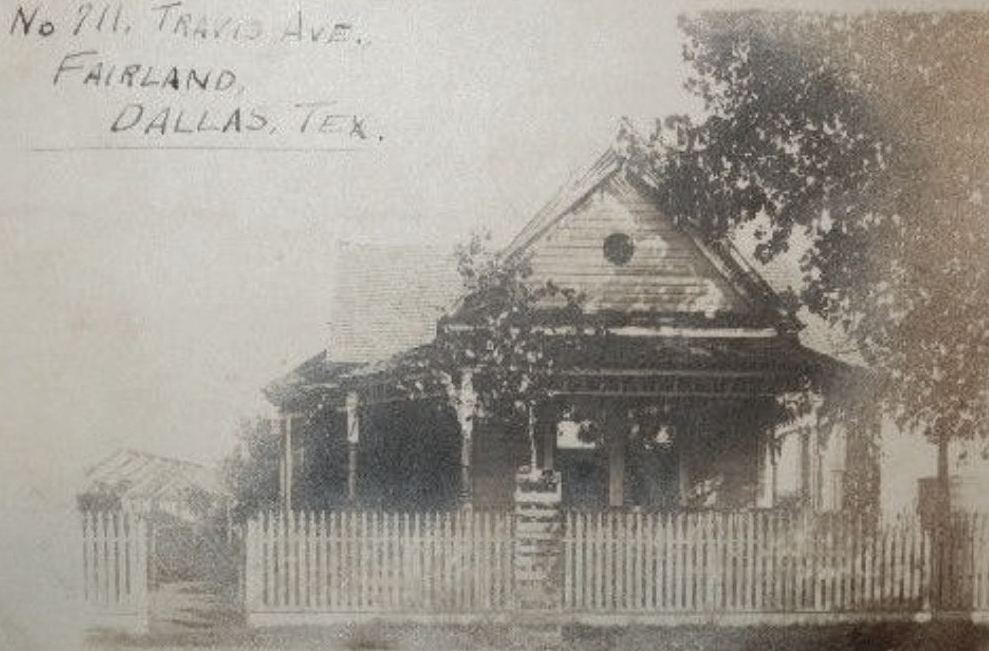
Below, a house which once stood at 711 Travis (which later became 4627 Travis), between Knox and Hester (the Katy railroad tracks would have run right behind the house) — see it on a 1921 Sanborn map here. It was in the “Fairland” addition. The owner of the house was T. B. Baldwin, a traveling agent for The Dallas Morning News. The photo was on a postcard mailed in 1908.

travis-ave-house_fairland_1908_ebay_rppc

*

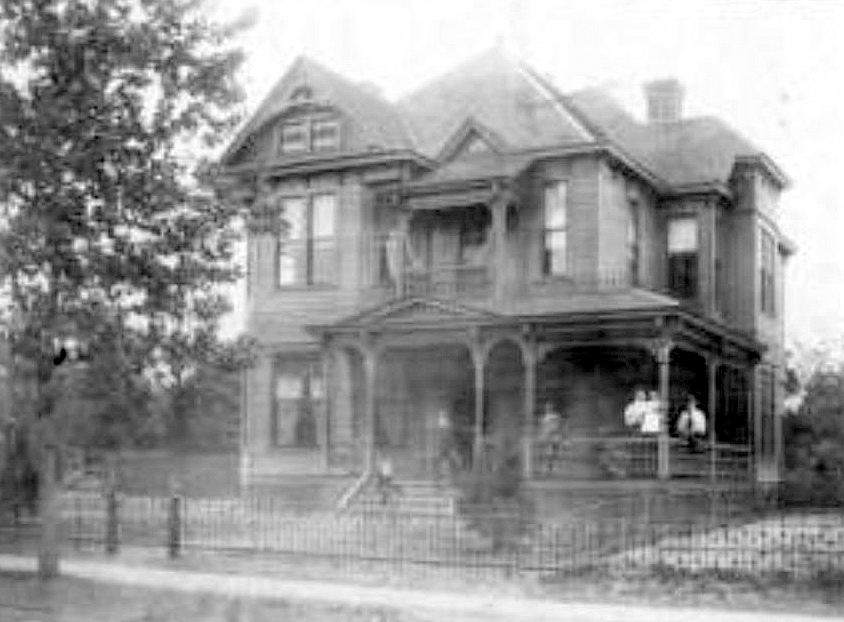
Now to South Dallas (The Cedars?). This house stood at 200 Cockrell Ave. (which became 2130 Cockrell), between Corinth and Montgomery, now part of a large swath of empty land almost certainly being developed in somebody’s head as I type this. See it at the very bottom of this 1921 Sanborn map. The house was owned by Horatio W. Fairbanks, supervisor of the Dallas Cotton Mills, and was later occupied by the Wesley Settlement House for several years. The photo below is from 1896.

fairbanks-h-w_1896._ebay_cockrell-ave

*

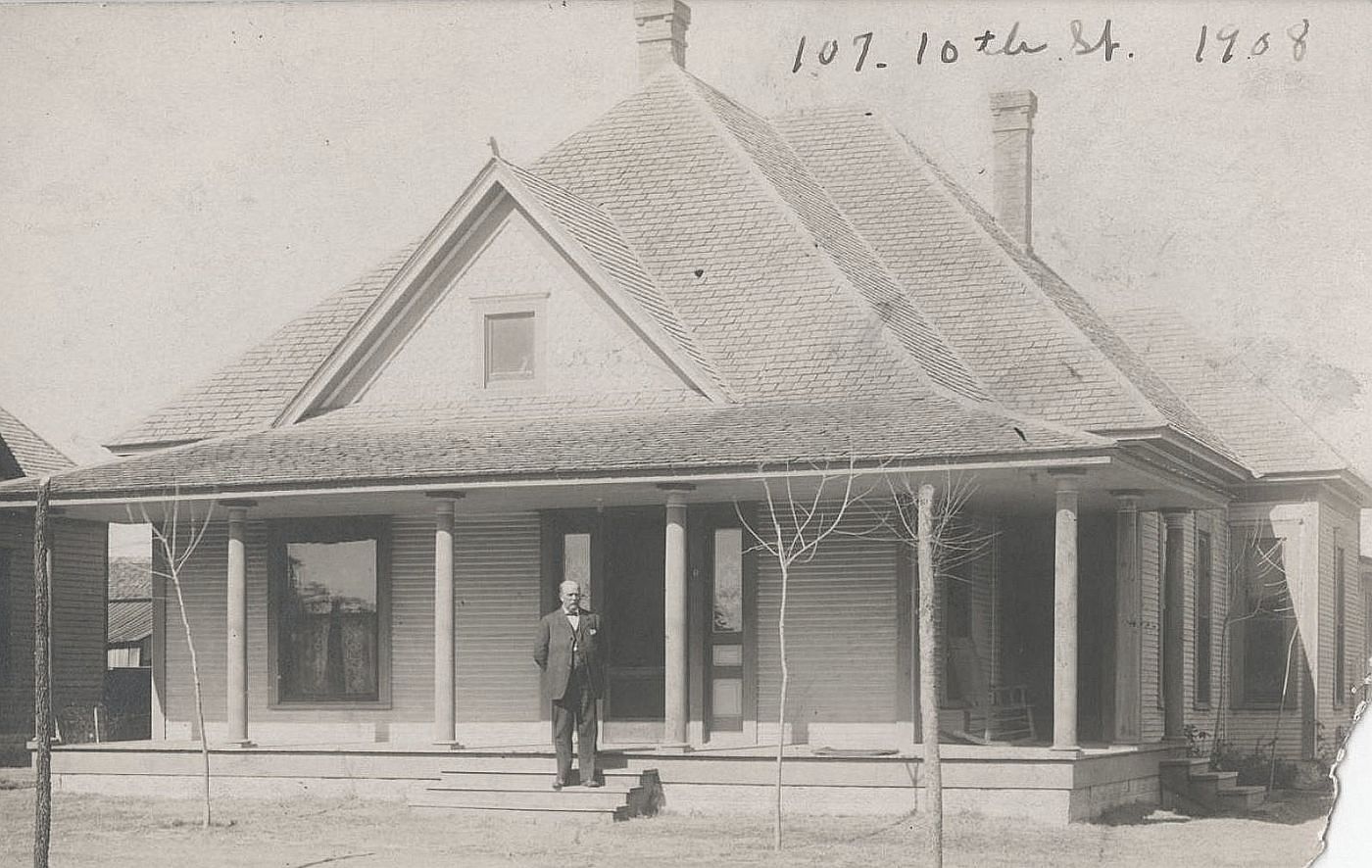
Now to four houses in Oak Cliff. The first stood at 107 10th Street (later 525 E. 10th St.), between Lansing and Marsalis — see it on a 1922 Sanborn map here. This was the home of Dr. William E. King, whom I presume is the man standing in front of the house — he died in 1909, a year after this photo was taken. The land now appears to be occupied by a body-shop parking lot. (This 1908 photo is from the Murphy Historical Society, via the Portal to Texas History, here.)

king-william_oak-cliff_1908_murphy-historical-society_via-portal

*

The home of T. Henry Dorsey, a member of the family who founded the Dorsey Printing Co., a pioneer printing establishment in Dallas, was at 161 Grand Ave. (the name of the street was changed to Marsalis, and in 1911 the address of this house became 113 N. Marsalis), between 9th and 10th streets — see it on a 1905 Sanborn map here. The current occupant of this land is, I think, a trucking company. This house — which Dorsey moved into around 1900 — can be seen below from several angles (including one from the back which shows a fence running into part of the house which appears to be encroaching onto a neighbor’s property. 

dorsey_ebay_d

dorsey_ebay_a

dorsey_ebay_b

dorsey_ebay_c

*

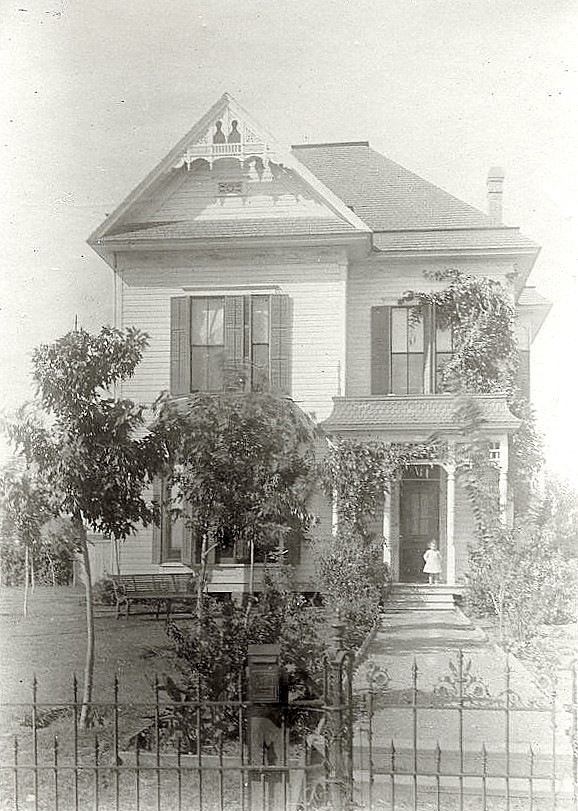
Before 1911, the address of the house below — a house I absolutely love — was 174 South Jefferson; after 1911, the address was, rather confusingly, changed to 516 East Jefferson (between Patton and Denver) — see it on a 1905 Sanborn map here. It was on land now occupied by Felix Botello Elementary School. This house was owned for several decades by Dr. William M. Lively. The image below is from a postcard dated 1909. (Great car!)

lively-house_poss-oak-cliff_rppc_1909_ebay

*

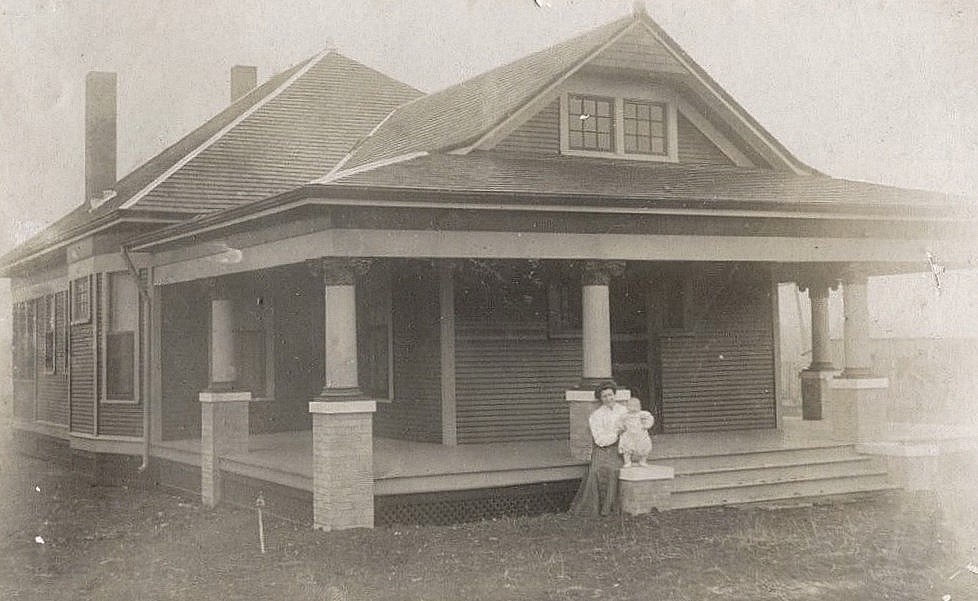
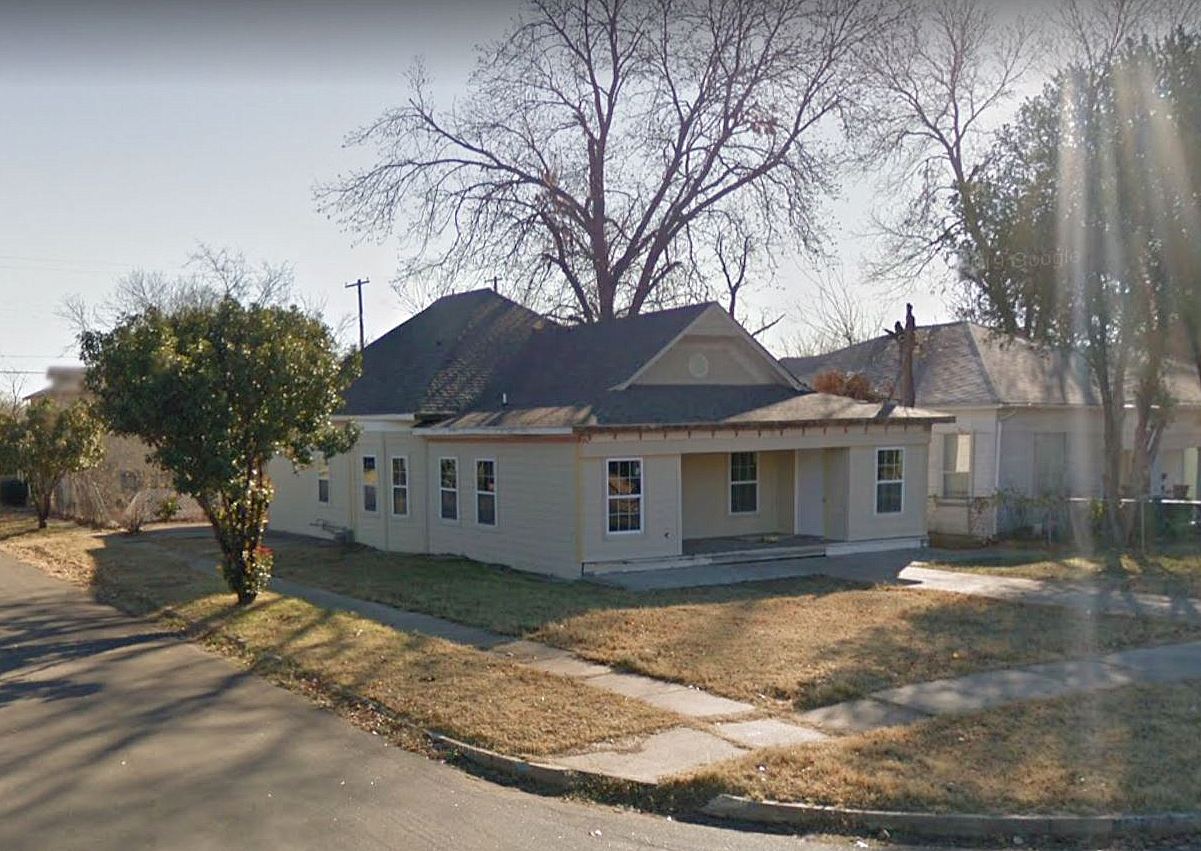
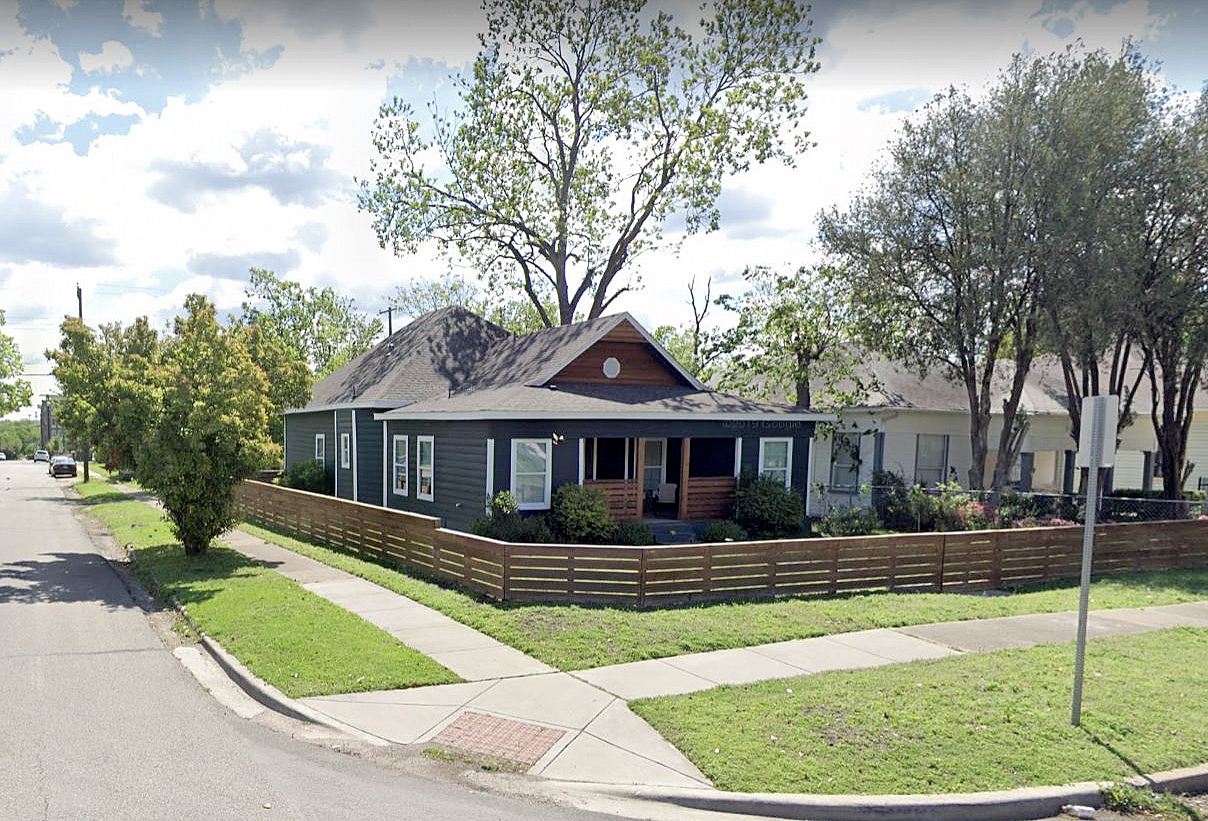
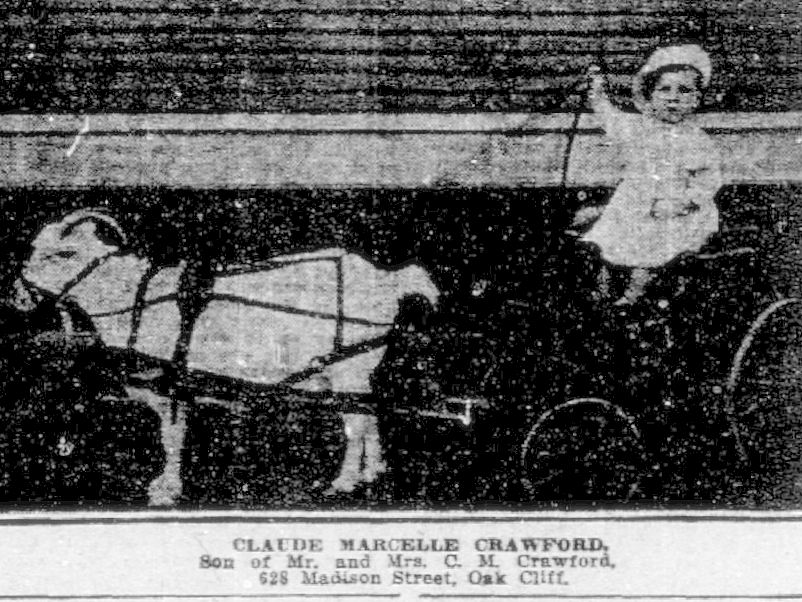
Below is the only one of these houses still standing. It began life as 120 Madison Ave. (which later became 628 N. Madison), at the corner of W. Neely St. in the Kidd Springs neighborhood of Oak Cliff. See it on a 1922 Sanborn map here (bottom left corner). Claude Marcelle (C. M.) Crawford, a traveling salesman, lived here with his wife, Maud, and their infant son, Marcelle Crawford. Maud Crawford (who died in 1913, just a couple of years after this photo was taken) wrote: “What do you think of our ‘cosy corner.’ Every one tells us it is pretty so much until we almost believe it our selves.” Crawford eventually went to work for Bristol-Myers as a regional branch manager, and after 30 years, when he was in ill health, the company retired him on full pay (!) in gratitude for his service. When he retired, he owned a Beverly Drive home in Highland Park, apparently having done very well. His charming little starter-house in Oak Cliff still stands, having recently been remodeled. 

crawford-house_madison_oak-cliff_ebay_cropped
about 1910

crawford-house_madison_google-street-view_2012
2012, Google Street View

crawford-house_madison_google-street-view_20192019, Google Street View

crawford-claude-marcelle_dmn_081311
Claude Marcelle Crawford, Jr., Dallas Morning News, Aug. 13 1911

*

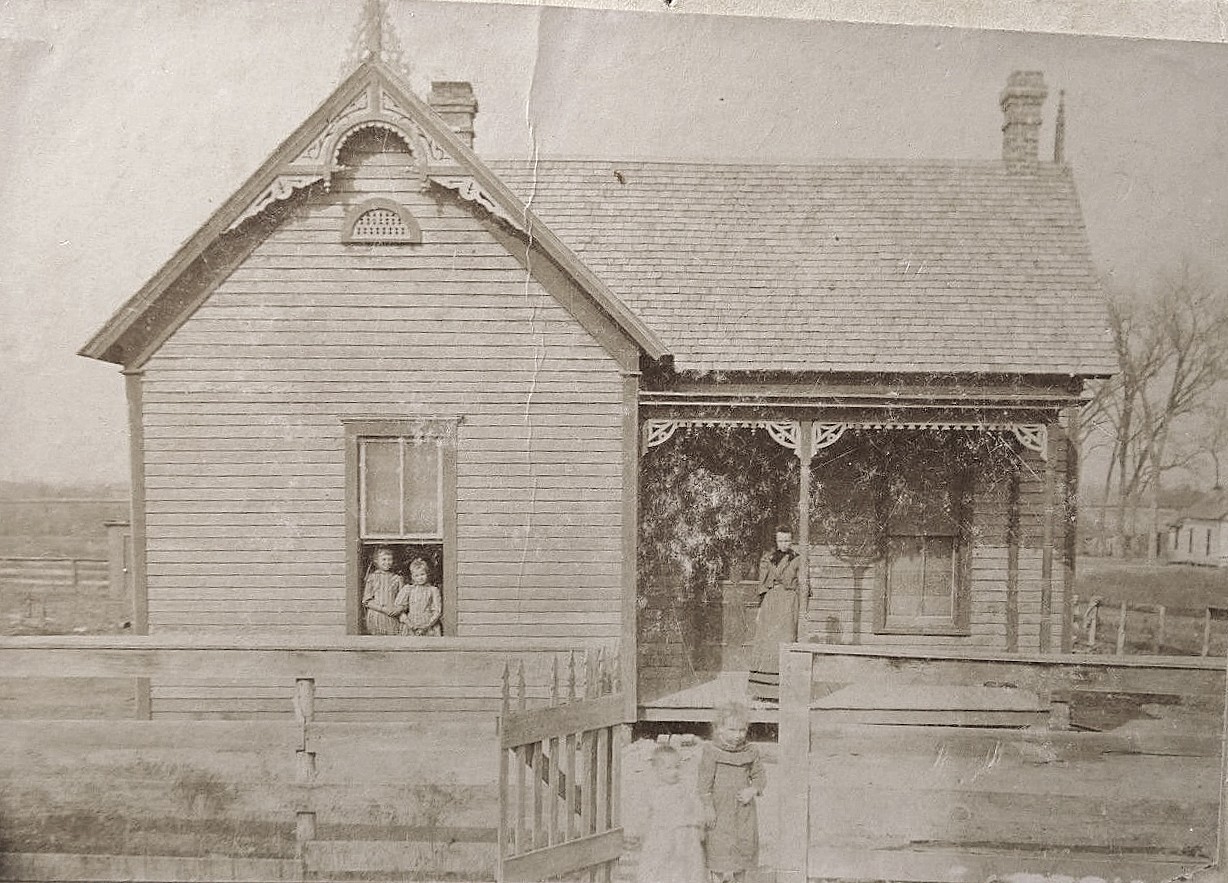
And, lastly, the only house I wasn’t able to determine the location of — it also looks like the oldest. On the back is a faint penciled notation which appears to  be signed “G. P. Taylor.” In a more recent notation in ink, the family members in the photo are identified: “Made in Dallas, Tex. — Elm St. — Mother on porch, Mattie & I in window, Pearl & Joe in gate.” 1870s or 1880s? It’s a mystery!

elm-street-house_ebay_taylor

***

Sources & Notes

All images except the William E. King house are from eBay.

lemmon-avenue_house_rppc_ebay_sm

*

Copyright © 2020 Paula Bosse. All Rights Reserved.
A Few Random Postcards

methodist-hospital_postcard_1944_ebay

by Paula Bosse

Here are a few totally random postcard images, pulled from bulging digital file folders.

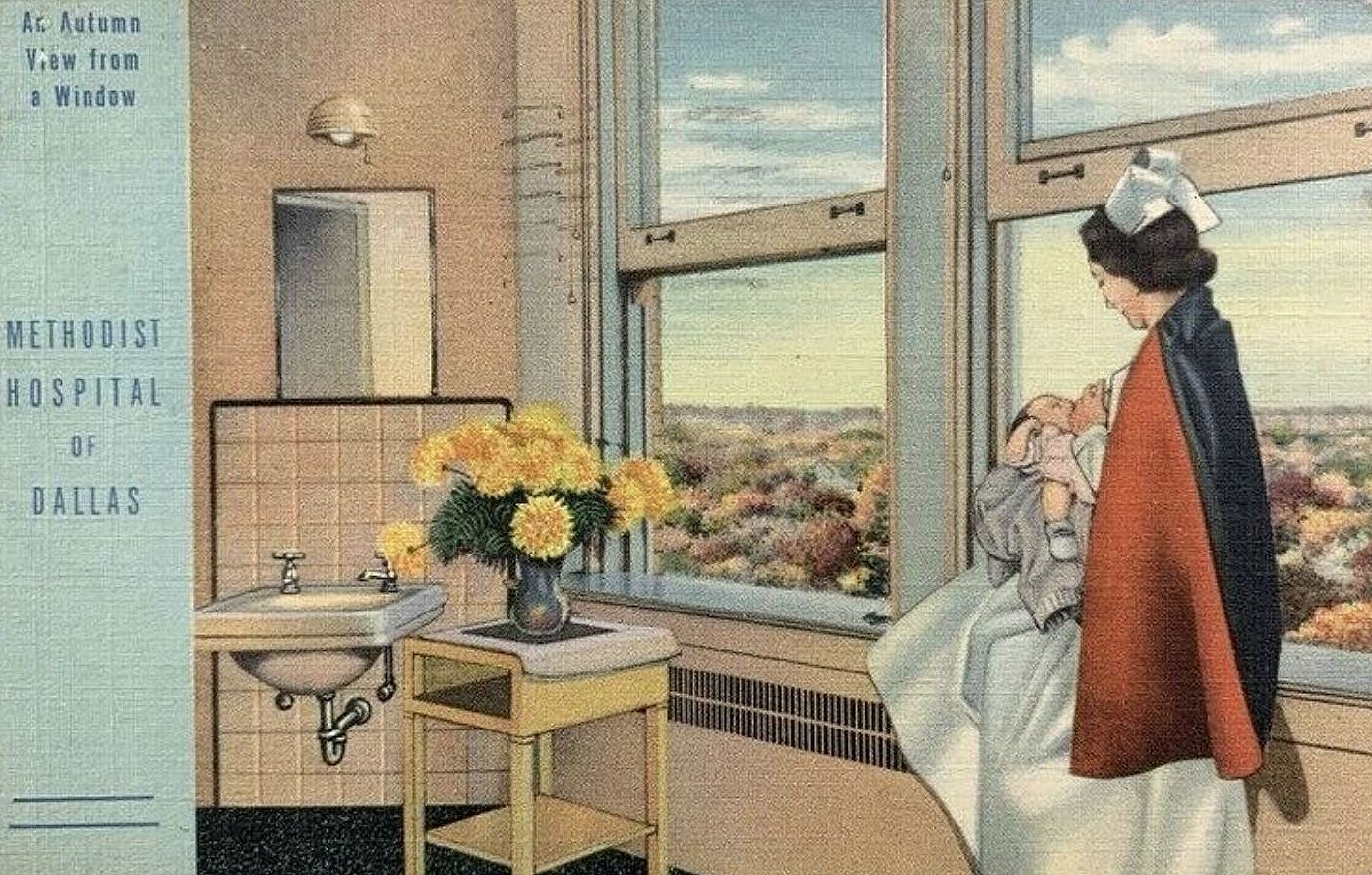
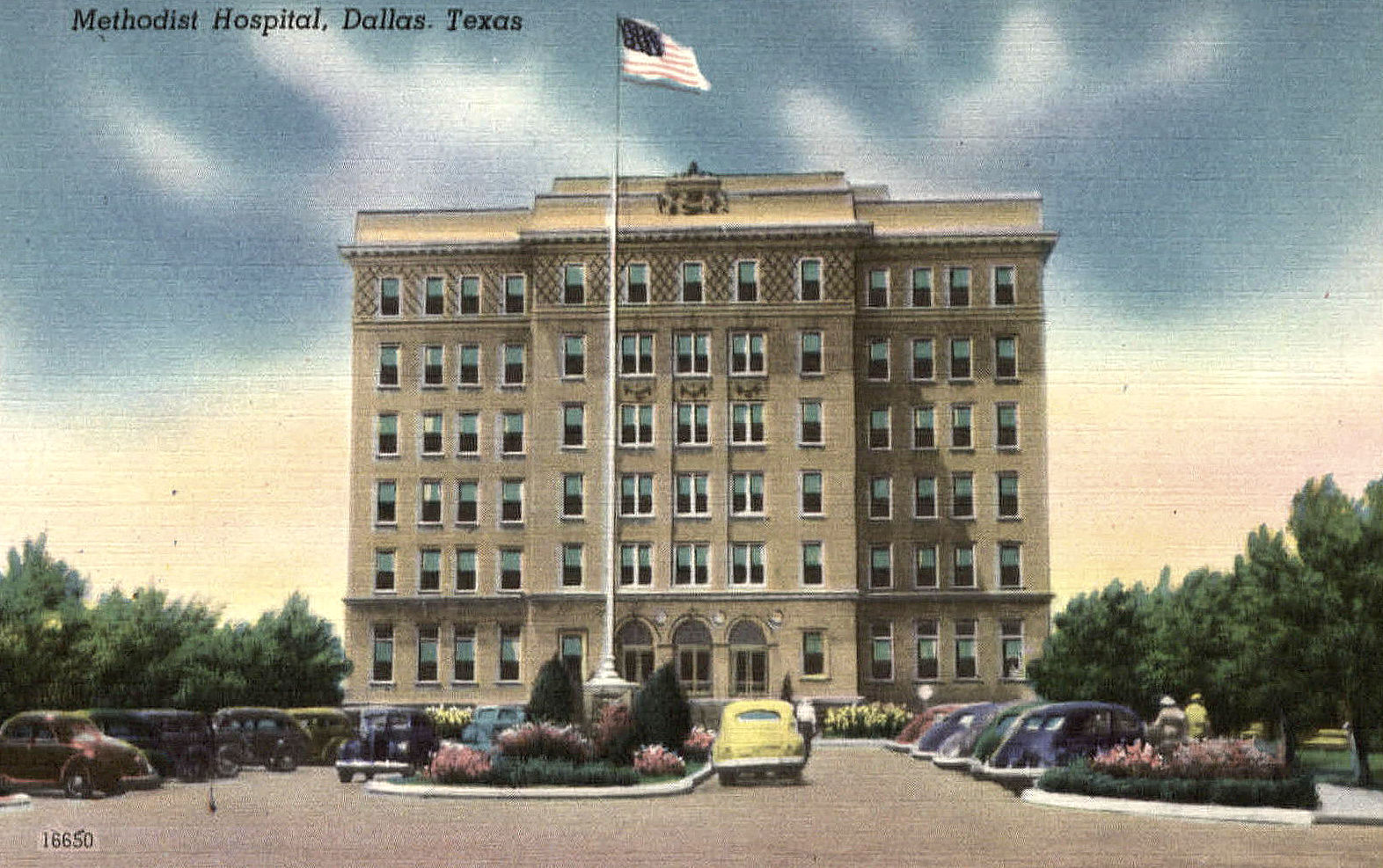
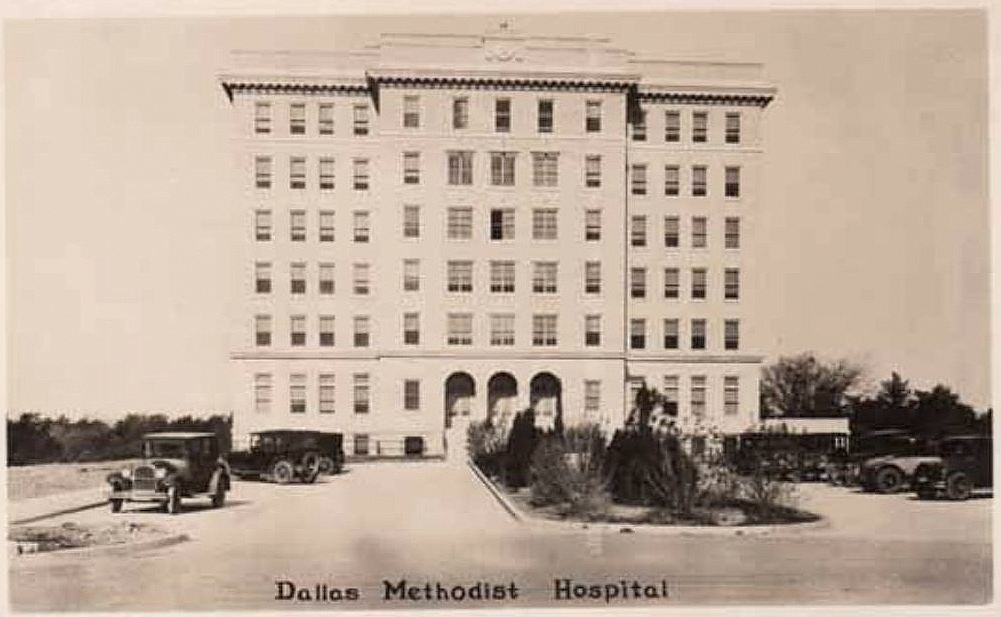
Above, an unusual postcard for Methodist Hospital — “An Autumn View From a Window.” The hospital was located in Oak Cliff at 301 Colorado Street — built in 1927, demolished in 1994. The card is postmarked 1944. Below are two other images.

methodist-hospital_rppc_ebay

methodist-hospital

*

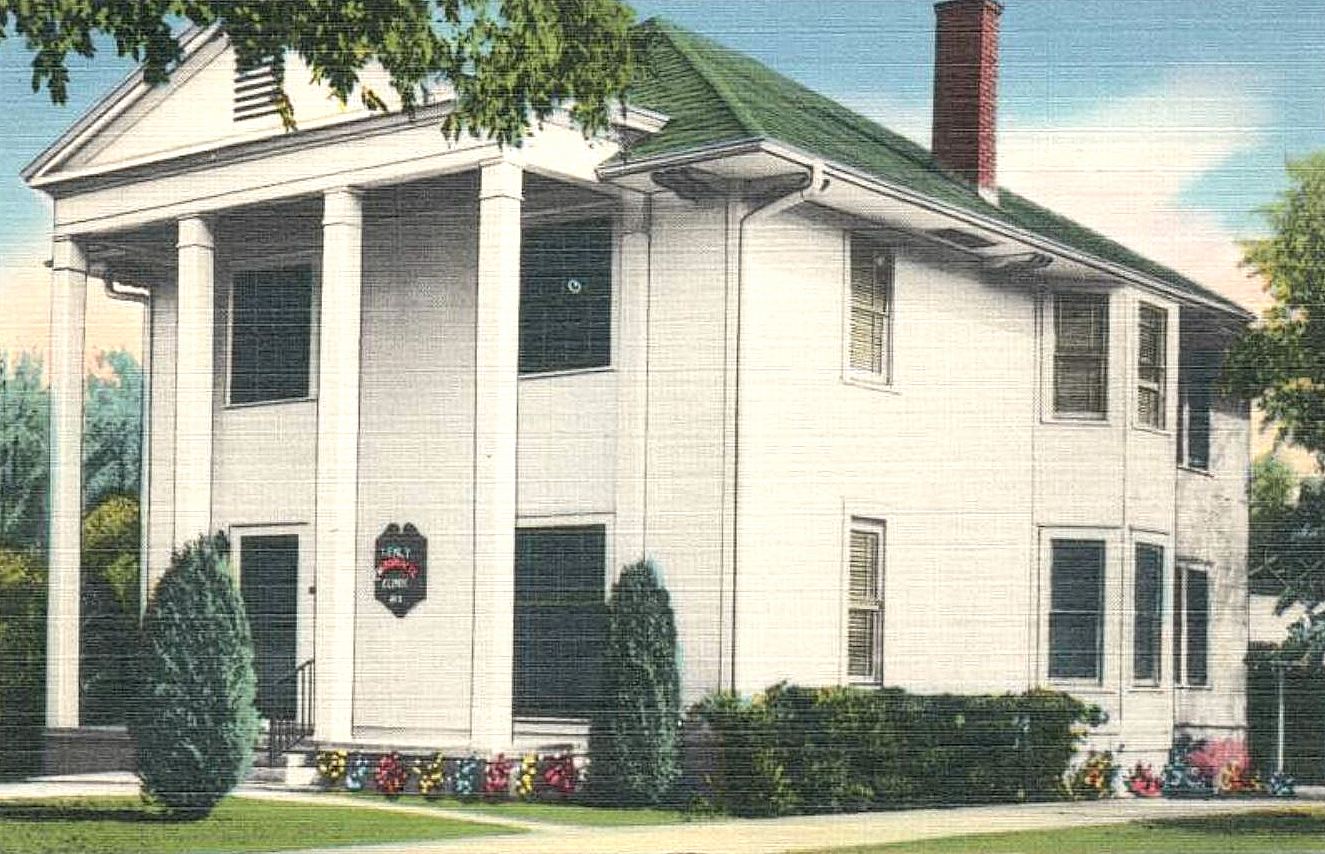
Below, the Lemly Chiropractic Clinic of Dr. F. Lee Lemly at 808 N. Bishop in Oak Cliff (this was also the residence of his family). The house is still standing.

lemley-chiropractic_808-n-bishop_ebay

*

A circa-1910s pretty view of City Park (part of which still hangs on as the site of Dallas Heritage Village in The Cedars):

city-park_postcard_clogenson_ebay

*

Another postcard from The Cedars/South Dallas, once home to a large, vibrant Jewish community, this one shows the Colonial Hill home of insurance man Sidney Reinhardt (1864-1924) at 277 South Boulevard (now renumbered as 1825 South Blvd.). The house was built around 1907, and this postcard appeared before 1911. The house — in what is now designated as the South Boulevard-Park Row Historic District — still stands.

south-blvd_now-1825_sidney-reinhardt_postcard_1910_ebay

*

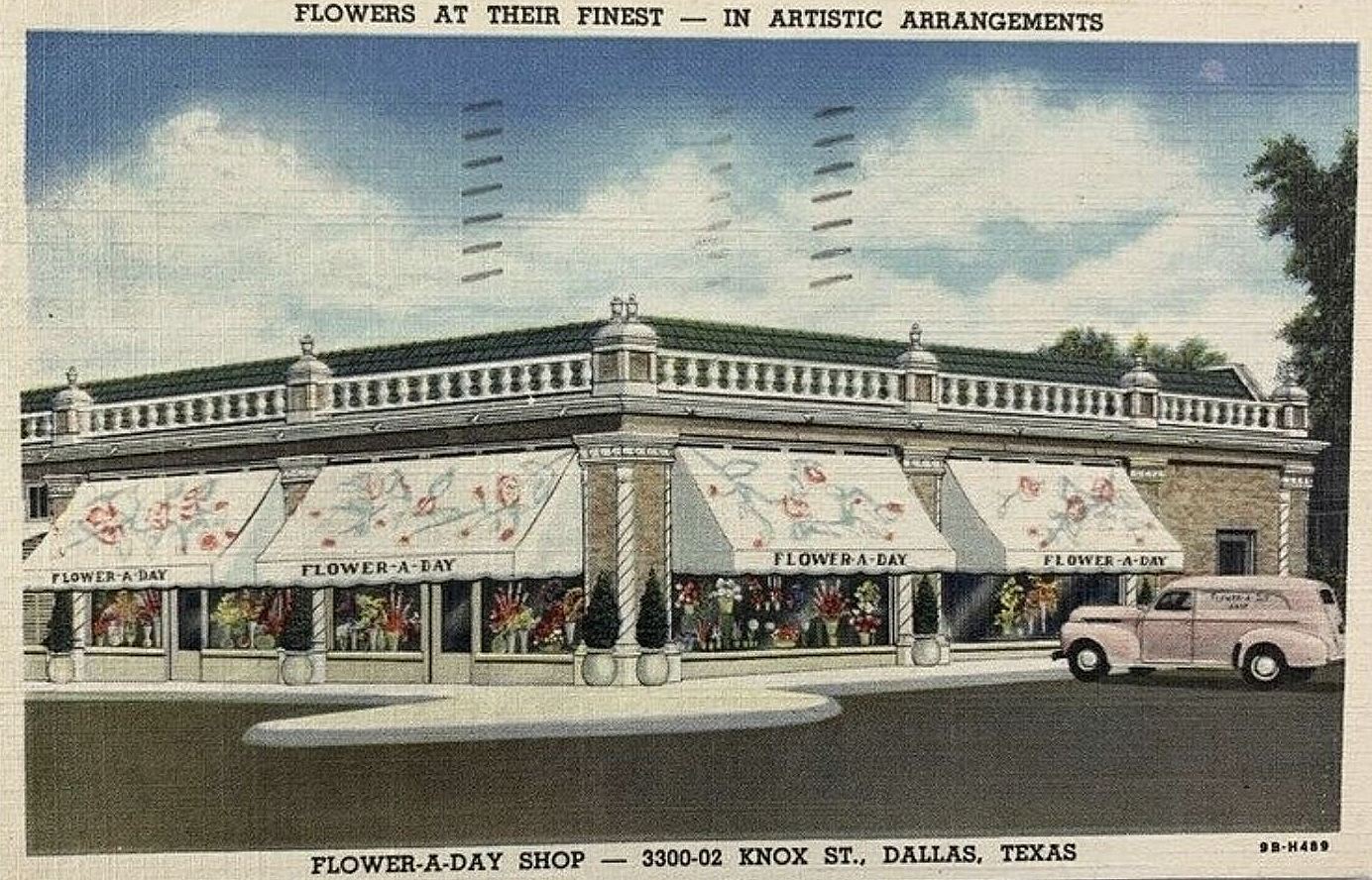
Here’s the Flower-A-Day Shop at the corner of Knox and Travis; the building is still there, but it’s nowhere near as charming today as it was when this postcard was mailed in 1955.

flower-a-day_knox-and-travis_postmarked-1950_ebay

*

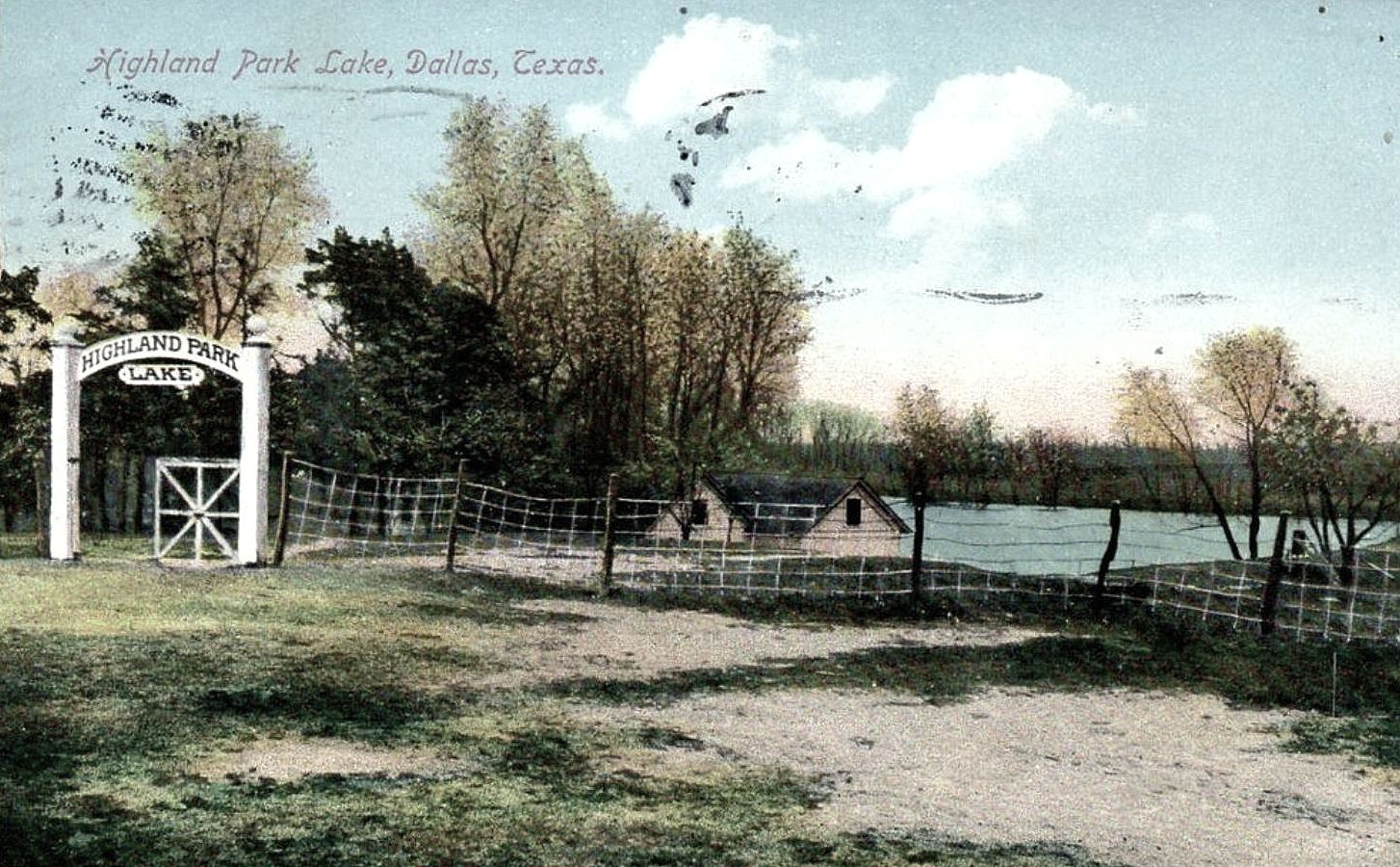
And, lastly, “Highland Park Lake,” now Exall Lake. In fact, it was originally Exall Lake, as it was on the property of Henry Exall, who created the lake by damming Turtle Creek. The lake was a favorite recreation spot way out of town. It seems to have become “Highland Park Lake” after John Armstrong had taken over the property with an eye to developing what eventually became Highland Park. I’ve actually never heard of “Highland Park Lake,” but it was still being referred to as that in the 1960s — I’m not sure when it reverted to “Exall Lake” (or where exactly this photo was taken), but it remains one of Highland Park’s beauty spots. 

highland-park-lake_postcard

***

Sources & Notes

Most of these postcards were found on eBay.

methodist-hospital_postcard_1944_ebay_sm

*

Copyright © 2019 Paula Bosse. All Rights Reserved.
A Flooded Sportatorium — 1945

sportatorium_flood_squire-haskins_UTA_boys-1_det
Boys gotta do what boys gotta do… (photo: Squire Haskins/UTA Libraries)

by Paula Bosse

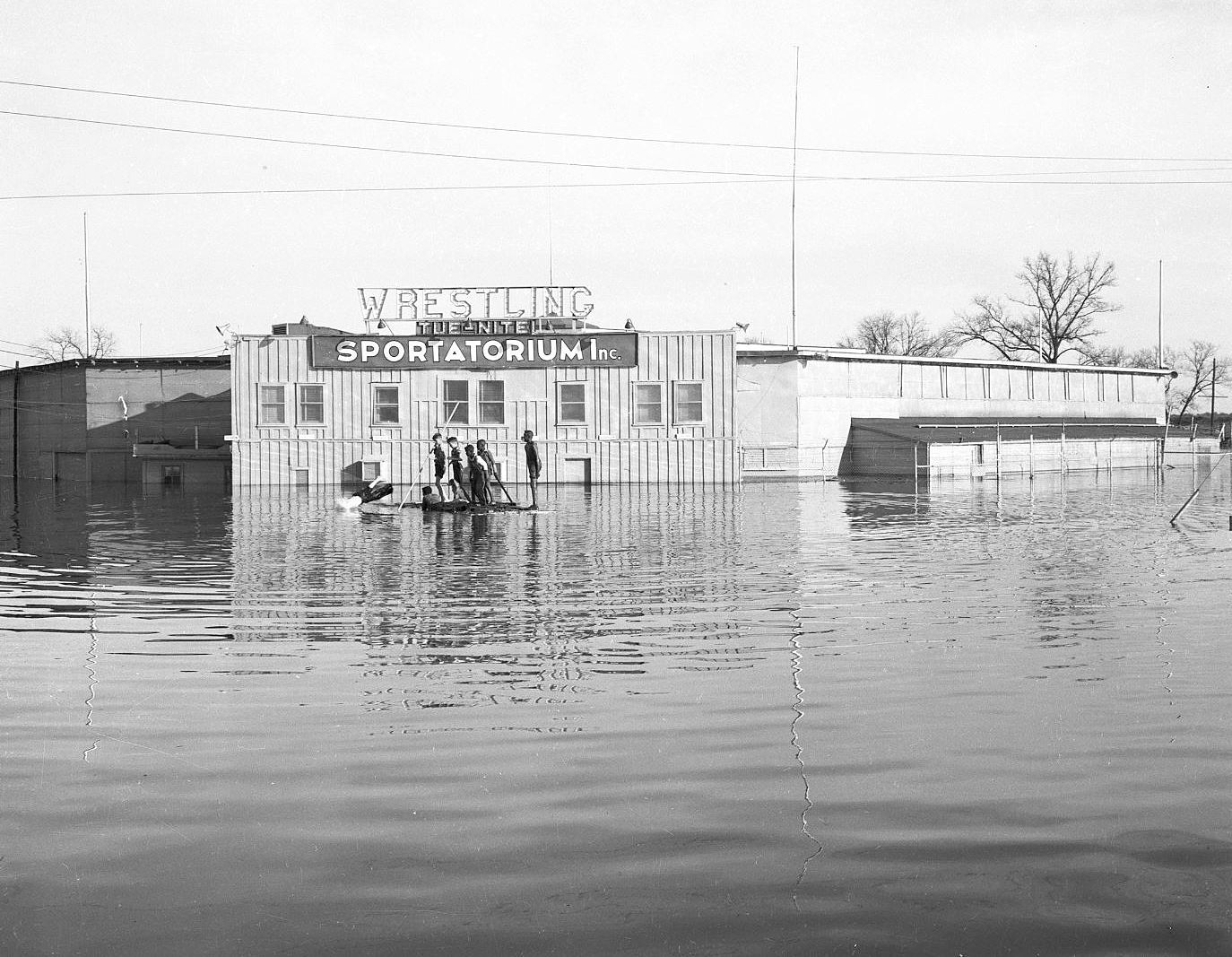
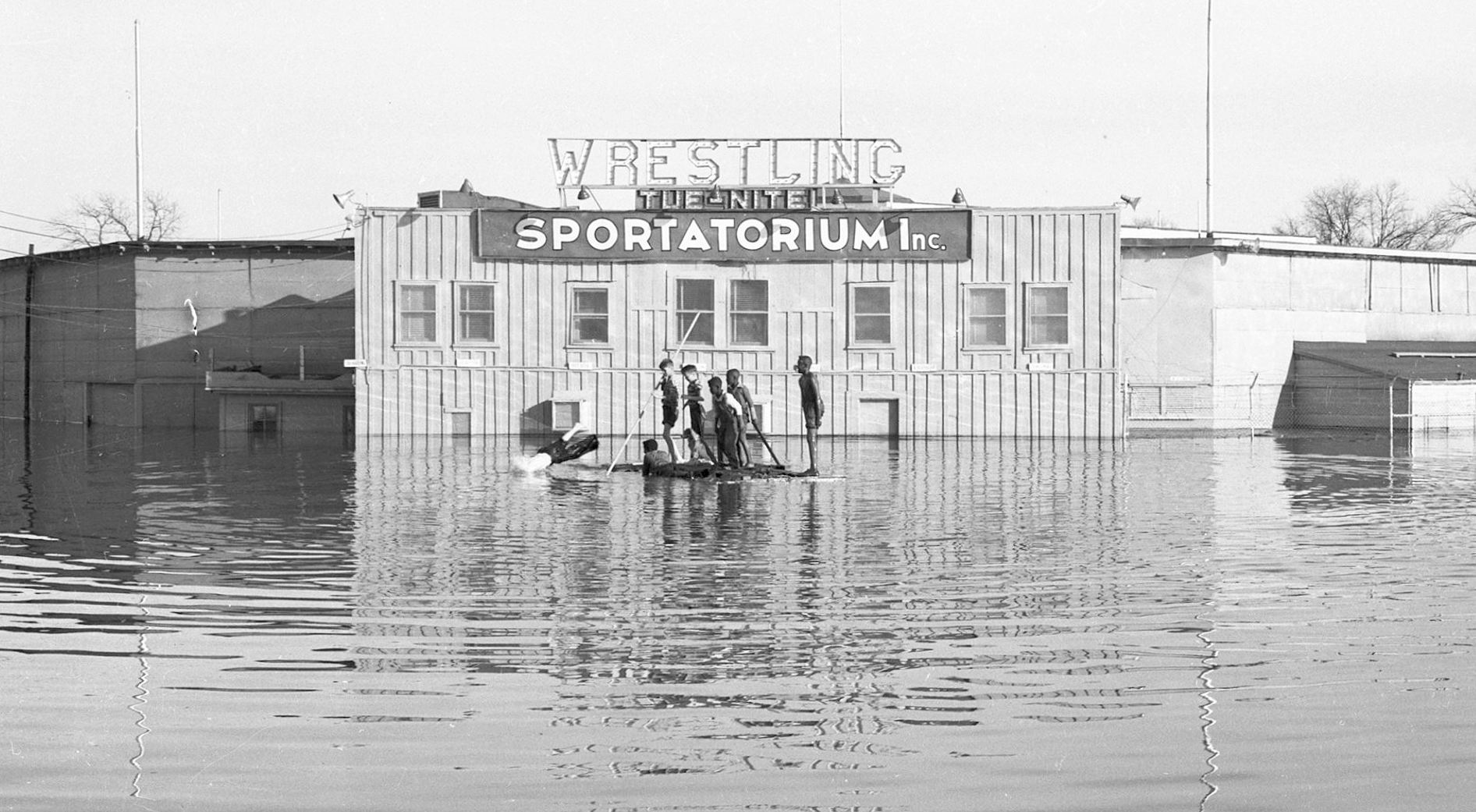
Imagine it has flooded around the Sportatorium: what would you expect seven boys and their dog to do? Well, here they are doing about what you’d expect. (The image above is a detail from the photo below, by Squire Haskins.)
sportatorium_flood_squire-haskins_UTA_boys-1

Another photo, this one with a Huck-Finn-meets-Iwo-Jima-Memorial vibe:

sportatorium_flood_squire-haskins_UTA_boys-2

My closer-up detail (click to see larger image):

sportatorium_flood_squire-haskins_UTA_boys-2_det

Another view:

sportatorium_flood_squire-haskins_UTA_no-boys

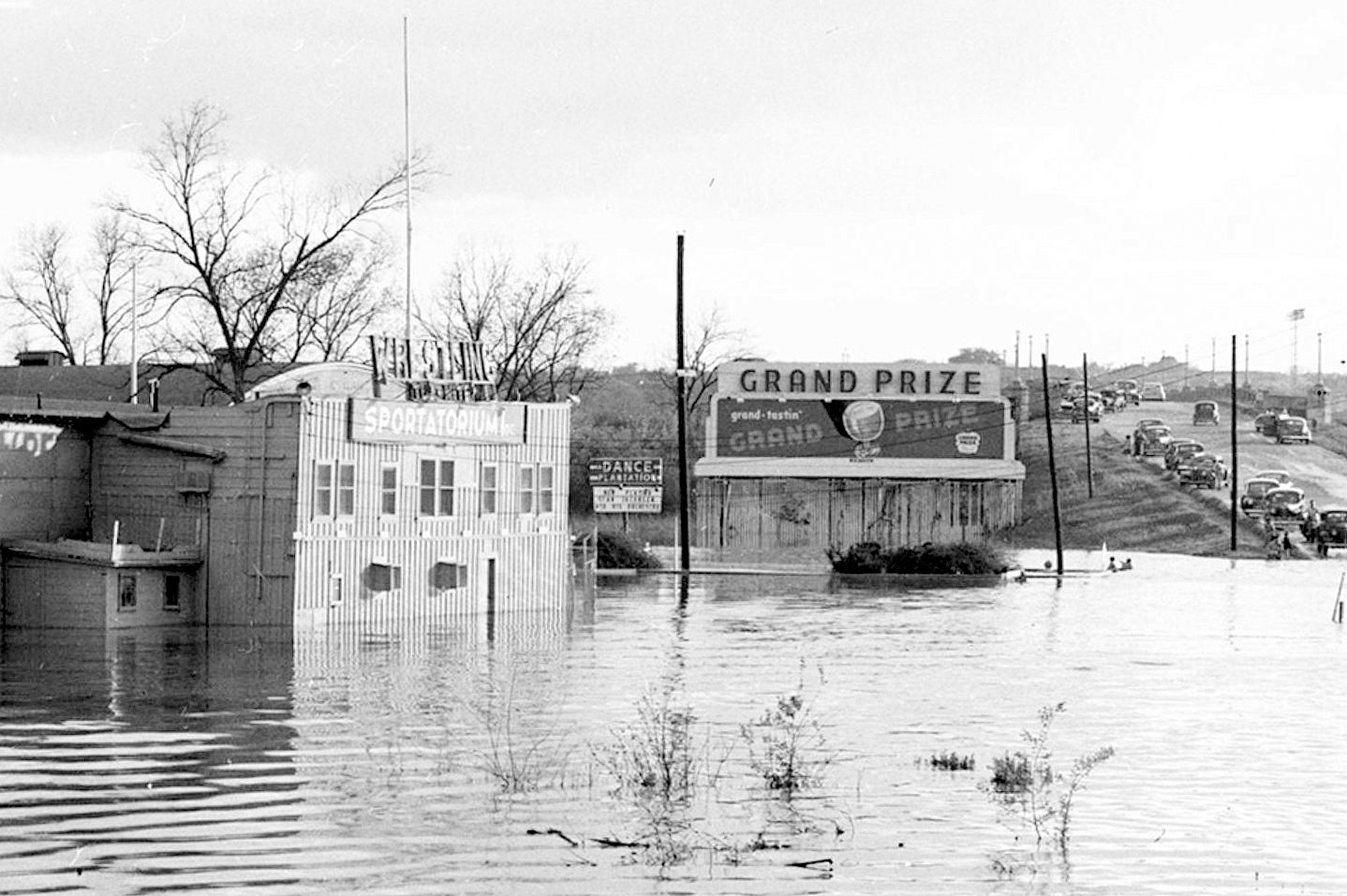
Closer up, with a Grand Prize Beer billboard, cars (on Industrial?), and a sign for the next-door Plantation nightspot:

sportatorium_flood_squire-haskins_UTA_no-boys_det

No wrasslin’ tonight, y’all.
***

Sources & Notes

All photos by Squire Haskins, from the University of Texas at Arlington Libraries, Special Collections.

The photos in the UTA collection are undated, but a photograph of these same boys and dog on their raft appeared in The Dallas Morning News on April 5, 1945, along with a whimsical article titled “Pint-Size Warriors Fight Battle of Trinity, Prove Stormiest Rain Cloud Has Silver Lining.” A few pages away there were several aerial photos showing the major flooding which had submerged large portions of the area around the Sportatorium and Corinth Street viaduct.

The Sportatorium was located at 1000 S. Industrial (now Riverfront), at Cadiz (see map here). Maybe a little too close to the Trinity….

*

Copyright © 2019 Paula Bosse. All Rights Reserved