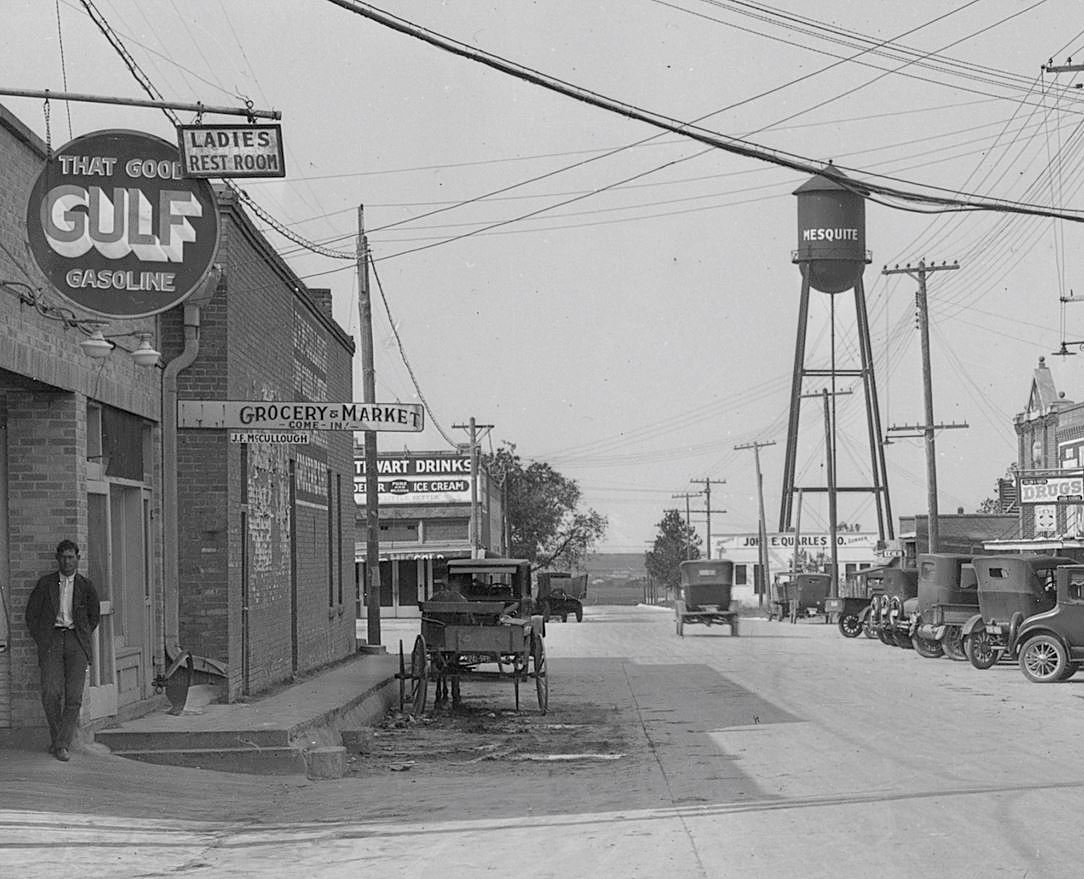
Meet you under the water tower… (photo: Dallas Public Library)
by Paula Bosse
How about a little love for Mesquite, our neighbor friend to the east. I came across this great photo of Mesquite’s old downtown area in the library archives the other day. The full photo from 1925 — by Dallas photographer Frank Rogers — is below. A detail of the photo (which looks a perfect little photo all on its own) is above.
The building on the right side of the photo is the Snyder Bank Building (1915). It still stands at 201 West Main — see it today on Google Street View here.
Too bad that water tower is gone. But thanks for keeping the Snyder building, Mesquite!
***
Sources & Notes
This photo, “[Downtown Mesquite, Texas],” was taken by Frank Rogers in 1925. It is from the Frank Rogers Collection, Dallas History and Archives, Dallas Public Library; its call number is PA78-2/334.
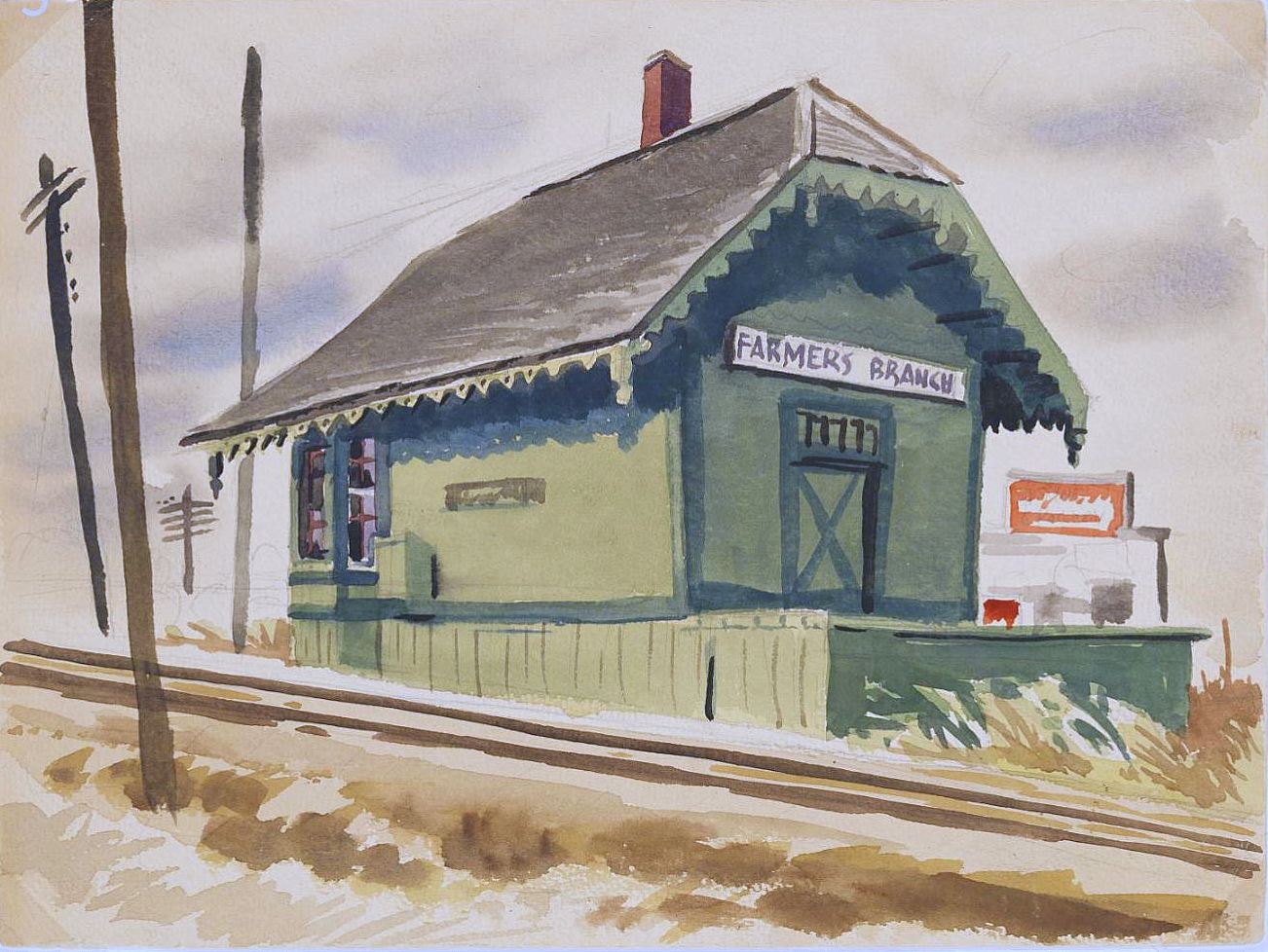
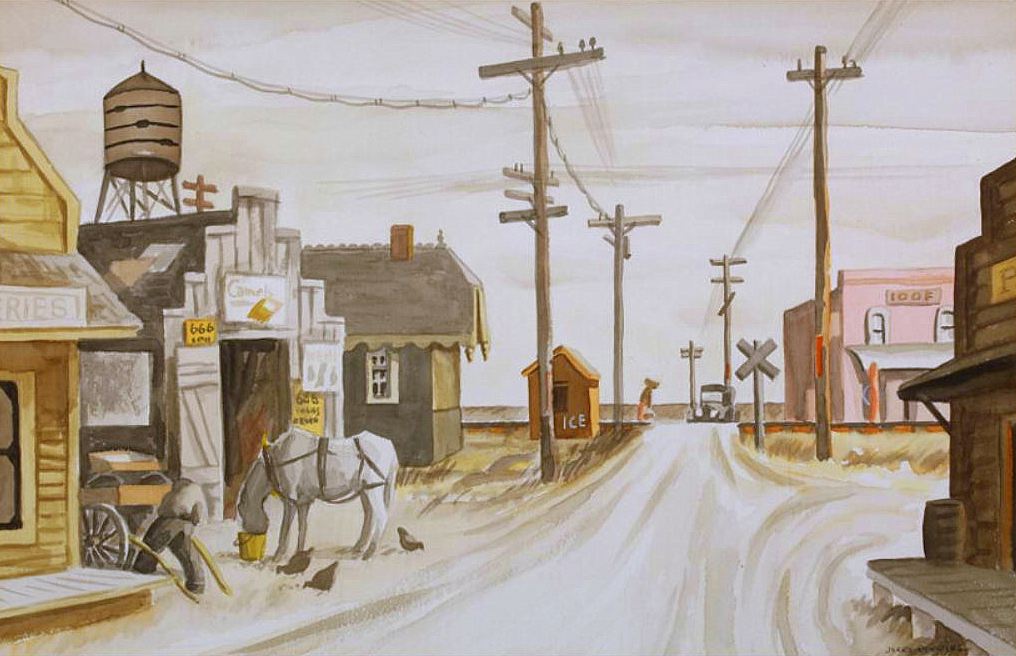
One of the joys of being a fan of an artist is discovering works you’ve never seen before. And here are two, both by a favorite of mine, Dallas artist Jerry Bywaters — and both are watercolors of the very nearby Farmers Branch. Bywaters must have been quite taken with the picturesque little depot there, because it snuck into at least two of his paintings. The one above is untitled, and the one below is “Farmers Branch In the Early Days.”
I can’t find dates for either of these, but the top work appears to have debuted at an exhibition at the Lawrence Art Galleries in November 1937 (it is mentioned in a review of the show by Frances Folsom in The Dallas Morning News — “Exhibition of Art Works by Jerry Bywaters Opening,” DMN, Oct. 31, 1937).
The depot is still standing — it was restored and relocated to the Farmers Branch Historical Park in 1985. Read a great history of the depot here.
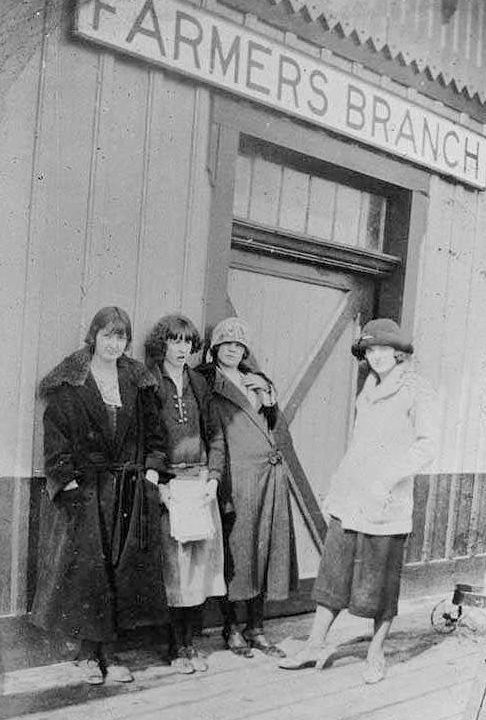
The photo below is from the City of Farmers Branch site. Who wouldn’t want to spend a day with those girls?
I think I need to explore Farmers Branch.
***
Sources & Notes
Top painting (“Untitled [Farmers Branch Train Depot]”) is an undated watercolor by Jerry Bywaters, from the Bywaters Special Collections, Hamon Arts Library, SMU Libraries — more info on this can be found at the SMU site here.
The second painting, “Farmers Branch In the Early Days,” is an undated watercolor by Jerry Bywaters; it was sold by Heritage Auctions in 2010. (A notation on the back of this framed piece indicates that it once belonged to the legendary Judge Sarah T. Hughes, or it was purchased by her to give to a very lucky friend.)
The photo of bobbed flappers loitering around the depot is from the City of Farmers Branch website, here.
Other Flashback Dallas posts with (very different) examples of Jerry Bywaters’ art:
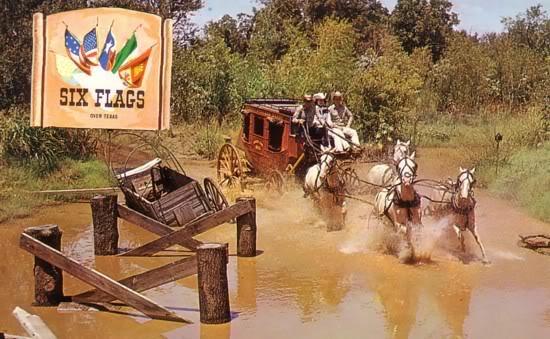
And this (with grazing buffalo for added Old West atmosphere):
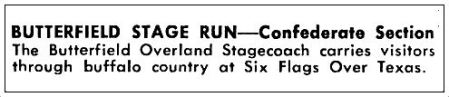
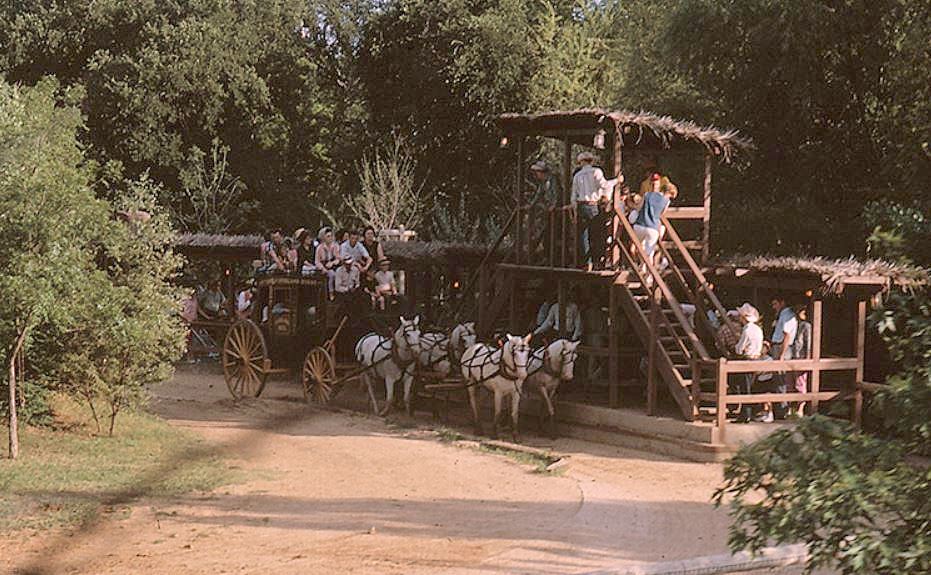
When I first saw Six Flags postcards touting stagecoach rides, my first thought was, “How did they ever manage to get insurance for that?”
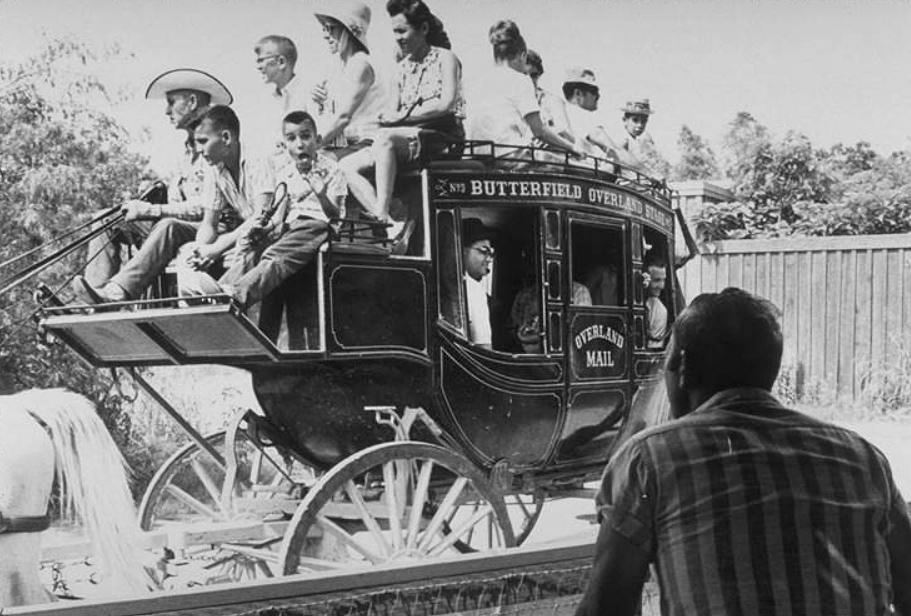
The “Butterfield Overland” ride debuted in the “Confederate” section when the park opened in 1961 and lasted until about 1967. It was very, very popular.
1965, via UTA Libraries Special Collections (det)
Why did I never know about this when I was a kid? I never saw a stagecoach. I would have LOVED to ride a stagecoach. What happened? Well, here’s what happened: in May 1967, one of the stage’s wheels came off mid-ride, and the stage overturned, injuring 11 of the 14 people on board, most of them children. A 4-year-old Haltom City girl — who was riding on the top — was pinned beneath the overturned stagecoach. When she was freed, she was rushed to the hospital and underwent emergency surgery on both feet. One of the news stories about this unfortunate incident ended with, “Saturday’s accident was the first involving the stagecoach since the park opened in 1961,” adding that more than 4 million persons had ridden this ride between 1961 and 1967. (Four million!) (Granted, I think there were four stagecoaches and four teams of horses, but… four million!!)
One month after the accident, it was reported that the girl’s father had sued Six Flags for $531,000, contending that park officials were guilty of 30 counts of negligence. ($531,000 would be the equivalent in today’s money of about $5 million.) I can’t find anything about what happened with this lawsuit, but I assume there was probably a quiet settlement. Coincidentally or not, that spelled the end of the Butterfield Overland stagecoach ride at Six Flags Over Texas.
And that’s why I never heard of — or got to experience — a stagecoach ride at Six Flags.
(I don’t know what happened to the buffalo.)
***
Sources & Notes
Top photo of a Six Flags stagecoach jam-packed with kids from Fort Worth magazine.
The 1965 image is a detail of a larger photo from the Jack White Photograph Collection, UTA Libraries Special Collections — see the full photo and more details here.
Read more about this Butterfield Overland stagecoach ride at Parktimes.com.
The whole “Confederate” and “Texas” sections of SFOT were kind of weird, including a several-times-a-day lynching (!), as can be seen in one of the postcards in the 2014 Flashback Dallas post “Angus Wynne Jr.’s ‘Texas Disneyland’ — 1961.”
A slightly different version of this post originally appeared on the Flashback Dallas Patreon page in August 2023. If you’d like to see daily Flashback Dallas posts, please consider supporting me on Patreon, for as little as $5 a month.
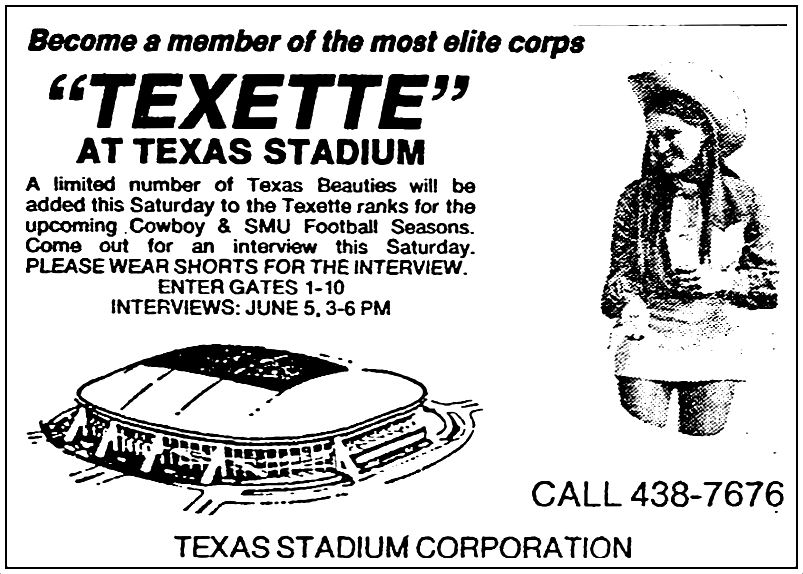
I will never be accused of knowing anything about sports — or even about things that are sports-adjacent — but I’m fairly literate in pop culture, and I am genuinely surprised that, until yesterday, I had never heard of the “Texettes.” I have no idea how long they lasted (for all I know, they’re still around!), but it was from 1971 until at least 1984 (I say 1984 only because there was a classified ad in the The Dallas Morning News announcing Texette auditions in June of that year — but Blackie Sherrod mentions them in what I think is the present tense in a 1989 column, so they might have been around into the ’90s). Seriously, how have I never heard of them? There’s almost nothing about them online, which is weird, because they were around for a significant amount of time.
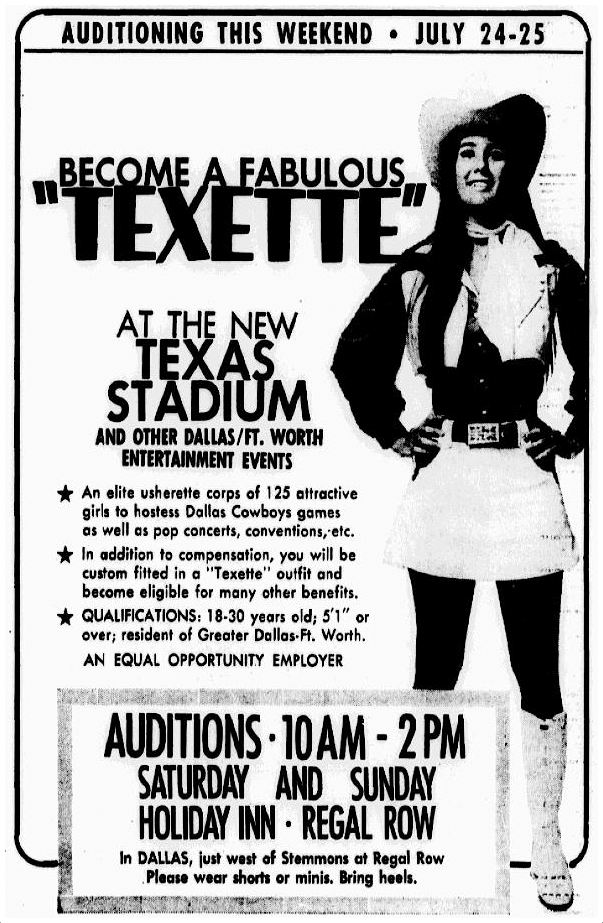
The ad above, announcing the first-ever Texette auditions, appeared in the Dallas and Fort Worth newspapers on July 21, 1971. The opening of the brand-new Texas Stadium was on the horizon (the first Dallas Cowboys game to be played there was on Oct. 24, 1971), and the huge stadium was going to be 100% unfamiliar to Cowboys fans — they were going to need people to help them find stuff. Here’s where the Texettes came in. They were described as “hostesses” and “usherettes” who wore mini-skirts and go-go boots. Open auditions were held to find 125 Texettes. Hopefuls were advised to wear hotpants or mini-skirts and heels. The only qualifications appear to have been that the “girls” be between the ages of 18 and 30, at least 5’1″, DFW residents, and attractive.
*
BECOME A FABULOUS ‘TEXETTE’ AT THE NEW TEXAS STADIUM
and other Dallas/Ft. Worth entertainment events.
An elite usherette corps of 125 attractive girls to hostess Dallas Cowboys games as well as pop concerts, conventions, etc.
In addition to compensation, you will be custom fitted in a “Texette” outfit and become eligible for many other benefits.
**
Texettes were “hostesses” who smiled and welcomed people to the stadium, helped fans find their seats, and gave tours. (They also seem to have functioned as something not far removed from cocktail waitresses in the press box.) The first year (1971) they were paid $8 a game (equivalent in today’s money of about $60). They also appeared at various DFW events as sort of all-purpose Chamber-of-Commerce-like greeters with toothy smiles and toned thighs.
Their outfits consisted of white knee-high go-go boots, blue mini-skirts, white blouses, vests, yellow neckerchiefs, and white cowboy hats. They pre-dated the “sexy”-era of Dallas Cowboys Cheerleaders (before the famous cheerleaders we know today, high school students cheered the team on at the Cotton Bowl), but the Texettes’ Western-inspired, drill-team-inspired costumes might have served as a kernel of the inspiration for those of the Dallas Cowboys Cheerleaders. It’s interesting (to me, anyway) that the Texettes and the Cheerleaders existed at the same time for a few years — for quite a while, in fact. Seems like they might cancel each other out. But I guess the Texettes were more cute-girl-next-door cowgirls in the stands, and the cheerleaders were sexy-girl-you’ll-never-be-able-to-talk-to-in-real-life cowgirls on the field.
As I said, I’d never heard of this “elite usherette corps” before yesterday. If anyone knows how long they were a thing, please comment below.
**
I’ve found two bits of film of Texette auditions (both are in the indispensable WFAA archives held by the Jones Film Collection at SMU). The first is from July 1971 (the same audition advertised in the top ad) — it can be seen in Channel 8 footage below (there are two separate clips — at the 19:44 mark and at the 24:26 mark). The report is delivered by a frightened man giving off “Tim Calhoun” vibes.
*
A later report — from 1975 — shows another try-out. The reporter notes that the job has unique perks, like maybe finding a football-player husband or catching the eye of a talent scout. By then, the pay had jumped to $10 an appearance, and there were a lot more applicants.
*
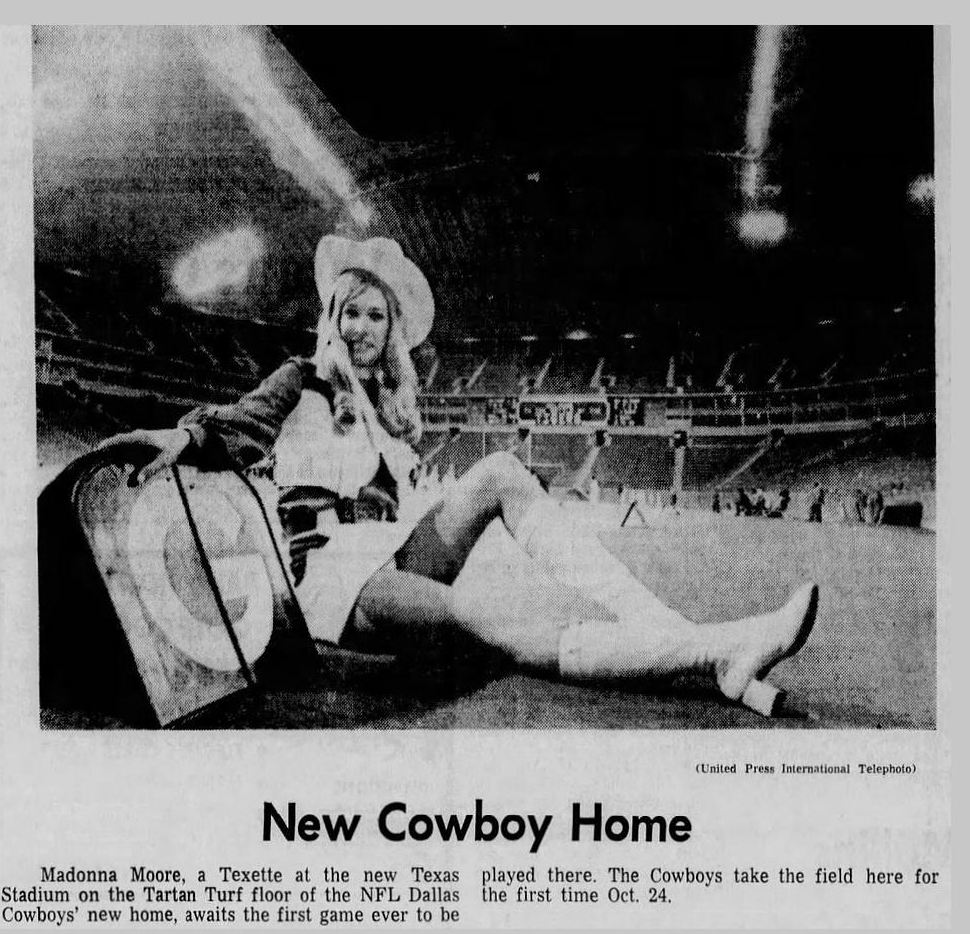
Below, a new Texette (Madonna Moore) on the field at Texas Stadium. This might have been taken on Oct. 15, 1971, the day the very first football game was played there (local team Bishop College lost to Texas Southern University, 34-21).
Bradenton (FL) Herald, Oct. 16, 1971
*
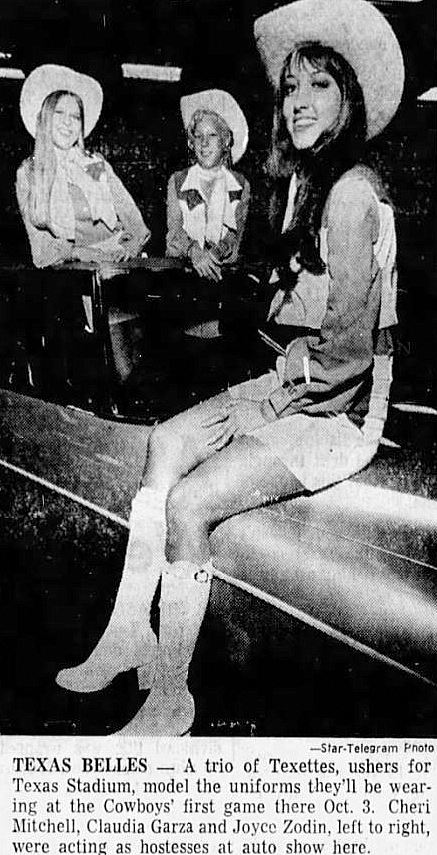
Showing off their new outfits are Texettes Cheri Mitchell, Claudia Garza, and Joyce Zodin. (The caption was incorrect about the date the Cowboys would take the field — that wasn’t until Oct. 24, 1971, in a game against the New England Patriots, which they won 44-21.)
Fort Worth Star-Telegram, Sept. 16, 1971
*
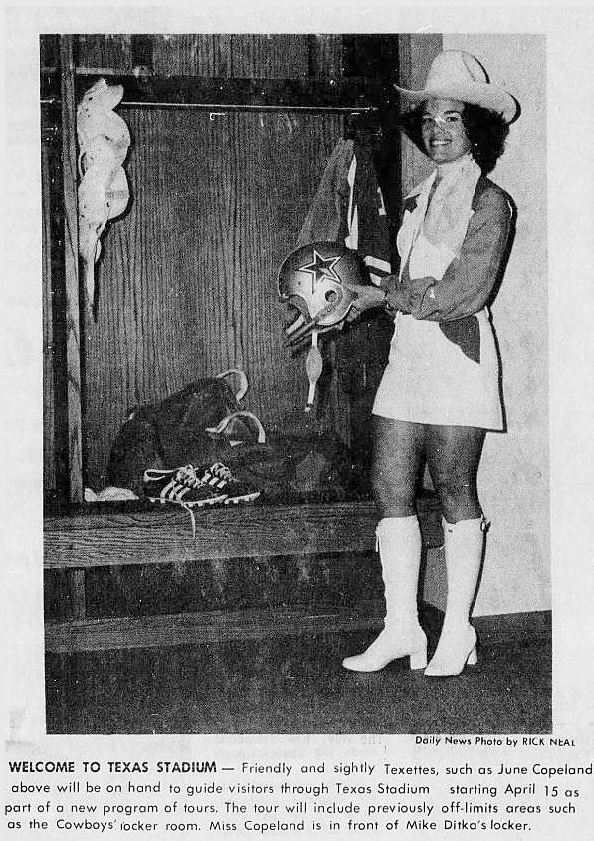
Texette June Copeland stands in front of Mike Ditka’s locker, which appears to have been rifled through.
Irving Daily News, Apr. 5, 1972
*
The Texettes were still going strong in 1982 as they entered their 11th year. I think the skirt has gotten shorter.
June 1982
*
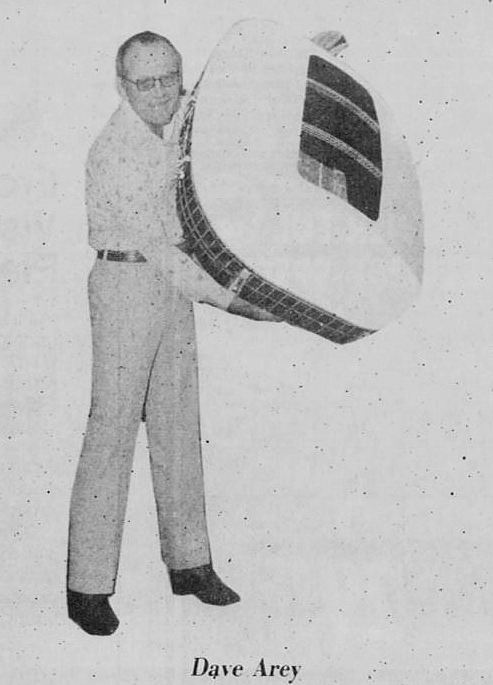
This has nothing to do with the Texettes, but I love this photo of Dave Arey, director of operations at Texas Stadium. He’s seen here holding a replica of the stadium, which seems like it would have been perfect as a doggie bed.
Irving Daily News, Aug. 22, 1976
*
***
Sources & Notes
This originally appeared in a slightly different form this morning as a post on my Patreon page (where I post daily Dallas-history tidbits for subscribers who are generously supporting me for as little as $5 a month).
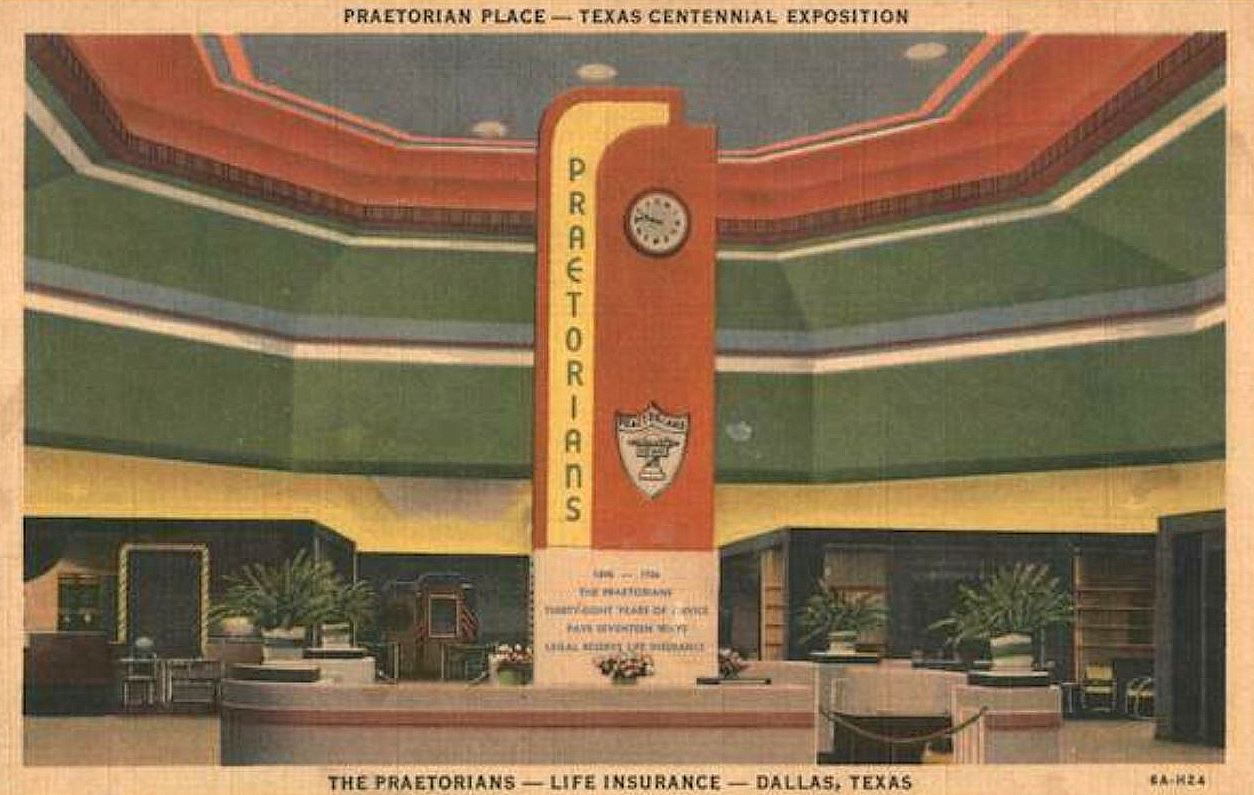
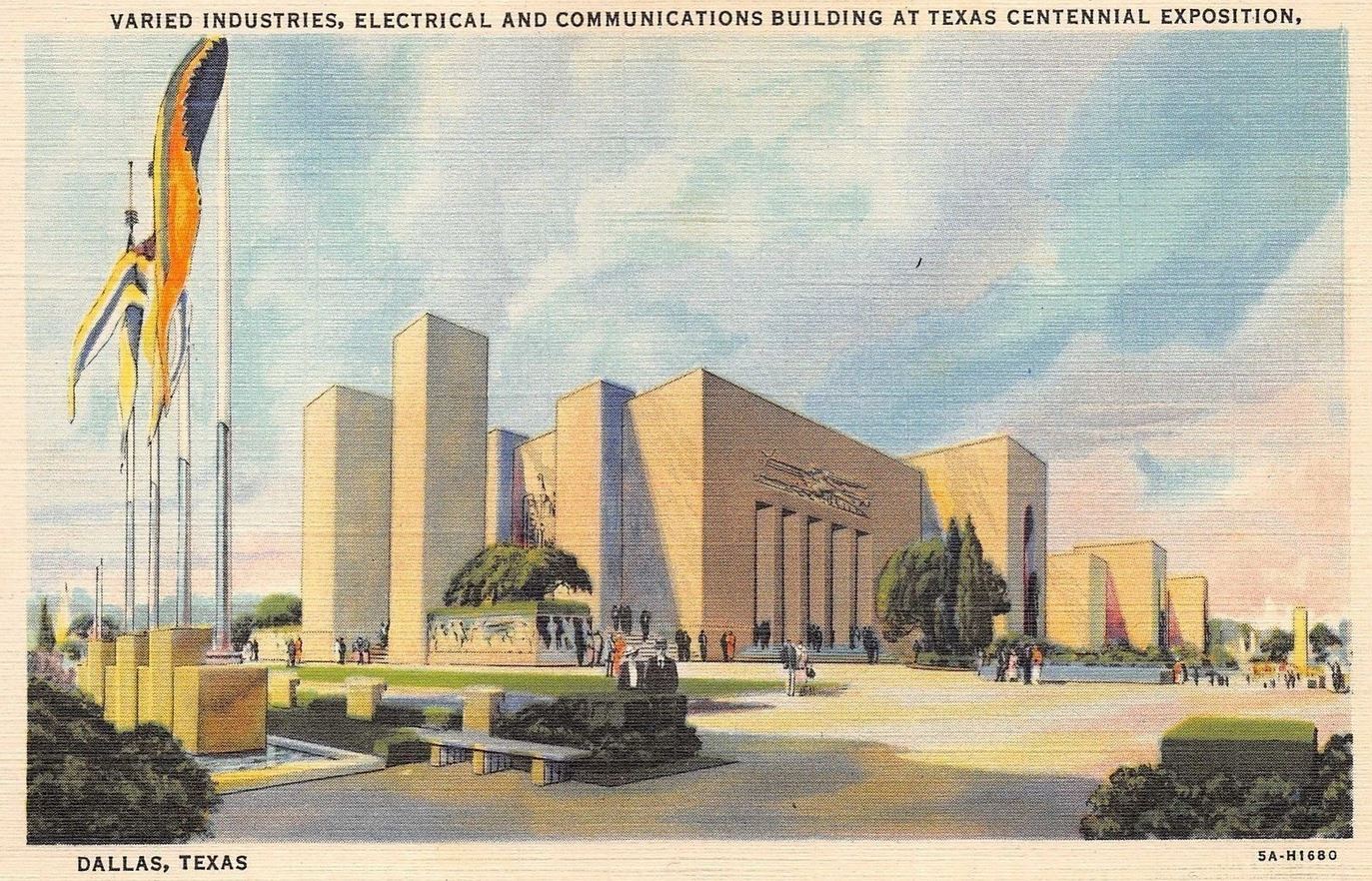
I’ve seen so many Dallas postcards that it’s always a little bit of a jolt when I see one I’ve never seen before, like the one above. The Praetorians Life Insurance exhibit was inside the Varied Industries building (below). So much is written about the architecture of Fair Park — but we don’t hear a lot about the interiors. I don’t think there are many color photos in existence. This is a colorized image, but the colors in real life were pretty vibrant. Even the floors were fantastic! One of my favorite “finds” was the ad at the top of the post “State Fair Coliseum/Centennial Administration Building/Women’s Museum/Women’s Building” — it’s a color photo (!) which shows glimpses of the interior, the furniture, and, best of all, the custom linoleum.
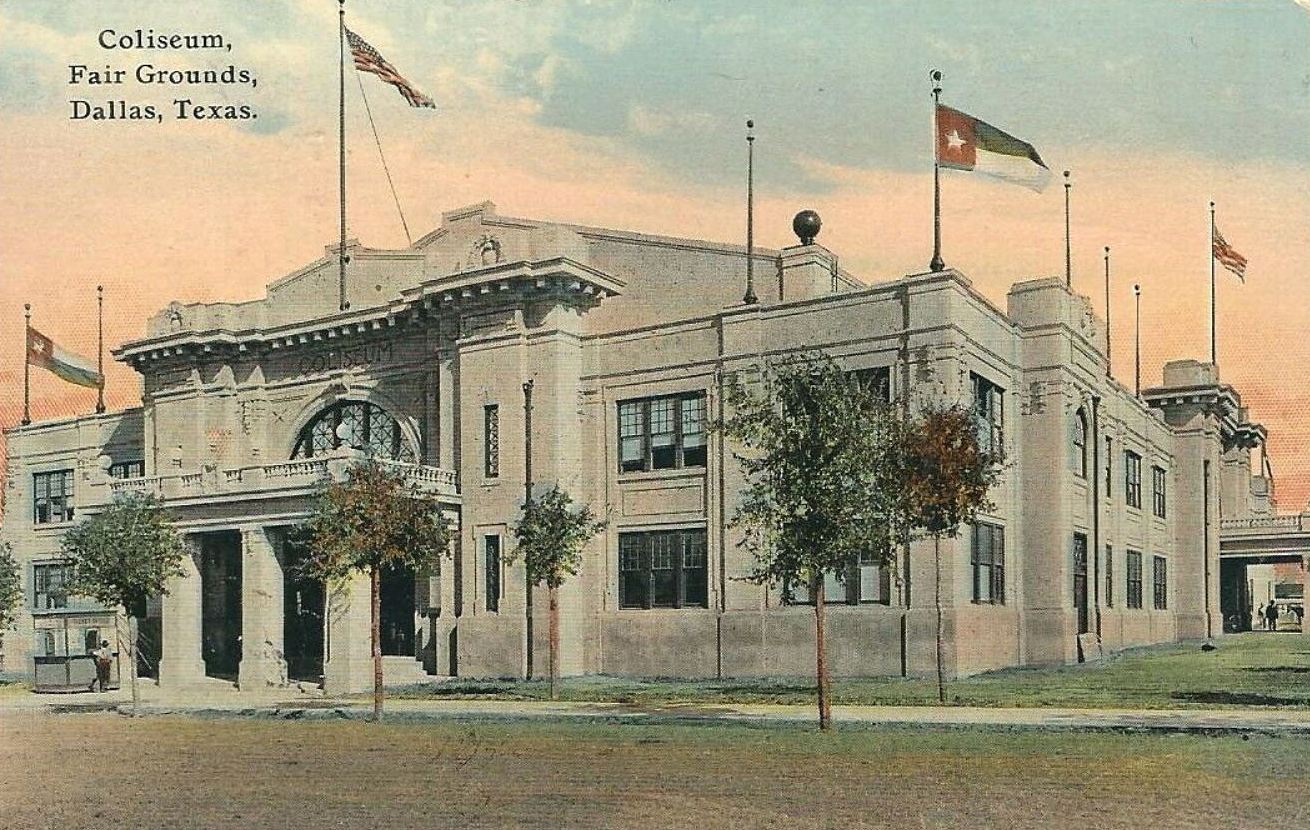
And speaking of the Fair Park Coliseum, this is a great postcard (with a 1911 postmark):
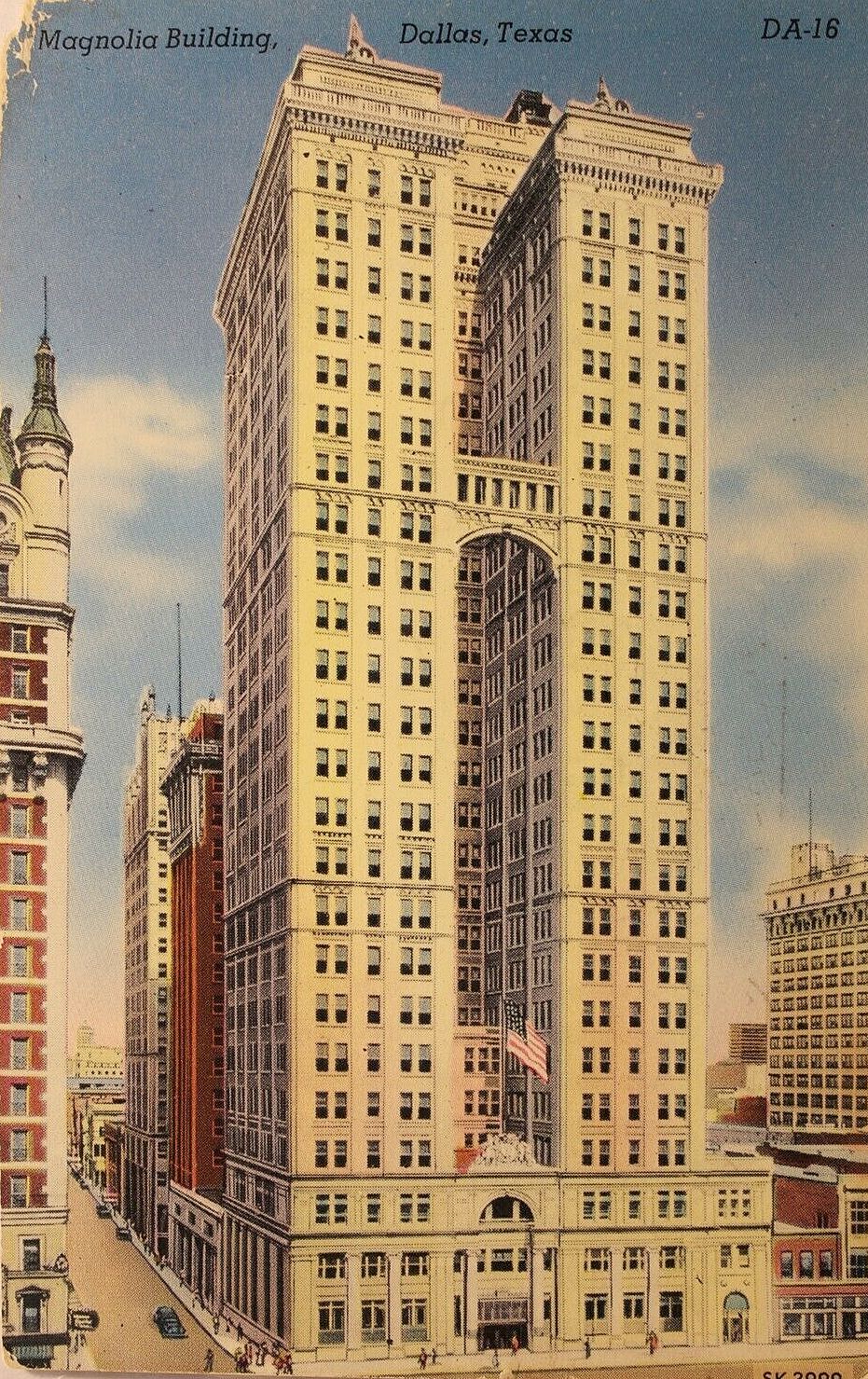
And here’s the Magnolia Building — it never gets old:
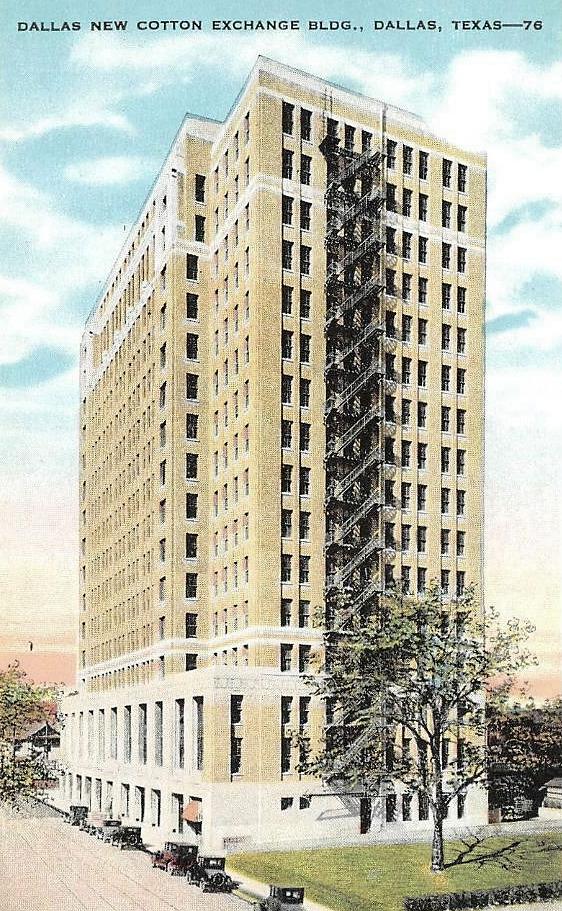
The “new” Cotton Exchange Building, at St. Paul and San Jacinto (I wrote about the old and new Cotton Exchange buildings here — scroll down to #4):
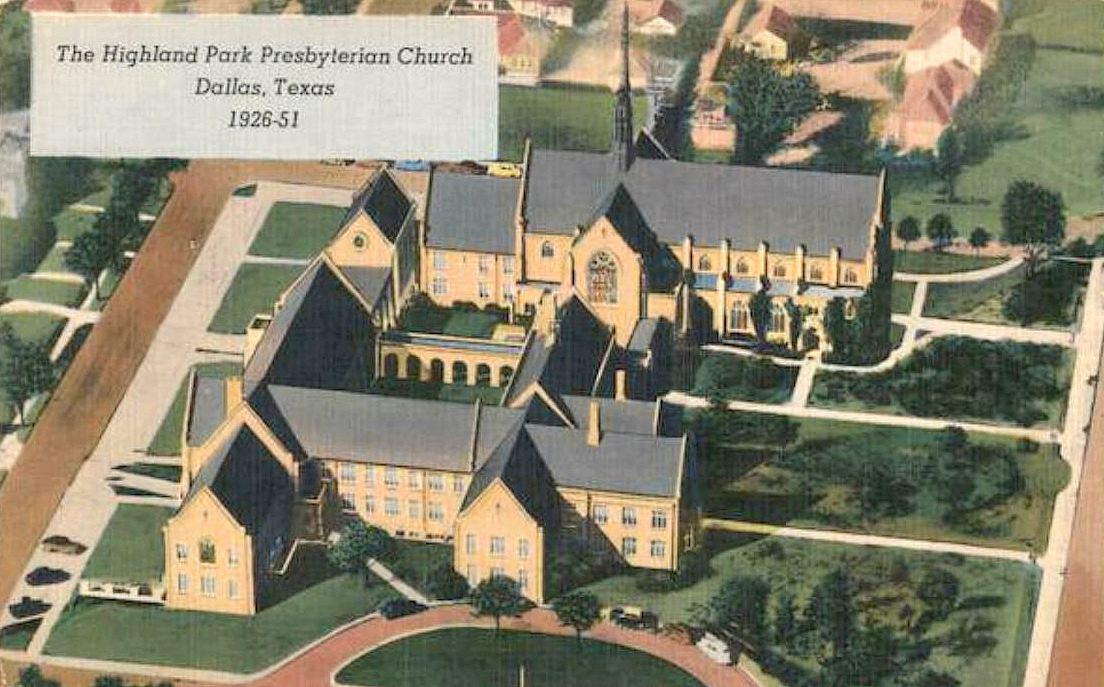
Highland Park Presbyterian Church (circa 1940s):
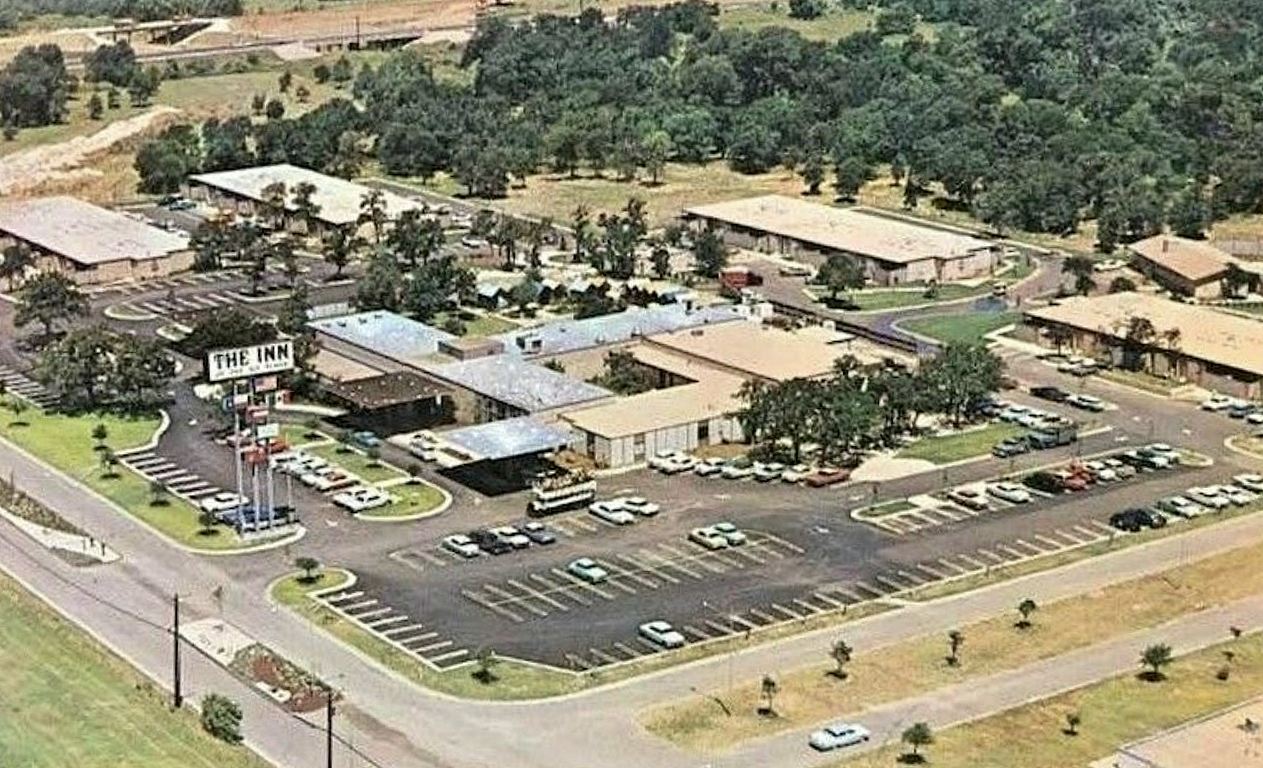
The Inn of the Six Flags — along the DFW turnpike in Arlington. I’d never seen this postcard — and the resolution is pretty bad — but I post this almost entirely to drink in that unbelievably pastoral view of 1960s Arlington.
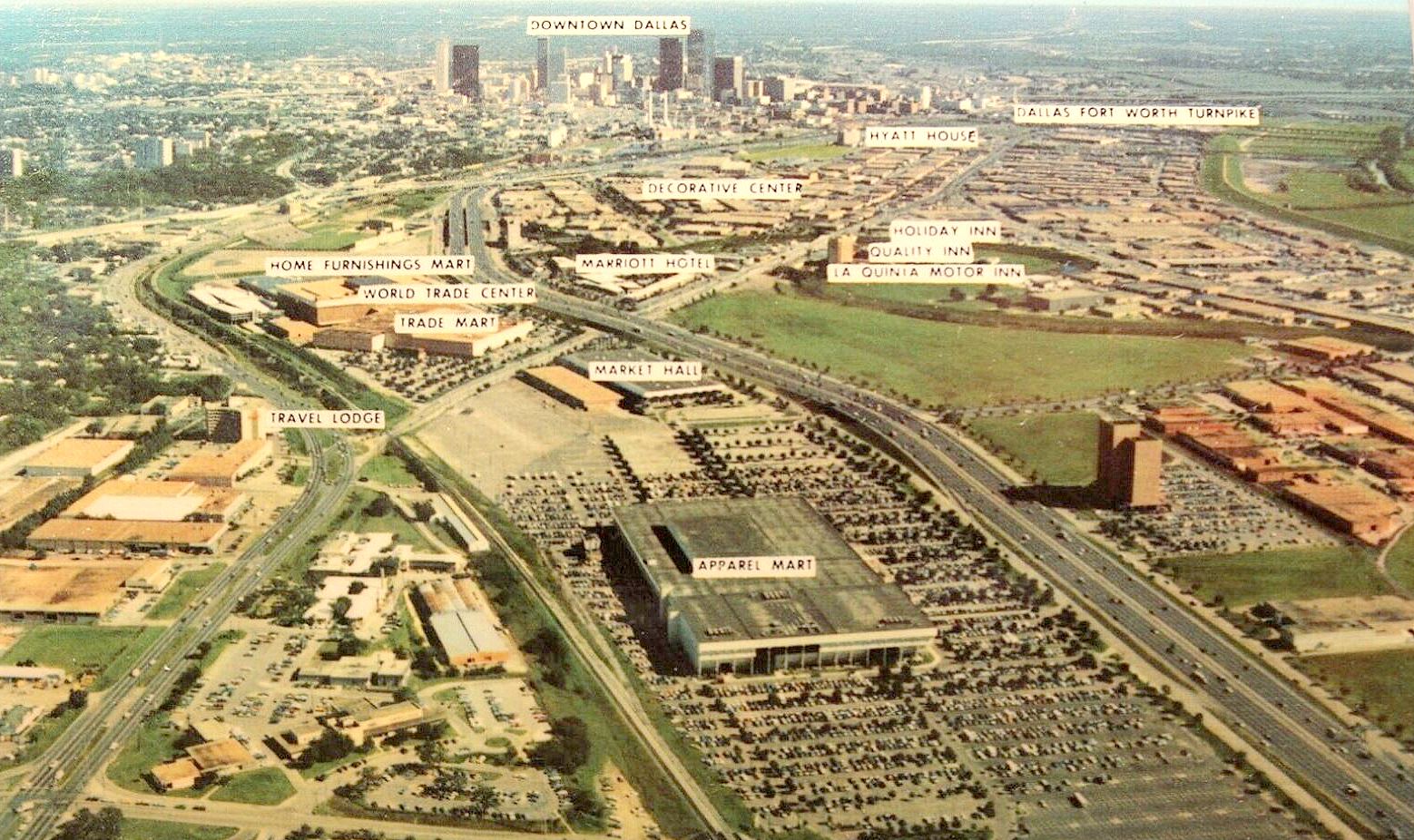
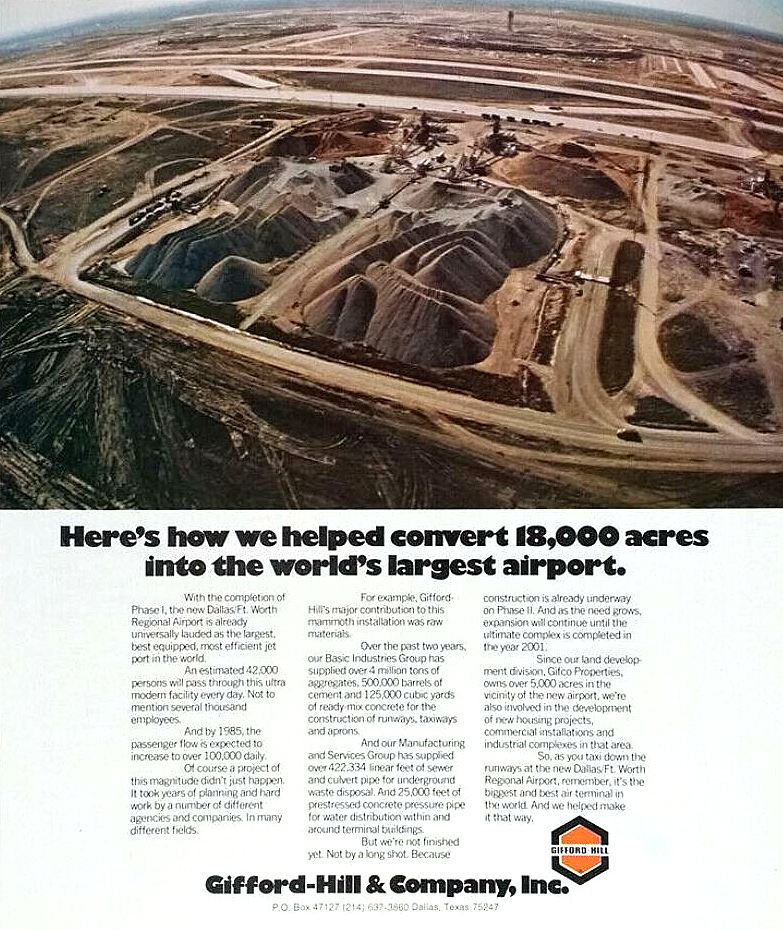
A couple of ads letting the nation know that construction of the new Dallas-Fort Worth International Airport was progressing and would soon be the biggest, bestest… um, BIGGEST airport ever! “Phase I” was completed by the end of 1973, and DFW opened for business in January, 1974.
The first ad, from Gifford-Hill (click to see larger image — transcription below):
Here’s how we helped convert 18,000 acres into the world’s largest airport.
With the completion of Phase I, the new Dallas/Ft. Worth Regional Airport is already universally lauded as the biggest, best equipped, most efficient jet port in the world.
An estimated 42,000 persons will pass through this ultra modern facility every day. Not to mention several thousand employees.
And by 1985, the passenger flow is expected to increase to over 100,000 daily.
Of course a project of this magnitude didn’t just happen. It took years of planning and hard work by a number of different agencies and companies. In many different fields.
For example, Gifford-Hill’s major contribution to this mammoth installation was raw materials.
Over the past two years, our Basic Industries Group has supplied over 4 million tons of aggregates, 500,000 barrels of cement and 125,000 cubic yards of ready-mix concrete for the construction of runways, taxiways and aprons.
And our Manufacturing and Services Group has supplied over 422,334 linear feet of sewer and culvert pipe for underground waste disposal. And 25,000 feet of prestressed concrete pressure pipe for water distribution within and around terminal buildings.
But we’re not finished yet. Not by a long shot. Because construction is already underway on Phase II. And as the need grows, expansion will continue until the ultimate complex is completed in the year 2001.
Since our land development division, Gifco Properties, owns over 5,000 acres in the vicinity of the new airport, we’re also involved in the development of new housing projects, commercial installations and industrial complexes in that area.
So, as you taxi down the runways at the new Dallas/Ft. Worth Regional Airport, remember, it’s the biggest and best air terminal in the world. And we helped make it that way.
Gifford-Hill & Company, Inc. Dallas, Texas
1969, Highland Park High School yearbook
*
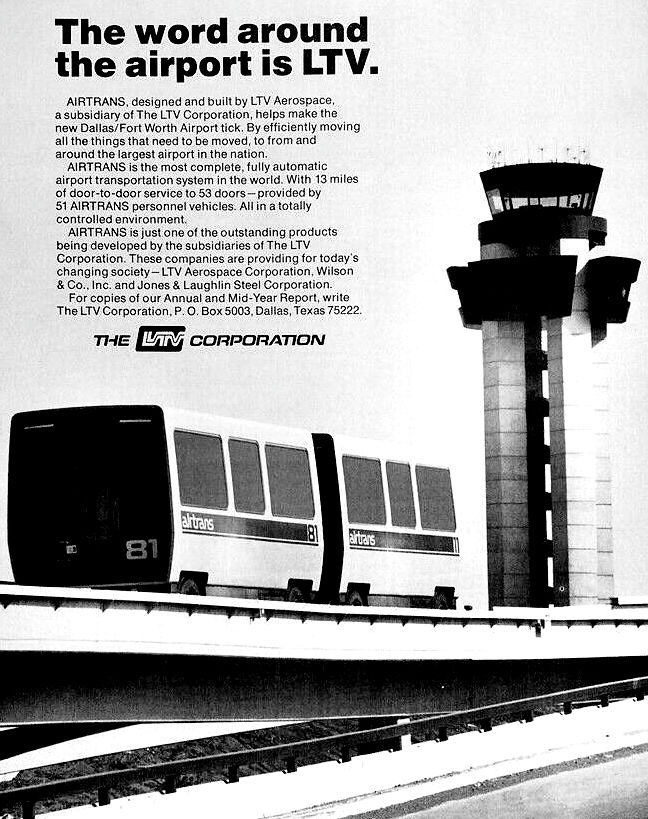
The second ad, from LTV, touting their automated AIRTRANS all-electric transportation system which carried people and cargo around the airport.
The word around the airport is LTV.
AIRTRANS, designed and built by LTV Aerospace, a subsidiary of The LTV Corporation, helps make the new Dallas/Fort Worth Airport tick. By efficiently moving all the things that need to be moved, to from and around the largest airport in the nation.
AIRTRANS is the most complete, fully automatic airport transportation system in the world. With 13 miles of door-to-door service to 53 doors – provided by 51 AIRTRANS personnel vehicles. All in a totally controlled environment.
AIRTRANS is just one of the outstanding products being developed by the subsidiaries of The LTV Corporation. These companies are providing for today’s changing society – LTV Aerospace Corporation, Wilson & Co., Inc. and Jones & Laughlin Steel Corporation.
*
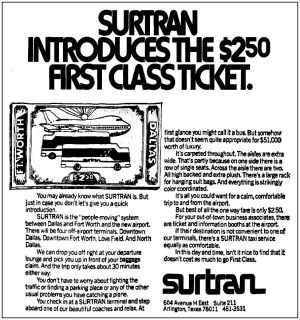
And because AIRTRANS is getting its day in the sun, here’s a local ad for its troubled “surface” counterpart (I just learned that “SURTRAN” stands for “surface transportation”) — the bus/taxi/limo system designed to get people to the airport from Dallas or Fort Worth. As this ad says, a one-way bus ticket was $2.50 (about $15.00 in today’s money). SURTRAN seems to have been financially troubled from the beginning — SURTRAN service ended at the end of October, 1984.
Sept., 1973
*
End of Phase I:
1973
***
Sources & Notes
Gifford-Hill ad with color photo and LTV ad found on eBay.
As another year crawls to an end, it’s time to collect the odd bits and pieces that have piled up over the past few months which struck me as interesting or funny or… whatever. I had nowhere else to put them, so they’re going here! (Most images are larger when clicked.)
**
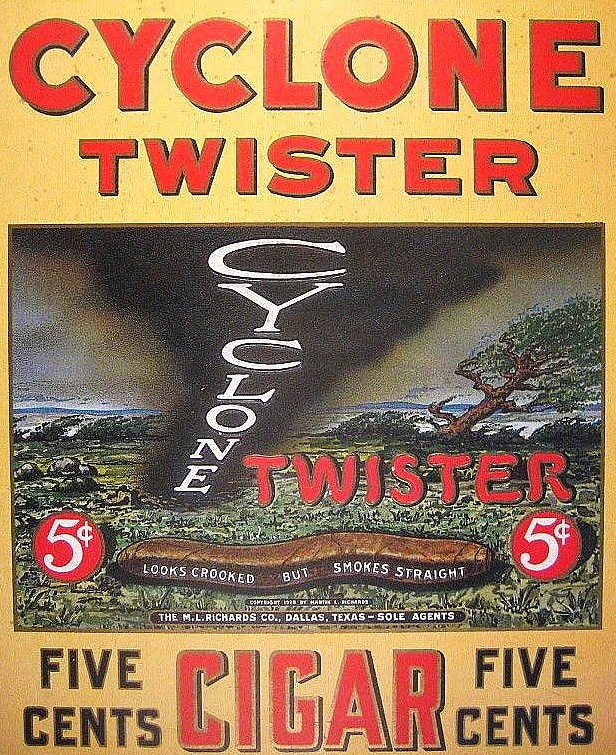
First up, the ad above for the “Cyclone Twister” 5-cent cigar, distributed by Dallas wholesaler Martin L. Richards in 1928. Note the shape of the cigar. “Looks crooked but smokes straight.” Probably looked a little strange when smoked. I guess it might help break the ice at parties. Found on eBay.
*
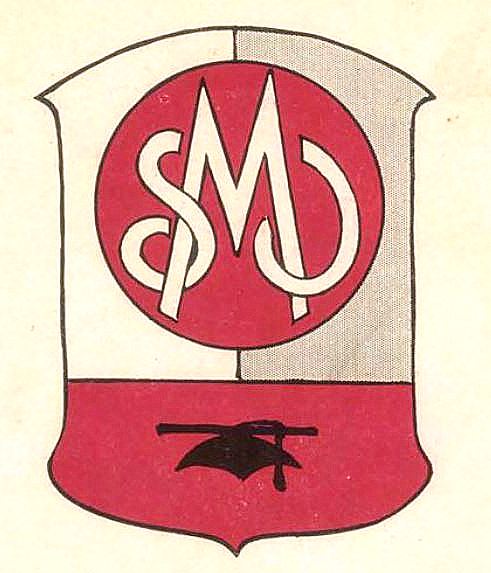
Here’s a nice little crest for SMU I’ve never seen — I’m not sure how long this lasted. From the 1916 Rotunda yearbook.
*
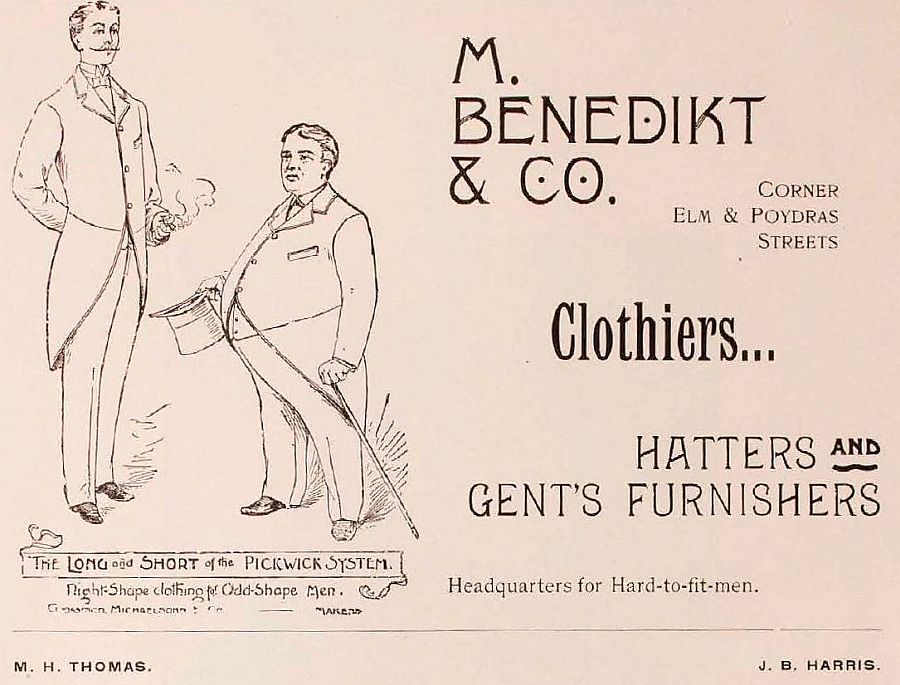
M. Benedikt & Co. was the “Headquarters for Hard-to-fit-men” — in other words, they specialized in “Right-Shape clothing for Odd-Shape Men.” Here are a couple of examples of what they might consider “odd-shape men” in an ad from 1899.
*
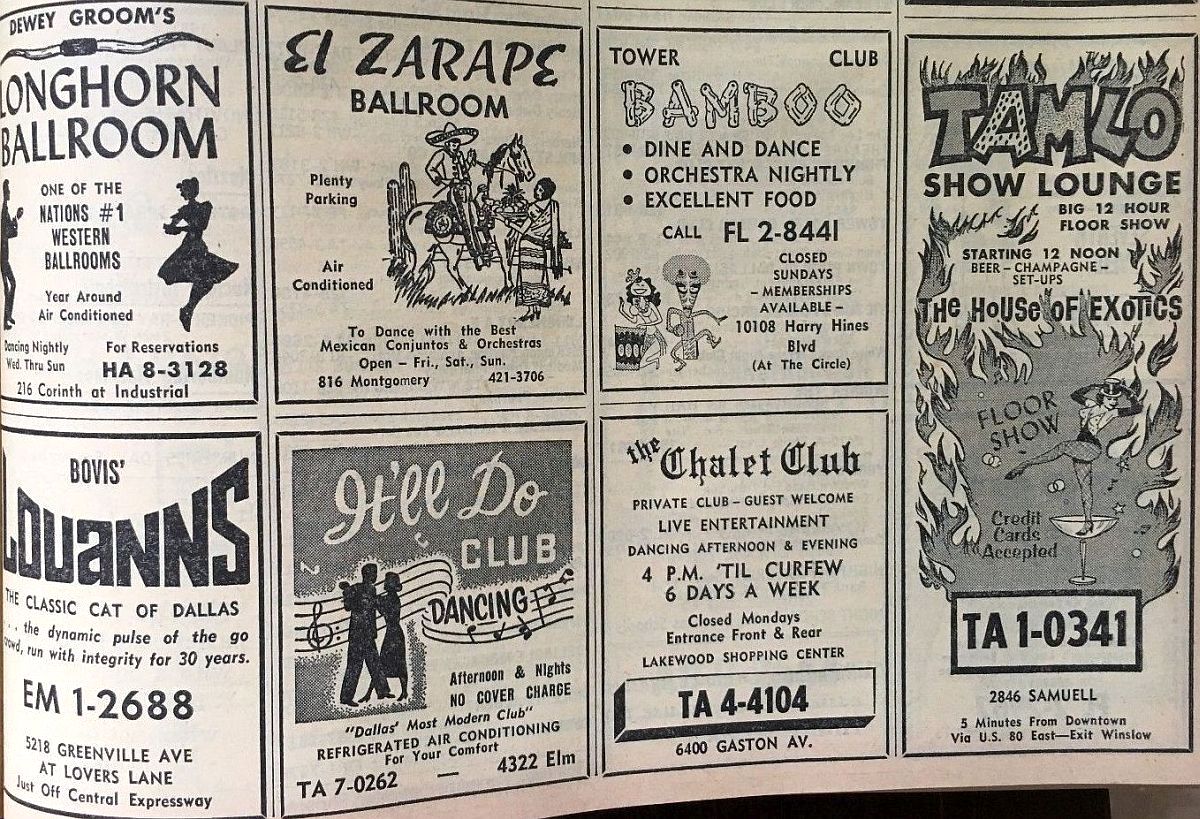
This is an interesting selection of ads from a 1968 edition of the Yellow Pages: Dewey Groom’s Longhorn Ballroom, Louanns, El Zarape Ballroom, the It’ll Do Club, the Bamboo Room at the Tower Hotel Courts, the Chalet Club, and the Tamlo Show Lounge (a couple of these show up in the…um… informative story “The Meanest Bars in Dallas” (D Magazine, July, 1975).
*
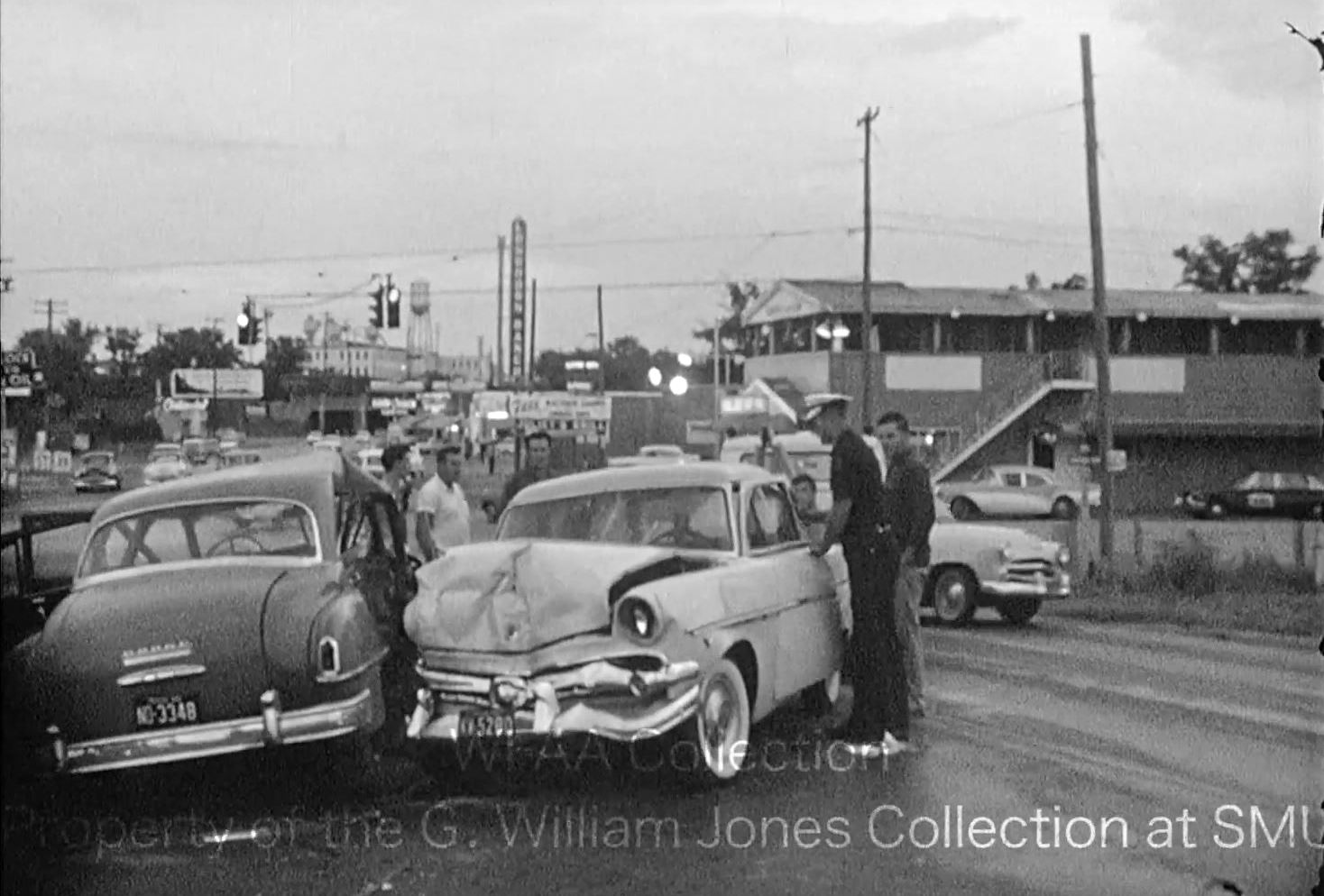
I’ve been working in the G. William Jones Film and Video Archives at SMU for the past few months, and this was something I came across while viewing a 1960 WFAA-Channel 8 News clip which made me really excited (it’s an awful screenshot, but, what the heck): while covering a car wreck at Corinth and Industrial, the Ch. 8 camera panned across the scene, and in the background, just left of center, was a very tall sign for the Longhorn Ranch, which I’d never seen before. Before it was the Longhorn Ranch it was Bob Wills’ Ranch House, and after it was the Longhorn Ranch it was the Longhorn Ballroom (more history of the legendary honky-tonk is in a Texas Monthly article here). So, anyway, it’s a fuzzy screenshot, but I think it’s cool. (The footage is from June, 1960 but the clip hasn’t yet been uploaded online.)
*
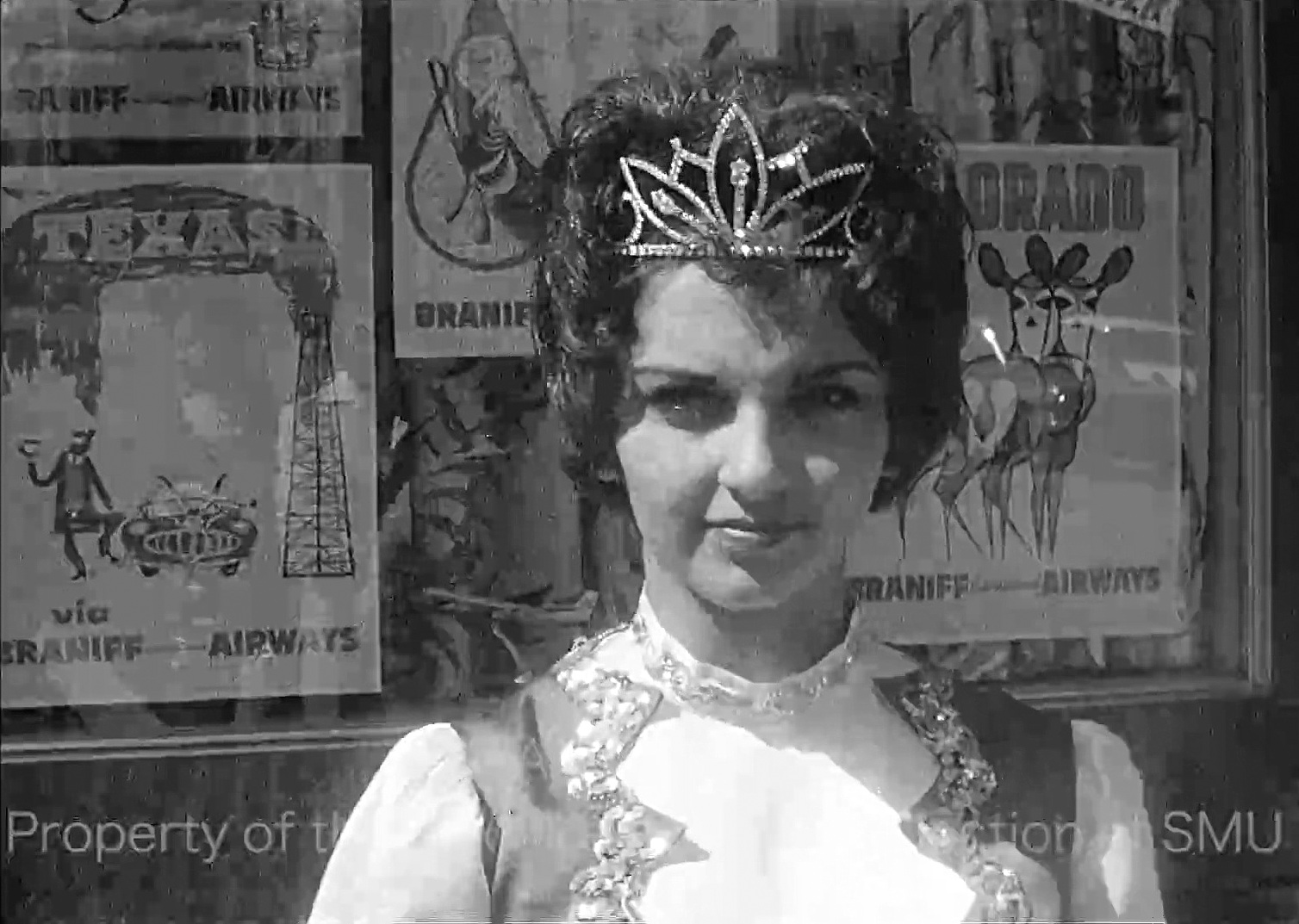
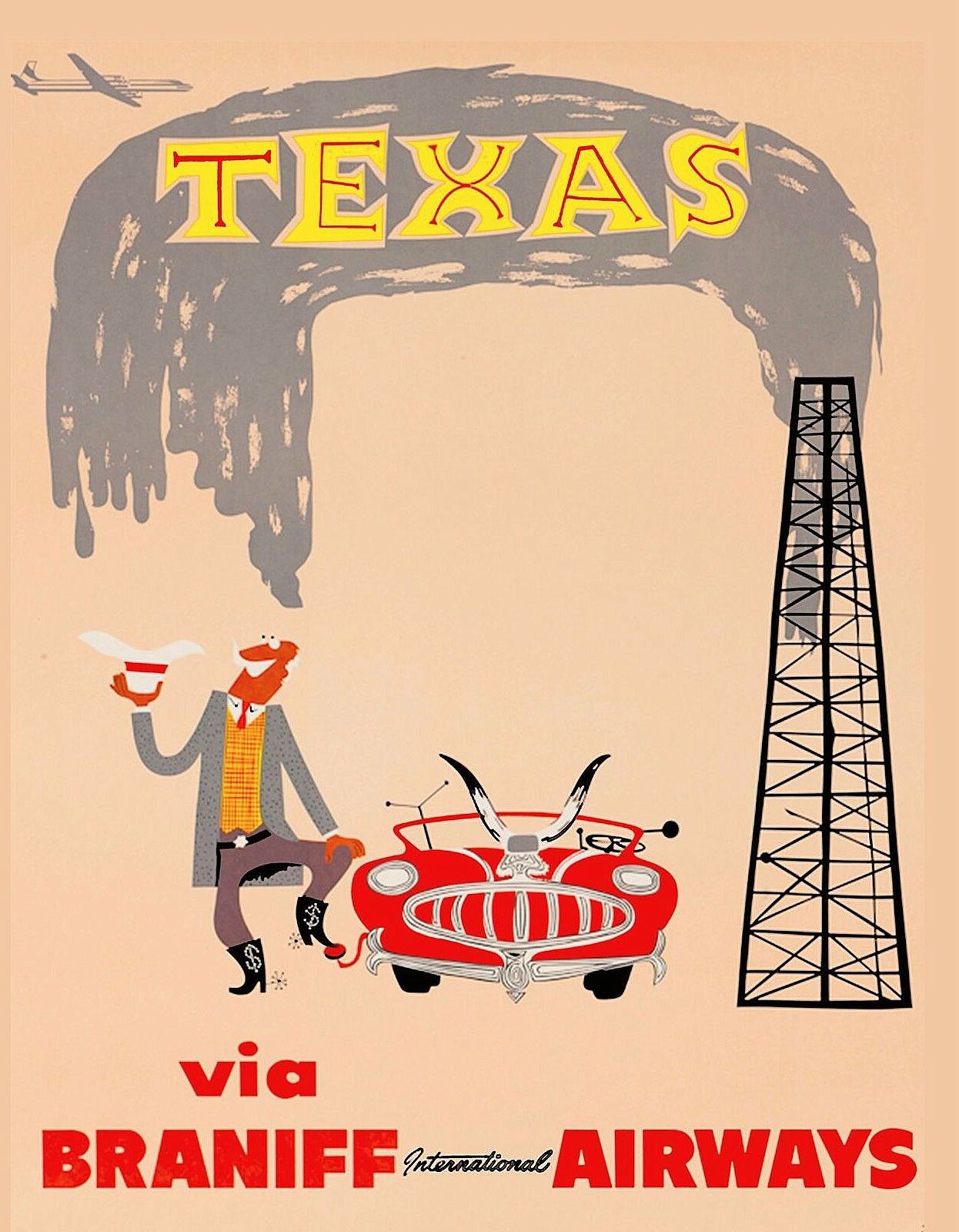
Speaking of WFAA footage in the Jones Film collection, there was some sort of story about comely young women in skimpy outfits handing out samples of some sort of food to passing pedestrians on Commerce Street (the one-minute clip is here). In addition to seeing sights associated with downtown streets in 1962 (including businesses such as Sigel’s and the Horseshoe Bar, as well as a large sign advertising the Theatre Lounge), I was really happy to see a few Braniff Airways posters in a window — I love those late-’50s/early-’60s Braniff travel posters! So here’s another screenshot and, below that, the Texas-kitsch poster I was so happy to see in color.
Braniff Airways, Inc., Copyright 1926 2019
*
I don’t have an image for it, but I was amused to learn that in 1969 the powers-that-be at the Texas Turnpike Authority nixed the suggestion that the Dallas North Tollway be renamed in honor of president Dwight D. Eisenhower, who had recently died — the idea was turned down because 1) new signage would have been very expensive, and 2) officials were afraid that “irreverent motorists” would inevitably refer to the toll road as the “Ike Pike” (I know I would have!).
*
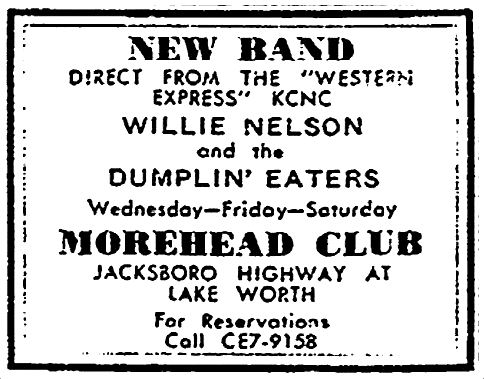
Not Dallas, but there’s always time for a little love for Fort Worth: here’s a nice ad from 1955 for a 22-year-old Fort Worth DJ named Willie Nelson, back when he was gigging out on the Jacksboro Highway with his band the Dumplin’ Eaters.
Fort Worth Star-Telegram, Sept. 9, 1955
*
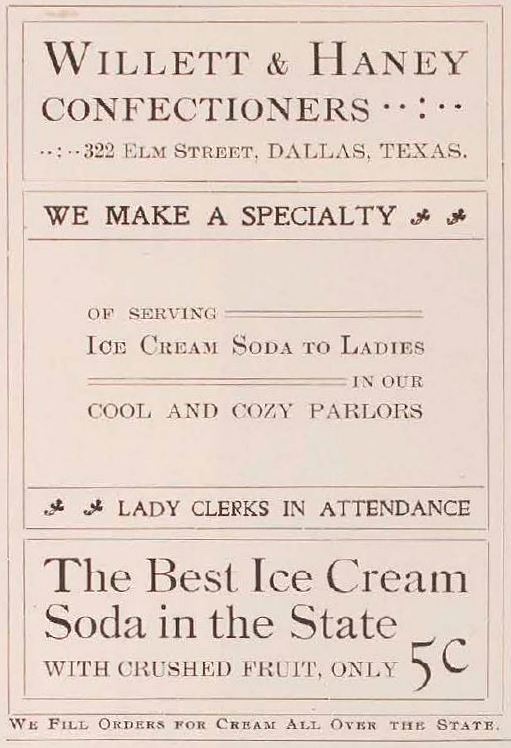
Apparently there was a time when ladies were uncomfortable patronizing an establishment in which m*n served them ice cream, so this ad from 1899 made sure to note that “lady clerks” were in attendance. (See the back side of the Willett & Haney Confectioners parlor a couple of years before this ad, when the “cool and cozy parlor” was located on Main Street — it’s at the far left in this circa-1895 photo detail from this post.) The parlor was owned by John B. Willett and John S. Haney, and in addition to ice cream and candy, their specialty was oysters, and I can only hope that there was some experimenting with new food combos involving mollusks, ice cream sodas, and crushed fruit.
*
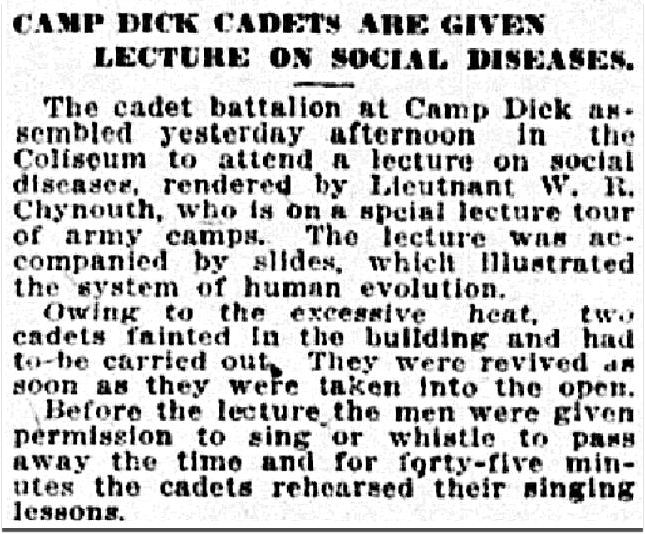
This is an odd little tidbit from The Dallas Morning News about a couple of cadets from Camp Dick (at Fair Park) and what happened to them when they attended a lecture on “social diseases.” (The jokes write themselves….) Who knew singing and whistling were so therapeutic”
DMN, Aug. 17, 1918
*
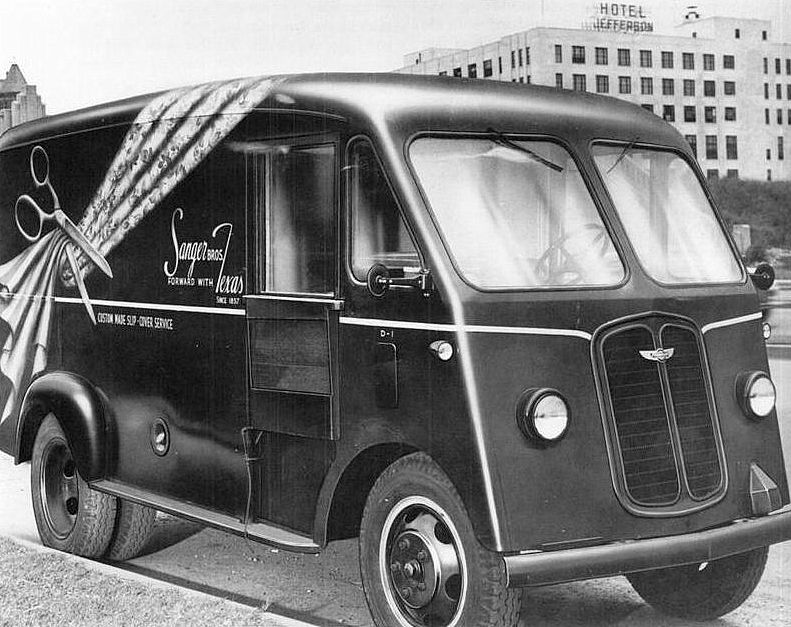
The caption for this photo (which appeared in the article “Going Downtown to Shop” by Jackie McElhaney, from the Spring, 2009 issue of Legacies): “In 1946, Sanger’s introduced a portable drapery shop. Two seamstresses sewed draperies in this truck while parked in the customer’s driveway.” Now that’s service!
“Forward with Texas,” 1947 ad detail
*
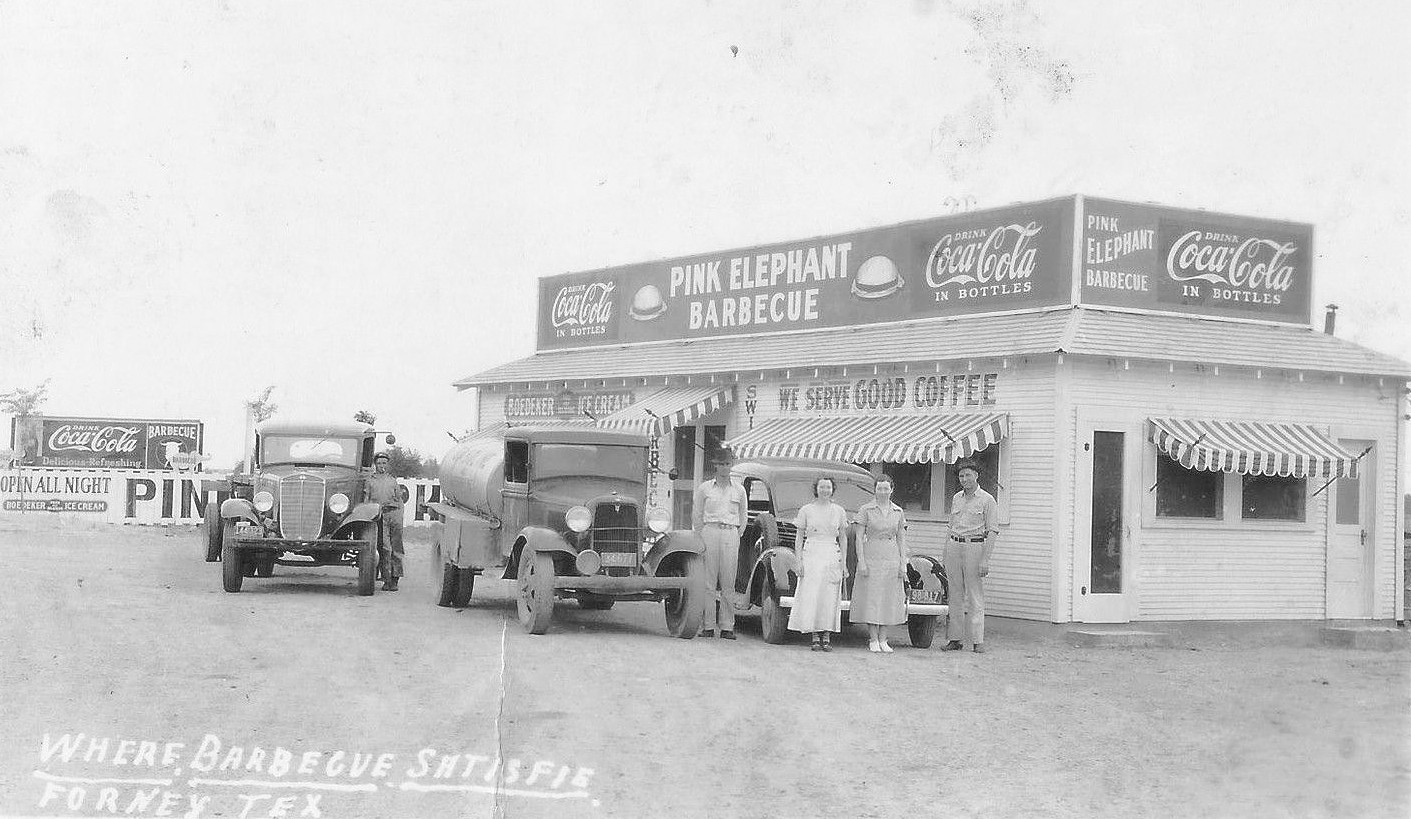
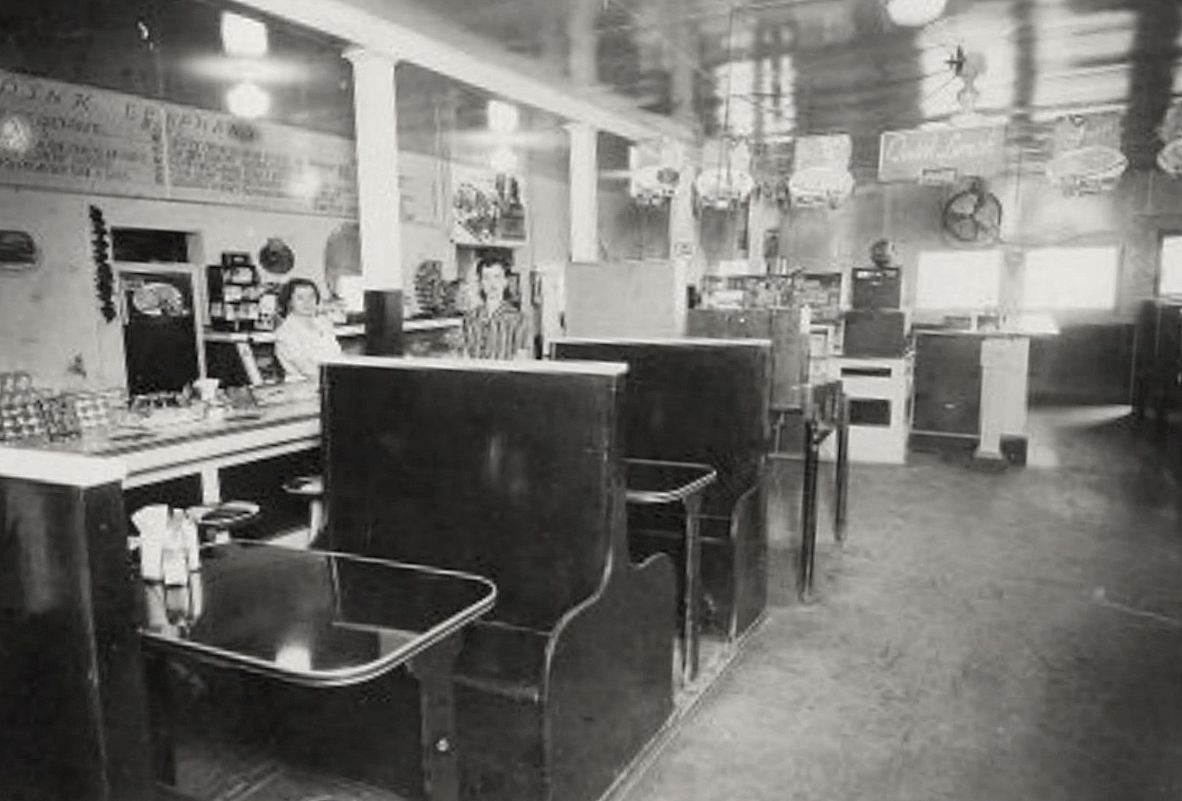
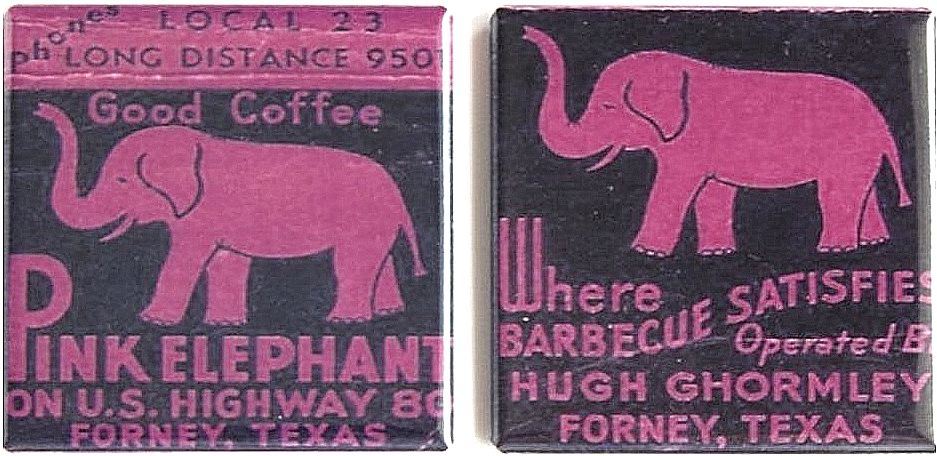
Two more. This first was a real-photo postcard I found on eBay. It shows the Pink Elephant cafe on Hwy. 80 in Forney (not Dallas, but pretty close!). I love the idea of Forney having a place called the Pink Elephant — it was quite popular and was in business from at least the 1930s to the 1950s. The card below was postmarked in 1936.
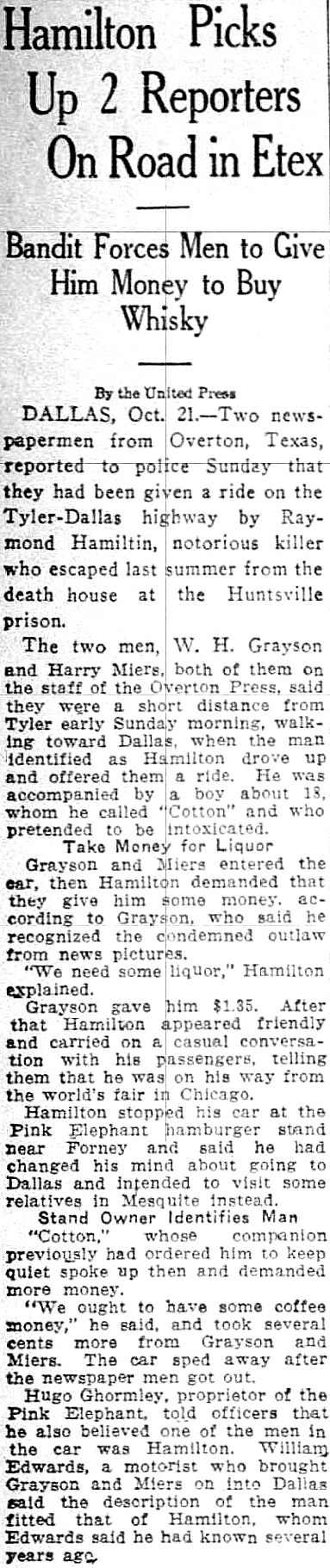
I wondered if the place was still around (sadly, it is not), and in looking for info about it found this interesting article from 1934 about outlaw Raymond Hamilton, the escaped killer who grew up in Dallas (…there’s the Dallas connection!) and was notorious for having been a member of Bonnie and Clyde’s “Barrow Gang.” (Click to read.)
Austin American, Oct. 22, 1934
*
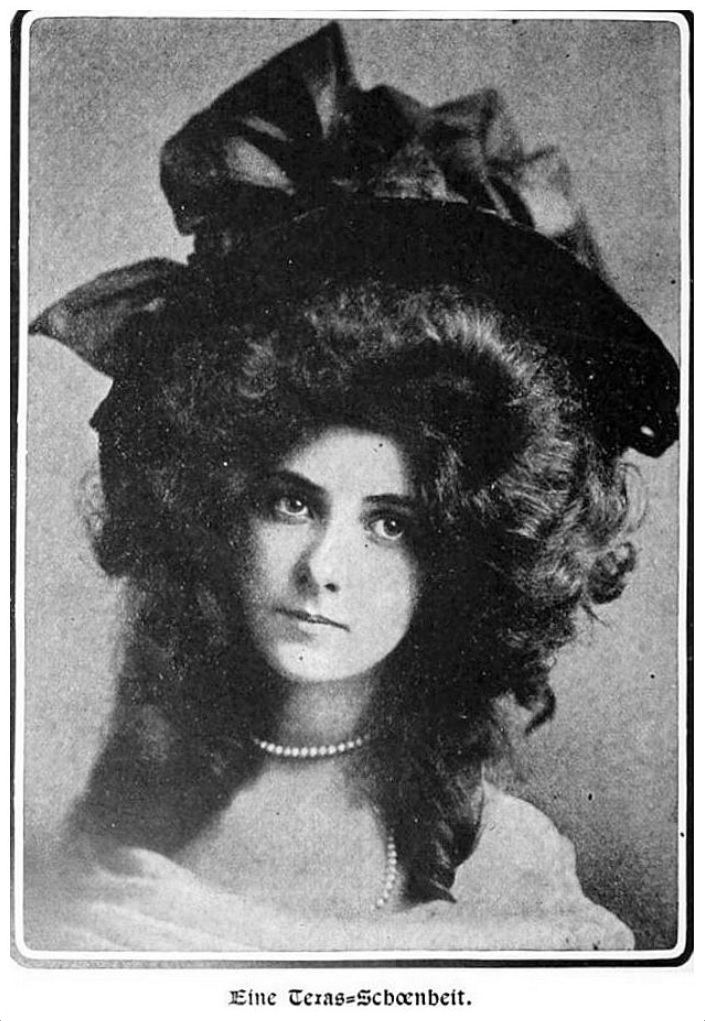
And, lastly, a photo of a young woman which appeared in a German-language magazine, captioned simply “Eine Texas Schönheit (A Texas Beauty).” Is the hair wearing the hat, or is the hat wearing the hair?
***
Previous installments of Flashback Dallas “Orphaned Factoids” can be found here.
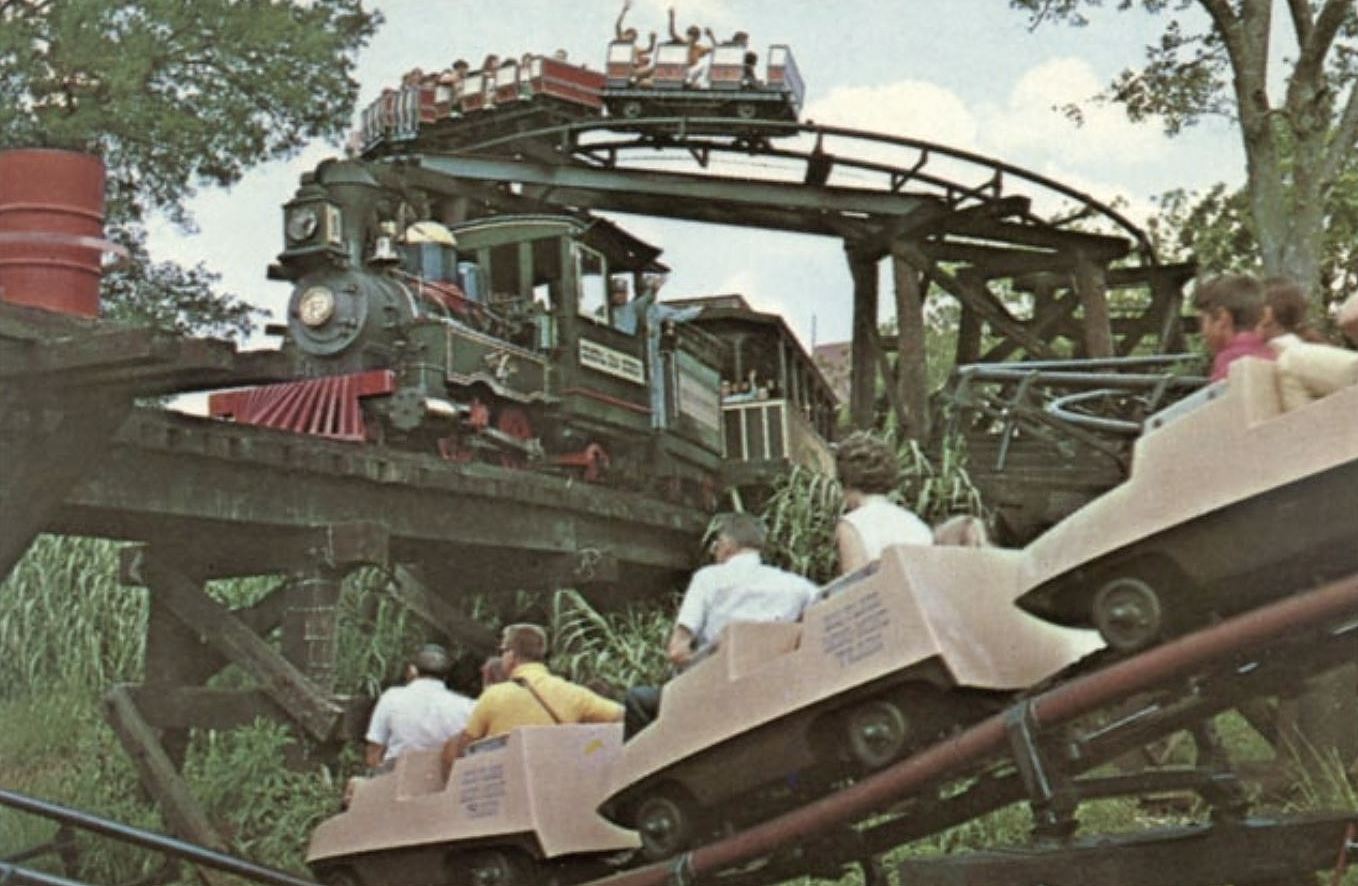
There’s a lot going on in this postcard! The description, from the back of the card:
TEXAS EXCITEMENT Three of the most popular rides at SIX FLAGS Over Texas are shown in action. At top is the Runaway Mine Train which annually carries more than 2½ million riders. At center an authentic 1898 steam engine carries passengers over a narrow gauge track which encircles the huge theme park. And, in the foreground is the SIX FLAGS Mini Mine Train, designed for the younger set.
***
Sources & Notes
This 1970s-era postcard is from Ken Collier’s fantastic Six Flags Over Texas site, here.
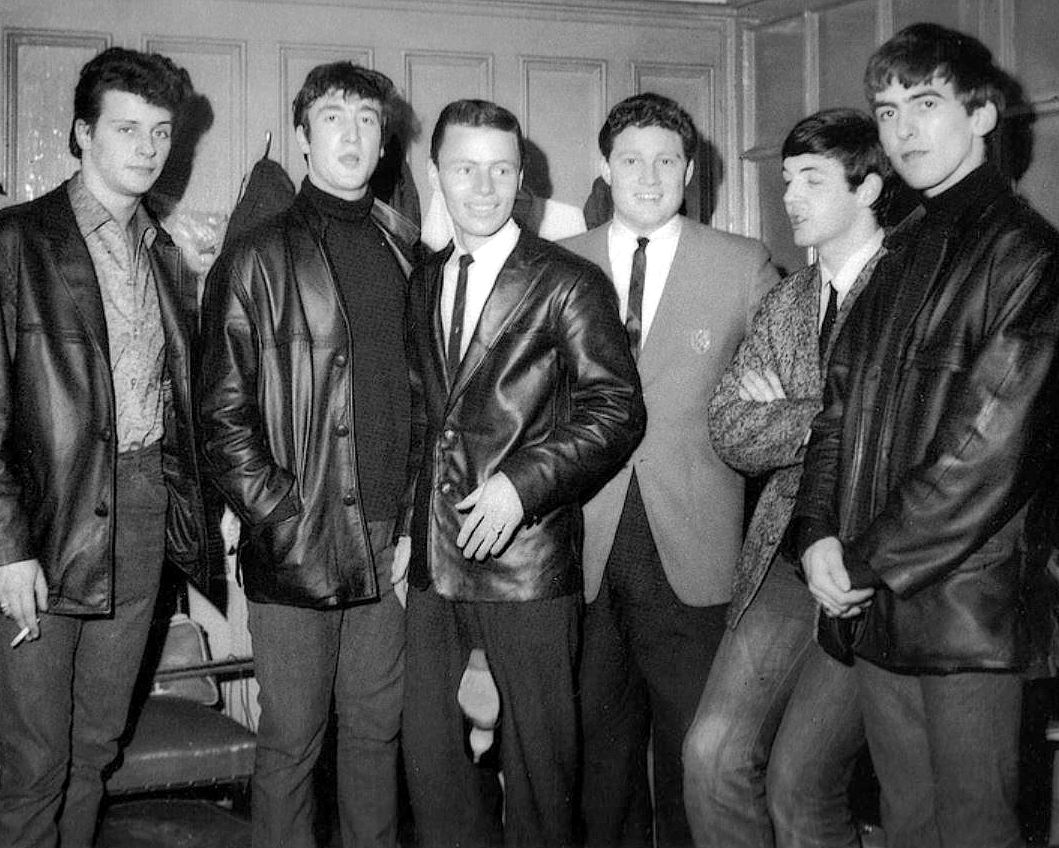
The Ringo-less Beatles with Delbert and Bruce, June 21, 1962
*
(CLICK HERE TO WATCH THE FILM DISCUSSED IN THIS POST)
*
by Paula Bosse
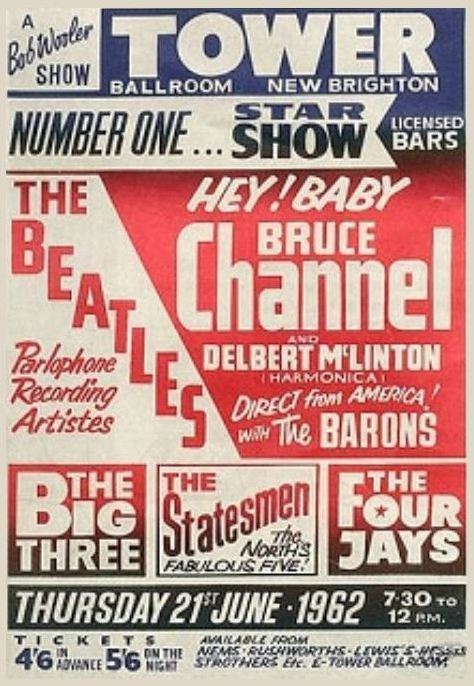
You know how you’re all excited about one thing only to discover something even more exciting sitting all alone over off to the side? That’s what happened when I took a look at the “Light Crust Doughboys collection” which has recently been uploaded to the Portal to Texas History site as part of the Spotlight on North Texas project via the UNT Media Library. I’m a huge fan of Western Swing and classic country music, and I spent an enjoyable hour or two watching home movies of the Light Crust Doughboys as they toured around Texas. When I looked to see what else comprised this collection, I saw the words “England Tour,” “Bruce Channel,” and “Delbert McClinton,” and a jolt went through me: oh my god, could there be film footage of the legendary meeting between the Beatles and North Texas musicians Bruce Channel and Delbert McClinton? Every Beatles fan worth his/her salt knows about the June 21, 1962 meeting when John Lennon eagerly chatted with Delbert McClinton about his harmonica prowess.
I watched the 27-minute home movie (shot by Marvin “Smokey” Montgomery, member of the Light Crust Doughboys and, from what I gather, Bruce Channel’s musical collaborator and, possibly, acting manager), and it does, in fact, capture glimpses of the famed tour in which Grapevine’s Channel, riding high on his #1 hit Hey! Baby, toured England with Fort Worth musician Delbert McClinton, who played harmonica on the record. One of their dates was the English town of Wallasey, just across the Mersey from Liverpool. On June 21, 1962 Bruce and Delbert played the New Brighton Tower Ballroom — their opening act was a popular local band on the brink of superstardom, The Beatles. Backstage, John Lennon asked for a few harmonica tips from Delbert whose Hey! Baby sound John really liked, and Delbert was happy to share. The photo above was taken at that meeting by Paul’s brother, Mike McCartney: from left to right, Pete Best (who would soon be replaced by Ringo Starr), John Lennon, Delbert McClinton (is he wearing Paul’s jacket?), Bruce Channel, Paul McCartney, and George Harrison. Another one, with Bruce and Paul, is below (I’m not sure who the girl is).
The home movie shot by Smokey Montgomery shows Bruce and Delbert (both only 21 years old at the time), their Fort Worth record producer “Major Bill” Smith, as well as several members of the package show of British performers that toured with Bruce, including Frank Ifield, Jay and Tommy Scott, and Beryl Bryden. …But, argh, no Beatles! So close! Still, this is great film footage of a famous tour — footage which may never have been seen by the public — and it is now available online for all to see, courtesy of the University of North Texas!
The 27-minute (silent) film can be viewed here(the good stuff is really only in the first 11 minutes or so — the rest is mostly tourist footage of the changing of the guards at Buckingham Palace).
This may be thrilling to only a handful of people, but I am definitely one of those people!
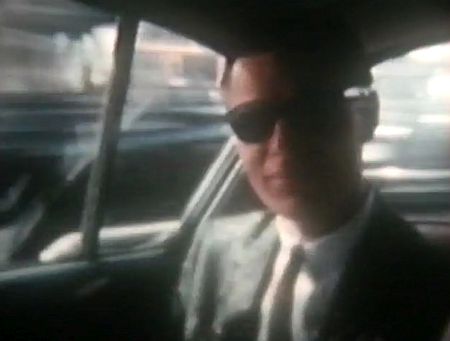
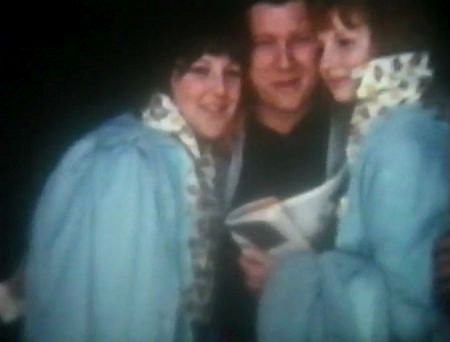
A few screen captures from Smokey Montgomery’s 1962 “England Tour” film (all images are larger when clicked):
Bruce on the bus
Delbert in a taxi
Bruce with fans
Perks of the trade
More perks
Delbert
Bruce and Delbert, London
You just never know what you’re going to stumble across…. Below is Bruce Channel’s monster 1962 hit, recorded in 1961 at the Clifford Herring Studios in Fort Worth, Hey! Baby, kicked off by Delbert McClinton’s distinctive harmonica.
**
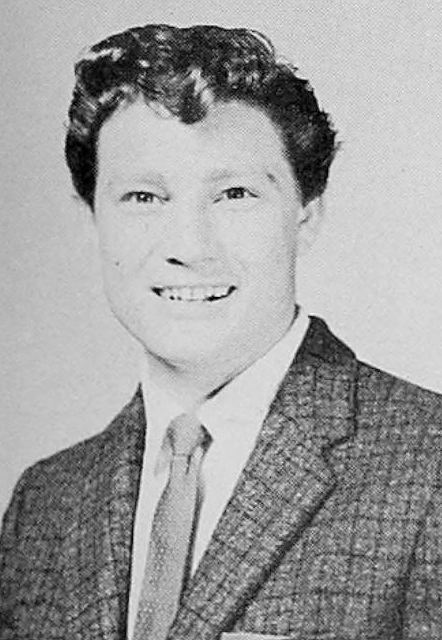
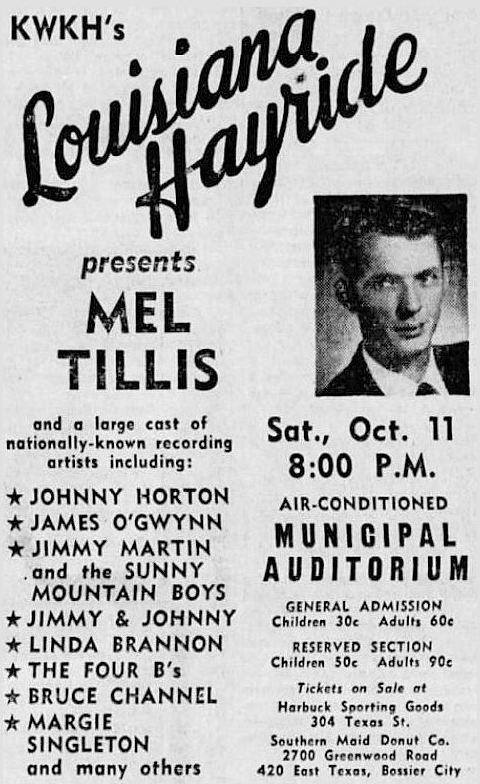
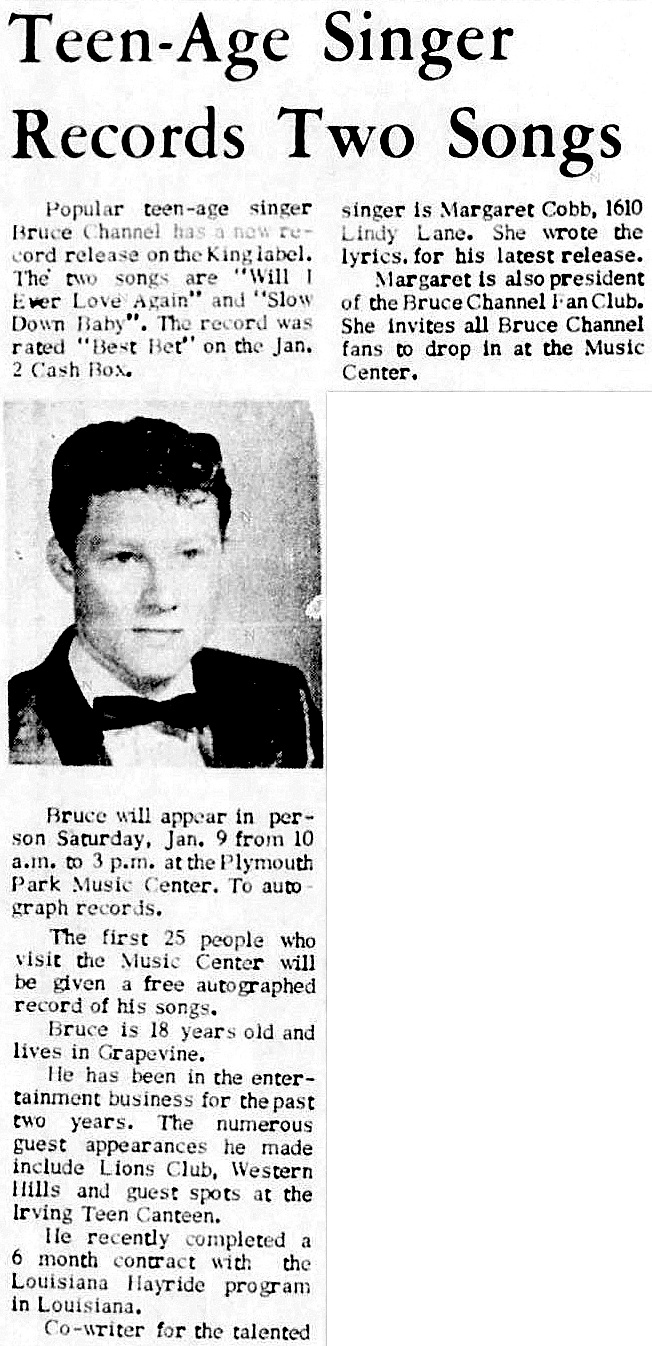
Bruce Channel (born Bruce McMeans — the “Channel” was his mother’s maiden name), was born at the end of 1940 and attended Grapevine High School. During his high school days he gained popularity as a performer, complete with lengthy commutes between Dallas and Shreveport, where he was a regular performer on the star-making Louisiana Hayride. Around this time he began writing songs with Margaret Cobb, an Irving woman who was 10-15 years older and the sister of a musician acquaintance. Dallas-Fort Worth-area musician Smokey Montgomery (known for decades as the banjo player in the Light Crust Doughboys) not only helped arrange those songs, but he also produced and played on some of Channel’s early singles, such as the cool (and fast!) rockabilly number, Slow Down, Baby (hear it here) and a song I like even more, Come On, Baby (hear it here).
The Cobb-Channel-penned Hey! Baby was recorded in 1961 and soon became a local radio hit, most notably on KLIF in Dallas, then worked its way up charts around Texas. The song finally reached #1 in the country in March, 1962. Channel had a few other lesser hits, but none ever reached the heights of Hey! Baby. He moved to Nashville in the ’70s and embarked on a successful songwriting career.
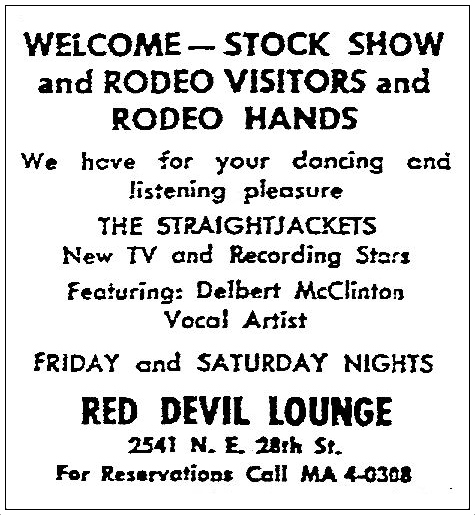
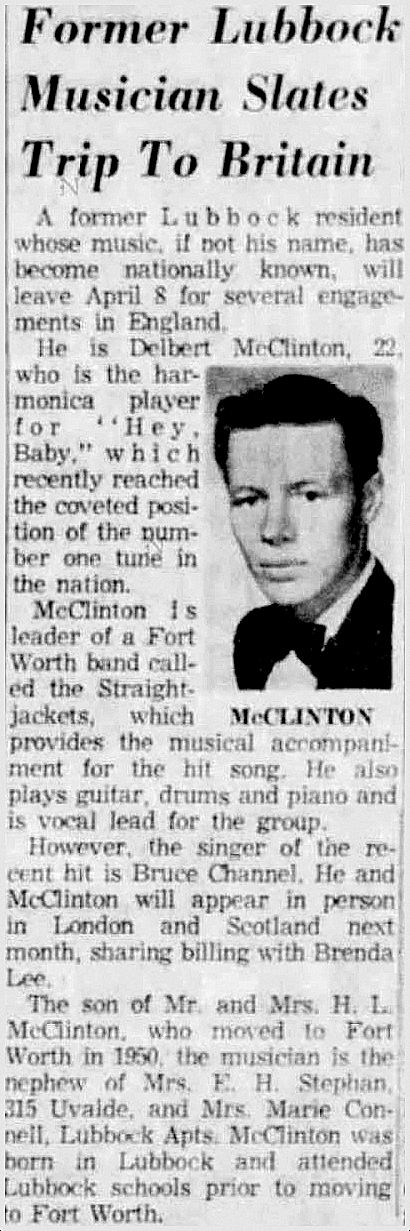
Delbert McClinton was born in Lubbock, also at the end of 1940, but grew up in Fort Worth where he, too, was a teenage musician, first gaining attention with his band The Straitjackets/Straightjackets and later the Rondels. He’s a bona fide Texas blues legend and continues to perform.
Bruce McMeans, Grapevine High School, 1960
Shreveport Times, Oct. 10, 1958
Irving (TX) News-Texan, Jan. 7, 1960 (click for larger image)
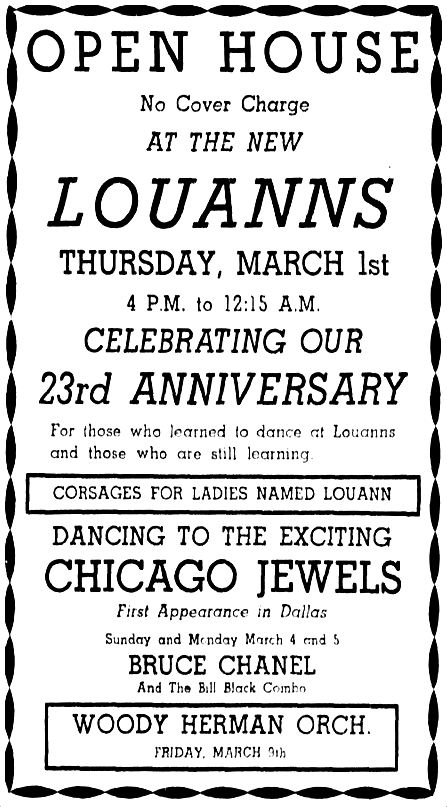
Louann’s, Dallas, March, 1962
British tour program photo, June, 1962, via Flickr
Delbert McClinton, Arlington Heights High School, 1959
Red Devil Lounge, Fort Worth, Jan., 1958
Lubbock Avalanche-Journal, March 21, 1962 (click to read)
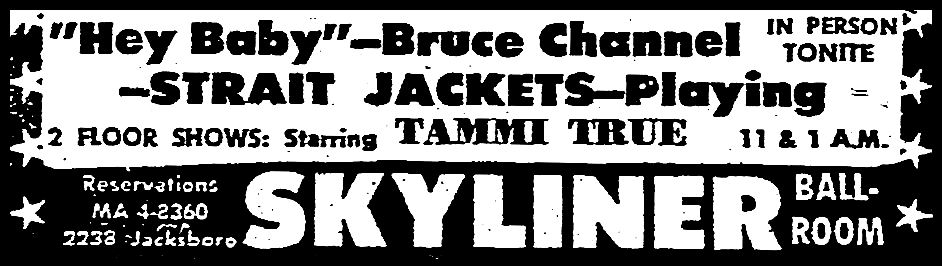
Bruce with Delbert (and stripper Tammi True), FW, Jan. 1962
***
Sources & Notes
The film featuring Bruce Channel and Delbert McClinton is titled “[The Light Crust Doughboys, No. 16 — England Tour]” and is part of the Spotlight on North Texas collection; it was provided by UNT Media Library to The Portal to Texas History and may be viewed here. It was filmed by Marvin “Smokey” Montgomery (who can be seen near the very end, sitting almost in silhouette in front of an airplane window). The film is part of a collection of Light Crust Doughboys and LCD-related materials donated by Art Greenhaw. (Special thanks to Laura Treat!)
Speaking of UNT, there may also be a film clip somewhere in the Denton vaults in which Bruce Channel, the “Grapevine farmboy,” was the subject of a WBAP-Ch. 5 news story (the April 18, 1962 script is here).
See the full printed program for Bruce Channel’s June, 1962 British package tour here.
Bruce Channel’s website is here. Read an interesting interview with him here. More Bruce on Wikipedia, here.
Delbert McClinton’s website is here. He’s constantly touring. Go see him!
The producer of (among other recordings) Hey! Baby and Hey, Paula (the song which has followed me around my whole life) was “Major Bill” Smith who was quite a polarizing character and was often described as a “hustler” (Delbert was not a fan). Read about him here. (Also, rockabilly god Ronnie Dawson might be one of the musicians on Hey! Baby — I’ve always heard he played drums on Hey, Paula.)
Marvin “Smokey” Montgomery is listed, along with Major Bill Smith, as a co-producer of Hey! Baby, which sold well over a million copies, but it rankled him that he did not get a songwriting credit (and, perhaps more importantly, did not earn royalties), which he contended he deserved: in a 1973 Dallas Morning News profile he said somewhat bitterly, “[*Now*] if I have anything to do with making the music or writing the words… you can bet your sweet life my name will be on that record.” (“The Man Who’ll ‘Listen To Your Song'” by David Hawkins, DMN, Oct. 18, 1973). More on Smokey’s long career can be found at the Handbook of Texas, here.
Read about the Beatles’ use of a perhaps Delbert-inspired harmonica sound on several of their early recordings, most notably Love Me Do, here.
Side note: Hey! Baby broke first locally on Dallas radio station KLIF and then on Houston’s KILT — both stations were owned by Gordon McLendon, which might explain why Bruce Channel was appearing at an April, 1964 political rally at Reverchon Park in support of McLendon’s race for U.S. Senate (?!) — see the ad here. (McLendon lost his Democratic primary challenge against Sen. Ralph Yarborough, who ultimately went on to defeat Republican contender, the elder George Bush.)
Bruce and Delbert weren’t the only DFW musicians with whom pre-Beatlemania Beatles hobnobbed: they also shared a bill in Paris with Dallas son Trini Lopez in 1963 — the Flashback Dallas post “Trini Lopez: Little Mexico’s Greatest Export” is here.
How often is juggling mind-blowing? It was here! (click for larger image)
by Paula Bosse
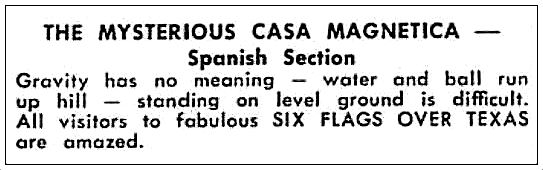
Every year my aunt and her fun friend Shirley took my brother and me to Six Flags Over Texas. This was the ’70s, so some of the original hard-to-believe attractions were already gone (helicopter and stagecoach rides?! — see a promotional video of the park from 1965 here), but it was still when the place was an actual “theme” park — an amusement park originally suggested by aspects of Texas history. The sections of the park represented the six flags that have flown over Texas (see a map here). One of those sections was the Spanish section, the location of two of my favorite Six Flags attractions: the log ride and Casa Magnetica.
Casa Magnetica was the hard-to-wrap-your-brain-around tilted house (newspaper articles reported it was built at either a 24.6-degree angle or a 34-degree angle) which made you feel completely disoriented, especially if you’d just stepped in from the blinding blast of 110-degree heat and were feeling a bit queasy from one too many Pink Things. I loved it. Things rolled uphill, you couldn’t stand up straight, and your brain was mighty confused. The text from the back of the postcard seen above:
Casa Magnetica was introduced very early in Six Flags’ history — it debuted in the second season, 1962, and it was a huge hit. Here is how the SFOT marketing team described it in press releases at the time. (Clippings and images are larger when clicked.) Imagine what it would have been like to have been the architect of this place!
Six Flags Gazette, April 22, 1962
Six Flags Gazette, April 29, 1962
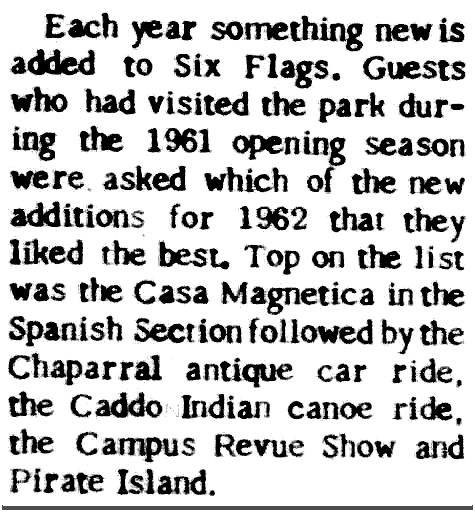
As far as new attractions, the weird little house was the biggest hit of the 1962 season.
Six Flags Gazette, April 20, 1963
Here it is, under construction, in late 1961 or early 1962:
And, later, with a teenage “hostess” sitting under its Spanish-mission-inspired arch.
*
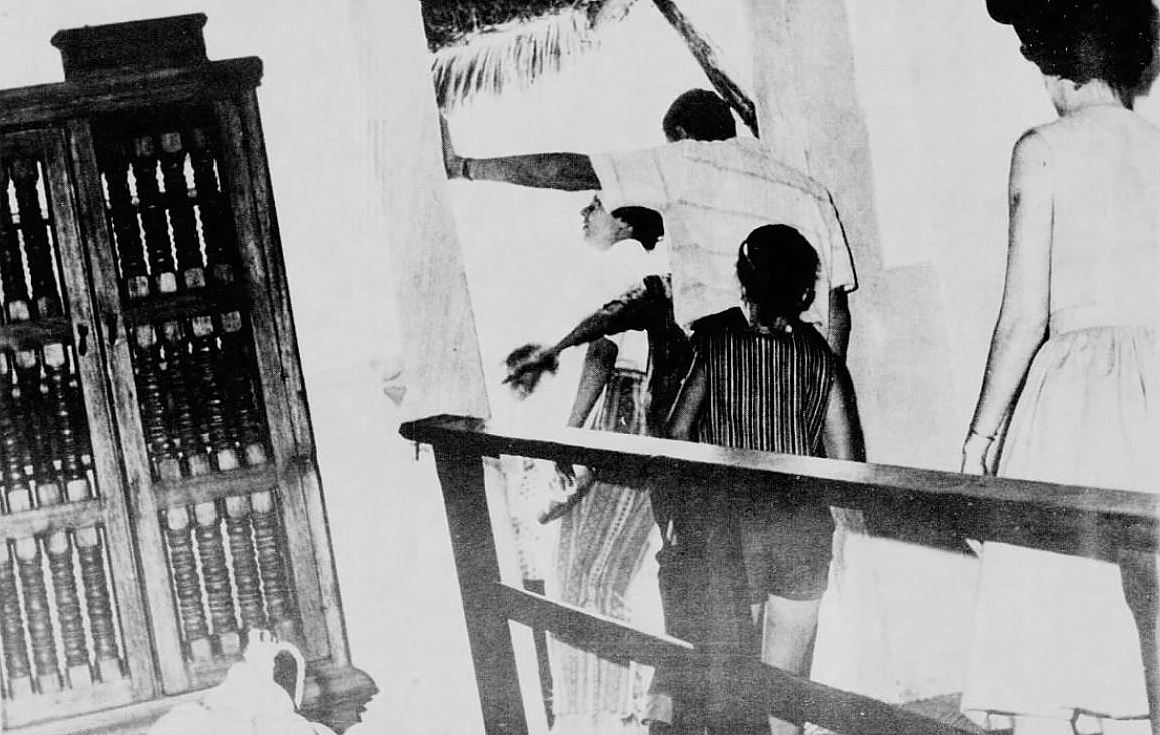
The caption of the photo above: “WHICH ONE’S STRAIGHT? — It’s hard to tell in the Casa Magnetica in the Spanish section. It’s difficult to keep from leaning the wrong way in this house where water seems to run uphill. Notice in the lower left of the picture how the basketful of goodies seems to be hanging instead of sitting.” (Six Flags Gazette, May 27, 1962)
*
Caption: “SOMETHING WRONG? — Six Flags hostesses find that the law of gravity doesn’t seem to apply in Casa Magnetica.” (Six Flags Gazette, April 29, 1962)
*
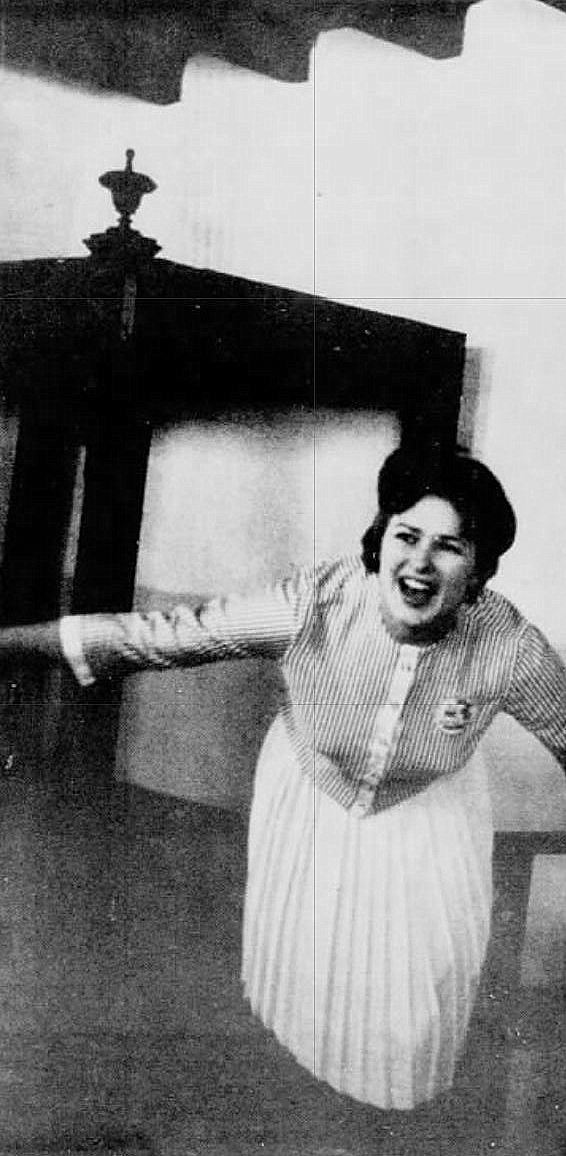
Caption: “LEMME OUT! — In Casa Magnetica, a house in the Spanish Section of Six Flags which defies gravity, this hostess gets a little panicky when the 34-degree slant proves too much for her.” (Six Flags Gazette, April 26, 1962)
Articles and captioned photos are from the Six Flags Gazette, a seasonal supplement that appeared in both the Grand Prairie Daily News-Texan and the Irving Daily News-Texan during the early years of Six Flags.
Photo of Casa Magnetica under construction in the scrubby Arlington landscape is from the History of Six Flags Facebook group, posted there by the administrator Michael Hicks, submitted to Flashback Dallas by reader Brian Gunn (thank you, Brian!).
The photo of the Six Flags “hostess” sitting outside the entrance to Casa Magnetica is from the Six Flags Over Texas Facebook page, here (it appears with a photo of the Chaparral Antique Cars, the second-most popular attraction introduced in the 1962 season).
Read the “spiel” you’d hear when you visited Casa Magnetica, here.
And, in case you missed it above, I highly encourage you to watch the 6-minute Six Flags Over Texas promotional film from 1965 at the Texas Archive of the Moving Image (TAMI) website here (Casa Magnetica is seen briefly at the :45 mark). Watch it full-screen!
More Flashback Dallas posts on Six Flags Over Texas can be found here.

 Meet you under the water tower… (photo: Dallas Public Library)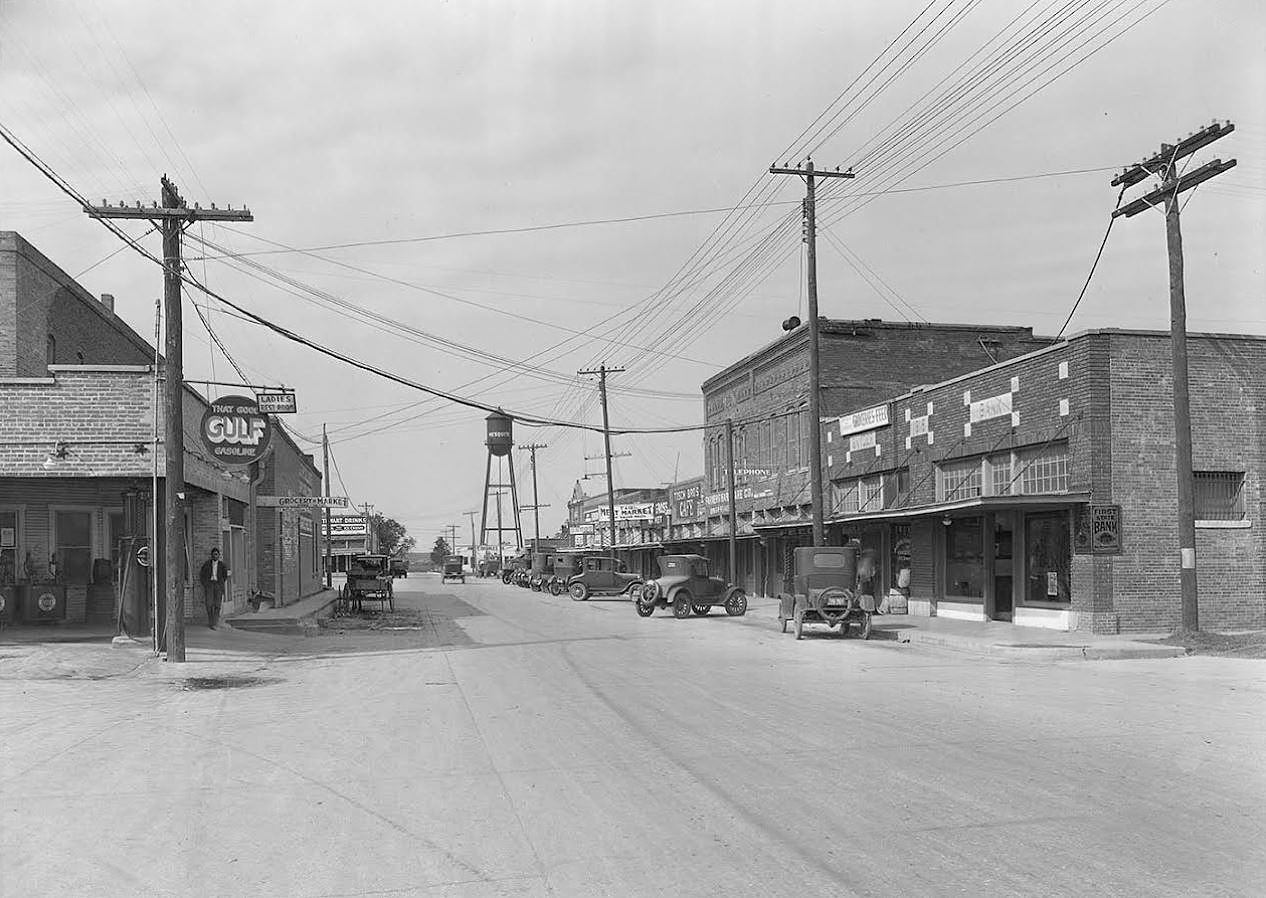







 Sept., 1973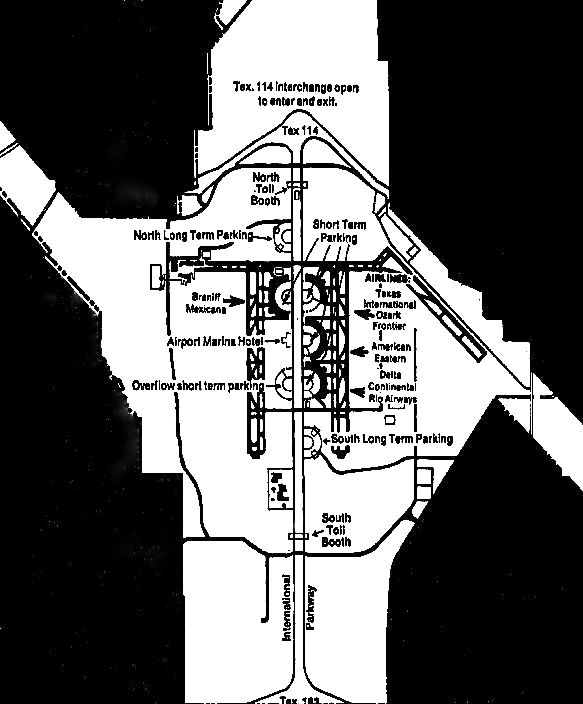














 Flashback : Dallas