Flashback : Dallas

A Miscellany: History, Ads, Pop Culture

Category: Newspapers

Looking for the Historical Dallas Morning News Archive at the New Dallas Public Library Website?

By Paula Bosse

You’re not alone!

The Dallas Public Library has unveiled an updated and redesigned website this week, and it’s taking a while for the dust to settle. I work in the Dallas History archives (7th floor of the downtown DPL), and even I am having a hard time finding things! But it’s only been a couple of days — the kinks will be worked out, and it’ll get easier.

We’ve had several calls and emails about the inability to access/find the 1885-1984 Historical DMN Database, via NewsBank. Let me see if I can help. I’ll try to simplify this as much as possible. (See the last paragraph of this post to find out about the POST-1984 database.)

First, there is a new website URL: it is now DALLASLIBRARY.ORG — go here.

In order to access the DMN archives, you have to log into your account (you must have a DPL library card to do this — library cards are free to residents of the city of Dallas).

  • Click on “MY ACCOUNT” at the top right of the home page.
  • Enter your username or library card number; enter your password.
  • You’ve landed on a page with your account information. At the top of that page, click on “DATABASES.”
  • Scroll down. Click on “MAGAZINES, NEWSPAPERS & JOURNALS.”
  • Click on whichever of the options you’d like — the most popular are The Dallas Morning News and The Fort Worth Star-Telegram (also available are Austin and El Paso papers).
  • For our purposes, click on “NEWSBANK – HISTORICAL DMN AND STAR-TELEGRAM.”
  • Click on “AMERICA’S HISTORICAL NEWSPAPERS.”

And now you can begin your searches. I tend to use the search option that includes both papers, but you can narrow your preference by choosing DMN (1885-1984) or FWST (1897-1990). [There is an ongoing glitch which requires logging in a second time for access. Don’t know what’s going on, but it happens to me about 50% of the time.]

*

Or, more concisely:

  • MY ACCOUNT–>
  • DATABASES–>
  • MAGAZINES, NEWSPAPERS & JOURNALS–>
  • NEWSBANK – HISTORICAL DMN AND STAR-TELEGRAM –>
  • AMERICA’S HISTORICAL NEWSPAPERS –>
  • database of your choice

*

You can also access stripped-down Texas-only versions of Newspapers.com and NewspaperArchive.com (I’m not sure why they’re not all in the same place), by doing this after logging into your account:

  • DATABASES–> GENEALOGY–> choose database and proceed as above

(The Dallas Morning News is not available through Newspapers.com or NewspaperArchive.com, but the Fort Worth Star-Telegram and many other Texas newspapers are.)

*

And that’s it. If you are having trouble with any database on the website, keep checking back because there’s still a lot of tinkering going on.

**

But WHAT HAPPENED TO THE POST-1984 DALLAS MORNING NEWS DATABASE? As I understand it, this very useful part of NewsBank is currently unavailable during contract negotiations. The hope is that it will be back soon. Keep checking back!

***

Sources & Notes

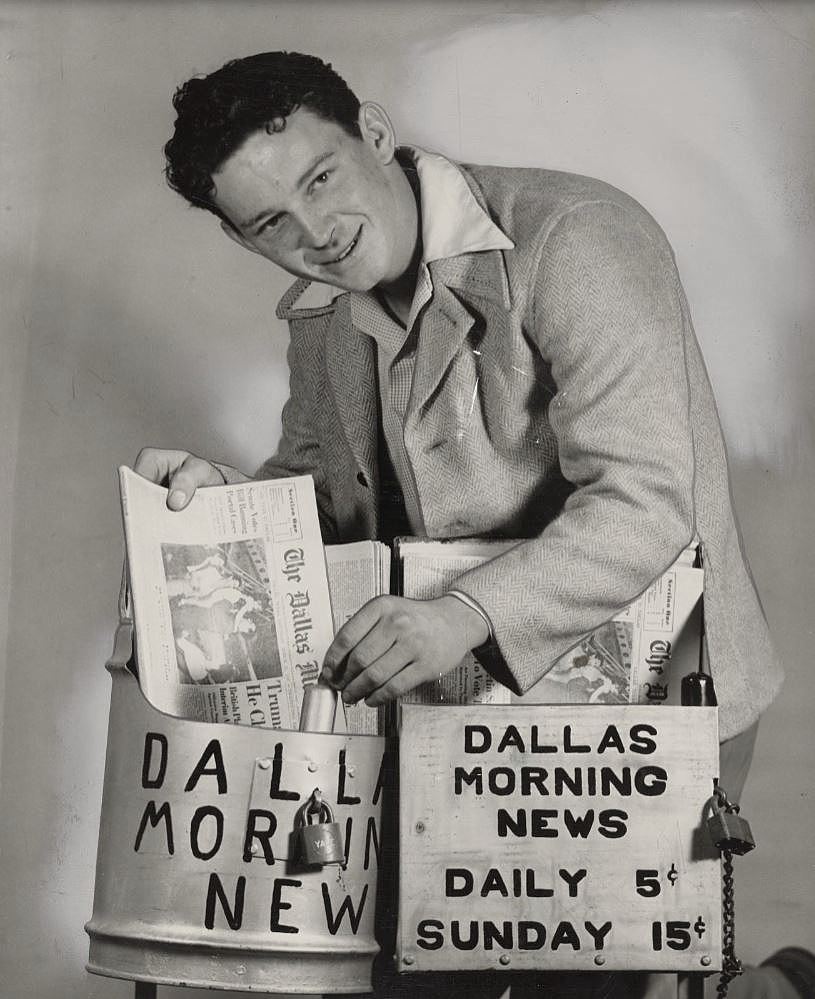
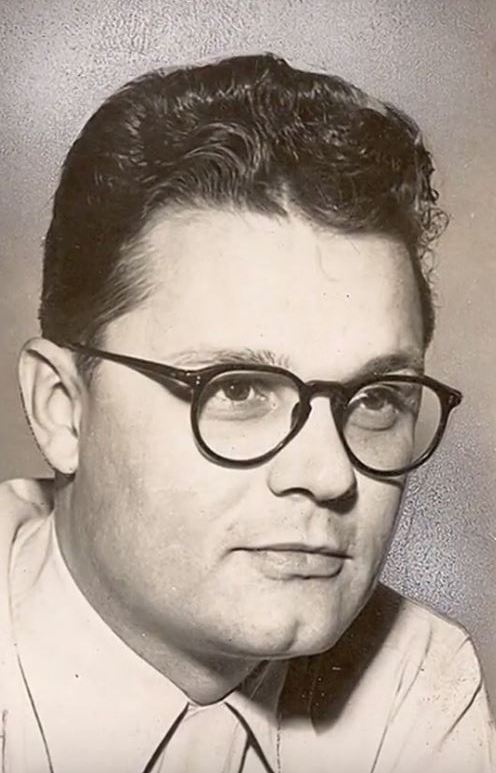
Photo from a post featured on the Flashback Dallas Patreon page: “Bill Fife, News Carrier — 1947; photo is from the Portal to Texas History, here.

*

Copyright © 2025 Paula Bosse. All Rights Reserved.

Good News! New Newspaper Access via the Dallas Public Library!

by Paula Bosse

Good news! The Dallas Public Library now offers to those with DPL library cards free access to the “Texas Edition” of Newspapers.com! You can browse/search a large variety of Texas newspapers that the site has in its database — I think it’s over 200. I’ve only just started playing with this “Texas Edition” to see how it differs from the full Newspapers.com site, and I’ve found that it does not offer all the newspapers that the full site does (for instance, it does not offer the very useful “Evening Edition” of The Fort Worth Star-Telegram), but there are a LOT of papers there. (For access to the full site, which contains US (beyond Texas) and select international newspapers — you must purchase your own subscription.) This is very exciting!

This joins the continuing DPL access to NewspaperArchive.com (provided by the Dallas Genealogical Society — thank you, DGS!). Newspapers.com and NewspaperArchive have some overlap in their content, but they also each have exclusives. Both are great resources.

*

So how do you get to them on the DPL website? You must have your library card number (or login info). Dallas Public Library cards are free, but they are available only to residents of the City of Dallas. (More specific info on that — including some exceptions — is at the DPL website, here.) (You are always welcome to visit the library in person to access these databases without needing a library card.)

Log in to the DPL website here. Click on “MY ACCOUNT” at the top.

Enter your login info.

Click on “DATABASES” (at top of page).

Click on “GENEALOGY.”

Click on (for instance) “NEWSPAPER ARCHIVE” or “NEWSPAPERS.COM (TEXAS EDITION)” or whatever else you want to explore.

And you’re there.

*

These databases complement the essential Dallas Morning News and Fort Worth Star-Telegram archives, which have been available for years on the library website, via NewsBank. They can be accessed on the same “Genealogy” tab, or, you can get to the DMN and FWST (and other publications not found on the “Genealogy” tab) by navigating this way:

LOG IN → DATABASES → MAGAZINES, NEWSPAPERS & JOURNALS → and then whatever publication you want to access.

*

These are all incredible resources for everyone interested in historical and genealogical research. Thank you, Dallas Public Library! (And don’t forget the huge scanned newspaper collection at the Portal to Texas History!)

***

Sources & Notes

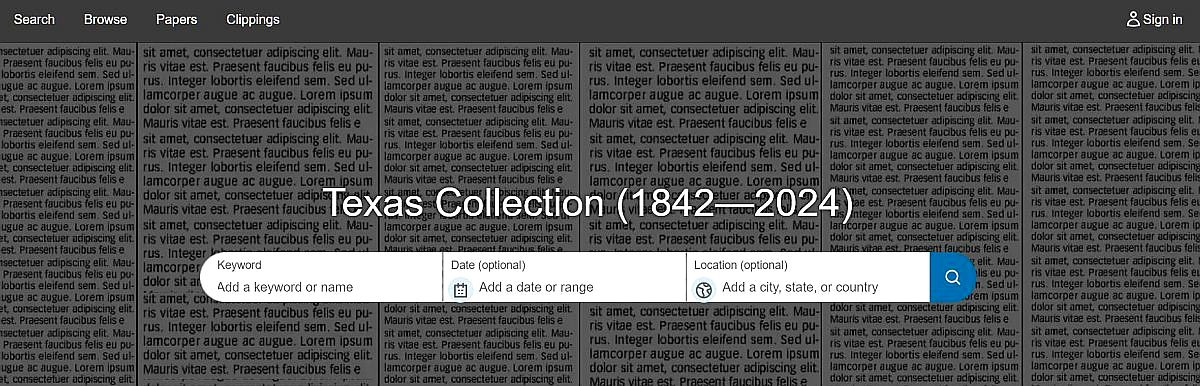
The three images in this post are screenshots from the Dallas Public Library website.

*

Copyright © 2025 Paula Bosse. All Rights Reserved.

Elks-a-Plenty — 1908

dmn-bldg_decorated-for-elks-convention_1908_cook-collection_SMU_fullBegirt with ruffles and studded with elks…

by Paula Bosse

Conventions have always been important to Dallas. One of the most important conventions ever to descend upon the city was the annual convention of the Benevolent and Protective Order of Elks in July 1908. There were approximately 38,000 attendees, but when you added to that number spouses and various others with business, social, or just looky-loo interests, it was estimated that more than 100,00 out-of-towners clogged the streets of our fair burg during the time of the convention. Dallas was a sizeable city in 1908, but the sudden swarming into town of 100,000 people (twice the actual population of the city!) must have been… challenging. (And profitable!)

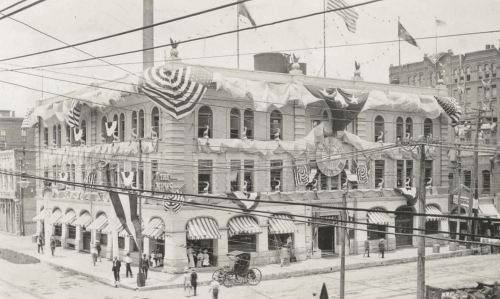
Dallas welcomed the Elks with enthusiasm and open arms. Everyone knew they were coming, and everywhere there were splashes of the Elk colors, purple and white. A special (and later notorious) semi-permanent arch was erected to span Main Street at Akard. And businesses competed with one another to see who could decorate their building with the most spectacular and festive bunting.

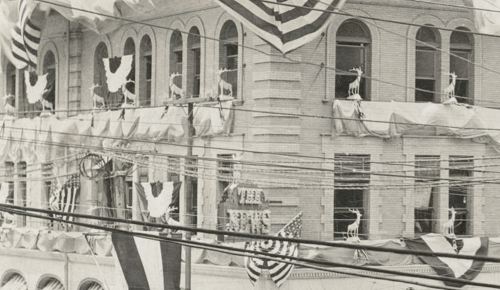
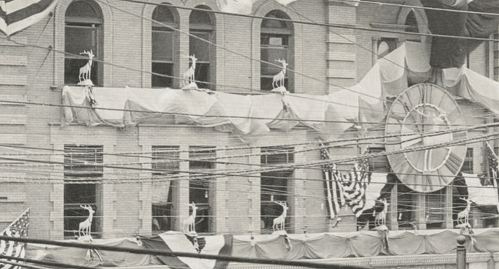
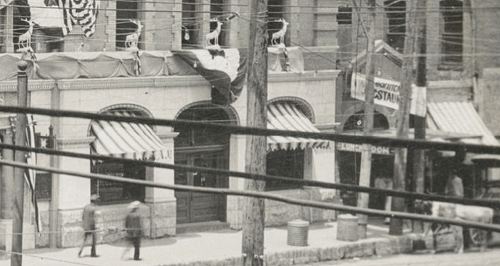
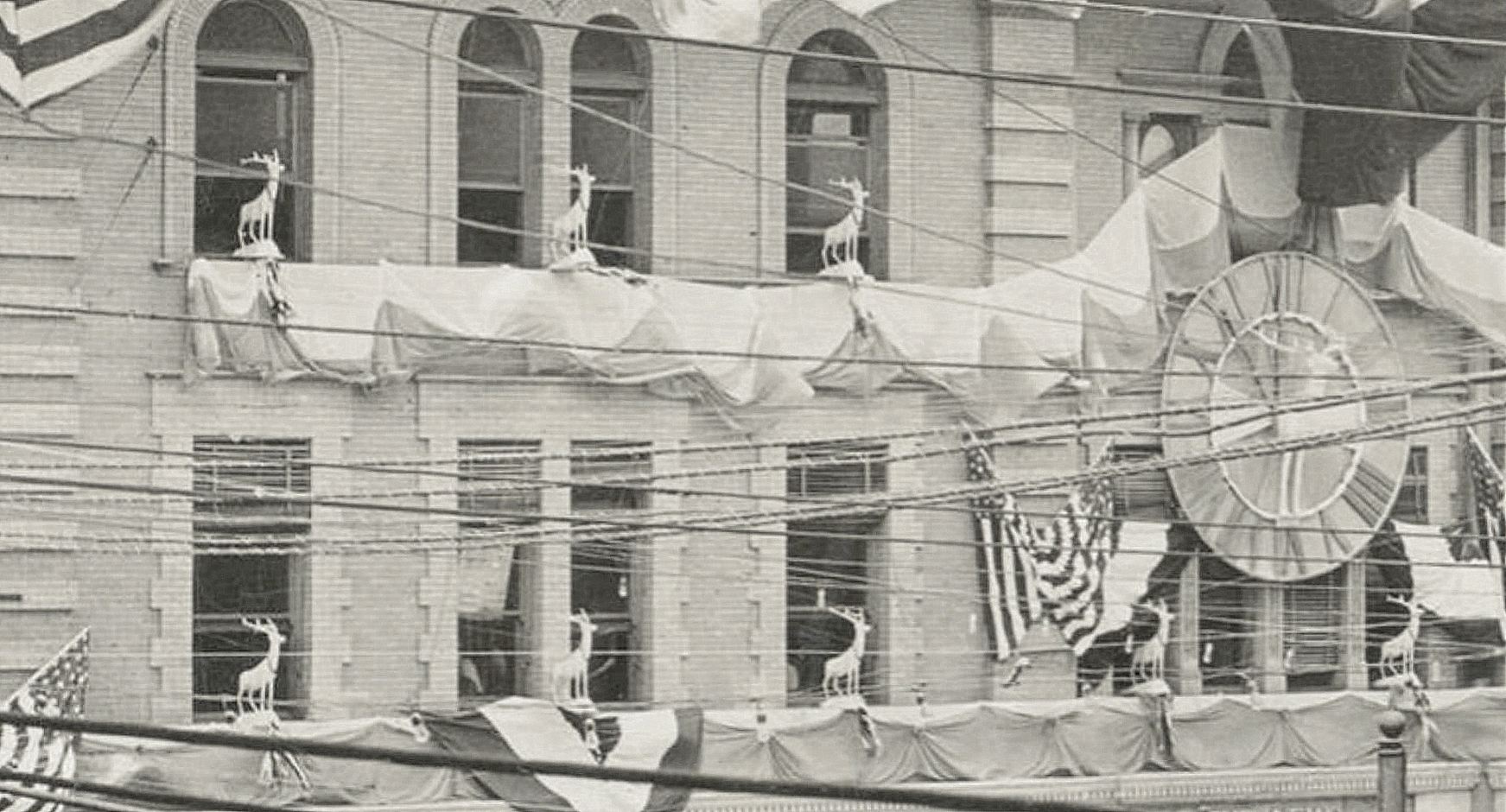
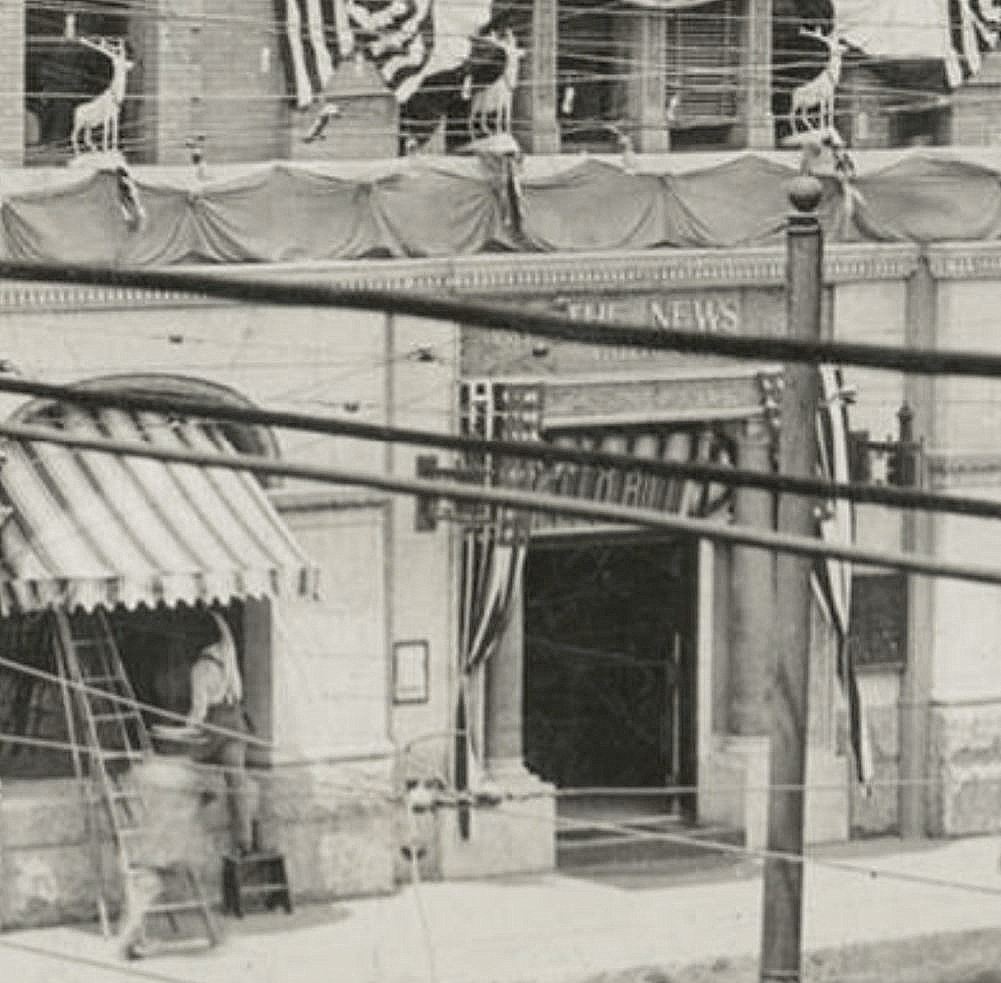
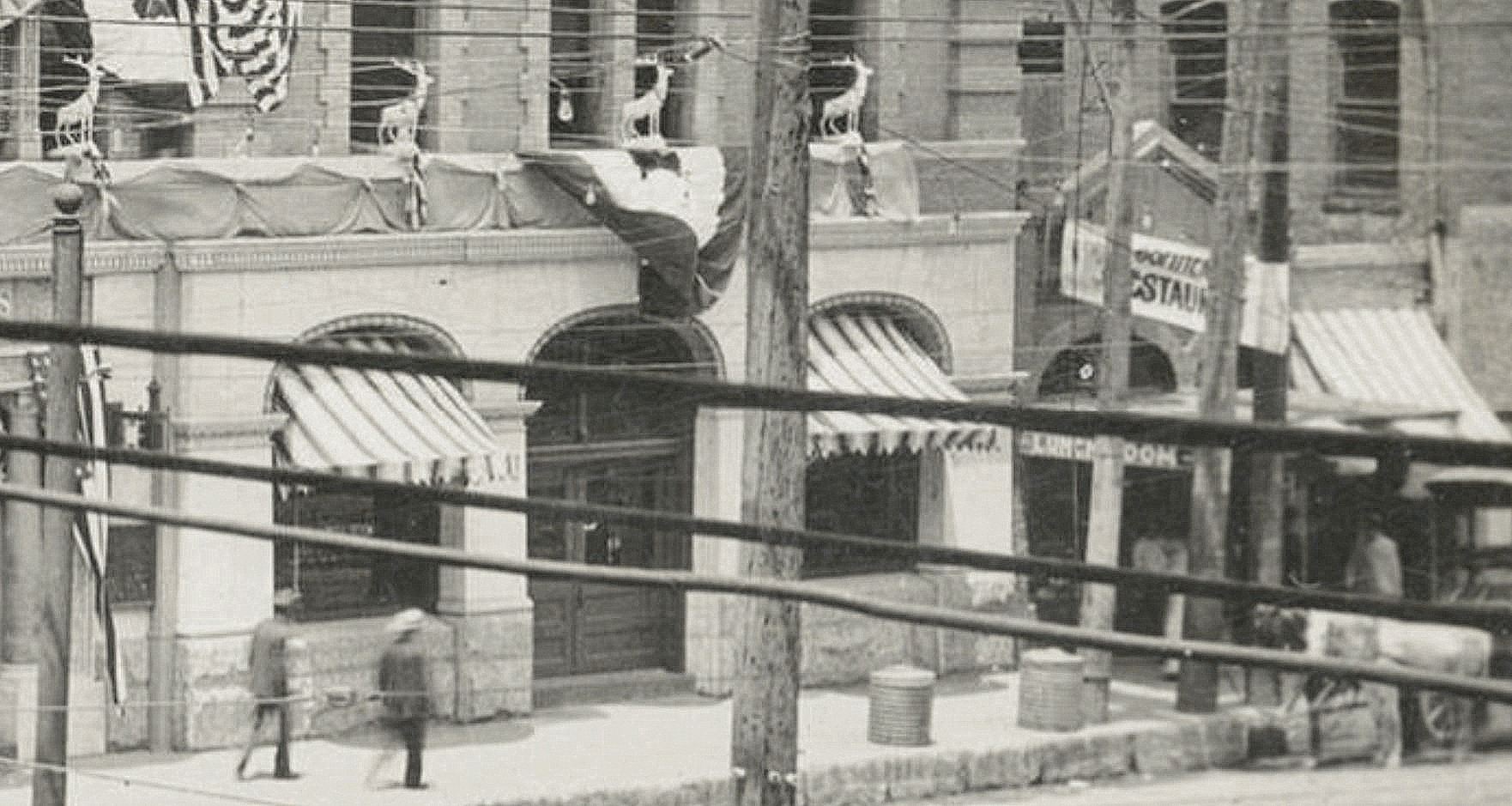
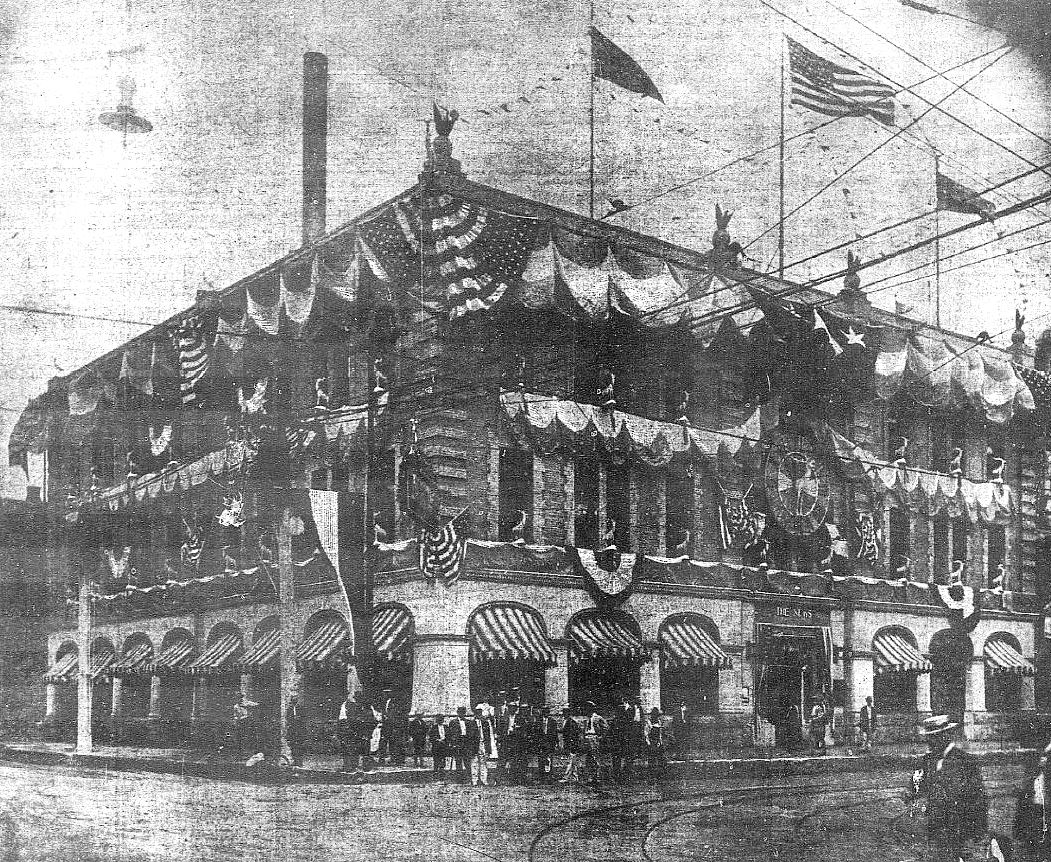
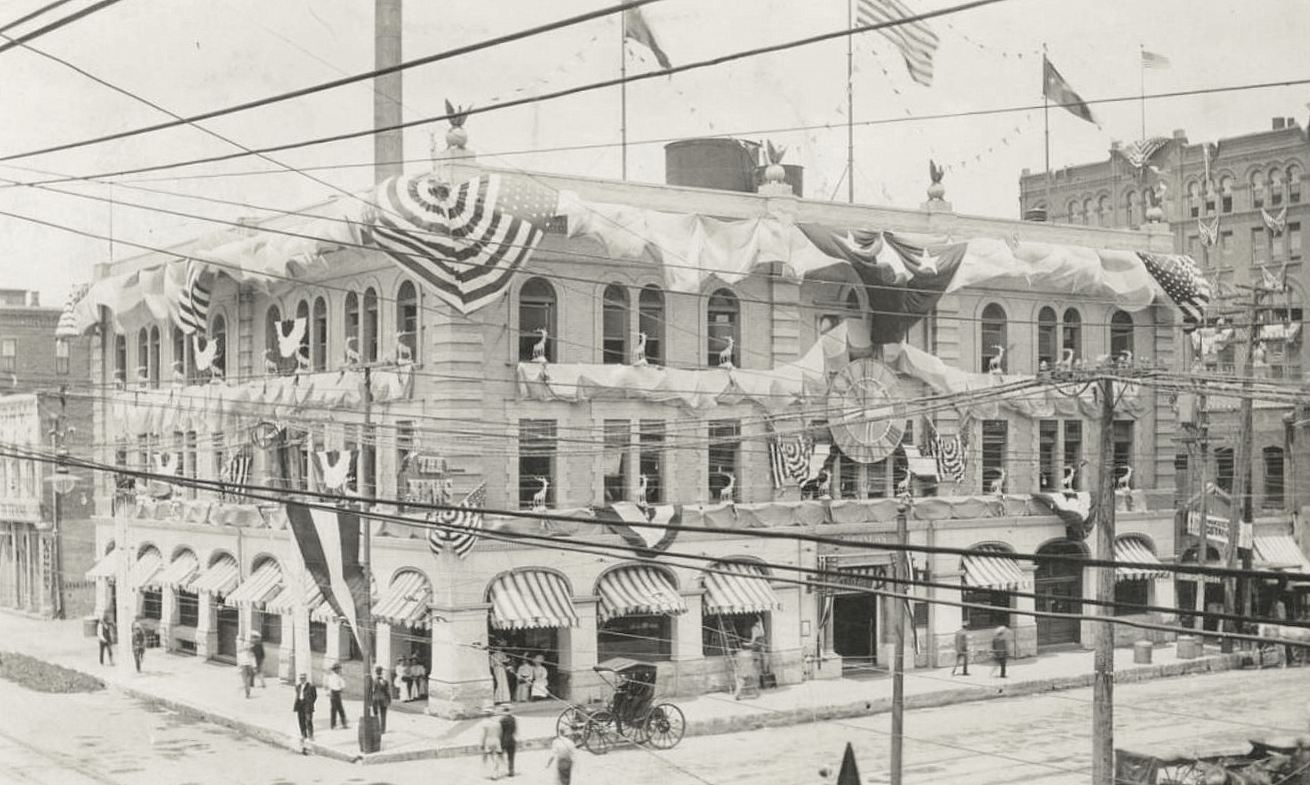
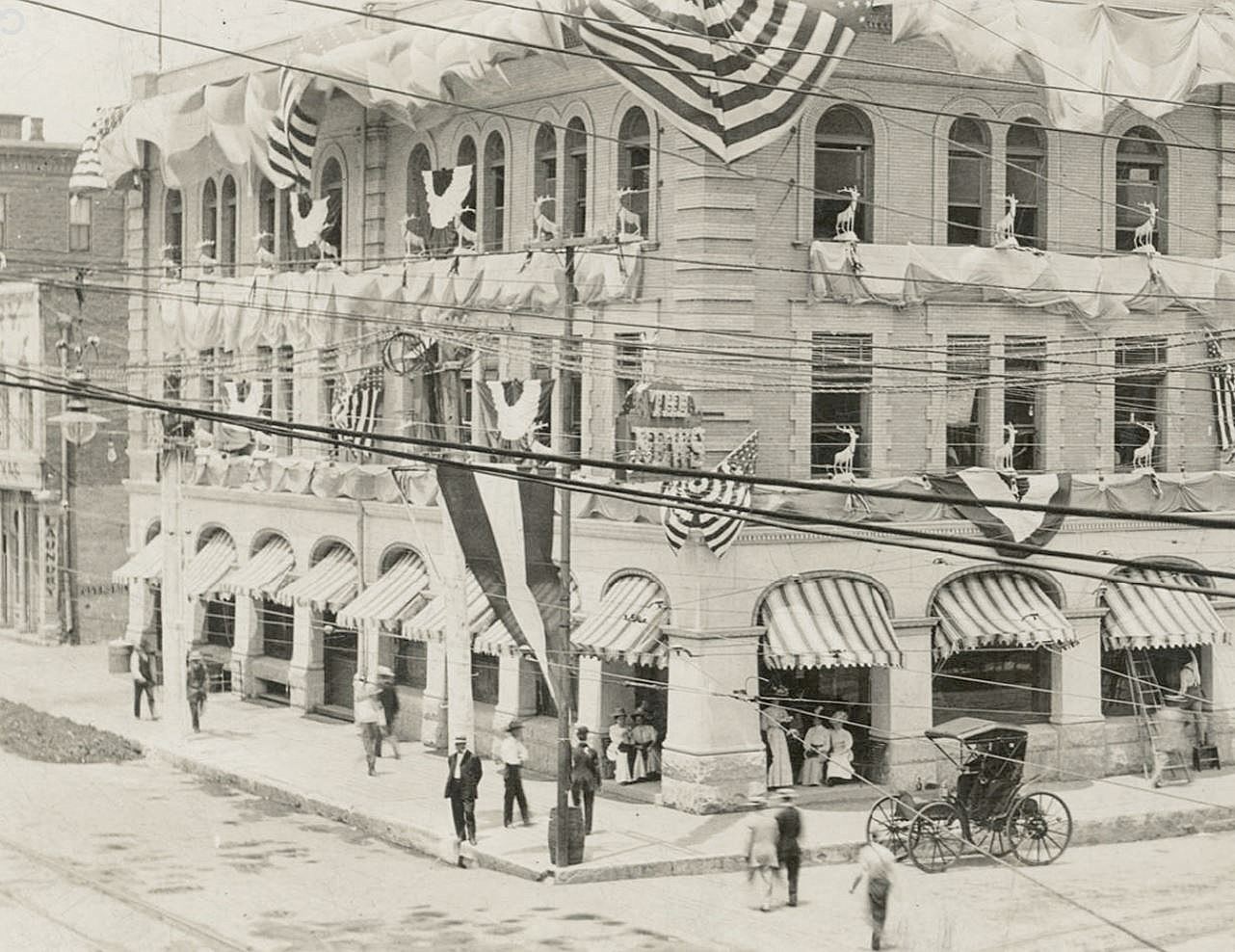
Above is a photo of the Dallas Morning News Building at the northwest corner of Commerce and Lamar, crammed full of flags, bunting, pennants, cowbells, lights, little statues of elks, medium-sized statues of elks, and large statues of elks. (There is an elk in every window.) It also had a large clock erected which was perpetually stuck at an Elk-y 11:00 and a parallelogram-shaped sign which lit up to flash the Elk greeting “Hello, Bill!” So… a lot. But what might seem like overkill — like The News was trying a little too hard to be noticed… the Elks loved it. LOVED IT. They loved it so much that they awarded the newspaper an award of $250 for the best decorated building in the city (that would be about $8,000 in today’s money!). Scroll down to read a breathless description of these decorations, with details of absolutely everything that was flapping, clanging, flashing, billowing, and throbbing at Commerce and Lamar in the summer of 1908. (I have to put this sentence from the article here because I love it so much: “To the bottom of each of these flags are attached small cowbells of different tones, so that with every strong whiff of wind there is a discordant but merry jingle.”)

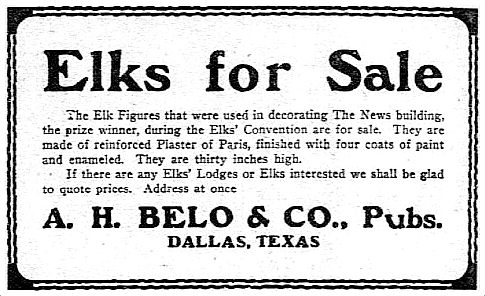
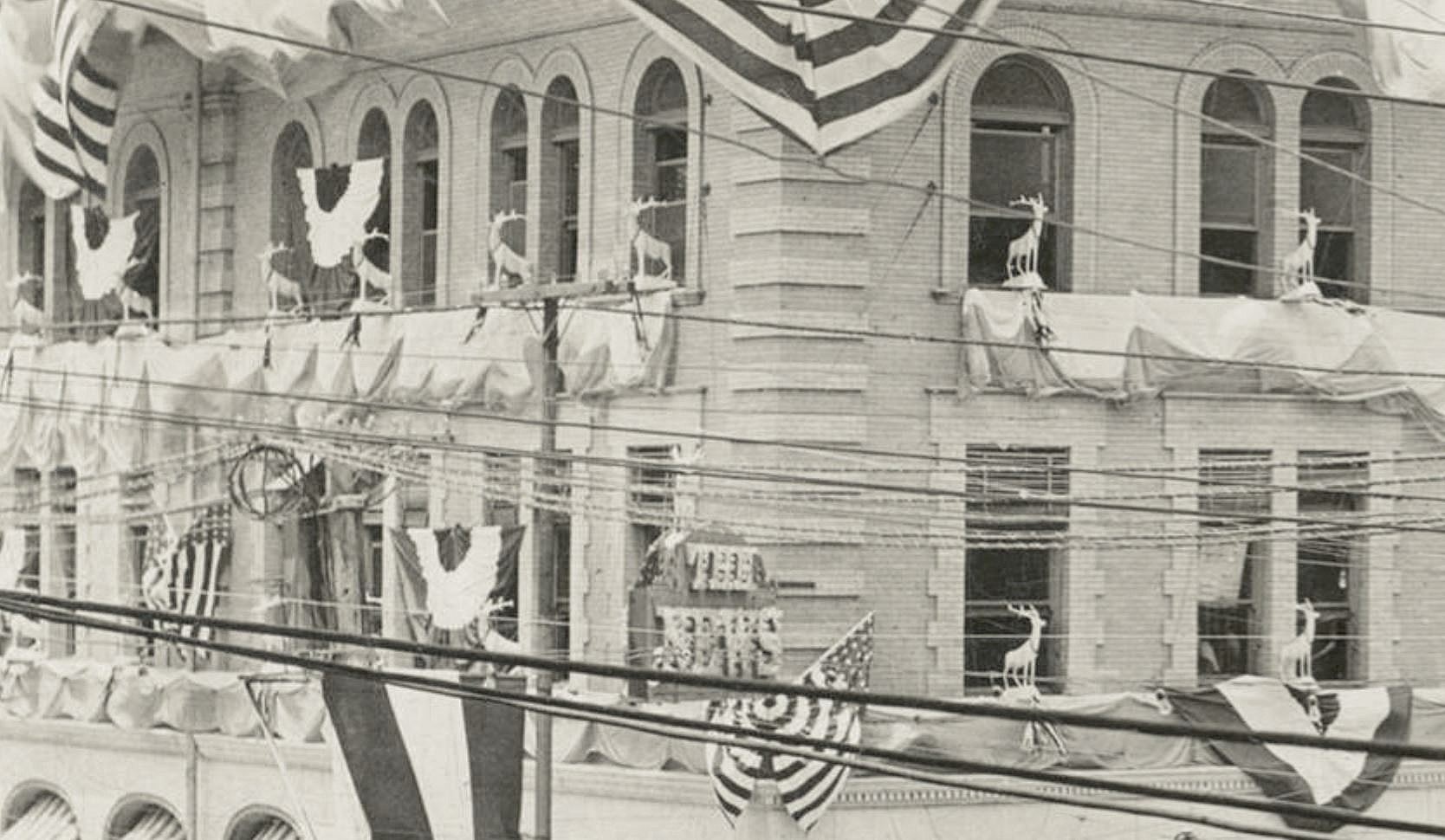
So, those elk statues. I mean… they’re fantastic. Little elks in every window, illuminated by a single electric bulb positioned “between the forefeet” of each mini-elk. And then there are the larger ones appearing to step out of — or off of — the building. But back to those little elks — are you wondering what happened to them after the conventioneers headed back home? Wonder no more!
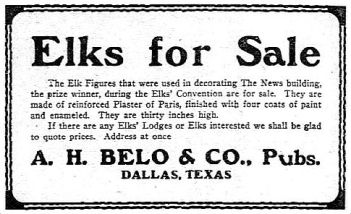
elks_news-bldg_belo-ad_071808Dallas Morning News, July 18, 1908

That would have been a great souvenir!

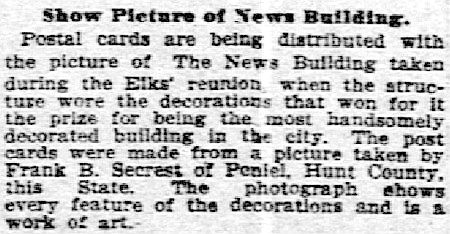
The photo at the top of this post (by Frank B. Secrest of Hunt County) was issued that summer as a postcard. The News did not miss an opportunity to mention it:
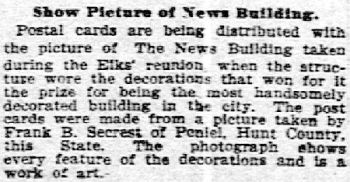
elks_news-bldg_dmn_080708DMN, Aug. 7, 1908

*

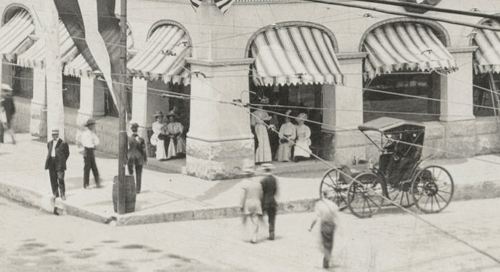
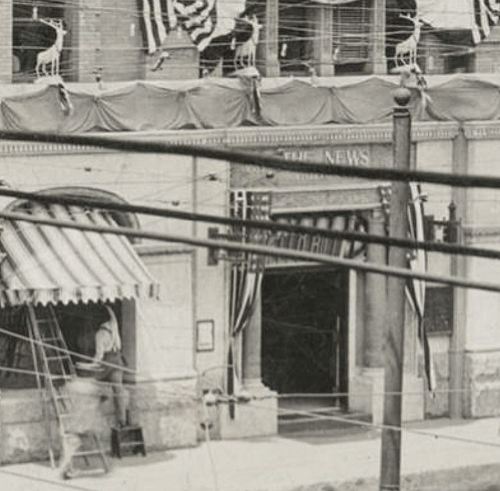
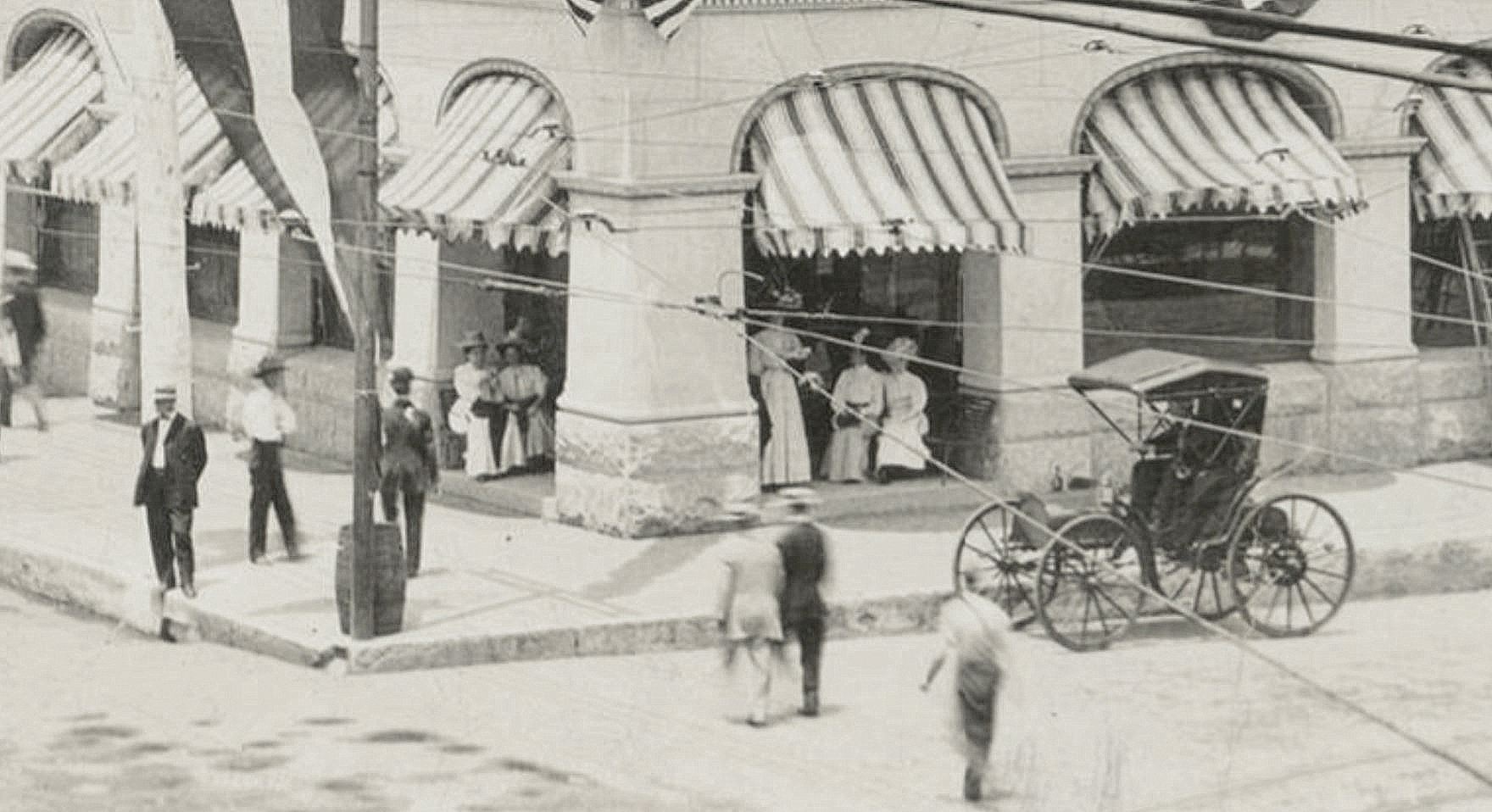
And because I love to zoom in on these sorts of photos, here are a few magnified details:
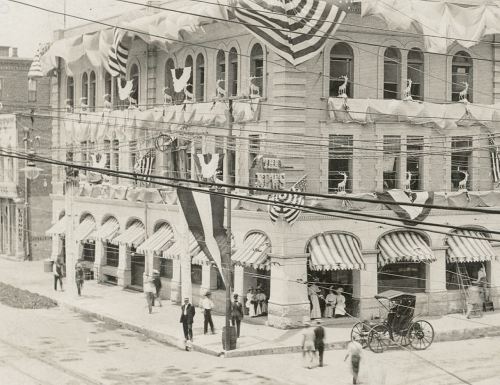
dmn-bldg_decorated-for-elks-convention_1908_cook-collection_SMU_det-2

dmn-bldg_decorated-for-elks-convention_1908_cook-collection_SMU_det-3

dmn-bldg_decorated-for-elks-convention_1908_cook-collection_SMU_det-4

dmn-bldg_decorated-for-elks-convention_1908_cook-collection_SMU_det-5

dmn-bldg_decorated-for-elks-convention_1908_cook-collection_SMU_det-6

dmn-bldg_decorated-for-elks-convention_1908_cook-collection_SMU_det-7

**

Here is a lengthy description of the decorations, from The Dallas Morning News — direct from the horse’s mouth:

To decorate The News Building in celebration of the coming of the Elks has been the labor of two men for more than a month, and of a dozen for two days: for, though it was only three days ago that the first bit of color appeared on the outer walls, the preparations were begun in the seclusion of a workshop early in June. The draping of the building with bunting and flags was done under the direction of W. T. Senter of the National Decorating Company of St. Louis, and of Edward A. Gebhard, librarian of The News. In working out their scheme they have used 4,200 yards of bunting, purple, white and purple, and twenty-four immense flags, and disposed of it in such artistic fashion as to avoid a sense of crowding.

PURPLE, WHITE AND PURPLE RUFFLES

The building is thrice begirt with big ruffles of purple, white and purple. But, to begin at the topmost, three large flags, one the United States, another the Texas and the other The News’ flag, float high above the Lamar street side of the building. To the bottom of each of these flags are attached small cowbells of different tones, so that with every strong whiff of wind there is a discordant but merry jingle. From one to the other of the flagstaffs hundreds of small pennants in the colors of the Elks flutter gayly in the breeze. Festooned from the heavy cornice which crowns the building are heavy folds of purple, white and purple so arranged that with every vagrant breeze it swells and sinks like the surface of water. Once on the Lamar street side, over the entrance, again at the corner and once on the Commerce street side this bunting is gathered around an immense United States flag, fashioned fan-shape. Poised on the cornice of the building at the corner, as if surveying the land preparatory of a leap, is the graceful figure of an elk, five and a half feet high, made out of plaster of Paris, painted and enameled until he glistens.

The two lower ledges of the building are draped in similar fashion, except that the streamers at these places are narrower than those that festoon the cornice. Above the main entrance on the Lamar street side and extending from below the second story to the third-story ledge is the piece de resistance. Here set in an embrasure of the building, is a clock dial twelve feet in diameter. The gilt letters marking the divisions of the circle are two feet high. The hands point to the hour of 11. The pure white head and shoulders of an elk seven feet high are shown in the center one foot forward, as if he were about to emerge from the fluffy mass of purple and white bunting that forms the background dial. On each side an immense flag is gathered in a way to make it fan-shaped. Circling the clock dial are six large incandescent lights.

WHOLE HERD OF ELKS

From the third-story corner of the building, above which stands a five and one-half foot Elk, as if surveying the country from a precipice, are festooned two twelve-foot flags that fall almost to the second-story ledge of the building. One is gathered around on the Commerce and the other on the Lamar street side. And there yet remains to speak of the most distinctive feature of the whole scheme of decoration. The News, in preparation for this event, had made a whole herd of elks. There are forty-two of them, each thirty-two inches tall, and one, mounted on a pedestal, stands poised from the ledge of every window in the building. They are pure white, made of plaster Paris, painted twice and then enameled. Between the forefeet of every one is an electric bulb. The elks are from models designed by Mr. Gebhard and were cast in The News Building.

BRILLIANT ILLUMINATION

Of course the whole building is brilliantly lighted. In addition to the electricity used ordinarily, which lights the exterior of The News Building pretty well, bulbs have been studded profusely midst the decorations and over the Lamar street entrance is a parallelogram of electric lights which illuminate the sign, “Hello, Bill!”

*

The article then launches into more self-promotion, with an, admittedly, interesting description of the layout of the News Building:

ATTRACTS GENERAL ATTENTION

The building of The News attracted general attention from the thousands of visiting Elks. Many expressed their surprise that a city the size of Dallas had such a complete, modern building and equipment, and the compliments concerning The News as a newspaper have been very pleasing.

The News Building has all the modern fireproof features. It occupies a space of 300×100, having three floors and a basement, the whole being used by the newspaper. Its business office is one of the handsomest in the State, and, as one visitor remarked, it looks more like a prosperous bank than the ordinary newspaper office.

The first floor is given up to the business and circulation departments, the press room and the mailing department. In the basement are the paper storage rooms and the power department. On the second floor are the editorial rooms, telegraph rooms and the general circulation department and the newspaper job department, besides the Employes’ Library and Recreation Room. On the third floor are the composing and the linotype rooms, the stereotype room and the engraving department.

INDIVIDUAL ELECTRIC MOTORS

Every piece of machinery in the house is operated by its own individual electric motor. Power is supplied from two immense engines and generators combined, the engine room being one of the show places in the building, having a metal ceiling and white glazed brick on the walls, with a cement floor. The press room contains two three-deck presses, one quadruple press and one sextuple press.

TWO DAILY NEWSPAPERS

The Dallas News is the offspring of The Galveston News, which was established in 1842. The two papers are under the same management. The publication offices of The News, Galveston and Dallas, 315 miles apart, are connected by special wires for interchange of news matter. The Galveston paper supplies the southern part of the State and the Louisiana border, while the other covers all North Texas and goes well into Arkansas, Oklahoma and New Mexico.

THREE SPECIAL TRAINS

For upward of a quarter of a century the two papers have operated at their own expense, every day in the year, three special newspaper trains, one running Galveston to Houston, one Dallas to Denison and the third Dallas to Fort Worth. The Dallas News covers hundreds of thriving towns throughout its territory, many of them before breakfast time, through its unrivaled facilities of distribution. Starting in 1885, The Dallas News has been a continuous success, and has achieved an enviable reputation wherever American newspapers are known. As an advertising medium it is in a class by itself so far as papers in this section of the country are concerned. Starting at 1885 with thirty-three classified ads in its Sunday issue, it now runs each Sunday about 2,000. It is a success because it is enterprising and because it is clean, both in its news columns and in its advertising columns; because it is fair-minded and because its efforts have always been uplifting from a moral and intellectual standpoint and fair to every interest.

*

And then it launches into many, many testimonials from Elk visitors on how much they love the decorations. This is the first. You get the idea.

J. T. McNulty of Baltimore, grand trustee of the Elks, prominent in National circles of the Knights of Columbus and a central figure in the Ancient Order of Hibernians of America, who has traveled largely and visited every State in the Union, being prominent in business and political circles said: “I have been to many conventions, my son, and have seen many decorations, but the one at The News plant, in my estimation ‘takes the cake,’ figuratively and literally speaking. It is the most unique, the most artistic and the most beautiful I have ever seen in all my attendance at conventions in this country, and I have attended many of them. I was agreeably surprised at the way Dallas has decorated, but nothing gave me such a shock of pleasurable surprise as the first sight I had of The News’ decorations.”

*

And this is the dark and grainy photo that ran with the article:
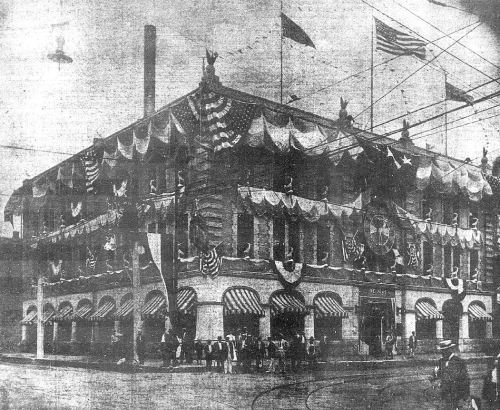
dmn-bldg_elks_dmn_071508_photoDMN, July 15, 1908

**

I kinda want an elk statue now. Also, according to the article, I now know the Morning News has its own flag. Can someone point me to more info?

**

Most of the larger downtown buildings went crazy with decorations, such as the Oriental Hotel (southeast corner of Commerce & Akard), seen here festooned up the wazoo. If you see a photo from 1908 with a Dallas building that’s looks like this, blame it on the Elks.

oriental-hotel_postcard_elks_1908_ebay

***

Sources & Notes

Top photo — titled “[The News, First Prize for Decorations, Dallas, Texas]” — is from the George W. Cook Dallas/Texas Image Collection, DeGolyer Library, Southern Methodist University; more info on this photograph (postcard) can be found here.

Lengthy quote is from the article “Dallas News Building Decorated In Honor of the Elk’s Grand Lodge Which Is Now Holding Its Annual Session and Grand Jubilee in This City,” The Dallas Morning News, July 15, 1908.

More Elks-related Flashback Dallas posts:

And more photos of this beautiful Dallas News Building can be found in these posts:

dmn-bldg_decorated-for-elks-convention_1908_cook-collection_SMU_full_sm

*

Copyright © 2022 Paula Bosse. All Rights Reserved.

Dallas Morning News/Fort Worth Star-Telegram Archives Update

dmn-bldg_dmn_sketch_1890sDallas News HQ, 1890s

by Paula Bosse

A couple of facts about me: I guess I’m what you’d call a “power user” of the Dallas Public Library’s NewsBank newspaper database, accessing the archives of the Dallas Morning News and Fort Worth Star-Telegram pretty much daily; I’m also fairly resistant to change (i.e. kind of lazy).

So when I encountered the redesign of the entire NewsBank database yesterday, I was less than ecstatic that I’d have to stop what I was doing and figure out where everything had been moved to. I know I’ll get used to it quickly (I already have), but, what a pain. I’m not sure why some of the changes were made, but, whatever. I actually discovered a few new things which are either brand new or were hidden in what is, let’s face it, a site with a lot of stuff going on. (There are only so many hours in the day….)

The point of this is to say that I have re-re-re-updated Flashback Dallas’ most popular post, “How To Access the Historical Dallas Morning News Archive.”

For any of you who might log on to the Dallas Public Library site and click over to the DMN archive and wonder what the heck happened, my step-by-step tips might be helpful. They might also be tedious, repetitive, and vague. But at least it’s up-to-date! Until they change it again!

Click on the link above if you need any help. (Remember: filtering is your friend!)

And, again, many thanks to the Dallas Public Library and The Dallas Morning News (and The Fort Worth Star-Telegram) (and NewsBank) for providing such a valuable resource!

dmn-bldg_dmn_sketch_1890s_sm

*

Copyright © 2021 Paula Bosse. All Rights Reserved.

Legendary Sports Writers of the Fort Worth Press — ca. 1948

sportswriters_blackie-sherrod_dan-jenkins_bud-shrake_etc_fort-worth-press_SMUBlackie and crew…

by Paula Bosse

The legendary sport writers of The Fort Worth Press, circa 1948: (standing, l to r) Jerre Todd, Blackie Sherrod, Dan Jenkins; (sitting) Andy Anderson and Edwin “Bud” Shrake. Missing: Gary Cartwright. 

This is what sports writers should look like!

***

Sources & Notes

Photo — titled “[Staff of Fort Worth Press]” — is from the Blackie Sherrod papers, DeGolyer Library, Southern Methodist University; more info can be found here.

More on Blackie Sherrod, who became the dean of Dallas sportswriters, can be found in the Flashback Dallas post “Blackie Sherrod: The Most Plagiarized Man in Texas: 1919-2016.”

Read a great, lengthy piece about these guys and their time as the greatest sportswriting staff in Texas in the article “Mourning Dark: The Fort Worth Press’ Legendary Sportswriters Are a Dying Breed” by Kathy Cruz (Fort Worth Weekly, Jan. 3, 2018).

*

Copyright © 2020 Paula Bosse. All Rights Reserved.
George Dahl’s Downtown Public Library Is Now the Home of The Dallas Morning News

14DPL_schiwetzcrop

by Paula Bosse

Today is the official beginning of the next step in the history of the George Dahl-designed building at Commerce and Harwood which once housed the Dallas Public Library: after years of abandonment and deterioration, it is now the miraculously preserved and spiffed-up home of The Dallas Morning News! Read Robert Wilonsky’s valentine to the beautiful building — along with photos old and new — on the News site, here.

And while we’re at it, let’s look back to the beginnings of the building as the wonderfully modern Dallas Public Library in one of my very first Flashback Dallas posts, “George Dahl’s Sleek Downtown Library — 1955,” here.

Thank you, DMN, for saving and resuscitating this landmark Dallas building!

*

Copyright © 2017 Paula Bosse. All Rights Reserved.
 

The Dallas Express — A Look Inside the Offices of the City’s Most Important Black Newspaper — 1924

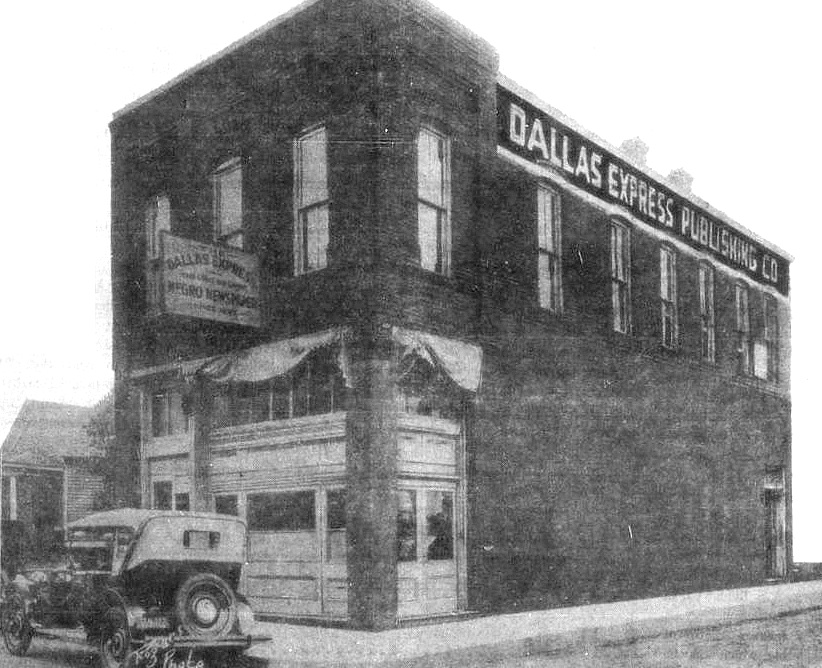
dallas-express-bldg_dallas-express_0607242600 Swiss, home of The Dallas Express (click for larger image)

by Paula Bosse

Without question, The Dallas Express (1892/3-1970) was the most important and most widely-read black-owned newspaper published for Dallas’ African-American community. In addition to stories of particular interest to its Dallas and Texas readership, it also covered national and international news, and in the Jim Crow era, when black Dallasites were rarely mentioned in white-owned newspapers except in crime reports, The Express reported on the people, the businesses, the churches, and the achievements of their large community. They also wrote about politics and issues of race and discrimination. One of the paper’s slogans was “A Champion of Justice, A Messenger of Hope.”

I’ve been interested in newspapers, journalism, and the actual physical process of printing newspapers for as long as I can remember, but until a couple of years ago, I was not aware of The Dallas Express, founded in 1892 by publisher/editor W. E. King. Discovering this paper and its stories about my hometown has been eye-opening. The Dallas Express is an important — and often overlooked — source of Dallas history. I love reading through issues of The Express because unlike white-owned papers of this period, it presents a realistic and human chronicle of the everyday lives of Dallas’ black men and women, something which was almost completely ignored by The Dallas Morning News and The Dallas Times Herald.

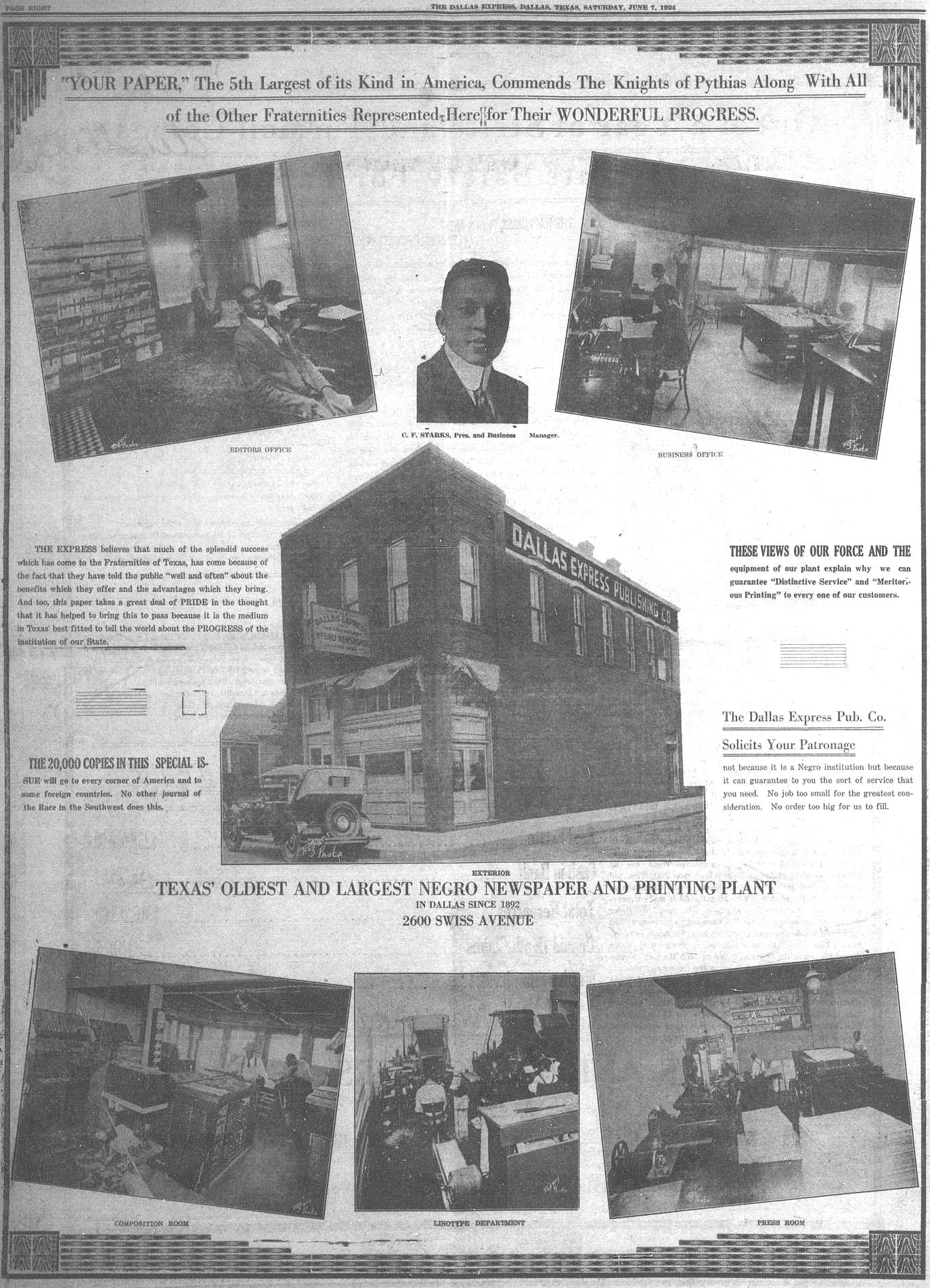
For many years, the offices of the Express were just north of Deep Ellum, at 2600 Swiss — at the corner of Good Street, about where Brad Oldham’s Traveling Man sculpture stands today. (I have a feeling the actual location was in the middle of what is now Good-Latimer. See the location on a 1921 Sanborn map here.) Happily, the Express printed a full-page ad for itself in the June 7, 1924 edition, so we can see what the Swiss Avenue building, its offices, and its production rooms looked like. These photos were taken by noted Dallas photographer Frank Rogers. (Apologies for the muddy quality of these photos — I’d love to see the crisp originals!)

*

These photos show the Dallas Express offices as they looked in 1924, when the newspaper had already been in business for 32 years. The exterior of the two-story building can be seen in the photo at the top — standing next to a private residence. (Click photos to see larger images.)

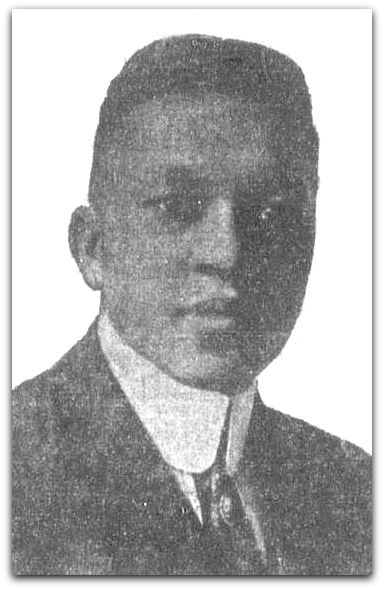
Below, president and business manger (and, later, owner), C. F. Starks:

dallas-express_c-f-starks_pres-business-mgr_060724

The editor’s office (John W. Rice was the editor at this time and is, presumably, the man in the foreground):

dallas-express_editors-office_060724

The business office:

dallas-express_business-office_060724

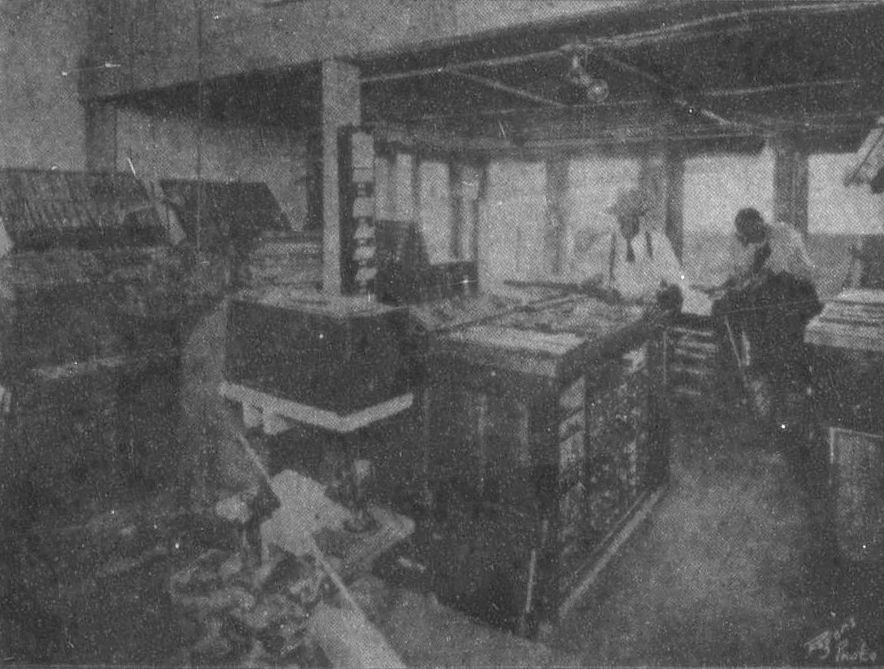
The composition room:

dallas-express_composition-room_060724

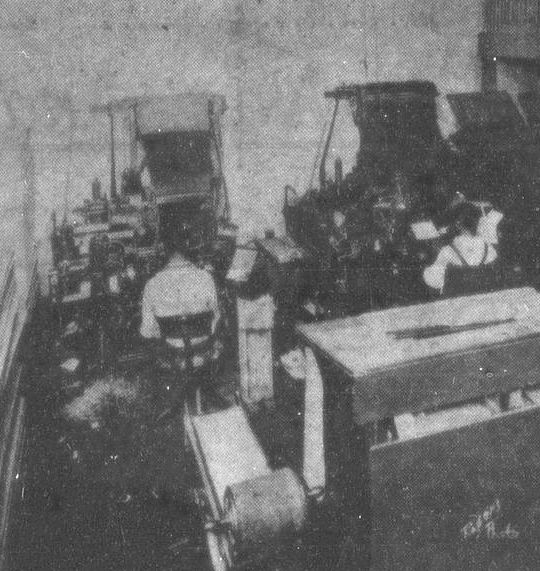
The linotype department (I have written about my fascination with linotype machines here):

dallas-express_linotype_060724

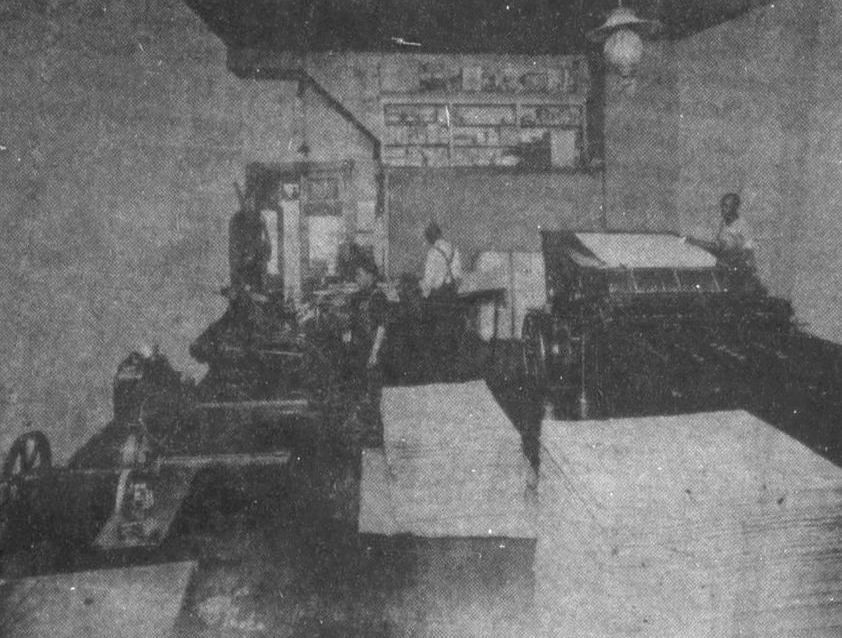
And the press room:

dallas-express_press-room_060724

The text from the ad (this special “Pythian Edition”of the paper was printed to coincide with the 40th annual meeting of the Knights of Pythias):

“YOUR Paper,” The 5th Largest of its Kind in America, Commends The Knights of Pythias Along With All of the Other Fraternities Represented Here for Their WONDERFUL PROGRESS.

THE EXPRESS believes that much of the splendid success which has come to the Fraternities of Texas, has come because of the fact that they have told the public “well and often” about the benefits which they offer and the advantages which they bring. And too, this paper takes a great deal of PRIDE in the thought that it has helped to bring this to pass because it is the medium in Texas best fitted to tell the world about the PROGRESS of the institution of our State.

These views of our force and the equipment at our plant explain why we can guarantee “Distinctive Service” and “Meritorious Printing” to every one of our customers.

The 20,000 copies in this special issue will go to every corner of America and to some foreign countries. No other journal of the Race in the Southwest does this.

The Dallas Express Pub. Co. Solicits Your Patronage not because it is a Negro institution but because it can guarantee to you the sort of service that you need. No job too small for the greatest consideration. No order too big for us to fill.

TEXAS’ OLDEST AND LARGEST NEGRO NEWSPAPER AND PRINTING PLANT
In Dallas Since 1892
2600 Swiss Avenue

*

The full-page ad:

dallas-express_060724_p8_full-page
Dallas Express, June 7, 1924

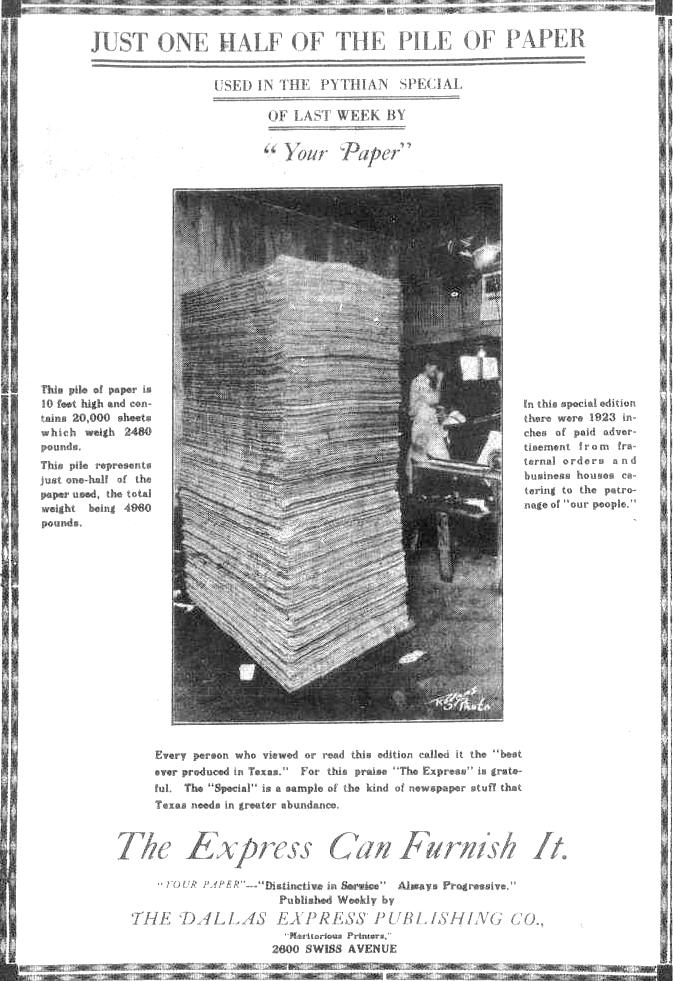
Another photo of the printing room appeared in an Express ad which ran in the paper the following week:

dallas-express_061424_ad
Dallas Express, June 14, 1924

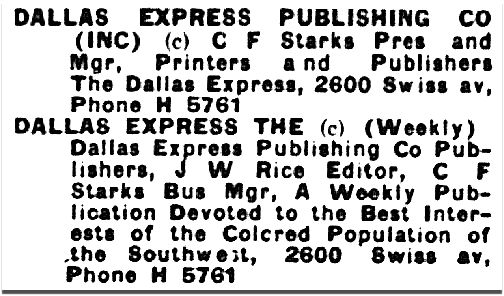
dallas-express_1923-directory
1923 Dallas directory

***

Sources & Notes

Photos by Frank Rogers. Original prints might be in the Frank Rogers Collection at the Dallas Public Library, but nothing showed up when I searched the DPL database. Original crisp prints would be wonderful to see!

Photos appeared in the June 7, 1924 edition of The Dallas Express. The full newspaper can be found here. Only a few years’ worth of scanned issues of The Express are available on UNT’s Portal to Texas History site — mostly 1919-1924 — they can be accessed here.

Read about The Dallas Express at the Portal to Texas History, here; the Wikipedia entry is here.

*

Copyright © 2016 Paula Bosse. All Rights Reserved.
 

Blackie Sherrod: “The Most Plagiarized Man in Texas” — 1919-2016

blackie-sherrod_dmn-video

by Paula Bosse

Legendary sportswriter Blackie Sherrod died yesterday at the age of 96. My father was not a follower of sports, but I remember he read Blackie Sherrod’s columns because, along with other great, larger-than-life, and exceptionally talented DFW sportswriters such as Bud Shrake, Dan Jenkins, and Gary Cartwright, Blackie was — for want of a better word — a “literary” journalist whose style transcended his subject matter. His writing appealed to everyone who enjoyed and appreciated well-written and caustically funny forays into, around, over, and under the world of sports. Sports fans — and other sportswriters — loved the guy. And so did everyone else.

In the December 1975 issue of Texas Monthly, Larry L. King (forever known as the man who made more money from the best little whorehouse in Texas than any of the girls who plied their trade there) wrote a fantastic profile of Blackie (“The Best Sportswriter in Texas”), in which he described Blackie Sherrod as being “the most plagiarized man in Texas.” Sportswriters around the state routinely stole all of Blackie’s best lines and inserted them, unattributed, into their own columns. King himself admits he was one of the worst offenders. The lengthy profile is great. Great. Read it here.

*

UPDATE: Also, this is a great 9-minute film produced by KERA in the 1970s in which Blackie talks about his career, past and present.

***

Sources & Notes

Video is from the KERA Collection, G. William Jones Film & Video Collection, Hamon Arts Library, Southern Methodist University; the permanent link on YouTube is here.

Watch a Dallas Morning News-produced video tribute to Blackie Sherrod from 2013.

The Dallas Morning News obituary — “Legendary News Sportswriter Blackie Sherrod Dies at 96” — written by Kevin Sherrington, is here.

Several of Blackie’s Sherrod’s books can be purchased online, here.

Moments after I posted yesterday’s photo of the Dallas Times Herald lobby, I read that Blackie had died. He must have walked through that lobby thousands of times. That was an odd bit of synchronicity.

See an early photo of Blackie with his famed co-workers in the post “Legendary Sports Writers of the Fort Worth Press — ca, 1948.”

Thanks, Blackie.

*

Copyright © 2016 Paula Bosse. All Rights Reserved.
“The Times Herald Stands For Dallas As a Whole”

dallas-times-herald-lobby_UTA_squire-haskinsCool and sleek (click for very large image)

by Paula Bosse

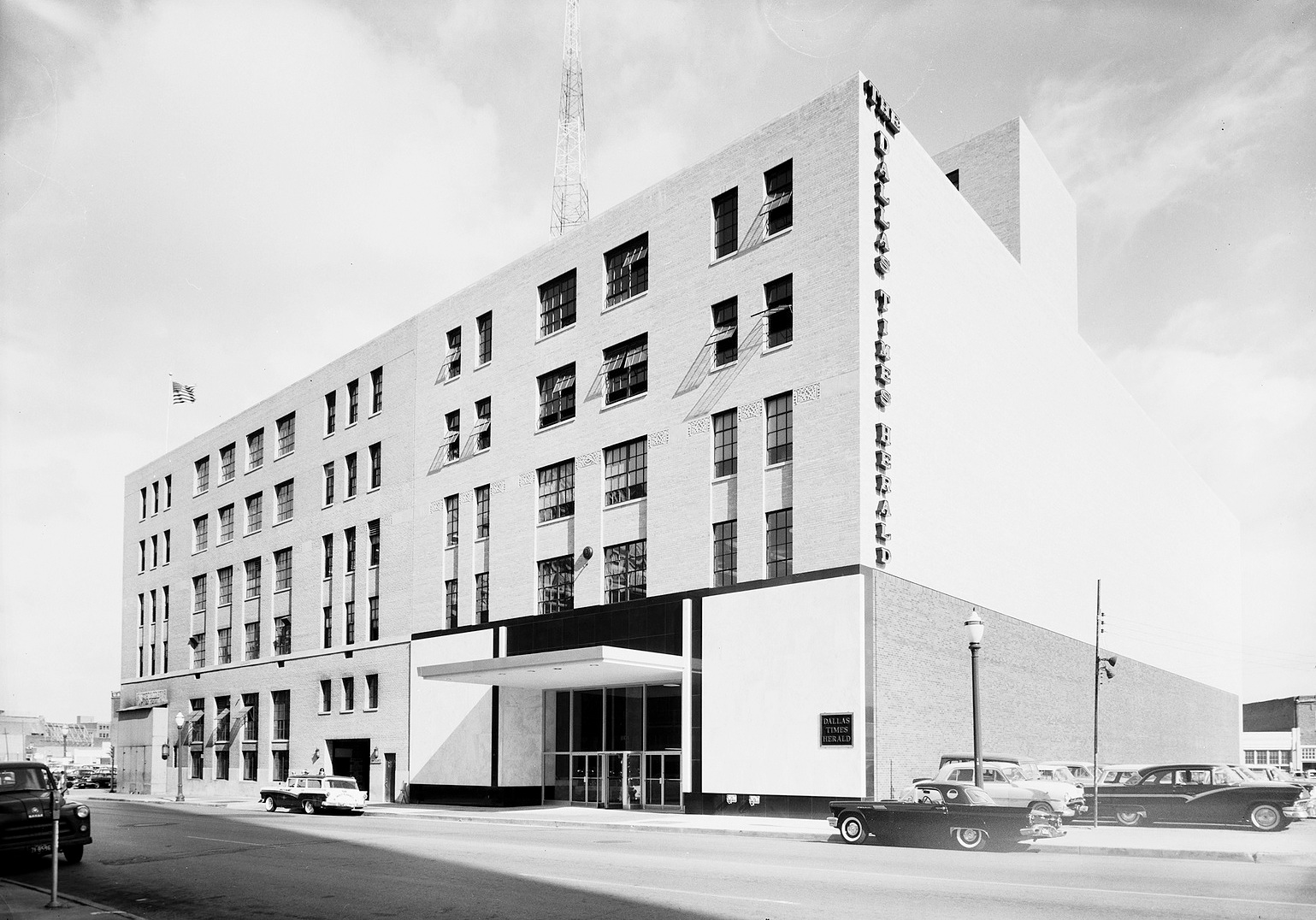
Above, the Dallas Times Herald lobby, in all its gleaming mid-century style.

And, below, its smart, crisp exterior (taken on July 28, 1958).

dallas-times-herald-bldg_squire-haskins_uta

RIP, DTH. (And, yes, I’m still bitter.)

***

Sources & Notes

Photos by Squire Haskins, from the Squire Haskins Photography Inc. Collection, UTA Libraries, University of Texas at Arlington; more info on the interior photo is here; more on the exterior photo is here.

The Dallas Times Herald building was located at 1101 Pacific Ave., bounded by Pacific, Griffin, and Patterson. The building was demolished in 1993 and replaced by a parking lot.

*

Copyright © 2016 Paula Bosse. All Rights Reserved.
The Dallas News Special: Fast Train to Denison — 1887

dallas-news-special_belo-collection_smuThe Dallas Morning News, full speed ahead! (Belo Collection, SMU)

by Paula Bosse

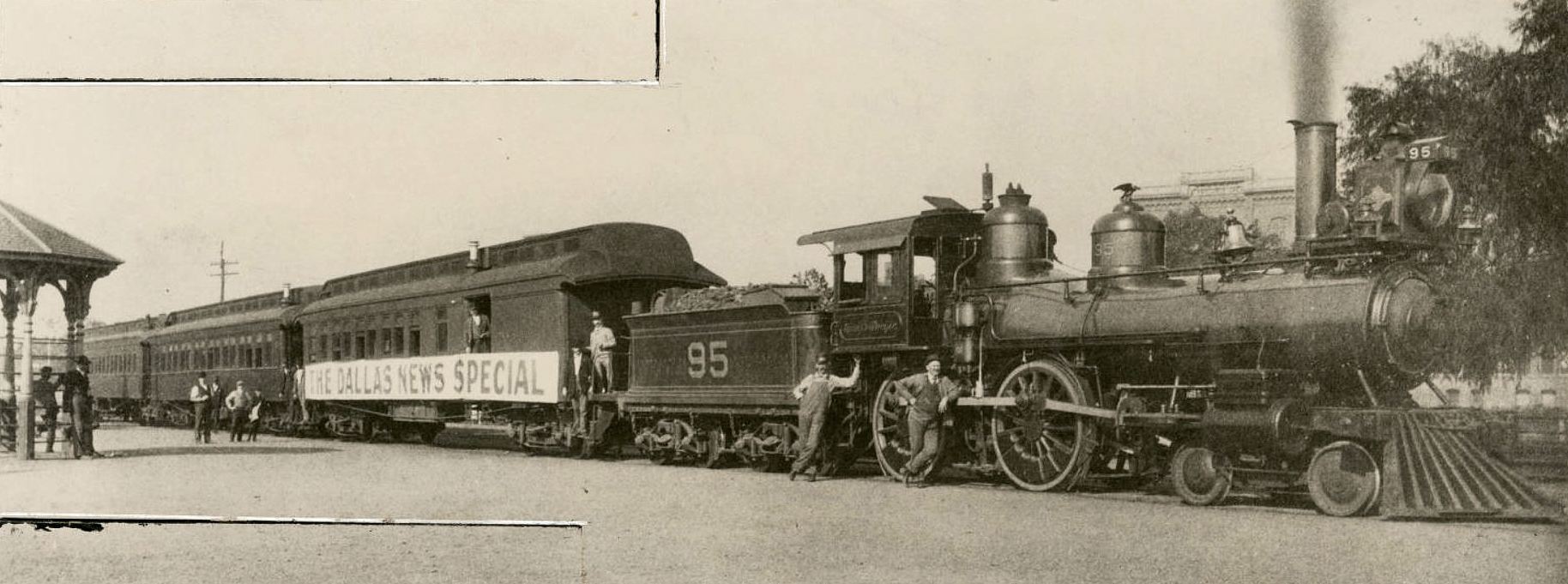
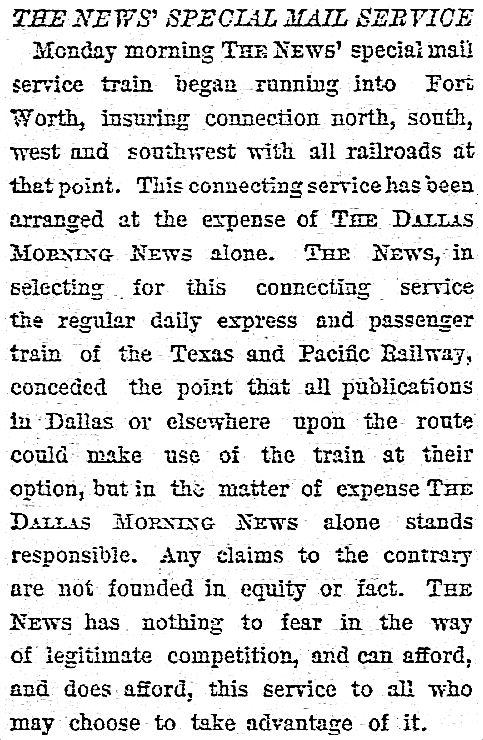
In October 1885, The Galveston News decided to launch a sister publication in Dallas, The Dallas Morning News. They sent 26-year-old George Bannerman Dealey to run it. Before that first month was up, go-getter Dealey had made a special arrangement with the Texas & Pacific railroad — “at considerable expense to The News” — to extend its route and pop into Dallas to pick up papers destined for its subscribers west of the city. (The photo at the top may or may not show that very first “Special Mail train.”)

news-train-fort-worth_dmn_102885DMN, Oct. 27, 1885 (click for larger image)

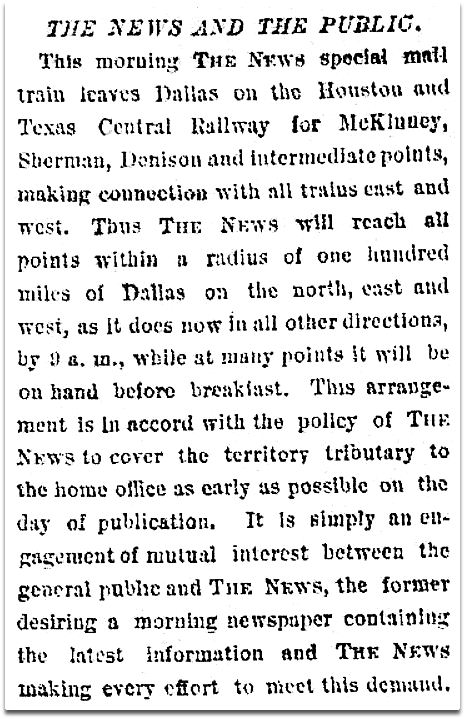
A year and a half later, The News one-upped itself and made the announcement that it would operate a special train to Denison — again, “at a vast expense.” This train would transport editions of the paper in the wee small hours in order to assure that The Dallas Morning News would actually BE a morning newspaper for as many of its subscribers as possible, whether they lived “within a block of the press” or a hundred miles away (DMN, Sept. 30, 1888). News-hungry Denisonians could read their papers over breakfast at the same time their Dallas counterparts did.
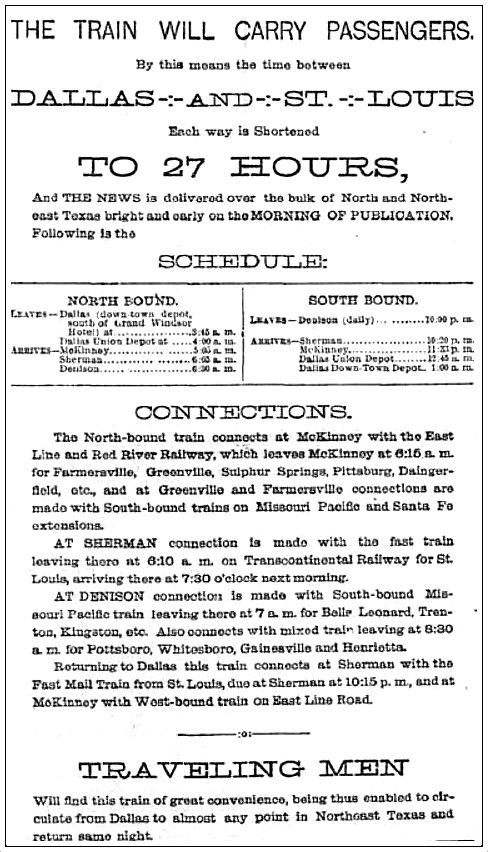
news-train_dmn_052287DMN, May 22, 1887

The train was dubbed by some “The Comet” (not to be confused with the MKT’s later Katy Komet). It was a “fast train” that carried passengers as well as newspapers along the Houston and Texas Central rails.

ad-special-news-train_dmn_052287-det

ad-special-news-train_dmn_052287-det2DMN, May 22, 1887

Not only was this a clever way to extend its reach and expand its circulation, but, as the Handbook of Texas notes, it also “enabled the paper to meet the threat of the St. Louis newspapers, which in 1885 had a larger circulation in North Texas than did any state paper.”

A rousing account of the first Dallas-to-Denison run appeared in the pages of both The Dallas News and The Galveston News (which often shared content). A link to that full story is below, but here are a few passages from an article written the next year, touting the wondrous success of the News Special, written as only a nineteenth-century newspaperman could write it (and the writer might well have been G. B. Dealey himself).

First, one encounters a mention of Plano in a more grandiose combination of words than one might expect, as the writer describes his pleasant pre-dawn train trip along the route.

Plano was reached before the drowsy god of day had wiped his eyes at the first yawn. He rolled over in his couch by the time it reached McKinney, and he was sitting on the side of it when the train was at Melissa. And here the mocking birds, with no ruddier iris upon their breast, but moved with the spirit that makes the burnished dove mourn out his love, made the air resonant with their chatter and their songs. Into Sherman and Denison the train plunged and the trip was done.

Um, yes. Then he breaks it down in a little more specifically. Actually, a LOT more specifically.

It starts. Two minutes are consumed at the Missouri Pacific crossing five miles out, two minutes at Caruth’s, five minutes for water, two minutes at Richardson, two minutes at the Cotton Belt crossing, three minutes at Plano, two minutes at Allen, three minutes at McKinney, two minutes at Melissa, fifteen minutes at Anna for a meeting point, three minutes at Van Alstyne, two minutes at Howe, five minutes at Sherman. Total forty-eight minutes. The distance between Sherman and Dallas is sixty-four miles. The time card calls for two hours and five minutes from Dallas to that point. Forty-eight minutes is consumed in stoppages. Anyone can make the calculations, sixty-four miles in seventy-seven minutes, and see the terrific speed that this train makes, has made for over a year, and made it without a single accident, and it is a good road — an awful good road — to make it over.

And then he congratulates his employer on giving even its most distant readers “an even whack.”

Is there anything like this in the history of newspapers? True, some of them in the north run special trains on special occasions, but THE NEWS stands without a rival in this sustained work of giving its remote patrons an even whack with its people of the city. (–The Dallas Morning News, Sept. 30, 1888)

Below, a train identified as this H&TC News Special to Denison, even though it looks remarkably similar to the T&P train (in the photo above) which may or may not have been that earlier 1885 mail train to Fort Worth. Dealey is identified as the man in the light-colored suit, standing on the steps (he also resembles the man in the top photo, but now with a full beard).

dallas-news-special_train-to-denison_1887_mcafee_degolyer_SMU

The train would slow down as it neared a small-town depot, and, without stopping, a man would toss bundles of papers from the train into the waiting arms of another man on the platform, who would then divide them up and hand them off to men and boys on horseback who would race to deliver them to stores and homes before breakfast.

The Dallas Morning News ran its hot-off-the-presses newspapers up to Denison for several decades on this train until, presumably, cheaper trucks were pulled into action. But did the rather less romantic trucks, rattling up to Grayson County, inspire the mockingbirds to “[make] the air resonant with their chatter and their songs” as had the noble locomotive speeding the news through the night? I think not.

*

dallas-news-train_degolyer-lib_SMU_ca-1885Dallas News offices, via DeGolyer Library, SMU

***

Sources & Notes

Top photo, titled “The Dallas Morning News special train,” is from the Belo Records, DeGolyer Library, Central University Libraries, Southern Methodist University; it can be viewed here. It’s a bit confusing, but this may show the inaugural run of the DMN’s special train to Fort Worth on May 22 ,1885, along the Texas & Pacific Railway. If anyone has suggestions on where this photo may have been taken, please let me know.

I came across a cropped version of the second photo in the March 1976 issue of Texas Historian, with the caption: “The Comet, Dallas News special train operated between Dallas and Denison in 1887. G. B. Dealey, then Dallas News business manager, stands on first car platform.” The version seen above is from the George A. McAfee photographs collection, DeGolyer Library, Southern Methodist University here; it is titled ”The Dallas News Special (H&T.C.).”

If you’re into trains (and even if you’re not), you might enjoy reading the following three stories from The Dallas Morning News:

  • “Special Mail Service, Observations of a Staff Correspondent Along the Route” (DMN, Oct. 27, 1885), describing the new Fort Worth route and how The News convinced (i.e. paid) the Texas & Pacific Railway to include a stop in Dallas to load up on newspapers and haul them westward, can be read here.
  • “The News in North Texas, The Special Mail Train Service” (DMN, May 23, 1887), a rousingly written ride-along narrative, is here. (I would advise more fragile readers to skip to the next paragraph when they come across mention of a cute little calf — nineteenth-century journalism is not for the overly sensitive.)
  • “News Special Train, Between Dallas and Denison Before Day, Remarkable Record, But the Following Cheerful Narrative Tells the Whole Story, Extending Over Sixteen Months, Over Fifty Miles An Hour” (DMN, Sept. 30, 1888), another genuinely exciting and poetic account of the special train and its crew, again, probably written by Dealey, can be read here. The few sentences that are illegible at the bottom of the first column: “He rang it with jerks in town, he rang it clangingly at crossings, but away out in the solitudes of the country, softly and gently he would peal it slowly, as if he had quit; softly as if his head had dropped upon his bosom. Lyerly is promoted now. Lasher is on the regular passenger train, and R. R. Roe has beautifully and [evenly?] taken his place. But Gentry still sits upon his old seat on the right hand side and watches growing into beefhood the….” 

*

Copyright © 2015 Paula Bosse. All Rights Reserved.