Flashback : Dallas

A Miscellany: History, Ads, Pop Culture

Category: Photographs

2222 Ross Avenue: From Packard Dealership to “War School” to Landmark Skyscraper
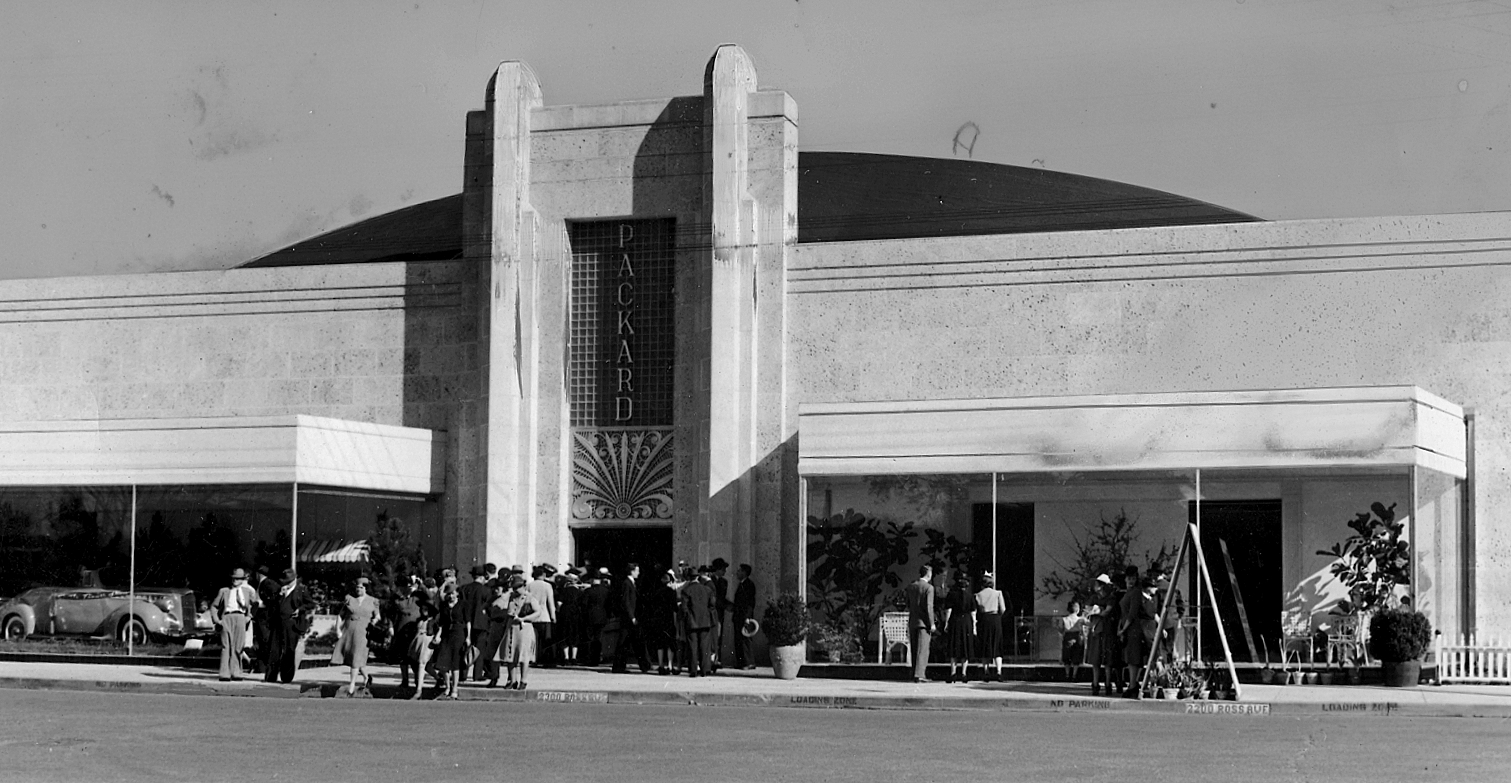
packard-dealership_2222-ross_detroit-pub-lib_1940Packard automobile showplace, 1940

by Paula Bosse

In late summer of 1939, a new 60,000-square-foot. $250,000 home for Packard-Dallas, Inc. featuring a “luxurious showroom” was announced. The first Packard automobile dealership had opened in 1933 at Pacific and Olive, and in the intervening six years, their growth had been tremendous, necessitating several moves and expansions.
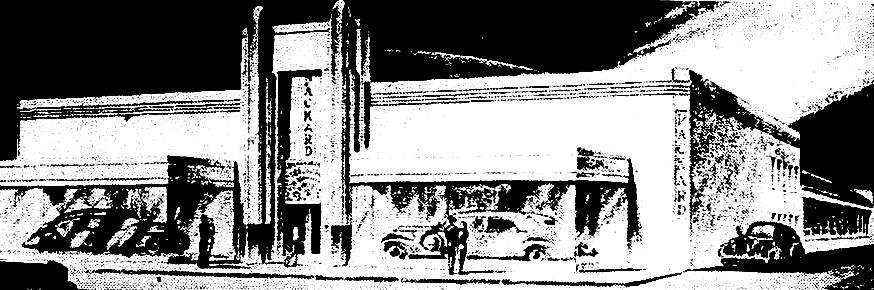
packard_ross_rendering_1939

The attractive art deco building, faced with Cordova limestone and decorated with glass bricks, cast aluminum letters, and neon, was designed by J. A. Pitzinger and Roy E. Lane Associates, and was constructed at 2222 Ross Avenue in a mere three months. The large building was right across the street from the Cathedral of the Sacred Heart, in the block bounded by Ross, Crockett, San Jacinto, and N. Pearl. The president of Packard-Dallas was J. A. Eisele and the secretary-treasurer was his son, Horace. The grand opening on Dec. 16, 1939 was a big enough deal that the home-office Detroit honchos flew in, and there was even a 15-minute radio program devoted to it on KRLD.

Under the headline “Growing With Dallas,” the opening-day ad featured a photograph of Joe and Horace Eisele and “A Message of Appreciation and an Invitation”:
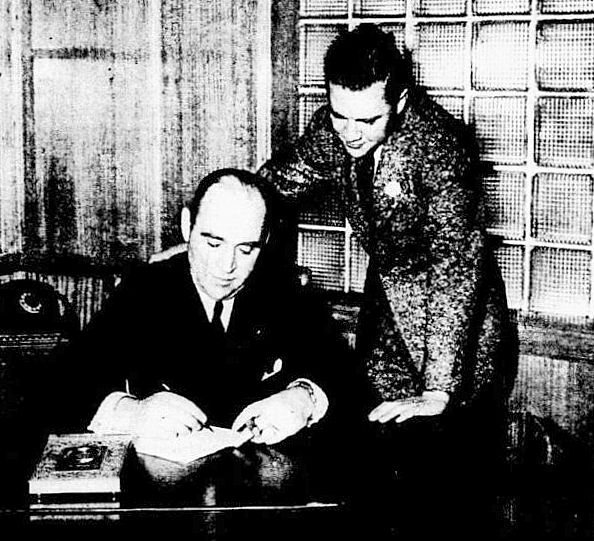
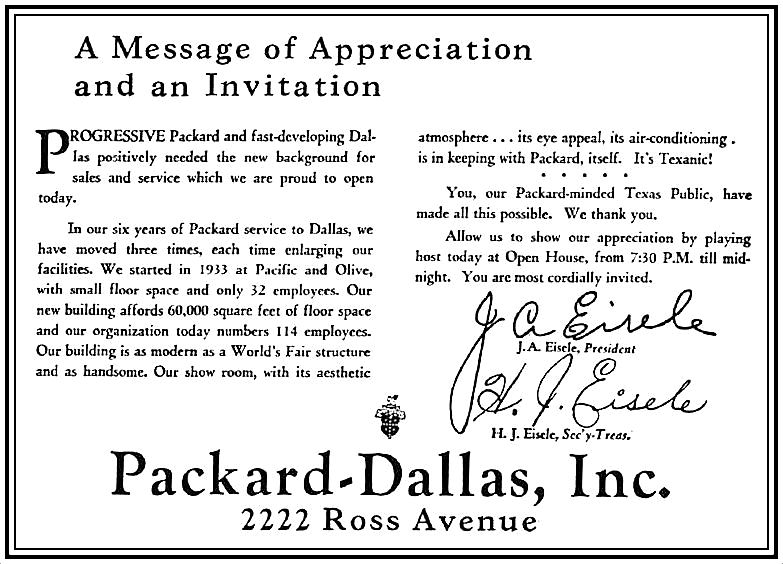
packard_dmn_121639_ad1

packard_dmn_121639_ad2Ad, Dec. 16, 1939 (click for larger image)

“It’s Texanic!”

And another ad featured this nifty little line drawing of the cool building:
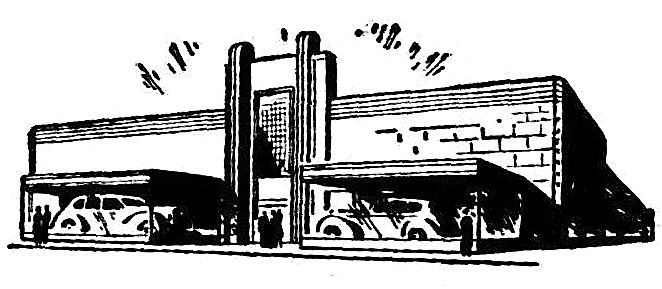
packard_dmn_121639-drawing-detDec. 16, 1939 (ad detail)

One of the stories about the opening of Dallas’ new auto showroom palace boasted that this big, beautiful, brash building was here to stay — Packard-Dallas had a 15-year lease on the place. …Which is why it was surprising to read that the building was sold less than two years later.

The U.S. was on the inevitable brink of involvement in the European war, and the National Defense School had begun operation in Dallas in July 1940. After a year of classes in which young men were taught “to do the technical and mechanical work necessary to warfare” (DMN, March 20, 1941), classrooms at the Technical high school and at Fair Park were bursting at the seams, and a larger facility was necessary. The Dallas Board of Education (which oversaw the program, often called “the War School”), was given the go-ahead to purchase the building (and, presumably, the property) for $125,000 in August 1941.

I’m not sure why J. A. Eisele sold the building (his name was listed as owner, rather than the Packard Company) — it wasn’t even two years old, and he got only half of what it cost to build. Patriotism? His son Horace had been drafted in April, so … maybe. Eisele seems to have left the auto sales business, which he had been in for decades, and had moved out of Texas by 1945.

After the U.S. officially entered the war and it became obvious that “defense schools” around the country would have to admit women in order to maintain manufacturing quotas, women began to work beside men at the Ross Avenue school in January 1942.

Eighty women Saturday pulled their fingers against the triggers of aircraft rivet guns as the Dallas National Defense School, 2222 Ross Avenue, started the state’s first major training course designed to place women side by side with men in Texas war materials plants. (DMN, Jan. 4, 1942)
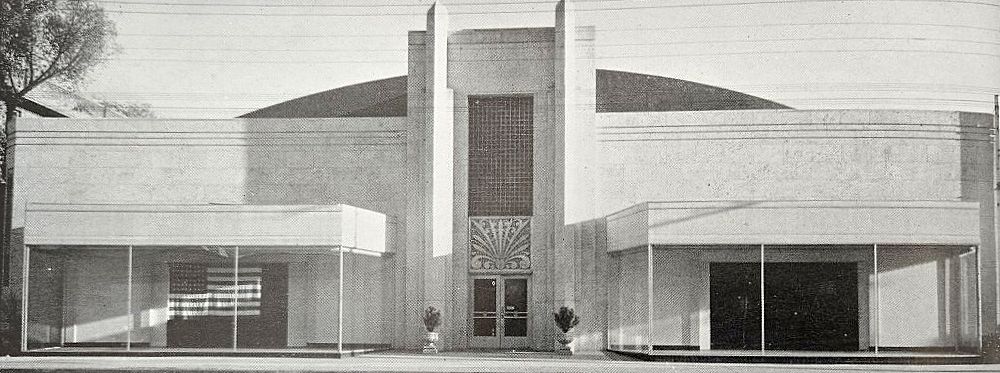
packard_ross-avenue_war-school_young-america-in-dallas_1942_DPL
1942

This “War School” was a training school for war-time jobs at places like North American Aviation.
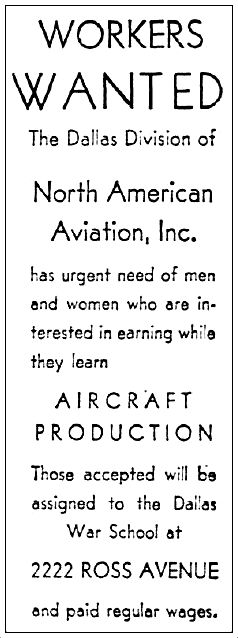
defense-school_dmn_090643Sept. 1943

Thousands of men and women trained at the Ross Avenue facility until the war ended in 1945. The school continued, but no longer as a Defense School — it became Dallas Vocational School, and its first students were veterans.

In 1976, the school was designated as one of the Dallas Independent School District’s magnet schools — it became the Transportation Institute, where “students interested in owning their own dealership, becoming a technician-mechanic or an auto body specialist will receive on the spot training in a laboratory consisting of a new car showroom, a modernly equipped repair center and a complete auto rebuilding facility” (DMN, Aug. 22, 1976). Back to its roots! And it only took 37 years.

The school continued for a while but, inevitably, the property became more and more attractive to developers. In 1981, as the developers were circling, a City Landmark Designation Eligibility List was issued. It contained buildings which had “particular architectural, historical, cultural and/or other significance to the City of Dallas,” and, if approved, were eligible to receive historic landmark designation. I’m guessing 2222 Ross Avenue didn’t make the cut, because Trammell Crow bought the building in 1983 and tore it down the next year.
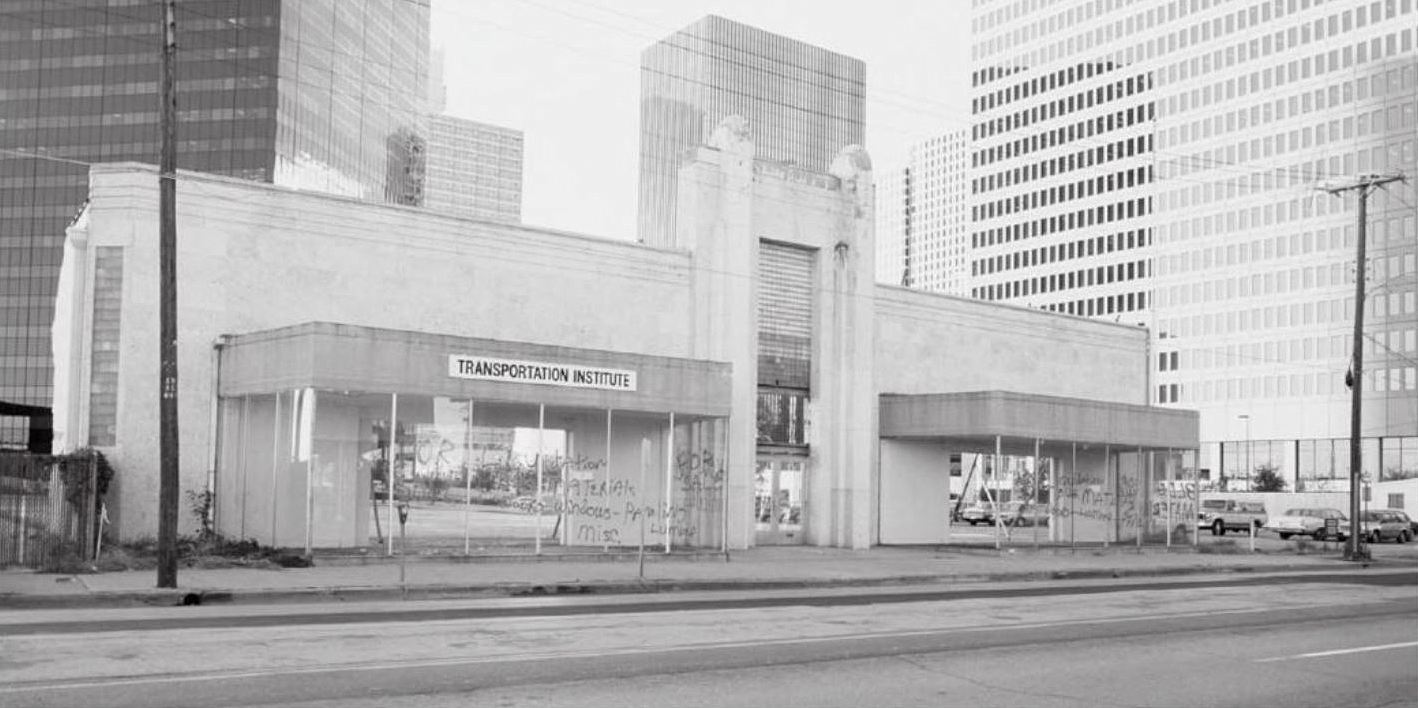
transportation-institute_lost-dallas_dotyvia Lost Dallas by Mark Doty

But … Crow sold the facade to real estate developer and investor Lou Reese, who said that he would reassemble the limestone facade and incorporate it into a restaurant he planned to build in Deep Ellum. That was an interesting plan. (Incidentally, in the same city council meeting in which the demolition/disassembling of the building’s facade was discussed, the council also considered “a request for more than $7 million in federal funds for a project to renovate the Adams Hat Co building into apartments” (DMN, Aug. 8, 1984). …Lou Reese owned the Adams Hat building. What a coincidence!)

The city council’s decision?

The council authorized developer Trammell Crow to disassemble the art deco facade of the former Transportation Institute Magnet High School on the condition that the facade be reconstructed in Deep Ellum…. The company [has] demolished all but the building’s limestone facade, which was determined to be eligible for designation as an historic landmark. (DMN, Aug. 9, 1984)

So? Where’s that facade? There was no mention of it for three years, until an article in the Morning News about another developer who had big plans for a major Deep Ellum complex called “Near Ellum,” which would be bounded by Commerce, Crowdus, Taylor, and Henry streets.

Highlighting Near Ellum will be a 40-foot art deco facade, formerly on the front of the Transportation Institute on Ross Avenue, in the main parking plaza. The plaza will also include an outdoor stage for concerts and special events. (“Developer Plans Deep Ellum Project,” DMN, June 25, 1987)

Aaaaaaaaaaaaaaaand … that never happened. I wonder if that 76-year-old disassembled limestone facade is still crated up somewhere around town. Somehow I doubt it.

So, 2222 Ross Avenue. What’s there now? None other than the 55-story skyscraper, Chase Tower, also known as “The Keyhole Building.”

You could get a lotta Packards in there.

***

Sources & Notes

Top photo from the Detroit Public Library’s Packard Collection in the National Automotive History Collection, viewable here; I’ve straightened and cropped it. The reverse has this notation: “Packard Motor Car Co., branches/dealerships/agencies, 2300 [sic] Ross Avenue Dallas, Texas, exterior, show windows left to right; 1940 Packard 110 or 120, eighteenth series, model 1800 or 1801, 6/8-cylinder, 100-120-horsepower, 122/127-inch wheelbase, convertible coupe (body type #1389/1399), special furniture display.”

1942 photo of the building is from a publication called “Young America in Dallas,” Dallas History and Archives, Dallas Public Library.

The developer who apparently came into possession of the facade after Lou Reese was Ed Sherrill. Perhaps someone associated with the Near Ellum project might know what became of the “saved” facade.

Chase Tower info on Wikipedia here; photo of it here. Imagine a teeny-tiny car dealership at its base.

Packard automobiles? Some of them were pretty cool. Check ’em out here.

A lengthy article on the notorious developer Lou Reese — “Hide and Seek” by Thomas Korosec (Dallas Observer, June 8, 2000) — is here.

*

Copyright © 2015 Paula Bosse. All Rights Reserved.
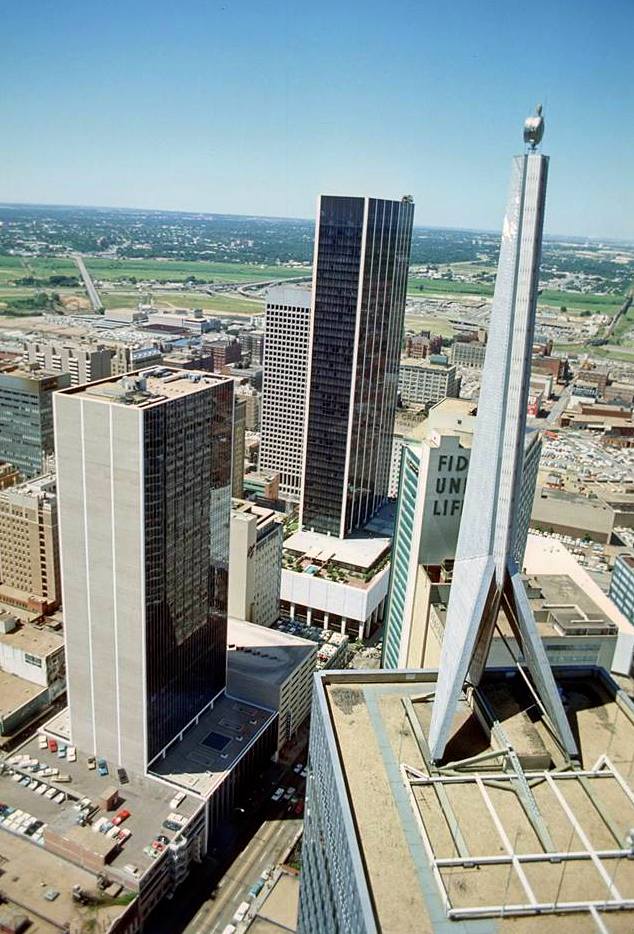
An Incredible View From Republic Tower 2 — 1968

republic2_parrish_1_1968
Photo by Bill Parrish, 1968, used with permission (click for larger image)

by Paula Bosse

On August 15, 1968, teenager Bill Parrish — a former Dallasite who was back in town on a visit — was surprised to see that a new building has sprung up since he’d left: the 50-story Republic Tower 2 (built in 1964), the much-taller sister-building to one of Dallas’ most famous skyscrapers, the 36-story rocket-topped Republic National Bank Building. He wondered if he could get to the top of the building to take some photos. Bill remembers the day clearly:

“I lived in Dallas until I was 9 years old, at which time we moved to Palo Alto, Califorinia. I spent the summer of 1968 at Texas A&M in an engineering program for high-ability science students. My parents picked me up in College Station and we came back via Dallas. I was a ‘tourist who used to live there’ and wanted some shots to remember the city by — even as a teenager. I had a fairly good camera, and I knew how to take pictures, having done photojournalism in high school. Also, I remembered how much fun I had living in Dallas, so maybe I was looking at the city a little differently.

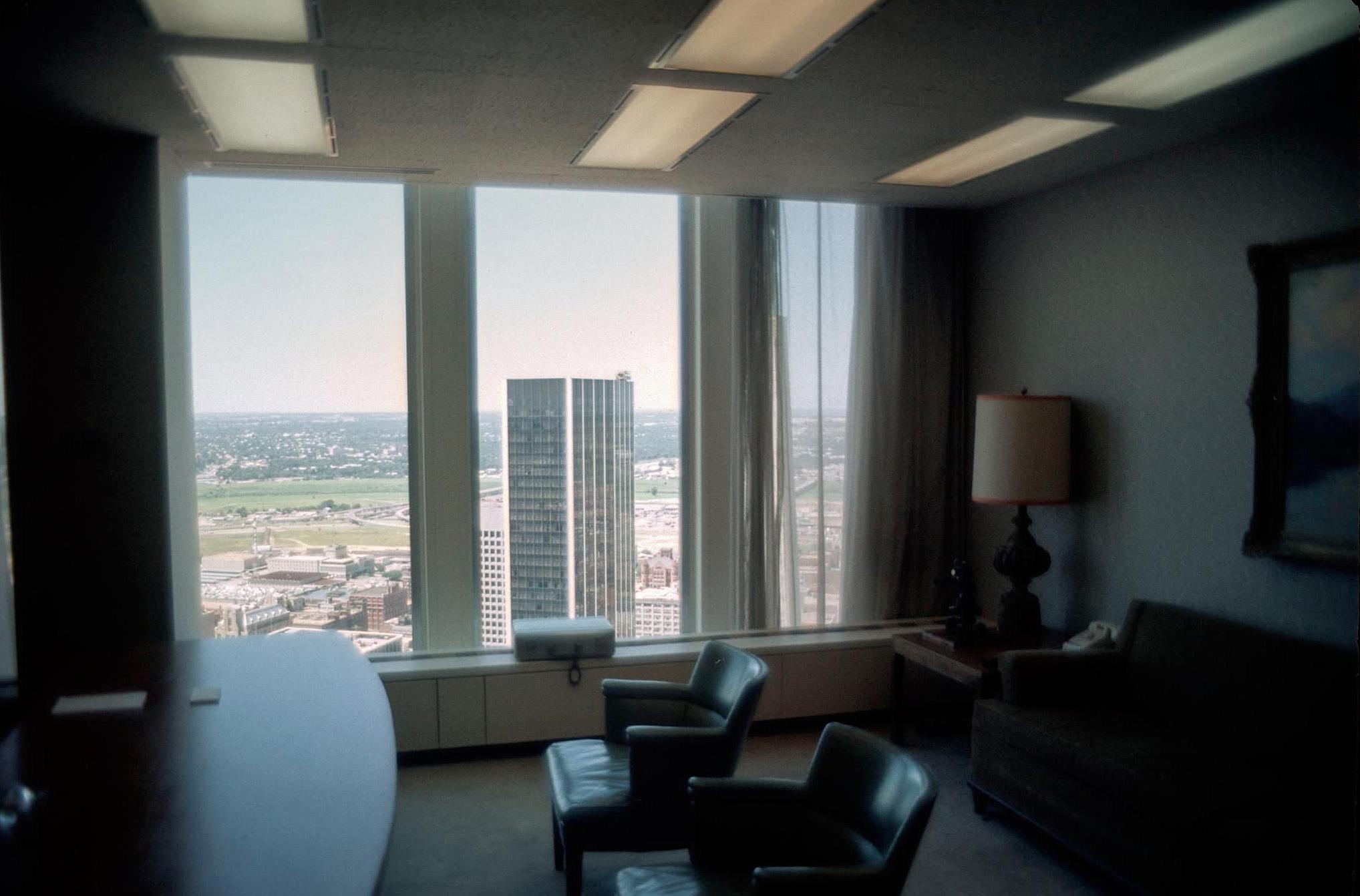
“We stopped in Dallas for a few days on the way back, and we spent one day downtown visiting old haunts. My dad and I were in our suits, and we went to the new (to us) Republic Tower 2 and rode the elevator to the top and asked around if we could take some shots out of some windows. Some very nice folks allowed us to use an office that was currently not being used. A number of shots were made from the same office. I think we were in and out in about 5 minutes — I remember the folks up there were very nice to us … considering we just ‘dropped in.’

“I just wish I had shot like 3 rolls of film — like inside the Mercantile lobby, inside Titche’s, and inside Neiman’s. I would have shot stuff at Walnut Hill Village, Marsh Hill Village, in the terminal at Love Field, at my old school, peoples’ houses I remembered, restaurants, etc. if I had known they would be of value in 50 or so years.

“I guess the takeaway is that today if something catches your eye, shoot it (with your phone even), and archive it so it can be found later… and don’t throw away old pictures! You may not be able to keep everything, but be careful about what might be of value to someone.”

*

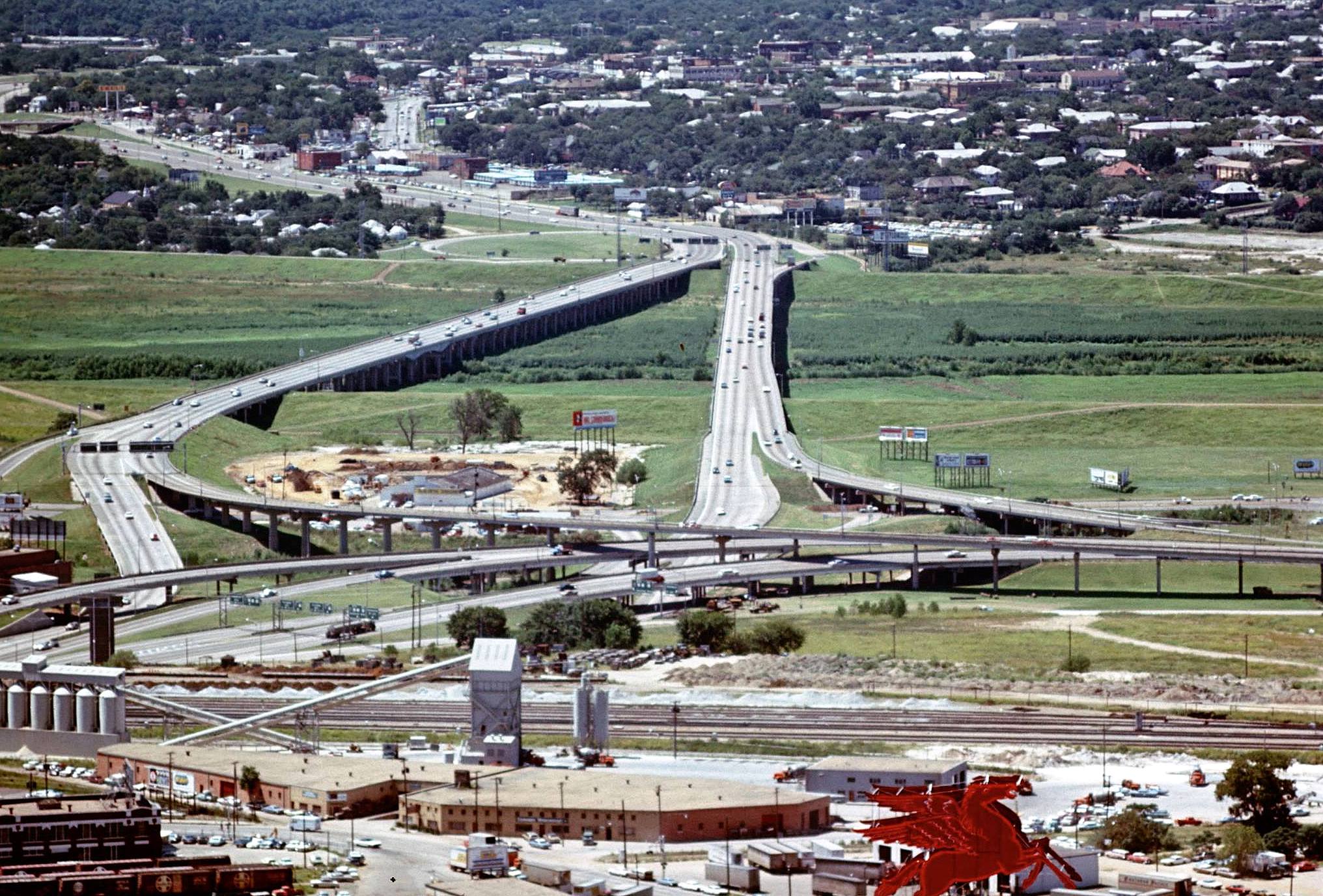
Below are some of Bill’s really, really wonderful photos taken on that summer day in 1968 from a top floor of the tallest building in Dallas. (Many of these are HUGE. Click to enlarge.)

republic2_parrish_2_1968

republic2_parrish_5_1968

republic2_parrish_4_1968

republic2_parrish_3_1968

republic2_parrish_6_1968The office Bill shot from; his aluminum camera case is on the windowsill.

republic2_parrish_7_1968The original be-rocketed Republic National Bank Building on the left, the taller Republic Tower 2 in the middle.

***

Sources & Notes

All photos in this post by Bill Parrish, used with his permission. They first appeared in the Retro Dallas Facebook group.

During this short trip to Dallas, Bill’s family also shot some home movie footage, which can be seen here.

Below, a Google map showing the Bill’s general view of the photos looking over Pegasus to Oak Cliff:

map-view-from-republic2

Some photos by a different photographer, taken from the top of the Republic Center Tower II (its official name) in 2007, can be seen here. A couple of the photos show the exact same shots Bill took. A lot can happen in 40 years!

The Wikipedia page for Republic Center is here; the official Republic Center site is here (worth checking out if only to see the BEAUTIFUL shot of the two buildings, including the re-lit “rocket” tower).

My previous post, “The Republic National Bank Building: Miles of Aluminum, Gold Leaf, and a Rocket,” is here.

All of Bill Parrish’s photos are very large. Click to see some of them much, much larger!

Thank you so much, Bill, for sharing these fantastic pictures. The photo at the top is now one of my favorite-EVER shots of the Dallas skyline!

*

Copyright © 2015 Paula Bosse. All Rights Reserved.


Triple Underpass — 1950s

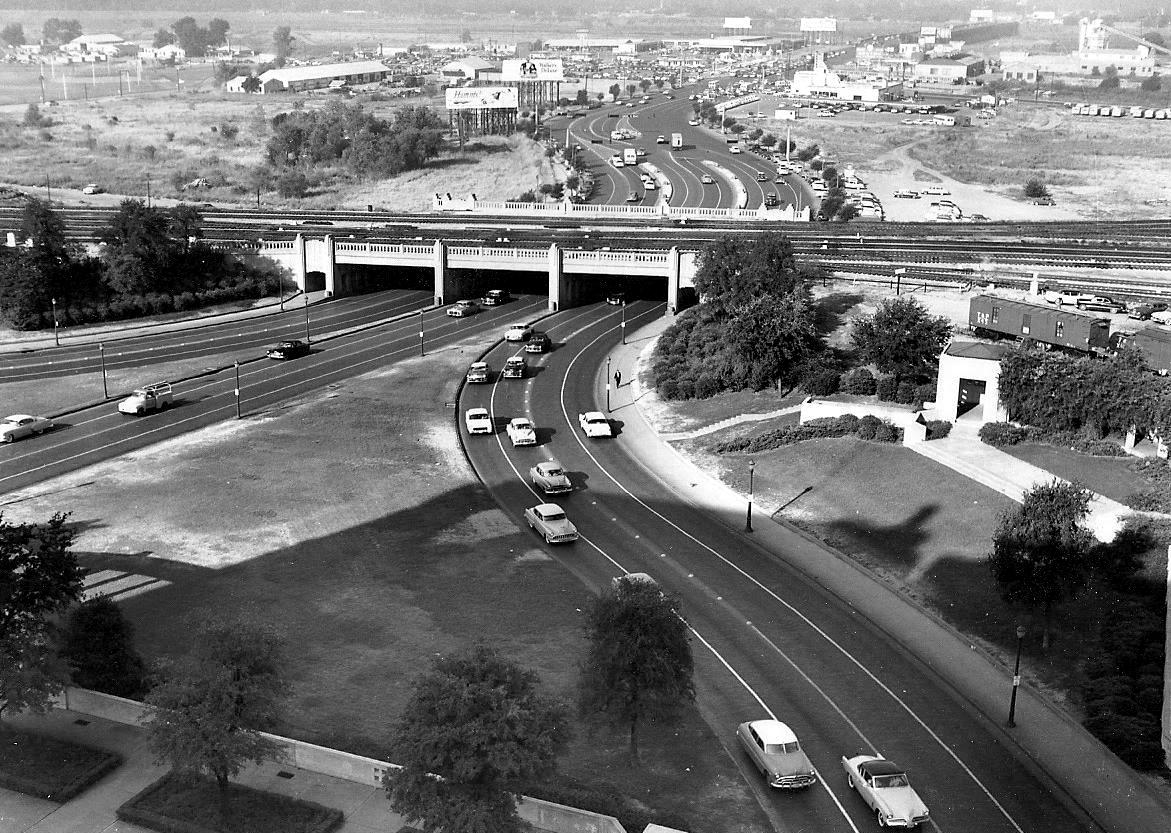
triple-underpass_1950sComing and going…

by Paula Bosse

A view toward Oak Cliff, back before the words “triple underpass” began to be capitalized.

I LOVE this photo.

Check out this same view from about 1936 here.

***

Sources & Notes

Photo found here (along with other JFK-related photos of Dealey Plaza).

*

Copyright © 2015 Paula Bosse. All Rights Reserved.

The Allen Street Taxi Company

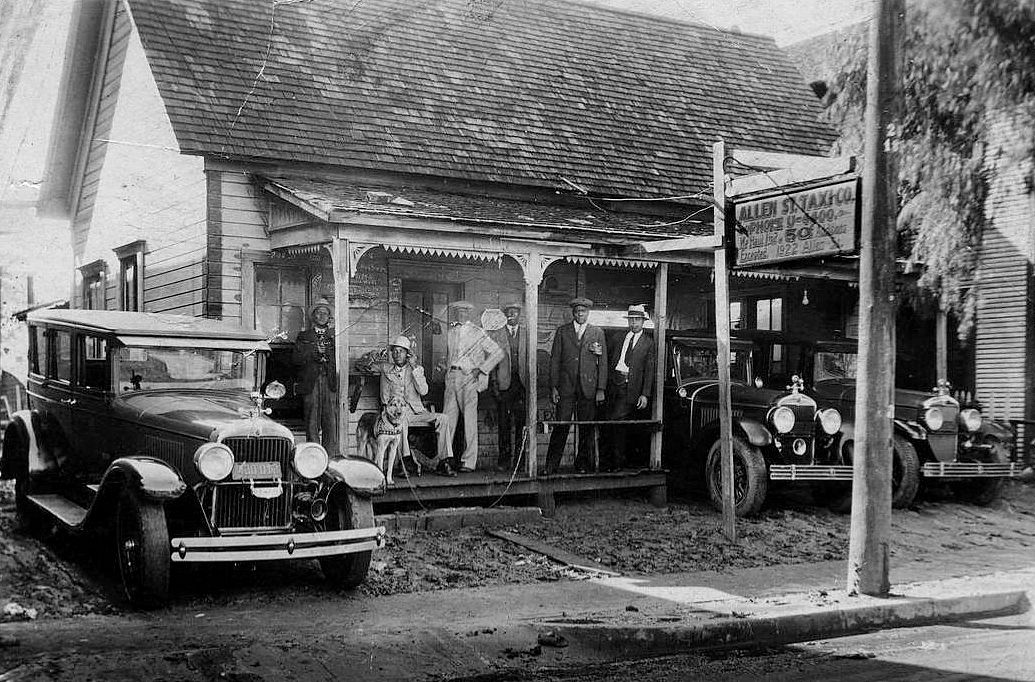
allen-st-taxi-co_cook-degolyerAllen St. Taxi Co. / George W. Cook Collection, SMU

by Paula Bosse

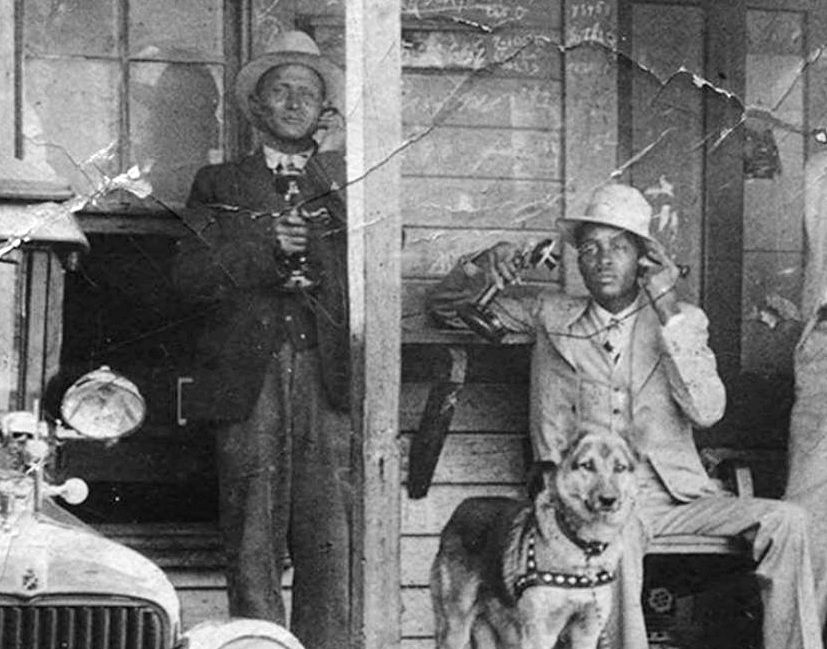
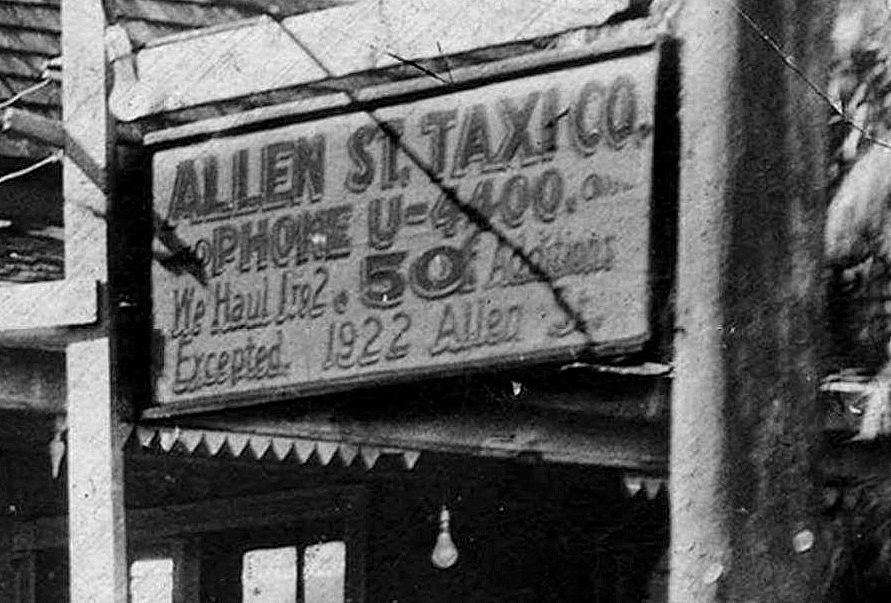
This has to be one of my favorite “unknown Dallas” photographs that I’ve come across. It shows the Allen St. Taxi Co. — in the State-Thomas area — at 1922 Allen Street (now pretty much vacant land under the Woodall Rodgers freeway). My ability to date cars is not good, but from city directory information, it seems that this photo might date from somewhere between the mid-1920s to around 1930. The owners/proprietors of the company were listed as John Leonard and Andrew Short in the 1929 telephone book. I wonder if they are in this fantastic photo? Let’s look a little more closely at some of the details. (All pictures larger when clicked.)

allen-st-taxi-co_cook-degolyer_det2Those phones!

allen-st-taxi-co_cook-degolyer-det4I love these guys. All business.

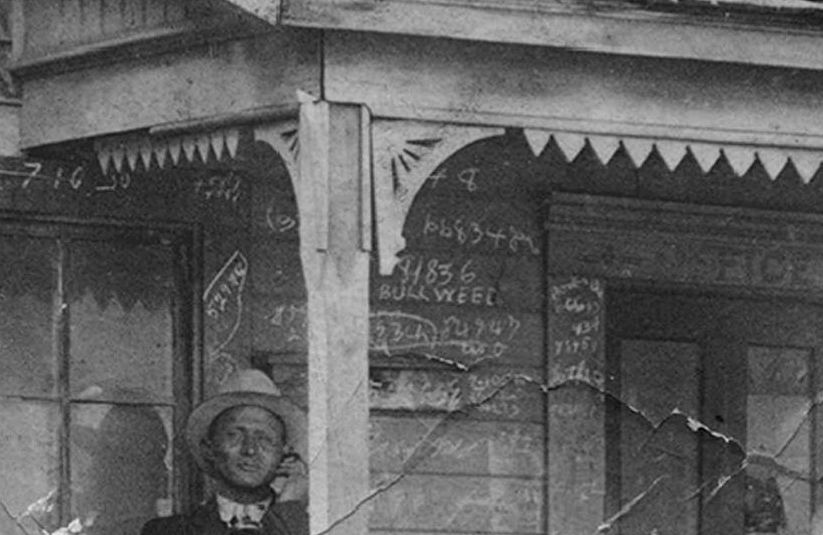
allen-st-taxi-co_cook-degolyer_det5“Bullweed.” What is all this writing? I love the guy’s face looking out of the window.

allen-st-taxi-co_cook-degolyer_det1“Dallas.” Car-people know exactly what make and model this vehicle is. …I am not one of these people.

allen-st-taxi-co_cook-degolyer_det3

***

Sources & Notes

Top photo, titled “Allen Street Taxi Co.,” is from the George W. Cook Dallas/Texas Image Collection, DeGolyer Library, Central University Libraries, Southern Methodist University; it can be viewed here.

The first “official” listing of the Allen St. Taxi Co. was in the 1929 city directory. The address at that time (which usually reflected information supplied the previous year) was 1907 Allen St. It didn’t appear again in the directory until 1932 when it was listed at 2816 Juliette St. In 1933 and 1934 it was listed at 2114 Hall St. In 1936 and 1937 it had moved to 2217 Hugo. And in 1938, the taxi part of the business seems to have fallen by the wayside, and it became Allen St. Transfer.

In 1925 there were only three official cab companies listed in the city directory. But the rough-and-tumble world of taxi cab service in the unregulated ’20s and ’30s was pretty intense. There were a lot of unlicensed jitneys rolling around town, especially, one would assume, in the segregated black neighborhoods of the city unlikely to be served by white-owned companies. My guess is that this might have been how the Allen St. Taxi Co. began.

For more on the go-go-go competitive world of taxi service at this time, see my previous post, “Washington Taxi Company: ‘Call George!'” here.

*

Copyright © 2015 Paula Bosse. All Rights Reserved.
The Dallas Skyline from the Maple Terrace Penthouse — 1952

feldman_terrace_huntington-detView from the penthouse (Huntington Library)

by Paula Bosse

The best view of the Dallas skyline that no longer exists may very well have been the view from atop the Maple Terrace Apartments, located on Maple Avenue, right across Wolf Street from the Stoneleigh Hotel. The photo above was taken in 1952, when there was a straight-shot view of downtown, with no hulking buildings to spoil the vista. This view — completely unobstructed except for the Stoneleigh (out of frame, at left) — must have been spectacular at night. (Although, as can be seen at the far right, the industrial area that surrounded the iconic DP&L smokestacks was also part of the view. Also not included in realtor brochures would have been the fact that the luxury apartment building overlooked the adjacent Little Mexico neighborhood, often described as a “slum area” — the huge economic disparity between the neighboring haves and have-nots would have been starkly apparent to any gimlet-sipping rooftop visitor. And then there was the not-so-distant meat-packing plant…. But I digress.)

The beautiful Maple Terrace Apartments — designed by architect Alfred Bossom (who also designed the Magnolia Building) — was built in 1924-25 and opened with great fanfare as the city’s first luxury apartments.

maple-terrace_postcard

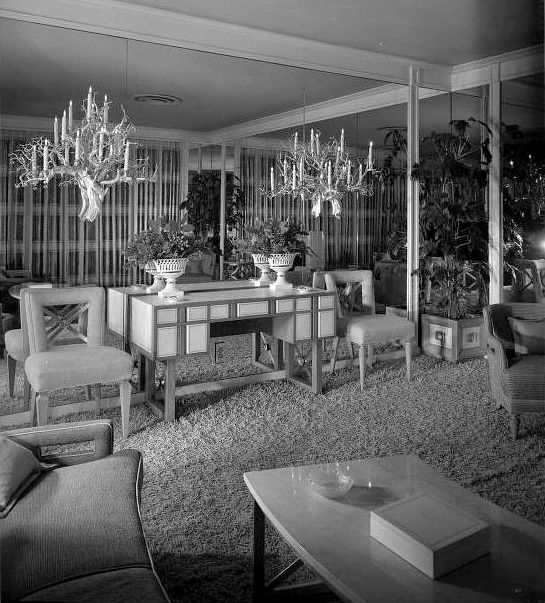
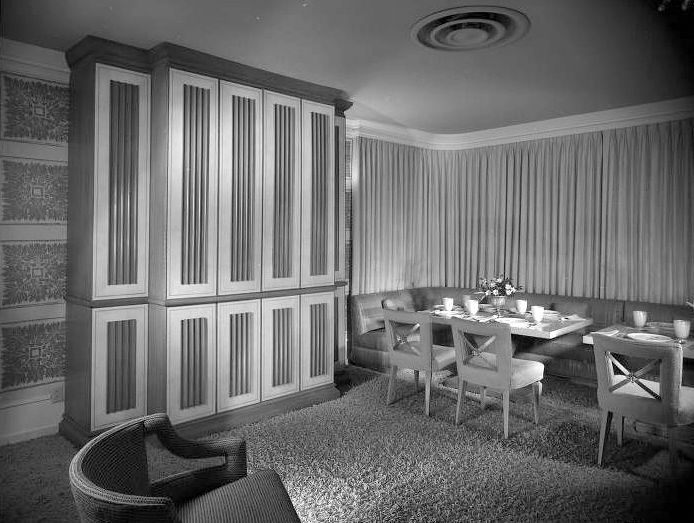
An early tenant was Morris Feldman, a Polish immigrant whose family owned the successful Parisian Fur Co. (later Parisian-Peyton). Morris’ son, the incredibly wealthy oilman and art collector, D. D. Feldman, must have been quite taken with his parents’ home there, because in the late ’40s or early ’50s, he transformed the entire seventh floor — which had previously contained 20 “hotel-type” units — into his personal penthouse. The patio terrace with the to-die-for view was the cherry on the sundae.

feldman_terrace_huntington

Countless cocktail parties, dinner parties, and fashionable teas were held in the Feldmans’ penthouse. The interior design — the work of Tom Douglas, of Los Angeles — was, apparently, much admired. The decor consisted of a mixture of typically cool Mid-Century Modern pieces as well as a few touches that, from a 21st-century vantage point, look a little … tacky. Somewhere in all of the acreage of furnishings was a fireplace, a white leather-covered piano (!), “a cocoa-striped sofa with pale blue frame,” murals, white brick wallpaper, and several pieces of furniture and cabinetry with a “driftwood finish.” And lots of lacquer. And mirrors, mirrors, mirrors. These “timeless furnishings in beige, marigold, white leather and ash” (DMN, Nov. 19, 1960) are dated relics of another era, but, at the time, they were splashed across the pages of magazines such as Architectural Digest.

feldman_entryway_huntington-lib

feldman_living-rm_huntington-lib

feldman_dining-rm_huntington-lib

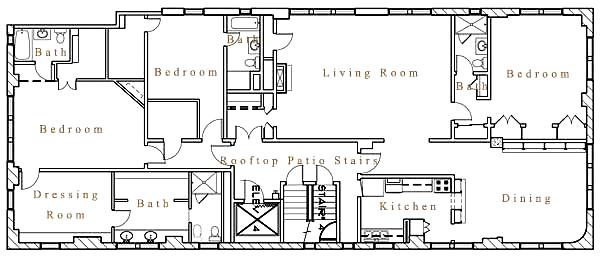
As far as I know, the seventh floor of the Maple Terrace is still a single space. A 1978 real estate ad touted its “recently redecorated” 3,000 sq. ft. amenities:

maple-terrace-penthouse_dmn_032278

Below, the present-day penthouse floor plan from the Maple Terrace’s website:

maple-terrace_penthouse-floorplan-today

And, look, here’s a photo of what that entryway looks like now, (without the mural):

maple-terrace_hallway-today

I’m sure the rooftop terrace is still as beautiful as ever, but, sadly, it will never again boast of that once-incredible view:

maple-terrace-view-today

***

Sources & Notes

Top photo (and all black and white photos from this series) by Maynard L. Parker, for Architectural Digest; from the Maynard L. Parker Collection at the Huntington Library, accessible here. The top photo is a detail, which has been cropped and reversed; the original photo is shown in reverse on the Huntington site (along with some early image “editing” on the outline of the Stoneleigh), which is a bit freaky when you know that what you’re looking at is backwards!

Color photos and floor plan from the website of the Maple Terrace Apartments, here. Biographical info on the architect, Sir Alfred Bossom, is here. Fabulous photos of the building from AIA Dallas, is here; and a wonderful piece on the mystique of living in the famed Maple Terrace from D Magazine, is here.

An intense and thorough description of the Feldmans’ penthouse decor is in the article “Feldman Apartment: Timeless Decorating” by Jeanne Barnes (Dallas Morning News, Nov. 19, 1960).

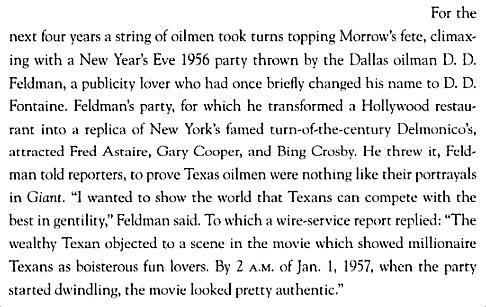
In addition to his oil holdings, D. D. Feldman was an important collector and patron of Texas art. In reading about Mr. Feldman, my favorite tidbit is this, from the book The Big Rich: The Rise and Fall of the Greatest Texas Oil Fortunes by Bryan Burrough (Penguin, 2009):

feldman_big-rich_quote

*

Copyright © 2015 Paula Bosse. All Rights Reserved.

Underwriters Salvage Co., Dallas Warehouse — 1920

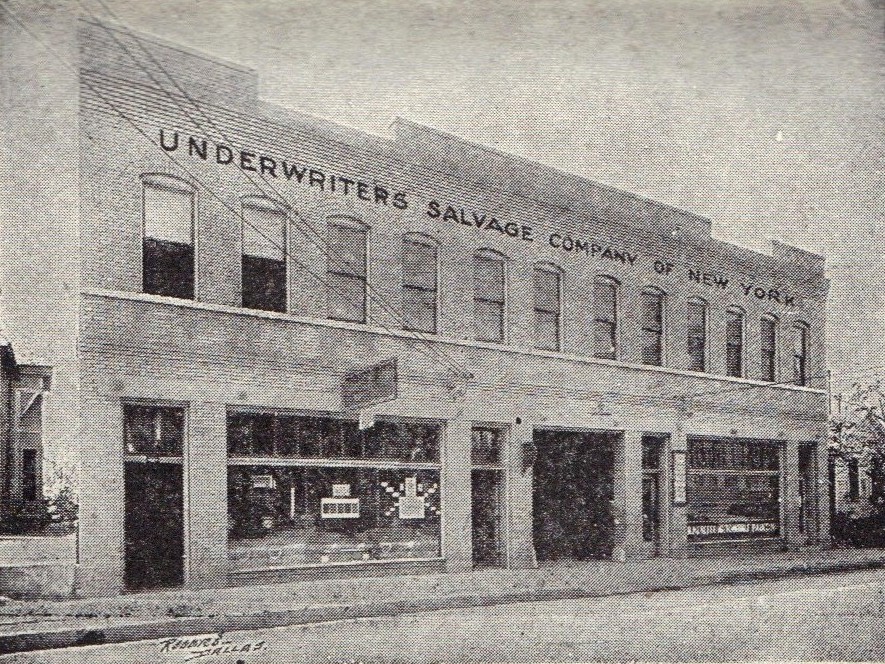
underwriters-salvage_1920The company’s Dallas warehouse on N. Lamar (click for larger image)

by Paula Bosse

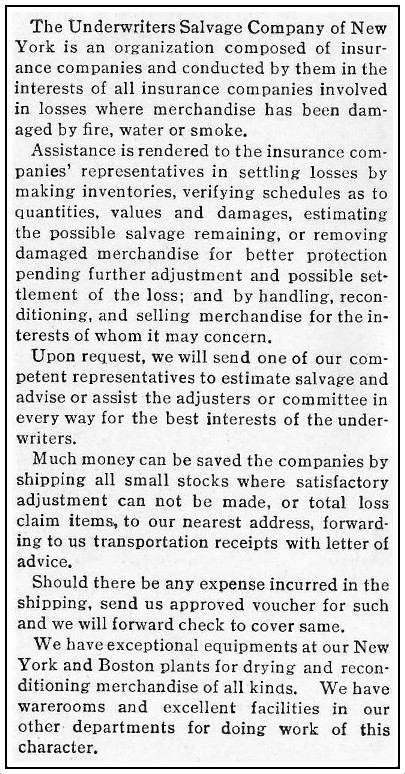
The Underwriters Salvage Company of New York (founded in 1893) was a business that worked with insurance companies and merchants in settling losses due to merchandise damaged by fire, water, etc. In their words:

underwriters-salvage-co_1920Underwriters Salvage Co., 1920

There were branch offices in cities around the country, including Dallas, which was the location of the company’s Southwestern offices, or, their “Gulf Department,” located in the American Exchange National Bank Bldg. on Main St. The warehouse pictured above was at 2014-16 North Lamar (in the West End warehouse district, between McKinney Ave. and Munger). Not only would merchandise being readied for processing be stored there, there would probably also be large fans going full-blast to dry out and remove the smell of smoke from items that would soon be sold for bargain prices, either to the public or to wholesalers via “fire sales” or public auctions.

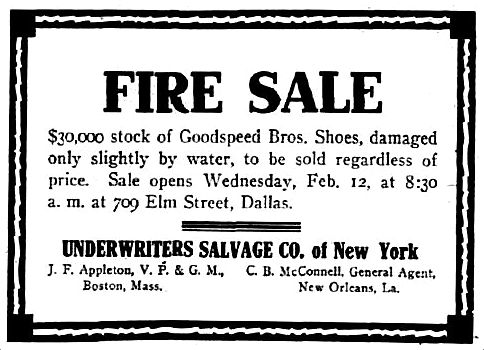
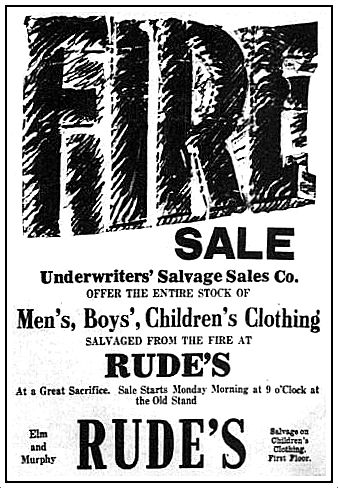
The company’s most famous fire sale (which they were quick to mention in later national advertising) was the huge dispersal of merchandise from the big fire at Neiman-Marcus in 1964. Instead of the usual, somewhat dull, inventories of shoes or boys’ coats or rope (“all sizes”), that sale included Neiman’s eye-poppingly expensive fur coats and other luxury goods (and, I think, every single piece of merchandise in the store that survived), all marked down to bargain basement prices. Now THAT is a fire sale.

*

underwriters-salvage_dmn_0210131913

underwriters-salvage_dmn_0622241924

underwriters-salvage_dmn_0613241924

***

Top photo and text excerpt from a tiny pocket-sized booklet/calendar issued by the Underwriters Salvage Company of New York in 1920, featuring photos of the company’s branches around the United States.

*

Copyright © 2015 Paula Bosse. All Rights Reserved.
“Along the Tracks” in the Fair Park Area

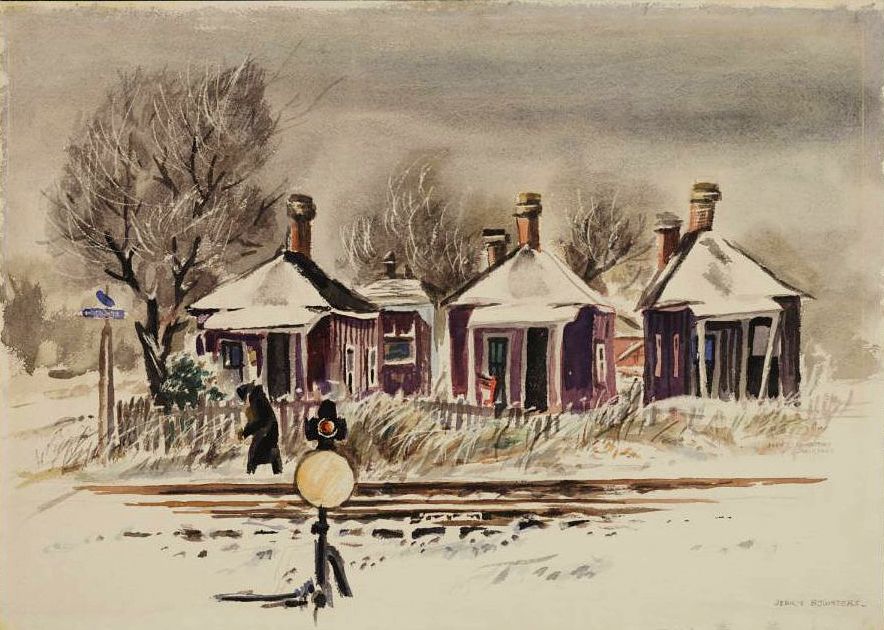
bywaters_along-the-tracks_fair-park_smu_1947“Along the Tracks” by Jerry Bywaters, 1947 (Hamon Arts Lib., SMU)

by Paula Bosse

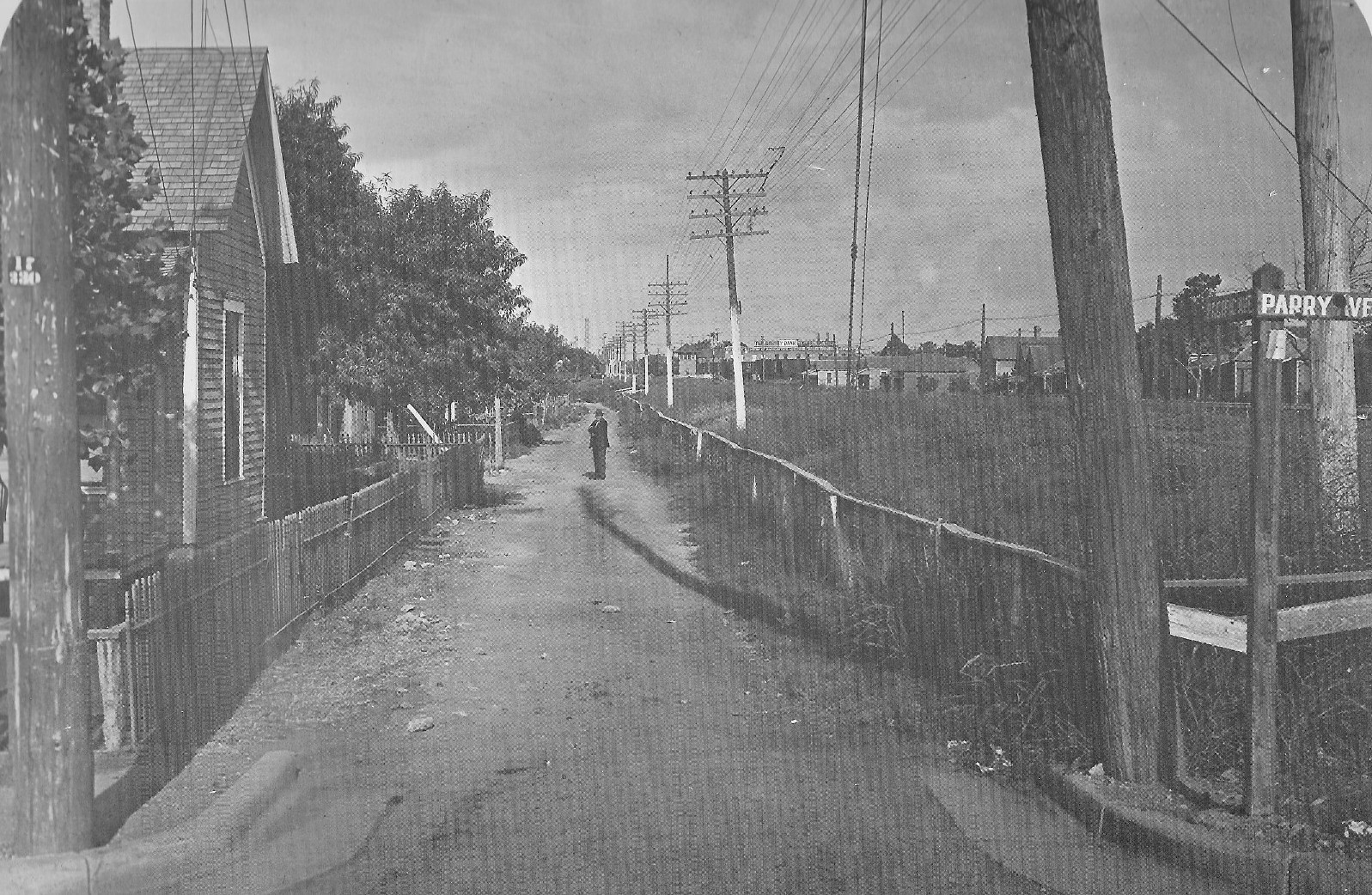
As we’re currently experiencing an extended period of cold, snowy, icy weather, what better time than now to post this atmospheric watercolor by Jerry Bywaters? Titled “Along the Tracks,” it was painted during a very cold and snowy early January of 1947, in the area around Fair Park (where Bywaters worked as the head of the Dallas Museum of Fine Arts). Railroad tracks ran on either side of Fair Park — the Texas & New Orleans tracks ran along Trunk on the west side, and the Texas & Pacific tracks ran along Pacific on the east side. The DMFA was on the very western edge of Fair Park, and as it was bitterly cold, Bywaters probably wasn’t traipsing any farther than he had to — the west side of Fair Park near the T&NO tracks would certainly have been more convenient for him. But I came across a photo that looks pretty much the same as the scene Bywaters painted, only from the T&P side to the east, so who knows?

pacific-parry_ca1916_greene

The photo above (taken around 1916) shows the intersection of Pacific and Parry, looking west on Pacific. “Along the tracks.”

***

Sources & Notes

Jerry Bywaters’ painting “Along the Tracks” is from the Bywaters Special Collections in the Hamon Arts Library at Southern Methodist University; it can be accessed here. As far as I can tell, that street sign doesn’t actually say anything, but if you see something in the scribble, let me know!

The 1916-ish photograph of the Pacific and Parry intersection is from Dallas, The Deciding Years by A. C. Greene (Austin: Encino Press, 1973).

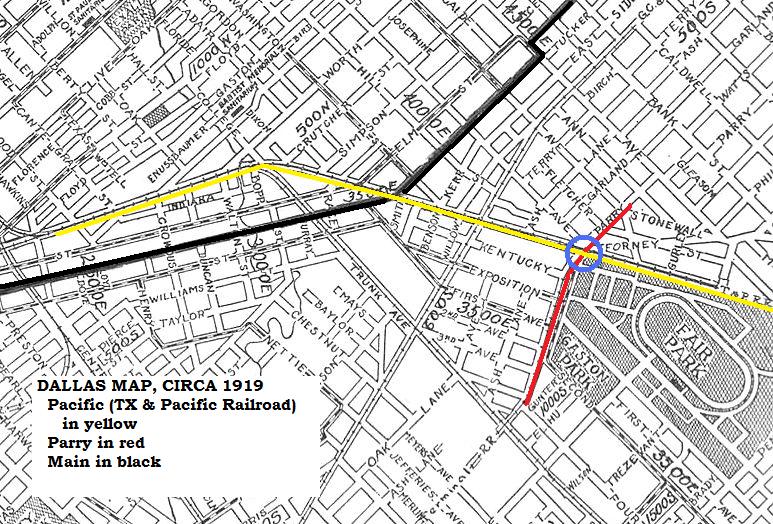
Here is a 1919 map detail showing the area around Fair Park (full map is here):

pacific-parry_1919

When Bywaters painted “Along the Tracks” it was REALLY cold. A couple of photos from the Jan. 1, 1947 edition of The Dallas Morning News show a snow-dusted Cotton Bowl and two very cute Oak Cliff teenage girls ice skating on West Jefferson Blvd.

*

Copyright © 2015 Paula Bosse. All Rights Reserved.

The Dunbar Branch: Dallas’ First Library for the African-American Community, 1931-1959

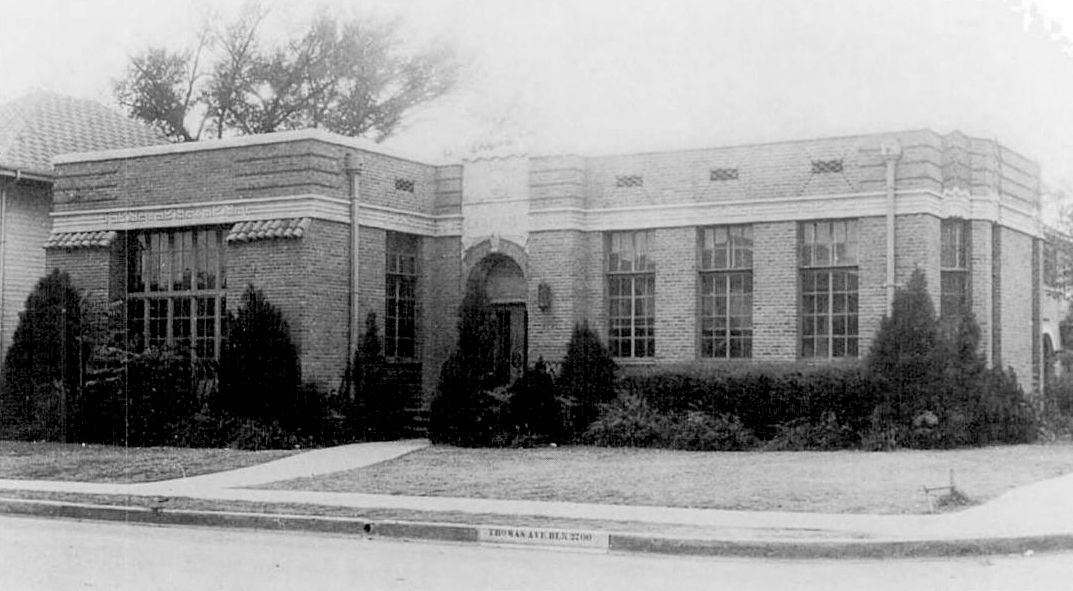
dunbar_hazel_dpl-bkThe Paul Laurence Dunbar Branch of the Dallas Public Library

by Paula Bosse

The Paul Laurence Dunbar Branch of the Dallas Public Library was the first library in Dallas to welcome and serve the African-American community. It opened in June, 1931 at the northwest corner of Thomas and Worthington in what was then the predominantly black neighborhood of “North Dallas” (the area is now known as “Uptown”), a thriving business and residential neighborhood which was home to everyone from the city’s black professionals who lived in large, lovely gingerbread-style houses, to middle- and lower-class black families who lived in more modest homes.

This was a time when almost every aspect of life was racially segregated — the grand downtown Carnegie Library was expressly off-limits to non-whites, and few of the black schools had any sort of functioning library. It was a long, hard bureaucratic battle of petitioning the city, the state, the Carnegie corporation … anyone … for a library which the city’s woefully underserved black citizens could call their own. It took years until the powers-that-be gave the go-ahead to finally build one. The building was designed by Dallas architects Ralph Bryan and Walter Sharp.

The charming one-story, brick-and-reinforced-concrete building was very, very popular and was a source of pride in the community. And it was beautiful!

dunbar_ref-and-reading-rm_hazelThe reference and reading room

dunbar-lib_hazel_062931-photoOpening-day crowds, June 1931

dunbar-children_hazel_1949Children in costumes to celebrate National Book Week, Nov. 1949

Even though the photo featured in the ad below is very grainy, it’s still kind of cool (from 1958, one year before the branch closed).

dunbar-branch-library_lincoln-high-school-yrbk-ad_19581958 Lincoln High School yearbook

dunbar-branch-library_lincoln-high-school-yrbk-ad_1958-det

In the late 1940s, construction began on Central Expressway. Unfortunately, this much-needed highway cut right through the heart of the North Dallas/State-Thomas/Freedman’s Town area. The destruction of many of the area’s buildings and displacement of many of its residents was a devastating blow to the African-American community who lived, worked, and shopped there. That and other economic forces led to the eventual dispersal of the area’s black population to other parts of the city. By the 1950s, the library had lost many of its core patrons, and in 1959 the Dunbar Branch closed. At some point that beautiful building, located just a few blocks south of McKinney Avenue, was demolished. The historic State-Thomas area has now been almost completely obliterated as “Uptown” has taken over. And another part of the city’s history has been lost.

***

Sources & Notes

All photos are from the book Dallas Public Library, Celebrating a Century of Service 1901-2001 by Michael V. Hazel (Denton: University of North Texas Press/Friends of the Dallas Public Library, 2001); photos are presumably from The Texas/Dallas History & Archives Division of the Dallas Public Library.

Hazel’s chapter on the Dunbar Branch is well worth reading. Not only is it interesting (and kind of shocking) to learn the lengths to which the black community had to go simply in order to have access to a library system which their tax dollars were helping to support, but there are also more wonderful photos like the ones above. The Dunbar chapter is accessible here.

Two articles of interest from the archives of The Dallas Morning News:

  • Description of the planned new “Negro branch” library (DMN, Aug. 15, 1930)
  • “City Plans To Sell Building” (DMN, May 15, 1959) — on the decision to close the branch and sell the building

The library’s (white) architects, Ralph Bryan and Walter Sharp also designed the nearby Moorland YMCA — it was built at almost the same time as the library, and, hallelujah, that building still stands, currently housing the Dallas Black Dance Theatre. A few years later Sharp designed Lincoln High School in South Dallas. All in all, these architects were responsible for three extremely important buildings that served Dallas’ black citizens.

Paul Laurence Dunbar (1872-1906) was one of the first nationally prominent African-American writers; more about him, here.

There is another Dunbar branch library in the Dallas Public Library system — the website for the Paul Laurence Dunbar Lancaster-Kiest Branch Library is here.

*

Copyright © 2015 Paula Bosse. All Rights Reserved.

The Continental Gin Complex — 1914

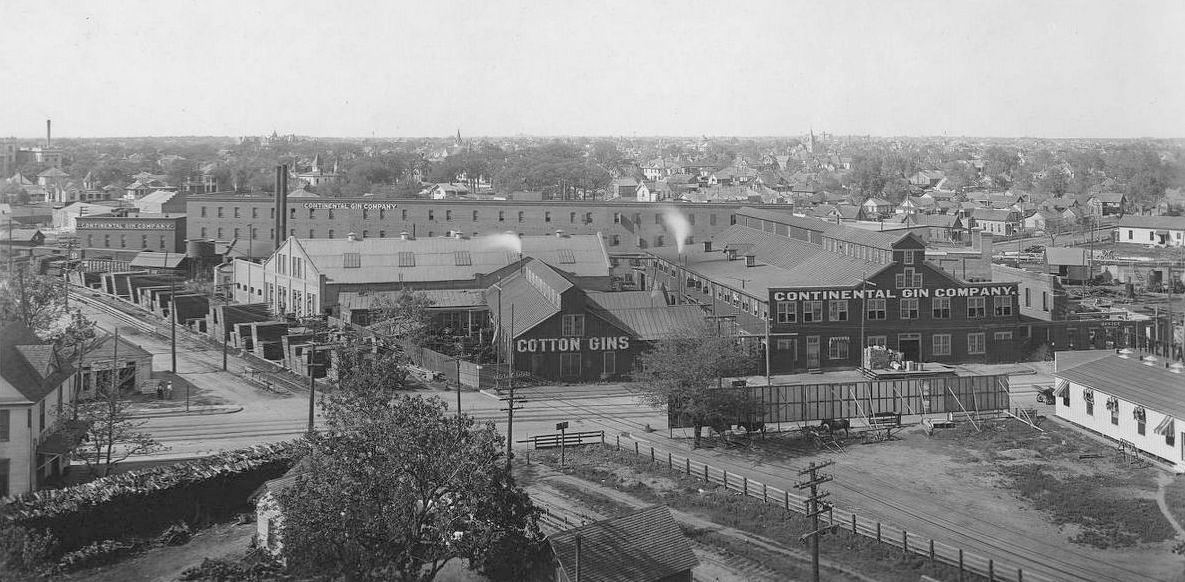
continental-gin-bldg_1914_cook-degolyer-smu-bwPhoto by Chas. Erwin Arnold (DeGolyer Lib., SMU) (click for larger image)

by Paula Bosse

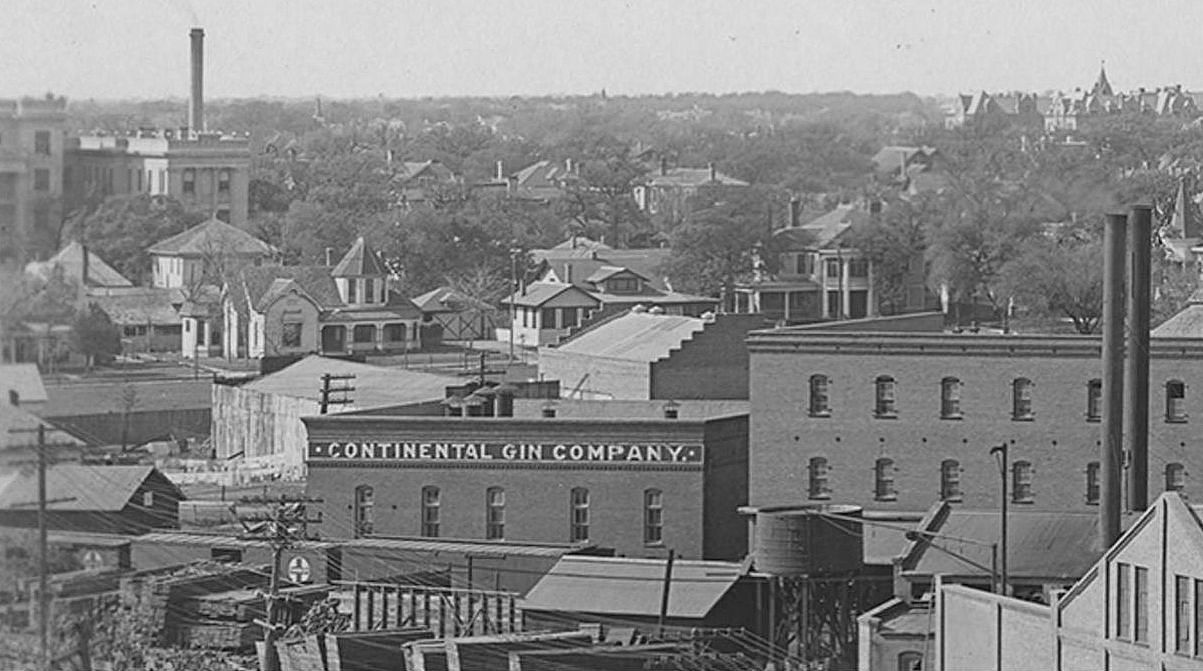
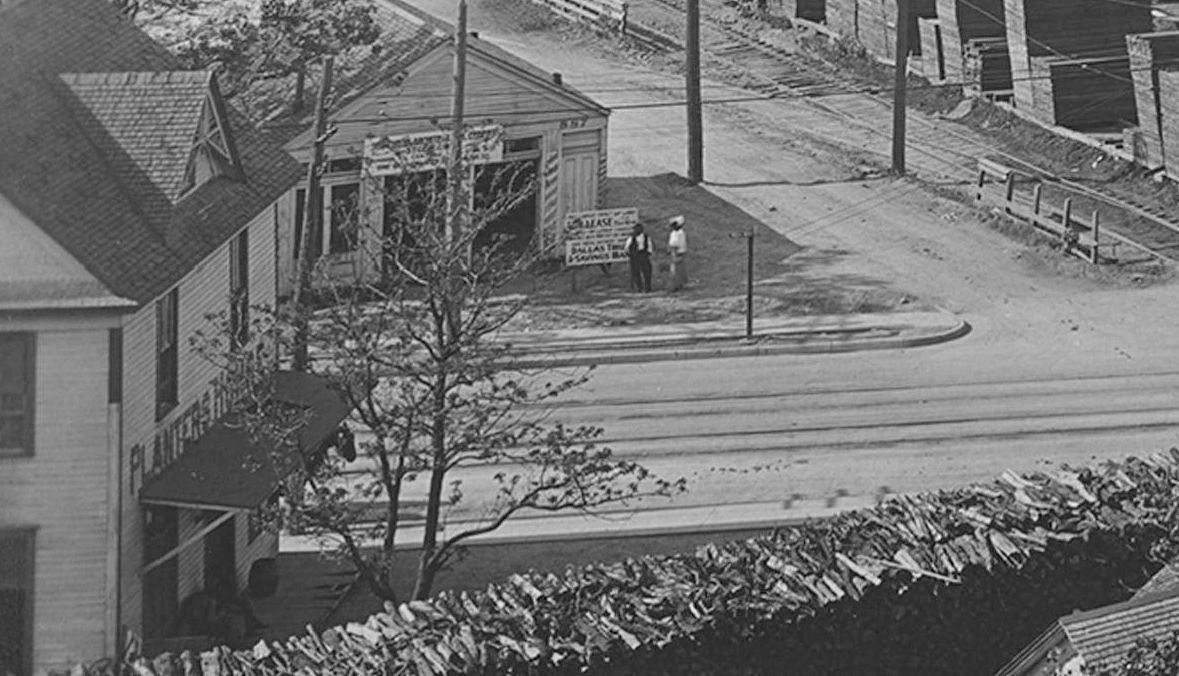
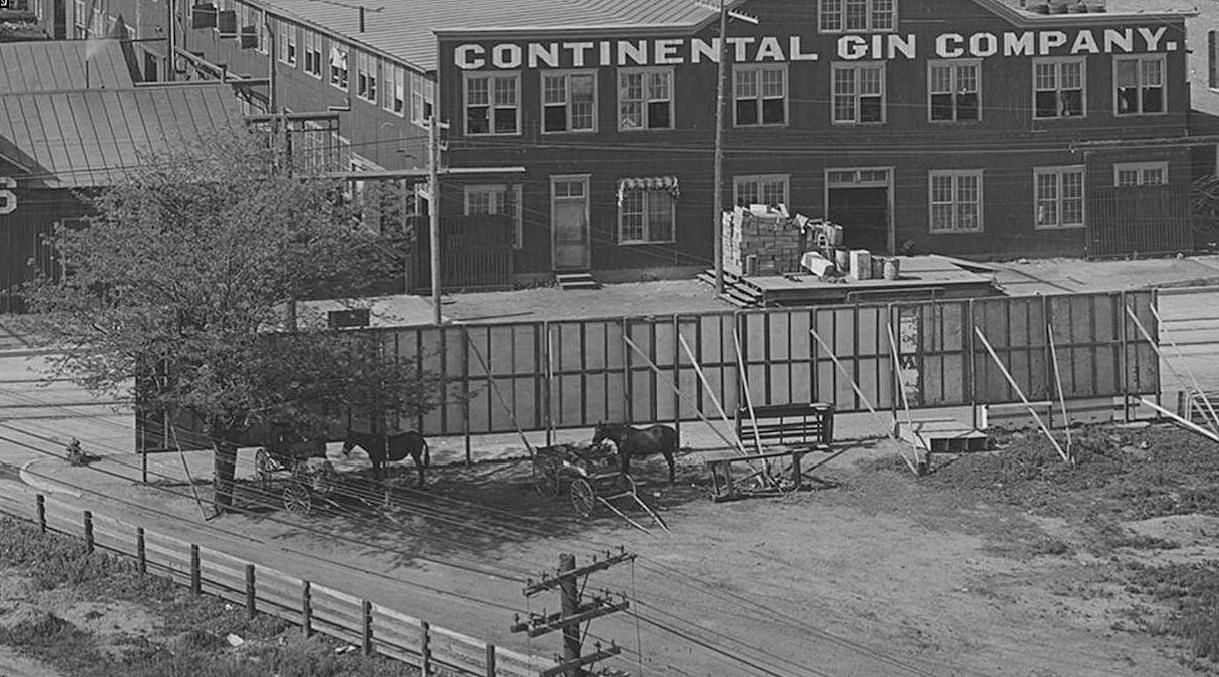
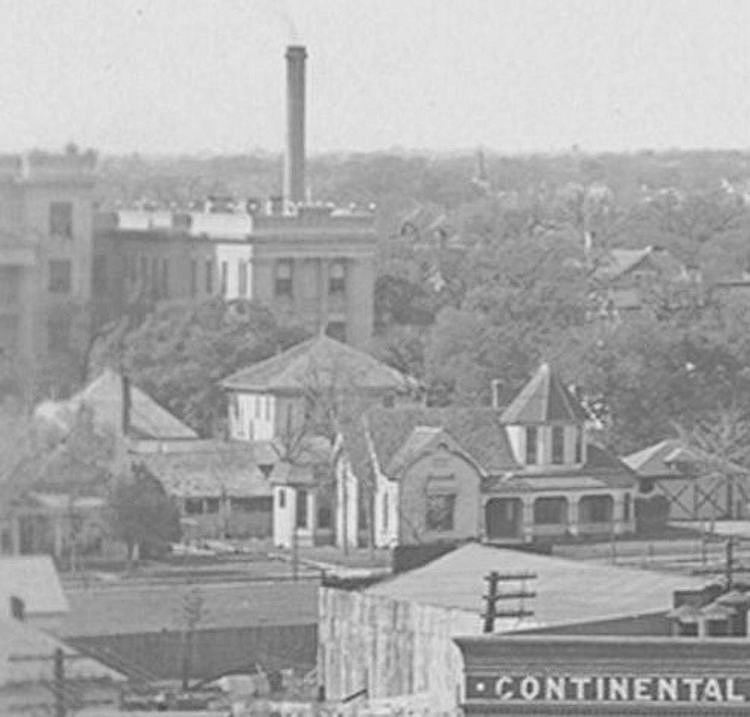
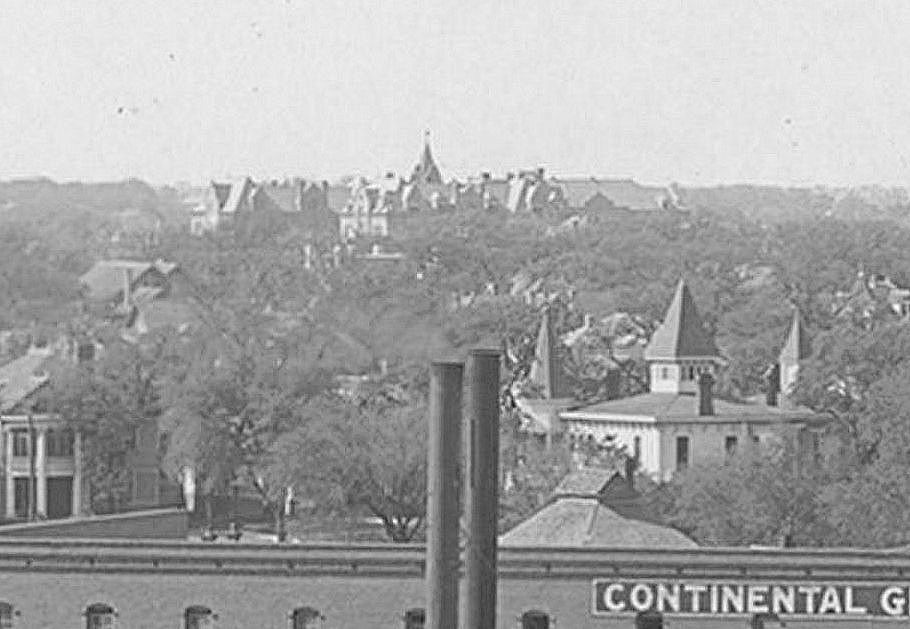
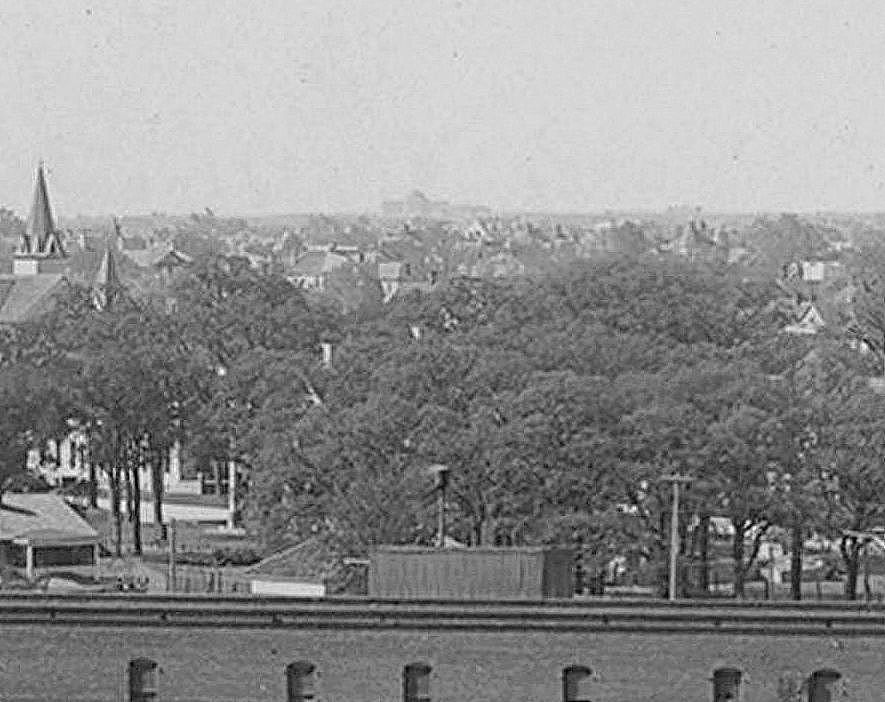
This is a really wonderful view of the Continental Gin Company complex, a Dallas landmark, much of which is, remarkably, still standing in Deep Ellum. Granted, my experience is limited, but I’ve never seen a photograph from this period showing the manufacturing end of Deep Ellum and the residential neighborhood just beyond it to the north. This is another incredible image from the George W. Cook Collection at the DeGolyer Library at SMU. A few magnified details, below. (Click for much larger images.)

continental-gin-bldg_1914_cook-degolyer-det1_bw

continental-gin-bldg_1914_cook-degolyer-det2_bw

continental-gin-bldg_1914_cook-degolyer-det3_bw

And zooming into the distance….

continental-gin_baylor_1914_bwThe back side of Baylor, at the top left. See it from the front here.

continental-gin_ursuline_1914_bwIn the middle at the top, Ursuline. (See more views of it here.)

continental-gin_smu_1914_bwAnd, my favorite, SMU’s Dallas Hall, waaaaaaaaaaaaaay in the distance. SMU hadn’t even officially opened when this photo was taken!

map_1919_continental-gin-bldg1919 map

***

Photograph titled “Continental Gin Company on Elm Street, Facing North” by Charles Erwin Arnold; from the George W. Cook Dallas/Texas Image Collection housed at the DeGolyer Library, Central University Libraries, Southern Methodist University. The photo and its details can be viewed here (I have altered the color in the images seen in this post).

Map detail from a large 1919 Dallas street map (which can be seen via the Portal to Texas History, here).

A view of this area from the 1921 Sanborn maps can be found here (click to make larger). (What’s a Sanborn map? Wikipedia tells you here.)

I wrote at length about the history of the Continental Gin complex of buildings in the post “Munger’s Improved Continental Gin Company,” here.

All images larger when clicked.

*

Copyright © 2015 Paula Bosse. All Rights Reserved.
 

Carhops as Sex Symbols — 1940

male-car-hops_AP_1940“At your service, ma’am…” / AP Photo

by Paula Bosse

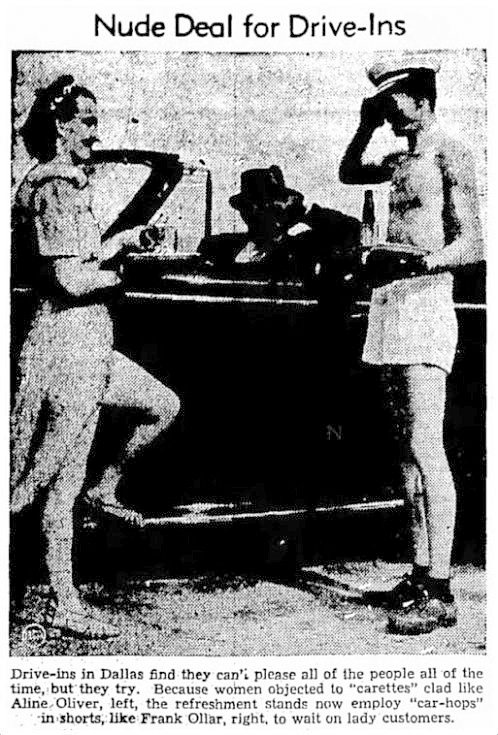
In 1940, Dallas was in a tizzy about the sudden fad of scantily-clad “girl carhops.” This scourge had made its way to Dallas from Houston (brought to Oak Cliff by the enterprising husband and wife team behind Sivils Drive-In), and in April of 1940, it was a newspaper story with, as it were … legs. For a good month or two, stories of sexy carhops were everywhere.

The girls started wearing uniforms with very short skirts — or midriff-baring costumes with cellophane hula skirts. Some of the women reported an increase in tips of $25 or more a week — a ton of money for the time.

The public’s reaction ranged from amusement to outrage. There were reports of community matrons who reported the “indecent” attire to the police department and demanded action. Other women were annoyed by the objectification of young womanhood. Lawmakers in Austin discussed whether the practice of waitresses exposing so much extra skin posed a health risk to consumers.

But it wasn’t until a woman from Oak Cliff piped up that something actually happened. She complained that she didn’t want to look at girls’ legs when she stopped in at her local drive-in — she wanted to look at men’s legs. Drive-in owners thought that was a GREAT idea, and the idea of the scantily-clad male carhop was born.

carhops_FWST_042840Fort Worth Star-Telegram, Apr. 28, 1940 

One might think that the woman behind this “equal ogling” campaign was sort of proto-feminist, until you get to the part where she said that the whole girl carhop thing was “wrong socially and economically and should not be tolerated” (DMN, Apr. 27, 1940) — not because of the skin flashed, but because men needed jobs, not girls. And that also raised hackles. Two married women who had been carhops wrote to the Dallas News to speak up for these girls and women who were “at least coming nearer to making a living wage than at any other time of their existence. […] The girl carhops are either supporting their family or sharing the expenses. […] Why all the storm about a leg? It is nothing more than you see at a movie and a vaudeville” (DMN, May 5, 1940).

The photo at the top ran in newspapers around the country with the headline: “Adonis and Apollo of Roadside Bring Trade to Daring Stand.”

First large roadside stand Friday to bow to the demand of Dallas women and feature husky young male carhops in shorts was the Log Lodge Tavern at Lemmon and Midway where four six-footers found jobs. Above, in blue shorts, white sweatshirt and cowboy boots, Joe Wilcox serves Pauline Taylor who smiles her approval of the idea. Bound for another car is James Smith, at right.

April, 1940 must have been a slow news month, because this story really got around (click to see a larger image).

sexy-carhops_corsicana-daily-sun_042740Corsicana Daily Sun, April 27, 1940

One intrepid reporter even tracked down a Texas Ranger (!) to ask his opinion, to which the Ranger replied, “…letting those roadside glamor boys wear boots is nothing more than a slam at the state. People think of booted Texans as men, not as fancy-panted carhops.” The whole article, below, is pretty amusing.

sexy-carhops_anniston-AL-star_042840Anniston (AL) Star, April 28, 1940

There were other male carhops around town, some not quite so hunky. This guy — game as he was — really needed to reconsider his outfit.

carhops_xenia-ohio-daily-gazette_050340Xenia (Ohio) Daily Gazette, May 3, 1940

But back to the female carhops and their siren-like hold over their male customers. This was, by far, the best story to hit the wires:

sexy-carhops_waxahachie-daily-light_071640
Waxahachie Daily Light,  July 16, 1940

***

Sources & Notes

Top image from the Associated Press, 1940. 

The Log Lodge Tavern was located at 7334 Lemmon Avenue, which was across from Love Field and adjacent to the Log Lodge Tourist Court. It was located approximately where the red circle is below, on a page from the 1952 Mapsco (click for larger image).

lemmon-ave_mapsco-1952

Check out these related articles from The Dallas Morning News:

  • “Skimpiest Costumes Bring Biggest Wages” (DMN, April 24, 1940)
  • “Women To Fight Girl Carhops; Slogan: Let Us See Men’s Legs” (DMN, April 26, 1940)
  • “Adonis and Apollo of Roadside Bring Trade to Daring Stand” (DMN, April 27, 1940)
  • “Word For Carhops Grass Skirts And All” (letter to the editor) (DMN, May 5, 1940)
  • “Went Crazy Over Car Hops, Wife Says of Fugitive” (DMN, July 16, 1940)

UPDATE: This has been a weirdly popular post — it’s gotten thousands and thousands of hits and even resulted in a short radio interview on Dallas’ public radio station, KERA. I don’t really add anything new to this story, but if you’d like to listen to the interview conducted by Justin Martin, it is here.

If you like what you’ve seen on Flashback Dallas, please consider supporting me on Patreon, where for as little as $5 a month, you can receive all-new updates several times a week (if not daily!). More information can be found at Patreon, here.

*

Copyright © 2015 Paula Bosse. All Rights Reserved.