Flashback : Dallas

A Miscellany: History, Ads, Pop Culture

Category: Photographs

Big Tex and His Dressers

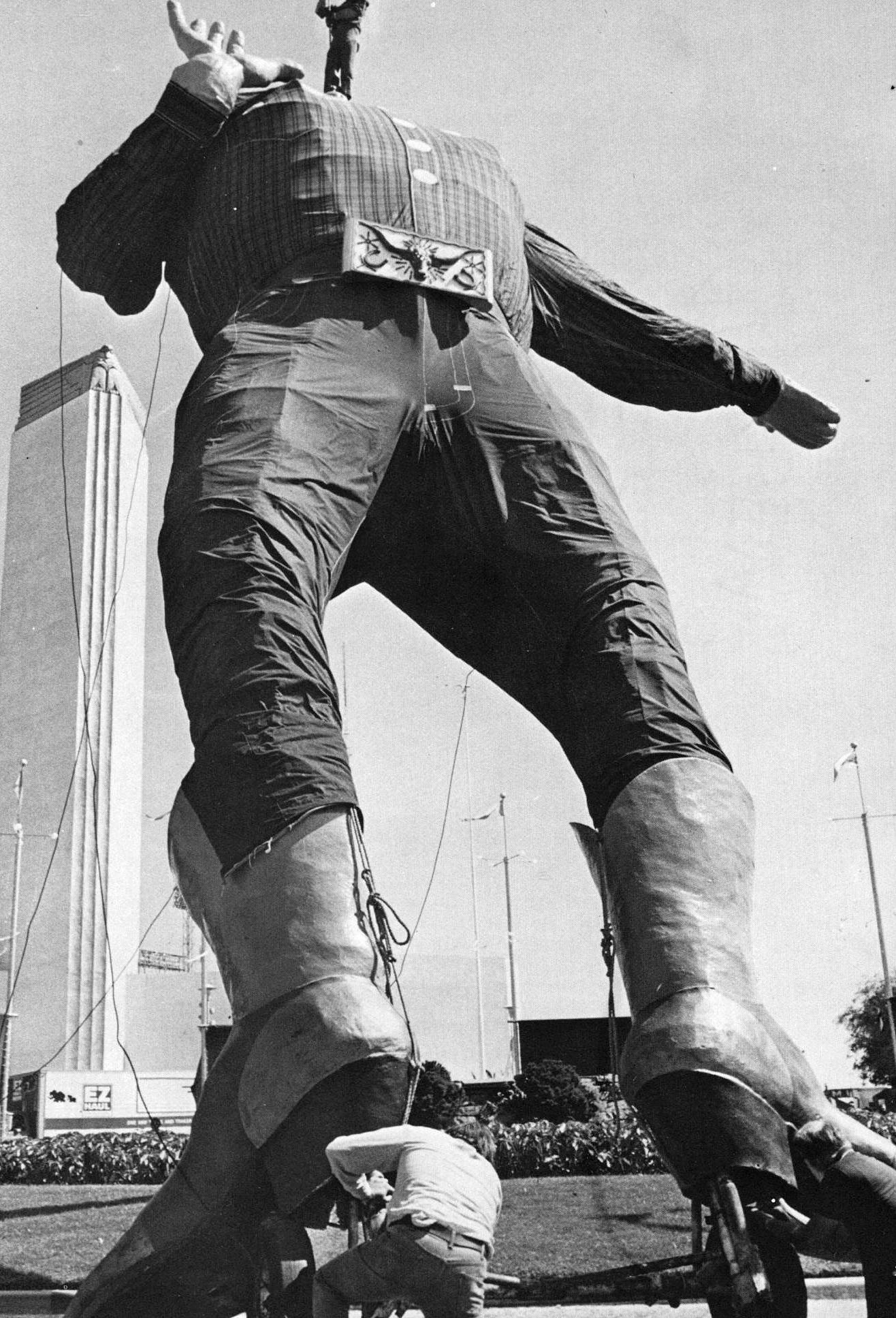
big-tex_headless_1970s
Headlessness and wardrobe malfunctions being attended to…

by Paula Bosse

It’ll probably all get straightened out in the end.

When I worked in a bookstore that had frequent visits by costumed characters for children’s events, we were told to make sure children never saw the characters without their costume heads because it might freak the kids out. If true, that photo above has the potential to scar some impressionable youngsters for life.

Above, Big Tex in dishabille.

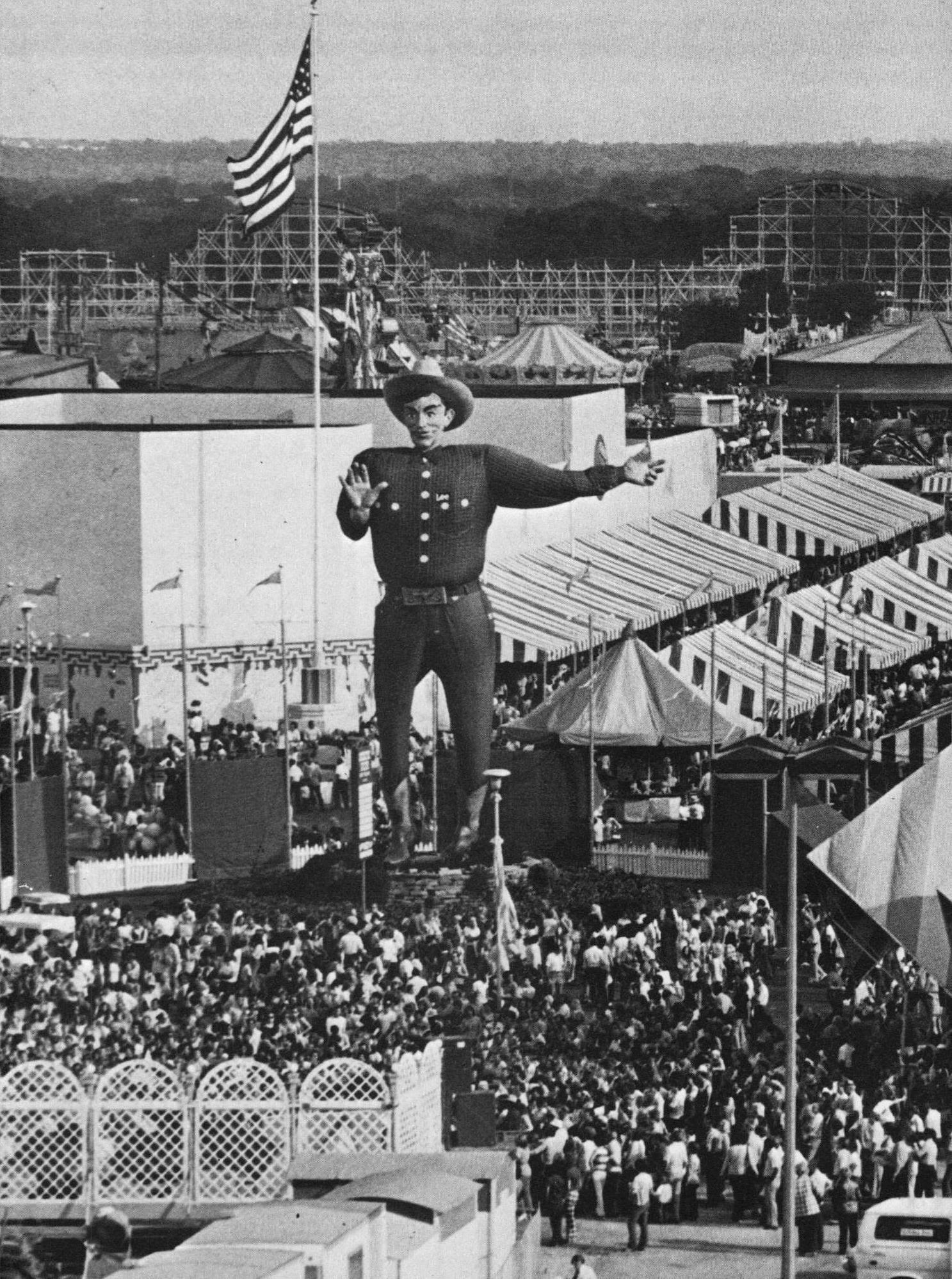
Below, all pulled together.

big-tex_tx-historian_sept1976-sm

***

Sources & Notes

Top photo of a headless Big Tex is from the Sept. 1976 issue of Texas Historian, a Texas State Historical Association publication of the Junior Historians of Texas.

Second photo, of a put-together Big Tex is a State Fair of Texas photo from the same issue of Texas Historian.

Click images to make Bit Tex REALLY big!

*

Copyright © 2014 Paula Bosse. All Rights Reserved.

University Park, Academic Metropolis — ca. 1915

university-hillcrest_1915University Park, prime real estate (click for larger image; see below for HUGE image)

by Paula Bosse

In the 1970s, Park Cities residents received oversized postcards in the mail featuring historic photos of the area. This “Heritage Series” was presented by the Park Cities Bank and later by Fidelity Bank. I’ll be sharing these wonderful images in the weeks to come. First up is this hard-to-fathom view of the intersection of University and Hillcrest, seen around 1915 when SMU opened, taken from Dallas Hall on the university campus. The description:

“In 1915, University Park was a sparsely populated community north of Dallas. At the time, most Dallas residents thought of Highland Park as ‘country living.’ This photo was taken from SMU’s Dallas Hall looking west along University Boulevard with the cross street being Hillcrest. The two-story home seen on the northwest corner of University and Hillcrest has long been replaced with a series of commercial buildings.”

***

UPDATE: For a much, much larger image of this photo, click here.

“Heritage Series” postcards used courtesy of the Lone Star Library Annex Facebook page. Postcard credits image to Dallas Public Library.

There is a book all about the houses that were built in that first block of University: The Block Book by Bonnie Wheeler (a review of which can be read here). (You probably won’t be able to find a copy of it, but if you do, snap it up. I see only one copy for sale online, and it is rather outrageously priced at just under $500!)

*

Copyright © 2014 Paula Bosse. All Rights Reserved.

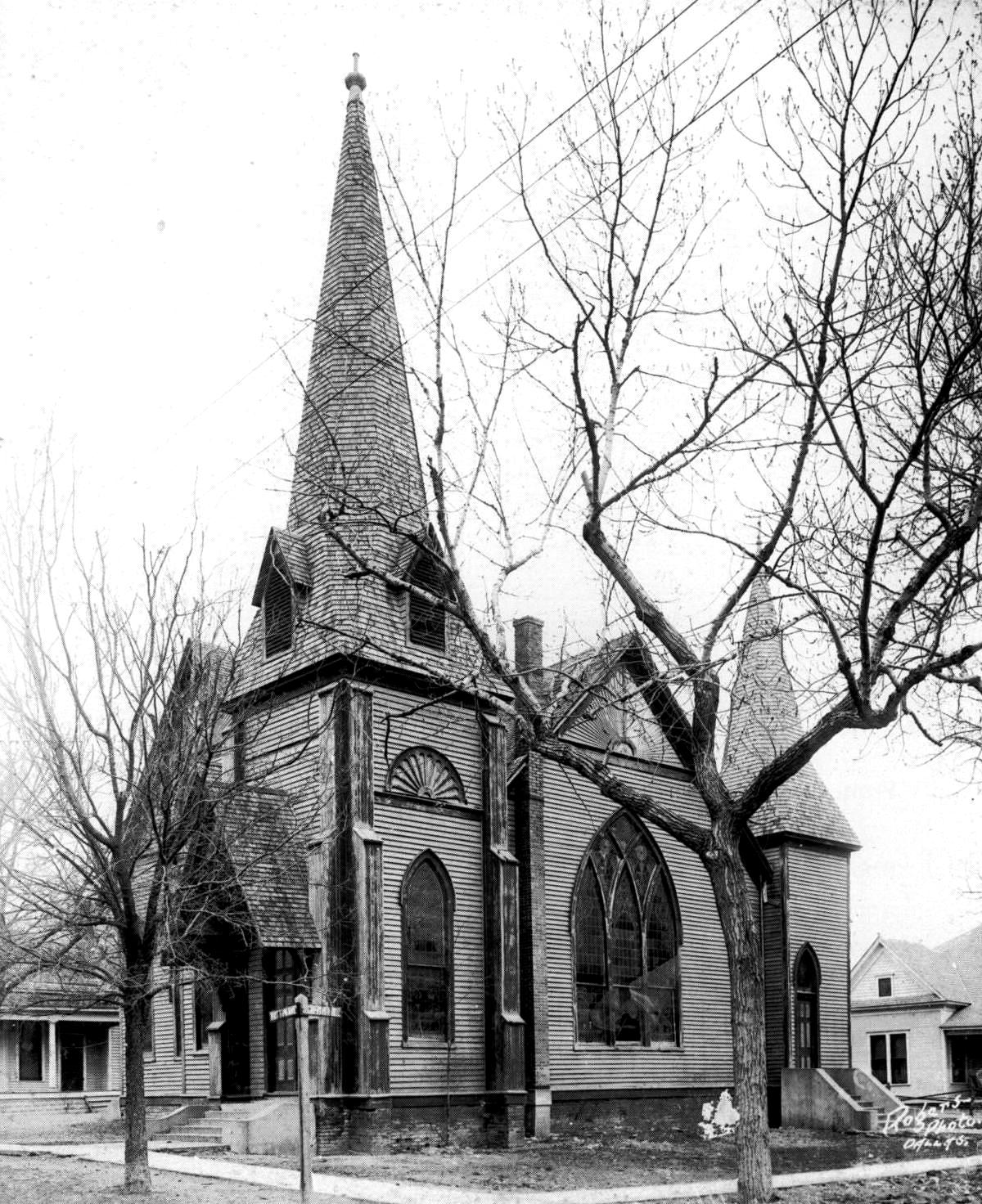
Oak Cliff Presbyterian Church, Organized 1890

oak-cliff-presbyterian_smOak Cliff Presbyterian Church, ca. 1897 (click for larger image)

by Paula Bosse

I came across this photograph of a church a couple of days ago and was mesmerized by its charming woodiness. According to its caption, it was the Oak Cliff Presbyterian Church, at the corner of Ninth Street and St. George (now Patton). Its first pastor was the Rev. W. L. Lowrance who had organized the church in 1890 with fewer than twenty members. Church membership grew steadily, and in 1923, having finally outgrown the small wood frame building, the congregation moved to their next location at Tenth and Madison (contributing to Tenth Street’s appearance in Ripley’s Believe It Or Not as the street having more churches per mile than any other street in the world). At some point this lovely church was razed.

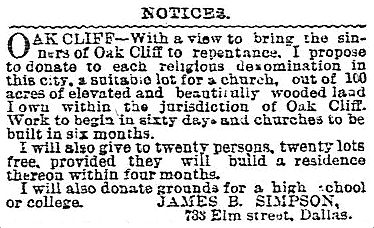
I’ve found little else on its earliest history. but I came across this advertisement placed in The Dallas Morning News in 1891:

simpson_oak-cliff-land-donation_dmn_031491(DMN, March 14, 1891)

Col. James B. Simpson was something of a learned Renaissance-man around Dallas. He had been the editor of The Dallas Herald for many years and was a civic leader with real estate interests. I’m not sure if this ad has anything to do with the establishment of the Oak Cliff Presbyterian Church, but it’s interesting to note that construction of the new church was mentioned as being under construction one month after this ad’s appearance. Time was running out for those Oak Cliff sinners (even though one newspaper report stated that the building wasn’t occupied until 1893).

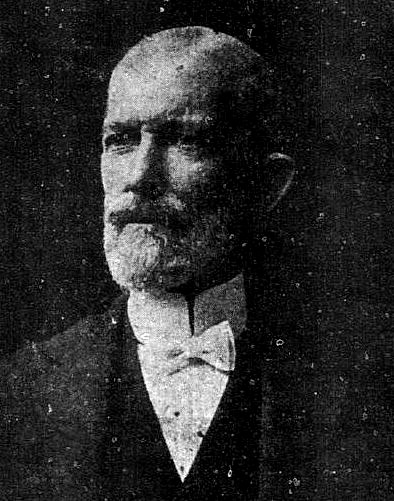
Rev. Lowrance, an apparently well-liked and respected pastor, retired at the end of 1903.

lowrance_dmn_122903-photo“Dr. W. L. Lowrance of Oak Cliff”

lowrance_dmn_dmn_122903(DMN, Dec. 29, 1903 — click for larger image)

The Oak Cliff Presbyterian Church lives on, now on S. Hampton. One can only assume that the building it occupies today is not quite as charming as the little woody one that was built 120 years ago.

***

Top photo (by the Rogers Photo Studio, circa 1897) appeared in the Fall 2009 issue of Legacies magazine, here.

Though the first Oak Cliff Presbyterian Church was on Ninth St., the second one was on Tenth St., and that seems reason enough to direct attention to the article “Road to Glory: Tenth Street Becomes Church Street” by René Schmidt — it appeared in the same issue of Legacies as the church photo, and you can read it here.

Read more about this “Street of Churches” and its staggering fourteen churches (!) in the May 1, 1950 edition of The Dallas Morning News.

*

Copyright © 2014 Paula Bosse. All Rights Reserved.


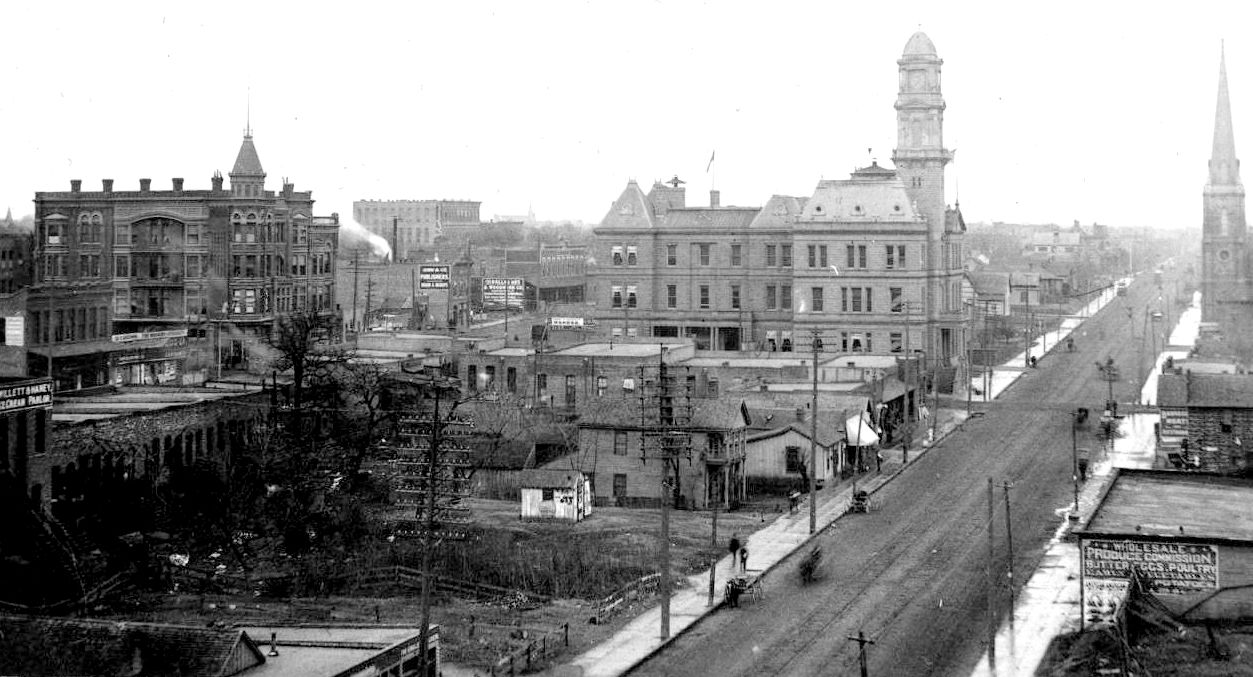
Henry Stark’s “Bird’s Eye View of Dallas” — 1895/96

stark_downtown_1895-96_hplCommerce St. looking east from about Akard

by Paula Bosse

In the winter of 1895-1896, a St. Louis photographer named Henry Stark traveled to Texas, photographing scenes and vistas across the state. According to The Handbook of Texas, he is believed to be “the first photographer to have made an extensive photographic record of Texas.” A collection of his photos was published under the title Views in Texas.

The photograph above shows Commerce Street looking east, with the post office and its tall clock tower dominating the scene (the clock shows that it is 9:35 in the morning). The Old Post Office was bounded by Main, Ervay, Commerce, and St. Paul.

This is a great photo, showing Dallas as I’ve never seen it before. I’ve zoomed in to see the “hidden” details. (All photos are larger when clicked.)

stark_det1What is the building on the left? It’s very unusual-looking. (UPDATE: See the comments below. This appears to be the adjoining Bookhout and Middleton Buildings at Ervay and Main.)

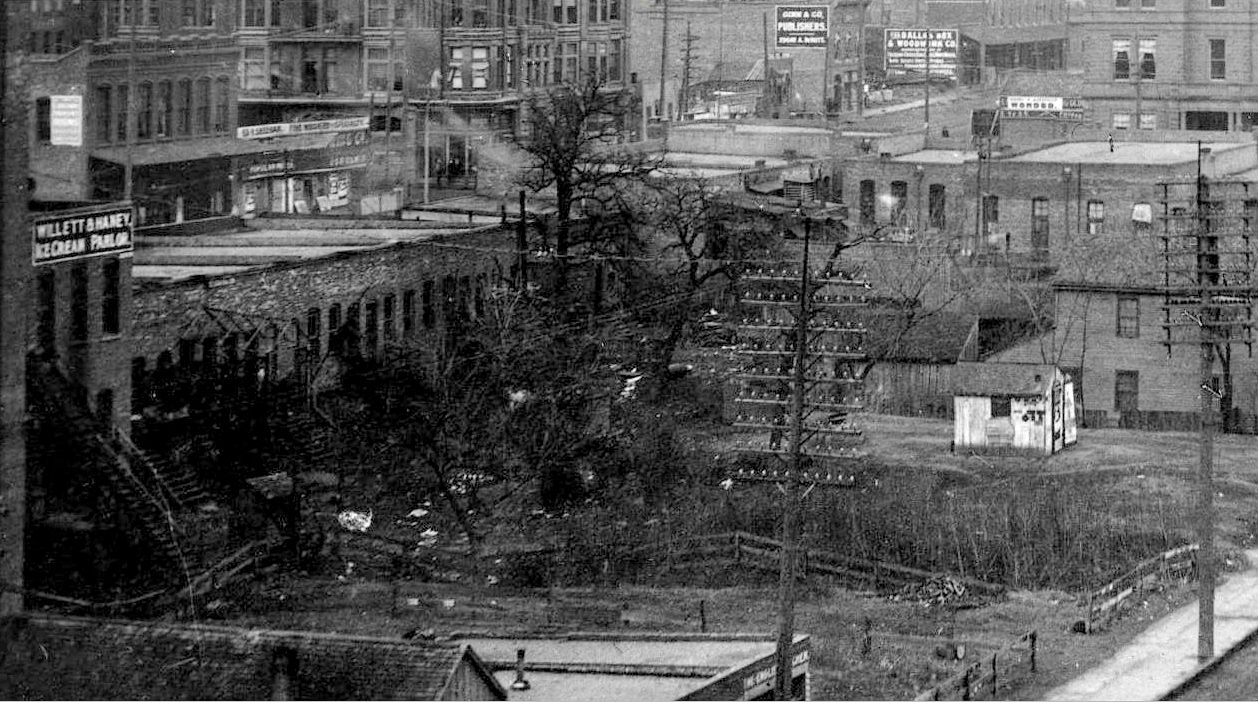
stark_det2This is my favorite detail. All that trash. And vacant lots. And a haphazard, meandering fence. Are those steps leading to rear entrances of buildings facing Main? And those utility poles! That block looks kind of squalid. Not Dallas at its best. I think this would be around Akard. (UPDATE: A reader wrote to say that this looks like a “ravine” — that the fence may be following the course of an old stream — something that might explain why that area of prime real estate hadn’t been developed yet.)

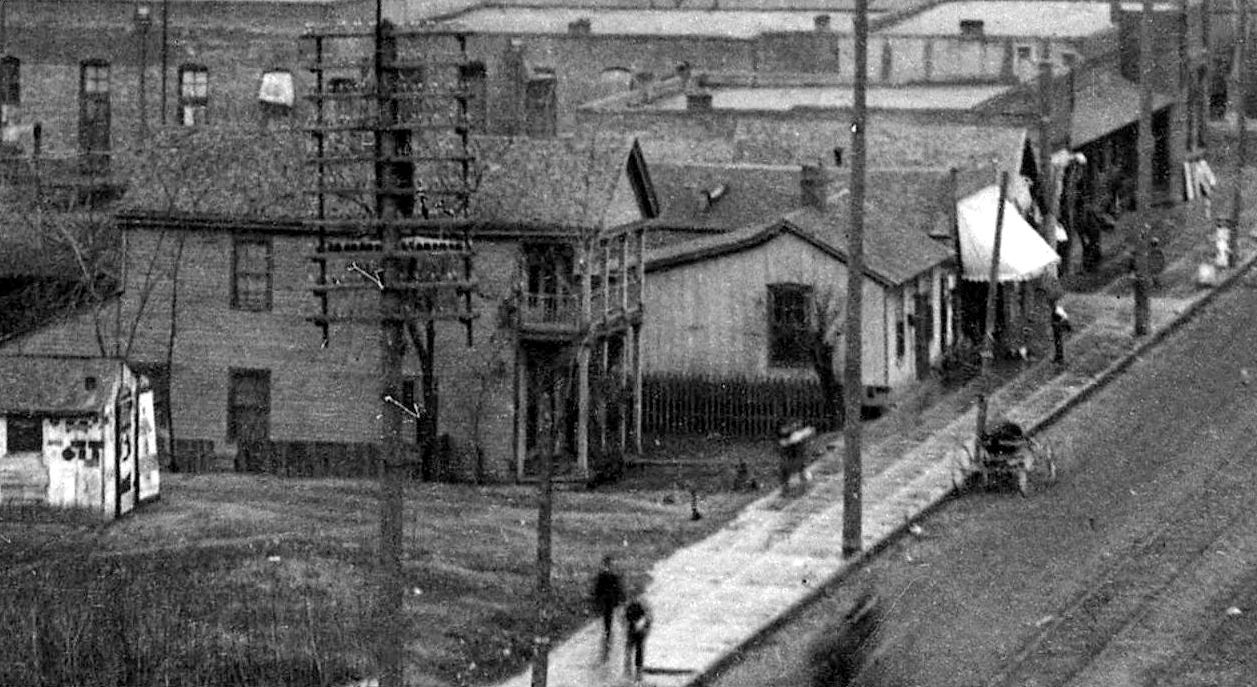
stark_det3Houses just a few steps from the giant post office building. Horse-drawn buggies parked at the curb. People on the sidewalk. What looks like a man with his hands on his hips looking down at a child. Or maybe a dog.

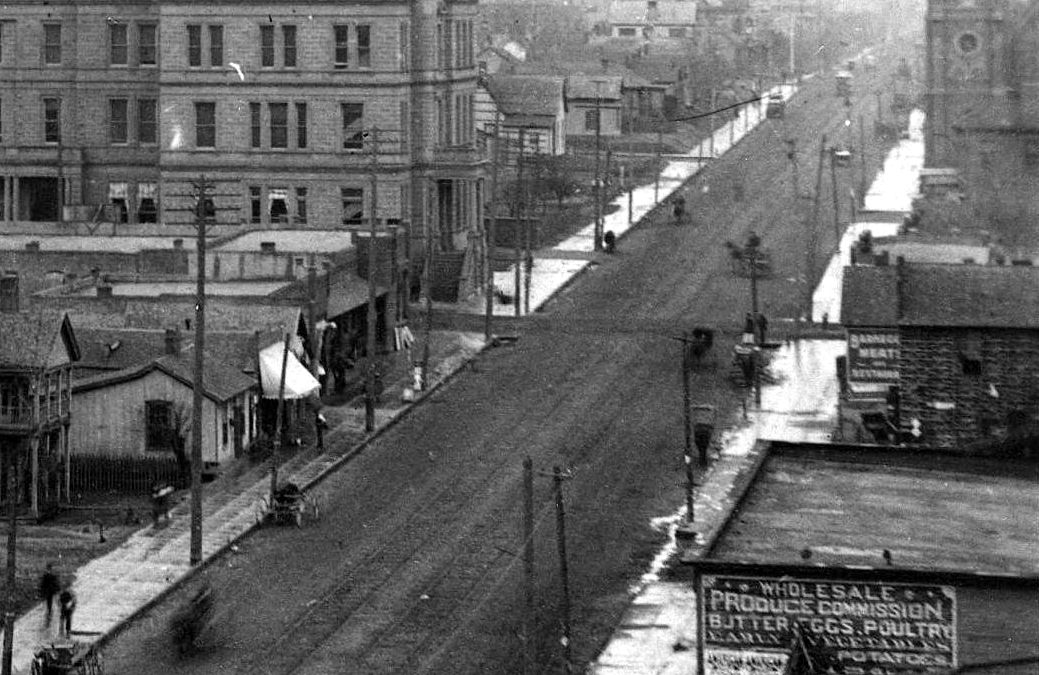
stark_det4A bustling Commerce Street at the intersection of Ervay, with trollies in the distance.

*

This photograph shows almost exactly the same view as one I posted earlier under the title “Something Like N.Y.” — check out the 1904 version here.

***

Sources & Notes

The photograph, by Henry Stark, is from the Houston Metropolitan Research Center, Houston Public Library. The resolution is a bit grainy when trying to enlarge the details — to explore the photo for yourself, see it here.

What little is known of Henry Stark can be read in the brief Handbook of Texas bio, here.

For another Henry Stark photo, see the post “Oak Cliff Trolley — 1895,” here.

For other examples of photographs I’ve zoomed in on to reveal unintended vignettes, see here.

*

Copyright © 2014 Paula Bosse. All Rights Reserved.

From Dull to Spectacular — How a Picture Postcard Evolves

theater-row_before_tsha

by Paula Bosse

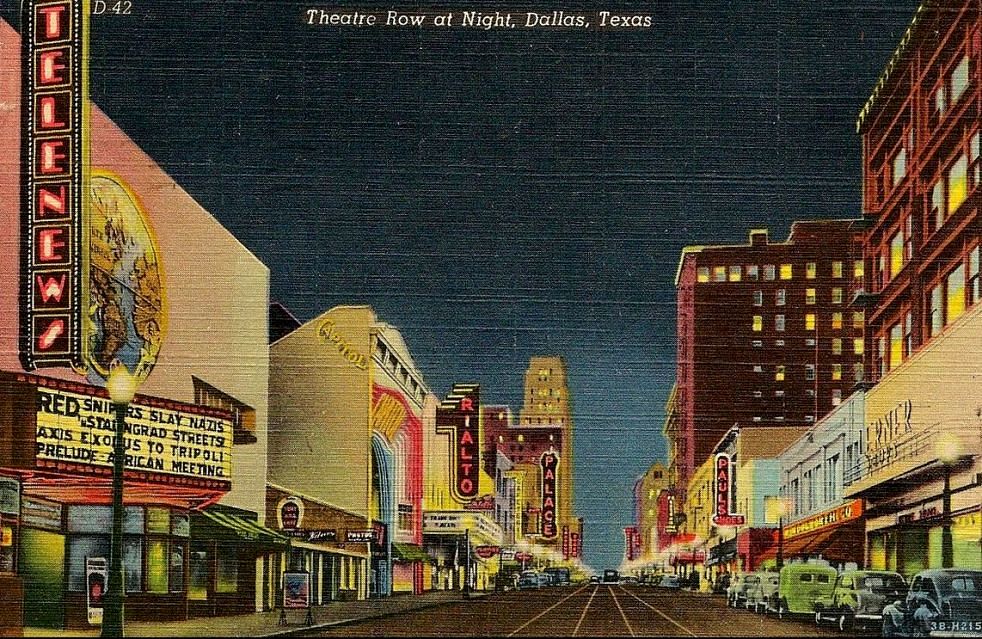
You know how you look at some of those fantastic postcards from the ’40s that don’t look real and you wonder, “Is that from a photograph, or is that just an artistic interpretation?” Well, it’s both.

In the above “before” and the below “after,” it’s interesting to note what’s been kept in and what’s been taken out. And how a fairly ho-hum daytime view becomes a dazzling night-time scene. Either way, it’s an Elm Street I’ll — sadly — never experience.

theater-row_after

***

Sources & Notes

Black-and-white photograph of Elm Street’s “Theater Row” from the Texas State Historical Association.

Click pictures for larger images.

*

Copyright © 2014 Paula Bosse. All Rights Reserved.


Telephone Operators Sweating at the Switchboard — 1951

summer_telephone-operators_1951Low-tech A/C: ice, buckets, fans

by Paula Bosse

The summer of 1951 in Texas was brutally hot. One heat-related incident that August made national headlines: more than 1,500 Southwestern Bell telephone operators (and supportive coworkers) who were working in unairconditioned conditions (!!) at the Haskell Exchange on Bryan and at the Akard Street headquarters downtown staged what news reports called a “wildcat walkout” and refused to continue working in the sweltering buildings. Management’s attempt to cool things down with electric fans blowing over buckets of ice had not worked. Operators returned the next day, having made their point, hopefully to the imminent installation of air-conditioned switchboard rooms.

The caption for the photo above:

Dallas, Tex. Aug. 10 [1951] — BEATING THE HEAT — Both ice and fans are brought into play by telephone operators at an exchange here today as the city continued to swelter under 100-degree or over temperatures. The thermometer reached a high of 102-degrees to run the consecutive days of 100-degree readings to ten. It is the longest period of such reading since 1925 when a record 11 straight days was set. High mark for the present heat wave was 107 on August 6.

Three days later, the sweat hit the fan, and the women walked out.

operators_heat_st-joseph-MO-news-press_081451
St. Joseph [MO] News Press, Aug. 14, 1951 (click to read)

Let’s hope your work conditions are a bit better this summer!

***

Sources & Notes

Wire service photograph from the Southern Labor Archives of the Georgia State University Library Special Collections.

See ads from 1911 and 1925 encouraging women to become telephone operators in the Flashback Dallas post “Work and Play in Telephone Land,” here.

*

Copyright © 2014 Paula Bosse. All Rights Reserved.

Expo Park, Circa 1946: Dry Goods, Rooms to Let, Sheet Metal, and Head-In Parking

exposition-827-825_c1946_jim-wheat800 block of Exposition…

by Paula Bosse

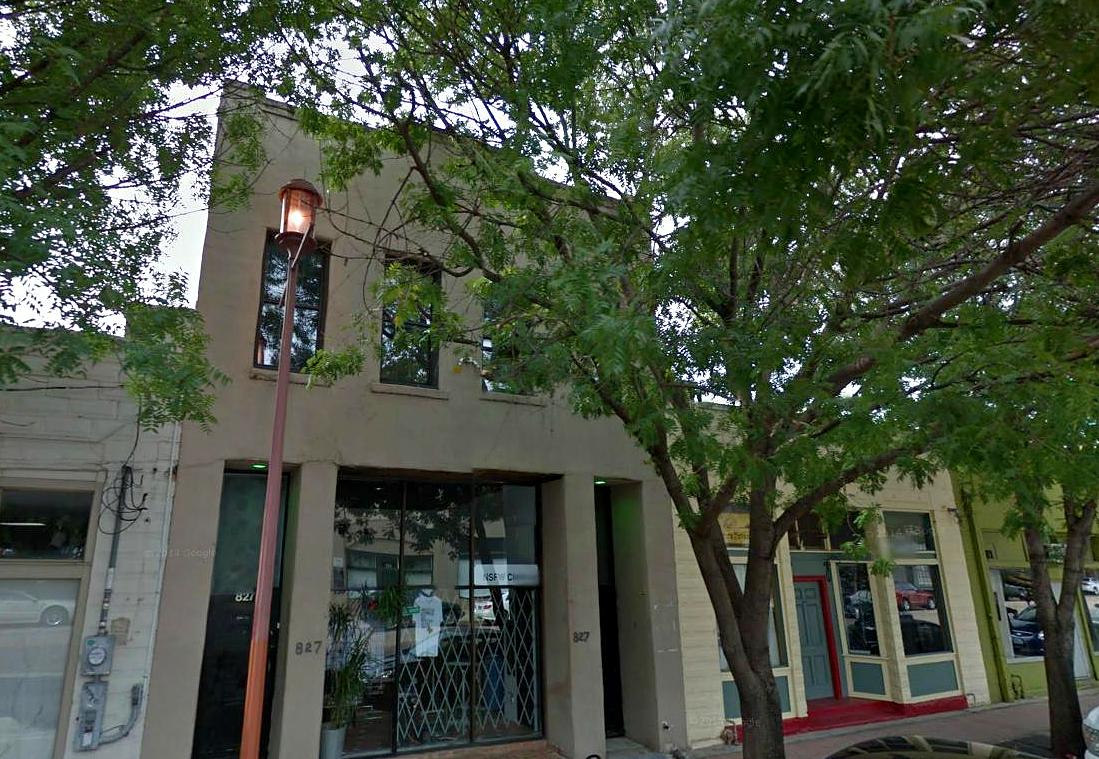
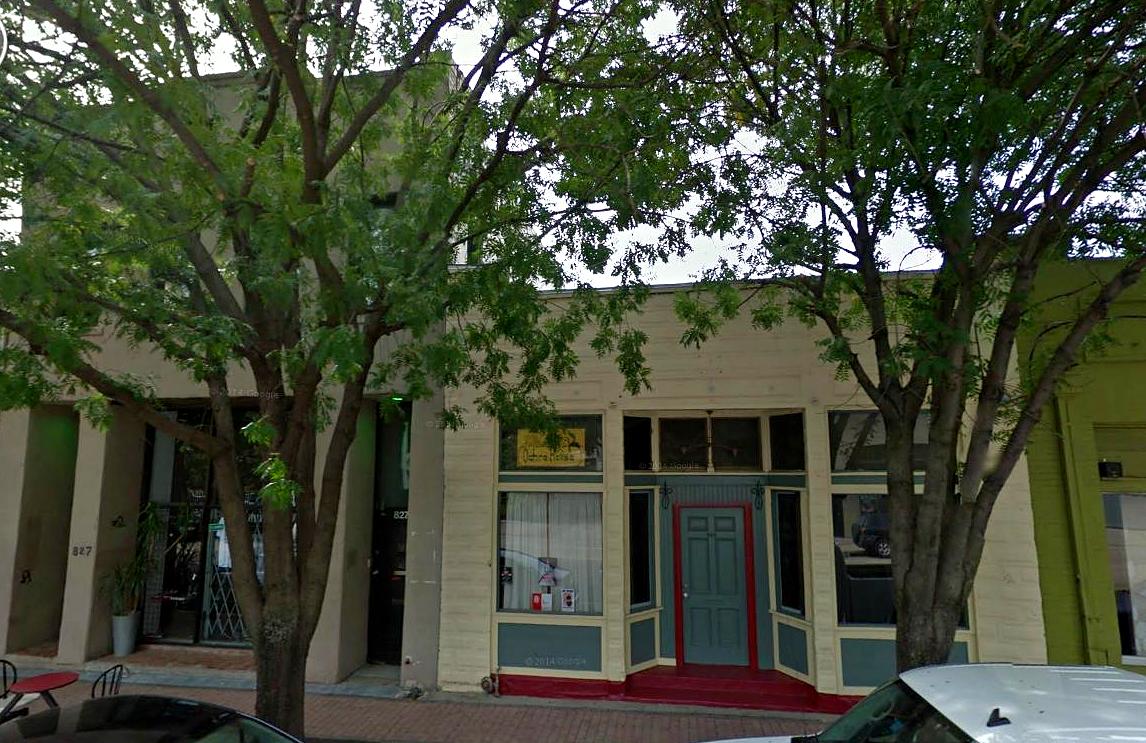
Next time you stop by the Amsterdam Bar at 831 Exposition Avenue, whip out your phone and show this photo to your drinking buddies — this is what the street looked like two doors down, just after World War II. The two-story building at 827 Exposition was home to Lief Dry Goods and the Lief Hotel, and the single-story 825 Exposition was divided into McNeill’s Tin Shop and the Fair Way Cleaners & Laundry (it currently houses the Ochre House theater space). Today the neighborhood has lost much of its grittiness (and head-in parking), but the buildings are still recognizable almost 70 years later. Below, present-day 827 and 825 Exposition Avenue.

exposition_827-google

exposition_825-google

***

Sources & Notes

Top photo from Jim Wheat’s Dallas County Texas Archives.

Bottom two images from Google Street View.

*

Copyright © 2014 Paula Bosse. All Rights Reserved.

I-35E Looking South: A Landscape Blissfully Free of Cars and Strip Malls — 1964

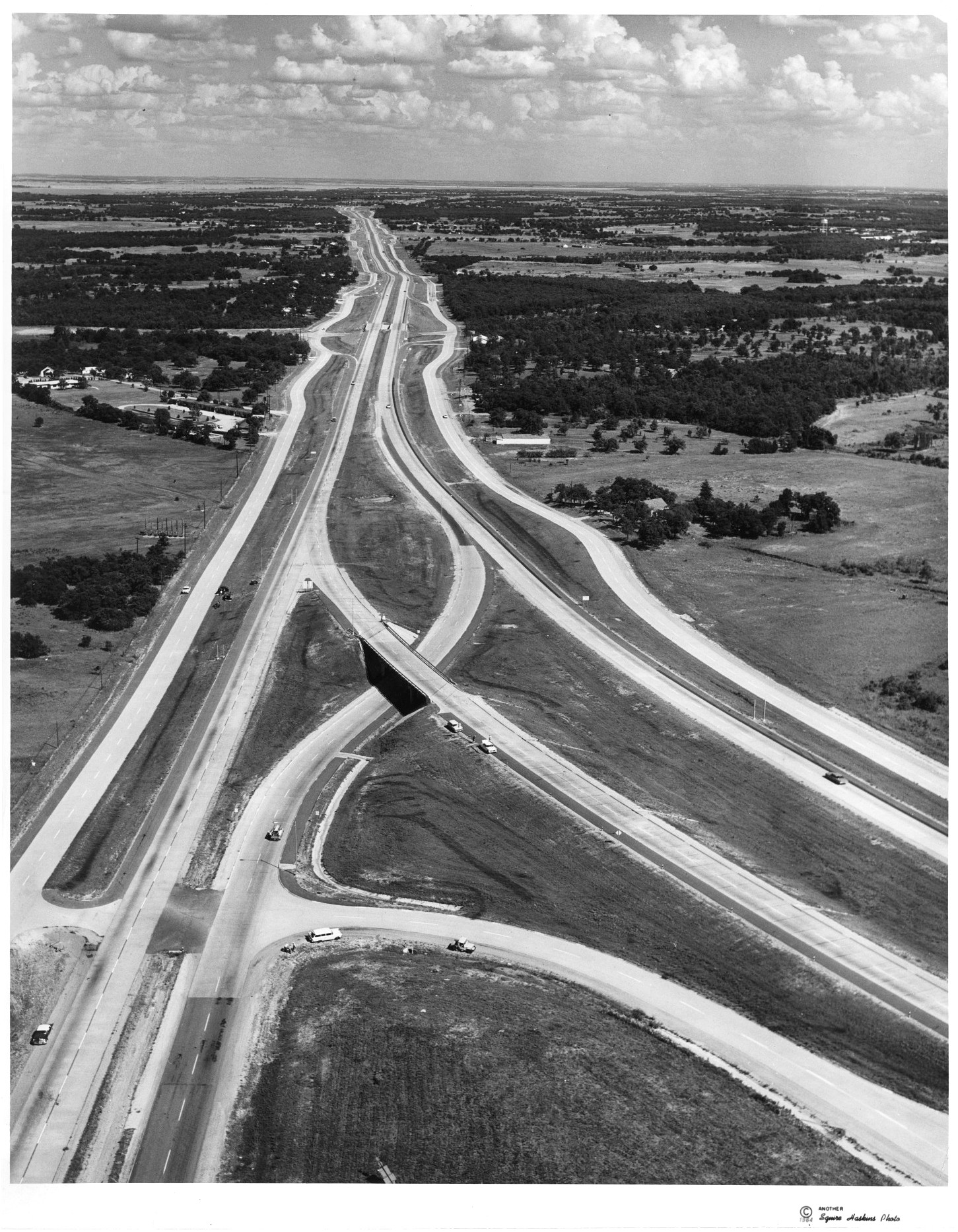
I35E-south-from-denton_haskinsI-35, pre-sprawl — photo by Squire Haskins (GIGANTIC when clicked)

by Paula Bosse

This is I-35. …I-35! I’m not sure what stretch of the interstate this is exactly, but I think we’re looking north toward Denton south from Denton. I might cry. No sprawl!

*

UPDATE: I’ve had several comments about this photo from all over El Internet, and it appears that this is I-35E in Denton, looking south(east) toward Lake Lewisville (then Lake Dallas). More specifically, this shows the I-35 / US-77 (Dallas Dr.) interchange, with part of the old Hwy. 77 visible at the bottom of the photo. It’s been pointed out that the water tower at the top right is at the Denton State School. I hope this is correct! If anyone else has any suggestions, please let me know! (To see a 1965 road map of this area, see here.)

Here’s how it looks these days (thanks, Bill P.).

i35e_google-earth

***

Another amazing aerial photograph by Squire Haskins, from the collection of the Denton Public Library (with an incorrect description!). Accessible on the Portal to Texas History, here.

Click picture for larger image. In fact, it’ll get so big that it might break whatever device you’re viewing this on; proceed with caution.

*

Copyright © 2014 Paula Bosse. All Rights Reserved.

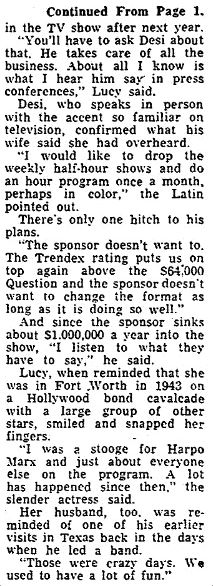
Lucy, Desi, Dallas — 1956

lucy-desi_fw_bellaircraftLucille Ball and Desi Arnaz and their loaner ‘copter from Bell Aircraft

by Paula Bosse

Lucille Ball and Desi Arnaz came to Dallas and Fort Worth in 1956 to promote their new movie, “Forever Darling.” Their arrival times were heavily publicized, and throngs of fans showed up to welcome them — in Dallas at Love Field, and in Fort Worth at the Western Hills Hotel. For those who might have missed their arrivals, they still had a chance to see the couple at one of the personal appearances scheduled at the theaters showing their movie (in Dallas at the Majestic on February 10th, and in Fort Worth at the Hollywood on the 11th). Crowds were large and enthusiastic, and everyone appears to have had a genuinely fun time, possibly even Lucy and Desi, whose relationship in those days was frequently a bit shaky.

Best of all was the tidbit about how the famous couple traveled from Dallas to Fort Worth: by helicopter.

Two television stars will be sailing around above Dallas skyscrapers Saturday. …Lucille Ball and Desi Arnaz will catch a helicopter ride from atop the Statler Hilton for a trip to Fort Worth. City Council officially sanctioned the ride at its Monday meeting. (Dallas Morning News, Feb. 7, 1956)

They left from the helipad atop the Statler Hilton and touched down at the helipad at the Western Hills Hotel in Fort Worth (hotels are nothing without helipads). There was some sort of cordial relationship between the Arnazes and the people at Bell Aircraft, because they availed themselves of this brand new deluxe chopper in New York as well as in DFW. When their promotional duties were finished, Lucy and Desi left Cowtown for California as guests of the president of the Santa Fe Railway — in his private car. Because that’s how you travel if you’re Hollywood royalty.

*

lucy-desi_dmn_020856-detFeb 8, 1956
*

lucy-desi_dmn_021156-photolucy-desi_dmn_021156-captionDMN, Feb. 11, 1956

(Leon Craker, I bet you had a great story about this for years after this momentous meeting.) 

*

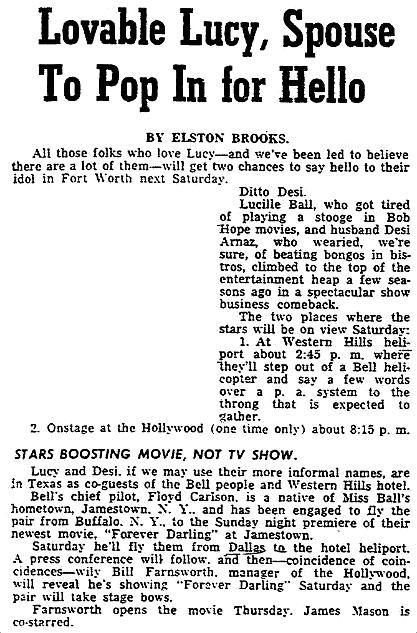
In Fort Worth, Elston Brooks (whose amusing articles I’ve really enjoyed discovering these past few months), seemed underwhelmed and a little annoyed at the prospect of  “lovable Lucy and spouse” invading the city (click articles to see larger images):

lucy-desi_FWST_020556Fort Worth Star-Telegram, Feb. 5, 1956
*

Elson Brooks may not have been very excited, but when Lucy and Desi stepped out of that helicopter, the Fort Worth crowd went wild (click text for larger image):

lucy-desi_FWST_021256-photo

lucy-desi_FWST_021256a

lucy-desi_FWST_021256bFWST, Feb. 12, 1956

*

And here they are back in Los Angeles, with Desi Jr., at the end of a busy promotional tour. Desi is proudly wearing the cowboy hat he’d been given in Fort Worth. And he looks damn good in it.

lucy-desi_dfw

***

Sources & Notes

Top photo of Lucy and Desi standing next to the 1956 Bell 47H-1 (“one of the world’s first executive helicopters”) is from the August 2012 issue of Vintage Aircraft Magazine; photo from Bell Aircraft. The article concerning this helicopter model is contained in a PDF here.

The bottom photo is from a Pinterest page, here.

UPDATE: I had originally identified the photo of Lucy and Desi with the train as having probably been taken in Fort Worth as they were about to depart for Hollywood, mainly because they’re wearing similar clothing from the FW appearance, but a rail historian noted that this photo was actually taken in California at the Los Angeles Union Passenger Terminal — he could tell because he recognized the part of the platform structure over their heads! (“I can name that song in TWO notes!”) The photo he directed me which shows the LAUPT platform (and, in fact, the same engine, two years earlier!), is here. They probably took the final photo for the Santa Fe company as thanks for providing them with transportation back home in the president’s private car. (Thanks, Skip!)

*

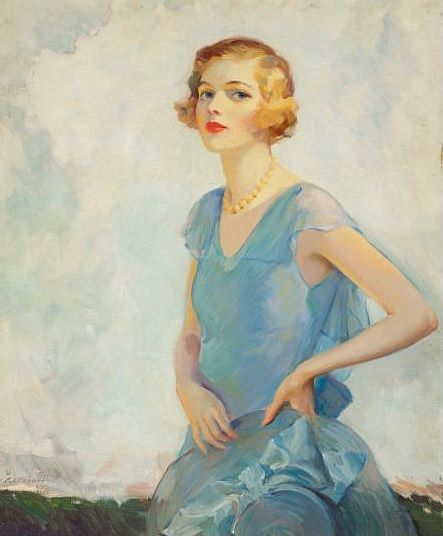
And because today is Lucille Ball’s birthday (which I know only because she shares a birthday with my aunt — happy birthday, Bettye Jo!), it seems like a good time to wheel out this strikingly beautiful portrait of Lucy, along with a wonderful photograph of her from about the same time (probably between 1928 and 1930).

lucilleballportrait

lucilleball-ca1930

*

Copyright © 2014 Paula Bosse. All Rights Reserved.


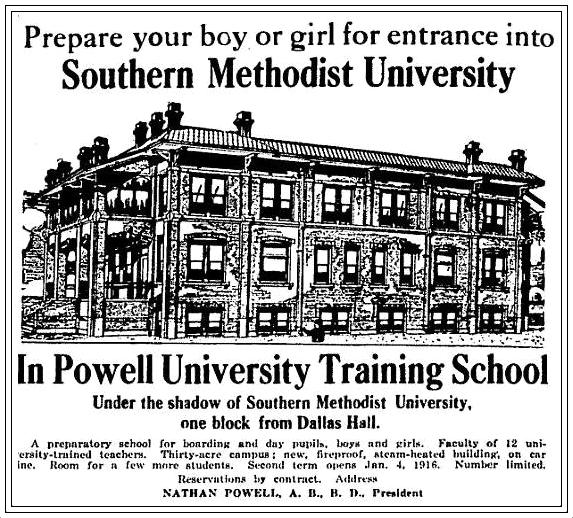
Send Your Kids to Prep School “Under the Shadow of SMU” — 1915

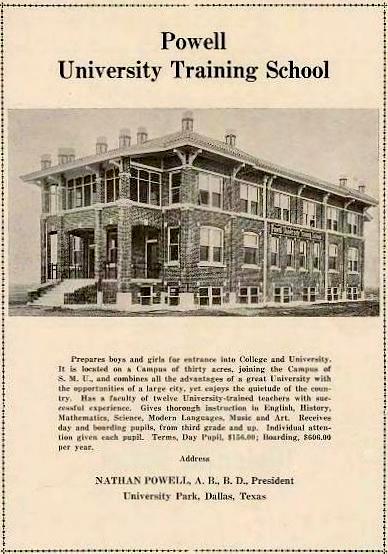
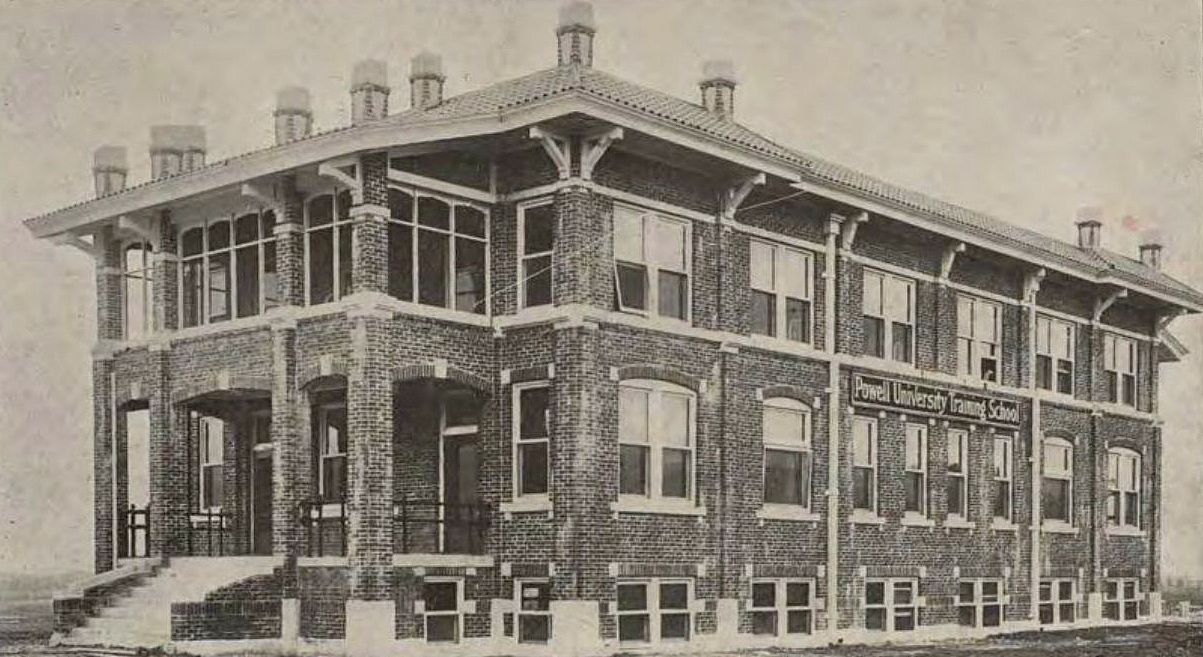
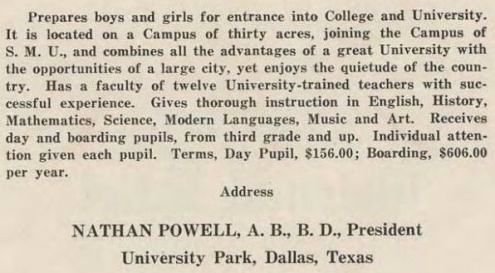
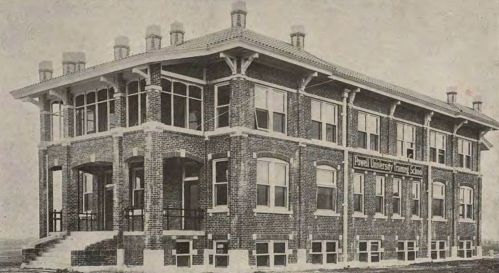
powell-prep_rotunda_1916Powell University Training School, 1915

by Paula Bosse

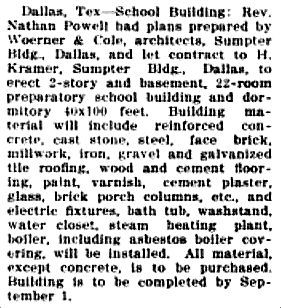
Nathan Powell (1869-1963) was a former Methodist minister who opened his prep school, Powell University Training School, on thirty acres of open land, just across an unpaved road from SMU (which was still in the very early days of its construction). SMU and the Powell school shared more than just adjacent addresses — which they both rather idealistically touted as being “situated on high ground overlooking the university campus and the city” — they also opened on the same day, September 15, 1915.

The location and the opening date were not a coincidence, as Dr. Powell was one of the Methodist movers and shakers who originally promoted the idea of Dallas as the site for a new Methodist university. The following (perhaps exaggerated) sentence can be found in the (perhaps overly laudatory) profile of Powell in one of those ubiquitous late-19th, early-20th century “mug books,” A History of  Texas and Texans (1916):

Beyond his activities as a minister and teacher, the most notable achievement in the life and career of Doctor Powell lies in the fact that he was the sole originator and promoter of the great Southern Methodist University at Dallas, which began its first year September 15, 1915.

Powell University Training School lasted for only about twelve years, until Powell’s rather sudden retirement in 1927 (the good reverend’s “retirement” might have been precipitated by numerous lawsuits and mounting debt). When the school closed, Dr. Powell and his family moved to Harlingen to — as his obituary states — “help organize the grapefruit growers of the Rio Grande Valley.” He operated a citrus nursery himself for a while until it was destroyed by a 1933 hurricane. Nathan Powell died in Harlingen in 1963 at the age of 94.

It’s always exciting to see old buildings still standing in Dallas, and, happily, this one is still around — and it still looks good. Fittingly, it’s currently home to an early-child development center. Next time you’re near the intersection of Binkley and Hillcrest, go take a look.

*
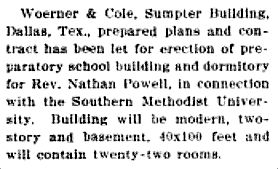
powell_tx-trade-rev-industrial-record_071515a*powell_tx-trade-rev-industrial-record_071515bBoth items from the Texas Trade Review & Industrial Record, July 15, 1915
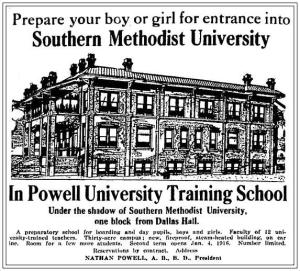
powell_school_ad_smu-times_121815SMU Times, Dec. 18, 1915 (click for larger image)
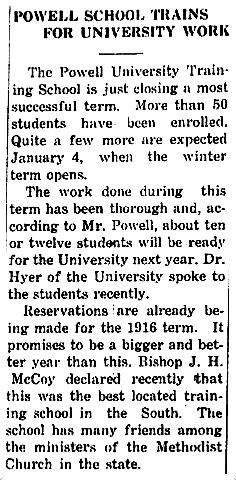
powell_school_smu-times_121815SMU Times, Dec. 18, 1915

ad-powell-prep_smu-rotunda-19161915 (click to read text)

Below, after the school closed. Looking a little shaggy. I would have guessed the photo was from much earlier, but it’s dated 1931. Complete with horse.
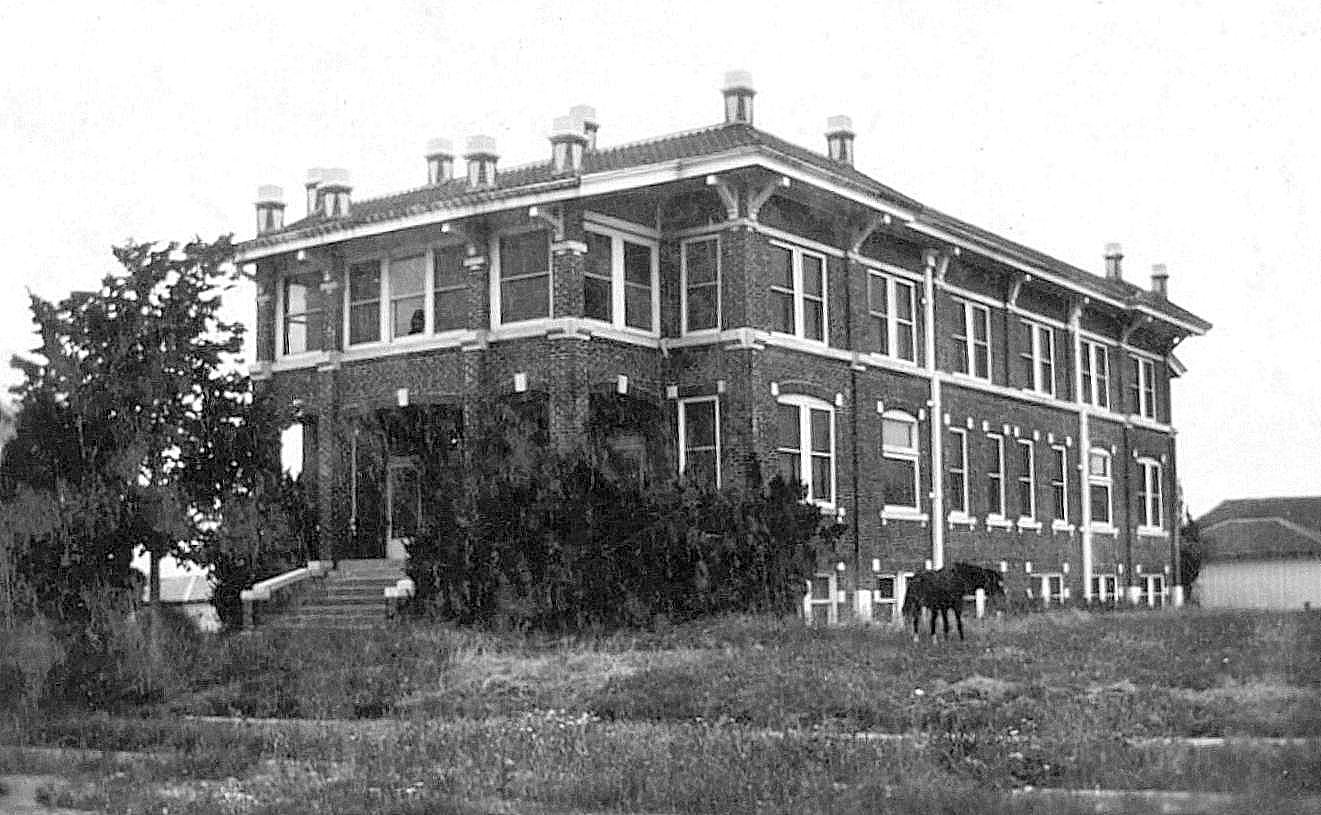
powell-univ-training-school_brown-bk_university-park_19311931, Brown Book, University Park Public Library

***

Sources & Notes

Top image and bottom ad appeared in the very first edition of The Rotunda, SMU’s yearbook for their inaugural year, 1915-16.

More on Rev. Powell’s early life and involvement with the founding of Southern Methodist University can be read in A History of Texas and Texans by Frank W. Johnson (Chicago and New York: American Historical Society, 1916), here.

Information regarding Powell’s retirement in Harlingen is from “The Chronological History of Harlingen” by Norman Rozeff (circa 2009), in a PDF here.

Powell’s obituary can be found in The Dallas Morning News, Nov. 8, 1963: “Dr. Powell Dies; Helped Found SMU.”

Currently occupying 3412 Binkley is The Community School of the Park Cities. According to the history page of their website (here), the building has been operated as a school since at least the 1950s.

I’m not sure what the actual facts are concerning Nathan Powell’s role in the founding of SMU. There are very few results when searching the internet. Most newspaper articles connecting him with the university seem to have been generated by Powell himself. If Powell was as important in the history of SMU as he claimed to be, it’s surprising to see so little information on any connection. Was Powell’s assertion that he was the driving force behind the creation of SMU a blatant lie? Was it merely an exaggeration of the truth? Or was it accurate, but something happened to cause the university to distance itself from him? A collection of papers in the SMU archives (which I have not seen) seems to indicate that there were those in Methodist circles who disputed Powell’s claims, as Elijah L. Shettles took it upon himself to prove that Nathan Powell was the driving force behind the very existence of SMU. An overview of the collection — The Elijah L. Shettles Papers on the Founding of Southern Methodist University — can be found here.

(I’ve found an article from the Fort Worth Star-Telegram in 1910 that had Powell all but saying Fort Worth — not Dallas — would be the best choice for the university’s location. Read that article and see other photos of the school — and also read about the lawsuit against Powell (which had nothing to do with SMU) that took thirteen years to reach trial and ended in quite a hefty judgement, in a PDF here.)

See more of SMU’s first year in previous posts here and here.

*

Copyright © 2014 Paula Bosse. All Rights Reserved.