Flashback : Dallas

A Miscellany: History, Ads, Pop Culture

Category: Retail

Cadillac + Neiman-Marcus = “Practical” — 1956

ad-cadillac_neiman-marcus_1956Gowns and storefront by N-M, bumpers by Cadillac

by Paula Bosse

One need not be “prominent” to own a Cadillac or to shop at Neiman’s (… but it certainly helps).

***

Sources & Notes

Thanks to reader Kevin Smith for sending this to me!

Click ad to read text and to see those N-M gowns practically life-size.

*

Copyright © 2015 Paula Bosse. All Rights Reserved.

Neiman-Marcus / France-Texas / A-Z — 1957

n-m_french_ad_cover-smMais oui!

by Paula Bosse

Bastille Day again already? It seems to come earlier every year. Last year I wrote about the 1957 Neiman-Marcus French Fortnight — the very first fortnight celebration. This year I thought I would present a few of the pages from the lavish advertising supplement Neiman’s placed in the October, 1957 issues of American and French Vogue. The mini-catalog was titled “Neiman-Marcus Brings France to Texas, Everything From A to Z.” (Link to the entire ad insert is below.) Here we have “C,” “R,” “V,” and “Z.” Enjoy a flashback to fabulous ’50s fashion photography. And Happy Bastille Day!

n-m_french-ad_cn-m_french_ad_rn-m_french_ad_vn-m_french-ad_zClick to read a list of events and exhibits happening around the store.

***

These pages are from a reprint of a 30-plus-page 1957 Neiman-Marcus advertising spread; from the collection of Stanley Marcus’ papers at the DeGolyer Library, Central University Libraries, Southern Methodist University. This is the very epitome of high-fashion advertising of the 1950s, and the sophisticated-but-fun-and-frothy art direction is wonderful. The entire mini-catalog has been scanned by SMU, and it can be viewed in a PDF, here.

My previous post “Neiman-Marcus Brings France to Big D — 1957” — which gives some background on this first N-M fortnight celebration and contains a great photo of the exterior of the downtown store elaborately decorated to resemble the Rue du Faubourg Saint-Honoré — can be found here.

All images larger when clicked.

*

Copyright © 2015 Paula Bosse. All Rights Reserved.

When In Doubt, Get Mom a Hat — 1951

mothers-day_dmn_050351

by Paula Bosse

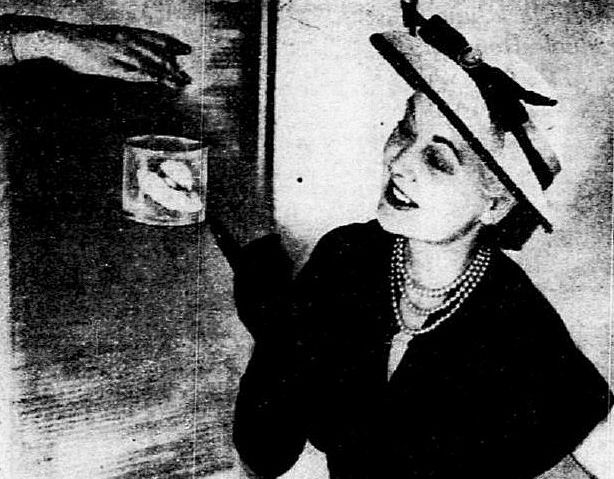
Give Mom a teeny-tiny hat!

Mother’s Day Sure to please everybody’s mother is this attractively packaged Mother’s Day hat certificate that she can use to purchase the hat that is most becoming. The certificate is enclosed with a miniature straw hat in a crystal-clear plastic hat box. W. A. Green Company.

Happy Mother’s Day!

***

Sources & Notes

From an advertorial appearing in The Dallas Morning News on May 3, 1951.

*

Copyright © 2015 Paula Bosse. All Rights Reserved.

2222 Ross Avenue: From Packard Dealership to “War School” to Landmark Skyscraper

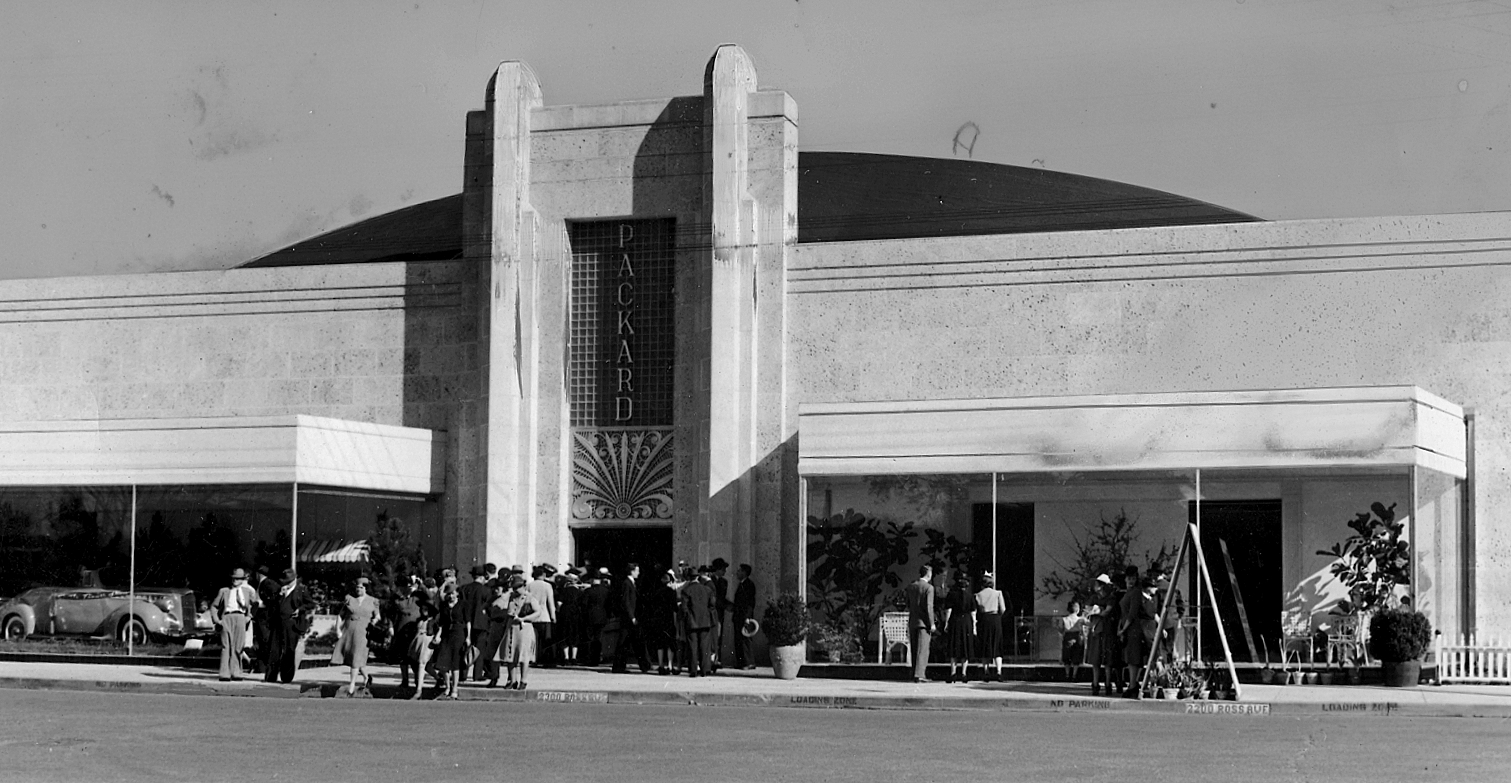
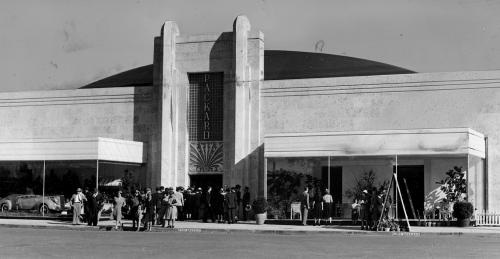
packard-dealership_2222-ross_detroit-pub-lib_1940Packard automobile showplace, 1940

by Paula Bosse

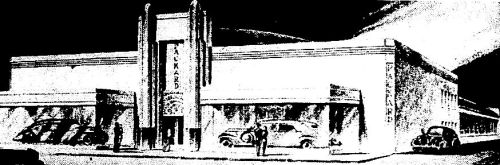
In late summer of 1939, a new 60,000-square-foot. $250,000 home for Packard-Dallas, Inc. featuring a “luxurious showroom” was announced. The first Packard automobile dealership had opened in 1933 at Pacific and Olive, and in the intervening six years, their growth had been tremendous, necessitating several moves and expansions.
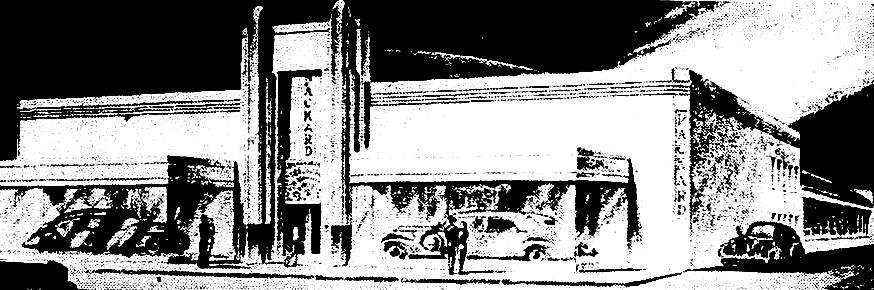
packard_ross_rendering_1939

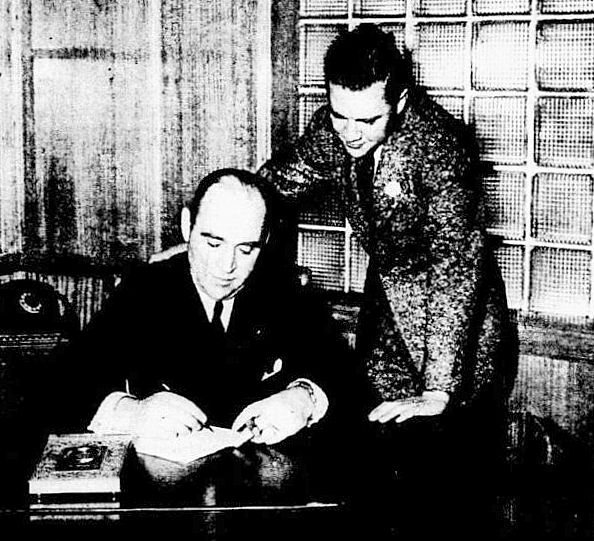
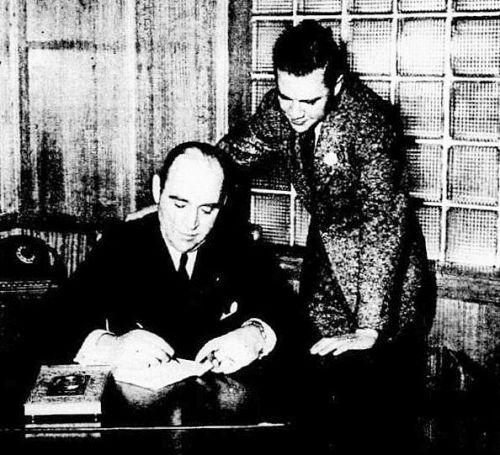
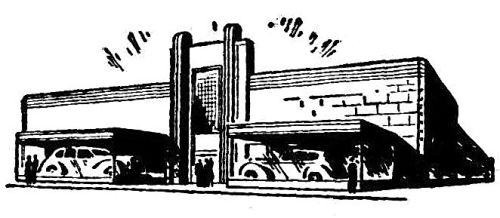
The attractive art deco building, faced with Cordova limestone and decorated with glass bricks, cast aluminum letters, and neon, was designed by J. A. Pitzinger and Roy E. Lane Associates, and was constructed at 2222 Ross Avenue in a mere three months. The large building was right across the street from the Cathedral of the Sacred Heart, in the block bounded by Ross, Crockett, San Jacinto, and N. Pearl. The president of Packard-Dallas was J. A. Eisele and the secretary-treasurer was his son, Horace. The grand opening on Dec. 16, 1939 was a big enough deal that the home-office Detroit honchos flew in, and there was even a 15-minute radio program devoted to it on KRLD.

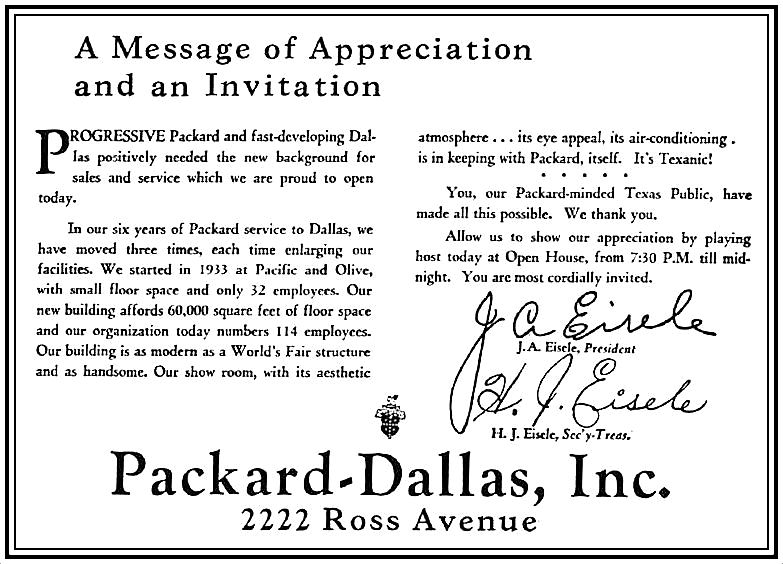
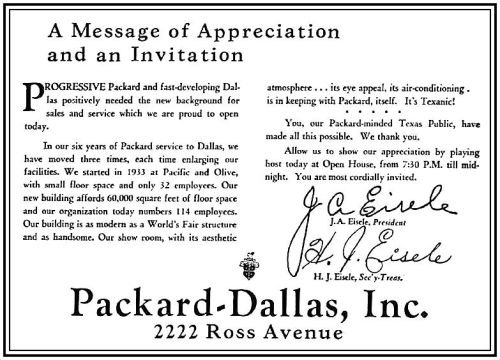
Under the headline “Growing With Dallas,” the opening-day ad featured a photograph of Joe and Horace Eisele and “A Message of Appreciation and an Invitation”:
packard_dmn_121639_ad1

packard_dmn_121639_ad2Ad, Dec. 16, 1939 (click for larger image)

“It’s Texanic!”

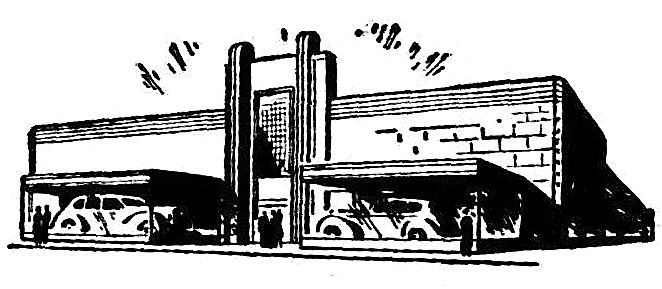
And another ad featured this nifty little line drawing of the cool building:
packard_dmn_121639-drawing-detDec. 16, 1939 (ad detail)

One of the stories about the opening of Dallas’ new auto showroom palace boasted that this big, beautiful, brash building was here to stay — Packard-Dallas had a 15-year lease on the place. …Which is why it was surprising to read that the building was sold less than two years later.

The U.S. was on the inevitable brink of involvement in the European war, and the National Defense School had begun operation in Dallas in July 1940. After a year of classes in which young men were taught “to do the technical and mechanical work necessary to warfare” (DMN, March 20, 1941), classrooms at the Technical high school and at Fair Park were bursting at the seams, and a larger facility was necessary. The Dallas Board of Education (which oversaw the program, often called “the War School”), was given the go-ahead to purchase the building (and, presumably, the property) for $125,000 in August 1941.

I’m not sure why J. A. Eisele sold the building (his name was listed as owner, rather than the Packard Company) — it wasn’t even two years old, and he got only half of what it cost to build. Patriotism? His son Horace had been drafted in April, so … maybe. Eisele seems to have left the auto sales business, which he had been in for decades, and had moved out of Texas by 1945.

After the U.S. officially entered the war and it became obvious that “defense schools” around the country would have to admit women in order to maintain manufacturing quotas, women began to work beside men at the Ross Avenue school in January 1942.

Eighty women Saturday pulled their fingers against the triggers of aircraft rivet guns as the Dallas National Defense School, 2222 Ross Avenue, started the state’s first major training course designed to place women side by side with men in Texas war materials plants. (DMN, Jan. 4, 1942)
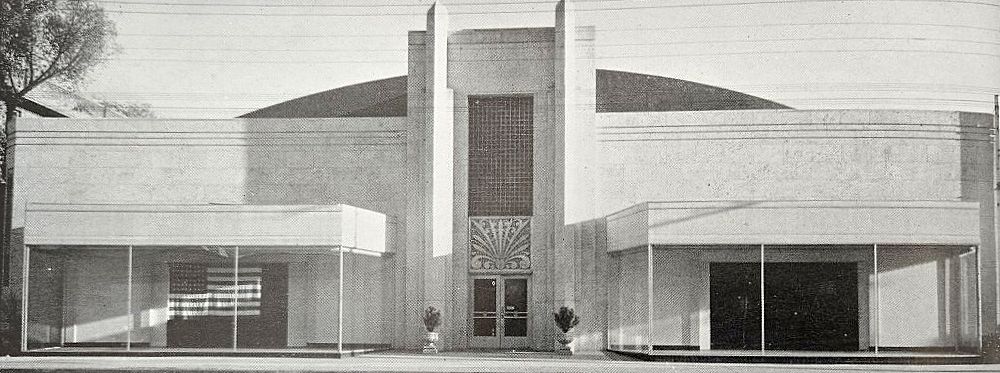
packard_ross-avenue_war-school_young-america-in-dallas_1942_DPL
1942

This “War School” was a training school for war-time jobs at places like North American Aviation.
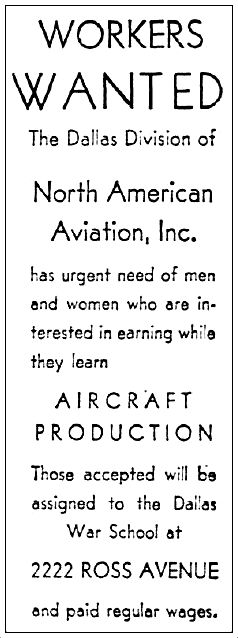
defense-school_dmn_090643Sept. 1943

Thousands of men and women trained at the Ross Avenue facility until the war ended in 1945. The school continued, but no longer as a Defense School — it became Dallas Vocational School, and its first students were veterans.

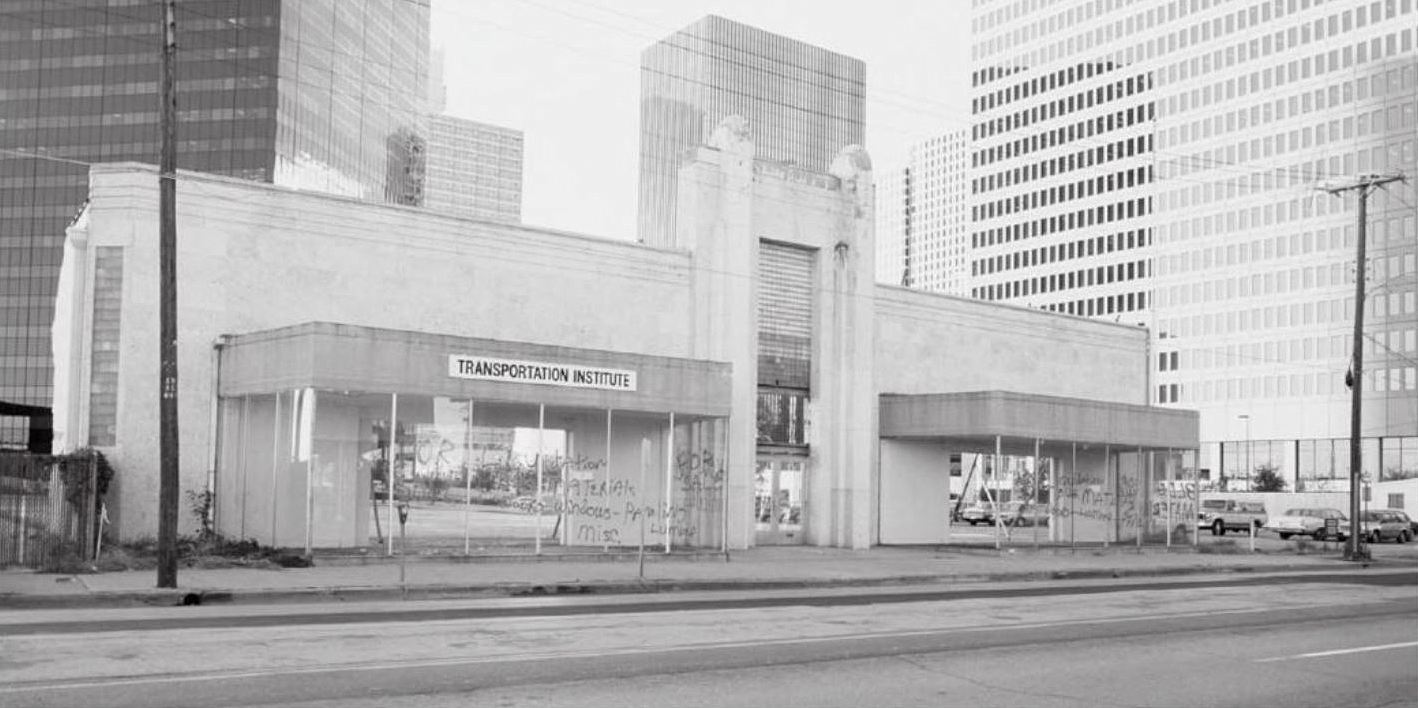
In 1976, the school was designated as one of the Dallas Independent School District’s magnet schools — it became the Transportation Institute, where “students interested in owning their own dealership, becoming a technician-mechanic or an auto body specialist will receive on the spot training in a laboratory consisting of a new car showroom, a modernly equipped repair center and a complete auto rebuilding facility” (DMN, Aug. 22, 1976). Back to its roots! And it only took 37 years.

The school continued for a while but, inevitably, the property became more and more attractive to developers. In 1981, as the developers were circling, a City Landmark Designation Eligibility List was issued. It contained buildings which had “particular architectural, historical, cultural and/or other significance to the City of Dallas,” and, if approved, were eligible to receive historic landmark designation. I’m guessing 2222 Ross Avenue didn’t make the cut, because Trammell Crow bought the building in 1983 and tore it down the next year.
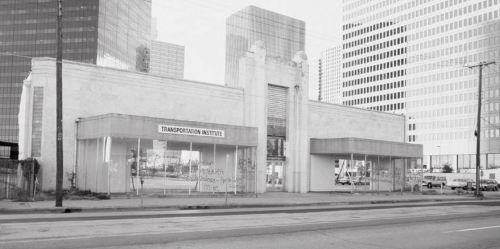
transportation-institute_lost-dallas_dotyvia Lost Dallas by Mark Doty

But … Crow sold the facade to real estate developer and investor Lou Reese, who said that he would reassemble the limestone facade and incorporate it into a restaurant he planned to build in Deep Ellum. That was an interesting plan. (Incidentally, in the same city council meeting in which the demolition/disassembling of the building’s facade was discussed, the council also considered “a request for more than $7 million in federal funds for a project to renovate the Adams Hat Co building into apartments” (DMN, Aug. 8, 1984). …Lou Reese owned the Adams Hat building. What a coincidence!)

The city council’s decision?

The council authorized developer Trammell Crow to disassemble the art deco facade of the former Transportation Institute Magnet High School on the condition that the facade be reconstructed in Deep Ellum…. The company [has] demolished all but the building’s limestone facade, which was determined to be eligible for designation as an historic landmark. (DMN, Aug. 9, 1984)

So? Where’s that facade? There was no mention of it for three years, until an article in the Morning News about another developer who had big plans for a major Deep Ellum complex called “Near Ellum,” which would be bounded by Commerce, Crowdus, Taylor, and Henry streets.

Highlighting Near Ellum will be a 40-foot art deco facade, formerly on the front of the Transportation Institute on Ross Avenue, in the main parking plaza. The plaza will also include an outdoor stage for concerts and special events. (“Developer Plans Deep Ellum Project,” DMN, June 25, 1987)

Aaaaaaaaaaaaaaaand … that never happened. I wonder if that 76-year-old disassembled limestone facade is still crated up somewhere around town. Somehow I doubt it.

So, 2222 Ross Avenue. What’s there now? None other than the 55-story skyscraper, Chase Tower, also known as “The Keyhole Building.”

You could get a lotta Packards in there.

***

Sources & Notes

Top photo from the Detroit Public Library’s Packard Collection in the National Automotive History Collection, viewable here; I’ve straightened and cropped it. The reverse has this notation: “Packard Motor Car Co., branches/dealerships/agencies, 2300 [sic] Ross Avenue Dallas, Texas, exterior, show windows left to right; 1940 Packard 110 or 120, eighteenth series, model 1800 or 1801, 6/8-cylinder, 100-120-horsepower, 122/127-inch wheelbase, convertible coupe (body type #1389/1399), special furniture display.”

1942 photo of the building is from a publication called “Young America in Dallas,” Dallas History and Archives, Dallas Public Library.

The developer who apparently came into possession of the facade after Lou Reese was Ed Sherrill. Perhaps someone associated with the Near Ellum project might know what became of the “saved” facade.

Chase Tower info on Wikipedia here; photo of it here. Imagine a teeny-tiny car dealership at its base.

Packard automobiles? Some of them were pretty cool. Check ’em out here.

A lengthy article on the notorious developer Lou Reese — “Hide and Seek” by Thomas Korosec (Dallas Observer, June 8, 2000) — is here.

*

Copyright © 2015 Paula Bosse. All Rights Reserved.

Random Still-Standing Buildings Featured in Ads From 1929

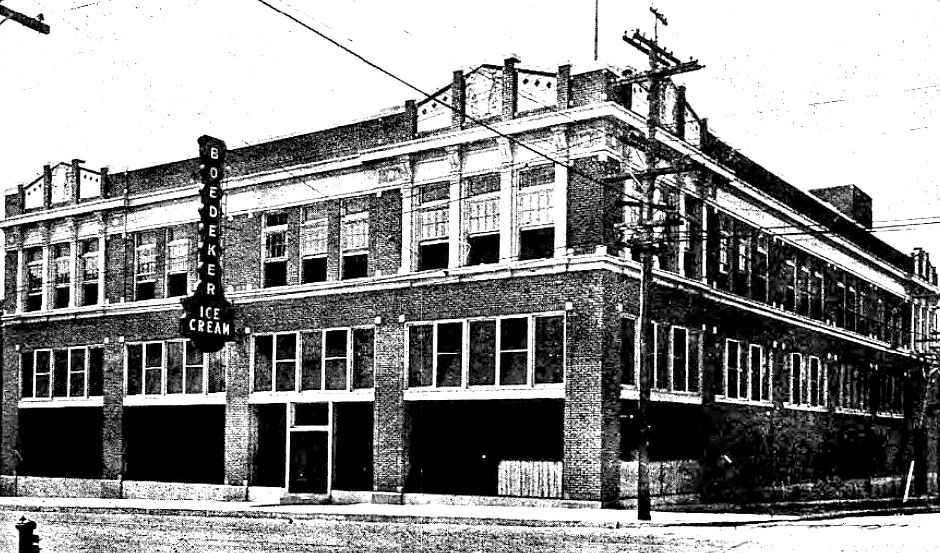
ad-boedeker-ice-cream_1929-directoryS. Ervay & Griffin — still there! (click to see larger image of building)

by Paula Bosse

I’ve always had a fascination for old advertisements. Ads for local products and businesses are particularly interesting and can be quite informative — especially those that feature photographs of the businesses being advertised. I always get an exciting little jolt when I see a still-standing building that I recognize in a 50-, 60-, or 70-year-old ad. Below are a few ads from 1929 — 86 years ago! — featuring buildings that have somehow survived the wrecking ball. Not all of them are architecturally interesting, but they’ve all seen a lot more than you and I have. Click the ads below to see larger images of the buildings.

*

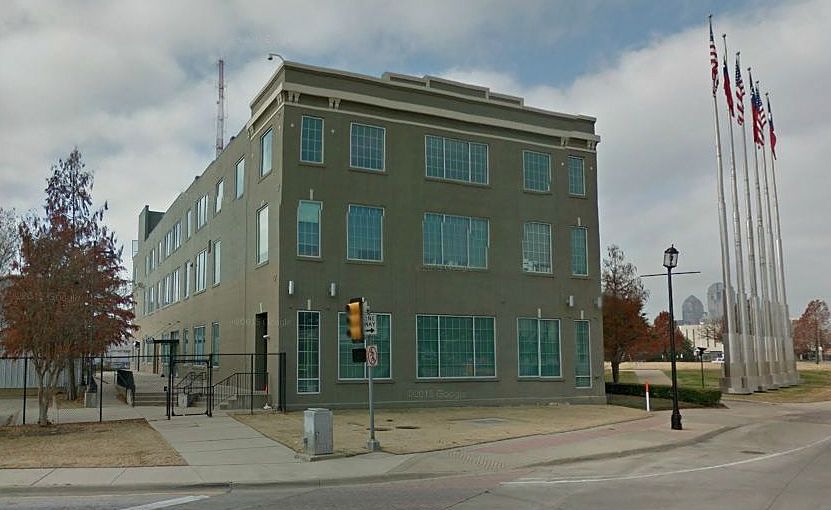
Above, the Boedeker Ice Cream plant — the “finest in the South,” located at S. Ervay & Griffin (1201 S. Ervay). The company was founded in 1887 by German Frederick Boedeker, the first ice cream manufacturer in Dallas. This building was built, I believe, around 1921. I’m not sure what’s in there these days (if anything), but here  is it today, via Google Street View:

ad-boedeker-ice-cream_now_google

UPDATE: Apparently there are plans afoot — read about them here.

*

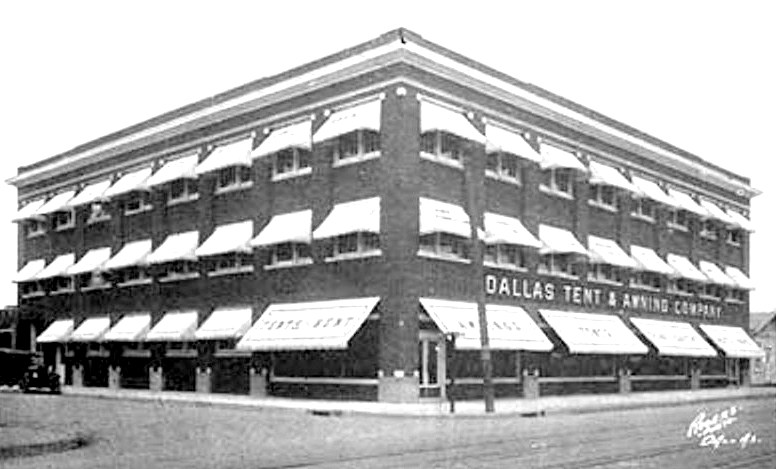
Next, the Dallas Tent & Awning Company at 3401 Commerce.

ad-dallas-tent-awning_directory_1929(click to see larger image of building)

This very successful company moved several times to larger and larger spaces, until they decided to build their own showroom and manufacturing plant in 1921. A 1922 Chamber of Commerce ad described the building as “a three-story modern building, 100 feet square with a warehouse in the rear which covers 40,000 square feet, Commerce and Race streets.” They manufactured tents, awnings, automobile tops, tire covers, and seat covers.

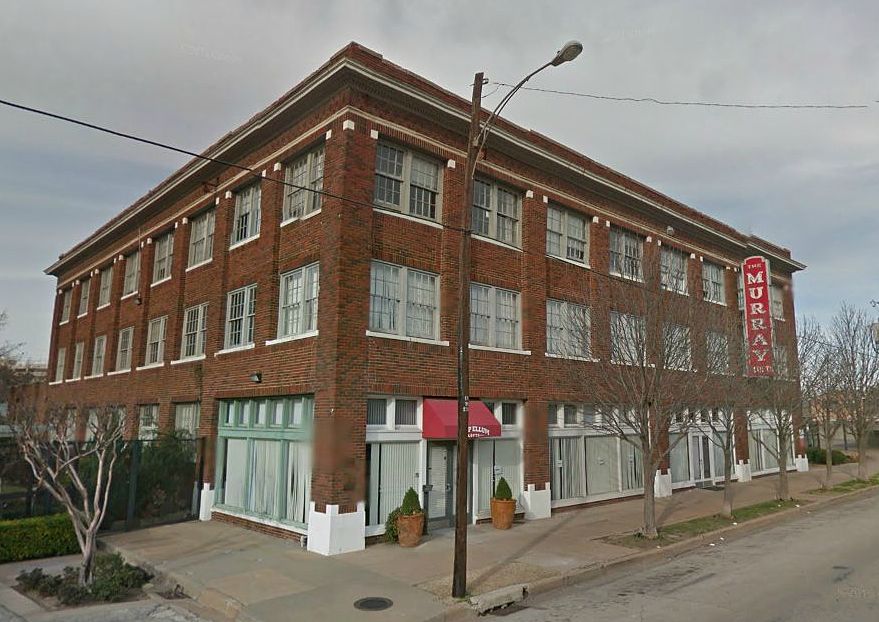
Here it is today, the cool-looking Murray Lofts, between Deep Ellum and Exposition Park:

murraylofts

(I’m not sure if the house in this ad was in Dallas, but I hope so! What a beautiful house! A larger image is here.)

*

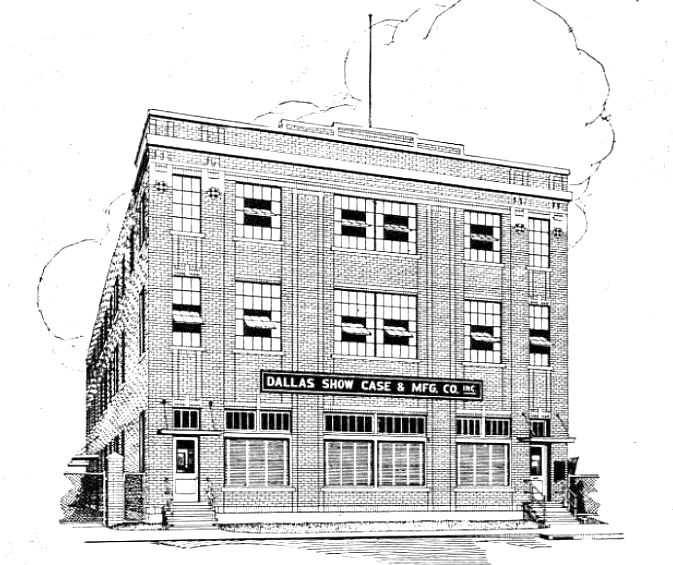
Next, the Dallas Show Case & Mfg. Co. at 329-337 Exposition.

ad-dallas-show-case_directory_1929(click to see larger image of building)

According to a 1962 interview with Otto Coerver — the son of the company’s founder — the factory was built in 1920 just blocks from Fair Park — a location so far “out in the country” that there was no city electric service. Since its founding in 1880, the company had manufactured “bank, office and store fixtures, showcases, hardwood floors and special household and church furniture.” The building still stands, but I’m not sure who occupies it these days.

ad-dallas-show-case_now_google

*

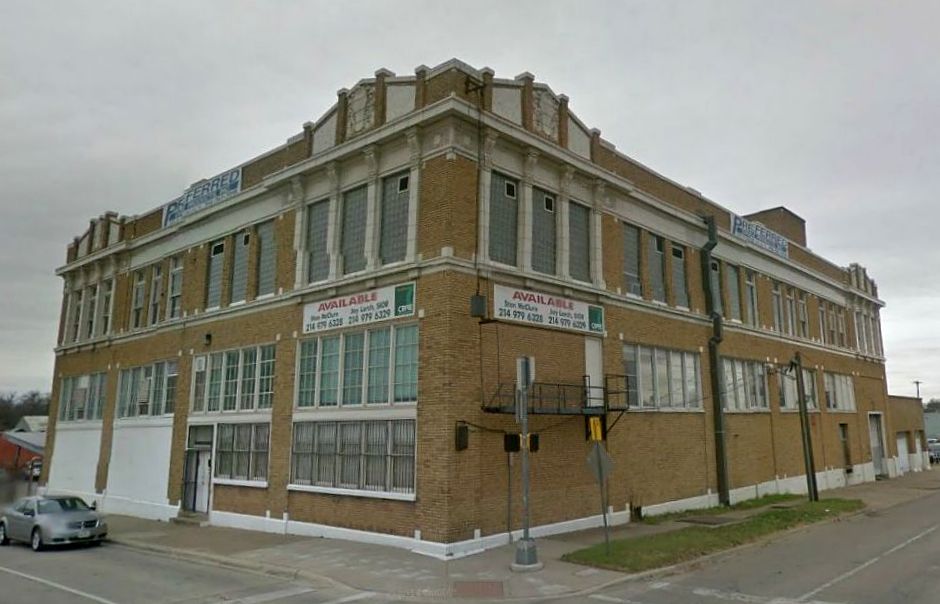
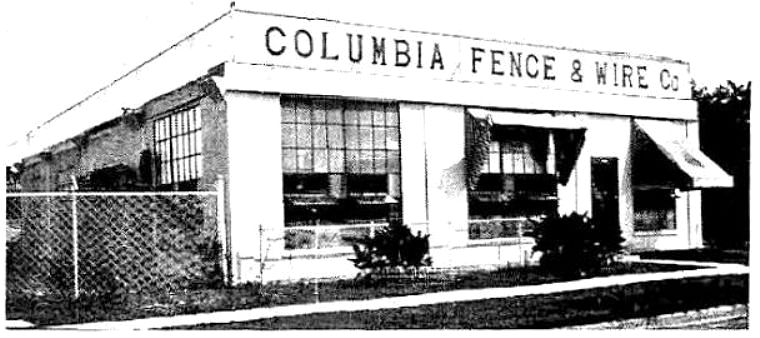
And, lastly, the Columbia Fence & Wire Co. at 3120 Grand Avenue.

ad-columbia-fence-wire_directory-1929sm(click to see larger image of building)

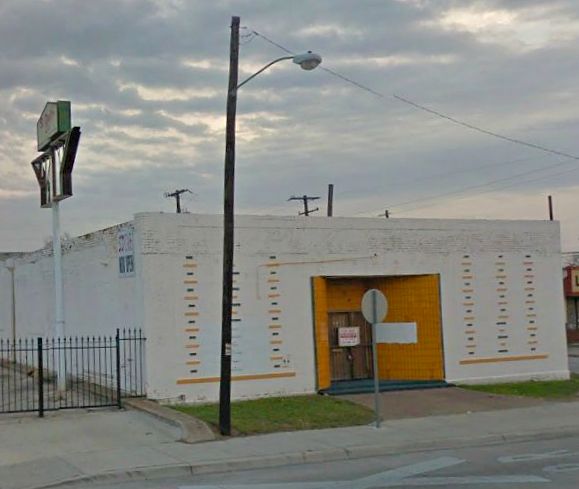
Though it’s been there since at least 1922, this building is one that I have to admit I probably wouldn’t shed a tear over were it to be demolished. Still, it’s been around a lot longer than I have, and I have to admire the fact that it’s managed to hang on for so many years.  After the Columbia Fence & Wire Co. moved on, the building was occupied by a succession of light industrial businesses. In the 1970s it must have gone through quite a renovation, because it became home to a string of discos, including the short-lived Lucifer’s (owned by Dallas Cowboy Harvey Martin), the Plush Pup, and Papa Do Run Run. Below, the current Google street view (the sign above the vacant building says “S. Dallas Cafe”):

ad-columbia-fence-wire_now_google

 ***

Sources & Notes

All ads from the 1929 city directory. (Apologies for the muddy images. Whenever I post these directory ads, they look great before they’re posted, then something happens during the uploading process, and … argh.)

Present-day images from Google Street View.

A continuation — “MORE Random Still-Standing Buildings Featured in Ads From 1929” — can be found here.

*

Copyright © 2015 Paula Bosse. All Rights Reserved.

Lakewood’s “Modernistic” Skillern’s Drug Store — 1934

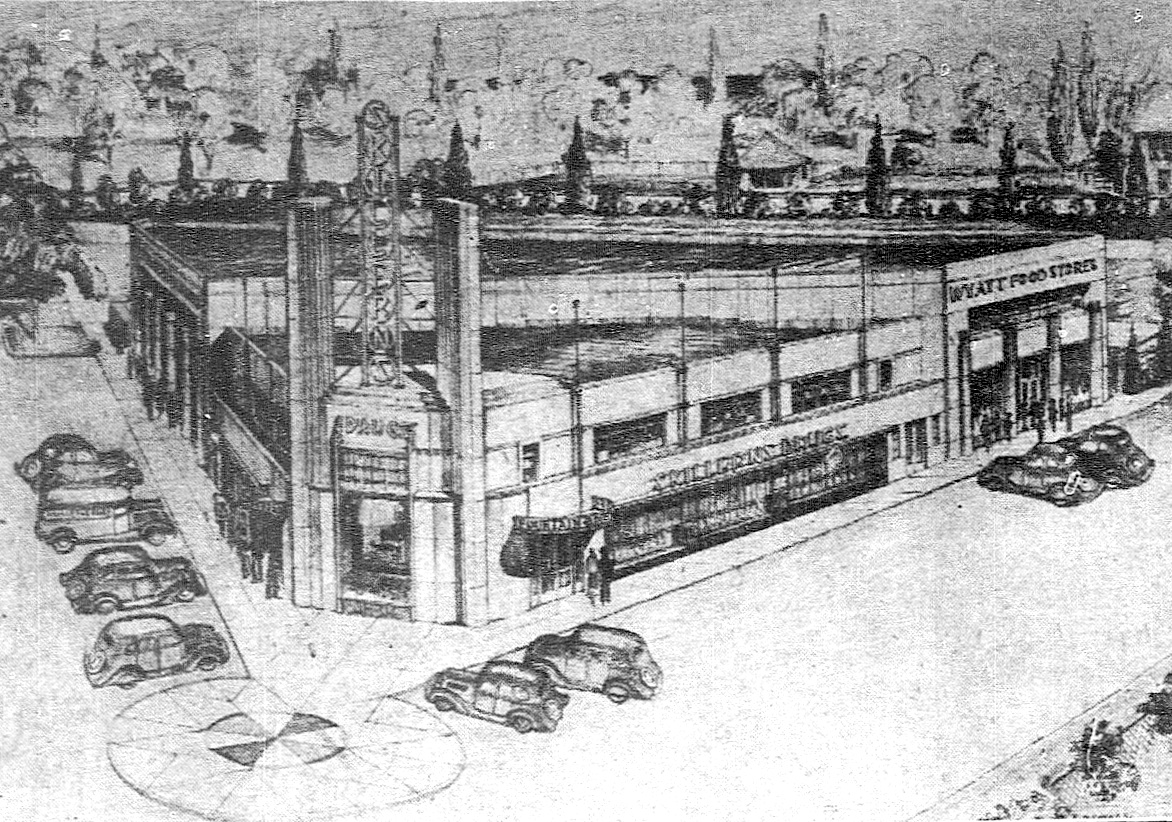
skillerns-lakewood_architects-rendering_1934
Architect’s drawing, 1934 — Abrams & Gaston…

by Paula Bosse

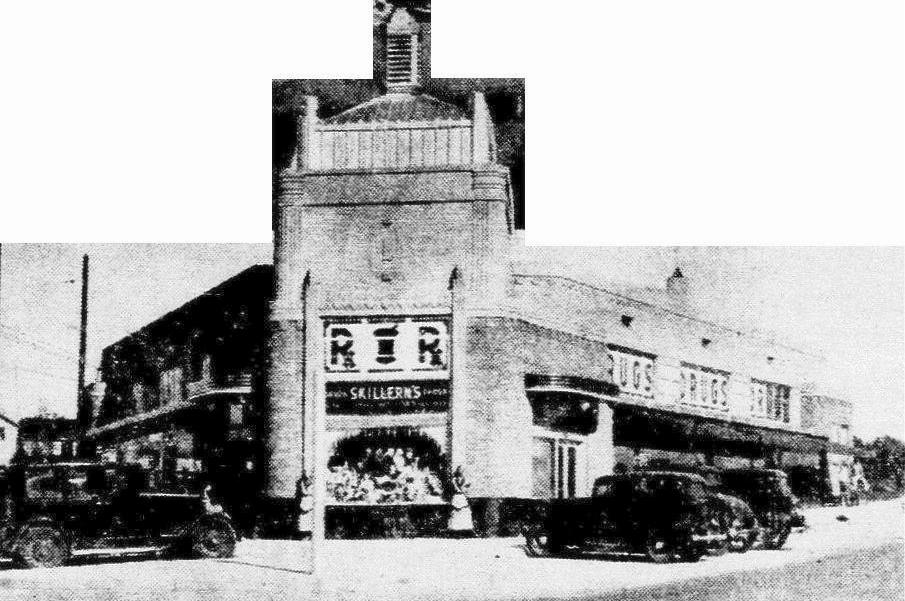
The drawing above was architect J. N. McCammon’s design for a new 14,000-square-foot concrete-and-stucco building of a new Lakewood development, at Abrams and Gaston (a stone’s throw from land now occupied by the parking lot of the Lakewood Whole Foods). It was to be built by Rae Skillern, whose Skillern’s drug store would anchor the development, with a Wyatt Food Store also occupying a large chunk of the property. The “retail village” was to be modeled (…somewhat) after the much-lauded Highland Park Village shopping center, and its design was described in articles as being “modernistic.”

Construction was to begin in early 1934 and be completed in 90 days, but things hit a bit of a roadblock when Lakewood residents objected to a shopping area in their “high-class” residential neighborhood (charming though Skillern’s design might have been…). A zoning classification change from “local retail” to “residential” was sought by concerned Lakewood inhabitants, but the City Plan Commission nixed this and gave the builders the go-ahead.

Skillern’s No. 4 opened in December of 1934 at 6401 Gaston and humbly hailed its newest emporium as “America’s most beautiful drug store.” It was, by far, the largest in the local company’s quickly expanding chain, and it featured a large, varied inventory, beautiful fixtures and innovative merchandising, a large soda fountain (with curb service), a “perfume bar,” and an open view into the “prescription department” where customers could watch the pharmacists doling out their medications.

The small shopping area quickly became a popular shopping destination (along with the larger Lakewood Shopping Center across Gaston), and the big, new Skillern’s — which sat at the point of the triangular-shaped “village” — was its focal point.

lakewood-skillerns_1930s
Dec., 1934

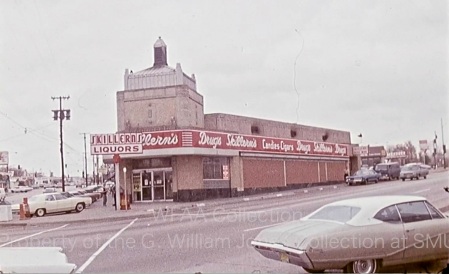
Skillern’s left its cool building sometime around 1971, after a fire caused heavy damages in November, 1970. It moved across the street, into the equally cool old Gaston Avenue Pharmacy (known familiarly as Doc Harrell’s drug store, the place with the iconic conical roof), not long after Harrell’s death in 1969. The Lakewood outpost of the Mickey Finn’s chain of pool halls opened in the old Skillern’s space in February, 1972. In 1978 the property was condemned by the city to make way for the weird Abrams Bypass, which cut through that northeast corner of the Gaston-Abrams intersection; several buildings in the immediate vicinity deemed to be in the way of progress were demolished, including Rae Skillern’s “modernistic” drug store, a Lakewood landmark for over 40 years. Pity.

Below, a screenshot of footage from WFAA-Channel 8 News, in late November 1970. A last hurrah.

skillerns_lakewood_nov-29-1970

 ***

Sources & Notes

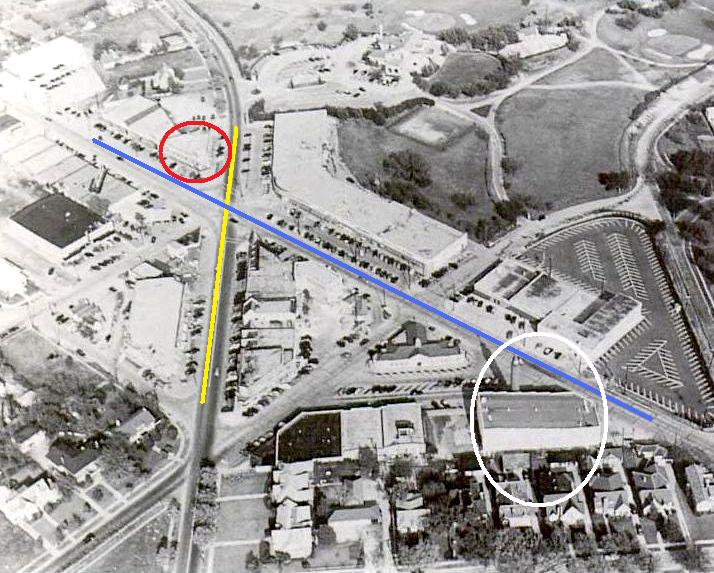
Skillern’s was located on the northeast corner of Gaston and Abrams at the tip of a triangular-shaped piece of land. The drawing at the top shows Abrams running vertically (to its west), and Gaston running horizontally (to its south). It would have faced the old Dixie House space. The Abrams Bypass skewed everything, but it was about where the little triangular “park” is now — between Abrams Parkway and Abrams Road, just west of the Whole Foods parking lot. (UPDATE: I now know that that greenspace has a name: Harrell Park!) Below is an aerial photo of what this part of Lakewood used to look like. Gaston is in yellow, Abrams is in blue, the Skillern’s building is circled in red, and the Lakewood Theater (for reference, because this all looks pretty freaky to us today and it’s hard to get one’s bearings) is circled in white. Looking northeasterly.

lakewood_aerial_marked

To see a larger image of this aerial photo — without the markings — click here. (Photo from the book The Dallas Public Library, A Century of Service by Michael V. Hazel, presumably from the collection of the Dallas Public Library.)

An interesting account of the how the bizarro Abrams Bypass happened can be found in the D Magazine article “Why Lakewood Doesn’t Trust Itself” by Charles Matthews (Oct., 1978), here. A Dallas Morning News article on the same topic — “Lakewood Plan May Benefit Bank” by Henry Tatum (March 12, 1978) — can be found in the Dallas Morning News archives.

*

Copyright © 2015 Paula Bosse. All Rights Reserved.

Luncheon at The Zodiac Room, Darling

zodiac-room_smFood, fashion, & the unmistakable whiff of Old Money (click for larger image)

by Paula Bosse

Two cool and sophisticated postcards from the cool and sophisticated Neiman-Marcus (although it’s debatable whether the truly cool and sophisticated N-M shopper would, in fact, mail anyone something as bourgeois as a postcard of a department store, Neiman-Marcus or not). Perhaps these were done up for the sizable tourist trade. I love these cards. Commercial art of this period is wonderful.

The description on the back reads: “One of the great dining spots of the Southwest … N-M’s famed ZODIAC ROOM. The superlative food specialties of Director Helen Corbitt and her staff are enjoyed during modeling of fashions a la Neiman-Marcus at luncheon and dinner. Also, tea served daily.”

Below, the Carriage Entrance:

neimans_postcard_c1950s-carriage-entrance-sm(click for larger image)

The description: “‘The Carriage Entrance’ — famous passageway into one of the world’s great specialty stores.”

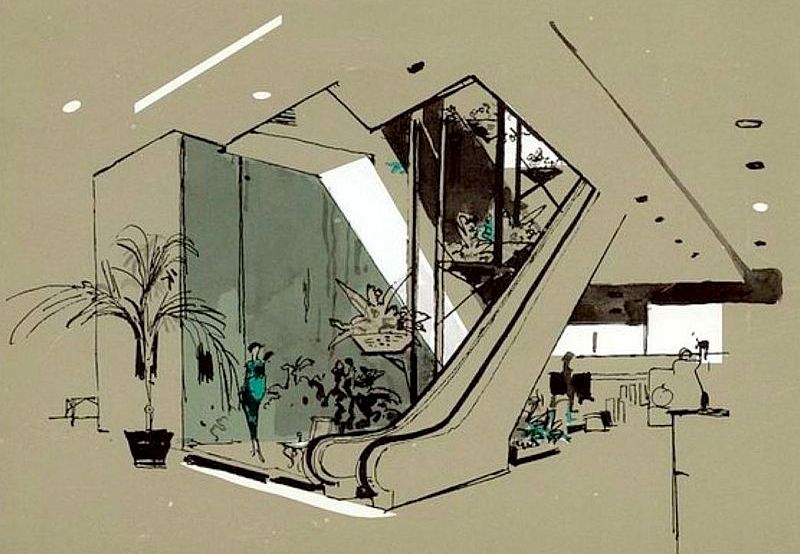
And another (I’d love to see the whole series of these postcards.) Sadly, no description on this one, featuring a fashionable escalator.

n-m_escalator_pinterest

I fear I shall never reach the level of swan-like sophistication needed to become an habitué of The Zodiac Room. Tant pis.

***

I have no idea where these postcards came from. I’m not sure of the date, either, but … “1950s”? Maybe very early 1960s? Let’s go with “Mid-Century” — everyone loves that! Whenever this was, this was a period when fashion was chic and fabulous. As was Neiman-Marcus. (I still miss that hypen!)

Need to make a reservation at The Zodiac? Info is here.

*

Copyright © 2015 Paula Bosse. All Rights Reserved.

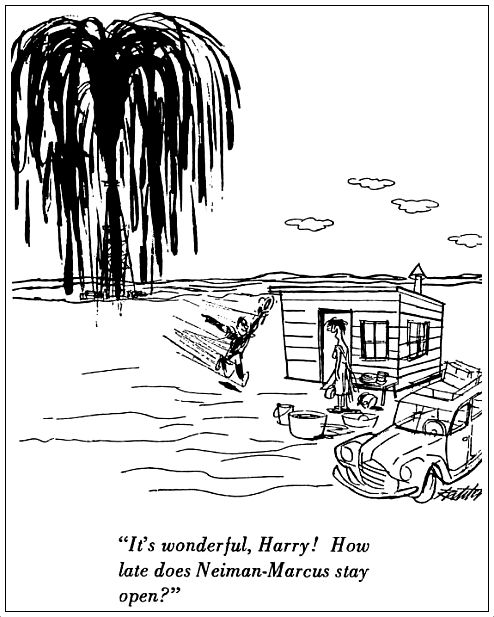
Neiman’s Will Welcome You With Open Arms When Your Gusher Finally Comes In

neiman-marcus_cartoon_1956New Yorker cartoon by Mischa Richter, 1956

by Paula Bosse

I came across this cartoon in — of all things — a historical journal, without a source. Google informs me that this was a cartoon by Mischa Richter, and that it appeared in the Oct. 27, 1956 issue of the New Yorker, one month before the release of the heavily-promoted epic movie “Giant.” You know Jett Rink was no stranger to N-M after his gusher came in.

***

Cartoon from the TSHA journal Texas Historian, Nov. 1978, used as an illustration in the article “Neiman-Marcus: A Dream of Elegance” by Margaret Lucas.

Details on the New Yorker cartoon by Mischa Richter (and the possibility that the original artwork may be available for purchase from Condé Nast, if you are so inclined) can be found here.

*

Copyright © 2015 Paula Bosse. All Rights Reserved.

You Know What They Say: Big Feet, Big Cigars — 1877

ad-ben-loeb-cigars_dallas-herald_070777“Go to Ben Loeb’s” — 1877 advertisement
by Paula Bosse

Not your typical advertising cut. Wonder if ol’ Ben paid a local artist a handful of cigars in exchange for this great eye-catching art?

An early subliminal ad?

***

Ad from The Dallas Herald, July 7, 1877.

*

Copyright © 2015 Paula Bosse. All Rights Reserved.

Back When Bookstore Fixtures Were a Thing of Beauty! — 1940s

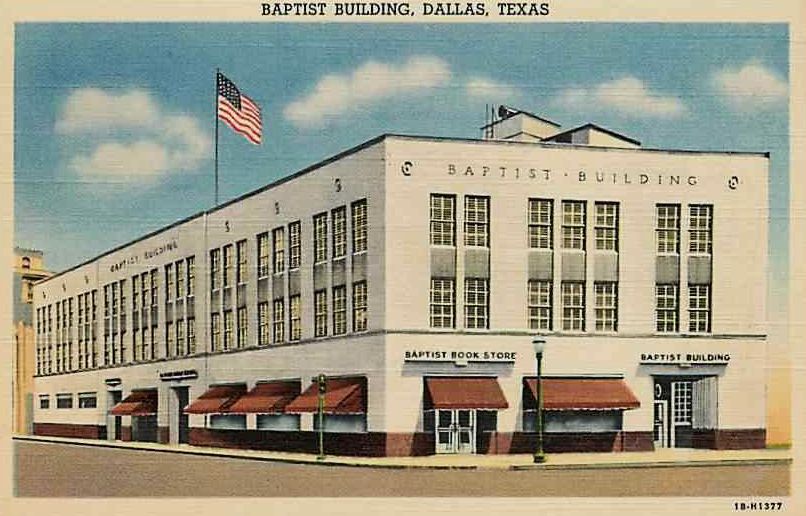
baptist-book-storeErvay & Pacific — “Book Corner” (click for larger image)

by Paula Bosse

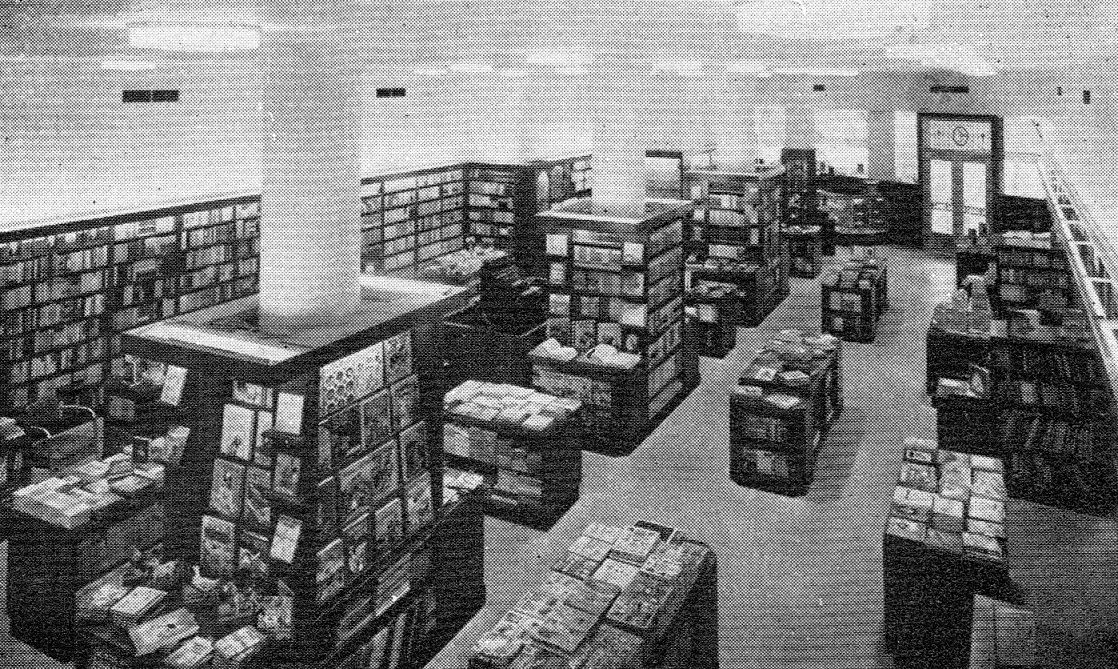
In July of 1941 the Baptist Building opened at Ervay and Pacific. Part of the ground floor (“the Book Corner”) was occupied by the Baptist Book Store, which sold mostly religious material, but which also stocked dictionaries (“and other items of similar nature”) and children’s books (“We have books for every type and age of juvenile from the Picture Books of Children from three to five to the vigorous youth wanting stories of the romantic west”). The ad below appeared in a booklet put together to welcome newcomers to the city, about 1946:

baptist-book-store_ca1946(click for larger image of bookstore interior)
*

Having grown up in a family-run bookstore (and having worked in various other bookstores for a large chunk of my life), I’m always fascinated by old photos of bookstore interiors, and this one is just great. (Click the image above to see the photo of the store much larger.) I’m particularly fascinated by the fixtures encircling the pillars — I’m not sure I’ve ever seen the problem handled in such a sophisticated way. And is that recessed lighting shining down on the slatwalls? This is a really wonderful-looking bookstore. The only thing that looks out of place is what appears to be an old-fashioned chunky cash register, center left. Everything else in this photo makes the bookseller in me practically giddy with nostalgia.

baptist-book-store_dmn_092847-det

***

Ad is from a publication called “So This is Dallas” published by “The Welcome Wagon.” It is undated but is probably from immediately after the war. This slim booklet was printed for several years in slightly different editions for people who were considering a move to Dallas or for people who had just moved here. These booklets are wonderful snapshots of the time, with everything the prospective Dallasite would need: facts, photos, and ads.

Bottom image is a detail from a 1947 ad.

*

I am fascinated by photographs of vintage bookstore interiors — especially Dallas bookstore interiors, of which there are precious few to be found. I would love to see any photos of Dallas bookstores before, say, 1970. If you have any, please send them my way! My contact info is in the “About/Contact” tab at the top of the page. Thanks!

*

Copyright © 2014 Paula Bosse. All Rights Reserved.