Flashback : Dallas

A Miscellany: History, Ads, Pop Culture

Category: Roads & Bridges

The 67-80 Split Near Mesquite — ca. 1951

interchange_hwys-67-and-80_THC_flickr_largeFar East Dallas (click for VERY LARGE image)

by Paula Bosse

Above, a wonderful photo showing Highway 67 (now East R. L. Thornton Freeway and I-30) splitting off into Highway 80, just east of Loop 12/Buckner Blvd., surrounded by lots and lots of open land. At the top right, along Buckner, you can see the Buckner Drive-In, above it the original location of the Devil’s Bowl Speedway, and farther over, to the left, White Rock Airport. Part of the sprawling property belonging to the Buckner Orphans Home can be seen at the bottom left. Today, this is right about at the Dallas/Mesquite border. Except for the highways, this is pretty unrecognizable today!

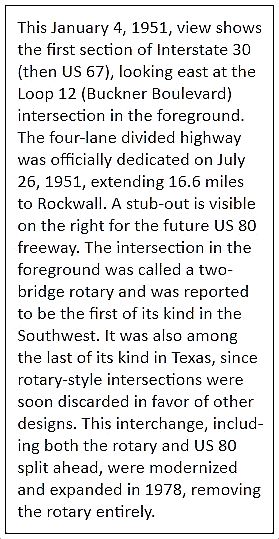
Here is a second photo, dated Jan. 4, 1951, with Oscar Slotboom’s caption below (from Slotboom’s exhaustively researched book and website, Dallas-Fort Worth Freeways).
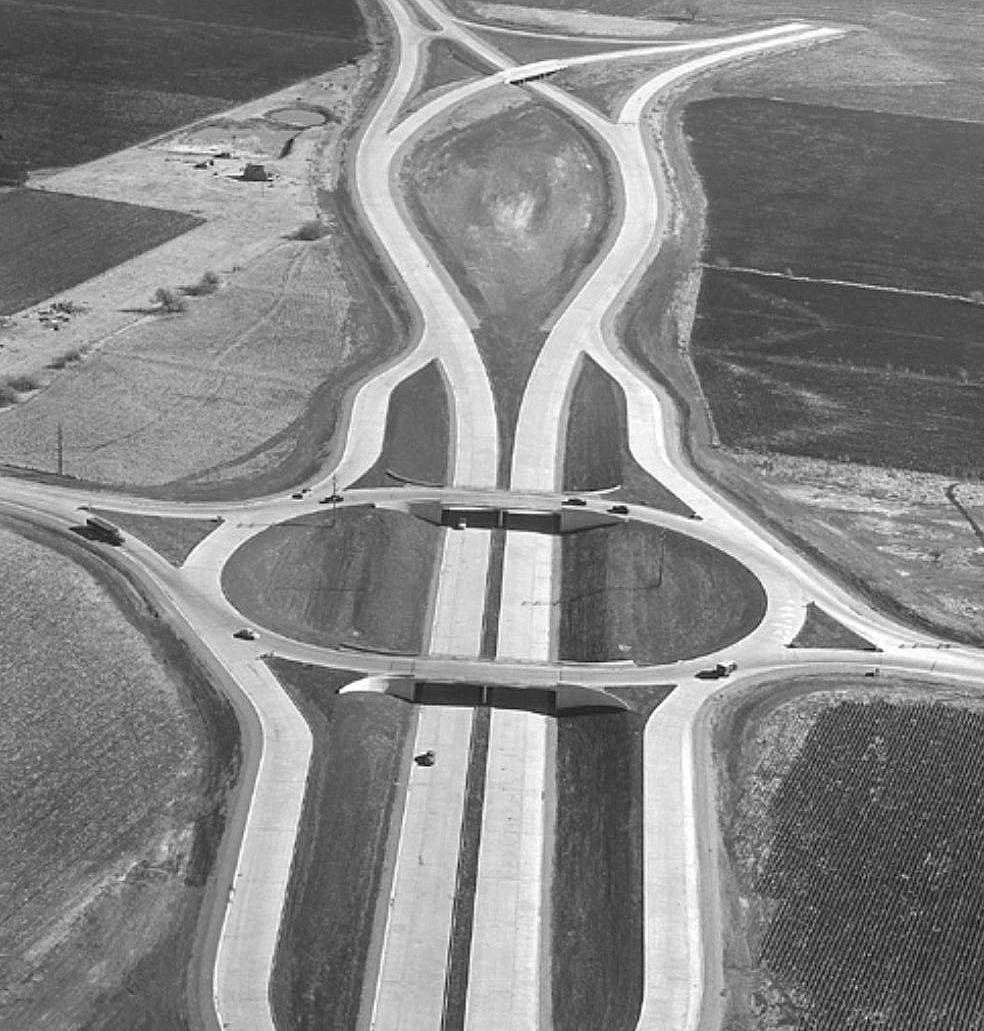
thornton-frwy_1951_dfw-freeways

thornton-frwy_1951_dfw-freeways_INFO_pdf-p40

*

The Buckner Orphans Home was founded in 1879; it was both a home for orphaned children and a working farm, and at its height, it occupied some 3,000 acres of land (!). Take a look at a 1911 photo here to give you an idea of the size of the place. The buildings seen at the bottom left of the photo above were houses used by Buckner staff; the Home itself is out of frame.
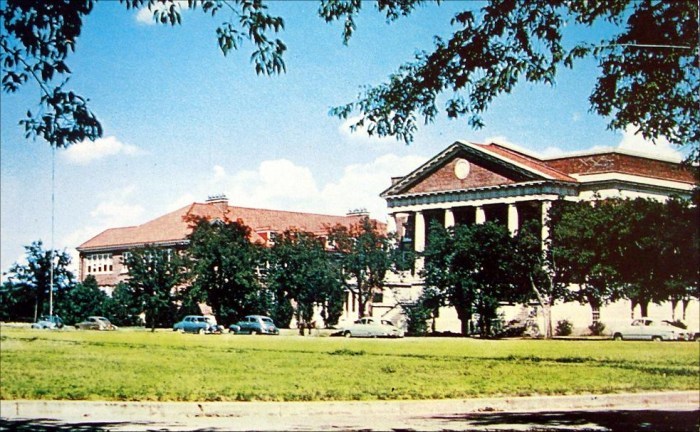
buckner-orphans-homeBuckner Children’s Home

White Rock Airport opened about 1941 and was in use until 1974. Here is a photo of it soon after it opened.
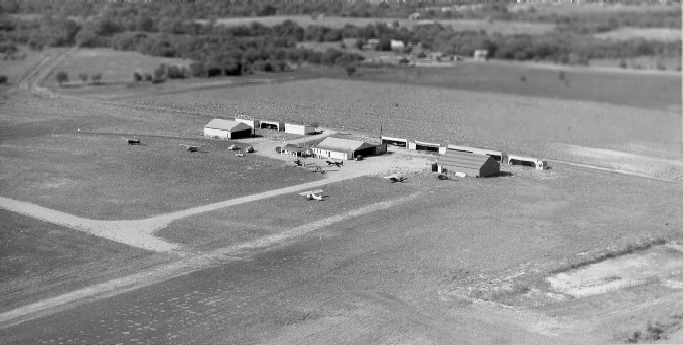
white-rock-airport_early-1940sWhite Rock Airport

(Several more photos and memories about this airport can be found here.)

Devil’s Bowl Speedway opened in March, 1941. If you wanted to see jalopy races, you headed to Devil’s Bowl. (DBS is still around, nearby, at a different location.)

The Buckner Boulevard Drive-In opened on June 4, 1948. It was the first drive-in in Dallas to have individual car speakers that one placed in one’s car. (More on the Buckner Drive-In can be found at Cinema Treasures, here.)

***

Sources & Notes

Top photo is from the TxDOT Photo Files and can be viewed on the Texas State Archives’ Flickr page, here; the date is given as “circa 1940,” but as the drive-in didn’t open until 1948, the date of the photo is probably closer to 1950. (The second aerial photograph — from Oscar Slotboom’s fantastic Dallas-Fort Worth Freeways — is dated 1951, so I’ve updated the title of this post.)

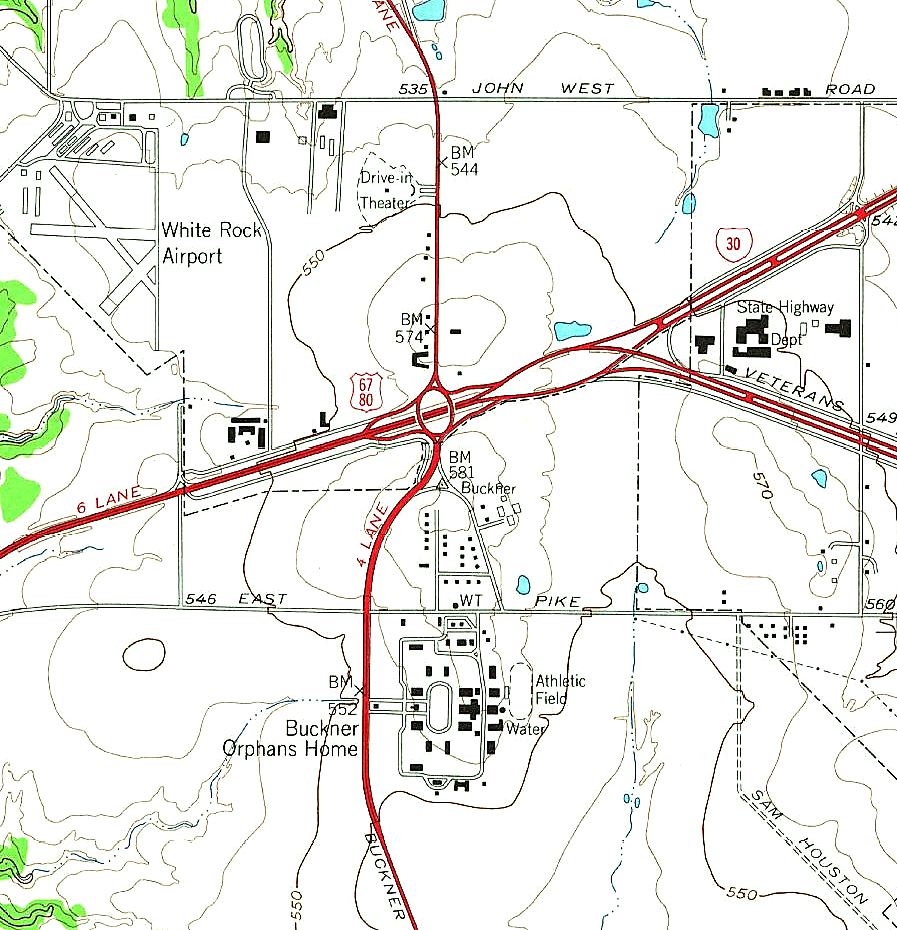
Thanks to Mark’s comment below, I’ve found this detail of a 1957 topo map from the United States Geological Survey. It’s a few years after the photo above was taken, but it shows the layout of the Buckner Children’s Home more fully. (The east-west highway called “East Pike” here is now known as Samuell Blvd.) Click map for larger image.
1957-topo_usgs

The Dallas/Mesquite city limits boundaries have moved over the years, but a current view of the boundary — which involves the area seen in this photo (seriously, this exact area) — can be seen here.

Below, a current Google Maps view of this interchange:
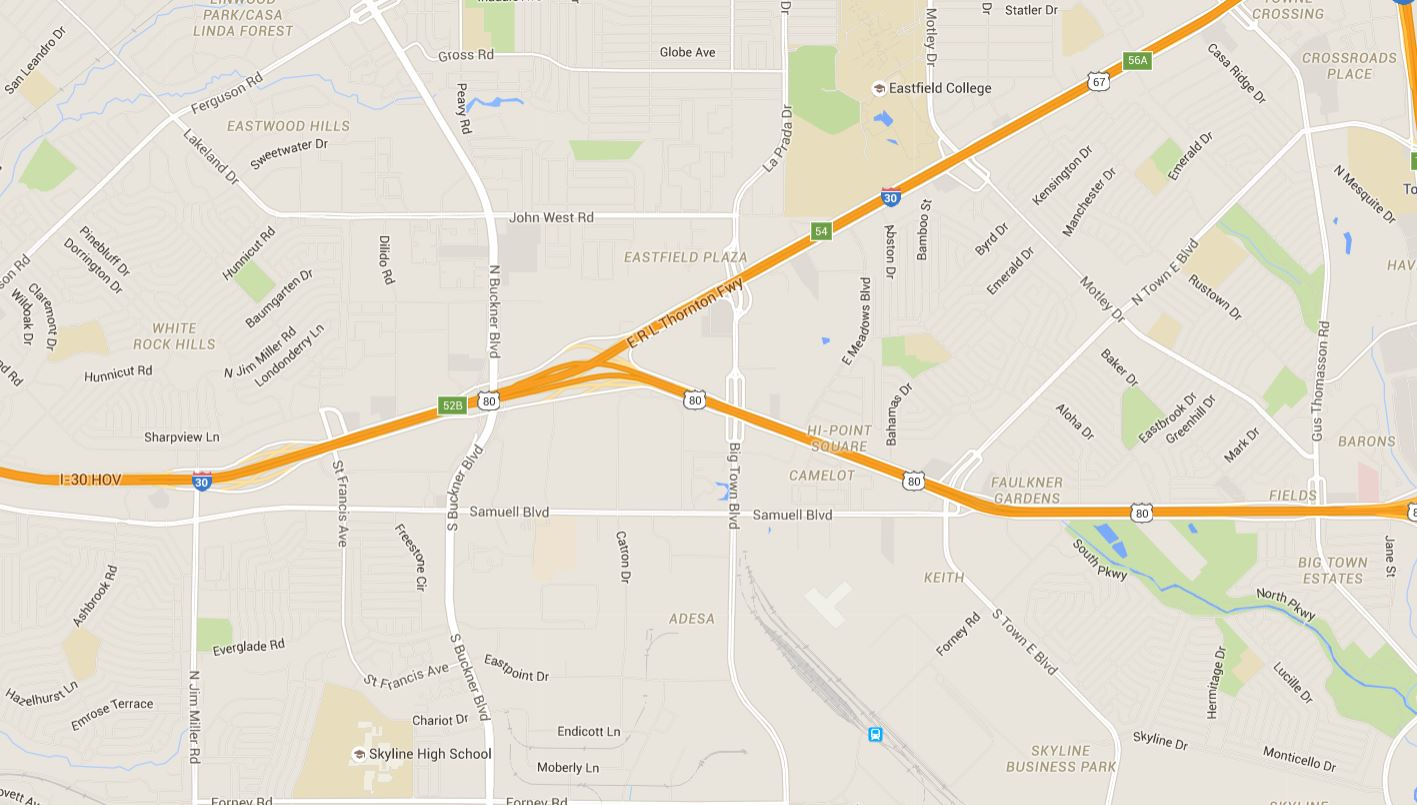
interchange-map

And, if like me, you need some helpful guidance:
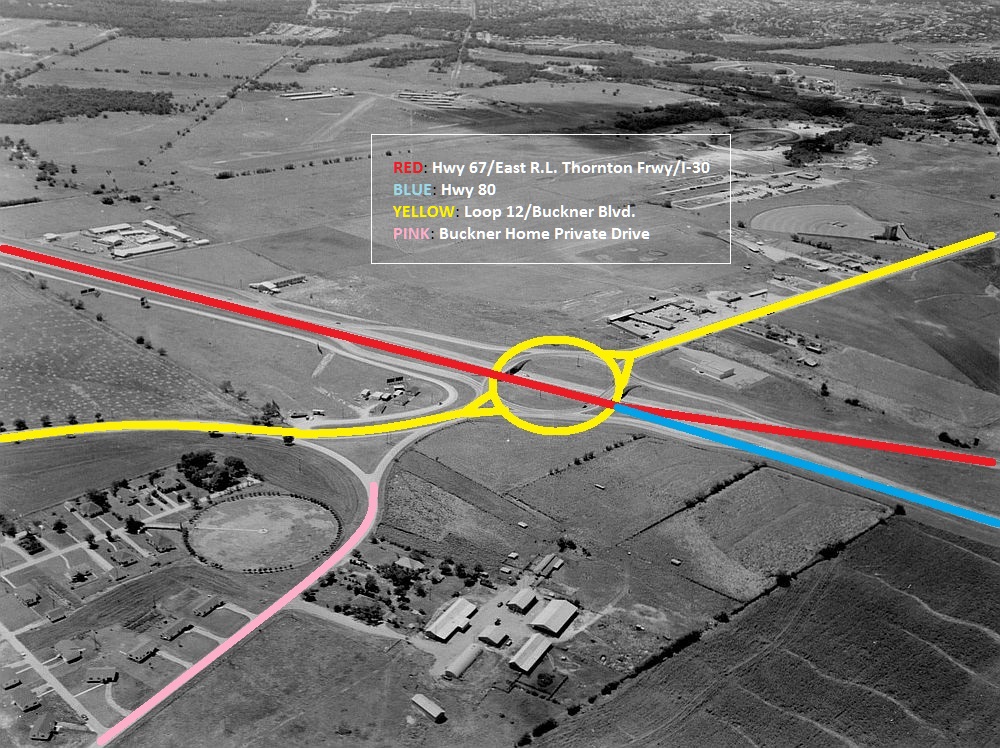
interchange_marked.jpg

Thanks to members of the Dallas History Facebook group for helping me figure out what I was looking at, especially David and Chuck — thanks, guys!

Click pictures and articles for larger images.

*

Copyright © 2015 Paula Bosse. All Rights Reserved.

Pacific Avenue — 1925

pacific_bryan_looking-east_lost-dallas_dotyThe back side of Elm, looking east…

by Paula Bosse

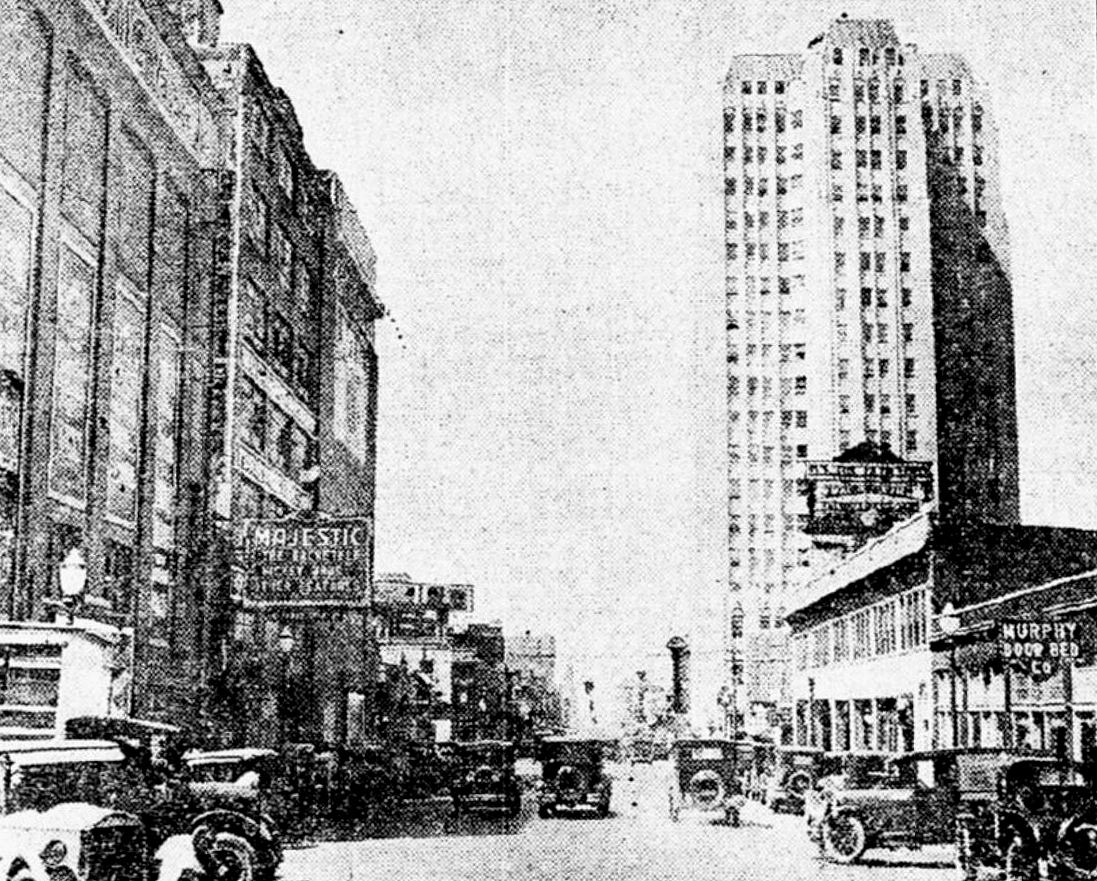
Elm Street gets all the glory as Theater Row, but what about Pacific? It had those very same theaters. …Sort of. Pacific gets overlooked a lot. When I see photos like this one — which shows Pacific Avenue looking east from Bryan — I always think of it as a photo showing the back side of Elm rather than as a photo showing Pacific. Always a bridesmaid, never the bride.

This photo was taken only a few short years after the Texas & Pacific railroad tracks were removed from Pacific, making it into an automobile and pedestrian thoroughfare only — no more frightening, smoke-belching trains rumbling right down the middle of the street. The city was hoping that Pacific would become a heavily commercial area like Elm, Main, and Commerce, but it never really reached those lofty heights.

I’ve always wondered if the theaters that lined Elm ever considered having entrances/box offices on both Elm and Pacific. I think that they were really only willing to slap a few posters and paint their names on their back, Pacific-facing walls. Elm Street was glitzy and glamorous. Pacific was not. Back in those early days when people were still trying to get used to Pacific Avenue being newly liberated from its railroad tracks, it might have been seen as something of an afterthought — as more of a very wide alley with traffic than as a contender for one of Dallas’ major streets.

But back to the theaters. In the photo above, we see the Old Mill at 1525-27 Elm (where “The Snob” was playing, featuring John Gilbert and Norma Shearer), the Capitol at 1521-23 Elm (which had Alla Nazimova in “The Redeeming Sin”), and the Jefferson Theater at 1517 Elm (featuring Harley Sadler’s repertory company appearing in “Honest Hypocrites and Saintly Sinners” between vaudeville acts). All of these were playing in May, 1925.

It’s interesting that the only business seen here on the south side of Pacific that had an address on both Elm and Pacific was Van Winkle’s Book Store (before it moved a couple of doors up Elm, it was at 1603 Elm/1614 Pacific). Note the sign advising “Free Passage to Elm Street” — several businesses allowed people to cut through their stores to get to the next street over because the blocks were incredibly long and would sometimes have necessitated pedestrians going three blocks out of their way just to get to their destination.

Other notable landmarks in the photo above: the Medical Arts Building (on the left) and the Dallas Athletic Club.

Here’s a view of Pacific from around the same time, looking west, from about Harwood.

pacific-looking-west_dmn_041430
1930

Most interesting detail in this photo? That Murphy Door Bed Co. sign!

***

Sources & Notes

Top photo from Lost Dallas by Mark Doty (Charleston: Arcadia Publishing, 2012).

*

Copyright © 2015 Paula Bosse. All Rights Reserved.
“How High’s the Water, Mama?” — 1908

trinity-river_flood_1908_LOC-lg

by Paula Bosse

A great panoramic photo by Clogenson, showing the old Commerce Street bridge partially submerged by the Trinity River (which is pretty dang high … and rising).

***

Photograph by Henry Clogenson, from the collection of the Library of Congress; accessible here.

Previous Flashback Dallas posts on the Great Flood of 1908 can be found here and here. And a fantastic photo of what the Trinity looked like before it was straightened and moved is here.

And, really, you MUST hear Johnny Cash sing the pertinent “Five Feet High & Rising,” here.

Click picture for a REALLY big image.

*

Copyright © 2015 Paula Bosse. All Rights Reserved.

 

“The Walls Are Rising” (1967): Watch It Online!

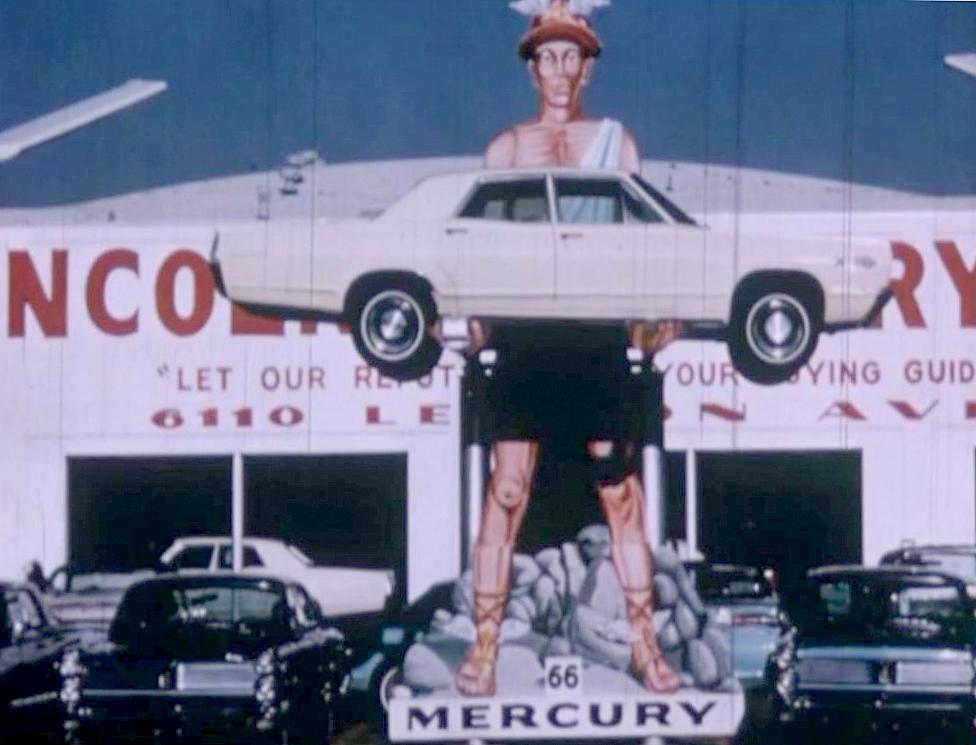
mercury-dealership-6110-lemmon_wallsDallasites love their cars…. (photo from “The Walls Are Rising”/AIA Dallas)

by Paula Bosse

Late last year I stumbled across mention of a 1967 film about Dallas called “The Walls Are Rising.” It was made by the American Institute of Architects, Dallas Chapter, and was sponsored by the Greater Dallas Planning Council as a sort of warning to the people of Dallas about the dangers of auto-centric sprawl and uncontrolled urban planning. I searched and searched for the whereabouts of the film, but it seemed to have disappeared without a trace. I contacted AIA Dallas, and after much searching, they found the film, still on an old reel. They digitized the film and screened it before a large and enthusiastic crowd in January, and after viewing the film and listening to a panel discussion, audience members launched into a lively and concerned discussion about the state of Dallas today. It turns out that most of the topics of grave concern in 1967 continue to be topics of grave concern today, almost 50 years later.

AIA Dallas has uploaded the 27-minute film to Vimeo, and it is now available for all to watch online. Made to emphasize the dangers of out-of-control urban blight brought on by an over-reliance on automobiles, a lack of green spaces, and depressing expanses of visual clutter, the film is a sardonic look at a claustrophobically “modern” Dallas. It’s a hip documentary — absolutely a product of its era — made by a filmmaker with avant-garde tendencies; imagine what an industrial film would have been like had it been made by “with-it” ad men who were given free-rein to get their message across (and who may have indulged in illicit substances during the editing phase). Not as weird as the film itself (though still plenty weird) are some of the proposals from architects and planners on ways to improve the city’s “livability.”

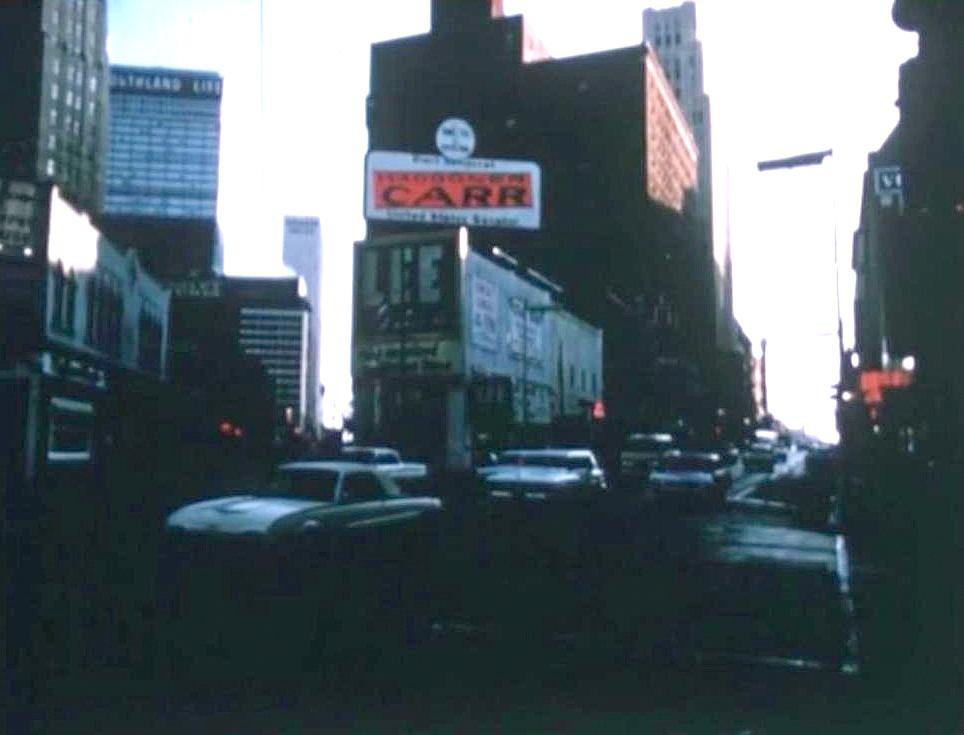
Best of all, though, are all the photos of the city. It’s great being able to hit “pause” and take a look at each and every 1967 photo of Dallas, from a jam-packed downtown, to a cluttered Oak Lawn, to a serene Turtle Creek.

Thanks again to AIA Dallas for finding the film and uploading this weird little slice of Dallas history!

The Walls are Rising from AIA Dallas on Vimeo.

*

A few screengrabs (click for larger images):

oak-lawn_jays_esquire_walls

lee-optical_walls

sterling_walls-are-rising_1967

night_parking

state-fair-2_walls

turtle_turtle-creek_walls

***

Sources & Notes

The video can be found on Vimeo here.

All photos by Ronald Perryman, from his film “The Walls Are Rising” (1967), “produced by Greater Dallas Planning Council in collaboration with Dallas Chapter of American Institute of Architects.”

The AIA Dallas website is here.

Robert Wilonsky’s Dallas Morning News blog post (May 21, 2015) on the uploading of this film is here.

My previous posts on “The Walls Are Rising” can be found here.

*

Copyright © 2015 Paula Bosse. All Rights Reserved.
A Proposed Trinity River Boulevard Connecting Dallas and Fort Worth — 1924

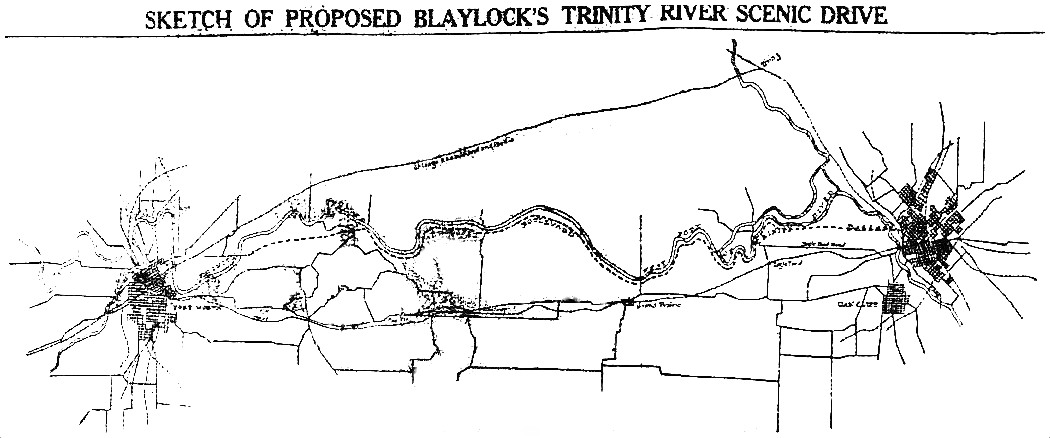
trinity-river-scenic-drive_dmn-110224The mayor’s plan for a scenic highway… (click for larger image)

by Paula Bosse

In 1924, Dallas Mayor Louis Blaylock proposed a new route between Dallas and Fort Worth which would closely follow the course of the Trinity River. Not only would this new road relieve congestion of the highway already in heavy use by trucks, business vehicles, and “speeding jitneys,” but it would also provide a more sedate and scenic thoroughfare, intended for use by the citizens of Dallas, Fort Worth, and the mid-cities who enjoyed taking their “pleasure vehicles” out for a stress-free Sunday drive.

The following text and the above chart appeared in The Dallas Morning News on Nov. 2, 1924:

Sketch of Proposed Blaylock’s Trinity River Scenic Drive

Mayor Louis Blaylock’s proposed scenic highway between Dallas and Fort Worth would follow the course of the West Fork of the Trinity River between the two cities. The above sketch was made in the office of E. A. Kingsley, city engineer of Dallas.

Last week the Dallas Mayor advanced the suggestion that the “necessary new road to Fort Worth” be planned along these lines. Both Mayor Blaylock and Mayor Willard Burton of Fort Worth have offered $5,000 each toward the new enterprise if nine other citizens in both places donate like sums.

Mayor Blaylock said Saturday that such a project would be impracticable without adequate flood control, and when the matter reaches the conference stage around Jan. 1 a system of locks, dams and levees will be discussed. A boat canal between Dallas and Fort Worth and an irrigation system for the intermediate farming country are among the possibilities, said Mayor Blaylock.

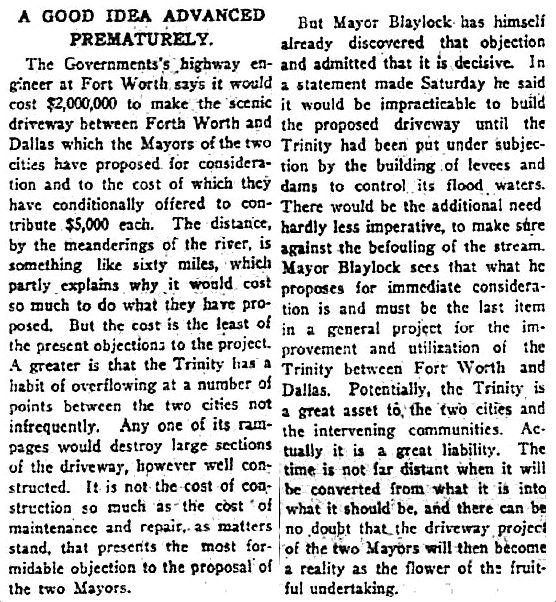
A few days earlier, a sarcastic editorial about the plan (in which the Dallas mayor’s name was misspelled throughout) appeared in The Fort Worth Star-Telegram (click for larger image):

trinity-highway_FWST_102924FWST, Oct. 29, 1924

Even though Dallas and Fort Worth had long engaged in a (mostly) friendly rivalry, it was Fort Worth’s mayor, Willard Burton, who, rather surprisingly, stepped up to offer financial support for the Dallas mayor’s plan. Saying that it was unfair to further burden the taxpayers, he chipped in $5,000 toward the funding of the new road and suggested that he could persuade nine other civic-minded Fort Worthians to do the same. Blaylock may have been forced by mayoral peer pressure to dig deep and follow suit, but he also pledged $5,000 and said he’d get nine flush Dallasites to fork over five thou, too.

trinity-highway_dmn_103124DMN, Oct. 31, 1924

I’m not sure how either thought a 60-mile road could be built between Dallas and Fort Worth for only $100,000 (slightly less than 1.5 million dollars in today’s money). As it turned out, it couldn’t. An engineer with the U.S. Bureau of Roads estimated it would cost closer to $2,000,000 (about 27.5 million dollars in today’s money — a veritable BARGAIN!).

trinity-highway_dmn_110124-costDMN, Nov. 1, 1924

In less than a week of giddy conversations about the Trinity River fantasy boulevard, the plan was pretty much dead when everyone accepted the fact that it was not economically feasible.

trinity-highway_dmn_110424DMN, Nov. 4, 1924

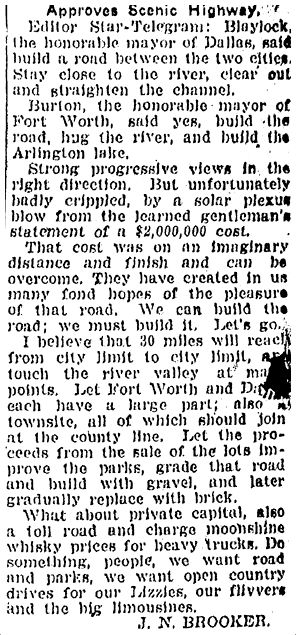
There must have been many sad souls in Dallas in the fall of 1924. But some still insisted it could be built and should be built. Prominent Fort Worth resident J. N. Brooker wrote an impassioned letter to the Star-Telegram, with a few helpful suggestions:

scenic-drive_FWST_112124FWST, Nov. 21, 1924

A toll road that charges “moonshine whiskey prices” — there you go!

***

Sources & Notes

Top image from The Dallas Morning News, Nov. 2, 1924 (apologies for the poor resolution!).

More on Mayor Louis Blaylock (1849-1932) from The Handbook of Texas, here.

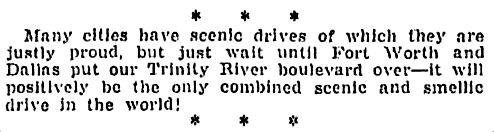
Lastly, a couple of amusing snide remarks from the pages of Amon Carter’s Fort Worth Star-Telegram:

scenic-drive_FWST_110324FWST, Nov. 3, 1924

scenic-drive_FWST_111124FWST, Nov. 11, 1924

Most images larger when clicked.

*

Copyright © 2015 Paula Bosse. All Rights Reserved.

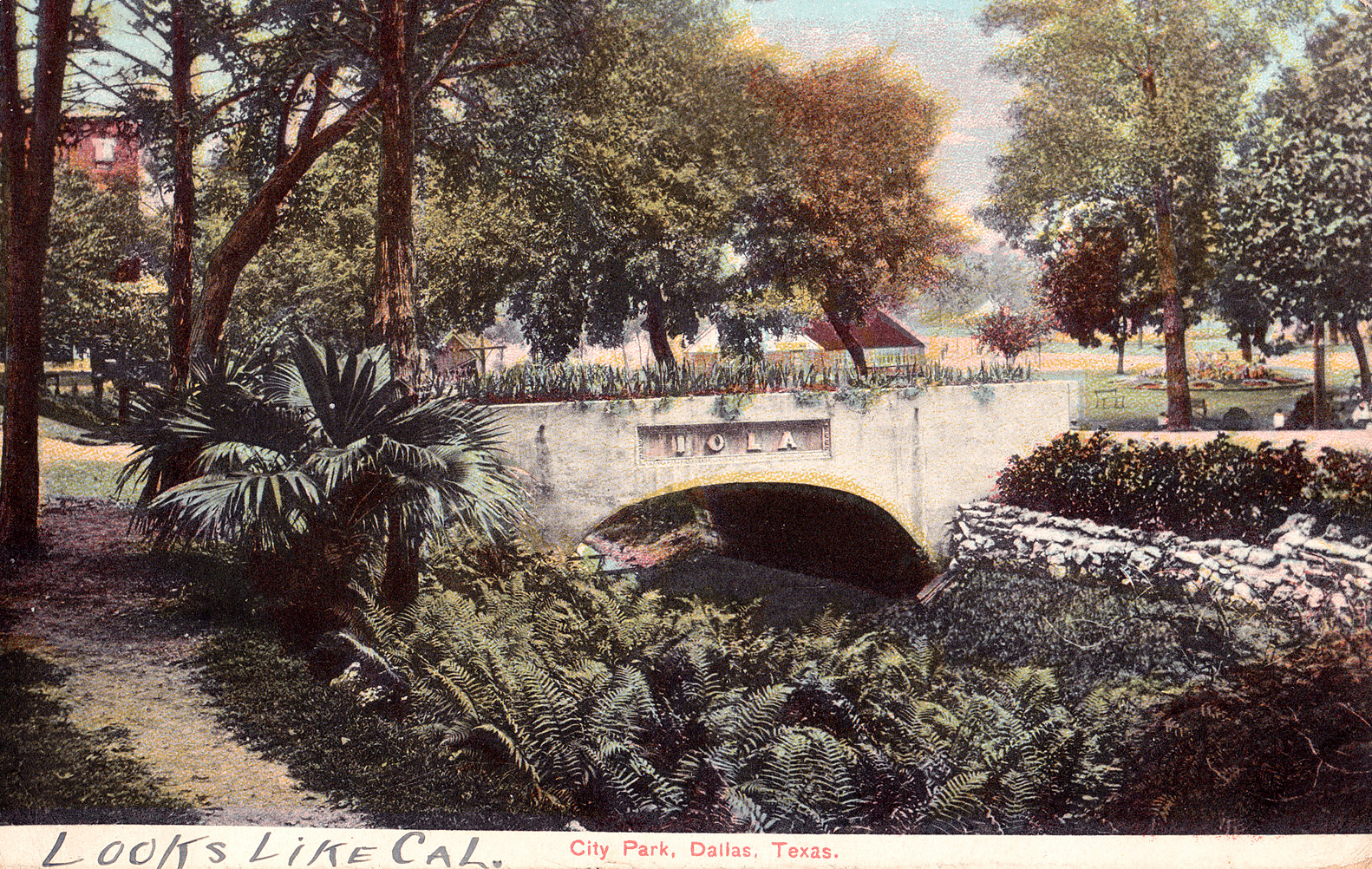
Iola Bridge

iola-bridge_city-park_ca-1908“Looks like California…” — City Park, ca. 1908

by Paula Bosse

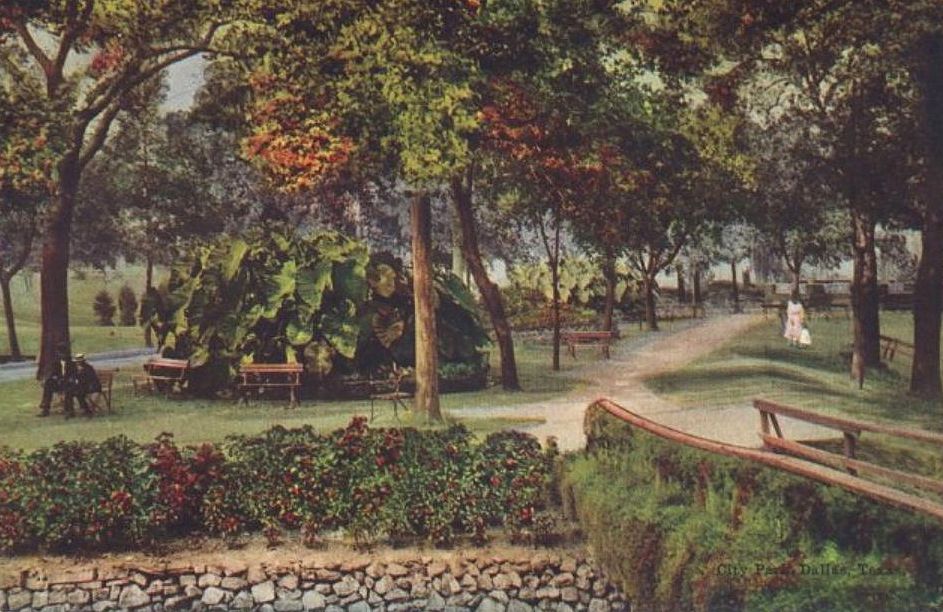
Old postcards of (Old) City Park always seem kind of mysterious to me. I’m fascinated by photos of what was, for many years, Dallas’ only park. It was very big and beautifully landscaped — and it was one of the things about the city that those of earlier generations were most proud of. The postcard views above and below are from the early days of the twentieth century, and, sadly, those views don’t exist anymore — it’s hard to believe they EVER existed here. Even though there’s a hint of what you might see at Reverchon Park, there’s little else about these images that looks like the Dallas of today. What a shame!

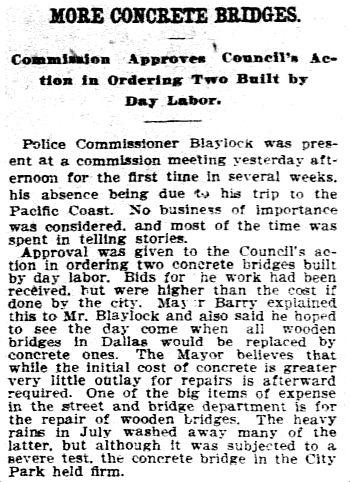
But what’s the story behind the attractive little “Iola” bridge? Built in 1905, it was, apparently, Dallas’ first (or possibly second) concrete bridge. The Iola bridge was far sturdier than the wooden bridges around Dallas, and a concrete bridge also required very little upkeep. In fact, this little bridge “of ornamental design” is actually kind of important — it was often cited by city planners and commissioners when discussing the construction of future bridges around the city.

concrete-bridges_dmn_081005Dallas Morning News, Aug. 10, 1905

It seems wooden bridges were being washed away almost as often as Dallas courthouses were burning down. In a letter that appeared in The News on Feb. 21, 1911, it was noted that, while wooden bridges were “under constant repair,” the concrete Iola bridge “has not required one dollar of outlay […] during its six years of existence.” So … cheaper and sturdier. Bye-bye, wooden bridges!

But “Iola”… where did that name come from? I thought it might have been the name of a wife or mother of a mayor or planner, but I suspect it was merely the name of the company that donated the cement for the bridge’s construction, the Iola Portland Cement Company. The company’s canny “civic donation” ultimately paid off BIG for them in the end. Not only did they supply the cement to build that first very pretty little bridge in a very pretty park, they also, ultimately, got whopping new orders from the city for all those new concrete bridges that began to be built — including, less than ten years later (when the Iola company’s West Dallas plant had been sold to the TEXAS Portland Cement Co.), the Trinity River-spanning Oak Cliff/Houston Street viaduct, which, when it opened in 1912, was the longest concrete bridge in the WORLD! And it all began with that unassuming bridge in scenic City Park, just south of the central business district.

*

iola-bridge_watermelon-kid

iola-bridge_dmn_100921aDMN, 1921

Below, a couple of views showing the charming and rather more rustic wooden bridges in the park.

bridge_city-park_watermelon-kid

wooden-bridges_city-park_watermelon-kid

iola-cement_directory-1905Ad from the 1905 Dallas directory

***

Sources & Notes

Top postcard found somewhere on the internet. All other postcards from The Watermelon Kid — here.

Black and white photo by Victor H. Schoffelmayer appeared in The Dallas Morning News on Oct. 9, 1921; it was one of several photographs of the Iola bridge, taken by members of the Dallas Camera Club.

A Dallas Morning News article from July 14, 1905 detailing the new improvements to City Park (including the concrete bridge) can be read here. (I don’t think the really wonderful-sounding “cascade” was ever built — and that’s a pity, because it sounds like it would have been beautiful!)

*

Copyright © 2015 Paula Bosse. All Rights Reserved.
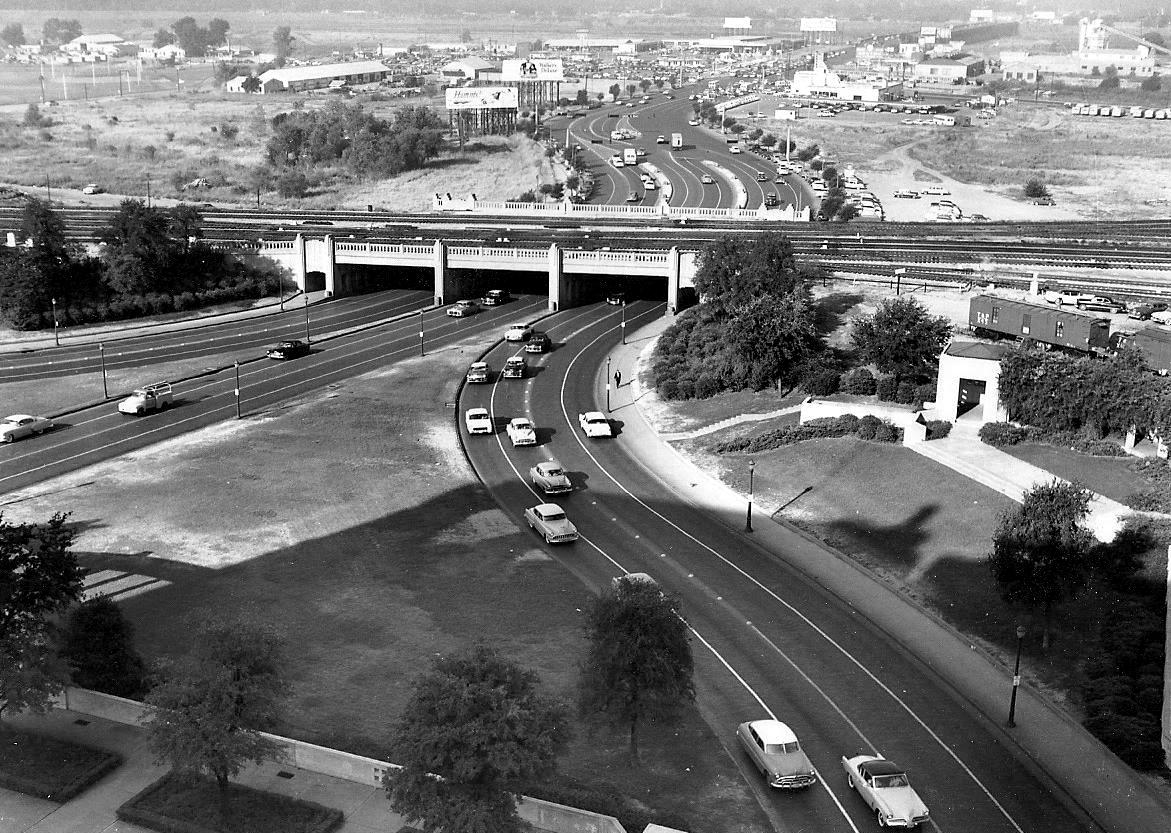
Triple Underpass — 1950s

triple-underpass_1950sComing and going…

by Paula Bosse

A view toward Oak Cliff, back before the words “triple underpass” began to be capitalized.

I LOVE this photo.

Check out this same view from about 1936 here.

***

Sources & Notes

Photo found here (along with other JFK-related photos of Dealey Plaza).

*

Copyright © 2015 Paula Bosse. All Rights Reserved.

Interurbans: Freight Movers?

People-mover, above; freight-mover, below…

by Paula Bosse

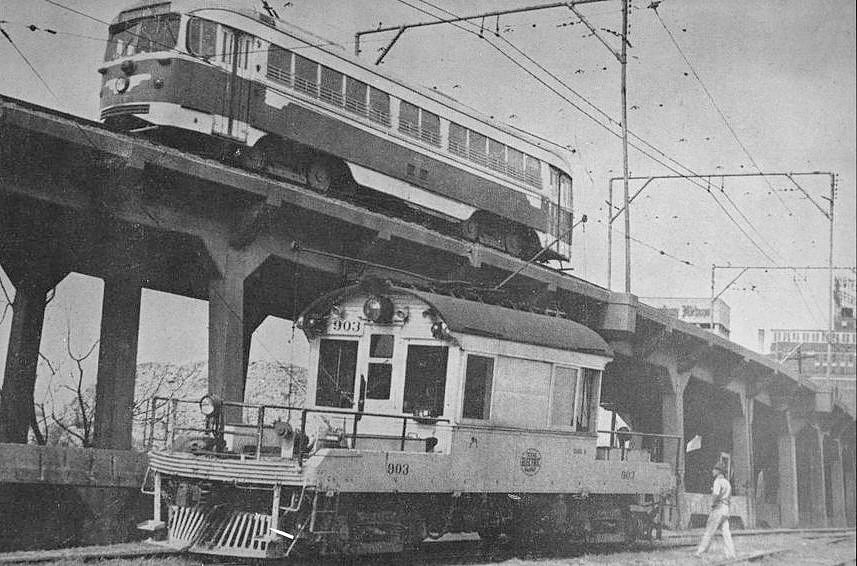
When I saw this photo, I had no idea what I was looking at — what was that odd-looking thing in the foreground? A couple of rail enthusiasts informed me that it was an interurban freight engine on rail tracks beneath the old elevated interurban/streetcar trestle that spanned the Trinity. This is the Dallas side, with the Dallas Morning News building and the Hotel Jefferson in the background, to the north. (You can see the tracks running right next to the DMN in a photo in a previous post, here.) According to one of the experts:

The interurban did some exchange of freight cars with the regular railroads and the exchange tracks were under the streetcar/interurban viaduct. This track merged with the streetcar tracks at the foot of the viaduct right next to the DMN.

The interurban, though primarily a mover of people, also hauled freight. With more than 200 miles of track across North Texas, the Texas Electric Railway was the largest interurban railway operator in the South. But its glory days were starting to wane as the popularity of automobiles increased. By the ’20s, freight-moving was added to the company’s services, generating welcomed revenue.

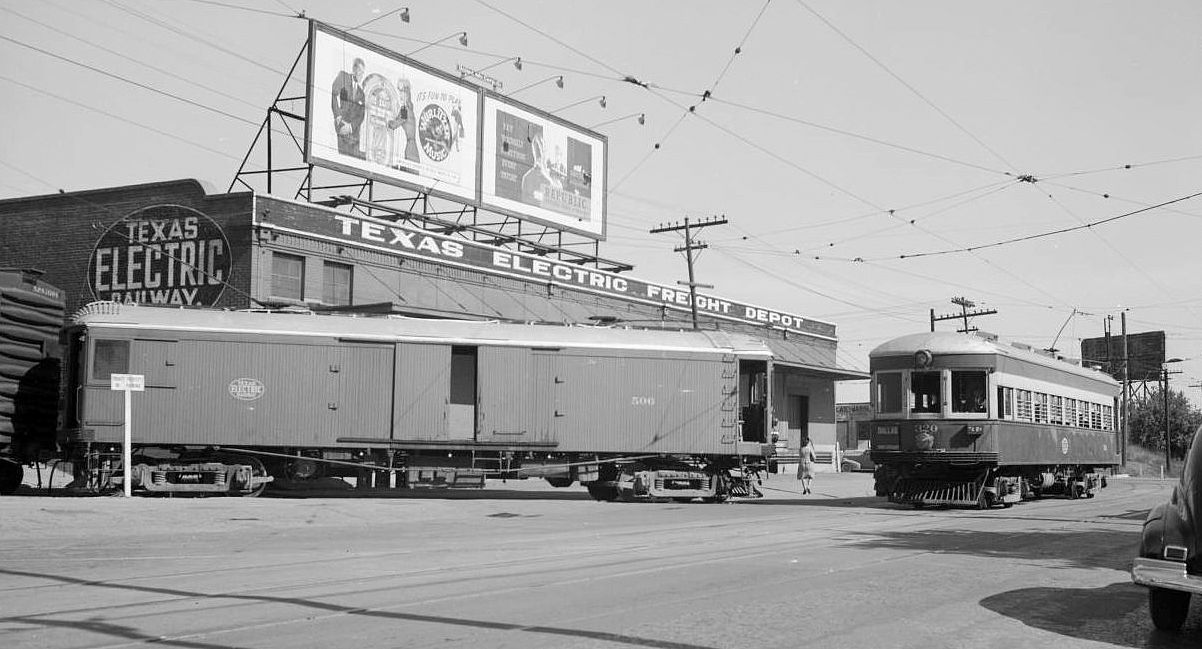
The interurban freight depot — seen below in 1946 — was located just east of Ferris Plaza. At the left, part of a railroad freight car is visible, in the middle, an interurban freight car, at the right, an interurban (passenger) streetcar, and at the far right, an automobile. And some crazy person walking.

freight_interurban_denver-pub-lib_1946

But the automobile eventually proved too popular, and more and more people began using trucks for hauling. After 40 years in business, the Texas Electric Railway interurban ceased operations in 1948.

*

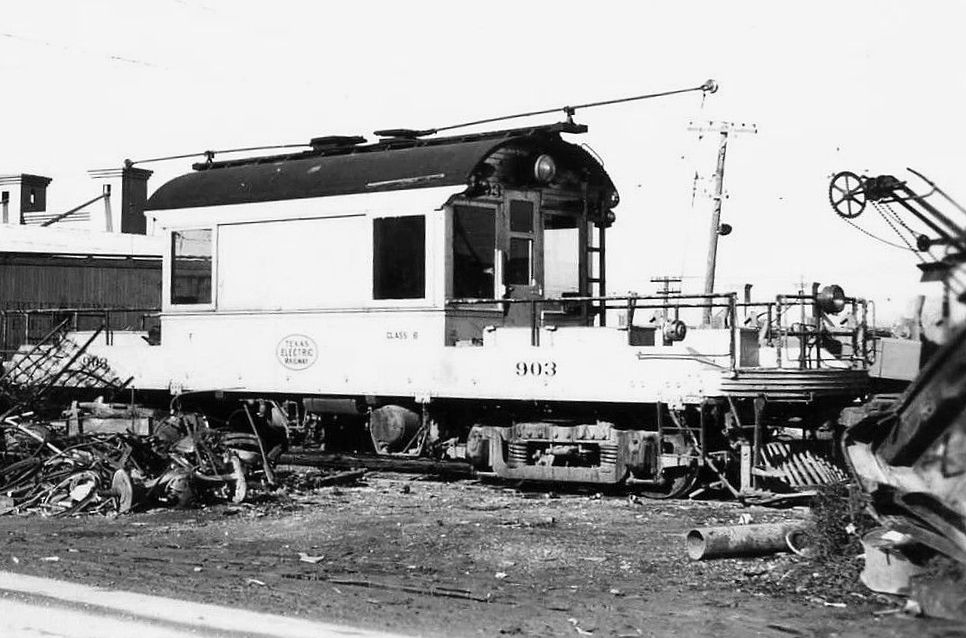
When searching around for possible other images of engine 903 (as seen in the top photo), I found it hanging out over on eBay — described as being in the “Waco car house yards” in 1944. Small world.

engine-903_ebay

***

Sources & Notes

Top image found on Flickr.

Photo of the freight depot taken by Robert W. Richardson on April 27, 1946; from the Western History/Genealogy Dept., Denver Public Library.

Bottom photo (cropped) from eBay..

Interurban freight operation Wikipedia entry here.

Texas Electric Railway: Handbook of Texas entry here; Wikipedia entry here.

MANY photos of various Texas Electric Railway freight motors and locomotives, here.

And, lastly, great photos from around Dallas in CERA’s “Texas Electric and the Journey to DART,” here.

(Thanks to Bob J. and Robert P. for their helpful info!)

*

Copyright © 2014 Paula Bosse. All Rights Reserved.

Urban Crisis: “The Walls Are Rising” — 1967

walls_lake_1967
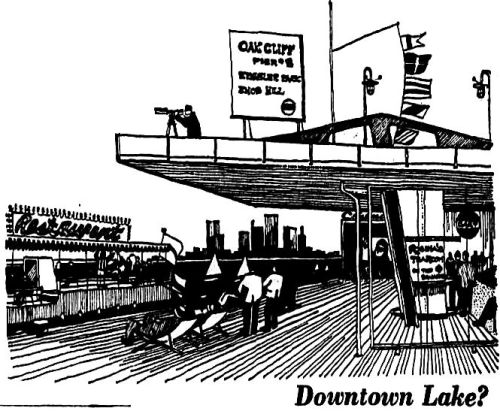
Oak Cliff Pier? Just one part of Dallas’ urban future as envisioned in 1967…

by Paula Bosse

In 1967, the Dallas chapter of the American Institute of Architects unveiled a project it had been working on under the sponsorship of the Greater Dallas Planning Council for over a year — a 40-minute color slide presentation with recorded narration called “The Walls are Rising,” directed by writer-photographer Ron Perryman of Austin. Enslie “Bud” Oglesby — one of Dallas’ top architects and the chairman of the committee behind the project — said of the film:

I saw here an opportunity to demonstrate the problems which poor planning bring and the results that can come from a sound, unified planning program…. (Fort Worth Star-Telegram, June 18, 1967)

The rather more urgent tone of the brochure that accompanied the film was a bit more dire:

We cannot afford to lose any more time in developing a coordinated plan to make Dallas a more beautiful and effective city, for all around us the walls are rising, the city is being built… We are designing by default instead of summoning our vitality, wealth resources, talents and human vision to create a design plan that will give Dallas quality and character all its own.

The goal of the project was to create awareness among city officials, planners, and designers (as well as among the public) of the immediate need to address the conscious physical design of the city in order to improve its future “livability.” The argument was that the city of Dallas was, in 1967, an unplanned and uncoordinated chaotic urban environment dominated by (and practically strangled by) the automobile; it was overwhelmed by traffic, noise, and visual clutter, and it lacked much-needed green spaces and personal “refuges.”

It was stressed that the film was not a plan, per se, but was, instead, an outline of suggestions that the AIA and the Greater Dallas Planning Council were proffering for discussion (and, one assumes, hoping would be implemented). Among their suggestions were the following (some of which have been adopted, but many of which have been “on the table” for decades now and which Dallas leaders continue to debate):

  • A 6-mile hike-and-bike trail from Turtle Creek to Reverchon Park
  • A rapid transit system (the report stressed that it would be urgently needed by 1980)
  • The creation of downtown parks
  • The development of downtown apartment housing
  • A centralized transportation hub (bus, rail, air)
  • The reduction in noise, visual clutter, and traffic
  • More “sensitive” freeway planning, which should be designed (or re-designed) for the driver and not for the automobile
  • More awareness of the pedestrian in designing downtown and neighborhood streets, especially in regard to safety and accessibility
  • Development of, yes, the Trinity River and its levees, including a downtown lake and sailboat-dotted marina, with apartments and a variety of entertainment and shopping venues lining the “shore”
  • And, most unexpectedly, a “scenic link” which would connect Fair Park to the Dallas Zoo, incorporating a sort of shuttle service between the two locations (and across the Trinity) via an elevated gondola ride (!)

As fun and fanciful as fresh ideas on getting to Oak Cliff are, the film seems to have been more of a warning of what the city’s future might be if it continued down its then-current path of … having basically no plan at all. The film started off by assaulting the viewer’s senses with several minutes of “blaring, cacophonous music” and a rush of chaotic images — and opened with the ominous words, “We are living in an accident.” The League of Women Voters issued a report in 1968 called “Crisis: The Condition of the American City” in which they described “The Walls Are Rising” as “a horror film.”

What sounds a bit like a sophisticated A/V presentation was screened for dozens and dozens and dozens of groups in the Dallas area between 1967 and about 1972: it was shown to various Chambers of Commerce, Rotary, Kiwanis, and Lions clubs, women’s groups, church groups, business groups, arts organizations, and on and on and on. The film would usually be introduced by an architect who would also lead a discussion and answer questions afterward. If you were a member of a civic or professional group in the late ’60s, chances are pretty good you saw “The Walls Are Rising.”

Which is why it’s so surprising that all traces of the film seem to have vanished in the intervening years. I contacted the Dallas Municipal Archives, the Texas/Dallas History & Archives Division of the Dallas Public Library, AIA Dallas, and Dallas Center for Architecture. Everyone was very helpful, but … nothing. Designs for Dallas and the later Goals for Dallas are better known projects, but it seems that there would be something connected with this film lying around somewhere. I’d love to see it. It sounds like it would be entertaining and informative … and depressing. We’ve come so far. …We haven’t come far at all.

**

walls_FWST_061867Fort Worth Star-Telegram, June 18, 1967 (click for larger image)

***

Sources & Notes

“The Walls Are Rising” was introduced to the Dallas public in Dorothie Erwin’s article, “A Design for Dallas Proposed,” which ran in the Feb. 12, 1967 edition of The Dallas Morning News. Additional descriptions of the film can be found in the article “A Courageous Look at Today’s City” by Larry Howell (DMN, May 3, 1968).

*

UPDATE: Jan. 9, 2015 — Great news! AIA Dallas has found the film and has scheduled a screening!

  • To read my follow-up post “‘The Walls Are Rising’ — FOUND!” click here.
  • To read Robert Wilonsky’s Dallas Morning News article on the newly-found film, click here.
  • For info on the AIA Dallas screening, click here.

UPDATE: Jan. 20, 2015 — The public screening and panel discussion at the Sixth Floor Museum was great! Read about it here.

UPDATE: May, 22, 2015 — AIA Dallas has digitized and uploaded the film to Vimeo. Watch the complete film here.

*

Copyright © 2014 Paula Bosse. All Rights Reserved.


Union Station’s Empty Backyard — ca. 1920

union-stn_ca1920The western edge of downtown, looking south (click for larger image)

by Paula Bosse

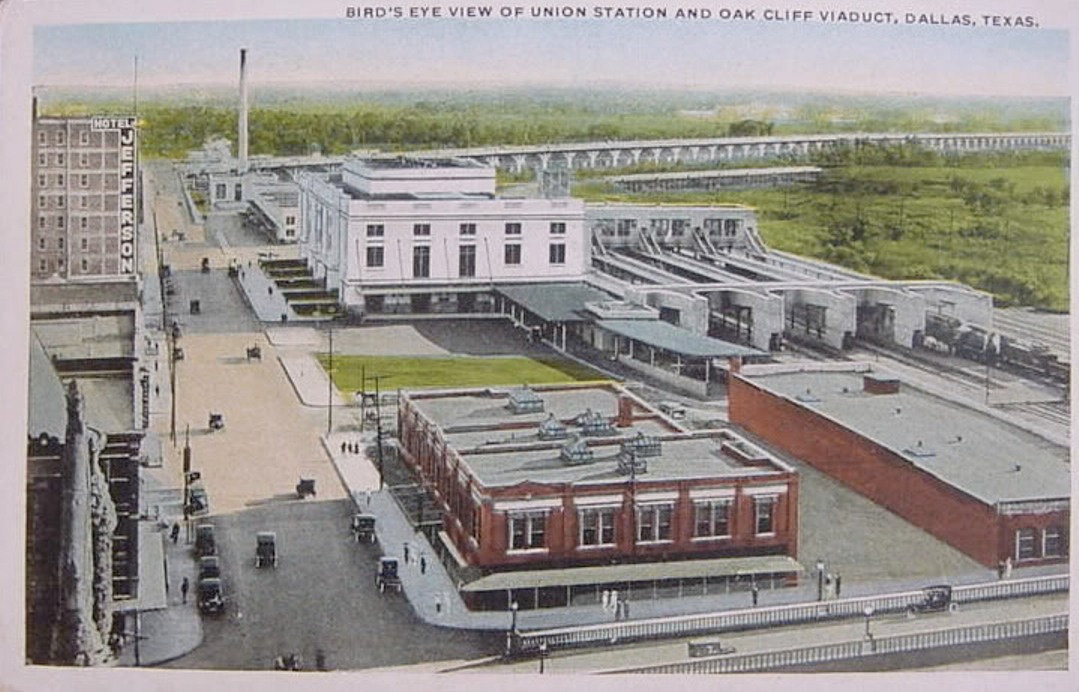
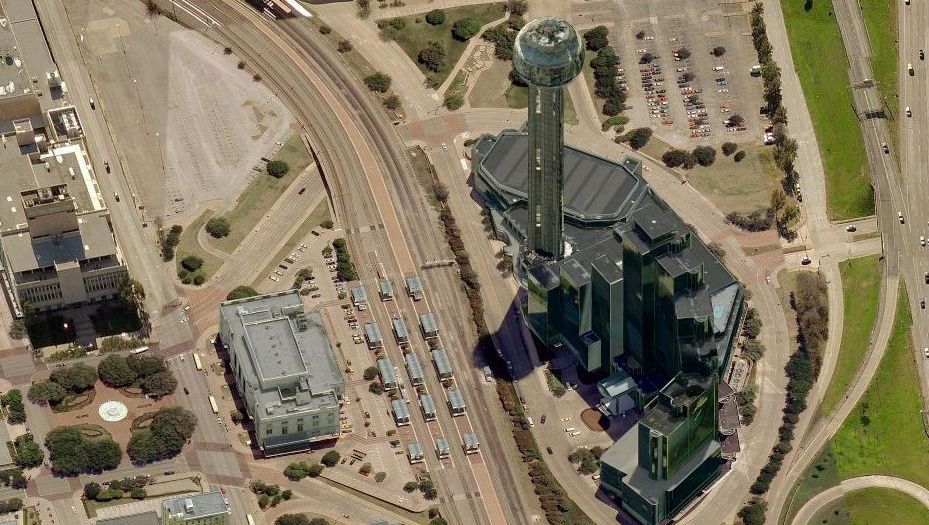
Here’s a postcard view you don’t see that often, Houston Street, looking south, with the Old Red Courthouse at the lower left, the gleaming white Union Station in the upper middle, and the fantastic Houston Street viaduct at the top. It’s a little hard to imagine that sixty-or-so years later, Reunion Tower would be plunked down at the far right of this picture, in that grassy field behind the tracks at Union Station.

union-stn_bing_20014

***

Postcard from the DallasMetropolis.com forum, here (see comment for the very interesting description of what’s what in this image).

Present-day bird’s-eye view from Bing (click for larger image).

*

Copyright © 2014 Paula Bosse. All Rights Reserved.